OCR Media Studies – AS Level
Unit G321: Foundation Portfolio in Media
Planning & Research
Name: Charlie Batcheler
Candidate Number: 1016
Center Name: St. Andrew’s Catholic School
Center Number: 64135
Set Brief - Print
Music Magazine – Production
Preliminary Task Progression and
Planning & Research
Section 1) –
Preliminary Task
Preliminary Task Progression–
Evidence
Front Cover
Step-by-step
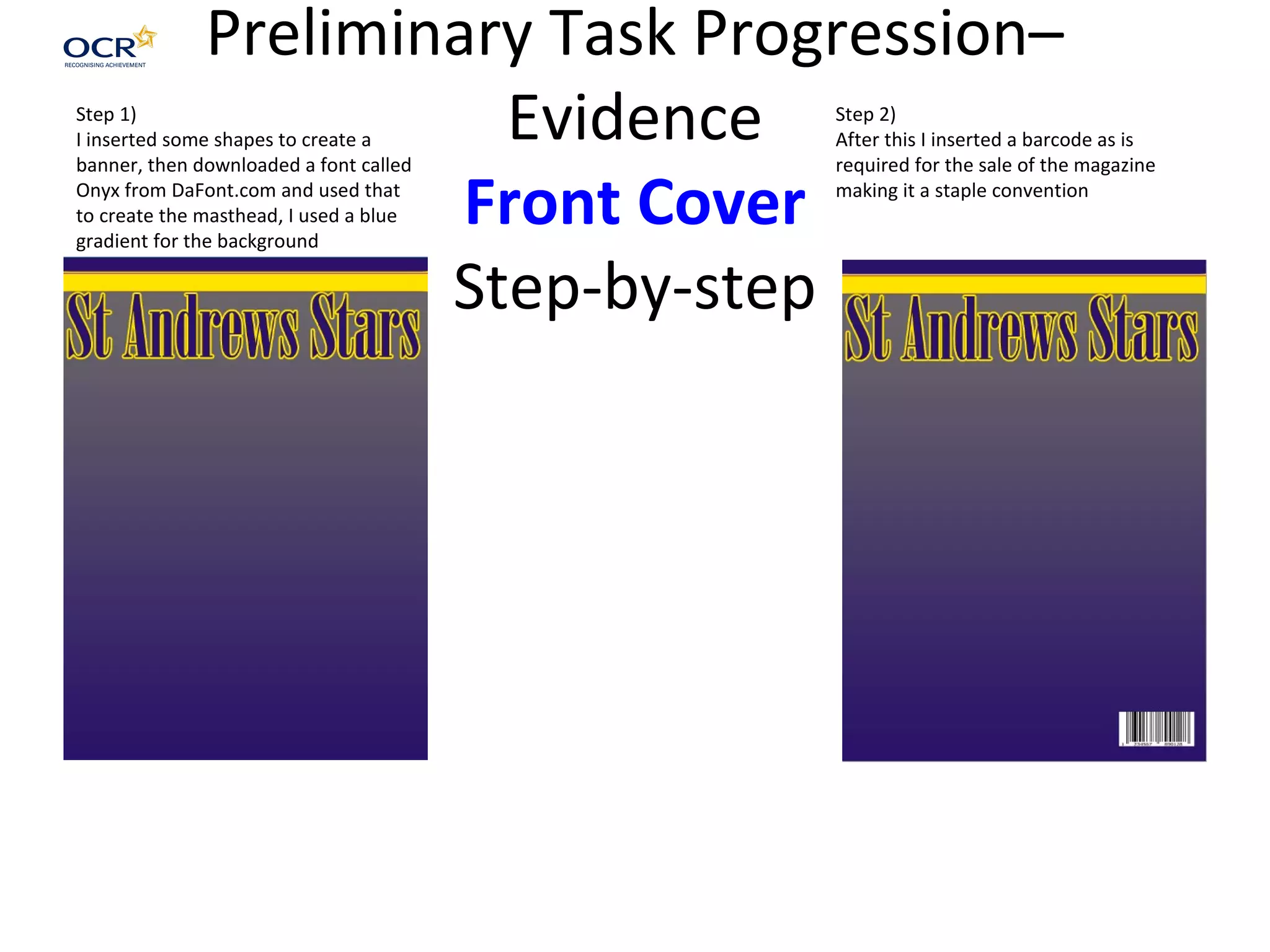
Step 1)
I inserted some shapes to create a
banner, then downloaded a font called
Onyx from DaFont.com and used that
to create the masthead, I used a blue
gradient for the background
Step 2)
After this I inserted a barcode as is
required for the sale of the magazine
making it a staple convention
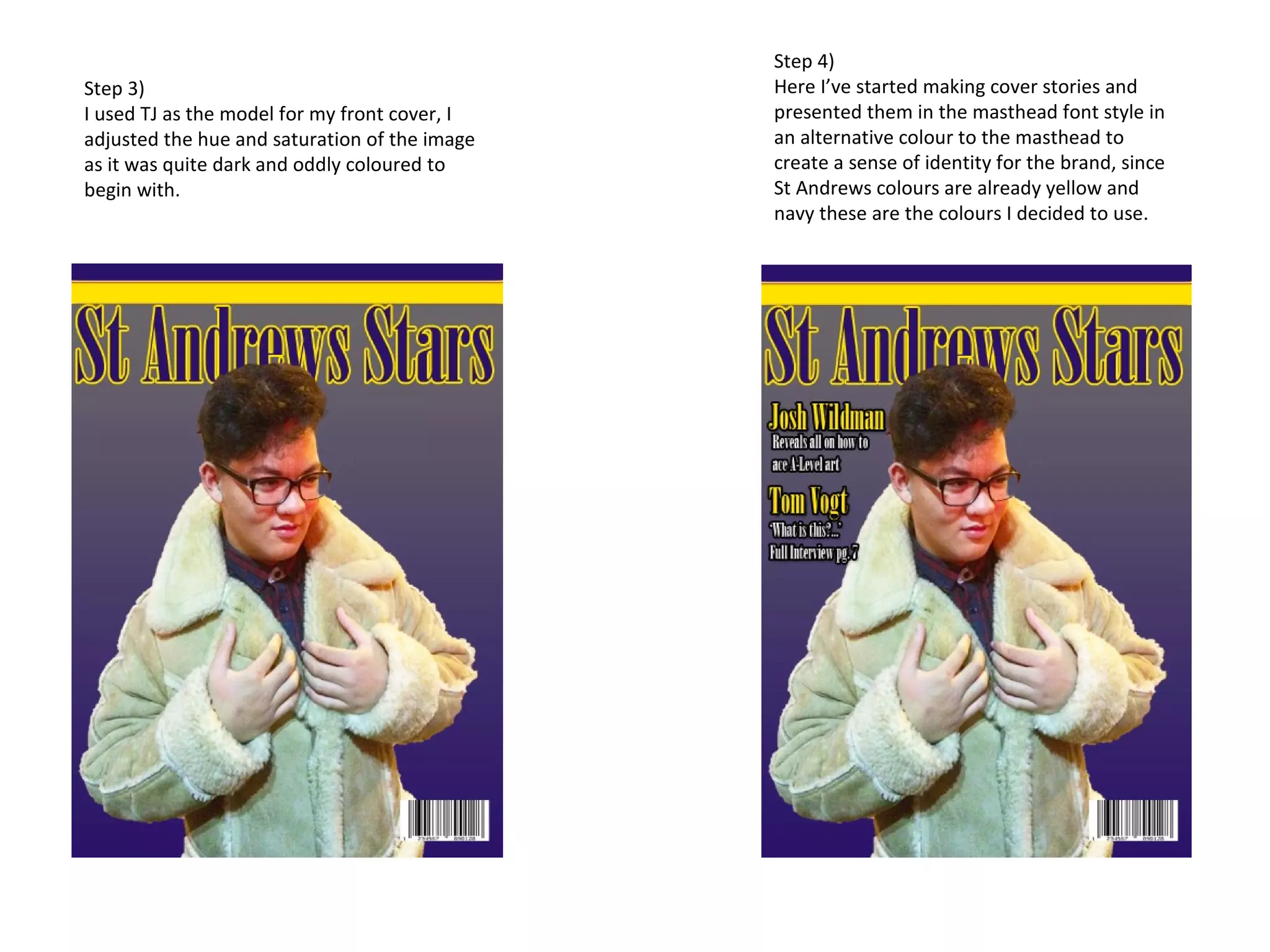
Step 3)
I used TJ as the model for my front cover, I
adjusted the hue and saturation of the image
as it was quite dark and oddly coloured to
begin with.
Step 4)
Here I’ve started making cover stories and
presented them in the masthead font style in
an alternative colour to the masthead to
create a sense of identity for the brand, since
St Andrews colours are already yellow and
navy these are the colours I decided to use.
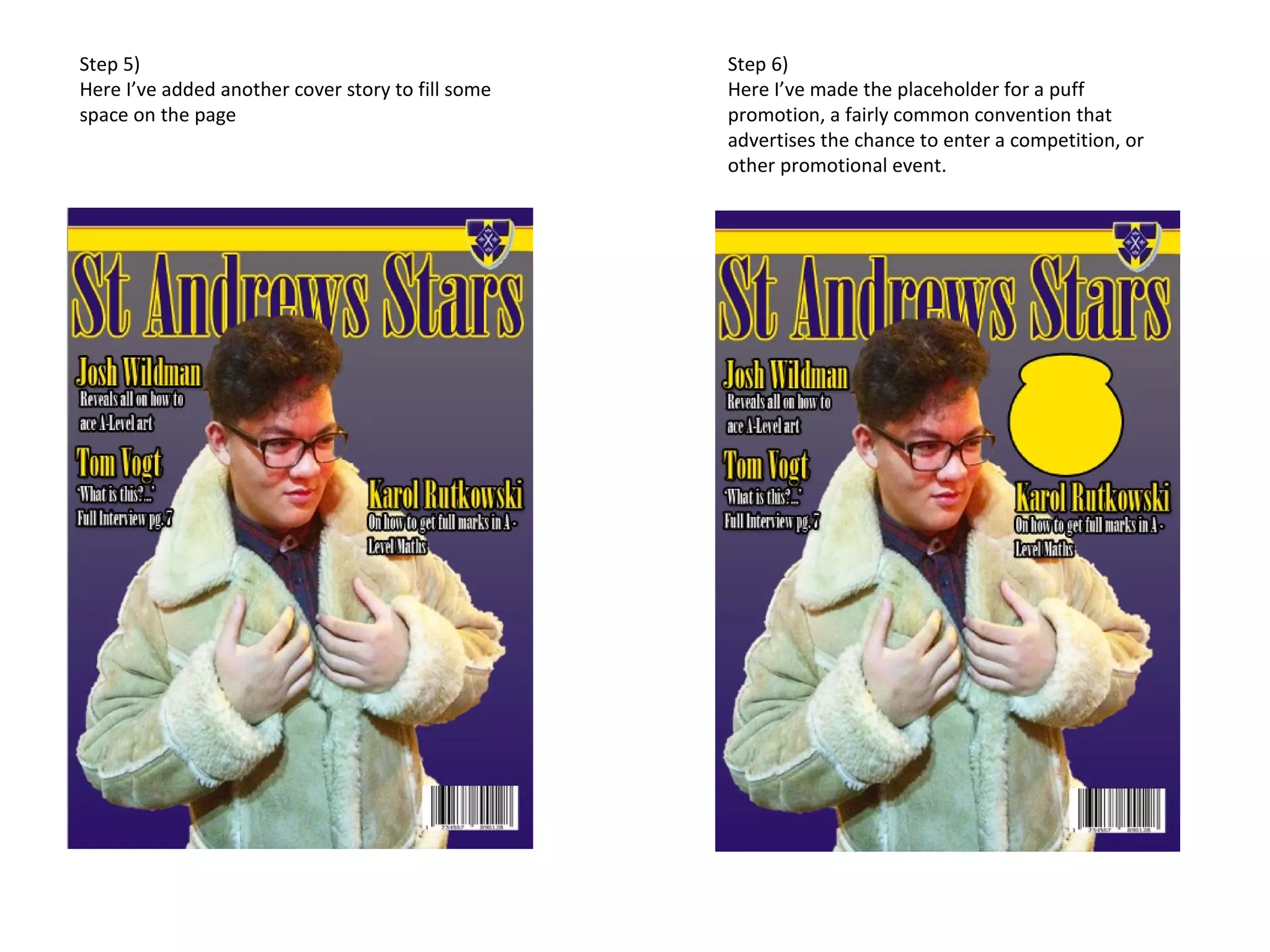
Step 5)
Here I’ve added another cover story to fill some
space on the page
Step 6)
Here I’ve made the placeholder for a puff
promotion, a fairly common convention that
advertises the chance to enter a competition, or
other promotional event.
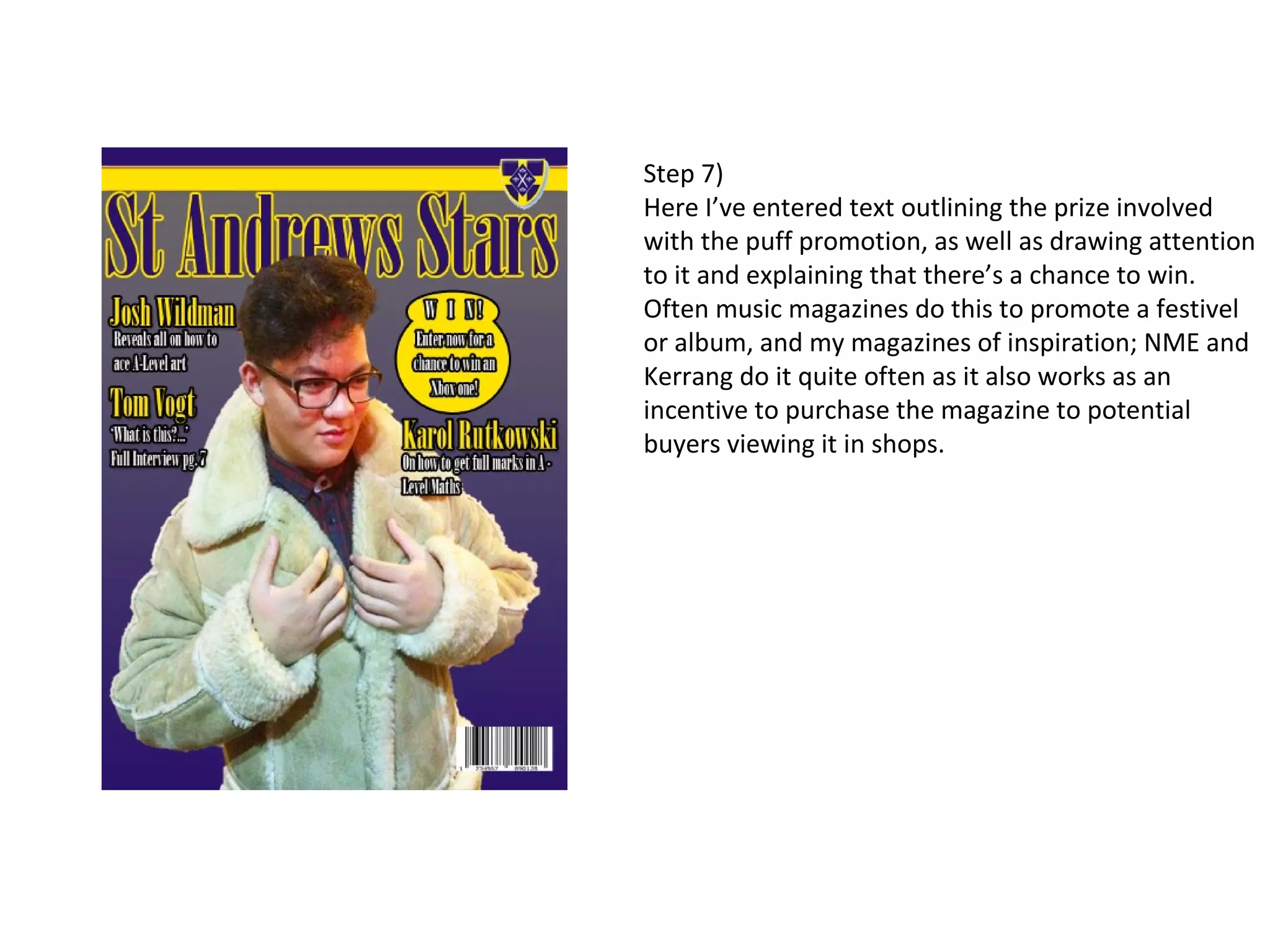
Step 7)
Here I’ve entered text outlining the prize involved
with the puff promotion, as well as drawing attention
to it and explaining that there’s a chance to win.
Often music magazines do this to promote a festivel
or album, and my magazines of inspiration; NME and
Kerrang do it quite often as it also works as an
incentive to purchase the magazine to potential
buyers viewing it in shops.
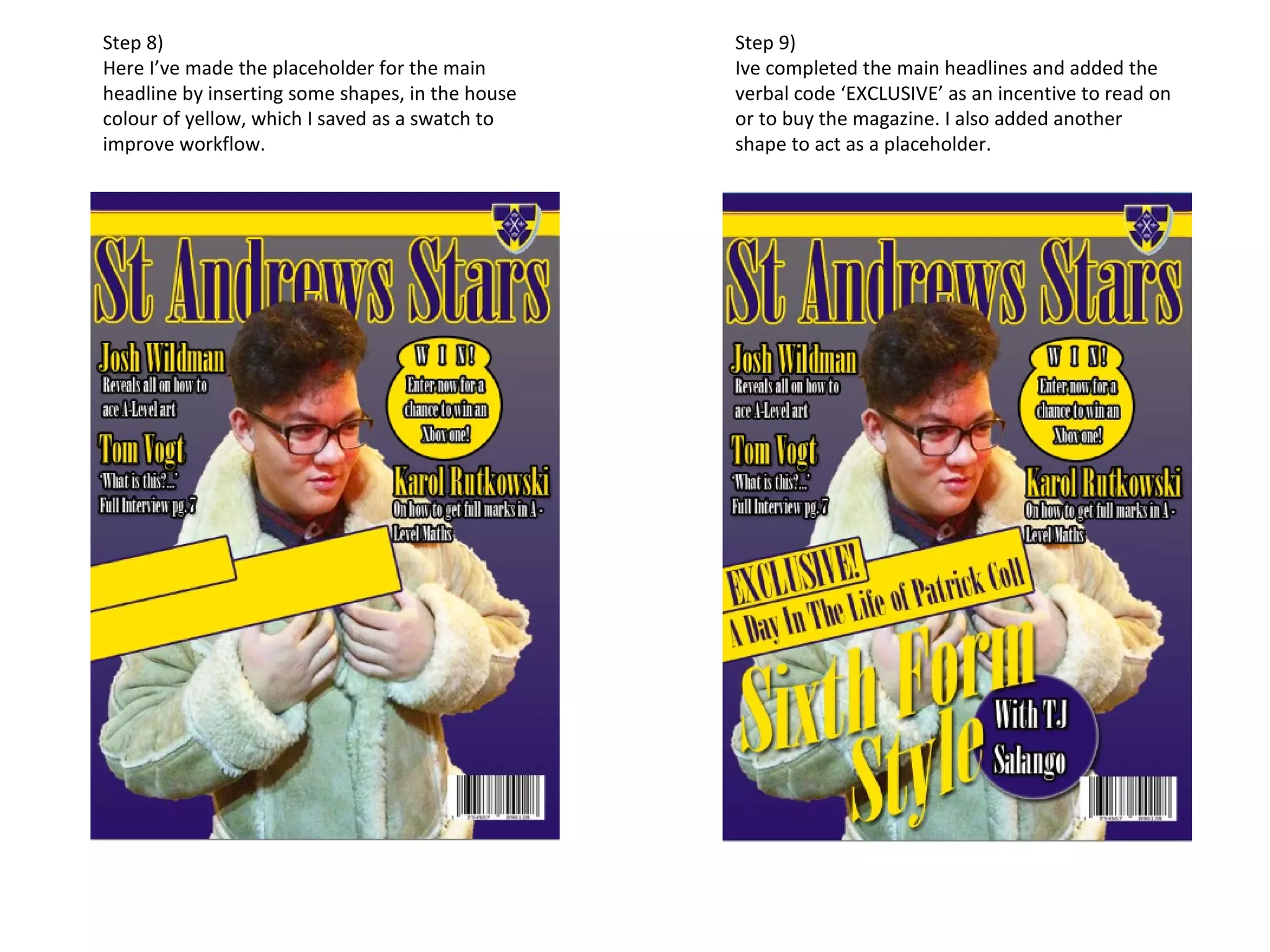
Step 8)
Here I’ve made the placeholder for the main
headline by inserting some shapes, in the house
colour of yellow, which I saved as a swatch to
improve workflow.
Step 9)
Ive completed the main headlines and added the
verbal code ‘EXCLUSIVE’ as an incentive to read on
or to buy the magazine. I also added another
shape to act as a placeholder.
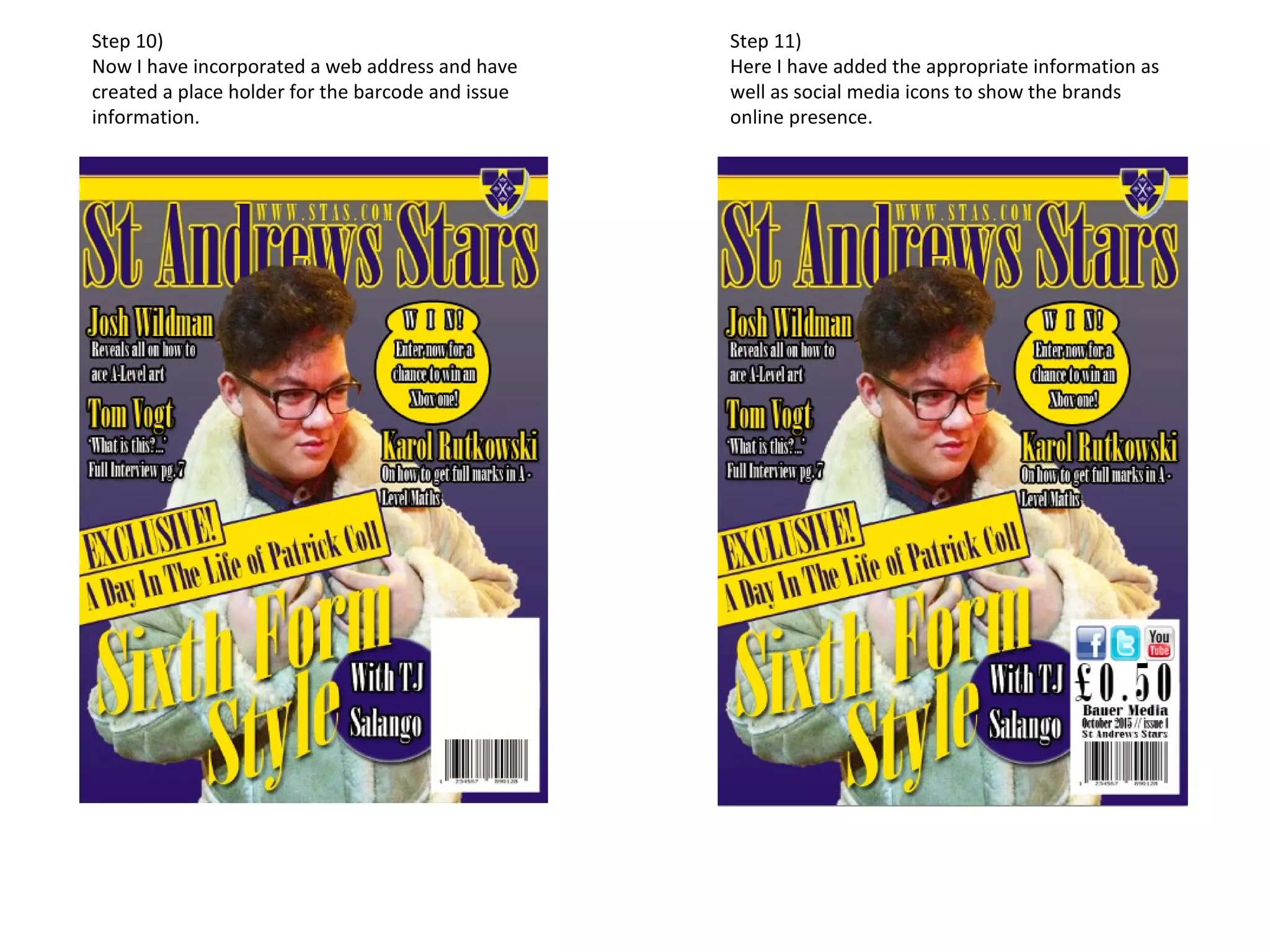
Step 10)
Now I have incorporated a web address and have
created a place holder for the barcode and issue
information.
Step 11)
Here I have added the appropriate information as
well as social media icons to show the brands
online presence.
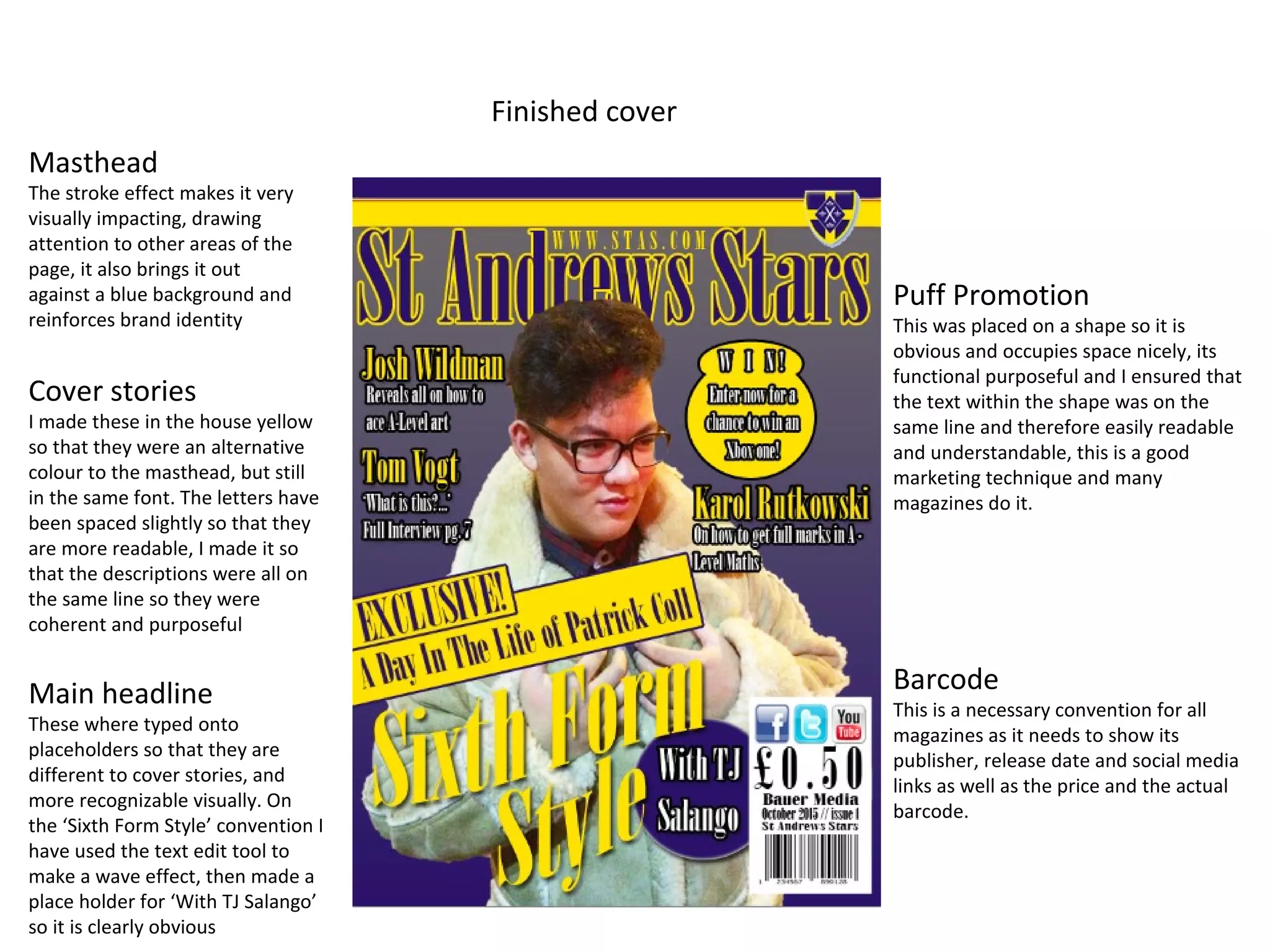
Finished cover
Masthead
The stroke effect makes it very
visually impacting, drawing
attention to other areas of the
page, it also brings it out
against a blue background and
reinforces brand identity
Cover stories
I made these in the house yellow
so that they were an alternative
colour to the masthead, but still
in the same font. The letters have
been spaced slightly so that they
are more readable, I made it so
that the descriptions were all on
the same line so they were
coherent and purposeful
Main headline
These where typed onto
placeholders so that they are
different to cover stories, and
more recognizable visually. On
the ‘Sixth Form Style’ convention I
have used the text edit tool to
make a wave effect, then made a
place holder for ‘With TJ Salango’
so it is clearly obvious
Puff Promotion
This was placed on a shape so it is
obvious and occupies space nicely, its
functional purposeful and I ensured that
the text within the shape was on the
same line and therefore easily readable
and understandable, this is a good
marketing technique and many
magazines do it.
Barcode
This is a necessary convention for all
magazines as it needs to show its
publisher, release date and social media
links as well as the price and the actual
barcode.
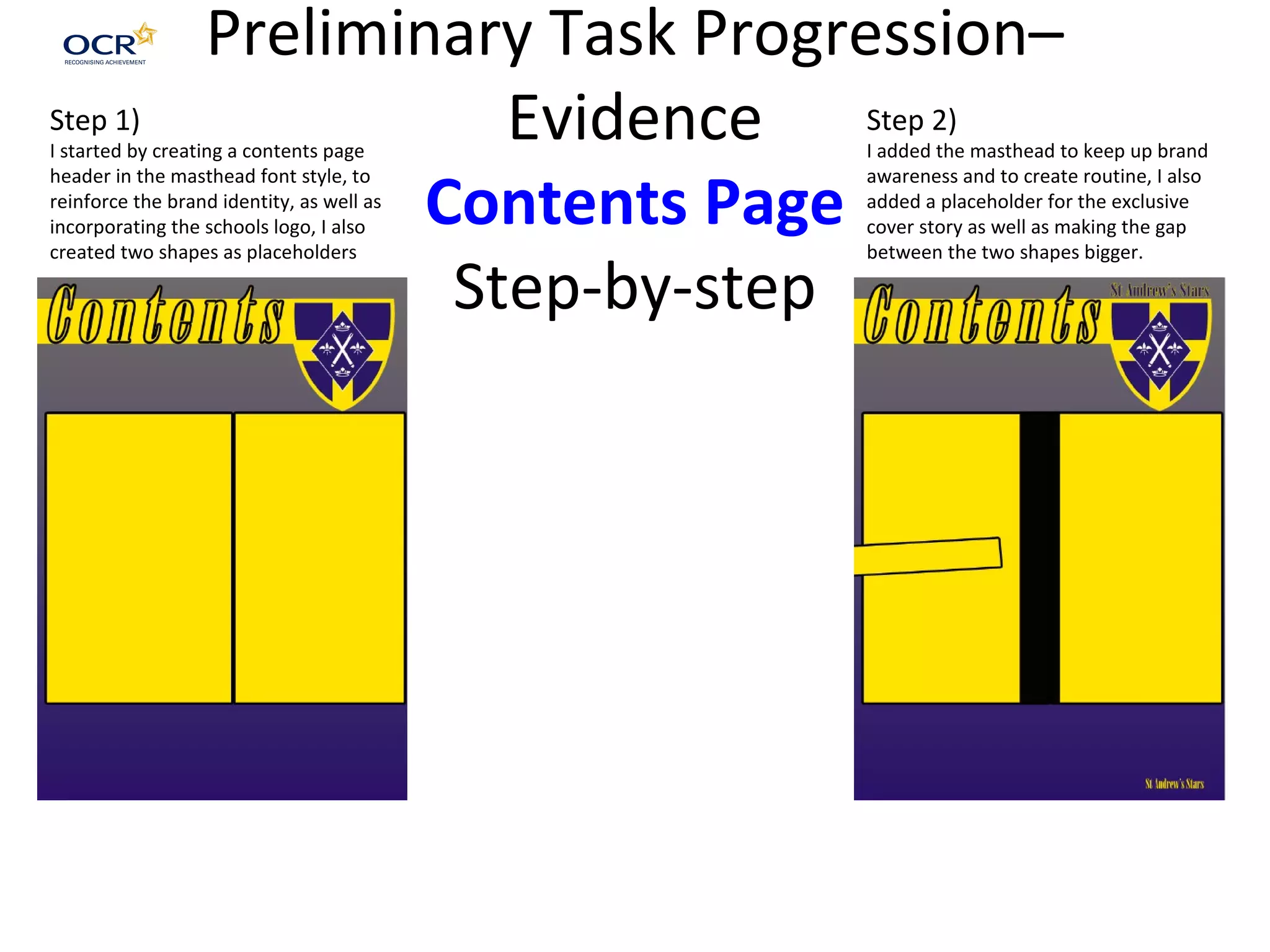
Preliminary Task Progression–
Evidence
Contents Page
Step-by-step
Step 1)
I started by creating a contents page
header in the masthead font style, to
reinforce the brand identity, as well as
incorporating the schools logo, I also
created two shapes as placeholders
Step 2)
I added the masthead to keep up brand
awareness and to create routine, I also
added a placeholder for the exclusive
cover story as well as making the gap
between the two shapes bigger.
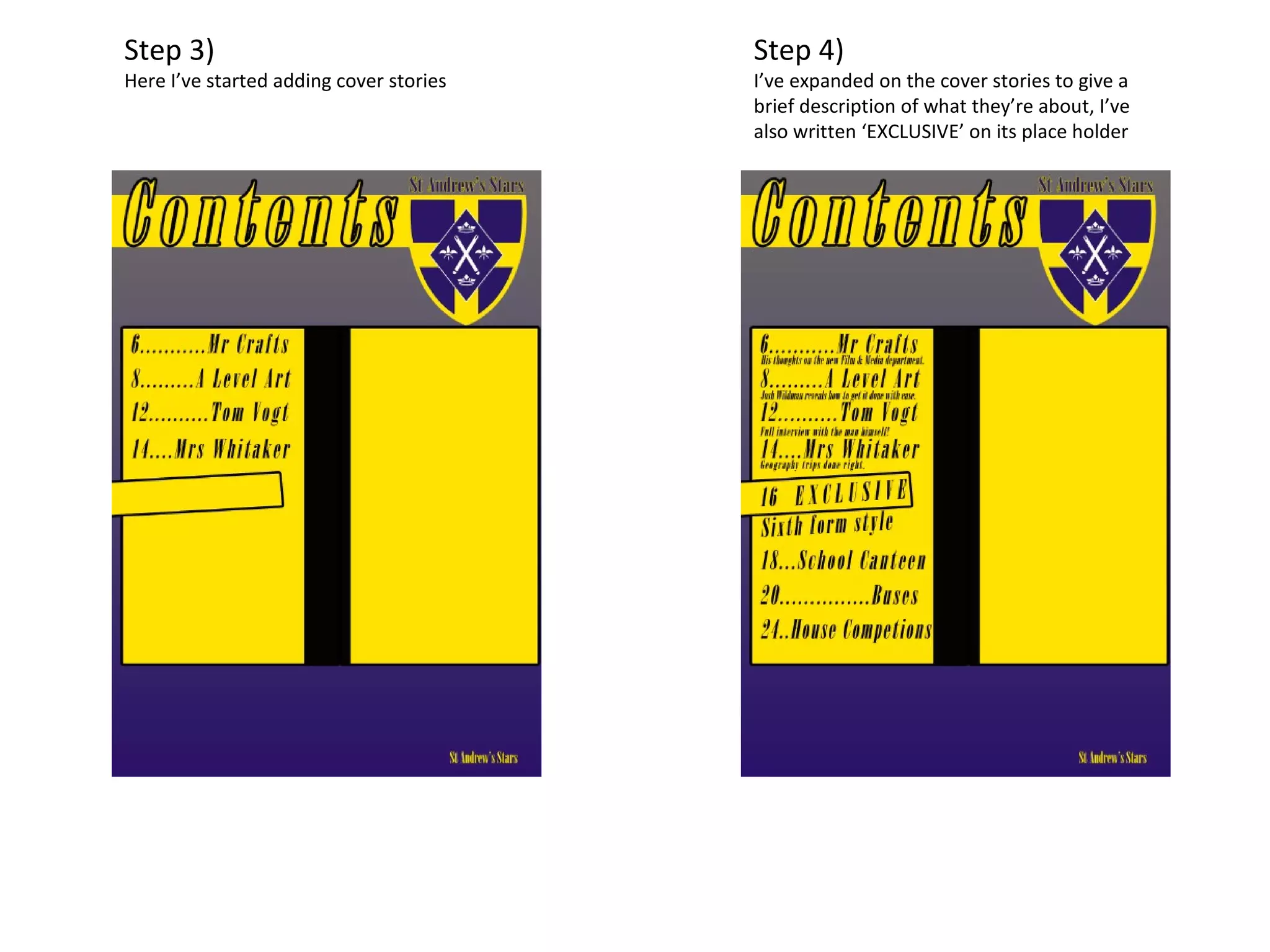
Step 3)
Here I’ve started adding cover stories
Step 4)
I’ve expanded on the cover stories to give a
brief description of what they’re about, I’ve
also written ‘EXCLUSIVE’ on its place holder
Step 5)
Ive added a ‘Sections’ and ‘Features’ so that one
can get an overview of what’s in the magazine, and
added a shape to put the main headline story on.
Step 6)
I made a page number next to the masthead at the
bottom, a convention that most magazines conform
to.
Step 7)
Here I have written and implemented an editorial, a
common convention in the first issues of magazines
alongside an editor photo and information, as well as a
drop capital in the masthead font style.
Step 8)
I added the editors signature alongside his
information and the editorial.
Step 9)
For this step I filled the empty space with relevant
stuff from every story and the page the story is on.
Step 10)
Similarly to step 9 I developed on the description of a
cover story and added a photo to use up dead space
Section 2) – Log Book
Music Magazine – Genre research
• Music Magazines have been prolific in England
and English culture since the 1950’s. Famous
Magazine NME began being printed in 1952
and is one of the first modern music
magazines.
• Before this there was a publication called
Melody Maker, which began being printed in
1926, and rivaled NME for some time, before
being absorbed by it in 2001 due to sales
falling to websites and blogs that presented
information freely instead of having to pay
subscription.
• Nowadays the top selling music magazine in
the UK is Q with 158,271 subscriptions
nationwide.
• There were many more magazines than there
are nowadays, but many folded in the 90’s due
to the rise of the internet.
• Top selling music magazines in the UK include:
Mojo, The fly, Uncut, Kerrang, Classic Rock,
Metal Hammer, Mixmag and Word.
Established Magazine for my Research
Headline
grabs peoples attention and helps the
flow of the cover. It also gives
information on the main story within
the magazine, and reinforces the star
appeal by giving more information on
the involvement of the celebrity in that
issue
Cover Lines
These can also work as
incentives , as they give
the reader an idea of the
content of the magazine,
and what it has to offer,
without having to look in
it.
Incentive
Gives people an overall reason to buy the
magazine, if they weren’t planning to already
Masthead
Big and obvious, it lets the reader know
what the magazine is, and it also helps the
aesthetic flow of the magazine.
Main Image
This creates star appeal (David Bowie), which is a concept
[theorized by Richard Dyer} which suggests that people are
more likely to notice an buy a magazine if it has a
recognizable, likeable, well known celebrity on the cover. It
also implies that there is content within the magazine about
the individual, meaning fans are more likely to buy it.
Strapline (Katz)
Much like the masthead, it helps the
magazine create an identity , but also helps
the overall aesthetic and flow of the cover,
as it draws attention away from the
masthead, which grabs the attention
initially, and then leads the readers
attention towards the cover lines
Barcode
Although aesthetically
unpleasant it is necessary
for the sale of the
magazine.
Q Target Audience (Hartley)
Q targets people over the age of 25 as they feel this was an
untapped demographic when it comes to music magazine, this is
reinforced through the use of older stars on their covers, David
Bowie for example being a musician that appeals more to the
older generation, generally. The magazine is targeted at either sex,
but is bought mainly by men, and due to the price the reader
would have to have a steady in come from somewhere. Generally
the genre is unspecific, covering the music industry as an entity in
its own right.
Target Audience – Katz, Maslow, Hartley and/or socio-economic needs
Q magazine is mostly going to appeal to young, white males, as it generally covers rock and
alternative music – a genre with a predominantly white male following; however the style of the
magazine is more high brow than. They are most likely employed as a subscription is expensive
and a luxury. According to Q’s readership profile, 71.8% of their readership is in the A, B or C1
category on the socio economic ladder. Generally the readership is in the age range of 15 – 25
which means it is consumed by mainly students and young adults who are either employed or
seeking employment. This means that the magazine may be purchased with parents money, or
money acquired from parents suggesting a majority of the readership are from a middle class
background (Hartley). The magazine is 3.90 making it fairly affordable. Source: http://www.bauermedia.co.uk/uploads/q.pdf
What is the USP of this magazine?
From the research I have done on this magazine I can see hat the USP is the incentive the
magazine gives you to buy it, on the one in the previous slide this was the red circle that
claimed there were 124 album reviews in the magazine making people want to buy it. There
are other incentives to get people to buy it too, for example on the left hand side of the
cover, there is a box that says ‘Rare interview and pictures’ Also making people want to get
it for that feature. Q’s strapline is simple and impacting, ‘The world’s greatest music
magazine’ a claim so bold that a consumer assumes there is good reason for the statement to
be made influencing them want to purchase the magazine over an other as it is the
superlative, this is particularly effective to ‘climbers’ (Maslow)
Publisher research
Key areas to focus on:
•Bauer – “We think popular” slogan – Connotations?
•Readership profile of the magazine – Socio-economic needs, circulation figures etc.
•Retail outlets the magazine is available in.
- Monthly global print audience of over 120 m
- Median age of 34
- ABC 1 profile is 71.8%
- 70% of readers are in employment
‘We Think Popular’
This slogan suggests that Bauer media are good at appealing to the mainstream, and
that whatever they make is popular. It also implies that bauer has somewhat of a
monopoly over
Conventions of a Music Magazine
Cover lines
As well as obviously giving insight to
stories within the magazine, they also
work as an incentive because of this
Masthead
Large and obvious, draws
attention to the magazine, in
Kerrang’s case it is in a jagged and
punky font, in order to suite the
magazines aesthetic.
Cover story
Grabs attention and helps the
aesthetic flow of the page, it also
communicates the information of the
story within
Main Image
Creates star appeal, also appeals to
social climbers and explorers, social
climbers as they are inspired to buy
the magazine as there is a star on the
cover, explorers as Black veil brides
are known for being alternative
Incentives
These give the reader an
incentive to buy the magazine,
Kerrang, unlike others offers
posters of bands featured in the
magazine
Barcode
Aesthetically unpleasing but
needed
Kerrang target audience
Kerrang targets neither sex and uses both male gaze and
female gaze in their covers, however the readership is
predominantly male. As the magazine covers mainly modern
bands it is targeted at teenager as 69.5% of the readership
are aged 15 – 24. The magazine is quite expensive and
therefore targeted at people who are old enough to be
employed, or parents to buy for teenagers.

Preliminary Task and Planning & Research

  • 1.
    OCR Media Studies– AS Level Unit G321: Foundation Portfolio in Media Planning & Research Name: Charlie Batcheler Candidate Number: 1016 Center Name: St. Andrew’s Catholic School Center Number: 64135 Set Brief - Print Music Magazine – Production Preliminary Task Progression and Planning & Research
  • 2.
  • 3.
    Preliminary Task Progression– Evidence FrontCover Step-by-step Step 1) I inserted some shapes to create a banner, then downloaded a font called Onyx from DaFont.com and used that to create the masthead, I used a blue gradient for the background Step 2) After this I inserted a barcode as is required for the sale of the magazine making it a staple convention
  • 4.
    Step 3) I usedTJ as the model for my front cover, I adjusted the hue and saturation of the image as it was quite dark and oddly coloured to begin with. Step 4) Here I’ve started making cover stories and presented them in the masthead font style in an alternative colour to the masthead to create a sense of identity for the brand, since St Andrews colours are already yellow and navy these are the colours I decided to use.
  • 5.
    Step 5) Here I’veadded another cover story to fill some space on the page Step 6) Here I’ve made the placeholder for a puff promotion, a fairly common convention that advertises the chance to enter a competition, or other promotional event.
  • 6.
    Step 7) Here I’veentered text outlining the prize involved with the puff promotion, as well as drawing attention to it and explaining that there’s a chance to win. Often music magazines do this to promote a festivel or album, and my magazines of inspiration; NME and Kerrang do it quite often as it also works as an incentive to purchase the magazine to potential buyers viewing it in shops.
  • 7.
    Step 8) Here I’vemade the placeholder for the main headline by inserting some shapes, in the house colour of yellow, which I saved as a swatch to improve workflow. Step 9) Ive completed the main headlines and added the verbal code ‘EXCLUSIVE’ as an incentive to read on or to buy the magazine. I also added another shape to act as a placeholder.
  • 8.
    Step 10) Now Ihave incorporated a web address and have created a place holder for the barcode and issue information. Step 11) Here I have added the appropriate information as well as social media icons to show the brands online presence.
  • 9.
    Finished cover Masthead The strokeeffect makes it very visually impacting, drawing attention to other areas of the page, it also brings it out against a blue background and reinforces brand identity Cover stories I made these in the house yellow so that they were an alternative colour to the masthead, but still in the same font. The letters have been spaced slightly so that they are more readable, I made it so that the descriptions were all on the same line so they were coherent and purposeful Main headline These where typed onto placeholders so that they are different to cover stories, and more recognizable visually. On the ‘Sixth Form Style’ convention I have used the text edit tool to make a wave effect, then made a place holder for ‘With TJ Salango’ so it is clearly obvious Puff Promotion This was placed on a shape so it is obvious and occupies space nicely, its functional purposeful and I ensured that the text within the shape was on the same line and therefore easily readable and understandable, this is a good marketing technique and many magazines do it. Barcode This is a necessary convention for all magazines as it needs to show its publisher, release date and social media links as well as the price and the actual barcode.
  • 10.
    Preliminary Task Progression– Evidence ContentsPage Step-by-step Step 1) I started by creating a contents page header in the masthead font style, to reinforce the brand identity, as well as incorporating the schools logo, I also created two shapes as placeholders Step 2) I added the masthead to keep up brand awareness and to create routine, I also added a placeholder for the exclusive cover story as well as making the gap between the two shapes bigger.
  • 11.
    Step 3) Here I’vestarted adding cover stories Step 4) I’ve expanded on the cover stories to give a brief description of what they’re about, I’ve also written ‘EXCLUSIVE’ on its place holder
  • 12.
    Step 5) Ive addeda ‘Sections’ and ‘Features’ so that one can get an overview of what’s in the magazine, and added a shape to put the main headline story on. Step 6) I made a page number next to the masthead at the bottom, a convention that most magazines conform to.
  • 13.
    Step 7) Here Ihave written and implemented an editorial, a common convention in the first issues of magazines alongside an editor photo and information, as well as a drop capital in the masthead font style. Step 8) I added the editors signature alongside his information and the editorial.
  • 14.
    Step 9) For thisstep I filled the empty space with relevant stuff from every story and the page the story is on. Step 10) Similarly to step 9 I developed on the description of a cover story and added a photo to use up dead space
  • 15.
  • 16.
    Music Magazine –Genre research • Music Magazines have been prolific in England and English culture since the 1950’s. Famous Magazine NME began being printed in 1952 and is one of the first modern music magazines. • Before this there was a publication called Melody Maker, which began being printed in 1926, and rivaled NME for some time, before being absorbed by it in 2001 due to sales falling to websites and blogs that presented information freely instead of having to pay subscription. • Nowadays the top selling music magazine in the UK is Q with 158,271 subscriptions nationwide. • There were many more magazines than there are nowadays, but many folded in the 90’s due to the rise of the internet. • Top selling music magazines in the UK include: Mojo, The fly, Uncut, Kerrang, Classic Rock, Metal Hammer, Mixmag and Word.
  • 17.
    Established Magazine formy Research Headline grabs peoples attention and helps the flow of the cover. It also gives information on the main story within the magazine, and reinforces the star appeal by giving more information on the involvement of the celebrity in that issue Cover Lines These can also work as incentives , as they give the reader an idea of the content of the magazine, and what it has to offer, without having to look in it. Incentive Gives people an overall reason to buy the magazine, if they weren’t planning to already Masthead Big and obvious, it lets the reader know what the magazine is, and it also helps the aesthetic flow of the magazine. Main Image This creates star appeal (David Bowie), which is a concept [theorized by Richard Dyer} which suggests that people are more likely to notice an buy a magazine if it has a recognizable, likeable, well known celebrity on the cover. It also implies that there is content within the magazine about the individual, meaning fans are more likely to buy it. Strapline (Katz) Much like the masthead, it helps the magazine create an identity , but also helps the overall aesthetic and flow of the cover, as it draws attention away from the masthead, which grabs the attention initially, and then leads the readers attention towards the cover lines Barcode Although aesthetically unpleasant it is necessary for the sale of the magazine. Q Target Audience (Hartley) Q targets people over the age of 25 as they feel this was an untapped demographic when it comes to music magazine, this is reinforced through the use of older stars on their covers, David Bowie for example being a musician that appeals more to the older generation, generally. The magazine is targeted at either sex, but is bought mainly by men, and due to the price the reader would have to have a steady in come from somewhere. Generally the genre is unspecific, covering the music industry as an entity in its own right.
  • 18.
    Target Audience –Katz, Maslow, Hartley and/or socio-economic needs Q magazine is mostly going to appeal to young, white males, as it generally covers rock and alternative music – a genre with a predominantly white male following; however the style of the magazine is more high brow than. They are most likely employed as a subscription is expensive and a luxury. According to Q’s readership profile, 71.8% of their readership is in the A, B or C1 category on the socio economic ladder. Generally the readership is in the age range of 15 – 25 which means it is consumed by mainly students and young adults who are either employed or seeking employment. This means that the magazine may be purchased with parents money, or money acquired from parents suggesting a majority of the readership are from a middle class background (Hartley). The magazine is 3.90 making it fairly affordable. Source: http://www.bauermedia.co.uk/uploads/q.pdf What is the USP of this magazine? From the research I have done on this magazine I can see hat the USP is the incentive the magazine gives you to buy it, on the one in the previous slide this was the red circle that claimed there were 124 album reviews in the magazine making people want to buy it. There are other incentives to get people to buy it too, for example on the left hand side of the cover, there is a box that says ‘Rare interview and pictures’ Also making people want to get it for that feature. Q’s strapline is simple and impacting, ‘The world’s greatest music magazine’ a claim so bold that a consumer assumes there is good reason for the statement to be made influencing them want to purchase the magazine over an other as it is the superlative, this is particularly effective to ‘climbers’ (Maslow)
  • 19.
    Publisher research Key areasto focus on: •Bauer – “We think popular” slogan – Connotations? •Readership profile of the magazine – Socio-economic needs, circulation figures etc. •Retail outlets the magazine is available in. - Monthly global print audience of over 120 m - Median age of 34 - ABC 1 profile is 71.8% - 70% of readers are in employment ‘We Think Popular’ This slogan suggests that Bauer media are good at appealing to the mainstream, and that whatever they make is popular. It also implies that bauer has somewhat of a monopoly over
  • 20.
    Conventions of aMusic Magazine Cover lines As well as obviously giving insight to stories within the magazine, they also work as an incentive because of this Masthead Large and obvious, draws attention to the magazine, in Kerrang’s case it is in a jagged and punky font, in order to suite the magazines aesthetic. Cover story Grabs attention and helps the aesthetic flow of the page, it also communicates the information of the story within Main Image Creates star appeal, also appeals to social climbers and explorers, social climbers as they are inspired to buy the magazine as there is a star on the cover, explorers as Black veil brides are known for being alternative Incentives These give the reader an incentive to buy the magazine, Kerrang, unlike others offers posters of bands featured in the magazine Barcode Aesthetically unpleasing but needed Kerrang target audience Kerrang targets neither sex and uses both male gaze and female gaze in their covers, however the readership is predominantly male. As the magazine covers mainly modern bands it is targeted at teenager as 69.5% of the readership are aged 15 – 24. The magazine is quite expensive and therefore targeted at people who are old enough to be employed, or parents to buy for teenagers.