Preliminary
Comparison
Skill Development
At the time of Developing the the preliminary I had no prior
experience with shooting and editing. This resulted in choppy
editing with slight continuity errors. In addition to unsteady
camera work. The non-diegetic music was pre-selected,
whereas in the final film the score was an original production.
The acting in the prelim was poor and the choice of location
was uninspired.
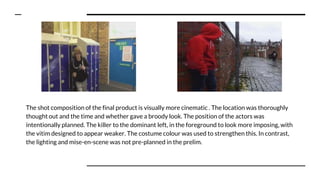
The shot composition of the final product is visually more cinematic . The location was thoroughly
thought out and the time and whether gave a broody look. The position of the actors was
intentionally planned. The killer to the dominant left, in the foreground to look more imposing, with
the vitim designed to appear weaker. The costume colour was used to strengthen this. In contrast,
the lighting and mise-en-scene was not pre-planned in the prelim.
Software and Hardware
Over the course of filming, a lot was learned about the correct
ways of operating programs and equipment. The rough cut
was a learning opportunity, to gain experience with editing
software, shot composition and camera operating. This
explains the difference in the quality of camera steadiness,
editing speed, noise canceling and composition; between the
preliminary and the final product. Additionally, I now have a
more comprehensive understanding of the genre and media in
general.
Practical Examples
I have learnt how to ensure a tripod is steady and straight,
using the spirit level and tightening.
The zoom feature can now be used steadily at a constant rate.
I have become more competent with the cut, fade and text
tools on Finalcut, allowing for a seamlessly flowing sequence.
I can now animate pictures on Photoshop to create the
movie’s opening logo’s.
Needs improvement
I still need practice with panning. When I move the camera on
the tripod, the movement is clunky and unprofessional.
Lighting a set is something I could have used more effectively
if I had more experience.
The text overlays could have been improved with a better
suited font.
Rough-cut
Most of the footage in the rough cut was re-shot for the final
cut. This was a huge learning curve as it pointed out the
weaknesses, so it could be drastically improved.
This is opportunity is the factor that allowed the jump in
quality from the preliminary to the final product.

Preliminary comparison

  • 1.
  • 2.
    Skill Development At thetime of Developing the the preliminary I had no prior experience with shooting and editing. This resulted in choppy editing with slight continuity errors. In addition to unsteady camera work. The non-diegetic music was pre-selected, whereas in the final film the score was an original production. The acting in the prelim was poor and the choice of location was uninspired.
  • 3.
    The shot compositionof the final product is visually more cinematic . The location was thoroughly thought out and the time and whether gave a broody look. The position of the actors was intentionally planned. The killer to the dominant left, in the foreground to look more imposing, with the vitim designed to appear weaker. The costume colour was used to strengthen this. In contrast, the lighting and mise-en-scene was not pre-planned in the prelim.
  • 4.
    Software and Hardware Overthe course of filming, a lot was learned about the correct ways of operating programs and equipment. The rough cut was a learning opportunity, to gain experience with editing software, shot composition and camera operating. This explains the difference in the quality of camera steadiness, editing speed, noise canceling and composition; between the preliminary and the final product. Additionally, I now have a more comprehensive understanding of the genre and media in general.
  • 5.
    Practical Examples I havelearnt how to ensure a tripod is steady and straight, using the spirit level and tightening. The zoom feature can now be used steadily at a constant rate. I have become more competent with the cut, fade and text tools on Finalcut, allowing for a seamlessly flowing sequence. I can now animate pictures on Photoshop to create the movie’s opening logo’s.
  • 6.
    Needs improvement I stillneed practice with panning. When I move the camera on the tripod, the movement is clunky and unprofessional. Lighting a set is something I could have used more effectively if I had more experience. The text overlays could have been improved with a better suited font.
  • 7.
    Rough-cut Most of thefootage in the rough cut was re-shot for the final cut. This was a huge learning curve as it pointed out the weaknesses, so it could be drastically improved. This is opportunity is the factor that allowed the jump in quality from the preliminary to the final product.