DEPT OF GYNAE & OBS
Presented by-
DR. SABRIN SAMAD JOTY
DR. PIZUSH PAUL
*PREGNANCY
WITH EPILEPSY
*
Mrs. Jannatul Ferdous ,23 years old a primi gravida hailing from
Rajshahi was admitted in GREENLIFE MEDICAL COLLEGE &
HOSPITAL at her 40 wks pregnancy with epilepsy on 28th
February,2018. And she stated that she was reasonably well 7
years back, till 2012 then She suddenly started to feel tingling &
numbness of her tongue which was associated with involuntary
movement also. She gave history of several episodes of same
complaints but she didn’t consult with any physician for this
problem.
In April 2015, she got her 2nd attack with generalized
seizure ,which was characterized by initial aura , after that she
became rigid & fell down from standing position and became
unconscious, which last for few minutes. When she regained from
her unconsciousness ,she noticed there was tongue injury. Then
she consulted with a physician and was referred to a neurologist .
On the basis of clinical history , signs-symptoms, she was properly
evaluated thoroughly & investigated with CT Scan & MRI of brain
followed by EEG and diagnosed as EPILEPSY. Since then she had been
prescribed –
Tab. Carbamazepine 200mg 1 tab twice a day daily.
Tab. Clonazepam 0.5 mg 1 tab at night daily.
With this medication, her intensity & duration of fit reduced but was
not well controlled , dose of carbamazepine was increased in one
month later (May, 2015) & was prescribed as-
Tab. Carbamazepine 200 mg 1.5 tab twice a day daily.
Tab. Clonazepam 0.5 mg 1 tab at night daily.
After that, she remained stable, seizure free for 1.5 years.
She got married in 2016. As she wanted to conceive, she consulted
with her neurologist 1 year following her medication (Carbamazepine &
Clonazepam). After proper clinical evaluation and investigations, her
AED therapy was readjusted with monotherapy with reduced dose of
drug and was prescribed as-
Tab. Carbamazepine 200 mg 1 tab twice a day daily.
Tab. Folison 5 mg 1 tab once a day daily.
Her menstrual cycle was regular and her L.M.P was on 28th May 2017.
Since then she was amenorrhoeic and she conceived. It was her
planned pregnancy and she was in regular antenatal checkup . She
continued to take Carbamazepine & Folic acid in her readjusted dose
during her whole pregnancy period. Anomaly Scan revealed no
abnormalities.
At her 40 wks of pregnancy , per abdominal examination revealed, non-
engagement of fetal head . So decision was taken for elective cesarean
section under G/A . She again consulted with neurologist before LUCS and
was advised to give Inj. Vit. k stat.
Her LUCS was done in presence of expert anesthesiologist & neonatologist.
Following delivery , Inj. Vit-K was given to both mother and baby for
3days. The baby was properly evaluated – there was no congenital
anomalies found and APGAR score of the baby was 10/10 in 1st 5-10 mins.
Echo of the baby was done & which revealed no abnormalities .
After LUCS , with the consultation of neurologist, mother & baby was
treated with VIT –K injection and advised to continue the treatment with
AED with same dose (Carbamazepine 200mg twice daily). At her 7th
normal puerperal days, She was discharged with happily from this
Hospital.
PREGNANCY WITH EPILEPSY
*Epilepsy is a chronic disorder or group of disorders characterized by
recurrent, unpredictable seizures.
*A seizure is a temporary physiological dysfunction of brain, in which
neurons will produce excessive electrical discharge.
*Epilepsy is common, affecting around 600000 people in the UK. It
usually begins in childhood, but can start at any age. The main
symptoms of epilepsy are repeated seizures.
*A Seizure happens when abnormal patterns of electrical activity arise
in the brain. It may cause the body to move in an uncontrolled way &
can also cause loss of consciousness for a short period.
*
*If the women with epilepsy is taking antiepileptic drugs (AEDs) & she
is planning to get pregnant , she should continue to use
contraceptive & take her medication until she discuss her plan with
her neurologist.
*This is because she may need some changes to her medication & this
should only be done under the supervision of her specialist.
*Some AEDs can harm an unborn baby, but there’s also a risk from
having uncontrolled seizures in pregnancy.
EFFECT OF PREGNANCY ON EPILEPSY:
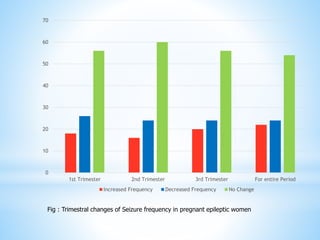
Pregnancy has a variable effect on seizure frequency. Seizure
frequency may remain unchanged or decreases in 2/3 of Women
with epilepsy, whereas it may increase in others. Incidence of
increased frequency of seizures in pregnancy is 17-33%. Seizure
frequency may also vary between pregnancies in the same
woman. There can be diverse patterns of seizure frequency
during pregnancy. Frequency of seizure can be differed in
different trimester.
0
10
20
30
40
50
60
70
1st Trimester 2nd Trimester 3rd Trimester For entire Period
Increased Frequency Decreased Frequency No Change
Fig : Trimestral changes of Seizure frequency in pregnant epileptic women
EFFECT OF EPILEPSY ON PREGNANCY:
Maternal:
• Miscarriage due to trauma experienced during seizures.
• Pre-eclampsia
• Premature separation of placenta
• Pre-term labour
Fetal:
• Fetal malformation
• Fetal injury
• Fetal heart rate deceleration
• IUGR
• Still birth
*Many women with epilepsy use AEDs to keep their seizures under
control. Research has shown that there may be an increased risk of “
FOCAL ANTICONVULSANT SYNDROME” in children born to mothers who
have taken some AEDs during pregnancy.
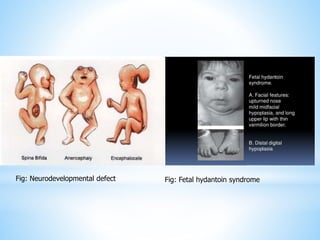
*A child with FACS may have a number of physical or brain development
(neurodevelopmental) difficulties.
*AEDs may increase the risk of physical defects such as spina bifida, heart
abnormalities & cleft lip.
*Depending on the type of medication & the dose she is taking ,there
may also be an increased risk of long term effect in the baby, such as-
Lower intellectual abilities
Poor language skills(speaking & understanding)
Autistic spectrum disorders.
Delayed walking & talking.
EFFECT OF DRUGS ON PREGNANCY WITH
EPILEPSY
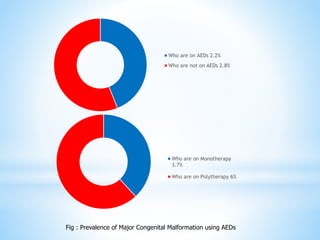
Who are on AEDs 2.2%
Who are not on AEDs 2.8%
Who are on Monotherapy
3.7%
Who are on Polytherapy 6%
Fig : Prevalence of Major Congenital Malformation using AEDs
Most of the antiepileptic drugs are teratogenic. But
Carbamazepine and Lamotrigine have the lowest incidence of
major fetal malformations.
Sodium valproate , Phenytoin are found to be most teratogenic.
The risk of Sodium valproate is higher. IQ may be lower when
children are exposed to valporate in utero.The risk of physical defects
in babies whose mothers take Sodium valproate in pregnancy is
around 11% ,compared with 2-3% for general children. But it should
be carefully balanced against its benefits.
Levetiracetam may be safe , but we should avoid other newer
drugs if possible.
0
1
2
3
4
5
6
7
8
Sodium valporate
6.20%
Phenytoin 3.70% Carbamazepine
2.20%
Lemotrigine
3.20%
Gabapentin 3.20%Topiramate 7.10%
MCM Rate (%)
Fig: Rate(%) of Major Congenital Malformation due to AEDs.
Fig: Neurodevelopmental defect Fig: Fetal hydantoin syndrome
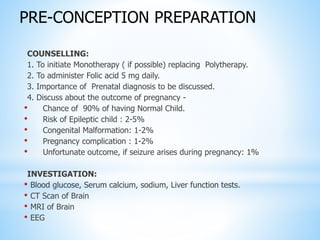
COUNSELLING:
1. To initiate Monotherapy ( if possible) replacing Polytherapy.
2. To administer Folic acid 5 mg daily.
3. Importance of Prenatal diagnosis to be discussed.
4. Discuss about the outcome of pregnancy -
• Chance of 90% of having Normal Child.
• Risk of Epileptic child : 2-5%
• Congenital Malformation: 1-2%
• Pregnancy complication : 1-2%
• Unfortunate outcome, if seizure arises during pregnancy: 1%
INVESTIGATION:
• Blood glucose, Serum calcium, sodium, Liver function tests.
• CT Scan of Brain
• MRI of Brain
• EEG
PRE-CONCEPTION PREPARATION
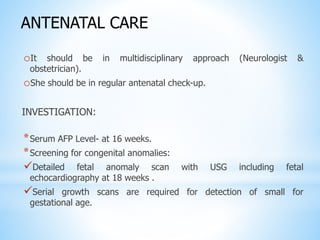
oIt should be in multidisciplinary approach (Neurologist &
obstetrician).
oShe should be in regular antenatal check-up.
INVESTIGATION:
*Serum AFP Level- at 16 weeks.
*Screening for congenital anomalies:
Detailed fetal anomaly scan with USG including fetal
echocardiography at 18 weeks .
Serial growth scans are required for detection of small for
gestational age.
ANTENATAL CARE
DRUGS:
1.Antiepileptic drugs:
Carbamazepine is the safest antiepileptic drug in pregnancy.
No need to change the drug if epilepsy is well controlled with
Phenytoin, Valproate, Lamotrigine, Levetiracetum or
phenobarbitone.
Restarting the AED at her antenatal period, many women may
stop their AED due to fear of teratogenicity.
2.Vit K :
In the last 1 month of pregnancy , patient should take Vit K.
10-20 mg daily.
3. Folic acid:
 5 mg daily prior to conception throughout the pregnancy.
Women with epilepsy should be re-assured that most women have an
uncomplicated labour & delivary.
2% -4% of women with epilepsy will have a tonic clonic seizure during labour.
1. Birth should be arranged in a hospital with facilities for emergency C/S and
maternal & neonatal resuscitation.
2. Continue regular AEDs in labour (orally or parenterally)
3. Strictly monitoring during labour.
4. Pain relief in labour :
-Use of Pethidine should be avoided.
-Diamorphine.
-Entonox
-Regional analgesia.
INTRAPARTUM CARE
5. Seizures management:
* If seizures that are not rapidly self-limiting occur in labour-
Oxygen
Anticonvulsant ( ideally, Lorazepam 4 mg I/V over 2 min or Diazepam 10-20 mg
I/V at 2mg/min)
Continuous fetal monitoring
* For women who have had seizures during previous deliveries-
 Carbamazepine P/R
 Sodium valproate I/V
 Phenytoin I/V
6. Mode of delivery:
Most women with epilepsy have a vaginal delivery.
C/S should be considered in women with frequent seizure in the 3rd trimester or
with history of status epilepticus under severe stress and other obstretic cause.
Post Natal Management
The Neonate
• 1 mg Vitamin K I/M is administrated to the newborn immediately after birth.
• Observe baby closely for signs of respiratory distress, level of alertness and
signs of excessive drowsiness.
• Examine baby for any congenital anomalies.
• Breast feeding:
There is no contraindication for breastfeeding as antiepileptic drugs are
excreted in breast milk only in low concentrations.
THE MOTHER
• Mother should continue their AEDs postnatally. Readjustment of dosage is
necessary & to bring down the dose to the pre-pregnant level by 4-6
weeks postpartum.
• Mother should be well supported and ensure that triggers of seizure
deterioration such as sleep deprivation, stress, pain are minimized
* Contraception:
oSome AEDs induce hepatic enzymes that metabolize synthetic hormones,
increasing the risk of contraceptive failure. This is more marked with
Carbamazepine, Phenytoin, Phenobarbital. If the AED cannot be changed ,
this can be overcome by giving higher dose preparations of the oral
contraceptive.
oSodium valproate & Levetiracetam have no interaction with hormonal
contraception .
Follow Up
The mother and her baby must be under regular follow-up with her
neurologist for lifelong.
*
* Pregnancy is not contraindicated in women with epilepsy.
* The compliance of AEDs regimens is a must for pregnant women to
control the frequency of seizures.
* Most of the AEDs are teratogenic. Monotherapy is safer than
polytherapy. Risk is higher with Sodium Valproate.
* Pre-conceptional counseling and regular ANC ,with antenatal
screening for any congenital malformations, play important roles in
the prevention of unfortunate outcomes in both mother and child.
* Delivery should be in a tertiary hospital.
* Breastfeeding should be encouraged.
* Regular follow-up of both mother and baby .
*THANK YOU

Pregnancy with epilepsy .............

  • 1.
    DEPT OF GYNAE& OBS Presented by- DR. SABRIN SAMAD JOTY DR. PIZUSH PAUL *PREGNANCY WITH EPILEPSY
  • 2.
    * Mrs. Jannatul Ferdous,23 years old a primi gravida hailing from Rajshahi was admitted in GREENLIFE MEDICAL COLLEGE & HOSPITAL at her 40 wks pregnancy with epilepsy on 28th February,2018. And she stated that she was reasonably well 7 years back, till 2012 then She suddenly started to feel tingling & numbness of her tongue which was associated with involuntary movement also. She gave history of several episodes of same complaints but she didn’t consult with any physician for this problem. In April 2015, she got her 2nd attack with generalized seizure ,which was characterized by initial aura , after that she became rigid & fell down from standing position and became unconscious, which last for few minutes. When she regained from her unconsciousness ,she noticed there was tongue injury. Then she consulted with a physician and was referred to a neurologist .
  • 3.
    On the basisof clinical history , signs-symptoms, she was properly evaluated thoroughly & investigated with CT Scan & MRI of brain followed by EEG and diagnosed as EPILEPSY. Since then she had been prescribed – Tab. Carbamazepine 200mg 1 tab twice a day daily. Tab. Clonazepam 0.5 mg 1 tab at night daily. With this medication, her intensity & duration of fit reduced but was not well controlled , dose of carbamazepine was increased in one month later (May, 2015) & was prescribed as- Tab. Carbamazepine 200 mg 1.5 tab twice a day daily. Tab. Clonazepam 0.5 mg 1 tab at night daily. After that, she remained stable, seizure free for 1.5 years.
  • 4.
    She got marriedin 2016. As she wanted to conceive, she consulted with her neurologist 1 year following her medication (Carbamazepine & Clonazepam). After proper clinical evaluation and investigations, her AED therapy was readjusted with monotherapy with reduced dose of drug and was prescribed as- Tab. Carbamazepine 200 mg 1 tab twice a day daily. Tab. Folison 5 mg 1 tab once a day daily. Her menstrual cycle was regular and her L.M.P was on 28th May 2017. Since then she was amenorrhoeic and she conceived. It was her planned pregnancy and she was in regular antenatal checkup . She continued to take Carbamazepine & Folic acid in her readjusted dose during her whole pregnancy period. Anomaly Scan revealed no abnormalities.
  • 5.
    At her 40wks of pregnancy , per abdominal examination revealed, non- engagement of fetal head . So decision was taken for elective cesarean section under G/A . She again consulted with neurologist before LUCS and was advised to give Inj. Vit. k stat. Her LUCS was done in presence of expert anesthesiologist & neonatologist. Following delivery , Inj. Vit-K was given to both mother and baby for 3days. The baby was properly evaluated – there was no congenital anomalies found and APGAR score of the baby was 10/10 in 1st 5-10 mins. Echo of the baby was done & which revealed no abnormalities . After LUCS , with the consultation of neurologist, mother & baby was treated with VIT –K injection and advised to continue the treatment with AED with same dose (Carbamazepine 200mg twice daily). At her 7th normal puerperal days, She was discharged with happily from this Hospital.
  • 7.
    PREGNANCY WITH EPILEPSY *Epilepsyis a chronic disorder or group of disorders characterized by recurrent, unpredictable seizures. *A seizure is a temporary physiological dysfunction of brain, in which neurons will produce excessive electrical discharge. *Epilepsy is common, affecting around 600000 people in the UK. It usually begins in childhood, but can start at any age. The main symptoms of epilepsy are repeated seizures. *A Seizure happens when abnormal patterns of electrical activity arise in the brain. It may cause the body to move in an uncontrolled way & can also cause loss of consciousness for a short period.
  • 9.
    * *If the womenwith epilepsy is taking antiepileptic drugs (AEDs) & she is planning to get pregnant , she should continue to use contraceptive & take her medication until she discuss her plan with her neurologist. *This is because she may need some changes to her medication & this should only be done under the supervision of her specialist. *Some AEDs can harm an unborn baby, but there’s also a risk from having uncontrolled seizures in pregnancy.
  • 10.
    EFFECT OF PREGNANCYON EPILEPSY: Pregnancy has a variable effect on seizure frequency. Seizure frequency may remain unchanged or decreases in 2/3 of Women with epilepsy, whereas it may increase in others. Incidence of increased frequency of seizures in pregnancy is 17-33%. Seizure frequency may also vary between pregnancies in the same woman. There can be diverse patterns of seizure frequency during pregnancy. Frequency of seizure can be differed in different trimester.
  • 11.
    0 10 20 30 40 50 60 70 1st Trimester 2ndTrimester 3rd Trimester For entire Period Increased Frequency Decreased Frequency No Change Fig : Trimestral changes of Seizure frequency in pregnant epileptic women
  • 12.
    EFFECT OF EPILEPSYON PREGNANCY: Maternal: • Miscarriage due to trauma experienced during seizures. • Pre-eclampsia • Premature separation of placenta • Pre-term labour Fetal: • Fetal malformation • Fetal injury • Fetal heart rate deceleration • IUGR • Still birth
  • 13.
    *Many women withepilepsy use AEDs to keep their seizures under control. Research has shown that there may be an increased risk of “ FOCAL ANTICONVULSANT SYNDROME” in children born to mothers who have taken some AEDs during pregnancy. *A child with FACS may have a number of physical or brain development (neurodevelopmental) difficulties. *AEDs may increase the risk of physical defects such as spina bifida, heart abnormalities & cleft lip. *Depending on the type of medication & the dose she is taking ,there may also be an increased risk of long term effect in the baby, such as- Lower intellectual abilities Poor language skills(speaking & understanding) Autistic spectrum disorders. Delayed walking & talking. EFFECT OF DRUGS ON PREGNANCY WITH EPILEPSY
  • 14.
    Who are onAEDs 2.2% Who are not on AEDs 2.8% Who are on Monotherapy 3.7% Who are on Polytherapy 6% Fig : Prevalence of Major Congenital Malformation using AEDs
  • 16.
    Most of theantiepileptic drugs are teratogenic. But Carbamazepine and Lamotrigine have the lowest incidence of major fetal malformations. Sodium valproate , Phenytoin are found to be most teratogenic. The risk of Sodium valproate is higher. IQ may be lower when children are exposed to valporate in utero.The risk of physical defects in babies whose mothers take Sodium valproate in pregnancy is around 11% ,compared with 2-3% for general children. But it should be carefully balanced against its benefits. Levetiracetam may be safe , but we should avoid other newer drugs if possible.
  • 17.
    0 1 2 3 4 5 6 7 8 Sodium valporate 6.20% Phenytoin 3.70%Carbamazepine 2.20% Lemotrigine 3.20% Gabapentin 3.20%Topiramate 7.10% MCM Rate (%) Fig: Rate(%) of Major Congenital Malformation due to AEDs.
  • 18.
    Fig: Neurodevelopmental defectFig: Fetal hydantoin syndrome
  • 19.
    COUNSELLING: 1. To initiateMonotherapy ( if possible) replacing Polytherapy. 2. To administer Folic acid 5 mg daily. 3. Importance of Prenatal diagnosis to be discussed. 4. Discuss about the outcome of pregnancy - • Chance of 90% of having Normal Child. • Risk of Epileptic child : 2-5% • Congenital Malformation: 1-2% • Pregnancy complication : 1-2% • Unfortunate outcome, if seizure arises during pregnancy: 1% INVESTIGATION: • Blood glucose, Serum calcium, sodium, Liver function tests. • CT Scan of Brain • MRI of Brain • EEG PRE-CONCEPTION PREPARATION
  • 20.
    oIt should bein multidisciplinary approach (Neurologist & obstetrician). oShe should be in regular antenatal check-up. INVESTIGATION: *Serum AFP Level- at 16 weeks. *Screening for congenital anomalies: Detailed fetal anomaly scan with USG including fetal echocardiography at 18 weeks . Serial growth scans are required for detection of small for gestational age. ANTENATAL CARE
  • 21.
    DRUGS: 1.Antiepileptic drugs: Carbamazepine isthe safest antiepileptic drug in pregnancy. No need to change the drug if epilepsy is well controlled with Phenytoin, Valproate, Lamotrigine, Levetiracetum or phenobarbitone. Restarting the AED at her antenatal period, many women may stop their AED due to fear of teratogenicity. 2.Vit K : In the last 1 month of pregnancy , patient should take Vit K. 10-20 mg daily. 3. Folic acid:  5 mg daily prior to conception throughout the pregnancy.
  • 22.
    Women with epilepsyshould be re-assured that most women have an uncomplicated labour & delivary. 2% -4% of women with epilepsy will have a tonic clonic seizure during labour. 1. Birth should be arranged in a hospital with facilities for emergency C/S and maternal & neonatal resuscitation. 2. Continue regular AEDs in labour (orally or parenterally) 3. Strictly monitoring during labour. 4. Pain relief in labour : -Use of Pethidine should be avoided. -Diamorphine. -Entonox -Regional analgesia. INTRAPARTUM CARE
  • 23.
    5. Seizures management: *If seizures that are not rapidly self-limiting occur in labour- Oxygen Anticonvulsant ( ideally, Lorazepam 4 mg I/V over 2 min or Diazepam 10-20 mg I/V at 2mg/min) Continuous fetal monitoring * For women who have had seizures during previous deliveries-  Carbamazepine P/R  Sodium valproate I/V  Phenytoin I/V 6. Mode of delivery: Most women with epilepsy have a vaginal delivery. C/S should be considered in women with frequent seizure in the 3rd trimester or with history of status epilepticus under severe stress and other obstretic cause.
  • 24.
    Post Natal Management TheNeonate • 1 mg Vitamin K I/M is administrated to the newborn immediately after birth. • Observe baby closely for signs of respiratory distress, level of alertness and signs of excessive drowsiness. • Examine baby for any congenital anomalies. • Breast feeding: There is no contraindication for breastfeeding as antiepileptic drugs are excreted in breast milk only in low concentrations. THE MOTHER • Mother should continue their AEDs postnatally. Readjustment of dosage is necessary & to bring down the dose to the pre-pregnant level by 4-6 weeks postpartum. • Mother should be well supported and ensure that triggers of seizure deterioration such as sleep deprivation, stress, pain are minimized
  • 25.
    * Contraception: oSome AEDsinduce hepatic enzymes that metabolize synthetic hormones, increasing the risk of contraceptive failure. This is more marked with Carbamazepine, Phenytoin, Phenobarbital. If the AED cannot be changed , this can be overcome by giving higher dose preparations of the oral contraceptive. oSodium valproate & Levetiracetam have no interaction with hormonal contraception . Follow Up The mother and her baby must be under regular follow-up with her neurologist for lifelong.
  • 26.
    * * Pregnancy isnot contraindicated in women with epilepsy. * The compliance of AEDs regimens is a must for pregnant women to control the frequency of seizures. * Most of the AEDs are teratogenic. Monotherapy is safer than polytherapy. Risk is higher with Sodium Valproate. * Pre-conceptional counseling and regular ANC ,with antenatal screening for any congenital malformations, play important roles in the prevention of unfortunate outcomes in both mother and child. * Delivery should be in a tertiary hospital. * Breastfeeding should be encouraged. * Regular follow-up of both mother and baby .
  • 27.