BW6	
Session	
6/8/16	1:30	PM	


Predictive	Test	Planning	to	Improve	
System	Quality	
	
Presented	by:	
	
Penny	McVay	
Liberty	Mutual	
	
	
Brought	to	you	by:		


350	Corporate	Way,	Suite	400,	Orange	Park,	FL	32073		
888---268---8770	··	904---278---0524	-	info@techwell.com	-	http://www.techwell.com/
Penny	McVay	
Liberty	Mutual	
	
Penny	McVay	manages	a	large,	global-wide	quality	assurance	team	for	the	
commercial	insurance	technology	division	of	Liberty	Mutual.	Penny	began	her	
career	in	the	insurance	industry	and	has	experience	in	business	functional	areas	
and	IT.	From	a	COBOL	programmer	to	a	developer	to	earning	her	PMP	
certification,	Penny's	experiences	have	shaped	her	approach	to	managing	QA	as	a	
true	partner	in	collaborating	on	large	IT	projects	for	the	past	fourteen	years.	
Penny	resides	in	Hamilton,	Ohio,	and	when	she's	not	knee-deep	into	quality	
assurance	practices,	Penny	enjoys	spending	time	with	her	family	and	camping.
6/2/16
1
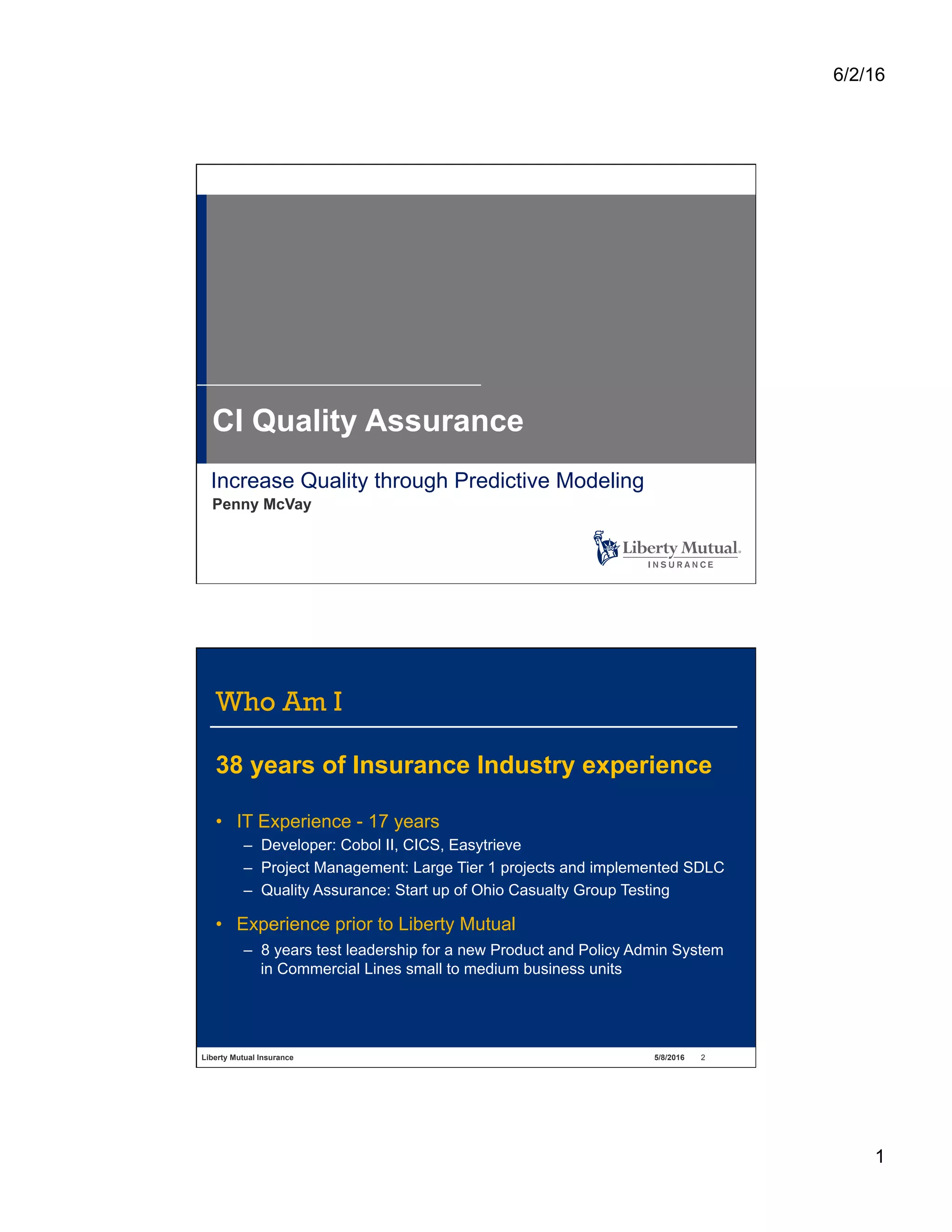
Increase Quality through Predictive Modeling
Penny McVay
CI Quality Assurance
Liberty Mutual Insurance 5/8/2016 2
Who Am I
38 years of Insurance Industry experience
•  IT Experience - 17 years
–  Developer: Cobol II, CICS, Easytrieve
–  Project Management: Large Tier 1 projects and implemented SDLC
–  Quality Assurance: Start up of Ohio Casualty Group Testing
•  Experience prior to Liberty Mutual
–  8 years test leadership for a new Product and Policy Admin System
in Commercial Lines small to medium business units
6/2/16
2
Liberty Mutual Insurance 5/8/2016 3
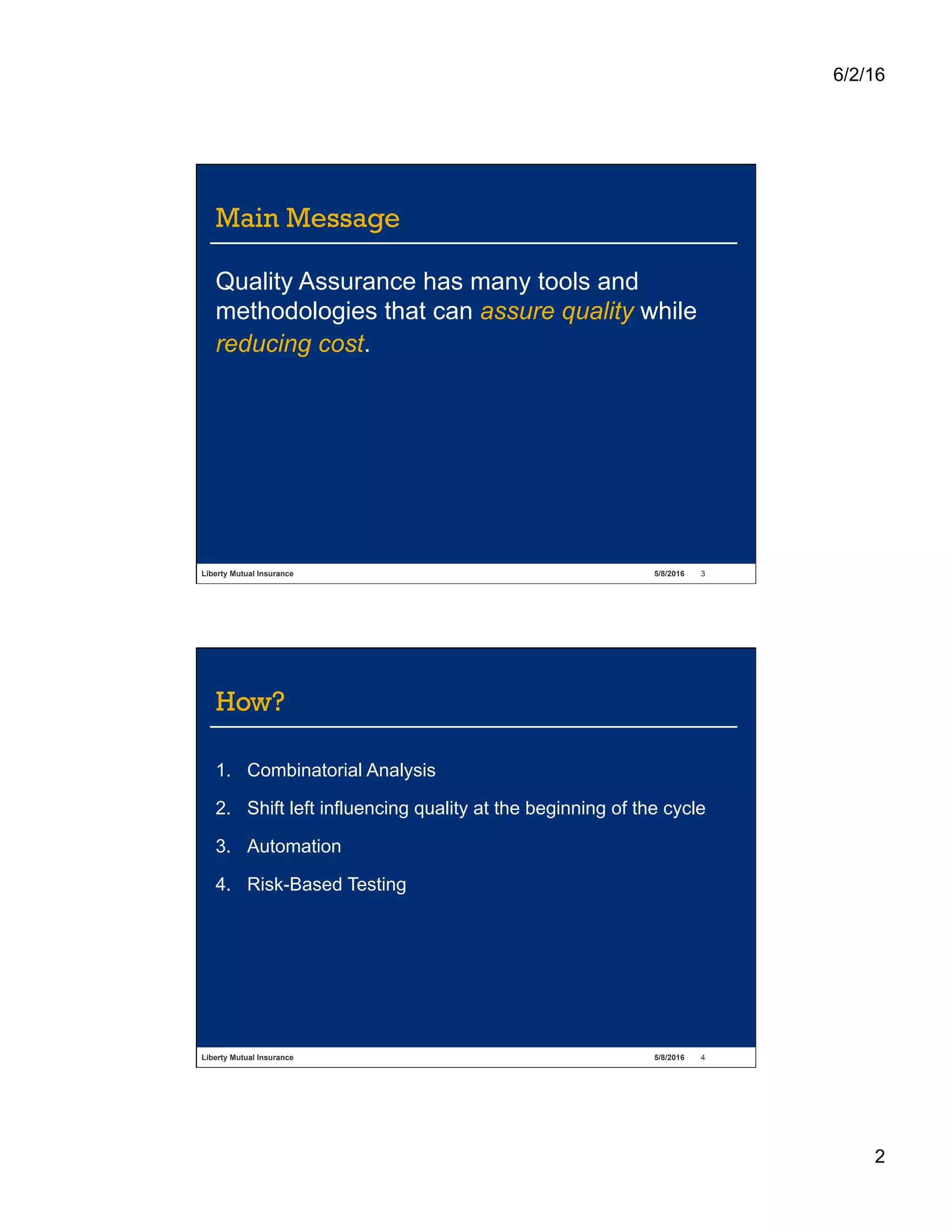
Main Message
Quality Assurance has many tools and
methodologies that can assure quality while
reducing cost.
Liberty Mutual Insurance 5/8/2016 4
How?
1.  Combinatorial Analysis
2.  Shift left influencing quality at the beginning of the cycle
3.  Automation
4.  Risk-Based Testing
6/2/16
3
Liberty Mutual Insurance 5/8/2016 5
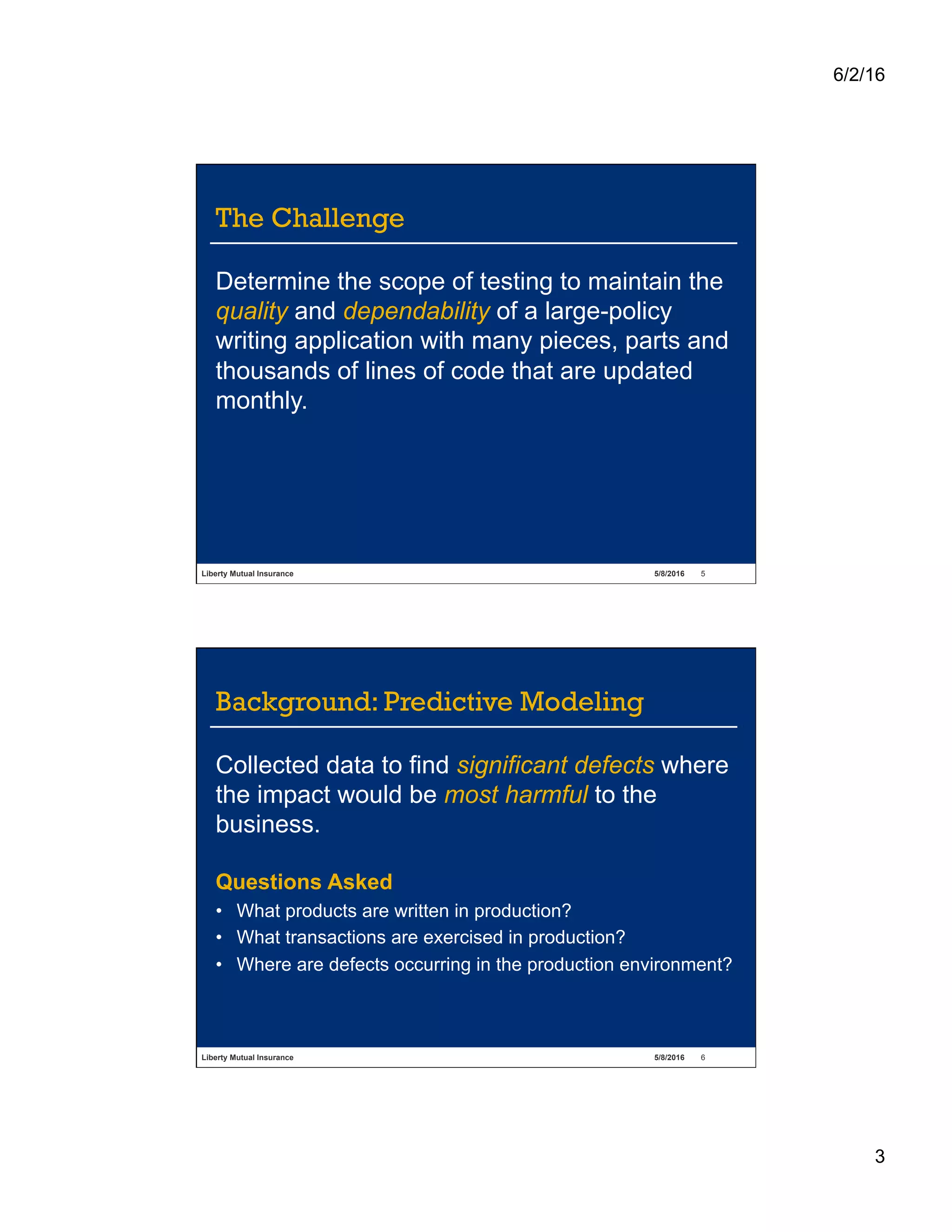
The Challenge
Determine the scope of testing to maintain the
quality and dependability of a large-policy
writing application with many pieces, parts and
thousands of lines of code that are updated
monthly.
Liberty Mutual Insurance 5/8/2016 6
Background: Predictive Modeling
Collected data to find significant defects where
the impact would be most harmful to the
business.
Questions Asked
•  What products are written in production?
•  What transactions are exercised in production?
•  Where are defects occurring in the production environment?
6/2/16
4
Liberty Mutual Insurance 5/8/2016 7
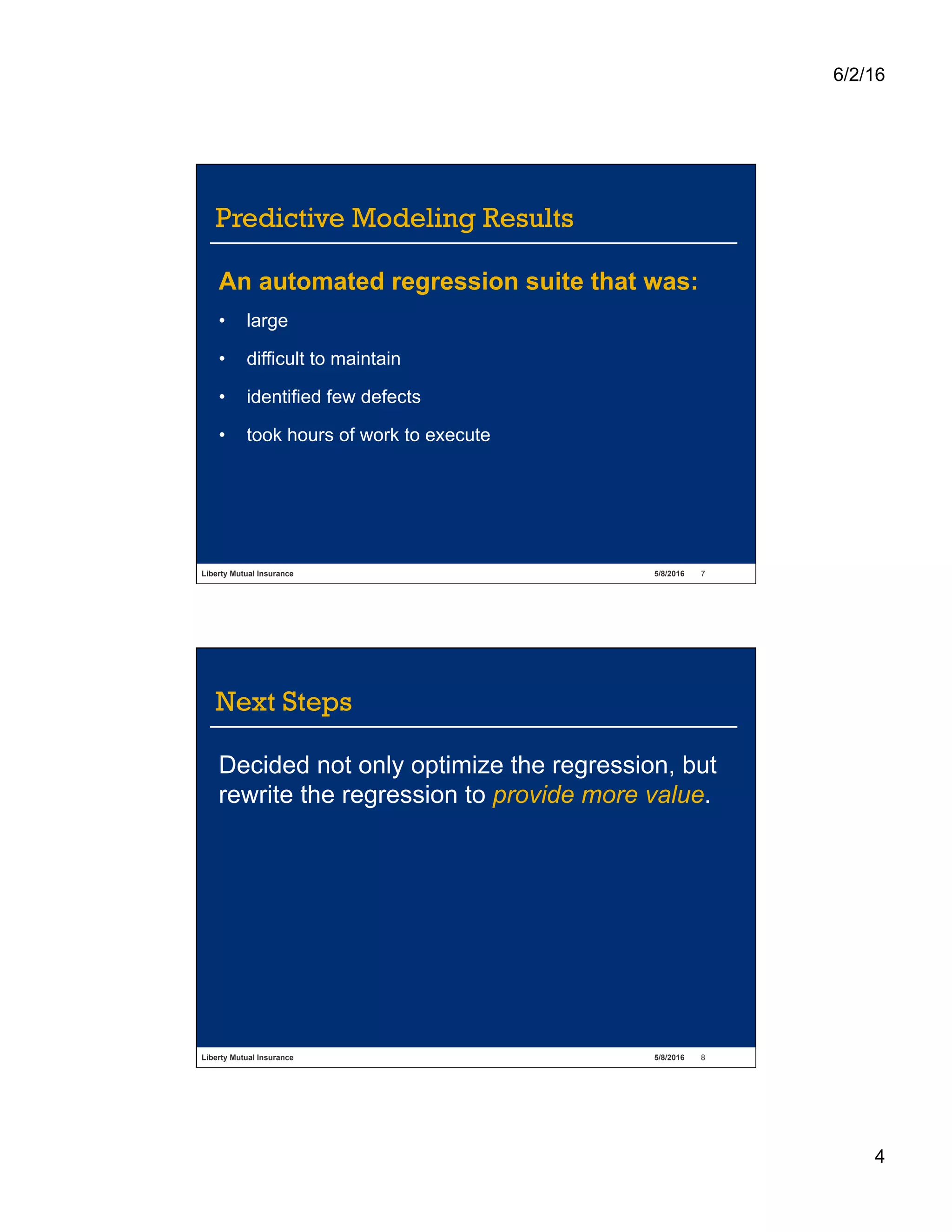
Predictive Modeling Results
An automated regression suite that was:
•  large
•  difficult to maintain
•  identified few defects
•  took hours of work to execute
Liberty Mutual Insurance 5/8/2016 8
Next Steps
Decided not only optimize the regression, but
rewrite the regression to provide more value.
6/2/16
5
Liberty Mutual Insurance 5/8/2016 9
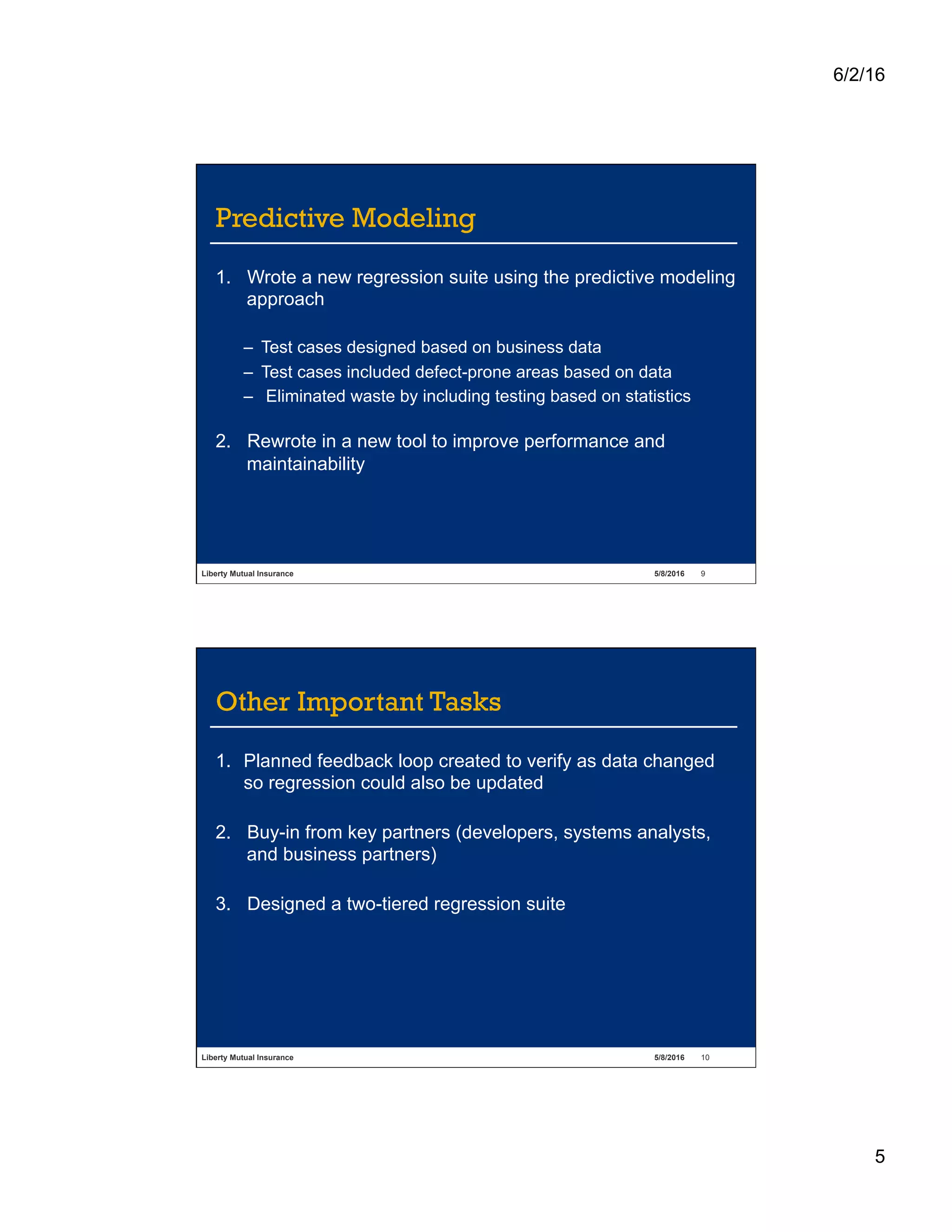
Predictive Modeling
1.  Wrote a new regression suite using the predictive modeling
approach
–  Test cases designed based on business data
–  Test cases included defect-prone areas based on data
–  Eliminated waste by including testing based on statistics
2.  Rewrote in a new tool to improve performance and
maintainability
Liberty Mutual Insurance 5/8/2016 10
Other Important Tasks
1.  Planned feedback loop created to verify as data changed
so regression could also be updated
2.  Buy-in from key partners (developers, systems analysts,
and business partners)
3.  Designed a two-tiered regression suite
6/2/16
6
Liberty Mutual Insurance 5/8/2016 11
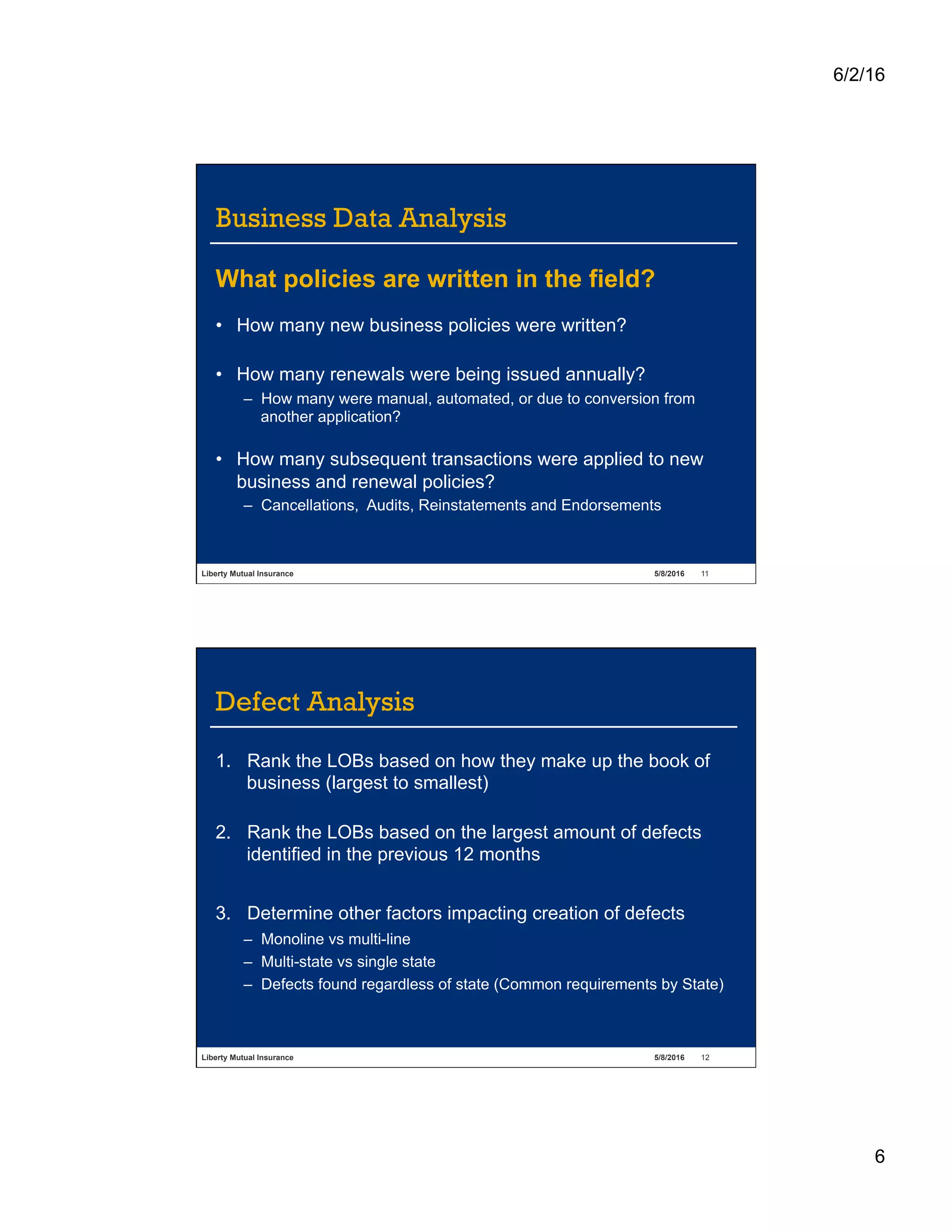
Business Data Analysis
What policies are written in the field?
•  How many new business policies were written?
•  How many renewals were being issued annually?
–  How many were manual, automated, or due to conversion from
another application?
•  How many subsequent transactions were applied to new
business and renewal policies?
–  Cancellations, Audits, Reinstatements and Endorsements
Liberty Mutual Insurance 5/8/2016 12
Defect Analysis
1.  Rank the LOBs based on how they make up the book of
business (largest to smallest)
2.  Rank the LOBs based on the largest amount of defects
identified in the previous 12 months
3.  Determine other factors impacting creation of defects
–  Monoline vs multi-line
–  Multi-state vs single state
–  Defects found regardless of state (Common requirements by State)
6/2/16
7
Liberty Mutual Insurance 5/8/2016 13
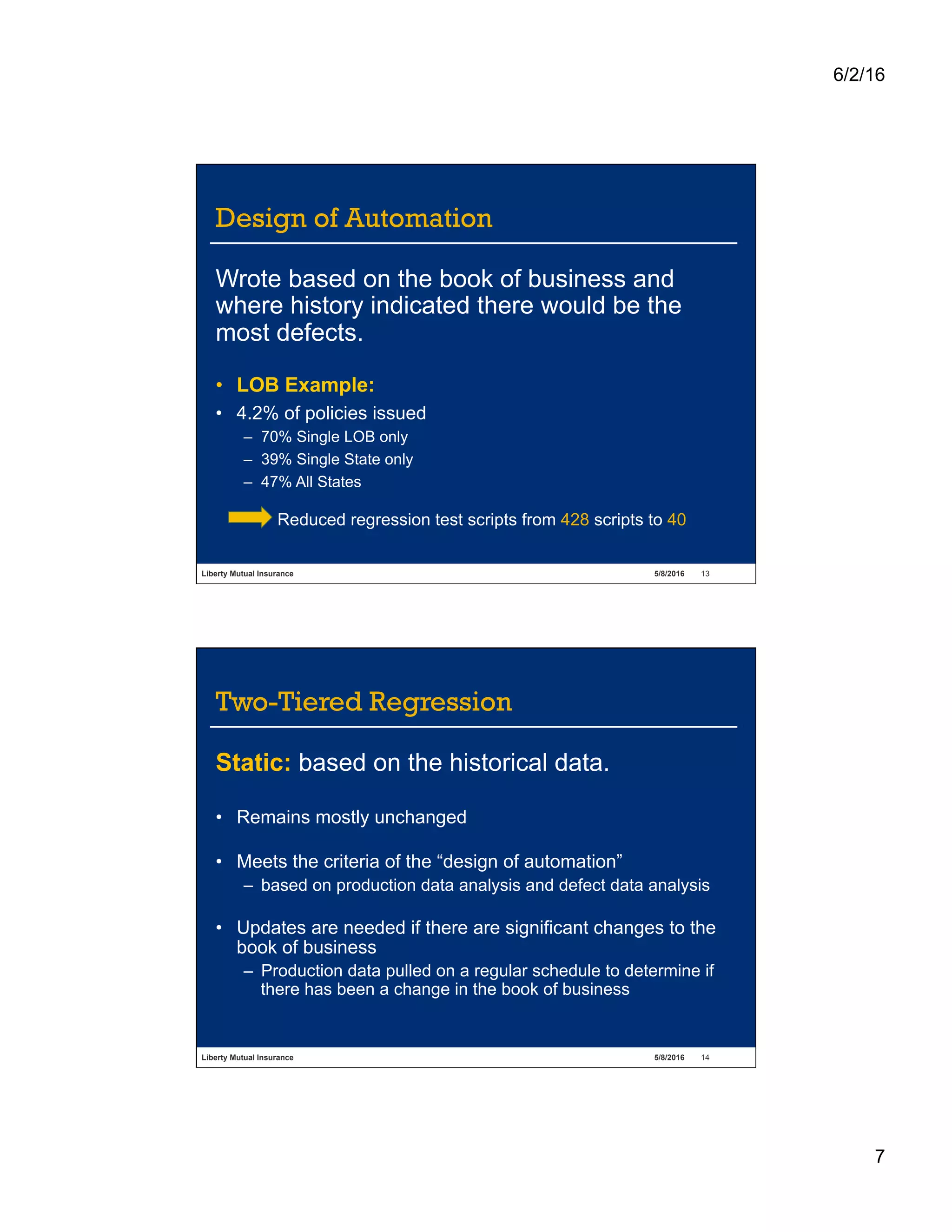
Design of Automation
Wrote based on the book of business and
where history indicated there would be the
most defects.
•  LOB Example:
•  4.2% of policies issued
–  70% Single LOB only
–  39% Single State only
–  47% All States
Reduced regression test scripts from 428 scripts to 40
Liberty Mutual Insurance 5/8/2016 14
Two-Tiered Regression
Static: based on the historical data.
•  Remains mostly unchanged
•  Meets the criteria of the “design of automation”
–  based on production data analysis and defect data analysis
•  Updates are needed if there are significant changes to the
book of business
–  Production data pulled on a regular schedule to determine if
there has been a change in the book of business
6/2/16
8
Liberty Mutual Insurance 5/8/2016 15
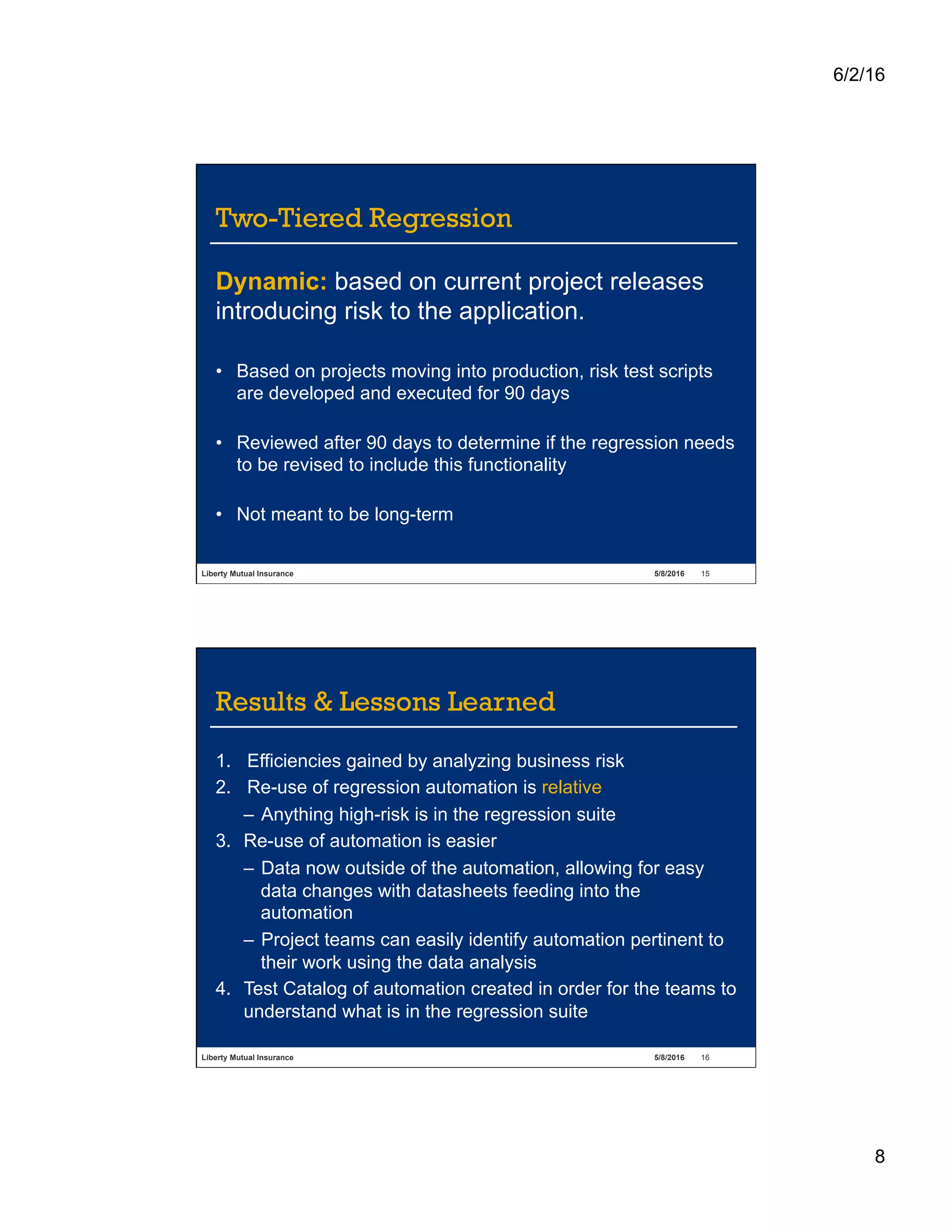
Two-Tiered Regression
Dynamic: based on current project releases
introducing risk to the application.
•  Based on projects moving into production, risk test scripts
are developed and executed for 90 days
•  Reviewed after 90 days to determine if the regression needs
to be revised to include this functionality
•  Not meant to be long-term
Liberty Mutual Insurance 5/8/2016 16
Results & Lessons Learned
1.  Efficiencies gained by analyzing business risk
2.  Re-use of regression automation is relative
–  Anything high-risk is in the regression suite
3.  Re-use of automation is easier
–  Data now outside of the automation, allowing for easy
data changes with datasheets feeding into the
automation
–  Project teams can easily identify automation pertinent to
their work using the data analysis
4.  Test Catalog of automation created in order for the teams to
understand what is in the regression suite
6/2/16
9

Predictive Test Planning to Improve System Quality

  • 1.
  • 2.
  • 3.
    6/2/16 1 Increase Quality throughPredictive Modeling Penny McVay CI Quality Assurance Liberty Mutual Insurance 5/8/2016 2 Who Am I 38 years of Insurance Industry experience •  IT Experience - 17 years –  Developer: Cobol II, CICS, Easytrieve –  Project Management: Large Tier 1 projects and implemented SDLC –  Quality Assurance: Start up of Ohio Casualty Group Testing •  Experience prior to Liberty Mutual –  8 years test leadership for a new Product and Policy Admin System in Commercial Lines small to medium business units
  • 4.
    6/2/16 2 Liberty Mutual Insurance5/8/2016 3 Main Message Quality Assurance has many tools and methodologies that can assure quality while reducing cost. Liberty Mutual Insurance 5/8/2016 4 How? 1.  Combinatorial Analysis 2.  Shift left influencing quality at the beginning of the cycle 3.  Automation 4.  Risk-Based Testing
  • 5.
    6/2/16 3 Liberty Mutual Insurance5/8/2016 5 The Challenge Determine the scope of testing to maintain the quality and dependability of a large-policy writing application with many pieces, parts and thousands of lines of code that are updated monthly. Liberty Mutual Insurance 5/8/2016 6 Background: Predictive Modeling Collected data to find significant defects where the impact would be most harmful to the business. Questions Asked •  What products are written in production? •  What transactions are exercised in production? •  Where are defects occurring in the production environment?
  • 6.
    6/2/16 4 Liberty Mutual Insurance5/8/2016 7 Predictive Modeling Results An automated regression suite that was: •  large •  difficult to maintain •  identified few defects •  took hours of work to execute Liberty Mutual Insurance 5/8/2016 8 Next Steps Decided not only optimize the regression, but rewrite the regression to provide more value.
  • 7.
    6/2/16 5 Liberty Mutual Insurance5/8/2016 9 Predictive Modeling 1.  Wrote a new regression suite using the predictive modeling approach –  Test cases designed based on business data –  Test cases included defect-prone areas based on data –  Eliminated waste by including testing based on statistics 2.  Rewrote in a new tool to improve performance and maintainability Liberty Mutual Insurance 5/8/2016 10 Other Important Tasks 1.  Planned feedback loop created to verify as data changed so regression could also be updated 2.  Buy-in from key partners (developers, systems analysts, and business partners) 3.  Designed a two-tiered regression suite
  • 8.
    6/2/16 6 Liberty Mutual Insurance5/8/2016 11 Business Data Analysis What policies are written in the field? •  How many new business policies were written? •  How many renewals were being issued annually? –  How many were manual, automated, or due to conversion from another application? •  How many subsequent transactions were applied to new business and renewal policies? –  Cancellations, Audits, Reinstatements and Endorsements Liberty Mutual Insurance 5/8/2016 12 Defect Analysis 1.  Rank the LOBs based on how they make up the book of business (largest to smallest) 2.  Rank the LOBs based on the largest amount of defects identified in the previous 12 months 3.  Determine other factors impacting creation of defects –  Monoline vs multi-line –  Multi-state vs single state –  Defects found regardless of state (Common requirements by State)
  • 9.
    6/2/16 7 Liberty Mutual Insurance5/8/2016 13 Design of Automation Wrote based on the book of business and where history indicated there would be the most defects. •  LOB Example: •  4.2% of policies issued –  70% Single LOB only –  39% Single State only –  47% All States Reduced regression test scripts from 428 scripts to 40 Liberty Mutual Insurance 5/8/2016 14 Two-Tiered Regression Static: based on the historical data. •  Remains mostly unchanged •  Meets the criteria of the “design of automation” –  based on production data analysis and defect data analysis •  Updates are needed if there are significant changes to the book of business –  Production data pulled on a regular schedule to determine if there has been a change in the book of business
  • 10.
    6/2/16 8 Liberty Mutual Insurance5/8/2016 15 Two-Tiered Regression Dynamic: based on current project releases introducing risk to the application. •  Based on projects moving into production, risk test scripts are developed and executed for 90 days •  Reviewed after 90 days to determine if the regression needs to be revised to include this functionality •  Not meant to be long-term Liberty Mutual Insurance 5/8/2016 16 Results & Lessons Learned 1.  Efficiencies gained by analyzing business risk 2.  Re-use of regression automation is relative –  Anything high-risk is in the regression suite 3.  Re-use of automation is easier –  Data now outside of the automation, allowing for easy data changes with datasheets feeding into the automation –  Project teams can easily identify automation pertinent to their work using the data analysis 4.  Test Catalog of automation created in order for the teams to understand what is in the regression suite
  • 11.