Semi-supervised learning with GANs : putting together the pieces together
OLX Berlin Data Science Team
Classifieds
OLX in a glance
350+ million
active users
40+ countries
60+ million new
listings per month
Market leader
in 35 countries
Classifieds - Data Science areas of Application
How GANs help in a semi-supervised setup
Using Colaboratory to train a GAN for semi-supervised learning
Options for putting the model in production
What are GANs
Outline
Short Intro
Intro to Deep Learning
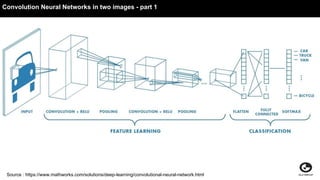
Convolution Neural Networks in two images - part 1
Source : https://www.mathworks.com/solutions/deep-learning/convolutional-neural-network.html
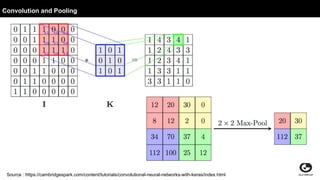
Convolution and Pooling
Source : https://cambridgespark.com/content/tutorials/convolutional-neural-networks-with-keras/index.html
Convolution Neural Networks in two images - part 2
http://machinelearninguru.com/computer_vision/basics/convolution/convolution_layer.html
Why does it work so well?
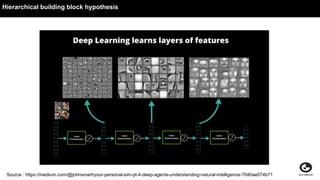
Hierarchical building block hypothesis
Source : https://medium.com/@johnsmart/your-personal-sim-pt-4-deep-agents-understanding-natural-intelligence-7040ae074b71
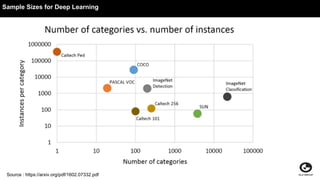
Sample Sizes for Deep Learning
Source : https://arxiv.org/pdf/1602.07332.pdf
Generative Adversarial Networks
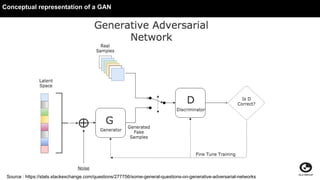
Conceptual representation of a GAN
Source : https://stats.stackexchange.com/questions/277756/some-general-questions-on-generative-adversarial-networks
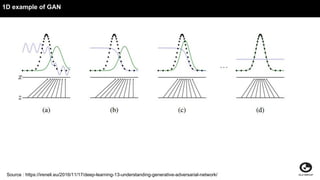
1D example of GAN
Source : https://ireneli.eu/2016/11/17/deep-learning-13-understanding-generative-adversarial-network/
GANs in one image
Source : https://news.developer.nvidia.com/edit-photos-with-gans
Types of GANs
Source : https://becominghuman.ai/unsupervised-image-to-image-translation-with-generative-adversarial-networks-adb3259b11b9
Limitations of GANs (1/3)
● Mode Collapse: Generator does not generate the full range of plausible samples
● More likely if the generator is optimized while the discriminator is kept constant for many iterations
Limitations of GANs (2/3)
● GANs predict the entire sample (e.g. image) at once
● Difficult to predict pixel neighborhoods
Limitations of GANs (3/3)
● Difficult training process / convergence: Generator and discriminator keep oscillating
● Network does not converge to a stable, (near) optimal solution
Semi-supervised learning with
GANs
Why using GANs in a semi-supervised setting?
● Create a more diverse set of unlabeled data
● Get a better / more descriptive decision boundary
● Improve generalization when the amount of training samples is small
Influence of unlabeled data in semi-supervised learning
● Continuity assumption
● Cluster assumption
● Manifold assumption
Example of GAN in a semi-supervised learning role
Source : https://towardsdatascience.com/semi-supervised-learning-with-gans-9f3cb128c5e
Sources of information and their role for the discriminator
● Real samples that have labels, similar to normal supervised learning
● Real samples that do not have labels. For those, the discriminator only learns that these images are
real
● Samples coming from the generator. For those, the discriminator learns to classify as fake
What do we have to modify to make it work?
● Adjust the loss functions so that we tackle both problems:
○ as per the original GAN task, use binary cross entropy for the GAN part
○ as per multiclass classification task, use softmax cross entropy (or sparse cross entropy with
logits) for the supervised task
○ apply masks to ignore the label not seen in the respective subtask
○ take the average of the GAN and supervised loss
● The discriminator can use the generator’s images, as well as the labeled and unlabeled training data,
to classify the dataset
Improving the GAN part
● Training GANs is a challenging problem -> feature matching approach
a. take the moments for some features for a “real” minibatch
b. take the moments for same features for a “fake” minibatch
c. minimize mean absolute error between the two
A use case from
Trust and Safety
Classifieds - Data Science areas of Application
● Spam can be a problem in open platforms like classifieds
● Its annoying and can also be used as a vehicle for fraud
● How can we keep bad users out without annoying good users with stringent policies?
Why is it a challenge?
● It’s a recurring battle, with spammers becoming more inventive to circumvent the algorithms
● We may have only a few cases of cases of annotated examples for certain types of bad content
Generating Synthetic Samples with GANs
Results
● In the presented example we only have a few tens of instances for a certain type of spam
● We are able to quickly explore the input space and map to a latent feature space combining the
different types of signal we have available from text, image, user behaviour, etc.
● Semi supervised learning with GANs does better (AUC = 0.999) vs Random Forest (AUC = 0.997)
Questions and Discussion
Deployment Options we will discuss
● Amazon Sagemaker
● AWS Lambda and Tensorflow
AWS Sagemaker in the ML Stack
AWS SageMaker
AWS Lambda
39
Applied Data Science Vision - Building the BasisAWS Lambda with Tensorflow
Resources
● Using Chalice to serve SageMaker predictions
○ https://medium.com/@julsimon/using-chalice-to-serve-sagemaker-predictions-a2015c02b033
● SageMaker examples
○ https://github.com/awslabs/amazon-sagemaker-examples
● How to Deploy Deep Learning Models with AWS Lambda and Tensorflow
○ https://aws.amazon.com/blogs/machine-learning/how-to-deploy-deep-learning-models-with-aws-la
mbda-and-tensorflow/
References
● Getting started with ML (Google)
○ https://drive.google.com/file/d/0B0phzgXZajPFZFRYNFRicjlZTVk/view
● Semi-supervised learning with Generative Adversarial Networks (GANs)
○ https://towardsdatascience.com/semi-supervised-learning-with-gans-9f3cb128c5e
● CNNs, three things you need to know
○ https://www.mathworks.com/solutions/deep-learning/convolutional-neural-network.html
● Semi-supervised learning
○ https://en.wikipedia.org/wiki/Semi-supervised_learning
● Variants of GANs
○ https://www.slideshare.net/thinkingfactory/variants-of-gans-jaejun-yoo
● From GAN to WGAN
○ https://lilianweng.github.io/lil-log/2017/08/20/from-GAN-to-WGAN.html

Predictive analytics semi-supervised learning with GANs

  • 1.
    Semi-supervised learning withGANs : putting together the pieces together OLX Berlin Data Science Team
  • 2.
  • 3.
    OLX in aglance 350+ million active users 40+ countries 60+ million new listings per month Market leader in 35 countries
  • 4.
    Classifieds - DataScience areas of Application
  • 5.
    How GANs helpin a semi-supervised setup Using Colaboratory to train a GAN for semi-supervised learning Options for putting the model in production What are GANs Outline Short Intro
  • 6.
    Intro to DeepLearning
  • 7.
    Convolution Neural Networksin two images - part 1 Source : https://www.mathworks.com/solutions/deep-learning/convolutional-neural-network.html
  • 8.
    Convolution and Pooling Source: https://cambridgespark.com/content/tutorials/convolutional-neural-networks-with-keras/index.html
  • 9.
    Convolution Neural Networksin two images - part 2 http://machinelearninguru.com/computer_vision/basics/convolution/convolution_layer.html
  • 10.
    Why does itwork so well?
  • 11.
    Hierarchical building blockhypothesis Source : https://medium.com/@johnsmart/your-personal-sim-pt-4-deep-agents-understanding-natural-intelligence-7040ae074b71
  • 12.
    Sample Sizes forDeep Learning Source : https://arxiv.org/pdf/1602.07332.pdf
  • 13.
  • 14.
    Conceptual representation ofa GAN Source : https://stats.stackexchange.com/questions/277756/some-general-questions-on-generative-adversarial-networks
  • 15.
    1D example ofGAN Source : https://ireneli.eu/2016/11/17/deep-learning-13-understanding-generative-adversarial-network/
  • 16.
    GANs in oneimage Source : https://news.developer.nvidia.com/edit-photos-with-gans
  • 17.
    Types of GANs Source: https://becominghuman.ai/unsupervised-image-to-image-translation-with-generative-adversarial-networks-adb3259b11b9
  • 18.
    Limitations of GANs(1/3) ● Mode Collapse: Generator does not generate the full range of plausible samples ● More likely if the generator is optimized while the discriminator is kept constant for many iterations
  • 19.
    Limitations of GANs(2/3) ● GANs predict the entire sample (e.g. image) at once ● Difficult to predict pixel neighborhoods
  • 20.
    Limitations of GANs(3/3) ● Difficult training process / convergence: Generator and discriminator keep oscillating ● Network does not converge to a stable, (near) optimal solution
  • 21.
  • 22.
    Why using GANsin a semi-supervised setting? ● Create a more diverse set of unlabeled data ● Get a better / more descriptive decision boundary ● Improve generalization when the amount of training samples is small
  • 23.
    Influence of unlabeleddata in semi-supervised learning ● Continuity assumption ● Cluster assumption ● Manifold assumption
  • 24.
    Example of GANin a semi-supervised learning role Source : https://towardsdatascience.com/semi-supervised-learning-with-gans-9f3cb128c5e
  • 25.
    Sources of informationand their role for the discriminator ● Real samples that have labels, similar to normal supervised learning ● Real samples that do not have labels. For those, the discriminator only learns that these images are real ● Samples coming from the generator. For those, the discriminator learns to classify as fake
  • 26.
    What do wehave to modify to make it work? ● Adjust the loss functions so that we tackle both problems: ○ as per the original GAN task, use binary cross entropy for the GAN part ○ as per multiclass classification task, use softmax cross entropy (or sparse cross entropy with logits) for the supervised task ○ apply masks to ignore the label not seen in the respective subtask ○ take the average of the GAN and supervised loss ● The discriminator can use the generator’s images, as well as the labeled and unlabeled training data, to classify the dataset
  • 27.
    Improving the GANpart ● Training GANs is a challenging problem -> feature matching approach a. take the moments for some features for a “real” minibatch b. take the moments for same features for a “fake” minibatch c. minimize mean absolute error between the two
  • 28.
    A use casefrom Trust and Safety
  • 29.
    Classifieds - DataScience areas of Application
  • 30.
    Classifieds - DataScience areas of Application ● Spam can be a problem in open platforms like classifieds ● Its annoying and can also be used as a vehicle for fraud ● How can we keep bad users out without annoying good users with stringent policies?
  • 31.
    Why is ita challenge? ● It’s a recurring battle, with spammers becoming more inventive to circumvent the algorithms ● We may have only a few cases of cases of annotated examples for certain types of bad content
  • 32.
  • 33.
    Results ● In thepresented example we only have a few tens of instances for a certain type of spam ● We are able to quickly explore the input space and map to a latent feature space combining the different types of signal we have available from text, image, user behaviour, etc. ● Semi supervised learning with GANs does better (AUC = 0.999) vs Random Forest (AUC = 0.997)
  • 34.
  • 35.
    Deployment Options wewill discuss ● Amazon Sagemaker ● AWS Lambda and Tensorflow
  • 36.
    AWS Sagemaker inthe ML Stack
  • 37.
  • 38.
  • 39.
    39 Applied Data ScienceVision - Building the BasisAWS Lambda with Tensorflow
  • 40.
    Resources ● Using Chaliceto serve SageMaker predictions ○ https://medium.com/@julsimon/using-chalice-to-serve-sagemaker-predictions-a2015c02b033 ● SageMaker examples ○ https://github.com/awslabs/amazon-sagemaker-examples ● How to Deploy Deep Learning Models with AWS Lambda and Tensorflow ○ https://aws.amazon.com/blogs/machine-learning/how-to-deploy-deep-learning-models-with-aws-la mbda-and-tensorflow/
  • 41.
    References ● Getting startedwith ML (Google) ○ https://drive.google.com/file/d/0B0phzgXZajPFZFRYNFRicjlZTVk/view ● Semi-supervised learning with Generative Adversarial Networks (GANs) ○ https://towardsdatascience.com/semi-supervised-learning-with-gans-9f3cb128c5e ● CNNs, three things you need to know ○ https://www.mathworks.com/solutions/deep-learning/convolutional-neural-network.html ● Semi-supervised learning ○ https://en.wikipedia.org/wiki/Semi-supervised_learning ● Variants of GANs ○ https://www.slideshare.net/thinkingfactory/variants-of-gans-jaejun-yoo ● From GAN to WGAN ○ https://lilianweng.github.io/lil-log/2017/08/20/from-GAN-to-WGAN.html