Conic Sections
Lesson 1.3. ELLIPSES
Learning Outcomes of the Lesson
At the end of the lesson, the student is able to:
1. define an ellipse;
2. determine the standard form of equation of
an ellipse;
3. graph an ellipse in a rectangular coordinate
system; and
4. solve situational problems involving conic
sections (ellipses).
Lesson 1.3. ELLIPSES
Lesson Outline
1. Definition of an ellipse
2. Derivation of the standard equation of an
ellipse
3. Graphing ellipses
4. Solving situational problems involving ellipses
Conic Sections
Lesson 1.3. ELLIPSES
Introduction
Unlike circle and parabola, an ellipse is one of the
conic sections that most students have not
encountered formally before. Its shape is a bounded
curve which looks like a flattened circle. The orbits of
the planets in our solar system around the sun happen
to be elliptical in shape. Also, just like parabolas,
ellipses have reflective properties that have been
used in the construction of certain structures. These
applications and more will be encountered in this
lesson.
Conic Sections
Lesson 1.3. ELLIPSES
1.3.1. Definition and
Equation of an Ellipse
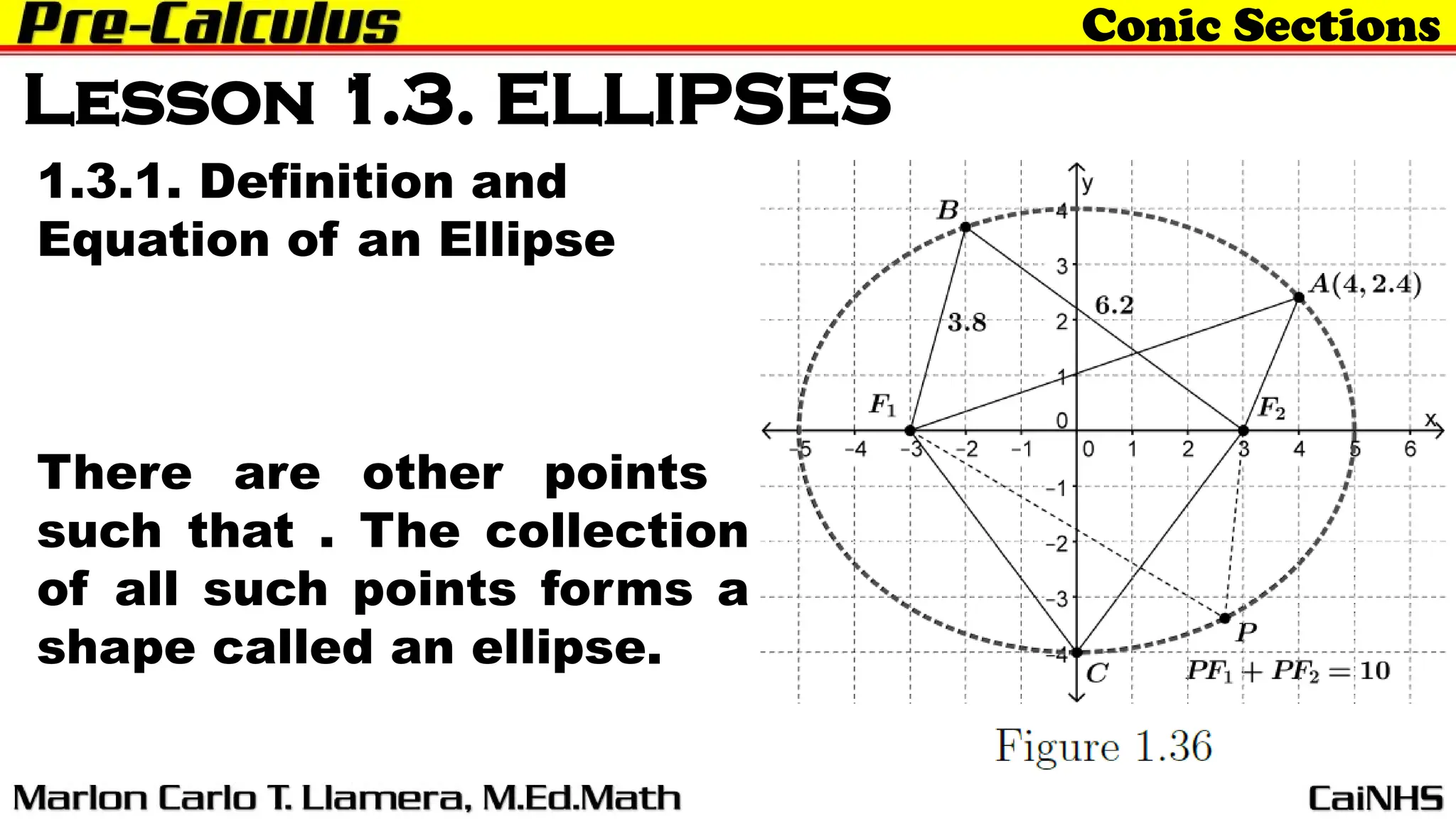
Consider the points and ,
as shown in Figure 1.36.
What is the sum of the
distances of from and
from ? How about the sum
of the distances of (and )
from and from ?
Conic Sections
Lesson 1.3. ELLIPSES
1.3.1. Definition and
Equation of an Ellipse
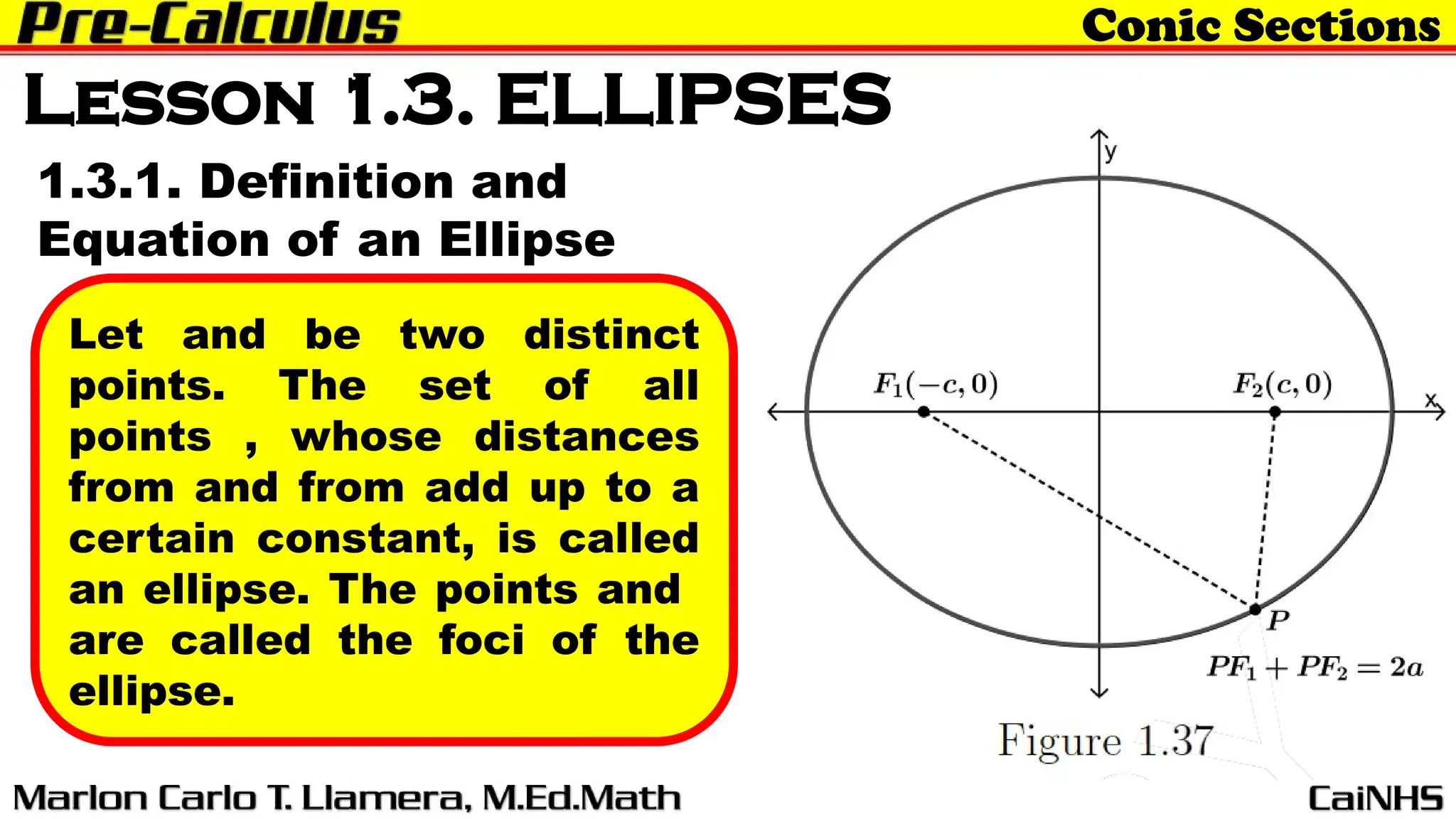
There are other points
such that . The collection
of all such points forms a
shape called an ellipse.
Conic Sections
Lesson 1.3. ELLIPSES
1.3.1. Definition and
Equation of an Ellipse
Conic Sections
Let and be two distinct
points. The set of all
points , whose distances
from and from add up to a
certain constant, is called
an ellipse. The points and
are called the foci of the
ellipse.
Lesson 1.3. ELLIPSES
Conic Sections

Pre-Calculus: Definition and Standard Equation ofEllipse

  • 1.
    Conic Sections Lesson 1.3.ELLIPSES Learning Outcomes of the Lesson At the end of the lesson, the student is able to: 1. define an ellipse; 2. determine the standard form of equation of an ellipse; 3. graph an ellipse in a rectangular coordinate system; and 4. solve situational problems involving conic sections (ellipses).
  • 2.
    Lesson 1.3. ELLIPSES LessonOutline 1. Definition of an ellipse 2. Derivation of the standard equation of an ellipse 3. Graphing ellipses 4. Solving situational problems involving ellipses Conic Sections
  • 3.
    Lesson 1.3. ELLIPSES Introduction Unlikecircle and parabola, an ellipse is one of the conic sections that most students have not encountered formally before. Its shape is a bounded curve which looks like a flattened circle. The orbits of the planets in our solar system around the sun happen to be elliptical in shape. Also, just like parabolas, ellipses have reflective properties that have been used in the construction of certain structures. These applications and more will be encountered in this lesson. Conic Sections
  • 4.
    Lesson 1.3. ELLIPSES 1.3.1.Definition and Equation of an Ellipse Consider the points and , as shown in Figure 1.36. What is the sum of the distances of from and from ? How about the sum of the distances of (and ) from and from ? Conic Sections
  • 5.
    Lesson 1.3. ELLIPSES 1.3.1.Definition and Equation of an Ellipse There are other points such that . The collection of all such points forms a shape called an ellipse. Conic Sections
  • 6.
    Lesson 1.3. ELLIPSES 1.3.1.Definition and Equation of an Ellipse Conic Sections Let and be two distinct points. The set of all points , whose distances from and from add up to a certain constant, is called an ellipse. The points and are called the foci of the ellipse.
  • 7.