Pran-RFL is the pioneer in Bangladesh to be involved in contract farming and procures raw
material directly from the farmers and processes through state of the art machinery at their
several factories into hygienically packed food and drinks products. The brand PRAN has
established itself in every category of food and beverage industry and can boost a product range
from Juices, Carbonated Drinks, Confectionery, Snacks, and Spices to even Dairy products. RFL
Plastics is dealing with different types of plastic products in different categories such as house
ware, plastic furniture, industrial ware & garments accessories. The Company has been
expanding its product lines day- by-day & achieving diversified product range in the
Company Profile
registered as a plc
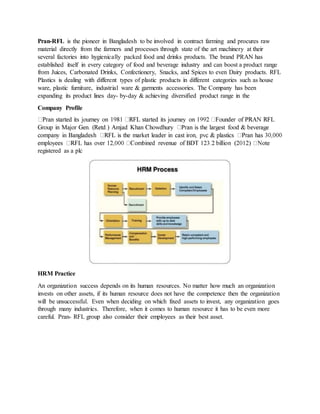
HRM Practice
An organization success depends on its human resources. No matter how much an organization
invests on other assets, if its human resource does not have the competence then the organization
will be unsuccessful. Even when deciding on which fixed assets to invest, any organization goes
through many industries. Therefore, when it comes to human resource it has to be even more
careful. Pran- RFL group also consider their employees as their best asset.
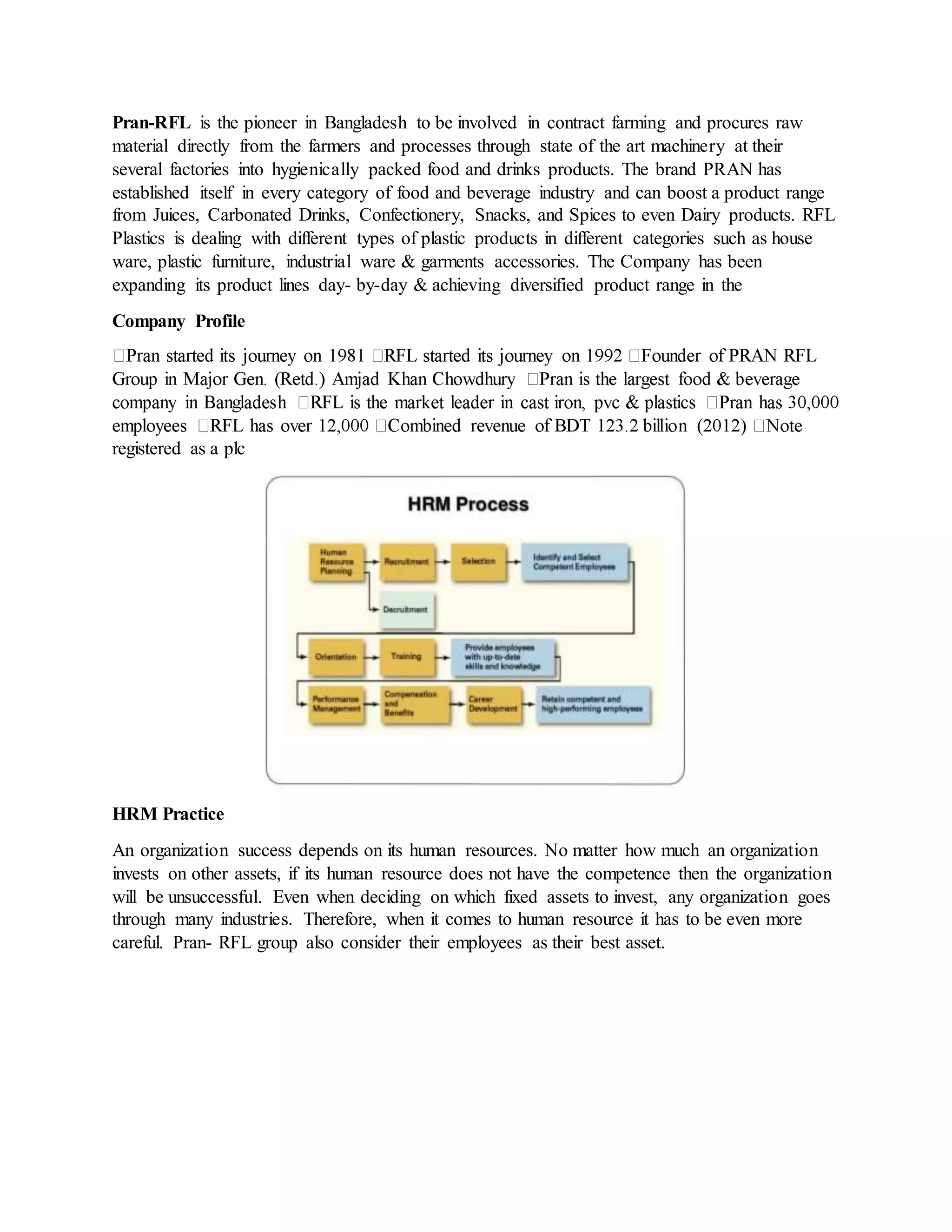
Functions of HRD
• Recruitment Process Policy & Procedure • Conformation Policy & Procedure • Human
Resource Development • Career Planning • Job Description Preparation • Maintaining Turnover
• Conducting Appraisal at the End of Each Year
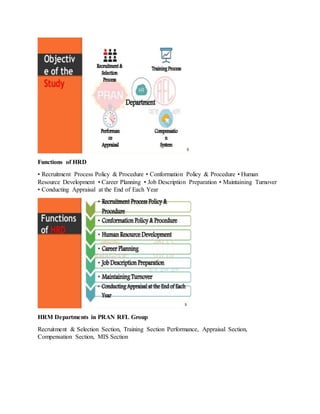
HRM Departments in PRAN RFL Group
Recruitment & Selection Section, Training Section Performance, Appraisal Section,
Compensation Section, MIS Section
Source of Recruitment
Need Assessment, Defining the Position, Description Checking the Recruitment Options,
Advertisement Screening & Shot- Listing
Source of Recruitment
Internal Sources, External Sources
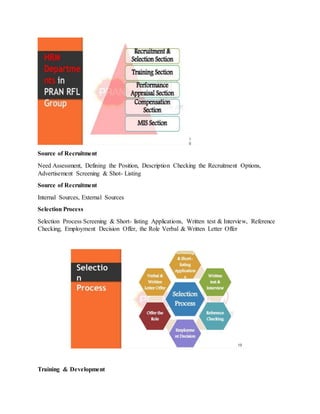
Selection Process
Selection Process Screening & Short- listing Applications, Written test & Interview, Reference
Checking, Employment Decision Offer, the Role Verbal & Written Letter Offer
Training & Development
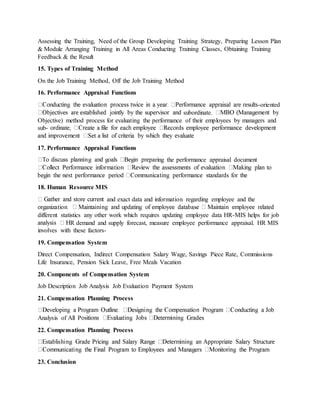
Assessing the Training, Need of the Group Developing Training Strategy, Preparing Lesson Plan
& Module Arranging Training in All Areas Conducting Training Classes, Obtaining Training
Feedback & the Result
15. Types of Training Method
On the Job Training Method, Off the Job Training Method
16. Performance Appraisal Functions
-oriented
subordinate.
Objective) method process for evaluating the performance of their employees by managers and
sub-
17. Performance Appraisal Functions
ring the performance appraisal document
18. Human Resource MIS
and exact data and information regarding employee and the
different statistics any other work which requires updating employee data HR-MIS helps for job
R demand and supply forecast, measure employee performance appraisal. HR MIS
involves with these factors-
19. Compensation System
Direct Compensation, Indirect Compensation Salary Wage, Savings Piece Rate, Commissions
Life Insurance, Pension Sick Leave, Free Meals Vacation
20. Components of Compensation System
Job Description Job Analysis Job Evaluation Payment System
21. Compensation Planning Process
Analysis of All P
22. Compensation Planning Process
23. Conclusion
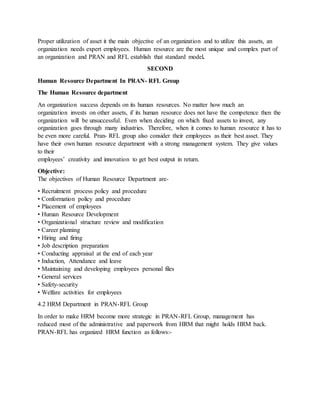
Proper utilization of asset it the main objective of an organization and to utilize this assets, an
organization needs expert employees. Human resource are the most unique and complex part of
an organization and PRAN and RFL establish that standard model.
SECOND
Human Resource Department In PRAN- RFL Group
The Human Resource department
An organization success depends on its human resources. No matter how much an
organization invests on other assets, if its human resource does not have the competence then the
organization will be unsuccessful. Even when deciding on which fixed assets to invest, any
organization goes through many industries. Therefore, when it comes to human resource it has to
be even more careful. Pran- RFL group also consider their employees as their best asset. They
have their own human resource department with a strong management system. They give values
to their
employees’ creativity and innovation to get best output in return.
Objective:
The objectives of Human Resource Department are-
• Recruitment process policy and procedure
• Conformation policy and procedure
• Placement of employees
• Human Resource Development
• Organizational structure review and modification
• Career planning
• Hiring and firing
• Job description preparation
• Conducting appraisal at the end of each year
• Induction, Attendance and leave
• Maintaining and developing employees personal files
• General services
• Safety-security
• Welfare activities for employees
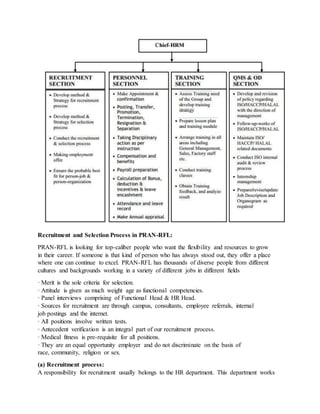
4.2 HRM Department in PRAN-RFL Group
In order to make HRM become more strategic in PRAN-RFL Group, management has
reduced most of the administrative and paperwork from HRM that might holds HRM back.
PRAN-RFL has organized HRM function as follows:-
Recruitment and Selection Process in PRAN-RFL:
PRAN-RFL is looking for top-caliber people who want the flexibility and resources to grow
in their career. If someone is that kind of person who has always stood out, they offer a place
where one can continue to excel. PRAN-RFL has thousands of diverse people from different
cultures and backgrounds working in a variety of different jobs in different fields
· Merit is the sole criteria for selection.
· Attitude is given as much weight age as functional competencies.
· Panel interviews comprising of Functional Head & HR Head.
· Sources for recruitment are through campus, consultants, employee referrals, internal
job postings and the internet.
· All positions involve written tests.
· Antecedent verification is an integral part of our recruitment process.
· Medical fitness is pre-requisite for all positions.
· They are an equal opportunity employer and do not discriminate on the basis of
race, community, religion or sex.
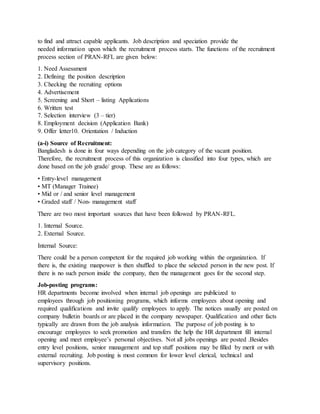
(a) Recruitment process:
A responsibility for recruitment usually belongs to the HR department. This department works
to find and attract capable applicants. Job description and speciation provide the
needed information upon which the recruitment process starts. The functions of the recruitment
process section of PRAN-RFL are given below:
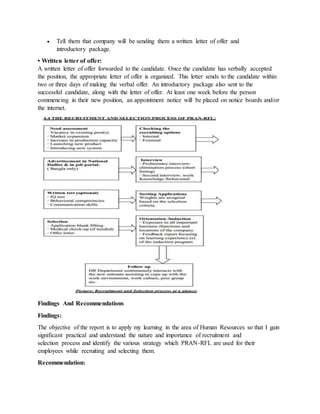
1. Need Assessment
2. Defining the position description
3. Checking the recruiting options
4. Advertisement
5. Screening and Short – listing Applications
6. Written test
7. Selection interview (3 – tier)
8. Employment decision (Application Bank)
9. Offer letter10. Orientation / Induction
(a-i) Source of Recruitment:
Bangladesh is done in four ways depending on the job category of the vacant position.
Therefore, the recruitment process of this organization is classified into four types, which are
done based on the job grade/ group. These are as follows:
• Entry-level management
• MT (Manager Trainee)
• Mid or / and senior level management
• Graded staff / Non- management staff
There are two most important sources that have been followed by PRAN-RFL.
1. Internal Source.
2. External Source.
Internal Source:
There could be a person competent for the required job working within the organization. If
there is, the existing manpower is then shuffled to place the selected person in the new post. If
there is no such person inside the company, then the management goes for the second step.
Job-posting programs:
HR departments become involved when internal job openings are publicized to
employees through job positioning programs, which informs employees about opening and
required qualifications and invite qualify employees to apply. The notices usually are posted on
company bulletin boards or are placed in the company newspaper. Qualification and other facts
typically are drawn from the job analysis information. The purpose of job posting is to
encourage employees to seek promotion and transfers the help the HR department fill internal
opening and meet employee’s personal objectives. Not all jobs openings are posted .Besides
entry level positions, senior management and top stuff positions may be filled by merit or with
external recruiting. Job posting is most common for lower level clerical, technical and
supervisory positions.
External Source:
After considering above option, the company goes for external recruiting if needed. Those
who best meet the skills, qualifications, experience and competencies required for the position
should fill vacancies. Therefore, if there is no candidate within PRAN-RFL, who is suitable for
the role, external advertisement should be placed to attract the potential candidates followed by
the selection procedures.
Advertisement:
The Company gives advertisement in national dailies to attract the talents from the
market. PRAN- RFL puts two types of advertisements in the newspapers. It sometimes keeps the
identity concealed in the ads, mentioning a GPO BOX number only. The purpose of the
concealed identity is to avoid the unwanted pressure from the stakeholders for the employment
of their desired candidates. But this way the company may lose the talents out there in the market
who would have applied for the same post had they known the name of the organization. This is
why the company kept the identity open in their recent job advertisement when the quality of
the candidate was a very important factor to consider. By revealing the BPL identify, the
company attempts to attract the best potentials among all the others.
Employee referrals:
Employee referral means using personal contracts to locate job opportunities. It is
a recommendation from a current employee regarding a job applicant. The logic behind
employee referral is that “it takes one to know one”. Employees working in the PRAN-RFL, in
this case, are encouraged to recommend the names of their friends working in other organization
for a possible vacancy in the near future.
Employment Agency:
An agency finds and prescreens applicants, referring those who seem qualified to
the organization for further assessment and final selection. PRAN- RFL also takes help from
such employment agency. They post their job vacancies on job portal like: BD jobs, BITAC.
Walk-ins and Write-ins:
Walk-ins are some seekers who arrived at the HR department of BPL in search of a job;
Writeins are those who send a written enquire .both groups normally are ask to complete
and application blank to determine their interest and abilities. Usable application is kept in an
active file until a suitable opening occurs or until an application is too old to be considered
valid, usually six months.
Consulting the CV Bank:
The unsolicited applications stored in the data bank are consulted. If the quality of a
person matches with the requirements mentioned in the position description, then he / she is
called for interview. If not, then the third step is followed.
(b) Selection Process:
Selection is the process of gathering information for the purpose of evaluating and deciding
who should be employed in particular jobs.
(b-i) Screening and Short-listing Applications
The responses to the advertisements are sorted and screened. The CVs as well as the
Covering letters are judged. In the covering letter, the style and language of writing, the
emphasis put on the areas asked for tin the advertisements and the quality of the letter (whether it
is specifically tailored to the advertisement or just a standard response) are the aspects that are
judged. Different weights are assigned to the selection criteria mentioned in the man
specification depending on their relative importance. (For example, educational institutions like
IBA, BUET
are given the highest weight among the local ones and the foreign universities of UK,
Australia, etc. are put at par with the best of the country). Based on the presence of these factors
to the desired extent (experience, educational degree, computer literacy, etc) the cumulative
weights for all the applicants are counted and the short list of a sizable number of the top most
candidates is generated.
However, the HR officials also study the CVs with the respective line manager to check
whether any valuable deciding parameter is missed that are mentioned in the CVs. Then the
candidates selected in the short list are called for the written test.
(b-ii) Written Test
Written test is a regular part of the normal recruitment process. It is conducted as and
when required. Previously no written test was taken for the management employee; the
applicants had to go directly through the interview process. After the introduction of the manager
trainee program, the written test before the interview process has proved to be effective and a
useful tool to select the desirable candidates. The written test includes psychometric test, test on
behavioral competency, and written test on communication skills. The candidates are called for
the
preliminary (first) interview based on their performance in the written test.
(b-iii) Selection Interview
The interview process is a three-tier one. A preliminary interview is conducted which follows
the “elimination method”. After that, the second interview takes place with a very few number
of candidates. Then they finally selected person is called for the final interview. The interview
time is kept convenient for the candidate especially if s/he is working elsewhere at the time
of interview. In that case the chosen time is after the business hour or in any holiday.
(b-iv) Reference Checks
Reference checks allow obtaining information and opinions regarding the person’s
character, quality of the work and suitability for the position. It is an opportunity to validate the
information received from the candidate via their resume and the interview. Speaking to the
candidate’s manager or other people whom they have worked with should also check internal
candidates. The opinion of a referee who has worked can for an extended period is likely to be
more accurate than the assessment from one to two hours of interviewing.The candidate’s
immediate supervisors are needed to be contacted. Permission should be obtained to contact the
candidate’s referee especially if their current employer is contacted. It is not unusual for a
candidate to be uncomfortable with the organization’s speaking to a current employer.
If they are uncomfortable, an alternative person other than the current employer has to be chosen
by the candidate (work colleague, for example). Unless the candidate is a graduate or school
leaver with no prior work experience, only contact work related referees should be contacted. At
least two reference checks should be done, however the more the better. There is a sample
reference-checking guide that is more or less followed. It is important to prepare a reference
check guide that asks the referee about the key skills, competencies and experience
required for the position. Reference checks need to be done by line manager or personnel of
the HR department. During the interviews, the candidates would have given some examples
of incidents, tasks or projects that can be asked about. The referee should be asked what
the candidate did in those examples, which ascertain whether the information received from
the candidate is consistent with that of the referee.
(b-v) Employment Decision
If the candidate has no problem with the stated terms and conditions of the job and
the organization mentioned and discussed in the final interview, s/he is offered an application
blank. The application blank is a standard format of employee-information that includes all
the information the organization needs regarding the personnel. The candidate has to fill this
blank and submit this to the company along with a CV.
(b-vi) Offering the Role:
Once the above activities are done, the candidate is given an offer letter specifying the
salary package, job responsibilities, utilities that will be provided by the organization. Even at
this stage the selected candidate has the chance to withdraw her/himself from the job offer. S/he
is always free to discuss whatever difficulty may arise regarding pay structure/ facilities, etc. the
door of
HR is kept open for any sort of relevant discussion.
• Verbal offer:
The verbal offer of the role to the candidate is given once the employment decisions
and reference checks have been successfully completed. The discussion cover the following:
 Tell the candidate that company would like to offer them the role.
 Congratulate them.
 Tell them the remuneration package that is being offered, including superannuating.
 Ask them if they are happy with it.
 Ask them if they verbally accept the position.
 Tell them that company will be sending them a written letter of offer and
introductory package.
• Written letter of offer:
A written letter of offer forwarded to the candidate. Once the candidate has verbally accepted
the position, the appropriate letter of offer is organized. This letter sends to the candidate within
two or three days of making the verbal offer. An introductory package also sent to the
successful candidate, along with the letter of offer. At least one week before the person
commencing in their new position, an appointment notice will be placed on notice boards and/or
the internet.
Findings And Recommendations
Findings:
The objective of the report is to apply my learning in the area of Human Resources so that I gain
significant practical and understand the nature and importance of recruitment and
selection process and identify the various strategy which PRAN-RFL are used for their
employees while recruiting and selecting them.
Recommendation:
At the conclusion of the report I would like to say that the PRAN-RFL has practiced the
standard human resource management. Here I have some recommendations that identify avenues
for improving the recruitment process and selection policies of PRAN-RFL:
1. Timeliness is an important ingredient in terms of recruitment process. The
recruitment department of PRAN-RFL should look into the matter of consuming less time in
the process of calling the applicants after their responses very seriously.
2. To provide an adequate pool of candidates the organization could use more clear and specific
statements in the ad in terms of the minimum educational degree, preferred institutions and other
necessary criteria based on which the initial screening of the applications were conducted.
3. To increase the satisfactory level of current interviewing process they can choose
group interview method to cope up the problem. Sometimes recruitment process section has to
take interview of a large pool of candidates group interview method can be great solution to this
problem.
4. From the survey we have seen that the organization prefer experienced people in the
selection process. Sometimes they give advantage for the candidates who have experience even
if the positions are not advertised for experience people. This will discourage new potential
graduates apply for the organization in future. The organization should give more opportunities
for fresh graduates.
5. Sometimes the organization provides advantages to the referred candidates. This is also a
bad practice for organization reputation. Sometimes a highly qualified candidates cannot get the
job because of less qualified referred candidates. PRAN- RFL is one of the best manufacturing
companies which have seen tremendous success since its establishment .It has been possible only
because of its skilled management, well trained, dedicated employees and excellent quality
products. It has earned very impressive operating income over the previous years .The company
tries to hold a good corporate governance by maintaining discipline and sincerity all over the
organization through its skilled and dedicated employees.
Conclusion
PRAN- RFL group of industries are now one of the most successful industry in our
country. They are trying to increase their business line and their own brand. From this report we
will able to know about the recruitment process section of PRAN-RFL group of industries. After
doing this report I would like to conclude by saying that it had been a great experience for me.
Moreover the survey that I conducted gave me a stronger and more helpful knowledge about the
entire research. This report may contain few flaws yet I have tried my best to maintain accuracy.
I hope this report can be a helpful resource to use in future.

Pran rfl manik sir

  • 1.
    Pran-RFL is thepioneer in Bangladesh to be involved in contract farming and procures raw material directly from the farmers and processes through state of the art machinery at their several factories into hygienically packed food and drinks products. The brand PRAN has established itself in every category of food and beverage industry and can boost a product range from Juices, Carbonated Drinks, Confectionery, Snacks, and Spices to even Dairy products. RFL Plastics is dealing with different types of plastic products in different categories such as house ware, plastic furniture, industrial ware & garments accessories. The Company has been expanding its product lines day- by-day & achieving diversified product range in the Company Profile registered as a plc HRM Practice An organization success depends on its human resources. No matter how much an organization invests on other assets, if its human resource does not have the competence then the organization will be unsuccessful. Even when deciding on which fixed assets to invest, any organization goes through many industries. Therefore, when it comes to human resource it has to be even more careful. Pran- RFL group also consider their employees as their best asset.
  • 2.
    Functions of HRD •Recruitment Process Policy & Procedure • Conformation Policy & Procedure • Human Resource Development • Career Planning • Job Description Preparation • Maintaining Turnover • Conducting Appraisal at the End of Each Year HRM Departments in PRAN RFL Group Recruitment & Selection Section, Training Section Performance, Appraisal Section, Compensation Section, MIS Section
  • 3.
    Source of Recruitment NeedAssessment, Defining the Position, Description Checking the Recruitment Options, Advertisement Screening & Shot- Listing Source of Recruitment Internal Sources, External Sources Selection Process Selection Process Screening & Short- listing Applications, Written test & Interview, Reference Checking, Employment Decision Offer, the Role Verbal & Written Letter Offer Training & Development
  • 4.
    Assessing the Training,Need of the Group Developing Training Strategy, Preparing Lesson Plan & Module Arranging Training in All Areas Conducting Training Classes, Obtaining Training Feedback & the Result 15. Types of Training Method On the Job Training Method, Off the Job Training Method 16. Performance Appraisal Functions -oriented subordinate. Objective) method process for evaluating the performance of their employees by managers and sub- 17. Performance Appraisal Functions ring the performance appraisal document 18. Human Resource MIS and exact data and information regarding employee and the different statistics any other work which requires updating employee data HR-MIS helps for job R demand and supply forecast, measure employee performance appraisal. HR MIS involves with these factors- 19. Compensation System Direct Compensation, Indirect Compensation Salary Wage, Savings Piece Rate, Commissions Life Insurance, Pension Sick Leave, Free Meals Vacation 20. Components of Compensation System Job Description Job Analysis Job Evaluation Payment System 21. Compensation Planning Process Analysis of All P 22. Compensation Planning Process 23. Conclusion
  • 5.
    Proper utilization ofasset it the main objective of an organization and to utilize this assets, an organization needs expert employees. Human resource are the most unique and complex part of an organization and PRAN and RFL establish that standard model. SECOND Human Resource Department In PRAN- RFL Group The Human Resource department An organization success depends on its human resources. No matter how much an organization invests on other assets, if its human resource does not have the competence then the organization will be unsuccessful. Even when deciding on which fixed assets to invest, any organization goes through many industries. Therefore, when it comes to human resource it has to be even more careful. Pran- RFL group also consider their employees as their best asset. They have their own human resource department with a strong management system. They give values to their employees’ creativity and innovation to get best output in return. Objective: The objectives of Human Resource Department are- • Recruitment process policy and procedure • Conformation policy and procedure • Placement of employees • Human Resource Development • Organizational structure review and modification • Career planning • Hiring and firing • Job description preparation • Conducting appraisal at the end of each year • Induction, Attendance and leave • Maintaining and developing employees personal files • General services • Safety-security • Welfare activities for employees 4.2 HRM Department in PRAN-RFL Group In order to make HRM become more strategic in PRAN-RFL Group, management has reduced most of the administrative and paperwork from HRM that might holds HRM back. PRAN-RFL has organized HRM function as follows:-
  • 6.
    Recruitment and SelectionProcess in PRAN-RFL: PRAN-RFL is looking for top-caliber people who want the flexibility and resources to grow in their career. If someone is that kind of person who has always stood out, they offer a place where one can continue to excel. PRAN-RFL has thousands of diverse people from different cultures and backgrounds working in a variety of different jobs in different fields · Merit is the sole criteria for selection. · Attitude is given as much weight age as functional competencies. · Panel interviews comprising of Functional Head & HR Head. · Sources for recruitment are through campus, consultants, employee referrals, internal job postings and the internet. · All positions involve written tests. · Antecedent verification is an integral part of our recruitment process. · Medical fitness is pre-requisite for all positions. · They are an equal opportunity employer and do not discriminate on the basis of race, community, religion or sex. (a) Recruitment process: A responsibility for recruitment usually belongs to the HR department. This department works
  • 7.
    to find andattract capable applicants. Job description and speciation provide the needed information upon which the recruitment process starts. The functions of the recruitment process section of PRAN-RFL are given below: 1. Need Assessment 2. Defining the position description 3. Checking the recruiting options 4. Advertisement 5. Screening and Short – listing Applications 6. Written test 7. Selection interview (3 – tier) 8. Employment decision (Application Bank) 9. Offer letter10. Orientation / Induction (a-i) Source of Recruitment: Bangladesh is done in four ways depending on the job category of the vacant position. Therefore, the recruitment process of this organization is classified into four types, which are done based on the job grade/ group. These are as follows: • Entry-level management • MT (Manager Trainee) • Mid or / and senior level management • Graded staff / Non- management staff There are two most important sources that have been followed by PRAN-RFL. 1. Internal Source. 2. External Source. Internal Source: There could be a person competent for the required job working within the organization. If there is, the existing manpower is then shuffled to place the selected person in the new post. If there is no such person inside the company, then the management goes for the second step. Job-posting programs: HR departments become involved when internal job openings are publicized to employees through job positioning programs, which informs employees about opening and required qualifications and invite qualify employees to apply. The notices usually are posted on company bulletin boards or are placed in the company newspaper. Qualification and other facts typically are drawn from the job analysis information. The purpose of job posting is to encourage employees to seek promotion and transfers the help the HR department fill internal opening and meet employee’s personal objectives. Not all jobs openings are posted .Besides entry level positions, senior management and top stuff positions may be filled by merit or with external recruiting. Job posting is most common for lower level clerical, technical and supervisory positions.
  • 8.
    External Source: After consideringabove option, the company goes for external recruiting if needed. Those who best meet the skills, qualifications, experience and competencies required for the position should fill vacancies. Therefore, if there is no candidate within PRAN-RFL, who is suitable for the role, external advertisement should be placed to attract the potential candidates followed by the selection procedures. Advertisement: The Company gives advertisement in national dailies to attract the talents from the market. PRAN- RFL puts two types of advertisements in the newspapers. It sometimes keeps the identity concealed in the ads, mentioning a GPO BOX number only. The purpose of the concealed identity is to avoid the unwanted pressure from the stakeholders for the employment of their desired candidates. But this way the company may lose the talents out there in the market who would have applied for the same post had they known the name of the organization. This is why the company kept the identity open in their recent job advertisement when the quality of the candidate was a very important factor to consider. By revealing the BPL identify, the company attempts to attract the best potentials among all the others. Employee referrals: Employee referral means using personal contracts to locate job opportunities. It is a recommendation from a current employee regarding a job applicant. The logic behind employee referral is that “it takes one to know one”. Employees working in the PRAN-RFL, in this case, are encouraged to recommend the names of their friends working in other organization for a possible vacancy in the near future. Employment Agency: An agency finds and prescreens applicants, referring those who seem qualified to the organization for further assessment and final selection. PRAN- RFL also takes help from such employment agency. They post their job vacancies on job portal like: BD jobs, BITAC. Walk-ins and Write-ins: Walk-ins are some seekers who arrived at the HR department of BPL in search of a job; Writeins are those who send a written enquire .both groups normally are ask to complete and application blank to determine their interest and abilities. Usable application is kept in an active file until a suitable opening occurs or until an application is too old to be considered valid, usually six months. Consulting the CV Bank: The unsolicited applications stored in the data bank are consulted. If the quality of a person matches with the requirements mentioned in the position description, then he / she is called for interview. If not, then the third step is followed. (b) Selection Process:
  • 9.
    Selection is theprocess of gathering information for the purpose of evaluating and deciding who should be employed in particular jobs. (b-i) Screening and Short-listing Applications The responses to the advertisements are sorted and screened. The CVs as well as the Covering letters are judged. In the covering letter, the style and language of writing, the emphasis put on the areas asked for tin the advertisements and the quality of the letter (whether it is specifically tailored to the advertisement or just a standard response) are the aspects that are judged. Different weights are assigned to the selection criteria mentioned in the man specification depending on their relative importance. (For example, educational institutions like IBA, BUET are given the highest weight among the local ones and the foreign universities of UK, Australia, etc. are put at par with the best of the country). Based on the presence of these factors to the desired extent (experience, educational degree, computer literacy, etc) the cumulative weights for all the applicants are counted and the short list of a sizable number of the top most candidates is generated. However, the HR officials also study the CVs with the respective line manager to check whether any valuable deciding parameter is missed that are mentioned in the CVs. Then the candidates selected in the short list are called for the written test. (b-ii) Written Test Written test is a regular part of the normal recruitment process. It is conducted as and when required. Previously no written test was taken for the management employee; the applicants had to go directly through the interview process. After the introduction of the manager trainee program, the written test before the interview process has proved to be effective and a useful tool to select the desirable candidates. The written test includes psychometric test, test on behavioral competency, and written test on communication skills. The candidates are called for the preliminary (first) interview based on their performance in the written test. (b-iii) Selection Interview The interview process is a three-tier one. A preliminary interview is conducted which follows the “elimination method”. After that, the second interview takes place with a very few number of candidates. Then they finally selected person is called for the final interview. The interview time is kept convenient for the candidate especially if s/he is working elsewhere at the time of interview. In that case the chosen time is after the business hour or in any holiday. (b-iv) Reference Checks Reference checks allow obtaining information and opinions regarding the person’s character, quality of the work and suitability for the position. It is an opportunity to validate the information received from the candidate via their resume and the interview. Speaking to the candidate’s manager or other people whom they have worked with should also check internal candidates. The opinion of a referee who has worked can for an extended period is likely to be
  • 10.
    more accurate thanthe assessment from one to two hours of interviewing.The candidate’s immediate supervisors are needed to be contacted. Permission should be obtained to contact the candidate’s referee especially if their current employer is contacted. It is not unusual for a candidate to be uncomfortable with the organization’s speaking to a current employer. If they are uncomfortable, an alternative person other than the current employer has to be chosen by the candidate (work colleague, for example). Unless the candidate is a graduate or school leaver with no prior work experience, only contact work related referees should be contacted. At least two reference checks should be done, however the more the better. There is a sample reference-checking guide that is more or less followed. It is important to prepare a reference check guide that asks the referee about the key skills, competencies and experience required for the position. Reference checks need to be done by line manager or personnel of the HR department. During the interviews, the candidates would have given some examples of incidents, tasks or projects that can be asked about. The referee should be asked what the candidate did in those examples, which ascertain whether the information received from the candidate is consistent with that of the referee. (b-v) Employment Decision If the candidate has no problem with the stated terms and conditions of the job and the organization mentioned and discussed in the final interview, s/he is offered an application blank. The application blank is a standard format of employee-information that includes all the information the organization needs regarding the personnel. The candidate has to fill this blank and submit this to the company along with a CV. (b-vi) Offering the Role: Once the above activities are done, the candidate is given an offer letter specifying the salary package, job responsibilities, utilities that will be provided by the organization. Even at this stage the selected candidate has the chance to withdraw her/himself from the job offer. S/he is always free to discuss whatever difficulty may arise regarding pay structure/ facilities, etc. the door of HR is kept open for any sort of relevant discussion. • Verbal offer: The verbal offer of the role to the candidate is given once the employment decisions and reference checks have been successfully completed. The discussion cover the following:  Tell the candidate that company would like to offer them the role.  Congratulate them.  Tell them the remuneration package that is being offered, including superannuating.  Ask them if they are happy with it.  Ask them if they verbally accept the position.
  • 11.
     Tell themthat company will be sending them a written letter of offer and introductory package. • Written letter of offer: A written letter of offer forwarded to the candidate. Once the candidate has verbally accepted the position, the appropriate letter of offer is organized. This letter sends to the candidate within two or three days of making the verbal offer. An introductory package also sent to the successful candidate, along with the letter of offer. At least one week before the person commencing in their new position, an appointment notice will be placed on notice boards and/or the internet. Findings And Recommendations Findings: The objective of the report is to apply my learning in the area of Human Resources so that I gain significant practical and understand the nature and importance of recruitment and selection process and identify the various strategy which PRAN-RFL are used for their employees while recruiting and selecting them. Recommendation:
  • 12.
    At the conclusionof the report I would like to say that the PRAN-RFL has practiced the standard human resource management. Here I have some recommendations that identify avenues for improving the recruitment process and selection policies of PRAN-RFL: 1. Timeliness is an important ingredient in terms of recruitment process. The recruitment department of PRAN-RFL should look into the matter of consuming less time in the process of calling the applicants after their responses very seriously. 2. To provide an adequate pool of candidates the organization could use more clear and specific statements in the ad in terms of the minimum educational degree, preferred institutions and other necessary criteria based on which the initial screening of the applications were conducted. 3. To increase the satisfactory level of current interviewing process they can choose group interview method to cope up the problem. Sometimes recruitment process section has to take interview of a large pool of candidates group interview method can be great solution to this problem. 4. From the survey we have seen that the organization prefer experienced people in the selection process. Sometimes they give advantage for the candidates who have experience even if the positions are not advertised for experience people. This will discourage new potential graduates apply for the organization in future. The organization should give more opportunities for fresh graduates. 5. Sometimes the organization provides advantages to the referred candidates. This is also a bad practice for organization reputation. Sometimes a highly qualified candidates cannot get the job because of less qualified referred candidates. PRAN- RFL is one of the best manufacturing companies which have seen tremendous success since its establishment .It has been possible only because of its skilled management, well trained, dedicated employees and excellent quality products. It has earned very impressive operating income over the previous years .The company tries to hold a good corporate governance by maintaining discipline and sincerity all over the organization through its skilled and dedicated employees. Conclusion PRAN- RFL group of industries are now one of the most successful industry in our country. They are trying to increase their business line and their own brand. From this report we will able to know about the recruitment process section of PRAN-RFL group of industries. After doing this report I would like to conclude by saying that it had been a great experience for me. Moreover the survey that I conducted gave me a stronger and more helpful knowledge about the entire research. This report may contain few flaws yet I have tried my best to maintain accuracy. I hope this report can be a helpful resource to use in future.