Chapter 9
Finance
Understanding the Finance Process
I. Nature of Financing
A. Introduction to the
Financing Process
 Financing is the key to most real estate transactions
 California Calls Trust Deeds “Mortgages”
 Mortgages are rarely used in California, but the term
“mortgage” is so ingrained in the tradition of lending
that often trust deeds and other loans are referred to as
“mortgages”
 The TRUSTOR is usually the party that is borrowing
the money
 The BENEFICIARY is the lender
 The TRUSTEE is the third, disinterested party who
holds naked legal title to the property
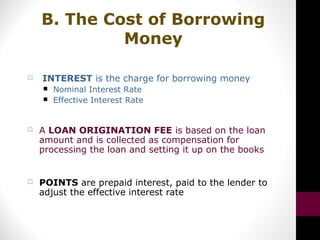
B. The Cost of Borrowing
Money
 INTEREST is the charge for borrowing money
 Nominal Interest Rate
 Effective Interest Rate
 A LOAN ORIGINATION FEE is based on the loan
amount and is collected as compensation for
processing the loan and setting it up on the books
 POINTS are prepaid interest, paid to the lender to
adjust the effective interest rate
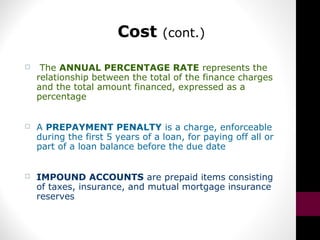
Cost (cont.)
 The ANNUAL PERCENTAGE RATE represents the
relationship between the total of the finance charges
and the total amount financed, expressed as a
percentage
 A PREPAYMENT PENALTY is a charge, enforceable
during the first 5 years of a loan, for paying off all or
part of a loan balance before the due date
 IMPOUND ACCOUNTS are prepaid items consisting
of taxes, insurance, and mutual mortgage insurance
reserves
II. Institutional
(Conventional) Financing
Institutional Financing
 Loans are not backed by any government
agency
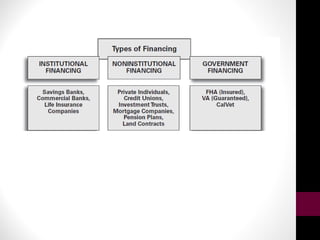
 Three primary sources for conventional loans:
 Savings banks
 Commercial banks
 Life insurance companies
 Approximately 80% of all home loans are
conventional
A. Mortgage Bankers
 MORTGAGE BANKING companies are direct
lenders that underwrite for usually hundreds of
investors
 Mortgage companies can be both a Mortgage
Banker and a Mortgage Broker
 MORTGAGE BROKERS shop for a lender for the
borrowers and earn a fee by putting lender and
borrower together
B. Savings Banks
 Savings banks are one source for conventional loans
and are restricted by their charter to investments in
real estate only
 Loans on a well-located property to borrowers with
good income and credit are referred to as PRIME
LOANS
 SUBPRIME BORROWERS have a FICO score of 650
or lower, two or more 30-day late payments in the
past 12 months, or one 60-day late payment in the
last 24 months, a foreclosure, bankruptcy, high
debt-to-income ratio of more than 50%
C. Commercial Banks
 Commercial banks are usually more selective about
both properties and buyers than savings banks
when making loans
 They make their own appraisals
 Loans, by law, may not exceed over 80% of the
appraised value
D. Life Insurance Companies
 Insurance companies are even more selective about
properties and borrowers than commercial or
savings banks
 They are usually interested ONLY in prime loans
with very little risk
 Mortgage brokers are usually correspondents for
insurance companies
E. Private Mortgage
Insurance
 For conventional loans with less than 20% down, a
private insurer will insure the lender against loss in
the event of foreclosure
 The private insurers generally cover only the top 10
to 20 percent of the loan
F. Fixed Rate Mortgages
 A FIXED RATE MORTGAGE is a loan for which the
payments are usually the same each month for the
life of the loan
 The equal monthly payments include both the
principal and the interest or is FULLY AMORTIZED
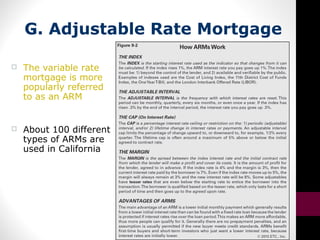
G. Adjustable Rate Mortgage
 The variable rate
mortgage is more
popularly referred
to as an ARM
 About 100 different
types of ARMs are
used in California
H. Special Purpose Loans
 With a GRADUATED PAYMENT MORTGAGE, the rate and
term are fixed, but the monthly payments are smaller at
the beginning of the term and increase over time
 NEGATIVE AMORTIZATION occurs when monthly
installment payments are insufficient to pay the interest
accruing on the principal balance
 BIWEEKLY MORTGAGE is a fixed interest rate loan for
which the payments are made every two weeks and each
payment if ½ the amount of a regular monthly payment
 15 YEAR FIXED AND ADJUSTABLE LOANS – these
loans can be paid off in only 15 years, usually at a lower
interest rate than 30 year loans
 REVERSE MORTGAGE LOANS - the borrower can receive
monthly installments or can receive a lump sum
III. The Secondary
Mortgage Market
A. Secondary Mortgage
Market
 The SECONDARY MORTGAGE MARKET buys and
sells first mortgages from financial institutions
 Financial institutions will make trust deed loans and
sell them to other institutions for a profit
 The secondary mortgage market enable lenders to
keep an adequate supply of money for new loans
 Lenders in the secondary market are concerned with
the “liquidity and marketability” of loans
1. Federal National Mortgage
Association
 Fannie Mae
 This association dominates the secondary
mortgage market
2. Government National
Mortgage Association
 Ginnie Mae
 A government corporation which sells secondary
mortgages to the public and provides the federal
government with cash
 Basically replaced Fannie Mae
3. Federal Home Loan
Mortgage Corporation
 Freddie Mac
 A private corporation operating similar to
Fannie Mae
B. Final Word on
Conventional Loans
 Without government backing these loans are riskier
 Fannie Mae & Freddie Mac currently have loan limits
for a house/condo
 A loan higher than the Fannie Mae/Freddie Mac loan
limit is called a JUMBO LOAN
IV. Government
Financing
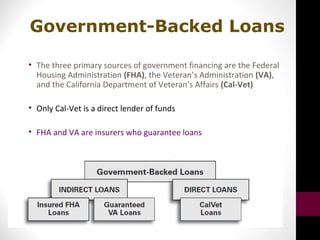
Government-Backed Loans
• The three primary sources of government financing are the Federal
Housing Administration (FHA), the Veteran’s Administration (VA),
and the California Department of Veteran’s Affairs (Cal-Vet)
• Only Cal-Vet is a direct lender of funds
• FHA and VA are insurers who guarantee loans
A. Federal Housing
Administration
 The primary purpose of FHA Section 203b is to encourage and
assist people to become homeowners
 Points or discount points may be charged to either the buyer or
seller under FHA & VA financing
 Cash investment is a requirement of buyers
 1% loan origination fee
 Maximum insurable FHA loan amount depends on median priced
homes in that area
 FHA has several graduated payment plans
B. Department of Veteran’s
Affairs
 A VA loan is not a loan, but rather a guarantee to an approved
lender
 A CERTIFICATE OF REASONABLE VALUE (CRV) is an appraisal
of the property a veteran wishes to buy
 The amount of the down payment needed for a VA loan is
determined by the CRV
 Any eligible veteran may obtain a VA loan on the purchase of
residential property as long as he or she is going to occupy the
unit
 Eligibility for another VA loan can be restored when the first loan
is paid off and the veteran has not fully used the current
guaranty
C. California Department of
Veteran’s Affairs
 California provides additional special assistance to
wartime veterans
 Loan funds are obtained from bond issues
 Operating costs of the program, plus retirement of
the bonds and interest thereon, are reflected in the
interest rates charged on Cal-Vet loans
 All veterans are eligible for the Cal-Vet program
 A group term life insurance policy is a requirement
of veterans
V. Qualifying the
Borrower
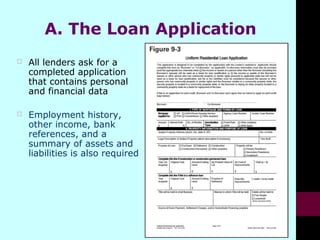
A. The Loan Application
 All lenders ask for a
completed application
that contains personal
and financial data
 Employment history,
other income, bank
references, and a
summary of assets and
liabilities is also required
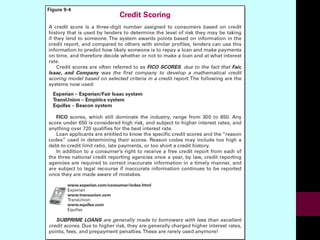
1. Credit Scoring
 CREDIT SCORING gives lenders a fast, objective
measurement of your ability to repay a loan or make
timely credit payments
 Factors comprising a credit score include:
 Payment history track record
 Amounts owed
 Length of credit history
 New credit
 Types of credit use
 The most widely used credit bureau scores are
developed by Fair, Issac and Company known as
FICO scores
2. Equal Credit Opportunity
Act
 This law requires that financial institutions and other
persons engaged in the extension of credit make
that credit equally available to all creditworthy
customers without regard to:
 Sex
 Marital status
 Race
 Color
 Religion
 National origin
 Age
 Receipt of public assistance
3. Fair Credit Reporting Act
 The FAIR CREDIT REPORTING ACT allows loan
applicants who have data collected on them to see
their files
 The law states that the credit bureau must quickly
correct mistakes found in its records
4. Truth in Lending Act
 This act is often known as Regulation Z
 It lets borrowers and customers know the cost of
credit so that they can compare costs with those
other credit sources and thereby avoid the
uninformed use of credit
VI. Non-Institutional
Financing
A. Junior Loans
 Non-institutional financing is private funding
 JUNIOR LOANS (secondary financing) – are
secured by a second trust deed or mortgage, and any
other loans on a property that come after the first, or
prime, security
 If a seller “carries back” a loan, he or she would be
called a junior mortgage holder (“lendlord”)
 Acceleration Clause
 Discounted Second Trust Deed
 Balloon Payment
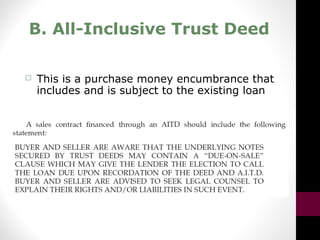
B. All-Inclusive Trust Deed
 This is a purchase money encumbrance that
includes and is subject to the existing loan
C. Contract of Sale
 This is also referred to as a LAND CONTRACT
 A land contract is like a car loan – you may be
driving a car, but you don’t own the title until it’s
paid off
D. All-Cash Transactions
 Very few buyers pay all cash for property, but
occasionally they will do so
 Paying off an existing loan is often inadvisable when
the interest rates are low
VII. Loan Takeovers
A. Assumption vs. Subject To
 A LOAN ASSUMPTION occurs when a buyers
pays the seller for part or all of the equity in a
property and assumes the responsibility for
payment of the existing loan
 EQUITY is the difference between market value
and existing loans against the property
 Taking title SUBJECT TO a prior loan constitutes
an agreement to take over and make the loan
payments or lose the property
 Not all loans can be assumed
VIII. Loan Brokerage
A. Safe Mortgage Licensing
Act
 Title V. – The SECURE AND FAIR ENFORCEMENT
MORTGAGE LICENSING ACT (SAFE ACT) of the Housing
and Economic Recovery Act of 2008 was signed into law on
July 30, 2008 to enhance consumer protection and reduce
fraud in mortgage loan transactions.
 The SAFE ACT mandates that each person performing
business activities that fit the definition of a mortgage loan
originator meet certain minimum pre-licensing and
continuing education requirements in order to be licensed
as a loan originator in any state.
 In addition to existing state requirements, each person
must also take and pass a test consisting of a national
component and state loan origination component.
B. Mortgage Loan Disclosure
Statement
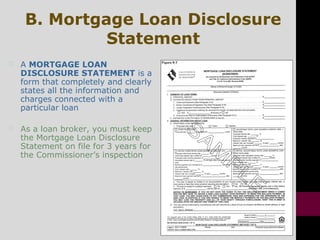
 A MORTGAGE LOAN
DISCLOSURE STATEMENT is a
form that completely and clearly
states all the information and
charges connected with a
particular loan
 As a loan broker, you must keep
the Mortgage Loan Disclosure
Statement on file for 3 years for
the Commissioner’s inspection
C. Business and Professions
Code
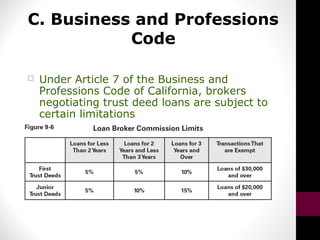
 Under Article 7 of the Business and
Professions Code of California, brokers
negotiating trust deed loans are subject to
certain limitations
D. Usury Limitations
 USURY is charging more than the legally allowed
percentage of interest
 In California, the maximum interest rate charged for
various loans is set by law
 The constitutional usury rate in California is 10%, or
five percent above the discount rate charged by the
Federal Reserve Bank of San Francisco, whichever is
higher
IX. Loan Defaults and
REO Advisory
Loan Defaults & REO
Advisory
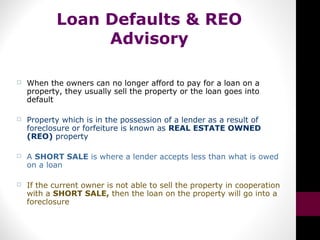
 When the owners can no longer afford to pay for a loan on a
property, they usually sell the property or the loan goes into
default
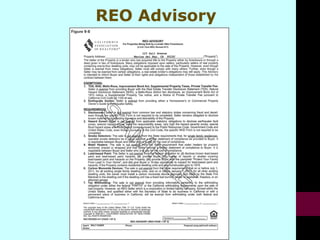
 Property which is in the possession of a lender as a result of
foreclosure or forfeiture is known as REAL ESTATE OWNED
(REO) property
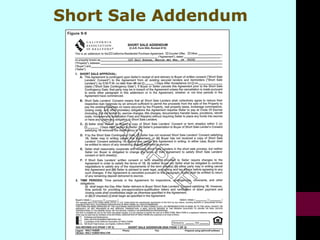
 A SHORT SALE is where a lender accepts less than what is owed
on a loan
 If the current owner is not able to sell the property in cooperation
with a SHORT SALE, then the loan on the property will go into a
foreclosure
REO Advisory
Short Sale Addendum
Chapter Summary
• Nature of Financing
• Intro of Financing Process
• Cost of Borrowing Money
• Institutional Financing
• Mortgage Bankers
• Savings Banks
• Commercial Banks
• Life Insurance Companies
• Private Mortgage Insurance
• Fixed Rate Mortgage
• ARMs
• Special Purpose Loans
• Secondary Mortgage Market
• Fannie Mae
• Ginnie Mae
• Freddie Mac
• Government Financing
• FHA
• VA
• Cal-Vet
• Qualifying the Buyer
• Loan Application
• Credit Score
• ECOA
• Fair Credit Reporting Act
• TILA – Reg Z
Chapter Summary
• Non-Institutional Financing
• Junior Loans
• AITD
• Land Contracts
• All Cash
• Loan Takeovers
• Assumption
• Loan Brokerage
• Mortgage Loan Disclosure Statement
• Article 7 – Business & Professions Code
• Usury Limitations
• SAFE ACT
• REOs
• SHORT SALES

Prac pp chp 9

  • 1.
  • 2.
    I. Nature ofFinancing
  • 3.
    A. Introduction tothe Financing Process  Financing is the key to most real estate transactions  California Calls Trust Deeds “Mortgages”  Mortgages are rarely used in California, but the term “mortgage” is so ingrained in the tradition of lending that often trust deeds and other loans are referred to as “mortgages”  The TRUSTOR is usually the party that is borrowing the money  The BENEFICIARY is the lender  The TRUSTEE is the third, disinterested party who holds naked legal title to the property
  • 4.
    B. The Costof Borrowing Money  INTEREST is the charge for borrowing money  Nominal Interest Rate  Effective Interest Rate  A LOAN ORIGINATION FEE is based on the loan amount and is collected as compensation for processing the loan and setting it up on the books  POINTS are prepaid interest, paid to the lender to adjust the effective interest rate
  • 5.
    Cost (cont.)  TheANNUAL PERCENTAGE RATE represents the relationship between the total of the finance charges and the total amount financed, expressed as a percentage  A PREPAYMENT PENALTY is a charge, enforceable during the first 5 years of a loan, for paying off all or part of a loan balance before the due date  IMPOUND ACCOUNTS are prepaid items consisting of taxes, insurance, and mutual mortgage insurance reserves
  • 7.
  • 8.
    Institutional Financing  Loansare not backed by any government agency  Three primary sources for conventional loans:  Savings banks  Commercial banks  Life insurance companies  Approximately 80% of all home loans are conventional
  • 9.
    A. Mortgage Bankers MORTGAGE BANKING companies are direct lenders that underwrite for usually hundreds of investors  Mortgage companies can be both a Mortgage Banker and a Mortgage Broker  MORTGAGE BROKERS shop for a lender for the borrowers and earn a fee by putting lender and borrower together
  • 10.
    B. Savings Banks Savings banks are one source for conventional loans and are restricted by their charter to investments in real estate only  Loans on a well-located property to borrowers with good income and credit are referred to as PRIME LOANS  SUBPRIME BORROWERS have a FICO score of 650 or lower, two or more 30-day late payments in the past 12 months, or one 60-day late payment in the last 24 months, a foreclosure, bankruptcy, high debt-to-income ratio of more than 50%
  • 11.
    C. Commercial Banks Commercial banks are usually more selective about both properties and buyers than savings banks when making loans  They make their own appraisals  Loans, by law, may not exceed over 80% of the appraised value
  • 12.
    D. Life InsuranceCompanies  Insurance companies are even more selective about properties and borrowers than commercial or savings banks  They are usually interested ONLY in prime loans with very little risk  Mortgage brokers are usually correspondents for insurance companies
  • 13.
    E. Private Mortgage Insurance For conventional loans with less than 20% down, a private insurer will insure the lender against loss in the event of foreclosure  The private insurers generally cover only the top 10 to 20 percent of the loan
  • 14.
    F. Fixed RateMortgages  A FIXED RATE MORTGAGE is a loan for which the payments are usually the same each month for the life of the loan  The equal monthly payments include both the principal and the interest or is FULLY AMORTIZED
  • 15.
    G. Adjustable RateMortgage  The variable rate mortgage is more popularly referred to as an ARM  About 100 different types of ARMs are used in California
  • 16.
    H. Special PurposeLoans  With a GRADUATED PAYMENT MORTGAGE, the rate and term are fixed, but the monthly payments are smaller at the beginning of the term and increase over time  NEGATIVE AMORTIZATION occurs when monthly installment payments are insufficient to pay the interest accruing on the principal balance  BIWEEKLY MORTGAGE is a fixed interest rate loan for which the payments are made every two weeks and each payment if ½ the amount of a regular monthly payment  15 YEAR FIXED AND ADJUSTABLE LOANS – these loans can be paid off in only 15 years, usually at a lower interest rate than 30 year loans  REVERSE MORTGAGE LOANS - the borrower can receive monthly installments or can receive a lump sum
  • 17.
  • 18.
    A. Secondary Mortgage Market The SECONDARY MORTGAGE MARKET buys and sells first mortgages from financial institutions  Financial institutions will make trust deed loans and sell them to other institutions for a profit  The secondary mortgage market enable lenders to keep an adequate supply of money for new loans  Lenders in the secondary market are concerned with the “liquidity and marketability” of loans
  • 19.
    1. Federal NationalMortgage Association  Fannie Mae  This association dominates the secondary mortgage market
  • 20.
    2. Government National MortgageAssociation  Ginnie Mae  A government corporation which sells secondary mortgages to the public and provides the federal government with cash  Basically replaced Fannie Mae
  • 21.
    3. Federal HomeLoan Mortgage Corporation  Freddie Mac  A private corporation operating similar to Fannie Mae
  • 22.
    B. Final Wordon Conventional Loans  Without government backing these loans are riskier  Fannie Mae & Freddie Mac currently have loan limits for a house/condo  A loan higher than the Fannie Mae/Freddie Mac loan limit is called a JUMBO LOAN
  • 23.
  • 24.
    Government-Backed Loans • Thethree primary sources of government financing are the Federal Housing Administration (FHA), the Veteran’s Administration (VA), and the California Department of Veteran’s Affairs (Cal-Vet) • Only Cal-Vet is a direct lender of funds • FHA and VA are insurers who guarantee loans
  • 25.
    A. Federal Housing Administration The primary purpose of FHA Section 203b is to encourage and assist people to become homeowners  Points or discount points may be charged to either the buyer or seller under FHA & VA financing  Cash investment is a requirement of buyers  1% loan origination fee  Maximum insurable FHA loan amount depends on median priced homes in that area  FHA has several graduated payment plans
  • 26.
    B. Department ofVeteran’s Affairs  A VA loan is not a loan, but rather a guarantee to an approved lender  A CERTIFICATE OF REASONABLE VALUE (CRV) is an appraisal of the property a veteran wishes to buy  The amount of the down payment needed for a VA loan is determined by the CRV  Any eligible veteran may obtain a VA loan on the purchase of residential property as long as he or she is going to occupy the unit  Eligibility for another VA loan can be restored when the first loan is paid off and the veteran has not fully used the current guaranty
  • 27.
    C. California Departmentof Veteran’s Affairs  California provides additional special assistance to wartime veterans  Loan funds are obtained from bond issues  Operating costs of the program, plus retirement of the bonds and interest thereon, are reflected in the interest rates charged on Cal-Vet loans  All veterans are eligible for the Cal-Vet program  A group term life insurance policy is a requirement of veterans
  • 28.
  • 29.
    A. The LoanApplication  All lenders ask for a completed application that contains personal and financial data  Employment history, other income, bank references, and a summary of assets and liabilities is also required
  • 30.
    1. Credit Scoring CREDIT SCORING gives lenders a fast, objective measurement of your ability to repay a loan or make timely credit payments  Factors comprising a credit score include:  Payment history track record  Amounts owed  Length of credit history  New credit  Types of credit use  The most widely used credit bureau scores are developed by Fair, Issac and Company known as FICO scores
  • 32.
    2. Equal CreditOpportunity Act  This law requires that financial institutions and other persons engaged in the extension of credit make that credit equally available to all creditworthy customers without regard to:  Sex  Marital status  Race  Color  Religion  National origin  Age  Receipt of public assistance
  • 33.
    3. Fair CreditReporting Act  The FAIR CREDIT REPORTING ACT allows loan applicants who have data collected on them to see their files  The law states that the credit bureau must quickly correct mistakes found in its records
  • 34.
    4. Truth inLending Act  This act is often known as Regulation Z  It lets borrowers and customers know the cost of credit so that they can compare costs with those other credit sources and thereby avoid the uninformed use of credit
  • 35.
  • 36.
    A. Junior Loans Non-institutional financing is private funding  JUNIOR LOANS (secondary financing) – are secured by a second trust deed or mortgage, and any other loans on a property that come after the first, or prime, security  If a seller “carries back” a loan, he or she would be called a junior mortgage holder (“lendlord”)  Acceleration Clause  Discounted Second Trust Deed  Balloon Payment
  • 37.
    B. All-Inclusive TrustDeed  This is a purchase money encumbrance that includes and is subject to the existing loan
  • 38.
    C. Contract ofSale  This is also referred to as a LAND CONTRACT  A land contract is like a car loan – you may be driving a car, but you don’t own the title until it’s paid off
  • 39.
    D. All-Cash Transactions Very few buyers pay all cash for property, but occasionally they will do so  Paying off an existing loan is often inadvisable when the interest rates are low
  • 40.
  • 41.
    A. Assumption vs.Subject To  A LOAN ASSUMPTION occurs when a buyers pays the seller for part or all of the equity in a property and assumes the responsibility for payment of the existing loan  EQUITY is the difference between market value and existing loans against the property  Taking title SUBJECT TO a prior loan constitutes an agreement to take over and make the loan payments or lose the property  Not all loans can be assumed
  • 42.
  • 43.
    A. Safe MortgageLicensing Act  Title V. – The SECURE AND FAIR ENFORCEMENT MORTGAGE LICENSING ACT (SAFE ACT) of the Housing and Economic Recovery Act of 2008 was signed into law on July 30, 2008 to enhance consumer protection and reduce fraud in mortgage loan transactions.  The SAFE ACT mandates that each person performing business activities that fit the definition of a mortgage loan originator meet certain minimum pre-licensing and continuing education requirements in order to be licensed as a loan originator in any state.  In addition to existing state requirements, each person must also take and pass a test consisting of a national component and state loan origination component.
  • 44.
    B. Mortgage LoanDisclosure Statement  A MORTGAGE LOAN DISCLOSURE STATEMENT is a form that completely and clearly states all the information and charges connected with a particular loan  As a loan broker, you must keep the Mortgage Loan Disclosure Statement on file for 3 years for the Commissioner’s inspection
  • 45.
    C. Business andProfessions Code  Under Article 7 of the Business and Professions Code of California, brokers negotiating trust deed loans are subject to certain limitations
  • 46.
    D. Usury Limitations USURY is charging more than the legally allowed percentage of interest  In California, the maximum interest rate charged for various loans is set by law  The constitutional usury rate in California is 10%, or five percent above the discount rate charged by the Federal Reserve Bank of San Francisco, whichever is higher
  • 47.
    IX. Loan Defaultsand REO Advisory
  • 48.
    Loan Defaults &REO Advisory  When the owners can no longer afford to pay for a loan on a property, they usually sell the property or the loan goes into default  Property which is in the possession of a lender as a result of foreclosure or forfeiture is known as REAL ESTATE OWNED (REO) property  A SHORT SALE is where a lender accepts less than what is owed on a loan  If the current owner is not able to sell the property in cooperation with a SHORT SALE, then the loan on the property will go into a foreclosure
  • 49.
  • 50.
  • 51.
    Chapter Summary • Natureof Financing • Intro of Financing Process • Cost of Borrowing Money • Institutional Financing • Mortgage Bankers • Savings Banks • Commercial Banks • Life Insurance Companies • Private Mortgage Insurance • Fixed Rate Mortgage • ARMs • Special Purpose Loans • Secondary Mortgage Market • Fannie Mae • Ginnie Mae • Freddie Mac • Government Financing • FHA • VA • Cal-Vet • Qualifying the Buyer • Loan Application • Credit Score • ECOA • Fair Credit Reporting Act • TILA – Reg Z
  • 52.
    Chapter Summary • Non-InstitutionalFinancing • Junior Loans • AITD • Land Contracts • All Cash • Loan Takeovers • Assumption • Loan Brokerage • Mortgage Loan Disclosure Statement • Article 7 – Business & Professions Code • Usury Limitations • SAFE ACT • REOs • SHORT SALES