ISSUE OF DEBENTURES
MRK
DEBENTURE
Debenture is an acknowledgement of debt issued by a
company under its common seal.
Meaning of debentures as per section 2(30) of the
companies act, 2013:
Debenture includes debenture stock, bonds and any other
instrument of the company evidencing a debt, whether
constituting a charge on the assets of the company or not.
BONDS
A bond and debenture both are debt instrument issued by
government or companies. Both of these are fundraising tools for the
issuer. Bonds are generally issued by the government, the agencies of
government or by large corporations whereas debentures are issued by
public companies to raise money from the market.
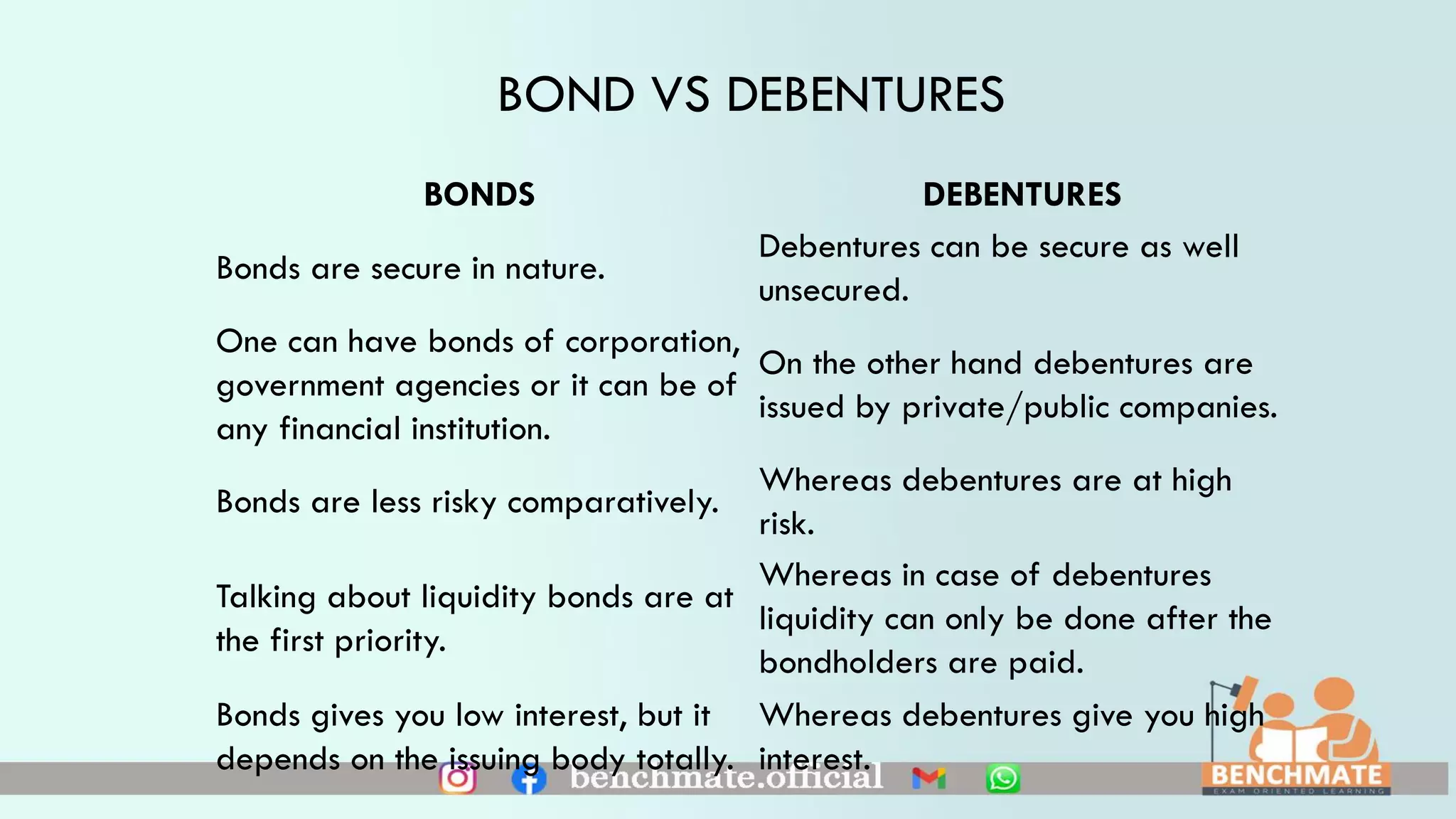
BOND VS DEBENTURES
BONDS DEBENTURES
Bonds are secure in nature.
Debentures can be secure as well
unsecured.
One can have bonds of corporation,
government agencies or it can be of
any financial institution.
On the other hand debentures are
issued by private/public companies.
Bonds are less risky comparatively.
Whereas debentures are at high
risk.
Talking about liquidity bonds are at
the first priority.
Whereas in case of debentures
liquidity can only be done after the
bondholders are paid.
Bonds gives you low interest, but it
depends on the issuing body totally.
Whereas debentures give you high
interest.
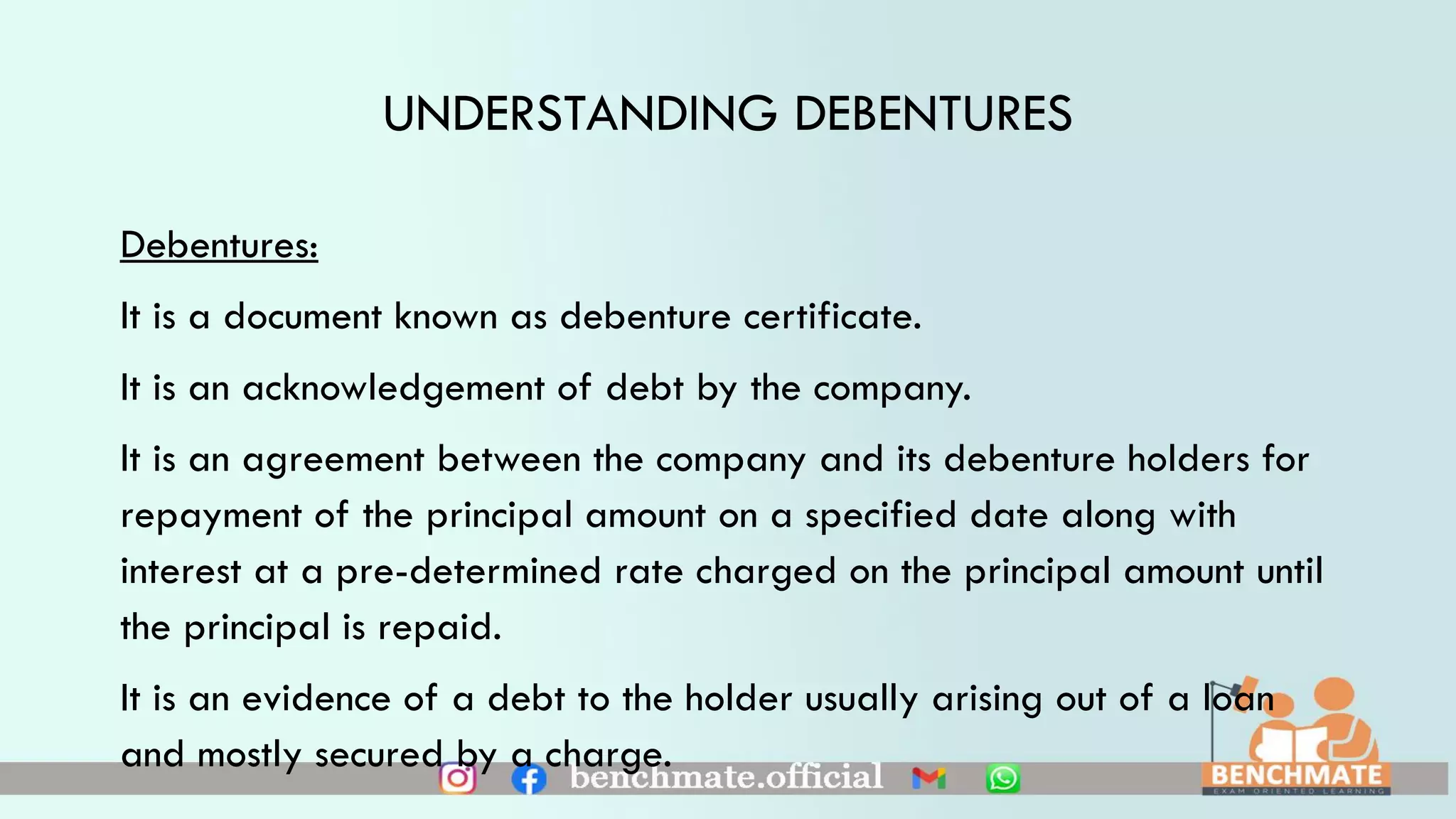
UNDERSTANDING DEBENTURES
Debentures:
It is a document known as debenture certificate.
It is an acknowledgement of debt by the company.
It is an agreement between the company and its debenture holders for
repayment of the principal amount on a specified date along with
interest at a pre-determined rate charged on the principal amount until
the principal is repaid.
It is an evidence of a debt to the holder usually arising out of a loan
and mostly secured by a charge.
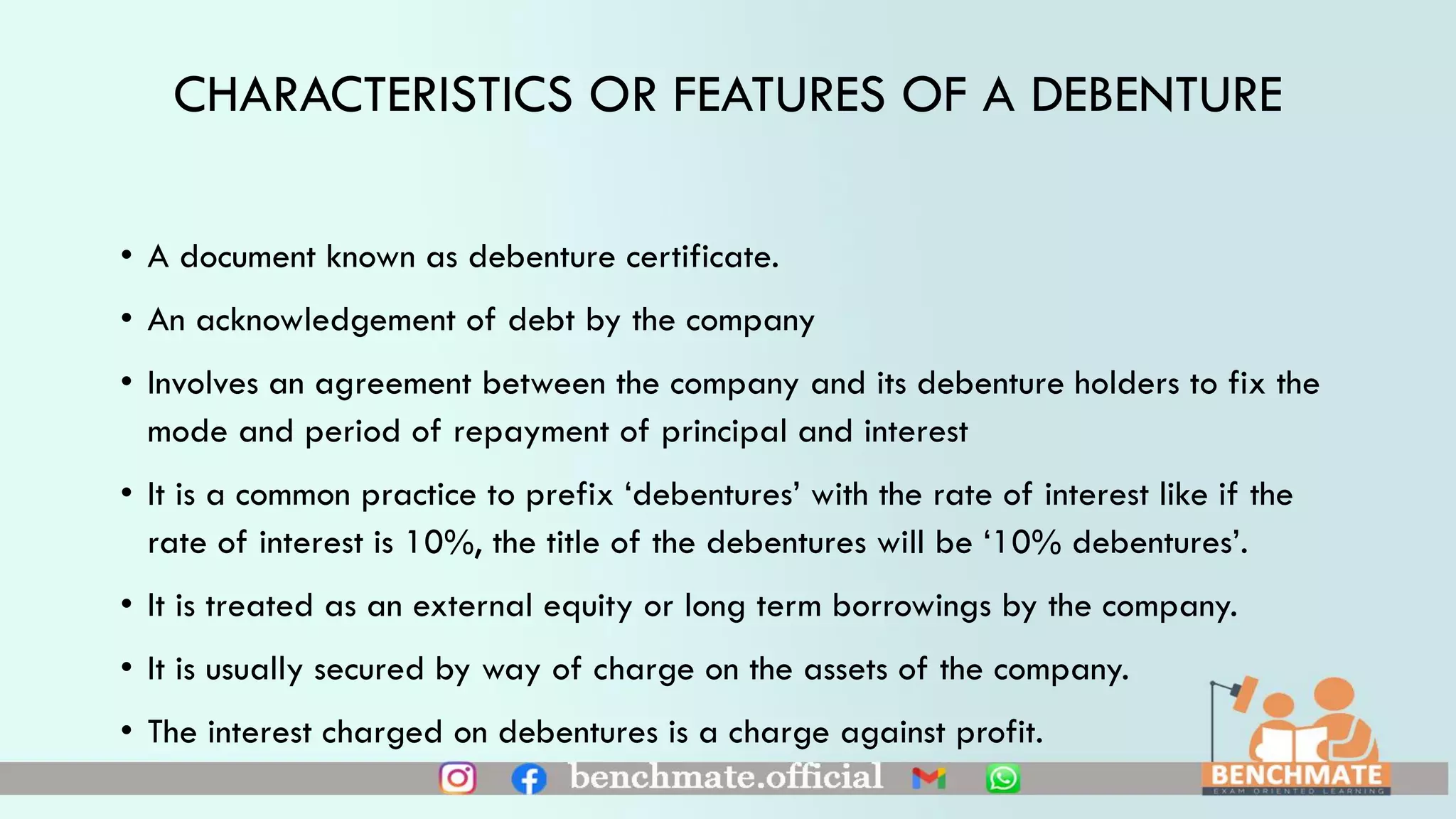
CHARACTERISTICS OR FEATURES OF A DEBENTURE
• A document known as debenture certificate.
• An acknowledgement of debt by the company
• Involves an agreement between the company and its debenture holders to fix the
mode and period of repayment of principal and interest
• It is a common practice to prefix ‘debentures’ with the rate of interest like if the
rate of interest is 10%, the title of the debentures will be ‘10% debentures’.
• It is treated as an external equity or long term borrowings by the company.
• It is usually secured by way of charge on the assets of the company.
• The interest charged on debentures is a charge against profit.
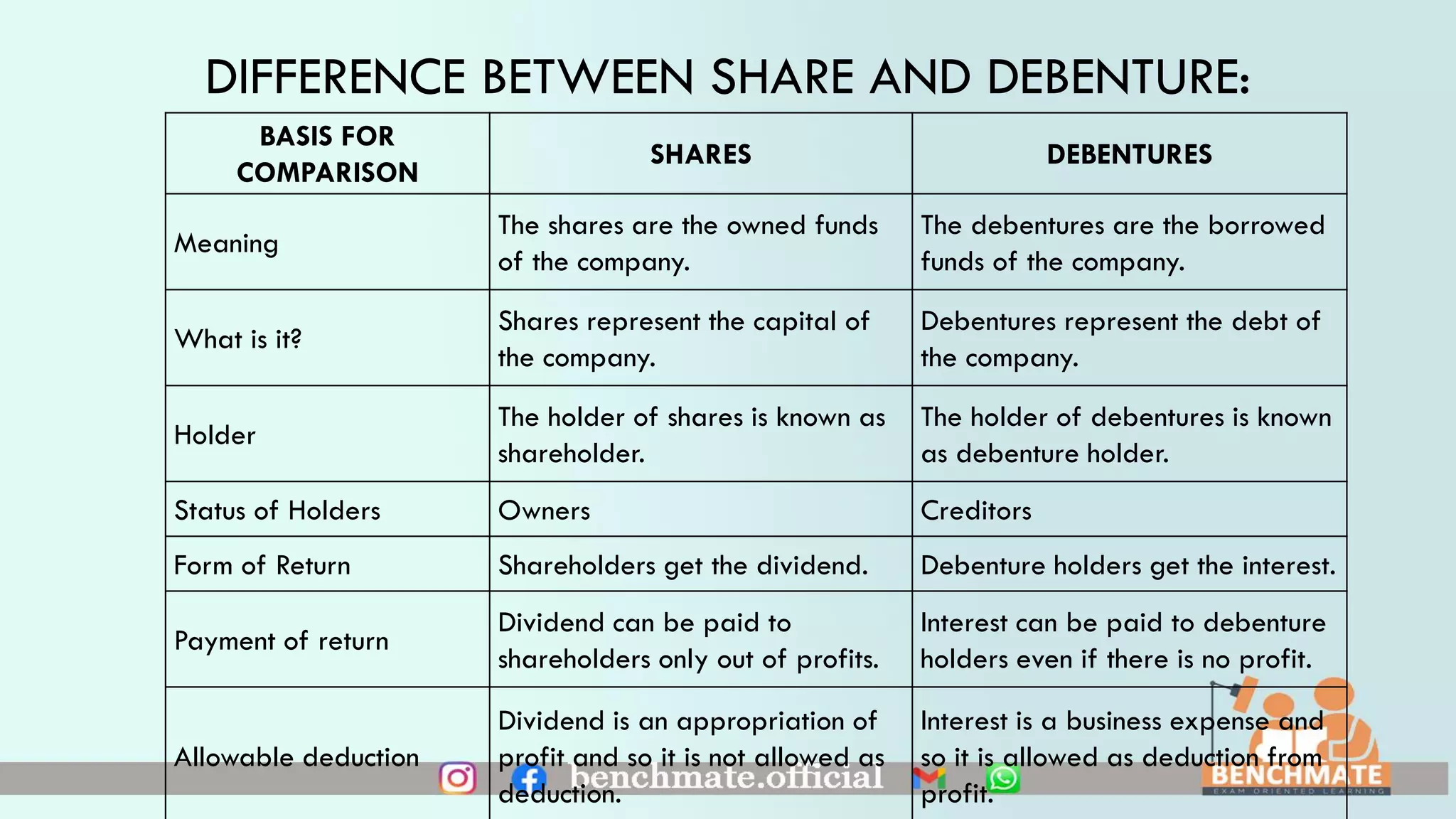
DIFFERENCE BETWEEN SHARE AND DEBENTURE:
BASIS FOR
COMPARISON
SHARES DEBENTURES
Meaning
The shares are the owned funds
of the company.
The debentures are the borrowed
funds of the company.
What is it?
Shares represent the capital of
the company.
Debentures represent the debt of
the company.
Holder
The holder of shares is known as
shareholder.
The holder of debentures is known
as debenture holder.
Status of Holders Owners Creditors
Form of Return Shareholders get the dividend. Debenture holders get the interest.
Payment of return
Dividend can be paid to
shareholders only out of profits.
Interest can be paid to debenture
holders even if there is no profit.
Allowable deduction
Dividend is an appropriation of
profit and so it is not allowed as
deduction.
Interest is a business expense and
so it is allowed as deduction from
profit.
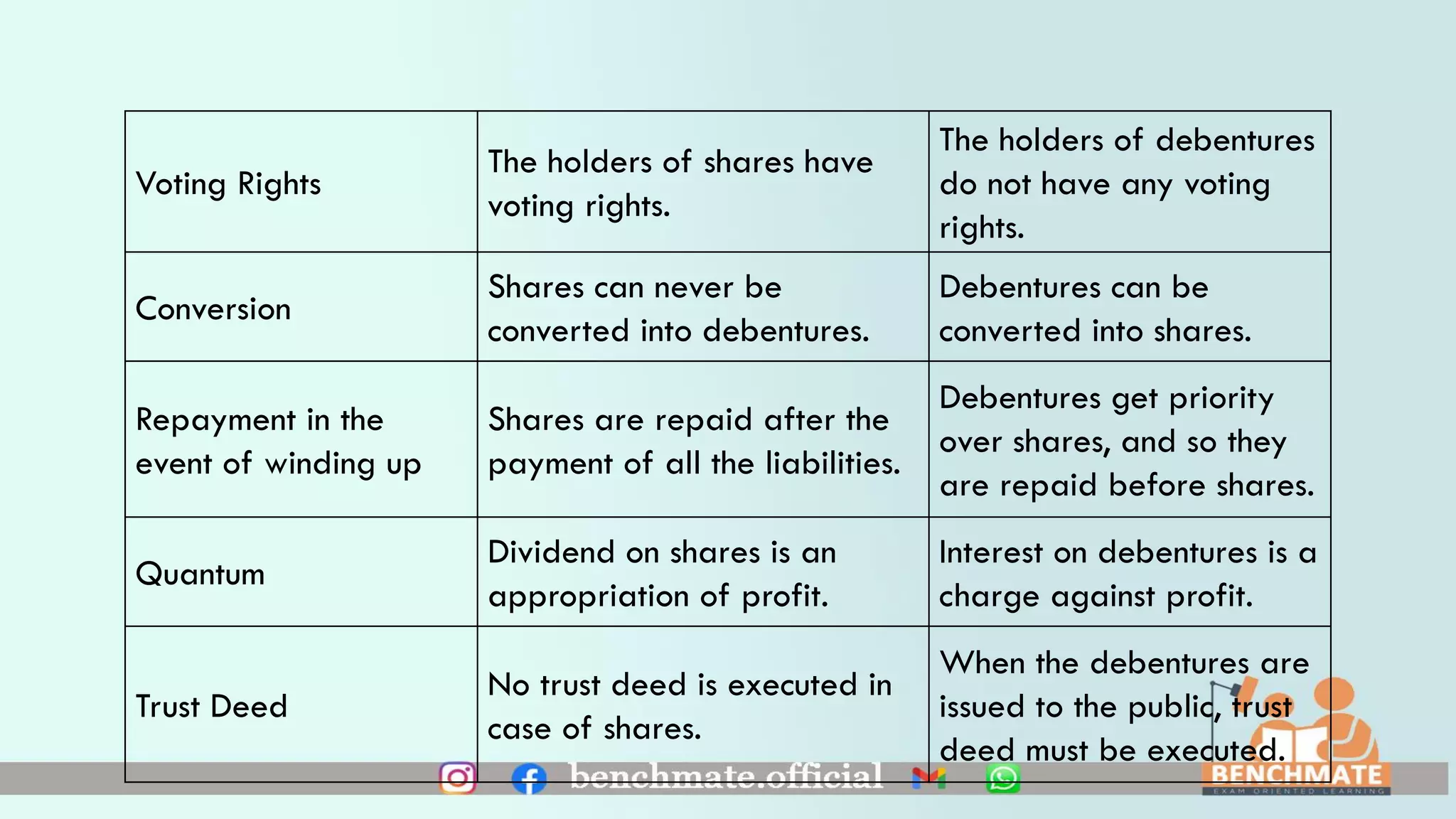
Voting Rights
The holders of shares have
voting rights.
The holders of debentures
do not have any voting
rights.
Conversion
Shares can never be
converted into debentures.
Debentures can be
converted into shares.
Repayment in the
event of winding up
Shares are repaid after the
payment of all the liabilities.
Debentures get priority
over shares, and so they
are repaid before shares.
Quantum
Dividend on shares is an
appropriation of profit.
Interest on debentures is a
charge against profit.
Trust Deed
No trust deed is executed in
case of shares.
When the debentures are
issued to the public, trust
deed must be executed.
What all are the differences between share holder and
debenture holder?
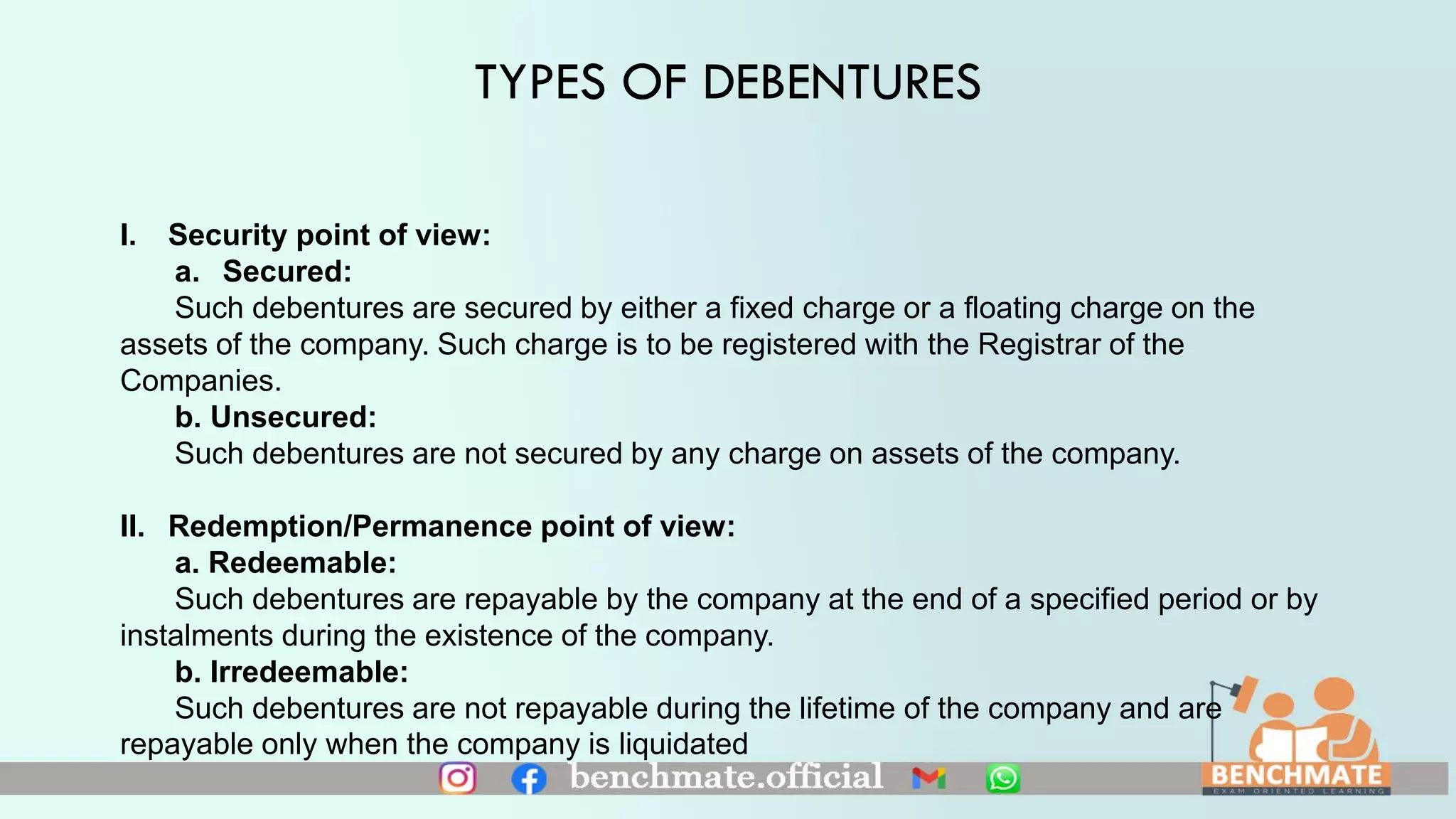
TYPES OF DEBENTURES
I. Security point of view:
a. Secured:
Such debentures are secured by either a fixed charge or a floating charge on the
assets of the company. Such charge is to be registered with the Registrar of the
Companies.
b. Unsecured:
Such debentures are not secured by any charge on assets of the company.
II. Redemption/Permanence point of view:
a. Redeemable:
Such debentures are repayable by the company at the end of a specified period or by
instalments during the existence of the company.
b. Irredeemable:
Such debentures are not repayable during the lifetime of the company and are
repayable only when the company is liquidated
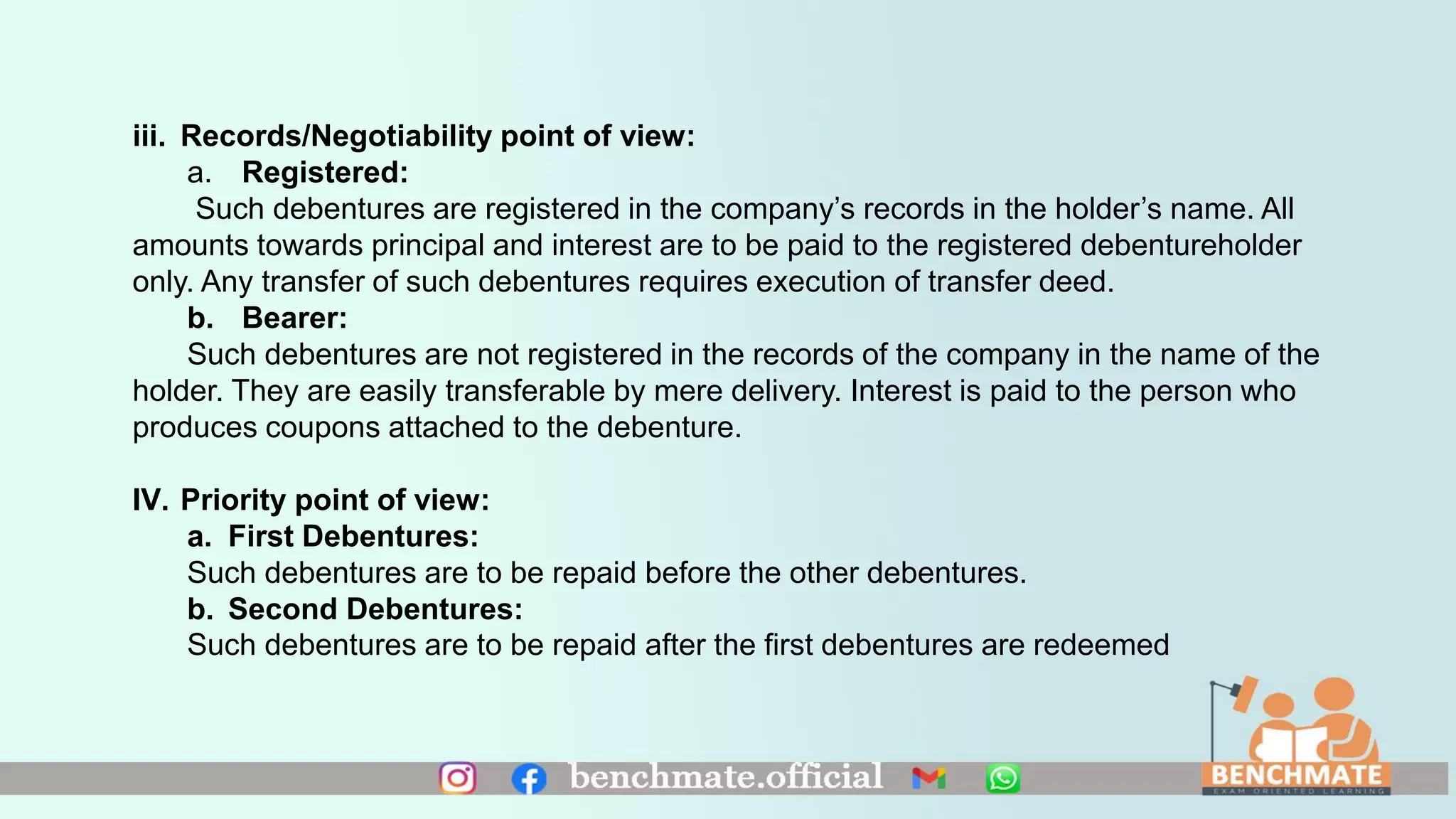
iii. Records/Negotiability point of view:
a. Registered:
Such debentures are registered in the company’s records in the holder’s name. All
amounts towards principal and interest are to be paid to the registered debentureholder
only. Any transfer of such debentures requires execution of transfer deed.
b. Bearer:
Such debentures are not registered in the records of the company in the name of the
holder. They are easily transferable by mere delivery. Interest is paid to the person who
produces coupons attached to the debenture.
IV. Priority point of view:
a. First Debentures:
Such debentures are to be repaid before the other debentures.
b. Second Debentures:
Such debentures are to be repaid after the first debentures are redeemed
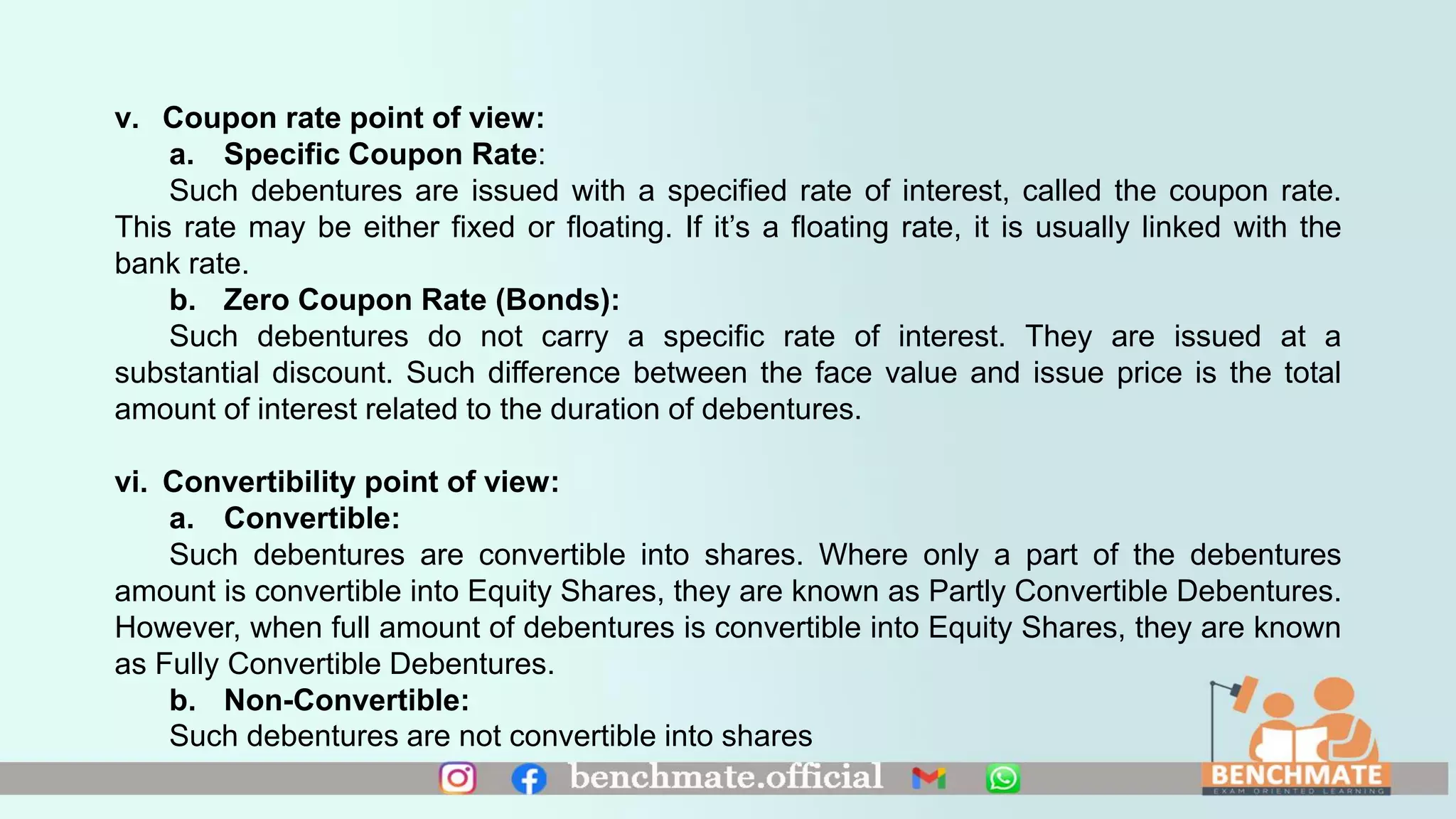
v. Coupon rate point of view:
a. Specific Coupon Rate:
Such debentures are issued with a specified rate of interest, called the coupon rate.
This rate may be either fixed or floating. If it’s a floating rate, it is usually linked with the
bank rate.
b. Zero Coupon Rate (Bonds):
Such debentures do not carry a specific rate of interest. They are issued at a
substantial discount. Such difference between the face value and issue price is the total
amount of interest related to the duration of debentures.
vi. Convertibility point of view:
a. Convertible:
Such debentures are convertible into shares. Where only a part of the debentures
amount is convertible into Equity Shares, they are known as Partly Convertible Debentures.
However, when full amount of debentures is convertible into Equity Shares, they are known
as Fully Convertible Debentures.
b. Non-Convertible:
Such debentures are not convertible into shares
THANK YOU

Introduction to debentures

  • 1.
  • 2.
    DEBENTURE Debenture is anacknowledgement of debt issued by a company under its common seal. Meaning of debentures as per section 2(30) of the companies act, 2013: Debenture includes debenture stock, bonds and any other instrument of the company evidencing a debt, whether constituting a charge on the assets of the company or not.
  • 3.
    BONDS A bond anddebenture both are debt instrument issued by government or companies. Both of these are fundraising tools for the issuer. Bonds are generally issued by the government, the agencies of government or by large corporations whereas debentures are issued by public companies to raise money from the market.
  • 4.
    BOND VS DEBENTURES BONDSDEBENTURES Bonds are secure in nature. Debentures can be secure as well unsecured. One can have bonds of corporation, government agencies or it can be of any financial institution. On the other hand debentures are issued by private/public companies. Bonds are less risky comparatively. Whereas debentures are at high risk. Talking about liquidity bonds are at the first priority. Whereas in case of debentures liquidity can only be done after the bondholders are paid. Bonds gives you low interest, but it depends on the issuing body totally. Whereas debentures give you high interest.
  • 5.
    UNDERSTANDING DEBENTURES Debentures: It isa document known as debenture certificate. It is an acknowledgement of debt by the company. It is an agreement between the company and its debenture holders for repayment of the principal amount on a specified date along with interest at a pre-determined rate charged on the principal amount until the principal is repaid. It is an evidence of a debt to the holder usually arising out of a loan and mostly secured by a charge.
  • 6.
    CHARACTERISTICS OR FEATURESOF A DEBENTURE • A document known as debenture certificate. • An acknowledgement of debt by the company • Involves an agreement between the company and its debenture holders to fix the mode and period of repayment of principal and interest • It is a common practice to prefix ‘debentures’ with the rate of interest like if the rate of interest is 10%, the title of the debentures will be ‘10% debentures’. • It is treated as an external equity or long term borrowings by the company. • It is usually secured by way of charge on the assets of the company. • The interest charged on debentures is a charge against profit.
  • 7.
    DIFFERENCE BETWEEN SHAREAND DEBENTURE: BASIS FOR COMPARISON SHARES DEBENTURES Meaning The shares are the owned funds of the company. The debentures are the borrowed funds of the company. What is it? Shares represent the capital of the company. Debentures represent the debt of the company. Holder The holder of shares is known as shareholder. The holder of debentures is known as debenture holder. Status of Holders Owners Creditors Form of Return Shareholders get the dividend. Debenture holders get the interest. Payment of return Dividend can be paid to shareholders only out of profits. Interest can be paid to debenture holders even if there is no profit. Allowable deduction Dividend is an appropriation of profit and so it is not allowed as deduction. Interest is a business expense and so it is allowed as deduction from profit.
  • 8.
    Voting Rights The holdersof shares have voting rights. The holders of debentures do not have any voting rights. Conversion Shares can never be converted into debentures. Debentures can be converted into shares. Repayment in the event of winding up Shares are repaid after the payment of all the liabilities. Debentures get priority over shares, and so they are repaid before shares. Quantum Dividend on shares is an appropriation of profit. Interest on debentures is a charge against profit. Trust Deed No trust deed is executed in case of shares. When the debentures are issued to the public, trust deed must be executed.
  • 9.
    What all arethe differences between share holder and debenture holder?
  • 10.
    TYPES OF DEBENTURES I.Security point of view: a. Secured: Such debentures are secured by either a fixed charge or a floating charge on the assets of the company. Such charge is to be registered with the Registrar of the Companies. b. Unsecured: Such debentures are not secured by any charge on assets of the company. II. Redemption/Permanence point of view: a. Redeemable: Such debentures are repayable by the company at the end of a specified period or by instalments during the existence of the company. b. Irredeemable: Such debentures are not repayable during the lifetime of the company and are repayable only when the company is liquidated
  • 11.
    iii. Records/Negotiability pointof view: a. Registered: Such debentures are registered in the company’s records in the holder’s name. All amounts towards principal and interest are to be paid to the registered debentureholder only. Any transfer of such debentures requires execution of transfer deed. b. Bearer: Such debentures are not registered in the records of the company in the name of the holder. They are easily transferable by mere delivery. Interest is paid to the person who produces coupons attached to the debenture. IV. Priority point of view: a. First Debentures: Such debentures are to be repaid before the other debentures. b. Second Debentures: Such debentures are to be repaid after the first debentures are redeemed
  • 12.
    v. Coupon ratepoint of view: a. Specific Coupon Rate: Such debentures are issued with a specified rate of interest, called the coupon rate. This rate may be either fixed or floating. If it’s a floating rate, it is usually linked with the bank rate. b. Zero Coupon Rate (Bonds): Such debentures do not carry a specific rate of interest. They are issued at a substantial discount. Such difference between the face value and issue price is the total amount of interest related to the duration of debentures. vi. Convertibility point of view: a. Convertible: Such debentures are convertible into shares. Where only a part of the debentures amount is convertible into Equity Shares, they are known as Partly Convertible Debentures. However, when full amount of debentures is convertible into Equity Shares, they are known as Fully Convertible Debentures. b. Non-Convertible: Such debentures are not convertible into shares
  • 13.