









Chapter 1
The Salesperson
How to Get Started
I. Enter The Salesperson
– Becoming a Traditional and
Digital Expert
A. First, Get the Support of
Your Family
 Your time will not always be your own
 Have six month’s savings
 Keep your expectations realistic
 Passing the state exam is public record
 SPHERE OF INFLUENCE is a list of prospects
that an agent regularly contacts
 Interview with at least 3 brokers when
selecting a sponsoring broker
B. Brokers Know When You
Pass
II.
THE BROKER INTERVIEW
A. How You Select An Employing Broker
 Personal referrals from buyers or sellers
are a great source for finding a broker
 Your reputation as an agent is directly
related to the reputation of the broker for
whom you choose to work
B. The Appointment
 Allow 1 hour for each broker interview
 You and the Broker are Interviewing each other
 Dress sensibly in business attire
 Be punctual and pleasant
 First impressions count!
What Questions to Ask:
 Start-up costs?
 Who pays for expenses?
 Signs
 Business cards
 zipForm®
 Advertisements
 Desk fees
What Questions to Ask:
 What are the New salesperson requirements?
 Four-door car
 Errors and Omission liability insurance
 Business-like demeanor
 Appropriate vocabulary
What Questions to Ask:
 What Training and Support will I receive?
 In-house training
 Seasoned mentor
 Shadowing other agents on their appointments
 Local Association of Realtors®
What Questions to Ask:
 What is My Portion of the Commission?
 When and how are commissions paid
 Seasoned agents get higher percentage
 STRAIGHT COMMISSION the agent is paid a
commission based on a percentage of the selling
price at close of escrow
 100% COMMISSION the agent receives all (or
nearly all) of the commission earned by the office
What Questions to Ask:
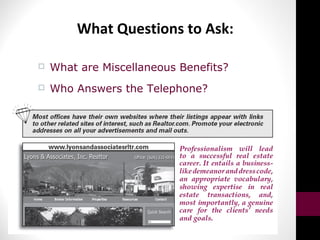
 What are Miscellaneous Benefits?
 Who Answers the Telephone?
III.
LARGE vs.
SMALL OFFICES
Large or Small?
 Small firms tend to remain flexible and there’s no
need for corporate approval
 Small firm’s activities may be limited to selling
 Large firms are diversified with more capital, but
less flexible
 Large firms have more overhead and less accurate
control of its resources.
 Always ask about a company’s long-range growth
plan before deciding where you want to work
IV.
INDEPENDENT
CONTRACTOR and
EMPLOYER
RELATIONSHIP
Independent Contractor-
Employer Relationship
• All salespeople actively engaged in professional real estate
activities MUST be employed by a licensed real estate broker
• INDEPENDENT CONTRACTOR sells results rather than time,
and his or her physical conduct in not subject to the control of
another
• EMPLOYEE works under the direct control and supervision of
the broker
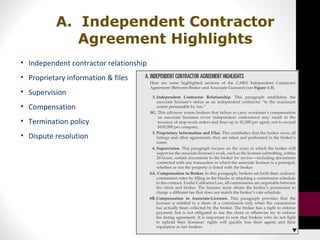
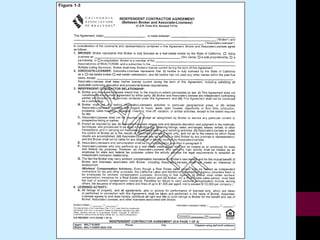
A. Independent Contractor
Agreement Highlights
• Independent contractor relationship
• Proprietary information & files
• Supervision
• Compensation
• Termination policy
• Dispute resolution
V. Your Planning
Objectives
and Goals
Planning Objectives & Goals
 Now that you’ve carefully selected your office,
you need to set realistic goals
 Plan your work and work your plan
 Write down your yearly goals and put them away
 Review your goals periodically for updating
A. Sphere of influence
 Immediately contact friends, relatives, past and present
co-workers
 A GEOGRAPHICAL FARM is a group of people within a
geographical area with whom the agent stays in touch
with on a regular basis
 “Spheres of influence” may include clubs, church groups,
neighbors or organizations
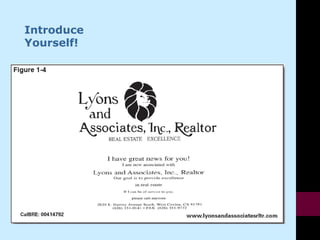
Introduce
Yourself!
B. Schedule Daily Activities
 Write out a schedule of your daily activities
 Return phone calls promptly
 Develop new leads
 Review new listings
C. Soliciting
 Call on past clients, buyers, and sellers
 COLD CALLS are telephone calls to people you don’t know
 WARM CALLS are to people you already know and are usually
more productive
 EXPIRED LISTINGS are listings that did not sell within the
contract period
 REVERSE DIRECTORY is a website or publication similar to a
phone book, where phone numbers are listed by address rather
than name
D. Previewing
 You should preview new properties on behalf of
potential buyers and for your own information
 Put together a Sales Kit to aid you in your daily
real estate related activities
 The majority of your “sales kit” will be contained on
your mobile device, but “hard copy” contracts,
addendums, etc., should be kept in a briefcase for
easy access
E. Showing Properties
 Remember that only “direct” personal
contacts lead to sales
 Buyers should be pre-qualified by at least one
lender before showing properties
 Do not show more than 5 houses in any one
showing
 Ask buyers for their comments and feedback
F. Becoming An Expert
 Create your own area of expertise:
 Condo sales
 New sales
 Probates
 Foreclosures
 Property management
 There are many advanced Realtor® designations
that indicate a higher degree of education and
specialty
G. Attributes of An Effective
Salesperson
VI.
ENTER THE BROKER
A. Agency Representation
 The broker acts as an intermediary –a catalyst- in bringing
together buyers and sellers
 A FIDUCIARY RELATIONSHIP, means the broker owes a
duty of the highest care and confidentiality to his or her
principals, whose interest they promote even at the cost of
some greater benefit to themselves
 When a broker represents more than one party, it is known
as DUAL AGENCY
 Who the broker is representing must be disclosed to all
parties, in writing, prior to entering into a transaction
B. Directing and Supervising
 Many brokers have POLICY MANUALS in their offices which
are designed to give rules and policies for the staff in their
relationships inside and outside the office sphere
 Broker office’s must run as a well disciplined team
 A broker must provide leadership to his/her salespeople
 Each office should have a detailed TRANSACTION FILE which
includes all property contracts, documents, and disclosures
signed by the principals
 To save paper, a GREEN OFFICE will digitally scan items in
the transaction file and be kept for 3 years
C. Cooperating Brokers
 Most properties are not sold by the listing broker
 A cooperating broker is a broker who participates in
facilitating a real estate transaction with the broker who
listed the property
 Showing agents should always leave a business card in an
agreed upon location when showing a property
 A smart listing agent should collect these cards regularly
and get feedback from the showing agents and share this
information with the seller
D. Commissions
Most brokers are paid a commission based on a
percentage of the sales price they obtain on their
transactions
All commissions are negotiable between the seller and
the listing broker
VII.
THE BROKERAGE
FIRM
A. Getting Started in Business
 As a salesperson, if you want to open your own office,
you’ll have to become a broker
 You will need to do the following steps:
 Get licensed as a broker
 Secure the necessary capital
 Decide on a location and building
 Obtain a business license
 Have a telephone and internet system installed
 Open a trust account and business checking account
 Order supplies and get office equipment
 Order signs
 Create a policy manual and training program
 Hire a receptionist
 Join local, state, and national associations of Realtors®
 Announce yourself
 Establish a website
B. Keeping Up with the
Competition
 Your transaction information should be available anytime
and anywhere, using CAR’s new app,
ZIPFORM®MOBILE WEB EDITION
C. Forms of Business
Ownership
 A SOLE PROPRIETORSHIP is characterized by an office
run by one owner solely responsible for all decisions
 UNLIMITED LIABILITY
 A PARTNERSHIP is an association of two or more
persons as co-owners of a business for profit
 UNLIMITED LIABILITY TO ALL PARTNERS
 A CORPORATION is a legal “artificial being” that
conducts business under its chartered name
 LIMITED LIABLITY TO OWNERS
 STOCK ISSUED
 S CORPORATIONS
VIII.
RECORD KEEPING
RECORD KEEPING
 Trust Fund Records
 All brokers must keep detailed records
 Trust funds must be deposited within 3 business days
 COMMINGLING is the illegal mixing of he client’s and
brokers funds
 CONVERSION is the illegal practice of misappropriation
and using the client’s money
 Sales Records
 Keep for 3 years/4 years if doing Property Management
 Filing systems should be uncomplicated
 All files stay in the office/office computer/copies can be
made
CHAPTER SUMMARY
• Enter the Salesperson
• Family support
• 6 mos. Savings
• Broker Interview
• Selecting your broker
• The appointment
• Large or Small Offices
• Employer-Employee
Relationship
• Independent Contract
• Employee
 Planning Objectives & Goals
 Sphere of Influence
 Soliciting
 Previewing
 Showing properties
 Enter the Broker
 Agency
 Fiduciary
 Cooperative Sales
 Commissions
CHAPTER SUMMARY
• Brokerage Firm
• Getting started
• Soles Proprietorship
• Partnership
• Corporation
• Record Keeping
• Trust Fund Records
• Sales Records
• 3 years

Prac pp chp 1

  • 1.
  • 2.
    I. Enter TheSalesperson – Becoming a Traditional and Digital Expert
  • 3.
    A. First, Getthe Support of Your Family  Your time will not always be your own  Have six month’s savings  Keep your expectations realistic
  • 4.
     Passing thestate exam is public record  SPHERE OF INFLUENCE is a list of prospects that an agent regularly contacts  Interview with at least 3 brokers when selecting a sponsoring broker B. Brokers Know When You Pass
  • 5.
  • 6.
    A. How YouSelect An Employing Broker  Personal referrals from buyers or sellers are a great source for finding a broker  Your reputation as an agent is directly related to the reputation of the broker for whom you choose to work
  • 7.
    B. The Appointment Allow 1 hour for each broker interview  You and the Broker are Interviewing each other  Dress sensibly in business attire  Be punctual and pleasant  First impressions count!
  • 8.
    What Questions toAsk:  Start-up costs?  Who pays for expenses?  Signs  Business cards  zipForm®  Advertisements  Desk fees
  • 9.
    What Questions toAsk:  What are the New salesperson requirements?  Four-door car  Errors and Omission liability insurance  Business-like demeanor  Appropriate vocabulary
  • 10.
    What Questions toAsk:  What Training and Support will I receive?  In-house training  Seasoned mentor  Shadowing other agents on their appointments  Local Association of Realtors®
  • 11.
    What Questions toAsk:  What is My Portion of the Commission?  When and how are commissions paid  Seasoned agents get higher percentage  STRAIGHT COMMISSION the agent is paid a commission based on a percentage of the selling price at close of escrow  100% COMMISSION the agent receives all (or nearly all) of the commission earned by the office
  • 13.
    What Questions toAsk:  What are Miscellaneous Benefits?  Who Answers the Telephone?
  • 14.
  • 15.
    Large or Small? Small firms tend to remain flexible and there’s no need for corporate approval  Small firm’s activities may be limited to selling  Large firms are diversified with more capital, but less flexible  Large firms have more overhead and less accurate control of its resources.  Always ask about a company’s long-range growth plan before deciding where you want to work
  • 16.
  • 17.
    Independent Contractor- Employer Relationship •All salespeople actively engaged in professional real estate activities MUST be employed by a licensed real estate broker • INDEPENDENT CONTRACTOR sells results rather than time, and his or her physical conduct in not subject to the control of another • EMPLOYEE works under the direct control and supervision of the broker
  • 18.
    A. Independent Contractor AgreementHighlights • Independent contractor relationship • Proprietary information & files • Supervision • Compensation • Termination policy • Dispute resolution
  • 20.
  • 21.
    Planning Objectives &Goals  Now that you’ve carefully selected your office, you need to set realistic goals  Plan your work and work your plan  Write down your yearly goals and put them away  Review your goals periodically for updating
  • 22.
    A. Sphere ofinfluence  Immediately contact friends, relatives, past and present co-workers  A GEOGRAPHICAL FARM is a group of people within a geographical area with whom the agent stays in touch with on a regular basis  “Spheres of influence” may include clubs, church groups, neighbors or organizations
  • 23.
  • 24.
    B. Schedule DailyActivities  Write out a schedule of your daily activities  Return phone calls promptly  Develop new leads  Review new listings
  • 25.
    C. Soliciting  Callon past clients, buyers, and sellers  COLD CALLS are telephone calls to people you don’t know  WARM CALLS are to people you already know and are usually more productive  EXPIRED LISTINGS are listings that did not sell within the contract period  REVERSE DIRECTORY is a website or publication similar to a phone book, where phone numbers are listed by address rather than name
  • 26.
    D. Previewing  Youshould preview new properties on behalf of potential buyers and for your own information  Put together a Sales Kit to aid you in your daily real estate related activities  The majority of your “sales kit” will be contained on your mobile device, but “hard copy” contracts, addendums, etc., should be kept in a briefcase for easy access
  • 27.
    E. Showing Properties Remember that only “direct” personal contacts lead to sales  Buyers should be pre-qualified by at least one lender before showing properties  Do not show more than 5 houses in any one showing  Ask buyers for their comments and feedback
  • 28.
    F. Becoming AnExpert  Create your own area of expertise:  Condo sales  New sales  Probates  Foreclosures  Property management  There are many advanced Realtor® designations that indicate a higher degree of education and specialty
  • 29.
    G. Attributes ofAn Effective Salesperson
  • 30.
  • 31.
    A. Agency Representation The broker acts as an intermediary –a catalyst- in bringing together buyers and sellers  A FIDUCIARY RELATIONSHIP, means the broker owes a duty of the highest care and confidentiality to his or her principals, whose interest they promote even at the cost of some greater benefit to themselves  When a broker represents more than one party, it is known as DUAL AGENCY  Who the broker is representing must be disclosed to all parties, in writing, prior to entering into a transaction
  • 32.
    B. Directing andSupervising  Many brokers have POLICY MANUALS in their offices which are designed to give rules and policies for the staff in their relationships inside and outside the office sphere  Broker office’s must run as a well disciplined team  A broker must provide leadership to his/her salespeople  Each office should have a detailed TRANSACTION FILE which includes all property contracts, documents, and disclosures signed by the principals  To save paper, a GREEN OFFICE will digitally scan items in the transaction file and be kept for 3 years
  • 33.
    C. Cooperating Brokers Most properties are not sold by the listing broker  A cooperating broker is a broker who participates in facilitating a real estate transaction with the broker who listed the property  Showing agents should always leave a business card in an agreed upon location when showing a property  A smart listing agent should collect these cards regularly and get feedback from the showing agents and share this information with the seller
  • 35.
    D. Commissions Most brokersare paid a commission based on a percentage of the sales price they obtain on their transactions All commissions are negotiable between the seller and the listing broker
  • 36.
  • 37.
    A. Getting Startedin Business  As a salesperson, if you want to open your own office, you’ll have to become a broker  You will need to do the following steps:  Get licensed as a broker  Secure the necessary capital  Decide on a location and building  Obtain a business license  Have a telephone and internet system installed  Open a trust account and business checking account  Order supplies and get office equipment  Order signs  Create a policy manual and training program  Hire a receptionist  Join local, state, and national associations of Realtors®  Announce yourself  Establish a website
  • 38.
    B. Keeping Upwith the Competition  Your transaction information should be available anytime and anywhere, using CAR’s new app, ZIPFORM®MOBILE WEB EDITION
  • 39.
    C. Forms ofBusiness Ownership  A SOLE PROPRIETORSHIP is characterized by an office run by one owner solely responsible for all decisions  UNLIMITED LIABILITY  A PARTNERSHIP is an association of two or more persons as co-owners of a business for profit  UNLIMITED LIABILITY TO ALL PARTNERS  A CORPORATION is a legal “artificial being” that conducts business under its chartered name  LIMITED LIABLITY TO OWNERS  STOCK ISSUED  S CORPORATIONS
  • 40.
  • 41.
    RECORD KEEPING  TrustFund Records  All brokers must keep detailed records  Trust funds must be deposited within 3 business days  COMMINGLING is the illegal mixing of he client’s and brokers funds  CONVERSION is the illegal practice of misappropriation and using the client’s money  Sales Records  Keep for 3 years/4 years if doing Property Management  Filing systems should be uncomplicated  All files stay in the office/office computer/copies can be made
  • 42.
    CHAPTER SUMMARY • Enterthe Salesperson • Family support • 6 mos. Savings • Broker Interview • Selecting your broker • The appointment • Large or Small Offices • Employer-Employee Relationship • Independent Contract • Employee  Planning Objectives & Goals  Sphere of Influence  Soliciting  Previewing  Showing properties  Enter the Broker  Agency  Fiduciary  Cooperative Sales  Commissions
  • 43.
    CHAPTER SUMMARY • BrokerageFirm • Getting started • Soles Proprietorship • Partnership • Corporation • Record Keeping • Trust Fund Records • Sales Records • 3 years