Accounting Principles &
Accounting Equation
Accounting Principles
• Those rules of action or conduct which are adopted by the
accountants universally while recording the transactions.
• Features:
Usefulness-must satisfy the need of users
Objectivity-only if its based on facts & figures without personal bias.
Feasibility-easy to use & practicable.
• Classification:
1. Accounting concepts
2. Accounting conventions
Accounting concepts
• Basic assumptions or conditions upon which accounting is based.
1. Business entity concept: business is treated as a separate entity
from its owner. business transactions are separated from personal
transactions.
2. Going concern concept: assumption that business will exist for a
long time to come. neither the intention nor the necessity to wind
up its affairs.
3. Money measurement concept: record only those transactions
which can be expressed in terms of money.
4. Cost concept: assets are recorded in the books at the price at which
they are acquired. cost should not be confused with the value.
(Depreciation, historical cost)
5. Dual aspect concept: for every debit, there is a credit-double entry
system.
• Example: A starts business with capital of Rs.10,000.this transaction has
two aspects. on one hand business has asset(cash) of Rs.10,000.on other
hand business has to pay A(proprietor) Rs.10,000 which is owner’s capital.
capital (equity)= cash (asset)
10,000 = 10,000
• Later A borrows Rs.5000 from a bank. the dual aspect of this transaction
will be
Liability (Loan)= Cash (Asset)
• Total will become
liability + capital= assets
5,000+10,000 = 15,000
6. Accounting period concept: life of business is divided into appropriate
segments for studying the results of business.it is usually one year.
income statement & balance sheet are prepared at the end of each
accounting period.
7. Matching concept: firms recognize revenues and their related
expenses in the same accounting period. the matching concept does
not apply under "cash basis accounting.“
• The matching idea, in fact, has meaning only under accrual accounting.
The concept refers specifically to matching earned revenues with the
incurred expenses that brought them. Matched "revenues" and
"expenses" work together in the Income statement equation to
determine the firm's net profit for the period
• Net Profit = Revenues Earned – Expenses Incurred
• 8. Realisation concept: profit should be considered only when
realised that’s is when goods are transferred to the buyer and sales
are made(cash received or not)
Accounting Conventions
• Those customs or traditions which guide the accountants while
preparing the accounting statements.
1. Convention of disclosure: disclose all significant information to the
reader so that he may not be mislead. he should be able to make a
free judgement.
2. Convention of materiality: only those events or items should be
recorder which have a significant effect(influence economic
decision) and insignificant things should be ignored.
3. Convention of consistency: accounting practices should remain
unchanged from one period to another. this is important for the
purpose of self comparison.
4. Convention of conservatism: play safe. if there is a possibility of
loss,it should be taken into account at the earlier stage. on the
other hand ignore profit till time it materialized.
Accounting equation
• It states that at any point of time the assets of any entity must be
equal(in monetary terms) to the total equities.
• The properties owned by the business is called assets
• The rights to the properties is called equities
• The equites are of two types:
1. The rights of the creditors are called liabilities
2. The rights of the owner is called capital.
Assets - Liabilities = Owner's (or Stockholders') Equity.
Example
• J. Ott forms a sole proprietorship called Accounting Software Co.
(ASC). On December 1, 2017, J. Ott invests personal funds of $10,000
to start ASC. The effect of this transaction on ASC's accounting
equation is:
• ASC's assets increase by $10,000 and so does ASC's owner's equity. As
a result, the accounting equation will be in balance.
• On December 2, 2017 J. Ott withdraws $100 of cash from the
business for his personal use. The effect of this transaction on ASC's
accounting equation is:
• On December 2, 2017 J. Ott withdraws $100 of cash from the
business for his personal use. The effect of this transaction on ASC's
accounting equation is:
• The accounting equation remains in balance since ASC's assets have
been reduced by $100 and so has the owner's equity.
• Since the transactions of December 1 and 2 were each in balance, the
sum of both transactions should also be in balance:
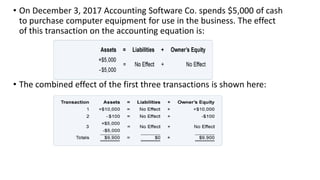
• On December 3, 2017 Accounting Software Co. spends $5,000 of cash
to purchase computer equipment for use in the business. The effect
of this transaction on the accounting equation is:
• The combined effect of the first three transactions is shown here:
• On December 4, 2017 ASC obtains $7,000 by borrowing money from
its bank. The effect of this transaction on the accounting equation is:
• The combined effect on the accounting equation from the first four
transactions is available here:

accounting principles & equation.pptx

  • 1.
  • 2.
    Accounting Principles • Thoserules of action or conduct which are adopted by the accountants universally while recording the transactions. • Features: Usefulness-must satisfy the need of users Objectivity-only if its based on facts & figures without personal bias. Feasibility-easy to use & practicable. • Classification: 1. Accounting concepts 2. Accounting conventions
  • 3.
    Accounting concepts • Basicassumptions or conditions upon which accounting is based. 1. Business entity concept: business is treated as a separate entity from its owner. business transactions are separated from personal transactions. 2. Going concern concept: assumption that business will exist for a long time to come. neither the intention nor the necessity to wind up its affairs. 3. Money measurement concept: record only those transactions which can be expressed in terms of money. 4. Cost concept: assets are recorded in the books at the price at which they are acquired. cost should not be confused with the value. (Depreciation, historical cost)
  • 4.
    5. Dual aspectconcept: for every debit, there is a credit-double entry system. • Example: A starts business with capital of Rs.10,000.this transaction has two aspects. on one hand business has asset(cash) of Rs.10,000.on other hand business has to pay A(proprietor) Rs.10,000 which is owner’s capital. capital (equity)= cash (asset) 10,000 = 10,000 • Later A borrows Rs.5000 from a bank. the dual aspect of this transaction will be Liability (Loan)= Cash (Asset) • Total will become liability + capital= assets 5,000+10,000 = 15,000
  • 5.
    6. Accounting periodconcept: life of business is divided into appropriate segments for studying the results of business.it is usually one year. income statement & balance sheet are prepared at the end of each accounting period. 7. Matching concept: firms recognize revenues and their related expenses in the same accounting period. the matching concept does not apply under "cash basis accounting.“ • The matching idea, in fact, has meaning only under accrual accounting. The concept refers specifically to matching earned revenues with the incurred expenses that brought them. Matched "revenues" and "expenses" work together in the Income statement equation to determine the firm's net profit for the period • Net Profit = Revenues Earned – Expenses Incurred
  • 6.
    • 8. Realisationconcept: profit should be considered only when realised that’s is when goods are transferred to the buyer and sales are made(cash received or not)
  • 7.
    Accounting Conventions • Thosecustoms or traditions which guide the accountants while preparing the accounting statements. 1. Convention of disclosure: disclose all significant information to the reader so that he may not be mislead. he should be able to make a free judgement. 2. Convention of materiality: only those events or items should be recorder which have a significant effect(influence economic decision) and insignificant things should be ignored. 3. Convention of consistency: accounting practices should remain unchanged from one period to another. this is important for the purpose of self comparison.
  • 8.
    4. Convention ofconservatism: play safe. if there is a possibility of loss,it should be taken into account at the earlier stage. on the other hand ignore profit till time it materialized.
  • 9.
    Accounting equation • Itstates that at any point of time the assets of any entity must be equal(in monetary terms) to the total equities. • The properties owned by the business is called assets • The rights to the properties is called equities • The equites are of two types: 1. The rights of the creditors are called liabilities 2. The rights of the owner is called capital. Assets - Liabilities = Owner's (or Stockholders') Equity.
  • 10.
    Example • J. Ottforms a sole proprietorship called Accounting Software Co. (ASC). On December 1, 2017, J. Ott invests personal funds of $10,000 to start ASC. The effect of this transaction on ASC's accounting equation is: • ASC's assets increase by $10,000 and so does ASC's owner's equity. As a result, the accounting equation will be in balance.
  • 11.
    • On December2, 2017 J. Ott withdraws $100 of cash from the business for his personal use. The effect of this transaction on ASC's accounting equation is: • On December 2, 2017 J. Ott withdraws $100 of cash from the business for his personal use. The effect of this transaction on ASC's accounting equation is: • The accounting equation remains in balance since ASC's assets have been reduced by $100 and so has the owner's equity. • Since the transactions of December 1 and 2 were each in balance, the sum of both transactions should also be in balance:
  • 12.
    • On December3, 2017 Accounting Software Co. spends $5,000 of cash to purchase computer equipment for use in the business. The effect of this transaction on the accounting equation is: • The combined effect of the first three transactions is shown here:
  • 13.
    • On December4, 2017 ASC obtains $7,000 by borrowing money from its bank. The effect of this transaction on the accounting equation is: • The combined effect on the accounting equation from the first four transactions is available here: