Accounting Equation
Accounting Equation
DR. PARITOSH DUBE 1
Accounting Equation
Learning Objectives
This Chapter would enable you to
understand:
 Meaning of an Accounting Equation
 Rules for Making Accounting
Equation
 Effect of Transactions on an
Accounting Equation
DR. PARITOSH DUBE 2
Accounting Equation
CONTENT
• MEANING OF AN
ACCOUNTING EQUATION
• MEANING OF ASSETS
LIABILITIES AND CAPITAL
• CLASSIFICATION OF ASSETS
LIABILITIES AND CAPITAL
• RULES FOR MAKING
ACCOUNTING EQUATION
DR. PARITOSH DUBE 3
Accounting Equation
CONTENT
• FORMAT OF ACCOUNTING EQUATION
• TRANSACTION TYPES OF
ACCOUNTING EQUATION
DR. PARITOSH DUBE 4
Accounting Equation
MEANING
MEANING OF AN ACCOUNTING
EQUATION
An Accounting Equation is a
mathematical expression which shows
that the assets and liabilities of a
firm are equal.
DR. PARITOSH DUBE 5
Accounting Equation
MEANING OF ACCOUNTING
EQUATION
• An Accounting Equation is based on the
dual aspect concept of accounting i.e.,
every transaction has two aspects-debit
and credit.
• It holds that for every debit there is a
credit of equal amount and vice versa.
DR. PARITOSH DUBE 6
Accounting Equation
MEANING OF ACCOUNTING EQUATION
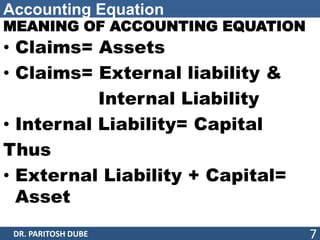
• Claims= Assets
• Claims= External liability &
Internal Liability
• Internal Liability= Capital
Thus
• External Liability + Capital=
Asset
DR. PARITOSH DUBE 7
Accounting Equation
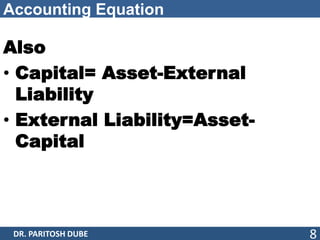
Also
• Capital= Asset-External
Liability
• External Liability=Asset-
Capital
DR. PARITOSH DUBE 8
Accounting Equation
MEANING OF AN ACCOUNTING EQUATION
An Accounting Equation always
holds true with every change
that occurs due to a
transaction entered into. It is
because it is based on the dual
aspect concept of accounting.
DR. PARITOSH DUBE 9
Accounting Equation
DR. PARITOSH DUBE 10
A transaction may affect
either both sides of the
equation by the same amount
or one side of the equation
only by both increasing or
decreasing it by equal
amounts.
Accounting Equation
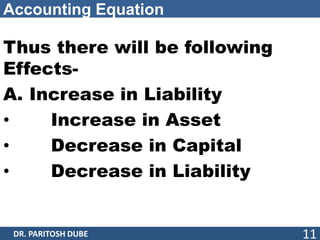
Thus there will be following
Effects-
A. Increase in Liability
• Increase in Asset
• Decrease in Capital
• Decrease in Liability
DR. PARITOSH DUBE 11
Accounting Equation
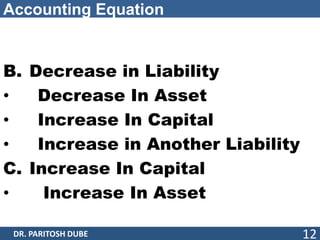
B. Decrease in Liability
• Decrease In Asset
• Increase In Capital
• Increase in Another Liability
C. Increase In Capital
• Increase In Asset
DR. PARITOSH DUBE 12
Accounting Equation
D. Decrease In Capital
• Decrease In Asset
E. Increase in Asset
• Decrease in Another Asset
DR. PARITOSH DUBE 13
Accounting Equation
WHAT ARE ASSETS LIABILITIES AND CAPITAL
• ASSETS:-Assets are defined as
resources that help generate
profit in your business. You
have some control over it.
These are not meant for
sale(except finished goods)
but for operating the business.
DR. PARITOSH DUBE 14
Accounting Equation
• LIABILITIES:-A liability, in
general, is an obligation to, or
something that you owe to
somebody else. Liabilities are
defined as a company's legal
financial debts or obligations
that arise during the course of
business operations.
DR. PARITOSH DUBE 15
Accounting Equation
• CAPITAL:-Capital is the
amount invested in the
business by the owners in
form of Original Investment
Reserves and provisions
• Capital= Asset- External
Liabilities
DR. PARITOSH DUBE 16
Accounting Equation
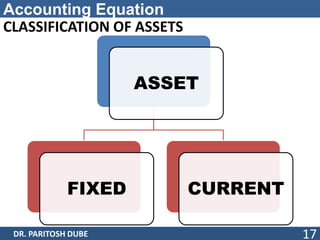
CLASSIFICATION OF ASSETS
ASSET
FIXED CURRENT
DR. PARITOSH DUBE 17
Accounting Equation
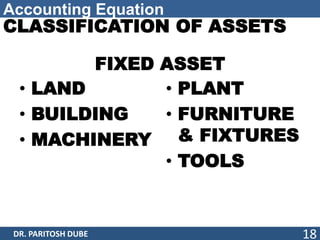
CLASSIFICATION OF ASSETS
FIXED ASSET
• LAND
• BUILDING
• MACHINERY
• PLANT
• FURNITURE
& FIXTURES
• TOOLS
DR. PARITOSH DUBE 18
Accounting Equation
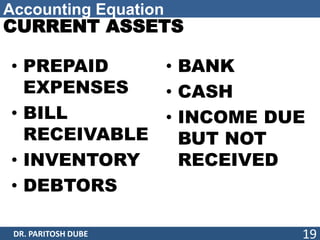
CURRENT ASSETS
• PREPAID
EXPENSES
• BILL
RECEIVABLE
• INVENTORY
• DEBTORS
• BANK
• CASH
• INCOME DUE
BUT NOT
RECEIVED
DR. PARITOSH DUBE 19
Accounting Equation
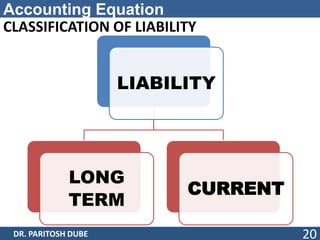
CLASSIFICATION OF LIABILITY
LIABILITY
LONG
TERM
CURRENT
DR. PARITOSH DUBE 20
Accounting Equation
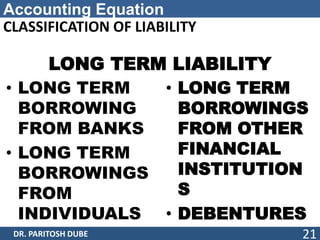
CLASSIFICATION OF LIABILITY
LONG TERM LIABILITY
• LONG TERM
BORROWING
FROM BANKS
• LONG TERM
BORROWINGS
FROM
INDIVIDUALS
• LONG TERM
BORROWINGS
FROM OTHER
FINANCIAL
INSTITUTION
S
• DEBENTURES
DR. PARITOSH DUBE 21
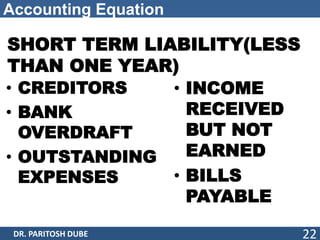
Accounting Equation
SHORT TERM LIABILITY(LESS
THAN ONE YEAR)
• CREDITORS
• BANK
OVERDRAFT
• OUTSTANDING
EXPENSES
• INCOME
RECEIVED
BUT NOT
EARNED
• BILLS
PAYABLE
DR. PARITOSH DUBE 22
Accounting Equation
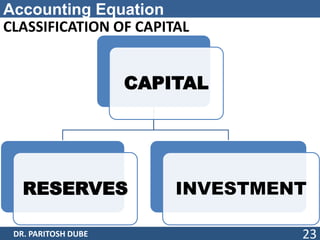
CLASSIFICATION OF CAPITAL
DR. PARITOSH DUBE 23
CAPITAL
RESERVES INVESTMENT
Accounting Equation
MEANING OF AN ACCOUNTING EQUATION
Transactions from the Accounting Equation
viewpoint, can be divided into two, i.e.,
1. Transactions Affecting Two Items and
2. Transactions Affecting More Than Two Items.
DR. PARITOSH DUBE 24
Accounting Equation
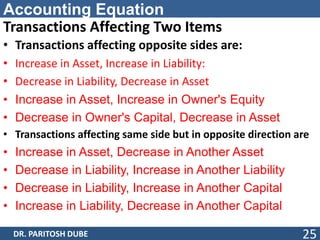
Transactions Affecting Two Items
• Transactions affecting opposite sides are:
• Increase in Asset, Increase in Liability:
• Decrease in Liability, Decrease in Asset
• Increase in Asset, Increase in Owner's Equity
• Decrease in Owner's Capital, Decrease in Asset
• Transactions affecting same side but in opposite direction are
• Increase in Asset, Decrease in Another Asset
• Decrease in Liability, Increase in Another Liability
• Decrease in Liability, Increase in Another Capital
• Increase in Liability, Decrease in Another Capital
DR. PARITOSH DUBE 25
Accounting Equation
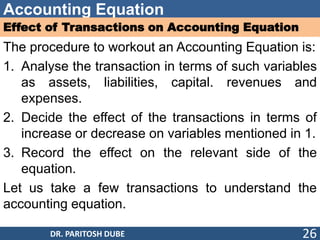
Effect of Transactions on Accounting Equation
The procedure to workout an Accounting Equation is:
1. Analyse the transaction in terms of such variables
as assets, liabilities, capital. revenues and
expenses.
2. Decide the effect of the transactions in terms of
increase or decrease on variables mentioned in 1.
3. Record the effect on the relevant side of the
equation.
Let us take a few transactions to understand the
accounting equation.
DR. PARITOSH DUBE 26
Accounting Equation
RULES FOR ACCOUNTING EQUATIONS
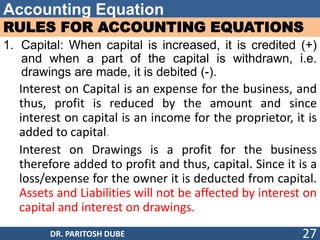
1. Capital: When capital is increased, it is credited (+)
and when a part of the capital is withdrawn, i.e.
drawings are made, it is debited (-).
Interest on Capital is an expense for the business, and
thus, profit is reduced by the amount and since
interest on capital is an income for the proprietor, it is
added to capital.
Interest on Drawings is a profit for the business
therefore added to profit and thus, capital. Since it is a
loss/expense for the owner it is deducted from capital.
Assets and Liabilities will not be affected by interest on
capital and interest on drawings.
DR. PARITOSH DUBE 27
Accounting Equation
RULES FOR ACCOUNTING EQUATIONS
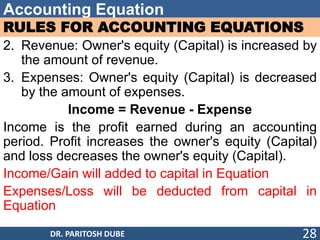
2. Revenue: Owner's equity (Capital) is increased by
the amount of revenue.
3. Expenses: Owner's equity (Capital) is decreased
by the amount of expenses.
Income = Revenue - Expense
Income is the profit earned during an accounting
period. Profit increases the owner's equity (Capital)
and loss decreases the owner's equity (Capital).
Income/Gain will added to capital in Equation
Expenses/Loss will be deducted from capital in
Equation
DR. PARITOSH DUBE 28
Accounting Equation
RULES FOR ACCOUNTING EQUATIONS
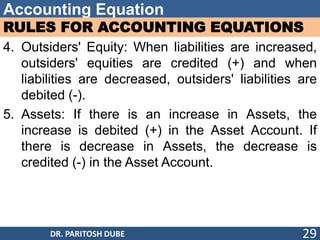
4. Outsiders' Equity: When liabilities are increased,
outsiders' equities are credited (+) and when
liabilities are decreased, outsiders' liabilities are
debited (-).
5. Assets: If there is an increase in Assets, the
increase is debited (+) in the Asset Account. If
there is decrease in Assets, the decrease is
credited (-) in the Asset Account.
DR. PARITOSH DUBE 29
Accounting Equation
RULES FOR ACCOUNTING EQUATIONS
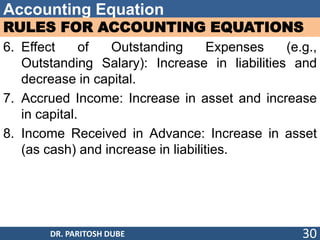
6. Effect of Outstanding Expenses (e.g.,
Outstanding Salary): Increase in liabilities and
decrease in capital.
7. Accrued Income: Increase in asset and increase
in capital.
8. Income Received in Advance: Increase in asset
(as cash) and increase in liabilities.
DR. PARITOSH DUBE 30
Accounting Equation
RULES FOR ACCOUNTING EQUATIONS
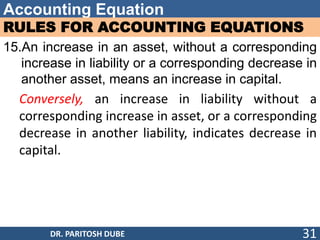
15.An increase in an asset, without a corresponding
increase in liability or a corresponding decrease in
another asset, means an increase in capital.
Conversely, an increase in liability without a
corresponding increase in asset, or a corresponding
decrease in another liability, indicates decrease in
capital.
DR. PARITOSH DUBE 31
Accounting Equation
Effect of Transactions on Accounting Equation
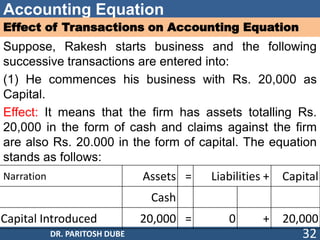
Suppose, Rakesh starts business and the following
successive transactions are entered into:
(1) He commences his business with Rs. 20,000 as
Capital.
Effect: It means that the firm has assets totalling Rs.
20,000 in the form of cash and claims against the firm
are also Rs. 20.000 in the form of capital. The equation
stands as follows:
DR. PARITOSH DUBE 32
Narration Assets = Liabilities + Capital
Cash
Capital Introduced 20,000 = 0 + 20,000
Accounting Equation
Effect of Transactions on Accounting Equation
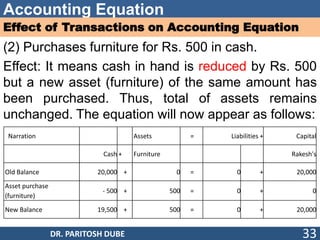
(2) Purchases furniture for Rs. 500 in cash.
Effect: It means cash in hand is reduced by Rs. 500
but a new asset (furniture) of the same amount has
been purchased. Thus, total of assets remains
unchanged. The equation will now appear as follows:
DR. PARITOSH DUBE 33
Narration Assets = Liabilities + Capital
Cash + Furniture Rakesh's
Old Balance 20,000 + 0 = 0 + 20,000
Asset purchase
(furniture)
- 500 + 500 = 0 + 0
New Balance 19,500 + 500 = 0 + 20,000
Accounting Equation
Effect of Transactions on Accounting Equation
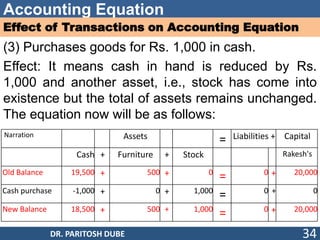
(3) Purchases goods for Rs. 1,000 in cash.
Effect: It means cash in hand is reduced by Rs.
1,000 and another asset, i.e., stock has come into
existence but the total of assets remains unchanged.
The equation now will be as follows:
DR. PARITOSH DUBE 34
Narration Assets = Liabilities + Capital
Cash + Furniture + Stock Rakesh's
Old Balance 19,500 + 500 + 0
= 0 + 20,000
Cash purchase -1,000 + 0 + 1,000
= 0 + 0
New Balance 18,500 + 500 + 1,000
= 0 + 20,000
Accounting Equation
Effect of Transactions on Accounting Equation
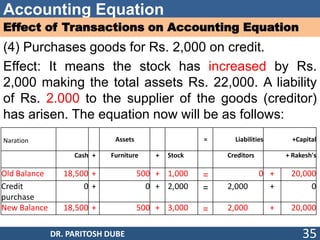
(4) Purchases goods for Rs. 2,000 on credit.
Effect: It means the stock has increased by Rs.
2,000 making the total assets Rs. 22,000. A liability
of Rs. 2.000 to the supplier of the goods (creditor)
has arisen. The equation now will be as follows:
DR. PARITOSH DUBE 35
Naration Assets = Liabilities +Capital
Cash + Furniture + Stock Creditors + Rakesh's
Old Balance 18,500 + 500 + 1,000 = 0 + 20,000
Credit
purchase
0 + 0 + 2,000 = 2,000 + 0
New Balance 18,500 + 500 + 3,000 = 2,000 + 20,000
Accounting Equation
Effect of Transactions on Accounting Equation
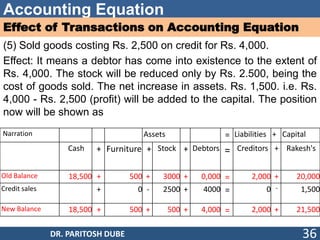
(5) Sold goods costing Rs. 2,500 on credit for Rs. 4,000.
Effect: It means a debtor has come into existence to the extent of
Rs. 4,000. The stock will be reduced only by Rs. 2.500, being the
cost of goods sold. The net increase in assets. Rs. 1,500. i.e. Rs.
4,000 - Rs. 2,500 (profit) will be added to the capital. The position
now will be shown as
DR. PARITOSH DUBE 36
Narration Assets = Liabilities + Capital
Cash + Furniture + Stock + Debtors = Creditors + Rakesh's
Old Balance 18,500 + 500 + 3000 + 0,000 = 2,000 + 20,000
Credit sales + 0 - 2500 + 4000 = 0 - 1,500
New Balance 18,500 + 500 + 500 + 4,000 = 2,000 + 21,500
Accounting Equation
Effect of Transactions on Accounting Equation
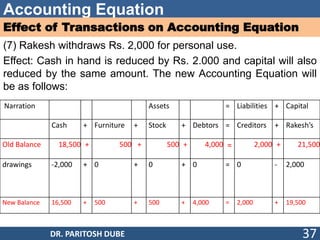
(7) Rakesh withdraws Rs. 2,000 for personal use.
Effect: Cash in hand is reduced by Rs. 2.000 and capital will also
reduced by the same amount. The new Accounting Equation will
be as follows:
DR. PARITOSH DUBE 37
Narration Assets = Liabilities + Capital
Cash + Furniture + Stock + Debtors = Creditors + Rakesh’s
Old Balance 18,500 + 500 + 500 + 4,000 = 2,000 + 21,500
drawings -2,000 + 0 + 0 + 0 = 0 - 2,000
New Balance 16,500 + 500 + 500 + 4,000 = 2,000 + 19,500
Accounting Equation
Effect of Transactions on Accounting Equation
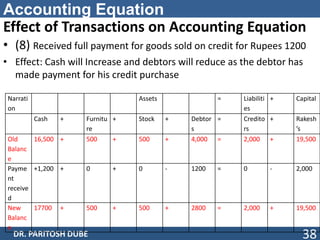
• (8) Received full payment for goods sold on credit for Rupees 1200
• Effect: Cash will Increase and debtors will reduce as the debtor has
made payment for his credit purchase
DR. PARITOSH DUBE 38
Narrati
on
Assets = Liabiliti
es
+ Capital
Cash + Furnitu
re
+ Stock + Debtor
s
= Credito
rs
+ Rakesh
’s
Old
Balanc
e
16,500 + 500 + 500 + 4,000 = 2,000 + 19,500
Payme
nt
receive
d
+1,200 + 0 + 0 - 1200 = 0 - 2,000
New
Balanc
e
17700 + 500 + 500 + 2800 = 2,000 + 19,500
Accounting Equation
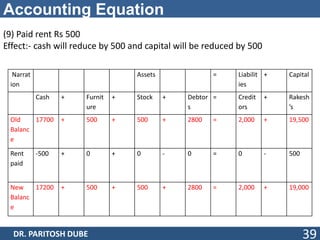
(9) Paid rent Rs 500
Effect:- cash will reduce by 500 and capital will be reduced by 500
Narrat
ion
Assets = Liabilit
ies
+ Capital
Cash + Furnit
ure
+ Stock + Debtor
s
= Credit
ors
+ Rakesh
’s
Old
Balanc
e
17700 + 500 + 500 + 2800 = 2,000 + 19,500
Rent
paid
-500 + 0 + 0 - 0 = 0 - 500
New
Balanc
e
17200 + 500 + 500 + 2800 = 2,000 + 19,000
DR. PARITOSH DUBE 39
Accounting Equation
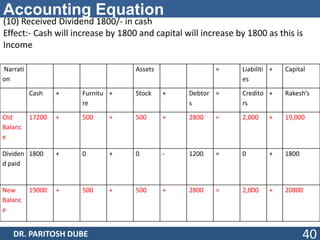
(10) Received Dividend 1800/- in cash
Effect:- Cash will increase by 1800 and capital will increase by 1800 as this is
Income
Narrati
on
Assets = Liabiliti
es
+ Capital
Cash + Furnitu
re
+ Stock + Debtor
s
= Credito
rs
+ Rakesh’s
Old
Balanc
e
17200 + 500 + 500 + 2800 = 2,000 + 19,000
Dividen
d paid
1800 + 0 + 0 - 1200 = 0 + 1800
New
Balanc
e
19000 + 500 + 500 + 2800 = 2,000 + 20800
DR. PARITOSH DUBE 40
Accounting Equation
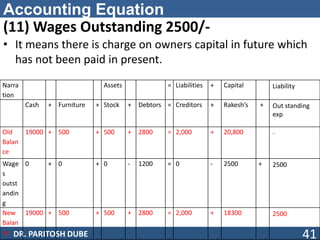
(11) Wages Outstanding 2500/-
• It means there is charge on owners capital in future which
has not been paid in present.
DR. PARITOSH DUBE 41
Narra
tion
Assets = Liabilities + Capital Liability
Cash + Furniture + Stock + Debtors = Creditors + Rakesh’s + Out standing
exp
Old
Balan
ce
19000 + 500 + 500 + 2800 = 2,000 + 20,800 -
Wage
s
outst
andin
g
0 + 0 + 0 - 1200 = 0 - 2500 + 2500
New
Balan
ce
19000 + 500 + 500 + 2800 = 2,000 + 18300 2500
Accounting Equation
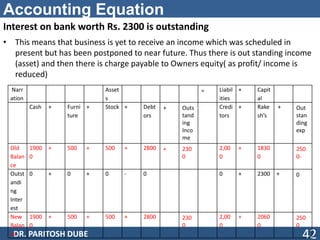
Interest on bank worth Rs. 2300 is outstanding
• This means that business is yet to receive an income which was scheduled in
present but has been postponed to near future. Thus there is out standing income
(asset) and then there is charge payable to Owners equity( as profit/ income is
reduced)
DR. PARITOSH DUBE 42
Narr
ation
Asset
s
= Liabil
ities
+ Capit
al
Cash + Furni
ture
+ Stock + Debt
ors
+ Outs
tand
ing
Inco
me
Credi
tors
+ Rake
sh’s
+ Out
stan
ding
exp
Old
Balan
ce
1900
0
+ 500 + 500 + 2800 + 230
0
2,00
0
+ 1830
0
250
0-
Outst
andi
ng
Inter
est
0 + 0 + 0 - 0 0 + 2300 + 0
New
Balan
ce
1900
0
+ 500 + 500 + 2800 230
0
2,00
0
+ 2060
0
250
0
Accounting Equation
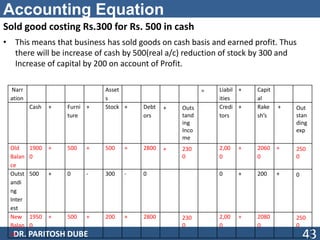
Sold good costing Rs.300 for Rs. 500 in cash
• This means that business has sold goods on cash basis and earned profit. Thus
there will be increase of cash by 500(real a/c) reduction of stock by 300 and
Increase of capital by 200 on account of Profit.
DR. PARITOSH DUBE 43
Narr
ation
Asset
s
= Liabil
ities
+ Capit
al
Cash + Furni
ture
+ Stock + Debt
ors
+ Outs
tand
ing
Inco
me
Credi
tors
+ Rake
sh’s
+ Out
stan
ding
exp
Old
Balan
ce
1900
0
+ 500 + 500 + 2800 + 230
0
2,00
0
+ 2060
0
+ 250
0
Outst
andi
ng
Inter
est
500 + 0 - 300 - 0 0 + 200 + 0
New
Balan
ce
1950
0
+ 500 + 200 + 2800 230
0
2,00
0
+ 2080
0
250
0
Accounting Equation
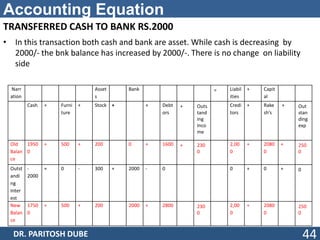
TRANSFERRED CASH TO BANK RS.2000
• In this transaction both cash and bank are asset. While cash is decreasing by
2000/- the bnk balance has increased by 2000/-. There is no change on liability
side
DR. PARITOSH DUBE 44
Narr
ation
Asset
s
Bank = Liabil
ities
+ Capit
al
Cash + Furni
ture
+ Stock + + Debt
ors
+ Outs
tand
ing
Inco
me
Credi
tors
+ Rake
sh’s
+ Out
stan
ding
exp
Old
Balan
ce
1950
0
+ 500 + 200 0 + 1600 + 230
0
2,00
0
+ 2080
0
+ 250
0
Outst
andi
ng
Inter
est
-
2000
+ 0 - 300 + 2000 - 0 0 + 0 + 0
New
Balan
ce
1750
0
+ 500 + 200 2000 + 2800 230
0
2,00
0
+ 2080
0
250
0
Accounting Equation
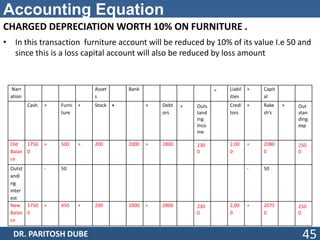
CHARGED DEPRECIATION WORTH 10% ON FURNITURE .
• In this transaction furniture account will be reduced by 10% of its value I.e 50 and
since this is a loss capital account will also be reduced by loss amount
DR. PARITOSH DUBE 45
Narr
ation
Asset
s
Bank = Liabil
ities
+ Capit
al
Cash + Furni
ture
+ Stock + + Debt
ors
+ Outs
tand
ing
Inco
me
Credi
tors
+ Rake
sh’s
+ Out
stan
ding
exp
Old
Balan
ce
1750
0
+ 500 + 200 2000 + 2800 230
0
2,00
0
+ 2080
0
250
0
Outst
andi
ng
Inter
est
- 50 - 50
New
Balan
ce
1750
0
+ 450 + 200 2000 + 2800 230
0
2,00
0
+ 2075
0
250
0
Accounting Equation
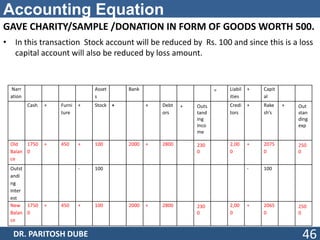
GAVE CHARITY/SAMPLE /DONATION IN FORM OF GOODS WORTH 500.
• In this transaction Stock account will be reduced by Rs. 100 and since this is a loss
capital account will also be reduced by loss amount.
DR. PARITOSH DUBE 46
Narr
ation
Asset
s
Bank = Liabil
ities
+ Capit
al
Cash + Furni
ture
+ Stock + + Debt
ors
+ Outs
tand
ing
Inco
me
Credi
tors
+ Rake
sh’s
+ Out
stan
ding
exp
Old
Balan
ce
1750
0
+ 450 + 100 2000 + 2800 230
0
2,00
0
+ 2075
0
250
0
Outst
andi
ng
Inter
est
- 100 - 100
New
Balan
ce
1750
0
+ 450 + 100 2000 + 2800 230
0
2,00
0
+ 2065
0
250
0
Accounting Equation
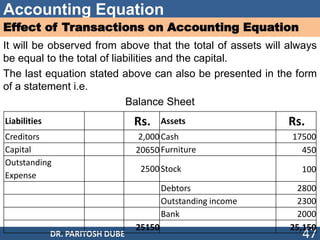
Effect of Transactions on Accounting Equation
It will be observed from above that the total of assets will always
be equal to the total of liabilities and the capital.
The last equation stated above can also be presented in the form
of a statement i.e.
Balance Sheet
DR. PARITOSH DUBE 47
Liabilities Rs. Assets Rs.
Creditors 2,000Cash 17500
Capital 20650Furniture 450
Outstanding
Expense
2500Stock 100
Debtors 2800
Outstanding income 2300
Bank 2000
25150 25,150
Accounting Equation
Effect of Transactions on Accounting Equation
A conclusion apparent from the transactions given
above is that every transaction has a double sided
effect. In other words, the Dual Aspect Concept will
always hold good.
A reduction or increase in an asset will have a
corresponding effect on liabilities or capital. This is
because of the rule that every receiver is a giver and
every giver is a receiver.
NOTE: There can be more variations of transaction
but if our entry identification and correct the balances
will always tally
DR. PARITOSH DUBE 48
Accounting Equation
DR. PARITOSH DUBE 49

Accounting Equation -An Introduction.pdf

  • 1.
  • 2.
    Accounting Equation Learning Objectives ThisChapter would enable you to understand:  Meaning of an Accounting Equation  Rules for Making Accounting Equation  Effect of Transactions on an Accounting Equation DR. PARITOSH DUBE 2
  • 3.
    Accounting Equation CONTENT • MEANINGOF AN ACCOUNTING EQUATION • MEANING OF ASSETS LIABILITIES AND CAPITAL • CLASSIFICATION OF ASSETS LIABILITIES AND CAPITAL • RULES FOR MAKING ACCOUNTING EQUATION DR. PARITOSH DUBE 3
  • 4.
    Accounting Equation CONTENT • FORMATOF ACCOUNTING EQUATION • TRANSACTION TYPES OF ACCOUNTING EQUATION DR. PARITOSH DUBE 4
  • 5.
    Accounting Equation MEANING MEANING OFAN ACCOUNTING EQUATION An Accounting Equation is a mathematical expression which shows that the assets and liabilities of a firm are equal. DR. PARITOSH DUBE 5
  • 6.
    Accounting Equation MEANING OFACCOUNTING EQUATION • An Accounting Equation is based on the dual aspect concept of accounting i.e., every transaction has two aspects-debit and credit. • It holds that for every debit there is a credit of equal amount and vice versa. DR. PARITOSH DUBE 6
  • 7.
    Accounting Equation MEANING OFACCOUNTING EQUATION • Claims= Assets • Claims= External liability & Internal Liability • Internal Liability= Capital Thus • External Liability + Capital= Asset DR. PARITOSH DUBE 7
  • 8.
    Accounting Equation Also • Capital=Asset-External Liability • External Liability=Asset- Capital DR. PARITOSH DUBE 8
  • 9.
    Accounting Equation MEANING OFAN ACCOUNTING EQUATION An Accounting Equation always holds true with every change that occurs due to a transaction entered into. It is because it is based on the dual aspect concept of accounting. DR. PARITOSH DUBE 9
  • 10.
    Accounting Equation DR. PARITOSHDUBE 10 A transaction may affect either both sides of the equation by the same amount or one side of the equation only by both increasing or decreasing it by equal amounts.
  • 11.
    Accounting Equation Thus therewill be following Effects- A. Increase in Liability • Increase in Asset • Decrease in Capital • Decrease in Liability DR. PARITOSH DUBE 11
  • 12.
    Accounting Equation B. Decreasein Liability • Decrease In Asset • Increase In Capital • Increase in Another Liability C. Increase In Capital • Increase In Asset DR. PARITOSH DUBE 12
  • 13.
    Accounting Equation D. DecreaseIn Capital • Decrease In Asset E. Increase in Asset • Decrease in Another Asset DR. PARITOSH DUBE 13
  • 14.
    Accounting Equation WHAT AREASSETS LIABILITIES AND CAPITAL • ASSETS:-Assets are defined as resources that help generate profit in your business. You have some control over it. These are not meant for sale(except finished goods) but for operating the business. DR. PARITOSH DUBE 14
  • 15.
    Accounting Equation • LIABILITIES:-Aliability, in general, is an obligation to, or something that you owe to somebody else. Liabilities are defined as a company's legal financial debts or obligations that arise during the course of business operations. DR. PARITOSH DUBE 15
  • 16.
    Accounting Equation • CAPITAL:-Capitalis the amount invested in the business by the owners in form of Original Investment Reserves and provisions • Capital= Asset- External Liabilities DR. PARITOSH DUBE 16
  • 17.
    Accounting Equation CLASSIFICATION OFASSETS ASSET FIXED CURRENT DR. PARITOSH DUBE 17
  • 18.
    Accounting Equation CLASSIFICATION OFASSETS FIXED ASSET • LAND • BUILDING • MACHINERY • PLANT • FURNITURE & FIXTURES • TOOLS DR. PARITOSH DUBE 18
  • 19.
    Accounting Equation CURRENT ASSETS •PREPAID EXPENSES • BILL RECEIVABLE • INVENTORY • DEBTORS • BANK • CASH • INCOME DUE BUT NOT RECEIVED DR. PARITOSH DUBE 19
  • 20.
    Accounting Equation CLASSIFICATION OFLIABILITY LIABILITY LONG TERM CURRENT DR. PARITOSH DUBE 20
  • 21.
    Accounting Equation CLASSIFICATION OFLIABILITY LONG TERM LIABILITY • LONG TERM BORROWING FROM BANKS • LONG TERM BORROWINGS FROM INDIVIDUALS • LONG TERM BORROWINGS FROM OTHER FINANCIAL INSTITUTION S • DEBENTURES DR. PARITOSH DUBE 21
  • 22.
    Accounting Equation SHORT TERMLIABILITY(LESS THAN ONE YEAR) • CREDITORS • BANK OVERDRAFT • OUTSTANDING EXPENSES • INCOME RECEIVED BUT NOT EARNED • BILLS PAYABLE DR. PARITOSH DUBE 22
  • 23.
    Accounting Equation CLASSIFICATION OFCAPITAL DR. PARITOSH DUBE 23 CAPITAL RESERVES INVESTMENT
  • 24.
    Accounting Equation MEANING OFAN ACCOUNTING EQUATION Transactions from the Accounting Equation viewpoint, can be divided into two, i.e., 1. Transactions Affecting Two Items and 2. Transactions Affecting More Than Two Items. DR. PARITOSH DUBE 24
  • 25.
    Accounting Equation Transactions AffectingTwo Items • Transactions affecting opposite sides are: • Increase in Asset, Increase in Liability: • Decrease in Liability, Decrease in Asset • Increase in Asset, Increase in Owner's Equity • Decrease in Owner's Capital, Decrease in Asset • Transactions affecting same side but in opposite direction are • Increase in Asset, Decrease in Another Asset • Decrease in Liability, Increase in Another Liability • Decrease in Liability, Increase in Another Capital • Increase in Liability, Decrease in Another Capital DR. PARITOSH DUBE 25
  • 26.
    Accounting Equation Effect ofTransactions on Accounting Equation The procedure to workout an Accounting Equation is: 1. Analyse the transaction in terms of such variables as assets, liabilities, capital. revenues and expenses. 2. Decide the effect of the transactions in terms of increase or decrease on variables mentioned in 1. 3. Record the effect on the relevant side of the equation. Let us take a few transactions to understand the accounting equation. DR. PARITOSH DUBE 26
  • 27.
    Accounting Equation RULES FORACCOUNTING EQUATIONS 1. Capital: When capital is increased, it is credited (+) and when a part of the capital is withdrawn, i.e. drawings are made, it is debited (-). Interest on Capital is an expense for the business, and thus, profit is reduced by the amount and since interest on capital is an income for the proprietor, it is added to capital. Interest on Drawings is a profit for the business therefore added to profit and thus, capital. Since it is a loss/expense for the owner it is deducted from capital. Assets and Liabilities will not be affected by interest on capital and interest on drawings. DR. PARITOSH DUBE 27
  • 28.
    Accounting Equation RULES FORACCOUNTING EQUATIONS 2. Revenue: Owner's equity (Capital) is increased by the amount of revenue. 3. Expenses: Owner's equity (Capital) is decreased by the amount of expenses. Income = Revenue - Expense Income is the profit earned during an accounting period. Profit increases the owner's equity (Capital) and loss decreases the owner's equity (Capital). Income/Gain will added to capital in Equation Expenses/Loss will be deducted from capital in Equation DR. PARITOSH DUBE 28
  • 29.
    Accounting Equation RULES FORACCOUNTING EQUATIONS 4. Outsiders' Equity: When liabilities are increased, outsiders' equities are credited (+) and when liabilities are decreased, outsiders' liabilities are debited (-). 5. Assets: If there is an increase in Assets, the increase is debited (+) in the Asset Account. If there is decrease in Assets, the decrease is credited (-) in the Asset Account. DR. PARITOSH DUBE 29
  • 30.
    Accounting Equation RULES FORACCOUNTING EQUATIONS 6. Effect of Outstanding Expenses (e.g., Outstanding Salary): Increase in liabilities and decrease in capital. 7. Accrued Income: Increase in asset and increase in capital. 8. Income Received in Advance: Increase in asset (as cash) and increase in liabilities. DR. PARITOSH DUBE 30
  • 31.
    Accounting Equation RULES FORACCOUNTING EQUATIONS 15.An increase in an asset, without a corresponding increase in liability or a corresponding decrease in another asset, means an increase in capital. Conversely, an increase in liability without a corresponding increase in asset, or a corresponding decrease in another liability, indicates decrease in capital. DR. PARITOSH DUBE 31
  • 32.
    Accounting Equation Effect ofTransactions on Accounting Equation Suppose, Rakesh starts business and the following successive transactions are entered into: (1) He commences his business with Rs. 20,000 as Capital. Effect: It means that the firm has assets totalling Rs. 20,000 in the form of cash and claims against the firm are also Rs. 20.000 in the form of capital. The equation stands as follows: DR. PARITOSH DUBE 32 Narration Assets = Liabilities + Capital Cash Capital Introduced 20,000 = 0 + 20,000
  • 33.
    Accounting Equation Effect ofTransactions on Accounting Equation (2) Purchases furniture for Rs. 500 in cash. Effect: It means cash in hand is reduced by Rs. 500 but a new asset (furniture) of the same amount has been purchased. Thus, total of assets remains unchanged. The equation will now appear as follows: DR. PARITOSH DUBE 33 Narration Assets = Liabilities + Capital Cash + Furniture Rakesh's Old Balance 20,000 + 0 = 0 + 20,000 Asset purchase (furniture) - 500 + 500 = 0 + 0 New Balance 19,500 + 500 = 0 + 20,000
  • 34.
    Accounting Equation Effect ofTransactions on Accounting Equation (3) Purchases goods for Rs. 1,000 in cash. Effect: It means cash in hand is reduced by Rs. 1,000 and another asset, i.e., stock has come into existence but the total of assets remains unchanged. The equation now will be as follows: DR. PARITOSH DUBE 34 Narration Assets = Liabilities + Capital Cash + Furniture + Stock Rakesh's Old Balance 19,500 + 500 + 0 = 0 + 20,000 Cash purchase -1,000 + 0 + 1,000 = 0 + 0 New Balance 18,500 + 500 + 1,000 = 0 + 20,000
  • 35.
    Accounting Equation Effect ofTransactions on Accounting Equation (4) Purchases goods for Rs. 2,000 on credit. Effect: It means the stock has increased by Rs. 2,000 making the total assets Rs. 22,000. A liability of Rs. 2.000 to the supplier of the goods (creditor) has arisen. The equation now will be as follows: DR. PARITOSH DUBE 35 Naration Assets = Liabilities +Capital Cash + Furniture + Stock Creditors + Rakesh's Old Balance 18,500 + 500 + 1,000 = 0 + 20,000 Credit purchase 0 + 0 + 2,000 = 2,000 + 0 New Balance 18,500 + 500 + 3,000 = 2,000 + 20,000
  • 36.
    Accounting Equation Effect ofTransactions on Accounting Equation (5) Sold goods costing Rs. 2,500 on credit for Rs. 4,000. Effect: It means a debtor has come into existence to the extent of Rs. 4,000. The stock will be reduced only by Rs. 2.500, being the cost of goods sold. The net increase in assets. Rs. 1,500. i.e. Rs. 4,000 - Rs. 2,500 (profit) will be added to the capital. The position now will be shown as DR. PARITOSH DUBE 36 Narration Assets = Liabilities + Capital Cash + Furniture + Stock + Debtors = Creditors + Rakesh's Old Balance 18,500 + 500 + 3000 + 0,000 = 2,000 + 20,000 Credit sales + 0 - 2500 + 4000 = 0 - 1,500 New Balance 18,500 + 500 + 500 + 4,000 = 2,000 + 21,500
  • 37.
    Accounting Equation Effect ofTransactions on Accounting Equation (7) Rakesh withdraws Rs. 2,000 for personal use. Effect: Cash in hand is reduced by Rs. 2.000 and capital will also reduced by the same amount. The new Accounting Equation will be as follows: DR. PARITOSH DUBE 37 Narration Assets = Liabilities + Capital Cash + Furniture + Stock + Debtors = Creditors + Rakesh’s Old Balance 18,500 + 500 + 500 + 4,000 = 2,000 + 21,500 drawings -2,000 + 0 + 0 + 0 = 0 - 2,000 New Balance 16,500 + 500 + 500 + 4,000 = 2,000 + 19,500
  • 38.
    Accounting Equation Effect ofTransactions on Accounting Equation • (8) Received full payment for goods sold on credit for Rupees 1200 • Effect: Cash will Increase and debtors will reduce as the debtor has made payment for his credit purchase DR. PARITOSH DUBE 38 Narrati on Assets = Liabiliti es + Capital Cash + Furnitu re + Stock + Debtor s = Credito rs + Rakesh ’s Old Balanc e 16,500 + 500 + 500 + 4,000 = 2,000 + 19,500 Payme nt receive d +1,200 + 0 + 0 - 1200 = 0 - 2,000 New Balanc e 17700 + 500 + 500 + 2800 = 2,000 + 19,500
  • 39.
    Accounting Equation (9) Paidrent Rs 500 Effect:- cash will reduce by 500 and capital will be reduced by 500 Narrat ion Assets = Liabilit ies + Capital Cash + Furnit ure + Stock + Debtor s = Credit ors + Rakesh ’s Old Balanc e 17700 + 500 + 500 + 2800 = 2,000 + 19,500 Rent paid -500 + 0 + 0 - 0 = 0 - 500 New Balanc e 17200 + 500 + 500 + 2800 = 2,000 + 19,000 DR. PARITOSH DUBE 39
  • 40.
    Accounting Equation (10) ReceivedDividend 1800/- in cash Effect:- Cash will increase by 1800 and capital will increase by 1800 as this is Income Narrati on Assets = Liabiliti es + Capital Cash + Furnitu re + Stock + Debtor s = Credito rs + Rakesh’s Old Balanc e 17200 + 500 + 500 + 2800 = 2,000 + 19,000 Dividen d paid 1800 + 0 + 0 - 1200 = 0 + 1800 New Balanc e 19000 + 500 + 500 + 2800 = 2,000 + 20800 DR. PARITOSH DUBE 40
  • 41.
    Accounting Equation (11) WagesOutstanding 2500/- • It means there is charge on owners capital in future which has not been paid in present. DR. PARITOSH DUBE 41 Narra tion Assets = Liabilities + Capital Liability Cash + Furniture + Stock + Debtors = Creditors + Rakesh’s + Out standing exp Old Balan ce 19000 + 500 + 500 + 2800 = 2,000 + 20,800 - Wage s outst andin g 0 + 0 + 0 - 1200 = 0 - 2500 + 2500 New Balan ce 19000 + 500 + 500 + 2800 = 2,000 + 18300 2500
  • 42.
    Accounting Equation Interest onbank worth Rs. 2300 is outstanding • This means that business is yet to receive an income which was scheduled in present but has been postponed to near future. Thus there is out standing income (asset) and then there is charge payable to Owners equity( as profit/ income is reduced) DR. PARITOSH DUBE 42 Narr ation Asset s = Liabil ities + Capit al Cash + Furni ture + Stock + Debt ors + Outs tand ing Inco me Credi tors + Rake sh’s + Out stan ding exp Old Balan ce 1900 0 + 500 + 500 + 2800 + 230 0 2,00 0 + 1830 0 250 0- Outst andi ng Inter est 0 + 0 + 0 - 0 0 + 2300 + 0 New Balan ce 1900 0 + 500 + 500 + 2800 230 0 2,00 0 + 2060 0 250 0
  • 43.
    Accounting Equation Sold goodcosting Rs.300 for Rs. 500 in cash • This means that business has sold goods on cash basis and earned profit. Thus there will be increase of cash by 500(real a/c) reduction of stock by 300 and Increase of capital by 200 on account of Profit. DR. PARITOSH DUBE 43 Narr ation Asset s = Liabil ities + Capit al Cash + Furni ture + Stock + Debt ors + Outs tand ing Inco me Credi tors + Rake sh’s + Out stan ding exp Old Balan ce 1900 0 + 500 + 500 + 2800 + 230 0 2,00 0 + 2060 0 + 250 0 Outst andi ng Inter est 500 + 0 - 300 - 0 0 + 200 + 0 New Balan ce 1950 0 + 500 + 200 + 2800 230 0 2,00 0 + 2080 0 250 0
  • 44.
    Accounting Equation TRANSFERRED CASHTO BANK RS.2000 • In this transaction both cash and bank are asset. While cash is decreasing by 2000/- the bnk balance has increased by 2000/-. There is no change on liability side DR. PARITOSH DUBE 44 Narr ation Asset s Bank = Liabil ities + Capit al Cash + Furni ture + Stock + + Debt ors + Outs tand ing Inco me Credi tors + Rake sh’s + Out stan ding exp Old Balan ce 1950 0 + 500 + 200 0 + 1600 + 230 0 2,00 0 + 2080 0 + 250 0 Outst andi ng Inter est - 2000 + 0 - 300 + 2000 - 0 0 + 0 + 0 New Balan ce 1750 0 + 500 + 200 2000 + 2800 230 0 2,00 0 + 2080 0 250 0
  • 45.
    Accounting Equation CHARGED DEPRECIATIONWORTH 10% ON FURNITURE . • In this transaction furniture account will be reduced by 10% of its value I.e 50 and since this is a loss capital account will also be reduced by loss amount DR. PARITOSH DUBE 45 Narr ation Asset s Bank = Liabil ities + Capit al Cash + Furni ture + Stock + + Debt ors + Outs tand ing Inco me Credi tors + Rake sh’s + Out stan ding exp Old Balan ce 1750 0 + 500 + 200 2000 + 2800 230 0 2,00 0 + 2080 0 250 0 Outst andi ng Inter est - 50 - 50 New Balan ce 1750 0 + 450 + 200 2000 + 2800 230 0 2,00 0 + 2075 0 250 0
  • 46.
    Accounting Equation GAVE CHARITY/SAMPLE/DONATION IN FORM OF GOODS WORTH 500. • In this transaction Stock account will be reduced by Rs. 100 and since this is a loss capital account will also be reduced by loss amount. DR. PARITOSH DUBE 46 Narr ation Asset s Bank = Liabil ities + Capit al Cash + Furni ture + Stock + + Debt ors + Outs tand ing Inco me Credi tors + Rake sh’s + Out stan ding exp Old Balan ce 1750 0 + 450 + 100 2000 + 2800 230 0 2,00 0 + 2075 0 250 0 Outst andi ng Inter est - 100 - 100 New Balan ce 1750 0 + 450 + 100 2000 + 2800 230 0 2,00 0 + 2065 0 250 0
  • 47.
    Accounting Equation Effect ofTransactions on Accounting Equation It will be observed from above that the total of assets will always be equal to the total of liabilities and the capital. The last equation stated above can also be presented in the form of a statement i.e. Balance Sheet DR. PARITOSH DUBE 47 Liabilities Rs. Assets Rs. Creditors 2,000Cash 17500 Capital 20650Furniture 450 Outstanding Expense 2500Stock 100 Debtors 2800 Outstanding income 2300 Bank 2000 25150 25,150
  • 48.
    Accounting Equation Effect ofTransactions on Accounting Equation A conclusion apparent from the transactions given above is that every transaction has a double sided effect. In other words, the Dual Aspect Concept will always hold good. A reduction or increase in an asset will have a corresponding effect on liabilities or capital. This is because of the rule that every receiver is a giver and every giver is a receiver. NOTE: There can be more variations of transaction but if our entry identification and correct the balances will always tally DR. PARITOSH DUBE 48
  • 49.