Elderly People in Portugal 
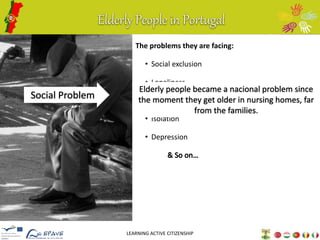
The problems they are facing: 
• Social exclusion 
• Loneliness 
• Inactivity 
• Isolation 
• Depression 
LEARNING ACTIVE CITIZENSHIP 
Social Problem 
Elderly people became a nacional problem since 
the moment they get older in nursing homes, far 
from the families.
4 
LEARNING ACTIVE CITIZENSHIP 
Solutions & Strategies
Volunteer action 
LEARNING ACTIVE CITIZENSHIP 
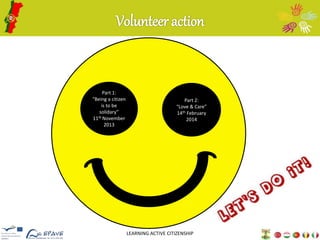
Part 1: 
“Being a citizen 
is to be 
solidary” 
11thNovember 
2013 
Part 2: 
“Love & Care” 
14th February 
2014
VOLUNTEER ACTION 
Part 1 
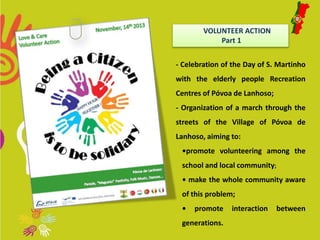
- Celebration of the Day of S. Martinho 
with the elderly people Recreation 
Centres of Póvoa de Lanhoso; 
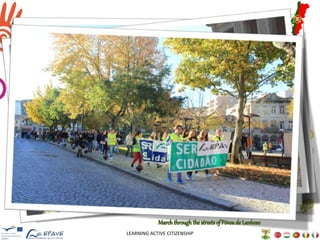
- Organization of a march through the 
streets of the Village of Póvoa de 
Lanhoso, aiming to: 
•promote volunteering among the 
school and local community; 
• make the whole community aware 
of this problem; 
• promote interaction between 
generations.
LEARNING ACTIVE CITIZENSHIP
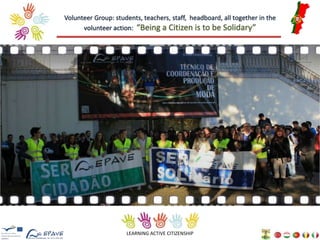
Volunteer Group: students, teachers, staff, headboard, all together in the 
volunteer action: “Being a Citizen is to be Solidary” 
LEARNING ACTIVE CITIZENSHIP
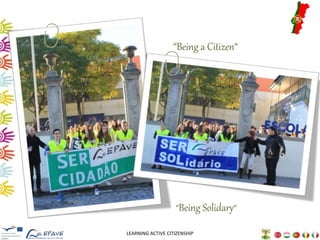
“Being a Citizen“ 
“Being Solidary“ 
LEARNING ACTIVE CITIZENSHIP
1. In Portugal, the elderly population represents a group 
increasingly relevant both in number and in social 
concern, as a result of situations of social exclusion, 
including situations of solitude, family abandonment and 
poverty; 
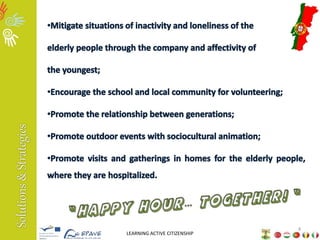
2. Among many, the solutions considered for us to 
combat some of their problems are the company, the 
warmth, conviviality with the young, caring, animation, 
through voluntary campaigns; 
3. EPAVE promoted two voluntary actions under the themes “Being a Citizen is to 
be Solidary” and “Love & Care”, aiming to educate the school and local community 
to the social problem of social exclusion of the elderly people and incentivate a 
more active citizenship; 
4. As a consequence of these initiatives have resulted a bigger involvement of 
young people towards this social problem, as well as their awareness of the 
importance of being an active citizen as a contribution to the common good; 
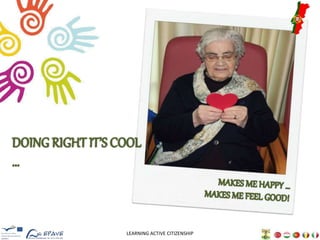
5. Volunteering is very important for the young participants, because they felt very 
gratified by the exchanges with the elderly people because "Doing Right it's Cool 
... Makes Me Happy ... Makes me Feel Good!".
LEARNING ACTIVE CITIZENSHIP
Ppt portuguese team final with conclusions

Ppt portuguese team final with conclusions

  • 3.
    Elderly People inPortugal The problems they are facing: • Social exclusion • Loneliness • Inactivity • Isolation • Depression LEARNING ACTIVE CITIZENSHIP Social Problem Elderly people became a nacional problem since the moment they get older in nursing homes, far from the families.
  • 4.
    4 LEARNING ACTIVECITIZENSHIP Solutions & Strategies
  • 5.
    Volunteer action LEARNINGACTIVE CITIZENSHIP Part 1: “Being a citizen is to be solidary” 11thNovember 2013 Part 2: “Love & Care” 14th February 2014
  • 6.
    VOLUNTEER ACTION Part1 - Celebration of the Day of S. Martinho with the elderly people Recreation Centres of Póvoa de Lanhoso; - Organization of a march through the streets of the Village of Póvoa de Lanhoso, aiming to: •promote volunteering among the school and local community; • make the whole community aware of this problem; • promote interaction between generations.
  • 7.
  • 8.
    Volunteer Group: students,teachers, staff, headboard, all together in the volunteer action: “Being a Citizen is to be Solidary” LEARNING ACTIVE CITIZENSHIP
  • 9.
    “Being a Citizen“ “Being Solidary“ LEARNING ACTIVE CITIZENSHIP
  • 10.
  • 11.
  • 12.
  • 13.
  • 14.
  • 15.
  • 16.
  • 17.
  • 18.
  • 19.
  • 20.
  • 21.
  • 22.
    1. In Portugal,the elderly population represents a group increasingly relevant both in number and in social concern, as a result of situations of social exclusion, including situations of solitude, family abandonment and poverty; 2. Among many, the solutions considered for us to combat some of their problems are the company, the warmth, conviviality with the young, caring, animation, through voluntary campaigns; 3. EPAVE promoted two voluntary actions under the themes “Being a Citizen is to be Solidary” and “Love & Care”, aiming to educate the school and local community to the social problem of social exclusion of the elderly people and incentivate a more active citizenship; 4. As a consequence of these initiatives have resulted a bigger involvement of young people towards this social problem, as well as their awareness of the importance of being an active citizen as a contribution to the common good; 5. Volunteering is very important for the young participants, because they felt very gratified by the exchanges with the elderly people because "Doing Right it's Cool ... Makes Me Happy ... Makes me Feel Good!".
  • 23.
  • 24.

Editor's Notes

  • #7 5. This was the poster of our first volunteer action: “Being a Citizen is to be Solidary”. To promote volunteering and interaction between generations, the volunteers organized a march through the streets of Póvoa de Lanhoso. We celebrated the Day of São Martinho in the centre of the village with the elderly people from the Home Care of Póvoa de Lanhoso, to which the local population joined.
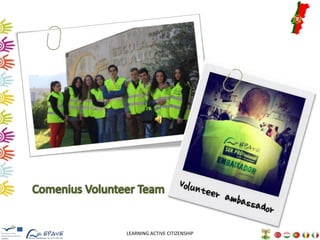
  • #8 6. This is the group of volunteers who organized the first voluntary action. In our school already exists the Group "EPAVE Ambassador“, which participates in various voluntary actions addressed to different target audiences.
  • #9 7. Volunteer Group: students, teachers, staff, headboard, all together in the volunteer action: “Being a Citizen is to be Solidary”.
  • #10 8. Thus, on 11th November, the volunteers began the march through the streets of the Village of Póvoa de Lanhoso, aiming to educate the school and local community to the social problem of social exclusion of the elderly people and incentivate a more active citizenship.
  • #11 9. This is the march through the streets of Póvoa de Lanhoso…
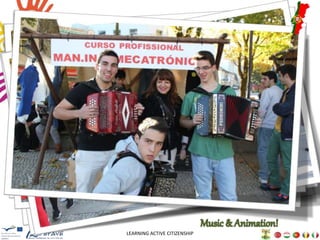
  • #12 10. Here we can see some pictures reporting the music and animation moment…
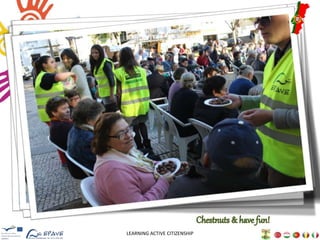
  • #13 11. So, the volunteers celebrated with the elderly the Day of São Martinho, one of the celebrations marking the Fall. According to Portuguese tradition, in this day chestnuts are roasted and the new wine is drank, produced with the harvest of the previous Autumn. The volunteers offered to the elderly people juice and roasted chestnuts, and this celebration is always accompanied with traditional music and dances.
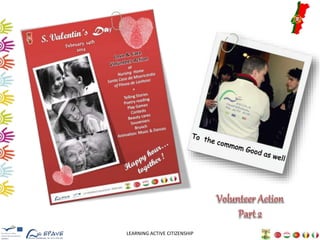
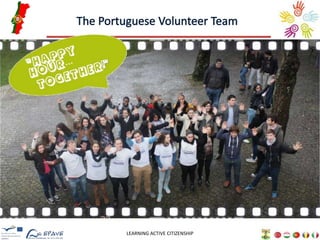
  • #14 12. HAPPY HOUR ...TOGETHER, is the second voluntary action and gathered the school community around the elderly people, contributing to the awareness of being a more active and solidary citizen for the COMMON GOOD! ALL WE NEED IS LOVE! LOVE IS ALL WE NEED… !
  • #15 13. This is the group of Portuguese volunteers who participated in this action.
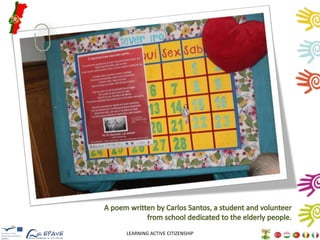
  • #16 14. Here you can see a poem written by Carlos Santos, a student and also volunteer from our school, dedicated to the elderly people.
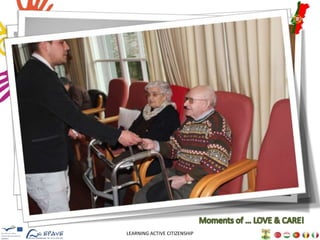
  • #17 15. These pictures report some moments of … LOVE & CARE!
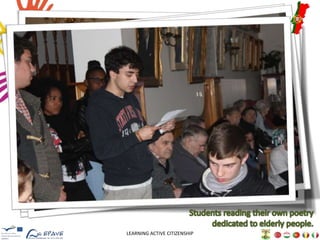
  • #18 16. Here are represented the moments with students reading their own poetry dedicated to elderly people.
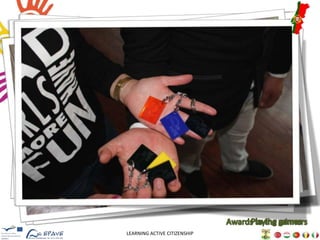
  • #19 17. Here you can see all together playing games and the awards to the winners!
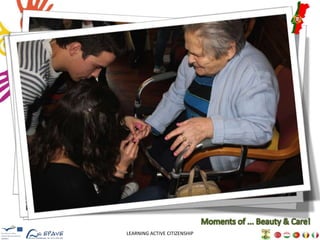
  • #20 18. There were also Moments of ... Beauty & Care!
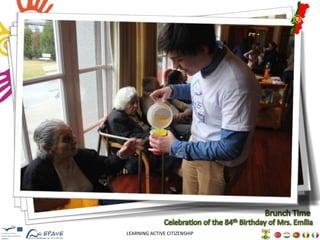
  • #21 19. At the brunch time there was the celebration of the 84th Birthday of Mrs. Emília.
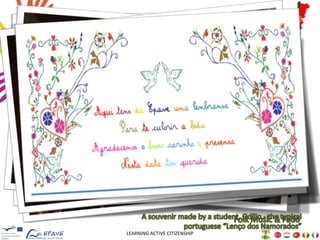
  • #22 20. We also had some folk music and Fado. And here you can also see a postcard made by a student, Odílio Vieira, illustrating the traditional “Lenço dos Namorados” (Valentines’ Scarf), typical from the north of Portugal. It says: “Here you have a souvenir from EPAVE, to colour your life, we thank your care and presence, in such a special date.” The “Valentines’ scarf” it’s an ancient tradition in our region. Women handmade the scarves with love themes and wrote a message to their loved one. Since they were women with very little scholar formation, they wrote this messages as they pronounced them, making some written mistakes. But, because this is theirs main characteristic, they still are produced in the same way.
  • #24 21. Doing Right it’s Cool… Makes Me Happy… Makes me Feel Good!
  • #26 23. Thank you For Your Attention!!!