3rd MEETING Turkey 
21st – 25th October 2013
 Addiction 
 Bullying 
 Gender discrimination 
at Work 
 Violence 
 Marginalization 
 Isolation
Young People - ADDICTION 
Drug addiction is defined as a dependency to a "toxic" or 
drug that causes additionally in the consumer 
psychological disturbances. 
Despite the consumption of licit and illicit 
drugs have decreased in 2012, this 
problem continues to worry the Portuguese 
Society, because it affects mostly young 
people.
Young People – ADDICTION - Statistics 
73.3 
44.3 
27.5 
19.2 
35 
80 
70 
30 
60 
25 
50 
20 
40 
15 
30 
10 
20 
5 
10 
0 
11.7 
17 
2.3 
5.6 
10.1 
Alcoholic Drinks Tobacco Canabis Ectasy 
Licit Drugs Illicit Drugs 
% 
Continued Consumption Rate of the Main Licit and Illicit Drugs 
Source: III Annual Inquérito Report Nacional “A Situação ao Consumo do País de em Substâncias Matéria de Psicoativas Drogas e Toxicodependências na População Portuguesa (2011)” 
(2013) – IDT (Institute on 
Drugs and Drug Addiction) 
19.1 
24.4 
29.7 
0 
Total Pop. 
(15-64 
years) 
Young 
Adult Pop. 
(15-34 
years) 
13 years 14 years 15 years 16 years 17 years 18 years 
% 
Continuous Prevalence of Cannabis use by young people, 2011
Young People – ADDICTION: Solutions & Strategies 
 Disclosure and access to information; 
 School projects of prevention/deterrence; 
 Awareness-Raising Actions undertaken by and for 
young people; 
 Promoting healthy lifestyles; 
 The supply reduction by increasing the capture of 
traffickers; 
 Creating initiatives and prevention programmes with 
the municipalities, families, sport clubs, associations, 
places of entertainment (bars, discos, etc.) and 
companies; 
 Mobile support units/deterrence/medical care.
Young People - Problems 
Bullying 
Bullying is an intentional and repeated behaviour 
which intentionally inflict damage or discomfort, 
through physical or verbal threats or psychological 
violence. 
However, due to the Internet 
(Social Networks), this 
problem has acquired 
alarming dimensions.
Young People – Bullying: Statistics 
20 
20 
16 
The study sample : 1.014 respondents 
sexual agression 
dissemination of rumors 
robberies 
damage of objects 
activities carried out by the Group 
screams 
agression 
Agressive comments on Net 
threats or intimidation through 
Source: APAV (Portuguese Association for Victim Support) 
66 
67 
60 
62 
22 
18 
2 
0 10 20 30 40 50 60 70 80 
insults 
% 
Bullying Behaviours
Young People – Bullying: Solutions & Strategies 
Recognize and Respond; 
 Create Dialogue; 
Encourage bystanders to 
become “upstanders“; 
 Foster safety and inclusion; 
Educate your Community; 
Promote youth 
employment activities; 
 Create movements anti-bullying 
at school; 
Psychological support to 
the aggressor and the 
victim; 
 Promote the involvement of 
families; 
Promote access to 
information; 
Promote healthy 
lifestyles.
Woman: Discrimination at Work 
9 
Discrimination refers to attitudes that harm individuals 
belonging to certain social groups and the result of social 
processes that harass members of these groups. 
Women are still discriminated, since men are given more job 
opportunities. In addition, they have lower salaries and their 
prospects to rise professionally are more limited, even when 
both genders have the same professional qualifications.
Woman: Discrimination at Work - Statistics 
47.3 
34.1 
11.6 
52.7 
65.9 
12.1 
70.0 
60.0 
50.0 
40.0 
30.0 
20.0 
10.0 
0.0 
Unemployment Higher education graduates Unemployment rate of the 
labor force with higher 
education 
% 
UNEMPLOYMENT RATE, BY EDUCATION AND GENDER, 2013 
Men 
Women 
Source: IEFP (Institute of Employment and Vocational Training), 2013
Woman: Discrimination at Work 
Solutions & Strategies 
 Implementation of plans for gender equality in 
enterprises; 
 Support female entrepreneurship; 
 Prevent and combat the sexual and moral 
harassment in the workplace; 
 Combat pay imbalances; 
 Promote the emancipation of young women for 
participation and active citizenship; 
 Actions to raise awareness of the importance of 
gender equality in schools; 
 Training in gender equality in enterprises.
Woman – Domestic Violence 
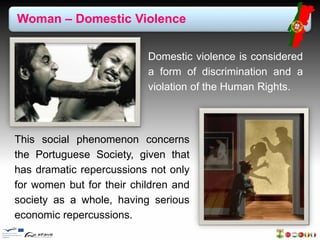
Domestic violence is considered 
a form of discrimination and a 
violation of the Human Rights. 
This social phenomenon concerns 
the Portuguese Society, given that 
has dramatic repercussions not only 
for women but for their children and 
society as a whole, having serious 
economic repercussions.
Woman – Violence: Statistics 
Victims of Domestic Violence, by Gender 
83% 
13% 
4% 
Women 
Men 
Absent 
Source: APAV (Portuguese Association for Victim Support), 2011.
Woman – Violence: Solutions & Strategies 
 Consolidate the system of security and protection of 
victims of domestic violence; 
 Social integration of the victims of domestic violence 
through insertion itineraries; 
 Involvement of municipalities on prevention and 
combating domestic violence, streamlining the role of 
local and regional networks; 
 National campaigns against domestic violence; 
 Primary prevention through awareness-raising actions 
and information on domestic violence and dating 
violence in schools.
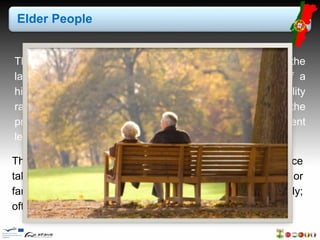
Elder People 
The population ageing pattern that has been observed for the 
last few years kept its tendency, as a consequence of a 
higher life expectancy and the low levels in the total fertility 
rate which, although reflecting a slight increase over the 
previous year, remained below the threshold of replacement 
level. 
The current age is a center of concerns due to dependence 
taken by elder people in relation to children, grandchildren or 
family. Families do not give due attention to their elderly; 
often these are neglected.
Elder People - PROBLEMS 
Social exclusion 
Family abandonment 
Loneliness 
Inactivity 
Isolation 
Lack of medical care 
Poverty 
Homeless 
Depression 
Victims of violence
Elder People - STATISTICS 
Demographic Projection for 2050 
15.1 
Portugal Demography 
66.77 
18.2 
60 
80 
70 
50 
60 
40 
50 
40 
30 
30 
20 
20 
10 
10 
0 
0-14 15-64 >65 
Inactive Active Older 
% 
Age 
12.1 
56 
32 
0 
0-14 15-64 >65 
Inactive Active Older 
% 
Age 
Source: APAV (Portuguese Association for Victim Support), 2011.
Elder People - STRATEGIES (SOLUTIONS) 
 Several Activities 
 Meals-on-wheels 
 Personal hygiene and 
comfort 
 Laundry and House 
cleaning 
 Shopping Services 
 Responsibility of families 
for their elderly 
 ICT training and other 
 Health care (cooperation) 
 Helpline for the elderly 
 Security – Portuguese Police 
 Companion (going outside) 
 Sociocultural Animation 
 Encourage volunteering 
 Qualified technical staff to 
deal with the elderly 
 Promote intergenerational 
relationships
PORTUGUESE COMENIUS TEAM: 
STUDENTS 
ANA ANTUNES 
& 
CYNTHIA DURÃES 
TEACHERS: 
CLARA COSTA , EUGÉNIA GOMES & 
MÓNICA ALVES 
COORDINATOR: 
AMÉLIA VELOSO 
October, 2013 
21st – 25th October 
2013
• http://www.ine.pt 
• http://www.qren.pt 
• BALSA, Casimiro et al (2013). III Inquérito Nacional ao Consumo de Substâncias 
Psicoativas na População Portuguesa (Relatório preliminar). Coleção Estudos, 
CESNOVA – Centro de Estudos de Sociologia da Universidade Nova de Lisboa. 
Lisboa: SICAD (IDT) 
• FERREIRA, Virgínia (2010).A Igualdade de Mulheres e Homens no Trabalho e no 
Emprego em Portugal. Politicas e Circunstâncias. Coleção Estudos 7. Lisboa: 
CITE - Comissão para a Igualdade no Trabalho e no Emprego 
• IV Plano Nacional para a Igualdade, Género, Cidadania e não Discriminação, 2011 
-2013. Resolução do Conselho de Ministros n.º 5/2011, de 18 de Janeiro 
• IV Plano Nacional contra a Violência Doméstica (2011 -2013). Resolução do 
Conselho de Ministros n.º 100/2010, de 17 de Dezembro 
• CITE- Comissão para Igualdade no Trabalho e Emprego 
• IDT – A Situação do País em Matéria de Drogas e Toxicodependências. 
Tendências por Drogas – Cannabis 
• Estatísticas APAV. Violência Doméstica (2011). 
• Barómetro APAV INTERCAMPUS (junho 2013). Perceção da População 
Portuguesa sobre Stalking, Cyberstalking, Bullying e Cyberbullying 
• Plano Nacional Contra a Droga e Toxicodependências, Resolução do Conselho de 
Ministros nº 115/2006, de 18 de Setembro

3rd meeting comenius turkey

  • 1.
    3rd MEETING Turkey 21st – 25th October 2013
  • 2.
     Addiction Bullying  Gender discrimination at Work  Violence  Marginalization  Isolation
  • 3.
    Young People -ADDICTION Drug addiction is defined as a dependency to a "toxic" or drug that causes additionally in the consumer psychological disturbances. Despite the consumption of licit and illicit drugs have decreased in 2012, this problem continues to worry the Portuguese Society, because it affects mostly young people.
  • 4.
    Young People –ADDICTION - Statistics 73.3 44.3 27.5 19.2 35 80 70 30 60 25 50 20 40 15 30 10 20 5 10 0 11.7 17 2.3 5.6 10.1 Alcoholic Drinks Tobacco Canabis Ectasy Licit Drugs Illicit Drugs % Continued Consumption Rate of the Main Licit and Illicit Drugs Source: III Annual Inquérito Report Nacional “A Situação ao Consumo do País de em Substâncias Matéria de Psicoativas Drogas e Toxicodependências na População Portuguesa (2011)” (2013) – IDT (Institute on Drugs and Drug Addiction) 19.1 24.4 29.7 0 Total Pop. (15-64 years) Young Adult Pop. (15-34 years) 13 years 14 years 15 years 16 years 17 years 18 years % Continuous Prevalence of Cannabis use by young people, 2011
  • 5.
    Young People –ADDICTION: Solutions & Strategies  Disclosure and access to information;  School projects of prevention/deterrence;  Awareness-Raising Actions undertaken by and for young people;  Promoting healthy lifestyles;  The supply reduction by increasing the capture of traffickers;  Creating initiatives and prevention programmes with the municipalities, families, sport clubs, associations, places of entertainment (bars, discos, etc.) and companies;  Mobile support units/deterrence/medical care.
  • 6.
    Young People -Problems Bullying Bullying is an intentional and repeated behaviour which intentionally inflict damage or discomfort, through physical or verbal threats or psychological violence. However, due to the Internet (Social Networks), this problem has acquired alarming dimensions.
  • 7.
    Young People –Bullying: Statistics 20 20 16 The study sample : 1.014 respondents sexual agression dissemination of rumors robberies damage of objects activities carried out by the Group screams agression Agressive comments on Net threats or intimidation through Source: APAV (Portuguese Association for Victim Support) 66 67 60 62 22 18 2 0 10 20 30 40 50 60 70 80 insults % Bullying Behaviours
  • 8.
    Young People –Bullying: Solutions & Strategies Recognize and Respond;  Create Dialogue; Encourage bystanders to become “upstanders“;  Foster safety and inclusion; Educate your Community; Promote youth employment activities;  Create movements anti-bullying at school; Psychological support to the aggressor and the victim;  Promote the involvement of families; Promote access to information; Promote healthy lifestyles.
  • 9.
    Woman: Discrimination atWork 9 Discrimination refers to attitudes that harm individuals belonging to certain social groups and the result of social processes that harass members of these groups. Women are still discriminated, since men are given more job opportunities. In addition, they have lower salaries and their prospects to rise professionally are more limited, even when both genders have the same professional qualifications.
  • 10.
    Woman: Discrimination atWork - Statistics 47.3 34.1 11.6 52.7 65.9 12.1 70.0 60.0 50.0 40.0 30.0 20.0 10.0 0.0 Unemployment Higher education graduates Unemployment rate of the labor force with higher education % UNEMPLOYMENT RATE, BY EDUCATION AND GENDER, 2013 Men Women Source: IEFP (Institute of Employment and Vocational Training), 2013
  • 11.
    Woman: Discrimination atWork Solutions & Strategies  Implementation of plans for gender equality in enterprises;  Support female entrepreneurship;  Prevent and combat the sexual and moral harassment in the workplace;  Combat pay imbalances;  Promote the emancipation of young women for participation and active citizenship;  Actions to raise awareness of the importance of gender equality in schools;  Training in gender equality in enterprises.
  • 12.
    Woman – DomesticViolence Domestic violence is considered a form of discrimination and a violation of the Human Rights. This social phenomenon concerns the Portuguese Society, given that has dramatic repercussions not only for women but for their children and society as a whole, having serious economic repercussions.
  • 13.
    Woman – Violence:Statistics Victims of Domestic Violence, by Gender 83% 13% 4% Women Men Absent Source: APAV (Portuguese Association for Victim Support), 2011.
  • 14.
    Woman – Violence:Solutions & Strategies  Consolidate the system of security and protection of victims of domestic violence;  Social integration of the victims of domestic violence through insertion itineraries;  Involvement of municipalities on prevention and combating domestic violence, streamlining the role of local and regional networks;  National campaigns against domestic violence;  Primary prevention through awareness-raising actions and information on domestic violence and dating violence in schools.
  • 15.
    Elder People Thepopulation ageing pattern that has been observed for the last few years kept its tendency, as a consequence of a higher life expectancy and the low levels in the total fertility rate which, although reflecting a slight increase over the previous year, remained below the threshold of replacement level. The current age is a center of concerns due to dependence taken by elder people in relation to children, grandchildren or family. Families do not give due attention to their elderly; often these are neglected.
  • 16.
    Elder People -PROBLEMS Social exclusion Family abandonment Loneliness Inactivity Isolation Lack of medical care Poverty Homeless Depression Victims of violence
  • 17.
    Elder People -STATISTICS Demographic Projection for 2050 15.1 Portugal Demography 66.77 18.2 60 80 70 50 60 40 50 40 30 30 20 20 10 10 0 0-14 15-64 >65 Inactive Active Older % Age 12.1 56 32 0 0-14 15-64 >65 Inactive Active Older % Age Source: APAV (Portuguese Association for Victim Support), 2011.
  • 18.
    Elder People -STRATEGIES (SOLUTIONS)  Several Activities  Meals-on-wheels  Personal hygiene and comfort  Laundry and House cleaning  Shopping Services  Responsibility of families for their elderly  ICT training and other  Health care (cooperation)  Helpline for the elderly  Security – Portuguese Police  Companion (going outside)  Sociocultural Animation  Encourage volunteering  Qualified technical staff to deal with the elderly  Promote intergenerational relationships
  • 19.
    PORTUGUESE COMENIUS TEAM: STUDENTS ANA ANTUNES & CYNTHIA DURÃES TEACHERS: CLARA COSTA , EUGÉNIA GOMES & MÓNICA ALVES COORDINATOR: AMÉLIA VELOSO October, 2013 21st – 25th October 2013
  • 20.
    • http://www.ine.pt •http://www.qren.pt • BALSA, Casimiro et al (2013). III Inquérito Nacional ao Consumo de Substâncias Psicoativas na População Portuguesa (Relatório preliminar). Coleção Estudos, CESNOVA – Centro de Estudos de Sociologia da Universidade Nova de Lisboa. Lisboa: SICAD (IDT) • FERREIRA, Virgínia (2010).A Igualdade de Mulheres e Homens no Trabalho e no Emprego em Portugal. Politicas e Circunstâncias. Coleção Estudos 7. Lisboa: CITE - Comissão para a Igualdade no Trabalho e no Emprego • IV Plano Nacional para a Igualdade, Género, Cidadania e não Discriminação, 2011 -2013. Resolução do Conselho de Ministros n.º 5/2011, de 18 de Janeiro • IV Plano Nacional contra a Violência Doméstica (2011 -2013). Resolução do Conselho de Ministros n.º 100/2010, de 17 de Dezembro • CITE- Comissão para Igualdade no Trabalho e Emprego • IDT – A Situação do País em Matéria de Drogas e Toxicodependências. Tendências por Drogas – Cannabis • Estatísticas APAV. Violência Doméstica (2011). • Barómetro APAV INTERCAMPUS (junho 2013). Perceção da População Portuguesa sobre Stalking, Cyberstalking, Bullying e Cyberbullying • Plano Nacional Contra a Droga e Toxicodependências, Resolução do Conselho de Ministros nº 115/2006, de 18 de Setembro

Editor's Notes

  • #9 Aqui acho que fica giro, primeiro aparecer a foto (que depois desaparece) e depois em tópicos as soluções
  • #11 Relativamente ao Desemprego, podemos observar neste gráfico que a percentagem de mulheres desempregadas é mais elevada do que os homens. E apesar de as mulheres apresentarem uma significativa taxa de qualificações elevadas, são ainda muito vulneráveis a situações de desemprego.
  • #12 Clara, tens que resumir melhor estes tópicos, por causa do tamanho da letra e do espaçamento.
  • #13 Acho que se deve definir “Violência”, pois não é só física. Acho importante dizer que é um fenómeno que afeta toda a família e não só as mulheres
  • #14 Este gráfico mostra que, em 2012, dos 6733 processos de Violência Doméstica , 83% das vitimas eram do sexo feminino. Porém, e apesar de constituir crime público, muitas situações não são denunciadas e, por isso, continua a vitimizar dezenas de milhares de mulheres, chegando a causar a morte de algumas das vitimas.
  • #18 Se for necessário retira-se este gráfico
  • #19 Ainda faltam algumas fotos que vou procurar