Project PPT on
Smoke
Detector
Group 3
Under Guidance of Miss Neha Shah
FE EXTC 2025-26
Submitted by:
Sharavan Gawde(Roll no.-15)
Dhanashree Ghadigaonkar(Roll no.-16)
Shravan Ghosalkar(Roll no.-17)
Esha Ghosh(Roll no.-18)
Ayush Hasapurkar(Roll no.-19)
Sarvesh Hirve(Roll no.-20)
Samyak Ingole(Roll no.-21)
Introduction
• Technology plays a vital role in our daily
lives,particularly in safety and security.
• This project presents an Arduino based smoke detector
and alarm system designed to prevent fire accidents.The
circuit includes a smoke sensor, the LCD shows “Fire in
room!” and the alarm sound immediately, alerting
occupants and helping prevent damage or injury
Components
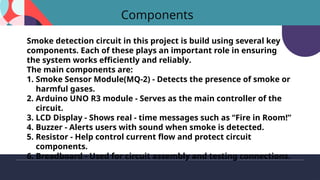
Smoke detection circuit in this project is build using several key
components. Each of these plays an important role in ensuring
the system works efficiently and reliably.
The main components are:
1. Smoke Sensor Module(MQ-2) - Detects the presence of smoke or
harmful gases.
2. Arduino UNO R3 module - Serves as the main controller of the
circuit.
3. LCD Display - Shows real - time messages such as “Fire in Room!”
4. Buzzer - Alerts users with sound when smoke is detected.
5. Resistor - Help control current flow and protect circuit
components.
6. Breadboard - Used for circuit assembly and testing connections.
Smoke Senser
module (MQ 2)
MQ-2 detects smoke and flammable gases.
• Used for basic fire and safety monitoring.
• Triggers alarms in home and security
systems.
Arduino Uno R3
Arduino UNO is a popular microcontroller
board based on the ATmega328.
“Uno” means “one,” marking it as the first
USB-based Arduino board.
• Widely used for electronics projects,
prototyping, and automation.
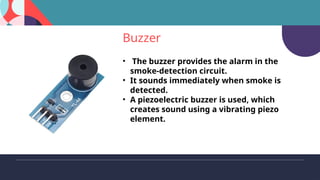
Buzzer
• The buzzer provides the alarm in the
smoke-detection circuit.
• It sounds immediately when smoke is
detected.
• A piezoelectric buzzer is used, which
creates sound using a vibrating piezo
element.
Working Principle
• The sensor’s output voltage changes according to the amount of
smoke or gas present in the surrounding air.
• The sensor produces a voltage proportional to the concentration of
smoke or gas.
• When the gas or smoke concentration increases, the output voltage
also increases.
• Conversely, when the concentration decreases, the output voltage
drops.
• This change in voltage helps in circuit detect the presence and
intensity of smoke, triggering the alarm when a certain threshold is
reached.
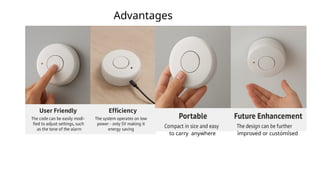
Advantages
to carry anywhere improved or customised
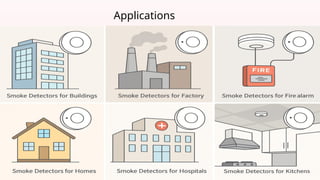
Applications
Conclusion
• For better fire safety, it’s important to install smoke detectors in
every bedroom,hallway, and floor of a home or building.
• With reliable smoke detectors, we can be confident that our homes
and families are protected from fire hazards.
• Smoke detectors are low-cost, efficient , and easy to use making
them one of the most effective safety device in both homes and
industries
"Smoke Alarms in U.S. Home Fires". nfpa.org. September 2015. Archived from the original on 2017-07-29.
Retrieved 2017-07-28. "Smoke Alarm Myths Explained". The World Fire Safety Foundation. Archived from the
original on 2014-10-06. Retrieved 2014-09-03.
Residential Smoke Alarm Performance, Thomas Cleary, Building and Fire Research Laboratory, National
Institute of Standards and Technology, UL Smoke and Fire Dynamics Seminar. November, 2007.
"SMOKE ALARM SAFETY TIPS". Safety Information. National Fire Protection Association. Archived from the
original on 2009-08- 21. Retrieved 2009-05-17
Reference • "Smoke Alarms in U.S. Home Fires". nfpa.org. September
2015. Archived from the original on 2017-07-29.
Retrieved 2017-07-28. "Smoke Alarm Myths Explained".
The World Fire Safety Foundation. Archived from the
original on 2014-10-06. Retrieved 2014-09-03.
• Residential Smoke Alarm Performance, Thomas Cleary,
Building and Fire Research Laboratory, National Institute
of Standards and Technology, UL Smoke and Fire
Dynamics Seminar. November, 2007.
• "SMOKE ALARM SAFETY TIPS". Safety Information.
National Fire Protection Association. Archived from the
original on 2009-08- 21. Retrieved 2009-05-17

THANK YOU...

PPT physics final version.pptx .........................

  • 1.
  • 2.
    Under Guidance ofMiss Neha Shah FE EXTC 2025-26 Submitted by: Sharavan Gawde(Roll no.-15) Dhanashree Ghadigaonkar(Roll no.-16) Shravan Ghosalkar(Roll no.-17) Esha Ghosh(Roll no.-18) Ayush Hasapurkar(Roll no.-19) Sarvesh Hirve(Roll no.-20) Samyak Ingole(Roll no.-21)
  • 3.
    Introduction • Technology playsa vital role in our daily lives,particularly in safety and security. • This project presents an Arduino based smoke detector and alarm system designed to prevent fire accidents.The circuit includes a smoke sensor, the LCD shows “Fire in room!” and the alarm sound immediately, alerting occupants and helping prevent damage or injury
  • 4.
    Components Smoke detection circuitin this project is build using several key components. Each of these plays an important role in ensuring the system works efficiently and reliably. The main components are: 1. Smoke Sensor Module(MQ-2) - Detects the presence of smoke or harmful gases. 2. Arduino UNO R3 module - Serves as the main controller of the circuit. 3. LCD Display - Shows real - time messages such as “Fire in Room!” 4. Buzzer - Alerts users with sound when smoke is detected. 5. Resistor - Help control current flow and protect circuit components. 6. Breadboard - Used for circuit assembly and testing connections.
  • 5.
    Smoke Senser module (MQ2) MQ-2 detects smoke and flammable gases. • Used for basic fire and safety monitoring. • Triggers alarms in home and security systems. Arduino Uno R3 Arduino UNO is a popular microcontroller board based on the ATmega328. “Uno” means “one,” marking it as the first USB-based Arduino board. • Widely used for electronics projects, prototyping, and automation.
  • 6.
    Buzzer • The buzzerprovides the alarm in the smoke-detection circuit. • It sounds immediately when smoke is detected. • A piezoelectric buzzer is used, which creates sound using a vibrating piezo element.
  • 7.
    Working Principle • Thesensor’s output voltage changes according to the amount of smoke or gas present in the surrounding air. • The sensor produces a voltage proportional to the concentration of smoke or gas. • When the gas or smoke concentration increases, the output voltage also increases. • Conversely, when the concentration decreases, the output voltage drops. • This change in voltage helps in circuit detect the presence and intensity of smoke, triggering the alarm when a certain threshold is reached.
  • 8.
    Advantages to carry anywhereimproved or customised
  • 9.
  • 11.
    Conclusion • For betterfire safety, it’s important to install smoke detectors in every bedroom,hallway, and floor of a home or building. • With reliable smoke detectors, we can be confident that our homes and families are protected from fire hazards. • Smoke detectors are low-cost, efficient , and easy to use making them one of the most effective safety device in both homes and industries
  • 12.
    "Smoke Alarms inU.S. Home Fires". nfpa.org. September 2015. Archived from the original on 2017-07-29. Retrieved 2017-07-28. "Smoke Alarm Myths Explained". The World Fire Safety Foundation. Archived from the original on 2014-10-06. Retrieved 2014-09-03. Residential Smoke Alarm Performance, Thomas Cleary, Building and Fire Research Laboratory, National Institute of Standards and Technology, UL Smoke and Fire Dynamics Seminar. November, 2007. "SMOKE ALARM SAFETY TIPS". Safety Information. National Fire Protection Association. Archived from the original on 2009-08- 21. Retrieved 2009-05-17 Reference • "Smoke Alarms in U.S. Home Fires". nfpa.org. September 2015. Archived from the original on 2017-07-29. Retrieved 2017-07-28. "Smoke Alarm Myths Explained". The World Fire Safety Foundation. Archived from the original on 2014-10-06. Retrieved 2014-09-03. • Residential Smoke Alarm Performance, Thomas Cleary, Building and Fire Research Laboratory, National Institute of Standards and Technology, UL Smoke and Fire Dynamics Seminar. November, 2007. • "SMOKE ALARM SAFETY TIPS". Safety Information. National Fire Protection Association. Archived from the original on 2009-08- 21. Retrieved 2009-05-17

  • 13.