WELCOME TO
ENGLISH FASE E
ZUHRI WIDYA NINGSIH, S.Pd, Gr
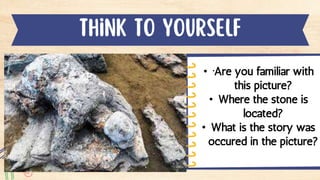
• ·Are you familiar with
this picture?
• Where the stone is
located?
• What is the story was
occured in the picture?
• Setelah mengamati teks, peserta didik mampu mengidentifikasi tujuan
komunikatif, struktur umum dan fitur kebahasaan Narrative Text secara
akurat.(C1)
• Setelah mempelajari teks yang telah disajikan, peserta didik mampu menganalisis
dan menyimpulkan berbagai informasi terkait fungsi sosial, struktur umum dan
fitur kebahasaan serta kata-kata sulit yang ada didalam teks menggunakan LKPD
terlampir dengan tepat.(C4)
• Setelah membaca teks yang disajikan, peserta didik mampu menemukan
informasi tertentu didalam Narrative Text secara mandiri .(C4)
• Peserta didik mampu mengkomunikasikan hasil diskusi dengan bahasa sendiri
sesuai dengan karakteristik tujuannya.(C5)
We will be learning how to identify ,
analyze, and present the results of social
function, text structure, and grammar in
NARRATIVE Text
Narrative text is a the type of text
that tells a imaginative story or
chronological story in the past
tense.
The aim/purpose of narrative
text is to entertain the readers
through the amusing story.
Write
with
purpose
Make your
story more
engaging
Figure out
how to start
your story
Write
with
purpose
Make your
story more
engaging
Figure out
how to start
your story
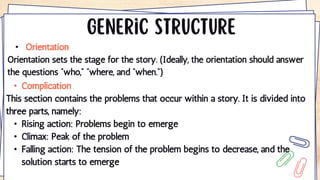
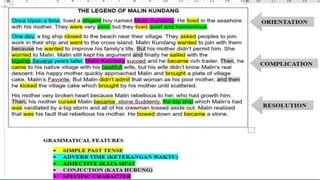
• Orientation
Orientation sets the stage for the story. (Ideally, the orientation should answer
the questions “who,” “where, and “when.”)
• Complication
This section contains the problems that occur within a story. It is divided into
three parts, namely:
• Rising action: Problems begin to emerge
• Climax: Peak of the problem
• Falling action: The tension of the problem begins to decrease, and the
solution starts to emerge
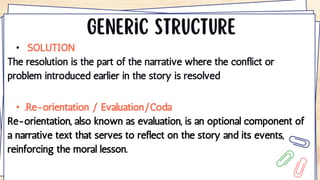
• SOLUTION
The resolution is the part of the narrative where the conflict or
problem introduced earlier in the story is resolved
• .Re-orientation / Evaluation/Coda
Re-orientation, also known as evaluation, is an optional component of
a narrative text that serves to reflect on the story and its events,
reinforcing the moral lesson.
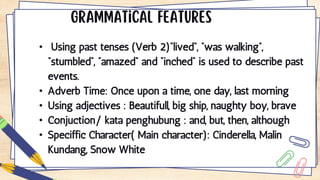
• Using past tenses (Verb 2)“lived”, “was walking”,
“stumbled”, “amazed” and “inched” is used to describe past
events.
• Adverb Time: Once upon a time, one day, last morning
• Using adjectives : Beautifull, big ship, naughty boy, brave
• Conjuction/ kata penghubung : and, but, then, although
• Speciffic Character( Main character): Cinderella, Malin
Kundang, Snow White
https://wordwall.net/id/resource/481535/open-the-box-narrative-text
•
•
•
PPT NARRATIVE TEXT KELAS X kurikulum merdeka

PPT NARRATIVE TEXT KELAS X kurikulum merdeka

  • 1.
    WELCOME TO ENGLISH FASEE ZUHRI WIDYA NINGSIH, S.Pd, Gr
  • 2.
    • ·Are youfamiliar with this picture? • Where the stone is located? • What is the story was occured in the picture?
  • 4.
    • Setelah mengamatiteks, peserta didik mampu mengidentifikasi tujuan komunikatif, struktur umum dan fitur kebahasaan Narrative Text secara akurat.(C1) • Setelah mempelajari teks yang telah disajikan, peserta didik mampu menganalisis dan menyimpulkan berbagai informasi terkait fungsi sosial, struktur umum dan fitur kebahasaan serta kata-kata sulit yang ada didalam teks menggunakan LKPD terlampir dengan tepat.(C4) • Setelah membaca teks yang disajikan, peserta didik mampu menemukan informasi tertentu didalam Narrative Text secara mandiri .(C4) • Peserta didik mampu mengkomunikasikan hasil diskusi dengan bahasa sendiri sesuai dengan karakteristik tujuannya.(C5)
  • 5.
    We will belearning how to identify , analyze, and present the results of social function, text structure, and grammar in NARRATIVE Text
  • 6.
    Narrative text isa the type of text that tells a imaginative story or chronological story in the past tense.
  • 7.
    The aim/purpose ofnarrative text is to entertain the readers through the amusing story.
  • 8.
  • 9.
  • 10.
    • Orientation Orientation setsthe stage for the story. (Ideally, the orientation should answer the questions “who,” “where, and “when.”) • Complication This section contains the problems that occur within a story. It is divided into three parts, namely: • Rising action: Problems begin to emerge • Climax: Peak of the problem • Falling action: The tension of the problem begins to decrease, and the solution starts to emerge
  • 11.
    • SOLUTION The resolutionis the part of the narrative where the conflict or problem introduced earlier in the story is resolved • .Re-orientation / Evaluation/Coda Re-orientation, also known as evaluation, is an optional component of a narrative text that serves to reflect on the story and its events, reinforcing the moral lesson.
  • 12.
    • Using pasttenses (Verb 2)“lived”, “was walking”, “stumbled”, “amazed” and “inched” is used to describe past events. • Adverb Time: Once upon a time, one day, last morning • Using adjectives : Beautifull, big ship, naughty boy, brave • Conjuction/ kata penghubung : and, but, then, although • Speciffic Character( Main character): Cinderella, Malin Kundang, Snow White
  • 19.
  • 20.