MELT FLOW TESTING
ISO 1133, ASTM D1238
Both Melt Flow and Rheology Tests can be very helpful
tools for QC monitoring and development of polymers.
This presentation is designed to be an informative
introduction and guide to Melt Flow test, and to assist
with troubleshooting inconsistencies in results.
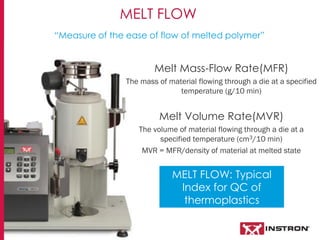
MELT FLOW
Melt Mass-Flow Rate(MFR)
The mass of material flowing through a die at a specified
temperature (g/10 min)
Melt Volume Rate(MVR)
The volume of material flowing through a die at a
specified temperature (cm3/10 min)
MVR = MFR/density of material at melted state
“Measure of the ease of flow of melted polymer”
MELT FLOW: Typical
Index for QC of
thermoplastics
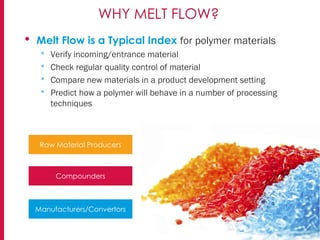
WHY MELT FLOW?
• Melt Flow is a Typical Index for polymer materials
• Verify incoming/entrance material
• Check regular quality control of material
• Compare new materials in a product development setting
• Predict how a polymer will behave in a number of processing
techniques
Raw Material Producers
Compounders
Manufacturers/Convertors
A TRUE STORY
As an example of an actual case of how Melt Flow information can be
used:
An injection molded polycarbonate part was found to crack when dropped. The virgin
resin had an MFR of 28.5 g/10min. A sample from a known “good” lot of parts was
ground up and tested in a melt flow tester. It had an MFR of 27 g/10min, well within
established tolerances (±30%). But a “problem” part showed an MFR of 90
g/10min. From this evidence, it was discovered that the “bad” lot contained a large
amount of regrind that had been thermally degraded in processing.
Manufacturers/Convertors
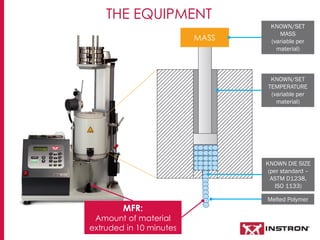
THE EQUIPMENT
MASS
KNOWN/SET
TEMPERATURE
(variable per
material)
KNOWN DIE SIZE
(per standard –
ASTM D1238,
ISO 1133)
KNOWN/SET
MASS
(variable per
material)
MFR:
Amount of material
extruded in 10 minutes
Melted Polymer
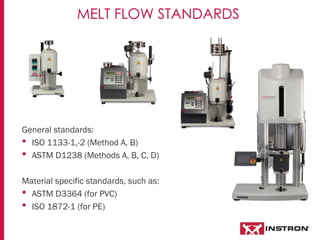
General standards:
• ISO 1133-1,-2 (Method A, B)
• ASTM D1238 (Methods A, B, C, D)
Material specific standards, such as:
• ASTM D3364 (for PVC)
• ISO 1872-1 (for PE)
MELT FLOW STANDARDS
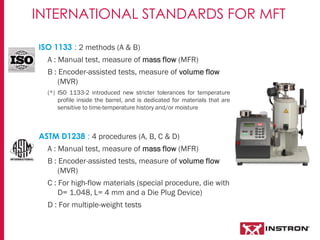
ISO 1133 : 2 methods (A & B)
A : Manual test, measure of mass flow (MFR)
B : Encoder-assisted tests, measure of volume flow
(MVR)
(*) ISO 1133-2 introduced new stricter tolerances for temperature
profile inside the barrel, and is dedicated for materials that are
sensitive to time-temperature history and/or moisture
ASTM D1238 : 4 procedures (A, B, C & D)
A : Manual test, measure of mass flow (MFR)
B : Encoder-assisted tests, measure of volume flow
(MVR)
C : For high-flow materials (special procedure, die with
D= 1.048, L= 4 mm and a Die Plug Device)
D : For multiple-weight tests
INTERNATIONAL STANDARDS FOR MFT
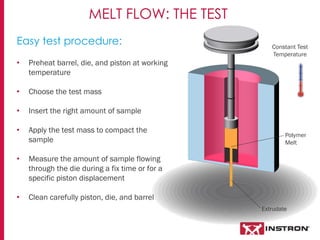
Easy test procedure:
• Preheat barrel, die, and piston at working
temperature
• Choose the test mass
• Insert the right amount of sample
• Apply the test mass to compact the
sample
• Measure the amount of sample flowing
through the die during a fix time or for a
specific piston displacement
• Clean carefully piston, die, and barrel
MELT FLOW: THE TEST
Polymer
Melt
Extrudate
Constant Test
Temperature
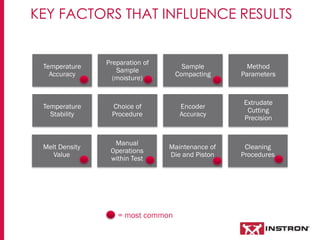
KEY FACTORS THAT INFLUENCE RESULTS
Temperature
Accuracy
Preparation of
Sample
(moisture)
Sample
Compacting
Method
Parameters
Melt Density
Value
Manual
Operations
within Test
Maintenance of
Die and Piston
Cleaning
Procedures
Temperature
Stability
Choice of
Procedure
Encoder
Accuracy
Extrudate
Cutting
Precision
= most common
• Is the barrel clean? Or is the die clean?
• Increased friction between the barrel & piston will reduce melt flow rates
• Is the test being run at the correct temperature?
• Is system temperature control accurate and consistent throughout length of barrel?
• Especially critical for materials that are sensitive to time-temperature history
• Has the material been pre-conditioned according to procedure?
• Hygroscopic materials give unreliable test results if they are not dried in consistent
manner
• Moisture tends to generate bubbles and trigger degradation of sample
• Is the melt density being used in the MFR calculations correct?
• Was the material compacted properly (or were there air bubbles)?
KEY FACTORS THAT INFLUENCE RESULTS
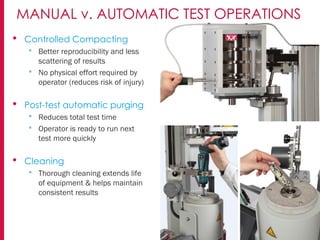
MANUAL v. AUTOMATIC TEST OPERATIONS
• Controlled Compacting
• Better reproducibility and less
scattering of results
• No physical effort required by
operator (reduces risk of injury)
• Post-test automatic purging
• Reduces total test time
• Operator is ready to run next
test more quickly
• Cleaning
• Thorough cleaning extends life
of equipment & helps maintain
consistent results
THANK YOU FOR YOUR TIME!
Please contact your local
Instron® Sales Representative
with any questions.

[Ppt] mfr instron

  • 1.
    MELT FLOW TESTING ISO1133, ASTM D1238
  • 2.
    Both Melt Flowand Rheology Tests can be very helpful tools for QC monitoring and development of polymers. This presentation is designed to be an informative introduction and guide to Melt Flow test, and to assist with troubleshooting inconsistencies in results.
  • 3.
    MELT FLOW Melt Mass-FlowRate(MFR) The mass of material flowing through a die at a specified temperature (g/10 min) Melt Volume Rate(MVR) The volume of material flowing through a die at a specified temperature (cm3/10 min) MVR = MFR/density of material at melted state “Measure of the ease of flow of melted polymer” MELT FLOW: Typical Index for QC of thermoplastics
  • 4.
    WHY MELT FLOW? •Melt Flow is a Typical Index for polymer materials • Verify incoming/entrance material • Check regular quality control of material • Compare new materials in a product development setting • Predict how a polymer will behave in a number of processing techniques Raw Material Producers Compounders Manufacturers/Convertors
  • 5.
    A TRUE STORY Asan example of an actual case of how Melt Flow information can be used: An injection molded polycarbonate part was found to crack when dropped. The virgin resin had an MFR of 28.5 g/10min. A sample from a known “good” lot of parts was ground up and tested in a melt flow tester. It had an MFR of 27 g/10min, well within established tolerances (±30%). But a “problem” part showed an MFR of 90 g/10min. From this evidence, it was discovered that the “bad” lot contained a large amount of regrind that had been thermally degraded in processing. Manufacturers/Convertors
  • 6.
    THE EQUIPMENT MASS KNOWN/SET TEMPERATURE (variable per material) KNOWNDIE SIZE (per standard – ASTM D1238, ISO 1133) KNOWN/SET MASS (variable per material) MFR: Amount of material extruded in 10 minutes Melted Polymer
  • 7.
    General standards: • ISO1133-1,-2 (Method A, B) • ASTM D1238 (Methods A, B, C, D) Material specific standards, such as: • ASTM D3364 (for PVC) • ISO 1872-1 (for PE) MELT FLOW STANDARDS
  • 8.
    ISO 1133 :2 methods (A & B) A : Manual test, measure of mass flow (MFR) B : Encoder-assisted tests, measure of volume flow (MVR) (*) ISO 1133-2 introduced new stricter tolerances for temperature profile inside the barrel, and is dedicated for materials that are sensitive to time-temperature history and/or moisture ASTM D1238 : 4 procedures (A, B, C & D) A : Manual test, measure of mass flow (MFR) B : Encoder-assisted tests, measure of volume flow (MVR) C : For high-flow materials (special procedure, die with D= 1.048, L= 4 mm and a Die Plug Device) D : For multiple-weight tests INTERNATIONAL STANDARDS FOR MFT
  • 9.
    Easy test procedure: •Preheat barrel, die, and piston at working temperature • Choose the test mass • Insert the right amount of sample • Apply the test mass to compact the sample • Measure the amount of sample flowing through the die during a fix time or for a specific piston displacement • Clean carefully piston, die, and barrel MELT FLOW: THE TEST Polymer Melt Extrudate Constant Test Temperature
  • 10.
    KEY FACTORS THATINFLUENCE RESULTS Temperature Accuracy Preparation of Sample (moisture) Sample Compacting Method Parameters Melt Density Value Manual Operations within Test Maintenance of Die and Piston Cleaning Procedures Temperature Stability Choice of Procedure Encoder Accuracy Extrudate Cutting Precision = most common
  • 11.
    • Is thebarrel clean? Or is the die clean? • Increased friction between the barrel & piston will reduce melt flow rates • Is the test being run at the correct temperature? • Is system temperature control accurate and consistent throughout length of barrel? • Especially critical for materials that are sensitive to time-temperature history • Has the material been pre-conditioned according to procedure? • Hygroscopic materials give unreliable test results if they are not dried in consistent manner • Moisture tends to generate bubbles and trigger degradation of sample • Is the melt density being used in the MFR calculations correct? • Was the material compacted properly (or were there air bubbles)? KEY FACTORS THAT INFLUENCE RESULTS
  • 12.
    MANUAL v. AUTOMATICTEST OPERATIONS • Controlled Compacting • Better reproducibility and less scattering of results • No physical effort required by operator (reduces risk of injury) • Post-test automatic purging • Reduces total test time • Operator is ready to run next test more quickly • Cleaning • Thorough cleaning extends life of equipment & helps maintain consistent results
  • 13.
    THANK YOU FORYOUR TIME! Please contact your local Instron® Sales Representative with any questions.