DEVELOPMENT OF AN
ALGORITHM OF INTERFACIAL
HEAT TRANSFER COEEFICIENT
GROUP NO:- 03
SWAPNIL PATIL 201042
ANUSHA PUTTI 201044
MAYUR RATHOD 201046
SNEHA MORE 201071
PROJECT GUIDE: Mr. C. M. CHOUDHARI
AIM AND OBJECTIVE:-
Develop an algorithm for Interfacial Heat Transfer
Coefficient (IFHTC).
Objective:-
1. To find the heat transfer coefficient for the air gap
formed.
2. To find the optimum pouring temperature for good
quality casting
3. To develop an algorithm for the same
PROBLEM DEFINITION:-
 To develop an algorithm for interfacial heat transfer
coefficient.
SCOPE
 The project deals with only sand casting and
considering Aluminum as the cast material.
 The shape of the component considered is a simple
plate.
 Except for the air gap formation other defects are not
taken into consideration.
 Analysis performed is only in 2D.
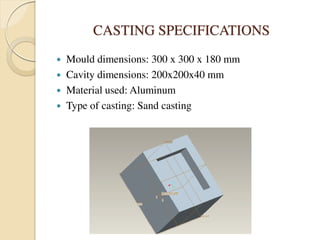
CASTING SPECIFICATIONS
 Mould dimensions: 300 x 300 x 180 mm
 Cavity dimensions: 200x200x40 mm
 Material used: Aluminum
 Type of casting: Sand casting
ANSYS WORK
Simulation done by two methods
1. Free Mesh.
2. Mapped Mesh.
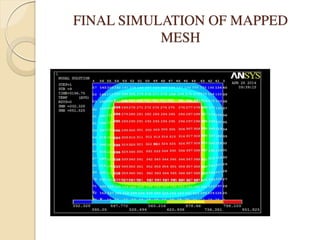
FINAL SIMULATION OF MAPPED
MESH
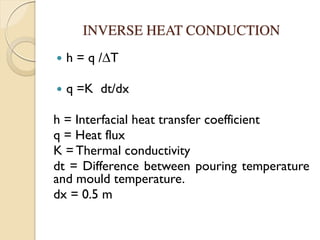
INVERSE HEAT CONDUCTION
 h = q /∆T
 q =K dt/dx
h = Interfacial heat transfer coefficient
q = Heat flux
K = Thermal conductivity
dt = Difference between pouring temperature
and mould temperature.
dx = 0.5 m
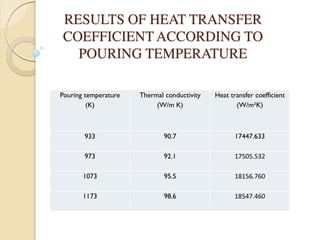
RESULTS OF HEAT TRANSFER
COEFFICIENT ACCORDING TO
POURING TEMPERATURE
Pouring temperature
(K)
Thermal conductivity
(W/m K)
Heat transfer coefficient
(W/m²K)
933 90.7 17447.633
973 92.1 17505.532
1073 95.5 18156.760
1173 98.6 18547.460
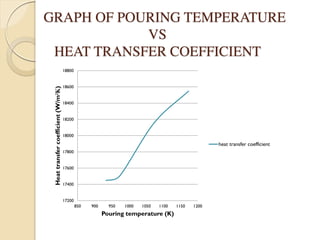
GRAPH OF POURING TEMPERATURE
VS
HEAT TRANSFER COEFFICIENT
17200
17400
17600
17800
18000
18200
18400
18600
18800
850 900 950 1000 1050 1100 1150 1200
Heattransfercoefficient(W/m²K)
Pouring temperature (K)
heat transfer coefficient
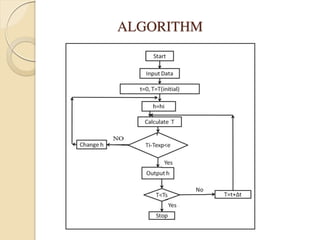
ALGORITHM
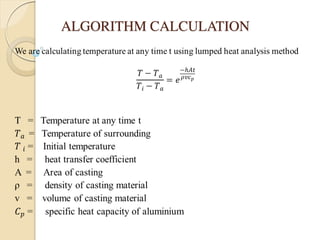
ALGORITHM CALCULATION
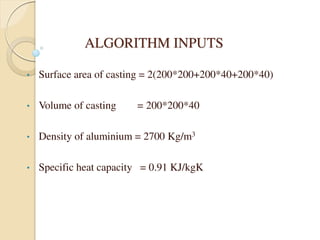
ALGORITHM INPUTS
• Surface area of casting = 2(200*200+200*40+200*40)
• Volume of casting = 200*200*40
• Density of aluminium = 2700 Kg/m3
• Specific heat capacity = 0.91 KJ/kgK
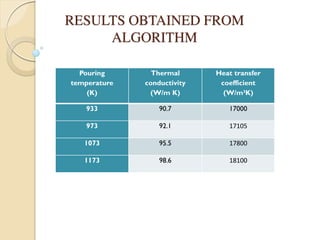
RESULTS OBTAINED FROM
ALGORITHM
Pouring
temperature
(K)
Thermal
conductivity
(W/m K)
Heat transfer
coefficient
(W/m²K)
933 90.7 17000
973 92.1 17105
1073 95.5 17800
1173 98.6 18100
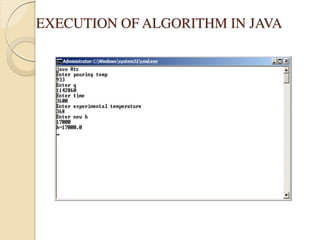
EXECUTION OF ALGORITHM IN JAVA
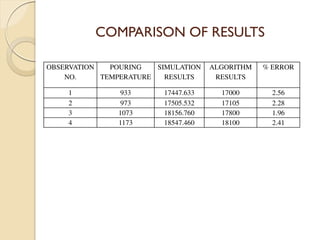
COMPARISON OF RESULTS
OBSERVATION
NO.
POURING
TEMPERATURE
SIMULATION
RESULTS
ALGORITHM
RESULTS
% ERROR
1 933 17447.633 17000 2.56
2 973 17505.532 17105 2.28
3 1073 18156.760 17800 1.96
4 1173 18547.460 18100 2.41
FUTURE SCOPE
• It can be extended to castings of different materials
and of different shapes.
• The analysis can also be done to find the other
optimum parameters for casting process such as
pouring temperature.
• The analysis can also be done for 3-D.
THANK YOU

ppt cd

  • 1.
    DEVELOPMENT OF AN ALGORITHMOF INTERFACIAL HEAT TRANSFER COEEFICIENT GROUP NO:- 03 SWAPNIL PATIL 201042 ANUSHA PUTTI 201044 MAYUR RATHOD 201046 SNEHA MORE 201071 PROJECT GUIDE: Mr. C. M. CHOUDHARI
  • 2.
    AIM AND OBJECTIVE:- Developan algorithm for Interfacial Heat Transfer Coefficient (IFHTC). Objective:- 1. To find the heat transfer coefficient for the air gap formed. 2. To find the optimum pouring temperature for good quality casting 3. To develop an algorithm for the same
  • 3.
    PROBLEM DEFINITION:-  Todevelop an algorithm for interfacial heat transfer coefficient.
  • 4.
    SCOPE  The projectdeals with only sand casting and considering Aluminum as the cast material.  The shape of the component considered is a simple plate.  Except for the air gap formation other defects are not taken into consideration.  Analysis performed is only in 2D.
  • 5.
    CASTING SPECIFICATIONS  Moulddimensions: 300 x 300 x 180 mm  Cavity dimensions: 200x200x40 mm  Material used: Aluminum  Type of casting: Sand casting
  • 6.
    ANSYS WORK Simulation doneby two methods 1. Free Mesh. 2. Mapped Mesh.
  • 7.
  • 8.
    INVERSE HEAT CONDUCTION h = q /∆T  q =K dt/dx h = Interfacial heat transfer coefficient q = Heat flux K = Thermal conductivity dt = Difference between pouring temperature and mould temperature. dx = 0.5 m
  • 9.
    RESULTS OF HEATTRANSFER COEFFICIENT ACCORDING TO POURING TEMPERATURE Pouring temperature (K) Thermal conductivity (W/m K) Heat transfer coefficient (W/m²K) 933 90.7 17447.633 973 92.1 17505.532 1073 95.5 18156.760 1173 98.6 18547.460
  • 10.
    GRAPH OF POURINGTEMPERATURE VS HEAT TRANSFER COEFFICIENT 17200 17400 17600 17800 18000 18200 18400 18600 18800 850 900 950 1000 1050 1100 1150 1200 Heattransfercoefficient(W/m²K) Pouring temperature (K) heat transfer coefficient
  • 11.
  • 12.
  • 13.
    ALGORITHM INPUTS • Surfacearea of casting = 2(200*200+200*40+200*40) • Volume of casting = 200*200*40 • Density of aluminium = 2700 Kg/m3 • Specific heat capacity = 0.91 KJ/kgK
  • 14.
    RESULTS OBTAINED FROM ALGORITHM Pouring temperature (K) Thermal conductivity (W/mK) Heat transfer coefficient (W/m²K) 933 90.7 17000 973 92.1 17105 1073 95.5 17800 1173 98.6 18100
  • 15.
  • 16.
    COMPARISON OF RESULTS OBSERVATION NO. POURING TEMPERATURE SIMULATION RESULTS ALGORITHM RESULTS %ERROR 1 933 17447.633 17000 2.56 2 973 17505.532 17105 2.28 3 1073 18156.760 17800 1.96 4 1173 18547.460 18100 2.41
  • 17.
    FUTURE SCOPE • Itcan be extended to castings of different materials and of different shapes. • The analysis can also be done to find the other optimum parameters for casting process such as pouring temperature. • The analysis can also be done for 3-D.
  • 18.