GROUP 3
DEVELOPMENT OF AN ALGORITHM FOR INTERFACIAL HEAT TRANSFER COEFFICIENT
GUIDE:Prof.Choudhari C.M.
Patil Swapnil,Putti Anusha,Rathode Mayur,More Sneha
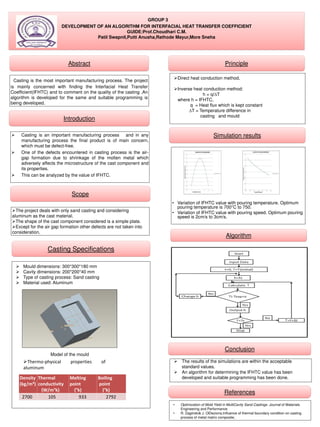
Algorithm
Abstract
Casting is the most important manufacturing process. The project
is mainly concerned with finding the Interfacial Heat Transfer
Coefficient(IFHTC) and to comment on the quality of the casting .An
algorithm is developed for the same and suitable programming is
being developed.
Introduction
 Casting is an important manufacturing process and in any
manufacturing process the final product is of main concern,
which must be defect-free.
 One of the defects encountered in casting process is the air-
gap formation due to shrinkage of the molten metal which
adversely affects the microstructure of the cast component and
its properties.
 This can be analyzed by the value of IFHTC.
Casting Specifications
 Mould dimensions: 300*300*180 mm
 Cavity dimensions: 200*200*40 mm
 Type of casting process: Sand casting
 Material used: Aluminum
Model of the mould
Density
(kg/m³)
Thermal
conductivity
(W/m°k)
Melting
point
(°k)
Boiling
point
(°k)
2700 105 933 2792
Thermo-physical properties of
aluminum
Scope
The project deals with only sand casting and considering
aluminum as the cast material.
The shape of the cast component considered is a simple plate.
Except for the air gap formation other defects are not taken into
consideration.
Principle
Direct heat conduction method.
Inverse heat conduction method:
h = q/∆T
where h = IFHTC,
q = Heat flux which is kept constant
∆T = Temperature difference in
casting and mould
Simulation results
• Variation of IFHTC value with pouring temperature. Optimum
pouring temperature is 700°C to 750.
• Variation of IFHTC value with pouring speed. Optimum pouring
speed is 2cm/s to 3cm/s.
Conclusion
 The results of the simulations are within the acceptable
standard values.
 An algorithm for determining the IFHTC value has been
developed and suitable programming has been done.
References
• Optimization of Mold Yield in MultiCavity Sand Castings. Journal of Materials
Engineering and Performance
• R. Zagórski& J. OEleziona,Influence of thermal boundary condition on casting
process of metal matrix composite,

poster1 (1)

  • 1.
    GROUP 3 DEVELOPMENT OFAN ALGORITHM FOR INTERFACIAL HEAT TRANSFER COEFFICIENT GUIDE:Prof.Choudhari C.M. Patil Swapnil,Putti Anusha,Rathode Mayur,More Sneha Algorithm Abstract Casting is the most important manufacturing process. The project is mainly concerned with finding the Interfacial Heat Transfer Coefficient(IFHTC) and to comment on the quality of the casting .An algorithm is developed for the same and suitable programming is being developed. Introduction  Casting is an important manufacturing process and in any manufacturing process the final product is of main concern, which must be defect-free.  One of the defects encountered in casting process is the air- gap formation due to shrinkage of the molten metal which adversely affects the microstructure of the cast component and its properties.  This can be analyzed by the value of IFHTC. Casting Specifications  Mould dimensions: 300*300*180 mm  Cavity dimensions: 200*200*40 mm  Type of casting process: Sand casting  Material used: Aluminum Model of the mould Density (kg/m³) Thermal conductivity (W/m°k) Melting point (°k) Boiling point (°k) 2700 105 933 2792 Thermo-physical properties of aluminum Scope The project deals with only sand casting and considering aluminum as the cast material. The shape of the cast component considered is a simple plate. Except for the air gap formation other defects are not taken into consideration. Principle Direct heat conduction method. Inverse heat conduction method: h = q/∆T where h = IFHTC, q = Heat flux which is kept constant ∆T = Temperature difference in casting and mould Simulation results • Variation of IFHTC value with pouring temperature. Optimum pouring temperature is 700°C to 750. • Variation of IFHTC value with pouring speed. Optimum pouring speed is 2cm/s to 3cm/s. Conclusion  The results of the simulations are within the acceptable standard values.  An algorithm for determining the IFHTC value has been developed and suitable programming has been done. References • Optimization of Mold Yield in MultiCavity Sand Castings. Journal of Materials Engineering and Performance • R. Zagórski& J. OEleziona,Influence of thermal boundary condition on casting process of metal matrix composite,