Transmedia in
Education
--Analysis of “Inanimate Alice”

Vickie Deng
Linbei Li
What is Transmedia?

   The different media and languages participate and
    contribute to the construction of the transmedia
    narrative world.


   Defined as the art of conveying messages, themes, or
    storylines to mass audiences through the artful and
    well-planned use of multiple media platforms.
Henry Jenkins’s thoughts
   Transmedia stories are stories told across multiple
    media, at the present time, the most significant
    stories tend to flow across multiple platforms.


   A transmedia text does not simply disperse
    information: it provides a set of roles and goals
    which readers can assume as they enact aspects
    of the story through their everyday life.
 trailer
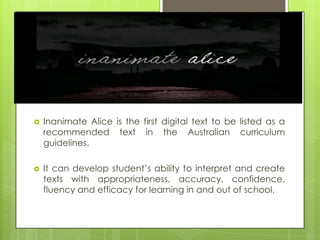
   Inanimate Alice is the first digital text to be listed as a
    recommended text in the Australian curriculum
    guidelines.

   It can develop student’s ability to interpret and create
    texts with appropriateness, accuracy, confidence,
    fluency and efficacy for learning in and out of school.
Is “Inanimate Alice”
a Transmedia Artifact ?
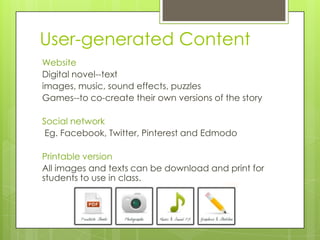
User-generated Content
Website
Digital novel--text
images, music, sound effects, puzzles
Games--to co-create their own versions of the story

Social network
 Eg. Facebook, Twitter, Pinterest and Edmodo

Printable version
All images and texts can be download and print for
students to use in class.
Interactive and expanding of
narrative
   Requires readers to drive the action forward at their
    own space
   The gaps in Alice’s story have allowed for a high level
    of participation within and around the narrative of
    Alice’s journey
   Languages & cultures – it requires a certain level of
    understanding of different cultures and languages to
    be able to experience the story better
   personal experiences - interact with their own lives.
    Alice's journey progresses, new storylines appear as
    time goes on. And students are growing up with Alice.
Why “Inanimate Alice” is a
Successful Transmedia
Artifact?
   well-planned use of multiple media platforms. And
    every piece of puzzle works to enhance the story as
    well as to engage learners.

   Easy to get access to.

   It meets students where they are ready to learn.

   It is user-friendly and encourages a community of
    learners to explore and discover.
Bibliography
   Jenkins, H. (2007, March 22). Transmedia storytelling 101. Retrieved
    December 10, 2008, from
    http://henryjenkins.org/2007/03/transmedia_storytelling_101.html

   Carlos Alberto Scolari, Transmedia Storytelling: “Implicit
    Consumers, Narrative Worlds, and Branding in Contemporary
    Media Production”, International Journal of Communication
    University of Vic, Catalunya, Spain

   Kress, G., & van Leeuwen, T. (2001). Multimodal discourse: The
    modes and media of contemporary communication. London:
    Arnold.

   inanimate Alice official website .http://www.inanimatealice.com/

Pp1 presentation

  • 1.
    Transmedia in Education --Analysis of“Inanimate Alice” Vickie Deng Linbei Li
  • 2.
    What is Transmedia?  The different media and languages participate and contribute to the construction of the transmedia narrative world.  Defined as the art of conveying messages, themes, or storylines to mass audiences through the artful and well-planned use of multiple media platforms.
  • 3.
    Henry Jenkins’s thoughts  Transmedia stories are stories told across multiple media, at the present time, the most significant stories tend to flow across multiple platforms.  A transmedia text does not simply disperse information: it provides a set of roles and goals which readers can assume as they enact aspects of the story through their everyday life.
  • 4.
  • 5.
    Inanimate Alice is the first digital text to be listed as a recommended text in the Australian curriculum guidelines.  It can develop student’s ability to interpret and create texts with appropriateness, accuracy, confidence, fluency and efficacy for learning in and out of school.
  • 6.
    Is “Inanimate Alice” aTransmedia Artifact ?
  • 7.
    User-generated Content Website Digital novel--text images,music, sound effects, puzzles Games--to co-create their own versions of the story Social network Eg. Facebook, Twitter, Pinterest and Edmodo Printable version All images and texts can be download and print for students to use in class.
  • 9.
    Interactive and expandingof narrative  Requires readers to drive the action forward at their own space  The gaps in Alice’s story have allowed for a high level of participation within and around the narrative of Alice’s journey  Languages & cultures – it requires a certain level of understanding of different cultures and languages to be able to experience the story better  personal experiences - interact with their own lives. Alice's journey progresses, new storylines appear as time goes on. And students are growing up with Alice.
  • 10.
    Why “Inanimate Alice”is a Successful Transmedia Artifact?
  • 11.
    well-planned use of multiple media platforms. And every piece of puzzle works to enhance the story as well as to engage learners.  Easy to get access to.  It meets students where they are ready to learn.  It is user-friendly and encourages a community of learners to explore and discover.
  • 12.
    Bibliography  Jenkins, H. (2007, March 22). Transmedia storytelling 101. Retrieved December 10, 2008, from http://henryjenkins.org/2007/03/transmedia_storytelling_101.html  Carlos Alberto Scolari, Transmedia Storytelling: “Implicit Consumers, Narrative Worlds, and Branding in Contemporary Media Production”, International Journal of Communication University of Vic, Catalunya, Spain  Kress, G., & van Leeuwen, T. (2001). Multimodal discourse: The modes and media of contemporary communication. London: Arnold.  inanimate Alice official website .http://www.inanimatealice.com/

Editor's Notes

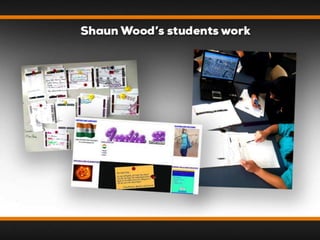
  • #10 we have seen students across the world remix, mashup and create their own next episodes of Alice in the widest transliterate sense. Different languages and ways of expressing things are used in different episodes.Students learn to adapt language to meet the demands of more general or more specialised purposes, audiences and contexts. They learn about the different ways in which knowledge and opinion are represented and developed in texts, and about how more or less abstraction and complexity can be shown through language and through multimodal representations.”Students drew that scene from a first person point of view, decided on the music and the sounds that would be playing during the scene, and then described what this scene tells us about themselves as a character in their story.
  • #12 According to:It is a recommended text to be introduced to the classroom to develop students’ digital literacy skills. Students want to share, participate in, create, shape and personalize their learning experience.We don't just Read it....neither do we just View it,We EXPERIENCE it.