EUROPEAN
     DIVERSITY
    EDUCATION
Children as movie makers!


              by Inés Rosado Valdivia
JUSTIFICATION
Diversity is important. All of us are different and we live in the same world.
It is very important for children to understand we have to share lots of things
with classmates, friends, different people around us…. These differences
should be understood and appreciated.
There are two main aspects of diversity that children will most likely encounter
in the classroom. One is learners with special needs. Included in this category
are children with learning disabilities and physical disabilities. Children need to
be able to understand the problems of others and help to make all students feel
comfortable. Another part of diversity comes from the many cultures that are in
a common classroom. Children need to respect and admire different cultures.
They also need to realize that minority groups have faced a large amount of
unnecessary hostility. All of this will help children to learn more about
themselves and the people around them. It will foster respect and appreciation
for others.
The main goal is to increase awareness and help children become more open-
minded to differences and how communication is very important in our lives.


INTRODUCTION
How shall we respond to diversity?
What is our vision of the society of the future?
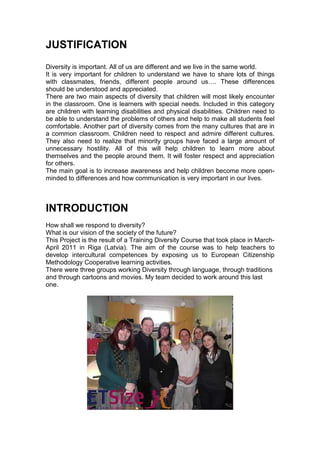
This Project is the result of a Training Diversity Course that took place in March-
April 2011 in Riga (Latvia). The aim of the course was to help teachers to
develop intercultural competences by exposing us to European Citizenship
Methodology Cooperative learning activities.
There were three groups working Diversity through language, through traditions
and through cartoons and movies. My team decided to work around this last
one.
MAIN GOALS
  Be sensitive for Europe, other countries, other cultures and differences
  between them.
  Work on European diversity and on a children´s level.
  Be sensible for attending diversity in the classroom.
  Develop English vocabulary, listening and speaking skills.
  Use innovating methodologies
  Produce a cartoon.
COMMUNICATION AND DISCUSSION
  -   Many bilingual children and many different qualities in each group of
      children
  -   Different ways of understanding education and culture.
  -   How diversity could be a resource.
  -   Give a positive way to understand diversity.


ACTIVITIES
  •   Provide each student with two sheets of paper. On the first paper, have
      students draw a picture using only one crayon. On the second piece, have
      students draw the same picture, but allow them to use all the colors. Ask the
      students which picture they prefer and why. Most will say the colorful picture;
      you can then point out that the diversity in colors is what makes the drawings
      fun, unique and interesting.
  •   This time give a paper to each student and tell them to draw themselves as they
      want to be seen by the others. Then, hang them on a board and tell them to
      describe in front of the others. Example: I am friendly, I am brave…
STEPS
 Watch the teacher’s cartoon produced in Latvia
 Speaking about diversity in the classroom
 Brainstorm: ideas for a new cartoon
 Find a postivite qualities for each child by groups
 Brainstorm: think a new story using them. Decide the main plot.
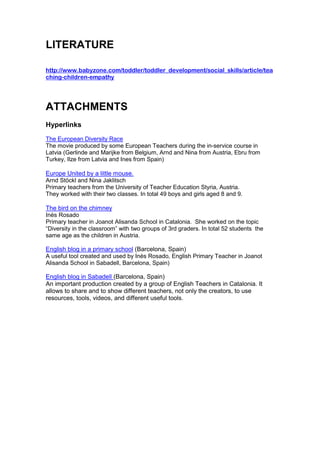
 Definition of the background.
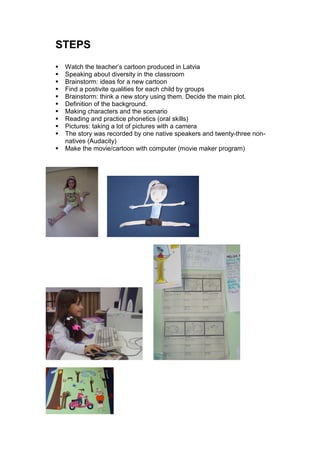
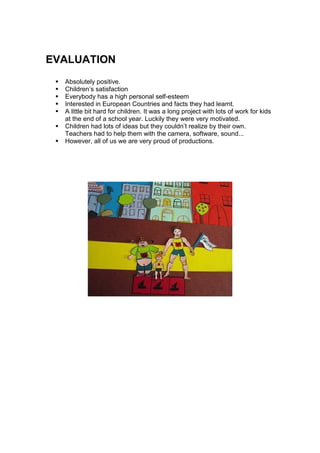
 Making characters and the scenario
 Reading and practice phonetics (oral skills)
 Pictures: taking a lot of pictures with a camera
 The story was recorded by one native speakers and twenty-three non-
 natives (Audacity)
 Make the movie/cartoon with computer (movie maker program)
EVALUATION
  Absolutely positive.
  Children’s satisfaction
  Everybody has a high personal self-esteem
  Interested in European Countries and facts they had learnt.
  A little bit hard for children. It was a long project with lots of work for kids
  at the end of a school year. Luckily they were very motivated.
  Children had lots of ideas but they couldn’t realize by their own.
  Teachers had to help them with the camera, software, sound...
  However, all of us we are very proud of productions.
LITERATURE

http://www.babyzone.com/toddler/toddler_development/social_skills/article/tea
ching-children-empathy


ATTACHMENTS
Hyperlinks
The European Diversity Race
The movie produced by some European Teachers during the in-service course in
Latvia (Gerlinde and Marijke from Belgium, Arnd and Nina from Austria, Ebru from
Turkey, Ilze from Latvia and Ines from Spain)

Europe United by a little mouse.
Arnd Stöckl and Nina Jaklitsch
Primary teachers from the University of Teacher Education Styria, Austria.
They worked with their two classes. In total 49 boys and girls aged 8 and 9.

The bird on the chimney
Inès Rosado
Primary teacher in Joanot Alisanda School in Catalonia. She worked on the topic
“Diversity in the classroom” with two groups of 3rd graders. In total 52 students the
same age as the children in Austria.

English blog in a primary school (Barcelona, Spain)
A useful tool created and used by Inès Rosado, English Primary Teacher in Joanot
Alisanda School in Sabadell, Barcelona, Spain)

English blog in Sabadell (Barcelona, Spain)
An important production created by a group of English Teachers in Catalonia. It
allows to share and to show different teachers, not only the creators, to use
resources, tools, videos, and different useful tools.

Diversity in the classroom

  • 1.
    EUROPEAN DIVERSITY EDUCATION Children as movie makers! by Inés Rosado Valdivia
  • 2.
    JUSTIFICATION Diversity is important.All of us are different and we live in the same world. It is very important for children to understand we have to share lots of things with classmates, friends, different people around us…. These differences should be understood and appreciated. There are two main aspects of diversity that children will most likely encounter in the classroom. One is learners with special needs. Included in this category are children with learning disabilities and physical disabilities. Children need to be able to understand the problems of others and help to make all students feel comfortable. Another part of diversity comes from the many cultures that are in a common classroom. Children need to respect and admire different cultures. They also need to realize that minority groups have faced a large amount of unnecessary hostility. All of this will help children to learn more about themselves and the people around them. It will foster respect and appreciation for others. The main goal is to increase awareness and help children become more open- minded to differences and how communication is very important in our lives. INTRODUCTION How shall we respond to diversity? What is our vision of the society of the future? This Project is the result of a Training Diversity Course that took place in March- April 2011 in Riga (Latvia). The aim of the course was to help teachers to develop intercultural competences by exposing us to European Citizenship Methodology Cooperative learning activities. There were three groups working Diversity through language, through traditions and through cartoons and movies. My team decided to work around this last one.
  • 3.
    MAIN GOALS Be sensitive for Europe, other countries, other cultures and differences between them. Work on European diversity and on a children´s level. Be sensible for attending diversity in the classroom. Develop English vocabulary, listening and speaking skills. Use innovating methodologies Produce a cartoon.
  • 4.
    COMMUNICATION AND DISCUSSION - Many bilingual children and many different qualities in each group of children - Different ways of understanding education and culture. - How diversity could be a resource. - Give a positive way to understand diversity. ACTIVITIES • Provide each student with two sheets of paper. On the first paper, have students draw a picture using only one crayon. On the second piece, have students draw the same picture, but allow them to use all the colors. Ask the students which picture they prefer and why. Most will say the colorful picture; you can then point out that the diversity in colors is what makes the drawings fun, unique and interesting. • This time give a paper to each student and tell them to draw themselves as they want to be seen by the others. Then, hang them on a board and tell them to describe in front of the others. Example: I am friendly, I am brave…
  • 5.
    STEPS Watch theteacher’s cartoon produced in Latvia Speaking about diversity in the classroom Brainstorm: ideas for a new cartoon Find a postivite qualities for each child by groups Brainstorm: think a new story using them. Decide the main plot. Definition of the background. Making characters and the scenario Reading and practice phonetics (oral skills) Pictures: taking a lot of pictures with a camera The story was recorded by one native speakers and twenty-three non- natives (Audacity) Make the movie/cartoon with computer (movie maker program)
  • 6.
    EVALUATION Absolutelypositive. Children’s satisfaction Everybody has a high personal self-esteem Interested in European Countries and facts they had learnt. A little bit hard for children. It was a long project with lots of work for kids at the end of a school year. Luckily they were very motivated. Children had lots of ideas but they couldn’t realize by their own. Teachers had to help them with the camera, software, sound... However, all of us we are very proud of productions.
  • 7.
    LITERATURE http://www.babyzone.com/toddler/toddler_development/social_skills/article/tea ching-children-empathy ATTACHMENTS Hyperlinks The European DiversityRace The movie produced by some European Teachers during the in-service course in Latvia (Gerlinde and Marijke from Belgium, Arnd and Nina from Austria, Ebru from Turkey, Ilze from Latvia and Ines from Spain) Europe United by a little mouse. Arnd Stöckl and Nina Jaklitsch Primary teachers from the University of Teacher Education Styria, Austria. They worked with their two classes. In total 49 boys and girls aged 8 and 9. The bird on the chimney Inès Rosado Primary teacher in Joanot Alisanda School in Catalonia. She worked on the topic “Diversity in the classroom” with two groups of 3rd graders. In total 52 students the same age as the children in Austria. English blog in a primary school (Barcelona, Spain) A useful tool created and used by Inès Rosado, English Primary Teacher in Joanot Alisanda School in Sabadell, Barcelona, Spain) English blog in Sabadell (Barcelona, Spain) An important production created by a group of English Teachers in Catalonia. It allows to share and to show different teachers, not only the creators, to use resources, tools, videos, and different useful tools.