F. Z. Peng: Slide 1
Feb. 15, 2006
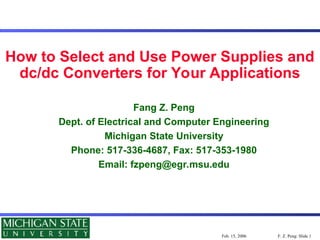
How to Select and Use Power Supplies and
dc/dc Converters for Your Applications
Fang Z. Peng
Dept. of Electrical and Computer Engineering
Michigan State University
Phone: 517-336-4687, Fax: 517-353-1980
Email: fzpeng@egr.msu.edu
F. Z. Peng: Slide 2
Feb. 15, 2006
Contents
• Introduction to Power Supplies and dc/dc
Converters
• Types & Technologies of Power Supplies
and dc/dc Converters
• Circuit Selection and Design
• Circuit Performance and Protection Features
• Thermal Requirements and Design Issues
F. Z. Peng: Slide 3
Feb. 15, 2006
Introduction to Power Supplies and dc/dc
Converters
• Available/Raw Power Sources
– AC or DC (frequency)
– Un-regulated (changes with load, prime source, etc.)
– Voltage (different level, polarity, isolation)
– Non-protected (against over load, fault, temp., etc.)
• Load Demand
– Different AC or DC (frequency)
– Regulated (against load, prime source, etc.)
– Voltage (different level, polarity, isolation)
– Protected (against over load, fault, temp., etc.)
F. Z. Peng: Slide 4
Feb. 15, 2006
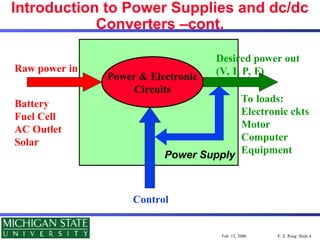
Power Supply
Introduction to Power Supplies and dc/dc
Converters –cont.
Power & Electronic
Circuits
Raw power in
Desired power out
(V, I, P, F)
To loads:
Electronic ckts
Motor
Computer
Equipment
Control
Battery
Fuel Cell
AC Outlet
Solar
F. Z. Peng: Slide 5
Feb. 15, 2006
Power Supplies and dc/dc Converters
–Types & Technologies
• AC-DC Power Supply (or AC Adapter)
– Change ac power into regulated dc power, e.g., a typical AC Adapter
takes 120 V ac input and converter it to regulated 5 Vdc.
• Dc/dc Converters
– Change dc at one voltage potential to a dc at a different voltage
potential
• DC-AC Power Supply (for example, UPS, 12Vdc-120Vac
adapter)
• AC-AC Power Supply/Regulator (for example, line
regulator)
F. Z. Peng: Slide 6
Feb. 15, 2006
AC-DC Power Supplies
-Circuit Selection and Design
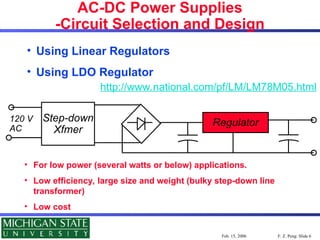
• Using Linear Regulators
• Using LDO Regulator
http://www.national.com/pf/LM/LM78M05.html
Step-down
Xfmer
Regulator
120 V
AC
• For low power (several watts or below) applications.
• Low efficiency, large size and weight (bulky step-down line
transformer)
• Low cost
F. Z. Peng: Slide 7
Feb. 15, 2006
AC-DC Power Supplies
-Circuit Selection and Design
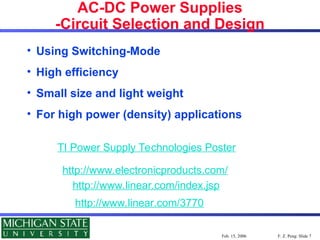
• Using Switching-Mode
• High efficiency
• Small size and light weight
• For high power (density) applications
http://www.linear.com/index.jsp
http://www.linear.com/3770
http://www.electronicproducts.com/
TI Power Supply Technologies Poster
F. Z. Peng: Slide 8
Feb. 15, 2006
Selecting the Right dc/dc Converter
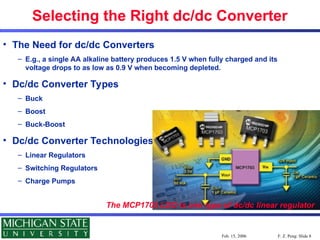
• The Need for dc/dc Converters
– E.g., a single AA alkaline battery produces 1.5 V when fully charged and its
voltage drops to as low as 0.9 V when becoming depleted.
• Dc/dc Converter Types
– Buck
– Boost
– Buck-Boost
• Dc/dc Converter Technologies
– Linear Regulators
– Switching Regulators
– Charge Pumps
The MCP1703 LDO is one type of dc/dc linear regulator
F. Z. Peng: Slide 9
Feb. 15, 2006
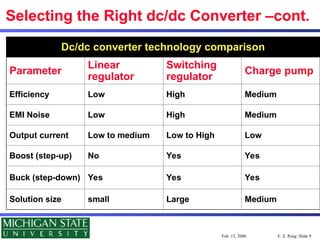
Selecting the Right dc/dc Converter –cont.
Dc/dc converter technology comparison
Parameter
Linear
regulator
Switching
regulator
Charge pump
Efficiency Low High Medium
EMI Noise Low High Medium
Output current Low to medium Low to High Low
Boost (step-up) No Yes Yes
Buck (step-down) Yes Yes Yes
Solution size small Large Medium
F. Z. Peng: Slide 10
Feb. 15, 2006
Selecting the Right dc/dc Converter –cont.
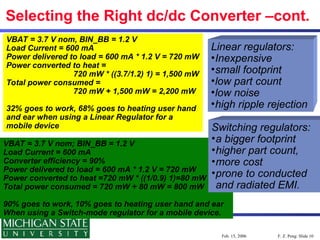
VBAT = 3.7 V nom, BIN_BB = 1.2 V
Load Current = 600 mA
Power delivered to load = 600 mA * 1.2 V = 720 mW
Power converted to heat =
720 mW * ((3.7/1.2) 1) = 1,500 mW
Total power consumed =
720 mW + 1,500 mW = 2,200 mW
32% goes to work, 68% goes to heating user hand
and ear when using a Linear Regulator for a
mobile device
VBAT = 3.7 V nom; BIN_BB = 1.2 V
Load Current = 600 mA
Converter efficiency = 90%
Power delivered to load = 600 mA * 1.2 V = 720 mW
Power converted to heat =720 mW * ((1/0.9) 1)=80 mW
Total power consumed = 720 mW + 80 mW = 800 mW
90% goes to work, 10% goes to heating user hand and ear
When using a Switch-mode regulator for a mobile device.
Linear regulators:
•Inexpensive
•small footprint
•low part count
•low noise
•high ripple rejection
Switching regulators:
•a bigger footprint
•higher part count,
•more cost
•prone to conducted
and radiated EMI.
F. Z. Peng: Slide 11
Feb. 15, 2006
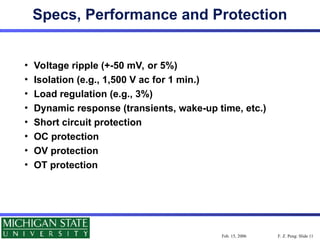
Specs, Performance and Protection
• Voltage ripple (+-50 mV, or 5%)
• Isolation (e.g., 1,500 V ac for 1 min.)
• Load regulation (e.g., 3%)
• Dynamic response (transients, wake-up time, etc.)
• Short circuit protection
• OC protection
• OV protection
• OT protection
F. Z. Peng: Slide 12
Feb. 15, 2006
Power Losses and Thermal Design
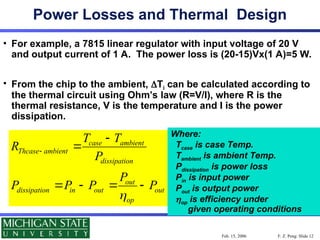
• For example, a 7815 linear regulator with input voltage of 20 V
and output current of 1 A. The power loss is (20-15)Vx(1 A)=5 W.
• From the chip to the ambient, Ti can be calculated according to
the thermal circuit using Ohm’s law (R=V/I), where R is the
thermal resistance, V is the temperature and I is the power
dissipation.
case ambient
Thcase ambient
dissipation
out
dissipation in out out
op
T T
R
P
P
P P P P




   
Where:
Tcase is case Temp.
Tambient is ambient Temp.
Pdissipation is power loss
Pin is input power
Pout is output power
op is efficiency under
given operating conditions
F. Z. Peng: Slide 13
Feb. 15, 2006
Power Losses and Thermal Design
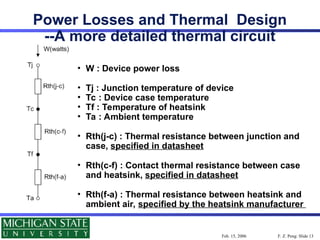
--A more detailed thermal circuit
• W : Device power loss
• Tj : Junction temperature of device
• Tc : Device case temperature
• Tf : Temperature of heatsink
• Ta : Ambient temperature
• Rth(j-c) : Thermal resistance between junction and
case, specified in datasheet
• Rth(c-f) : Contact thermal resistance between case
and heatsink, specified in datasheet
• Rth(f-a) : Thermal resistance between heatsink and
ambient air, specified by the heatsink manufacturer
F. Z. Peng: Slide 14
Feb. 15, 2006
Power Losses and Thermal Design
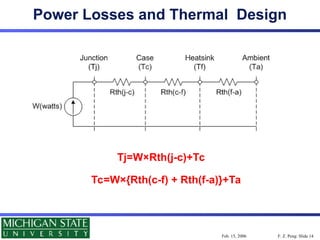
Tc=W×{Rth(c-f) + Rth(f-a)}+Ta
Tj=W×Rth(j-c)+Tc
F. Z. Peng: Slide 15
Feb. 15, 2006
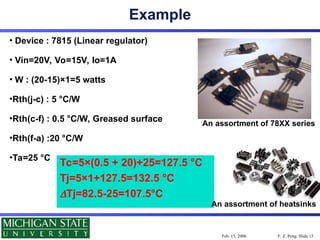
Example
Tc=5×(0.5 + 20)+25=127.5 °C
Tj=5×1+127.5=132.5 °C
Tj=82.5-25=107.5°C
• Device : 7815 (Linear regulator)
• Vin=20V, Vo=15V, Io=1A
• W : (20-15)×1=5 watts
•Rth(j-c) : 5 °C/W
•Rth(c-f) : 0.5 °C/W, Greased surface
•Rth(f-a) :20 °C/W
•Ta=25 °C
An assortment of 78XX series
An assortment of heatsinks
PowerSupplyAndThermal Issues and selection

  • 1.
    F. Z. Peng:Slide 1 Feb. 15, 2006 How to Select and Use Power Supplies and dc/dc Converters for Your Applications Fang Z. Peng Dept. of Electrical and Computer Engineering Michigan State University Phone: 517-336-4687, Fax: 517-353-1980 Email: fzpeng@egr.msu.edu
  • 2.
    F. Z. Peng:Slide 2 Feb. 15, 2006 Contents • Introduction to Power Supplies and dc/dc Converters • Types & Technologies of Power Supplies and dc/dc Converters • Circuit Selection and Design • Circuit Performance and Protection Features • Thermal Requirements and Design Issues
  • 3.
    F. Z. Peng:Slide 3 Feb. 15, 2006 Introduction to Power Supplies and dc/dc Converters • Available/Raw Power Sources – AC or DC (frequency) – Un-regulated (changes with load, prime source, etc.) – Voltage (different level, polarity, isolation) – Non-protected (against over load, fault, temp., etc.) • Load Demand – Different AC or DC (frequency) – Regulated (against load, prime source, etc.) – Voltage (different level, polarity, isolation) – Protected (against over load, fault, temp., etc.)
  • 4.
    F. Z. Peng:Slide 4 Feb. 15, 2006 Power Supply Introduction to Power Supplies and dc/dc Converters –cont. Power & Electronic Circuits Raw power in Desired power out (V, I, P, F) To loads: Electronic ckts Motor Computer Equipment Control Battery Fuel Cell AC Outlet Solar
  • 5.
    F. Z. Peng:Slide 5 Feb. 15, 2006 Power Supplies and dc/dc Converters –Types & Technologies • AC-DC Power Supply (or AC Adapter) – Change ac power into regulated dc power, e.g., a typical AC Adapter takes 120 V ac input and converter it to regulated 5 Vdc. • Dc/dc Converters – Change dc at one voltage potential to a dc at a different voltage potential • DC-AC Power Supply (for example, UPS, 12Vdc-120Vac adapter) • AC-AC Power Supply/Regulator (for example, line regulator)
  • 6.
    F. Z. Peng:Slide 6 Feb. 15, 2006 AC-DC Power Supplies -Circuit Selection and Design • Using Linear Regulators • Using LDO Regulator http://www.national.com/pf/LM/LM78M05.html Step-down Xfmer Regulator 120 V AC • For low power (several watts or below) applications. • Low efficiency, large size and weight (bulky step-down line transformer) • Low cost
  • 7.
    F. Z. Peng:Slide 7 Feb. 15, 2006 AC-DC Power Supplies -Circuit Selection and Design • Using Switching-Mode • High efficiency • Small size and light weight • For high power (density) applications http://www.linear.com/index.jsp http://www.linear.com/3770 http://www.electronicproducts.com/ TI Power Supply Technologies Poster
  • 8.
    F. Z. Peng:Slide 8 Feb. 15, 2006 Selecting the Right dc/dc Converter • The Need for dc/dc Converters – E.g., a single AA alkaline battery produces 1.5 V when fully charged and its voltage drops to as low as 0.9 V when becoming depleted. • Dc/dc Converter Types – Buck – Boost – Buck-Boost • Dc/dc Converter Technologies – Linear Regulators – Switching Regulators – Charge Pumps The MCP1703 LDO is one type of dc/dc linear regulator
  • 9.
    F. Z. Peng:Slide 9 Feb. 15, 2006 Selecting the Right dc/dc Converter –cont. Dc/dc converter technology comparison Parameter Linear regulator Switching regulator Charge pump Efficiency Low High Medium EMI Noise Low High Medium Output current Low to medium Low to High Low Boost (step-up) No Yes Yes Buck (step-down) Yes Yes Yes Solution size small Large Medium
  • 10.
    F. Z. Peng:Slide 10 Feb. 15, 2006 Selecting the Right dc/dc Converter –cont. VBAT = 3.7 V nom, BIN_BB = 1.2 V Load Current = 600 mA Power delivered to load = 600 mA * 1.2 V = 720 mW Power converted to heat = 720 mW * ((3.7/1.2) 1) = 1,500 mW Total power consumed = 720 mW + 1,500 mW = 2,200 mW 32% goes to work, 68% goes to heating user hand and ear when using a Linear Regulator for a mobile device VBAT = 3.7 V nom; BIN_BB = 1.2 V Load Current = 600 mA Converter efficiency = 90% Power delivered to load = 600 mA * 1.2 V = 720 mW Power converted to heat =720 mW * ((1/0.9) 1)=80 mW Total power consumed = 720 mW + 80 mW = 800 mW 90% goes to work, 10% goes to heating user hand and ear When using a Switch-mode regulator for a mobile device. Linear regulators: •Inexpensive •small footprint •low part count •low noise •high ripple rejection Switching regulators: •a bigger footprint •higher part count, •more cost •prone to conducted and radiated EMI.
  • 11.
    F. Z. Peng:Slide 11 Feb. 15, 2006 Specs, Performance and Protection • Voltage ripple (+-50 mV, or 5%) • Isolation (e.g., 1,500 V ac for 1 min.) • Load regulation (e.g., 3%) • Dynamic response (transients, wake-up time, etc.) • Short circuit protection • OC protection • OV protection • OT protection
  • 12.
    F. Z. Peng:Slide 12 Feb. 15, 2006 Power Losses and Thermal Design • For example, a 7815 linear regulator with input voltage of 20 V and output current of 1 A. The power loss is (20-15)Vx(1 A)=5 W. • From the chip to the ambient, Ti can be calculated according to the thermal circuit using Ohm’s law (R=V/I), where R is the thermal resistance, V is the temperature and I is the power dissipation. case ambient Thcase ambient dissipation out dissipation in out out op T T R P P P P P P         Where: Tcase is case Temp. Tambient is ambient Temp. Pdissipation is power loss Pin is input power Pout is output power op is efficiency under given operating conditions
  • 13.
    F. Z. Peng:Slide 13 Feb. 15, 2006 Power Losses and Thermal Design --A more detailed thermal circuit • W : Device power loss • Tj : Junction temperature of device • Tc : Device case temperature • Tf : Temperature of heatsink • Ta : Ambient temperature • Rth(j-c) : Thermal resistance between junction and case, specified in datasheet • Rth(c-f) : Contact thermal resistance between case and heatsink, specified in datasheet • Rth(f-a) : Thermal resistance between heatsink and ambient air, specified by the heatsink manufacturer
  • 14.
    F. Z. Peng:Slide 14 Feb. 15, 2006 Power Losses and Thermal Design Tc=W×{Rth(c-f) + Rth(f-a)}+Ta Tj=W×Rth(j-c)+Tc
  • 15.
    F. Z. Peng:Slide 15 Feb. 15, 2006 Example Tc=5×(0.5 + 20)+25=127.5 °C Tj=5×1+127.5=132.5 °C Tj=82.5-25=107.5°C • Device : 7815 (Linear regulator) • Vin=20V, Vo=15V, Io=1A • W : (20-15)×1=5 watts •Rth(j-c) : 5 °C/W •Rth(c-f) : 0.5 °C/W, Greased surface •Rth(f-a) :20 °C/W •Ta=25 °C An assortment of 78XX series An assortment of heatsinks