Data Privacy: What you should know, what you should do!
Donald E. Hester
CISSP, CISA, PSP, MCT
Director
Maze & Associates/San Diego City College
wwwLearnSecurity.Org
Tom Lanfranki
CISA, CPA, CIA
Information Systems Auditor
Office of the Auditor-Controller
Contra Costa County
Data Privacy in the Governmental Sector - Agenda
• What you should know:
– What is Data Privacy?
– Risks associated with Data Privacy
– Laws associated with Data Privacy
– Common Data Privacy Control Frameworks
• What you should do:
– Be Prepared and Proactive!
• Questions
• Raffle
2
What you should know!
What is Data Privacy?
Per National Institute of Standards and Technology – Special Publication 800-53: Appendix J
Privacy Control Catalog (Pg. 1):
“Privacy, with respect to personally identifiable information is a core value that can be
achieved only with appropriate legislation, policies, and controls to ensure compliance
with requirements.”
Personally Identifiable Information (PII) defined as:
(i) information which can be used to distinguish or trace an individual’s identity such as
their name, social security number, biometric records, etc., alone or when combined with
other personal or identifying information which is linked or linkable to a specific
individual, such as date and place of birth, mother’s maiden name etc.
(ii) Any other information that is linked or linkable to an individual, such as medical,
educational, financial and employment information.
California Constitution, Article 1, section 1. The state Constitution gives each citizen
an "inalienable right" to pursue and obtain "privacy.”
3
What you should know!
Risks Associated with Data Privacy
A. Number One Risk -- Identity Theft and Identity Fraud are terms used to refer
to all types of crime in which someone wrongfully obtains and uses another
individual’s personal data in some way that involves fraud or deception, typically for
economic gain.
B. Risks to the Government Organization
- Fraud
- Theft
- Litigation
- Loss of Reputation
- Cost for monitoring fees for customers
C. Current State – Our Observation
- Proliferation of Data Breaches
- Proliferation of New Technology – generally things are going to “the Web”
- Lack of Organization policy and procedures
- Deficiency in system monitoring
4
What you should know!
Risks Associated with Data Privacy
A. Common Victim Attributes of Identity Theft:
- May go undetected for months or even years – the longer it takes to discover the
loss the greater the pain and suffering
- Repeated victimization
- Costs can be significant and long-lasting
- Lower income, less-educated victims take longer to discover or report the crime,
resulting in greater suffering. Common suffering causes include harassment
from debt collectors, utility cutoffs and banking problems.
B. Common Victim Profile:
- Average age is 42.
- Typically do not notice the crime for 14 months.
- Often live in large metropolitan area
Shakespeare, Othello, Act 3:
“But he that filches from me my good name. Robs me of that which not enriches him,
And makes me poor indeed."
5
What you should know!
Proliferation of Data Breaches
• Survey: by a show of hands who has experienced identify theft?
– Last year?
• Top Data Reporting Agencies:
– Federal Trade Commission: Identity Theft Data Clearinghouse
– Department of Justice - California Attorney General
– Identity Theft Resource Center
– Open Security Foundation: DataLossdb
• From Federal Trade Commission Annual Report to Nation:
– 5% of Americans are victims of identity theft each year. This amounts to almost
15 million victims a year in the United States.
– Identify Theft is the major subject of consumer complaints it receives.
– People fear having their identities stolen.
– Financial loss to businesses and consumers is enormous, reaching billions of
dollars annually.
6
What you should know!
Proliferation of Data Breaches
7
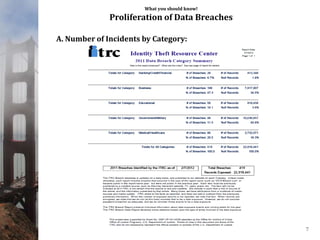
A. Number of Incidents by Category:
What you should know!
Proliferation of Data Breaches
8
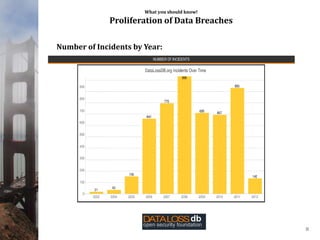
Number of Incidents by Year:
What you should know!
Proliferation of Data Breaches
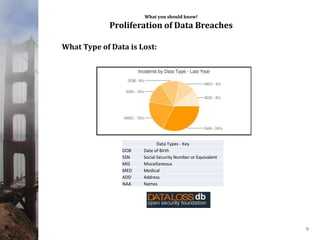
Data Types - Key
DOB Date of Birth
SSN Social Security Number or Equivalent
MIS Miscellaneous
MED Medical
ADD Address
NAA Names
9
What Type of Data is Lost:
What you should know!
Proliferation of Data Breaches
10
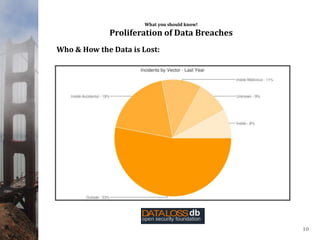
Who & How the Data is Lost:
What you should know!
Proliferation of Data Breaches
11
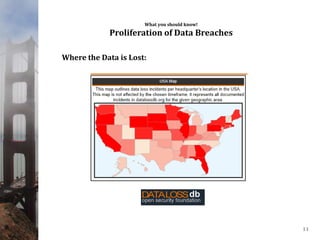
Where the Data is Lost:
What you should know!
Proliferation of Data Breaches
06-Feb-12 © 2012 Maze & Associates 12
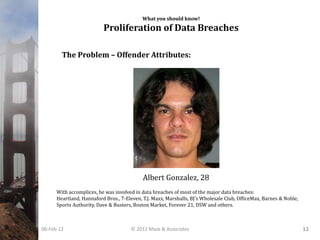
Albert Gonzalez, 28
With accomplices, he was involved in data breaches of most of the major data breaches:
Heartland, Hannaford Bros., 7-Eleven, T.J. Maxx, Marshalls, BJ’s Wholesale Club, OfficeMax, Barnes & Noble,
Sports Authority, Dave & Busters, Boston Market, Forever 21, DSW and others.
The Problem – Offender Attributes:
What you should know!
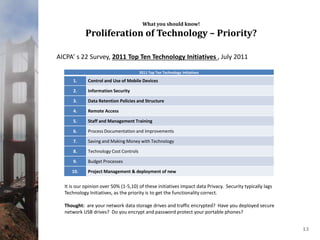
Proliferation of Technology – Priority?
13
2011 Top Ten Technology Initiatives
1. Control and Use of Mobile Devices
2. Information Security
3. Data Retention Policies and Structure
4. Remote Access
5. Staff and Management Training
6. Process Documentation and Improvements
7. Saving and Making Money with Technology
8. Technology Cost Controls
9. Budget Processes
10. Project Management & deployment of new
It is our opinion over 50% (1-5,10) of these initiatives impact data Privacy. Security typically lags
Technology Initiatives, as the priority is to get the functionality correct.
Thought: are your network data storage drives and traffic encrypted? Have you deployed secure
network USB drives? Do you encrypt and password protect your portable phones?
AICPA’ s 22 Survey, 2011 Top Ten Technology Initiatives , July 2011
What you should know!
Data Privacy Laws
1. Scope determination: must be based upon your business segments to properly
define the associated regulatory requirements. Example: Are you in the Utility
Business (Water, Garbage or Sewer) or Health Care (Ambulance Service or
Hospital)?
2. This overview is based upon interviews and cursory research. We are not
attorneys and do not give legal advice or opinions.
3. Goal is nothing more than to provide an overview of various requirements.
4. Consult your Legal Counsel!
5. Legal Classification Frameworks:
a. Common Privacy Principles
b. Federal laws
c. State Laws
d. Other
6. The CA Office of Privacy Protection was established by CA Gov. Code Section 11549.5.
Their website and staff are an outstanding resource:
Joanne McNabb, CIPP, CIPP/G, CIPP/IT
Chief
California Office of Privacy Protection
Phone: 916-651-1057
joanne.mcnabb@scsa.ca.gov
14
What you should know!
Data Privacy Laws
Common Privacy Principles:
Fair Information Practice Principles
http://www.oecd.org
Purpose:
These widely accepted Fair Information Practice Principles are the basis for many privacy laws in the United
States, Canada, Europe and other parts of the world. The Principles were first formulated by the U. S. Department
of Health, Education and Welfare in 1973, and are quoted here from the Organization for Economic Cooperation
and Development's Guidelines on the Protection of Privacy and Transborder Flows of Personal Data
Key Principles (8):
- Openness
- Collection Limitation
- Purpose Specification
- Use Limitation
- Data Quality
- Individual Participation
- Security Safeguards
- Accountability
15
What you should know!
Data Privacy Laws
Source: California Office of Privacy Protection
http://www.privacy.ca.gov/privacy_laws/index.shtml
Federal Laws
A. General Privacy
1. Fair Credit Reporting Act (FCRA) Section 625e: requires creditors to implement a written Identify Theft
Prevention Program to detect, prevent, and mitigate identity theft in connection with “covered” accounts.
B. Identity Theft
1. Federal Identity Theft Assumption and Deterrence Act of 1998: US Code section 1028: makes it a federal
crime to use another’s identity to commit an activity that violates Federal law or that is a felony under state or
local law.
16
What you should know!
Data Privacy Laws
Source: California Office of Privacy Protection
http://www.privacy.ca.gov/privacy_laws/index.shtml
State Laws – top 12
A. General Privacy
1. CA Original Privacy Law, SB 1386: Notice of security breach: This bill requires a business or a State agency
that maintains computerized data that includes specified personal information to disclose any breach of the
security of that data to any California resident whose unencrypted personal information was, or is reasonably
believed to have been, acquired by an unauthorized person. By giving consumers such notice, the bill gives them
the opportunity to take proactive steps to ensure that they do not become victims of identity theft. Note: Local
Government and Agencies are exempt.
2. CA Public Records Act, Government Code sections 6250: Applies to local government and gives members of
the public the a right to obtain described kinds of documents that are not protected from disclosure. Also
provides some specific privacy protections. May cause problems for municipalities as information is forwarded to
brokers without properly redacting the PII.
3. CA Public Records Act, Government Code sections 6250: Applies to local government and gives members of
the public the right to obtain described kinds of documents that are not protected from disclosure. Also provides
some specific privacy protections. May cause problems for municipalities as information must be properly
redacted before providing to information brokers.
17
What you should know!
Data Privacy Laws
Source: California Office of Privacy Protection
http://www.privacy.ca.gov/privacy_laws/index.shtml
4. Social Security Number Confidentiality, CA Civil Code 1798.85: law restricts businesses, state and local
agencies from publicly posting or displaying Social Security numbers.
5. Social Security Numbers in Local Government Records, CA Civil Code 1798.89: require local government
agencies to truncate SSN in documents released to the public so as to display no more than the last four digits.
6. Computer Misuse and Abuse, Penal Code 502: makes it a crime to knowingly access and without permission,
use, misuse, abuse, damage, contaminate, disrupt or destroy a computer ... computer program. We recommend
that your agency establish a computer access login banner and the banner should refer to this code
section.
7. Credit Card or Check Payment, Code section 1725: any person accepting a check in payment is prohibited
from recording a purchaser’s credit card number or requiring that a credit card be shown as condition of
accepting the check. Any person accepting a credit card in payment of goods is prohibited from writing the
collecting and recording cardholder’s personal information on forms associated with the transaction. The law
explicitly allows the collection of a zip code in a sales transaction to ... prevent fraud.
8. State Agency Privacy Policies, Government Code section 11019.9: requires state agencies to enact and to
maintain a privacy policy and to designate an employee to be responsible for the policy. The policy must describe
the agency’s practices for handling personal information.
18
What you should know!
Data Privacy Laws
Source: California Office of Privacy Protection
http://www.privacy.ca.gov/privacy_laws/index.shtml
9. Credit/Debit Card Truncation, CA Civil Code section 1747.09: no more than the last five digits of a credit card
or debit card number may be printed on the customer copy of electronically printed receipts.
10. Disposal of Customer Records, CA Civil Code section 1798.80: require businesses to shred, erase or
otherwise modify the personal information when disposing of customer records under their control.
11. Confidentiality of Library Records, CA Government Code 6254: Registration and circulation records of
libraries supported by public funds, are confidential and are explicitly exempted from the Public Records Act.
12. Security Breach Notice, CA Civil Code 1798: law requires a business that maintains unencrypted computer
data that includes personal information, as defined, to notify any California resident whose unencrypted personal
information was, or is reasonably believed to have been, acquired by an unauthorized person. The type of
information that requires the notice requirement is an individual’s name plus one or more of the following: Social
Security Number, driver’s license or CA Identification Card number, financial account numbers, medical
information, or health insurance information. If the breach notice is to more than 500 CA residents must
electronically submit a sample to the Attorney General.
19
What you should know!
Data Privacy Laws
Legal Classification Framework - Other
1. Payment Card Industry (PCI) – requirements.
Conclusion:
At this point in time most of the State breach disclosure laws do not apply to local government
agencies. However, isn’t breach disclosure the right thing to do?
20
What you should do!
Understand Common Privacy Control Frameworks
Common Frameworks and Resources:
1. National Institute of Standards and Technology, Special Publication 800-53 Security and
Privacy Controls, Appendix J
2. Federal Trade Commission: Identity Theft Prevention Program (ITPP)
3. American Institute of Certified Public Accountants:
a. Generally Accepted Privacy Principles
b. Privacy Maturity Model
4. State of California Privacy Procedures
21
What you should do!
Understand Common Privacy Control Frameworks
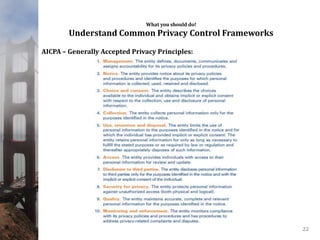
AICPA – Generally Accepted Privacy Principles:
22
What you should do!
Understand Common Privacy Control Frameworks
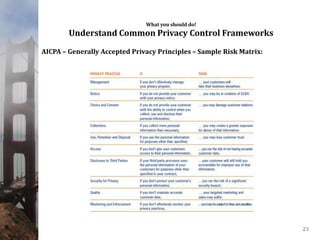
AICPA – Generally Accepted Privacy Principles – Sample Risk Matrix:
23
What you Should do!
Data Privacy in Local Government
Be Prepared and Proactive!
1. Engage Senior Management – determine and document a data privacy
strategy and action plan.
2. Take an inventory of your computer systems, applications, and personal
information data.
a. State Sample: http://www.cio.ca.gov/OIS/Government/privacy/default.asp#inventory
3. Develop a Data Privacy Policy and Train Staff on the Policy.
a. CA State Sample: http://www.cio.ca.gov/OIS/Government/privacy/default.asp#training
4. Develop an Data Breach Incident Management Policy.
a. CA State Sample: http://www.cio.ca.gov/OIS/Government/privacy/default.asp#breach
5. Ensure system monitoring practices are in place.
6. Ensure your vendors are in compliance with privacy laws and regulations.
24
Data Privacy in Local Government
Questions?
25
Data Privacy in Local Government
Raffle: - InformationActive: http://www.informationactive.com/
- ActiveData
- Live Product is included on the USB Drive!
ActiveData For Excel® adds time savings data analysis and worksheet manipulation features to Microsoft Excel®.
With ActiveData For Excel®you can join, merge, match, query, sample (random, stratified and monetary / PPS),
summarize, categorize, stratify, look for duplicate and missing items, generate statistics, perform Benford's Law analysis,
combine, split, splice, slice and dice your data like a pro!
26

CSMFO 2012 Data Privacy in Local Government

  • 1.
    Data Privacy: Whatyou should know, what you should do! Donald E. Hester CISSP, CISA, PSP, MCT Director Maze & Associates/San Diego City College wwwLearnSecurity.Org Tom Lanfranki CISA, CPA, CIA Information Systems Auditor Office of the Auditor-Controller Contra Costa County
  • 2.
    Data Privacy inthe Governmental Sector - Agenda • What you should know: – What is Data Privacy? – Risks associated with Data Privacy – Laws associated with Data Privacy – Common Data Privacy Control Frameworks • What you should do: – Be Prepared and Proactive! • Questions • Raffle 2
  • 3.
    What you shouldknow! What is Data Privacy? Per National Institute of Standards and Technology – Special Publication 800-53: Appendix J Privacy Control Catalog (Pg. 1): “Privacy, with respect to personally identifiable information is a core value that can be achieved only with appropriate legislation, policies, and controls to ensure compliance with requirements.” Personally Identifiable Information (PII) defined as: (i) information which can be used to distinguish or trace an individual’s identity such as their name, social security number, biometric records, etc., alone or when combined with other personal or identifying information which is linked or linkable to a specific individual, such as date and place of birth, mother’s maiden name etc. (ii) Any other information that is linked or linkable to an individual, such as medical, educational, financial and employment information. California Constitution, Article 1, section 1. The state Constitution gives each citizen an "inalienable right" to pursue and obtain "privacy.” 3
  • 4.
    What you shouldknow! Risks Associated with Data Privacy A. Number One Risk -- Identity Theft and Identity Fraud are terms used to refer to all types of crime in which someone wrongfully obtains and uses another individual’s personal data in some way that involves fraud or deception, typically for economic gain. B. Risks to the Government Organization - Fraud - Theft - Litigation - Loss of Reputation - Cost for monitoring fees for customers C. Current State – Our Observation - Proliferation of Data Breaches - Proliferation of New Technology – generally things are going to “the Web” - Lack of Organization policy and procedures - Deficiency in system monitoring 4
  • 5.
    What you shouldknow! Risks Associated with Data Privacy A. Common Victim Attributes of Identity Theft: - May go undetected for months or even years – the longer it takes to discover the loss the greater the pain and suffering - Repeated victimization - Costs can be significant and long-lasting - Lower income, less-educated victims take longer to discover or report the crime, resulting in greater suffering. Common suffering causes include harassment from debt collectors, utility cutoffs and banking problems. B. Common Victim Profile: - Average age is 42. - Typically do not notice the crime for 14 months. - Often live in large metropolitan area Shakespeare, Othello, Act 3: “But he that filches from me my good name. Robs me of that which not enriches him, And makes me poor indeed." 5
  • 6.
    What you shouldknow! Proliferation of Data Breaches • Survey: by a show of hands who has experienced identify theft? – Last year? • Top Data Reporting Agencies: – Federal Trade Commission: Identity Theft Data Clearinghouse – Department of Justice - California Attorney General – Identity Theft Resource Center – Open Security Foundation: DataLossdb • From Federal Trade Commission Annual Report to Nation: – 5% of Americans are victims of identity theft each year. This amounts to almost 15 million victims a year in the United States. – Identify Theft is the major subject of consumer complaints it receives. – People fear having their identities stolen. – Financial loss to businesses and consumers is enormous, reaching billions of dollars annually. 6
  • 7.
    What you shouldknow! Proliferation of Data Breaches 7 A. Number of Incidents by Category:
  • 8.
    What you shouldknow! Proliferation of Data Breaches 8 Number of Incidents by Year:
  • 9.
    What you shouldknow! Proliferation of Data Breaches Data Types - Key DOB Date of Birth SSN Social Security Number or Equivalent MIS Miscellaneous MED Medical ADD Address NAA Names 9 What Type of Data is Lost:
  • 10.
    What you shouldknow! Proliferation of Data Breaches 10 Who & How the Data is Lost:
  • 11.
    What you shouldknow! Proliferation of Data Breaches 11 Where the Data is Lost:
  • 12.
    What you shouldknow! Proliferation of Data Breaches 06-Feb-12 © 2012 Maze & Associates 12 Albert Gonzalez, 28 With accomplices, he was involved in data breaches of most of the major data breaches: Heartland, Hannaford Bros., 7-Eleven, T.J. Maxx, Marshalls, BJ’s Wholesale Club, OfficeMax, Barnes & Noble, Sports Authority, Dave & Busters, Boston Market, Forever 21, DSW and others. The Problem – Offender Attributes:
  • 13.
    What you shouldknow! Proliferation of Technology – Priority? 13 2011 Top Ten Technology Initiatives 1. Control and Use of Mobile Devices 2. Information Security 3. Data Retention Policies and Structure 4. Remote Access 5. Staff and Management Training 6. Process Documentation and Improvements 7. Saving and Making Money with Technology 8. Technology Cost Controls 9. Budget Processes 10. Project Management & deployment of new It is our opinion over 50% (1-5,10) of these initiatives impact data Privacy. Security typically lags Technology Initiatives, as the priority is to get the functionality correct. Thought: are your network data storage drives and traffic encrypted? Have you deployed secure network USB drives? Do you encrypt and password protect your portable phones? AICPA’ s 22 Survey, 2011 Top Ten Technology Initiatives , July 2011
  • 14.
    What you shouldknow! Data Privacy Laws 1. Scope determination: must be based upon your business segments to properly define the associated regulatory requirements. Example: Are you in the Utility Business (Water, Garbage or Sewer) or Health Care (Ambulance Service or Hospital)? 2. This overview is based upon interviews and cursory research. We are not attorneys and do not give legal advice or opinions. 3. Goal is nothing more than to provide an overview of various requirements. 4. Consult your Legal Counsel! 5. Legal Classification Frameworks: a. Common Privacy Principles b. Federal laws c. State Laws d. Other 6. The CA Office of Privacy Protection was established by CA Gov. Code Section 11549.5. Their website and staff are an outstanding resource: Joanne McNabb, CIPP, CIPP/G, CIPP/IT Chief California Office of Privacy Protection Phone: 916-651-1057 joanne.mcnabb@scsa.ca.gov 14
  • 15.
    What you shouldknow! Data Privacy Laws Common Privacy Principles: Fair Information Practice Principles http://www.oecd.org Purpose: These widely accepted Fair Information Practice Principles are the basis for many privacy laws in the United States, Canada, Europe and other parts of the world. The Principles were first formulated by the U. S. Department of Health, Education and Welfare in 1973, and are quoted here from the Organization for Economic Cooperation and Development's Guidelines on the Protection of Privacy and Transborder Flows of Personal Data Key Principles (8): - Openness - Collection Limitation - Purpose Specification - Use Limitation - Data Quality - Individual Participation - Security Safeguards - Accountability 15
  • 16.
    What you shouldknow! Data Privacy Laws Source: California Office of Privacy Protection http://www.privacy.ca.gov/privacy_laws/index.shtml Federal Laws A. General Privacy 1. Fair Credit Reporting Act (FCRA) Section 625e: requires creditors to implement a written Identify Theft Prevention Program to detect, prevent, and mitigate identity theft in connection with “covered” accounts. B. Identity Theft 1. Federal Identity Theft Assumption and Deterrence Act of 1998: US Code section 1028: makes it a federal crime to use another’s identity to commit an activity that violates Federal law or that is a felony under state or local law. 16
  • 17.
    What you shouldknow! Data Privacy Laws Source: California Office of Privacy Protection http://www.privacy.ca.gov/privacy_laws/index.shtml State Laws – top 12 A. General Privacy 1. CA Original Privacy Law, SB 1386: Notice of security breach: This bill requires a business or a State agency that maintains computerized data that includes specified personal information to disclose any breach of the security of that data to any California resident whose unencrypted personal information was, or is reasonably believed to have been, acquired by an unauthorized person. By giving consumers such notice, the bill gives them the opportunity to take proactive steps to ensure that they do not become victims of identity theft. Note: Local Government and Agencies are exempt. 2. CA Public Records Act, Government Code sections 6250: Applies to local government and gives members of the public the a right to obtain described kinds of documents that are not protected from disclosure. Also provides some specific privacy protections. May cause problems for municipalities as information is forwarded to brokers without properly redacting the PII. 3. CA Public Records Act, Government Code sections 6250: Applies to local government and gives members of the public the right to obtain described kinds of documents that are not protected from disclosure. Also provides some specific privacy protections. May cause problems for municipalities as information must be properly redacted before providing to information brokers. 17
  • 18.
    What you shouldknow! Data Privacy Laws Source: California Office of Privacy Protection http://www.privacy.ca.gov/privacy_laws/index.shtml 4. Social Security Number Confidentiality, CA Civil Code 1798.85: law restricts businesses, state and local agencies from publicly posting or displaying Social Security numbers. 5. Social Security Numbers in Local Government Records, CA Civil Code 1798.89: require local government agencies to truncate SSN in documents released to the public so as to display no more than the last four digits. 6. Computer Misuse and Abuse, Penal Code 502: makes it a crime to knowingly access and without permission, use, misuse, abuse, damage, contaminate, disrupt or destroy a computer ... computer program. We recommend that your agency establish a computer access login banner and the banner should refer to this code section. 7. Credit Card or Check Payment, Code section 1725: any person accepting a check in payment is prohibited from recording a purchaser’s credit card number or requiring that a credit card be shown as condition of accepting the check. Any person accepting a credit card in payment of goods is prohibited from writing the collecting and recording cardholder’s personal information on forms associated with the transaction. The law explicitly allows the collection of a zip code in a sales transaction to ... prevent fraud. 8. State Agency Privacy Policies, Government Code section 11019.9: requires state agencies to enact and to maintain a privacy policy and to designate an employee to be responsible for the policy. The policy must describe the agency’s practices for handling personal information. 18
  • 19.
    What you shouldknow! Data Privacy Laws Source: California Office of Privacy Protection http://www.privacy.ca.gov/privacy_laws/index.shtml 9. Credit/Debit Card Truncation, CA Civil Code section 1747.09: no more than the last five digits of a credit card or debit card number may be printed on the customer copy of electronically printed receipts. 10. Disposal of Customer Records, CA Civil Code section 1798.80: require businesses to shred, erase or otherwise modify the personal information when disposing of customer records under their control. 11. Confidentiality of Library Records, CA Government Code 6254: Registration and circulation records of libraries supported by public funds, are confidential and are explicitly exempted from the Public Records Act. 12. Security Breach Notice, CA Civil Code 1798: law requires a business that maintains unencrypted computer data that includes personal information, as defined, to notify any California resident whose unencrypted personal information was, or is reasonably believed to have been, acquired by an unauthorized person. The type of information that requires the notice requirement is an individual’s name plus one or more of the following: Social Security Number, driver’s license or CA Identification Card number, financial account numbers, medical information, or health insurance information. If the breach notice is to more than 500 CA residents must electronically submit a sample to the Attorney General. 19
  • 20.
    What you shouldknow! Data Privacy Laws Legal Classification Framework - Other 1. Payment Card Industry (PCI) – requirements. Conclusion: At this point in time most of the State breach disclosure laws do not apply to local government agencies. However, isn’t breach disclosure the right thing to do? 20
  • 21.
    What you shoulddo! Understand Common Privacy Control Frameworks Common Frameworks and Resources: 1. National Institute of Standards and Technology, Special Publication 800-53 Security and Privacy Controls, Appendix J 2. Federal Trade Commission: Identity Theft Prevention Program (ITPP) 3. American Institute of Certified Public Accountants: a. Generally Accepted Privacy Principles b. Privacy Maturity Model 4. State of California Privacy Procedures 21
  • 22.
    What you shoulddo! Understand Common Privacy Control Frameworks AICPA – Generally Accepted Privacy Principles: 22
  • 23.
    What you shoulddo! Understand Common Privacy Control Frameworks AICPA – Generally Accepted Privacy Principles – Sample Risk Matrix: 23
  • 24.
    What you Shoulddo! Data Privacy in Local Government Be Prepared and Proactive! 1. Engage Senior Management – determine and document a data privacy strategy and action plan. 2. Take an inventory of your computer systems, applications, and personal information data. a. State Sample: http://www.cio.ca.gov/OIS/Government/privacy/default.asp#inventory 3. Develop a Data Privacy Policy and Train Staff on the Policy. a. CA State Sample: http://www.cio.ca.gov/OIS/Government/privacy/default.asp#training 4. Develop an Data Breach Incident Management Policy. a. CA State Sample: http://www.cio.ca.gov/OIS/Government/privacy/default.asp#breach 5. Ensure system monitoring practices are in place. 6. Ensure your vendors are in compliance with privacy laws and regulations. 24
  • 25.
    Data Privacy inLocal Government Questions? 25
  • 26.
    Data Privacy inLocal Government Raffle: - InformationActive: http://www.informationactive.com/ - ActiveData - Live Product is included on the USB Drive! ActiveData For Excel® adds time savings data analysis and worksheet manipulation features to Microsoft Excel®. With ActiveData For Excel®you can join, merge, match, query, sample (random, stratified and monetary / PPS), summarize, categorize, stratify, look for duplicate and missing items, generate statistics, perform Benford's Law analysis, combine, split, splice, slice and dice your data like a pro! 26