Elements: Voices
Music Appreciation
Unit 2
Voices
• Singing has always been the easiest and most
familiar way to make music.
• Singing is unique in music because of the
ability to mix words with musical tones.
• When you sing it establishes a connection
between the singer and the listener.
• Communication is established using both
words and music.
Voices
• Although everyone can sing, few can do it
well.
• Singing is a difficult art that requires a lot of
natural talent and years of practice.
• All an instrumentalist has to do is push down a
valve or key to play a note where a singer
must be able to hear a note and adjust their
vocal chords in order to produce that note
accurately.
Voices
• Men’s vocal chords are thicker than women’s
are, resulting in a lower sounding voice.
• The voices of men and woman are classified
as follows…
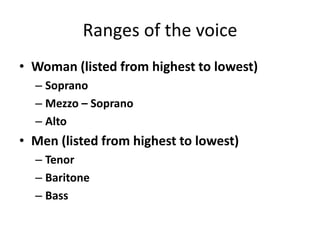
Ranges of the voice
• Woman (listed from highest to lowest)
– Soprano
– Mezzo – Soprano
– Alto
• Men (listed from highest to lowest)
– Tenor
– Baritone
– Bass
Voices
• Methods and styles of singing vary from
culture to culture.
• The way the Japanese and Americans sing are
very different
• Classical, jazz, folk, rap, and rock are all sung
differently
• Play listening examples
Voices
• Until the late 1600s, most of the music was
vocal music.
• Instruments were rare to come because they
had to be made by hand and cost money.
• Since the late 1600s, instrumental and vocal
music have become equally important.

Powerpoint 2 e

  • 1.
  • 2.
    Voices • Singing hasalways been the easiest and most familiar way to make music. • Singing is unique in music because of the ability to mix words with musical tones. • When you sing it establishes a connection between the singer and the listener. • Communication is established using both words and music.
  • 3.
    Voices • Although everyonecan sing, few can do it well. • Singing is a difficult art that requires a lot of natural talent and years of practice. • All an instrumentalist has to do is push down a valve or key to play a note where a singer must be able to hear a note and adjust their vocal chords in order to produce that note accurately.
  • 4.
    Voices • Men’s vocalchords are thicker than women’s are, resulting in a lower sounding voice. • The voices of men and woman are classified as follows…
  • 5.
    Ranges of thevoice • Woman (listed from highest to lowest) – Soprano – Mezzo – Soprano – Alto • Men (listed from highest to lowest) – Tenor – Baritone – Bass
  • 6.
    Voices • Methods andstyles of singing vary from culture to culture. • The way the Japanese and Americans sing are very different • Classical, jazz, folk, rap, and rock are all sung differently • Play listening examples
  • 7.
    Voices • Until thelate 1600s, most of the music was vocal music. • Instruments were rare to come because they had to be made by hand and cost money. • Since the late 1600s, instrumental and vocal music have become equally important.