
Real Time Groupware in Web
              Browsers: A New Web 2.0
             Species is Coming of Age!?
                               Dr. Weigang Wang
                Decision and Cognitive Sciences Research Centre
                             Strategy Division, MBS
                          The University of Manchester


Web / Art / Science Camp Unconference (6 November 2010, London)
Overview

•   A Web science approach
•   The problems/issues
•   The PowerMeeting idea
•   Technical protocols/rules
•   Social protocols/rules
•   The evidence of success at micro level
•   Some promising lights at macro level
•   A comparison to Google Wave, …
•   Concluding remarks
                                             2
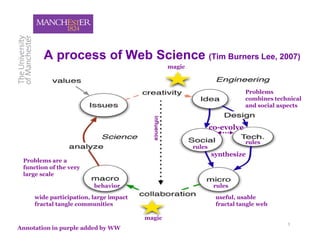
A process of Web Science (Tim Burners Lee, 2007)
                                                      magic


                                                                                  Problems
                                                                                  combines technical
                                                                                  and social aspects


                                          influence
                                          influence
                                                                      co-evolve
                                                                                  rules
                                                              rules
                                                                      synthesize
 Problems are a
 function of the very
 large scale

                         behavior                                      rules

     wide participation, large impact                                  useful, usable
     fractal tangle communities                                        fractal tangle web

                                        magic
                                                                                               3
Annotation in purple added by WW
Wiki example (Tim Burners Lee, 2007)


                                       4
The Problems/Issues

• Lack of real time collaboration support on the Web
   – Web based cooperative systems are largely asynchronous
     (e.g. Facebook, Blob, Wiki, Web mail).
   – For a long time standard Web browsers and standard Web
     networking technologies are inadequate for real time
     groupware
   – Most plug-in (JavaApplet, Java Web Start, Flash) based ones
     are not easy to access and not widely adopted


• Two high-level problems/issues
   – Not readily accessible (an issue at micro level)
   – Not widely adopted (failed at macro level)

                                                                   5
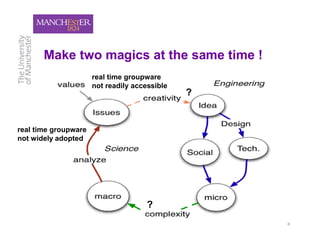
Make two magics at the same time !
                      real time groupware
                      not readily accessible
                                               ?


real time groupware
not widely adopted


                                      ?
                                                   6
The PowerMeeting Idea

• Standard Web browser based real time
  groupware using latest Web 2.0 technologies
  (AJAX and AJAX push)
  – High level technical protocols that make real time
    groupware possible and easier to build (for
    developers)
  – Social protocols that make the system easier to
    understand and more comfortable to use (for end
    users)


                                                         7
The technical protocols

• Replicated data model
• Cooperative Model-View-Controller and Cooperative
  Model-View-Presenter (CoopMVC and CoopMVP)
• Concurrency friendly content model and change
  notification
• Efficient optimistic concurrency control (OCC)
• Smooth moving between synchronous and
  asynchronous collaboration modes
   – Persistent collaborative session and data objects
   – Webized session instances (accessible by URLs)
• Supported by Googe Web Toolkit (GWT) and Java
  IDE (Eclipse)

                                                         8
The social protocols

• Meeting metaphor for conventions and social protocols
  in group meetings (participants, area of joint focus,
  pointer/beamer, agenda and their corresponding task-
  specific tools, session chair led group process)
• “PowerPoint” metaphor for planning and execute a
  meeting process (consisting of agenda items)
• Point-of-Meeting (PoM) in context (for integrating real
  time media into existing asynchronous social media)
• Focus on joint work in shared workspace while using
  textual or voice chatting for fine grained coordination


                                                        9
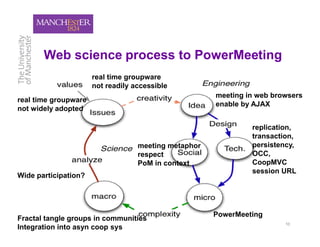
Web science process to PowerMeeting
                      real time groupware
                      not readily accessible
                                                      meeting in web browsers
real time groupware
                                                      enable by AJAX
not widely adopted

                                                               replication,
                                                               transaction,
                                   meeting metaphor            persistency,
                                   respect                     OCC,
                                   PoM in context              CoopMVC
                                                               session URL
Wide participation?


                                                      PowerMeeting
Fractal tangle groups in communities
                                                                        10
Integration into asyn coop sys
PowerMeeting

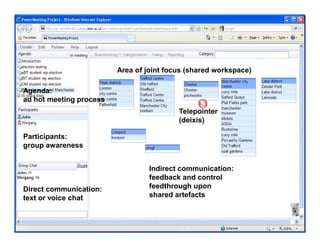
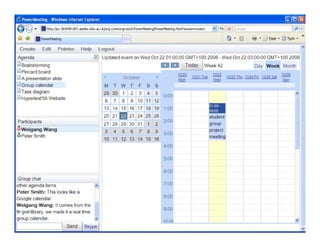
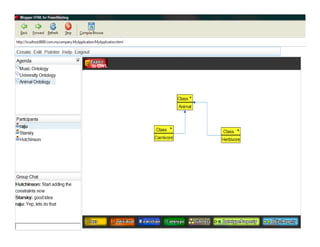
• PowerMeeting supports participants to plan
  and perform their group activities (using
  various task-specific groupware tools) in a well
  coordinated group process.


                                                 11
Area of joint focus (shared workspace)

Agenda:
ad hot meeting process
                                          Telepointer
                                          (deixis)

Participants:
group awareness


                                  Indirect communication:
                                  feedback and control
Direct communication:             feedthrough upon
text or voice chat                shared artefacts


                                                                  12
13
14
15
16
Comparing with ThinkTank

• ThinkTank: needs a Flash plug in, provides a small
  number of tools, smaller developer base with
  ActionScript, mainly used for collocated decision
  meetings, lacks integrated communication and
  coordination support, cannot run in devices not
  supporting flash, e.g. iPhone and iPad
• Comparing with ThinkTank, PowerMeeting
   – Can be accessed by any standard Web browser (no need to
     install a plug in)
   – Is more open and extendable in terms of groupware tools
     available
   – Has integrated communication and coordination support for
     distributed facilitation


                                                                 17
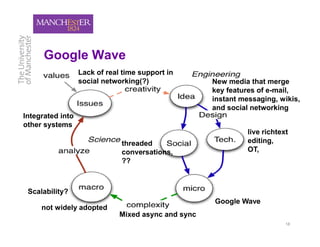
Google Wave
                  Lack of real time support in
                  social networking(?)               New media that merge
                                                     key features of e-mail,
                                                     instant messaging, wikis,
                                                     and social networking
Integrated into
other systems
                                                               live richtext
                              threaded                         editing,
                              conversations,                   OT,
                              ??


 Scalability?
                                                     Google Wave
     not widely adopted
                              Mixed async and sync
                                                                           18
19
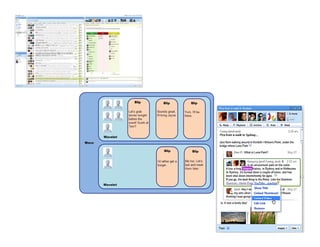
Comparing with Google Wave (May, 2009)

• Google Wave: strong in richtext editing, its operational
  transformation concurrency control methods are specific to its
  operations on text editing, weak on task-specific tool support (the
  capability of its gadgets extension is very limited), system
  objectives not very clear, not easy to understand and use, project
  ended due to low adoption
• Comparing with Google Wave, PowerMeeting (June, 2008)
    – Supports the development of full-fledged groupware with more
      complex data structures and operations
    – Applies an optimistic concurrency control methods applicable to such
      data structures for wide range of groupware applications
    – Focus on group work with textual and voice chat as communication
      and coordination means
    – Offers distributed facilitation support for a well coordinated meeting
      process


                                                                          20
Data from Google Analytics
(from 13 Nov 2008 to 19 Oct 2010)
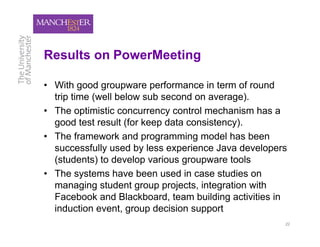
• 1454 users from 74 counties/territories
• Avg. Time on Site: 00:03:42
• Top screen resolution: 1280x800, 25.35%;
  1024x768, 21.96%; 1280x1024, 18.36%, …
• Connecting speed: T1, 42.49%; DSL, 28.61%;
  Unknown 21.92%; Cable, 5.81%; Dialup,
  1.09%
• Used 8 browsers: Firebox, 33.96%; Chrome,
  29.57%; Internet Exporer, 27.85%; Safari,
  6.48%; Opera, 1.30%

                                           21
Results on PowerMeeting

• With good groupware performance in term of round
  trip time (well below sub second on average).
• The optimistic concurrency control mechanism has a
  good test result (for keep data consistency).
• The framework and programming model has been
  successfully used by less experience Java developers
  (students) to develop various groupware tools
• The systems have been used in case studies on
  managing student group projects, integration with
  Facebook and Blackboard, team building activities in
  induction event, group decision support
                                                     22
Concluding remarks

• This work is the first to demonstrate that
  standard Web networking technologies and
  standard Web browsers can support full-
  fledged highly interactive real-time groupware
  that offer a desktop-application-like rich user
  experience
• More work is needed to further investigate its
  adoption, distributed facilitation support, and
  its integration with other popular Web 2.0
  systems

                                                    23
Links

• PowerMeeting website (Introduction and Demos):
     – http://www.powermeeting.co.uk
•   Wang, W. 2008. PowerMeeting on CommonGround: web based synchronous groupware with
    rich user experience. In Proceedings of the ACM Hypertext 2008 Workshop on Collaboration
    and Collective intelligence (Pittsburgh, PA, USA, June 19 - 21, 2008). WebScience '08, New
    York, NY, 35-39. DOI=http://doi.acm.org/10.1145/1379157.1379166
•   Wang, W. and French, S. 2008. A multi-dimensional framework for facilitating wide
    participation and common understanding. In Proceedings of the ACM Hypertext 2008
    Workshop on Collaboration and Collective intelligence (Pittsburgh, PA, USA, June 19 - 21,
    2008). WebScience '08, New York, NY, 23-27.
    DOI=http://doi.acm.org/10.1145/1379157.1379164
•   Wang, W. 2008. Powermeeting: gwt-based synchronous groupware (A demo at HT98). In
    Proceedings of the Nineteenth ACM Conference on Hypertext and Hypermedia (Pittsburgh,
    PA, USA, June 19 - 21, 2008). ACM HT '08, New York, NY, 251-252.
    DOI=http://doi.acm.org/10.1145/1379092.1379150
•   Stephen Mogan, Weigang Wang, "The Impact of Web 2.0 Developments on Real-Time
    Groupware," socialcom, pp.534-539, 2010 IEEE Second International Conference on Social
    Computing, 2010, DOI= http://doi.ieeecomputersociety.org/10.1109/SocialCom.2010.84
                                                                                             24
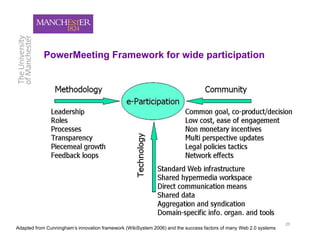
PowerMeeting Framework for wide participation


                                                                                                                   25
Adapted from Cunningham’s innovation framework (WikiSystem 2006) and the success factors of many Web 2.0 systems
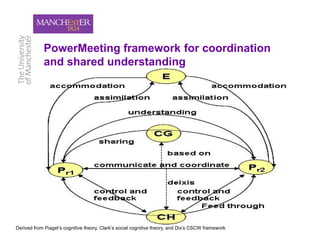
PowerMeeting framework for coordination
            and shared understanding


                                                                                                    26
Derived from Piaget’s cognitive theory, Clark’s social cognitive theory, and Dix’s CSCW framework

PowerMeeting6nov2010

  • 1.
    Real Time Groupwarein Web Browsers: A New Web 2.0 Species is Coming of Age!? Dr. Weigang Wang Decision and Cognitive Sciences Research Centre Strategy Division, MBS The University of Manchester Web / Art / Science Camp Unconference (6 November 2010, London)
  • 2.
    Overview • A Web science approach • The problems/issues • The PowerMeeting idea • Technical protocols/rules • Social protocols/rules • The evidence of success at micro level • Some promising lights at macro level • A comparison to Google Wave, … • Concluding remarks 2
  • 3.
    A process ofWeb Science (Tim Burners Lee, 2007) magic Problems combines technical and social aspects influence influence co-evolve rules rules synthesize Problems are a function of the very large scale behavior rules wide participation, large impact useful, usable fractal tangle communities fractal tangle web magic 3 Annotation in purple added by WW
  • 4.
    Wiki example (TimBurners Lee, 2007) 4
  • 5.
    The Problems/Issues • Lackof real time collaboration support on the Web – Web based cooperative systems are largely asynchronous (e.g. Facebook, Blob, Wiki, Web mail). – For a long time standard Web browsers and standard Web networking technologies are inadequate for real time groupware – Most plug-in (JavaApplet, Java Web Start, Flash) based ones are not easy to access and not widely adopted • Two high-level problems/issues – Not readily accessible (an issue at micro level) – Not widely adopted (failed at macro level) 5
  • 6.
    Make two magicsat the same time ! real time groupware not readily accessible ? real time groupware not widely adopted ? 6
  • 7.
    The PowerMeeting Idea •Standard Web browser based real time groupware using latest Web 2.0 technologies (AJAX and AJAX push) – High level technical protocols that make real time groupware possible and easier to build (for developers) – Social protocols that make the system easier to understand and more comfortable to use (for end users) 7
  • 8.
    The technical protocols •Replicated data model • Cooperative Model-View-Controller and Cooperative Model-View-Presenter (CoopMVC and CoopMVP) • Concurrency friendly content model and change notification • Efficient optimistic concurrency control (OCC) • Smooth moving between synchronous and asynchronous collaboration modes – Persistent collaborative session and data objects – Webized session instances (accessible by URLs) • Supported by Googe Web Toolkit (GWT) and Java IDE (Eclipse) 8
  • 9.
    The social protocols •Meeting metaphor for conventions and social protocols in group meetings (participants, area of joint focus, pointer/beamer, agenda and their corresponding task- specific tools, session chair led group process) • “PowerPoint” metaphor for planning and execute a meeting process (consisting of agenda items) • Point-of-Meeting (PoM) in context (for integrating real time media into existing asynchronous social media) • Focus on joint work in shared workspace while using textual or voice chatting for fine grained coordination 9
  • 10.
    Web science processto PowerMeeting real time groupware not readily accessible meeting in web browsers real time groupware enable by AJAX not widely adopted replication, transaction, meeting metaphor persistency, respect OCC, PoM in context CoopMVC session URL Wide participation? PowerMeeting Fractal tangle groups in communities 10 Integration into asyn coop sys
  • 11.
    PowerMeeting • PowerMeeting supportsparticipants to plan and perform their group activities (using various task-specific groupware tools) in a well coordinated group process. 11
  • 12.
    Area of jointfocus (shared workspace) Agenda: ad hot meeting process Telepointer (deixis) Participants: group awareness Indirect communication: feedback and control Direct communication: feedthrough upon text or voice chat shared artefacts 12
  • 13.
  • 14.
  • 15.
  • 16.
  • 17.
    Comparing with ThinkTank •ThinkTank: needs a Flash plug in, provides a small number of tools, smaller developer base with ActionScript, mainly used for collocated decision meetings, lacks integrated communication and coordination support, cannot run in devices not supporting flash, e.g. iPhone and iPad • Comparing with ThinkTank, PowerMeeting – Can be accessed by any standard Web browser (no need to install a plug in) – Is more open and extendable in terms of groupware tools available – Has integrated communication and coordination support for distributed facilitation 17
  • 18.
    Google Wave Lack of real time support in social networking(?) New media that merge key features of e-mail, instant messaging, wikis, and social networking Integrated into other systems live richtext threaded editing, conversations, OT, ?? Scalability? Google Wave not widely adopted Mixed async and sync 18
  • 19.
  • 20.
    Comparing with GoogleWave (May, 2009) • Google Wave: strong in richtext editing, its operational transformation concurrency control methods are specific to its operations on text editing, weak on task-specific tool support (the capability of its gadgets extension is very limited), system objectives not very clear, not easy to understand and use, project ended due to low adoption • Comparing with Google Wave, PowerMeeting (June, 2008) – Supports the development of full-fledged groupware with more complex data structures and operations – Applies an optimistic concurrency control methods applicable to such data structures for wide range of groupware applications – Focus on group work with textual and voice chat as communication and coordination means – Offers distributed facilitation support for a well coordinated meeting process 20
  • 21.
    Data from GoogleAnalytics (from 13 Nov 2008 to 19 Oct 2010) • 1454 users from 74 counties/territories • Avg. Time on Site: 00:03:42 • Top screen resolution: 1280x800, 25.35%; 1024x768, 21.96%; 1280x1024, 18.36%, … • Connecting speed: T1, 42.49%; DSL, 28.61%; Unknown 21.92%; Cable, 5.81%; Dialup, 1.09% • Used 8 browsers: Firebox, 33.96%; Chrome, 29.57%; Internet Exporer, 27.85%; Safari, 6.48%; Opera, 1.30% 21
  • 22.
    Results on PowerMeeting •With good groupware performance in term of round trip time (well below sub second on average). • The optimistic concurrency control mechanism has a good test result (for keep data consistency). • The framework and programming model has been successfully used by less experience Java developers (students) to develop various groupware tools • The systems have been used in case studies on managing student group projects, integration with Facebook and Blackboard, team building activities in induction event, group decision support 22
  • 23.
    Concluding remarks • Thiswork is the first to demonstrate that standard Web networking technologies and standard Web browsers can support full- fledged highly interactive real-time groupware that offer a desktop-application-like rich user experience • More work is needed to further investigate its adoption, distributed facilitation support, and its integration with other popular Web 2.0 systems 23
  • 24.
    Links • PowerMeeting website(Introduction and Demos): – http://www.powermeeting.co.uk • Wang, W. 2008. PowerMeeting on CommonGround: web based synchronous groupware with rich user experience. In Proceedings of the ACM Hypertext 2008 Workshop on Collaboration and Collective intelligence (Pittsburgh, PA, USA, June 19 - 21, 2008). WebScience '08, New York, NY, 35-39. DOI=http://doi.acm.org/10.1145/1379157.1379166 • Wang, W. and French, S. 2008. A multi-dimensional framework for facilitating wide participation and common understanding. In Proceedings of the ACM Hypertext 2008 Workshop on Collaboration and Collective intelligence (Pittsburgh, PA, USA, June 19 - 21, 2008). WebScience '08, New York, NY, 23-27. DOI=http://doi.acm.org/10.1145/1379157.1379164 • Wang, W. 2008. Powermeeting: gwt-based synchronous groupware (A demo at HT98). In Proceedings of the Nineteenth ACM Conference on Hypertext and Hypermedia (Pittsburgh, PA, USA, June 19 - 21, 2008). ACM HT '08, New York, NY, 251-252. DOI=http://doi.acm.org/10.1145/1379092.1379150 • Stephen Mogan, Weigang Wang, "The Impact of Web 2.0 Developments on Real-Time Groupware," socialcom, pp.534-539, 2010 IEEE Second International Conference on Social Computing, 2010, DOI= http://doi.ieeecomputersociety.org/10.1109/SocialCom.2010.84 24
  • 25.
    PowerMeeting Framework forwide participation 25 Adapted from Cunningham’s innovation framework (WikiSystem 2006) and the success factors of many Web 2.0 systems
  • 26.
    PowerMeeting framework forcoordination and shared understanding 26 Derived from Piaget’s cognitive theory, Clark’s social cognitive theory, and Dix’s CSCW framework