RECAP….
TIME TO THINK
1. What companies do you believe
are the largest?
2. Why do you think that these
companies are among the largest?
MARKET STRUCTURES
Learning Competencies: At the end of
the lesson, the students are expected:
 To identify four different types of
market structures.
 To understand the differences
between each type of market
structure.
 To complete a grid detailing specific
aspects of each market.
MARKET STRUCTURES
Activity No. 1 “WHAT’S YOUR BET?”
TIME TO THINK
•How do some products differ from another?
Keep your worksheets. We’ll try
to go back on that later.
TIME TO THINK
•Activity No. 2: “Market Structure Simulation”
Price Range:
25 cents to 3 pesos
MARKET STRUCTURES
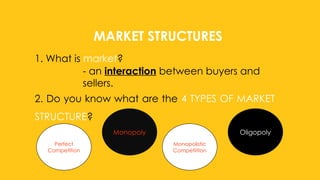
1. What is market?
- an interaction between buyers and
sellers.
2. Do you know what are the 4 TYPES OF MARKET
STRUCTURE?
Perfect
Competition
Monopoly
Monopolistic
Competiition
Oligopoly
MARKET STRUCTURES
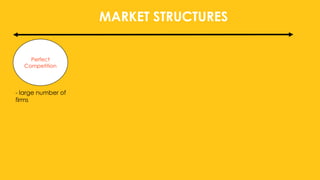
Perfect
Competition
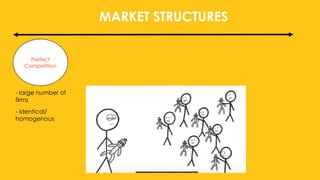
- large number of
firms
MARKET STRUCTURES
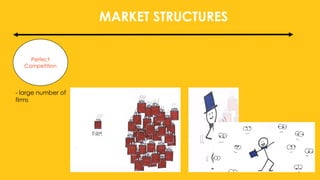
Perfect
Competition
- large number of
firms
MARKET STRUCTURES
Perfect
Competition
- large number of
firms
- identical/
homogenous
MARKET STRUCTURES
Perfect
Competition
- large number of
firms
- identical/
homogenous
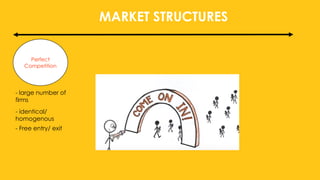
- Free entry/ exit
MARKET STRUCTURES
Perfect
Competition
- large number of
firms
- identical/
homogenous
- Free entry/ exit
- One of the
characteristic of
PC is that they
are efficient.
- In a perfectly
competitive
market, price
and output
reach their
equilibrium levels.
Can someone draw a graph
showing the equilibrium
levels?
• Examples:
Apple
cucumber
cabbage
meat
MARKET STRUCTURES
Perfect
Competition
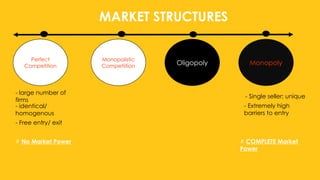
MARKET STRUCTURES
Perfect
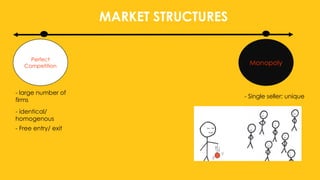
Competition Monopoly
- large number of
firms
- identical/
homogenous
- Free entry/ exit
- Single seller; unique
MARKET STRUCTURES
Perfect
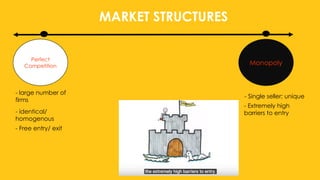
Competition Monopoly
- large number of
firms
- identical/
homogenous
- Free entry/ exit
- Single seller; unique
- Extremely high
barriers to entry
MARKET STRUCTURES
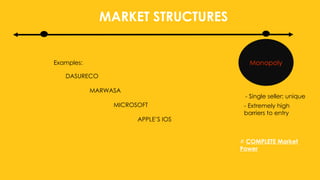
Monopoly
- Single seller; unique
- Extremely high
barriers to entry
# COMPLETE Market
Power
Examples:
DASURECO
MARWASA
MICROSOFT
APPLE’S IOS
MARKET STRUCTURES
Perfect
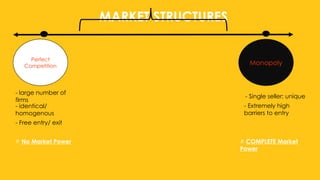
Competition Monopoly
- large number of
firms
- identical/
homogenous
- Free entry/ exit
- Single seller; unique
- Extremely high
barriers to entry
# No Market Power # COMPLETE Market
Power
MARKET STRUCTURES
Perfect
Competition Monopoly
- large number of
firms
- identical/
homogenous
- Free entry/ exit
- Single seller; unique
- Extremely high
barriers to entry
# No Market Power # COMPLETE Market
Power
Monopolistic
Competiition Oligopoly
MARKET STRUCTURES
Perfect
Competition Monopoly
- large number of
firms
- identical/
homogenous
- Free entry/ exit
- Single seller; unique
- Extremely high
barriers to entry
# No Market Power # COMPLETE Market
Power
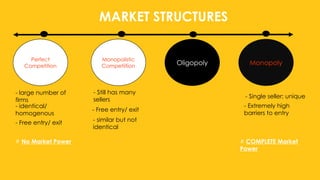
Monopolistic
Competiition Oligopoly
- Still has many
sellers
- Free entry/ exit
- similar but not
identical
MARKET STRUCTURES
Perfect
Competition Monopoly
- large number of
firms
- identical/
homogenous
- Free entry/ exit
- Single seller; unique
- Extremely high
barriers to entry
# No Market Power # COMPLETE Market
Power
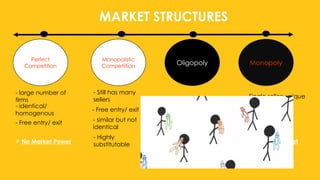
Monopolistic
Competiition Oligopoly
- Still has many
sellers
- Free entry/ exit
- similar but not
identical
- Highly
substitutable
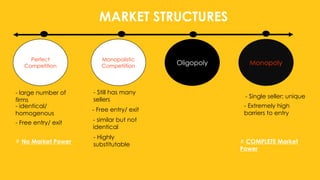
MARKET STRUCTURES
Perfect
Competition Monopoly
- large number of
firms
- identical/
homogenous
- Free entry/ exit
- Single seller; unique
- Extremely high
barriers to entry
# No Market Power # COMPLETE Market
Power
Monopolistic
Competiition Oligopoly
- Still has many
sellers
- Free entry/ exit
- similar but not
identical
- Highly
substitutable
MARKET STRUCTURES
Monopolistic
Competiition
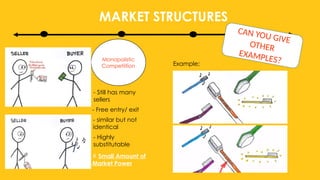
- Still has many
sellers
- Free entry/ exit
- similar but not
identical
- Highly
substitutable
Example:
# Small Amount of
Market Power
CAN YOU GIVE
OTHER
EXAMPLES?
MARKET STRUCTURES
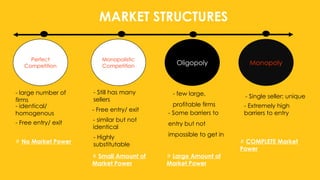
Perfect
Competition Monopoly
- large number of
firms
- identical/
homogenous
- Free entry/ exit
- Single seller; unique
- Extremely high
barriers to entry
# No Market Power # COMPLETE Market
Power
Monopolistic
Competiition Oligopoly
- Still has many
sellers
- Free entry/ exit
- similar but not
identical
- Highly
substitutable
# Small Amount of
Market Power
- few large,
profitable firms
MARKET STRUCTURES
Perfect
Competition Monopoly
- large number of
firms
- identical/
homogenous
- Free entry/ exit
- Single seller; unique
- Extremely high
barriers to entry
# No Market Power # COMPLETE Market
Power
Monopolistic
Competiition Oligopoly
- Still has many
sellers
- Free entry/ exit
- similar but not
identical
- Highly
substitutable
# Small Amount of
Market Power
- few large,
profitable firms
- Some barriers to
entry but not
impossible to get in
MARKET STRUCTURES
Oligopoly
- few large,
profitable firms
- Some barriers to
entry but not
impossible to get in
Example:
- Each firm has a
large chunk in the
market
Collusion Price Fixing
Example: OPPO
AND VIVO
Network Bank and
BDO
CAN YOU GIVE
OTHER
EXAMPLES?
MARKET STRUCTURES
Perfect
Competition Monopoly
- large number of
firms
- identical/
homogenous
- Free entry/ exit
- Single seller; unique
- Extremely high
barriers to entry
# No Market Power # COMPLETE Market
Power
Monopolistic
Competition Oligopoly
- Still has many
sellers
- Free entry/ exit
- similar but not
identical
- Highly
substitutable
# Small Amount of
Market Power
- few large,
profitable firms
- Some barriers to
entry but not
impossible to get in
# Large Amount of
Market Power
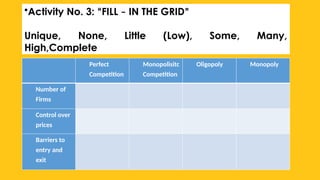
•Activity No. 3: “FILL – IN THE GRID”
Unique, None, Little (Low), Some, Many,
High,Complete
Perfect
Competition
Monopolisitc
Competition
Oligopoly Monopoly
Number of
Firms
Control over
prices
Barriers to
entry and
exit
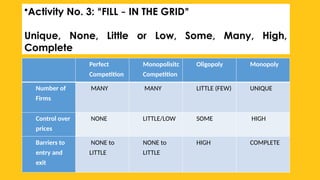
•Activity No. 3: “FILL – IN THE GRID”
Unique, None, Little or Low, Some, Many, High,
Complete
Perfect
Competition
Monopolisitc
Competition
Oligopoly Monopoly
Number of
Firms
MANY MANY LITTLE (FEW) UNIQUE
Control over
prices
NONE LITTLE/LOW SOME HIGH
Barriers to
entry and
exit
NONE to
LITTLE
NONE to
LITTLE
HIGH COMPLETE
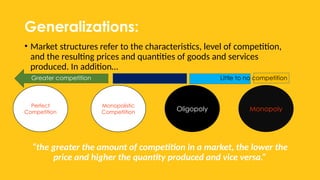
Generalizations:
• Market structures refer to the characteristics, level of competition,
and the resulting prices and quantities of goods and services
produced. In addition…
“the greater the amount of competition in a market, the lower the
price and higher the quantity produced and vice versa.”
Perfect
Competition
Monopoly
Monopolistic
Competiition
Oligopoly
Greater competition Little to no competition
Application : Self- Evaluation
INSTRUCTION: Let’s continue Activity No. 1. Discern what Market Structure does the given
products belong.
Questions?

market-structure.pptx for Applied Economics

  • 1.
  • 2.
    TIME TO THINK 1.What companies do you believe are the largest? 2. Why do you think that these companies are among the largest?
  • 3.
  • 4.
    Learning Competencies: Atthe end of the lesson, the students are expected:  To identify four different types of market structures.  To understand the differences between each type of market structure.  To complete a grid detailing specific aspects of each market. MARKET STRUCTURES
  • 5.
    Activity No. 1“WHAT’S YOUR BET?” TIME TO THINK •How do some products differ from another? Keep your worksheets. We’ll try to go back on that later.
  • 6.
    TIME TO THINK •ActivityNo. 2: “Market Structure Simulation” Price Range: 25 cents to 3 pesos
  • 7.
    MARKET STRUCTURES 1. Whatis market? - an interaction between buyers and sellers. 2. Do you know what are the 4 TYPES OF MARKET STRUCTURE? Perfect Competition Monopoly Monopolistic Competiition Oligopoly
  • 8.
  • 9.
  • 10.
    MARKET STRUCTURES Perfect Competition - largenumber of firms - identical/ homogenous
  • 11.
    MARKET STRUCTURES Perfect Competition - largenumber of firms - identical/ homogenous - Free entry/ exit
  • 12.
    MARKET STRUCTURES Perfect Competition - largenumber of firms - identical/ homogenous - Free entry/ exit - One of the characteristic of PC is that they are efficient. - In a perfectly competitive market, price and output reach their equilibrium levels. Can someone draw a graph showing the equilibrium levels?
  • 13.
  • 14.
    MARKET STRUCTURES Perfect Competition Monopoly -large number of firms - identical/ homogenous - Free entry/ exit - Single seller; unique
  • 15.
    MARKET STRUCTURES Perfect Competition Monopoly -large number of firms - identical/ homogenous - Free entry/ exit - Single seller; unique - Extremely high barriers to entry
  • 16.
    MARKET STRUCTURES Monopoly - Singleseller; unique - Extremely high barriers to entry # COMPLETE Market Power Examples: DASURECO MARWASA MICROSOFT APPLE’S IOS
  • 17.
    MARKET STRUCTURES Perfect Competition Monopoly -large number of firms - identical/ homogenous - Free entry/ exit - Single seller; unique - Extremely high barriers to entry # No Market Power # COMPLETE Market Power
  • 18.
    MARKET STRUCTURES Perfect Competition Monopoly -large number of firms - identical/ homogenous - Free entry/ exit - Single seller; unique - Extremely high barriers to entry # No Market Power # COMPLETE Market Power Monopolistic Competiition Oligopoly
  • 19.
    MARKET STRUCTURES Perfect Competition Monopoly -large number of firms - identical/ homogenous - Free entry/ exit - Single seller; unique - Extremely high barriers to entry # No Market Power # COMPLETE Market Power Monopolistic Competiition Oligopoly - Still has many sellers - Free entry/ exit - similar but not identical
  • 20.
    MARKET STRUCTURES Perfect Competition Monopoly -large number of firms - identical/ homogenous - Free entry/ exit - Single seller; unique - Extremely high barriers to entry # No Market Power # COMPLETE Market Power Monopolistic Competiition Oligopoly - Still has many sellers - Free entry/ exit - similar but not identical - Highly substitutable
  • 21.
    MARKET STRUCTURES Perfect Competition Monopoly -large number of firms - identical/ homogenous - Free entry/ exit - Single seller; unique - Extremely high barriers to entry # No Market Power # COMPLETE Market Power Monopolistic Competiition Oligopoly - Still has many sellers - Free entry/ exit - similar but not identical - Highly substitutable
  • 22.
    MARKET STRUCTURES Monopolistic Competiition - Stillhas many sellers - Free entry/ exit - similar but not identical - Highly substitutable Example: # Small Amount of Market Power CAN YOU GIVE OTHER EXAMPLES?
  • 23.
    MARKET STRUCTURES Perfect Competition Monopoly -large number of firms - identical/ homogenous - Free entry/ exit - Single seller; unique - Extremely high barriers to entry # No Market Power # COMPLETE Market Power Monopolistic Competiition Oligopoly - Still has many sellers - Free entry/ exit - similar but not identical - Highly substitutable # Small Amount of Market Power - few large, profitable firms
  • 24.
    MARKET STRUCTURES Perfect Competition Monopoly -large number of firms - identical/ homogenous - Free entry/ exit - Single seller; unique - Extremely high barriers to entry # No Market Power # COMPLETE Market Power Monopolistic Competiition Oligopoly - Still has many sellers - Free entry/ exit - similar but not identical - Highly substitutable # Small Amount of Market Power - few large, profitable firms - Some barriers to entry but not impossible to get in
  • 25.
    MARKET STRUCTURES Oligopoly - fewlarge, profitable firms - Some barriers to entry but not impossible to get in Example: - Each firm has a large chunk in the market Collusion Price Fixing Example: OPPO AND VIVO Network Bank and BDO CAN YOU GIVE OTHER EXAMPLES?
  • 26.
    MARKET STRUCTURES Perfect Competition Monopoly -large number of firms - identical/ homogenous - Free entry/ exit - Single seller; unique - Extremely high barriers to entry # No Market Power # COMPLETE Market Power Monopolistic Competition Oligopoly - Still has many sellers - Free entry/ exit - similar but not identical - Highly substitutable # Small Amount of Market Power - few large, profitable firms - Some barriers to entry but not impossible to get in # Large Amount of Market Power
  • 27.
    •Activity No. 3:“FILL – IN THE GRID” Unique, None, Little (Low), Some, Many, High,Complete Perfect Competition Monopolisitc Competition Oligopoly Monopoly Number of Firms Control over prices Barriers to entry and exit
  • 28.
    •Activity No. 3:“FILL – IN THE GRID” Unique, None, Little or Low, Some, Many, High, Complete Perfect Competition Monopolisitc Competition Oligopoly Monopoly Number of Firms MANY MANY LITTLE (FEW) UNIQUE Control over prices NONE LITTLE/LOW SOME HIGH Barriers to entry and exit NONE to LITTLE NONE to LITTLE HIGH COMPLETE
  • 29.
    Generalizations: • Market structuresrefer to the characteristics, level of competition, and the resulting prices and quantities of goods and services produced. In addition… “the greater the amount of competition in a market, the lower the price and higher the quantity produced and vice versa.” Perfect Competition Monopoly Monopolistic Competiition Oligopoly Greater competition Little to no competition
  • 30.
    Application : Self-Evaluation INSTRUCTION: Let’s continue Activity No. 1. Discern what Market Structure does the given products belong.
  • 31.

Editor's Notes

  • #1 1. What are 3 the price elasticity of demand? 2. What determines own price? Cross Price? Income? What if the result of your own price is -0.46, how would you interpret that? Negative relship, inelastic Cross price ? Price of related products , complementary inelastic Good to know that you remember all those.
  • #5 I will distribute worksheets for you to answer. You just determine the top 3 brands that you prefer in each category. I will give you 2 minutes to answer
  • #6 Group 1 (1student)– not talk to anyone 2 (3 students)- allowed to talk to each other but not to ither groups 3 (3 students)- not allowed to talk 4. (the rest of the group) Allowed to talk to each other After… Can you gues which among the 4 groups represented pc? Monopoly? MC? Oli?
  • #14 1. Opposite of pc is MONO 2.Based on our activity, how can you describe MONO? 3. Can you still call mono a market even it has only one seller?
  • #22 Other examples: shampoo, shoes, pants, coffee