What is Application Letter?
A letter contains detailed information on why are you are
qualified for the job you are applying for. Effective
application letters explain the reasons for your interest in
the specific organization and identify your most relevant
skills or experiences.
Your application letter should let the employer know what
position you are applying for, why the employer should
select you for an interview, and how you will follow-up.
Points in Writing Application Letter
First Paragraph: Why you are
writing – mention the job you are
applying for and where you found
the listing.
Middle Paragraphs: What you
have to offer the employer –
mention why your skills and
experience are a good fit for the
job.
Last Paragraph: Say thank you
to the hiring manager for
considering you and note how you
will follow up.
What You
Should Do
in Writing
Application Letter?
1
Make it easy for them to contact you
Include some sort of contact information in the letter. This
information should be excluded from the body of the
letter and in one designated place. At the very least, you
should have your full name, address, professional email
and phone name. Your email should be appropriate and an
account that you check often. Don’t put the throwaway
account that you use for mailing lists. It is vital that an
employer is able to contact you especially if you really
want the job.
2
In the introduction, mention to the employer how
you found the job listing and why you are attracted
to the position
Be specific! The information about the job listing will be
helpful to the company and explaining why you are drawn
to the job conveys a genuine interest. Talk about why you
would like to work there. Including details of what you
like about the company shows some passion.
3
Be sure to mention your strengths regarding the
position
It’s important to talk about traits that are relevant to the
job listing. Your application letter is a great place to
mention them and then expand on how they would apply
to the position. This is beneficial because employers
wouldn’t get this information from your resume.
4
Relate the job listing to previous work experience
If you include specific examples of similar work that you
have done, then you show the employer that you are
knowledgeable about the tasks that the job will entail.
Providing concrete examples is a great way to illustrate
your accomplishments instead of just talking about them.
5
Speak a little bit about what you can bring to the
table
This would be a good time to mention anything that sets
you apart from other applicants. Tell how you can
complement the team and provide balance in the office.
What do you have that the company needs or wants?
6
Make sure your letter is polite, formal and
condensed
Use the correct language and avoid any slang. Keep the
letter to a page. Add a personal touch by signing the letter
in pen. Also, take initiative by stating how you will follow
up with them whether it will be an email or a request for
an interview. Thank them for their time and
consideration.
What You
Shouldn’t Do
in Writing
Application Letter?
1
Start off your letter with “To Whom It May Concern.”
This is lazy and very general. Find out who will be
receiving your application letter and resume, and then
address them directly. If you aren’t sure, then inquire so
that you are able to provide a detailed salutation instead
of a vague greeting.
2
Write a catch-all letter
Although it might seem easier to write one application
letter for every job listing that you intend on applying for,
it won’t work out in the end. Make sure you write
specifically to each employer so that you can cater your
letter to the company. Each position is different and
therefore requires a different letter that can extol your
virtues relevant to that particular job.
3
Include irrelevant information
Your letter is only one page so it is important to cut out
anything that isn’t vital for the employer to know. Some
work experience isn’t pertinent and there is no space to
address your weaknesses in an application letter. Stick to
positive and relevant information that will support your
resume instead of detracting from it with excess material.
4
Say why you are looking for a new job
Your future employer doesn’t need to know why you left
your old job or the circumstances surrounding it. Also,
refrain from speaking badly about coworkers or bosses
from previous jobs. An application letter is supposed to
help you get the position, not the opposite. Only talk about
how you can benefit the company by taking the job.
5
Give excruciating detail
Remember, the letter is only supposed to be a page so
excessive detail is unnecessary. Keep your points brief and
to the point. Sentences should be short and simple. Tell the
employer what they need to know to make your resume
stand out and highlight the important parts of your
professional life.
6
Send your letter without proofreading
Typos, bad grammar and spelling mistakes will surely be
noticed by the employer. That can make you look
unprofessional and careless. Be sure to read your
application letter at least three times on separate
occasions. Also, get a friend to read it over to make sure
there aren’t any mistakes and that it flows nicely. There’s
nothing worse than sending off your application and then
discovering a flaw.
WHAT ARE
THE DIFFERENCES
BETWEEN
COVER LETTER
AND
APPLICATION LETTER?
Cover Letter Versus
Application Letter Introductions
COVER LETTER APPLICATION LETTER
1. Cover letters typically contain a
brief introduction.
2. The introduction in a cover letter
consists of three to four sentences
about the job seeker's work
experiences, education,
accomplishments and the type of
organizations he feels are best
suited for his qualifications.
1. An application letter might contain
a more extensive introduction simply
because this letter serves a purpose
that's similar to the resume.
Example of Application Letter:
Dear (Hiring Executive),
Please accept my enclosed application for the position of
executive assistant to your Vice President of Operations. I'm
pleased to say that my qualifications match your job
requirements perfectly. In my current role with Genex
Engineering, I handle all of the same duties and much
more as executive assistant to the president and CEO for
the past four years. My experience, education (bachelor's
degree), strong communication skills and ability to
manage complex tasks and solve problems makes me an
ideal candidate for your position.
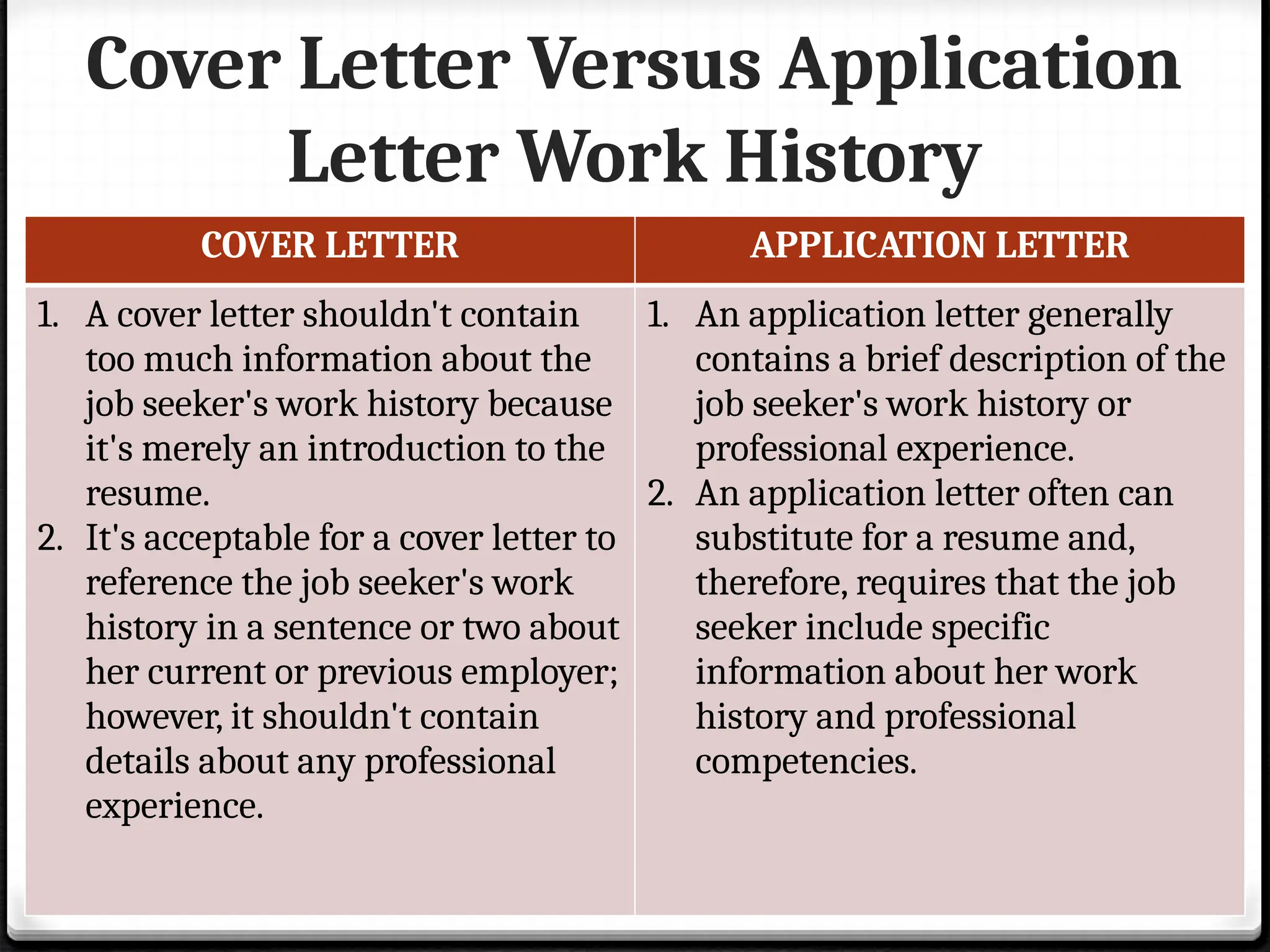
Cover Letter Versus Application
Letter Work History
COVER LETTER APPLICATION LETTER
1. A cover letter shouldn't contain
too much information about the
job seeker's work history because
it's merely an introduction to the
resume.
2. It's acceptable for a cover letter to
reference the job seeker's work
history in a sentence or two about
her current or previous employer;
however, it shouldn't contain
details about any professional
experience.
1. An application letter generally
contains a brief description of the
job seeker's work history or
professional experience.
2. An application letter often can
substitute for a resume and,
therefore, requires that the job
seeker include specific
information about her work
history and professional
competencies.
Cover Letter Versus
Application Letter Content
COVER LETTER APPLICATION LETTER
1. A cover letter is a teaser. Its
intent is to capture the
reader's attention enough to
make the recruiter or hiring
manager want to review the
resume.
2. The cover letter should
contain just enough
information that it doesn't
give away everything about
the applicant.
1. An application letter is a more
comprehensive document. It
describes the applicant's
educational background,
certifications and licenses, and
in some cases, salary history for
job postings that require it.
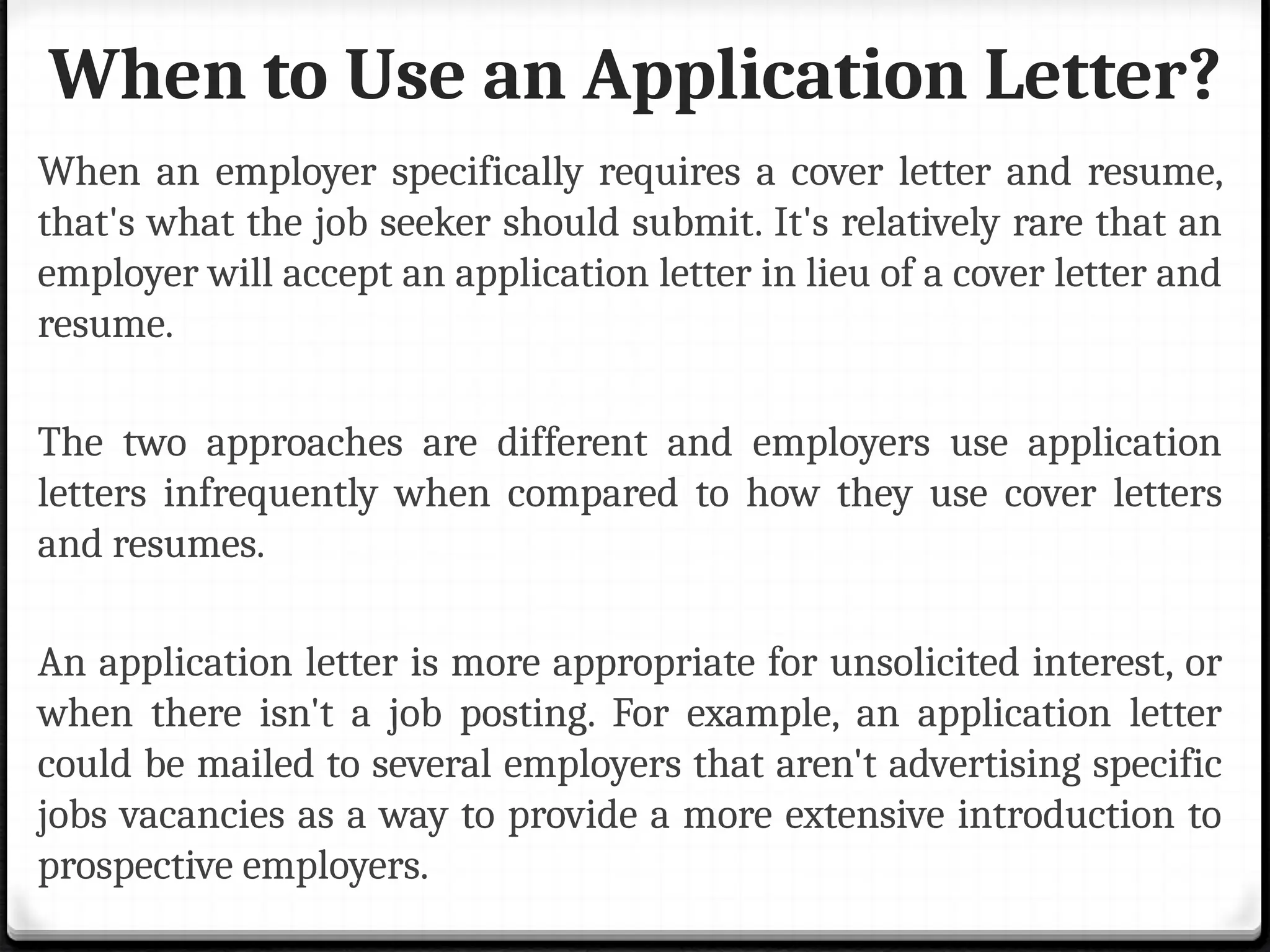
When to Use an Application Letter?
When an employer specifically requires a cover letter and resume,
that's what the job seeker should submit. It's relatively rare that an
employer will accept an application letter in lieu of a cover letter and
resume.
The two approaches are different and employers use application
letters infrequently when compared to how they use cover letters
and resumes.
An application letter is more appropriate for unsolicited interest, or
when there isn't a job posting. For example, an application letter
could be mailed to several employers that aren't advertising specific
jobs vacancies as a way to provide a more extensive introduction to
prospective employers.
Uses of Cover Letters and
Application Letters
COVER LETTER APPLICATION LETTER
1. A cover letter is almost
always used to express
interest in
employment.
2. Employers don't
always require a cover
letter, but it's always a
good idea to use a
cover letter.
1. An application letter can be used for
employment purposes; however, it
can also be used for applying for a
place in an academic program or an
internship program.
2. an application letter might be the
only requirement sought by schools
or employers – with an application
letter, it may not always be necessary
to include a resume.

Power point of Materi Application Letter i

  • 1.
    What is ApplicationLetter? A letter contains detailed information on why are you are qualified for the job you are applying for. Effective application letters explain the reasons for your interest in the specific organization and identify your most relevant skills or experiences. Your application letter should let the employer know what position you are applying for, why the employer should select you for an interview, and how you will follow-up.
  • 2.
    Points in WritingApplication Letter First Paragraph: Why you are writing – mention the job you are applying for and where you found the listing. Middle Paragraphs: What you have to offer the employer – mention why your skills and experience are a good fit for the job. Last Paragraph: Say thank you to the hiring manager for considering you and note how you will follow up.
  • 3.
    What You Should Do inWriting Application Letter?
  • 4.
    1 Make it easyfor them to contact you Include some sort of contact information in the letter. This information should be excluded from the body of the letter and in one designated place. At the very least, you should have your full name, address, professional email and phone name. Your email should be appropriate and an account that you check often. Don’t put the throwaway account that you use for mailing lists. It is vital that an employer is able to contact you especially if you really want the job.
  • 5.
    2 In the introduction,mention to the employer how you found the job listing and why you are attracted to the position Be specific! The information about the job listing will be helpful to the company and explaining why you are drawn to the job conveys a genuine interest. Talk about why you would like to work there. Including details of what you like about the company shows some passion.
  • 6.
    3 Be sure tomention your strengths regarding the position It’s important to talk about traits that are relevant to the job listing. Your application letter is a great place to mention them and then expand on how they would apply to the position. This is beneficial because employers wouldn’t get this information from your resume.
  • 7.
    4 Relate the joblisting to previous work experience If you include specific examples of similar work that you have done, then you show the employer that you are knowledgeable about the tasks that the job will entail. Providing concrete examples is a great way to illustrate your accomplishments instead of just talking about them.
  • 8.
    5 Speak a littlebit about what you can bring to the table This would be a good time to mention anything that sets you apart from other applicants. Tell how you can complement the team and provide balance in the office. What do you have that the company needs or wants?
  • 9.
    6 Make sure yourletter is polite, formal and condensed Use the correct language and avoid any slang. Keep the letter to a page. Add a personal touch by signing the letter in pen. Also, take initiative by stating how you will follow up with them whether it will be an email or a request for an interview. Thank them for their time and consideration.
  • 10.
    What You Shouldn’t Do inWriting Application Letter?
  • 11.
    1 Start off yourletter with “To Whom It May Concern.” This is lazy and very general. Find out who will be receiving your application letter and resume, and then address them directly. If you aren’t sure, then inquire so that you are able to provide a detailed salutation instead of a vague greeting.
  • 12.
    2 Write a catch-allletter Although it might seem easier to write one application letter for every job listing that you intend on applying for, it won’t work out in the end. Make sure you write specifically to each employer so that you can cater your letter to the company. Each position is different and therefore requires a different letter that can extol your virtues relevant to that particular job.
  • 13.
    3 Include irrelevant information Yourletter is only one page so it is important to cut out anything that isn’t vital for the employer to know. Some work experience isn’t pertinent and there is no space to address your weaknesses in an application letter. Stick to positive and relevant information that will support your resume instead of detracting from it with excess material.
  • 14.
    4 Say why youare looking for a new job Your future employer doesn’t need to know why you left your old job or the circumstances surrounding it. Also, refrain from speaking badly about coworkers or bosses from previous jobs. An application letter is supposed to help you get the position, not the opposite. Only talk about how you can benefit the company by taking the job.
  • 15.
    5 Give excruciating detail Remember,the letter is only supposed to be a page so excessive detail is unnecessary. Keep your points brief and to the point. Sentences should be short and simple. Tell the employer what they need to know to make your resume stand out and highlight the important parts of your professional life.
  • 16.
    6 Send your letterwithout proofreading Typos, bad grammar and spelling mistakes will surely be noticed by the employer. That can make you look unprofessional and careless. Be sure to read your application letter at least three times on separate occasions. Also, get a friend to read it over to make sure there aren’t any mistakes and that it flows nicely. There’s nothing worse than sending off your application and then discovering a flaw.
  • 17.
    WHAT ARE THE DIFFERENCES BETWEEN COVERLETTER AND APPLICATION LETTER?
  • 18.
    Cover Letter Versus ApplicationLetter Introductions COVER LETTER APPLICATION LETTER 1. Cover letters typically contain a brief introduction. 2. The introduction in a cover letter consists of three to four sentences about the job seeker's work experiences, education, accomplishments and the type of organizations he feels are best suited for his qualifications. 1. An application letter might contain a more extensive introduction simply because this letter serves a purpose that's similar to the resume.
  • 19.
    Example of ApplicationLetter: Dear (Hiring Executive), Please accept my enclosed application for the position of executive assistant to your Vice President of Operations. I'm pleased to say that my qualifications match your job requirements perfectly. In my current role with Genex Engineering, I handle all of the same duties and much more as executive assistant to the president and CEO for the past four years. My experience, education (bachelor's degree), strong communication skills and ability to manage complex tasks and solve problems makes me an ideal candidate for your position.
  • 20.
    Cover Letter VersusApplication Letter Work History COVER LETTER APPLICATION LETTER 1. A cover letter shouldn't contain too much information about the job seeker's work history because it's merely an introduction to the resume. 2. It's acceptable for a cover letter to reference the job seeker's work history in a sentence or two about her current or previous employer; however, it shouldn't contain details about any professional experience. 1. An application letter generally contains a brief description of the job seeker's work history or professional experience. 2. An application letter often can substitute for a resume and, therefore, requires that the job seeker include specific information about her work history and professional competencies.
  • 22.
    Cover Letter Versus ApplicationLetter Content COVER LETTER APPLICATION LETTER 1. A cover letter is a teaser. Its intent is to capture the reader's attention enough to make the recruiter or hiring manager want to review the resume. 2. The cover letter should contain just enough information that it doesn't give away everything about the applicant. 1. An application letter is a more comprehensive document. It describes the applicant's educational background, certifications and licenses, and in some cases, salary history for job postings that require it.
  • 23.
    When to Usean Application Letter? When an employer specifically requires a cover letter and resume, that's what the job seeker should submit. It's relatively rare that an employer will accept an application letter in lieu of a cover letter and resume. The two approaches are different and employers use application letters infrequently when compared to how they use cover letters and resumes. An application letter is more appropriate for unsolicited interest, or when there isn't a job posting. For example, an application letter could be mailed to several employers that aren't advertising specific jobs vacancies as a way to provide a more extensive introduction to prospective employers.
  • 24.
    Uses of CoverLetters and Application Letters COVER LETTER APPLICATION LETTER 1. A cover letter is almost always used to express interest in employment. 2. Employers don't always require a cover letter, but it's always a good idea to use a cover letter. 1. An application letter can be used for employment purposes; however, it can also be used for applying for a place in an academic program or an internship program. 2. an application letter might be the only requirement sought by schools or employers – with an application letter, it may not always be necessary to include a resume.