SUSTAINABLE DEVELOPMENT AND
INNOVATION CENTRE (SUDEIC)
Kindly off your phones!
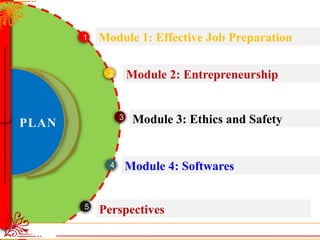
Module 1: Effective Job Preparation
Module 2: Entrepreneurship
Module 3: Ethics and Safety
Module 4: Softwares
1
2
3
4
Perspectives
5
PLAN
Module 1: Effective Job Preparation
Job Search Strategies
Assess Your Situation
• What type of job are you seeking?
• Short-term vs Long-term
• Pay bills, get experience, or both
• What are your qualifications?
• Why hire you?
• Where are you likely to have success?
• What industries/fields are hiring - https://candor.co/hiring-freezes/
https://github.com/gcreddy42/hiring2020, and more!
Be flexible, compromise, adjust expectations
Stay connected and build personal and professional network
Requires an action-oriented mindset
Stay Focused
• Look at the scope of your job search
• Geographic, industry, job title, organization size
• Look to continually improve (assess the process)
• Be realistic
• Remain confident
• Make it part of your day
Break it down…
• Focus First on Organizations—Not just Openings
• Find Offline Jobs and/or Contacts
• Locate small/medium employers in your area
• Cold call or email
• Connect with local Chamber of Commerce
• Reach out to faculty, advisors, relatives and friends
• Dust off your Materials
• Prospecting emails
• Resume
• Cover letter
• LinkedIn profile
• Handshake account
Plan it out…
• Expand your network
• TALK to people
• “Go” to where they are
• Virtual fairs
• Information sessions
• Virtual conferences
• Know what you need, want and dream of
• What do you need for salary
• Short vs long term – 40-year career
• Keep skills sharp for transition
• Location
• Prioritize mobility over loyalty to a single organization
Take action!
• Contact
• Recruiters
• Friends
• Family
• Faculty
• Create a relationship (for now or later)
• Alumni
• Apply
• Online
• Email
• Follow-up
LETTERS AND RESUME
Module 1: Effective Job Preparation
What is a motivation letter?
• A motivation letter is a one-page letter that’s used to describe why
you are the perfect candidate for a certain position.
• You are required to write a motivation letter in these specific
scenarios:
• You are applying to get admitted to an educational program at a
college or university
• You are applying as a volunteer in an organization
• You’re applying for an internship in a company.
Make sure you follow these six
steps
• Include the basics
• Write about what makes you unique
• Give concrete examples of what you have done and why it is
relevant for the job
• Be prepared – Know the basics about the company
• Make sure you explain why you've applied for the role
• Be interesting.
Each motivation letter consists of 3 main
parts:
• the introduction – introduce yourself and your
intent in the introduction,
• body – describe and highlight your
experiences in the body, and
•
• conclusion – thank the reader for his/her
consideration in the conclusion.
Introduction:
• A short, engaging pitch about yourself and why you
are applying. Here, you can include:
• Personal information. Who are you and what do you
do?
• What are you applying for? Where?
• Mention the general reason on why you’re applying,
and then deep-dive in the bulk of your motivation
letter.
• (don’t forget to mention contact information on top.)
Example of Introduction for Motivation
Letter
• Dear [Sir/Mme],
• My name is [Your name] and I would like to
express my interest in applying for the [e.g.
Master’s degree program] in [e.g. Economics]
at [University Name]. I’ve always dreamed of
advancing my knowledge of [e.g. Market
regulation and design], and I believe that an
MA in Economics from [University Name] would
set me miles ahead to reaching my goal.
Body of the Motivation Letter
• This is the main bulk of your motivation letter, and where
you mention stories behind your achievements, skills, and
passion for whatever you’re applying for.
• Look at the program requirements and the institution’s
website. Find out the top three requirements for the
position and explain how you are the best candidate.
• Demonstrate that you share the organization’s values or
are exceptionally qualified through a short story or
personal examples. Be specific.
Things You Can Mention in Your Motivation
Letter:
• My passion for ______ started when ______.
• I want to ______ because ______.
• I have been part of _________ for ___ months/years.
It’s the best thing for me because _______.
• I remember once when I ________, which made me
realize that I _______.
• _______ resonates with me because _________.
• What distinguishes me from my peers is __________.
Conclusion
• In this section, you can:
• Briefly summarize your main points - “I believe I’d be
a good fit for the program because of __________”
• Mention your overarching goal - “I’d love to be a
part of _______, as it would allow me to
___________.”
• Thank the reader and conclude the motivation letter
Cover Letters
 Reflects your attitude
 Provides specifically requested
information
 Indicates what you will do to follow up
 Writing sample
More purposes…
Parts
There are three basic parts to a cover letter:
 An introduction - a statement of who you are and
why you are sending the letter
 A sales pitch - an overview of your qualifications,
skills, abilities, and accomplishments
 A call to action - a request for a specific action such
as an interview
Ideally, you will cover these three basic parts in just 3 - 5
concise paragraphs typed on one page. The following
is an outline of how the "typical" cover letter content
is organized.
First Paragraph
Introduction
statement of who you are and why you are
sending the letter
 Immediately state the position you are
interested in and the reason that you would
be the best candidate for this position.
 If you are responding to an advertisement,
state this.
 If you have been doing research into the
company, this is a good place to mention it.
Second Paragraph
A sales pitch
an overview of your qualifications, skills,
abilities, and accomplishments
 Discuss your qualifications and show how the
company will benefit from them.
 Highlight your special accomplishments. Consider
using bullets to make these stand out.
 If you are responding to an advertisement, use
this paragraph to detail how your background
parallels the qualification requirements mentioned
in the ad.
 Don't feel that you need to write a detailed
synopsis of your employment history. Include just
the highlights and the pertinent information.
Third Paragraph
A call to action
a request for a specific action such as an
interview
 Make it clear to the reader that you would
like to speak to them in person.
 Specifically ask for an interview and make
sure that you include your telephone
number and any special instructions to
reach you.
 Alternatively, write that you will follow up
with a telephone call on a specific date at a
specific time and then make sure that you
do.
Step 4
Closing
 The closing of your letter should appear two lines
under the body. Align this with your return address.
This may be either on the right or left margin,
depending on the style you chose.
 A simple "Sincerely," will usually be fine. Under this,
apply four lines and type your name. Make certain
that after the letter is printed, you insert your
signature above this.
 Type an enclosure line on the left margin and several
lines under your name. This may be in the form
"Enclosure" or "Enc. resume".
Finally
 Whenever possible, use an envelope that matches
your paper.
 Try to avoid using mailing labels as this makes your
envelope look similar to a bulk mailing and it may not
be opened.
 Although it is acceptable to hand address or type the
envelope, some experts believe that a hand written
envelope will be more likely to be noticed and opened
as it resembles personal correspondence. If you have
the time and are sending only a few letters at a time,
you may wish to use this method, otherwise, it may
be more efficient to print the envelopes using a mail
merge program.
 Sounds like a form letter
 “To whom it may concern”
 Not using the company’s name
 Too long
 Not demonstrating how your background and
skills are a fit for the position
 Using an inappropriate writing style
Common cover letter mistakes
 Individualize
 Edit your writing
 Grammar, spelling and punctuation
 Be yourself
 Matching paper
 Keep records
Correspondence
Usually 3 - 5 individuals
Choose carefully
ALWAYS ask first
References
Provide a copy of your resume
Keep references informed
List references on a separate
page
More on references
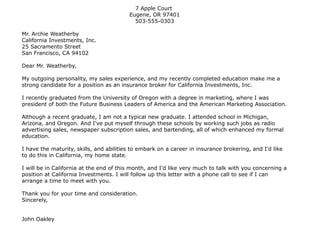
7 Apple Court
Eugene, OR 97401
503-555-0303
Mr. Archie Weatherby
California Investments, Inc.
25 Sacramento Street
San Francisco, CA 94102
Dear Mr. Weatherby,
My outgoing personality, my sales experience, and my recently completed education make me a
strong candidate for a position as an insurance broker for California Investments, Inc.
I recently graduated from the University of Oregon with a degree in marketing, where I was
president of both the Future Business Leaders of America and the American Marketing Association.
Although a recent graduate, I am not a typical new graduate. I attended school in Michigan,
Arizona, and Oregon. And I've put myself through these schools by working such jobs as radio
advertising sales, newspaper subscription sales, and bartending, all of which enhanced my formal
education.
I have the maturity, skills, and abilities to embark on a career in insurance brokering, and I'd like
to do this in California, my home state.
I will be in California at the end of this month, and I'd like very much to talk with you concerning a
position at California Investments. I will follow up this letter with a phone call to see if I can
arrange a time to meet with you.
Thank you for your time and consideration.
Sincerely,
John Oakley
Writing A Resume
What is a Resume?
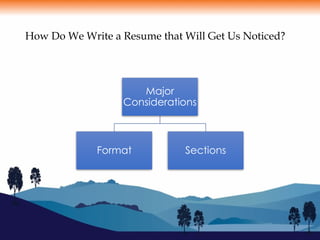
How Do We Write a Resume that Will Get Us Noticed?
Major
Considerations
Format Sections
Format
Format is essentially the way something is arranged or laid out.
Resume Format Expectations:
No more than one page in length for beginners
Margins between should be very small
Make the most out of the space on the document
(avoid too much or too little white space)
List content in reverse chronological order
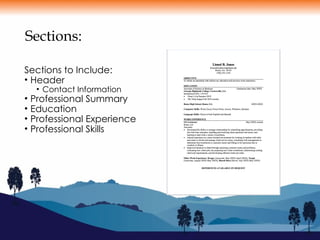
Sections:
Sections to Include:
• Header
• Contact Information
• Professional Summary
• Education
• Professional Experience
• Professional Skills
The Header
The Header should include your
name, and your most recent
contact information.
• First Name Last Name
• Email Address
• Phone Number
• Location (City and State)
Tips*
• Make a professional email that
includes your name, not a
username.
• If you have a LinkedIn, include
a link to your profile in your
header.
Professional Summary (Objective)
A professional summary is a brief summary of your skills, expertise
and career objective.
• Include the title of your current position or expertise
• "English Teacher" or "Digital Marking Specialist"
• "Passionate English educator with four years of experience in a post-
secondary education setting. Seeking to use knowledge of writing process,
high-impact teaching practices, and literary works to improve student success
rates in Imaginary University."
Education
In this section include your
degree information
1. Program Name/ Degree Title
1. Bachelor of Arts in English
Literature
2. University Name
3. Graduation Year
Optional Sections:
• GPA
• Honors
• Academic Achievements/ awards
• Minor
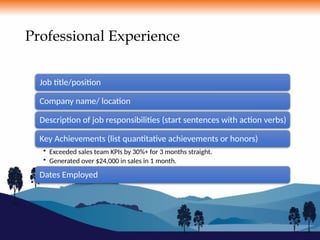
Professional Experience
Job title/position
Company name/ location
Description of job responsibilities (start sentences with action verbs)
Key Achievements (list quantitative achievements or honors)
• Exceeded sales team KPIs by 30%+ for 3 months straight.
• Generated over $24,000 in sales in 1 month.
Dates Employed
Skills
Include hard and soft skills:
Optional Sections
Characteristics Of A
Successful Resume
 Must always be 100% truthful.
 Contains no inappropriate personal information.
 Produced on a computer.
 Data presented in chronological order (unless functional).
Resume Writing Tips!
• Be consistent with your formatting- consistent formatting makes your resume scannable!
• Length & Margins - One page and margins no smaller than .5 inches.
• Watch your verb tenses - If you are still currently in a position, use present tense. If the position
was in the past, use past tense.
• Voice- Avoid first person pronouns.
• Keep it to one page.
• Proofread!
JOB INTERVIEW
P R E S E N T A T I O N T E M P L A T E
AGENDA
• Describe yourself
• Strengths and Weaknesses
• Why do you want this job?
• Your career 5 years from now
• Previous Companies
• What do you know about us?
• Proposal
• Compensation / Salary
• Future
DESCRIBE YOURSELF?
I am ambitious and driven. I thrive on challenge
and constantly set goals for myself, so I have
something to strive toward. I’m not comfortable
with settling, and I’m always looking for an
opportunity to do better and achieve greatness.
In my previous role, I was promoted three times
in less than two years.
ASHU UNIQUE N
How would you
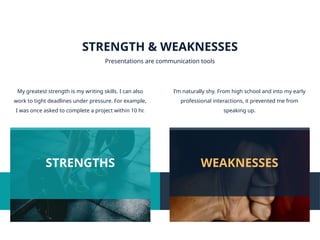
STRENGTH & WEAKNESSES
Presentations are communication tools
STRENGTHS WEAKNESSES
My greatest strength is my writing skills. I can also
work to tight deadlines under pressure. For example,
I was once asked to complete a project within 10 hr.
I’m naturally shy. From high school and into my early
professional interactions, it prevented me from
speaking up.
THIS JOB?
Why do you want
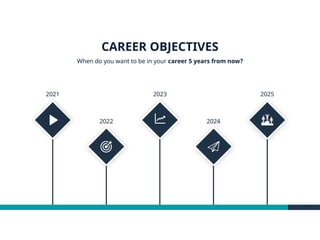
CAREER OBJECTIVES
When do you want to be in your career 5 years from now?
2021
2022
2023
2024
2025
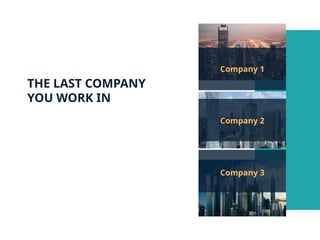
THE LAST COMPANY
YOU WORK IN
Company 1
Company 2
Company 3
KNOW ABOUT OUR COMPANY
What do you
Our Values, Our Culture, Our Mission
PROPOSAL
Module 3: ETHICS AND SAFETY
ETHICS
The Learning Goals:
The importance of developing a
strong work ethic and how the
work ethic you develop will
impact your future as an
employee.
Work Ethic
Presented By: ASHU UNIQUE
What is Work Ethic?
The Definition:
A standard of conduct and values
for job performance
In specific terms, work ethics is about what is morally
correct, honourable and acceptable to the larger
majority of the people of an organization, society or
group.
Top 10 Work Ethics
 Attendance
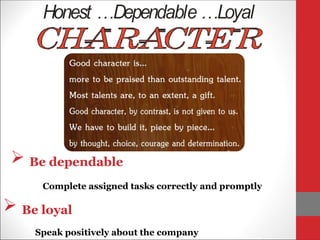
 Character
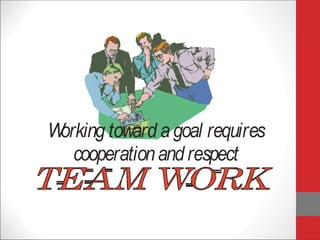
 Team Work
 Appearance
 Attitude
 Productivity
 Organizational Skills
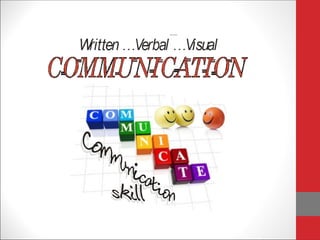
 Communication
 Cooperation
 Respect
 Limit Absences
Be at work every day possible
Plan your absences
Don’t abuse leave time
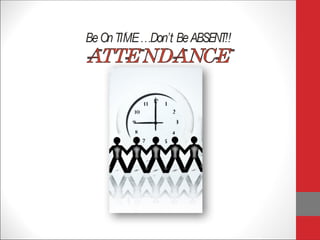
 Come to work on time
Be punctual every day
 Be dependable
Complete assigned tasks correctly and promptly
 Be loyal
Speak positively about the company
 Leadership abilities
The ability to be led and/or to become the leader
 Be a team player
The ability to get along with others – including those you
don’t necessarily like, Cooperation is the key
to productivity
 Be a contributing member
The ability to carry your own weight and help others
who are struggling
 Accept compromise
Recognize when to speak up with an idea and when
to compromise by blending ideas together
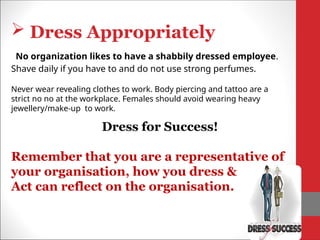
 Dress Appropriately
No organization likes to have a shabbily dressed employee.
Shave daily if you have to and do not use strong perfumes.
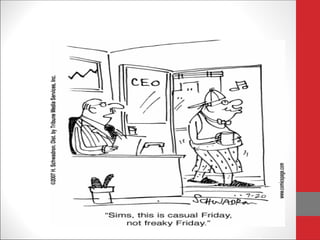
Dress for Success!
Remember that you are a representative of
your organisation, how you dress &
Act can reflect on the organisation.
Never wear revealing clothes to work. Body piercing and tattoo are a
strict no no at the workplace. Females should avoid wearing heavy
jewellery/make-up to work.
 Good manners
• Maintain good eye contact
• Monitor the volume of conversations
• Keep personal telephone conversations and emails to a minimum
• Maintain privacy - keep all workplace conversations professional
• Avoid interruptions & Use appropriate tone of Voice
• Appropriate introductions – introduce someone by their title
and last name (Ms. Mrs. Mr. Dr. ), unless otherwise specified
•Be a good Listener & Soft spoken.
•Show common respect and consideration for others
Remember that the first impression of who
you are can last a lifetime
 Have a good attitude
Listen to suggestions, Be positive
 Accept responsibility for ones work
If you make a mistake, admit it
 Take pride in your work
Do things the best you know how
 Don’t be dissatisfied all the time
You agreed to the work/pay/hours
 Written Communications
Being able to correctly write
reports and memos
 Verbal Communications
Being able to communicate one on one
or to a group
 Work hard
Work to the best of your ability
Traits of a Winning Employee
 Carry out orders
Do what’s asked the first time
 Show respect
Accept and acknowledge an
individuals talents and knowledge
Thank you
Whatever you do just do it with all your heart…..
Module 3: ETHICS AND SAFETY
SAFETY
Graham Twiby 76
Health & Safety in all industries
Safety signs
By
Engr. ASHU UNIQUE N.
Graham Twiby 77
Safety signs and the law
•The Health and Safety (Safety Signs and
Signals) Regulations require employers to
provide safety signs to raise awareness of risks
to health and safety.
•There are four types of safety signs in general
use.
•Each has a designated shape and colour.
•They make sure that information is given in a
standard format with minimum use of words.
Graham Twiby 78
Safety signs
Remember the general duty of employees:
•cooperate with your employer by observing
signs;
•comply with the law and your employer’s safe
systems of work;
•make proper and correct use of safety
equipment;
•don’t tamper with, deface, or remove safety
signs.
Graham Twiby 79
Safety Signs
Contents
Introduction to safety signs.
Prohibition signs
Mandatory signs
Warning signs
Fire signs.
Information signs.
Graham Twiby 80
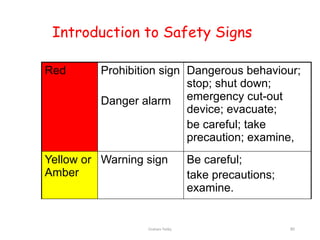
Introduction to Safety Signs
Red Prohibition sign
Danger alarm
Dangerous behaviour;
stop; shut down;
emergency cut-out
device; evacuate;
be careful; take
precaution; examine,
Yellow or
Amber
Warning sign Be careful;
take precautions;
examine.
Graham Twiby 81
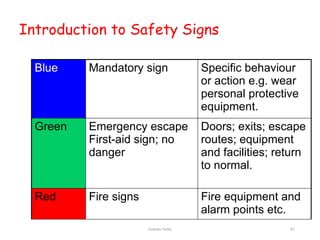
Introduction to Safety Signs
Blue Mandatory sign Specific behaviour
or action e.g. wear
personal protective
equipment.
Green Emergency escape
First-aid sign; no
danger
Doors; exits; escape
routes; equipment
and facilities; return
to normal.
Red Fire signs Fire equipment and
alarm points etc.
Graham Twiby 82
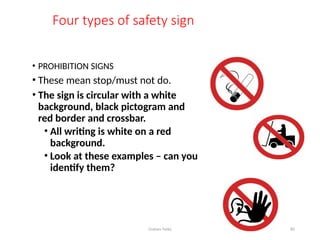
Four types of safety sign
• PROHIBITION SIGNS
• These mean stop/must not do.
• The sign is circular with a white
background, black pictogram and
red border and crossbar.
• All writing is white on a red
background.
• Look at these examples – can you
identify them?
Graham Twiby 83
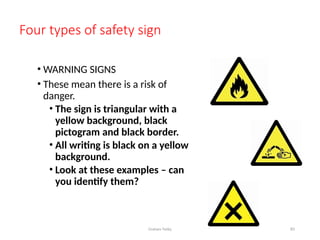
Four types of safety sign
• WARNING SIGNS
• These mean there is a risk of
danger.
• The sign is triangular with a
yellow background, black
pictogram and black border.
• All writing is black on a yellow
background.
• Look at these examples – can
you identify them?
Graham Twiby 84
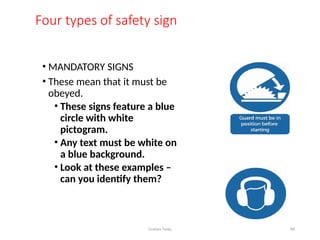
Four types of safety sign
• MANDATORY SIGNS
• These mean that it must be
obeyed.
• These signs feature a blue
circle with white
pictogram.
• Any text must be white on
a blue background.
• Look at these examples –
can you identify them?
Graham Twiby 85
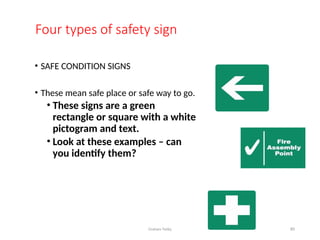
Four types of safety sign
• SAFE CONDITION SIGNS
• These mean safe place or safe way to go.
• These signs are a green
rectangle or square with a white
pictogram and text.
• Look at these examples – can
you identify them?
Graham Twiby 86
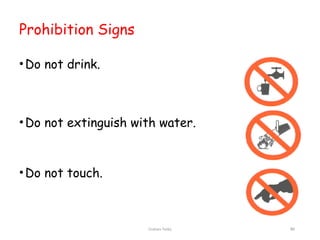
Prohibition Signs
•Do not drink.
•Do not extinguish with water.
•Do not touch.
Graham Twiby 87
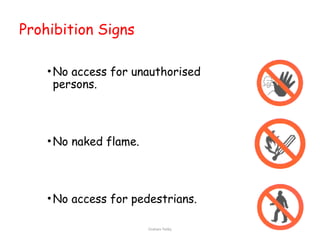
Prohibition Signs
•No access for unauthorised
persons.
•No naked flame.
•No access for pedestrians.
Graham Twiby 88
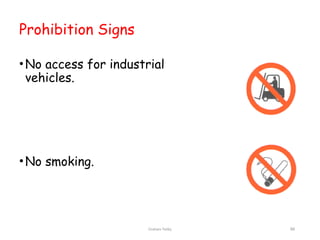
Prohibition Signs
•No access for industrial
vehicles.
•No smoking.
Graham Twiby 89
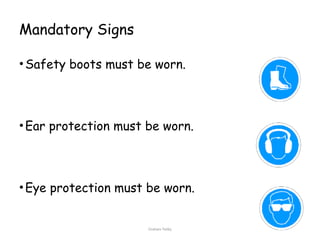
Mandatory Signs
•Safety boots must be worn.
•Ear protection must be worn.
•Eye protection must be worn.
Graham Twiby 90
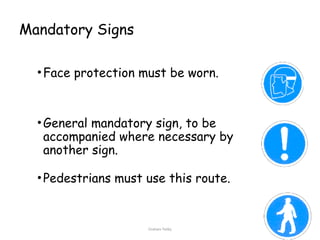
Mandatory Signs
•Face protection must be worn.
•General mandatory sign, to be
accompanied where necessary by
another sign.
•Pedestrians must use this route.
Graham Twiby 91
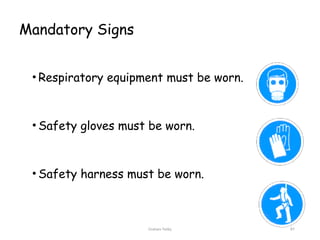
Mandatory Signs
• Respiratory equipment must be worn.
• Safety gloves must be worn.
• Safety harness must be worn.
Graham Twiby 92
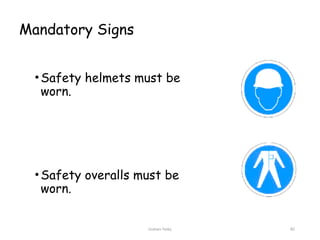
Mandatory Signs
•Safety helmets must be
worn.
•Safety overalls must be
worn.
Graham Twiby 93
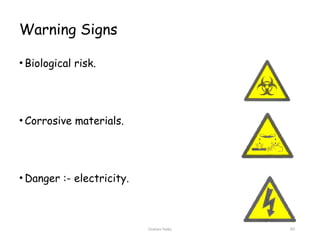
Warning Signs
• Biological risk.
• Corrosive materials.
• Danger :- electricity.
Graham Twiby 94
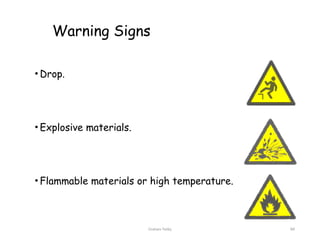
Warning Signs
• Drop.
• Explosive materials.
• Flammable materials or high temperature.
Graham Twiby 95
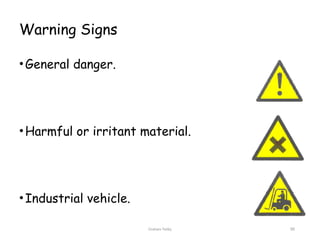
Warning Signs
•General danger.
•Harmful or irritant material.
•Industrial vehicle.
Graham Twiby 96
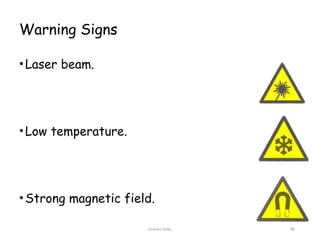
Warning Signs
•Laser beam.
•Low temperature.
•Strong magnetic field.
Graham Twiby 97
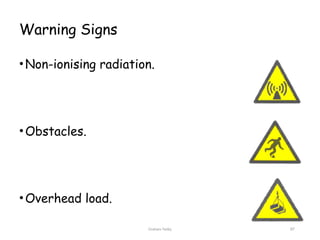
Warning Signs
•Non-ionising radiation.
•Obstacles.
•Overhead load.
Graham Twiby 98
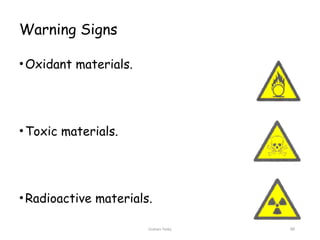
Warning Signs
•Oxidant materials.
•Toxic materials.
•Radioactive materials.
Graham Twiby 99
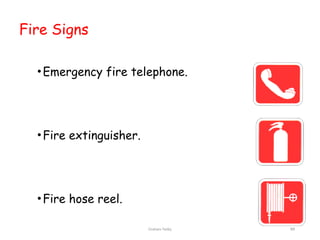
Fire Signs
•Emergency fire telephone.
•Fire extinguisher.
•Fire hose reel.
Graham Twiby 100
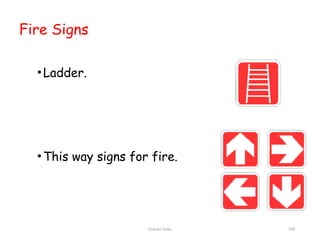
Fire Signs
•Ladder.
•This way signs for fire.
Graham Twiby 101
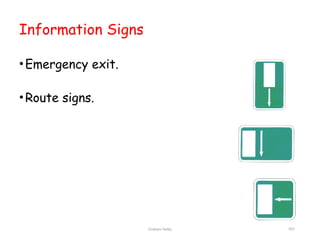
Information Signs
•Emergency exit.
•Route signs.
Graham Twiby 102
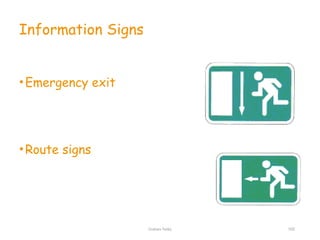
Information Signs
•Emergency exit
•Route signs
Graham Twiby 103
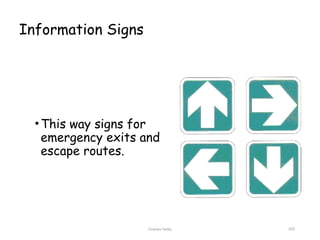
Information Signs
•This way signs for
emergency exits and
escape routes.
Graham Twiby 104
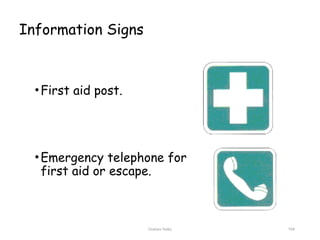
Information Signs
•First aid post.
•Emergency telephone for
first aid or escape.
Graham Twiby 105
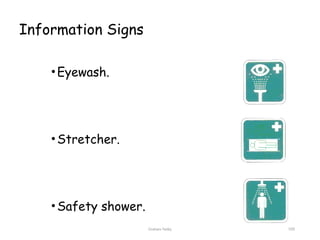
Information Signs
•Eyewash.
•Stretcher.
•Safety shower.
Graham Twiby 106
Safety signs- summary
• There are four types of safety signs in general use:
• prohibition;
• mandatory;
• warning;
• safe condition.
• Each have a designated shape and colour.
• If you are unsure about anything, always ASK.
Graham Twiby 107
End of Presentation
THANK YOU

conference ASD.pptx Personal development

  • 1.
    SUSTAINABLE DEVELOPMENT AND INNOVATIONCENTRE (SUDEIC) Kindly off your phones!
  • 2.
    Module 1: EffectiveJob Preparation Module 2: Entrepreneurship Module 3: Ethics and Safety Module 4: Softwares 1 2 3 4 Perspectives 5 PLAN
  • 3.
    Module 1: EffectiveJob Preparation Job Search Strategies
  • 4.
    Assess Your Situation •What type of job are you seeking? • Short-term vs Long-term • Pay bills, get experience, or both • What are your qualifications? • Why hire you? • Where are you likely to have success? • What industries/fields are hiring - https://candor.co/hiring-freezes/ https://github.com/gcreddy42/hiring2020, and more! Be flexible, compromise, adjust expectations Stay connected and build personal and professional network Requires an action-oriented mindset
  • 5.
    Stay Focused • Lookat the scope of your job search • Geographic, industry, job title, organization size • Look to continually improve (assess the process) • Be realistic • Remain confident • Make it part of your day
  • 6.
    Break it down… •Focus First on Organizations—Not just Openings • Find Offline Jobs and/or Contacts • Locate small/medium employers in your area • Cold call or email • Connect with local Chamber of Commerce • Reach out to faculty, advisors, relatives and friends • Dust off your Materials • Prospecting emails • Resume • Cover letter • LinkedIn profile • Handshake account
  • 7.
    Plan it out… •Expand your network • TALK to people • “Go” to where they are • Virtual fairs • Information sessions • Virtual conferences • Know what you need, want and dream of • What do you need for salary • Short vs long term – 40-year career • Keep skills sharp for transition • Location • Prioritize mobility over loyalty to a single organization
  • 8.
    Take action! • Contact •Recruiters • Friends • Family • Faculty • Create a relationship (for now or later) • Alumni • Apply • Online • Email • Follow-up
  • 9.
    LETTERS AND RESUME Module1: Effective Job Preparation
  • 10.
    What is amotivation letter? • A motivation letter is a one-page letter that’s used to describe why you are the perfect candidate for a certain position. • You are required to write a motivation letter in these specific scenarios: • You are applying to get admitted to an educational program at a college or university • You are applying as a volunteer in an organization • You’re applying for an internship in a company.
  • 11.
    Make sure youfollow these six steps • Include the basics • Write about what makes you unique • Give concrete examples of what you have done and why it is relevant for the job • Be prepared – Know the basics about the company • Make sure you explain why you've applied for the role • Be interesting.
  • 12.
    Each motivation letterconsists of 3 main parts: • the introduction – introduce yourself and your intent in the introduction, • body – describe and highlight your experiences in the body, and • • conclusion – thank the reader for his/her consideration in the conclusion.
  • 13.
    Introduction: • A short,engaging pitch about yourself and why you are applying. Here, you can include: • Personal information. Who are you and what do you do? • What are you applying for? Where? • Mention the general reason on why you’re applying, and then deep-dive in the bulk of your motivation letter. • (don’t forget to mention contact information on top.)
  • 14.
    Example of Introductionfor Motivation Letter • Dear [Sir/Mme], • My name is [Your name] and I would like to express my interest in applying for the [e.g. Master’s degree program] in [e.g. Economics] at [University Name]. I’ve always dreamed of advancing my knowledge of [e.g. Market regulation and design], and I believe that an MA in Economics from [University Name] would set me miles ahead to reaching my goal.
  • 15.
    Body of theMotivation Letter • This is the main bulk of your motivation letter, and where you mention stories behind your achievements, skills, and passion for whatever you’re applying for. • Look at the program requirements and the institution’s website. Find out the top three requirements for the position and explain how you are the best candidate. • Demonstrate that you share the organization’s values or are exceptionally qualified through a short story or personal examples. Be specific.
  • 16.
    Things You CanMention in Your Motivation Letter: • My passion for ______ started when ______. • I want to ______ because ______. • I have been part of _________ for ___ months/years. It’s the best thing for me because _______. • I remember once when I ________, which made me realize that I _______. • _______ resonates with me because _________. • What distinguishes me from my peers is __________.
  • 17.
    Conclusion • In thissection, you can: • Briefly summarize your main points - “I believe I’d be a good fit for the program because of __________” • Mention your overarching goal - “I’d love to be a part of _______, as it would allow me to ___________.” • Thank the reader and conclude the motivation letter
  • 18.
  • 19.
     Reflects yourattitude  Provides specifically requested information  Indicates what you will do to follow up  Writing sample More purposes…
  • 20.
    Parts There are threebasic parts to a cover letter:  An introduction - a statement of who you are and why you are sending the letter  A sales pitch - an overview of your qualifications, skills, abilities, and accomplishments  A call to action - a request for a specific action such as an interview Ideally, you will cover these three basic parts in just 3 - 5 concise paragraphs typed on one page. The following is an outline of how the "typical" cover letter content is organized.
  • 21.
    First Paragraph Introduction statement ofwho you are and why you are sending the letter  Immediately state the position you are interested in and the reason that you would be the best candidate for this position.  If you are responding to an advertisement, state this.  If you have been doing research into the company, this is a good place to mention it.
  • 22.
    Second Paragraph A salespitch an overview of your qualifications, skills, abilities, and accomplishments  Discuss your qualifications and show how the company will benefit from them.  Highlight your special accomplishments. Consider using bullets to make these stand out.  If you are responding to an advertisement, use this paragraph to detail how your background parallels the qualification requirements mentioned in the ad.  Don't feel that you need to write a detailed synopsis of your employment history. Include just the highlights and the pertinent information.
  • 23.
    Third Paragraph A callto action a request for a specific action such as an interview  Make it clear to the reader that you would like to speak to them in person.  Specifically ask for an interview and make sure that you include your telephone number and any special instructions to reach you.  Alternatively, write that you will follow up with a telephone call on a specific date at a specific time and then make sure that you do.
  • 24.
    Step 4 Closing  Theclosing of your letter should appear two lines under the body. Align this with your return address. This may be either on the right or left margin, depending on the style you chose.  A simple "Sincerely," will usually be fine. Under this, apply four lines and type your name. Make certain that after the letter is printed, you insert your signature above this.  Type an enclosure line on the left margin and several lines under your name. This may be in the form "Enclosure" or "Enc. resume".
  • 25.
    Finally  Whenever possible,use an envelope that matches your paper.  Try to avoid using mailing labels as this makes your envelope look similar to a bulk mailing and it may not be opened.  Although it is acceptable to hand address or type the envelope, some experts believe that a hand written envelope will be more likely to be noticed and opened as it resembles personal correspondence. If you have the time and are sending only a few letters at a time, you may wish to use this method, otherwise, it may be more efficient to print the envelopes using a mail merge program.
  • 26.
     Sounds likea form letter  “To whom it may concern”  Not using the company’s name  Too long  Not demonstrating how your background and skills are a fit for the position  Using an inappropriate writing style Common cover letter mistakes
  • 27.
     Individualize  Edityour writing  Grammar, spelling and punctuation  Be yourself  Matching paper  Keep records Correspondence
  • 28.
    Usually 3 -5 individuals Choose carefully ALWAYS ask first References
  • 29.
    Provide a copyof your resume Keep references informed List references on a separate page More on references
  • 30.
    7 Apple Court Eugene,OR 97401 503-555-0303 Mr. Archie Weatherby California Investments, Inc. 25 Sacramento Street San Francisco, CA 94102 Dear Mr. Weatherby, My outgoing personality, my sales experience, and my recently completed education make me a strong candidate for a position as an insurance broker for California Investments, Inc. I recently graduated from the University of Oregon with a degree in marketing, where I was president of both the Future Business Leaders of America and the American Marketing Association. Although a recent graduate, I am not a typical new graduate. I attended school in Michigan, Arizona, and Oregon. And I've put myself through these schools by working such jobs as radio advertising sales, newspaper subscription sales, and bartending, all of which enhanced my formal education. I have the maturity, skills, and abilities to embark on a career in insurance brokering, and I'd like to do this in California, my home state. I will be in California at the end of this month, and I'd like very much to talk with you concerning a position at California Investments. I will follow up this letter with a phone call to see if I can arrange a time to meet with you. Thank you for your time and consideration. Sincerely, John Oakley
  • 31.
  • 32.
    What is aResume?
  • 33.
    How Do WeWrite a Resume that Will Get Us Noticed? Major Considerations Format Sections
  • 34.
    Format Format is essentiallythe way something is arranged or laid out. Resume Format Expectations: No more than one page in length for beginners Margins between should be very small Make the most out of the space on the document (avoid too much or too little white space) List content in reverse chronological order
  • 35.
    Sections: Sections to Include: •Header • Contact Information • Professional Summary • Education • Professional Experience • Professional Skills
  • 36.
    The Header The Headershould include your name, and your most recent contact information. • First Name Last Name • Email Address • Phone Number • Location (City and State) Tips* • Make a professional email that includes your name, not a username. • If you have a LinkedIn, include a link to your profile in your header.
  • 37.
    Professional Summary (Objective) Aprofessional summary is a brief summary of your skills, expertise and career objective. • Include the title of your current position or expertise • "English Teacher" or "Digital Marking Specialist" • "Passionate English educator with four years of experience in a post- secondary education setting. Seeking to use knowledge of writing process, high-impact teaching practices, and literary works to improve student success rates in Imaginary University."
  • 38.
    Education In this sectioninclude your degree information 1. Program Name/ Degree Title 1. Bachelor of Arts in English Literature 2. University Name 3. Graduation Year Optional Sections: • GPA • Honors • Academic Achievements/ awards • Minor
  • 39.
    Professional Experience Job title/position Companyname/ location Description of job responsibilities (start sentences with action verbs) Key Achievements (list quantitative achievements or honors) • Exceeded sales team KPIs by 30%+ for 3 months straight. • Generated over $24,000 in sales in 1 month. Dates Employed
  • 40.
  • 41.
  • 42.
    Characteristics Of A SuccessfulResume  Must always be 100% truthful.  Contains no inappropriate personal information.  Produced on a computer.  Data presented in chronological order (unless functional).
  • 43.
    Resume Writing Tips! •Be consistent with your formatting- consistent formatting makes your resume scannable! • Length & Margins - One page and margins no smaller than .5 inches. • Watch your verb tenses - If you are still currently in a position, use present tense. If the position was in the past, use past tense. • Voice- Avoid first person pronouns. • Keep it to one page. • Proofread!
  • 44.
    JOB INTERVIEW P RE S E N T A T I O N T E M P L A T E
  • 45.
    AGENDA • Describe yourself •Strengths and Weaknesses • Why do you want this job? • Your career 5 years from now • Previous Companies • What do you know about us? • Proposal • Compensation / Salary • Future
  • 46.
    DESCRIBE YOURSELF? I amambitious and driven. I thrive on challenge and constantly set goals for myself, so I have something to strive toward. I’m not comfortable with settling, and I’m always looking for an opportunity to do better and achieve greatness. In my previous role, I was promoted three times in less than two years. ASHU UNIQUE N How would you
  • 47.
    STRENGTH & WEAKNESSES Presentationsare communication tools STRENGTHS WEAKNESSES My greatest strength is my writing skills. I can also work to tight deadlines under pressure. For example, I was once asked to complete a project within 10 hr. I’m naturally shy. From high school and into my early professional interactions, it prevented me from speaking up.
  • 48.
  • 49.
    CAREER OBJECTIVES When doyou want to be in your career 5 years from now? 2021 2022 2023 2024 2025
  • 50.
    THE LAST COMPANY YOUWORK IN Company 1 Company 2 Company 3
  • 51.
    KNOW ABOUT OURCOMPANY What do you Our Values, Our Culture, Our Mission
  • 52.
  • 53.
    Module 3: ETHICSAND SAFETY ETHICS
  • 54.
    The Learning Goals: Theimportance of developing a strong work ethic and how the work ethic you develop will impact your future as an employee. Work Ethic Presented By: ASHU UNIQUE
  • 55.
    What is WorkEthic? The Definition: A standard of conduct and values for job performance In specific terms, work ethics is about what is morally correct, honourable and acceptable to the larger majority of the people of an organization, society or group.
  • 56.
    Top 10 WorkEthics  Attendance  Character  Team Work  Appearance  Attitude  Productivity  Organizational Skills  Communication  Cooperation  Respect
  • 58.
     Limit Absences Beat work every day possible Plan your absences Don’t abuse leave time  Come to work on time Be punctual every day
  • 59.
     Be dependable Completeassigned tasks correctly and promptly  Be loyal Speak positively about the company
  • 61.
     Leadership abilities Theability to be led and/or to become the leader  Be a team player The ability to get along with others – including those you don’t necessarily like, Cooperation is the key to productivity  Be a contributing member The ability to carry your own weight and help others who are struggling  Accept compromise Recognize when to speak up with an idea and when to compromise by blending ideas together
  • 63.
     Dress Appropriately Noorganization likes to have a shabbily dressed employee. Shave daily if you have to and do not use strong perfumes. Dress for Success! Remember that you are a representative of your organisation, how you dress & Act can reflect on the organisation. Never wear revealing clothes to work. Body piercing and tattoo are a strict no no at the workplace. Females should avoid wearing heavy jewellery/make-up to work.
  • 65.
     Good manners •Maintain good eye contact • Monitor the volume of conversations • Keep personal telephone conversations and emails to a minimum • Maintain privacy - keep all workplace conversations professional • Avoid interruptions & Use appropriate tone of Voice • Appropriate introductions – introduce someone by their title and last name (Ms. Mrs. Mr. Dr. ), unless otherwise specified •Be a good Listener & Soft spoken. •Show common respect and consideration for others Remember that the first impression of who you are can last a lifetime
  • 67.
     Have agood attitude Listen to suggestions, Be positive  Accept responsibility for ones work If you make a mistake, admit it  Take pride in your work Do things the best you know how  Don’t be dissatisfied all the time You agreed to the work/pay/hours
  • 69.
     Written Communications Beingable to correctly write reports and memos  Verbal Communications Being able to communicate one on one or to a group
  • 71.
     Work hard Workto the best of your ability Traits of a Winning Employee  Carry out orders Do what’s asked the first time  Show respect Accept and acknowledge an individuals talents and knowledge
  • 73.
    Thank you Whatever youdo just do it with all your heart…..
  • 74.
    Module 3: ETHICSAND SAFETY SAFETY
  • 75.
    Graham Twiby 76 Health& Safety in all industries Safety signs By Engr. ASHU UNIQUE N.
  • 76.
    Graham Twiby 77 Safetysigns and the law •The Health and Safety (Safety Signs and Signals) Regulations require employers to provide safety signs to raise awareness of risks to health and safety. •There are four types of safety signs in general use. •Each has a designated shape and colour. •They make sure that information is given in a standard format with minimum use of words.
  • 77.
    Graham Twiby 78 Safetysigns Remember the general duty of employees: •cooperate with your employer by observing signs; •comply with the law and your employer’s safe systems of work; •make proper and correct use of safety equipment; •don’t tamper with, deface, or remove safety signs.
  • 78.
    Graham Twiby 79 SafetySigns Contents Introduction to safety signs. Prohibition signs Mandatory signs Warning signs Fire signs. Information signs.
  • 79.
    Graham Twiby 80 Introductionto Safety Signs Red Prohibition sign Danger alarm Dangerous behaviour; stop; shut down; emergency cut-out device; evacuate; be careful; take precaution; examine, Yellow or Amber Warning sign Be careful; take precautions; examine.
  • 80.
    Graham Twiby 81 Introductionto Safety Signs Blue Mandatory sign Specific behaviour or action e.g. wear personal protective equipment. Green Emergency escape First-aid sign; no danger Doors; exits; escape routes; equipment and facilities; return to normal. Red Fire signs Fire equipment and alarm points etc.
  • 81.
    Graham Twiby 82 Fourtypes of safety sign • PROHIBITION SIGNS • These mean stop/must not do. • The sign is circular with a white background, black pictogram and red border and crossbar. • All writing is white on a red background. • Look at these examples – can you identify them?
  • 82.
    Graham Twiby 83 Fourtypes of safety sign • WARNING SIGNS • These mean there is a risk of danger. • The sign is triangular with a yellow background, black pictogram and black border. • All writing is black on a yellow background. • Look at these examples – can you identify them?
  • 83.
    Graham Twiby 84 Fourtypes of safety sign • MANDATORY SIGNS • These mean that it must be obeyed. • These signs feature a blue circle with white pictogram. • Any text must be white on a blue background. • Look at these examples – can you identify them?
  • 84.
    Graham Twiby 85 Fourtypes of safety sign • SAFE CONDITION SIGNS • These mean safe place or safe way to go. • These signs are a green rectangle or square with a white pictogram and text. • Look at these examples – can you identify them?
  • 85.
    Graham Twiby 86 ProhibitionSigns •Do not drink. •Do not extinguish with water. •Do not touch.
  • 86.
    Graham Twiby 87 ProhibitionSigns •No access for unauthorised persons. •No naked flame. •No access for pedestrians.
  • 87.
    Graham Twiby 88 ProhibitionSigns •No access for industrial vehicles. •No smoking.
  • 88.
    Graham Twiby 89 MandatorySigns •Safety boots must be worn. •Ear protection must be worn. •Eye protection must be worn.
  • 89.
    Graham Twiby 90 MandatorySigns •Face protection must be worn. •General mandatory sign, to be accompanied where necessary by another sign. •Pedestrians must use this route.
  • 90.
    Graham Twiby 91 MandatorySigns • Respiratory equipment must be worn. • Safety gloves must be worn. • Safety harness must be worn.
  • 91.
    Graham Twiby 92 MandatorySigns •Safety helmets must be worn. •Safety overalls must be worn.
  • 92.
    Graham Twiby 93 WarningSigns • Biological risk. • Corrosive materials. • Danger :- electricity.
  • 93.
    Graham Twiby 94 WarningSigns • Drop. • Explosive materials. • Flammable materials or high temperature.
  • 94.
    Graham Twiby 95 WarningSigns •General danger. •Harmful or irritant material. •Industrial vehicle.
  • 95.
    Graham Twiby 96 WarningSigns •Laser beam. •Low temperature. •Strong magnetic field.
  • 96.
    Graham Twiby 97 WarningSigns •Non-ionising radiation. •Obstacles. •Overhead load.
  • 97.
    Graham Twiby 98 WarningSigns •Oxidant materials. •Toxic materials. •Radioactive materials.
  • 98.
    Graham Twiby 99 FireSigns •Emergency fire telephone. •Fire extinguisher. •Fire hose reel.
  • 99.
    Graham Twiby 100 FireSigns •Ladder. •This way signs for fire.
  • 100.
    Graham Twiby 101 InformationSigns •Emergency exit. •Route signs.
  • 101.
    Graham Twiby 102 InformationSigns •Emergency exit •Route signs
  • 102.
    Graham Twiby 103 InformationSigns •This way signs for emergency exits and escape routes.
  • 103.
    Graham Twiby 104 InformationSigns •First aid post. •Emergency telephone for first aid or escape.
  • 104.
    Graham Twiby 105 InformationSigns •Eyewash. •Stretcher. •Safety shower.
  • 105.
    Graham Twiby 106 Safetysigns- summary • There are four types of safety signs in general use: • prohibition; • mandatory; • warning; • safe condition. • Each have a designated shape and colour. • If you are unsure about anything, always ASK.
  • 106.
    Graham Twiby 107 Endof Presentation THANK YOU

Editor's Notes

  • #45 Links: https://www.pexels.com/photo/photo-of-two-people-shakehands-2058130/
  • #47 Links: https://www.pexels.com/photo/man-in-black-suit-jacket-standing-near-railings-3778876/
  • #48 Links: https://www.pexels.com/photo/person-holding-barbell-841130/ https://www.pexels.com/photo/human-fist-163431/
  • #51 Links: https://www.pexels.com/photo/architectural-design-architecture-buildings-city-373893/ https://www.pexels.com/photo/high-rise-building-746411/ https://www.pexels.com/photo/architecture-buildings-business-city-358502/
  • #52 Links: https://www.pexels.com/photo/group-of-people-standing-infront-of-blackboard-3184432/
  • #53 Links: https://www.pexels.com/photo/close-up-of-human-hand-327540/
  • #77 Title Safety signs and the Law The Health and Safety (Safety Signs and Signals) Regulations require employers to provide safety signs to raise awareness of risks to health and safety. There are four types of safety signs in general use. Each has a designated shape and colour. They make sure that information is given in a standard format with minimum use of words.
  • #78 Title Safety signs Remember the general duty of employees: cooperate with your employer by observing signs; comply with the law and your employer’s safe systems of work; make proper and correct use of safety equipment; don’t tamper with, deface, or remove safety signs.
  • #79 vbcbd
  • #82 Title Four types of safety sign PROHIBITION SIGNS These signs means stop/must not do. The sign is circular with a white background, black pictogram and red border and crossbar. All writing is white on a red background. Look at these examples – can you identify them? The slide contains three graphic images of prohibition signs: White circle with red border and red bar across the image of a lighted cigarette symbol. White circle with red border and red bar across the image of a fork lift truck. White circle with red border and red bar across the image of a person holding up their hand to indicate ‘stop’.
  • #83 Title Four types of safety sign WARNING SIGNS These mean there is a risk of danger. The sign is triangular with a yellow background, black pictogram and black border. All writing is black on a yellow background. Look at these examples – can you identify them? The slide contains three graphic images of warning signs: Yellow triangle with black border containing image of burning fire. Yellow triangle with black border containing image of acid burning materials and a persons hand. Yellow triangle with black border containing image of a black cross in the shape of an X.
  • #84 Title Four types of safety sign MANDATORY SIGNS These mean that it must be obeyed. These signs feature a blue circle with white pictogram. Any text must be white on a blue background. Look at these examples – can you identify them? The slide contains two graphic images of mandatory signs: Blue circle with white image of a circular saw blade with the guard raised out of position and the written words underneath stating ‘Guards must be in position before starting’. Blue circle with white graphic of a persons head wearing ear defenders. Description reads - Ear defenders must be worn.
  • #85 Title Four types of safety sign SAFE CONDITION SIGNS These mean safe place or safe way to go. These signs are a green rectangle or square with a white pictogram and text. Look at these examples – can you identify them? The slide contains three graphic images: Green rectangle with white arrow and description. Green rectangle with ‘right tick’ image and words ‘Fire assembly point’. Green rectangle with white cross image.
  • #106 Title Safety Signs – summary There are four types of safety signs in general use: prohibition; mandatory; warning; safe condition. Each have a designated shape and colour. If you are unsure about anything, always ASK.