Understanding
Visual-Spatial
Intelligence
what is spatial and visual
intelligence?
Spatial intelligence refers to the
ability to manipulate and
understand objects in three-
dimensional space mentally.
People with strong spatial
intelligence are good at:
• Visualizing objects: They can
easily picture objects in their
mind and rotate them, even if
they've never seen them before.
• Navigating: They have a good
sense of direction and can easily
find their way around unfamiliar
places.
• Understanding maps and
diagrams: They can interpret
and use maps, charts, and other
visual representations of
information.
• Solving puzzles: They excel at
puzzles that involve spatial
reasoning, like Rubik's Cubes or
jigsaw puzzles.
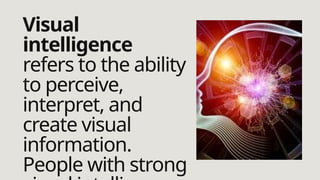
Visual
intelligence
refers to the ability
to perceive,
interpret, and
create visual
information.
People with strong
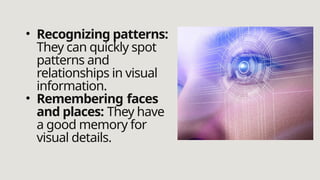
• Recognizing patterns:
They can quickly spot
patterns and
relationships in visual
information.
• Remembering faces
and places: They have
a good memory for
visual details.
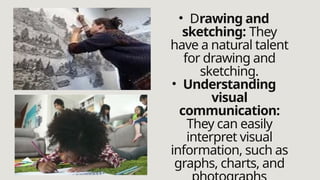
• Drawing and
sketching: They
have a natural talent
for drawing and
sketching.
• Understanding
visual
communication:
They can easily
interpret visual
information, such as
graphs, charts, and
The relationship between spatial and visual
intelligence:
While distinct, spatial and visual intelligence are
often interconnected. People with strong spatial
intelligence often have good visual intelligence,
and vice versa. This is because both abilities
involve the ability to process and understand
visual information.
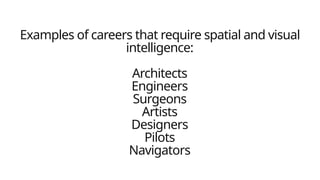
Examples of careers that require spatial and visual
intelligence:
Architects
Engineers
Surgeons
Artists
Designers
Pilots
Navigators
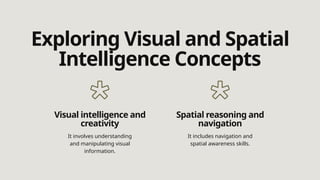
Exploring Visual and Spatial
Intelligence Concepts
It involves understanding
and manipulating visual
information.
Visual intelligence and
creativity
It includes navigation and
spatial awareness skills.
Spatial reasoning and
navigation
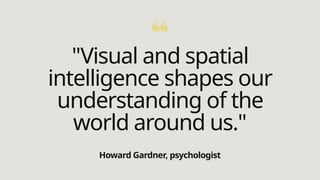
"Visual and spatial
intelligence shapes our
understanding of the
world around us."
Howard Gardner, psychologist

power pesentation Exploring Cognitive Abilities.pptx

  • 1.
  • 2.
    what is spatialand visual intelligence? Spatial intelligence refers to the ability to manipulate and understand objects in three- dimensional space mentally. People with strong spatial intelligence are good at:
  • 3.
    • Visualizing objects:They can easily picture objects in their mind and rotate them, even if they've never seen them before. • Navigating: They have a good sense of direction and can easily find their way around unfamiliar places.
  • 4.
    • Understanding mapsand diagrams: They can interpret and use maps, charts, and other visual representations of information. • Solving puzzles: They excel at puzzles that involve spatial reasoning, like Rubik's Cubes or jigsaw puzzles.
  • 5.
    Visual intelligence refers to theability to perceive, interpret, and create visual information. People with strong
  • 6.
    • Recognizing patterns: Theycan quickly spot patterns and relationships in visual information. • Remembering faces and places: They have a good memory for visual details.
  • 7.
    • Drawing and sketching:They have a natural talent for drawing and sketching. • Understanding visual communication: They can easily interpret visual information, such as graphs, charts, and
  • 8.
    The relationship betweenspatial and visual intelligence: While distinct, spatial and visual intelligence are often interconnected. People with strong spatial intelligence often have good visual intelligence, and vice versa. This is because both abilities involve the ability to process and understand visual information.
  • 9.
    Examples of careersthat require spatial and visual intelligence: Architects Engineers Surgeons Artists Designers Pilots Navigators
  • 10.
    Exploring Visual andSpatial Intelligence Concepts It involves understanding and manipulating visual information. Visual intelligence and creativity It includes navigation and spatial awareness skills. Spatial reasoning and navigation
  • 11.
    "Visual and spatial intelligenceshapes our understanding of the world around us." Howard Gardner, psychologist

Editor's Notes

  • #2  It's not just about seeing objects, but about visualizing them in our minds, rotating them, and understanding their relationships to other objects. "Being able to picture things in your mind and move them around like they're real."
  • #3 A child playing with building blocks: They might imagine a tower they want to build and then mentally rotate the blocks in their mind to figure out how they'll fit together. A sculptor working on a clay model: They might visualize the finished sculpture in their mind before they even start shaping the clay. A mechanic fixing a car engine: They might visualize the engine's parts and how they fit together, even if they can't see them all at once. An architect designing a building: They might visualize the building's layout, its exterior, and its interior spaces, even before the blueprints are drawn.
  • #5 It's about how our brains process and understand the world through sight. Recognizing a friend's face: You perceive the visual information of their face, interpret it as belonging to your friend, and then create a mental image of them. Reading a map: You perceive the lines and symbols on the map, interpret their meaning as representing roads, landmarks, and distances, and then create a mental picture of the area.
  • #8 Both abilities rely on the brain's ability to process and understand visual information.
  • #11 allows us to interpret and process the vast amount of visual information we encounter daily, from recognizing faces to understanding maps. Spatial intelligence enables us to mentally manipulate objects in space, helping us navigate, build, and solve problems. Together, these intelligences shape our perception of the world, allowing us to interact with and understand our surroundings in a meaningful way. Experience the beauty and complexity of our surroundings: We can appreciate the colors, shapes, and textures of nature, understand the layout of a city, and enjoy the visual arts. Interact with our environment effectively: We can navigate through space, solve problems, and create new things. Communicate with others: We can express ourselves visually, understand others' visual cues, and share information through visual means.