Lecture Notes 15:
C. TEACHING IN MULTIGRADE
CLASSES
D. TEACHING IN A MULTIPLE
INTELLIGENCE CLASSSROOM
Gardner's theory of Multiple
Intelligences (MI) presents a
powerful notion that there are
different separate human
capacities,
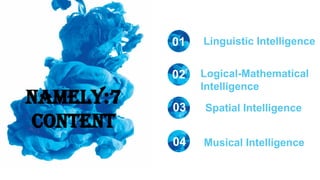
NAMELY:7
CONTENT
Linguistic Intelligence
01
02
03
04
Logical-Mathematical
Intelligence
Spatial Intelligence
Musical Intelligence
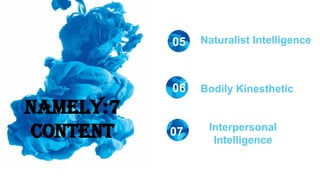
NAMELY:7
CONTENT
Naturalist Intelligence
05
06
07
Bodily Kinesthetic
Interpersonal
Intelligence
Linguistic Intelligence
PART 01
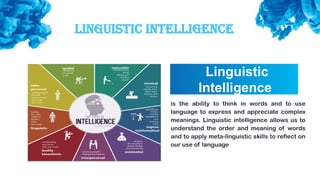
Linguistic Intelligence
Linguistic
Intelligence
is the ability to think in words and to use
language to express and appreciate complex
meanings. Linguistic intelligence allows us to
understand the order and meaning of words
and to apply meta-linguistic skills to reflect on
our use of language
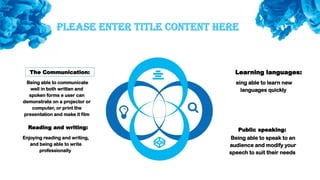
The Communication:
Being able to communicate
well in both written and
spoken forms e user can
demonstrate on a projector or
computer, or print the
presentation and make it film
Reading and writing:
Enjoying reading and writing,
and being able to write
professionally
Learning languages:
eing able to learn new
languages quickly
Being able to speak to an
audience and modify your
speech to suit their needs
Please enter title content here
Public speaking:
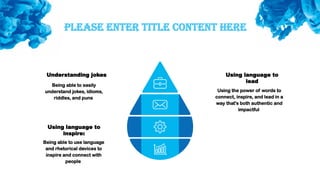
Using language to
lead
Using the power of words to
connect, inspire, and lead in a
way that's both authentic and
impactful
Understanding jokes
Being able to easily
understand jokes, idioms,
riddles, and puns
Using language to
inspire:
Being able to use language
and rhetorical devices to
inspire and connect with
people
Please enter title content here
Logical-Mathematical Intelligence
PART 02
is the ability to think
logically, reason, and work
with numbers. It's one of
the multiple intelligences
identified by psychologist
Howard Gardner.
Logical-mathematical
intelligence Characteristics
 Thinking conceptually and
abstractly
 Recognizing logical and
numerical patterns
 Solving problems logically
 Finding formulas
 Conducting scientific
investigations
 Enjoying working with
numbers
 Enjoying abstract thinking
 Enjoying solving puzzles
Logical-Mathematical
Intelligence
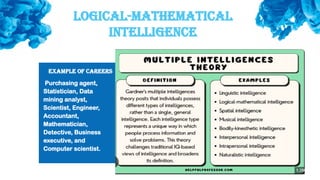
Example of careers
Purchasing agent,
Statistician, Data
mining analyst,
Scientist, Engineer,
Accountant,
Mathematician,
Detective, Business
executive, and
Computer scientist.
Logical-Mathematical
Intelligence
Spatial Intelligence
PART 03
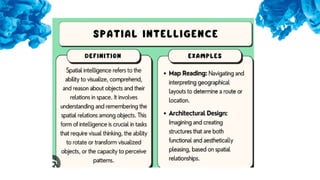
 Spatial intelligence is the ability to understand and use visual information to perceive the
world around us. It's also known as visual-spatial intelligence or spatial reasoning.
 Characteristics of spatial intelligence
 Being aware of your surroundings
 Remembering information by creating visual images
 Having a good sense of direction
 Being able to read maps and charts easily
 Being able to recognize patterns
 Being skilled at solving visual puzzles
Spatial intelligence
 How spatial intelligence develops
 Spatial intelligence can be developed from childhood through activities like map interpretation,
problem-solving, and three-dimensional diagrams
 Some people are born with or develop strong spatial awareness
They learn from looking at things, not just from hearing information
 Examples of spatial intelligence in use
 Using a map to get from one place to another
 Walking through doorways without bumping into them
 Driving or crossing the road by judging vehicle distance and speed
Spatial intelligence
Musical Intelligence
PART 04
Musical Intelligence
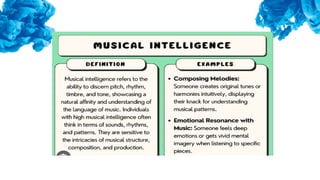
 Musical intelligence is the ability to understand, create, and appreciate music.
It also involves being able to process musical information and express oneself through music.
 Characteristics
 Being able to identify and distinguish different instruments
 Being able to recognize, create, and reflect on music
 Being able to produce an accurate tone and maintain rhythm
 Being able to understand and maintain timbre with an instrument or voice
 Being able to break down the pitch, rhythm, tone, and timbre of sounds
 Being highly sensitive to sounds
PART 05
Naturalist Intelligence
 Naturalist intelligence is the ability to understand and relate to nature.
It's also known as "nature smarts". People with high naturalist intelligence are curious
about the environment and other species, and are good at taking care of plants and animals.
 Characteristics
 Being sensitive to changes in the environment
 Recognizing differences between species, groups of people, or objects
 Understanding how species relate to each other
 Being able to identify, classify, and manipulate elements of the environment
Naturalist Intelligence
Activities
 Spending time in nature, such as parks, oceans, beaches, lakes, and mountains
 Tending a garden or yard
 Learning more about different animal species and plants
 Going on morning walks or hiking
 Visiting a zoo or aquarium
 Climbing or hiking in a mountain park
 Using a microscope or binoculars
 Planting seeds or searching for fossils
Bodily Kinesthetic
intelligence
PART 06
Bodily Kinesthetic intelligence
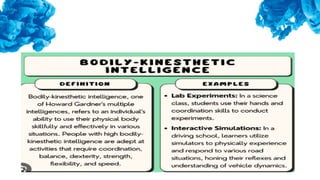
 Bodily kinesthetic intelligence is the ability to use your body to learn, solve problems,
and express ideas. It's also known as physical intelligence.
 Characteristics
 Physical skills: Good hand-eye coordination, balance, flexibility, and dexterity
 Learning style: Learn best by doing, exploring, and discovering
 Body awareness: Aware of their bodies and how to use them to convey feelings and ideas
 Motor skills: Advanced fine and gross motor skills
 Memory: Remember things better by doing them
 Body language: Skilled at using body language to communicate with others
Bodily Kinesthetic intelligence
 Examples of people with high bodily kinesthetic intelligence
 Athletes, Dancers, Surgeons, Crafts people, Michael Jordan, Babe Ruth, and I. M. Pei.
 How to develop bodily kinesthetic intelligence
 Engage in hands-on activities like art, science, or shop class
 Explore and experiment with different materials to create
 Participate in group games and learning tasks that require active participation
Interpersonal Intelligence
PART 07
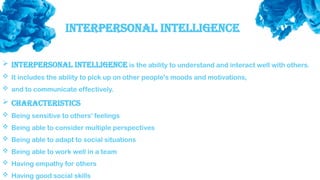
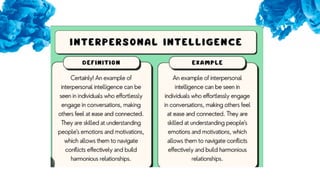
Interpersonal Intelligence
 Interpersonal intelligence is the ability to understand and interact well with others.
 It includes the ability to pick up on other people's moods and motivations,
 and to communicate effectively.
 Characteristics
 Being sensitive to others' feelings
 Being able to consider multiple perspectives
 Being able to adapt to social situations
 Being able to work well in a team
 Having empathy for others
 Having good social skills
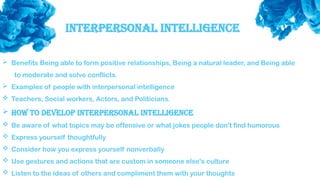
Interpersonal Intelligence
 Benefits Being able to form positive relationships, Being a natural leader, and Being able
to moderate and solve conflicts.
 Examples of people with interpersonal intelligence
 Teachers, Social workers, Actors, and Politicians.
 How to develop interpersonal intelligence
 Be aware of what topics may be offensive or what jokes people don't find humorous
 Express yourself thoughtfully
 Consider how you express yourself nonverbally
 Use gestures and actions that are custom in someone else's culture
 Listen to the ideas of others and compliment them with your thoughts
Thank you for
listening

Blue Education Presentation.pptx railab report.pptx

  • 1.
  • 2.
    C. TEACHING INMULTIGRADE CLASSES
  • 3.
    D. TEACHING INA MULTIPLE INTELLIGENCE CLASSSROOM Gardner's theory of Multiple Intelligences (MI) presents a powerful notion that there are different separate human capacities,
  • 4.
  • 5.
  • 6.
  • 7.
    Linguistic Intelligence Linguistic Intelligence is theability to think in words and to use language to express and appreciate complex meanings. Linguistic intelligence allows us to understand the order and meaning of words and to apply meta-linguistic skills to reflect on our use of language
  • 8.
    The Communication: Being ableto communicate well in both written and spoken forms e user can demonstrate on a projector or computer, or print the presentation and make it film Reading and writing: Enjoying reading and writing, and being able to write professionally Learning languages: eing able to learn new languages quickly Being able to speak to an audience and modify your speech to suit their needs Please enter title content here Public speaking:
  • 9.
    Using language to lead Usingthe power of words to connect, inspire, and lead in a way that's both authentic and impactful Understanding jokes Being able to easily understand jokes, idioms, riddles, and puns Using language to inspire: Being able to use language and rhetorical devices to inspire and connect with people Please enter title content here
  • 10.
  • 11.
    is the abilityto think logically, reason, and work with numbers. It's one of the multiple intelligences identified by psychologist Howard Gardner. Logical-mathematical intelligence Characteristics  Thinking conceptually and abstractly  Recognizing logical and numerical patterns  Solving problems logically  Finding formulas  Conducting scientific investigations  Enjoying working with numbers  Enjoying abstract thinking  Enjoying solving puzzles Logical-Mathematical Intelligence
  • 12.
    Example of careers Purchasingagent, Statistician, Data mining analyst, Scientist, Engineer, Accountant, Mathematician, Detective, Business executive, and Computer scientist. Logical-Mathematical Intelligence
  • 13.
  • 14.
     Spatial intelligenceis the ability to understand and use visual information to perceive the world around us. It's also known as visual-spatial intelligence or spatial reasoning.  Characteristics of spatial intelligence  Being aware of your surroundings  Remembering information by creating visual images  Having a good sense of direction  Being able to read maps and charts easily  Being able to recognize patterns  Being skilled at solving visual puzzles Spatial intelligence
  • 15.
     How spatialintelligence develops  Spatial intelligence can be developed from childhood through activities like map interpretation, problem-solving, and three-dimensional diagrams  Some people are born with or develop strong spatial awareness They learn from looking at things, not just from hearing information  Examples of spatial intelligence in use  Using a map to get from one place to another  Walking through doorways without bumping into them  Driving or crossing the road by judging vehicle distance and speed Spatial intelligence
  • 17.
  • 18.
    Musical Intelligence  Musicalintelligence is the ability to understand, create, and appreciate music. It also involves being able to process musical information and express oneself through music.  Characteristics  Being able to identify and distinguish different instruments  Being able to recognize, create, and reflect on music  Being able to produce an accurate tone and maintain rhythm  Being able to understand and maintain timbre with an instrument or voice  Being able to break down the pitch, rhythm, tone, and timbre of sounds  Being highly sensitive to sounds
  • 20.
  • 21.
    Naturalist Intelligence  Naturalistintelligence is the ability to understand and relate to nature. It's also known as "nature smarts". People with high naturalist intelligence are curious about the environment and other species, and are good at taking care of plants and animals.  Characteristics  Being sensitive to changes in the environment  Recognizing differences between species, groups of people, or objects  Understanding how species relate to each other  Being able to identify, classify, and manipulate elements of the environment
  • 22.
    Naturalist Intelligence Activities  Spendingtime in nature, such as parks, oceans, beaches, lakes, and mountains  Tending a garden or yard  Learning more about different animal species and plants  Going on morning walks or hiking  Visiting a zoo or aquarium  Climbing or hiking in a mountain park  Using a microscope or binoculars  Planting seeds or searching for fossils
  • 23.
  • 24.
    Bodily Kinesthetic intelligence Bodily kinesthetic intelligence is the ability to use your body to learn, solve problems, and express ideas. It's also known as physical intelligence.  Characteristics  Physical skills: Good hand-eye coordination, balance, flexibility, and dexterity  Learning style: Learn best by doing, exploring, and discovering  Body awareness: Aware of their bodies and how to use them to convey feelings and ideas  Motor skills: Advanced fine and gross motor skills  Memory: Remember things better by doing them  Body language: Skilled at using body language to communicate with others
  • 25.
    Bodily Kinesthetic intelligence Examples of people with high bodily kinesthetic intelligence  Athletes, Dancers, Surgeons, Crafts people, Michael Jordan, Babe Ruth, and I. M. Pei.  How to develop bodily kinesthetic intelligence  Engage in hands-on activities like art, science, or shop class  Explore and experiment with different materials to create  Participate in group games and learning tasks that require active participation
  • 27.
  • 28.
    Interpersonal Intelligence  Interpersonalintelligence is the ability to understand and interact well with others.  It includes the ability to pick up on other people's moods and motivations,  and to communicate effectively.  Characteristics  Being sensitive to others' feelings  Being able to consider multiple perspectives  Being able to adapt to social situations  Being able to work well in a team  Having empathy for others  Having good social skills
  • 29.
    Interpersonal Intelligence  BenefitsBeing able to form positive relationships, Being a natural leader, and Being able to moderate and solve conflicts.  Examples of people with interpersonal intelligence  Teachers, Social workers, Actors, and Politicians.  How to develop interpersonal intelligence  Be aware of what topics may be offensive or what jokes people don't find humorous  Express yourself thoughtfully  Consider how you express yourself nonverbally  Use gestures and actions that are custom in someone else's culture  Listen to the ideas of others and compliment them with your thoughts

  • 31.