What is Power Electronics?
 The field of power electronics can be well understood by dividing it into
two subcategories;
 Power engineering and electronics engineering. The field of power
engineering mainly deals with the generation, transmission, distribution,
and utilization of electrical energy at higher efficiency.
 Electronics engineering mainly deals with the generation,
transmission, and reception of signals and data at a very low power level
ranging from milliwatts to a few watts.
Power Electronics Cont..
In power electronics, the principles of electronics are placed into action for
applications that are rated at a high power level ranging from tens of watts
to hundreds of watts rather than low power levels ranging from milli-watts
to few watts.
In power electronics, a considerable amount of electrical energy is processed
as compared to the processing of signals and data in the case of electronics
engineering.
The electrical energy is processed and controlled by supplying the voltage
and current in a form that is suitable according to the load demand.
In a short, Power Electronics is a field where principles of electronics are
applied for the control and conversion of electrical energy at a higher power
level.
 Electronics engineering deals with the power devices that are used as
switches and also with circuits that are used for processing information.
 Power engineering consists of rotating equipment and static equipment
related to the generation transmission and distribution as well as utilisation of
electric power and power electronic play a big role in that as well.
 Control engineering concepts are required to control these systems to
understand the stability issues and to be able to see their response
characteristics.
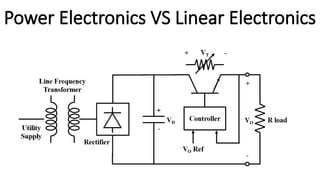
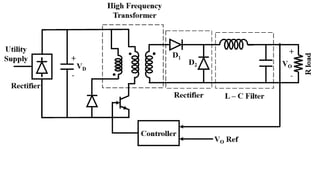
Power Electronics VS Linear Electronics
In linear electronics, the semiconductor devices are operated in the active region and for
isolation, an electrical transformer is used. It is due to operation in the active region that we have
high power loss and less efficiency.
It becomes uneconomical as the high amount of energy is wasted and also it becomes difficult to
remove the heat that is generated due to the dissipation of energy. The electrical transformer on
the other hand is heavy which overall increases the size of the system.
• Function
• Power electronics convert electrical power from one form to another, while linear electronics manipulate and regulate low-level signals and small
currents.
• Circuit components
• Linear electronics circuits are made up of ideal resistors, capacitors, inductors, and operational amplifiers (OP-amps).
• Operation
• Power electronics devices are operated in a switching mode, either fully on or fully off. Linear electronics devices operate in the linear (active) zone,
avoiding saturation and cutoff zones.
• Here are some other differences between power electronics and linear electronics:
• Power handling
• Power electronics devices are used in a variety of applications, from mobile set power management ICs that handle a few milliwatts to large linear
audio amplifiers that handle a few thousand watts.
• Efficiency
• Power electronics devices are more efficient than linear power supplies.
• Size
• Power electronics devices can be made compact by operating them at higher switching frequencies. Linear power supplies can be large, especially
when used in high power applications.
• Thermal management
• Power electronics devices can handle higher temperatures, which simplifies thermal designs. Linear power supplies can have high heat loss.
power electronics - Introduction to power Electronics

power electronics - Introduction to power Electronics

  • 1.
    What is PowerElectronics?  The field of power electronics can be well understood by dividing it into two subcategories;  Power engineering and electronics engineering. The field of power engineering mainly deals with the generation, transmission, distribution, and utilization of electrical energy at higher efficiency.  Electronics engineering mainly deals with the generation, transmission, and reception of signals and data at a very low power level ranging from milliwatts to a few watts.
  • 2.
    Power Electronics Cont.. Inpower electronics, the principles of electronics are placed into action for applications that are rated at a high power level ranging from tens of watts to hundreds of watts rather than low power levels ranging from milli-watts to few watts. In power electronics, a considerable amount of electrical energy is processed as compared to the processing of signals and data in the case of electronics engineering. The electrical energy is processed and controlled by supplying the voltage and current in a form that is suitable according to the load demand. In a short, Power Electronics is a field where principles of electronics are applied for the control and conversion of electrical energy at a higher power level.
  • 3.
     Electronics engineeringdeals with the power devices that are used as switches and also with circuits that are used for processing information.  Power engineering consists of rotating equipment and static equipment related to the generation transmission and distribution as well as utilisation of electric power and power electronic play a big role in that as well.  Control engineering concepts are required to control these systems to understand the stability issues and to be able to see their response characteristics.
  • 4.
    Power Electronics VSLinear Electronics
  • 7.
    In linear electronics,the semiconductor devices are operated in the active region and for isolation, an electrical transformer is used. It is due to operation in the active region that we have high power loss and less efficiency. It becomes uneconomical as the high amount of energy is wasted and also it becomes difficult to remove the heat that is generated due to the dissipation of energy. The electrical transformer on the other hand is heavy which overall increases the size of the system.
  • 8.
    • Function • Powerelectronics convert electrical power from one form to another, while linear electronics manipulate and regulate low-level signals and small currents. • Circuit components • Linear electronics circuits are made up of ideal resistors, capacitors, inductors, and operational amplifiers (OP-amps). • Operation • Power electronics devices are operated in a switching mode, either fully on or fully off. Linear electronics devices operate in the linear (active) zone, avoiding saturation and cutoff zones. • Here are some other differences between power electronics and linear electronics: • Power handling • Power electronics devices are used in a variety of applications, from mobile set power management ICs that handle a few milliwatts to large linear audio amplifiers that handle a few thousand watts. • Efficiency • Power electronics devices are more efficient than linear power supplies. • Size • Power electronics devices can be made compact by operating them at higher switching frequencies. Linear power supplies can be large, especially when used in high power applications. • Thermal management • Power electronics devices can handle higher temperatures, which simplifies thermal designs. Linear power supplies can have high heat loss.