Human Development
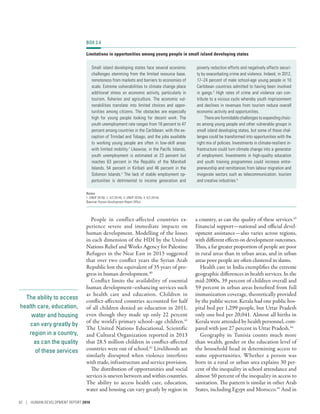
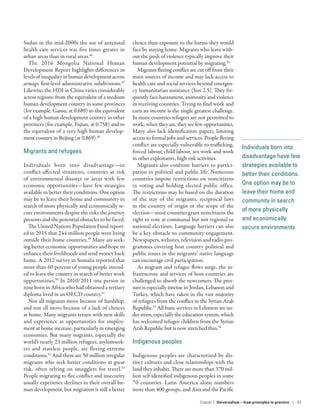
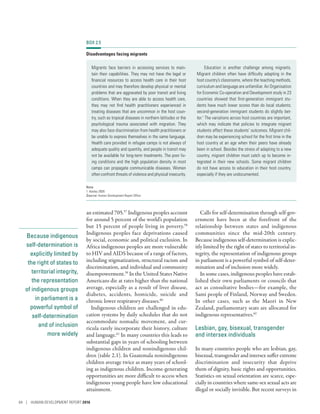
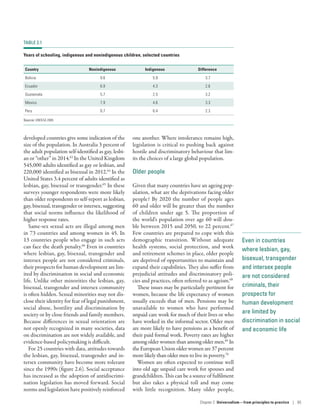
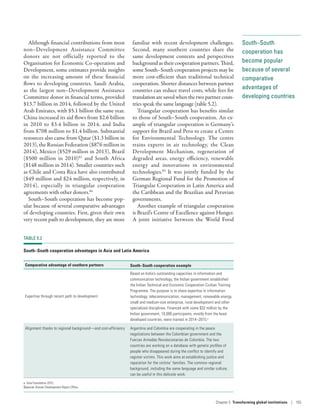
Report 2016
Human Development for Everyone Empowered lives.
Resilient nations.
The 2016 Human Development Report is the latest in the series of global Human Development Reports published
by the United Nations Development Programme (UNDP) since 1990 as independent, analytically and empirically
grounded discussions of major development issues, trends and policies.
Additional resources related to the 2016 Human Development Report can be found online at http://hdr.undp.org,
including digital versions of the Report and translations of the overview in more than 20 languages, an interactive
web version of the Report, a set of background papers and think pieces commissioned for the Report, interactive
maps and databases of human development indicators, full explanations of the sources and methodologies used in
the Report’s composite indices, country profiles and other background materials as well as previous global, regional
and national Human Development Reports. The 2016 Report and the best of Human Development Report Office
content, including publications, data, HDI rankings and related information can also be accessed on Apple iOS and
Android smartphones via a new and easy to use mobile app.
The cover reflects the basic message that human development is for
everyone—in the human development journey no one can be left out.
Using an abstract approach, the cover conveys three fundamental
points. First, the upward moving waves in blue and whites represent
the road ahead that humanity has to cover to ensure universal human
development. The different curvature of the waves alerts us that some
paths will be more difficult and sailing along those paths will not be easy,
but multiple options are open. Second, in this journey some people will
be ahead, but some will be lagging behind. Those lagging behind will
need helping hands from those who are ahead. The gestures of the two
hands reflect that spirit of human solidarity. Third, the two colours—
green and blue—and the hands at the top—convey that universal human
development requires a balance among planet, peace and people.
Copyright @ 2016
By the United Nations Development Programme
1 UN Plaza, New York, NY 10017 USA
All rights reserved. No part of this publication may be reproduced, stored in a retrieval system or transmitted, in any form or by means, electronic,
mechanical, photocopying, recording or otherwise, without prior permission.
Sales no.: E.16.III.B.1
ISBN: 978-92-1-126413-5
eISBN: 978-92-1-060036-1
ISSN: 0969-4501
A catalogue record for this book is available from the British Library and Library of Congress
Printed in Canada, by the Lowe-Martin Group, on Forest Stewardship Council certified and elemental chlorine-free papers. Printed using vegetable-based
ink.
Editing and production: Communications Development Incorporated, Washington DC, USA
Information design and data visualization: Gerry Quinn and Human Development Report Office
Cover design: Phoenix Design Aid
For a list of any errors and omissions found subsequent to printing, please visit our website at http://hdr.undp.org
Human Development
Report 2016
Human Development for Everyone
Human Development Report 2016
Human Development for Everyone
Empowered lives.
Resilient nations.
Published for the
United Nations
Development
Programme
(UNDP)
Human Development Report 2016 Team
Director and lead author
Selim Jahan
Deputy director
Eva Jespersen
Research and statistics
Shantanu Mukherjee (Team Leader). Milorad Kovacevic (Chief Statistician), Botagoz Abdreyeva, Astra Bonini, Cecilia
Calderon, Christelle Cazabat, Yu-Chieh Hsu, Christina Lengfelder, Patrizia Luongo, Tanni Mukhopadhyay, Shivani Nayyar
and Heriberto Tapia
Production and web
Admir Jahic and Dharshani Seneviratne
Outreach and communications
Jon Hall, Sasa Lucic, Jennifer O’Neil Oldfield and Anna Ortubia
Operations and administration
Sarantuya Mend (Operations Manager), Fe Juarez Shanahan and May Wint Than
ii | HUMAN DEVELOPMENT REPORT 2016
Human Development
Report 2016
Human Development for Everyone
Foreword
Human development is all about human free-
doms: freedom to realize the full potential of
every human life, not just of a few, nor of most,
butofalllivesineverycorneroftheworld—now
and in the future. Such universalism gives the
human development approach its uniqueness.
However, the principle of universalism is
one thing; translating it into practice is an-
other. Over the past quarter-century there has
been impressive progress on many fronts in hu-
man development, with people living longer,
more people rising out of extreme poverty and
fewer people being malnourished. Human
development has enriched human lives—but
unfortunately not all to the same extent, and
even worse, not every life.
It is thus not by chance but by choice that
world leaders in 2015 committed to a develop-
ment journey that leaves no one out—a central
premise of the 2030 Agenda. Mirroring that
universal aspiration, it is timely that the 2016
Human Development Report is devoted to the
theme of human development for everyone.
The Report begins by using a broad brush
to paint a picture of the challenges the world
faces and the hopes humanity has for a better
future. Some challenges are lingering (depri-
vations), some are deepening (inequalities)
and some are emerging (violent extremism),
but most are mutually reinforcing. Whatever
their nature or reach, these challenges have an
impact on people’s well-being in both present
and future generations.
At the same time, however, the Report re-
minds us what humanity has achieved over the
past 25 years and gives us hope that further ad-
vances are possible. We can build on what we
have achieved, we can explore new possibilities
to overcome challenges and we can attain what
once seemed unattainable. Hopes are within
our reach to realize.
Given that broader context, the Report
then raises two fundamental questions: who
has been left out in progress in human devel-
opment and how and why did that happen.
It emphasizes that poor, marginalized and
vulnerable groups—including ethnic mi-
norities, indigenous peoples, refugees and
migrants—are being left furthest behind. The
barriers to universalism include, among others,
deprivations and inequalities, discrimination
and exclusion, social norms and values, and
prejudice and intolerance. The Report also
clearly identifies the mutually reinforcing
gender barriers that deny many women the
opportunities and empowerment necessary to
realize the full potential of their lives.
To ensure human development for everyone,
the Report asserts that merely identifying the
nature of and the reasons for the deprivation
of those left out is not enough. Some aspects
of the human development analytical frame-
work and assessment perspectives must be
brought to the fore to address issues that
prevent universal human development. For
example, human rights and human security,
voice and autonomy, collective capabilities
and the interdependence of choices are key for
the human development of those currently left
out. Similarly, quality of human development
outcomes and not only quantity, going be-
yond the averages and disaggregating statistics
(particularly gender-disaggregation)—must
be considered to assess and ensure that human
development benefits reach everyone.
The Report forcefully argues that caring for
those left out requires a four-pronged policy
strategy at the national level: reaching those
left out using universal policies (for example,
inclusive growth, not mere growth), pursuing
measures for groups with special needs (for
example, persons with disabilities), making
human development resilient and empowering
those left out.
The Report rightly recognizes that national
policies need to be complemented by actions
at the global level. It addresses issues related to
the mandate, governance structures and work
of global institutions. It draws our attention
to the fact that even though we have grown
accustomed to heated debates winding up in
gridlock at the national, regional and global
levels, underneath the rumble of all that,
consensus has been emerging around many
global challenges to ensure a sustainable world
for future generations. The landmark Paris
Foreword | iii
Agreement on climate change, which recently
came into force, bears testimony to this. What
was once deemed unthinkable must now prove
to be unstoppable.
The Report complements the 2030 Agenda
by sharing the principle of universalism and by
concentrating on such fundamental areas as
eliminating extreme poverty, ending hunger
and highlighting the core issue of sustainabil-
ity. The human development approach and
the 2030 Agenda can be mutually reinforcing
by contributing to the narrative of each other,
by exploring how human development and
Sustainable Development Goal indicators can
complement each other and by being a forceful
advocacy platform for each other.
We have every reason to hope that trans-
formation in human development is possible.
What seem to be challenges today can be
overcome tomorrow. The world has fewer than
15 years to achieve its bold agenda of leaving
no one out. Closing the human development
gap is critical, as is ensuring the same, or even
better, opportunities for future generations.
Human development has to be sustained and
sustainable and has to enrich every human life
so that we have a world where all people can
enjoy peace and prosperity.
Helen Clark
Administrator
United Nations Development Programme
iv | HUMAN DEVELOPMENT REPORT 2016
Human Development
Report 2016
Human Development for Everyone
Acknowledgements
The 2016 Human Development Report is the
product of the Human Development Report
Office (HDRO) at the United Nations
Development Programme (UNDP).
The findings, analysis and policy rec-
ommendations of the Report are those of
HDRO alone and cannot be attributed to
UNDP or to its Executive Board. The UN
General Assembly has officially recognized
the Human Development Report as “an
independent intellectual exercise” that has
become “an important tool for raising aware-
ness about human development around the
world.”
We owe a lot to Nobel Laureate Professor
Amartya Sen for his continued inspirational
intellectual advice, guidance and thoughts.
HDRO is also privileged to receive a series
of contributions by eminent people and
organizations. Particular appreciation is due
for the signed contributions from Professor
Dan Ariely (James B. Duke Professor of
Psychology and Behavioral Economics at
Duke University), Carol Bellamy (chair of the
Governing Board of the Global Community
Engagement and Resilience Fund and former
executive director of the United Nations
Children’s Fund), Mirna Cunningham Kain
(Nicaraguan Miskitu, indigenous peoples
rights activist and former chairperson of
the United Nations Permanent Forum on
Indigenous Issues), Olafur Eliasson (artist and
founder of Little Sun), Melinda Gates (co-
chair of the Bill & Melinda Gates Foundation),
Dr. Angela Merkel (chancellor of the Federal
Republic of Germany) and Juan Manuel
Santos (president of Colombia and 2016
Nobel Peace Prize Laureate). We are especially
thankful to Martin Santiago and the UNDP
Country Office in Colombia for facilitating
President Santos’s contribution.
Appreciation is also extended for contribu-
tions from the following authors: Paul Anand,
Ayesha Banu, Flavio Comim, Giovanni
Andrea Cornia, Juliana Martinez Franzoni,
Stephany Griffith-Jones, Irene Khan, Peter
Lunenborg, Manuel Montes, Siddiqur
Osmani, Enrique Peruzzotti, Robert Pollin,
Diego Sanchez-Ancochea, Anuradha Seth,
Frances Stewart and Florencia Torche.
We are thankful for think pieces contributed
by Oscar A. Gomez, Sachiko G. Kamidohzono
and Ako Muto of the Japan International
Cooperation Agency Research Institute; Mara
Simane of the Cross Sectoral Coordination
Centre of the Latvia Cabinet of Ministers; and
HOPE XXL, a civil society organization. Two
UNDP Global Policy Centres—one in Seoul
on global development partnerships and one
in Nairobi on resilient ecosystems and deser-
tification—contributed think pieces to the
Report, and our thanks go to Balazs Hovarth
and Anne-Gertraude Juepner.
Invaluable insights and guidance were re-
ceived from a distinguished Advisory Panel:
Olu Ajakaiye, Magdalena Sepúlveda Carmona,
Giovanni Andrea Cornia, Diane Elson, Heba
Handoussa, Richard Jolly, Ravi Kanbur,
Yasushi Katsuma, Ella Libanova, Justin Yifu
Lin, Leticia Merino, Solita Monsod, Onalenna
Doo Selolwane and Frances Stewart.
For providing expert advice on methodolo-
gies and data choices related to the calculation
of the Report’s human development indices,
we would also like to thank the Report’s
Statistical Advisory Panel members: Lisa Grace
S. Bersales, Albina Chuwa, Koen Decancq,
Enrico Giovannini, Pascual Gerstenfeld, Janet
Gornick, Gerald Haberkorn, Haishan Fu,
Robert Kirkpatrick, Jaya Krishnakumar and
Michaela Saisana.
The Report’s composite indices and other
statistical resources rely on the expertise of the
leading international data providers in their
specialized fields, and we express our gratitude
for their continued collegial collaboration with
the HDRO. To ensure accuracy and clarity,
the statistical analysis has benefited from dis-
cussions of statistical issues with Gisela Robles
Aguilar, Sabina Alkire, Kenneth Hartggen and
Nicolas Fasel and his team from the Office of
the United Nations High Commissioner for
Human Rights.
The consultations held during the prepa-
ration of the Report relied on the generous
support of many institutions and individuals
Acknowledgements | v
who are too numerous to mention here (par-
ticipants and partners are listed at http://
hdr.undp.org/2016-report/consultations).
Formal multistakeholder consultations were
held between April and September 2016 in
Geneva, Paris, Istanbul, Nairobi, Singapore
and Panama. We are grateful to the UNDP
Office in Geneva, the Organisation for
Economic Co-operation and Development
and UNDP regional service centres and global
policy centres for organizing these consulta-
tions and in particular to Rebeca Arias, Max
Everest-Phillips, Anne-Gertraude Juepner,
Alexis Laffittan, Marcos Neto and Maria
Luisa Silva. Informal consultations were also
held on the side of the launch of the 2015
Human Development Report in Beijing,
Bonn, Colombo, Dhaka, Helsinki, London,
Manila, Reykjavik and Vienna. Contributions,
support and assistance from partnering insti-
tutions, including UNDP regional bureaus
and country offices, are acknowledged with
much gratitude.
Special thanks are extended to UNDP col-
leagues who constituted the Readers Group
for the Report: Mandeep Dhaliwal, Priya
Gajraj, George Ronald Gray, Anne-Gertraude
Juepner, Sheila Marnie, Ayodele Odusola,
Thangavel Palanivel, Sarah Poole, Mounir
Tabet, Claire Van der Vaeren and Claudia
Vinay. The political read of the Report was
done by Patrick Keuleers, Luciana Mermet
and Nicholas Rosellini, and their advice is
thankfully acknowledged.
Former HDRO colleagues and friends of
the Report, including Moez Doraid, Sakiko
Fukuda-Parr, Terry McKinley, Saraswathi
Menon, Siddiqur Osmani, Stefano Pettinato
and David Stewart, were kind enough to spend
a day with us and share their insights, views
and experiences, which are invaluable.
We further benefited on Report-related
topics from discussions with and inputs
from Saamah Abdallah, Helmut K. Anheier,
Michelle Breslauer, Cosmas Gitta, Ronald
Mendoza, Eugenia Piza-Lopez, Julia Raavad,
Diane Sawyer and Oliver Schwank. We would
like to thank members of the public who par-
ticipated in online surveys for Report-related
topics on our website.
Several talented young people contrib-
uted to the Report as interns: Ellen Hsu,
Mohammad Taimur Mustafa, Abedin Rafique,
Jeremías Rojas, Prerna Sharma, Weijie Tan and
Danielle Ho Tan Yau. They deserve recogni-
tion for their dedication and contributions.
We are grateful for the highly professional
editing and production by Communications
Development Incorporated—led by Bruce
Ross-Larson,withJoeCaponio,MikeCrumplar,
Christopher Trott and Elaine Wilson—and de-
signers Gerry Quinn and Phoenix Design Aid.
Most of all, on a personal note, I am,
as always, profoundly grateful to UNDP
Administrator Helen Clark for her leadership
and vision as well as her commitment to the
cause of human development and her solid
support to our work. My thanks also go to the
entire HDRO team for their dedication in
producing a report that strives to further the
advancement of human development.
Selim Jahan
Director
Human Development Report Office
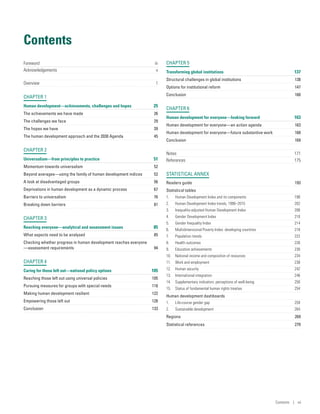
vi | HUMAN DEVELOPMENT REPORT 2016
Contents
Foreword	 iii
Acknowledgements	 v
Overview	1
CHAPTER 1
Human development­—­achievements, challenges and hopes	 25
The achievements we have made	 26
The challenges we face	 29
The hopes we have	 39
The human development approach and the 2030 Agenda	 45
CHAPTER 2
Universalism—from principles to practice	 51
Momentum towards universalism	 52
Beyond averages­—­using the family of human development indices	 52
A look at disadvantaged groups	 56
Deprivations in human development as a dynamic process	 67
Barriers to universalism	 76
Breaking down barriers	 81
CHAPTER 3
Reaching everyone­—analytical and assessment issues	 85
What aspects need to be analysed	 85
Checking whether progress in human development reaches everyone­
—­assessment requirements	 94
CHAPTER 4
Caring for those left out­—­national policy options	 105
Reaching those left out using universal policies	 105
Pursuing measures for groups with special needs	 118
Making human development resilient	 122
Empowering those left out	 128
Conclusion	133
CHAPTER 5
Transforming global institutions	 137
Structural challenges in global institutions	 138
Options for institutional reform	 147
Conclusion	160
CHAPTER 6
Human development for everyone­—­looking forward	 163
Human development for everyone­—­an action agenda	 163
Human development for everyone­—­future substantive work	 168
Conclusion	169
Notes	 171
References	 175
STATISTICAL ANNEX
Readers guide	 193
Statistical tables	
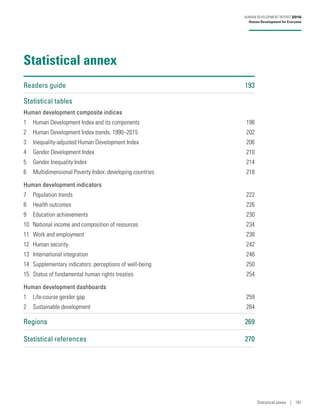
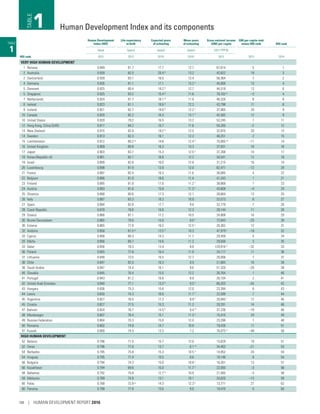
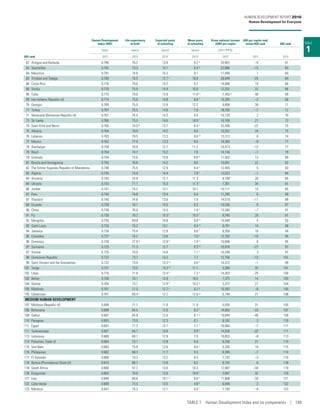
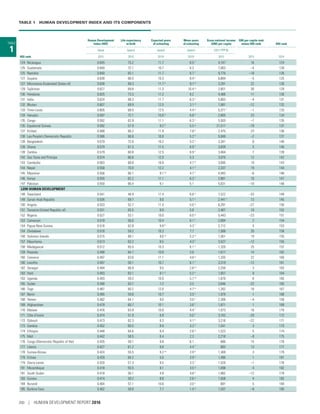
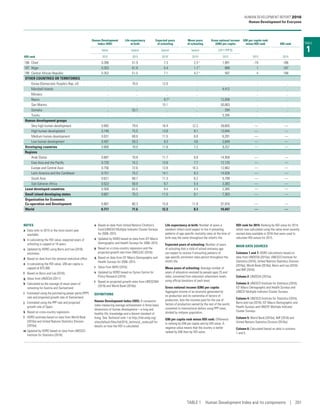
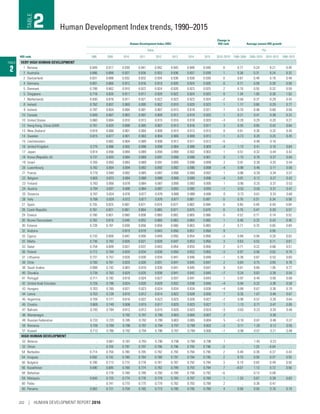
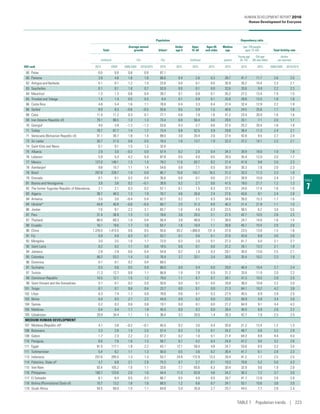
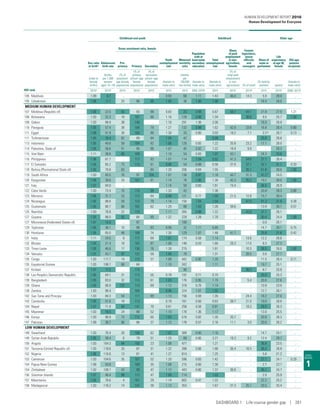
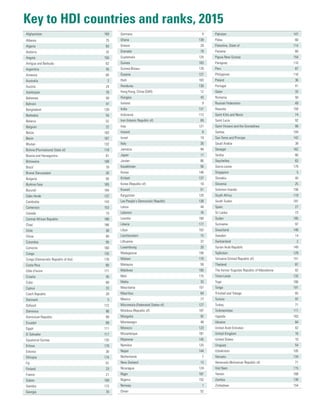
1.	 Human Development Index and its components	 198
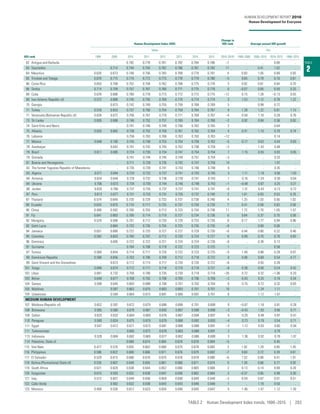
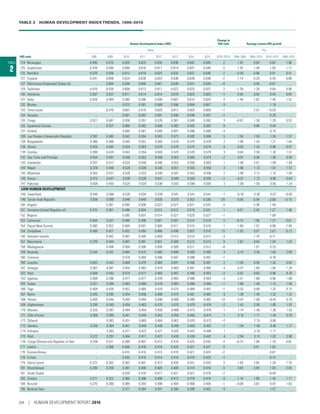
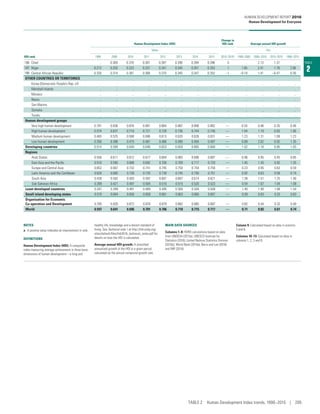
2.	 Human Development Index trends, 1990–2015	 202
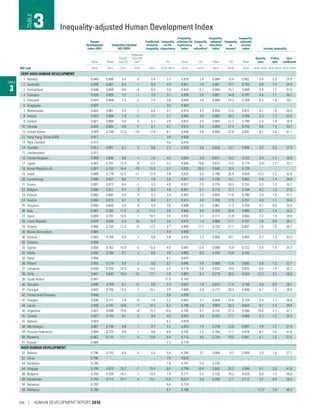
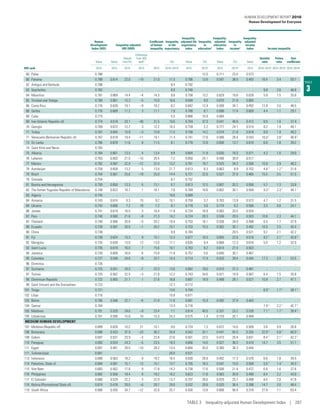
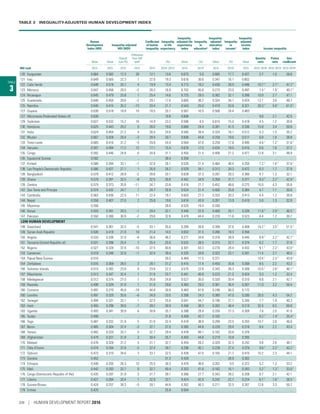
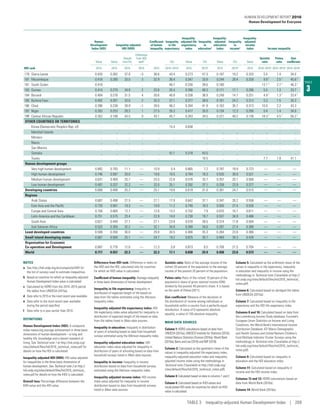
3.	 Inequality-adjusted Human Development Index	 206
4.	 Gender Development Index	 210
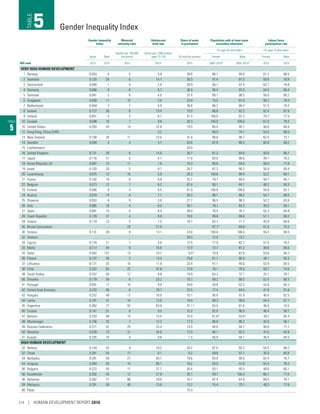
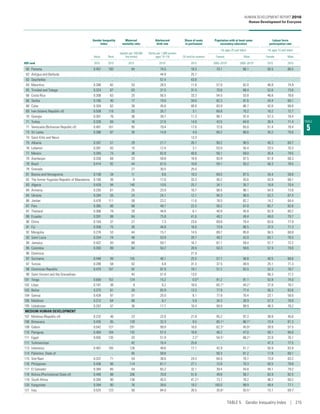
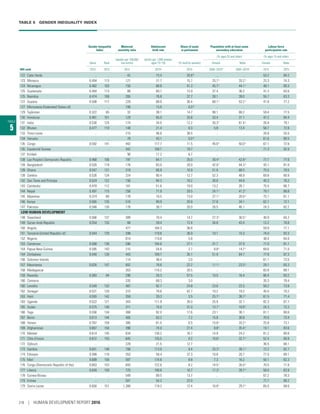
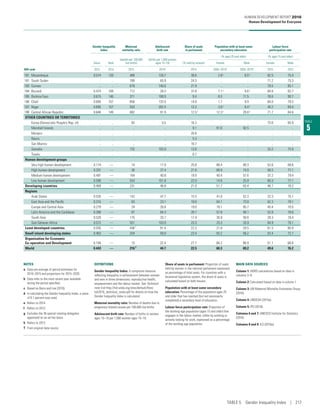
5.	 Gender Inequality Index	 214
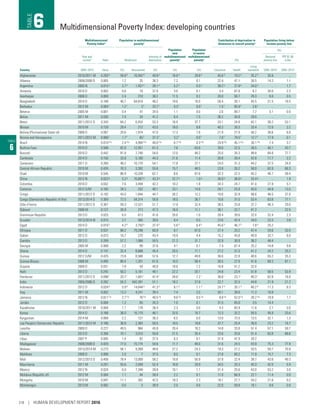
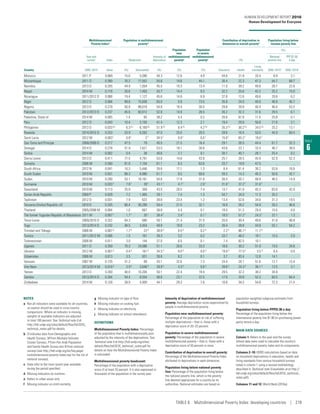
6.	 Multidimensional Poverty Index: developing countries	 218
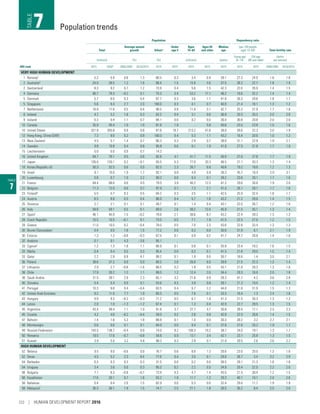
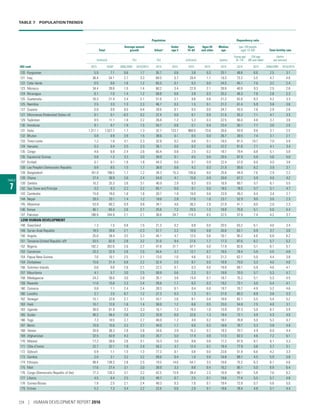
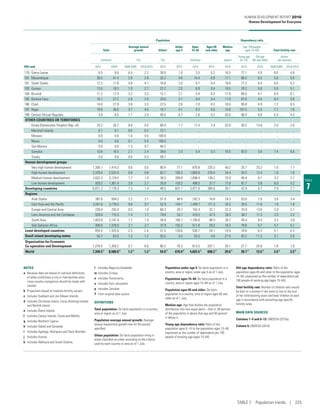
7.	 Population trends	 222
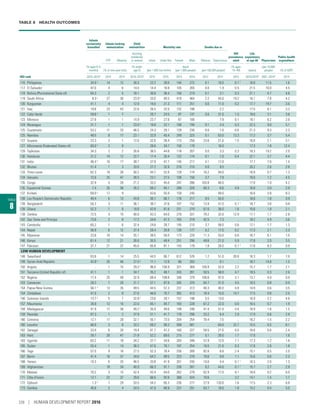
8.	 Health outcomes	 226
9.	 Education achievements	 230
10.	 National income and composition of resources	 234
11.	 Work and employment	 238
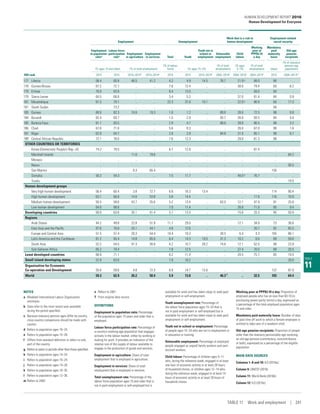
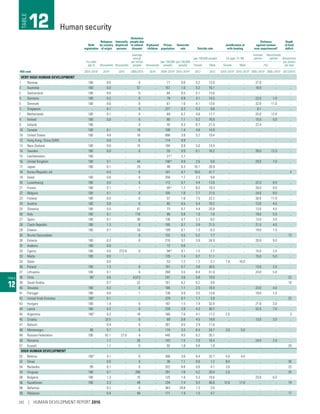
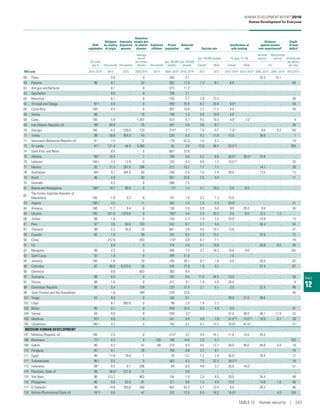
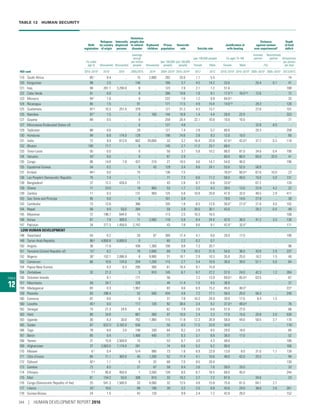
12.	 Human security	 242
13.	 International integration	 246
14.	 Supplementary indicators: perceptions of well-being	 250
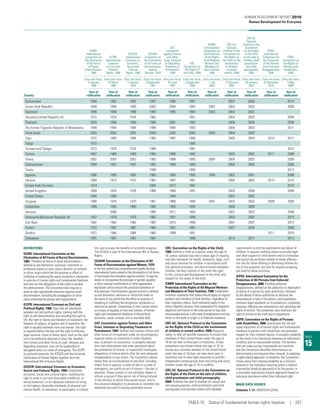
15.	 Status of fundamental human rights treaties	 254
Human development dashboards
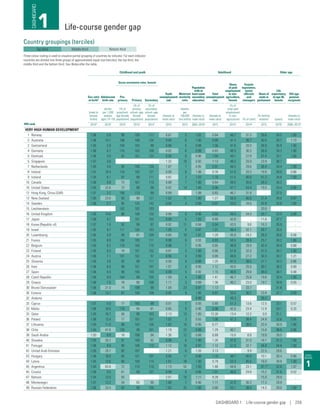
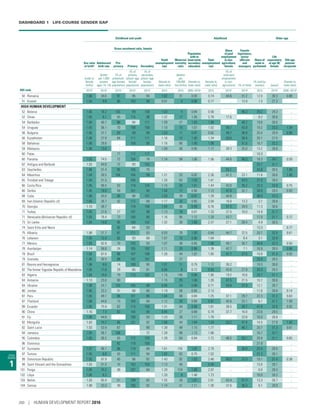
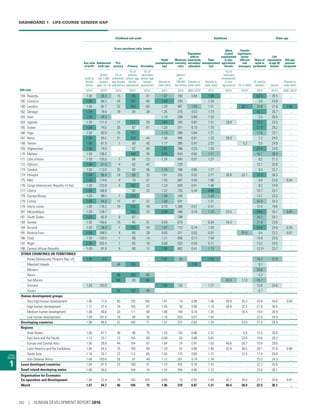
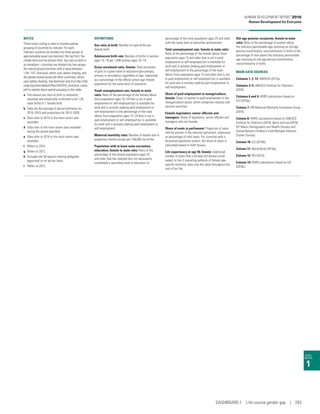
1.	 Life-course gender gap	 259
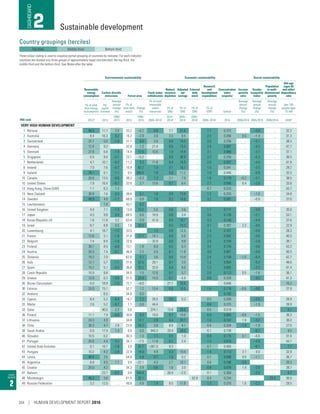
2.	 Sustainable development	 264
Regions	269
Statistical references	 270
Contents | vii
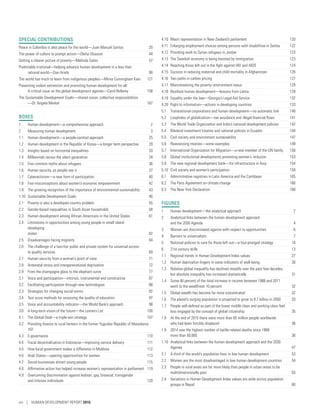
SPECIAL CONTRIBUTIONS
Peace in Colombia is also peace for the world—Juan Manuel Santos	 20
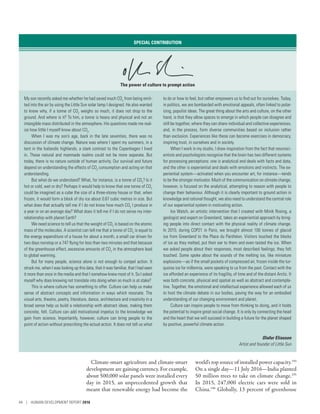
The power of culture to prompt action—Olafur Eliasson	 44
Getting a clearer picture of poverty—Melinda Gates	 57
Predictably irrational—helping advance human development in a less than
rational world—Dan Ariely	 90
The world has much to learn from indigenous peoples—Mirna Cunningham Kain	 121
Preventing violent extremism and promoting human development for all:
A critical issue on the global development agenda—Carol Bellamy	 158
The Sustainable Development Goals—shared vision, collective responsibilities
—Dr. Angela Merkel	 167
BOXES
1	 Human development­—­a comprehensive approach	 2
2	 Measuring human development	 3
1.1	 Human development­—­a people-centred approach	 25
1.2	 Human development in the Republic of Korea­—­a longer term perspective	 29
1.3	 Insights based on horizontal inequalities	 33
1.4	 Millennials versus the silent generation	 34
1.5	 Five common myths about refugees	 36
1.6	 Human security, as people see it	 37
1.7	 Cyberactivism­—­a new form of participation	 40
1.8	 Five misconceptions about women’s economic empowerment	 42
1.9	 The growing recognition of the importance of environmental sustainability	 43
1.10	 Sustainable Development Goals	 46
2.1	 Poverty is also a developed country problem	 55
2.2	 Gender-based inequalities in South Asian households	 58
2.3	 Human development among African Americans in the United States	 61
2.4	 Limitations in opportunities among young people in small island
developing	
states	62
2.5	 Disadvantages facing migrants	 64
2.6	 The challenge of a two-tier public and private system for universal access
to quality services	 69
2.7	 Human security from a woman’s point of view	 71
2.8	 Antenatal stress and intergenerational deprivation	 72
2.9	 From the champagne glass to the elephant curve	 77
3.1	 Voice and participation—intrinsic, instrumental and constructive	 87
3.2	 Facilitating participation through new technologies	 88
3.3	 Strategies for changing social norms	 92
3.4	 Test score methods for assessing the quality of education	 97
3.5	 Voice and accountability indicator—the World Bank’s approach	 98
3.6	 A long-term vision of the future—the Leimers List	 100
4.1	 The Global Deal­—­a triple-win strategy	 107
4.2	 Providing finance to rural farmers in the former Yugoslav Republic of Macedonia	
107
4.3	E-governance	 110
4.4	 Fiscal decentralization in Indonesia­—­improving service delivery	 111
4.5	 How local government makes a difference in Moldova	 112
4.6	 Arab States­—­opening opportunities for women	 113
4.7	 Social businesses attract young people	 115
4.8	 Affirmative action has helped increase women’s representation in parliament	 119
4.9	 Overcoming discrimination against lesbian, gay, bisexual, transgender
and intersex individuals	 120
4.10	 Maori representation in New Zealand’s parliament	 120
4.11	 Enlarging employment choices among persons with disabilities in Serbia	 122
4.12	 Providing work to Syrian refugees in Jordan	 123
4.13	 The Swedish economy is being boosted by immigration	 123
4.14	 Reaching those left out in the fight against HIV and AIDS	 124
4.15	 Success in reducing maternal and child mortality in Afghanistan	 126
4.16	 Two paths in carbon pricing	 127
4.17	 Mainstreaming the poverty–­environment nexus	 129
4.18	 Resilient human development­—­lessons from Latvia	 129
4.19	 Equality under the law­—­Georgia’s Legal Aid Service	 132
4.20	 Right to information­—­actions in developing countries	 133
5.1	 Transnational corporations and human development—no automatic link	 140
5.2	 Loopholes of globalization—tax avoidance and illegal financial flows	 141
5.3	 The World Trade Organization and India’s national development policies	 142
5.4	 Bilateral investment treaties and national policies in Ecuador	 144
5.5	 Civil society and environment sustainability	 147
5.6	 Reassessing treaties—some examples	 149
5.7	 International Organization for Migration—a new member of the UN family	 150
5.8	 Global institutional developments promoting women’s inclusion	 153
5.9	 The new regional development bank—for infrastructure in Asia	 154
5.10	 Civil society and women’s participation	 159
6.1	 Administrative registries in Latin America and the Caribbean	 165
6.2	 The Paris Agreement on climate change	 166
6.3	 The New York Declaration	 168
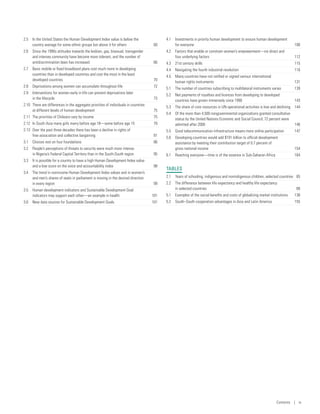
FIGURES
1	 Human development­—­the analytical approach	 2
2	 Analytical links between the human development approach
and the 2030 Agenda	 4
3	 Women are discriminated against with respect to opportunities	 6
4	 Barriers to universalism	 7
5	 National policies to care for those left out—a four-pronged strategy	 10
6	 21st century skills	 13
1.1	 Regional trends in Human Development Index values	 27
1.2	 Human deprivation lingers in some indicators of well-being	 30
1.3	 Relative global inequality has declined steadily over the past few decades,
but absolute inequality has increased dramatically	 31
1.4	 Some 46 percent of the total increase in income between 1988 and 2011
went to the wealthiest 10 percent	 32
1.5	 Global wealth has become far more concentrated	 32
1.6	 The planet’s surging population is projected to grow to 9.7 billion in 2050	 33
1.7	 People self-defined as part of the lower middle class and working class feel
less engaged by the concept of global citizenship	 35
1.8	 At the end of 2015 there were more than 65 million people worldwide
who had been forcibly displaced	 36
1.9	 2014 saw the highest number of battle-related deaths since 1989:
more than 50,000	 36
1.10	 Analytical links between the human development approach and the 2030
Agenda	47
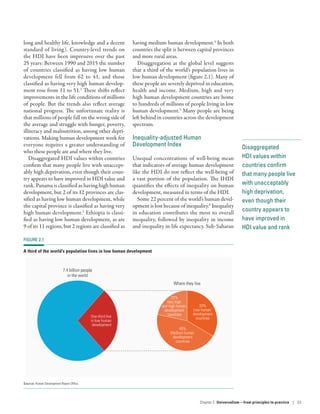
2.1	 A third of the world’s population lives in low human development	 53
2.2	 Women are the most disadvantaged in low human development countries	 54
2.3	 People in rural areas are far more likely than people in urban areas to be
multidimensionally poor	 55
2.4	 Variations in Human Development Index values are wide across population
groups in Nepal	 60
viii | HUMAN DEVELOPMENT REPORT 2015
2.5	 In the United States the Human Development Index value is below the
country average for some ethnic groups but above it for others	 60
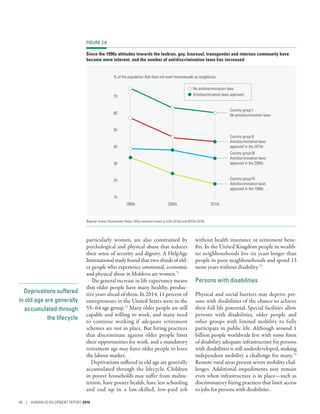
2.6	 Since the 1990s attitudes towards the lesbian, gay, bisexual, transgender
and intersex community have become more tolerant, and the number of
antidiscrimination laws has increased	 66
2.7	 Basic mobile or fixed broadband plans cost much more in developing
countries than in developed countries and cost the most in the least
developed countries	 70
2.8	 Deprivations among women can accumulate throughout life	 72
2.9	 Interventions for women early in life can prevent deprivations later
in the lifecycle	 73
2.10	 There are differences in the aggregate priorities of individuals in countries
at different levels of human development	 75
2.11	 The priorities of Chileans vary by income	 75
2.12	 In South Asia many girls marry before age 18—some before age 15	 79
2.13	 Over the past three decades there has been a decline in rights of
free association and collective bargaining	 81
3.1	 Choices rest on four foundations	 86
3.2	 People’s perceptions of threats to security were much more intense
in Nigeria’s Federal Capital Territory than in the South-South region	 95
3.3	 It is possible for a country to have a high Human Development Index value
and a low score on the voice and accountability index	 98
3.4	 The trend in nonincome Human Development Index values and in women’s
and men’s shares of seats in parliament is moving in the desired direction
in every region	 99
3.5	 Human development indicators and Sustainable Development Goal
indicators may support each other—an example in health	 101
3.6	 New data sources for Sustainable Development Goals	 101
4.1	 Investments in priority human development to ensure human development
for everyone	 108
4.2	 Factors that enable or constrain women’s empowerment—six direct and
four underlying factors	 112
4.3	 21st century skills	 115
4.4	 Navigating the fourth industrial revolution	 116
4.5	 Many countries have not ratified or signed various international
human rights instruments	 131
5.1	 The number of countries subscribing to multilateral instruments varies	 139
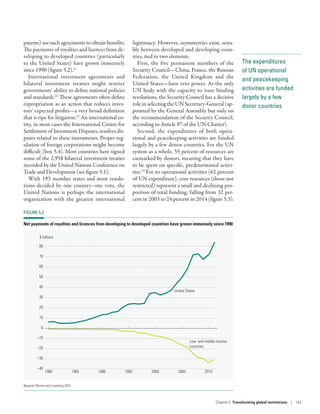
5.2	 Net payments of royalties and licences from developing to developed
countries have grown immensely since 1990	 143
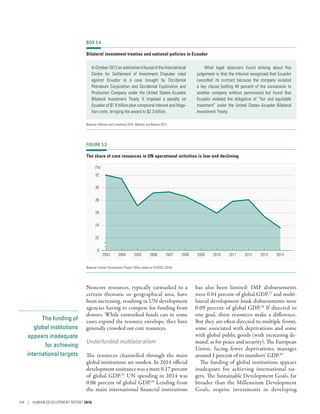
5.3	 The share of core resources in UN operational activities is low and declining	 144
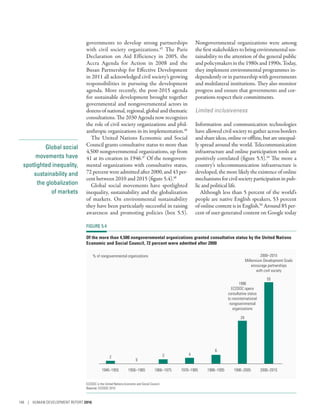
5.4	 Of the more than 4,500 nongovernmental organizations granted consultative
status by the United Nations Economic and Social Council, 72 percent were
admitted after 2000	 146
5.5	 Good telecommunication infrastructure means more online participation	 147
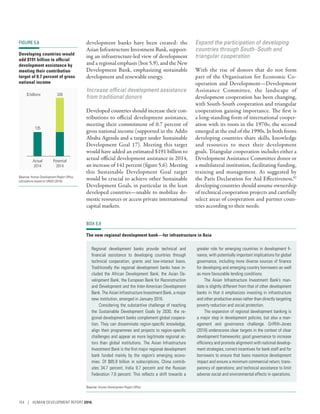
5.6	 Developing countries would add $191 billion to official development
assistance by meeting their contribution target of 0.7 percent of
gross national income	 154
6.1	 Reaching everyone­—­time is of the essence in Sub-­Saharan Africa	 164
TABLES
2.1	 Years of schooling, indigenous and nonindigenous children, selected countries	 65
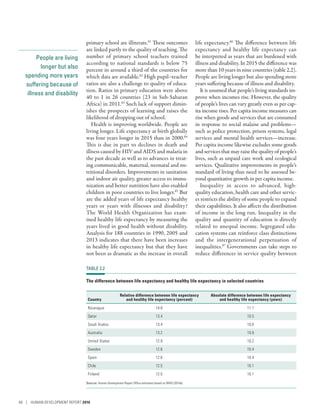
2.2	 The difference between life expectancy and healthy life expectancy
in selected countries	 68
5.1	 Examples of the social benefits and costs of globalizing market institutions	 138
5.2	 South–South cooperation advantages in Asia and Latin America	 155
Contents | ix
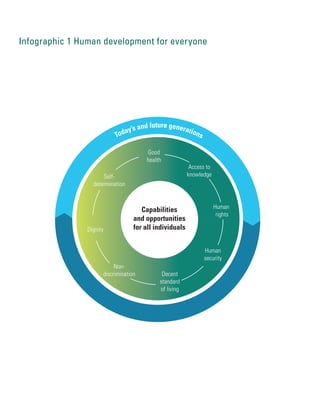
Overview
Human development
for everyone
Good
health
Self-
determination
Dignity
Non-
discrimination Decent
standard
of living
Access to
knowledge
Human
rights
Human
security
Capabilities
and opportunities
for all individuals
Today’s and future generations
Infographic 1 Human development for everyone
Human Development
Report 2016
Human Development for Everyone
Universalism is key to
human development,
and human
development for
everyone is attainable
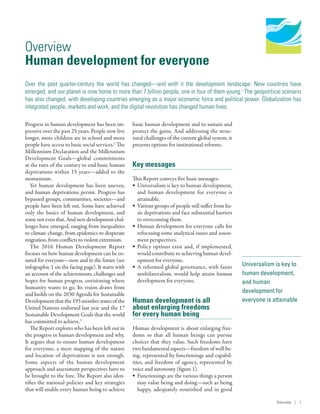
Overview
Human development for everyone
Over the past quarter-century the world has changed­—­and with it the development landscape. New countries have
emerged, and our planet is now home to more than 7 billion people, one in four of them young.1
The geopolitical scenario
has also changed, with developing countries emerging as a major economic force and political power. Globalization has
integrated people, markets and work, and the digital revolution has changed human lives.
Progress in human development has been im-
pressive over the past 25 years. People now live
longer, more children are in school and more
people have access to basic social services.2
The
Millennium Declaration and the Millennium
Development Goals­—­global commitments
at the turn of the century to end basic human
deprivations within 15 years­—­added to the
momentum.
Yet human development has been uneven,
and human deprivations persist. Progress has
bypassed groups, communities, societies­—­and
people have been left out. Some have achieved
only the basics of human development, and
somenoteventhat.Andnewdevelopmentchal-
lenges have emerged, ranging from inequalities
to climate change, from epidemics to desperate
migration, from conflicts to violent extremism.
The 2016 Human Development Report
focuses on how human development can be en-
sured for everyone­—­now and in the future (see
infographic 1 on the facing page). It starts with
an account of the achievements, challenges and
hopes for human progress, envisioning where
humanity wants to go. Its vision draws from
and builds on the 2030 Agenda for Sustainable
Development that the 193 member states of the
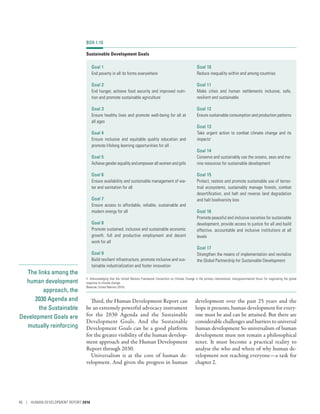
United Nations endorsed last year and the 17
Sustainable Development Goals that the world
has committed to achieve.3
The Report explores who has been left out in
the progress in human development and why.
It argues that to ensure human development
for everyone, a mere mapping of the nature
and location of deprivations is not enough.
Some aspects of the human development
approach and assessment perspectives have to
be brought to the fore. The Report also iden-
tifies the national policies and key strategies
that will enable every human being to achieve
basic human development and to sustain and
protect the gains. And addressing the struc-
tural challenges of the current global system, it
presents options for institutional reforms.
Key messages
This Report conveys five basic messages:
•	 Universalism is key to human development,
and human development for everyone is
attainable.
•	 Various groups of people still suffer from ba-
sic deprivations and face substantial barriers
to overcoming them.
•	 Human development for everyone calls for
refocusing some analytical issues and assess-
ment perspectives.
•	 Policy options exist and, if implemented,
would contribute to achieving human devel-
opment for everyone.
•	 A reformed global governance, with fairer
multilateralism, would help attain human
development for everyone.
Human development is all
about enlarging freedoms
for every human being
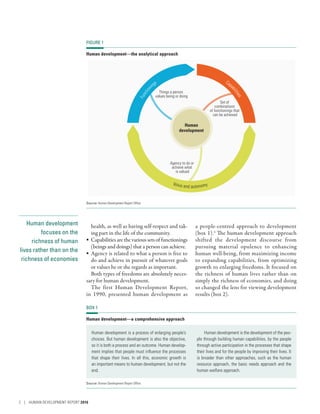
Human development is about enlarging free-
doms so that all human beings can pursue
choices that they value. Such freedoms have
two fundamental aspects­—­freedom of well-be-
ing, represented by functionings and capabil-
ities, and freedom of agency, represented by
voice and autonomy (figure 1).
•	 Functionings are the various things a person
may value being and doing­—­such as being
happy, adequately nourished and in good
Overview | 1
Human development
focuses on the
richness of human
lives rather than on the
richness of economies
health, as well as having self-respect and tak-
ing part in the life of the community.
•	 Capabilitiesarethevarioussetsoffunctionings
(beings and doings) that a person can achieve.
•	 Agency is related to what a person is free to
do and achieve in pursuit of whatever goals
or values he or she regards as important.
Both types of freedoms are absolutely neces-
sary for human development.
The first Human Development Report,
in 1990, presented human development as
a ­people-centred approach to development
(box 1).4
The human development approach
shifted the development discourse from
pursuing material opulence to enhancing
human well-being, from maximizing income
to expanding capabilities, from optimizing
growth to enlarging freedoms. It focused on
the richness of human lives rather than on
simply the richness of economies, and doing
so changed the lens for viewing development
results (box 2).
FIGURE 1
Human development­—­the analytical approach
Human
development
Function
ings Capa
bilities
Voice and autonomy
Things a person
values being or doing
Set of
combinations
of functionings that
can be achieved
Agency to do or
achieve what
is valued
Source: Human Development Report Office.
BOX 1
Human development­—­a comprehensive approach
Human development is a process of enlarging people’s
choices. But human development is also the objective,
so it is both a process and an outcome. Human develop-
ment implies that people must influence the processes
that shape their lives. In all this, economic growth is
an important means to human development, but not the
end.
Human development is the development of the peo-
ple through building human capabilities, by the people
through active participation in the processes that shape
their lives and for the people by improving their lives. It
is broader than other approaches, such as the human
resource approach, the basic needs approach and the
human welfare approach.
Source: Human Development Report Office.
2 | HUMAN DEVELOPMENT REPORT 2016
What humanity has
achieved over 25
years gives hope that
fundamental changes
are possible. Some
of the impressive
achievements have
been in regions or
areas that once
were lagging
The human development approach also pro-
vided the analytical bedrock of the Millennium
Declaration and the Millennium Development
Goals­—­the timebound development objectives
and targets agreed on in 2000 by 189 heads of
states and governments to reduce basic human
poverty by 2015. And it informed and influ-
enced the 2030 Agenda and the Sustainable
Development Goals.
Human development for
everyone is attainable
As universalism is the centrepiece of human
development, human development must be
and can be attained for everyone. The positive
evidence is encouraging.
By 2015 the world had achieved some of
what seemed to be daunting challenges 25 years
ago. Even though the global population in-
creased by 2 billion­—­from 5.3 billion in 1990
to 7.3 billion in 2015­—­more than 1 billion
people escaped extreme poverty, 2.1  billion
gained access to improved sanitation and more
than 2.6 billion gained access to an improved
source of drinking water.5
The global under-five mortality rate was more
than halved between 1990 and 2015—­from
91 per 1,000 live births to 43. The incidence
of HIV, malaria and tuberculosis declined be-
tween 2000 and 2015. The proportion of seats
held by women in parliaments worldwide rose
to 23 percent in 2016­—­up 6 percentage points
over the preceding decade. The global net loss
of forested areas fell from 7.3  million hec-
tares a year in the 1990s to 3.3 million during
2010–2015.6
Yet, even with all this commendable progress,
the world still faces many complex develop-
ment challenges. Some challenges are lingering
(deprivations), some deepening (inequalities)
and some emerging (violent extremism). Some
are global (gender inequality), some regional
(water stress) and some local (natural disasters).
Most are mutually reinforcing­—­climate change
reduces food security; rapid urbanization mar-
ginalizes the urban poor. Whatever their reach,
these challenges have a negative impact on
people’s well-being.
Despite all these challenges, what human-
ity has achieved over 25 years gives hope that
fundamental changes are possible. In fact, some
of the impressive achievements have been in
regions or areas that once were lagging. All over
the world people are increasingly engaged in
influencing the processes that shape their lives.
Human ingenuity and creativity have initiated
technological revolutions and translated them
into the way we work, think and behave.
Gender equality and women’s empowerment
are now mainstream dimensions of any devel-
opment discourse. And there is no denying that
with an intention to overcome them construc-
tively, space for discussions and dialogues on
issues once taboo is slowly opening­—­as with
sexual orientation; discriminations faced by les-
bian, gay, bisexual, transgender and intersex peo-
ple; and female genital mutilation and cutting.
Awareness of sustainability has been growing.
The 2030 Agenda and the Paris Agreement on
climate change are prime examples. They also
show that under the rumble of debate and grid-
lock, a nascent global consensus is emerging
around many global challenges and ensuring a
sustainable world for future generations.
BOX 2
Measuring human development
The composite Human Development Index (HDI) in-
tegrates three basic dimensions of human develop-
ment. Life expectancy at birth reflects the ability to
lead a long and healthy life. Mean years of schooling
and expected years of schooling reflect the ability to
acquire knowledge. And gross national income per
capita reflects the ability to achieve a decent stan-
dard of living.
To measure human development more comprehen-
sively, the Human Development Report also presents four
other composite indices. The Inequality-adjusted HDI dis-
counts the HDI according to the extent of inequality. The
Gender Development Index compares female and male
HDI values. The Gender Inequality Index highlights wom-
en’s empowerment. And the Multidimensional Poverty
Index measures nonincome dimensions of poverty.
Source: Human Development Report Office.
Overview | 3
Closing the human
development gaps
is critical, but so is
ensuring that future
generations have
the same, or even
better, opportunities
All these promising developments give the
world the hope that things can be changed and
that transformations are possible. The world
has less than 15 years to achieve its inspiration-
al agenda to leave no one behind. Closing the
human development gaps is critical, but so is
ensuring that future generations have the same,
or even better, opportunities.
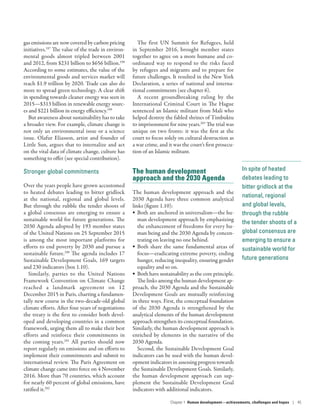
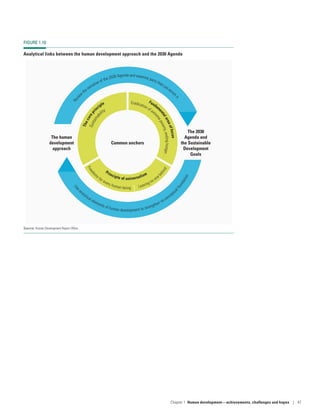
And fulfilling the 2030 Agenda is a critical
step towards enabling all people to reach their
full potential. In fact, the human development
approach and the 2030 Agenda have three
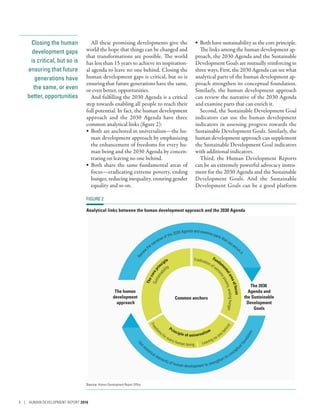
common analytical links (figure 2):
•	 Both are anchored in universalism­—­the hu-
man development approach by emphasizing
the enhancement of freedoms for every hu-
man being and the 2030 Agenda by concen-
trating on leaving no one behind.
•	 Both share the same fundamental areas of
focus­—­eradicating extreme poverty, ending
hunger, reducing inequality, ensuring gender
equality and so on.
•	 Both have sustainability as the core principle.
The links among the human development ap-
proach, the 2030 Agenda and the Sustainable
Development Goals are mutually reinforcing in
three ways. First, the 2030 Agenda can see what
analytical parts of the human development ap-
proach strengthen its conceptual foundation.
Similarly, the human development approach
can review the narrative of the 2030 Agenda
and examine parts that can enrich it.
Second, the Sustainable Development Goal
indicators can use the human development
indicators in assessing progress towards the
Sustainable Development Goals. Similarly, the
human development approach can supplement
the Sustainable Development Goal indicators
with additional indicators.
Third, the Human Development Reports
can be an extremely powerful advocacy instru-
ment for the 2030 Agenda and the Sustainable
Development Goals. And the Sustainable
Development Goals can be a good platform
FIGURE 2
Analytical links between the human development approach and the 2030 Agenda
Common anchors
The human
development
approach
The 2030
Agenda and
the Sustainable
Development
Goals
Revie
w
the narrative of the 2030 Agenda and examine parts that can enrich
it
Use
analytical elements of human development to strengthen its conceptu
alfoundation
Thecorepri
nciple
Fundam
entalareaoffocus
Principle of universalism
Sustainab
ility
Eradication of extr
emepoverty,endinghunger…
Freedo
ms for every human being Leaving no one b
ehind
Source: Human Development Report Office.
4 | HUMAN DEVELOPMENT REPORT 2016
Human deprivations
are dynamic. Moving
above the low human
development threshold
does not necessarily
ensure that people
will be protected
from emerging and
future threats
for the greater visibility of the human develop-
ment approach and the Human Development
Report for the coming years.
Yet basic deprivations abound
among various groups of people
One person in nine in the world is hungry, and
one in three is malnourished.7
About 15 mil-
lion girls a year marry before age 18, one every
two seconds.8
Worldwide 18,000 people a day
die because of air pollution,9
and HIV infects
2  million people a year.10
Every minute an
average of 24 people are displaced from their
home.11
Such basic deprivations are common among
various groups. Women and girls, ethnic mi-
norities, indigenous peoples, persons with dis-
abilities, migrants­—­all are deprived in the basic
dimensions of human development.
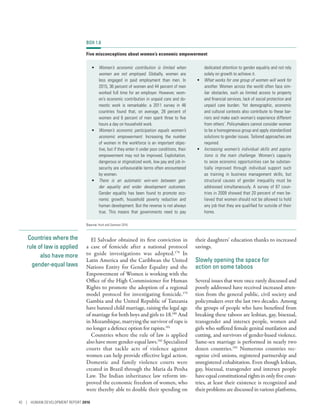
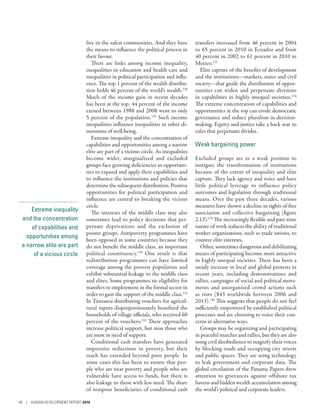
In all regions women have a longer life expec-
tancy than do men, and in most regions girls’ ex-
pected years of schooling are similar to those of
boys. Yet in all regions women consistently have,
on average, a lower Human Development Index
(HDI) value than do men. The largest difference
is in South Asia, where the female HDI value is
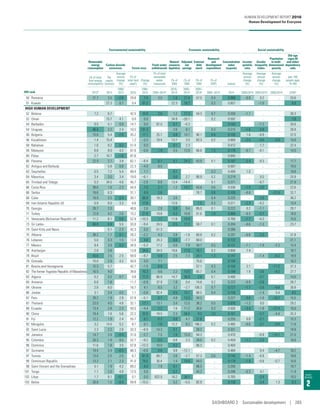
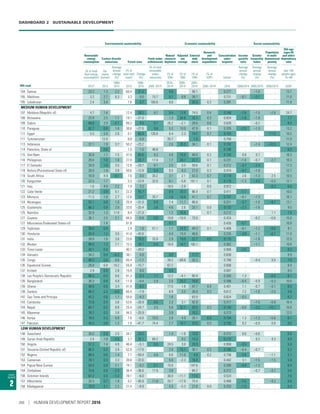
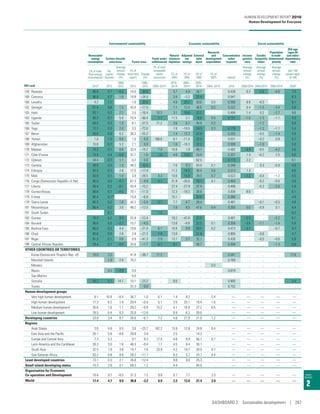
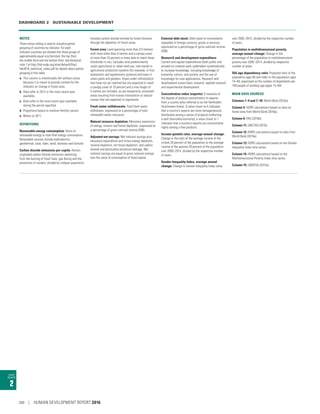
20 percent lower than the male HDI value.
There are group-based disadvantages, as
shown in Nepal. Brahmans and Chhetris have
the highest HDI value (0.538), followed by
Janajatis (0.482), Dalits (0.434) and Muslims
(0.422). The greatest inequalities are in educa-
tion, with pronounced long-lasting effects on
capabilities.12
Shortfalls in basic human development
among various groups often persist because
of discrimination. Women are particularly
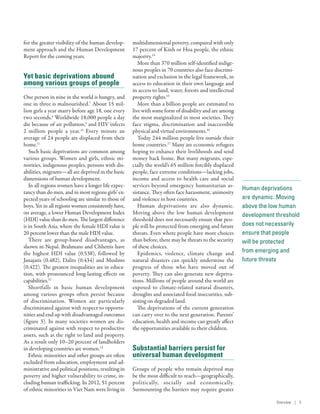
discriminated against with respect to opportu-
nities and end up with disadvantaged outcomes
(figure 3). In many societies women are dis-
criminated against with respect to productive
assets, such as the right to land and property.
As a result only 10–20 percent of landholders
in developing countries are women.13
Ethnic minorities and other groups are often
excluded from education, employment and ad-
ministrative and political positions, resulting in
poverty and higher vulnerability to crime, in-
cluding human trafficking. In 2012, 51 percent
of ethnic minorities in Viet Nam were living in
multidimensional poverty, compared with only
17 percent of Kinh or Hoa people, the ethnic
majority.14
More than 370 million self-identified indige-
nous peoples in 70 countries also face discrimi-
nation and exclusion in the legal framework, in
access to education in their own language and
in access to land, water, forests and intellectual
property rights.15
More than a billion people are estimated to
live with some form of disability and are among
the most marginalized in most societies. They
face stigma, discrimination and inaccessible
physical and virtual environments.16
Today 244 million people live outside their
home countries.17
Many are economic refugees
hoping to enhance their livelihoods and send
money back home. But many migrants, espe-
cially the world’s 65 million forcibly displaced
people, face extreme conditions­—­lacking jobs,
income and access to health care and social
services beyond emergency humanitarian as-
sistance. They often face harassment, animosity
and violence in host countries.
Human deprivations are also dynamic.
Moving above the low human development
threshold does not necessarily ensure that peo-
ple will be protected from emerging and future
threats. Even where people have more choices
than before, there may be threats to the security
of these choices.
Epidemics, violence, climate change and
natural disasters can quickly undermine the
progress of those who have moved out of
poverty. They can also generate new depriva-
tions. Millions of people around the world are
exposed to climate-related natural disasters,
droughts and associated food insecurities, sub-
sisting on degraded land.
The deprivations of the current generation
can carry over to the next generation. Parents’
education, health and income can greatly affect
the opportunities available to their children.
Substantial barriers persist for
universal human development
Groups of people who remain deprived may
be the most difficult to reach­—­geographically,
politically, socially and economically.
Surmounting the barriers may require greater
Overview | 5
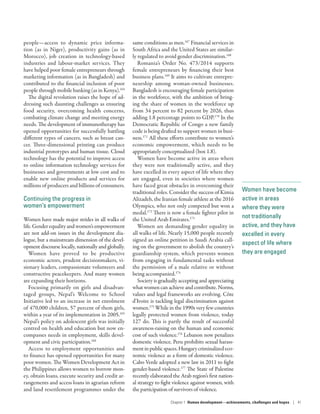
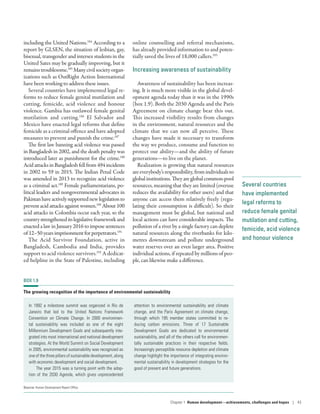
Realizing universal
human development
in practice is possible,
but the key barriers
and forms of exclusion
must first be overcome
fiscal resources and development assistance,
continuing gains in technology and better data
for monitoring and evaluation.
But some barriers are deeply embedded in
social and political identities and relationships­
—­such as blatant violence, discriminatory laws,
exclusionary social norms, imbalances in polit-
ical participation and unequal distribution of
opportunities. Overcoming them will require
putting empathy, tolerance and moral com-
mitments to global justice and sustainability at
the centre of individual and collective choices.
People should consider themselves part of a
cohesive global whole rather than a fragment-
ed terrain of rival groups and interests.
Moving towards universal human develop-
ment requires an awareness and understanding
of the drivers and dynamics of how groups are
marginalized, which inevitably varies across
countries and regions. Realizing universal hu-
man development in practice is possible, but
the key barriers and forms of exclusion must
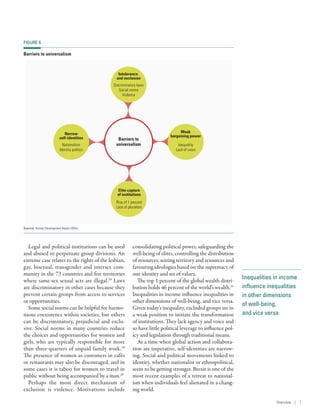
first be overcome (figure 4).
Whether intentional or unintentional,
exclusion can have the same results­—­some
people will be more deprived than others, and
not all people will have equal opportunities to
realize their full potential. Group inequalities
reflect divisions that are socially constructed
and sustained because they establish a basis for
unequal access to valued outcomes and scarce
resources. The dimensions and mechanisms of
exclusion are also dynamic, as are the character-
istics groups use as a basis for exclusion.
FIGURE 3
Women are discriminated against with respect to opportunities
Women are
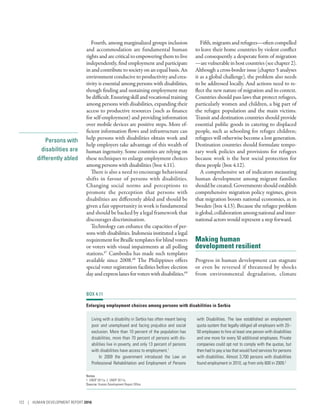
discriminated against
with respect
to opportunities
100 countries
Prevented from
pursuing some
careers only
because of
their gender
More than 150 countries
Legally discriminated
against
18 countries
Free from legal
impediments
32 countries
Procedures to
obtain a passport
differ from those for men
18 countries
Required to
have husband’s
approval
to get a job
100
193
(countries)
Source: Human Development Report Office.
6 | HUMAN DEVELOPMENT REPORT 2016
Inequalities in income
influence inequalities
in other dimensions
of well-being,
and vice versa
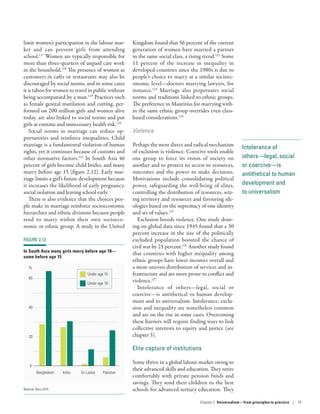
Legal and political institutions can be used
and abused to perpetuate group divisions. An
extreme case relates to the rights of the lesbian,
gay, bisexual, transgender and intersex com-
munity in the 73 countries and five territories
where same-sex sexual acts are illegal.18
Laws
are discriminatory in other cases because they
prevent certain groups from access to services
or opportunities.
Some social norms can be helpful for harmo-
nious coexistence within societies, but others
can be discriminatory, prejudicial and exclu-
sive. Social norms in many countries reduce
the choices and opportunities for women and
girls, who are typically responsible for more
than three-quarters of unpaid family work.19
The presence of women as customers in cafés
or restaurants may also be discouraged, and in
some cases it is taboo for women to travel in
public without being accompanied by a man.20
Perhaps the most direct mechanism of
exclusion is violence. Motivations include
consolidating political power, safeguarding the
well-being of elites, controlling the distribution
of resources, seizing territory and resources and
favouring ideologies based on the supremacy of
one identity and set of values.
The top 1 percent of the global wealth distri-
bution holds 46 percent of the world’s wealth.21
Inequalities in income influence inequalities in
other dimensions of well-being, and vice versa.
Given today’s inequality, excluded groups are in
a weak position to initiate the transformation
of institutions. They lack agency and voice and
so have little political leverage to influence pol-
icy and legislation through traditional means.
At a time when global action and collabora-
tion are imperative, self-identities are narrow-
ing. Social and political movements linked to
identity, whether nationalist or ethnopolitical,
seem to be getting stronger. Brexit is one of the
most recent examples of a retreat to national-
ism when individuals feel alienated in a chang-
ing world.
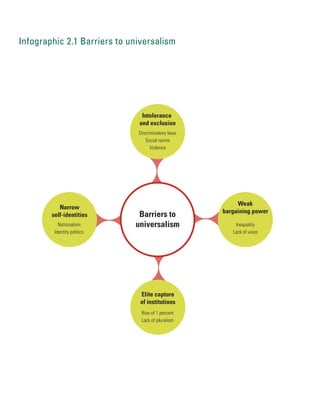
FIGURE 4
Barriers to universalism
Barriers to
universalism
Intolerance
and exclusion
Discriminatory laws
Social norms
Violence
Weak
bargaining power
Inequality
Lack of voice
Narrow
self-identities
Nationalism
Identity politics
Elite capture
of institutions
Rise of 1 percent
Lack of pluralism
Source: Human Development Report Office.
Overview | 7
Voice and autonomy,
as parts of freedom of
agency and freedom of
well-being, are integral
to human development
Intolerance of others in all its forms­—­legal,
social or coercive­—­is antithetical to human
development and to principles of universalism.
Human development for
everyone calls for refocusing
some analytical issues
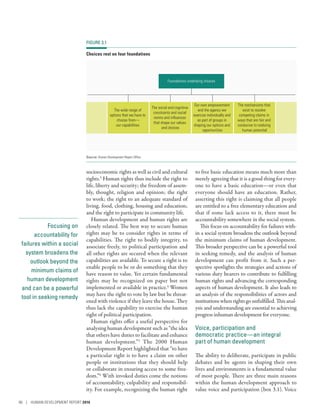
Human development involves expanding
choices, which determine who we are and what
we do. Several factors underlie these choic-
es: the wide range of options that we have to
choose from­—­our capabilities; the social and
cognitive constraints and social norms and in-
fluences that shape our values and choices; our
own empowerment and the agency we exercise
individually and as part of groups in shaping
our options and opportunities; and the mech-
anisms that exist to resolve competing claims
in ways that are fair and conducive to realizing
human potential.
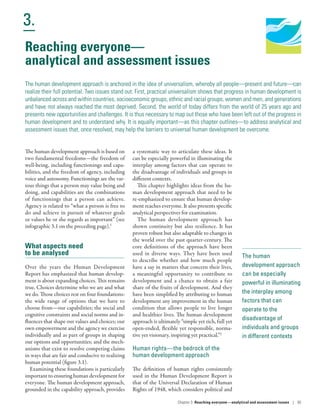
The human development approach provides
a systematic way to articulate these ideas. It
can be especially powerful in illuminating the
interplay among factors that can operate to
the disadvantage of individuals and groups in
different contexts.
Human rights are the bedrock of human
development. Human rights offer a useful
perspective for analysing human development.
Duty holders support and enhance human
development and are accountable for a social
system’s failures to deliver human development.
These perspectives not only go beyond the
minimal claims of human development, but
can also serve as a powerful tool in seeking
remedies.
The notion of human security should
emphasize a deep understanding of threats,
risks and crises for joint action in the human
development and human security approaches.
The challenges are to balance the shock-driven
response to global threats and the promotion of
a culture of prevention.
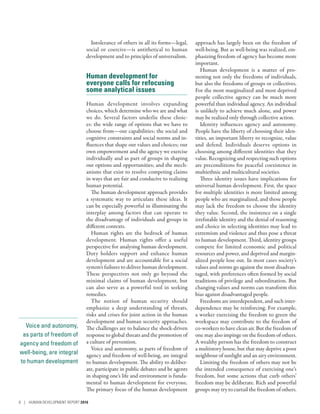
Voice and autonomy, as parts of freedom of
agency and freedom of well-being, are integral
to human development. The ability to deliber-
ate, participate in public debates and be agents
in shaping one’s life and environment is funda-
mental to human development for everyone.
The primary focus of the human development
approach has largely been on the freedom of
well-being. But as well-being was realized, em-
phasizing freedom of agency has become more
important.
Human development is a matter of pro-
moting not only the freedoms of individuals,
but also the freedoms of groups or collectives.
For the most marginalized and most deprived
people collective agency can be much more
powerful than individual agency. An individual
is unlikely to achieve much alone, and power
may be realized only through collective action.
Identity influences agency and autonomy.
People have the liberty of choosing their iden-
tities, an important liberty to recognize, value
and defend. Individuals deserve options in
choosing among different identities that they
value. Recognizing and respecting such options
are preconditions for peaceful coexistence in
multiethnic and multicultural societies.
Three identity issues have implications for
universal human development. First, the space
for multiple identities is more limited among
people who are marginalized, and those people
may lack the freedom to choose the identity
they value. Second, the insistence on a single
irrefutable identity and the denial of reasoning
and choice in selecting identities may lead to
extremism and violence and thus pose a threat
to human development. Third, identity groups
compete for limited economic and political
resources and power, and deprived and margin-
alized people lose out. In most cases society’s
values and norms go against the most disadvan-
taged, with preferences often formed by social
traditions of privilege and subordination. But
changing values and norms can transform this
bias against disadvantaged people.
Freedoms are interdependent, and such inter-
dependence may be reinforcing. For example,
a worker exercising the freedom to green the
workspace may contribute to the freedom of
co-workers to have clean air. But the freedom of
one may also impinge on the freedom of others.
A wealthy person has the freedom to construct
a multistory house, but that may deprive a poor
neighbour of sunlight and an airy environment.
Limiting the freedom of others may not be
the intended consequence of exercising one’s
freedom, but some actions that curb others’
freedom may be deliberate. Rich and powerful
groups may try to curtail the freedom of others.
8 | HUMAN DEVELOPMENT REPORT 2016
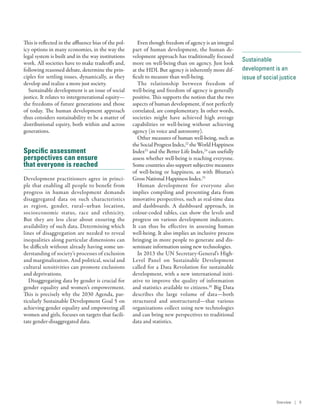
Sustainable
development is an
issue of social justice
This is reflected in the affluence bias of the pol-
icy options in many economies, in the way the
legal system is built and in the way institutions
work. All societies have to make tradeoffs and,
following reasoned debate, determine the prin-
ciples for settling issues, dynamically, as they
develop and realize a more just society.
Sustainable development is an issue of social
justice. It relates to intergenerational equity­—­
the freedoms of future generations and those
of today. The human development approach
thus considers sustainability to be a matter of
distributional equity, both within and across
generations.
Specific assessment
perspectives can ensure
that everyone is reached
Development practitioners agree in princi-
ple that enabling all people to benefit from
progress in human development demands
disaggregated data on such characteristics
as region, gender, rural–urban location,
socioeconomic status, race and ethnicity.
But they are less clear about ensuring the
availability of such data. Determining which
lines of disaggregation are needed to reveal
inequalities along particular dimensions can
be difficult without already having some un-
derstanding of society’s processes of exclusion
and marginalization. And political, social and
cultural sensitivities can promote exclusions
and deprivations.
Disaggregating data by gender is crucial for
gender equality and women’s empowerment.
This is precisely why the 2030 Agenda, par-
ticularly Sustainable Development Goal 5 on
achieving gender equality and empowering all
women and girls, focuses on targets that facili-
tate gender-disaggregated data.
Even though freedom of agency is an integral
part of human development, the human de-
velopment approach has traditionally focused
more on well-being than on agency. Just look
at the HDI. But agency is inherently more dif-
ficult to measure than well-being.
The relationship between freedom of
well-being and freedom of agency is generally
positive. This supports the notion that the two
aspects of human development, if not perfectly
correlated, are complementary. In other words,
societies might have achieved high average
capabilities or well-being without achieving
agency (in voice and autonomy).
Other measures of human well-being, such as
theSocialProgressIndex,22
theWorldHappiness
Index23
and the Better Life Index,24
can usefully
assess whether well-being is reaching everyone.
Some countries also support subjective measures
of well-being or happiness, as with Bhutan’s
Gross National Happiness Index.25
Human development for everyone also
implies compiling and presenting data from
innovative perspectives, such as real-time data
and dashboards. A dashboard approach, in
­colour-coded tables, can show the levels and
progress on various development indicators.
It can thus be effective in assessing human
well-being. It also implies an inclusive process
bringing in more people to generate and dis-
seminate information using new technologies.
In 2013 the UN Secretary-General’s High-
Level Panel on Sustainable Development
called for a Data Revolution for sustainable
development, with a new international initi-
ative to improve the quality of information
and statistics available to citizens.26
Big Data
describes the large volume of data­—­both
structured and unstructured­—­that various
organizations collect using new technologies
and can bring new perspectives to traditional
data and statistics.
Overview | 9
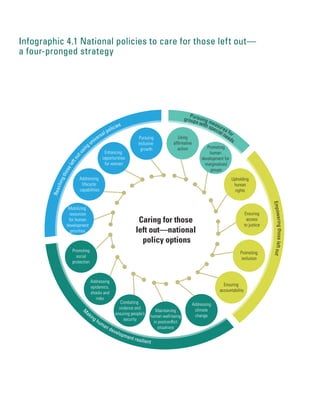
Caring for those
left out—national
policy options
Reachingthoseleftoutus
ing universal policies
Pursuing measures for
M
aking human development resilient
Addressing
epidemics,
shocks and
risks
Combating
violence and
ensuring people’s
security
Addressing
climate
change
Maintaining
human well-being
in postconflict
situations
Promoting
social
protection
Mobilizing
resources
for human
development
priorities
Addressing
lifecycle
capabilities
Pursuing
inclusive
growth
Using
affirmative
action Promoting
human
development for
marginalized
groups
Ensuring
accountability
Promoting
inclusion
Ensuring
access
to justice
Upholding
human
rights
Enhancing
opportunities
for women
Empoweringthoseleftout
groups with special needs
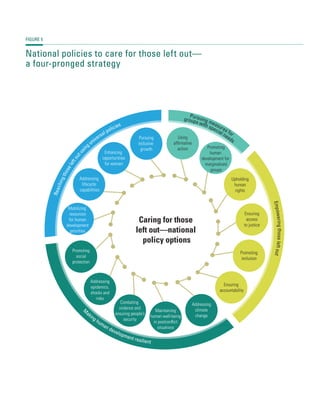
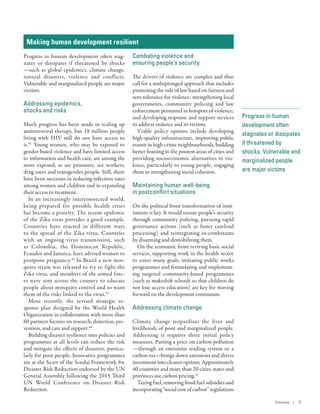
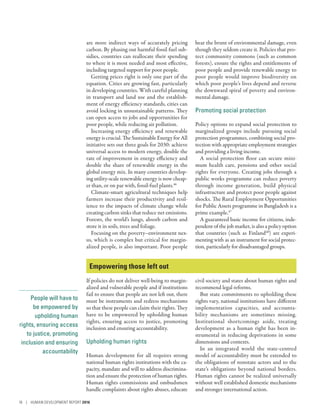
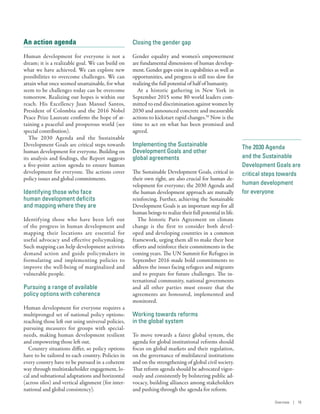
FIGURE 5
National policies to care for those left out—
a four-pronged strategy
For human
development to reach
everyone, growth
has to be inclusive
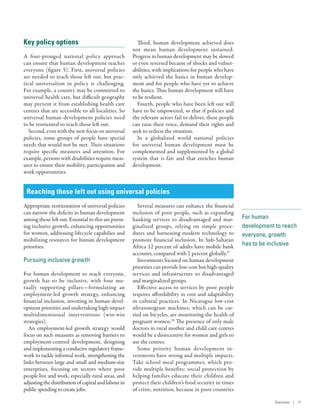
Key policy options
A four-pronged national policy approach
can ensure that human development reaches
everyone (figure 5). First, universal policies
are needed to reach those left out, but prac-
tical universalism in policy is challenging.
For example, a country may be committed to
universal health care, but difficult geography
may prevent it from establishing health care
centres that are accessible to all localities. So
universal human development policies need
to be reoriented to reach those left out.
Second, even with the new focus on universal
policies, some groups of people have special
needs that would not be met. Their situations
require specific measures and attention. For
example, persons with disabilities require meas-
ures to ensure their mobility, participation and
work opportunities.
Third, human development achieved does
not mean human development sustained.
Progress in human development may be slowed
or even reversed because of shocks and vulner-
abilities, with implications for people who have
only achieved the basics in human develop-
ment and for people who have yet to achieve
the basics. Thus human development will have
to be resilient.
Fourth, people who have been left out will
have to be empowered, so that if policies and
the relevant actors fail to deliver, these people
can raise their voice, demand their rights and
seek to redress the situation.
In a globalized world national policies
for universal human development must be
complemented and supplemented by a global
system that is fair and that enriches human
development.
Reaching those left out­­using universal policies
Appropriate reorientation of universal policies
can narrow the deficits in human development
among those left out. Essential to this are pursu-
ing inclusive growth, enhancing opportunities
for women, addressing lifecycle capabilies and
mobilizing resources for human development
priorities.
Pursuing inclusive growth
For human development to reach everyone,
growth has to be inclusive, with four mu-
tually supporting pillars­—formulating an
­employment-led growth strategy, enhancing
financial inclusion, investing in human devel-
opment priorities and undertaking high-­impact
multidimensional interventions (win-win
strategies).
An employment-led growth strategy would
focus on such measures as removing barriers to
employment-centred development, designing
and implementing a conducive regulatory frame-
work to tackle informal work, strengthening the
links between large and small and medium-size
enterprises, focusing on sectors where poor
people live and work, especially rural areas, and
adjusting the distribution of capital and labour in
public spending to create jobs.
Several measures can enhance the financial
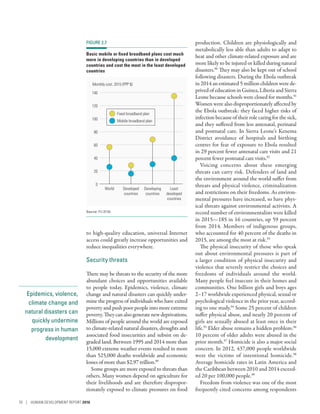
inclusion of poor people, such as expanding
banking services to disadvantaged and mar-
ginalized groups, relying on simple proce-
dures and harnessing modern technology to
promote financial inclusion. In Sub-­Saharan
Africa 12 percent of adults have mobile bank
accounts, compared with 2 percent globally.27
Investments focused on human development
priorities can provide low-cost but high-quality
services and infrastructure to disadvantaged
and marginalized groups.
Effective access to services by poor people
requires affordability in cost and adaptability
in cultural practices. In Nicaragua low-cost
ultrasonogram machines, which can be car-
ried on bicycles, are monitoring the health of
pregnant women.28
The presence of only male
doctors in rural mother and child care centres
would be a disincentive for women and girls to
use the centres.
Some priority human development in-
vestments have strong and multiple impacts.
Take school meal programmes, which pro-
vide multiple benefits: social protection by
helping families educate their children and
protect their children’s food security in times
of crisis; nutrition, because in poor countries
Overview | 11
Because half of
humanity is not
enjoying progress in
human development,
such development
is not universal
school meals are often the only regular and
nutritious meal; and strong incentive to
send children to school and keep children
in schools. Evidence from Botswana, Cabo
Verde, Côte d’Ivoire, Ghana, Kenya, Mali,
Namibia, Nigeria and South Africa bears
testimony to these benefits.29
Rural infrastructure, especially roads and
electricity, is another area. Building rural roads
reduces transport costs, connects rural farmers
to markets, allows workers to move more freely
and promotes access to schools and health care
clinics. Electrification in rural communities
in Guatemala and South Africa has helped
increase employment among marginalized
groups.30
Redistributing assets can also bring those left
out into the growth process. Human capital
is an asset, and differences in educational at-
tainment prevent poor people from becoming
part of the high-productivity growth process.
Democratizing education, particularly tertiary
education, would benefit people from poorer
backgrounds.
Similarly, doing things locally may bring
multiple development impacts. Providing au-
tonomy to local governments in formulating
and implementing local development plans
allows the plans to reflect the aspirations of
local communities. Fiscal decentralization can
also empower local governments to collect
their own revenues and depend less on central
government grants. But if the local approach
is to ensure human development for those left
out, it will also require people’s participation
and greater local administrative capacity.
Enhancing opportunities for women
Gender equality and women’s empowerment
are fundamental dimensions of human de-
velopment. Because half of humanity is not
enjoying progress in human development, such
development is not universal.
Investing in girls and women has multidimen-
sional benefits­—­for example, if all girls in devel-
oping countries completed secondary education,
the under-five mortality rate would be halved.31
Women also need support to pursue higher ed-
ucation, particularly in science, technology, en-
gineering and mathematics, where much future
demand for high-level work will be.
Women also have to juggle paid employment
outside the home and unpaid care work inside
the home as well as balance their productive
and reproductive roles. Flexible working ar-
rangements and enlarged care options, includ-
ing daycare centres, afterschool programmes,
senior citizen homes and long-term care facili-
ties, can help women broaden their choices.
Measures to encourage women’s entrepre-
neurship include establishing a legal framework
that removes barriers to women owning land, a
critical asset, especially in agriculture. So land
policies, legislation and administration need to
be changed to accommodate women­—­and the
new rules must be enforced.
The glass ceiling, though cracked in many
places, is far from being shattered. Gender
requirements in selection and recruitment
and incentive mechanisms for retention can
enhance women’s representation in the public
and private sectors. The criteria for promoting
men and women into senior management po-
sitions should be identical, based on equal pay
for equal work. Mentoring, coaching and spon-
soring can empower women in the workplace
by using successful female senior managers as
role models and as sponsors.
Addressing lifecycle capabilities
To ensure that human development reaches
those left out, building capabilities should be
seen through a lifecycle lens as people face var-
ious types of vulnerabilities in different phases
of their lives.
Sustained human development is more likely
when all children can acquire the skills that
match the opportunities open to young people
joining the workforce. Much attention is cor-
rectly focused on what is needed to ensure that
all children, everywhere, complete a full course
of schooling, including preschooling. The
World Bank has found that every dollar spent
on preschool education earns $6–$17 in public
benefits, in the form of a healthier and more
productive workforce.32
Ghana now includes
two years of preschool in the education system.
China is contemplating providing preschool
facilities for all youngsters.33
Empowering young people requires actions
on both the political and the economic fronts.
On the political front at least 30 countries have
12 | HUMAN DEVELOPMENT REPORT 2016
Options for mobilizing
resources for human
development priorities
range from creating
fiscal space to using
climate finance, and
from cutting subsidies
not beneficial to
poor people to using
resources efficiently
some kind of nonadult parliamentary structure,
nationally or in cities, villages or schools.34
So
young people’s opinions in various forms of
participation­—­in government-sponsored
advisory roles, youth parliaments and round-
table discussions­—­are being integrated into
policymaking.
On the economic front creating new op-
portunities for young people and preparing
young people with the skills they need to take
advantage of the opportunities are required.
More than one-third of the skills important in
today’s economy will have changed by 2020.35
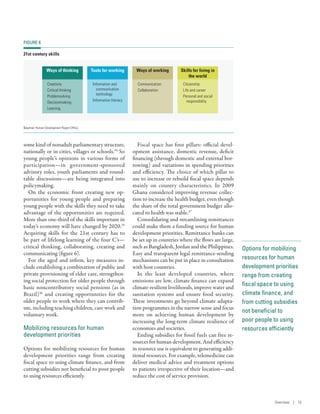
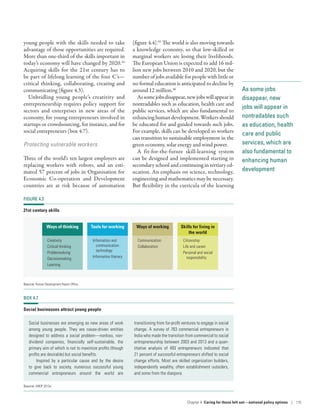
Acquiring skills for the 21st century has to
be part of lifelong learning of the four C’s­—­
critical thinking, collaborating, creating and
communicating (figure 6).
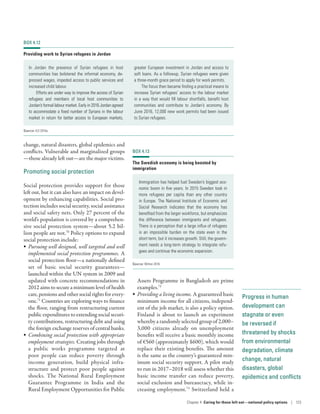
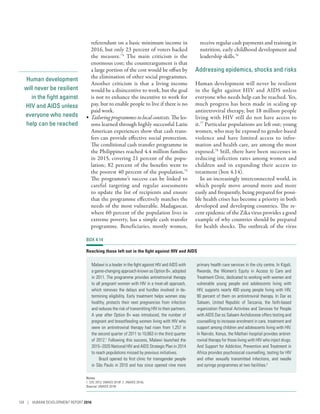
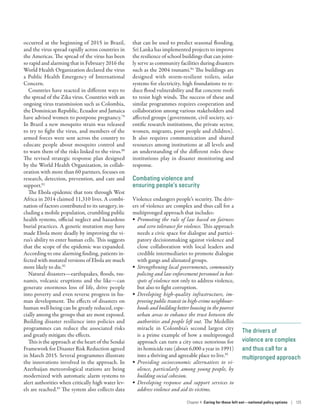
For the aged and infirm, key measures in-
clude establishing a combination of public and
private provisioning of elder care, strengthen-
ing social protection for older people through
basic noncontributory social pensions (as in
Brazil)36
and creating opportunities for the
older people to work where they can contrib-
ute, including teaching children, care work and
voluntary work.
Mobilizing resources for human
development priorities
Options for mobilizing resources for human
development priorities range from creating
fiscal space to using climate finance, and from
cutting subsidies not beneficial to poor people
to using resources efficiently.
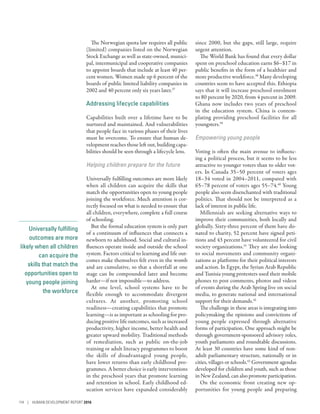
Fiscal space has four pillars: official devel-
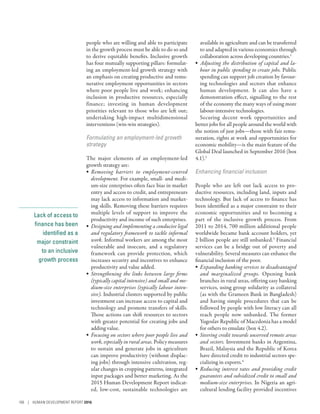
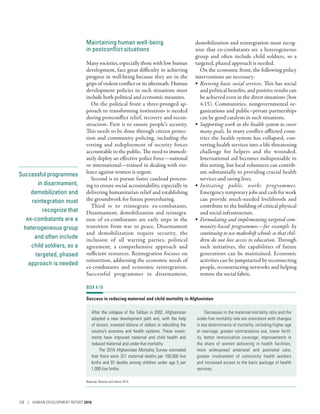
opment assistance, domestic revenue, deficit
financing (through domestic and external bor-
rowing) and variations in spending priorities
and efficiency. The choice of which pillar to
use to increase or rebuild fiscal space depends
mainly on country characteristics. In 2009
Ghana considered improving revenue collec-
tion to increase the health budget, even though
the share of the total government budget allo-
cated to health was stable.37
Consolidating and streamlining remittances
could make them a funding source for human
development priorities. Remittance banks can
be set up in countries where the flows are large,
such as Bangladesh, Jordan and the Philippines.
Easy and transparent legal remittance-sending
mechanisms can be put in place in consultation
with host countries.
In the least developed countries, where
emissions are low, climate finance can expand
climate-resilient livelihoods, improve water and
sanitation systems and ensure food security.
These investments go beyond climate adapta-
tion programmes in the narrow sense and focus
more on achieving human development by
increasing the long-term climate resilience of
economies and societies.
Ending subsidies for fossil fuels can free re-
sources for human development. And efficiency
in resource use is equivalent to generating addi-
tional resources. For example, telemedicine can
deliver medical advice and treatment options
to patients irrespective of their location­—­and
reduce the cost of service provision.
FIGURE 6
21st century skills
Ways of thinking
Creativity
Critical thinking
Problemsolving
Decisionmaking
Learning
Tools for working
Information and
communication
technology
Information literacy
Ways of working
Communication
Collaboration
Skills for living in
the world
Citizenship
Life and career
Personal and social
responsibility
Source: Human Development Report Office.
Overview | 13
Marginalized groups
often face similar
constraints, such as
discrimination. But
each group also has
special needs that
must be met if they
are to benefit from
progress in human
development
Pursuing measures for groups with special needs
Because some social groups (ethnic minorities,
indigenous peoples, persons with disabilities)
are systematically discriminated against and
thereby left out, specific measures are needed so
they may achieve equitable outcomes in human
development.
Using affirmative action
Affirmative action has been important in re-
dressing historical and persistent group dispar-
ities and group discriminations. It may take the
form of enrolment quotas for ethnic minorities
in tertiary education or preferential treatment
of female entrepreneurs in obtaining subsidized
credit through the banking system.
Affirmative action has made a difference
in women’s representation in parliament.
Following the Beijing Declaration and Platform
for Action at the United Nations Fourth World
Conference in 1995, some countries adopted
a gender quota to increase the proportion of
seats held by women, providing confidence and
incentives for women to run for elected office
and win. Rwanda, where women account for
64 percent of representatives in the House of
Deputies, is a shining example.38
Promoting human development
for marginalized groups
Despite the great diversity in identities and
needs, marginalized groups such as ethnic
minorities, indigenous peoples, persons with
disabilities, people living with HIV and
AIDS, and lesbian, gay, bisexual, transgender
and intersex individuals often face similar
constraints, such as discrimination, social
stigma and risk of being harmed. But each
group also has special needs that must be met
if they are to benefit from progress in human
development.
For some vulnerable groups, such as ethnic
minorities or persons with disabilities, anti­
discrimination and other rights are guaranteed
in constitutions and other legislation. Similarly,
special provisions often protect indigenous
peoples, as in Canada and New Zealand.39
Yet in many cases effective mechanisms for
implementation and full equality in law are
lacking. National human rights commissions
or commissions for specific groups can provide
oversight and ensure that the rights of these
groups are not violated. And overcoming the
discrimination and abuse of members of the
lesbian, gay, bisexual, transgender and intersex
community requires a legal framework that can
defend their human rights.
Participation in the processes that shape the
lives of disadvantaged groups needs to be en-
sured. For example, quotas for ethnic minorities
and representation of indigenous peoples in
parliaments are ways to help them raise their
concerns. Some indigenous peoples have their
own parliaments or councils, which are consul-
tative bodies. New Zealand has the longest his-
tory of indigenous representation in a national
legislature.40
For persons with disabilities, inclusion and
accommodation are critical to empowering
them to live independently, find employment
and contribute to society. Specific vocational
training initiatives should be undertaken to
develop their skills. Increasing access to pro-
ductive resources, such as finance for self-em-
ployment, and providing information over
mobile devices can help them in self-employ-
ment. Appropriate infrastructure including
technology can enable persons with disabilities
to be more mobile.
Migrants and refugees are vulnerable in host
countries, and national actions are needed to
address the new nature of migration and its
evolution. Countries should pass laws that
protect refugees, particularly women and
children, a big part of the refugee population
and the main victims. Transit and destination
countries should provide essential public goods
in catering to the displaced, such as schooling
refugee children. And destination countries
should formulate temporary work policies and
provisions for refugees.
14 | HUMAN DEVELOPMENT REPORT 2016
Progress in human
development often
stagnates or dissipates
if threatened by
shocks. Vulnerable and
marginalized people
are major victims
Making human development resilient
Progress in human development often stag-
nates or dissipates if threatened by shocks­
—­such as global epidemics, climate change,
natural disasters, violence and conflicts.
Vulnerable and marginalized people are major
victims.
Addressing epidemics,
shocks and risks
Much progress has been made in scaling up
antiretroviral therapy, but 18 million people
living with HIV still do not have access to
it.41
Young women, who may be exposed to
gender-based violence and have limited access
to information and health care, are among the
most exposed, as are prisoners, sex workers,
drug users and transgender people. Still, there
have been successes in reducing infection rates
among women and children and in expanding
their access to treatment.
In an increasingly interconnected world,
being prepared for possible health crises
has become a priority. The recent epidemic
of the Zika virus provides a good example.
Countries have reacted in different ways
to the spread of the Zika virus. Countries
with an ongoing virus transmission, such
as Colombia, the Dominican Republic,
Ecuador and Jamaica, have advised women to
postpone pregnancy.42
In Brazil a new mos-
quito strain was released to try to fight the
Zika virus, and members of the armed forc-
es were sent across the country to educate
people about mosquito control and to warn
them of the risks linked to the virus.43
More recently, the revised strategic re-
sponse plan designed by the World Health
Organization in collaboration with more than
60 partners focuses on research, detection, pre-
vention, and care and support.44
Building disaster resilience into policies and
programmes at all levels can reduce the risk
and mitigate the effects of disasters, particu-
larly for poor people. Innovative programmes
are at the heart of the Sendai Framework for
Disaster Risk Reduction endorsed by the UN
General Assembly following the 2015 Third
UN World Conference on Disaster Risk
Reduction.
Combating violence and
ensuring people’s security
The drivers of violence are complex and thus
call for a multipronged approach that includes
promoting the rule of law based on fairness and
zero tolerance for violence; strengthening local
governments, community policing and law
enforcement personnel in hotspots of violence;
and developing response and support services
to address violence and its victims.
Viable policy options include developing
high-quality infrastructure, improving public
transit in high-crime neighbourhoods, building
better housing in the poorest areas of cities and
providing socioeconomic alternatives to vio-
lence, particularly to young people, engaging
them in strengthening social cohesion.
Maintaining human well-being
in postconflict situations
On the political front transformation of insti-
tutions is key. It would ensure people’s security
through community policing, pursuing rapid
governance actions (such as faster caseload
processing) and reintegrating ex-combatants
by disarming and demobilizing them.
On the economic front reviving basic social
services, supporting work in the health sector
to cover many goals, initiating public works
programmes and formulating and implement-
ing targeted community-based programmes
(such as makeshift schools so that children do
not lose access education) are key for moving
forward on the development continuum.
Addressing climate change
Climate change jeopardizes the lives and
livelihoods of poor and marginalized people.
Addressing it requires three initial policy
measures. Putting a price on carbon pollution­
—­through an emissions trading system or a
carbon tax—brings down emissions and drives
investment into cleaner options. Approximately
40 countries and more than 20 cities, states and
provinces use carbon pricing.45
Taxing fuel, removing fossil fuel subsidies and
incorporating “social cost of carbon” regulations
Overview | 15
People will have to
be empowered by
upholding human
rights, ensuring access
to justice, promoting
inclusion and ensuring
accountability
are more indirect ways of accurately pricing
carbon. By phasing out harmful fossil fuel sub-
sidies, countries can reallocate their spending
to where it is most needed and most effective,
including targeted support for poor people.
Getting prices right is only one part of the
equation. Cities are growing fast, particularly
in developing countries. With careful planning
in transport and land use and the establish-
ment of energy efficiency standards, cities can
avoid locking in unsustainable patterns. They
can open access to jobs and opportunities for
poor people, while reducing air pollution.
Increasing energy efficiency and renewable
energy is crucial. The Sustainable Energy for All
initiative sets out three goals for 2030: achieve
universal access to modern energy, double the
rate of improvement in energy efficiency and
double the share of renewable energy in the
global energy mix. In many countries develop-
ing utility-scale renewable energy is now cheap-
er than, or on par with, fossil-fuel plants.46
Climate-smart agricultural techniques help
farmers increase their productivity and resil-
ience to the impacts of climate change while
creating carbon sinks that reduce net emissions.
Forests, the world’s lungs, absorb carbon and
store it in soils, trees and foliage.
Focusing on the ­poverty–environment nex-
us, which is complex but critical for margin-
alized people, is also important. Poor people
bear the brunt of environmental damage, even
though they seldom create it. Policies that pro-
tect community commons (such as common
forests), ensure the rights and entitlements of
poor people and provide renewable energy to
poor people would improve biodiversity on
which poor people’s lives depend and reverse
the downward spiral of poverty and environ-
mental damage.
Promoting social protection
Policy options to expand social protection to
marginalized groups include pursuing social
protection programmes, combining social pro-
tection with appropriate employment strategies
and providing a living income.
A social protection floor can secure mini-
mum health care, pensions and other social
rights for everyone. Creating jobs through a
public works programme can reduce poverty
through income generation, build physical
infrastructure and protect poor people against
shocks. The Rural Employment Opportunities
for Public Assets programme in Bangladesh is a
prime example.47
A guaranteed basic income for citizens, inde-
pendent of the job market, is also a policy option
that countries (such as Finland48
) are experi-
menting with as an instrument for social protec-
tion, particularly for disadvantaged groups.
Empowering those left out
If policies do not deliver well-being to margin-
alized and vulnerable people and if institutions
fail to ensure that people are not left out, there
must be instruments and redress mechanisms
so that these people can claim their rights. They
have to be empowered by upholding human
rights, ensuring access to justice, promoting
inclusion and ensuring accountability.
Upholding human rights
Human development for all requires strong
national human rights institutions with the ca-
pacity, mandate and will to address discrimina-
tion and ensure the protection of human rights.
Human rights commissions and ombudsmen
handle complaints about rights abuses, educate
civil society and states about human rights and
recommend legal reforms.
But state commitments to upholding these
rights vary, national institutions have different
implementation capacities, and accounta-
bility mechanisms are sometimes missing.
Institutional shortcomings aside, treating
development as a human right has been in-
strumental in reducing deprivations in some
dimensions and contexts.
In an integrated world the state-centred
model of accountability must be extended to
the obligations of nonstate actors and to the
state’s obligations beyond national borders.
Human rights cannot be realized universally
without well established domestic mechanisms
and stronger international action.
16 | HUMAN DEVELOPMENT REPORT 2016
Global institutional
reforms should
encompass the
broader areas
of regulation of
global markets,
the governance of
multilateral institutions
and the strengthening
of global civil society
Ensuring access to justice
Access to justice is the ability of people to seek
and obtain remedy through formal or informal
judicial institutions.
Poor and disadvantaged people face immense
obstacles, including their lack of awareness and
legal knowledge, compounded by structural
and personal alienation. Poor people lack ade-
quate access to public services, which are often
expensive and cumbersome and have few re-
sources, personnel and facilities. Police stations
and courts may not be available in remote areas,
and poor people can rarely afford the cost of
legal processes. Quasi-judicial mechanisms may
also be inaccessible or prejudicial.
Obstacles to justice for indigenous peoples
and for racial and ethnic minorities stem from
their historically subordinate status and from
sociopolitical systems that reinforce bias in the
legal framework and the justice system.
Promoting inclusion
Human development for everyone requires
inclusion of all in the development discourse
and process.
New global forms and methods of organi-
zation and communication are facilitated by
technology and social media. They have mobi-
lized grassroots activism and brought in people
and groups to voice their opinions, as through
cyberactivism. Improving the quality and scope
of citizen engagement in public institutions
involves civic education, capacity development
and political dialogue.
Ensuring accountability
Accountability is central to ensuring that hu-
man development reaches everyone, especially
in protecting the rights of those excluded.
One major instrument for ensuring ac-
countability of social institutions is the right
to information. Since the 1990s more than 50
countries have adopted new instruments that
protect the right to information, often due to
democratic transitions and to the active partic-
ipation of civil society organizations in public
life.49
The right to information requires the freedom
to use that information to form public opinions,
call governments to account, participate in de-
cisionmaking and exercise the right to freedom
of expression. Information and communication
technology is increasingly being used to ensure
accountability.
Participatoryexercisestoholdstateinstitutions
accountable, such as public expenditure tracking
surveys, citizen report cards, score cards, social
audits and community monitoring, have all been
used to develop direct accountability relation-
ships between service users and service providers.
Global institutional reforms and a fairer multilateral system
would help attain human development for everyone
We live in a globalized world where human de-
velopment outcomes are determined not only
by actions at the national level, but also by the
structures, events and work at the global level.
The shortcomings in the current architecture
of global systems pose challenges for human
development on three fronts. The distribution-
al consequences of inequitable globalization
have promoted the progress of some segments
of the population, leaving poor and vulnerable
people out. Globalization is also making those
left out economically insecure. And people
are suffering in lingering conflicts. In short,
all these undermine and limit national efforts
and pose as barriers to human development for
everyone.
Global institutional reforms should encom-
pass the broader areas of regulation of global
markets, the governance of multilateral institu-
tions and the strengthening of global civil so-
ciety with each area reflecting specific actions.
Stabilizing the global economy
Reforms should focus on regulating currency
transactions and capital flows and coordinating
macroeconomic policies and regulations. One
option is a multilateral tax on cross-border
Overview | 17
The time has come
to examine the
representation,
transparency and
accountability of
multilateral institutions
transactions; another is the use of capital con-
trols by individual countries.
Applying fair trade and
investment rules
The international agenda should be to set rules to
expandtradeingoods,servicesand knowledgeto
favour human development and the Sustainable
Development Goals. The key reforms to advance
this agenda include finalizing the World Trade
Organization’s Doha Round, reforming the
global intellectual property rights regime and
reforming the global investor protection regime.
Adopting a fair system of migration
Measures are needed to strengthen strategies
that protect the rights of and promote the op-
portunities for migrants, to establish a global
mechanism to coordinate economic (voluntary)
migration and to facilitate guaranteed asylum
for forcibly displaced people. The International
Organization for Migration officially joined the
UN System in September 2016, and its work
and actions are expected to expand and advance.
Assuring greater equity and legitimacy
of multilateral institutions
Thetimehascometoexaminetherepresentation,
transparency and accountability of multilateral
institutions. Some policy options to move these
institutions towards greater equity and legitima-
cy are increasing the voice of developing coun-
tries in multilateral organizations, improving
transparency in appointing heads of multilateral
organizations and increasing coordination and
effectiveness to achieve people-centred goals.
Coordinating taxes and
monitoring finance globally
A move towards a global automatic exchange of
information (such as a global financial register)
would facilitate the work of tax and regulatory
authorities tracking income and detecting illicit
financial flows, which may be mobilized for hu-
man development. This would require increasing
technical capacity of countries to process infor-
mation and implement active policies against tax
evasion, tax avoidance and illicit flows.
Making the global economy sustainable
Sustainabledevelopmentactivitiesatthenational
level must be complemented with global actions.
Curbingglobalwarmingispossible.Coordinated
global action has worked well in the past, as in
moves to halt ozone depletion in the 1990s.
Continuing advocacy and communication on
the need to address climate change and protect
the environment are essential to gather support
from various stakeholders (including multilat-
eral development banks). The recently created
New Development Bank has explicitly commit-
ted to giving priority to clean energy projects.
Ensuring well funded
multilateralism and cooperation
Multilateral and regional development banks
can do more to address several challenges of
globalization. Increasing official development
assistance from traditional donors, expand-
ing the participation of developing countries
through South–South and triangular coop-
eration, and exploring innovative options for
financing would be useful.
Globally defending people’s security
From a human development perspective, as-
sistance in human emergencies and crises is an
ethical obligation. In such cases, proposed solu-
tions include restructuring current mechanisms
towards prevention in addition to short-term
responses to shocks, prioritizing field opera-
tions and coordinating better internally and ex-
ternally with civil society and the private sector.
Promoting greater and better
participation of global civil society
Tapping civil society’s potential requires ex-
panding mechanisms for it to participate in
multilateral institutions; enhancing the trans-
parency and accountability of multilateral in-
stitutions; promoting and supporting inclusive
global civil society networks focused on such
groups as women, young people and ethnic mi-
norities; increasing the free flow of information
and knowledge through active transparency
mechanisms; and protecting the work of inter-
national investigative journalism.
18 | HUMAN DEVELOPMENT REPORT 2016
The 2030 Agenda
and the Sustainable
Development Goals are
critical steps towards
human development
for everyone
An action agenda
Human development for everyone is not a
dream; it is a realizable goal. We can build on
what we have achieved. We can explore new
possibilities to overcome challenges. We can
attain what once seemed unattainable, for what
seem to be challenges today can be overcome
tomorrow. Realizing our hopes is within our
reach. His Excellency Juan Manuel Santos,
President of Colombia and the 2016 Nobel
Peace Prize Laureate confirms the hope of at-
taining a peaceful and prosperous world (see
special contribution).
The 2030 Agenda and the Sustainable
Development Goals are critical steps towards
human development for everyone. Building on
its analysis and findings, the Report suggests
a five-point action agenda to ensure human
development for everyone. The actions cover
policy issues and global commitments.
Identifying those who face
human development deficits
and mapping where they are
Identifying those who have been left out
of the progress in human development and
mapping their locations are essential for
useful advocacy and effective policymaking.
Such mapping can help development activists
demand action and guide policymakers in
formulating and implementing policies to
improve the well-being of marginalized and
vulnerable people.
Pursuing a range of available
policy options with coherence
Human development for everyone requires a
multipronged set of national policy options:
reaching those left out using universal policies,
pursuing measures for groups with special-
needs, making human development resilient
and empowering those left out.
Country situations differ, so policy options
have to be tailored to each country. Policies in
every country have to be pursued in a coherent
way through multistakeholder engagement, lo-
cal and subnational adaptations and horizontal
(across silos) and vertical alignment (for inter-
national and global consistency).
Closing the gender gap
Gender equality and women’s empowerment
are fundamental dimensions of human develop-
ment. Gender gaps exist in capabilities as well as
opportunities, and progress is still too slow for
realizing the full potential of half of humanity.
At a historic gathering in New York in
September 2015 some 80 world leaders com-
mitted to end discrimination against women by
2030 and announced concrete and measurable
actions to kickstart rapid changes.50
Now is the
time to act on what has been promised and
agreed.
Implementing the Sustainable
Development Goals and other
global agreements
The Sustainable Development Goals, critical in
their own right, are also crucial for human de-
velopment for everyone; the 2030 Agenda and
the human development approach are mutually
reinforcing. Further, achieving the Sustainable
Development Goals is an important step for all
humanbeingstorealizetheirfullpotentialinlife.
The historic Paris Agreement on climate
change is the first to consider both devel-
oped and developing countries in a common
framework, urging them all to make their best
efforts and reinforce their commitments in the
coming years. The UN Summit for Refugees in
September 2016 made bold commitments to
address the issues facing refugees and migrants
and to prepare for future challenges. The in-
ternational community, national governments
and all other parties must ensure that the
agreements are honoured, implemented and
monitored.
Working towards reforms
in the global system
To move towards a fairer global system, the
agenda for global institutional reforms should
focus on global markets and their regulation,
on the governance of multilateral institutions
and on the strengthening of global civil society.
That reform agenda should be advocated vigor-
ously and consistently by bolstering public ad-
vocacy, building alliances among stakeholders
and pushing through the agenda for reform.
Overview | 19
SPECIAL CONTRIBUTION
Peace in Colombia is also peace for the world
In Colombia we are more determined than ever to end the longest running
and only remaining internal armed conflict in the Americas.
Colombians were divided over the agreement that was negotiated
between the Government and the FARC guerrillas. And so, we undertook
efforts to reach a new peace accord that would dispel doubts and garner
nationwide support. Almost simultaneously we announced the beginning of
peace talks with the ELN, the last remaining guerrillas. We hope this will
bring a definitive end to the armed conflict in our country.
For five decades the war has had a very high price for Colombia and has,
undoubtedly, hurt the nation’s prospect. A study by Los Andes University
estimates that households who have been victims of forced displacement
and violence saw their income reduced by half. This is exacerbated when
one considers that these people are likely to have difficulty recovering and
are at risk of living in conditions of chronic poverty.
Beyond the effect on our economy, the greatest impact of the war falls
on 250,000 or more casualties­—­and their families­—­and the 8 million vic-
tims and internally displaced people. Every life lost, as well as each and
every one of the personal and family tragedies of those who were affected
by the armed conflict and survived, both saddens us and also strengthens
our commitment.
We agree with the spirit of this Human Development Report, which is
that the “wealth of human lives” must be considered before the wealth of
economies when judging the prosperity of society. In that sense we under-
stand that peace is a basic condition for enriching the lives of Colombians.
And I am referring to a broader concept of peace that transcends the end of
the conflict and brings harmony and well-being.
A family with insufficient income does not live in peace, nor does a
family without decent housing or access to education. This is why we have
focused on fostering economic growth that benefits everyone and that re-
duces social gaps.
The progress we have made to date is in line with the Sustainable
Development Goals that Colombia championed and began working towards,
even before they were adopted by the United Nations. Indeed, we were the
first country to include these goals in our National Development Plan.
Thanks to our early efforts, we have been able to reap the benefits of
our work ahead of schedule. For example, over the past five years we have
reduced extreme poverty by nearly half­—­from 14.4 percent to 7.9 percent­
—­a very significant achievement that allows us to envisage its eradication
by 2025, if not sooner.
That jump, beyond the numbers, means that millions of Colombians
have improved their quality of life. We are certain of this because, together
with traditional income-based measures of poverty, we have pioneered the
Multidimensional Poverty Index, which assesses other variables, such as ac-
cess to public services or the type of family housing. Today, without a doubt,
more Colombians have a better life.
We have also made early progress in the quality of education­—­
another of the Sustainable Development Goals. Not only do all children and
young people study in public schools for free, we are increasing their class
hours and improving the quality of learning through different programmes
and initiatives. As a result of these efforts, our students have significantly
improved the average scores on tests that measure their knowledge and
skills.
With our focus on peacebuilding, the emphasis on education is perhaps
the best example of what we can do in this new phase without the burden
of the armed conflict. For the first time ever, the education budget is greater
than that for security and defence, which is consistent with our goal to be-
come the most educated country in Latin America by the year 2025.
Peace, equity and education are three areas that Colombians have been
deprived of historically. Peace, equity and education have been the three
pillars of our main efforts over the past few years.
However, if our goal is to achieve “human development for everyone,”
our efforts cannot stop here: Climate change is the greatest threat ever
faced by humankind.
In this regard Colombia has decided to play an active part in tackling
this phenomenon. As guardians of one of the most biodiverse regions on the
planet, with exceptional forests, water resources and soil fertility, we have
an enormous responsibility to both Colombians and the world.
The concept of “green growth” is part of our economic development
model and has been mainstreamed into all sectors of the economy. We
are convinced that growth and environmental sustainability are perfectly
compatible. In addition, the demarcation of our paramos (moorland eco-
systems) and the declaration of protected areas­—­which by 2018 should
reach 19 million hectares, an area larger than Uruguay­—­are proof of our
resolve.
Under the Paris Agreement on climate change, Colombia has set out a
goal: to reduce projected greenhouse gas emissions by 20 percent by 2030.
And we have already begun to take decisive action to achieve this ambitious
objective: We have presented a bill to Congress for the creation of a carbon
tax on various fuels. We will be the first Latin American country­—­and one
of the first in the world­—­to apply such a measure. With this single initiative
we expect to meet half of our commitment established in the Paris Climate
Change Conference.
Peace­—­understood, as I mentioned before, in the broader sense of
well-being and harmony­—­opens the door to the possibility of a viable world
for future generations, one in which their very existence is not threatened
by global warming. We are proud to confirm that these efforts, in addition to
the end of the armed conflict, improved education and increased equity, are
a contribution to the world.
With the end to the conflict, people from around the globe can enjoy
the natural wonders and tourism in Colombia, which had been restricted for
20 | HUMAN DEVELOPMENT REPORT 2016
*  *  *
From a human development perspective,
we want a world where all human beings have
the freedom to realize their full potential in
life so they can attain what they value. In the
ultimate analysis, development is of the people,
by the people and for the people. People have
to partner with each other. There needs to be
a balance between people and the planet. And
humanity has to strive for peace and prosperity.
Human development requires recognizing that
every life is equally valuable and that human
development for everyone must start with
those farthest behind.
The 2016 Human Development Report is
an intellectual contribution to resolving these
issues. We strongly believe that only after they
are resolved will we all reach the end of the road
together. And when we look back, we will see
that no one has been left out.
decades­—­even for Colombians themselves. Also, foreign business people
can discover new opportunities in sectors and regions that were previously
off limits because of violence.
In terms of equity we are strengthening the middle class that will cre-
ate an opportunity for investors in search of new markets. And with quality
education we are preparing a new generation that in the future will be able
to put its skills and knowledge into practice anywhere in the world.
“Human development for everyone” is a commitment that transcends
our country, and we want our work to impact and enrich the lives of citizens
from other nations. Similarly, we feel that the support of the international
community has had a positive impact on Colombians. We are convinced
that, in a spirit of solidarity and collaboration, we will continue working
together, Colombians and non-Colombians, to build peace in Colombia and
peace for the rest of the world.
Juan Manuel Santos
President of Colombia and 2016 Nobel Peace Prize Laureate
SPECIAL CONTRIBUTION
Overview | 21
Chapter 1
Human development­—­
achievements,
challenges and hopes
The world
we want
People
Prosperity
Peace
Partnership
Planet
End poverty and
hunger in all forms
and ensure dignity
and equality
Ensure prosperity
and fulfilling lives in
harmony with nature
Foster peaceful,
just and
inclusive societies
Implement the agenda
through a solid
global partnership
Protect our
planet’s natural
resources and
climate for future
generations
Infographic 1.1 The world we want
1.
Chapter 1  Human development­—­achievements, challenges and hopes | 25
Human Development
Report 2016
Human Development for Everyone
The Human
Development Reports
have extended the
frontiers of thought
leadership, public
policy advocacy
and influence on
development agendas
Human development­—­achievements,
challenges and hopes
Human development is all about people­—­expanding their freedoms, enlarging their choices, enhancing their capabilities
and improving their opportunities. It is a process as well as an outcome. Economic growth and income are means to human
development but not ends in themselves­—­because it is the richness of people’s lives, not the richness of economies, that
ultimately is valuable to people. With such a simple but powerful notion, the first Human Development Report, appearing
in 1990, put people at the centre of the development discourse, changing the lens for assessing development policies and
outcomes (box 1.1).1
Over the ensuing 10 years the Human
Development Reports extended the frontiers
of thought leadership, public policy advocacy
and influence on development agendas. The
1994 Human Development Report intro-
duced the notion of human security, going
beyond the traditional concept of national
and territorial security.2
The 1995 Human
Development Report­—which strongly argued
that development, if not engendered, is endan-
gered—contributed to the Beijing Declaration
and Platform of Action at the Fourth World
Conference on Women.3
The 1997 Human
Development Report introduced a multi-
dimensional concept of poverty, known as
human poverty, and an associated composite
measure­—­the Human Poverty Index, an ana-
lytical breakthrough to elevate the discussion of
human deprivations beyond income poverty.4
In addition to contributing to development
thinking, these reports, with their policy
recommendations and innovative data pres-
entations, had policy impacts. The proposal
to create Honesty International in the 1992
Human Development Report led to the es-
tablishment of Transparency International.5
And the disaggregation of Egypt’s Human
Development Index (HDI) value in the
1994 Human Development Report led to
an increased allocation of public resources to
Upper Egypt, a less well developed area of the
country.6
At the turn of the century 189 heads
of state and government endorsed the
Millennium Declaration and the Millennium
Development Goals to overcome basic
human deprivations by 2015, all solidly an-
chored in the human development approach.
BOX 1.1
Human development­—­a people-centred approach
Human development is about acquiring more capabili-
ties and enjoying more opportunities to use those ca-
pabilities. With more capabilities and opportunities,
people have more choices, and expanding choices is at
the core of the human development approach. But hu-
man development is also a process. Anchored in human
rights, it is linked to human security. And its ultimate
objective is to enlarge human freedoms.
Human development is development of the people
through the building of human resources, for the people
through the translation of development benefits in their
lives and by the people through active participation in the
processes that influence and shape their lives. Income is
a means to human development but not an end in itself.
The human development approach in the 1990
Human Development Report also introduced a compos-
ite index, the Human Development Index (HDI), for as-
sessing achievements in the basic dimensions of human
development. Those dimensions of human development­
are ­to lead a long and healthy life, measured by life ex-
pectancy at birth; to acquire knowledge, measured by
mean years of schooling and expected years of school-
ing; and to achieve a decent standard of living, measured
by gross national income per capita.
Source: Human Development Report Office.
Every developing
region’s HDI value
increased considerably
between 1990 and
2015, although
progress has been
slowing since 2010
During the last decade Human Development
Reports covered such themes as deepening
democracy (2002), cultural diversity (2004),
climate change (2008), sustainability and eq-
uity (2011) and work for human development
(2015).7
The global reports have been complemented
over the years by more than three dozen re-
gional and subregional Human Development
Reports and more than 700 national Human
Development Reports.8
Subnational re-
ports have also been produced, including 19
state-level reports in India and a municipal
HDI in Brazil.9
Over the last quarter century all these reports
have added momentum to human progress,
and thus some of what seemed to be a daunting
challenge in 1990 was largely achieved by 2015.
Extreme poverty is estimated to have been be-
low 11 percent globally in 2013, a drop of more
than two-thirds since 1990.10
So even though
the global population increased by 2 billion­—­
from 5.3 billion in 1990 to 7.3 billion in 2015­
—­the number of people in extreme poverty fell
by more than a billion.
Yet not all the news is good news.
Substantial human deprivations persist de-
spite the progress. One person in nine in the
world is hungry, and one person in three is
malnourished.11
Eleven children under age 5
die every minute, and 35 mothers die during
childbirth every hour.12
About 15  million
girls a year marry before age 18, one every
two seconds.13
Worldwide 18,000 people
a day die because of air pollution, and HIV
infects 2 million people a year.14
Every minute
an average of 24 people are displaced from
their home.15
And new development challenges have
emerged. Conflicts, disasters and natural re-
sources can no longer be considered national
concerns; they have become global concerns.
More than 21.3 million people­—­roughly the
population of Australia­—­are refugees.16
More
than 100  million people could be affected
by the combined impact of El Niño and La
Niña, a double shock.17
Insecurity because of
violent extremism has spread throughout the
globe. The cost of violence globally is about
$1,900 per person.18
Water scarcity and climate
change have added to international tensions.
Epidemics such as Ebola and Zika pose serious
threats to people, and about 20,000 children
have become Ebola orphans.19
Human ingenuity has opened promising
new arenas, but human suffering also abounds.
Violence, not dialogue, has become a common
human language. Isolationism, not diversity,
is gaining currency. Despite the challenges,
what humanity has achieved over the past 25
years and our desire to aspire to even more
give us hope on many fronts. Challenges also
offer rays of hope, and hopes face daunting
challenges before they can be realized. This
link needs to be kept in mind as we pursue our
goal to overcome the challenges and realize
the hopes.
The achievements we have made
The levels of human development have im-
proved all over the world. Every developing
region’s HDI value increased considerably be-
tween 1990 and 2015, although progress has
been slowing since 2010 (figure 1.1). This re-
flects important advances not only in income,
but also in health and education. Between
1990 and 2015 the aggregate HDI value
of the least developed countries increased
46 percent, and the aggregate HDI value for
low human development countries increased
40 percent.20
Reduced poverty and hunger
The global extreme poverty rate ($1.90 a day)
was estimated at less than 11 percent in 2013,
a drop of more than two-thirds from the
35 percent in 1990.21
The decrease has been
particularly remarkable in East Asia and the
Pacific, where the proportion of people living
on less than $1.90 a day fell from 60.2 percent
in 1990 to 3.5 percent in 2013, and in South
Asia, where the proportion fell from 44.6 per-
cent to 15 percent.22
China’s extreme poverty
rate plummeted from 66.5 percent in 1990 to
1.9 percent in 2013. The working poor, who
work and live on less than $1.90 a day, ac-
counted for 10 percent of workers worldwide
in 2015, nearly two-thirds less than in 2000.23
The global population suffering from hunger
declined from 15  percent in 2000–2002 to
11 percent in 2014–2016.24
26 | HUMAN DEVELOPMENT REPORT 2016
While children in the
poorest households
are far less likely to
survive to their fifth
birthdays, the mortality
rate is declining faster
for children in poor
households than
for other children
Decreased mortality
The global under-five mortality rate was more
than halved between 1990 and 2015.25
The
steepest decline was in Sub-­Saharan Africa,
where the challenge was the greatest. While
children in the poorest households are far less
likely to survive to their fifth birthdays, the
mortality rate is declining faster for children
in poor households than for other children.
Maternal mortality rates have also declined
considerably since 1990: 45 percent globally
and 64 percent in South Asia, as of 2013.26
Access to professional health care has im-
proved: in 2014 more than 71 percent of births
worldwide were attended by skilled health per-
sonnel, up from 59 percent in 1990. In North
Africa the proportion of pregnant women who
receive at least four antenatal medical visits rose
from 50 percent in 1990 to 89 percent in 2014,
the largest improvement worldwide.27
Globally,
nearly two-thirds of women ages 15–49 who
are married or in union use contraception, up
from 55 percent in 1990.
Global health is also improving. In develop-
ing regions the proportion of undernourished
people has been nearly halved since 1990.28
In 2013 measles-containing vaccines reached
84  percent of children worldwide. Global
coverage of two doses of the measles vaccine in-
creased from 15 percent in 2000 to 53 percent
in 2013, resulting in a 67 percent decline in the
number of annual reported measles cases. An
estimated 15.6 million lives were saved through
measles vaccination between 2000 and 2013.29
These positive developments have led to a dra-
matic decline in preventable child deaths.
Overall mortality rates are falling in part be-
cause of actions to tackle malaria, tuberculosis,
measles, and HIV and AIDS. Between 2001
and 2015 more than 6.8 million malaria deaths,
many of them in children, were prevented.30
The
number of new HIV infections also fell, from
an estimated 3.5 million in 2000 to 2.1 million
in 2013. From 1995 to 2013 increasing use of
antiretroviral therapy averted 7.6 million deaths
from AIDS.31
Tuberculosis mortality rates also
fell in response to efforts to prevent, diagnose
and treat the disease, with 37 million lives saved
between 2000 and 2013.32
Improved access to basic
social services
Access to basic social services has been greatly
expanded worldwide. Between 1990 and 2015,
FIGURE 1.1
Regional trends in Human Development Index values
Arab States
East Asia & the Pacific
Europe & Central Asia
Latin America &
the Caribbean
South Asia
Sub-Saharan Africa
1990 1995 2000 2005 2010 2015
Human development classification
(Human Development Index value)
Low
(less than
0.550)
Medium
(0.550–
0.699)
High
(0.700–
0.799)
Very high
(0.800 or
greater)
Source: Human Development Report Office.
Chapter 1  Human development­—­achievements, challenges and hopes | 27
Communication and
information on the
impact of climate
change have reached
more people than
ever before, raising
awareness in every
corner of the world
2.1 billion people gained access to improved
sanitation, halving the number of people re-
sorting to open defecation, a major source of
transmittable diseases such as cholera.33
More
than 2.6  billion people gained access to an
improved source of water, and the Millennium
Development Goal target of halving the
proportion of the population without access
to safe drinking water was reached five years
ahead of schedule.34
The improvement has been
impressive in Sub-­Saharan Africa, where the
proportion of the population with access to
an improved drinking water source rose from
48 percent in 1990 to 68 percent in 2015, and
in East Asia, where the proportion rose from
68 percent in 1990 to 96 percent in 2015. And
despite rapid urbanization across the globe, the
proportion of the urban population living in
slums fell almost 10 percentage points between
2000 and 2014 in developing regions.35
In developing regions 91 percent of primary
school–age children were enrolled in 2015,
up from 83 percent in 2000, and the number
of out-of-school children worldwide fell by
almost half over the same period.36
The greatest
progress has been in Sub-­Saharan Africa, where
the net primary school enrolment rate rose
from 52 percent in 1990 to 80 percent in 2015.
As a result, a larger proportion of young people
can now read and write: The global literacy rate
among people ages 15–24 was 91 percent in
2015, up from 83 percent in 1995. The gap in
literacy between young men and young women
has also narrowed, to an estimated 3 percentage
points in 2015. North Africa and South Asia
showed the greatest improvement in youth
literacy, pushed by a strong increase in literacy
among young women.
Increased people’s participation
People’s participation in public and political
life, another essential aspect of human develop-
ment, has also improved over the past 25 years.
The average share of parliamentary seats held by
women worldwide rose from 11 percent in 1995
to 22 percent in 2015, and two-thirds of devel-
oping countries have achieved gender parity in
primary education, allowing girls and women to
better voice their concerns and interests.37
Civil
society organizations have expanded considera-
bly, helping individuals exercise agency, express
their opinion and defend their interests on the
national and international scenes.
Improved environmental sustainability
Environmental protection, which has become
a key global issue, has shown encouraging
successes as well. The degradation of the ozone
layer, a major concern in the 1990s, has been
halted, and by 2050 the ozone layer will have
fully recovered from the damages caused by
ozone-depleting substances.38
The share of
marine biodiversity areas that are protected
increased from 15 percent in 2000 to 19 per-
cent in 2016.39
The global net loss in forest area
declined from 7.3 million hectares a year in the
1990s to 3.3 million in 2010–2015, and the
share of terrestrial areas that are protected in-
creased from 16.5 percent in 2000 to 19.3 per-
cent in 2016. Communication and information
on the need to protect nature and the impact of
climate change have reached more people than
ever before, raising awareness in every corner of
the world.
Advances in technology
New technologies are one of the most apparent
changes in our current lives. They have lifted
economies up, facilitated transportation and
communication, led to major advances in health
and education, expanded information and
participation and created new security tools.
Green technologies may be the key to a more
sustainable future, where resources are availa-
ble to all without harming the environment.
Information and communication technology
has spread exponentially. In 2016, 94.1 percent
of the population in developing countries own
a mobile phone, and 40.1 percent have access to
the Internet, up from 7.8 percent in 2005.40
In
developed countries access to the Internet and
to smartphones is nearly universal.
The impact of technology on the economy
is undeniable. Global high-technology exports
have more than doubled in the last 15 years,
from $987 billion in 1999 to $2,147 billion in
2014.41
Cloud technology, three-­dimensional
printing, advanced robotics, energy storage
and digital assistants hold great potential
for creating new jobs and new areas of work.
People with the skills and resources to use
28 | HUMAN DEVELOPMENT REPORT 2016
Even with all the
impressive progress
in reducing poverty
over the past 25 years,
766 million people,
385 million of them
children, lived on less
than $1.90 a day in 2013
technology and create value can thrive in
today’s digital world, as discussed in the 2015
Human Development Report.
New technologies have also changed the
way governments interact with their citizens,
increasing the reach and efficiency of public
service delivery.42
Several countries use mobile
phones to extend basic social services, includ-
ing health care and education, to hard-to-reach
populations.43
The Internet allows much more
information to be shared than any other means
of communication has. The amount of digital
data has doubled every three years since 2000,
and today less than 2 percent of stored informa-
tion is offline.44
Though there is far to go before all people
can live their lives to their full potential, co-
operation and commitments to eliminating
deprivations and promoting sustainable human
development have improved the lives of billions
of people over the past 25 years. The Republic
of Korea has sustained progress in human de-
velopment for even longer (box 1.2).
The challenges we face
Some challenges are lingering (deprivations),
some are deepening (inequalities) and some are
emerging (violent extremism). Some are global
(gender inequality), some are regional (water
stress) and some are within national boundaries
(natural disasters). Most are mutually reinforc-
ing: Climate change reduces food security, and
rapid urbanization marginalizes poor people
in urban areas. Whatever their nature or reach,
these challenges have an impact on people’s
well-being.
Lingering deprivations and inequalities
Even with all the impressive progress in reduc-
ing poverty over the past 25 years, 766 million
people,45
385 million of them children,46
lived
on less than $1.90 a day in 2013. Poor nutrition
causes 45 percent of the deaths among children
under age 5.47
Children born in developing
countries in 2016 will lose nearly $177 billion
in potential lifetime earnings because of stunt-
ing and other delays in physical development.48
Yet one-third of the world’s food is wasted
every year.49
If one-fourth of the food wasted
across the globe could be recovered, it could
feed 870 million people.50
Unless the world
tackles deprivation today, 167  million chil-
dren will live in extreme poverty by 2030,
and 69 million children under age 5 will die
of preventable causes.51
These outcomes will
definitely shrink the capabilities of future gen-
erations. About 758 million adults, including
BOX 1.2
Human development in the Republic of Korea­—­a longer term perspective
The Republic of Korea has travelled a highly successful
path of human development over the past six decades.
And the major drivers behind the country’s sustained
trajectory of high human development include success-
ful land reforms, rural development, extensive human
resources development and rapid equitable economic
growth. Export orientation, sustainable domestic re-
source mobilization with strong redistribution policies,
and public infrastructure development also played major
roles. Needless to say, effective institutions and gover-
nance were also key.
The main dynamics of the Republic of Korea’s prog-
ress was a virtuous cycle between economic and social
policies, which­—­while maintaining the primacy of the
growth objective­—­adapted flexibly to evolving con-
straints and opportunities and successfully harnessed
major currents in the human development space, such
as globalization, technological change and urbanization.
The Republic of Korea attained a critical mass of
policies conducive to human development in the face
of multiple challenges. Doing so allowed the country
to remain on a path of rapid and socially inclusive hu-
man development for so long­—­and to serve as a model
for other countries. The country, assisted by the United
Nations Development Programme Seoul Policy Centre
for Global Development Partnerships, is already convey-
ing its knowhow (such as that gleaned from the Seoul
government’s Clean Construction System) to partner
countries, duly adapted to the realities of partner coun-
tries, whose policymakers and political leaders are aim-
ing for similarly rapid and sustained improvements in
human development.
Source: UNDP Seoul Policy Centre for Global Development Partnerships.
Chapter 1  Human development­—­achievements, challenges and hopes | 29
Poverty is no longer a
problem of developing
regions only; it is
also on the rise in
developed countries
114 million young people, still lack basic read-
ing and writing skills.52
Lingering deprivations
are evident in various aspects of human devel-
opment (figure 1.2).
Poverty is no longer a problem of devel-
oping regions only; it is also on the rise in
developed countries. The International Labour
Organization estimates that in 2012 more than
300  million people in developed countries
lived in poverty.53
Children and women are the most affected
by poverty, and 36 percent of children in de-
veloped countries live under the relative pov-
erty line, in households with an income below
60 percent of the national median household
income. In the United States 32 million adults
are functionally illiterate, and in the United
Kingdom 8 million.54
Rising incomes around the world have been
accompanied by widening inequality. Measures
of the gaps in income equality include the
Gini coefficient (where a value of 0 means that
everyone has the same income, and a value of 1
means that one person has all the income) and
quintile ratios (the ratio of the average income
of the wealthiest 20 percent of the population
to the average income of the poorest 20 percent
of the population).
Although income inequality across house-
holds has risen in many countries, some
estimates show that it has narrowed across
the world as a whole because the incomes of
developing and developed regions have been
converging. Relative global inequality has de-
clined steadily over the past few decades, from
a relative Gini coefficient of 0.74 in 1975 to
FIGURE 1.2
Human deprivation lingers in some indicators of well-being
795 million (2014–2016)
159 million (2014)
90 (million 2015)
6 million (2015)
303,000 (2015)
36 million (2015)
758 million (2014)
114 million (2014)
160 million (2009)
61 million (2016)
250 million (2014)
663 million (2015)
2.4 billion (2015)
946 million (2015)
880 million (2015)
Poverty and hunger
Income poor
Chronic hunger
Children stunted
Children underweight
Health, mortality and education
Children dying before age 5
Maternal mortality
People living with HIV
Illiterate adults
Illiterate young people
Functionally illiterate people in OECD countries
Children not at school at primary level
Children not learning basic skills
Access to basic social services
People who lack access to an improved
water source
People who lack access to an improved
sanitation facility
People resorting to open defecation
People living in urban slums
766 million (2013)
Source: Human Development Report Office.
30 | HUMAN DEVELOPMENT REPORT 2016
Global wealth has
become far more
concentrated. The
wealthiest 1 percent
of the population
had 32 percent of
global wealth around
2000 and 46 percent
around 2010
0.63 in 2010, driven by declining inequality
between countries arising from the extraordi-
nary economic growth in, primarily, China and
India.55
This happened despite an increasing
trend towards inequality within countries. By
contrast, absolute inequality, measured by the
absolute Gini coefficient, has increased dra-
matically since the mid-1970s (figure 1.3). To
understand the absolute and the relative, take
an example. In 2000 one person in a country
earns $1 a day and another person $10 a day.
With economic growth, in 2016 the first
person earns $8 a day, and the second person
$80 a day. The relative difference between the
two remains the same (the second person has
10 times more than the first person), but the
absolute difference has gone up from $7 to $72.
The World Bank reports that between 2008
and 2013 income gaps widened in 34 of the
83 countries monitored as income grew more
quickly for those in the wealthiest 60 percent
of the income distribution than for those in the
poorest 40 percent.56
And in 23 countries peo-
ple in the poorest 40 percent saw their income
decline.
Increases in income have been particularly
sharp at the top of the income distribution.
Some 46 percent of the total increase in income
between 1988 and 2011 went to the wealthiest
10 percent (figure 1.4). Since 2000, 50 percent
of the increase in global wealth benefited only
the wealthiest 1 percent of the world’s popula-
tion. Conversely, the poorest 50 percent of the
world’s population received only 1 percent of
the increase.57
Global wealth has become far more concen-
trated. The wealthiest 1 percent of the popu-
lation had 32 percent of global wealth around
2000 and 46 percent around 2010 (figure 1.5).
The super-rich­—­the wealthiest 0.1 percent­—­
loom larger. The share of national wealth among
the super-rich in the United States increased
from 12 percent in 1990 to 19 percent in 2008
(before the financial crisis) and to 22 percent in
2012 (critics pointed to inequality as one of the
key causes of the crisis).58
Access to the benefits of the digital revo-
lution is uneven globally. Almost 2  billion
people still do not use a mobile phone, and
only 15 percent of the world population has
high-speed Internet access.59
Some 89 percent
of the planet’s urban population has access to
3G mobile broadband, compared with only
29 percent of the rural population.60
The inequality discussion often focuses on
vertical inequality­—­such as the inequality be-
tween wealthiest 10 percent of the population
and the poorest 10  percent­—­and rarely on
horizontal inequality­—­such as the inequality
across ethnic groups. Analysis of horizontal
inequality can bring critical insights to the in-
equality discourse (box 1.3).
FIGURE 1.3
Relative global inequality has declined steadily over the past few decades, but absolute inequality has
increased dramatically
19851975
Relative
Absolute
20101995 2000 2005
0.75
0.70
0.65
0.60
0.55
Relative Gini coefficient
8,000
6,000
4,000
2,000
0
Absolute Gini coefficient
Source: Niño-Zarazúa, Roope and Tarp 2016.
Chapter 1  Human development­—­achievements, challenges and hopes | 31
Urbanization has been
described as a new
frontier of development
because it is not a
passive outcome of
development, but a
creator of value­
Lingering deprivations and inequalities
present serious challenges to human develop-
ment on at least three fronts. First, they stunt
the capabilities of people­—­not only their
well-being, but also their voice and autonomy.
Second, they initiate and reinforce a process
of exclusion whereby poor people and others
at the bottom of the social ladder are excluded
from influencing the processes that shape their
lives. Third, they create a society where rights
and opportunities are denied to poor people—­
and that is unjust.
Multidimensional population dynamics
The planet’s surging population is projected to
grow to 9.7 billion in 2050 (figure 1.6), with
five main implications: widespread urbaniza-
tion, an ageing population, a growing middle
class, migration and a youth bulge.
In 2014 more than half the world’s people
lived in urban areas, a share expected to reach
two-thirds by 2050, when cities will have swol-
len by another 2.5 billion people.61
The world
is projected to have 41 megacities by 2030,
each with more than 10 million inhabitants.62
Urbanization has been described as a new fron-
tier of development because it is not a passive
outcome of development, but a creator of value­
—­the more than half of humanity living in
cities generates more than 80 percent of global
gross domestic product (GDP).63
Not all urbanization is positive, however,
especially if it is unplanned. It puts pressure
on infrastructure and may lower residents’
quality of life. More than 1 billion people live
in housing that is below minimum standards
of comfort and sanitation, and new houses
have to be built for 3 billion people by 2030.64
Some 880 million people live in slums, and
nearly 40  percent of the world’s future ur-
ban expansion may occur in slums.65
Almost
700 million urban slumdwellers lack adequate
sanitation, which­—­along with lack of safe
FIGURE 1.4
Some 46 percent of the total increase in income between 1988 and 2011 went to the wealthiest 10 percent
2005 PPP $ (billions)
2,000
0
101 98765432
1,000
4,000
6,000
5,000
Global income decile
Increase in income, 1988–2011
Top 1 percent
Note: PPP is purchasing power parity.
Source: Lawson 2016.
FIGURE 1.5
Global wealth has become far more concentrated
Global wealth
2000
68%
32%
46%
54%
Global wealth
2011
99%
Population
Wealthiest
1 percent
Source: Human Development Report Office estimates based on Milanovi´c (2016).
32 | HUMAN DEVELOPMENT REPORT 2016
The global middle class­
­is expected to expand
to 3.2 billion people in
Asia and the Pacific
and to 1.7 billion people
elsewhere by 2030
drinking water­—­raises the risk of communica-
ble diseases such as cholera and diarrhoea, par-
ticularly among children.66
Violence, drugs and
crime also increase with rapid urbanization.
And urbanization is linked to climate change.
Along with prosperity and innovation, global
cities are the principal sources of the carbon
dioxide emissions that are warming the earth.67
Many larger cities are in low-lying coastal areas,
leaving them exposed to the dangers of flood-
ing associated with rising sea levels and storm
surges.
As a result of declining fertility and greater
longevity, older people now make up an in-
creasing proportion of national populations.
The number of people ages 60 and older is
expected to reach 1.4  billion in 2030 and
2.1  billion in 2050.68
That would raise the
global old-age dependency ratio (the ratio of
the number of people ages 65 and older to
the number of people of working age, gener-
ally ages 15–64) in developing countries from
13 percent in 2015 to 26 percent in 2050.69
And that will have major implications for
retirement ages, health services, elder care,
social protection and family relationships. In
developed countries ageing populations are
challenging retirement systems and requiring
adaptations to work arrangements and long-
term care services.70
The global middle class­—­households with
a daily expenditure of $10–$100 per capita in
purchasing power parity terms­—­is expected
to expand to 3.2 billion people in Asia and the
Pacific and to 1.7 billion people elsewhere by
2030.71
Its rapid expansion stems from the rise
in countries such as China, where ­middle-class
households (with an annual income of
$11,500–$43,000) increased from 5 million in
2000 to 225 million in 2015.72
But country defi-
nitions of the middle class differ, both through
the lenses of income and expenditure and in
relative terms compared with a societal mean.73
BOX 1.3
Insights based on horizontal inequalities
A common argument in discussions about horizontal in-
equality is that people would be more favourable to re-
distribution within their own group and less favourable
to redistribution between groups because the former is
perceived by the group as just and fair.
But Ghana and Uganda showed far higher approval
ratings for redistribution between ethnic groups, even
though ethnic identity was just as strong as in other
countries. High approval for redistribution is clearly
compatible with a strong ethnic identification.
Redistribution is critical in addressing horizontal in-
equality and can form the core of public policy to ensure
rights, justice and equality in a multiethnic society. Such
policies would have constitutive benefits (such as enhanc-
ing human capabilities in various groups) as well as con-
sequential benefits (such as improving social cohesion).
Deprivation is a denial of human rights (which have
intrinsic value), and overcoming it is also instrumental
in enjoying other rights and freedoms. Equality has in-
trinsic value (anchored in the notion of justice) as well
as instrumental value because it affects other accepted
objectives. Inequality is justified only if it improves the
position of the poorest or if it arises through legitimate
processes.
Source: Cornia and Stewart 2014.
FIGURE 1.6
The planet’s surging population is projected to
grow to 9.7 billion in 2050
20501990 2015
World population (billions)
9
6
3
0
85 percent are
projected to live
in currently
developing
regions
5.0
7.3
9.7
Source: UNDESA 2015b.
Chapter 1  Human development­—­achievements, challenges and hopes | 33
Population shifts
associated with
migration will
change not only the
demographic profile
of societies, but also
their values, norms,
culture and political
and social institutions
How might the growth of the middle class
affect human development? The larger middle
class is more of an economic middle class than
the traditional intellectual middle class, and its
approach to social debate, intellectual leader-
ship and social cohesion may differ from that of
its predecessors, which acted as the conscience
of society, provided intellectual leadership in
social and cultural movements and champi-
oned the poor and the marginalized. In most
societies younger people will constitute an eco-
nomic middle class that strives for innovation
and creativity in life as well as in work. They
are also more likely to see themselves as global
citizens, with positive implications for human
capabilities and opportunities.
But the new middle class may show consump-
tion patterns that have adverse impacts on sus-
tainable consumption. It may have its own social
agenda (such as social entrepreneurship) but be
motivated more by personal economic advance-
ment. It may also be more insular and be more
intimately linked to a Twitter community or a
Facebook community than to a physical com-
munity or neighbourhood. It may have many
digital connections but few human connections.
Population dynamics will continue to change
because of migration to developed countries.
The population of the European Union was
507  million in 2013. Without migration it
would drop to 399 million by 2080, but with
migration it would rise to 520 million.74
The
population of the United States was 324 mil-
lion in 2015. Without migration it would
have risen to 338 million by 2016, but with
migration it reached 441 million. Population
shifts associated with migration will change not
only the demographic profile of these and other
societies, but also their values, norms, culture
and political and social institutions, possibly
creating tensions and conflicts. One human de-
velopment challenge will thus involve forging
peaceful and cohesive multicultural societies in
many parts of the world.
Today young people ages 10–24 account for
about 1.8 billion of the world’s 7.3 billion peo-
ple.75
Around 90 percent of these young people
live in developing countries. A third of the
world’s population is under age 20, and in about
40 African countries more than half the popu-
lation is under age 20.76
There are more young
people alive today than at any other time in
human history.77
Young people are active users
of information and communication technology,
and 30 percent are digital natives, young people
ages 15–24 who have been using the Internet
for five years or more.78
Yet 73.3  million young people are out of
work, and 40 percent of young people in the
global labour force are either unemployed or
poorly paid.79
Young people are three times
more likely than adults to be out of work.80
Nearly 156 million young people in emerging
and developing countries are working poor­—­
working but living in extreme poverty on less
than $1.90 a day or in moderate poverty on
$1.90–$3.10 a day.81
In the next 15 years young
people worldwide will need 600 million jobs.82
Millennials­—­people ages 18–34 in 2015­
—­are expected to work longer hours (nearly a
quarter work more than 50 hours a week) and
retire much later (a quarter expect to retire after
age 70) than their grandparents­—­the silent gen-
eration, mostly in their 70s and 80s (box 1.4).83
Globalization­—­a double-edged sword
Globalization has been heralded over the years
as an engine of growth. In China and India
opening up the economy to the world accel-
erated growth, which in turn helped address
human development challenges­—­reducing
poverty, improving health outcomes and ex-
tending access to basic social services. Thanks
largely to China, the extreme poverty rate in
East Asia dropped from 60 percent in 1990 to
3.5 percent in 2013.84
In 40 countries analysed
BOX 1.4
Millennials versus the silent generation
•	 Millennials are better educated.
•	 Female millennials are much more likely to be
working.
•	 Millennials face tougher job markets.
•	 Millennials are less likely to marry.
•	 Millennials are more likely to be an ethnic
minority.
•	 Millennials are far less likely to be war veterans.
•	 Female millennials are better educated than
male millennials.
Source: Patten and Fry 2015.
34 | HUMAN DEVELOPMENT REPORT 2016
Globalization cannot
be rolled back, so
the challenge is to
ensure that it leaves
no one behind
in 2013, 453 million people­—­190 million of
them women­—­were working in global value
chains, up from 296  million in 1995.85
A
study of 40 countries, 13 of them developing
countries, found that trade generally favours
the poorest people because they spend more in
traded sectors.86
Globalization has been accelerated by the
technological revolution, particularly the dig-
ital revolution. Global trade in merchandise
and services amounted to almost $24 trillion
in 2014, up from $13 trillion in 2005.87
And
knowledge-intensive flows increased 1.3 times
faster than labour-intensive flows.88
But globalization has not delivered the ex-
pected shared prosperity. Unskilled workers
lost jobs in many economies, and manufactur-
ing jobs disappeared. Productivity may have
increased, but this did not always translate
into higher wages, and the inequality in pay
between unskilled and highly skilled labour has
widened considerably.89
People have struggled during the process of
globalization: Those who have recently crossed
the poverty line in developing countries face
vulnerable employment and informality, and
the traditional middle class in high-income
countries faces stagnant wages and reductions
in social services. This pattern is shaping global
social attitudes towards globalization: People
self-defined as part of the lower middle class and
working class feel less engaged by the concept
of global citizenship (figure 1.7). The causes
are invisible in indicators such as overall GDP
growth or progress out of poverty by extremely
poor people, yet the frustration can create polit-
ical and institutional instability if left addressed.
There seems to be a widespread view that glo-
balization is good for a small elite but not for the
broad masses of people.90
Even many academics
and policymakers who welcomed globalization
are revising their opinion. It was always thought
that globalization would not benefit everyone
but that the benefits would eventually outweigh
the losses.91
The backlash against globalization
is reshaping politics in various countries. But
it cannot be rolled back, so the challenge is to
ensure that globalization leaves no one behind.
People on the move
Millions of people are on the move because of
conflicts, disasters or a search for better econom-
ic opportunities. Conflicts, violence and human
rightsviolationshavepromptedmassivedisplace-
mentsofpeoplewithinoroutsidetheircountries.
At the end of 2015 more than 65  million
people worldwide had been forcibly displaced
(internally displaced persons, refugees and
asylumseekers)­—­the most since the Second
World War and more than the population
of France or the combined populations of
Australia, Canada and New Zealand (figure
1.8).92
Some 86 percent of them are hosted in
developing countries, making refugees less of a
burden on developed countries (box 1.5).93
FIGURE 1.7
People self-defined as part of the lower middle class and working class feel less engaged by the concept
of global citizenship
Upper class
Upper middle class
Lower middle class
Working class
Lower class
80.8%
77.9%
75.0%
74.4%
75.8%
(% strongly agree or agree with “I see myself as a world citizen”)
Note: Data are for 59 countries.
Source: Human Development Report Office estimates based on World Values Survey, wave 6, (www.worldvaluessurvey.org/wvs.jsp).
Chapter 1  Human development­—­achievements, challenges and hopes | 35
Children are among
the major victims of
forced displacement
Children are among the major victims of
forced displacement. Of the nearly 50 million
children who have migrated across borders or
been forcibly displaced, 28 million fled vio-
lence and insecurity.94
More than 98,000 chil-
dren are unaccompanied in migration or have
been separated from their family.95
People on the move also face dangers during
their journeys and afterwards. The global count
of migrant deaths was more than 10,000 in
2014 and 2015, and many more were unac-
counted for.
Widespread conflict and
violent extremism
Widespread conflict and violent extremism have
become a challenge of our time. Conflict-related
deaths are a proxy measure for the absence of
peace. Since the end of the Second World War
there has been a downward trend in such deaths,
except in 2000, when the Eritrean–­Ethiopian
war alone caused at least 50,000 deaths.96
With
the escalation of conflict and extreme violence
in the Syrian Arab Republic, 2014 saw the high-
est number of battle-related deaths since 1989:
more than 50,000 (figure 1.9).97
In 17 countries
affected by prolonged conflicts, more than
FIGURE 1.8
At the end of 2015 there were more than 65 million
people worldwide who had been forcibly displaced
65.3 million
forcibly displaced worldwide
40.8 million
internally
displaced
persons
21.3 million
refugees
3.2 million
asylumseekers
Source: Statista 2016.
FIGURE 1.9
2014 saw the highest number of battle-related
deaths since 1989: more than 50,000
Syrian Arab Republic
Afghanistan
Iraq
Ukraine
Nigeria
Pakistan
South Sudan
Israel
Yemen, Rep.
Somalia
54,600
12,250
11,933
4,352
3,140
3,793
1,674
1,665
1,660
1,103
Source: Purdie and Khaltarkhuu 2016.
BOX 1.5
Five common myths about refugees
Refugees are a European problem
Europe is home to only 6  percent of global refu-
gees; 86  percent are in developing countries. The
six richest nations host only 9 percent of refugees
worldwide.
Refugees are not desperate­—­they are
choosing to migrate
By definition refugees are people who flee across bor-
ders to escape violent conflict or persecution.
Most refugees are young, able-bodied men
Worldwide nearly 50 million children have migrated
or been forcibly displaced. These children may be
refugees, interally displaced persons or migrants.
Refugees and migrants bring terrorism
Over the past few years the deadliest terrorist attacks
around the world have been perpetrated by citizens
born in the targeted countries.
Developed countries are overcrowded and
cannot take any more people
The size of the population in most developed coun-
tries is actually declining, and the demographic divi-
dend in these countries is being exhausted. Migration
can be crucial in addressing this issue.
Source: Human Development Report Office.
36 | HUMAN DEVELOPMENT REPORT 2016
Broader peace,
stability and security
are linked not only
to the end of wars
and conflicts, but
also to the end of
violence within
societies and human
security in personal
and community life
56 million people are trapped in a vicious cycle
of violence and hunger.98
In 2000 UN Security Council resolution
1325 recognized that war affects women differ-
ently and stressed the need to increase women’s
participation in peace talks.99
But from 1992 to
2011 only 9 percent of participants in peace ne-
gotiations were women.100
Globally, fewer than
5 percent of peacekeepers are women.101
Incidents of violent extremism and terrorism
worldwide rose from fewer than 5,000 in 2006 to
nearly 15,000 in 2014.102
There has been a nearly
tenfoldincreaseindeathsfromviolentextremism
andterrorism­since2000—­from3,329victimsto
32,685 in 2014.103
And the death toll keeps ris-
ing. In Iraq an estimated 50,000 people have died
since 2003.104
In 2016 more than 20,000 people
died during internal conflict in Afghanistan, and
more than 10,000 died in Yemen.105
Economic losses from conflict are estimated
at $742 billion a year, dwarfing the $167 billion
in annual gross disbursements of official devel-
opment assistance.106
But the costs of conflicts
and violence are not limited to economic costs.
People are uprooted because of conflicts and
violence, they lose their belongings, they are on
the run, their families are broken up­—­and too
many die. About 600 million young people live
in fragile and conflict-affected situations with
no work and little hope.107
Despair sometimes
leads them to violent extremism. Refugee chil-
dren and adolescents are five times more likely
than nonrefugee children and adolescents to
be out of school, with serious implications for
building their capabilities.108
Broader peace, stability and security are
linked not only to the end of wars and conflicts,
but also to the end of violence within societies
and human security in personal and communi-
ty life. Violence has become a human language
in many societies, and intolerance has become
the reaction (box 1.6).
Rising shocks, expanding vulnerabilities
Although human beings are extremely re-
silient, the system in which they live and
operate has to be resilient as well. Pandemics,
natural disasters, climate change, economic
and financial crises and other shocks can slow,
reverse or completely derail human develop-
ment. The effects on human development are
not transitory; they may become permanent.
Recovering from shocks takes a long time. Even
six years after the economic and financial crisis
of 2008–2009, at least 61 million fewer jobs
were available globally than expected.109
Five
years of war in the Syrian Arab Republic and
the spillover in Egypt, Iraq, Jordan, Lebanon
and Turkey have cost close to $35 billion­—­
equivalent to the GDP of the Syrian Arab
Republic in 2007.110
It will take time to return
to the prewar GDP.111
Restoring Libya’s infra-
structure will cost an estimated $200 billion
over the next 10 years.112
BOX 1.6
Human security, as people see it
Human security to me means that my children and
grandchildren will never see killing of human beings
because of their colour or tribe as I witnessed in 1994
during the genocide of Tutsi in Rwanda.
—A female professional from Rwanda
Human security to me means that I can walk on any
street, anywhere, at any time using any clothes that I
want­—­and with no fear. —A man from Brazil
To me personally, human security means being free to
be myself as a transwoman who came from the very
oppressive continent of Africa, to be free from that
violence and feeling safe and functional.
—A former student from the United States
Human security is good nutrition, health and educa-
tion, stability and peace, prosperity of the country and
a robust state, freedoms, justice, democratic govern-
ment. —A male government official from Yemen
For me, human security means equality between
people no matter what age, race, gender, social sta-
tus or preferences they have. It means mutual respect
between the people in the whole wide world.
—A female student from Belarus
Human security for me is to have a voice. It means
the right to participate in political process, the right to
criticize injustice. —A male professor from India
Human security is not to worry or think about my day-
to-day needs and safety.
—A gay male government official from the Philippines
Human security for me is the future health and well-
being of my children and grandchildren.
—A female retired social worker from New Zealand
Source: Human Development Report Office.
Chapter 1  Human development­—­achievements, challenges and hopes | 37
The combined effects
of growing populations,
rising incomes and
expanding cities will
cause the demand
for water to rise
exponentially, while
supply becomes more
erratic and uncertain
Eighteen million people living with HIV,
mostly young and adolescent, do not receive
antiretroviral treatment.113
Young women ages
15–24 are at higher risk of HIV infection and
account for 20 percent of new HIV infections
among adults globally.114
About 1.8 million
children live with HIV, and only half of them
receive lifesaving treatment.115
More than
50  percent of people living with HIV do
not know that they are infected,116
and only
30 percent of young women have comprehen-
sive and correct knowledge about HIV.117
Noncommunicable diseases lead to 38 mil-
lion deaths a year, 28 million of them in low-
and middle-income countries.118
Cancer causes
8.2 million deaths a year, 5.7 million of them
in developing countries.119
Almost 2.1 billion
people worldwide are overweight or obese,
62 percent of them in developing countries.120
The number of overweight children is project-
ed to double by 2030.121
Ebola and Zika have emerged as epidemics
going beyond a country or group of countries.
And infectious diseases are developing resist-
ance to the antimicrobial drugs used to treat
them. Overprescription and failure to complete
courses of treatment allow resistance to develop
and microbial infections to become a human
health threat. Some 700,000 deaths are attrib-
uted to antimicrobial resistance each year;122
that number could skyrocket to 10 million a
year by 2050 and cause global GDP to drop
1.1–3.8 percent. Some 28 million more people
are projected to slide into poverty because of
antimicrobial resistance.123
Some 218 million people a year are touched
by natural disasters.124
The total direct costs
of disasters and major diseases are equivalent.
Between 1980 and 2012 an estimated 42 mil-
lion human life-years were lost to disasters, and
80 percent of them in developing countries.125
Fragile and conflict-affected states are home
to more than 1.4 billion people and half the
world’s extremely poor, a number that will grow
82 percent by 2030 if no action is taken.126
Imbalances between the needs of
people and the capacity of the planet
Every year, 24 billion tonnes of fertile soils are
lost to erosion, and 12 million hectares of land
are lost to drought and desertification, affecting
the lives and livelihoods of 1.5 billion people.127
Desertification could displace up to 135 million
people by 2045.128
Biodiversity is below safe
levels across more than half the world’s lands.129
Every year, 300 million tonnes of plastic are
manufactured, but only 15 percent is recycled,
leaving 46,000 floating pieces of plastic per
square mile of ocean.130
But this is a minuscule
fraction of the total amount of waste held in the
seas, which affects nearly 700 marine species.131
In 2012 an estimated 8.4 million people died
from air, water or land pollution.132
At least
6.5 million people a year are believed to be dying
from air pollution, with many more injured.133
The cost of air pollution in welfare losses has
been estimated at $5  trillion, 60  percent of
which is in developing regions.134
About 2.7 bil-
lion people still depend on wood or waste fires
that cause indoor air pollution, affecting women
and children the most.135
Indoor air pollution
leads to around 3.5 million deaths a year.136
Forests and trees provide vital resources to
1.3 billion people, and in developing countries,
forest income is second only to farm income
among rural communities.137
Between 60 mil-
lion and 200 million indigenous peoples rely
on forests for survival.138
Acting as the lungs of
the world, forests also slow climate change, and
acting as carbon sinks, they increase resilience.
Yet in tropical countries the annual net forest
loss is 7 million hectares­—­the size of Ireland.139
Water stress is a major challenge affecting
more than 4 billion people worldwide.140
The
combined effects of growing populations, ris-
ing incomes and expanding cities will cause the
demand for water to rise exponentially, while
supply becomes more erratic and uncertain.
Water is becoming scarcer in the Arab States
and in the African Sahel, where it is already
in short supply, and may start disappearing in
Central Africa or East Asia, where it is current-
ly abundant. These regions could see declines of
as much as 6 percent of GDP by 2050 because
of water-related impacts on agriculture, health
and income.141
In 2012 more than 80 percent of the world’s
primary energy supply came from fossil fuels,
and only 16  percent came from renewable
energy.142
In 2015 fossil fuels accounted for
55 percent of global energy investment, and
today fossil fuel companies benefit from global
subsidies of $10  million a minute.143
About
38 | HUMAN DEVELOPMENT REPORT 2016
The world has the
resources, the
technology and
the expertise to
overcome human
deprivations. And
the notion of sharing
prosperity gives us
hope that we are
ready to tackle human
deprivations together
1 billion people worldwide lack access to elec-
tricity.144
By 2040 the planet’s energy system
will need to serve 9 billion people, and much of
the energy will have to be renewable.
Climate change will aggravate land
degradation­—­especially in drylands, which
occupy 40 percent of global land area, are in-
habited by some 2 billion people and support
half the world’s livestock.145
By 2030 climate
change is expected to cause an additional
250,000 deaths a year from malaria, diarrhoea,
heat stress and malnutrition.146
The poorest people are more exposed than
the average population to climate-related
shocks and are at high risk of floods, droughts
and heat waves; crop failures from reduced rain-
fall; spikes in food prices after extreme weather
events; and increased incidence of diseases after
heat waves and floods. Poor people are also
more exposed to higher temperatures and live
in countries where food production is expected
to decrease. If climate-smart action is not taken
now, more than 100 million additional people
could be living in poverty by 2030.147
Climate
change can have the most disastrous effects on
indigenous peoples, who rely more on natural
resources and agriculture.
The hopes we have
What humanity has achieved over 25 years de-
spiteallthechallengesithasfacedgiveshopethat
fundamental change is possible. Yes, progress on
many fronts has been uneven and deprivations
linger, yet what has been achieved can become
a foundation for progress in many areas. We can
explore new possibilities for overcoming chal-
lengesandattainwhatonceseemedunattainable.
Realizing our hopes is within our reach.
Rapid progress is possible
Some of the impressive achievements in human
development over the last 25 years have been
in regions and areas that once were lagging.
South Asia, where extreme poverty is ram-
pant, reduced the extreme poverty rate from
44.5 percent in 1990 to 15 percent in 2013.148
Average incomes rose among the poorest
40 percent between 2008 and 2013 despite the
financial crisis.149
And between 2011 and 2014,
700 million people worldwide became account
holders in banks, other financial institutions or
mobile money service providers.150
Africa boosted life expectancy by six years in
the 2000s. Latin America and the Caribbean
reduced the under-five mortality rate by
70  percent between 1990 and 2015.151
The
Americas have been declared free of mea-
sles.152
Guatemala has joined three other Latin
American countries that were already free of
river blindness.153
Southeast Asia cut the share
of the population living in slums from 40 per-
cent in 2000 to 27 percent in 2014.154
In 2005 India aimed to connect every
community with more than 1,000 people
(and every community with more than 500
people in hilly, tribal and desert areas) to an
all-weather road.155
Four years later, 70 percent
of the target communities were connected. In
2005 Ethiopia launched Sub-­Saharan Africa’s
largest social protection programme.156
Four
years later 7.5 million people were supported in
times of food insecurity. In 2010 Senegal tar-
geted 191 rural villages for improved access to
electricity, boosting the number of people with
access from 17,000 to 90,000 in 2012.157
All these gains are reasons for hope that rapid
progress is possible, even in areas previously lag-
ging.Theworldhastheresources,thetechnology
and the expertise to overcome human depriva-
tions. And the notion of sharing prosperity gives
us hope that we are ready to tackle human depri-
vations together. Inaction is not an option.
The resounding voices of the people
People everywhere want to influence the pro-
cesses that shape their lives. They are vocal in
raising concerns­—such as those related to
waste recycling and extractive industries, ethi-
cal sourcing and fair practices in trade, citizen
safety and the public health implications of
agribusiness and pharmaceuticals­. Other exam-
ples include antiglobalization protests and the
Occupy movement against wealth and income
inequality. Technology and social media have
mobilized grassroots activism and included
people and groups previously unable to exercise
voice and opinion (box 1.7).
The Internet brings people together through
offline protests as well. In 2014 the platform
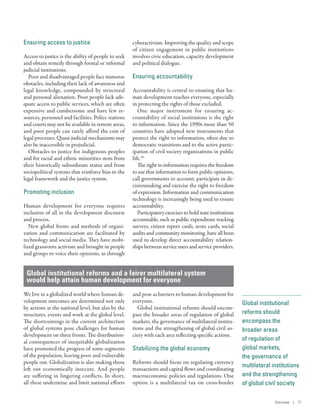
Avaaz.org coordinated a gathering of more than
Chapter 1  Human development­—­achievements, challenges and hopes | 39
As more people
raise their voices to
express their hopes
and aspirations as
well as their despair
and frustration,
mobilizing to demand
what they want will
become easier
400,000 people in Manhattan­—­and hundreds
of thousands more in other cities­—­for the “big-
gest climate march in history.”158
Crowdfunding
allows individuals to contribute small amounts
of money towards a philanthropic project that
requires larger funds. Donors can fund local
projects through civic crowdfunding or projects
in other countries through charity crowdfund-
ing.159
Spacehive, a civic crowdfunding platform
in the United Kingdom, specializes in raising
funds for small community projects such as im-
proving a playground or renovating a school. It
has raised nearly £5 million (more than $6 mil-
lion) since its launch in 2011.160
Although petitions, protests, fundraising and
political publications have always existed, the
Internet has allowed them to reach an unprec-
edented level and bring together people across
the world. Mobile phones have multiplied the
impact of popular movements. The broadcast-
ing on Facebook of police attacks during pro-
democracy demonstrations was instrumental
in the 2011 Arab Spring.161
Smartphones and
subscription-free mobile phones will likely ac-
celerate this trend, creating new opportunities
for people to express themselves freely, even
under authoritarian regimes.
As more people raise their voices to express
theirhopesandaspirationsaswellastheirdespair
and frustration, mobilizing to demand what they
want will become easier. People’s voices can thus
become a more powerful force, giving others
hope in shaping the world they want.
Expanding human ingenuity
and creativity
Human ingenuity and creativity have initiated
technological revolutions and translated these
revolutions into the way we work, think and
behave. Technology is all around us, and some-
times in us­—­biotech, digital tech, nanotech,
neurotech, green tech and so on. The digital
revolution has been going on for some time.
The number of connected devices worldwide
was projected to increase from 9  billion in
2012 to 23 billion in 2016.162
Some estimates
put the Internet’s contribution to global GDP
at as much as $4.2 trillion in 2016.163
The innovations of the technological rev-
olution have ranged from three-dimensional
technology to digital banking, from e-books
to e-commerce, from the sharing economy to
crowdworking. Economies have become indi-
vidualized to match demand and supply peer-
to-peer. The labour market does not require
a traditional workplace, and the process has
opened opportunities for many while making
work precarious or even vulnerable for many
others.
Mobile phones and mobile Internet
services offer many new opportunities for
BOX 1.7
Cyberactivism­—­a new form of participation
Cyberactivism is political engagement by means of the
Internet. Netizens are individuals who work to create
online communities to realize social or political goals.
But the Internet also brings together individuals who do
not otherwise engage in political or public life and sim-
ply feel concerned by a specific issue.
On several occasions in recent years, large num-
bers of people have signed online petitions to draw
the attention of policymakers to their opinions. In 2010,
2 million petitioners succeeded in banning politicians
convicted of crimes from running for office in Brazil. In
2012 an online petition received 1.8 million signatures
in support of the recognition of Palestine as a state by
the United Nations. In 2014, 2.3 million people signed
an online petition to oppose the eviction of the Maasai
people from their ancestral lands by the Tanzanian gov-
ernment. Since 2010 the United Kingdom has provided
the opportunity for citizens to petition Parliament on an
issue by gathering 100,000 signatures.
In 2003 online mobilization led protests in sev-
eral countries against the war in Iraq. Over the past
10 years this trend has encompassed protests by civil
society organizations and protests prompted by indi-
viduals who join together over a specific issue and
then disengage from political discourse. An important
aspect of these protests is their geographic scope,
sometimes spanning several cities and sometimes
several countries.
Source: Human Development Report Office.
40 | HUMAN DEVELOPMENT REPORT 2016
Women have become
active in areas
where they were
not traditionally
active, and they have
excelled in every
aspect of life where
they are engaged
people­—­access to dynamic price informa-
tion (as in Niger), productivity gains (as in
Morocco), job creation in technology-based
industries and labour-market services. They
have helped poor female entrepreneurs through
marketing information (as in Bangladesh) and
contributed to the financial inclusion of poor
people through mobile banking (as in Kenya).164
The digital revolution raises the hope of ad-
dressing such daunting challenges as ensuring
food security, overcoming health concerns,
combating climate change and meeting energy
needs. The development of immunotherapy has
opened opportunities for successfully battling
different types of cancers, such as breast can-
cer. Three-dimensional printing can produce
industrial prototypes and human tissue. Cloud
technology has the potential to improve access
to online information technology services for
businesses and governments at low cost and to
enable new online products and services for
millions of producers and billions of consumers.
Continuing the progress in
women’s empowerment
Women have made major strides in all walks of
life.Genderequalityandwomen’sempowerment
are not add-on issues in the development dia-
logue, but a mainstream dimension of the devel-
opment discourse locally, nationally and globally.
Women have proved to be productive
economic actors, prudent decisionmakers, vi-
sionary leaders, compassionate volunteers and
constructive peacekeepers. And many women
are expanding their horizons.
Focusing primarily on girls and disadvan-
taged groups, Nepal’s Welcome to School
Initiative led to an increase in net enrolment
of 470,000 children, 57 percent of them girls,
within a year of its implementation in 2005.165
Nepal’s policy on adolescent girls was initially
centred on health and education but now en-
compasses needs in employment, skills devel-
opment and civic participation.166
Access to employment opportunities and
to finance has opened opportunities for many
poor women. The Women Development Act in
the Philippines allows women to borrow mon-
ey, obtain loans, execute security and credit ar-
rangements and access loans in agrarian reform
and land resettlement programmes under the
same conditions as men.167
Financial services in
South Africa and the United States are similar-
ly regulated to avoid gender discrimination.168
Romania’s Order No. 473/2014 supports
female entrepreneurs by financing their best
business plans.169
It aims to cultivate entrepre-
neurship among woman-owned businesses.
Bangladesh is encouraging female participation
in the workforce, with the ambition of bring-
ing the share of women in the workforce up
from 34 percent to 82 percent by 2026, thus
adding 1.8 percentage points to GDP.170
In the
Democratic Republic of Congo a new family
code is being drafted to support women in busi-
ness.171
All these efforts contribute to women’s
economic empowerment, which needs to be
appropriately conceptualized (box 1.8).
Women have become active in areas where
they were not traditionally active, and they
have excelled in every aspect of life where they
are engaged, even in societies where women
have faced great obstacles in overcoming their
traditional roles. Consider the success of Kimia
Alizadeh, the Iranian female athlete at the 2016
Olympics, who not only competed but won a
medal.172
There is now a female fighter pilot in
the United Arab Emirates.173
Women are demanding gender equality in
all walks of life. Nearly 15,000 people recently
signed an online petition in Saudi Arabia call-
ing on the government to abolish the country’s
guardianship system, which prevents women
from engaging in fundamental tasks without
the permission of a male relative or without
being accompanied.174
Society is gradually accepting and appreciating
what women can achieve and contribute. Norms,
values and legal frameworks are evolving. Côte
d’Ivoire is tackling legal discrimination against
women.175
While in the 1990s very few countries
legally protected women from violence, today
127 do. This is partly the result of successful
awareness-­raising on the human and economic
cost of such violence.176
Lebanon now penalizes
domestic violence. Peru prohibits sexual harass-
mentinpublicspaces.Hungarycriminalizedeco-
nomic violence as a form of domestic violence.
Cabo Verde adopted a new law in 2011 to fight
gender-­based violence.177
The State of Palestine
recently elaborated the Arab region’s first nation-
al strategy to fight violence against women, with
the participation of survivors of violence.
Chapter 1  Human development­—­achievements, challenges and hopes | 41
Countries where the
rule of law is applied
also have more
gender-equal laws
El Salvador obtained its first conviction in
a case of femicide after a national protocol
to guide investigations was adopted.178
In
Latin America and the Caribbean the United
Nations Entity for Gender Equality and the
Empowerment of Women is working with the
Office of the High Commissioner for Human
Rights to promote the adoption of a regional
model protocol for investigating femicide.179
Gambia and the United Republic of Tanzania
have banned child marriage, raising the legal age
of marriage for both boys and girls to 18.180
And
in Mozambique, marrying the survivor of rape is
no longer a defence option for rapists.181
Countries where the rule of law is applied
also have more gender-equal laws.182
Specialized
courts that tackle acts of violence against
women can help provide effective legal action.
Domestic and family violence courts were
created in Brazil through the Maria da Penha
Law. The Indian inheritance law reform im-
proved the economic freedom of women, who
were thereby able to double their spending on
their daughters’ education thanks to increased
savings.
Slowly opening the space for
action on some taboos
Several issues that were once rarely discussed and
poorly addressed have received increased atten-
tion from the general public, civil society and
policymakers over the last two decades. Among
the groups of people who have benefited from
breaking these taboos are lesbian, gay, bisexual,
transgender and intersex people, women and
girls who suffered female genital mutilation and
cutting, and survivors of gender-based violence.
Same-sex marriage is performed in nearly two
dozen countries.183
Numerous countries rec-
ognize civil unions, registered partnership and
unregistered cohabitation. Even though lesbian,
gay, bisexual, transgender and intersex people
haveequalconstitutionalrightsinonly five coun-
tries, at least their existence is recognized and
their problems are discussed in various platforms,
BOX 1.8
Five misconceptions about women’s economic empowerment
•	 Women’s economic contribution is limited when
women are not employed. Globally, women are
less engaged in paid employment than men. In
2015, 36 percent of women and 44 percent of men
worked full time for an employer. However, wom-
en’s economic contribution in unpaid care and do-
mestic work is remarkable: a 2011 survey in 46
countries found that, on average, 28  percent of
women and 6 percent of men spent three to five
hours a day on household work.
•	 Women’s economic participation equals women’s
economic empowerment. Increasing the number
of women in the workforce is an important objec-
tive, but if they enter it under poor conditions, their
empowerment may not be improved. Exploitation,
dangerous or stigmatized work, low pay and job in-
security are unfavourable terms often encountered
by women.
•	 There is an automatic win-win between gen-
der equality and wider development outcomes.
Gender equality has been found to promote eco-
nomic growth, household poverty reduction and
human development. But the reverse is not always
true. This means that governments need to pay
dedicated attention to gender equality and not rely
solely on growth to achieve it.
•	 What works for one group of women will work for
another. Women across the world often face sim-
ilar obstacles, such as limited access to property
and financial services, lack of social protection and
unpaid care burden. Yet demographic, economic
and cultural contexts also contribute to these bar-
riers and make each woman’s experience different
from others’. Policymakers cannot consider women
to be a homogeneous group and apply standardized
solutions to gender issues. Tailored approaches are
required.
•	 Increasing women’s individual skills and aspira-
tions is the main challenge. Women’s capacity
to seize economic opportunities can be substan-
tially improved through individual support such
as training in business management skills, but
structural causes of gender inequality must be
addressed simultaneously. A survey of 67 coun-
tries in 2009 showed that 20 percent of men be-
lieved that women should not be allowed to hold
any job that they are qualified for outside of their
home.
Source: Hunt and Samman 2016.
42 | HUMAN DEVELOPMENT REPORT 2016
Several countries
have implemented
legal reforms to
reduce female genital
mutilation and cutting,
femicide, acid violence
and honour violence
including the United Nations.184
According to a
report by GLSEN, the situation of lesbian, gay,
bisexual, transgender and intersex students in the
United Sates may be gradually improving, but it
remainstroublesome.185
Manycivilsocietyorgan-
izations such as OutRight Action International
have been working to address these issues.
Several countries have implemented legal re-
forms to reduce female genital mutilation and
cutting, femicide, acid violence and honour
violence. Gambia has outlawed female genital
mutilation and cutting.186
El Salvador and
Mexico have enacted legal reforms that define
femicide as a criminal offence and have adopted
measures to prevent and punish the crime.187
The first law banning acid violence was passed
in Bangladesh in 2002, and the death penalty was
introduced later as punishment for the crime.188
AcidattacksinBangladeshfellfrom494incidents
in 2002 to 59 in 2015. The Indian Penal Code
was amended in 2013 to recognize acid violence
as a criminal act.189
Female parliamentarians, po-
litical leaders and nongovernmental advocates in
Pakistanhaveactivelysupportednewlegislationto
prevent acid attacks against women.190
About 100
acid attacks in Colombia occur each year, so the
countrystrengtheneditslegislativeframeworkand
enacted a law in January 2016 to impose sentences
of12–50yearsimprisonmentforperpetrators.191
The Acid Survivor Foundation, active in
Bangladesh, Cambodia and India, provides
support to acid violence survivors.192
A dedicat-
ed helpline in the State of Palestine, including
online counselling and referral mechanisms,
has already provided information to and poten-
tially saved the lives of 18,000 callers.193
Increasing awareness of sustainability
Awareness of sustainability has been increas-
ing. It is much more visible in the global devel-
opment agenda today than it was in the 1990s
(box 1.9). Both the 2030 Agenda and the Paris
Agreement on climate change bear this out.
This increased visibility results from changes
in the environment, natural resources and the
climate that we can now all perceive. These
changes have made it necessary to transform
the way we produce, consume and function to
protect our ability­—­and the ability of future
generations­—­to live on the planet.
Realization is growing that natural resources
areeverybody’sresponsibility,fromindividualsto
globalinstitutions.Theyareglobalcommon-pool
resources, meaning that they are limited (overuse
reduces the availability for other users) and that
anyone can access them relatively freely (regu-
lating their consumption is difficult). So their
management must be global, but national and
local actions can have considerable impacts. The
pollution of a river by a single factory can deplete
natural resources along the riverbanks for kilo-
metres downstream and pollute underground
water reserves over an even larger area. Positive
individual actions, if repeated by millions of peo-
ple, can likewise make a difference.
BOX 1.9
The growing recognition of the importance of environmental sustainability
In 1992 a milestone summit was organized in Rio de
Janeiro that led to the United Nations Framework
Convention on Climate Change. In 2000 environmen-
tal sustainability was included as one of the eight
Millennium Development Goals and subsequently inte-
grated into most international and national development
strategies. At the World Summit on Social Development
in 2005, environmental sustainability was recognized as
oneofthethreepillarsofsustainabledevelopment,along
with economic development and social development.
The year 2015 was a turning point with the adop-
tion of the 2030 Agenda, which gives unprecedented
attention to environmental sustainability and climate
change, and the Paris Agreement on climate change,
through which 195 member states committed to re-
ducing carbon emissions. Three of 17 Sustainable
Development Goals are dedicated to environmental
sustainability, and all of the others call for environmen-
tally sustainable practices in their respective fields.
Increasingly perceptible resource depletion and climate
change highlight the importance of integrating environ-
mental sustainability in development strategies for the
good of present and future generations.
Source: Human Development Report Office.
Chapter 1  Human development­—­achievements, challenges and hopes | 43
Climate-smart agriculture and climate-smart
development are gaining currency. For example,
about 500,000 solar panels were installed every
day in 2015, an unprecedented growth that
meant that renewable energy had become the
world’s top source of installed power capacity.194
On a single day­—­11 July 2016­—­India planted
50 million trees to take on climate change.195
In 2015, 247,000 electric cars were sold in
China.196
Globally, 13 percent of greenhouse
SPECIAL CONTRIBUTION
The power of culture to prompt action
My son recently asked me whether he had saved much CO2
from being emit-
ted into the air by using the Little Sun solar lamp I designed. He also wanted
to know why, if a tonne of CO2
weighs so much, it does not drop to the
ground. And where is it? To him, a tonne is heavy and physical and not an
intangible mass distributed in the atmosphere. His questions made me real-
ize how little I myself know about CO2
.
When I was my son’s age, back in the late seventies, there was no
discussion of climate change. Nature was where I spent my summers, in a
tent in the Icelandic highlands, a stark contrast to the Copenhagen I lived
in. These natural and manmade realms could not be more separate. But
today, there is no nature outside of human activity. Our survival and future
depend on understanding the effects of CO2
consumption and acting on that
understanding.
But what do we understand? What, for instance, is a tonne of CO2
? Is it
hot or cold, wet or dry? Perhaps it would help to know that one tonne of CO2
could be imagined as a cube the size of a three-storey house or that, when
frozen, it would form a block of dry ice about 0.67 cubic metres in size. But
what does that actually tell me if I do not know how much CO2
I produce in
a year or on an average day? What does it tell me if I do not sense my inter-
relationship with planet Earth?
We need science to tell us that the weight of CO2
is based on the atomic
mass of the molecules. A scientist can tell me that a tonne of CO2
is equal to
the energy expenditure of a house for about a month, a small car driven for
two days nonstop or a 747 flying for less than two minutes and that because
of the greenhouse effect, excessive amounts of CO2
in the atmosphere lead
to global warming.
But for many people, science alone is not enough to compel action. It
struck me, when I was looking up this data, that it was familiar, that I had seen
it more than once in the media and that I somehow knew most of it. So I asked
myself why does knowing not translate into doing when so much is at stake?
This is where culture has something to offer. Culture can help us make
sense of abstract concepts and information in ways which resonate. The
visual arts, theatre, poetry, literature, dance, architecture and creativity in a
broad sense help us build a relationship with abstract ideas, making them
concrete, felt. Culture can add motivational impetus to the knowledge we
gain from science. Importantly, however, culture can bring people to the
point of action without prescribing the actual action. It does not tell us what
to do or how to feel, but rather empowers us to find out for ourselves. Today,
in politics, we are bombarded with emotional appeals, often linked to polar-
izing, populist ideas. The great thing about the arts and culture, on the other
hand, is that they allow spaces to emerge in which people can disagree and
still be together, where they can share individual and collective experiences,
and, in the process, form diverse communities based on inclusion rather
than exclusion. Experiences like these can become exercises in democracy,
inspiring trust, in ourselves and in society.
When I work in my studio, I draw inspiration from the fact that neurosci-
entists and psychologists recognize that the brain has two different systems
for processing perceptions: one is analytical and deals with facts and data,
and the other is experiential and deals with emotions and instincts. The ex-
periential system­—­activated when you encounter art, for instance­—­tends
to be the stronger motivator. Much of the communication on climate change,
however, is focused on the analytical, attempting to reason with people to
change their behaviour. Although it is clearly important to ground action in
knowledge and rational thought, we also need to understand the central role
of our experiential system in motivating action.
Ice Watch, an artistic intervention that I created with Minik Rosing, a
geologist and expert on Greenland, takes an experiential approach by bring-
ing people into direct contact with the physical reality of climate change.
In 2015, during COP21 in Paris, we brought almost 100 tonnes of glacial
ice from Greenland to the Place du Panthéon. Visitors touched the blocks
of ice as they melted, put their ear to them and even tasted the ice. When
we asked people about their responses, most described feelings; they felt
touched. Some spoke about the sounds of the melting ice, like miniature
explosions­—­as if the small pockets of compressed air, frozen inside the tur-
quoise ice for millennia, were speaking to us from the past. Contact with the
ice afforded an experience of its fragility, of time and of the distant Arctic. It
was both concrete, physical and spatial as well as abstract and contempla-
tive. Together, the emotional and intellectual experience allowed each of us
to host the climate debate in our bodies, paving the way for an embodied
understanding of our changing environment and planet.
Culture can inspire people to move from thinking to doing, and it holds
the potential to inspire great social change. It is only by connecting the head
and the heart that we will succeed in building a future for the planet shaped
by positive, powerful climate action.
Olafur Eliasson
Artist and founder of Little Sun
44 | HUMAN DEVELOPMENT REPORT 2016
In spite of heated
debates leading to
bitter gridlock at the
national, regional
and global levels,
through the rubble
the tender shoots of a
global consensus are
emerging to ensure a
sustainable world for
future generations
gas emissions are now covered by carbon pricing
initiatives.197
The value of the trade in environ-
mental goods almost tripled between 2001
and 2012, from $231 billion to $656 billion.198
According to some estimates, the value of the
environmental goods and services market will
reach $1.9 trillion by 2020. Trade can also do
more to spread green technology. A clear shift
in spending towards cleaner energy was seen in
2015­—­$313 billion in renewable energy sourc-
es and $221 billion in energy efficiency.199
But awareness about sustainability has to take
a broader view. For example, climate change is
not only an environmental issue or a science
issue. Olafur Eliasson, artist and founder of
Little Sun, argues that to internalize and act
on the vital data of climate change, culture has
something to offer (see special contribution).
Stronger global commitments
Over the years people have grown accustomed
to heated debates leading to bitter gridlock
at the national, regional and global levels.
But through the rubble the tender shoots of
a global consensus are emerging to ensure a
sustainable world for future generations. The
2030 Agenda adopted by 193 member states
of the United Nations on 25 September 2015
is among the most important platforms for
efforts to end poverty by 2030 and pursue a
sustainable future.200
The agenda includes 17
Sustainable Development Goals, 169 targets
and 230 indicators (box 1.10).
Similarly, parties to the United Nations
Framework Convention on Climate Change
reached a landmark agreement on 12
December 2015 in Paris, charting a fundamen-
tally new course in the two-decade-old global
climate efforts. After four years of negotiations
the treaty is the first to consider both devel-
oped and developing countries in a common
framework, urging them all to make their best
efforts and reinforce their commitments in
the coming years.201
All parties should now
report regularly on emissions and on efforts to
implement their commitments and submit to
international review. The Paris Agreement on
climate change came into force on 4 November
2016. More than 70 countries, which account
for nearly 60 percent of global emissions, have
ratified it.202
The first UN Summit for Refugees, held
in September 2016, brought member states
together to agree on a more humane and co-
ordinated way to respond to the risks faced
by refugees and migrants and to prepare for
future challenges. It resulted in the New York
Declaration, a series of national and interna-
tional commitments (see chapter 6).
A recent groundbreaking ruling by the
International Criminal Court in The Hague
sentenced an Islamic militant from Mali who
helped destroy the fabled shrines of Timbuktu
to imprisonment for nine years.203
The trial was
unique on two fronts: it was the first at the
court to focus solely on cultural destruction as
a war crime, and it was the court’s first prosecu-
tion of an Islamic militant.
The human development
approach and the 2030 Agenda
The human development approach and the
2030 Agenda have three common analytical
links (figure 1.10):
•	 Both are anchored in universalism­—­the hu-
man development approach by emphasizing
the enhancement of freedoms for every hu-
man being and the 2030 Agenda by concen-
trating on leaving no one behind.
•	 Both share the same fundamental areas of
focus­—­eradicating extreme poverty, ending
hunger, reducing inequality, ensuring gender
equality and so on.
•	 Both have sustainability as the core principle.
The links among the human development ap-
proach, the 2030 Agenda and the Sustainable
Development Goals are mutually reinforcing
in three ways. First, the conceptual foundation
of the 2030 Agenda is strengthened by the
analytical elements of the human development
approach strengthen its conceptual foundation.
Similarly, the human development approach is
enriched by elements in the narrative of the
2030 Agenda.
Second, the Sustainable Development Goal
indicators can be used with the human devel-
opment indicators in assessing progress towards
the Sustainable Development Goals. Similarly,
the human development approach can sup-
plement the Sustainable Development Goal
indicators with additional indicators.
Chapter 1  Human development­—­achievements, challenges and hopes | 45
The links among the
human development
approach, the
2030 Agenda and
the Sustainable
Development Goals are
mutually reinforcing
Third, the Human Development Report can
be an extremely powerful advocacy instrument
for the 2030 Agenda and the Sustainable
Development Goals. And the Sustainable
Development Goals can be a good platform
for the greater visibility of the human develop-
ment approach and the Human Development
Report through 2030.
Universalism is at the core of human de-
velopment. And given the progress in human
development over the past 25 years and the
hope it presents, human development for every-
one must be and can be attained. But there are
considerable challenges and barriers to universal
human development So universalism of human
development must not remain a philosophical
tenet. It must become a practical reality to
analyse the who and where of why human de-
velopment not reaching everyone­—­a task for
chapter 2.
BOX 1.10
Sustainable Development Goals
Goal 1
End poverty in all its forms everywhere
Goal 2
End hunger, achieve food security and improved nutri-
tion and promote sustainable agriculture
Goal 3
Ensure healthy lives and promote well-being for all at
all ages
Goal 4
Ensure inclusive and equitable quality education and
promote lifelong learning opportunities for all
Goal 5
Achievegenderequality andempowerallwomenandgirls
Goal 6
Ensure availability and sustainable management of wa-
ter and sanitation for all
Goal 7
Ensure access to affordable, reliable, sustainable and
modern energy for all
Goal 8
Promote sustained, inclusive and sustainable economic
growth, full and productive employment and decent
work for all
Goal 9
Build resilient infrastructure, promote inclusive and sus-
tainable industrialization and foster innovation
Goal 10
Reduce inequality within and among countries
Goal 11
Make cities and human settlements inclusive, safe,
­resilient and sustainable
Goal 12
Ensure sustainable consumption and production patterns
Goal 13
Take urgent action to combat climate change and its
impacts1
Goal 14
Conserve and sustainably use the oceans, seas and ma-
rine resources for sustainable development
Goal 15
Protect, restore and promote sustainable use of terres-
trial ecosystems, sustainably manage forests, combat
desertification, and halt and reverse land degradation
and halt biodiversity loss
Goal 16
Promote peaceful and inclusive societies for sustainable
development, provide access to justice for all and build
effective, accountable and inclusive institutions at all
levels
Goal 17
Strengthen the means of implementation and revitalize
the Global Partnership for Sustainable Development
1. Acknowledging that the United Nations Framework Convention on Climate Change is the primary international, intergovernmental forum for negotiating the global
response to climate change.
Source: United Nations 2015c.
46 | HUMAN DEVELOPMENT REPORT 2016
FIGURE 1.10
Analytical links between the human development approach and the 2030 Agenda
Common anchors
The human
development
approach
The 2030
Agenda and
the Sustainable
Development
Goals
Revie
w
the narrative of the 2030 Agenda and examine parts that can enrich
it
Use
analytical elements of human development to strengthen its conceptu
alfoundation
Thecorepri
nciple
Fundam
entalareaoffocusPrinciple of universalism
Sustainab
ility
Eradication of extr
emepoverty,endinghunger…
Freedo
ms for every human being Leaving no one b
ehind
Source: Human Development Report Office.
Chapter 1  Human development­—­achievements, challenges and hopes | 47
Chapter 2
Universalism—
from principles
to practice
Barriers to
universalism
Intolerance
and exclusion
Discriminatory laws
Social norms
Violence
Weak
bargaining power
Inequality
Lack of voice
Narrow
self-identities
Nationalism
Identity politics
Elite capture
of institutions
Rise of 1 percent
Lack of pluralism
Infographic 2.1 Barriers to universalism
Human Development
Report 2016
Human Development for Everyone
2.
Chapter 2  Universalism—from principles
to practice | 51
As gains are achieved,
other deprivations may
become more critical,
and new groups may
bear the burden of
being left behind
Universalism—from principles
to practice
The progress in human development over the past 25 years has been impressive on many fronts. More children are going to
school, people are living longer, incomes are higher and people have greater potential to shape their societies and their future
under democratic forms of government. But the gains have not been universal, and not all lives have been lifted. This reality
was the impetus for the intergovernmental agreement on the 2030 Agenda, which aims to leave no one behind. Millions of
people are indeed unable to reach their full potential in life because they suffer deprivations in multiple dimensions of human
development­—­lacking income and secure livelihoods, experiencing hunger and malnutrition, having no or limited access to
social services, fearing violence and discrimination and being marginalized from the political processes that shape their lives.
There are imbalances across countries; socioeconomic, ethnic and racial groups; urban and rural areas; and women and men.
Some groups are more deprived than others, and the most deprived individuals belong to multiple disadvantaged groups­—­an
older, ethnic minority woman in a least developed country, for example.
The absolute deprivations in basic human devel-
opmentremainpronouncedanddemandurgent
attention.Butbeingleftbehindisadynamicand
relative process, so universalism­—­human devel-
opment for everyone­—­requires a forward-look-
ing approach. As gains are achieved, other
deprivations may become more critical, and new
groupsmaybeartheburdenofbeingleftbehind.
Many people appear to be doing well according
to measures such as minimum schooling and in-
come, but the quality of education and of work
conditions are low for many millions of people.
Likewise, people are living longer and healthier
lives, but many face deficits in political freedom
and in opportunities for political participation.
Demographic shifts, transitions from peace
to insecurity and other macro threats such as
epidemics, financial crises, natural disasters
and climate change all generate new forms of
advantage and disadvantage. In this digital age
a lack of reliable access to information, infra-
structure or technology can severely curtail
opportunities, even in developed countries,
reshaping patterns of deprivation. And even as
restrictive social norms—such as restrictions
on women working outside the home—lose
force in some societies, others—such as dis-
crimination against older people—become
more powerful. Who is left behind, how and
why are questions with different answers in
different places at different times.
Enabling all human beings to realize their full
potentialdemandsurgentattentiontoinequality
and to relative capabilities and opportunities.
It is not enough to enable those with the least
capabilities to move above minimum thresh-
olds. For instance, even if extreme poverty were
to be eradicated globally or universal primary
school enrolment attained, the wealthy and
highly educated could simultaneously accrue
enormous economic resources or achieve higher
tertiary enrolment rates, thereby maintaining or
even widening gaps in key capabilities. Despite
absolute gains for all people, the possibilities
for those with the least wealth and education to
realize their full potential would continue to lag.
Because the starting points vary widely
across individuals, more equitable outcomes
may require greater attention and support
for the people who are farthest behind. It is
particularly important to close the gaps in
voice and agency. Institutions and policies may
otherwise disproportionately reflect the values
and interests of elites, who often have greater
voice. There is a risk that gaps could become
self-perpetuating and ever more difficult to
eradicate. And extreme inequalities in voice
and agency can breed economic, social and
political instability and conflict.
Human development embodies a com-
mitment to ensure rights, voice, security and
freedom­—­not to most, but to all people in
every corner of the world. It also stresses the
importance of sustaining capabilities and op-
portunities throughout an individual’s lifecycle
and for subsequent generations.
One of the main
challenges of
practical universalism­
­is reaching those
who experience
the most extreme
deprivations and those
who are the most
socially marginalized
and excluded
One of the main challenges of practical
universalism­—­advancing from ideas to actions
and institutions­—­is reaching those who experi-
ence the most extreme deprivations and those
who are the most socially marginalized and
excluded. Technical and financial barriers can
be overcome, and there are indeed strong col-
lective efforts in this direction. But deep-seated
barriers to universalism, including discrimina-
tory social norms and laws and inequalities in
agency and voice, require more attention. There
is also a need to appreciate the dynamic nature
of deprivations and exclusion­—­that gains can
be reversed by health or financial shocks, that
new barriers can emerge if conflict erupts or
community security and services deteriorate
and that new groups without reliable access
to the Internet can be marginalized when that
access becomes central to livelihoods.
The goal is not only to reach the most de-
prived and ensure that no one is left behind
today, but also to protect those at risk of being
left behind tomorrow. Universalism is a princi-
ple of the human development approach, and
now is the time to translate it into practice by
identifying and breaking down barriers that
exclude certain groups, narrowing the wide
gaps in life chances among different groups,
proposing policy options that fit contexts
and levels of development and identifying
institutional shortcomings. This is practical
universalism.
Momentum towards universalism
Space is opening for the practice of universalism
and the extension of human development to
everyone. The 2030 Agenda takes a universal ap-
proach. Its Sustainable Development Goals em-
body a shared vision of progress towards a safe,
just and sustainable world in which all human
beings can thrive. The goals reflect principles
of universality that no one and no country
should be excluded and that everyone and every
country share a common­—­albeit differentiated­
—­responsibility for the outcomes of all. Global
momentum is thus in place to enable policymak-
ers and advocates to move in ways that may have
been much more difficult in the past.
Translating principle into policy and institu-
tional practice requires mapping out who the
deprived are, where they live, what the extent
of their deprivation is and what the risks of new
deprivations are. The Report on the World Social
Situation 2016 noted that universalism is pos-
sible only after those who are being left behind
have been identified.1
With this reasoning, this
chapter:
•	 Looks beyond national averages and existing
measures.
•	 Comprehends the development barriers that
often block particular groups, such that some
groups are disproportionately marginalized
and more at risk of emerging threats.
•	 Contextualizes human development, identi-
fying deprivations and inequalities across the
spectrum of countries with different incomes
and human development profiles and map-
ping out how new barriers can emerge, even
as some deprivations are overcome.
•	 Analyses the barriers to practical universalism
so that steps can be taken to eliminate them.
Beyond averages­—­using
the family of human
development indices
Human development is about improving the
life chances of individuals. However, the meas-
ures used to monitor progress in human de-
velopment often cover only countries and not
individuals or groups. Disaggregated measures
are therefore needed that show who is deprived,
where they live and the nature of their depri-
vations. National, subregional and regional
Human Development Reports have identified
deprivations by analysing data disaggregated
by age, gender, subnational units, ethnicity and
other parameters. Disaggregating and analysing
the family of human development indices­—­
the Human Development Index (HDI), the
Inequality-adjusted Human Development
Index (IHDI), the Gender Development Index
(GDI), the Gender Inequality Index (GII) and
the Multidimensional Poverty Index (MPI)­—­
are early steps towards quantifying the scale of
deprivations globally.
Human Development Index
The HDI is one tool for identifying depriva-
tions in a selection of essential capabilities (a
52 | HUMAN DEVELOPMENT REPORT 2016
Disaggregated
HDI values within
countries confirm
that many people live
with unacceptably
high deprivation,
even though their
country appears to
have improved in
HDI value and rank
long and healthy life, knowledge and a decent
standard of living). Country-level trends on
the HDI have been impressive over the past
25 years: Between 1990 and 2015 the number
of countries classified as having low human
development fell from 62 to 41, and those
classified as having very high human develop-
ment rose from 11 to 51.2
These shifts reflect
improvements in the life conditions of millions
of people. But the trends also reflect average
national progress. The unfortunate reality is
that millions of people fall on the wrong side of
the average and struggle with hunger, poverty,
illiteracy and malnutrition, among other depri-
vations. Making human development work for
everyone requires a greater understanding of
who these people are and where they live.
Disaggregated HDI values within countries
confirm that many people live with unaccept-
ably high deprivation, even though their coun-
try appears to have improved in HDI value and
rank. Panama is classified as having high human
development, but 2 of its 12 provinces are clas-
sified as having low human development, while
the capital province is classified as having very
high human development.3
Ethiopia is classi-
fied as having low human development, as are
9 of its 11 regions, but 2 regions are classified as
having medium human development.4
In both
countries the split is between capital provinces
and more rural areas.
Disaggregation at the global level suggests
that a third of the world’s population lives in
low human development (figure 2.1). Many of
these people are severely deprived in education,
health and income. Medium, high and very
high human development countries are home
to hundreds of millions of people living in low
human development.5
Many people are being
left behind in countries across the development
spectrum.
Inequality-adjusted Human
Development Index
Unequal concentrations of well-being mean
that indicators of average human development
like the HDI do not reflect the well-being of
a vast portion of the population. The IHDI
quantifies the effects of inequality on human
development, measured in terms of the HDI.
Some 22 percent of the world’s human devel-
opment is lost because of inequality.6
Inequality
in education contributes the most to overall
inequality, followed by inequality in income
and inequality in life expectancy. Sub-Saharan
FIGURE 2.1
A third of the world’s population lives in low human development
7.4 billion people
in the world
One-third live
in low human
development
Where they live
33%
Low human
development
countries
45%
Medium human
development
countries
22%
Very high
and high human
development
countries
Source: Human Development Report Office.
Chapter 2  Universalism—from principles
to practice | 53
The deprivations
facing women are the
most extreme barrier
to global progress in
human development
Africa has the highest loss of human develop-
ment because of inequality (32 percent).7
At the country level unequal distribution of
human development occurs both in low hu-
man development countries, such as Comoros
(where 46 percent of human development is lost
because of inequality) and in very high human
development countries, such as Chile (where 18
percent of human development is lost because of
inequality).8
The IHDI indicates that human de-
velopment for everyone will require considerable
interventions to overcome unequal distributions
in key capabilities within countries.
Gender Development Index and
Gender Inequality Index
Women are more likely than men to suffer from
low human development.9
Many groups are
disadvantaged, but the systemic deprivations of
women relative to men deserve to be highlight-
ed because women constitute half the world’s
population. The deprivations facing women are
the most extreme barrier to global progress in
human development.
Despite the fact that in all regions women
have longer life expectancy than do men and
the fact that in most regions the expected num-
ber of years of schooling for girls is similar to
that for boys, women consistently have a lower
HDI value than do men. The largest differences
captured by the GDI are in South Asia, where
the HDI value for women is 17.8 percent lower
than the HDI value for men, followed by the
Arab States with a 14.4 percent difference and
Sub-Saharan Africa with 12.3 percent.
Much of the variation in HDI between
women and men is due to lower income among
women relative to men and to lower educational
attainment among women relative to men. Part
of the variation in the HDI between men and
women is generated by barriers to women work-
ing outside the home, to accessing education,
to voicing their concerns in political arenas, to
shaping policies and to receiving the benefits of
high-quality and accessible health care.
The GII is a composite index that captures
the inequality that many women face in repro-
ductive health, secondary education, political
representation and the labour market (figure
2.2). Women are the most disadvantaged in low
human development countries.10
A challenge to global progress in human de-
velopment across all regions and groups, gender
inequality is most severe in low and medium
human development countries and in the Arab
States, South Asia and Sub-Saharan Africa.11
As countries’ human development improves,
women’s choices and opportunities must be
equal to those of men so that everyone benefits
from advances in human development.
Multidimensional Poverty Index
Deprived people often lack capabilities and
opportunities across multiple dimensions. The
MPI, which is calculated for 102 developing
countries, reveals more about the depth and
overlapping nature of people’s nonincome dep-
rivations than do one-dimensional measures of
poverty. Based on 10 indicators, the MPI iden-
tifies households that are acutely deprived by
their health, education and standard of living.
Almost 1.5 billion people in the developing
countries for which the MPI is calculated live
in multidimensional poverty, 53.9 percent of
them in South Asia and 33.5 percent in Sub-
Saharan Africa.12
People are also deprived in
developed countries (box 2.1).
Some systematic patterns of deprivation can
be inferred from poverty measures. People in
rural areas are far more likely than people in
urban areas to be multidimensionally poor (29
FIGURE 2.2
Women are the most disadvantaged in low human
development countries
Very high
human development
Medium
human development
High
human
development
Low
human
development
.491
.291.590
.174
Note: 1 indicates absolute inequality, as measured by the Gender Inequality
Index, and 0 indicates perfect equality.
Source: Human Development Report Office.
54 | HUMAN DEVELOPMENT REPORT 2016
There is a high
likelihood that if
a household is
deprived in one of
the 10 indicators
used to calculate the
MPI, it will also be
deprived in others
percent versus 11 percent), though there is var-
iation across regions (figure 2.3).
Nearly half of people in rural areas worldwide
lack access to improved sanitation facilities,
compared with a sixth of people in urban are-
as.13
And twice as many rural children as urban
children are out of school.14
At the same time,
slumdwellers account for 48 percent of the
urban population in developing countries and
are deprived of many services and opportunities­
—­the very benefits that many deprived people
migrated from rural areas to obtain.15
There is a high likelihood that if a household
is deprived in one of the 10 indicators used to
calculate the MPI, it will also be deprived in
others. To improve the conditions of the most
BOX 2.1
Poverty is also a developed country problem
Deprivations are a universal problem afflicting people in
developed and developing countries alike. An average of
11 percent of the population in Organisation for Economic
Co-operation and Development (OECD) countries were
below the income poverty line in 2014.1
As of 2012 there
were 633,000 homeless people in the United States and
284,000 in Germany.2
OECD countries have the highest
incarceration rates of any group of countries: an aver-
age of 274 people per 100,000, isolated from society in
prison.3
An average of 15 percent of young people ages
15–29 are neither employed nor in education or training
and are struggling to find their place in society.4
Health
deprivations caused by obesity are also high. The most re-
cent survey data indicate that an average of 53.8 percent
of the adult population in OECD countries is overweight
or obese and faces high risks of cardiovascular disease,
respiratory illnesses, diabetes and other diseases.5
The data make clear that not all people in countries
classified as having very high human development are
able to achieve their full life potential. Poverty can take
different forms in developed countries and in developing
countries, but it is no less debilitating to the choices and
the future of individuals and households experiencing
the deprivations.
Notes
1. OECD 2016a. 2. OECD 2015a. 3. Based on UNODC (2016). 4. OECD 2016e. 5. OECD 2015b.
Source: Human Development Report Office.
FIGURE 2.3
People in rural areas are far more likely than people in urban areas to be multidimensionally poor
Latin America
 the Caribbean
19
3
East Asia 
the Pacific
8
2
Europe and
Central Asia
3
1
Sub-Saharan
Africa
74
31
Developing
countries
29
11
Rural population
Urban population
South Asia
64
25
Arab States
29
8
Population in multidimensional poverty (%)
Source: Human Development Report Office.
Chapter 2  Universalism—from principles
to practice | 55
Viewing the nation
as the primary
unit of analysis
for policymaking
and measurement
has value, but
looking directly at
the conditions of
individuals is essential
for identifying who
is being left behind
deprived, a more comprehensive cross-sectoral
approach to policy may thus be more effective
than interventions that separately target par-
ticular elements of poverty.
Poverty rates differ between men and wom-
en. Although at the global level households
headed by men and those headed women are
almost equally likely to be multidimensionally
poor­—­29 percent of man-headed households
and 28 percent of woman-headed households
are multidimensionally poor­—­there is consid-
erable variation across countries and regions.16
Because the MPI is calculated at the household
level rather than at the individual level, com-
plementary research may be needed to clarify
the relationship between gender and poverty.
People are more likely to fall into multidi-
mensional poverty during conflict, and people
in conflict areas face particular barriers to
moving out of multidimensional poverty. An
average of 49 percent of the population in 24
countries in conflict for which the MPI is cal-
culated lives in multidimensional poverty, and
another 16 percent live in near-poverty. An av-
erage of 27 percent of people in these countries
live in severe multidimensional poverty.
Deprivations also vary across socioeconomic
groups. In Sub-Saharan Africa poor people,
especially women attending school in rural
communities, are far less likely than nonpoor
people to be learning critical skills such as
reading, writing and mathematics.17
In Chad
the richest quintile of the population averages
6.7 years of schooling, compared with 1.0 for
the poorest quintile. The story is similar in
Ethiopia­—­7.5 years for the richest quintile
and 1.6 years for the poorest quintile­—­and
in Madagascar­—­9.8 years and 1.7 years.18
In
South Africa HIV prevalence is higher among
the poorest socioeconomic groups. Access to
basic social services of acceptable quality is
often limited among people living in poverty,
intensifying the disparities in well-being. In
Zambia poor people are less likely to use pub-
lic hospitals because of financial and physical
barriers, despite having greater need than other
income groups.19
Too many people are still missing out
The HDI, GII, GDI and MPI indicate that not
everyone is lifted as countries progress on these
average measures. Despite the overall progress,
about one-third of people in the world live in
unacceptably low human development. Many
of them­—­especially women and girls, people in
rural areas and people in countries in conflict—
suffer multiple and overlapping deprivations.
Viewing the nation as the primary unit of
analysis for policymaking and measurement
has value, but looking directly at the condi-
tions of individuals is essential for identifying
who is being left behind. Countries’ human
development may improve, but this does not
mean that entire populations are better off
or benefit equally. Supplementing national
measures with subnational measures is impor-
tant for policymaking. Data disaggregation is
critical for identifying the integrated actions
needed to support universalism and the full
realization of life potential among all people
(see chapter 3). Melinda Gates, co-chair of
the Bill  Melinda Gates Foundation, ar-
gues that getting a clearer picture of poverty
and deprivation is a fundamental first step
towards designing and implementing more ef-
fective policies and interventions (see special
contribution).
A look at disadvantaged groups
All people in all circumstances are not equally
disadvantaged. People with certain charac-
teristics, in certain locations or at particularly
vulnerable stages of the lifecycle are more
likely than other people to lack access to
­capability-enhancing resources and opportu-
nities to suffer deprivations. These groups are
also disproportionately exposed and vulnerable
to emerging threats such as epidemics, climate
change and natural disasters, so progress
may be less sustainable among these groups
even when gains in human development are
achieved. Group distinctions such as ethnicity
or religion can serve as dividing lines to support
discrimination and restrict access to resources
and opportunities. The result can be differ-
ences in the human development outcomes of
particular groups. The following subsections
identify some of the groups that are missing out
on progress in human development and show
how deprivations may take shape in particular
contexts and conditions.
56 | HUMAN DEVELOPMENT REPORT 2016
SPECIAL CONTRIBUTION
Getting a clearer picture of poverty
I was asked last year to select one photograph that has profoundly influenced
my life. I chose an image known as Migrant Mother­—­a haunting picture of
a woman named Florence Owens Thompson sitting with three of her chil-
dren in their makeshift home, a rudimentary tent. The photograph was taken
in California in 1936 as millions of American families struggled through the
Great Depression. Florence and her family are destitute and desperate.
That iconic photograph, which I first came across in high school, still
comes to mind whenever poverty is the topic of conversation. Poverty as a
category of analysis is an abstraction. Migrant Mother captures its harsh,
biting reality better than any other image­—­and any dictionary definition or
economic indicator­—­that I have ever seen. And what motivates me is that,
70 years on, this struggle is still daily life for more than a billion people
around the world.
In my work I have seen that struggle firsthand. I have seen how lack of
family planning advice and contraceptives leaves parents with more mouths
to feed than they can afford; how not getting the right food and nutrients
leaves people unable to fulfil their potential; and how disease leaves adults
too weak to work, and children too sick for school.
So while there are robust and legitimate debates going on about the
methodology and measurements we use to classify poverty, first and fore-
most we must remember what it actually means to be poor. Essentially,
being poor is about deprivation. Poverty not only deprives people of food,
shelter, sanitation, health, income, assets and education, it also deprives
them of their fundamental rights, social protections and basic dignity.
Poverty also looks different in different places. While in East Africa it is
related mostly to living standards, in West Africa child mortality and lack of
education are the biggest contributors.
All this complexity and variation is impossible to capture in a defini-
tion of poverty as simplistic as living on less than $1.90 a day. If we really
mean to “end poverty in all its forms everywhere,” as laid out in the first
Sustainable Development Goal (SDG), then it fits that we have to know what
all those forms are. We need to have a far clearer picture of the most mar-
ginalized and most vulnerable. Not just those who are financially poor, but
those facing a number of distinct disadvantages, such as gender, race and
ethnicity, that taken together deprive them of the chance to lead healthy,
productive lives.
One of the reasons I find Migrant Mother so powerful is that it focuses
on the plight of a woman and how she is scarred by deprivation, at a time
when their hardship and suffering was sometimes overlooked by politi-
cians and policymakers. It is critical to know more about the lives of today’s
Florence Owens Thompsons since women and girls are widely recognized as
one of the most disregarded and disenfranchised groups in many developing
countries. Indeed, the World Bank argues that a “complete demographic
poverty profile should also include a gender dimension,” given that most
average income measurements miss the contribution and consumption of
women and girls within households entirely.
For a long time, for example, when data collectors in Uganda conducted
labour force surveys, they only asked about a household’s primary earner. In
most cases, the main breadwinner in Ugandan households was the man, so
the data made it look like barely any women were participating in the work-
force. When the data collectors started asking a second question­—­who
else in the household works?­—­Uganda’s workforce immediately increased
by 700,000 people, most of them women. Obviously, these women had ex-
isted all along. But until their presence was counted and included in official
reports, these women and the daily challenges they faced were ignored by
policymakers. Similarly, because many surveys tend to focus solely on the
head of household­—­and assume that to be the man­—­we have less idea of
the numbers of women and children living in poverty and the proportion of
woman-headed households in poverty.
Getting a clearer picture of poverty and deprivation is a fundamental
first step towards designing and implementing more effective policies and
interventions, as well as better targeting scarce resources where they will
have the greatest impact. That’s why our foundation is supporting partners
to better identify who and where the poorest and most vulnerable are, col-
lect better information on what they want and need to improve their lives
and develop a better understanding of the structural barriers they face. The
findings will then be used to develop strategies that specifically target those
identified within the first 1,000 days of SDG implementation.
This report is a welcome contribution to these efforts, along with the
United Nations Development Programme’s ongoing work to revamp the Human
Development Index (HDI), including an explicit focus on women and girls.
Since its creation in 1990 the HDI has been a central pillar of multidimensional
poverty and a key instrument to measure both how much we have achieved
and the challenges ahead. The report is also a timely addition to the calls
made by the Commission on Global Poverty, the Organisation for Economic
Co-Operation and Development and others for incorporating quality of life
dimensions into the way we understand and determine human deprivation.
I am excited by the prospect of a broader, more sophisticated approach
to determining poverty. But all the best data in the world won’t do us much
good if they sit on a shelf collecting dust. They must be used to influence
decisionmaking and accountability, and ultimately to transform the lives of
the world’s most vulnerable people. The last 15 years have shown us that
progress on poverty is possible. But we also know that it is not inevitable­—­
nor has it been universal. My hope is that this report will catalyse the global
community to ensure that, this time, no one is left behind. Let’s not squander
this momentum.
Melinda Gates
Co-chair of the Bill  Melinda Gates Foundation
Chapter 2  Universalism—from principles
to practice | 57
Gender disparities in
human development,
while narrowing
slowly, are embedded
in social norms
and long-standing
patterns of exclusion
from household
and community
decisionmaking
that limit women’s
opportunities
and choices
Women and girls
Women and girls are not able to live their
lives to their full potential in many countries.
Gender disparities in human development,
while narrowing slowly, are embedded in social
norms and long-standing patterns of exclusion
from household and community decision-
making that limit women’s opportunities and
choices (box 2.2).
Gender-based discrimination starts before
school, even before birth. The preference for a
son can lead to sex-selective abortions and miss-
ing women, particularly in some South Asian
countries. Discrimination continues in families
through intrahousehold resource allocation.
The gender politics of food­—­nurtured by the
assumptions, norms and values about women
needing fewer calories­—­can push women into
a perpetual state of malnutrition and protein
deficiency. Women and girls sometimes eat last
and least within the household. Early marriage
among girls limits their long-term capabilities
and potential. Each year, 15 million girls in
developing countries marry before age 18, and
if there is no reduction in the incidence of early
marriage among girls, by 2050, 18 million girls
will be married before age 18.20
Worldwide, one
out of eight age-eligible girls does not attend
primary or secondary school.21
Only 62 of 145
countries have achieved gender parity in prima-
ry and secondary education.22
As highlighted in the 2015 Human
Development Report, women face numerous
disadvantages in paid and unpaid work. The
global labour force participation rate is 49.6
percent among women and 76.2 percent
among men.23
Women employed in vulnerable
work or the informal economy may lack decent
work conditions, social security and voice and
have lower earnings than do other workers.
Women also suffer discrimination in relation to
productive assets, such as the right to land and
property. Women are barred from owning land
because of customary laws and social norms and
practices. Only 10–20 percent of landholders
BOX 2.2
Gender-based inequalities in South Asian households
Women in South Asia are often excluded from decision-
making, have limited access to and control over resourc-
es, are restricted in their mobility and are often under
threat of violence from male relatives. These depriva-
tions are linked strongly to patriarchal social norms and
attitudes that impede equitable gender relationships
within households. They have consequences for health,
education and community participation.
Discrimination at each stage of the female life-
cycle contributes to health disparities—from sex-
selective abortions (particularly common in India and
Pakistan) to lower nutrition intake and the neglect of
health care among girls and women. A girl between
her first and fifth birthdays in India or Pakistan has
a 30–50 percent greater chance of dying than a boy.
The maternal mortality ratio in South Asia is also
stubbornly high, second only to that in Sub-Saharan
Africa. This is partly because many births are not
attended by skilled health personnel (44 percent in
Bangladesh). Decisions about seeking care are made
largely by husbands or older male and female house-
hold members, and mistrust or misinformation about
modern health facilities for child delivery restricts ac-
cess by women.
Inequality in work and education begins in child-
hood. Girls in South Asia learn domestic skills in the
household and begin to take on domestic duties and
child care. There are strong beliefs in rural areas that
sons should be educated because they will remain in the
family and support ageing parents, while daughters are
likely to serve other families after marriage. Cultural be-
liefs that the role of a woman is to be a wife and mother
have direct consequences on parents’ incentives to in-
vest in expanding their daughters’ capabilities through
education and preparation for paid work. Another com-
mon perception is that education for girls beyond primary
school will make it harder for a woman to find a husband.
Legislation promoting gender equality is vital for
women in South Asia. But households are where most
decisionmaking takes place, and norms and values
continue to perpetuate inequalities between men and
women across generations, even when such laws are
in place. If women are not encouraged to work outside
the home, labour laws will not reach them. If families do
not allow girls to attend school, scholarships and school
gender quotas will not support them. And if violence
against women is overlooked in the home, women will
not feel empowered to voice their concerns.
Source: Banu 2016.
58 | HUMAN DEVELOPMENT REPORT 2016
In many developing
and developed
countries ethnic
minority status is
associated with
lower capabilities
and opportunities
in developing countries are women.24
Women
take on a disproportionate amount of unpaid
work in the home, forgoing opportunities for
other activities, including education, visits to
health centres and work outside the home.
There are more women than men living in
poverty. In 2012 in Latin America and the
Caribbean there were 117 women in poor
households for every 100 men, an 8 percent
increase since 1997.25
In many countries outcomes in educational
attainment and health are worse for girls than
for boys. Globally, 60.3 percent of adult women
have at least some secondary education, com-
paredwith69.2percentofadultmen.26
Maternal
mortality ratios and adolescent birth rates are
declining but remain high in Sub-Saharan
Africa, at 551 deaths per 100,000 live births and
103 births per 1,000 women ages 15–19.27
One of the most brutal forms of women’s
disempowerment is violence against women,
including in the home, in all societies, among all
socioeconomic groups and at all levels of edu-
cation. According to a 2013 global review, one-
third of women­—­and more than two-thirds in
some countries­—­have experienced physical or
sexual violence inflicted by an intimate partner
or sexual violence inflicted by a nonpartner.
Some 20 percent of women experienced sexual
violence as children.28
Nearly a quarter of girls
ages 15–19 worldwide reported having been
victims of violence after turning 15.29
Violence against women can be perpet-
uated through social norms. For example,
female genital mutilation and cutting remain
widespread. New estimates indicate that 200
million women and girls living today have
undergone female genital mutilation, even
though the majority of men and women op-
pose the practice in many countries where it is
performed.30
Acid attacks against women are
a heinous form of violence common in com-
munities where patriarchal gender orders are
used to justify violence against women. In the
last 15 years more than 3,300 acid-throwing
attacks have been recorded  in Bangladesh,
Colombia, Pakistan, Uganda and the United
Kingdom.31
The true number is likely much
higher because many cases go unrecorded.
In some societies women are also targets of
honour-based violence, where the concept of
honour and shame is fundamentally bound
up with the expected behaviours of women,
as dictated by their families or societies.
Worldwide, 5,000 women a year are murdered
in such honour killings.32
When women are discriminated against, so-
ciety suffers. Even in a narrow economic sense,
gender gaps in women’s entrepreneurship and
labour force participation account for estimat-
ed economywide income losses of 27 percent in
the Middle East and North Africa, 19 percent
in South Asia, 14 percent in Latin America and
the Caribbean and 10 percent in Europe.33
In
Sub-Saharan Africa annual economic losses
because of gender gaps in effective labour (the
labour force participation rate and years of
schooling) are estimated at $95 billion.34
Ethnic minorities
In many developing and developed countries
ethnic minority status is associated with lower
capabilities and opportunities. More than 250
million people worldwide face discrimination
solely on the basis of caste or inherited status.35
In Viet Nam there are gaps between the capa-
bilities of ethnic or linguistic minorities and
the Kinh-Hoa majority. In 2012, 50.9 percent
of the ethnic minority population was living
in multidimensional poverty, compared with
only 16.5 percent of the Kinh-Hoa popula-
tion. In 2008 the poverty rate was 51 percent
among ethnic minorities and 54 percent among
non-Vietnamese speakers, compared with only
26 percent among the Kinh-Hoa population.
Some 84.6 percent of Kinh-Hoa children ages
12–23 months were fully immunized in 2014,
compared with 69.4 percent of ethnic minority
children.36
Evidence from Nepal shows similar patterns
of disadvantages among ethnic minority groups.
The 2014 Nepal National Human Development
Report found wide variations in HDI values
across population groups, although the trends
are towards less inequality. The Newar people
have the highest HDI value, 0.565, followed
by the Brahman-Chhetris (0.538), followed by
Janajatis (0.482), Dalits (0.434) and Muslims
(0.422; figure 2.4). The variations in HDI
values are significant within these groups, de-
pending on location. The highest inequalities
are in education, and this may have pronounced
long-term effects on capabilities later in life.
Chapter 2  Universalism—from principles
to practice | 59
Deprivations among
ethnic minorities
are also apparent
in very high human
development countries
Deprivations among ethnic minorities are
also apparent in countries classified as having
very high human development. Measure of
America produces an HDI value that is disag-
gregated by ethnic group for each state in the
United States. The country’s average HDI value
(scaled from 0 to 10) is 5.03; the HDI value for
Latinos (4.05), African Americans (3.81) and
Native Americans (3.55) are below this average,
while the HDI values for Whites (5.43) and
Asian Americans (7.21) are above it (figure
2.5). Box 2.3 focuses on the issue of human
FIGURE 2.4
Variations in Human Development Index values are wide across population groups in Nepal
Hill Brahman
Hill Chhetri
Madhesi Brahman/Chhetri
Hill Dalit
Madhesi Dalit
Hill Janajati
Tarai Janajati
0.538
0.557
0.507
0.536
0.460
0.434
0.446
0.400
0.565
0.482
0.509
0.473
0.422
0.511
0.454
0.586
Human Development Index value, 2011
All Brahman/Chhetri
Madhesi other castes
All Dalits
Newar
All Janajatis excluding Newar
Muslim/Musalman
All Hill/Mountain groups
All Tarai/Madhesi groups
Others
Source: UNDP 2014e.
FIGURE 2.5
In the United States the Human Development Index value is below the country average for some ethnic
groups but above it for others
Asian
Americans
Whites Latinos African
Americans
Native
Americans
7.21
Overall
US average 5.03
Human Development Index value, 2010 (0–10)
5.43
4.05 3.81 3.55
5.69
3.97
3.35
2.62
1.27
Subgroup national average
Subgroup lowest state average
Note: Data refer to the Human Development Index produced by Measure of America, which differs from teh Human Development Index produced by hte Human
Developme Report Office.
Source: Human Development Report Office estimates based on Lewis and Burd-Sharps (2013).
60 | HUMAN DEVELOPMENT REPORT 2016
Individuals born into
communities that
are geographically
isolated, predominantly
home to politically
and socially excluded
minorities or
disproportionately
exposed to
environmental
pressures have
fewer opportunities
development among African Americans in the
United States.
Deprivations in capabilities linked to ethnic-
ity can be exacerbated by greater exposure to
external pressures such as climate change. In
Cambodia indigenous peoples are disadvan-
taged by higher poverty rates, limited access
to education and health, and fewer representa-
tives in national and subnational decisionmak-
ing institutions. The same groups are doubly
deprived because their livelihoods rely more
heavily on natural resources and agriculture
than those of other population groups, and the
impact of climate change on their livelihoods
has been high.
People in vulnerable locations
Where individuals are born has an immense
effect on their potential capabilities and op-
portunities. People born in the least developed
countries, fragile states and countries in conflict
suffer huge disadvantages relative to people
born in stable, highly developed countries.
Citizenship, an ascribed group characteristic,
can tie individuals to place-based conditions of
violence and insecurity, under-resourced public
programmes or vulnerability to environmental
change and economic shocks, with devastating
effects on life chances (box 2.4).
The resources available to individuals to
enhance their capabilities vary by country. For
example, public spending on health care pro-
grammes and insurance in Organisation for
Economic Co-operation and Development
(OECD) countries averages 7.7 percent of
GDP, while public health expenditures in
the least developed countries average only
1.8 percent of GDP.37
Public expenditure on
education is 5.1 percent of GDP in OECD
countries but 3.3 percent in the least devel-
oped countries.38
In 2010 the share of the
population living on degraded land (land with
limited productive capacity) was only 3.4
percent in OECD countries but 23.5 percent
in the least developed countries.39
These statis-
tics suggest why people in different countries
face different means of reaching their full
potential.
Individuals born into communities that are
geographically isolated, predominantly home
to politically and socially excluded minorities
or disproportionately exposed to environmen-
tal pressures have fewer opportunities. Whole
communities risk being left behind unless un-
balanced service distribution is rectified.
BOX 2.3
Human development among African Americans in the United States
African Americans’ life expectancy is shorter than that
of other ethnic and racial groups in the United States.
African Americans also trail Whites and Asian Ameri-
cans in education and wages: Whites earn 27 percent
more on average. In some metropolitan areas the dispar-
ity is particularly striking. The life expectancy of African
Americans in Baltimore, Chicago, Detroit, Pittsburgh, St.
Petersburg and Tampa is now close to the national av-
erage in the late 1970s.1
The reasons are complex but
linked to a long history of legal and social discrimination.
Policies that improve educational achievement can
expand opportunities for African Americans and other
racial and ethnic minorities in work and other areas.
Equalizing educational achievement could reduce dis-
parities in employment between African Americans and
Whites by 53 percent, incarceration by 79 percent and
health outcomes by 88 percent.2
Differences in wages between African Americans
and Whites are also related to discrimination in the
job market. Discrimination accounts for an estimated
one-third of wage disparities, all else (including edu-
cation) being equal.3
This indicates that policies are
needed to ensure that skills and education are rewarded
equally. Social pressures within the African American
community can limit choices and later life chances
among adolescents. Being labelled as “acting White”­
—­whereby high-achieving African American students
are shunned in some contexts by their peers for doing
well academically­—­can discourage good performance
in school.4
Reducing the stigmatization of academic
achievement among African American youth could be
a step towards reducing inequalities in human develop-
ment outcomes.
Notes
1. Lewis and Burd-Sharps 2013. 2. Curto, Fryer and Howard 2011. 3. Fryer, Pager and Spenkuch 2013. 4. Fryer 2006.
Source: Human Development Report Office.
Chapter 2  Universalism—from principles
to practice | 61
The ability to access
health care, education,
water and housing
can vary greatly by
region in a country,
as can the quality
of these services
People in conflict-affected countries ex-
perience severe and immediate impacts on
human development. Modelling of the losses
in each dimension of the HDI by the United
Nations Relief and Works Agency for Palestine
Refugees in the Near East in 2013 suggested
that over two conflict years the Syrian Arab
Republic lost the equivalent of 35 years of pro-
gress in human development.40
Conflict limits the availability of essential
human development–enhancing services such
as health care and education. Children in
conflict-affected countries accounted for half
of all children denied an education in 2011,
even though they made up only 22 percent
of the world’s primary school–age children.41
The United Nations Educational, Scientific
and Cultural Organization reported in 2013
that 28.5 million children in conflict-affected
countries were out of school.42
Livelihoods are
similarly disrupted when violence interferes
with trade, infrastructure and service provision.
The distribution of opportunities and social
services is uneven between and within countries.
The ability to access health care, education,
water and housing can vary greatly by region in
a country, as can the quality of these services.43
Financial support­—­national and official devel-
opment assistance­—­also varies across regions,
with different effects on development outcomes.
Thus, a far greater proportion of people are poor
in rural areas than in urban areas, and in urban
areas poor people are often clustered in slums.
Health care in India exemplifies the extreme
geographic differences in health services. In the
mid-2000s, 39 percent of children overall and
59 percent in urban areas benefited from full
immunization coverage, theoretically provided
by the public sector. Kerala had one public hos-
pital bed per 1,299 people, but Uttar Pradesh
only one bed per 20,041. Almost all births in
Kerala were attended by health personnel, com-
pared with just 27 percent in Uttar Pradesh.44
Geography in Tunisia counts much more
than wealth, gender or the education level of
the household head in determining access to
some opportunities. Whether a person was
born in a rural or urban area explains 30 per-
cent of the inequality in school attendance and
almost 50 percent of the inequality in access to
sanitation. The pattern is similar in other Arab
States, including Egypt and Morocco.45
And in
BOX 2.4
Limitations in opportunities among young people in small island developing states
Small island developing states face several economic
challenges stemming from the limited resource base,
remoteness from markets and barriers to economies of
scale. Extreme vulnerabilities to climate change place
additional stress on economic activity, particularly in
tourism, fisheries and agriculture. The economic vul-
nerabilities translate into limited choices and oppor-
tunities among citizens. The obstacles are especially
high for young people looking for decent work. The
youth unemployment rate ranges from 18 percent to 47
percent among countries in the Caribbean, with the ex-
ception of Trinidad and Tobago, and the jobs available
to working young people are often in low-skill areas
with limited mobility.1
Likewise, in the Pacific Islands,
youth unemployment is estimated at 23 percent but
reaches 63 percent in the Republic of the Marshall
Islands, 54 percent in Kiribati and 46 percent in the
Solomon Islands.2
The lack of stable employment op-
portunities is detrimental to income generation and
poverty reduction efforts and negatively affects securi-
ty by exacerbating crime and violence. Indeed, in 2012,
17–24 percent of male school-age young people in 10
Caribbean countries admitted to having been involved
in gangs.3
High rates of crime and violence can con-
tribute to a vicious cycle whereby youth imprisonment
and declines in revenues from tourism reduce overall
economic activity and opportunities.
There are formidable challenges to expanding choic-
es among young people and other vulnerable groups in
small island developing states, but some of these chal-
lenges could be transformed into opportunities with the
right mix of policies. Investments in ­climate-resilient in-
frastructure could turn climate change into a generator
of employment. Investments in high-quality education
and youth training programmes could increase entre-
preneurship and remittances from labour migration and
invigorate sectors such as telecommunication, tourism
and creative industries.4
Notes
1. UNDP 2016b. 2. ILO 2014b. 3. UNDP 2016b. 4. ILO 2014b.
Source: Human Development Report Office.
62 | HUMAN DEVELOPMENT REPORT 2016
Individuals born into
disadvantage­have few
strategies available to
better their conditions.
One option may be to
leave their home and
community in search
of more physically
and economically
secure environments
Sudan in the mid-2000s the use of antenatal
health care services was five times greater in
urban areas than in rural areas.46
The 2016 Mongolia National Human
Development Report highlights differences in
levelsofinequalityinhumandevelopmentacross
aimags, first-level administrative subdivisions.47
Likewise, the HDI in China varies considerably
across regions: from the equivalent of a medium
human development country in some provinces
(for example, Gansu, at 0.689) to the equivalent
of a high human development country in other
provinces (for example, Fujian, at 0.758) and to
the equivalent of a very high human develop-
ment country in Beijing (at 0.869).48
Migrants and refugees
Individuals born into disadvantage­—­in
conflict-affected situations, countries at risk
of environmental disaster or areas with few
economic opportunities­—­have few strategies
available to better their conditions. One option
may be to leave their home and community in
search of more physically and economically se-
cure environments despite the risks the journey
presents and the potential obstacles to be faced.
The United Nations Population Fund report-
ed in 2015 that 244 million people were living
outside their home countries.49
Many are seek-
ing better economic opportunities and hope to
enhance their livelihoods and send money back
home. A 2012 survey in Somalia reported that
more than 60 percent of young people intend-
ed to leave the country in search of better work
opportunities.50
In 2010/2011 one person in
nine born in Africa who had obtained a tertiary
diploma lived in an OECD country.51
Not all migrants move because of hardship,
and not all move because of a lack of choices
at home. Many migrants return with new skills
and experience as opportunities for employ-
ment at home increase, particularly in emerging
economies. But many migrants, especially the
world’s nearly 23 million refugees, asylumseek-
ers and stateless people, are fleeing extreme
conditions.52
And there are 50 million irregular
migrants who seek better conditions at great
risk, often relying on smugglers for travel.53
People migrating to flee conflict and insecurity
usually experience declines in their overall hu-
man development, but migration is still a better
choice than exposure to the harms they would
face by staying home. Migrants who leave with-
out the push of violence typically improve their
human development potential by migrating.54
Migrants fleeing conflict are cut off from their
main sources of income and may lack access to
health care and social services beyond emergen-
cy humanitarian assistance (box 2.5). They fre-
quently face harassment, animosity and violence
in receiving countries. Trying to find work and
earn an income is the single greatest challenge.
In many countries refugees are not permitted to
work; when they are, they see few opportunities.
Many also lack identification papers, limiting
access to formal jobs and services. People fleeing
conflict are especially vulnerable to trafficking,
forced labour, child labour, sex work and work
in other exploitative, high-risk activities.
Migrants also confront barriers to partici-
pation in political and public life. Numerous
countries impose restrictions on noncitizens
in voting and holding elected public office.
The restrictions may be based on the duration
of the stay of the migrants, reciprocal laws
in the country of origin or the scope of the
election­—­most countries grant noncitizens the
right to vote at communal but not regional or
national elections. Language barriers can also
be a key obstacle to community engagement.
Newspapers, websites, television and radio pro-
grammes covering host country political and
public issues in the migrants’ native language
can encourage civil participation.
As migrant and refugee flows surge, the in-
frastructure and services of host countries are
challenged to absorb the newcomers. The pres-
sure is especially intense in Jordan, Lebanon and
Turkey, which have taken in the vast majority
of refugees from the conflict in the Syrian Arab
Republic.55
All basic services in Lebanon are un-
der stress, especially the education system, which
has welcomed refugee children from the Syrian
Arab Republic but is now stretched thin.56
Indigenous peoples
Indigenous peoples are characterized by dis-
tinct cultures and close relationships with the
land they inhabit. There are more than 370 mil-
lion self-identified indigenous peoples in some
70 countries. Latin America alone numbers
more than 400 groups, and Asia and the Pacific
Chapter 2  Universalism—from principles
to practice | 63
Because indigenous
self-determination is
explicitly limited by
the right of states to
territorial integrity,
the representation
of indigenous groups
in parliament is a
powerful symbol of
self-determination
and of inclusion
more widely
an estimated 705.57
Indigenous peoples account
for around 5 percent of the world’s population
but 15 percent of people living in poverty.58
Indigenous peoples face deprivations caused
by social, economic and political exclusion. In
Africa indigenous peoples are more vulnerable
to HIV and AIDS because of a range of factors,
including stigmatization, structural racism and
discrimination, and individual and community
disempowerment.59
In the United States Native
Americans die at rates higher than the national
average, especially as a result of liver disease,
diabetes, accidents, homicide, suicide and
chronic lower respiratory diseases.60
Indigenous children are challenged in edu-
cation systems by daily schedules that do not
accommodate nomadic movement, and cur-
ricula rarely incorporate their history, culture
and language.61
In many countries this leads to
substantial gaps in years of schooling between
indigenous children and nonindigenous chil-
dren (table 2.1). In Guatemala nonindigenous
children average twice as many years of school-
ing as indigenous children. Income-generating
opportunities are more difficult to access when
indigenous young people have low educational
attainment.
Calls for self-determination through self-gov-
ernment have been at the forefront of the
relationship between states and indigenous
communities since the mid-20th century.
Because indigenous self-determination is explic-
itly limited by the right of states to territorial in-
tegrity, the representation of indigenous groups
in parliament is a powerful symbol of self-deter-
mination and of inclusion more widely.
In some cases, indigenous peoples have estab-
lished their own parliaments or councils that
act as consultative bodies­—­for example, the
Sami people of Finland, Norway and Sweden.
In other cases, such as the Maori in New
Zealand, parliamentary seats are allocated for
indigenous representatives.62
Lesbian, gay, bisexual, transgender
and intersex individuals
In many countries people who are lesbian, gay,
bisexual, transgender and intersex suffer extreme
discrimination and insecurity that deprive
them of dignity, basic rights and opportunities.
Statistics on sexual orientation are scarce, espe-
cially in countries where same-sex sexual acts are
illegal or socially invisible. But recent surveys in
BOX 2.5
Disadvantages facing migrants
Migrants face barriers in accessing services to main-
tain their capabilities. They may not have the legal or
financial resources to access health care in their host
countries and may therefore develop physical or mental
problems that are aggravated by poor transit and living
conditions. When they are able to access health care,
they may not find health practitioners experienced in
treating diseases that are uncommon in the host coun-
try, such as tropical diseases in northern latitudes or the
psychological trauma associated with migration. They
may also face discrimination from health practitioners or
be unable to express themselves in the same language.
Health care provided in refugee camps is not always of
adequate quality and quantity, and people in transit may
not be available for long-term treatments. The poor liv-
ing conditions and the high population density in most
camps can propagate communicable diseases. Women
often confront threats of violence and physical insecurity.
Education is another challenge among migrants.
Migrant children often have difficulty adapting in the
host country’s classrooms, where the teaching methods,
curriculum and language are unfamiliar. An Organisation
for Economic Co-operation and Development study in 23
countries showed that first-generation immigrant stu-
dents have much lower scores than do local students;
second-generation immigrant students do slightly bet-
ter.1
The variations across host countries are important,
which may indicate that policies to integrate migrant
students affect these students’ outcomes. Migrant chil-
dren may be experiencing school for the first time in the
host country at an age when their peers have already
been in school. Besides the stress of adapting to a new
country, migrant children must catch up to become in-
tegrated in their new schools. Some migrant children
do not have access to education in their host country,
especially if they are undocumented.
Note
1. Keeley 2009.
Source: Human Development Report Office.
64 | HUMAN DEVELOPMENT REPORT 2016
Even in countries
where lesbian, gay,
bisexual, transgender
and intersex people
are not considered
criminals, their
prospects for
human development
are limited by
discrimination in social
and economic life
developed countries give some indication of the
size of the population. In Australia 3 percent of
the adult population self-identified as gay, lesbi-
an or “other” in 2014.63
In the United Kingdom
545,000 adults identified as gay or lesbian, and
220,000 identified as bisexual in 2012.64
In the
United States 3.4 percent of adults identified as
lesbian, gay, bisexual or transgender.65
In these
surveys younger respondents were more likely
than older respondents to self-report as lesbian,
gay, bisexual, transgender or intersex, suggesting
that social norms influence the likelihood of
higher response rates.
Same-sex sexual acts are illegal among men
in 73 countries and among women in 45. In
13 countries people who engage in such acts
can face the death penalty.66
Even in countries
where lesbian, gay, bisexual, transgender and
intersex people are not considered criminals,
their prospects for human development are lim-
ited by discrimination in social and economic
life. Unlike other minorities the lesbian, gay,
bisexual, transgender and intersex community
is often hidden. Sexual minorities may not dis-
close their identity for fear of legal punishment,
social abuse, hostility and discrimination by
society or by close friends and family members.
Because differences in sexual orientation are
not openly recognized in many societies, data
on discrimination are not widely available, and
evidence-based policymaking is difficult.
For 25 countries with data, attitudes towards
the lesbian, gay, bisexual, transgender and in-
tersex community have become more tolerant
since the 1990s (figure 2.6). Social acceptance
has increased as the adoption of antidiscrimi-
nation legislation has moved forward. Social
norms and legislation have positively reinforced
one another. Where intolerance remains high,
legislation is critical to pushing back against
hostile and discriminatory behaviour that lim-
its the choices of a large global population.
Older people
Given that many countries have an ageing pop-
ulation, what are the deprivations facing older
people? By 2020 the number of people ages
60 and older will be greater than the number
of children under age 5. The proportion of
the world’s population over age 60 will dou-
ble between 2015 and 2050, to 22 percent.67
Few countries are prepared to cope with this
demographic transition. Without adequate
health systems, social protection, and work
and retirement schemes in place, older people
are deprived of opportunities to maintain and
expand their capabilities. They also suffer from
prejudicial attitudes and discriminatory poli-
cies and practices, often referred to as ageism.68
These issues may be particularly pertinent for
women, because the life expectancy of women
usually exceeds that of men. Pensions may be
unavailable to women who have performed
unpaid care work for much of their lives or who
have worked in the informal sector. Older men
are more likely to have pensions as a benefit of
their paid formal work. Poverty rates are higher
among older women than among older men.69
In
theEuropeanUnionolderwomenare37percent
more likely than older men to live in poverty.70
Women are often expected to continue well
into old age unpaid care work for spouses and
grandchildren. This can be a source of fulfilment
but also takes a physical toll and may come
with little recognition. Many older people,
TABLE 2.1
Years of schooling, indigenous and nonindigenous children, selected countries
Country Nonindigenous Indigenous Difference
Bolivia 9.6 5.9 3.7
Ecuador 6.9 4.3 2.6
Guatemala 5.7 2.5 3.2
Mexico 7.9 4.6 3.3
Peru 8.7 6.4 2.3
Source: UNDESA 2009.
Chapter 2  Universalism—from principles
to practice | 65
Deprivations suffered
in old age are generally
accumulated through
the lifecycle
particularly women, are also constrained by
psychological and physical abuse that reduces
their sense of security and dignity. A HelpAge
International study found that two-thirds of old-
er people who experience emotional, economic
and physical abuse in Moldova are women.71
The general increase in life expectancy means
that older people have many healthy, produc-
tive years ahead of them. In 2014, 11 percent of
entrepreneurs in the United States were in the
55–64 age group.72
Many older people are still
capable and willing to work, and many need
to continue working if adequate retirement
schemes are not in place. But hiring practices
that discriminate against older people limit
their opportunities for work, and a mandatory
retirement age may force older people to leave
the labour market.
Deprivations suffered in old age are generally
accumulated through the lifecycle. Children
in poorer households may suffer from malnu-
trition, have poorer health, have less schooling
and end up in a low-skilled, low-paid job
without health insurance or retirement bene-
fits. In the United Kingdom people in wealth-
ier neighbourhoods live six years longer than
people in poor neighbourhoods and spend 13
more years without disability.73
Persons with disabilities
Physical and social barriers may deprive per-
sons with disabilities of the chance to achieve
their full life potential. Special facilities allow
persons with disabilities, older people and
other groups with limited mobility to fully
participate in public life. Although around 1
billion people worldwide live with some form
of disability, adequate infrastructure for persons
with disabilities is still underdeveloped, making
independent mobility a challenge for many.74
Remote rural areas present severe mobility chal-
lenges. Additional impediments may remain
even when infrastructure is in place­—­such as
discriminatory hiring practices that limit access
to jobs for persons with disabilities .
FIGURE 2.6
Since the 1990s attitudes towards the lesbian, gay, bisexual, transgender and intersex community have
become more tolerant, and the number of antidiscrimination laws has increased
1990s 2000s 2010s
% of the population that does not want homosexuals as neighbours
No antidiscrimination laws
Antidiscrimination laws approved70
60
50
40
30
20
10
Country group I
No antidiscrimination laws
Country group II
Antidiscrimination laws
approved in the 2010s
Country group III
Antidiscrimination laws
approved in the 2000s
Country group IV
Antidiscrimination laws
approved in the 1990s
Source: Human Development Report Office estimates based on ILGA (2016a) and WVSA (2016).
66 | HUMAN DEVELOPMENT REPORT 2016
Deprivations can
materialize when
development leads
to new needs and
new mechanisms
of exclusion
People with mental health conditions are
particularly vulnerable to social exclusion. In
27 European countries the gap in unemploy-
ment rates between individuals with mental
health conditions and those without widened
between 2006 and 2010 (before and after
the financial crisis), and social stigmatization
was an important factor contributing to job
insecurity.75
In Germany the unwillingness
to recommend an individual with depression
for a job increased between 1990–2000 and
2000–2010.76
An estimated 350 million
people worldwide are affected by depression,
about 60 million are affected by bipolar affec-
tive disorders, 21 million by schizophrenia and
other psychoses and 47.5 million by demen-
tia.77
The fact that half a billion people suffer
from these conditions means that the exclusion
of people with mental health conditions from
work and social activities is a major barrier to
universalism.78
Deprivations in human
development as a
dynamic process
The universal achievement of some basic capa-
bilities will not enable all people to realize their
full life potential. Many dimensions of human
development may still be lacking, including
agency, security and sustainability. And the
capabilities that matter most vary in different
contexts and at different stages of the life­cycle.
Security may be at the top of the list for a
household in a conflict-affected country, while
interesting work opportunities may be the top
priority of an educated young person. Nor
does rising above the low human development
threshold ensure that people are protected
from emerging and future threats to human
development. Indeed, 900 million people live
close to the threshold of multidimensional
poverty and risk falling into poverty after even
a minor setback in health, education or live-
lihood.79
The condition of being deprived is
therefore dynamic.
Deprivations can materialize when develop-
ment leads to new needs and new mechanisms
of exclusion. Political transitions, demographic
shifts and outbreaks of violence put pressure on
achieved gains. Climate change, financial crises
and epidemics push people into multidimen-
sional poverty. People in developed countries
can lack opportunities for work, education and
access to information, despite extensive infor-
mation and communication technology infra-
structure because broadband Internet systems
do not reach some rural areas or carry prohibi-
tive costs. This section elaborates on important
but perhaps underemphasized issues of human
development­—­quality, information access,
security, and lifecycle and intergenerational
deprivations­—­that are increasingly central to
people’s life potential.
From quantity to quality in
human development
Over the last quarter-century, assessments of
human development have focused primar-
ily on quantitative achievements. But with
substantial progress in human development
linked to measures of quantity, such as years of
schooling or life expectancy, there are questions
about whether quality has also improved. Has
quality in education, health and standards of
living been enhanced? Quality is an important
yardstick against which the progress in human
development across countries and individuals
should be examined. Large variations in the
quality of human development across groups
can become the basis for inequality and the
perpetuation of deprivations throughout an
individual’s lifecycle and across generations.
Within the human development approach, the
concept of quality can be explored in opportu-
nities for public participation, the enforcement
of rights and the quality of work. As a starting
point, the analysis is directed at the quality of
education, health and living standards­—­the di-
mensions of human development that compose
the HDI.
Many countries have made gains in access
to education, but improvements in the quality
of education have not kept pace. One-third of
primary school–age children are not learning
basic mathematics and reading even though
half of them have spent at least four years in
school.80
Girls’ enrolment in primary education
has increased, but the results in terms of litera-
cy are not encouraging. In half of 53 develop-
ing countries with data, the majority of adult
women who completed four to six years of
Chapter 2  Universalism—from principles
to practice | 67
People are living
longer but also
spending more years
suffering because of
illness and disability
primary school are illiterate.81
These outcomes
are linked partly to the quality of teaching. The
number of primary school teachers trained
according to national standards is below 75
percent in around a third of the countries for
which data are available.82
High pupil–teacher
ratios are also a challenge to quality of educa-
tion. Ratios in primary education were above
40 to 1 in 26 countries (23 in Sub-Saharan
Africa) in 2011.83
Such lack of support dimin-
ishes the prospects of learning and raises the
likelihood of dropping out of school.
Health is improving worldwide. People are
living longer. Life expectancy at birth globally
was four years longer in 2015 than in 2000.84
This is due in part to declines in death and
illness caused by HIV and AIDS and malaria in
the past decade as well as to advances in treat-
ing communicable, maternal, neonatal and nu-
tritional disorders. Improvements in sanitation
and indoor air quality, greater access to immu-
nization and better nutrition have also enabled
children in poor countries to live longer.85
But
are the added years of life expectancy healthy
years or years with illnesses and disability?
The World Health Organization has exam-
ined healthy life expectancy by measuring the
years lived in good health without disability.
Analysis for 188 countries in 1990, 2005 and
2013 indicates that there have been increases
in healthy life expectancy but that they have
not been as dramatic as the increase in overall
life expectancy.86
The difference between life
expectancy and healthy life expectancy can
be interpreted as years that are burdened with
illness and disability. In 2015 the difference was
more than 10 years in nine countries (table 2.2).
People are living longer but also spending more
years suffering because of illness and disability.
It is assumed that people’s living standards im-
prove when incomes rise. However, the quality
of people’s lives can vary greatly even as per cap-
ita income rises. Per capita income measures can
rise when goods and services that are consumed
in response to social malaise and problems­—­
such as police protection, prison systems, legal
services and mental health services­—­increase.
Per capita income likewise excludes some goods
and services that may raise the quality of people’s
lives, such as unpaid care work and ecological
services. Qualitative improvements in people’s
standard of living thus need to be assessed be-
yond quantitative growth in per capita income.
Inequality in access to advanced, high-­
quality education, health care and other servic-
es restricts the ability of some people to expand
their capabilities. It also affects the distribution
of income in the long run. Inequality in the
quality and quantity of education is directly
related to unequal income. Segregated edu-
cation systems can reinforce class distinctions
and the intergenerational perpetuation of
inequalities.87
Governments can take steps to
reduce differences in service quality between
TABLE 2.2
The difference between life expectancy and healthy life expectancy in selected countries
Country
Relative difference between life expectancy
and healthy life expectancy (percent)
Absolute difference between life expectancy
and healthy life expectancy (years)
Nicaragua 14.8 11.1
Qatar 13.4 10.5
Saudi Arabia 13.4 10.0
Australia 13.2 10.9
United States 12.9 10.2
Sweden 12.6 10.4
Spain 12.6 10.4
Chile 12.5 10.1
Finland 12.5 10.1
Source: Human Development Report Office estimates based on WHO (2016e).
68 | HUMAN DEVELOPMENT REPORT 2016
The digital divide
continues to impede
universal benefits and
could push people
who are already
deprived in other
areas further behind
private and public providers and standardize
costs, including by taxing private suppliers to
support public services (box 2.6). The key is to
build the support across all population groups
for good-quality, universal services so that all
classes, genders and ethnicities have an interest
in fair and adequate provision to all.
Expanding digital access
Broadband coverage and variations in access
to computers and smartphones could generate
new forms of exclusion. Inexpensive and relia-
ble access to the Internet is becoming essential
to the development of capabilities in other
areas, such as education, work and political par-
ticipation. Access to information is crucial for
high-quality education and thus for expanding
opportunities among children and youth. The
biggest challenge is to make these benefits
available to all people everywhere. However,
the digital divide continues to impede universal
benefits and could push people who are already
deprived in other areas further behind.
Less than half the world’s population (47 per-
cent) uses the Internet. Only 25 percent of peo-
ple in Sub-Saharan Africa are users, and only
42 percent of people in Asia and the Pacific and
the Arab States are. In contrast, two-thirds of
the population is online in the Americas and
in the Commonwealth of Independent States.
The rate in Europe is 79 percent.88
Prices in many regions make connecting to
the Internet prohibitively expensive. Basic mo-
bile or fixed broadband plans cost much more
in developing countries than in developed
countries and cost the most in the least devel-
oped countries (figure 2.7). But digital divides
exist even in developed countries.
To enable all people to benefit from the
opportunities that information and commu-
nication technology holds for human devel-
opment, striving for universal access to free
Wi-Fi may be needed. Combined with access
BOX 2.6
The challenge of a two-tier public and private system for universal access to quality services
Despite advances towards universal public education,
health care and social protection in many countries,
people are still being left behind in accessing high-­
quality services. Quality differs greatly between public
and private services in some cases. Access to high-­
quality services is too often a privilege reserved for
well-off populations. Highly unequal societies face the
risk of segmentation between a universal public system
and a smaller private system for elites.
Take Argentina. Despite expanded investment in
public schools between 2003 and 2011, enrolment in pri-
vate schools increased from 22 percent to 39 percent.1
In Latin America and the Caribbean on average 50 per-
cent of children of households in the highest income
quintile attended private primary and secondary schools
in 2010, compared with less than 4 percent of children
of households in the lowest income quintile.2
In Turkey
expansion among private health care providers has re-
sulted in more social stratification in the consumption
of health services because higher income patients are
abandoning public services for private services that are
often better in quality.3
The use of private services by middle and upper
segments of the welfare distribution across countries
increases the likelihood of poor-quality public services
because large segments of the population do not have a
vested interest in public service quality, social pressure is
insufficient to maintain good-quality, universally accessi-
ble public services and public services are becoming less
cost-efficient because of user flight. The sustainability
of funding for public programmes is at risk if the middle
class does not have a vested interest in the programmes.
A two-tier public and private service system is not
inherently negative. It is problematic only if there are
extreme variations in quality between the two options
that reinforce inequalities in opportunity among those
who can pay and those who cannot. There are wide dis-
parities in quality between public and private education
services in many developing countries. A recent review
of 21 studies in Ghana, India, Kenya, Nepal, Nigeria and
Pakistan found that students in private schools tend to
achieve better learning outcomes than do students in
state schools. Teaching is also often better in private
schools than in state schools­—­for example, in India,
Kenya, Nigeria, Pakistan, South Africa and Tanzania.4
Notes
1. Martinez-Franzoni and Sánchez-Ancochea 2016. 2. Daude 2012. 3. Agartan 2012. 4. Day Ashley and others 2014.
Source: Human Development Report Office.
Chapter 2  Universalism—from principles
to practice | 69
Epidemics, violence,
climate change and
natural disasters can
quickly undermine
progress in human
development
to high-quality education, universal Internet
access could greatly increase opportunities and
reduce inequalities everywhere.
Security threats
There may be threats to the security of the more
abundant choices and opportunities available
to people today. Epidemics, violence, climate
change and natural disasters can quickly under-
mine the progress of individuals who have exited
poverty and push poor people into more extreme
poverty.Theycanalsogeneratenewdeprivations.
Millions of people around the world are exposed
to climate-related natural disasters, droughts and
associated food insecurities and subsist on de-
graded land. Between 1995 and 2014 more than
15,000 extreme weather events resulted in more
than 525,000 deaths worldwide and economic
losses of more than $2.97 trillion.89
Some groups are more exposed to threats than
others. Many women depend on agriculture for
their livelihoods and are therefore dispropor-
tionately exposed to climate pressures on food
production. Children are physiologically and
metabolically less able than adults to adapt to
heat and other climate-related exposure and are
more likely to be injured or killed during natural
disasters.90
They may also be kept out of school
following disasters. During the Ebola outbreak
in 2014 an estimated 5 million children were de-
prived of education in Guinea, Liberia and Sierra
Leone because schools were closed for months.91
Women were also disproportionately affected by
the Ebola outbreak: they faced higher risks of
infection because of their role caring for the sick,
and they suffered from less antenatal, perinatal
and postnatal care. In Sierra Leone’s Kenema
District avoidance of hospitals and birthing
centres for fear of exposure to Ebola resulted
in 29 percent fewer antenatal care visits and 21
percent fewer postnatal care visits.92
Voicing concerns about these emerging
threats can carry risk. Defenders of land and
the environment around the world suffer from
threats and physical violence, criminalization
and restrictions on their freedoms. As environ-
mental pressures have increased, so have phys-
ical threats against environmental activists. A
record number of environmentalists were killed
in 2015­—­185 in 16 countries, up 59 percent
from 2014. Members of indigenous groups,
who accounted for 40 percent of the deaths in
2015, are among the most at risk.93
The physical insecurity of those who speak
out about environmental pressures is part of
a larger condition of physical insecurity and
violence that severely restrict the choices and
freedoms of individuals around the world.
Many people feel insecure in their homes and
communities. One billion girls and boys ages
2–17 worldwide experienced physical, sexual or
psychological violence in the prior year, accord-
ing to one study.94
Some 25 percent of children
suffer physical abuse, and nearly 20 percent of
girls are sexually abused at least once in their
life.95
Elder abuse remains a hidden problem:96
10 percent of older adults were abused in the
prior month.97
Homicide is also a major social
concern. In 2012, 437,000 people worldwide
were the victims of intentional homicide.98
Average homicide rates in Latin America and
the Caribbean between 2010 and 2014 exceed-
ed 20 per 100,000 people.99
Freedom from violence was one of the most
frequently cited concerns among respondents
FIGURE 2.7
Basic mobile or fixed broadband plans cost much
more in developing countries than in developed
countries and cost the most in the least developed
countries
World Developed
countries
Developing
countries
Least
developed
countries
140
120
100
80
60
40
20
0
Monthly cost, 2015 (PPP $)
Fixed broadband plan
Mobile broadband plan
Source: ITU 2016b.
70 | HUMAN DEVELOPMENT REPORT 2016
Lifelong deprivations
among children and
adults can begin
even before birth
to a survey on human security carried out
by the Human Development Report Office.
Physical security and freedom from the threat
of violence were particular concerns among
female respondents (box 2.7). For women, real
or perceived physical and emotional violence
is a major barrier to meeting their full human
potential and feeling free to move about.
Deprivations throughout the
lifecycle and across generations
Lifelong deprivations among children and
adults can begin even before birth (figure 2.8).
Starting at conception, the environment to
which pregnant women are exposed and the
choices available to them shape the future skills
and abilities of their children in ways that are
difficult to alter as the children grow. A lack of
medical attention, poor nutrition and heavy
physical demands put unborn children at risk.
Poor children are more likely than their more
affluent peers to experience myriad environ-
mental risks before birth, including household
disruption, pollution and violence. These an-
tenatal exposures to stress have been found to
mould life trajectories in health and cognitive
and socioemotional development­—­precisely
the areas of development that might otherwise
allow individuals to be productive members
of society (box 2.8). For instance, children in
Canada who had been exposed in the womb
to a strong winter storm in 1998 later exhib-
ited lower levels of cognitive development,
language functioning and motor functioning
than did children who had not been exposed.
Antenatal exposure to a 2005 earthquake in
Chile has been negatively associated with chil-
dren’s future cognitive ability. Such exposure
to stress can play a role in the intergenerational
transmission of disadvantage by constraining
development potential early in life.100
BOX 2.7
Human security from a woman’s point of view
A survey conducted by the Human Development Report
Office asked women of all ages and occupational back-
grounds around the world, “What does human security
mean to you?” Many women responded that they were
concerned with physical and psychological violence.
“Human security is the right to move freely in your town
without worrying about whether you will return home
unharmed and unthreatened.”
—A female teacher from Brazil
“It is impossible to feel safe as a human being if our
own existence is not recognized or respected, even if
we have access to all sorts of opportunities.”
—A female economist from Mauritania
“Human security means being able to go about alone
outside any time of the day or night and not fear any
possible violence. It means that I should not consider my
gender, religion or any other distinctive features when
making a decision to spend time outdoors for fear of
malicious intent.”
—A female development worker from Kazakhstan
“Human security for me is freedom from fear, fear of
being looked down at because of being a woman and
being assaulted and disrespected because of the same”
—A female student from India
“Human security is being able to sleep peacefully, not
being afraid of getting home late at night because of
violators, not driving with closed windows for fear that
someone will grab my bag, going to the supermarket
without being afraid of having my belongings stolen
from the car, going to the Yaoundé market without
hiding my money in my bra, and walking freely along
Kennedy Avenue.” —A woman from Cameroon
“Human security is the freedom to live your life free
from hate crimes, sexism, racism and other kinds of op-
pression, freedom to express yourself and be active in
society.” —A female activist from Sweden
“Human security means freedom from abuse and vio-
lence, particularly child abuse, domestic violence, in-
terpersonal violence and intimate partner violence. It is
about the protection of children, youth, elderly, persons
with disabilities and women from violence and crime.”
—A female researcher from Trinidad and Tobago
Source: Human Development Report Office.
Chapter 2  Universalism—from principles
to practice | 71
Educational attainment
is a central mechanism
for perpetuating
socioeconomic
stratification across
generations
FIGURE 2.8
Deprivations among women can accumulate throughout life
Female infanticide
and neglect
Low primary and
secondary school enrollment
Insufficient access to health care
High maternal mortality risk
High burden of care work
Low labour force particiaption
Insufficient pensions and
protection in old age
Source: Human Development Report Office.
BOX 2.8
Antenatal stress and intergenerational deprivation
Educational attainment is a central mechanism for per-
petuating socioeconomic stratification across genera-
tions. Advantaged parents can afford more and better
education for their children, which has many benefits in
the labour market. There is also a direct transmission of
economic advantage through inheritance and the use of
job referral networks to favour children. These mecha-
nisms affect later stages of the lifecycle, when children
have reached school age or working age. But a growing
body of research suggests that the intergenerational
perpetuation of deprivation begins before birth and that
the intergenerational transmission of advantage may
already be advanced when children enter the education
system.
Exposure to environmental stressors in the womb
has been connected to poor birth outcomes such as
lower birthweight and higher probability of preterm
birth. It has also been connected to children’s develop-
mental outcomes such as motor skills, cognitive ability,
emotional stability, attention deficit disorder and early
educational achievement. Given that birth outcomes
and early childhood development predict educational
and economic attainment in adulthood, the higher
probability that poor people will be exposed to risks
in the womb may constitute the first injustice and may
play a central role in the persistence of disadvantage
across generations.
Why does antenatal exposure have such persistent
effects over the lifecycle? The antenatal period includes
critical and sensitive developmental stages in which
the effect of the environment on future capabilities is
especially strong and potentially irreversible, regardless
of subsequent interventions. During the antenatal pe-
riod the central nervous system and the brain undergo
a cascade of critical developmental processes that are
particularly susceptible to the environment and that
shape later abilities in a cumulative fashion. An ante-
natal shock can result in reduced language ability in the
first years of life, which may affect the ability to read
and to succeed in school overall.
Abundant research in the biological and behav-
ioural sciences highlights the importance of investing
in the well-being of populations in the early stages of
life, starting at conception. An economic perspective
suggests that investments in capabilities early in life
are much more cost-effective than investments later on.
Source: Torche 2016.
72 | HUMAN DEVELOPMENT REPORT 2016
Interventions
to overcome
deprivations today
need to be viewed
as opportunities to
prevent deprivations
among future
generations
Parents’ educational attainment and earnings
are strong predictors of children’s educational
attainment.101
A study in South Africa found
that fathers with high educational attainment
pass on three-fifths of their earnings advantage
to sons.102
Daughters who inherit the low ed-
ucational attainment of their parents are more
disadvantaged as adults: They are 9 percent
more likely to be in the bottom of the occupa-
tion distribution relative to the overall popula-
tion.103
In the United Kingdom people whose
father had low educational attainment are 7.5
times more likely to have little education than
are people with a highly educated father; in
turn, people with low educational attainment
are 11 times more likely to be deprived of ma-
terial assets than are people with higher educa-
tional attainment.104
As the 2015 Human Development Report
stressed, increasing women’s access to educa-
tion and paid work may have effects on the
choices of subsequent generations of girls. Girls
are more likely to be employed and to earn
more as adults if their mother was employed.
In the United States the daughters of mothers
who are employed earn 23 percent more than
the daughters of mothers who do not work
outside the home.105
In Senegal the parents’
education is positively associated with the
offspring’s adult living standards, and maternal
education has a much larger positive effect than
does paternal education.106
Interventions to
overcome deprivations today need to be viewed
as opportunities to prevent deprivations among
future generations.
Interventions for women early in life can
prevent deprivations later in the lifecycle (fig-
ure 2.9). When investments in life capabilities
occur sooner rather than later, as through early
childhood education and care, the prospects
improve for education and work.107
This is
because capabilities at any stage in life are
path dependent and reflect the challenges and
opportunities encountered at earlier stages.
Children who do not have access to early child-
hood education may not do as well in primary
and secondary school. Young people who have
an education but live in an area with a sluggish
labour market may resort to informal work
or remain unemployed, which can lead to an
insufficient pension in old age. Older people
may suffer illnesses and disabilities accumulat-
ed over years of strenuous physical labour and
insufficient preventive health care. The barriers
facing marginalized groups may emerge at vari-
ous points throughout the lifecycle and lead to
FIGURE 2.9
Interventions for women early in life can prevent deprivations later in the lifecycle
Equitable access to primary and
secondary education for girls
Lower likelihood of child marriage
and adolescent pregnancies
Higher likelihood of labour force
participation and paid work
More women in parliament and
upper managment positions
More sufficient pensions and social
protection for women in old age
Source: Human Development Report Office.
Chapter 2  Universalism—from principles
to practice | 73
Fulfilling basic needs
is an essential part of
expanding capabilities
but is insufficient to
enable people to reach
their full potential
severe deprivations in old age. Early interven-
tions can prevent subsequent limitations, along
with interventions that help individuals recover
from past deprivation.
What do people value in human
development beyond the basics?
Fulfilling basic needs is an essential part of
expanding capabilities but is insufficient to
enable people to reach their full potential.
This is especially so in a world characterized by
new and often more precarious forms of work,
escalating violence and mounting environ-
mental crises. Many people are deprived of a
sense of security that they will be able to retain
tomorrow the gains they have made today.
Many are deprived of voice and opportunities
to participate in the collective valuation of
policies and priorities. Others lack access to
good-quality services and to information and
communication technology. Practical univer-
salism requires attention to these and other
dimensions of human development in which
people in both developed and developing
countries remain deprived.
Development in some of these dimensions
may not have appeared so urgent in the past
simply because of the scale of the deprivation in
basic needs. Parents of children who lack access
to schooling may not worry about the quality
of secondary education. Families that are trying
to get by on less than $1.90 a day may not pri-
oritize the prevention of environmental crises.
But as the types of deprivations captured in
the HDI and MPI are reduced for individuals
and societies, other deprivations become more
prominent. People have more choices and free-
doms, but there are still constraints that limit
life potential.
Surveys based on subjective evaluations pro-
vide insights into the diversity of values across
populations and suggest links between the
surroundings and the development priorities of
individuals. For example, the My World global
survey being conducted by the United Nations
in support of the 2030 Agenda assessed devel-
opment issues that matter most to people.108
More than 9 million responses have prioritized
action issues from 16 options, ranging from
securing a good education and ensuring polit-
ical freedom to tackling climate change. The
top three priorities are good education, better
health care and better job opportunities. A
disaggregation of the survey data by develop-
ment status, age, gender, citizenship and region
shows more variation in the top priorities.
There are thus differences in the aggregate
priorities of individuals in countries at different
levels of human development (figure 2.10).
Good education is the top priority across all
human development groups, and the top three
priorities are similar in the low, medium and
high human development countries. But an
honest and responsive government and access
to clean water and sanitation are among the
top three priorities in very high human devel-
opment countries, where better health care and
better job opportunities are not even among
the top five priorities.
A survey by the Pew Research Center re-
inforces the context specificity of people’s
priorities and concerns. Some 83 percent
of respondents in 34 developing countries
considered crime to be the biggest problem
in their country.109
Corruption, lack of health
care, poor schools and water pollution were
also viewed as major problems. The percentage
of respondents who listed crime as a concern
was 93 percent) in Tunisia, compared with
only 31 percent in Poland, where 59 percent
of respondents listed health care as a very big
problem (which compares with only 17 percent
in China).
Income can also shape people’s priorities.
Respondents in a nationwide opinion survey
in Chile were asked what was most important
to them in order to have a happy life. The
answers of respondents in the highest and
lowest income quintiles varied substantially.
Respondents in the highest income quintile
most often cited the achievement of life goals
and targets, whereas respondents in the lowest
income quintile cited a peaceful life without
much disruption (figure 2.11). Leading a
meaningful life and enjoying the good things in
life were less of a priority among respondents in
the lowest income quintile.
People’s priorities and values appear to be
context specific. In Algeria, where youth un-
employment rates are high, a young woman
may value employment most. Once integrated
into the labour market and at the peak of her
career, she may value free time the most. A
74 | HUMAN DEVELOPMENT REPORT 2016
Because values evolve
and shift according to
the context, the human
development approach
remains relevant even
as basic needs are met
healthy older man in Norway may value good
interpersonal relationships with friends and
family the most, despite having valued free time
more when he was younger and working, like
his Algerian counterpart. Because values evolve
and shift according to the context, the human
development approach remains relevant even
as basic needs are met.
FIGURE 2.10
There are differences in the aggregate priorities of individuals in countries at different levels of human
development
A good education
Better health care
Better job opportunities
An honest and responsive government
Affordable and nutritious food
Access to clean water and sanitation
Protection against crime and violence
Low
human
development
Medium
human
development
High
human
development
Very high
human
development
1 11 1
2 32
3 23
45
34
5 5
4 45 2
Source: Human Development Report Office estimates based on United Nations (2015b).
FIGURE 2.11
The priorities of Chileans vary by income
Leading a
meaningful life
Sharing
with others
Leading a
peaceful life without
much disruption
That loved ones
have a good life
Achieving life
goals and targets
Enjoying the
good things in life
40
30
20
10
0
%
Poorest 20 percent
Richest 20 percent
Most important to have a happy life
Source: UNDP 2012a.
Chapter 2  Universalism—from principles
to practice | 75
Whether intentional
or unintentional, the
exclusion from the
opportunities of one
group by another
group is often the
root of deprivation
and disadvantage
Barriers to universalism
Deprivations can be eliminated. The progress
since the first Human Development Report in
1990 demonstrates this. The global HDI value
has increased 20 percent since then, from 0.597
to 0.717. The increase in the HDI value for the
least developed countries is 46 percent.110
Progress has not come easily, but the path to
progress may have been easier than the path to
the goal of leaving no one behind. Individuals
who are still deprived may be the most difficult
to reach­—­geographically, politically, socially
and economically. It is time to push to eradicate
the remaining deprivations not only in access to
health care, education and livelihoods, but also
in other dimensions of well-being, such as se-
curity, freedom of participation in political life
and access to advanced, high-quality services.
The realization of this vision will face chal-
lenges. Some barriers may require technical
solutions­—­greater fiscal resources and devel-
opment assistance, gains in technology and
improved data resources for monitoring and
evaluation (see chapter 3). These barriers can be
addressed, albeit not easily, through changes in
national policies (see chapter 4) and in interna-
tional systems (see chapter 5).
Other barriers are deeply embedded in so-
cial and political relationships and identities.
The context in which many individuals make
choices is fraught with insecurity, glaring
inequalities and competition for scarce re-
sources. Discriminatory laws, exclusionary
social norms, violence, imbalances in political
participation and unequal distribution of
opportunities all stand in the way of progress.
Exclusion can be intentional or unintentional,
but the results are the same­—­some people
will be more deprived than others, and not
all people will have an equal chance to realize
their full potential. Men have more choices
than women, rich people have more choices
than poor people, citizens have more choices
than migrants and some ethnicities have more
choices than others.
Progress towards universal human devel-
opment requires a deep awareness and under-
standing of the drivers and dynamics of these
groups’ exclusion. The drivers and the dynamics
inevitably vary across countries and regions.
Universalism in practice is possible, but key
barriers and types of exclusion must be over-
come (see infographic 2.1 at the beginning of
the chapter).
Intolerance and exclusion and
the related mechanisms
Whether intentional or unintentional, one
group excluding another group from oppor-
tunities is often the root of deprivation and
disadvantage. Membership in a group fulfils a
basic desire to belong to a family, a community,
a religion or a race. Individuals have multiple
group affiliations at any one time and belong to
different groups throughout life. Groups allow
individuals to identify with others based on a
shared characteristic or interest, but they also
permit exclusion.
Group inequalities reflect divisions that are
socially constructed and sustained because they
establish a basis for unequal access to valued
outcomes and scarce resources. Once inequal-
ities are established, the organizational focus
becomes how to maintain the distinctions
and ensure group loyalty and solidarity so that
those who benefit from membership in the
group are able to maintain their advantageous
positions. At the same time the dimensions
and mechanisms of exclusion are dynamic,
as are the characteristics that groups use as a
basis for exclusion. An ethnic minority group
may penetrate the political space that has been
occupied by the majority­—­a success from the
perspective of equity in political participation­
—­but the members of the ethnic minority who
occupy the space may then use class divisions
to exclude others in the same ethnic minority
from participating in policy decisions. It is thus
important to recognize that group identity and
barriers of exclusion tend to shift under strate-
gies to protect advantages.
Many dynamics have a bearing on group for-
mation and protection strategies. Today, trends
in global income distribution present challeng-
es to collective agreements and cooperation
across countries and population segments.
Voters in the lower middle class in developed
countries are frustrated with the lower than
average growth in their living standards relative
to elites (box 2.9). The frustration is coupled
with an awareness of high income growth in
emerging economies such as China and India,
76 | HUMAN DEVELOPMENT REPORT 2016
which may become a source of resentment
against trade with and migration from develop-
ing countries.
The pace of change is rapid and unpredict-
able, and many people are struggling to find
their way. With globalization and greater hu-
man mobility, come changes in demographic
structures, languages and cultural diversity.
From a human development perspective,
diversity should be celebrated as a powerful
ingredient of human creativity. But there are
also risks that social cohesion, mutual respect
and tolerance of differences can be strained or
break down altogether, resulting in xenopho-
bia, nationalism, discrimination and violence.
There can be a lack of recognition or appre-
ciation for different beliefs and views, norms
and cultures, and lifestyles. Historically, people
have navigated periods of widespread change
and unpredictability, but these periods are
often characterized by immense suffering and
conflict. Strict and extreme beliefs and views­
—­whether religious or political­—­breed intol-
erance and prevent flexibility and adjustability
to change. It is therefore crucial to identify and
reverse patterns of intolerance during such
times, whether discriminatory laws, exclusion-
ary social norms or violence and coercion and
to instead respond to emerging global challeng-
es through mutual respect and collaboration.
Discrimination, exclusion and intolerance run
counter to universalism­—­the centrepiece of
human development and the cornerstone of
the world we want.
BOX 2.9
From the champagne glass to the elephant curve
The 1992 Human Development Report showed that global income distribution
followed a champagne glass pattern, where the bulk of income is concentrated
at the top of the distribution, and the global income distribution in 1998 and
2008 reflected that pattern (see left panel of figure). One might conclude that
the people who are not at the top of the distribution have a collective interest
in redistributing resources. But there seems to be a different lived experience
across the stem of the glass. The rate of change in the real income between
1988 and 2008 follows an elephant curve (see right panel of figure).1
The per-
centage change in real income favoured those who were in the bottom half and
the top declie of the global income distribution, whereas the real income of the
lower middle class in developed countries—grew only modestly. For example,
in Germany the real income of the poorest 50 percent grew 0–7 percent, in the
United States the poorest 50 percent saw real income growth of slightly over 20
percent and in Japan the poorest 10 percent saw real income decline.
Income gains from 1998 to 2008 have not been even across income deciles
2008
“Champagne glass”
1988
“Champagne glass”
Poorest 10%
P10–P20
P20–P30
P30–P40
P40–P50
P50–P60
P60–P70
P70–P80
P80–P90
P90–P95
P95–P99
Richest 1% 39%
27%
17%
12%
58%
72%
70%
62%
53%
46%
25%
5%
Real income growth,
1988–2008 (%)
Global income distribution,
1988 and 2008
The bulk of global income
is concentrated at the very top of
the distribution
The real incomes of the
lower middle class in
developed countries have
seen only modest growth
50,000 40,000 030,000 20,000 10,000
(2005 PPP $)
Note
1. Milanovi´c 2016.
Source: Human Development Report Office estimates based on Milanovi´c (2016) and UNDP (1992).
Chapter 2  Universalism—from principles
to practice | 77
Legal and political
institutions can be
used and abused
to perpetuate
group divisions
Discriminatory laws
Legal and political institutions can be used
and abused to perpetuate group divisions. An
extreme case relates to the rights of the lesbian,
gay, bisexual, transgender and intersex com-
munity in the 73 countries and five territories
where same-sex sexual acts are illegal, including
13 where such acts are punishable by death.111
Only 10 countries grant lesbian, gay, bisexual,
transgender and intersex people equal consti-
tutional rights.112
Laws are discriminatory in
other cases because they prevent certain groups
from accessing services or opportunities, such
as when host countries legally bar refugees
from working. State policies can be discrimina-
tory as well­—­such as denying citizenship or the
right to vote or run for political office. National
borders thus become legal instruments that
can reinforce inequalities between the citizens
of different countries. Within-country ine-
qualities are wide, but the laws and practices
in countries of birth can also determine life
chances and opportunities.
In some cases women do not have the same
legal rights as men. Women’s opportunities are
impeded by law in 155 out of 173 countries
with data. In 100 countries women are prevent-
ed from engaging in some professions because
of their gender. In 32 countries the procedures
that women face to obtain a passport differ
from those that men face. In 18 countries wom-
en need their husband’s approval to take a job.
And in 46 countries laws do not protect women
from domestic violence.113
Women also face dis-
crimination if their opportunities and choices
are restricted because appropriate protective
laws have not been enacted­—­for example, when
paid maternity leave is not mandated or when
discriminatory hiring practices are tolerated.
As the 2015 Human Development Report
highlighted, far more women would become
active in the labour market and have better
wages and positions of influence if regulations
were in place to reduce workplace harassment
against women, ensure equal wages and hiring
practices and provide care options for children
and older people.114
Discriminatory laws and
the lack of legislation restrict women’s freedoms
and impede their full participation in public life
as equal members of society. These outcomes are
linked to the fact that women are often excluded
from the political spaces where policies and leg-
islation are agreed. Globally women hold only
22 percent of the seats in parliament, 26 percent
of the seats on the highest courts and 18 percent
of ministerial positions.
Regulations and the nature of institutions
can also indirectly limit the access poor people
have to services and resources. For example,
banks that require minimum deposits limit
access to financial services for poor people.
Around 2 billion people worldwide are still
unbanked­—­lacking accounts at banks, other
financial institutions or mobile money service
providers.115
Similarly, the absence of birth
registrations and lack of identity cards can pre-
vent poor people from gaining access to many
public services.
Social norms
Social norms are implicitly established rules of
behaviour. Some may be helpful in promoting
harmonious coexistence, but others may be
discriminatory, prejudicial and exclusive.
For example, prejudice and social perceptions
often lead to unequal outcomes among different
groups in job markets, which reduces livelihood
opportunities for minorities. In employment
recruitment in the United States White job
applicants are often systematically selected over
African American and Latino job applicants,
even when the minorities have equal or higher
qualifications. African Americans are often re-
jected solely on the basis of their names (which
employers glean from resumes) and receive only
half as many job offers as White candidates.
Despite Nepal’s laws against untouchability, in-
dividuals considered of lower caste continue to
be excluded from certain jobs and services, and
Dalits earn considerably less than non-Dalits.
Discriminatory treatment of persons with dis-
abilities is widespread and has implications for
their livelihoods. In Mauritius, Panama, Peru,
the Russian Federation and the United States
the employment gap between persons with dis-
abilities and persons without disabilities is more
than 40 percentage points.116
In many countries social norms reduce choice
and opportunities for women and girls. As the
2015 Human Development Report highlight-
ed, norms and traditions that distribute the
bulk of unpaid work in the home to women
78 | HUMAN DEVELOPMENT REPORT 2016
Intolerance of
others­—­legal, social
or coercive­—­is
antithetical to human
development and
to universalism
limit women’s participation in the labour mar-
ket and can prevent girls from attending
school.117
Women are typically responsible for
more than three-quarters of unpaid care work
in the household.118
The presence of women as
customers in cafés or restaurants may also be
discouraged by social norms, and in some cases
it is taboo for women to travel in public without
being accompanied by a man.119
Practices such
as female genital mutilation and cutting, per-
formed on 200 million girls and women alive
today, are also linked to social norms and put
girls at extreme and unnecessary health risk.120
Social norms in marriage can reduce op-
portunities and reinforce inequalities. Child
marriage is a fundamental violation of human
rights, yet it continues because of customs and
other normative factors.121
In South Asia 46
percent of girls become child brides, and many
marry before age 15 (figure 2.12). Early mar-
riage limits a girl’s future development because
it increases the likelihood of early pregnancy,
social isolation and leaving school early.
There is also evidence that the choices peo-
ple make in marriage reinforce socioeconomic
hierarchies and ethnic divisions because people
tend to marry within their own socioeco-
nomic or ethnic group. A study in the United
Kingdom found that 56 percent of the current
generation of women have married a partner
in the same social class, a rising trend.122
Some
11 percent of the increase in inequality in
developed countries since the 1980s is due to
people’s choice to marry at a similar socioec-
onomic level­—­doctors marrying lawyers, for
instance.123
Marriage also perpetuates social
norms and traditions linked to ethnic groups.
The preference in Mauritius for marrying with-
in the same ethnic group overrides even class-
based considerations.124
Violence
Perhaps the most direct and radical mechanism
of exclusion is violence. Coercive tools enable
one group to force its vision of society on
another and to protect its access to resources,
outcomes and the power to make decisions.
Motivations include consolidating political
power, safeguarding the well-being of elites,
controlling the distribution of resources, seiz-
ing territory and resources and favouring ide-
ologies based on the supremacy of one identity
and set of values.125
Exclusion breeds violence. One study draw-
ing on global data since 1945 found that a 30
percent increase in the size of the politically
excluded population boosted the chance of
civil war by 25 percent.126
Another study found
that countries with higher inequality among
ethnic groups have lower incomes overall and
a more uneven distribution of services and in-
frastructure and are more prone to conflict and
violence.127
Intolerance of others­—­legal, social or
coercive­—­is antithetical to human develop-
ment and to universalism. Intolerance, exclu-
sion and inequality are nonetheless common
and are on the rise in some cases. Overcoming
these barriers will require finding ways to link
collective interests to equity and justice (see
chapter 3).
Elite capture of institutions
Some thrive in a global labour market owing to
their advanced skills and education. They retire
comfortably with private pension funds and
savings. They send their children to the best
schools for advanced tertiary education. They
FIGURE 2.12
In South Asia many girls marry before age 18—
some before age 15
Bangladesh India Sri Lanka Pakistan
60
40
20
0
%
Under age 15
Under age 18
Source: Banu 2016.
Chapter 2  Universalism—from principles
to practice | 79
Extreme inequality
and the concentration
of capabilities and
opportunities among
a narrow elite are part
of a vicious circle
live in the safest communities. And they have
the means to influence the political process in
their favour.
There are links among income inequality,
inequalities in education and health care and
inequalities in political participation and influ-
ence. The top 1 percent of the wealth distribu-
tion holds 46 percent of the world’s wealth.128
Much of the income gain in recent decades
has been at the top: 44 percent of the income
earned between 1988 and 2008 went to only
5 percent of the population.129
Such income
inequalities influence inequalities in other di-
mensions of well-being.
Extreme inequality and the concentration of
capabilities and opportunities among a narrow
elite are part of a vicious circle. As inequalities
become wider, marginalized and excluded
groups face growing deficiencies in opportuni-
ties to expand and apply their capabilities and
to influence the institutions and policies that
determine the subsequent distribution. Positive
opportunities for political participation and
influence are central to breaking the vicious
circle.
The interests of the middle class may also
sometimes lead to policy decisions that per-
petuate deprivations and the exclusion of
poorer groups. Antipoverty programmes have
been opposed in some countries because they
do not benefit the middle class, an important
political constituency.130
One result is that
redistribution programmes can have limited
coverage among the poorest population and
exhibit substantial leakage to the middle class
and elites. Some programmes tie eligibility for
transfers to employment in the formal sector in
order to gain the support of the middle class.131
In Tanzania distributing vouchers for agricul-
tural inputs disproportionately benefited the
households of village officials, who received 60
percent of the vouchers.132
These approaches
increase political support, but miss those who
are most in need of support.
Conditional cash transfers have generated
impressive reductions in poverty, but their
reach has extended beyond poor people. In
some cases this has been to ensure that peo-
ple who are near poverty and people who are
vulnerable have access to funds, but there is
also leakage to those with less need. The share
of nonpoor beneficiaries of conditional cash
transfers increased from 46 percent in 2004
to 65 percent in 2010 in Ecuador and from
40 percent in 2002 to 61 percent in 2010 in
Mexico.133
Elite capture of the benefits of development
and the institutions­—­markets, states and civil
society­—­that guide the distribution of oppor-
tunities can widen and perpetuate divisions
in capabilities in highly unequal societies.134
The extreme concentration of capabilities and
opportunities at the top can erode democratic
governance and reduce pluralism in decision-
making. Equity and justice take a back seat to
rules that perpetuate divides.
Weak bargaining power
Excluded groups are in a weak position to
instigate the transformation of institutions
because of the extent of inequality and elite
capture. They lack agency and voice and have
little political leverage to influence policy
outcomes and legislation through traditional
means. Over the past three decades, various
measures have shown a decline in rights of free
association and collective bargaining (figure
2.13).135
The increasingly flexible and part-time
nature of work reduces the ability of traditional
worker organizations, such as trade unions, to
counter elite interests.
Other, sometimes dangerous and debilitating
means of participating become more attractive
in highly unequal societies. There has been a
steady increase in local and global protests in
recent years, including demonstrations and
rallies, campaigns of social and political move-
ments and unorganized crowd actions such
as riots (843 worldwide between 2006 and
2013).136
This suggests that people do not feel
sufficiently empowered by established political
processes and are choosing to voice their con-
cerns in alternative ways.
Groups may be organizing and participating
in peaceful marches and rallies, but they are also
using civil disobedience to magnify their voices
by blocking roads and occupying city streets
and public spaces. They are using technology
to leak government and corporate data. The
global circulation of the Panama Papers drew
attention to grievances against offshore tax
havens and hidden wealth accumulation among
the world’s political and corporate leaders.
80 | HUMAN DEVELOPMENT REPORT 2016
Divisions and
exclusions, while often
deep, are not static
Narrow self-identities
Economic, ecological and technological sys-
tems extend across national borders. Decisions
in one nation or region can affect individuals
on the opposite side of the world. Trade
policies in Europe can affect agricultural live-
lihoods in Latin America. Carbon emissions
in Asia can generate climate vulnerabilities in
Africa. Financial policies in the United States
can shift global capital flows. Universal human
development and ensuring opportunities for
all thus require a united global effort to reduce
inequalities and empower marginalized groups.
At a time when global action and collabora-
tion are imperative, self-identities are narrow-
ing. Social and political movements linked to
identity, whether nationalist or ethno­political,
seem to be increasing in frequency and
strength. Identity politics are on the rise. Data
from 1816 to 2001 show a peak in 2001 when
almost 90 percent of the conflicts in the world
were being fought by nationalists seeking to
establish separate nation-states or between eth-
nicities over ethnic balances of power within
existing states.137
The Brexit is one of the most
recent examples of a retreat to nationalism
among individuals who are feeling alienated in
a changing world. This shift towards support
for nationalism might have been foreseen.
Breaking down barriers
Divisions and exclusions, while often deep, are
not static. Shocks, disasters, crises, political
shifts, the spread of technologies, the globali-
zation of information, business and social
networks­—­all open space for new alignments
and the redistribution of political and material
resources across groups. This is why we need to
understand emerging trends that can unite, em-
power and motivate people to push for change
and the potential collective interests of groups
that may stand to gain influence and leverage.
The 2030 Agenda is momentous in that it
focuses on the universal reduction of depriva-
tions. If this intergovernmental agreement can
be harnessed to truly shift institutions onto a
path that promotes justice, equity and sustain-
ability, remaining deprivations and inequalities
can be overcome.
The human development approach has always
advocated for the expansion of capabilities and
freedoms to the fullest for all people regardless
of gender, nationality, ethnicity, sexual orienta-
tion or any other group identity. But translating
universalism from principle to practice will have
to rely on more than mapping the groups that
have been bypassed in the human development
journey and identifying the barriers to ensure
that human development reaches everyone. It
will also require refocusing on some elements
of the human development analytical approach
that have so far been insufficiently considered,
such as voice and participation, identity and
diversity, inclusion and social justice. Chapter 3
is devoted to such analysis.
FIGURE 2.13
Over the past three decades there has been a
decline in rights of free association and collective
bargaining
Freedom of Association and Collective Bargaining Index
1985
5
6
7
8
9
1990 1995 2000 2005 2010
Note: Data are for 73 countries.
Source: Human Development Report Office estimates based on Marx, Soares
and Van Acker (2015).
Chapter 2  Universalism—from principles
to practice | 81
Chapter 3
Reaching everyone—
analytical and
assessment issues
Human
development
Functio
nings Cap
abilities
Voice and autonomy
Things a person
values being or doing
Set of combinations
of functionings that
can be achieved
Agency to do or achieve
what is valued
Infographic 3.1 Human development represents freedom
of well-being as well as freedom of agency
Human Development
Report 2016
Human Development for Everyone
3.
Chapter 3  Reaching everyone­—­analytical and assessment issues | 85
The human
development approach
can be especially
powerful in illuminating
the interplay among
factors that can
operate to the
disadvantage of
individuals and groups
in different contexts
Reaching everyone­—­
analytical and assessment issues
The human development approach is anchored in the idea of universalism, whereby all people­—­present and future­—­can
realize their full potential. Two issues stand out. First, practical universalism shows that progress in human development is
unbalanced across and within countries, socioeconomic groups, ethnic and racial groups, women and men, and generations
and have not always reached the most deprived. Second, the world of today differs from the world of 25 years ago and
presents new opportunities and challenges. It is thus necessary to map out those who have been left out of the progress in
human development and to understand why. It is equally important­—­as this chapter outlines­—­to address analytical and
assessment issues that, once resolved, may help the barriers to universal human development be overcome.
The human development approach is based on
two fundamental freedoms­—­the freedom of
well-being, including functionings and capa-
bilities, and the freedom of agency, including
voice and autonomy. Functionings are the var-
ious things that a person may value being and
doing, and capabilities are the combinations
of functionings that a person can achieve.
Agency is related to “what a person is free to
do and achieve in pursuit of whatever goals
or values he or she regards as important” (see
infographic 3.1 on the preceding page).1
What aspects need
to be analysed
Over the years the Human Development
Report has emphasized that human develop-
ment is about expanding choices. This remains
true. Choices determine who we are and what
we do. Those choices rest on four foundations:
the wide range of options that we have to
choose from­—­our capabilities; the social and
cognitive constraints and social norms and in-
fluences that shape our values and choices; our
own empowerment and the agency we exercise
individually and as part of groups in shaping
our options and opportunities; and the mech-
anisms that exist to resolve competing claims
in ways that are fair and conducive to realizing
human potential (figure 3.1).
Examining these foundations is particularly
important to ensuring human development for
everyone. The human development approach,
grounded in the capability approach, provides
a systematic way to articulate these ideas. It
can be especially powerful in illuminating the
interplay among factors that can operate to
the disadvantage of individuals and groups in
different contexts.
This chapter highlights ideas from the hu-
man development approach that need to be
re-emphasized to ensure that human develop-
ment reaches everyone. It also presents specific
analytical perspectives for examination.
The human development approach has
shown continuity but also resilience. It has
proven robust but also adaptable to changes in
the world over the past quarter-century. The
core definitions of the approach have been
used in diverse ways. They have been used
to describe whether and how much people
have a say in matters that concern their lives,
a meaningful opportunity to contribute to
development and a chance to obtain a fair
share of the fruits of development. And they
have been simplified by attributing to human
development any improvement in the human
condition that allows people to live longer
and healthier lives. The human development
approach is ultimately “simple yet rich, full yet
open-ended, flexible yet responsible, norma-
tive yet visionary, inspiring yet practical.”2
Human rights­—­the bedrock of the
human development approach
The definition of human rights consistently
used in the Human Development Report is
that of the Universal Declaration of Human
Rights of 1948, which considers political and
Focusing on
accountability for
failures within a social
system broadens the
outlook beyond the
minimum claims of
human development
and can be a powerful
tool in seeking remedy
socioeconomic rights as well as civil and cultural
rights.3
Human rights thus include the right to
life, liberty and security; the freedom of assem-
bly, thought, religion and opinion; the right
to work; the right to an adequate standard of
living, food, clothing, housing and education;
and the right to participate in community life.
Human development and human rights are
closely related. The best way to secure human
rights may be to consider rights in terms of
capabilities. The right to bodily integrity, to
associate freely, to political participation and
all other rights are secured when the relevant
capabilities are available. To secure a right is to
enable people to be or do something that they
have reason to value. Yet certain fundamental
rights may be recognized on paper but not
implemented or available in practice.4
Women
may have the right to vote by law but be threat-
ened with violence if they leave the house. They
thus lack the capability to exercise the human
right of political participation.
Human rights offer a useful perspective for
analysing human development such as “the idea
that others have duties to facilitate and enhance
human development.”5
The 2000 Human
Development Report highlighted that “to have
a particular right is to have a claim on other
people or institutions that they should help
or collaborate in ensuring access to some free-
dom.”6
With invoked duties come the notions
of accountability, culpability and responsibil-
ity. For example, recognizing the human right
to free basic education means much more than
merely agreeing that it is a good thing for every-
one to have a basic education­—­or even that
everyone should have an education. Rather,
asserting this right is claiming that all people
are entitled to a free elementary education and
that if some lack access to it, there must be
accountability somewhere in the social system.
This focus on accountability for failures with-
in a social system broadens the outlook beyond
the minimum claims of human development.
This broader perspective can be a powerful tool
in seeking remedy, and the analysis of human
development can profit from it. Such a per-
spective spotlights the strategies and actions of
various duty bearers to contribute to fulfilling
human rights and advancing the corresponding
aspects of human development. It also leads to
an analysis of the responsibilities of actors and
institutions when rights go unfulfilled. This anal-
ysis and understanding are essential to achieving
progress inhuman development for everyone.
Voice, participation and
democratic practice­—­an integral
part of human development
The ability to deliberate, participate in public
debates and be agents in shaping their own
lives and environments is a fundamental value
of most people. There are three main reasons
within the human development approach to
value voice and participation (box 3.1). Voice
FIGURE 3.1
Choices rest on four foundations
Foundations underlying choices
The wide range of
options that we have to
choose from—
our capabilities
Our own empowerment
and the agency we
exercise individually and
as part of groups in
shaping our options and
opportunities
The mechanisms that
exist to resolve
competing claims in
ways that are fair and
conducive to realizing
human potential
The social and cognitive
constraints and social
norms and influences
that shape our values
and choices
Source: Human Development Report Office.
86 | HUMAN DEVELOPMENT REPORT 2016
Agency can advance
one’s own well-
being, but it can
also further the
well-being of others
and participation are both a means and an end.
Truly functional, participatory democracy,
which is much broader than a voting process,
leads to a virtuous circle. Political freedoms
empower people to demand policies that ex-
pand their opportunities to hold governments
accountable. Debate and discussion help
communities shape priorities. A free press, a
vibrant civil society and the political freedoms
guaranteed by a constitution underpin inclu-
sive institutions and human development. The
human development approach views people
not only as beneficiaries of development, but
also as architects of their own lives.7
Related to this is the notion of agency. People
who enjoy high levels of agency are engaged
in actions congruent with their values. When
people are coerced into an action, are submis-
sive or desirous to please or are simply passive,
they are not exercising agency.8
Well-being and agency­—­the two funda-
mental freedoms in the human development
approach­—­are related yet distinct. An agent
is someone who acts and brings about change.
Agency can advance one’s own well-being, but
it can also further the well-being of others.
People may thus volunteer for causes that do
not advance their own well-being, such as pro-
tecting the rights or improving the conditions
of vulnerable groups or conserving ecosystems,
landmarks or historical monuments. People
may put themselves in gruelling situations,
working to promote causes they believe in at
the cost of their own health or security. They
are exercising their agency. Human agency
thus advances any goals that are important to
individuals­—­for themselves, for their commu-
nities or for other entities.
The exponential spread of information and
communication technologies, along with ris-
ing education and literacy rates, has provided
individuals with new tools for participation
(box 3.2). Online participation can have a
major impact on agency and empowerment.
But new forms of participation also face chal-
lenges and risks that must be addressed. Equal
access to the Internet for all people must be
pursued between and within countries. And
people must be protected from the risks of
misinformation and online violence­—­such as
cyberbullying, online sexual abuse, harassment
or hate speech­—­that target mostly children
and women.9
The primary focus of the human development
approach and of the Human Development
Report has largely been on the freedom of
well-being. This is reflected in the way the
Human Development Index (HDI) has been
constructed. This focus may have arisen because
basic deprivations were once more widespread,
attracting the preponderance of analysis, meas-
urement and policy response. But as well-being
was realized, emphasizing freedom of agency has
becomemoreimportant.Thatfreedomhasanin-
dependent, intrinsic worth, in addition to an in-
strumental value because it enhances well-being.
BOX 3.1
Voice and participation—intrinsic, instrumental and constructive
Voice and participation are intrinsically important, make
instrumental contributions and play a constructive role
in the human development approach:
•	 Intrinsic. Voice and participation have high intrinsic
value to people as key functionings.
•	 Instrumental. Voice and participation enhance dem-
ocratic political freedoms and thus have instrumen-
tal value in expanding capabilities. The functionings
of being well fed and free of disease or having an
adequate education may appear basic. In practice,
even these are difficult to achieve without the abili-
ty to participate in society. Being excluded and shut
off and not possessing voice are usually the rea-
sons that people and groups lack basic capabilities,
sometimes generation after generation.
•	 Constructive. Societies and nations must deliberate
and decide, through give and take, their common
priorities and agendas. Effective participation en-
sures that all groups sit at the table. Broad, truly
representative participation in civic dialogue is the
way to ensure that societies advance towards re-
alizing the concept of justice, the principles of uni-
versalism and sustainability, and other values that
they hold collectively.
Source: Human Development Report Office.
Chapter 3  Reaching everyone­—­analytical and assessment issues | 87
Looking at the world
only through the lens
of threats sometimes
imposes the tyranny
of the urgent over
the essential
Human security­—­a precondition
for human development
The concept of human security shifts the
attention from interstate conflicts towards
people’s feelings of insecurity. It encompasses
concerns about jobs, income, health, the envi-
ronment and crime. It also means protection
from sudden and harmful disruptions in life.
According to the 1994 Human Development
Report, “human security is not a concern with
weapons­—­it is a concern with human life and
dignity.”10
Millions of people around the world must
cope with the impacts of climate change,
natural disasters, economic and health crises,
and intolerance and violence (see chapter 1).
Because of these new realities and the aspi-
ration of leaving no one behind, the concept
of human security remains highly relevant.
The emphasis should be on achieving a deep
understanding of threats, risks and crises and
addressing them through joint action based on
the crucial concepts and approaches of human
development and human security.11
Two ideas
are relevant:
•	 Countering the shock-driven response to global
threats. There is no denying that an inevitable
short-term security imperative exists requiring
an emergency response. This is understandable
from a human agency perspective. The effect
of shocks on global attention nonetheless
has significance in responding to questions
about who is being left behind and why. This
is because precisely these forgotten or difficult
to reach populations are usually the most at
risk to shocks. But looking at the world only
through the lens of threats sometimes imposes
the tyranny of the urgent over the essential.
Peaks in attention to emergencies fail to
address the gradual and complex process of
vulnerability that builds between shocks.
The human development and human security
approaches, while remaining available to con-
front short-term security imperatives, should
become involved in aligning efforts to shift the
emphasis away from shock-driven responses to
globalthreats.Peoplearealsoleftbehindwhen
threats are protracted and require a long-term
commitment to crisis management.
•	 Promoting a culture of prevention. How
should we understand and practise preven-
tion as part of the development process?
If one sees the world through the prism of
threats, it may appear normal for crises to be
considered opportunities. A return to busi-
ness as usual once the emergency has passed
may appear equally normal. Yet, while crisis
prevention may receive the least attention in
the cycle of crisis management, it is the com-
ponent that, everybody agrees, should be the
most important.
To shift from a shock-driven response to cri-
sis to a needs-driven one, human development
strategies must be anchored in the everyday
and not rooted in emergencies. Human secu-
rity emphasizes the centrality of people in the
calculations that make us assign importance to
some threats over others. This emphasis should
also encourage us to pay attention to the full
cycle of relief, recovery and prevention in crisis
management.
BOX 3.2
Facilitating participation through new technologies
The spread of the Internet over the past decades has
facilitated the rise of new forms of civil participa-
tion. These include e-government, online petitions,
mass demonstrations, crowdfunding and blogging.
Although petitions, protests, fundraising and politi-
cal publications have long existed, the Internet has
allowed them to achieve unprecedented coverage,
bringing people together across physical borders with
enormous speed.
Activists can now gather support from millions of
people in a few weeks and with limited resources, per-
mitting them to have an impact on public and political
life that would have been impossible through traditional
means of participation. This has challenged government
and party monopolies in politics and effectively broad-
ened civil participation. New technologies have also
helped previously excluded groups—such as people
with limited mobility, people living in secluded areas and
young people—participate in public and political life.
Source: Human Development Report Office.
88 | HUMAN DEVELOPMENT REPORT 2016
Human development
is also a matter
of promoting the
freedoms of groups
or collective entities
Human decisionmaking­—­to
be examined more closely
The functionings that individuals realize
through their capabilities flow from a conflu-
ence of conscious or subconscious choices. In
making choices, people often fail to take into
account the spillovers and long-term conse-
quences. They may follow the herd or fail to
correct for cognitive bias. They may simply
be overwhelmed and unable to process all the
available information­—­with important im-
plications for human development. Examples
include the failure to save for retirement or
taking on bad loans although better options are
available. Such mistakes are well documented
in the literature on behavioural and cognitive
science.12
People face many decisions, ranging from the
trivial to the consequential. They face multiple
options and have to make choices, sometimes
as part of a group. Development economists
and practitioners use standard models to assess
how people make choices. Psychologists and
experimental and behavioural economists,
meanwhile, have been documenting the mis-
takes in how people make choices.13
People’s
decisions seem to be swayed by considerations
that should not matter­—­the default option,
the order in which options are presented and
sometimes seemingly irrelevant options. Some
researchers say that people are irrational or that
they make (predictably) irrational choices.14
Dan Ariely, James B. Duke Professor at Duke
University and a leading authority on behav-
ioural economics, shares his thoughts on how
to advance human development in a less than
rational world (see special contribution).
What seems like irrational behaviour by
a group, such as poor people, may at times
simply reflect a lack of access to services that
everyone else takes for granted. People with
stable incomes may fail to save and ensure fu-
ture financial security. This may appear to be
irrational behaviour. But it may simply be that
these people lack access to basic services such
as savings accounts. In the Philippines about
30 percent of people who were offered a savings
account with no option to make a withdrawal
for six months accepted. Individuals who used
the accounts increased their savings 82 percent
more than the control group did.15
Some choices seem to irrationally depend on
considerations that should not matter­—­how
healthy and unhealthy foods are arranged in
the supermarket or whether a company signs
up employees automatically for a retirement
savings plan. In all walks of life, how the op-
tions are presented and experienced can have
an effect on the choices made.16
In some cases understanding how and under
what conditions choices are made may suggest
straightforward policy fixes.17
In many other
cases there may be no easy policy fixes. So being
aware of the vagaries of human behaviour is
essential. Only by being aware of how people
make choices can planners design programmes
and policies to support decisionmaking ap-
propriately among people who may otherwise
be especially prone to mistakes. Policy design
involves judgements about default options,
how much information to introduce and how
the information is framed, presented and dis-
seminated. Understanding how people make
choices can enhance the process.18
Some of
these insights are integrated into policymak-
ing. Others are novel, and a large number of
researchers around the world are working on
uncovering them.19
Collective capabilities­—­helping
marginalized groups
Human development is not only a matter of
promoting the freedoms that individuals have
and have reason to choose and value. It is also
a matter of promoting the freedoms of groups
or collective entities. Individuals are not the
only unit of moral concern; structures of living
together are, too.20
The failure to explicitly
include them in evaluating the state of affairs
leads to the loss of important information.
Take the example of a society that makes
explicit arrangements to include persons with
disabilities in the mainstream, allowing them
to lead full lives as individuals and members
of society. Or a society that is open towards
and accepting of refugees, allowing them to
find work and integrate in the mainstream.
Conversely, a community that discourages les-
bian, gay, bisexual, transgender or intersex indi-
viduals from marrying or having children limits
the fulfilment of these people’s lives. Societies
vary in the number, functions and effectiveness
Chapter 3  Reaching everyone­—­analytical and assessment issues | 89
SPECIAL CONTRIBUTION
Predictably irrational—helping advance human development in a less than rational world
How did you get into studying how individuals make decisions or
choices? Was this a rational decision?
I got into this following my experience of being in hospital for a very long
time. I was badly injured when young. While in hospital, there were a num-
ber of things that I thought were very wrong, and I didn’t like. One was how
the bandages were replaced for burn patients. What is the right approach
for doing this—ripping them fast, or taking them out slowly? What is the
best way to minimize the pain? The nurses said they knew the best ap-
proach, which was to rip them off fast. They followed their intuition. I didn’t
agree that this was the right way. Despite good intentions, the nurses were
wrong about this.
After leaving the hospital, I thought about doing experiments to under-
stand how we sometimes have bad intuitions. Where do these fail us the
most? What is the right model of human behaviour? I wanted to understand
how people behave, how we make mistakes and also how we can do better.
This was not a “rational” decision. I did not consider all my options and
think about them. I found something I liked to do and felt passionate about.
I jumped right into it without thinking too much and without thinking for too
long.
What have we learned from behavioural economics about how
individuals and groups make decisions? How has this changed how
economists think about decisionmaking? What are the implications in
terms of policies for health, education and well-being?
People, in general, don’t make very thoughtful, rational decisions. For ex-
ample, take texting and driving and our general addiction to cellphones. This
is quite irrational. Most of the messages and emails we get do not need
immediate attention.
There is the concept of random reinforcement. A rat gets food every
100th time he presses a lever. If the food is given on any random press
between 1 and 200, the rat will go on pressing for much longer in hope of
a reward. This is why we are addicted to our phones. From time to time we
get an email or message that is very exciting, and hence we are hooked. We
check our phones way too often, including when we are driving.
Take overeating, underexercising, financial decisionmaking, and there
are millions of other places where we fail. In terms of relevant policies, this
is not always an information problem. With smoking, for example, the bar-
rier is not lack of good information.
A policy is a tool to get people to behave in a different way. If the model
that the policy is based on is wrong, the policy will fail. There are some
assumptions in standard models that have to be questioned. For example,
people do not usually think long term.
And then, with banking regulation there is a need to understand the
model. Bankers are not bad people, but there are conflicts of interest.
Policies are introduced, for example, to increase transparency, but they do
not achieve much. What is needed is a better theory of how people behave,
what the conflicts of interest are and what can be done to bring down these
conflicts of interest.
Being able to lead a long and healthy life, being well informed and
being able to participate and make decisions are the foundations of
well-being in the human development approach. This view holds that
the expansion of individuals’ choices should be the goal of development.
Given what we know from behavioural economics, would you say this
view can be qualified, or nuanced, in some way?
This is a beautiful but naïve perspective. Choices are all good when they
have no cost. Having choices can lead to what has been called the burden
of choice.
We have to ask ourselves: Are we helping people by giving choices? Is
it fair? Do you want to choose when to end your parent’s life, when to pull
life support?
There are tiny choices—where to drink coffee, eat. People have no time
to think about those choices. People take what is easily available. They don’t
make these choices with full agency. There are the middle-range choices,
for example, which camera or stereo system to buy. These are the decisions
where people can make the right choice—given the right information, if
they have the time and they think about it.
Then there are the really huge choices, involving marriage, house, sav-
ings, etc. When people get bad news, say about a health condition, they
“shut down.” Studies show that with people who have prostate cancer, the
course of treatment depends on which doctor they see first. If they see a
surgeon, they have surgery. If they see a different doctor, they have a differ-
ent treatment plan, not surgery.
It is with the very small and the very big choices that we have to help
people.
We want to explore how individuals act as part of groups. How much
are individual decisions impacted by social norms, values, stereotypes
and prejudices? How do norms such as those of fairness, cooperation
and honesty come to be, and how are they sustained?
With honesty, we have to think about rationalization. There are different
aspects of honesty. People ask, how dishonest can I be and yet feel good
about myself? This has to do with social norms. In some countries, bribery
is ok. People ask themselves, what is acceptable here? They end up say-
ing, ok, this is acceptable. If you live in a country where giving a bribe to
a public official is common practice, you tell yourself that this is perfectly
acceptable.
In the United States everyone gets away with illegal downloads. This
is corruption! There is a big social element to it. People know it is illegal.
Because everyone does it, this empties the moral content of it.
90 | HUMAN DEVELOPMENT REPORT 2016
Society must organize
resources, technology,
expertise, policies
and institutions in
a way that enables
individuals to take
action to achieve
human freedom
of social institutions and thus in the range of
social competencies that can promote human
freedoms.21
What social institutions­—­family, communi-
ty, nongovernmental organizations, neighbour-
hood or social clubs, and cooperatives­—­can
be or do reflects collective capabilities. Such
capabilities enhance human development, par-
ticularly among people who are marginalized
or deprived and whose freedom cannot be en-
hanced through the actions of individuals alone.
The collective capabilities of social institu-
tions are essential in many cases. Every indi-
vidual values freedom from hunger, but few
individuals have the capability to achieve this
freedom through their own efforts. Society
must organize resources, technology, expertise,
policies and institutions in a way that enables
individuals to take action to achieve the free-
dom. Similarly, people in forced labour may
not escape it without collective capabilities or
the capabilities of institutions.
Groups and coalitions are a means of exer-
cising collective agency, which is much more
powerful than people exercising individual
agency. Groups to which individuals belong,
including groups that individuals may establish,
can expand individual capabilities and afford
individuals new freedoms. A leading example
is the Grameen Bank experience in Bangladesh,
where groups of destitute women helped em-
power individual woman economically and so-
cially, which individual efforts might not have
achieved. Informal workers in many economies
have organized to demand their rights to better
conditions. Through organization and collec-
tive action since 2002, waste pickers in Buenos
Aires transformed a hazardous activity based
on poor technology into a cooperative system
of urban recycling based on decent work con-
ditions, appropriate technology and reduced
incidence of child labour.22
Social values and norms­—­key
impacts on universalism
Social values and norms influence the parame-
ters of the freedoms that are enhanced through
human development. Societies may limit the
freedoms that are recognized among individu-
als who are, say, women, gay, transgender, with
disabilities or of a particular race or religion
(see chapter 2). For example, a society that ex-
pects women to perform only unpaid care work
explicitly or implicitly discourages girls from
attaining higher education and fulfilling their
full potential.
Thenormsandvaluesofasocietymaynotsup-
port the most disadvantaged. Prejudice against
some groups is sometimes deeply ingrained in
culture and practice. Women face explicit and
implicit discrimination in school and working
life.23
This discrimination is found even in en-
vironments that would be expected to reward
merit objectively, such as higher education and
the scientific community.24
In advanced coun-
tries groups may face discrimination and lack of
opportunities based on race. In the United States
the bias of educators against African American
children has an impact as early as preschool.25
Bias and prejudice thus play a role in almost all
important aspects of life. What individuals do
and how they act are dictated largely by social
traditions of privilege and subordination.
How important is self-image, or how we view ourselves, in making
decisions? What are some applications of this and some implications
for policy design?
Experiments show that people are not completely dishonest. People cheat
less than what the theory of rational individuals would suggest. People ask
themselves what they will be comfortable with (not what they can get away
with). There is a range of goodness. People have a self-image, an internal
standard for good behaviour, which is very much a social construct.
Policies that take advantage of the impact of social norms can be very
effective. They had this problem in Bogotá, where people would not stop
at red lights. The city hired mimes (clowns) to stand at intersections and
to make fun of people who wouldn’t stop at traffic signals. People started
behaving better. If you think about it, it was a beautiful intervention. This
underlines the importance of understanding social constructs, changing the
words and terms that people use and to get people to start thinking of them-
selves in different ways.
Dan Ariely
James B. Duke Professor of Psychology and Behavioral Economics at Duke University
SPECIAL CONTRIBUTION
Chapter 3  Reaching everyone­—­analytical and assessment issues | 91
People should have
the liberty of choosing
their identities
Groups are governed by social norms that
also influence the behaviour of individuals and
often shape the freedoms individuals articulate,
particularly agency. The effect on freedom has
been analysed in terms of adaptive preferenc-
es, the mechanism people use to adjust their
preferences according to their circumstances.
The frequently unconscious adaptation of pref-
erences distorts perceptions of freedom so that
individuals may not notice that their freedom
of choice has been constrained.
The concept of adaptive preferences is espe-
cially applicable to the gender debate.26
The
deprivation in agency associated with social
norms and culture is evident in the practice
of early marriage, the lack of women’s control
over household resources and the attitudes
that expose women to the risk of gender-based
violence. Almost half the women surveyed
in Africa report agency-related deprivation
in more than one area of their lives. Women
who are educated, who work or who live in
urban areas have more voice and autonomy. In
Africa almost 20 percent of women who live
in rural areas and have no more than a primary
education experience three major deprivations,
compared with 1 percent of women who live in
urban areas and have higher education.27
Social norms, rules and conventions are not
created in a vacuum. Norms and expected and
accepted behaviour evolve. The circumstances
that may have given rise to particular norms
may change, but the norms themselves may
not. Traditions and norms tend to become
entrenched. Once established, a norm can be
difficult to dislodge. Many anachronistic and
sometimes perverse social norms persist for
generations. Traditions, including dowry from
the families of brides and child marriage, are
maintained by households under social pressure.
Violating a norm can cause psychological dis-
comfort, financial loss or worse. In these cases
the focus should be how the norms can influence
the effects of healthy policies and the identifica-
tion of ways to alter the norms (box 3.3).
Multiple identities­—­how they
influence agency and well-being
Multiple identities influence an individual’s
agency and well-being (functionings and ca-
pabilities): citizenship, residence, geographic
origin, class, gender, politics, profession, em-
ployment, social commitments and so on. Each
of these groups is associated with a specific
aspect of an individual’s identity. Group affili-
ations and identities are more fluid than fixed.
Each person belongs to a number of groups at
one time. People are born into some groups­
—­a woman, an Asian, lefthandedness. Other
groups may be abandoned, such as religion.
Still others may be joined, such as citizenship.
No single identity can completely define an
individual throughout her or his life.
People have the liberty of choosing their
identities. Individuals have reason to recognize,
value and defend the freedom to choose identi-
ties. Liberty is important and valuable because
all individuals deserve the space to consider the
various facets, nuances and choices associated
with their identity. Liberty is also a precondi-
tion for peaceful coexistence in multiethnic
and multicultural societies.
Three identity issues have implications for
human development. First, the space for mul-
tiple identities is more limited among people
who are marginalized, and those people may
lack the freedom to choose the identity they
BOX 3.3
Strategies for changing social norms
•	 Rectify mistaken beliefs about what others do or think.
•	 Use the mechanisms of social pressure.
•	 Change the symbolic meaning of a social norm.
•	 Create or exploit conflicts among different norms.
•	 Change the signalling function of norm compliance.
•	 Change the incentives for supporting norms among
key actors.
•	 Send countermessages through appropriate
messengers.
•	 Adjust how norms interact with laws.
Source: World Bank 2014.
92 | HUMAN DEVELOPMENT REPORT 2016
Interdependent
freedoms and choices
are also characteristic
of intergenerational
equity­
value. This absence can be a serious deprivation
in their lives because it limits their agency.
Second, many people favour a single identity
to the disadvantage of all others and deny rea-
soning and choice in selecting identities. Much
extremism and hatred can be undermined by
promoting the acceptance of multiple iden-
tities over a single identity, such as ethnicity,
religion or caste. Embracing single identities
may make other groups or identities appear as
rivals or even enemies. It misses all the multiple
identities that may be shared, such as humanity,
parents or neighbours. Multiple identities are
essential to the freedom of agency because they
provide people with the chance to explore dif-
ferent functionings and capabilities, and they
can ensure autonomy.
Third, identity groups interact and com-
pete with each other over limited economic
and political resources and power. Groups
often seek to obtain more power at the cost of
other groups. They are often able to become
entrenched in positions of power. The result-
ing concentration of economic and political
control within a single group can be difficult to
unravel (see chapter 2). In this process, margin-
alized groups experiencing deprivations­—­such
as indigenous groups, older people and ethnic
minorities­—­lose out and may become excluded
from progress in human development.
Yet groups have the space to interact and
share their concerns in a participatory dem-
ocratic system. They should seek a common
understanding of a fair society through ne-
gotiation and discussion so all people possess
the freedom to explore different identities and
choose their own path. Collective values and
collective aspirations can be fostered through a
collective discourse in which all constituencies
truly and effectively participate.
The interdependence of freedoms­
—­the inevitability of tradeoffs
According to the human development ap-
proach, all people should be able to lead the
kind of life that they have reason to value.
But the freedom of one person or group may
interfere with the freedom of another person or
group. This can be an unintended outcome or a
deliberate goal. Given the political economy of
societies, there may be attempts by richer and
more powerful groups to restrict the freedom
of others. This is reflected in the affluence bias
of the policy matrix, the way the legal system
functions and the way institutions operate in
many economies. This elite capture represents
an attempt of the rich and the powerful to curb
the opportunities of poor and deprived people.
The human development approach recogniz-
es that more must be done than merely calling
for the expansion of capabilities and freedoms.
All societies need to make tradeoffs, decide
among the claims of competing groups on finite
resources and establish priorities in a context
of unequal distribution of income and wealth,
voice and participation, inclusion and diversity,
and so on. Following reasoned debate, societies
need to determine the principles for settling
these issues to realize a more just society.
Sustainable development
as social justice
Interdependent freedoms and choices are also
characteristic of intergenerational equity­—­the
freedoms of future generations in relation to
the freedoms of the present generation. The
2011 Human Development Report defines
sustainable human development as “the ex-
pansion of the substantive freedoms of people
today while making reasonable efforts to
avoid seriously compromising those of future
generations.”28
This is similar to many conventional notions
of environmental sustainability. But it also
reflects the concept of universalism, which
goes deeper. Universalism argues that the life
experiences of all individuals within and across
generations are equally important. The human
development approach therefore considers
sustainability as a matter of distributional
equity both within and across generations.
Human Development Reports have consist-
ently advanced this integrated approach to
sustainability.
The human development approach reiterates
that sustainable development is much broader
than the protection of natural resources and
the environment; that environmental degra-
dation exerts larger, unequal impacts on poor,
marginalized and vulnerable people; and that
climate change affects the people and countries
the most that have least contributed to it. From
Chapter 3  Reaching everyone­—­analytical and assessment issues | 93
The more command
women have over
household income,
the more they
participate in the
economy, the more
girls are enrolled in
secondary school and
the larger the benefits
for their families,
their communities
and their countries
a human development perspective, sustainable
development thus embodies social justice.
Gender equality and women’s
empowerment­—­vital markers
If human development must reach everyone,
gender equality and women’s empowerment
need to be central. When women are allowed
to work in a profession of their choice, when
they have access to financial services and when
they are protected by law from domestic vi-
olence, they are able to lead lives to their full
potential. The more command women have
over household income, the more they partici-
pate in the economy, the more girls are enrolled
in secondary school and the larger the benefits
for their families, their communities and their
countries.
Gender equality and women’s empowerment
need to be addressed in a mainstreamed and in-
tegrated way. Sustainable Development Goal 5
covers gender equality and the empowerment
of all women and girls, and it proposes relevant
targets and indicators. But gender equality and
women’s empowerment should not be limited
to a single goal. Gender-focused targets are
also covered by Sustainable Development Goal
3 (good health and well-being) and Goal 4
(quality education). These goals and targets
have catalysing effects on achieving the other
Sustainable Development Goals.
Gender parity is often mistaken for gender
equality. Gender parity is an equality of num-
bers. Gender equality, by contrast, refers to the
social relationship between men and women
and has deeper dimensions. Take the example
of women’s participation in peacebuilding
efforts to end conflicts. At times, female
representatives are invited to negotiations in
order to meet a formal requirement for equal
participation. However, when women are em-
powered to be effective participants, they can
have a great impact.29
In the recently completed
Colombia peace process, one-third of partic-
ipants in the negotiations were women. Their
lobbying ensured that those who committed
sexual violence in the conflict would not be
eligible for pardons. The women also advocat-
ed for economic support for women in rural
areas for new development activities.30
When
women are included in the peace process, there
is a 20 percent increase in the probability of an
agreement lasting at least 2 years and a 35 per-
cent increase in the probability of an agreement
lasting at least 15 years.31
Checking whether progress
in human development
reaches everyone­—­
assessment requirements
Averages are not adequate for determining
whether everyone benefits from progress in
human development; a disaggregated approach
is needed. Nor will a purely quantitative assess-
ment succeed; qualitative aspects are needed,
too. Data on freedom of agency also need to
be reviewed, particularly on voice and account-
ability. Other indicators of human well-being
can provide insights, such as the social progress
index.32
Finally, good generation and dissem-
ination of data are important and require
additional in-depth research, experimentation,
consultations and alliance-building among
stakeholders.
The disaggregated perspective
An assessment of whether progress in human
development is reaching everyone requires dis-
aggregated data by region, gender, rural–urban
location, socioeconomic status, race, ethnicity
and so on. Disaggregated data unmask the av-
erages and show who has been bypassed, where
they are and why.
Development barriers often fall along group
lines. People with certain characteristics, in
certain locations and with certain identities are
more likely to lack access to essential services
and opportunities and are more prone to be
victims of discrimination and other forms of
social exclusion.
To include everyone in progress in human
development, the excluded and marginalized, as
well as the depth of their deprivations, need to
be identified, often through data disaggregated
in National Human Development Reports.
For example, Ethiopia’s 2014 National Human
Development Report presented HDI values dis-
aggregated by region, Mexico’s 2010 National
Human Development Report presented HDI
values disaggregated by indigenous group and
94 | HUMAN DEVELOPMENT REPORT 2016
Investments in national
statistical capacities,
more financing
to support longer
and more detailed
surveys that target
the individual rather
than the household
and greater use of big
data will be needed to
strengthen and extend
survey coverage
Somalia’s 2012 National Human Development
Report presented Multidimensional Poverty
Index values disaggregated by area (nomadic,
rural, urban and the like).33
The 2030 Agenda
stipulates that progress towards achieving the
Sustainable Development Goals will depend
on high-quality, accessible, timely and reliable
data disaggregated by income, gender, age, race,
ethnicity, migration status, disability, geograph-
ic location and other characteristics relevant in
national contexts.34
While there is agreement in principle that
enabling all people to benefit from progress in
human development demands disaggregated
data, there is less clarity about how to ensure
data availability. Which survey instruments
are the most accurate and cost-effective for
collecting these data? And there are questions
about how to gather data that may be culturally
or politically sensitive but extremely important.
Many groups may remain largely invisible in
data because of such sensitivities­—­for example,
the lesbian, gay, bisexual, transgender and inter-
sex community. Any group that suffers extreme
discrimination or criminalization may hide
their identity, making the collection of accurate
data nearly impossible. Likewise, data disaggre-
gated by indigenous population or ethnic group
may be discouraged. Overcoming these cultural
and political barriers to open self-identification
is a great challenge in reaching the most exclud-
ed and marginalized groups.
Data on health, education and other aspects
of well-being are already available in disaggre-
gated form by gender, age, location and income
decile through household surveys, including
Demographic and Health Surveys, Multiple
Indicator Cluster Surveys and the Living
Standards Measurement Study.35
More can be
done to increase the frequency of these surveys
and improve their comparability, but using the
disaggregated data that already exist is a start
towards understanding patterns of exclusion.
Investments in national statistical capacities,
more financing to support longer and more de-
tailed surveys that target the individual rather
than the household and greater use of big data
will be needed to strengthen and extend survey
coverage.
Disaggregated data can also be mobilized
through perception surveys. A 2015 field
survey in Nigeria revealed that people’s per-
ceptions of threats to security in such areas as
ability to support oneself or losing one’s bank
savings were much more intense in the Federal
Capital Territory than in the South-South re-
gion (figure 3.2). Such information alerts poli-
cymakers to the barriers to a sense of security in
the Federal Capital Territory and to the need to
undertake remedial action.36
FIGURE 3.2
People’s perceptions of threats to security were much more intense in Nigeria’s Federal Capital Territory
than in the South-South region
90
60
30
0
Being unable to support oneself
Inability to pay for one’s children’s or one’s own education
Inability to pay one’s rent or other household bills
Losing one’s saving in the bank
Needing to bribe someone in order to obtain a service
South-South Federal Capital Territory
(%)
Source: UNDP 2015b.
Chapter 3  Reaching everyone­—­analytical and assessment issues | 95
Disparities in one
area may reinforce
disparities in other
areas and create a
dynamic whereby
people are left further
and further behind in
human development
Determining the types of disaggregation
needed to reveal inequalities along particular di-
mensions can be difficult without understanding
the processes of exclusion and marginalization
in a society. It is thus important that decisions
about data collection be rooted in qualitative
and historical research on these processes in
each context. For example, in Mongolia, data
have been disaggregated by disability. In 2010
the share of people ages 10 or older with no
education was three times higher among persons
with disabilities than among the rest of the pop-
ulation, and persons with disabilities were also
less likely to obtain higher education (8 percent
versus 18 percent of the rest of the population).37
Disparities in one area may reinforce dispari-
ties in other areas and create a dynamic where-
by people are left further and further behind
in human development. For example, women
are generally disadvantaged relative to men in
obtaining the benefits of human development.
If such women are living in ecologically fragile
areas, they are doubly deprived: because of
their gender and because of their location. The
deprivations may pile up if these women are
also poor. The assessment perspective should
thus address these dynamics and focus first on
those who are furthest behind.
One key dimension of data disaggregation is
gender, yet this dimension is missing or opaque
in most development indicators. The 2030
Agenda, particularly Sustainable Development
Goal 5, focuses on targets that will require
­gender-disaggregated data, including:38
•	 Ending all forms of discrimination against all
women and girls everywhere.
•	 Eliminating all forms of violence against all
women and girls in the public and private
spheres, including trafficking and sexual and
other types of exploitation.
•	 Eliminating all harmful practices, such as
child, early and forced marriage and female
genital mutilation.
•	 Recognizing and valuing unpaid care and do-
mestic work through the provision of public
services.
•	 Ensuring women’s full and effective partici-
pation and equal opportunities for leadership
at all levels of decisionmaking in political,
economic and public life.
•	 Ensuring universal access to sexual and re-
productive health and reproductive rights as
agreed in accordance with the Programme
of Action of the International Conference
on Population and Development (1994)
and the Beijing Platform for Action (1995)
and the outcome documents of their review
conferences.
Qualitative assessment
Progress in human development has often been
widespread and impressive quantitatively but is
less impressive when the quality of outcomes
is factored in. The differences in quality across
groups can also be stark. In terms of people
and their lives, low quality implies a lack of the
tools necessary to reach one’s full potential and
express all one’s capabilities.
More children are enrolled in and attending
school than ever. But 250  million children
worldwide do not learn basic skills, even though
half of them have spent at least four years in
school.39
In most countries class size, the number
of qualified teachers and the availability of im-
proved facilities are more desirable in better-off
neighbourhoods than in poorer neighbour-
hoods, leading to wide differences in learning.
International testing has been conducted
since the 1950s to compare cognitive achieve-
ment at various levels of schooling across coun-
tries and to identify the causes of measured
differences (box 3.4). Most of these attempts
to assess the quality of education reflect the
principle that cognitive development is the
main objective of education and thus measure
the success of education systems based on this
concept. Scholastic test scores provide a gauge
of how well the curriculum is learned and of
students’ learning achievements at the main
exit points of school systems.
Global health is also improving. People are
living longer. Global life expectancy at birth
was 4.9 years longer in 2015 than in 2000,
though there were wide variations across re-
gions and countries. The increase in life expec-
tancy at birth from 2000 to 2015 was greatest
in Sub-­Saharan Africa (8.8 years), followed by
South Asia (5.5 years) and Latin America and
the Caribbean (3.8 years).40
But are the added
years of life expectancy healthy years or years
characterized by illness and disability? The
notion of healthy life expectancy helps answer
this question (see chapter 2). The increase in
96 | HUMAN DEVELOPMENT REPORT 2016
An assessment that
combines well-­being
with agency and
participation at the
political level may
be a more complete
assessment of human
development
healthy life expectancy has not been as dramat-
ic as the increase in life expectancy, so people
are generally living more years, but those years
are not free from illness and disability.41
Urban-based health facilities provide better
health services than do rural health centres.
The upshot is that not everyone or every group
enjoys high-quality human development; there
are differences in the quality of the capabilities
achieved and the opportunities available.
Data on freedom of agency
Even though freedom of agency has always
been an integral component of the concept of
human development, the Human Development
Report has usually been much more concerned
with well-being than with agency. This is true
of the HDI, which does not accord intrinsic
value­—­as distinct from instrumental value­—­to
freedom of agency. The omission is mitigated
to some extent by the Gender Empowerment
Index and related measures, but agency is not
only a gender issue.
One of the problems in assessing freedom
of agency is that it is inherently much more
difficult than well-being to measure. However,
a good deal can be learned about the progress
in achieving freedom of agency (or not) around
the world without precise measurements. This
is particularly relevant to examining who is
being left behind and why and who is likely
to be left behind as a result of ongoing trends.
Groups that suffer absolute and relative depri-
vations in outcomes are often also deprived in
voice, participation and process freedoms.
The extent of agency and participation
enjoyed by different groups may change.
Advances in technology, government regimes,
economic structures and legal frameworks may
affect freedom of agency.
There is generally a positive relationship be-
tween well-being (measured by the HDI) and
agency and participation (as measured by the
World Bank’s voice and accountability indicator;
box 3.5). But it is possible for a country to have a
high HDI value and a low score on the voice and
accountability index (figure 3.3). This supports
the notion that the two measures, if not perfectly
correlated, are complementary. In other words,
societies may achieve high average freedom of
well-being but not freedom of agency. If human
development is to reach everyone in its various
aspects, freedom of agency must be enhanced.
An assessment that combines well-­being with
agency and participation at the political level
may be a more complete assessment of human
development.
One aspect of freedom of agency is the
extent of women’s agency and the extent to
which women are able to shape decisions that
affect their lives. This is extremely important
from a human development perspective but
difficult to capture quantitatively in all its
BOX 3.4
Test score methods for assessing the quality of education
More than 60 countries and other education systems
participate in the Trends in International Mathematics
and Science Study, which covers mathematics and
science, and 55 education systems took part in the
2011 round of the Progress in International Reading
Literacy Study.1
In 2015 the Organisation for Economic
Co-operation and Development’s Programme for
International Student Assessment (PISA) was conduct-
ed in 72 countries and economies, mainly industrialized
and middle-income countries. Other initiatives include
the 16 country Southern and Eastern African Consortium
for Monitoring Educational Quality and the 15 country
Latin American Laboratory for the Assessment of Quality
in Education.
The question is whether these international tests
provide a useful assessment of the quality of education
outcomes in a country or remain mainly a measure of
how well students have learned a curriculum. PISA is
the only one that uses tests not directly linked to curri-
cula. National PISA scores are averages and so conceal
variations within a country. PISA and the Latin American
Laboratory assessment provide more detail on distribu-
tion, such as quartiles, and on standard deviations and
scores by parent income quintile.
Note
1. U.S. Department of Education’s Trends in International Mathematics and Science Study website (https://nces.ed.gov/timss/) and Progress in International Reading Literacy
Study website (https://nces.ed.gov/surveys/pirls/).
Source: Human Development Report Office.
Chapter 3  Reaching everyone­—­analytical and assessment issues | 97
One dimension
that lends itself to
measurement is
women’s participation
in national political life
and decisionmaking
dimensions. One dimension that lends itself
to measurement is women’s participation in
national political life and decisionmaking,
which is measured using women’s share of seats
in the national parliament. (This indicator is
included in the Gender Inequality Index.) By
shedding light on a key dimension of women’s
agency, this indicator complements the HDI
and provides a more complete picture of a
nation’s progress.
BOX 3.5
Voice and accountability indicator—the World Bank’s approach
The voice and accountability indicator is one of six aggre-
gate governance indicators constructed by the World Bank
to capture the dimensions of governance in a country—
voice and accountability, political stability and absence
of violence, government effectiveness, regulatory qual-
ity, rule of law and control of corruption. Each indicator is
based on information from several data sources, ranging
from household and firm surveys to the subjective assess-
ments of multilateral organizations, nongovernmental
organizations and providers of commercial business infor-
mation. The voice and accountability indicator aggregates
data from surveys to capture perceptions of “the extent to
which a country’s citizens are able to participate in select-
ing their government, as well as freedom of expression,
freedom of association and a free media.”1
The individual variables from the various data sources
are rescaled to run from zero to one, with higher values in-
dicating better outcomes, and the rescaled values are then
used to construct estimates of voice and accountability.
Estimates are available for 214 countries and territories
from1996to2015inunitsofastandardnormaldistribution
ranging from approximately –2.5 to 2.5. Updated annually,
the indicator was first used by the Human Development
Report Office in the 2002 Human Development Report.2
Notes
1. World Bank 2007, p. 262. 2. UNDP 2002.
Source: Human Development Report Office.
FIGURE 3.3
It is possible for a country to have a high Human Development Index value and a low score on the voice
and accountability index
1.0
1.0 2.0–2.0 –1.0 0
0.9
0.8
0.7
0.6
0.5
0.4
0.3
Voice and accountability, 2015
Human Development Index, 2015
Arab States
East Asia  the Pacific
Europe and Central Asia
Latin America  the Caribbean
OECD
South Asia
Sub-Saharan Africa
Source: The World Bank’s Worldwide Governance Indicators website (www.govindicators.org); Human Development Report Office.
98 | HUMAN DEVELOPMENT REPORT 2016
All regions have made
progress in closing the
gap in representation
in parliament between
women and men
HDI values can be estimated separately for
women and men by estimating education,
health and income outcomes among women
and men separately. The gender-based differ-
ences in well-being outcomes tend to be more
pronounced in the education and health out-
comes. They are also measured more clearly, are
better understood and reflect more robust data.
So estimates of nonincome HDI values among
women and men are used­—­that is, HDI values
constructed from the education and health
dimensions alone.
The trend in nonincome HDI values and
in women’s and men’s shares of seats in par-
liament is moving in the desired direction in
every region, even if initial points and chang-
es over time vary (figure 3.4). Yet all regions
have made progress in closing the gap in
representation in parliament between women
and men. Latin America and the Caribbean
has one of the strongest performances, while
East Asia and the Pacific has made little
progress.
Other measures of well-being
Various measures of human well-being have
been proposed and constructed over the years.
In the context of human development reaching
everyone, this section examines whether some
of these measures can provide an assessment
framework for capturing universal well-being.
Social progress index
The social progress index ranks countries by
social progress­—­how societies improve in social,
political and economic structures so that every-
one benefits.42
Gains may derive from direct
human action, such as through social enterprise
or social activism, or as a natural progression in
sociocultural evolution. The index measures the
extent to which countries provide for the social
and environmental needs of their citizens. Fifty-
three indicators on basic human needs, the foun-
dationsofwell-beingandopportunitytoprogress
show the relative performance of nations.
FIGURE 3.4
The trend in nonincome Human Development Index values and in women’s and men’s shares of seats in
parliament is moving in the desired direction in every region
1.0
75 1000 25 50
0.9
0.8
0.7
0.6
0.5
0.4
0.3
Share of seats in parliament, 1997 and 2015 (%)
Human Development Index, 1997 and 2015
Female Male
Arab States
East Asia  the Pacific
Europe and Central Asia
Latin America  the Caribbean
South Asia
Sub-Saharan Africa
Source: Human Development Report Office.
Chapter 3  Reaching everyone­—­analytical and assessment issues | 99
Various measures
of human well-being
have been proposed
and constructed
over the years
World happiness index
The world happiness index annually surveys nu-
merous people in various countries around the
world to identify the country with the happiest
population.43
Rankings are based on responses
to a life evaluation questionnaire that is based
on Cantril’s ladder. It asks respondents to think
of a ladder on which their best possible life
would be step 10, while their worst possible life
would be step 0. Respondents are then asked to
rate their lives at the present moment as a step
on the ladder. The researchers identify the re-
sult as the perception respondents have of their
own happiness. The responses are weighted
based on six other factors: level of gross domes-
tic product (GDP), life expectancy, generosity,
social support, freedom and corruption.
Better life index
The better life index is a composite index com-
puted for the 35 Organisation for Economic
Co-operation and Development countries
plus Brazil, the Russian Federation and South
Africa. It measures well-being according to 11
themes in living conditions (housing, income
and jobs) and quality of life (community, edu-
cation, environment, civic engagement, health,
life satisfaction, safety and work–life balance).44
It involves citizens in constructing the index, so
people have a say in its value.
Subjective measures of well-being
Some countries support subjective measures of
well-being or happiness. For example, Bhutan has
a gross national happiness index.45
The United
Kingdom, through the Office for National
Statistics, is one of the first countries to officially
embrace the measurement of life satisfaction and
happiness, with measures of national well-be-
ing.46
Proponents note that a single measure of
happiness, which arguably summarizes people’s
feelings about many aspects of well-being, avoids
the need to weight components. Others note
that an individual’s happiness may also be related
to his or her relative­—­rather than absolute­—­
level of well-being in a society, which may hinder
cross-countrycomparisons.Manypeople,includ-
ing young people, are thinking of a long-term vi-
sion of the future in terms of achieving a life that
can be graded “good” (box 3.6).
Human development indicators and
Sustainable Development Goal indicators
Human development indicators and
Sustainable Development Goal indicators may
support each other (figure 3.5). For example,
BOX 3.6
A long-term vision of the future—the Leimers List
In 1967 Martin Luther King, Jr., called for a world per-
spective. The young people of HOPE XXL are trying to
answer that call. HOPE XXL wants to ensure that all
people can achieve a life they grade as “good” (at least
a 8 on a scale of 0 to 10).
HOPE XXL started in 2009 in The Netherlands. Ten
young people from the Liemers region developed the first
versionoftheLiemersList:along-termvisionofthefuture.
HOPE XXL has since grown into an international move-
ment with thousands of young people joining and sharing
their ideas. During a series of international events, includ-
ing the 2012 European conference with Kofi Annan, the
Liemers List was developed further. The Liemers List was
finalized by young people from all over the world at the
HOPE XXL Global Summit in Costa Rica in January 2015
and presented to the United Nations in February 2015.
HOPE XXL challenges everyone to contribute.
To implement the Liemers List, HOPE XXL has pro-
posed a new approach to international cooperation
called the People’s Partnership. It is an essential ele-
ment in the young people’s vision of the future and a new
approach to international cooperation. In the People’s
Partnership all countries are paired together to realize
the goal of all persons grading their lives as good. HOPE
XXL believes that the number 8 encompasses the great-
er goal of the UN Global Goals and is therefore the per-
fect symbol to communicate to reach a wider audience.
The first partnership is between Bangladesh and
The Netherlands, and HOPE XXL is focusing on strength-
ening the relationship between the two countries.
Source: HOPE XXL 2015.
100 | HUMAN DEVELOPMENT REPORT 2016
Data need to be
generated and
disseminated on the
basis of innovative
perspectives­ ­to
encourage the
participation of more
people, use of new
technologies and
reliance on more
aspects of people’s
perceptions
Sustainable Development Goal indicator 3.2.1
on the under-five mortality rate can draw on
data in the Human Development Report
(see Statistical table 8) and be used to track
progress. Similar examples can be drawn from
such areas as poverty and inequality, education
and gender equality. Human development
indicators in the Human Development Report
may also identify and integrate Sustainable
Development Goal indicators in the Human
Development Report statistical tables, particu-
larly those on sustainability, urbanization and
governance.
New ways to generate and
disseminate data
Data need to be generated and disseminated
on the basis of innovative perspectives­—­to
encourage the participation of more people,
use of new technologies and reliance on more
aspects of people’s perceptions. In a survey of
existing projects that use new sources of data
and their suitability for measurement of the
Sustainable Development Goals, the most
common sources of new data were mobile
phones, satellite imagery and social media
(figure 3.6).47
One issue in the data generation and the
dissemination process is Big Data. Big Data is
about data characterized by high volume, high
velocity, great variety and often also significant
veracity.48
It is as much associated with how,
where and why it is generated, whether col-
lected purposely by official or private entities
or as byproducts of data generated for other
FIGURE 3.5
Human development indicators and Sustainable Development Goal indicators may support each other—an
example in health
Indicator 3.1.1
Maternal mortality ratio
A component of
Gender Inequality Index Table 5
Sustainable Development Goal
indicators Human development indicators
Indicator 3.2.1
Under-five mortality rate
In health outcomes Table 8
Indicator 3.4.2
Suicide mortality rate
In human security Table 12
Indicator 3.7.2
Adolescent birth rate
A component of
Gender Inequality Index Table 5
Sustainable Development
Goal 3—promoting
long and healthy
well-being at all ages
Source: Human Development Report Office.
FIGURE 3.6
New data sources for Sustainable Development
Goals
Mobile phone
Satellite imagery
Other social networks
Web
Scanner
Twitter
Financial transactions
Facebook
Sensors
Smart meter
20
Number of projects by data source
18
12
12
11
11
11
8
6
5
Source: Ballivian 2015.
Chapter 3  Reaching everyone­—­analytical and assessment issues | 101
A true data revolution
would draw on
existing and new
sources of data to
integrate statistics
into decisionmaking
purposes. Granularity­—­detail­—­is a particular
strength, enabling deeper, more nuanced anal-
ysis and tracking, but it is also associated with
elements of risk, particularly pertaining to the
protection of individuals or groups who may
not be aware that they are being monitored.
The World Economic Forum obtained data
from LinkedIn to add granularity to analysis
of tertiary education for its 2016 Human
Capital Report.49
In the international context
Big Data has wide application in humanitar-
ian situations and for data on community
behaviour as part of programme and project
implementation.
The UN Secretary-General’s High-Level
Panel on Sustainable Development called for
a data revolution for sustainable development
in 2013 through a new international initiative
to improve the quality of statistics and infor-
mation available to citizens.50
It asked stake-
holders to take advantage of new technology,
crowdsourcing and improved connectivity to
empower people with information on the
progress towards the Sustainable Development
Goal targets. It maintained that better data
and statistics would help governments track
progress and ensure that decisions were based
on evidence. These enhanced data and statistics
can also strengthen accountability. A true data
revolution would draw on existing and new
sources of data to integrate statistics into deci-
sionmaking, promote open access to and use of
data and ensure increased support for statistical
systems.
Particularly important in the call for a data
revolution is the focus on empowering citizens
through information, including through the
transparency and openness of official statistics
and through government accountability. The
call was also recognition that the trajectory
of progress in internationally available official
statistics was inadequate and needed new mo-
mentum, despite the efforts of the Partnership
in Statistics for Development in the 21st
Century and other bilateral, regional and glob-
al initiatives.
A dashboard approach has become a com-
mon approach for measuring development
outcomes. It provides colour-coded tables
that show the levels and progress of humanity
on various development indicators. Such an
approach can be effective in presenting data
on well-being. This edition of the Human
Development Report experiments with
two dashboards, one on the environmental,
economic and social aspects of sustainable
development and one on gender equality and
women’s empowerment (see the statistical an-
nex). A dashboard does not convey a definitive
conclusion on country achievements, merely an
indication. But if useful, dashboards could be
extended to other areas of human development.
*  *  *
The human development approach recognizes
that the choices people make are the ways in
which they realize their aspirations, though
the claims of individuals are interdependent
and can compete with one another. A practical
realization of universal outcomes thus requires
considering not only the ways choices are made,
but also the ways those choices can be en-
hanced not for a few, not for the most, but for
everyone. And that is where policies become
important­—­a theme taken up in chapter 4.
102 | HUMAN DEVELOPMENT REPORT 2016
Chapter 4
Caring for those
left out­—­national
policy options
Infographic 4.1 National policies to care for those left out­—
­a four-pronged strategy
Caring for those
left out—national
policy options
Reachingthoseleftoutus
ing universal policies
Pursuing measures for
M
aking human development resilient
Addressing
epidemics,
shocks and
risks
Combating
violence and
ensuring people’s
security
Addressing
climate
change
Maintaining
human well-being
in postconflict
situations
Promoting
social
protection
Mobilizing
resources
for human
development
priorities
Addressing
lifecycle
capabilities
Pursuing
inclusive
growth
Using
affirmative
action Promoting
human
development for
marginalized
groups
Ensuring
accountability
Promoting
inclusion
Ensuring
access
to justice
Upholding
human
rights
Enhancing
opportunities
for women
Empoweringthoseleftout
groups with special needs
Human Development
Report 2016
Human Development for Everyone
4.
Chapter 4  Caring for those left out­—­national policy options | 105
Some policies that
enhance human
development,
especially universal
ones, can have more
than proportionally
positive impacts on
marginalized and
vulnerable people
Caring for those left out­—­
national policy options
Basic human development has progressed well on average in all regions of the world. But not everyone has benefited from
this progress—at least not equitably. Some have been left out, and some have been left behind. Given the challenges
of today’s world, this chapter identifies the key national policies and strategies that need to be pursued to achieve basic
human development for everyone and to protect the gains that have been made.
Ensuring that human development reaches
everyone calls for a four-pronged policy
approach (see infographic 4.1 on the facing
page). First, universal policies are needed to
reach those left out. There are three important
aspects of universal policies. One, universalism
is an idea, but as chapter 2 shows, practical
universalism is another matter, particularly in
policy areas. For example, a country may be
committed to universal health care, but diffi-
cult geography may prevent it from establish-
ing health care centres that are accessible to all
localities. Two, even with universal outcomes,
there may be disparities. For instance, a coun-
try may attain universal primary education,
but the quality of learning may vary between
schools in rich neighbourhoods and schools in
poor neighbourhoods. Three, because of these
factors, universal human development policies
need to be reoriented to reach those left out.
Thus, economic growth is an important means
to achieve human development, but if the
benefits of growth are to reach disadvantaged
and marginalized people, growth will have to
be inclusive such that poor and disadvantaged
people actively participate in the generation
of growth and have an equitable share in the
outcome.
Second, even with the new focus on univer-
sal policies, some groups of people have special
needs that would not be met (see chapter 2).
Their situations require specific measures and
attention. For example, persons with disabili-
ties require measures to ensure their mobility,
participation and work opportunities.
Third, human development achieved does
not mean human development sustained.
Particularly in today’s world, with all the risks
and vulnerabilities (see chapter 1), progress in
human development may be slowed or even
reversed. This makes it essential to protect the
gains and avoid reversal, especially for people
who have achieved only the basics in human
development and for people who have yet
to achieve the basics. The first group could
fall back below the threshold of basic human
development, and the second might make no
headway towards reaching it. Thus human
development has to be resilient.
Fourth, people who have been left out will
have to be empowered so that if policies and
the relevant actors fail to deliver, these people
can raise their voice, demand their rights and
seek to redress the situation. That requires
a framework for human rights and access to
justice, a space for dialogue and effective par-
ticipation, and a mechanism for demanding
accountability.
Reaching those left out
using universal policies
Some policies that enhance human develop-
ment, especially universal ones, can have more
than proportionally positive impacts on mar-
ginalized and vulnerable people. Identifying
and reorienting these policies can narrow
the human development deficits of those left
out. Essential in this are pursuing inclusive
growth, enhancing opportunities for women,
addressing lifecycle capabilities and mobilizing
resources for human development priorities­
—­because universal policies are resource
intensive.
Pursuing inclusive growth
For human development to reach everyone,
growth has to be inclusive. This means that
Lack of access to
finance has been
identified as a
major constraint
to an inclusive
growth process
people who are willing and able to participate
in the growth process must be able to do so and
to derive equitable benefits. Inclusive growth
has four mutually supporting pillars: formulat-
ing an employment-led growth strategy with
an emphasis on creating productive and remu-
nerative employment opportunities in sectors
where poor people live and work; enhancing
inclusion in productive resources, especially
finance; investing in human development
priorities relevant to those who are left out;
undertaking high-impact multidimensional
interventions (win-win strategies).
Formulating an employment-led growth
strategy
The major elements of an employment-led
growth strategy are:
•	 Removing barriers to employment-centred
development. For example, small- and medi-
um-size enterprises often face bias in market
entry and access to credit, and entrepreneurs
may lack access to information and market-
ing skills. Removing these barriers requires
multiple levels of support to improve the
productivity and income of such enterprises.
•	 Designing and implementing a conducive legal
and regulatory framework to tackle informal
work. Informal workers are among the most
vulnerable and insecure, and a regulatory
framework can provide protection, which
increases security and incentives to enhance
productivity and value added.
•	 Strengthening the links between large firms
(typically capital intensive) and small and me-
dium-size enterprises (typically labour inten-
sive). Industrial clusters supported by public
investment can increase access to capital and
technology and promote transfers of skills.
Those actions can shift resources to sectors
with greater potential for creating jobs and
adding value.
•	 Focusing on sectors where poor people live and
work, especially in rural areas. Policy measures
to sustain and generate jobs in agriculture
can improve productivity (without displac-
ing jobs) through intensive cultivation, reg-
ular changes in cropping patterns, integrated
input packages and better marketing. As the
2015 Human Development Report indicat-
ed, low-cost, sustainable technologies are
available in agriculture and can be transferred
to and adapted in various economies through
collaboration across developing countries.1
•	 Adjusting the distribution of capital and la-
bour in public spending to create jobs. Public
spending can support job creation by favour-
ing technologies and sectors that enhance
human development. It can also have a
demonstration effect, signalling to the rest
of the economy the many ways of using more
labour-intensive technologies.
Securing decent work opportunities and
better jobs for all people around the world with
the notion of just jobs­—­those with fair remu-
neration, rights at work and opportunities for
economic mobility­—­is the main feature of the
Global Deal launched in September 2016 (box
4.1).2
Enhancing financial inclusion
People who are left out lack access to pro-
ductive resources, including land, inputs and
technology. But lack of access to finance has
been identified as a major constraint to their
economic opportunities and to becoming a
part of the inclusive growth process. From
2011 to 2014, 700 million additional people
worldwide became bank account holders, yet
2 billion people are still unbanked.3
Financial
services can be a bridge out of poverty and
vulnerability. Several measures can enhance the
financial inclusion of the poor.
•	 Expanding banking services to disadvantaged
and marginalized groups. Opening bank
branches in rural areas, offering easy banking
services, using group solidarity as collateral
(as with the Grameen Bank in Bangladesh)
and having simple procedures that can be
followed by people with low literacy can all
reach people now unbanked. The former
Yugoslav Republic of Macedonia has a model
for others to emulate (box 4.2).
•	 Steering credit towards unserved remote areas
and sectors. Investment banks in Argentina,
Brazil, Malaysia and the Republic of Korea
have directed credit to industrial sectors spe-
cializing in exports.4
•	 Reducing interest rates and providing credit
guarantees and subsidized credit to small and
medium-size enterprises. In Nigeria an agri-
cultural lending facility provided incentives
106 | HUMAN DEVELOPMENT REPORT 2016
Financial services
can be a bridge
out of poverty and
vulnerability
to banks to allocate a large share of their
credit to agribusiness, particularly small
entrepreneurs. Such loans accounted for
1 percent of total bank loans in 2010 and are
expected to reach 10 percent by 2020.5
•	 Harnessing modern technology to promote
financial inclusion. In Africa 12 percent of
adults have mobile bank accounts, compared
with 2  percent globally.6
Kenya leads the
way at 58 percent, followed by Somalia, the
United Republic of Tanzania and Uganda
at 35 percent.7
M-Pesa in Kenya is a prime
example of how mobile phone technology
can reach the unbanked. BKash, a mobile
banking system in Bangladesh, has changed
the way poor people transfer money, includ-
ing remittances by garment workers, bill pay-
ments and the purchase of daily necessities.
Investing in human development
priorities
In 2014 public expenditure as a percentage
of such basic social services as health care was
3 percent in developing countries; the share in
education was 4.7 percent between 2005 and
2014.8
Yet a major part of this expenditure may
not reach those who need the services the most.
Most disadvantaged and marginalized groups
lack universal primary education, universal
health care, improved sanitation and decent
housing. But simply increasing social spending
is not enough because in many instances such
spending goes for modern health facilities for
well-off groups in urban areas rather than to
mother and child care centres in rural areas.
Focused investments in human development
BOX 4.1
The Global Deal­—­a triple-win strategy
Decent work and good labour relations contribute to great-
er equality and more inclusive economic development,
benefiting workers, companies and societies (a triple
win). The Global Deal­—­initiated by the Prime Minister of
Sweden and designed with the Organisation for Economic
Co-operation and Development and the International
Labour Organization­—­aims to enhance dialogue among
like-minded national governments, companies, employer
associations, trade unions and broader civil society to im-
prove employment conditions and boost productivity.
It aims to develop a platform for parties to collabo-
rate and to strengthen existing cooperation structures.
It will build on established initiatives and projects,
providing political direction and impetus to overall
development and systematizing and scaling up exist-
ing processes. The expectation is that it will contribute
to inclusive growth, reduce inequalities and become a
step towards achieving the Sustainable Development
Goals and the ultimate goal of eradicating extreme
poverty.
Source: Dewan and Randolph 2016; Global Citizen 2016.
BOX 4.2
Providing finance to rural farmers in the former Yugoslav Republic of Macedonia
Two-thirds of the poor people in the former Yugoslav
Republic of Macedonia, mostly subsistence farmers,
unemployed people and pensioners, live in rural areas,
where they lack the finance for investment and rural fi-
nancial and technical services.
A 2008 Agricultural Financial Services Project that
was aligned with the country’s rural development policy
concentrated on two basic services. In one, groups
of clients were formed, their financial literacy was
enhanced and the technical and managerial skills of
service providers were improved. In the other, only ag-
ricultural financial services and technical support were
provided through agricultural investments.
In a simple but focused approach, the project pro-
vided 2,745 loans, lifting the average participant house-
hold’s annual business income from €5,166 to €8,050 in
two years. Project-linked branches offering credit and
credit officers expanded fivefold.1
Note
1. IFAD 2009, 2016.
Source: Human Development Report Office.
Chapter 4  Caring for those left out­—­national policy options | 107
Focused investments
in human development
priorities can deliver
high-quality services
to disadvantaged and
marginalized groups
priorities can produce human development
benefits by delivering services along with infra-
structure, thereby directing high-quality servic-
es to disadvantaged and marginalized groups
(figure 4.1).
Investing in human priorities is intended to
reach those who lack basic social services such
as education and health care that are essential
for enhancing human capital so that these
people can not only be part of inclusive growth,
but also enhance their capabilities, which are
intrinsically valuable.
But there are four relevant policy consider-
ations. First, the mere availability of services
or access to them is not enough; the effective
use of services also requires affordability and
adaptability. Low-cost but good services are
possible and can be affordable for poor people.
In Nicaragua compact ultrasound machines
that can be carried on bicycles are being used
to monitor the health of pregnant women,
improving antenatal care at relatively low cost.9
Similarly, services must be sensitive to the cul-
tural and social norms of the contexts in which
they are provided. For example, the presence
of only male doctors in rural mother and child
care centres would be a disincentive for women
and girls to use the centres.
Second, mere provisioning of services with-
out considering quality is detrimental to poor
people. Many services in poor areas are low
quality­—­partly because of the perception that
poor people do not want to pay for high-­quality
services and partly because of the perception
that it is enough that poor people have some
services, regardless of the quality. The result:
Most high-quality services are enjoyed by the
affluent. But poor people are usually ready to
pay for high-quality and affordable services. In
2004 poor parents in Chad paid for schooling
both in cash ($2 is the average annual contribu-
tion) and in kind (volunteering at community
or government schools).10
Parents also covered
the cost of books and other supplies.
High-quality services can indeed be provided
to poor people, as in Burkina Faso. The Office
National de l’Eau et de l’Assainissement (the
National Office of Water and Sanitation),
the utility in charge of water and wastewater
services in the capital, Ouagadougou, and
other urban areas, provides piped water only
to formal settlements.11
But about 16 percent
FIGURE 4.1
Investments in priority human development to ensure human development for everyone
Public expenditure ratio
Government share of GNP
Social allocation ratio
Social services share of
government spending
Social priority ratio
Human priority share of
social sector spending
Human expenditure ratio
Human priority share of GNP
The human expenditure ratio is the product of three ratios:
E/Y = public expenditure as a
proportion of national income
S/E = the proportion of public
expenditure going to the social
sector—the social allocation ratio
P/S = the proportion of expenditure
in the social sectors going to human
development priorities—the social
priority ratio
Put differently, the human
expenditure ratio is E/Y x S/E x P/S
Source: Human Development Report Office based on UNDP (1991).
108 | HUMAN DEVELOPMENT REPORT 2016
Universal human
development could be
accelerated if some
multidimensional high-
impact interventions
are pursued
of Ouagadougou’s nearly 2 million inhabitants
live in informal settlements, which are beyond
the utility’s mandate.12
To skirt this problem,
the utility designed five-year concession con-
tracts for private firms to build and operate
water networks in five informal settlements,
beginning in 2013.13
The utility sells bulk water
to the operators and regulates the tariffs. The
model has been so successful that the utility
added two more concessions in Ouagadougou
and three in Houndé in 2015. Another should
be ready by the end of 2016 in Bobo-Dioulasso.
Third, nongovernmental organizations have
become major actors in many countries by
providing such basic social services as health
care, education and safe drinking water.
The BRAC nonformal education system in
Bangladesh is a prime example.14
Following an
innovative curriculum but providing education
in a cost-­effective way has boosted both school
attendance and retention. Two major measures
that BRAC schools have initiated are separate
toilets and two free sets of school uniforms
for girls. These measures have contributed im-
mensely to the education of girls in Bangladesh.
BRAC also leads in providing basic social ser-
vices, particularly in conflict and post­conflict
countries such as Afghanistan.15
In many coun-
tries nongovernmental organizations and foun-
dations (for instance, the Bill  Melinda Gates
Foundation) are working with governments
and other agencies on immunization drives for
children.16
Public–­private partnerships and al-
liances may thus be an effective mechanism for
providing services.
Fourth, innovative services rarely include
poor people, even though poor people often
need these services the most. As the UN
Secretary-General’s High-Level Panel on Access
to Medicines highlighted, medical innovations
have saved and improved millions of lives
around the world, but access to them is highly
unequal. Vulnerable groups are prevented from
fully benefiting from the innovations because
of multiple factors, including limited resources,
stigma, discrimination, poor health education,
unavailability of health insurance, regulatory
barriers and exclusive marketing rights.17
One stark example: The international non-
governmental organization Médecins Sans
Frontières validated new tests for tuberculo-
sis to be used in low-income, humanitarian
settings.18
Yet the cost was too high for affected
developing countries, which obtained the tests
only after a dedicated public–private part-
nership was created. Economic and political
choices around the funding and support of
innovations often result in such barriers to ac-
cess. Identifying gaps in the protection of target
populations, determining the best new ways to
address persistent challenges and providing
evidence of the efficiency of the new methods
may convince decisionmakers to scale up inno-
vations and ensure inclusiveness.19
Since 2000, governments around the world
have increasingly used the Internet to engage
with their populations, publishing official doc-
uments and data on websites, allowing citizens
to undertake administrative procedures online
and sometimes inviting them to provide feed-
back or even participate in political decision-
making (box 4.3).20
But with a digital divide
and without a digital dividend, few marginal
and vulnerable groups can take advantage of
these services.
Undertaking high-impact multidimensional
interventions­—­win-win strategies
Universal human development could be accel-
erated if some multidimensional high-impact
interventions are pursued. Measures such as
providing school meals, redistributing assets
and prioritizing local actions are a crucial part
of the answer because such interventions have
strong and multiple impacts; they are win-win
strategies.
Providing school meals. School meal pro-
grammes provide multiple benefits: social
protection by helping families educate their
children and protect their children’s food se-
curity in times of crisis; nutrition, because in
poor countries school meals are often the only
regular and nutritious meal a child receives; ed-
ucation, because a daily school meal provides a
strong incentive to send children to school and
keep them there; and a boost to local agricul-
ture, because food is often bought locally, ben-
efiting local farmers. Evidence from Botswana,
Cabo Verde, Côte d’Ivoire, Ghana, Kenya,
Mali, Namibia, Nigeria and South Africa bears
testimony to all the benefits of school feeding
programmes.21
Chapter 4  Caring for those left out­—­national policy options | 109
Differences in
educational attainment
prevent poor people
from becoming part of
the high-productivity
growth process
Rural infrastructure, especially roads and
electricity, is another area. Building rural roads
reduces transport costs, connects rural farmers
to markets, allows workers to move more freely
and promotes access to schools and health care
clinics. More than 1 billion people worldwide
lack electricity.22
Electrification in rural commu-
nities in Guatemala and South Africa has helped
increase employment among marginalized
groups.23
Low-cost options such as mini-grids
have been successful in Kenya (green mini-grid),
Senegal (smaller community projects) and the
United Republic of Tanzania (good consumer
tariff) and can be easily replicated elsewhere.24
Mini-grids­—­oftensuppliedbyhybridgeneration
systems and incorporating smart technologies­—­
are also connecting rural households.
Cost-effective nutritional interventions
can address deficiencies in iodine and
micronutrients­—­deficiencies common among
disadvantaged and marginalized groups.25
Adding iodine to salt, removing taxes on micro-
nutrients and fortifying staples and condiments
have improved the nutrition status of poor peo-
ple.26
Such easy low-cost interventions can be
readily scaled up and replicated elsewhere.
Redistributing assets. Redistributive policies
are often framed as reducing inequalities in
outcomes (such as income) or providing social
protection (as in cash transfers). But redistrib-
uting assets can also bring those left out into the
growth process. For example, land reform has
been advocated as a prerequisite for levelling
the playing field so that growth is equitable. But
customary laws for property tenure are still the
norm in many societies. Such laws cover more
than 75 percent of the land in most African
countries and deprive women in particular.27
Appropriate land legislation can be formulated
to supersede customary laws.
Human capital is an asset, and differences in
educational attainment, one aspect of this asset,
prevent poor people from becoming part of the
high-productivity growth process. And the out-
come of that difference becomes stark in tertiary
education. In the United States in 2015 the me-
dian weekly income of a person with a master’s
degree was $1,341, but that of a person with
only a high school diploma was roughly half
that, at $678.28
(The 2015 Human Development
Report called for democratizing tertiary educa-
tion both nationally and globally.)29
Subsidizing inputs for poor people enhanc-
es their productivity and contributes to the
growth process. For example, subsidizing green
energy would be both poverty reducing and en-
vironment friendly. Bangladesh’s central bank
has financed environmentally sustainable initi-
atives through a low-cost refinancing window.30
Jordan and Morocco have followed suit.
Prioritizing local actions. Local approaches can
limit conflict, protect minority rights, improve
service delivery and be more responsive to local
needs and citizen preferences.
BOX 4.3
E-governance
Digital identification systems, a new area of develop-
ment for civil participation, have great potential. They
have increased the efficiency of public services in
Belgium, Estonia, Finland, France, the Republic of Korea
and Singapore, where citizens can pay taxes or request
official documents online.1
In developing countries digi-
tal identification can expand civil registration systems.
Nigeria piloted a new voter authentication system in the
2015 elections, using fingerprint-encoded cards to avoid
duplicate votes.2
E-government can reduce costs and expand reach to
even the most secluded areas of a country, as long as the
Internet is accessible. In 2000 the United States launched
the government’s official web portal to provide informa-
tion and services to the public. Today 159 governments
publish information online on finance, 151 on health, 146
on education, 132 on labour, 130 on the environment and
123 on social welfare.3
Another rapidly developing area
is open government data­—­freely accessible on websites
with raw data, giving people the opportunity to follow
their government’s results and to hold it accountable.
Notes
1. World Bank 2016p. 2. World Bank 2016p. 3. UNDESA 2014a.
Source: Human Development Report Office.
110 | HUMAN DEVELOPMENT REPORT 2016
Local approaches can
contribute much to
human development
in the poorest areas
Providing autonomy to local governments
in formulating and implementating local
development plans allows plans to reflect the
aspirations of local communities. Fiscal decen-
tralization can also empower local governments
to collect their own revenues and depend less
on central government grants, under a formula
for revenue generation between the central
government and local governments. In Latin
America decentralization increased local gov-
ernment spending from 20 percent of total gov-
ernment spending in 1985 to about 30 percent
in 2010.31
But the share of own-source revenue
remained unchanged, at about 10 percent of
the national total, making local government
finances more vulnerable and less predictable,
undermining long-term planning. Indonesia’s
big bang decentralizations provide resources to
meet local needs (box 4.4).
But if the local approach is to ensure human
development for those left out, it will also re-
quire people’s participation and greater local
administrative capacity. A transparent and
accountable mechanism should be in place to
monitor human development outcomes. With
community involvement and support from the
central government and other development
partners, local approaches can contribute much
to human development in the poorest areas,
as in Moldova (box 4.5).32
The participatory
model has worked so well that 70 towns and
communities have adopted it, and 350,000
Moldovans are involved in improving local
development.
Enhancing opportunities for women
Creating opportunities for women requires
ensuring women’s empowerment in the eco-
nomic, political and cultural spheres (figure
4.2). Investing in girls and women has multi-
dimensional benefits­—­for example, if all girls
in developing countries completed secondary
education, the under-five mortality rate would
be halved.33
As more girls finish primary and secondary
education, they can carry on to higher edu-
cation, enabling them to do the work of the
future and move up the career ladder. But more
women should be in science, technology, engi-
neering and mathematics, where much future
demand for high-level work will be. Only one-
fifth of countries had achieved gender parity
in research by 2015, meaning that 45–55 per-
cent of researchers were women.34
Increasing
women’s enrolment in tertiary education and
in science, technology, engineering and mathe-
matics requires such incentives as scholarships,
admission quotas and internships with research
institutions and technology firms.
BOX 4.4
Fiscal decentralization in Indonesia­—­improving service delivery
Starting in 2000, when devolution to cities and districts
became a focus of government reforms, decentraliza-
tion was especially strong on the expenditure side in
Indonesia. Subnational governments now manage al-
most a third of total public spending and about half of
development outlays. Local governments are obliged to
provide health care, education, and environmental and
infrastructure services. Some of the major steps of the
reforms:
•	 Local governments were given budget autonomy.
The next higher administrative level was mandat-
ed to review legality. Law 32/2004 expanded high-
er-level oversight of local budgeting.
•	 Local and provincial assemblies are now elected
every five years.
•	 Provincial governors and local mayors have been
directly elected since 2005.
•	 The Public Information Disclosure Act, passed in
2008, promised better access to public information
as well as more transparency.
•	 Citizens provide input into local government plan-
ning, and there are mechanisms for providing
small-scale community services.
The positive outcomes of the reforms include a
substantial increase in local public spending on services
and better service delivery in some sectors. But there
have been issues with spending efficiency in some ar-
eas, as well as disputes over the extent of gains. And
more attention has to be paid to developing effective
local accountability mechanisms.
Source: Smoke 2015.
Chapter 4  Caring for those left out­—­national policy options | 111
Investing in girls
and women brings
multidimensional
benefits­—­for example,
if all girls in developing
countries were to
complete secondary
education, the
under-five mortality
rate would be halved
Women also have to juggle paid employment
outside the home and unpaid care work inside
the home as well as balance their productive
and reproductive roles. Reserving jobs for
women on maternity leave for up to a year
and flexible working arrangements, including
telecommuting, can allow women to return to
work after giving birth. Women could also be
offered salary increases to return to work.
Reducing the burden of unpaid care work
among women can also give women more
choices. Enlarging care options, including day
FIGURE 4.2
Factors that enable or constrain women’s empowerment—six direct and four underlying factors
Access to property,
assets and financial
services
Gendernorm
s and discriminatory social norms
Education skills
development and
training
Collective action
and leadership
Access to
quality, decent
paid work
Address unpaid
care and work
burdens
Social
protection
Labour
marketcharacteristics
Legal, regulatory and policy framework
Fiscalpolicy
Women’s economic
empowerment
Source: Hunt and Samman 2016.
BOX 4.5
How local government makes a difference in Moldova
Telenesti, a town of 9,000, was once one of Moldova’s
poorest. For 20 years basic water, sewerage and gar-
bage services were a rare luxury for most people. Then
Telenesti’s municipal government teamed with local
residents to improve basic services under a national
participatory initiative.
A long-standing problem was that local govern-
ments had little experience in guiding local develop-
ment. Under socialism they depended on the distant
central government for direction. So more than 10,000
local officials­—­80 percent of the national total­—­were
trained in how to engage with community members and
better manage public services.
Telenesti has since renovated its water network,
added street lighting and built new roads. It became the
first town in the country to provide all residents with
access to a sewerage system.
Source: UNDP 2013a.
112 | HUMAN DEVELOPMENT REPORT 2016
Mentoring, coaching
and sponsoring can
empower women in
the workplace by using
successful senior
female managers
as role models and
as sponsors
care centres, afterschool programmes, homes for
senior citizens and long-term care facilities could
help. Another option is to subsidize unpaid care
work through vouchers or credits. Improved ac-
cess to clean water and sanitation, energy services
and public infrastructure, including transport,
can greatly reduce the burden of unpaid care
work, leaving more time for paid work, if women
choose to pursue it. Parental leave for mothers
and fathers can balance the distribution of
unpaid care work and reduce wage gaps in paid
work when fathers are included and have incen-
tives to use it. A more equitable distribution of
reproductive roles between mothers and fathers
would also benefit men, who often miss out on
important family time with their children.
Encouraging and supporting female
entrepreneurs
Measures to encourage women’s entrepreneur-
ship include establishing a legal framework
that removes barriers to women owning land,
a critical asset, especially in agriculture. Farms
managed by woman-­headed households are
between half and two-thirds the size of farms
run by man-­headed households.35
So, land pol-
icies, legislation and administration need to be
changed to accommodate women—and the new
rules must be enforced. These measures should
cover formal and informal legal systems. In some
countries legal reforms are already under way
that may provide opportunities for women that
have been heretofore unavailable (box 4.6).
Breaking the glass ceiling
The glass ceiling, though cracked in many
places, is far from being shattered. Women in
business hold 24 percent of senior management
positions globally, but 33 percent of business-
es have no women in those posts.36
Gender
requirements in selection and recruitment
and incentive mechanisms for retention can
enhance women’s representation in the public
and private sectors. The criteria for promoting
men and women into senior management po-
sitions should be identical, based on equal pay
for equal work.
Indevelopingcountriesbusinessleadershippo-
sitions that are open to women are often limited
to micro or small enterprises. In such contexts,
policies promoting women’s entrepreneurship
and supporting the participation of women-led
small and medium-size enterprises in public sec-
tor procurement can be particularly relevant.
Women’s representation can be increased
through affirmative action, such as quotas for
women on corporate boards, as in the European
Union. Such efforts are even more effective
when accompanied by policies that raise reten-
tion rates. Mentoring, coaching and sponsoring
can empower women in the workplace by using
successful senior female managers as role mod-
els and as sponsors. All these approaches can
change norms and promote women to positions
of seniority and responsibility. A complementa-
ry approach is to encourage men to join profes-
sions traditionally dominated by women.
BOX 4.6
Arab States­—­opening opportunities for women
Business associations are emerging to support female
entrepreneurs through training, research, network-
ing and other services. Examples include the MENA
Businesswomen’s Network Association in Bahrain, the
Occupied Palestinian Territory Business Women’s Forum
and the National Association of Women Entrepreneurs
of Tunisia.1
Female labour force participation may increase
in the Arab States as businesses and governments
recognize the financial benefits of employing women,
especially given women’s higher educational attainment
and purchasing power.
In Saudi Arabia the number of women employed has
increased 48 percent since 2010, thanks partly to petitions
and legal reforms that enable women to work in formerly
closed sectors, including law, to go outside unaccompa-
nied by men, to exercise voting rights and to be elected
at certain levels of government.2
In Jordan the online
platform for engineering contractors, Handasiyat.net, has
attracted female engineers seeking to work from home.3
Notes
1. ILO 2016b. 2. Chew 2015. 3. ILO 2016b.
Source: Human Development Report Office.
Chapter 4  Caring for those left out­—­national policy options | 113
Universally fulfilling
outcomes are more
likely when all children
can acquire the
skills that match the
opportunities open to
young people joining
the workforce
The Norwegian quota law requires all public
(limited) companies listed on the Norwegian
Stock Exchange as well as state-owned, munici-
pal, intermunicipal and cooperative companies
to appoint boards that include at least 40 per-
cent women. Women made up 6 percent of the
boards of public limited liability companies in
2002 and 40 percent only six years later.37
Addressing lifecycle capabilities
Capabilities built over a lifetime have to be
nurtured and maintained. And vulnerabilities
that people face in various phases of their lives
must be overcome. To ensure that human de-
velopment reaches those left out, building capa-
bilities should be seen through a lifecycle lens.
Helping children prepare for the future
Universally fulfilling outcomes are more likely
when all children can acquire the skills that
match the opportunities open to young people
joining the workforce. Much attention is cor-
rectly focused on what is needed to ensure that
all children, everywhere, complete a full course
of schooling.
But the formal education system is only part
of a continuum of influences that connects a
newborn to adulthood. Social and cultural in-
fluences operate inside and outside the school
system. Factors critical to learning and life out-
comes make themselves felt even in the womb
and are cumulative, so that a shortfall at one
stage can be compounded later and become
harder­—­if not impossible­—­to address.
At one level, school systems have to be
flexible enough to accommodate divergent
cultures. At another, promoting school
readiness­—­creating capabilities that promote
learning­—­is as important as schooling for pro-
ducing positive life outcomes, such as increased
productivity, higher income, better health and
greater upward mobility. Traditional methods
of remediation, such as public on-the-job
training or adult literacy programmes to boost
the skills of disadvantaged young people,
have lower returns than early childhood pro-
grammes. A better choice is early interventions
in the preschool years that promote learning
and retention in school. Early childhood ed-
ucation services have expanded considerably
since 2000, but the gaps, still large, require
urgent attention.
The World Bank has found that every dollar
spent on preschool education earns $6–$17 in
public benefits in the form of a healthier and
more productive workforce.38
Many developing
countries seem to have accepted this. Ethiopia
says that it will increase preschool enrolment
to 80 percent by 2020, from 4 percent in 2009.
Ghana now includes two years of preschool
in the education system. China is contem-
plating providing preschool facilities for all
youngsters.39
Empowering young people
Voting is often the main avenue to influenc-
ing a political process, but it seems to be less
attractive to younger voters than to older vot-
ers. In Canada 35–50 percent of voters ages
18–34 voted in 2004–2011, compared with
65–78 percent of voters ages 55–74.40
Young
people also seem disenchanted with traditional
politics. That should not be interpreted as a
lack of interest in public life.
Millennials are seeking alternative ways to
improve their communities, both locally and
globally. Sixty-three percent of them have do-
nated to charity, 52 percent have signed peti-
tions and 43 percent have volunteered for civil
society organizations.41
They are also looking
to social movements and community organi-
zations as platforms for their political interests
and action. In Egypt, the Syrian Arab Republic
and Tunisia young protesters used their mobile
phones to post comments, photos and videos
of events during the Arab Spring live on social
media, to generate national and international
support for their demands.42
The challenge in these areas is integrating into
policymaking the opinions and convictions of
young people expressed through alternative
forms of participation. One approach might be
through government-sponsored advisory roles,
youth parliaments and roundtable discussions.
At least 30 countries have some kind of non-
adult parliamentary structure, nationally or in
cities, villages or schools.43
Government agendas
developed for children and youth, such as those
in New Zealand, can also promote participation.
On the economic front creating new op-
portunities for young people and preparing
114 | HUMAN DEVELOPMENT REPORT 2016
As some jobs
disappear, new
jobs will appear in
nontradables such
as education, health
care and public
services, which are
also fundamental to
enhancing human
development
young people with the skills needed to take
advantage of those opportunities are required.
More than one-third of the skills important in
today’s economy will have changed by 2020.44
Acquiring skills for the 21st century has to
be part of lifelong learning of the four C’s­—­
critical thinking, collaborating, creating and
communicating (figure 4.3).
Unbridling young people’s creativity and
entrepreneurship requires policy support for
sectors and enterprises in new areas of the
economy, for young entrepreneurs involved in
startups or crowdsourcing, for instance, and for
social entrepreneurs (box 4.7).
Protecting vulnerable workers
Three of the world’s ten largest employers are
replacing workers with robots, and an esti-
mated 57 percent of jobs in Organisation for
Economic Co-operation and Development
countries are at risk because of automation
(figure 4.4).45
The world is also moving towards
a knowledge economy, so that low-skilled or
marginal workers are losing their livelihoods.
The European Union is expected to add 16 mil-
lion new jobs between 2010 and 2020, but the
number of jobs available for people with little or
no formal education is anticipated to decline by
around 12 million.46
Assomejobsdisappear,newjobswillappearin
nontradables such as education, health care and
public services, which are also fundamental to
enhancing human development. Workers should
be educated for and guided towards such jobs.
For example, skills can be developed so workers
can transition to sustainable employment in the
green economy, solar energy and wind power.
A fit-for-the-future skill-learning system
can be designed and implemented starting in
secondary school and continuing in tertiary ed-
ucation. An emphasis on science, technology,
engineering and mathematics may be necessary.
But flexibility in the curricula of the learning
FIGURE 4.3
21st century skills
Ways of thinking
Creativity
Critical thinking
Problemsolving
Decisionmaking
Learning
Tools for working
Information and
communication
technology
Information literacy
Ways of working
Communication
Collaboration
Skills for living in
the world
Citizenship
Life and career
Personal and social
responsibility
Source: Human Development Report Office.
BOX 4.7
Social businesses attract young people
Social businesses are emerging as new areas of work
among young people. They are cause-driven entities
designed to address a social problem­—­nonloss, non-
dividend companies, financially self-sustainable, the
primary aim of which is not to maximize profits (though
profits are desirable) but social benefits.
Inspired by a particular cause and by the desire
to give back to society, numerous successful young
commercial entrepreneurs around the world are
transitioning from for-profit ventures to engage in social
change. A survey of 763 commercial entrepreneurs in
India who made the transition from commercial to social
entrepreneurship between 2003 and 2013 and a quan-
titative analysis of 493 entrepreneurs indicated that
21 percent of successful entrepreneurs shifted to social
change efforts. Most are skilled organization builders,
independently wealthy, often establishment outsiders,
and some from the diaspora.
Source: UNDP 2015a.
Chapter 4  Caring for those left out­—­national policy options | 115
Older people require
dedicated attention
to ensure that
their human rights
are respected
system is crucial, and training should provide
multitasking skills and the agility to move from
one line of activity to another. Workers whose
livelihoods are threatened can transition to jobs
at similar and higher levels with the aid of wage
subsidies and temporary income support.
Caring for older people
Older people form a particularly vulnerable
group that often suffers from deprivations in
health, income and social life (see chapter 2).
They require dedicated attention from policy-
makers to ensure that their human rights are re-
spected and that opportunities are available so
they can enjoy self-realization and contribute
to society. Some appropriate measures include:
•	 Establishing a combination of public and pri-
vate provisioning of elder care. Public provision
of health care can be strengthened through
affordable but high-quality health services
targeted exclusively at older people. Because
of changing family structures and women’s
increasing economic activity, market mecha-
nisms can enable private provision of such care
(such as the employment of private caregivers)
or innovative collective community-based sys-
tems. Under the Fureai Kippu system in Japan,
people earn credits for caring for older people
that they can use later when they need care or
that they can transfer to others.47
•	 Strengthening the social protection for older
people through basic noncontributory social
pensions (as in Brazil).48
Countries should
also explore fully funded contributory pen-
sions and social pensions.49
•	 Creating opportunities for older people to work
where they can contribute, including teaching
children, care work and voluntary work.
Older relatives may provide care for children
whose parents are working or have migrated
for work or where the children have become
orphans. In Denmark and the Netherlands
more than 60 percent of women and more
than 40 percent of men ages 60–65 provide
care for their grandchildren.50
In the United
Kingdom 30 percent of people ages 65–74
engage in voluntary work.51
Mobilizing resources for human
development priorities
Public policies for human development priorities
require domestic and external resources. One of
the critical issues is how resources are mobilized
for such investments. The domestic revenue base
inmanydevelopingcountriesisgenerallylow.For
example, in 2002 tax revenue as a share of GDP
was about 7.2 percent in low human develop-
mentcountries,comparedwithnearly15 percent
in very high human development countries.52
Foreign direct investment favours certain coun-
tries (such as China and India), but not so much
other countries. The economic lifeline of some
poor countries is official development assistance,
the prospect of which is rather dim because of
the global political economy situation. Given
such diverse circumstances, there are at least five
options that developing countries can explore to
generate the necessary resources.
Creating fiscal space
Fiscal space is the financing available to gov-
ernments through policy actions aimed at
enhancing resource mobilization and reforms
FIGURE 4.4
Navigating the fourth industrial revolution
1784 1870 1969 ????
Steam, water,
mechanical production
equipment
1 2 3 4
Division of
labour, electricity,
mass production
The computer,
electronics
and the Internet
The barriers
between people and
machine dissolve
Source: Schwab 2016.
116 | HUMAN DEVELOPMENT REPORT 2016
Consolidating
and streamlining
remittances could
make them a funding
source for human
development priorities
to improve the governance, institutional and
economic environment. Fiscal space has four
pillars: official development assistance, domes-
tic revenue, deficit financing (through domes-
tic and external borrowing) and variations in
spending priorities and efficiency.53
The choice of which pillar to use to increase
or rebuild fiscal space depends mainly on coun-
try characteristics. In 2009 Ghana considered
improving revenue collection to increase the
health budget, even though the share of the to-
tal government budget allocated to health was
stable.54
In 2006 Chile identified higher revenue
and greater borrowing as channels to expand the
fiscal space.55
In the mid-2000s Brazil and India
identified higher expenditure efficiency in areas
where stronger revenue efforts were identified as
a means to boost the fiscal space.56
Expanding the per capita fiscal space allows
for greater spending on sectors of the economy
that directly enhance human development.
And the stability of the fiscal space during
economic downturns can also help maintain or
even increase expenditure on social services as a
countercyclical measure.
Macroeconomic stability can help boost the
fiscal space. Fiscal rules, stabilization funds and
a medium-term expenditure framework can
strengthen fiscal governance and bolster the fis-
cal space, as can more efficient use of resources.
For example, developing countries might take
advantage of lower commodity prices to reform
subsidies. Broadening the tax base and reduc-
ing tax distortions also help.
Consolidating remittances
In 2016 remittances to developing countries­—­a
lifeline for many societies­—­were expected to
reach $442 billion.57
They enter through various
channels (not all legal) for a raft of purposes,
from pure consumption to education and asset
purchases, including land. But the transfer costs
are steep, averaging nearly 8 percent worldwide
to send $200 internationally in 2015.
Consolidating and streamlining remittances
could make them a funding source for human
development priorities. Remittance banks can
be set up in countries where the remittance
flows are large, such as Bangladesh, Jordan
and the Philippines. Easy and transparent
legal remittance-sending mechanisms can be
instituted in consultation with host countries.
And digital remittance transfers can be mod-
elled after M-Pesa and BKash.
Using climate finance as human
development priority financing
The 2030 Agenda and the Paris Climate
Change Agreement mark the global communi-
ty’s commitment to take action to end poverty,
confront inequality and tackle climate change,
which impact marginalized and vulnerable peo-
ple the most. Climate finance has thus emerged
as a major resource to help countries tackle
climate change. Given the differences in con-
cerns in middle-income countries and the least
developed countries, there has been a debate
about the appropriate relationship between
development finance and climate finance.
Concerns vary across countries. Developed
and middle-income countries that emit the
majority of the carbon dioxide into the atmos-
phere are seeking financing and technologies to
reduce emissions and mitigate climate change.
But in the least developed countries, where
emissions are low, climate finance can expand
climate-resilient livelihoods, improve water and
sanitation systems and ensure food security.
These investments go beyond climate adapta-
tion programmes in the narrow sense to focus
on achieving human development by increasing
the long-term climate resilience of economies
and societies.
Exploiting other means
An estimated $1 trillion flows illegally out of
developing and emerging economies each year,
more than these economies receive in foreign
direct investment and official development as-
sistance.58
Beyond depriving the world’s needy
countries, this propels crime, corruption and
tax evasion. Most of the money is lost through
trade invoicing­—­changing prices to secretly
move money across borders. If exporting and
importing countries collaborate to monitor
invoicing through trade rules and other mech-
anisms, such flows can be identified and seized.
Development impact bonds can be floated
to open revenue streams from private inves-
tors and allow public entities to transfer risk.
They also force policymakers to measure the
Chapter 4  Caring for those left out­—­national policy options | 117
Ending subsidies to the
rich or for commodities
such as fossil fuel can
generate resources for
human development
benefits of interventions. But they need clear
goals­—­such as building 1  million toilets. A
clear quantitative goal may sound great and be
easily measurable, but the toilets would make
little difference if they are not part of a locally
led sustainable sanitation system.
Stopping corruption and capital flight can
also provide resources for human develop-
ment. In 2010, $21 trillion worth of financial
assets were transferred to offshore tax havens.59
Nigeria is estimated to have lost over $400 bil-
lion to corruption between independence and
1999.60
A small fraction of that could do much
to reach those left out.
Ending subsidies to the rich or for com-
modities such as fossil fuel can free resources
for human development. In 2014 the richest
20  percent of India’s population enjoyed
subsidies of $16  billion thanks to six com-
modities and services­—­cooking gas, railways,
power, aviation fuel, gold and kerosene­—­and
exempt-­exempt-exempt tax treatment under
the public provident fund.61
The International
Monetary Fund estimates that fossil fuel
companies benefit from global subsidies of
$10 million a minute largely because polluters
are not charged for the cost of the environ-
mental damage they cause.62
That cost includes
the harm to local populations by air pollution
as well as to people across the globe affected
by the floods, droughts and storms driven by
climate change.
In the 1990s a 20:20 compact was proposed
for basic human development­—­developing
countries would devote 20  percent of their
domestic budget to human development
priorities, complemented by 20 percent of of-
ficial development assistance.63
Given the 2030
Agenda, such ideas should be revived.
Using resources efficiently
Efficiency in resource use is equivalent to
generating additional resources. For example,
telemedicine can deliver medical advice and
treatment options to patients irrespective of
their location, thereby reducing the cost of
service provision. Frontline health workers
have difficulty diagnosing pneumonia, which
kills more than 1 million children a year, and
pre-­eclampsia, the second-leading cause of
maternal deaths. To change this, the Phone
Oximeter mobile health platform uses a
low-cost sensor powered by a mobile phone
to measure blood oxygen levels and then
displays informed advice for diagnosis and
treatment.64
Pursuing measures for
groups with special needs
Because some groups in society are systemat-
ically discriminated against and thereby left
out, only positive discriminatory measures
can achieve more equitable outcomes in
human development. To ensure that human
development reaches everyone, measures are
needed for some groups with special needs­—­
such as women, ethnic minorities, indigenous
peoples, persons with disabilities, people
living with HIV and AIDS and vulnerable
workers.
One of these measures is to collect disaggre-
gated data on all these groups (see chapter 3).
Other policy measures are affirmative action
and specific interventions to promote human
development for marginalized groups.
Using affirmative action
Affirmative action­—­positive discrimination
for distributive justice­—­has been important
in redressing historical and persistent group
disparities and group discrimination and in
reiterating that every human being has equal
rights. Women, ethnic minorities and per-
sons with disabilities face various forms of
discrimination because of their sex, ethnicity
or circumstances (see chapter 2). Stigma and
norms also contribute to the disparities and
discrimination affecting indigenous peoples or
people living with HIV and AIDS. Affirmative
action may take the form of enrolment quotas
for ethnic minorities in tertiary education or
preferential treatment for female entrepre-
neurs in obtaining subsidized credit through
the banking system.
Affirmative action such as quotas not only re-
serves jobs for persons with disabilities, but also
provides an opportunity for the rest of society
to observe the capabilities and achievements of
these people, changing bias, attitudes and social
norms. One area where affirmative action has
118 | HUMAN DEVELOPMENT REPORT 2016
Despite the
great diversity in
identities and needs,
marginalized groups
must confront common
constraints in their
efforts to enhance
their capabilities
and freedoms
made a difference is in women’s representation
in parliament (box 4.8).
India’s affirmative action programme­—­
launched in 1950, making it the world’s oldest­
—­was originally intended to benefit Scheduled
Castes, which include Dalits, or untouchables,
who had been oppressed for centuries under
the caste system and accounted for about
16 percent of the population, and Scheduled
Tribes, the historically neglected tribal groups
that accounted for about 8  percent of the
population.65
The programme was expanded in
the early 1990s to include the Other Backward
Classes, lower castes of socially and education-
ally disadvantaged people encompassing about
25 percent of the population. The programme
has not remedied caste-based exclusions, but
it has had substantial positive effects. In 1965,
for example, Dalits held fewer than 2 percent of
senior civil service positions, but the share had
grown to 11 percent by 2001.
In 2013, 32 of the 38 state universities and 40
of the 59 federal universities in Brazil had some
form of affirmative action policy.66
Between
1997 and 2011 the share of Afro-Brazilians
of college age enrolled in university rose from
4 percent to 20 percent.
Promoting human development
for marginalized groups
Despite the great diversity in identities and
needs (see chapter 2), marginalized groups,
such as ethnic minorities, indigenous peoples,
persons with disabilities, people living with
HIV and AIDS, and lesbian, gay, bisexual,
transgender and intersex individuals, often
face similar constraints in their efforts to en-
hance their capabilities and freedoms, such as
marginalization in basic well-being, voice and
autonomy, or rights and privileges. They often
face discrimination, social stigma and risk of
being harmed. But each group also has special
needs that must be met for the group to benefit
from progress in human development.
First, for some vulnerable groups, such as eth-
nic minorities or persons with disabilities, anti­
discrimination and other rights are guaranteed
in constitutions and other legislation. Similarly,
special provisions often protect indigenous
peoples, as in Canada and New Zealand. Yet in
many cases effective mechanisms for full equal-
ity in law are lacking. National human rights
commissions or commissions for specific groups
can provide oversight and ensure that the rights
BOX 4.8
Affirmative action has helped increase women’s representation in parliament
Gender-based quotas in senior positions and parlia-
ments have gained prominence since the adoption of
the Beijing Declaration and Platform for Action at the
United Nations Fourth World Conference in 1995 and
the Committee on the Elimination of Discrimination
against Women’s general recommendation 25 (2004)
on special temporary measures, including quotas.
Governments have increasingly adopted quotas since
the conference to boost women’s participation, counter
discrimination and accelerate change.
In countries with some type of parliamentary gen-
der quota a higher share of parliamentary seats are
held by women. Women average 26  percent of the
seats in lower houses and in single houses of parlia-
ment in countries with voluntary party quotas, 25 per-
cent in countries with legislated candidate quotas and
23 percent in countries with reserved seats for women.1
Compare this with 16 percent in countries with no such
quotas. Countries with quotas for female parliamentari-
ans have provided confidence and incentives for women
to contest general parliamentary seats and win those
seats.
Rwanda, with female representation of 64 percent
in the House of Deputies, is a shining example. The 2003
constitution set aside 30 percent of legislative seats for
women. Each election since has increased the seats held
by women, both those reserved for women and some of
the nonreserved seats. Women’s representation in the
House of Deputies rose to 64 percent in 2013. Today,
women account for over 60 percent of the members of
parliament.2
Since the introduction of quotas, women
have not only increased their number of representa-
tives, they have also used their positions to pass laws
empowering women, including preventing and punishing
violence against women, increasing property rights for
women and promoting women in the labour force.
Notes
1. United Nations 2015d. 2. UN Women 2016a.
Source: Human Development Report Office.
Chapter 4  Caring for those left out­—­national policy options | 119
Quotas in favour of
ethnic minorities and
the representation of
indigenous peoples
in parliaments are a
means not only to foster
self-determination, but
also to raise issues
of special concern
of these groups are not violated. Some of these
groups are not recognized as marginalized in
many countries. Only five countries recognize
the rights of lesbian, gay, bisexual, transgender
and intersex people (box 4.9; see also chapter 2).
Second, recognition of the special identity
and status of marginalized groups, such as ethnic
minorities or indigenous peoples, is necessary.
Thus, because recognizing the right to self-­
determination sends a powerful message about
the need for protection, recognizing the right of
self-­determination among indigenous commu-
nities is crucial. The special relationship of many
indigenous peoples and the land should likewise
be recognized, with measures to advance human
development among these people reflecting an
awareness of this reality. Ethnic minorities and
indigenous peoples have distinct cultures and
languages that need to be taken into considera-
tion in expanding access to health care facilities
and education opportunities. Education in their
native language not only recognizes the impor-
tance of distinct native languages, but is also
conducive to greater learning among children.
Third, effective participation by disadvan-
taged groups in the processes that shape their
lives needs to be ensured. Quotas for ethnic mi-
norities and indigenous peoples in parliaments
are thus a means not only to foster self-deter-
mination, but also to help them raise their con-
cerns. Some indigenous peoples have their own
parliaments or councils, which are consultative
bodies (see chapter 2). New Zealand has the
longest history of indigenous self-representa-
tion in a national legislature (box 4.10). Mirna
Cunningham Kain, activist for the rights of the
Nicaraguan Miskitu indigenous peoples rights
activist and former chairperson of the United
Nations Permanent Forum on Indigenous Issues,
emphasizes that the there is much to learn from
indigenous peoples’ quest for peace and develop-
ment in a plural world (see special contribution).
BOX 4.9
Overcoming discrimination against lesbian, gay, bisexual, transgender and intersex individuals
Overcoming the discrimination and abuse of lesbian,
gay, bisexual, transgender and intersex (LGBTI) indi-
viduals requires a legal framework that can defend the
relevant human rights. Where LGBTI people are criminal-
ized, they are widely discriminated against. In countries
with no basic legal tolerance for LGBTI people, there
is almost no room for a defence based on the principle
of antidiscrimination: The main protection is for LGBTI
people to deny their sexual preference. Awareness
campaigns need to be launched in households, com-
munities, schools and workplaces so that acceptance
becomes easier. Nonacceptance within households of-
ten leads teenagers to run away or drift and encourages
harassment in schools and discrimination in hiring. Help
centres, hotlines and mentoring groups can assist this
community.
Source: Human Development Report Office.
BOX 4.10
Maori representation in New Zealand’s parliament
The Maori Representation Act of 1867 introduced a dual
constituency system in New Zealand whereby mem-
bers of parliament are elected from two sets of single-­
member electorates, one for people of Maori descent
and the other for people of European descent­—­now
referred to as general electorates. In 1975 the act was
amended to introduce a Maori Electoral Option, which
gave electors of Maori descent the right to choose
whether they enrolled in the Maori or the general
electorates.
Electoral reform in the 1990s affected Maori rep-
resentation in two ways. First, it allowed the number
of Maori electorates, which had remained fixed at four
since 1867, to vary up or down depending on the numbers
of voters of Maori descent who elected to enroll to vote
in those electorates. Second, it introduced proportional
representation, which allowed Maori and other groups
to be elected from party lists. This resulted in the elec-
tion of Maori from a wider range of political parties and
a much higher number of Maori members of parliament
(currently 25 out of 121 total members of parliament).
Source: Edwards 2015; Forbes 2015.
120 | HUMAN DEVELOPMENT REPORT 2016
SPECIAL CONTRIBUTION
The world has much to learn from indigenous peoples
From my lifelong experiences, being an advocate for the rights of some of
the most marginalized peoples, allow me to share what I have learned and
come to see as essential elements to ensure peaceful societies and sustain-
able development in a plural world.
Celebrating diversity
Indigenous peoples contribute to diversity, and their history emphasizes the
importance of revitalizing and celebrating ancient cultures, music, languag-
es, knowledge, traditions and identities. Living in an era where xenophobia,
fundamentalism, populism and racism are on the rise in many parts of the
world, celebrations and positive messages about the value of diversity can
contribute to counter negative stereotypes, racism and discrimination and
instead foster tolerance, innovation and peaceful coexistence between
peoples. This is essential to safeguard the inherent belief in human beings’
equal worth, as reflected in the fundamental principles of the Universal
Declaration on Human Rights.
Taking special measures to ensure equality and
combat discrimination
The world today is more unequal than ever before­—­yet, there is an increas-
ing recognition of the crucial importance of addressing systematic inequali-
ties to ensure sustainable development. To address inequalities, a first step
is to repeal discriminatory policies and laws that continue to exist in many
countries, preventing particular groups of peoples from fully realizing their
potential. For indigenous peoples, it is necessary to adopt positive or special
measures to overcome discrimination and ensure the progressive achieve-
ment of indigenous peoples’ rights, as emphasised in the UN Declaration
on the Rights of Indigenous Peoples (article 21.2). This includes measures
to safeguard cultural values and identities of indigenous peoples (article
8.2) or to ensure access to education in their own languages (article 14).
Further, nondiscrimination for indigenous peoples is strongly related to the
right to self-determination and cultural integrity. These principles should be
promoted in the context of addressing target 16b of the 2030 Agenda, pro-
moting and enforcing nondiscriminatory laws and policies.
Getting down to the root causes of conflicts
No solution to conflicts and injustices will be possible without addressing
the root causes for these conflicts. For indigenous peoples, root causes
most often relate to violations against their human rights, in particular
rights related to their lands, territories and resources. Across the world,
indigenous peoples increasingly experience militarization, armed conflict,
forced displacements or other conflicts on their lands, which have become
increasingly valuable in light of globalization and the continued quest for
resource extraction. Indigenous human rights and environmental defenders,
who mobilize to protect their rights, face death threats, harassment, crimi-
nalization and killings. According to an Oxfam Report, 41 percent of murders
of human rights defenders in Latin America were related to the defence of
the environment, land, territory and indigenous peoples. The essential and
first step to prevent conflict and ensure peaceful development is hence to
protect, promote and ensure the basic rights of all peoples, including their
free, prior and informed consent on development activities taking place on
their lands. In that light the 2030 Agenda’s goal 16 on peaceful societies
and strong institutions is essential. In particular, the focus on transparency,
the rule of law and equal access to justice will be crucial to ensure account-
ability to the rights of all peoples.
Bringing in the voices, world views and power of
indigenous peoples
Indigenous peoples have called for their rights to be at the negotiating table
and have a voice in decisionmaking processes. “Nothing about us, without
us” goes one of the mottoes, that is being repeated. Consistent with the
UN Declaration on the Rights of Indigenous Peoples article 7, indigenous
peoples have the collective right to live in freedom, peace and security as
distinct peoples. Furthermore, in postconflict societies, states should ensure
the participation of indigenous peoples through their own representative
institutions in peace negotiations, peacebuilding, peacekeeping, humanitar-
ian assistance and reconciliation processes. By strengthening indigenous
peoples’ own institutions and governance systems and ensuring their inclu-
sion in essential decisionmaking processes at the local, national and global
levels, just solutions to conflicts can be found, and the structural root causes
that led to the conflicts can be addressed. Indigenous peoples can also con-
tribute to peace processes through their ancient wisdom and approaches to
reconciliation and peace. Indigenous approaches to reconciliation often go
beyond legal solutions with an essential focus on forgiveness, coexistence
and harmony, which can inspire in a conflict situation that might otherwise
seem protracted. The world has much to learn from indigenous peoples in
the quest for peace and development in a plural world, as the one we are
living in.
Mirna Cunningham Kain
Nicaraguan Miskitu, indigenous peoples rights activist and former chairperson of the United Nations Permanent Forum on Indigenous Issues
Chapter 4  Caring for those left out­—­national policy options | 121
Persons with
disabilities are
differently abled
Fourth, among marginalized groups inclusion
and accommodation are fundamental human
rights and are critical to empowering them to live
independently, find employment and participate
in and contribute to society on an equal basis. An
environmentconducive toproductivity and crea-
tivity is essential among persons with disabilities,
though finding and sustaining employment may
bedifficult.Ensuringskillandvocationaltraining
among persons with disabilities, expanding their
access to productive resources (such as finance
for self-employment) and providing information
over mobile devices are positive steps. More ef-
ficient information flows and infrastructure can
help persons with disabilities obtain work and
help employers take advantage of this wealth of
human ingenuity. Some countries are relying on
these techniques to enlarge employment choices
among persons with disabilities (box 4.11).
There is also a need to encourage behavioural
shifts in favour of persons with disabilities.
Changing social norms and perceptions to
promote the perception that persons with
disabilities are differently abled and should be
given a fair opportunity in work is fundamental
and should be backed by a legal framework that
discourages discrimination.
Technology can enhance the capacities of per-
sons with disabilities. Indonesia instituted a legal
requirement for Braille templates for blind voters
or voters with visual impairments at all polling
stations.67
Cambodia has made such templates
available since 2008.68
The Philippines offers
special voter registration facilities before election
dayandexpresslanesforvoterswithdisabilities.69
Fifth,migrantsandrefugees­—­oftencompelled
to leave their home countries by violent conflict
and consequently a desperate form of migration­
—­arevulnerableinhostcountries(seechapter2).
Although a cross-border issue (chapter 5 analyses
it as a global challenge), the problem also needs
to be addressed locally. And actions need to re-
flect the new nature of migration and its context.
Countries should pass laws that protect refugees,
particularly women and children, a big part of
the refugee population and the main victims.
Transit and destination countries should provide
essential public goods in catering to displaced
people, such as schooling for refugee children;
refugees will otherwise become a lost generation.
Destination countries should formulate tempo-
rary work policies and provisions for refugees
because work is the best social protection for
these people (box 4.12).
A comprehensive set of indicators measuring
human development among migrant families
should be created. Governments should establish
comprehensive migration policy regimes, given
that migration boosts national economies, as in
Sweden (box 4.13). Because the refugee problem
isglobal,collaborationamongnationalandinter-
national actors would represent a step forward.
Making human
development resilient
Progress in human development can stagnate
or even be reversed if threatened by shocks
from environmental degradation, climate
BOX 4.11
Enlarging employment choices among persons with disabilities in Serbia
Living with a disability in Serbia has often meant being
poor and unemployed and facing prejudice and social
exclusion. More than 10 percent of the population has
disabilities, more than 70 percent of persons with dis-
abilities live in poverty, and only 13 percent of persons
with disabilities have access to employment.1
In 2009 the government introduced the Law on
Professional Rehabilitation and Employment of Persons
with Disabilities. The law established an employment
quota system that legally obliged all employers with 20–
50 employees to hire at least one person with disabilities
and one more for every 50 additional employees. Private
companies could opt not to comply with the quotas, but
then had to pay a tax that would fund services for persons
with disabilities. Almost 3,700 persons with disabilities
found employment in 2010, up from only 600 in 2009.2
Notes
1. UNDP 2011a. 2. UNDP 2011a.
Source: Human Development Report Office.
122 | HUMAN DEVELOPMENT REPORT 2016
Progress in human
development can
stagnate or even
be reversed if
threatened by shocks
from environmental
degradation, climate
change, natural
disasters, global
epidemics and conflicts
change, natural disasters, global epidemics and
conflicts. Vulnerable and marginalized groups­
—­those already left out­—­are the major victims.
Promoting social protection
Social protection provides support for those
left out, but it can also have an impact on devel-
opment by enhancing capabilities. Social pro-
tection includes social security, social assistance
and social safety nets. Only 27 percent of the
world’s population is covered by a comprehen-
sive social protection system­—­about 5.2 bil-
lion people are not.70
Policy options to expand
social protection include:
•	 Pursuing well designed, well targeted and well
implemented social protection programmes. A
social protection floor­—­a nationally defined
set of basic social security guarantees­—­
launched within the UN system in 2009 and
updated with concrete recommendations in
2012 aims to secure a minimum level of health
care, pensions and other social rights for every-
one.71
Countries are exploring ways to finance
the floor, ranging from restructuring current
public expenditures to extending social securi-
ty contributions, restructuring debt and using
the foreign exchange reserves of central banks.
•	 Combining social protection with appropriate
employment strategies. Creating jobs through
a public works programme targeted at
poor people can reduce poverty through
income generation, build physical infra-
structure and protect poor people against
shocks. The National Rural Employment
Guarantee Programme in India and the
Rural Employment Opportunities for Public
Assets Programme in Bangladesh are prime
examples.72
•	 Providing a living income. A guaranteed basic
minimum income for all citizens, independ-
ent of the job market, is also a policy option.
Finland is about to launch an experiment
whereby a randomly selected group of 2,000–
3,000 citizens already on unemployment
benefits will receive a basic monthly income
of €560 (approximately $600), which would
replace their existing benefits. The amount
is the same as the country’s guaranteed min-
imum social security support. A pilot study
to run in 2017–2018 will assess whether this
basic income transfer can reduce poverty,
social exclusion and bureaucracy, while in-
creasing employment.73
Switzerland held a
BOX 4.13
The Swedish economy is being boosted by
immigration
Immigration has helped fuel Sweden’s biggest eco-
nomic boom in five years. In 2015 Sweden took in
more refugees per capita than any other country
in Europe. The National Institute of Economic and
Social Research indicates that the economy has
benefited from the larger workforce, but emphasizes
the difference between immigrants and refugees.
There is a perception that a large influx of refugees
is an impossible burden on the state even in the
short term, but it increases growth. Still, the govern-
ment needs a long-term strategy to integrate refu-
gees and continue the economic expansion.
Source: Witton 2016.
BOX 4.12
Providing work to Syrian refugees in Jordan
In Jordan the presence of Syrian refugees in host
communities has bolstered the informal economy, de-
pressed wages, impeded access to public services and
increased child labour.
Efforts are under way to improve the access of Syrian
refugees and members of local host communities to
Jordan’s formal labour market. Early in 2016 Jordan agreed
to accommodate a fixed number of Syrians in the labour
market in return for better access to European markets,
greater European investment in Jordan and access to
soft loans. As a followup, Syrian refugees were given
a three-month grace period to apply for work permits.
The focus then became finding a practical means to
increase Syrian refugees’ access to the labour market
in a way that would fill labour shortfalls, benefit host
communities and contribute to Jordan’s economy. By
June 2016, 12,000 new work permits had been issued
to Syrian refugees.
Source: ILO 2016a.
Chapter 4  Caring for those left out­—­national policy options | 123
Human development
will never be resilient
in the fight against
HIV and AIDS unless
everyone who needs
help can be reached
referendum on a basic minimum income in
2016, but only 23 percent of voters backed
the measure.74
The main criticism is the
enormous cost; the counterargument is that
a large portion of the cost would be offset by
the elimination of other social programmes.
Another criticism is that a living income
would be a disincentive to work, but the goal
is not to enhance the incentive to work for
pay, but to enable people to live if there is no
paid work.
•	 Tailoring programmes to local contexts. The les-
sons learned through highly successful Latin
American experiences show that cash trans-
fers can provide effective social protection.
The conditional cash transfer programme in
the Philippines reached 4.4 million families
in 2015, covering 21 percent of the popu-
lation; 82  percent of the benefits went to
the poorest 40 percent of the population.75
The programme’s success can be linked to
careful targeting and regular assessments
to update the list of recipients and ensure
that the programme effectively matches the
needs of the most vulnerable. Madagascar,
where 60 percent of the population lives in
extreme poverty, has a simple cash transfer
programme. Beneficiaries, mostly women,
receive regular cash payments and training in
nutrition, early childhood development and
leadership skills.76
Addressing epidemics, shocks and risks
Human development will never be resilient
in the fight against HIV and AIDS unless
everyone who needs help can be reached. Yes,
much progress has been made in scaling up
antiretroviral therapy, but 18 million people
living with HIV still do not have access to
it.77
Particular populations are left out; young
women, who may be exposed to gender-based
violence and have limited access to infor-
mation and health care, are among the most
exposed.78
Still, there have been successes in
reducing infection rates among women and
children and in expanding their access to
treatment (box 4.14).
In an increasingly interconnected world, in
which people move around more and more
easily and frequently, being prepared for possi-
ble health crises has become a priority in both
developed and developing countries. The re-
cent epidemic of the Zika virus provides a good
example of why countries should be prepared
for health shocks. The outbreak of the virus
BOX 4.14
Reaching those left out in the fight against HIV and AIDS
Malawi is a leader in the fight against HIV and AIDS with
a game-changing approach known as Option B+, adopted
in 2011. The programme provides antiretroviral therapy
to all pregnant women with HIV in a treat-all approach,
which removes the delays and hurdles involved in de-
termining eligibility. Early treatment helps women stay
healthy, protects their next pregnancies from infection
and reduces the risk of transmitting HIV to their partners.
A year after Option B+ was introduced, the number of
pregnant and breastfeeding women living with HIV who
were on antiretroviral therapy had risen from 1,257 in
the second quarter of 2011 to 10,663 in the third quarter
of 2012.1
Following this success, Malawi launched the
2015–2020 National HIV and AIDS Strategic Plan in 2014
to reach populations missed by previous initiatives.
Brazil opened its first clinic for transgender people
in São Paulo in 2010 and has since opened nine more
primary health care services in the city centre. In Kigali,
Rwanda, the Women’s Equity in Access to Care and
Treatment Clinic, dedicated to working with women and
vulnerable young people and adolescents living with
HIV, supports nearly 400 young people living with HIV,
90 percent of them on antiretroviral therapy. In Dar es
Salaam, United Republic of Tanzania, the faith-based
organization Pastoral Activities and Services for People
with AIDS Dar es Salaam Archdiocese offers testing and
counselling to increase enrolment in care, treatment and
support among children and adolescents living with HIV.
In Nairobi, Kenya, the Mathari hospital provides antiret-
roviral therapy for those living with HIV who inject drugs.
And Support for Addiction, Prevention and Treatment in
Africa provides psychosocial counselling, testing for HIV
and other sexually transmitted infections, and needle
and syringe programmes at two facilities.2
Notes
1. CDC 2013; UNAIDS 2016f. 2. UNAIDS 2016c.
Source: UNAIDS 2016f.
124 | HUMAN DEVELOPMENT REPORT 2016
The drivers of
violence are complex
and thus call for a
multipronged approach
occurred at the beginning of 2015 in Brazil,
and the virus spread rapidly across countries in
the Americas. The spread of the virus has been
so rapid and alarming that in February 2016 the
World Health Organization declared the virus
a Public Health Emergency of International
Concern.
Countries have reacted in different ways to
the spread of the Zika virus. Countries with an
ongoing virus transmission such as Colombia,
the Dominican Republic, Ecuador and Jamaica
have advised women to postpone pregnancy.79
In Brazil a new mosquito strain was released
to try to fight the virus, and members of the
armed forces were sent across the country to
educate people about mosquito control and
to warn them of the risks linked to the virus.80
The revised strategic response plan designed
by the World Health Organization, in collab-
oration with more than 60 partners, focuses on
research, detection, prevention, and care and
support.81
The Ebola epidemic that tore through West
Africa in 2014 claimed 11,310 lives. A combi-
nation of factors contributed to its savagery, in-
cluding a mobile population, crumbling public
health systems, official neglect and hazardous
burial practices. A genetic mutation may have
made Ebola more deadly by improving the vi-
rus’s ability to enter human cells. This suggests
that the scope of the epidemic was expanded.
According to one alarming finding, patients in-
fected with mutated versions of Ebola are much
more likely to die.82
Natural disasters­—­earthquakes, floods, tsu-
namis, volcanic eruptions and the like­—­can
generate enormous loss of life, drive people
into poverty and even reverse progress in hu-
man development. The effects of disasters on
human well-being can be greatly reduced, espe-
cially among the groups that are most exposed.
Building disaster resilience into policies and
programmes can reduce the associated risks
and greatly mitigate the effects.
This is the approach at the heart of the Sendai
Framework for Disaster Risk Reduction agreed
in March 2015. Several programmes illustrate
the innovations involved in the approach. In
Azerbaijan meteorological stations are being
modernized with automatic alarm systems to
alert authorities when critically high water lev-
els are reached.83
The system also collects data
that can be used to predict seasonal flooding.
Sri Lanka has implemented projects to improve
the resilience of school buildings that can joint-
ly serve as community facilities during disasters
such as the 2004 tsunami.84
The buildings are
designed with storm-­resilient toilets, solar
systems for electricity, high foundations to re-
duce flood vulnerability and flat concrete roofs
to resist high winds. The success of these and
similar programmes requires cooperation and
collaboration among various stakeholders and
affected groups (government, civil society, sci-
entific research institutions, the private sector,
women, migrants, poor people and children).
It also requires communication and shared
resources among institutions at all levels and
an understanding of the different roles these
institutions play in disaster monitoring and
response.
Combating violence and
ensuring people’s security
Violence endangers people’s security. The driv-
ers of violence are complex and thus call for a
multipronged approach that includes:
•	 Promoting the rule of law based on fairness
and zero tolerance for violence. This approach
needs a civic space for dialogue and partici-
patory decisionmaking against violence and
close collaboration with local leaders and
credible intermediaries to promote dialogue
with gangs and alienated groups.
•	 Strengthening local governments, community
policing and law enforcement personnel in hot-
spots of violence not only to address violence,
but also to fight corruption.
•	 Developing high-quality infrastructure, im-
proving public transit in high-crime neighbour-
hoods and building better housing in the poorest
urban areas to enhance the trust between the
authorities and people left out. The Medellín
miracle in Colombia’s second largest city
is a prime example of how a multipronged
approach can turn a city once notorious for
its homicide rate (about 6,000 a year in 1991)
into a thriving and agreeable place to live.85
•	 Providing socioeconomic alternatives to vi-
olence, particularly among young people, by
building social cohesion.
•	 Developing response and support services to
address violence and aid its victims.
Chapter 4  Caring for those left out­—­national policy options | 125
Successful programmes
in disarmament,
demobilization and
reintegration must
recognize that
ex-­combatants are a
heterogeneous group
and often include
child soldiers, so a
targeted, phased
approach is needed
Maintaining human well-being
in postconflict situations
Many societies, especially those with low human
development, face great difficulty in achieving
progress in well-being because they are in the
grips of violent conflict or its aftermath. Human
development policies in such situations must
include both political and economic measures.
On the political front a three-pronged ap-
proach to transforming institutions is needed
during postconflict relief, recovery and recon-
struction. First is to ensure people’s security.
This needs to be done through citizen protec-
tion and community policing, including the
vetting and redeployment of security forces
accountable to the public. The need to immedi-
ately deploy an effective police force­—­national
or international­—­trained in dealing with vio-
lence against women is urgent.
Second is to pursue faster caseload process-
ing to ensure social accountability, especially in
delivering humanitarian relief and establishing
the groundwork for future powersharing.
Third is to reintegrate ex-­combatants.
Disarmament, demobilization and reintegra-
tion of ex-­combatants are early steps in the
transition from war to peace. Disarmament
and demobilization require security, the
inclusion of all warring parties, political
agreement, a comprehensive approach and
sufficient resources. Reintegration focuses on
reinsertion, addressing the economic needs of
ex-­combatants and economic reintegration.
Successful programmes in disarmament,
demobilization and reintegration must recog-
nize that ex-­combatants are a heterogeneous
group and often include child soldiers, so a
targeted, phased approach is needed.
On the economic front, the following policy
interventions are necessary:
•	 Reviving basic social services. This has social
and political benefits, and positive results can
be achieved even in the direst situations (box
4.15). Communities, nongovernmental or-
ganizations and public–private partnerships
can be good catalysts in such situations.
•	 Supporting work in the health system to cover
many goals. In many conflict-afflicted coun-
tries the health system has collapsed, con-
verting health services into a life-­threatening
challenge for helpers and the wounded.
International aid becomes indispensable in
this setting, but local volunteers can contrib-
ute substantially to providing crucial health
services and saving lives.
•	 Initiating public works programmes.
Emergency temporary jobs and cash for work
can provide much-needed livelihoods and
contribute to the building of critical physical
and social infrastructure.
•	 Formulating and implementing targeted com-
munity-based programmes­—­for example by
continuing to use makeshift schools so that chil-
dren do not lose access to education. Through
such initiatives, the capabilities of future
generations can be maintained. Economic
activities can be jumpstarted by reconnecting
people, reconstructing networks and helping
restore the social fabric.
BOX 4.15
Success in reducing maternal and child mortality in Afghanistan
After the collapse of the Taliban in 2002, Afghanistan
adopted a new development path and, with the help
of donors, invested billions of dollars in rebuilding the
country’s economy and health systems. These invest-
ments have improved maternal and child health and
reduced maternal and under-five mortality.
The 2010 Afghanistan Mortality Survey estimated
that there were 327 maternal deaths per 100,000 live
births and 97 deaths among children under age 5 per
1,000 live births.
Decreases in the maternal mortality ratio and the
under-five mortality rate are consistent with changes
in key determinants of mortality, including higher age
at marriage, greater contraceptive use, lower fertil-
ity, better immunization coverage, improvements in
the share of women delivering in health facilities,
more widespread antenatal and postnatal care,
greater involvement of community health workers
and increased access to the basic package of health
services.
Source: Rasooly and others 2014.
126 | HUMAN DEVELOPMENT REPORT 2016
Rather than placing
formal restrictions
on emissions, a price
on carbon raises the
awareness of polluters
while giving them a
choice; it is the most
flexible and least costly
way for society to
achieve environmental
protection
Addressing climate change
Climate change jeopardizes the lives and
livelihoods of poor and marginalized people
through food insecurity, health and other
risks. Addressing it requires three initial policy
measures.
Putting a price on carbon pollution and
ending fossil subsidies
Putting a price on carbon pollution brings down
emissions and drives investment into cleaner
options. There are several paths governments
can take to price carbon, all leading to the same
result (box 4.16). The choice of the instrument
will depend on national and economic circum-
stances. There are also more indirect ways of
accurately pricing carbon, such as through fuel
taxes, the removal of fossil fuel subsidies and
regulations that incorporate a social cost of
carbon. Greenhouse gas emissions can also be
priced through payments for emission reduc-
tions. Private or sovereign entities can purchase
emissions reductions to compensate for their
own emissions (offsets) or to support mitigation
activities through results-­based finance.
These measures begin to capture what are
known as the external costs of carbon emissions­
—­costs that the public pays for in other ways,
such as higher food prices because of damage to
crops, higher health care costs because of heat
waves and droughts, and damage to property
because of flooding and sea level rise­—­and tie
them to their sources through a price on carbon.
These options are intended to make those
who are responsible for the damage and who
are in a position to limit it pay for remediation.
Rather than placing formal restrictions on
emissions, a price on carbon raises the aware-
ness of polluters while giving them a choice.
They can interrupt their polluting activities,
find ways to reduce their emissions or agree to
pay the price for the pollution they generate.
This is the most flexible and least costly way for
society to achieve environmental protection.
It is also an efficient way to encourage inno-
vations in clean technologies while promoting
economic growth.
Approximately 40 countries and more than
20 cities, states and provinces use carbon
pricing mechanisms, and more intend to do
so in coming years. These mechanisms cover
around half of the emissions of these entities,
or 13 percent of annual global greenhouse gas
emissions.86
The Paris Agreement on climate
change further encourages countries to cooper-
ate internationally on carbon markets and link
their respective carbon pricing policies.
Getting prices right is only one part of the
equation. Cities are growing fast, particularly
in developing countries. Over half the glob-
al population is urban today; by 2050 that
proportion is expected to reach two-thirds.87
With careful planning in transport and land
use and the establishment of energy efficiency
standards, cities can avoid locking in unsustain-
able patterns. They can open access to jobs and
opportunities for poor people, while reducing
air pollution.
BOX 4.16
Two paths in carbon pricing
There are two main types of carbon pricing: an emis-
sions trading system and a carbon tax. An emissions
trading system­—­sometimes referred to as a cap-and-
trade system­—­caps the total level of greenhouse gas
emissions and allows industries with low emissions to
sell their extra allowances to larger emitters. By cre-
ating supply and demand for emissions allowances,
the system establishes a market price for greenhouse
gas emissions. The cap helps ensure that the required
emission reductions will take place to keep the emit-
ters (in aggregate) within their preallocated carbon
budget.
A carbon tax directly sets a price on carbon by defin-
ing a tax rate on greenhouse gas emissions or­—­more
commonly­—­on the carbon content of fossil fuels. It is
different from an emissions trading system in that the
reduction in emissions as a result of the tax is not pre-
defined, though the price of carbon is.
Source: World Bank 2016j.
Chapter 4  Caring for those left out­—­national policy options | 127
Poor people and
environmental damage
are often caught in a
downward spiral. Past
resource degradation
deepens today’s
poverty, which forces
poor people to deplete
resources to survive
By phasing out harmful fossil fuel subsidies,
countries can reallocate their spending to where
it is most needed and most effective, including
targeted support for poor people. In 2013 glob-
al fossil fuel subsidies totalled $550 billion and
accounted for a large share of some countries’
GDP.88
Yet fossil fuel subsidies are not about
protecting the poor: The wealthiest 20 percent
of the population captures six times more ben-
efit from such subsidies than does the poorest
20 percent.89
Increasing energy efficiency and the use
of renewable energy
About 1.2 billion people worldwide lack access
to electricity, and 2.8 billion rely on solid fuels,
such as wood, charcoal and coal, which cause
noxious indoor air pollution, for cooking.90
The Sustainable Energy for All Initiative sets
out three goals for 2030: achieve universal
access to modern energy, double the rate of
improvement in energy efficiency and double
the share of renewable energy in the global
energy mix. More than 20 years of effort in im-
proving energy efficiency have reduced global
energy use to one-third less than it otherwise
would have been. Choosing renewable energy
is more affordable than ever. Prices are falling,
and developing utility-scale renewable energy
is now less expensive than the cost of fossil fuel
facilities in a number of countries.91
Focusing on the poverty–­environment
nexus­—­complex but critical for
marginalized people
The poverty–­environment nexus is complex.
Environmental damage almost always affects
people living in poverty the most. These people
become the major victims of air and water pol-
lution, experience drought and desertification
and generally live nearest to the dirty factories,
busy roads, waste dumps and ecologically frag-
ile lands. There is an irony here. Even though
poor people bear the brunt of environmental
damage, they are seldom the creators of it. The
rich pollute more, generate more waste and put
more stress on nature.
Poor people and environmental damage are
often caught in a downward spiral. Past resource
degradation deepens today’s poverty, which
forcespoorpeopletodepleteresourcestosurvive.
Biodiversity, on which poor people’s lives, liveli-
hoods,foodandmedicinedepend,haspassedthe
precautionarythresholdinhalftheworld’sland.92
It would be too simplistic to explain the
poverty–­environment nexus in terms of income
only: Questions about the ownership of natural
resources, access to common resources (such as
water), the strengths and weaknesses of local
communities and local institutions, and ensur-
ing poor people’s rights and entitlements to re-
sources are all part of the policy options because
they impact people’s environmental behaviour.
Climate-smart agriculture supports develop-
ment while ensuring food security as climate
changes. Using this approach, farmers can raise
productivity and improve their resilience to
climate change. Their farms, along with forests,
can absorb and store carbon, creating carbon
sinks and reducing overall emissions.93
Through a Poverty–Environment Initiative
led jointly by the United Nations Development
Programme and the United Nations
Environment Programme, the mutually rein-
forcing links between poverty and environment
have been mainstreamed into the national and
local development strategies of 24 countries
and into the sector strategies of 18 countries
in an integrated fashion, focusing on multi-
dimensional development issues (box 4.17).
Protecting the gains of human development
and stopping the reversals of these gains would
model resilience in concentric circles around
the individual, the family and tight local
groups, the local community, local government,
the state and the planet. The government’s role
is to ensure a balance between the protection
and the empowerment of the individual and
the concentric circles of security providers,
which are either extensions of the individual
or, if they are malfunctioning, the threats to the
individual. Latvia has been at the forefront of
such an approach, which can be replicated in
other parts of the world (box 4.18).
Empowering those left out
If policies do not deliver well-being to mar-
ginalized and vulnerable people and if insti-
tutions fail to ensure that people are not left
out, there must be instruments and redress
128 | HUMAN DEVELOPMENT REPORT 2016
The landscape of
human rights tools
for addressing
deprivations and
exclusion across
the dimensions of
human development
is complex
mechanisms so that these people can claim
their rights and demand what they deserve.
Upholding human rights
The landscape of human rights tools for ad-
dressing deprivations and exclusion across the
dimensions of human development is complex.
Frameworks are in place to guarantee universal
human rights and justice for all people. But
state commitments to upholding these rights
vary, national institutions have different imple-
mentation capacities and accountability mech-
anisms are sometimes missing. The Universal
BOX 4.17
Mainstreaming the poverty–­environment nexus
Rwanda has integrated the poverty–­environment nexus
and climate objectives and targets into 30 district plans,
as it institutionalizes mainstream approaches to the
poverty–­environment nexus and implements poverty–­
environment objectives into its National Development
Plan.
Mongolia’s Green Development Policy integrates
poverty–­environment objectives and indicators. Sub-
stantial progress was also made in 17 provincial de-
velopment plans and in the National Socio-Economic
Development Plan (2016–2020), in which sustainable
development and inclusive growth are outcomes in sup-
port of the country’s economic development.
A poverty–­environment initiative has helped the
government of Guatemala include pro-poor, gender
and sustainable natural resource management objec-
tives in its National Development Plan and regional
development plans.1
The initiative has trained govern-
ment officials on how ecosystem services and valuation
methodologies can contribute to poverty reduction.
Lao People’s Democratic Republic has identi-
fied foreign direct investment in natural resources,
including land, mining and hydropower, as the key
poverty–­environment nexus issue.2
Such investment
was driving rapid economic growth in the country but
degrading the environment of rural communities. The
initiative has helped integrate social and environmen-
tal safeguards into national development planning and
private investment management, including modern
guidelines for new investments and improved moni-
toring capacity, in a signal contribution to Sustainable
Development Goal target 17.5, to adopt and implement
investment promotion regimes for least developed
countries.3
Notes
1. UNEP and UNDP 2016. 2. United Nations 2015c. 3. United Nations 2015c.
Source: GC-RED 2016.
BOX 4.18
Resilient human development­—­lessons from Latvia
First, human resilience must be seen though a combined
lens of human development and human security.
Second, human resilience must be embedded in
reality, as follows:
•	 Information technology and human mobility in-
crease the impact of individual and global actions.
•	 There are many development goals and limited re-
sources. The best development gains result from
smart prioritizing and making good choices.
•	 The emergence of behavioural economics helps
policymakers address human perceptions.
Third, to prioritize actions, decisionmakers may take
the following steps:
•	 Ask people to identify the main threats, risks and
barriers to their development, collect data on the
risks identified, gauge the intensity of the threats
through standard approaches and identify the most
vulnerable groups.
•	 Address objective and subjective factors because
both affect behaviour.
•	 Identify and strengthen the factors with the great-
est impact on promoting resilience, remembering
that these factors can be specific to individuals and
communities.
•	 Foster the abilities of individuals to develop their
own security strategies.
•	 Ensure efficient security constellations­—­inter­
sectoral, multilevel cooperation to help the individ-
ual, community and country to maintain security.
Source: Simane 2016.
Chapter 4  Caring for those left out­—­national policy options | 129
In an integrated
world, human rights
require global justice
Declaration of Human Rights, adopted in
1948, has served as the foundation for global
and national human rights and moral calls
for action.94
It has drawn attention to human
rights by influencing national constitutions
and prompting international treaties aimed at
protecting specific types of rights, including the
International Covenant on Civil and Political
Rights and the International Covenant on
Economic, Social and Cultural Rights.
Governments have been selective in rec-
ognizing international treaties and vary in
adoption of mechanisms for greater account-
ability (figure 4.5). Optional protocols have
been established to provide individuals with a
means to file complaints about rights violations
to international committees. These committees
are entrusted to conduct inquiries into serious
and systematic abuses.
Human development for all entails a full
commitment to human rights that, as measured
by ratifications of human rights treaties, has
yet to be made. It also requires strong national
human rights institutions with the capacity,
mandate and will to address discrimination
and ensure the protection of human rights
across multiple dimensions. Such institutions,
including human rights commissions and
­ombudsmen, handle complaints about rights
abuses, educate civil society and states about
human rights and recommend legal reforms.
Treating development as a human right has
been instrumental in reducing deprivations in
some dimensions and contexts. For example,
under the Indian Constitution the state must
provide schools within a reasonable distance to
the communities they serve; after this provision
became a motive of public litigation against
the government in the Supreme Court, such
schools were provided.
Treating the full expansion of choices and
freedoms associated with human development
as human rights is a practical way of shifting
highly unequal power balances. Human rights
provide principles, vocabularies and tools for
defending the rights, help reshape political dy-
namics and open space for social change.
In an integrated world, human rights require
global justice. The state-centred model of
accountability must be extended to the obliga-
tions of nonstate actors and to the state’s obli-
gations beyond national borders. Human rights
cannot be realized universally without well
established domestic mechanisms and stronger
international action (see chapter 5).
Ensuring access to justice
Access to justice is the ability of people to seek
and obtain remedy through formal or informal
judicial institutions. The justice process has
qualitative dimensions and should be pursued
in accordance with human rights principles and
standards. A central feature of the rule of law
is the equality of all before the law­—­all people
have the right to the protection of their rights
by the state, particularly the judiciary. Therefore,
equal access to the courts and other institutions
of justice involved in enforcing the law is impor-
tant. Access to justice goes beyond access to the
formal structures of the courts and the legal sys-
tem; it is more than legal empowerment alone.
Poor and disadvantaged people face immense
obstacles, including their lack of awareness and
legal knowledge, compounded by structural and
personal alienation. Poor people have limited ac-
cess to public services, which are often expensive
and cumbersome and lack adequate resources,
personnel and facilities. Police stations and
courts may not be available in remote areas, and
poor people can rarely afford the cost of legal
processes, such as legal fees. Quasi-judicial mech-
anisms may also be inaccessible or prejudicial.
Obstacles to justice for indigenous peoples
and for racial and ethnic minorities stem from
their historically subordinate status and from
sociopolitical systems that reinforce bias in the
legal framework and the justice system, which
may tend to criminalize the actions of and incar-
cerate members of these minorities dispropor-
tionately. This leads to a systemic reinforcement
of weaknesses and susceptibility to abuse by law
enforcement officials.
The political and legal marginalization of
historically oppressed or subordinate groups
can still be seen in these groups’ limited access
to justice. Ethnic minorities, poor rural people
and people displaced by conflict have tradition-
ally faced some of the largest barriers to justice.
Universal access to justice is particularly
important for marginalized groups. Legal em-
powerment and knowledge are essential so that
people can claim their rights. The weakest in
society need them the most. The state-financed
130 | HUMAN DEVELOPMENT REPORT 2016
Legal Aid Service in Georgia is a promising
example that has produced timely and tangible
results (box 4.19).95
Promoting inclusion
Countries have deployed various political
approaches in dealing with difference and
diversity among their population and within
borders. Societies have dealt with cultural di-
versity and heterogeneous populations through
multiple measures that focus on integration,
assimilation and multiculturalism.
These approaches have often required an
evolving notion of citizenship with socio­political
features. These features have had varying effects
FIGURE 4.5
Many countries have not ratified or signed various international human rights instruments
177
168
164
189
160
196
49
53
168
6
7
6
2
10
1
17
51
19
14
22
27
6
27
0
132
93
11
International Convention on the Elimination of
All Forms of Racial Discrimination (1965)
International Covenant on Civil and
Political Rights (1966)
International Covenant on Economic,
Social and Cultural Rights (1966)
Convention on the Elimination of All
Forms of Discrimination against Women (1979)
Convention against Torture and Other Cruel,
Inhuman or Degrading Treatment or Punishment (1984)
Convention on the Rights of the Child (1989)
International Convention on the Protection of the Rights of
All Migrant Workers and Members of their Families (1990)
International Convention for the Protection of all
Persons from Enforced Disappearance (2006)
Convention on the Rights of Persons
with Disabilities (2007)
State party Signatory No action
Source: UNOHCHR 2016.
Chapter 4  Caring for those left out­—­national policy options | 131
The right to information
requires the freedom
to use that information
to form public opinions,
call governments to
account, participate
in decisionmaking and
exercise the right to
freedom of expression
on people’s well-being and human development
priorities because they have had a broad impact
on people’s political freedoms, their relative
position in markets and their status in social
and public life. For example, some 1.5 billion
people worldwide cannot prove who they are.96
Without birth registration, a birth certificate or
any other identification document, they face bar-
riers carrying out everyday tasks such as opening
a bank account, accessing social benefits and
obtaining health insurance. New technologies
can help countries build robust and inclusive
identification systems.
Where the deprived, excluded group is a
demographic majority, democratic institutions
may lead to comprehensive policies that reduce
socioeconomic inequalities. This was the case
in post-apartheid South Africa and in Malaysia
following the adoption of the New Economic
Policy in 1970.
Inclusion is at the core of the 2030 Agenda.
The pledge to leave no one behind is embedded
in the vision of a just, equitable, tolerant, open
and socially inclusive world in which the needs
of the most vulnerable are met.
Ensuring accountability
Holdingsocialinstitutionspubliclyandmutually
accountable, especially in protecting the rights of
excluded segments of a population, requires ex-
plicitpolicyinterventions.Onemajorinstrument
to accomplish this is the right to information.
Since the 1990s more than 50 countries have
adopted new instruments that protect the right
to information.97
In 2015 more than 100 coun-
trieshadnationallawsornationalordinancesand
regulations on the right to information.98
While
laws on freedom of information were enacted in
advanced industrialized countries to promote
good governance, transparency and accountabil-
ity, they had a somewhat different trajectory in
many developing countries (box 4.20).
The right to information requires the free-
dom to use that information to form public
opinions, call governments to account, partic-
ipate in decisionmaking and exercise the right
to freedom of expression. This right of access
to information places two key obligations on
governments: to publish and disseminate to the
public key information on what public bodies
are doing and to respond by letting the public
view the original documents or receive copies
of documents and information.
Participatory exercises to hold state institu-
tions accountable, such as public expenditure
tracking surveys, citizen report cards, score cards,
social audits and community monitoring, have
all been used to develop direct accountability re-
lationshipsbetweenserviceusersandservicepro-
viders. They also provide stakeholder inputs in
deliberative exercises that prioritize and allocate
localservicesandresourcesthroughparticipatory
budgeting, sector-specific budget monitoring
andparticipatoryaudits,allimprovingcitizenen-
gagement in the management of public finances.
BOX 4.19
Equality under the law­—­Georgia’s Legal Aid Service
Georgia’s state-financed Legal Aid Service was estab-
lished in 2007 to provide legal advice, particularly to
vulnerable groups, as part of a sweeping package of
judicial reforms. The service operates as an indepen-
dent entity accountable to parliament. Its indepen-
dence and transparency are safeguarded by the Legal
Aid Council.
The government has established the High School
of Justice to train judicial professionals.1
Lawyers have
gained public outreach skills, particularly on behalf of
marginalized groups.
Three-quarters of respondents to a 2010 survey rat-
ed the service “very satisfactory,” and 71 percent said
that they had achieved a favourable outcome in court.2
By 2015 the service had expanded to 18 offices
across the country and had provided free legal as-
sistance to more than 75,000 people. The majority of
beneficiaries were from the most vulnerable groups­
—­57 percent without jobs, 11 percent without the edu-
cation to understand legal language, 10 percent socially
vulnerable and 4 percent ethnic minorities. Fifty-eight
percent of users were women.
Notes
1. UNDP 2016g. 2. UNDP 2016g.
Source: Human Development Report Office.
132 | HUMAN DEVELOPMENT REPORT 2016
People’s freedoms,
including those
associated with voice
and accountability,
can have instrumental
or indirect value for
other development
objectives, because
different types of
freedoms can be
complementary
Such participation is also well recognized as
contributing to human development and to
democratic governance—particularly for those
left out. Empowered voice and participation
have had pro-poor development outcomes as
well as democracy-building outcomes. People’s
freedoms, including those associated with voice
and accountability, can also have instrumental
or indirect value for other development ob-
jectives, because different types of freedoms
can be complementary. Enhancing voice and
accountability can therefore have an impact on
poverty and deprivations.
Conclusion
Advancing human development through
efforts to reach everyone requires meaning-
ful and well designed policies­—­including
universal policies with appropriate focus and
reorientation, measures for groups with specific
needs and interventions to protect human de-
velopment gains and stop reversals. But policies
supporting national policies will also involve
ensuring people’s participation in influencing
policies and in evaluating development results,
particularly the voice of the marginalized and
vulnerable. For this, the quality and use of data
for evidence-based policymaking will need to
be greatly improved. And the systems and tools
for transparency, accountability and evaluation
will need to be greatly strengthened.
But the relevance and the effectiveness of
national policies depend largely on what hap-
pens globally in terms of issues and institutions,
given the broader bounds of the global com-
munity and global markets. Chapter 5 takes up
that issue.
BOX 4.20
Right to information­—­actions in developing countries
Since 2005 India has introduced progressive acts on the
right to socioeconomic entitlements, including informa-
tion, work, education, forest conservation, food and pub-
lic service. These acts have been marked by their explicit
use of rights-based claims and by the design of innovative
governance mechanisms that seek to enhance the trans-
parency, responsiveness and accountability of the state.1
Social audits, defined as mechanisms by which
information on expenditures and implementation prob-
lems is gathered and then presented for discussion in
a public meeting, have become popular, thanks to the
work of the Indian grassroots group Mazdoor Kisaan
Shakti Sangathana.2
In Bangladesh the Local Government (Union Pari-
shad) Act 2009 and the Right to Information Act 2009
require disclosure of information on the Union Parishad’s
proposed budget at open meetings and of current de-
velopment plans and budgets at citizen gatherings.3
Mozambique’s Conselhos consultivas (consulting coun-
cils) comprise citizens elected by their communi-
ties, with quotas for community leaders (40 percent),
women (30  percent) and young people (20  percent).
They are intended to establish a public administration
for development as part of a process through which
citizens participate and influence the decisionmaking on
development.
Notes
1. Ruparelia 2013. 2. Joshi 2010. 3. McGee and Kroesschell 2013.
Source: Human Development Report Office.
Chapter 4  Caring for those left out­—­national policy options | 133
Chapter 5
Transforming
global institutions
Challenges
and reforms in
global institutions
Structural challenges
in global institutions
Options for reforming
global institutions
Global markets and th
eirregulation
Global civil soc
iety
Multilateralinstitutions
Limited
inclusiveness
Inequitable
globalization
Unbalanced
governance
of economic
globalization
Inequitable
multilateralism
Reactive
multilateralism
Underfunded
multilateralism
Limited
participation
in multilateral
processes
Limited
informed
deliberation
Increase
information
flow and
transparency
Greater
equity and
legitimacy
of multilateral
institutions
Well funded
multilateralism
and
cooperation
Globally
defending
people’s
security
Protect
investigative
journalism
Expand
participation
in multilateral
processes
Promote
and support
inclusive
civil society
networks
Macro-
economic
stability
Fair trade
and
investment
rules
Global tax
coordination
Sustainable
global
economy
Fair system
of migration
Infographic 5.1 Challenges and reforms in
global institutions—a summary
Human Development
Report 2016
Human Development for Everyone
5.
Chapter 5  Transforming global institutions | 137
The winners and
losers of globalization
depend on the way
globalization is pursued
Transforming global institutions
The current global landscape is very different from what the world faced in 1990. New global challenges threaten the 2030
Agenda for “leaving no one behind.” Inequality and exclusion, violence and extremism, refugees and migration, pollution
and environmental degradation­—­all are caused by humans and their interactions, particularly across borders. That is why
their solution depends not only on the actions of individual countries, but also on the construction of global collective
capabilities to achieve results that no country can on its own.
All these cases involve global public goods
and spillovers, which have grown in tandem
with globalization and human connectivity.
Uncoordinated national policies addressing
global challenges­—­cutting greenhouse gas emis-
sions, protecting labour rights, ensuring mini-
mum incomes, cooperating to strengthen fragile
states, providing humanitarian aid and refuge to
those extremely endangered­—­are bound to be
insufficient because of the existence of externali-
ties.1
So global and regional institutions are nec-
essary to bring systematic attention, monitoring
and coordination to key global issues.
International institutions and the resulting
global order have enabled considerable progress
in human development. But these institutions
have also coexisted with persistent extreme
deprivation­—­leaving behind large segments of
the global population­—­and persistent human
insecurity (see chapters 1 and 2). The mixed
success calls for reforms, with an agenda that
keeps what works and addresses evident gaps.
The main global social institutions­—­
markets, multilateral organizations and civil
society­—­are the focus of this chapter. They
include rules and regulations governing the
interchange of goods, services, capital and
labour; multilateral organizations setting and
enforcing the promotion of global public
goods; and global networks of citizens pro-
moting their diverse interests. The chapter
addresses the structural challenges for human
development, particularly for reaching every-
one, and presents reform options.
On the challenges and structural deficien-
cies, the leitmotif is inequality among coun-
tries at different levels of development and
among segments of the global population.
Asymmetries persist in the way countries par-
ticipate in global markets, in defining rules, in
financing compensatory mechanisms and in
having the capacity to pursue accountability.
These inequalities constitute barriers to prac-
tical universalism and compromise fairness, as
some groups have decisive advantages in defin-
ing both the rules of the game and the payoffs.
The winners and losers of globalization depend
on the way globalization is pursued.
To respond to these challenges, global institu-
tions can enhance collective capabilities. They
can expand opportunities for international
exchange (including people, knowledge, goods,
services and capital), both for cooperation and
for participation and accountability. But there
is tension between globalization and democrat-
ic national policymaking. International rules
can constrain some national policies, including
those that today’s developed countries used in
the past. However, it is possible to construct
better global institutions and governance along
the following lines:
•	 Rules that over-restrict development policies
are not an inevitable result of globalization.
They are the consequence of a particular
path to globalization, where some countries
and some voices have had a greater say at
the negotiating table. But if broader views
are included more systematically and more
equitably, it will be possible to enact human
development–friendly rules for all. In par-
ticular, expanding opportunities requires
that countries retain meaningful space for
national policymaking under democratic
principles.
•	 The generation of global public goods demands
stronger multilateralism and policy coher-
ence, able to match the common good with
the common responsibility, all endowed with
legitimacy. For example, curbing the inflow
of migrants cannot be fully separated from
the responsibility to protect people facing
extreme deprivation abroad.
Collective decisions
shape global
institutions­—­through
the interactions of
different groups,
with varying costs
and benefits
•	 Developing countries require enhanced ca-
pacities to use globalization for sustainable
development. In the past they have accepted­
—­through democratic processes­—­the
restrictions on national policymaking in
investment protection treaties, tax incentives
to foreign companies and the liberalization
of trade. Some of these commitments later
become obstacles for development policies in
some countries.
Structural challenges in
global institutions
Human development for everyone requires
identifying relevant barriers to practical uni-
versalism at the level of the main global insti-
tutions: markets, multilateral organizations and
global civil society.
Governance of economic globalization
Unbalanced governance of economic
globalization
The globalization of market institutions regu-
lating the international flow of goods, services,
capital and labour is neither spontaneous
nor inevitable. The world has previously seen
waves of globalization followed by periods of
protectionism, a result of collective national,
regional and global decisions. Globalization
requires minimum standards, rules and trust.
For individuals globalization can be seen as
intrinsically human development–enhancing,
since it opens new opportunities for interact-
ing, travelling and investing (an expansion of
individual capabilities). But it also implies ex-
posure to external shocks through interactions
with other people and nations. Some shocks
will expand capabilities, some will reduce them
(table 5.1). Based on these effects, collective
decisions shape global institutions­—­through
the interactions of different groups, with var-
ying costs and benefits.
Multilateral and bilateral organizations
determine the main rules and standards. For
trade in goods and services the World Trade
Organization is the main standard-setting en-
tity: Member countries are bound by its norms.
For the flow of capital the main mechanisms
of protection are international investment
agreements and bilateral investment treaties.
For the flow of labour there is a mix of bilateral
agreements and international conventions.
The multilateral mechanisms protect-
ing foreign goods and foreign capital from
TABLE 5.1
Examples of the social benefits and costs of globalizing market institutions
Benefits Costs
Trade
•	 Access to goods and services at a lower price
•	 Access to larger markets
•	 Upgrading and diversifying economic structures
•	 Unemployment in import-substituting sectors
•	 Exposure to negative trade shocks
•	 Reduced space for national policies
•	 Race to the bottom (workers)
Finance
•	 Access to new sources of financing
•	 Ability for firms to diversify risks by accessing other
markets
•	 Financial volatility (exposure to financial shocks)
•	 Reduced space for national policies
•	 Race to the bottom (workers, tax systems and
regulations)
Migration
•	 Access to a broader labour market for host countries
•	 Access to better working and living conditions than in
source countries for migrants
•	 Remittances for source countries
•	 Flow of knowledge and culture
•	 Vulnerability of migrants and their families
•	 Potential imbalances in service provision in host
countries, particularly in the face of a migration shock
•	 Gaps in skills and care for countries of origin (“brain
drain”)
Source: Human Development Report Office.
138 | HUMAN DEVELOPMENT REPORT 2016
Mobility is more
limited for workers
than for goods or for
capital. But there has
been little progress
in policies favouring
labour mobility
discriminatory treatment are much more prev-
alent than those protecting foreign workers
from discrimination (figure 5.1). The World
Trade Organization has 164 members subject
to its standards and rules; 181 countries have
signed investment protection treaties, which
provide legal mechanisms for affected corpora-
tions to sue states. But fewer than 50 countries
are committed to protecting migrants, their ba-
sic rights as human beings and their economic
rights as workers.
The asymmetry in multilateral and bilateral
institutions regulating international markets has
affected patterns of globalization. The globali-
zation of trade has surged since 1990, averaging
6.7 percent growth a year. The globalization of
finance has expanded even faster. Foreign direct
investment increased 8.9 percent a year over
1990–2015.2
Meanwhile the number of mi-
grants has grown 1.9 percent a year, keeping the
share of migrants in the world population stable
over the last 25 years, at around 3 percent.3
Mobility differs for goods, services, capital
and labour. It is more limited for workers
than for goods or for capital, which can move
in seconds. But there has been little progress
in policies favouring labour mobility. About
73 percent of surveyed countries had migration
policies consistent with keeping migration
constant (typically no intervention), 16 per-
cent had policies to lower migration and only
11 percent had policies to increase it.4
One of the main costs of globalization is the
transmission of “major” external shocks, those
beyond “normal” cycles. A collapse in terms of
trade because of global recession, a sudden stop
of capital flows or a surge in migrants caused
by a conflict in a neighbouring country are ex-
ternal events with the potential to create large
cross-border crises. From the point of view of
a particular country, these external shocks are
typically exogenous, but from the point of
view of the international community, they are
endogenous human-caused events. So in many
cases they are preventable. Similarly, once the
shock starts, individual countries rarely have
the capacity to affect its magnitude and dura-
tion. Instead, the coordinated action of many
countries must contain and reduce the negative
effects.
FIGURE 5.1
The number of countries subscribing to multilateral instruments varies
International Convention on
the Protection of the Rights
of all Migrant Workers and
Members of their families
Migration:
ILO Convention 143
on Migrant
Workers
Migration:
ILO Convention 97
on Migration for
Employment
Countries with
a bilateral
investment treaty
World Trade
Organization
(members)
164
181
49
23
49
Number of
countries
Global protectionism through
limited adoption of migration-related
conventions correlates with low growth rates
Annual growth of the global migration: 1.9%
Global openess to trade and investment flow
correlates with high growth rates
Annual growth of global trade: 6.7%
Annual growth of foreign direct investment: 8.9%
Note: Growth rates are for 1990–2015.
Source: World Trade Organization, United Nations Conference on Trade and Development, United Nations Department of Economic and Social Affairs, International
Labour Organization and United Nations Treaty Collection.
Chapter 5  Transforming global institutions | 139
The current
architecture of
international
institutions and
unbalanced evolution
of global markets
present challenges to
human development
Inequitable globalization
The current architecture of international institu-
tionsandunbalancedevolutionofglobalmarkets
present challenges to human development on
two fronts. Some population segments have pro-
gressed, leaving others behind. And unregulated
financial globalization has increased people’s
economic insecurity (see chapters 1 and 2).
Capitaltendstobeconcentratedinthewealth-
iest segment of the population, which enjoys the
benefits of mobility and the increasingly flexible
forms of production (global value chains). Some
of the gains are transmitted to the rest of society,
but the positive effects cannot be taken for grant-
ed (box 5.1). The increasingly complex global
economy has also created loopholes that might
accommodate illegal activities and tax evasion,
undermininggovernmenteffectiveness(box5.2).
Barriers to migration undermine one path
to development for people in poor countries.
Orderly migration increases opportunities for
people in developing countries. Individuals gen-
erally see moving to another country as a way
to increase their well-being and human devel-
opment. More than 75 percent of international
migrants move to a country with higher human
development than in their home country.5
In
some cases they discover choices they did not
have at home. For instance, women may be al-
lowed to study and work more freely. Refugees
can escape violence and persecution and hope
that their human rights will be respected.
International migrants are a source of money,
investment and trade for their home country.6
But the costs of migration can be unaccept-
ably high. They derive from the lack of pro-
tection of migrants’ basic rights, resulting in,
BOX 5.1
Transnational corporations and human development—no automatic link
Transnational corporations have been one of the most
notable faces of globalization. The stock of foreign di-
rect investment grew from $2 billion in 1990 to $25 bil-
lion in 2015.1
This increase has been associated with
investment treaties (see figure 5.1) and national invest-
ment policies liberalizing or promoting foreign direct
investment. An underlying promise is that foreign direct
investment can enhance human development, through
different channels: the increase in productive capacity
(particularly in developing countries, which are capital
scarce), the transfer and diffusion of technology and
knowhow, the creation of employment and skill devel-
opment and increases in tax revenues. But these posi-
tive links should not be taken for granted.
•	 A significant share of foreign direct investment is
devoted to mergers and acquisitions related to ex-
isting assets. In those cases, there is no direct cre-
ation of productive capacity. In 2015, 41 percent of
foreign direct investment inflows were for mergers
and acquisitions.2
•	 Foreign direct investment tends to come from and
go to high-income countries. In such economies the
stock of foreign direct investment was 37 percent of
GDP in 2015, compared with 31 percent in transition
countries and 28 percent in developing countries.3
•	 Transnational corporations often operate protect-
ed by investment treaties that might prevent the
correction of negative externalities rooted in their
operations. For example, legislative reform in the re-
newable energy sector was the top activity by states
pursuing investment arbitration in 2015. Similarly,
the Energy Charter Treaty is by far the most frequent-
ly invoked international investment agreement.4
•	 Transnational corporations have been changing the
global pattern of production through global value
chains, geographically fragmenting production pro-
cesses. Today around 80 percent of global exports
are nested within global value chains.5
If a country
imports all high value-added inputs, it might end up
exporting sophisticated final goods with relatively
low value-added. One consequence is that for de-
veloping countries, engaging in a manufacturing
global value chain does not necessarily upgrade
the productive and social structure.
•	 Transnational corporations often use geographical
fragmentation to avoid taxes.6
•	 Another effect of global value chains is the rising
share of value added generated by capital and
high-skilled labour, with pervasive consequences
for the distribution of income across and within
countries (between investors and workers and be-
tween different segments of the population, in gen-
eral).7
For example, in Latin America foreign direct
investment widened income gaps.8
Notes
1. UNCTAD 2016. 2. UNCTAD 2016. 3. UNCTAD 2016. 4. UNCTAD 2016. 5. Montes and Lunenborg 2016. 6. Zucman 2015. 7. Timmer and others 2014. 8. Herzer, Huhne and
Nunnenkamp 2014; Suanes 2016.
140 | HUMAN DEVELOPMENT REPORT 2016
The governance of
multilateral institutions
is important not only
for achieving their
key functions, but
also for expanding the
collective capabilities
among nations
for example, a high death toll among refugees
and widespread human trafficking (as the 2015
Human Development Report documented).
Such costs undermine the globalization of
labour as a vehicle for human development.
The growth in the stock of voluntary migrants
(excluding refugees) fell from 3  percent in
2005–2010 to 1.5 percent in 2010–2015.7
Imbalances in the governance
of multilateral institutions
Inequitable multilateralism
The governance of multilateral institutions
is important not only for achieving their key
functions, but also for expanding the collective
capabilities among nations. An appropriate
structure ensures the legitimacy and the quality
of the work of such institutions.
The International Monetary Fund (IMF)
helps solve information, commitment and
coordination problems that might affect the
stability and soundness of the global mon-
etary system. In practical terms it performs
surveillance work (having access to sensitive
information) and acts as a trusted advisor. Its
effectiveness depends on how trustworthy,
competent and impartial countries see it.
The IMF’s governance structure (which
is dominated by Group of 7 countries) mat-
ters. After reforms agreed on in 2010 and
BOX 5.2
Loopholes of globalization—tax avoidance and illegal financial flows
The mobility of capital in a world of uneven rules has
created loopholes that erode the capacities of national
governments to perform such basic tasks as collecting
taxes and regulating and restricting illegal activities.
Large firms and high-income groups take advan-
tage of regulatory loopholes on international financial
markets to avoid paying national taxes. Corporations
producing at global scale can shift profits to places
with lower taxes (through transfer pricing and debt re-
structuring). For example, in August 2016 the European
Commission determined that the effective corporate tax
rate that Apple paid was 0.005 percent in fiscal 2014,
thanks to a special tax regime in Ireland, where profits
from sales across Europe could be recorded.1
Similarly,
high-income people can use offshore centres to hide
their money and reduce their tax burden. The wealth in
offshore centres was estimated at $7.6 trillion in 2014,
more than the capitalization of the world’s 20 largest
companies, and the accumulated assets of the wealthi-
est 1,645 people (see figure). In April 2016 the “Panama
Papers” offered a glimpse into the mechanisms that
wealthy people use in offshore centres. The fiscal cost
to national governments: more than $190 billion a year.2
Illicit financial flows—money illegally earned, trans-
ferred or used—present a big challenge for developing
countries, particularly those in Africa. The flows weaken
governance and reduce consumption, investment and
social spending, hurting the long-term construction
of collective capabilities and the expansion of human
development. In Africa an estimated $30–$60  billion
Transferring wealth offshore
7.6
5.9
6.4
Assets of the
wealthiest
1,645 billionaires
Market capitalization
of the 20 largest
global companies
Offshore
wealth
$ trillions
Comparable to
Source: Zucman 2015; Forbes FT 500.
a year is lost because of laundering criminal proceeds
associated with human trafficking—corruption that
leads to the theft of state assets, tax abuse and com-
mercial abuse. In 2001–2010 Africa lost around $400
billion to trade mispricing alone. The size of illicit finan-
cial flows are in the range of total official development
assistance to the region.3
There are multiple drivers of
illicit financial flows, but the main ones are lack of trans-
parency, lack of monitoring systems, heterogeneous
tax systems, limited national capacities, incomplete
international architecture and insufficient coordination
among countries, all in a context of economies based on
extractive industries operating under weak institutions.4
1. European Commission 2016. 2. Zucman 2015. 3. Over the last 50 years Africa lost an estimated $1 trillion dollars because of illicit financial flows, which is roughly the level
of official development assistance (African Union and Economic Commission for Africa 2015). 4. African Union and Economic Commission for Africa 2015.
Source: Human Development Report Office.
Chapter 5  Transforming global institutions | 141
The rules that govern
international trade
affect national space to
define public policies
implemented in January 2016, the United States
alone has veto power, with almost 17 percent
of the voting power. Brazil, China, India, the
Russian Federation and South Africa combined
have 14 percent of the voting power.8
There are
some complaints that lending decisions have
been connected to the borrower’s alignment
with the main shareholders’ interests.9
For ex-
ample, the systemic exemption clause­—­in effect
during 2010–2015 to assist Greece­—­allowed
the IMF to provide loans to countries with
unsustainable debts if the countries’ problems
could pose a threat to international financial
stability.10
The policy has pros (defending global
financial stability) and cons (creating moral
hazard). Such a case also raises an alert about
possible tension at the geopolitical level.
The IMF’s Independent Evaluation Office
found that trust in the organization was vari-
able, “with authorities in Asia, Latin America
and large emerging markets the most sceptical,
and those in large advanced countries the most
indifferent.”11
Limited trust affects its role not
only as advisor, but also as lender in times of
crisis.12
It is argued that as a result of this limit-
ed trust, developing economies have chosen to
accumulate very large reserves as self-insurance,
a choice that is costly for countries and ineffi-
cient (with a recessionary bias) for the world.13
The World Bank is also governed by share-
holders, predominately Group of 7 countries,
though China became the third largest voter
after the United States and Japan since a 2010
reform.14
There may be tension between the
goal of eradicating poverty and the goal of
overcoming failures in capital markets and pro-
viding global public goods.15
The governance of international trade is dom-
inated by rules­—­the General Agreement on
Tariffs and Trade and its successor, the World
Trade Organization. They have favoured trade
expansion16
in a context of generalized trade lib-
eralization in developing countries as a result of
structural adjustment in the 1980s and 1990s.17
However, the rules affect national space to de-
fine public policies.18
In particular, they limit
the use of trade policy to support sectoral or in-
dustrial development (policies used in the past
by today’s developed countries to promote their
industries).19
In addition, some rules can restrict
the use of social policy, such as India’s National
Food Security Act (box 5.3).
The World Trade Organization’s Doha
Development Round offered some space for
rebalancing the rules, this time towards a
­development-oriented perspective. But pro-
gress on the key issues of this round, negotiated
since 2001, has been limited.20
With the Doha
Round stalled, international trade rules have
been dominated by regional and bilateral trade
agreements, where protecting investments
and intellectual property rights have become
central. In practice, industrial countries (the
main source of foreign direct investment and
BOX 5.3
The World Trade Organization and India’s national development policies
India’s National Food Security Act of 2013 grants the
“right to food” in the biggest ever food safety net pro-
gramme, distributing highly subsidized food grain (61
million tonnes) to 67 percent of the population. The
scale of buying grain from poor farmers for sale to
poorer consumers put India at risk of violating its World
Trade Organization obligations in agriculture. World
Trade Organization members are subject to trade sanc-
tions if they breach a ceiling on their agricultural subsi-
dies. But the method of calculating the ceiling is fixed on
the basis of 1986–1988 prices and in national currency,
an unusually low baseline.
This clear asymmetry in international rules reduces
national space for development policy. India, as other
developing countries, did not have large agricultural
subsidies when the rules were originally agreed. The
act—which aims to stave off hunger for 840 million
people and which can play a pivotal role in the UN
agenda to end hunger everywhere—is being challenged
because it raises India’s direct food subsidy bill from
roughly $15 billion a year to $21 billion. In comparison,
the United States increased its agricultural domestic
support from $60 billion in 1995 to $140 billion in 2013.
The matter has not been resolved, except for a
negotiated pause in dispute actions against countries
with existing programmes that notify the World Trade
Organization and promise to negotiate a permanent
solution.
Source: Montes and Lunenborg 2016.
142 | HUMAN DEVELOPMENT REPORT 2016
The expenditures
of UN operational
and peacekeeping
activities are funded
largely by a few
donor countries
patents) use such agreements to obtain benefits.
The payments of royalties and licences from de-
veloping to developed countries (particularly
to the United States) have grown immensely
since 1990 (figure 5.2).21
International investment agreements and
bilateral investment treaties might restrict
governments’ ability to define national policies
and standards.22
These agreements often define
expropriation as an action that reduces inves-
tors’ expected profits—a very broad definition
that is ripe for litigation.23
An international en-
tity, in most cases the International Centre for
Settlement of Investment Disputes, resolves dis-
putes related to these instruments. Proper reg-
ulation of foreign corporations might become
difficult (box 5.4). Most countries have signed
some of the 2,958 bilateral investment treaties
recorded by the United Nations Conference on
Trade and Development (see figure 5.1).
With 193 member states and most resolu-
tions decided by one country–one vote, the
United Nations is perhaps the international
organization with the greatest international
legitimacy. However, asymmetries exist, nota-
bly between developed and developing coun-
tries, tied to two elements.
First, the five permanent members of the
Security Council­—­China, France, the Russian
Federation, the United Kingdom and the
United States­—­have veto power. As the only
UN body with the capacity to issue binding
resolutions, the Security Council has a decisive
role in selecting the UN Secretary-General (ap-
pointed by the General Assembly but only on
the recommendation of the Security Council,
according to Article 97 of the UN Charter).
Second, the expenditures of both opera-
tional and peacekeeping activities are funded
largely by a few donor countries. For the UN
system as a whole, 55 percent of resources are
earmarked by donors, meaning that they have
to be spent on specific, predetermined activi-
ties.24
For its operational activities (62 percent
of UN expenditure), core resources (those not
restricted) represent a small and declining pro-
portion of total funding, falling from 32 per-
cent in 2003 to 24 percent in 2014 (figure 5.3).
FIGURE 5.2
Net payments of royalties and licences from developing to developed countries have grown immensely since 1990
1980
60
70
80
50
40
30
20
10
0
–10
–20
–30
–40
1985 1990 1995 2000
Low- and middle-income
countries
United States
$ billions
2005 2010
Source: Montes and Lunenborg 2016.
Chapter 5  Transforming global institutions | 143
The funding of
global institutions
appears inadequate
for achieving
international targets
Noncore resources, typically earmarked to a
certain thematic or geographical area, have
been increasing, resulting in UN development
agencies having to compete for funding from
donors. While earmarked funds can in some
cases expand the resource envelope, they have
generally crowded out core resources.
Underfunded multilateralism
The resources channelled through the main
global institutions are modest. In 2014 official
development assistance was a mere 0.17 percent
of global GDP.25
UN spending in 2014 was
0.06 percent of global GDP.26
Lending from
the main international financial institutions
has also been limited: IMF disbursements
were 0.04 percent of global GDP,27
and multi-
lateral development bank disbursements were
0.09 percent of global GDP.28
If directed to
one goal, these resources make a difference.
But they are often directed to multiple fronts,
some associated with deprivations and some
with global public goods (with increasing de-
mand, as for peace and security). The European
Union, facing fewer deprivations, manages
around 1 percent of its members’ GDP.29
The funding of global institutions appears
inadequate for achieving international tar-
gets. The Sustainable Development Goals, far
broader than the Millennium Development
Goals, require investments in developing
FIGURE 5.3
The share of core resources in UN operational activities is low and declining
(%)
20042003 20142005 2006 2007 2008 2009 2010 2011 2012 2013
32
30
28
26
24
22
0
Source: Human Development Report Office based on ECOSOC (2016).
BOX 5.4
Bilateral investment treaties and national policies in Ecuador
InOctober2012anarbitrationtribunaloftheInternational
Centre for Settlement of Investment Disputes ruled
against Ecuador in a case brought by Occidental
Petroleum Corporation and Occidental Exploration and
Production Company under the United States–Ecuador
Bilateral Investment Treaty. It imposed a penalty on
Ecuador of $1.8 billion plus compound interest and litiga-
tion costs, bringing the award to $2.3 billion.
What legal observers found striking about this
judgement is that the tribunal recognized that Ecuador
cancelled its contract because the company violated
a key clause (selling 40 percent of the concession to
another company without permission) but found that
Ecuador violated the obligation of “fair and equitable
treatment” under the United States–Ecuador Bilateral
Investment Treaty.
Source: Montes and Lunenborg 2016; Wallach and Beachy 2012.
144 | HUMAN DEVELOPMENT REPORT 2016
Today’s armed conflicts
are increasingly
within countries, but
the consequences
are felt globally
countries of $3.3–4.5 trillion over the next 15
years. Subtracting current annual investments
of $1.4  trillion, the resource gap is around
$2.5 trillion (around 3 percent of global GDP
in current prices).30
The global agenda also
demands a strong global approach. The United
Nations­—­leading this agenda, which includes
several issues intrinsically global, particularly
those related to the environment and climate
change­—­has a budget that is very small (around
2 percent of the resource gap for achieving the
Sustainable Development Goals in developing
countries31
).
Nor is the Sustainable Development Goals’
more ambitious agenda matched by resources
provided by traditional donor countries through
official development assistance. The typical con-
tribution of developed countries has with a few
exceptions been consistently below 0.7 percent
of gross national income (GNI), a mark estab-
lished in 1970 and reaffirmed by the Monterrey
Consensus in 2002 and by the Sustainable
Development Goals last year. In 2014 the aver-
age contribution of donor countries through this
channel was 0.39 percent of GNI.32
Two problems demand a strong economic
role of global institutions: the underprovision
of public goods when left to voluntary de-
centralized decisions, and the imperfections
in capital markets. Reducing carbon dioxide
emissions under the Paris Agreement on climate
change would require annual clean energy
investments equivalent to 1.5 percent of every
country’s GDP.33
The resource gaps are also
wide for such urgent issues as forcibly displaced
people. Despite record contributions from
donors in 2015 ($3.36  billion), the funding
gap for the Office of the United Nations High
Commissioner for Refugees grew to 53 percent,
from 36 percent in 2010.34
In 2016 its estimated
funding need is $6.55 billion35
­—­equivalent to
0.4 percent of global military expenditure.36
Reactive multilateralism
Over the last few years the number of countries
in conflict and the number of casualties have
trended upward.37
Today’s armed conflicts are
increasingly within countries, reducing the
traditional tools of coercive diplomacy and
deterrence.38
But the consequences are felt glob-
ally, both because the international community
must respond to international terrorism and
violations of human rights and because extreme
human insecurity can be a source of border ten-
sions and refugee crises. These “new” phenome-
na have the following characteristics:39
•	 Themajorityaresupportedbyillegalfinancing.
•	 Nonstate actors are much more prominent.
•	 Civilians account for the vast majority of vic-
tims.40
Of people killed or injured by explo-
sive weapons in populated areas, 92 percent
are civilians.41
These crises highlight the weakness of
global institutions, whether their inadequate
response to forced migration or their failure
to prevent crises through bolder development
programmes. In most cases the surge in interna-
tional cooperation seems to have waited until
the situation reached a global scale.
International cooperation is based on sov-
ereignty. Bilateral cooperation takes place
between two sovereign states. Multilateral
cooperation through UN entities is demand
driven: Programmes are agreed with govern-
ments. The underlying assumption is that the
­nation-state can protect its citizens, which
is not always the case. But the envelope of
resources also depends on the priorities of
donor countries. Therefore, this system of de-
mand and supply leaves some people behind.
Consider the three main sources of refugees
in 2010–2015 (Afghanistan, Somalia and
the Syrian Arab Republic).42
In the late 1990s
they received 0.4 percent of total official de-
velopment assistance, despite accounting for
0.8 percent of the population of developing
countries.43
In the last few years, after the crisis
became a reality affecting other countries, they
received around 5 percent,44
led more by their
instability than by the root social conditions
causing it.
Untapped potential of
global civil society
Limited participation in multilateral
processes
One notable institutional change over the
past 25 years is the progressive involvement
of global civil society movements in formal
multilateral processes. In 2000 the United
Nations Millennium Declaration encouraged
Chapter 5  Transforming global institutions | 145
Global social
movements have
spotlighted inequality,
sustainability and
the globalization
of markets
governments to develop strong partnerships
with civil society organizations.45
The Paris
Declaration on Aid Efficiency in 2005, the
Accra Agenda for Action in 2008 and the
Busan Partnership for Effective Development
in 2011 all acknowledged civil society’s growing
responsibilities in pursuing the development
agenda. More recently, the post-2015 agenda
for sustainable development brought together
governmental and nongovernmental actors in
dozens of national, regional, global and thematic
consultations. The 2030 Agenda now recognizes
the role of civil society organizations and phil-
anthropic organizations in its implementation.46
The United Nations Economic and Social
Council grants consultative status to more than
4,500 nongovernmental organizations, up from
41 at its creation in 1946.47
Of the nongovern-
mental organizations with consultative status,
72 percent were admitted after 2000, and 43 per-
cent between 2010 and 2015 (figure 5.4).48
Global social movements have spotlighted
inequality, sustainability and the globalization
of markets. On environmental sustainability
they have been particularly successful in raising
awareness and promoting policies (box 5.5).
Nongovernmental organizations were among
the first stakeholders to bring environmental sus-
tainability to the attention of the general public
andpolicymakersinthe1980sand1990s.Today,
they implement environmental programmes in-
dependently or in partnership with governments
and multilateral institutions. They also monitor
progress and ensure that governments and cor-
porations respect their commitments.
Limited inclusiveness
Information and communication technologies
have allowed civil society to gather across borders
andshareideas,onlineoroffline,butareunequal-
ly spread around the world. Telecommunication
infrastructure and online participation tools are
positively correlated (figure 5.5).49
The more a
country’s telecommunication infrastructure is
developed, the more likely the existence of online
mechanismsforcivilsocietyparticipationinpub-
lic and political life.
Although less than 5 percent of the world’s
people are native English speakers, 53 percent
of online content is in English.50
Around 85 per-
cent of user-generated content on Google today
FIGURE 5.4
Of the more than 4,500 nongovernmental organizations granted consultative status by the United Nations
Economic and Social Council, 72 percent were admitted after 2000
1946–1955 1956–1965 1966–1975 1976–1985 1986–1995
1996
ECOSOC opens
consultative status
to noninternational
nongovernmental
organizations
2000–2015
Millennium Development Goals
encourage partnerships
with civil society
% of nongovernmental organizations
1996–2005 2006–2015
2
0
3 4
6
29
55
ECOSOC is the United Nations Economic and Social Council.
Source: ECOSOC 2015.
146 | HUMAN DEVELOPMENT REPORT 2016
New forms of
participation­—­
particularly though
social networks with
global reach­—­are
increasingly important
in policymaking
is produced in Canada, Europe or the United
States.51
Individuals unable to read or write
English are thus excluded from most of the op-
portunities for participation on the Internet.
Limited informed deliberation
New forms of participation­—­particularly
though social networks with global reach­—­are
increasingly important in policymaking. They
are based on fast and decentralized interactions,
which do not always allow proper fact-checking
and analysis. So the policy debate can be too
reactive and based on a short-term news cycle.
Computer-generated fake accounts (bots) can
alter the information that governments and the
media extract from social networks.
Social media can also spread false infor-
mation. User-created content allows anyone
to publish anything regardless of its veracity.
Aggregating users by their identity, tastes and
beliefs into “echo chambers” makes it easier to
persuade groups of people.52
This is reinforced
by a confirmation bias that leads people to fo-
cus on information matching their own opin-
ion rather than be open to other arguments.
Options for institutional reform
The global order and its effects on human de-
velopment depend on the quality of global in-
stitutions. While national policies can facilitate
a country’s insertion in global society, a good
economic, social and political order requires
institutions to coordinate the collective actions
of all countries. The following options for re-
form aim to make better global institutions by
promoting global public goods.
Stabilizing the global economy
The history of financial crises shows how capi-
tal markets tend to underestimate risks in times
of liquidity and to overreact in times of trouble.
FIGURE 5.5
Good telecommunication infrastructure means
more online participation
E-participation index
Information and communication technology infrastructure index
0.8
0.6
0.4
0.2
0
0 0.1 0.2 0.3 0.4
Low-income
countries
Upper middle-
income countries
High-income
countries
Lower middle-
income countries
Source: UNDESA 2016d.
BOX 5.5
Civil society and environment sustainability
The international nongovernmental organization Green-
peace elaborated one of the first scenarios for mitigating
climate change as early as 1993 and was instrumental in
raisingawarenessofglobalwarmingthroughprotestsand
other communications.1
In the early 1990s it developed a
new technology, Greenfreeze, to build refrigerators with-
out using chlorofluorocarbons, which deplete ozone. In
1997 the United Nations Environment Programme recog-
nized Greenpeace’s contributions to protecting the Earth’s
ozone layer. Today, more than 800 million of the world’s
refrigerators use Greenfreeze technology.2
Civil society organizations have had a major lo-
cal, national or global impact on the environment,
through their direct action and their advocacy. Highly
publicized campaigns, in the media or on the streets,
have informed people about environmental issues and
pressured governments to take action. For instance,
Greenpeace research on deforestation in the Amazon
due to the production of soy, followed by protests by the
organization’s activists, led the Brazilian government to
adopt an agreement keeping the rainforest from being
destroyed by soybean farming.3
Notes
1. IPCC 2000. 2. Greenpeace 2016a. 3. Greenpeace 2016b.
Source: Human Development Report Office.
Chapter 5  Transforming global institutions | 147
Macroeconomic
coordination among
larger economies is
key to preserving the
public good of stability
Coordinate macroeconomic policies and
regulations
Macroeconomic coordination among larger
economies is key to preserving the public good
of stability. Global imbalances could be more
systematically addressed with greater participa-
tion of the United Nations in Group of 7 and
Group of 20 meetings, on behalf of developing
countries with small economies but great expo-
sure to external shocks.
The 2008 financial crisis triggered a wide
array of coordination efforts, led by the Group
of 20, around a consensus for countercyclical
fiscal and monetary policy. An important meas-
ure was the heavy capitalization of multilateral
development banks. And the IMF approved
the largest issuance of special drawing rights in
its history ($250 billion), allocating 60 percent
to high-income countries.53
After the crisis the main central banks (US
Federal Reserve, Bank of Canada, European
Central Bank, Bank of England, People’s Bank of
China and Bank of Japan) used currency swaps to
provide liquidity and stabilize exchange rate mar-
kets, working among themselves and with some
central banks from developing countries.54
Such
coordinationshouldbeenhancedandmademore
systematic. One proposal is a global international
reservesystembasedonspecialdrawingrightsand
managedbytheIMF,allowingcountriestodepos-
itunusedspecialdrawingrightsattheIMF,which
could finance its lending operations, facilitating
countercyclical policy and efficient risk sharing.55
Regulate currency transactions and
capital flows
To help capital markets channel resources from
savers to investors and facilitate the smoothing
of consumption, regulation has become well
accepted, but mainly in the space of banks.
The Financial Stability Board coordinates na-
tional financial authorities and international
­standard-setting in their efforts to come up
with regulatory and supervisory policies. But
there has been reluctance to regulate nonbank
international capital flows.56
One option is to tax international trans-
actions. A multilateral tax on the four major
trading currencies (with a very small rate of
0.1 percent) could raise roughly 0.05 percent of
global GDP.57
Such transaction taxes in France
curtail trading volumes and intraday volatility
with negligible effect on liquidity.58
A multilat-
eral tax could reduce speculation and the asso-
ciated short-term volatility and strengthen the
longer term segments of capital markets, linked
to productive investment.
Another option is to use capital controls.
Even the IMF (which in 1997 attempted to
make capital account liberalization mandatory
for all its members) has recently acknowledged
their benefits,59
highlighting that they reduced
vulnerabilities (overheating and excessive in-
debtedness) before the financial crisis in 2008.60
Applying fair trade and investment rules
A fair system regulating the flow of goods, ser-
vices, knowledge and productive investment is a
global public good. International trade has been
a strong engine of development for many coun-
tries, particularly in Asia. But two problems are
now crucial. First, trade rules­—­including their
extension to intellectual property rights and
investment protection treaties­—­tend to favour
developed countries. Second, global trade has
slowed in recent years, which might reduce
opportunities for developing countries.61
The
international agenda should be to set rules to
expand trade of goods, services and knowl-
edge to favour human development and the
Sustainable Development Goals.
Finalize the World Trade Organization’s
Doha Round
For developing countries, one of the most
important global public goods would be
a fair and well functioning World Trade
Organization. There is hope: As developing
countries have gained negotiating power, mul-
tilateral agreements can, despite their limita-
tions, become a tool for fairer trade. The Doha
Round intends to add development principles
to trade rules, by introducing implementation
issues to ease the ability of developing coun-
tries to perform World Trade Organization
obligations, by addressing imbalances in agri-
cultural subsidy regimes and by strengthening
and operationalizing special and differential
treatment (see Sustainable Development Goal
target 17.10).
148 | HUMAN DEVELOPMENT REPORT 2016
Migration can continue
to be a source of
human development
if the long-term needs
of host countries
match the interests
of migrants
Reform the global intellectual property
rights regime
Assessing the usefulness of the current intel-
lectual property rights regime to meet the
Sustainable Development Goals could be a ba-
sis for reform. Two Sustainable Development
Goals are particularly sensitive to property
rights: the promotion of healthy life and
well-being for all (Sustainable Development
Goal 3) and the technology facilitation mech-
anism, introduced in the Addis Ababa Action
Agenda (Sustainable Development Goal 17).
The UN Secretary-General’s High-Level
Panel on Access to Medicines has recommend-
ed that World Trade Organization members
revise agreements on Trade-Related Aspects
of Intellectual Property Rights to enable a swift
and expeditious export of essential medicines
produced under compulsory license to coun-
tries that cannot produce them themselves.62
In
practice, priority should be given to medicines
on the World Health Organization Model List
of Essential Medicines. A similar principle
should be used with the technology facilitation
mechanism: Every year technologies critical to
achieving the Sustainable Development Goals
should be identified (in a forum proposed by
the Addis Agenda), as should the obstacles to
their adoption. In this context, if intellectual
property rights enforced through World Trade
Organization mechanisms prove to be an
obstacle to the timely diffusion of required
technology, the international community
must take a hard look at reshaping the way
such assets are protected and remunerated in-
ternationally.63
Progress in this direction could
be particularly important in fighting climate
change, since technology diffusion is essential
to decouple GDP growth from greenhouse gas
emissions.
Reform the global investor protection
regime
While investors and their property rights have
to be properly defended against arbitrariness,
most bilateral investment treaties with devel-
oping countries have been negotiated asym-
metrically. Developing countries should use the
available legal space to reassess and change the
models of these treaties (box 5.6).
Adopting a fair system of migration
Strengthen strategies that protect the
rights of and promote opportunities for
migrants
A first step in implementing a human rights–
based approach to protect migrants is to ratify
the 1990 UN Convention on Migrant Workers
and Their Families. Since migration is also part
of a global economy, its rules should be the
counterpart to fair trade and investment rules,
establishing nondiscriminatory treatment
of national workers. This market-based view
should be subject to negotiation in bilateral
and regional agreements, taking advantage of
similarities among countries.
Migration can continue to be a source of
human development if the long-term needs of
host countries match the interests of migrants.
Voluntary global mobility could benefit from
better coordination among countries of origin,
transit and destination. International agree-
ments could ensure migrants’ security and
increase their productivity. Training and infor-
mation could be provided to migrants in their
country of origin on the opportunities and chal-
lenges they will encounter in their host country.
Governments could exchange administrative
information on migrants to facilitate their
integration. For example, the Bulgarian city of
Kavarna signed an agreement with Polish cities,
where most of its Roma population is employed,
BOX 5.6
Reassessing treaties—some examples
South Africa, after consultations with the investment
community, has allowed existing bilateral investment
treaties to lapse and locates investor protections in a
domestic law effective December 2015.
Brazil has negotiated new treaties with Angola,
Chile, Colombia, Malawi, Mexico, Mozambique and
Peru based on a core model of investment facilita-
tion and cooperation. The Brazilian approach gen-
erally rejects investor–state arbitration to resolve
disputes.
India’s new model protects the investor instead of
the investment. And it requires the exhaustion of do-
mestic remedies before arbitration can be triggered.
Source: Montes and Lunenborg 2016.
Chapter 5  Transforming global institutions | 149
Since displacement
lasts on average
17 years, the
journeys of forcibly
displaced people
require international
coordination and
agreement
to ensure their right to work, allow them to start
companies and facilitate tax collection.64
The
Romas’ economic success improved how the
host community perceived them.
Establish a global mechanism to
coordinate economic migration
The International Organization for Migration
joined the UN system in September 2016
(box 5.7). Long-term migration policies, with
a human development perspective, require
continuous and consistent coordination and co-
operation at all levels. As part of the UN system
the International Organization for Migration
becomes a permanent member of the Chief
Executives Board, the highest entity for UN
coordination, and its subsidiary bodies. The
International Organization for Migration is now
formalized in UN country teams as part of the
UN Development Assistance Framework. It is
poised to be the main supporter of negotiations
to adopt the Global Compact for Safe, Orderly
and Regular Migration, scheduled for 2018.
Facilitate guaranteed asylum for forcibly
displaced people
The 1951 Refugee Convention and its
1967 Protocol oblige countries to welcome
­asylumseekers on their territories and to not
send them back where their lives may be at risk.
Only 148 of 193 UN member states are party
to the convention or its protocol.
The safety of forcibly displaced people
during their journey must also be ensured
through humanitarian aid or organized trans-
portation. Since displacement lasts on average
17 years, their journeys require international
coordination and agreement to share the re-
sponsibility of care in times of emergency and
in the longer term.65
In the Kenyan refugee
camp of Kalobeyei, refugees have been granted
plots of land and the right to sell their produce
and to open businesses for more sustainable
livelihoods.66
Coordinating taxes and
monitoring finance, globally
One of the pillars of human development is a
systemoftaxationtofinancekeyhumandevelop-
ment priorities. But the recent wave of globaliza-
tion has been weakening governments’ ability to
collect taxes and curb illicit financial flows.
Move towards a global automatic
exchange of information from financial
institutions
A global financial register, recording ownership
of all financial securities in circulation in the
world, would facilitate the work of tax and
regulatory authorities tracking income and
BOX 5.7
International Organization for Migration—a new member of the UN family
The International Organization for Migration—the lead
global agency on migration—joined the UN system as a
related organization in September 2016, precisely when
the international community faced the task of coordinat-
ing a holistic approach to the global challenge of large
movements of migrants and refugees. It embraces areas
as diverse as migration, humanitarian assistance (includ-
ing food security), public health and labour markets. With
its new status, cooperation with UN agencies, funds and
programmes will be deepened on substantial issues as
well as in such areas as administrative cooperation, re-
ciprocal representation and personnel arrangements.
As part of a regional response to the Syrian crisis,
the International Organization for Migration provided
assistance for 4 million people in Iraq, Jordan, Lebanon,
the Syrian Arab Republic and Turkey.1
It has room for
cooperation with the Office of the High Commissioner
for Refugees and other specialized UN agencies, funds
and programmes. It is expected to play a key role from a
migration perspective in the long-term normalization of
the crisis, providing services in prescreening, counsel-
ling, medical processing, training, transport, reception
and integration.2
Notes
1. IOM 2016a, 2016b. 2. UNHCR 1997.
Source: Human Development Report Office.
150 | HUMAN DEVELOPMENT REPORT 2016
Technological
development has
already allowed
the decoupling of
economic growth
and carbon dioxide
emissions in 21
countries
detecting illicit flows. This is feasible if existing
registries from main markets are centralized
and expanded to include derivatives.67
On-demand information (for example, one
government requesting information about
some taxpayer) is not effective, since it has to
go through an investigation with limited in-
formation (precisely why information is being
requested). But an active global mechanism is
feasible. In 2010 the US Congress passed the
Foreign Account Tax Compliance Act, which
requires financial institutions in the world to
inform US tax authorities of assets held by US
citizens.68
Integrated information systems can reduce
illicit financial flows, enabling authorities at
both ends of the flows to act against them.
For instance, the destination of illicit flows
from Africa is concentrated in its main trading
partners (Canada, China, Europe, India, Japan,
the Republic of Korea and the United States).69
Given the institutional weakness of most
African countries, their trading partners could
boost transparency.
Increase technical capacity of countries
to process information and implement
active policies against tax evasion, tax
avoidance and illicit flows
To make the globalization of information
work in favour of public policies, governments
require preparation. Even if information about
foreign assets becomes readily available as the
result of a data revolution, its effectiveness will
depend on adequate and systematic analysis.
So international cooperation should support
the development of technical capacity in this
area.
Making the global economy sustainable
The Paris Agreement on climate change is a
milestone but will not be enough in itself.
Experts agree that countries’ current pledges
to reduce greenhouse gas emissions (intended
nationally determined contributions) will not
keep global warming below the critical level of
1.5°–2°C above preindustrial levels.70
In fact,
if all countries were to keep to their pledges,
the global mean temperature would rise 2.4°–
2.7°C by 2100.71
Yet curbing global warming is possible.
Coordinated global action has worked well in
the past, as in moves to halt ozone depletion
in the 1990s. The 1987 Montreal Protocol
on Substances That Deplete the Ozone Layer
and subsequent compliance by signatory states
led to a sharp decline in atmospheric chlorine,
which depletes the ozone layer.72
Then, howev-
er, both the problem and the solution appeared
much more straightforward. Now the world
has a clear diagnosis of the problem associated
with greenhouse gases, but the solution is not as
clear and even less incentive-compatible. Still,
things may be changing: A proposed plan to
raise global investment in energy efficiency and
to expand renewable energy from the current
0.4 percent of GDP a year to 1.5–2 percent
of GDP a year would reduce carbon dioxide
emissions 40 percent over 20 years, to levels
consistent with a limited increase in temper-
atures, and have positive net macroeconomic
effects.73
With enough political commitment,
these targets are feasible.
Technological development has already
allowed the decoupling of economic growth
and carbon dioxide emissions in 21 countries,
including Germany, Spain, Sweden, the United
Kingdom and the United States.74
World
economic growth in 2014 and 2015 was not
accompanied by emissions growth.75
So there
is space for a good equilibrium. If countries
have access to those technologies through new
investments, a decisive investment plan can
overcome the feared tradeoff between faster
economic development and lower greenhouse
gas emissions.
Environmentally sustainable policies are not
only the right thing to do for future generations,
they are also an effective way of promoting
human development now. An aggressive in-
vestment plan is likely to have a positive effect
on job creation, based on estimates in Brazil,
China, Germany, India, Indonesia, the Republic
of Korea, South Africa, Spain and the United
States. In India increasing clean energy invest-
ments by 1.5 percent of GDP a year for 20 years
will generate a net increase of about 10 million
jobs annually, after factoring in job losses from
retrenchments in the fossil fuel industries.76
Continuing advocacy and communication
on the need to address climate change and
protect the environment are essential to gather
Chapter 5  Transforming global institutions | 151
Today’s new realities
and aspirations
call for improved
representation of
developing countries
in the governance
of multilateral
organizations
support from governments, corporations and
individuals. Technological advances and better
knowledge of impacts on the environment have
provided the tools to correct ways of living,
consuming and producing. This correction will
come with a cost, including inevitable job losses
in polluting industries. But the 2015 Human
Development Report exposed different ways
to respond to this challenge, such as targeted
social policies and the development of new
professional skills for affected workers.77
A good balance requires access to technol-
ogy, economic incentives aligned with green
investment, and resources to invest. Indeed,
efficiency and sustainability depend on iden-
tifying the “right” social costs of the different
types of energy and on tackling failures in cred-
it markets.
One promising option is to expand access to
credit through national and multilateral devel-
opment banks. Germany is a world leader in
energy efficiency thanks to the decisive action
of Germany’s state-owned development bank,
KfW. Its loans and subsidies for investment in
energy-efficiency measures in buildings and in-
dustry have leveraged voluminous private funds.
And the recently created New Development
Bank, which is expected to emphasize sustain-
able development and renewable energy, has
explicitly committed to giving priority to clean
energy projects. In 2016 it approved its first
package of loans worth $811 million to Brazil,
China, India and South Africa.
Assuring greater equity and legitimacy
of multilateral institutions
With today’s new realities the time has come to
examine the governance structures of multilat-
eral institutions.
Increase the voice of developing
countries in multilateral organizations
There has been progress over the last few years
with the recapitalization of the IMF and multi-
lateral development banks to face the financial
crisis, but most developing countries remain
under-represented. The UN Security Council
should open more space for developing coun-
tries. Today’s new realities and aspirations call
for improved representation of developing
countries in the governance of multilateral
organizations.
Improve transparency in appointing
heads of multilateral organizations
The appointment process of heads of multilat-
eral organizations should be more transparent.
The lack of transparency limits the oppor-
tunity to shape each organization for future
challenges. In 2016 the United Nations made
some progress on this front, with the election
of the Secretary-General preceded by public
declarations of candidacies and public informal
dialogues with member states. This progress
should continue with more robust processes in
all multilateral organizations.
Increase coordination and effectiveness
to achieve people-centred goals
The performance of multilateral institutions
should be assessed on people’s agency and
well-being. The multilateral system is commit-
ted to achieving the Sustainable Development
Goals by 2030. This powerful agenda might re-
quire institutional adjustments, such as reshap-
ing entities to strengthen coherence, increase
accountability and ensure synergy, or binding
mechanisms to make effective the common
but differentiated responsibility of countries.
The advancement of disadvantaged groups in
many parts of the world depends heavily on the
consistent work of multilateral organizations
(box 5.8).
Ensuring well funded
multilateralism and cooperation
The international community should expand
the resource envelope for global action, includ-
ing global financing for national development
and for institutional public goods.
Strengthen multilateral and regional
development banks
Multilateral and regional development banks
can address the lack of resources to support
poverty eradication, the knowledge gaps in
policymaking, the market failures affecting
the financing of socially valuable projects
152 | HUMAN DEVELOPMENT REPORT 2016
Multilateral and
regional development
banks played an
active countercyclical
role in the financial
crisis of 2008, a role
to be strengthened
(local, national, regional or global) and finan-
cial instability.
The World Bank Group is the most important
multilateral development bank (with around
50 percent of multilateral development bank
disbursements over 2004–2012).78
Founded to
address market failures in international capital
markets, it now has the primary goal of reducing
extreme poverty. It is also a knowledge bank,
collecting and disseminating data and ideas.
Multilateral and regional development banks
played an active countercyclical role in the fi-
nancial crisis of 2008, a role to be strengthened.
For example, the multilateral development
banks increased their lending to developing and
emerging countries 72 percent between 2008
and 2009, precisely when private capital mar-
kets were contracting their flows of resources.79
They reacted quickly to the paralysis in private
trade financing, committing to $9.1  billion,
on top of the $3.2 billion they were already
providing. The Group of 20 agreed in 2009
to support the recapitalization of multilateral
development banks.80
Development banks can catalyse long-term
private financing and thus leverage public
resources. For example, in 2012 the European
Investment Bank doubled its paid-in capital by
€10 billion, which increased its lending capac-
ity by €80 billion. Given typical cofinancing
of at least 50 percent by private investors, this
opened financing space of €160  billion.81
If
multilateral development banks diversify, they
can accommodate broader objectives in line
with the Sustainable Development Goals. In
the last few years two very large multilateral
BOX 5.8
Global institutional developments promoting women’s inclusion
Global institutions supporting gender equality and
women’s empowerment have evolved over the last
three decades. In addition to the continuing work of the
Commission on the Status of Women (since 1946) and
the 1979 Convention on the Elimination of all Forms of
Discrimination against Women, two important process-
es have been under way.
First, the institutional architecture has been expand-
ed since the 1995 Beijing Platform for Action, which de-
fined strategic objectives and actions by governments,
regional organizations, multilateral organizations and
private sector and civil society organizations. In July
2010 the United Nations Entity for Gender Equality
and the Empowerment of Women, also known as UN
Women, was created to consolidate the mandates of
four previously separate entities in the UN system and
to lead, coordinate and promote the accountability of
the UN system in its work on gender equality and wom-
en’s empowerment.
Second, the normative work on gender equal-
ity and women’s empowerment has been progressively
mainstreamed through different instruments, follow-
ing the rights-based and evidence-based premise that
improving the situation of women is not only a moral
imperative, but also a prerequisite and an effective—
and indispensable—development tool. In 2000 the
UN Security Council approved the landmark resolution
1325, stressing the key role of women in preventing
and resolving conflicts through peace negotiations,
peacebuilding, peacekeeping, humanitarian responses
and postconflict reconstruction. In 2015 it approved
resolution 2242, strengthening the agenda for Women,
Peace and Security within the UN system and defining
the accountability of all peace actors, including UN
peacekeepers.
The dual role of gender equality and women’s em-
powerment—as a means and end of human develop-
ment—has been consistently reflected in the global
development agenda. In the Millennium Development
Goals and in the 2030 Agenda and the Sustainable
Development Goals, gender equality and women’s em-
powerment appear both as standalone goals and part
of most development objectives. This view, in turn, has
trickled down to other multilateral, regional, national
and local government entities, supported by a global
network of civil society organizations.
A majority of developing regions have achieved
gender parity in primary education, and gaps have nar-
rowed in secondary and tertiary education. But in most
areas progress has been too slow and uneven.1
One im-
portant global institutional challenge is to generate ac-
curate and updated sex-disaggregated statistical data
and information for all countries, particularly in lagged
statistical areas such as time use, essential for compre-
hensive analysis of the economic and noneconomic situ-
ation of women and men in a rapidly changing world.
Note
1. UNDESA 2015e.
Source: Human Development Report Office.
Chapter 5  Transforming global institutions | 153
development banks have been created: the
Asian Infrastructure Investment Bank, support-
ing an infrastructure-led view of development
and a regional emphasis (box 5.9), and the New
Development Bank, emphasizing sustainable
development and renewable energy.
Increase official development assistance
from traditional donors
Developed countries should increase their con-
tributions to official development assistance,
meeting their commitment of 0.7 percent of
gross national income (supported in the Addis
Ababa Agenda and a target under Sustainable
Development Goal 17). Meeting this target
would have added an estimated $191 billion to
actual official development assistance in 2014,
an increase of 141 percent (figure 5.6). Meeting
this Sustainable Development Goal target
would be crucial to achieve other Sustainable
Development Goals, in particular in the least
developed countries­—­unable to mobilize do-
mestic resources or access private international
capital markets.
Expand the participation of developing
countries through South–South and
triangular cooperation
With the rise of donors that do not form
part of the Organisation for Economic Co-
operation and Development—Development
Assistance Committee, the landscape of
development cooperation has been changing,
with South-South cooperation and triangular
cooperation gaining importance. The first is
a long-standing form of international cooper-
ation with its roots in the 1970s; the second
emerged at the end of the 1990s. In both forms
developing countries share skills, knowledge
and resources to meet their development
goals. Triangular cooperation includes either a
Development Assistance Committee donor or
a multilateral institution, facilitating funding,
training and management. As suggested by
the Paris Declaration for Aid Effectiveness,82
developing countries should assume ownership
of technical cooperation projects and carefully
select areas of cooperation and partner coun-
tries according to their needs.
BOX 5.9
The new regional development bank—for infrastructure in Asia
Regional development banks provide technical and
financial assistance to developing countries through
technical cooperation, grants and low-interest loans.
Traditionally the regional development banks have in-
cluded the African Development Bank, the Asian De-
velopment Bank, the European Bank for Reconstruction
and Development and the Inter-American Development
Bank. The Asian Infrastructure Investment Bank, a major
new institution, emerged in January 2016.
Considering the substantive challenge of reaching
the Sustainable Development Goals by 2030, the re-
gional development banks complement global coopera-
tion. They can disseminate region-specific knowledge,
align their programmes and projects to region-specific
challenges and appear as more legitimate regional ac-
tors than global institutions. The Asian Infrastructure
Investment Bank is the first major regional development
bank funded mainly by the region’s emerging econo-
mies. Of $85.9 billion in subscriptions, China contrib-
utes 34.7 percent, India 9.7 percent and the Russian
Federation 7.6 percent. This reflects a shift towards a
greater role for emerging countries in development fi-
nance, with potentially important implications for global
governance, including more diverse sources of finance
for developing and emerging country borrowers as well
as more favourable lending conditions.
The Asian Infrastructure Investment Bank’s man-
date is slightly different from that of other development
banks in that it emphasizes investing in infrastructure
and other productive areas rather than directly targeting
poverty reduction and social protection.
The expansion of regional development banking is
a major step in development policies, but also a man-
agement and governance challenge. Griffith-Jones
(2016) underscores clear targets in the context of clear
development frameworks; good governance to increase
efficiency and promote alignment with national develop-
ment strategies; correct incentives for bank staff and for
borrowers to ensure that loans maximize development
impact and ensure a minimum commercial return; trans-
parency of operations; and technical assistance to limit
adverse social and environmental effects in operations.
Source: Human Development Report Office.
FIGURE 5.6
Developing countries would
add $191 billion to official
development assistance by
meeting their contribution
target of 0.7 percent of gross
national income
135
Actual
2014
326
Potential
2014
$ billions
Source: Human Development Report Office
calculations based on UNSD (2016).
154 | HUMAN DEVELOPMENT REPORT 2016
South–South
cooperation has
become popular
because of several
comparative
advantages of
developing countries
Although financial contributions from most
non–Development Assistance Committee
donors are not officially reported to the
Organisation for Economic Co-operation and
Development, some estimates provide insights
on the increasing amount of these financial
flows to developing countries. Saudi Arabia,
as the largest non–Development Assistance
Committee donor in financial terms, provided
$13.7 billion in 2014, followed by the United
Arab Emirates, with $5.1 billion the same year.
China increased its aid flows from $2.6 billion
in 2010 to $3.4  billion in 2014, and India
from $708 million to $1.4 billion. Substantial
resources also came from Qatar ($1.3 billion in
2013), the Russian Federation ($876 million in
2014), Mexico ($529 million in 2013), Brazil
($500  million in 2010)83
and South Africa
($148 million in 2014). Smaller countries such
as Chile and Costa Rica have also contributed
($49 million and $24 million, respectively, in
2014), especially in triangular cooperation
agreements with other donors.84
South–South cooperation has become pop-
ular because of several comparative advantages
of developing countries. First, given their own
very recent path to development, they are more
familiar with recent development challenges.
Second, many southern countries share the
same development contexts and perspectives
background as their cooperation partners. Third,
some South–South cooperation projects may be
more cost-efficient than traditional technical
cooperation. Shorter distances between partner
countries can reduce travel costs, while fees for
translation are saved when the two partner coun-
tries speak the same language (table 5.2).
Triangular cooperation has benefits similar
to those of South–South cooperation. An ex-
ample of triangular cooperation is Germany’s
support for Brazil and Peru to create a Centre
for Environmental Technology. The centre
trains experts in air technology, the Clean
Development Mechanism, regeneration of
degraded areas, energy efficiency, renewable
energy and innovations in environmental
technologies.85
It was jointly funded by the
German Regional Fund for the Promotion of
Triangular Cooperation in Latin America and
the Caribbean and the Brazilian and Peruvian
governments.
Another example of triangular cooperation
is Brazil’s Centre of Excellence against Hunger.
A joint initiative between the World Food
TABLE 5.2
South–South cooperation advantages in Asia and Latin America
Comparative advantage of southern partners South–South cooperation example
Expertise through recent path to development
Based on India’s outstanding capacities in information and
communication technology, the Indian government established
the Indian Technical and Economic Cooperation Civilian Training
Programme. The purpose is to share expertise in information
technology, telecommunication, management, renewable energy,
small and medium-size enterprise, rural development and other
specialized disciplines. Financed with some $32 million by the
Indian government, 10,000 participants, mostly from the least
developed countries, were trained in 2014–2015.a
Alignment thanks to regional background—and cost-efficiency Argentina and Colombia are cooperating in the peace
negotiations between the Colombian government and the
Fuerzas Armadas Revolucionarias de Colombia. The two
countries are working on a database with genetic profiles of
people who disappeared during the conflict to identify and
register victims. This work aims at establishing justice and
reparation for the victims’ families. The common regional
background, including the same language and similar culture,
can be useful in this delicate work.
a. Asia Foundation 2015.
Source: Human Development Report Office.
Chapter 5  Transforming global institutions | 155
The existing
multilateral institutions
have a long-
established legitimacy
and functioning
capacity to convene
states around common
actions. But they
require substantial
reforms to address
today’s issues
Programme and the Brazilian government, the
centre makes the successful Brazilian strategy
of addressing Zero Hunger available to other
developing countries. Brazil had reduced the
number of people suffering from hunger from
22.8 million in 1992 to 13.6 million in 2012.86
The centre, launched in 2011, aims to improve
food security, social protection and school
attendance (through school feeding) in devel-
oping countries—mostly in Africa but also in
Asia and Latin America­—­through training,
workshops, technical missions and national
consultations.87
Explore options for funding global public
goods
In view of conflicts, insecurity, financial volatil-
ity and environmental degradation, awareness
of the need to provide global public goods
is increasing, but collective action problems
encourage states to free ride. That is why such
goods are hugely underfunded.
One option is the traditional mechanism
of UN financing, included in the Charter
of the United Nations: “The expenses of the
organization shall be borne by the Members
as apportioned by the General Assembly.” In
2014 assessed contributions accounted for
around 29  percent of UN system revenues,
more than half of which were devoted to
peacekeeping operations.88
Given the growing
share of earmarked resources, enhanced man-
datory assessed contributions can be explored
to increase the global collective capabilities to,
for example, deal with crises­—­such as climate
mitigation and adaptation­—that have global
repercussions. Contributions can be an incen-
tive device, linking them to the generation of
negative externalities, such as carbon dioxide
emissions.89
The Adaptation Fund established under
the Kyoto Protocol of the United Nations
Framework Convention on Climate Change
is financed in part by government and
private donors as well as from a 2  percent
share of proceeds of Certified Emission
Reductions issued under the Protocol’s Clean
Development Mechanism projects. Since
2010 it has committed almost $360 million
to climate adaptation and resilience activities
in 61 countries.90
The collapse of carbon
prices has greatly reduced this mechanism’s
revenues.
A global financial transaction tax to increase
funding for developing countries has been
proposed by some entities (such as the UN
Department of Economic and Social Affairs).
As discussed earlier, this would increase the
cost of purely speculative financial transactions.
Some of the revenues could go towards global
public goods.91
About 30 economies have some
form of financial transaction tax. The European
Union is the closest to adopting a comprehen-
sive approach, including 10 member states, but
has yet to make a final decision.92
Other innovative ways to fund global pub-
lic goods include taxes, fees and levies; funds
from private companies; public sources from
developing countries (including South–South
cooperation); and partnerships that combine
sources. UNITAID, established in 2006 by the
governments of Brazil, Chile, France, Norway
and the United Kingdom, aims to prevent and
treat HIV and AIDS, tuberculosis and malaria.
Through traditional contributions and an addi-
tional tax on airfares, it raises around $300 mil-
lion a year.93
Globally defending people’s security
Rising geopolitical instability, challenging
globalization and reappearing nationalism
and xenophobia in many countries make it
more important than ever to bring the world
together through multilateral organizations.
The existing multilateral institutions have a
long-established legitimacy and functioning
capacity to convene states around common
actions. But they require substantial reforms to
address today’s issues.
Discussions are under way to ensure that
the United Nations provides a forum to reach
multilateral decisions promptly in response to
major global problems­—­and that it possesses
the means to implement decisions effectively.
Some of the proposed solutions are restructur-
ing current mechanisms towards prevention
rather than towards mere reaction, prioritizing
field operations and coordinating better in-
ternally and with civil society and the private
sector. In a special contribution, Carol Bellamy,
chair of the Governing Board of the Global
Community Engagement and Resilience
156 | HUMAN DEVELOPMENT REPORT 2016
The international
community should
be able to act in
cases of evident
deterioration of human
conditions, particularly
in crisis situations
Fund and former executive director of United
Nations Children’s Fund, argues that prevent-
ing violent extremism has worked its way onto
the global development agenda (see special
contribution).
Improve mechanisms to ensure an
adequate response to crisis
The 2014 Human Development Report
pointed out that today’s fragmented global
institutions are not accountable or fast-­acting
enough to address crises. They typically
work in an ad hoc manner with neither the
mandate nor the resources to tackle modern
threats. Each global institution has its own
structural problems and drawbacks.94
For
example, the United Nations was founded
explicitly to uphold the collective security
of sovereign states, a structure that no longer
matches today’s security threats. It thus
suffers from structural legacies of the Cold
War­—­such as Security Council vetoes­—­that
restrict multilateral actions. Humanitarian
organizations, which are usually the first to
respond to human suffering in the aftermath
of natural disasters, see themselves restricted
in conflict prevention and resolution because
of their need to preserve absolute impartiality
towards the belligerents and nondiscrimina-
tion towards the victims. They may stay away
from peace processes in order to assure their
ability to continue their work in case conflict
prevention fails.95
Such problems highlight first, the need for
institutional adequacy and coherence, and
second, the need for commensurate resources
to tackle these modern threats. Global and
multilateral institutions require fundamental
reforms that can endow their international
efforts with both legitimacy and capacity­—­
boosting their means of implementation.
The international community should be able
to act in cases of evident deterioration of hu-
man conditions, particularly in crisis situations.
The 2014 Human Development Report argues
that the responsibility to protect should be ex-
panded beyond mass atrocities to include other
intense deprivations in the human security of
particular vulnerable groups.96
Strengthen global redress mechanisms
For human security the rule of law imposes
dual accountability on the state. First, the
state has an obligation to victims of violence
to bring perpetrators to justice. Second, when
agents of the state break the law they too must
be held to account. Yet it is precisely in war-
torn societies that the rule of law is absent and
difficult to rebuild, leaving the demand for
justice unmet.
That is why advocates of human rights saw
the establishment of the International Criminal
Court as one of their major victories. More
than a decade later the assessment is sobering.
Prosecutions have been few, slow and difficult,
with patchy support and cooperation from
member states. There is no clear evidence to
suggest that the court’s action has had a de-
terrent effect­—­and enhanced protection and
empowerment of victims. On the contrary, the
court has encountered severe resistance from
governments and local communities.97
In 2016
Burundi and South Africa announced their
withdrawal from it.98
Adequate, well equipped and well accepted
global redress mechanisms are indispensable for
resolving cross-broader issues, such as genocide,
ethnic cleansing, refugees, migrant workers, hu-
mans trafficked and claims on international or
territorial waters. Yet the international forums
for deliberating these shared global challenges
remain mired with historic deficits in partici-
pation and accountability. Global mechanisms
to deal with international crimes need to be
strengthened, by reasserting country com-
mitments to accountable, collective action at
the global level and by holding member states
accountable for compliance both in commit-
ments and in action.
Promoting greater and better
participation of global civil society
in multilateral processes
Greater people’s participation should be en-
sured in multilateral decisionmaking, making it
inclusive, equitable and truly global. It should
also be based on facts and reason, to produce
positive changes in policies.
Chapter 5  Transforming global institutions | 157
Expand mechanisms for participation of
civil society in multilateral institutions
Efforts have already been made to encourage
civil society in multilateral institutions, such
as including nongovernmental organizations
in international debates as observers or con-
sultants. Some civil society organizations
participate in international initiatives, alongside
governments and intergovernmental organi-
zations. Consider the Busan Partnership for
Effective Development Co-operation, which
counts the Bill  Melinda Gates Foundation
and the civil society network Better Aids among
its signatories. Such participation mechanisms
should be developed further to ensure that the
SPECIAL CONTRIBUTION
Preventing violent extremism and promoting human development for all: A critical issue on the global development agenda
“Preventing violent extremism” (PVE) has gradually worked its way onto the
global development agenda and now seems set to become a permanent fixture.
Initially there was scepticism among many in the development commu-
nity, but it has gained much wider legitimacy, for example, through the work
of the 35 member state Global Counterterrorism Forum (GCTF). At the same
time the fact the PVE agenda emerged from a counterterrorism community
was a further concern. While welcoming the effort to correct the security-
heavy counterterrorism policies of the past, there remained a suspicion that
PVE was no more than a fig leaf and that efforts to engage development
would simply continue to instrumentalize it.
While the development community is still far from fully converted, a
number of recent advances may alleviate concerns. First, the UN Secretary-
General has embraced PVE and its relevance to the global development
agenda, publishing his Action Plan to Prevent Violent Extremism in January
2016 and calling on all UN agencies to respond. Second, this builds on a
clear recognition of the interdependency of security and development in
the Sustainable Development Goals. Third, the Development Assistance
Committee (DAC) of the Organisation for Economic Co-operation and
Development (OECD) has recognized PVE contributions by donors as eli-
gible for official development assistance (ODA) status. As a result, some
of the most significant development donors—from the UK Department
for International Development (DFID) through the Swiss Agency for
Development and Cooperation (SDC) to the US Agency for International
Development (USAID) —are now funding PVE activities at scale.
Existing research on what causes and may in turn prevent violent ex-
tremism—while still in its infancy—nevertheless points up the potential
relevance of development interventions. While one of the challenges of
PVE remains that its drivers are context-specific and extremely localized,
exclusion and marginalization are constants. How to lift the obstacles to
human development generated by exclusion and marginalization is one of
the themes for this Human Development Report; and it is clear that doing so
will also help prevent violent extremism. The sorts of interventions that have
been demonstrated to be most effective, for example, include empowering
women and girls, educating children especially to think critically, and creat-
ing positive alternatives such as apprenticeships and jobs.
Beyond the individual and community levels, the linkages between
development and violent extremism at the national and global levels are
also becoming clearer. Despite media attention to atrocities committed in
a growing number of rich countries, it is worth remembering that the im-
pact of violent extremism is felt disproportionately by poor communities in
poorer countries. Rapidly developing countries like Egypt, Kenya and Tunisia
are losing a significant proportion of their GDP because of the reduction in
tourism in response to concerns about extremism and terrorism. The 2015
Global Terrorism Index estimated that the global economic cost of terrorism
(including direct and indirect costs) was over $50 billion in 2014, thereby
also making a strong business case for private sector engagement.
The Global Community Engagement and Resilience Fund (GCERF) has
been at the forefront with initiatives to prevent violent extremism through
promoting human development. They are conceived and developed by af-
fected communities and include activities for raising awareness of violent
extremism, mobilizing action against it and creating positive alternatives.
In its first two years the fund has distributed about $25 million to support
local initiatives to build community resilience against violent extremism in
Bangladesh, Kenya, Kosovo,* Mali, Myanmar and Nigeria. Such initiatives
also seek to bridge different perspectives on security and development
among stakeholders and ensure national ownership, doing no harm and pro-
tecting the communities that participate.
The challenges of integrating PVE with human development should not
be underestimated. But perhaps for the first time in my career, human de-
velopment for all may actually be attainable. I am strongly committed to
contribute to lift a significant barrier that remains in the way of this epochal
achievement. Preventing violent extremism is a critical development goal.
Carol Bellamy
Chair of the Governing Board of the Global Community Engagement and Resilience Fund and former executive director of the United Nations Children’s Fund
* References to Kosovo shall be understood to be in the context of Security Council Resolution 1244 (1999).
158 | HUMAN DEVELOPMENT REPORT 2016
Multilateral
organizations must
themselves be
accountable not only
to member states, but
also to civil society
civil society organizations involved represent a
wide range of interests.
Enhance the transparency and
accountability of multilateral institutions
Information and communication technologies
provide new tools for civil society and concerned
individuals from around the world to monitor
the commitments and results of multilateral
institutions. Some multilateral institutions
recently published databases online so that the
public could use them for monitoring and advo-
cacy, starting with the United Nations in 2008,99
the World Bank in 2011100
and the European
Union in 2012.101
Other mechanisms include
online petitions to address multilateral bodies
on specific issues. To support these new forms
of civil participation, more people must possess
computer skills and have access to the Internet.
Promote and support inclusive
global civil society networks
focused on specific groups
Networks of women; young people; ethnic
minorities; persons with disabilities; lesbian,
gay, bisexual, transgender and intersex peo-
ple; and displaced workers make their voices
stronger in the global arena and facilitate
peer-learning of best practices to promote
inclusion in every country. Civil society has
been praised for its positive impact on wom-
en’s participation in public and political life
(box 5.10).
Increase the free flow of information
and knowledge through active
transparency mechanisms
In the long term both market and multilateral
institutions will benefit from the accounta-
bility ensured by a well informed civil society.
Well regulated markets collect and disseminate
information about prices, wages, taxes paid and
service quality. Similarly, multilateral initiatives
are standardizing open government practices,
such as the Open Government Partnership,
which has 70 member countries.102
Multilateral
organizations must themselves be accountable
not only to member states, but also to civil
society.
The International Aid Transparency
Initiative is a global benchmark for multilateral
organizations to publish relevant information
on their programmes. Open government data
initiatives publish raw data on freely accessible
websites; in 2014, 86 countries provided gov-
ernment data in machine-readable structures,
such as Microsoft Excel.103
The United States
launched the Open Government Initiative
in 2009,104
joined by the United Kingdom in
2010,105
Kenya in 2011,106
Ghana in 2012107
and Japan in 2013,108
to cite a few.
BOX 5.10
Civil society and women’s participation
Women are less represented than men in traditional politi-
cal forums. In 2015 women held 22.5 percent of national
parliamentary seats worldwide. When women face dis-
crimination in formally entering political or public life, civil
society presents them with alternatives for participation.
Of the 11,554 UN online volunteers who contributed their
skills for peace and development in 2015, 59 percent were
women.1
Civil society organizations have been advocating
for gender equity and raising awareness of women’s rights
violations for decades.
The role of civil society in gender initiatives is now
fully recognized by multilateral institutions. The United
Nations Entity for Gender Equality and the Empowerment
of Women regards civil society as one of its most important
constituencies, playing “a pivotal role in advancing gender
equality and the empowerment of women”2
In 2016 the
Commission on the Status of Women agreed to increase
resources and support for women’s and civil society orga-
nizations to promote gender equality, the empowerment
of women and the rights of women and girls. The United
Nations Development Programme’s 2014–2017 Gender
Equality Strategy also plans to support women’s networks
and civil society movements to bring gender equality per-
spectives into policymaking and legal reforms.
Notes
1. UNV 2016. 2. UN Women 2014.
Source: Human Development Report Office.
Chapter 5  Transforming global institutions | 159
The transformation
of global institutions
can expand human
development
for everyone
Protect the work of international
investigative journalism
Freedoms of expression and of information
are fundamental human rights recognized in
the Universal Declaration of Human Rights
and the International Covenant on Civil and
Political Rights. They are also instrumental in
human development and human security. Free
and competent media can ensure transparency,
accountability and the rule of law, promote
participation in public and political discourse
and contribute to the fight against poverty.
Yet freedom of the press has been under attack
worldwide in recent years, with investigative
journalists risking their freedom and sometimes
their lives for their work. The United Nations
recommends making freedom of expression
possible through:109
•	 A legal and regulatory environment that al-
lows for an open and pluralistic media sector
to emerge.
•	 Political will to support the sector and rule of
law to protect.
•	 Laws ensuring access to information, espe-
cially information in the public domain.
•	 Media literacy skills among news consumers
to critically analyse and synthesize the infor-
mation they receive to use it in their daily
lives and to hold the media accountable for
its actions.
The media have uncovered war crimes, asym-
metries in global markets, abuses of privacy
on the Internet and problems in international
organizations, information essential for im-
proving national and global institutions.
Conclusion
The transformation of global institutions can
expand human development for everyone. It is
a process that requires a delicate balance among
the regulation of markets, the governance of
multilateral organizations and the participa-
tion of an increasingly interconnected global
civil society. The three are linked, and their
reciprocal accountability is crucial to under-
take reforms. Global markets are a great source
of dynamism, but they need to be properly
regulated to work for the majority. These reg-
ulations in turn need to be rooted in legitimate
multilateral processes, where the interests of
developing countries are central and where the
voices of people contribute to the deliberative
process. These transformations at the global
level are essential for achieving human develop-
ment for everyone.
Chapter 6 builds on the national policies and
global reforms to propose a five point action
agenda. It also looks forward to identify the
substantive work on human development that
needs to be undertaken to extend the frontiers
of knowledge on human development for
everyone..
160 | HUMAN DEVELOPMENT REPORT 2016
Chapter 6
Human development
for everyone—
looking forward
Human
development
for
everyone
Identify those
who face human
development deficits
and map where
they are
Pursue a range
of available
policy options
with coherence
Work towards reforms
in the global system
Implement the
Sustainable Development
Goals and other
global agreements
Close the gender gap
Infographic 6.1 Human development for everyone—
a five-point action agenda
Human Development
Report 2016
Human Development for Everyone
6.
Chapter 6  Human development for everyone—looking forward | 163
Identifying those who
have been left out of
the progress in human
development and
mapping their locations
are not just parts of an
academic exercise,
they are essential
tasks for useful
advocacy and for
effective policymaking
Human development for everyone is not a
dream; it is a realizable goal. We can build
on what we have achieved. We can explore
new possibilities to overcome challenges. We
can attain what once seemed unattainable,
for what seem to be challenges today can be
overcome tomorrow. Realizing our hopes is
within our reach. The 2030 Agenda and the
Sustainable Development Goals are criti-
cal steps towards human development for
everyone.
But the reality is that the impressive progress
on many human development fronts over
the past 25 years has bypassed many people,
particularly those who are marginalized and
vulnerable. Such progress has enriched many
lives­—­but not to the same extent and certainly
not for all. The barriers are still substantial­—­
economic, political and social­—­for all human
beings to realize their full potential in life.
Such barriers are particularly stark for women
and girls, since they are discriminated against
just because of their gender.
Overcoming such inequality and barriers
is a prerequisite for human development for
everyone. Despite the barriers to universalism,
a more just, equitable and inclusive world must
be viewed as achievable. Particularly where the
financial and technological resources exist
to eliminate deprivations, the persistence of
such injustice is indefensible. A more equal
world calls for practical and immediate ac-
tion on three fronts. First is implementing
relevant measures from the range of available
policy options. Second is reforming global
governance with fairer multilateralism. And
third is refocusing on analytical issues, such as
disaggregated indicators, voice and autonomy
measures and qualitative assessments of human
development.
The world has fewer than 15 years to achieve
the aspirational and inspirational goals to
eradicate poverty, end hunger, achieve gender
equality and empower all women and girls.
Time is of the essence, as Sub-­Saharan Africa
shows (figure 6.1). To eliminate extreme pover-
ty by 2030, it must progress twice as fast as its
current rate. If nothing happens in the next six
years, progress will have to be more than three
times faster.1
If numbers stagnate in the next 11
years, progress will have to be eight times faster.
Human development for
everyone­—­an action agenda
In the context of these aspirations, the Report
builds on its analysis and findings to suggest a
five-point action agenda for ensuring human
development for everyone (see infographic 6.1
on the facing page). These actions cover policy
issues and global commitments.
Identifying those who face
human development deficits
and mapping where they are
Identifying those who have been left out of the
progress in human development and mapping
their locations are not just parts of an academ-
ic exercise, they are essential tasks for useful
advocacy and for effective policymaking.
Such mapping can help development activists
demand action and guide policymakers in
formulating and implementing policies to
improve the well-being of marginalized and
vulnerable people. National and subnational
Human Development Reports can be useful
instruments for identifying those left behind
and mapping their locations.
Human development for everyone­—­
looking forward
We want a world where human development reaches everyone and no one is left behind­—­now or in the future. In that
broader perspective the preceding chapters have articulated the message that since universalism is key to human develop-
ment, it is both an ethical imperative and a practical requirement. The human development journey will not be universal if
we leave anyone behind, and we cannot build a peaceful and prosperous world by excluding people on the path.
FIGURE 6.1
Reaching everyone­—­time is of the essence in Sub-­Saharan Africa
20.6%
10.9%
5.6%
4.5%
32.2%
12.1%
9.3%
33.1%
15.4%
10.0%
5.9%
42.4%
24.1%
12.9%
10.4%
55.2%
33.0%
23.5%
14.8%
0 10 20 30 40 50 60
2027
2024
2021
2018
2015
Annual change needed to eliminate education poverty by 2030
Annual change needed to eliminate ultra povertya
by 2030
Annual change needed to achieve universal birth registration by 2030
Annual change needed to reduce under-five mortality to 25 preventable deaths per 1,000 live births by 2030
Annual change needed to halve national poverty by 2030
18.2%
16.8%
17.7%
7.5%
7.4%
7.4%
a. Defined as poverty in which individuals cannot afford to meet daily recommended food requirements.
Source: ODI 2016.
164 | HUMAN DEVELOPMENT REPORT 2016
Gender equality
and women’s
empowerment
are fundamental
dimensions of human
development
A critical element of such a mapping exercise
is collecting relevant information and data.
Rather than traditional census and household
surveys, innovative data collection mechanisms­
—­such as administrative registries, as pursued
in some countries in Latin America and the
Caribbean­—­can be more effective (box 6.1).
Pursuing a range of available
policy options with coherence
Translating universalism from principle to
practice will have to go beyond mapping those
left out in the human development journey
and identifying the barriers they face. Pursuing
necessary policies and empowering those left
out are a must.
Human development for everyone requires
a multipronged set of national policy options
(see chapter 4): reaching those left out using
universal policies, pursuing measures for groups
with special needs, making human development
resilient and empowering those left out.
Keep in mind, however, that country situa-
tions differ and policy options have to be tai-
lored to each country. Policies in every country
have to be pursued in a coherent way through
multistakeholder engagement, local and subna-
tional adaptations and horizontal (across silos)
and vertical policy coherence (for international
and global consistency).
Closing the gender gap
Gender equality and women’s empowerment
are fundamental dimensions of human de-
velopment. With half of humanity lacking
equal progress in human development, human
development is not universal. This simple but
a powerful truth is often forgotten in the preoc-
cupation with average human progress.
Gender gaps exist in capabilities as well as
opportunities. As the 2016 Global Gender Gap
Report indicates, progress is still too slow for
realizing the full potential of half of humanity
within our lifetimes.2
On current trends East
Asia and the Pacific will take 111 years to close
just the economic gender gap (not to speak of
other gender gaps), and the Middle East and
North Africa, 356 years.
At a historic gathering in New York in
September 2015 some 80 world leaders com-
mitted to end discrimination against women by
2030 and announced concrete and measurable
national actions to kickstart rapid changes. The
commitments address the most pressing barri-
ers for women, such as increasing investment
in gender equality, reaching parity for women
at all levels of decisionmaking, eliminating
discriminatory legislation and tackling social
norms that perpetuate discrimination and vio-
lence against women. Now is the time to act on
what has been promised and agreed.
BOX 6.1
Administrative registries in Latin America and the Caribbean
Administrative registries collect multidimensional data
on such subjects as time use, income and subjective
well-being. A well known example is Brazil’s Cadastro
Único shared registry, which provides panel data on
the vulnerable population, defined as households earn-
ing half or less of a minimum wage per person or three
minimum wages in all. The database contains informa-
tion on the characteristics of the household and each
family member and on their social and economic circum-
stances and access to public services.
Run by Caixa Econômica Federal, a public bank,
the database covers about 78 million people, mainly to
assign benefits for Bolsa Família, the well known cash
transfer programme. It has increased the programme’s
outreach while mitigating the risk of data manipulation,
fraud and clientelism, for which Bolsa Família was ear-
lier criticized.
Other countries in Latin America and the Caribbean
have followed Brazil’s lead. The Dominican Republic’s
Single Beneficiary Selection System helps identify and
classify households eligible for social programmes. This
targeting mechanism has been key for channelling resourc-
es to the most vulnerable households, while also improving
the monitoring and evaluation of social policy programmes.
A single national database for determining eligibil-
ity has other benefits, such as preventing duplication
(otherwise people may receive benefits from several
programmes), reducing administrative costs across pro-
grammes and facilitating the monitoring of criteria for
time limits and graduation.
Source: Checchi and van der Werfhorst 2014; ILO 2014a; World Bank 2015c.
Chapter 6  Human development for everyone—looking forward | 165
The Sustainable
Development Goals,
critical in their own
right, are also crucial
for human development
for everyone; the
2030 Agenda and the
human development
approach are
mutually reinforcing
Implementing the Sustainable
Development Goals and other
global agreements
The Sustainable Development Goals, critical
in their own right, are also crucial for human
development for everyone; the 2030 Agenda
and the human development approach are
mutually reinforcing. Further, achieving the
Sustainable Development Goals is an impor-
tant step for all human beings to realize their
full potential in life. In that context the focus
should be not only on people who are “just be-
hind and visible,” but also on those who are “far
behind and invisible.” Tracking and monitoring
the Sustainable Development Goals are thus
important to measure progress, identify gaps
in sustainable development and change policies
and implementation plans, if development
is off track. Her Excellency Angela Merkel,
chancellor of the Federal Republic of Germany,
argues that all of humanity will have to work
together towards realizing the inspirational
2030 Agenda (see special contribution).
The historic Paris Agreement on climate
change is the first to consider both developed
and developing countries in a common frame-
work, urging them all to make their best efforts
and reinforce their commitments in the coming
years (box 6.2). All parties should now report
regularly on their emissions and their efforts
to implement their commitments, submitting
to international review. On another front, the
New York Declaration, announced at the UN
Summit for Refugees in September 2016, con-
tains bold commitments to address the issues
facing refugees and migrants and to prepare for
future challenges (box 6.3). The international
community, national governments and all oth-
er parties must ensure that the agreements are
honoured, implemented and monitored.
Working towards reforms
in the global system
In today’s globalized world, national policies
for universal human development must be
complemented and supplemented by a global
system that is fair and that enriches human
development. The current architecture of the
global system has five glaring shortcomings:
the governance of economic globalization is
BOX 6.2
The Paris Agreement on climate change
The key outcomes of the Conference of the Parties of
the United Nations Framework Convention on Climate
Change were the Paris Agreement and a companion deci-
sion known as the 21st Session. Among their provisions:
•	 Reaffirm the goal of limiting global temperature in-
crease to well below 2°C above preindustrial levels,
while urging efforts to limit the increase to 1.5°C.
•	 Establish binding commitments by all parties to
make nationally determined contributions and pur-
sue domestic measures aimed at achieving the
contributions.
•	 Commit all countries to report regularly on their
emissions and progress in implementing and
achieving nationally determined contributions and
to undergo international review.
•	 Commit all countries to submit new nationally de-
termined contributions every five years, with the
clear expectation that they will represent progress
beyond the previous contributions.
•	 Reaffirm the binding obligations of developed coun-
tries under the United Nations Framework Conven-
tion on Climate Change to support the efforts of
developing countries, while encouraging voluntary
contributions by developing countries, too.
•	 Extend through 2025 the current goal of mobilizing
$100 billion a year in support by 2020 with a higher
goal to be set for the period after 2025.
•	 Extend a mechanism to address the loss and dam-
age resulting from climate change, which explicitly
will not involve or provide a basis for any liability or
compensation.
•	 Require parties engaging in international emissions
trading to avoid double counting.
•	 Call for a new mechanism, similar to the Clean De-
velopment Mechanism under the Kyoto Protocol,
that enables emission reductions in one country
to be counted towards another country’s nationally
determined contributions.
Source: UNFCCC 2015.
166 | HUMAN DEVELOPMENT REPORT 2016
unbalanced, globalization remains inequitable,
imbalances exist in the governance of multi-
lateral institutions, multilateralism remains
reactive to human security and the potential of
global civil society remains untapped.
These shortcomings pose challenges to
human development on several fronts. The
distributional consequences of inequitable
globalization promote the progress of some
segments of the population, leaving poor and
SPECIAL CONTRIBUTION
The Sustainable Development Goals—shared vision, collective responsibilities
Human dignity is inviolable. This principle has not changed since 1948 when
it was formulated by the United Nations in the Universal Declaration of
Human Rights. It does not stop at national borders and applies to every-
one regardless of age, gender or religion. However, to what extent have
we lived up to this high principle? How far have we progressed in reality
towards ensuring that every individual can lead a life in dignity? The Human
Development Report sheds light on this regularly. By placing the focus on
individuals, it also highlights the necessity of investing in people: in health,
in education and training, in economic and social infrastructure.
Poverty and hunger, state fragility and terror­—­we are aware of these
and other existential challenges. However, we also know that good human
development is possible. Even in the poorest regions there are not only natu-
ral resources, but also tremendous creativity, innovative drive and a willing-
ness to work hard. We have to make the most of these assets in order to
seize the opportunities for a life in dignity­—­regardless of how difficult that
might be in some cases.
At a time of increasing globalization, life chances on the different con-
tinents are more closely interconnected than ever before. It is therefore all
the more important to act jointly on the basis of shared values. That is why
we have adopted the 2030 Agenda with its global Sustainable Development
Goals. That is why we have concluded a global climate agreement. As a
result of these instruments, all states have an obligation and responsibil-
ity to tackle the key challenges facing humankind­—­from the eradication
of poverty and the protection of the climate, nature and the environment to
ensuring peace.
In many respects, viable answers to such crucial questions require us to
fundamentally change how we think and act in the way we live and work.
The economy, social issues and the environment have an impact on each
other. Economic productivity, social responsibility and protection of the natu-
ral resources on our planet therefore have to be reconciled. This is exactly
the meaning of the principle of sustainability, which the 2030 Agenda is
aiming for. In its essence, it is about nothing less than a life in dignity, justice
and peace, a life in an intact environment, social security and the opportu-
nity for every individual to reach their economic potential.
The 2030 Agenda has laid the cornerstone of a new global partnership
in which Germany too is assuming an active role. Already in July 2016, at
the first High-Level Political Forum in New York, the German government
reported on the steps taken towards implementing the agenda at national
level, as well as the measures to follow. At the international level we will
use our G20 presidency in 2017 in particular to set priorities on the AGENDA.
The consistent implementation of the 2030 Agenda  also calls for a
transformation of the international system. One key task of the new UN
Secretary-General, António Guterres, will therefore be to make the UN
structures and institutions fit for purpose. Germany will be happy to support
him in this process.
Modern information and communications technologies offer major op-
portunities for the successful implementation of the 2030 Agenda. They
boost the efficiency, effectivity and transparency of measures and process-
es, thus saving time and money. They open up new possibilities for dialogue
and cooperation. They enable everyone to have access to knowledge.
Broader access to information can, not least, promote development pol-
icy goals in areas such as good governance and rural development, as well
as education, health and the development of financial systems. The develop-
ment and expansion of digital infrastructure can create new opportunities
for economic growth and employment in both industrialized and developing
countries. The important thing is to eliminate existing differences not only
between industrialized and developing countries, but also within developing
countries, for example between urban and rural regions.
Alongside access to modern technologies, there is the question of digi-
tal inclusion. The right qualifications are essential if every man and woman
is to participate in the digital world on an equal basis in both economic and
social terms. This, too, will be one of the focal issues during Germany’s G20
presidency.
Not only determination, but also unity are required in order to master
the diverse global challenges and in some cases crisis-ridden developments.
The 2030 Agenda provides us with a comprehensive and forward-looking
approach for shaping our world together­—­not any old way, not at the ex-
pense of people and nature in other regions but for the benefit of everyone
in our one world. We all have a responsibility, day in and day out, to make
sustainability a guiding principle in action­—­as responsible politicians and
decisionmakers in business and society, as individuals who are truly inter-
ested in our future.
Before the adoption of the 2030 Agenda it was the time to negotiate.
Now is the time to act. It is up to us to enable everyone to live a life in dignity.
Dr. Angela Merkel
Chancellor of the Federal Republic of Germany
Chapter 6  Human development for everyone—looking forward | 167
Voice and autonomy
have become more
important not only in
their own right, but also
as critical instruments
for the empowerment
and well-being of
those left out
vulnerable people behind. Such globalization
makes those left behind economically insecure.
And people suffer in lingering conflicts.
To move towards a fairer global system,
the agenda for global institutional reforms
should focus on global markets and their
regulation, on the governance of multilateral
institutions and on the strengthening of glob-
al civil society. That reform agenda should
be promoted vigorously and consistently by
bolstering public advocacy, building alliances
among stakeholders and pushing through the
agenda for reform.
Human development for everyone­
—­future substantive work
To ensure universal human development, the
action agenda for policies and reforms will
have to be backed by substantive work on
analytical issues and assessment perspectives.
The substantive work must begin with the why
questions. Why are people discriminated? Why
have social norms and values evolved to what
they are now? Answering will require not only
economic analysis, but also sociological and
anthropological studies.
Some issues in the human development
approach need to be refocused. So far, the
approach has concentrated more on freedom
of well-­being than on freedom of agency. This
may have a historical reason. In earlier years ba-
sic deprivations were more significant, deserv-
ing the most analysis, measurement and policy
response. But as well-being has been realized,
freedom of agency has become more impor-
tant. Voice and autonomy have become more
important not only in their own right, but also
as critical instruments for the empowerment
and well-being of those left out.
The focus also has to be on analysing and un-
derstanding collective capabilities. Collective
agency is critical for people who are margin-
alized and vulnerable, who may not be able
to achieve much alone. And because poor and
disadvantaged people suffer most from insecu-
rities and vulnerabilities, human security needs
to be analysed through its links with human de-
velopment and the balance between short-term
responses and long-term prevention.
To ensure human development for every-
one, future substantive work should also
concentrate on assessing human development.
Reaching everyone requires disaggregated data
and the pursuit of three other issues.
BOX 6.3
The New York Declaration
•	 Protect the human rights of all refugees and mi-
grants, regardless of status. This includes the rights
of women and girls and promoting their full, equal
and meaningful participation in finding solutions.
•	 Ensure that all refugee and migrant children are re-
ceiving education within a few months of arrival.
•	 Prevent and respond to sexual and gender-based
violence.
•	 Support those countries rescuing, receiving and
hosting large numbers of refugees and migrants.
•	 Work towards ending the practice of detaining chil-
dren for the purposes of determining their migra-
tion status.
•	 Strongly condemn xenophobia against refugees and
migrants and support a global campaign to counter it.
•	 Strengthen the positive contributions made by mi-
grants to economic and social development in their
host countries.
•	 Improve the delivery of humanitarian and develop-
ment assistance to those countries most affected,
including through innovative multilateral financial
solutions, with the goal of closing all funding gaps.
•	 Implement a comprehensive refugee response
based on a new framework that sets out the re-
sponsibility of Member States, civil society part-
ners and the UN system, whenever there is a large
movement of refugees or a protracted refugee
situation.
•	 Find new homes for all refugees identified by the
United Nations High Commissioner for Refugees as
needing resettlement and expand the opportunities
for refugees to relocate to other countries through,
for example, labour mobility or education schemes.
•	 Strengthen the global governance of migration by
bringing the International Organization for Migra-
tion into the UN system.
Source: United Nations 2016i.
168 | HUMAN DEVELOPMENT REPORT 2016
Human development
requires recognizing
that every life is equally
valuable and that
human development
for everyone must
start with those
farthest behind
First, assessments of human development so
far have focused on quantitative achievements.
But with progress in human development,
quality has also become important. For ex-
ample, more children are enrolled in and at-
tending school, but what are they learning? So
along with quantitative monitoring of progress
in human development, it is equally important
to assess the quality of those achievements.
Second, even though it is more difficult to
measure voice and autonomy, research should
focus on developing such a measure. Much
has been written on this, and human devel-
opment assessments can build on that work.
Such a measure would not only complement
the Human Development Index (a measure of
well-being), it would also be a powerful instru-
ment to advocate for the voiceless.
Third, various measures of well-being and
deprivations have been proposed from different
perspectives. Those left out suffer deprivation in
multiple aspects of life. So it is crucial that we
have a clear idea of multiple deprivations and
well-being. Examining how human development
measures can benefit from the other measures of
well-being would be a worthwhile exercise.
Because universalism is central to the human
development approach, some of these analytical
and assessment issues would inform and guide
the research, analysis and work of future Human
Development Reports, including the 2017
Report. This is necessary to extend the frontiers
of the human development approach, to better
understand human development issues and to
address future human development challenges.
Conclusion
From a human development perspective, we
want a world where all human beings have the
freedom to realize their full potential in life so
they can attain what they value. This is what
human development is all about­—­universalism,
leaving no one behind. Universal human devel-
opment must enable all people­—­regardless of
their age, citizenship, religion, ethnicity, gender,
sexual orientation or any other identity­—­to
expand their capabilities fully and put those ca-
pabilities to use. This also means that capabilities
and opportunities are sustainable throughout an
individual’s lifecycle and across generations. But
those less endowed or lagging behind need sup-
port from others­—­from individuals, communi-
ties and states­—­to realize their full potential.
In the ultimate analysis, development is of
the people, by the people and for the people.
People have to partner with each other. There
needs to be a balance between people and the
planet. And humanity has to strive for peace
and prosperity. Human development requires
recognizing that every life is equally valuable
and that human development for everyone
must start with those farthest behind.
The 2016 Human Development Report is
an intellectual contribution to resolving these
issues. We strongly believe that only after they
are resolved will we all reach the end of the road
together. And when we look back, we will see
that no one has been left out.
Chapter 6  Human development for everyone—looking forward | 169
Notes
Overview
1	 UNFPA 2014.
2	 United Nations 2015a.
3	 United Nations 2015c.
4	 UNDP 1990.
5	 United Nations 2015a.
6	 United Nations 2016h.
7	 United Nations 2016h.
8	 UNICEF 2014a.
9	 IEA 2016b.
10	 UNAIDS 2016a.
11	 UNHCR 2016a.
12	 UNDP 2014a.
13	 SIDA 2015.
14	 UNDP 2016e.
15	 UNDESA 2016a.
16	 WHO 2011b.
17	 UNFPA 2015.
18	 ILGA 2016b.
19	 Charmes 2015.
20	 Abadeer 2015.
21	 Human Development Report Office
calculation using data from Milanovi´c
(2016).
22	 The Social Progress Imperative’s
Social Progress Index website (www.­
socialprogressimperative.org/global-­
index/, accessed 12 December 2016).
23	 The Sustainable Development
Solutions Network’s World
Happiness Report website (http://­
worldhappiness.report, accessed 12
December 2016).
24	 The Organisation for Economic
Co-operation and Development’s
Better Life Index website (www.­
oecdbetterlifeindex.org, accessed 12
December 2016).
25	 Centre for Bhutan Studies and
GNH Research’s Gross National
Happiness Index website (www.­
grossnationalhappiness.com/­articles/,
accessed 12 December 2016).
26	 In 2009 the UN Secretary-General
created the Global Pulse initiative
aiming to harness Big Data as a public
good in the service of sustainable de-
velopment and humanitarian action. In
2014 the UN Statistical Commission
formed a Global Working Group on
Big Data. The Global Partnership on
Sustainable Development Data was
formed among governments, corpo-
rate, UN and international financial
institutions, nonprofits and academic
stakeholders. It currently has 150
members.
27	 Demirgüç-Kunt and others 2014.
28	 Harris and Marks 2009.
29	 WFP 2016b.
30	 World Bank 2016i.
31	 UNESCO 2013b.
32	 World Bank 2015b.
33	 The Economist 2016c.
34	 UNDESA 2016a.
35	 WEF 2016a.
36	 Cecchini and others 2015.
37	 Cashin 2016.
38	 UN Women 2016a.
39	 UNDESA 2016a.
40	 UNDESA 2016a.
41	 UNAIDS 2016d.
42	 WHO 2016j.
43	 The Guardian 2016a.
44	 WHO 2016j.
45	 World Bank 2015a.
46	 World Bank 2015a.
47	 UNDP 2015a.
48	 Demos Helsinki 2016.
49	 United Nations 2013.
50	 UN Women 2015b.
Chapter 1
1	 Jahan 2010.
2	 UNDP 1994.
3	 UNDP 1995.
4	 UNDP 1997. The Human Poverty Index
was replaced by the Multidimensional
Poverty Index in 2010.
5	 UNDP 1994
6	 Jahan 2003.
7	 UNDP 2002, 2004, 2007, 2011b,
2015a.
8	 UNDP 2017.
9	 UNDP and IAER 2013.
10	 World Bank 2017.
11	 IFPRI 2015; United Nations 2015a.
12	 WHO 2015c, 2016b.
13	 UNICEF 2014a.
14	 IEA 2016b; UNAIDS 2016a.
15	 UNHCR 2016a.
16	 UNHCR 2016a.
17	 FAO 2016a.
18	 IEP 2016.
19	 Street Child 2014.
20	 Human Development Report Office
estimates based on data from
UNDESA (2015d), UNESCO Institute
for Statistics (2016), UNSD (2016),
World Bank (2016o), Barro and Lee
(2015) and IMF (2016d).
21	 World Bank 2016i.
22	 World Bank 2017.
23	 United Nations 2016h.
24	 United Nations 2016h.
25	 United Nations 2016h.
26	 United Nations 2016h.
27	 United Nations 2015a.
28	 United Nations 2015a.
29	 United Nations 2015a.
30	 WHO 2016i.
31	 United Nations 2015a.
32	 United Nations 2015a.
33	 United Nations 2015a.
34	 United Nations 2015a.
35	 United Nations 2015a.
36	 United Nations 2015a.
37	 United Nations 2015a.
38	 United Nations 2015a.
39	 United Nations 2016h.
40	 ITU 2016a.
41	 World Bank 2016e.
42	 UNDESA 2016d.
43	 WHO 2011a; UNDESA 2014a.
44	 Cukier and Mayer-Schoenberger 2013.
45	 World Bank 2017.
46	 UNICEF and World Bank 2016.
47	 WFP 2016a.
48	 Fink and others 2016.
49	 FAO 2011a.
50	 McKenzie 2014.
51	 UNICEF 2016c.
52	 UNESCO Institute for Statistics 2016.
53	 ILO 2016d.
54	 Woosey 2005; Lattier 2015.
55	 Niño-Zarazúa, Roope and Tarp 2016.
56	 World Bank 2016i.
57	 Lawson 2016.
58	 Saez and Zucman 2014.
59	 World Bank 2016p.
60	 United Nations 2016h.
61	 DFID 2010.
62	 UNDESA 2014b.
63	 World Bank 2015g.
64	 World Bank 2016d.
65	 United Nations 2015a; WEF 2015.
66	 WEF 2015.
67	 UNDESA 2014b.
68	 UNDESA 2015c.
69	 UNDESA 2015a.
70	 UNDESA 2015b.
71	 Kharas and Gertz 2010.
72	 The Economist 2016a.
73	 Kharas and Gertz 2010.
74	 Ehrenfreund 2016.
75	 UNFPA 2014.
76	 UNDESA 2015b.
77	 UNFPA 2016.
78	 Office of the Secretary-General’s
Envoy on Youth 2016.
79	 ILO 2015a; UNDESA 2016e.
80	 UNDESA 2016e.
81	 ILO 2016e.
82	 S4YE 2015.
83	 ManpowerGroup 2016.
84	 World Bank 2017.
85	 ILO 2015b.
86	 Fajgelbaum and Khandelwal 2016.
87	 UNCTAD 2015.
88	 McKinsey Global Institute 2014.
89	 UNDP 2015a.
90	 The Economist 2016e.
91	 The Economist 2016e.
92	 UNHCR 2016a.
93	 UNHCR 2016a.
94	 UNICEF 2016e.
95	 UNHCR 2016a.
96	 Purdie and Khaltarkhuu 2016.
97	 Purdie and Khaltarkhuu 2016.
98	 FAO and WFP 2016.
99	 United Nations 2000a.
100	 UN Women 2012.
101	 United Nations Peacekeeping 2016.
102	 IEP 2016.
103	 IEP 2015.
104	 The Economist 2016b.
105	 IEP 2016.
106	 IEP 2016.
107	 IANYD 2016.
108	 UNESCO 2016a.
109	 ILO 2015c.
110	 World Bank 2016c.
111	 World Bank 2016c.
112	 World Bank 2016c.
113	 WHO 2016h.
114	 UNAIDS 2014a.
115	 UNAIDS 2016b.
116	 UNAIDS 2014b.
117	 UNAIDS 2015.
118	 WHO 2015d.
119	 WHO 2015b.
120	 Ng and others 2014.
121	 World Bank 2015d.
122	 WHO 2016a.
123	 World Bank 2016b.
124	 CRED and UNISDR 2015.
125	 UNISDR 2015.
126	 UNDP 2016f.
127	 UNCCD 2015.
128	 Braimoh 2015.
129	 Newbold and others 2016.
130	 Gjerde 2006; Parker 2015;
PlasticsEurope 2013.
131	 Gall and Thompson 2015.
132	 GAHP 2014.
133	 IEA 2016b.
134	 World Bank and IHME 2016.
135	 IEA 2016b.
136	 IEA 2016b.
137	 World Bank 2016n.
138	 Chao 2012.
139	 FAO 2016b.
140	 Mekonnen and Hoekstra 2016.
141	 World Bank 2016a.
142	 EIA 2016.
143	 Coady and others 2015; IEA 2016c.
144	 United Nations 2016h.
145	 United Nations 2010.
146	 WHO 2016c.
147	 Hallegatte and others 2016.
148	 World Bank 2017.
149	 World Bank 2016i.
150	 Demirgüç-Kunt and others 2014.
151	 United Nations 2015a.
152	 PAHO-WHO 2016a.
153	 PAHO-WHO 2016b.
154	 United Nations 2015a.
155	 Stuart and others 2016.
156	 Stuart and others 2016.
157	 Peracod 2012.
158	 Avaaz 2016.
159	 Hollow 2013.
160	 Spacehive 2016.
161	 Austin 2011.
162	 Statista 2016.
163	 Dean and others 2012.
164	 UNDP 2015a.
165	 UNICEF 2004.
166	 Watson 2016.
167	 Arekapudi 2014.
168	 Arekapudi 2014.
Notes | 171
169	 Arekapudi 2014.
170	 Indrawati 2015.
171	 Indrawati 2015.
172	 IOC 2016.
173	 Ford 2016.
174	 New York Times 2016.
175	 Indrawati 2015.
176	 Indrawati 2015.
177	 UN Women 2016b.
178	 UN Women 2016b.
179	 UN Women 2013.
180	 BBC News 2016b.
181	 Indrawati 2015.
182	 Indrawati 2015.
183	 Pew Research Center 2015b.
184	 Raub and others 2016.
185	 Greytak and others 2016.
186	 Lyons 2015.
187	 UN Women 2016b.
188	 Le Coz 2016.
189	 Ghosh 2016.
190	 UN Women 2016b.
191	 BBC News 2016a.
192	 Avon Global Center for Women and
Justice and others 2011.
193	 UN Women 2016b.
194	 Clark 2016.
195	 Banerjee 2016.
196	 Kynge 2016.
197	 World Bank and ECOFYS 2016.
198	 ITC 2014.
199	 IEA 2016c.
200	 United Nations 2015c.
201	 C2ES 2015.
202	 United Nations 2016e.
203	 Bokova 2016.
Chapter 2
1	 UNDESA 2016c.
2	 HDI classifications are based on HDI
fixed cutoff points, which are derived
from the quartiles of distributions of
the component indicators. The cutoff
points are less than 0.550 for low
human development, 0.550–0.699
for medium human development,
0.700–0.799 for high human devel-
opment and 0.800 or greater for very
high human development.
3	 UNDP 2014c.
4	 UNDP 2014d.
5	 Human Development Report Office
estimate.
6	 Human Development Report Office es-
timates based on abridged life-tables
of the United Nations Department of
Economic and Social Affairs (UNDESA
2015d) and data of the Luxembourg
Income Study database (LIS 2016),
Eurostat’s European Union Statistics
on Income and Living Conditions
(Eurostat 2016b), the World Bank’s
International Income Distribution
Data Set (World Bank 2013), United
Nations Children’s Fund Multiple
Indicator Cluster Surveys (UNICEF
2016b) and Demographic and Health
Surveys (ICF International 2016)
using the methodology described in
Technical note 2 (available at http://
hdr.undp.org/sites/default/files/
hdr2016_­technical_notes.pdf).
7	 Human Development Report Office
estimates based on UNDESA (2015d).
8	 Human Development Report Office
estimates based on data from
UNDESA (2015d), UNESCO Institute
for Statistics (2016), UNSD (2016),
World Bank (2016o), Barro and Lee
(2015) and IMF (2016d).
9	 Human Development Report Office
estimates based on the GDI.
10	 Human Development Report Office
estimates based on data from the UN
Maternal Mortality Estimation Group
(2016), UNDESA (2015d), IPU (2016),
UNESCO Institute for Statistics (2016)
and ILO (2016c).
11	 Human Development Report Office
estimates based on IPU (2016), ILO
(2016c), UN Maternal Mortality
Estimation Group (2016), UNDESA
(2015d) and UNESCO (2016b).
12	 Human Development Report
Office estimates based on data on
household deprivations in education,
health and living standards from
various household surveys using the
methodology described in Technical
note 1 (available at http://hdr.undp.
org/sites/default/files/hdr2016_­
technical_notes.pdf).
13	 United Nations 2015a.
14	 United Nations 2015a.
15	 UN-Habitat 2014.
16	 Human Development Report Office
estimates.
17	 Agbor 2012.
18	 Watkins, van Fleet and Greubel 2012.
19	 Phiri and Ataguba 2014.
20	 UNICEF 2014a.
21	 UNESCO 2015a.
22	 UNESCO 2015b.
23	 Human Development Report Office
estimates based on ILO (2016c).
24	 SIDA 2015.
25	 United Nations 2015a.
26	 Human Development Report Office
estimates based on UNESCO (2016b).
27	 Human Development Report Office
estimates based on UN Maternal
Mortality Estimation Group (2016) and
UNDESA (2015d).
28	 WHO 2016g.
29	 UNICEF 2014b.
30	 UNICEF 2016a.
31	 Acid Survivors Foundation 2016.
32	 Thomson 2016.
33	 World Bank 2015h.
34	 UNDP 2016a.
35	 United Nations 2016g.
36	 UNDP 2016e.
37	 Human Development Report Office
estimates based on UNDESA (2015d).
38	 Human Development Report Office
estimates based on World Bank
(2016o).
39	 Human Development Report Office
estimates based on FAO (2011b).
40	 UNRWA 2013.
41	 UNESCO and UNICEF 2015.
42	 UNESCO 2013a.
43	 Much of the data in this section are
from Martinez-Franzoni and Sánchez-
Ancochea (2016).
44	 Baru and others 2010.
45	 Krishnan and others 2016.
46	 Kronfol 2012.
47	 UNDP 2016i.
48	 UNDP 2016c.
49	 UNFPA 2015.
50	 UNDP 2012b.
51	 OECD and UNDESA 2013.
52	 UNHCR 2016c.
53	 IOM 2014.
54	 UNDP 2009.
55	 UNHCR 2016b.
56	 Watkins 2013.
57	 UNDESA 2016a.
58	 IFAD 2012.
59	 UNDESA 2013a.
60	 IHS 2016.
61	 IWGIA 2016.
62	 UNDESA 2016e.
63	 ABC News 2015.
64	 ONS 2012.
65	 Gates and Newport 2012.
66	 ILGA 2016b.
67	 WHO 2015e.
68	 Butler 1980.
69	 Shriver Center 2016.
70	 UN Women 2015a.
71	 HelpAge International and Center for
Demographic Research 2015.
72	 Kelley and others 2015.
73	 UCL Institute of Health Equity 2010.
74	 WHO 2011b.
75	 Evans-Lacko and others 2013.
76	 Angermeyer, Matschinger and
Schomerus 2013.
77	 WHO 2016f.
78	 WHO 2016f.
79	 Human Development Report
Office estimates based on data on
household deprivation in education,
health and living standards from
various household surveys using the
methodology described in Technical
note 1 (available at http://hdr.undp.
org/sites/default/files/hdr2016_­
technical_notes.pdf).
80	 UNESCO 2014b.
81	 Sandefur 2016.
82	 UNESCO 2014b.
83	 UNESCO 2014b.
84	 Human Development Report Office
estimates based on UNDESA (2015d).
85	 IHME 2016.
86	 Murray and others 2015.
87	 Checchi and van der Werfhorst 2014.
88	 ITU 2016b.
89	 Kreft and others 2015.
90	 UNICEF 2011.
91	 United Nations 2015a.
92	 Strong and Schwartz 2016.
93	 Global Witness 2016.
94	 Hillis and others 2014.
95	 End Violence Against Children: The
Global Partnership 2016.
96	 The World Health Organization
defines elder abuse as an act of com-
mission or of omission (neglect) that
may be intentional or psychological
(involving emotional or verbal aggres-
sion) financial or material, inflicting
unnecessary suffering, injury or pain.
97	 WHO 2015e.
98	 UNODC 2013.
99	 Human Development Report Office
estimates based on UNODC (2016).
100	 Torche 2016.
101	 Blanden 2013; Duncan and Murnane
2011; Torche 2014.
102	 Piraino 2015.
103	 Keswell, Girdwood and Leibbrandt
2013.
104	 Serafina and Tonkin 2014.
105	 McGinn, Castro and Lingo 2015.
106	 Lambert, Ravallion and van de Walle
2014.
107	 UNDP 2014b.
108	 At the time of writing, there were
more than 9.7 million survey votes
on what matters to respondents. The
data may not be statistically repre-
sentative in all countries and subpop-
ulations, but the results are indicative
of variations in values. The responses
are based on subjective evaluations.
See United Nations (2016a).
109	 See Pew Research Center (2014).
The survey involved face to face
interviews with approximately 1,000
respondents in each country, except
China (3,190) and India (2,464).
110	 Human Development Report Office
estimates based on data from Barro
and Lee (2015), IMF (2016d), UNDESA
(2015d, 2016e), UNDP (1990),
UNESCO (2016b) and World Bank
(2016o).
111	 ILGA 2016c.
112	 Raub and others 2016.
113	 World Bank 2015h.
114	 UNDP 2015a.
115	 Demirgüç-Kunt and others 2014.
116	 Banning-Lover 2016.
117	 UNDP 2015a.
118	 Charmes 2015.
119	 Abadeer 2015.
120	 WHO 2016d.
121	 UNICEF 2016b.
122	 IPPR 2012.
123	 OECD 2011.
124	 Nave 2000.
125	 United Nations 2014.
126	 See Wimmer (2012). The size of the
politically excluded population is cal-
culated as a function of the number of
power sharing elites.
127	 Alesina, Michalopoulos and
Papaioannou 2012.
128	 Milanovi´c 2016.
129	 Milanovi´c 2016.
130	 Desai 2007.
131	 Desai 2007.
132	 Pan and Christiaensen 2012.
133	 Stampini and Tornarolli 2012.
172 | HUMAN DEVELOPMENT REPORT 2016
134	 Darrow and Tomas 2005; Johnson and
Start 2001.
135	 See Marx and others (2015), which
is based on data from a sample of
73 mostly high- and middle-income
countries.
136	 Ortiz and others 2013.
137	 Wimmer 2012.
Chapter 3
1	 Sen 1985, p. 203.
2	 Alkire 2010, p. 1.
3	 United Nations 1948.
4	 Nussbaum 2003.
5	 UNDP 2000, p. 21.
6	 UNDP 2000, p. 21.
7	 UNDP 2010a.
8	 Alkire 2009.
9	 United Nations Broadband
Commission for Digital Development
2015; UNODC 2014b.
10	 UNDP 1994, p. 22.
11	 Gómez, Muto and Kamidohzono 2016.
12	 Kahneman and Tversky 2000.
13	 Kahneman and Tversky 2000; Thaler
2015.
14	 Ariely 2008, 2015.
15	 World Bank 2015i.
16	 Ariely 2008; Diamond and Vartiainen
2007.
17	 Banerjee and Duflo 2011; Karlan and
Appel 2011.
18	 Thaler and Sunstein 2008.
19	 Thaler and Sunstein 2008; World Bank
2015i.
20	 Deneulin 2008.
21	 Stewart 2013.
22	 Deneulin 2016.
23	 United Nations 2016b.
24	 Mandavilli 2016; Moss-Racusin and
others 2012.
25	 Gillian and others 2016.
26	 Nussbaum 2003.
27	 UNDP 2016a; World Bank 2014.
28	 UNDP 2011b, p. 2. See also Sen
(2009).
29	 United Nations 2015b.
30	 Power 2016.
31	 UN Women n.d.
32	 Social Progress Imperative 2016.
33	 UNDP 2010b, 2012b, 2014d.
34	 United Nations 2015c.
35	 ICF International 2016; UNICEF 2016b;
World Bank 2016g.
36	 UNDP 2015b.
37	 UNDP 2016i.
38	 United Nations 2015c.
39	 UNESCO 2014a.
40	 Based on UNDESA (2015d).
41	 Murray and others 2015.
42	 The Social Progress Imperative’s
Social Progress Index website (www.
socialprogressimperative.org/­global-
index/, accessed 12 December 2016).
43	 The Sustainable Development
Solutions Network’s World
Happiness Report website (http://­
worldhappiness.report, accessed 12
December 2016).
44	 The Organisation for Economic
Co-operation and Development’s
Better Life Index website (www.­
oecdbetterlifeindex.org, accessed 12
December 2016).
45	 Centre for Bhutan Studies and
GNH Research’s Gross National
Happiness website (www.­
grossnationalhappiness.com/­articles/,
accessed 12 December 2016).
46	 UK Office for National
Statistics’s National Wellbeing
Website (www.ons.gov.uk/­
peoplepopulationandcommunity/well-
being, accessed 12 December 2016).
47	 Ballivian 2015.
48	 GWG 2016.
49	 WEF 2016c.
50	 The UN Secretary-General created
the Global Pulse Initiative in 2009 to
harness Big Data as a public good in
the service of sustainable develop-
ment and humanitarian action. The
UN Statistical Commission formed
the Global Working Group on Big Data
in 2014. The Global Partnership on
Sustainable Development Data was
formed among governments, corpo-
rate partners, the United Nations,
international financial institutions,
and nonprofit and academic stake-
holders. It currently has more than
150 members.
Chapter 4
1	 UNDP 2015a.
2	 Dewan and Randolph 2016; Global
Citizen 2016.
3	 Demirgüç-Kunt and others 2014.
4	 Epstein 2007.
5	 Rizwanul and Iyanatul 2015.
6	 Demirgüç-Kunt and others 2014.
7	 Demirgüç-Kunt and others 2014.
8	 UNDP 2015a.
9	 Harris and Marks 2009.
10	 Hillman and Jenkner 2004.
11	 World Bank 2011a.
12	 INSD 2016; Soura 2015.
13	 Filou 2014.
14	 BRAC Centre 2016.
15	 BRAC Afghanistan 2016.
16	 Bill  Melinda Gates Foundation
2016.
17	 United Nations Secretary General’s
High-Level Panel on Access to
Medicines 2016.
18	 CID 2016.
19	 United Nations Secretary General’s
High-Level Panel on Access to
Medicines 2016.
20	 UNDESA 2014a.
21	 WFP 2016b.
22	 United Nations 2016h.
23	 World Bank 2016i.
24	 Wiemann and Eibs-Singer 2016.
25	 FAO and ILSI 1997.
26	 Allen and others 2006.
27	 SIDA 2015.
28	 US Bureau of Labor Statistics 2016.
29	 UNDP 2015a.
30	 UNEP 2016.
31	 Bonet and Cibils 2013.
32	 UNDP 2013a.
33	 UNESCO 2013c.
34	 UN Women 2016c.
35	 SIDA 2015.
36	 Grant Thornton 2016.
37	 Teigen 2012.
38	 World Bank 2015e.
39	 The Economist 2016c.
40	 Kembhavi 2013.
41	 Deloitte 2014.
42	 Austin 2011.
43	 United Nations 2016h.
44	 WEF 2016a.
45	 Schwab 2016; Williams-Grut 2016.
46	 UNDP 2015a.
47	 UNDP 2015a.
48	 Cecchini and others 2015.
49	 UNDP 2015a.
50	 UNFPA and HelpAge International
2012.
51	 UNDP 2015a.
52	 See Statistical table 10.
53	 Roy, Heuty and Letouzé 2007.
54	 Cashin 2016.
55	 World Bank 2006.
56	 World Bank 2006.
57	 World Bank 2016k.
58	 Kar and Spanjers 2015.
59	 Amundsen 2014.
60	 Nnochiri 2012.
61	 Nair 2016.
62	 Coady and others 2015.
63	 UNDP 1991.
64	 PATH 2013.
65	 Brown and Langer 2015.
66	 Lloyd 2015.
67	 Mann 2014.
68	 Cambodian Disabled People’s
Organization 2015.
69	 Asia Foundation 2013.
70	 UNDP 2015a.
71	 Rizwanul and Iyanatul 2015.
72	 UNDP 2015a.
73	 Neuvonen 2016.
74	 BBC News 2016c.
75	 World Bank 2015f.
76	 Rutkowski 2016.
77	 UNAIDS 2016e.
78	 UNAIDS 2015.
79	 WHO 2016j.
80	 The Guardian 2016a.
81	 WHO 2016j.
82	 Zimmer 2016.
83	 UNDP 2016h.
84	 UNDP 2016j.
85	 Brodzinsky 2014.
86	 World Bank 2015j.
87	 UNDESA 2015f.
88	 World Bank 2015a.
89	 Coady, Flamini and Sears 2015.
90	 World Bank 2015a.
91	 World Bank 2015a.
92	 Vaughan 2016.
93	 World Bank 2015a.
94	 United Nations 1948.
95	 UNDP 2016g.
96	 World Bank 2016f.
97	 United Nations 2013.
98	 Banisar 2015.
Chapter 5
1	 For actions with positive externali-
ties the result is underprovision, as
individuals or countries decide to
free-ride without contributing to their
supply. For actions with negative
externalities there is a tendency to
overprovision or overexploitation, as
some individual or countries do not
absorb their direct cost.
2	 UNCTAD 2016.
3	 UNDESA 2015c.
4	 UNDESA 2013b.
5	 UNDP 2009.
6	 For example, in 2015 remittances
to Sub-­Saharan Africa amounted to
2.46 percent of GDP, over three times
more than in 1990. In Latin America
and the Caribbean they almost
tripled over the same time period, to
1.43 percent of GDP. In 2015 global
remittances came to more than four
times global official development
assistance (World Bank 2016h). See
also UNDP (2015a).
7	 Human Development Report Office es-
timate based on data from the United
Nations Department of Economic
and Social Affairs, the Office of the
United Nations High Commissioner
for Refugees and the United Nations
Relief and Works Agency for Palestine
Refugees in the Near East.
8	 IMF 2016a.
9	 Thacker 1999; Dreher, Sturm and
Vreeland 2009; Reinhart and Trebesch
2016.
10	 IMF 2016b.
11	 Independent Evaluation Office of the
International Monetary Fund 2013,
p. 1.
12	 Eichengreen and Woods 2016.
13	 Ocampo 2015a.
14	 World Bank 2016m.
15	 Clemens and Kremer 2016; Ravallion
2016.
16	 Subramanian and Wei 2007.
17	 Seth 2016.
18	 Even creating tensions with democrat-
ic principles, as described by Rodrik
(2011).
19	 Chang 2002.
20	 Montes and Lunenborg 2016.
21	 Protection can go beyond foreign
direct investment flows. For instance,
the North American Free Trade
Agreement introduced clauses to
limit potential regulations not only for
foreign direct investment , but also for
destabilizing short-term speculative
flows (Gallager and others 2013).
22	 Montes and Lunenborg 2016;
Mercurio 2014.
23	 Montes and Lunenborg 2016.
24	 Jenks and Topping 2016.
Notes | 173
25	 Equivalent to $135 billion in 2014.
UNSD 2016; World Bank 2016o.
26	 Equivalent to $48 billion in 2014.
Jenks and Topping 2016; World Bank
2016o.
27	 Data are the average for the period
2008–2015 to include the response to
the global financial crisis (IMF 2016c;
World Bank 2016o).
28	 Data are for 2012. Ocampo 2015a;
World Bank 2016o.
29	 European Union 2014.
30	 UNCTAD 2014. Similar estimates can
be found in Schmidt-Traub (2015).
31	 Comparing the UN budget ($48 billion)
with the estimated annual resource
gap of implementing the Sustainable
Development Goals in developing
countries ($2.5 trillion).
32	 OECD 2016f, table 4.
33	 Pollin 2016.
34	 UNHCR 2015a.
35	 UNHCR 2015b.
36	 Perlo-Freeman and others 2016.
37	 UCDP 2016.
38	 Kaldor 1999.
39	 Weiss 2007; Kaldor 2013.
40	 Wiist and others 2014.
41	 United Nations 2016d.
42	 UNHCR 2016a.
43	 OECD 2016d.
44	 OECD 2016d.
45	 United Nations 2000b.
46	 United Nations 2015c.
47	 UNDESA 2016b.
48	 ECOSOC 2015.
49	 UNDESA 2016b.
50	 W3 Techs 2016.
51	 World Bank 2016p.
52	 Del Vicario and others 2016.
53	 Ocampo 2015a.
54	 Council on Foreign Relations 2015.
55	 Ocampo 2015b.
56	 Ocampo 2015a.
57	 Matheson 2011.
58	 Becchetti, Ferrari and Trenta 2014.
59	 IMF 2012.
60	 Ostry and others 2011.
61	 Montes and Lunenborg 2016.
62	 United Nations Secretary-General’s
High-Level Panel on Access to
Medicines 2016.
63	 Montes and Lunenborg 2016.
64	 IOM 2015.
65	 UNHCR 2014.
66	 The Economist 2016d.
67	 See details in Zucman (2015).
68	 See details in Zucman (2015).
69	 African Union and Economic
Commission for Africa 2015.
70	 Independent Commission on
Multilateralism 2016; Pollin 2016;
IEA 2016d.
71	 IEA 2016d; Pollin 2016.
72	 Independent Commission on
Multilateralism 2016.
73	 Pollin 2016.
74	 World Resources Institute 2016.
75	 IEA 2016a.
76	 Pollin 2016.
77	 UNDP 2015a.
78	 Ocampo 2015a.
79	 Griffith-Jones 2016.
80	 Ocampo 2015a.
81	 Griffith-Jones and Cozzi 2015.
82	 OECD 2008.
83	 Brazil’s development cooperation
is significantly higher according
to the official figures published
by the Brazilian government. The
Organisation for Economic Co-
operation and Development uses
these data but, for its analysis, only
includes in its estimates activities
in low- and middle-income countries
and contributions to multilateral
agencies whose main aim is promot-
ing the economic development and
welfare of developing countries (or
a percentage of these contributions
when a multilateral agency does not
work exclusively on development
activities in developing countries).
The Organisation for Economic
Co-operation and Development also
excludes bilateral peacekeeping activ-
ities. Brazil’s official data may exclude
some activities that would be includ-
ed as development cooperation in
Development Assistance Committee
statistics and so are also excluded
from the Organisation for Economic
Co-operation and Development
estimates that are based on Brazil’s
own data. (www.oecd.org/dac/
dac-global-relations/brazil-develop-
ment-co-operation.htm).
84	 All data are Organisation for
Economic Co-operation and
Development estimates, except
those for the Russian Federation
and the United Arab Emirates, which
do not report to the Organisation
for Economic Co-operation and
Development (www.oecd.org/develop-
ment/stats/non-dac-reporting.htm).
85	 GIZ 2014.
86	 WFP 2014.
87	 UNOSSC 2016.
88	 Jenks and Topping 2016.
89	 Sachs 2012.
90	 Adaptation Fund 2015; United Nations
2011.
91	 UNDESA 2012.
92	 Hemmelgarn and others 2015; Council
of the European Union 2016.
93	 WHO 2013.
94	 UNDP 2014b.
95	 Tanner 2000.
96	 UNDP 2014b.
97	 Khan 2016.
98	 The Guardian 2016b.
99	 UNSD 2008.
100	 World Bank 2011b.
101	 European Union 2012.
102	 Open Government Partnership web-
site (www.opengovpartnership.org,
accessed 26 September 2016).
103	 UNDESA 2014a.
104	 United States of America 2009.
105	 United Kingdom 2010.
106	 Republic of Kenya 2011.
107	 Republic of Ghana 2012.
108	 State of Japan 2013.
109	 United Nations 2016f.
Chapter 6
1	 ODI 2016.
2	 WEF 2016b.
174 | HUMAN DEVELOPMENT REPORT 2016
References
Abadeer, A.S.Z. 2015. Norms and Gender Discrimination in
the Arab World. New York: Palgrave Macmillan.
ABC (Australian Broadcasting Corporation) News.
2015. “ABS Collects Data on Sexual Orientation for First
Time.” PM (news broadcast), 6 July. www.abc.net.au/
news/2015-07-06/abs-collects-data-on-sexual-orientation-
for-first/6599506. Accessed 26 October 2016.
Acid Survivors Foundation. 2016. “Statistics.” www.
acidsurvivors.org/Statistics. Accessed 11 October 2016.
Adaptation Fund. 2015. “About the Adaptation Fund.” www.
adaptation-fund.org/about/. Accessed 30 September 2016.
African Union and Economic Commission for Africa.
2015. Illicit Financial Flows: Report of the High Level
Panel on Illicit Financial Flows from Africa. www.
uneca.org/sites/default/files/PublicationFiles/iff_main_
report_26feb_en.pdf. Accessed 8 November 2016.
Agartan, T.I. 2012. “Marketization and Universalism:
Crafting the Right Balance in the Turkish Healthcare
System.” Current Sociology 60(4): 456–471.
Agbor, J. 2012. “Op-Ed: Poverty, Inequality and Africa’s
Education Crisis.” Brookings Institution, Washington, DC.
www.brookings.edu/opinions/poverty-inequality-and-
africas-education-crisis/. Accessed 26 October 2016.
Alesina, A.F., S. Michalopoulos and E. Papaioannou.
2012. “Ethnic Inequality.” NBER Working Paper 18512,
National Bureau of Economic Research, Cambridge, MA.
www.nber.org/papers/w18512.pdf. Accessed 27 October
2016.
Alkire, S. 2009. “Concepts and Measures of Agency.” In K.
Basu and R. Kanbur, eds., Arguments for a Better World:
Essays in Honor of Amartya Sen. Volume I: Ethics, Welfare,
and Measurement and Volume II: Development, Society,
and Institutions. Oxford, UK: Oxford University Press.
———. 2010. “Human Development: Definitions, Critiques,
and Related Concepts.” Human Development Research
Paper 2010/01. United Nations Development Programme,
New York.
Allen, L., B. de Benoist, O. Dary and R. Hurrell, eds.
2006. Guidelines on Food Fortification with Micronutrients.
Geneva: World Health Organization; Rome: Food and
Agriculture Organization of the United Nations. www.
who.int/nutrition/publications/guide_food_fortification_­
micronutrients.pdf. Accessed 22 November 2016.
Amundsen, I. 2014. “Corruption and Other Leakages.” Paper
presented at the 2014 Natural Resource Charter Conference
“Strengthening Resource Governance,” 12–13 June, Oxford,
UK. www.cmi.no/publications/5247-­corruption-and-other-
leakages. Accessed 7 November 2016.
Angermeyer, M.C., H. Matschinger and G. Schomerus.
2013. “Public Attitudes towards People with Depression
in Times of Uncertainty: Results from Three Population
Surveys in Germany.” Social Psychiatry and Psychiatric
Epidemiology 48(9): 1513–1518.
Arekapudi, N. 2014. “Credit for All: Increasing Women’s
Access to Finance.” Thomson Reuters Foundation
News, 11 November. New York. http://news.trust.org//
item/20141111224416-boan9/. Accessed 14 October
2016.
Ariely, D. 2008. Predictably Irrational: The Hidden Forces
That Shape Our Decisions. New York: HarperCollins.
———. 2015. Irrationally Yours: On Missing Socks,
Pickup Lines, and Other Existential Puzzles. New York:
HarperCollins.
Asia Foundation. 2013. “The Right to Vote: Filipinos
with Disabilities and the 2013 Elections.” Manila, The
Philippines. https://asiafoundation.org/resources/pdfs/
PWDs2013Elections.pdf. Accessed 7 November 2016.
———. 2015. 50 Years of Indian Technical and Economic
Cooperation. Indian Development Cooperation Research
Report. Manila, The Philippines. www.cprindia.org/sites/
default/files/working_papers/IDCR%20Report%20-%20
50%20years%20of%20ITEC.pdf. Accessed 19 November
2016.
Austin, L. 2011. “The Politics of Youth Bulge: From Islamic
Activism to Democratic Reform in the Middle East and
North Africa.” SAIS Review of International Affairs 31(2):
81–96.
Avaaz. 2016. “Climate Change: The Beginning of the End
of Fossil Fuels.” https://avaaz.org/page/en/highlights/.
Accessed 11 October 2016.
Avon Global Center for Women and Justice, New
York City Bar Association, Cornell Law School
International Human Rights Clinic and Virtue
Foundation. 2011. “Combating Acid Violence in
Bangladesh, India, and Cambodia.” New York. www.
lawschool.cornell.edu/womenandjustice/upload/
Combating-Acid-Violence-Report.pdf. Accessed 14
October 2016.
Ballivian, A. 2015. “Using Big Data for the Sustainable
Development Goals.” Global Working Group on Big Data
for Official Statistics, New York. http://unstats.un.org/
unsd/trade/events/2015/abudhabi/presentations/
day3/02/2b%20A-Using%20Big%20Data%20for%20
the%20Sustainable%20Development%20Goals%20
10222015.pdf. Accessed 7 November 2016.
Banerjee, A., and E. Duflo. 2011. Poor Economics: A
Radical Rethinking of the Way to Fight Global Poverty.
Philadelphia: Public Affairs.
Banerjee, B. 2016. “India State Aims to Plant a Record 50
Million Trees in a Day.” Associated Press, 11 July. http://
bigstory.ap.org/article/6421397504594f6e80a179d07f35
f8d3/india-state-aims-plant-record-50-million-trees-day.
Accessed 26 August 2016.
Banisar, D. 2015. “National Right to Information Laws,
Regulations and Initiatives 2015.” Article 19: Global
Campaign for Free Expression. http://dx.doi.org/10.2139/
ssrn.1857498. Accessed 7 November 2016.
Banning-Lover, R. 2016. “Russia and the US Have the
Worst Employment Gaps for Disabled People.” The
Guardian, 23 June. www.theguardian.com/global-­
development-professionals-network/2016/jun/23/
russia-and-the-us-have-the-worst-employment-gaps-for-
disabled-people. Accessed 25 August 2016.
Banu, A. 2016. “Human Development, Disparity and
Vulnerability: Women in South Asia.” Background paper
for Human Development Report 2016. United Nations
Development Programme, Human Development Report
Office, New York.
Barro, R.J., and J.-W. Lee. 2015. Education Matters: Global
Schooling Gains from the 19th to the 21st Century. New
York: Oxford University Press.
Baru, R., A. Acharya, S. Acharya, A.K. Shiva Kumar
and K. Nagaraj. 2010. “Inequities in Access to Health
Services in India: Caste, Class and Region.” Economic and
Political Weekly 45(38): 49–58.
BBC News. 2016a. “Colombia’s President Santos Enacts
Tougher Law on Acid Attacks.” 19 January. www.bbc.
com/news/world-latin-america-35349222. Accessed 14
October 2016.
———. 2016b. “Gambia and Tanzania Outlaw Child
Marriage.” 8 July. www.bbc.com/news/world-­
africa-36746174. Accessed 14 October 2016.
———. 2016c. “Switzerland’s Voters Reject Basic
Income Plan.” 5 June. www.bbc.com/news/world-
europe-36454060. Accessed 7 November 2016.
Becchetti, L., M. Ferrari and U. Trenta. 2014. “The Impact
of the French Tobin Tax.” Journal of Financial Stability 15:
127–148.
Bill  Melinda Gates Foundation. 2016. “What We
Do: Vaccine Delivery Strategy Overview.” Seattle
www.gatesfoundation.org/What-We-Do/Global-
Development/Vaccine-Delivery. Accessed 17 December
2016.
Blanden, J. 2013. “Cross-country Rankings in
Intergenerational Mobility: A Comparison of Approaches
from Economics and Sociology.” Journal of Economic
Surveys 27(1): 38–73.
Bokova, I. 2016. “At Last, the Destruction of Heritage
Has Been Recognised as a Weapon of War.” The
Guardian, 28 September. www.theguardian.com/global-­
development/2016/sep/28/destruction-of-heritage-
weapon-of-war-timbuktu-shrines-irina-bokova. Accessed
14 October 2016.
Bonet, J, and V.F. Cibils. 2013. “Expanding Local Revenues
for Promoting Local Development.” Urban Public
Economics Review 19(July–December): 64–87.
BRAC Afghanistan. 2016. “BRAC Afghanistan.” Kabul.
http://brac.net/brac-afghanistan/item/756-education.
Accessed 17 December 2016
BRAC Centre. 2016. “Education.” Dhaka. http://brac.net/
education-programme/item/758-overview. Accessed 17
December 2016.
Braimoh, A. 2015. “To Fight Desertification, Let’s Manage
Our Land Better.” Landscape Approach (Blog), 17 June.
World Bank, Washington, DC. http://blogs.worldbank.org/
taxonomy/term/13891. Accessed 11 October 2016.
Brodzinsky, S. 2014. “From Murder Capital to Model City:
Is Medellín’s Miracle Show or Substance?” The Guardian,
17 April. www.theguardian.com/cities/2014/apr/17/
medellin-murder-capital-to-model-city-miracle-un-world-
urban-forum. Accessed 7 November 2016.
Brown, G.K., and A. Langer. 2015. “Does Affirmative
Action Work? Lessons from around the World.” Foreign
Notes | 175
Affairs 94(March–April): 49–56. www.foreignaffairs.
com/articles/2015-03-01/does-affirmative-action-work.
Accessed 7 November 2016.
Butler, R.N. 1980. “Ageism: A Foreword.” Journal of Social
Issues 36(2): 8–11.
C2ES (Centre for Climate and Energy Solutions). 2015.
“Outcomes of the U.N. Climate Change Conference
in Paris.” Arlington, VA. www.c2es.org/international/­
negotiations/cop21-paris/summary. Accessed 14 October
2016.
Cambodian Disabled People’s Organization. 2015.
“Disability Inclusion in the Voter Registration Processes,
The Challenges, Lessons Learned and Good Practices: A
Pathway of Disability Inclusion in Political Rights.” Phnom
Penh. www.ifes.org/sites/default/files/cdpo_report_the_
challenges_lessons_learned_and_good_practices.pdf.
Accessed 7 November 2016.
Cashin, C. 2016. Health Financing Policy: The
Macroeconomic, Fiscal, and Public Finance Context.
Washington, DC: World Bank. http://elibrary.worldbank.
org/doi/abs/10.1596/978-1-4648-0796-1. Accessed 7
November 2016.
CDC (US Centers for Disease Control and Prevention).
2013. “Impact of an Innovative Approach to Prevent
Mother-to-Child Transmission of HIV: Malawi, July 2011–
September 2012.” Morbidity and Mortality Weekly Report,
1 March. www.cdc.gov/mmwr/preview/mmwrhtml/
mm6208a3.htm?s_cid=mm6208a3_w. Accessed 7
November 2016.
Cecchini, S., F. Filgueira, R. Martínez and C. Rossel,
eds. 2015. Towards Universal Social Protection: Latin
American Pathways and Policy Tools. Santiago: United
Nations Economic Commission for Latin America and the
Caribbean.
Chang, H.-J. 2002. Kicking Away the Ladder: Development
Strategy in Historical Perspective. London and New York:
Anthem Press.
Chao, S. 2012. “Forest Peoples: Numbers across the World.”
Forest Peoples Programme, Moreton-in-Marsh, UK. www.
forestpeoples.org/sites/fpp/files/publication/2012/05/­
forest-peoples-numbers-across-world-final_0.pdf.
Accessed 26 October 2016.
Charmes, J. 2015. “Time Use across the World: Findings of a
World Compilation of Time Use Surveys.” Background pa-
per for Human Development Report 2015. United Nations
Development Programme, Human Development Report
Office, New York. www.hdr.undp.org/sites/default/files/
charmes_hdr_2015_final.pdf. Accessed 27 October 2016.
Checchi, D., and H.G. van der Werfhorst. 2014.
“Educational Policies and Income Inequality.” IZA
Discussion Paper 8222. Institute for the Study of Labour,
Bonn, Germany. http://ftp.iza.org/dp8222.pdf. Accessed
26 October 2016.
Chew, J. 2015. “Women Are Taking over Saudi Arabia’s
Workforce.” Fortune, 10 August. http://fortune.
com/2015/08/10/women-saudi-arabia/. Accessed 7
November 2016.
CID (Council for International Development). 2016.
“Healthcare Innovations Won’t Cure Global Health
Inequality: Political Action Will.” Wellington. www.cid.org.
nz/news/healthcare-innovations-wont-cure-global-health-
inequality-political-action-will/. Accessed 7 November 2016.
Clark, P. 2016. “Renewables Overtake Coal as World’s
Largest Source of Power Capacity.” Financial Times, 25
October. www.ft.com/content/09a1f984-9a1d-11e6-8f9b-
70e3cabccfae. Accessed 1 November 2016.
Clemens, M., and M. Kremer. 2016. “The New Role for
the World Bank.” Journal of Economic Perspectives 30(1):
53–76.
Coady, D., I.W.H. Parry, L. Sears and B. Shang.
2015. “How Large Are Global Energy Subsidies.” IMF
Working Paper 15/105. International Monetary Fund,
Washington, DC. www.imf.org/external/pubs/cat/longres.
aspx?sk=42940.0. Accessed 7 November 2016.
Coady, D., V. Flamini and L. Sears. 2015. “The Unequal
Benefits of Fuel Subsidies Revisited: Evidence for
Developing Countries.” IMF Working Paper 15/250.
International Monetary Fund, Washington, DC. www.imf.
org/external/pubs/ft/wp/2015/wp15250.pdf. Accessed 22
November 2016.
Cornia, G.A., and F. Stewart, eds. 2014. Towards Human
Development: New Approaches to Macroeconomics and
Inequality. Oxford: Oxford University Press.
Council of the European Union. 2016. “Outcome of the
Council Meeting, 3475th Council Meeting, Economic and
Financial Affairs.” Luxembourg. www.consilium.europa.
eu. Accessed 30 September 2016.
Council on Foreign Relations. 2015. “Central Bank Currency
Swaps.” www.cfr.org/international-finance/central-bank-
currency-swaps-since-financial-crisis/p36419#!/?cid=from_
interactives_listing. Accessed 8 November 2016.
CRED (Centre for Research on the Epidemiology of
Disasters) and UNISDR (United Nations Office for
Disaster Risk Reduction). 2015. “The Human Cost of
Weather-Related Disasters 1995–2015.” Geneva. www.
unisdr.org/files/46796_cop21weatherdisastersreport2015.
pdf. Accessed 14 October 2016.
Cukier, K.N., and V. Mayer-Schoenberger. 2013. “Rise of
Big Data: How It’s Changing the Way We Think about the
World.” Foreign Affairs 92(3): 28–40. http://faculty.cord.
edu/andersod/The%20Rise%20of%20Big%20Data.docx.
Accessed 4 December 2016.
Curto, V.E., R.G. Fryer, Jr., and M.L. Howard. 2011. “It
May Not Take a Village: Increasing Achievement among
the Poor.” In G.J. Duncan and R.J. Murnane, eds., Whither
Opportunity? Rising Inequality, Schools, and Children’s
Life Chances. New York: Russell Sage Foundation. http://
scholar.harvard.edu/files/fryer/files/it_may_not_take_a_
village_increasing_achievement_among_the_poor.pdf.
Accessed 26 October 2016.
Darrow, M., and A. Tomas. 2005. “Power, Capture, and
Conflict: A Call for Human Rights Accountability in
Development Cooperation.” Human Rights Quarterly 27(2):
471–538.
Daude, C. 2012. “Educación, Clases Medias y Movilidad
Social en América Latina.” In L. Paramio and R.
Grynspan, eds., Clases medias en sociedades emergen-
tes. Pensamiento Iberoamericano Series 10. Madrid:
Fundación Carolina and Agencia Española de Cooperación
Internacional para el Desarrollo. www.fundacioncarolina.
es/wp-content/uploads/2014/07/PensamientoIbero10.pdf.
Accessed 26 October 2016.
Day Ashley, L., C. Mcloughlin, M. Aslam, J. Engel, J.
Wales, S. Rawal, R. Batley, G. Kingdon, S. Nicolai
and P. Rose. 2014. “The Role and Impact of Private
Schools in Developing Countries.” Education Rigorous
Literature Review. UK Department for International
Development, London. www.gov.uk/government/uploads/
system/uploads/attachment_data/file/439702/private-
schools-full-report.pdf. Accessed 26 October 2016.
Dean, D., S. DiGrande, D. Field, A. Lundmark, J. O’Day,
J. Pineda and P. Zwillenberg. 2012. “BCG Report:
The Connected World; The Internet Economy in the G-20:
The $4.2 Trillion Growth Opportunity.” Boston Consulting
Group, Boston, MA. www.bcg.com/documents/file100409.
pdf. Accessed 20 October 2016.
Del Vicario, M., A. Bessi, F. Zollo, F. Petroni, A. Scala,
G. Caldarelli, H. Stanley and W. Quattrociocchi.
2016. “The Spreading of Misinformation Online.”
Proceedings of the National Academy of Sciences of the
United States of America 113(3): 554–559.
Deloitte. 2014. “Big Demands and High Expectations:
The Deloitte Millennial Survey.” London. http://www2.
deloitte.com/content/dam/Deloitte/ru/Documents/
Corporate_responsibility/ru_2014_MillennialSurvey_
ExecutiveSummary.pdf. Accessed 7 November 2016.
Demirgüç-Kunt, A., L.F. Klapper, D. Singer and P. Van
Oudheusden. 2014. “The Global Findex Database 2014:
Measuring Financial Inclusion around the World.” Policy
Research Working Paper 7255. World Bank, Washington,
DC. http://documents.worldbank.org/curated/
en/187761468179367706/pdf/WPS7255.pdf. Accessed 21
December 2016.
Demos Helsinki. 2016. “Thousands to Receive Basic
Income in Finland: A Trial That Could Lead to the Greatest
Societal Transformation of Our Time.” Helsinki. www.
demoshelsinki.fi/en/2016/08/30/thousands-to-receive-
basic-income-in-finland-a-trial-that-could-lead-to-the-
greatest-societal-transformation-of-our-time/. Accessed 7
November 2016.
Deneulin, S. 2008. “Beyond Individual Freedom and
Agency: Structures of Living Together in the Capability
Approach.” In F. Comim, M. Qizilbash and S. Alkire,
eds., The Capability Approach: Concepts, Measures and
Applications. New York: Cambridge University Press.
———. 2016. “Expanding Freedoms, Changing Structures:
The Human Development Report 2014.” Development and
Change 47(FORUM 2016): 937–951.
Desai, R.M. 2007. “The Political Economy of Poverty
Reduction: Scaling Up Antipoverty Programs in the
Developing World.” Working Paper 2. Brookings
Institution, Wolfensohn Center for Development,
Washington, DC. www.brookings.edu/wp-content/
uploads/2016/06/11_poverty_desai.pdf. Accessed 27
October 2016.
Dewan, S., and G. Randolph. 2016. “The Global Deal: A
New Economic Consensus.” Huffington Post (Blog), 17 June.
www.huffingtonpost.com/sabina-dewan/the-global-deal-a-
new-eco_b_7603460.html. Accessed 7 November 2016.
DFID (UK Department for International Development).
2010. Cities: The New Frontier. London. www.gov.uk/
government/uploads/system/uploads/attachment_data/
file/67689/cities-new-frontier.pdf. Accessed 25 August
2016.
Diamond, P., and H. Vartiainen, eds. 2007. Behavioral
Economics and its Applications. Princeton, NJ: Princeton
University Press.
176 | HUMAN DEVELOPMENT REPORT 2016
Dreher, A., J. Sturm and J. Vreeland. 2009. “Global Horse
Trading: IMF Loans for Votes in the United Nations Security
Council.” European Economic Review 53(7): 742–757.
Duncan, G.J., and R.J. Murnane, eds. 2011. Whither
Opportunity? Rising Inequality, Schools, and Children’s Life
Chances. New York: Russell Sage Foundation.
The Economist. 2016a. “China’s Middle Class: 225m
Reasons for China’s Leaders to Worry.” 9 July. www.
economist.com/news/leaders/21701760-communist-party-
tied-its-fortunes-mass-affluence-may-now-threaten-its-
survival-225m. Accessed 11 October 2016.
———. 2016b. “Daily Chart: Iraq’s Deadly War.” 8 July.
www.economist.com/blogs/graphicdetail/2016/07/daily-
chart-4?fsrc=scn/tw/te/bl/ed/iraqsdeadlywar. Accessed
25 August 2016.
———. 2016c. “Early Childhood Development: Give
Me a Child.” 29 October. www.economist.com/news/
international/21709292-boosting-health-toddlers-bodies-
and-brains-brings-multiple-benefits-too-often. Accessed 7
November 2016.
———. 2016d. “Special Report on Migration.” 28 May–3
June.
———. 2016e. “The World Economy: An Open and Shut
Case.” 1 October. www.economist.com/news/special-
report/21707833-consensus-favour-open-economies-
cracking-says-john-osullivan. Accessed 11 October 2016.
ECOSOC (United Nations Economic and Social
Council). 2015. “List of Non-governmental Organizations
in Consultative Status with the Economic and Social
Council as of 1 September 2015.” E/2015/INF/5. New
York. http://csonet.org. Accessed 18 October 2016.
———. 2016. “Statistical Annex on Funding Data of the
2016 Secretary General’s Report on the Implementation of
the QCPR.” www.un.org/en/ecosoc/qcpr/pdf/statistical_
annex_tables_on_funding_flows_2014.xlsx. Accessed 28
July 2016.
Edwards, B. 2015. “2014 NZ General Election Results—The
Definitive Stats.” Liberation (Blog), 3 March. http://liberation.
typepad.com/liberation/2015/03/2014-nz-general-election-
results-the-definitive-stats.html. Accessed 2 June 2015.
Ehrenfreund, M. 2016. “This Is How Immigration Will
Change Europe during the Rest of This Century.” World
Economic Forum, Geneva. www.weforum.org/agen-
da/2016/07/this-is-how-immigration-will-change-europe-
over-the-rest-of-this-century. Accessed 11 October 2016.
EIA (US Energy Information Administration). 2016.
International Energy Outlook 2016. Washington, DC. www.
eia.gov/forecasts/ieo/pdf/0484(2016).pdf. Accessed 14
October 2016.
Eichengreen, B., and N. Woods. 2016. “The IMF’s Unmet
Challenges.” Journal of Economic Perspectives 30(1): 29–52.
End Violence Against Children: The Global
Partnership. 2016. “Global Leaders and Youth Advocates
Launch New Partnership and Fund to End Violence against
Children Everywhere.” Press release, 12 July. New York.
www.end-violence.org/press_releases.html. Accessed 27
October 2016.
Epstein, G. 2007. “Central Banks as Agents of Employment
Creation.” Working Paper 38. Report ST/ESA/2007/
DWP/38. United Nations Department of Economic
and Social Affairs, New York. www.un.org/esa/desa/­
papers/2007/wp38_2007.pdf. Accessed 22 November
2016.
European Commission. 2014. “Communication from the
Commission on the European Citizens’ Initiative ‘Water
and Sanitation Are a Human Right! Water Is a Public
Good, Not a Commodity!’” Brussels. http://ec.europa.eu/
transparency/regdoc/rep/1/2014/EN/1-2014-177-EN-F1-1.
Pdf. Accessed 7 November 2016.
———. 2016. “State Aid: Ireland Gave Illegal Tax Benefits
to Apple Worth up to €13 Billion.” Press release, 30
August. http://europa.eu/rapid/press-release_IP-16-
2923_en.htm. Accessed 21 December 2016.
European Union. 2012. “European Union Open Data Portal.”
Brussels. http://open-data.europa.eu/en/data. Accessed
26 September 2016.
———. 2014. “The European Union Explained: Budget.”
Brussels. https://europa.eu/european-union/topics/­
budget_en. Accessed 28 November 2016.
Eurostat. 2016a. “Asylum Statistics Source.” http://
ec.europa.eu/eurostat/statistics-explained/index.php/
Asylum_statistics. Accessed 21 October 2016.
———. 2016b. European Union Statistics on Income and
Living Conditions (EUSILC). Brussels. http://ec.europa.eu/
eurostat/web/microdata/european-union-statistics-on
-income-and-living-conditions. EUSILC UDB 2014­—­version
2 of August 2016.
Evans-Lacko, S., M. Knapp, P. McCrone, G. Thornicroft
and R. Mojtabai. 2013. “The Mental Health
Consequences of the Recession: Economic Hardship and
Employment of People with Mental Health Problems in
27 European Countries.” Plos One (Community Blog), 26
July. http://journals.plos.org/plosone/article?id=10.1371/­
journal.pone.0069792. Accessed 26 October 2016.
Fajgelbaum, P.D., and A.K. Khandelwal. 2016.
“Measuring the Unequal Gains from Trade.” Quarterly
Journal of Economics 131(3): 1113–1180.
FAO (Food and Agriculture Organization of the United
Nations). 2011a. “Global Food Losses and Food Waste:
Extent, Causes and Prevention.” Rome. www.fao.org/­
docrep/014/mb060e/mb060e.pdf. Accessed 24 August 2016.
———. 2011b. The State of the World’s Land and Water
Resources for Food and Agriculture: Managing Systems at
Risk. Rome. www.fao.org/docrep/017/i1688e/i1688e.pdf.
Accessed 7 November 2016.
———. 2016a. “UN Seeks to Boost Response to El Niño’s
Dire Impact in Africa and Asia/Pacific, Urges La Niña
Preparedness.” Rome. www.fao.org/news/story/en/
item/423058/icode/. Accessed 23 August 2016.
———. 2016b. State of the World’s Forests 2016, Forests
and Agriculture: Land-Use Challenges and Opportunities.
Rome. www.fao.org/3/a-i5588e.pdf. Accessed 23 August
2016.
FAO (Food and Agriculture Organization of the United
Nations) and ILSI (International Life Sciences
Institute). 1997. Preventing Micronutrient Malnutrition:
A Guide to Food-Based Approaches: A Manual for Policy
Makers and Programme Planners. Rome. www.fao.org/­
docrep/X5244E/X5244e00.htm. Accessed 22 November
2016.
FAO (Food and Agriculture Organization of the United
Nations) and WFP (World Food Programme). 2016.
“Monitoring Food Security in Countries with Conflict
Situations: A Joint FAO/WFP Update for the United
Nations Security Council (July 2016).” Rome. www.fao.
org/3/a-c0335e.pdf. Accessed 11 October 2016.
Filou, E. 2014. “The African Water Companies Serving the
Poorest and Staying Afloat.” The Guardian, 4 October.
www.theguardian.com/global-development-professionals-
network/2016/oct/04/urban-africa-water-companies-
poorest-profit. Accessed 22 November 2016.
Fink, G., E. Peet, G. Danaei, K. Andrews, D.C. McCoy,
C.R. Sudfeld, M.C.S. Fawzi, M. Ezzati and W.W.
Fawzi. 2016. “Schooling and Wage Income Losses Due to
Early-Childhood Growth Faltering in Developing Countries:
National, Regional, and Global Estimates.” American
Journal of Clinical Nutrition 104(1): 104–112.
Forbes, M. 2015. “A Year of Mixed Fortunes for Maori MPs.”
Radio New Zealand, 29 December. www.radionz.co.nz/
news/national/293124/year-of-mixed-fortunes-for-maori-
mps. Accessed 7 November 2016.
Ford, D. 2016. “UAE’s First Female Fighter Pilot Led
Airstrike against ISIS.” CNN, 9 October. www.cnn.
com/2014/09/25/world/meast/uae-female-fighter-pilot/.
Accessed 14 October 2016.
Fryer, R.G., Jr. 2006. “Acting White: The Social Price Paid
by the Best and Brightest Minority Students.” Education
Next Winter: 52–59. http://educationnext.org/files/­
ednext20061_52.pdf. Accessed 26 October 2016.
Fryer, R.G., Jr., and S.D. Levitt. 2004.”The Causes and
Consequences of Distinctively Black Names.” Quarterly
Journal of Economics 119(3): 767–805.
Fryer, R.G., Jr., D. Pager and J.L. Spenkuch. 2013. “Racial
Disparities in Job Finding and Offered Wages.” Journal of
Law and Economics 56(3): 633–689.
GAHP (Global Alliance on Health and Pollution).
2014. “Pollution: The Silent Killer of Millions in Poor
Countries.” New York. www.gahp.net/new/wp-content/­
uploads/2014/12/GAHP-PollutionSummaryNov2014DRAFT.
pdf. Accessed 23 August 2016.
Gall, S.C., and R.C. Thompson. 2015. “The Impact of
Debris on Marine Life.” Marine Pollution Bulletin 92(1–2):
170–179.
Gallager, K., R. Ffrench-Davis, L. Mah-Hui and K.
Soverel. 2013. “Financial Stability and the Trans-Pacific
Partnership: Lessons from Chile and Malaysia.” GEGI
Working Paper. Boston, MA: Global Economic Governance
Initiative.
Gates, G.J., and F. Newport. 2012. “Special Report: 3.4%
of U.S. Adults Identify as LGBT.” Gallup, Politics, 18
October. Washington, DC. www.gallup.com/poll/158066/
special-report-adults-identify-lgbt.aspx. Accessed 26
October 2016.
GC-RED (Global Policy Centre on Resilient Ecosystems
and Desertification). 2016. “UNDP-UNEP Poverty-
Environment Initiative (PEI).” Nairobi. www.undp.org/
content/undp/en/home/ourwork/global-policy-centres/
sustainable_landmanagement/pei.html. Accessed 7
November 2016.
Geneva Declaration on Armed Violence and
Development. 2015. “Executive Summary.” Global
Burden of Armed Violence 2015: Every Body Counts.
Geneva. www.genevadeclaration.org/fileadmin/docs/
GBAV3/GBAV3_ExecSummary_pp1-10.pdf. Accessed 11
October 2016.
Ghosh, T. 2016. “Acid Attack in India: Where Does the
Nation Stand Today?” Huffington Post, 29 March. www.
huffingtonpost.com/tanushree-ghosh/acid-attack-in-india-
wher_b_9559790.html. Accessed 14 October 2016.
References | 177
Gillian, W.S., A.N. Maupin, C.R. Reyes, M. Accavitti
and F. Shic. 2016. “Do Early Educators’ Implicit Biases
Regarding Sex and Race Relate to Behavior Expectations
and Recommendations of Preschool Expulsions and
Suspensions?” Research Study Brief. Yale University, Yale
Child Study Center, New Haven, CT.
GIZ (Deutsche Gesellschaft für Internationale
Zusammenarbeit). 2014. Developing an Environmental
Technology Centre (CTA) in Peru. Triangular Cooperation
Brazil–Peru–Germany. Eschborn, Germany. www.giz.de/
en/downloads/giz2014-en-zentrum-umwelttechnologien-
peru.pdf. Accessed 8 November 2016.
Gjerde, K.M. 2006. “Ecosystems and Biodiversity in Deep
Waters and High Seas.” UNEP Regional Seas Reports and
Studies No. 178. United Nations Environment Programme,
Nairobi. www.unep.org/pdf/EcosystemBiodiversity_
DeepWaters_20060616.pdf. Accessed 11 October 2016.
Global Citizen. 2016. “Sweden’s New Global Deal Will
Boost Employment and the SDGs.” 12 October. New York.
www.globalcitizen.org/en/content/sweden-new-global-
deal/. Accessed 7 November 2016.
Global Initiative to End All Corporal Punishment
of Children. 2015. “Towards Non-violent Schools:
Prohibiting All Corporal Punishment, Global Report 2015.”
London. www.endcorporalpunishment.org/assets/pdfs/
reports-thematic/Schools%20Report%202015-EN.pdf.
Accessed 26 October 2016.
Global Witness. 2016. “On Dangerous Ground.” London.
www.globalwitness.org/en/reports/dangerous-ground/.
Accessed 26 October 2016.
Gómez, O.A., A. Muto and S.G. Kamidohzono. 2016.
“Sharing the Journey: The Way Ahead for Human
Development and Human Security Frameworks.”
Background paper for Human Development Report
2016. United Nations Development Programme, Human
Development Report Office, New York.
Grant Thornton. 2016. “Women in Business: Turning
Promise into Practice.” London. www.grantthornton.
global/en/insights/articles/women-in-business-2016/.
Greenpeace. 2016a. “Refrigeration that Won’t Heat Up
the Planet.” www.greenpeace.org/international/en/
campaigns/climate-change/Solutions/Climate-friendly-
refrigeration/. Accessed 8 November 2016.
———. 2016b. “10 Years Ago the Amazon Was Being
Bulldozed for Soy—Then Everything Changed.” www.
greenpeace.org/usa/victories/amazon-rainforest-­
deforestation-soy-moratorium-success/. Accessed 8
November 2016.
Greytak, E.A., J.G. Kosciw, C. Villenas and N.M.
Giga. 2016. “From Teasing to Torment: School Climate
Revisited, A Survey of U.S. Secondary School Students
and Teachers.” GLSEN, New York. www.glsen.org/sites/
default/files/TeasingtoTorment%202015%20FINAL%20
PDF%5B1%5D_0.pdf. Accessed 14 October 2016.
Griffith-Jones, S. 2016. “Global Governance and Growth
for Human Development.” Background paper for Human
Development Report 2016. United Nations Development
Programme, Human Development Report Office, New York.
Griffith-Jones, S., and G. Cozzi. 2015. “Investment-led
Growth: A Solution to the European Crisis.” Political
Quarterly 86: 119–133.
The Guardian. 2016a. “Brazil is ‘Badly Losing’ the Battle
against Zika Virus, Says Health Minister.” 26 January.
www.theguardian.com/world/2016/jan/26/brazil-zika-
virus-health-minister-armed-forces-eradication. Accessed
30 November 2016.
———. 2016b. “South Africa to Quit International Criminal
Court.” www.theguardian.com/world/2016/oct/21/south-
africa-to-quit-international-criminal-court-document-
shows. Accessed 8 November 2016.
GWG (Global Working Group on Big Data for Official
Statistics). 2016. “UN Big Data for Official Statistics.”
United Nations Department of Economic and Social
Affairs, New York. http://unstats.un.org/bigdata/.
Accessed 7 November 2016.
Hallegatte, S., M. Bangalore, L. Bonzanigo, M. Fay,
T. Kane, U. Narloch, J. Rozenberg, D. Treguer and
A. Vogt-Schilb. 2016. Shock Waves: Managing the
Impacts of Climate Change on Poverty. Climate Change
and Development Series. Washington, DC: World Bank.
https://openknowledge.worldbank.org/bitstream/
handle/10986/22787/9781464806735.pdf. Accessed 25
August 2016.
Harris, R.D., and W.M. Marks. 2009. “Compact Ultrasound
for Improving Maternal and Perinatal Care in Low-
Resource Settings: Review of the Potential Benefits,
Implementation Challenges and Public Health Issues.”
Journal of Ultrasound Medicine 28: 1067–1076.
Heckman, J., R. Pinto and P. Savelyev. 2013.
“Understanding the Mechanisms through Which an
Influential Early Childhood Program Boosted Adult
Outcomes.” American Economic Review 103(6): 2052–86.
HelpAge International and Center for Demographic
Research. 2015. “Breaking the Silence: Elder Abuse in the
Republic of Moldova.” Chisinau, Moldova. www.refworld.
org/pdfid/566a972e4.pdf. Accessed 26 October 2016.
Hemmelgarn, T., G. Nicodème, B. Tasnadi and P.
Vermote. 2015. “Financial Transaction Taxes in the
European Union.” Taxation Papers Working Paper 62.
Brussels. www.steuer-gegen-armut.org/fileadmin/
Dateien/Kampagnen-Seite/Unterstuetzung_Ausland/
EU/2015-2016/1602_EU_Commission.pdf. Accessed 30
September 2016.
Herzer, D., P. Huhne and P. Nunnenkamp. 2014. “FDI
and Income Inequality: Evidence from Latin American
Economies.” Review of Development Economics 18(4):
778–793.
Hillis, S., J. Mercy, A. Amobi and H. Kress. 2014. “Global
Prevalence of Past-year Violence against Children: A
Systematic Review and Minimum Estimates.” Pediatrics
137(3):e20154079.
Hillman, A.L., and E. Jenkner. 2004. “Educating Children
in Poor Countries.” Economic Issues 33. International
Monetary Fund, Washington, DC. www.imf.org/external/
pubs/ft/issues/issues33/. Accessed 7 November 2016.
Hollow, M. 2013. “Crowdfunding and Civic Society in
Europe: A Profitable Partnership?” Open Citizenship 4(1):
68–73. www.academia.edu/3415172/Crowdfunding_
and_Civic_Society_in_Europe_A_Profitable_Partnership.
Accessed 11 October 2016.
HOPE XXL. 2015. “The Liemers List: Final Version.” Duiven,
The Netherlands. www.hope-xxl.com/downloads/liemers-
list-final-version.pdf. Accessed 7 November 2016.
Hunt, A., and E. Samman. 2016. “Women’s Economic
Empowerment: Navigating Enablers and Constraints.”
Research Report. Overseas Development Institute,
London. www.odi.org/sites/odi.org.uk/files/resource-
documents/10683.pdf. Accessed 7 November 2016.
IANYD (United Nations Inter-Agency Network on Youth
Development). 2016. “Young People’s Participation
in Peacebuilding: A Practice Note.” New York. www.
un.org/en/peacebuilding/pbso/pdf/Practice%20Note%20
Youth%20%20Peacebuilding%20-%20January%202016.
pdf. Accessed 11 October 2016.
ICAP (International Carbon Action Partnership). 2016.
“Korea Emissions Trading Scheme.” 26 September, Berlin.
https://icapcarbonaction.com/en/?option=com_etsma
ptask=exportformat=pdflayout=listsystems[]=47.
Accessed 22 November 2016.
ICF International. 2016. “Data.” DHS Program. Rockville,
MD. www.dhsprogram.com/Data/. Accessed 15 July
2016.
IEA (International Energy Agency). 2016a. “Decoupling
of Global Emissions and Economic Growth Confrmed.”
Press release, 16 March. Paris. www.iea.org/newsroom/
news/2016/march/decoupling-of-global-emissions-and-
economic-growth-confirmed.html. Accessed 24 October
2016.
———. 2016b. Energy and Air Pollution: World Energy
Outlook Special Report. Paris. www.iea.org/publications/
freepublications/publication/WorldEnergyOutlookSpecial
Report2016EnergyandAirPollution.pdf. Accessed 23
August 2016.
———. 2016c. “WEI 2016: Fact Sheet.” Paris. www.iea.
org/media/publications/wei/WEI2016FactSheet.pdf.
Accessed 14 October 2016.
———. 2016d. World Energy Outlook 2016. www.iea.
org/media/publications/weo/WEO2016Factsheet.pdf.
Accessed 1 November 2016.
IEP (Institute for Economics and Peace). 2015. “Global
Terrorism Index 2015: Measuring and Understanding the
Impact of Terrorism.” New York. http://­economicsandpeace.
org/wp-content/uploads/2015/11/Global-Terrorism-
Index-2015.pdf. Accessed 23 August 2016.
———. 2016. “Global Peace Index 2016: Ten Years of
Measuring Peace.” New York. http://economicsandpeace.
org/wp-content/uploads/2016/06/GPI-2016-Report_2.pdf.
Accessed 23 August 2016.
IFAD (International Fund for Agricultural Development).
2009. “Macedonia: Agricultural Financial Services
Project.” Project Completion Digests. Rome. http://­
operations.ifad.org/documents/654016/037e464d-864a-
458d-b142-dcdf0086bca8. Accessed 7 November 2016.
———. 2012. “Indigenous Peoples: Valuing, Respecting
and Supporting Diversity.” Rome. www.ifad.org/
documents/10180/0f2e8980-09bc-45d6-b43b-
8518a64962b3. Accessed 1 November 2016.
———. 2016. “Rural Poverty Portal.” Rome. www.
ruralpovertyportal.org/country/statistics/tags/macedonia.
Accessed 7 November 2016.
IFPRI (International Food Policy Research Institute).
2015. Global Nutrition Report 2015: Actions and
Accountability to Advance Nutrition and Sustainable
Development. Washington, DC. http://ebrary.ifpri.
org/utils/getfile/collection/p15738coll2/id/129443/­
filename/129654.pdf. Accessed 24 August 2016.
IHME (Institute for Health Metrics and Evaluation).
2016. “Rethinking Development and Health: Findings from
the Global Burden of Disease Study.” IHME University of
178 | HUMAN DEVELOPMENT REPORT 2016
Washington, Seattle. www.healthdata.org/policy-report/
rethinking-development-and-health-findings-global-
burden-disease-study. Accessed 4 November 2016.
IHS (Indian Health Service, Federal Health Program
for American Indians and Alaska Natives). 2016.
“Disparities.” Fact sheet. Rockville, MD. www.ihs.gov/news-
room/factsheets/disparities/. Accessed 28 October 2016.
IISD (International Institute for Sustainable
Development). 2016. “Fossil-Fuel Subsidies.” Global
Subsidies Initiative, Geneva. www.iisd.org/gsi/fossil-fuel-
subsidies. Accessed 7 November 2016.
ILGA (International Lesbian, Gay, Bisexual, Trans and
Intersex Association). 2016a. “Global Attitudes Survey
on LGBTI People.” Geneva. http://ilga.org/what-we-do/
ilga-riwi-global-attitudes-survey-lgbti-logo/. Accessed 2
November 2016.
———. 2016b. “Sexual Orientation Laws in the World:
Criminalisation.” Geneva. http://ilga.org/downloads/04_
ILGA_WorldMap_ENGLISH_Crime_May2016.pdf.
Accessed 26 October 2016.
———. 2016c. “Sexual Orientation Laws in the World:
Overview.” Geneva. http://ilga.org/downloads/03_ILGA_
WorldMap_ENGLISH_Overview_May2016.pdf. Accessed
26 October 2016.
ILO (International Labour Organization). 2012.
“ILO Global Estimate of Forced Labour: Results and
Methodology.” Geneva. www.ilo.org/wcmsp5/groups/
public/---ed_norm/---declaration/documents/publication/
wcms_182004.pdf. Accessed 26 October 2016.
———. 2014a. “Brazil, Cadastro Único: Operating a
Registry through a National Public Bank.” Geneva.
———. 2014b. “Decent Work and Social Justice in Pacific
Small Island Developing States: Challenges, Opportunities
and Policy Responses.” ILO Office for Pacific Island
Countries, Suva, Fiji Islands. www.ilo.org/wcmsp5/
groups/public/---dgreports/---nylo/documents/publication/
wcms_242172.pdf. Accessed 28 November 2016.
———. 2015a. “Global Employment Trends for Youth
2015: Scaling Up Investments in Decent Jobs for
Youth.” Geneva. www.ilo.org/wcmsp5/groups/public/-
--dgreports/---dcomm/---publ/documents/publication/
wcms_412015.pdf. Accessed 23 August 2016.
———. 2015b. World Employment and Social Outlook: The
Changing Nature of Jobs. Geneva. www.ilo.org/wcmsp5/
groups/public/---dgreports/---dcomm/---publ/documents/
publication/wcms_368626.pdf. Accessed 11 October
2016.
———. 2015c. World Employment and Social Outlook:
Trends 2015. Geneva. www.ilo.org/­wcmsp5/groups/
public/---dgreports/---dcomm/---publ/documents/­
publication/wcms_337069.pdf. Accessed 14 October
2016.
———. 2016a. “Our Impact, Their Voices: Helping
Syrian Refugees Formalize Their Work Status through
Cooperatives.” 26 June. Geneva. www.ilo.org/beirut/
media-centre/fs/WCMS_493964/lang--en/index.htm.
Accessed 10 November 2016.
———. 2016b. “Women in Business and Management:
Gaining Momentum in the Middle East and North
Africa.” Regional Office for Arab States, Beirut. www.
ilo.org/wcmsp5/groups/public/---arabstates/---ro-beirut/
documents/publication/wcms_446101.pdf. Accessed 7
November 2016.
———. 2016c. “Women at Work: Trends 2016.” Geneva.
http://ilo.org/wcmsp5/groups/public/---dgreports/---
dcomm/---publ/documents/publication/wcms_457317.pdf.
Accessed 7 November 2016.
———. 2016d. World Employment and Social Outlook
2016: Transforming Jobs to End Poverty. Geneva.
https://sustainabledevelopment.un.org/content/
documents/10290ILO%20WESO(2016).pdf. Accessed 11
October 2016.
———. 2016e. World Employment and Social Outlook:
Trends for Youth 2016. Geneva. www.ilo.org/wcmsp5/
groups/public/---dgreports/---dcomm/---publ/documents/
publication/wcms_513739.pdf. Accessed 20 October
2016.
IMF (International Monetary Fund). 2012. The
Liberalization and Management of Capital Flows: An
Institutional View. Washington, DC.
———. 2016a. “IMF Members’ Quotas and Voting Power,
and IMF Board of Governors.” Washington, DC. www.imf.
org/external/np/sec/memdir/members.aspx. Accessed 16
December 2016.
———. 2016b. “IMF Survey: IMF Reforms Policy for
Exceptional Access Lending.” www.imf.org/external/
pubs/ft/survey/so/2016/pol012916a.htm. Accessed 21
December 2016.
———. 2016c. “Past IMF Disbursements and Repayments
for All Members.” Washington, DC. www.imf.org/­external/
np/fin/tad/extrep1.aspx. Accessed 10 November 2016.
———. 2016d. World Economic Outlook: October 2016:
Subdued Demand: Symptoms and Remedies. World
Economic and Financial Surveys. Washington, DC. www.
imf.org/external/pubs/ft/weo/2016/02/pdf/text.pdf.
Accessed 7 November 2016.
Independent Commission on Multilateralism. 2016.
UN 2030: Rebuilding Order in a Fragmenting World. New
York. www.ipinst.org/wp-content/uploads/2016/08/
IPI-ICM-UN-2030-Chairs-Report2FINAL.pdf. Accessed 26
September 2016.
Independent Evaluation Office of the International
Monetary Fund. 2013. The Role of the IMF as Trusted
Advisor. Evaluation Report. www.ieo-imf.org/ieo/
files/completedevaluations/RITA_-_Main_Report.pdf.
Accessed 8 November 2016.
Indrawati, S.M. 2015. “Discriminating against Women
Keeps Countries Poorer.” Voices: Perspectives on
Development (Blog), 10 September. Washington, DC.
http://blogs.worldbank.org/voices/discriminating-against-
women-keeps-countries-poorer. Accessed 14 October
2016.
INSD (Burkina Faso Institut National de la Statistique
et de la Démographie). 2016. “Chiffres clés.”
Ouagadougou. www.insd.bf/n/. Accessed 22 November
2016.
IOC (International Olympic Committee). 2016. “Kimia
Alizadeh: The Yog Star Flying the Flag for Female Athletes
in Iran.” 26 August. Lausanne, Switzerland. www.olympic.
org/news/kimia-alizadeh-the-yog-star-flying-the-flag-for-
female-athletes-in-iran. Accessed 14 October 2016.
IOM (International Organization for Migration). 2014.
“Global Migration Trends: An Overview.” Geneva. http://
missingmigrants.iom.int/sites/default/files/Global-
migration-trends_December-2014_final.pdf. Accessed 26
October 2016.
———. 2015. World Migration Report 2015: Migrants and
Cities: New Partnerships to Manage Mobility. Geneva.
http://publications.iom.int/system/files/wmr2015_en.pdf.
Accessed 26 September 2016.
———. 2016a. IOM Regional Response to the Syria Crisis.
Geneva. http://reliefweb.int/sites/reliefweb.int/files/
resources/IOM%20Regional%20Response%20to%20
the%20Syria%20Crisis%20Sitrep%20%28June%20
2016%29.pdf. Accessed 7 November 2016.
———. 2016b. IOM Regional Response to the Syria Crisis
[infographic]. Geneva. www.iom.int/sites/default/files/
country/docs/IOM-Regional-Response-to-the-Syria-Crisis-
Map-March2016.pdf. Accessed 16 December 2016.
IPCC (Intergovernmental Panel on Climate Change).
2000. Special Report on Emission Scenarios. Cambridge,
UK: Cambridge University Press.
IPPR (Institute for Public Policy Research). 2012.
“Modern Women Marrying Men of the Same or Lower
Social Class.” 5 April. London. www.ippr.org/news-and-
media/press-releases/modern-women-marrying-men-
of-the-same-or-lower-social-class. Accessed 27 October
2016.
IPU (Inter-Parliamentary Union). 2016. Women in na-
tional parliaments. www.ipu.org/wmn-e/classif-arc.htm.
Accessed 19 July 2016.
ITC (International Trade Centre). 2014. “Trade in
Environmental Goods and Services: Opportunities and
Challenges.” Technical Paper. Geneva. www.intracen.
org/uploadedFiles/intracenorg/Content/Publications/
AssetPDF/EGS%20Ecosystems%20Brief%20040914%20
-%20low%20res.pdf. Accessed 27 October 2016.
ITU (International Telecommunication Union). 2016a.
End-2016 Estimates for Key ICT Indicators. Geneva. www.
itu.int/en/ITU-D/Statistics/Documents/statistics/2016/
ITU_Key_2005-2016_ICT_data.xls. Accessed 4 December
2016.
———. 2016b. “ICT Facts and Figures 2016.” Geneva.
www.itu.int/en/ITU-D/Statistics/Documents/facts/
ICTFactsFigures2016.pdf. Accessed 26 October 2016.
IWGIA (International Work Group for Indigenous
Affairs). 2016. “Indigenous Peoples’ Education.”
Copenhagen. www.iwgia.org/culture-and-identity/
indigenous-peoples-and-education. Accessed 28 October
2016.
Jahan, S. 2003. “Evolution of the Human Development
Index.” In S. Fukuda-Parr and A.K. Shiva Kumar, eds.,
Readings in Human Development: Concepts, Measures
and Policies for a Development Paradigm. New Delhi:
Oxford University Press.
———. 2010. Freedom for Choice: Essays in Human
Development. Dhaka: Shahitya Prakash.
Jenks, B., and J. Topping. 2016. Financing the United
Nations Development System: Current Trends and
New Directions. Uppsala, Sweden: Dag Hammarskjold
Foundation and Multi-Partner Trust Fund Office.
Johnson, C., and D. Start. 2001.”Rights, Claims and
Capture: Understanding the Politics of Pro-Poor Policy.”
Working Paper 145. Overseas Development Institute,
London. www.odi.org/sites/odi.org.uk/files/odi-assets/
publications-opinion-files/2319.pdf. Accessed 27 October
2016.
Joshi, A. 2010. “Review of Impact and Effectiveness
of Transparency and Accountability Initiatives:
References | 179
Annex 1 Service Delivery.” Paper prepared for
the Transparency and Accountability Initiative
Workshop, Institute of Development Studies, 14–15
October, Brighton, UK. www.ids.ac.uk/files/dmfile/
IETAAnnex1ServicedeliveryJoshiFinal28Oct2010.pdf.
Accessed 22 November 2016.
Kahneman, D. 2011. Thinking, Fast and Slow. New York:
Farrar, Straus and Giroux.
Kahneman, D., and A. Tversky, eds. 2000. Choices, Values
and Frames. Cambridge: Cambridge University Press; New
York: Russell Sage Foundation.
Kaldor, M. 1999. New and Old Wars: Organized Violence in
a Global Era. Cambridge, UK: Polity Press.
———. 2013. “In Defense of New Wars.” Stability:
International Journal of Security and Development
2(1). www.stabilityjournal.org/articles/10.5334/sta.at/.
Accessed 19 December 2016.
Kar, D., and J. Spanjers. 2015. “Illicit Financial Flows
from Developing Countries: 2004–2013.” Global Financial
Integrity, Washington, DC. www.gfintegrity.org/wp-
content/uploads/2015/12/IFF-Update_2015-Final-1.pdf.
Accessed 22 November 2016.
Karki, M., and A.K. Bohara. 2014. “Evidence of Earnings
Inequality Based on Caste in Nepal.” Developing
Economies 52(3): 262–286.
Karlan, D., and J. Appel. 2011. More Than Good Intentions:
How a New Economics Is Helping to Solve Global Poverty.
New York: Dutton Adult.
Keeley, B. 2009. International Migration: The Human Face
of Globalization. OECD Insights. Paris. www.oecd-ilibrary.
org/docserver/download/0109111e.pdf?expires=14604750
31id=idaccname=guestchecksum=600363DC6E73F73
CCFACB0DAF7A97E36. Accessed 26 October 2016.
Kelley, D.J., A. Ali, C. Brush, A.C. Corbett, C. Daniels,
P.H. Kim, T.S. Lyons, M. Majbouri and E.G. Rogoff.
2015. “Global Entrepreneurship Monitor: 2014 United
States Report.” Global Entrepreneurship Research
Association, London Business School, London. www.­
babson.edu/Academics/centers/blank-center/global-
research/gem/Documents/GEM%20USA%202014.pdf.
Accessed 2 November 2016.
Kembhavi, R. 2013. “Political Participation among Seniors.”
Research Note. Elections Canada, Gatineau, Quebec,
Canada. www.elections.ca/res/rec/part/partsen/pdf/
sen_e.pdf. Accessed 7 November 2016.
Keswell, M., S. Girdwood and M. Leibbrandt. 2013.
“Educational Inheritance and the Distribution of
Occupations: Evidence from South Africa.” Review of
Income and Wealth 59(S1): S111–S137.
Keuleers, P. 2016. “Securing Our Societies from the Threat
of Senseless Terrorism.” Our Perspectives (Blog), 11
April. New York. www.undp.org/content/undp/en/home/
blog/2016/4/11/Securing-our-societies-from-the-threat-of-
senseless-terrorism-.html. Accessed 11 October 2016.
Khan, I. 2016. “Pathways to Justice: Rule of Law, Human
Rights, Sustainable Development and Human Security.”
Background paper for Human Development Report
2016. United Nations Development Programme, Human
Development Report Office, New York.
Kharas, H., and G. Gertz. 2010. “The New Global Middle
Class: A Crossover from West to East.” In China’s
Emerging Middle Class: Beyond Economic Transformation,
Cheng Li, ed. Washington, DC: Brookings Institution Press.
Kim, C.-Y. 2011. From Despair to Hope: Economic Policy
Making in Korea: 1945-1979. Seoul: Korean Development
Institute.
Kim, D.-I. and R.H. Topel. 1995. “Labor Markets and
Economic Growth: Lessons from Korea’s Industrialization,
1970-1990.” In R.B. Freeman and L. Katz, eds., Differences
and Changes in Wage Structures. Chicago, IL: University
of Chicago Press.
Kim, K.S., and J.K. Kim. 1997. “Korean Economic
Development: An Overview.” In D.-S. Cha, K.S. Kim
and D.H. Perkins, The Korean Economy 1945-1995:
Performance and Vision for the 21st Century. Seoul: Korea
Development Institute.
Kim, T.-H. 2011. “Development of a Gender Equality Index
and Measurement of Gender Equality in South Korea.”
Gender Studies and Policy Review 4: 80–93.
Kreft, S., D. Eckstein, L. Dorsch and L. Fischer. 2015.
“Global Climate Risk Index 2016: Who Suffers Most from
Extreme Weather Events? Weather-Related Loss Events
in 2014 and 1995 to 2014.” Germanwatch Briefing Paper.
Bonn, Germany. http://docplayer.net/18855757-Global-
climate-risk-index-2016.html. Accessed 3 November 2016.
Krishnan, N., G.L. Ibarra, A. Narayan, S. Tiwari and T.
Vishwanath. 2016. Uneven Odds, Unequal Outcomes:
Inequality of Opportunity in the Middle East and North
Africa. Directions in Development: Poverty Series.
Washington, DC: World Bank.
Kronfol, N.M. 2012. “Access and Barriers to Health
Care Delivery in Arab Countries: A Review.” Eastern
Mediterranean Health Journal 18(12): 1239–1246.
Kynge, J. 2016. “China in Three Numbers.” Financial Times,
13 July. http://video.ft.com/5032304024001/China-in-
three-numbers/World. Accessed 14 October 2016.
Lambert, S., M. Ravallion and D. van de Walle. 2014.
“Intergenerational Mobility and Interpersonal Inequality in
an African Economy.” Journal of Development Economics
110(C): 327–344.
Lattier, D. 2015. “32 Million U.S. Adults Are ‘Functionally
Illiterate’: What Does That Even Mean?” 25 August.
Intellectual Takeout, Bloomington, MN. www.­
intellectualtakeout.org/blog/32-million-us-adults-are-
functionally-illiterate-what-does-even-mean. Accessed 26
October 2016.
Lawson, M. 2016. “It’s Time to Demolish the Myth of
Trickle-Down Economics.” 19 July. World Economic Forum,
Geneva. www.weforum.org/agenda/2016/07/it-s-time-to-
demolish-the-myth-of-trickle-down-economics. Accessed
11 October 2016.
Le Coz, C. 2016. “As Acid Attacks Rise against Women,
Laws Help to Deter Such Assaults.” City University
of New York, Ralph Bunche Institute for International
Studies, New York. www.passblue.com/2016/02/29/
as-acid-­attacks-rise-against-women-laws-help-deter-such-
assaults/. Accessed 14 October 2016.
Lee, J.H., and D.-I. Kim. 1997. “Labor Market
Developments and Reforms in Korea.” Working Paper
9703. Korean Development Institute, Seoul.
Lee, K., W. Shin and H. Shin. 2015. “How Large or Small in
the Policy Space? WTO Regime and Industrial Policy.” In J.
Alonso and J. Ocampo, eds., Global Governance and Rules
for the Post-2015 Era: Addressing Emerging Issues in the
Global Environment. New York: Bloomsbury.
Lewis, K., and S. Burd-Sharps. 2013. American
Human Development Report: The Measure of America
2013–2014. New York: Measure of America. www.­
measureofamerica.org/wp-content/uploads/2013/06/
MOA-III.pdf. Accessed 26 October 2016.
LIS (Luxembourg Income Study). 2016. “LIS Database.”
Cross-National Data Center in Luxembourg, Luxembourg.
www.lisdatacenter.org/our-data/lis-database/. Accessed
15 July 2016.
Lloyd, M. 2015. “A Decade of Affirmative Action in Brazil:
Lessons for the Global Debate.” In R.T. Teranishi, L.B.
Pazich, M. Knobel and W.R. Allen, eds., Mitigating
Inequality: Higher Education Research, Policy and
Practice in an Era of Massification and Stratification.
Bingley, UK: Emerald Group Publishing. www.ses.
unam.mx/integrantes/uploadfile/mlloyd/Lloyd_
ADecadeOffAffirmativeActionInBrazil.pdf. Accessed 22
November 2016.
Lyons, K. 2015. “The Gambia Bans Female Genital
Mutilation.” The Guardian, 24 November. London. www.
theguardian.com/society/2015/nov/24/the-gambia-bans-
female-genital-mutilation. Accessed 14 October 2016.
Mandavilli, A. 2016. “Female Scientists Turn to Data to
Fight Lack of Representation on Panels.” New York Times,
5 September.
Mann, T. 2014. “Prejudice at the Polling Booth: Disabled
Indonesians Face Barriers in Voting.” Asia Foundation,
Jakarta. http://asiafoundation.org/2014/04/09/prejudice-
at-the-polling-booth-disabled-indonesians-face-barriers-
in-voting/. Accessed 7 November 2016.
ManpowerGroup. 2016. “Millennial Careers: 2020 Vision,
Facts, Figures and Practical Advice from Workforce
Experts.” Milwaukee, WI. www.manpowergroup.
com/wps/wcm/connect/660ebf65-144c-489e-975c-
9f838294c237/MillennialsPaper1_2020Vision_
lo.pdf?MOD=AJPERES. Accessed 20 October 2016.
Martínez-Franzoni, J. and D. Sánchez-Ancochea.
2016. “Achieving Universalism in Developing Countries.”
Background paper for Human Development Report
2016. United Nations Development Programme, Human
Development Report Office, New York.
Marx, A., J. Soares and W. Van Acker. 2015. “The
Protection of International Labour Rights: A Longitudinal
Analysis of the Protection of the Rights of Freedom of
Association and Collective Bargaining over 30 Years in 73
Countries.” In A. Marx, J. Wouters, G. Rayp and L. Beke,
eds., Global Governance of Labour Rights: Assessing the
Effectiveness of Transnational Public and Private Policy
Initiatives. Leuven Global Governance Series. Cheltenham,
UK: Edward Elgar Publishing.
Marx, A., J. Wouters, G. Rayp and L. Beke, eds. 2015.
Global Governance of Labour Rights: Assessing the
Effectiveness of Transnational Public and Private Policy
Initiatives. Leuven Global Governance Series. Cheltenham,
UK: Edward Elgar Publishing.
Matheson, T. 2011. “Taxing Financial Transactions: Issues
and Evidence.” Working Paper WP/11/54. Washington,
DC: International Monetary Fund.
McGee, R., and C. Kroesschell. 2013. “Local
Accountabilities in Fragile Contexts: Experiences from
Nepal, Bangladesh and Mozambique.” IDS Working Paper
422. Institute of Development Studies, Brighton, UK.
www.ids.ac.uk/download.cfm?objectid=E8A258F0-A82B-
11E2-806C005056AA0D87. Accessed 7 November 2016.
180 | HUMAN DEVELOPMENT REPORT 2016
McGinn, K.L., M.R. Castro and E.L. Lingo. 2015. “Mums
the Word! Cross-National Effects of Maternal Employment
on Gender Inequalities at Work and at Home.” Harvard
Business School Working Paper 15–094. Harvard Business
School, Boston, MA. https://dash.harvard.edu/bitstream/
handle/1/16727933/15-094%20(2).pdf?sequence=4.
Accessed 26 October 2016.
McKenzie, A.D. 2014. “A Billion Tons of Food Wasted
Yearly While Millions Still Go Hungry.” Inter Press Service,
9 October. www.ipsnews.net/2014/10/a-billion-tons-
of-food-wasted-yearly-while-millions-still-go-hungry/.
Accessed 24 August 2016.
McKinsey Global Institute. 2012. “Africa at Work: Job
Creation and Inclusive Growth.” London. www.mckinsey.
com/global-themes/middle-east-and-africa/africa-at-work.
Accessed 28 November 2016.
———. 2014. “Global Flows in a Digital Age: How Trade,
Finance, People, and Data Connect the World Economy.”
New York. www.mckinsey.com/~/media/mckinsey/
global%20themes/globalization/global%20flows%20
in%20a%20digital%20age/mgi%20global%20flows%20
in%20a%20digial%20age%20executive%20summary.
ashx. Accessed 11 October 2016.
Mekonnen, M.M., and A. Hoekstra. 2016. “Four Billion
People Facing Severe Water Scarcity.” Science Advances
2(2). http://advances.sciencemag.org/content/2/2/
e1500323. Accessed 14 December 2016.
Mercurio, B. 2014. “International Investment Agreements
and Public Health: Neutralizing a Threat through Treaty
Drafting.” Bulletin of the World Health Organization 92:
520–525.
Milanovi´c, B. 2016. Global Inequality: A New Approach
for the Age of Globalization. Cambridge, MA: Harvard
University Press. www.hup.harvard.edu/catalog.
php?isbn=9780674737136. Accessed 20 October 2016.
MINN (Minnesota International NGO Network). 2016.
Why Do So Many Developing Countries Fail to Develop?
Minneapolis, MN. www.minnesotangos.org/event/why-
do-so-many-developing-countries-fail-develop. Accessed
7 November 2016.
Montes, M., and P. Lunenborg. 2016. “Trade Rules and
Integration Trends and Human Development.” Background
paper for Human Development Report 2016. United
Nations Development Programme, Human Development
Report Office, New York.
Moss-Racusin, C.A., J.F. Dovidio, V.L. Brescoll,
M.J. Graham and J. Handelsman. 2012. “Science
Faculty’s Subtle Gender Biases Favor Male Students.”
Proceedings of the National Academy of Sciences 109(41):
16474–16479.
Murray, C.J.L., R.M. Barber, K.J. Foreman, A.A.
Ozgoren, F. Abd-Allah, S.F. Abera, V. Aboyans and
others. 2015. “Global, Regional, and National Disability-
Adjusted Life Years (DALYs) for 306 Diseases and Injuries
and Healthy Life Expectancy (HALE) for 188 Countries,
1990–2013: Quantifying the Epidemiological Transition.”
Lancet 386(10009): 2145–2191.
Nair, R. 2016. “Economic Survey Says the Rich
Get Implicit Subsidy of More Than Rs1 Trillion.”
Livemint, 10 December. www.livemint.com/Specials/­
d4pZ9spLnUtMu55D59GI8I/Why-should-rich-benefit-from-
subsidies.html. Accessed 7 November 2016.
Nave, A. 2000. “Marriage and the Maintenance of Ethnic
Group Boundaries: The Case of Mauritius.” Ethnic and
Racial Studies 23(2): 329–352.
Neuvonen, A. 2016. “Thousands to Receive Basic Income in
Finland: A Trial That Could Lead to the Greatest Societal
Transformation of Our Time.” Demos Helsinki, 30 August.
www.demoshelsinki.fi/en/2016/08/30/thousands-to-
receive-basic-income-in-finland-a-trial-that-could-lead-
to-the-greatest-societal-transformation-of-our-time/.
Accessed 7 November 2016.
New York Times. 2016. “Thousands Sign Petition to Abolish
Guardianship of Women in Saudi Arabia.” Women in
the World, 27 September. http://nytlive.nytimes.com/
womenintheworld/2016/09/27/thousands-sign-petition-
to-abolish-guardianship-of-women-in-saudi-arabia/.
Accessed 14 October 2016.
Newbold, T., L.N. Hudson, A.P. Arnell, S. Contu, A. De
Palma, S. Ferrier, S.L.L. Hill and others. 2016. “Has
Land Use Pushed Terrestrial Biodiversity beyond the
Planetary Boundary? A Global Assessment.” Science
353(6296): 288–291. http://science.sciencemag.org/
content/353/6296/288. Accessed 20 October 2016.
Ng, M., T. Fleming, M. Robinson, N. Thomson, N.
Graetz, C. Margono, E.C. Mullany and others. 2014.
“Global, Regional, and National Prevalence of Overweight
and Obesity in Children and Adults during 1980–2013:
A Systematic Analysis for the Global Burden of Disease
Study 2013.” Lancet 384(9945): 766–781.
Niño-Zarazúa, M., L. Roope and F. Tarp. 2016. “Global
Inequality: Relatively Lower, Absolutely Higher.” Review
of Income and Wealth. http://onlinelibrary.wiley.com/
doi/10.1111/roiw.12240/full. Accessed 11 October 2016.
Nnochiri, I. 2012. “Nigeria Loses $400bn to Oil Thieves:
Ezekwesili.” Vanguard, 28 August. www.vanguardngr.
com/2012/08/nigeria-loses-400bn-to-oil-thieves-­
ezekwesili/. Accessed 7 November 2016.
Nussbaum, M.C. 2003. “Capabilities as Fundamental
Entitlements: Sen and Social Justice.” Feminist Economics
9(2–3): 33–59.
Ocampo, J. 2015a. “Reforming the International Monetary
and Financial Architecture.” In J. Alonso and J. Ocampo,
eds., Global Governance and Rules for the Post-2015 Era:
Addressing Emerging Issues in the Global Environment.
New York: Bloomsbury.
———. 2015b. A Special Moment for Special Drawing
Rights. www.project-syndicate.org/commentary/has-
moment-come-for-special-drawing-right-by-jose-antonio-
ocampo-2015-10. Accessed 8 November 2016.
ODI (Overseas Development Institute). 2016. Leaving
No One Behind: A Critical Path for the First 1,000 Days of
the Sustainable Development Goals. London. www.odi.
org/sites/odi.org.uk/files/resource-documents/10692.pdf.
Accessed 14 October 2016.
OECD (Organisation for Economic Co-operation
and Development). 2008. “The Paris Declaration on
Aid Effectiveness and the Accra Agenda for Action
2005/2008.” Paris. www.oecd.org/dac/­effectiveness/
34428351.pdf. Accessed 2 December 2016.
———. 2011. “An Overview of Growing Income Inequalities
in OECD Countries: Main Findings.” In Divided We Stand:
Why Inequality Keeps Rising. Paris. www.oecd.org/els/
soc/49499779.pdf. Accessed 27 October 2016.
———. 2015a. Health at a Glance 2015: OECD Indicators.
Paris. http://apps.who.int/medicinedocs/documents/
s22177en/s22177en.pdf. Accessed 28 October 2016.
———. 2015b. Integrating Social Services for Vulnerable
Groups: Bridging Sectors for Better Service Delivery. Paris.
www.keepeek.com/Digital-Asset-Management/oecd/
social-issues-migration-health/integrating-the-delivery-
of-social-services-for-vulnerable-groups_9789264233775-
en#.WBOlnC0rIdU#page1. Accessed 28 October 2016.
———. 2015c. OECD Yearbook 2015. Paris.
———. 2016a. “Education at a Glance 2016: OECD
Indicators.” Paris. www.oecd.org/edu/education-at-a-
glance-19991487.htm. Accessed 28 October 2016.
———. 2016b. How’s Life in Korea? Paris.
———. 2016c. OECD Better Life Index. Paris.
———. 2016d. OECD Statistics. Paris. http://stats.oecd.
org/#. Accessed 21 October 2016.
———. 2016e. Society at a Glance 2016, OECD Social
Indicators: A Spotlight on Youth. Paris. http://static.pulso.
cl/20161005/2338198.pdf. Accessed 28 October 2016.
———. 2016f. “Statistics on Resource Flows to Developing
Countries.” Paris. www.oecd.org/dac/financing-­
sustainable-development/development-finance-data/
statisticsonresourceflowstodevelopingcountries.htm.
Accessed 16 December 2016.
OECD (Organisation for Economic Co-operation
and Development) and UNDESA (United Nations
Department of Economic and Social Affairs). 2013.
“World Migration in Figures.” Paris. www.oecd.org/els/mig/
World-Migration-in-Figures.pdf. Accessed 26 October 2016.
Office of the Secretary-General’s Envoy on Youth.
2016. “#YouthStats: Information and Communication
Technology.” New York. www.un.org/youthenvoy/
information-communication-technology/. Accessed 11
October 2016.
ONS (United Kingdom Office for National Statistics).
2012. “Integrated Household Survey April 2011 to March
2012: Experimental Statistics.” Statistical Bulletin, 28
September. London. http://webarchive.­nationalarchives.
gov.uk/20160105160709/www.ons.gov.uk/ons/
dcp171778_280451.pdf. Accessed 26 October 2016.
Ortiz, I., S. Burke, M. Berrada and H. Cortés. 2013.
“World Protests 2006–2013.” Working Paper. Initiative
for Policy Dialogue and Friedrich-Ebert-Stiftung, New
York. http://policydialogue.org/files/publications/World_
Protests_2006-2013-Executive_Summary.pdf. Accessed
27 October 2016.
Ostry, J., A. Ghosh, K. Habermeier, L. Laeven, M.
Chamon, M. Qureshi and A. Kokenyne. 2011.
“Managing Capital Inflows: What Tools to Use?” IMF
Staff Discussion Note SDN/11/06. Washington, DC:
International Monetary Fund.
Pager, D., B. Western and B. Bonikowski. 2009.
“Discrimination in a Low-Wage Labor Market: A Field
Experiment.” American Sociological Review 74(5):
777–799.
PAHO-WHO (Pan American Health Organization–World
Health Organization). 2016a. “Region of the Americas
Is Declared Free of Measles.” 27 September. Washington,
DC. www.paho.org/hq/index.php?option=com_content
view=articleid=12528%3Aregion-americas-declared-
free-measles. Accessed 14 October 2016.
References | 181
———. 2016b. “Guatemala Is the Fourth Country in the
World to Eliminate Onchocerciasis, Known as ‘River
Blindness’.” 26 September. Washington, DC. www.paho.
org/hq/index.php?option=com_contentview=articleid
=12520%3Aguatemala-eliminates-onchocerciasis-river-
blindnessItemid=135lang=en. Accessed 14 October 2016.
Pan, L., and L. Christiaensen. 2012. “Who Is Vouching for the
Input Voucher? Decentralized Targeting and Elite Capture in
Tanzania.” World Development 40(8): 1619–1633.
Parker, L. 2015. “Ocean Trash: 5.25 Trillion Pieces
and Counting, but Big Questions Remain.” National
Geographic, 11 January. http://news.nationalgeographic.
com/news/2015/01/150109-oceans-plastic-sea-trash-
science-marine-debris/. Accessed 26 October 2015.
PATH. 2013. “Breakthrough Innovations That Can Save
Women and Children Now.” Washington, DC. www.path.
org/publications/files/APP_unga_innovations_rpt.pdf.
Accessed 7 November 2016.
Patten, E., and R. Fry. 2015. “How Millennials Today
Compare with Their Grandparents 50 Years Ago.” Factan,
19 March. Pew Research Center, Washington, DC. www.
pewresearch.org/fact-tank/2015/03/19/how-millennials-
compare-with-their-grandparents/#!17. Accessed 7
November 2016.
Peracod (Programme for the Promotion of Renewable
Energy, Rural Electrification and a Sustainable
Supply of Household Fuels). 2012. “The Rural
Electrification Senegal (ERSEN) Project: Electricity for
over 90,000 Persons.” Dakar. https://energypedia.info/
images/6/61/Rural_Electrification_Senegal_ERSEN_
Project_Factsheet.pdf. Accessed 25 August 2016.
Perlo-Freeman, S., A. Fleurant, P. Wezeman and S.
Wezeman. 2016. “Trends in World Military Expenditure,
2015.” SIPRI Fact Sheet. Stockholm: Stockholm
International Peace Research Institute.
Pew Research Center. 2014. “Crime and Corruption Top
Problems in Emerging and Developing Countries.” Global
Attitudes  Trends. Washington, DC. www.pewglobal.
org/2014/11/06/crime-and-corruption-top-problems-in-
emerging-and-developing-countries/. Accessed 26 October
2016.
———. 2015a. “Latest Trends in Religious Restrictions and
Hostilities, Sidebar: Religious Hostilities and Religious
Minorities in Europe.” 26 February. Washington, DC.
www.pewforum.org/2015/02/26/sidebar-religious-
hostilities-and-religious-minorities-in-europe/. Accessed
26 October 2016.
———. 2015b. “Gay Marriage around the World.” 26 June.
Washington, DC. www.pewforum.org/2015/06/26/gay-
marriage-around-the-world-2013/. Accessed 14 October
2016.
Phiri, J., and J.E. Ataguba. 2014. “Inequalities in Public
Health Care Delivery in Zambia.” International Journal for
Equity in Health 13(24).
Piraino, P. 2015. “Intergenerational Earnings Mobility
and Equality of Opportunity in South Africa.” World
Development 67(C): 396–405.
PlasticsEurope (Association of Plastics Manufacturers
in Europe). 2013. “Plastics, the Facts 2013: An Analysis
of European Latest Plastics Production, Demand and
Waste Data.” Brussels. www.plasticseurope.de/cust/
documentrequest.aspx?DocID=59179. Accessed 20
October 2016.
Pollin, R. 2016. “Global Green Growth for Human
Development.” Background paper for Human Development
Report 2016. United Nations Development Programme,
Human Development Report Office, New York.
Power, S. 2016. “Remarks at a UN Security Council Open
Debate on Women, Peace, and Security.” 25 October. New
York. https://usun.state.gov/remarks/7505. Accessed 7
November 2016.
Purdie, E., and B.E. Khaltarkhuu. 2016. “Obstacles to
Development: What Data Are Available on Fragility,
Conflict and Violence?” The Data Blog, 13 July. World
Bank, Washington, DC. http://blogs.worldbank.
org/­opendata/obstacles-development-what-data-are-
available-fragility-conflict-and-violence. Accessed 25
August 2016.
Rasooly, M.H., P. Govindasamy, A. Agil, S. Rutstein,
F. Arnold, B. Noormal, A. Way, S. Brock and A.
Shadoul. 2014. “Success in Reducing Maternal and
Child Mortality in Afghanistan.” Global Public Health
9(Supplement 1): S29–542.
Raub, A., A. Cassola, I. Latz and J. Heymann. 2016.
“Protections of Equal Rights across Sexual Orientation
and Gender Identity: An Analysis of 193 National
Constitutions.” Yale Journal of Law and Feminism 28(1):
149–169. www.worldpolicycenter.org/sites/default/files/
WORLD_Constitutions_SOGI.pdf. Accessed 25 August
2016.
Ravallion, M. 2016. “The World Bank: Why It Is Still
Needed and Why It Still Disappoints.” Journal of
Economic Perspectives 30(1): 77–94.
Reinhart, C., and Trebesch, C. 2016. “The International
Monetary Fund: 70 Years of Reinvention.” Journal of
Economic Perspectives 30(1): 3–28.
Republic of Ghana. 2012. “Ghana Open Data Initiative.”
Accra. http://data.gov.gh. Accessed 26 September 2016.
Republic of Kenya. 2011. “Kenya Open Data.” Nairobi.
www.opendata.go.ke. Accessed 26 September 2016.
Rizwanul, I., and I. Iyanatul. 2015. Employment and
Inclusive Development. Routledge Studies in Development
Economics Series. New York: Routledge.
Rodrik, D. 2011. The Globalization Paradox: Democracy and
the Future of the World Economy. New York: Norton.
Roy, R., A. Heuty and E. Letouzé. 2007. “Fiscal Space for
What? Analytical Issues from a Human Development
Perspective.” Paper prepared for the G-20 workshop
on fiscal policy, Istanbul, 30 June–2 July. www.undp.
org/content/dam/aplaws/publication/en/publications/
poverty-reduction/poverty-website/fiscal-space-for-what/
FiscalSpaceforWhat.pdf. Accessed 7 November 2016.
Ruparelia, S. 2013. “A Progressive Juristocracy? The
Unexpected Social Activism of India’s Supreme Court.”
Helen Kellogg Institute Working Paper 391. University of
Notre Dame, South Bend, IN. http://citeseerx.ist.psu.edu/
viewdoc/download;jsessionid=12495ED2CD0B6B329183D
D50898008F7?doi=10.1.1.352.2424rep=rep1type=pdf.
Accessed 17 November 2016.
Rutkowski, M. 2016. “Combating Poverty and Building
Resilience through Social Protection.” Voices: Perspectives
on Development, 21 September. World Bank, Washington,
DC. http://blogs.worldbank.org/voices/combating-
poverty-and-building-resilience-through-social-protection.
Accessed 7 November 2016.
S4YE (Solutions for Youth Employment). 2015. “Toward
Solutions for Youth Employment: A Baseline for 2015.”
Washington, DC. www.s4ye.org/sites/default/files/
Toward_Solutions_for_Youth_Employment_Full.pdf.
Accessed 11 October 2016.
Sachs, J. 2012. “How to Make Rich Countries Pay for
Climate Change?” http://jeffsachs.org/2012/10/how-to-
make-rich-countries-pay-for-climate-change/. Accessed 8
November 2016.
Saez, E., and G. Zucman. 2014. “Wealth Inequality in
the United States since 1913: Evidence from Capitalized
Income Tax Data.” NBER Working Paper 20625. National
Bureau of Economic Research, Cambridge, MA. http://
gabriel-zucman.eu/files/SaezZucman2014.pdf. Accessed 1
November 2016.
Sandefur, J. 2016. “Measuring the Quality of Girls’
Education across the Developing World.” Views from
the Center: Education, Gender. Center for Global
Development, Washington, DC. www.cgdev.org/blog/
measuring-quality-girls-education-across-developing-
world?utm_source=261018utm_medium=cgd_
emailutm_campaign=cgd_weeklyutm_. Accessed
31 October 2016.
Schmidt-Traub, G. 2015. “Investment Needs to Achieve
the Sustainable Development Goals: Understanding the
Billions and Trillions.” SDSN Working Paper Version 2.
Sustainable Development Solutions Network, Paris. http://
unsdsn.org/wp-content/uploads/2015/09/151112-SDG-
Financing-Needs.pdf. Accessed 19 November 2016.
Schwab, K. 2016. “How Can We Embrace the Opportunities
of the Fourth Industrial Revolution?” World Economic
Forum, Geneva. www.weforum.org/agenda/2016/01/
how-can-we-embrace-the-opportunities-of-the-fourth-
industrial-revolution/. Accessed 7 November 2016.
Sen, A. 1985. “Well-being, Agency and Freedom: The Dewey
Lectures 1984.” Journal of Philosophy 2(4): 169–221.
———. 2009. The Idea of Justice. Cambridge, MA: Harvard
University Press.
Serafina, P., and R. Tonkin. 2014. “Intergenerational
Transmission of Disadvantage in the UK  EU, 2014.”
23 September. UK Office for National Statistics,
London. http://webarchive.nationalarchives.
gov.uk/20160105160709/www.ons.gov.uk/ons/
dcp171766_378097.pdf. Accessed 26 October 2016.
Seth, A. 2016. “Macroeconomic Policies for Human
Development.” Background paper for Human Development
Report 2016. United Nations Development Programme,
Human Development Report Office, New York.
Shin, G.-W. 1998. “Agrarian Conflict and the Origins of
Korean Capitalism.” American Journal of Sociology 103(5):
1309–1351.
Shriver Center (Sargent Shriver National Center on
Poverty Law). 2016. “Older Women and Poverty.”
WomanView 19(9). Chicago. www.ncdsv.org/SSNCPL_
Woman-View-Older-Women-and-Poverty_3-30-2016.pdf.
Accessed 1 November 2016.
SIDA (Swedish International Development Agency).
2015. “Women and Land Rights.” Gender Tool Box Brief.
Stockholm. www.sida.se/contentassets/3a820dbd152
f4fca98bacde8a8101e15/women-and-land-rights.pdf.
Accessed 26 October 2016.
Simane, M. 2016. “Human Resilience and Human Security in
Latvia.” Background paper for Human Development Report
182 | HUMAN DEVELOPMENT REPORT 2016
2016. United Nations Development Programme, Human
Development Report Office, New York.
Smoke, P. 2015. “Quality Support Facilities in the Field of
Decentralization, Local Governance and Local Development:
Decentralization in Indonesia.” Letter of Contract No. 2,
330793. IBF International Consulting and Local Development
International and European Union, Brussels.
Social Progress Imperative. 2016. “2016 Social Progress
Index.” Washington, DC. www.socialprogressimperative.
org/global-index/. Accessed 19 July 2016.
Soura, A.B. 2015. “Climate Variability and Water Availability
in Ouagadougou’s Informal Settlements.” International
Development Research Centre of Canada, Climate Change
and Water Programme, Ouagadougou. https://idl-bnc.
idrc.ca/dspace/bitstream/10625/54180/1/IDL-54180.pdf.
Accessed 22 November 2016.
Spacehive. 2016. “Spacehive: About Us.” London. www.
spacehive.com/Home/AboutUs. Accessed 11 October 2016.
Stampini, M., and L. Tornarolli. 2012. “The Growth of
Conditional Cash Transfers in Latin America and the
Caribbean: Did They Go Too Far?” Social Sector, Social
Protection and Health Division Policy Brief IDB-PB-185.
Inter-American Development Bank, Washington, DC.
https://publications.iadb.org/handle/11319/1448?locale-
attribute=en. Accessed 27 October 2016.
State of Japan. 2013. “Japan’s Open Data Initiative.” Tokyo.
www.data.go.jp. Accessed 26 September 2016.
Statista. 2016. “Refugees and Forced Displacement in Focus:
In 2015, 65.3 Million People Were Forcibly Displaced from
Their Homes.” New York. www.statista.com/chart/5073/
forced-displacement-in-focus/. Accessed 8 December 2016.
Stewart, F. 2013. “Capabilities and Human Development,
Beyond the Individual: The Critical Role of Social
Institutions and Social Competencies.” Occasional Paper
2013/03, United Nations Development Programme, Human
Development Report Office, New York.
Stone, L. 2015. “Quantitative Analysis of Women’s
Participation in Peace Processes.” In M. O’Reilly, A.Ó.
Súilleabháin and T. Paffenholz, eds., Reimagining
Peacemaking: Women’s Roles in Peace Processes. New
York: International Peace Institute.
Street Child. 2014. “Ebola Orphans: Rays of Hope for
2015, but 30,000+ at Crisis Point Now.” London. www.
street-child.co.uk/news/2014/12/22/ebola-orphans-rays-
of-hope-for-2015-but-30000-at-crisis-point-now. Accessed
11 October 2016.
Strong, A., and D.A. Schwartz. 2016. “Sociocultural
Aspects of Risk to Pregnant Women during the 2013–2015
Multinational Ebola Virus Outbreak in West Africa.”
Health Care for Women International 37(8): 922–942.
Stuart, E., K. Bird, T. Bhatkal, R. Greenhill, S. Lally,
G. Rabinowitz, E. Samman and M.B. Sarwar. 2016.
“Leaving No One Behind: A Critical Path for the First
1,000 Days of the Sustainable Development Goals.”
With Alainna Lynch, Overseas Development Institute,
London. www.odi.org/sites/odi.org.uk/files/resource-
documents/10692.pdf. Accessed 14 October 2016.
Suanes, M. 2016. “Foreign Direct Investment and Income
Inequality in Latin America: a Sectoral Analysis.” CEPAL
Review 118, April.
Subramanian, A., and S.-J. Wei. 2007. “The WTO
Promotes Trade, Strongly But Unevenly.” Journal of
International Economics 72(1): 151–75.
Swartz, J. 2016. “China’s National Emissions Trading
System: Implications for Carbon Markets and Trade.” Issue
Paper 6. International Centre for Trade and Sustainable
Development, Geneva. www.ieta.org/resources/China/
Chinas_National_ETS_Implications_for_Carbon_
Markets_and_Trade_ICTSD_March2016_Jeff_Swartz.pdf.
Accessed 16 November 2016.
Tanner, F. 2000. “Conflict Prevention and Conflict Resolution:
Limits of Multilateralism.” International Review of the Red
Cross 839.
Teigen, M. 2012. “Gender Quotas on Corporate Boards.”
Discussion paper presented at the European Commission
“Exchange of Good Practices on Gender Equality: Women
in Economic Decision-Making,” 10–11 May, Oslo. http://
ec.europa.eu/justice/gender-equality/files/exchange_
of_good_practice_no/no_discussion_paper_no_2012_
en.pdf. Accessed 22 November 2016.
Thacker, S. 1999. “The High Politics of IMF Lending.” World
Politics 52: 38–75.
Thaler, R.H. 2015. Misbehaving: The Making of Behavioral
Economics. New York: W.W. Norton  Company.
Thaler, R.H., and C.R. Sunstein. 2008. Nudge: Improving
Decisions about Health, Wealth, and Happiness. New
Haven, CT: Yale University Press.
Thomson, S. 2016. “5,000 Women a Year Are Still Being
Killed in the Name of ‘Honour’.” World Economic Forum,
Geneva. www.weforum.org/agenda/2016/07/honour-­
killings-pakistan-qandeel-baloch/. Accessed 11 October
2016.
Timmer, M., A. Erumban, B. Los, R. Stehrer and G. de
Vries. 2014. “Slicing Up Global Value Chains.” Journal of
Economic Perspectives 28(2): 99–118.
Torche, F. 2014. “Intergenerational Mobility and Inequality:
The Latin American Case.” Annual Review of Sociology
40(1): 619–642.
———. 2016. “Early-Life Exposures and the
Intergenerational Persistence of Disadvantage.”
Background paper for Human Development Report
2016. United Nations Development Programme, Human
Development Report Office, New York.
UCDP (Uppsala Conflict Data Program). 2016. “Uppsala
Conflict Data Program Database.” www.ucdp.uu.se.
Accessed 8 November 2016.
UCL Institute of Health Equity. 2010. Fair Society, Healthy
Lives: Marmot Review, Strategic Review of Health
Inequalities in England Post-2010. London. www.­
instituteofhealthequity.org/projects/fair-society-healthy-
lives-the-marmot-review. Accessed 26 October 2016.
UNAIDS (Joint United Nations Programme on HIV/
AIDS). 2014a. “The Gap Report 2014: Adolescent
Girls and Young Women.” In The Gap Report. Geneva.
www.unaids.org/sites/default/files/media_asset/02_
Adolescentgirlsandyoungwomen.pdf. Accessed 14 October
2016.
———. 2014b. The Gap Report. Geneva. www.unaids.org/
sites/default/files/media_asset/UNAIDS_Gap_­report_
en.pdf. Accessed 14 October 2016.
———. 2015. World AIDS Day 2015: On the Fast-Track
to End AIDS by 2030: Focus on Location and Population.
Geneva. www.unaids.org/sites/default/files/media_asset/
WAD2015_report_en_part01.pdf. Accessed 14 October
2016.
———. 2016a. AIDS by the Numbers: AIDS Is Not Over,
But It Can Be. Geneva. www.unaids.org/sites/default/
files/media_asset/AIDS-by-the-numbers-2016_en.pdf.
Accessed 23 August 2016.
———. 2016b.”Children and HIV.” Fact sheet. Geneva.
www.unaids.org/sites/default/files/media_asset/
FactSheet_Children_en.pdf. Accessed 14 October 2016.
———. 2016c. “Fast-Track Cities: Cities Ending the AIDS
Epidemic.” Geneva. www.unaids.org/sites/default/files/
media_asset/cities-ending-the-aids-epidemic_en.pdf.
Accessed 16 November 2016.
———. 2016d. Global Aids Update 2016. Geneva. www.
unaids.org/sites/default/files/media_asset/global-AIDS-
update-2016_en.pdf. Accessed 25 August 2016.
———. 2016e. “Global HIV Statistics Fact Sheet November
2016.” Geneva. www.unaids.org/sites/default/files/
media_asset/UNAIDS_FactSheet_en.pdf. Accessed 30
November 2016.
———. 2016f. “On the Fast-Track to an AIDS-Free
Generation.” Geneva. www.unaids.org/sites/default/
files/media_asset/GlobalPlan2016_en.pdf. Accessed 7
November 2016.
UNCCD (United Nations Convention to Combat
Desertification). 2015. “Desertification, Land Degradation
and Drought (DLDD): Some Global Facts and Figures. Bonn,
Germany. www.unccd.int/Lists/SiteDocumentLibrary/
WDCD/DLDD%20Facts.pdf. Accessed 11 October 2016.
UNCTAD (United Nations Conference on Trade and
Development). 2014. World Investment Report 2014:
Investing in the SDGs: An Action Plan. Geneva.
———. 2015. UNCTADStat. Geneva. http://unctadstat.­
unctad.org/wds/ReportFolders/reportFolders.aspx.
Accessed 11 October 2016.
———. 2016. World Investment Report 2016: Investor
Nationality: Policy Challenges. Geneva.
UNDESA (United Nations Department of Economic and
Social Affairs). 2009. State of the World’s Indigenous
Peoples. Report ST/ESA/328. New York. www.un.org/esa/
socdev/unpfii/documents/SOWIP/en/SOWIP_web.pdf.
Accessed 28 October 2016.
———. 2012. World Economic and Social Survey 2012: In
Search of New Development Finance. New York.
———. 2013a. Indigenous Peoples’ Access to Health
Services. Vol. 2 of State of the World’s Indigenous Peoples.
New York. www.un.org/esa/socdev/unpfii/­documents/2015/
sowip2volume-ac.pdf. Accessed 28 October 2016.
———. 2013b. International Migration Policies:
Government Views and Priorities. New York.
———. 2014a. United Nations E-government Survey 2014:
E-Government for the Future We Want. Report ST/ESA/
PAD/SER.E/188. New York. https://publicadministration.
un.org/egovkb/Portals/egovkb/Documents/un/2014-
Survey/E-Gov_Complete_Survey-2014.pdf. Accessed 7
November 2016.
———. 2014b. World Urbanization Prospects: The 2014
Revision. New York. https://esa.un.org/unpd/wup/
Publications/Files/WUP2014-Report.pdf. Accessed 11
October 2016.
———. 2015a. “Old-Age Dependency Ratio (Ratio of
Population Aged 65+ per 100 Population 15–64).” https://
esa.un.org/unpd/wpp/DataQuery/. Accessed 26 October
2016.
References | 183
———. 2015b.”Percentage of Total Population by Broad
Age Group, Both Sexes (per 100 Total Population).” New
York. https://esa.un.org/unpd/wpp/DataQuery/. Accessed
26 October 2016.
———. 2015c. Trends in International Migrant Stock: The
2015 Revision. New York.
———. 2015d. World Population Prospects: Key Findings
and Advance Tables: 2015 Revision. New York. https://
esa.un.org/unpd/wpp/Publications/Files/Key_Findings_
WPP_2015.pdf. Accessed 23 August 2016.
———. 2015e. The World’s Women 2015: Trends and
Statistics. New York.
———. 2015f. World Urbanization Prospects: The 2014
Revision. Report ST/ESA/SER.A/366. New York. https://
esa.un.org/unpd/wup/Publications/Files/WUP2014-
Report.pdf. Accessed 16 November 2016.
———. 2016a. Global Sustainable Development Report
2016. New York. https://sustainabledevelopment.un.org/
content/documents/2328Global%20Sustainable%20
development%20report%202016%20(final).pdf. Accessed
1 November 2016.
———. 2016b. “NGO Branch.” New York. http://csonet.org.
Accessed 18 October 2016.
———. 2016c. Report on the World Social Situation 2016,
Leaving No One Behind: The Imperative of Inclusive
Development. Document ST/ESA/362. New York. www.
un.org/development/desa/dspd/2015/12/30/report-on-
world-social-situation-2016-2/. Accessed 4 November
2016.
———. 2016d. United Nations E-government Survey 2016:
E-government in Support of Sustainable Development.
New York. http://workspace.unpan.org/sites/Internet/
Documents/UNPAN96407.pdf. Accessed 4 December 2016.
———. 2016e. World Youth Report on Youth Civic
Engagement. New York. www.unworldyouthreport.org/
images/docs/un_world_youth_report_youth_civic_­
engagement.pdf. Accessed 23 August 2016.
UNDP (United Nations Development Programme).
1990. Human Development Report 1990: Concept and
Measurement of Human Development. New York: Oxford
University Press. http://hdr.undp.org/sites/default/
files/­reports/219/hdr_1990_en_complete_nostats.pdf.
Accessed 8 December 2016.
———. 1991. Human Development Report 1991. New York:
Oxford University Press. http://hdr.undp.org/sites/default/
files/reports/220/hdr_1991_en_complete_nostats.pdf.
Accessed 7 November 2016.
———. 1992. Human Development Report 1992: Global
Dimensions of Human Development. New York. http://hdr.
undp.org/sites/default/files/reports/221/hdr_1992_en_
complete_nostats.pdf. Accessed 7 November 2016.
———. 1994. Human Development Report 1994: New
Dimensions of Human Security. New York: Oxford
University Press. http://hdr.undp.org/sites/default/
files/­reports/255/hdr_1994_en_complete_nostats.pdf.
Accessed 11 October 2016.
———. 1995. Human Development Report 1995: Gender
and Human Development. New York: Oxford University
Press. http://hdr.undp.org/sites/default/files/reports/256/
hdr_1995_en_complete_nostats.pdf. Accessed 11
October 2016.
———. 1997. Human Development Report 1997: Human
Development to Eradicate Poverty. New York: Oxford
University Press. http://hdr.undp.org/sites/default/
files/­reports/258/hdr_1997_en_complete_nostats.pdf.
Accessed 11 October 2016.
———. 2000. Human Development Report 2000: Human
Rights and Human Development. New York: Oxford
University Press.
———. 2002. Human Development Report 2002: Deepening
Democracy in a Fragmented World. New York: Oxford
University Press. http://hdr.undp.org/sites/default/files/
reports/263/hdr_2002_en_complete.pdf. Accessed 11
October 2016.
———. 2004. Human Development Report 2004: Cultural
Liberty in Today’s Diverse World. New York: Oxford
University Press. http://hdr.undp.org/sites/default/
files/reports/265/hdr_2004_complete.pdf. Accessed 11
October 2016.
———. 2007. Human Development Report 2007/2008:
Fighting Climate Change: Human Solidarity in a Divided
World. New York: Palgrave Macmillan. http://hdr.undp.
org/sites/default/files/reports/268/hdr_20072008_en_
complete.pdf. Accessed 11 October 2016.
———. 2009. Human Development Report 2009:
Overcoming Barriers: Human Mobility and Development.
New York: Palgrave Macmillan. www.hdr.undp.org/sites/
default/files/reports/269/hdr_2009_en_complete.pdf.
Accessed 26 October 2016.
———. 2010a. Human Development Report 2010: The Real
Wealth of Nations: Pathways to Human Development.
New York: Palgrave Macmillan.
———. 2010b. Informe sobre Desarrollo Humano de los
Pueblos Indígenas en México: El reto de la desigualdad de
oportunidades. Mexico City.
———. 2011a. “Empowering Lives, Building Resilience:
Development Stories from Europe and Central Asia.”
Volume 1. New York. www.scribd.com/doc/153150985/
UNDP-development-stories-Europe-and-CIS. Accessed 7
November 2016.
———. 2011b. Human Development Report 2011:
Sustainability and Equity: A Better Future for All. New
York: Palgrave Macmillan. http://hdr.undp.org/sites/
default/files/reports/271/hdr_2011_en_complete.pdf.
Accessed 11 October 2016.
———. 2012a. Desarrollo Humano en Chile 2012: Bienestar
subjetivo: el desafío de repensar el desarrollo. Santiago.
http://desarrollohumano.cl/idh/informes/2012-bienestar-
subjetivo-el-desafio-de-repensar-el-desarrollo/. Accessed
26 October 2016.
———. 2012b. Somalia Human Development Report 2012:
Empowering Youth for Peace and Development. Mogadishu.
www.hdr.undp.org/sites/default/files/reports/242/­somalia_
report_2012.pdf. Accessed 26 October 2016.
———. 2013a. Annual Report 2012–2013: Supporting
Global Progress. New York. www.undp.org/content/dam/
timorleste/img/UNDP_AR2013_English_v11-PRINT-Ready.
pdf. Accessed 7 November 2016.
———. 2013b. China National Human Development Report
2013: Sustainable and Liveable Cities: Toward Ecological
Civilization. Beijing. www.hdr.undp.org/sites/default/files/
china_nhdr_2013_en_final.pdf. Accessed 1 November 2016.
———. 2013c. Human Development Report 2013: The Rise
of the South: Human Progress in a Diverse World. New
York. http://hdr.undp.org/sites/default/files/reports/14/
hdr2013_en_complete.pdf. Accessed 4 December 2016.
———. 2014a. Beyond Geography: Unlocking Human
Potential. Kathmandu. www.hdr.undp.org/sites/default/
files/nepal_nhdr_2014-final.pdf. Accessed 26 October 2016.
———. 2014b. Human Development Report 2014: Sustaining
Human Progress: Reducing Vulnerabilities and Building
Resilience. New York. http://hdr.undp.org/sites/default/
files/hdr14-report-en-1.pdf. Accessed 26 October 2016.
———. 2014c. Informe Nacional de Desarrollo Humano
Panamá 2014: El Futuro es ahora: Primera infancia,
juventud y formación de capacidades para la vida. Panama
City. www.hdr.undp.org/sites/default/files/idh-panama-
ene-10-14-final.pdf. Accessed 26 October 2016.
———. 2014d. National Human Development Report 2014:
Ethiopia: Accelerating Inclusive Growth for Sustainable
Human Development in Ethiopia. Addis Ababa. www.hdr.
undp.org/sites/default/files/nhdr2015-ethiopia-en.pdf.
Accessed 26 October 2016.
———. 2014e. Nepal Human Development Report
2014: Beyond Geography: Unlocking Human Potential.
Kathmandu. http://hdr.undp.org/sites/default/files/­nepal_
nhdr_2014-final.pdf. Accessed 26 October 2016.
———. 2015a. Human Development Report 2015: Work
for Human Development. New York. http://hdr.undp.org/
sites/default/files/2015_human_development_report.pdf.
Accessed 11 October 2016.
———. 2015b. National Human Development Report 2015:
Human Security and Human Development in Nigeria. Abuja.
———. 2016a. Africa Human Development Report 2016:
Accelerating Gender Equality and Women’s Empowerment
in Africa. New York. www.undp.org/content/dam/undp/
library/corporate/HDR/Africa%20HDR/AfHDR_2016_
lowres_EN.pdf?download. Accessed 14 October 2016.
———. 2016b. Caribbean Human Development Report:
Multidimensional Progress: Human Resilience beyond
Income. New York. www.bb.undp.org/content/barbados/
en/home/presscenter/articles/2016/09/13/caribbean-
human-development-report-2016-launched.html. Accessed
28 November 2016.
———. 2016c. China National Human Development Report
2016: Social Innovation for Inclusive Human Development.
Beijing. www.cn.undp.org/content/china/en/home/
library/human_development/china-human-development-
report-2016.html. Accessed 13 December 2016.
———. 2016d. Eurasia: 2015 in Review: Stories across the
Region, from the Year that Changed the Global Development
Agenda. https://undpeurasia.exposure.co/eurasia-2015-in-
review. New York. Accessed 7 November 2016.
———. 2016e. Growth that Works for All: Viet Nam Human
Development Report 2015 on Inclusive Growth. Hanoi.
www.hdr.undp.org/sites/default/files/nhdr_2015_e.pdf.
Accessed 26 October 2016.
———. 2016f. “Helen Clark: Remarks at the Panel on
Ensuring that No-One Is Left Behind and the Challenge
of Countries in Special Situations at the Ministerial
Segment of the ECOSOC High Level Political Forum
on Sustainable Development.” 18 July. New York.
www.undp.org/­content/undp/en/home/presscenter/
speeches/2016/07/18/helen-clark-remarks-at-the-panel-
on-ensuring-that-no-one-is-left-behind-at-the-ministerial-
segment-of-the-ecosoc-high-level-political-forum-on-
sustainable-development.html. Accessed 11 October 2016.
184 | HUMAN DEVELOPMENT REPORT 2016
———. 2016g. “Legal Aid Service in Georgia.” New
York. www.undp.org/content/undp/en/home/ourwork/­
democraticgovernance/projects_and_initiatives/­georgia_
justice_forall.html. Accessed 17 November 2016.
———. 2016h. “Managing Droughts and Floods in
Azerbaijan.” New York. www.undp.org/content/undp/en/
home/ourwork/ourstories/managing-droughts-and-floods-
in-azerbaijan-.html. Accessed 16 November 2016.
———. 2016i. Mongolia Human Development Report
2016: Building a Better Tomorrow: Including Youth in the
Development of Mongolia. Ulaanbaatar. www.hdr.undp.
org/sites/default/files/mongolia_human_­devlopment_­
report_2016_english_full_report_2016_06_28.pdf.
Accessed 1 November 2016.
———. 2016j. “Together, Sri Lankan Communities Build
Back with Resilience.” New York. www.undp.org/content/
undp/en/home/ourwork/ourstories/together-sri-lankan-
communities-build-back-with-resilience.html. Accessed 16
November 2016.
———. 2017. Human Development Report Office’s Library
[online database]. http://hdr.undp.org/en/reports.
Accessed 16 January 2017.
UNDP (United Nations Development Programme) and
IAER (Institute for Applied Economic Research, João
Pinheiro Foundation). 2013. Human Development Atlas
in Brazil. http://atlasbrasil.org.br/2013/en/o_atlas/o_­
atlas_/. Accessed 14 December 2016.
UNEP (United Nations Environment Programme). 2016.
“Developing Countries Show World Way Forward on
Green Finance.” UNEP News Centre, 18 July. Geneva.
www.unep.org/newscentre/default.aspx?DocumentID=27
079ArticleID=36231l=en. Accessed 9 November 2016.
UNEP (United Nations Environment Programme) and
UNDP (United Nations Development Programme).
2016. “The Poverty-Environment Initiative in the Context
of the Sustainable Development Goals: Relevance and
Experience for National and Subnational Implementation.”
UNDP-UNEP Poverty-Environment Facility, United Nations,
Nairobi. www.undp.org/content/dam/undp/library/
Environment%20and%20Energy/sustainable%20land%20
management/Factsheet-PEI.pdf. Accessed 16 November
2016.
UNESCO (United Nations Educational, Scientific and
Cultural Organization). 2013a. “Children Still Battling to
go to School.” Education for all Global Monitoring Report,
Policy Paper 10. Montreal. http://unesdoc.unesco.org/
images/0022/002216/221668E.pdf. Accessed 26 October
2016.
———. 2013b. Education for All Global Monitoring Report –
Girls’ Education – the Facts. Paris.
———. 2013c. “Girls’ Education: The Facts.” Education for
All Global Monitoring Report, Fact Sheet. Paris. http://
en.unesco.org/gem-report/sites/gem-report/files/girls-
factsheet-en.pdf. Accessed 7 November 2016.
———. 2014a. Education for All: Global Monitoring Report
2014: Teaching and Learning: Achieving Quality for All.
Paris.
———. 2014b. Teaching and Learning: Achieving Quality for
All: EFA Global Monitoring Report 2013/4: Summary. Paris.
http://unesdoc.unesco.org/images/0022/002256/225654e.
pdf. Accessed 3 November 2016.
———. 2015a. “A Growing Number of Children and
Adolescents Are out of School as Aid Fails to Meet the
Mark.” Policy Paper 22/Fact sheet 31. Paris. www.uis.
unesco.org/Education/Documents/fs-31-out-of-school-
children-en.pdf. Accessed 25 August 2016.
———. 2015b. 2015 Global Monitoring Report: Education
for All 2000-2015: Achievements and Challenges. Paris.
http://unesdoc.unesco.org/images/0023/002322/232205e.
pdf. Accessed 14 October 2016.
———. 2016a. Global Education Monitoring Report 2016:
Education for People and Planet: Creating Sustainable
Futures for All. Paris. http://unesdoc.unesco.org/
images/0024/002457/245752e.pdf. Accessed 11 October
2016.
———. 2016b. “UNESCO eAtlas of Gender Inequality in
Education.” UNESCO Institute for Statistics, Montreal.
www.tellmaps.com/uis/gender/#!/tellmap/-1195952519.
Accessed 10 June 2016.
UNESCO (United Nations Educational, Scientific and
Cultural Organization) Institute for Statistics. 2016.
“Education: Illiterate Population.” Montreal. http://data.
uis.unesco.org. Accessed 8 December 2016.
UNESCO (United Nations Educational, Scientific
and Cultural Organization) and UNICEF (United
Nations Children’s Fund). 2015. “Fixing the Broken
Promise of Education for All: Findings from the Global
Initiative on Out-of-School Children.” UNESCO Institute
for Statistics, Montreal. http://unesdoc.unesco.org/
images/0023/002315/231511e.pdf. Accessed 26 October
2016.
UNFCCC (United Nations Framework Convention on
Climate Change). 2015. “Paris Agreement on Climate
Change.” Paris. http://unfccc.int/paris_agreement/
items/9485.php. Accessed on 3 December 2016.
UNFPA (United Nations Population Fund). 2014. State of
World Population 2014: The Power of 1.8 Billion. New York.
www.unfpa.org/sites/default/files/pub-pdf/EN-SWOP14-
Report_FINAL-web.pdf. Accessed 20 October 2016.
———. 2015. “Migration.” 23 December. New York. www.
unfpa.org/migration. Accessed 26 October 2016.
———. 2016. “World Population Day.” New York. www.
unfpa.org/events/world-population-day. Accessed 11
October 2016.
UNFPA (United Nations Population Fund) and HelpAge
International. 2012. Ageing in the Twenty-First Century:
A Celebration and a Challenge. New York. www.unfpa.
org/publications/ageing-twenty-first-century. Accessed 22
November 2016.
UN-Habitat (United Nations Human Settlements
Programme). 2014. “Proportion of Urban Population
Living in Slums 1990–2014.” Nairobi. http://unhabitat.
org/wp-content/uploads/2014/03/Table-2.2-Proportion-of-
urban-population-living-in-slums-1990-2014.pdf. Accessed
26 October 2016.
UNHCR (United Nations High Commissioner for
Refugees). 1997. “Memorandum of Understanding
between the United Nations High Commissioner
for Refugees and the International Organization for
Migration.” Geneva. www.unhcr.org/4aa7a3ed9.pdf.
Accessed 11 November 2016.
———. 2014. UNHCR Global Report 2014: Progressing
towards Solutions. Geneva. www.unhcr.org/en-us/
publications/fundraising/5575a78813/unhcr-global-report-
2014-progressing-towards-solutions.html?query=17years.
Accessed 26 September 2016.
———. 2015a. “Funding UNHCR’s Programmes.” In Global
Report 2015. Geneva. www.unhcr.org/574ed5574.pdf.
Accessed 7 November 2016.
———. 2015b. “Needs and Funding Requirements.” In
UNHCR Global Appeal 2016-2017. Geneva. www.unhcr.
org/564da0e20.pdf. Accessed 16 December 2016.
———. 2016a. Global Trends: Forced Displacement
in 2015. Geneva. https://s3.amazonaws.com/
unhcrsharedmedia/2016/2016-06-20-global-trends/2016-
06-14-Global-Trends-2015.pdf. Accessed 23 August 2016.
———. 2016b. “Syria Regional Refugee Response.”
Geneva. http://data.unhcr.org/syrianrefugees/regional.
php. Accessed 1 November 2016.
———. 2016c. “UNHCR Statistics: The World in Numbers.”
Geneva. http://popstats.unhcr.org/en/overview. Accessed
26 October 2016.
UNICEF (United Nations Children’s Fund). 2004. “Nepal,
Welcome to School: Enrolment and Retention in the
Education for All Initiative.” New York. www.unicef.org/
innovations/files/fa2_nepal_welcome_to_school(1).doc.
Accessed 14 October 2016.
———. 2011. “Children’s Vulnerability to Climate Change
and Disaster Impacts in East Asia and the Pacific.” UNICEF
East Asia and Pacific Regional Office, Bangkok. www.
unicef.org/environment/files/Climate_Change_Regional_
Report_14_Nov_final.pdf. Accessed 26 October 2016.
———. 2014a. Ending Child Marriage: Progress and
Prospects. New York. www.unicef.org/media/files/Child_
Marriage_Report_7_17_LR..pdf. Accessed 23 August 2016
———. 2014b. A Statistical Snapshot of Violence against
Adolescent Girls. New York. www.unicef.org/publications/
files/A_Statistical_Snapshot_of_Violence_Against_
Adolescent_Girls.pdf. Accessed 25 August 2016.
———. 2016a. “Female Genital Mutilation/Cutting: A
Global Concern.” New York. www.unicef.org/media/
files/FGMC_2016_brochure_final_UNICEF_SPREAD.pdf.
Accessed 26 August 2016.
———. 2016b. “Multiple Indicator Cluster Surveys.” New
York. http://mics.unicef.org. Accessed 15 July 2016.
———. 2016c. State of the World’s Children 2016: A Fair
Chance for Every Child. New York. www.unicef.org/
publications/files/UNICEF_SOWC_2016.pdf. Accessed 24
August 2016.
———. 2016d. “UNICEF Data: Monitoring the Situation of
Children and Women.” New York. http://data.unicef.org/
child-protection/child-marriage.html. Accessed 27 October
2016.
———. 2016e. Uprooted: The Growing Crisis of Migrant
Children. New York. www.unicef.org/publications/files/
Uprooted_growing_crisis_for_refugee_and_migrant_­
children.pdf. Accessed 11 October 2016.
UNICEF (United Nations Children’s Fund) and World
Bank. 2016. “Ending Extreme Poverty: A Focus on
Children.” New York. www.unicef.org/publications/
files/Ending_Extreme_Poverty_A_Focus_on_Children_
Oct_2016.pdf. Accessed 11 October 2016.
UNISDR (United Nations Office for Disaster Risk
Reduction). 2015. Global Assessment Report on Disaster
Risk Reduction 2015: Making Development Sustainable:
The Future of Disaster Risk Management. Geneva. www.
preventionweb.net/english/hyogo/gar/2015/en/gar-pdf/
GAR2015_EN.pdf. Accessed 11 October 2016.
References | 185
United Kingdom. 2010. “Opening up Government.” London.
https://data.gov.uk. Accessed 26 September 2016.
United Nations. 1948. “Universal Declaration of Human
Rights.” Document A/RES/3/217 A. New York.
———. 2000a. “Resolution 1325 (2000) Adopted by
the Security Council at its 4213th meeting, on 31
October 2000.” New York. https://documents-dds-ny.
un.org/doc/UNDOC/GEN/N00/720/18/PDF/N0072018.
pdf?OpenElement. Accessed 11 October 2016.
———. 2000b. United Nations Millennium Declaration, A/
RES/55/2. New York. www.un.org/millennium/declara-
tion/ares552e.htm/. Accessed 26 September 2016.
———. 2010. “Decade for Deserts and the Fight against
Desertification: Why Now?” New York. www.un.org/en/
events/desertification_decade/whynow.shtml. Accessed
23 August 2016.
———. 2011. Innovative Mechanisms of Financing
for Development. Report of the Secretary-General.
New York. www.un.org/ga/search/view_doc.
asp?symbol=A/66/334Lang=E. Accessed 30 September
2016.
———. 2012. “The Future We Want.” General Assembly
Resolution 66/288. New York. www.un.org/ga/search/
view_doc.asp?symbol=A/RES/66/288Lang=E. Accessed
1 July 2015.
———. 2013. “Promotion and Protection of the Right to
Freedom of Opinion and Expression.” Note by the Secretary-
General. A/68/362. New York. https://­documents-dds-ny.
un.org/doc/UNDOC/GEN/N13/464/76/pdf/N1346476.
pdf?OpenElement. Accessed 7 November 2016.
———. 2014. “Framework of Analysis for Atrocity Crimes:
A Tool for Prevention.” United Nations Office on Genocide
Prevention and the Responsibility to Protect, New
York. www.un.org/en/preventgenocide/adviser/pdf/
framework%20of%20analysis%20for%20atrocity%20
crimes_en.pdf. Accessed 27 October 2016.
———. 2015a. The Millennium Development Goals Report
2015. New York. www.un.org/millenniumgoals/2015_
MDG_Report/pdf/MDG%202015%20rev%20(July%201).
pdf. Accessed 26 October 2016.
———. 2015b. “Report of the Secretary-General on
Women, Peace and Security.” Document S/2015/716. UN
Security Council, New York.
———. 2015c. Transforming Our World: The 2030 Agenda
for Sustainable Development. Resolution adopted by
the General Assembly on 25 September 2015. New
York. www.un.org/ga/search/view_doc.asp?symbol=A/
RES/70/1Lang=E. Accessed 26 September 2016.
———. 2015d. “The World’s Women 2015: Trends and
Statistics.” New York. http://unstats.un.org/unsd/gender/
downloads/Ch5_Power_and_decision_info.pdf. Accessed
22 November 2016.
———. 2016a. “Have Your Say.” My World Analytics. New
York. http://data.myworld2015.org. Accessed 26 October
2016.
———. 2016b. Leave No One Behind: A Call to Action for
Gender Equality and Women’s Economic Empowerment.
New York.
———. 2016c. “New York Declaration.” New York.
http://refugeesmigrants.un.org/declaration. Accessed 7
November 2016.
———. 2016d. One Humanity: Shared Responsibility.
Report of the Secretary General for the World
Humanitarian Summit. New York.
———. 2016e. “Paris Climate Agreement to Enter into
Force on 4 November 2016.” New York. www.un.org/
sustainabledevelopment/blog/2016/10/paris-climate-
agreement-to-enter-into-force-on-4-november/. Accessed
14 October 2016.
———. 2016f. “Press Freedom: Freedom of Expression,
a Human Right.” New York. www.un.org/en/events/­
pressfreedomday/background.shtml. Accessed 8
December 2016.
———. 2016g. “Report of the Special Rapporteur on Minority
Issues.” Document A/HRC/31/56. New York. www.refworld.
org/docid/56dfde5d4.html. Accessed 14 October 2016.
———. 2016h. “The Sustainable Development Goals Report
2016.” New York. http://unstats.un.org/sdgs/report/2016/
The%20Sustainable%20Development%20Goals%20
Report%202016.pdf. Accessed 23 August 2016.
———. 2016i. “UN Summit for Refugees.” New York.
http://refugeesmigrants.un.org/summit. Accessed on 3
December 2016.
United Nations Broadband Commission for Digital
Development, Working Group on Broadband and
Gender. 2015. Cyber Violence against Women and Girls:
A World-wide Wake-up Call. Geneva.
United Nations Peacekeeping. 2016. “Gender Statistics
by Mission for the Month of August.” 7 September.
New York. www.un.org/en/peacekeeping/contributors/
gender/2016gender/aug16.pdf. Accessed 11 October
2016.
United Nations Secretary General’s High-Level Panel
on Access to Medicines. 2016. Report of the United
Nations Secretary General’s High-Level Panel on Access
to Medicines: Promoting Innovation and Access to Health
Technologies. New York. https://static1.squarespace.com/
static/562094dee4b0d00c1a3ef761/t/57d9c6ebf5e231b2f
02cd3d4/1473890031320/UNSG+HLP+Report+FINAL+12+
Sept+2016.pdf. Accessed 2 December 2016.
United States of America. 2009. “Open Government.”
Washington, DC. www.data.gov/open-gov/. Accessed 26
September 2016.
UN Maternal Mortality Estimation Group (World Health
Organization, United Nations Children’s Fund,
United Nations Population Fund and World Bank).
2016. Maternal mortality data. http://data.unicef.org/
topic/­maternal-health/maternal-mortality/. Accessed 28
April 2016.
UNODC (United Nations Office on Drugs and Crime).
2013. Global Study on Homicide 2013. Vienna.
www.­unodc.org/documents/gsh/pdfs/2014_GLOBAL_
HOMICIDE_BOOK_web.pdf. Accessed 14 October 2016.
———. 2014a. Global Study on Homicide 2013: Trends,
Contexts, Data. Vienna. www.unodc.org/documents/
gsh/pdfs/2014_GLOBAL_HOMICIDE_BOOK_web.pdf.
Accessed 14 October 2016.
———. 2014b. “Study Facilitating the Identification,
Description and Evaluation of the Effects of New
Information Technologies on the Abuse and Exploitation of
Children.” Vienna. www.unodc.org/documents/commis-
sions/CCPCJ/CCPCJ_Sessions/CCPCJ_23/E-CN15-2014-
CRP1_E.pdf. Accessed 7 November 2016.
———. 2016. “Statistics, UN-CTS Metadata
2014–2015: Prisons.” Vienna. https://data.unodc.
org/?lf=1lng=en#state:6. Accessed 7 November 2016.
UNOHCHR (Office of the United Nations High
Commissioner for Human Rights). 2016. “Monitoring
the Core International Human Rights Treaties.” Geneva.
www.ohchr.org/EN/HRBodies/Pages/TreatyBodies.aspx.
Accessed 7 November 2016.
UNOSSC (United Nations Office for South-South
Cooperation). 2016. Good Practices in South-South and
Triangular Cooperation for Sustainable Development.
New York.
UNRWA (United Nations Relief and Works Agency
for Palestine Refugees in the Near East). 2013. The
Syrian Catastrophe: Socioeconomic Monitoring Report.
First Quarterly Report (January–March). Amman. www.
unrwa.org/userfiles/2013071244355.pdf. Accessed 26
October 2016.
UNSD (United Nations Statistics Division). 2008.
UNdata: A World of Information. New York. http://data.
un.org/Default.aspx. Accessed 26 September 2016.
———. 2016. “Millennium Development Goals Indicators:
The Official United Nations Site for the MDG Indicators.”
New York. http://mdgs.un.org/unsd/mdg/Data.aspx.
Accessed 16 June 2016.
UNV (United Nations Volunteers). 2016. Annual Report:
Delivering at the Grassroots. New York. www.unv.org/
annual-report-2015/pdf/UNV-Annual-report-2015.pdf.
Accessed 19 November 2016.
UN Women (United Nations Entity for Gender Equality
and the Empowerment of Women). 2012. “Women’s
Participation in Peace Negotiations: Connections between
Presence and Influence.” New York. www.unwomen.
org/~/media/headquarters/attachments/sections/
library/publications/2012/10/wpssourcebook-03a-­
womenpeacenegotiations-en.pdf. Accessed 11 October
2016.
———. 2013. “Femicide in Latin America.” 4 April. New
York. www.unwomen.org/en/news/stories/2013/4/
femicide-in-latin-america. Accessed 14 October 2016.
———. 2014. The Premise and Promise of UN Women’s
Partnerships with Civil Society. New York. www2.­
unwomen.org/-/media/headquarters/attachments/­
sections/partnerships/civil%20society/unwomen-­
civilsociety-brochure-en.pdf?v=1d=20141013T121445.
Accessed 16 December 2016.
———. 2015a. Progress of the World’s Women 2015–2016:
Transforming Economies, Realizing Rights. New York.
http://progress.unwomen.org/en/2015/. Accessed 1
November 2016.
———. 2015b. “World Leaders Agree: We Must Close
the Gender Gap. Historic Gathering Boosts Political
Commitment for Women’s Empowerment at the Highest
Levels.” Press release, 27 September. New York. www.
unwomen.org/en/news/stories/2015/9/press-release-
global-leaders-meeting. Accessed 12 December 2016.
———. 2016a. “Facts and Figures: Leadership and Political
Participation, Women in Parliaments.” New York. www.
unwomen.org/en/what-we-do/leadership-and-political-
participation/facts-and-figures. Accessed 22 November
2016.
186 | HUMAN DEVELOPMENT REPORT 2016
———. 2016b. “Passing and Implementing Effective Laws
and Policies.” New York. www.unwomen.org/en/what-
we-do/ending-violence-against-women/passing-strong-
laws-and-policies. Accessed 14 October 2016.
———. 2016c. “Let’s Change These Numbers and Get More
Women in STEM.” Tweet, 3 October. https://twitter.com/
un_women/status/782982362854461442.
———. n.d. “Women at the Forefront of Peacebuilding.”
New York. www.unwomen.org/en/news/in-focus/women-
peace-security. Accessed 7 November 2016.
US Bureau of Labor Statistics. 2016. “Employment
Projections.” United States Department of Labor,
Washington, DC. www.bls.gov/emp/ep_chart_001.htm.
Accessed 7 November 2016.
Vaughan, A. 2016. “Biodiversity Is Below Safe Levels across
More Than Half of World’s Land—Study.” The Guardian,
14 July. www.theguardian.com/environment/2016/jul/14/
biodiversity-below-safe-levels-across-over-half-of-worlds-
land-study. Accessed 7 November 2016.
W3 Techs. 2016. “Usage of Content Languages for
Websites.” https://w3techs.com/technologies/overview/
content_language/all. Accessed 28 November 2016.
Walk Free Foundation. 2016. The Global Slavery
Index 2016. Broadway Nedlands, Western Australia.
http://assets.globalslaveryindex.org/downloads/
Global+Slavery+Index+2016.pdf. Accessed 11 October 2016.
Wallach, L., and B. Beachy. 2012. “Occidental v. Ecuador
Award Spotlights Perils of Investor-State System.” Global
Trade Watch. www.citizen.org/documents/oxy-v-ecuador-
memo.pdf. Accessed 16 December 2016.
Watkins, K. 2013. “Education without Borders: A Report
from Lebanon on Syria’s Out-of-School Children.” World
at School, London. www.odi.org/sites/odi.org.uk/files/
odi-assets/publications-opinion-files/8575.pdf. Accessed
26 October 2016.
Watkins, K., J.W. van Fleet and L. Greubel. 2012.
“Interactive: Africa Learning Barometer.” 17 September.
Brookings Institution, Washington, DC. www.brookings.
edu/interactives/africa-learning-barometer/. Accessed 4
November 2016.
Watson, C. 2016. “How Communications Can Change
Social Norms around Adolescent Girls: Lessons Learned
from Year 3 of a Multi-country Field Study.” Overseas
Development Institute, London. www.odi.org/sites/odi.
org.uk/files/resource-documents/10375.pdf. Accessed 20
October 2016.
WEF (World Economic Forum). 2015. “Global Risks 2015,
Part 2: Risks in Focus: 2.3 City Limits: The Risks of Rapid
and Unplanned Urbanization in Developing Countries.”
Geneva. http://reports.weforum.org/global-risks-2015/
part-2-risks-in-focus/2-3-city-limits-the-risks-of-rapid-
and-unplanned-urbanization-in-developing-countries/.
Accessed 11 October 2016.
———. 2016a. The Future of Jobs. Employment, Skills and
Workforce Strategy for the Fourth Industrial Revolution.
Global Challenge Insight Report. Geneva. www3.weforum.
org/docs/WEF_Future_of_Jobs.pdf. Accessed 25 August
2016.
———. 2016b. Global Gender Gap Report 2016. Davos.
http://reports.weforum.org/global-gender-gap-­report-
2016/.Accessed 3 December 2016.
———. 2016c. Insight Report: The Human Capital Report
2016. Geneva.
Weiss, T. 2007. Humanitarian Intervention: Ideas in Action.
Cambridge: Polity Press.
WFP (World Food Programme). 2014. “Brazil: A Champion
in the Fight against Hunger.” www.wfp.org/stories/brazil-
champions-fight-against-hunger. Accessed 30 September
2016.
———. 2016a. “Hunger Statistics.” Rome. www.wfp.org/
hunger/stats. Accessed 25 August 2016.
———. 2016b. “School Meals.” Rome. www.wfp.org/
school-meals. Accessed 7 November 2016.
WHO (World Health Organization). 2011a. mHealth: New
Horizons for Health through Mobile Technologies. Geneva.
www.who.int/goe/publications/goe_mhealth_web.pdf.
Accessed 4 December 2016.
———. 2011b. World Report on Disability. Geneva. www.
who.int/disabilities/world_report/2011/en/. Accessed 28
November 2016.
———. 2013. UNITAID Strategy 2013-2016. Geneva.
———. 2015a. “Ageing and Health.” Fact sheet 404.
Geneva. www.who.int/mediacentre/factsheets/fs404/en/.
Accessed 26 October 2016.
———. 2015b. “Cancer.” Fact sheet 297. Geneva. www.
who.int/mediacentre/factsheets/fs297/en/. Accessed 14
October 2016.
———. 2015c. “Maternal Mortality.” Fact sheet 348.
Geneva. www.who.int/mediacentre/factsheets/fs348/en/.
Accessed 11 October 2016.
———. 2015d. “Noncommunicable Diseases.” Fact sheet
355. Geneva. www.who.int/mediacentre/factsheets/
fs355/en/. Accessed 14 October 2016.
———. 2015e. World Report on Ageing and
Health. Geneva. http://apps.who.int/iris/bitstre
am/10665/186463/1/9789240694811_eng.pdf?ua=1.
Accessed 25 August 2016.
———. 2016a. “Call to Action: Combat Antimicrobial
Resistance and Preserve Antimicrobials for Future
Generations.” Geneva. http://apps.who.int/medicinedocs/
documents/s22393en/s22393en.pdf. Accessed 14 October
2016.
———. 2016b. “Children: Reducing Mortality.” Fact sheet
178. Geneva. www.who.int/mediacentre/factsheets/
fs178/en/. Accessed 11 October 2016.
———. 2016c. “Climate Change and Health.” Fact sheet
266. Geneva. www.who.int/mediacentre/factsheets/
fs266/en/. Accessed 25 August 2016.
———. 2016d. “Female Genital Mutilation.” Fact sheet
241. Geneva. www.who.int/mediacentre/factsheets/
fs241/en/. Accessed 27 October 2016.
———. 2016e. “Global Health Observatory (GHO) Data.”
Geneva. www.who.int/gho/mortality_burden_disease/
life_tables/en/. Accessed 3 November 2016.
———. 2016f. “Mental Disorders.” Fact sheet 396. Geneva.
www.who.int/mediacentre/factsheets/fs396/en/.
Accessed 26 October 2016.
———. 2016g. “Violence against Women: Intimate Partner
and Sexual Violence against Women.” Fact sheet 239.
Geneva. www.who.int/mediacentre/factsheets/fs239/en/.
Accessed 25 August 2016.
———. 2016h. “WHO Issues New Guidance on HIV
Self-testing ahead of World AIDS Day.” Press release, 29
November. Geneva. www.who.int/mediacentre/news/
releases/2016/world-aids-day/en/. Accessed 5 December
2016.
———. 2016i. World Malaria Report 2016.
Geneva. http://apps.who.int/iris/bitstre
am/10665/252038/1/9789241511711-eng.pdf?ua=1.
Accessed 14 December 2016.
———. 2016j. “Zika Strategic Response Plan.” Geneva.
http://apps.who.int/iris/bitstream/10665/246091/1/
WHO-ZIKV-SRF-16.3-eng.pdf?ua=1ua=1ua=1ua=1.
Accessed 30 November 2016.
Wiemann, M., and C. Eibs-Singer. 2016. “Renewable
Mini-grids: Unlocking Africa’s Rural Powerhouse.” ESI
Africa Issue 1. www.ruralelec.org/sites/default/files/
esiafrica-renewablemini-grids.pdf. Accessed 7 November
2016.
Wiist, W., K. Barker, N. Arya, J. Rohde, M. Donohoe,
S. White, P. Lubens, G. Gorman and A. Hagopian.
2014. “The Role of Public Health in the Prevention of War:
Rationale and Competencies.” American Journal of Public
Health 104(6): e34–e47 www.ncbi.nlm.nih.gov/pmc/­
articles/PMC4062030/. Accessed 19 November 2016.
Williams-Grut, O. 2016. “3 of the World’s 10 Largest
Employers Are Now Replacing Their Workers with Robots.”
Business Insider, 9 June. www.businessinsider.com/
clsa-wef-and-citi-on-the-future-of-robots-and-ai-in-the-
workforce-2016-6?r=UKIR=T. Accessed 7 November 2016.
Wimmer, A. 2012. Waves of War: Nationalism, State
Formation, and Ethnic Exclusion in the Modern World.
Cambridge Studies in Comparative Politics Series. New
York: Cambridge University Press.
Witton, B. 2016. “How Immigration is Fuelling Sweden’s
Economic Boom.” Independent, 5 October. www.­
independent.co.uk/news/world/europe/sweden-­
immigration-economic-boom-theresa-may-refugee-crisis-
tory-conference-a7347136.html. Accessed 10 November
2016.
Woosey, B. 2005. “The Effect the Eight Million Illiterate
Adults on the UK.” Where I Live Northhamptonshire,
2 November. BBC Northamptonshire, Northampton,
UK. www.bbc.co.uk/northamptonshire/content/
articles/2005/02/11/becky_woosey_the_effect_the_
eight_million_illiterate_adults_on_the_uk_feature.shtml.
Accessed 26 October 2016.
World Bank. 2006. “Fiscal Policy for Growth and
Development: An Interim Report.” Report DC2006-0003.
Washington, DC. http://siteresources.worldbank.org/
DEVCOMMINT/Documentation/20890698/DC2006-
0003(E)-FiscalPolicy.pdf. Accessed 7 November 2016.
———. 2007. World Development Indicators 2007.
Washington, DC.
———. 2011a. “Water Supply and Sanitation in Burkina
Faso: Turning Finance into Services for 2015 and Beyond.”
AMCOW Country Status Overview, Report 74207, Water
and Sanitation Program, Nairobi. https://­openknowledge.
worldbank.org/handle/10986/17756. Accessed 7
November 2016.
———. 2011b. “World Bank Open Data.” Washington DC.
http://data.worldbank.org. Accessed 26 September 2016.
———. 2013. “The International Income Distribution Data
Set (I2D2).” Washington, DC.
———. 2014. Voice and Agency: Empowering Women and
Girls for Shared Prosperity. Washington, DC.
References | 187
———. 2015a. “5 Ways to Reduce the Drivers of Climate
Change.” Washington, DC. www.worldbank.org/en/news/
feature/2015/03/18/5-ways-reduce-drivers-climate-
change?cid=CCG_TTccgEN_D_EXT. Accessed 7 November
2016.
———. 2015b. “Boosting the Health of Toddlers’ Bodies
and Brains Brings Multiple Benefits: But Too Often the
Wrong Methods Are Used.” Washington, DC. www.­
worldbank.org/en/topic/earlychildhooddevelopment/
overview. Accessed 7 November 2016.
———. 2015c. “Dominican Republic: Integrated Social
Protection and Promotion Project.” Report PAD1070.
Washington, DC.
———. 2015d. Ending Poverty and Hunger by 2030:
An Agenda for the Global Food System. Washington,
DC. http://documents.worldbank.org/curated/
en/700061468334490682/pdf/95768-REVISED-WP-­
PUBLIC-Box391467B-Ending-Poverty-and-Hunger-by-2030-
FINAL.pdf. Accessed 26 October 2016.
———. 2015e. “Overview.” 22 December. Washington, DC.
www.worldbank.org/en/topic/­earlychildhooddevelopment/
overview. Accessed 7 November 2016.
———. 2015f. “Philippines: CCT Proven to Keep Poor
Children Healthy and in School.” Press release, 23
September. Washington, DC. www.worldbank.org/en/
news/press-release/2015/09/23/philippines-cct-proven-
to-keep-poor-children-healthy-and-in-school. Accessed 7
November 2016.
———. 2015g. “Urban Development: Overview.” 10
October. Washington, DC. www.worldbank.org/en/topic/
urbandevelopment/overview. Accessed 11 October 2016.
———. 2015h. Women, Business and the Law 2016:
Getting to Equal. Washington, DC. http://wbl.worldbank.
org/~/media/WBG/WBL/Documents/Reports/2016/
Women-Business-and-the-Law-2016.pdf. Accessed 14
October 2016.
———. 2015i. World Development Report 2015: Mind,
Society, and Behavior. Washington, DC.
———. 2016a. “Climate-Driven Water Scarcity Could Hit
Economic Growth by Up to 6 Percent in Some Regions,
Says World Bank.” Press release, 3 May. www.worldbank.
org/en/news/press-release/2016/05/03/climate-driven-
water-scarcity-could-hit-economic-growth-by-up-to-
6-percent-in-some-regions-says-world-bank. Accessed 14
October 2016.
———. 2016b. “Drug-Resistant Infections: A Threat to Our
Economic Future.” Discussion Draft. Washington, DC.
http://pubdocs.worldbank.org/en/527731474225046104/
AMR-Discussion-Draft-Sept18updated.pdf. Accessed 14
October 2016.
———. 2016c. “The Economic Effects of War and
Peace.” MENA Quarterly Economic Brief 6. Washington,
DC. http://documents.worldbank.org/curated/
en/644191468191061975/pdf/103013-REPLACEMENT-
PUBLIC-MENA-QEB-ISSUE-6-JANUARY-2016.pdf.
Accessed 14 October 2016.
———. 2016d. “Eight Stubborn Facts about Housing
Policies.” Washington, DC. http://blogs.worldbank.org/
sustainablecities/eight-stubborn-facts-about-housing-
policies. Accessed 11 October 2016.
———. 2016e. “High-Technology Exports (Current US$).”
Washington, DC. http://data.worldbank.org/indicator/
TX.VAL.TECH.CD. Accessed 4 December 2016.
———. 2016f. “I4D, Identification for Development:
Strategic Framework.” 25 January. Washington, DC.
http://pubdocs.worldbank.org/en/21571460567481655/
April-2016-ID4D-Strategic-RoadmapID4D.pdf. Accessed 7
November 2016.
———. 2016g. “Living Standards Measurement Study.”
Washington, DC. http://go.worldbank.org/IPLXWMCNJ0.
Accessed 7 November 2016.
———. 2016h. “Personal Remittances, Received (% of
GDP).” http://data.worldbank.org/indicator/BX.TRF.PWKR.
DT.GD.ZS. Accessed 2 November 2016.
———. 2016i. Poverty and Shared Prosperity 2016: Taking
on Inequality. Washington, DC. www.worldbank.org/en/
publication/poverty-and-shared-prosperity. Accessed 22
November 2016.
———. 2016j. “Pricing Carbon.” Washington, DC. www.
worldbank.org/en/programs/pricing-carbon. Accessed 7
November 2016.
———. 2016k. “Remittances to Developing Countries
Edge Up Slightly in 2015.” Press release, 13 April.
Washington, DC. www.worldbank.org/en/news/press-
release/2016/04/13/remittances-to-developing-countries-
edge-up-slightly-in-2015. Accessed 7 November 2016.
———. 2016l. “Urban Violence: A Challenge of Epidemic
Proportions.” 6 September. Washington, DC. www.­
worldbank.org/en/news/feature/2016/09/06/urban-
violence-a-challenge-of-epidemic-proportions. Accessed
11 October 2016.
———. 2016m. “World Bank Group Finances Top 8
Countries Voting Power.” Washington, DC. https://
finances.worldbank.org/Shareholder-Equity/Top-8-
countries-voting-power/udm3-vzz9/data. Accessed 5
December 2016.
———. 2016n. “World Bank Group: Forest Action Plan
FY16–20.” Washington, DC. http://documents.worldbank.
org/curated/en/240231467291388831/pdf/106467-
REVISED-v1-PUBLIC.pdf. Accessed 23 August 2016.
———. 2016o. World Development Indicators database.
Washington, DC. http://data.worldbank.org. Accessed
14 October 2016.
———. 2016p. World Development Report: Digital
Dividends. Washington, DC. www.worldbank.org/en/
publication/wdr2016. Accessed 22 November 2016.
———. 2017. PovcalNet [online database]. http://­iresearch.
worldbank.org/PovcalNet/povDuplicateWB.aspx.
Accessed 5 December 2016.
World Bank and ECOFYS. 2016. “Carbon Pricing Watch
2016.” Washington, DC. https://openknowledge.­
worldbank.org/handle/10986/24288. Accessed 26 August
2016.
World Bank and IHME (Institute for Health Metrics
and Evaluation). 2016. “The Cost of Air Pollution:
Strengthening the Economic Case for Action.”
Washington, DC. https://openknowledge.­worldbank.
org/bitstream/handle/10986/25013/108141.
pdf?sequence=4isAllowed=y. Accessed 20 October 2016.
World Resources Institute. 2016. “The Roads to
Decoupling: 21 Countries Are Reducing Carbon Emissions
While Growing GDP.” www.wri.org/blog/2016/04/roads-
decoupling-21-countries-are-reducing-carbon-emissions-
while-growing-gdp. Accessed 26 September 2016.
WVSA (World Values Survey Association). 2016.
“Data and Documentation.” Institute for Comparative
Survey Research, Vienna. www.worldvaluessurvey.org/
WVSContents.jsp. Accessed 2 November 2016.
WWF-Korea. 2016. Korea Ecological Footprint Report 2016:
Measuring Korea’s Impact on Nature. Seoul.
Yi, I. 2012. “Economic and Social Development in the
Republic of Korea: Processes, Institutions and Actors.”
Research and Policy Brief 14. United Nations Research
Institute for Social Development, Geneva.
———. 2014. “How Could the Enhancement of Education
and Health Contribute to Economic Growth in South
Korea?” In I. Yi and T. Mkandawire, eds., Learning from
the South Korean Developmental Success: Effective
Developmental Cooperation and Synergistic Institutions
and Policies. London: Palgrave Macmillan UK.
Yi, I., C. Olive, H. Rhee and Y.-A. Chung. 2011. “The
Korean Experience within the Context of Development
Cooperation Effectiveness.” Presentation at the 5th Seoul
ODA International Conference, 13 Ocotober, Seoul.
Yi, l., O. Cocoman, Y.-A. Chung and H. Rhee. 2014.
“Effective Aid and Development Cooperation in South
Korea.” In I. Yi and T. Mkandawire, eds., Learning from
the South Korean Developmental Success: Effective
Development Cooperation and Synergistic Institutions and
Policies. London: Palgrave Macmillan UK.
Zimmer, C. 2016. “Ebola Evolved Into Deadlier Enemy during
the African Epidemic.” New York Times, 3 November.
www.nytimes.com/2016/11/04/science/ebola-evolution-
african-epidemic.html. Accessed 7 November 2016.
Zucman, G. 2015. The Hidden Wealth of Nations: The Scourge
of Tax Havens. Chicago, IL: University of Chicago Press.
188 | HUMAN DEVELOPMENT REPORT 2016
Human Development Reports 1990–2016
	 1990	 Concept and Measurement of Human Development
	 1991	 Financing Human Development
	 1992	 Global Dimensions of Human Development
	 1993	 People’s Participation
	 1994	 New Dimensions of Human Security
	 1995	 Gender and Human Development
	 1996	 Economic Growth and Human Development
	 1997	 Human Development to Eradicate Poverty
	 1998	 Consumption for Human Development
	 1999	 Globalization with a Human Face
	 2000	 Human Rights and Human Development
	 2001	 Making New Technologies Work for Human Development
	 2002	 Deepening Democracy in a Fragmented World
	 2003	 Millennium Development Goals: A Compact among Nations to End Human Poverty
	 2004	 Cultural Liberty in Today’s Diverse World
	 2005	 International Cooperation at a Crossroads: Aid, Trade and Security in an Unequal World
	 2006	 Beyond Scarcity: Power, Poverty and the Global Water Crisis
	 2007/2008	 Fighting Climate Change: Human Solidarity in a Divided World
	 2009	 Overcoming Barriers: Human Mobility and Development
	 2010	 The Real Wealth of Nations: Pathways to Human Development
	 2011	 Sustainability and Equity: A Better Future for All
	 2013	 The Rise of the South: Human Progress in a Diverse World
	 2014	 Sustaining Human Progress: Reducing Vulnerability and Building Resilience
	 2015	 Work for Human Development
	 2016	 Human Development for Everyone
Statistical annex
Readers guide	 193
Statistical tables
Human development composite indices
1	 Human Development Index and its components 198
2	 Human Development Index trends, 1990–2015 202
3	 Inequality-adjusted Human Development Index 206
4	 Gender Development Index 210
5	 Gender Inequality Index 214
6	 Multidimensional Poverty Index: developing countries 218
Human development indicators
7	 Population trends 222
8	 Health outcomes 226
9	 Education achievements 230
10	 National income and composition of resources 234
11	 Work and employment 238
12	 Human security 242
13	 International integration 246
14	 Supplementary indicators: perceptions of well-being 250
15	 Status of fundamental human rights treaties 254
Human development dashboards
1	 Life-course gender gap 259
2	 Sustainable development 264
Regions	269
Statistical references	 270
Statistical annex | 191
HUMAN DEVELOPMENT REPORT 2016
Human Development for Everyone
Readers guide
The 17 statistical tables in this annex provide an overview of
key aspects of human development. The first six tables contain
the family of composite human development indices and their
components estimated by the Human Development Report
Office (HDRO). The remaining tables present a broader set of
indicators related to human development. The two dashboards
introduce partial groupings of countries according to their
performance on each indicator.
Unless otherwise noted, tables use data available to the
HDRO as of 1 September 2016. All indices and indicators,
along with technical notes on the calculation of composite indi-
ces and additional source information, are available at http://
hdr.undp.org/en/data.
Countries and territories are ranked by 2015 Human Devel-
opment Index (HDI) value. Robustness and reliability analysis
has shown that for most countries differences in HDI are not
statistically significant at the fourth decimal place. For this rea-
son countries with the same HDI value at three decimal places
are listed with tied ranks.
Sources and definitions
Unless otherwise noted, the HDRO uses data from interna-
tional data agencies with the mandate, resources and expertise
to collect national data on specific indicators.
Definitions of indicators and sources for original data com-
ponents are given at the end of each table, with full source
details in Statistical references.
Methodology updates
The 2016 Report retains all the composite indices from
the family of human development indices­—­the HDI, the
Inequality-­adjusted Human Development Index (IHDI), the
Gender Development Index (GDI), the Gender Inequality
Index (GII) and the Multidimensional Poverty Index (MPI).
The methodology used to compute these indices is the same
as the one used in the 2015 Report. See Technical notes 1–5
at http://hdr.undp.org/sites/default/files/hdr2016_techni-
cal_notes.pdf for details.
New in this year’s Report are two colour-coded dashboard
tables, Life-course gender gap and Sustainable development. The
dashboards introduce partial grouping of countries by their
performance on each indicator.
Comparisons over time and across editions
of the Report
Because national and international agencies continually
improve their data series, the data­—­including the HDI values
and ranks­—­presented in this Report are not comparable to
those published in earlier editions. For HDI comparability
across years and countries see table 2, which presents trends
using consistent data.
Discrepancies between national and
international estimates
National and international data can differ because interna-
tional agencies harmonize national data using a consistent
methodology and occasionally produce estimates of missing
data to allow comparability across countries. In other cases
international agencies might not have access to the most recent
national data. When HDRO becomes aware of discrepancies,
it brings them to the attention of national and international
data authorities.
Country groupings and aggregates
The tables present weighted aggregates for several country
groupings. In general, an aggregate is shown only when data
are available for at least half the countries and represent at least
two-thirds of the population in that classification. Aggregates
for each classification cover only the countries for which data
are available.
Human development classification
HDI classifications are based on HDI fixed cutoff points,
which are derived from the quartiles of distributions of the
component indicators. The cutoff points are HDI of less than
0.550 for low human development, 0.550–0.699 for medium
human development, 0.700–0.799 for high human develop-
ment and 0.800 or greater for very high human development.
Regional groupings
Regional groupings are based on United Nations Development
Programme regional classifications. Least developed countries
and small island developing states are defined according to UN
classifications (see www.unohrlls.org).
Readers guide | 193
Developing countries
Aggregates are provided for the group of all countries classified
as developing countries, grouped by region.
Organisation for Economic Co-operation and
Development
Of the 35 OECD members, 32 are considered developed and 3
developing (Chile, Mexico and Turkey). Aggregates refer to all
countries from the group for which data are available.
Country note
Data for China do not include Hong Kong Special Administra-
tive Region of China, Macao Special Administrative Region of
China or Taiwan Province of China.
Symbols
A dash between two years, as in 2005–2014, indicates that the
data are from the most recent year available during the period
specified. A slash between years, as in 2005/2014, indicates
that data are the average for the years shown. Growth rates are
usually average annual rates of growth between the first and last
years of the period shown.
The following symbols are used in the tables:
..	 Not available
0 or 0.0	 Nil or negligible
—	 Not applicable
Statistical acknowledgements
The Report’s composite indices and other statistical resources
draw on a wide variety of the most respected international
data providers in their specialized fields. HDRO is particularly
grateful to the Centre for Research on the Epidemiology of
Disasters; Economic Commission for Latin America and the
Caribbean; Eurostat; Food and Agriculture Organization;
Gallup; ICF Macro; Institute for Criminal Policy Research;
Internal Displacement Monitoring Centre; International
Labour Organization; International Monetary Fund; Inter-
national Telecommunication Union; International Union
for the Conservation of Nature; Inter-Parliamentary Union;
Luxembourg Income Study; Office of the United Nations
High Commissioner for Human Rights; Office of the United
Nations High Commissioner for Refugees; Organisation for
­Economic Co-­operation and Development; Socio-Economic
Database for Latin America and the Caribbean; Syrian Center
for Policy Research; United Nations Children’s Fund; United
Nations Conference on Trade and Development; United
Nations Department of Economic and Social Affairs; United
Nations Economic and Social Commission for West Asia;
United Nations Educational, Scientific and Cultural Organ-
ization Institute for Statistics; United Nations Entity for
Gender Equality and the Empowerment of Women; United
Nations Office on Drugs and Crime; United Nations Relief
and Works Agency for Palestine Refugees in the Near East;
United Nations World Tourism Organization; World Bank;
and World Health Organization. The international education
database maintained by Robert Barro (Harvard University)
and Jong-Wha Lee (Korea University) was another invaluable
source for the calculation of the Report’s indices.
Statistical tables
The first six tables relate to the five composite human develop-
ment indices and their components.
Since the 2010 Human Development Report, four composite
human development indices­—­the HDI, the IHDI, the GII and
the MPI for developing countries­—­have been calculated. The
2014 Report introduced the GDI, which compares the HDI
calculated separately for women and men.
The remaining tables present a broader set of human develop-
ment indicators and provide a more comprehensive picture of a
country’s human development.
Table 1, Human Development Index and its components,
ranks countries by 2015 HDI value and details the values of
the three HDI components: longevity, education (with two
indicators) and income. The table also presents the difference
in rankings by HDI and gross national income per capita, as
well as the ranking on the 2014 HDI, calculated using the most
recently revised historical data available in 2016.
Table 2, Human Development Index trends, 1990–2015,
provides a time series of HDI values allowing 2015 HDI values
to be compared with those for previous years. The table uses
the most recently revised historical data available in 2016 and
the same methodology applied to compute 2015 HDI values.
The table also includes the change in HDI rank over the last
five years and the average annual HDI growth rate across
four time intervals: 1990–2000, 2000–2010, 2010–2015 and
1990–2015.
Table 3, Inequality-adjusted Human Development Index,
contains two related measures of inequality­—­the IHDI and
the loss in HDI due to inequality. The IHDI looks beyond the
average achievements of a country in longevity, education and
income to show how these achievements are distributed among
its residents. An IHDI value can be interpreted as the level of
human development when inequality is accounted for. The rela-
tive difference between IHDI and HDI values is the loss due to
inequality in distribution of the HDI within the country. The
table also presents the coefficient of human inequality, which
194 | HUMAN DEVELOPMENT REPORT 2016
is an unweighted average of inequalities in three dimensions.
In addition, the table shows each country’s difference in rank
on the HDI and the IHDI. A negative value means that taking
inequality into account lowers a country’s rank on the HDI.
The table also presents three standard measures of income
inequality: the ratio of the top and the bottom quintiles; the
Palma ratio, which is the ratio of income of the top 10 percent
and the bottom 40 percent; and the Gini coefficient.
Table 4, Gender Development Index, measures disparities
on the HDI by gender. The table contains HDI values estimat-
ed separately for women and men; the ratio of which is the GDI
value. The closer the ratio is to 1, the smaller the gap between
women and men. Values for the three HDI components­—­
longevity, education (with two indicators) and income­—­are
also presented by gender. The table includes five country group-
ings by absolute deviation from gender parity in HDI values.
Table 5, Gender Inequality Index, presents a composite
measure of gender inequality using three dimensions: reproduc-
tive health, empowerment and the labour market. Reproductive
health is measured by two indicators: the maternal mortality
ratio and the adolescent birth rate. Empowerment is measured
by the share of parliamentary seats held by women and the
shares of population with at least some secondary education by
gender. And labour market is measured by participation in the
labour force by gender. A low GII value indicates low inequality
between women and men, and vice-versa.
Table 6, Multidimensional Poverty Index: developing
countries, captures the multiple deprivations that people in
developing countries face in their education, health and living
standards. The MPI shows both the incidence of nonincome
multidimensional poverty (a headcount of those in multidi-
mensional poverty) and its intensity (the average deprivation
score experienced by poor people). Based on deprivation score
thresholds, people are classified as multidimensionally poor,
near multidimensional poverty or in severe poverty. The con-
tributions of deprivations in each dimension to overall poverty
are also presented. In addition, the table provides measures of
income poverty­—population living below the national poverty
line and ­population living on less than PPP $1.90 per day. MPI
estimations for this year use the revised methodology intro-
duced in the 2014 Report, which modified the original set of
10 indicators in several ways. Height-for-age replaced weight-
for-age for children under age 5 because stunting is a better
indicator of chronic malnutrition. A child death is considered
a health deprivation only if it happened in the five years prior
to the survey. The minimum threshold for education depriva-
tion was raised from five years of schooling to six to reflect the
standard definition of primary schooling used in the Millenni-
um Development Goals and in international measures of func-
tional literacy. And the indicators for household assets were
expanded to better reflect rural as well as urban households.
Table 7, Population trends, contains major population
indicators, including total population, median age, dependency
ratios and total fertility rates, which can help assess the burden
of support that falls on the labour force in a country.
Table 8, Health outcomes, presents indicators of infant
health (percentage of infants who are exclusively breastfed
for the first six months of life, percentage of infants who lack
immunization for DTP and measles, and infant mortality rate)
and of child health (under-five mortality rate and percentage of
children under age 5 whose height is stunted). The table also
contains indicators of adult health (adult mortality rates by
gender, mortality rates due to malaria and tuberculosis, HIV
prevalence rates and life expectancy at age 60). Two indicators
of quality of health care are also included: number of physicians
per 10,000 people and public health expenditure as a share of
GDP.
Table 9, Education achievements, presents standard edu-
cation indicators along with indicators on education quality.
The table provides indicators of educational attainment­—­adult
and youth literacy rates and the share of the adult population
with at least some secondary education. Gross enrolment ratios
at each level of education are complemented by primary school
dropout rates. The table also includes two indicators of edu-
cation quality­—­primary school teachers trained to teach and
the pupil–teacher ratio­—­as well as government expenditure on
education as a percentage of GDP.
Table 10, National income and composition of resourc-
es, covers several macroeconomic indicators such as gross
domestic product (GDP), gross fixed capital formation, and
taxes on income, profit and capital gain as percentage of total
tax revenue. Gross fixed capital formation is a rough indicator
of national income that is invested rather than consumed. In
times of economic uncertainty or recession, gross fixed capital
formation typically declines. General government final con-
sumption expenditure (presented as a share of GDP and as
average annual growth) is an indicator of public spending. In
addition, the table presents two indicators of debt­—­domestic
credit provided by the financial sector and total debt service,
both measured as a percentage of GDP or GNI. The consumer
price index is a measure of inflation; two indicators related to
the price of food are also presented­—­the price level index and
the price volatility index.
Table11,Workandemployment, presents indicators on two
components: employment and unemployment. Two key indica-
tors related to employment are the employment to population
ratio and labour force participation rate. The table also reports
employment in agriculture and in services and indicators related
to vulnerable employment and different forms of unemployment.
The table brings together indicators on child labour and the
working poor. Two indicators­—­paid maternity leave and old-age
pensions­—­reflect security stemming from employment.
Table 12, Human security, reflects the extent to which
the population is secure. The table begins with indicators of
birth registration, refugees by country of origin and internal-
ly displaced persons. It then shows the size of the homeless
Readers guide | 195
HUMAN DEVELOPMENT REPORT 2016
Human Development for Everyone
population due to natural disasters, the population of orphaned
children and the prison population. Also provided are indi-
cators of homicide and suicide (by gender), violence against
women and the depth of food deficit.
Table 13, International integration, provides indicators of
several aspects of globalization. International trade is captured
by measuring exports and imports as a share of GDP. Financial
flows are represented by net inflows of foreign direct investment
and flows of private capital, net official development assistance
and inflows of remittances. Human mobility is captured by the
net migration rate, the stock of immigrants, the net number of
tertiary students from abroad (expressed as a percentage of total
tertiary enrolment in that country) and the number of interna-
tional inbound tourists. International communication is rep-
resented by the share of the population that uses the Internet,
the number of mobile phone subscriptions per 100 people and
the percentage change in mobile phone subscriptions between
2010 and 2015.
Table 14, Supplementary indicators: perceptions of
well-being, includes indicators that reflect individuals’ per-
ceptions of relevant dimensions of human development­—edu-
cation ­quality, health care quality, standard of living and labour
market, personal safety and overall satisfaction with freedom
of choice and life. The table also presents indicators reflecting
perceptions about community and government.
Table 15, Status of fundamental human rights treaties,
shows when the key human rights conventions were ratified by
countries. The 11 selected conventions cover civil and political
rights; social, economic, and cultural rights; and rights and
freedoms related to elimination of all forms of racial and gen-
der discrimination and violence, protection of children’s rights,
rights of migrant workers and persons with disabilities. They
also cover torture and other cruel, inhuman and degrading
treatment as well as protection from enforced disappearance.
Dashboard 1, Life-course gender gap, contains a selection
of indicators that indicate gender gaps over the life course­—­
childhood and youth, adulthood and older age. The indicators
refer to health, education, labour market and work, leadership,
seats in parliament and social protection. Some indicators
are presented only for women, and others are presented as a
ratio of female to male values. Three-colour coding visualizes
partial grouping of countries by indicator. For each indicator
countries are divided into three groups of approximately
equal size (terciles)­—­the top third, the middle third and the
bottom third. Sex ratio at birth is an exception­—­countries are
dividedintotwogroups:thenaturalgroup(countrieswithavalue
between 1.04–1.07, inclusive) and the gender-biased group (all
other countries). Deviations from the natural sex ratio at birth
have implications for population replacement levels, suggest
possible future social and economic problems and may indicate
gender bias. Countries with values of a parity index concen-
trated around 1 form the group with the best achievements
in that indicator. Deviations from parity are treated equally
regardless of which gender is overachieving. The intention is
not to suggest thresholds or target values for these indicators.
See Technical note 6 at http://hdr.undp.org/sites/default/files/
hdr2016_­technical_notes.pdf for details about partial grouping
in the table.
Dashboard 2, Sustainable development, contains a
selection of indicators that cover environmental, econom-
ic and social sustainable development. A mix of level and
change indicators is related to renewable energy consumption,
­carbon-dioxide emissions, forest areas and fresh water with-
drawals. Economic sustainability indicators look at natural
resource depletion, national savings, external debt stock, gov-
ernment spending on research and development, and diversity
of economy. Social sustainability is captured by changes in
income and gender inequality and by the old-age dependency
ratio. Three-colour coding visualizes a partial grouping of
countries by indicator. For each indicator countries are divided
into three groups of approximately equal sizes (terciles)­: ­the top
third, the middle third and the bottom third. The intention is
not to suggest thresholds or target values for these indicators.
See Technical note 7 at http://hdr.undp.org/sites/default/files/
hdr2016_­technical_notes.pdf for more details about partial
grouping in the table.
196 | HUMAN DEVELOPMENT REPORT 2016
Human development
composite indices
TABLE
1
Human Development
Index (HDI)
Life expectancy
at birth
Expected years
of schooling
Mean years
of schooling
Gross national income
(GNI) per capita
GNI per capita rank
minus HDI rank HDI rank
Value (years) (years) (years) (2011 PPP $)
HDI rank 2015 2015 2015a
2015a
2015 2015 2014
VERY HIGH HUMAN DEVELOPMENT
1 Norway 0.949 81.7 17.7 12.7 67,614 5 1
2 Australia 0.939 82.5 20.4 b 13.2 42,822 19 3
2 Switzerland 0.939 83.1 16.0 13.4 56,364 7 2
4 Germany 0.926 81.1 17.1 13.2 c 45,000 13 4
5 Denmark 0.925 80.4 19.2 b
12.7 44,519 13 6
5 Singapore 0.925 83.2 15.4 d
11.6 78,162 e
–3 4
7 Netherlands 0.924 81.7 18.1 b 11.9 46,326 8 6
8 Ireland 0.923 81.1 18.6 b 12.3 43,798 11 8
9 Iceland 0.921 82.7 19.0 b
12.2 c
37,065 20 9
10 Canada 0.920 82.2 16.3 13.1 f 42,582 12 9
10 United States 0.920 79.2 16.5 13.2 53,245 1 11
12 Hong Kong, China (SAR) 0.917 84.2 15.7 11.6 54,265 –2 12
13 New Zealand 0.915 82.0 19.2 b
12.5 32,870 20 13
14 Sweden 0.913 82.3 16.1 12.3 46,251 2 15
15 Liechtenstein 0.912 80.2 g 14.6 12.4 h 75,065 e,i –11 14
16 United Kingdom 0.909 80.8 16.3 13.3 37,931 10 16
17 Japan 0.903 83.7 15.3 12.5 c 37,268 10 17
18 Korea (Republic of) 0.901 82.1 16.6 12.2 34,541 12 18
19 Israel 0.899 82.6 16.0 12.8 31,215 16 19
20 Luxembourg 0.898 81.9 13.9 12.0 62,471 –12 20
21 France 0.897 82.4 16.3 11.6 38,085 4 22
22 Belgium 0.896 81.0 16.6 11.4 41,243 1 21
23 Finland 0.895 81.0 17.0 11.2 f
38,868 1 23
24 Austria 0.893 81.6 15.9 11.3 c 43,609 –4 24
25 Slovenia 0.890 80.6 17.3 12.1 28,664 13 25
26 Italy 0.887 83.3 16.3 10.9 33,573 6 27
27 Spain 0.884 82.8 17.7 9.8 32,779 7 26
28 Czech Republic 0.878 78.8 16.8 12.3 28,144 11 28
29 Greece 0.866 81.1 17.2 10.5 24,808 16 29
30 Brunei Darussalam 0.865 79.0 14.9 9.0 f
72,843 –25 30
30 Estonia 0.865 77.0 16.5 12.5 c 26,362 12 31
32 Andorra 0.858 81.5 g
13.5 d
10.3 47,979 j
–18 32
33 Cyprus 0.856 80.3 14.3 11.7 29,459 4 34
33 Malta 0.856 80.7 14.6 11.3 29,500 3 35
33 Qatar 0.856 78.3 13.4 9.8 129,916 e
–32 33
36 Poland 0.855 77.6 16.4 11.9 24,117 11 36
37 Lithuania 0.848 73.5 16.5 12.7 26,006 7 37
38 Chile 0.847 82.0 16.3 9.9 21,665 16 38
38 Saudi Arabia 0.847 74.4 16.1 9.6 51,320 –26 38
40 Slovakia 0.845 76.4 15.0 12.2 26,764 1 40
41 Portugal 0.843 81.2 16.6 8.9 26,104 2 41
42 United Arab Emirates 0.840 77.1 13.3 k 9.5 c 66,203 –35 42
43 Hungary 0.836 75.3 15.6 12.0 23,394 6 43
44 Latvia 0.830 74.3 16.0 11.7 f 22,589 7 44
45 Argentina 0.827 76.5 17.3 9.9 f
20,945 l
12 45
45 Croatia 0.827 77.5 15.3 11.2 20,291 14 46
47 Bahrain 0.824 76.7 14.5 k
9.4 m
37,236 –19 46
48 Montenegro 0.807 76.4 15.1 11.3 n
15,410 24 49
49 Russian Federation 0.804 70.3 15.0 12.0 23,286 1 48
50 Romania 0.802 74.8 14.7 10.8 19,428 11 51
51 Kuwait 0.800 74.5 13.3 7.3 76,075 e –48 50
HIGH HUMAN DEVELOPMENT
52 Belarus 0.796 71.5 15.7 12.0 15,629 19 51
52 Oman 0.796 77.0 13.7 8.1 m
34,402 –21 53
54 Barbados 0.795 75.8 15.3 10.5 n
14,952 20 54
54 Uruguay 0.795 77.4 15.5 8.6 19,148 8 54
56 Bulgaria 0.794 74.3 15.0 10.8 c 16,261 13 57
56 Kazakhstan 0.794 69.6 15.0 11.7 f 22,093 –3 56
58 Bahamas 0.792 75.6 12.7 k 10.9 21,565 –3 58
59 Malaysia 0.789 74.9 13.1 10.1 24,620 –13 59
60 Palau 0.788 72.9 g
14.3 12.3 k
13,771 21 62
60 Panama 0.788 77.8 13.0 9.9 19,470 0 60
Human Development Index and its componentsTABLE
1
198 | HUMAN DEVELOPMENT REPORT 2016
TABLE
1
Human Development
Index (HDI)
Life expectancy
at birth
Expected years
of schooling
Mean years
of schooling
Gross national income
(GNI) per capita
GNI per capita rank
minus HDI rank HDI rank
Value (years) (years) (years) (2011 PPP $)
HDI rank 2015 2015 2015a
2015a
2015 2015 2014
62 Antigua and Barbuda 0.786 76.2 13.9 9.2 k 20,907 –4 61
63 Seychelles 0.782 73.3 14.1 9.4 k 23,886 –15 63
64 Mauritius 0.781 74.6 15.2 9.1 17,948 1 64
65 Trinidad and Tobago 0.780 70.5 12.7 o 10.9 28,049 –25 64
66 Costa Rica 0.776 79.6 14.2 8.7 14,006 14 66
66 Serbia 0.776 75.0 14.4 10.8 12,202 22 66
68 Cuba 0.775 79.6 13.9 11.8 m
7,455 p
48 69
69 Iran (Islamic Republic of) 0.774 75.6 14.8 8.8 f 16,395 –2 68
70 Georgia 0.769 75.0 13.9 12.2 8,856 38 71
71 Turkey 0.767 75.5 14.6 7.9 18,705 –7 72
71 Venezuela (Bolivarian Republic of) 0.767 74.4 14.3 9.4 15,129 2 70
73 Sri Lanka 0.766 75.0 14.0 10.9 f 10,789 21 72
74 Saint Kitts and Nevis 0.765 74.0 g
13.7 8.4 k
22,436 –22 75
75 Albania 0.764 78.0 14.2 9.6 10,252 24 75
76 Lebanon 0.763 79.5 13.3 8.6 m
13,312 8 74
77 Mexico 0.762 77.0 13.3 8.6 16,383 –9 77
78 Azerbaijan 0.759 70.9 12.7 11.2 16,413 –12 77
79 Brazil 0.754 74.7 15.2 7.8 14,145 –1 79
79 Grenada 0.754 73.6 15.8 8.6 k
11,502 13 80
81 Bosnia and Herzegovina 0.750 76.6 14.2 9.0 10,091 22 82
82 The former Yugoslav Republic of Macedonia 0.748 75.5 12.9 9.4 n
12,405 5 83
83 Algeria 0.745 75.0 14.4 7.8 c
13,533 –1 84
84 Armenia 0.743 74.9 12.7 11.3 8,189 28 85
84 Ukraine 0.743 71.1 15.3 11.3 f
7,361 34 81
86 Jordan 0.741 74.2 13.1 10.1 10,111 15 85
87 Peru 0.740 74.8 13.4 9.0 11,295 6 89
87 Thailand 0.740 74.6 13.6 7.9 14,519 –11 88
89 Ecuador 0.739 76.1 14.0 8.3 10,536 6 87
90 China 0.738 76.0 13.5 7.6 c
13,345 –7 91
91 Fiji 0.736 70.2 15.3 k
10.5 f
8,245 20 91
92 Mongolia 0.735 69.8 14.8 9.8 m
10,449 4 93
92 Saint Lucia 0.735 75.2 13.1 9.3 m 9,791 14 90
94 Jamaica 0.730 75.8 12.8 9.6 f
8,350 16 94
95 Colombia 0.727 74.2 13.6 7.6 c
12,762 –10 95
96 Dominica 0.726 77.9 g
12.8 k
7.9 m
10,096 6 95
97 Suriname 0.725 71.3 12.7 8.3 m
16,018 –27 97
97 Tunisia 0.725 75.0 14.6 7.1 c
10,249 3 97
99 Dominican Republic 0.722 73.7 13.2 7.7 12,756 –13 101
99 Saint Vincent and the Grenadines 0.722 73.0 13.3 m
8.6 k
10,372 –1 99
101 Tonga 0.721 73.0 14.3 m 11.1 5,284 33 101
102 Libya 0.716 71.8 13.4 k 7.3 c 14,303 –25 100
103 Belize 0.706 70.1 12.8 10.5 7,375 14 103
104 Samoa 0.704 73.7 12.9 d 10.3 d 5,372 27 104
105 Maldives 0.701 77.0 12.7 o 6.2 q 10,383 –8 105
105 Uzbekistan 0.701 69.4 r 12.2 12.0 m 5,748 21 108
MEDIUM HUMAN DEVELOPMENT
107 Moldova (Republic of) 0.699 71.7 11.8 11.9 5,026 31 105
108 Botswana 0.698 64.5 12.6 9.2 c
14,663 –33 107
109 Gabon 0.697 64.9 12.6 8.1 q
19,044 –46 109
110 Paraguay 0.693 73.0 12.3 8.1 8,182 3 110
111 Egypt 0.691 71.3 13.1 7.1 f
10,064 –7 111
111 Turkmenistan 0.691 65.7 10.8 9.9 k 14,026 –32 111
113 Indonesia 0.689 69.1 12.9 7.9 10,053 –8 113
114 Palestine, State of 0.684 73.1 12.8 8.9 5,256 21 115
115 Viet Nam 0.683 75.9 12.6 8.0 c
5,335 18 115
116 Philippines 0.682 68.3 11.7 9.3 8,395 –7 114
117 El Salvador 0.680 73.3 13.2 6.5 7,732 –3 115
118 Bolivia (Plurinational State of) 0.674 68.7 13.8 8.2 6,155 6 118
119 South Africa 0.666 57.7 13.0 10.3 12,087 –30 119
120 Kyrgyzstan 0.664 70.8 13.0 10.8 c 3,097 32 120
121 Iraq 0.649 69.6 10.1 k
6.6 n
11,608 –30 121
122 Cabo Verde 0.648 73.5 13.5 4.8 k
6,049 3 122
123 Morocco 0.647 74.3 12.1 5.0 f
7,195 –4 123
HUMAN DEVELOPMENT REPORT 2016
Human Development for Everyone
TABLE 1  Human Development Index and its components | 199
TABLE 1  HUMAN DEVELOPMENT INDEX AND ITS COMPONENTS
TABLE
1
Human Development
Index (HDI)
Life expectancy
at birth
Expected years
of schooling
Mean years
of schooling
Gross national income
(GNI) per capita
GNI per capita rank
minus HDI rank HDI rank
Value (years) (years) (years) (2011 PPP $)
HDI rank 2015 2015 2015a
2015a
2015 2015 2014
124 Nicaragua 0.645 75.2 11.7 6.5 f 4,747 16 124
125 Guatemala 0.640 72.1 10.7 6.3 7,063 –4 126
125 Namibia 0.640 65.1 11.7 6.7 f 9,770 –18 126
127 Guyana 0.638 66.5 10.3 8.4 c 6,884 –5 125
127 Micronesia (Federated States of) 0.638 69.3 11.7 k 9.7 d 3,291 22 126
129 Tajikistan 0.627 69.6 11.3 10.4 q
2,601 30 129
130 Honduras 0.625 73.3 11.2 6.2 4,466 11 130
131 India 0.624 68.3 11.7 6.3 c 5,663 –4 131
132 Bhutan 0.607 69.9 12.5 3.1 n 7,081 –12 132
133 Timor-Leste 0.605 68.5 12.5 4.4 q
5,371 l
–1 133
134 Vanuatu 0.597 72.1 10.8 o 6.8 n 2,805 23 134
135 Congo 0.592 62.9 11.1 6.3 c 5,503 –7 135
135 Equatorial Guinea 0.592 57.9 9.2 k
5.5 q
21,517 –79 137
137 Kiribati 0.588 66.2 11.9 7.8 k
2,475 23 136
138 Lao People’s Democratic Republic 0.586 66.6 10.8 5.2 n
5,049 –2 137
139 Bangladesh 0.579 72.0 10.2 5.2 c 3,341 8 140
139 Ghana 0.579 61.5 11.5 6.9 f 3,839 5 140
139 Zambia 0.579 60.8 12.5 6.9 f 3,464 7 139
142 Sao Tome and Principe 0.574 66.6 12.0 5.3 3,070 12 142
143 Cambodia 0.563 68.8 10.9 4.7 q
3,095 10 143
144 Nepal 0.558 70.0 12.2 4.1 n
2,337 19 144
145 Myanmar 0.556 66.1 9.1 m
4.7 f
4,943 –6 146
146 Kenya 0.555 62.2 11.1 6.3 f
2,881 10 147
147 Pakistan 0.550 66.4 8.1 5.1 5,031 –10 148
LOW HUMAN DEVELOPMENT
148 Swaziland 0.541 48.9 11.4 6.8 n
7,522 –33 149
149 Syrian Arab Republic 0.536 69.7 9.0 5.1 s
2,441 t
13 145
150 Angola 0.533 52.7 11.4 5.0 q
6,291 –27 150
151 Tanzania (United Republic of) 0.531 65.5 8.9 5.8 2,467 10 152
152 Nigeria 0.527 53.1 10.0 6.0 q
5,443 –23 151
153 Cameroon 0.518 56.0 10.4 6.1 c
2,894 2 154
154 Papua New Guinea 0.516 62.8 9.9 k 4.3 f 2,712 4 153
154 Zimbabwe 0.516 59.2 10.3 7.7 1,588 20 158
156 Solomon Islands 0.515 68.1 9.6 m
5.3 d
1,561 19 155
157 Mauritania 0.513 63.2 8.5 4.3 f
3,527 –12 155
158 Madagascar 0.512 65.5 10.3 6.1 n
1,320 25 157
159 Rwanda 0.498 64.7 10.8 3.8 1,617 14 162
160 Comoros 0.497 63.6 11.1 4.8 q
1,335 22 160
160 Lesotho 0.497 50.1 10.7 6.1 f
3,319 –12 161
162 Senegal 0.494 66.9 9.5 2.8 m 2,250 3 163
163 Haiti 0.493 63.1 9.1 k 5.2 c 1,657 9 164
163 Uganda 0.493 59.2 10.0 5.7 m 1,670 8 165
165 Sudan 0.490 63.7 7.2 3.5 3,846 –22 165
166 Togo 0.487 60.2 12.0 4.7 q 1,262 18 167
167 Benin 0.485 59.8 10.7 3.5 c 1,979 1 168
168 Yemen 0.482 64.1 9.0 3.0 c
2,300 –4 159
169 Afghanistan 0.479 60.7 10.1 3.6 f
1,871 1 169
170 Malawi 0.476 63.9 10.8 4.4 f
1,073 16 170
171 Côte d’Ivoire 0.474 51.9 8.9 5.0 f
3,163 –20 172
172 Djibouti 0.473 62.3 6.3 4.1 k
3,216 –22 171
173 Gambia 0.452 60.5 8.9 3.3 f
1,541 3 173
174 Ethiopia 0.448 64.6 8.4 2.6 q 1,523 5 174
175 Mali 0.442 58.5 8.4 2.3 2,218 –9 175
176 Congo (Democratic Republic of the) 0.435 59.1 9.8 6.1 680 15 178
177 Liberia 0.427 61.2 9.9 4.4 f
683 13 177
178 Guinea-Bissau 0.424 55.5 9.2 m
2.9 k
1,369 3 179
179 Eritrea 0.420 64.2 5.0 3.9 k 1,490 1 181
179 Sierra Leone 0.420 51.3 9.5 3.3 f 1,529 –1 176
181 Mozambique 0.418 55.5 9.1 3.5 q 1,098 4 182
181 South Sudan 0.418 56.1 4.9 4.8 n 1,882 –12 179
183 Guinea 0.414 59.2 8.8 2.6 q
1,058 4 182
184 Burundi 0.404 57.1 10.6 3.0 c
691 5 184
185 Burkina Faso 0.402 59.0 7.7 1.4 q
1,537 –8 185
200 | HUMAN DEVELOPMENT REPORT 2016
TABLE
1
Human Development
Index (HDI)
Life expectancy
at birth
Expected years
of schooling
Mean years
of schooling
Gross national income
(GNI) per capita
GNI per capita rank
minus HDI rank HDI rank
Value (years) (years) (years) (2011 PPP $)
HDI rank 2015 2015 2015a
2015a
2015 2015 2014
186 Chad 0.396 51.9 7.3 2.3 n 1,991 –19 186
187 Niger 0.353 61.9 5.4 1.7 f 889 1 187
188 Central African Republic 0.352 51.5 7.1 4.2 n 587 4 188
OTHER COUNTRIES OR TERRITORIES
Korea (Democratic People’s Rep. of) .. 70.5 12.0 .. .. .. ..
Marshall Islands .. .. .. .. 4,412 .. ..
Monaco .. .. .. .. .. .. ..
Nauru .. .. 9.7k .. 12,058 .. ..
San Marino .. .. 15.1 .. 50,063 .. ..
Somalia .. 55.7 .. .. 294 .. ..
Tuvalu .. .. .. .. 5,395 .. ..
Human development groups
Very high human development 0.892 79.4 16.4 12.2 39,605 — —
High human development 0.746 75.5 13.8 8.1 13,844 — —
Medium human development 0.631 68.6 11.5 6.6 6,281 — —
Low human development 0.497 59.3 9.3 4.6 2,649 — —
Developing countries 0.668 70.0 11.8 7.2 9,257 — —
Regions
Arab States 0.687 70.8 11.7 6.8 14,958 — —
East Asia and the Pacific 0.720 74.2 13.0 7.7 12,125 — —
Europe and Central Asia 0.756 72.6 13.9 10.3 12,862 — —
Latin America and the Caribbean 0.751 75.2 14.1 8.3 14,028 — —
South Asia 0.621 68.7 11.3 6.2 5,799 — —
Sub-Saharan Africa 0.523 58.9 9.7 5.4 3,383 — —
Least developed countries 0.508 63.6 9.4 4.4 2,385 — —
Small island developing states 0.667 70.3 11.5 8.1 7,303 — —
Organisation for Economic
Co‑operation and Development 0.887 80.3 15.9 11.9 37,916 — —
World 0.717 71.6 12.3 8.3 14,447 — —
NOTES
a	 Data refer to 2015 or the most recent year
available.
b	 In calculating the HDI value, expected years of
schooling is capped at 18 years.
c	 Updated by HDRO using Barro and Lee (2016)
estimates.
d	 Based on data from the national statistical office.
e	 In calculating the HDI value, GNI per capita is
capped at $75,000.
f	 Based on Barro and Lee (2016).
g	 Value from UNDESA (2011).
h	 Calculated as the average of mean years of
schooling for Austria and Switzerland.
i	 Estimated using the purchasing power parity (PPP)
rate and projected growth rate of Switzerland.
j	 Estimated using the PPP rate and projected
growth rate of Spain.
k	 Based on cross-country regression.
l	 HDRO estimate based on data from World Bank
(2016a) and United Nations Statistics Division
(2016a).
m	Updated by HDRO based on data from UNESCO
Institute for Statistics (2016).
n	 Based on data from United Nations Children’s
Fund (UNICEF) Multiple Indicator Cluster Surveys
for 2006–2015.
o	 Updated by HDRO based on data from ICF Macro
Demographic and Health Surveys for 2006–2015.
p	 Based on a cross-country regression and the
projected growth rate from UNECLAC (2016).
q	 Based on data from ICF Macro Demographic and
Health Surveys for 2006–2015.
r	 Value from WHO (2016).
s	 Updated by HDRO based on Syrian Centre for
Policy Research (2016).
t	 Based on projected growth rates from UNESCWA
(2016) and World Bank (2016a).
DEFINITIONS
Human Development Index (HDI): A composite
index measuring average achievement in three basic
dimensions of human development­—­a long and
healthy life, knowledge and a decent standard of
living. See Technical note 1 at http://hdr.undp.org/
sites/default/files/hdr2016_technical_notes.pdf for
details on how the HDI is calculated.
Life expectancy at birth: Number of years a
newborn infant could expect to live if prevailing
patterns of age-specific mortality rates at the time of
birth stay the same throughout the infant’s life.
Expected years of schooling: Number of years
of schooling that a child of school entrance age
can expect to receive if prevailing patterns of
age-specific enrolment rates persist throughout the
child’s life.
Mean years of schooling: Average number of
years of education received by people ages 25 and
older, converted from education attainment levels
using official durations of each level.
Gross national income (GNI) per capita:
Aggregate income of an economy generated by
its production and its ownership of factors of
production, less the incomes paid for the use of
factors of production owned by the rest of the world,
converted to international dollars using PPP rates,
divided by midyear population.
GNI per capita rank minus HDI rank: Difference
in ranking by GNI per capita and by HDI value. A
negative value means that the country is better
ranked by GNI than by HDI value.
HDI rank for 2014: Ranking by HDI value for 2014,
which was calculated using the same most recently
revised data available in 2016 that were used to
calculate HDI values for 2015.
MAIN DATA SOURCES
Columns 1 and 7: HDRO calculations based on
data from UNDESA (2015a), UNESCO Institute for
Statistics (2016), United Nations Statistics Division
(2016a), World Bank (2016a), Barro and Lee (2016)
and IMF (2016).
Column 2: UNDESA (2015a).
Column 3: UNESCO Institute for Statistics (2016),
ICF Macro Demographic and Health Surveys and
UNICEF Multiple Indicator Cluster Surveys.
Column 4: UNESCO Institute for Statistics (2016),
Barro and Lee (2016), ICF Macro Demographic and
Health Surveys and UNICEF Multiple Indicator
Cluster Surveys.
Column 5: World Bank (2016a), IMF (2016) and
United Nations Statistics Division (2016a).
Column 6: Calculated based on data in columns
1 and 5.
HUMAN DEVELOPMENT REPORT 2016
Human Development for Everyone
TABLE 1  Human Development Index and its components | 201
TABLE
2
Human Development Index (HDI)
Change in
HDI rank Average annual HDI growth
Value (%)
HDI rank 1990 2000 2010 2011 2012 2013 2014 2015 2010–2015a
1990–2000 2000–2010 2010–2015 1990–2015
VERY HIGH HUMAN DEVELOPMENT
1 Norway 0.849 0.917 0.939 0.941 0.942 0.945 0.948 0.949 0 0.77 0.24 0.21 0.45
2 Australia 0.866 0.899 0.927 0.930 0.933 0.936 0.937 0.939 1 0.38 0.31 0.24 0.32
2 Switzerland 0.831 0.888 0.932 0.932 0.934 0.936 0.938 0.939 0 0.67 0.49 0.16 0.49
4 Germany 0.801 0.860 0.912 0.916 0.919 0.920 0.924 0.926 0 0.71 0.59 0.30 0.58
5 Denmark 0.799 0.862 0.910 0.922 0.924 0.926 0.923 0.925 2 0.76 0.55 0.32 0.59
5 Singapore 0.718 0.820 0.911 0.917 0.920 0.922 0.924 0.925 0 1.34 1.05 0.30 1.02
7 Netherlands 0.830 0.878 0.911 0.921 0.922 0.923 0.923 0.924 –2 0.56 0.37 0.29 0.43
8 Ireland 0.762 0.857 0.909 0.895 0.902 0.910 0.920 0.923 1 1.17 0.60 0.29 0.77
9 Iceland 0.797 0.854 0.894 0.901 0.907 0.915 0.919 0.921 7 0.70 0.46 0.60 0.58
10 Canada 0.849 0.867 0.903 0.907 0.909 0.912 0.919 0.920 1 0.21 0.41 0.38 0.32
10 United States 0.860 0.884 0.910 0.913 0.915 0.916 0.918 0.920 –3 0.28 0.29 0.20 0.27
12 Hong Kong, China (SAR) 0.781 0.825 0.898 0.905 0.907 0.913 0.916 0.917 3 0.55 0.85 0.42 0.64
13 New Zealand 0.818 0.868 0.901 0.904 0.908 0.910 0.913 0.915 0 0.61 0.36 0.32 0.45
14 Sweden 0.815 0.877 0.901 0.903 0.904 0.906 0.909 0.913 –1 0.73 0.28 0.25 0.45
15 Liechtenstein .. 0.862 0.904 0.909 0.908 0.912 0.911 0.912 –5 .. 0.48 0.16 ..
16 United Kingdom 0.775 0.866 0.902 0.898 0.899 0.904 0.908 0.909 –4 1.13 0.41 0.16 0.64
17 Japan 0.814 0.856 0.884 0.889 0.894 0.899 0.902 0.903 1 0.51 0.32 0.44 0.42
18 Korea (Republic of) 0.731 0.820 0.884 0.889 0.891 0.896 0.899 0.901 0 1.15 0.76 0.37 0.84
19 Israel 0.785 0.850 0.883 0.889 0.891 0.895 0.898 0.899 2 0.81 0.38 0.35 0.54
20 Luxembourg 0.782 0.854 0.894 0.892 0.892 0.892 0.896 0.898 –4 0.88 0.46 0.11 0.56
21 France 0.779 0.849 0.882 0.885 0.887 0.890 0.894 0.897 1 0.86 0.39 0.34 0.57
22 Belgium 0.805 0.873 0.884 0.886 0.889 0.890 0.895 0.896 –4 0.81 0.12 0.27 0.42
23 Finland 0.783 0.856 0.878 0.884 0.887 0.890 0.893 0.895 1 0.90 0.25 0.37 0.53
24 Austria 0.794 0.837 0.880 0.884 0.887 0.892 0.892 0.893 –1 0.53 0.50 0.31 0.47
25 Slovenia 0.767 0.824 0.876 0.877 0.878 0.888 0.888 0.890 0 0.73 0.61 0.33 0.60
26 Italy 0.768 0.828 0.872 0.877 0.876 0.877 0.881 0.887 0 0.76 0.51 0.34 0.58
27 Spain 0.755 0.825 0.867 0.871 0.874 0.877 0.882 0.884 0 0.90 0.49 0.40 0.64
28 Czech Republic 0.761 0.821 0.861 0.864 0.865 0.871 0.875 0.878 0 0.76 0.47 0.39 0.57
29 Greece 0.760 0.801 0.860 0.858 0.860 0.862 0.865 0.866 0 0.52 0.71 0.14 0.52
30 Brunei Darussalam 0.782 0.819 0.846 0.852 0.860 0.863 0.864 0.865 1 0.46 0.33 0.43 0.40
30 Estonia 0.728 0.781 0.838 0.850 0.856 0.860 0.863 0.865 2 0.71 0.70 0.65 0.69
32 Andorra .. .. 0.819 0.819 0.843 0.850 0.857 0.858 9 .. .. 0.95 ..
33 Cyprus 0.733 0.800 0.847 0.850 0.849 0.850 0.854 0.856 –3 0.88 0.58 0.20 0.62
33 Malta 0.736 0.783 0.826 0.821 0.828 0.847 0.853 0.856 3 0.63 0.53 0.71 0.61
33 Qatar 0.754 0.809 0.827 0.837 0.843 0.854 0.855 0.856 2 0.71 0.22 0.68 0.51
36 Poland 0.712 0.784 0.829 0.834 0.838 0.850 0.852 0.855 –3 0.97 0.56 0.62 0.74
37 Lithuania 0.731 0.757 0.826 0.830 0.834 0.841 0.846 0.848 –1 0.36 0.87 0.53 0.60
38 Chile 0.700 0.761 0.820 0.826 0.831 0.841 0.845 0.847 2 0.84 0.75 0.65 0.76
38 Saudi Arabia 0.698 0.742 0.803 0.818 0.830 0.841 0.845 0.847 9 0.61 0.80 1.05 0.77
40 Slovakia 0.738 0.763 0.829 0.835 0.838 0.841 0.842 0.845 –7 0.34 0.83 0.39 0.54
41 Portugal 0.711 0.782 0.818 0.824 0.827 0.837 0.841 0.843 1 0.97 0.45 0.59 0.68
42 United Arab Emirates 0.726 0.798 0.824 0.826 0.829 0.832 0.836 0.840 –4 0.94 0.32 0.38 0.58
43 Hungary 0.703 0.769 0.821 0.823 0.824 0.834 0.834 0.836 –4 0.89 0.67 0.36 0.70
44 Latvia 0.703 0.728 0.810 0.812 0.814 0.822 0.828 0.830 1 0.35 1.07 0.49 0.67
45 Argentina 0.705 0.771 0.816 0.822 0.823 0.825 0.826 0.827 –2 0.90 0.57 0.28 0.64
45 Croatia 0.669 0.749 0.808 0.815 0.817 0.820 0.823 0.827 1 1.13 0.77 0.47 0.85
47 Bahrain 0.745 0.794 0.812 0.812 0.815 0.820 0.823 0.824 –3 0.63 0.23 0.29 0.40
48 Montenegro .. .. 0.792 0.797 0.799 0.803 0.804 0.807 2 .. .. 0.38 ..
49 Russian Federation 0.733 0.720 0.785 0.792 0.799 0.803 0.805 0.804 5 –0.18 0.87 0.48 0.37
50 Romania 0.700 0.708 0.798 0.797 0.794 0.797 0.798 0.802 –2 0.11 1.20 0.12 0.55
51 Kuwait 0.713 0.786 0.792 0.794 0.796 0.787 0.799 0.800 –1 0.98 0.07 0.21 0.46
HIGH HUMAN DEVELOPMENT
52 Belarus .. 0.681 0.787 0.793 0.796 0.796 0.798 0.796 1 .. 1.45 0.23 ..
52 Oman .. 0.705 0.797 0.797 0.796 0.796 0.795 0.796 –3 .. 1.25 –0.04 ..
54 Barbados 0.714 0.750 0.780 0.785 0.792 0.793 0.794 0.795 2 0.49 0.39 0.37 0.43
54 Uruguay 0.692 0.742 0.780 0.784 0.788 0.791 0.794 0.795 2 0.70 0.50 0.37 0.55
56 Bulgaria 0.700 0.713 0.775 0.778 0.781 0.787 0.792 0.794 3 0.19 0.83 0.49 0.50
56 Kazakhstan 0.690 0.685 0.766 0.774 0.782 0.789 0.793 0.794 7 –0.07 1.13 0.72 0.56
58 Bahamas .. 0.778 0.788 0.789 0.790 0.789 0.790 0.792 –6 .. 0.13 0.08 ..
59 Malaysia 0.643 0.725 0.774 0.776 0.779 0.783 0.787 0.789 1 1.20 0.67 0.39 0.83
60 Palau .. 0.741 0.770 0.775 0.779 0.782 0.783 0.788 2 .. 0.38 0.47 ..
60 Panama 0.662 0.721 0.758 0.765 0.773 0.780 0.785 0.788 4 0.86 0.50 0.76 0.70
Human Development Index trends, 1990–2015TABLE
2
202 | HUMAN DEVELOPMENT REPORT 2016
TABLE
2
Human Development Index (HDI)
Change in
HDI rank Average annual HDI growth
Value (%)
HDI rank 1990 2000 2010 2011 2012 2013 2014 2015 2010–2015a
1990–2000 2000–2010 2010–2015 1990–2015
62 Antigua and Barbuda .. .. 0.782 0.778 0.781 0.782 0.784 0.786 –7 .. .. 0.08 ..
63 Seychelles .. 0.714 0.744 0.755 0.762 0.766 0.781 0.782 11 .. 0.41 1.02 ..
64 Mauritius 0.620 0.673 0.748 0.756 0.765 0.769 0.779 0.781 6 0.83 1.05 0.89 0.93
65 Trinidad and Tobago 0.670 0.715 0.774 0.772 0.773 0.778 0.779 0.780 –5 0.65 0.79 0.16 0.61
66 Costa Rica 0.653 0.708 0.752 0.758 0.762 0.768 0.775 0.776 3 0.82 0.61 0.64 0.70
66 Serbia 0.714 0.709 0.757 0.767 0.766 0.771 0.775 0.776 0 –0.07 0.65 0.50 0.33
68 Cuba 0.676 0.686 0.780 0.778 0.773 0.772 0.772 0.775 –12 0.15 1.28 –0.13 0.55
69 Iran (Islamic Republic of) 0.572 0.666 0.745 0.755 0.769 0.770 0.774 0.774 3 1.53 1.12 0.78 1.22
70 Georgia .. 0.673 0.742 0.749 0.755 0.759 0.768 0.769 5 .. 0.99 0.72 ..
71 Turkey 0.576 0.653 0.737 0.750 0.754 0.759 0.764 0.767 9 1.26 1.22 0.81 1.15
71 Venezuela (Bolivarian Republic of) 0.634 0.672 0.756 0.767 0.770 0.771 0.769 0.767 –4 0.58 1.18 0.29 0.76
73 Sri Lanka 0.626 0.686 0.746 0.752 0.757 0.760 0.764 0.766 –2 0.92 0.84 0.56 0.82
74 Saint Kitts and Nevis .. .. 0.741 0.746 0.749 0.756 0.762 0.765 2 .. .. 0.64 ..
75 Albania 0.635 0.662 0.738 0.752 0.759 0.761 0.762 0.764 4 0.41 1.10 0.70 0.74
76 Lebanon .. .. 0.758 0.763 0.766 0.763 0.763 0.763 –12 .. .. 0.14 ..
77 Mexico 0.648 0.700 0.745 0.748 0.753 0.754 0.758 0.762 –5 0.77 0.63 0.44 0.65
78 Azerbaijan .. 0.642 0.741 0.742 0.745 0.752 0.758 0.759 –2 .. 1.43 0.48 ..
79 Brazil 0.611 0.685 0.724 0.730 0.734 0.747 0.754 0.754 7 1.15 0.55 0.83 0.85
79 Grenada .. .. 0.741 0.744 0.745 0.749 0.751 0.754 –3 .. .. 0.33 ..
81 Bosnia and Herzegovina .. .. 0.711 0.728 0.735 0.742 0.747 0.750 14 .. .. 1.07 ..
82 The former Yugoslav Republic of Macedonia .. .. 0.735 0.739 0.741 0.743 0.746 0.748 0 .. .. 0.35 ..
83 Algeria 0.577 0.644 0.724 0.732 0.737 0.741 0.743 0.745 3 1.11 1.18 0.56 1.03
84 Armenia 0.634 0.644 0.729 0.732 0.736 0.739 0.741 0.743 1 0.16 1.24 0.39 0.64
84 Ukraine 0.706 0.673 0.734 0.739 0.744 0.746 0.748 0.743 –1 –0.48 0.87 0.25 0.21
86 Jordan 0.620 0.706 0.737 0.735 0.737 0.737 0.741 0.741 –6 1.31 0.43 0.13 0.72
87 Peru 0.613 0.677 0.721 0.725 0.731 0.735 0.737 0.740 3 1.01 0.63 0.53 0.76
87 Thailand 0.574 0.649 0.720 0.729 0.733 0.737 0.738 0.740 4 1.25 1.03 0.56 1.02
89 Ecuador 0.643 0.670 0.710 0.717 0.725 0.737 0.739 0.739 7 0.41 0.58 0.83 0.56
90 China 0.499 0.592 0.700 0.703 0.713 0.723 0.734 0.738 11 1.72 1.70 1.05 1.57
91 Fiji 0.641 0.683 0.709 0.714 0.719 0.727 0.734 0.736 6 0.64 0.37 0.75 0.56
92 Mongolia 0.579 0.588 0.701 0.712 0.720 0.729 0.733 0.735 8 0.17 1.77 0.94 0.96
92 Saint Lucia .. 0.684 0.733 0.735 0.734 0.723 0.735 0.735 –8 .. 0.69 0.06 ..
94 Jamaica 0.651 0.680 0.722 0.725 0.727 0.727 0.729 0.730 –6 0.44 0.60 0.22 0.46
95 Colombia 0.592 0.653 0.700 0.707 0.712 0.720 0.724 0.727 6 0.99 0.70 0.76 0.83
96 Dominica .. 0.695 0.722 0.722 0.721 0.724 0.724 0.726 –8 .. 0.38 0.13 ..
97 Suriname .. .. 0.704 0.708 0.719 0.722 0.723 0.725 1 .. .. 0.58 ..
97 Tunisia 0.569 0.654 0.714 0.717 0.720 0.722 0.723 0.725 –5 1.40 0.88 0.29 0.97
99 Dominican Republic 0.596 0.656 0.703 0.706 0.709 0.712 0.718 0.722 0 0.96 0.69 0.54 0.77
99 Saint Vincent and the Grenadines .. 0.673 0.712 0.713 0.717 0.720 0.720 0.722 –6 .. 0.55 0.28 ..
101 Tonga 0.648 0.674 0.712 0.717 0.718 0.716 0.718 0.721 –8 0.38 0.56 0.24 0.42
102 Libya 0.681 0.732 0.756 0.706 0.735 0.730 0.719 0.716 –35 0.72 0.32 –1.06 0.20
103 Belize 0.648 0.677 0.700 0.702 0.706 0.705 0.706 0.706 –2 0.43 0.33 0.19 0.34
104 Samoa 0.598 0.645 0.693 0.698 0.700 0.701 0.702 0.704 0 0.75 0.72 0.32 0.65
105 Maldives .. 0.587 0.663 0.675 0.683 0.693 0.701 0.701 10 .. 1.24 1.11 ..
105 Uzbekistan .. 0.594 0.664 0.673 0.681 0.690 0.697 0.701 6 .. 1.12 1.07 ..
MEDIUM HUMAN DEVELOPMENT
107 Moldova (Republic of) 0.652 0.597 0.672 0.679 0.686 0.696 0.701 0.699 0 –0.87 1.18 0.81 0.28
108 Botswana 0.585 0.560 0.678 0.687 0.693 0.697 0.698 0.698 –3 –0.43 1.93 0.56 0.71
109 Gabon 0.620 0.633 0.664 0.669 0.678 0.687 0.694 0.697 5 0.20 0.48 0.97 0.47
110 Paraguay 0.580 0.624 0.675 0.679 0.679 0.688 0.692 0.693 –4 0.73 0.79 0.54 0.71
111 Egypt 0.547 0.612 0.671 0.673 0.681 0.686 0.688 0.691 –3 1.12 0.93 0.60 0.94
111 Turkmenistan .. .. 0.665 0.672 0.678 0.683 0.688 0.691 2 .. .. 0.78 ..
113 Indonesia 0.528 0.604 0.662 0.669 0.677 0.682 0.686 0.689 3 1.36 0.92 0.78 1.07
114 Palestine, State of .. .. 0.669 0.674 0.684 0.678 0.678 0.684 –5 .. .. 0.45 ..
115 Viet Nam 0.477 0.576 0.655 0.662 0.668 0.675 0.678 0.683 2 1.92 1.29 0.85 1.45
116 Philippines 0.586 0.622 0.669 0.666 0.671 0.676 0.679 0.682 –7 0.60 0.72 0.39 0.61
117 El Salvador 0.529 0.615 0.666 0.670 0.675 0.676 0.678 0.680 –6 1.52 0.80 0.41 1.01
118 Bolivia (Plurinational State of) 0.535 0.607 0.649 0.655 0.661 0.666 0.671 0.674 0 1.26 0.66 0.77 0.92
119 South Africa 0.621 0.629 0.638 0.644 0.652 0.660 0.665 0.666 2 0.13 0.14 0.89 0.28
120 Kyrgyzstan 0.615 0.593 0.632 0.638 0.647 0.656 0.662 0.664 3 –0.37 0.65 0.98 0.30
121 Iraq 0.572 0.607 0.649 0.656 0.659 0.658 0.649 0.649 –3 0.59 0.67 0.01 0.51
122 Cabo Verde .. 0.562 0.632 0.636 0.643 0.643 0.646 0.648 1 .. 1.19 0.50 ..
123 Morocco 0.458 0.530 0.612 0.623 0.634 0.640 0.645 0.647 4 1.46 1.47 1.12 1.39
HUMAN DEVELOPMENT REPORT 2016
Human Development for Everyone
TABLE 2  Human Development Index trends, 1990–2015 | 203
TABLE
2
TABLE 2  HUMAN DEVELOPMENT INDEXTRENDS, 1990–2015
Human Development Index (HDI)
Change in
HDI rank Average annual HDI growth
Value (%)
HDI rank 1990 2000 2010 2011 2012 2013 2014 2015 2010–2015a
1990–2000 2000–2010 2010–2015 1990–2015
124 Nicaragua 0.495 0.570 0.620 0.625 0.630 0.636 0.642 0.645 2 1.42 0.83 0.82 1.06
125 Guatemala 0.478 0.546 0.609 0.616 0.611 0.614 0.637 0.640 5 1.34 1.09 1.00 1.17
125 Namibia 0.578 0.556 0.612 0.619 0.625 0.632 0.637 0.640 2 –0.39 0.96 0.91 0.41
127 Guyana 0.541 0.606 0.624 0.630 0.633 0.636 0.638 0.638 –2 1.14 0.29 0.45 0.66
127 Micronesia (Federated States of) .. 0.604 0.638 0.640 0.641 0.639 0.637 0.638 –6 .. 0.56 –0.01 ..
129 Tajikistan 0.616 0.535 0.608 0.613 0.617 0.622 0.625 0.627 2 –1.39 1.28 0.64 0.08
130 Honduras 0.507 0.557 0.611 0.614 0.614 0.618 0.623 0.625 –1 0.94 0.94 0.45 0.84
131 India 0.428 0.494 0.580 0.590 0.599 0.607 0.615 0.624 4 1.45 1.62 1.46 1.52
132 Bhutan .. .. 0.572 0.581 0.589 0.596 0.604 0.607 5 .. .. 1.19 ..
133 Timor-Leste .. 0.470 0.607 0.618 0.620 0.612 0.603 0.605 –1 .. 2.57 –0.03 ..
134 Vanuatu .. .. 0.591 0.592 0.591 0.596 0.598 0.597 –1 .. .. 0.20 ..
135 Congo 0.521 0.487 0.558 0.557 0.576 0.581 0.589 0.592 3 –0.67 1.38 1.20 0.52
135 Equatorial Guinea .. 0.527 0.580 0.582 0.586 0.582 0.582 0.592 0 .. 0.96 0.44 ..
137 Kiribati .. .. 0.585 0.581 0.589 0.597 0.586 0.588 –3 .. .. 0.10 ..
138 Lao People’s Democratic Republic 0.397 0.463 0.542 0.554 0.563 0.573 0.582 0.586 5 1.54 1.59 1.59 1.57
139 Bangladesh 0.386 0.468 0.545 0.557 0.565 0.570 0.575 0.579 2 1.95 1.54 1.21 1.64
139 Ghana 0.455 0.485 0.554 0.563 0.570 0.576 0.575 0.579 0 0.63 1.34 0.88 0.97
139 Zambia 0.398 0.424 0.543 0.554 0.565 0.570 0.576 0.579 3 0.64 2.50 1.30 1.51
142 Sao Tome and Principe 0.454 0.497 0.546 0.553 0.559 0.562 0.565 0.574 –2 0.91 0.94 1.00 0.94
143 Cambodia 0.357 0.412 0.533 0.540 0.546 0.553 0.558 0.563 1 1.46 2.61 1.09 1.84
144 Nepal 0.378 0.446 0.529 0.538 0.545 0.551 0.555 0.558 2 1.66 1.73 1.07 1.57
145 Myanmar 0.353 0.427 0.526 0.533 0.540 0.547 0.552 0.556 2 1.90 2.12 1.10 1.83
146 Kenya 0.473 0.447 0.530 0.536 0.541 0.546 0.550 0.555 –1 –0.57 1.72 0.90 0.64
147 Pakistan 0.404 0.450 0.525 0.529 0.538 0.542 0.548 0.550 2 1.09 1.55 0.95 1.24
LOW HUMAN DEVELOPMENT
148 Swaziland 0.548 0.506 0.526 0.534 0.539 0.541 0.541 0.541 –1 –0.78 0.38 0.57 –0.05
149 Syrian Arab Republic 0.556 0.589 0.646 0.645 0.635 0.575 0.553 0.536 –29 0.58 0.94 –3.68 –0.15
150 Angola .. 0.391 0.495 0.508 0.523 0.527 0.531 0.533 4 .. 2.38 1.49 ..
151 Tanzania (United Republic of) 0.370 0.391 0.498 0.504 0.513 0.512 0.519 0.531 1 0.57 2.45 1.27 1.46
152 Nigeria .. .. 0.500 0.507 0.514 0.521 0.525 0.527 –1 .. .. 1.08 ..
153 Cameroon 0.444 0.437 0.486 0.496 0.501 0.507 0.514 0.518 5 –0.15 1.06 1.27 0.61
154 Papua New Guinea 0.360 0.422 0.494 0.501 0.506 0.511 0.515 0.516 1 1.60 1.57 0.90 1.45
154 Zimbabwe 0.499 0.427 0.452 0.464 0.488 0.498 0.507 0.516 15 –1.55 0.57 2.67 0.13
156 Solomon Islands .. 0.442 0.497 0.505 0.509 0.512 0.513 0.515 –3 .. 1.19 0.71 ..
157 Mauritania 0.378 0.444 0.487 0.491 0.501 0.509 0.513 0.513 0 1.62 0.94 1.04 1.23
158 Madagascar .. 0.456 0.504 0.506 0.508 0.509 0.511 0.512 –8 .. 1.01 0.33 ..
159 Rwanda 0.244 0.332 0.464 0.475 0.485 0.488 0.493 0.498 4 3.14 3.39 1.40 2.89
160 Comoros .. .. 0.479 0.484 0.490 0.497 0.498 0.497 –1 .. .. 0.78 ..
160 Lesotho 0.493 0.443 0.469 0.479 0.484 0.491 0.495 0.497 2 –1.06 0.56 1.20 0.04
162 Senegal 0.367 0.381 0.455 0.463 0.474 0.483 0.491 0.494 4 0.37 1.80 1.65 1.20
163 Haiti 0.408 0.443 0.470 0.477 0.483 0.487 0.490 0.493 –2 0.82 0.60 0.96 0.76
163 Uganda 0.309 0.396 0.477 0.477 0.478 0.483 0.488 0.493 –3 2.51 1.88 0.66 1.88
165 Sudan 0.331 0.399 0.463 0.468 0.478 0.485 0.488 0.490 –1 1.89 1.49 1.15 1.58
166 Togo 0.404 0.426 0.457 0.464 0.470 0.475 0.484 0.487 –1 0.53 0.69 1.32 0.75
167 Benin 0.345 0.395 0.454 0.458 0.466 0.475 0.481 0.485 0 1.38 1.40 1.32 1.37
168 Yemen 0.405 0.444 0.493 0.494 0.498 0.500 0.499 0.482 –12 0.91 1.06 –0.44 0.70
169 Afghanistan 0.295 0.340 0.454 0.463 0.470 0.476 0.479 0.479 –2 1.43 2.95 1.08 1.97
170 Malawi 0.325 0.387 0.444 0.454 0.459 0.466 0.473 0.476 1 1.74 1.40 1.38 1.53
171 Côte d’Ivoire 0.389 0.395 0.441 0.444 0.452 0.459 0.466 0.474 1 0.16 1.11 1.43 0.79
172 Djibouti .. 0.363 0.451 0.460 0.464 0.467 0.470 0.473 –2 .. 2.19 0.98 ..
173 Gambia 0.330 0.384 0.441 0.440 0.445 0.449 0.450 0.452 –1 1.54 1.40 0.46 1.27
174 Ethiopia .. 0.283 0.411 0.422 0.427 0.435 0.441 0.448 1 .. 3.79 1.71 ..
175 Mali 0.222 0.297 0.404 0.411 0.421 0.430 0.438 0.442 4 2.94 3.14 1.82 2.80
176 Congo (Democratic Republic of the) 0.356 0.331 0.398 0.407 0.412 0.419 0.425 0.435 4 –0.73 1.89 1.79 0.81
177 Liberia .. 0.386 0.406 0.416 0.419 0.425 0.427 0.427 0 .. 0.51 1.00 ..
178 Guinea-Bissau .. .. 0.410 0.416 0.415 0.419 0.421 0.424 –2 .. .. 0.67 ..
179 Eritrea .. .. 0.405 0.410 0.414 0.416 0.418 0.420 –1 .. .. 0.74 ..
179 Sierra Leone 0.272 0.302 0.392 0.401 0.413 0.426 0.431 0.420 3 1.04 2.65 1.39 1.75
181 Mozambique 0.209 0.298 0.397 0.400 0.405 0.409 0.414 0.418 0 3.63 2.90 1.03 2.82
181 South Sudan .. .. 0.429 0.419 0.417 0.421 0.421 0.418 –7 .. .. –0.49 ..
183 Guinea 0.271 0.322 0.385 0.396 0.406 0.412 0.414 0.414 0 1.74 1.80 1.45 1.71
184 Burundi 0.270 0.268 0.385 0.393 0.398 0.404 0.406 0.404 –1 –0.06 3.67 0.97 1.62
185 Burkina Faso .. .. 0.377 0.384 0.391 0.398 0.399 0.402 0 .. .. 1.27 ..
204 | HUMAN DEVELOPMENT REPORT 2016
TABLE
2
Human Development Index (HDI)
Change in
HDI rank Average annual HDI growth
Value (%)
HDI rank 1990 2000 2010 2011 2012 2013 2014 2015 2010–2015a
1990–2000 2000–2010 2010–2015 1990–2015
186 Chad .. 0.300 0.370 0.381 0.387 0.390 0.394 0.396 0 .. 2.13 1.37 ..
187 Niger 0.212 0.255 0.323 0.331 0.341 0.345 0.351 0.353 1 1.85 2.41 1.76 2.06
188 Central African Republic 0.320 0.314 0.361 0.366 0.370 0.345 0.347 0.352 –1 –0.19 1.41 –0.47 0.39
OTHER COUNTRIES OR TERRITORIES
Korea (Democratic People’s Rep. of) .. .. .. .. .. .. .. .. .. .. .. .. ..
Marshall Islands .. .. .. .. .. .. .. .. .. .. .. .. ..
Monaco .. .. .. .. .. .. .. .. .. .. .. .. ..
Nauru .. .. .. .. .. .. .. .. .. .. .. .. ..
San Marino .. .. .. .. .. .. .. .. .. .. .. .. ..
Somalia .. .. .. .. .. .. .. .. .. .. .. .. ..
Tuvalu .. .. .. .. .. .. .. .. .. .. .. .. ..
Human development groups
Very high human development 0.791 0.836 0.876 0.881 0.884 0.887 0.890 0.892 — 0.55 0.48 0.35 0.48
High human development 0.574 0.637 0.716 0.721 0.728 0.736 0.744 0.746 — 1.04 1.19 0.83 1.06
Medium human development 0.465 0.525 0.598 0.606 0.613 0.620 0.626 0.631 — 1.23 1.31 1.09 1.23
Low human development 0.356 0.388 0.475 0.481 0.486 0.490 0.494 0.497 — 0.89 2.02 0.92 1.35
Developing countries 0.514 0.569 0.640 0.646 0.653 0.659 0.665 0.668 — 1.02 1.18 0.85 1.05
Regions
Arab States 0.556 0.611 0.672 0.677 0.684 0.685 0.686 0.687 — 0.96 0.95 0.45 0.85
East Asia and the Pacific 0.516 0.595 0.688 0.692 0.700 0.709 0.717 0.720 — 1.45 1.45 0.92 1.35
Europe and Central Asia 0.652 0.667 0.732 0.741 0.745 0.750 0.754 0.756 — 0.23 0.95 0.63 0.59
Latin America and the Caribbean 0.626 0.685 0.730 0.735 0.739 0.745 0.750 0.751 — 0.92 0.63 0.58 0.74
South Asia 0.438 0.502 0.583 0.592 0.601 0.607 0.614 0.621 — 1.38 1.51 1.25 1.40
Sub-Saharan Africa 0.399 0.421 0.497 0.504 0.510 0.515 0.520 0.523 — 0.54 1.67 1.04 1.09
Least developed countries 0.347 0.399 0.481 0.489 0.495 0.500 0.504 0.508 — 1.40 1.90 1.08 1.54
Small island developing states 0.570 0.604 0.656 0.658 0.661 0.663 0.665 0.667 — 0.59 0.83 0.33 0.63
Organisation for Economic
Co‑operation and Development 0.785 0.835 0.872 0.876 0.879 0.882 0.885 0.887 — 0.62 0.44 0.33 0.49
World 0.597 0.641 0.696 0.701 0.706 0.710 0.715 0.717 — 0.71 0.82 0.61 0.74
NOTES
a	 A positive value indicates an improvement in rank.
DEFINITIONS
Human Development Index (HDI): A composite
index measuring average achievement in three basic
dimensions of human development­—­a long and
healthy life, knowledge and a decent standard of
living. See Technical note 1 at http://hdr.undp.org/
sites/default/files/hdr2016_technical_notes.pdf for
details on how the HDI is calculated.
Average annual HDI growth: A smoothed
annualized growth of the HDI in a given period,
calculated as the annual compound growth rate.
MAIN DATA SOURCES
Columns 1–8: HDRO calculations based on data
from UNDESA (2015a), UNESCO Institute for
Statistics (2016), United Nations Statistics Division
(2016a), World Bank (2016a), Barro and Lee (2016)
and IMF (2016).
Column 9: Calculated based on data in columns
3 and 8.
Columns 10–13: Calculated based on data in
columns 1, 2, 3 and 8.
HUMAN DEVELOPMENT REPORT 2016
Human Development for Everyone
TABLE 2  Human Development Index trends, 1990–2015 | 205
TABLE
3
Human
Development
Index (HDI)
Inequality-adjusted
HDI (IHDI)
Coefficient
of human
inequality
Inequality
in life
expectancy
Inequality-
adjusted life
expectancy
index
Inequality
in
educationa
Inequality-
adjusted
education
index
Inequality
in
incomea
Inequality-
adjusted
income
index Income inequality
Value Value
Overall
loss (%)
Difference
from HDI
rankb
(%) Value (%) Value (%) Value
Quintile
ratio
Palma
ratio
Gini
coefficient
HDI rank 2015 2015 2015 2015 2015 2010–2015c
2015 2015d
2015 2015d
2015 2010–2015e
2010–2015e
2010–2015e
VERY HIGH HUMAN DEVELOPMENT
1 Norway 0.949 0.898 5.4 0 5.4 3.3 0.918 2.4 0.894 10.4 0.882 3.8 0.9 25.9
2 Australia 0.939 0.861 8.2 –1 8.0 4.3 0.921 1.9 0.921 17.7 0.753 6.0 1.4 34.9
2 Switzerland 0.939 0.859 8.6 –4 8.4 3.8 0.934 5.7 0.840 15.7 0.806 4.9 1.2 31.6
4 Germany 0.926 0.859 7.2 –1 7.0 3.7 0.905 2.6 0.891 14.8 0.787 4.6 1.1 30.1
5 Denmark 0.925 0.858 7.2 –2 7.0 3.8 0.894 3.0 0.896 14.3 0.789 4.5 1.0 29.1
5 Singapore 0.925 .. .. .. .. 3.0 0.943 .. .. .. .. .. .. ..
7 Netherlands 0.924 0.861 6.9 2 6.8 3.7 0.914 4.2 0.859 12.4 0.812 4.2 1.0 28.0
8 Ireland 0.923 0.850 7.9 –2 7.7 3.7 0.905 3.0 0.883 16.3 0.769 5.3 1.3 32.5
9 Iceland 0.921 0.868 5.8 6 5.7 2.9 0.937 2.5 0.884 11.7 0.789 4.0 1.0 26.9
10 Canada 0.920 0.839 8.9 –2 8.7 4.7 0.912 3.9 0.856 17.4 0.755 5.8 1.3 33.7
10 United States 0.920 0.796 13.5 –10 12.9 6.1 0.856 5.6 0.850 27.0 0.692 9.1 2.0 41.1
12 Hong Kong, China (SAR) 0.917 .. .. .. .. 2.8 0.959 .. .. .. .. .. .. ..
13 New Zealand 0.915 .. .. .. .. 4.6 0.910 .. .. .. .. .. .. ..
14 Sweden 0.913 0.851 6.7 3 6.6 3.3 0.928 3.4 0.826 13.1 0.806 4.2 0.9 27.3
15 Liechtenstein 0.912 .. .. .. .. .. .. .. .. .. .. .. .. ..
16 United Kingdom 0.909 0.836 8.0 –1 7.8 4.5 0.894 2.8 0.871 16.2 0.752 5.3 1.3 32.6
17 Japan 0.903 0.791 12.4 –8 12.2 3.2 0.948 19.8 0.675 13.5 0.774 5.4 f 1.2 f 32.1 f
18 Korea (Republic of) 0.901 0.753 16.4 –19 15.9 3.7 0.920 25.5 0.645 18.4 0.720 .. .. ..
19 Israel 0.899 0.778 13.5 –11 12.9 3.9 0.925 8.4 0.796 26.4 0.639 10.3 2.2 42.8
20 Luxembourg 0.898 0.827 8.0 1 7.8 2.6 0.927 5.8 0.738 15.1 0.826 5.9 1.4 34.8
21 France 0.897 0.813 9.4 –1 9.3 4.0 0.921 7.5 0.776 16.3 0.752 5.3 1.3 33.1
22 Belgium 0.896 0.821 8.3 2 8.3 4.0 0.901 8.1 0.773 12.7 0.794 4.2 1.0 27.6
23 Finland 0.895 0.843 5.8 9 5.7 3.4 0.907 2.0 0.830 11.6 0.796 3.9 1.0 27.1
24 Austria 0.893 0.815 8.7 3 8.5 3.7 0.912 4.3 0.785 17.5 0.757 4.9 1.1 30.5
25 Slovenia 0.890 0.838 5.9 9 5.8 3.6 0.898 2.6 0.863 11.3 0.758 3.7 0.9 25.6
26 Italy 0.887 0.784 11.5 –3 11.2 3.0 0.945 9.9 0.734 20.8 0.696 6.7 1.4 35.2
27 Spain 0.884 0.791 10.5 1 10.1 3.5 0.932 5.1 0.777 21.8 0.684 7.3 1.5 35.9
28 Czech Republic 0.878 0.830 5.4 10 5.3 3.5 0.873 1.4 0.866 11.1 0.757 3.8 0.9 26.1
29 Greece 0.866 0.758 12.4 –6 12.2 3.7 0.905 11.7 0.733 21.1 0.657 7.6 1.6 36.7
30 Brunei Darussalam 0.865 .. .. .. .. 4.4 0.868 .. .. .. .. .. .. ..
30 Estonia 0.865 0.788 8.9 3 8.6 4.8 0.835 2.3 0.856 18.7 0.684 5.7 1.3 33.2
32 Andorra 0.858 .. .. .. .. .. .. .. .. .. .. .. .. ..
33 Cyprus 0.856 0.762 10.9 –2 10.8 4.0 0.891 12.4 0.688 15.9 0.722 5.4 1.4 34.3
33 Malta 0.856 0.786 8.1 3 8.0 4.5 0.892 6.0 0.734 13.6 0.742 .. .. ..
33 Qatar 0.856 .. .. .. .. 6.1 0.843 .. .. .. .. .. .. ..
36 Poland 0.855 0.774 9.5 2 9.3 5.2 0.840 5.4 0.806 17.4 0.685 5.0 1.2 32.1
37 Lithuania 0.848 0.759 10.5 0 10.2 5.5 0.778 5.6 0.833 19.6 0.675 6.5 1.4 35.2
38 Chile 0.847 0.692 18.2 –12 17.1 7.6 0.881 8.2 0.719 35.5 0.524 12.2 3.2 50.5
38 Saudi Arabia 0.847 .. .. .. .. 11.0 0.745 .. .. .. .. .. .. ..
40 Slovakia 0.845 0.793 6.1 12 6.0 5.3 0.822 1.4 0.812 11.4 0.748 4.0 0.9 26.1
41 Portugal 0.843 0.755 10.4 1 10.1 3.9 0.905 5.9 0.712 20.4 0.669 6.7 1.5 36.0
42 United Arab Emirates 0.840 .. .. .. .. 5.8 0.828 .. .. .. .. .. .. ..
43 Hungary 0.836 0.771 7.8 6 7.6 5.2 0.807 3.1 0.808 14.6 0.704 5.0 1.1 30.6
44 Latvia 0.830 0.742 10.6 –1 10.3 6.7 0.780 3.8 0.803 20.3 0.653 6.7 1.4 35.5
45 Argentina 0.827 0.698 15.6 –6 15.2 10.0 0.782 8.1 0.742 27.4 0.586 10.0 2.1 42.7
45 Croatia 0.827 0.752 9.1 2 8.9 4.5 0.845 4.4 0.763 17.7 0.660 5.7 1.2 32.5
47 Bahrain 0.824 .. .. .. .. 6.3 0.818 .. .. .. .. .. .. ..
48 Montenegro 0.807 0.736 8.8 1 8.7 5.2 0.823 7.4 0.738 13.6 0.657 4.8 1.2 31.9
49 Russian Federation 0.804 0.725 9.8 1 9.6 8.8 0.705 2.2 0.798 17.7 0.678 8.2 2.0 41.6
50 Romania 0.802 0.714 11.1 0 10.8 8.4 0.773 4.6 0.734 19.5 0.641 4.1 1.0 27.5
51 Kuwait 0.800 .. .. .. .. 7.2 0.779 .. .. .. .. .. .. ..
HIGH HUMAN DEVELOPMENT
52 Belarus 0.796 0.745 6.4 6 6.4 5.8 0.746 3.7 0.804 9.7 0.689 3.9 1.0 27.2
52 Oman 0.796 .. .. .. .. 7.0 0.815 .. .. .. .. .. .. ..
54 Barbados 0.795 .. .. .. .. 7.8 0.791 5.5 0.730 .. .. .. .. ..
54 Uruguay 0.795 0.670 15.7 –7 15.4 9.5 0.799 10.4 0.642 26.2 0.586 9.1 2.0 41.6
56 Bulgaria 0.794 0.709 10.7 2 10.5 7.8 0.771 5.5 0.735 18.2 0.629 6.9 1.5 36.0
56 Kazakhstan 0.794 0.714 10.1 4 10.1 11.6 0.674 5.9 0.758 12.7 0.712 3.7 0.9 26.3
58 Bahamas 0.792 .. .. .. .. 9.4 0.774 .. .. .. .. .. .. ..
59 Malaysia 0.789 .. .. .. .. 6.7 0.788 .. .. .. .. 11.3 f 2.6 f 46.3 f
Inequality-adjusted Human Development IndexTABLE
3
206 | HUMAN DEVELOPMENT REPORT 2016
TABLE
3
Human
Development
Index (HDI)
Inequality-adjusted
HDI (IHDI)
Coefficient
of human
inequality
Inequality
in life
expectancy
Inequality-
adjusted life
expectancy
index
Inequality
in
educationa
Inequality-
adjusted
education
index
Inequality
in
incomea
Inequality-
adjusted
income
index Income inequality
Value Value
Overall
loss (%)
Difference
from HDI
rankb
(%) Value (%) Value (%) Value
Quintile
ratio
Palma
ratio
Gini
coefficient
HDI rank 2015 2015 2015 2015 2015 2010–2015c
2015 2015d
2015 2015d
2015 2010–2015e
2010–2015e
2010–2015e
60 Palau 0.788 .. .. .. .. .. .. 12.0 0.711 23.0 0.573 .. .. ..
60 Panama 0.788 0.614 22.0 –19 21.0 11.5 0.786 13.6 0.597 38.0 0.493 16.4 3.4 50.7
62 Antigua and Barbuda 0.786 .. .. .. .. 8.4 0.792 .. .. .. .. .. .. ..
63 Seychelles 0.782 .. .. .. .. 9.0 0.746 .. .. .. .. 9.8 2.6 46.8
64 Mauritius 0.781 0.669 14.4 –4 14.3 9.8 0.758 13.2 0.629 19.8 0.628 5.9 1.5 35.8
65 Trinidad and Tobago 0.780 0.661 15.3 –5 15.0 16.6 0.648 6.6 0.670 21.9 0.665 .. .. ..
66 Costa Rica 0.776 0.628 19.1 –9 18.2 8.2 0.842 12.4 0.599 34.1 0.492 12.8 3.0 48.5
66 Serbia 0.776 0.689 11.2 3 11.1 7.9 0.780 8.1 0.698 17.4 0.600 4.4 1.1 29.1
68 Cuba 0.775 .. .. .. .. 5.5 0.866 10.9 0.694 .. .. .. .. ..
69 Iran (Islamic Republic of) 0.774 0.518 33.1 –40 31.5 10.6 0.764 37.3 0.441 46.6 0.412 6.6 1.6 37.4
70 Georgia 0.769 0.672 12.7 3 12.2 10.3 0.759 2.2 0.777 24.1 0.514 8.2 1.9 40.1
71 Turkey 0.767 0.645 15.9 –3 15.8 11.5 0.756 14.2 0.574 21.8 0.618 8.0 1.9 40.2
71 Venezuela (Bolivarian Republic of) 0.767 0.618 19.4 –11 19.1 11.4 0.741 17.6 0.586 28.4 0.543 16.0 f
2.8 f
46.9 f
73 Sri Lanka 0.766 0.678 11.6 8 11.5 8.1 0.778 12.8 0.656 13.7 0.610 6.6 1.8 39.2
74 Saint Kitts and Nevis 0.765 .. .. .. .. .. .. .. .. .. .. .. .. ..
75 Albania 0.764 0.661 13.5 4 13.4 9.9 0.804 11.9 0.630 18.3 0.571 4.3 1.0 29.0
76 Lebanon 0.763 0.603 21.0 –10 20.4 7.2 0.850 24.1 0.498 30.0 0.517 .. .. ..
77 Mexico 0.762 0.587 22.9 –12 22.4 13.2 0.761 19.7 0.525 34.3 0.506 10.8 2.9 48.2
78 Azerbaijan 0.759 0.659 13.2 5 13.0 21.7 0.613 8.3 0.663 8.9 0.702 4.8 f
1.2 f
31.8
79 Brazil 0.754 0.561 25.6 –19 25.0 14.4 0.721 22.6 0.527 37.8 0.465 15.5 3.5 51.5
79 Grenada 0.754 .. .. .. .. 8.7 0.752 .. .. .. .. .. .. ..
81 Bosnia and Herzegovina 0.750 0.650 13.3 6 13.1 6.7 0.813 12.5 0.607 20.2 0.556 5.7 1.3 33.8
82 The former Yugoslav Republic of Macedonia 0.748 0.623 16.7 1 16.1 7.6 0.789 10.6 0.602 30.1 0.509 9.3 f
2.3 f
44.1 f
83 Algeria 0.745 .. .. .. .. 18.6 0.689 .. .. .. .. .. .. ..
84 Armenia 0.743 0.674 9.3 15 9.2 10.1 0.759 3.7 0.703 13.9 0.573 4.7 1.2 31.5
84 Ukraine 0.743 0.690 7.2 18 7.2 8.7 0.718 3.6 0.774 9.2 0.590 3.3 0.8 24.1
86 Jordan 0.741 0.619 16.5 3 16.4 11.9 0.734 16.9 0.583 20.5 0.554 .. .. ..
87 Peru 0.740 0.580 21.6 –8 21.3 14.2 0.724 20.3 0.536 29.5 0.503 10.8 2.3 44.1
87 Thailand 0.740 0.586 20.8 –5 20.2 10.4 0.753 16.1 0.538 34.0 0.496 6.5 1.7 37.9
89 Ecuador 0.739 0.587 20.5 –1 20.2 15.1 0.733 15.5 0.562 30.1 0.492 10.5 2.5 45.4
90 China 0.738 .. .. .. .. 8.9 0.784 .. .. 29.5 0.521 9.2 2.1 42.2
91 Fiji 0.736 0.624 15.3 9 15.1 12.3 0.677 10.5 0.695 22.6 0.516 8.2 f 2.1 f 42.8 f
92 Mongolia 0.735 0.639 13.0 13 13.0 17.1 0.635 9.4 0.668 12.3 0.616 5.0 1.2 32.0
92 Saint Lucia 0.735 0.618 16.0 7 15.6 10.1 0.763 9.2 0.614 27.4 0.503 .. .. ..
94 Jamaica 0.730 0.609 16.6 6 15.9 11.9 0.757 5.6 0.640 30.1 0.467 .. .. ..
95 Colombia 0.727 0.548 24.6 –9 23.7 14.4 0.714 17.4 0.520 39.4 0.444 17.3 3.9 53.5
96 Dominica 0.726 .. .. .. .. .. .. .. .. .. .. .. .. ..
97 Suriname 0.725 0.551 24.0 –7 23.3 13.6 0.682 19.0 0.510 37.3 0.481 .. .. ..
97 Tunisia 0.725 0.562 22.5 –3 21.9 12.2 0.743 34.6 0.421 18.9 0.567 6.4 1.5 35.8
99 Dominican Republic 0.722 0.565 21.7 1 21.6 16.8 0.687 19.9 0.498 28.1 0.527 10.8 2.7 47.1
99 Saint Vincent and the Grenadines 0.722 .. .. .. .. 12.7 0.712 .. .. .. .. .. .. ..
101 Tonga 0.721 .. .. .. .. 13.6 0.704 .. .. .. .. 6.9 f 1.7 f 38.1 f
102 Libya 0.716 .. .. .. .. 15.8 0.671 .. .. .. .. .. .. ..
103 Belize 0.706 0.546 22.7 –6 21.8 11.6 0.681 15.9 0.592 37.9 0.403 .. .. ..
104 Samoa 0.704 .. .. .. .. 13.3 0.716 .. .. .. .. 7.9 f 2.2 f 42.7 f
105 Maldives 0.701 0.529 24.6 –9 23.4 7.1 0.814 40.0 0.337 23.2 0.539 7.1 f
1.7 f
38.4 f
105 Uzbekistan 0.701 0.590 15.8 10 15.3 24.3 0.575 1.4 0.729 20.1 0.489 .. .. ..
MEDIUM HUMAN DEVELOPMENT
107 Moldova (Republic of) 0.699 0.628 10.2 21 10.1 9.0 0.724 7.3 0.672 14.0 0.509 3.8 0.9 26.8
108 Botswana 0.698 0.433 37.9 –23 36.2 20.9 0.542 32.1 0.447 55.5 0.335 22.9 f
5.8 f
60.5 f
109 Gabon 0.697 0.531 23.9 –3 23.8 27.6 0.501 23.5 0.473 20.4 0.631 8.4 f
2.1 f
42.2 f
110 Paraguay 0.693 0.524 24.3 –5 23.5 18.3 0.666 14.0 0.527 38.3 0.410 14.7 3.5 51.7
111 Egypt 0.691 0.491 29.0 –10 28.2 13.4 0.684 35.0 0.390 36.3 0.444 .. .. ..
111 Turkmenistan 0.691 .. .. .. .. 26.0 0.521 .. .. .. .. .. .. ..
113 Indonesia 0.689 0.563 18.2 9 18.2 16.5 0.630 20.8 0.492 17.3 0.576 6.6 1.8 39.5
114 Palestine, State of 0.684 0.581 15.1 13 15.1 13.7 0.705 16.5 0.547 15.0 0.509 5.5 f
1.4 f
34.5 f
115 Viet Nam 0.683 0.562 17.8 9 17.8 14.2 0.738 17.6 0.508 21.4 0.472 6.8 1.6 37.6
116 Philippines 0.682 0.556 18.4 8 18.2 16.2 0.623 11.6 0.563 26.8 0.490 8.4 2.2 43.0
117 El Salvador 0.680 0.529 22.2 3 22.0 13.7 0.707 26.6 0.429 25.7 0.488 8.4 2.0 41.8
118 Bolivia (Plurinational State of) 0.674 0.478 29.0 –6 28.7 29.0 0.532 20.8 0.520 36.4 0.396 14.7 3.0 48.4
119 South Africa 0.666 0.435 34.7 –12 32.0 25.7 0.430 13.8 0.608 56.4 0.316 27.9 7.1 63.4
HUMAN DEVELOPMENT REPORT 2016
Human Development for Everyone
TABLE 3  Inequality-adjusted Human Development Index | 207
TABLE 3  INEQUALITY-ADJUSTED HUMAN DEVELOPMENT INDEX
TABLE
3
Human
Development
Index (HDI)
Inequality-adjusted
HDI (IHDI)
Coefficient
of human
inequality
Inequality
in life
expectancy
Inequality-
adjusted life
expectancy
index
Inequality
in
educationa
Inequality-
adjusted
education
index
Inequality
in
incomea
Inequality-
adjusted
income
index Income inequality
Value Value
Overall
loss (%)
Difference
from HDI
rankb
(%) Value (%) Value (%) Value
Quintile
ratio
Palma
ratio
Gini
coefficient
HDI rank 2015 2015 2015 2015 2015 2010–2015c
2015 2015d
2015 2015d
2015 2010–2015e
2010–2015e
2010–2015e
120 Kyrgyzstan 0.664 0.582 12.3 20 12.1 13.6 0.675 5.0 0.685 17.7 0.427 3.7 1.0 26.8
121 Iraq 0.649 0.505 22.3 1 22.0 19.3 0.616 30.6 0.347 16.1 0.602 .. .. ..
122 Cabo Verde 0.648 0.518 20.1 4 19.9 13.4 0.713 18.2 0.436 28.0 0.446 10.7 f 2.7 f 47.2 f
123 Morocco 0.647 0.456 29.5 –2 28.3 16.0 0.702 45.8 0.273 23.0 0.497 7.4 f 1.9 f 40.7 f
124 Nicaragua 0.645 0.479 25.8 1 25.4 14.6 0.725 29.5 0.382 32.1 0.396 10.9 2.7 47.1
125 Guatemala 0.640 0.450 29.6 –2 29.1 17.0 0.665 36.2 0.324 34.1 0.424 12.1 3.0 48.7
125 Namibia 0.640 0.415 35.2 –13 33.4 21.7 0.543 25.0 0.410 53.6 0.321 20.3 f
5.8 f
61.0 f
127 Guyana 0.638 0.518 18.8 10 18.5 20.7 0.567 10.5 0.508 24.4 0.483 .. .. ..
127 Micronesia (Federated States of) 0.638 .. .. .. .. 19.8 0.608 .. .. .. .. 9.6 2.1 42.5
129 Tajikistan 0.627 0.532 15.2 16 14.9 23.2 0.586 6.5 0.615 15.0 0.418 4.5 1.2 30.8
130 Honduras 0.625 0.443 29.2 0 28.5 19.6 0.660 24.4 0.391 41.5 0.336 15.8 3.4 50.6
131 India 0.624 0.454 27.2 4 26.5 24.0 0.565 39.4 0.324 16.1 0.512 5.3 1.5 35.2
132 Bhutan 0.607 0.428 29.4 –3 28.4 20.7 0.608 44.8 0.250 19.6 0.517 6.8 1.8 38.8
133 Timor-Leste 0.605 0.416 31.2 –5 29.9 24.4 0.564 47.6 0.259 17.8 0.495 4.6 f
1.2 f
31.6 f
134 Vanuatu 0.597 0.494 17.2 12 17.1 15.4 0.678 17.5 0.434 18.5 0.410 6.6 1.6 37.2
135 Congo 0.592 0.446 24.8 6 24.6 31.1 0.455 21.5 0.408 21.2 0.477 12.8 3.1 48.9
135 Equatorial Guinea 0.592 .. .. .. .. 38.4 0.359 .. .. .. .. .. .. ..
137 Kiribati 0.588 0.394 33.1 –7 32.0 26.1 0.526 21.4 0.464 48.4 0.250 7.2 f 1.6 f 37.6 f
138 Lao People’s Democratic Republic 0.586 0.427 27.1 1 26.9 26.2 0.529 34.1 0.313 20.3 0.472 6.3 1.7 37.9
139 Bangladesh 0.579 0.412 28.9 –2 28.6 20.1 0.639 37.3 0.287 28.3 0.380 4.7 1.3 32.1
139 Ghana 0.579 0.391 32.5 –8 32.5 30.8 0.442 34.9 0.358 31.7 0.377 9.3 f
2.2 f
42.8 f
139 Zambia 0.579 0.373 35.6 –11 34.7 33.8 0.416 21.7 0.452 48.6 0.275 16.0 4.3 55.6
142 Sao Tome and Principe 0.574 0.432 24.7 7 24.7 26.9 0.524 21.4 0.400 25.8 0.384 4.7 1.1 30.8
143 Cambodia 0.563 0.436 22.5 11 22.4 19.7 0.603 27.3 0.333 20.3 0.413 4.4 1.2 30.8
144 Nepal 0.558 0.407 27.0 2 25.8 19.6 0.618 43.9 0.267 13.9 0.410 5.0 1.3 32.8
145 Myanmar 0.556 .. .. .. .. 26.0 0.525 19.4 0.330 .. .. .. .. ..
146 Kenya 0.555 0.391 29.5 –1 29.4 32.1 0.440 22.9 0.400 33.1 0.339 11.6 f
2.9 f
48.5 f
147 Pakistan 0.550 0.380 30.9 –2 29.6 32.8 0.479 44.4 0.220 11.6 0.523 4.4 1.2 30.7
LOW HUMAN DEVELOPMENT
148 Swaziland 0.541 0.361 33.3 –5 33.1 35.0 0.289 26.8 0.399 37.6 0.408 14.2 f
3.5 f
51.5 f
149 Syrian Arab Republic 0.536 0.419 21.8 10 21.4 14.5 0.653 31.5 0.286 18.3 0.394 .. .. ..
150 Angola 0.533 0.336 37.0 –8 36.6 46.2 0.271 34.6 0.316 28.9 0.445 8.9 f 2.2 f 42.7 f
151 Tanzania (United Republic of) 0.531 0.396 25.4 7 25.4 25.0 0.525 28.5 0.315 22.7 0.374 6.2 1.7 37.8
152 Nigeria 0.527 0.328 37.8 –10 37.5 40.8 0.301 43.3 0.270 28.4 0.432 9.1 f
2.2 f
43.0 f
153 Cameroon 0.518 0.348 32.8 –1 32.4 39.4 0.335 34.8 0.322 23.1 0.391 11.4 2.7 46.5
154 Papua New Guinea 0.516 .. .. .. .. 26.5 0.484 11.5 0.371 .. .. 10.4 f
2.3 f
43.9 f
154 Zimbabwe 0.516 0.369 28.5 2 28.1 31.2 0.415 17.4 0.450 35.8 0.268 8.5 2.2 43.2
156 Solomon Islands 0.515 0.392 23.8 9 23.8 22.3 0.575 22.8 0.343 26.3 0.306 10.5 f
2.6 f
46.1 f
157 Mauritania 0.513 0.347 32.4 1 31.9 33.7 0.441 40.8 0.223 21.2 0.424 5.3 1.2 32.4
158 Madagascar 0.512 0.374 27.0 7 26.8 24.8 0.527 35.0 0.320 20.4 0.310 8.6 2.1 42.7
159 Rwanda 0.498 0.339 31.9 1 31.8 29.8 0.483 29.3 0.301 36.4 0.267 11.0 3.2 50.4
160 Comoros 0.497 0.270 45.8 –18 44.8 30.9 0.463 47.6 0.246 56.0 0.172 .. .. ..
160 Lesotho 0.497 0.320 35.6 –6 34.9 33.5 0.308 24.3 0.380 47.0 0.280 20.5 4.3 54.2
162 Senegal 0.494 0.331 33.1 1 32.5 25.0 0.541 44.7 0.196 27.7 0.340 7.7 1.9 40.3
163 Haiti 0.493 0.298 39.6 –7 39.2 30.9 0.458 38.3 0.262 48.4 0.219 32.5 6.5 60.8
163 Uganda 0.493 0.341 30.9 6 30.8 35.7 0.388 29.4 0.330 27.3 0.309 7.6 2.0 41.0
165 Sudan 0.490 .. .. .. .. 31.8 0.459 42.7 0.182 .. .. 6.2 f
1.4 f
35.4 f
166 Togo 0.487 0.332 31.9 5 31.6 32.4 0.418 38.9 0.299 23.5 0.293 10.7 2.6 46.0
167 Benin 0.485 0.304 37.4 –3 37.1 37.0 0.385 44.8 0.228 29.4 0.318 8.4 2.2 43.4
168 Yemen 0.482 0.320 33.7 0 32.7 29.4 0.478 48.1 0.182 20.6 0.376 .. .. ..
169 Afghanistan 0.479 0.327 31.8 3 30.4 35.7 0.403 44.8 0.219 10.8 0.395 .. .. ..
170 Malawi 0.476 0.328 31.2 5 31.1 32.7 0.454 28.2 0.320 32.5 0.242 9.6 2.6 46.1
171 Côte d’Ivoire 0.474 0.294 37.8 –2 37.4 39.7 0.296 45.1 0.228 27.4 0.379 9.6 f 2.2 f 43.2 f
172 Djibouti 0.473 0.310 34.6 3 33.7 32.5 0.439 47.0 0.165 21.7 0.410 10.2 2.3 44.1
173 Gambia 0.452 .. .. .. .. 31.3 0.428 .. .. 26.9 0.302 .. .. ..
174 Ethiopia 0.448 0.330 26.3 10 25.5 30.3 0.478 36.6 0.202 9.5 0.372 5.2 1.3 33.2
175 Mali 0.442 0.293 33.7 0 32.7 40.4 0.353 41.6 0.182 16.1 0.393 5.2 f 1.3 f 33.0 f
176 Congo (Democratic Republic of the) 0.435 0.297 31.9 3 31.7 39.1 0.366 27.7 0.343 28.2 0.208 8.7 2.1 42.1
177 Liberia 0.427 0.284 33.4 1 32.9 33.1 0.424 42.9 0.242 22.7 0.224 6.7 f 1.6 f 36.5 f
178 Guinea-Bissau 0.424 0.257 39.3 –5 39.1 44.6 0.302 40.3 0.211 32.5 0.267 12.6 3.3 50.7
179 Eritrea 0.420 .. .. .. .. 25.9 0.504 .. .. .. .. .. .. ..
208 | HUMAN DEVELOPMENT REPORT 2016
TABLE
3
Human
Development
Index (HDI)
Inequality-adjusted
HDI (IHDI)
Coefficient
of human
inequality
Inequality
in life
expectancy
Inequality-
adjusted life
expectancy
index
Inequality
in
educationa
Inequality-
adjusted
education
index
Inequality
in
incomea
Inequality-
adjusted
income
index Income inequality
Value Value
Overall
loss (%)
Difference
from HDI
rankb
(%) Value (%) Value (%) Value
Quintile
ratio
Palma
ratio
Gini
coefficient
HDI rank 2015 2015 2015 2015 2015 2010–2015c
2015 2015d
2015 2015d
2015 2010–2015e
2010–2015e
2010–2015e
179 Sierra Leone 0.420 0.262 37.8 –3 36.6 43.4 0.273 47.3 0.197 19.2 0.333 5.4 1.4 34.0
181 Mozambique 0.418 0.280 33.0 3 32.9 36.4 0.347 33.8 0.244 28.4 0.259 9.9 f 2.5 f 45.6 f
181 South Sudan 0.418 .. .. .. .. 40.7 0.330 39.6 0.180 .. .. 13.1 f 2.7 f 46.3 f
183 Guinea 0.414 0.270 34.8 2 33.6 35.4 0.390 48.3 0.171 17.1 0.296 5.5 1.3 33.7
184 Burundi 0.404 0.276 31.5 4 30.6 40.8 0.338 36.9 0.249 14.1 0.251 4.8 f 1.3 f 33.4 f
185 Burkina Faso 0.402 0.267 33.6 2 33.3 37.1 0.377 38.6 0.161 24.2 0.313 5.3 1.5 35.3
186 Chad 0.396 0.238 39.9 –1 39.6 46.2 0.264 41.9 0.163 30.7 0.313 10.0 2.2 43.3
187 Niger 0.353 0.253 28.3 1 27.5 35.3 0.417 35.0 0.134 12.3 0.290 5.4 1.4 34.0
188 Central African Republic 0.352 0.199 43.5 0 43.1 45.7 0.263 34.5 0.221 49.2 0.136 18.3 f 4.5 f 56.2 f
OTHER COUNTRIES OR TERRITORIES
Korea (Democratic People’s Rep. of) .. .. .. .. .. 15.4 0.658 .. .. .. .. .. .. ..
Marshall Islands .. .. .. .. .. .. .. .. .. .. .. .. .. ..
Monaco .. .. .. .. .. .. .. .. .. .. .. .. .. ..
Nauru .. .. .. .. .. .. .. .. .. .. .. .. .. ..
San Marino .. .. .. .. .. .. .. .. .. .. .. .. .. ..
Somalia .. .. .. .. .. 42.1 0.318 43.5 .. .. .. .. .. ..
Tuvalu .. .. .. .. .. .. .. 10.5 .. .. .. 7.7 1.9 41.1
Human development groups
Very high human development 0.892 0.793 11.1 — 10.9 5.4 0.865 7.2 0.797 19.9 0.723 — — —
High human development 0.746 0.597 20.0 — 19.6 10.5 0.764 18.3 0.535 30.0 0.521 — — —
Medium human development 0.631 0.469 25.7 — 25.5 22.6 0.578 33.7 0.357 20.1 0.500 — — —
Low human development 0.497 0.337 32.3 — 32.0 35.1 0.392 37.1 0.258 23.9 0.377 — — —
Developing countries 0.668 0.499 25.2 — 25.1 19.6 0.619 31.0 0.391 24.7 0.515 — — —
Regions
Arab States 0.687 0.498 27.5 — 27.1 17.9 0.642 37.1 0.347 26.2 0.556 — — —
East Asia and the Pacific 0.720 0.581 19.3 — 19.0 11.2 0.740 18.3 0.505 27.4 0.526 — — —
Europe and Central Asia 0.756 0.660 12.7 — 12.6 13.2 0.702 7.9 0.670 16.7 0.611 — — —
Latin America and the Caribbean 0.751 0.575 23.4 — 22.9 14.0 0.730 19.7 0.537 34.9 0.486 — — —
South Asia 0.621 0.449 27.7 — 27.1 23.9 0.570 39.5 0.314 17.8 0.504 — — —
Sub-Saharan Africa 0.523 0.355 32.2 — 32.1 34.9 0.389 34.0 0.297 27.4 0.386 — — —
Least developed countries 0.508 0.356 30.0 — 29.8 30.5 0.466 35.3 0.264 23.6 0.366 — — —
Small island developing states 0.667 0.500 25.1 — 24.7 19.2 0.625 20.7 0.469 34.3 0.426 — — —
Organisation for Economic
Co‑operation and Development 0.887 0.776 12.6 — 12.3 5.9 0.873 9.5 0.758 21.5 0.704 — — —
World 0.717 0.557 22.3 — 22.3 17.1 0.658 25.9 0.458 23.8 0.573 — — —
NOTES
a	 See http://hdr.undp.org/en/composite/IHDI for
the list of surveys used to estimate inequalities.
b	 Based on countries for which an Inequality-adjusted
Human Development Index value is calculated.
c	 Calculated by HDRO from the 2010–2015 period
life tables from UNDESA (2015a).
d	 Data refer to 2015 or the most recent year available.
e	 Data refer to the most recent year available
during the period specified.
f	 Data refer to a year earlier than 2010.
DEFINITIONS
Human Development Index (HDI): A composite
index measuring average achievement in three basic
dimensions of human development­—­a long and
healthy life, knowledge and a decent standard of
living. See Technical note 1 at http://hdr.undp.org/
sites/default/files/hdr2016_technical_notes.pdf for
details on how the HDI is calculated.
Inequality-adjusted HDI (IHDI): HDI value adjusted
for inequalities in the three basic dimensions of
human development. See Technical note 2 at http://
hdr.undp.org/sites/default/files/hdr2016_technical_
notes.pdf for details on how the IHDI is calculated.
Overall loss: Percentage difference between the
IHDI value and the HDI value.
Difference from HDI rank: Difference in ranks on
the IHDI and the HDI, calculated only for countries
for which an IHDI value is calculated.
Coefficient of human inequality: Average inequality
in three basic dimensions of human development.
Inequality in life expectancy: Inequality in
distribution of expected length of life based on
data from life tables estimated using the Atkinson
inequality index.
Inequality-adjusted life expectancy index: HDI
life expectancy index value adjusted for inequality in
distribution of expected length of life based on data
from life tables listed in Main data sources.
Inequality in education: Inequality in distribution
of years of schooling based on data from household
surveys estimated using the Atkinson inequality index.
Inequality-adjusted education index: HDI
education index value adjusted for inequality in
distribution of years of schooling based on data from
household surveys listed in Main data sources.
Inequality in income: Inequality in income
distribution based on data from household surveys
estimated using the Atkinson inequality index.
Inequality-adjusted income index: HDI income
index value adjusted for inequality in income
distribution based on data from household surveys
listed in Main data sources.
Quintile ratio: Ratio of the average income of the
richest 20 percent of the population to the average
income of the poorest 20 percent of the population.
Palma ratio: Ratio of the richest 10 percent of the
population’s share of gross national income (GNI)
divided by the poorest 40 percent’s share. It is based
on the work of Palma (2011).
Gini coefficient: Measure of the deviation of
the distribution of income among individuals or
households within a country from a perfectly equal
distribution. A value of 0 represents absolute
equality, a value of 100 absolute inequality.
MAIN DATA SOURCES
Column 1: HDRO calculations based on data from
UNDESA (2015a), UNESCO Institute for Statistics (2016),
United Nations Statistics Division (2016a), World Bank
(2016a), Barro and Lee (2016) and IMF (2016).
Column 2: Calculated as the geometric mean of the
values in inequality-adjusted life expectancy index,
inequality-adjusted education index and inequality-
adjusted income index using the methodology in
Technical note 2 (available at http://hdr.undp.org/
sites/default/files/hdr2016_technical_notes.pdf).
Column 3: Calculated based on data in columns 1 and 2.
Column 4: Calculated based on IHDI values and
recalculated HDI ranks for countries for which an IHDI
value is calculated.
Column 5: Calculated as the arithmetic mean of the
values in inequality in life expectancy, inequality
in education and inequality in income using the
methodology in Technical note 2 (available at http://
hdr.undp.org/sites/default/files/hdr2016_technical_
notes.pdf).
Column 6: Calculated based on abridged life tables
from UNDESA (2015a).
Column 7: Calculated based on inequality in life
expectancy and the HDI life expectancy index.
Columns 8 and 10: Calculated based on data from
the Luxembourg Income Study database, Eurostat’s
European Union Statistics on Income and Living
Conditions, the World Bank’s International Income
Distribution Database, ICF Macro Demographic
and Health Surveys and United Nations Children’s
Fund Multiple Indicator Cluster Surveys using the
methodology in Technical note 2 (available at http://
hdr.undp.org/sites/default/files/hdr2016_technical_
notes.pdf).
Column 9: Calculated based on inequality in
education and the HDI education index.
Column 11: Calculated based on inequality in
income and the HDI income index.
Columns 12 and 13: HDRO calculations based on
data from World Bank (2016a).
Column 14: World Bank (2016a).
HUMAN DEVELOPMENT REPORT 2016
Human Development for Everyone
TABLE 3  Inequality-adjusted Human Development Index | 209
TABLE
4
Gender Development
Index
Human Development
Index (HDI)
Life expectancy
at birth
Expected years
of schooling
Mean years
of schooling
Estimated gross national
income per capitaa
Value Groupb
Value (years) (years) (years) (2011 PPP $)
Female Male Female Male Female Male Female Male Female Male
HDI rank 2015 2015 2015 2015 2015 2015 2015c
2015c
2015c
2015c
2015 2015
VERY HIGH HUMAN DEVELOPMENT
1 Norway 0.993 1 0.944 0.951 83.7 79.7 18.3 17.1 12.8 12.7 59,800 75,314
2 Australia 0.978 1 0.927 0.948 84.6 80.5 20.9 d 20.0 d 13.4 13.0 34,271 51,386
2 Switzerland 0.974 2 0.926 0.951 85.1 81.0 16.0 16.1 13.3 13.5 46,798 66,116
4 Germany 0.964 2 0.908 0.942 83.4 78.7 16.9 17.3 12.9e 13.6e 35,878 54,440
5 Denmark 0.970 2 0.910 0.938 82.3 78.5 20.0 d 18.4 d 12.6 12.9 36,857 52,293
5 Singapore 0.985 1 0.913 0.927 86.2 80.1 15.5 15.3 11.1f 12.1f 60,787 96,001g
7 Netherlands 0.946 3 0.895 0.946 83.5 79.9 18.2 d
18.1 d
11.6 12.2 30,117 62,773
8 Ireland 0.976 1 0.909 0.931 83.1 79.0 18.6 d
18.6 d
12.5 11.9 33,497 54,135
9 Iceland 0.965 2 0.905 0.938 84.2 81.2 20.1 d
17.9 12.2e
12.6e
30,530 43,576
10 Canada 0.983 1 0.911 0.926 84.1 80.2 16.8 15.9 13.3h 12.9h 33,288 52,026
10 United States 0.993 1 0.915 0.922 81.6 76.9 17.3 15.8 13.2 13.2 42,272 64,410
12 Hong Kong, China (SAR) 0.964 2 0.903 0.937 87.0 81.4 15.8 15.5 11.5 12.4 39,525 70,921
13 New Zealand 0.963 2 0.896 0.930 83.7 80.3 20.0 d 18.5 d 12.6 12.5 24,413 41,718
14 Sweden 0.997 1 0.909 0.911 84.0 80.6 16.6 15.1 12.4 12.2 40,328 52,181
15 Liechtenstein .. .. .. .. .. .. 13.5 15.9 .. .. .. ..
16 United Kingdom 0.964 2 0.890 0.924 82.7 78.9 16.7 15.9 13.2 13.4 26,324 49,872
17 Japan 0.970 2 0.887 0.914 86.9 80.4 15.2 15.5 12.6e
12.4e
25,385 49,818
18 Korea (Republic of) 0.929 3 0.863 0.929 85.2 78.8 15.8 17.3 11.5 12.9 21,308 47,934
19 Israel 0.973 2 0.884 0.909 84.2 80.8 16.5 15.5 12.8 12.7 23,323 39,239
20 Luxembourg 0.966 2 0.881 0.911 84.1 79.6 14.0 13.7 11.6 12.3 47,539 77,291g
21 France 0.988 1 0.892 0.902 85.2 79.4 16.6 15.9 11.5 11.8 31,742 44,776
22 Belgium 0.978 1 0.881 0.901 83.4 78.5 16.7 15.9 11.2f
11.6f
32,416 50,358
23 Finland 1.000 1 0.895 0.895 83.8 78.2 17.6 16.5 11.5h
11.1h
32,069 45,882
24 Austria 0.957 2 0.870 0.909 84.0 79.1 16.2 15.6 10.8e
11.8e
29,829 57,888
25 Slovenia 1.003 1 0.890 0.888 83.5 77.6 18.1 16.7 11.9 12.2 25,654 31,726
26 Italy 0.963 2 0.865 0.899 85.7 80.9 16.7 15.9 10.5 11.0 22,910 44,844
27 Spain 0.974 2 0.870 0.894 85.4 80.0 18.0 17.4 9.6 10.0 24,382 41,500
28 Czech Republic 0.983 1 0.869 0.883 81.6 75.9 17.6 16.1 12.1 12.6 20,997 35,543
29 Greece 0.957 2 0.844 0.883 84.0 78.2 17.1 17.3 10.3 10.8 17,304 32,683
30 Brunei Darussalam 0.986 1 0.854 0.866 80.9 77.2 15.4 14.6 9.0h
9.1h
55,402 89,256g
30 Estonia 1.032 2 0.878 0.851 81.4 72.2 17.3 15.7 13.0e
12.2e
21,976 31,347
32 Andorra .. .. .. .. .. .. .. .. 10.2 10.3 .. ..
33 Cyprus 0.979 1 0.846 0.864 82.6 78.2 14.7 13.8 11.6 11.9 23,450 35,227
33 Malta 0.923 4 0.817 0.885 82.4 79.0 14.3 15.0 10.9 11.6 17,295 41,802
33 Qatar 0.991 1 0.851 0.859 80.1 77.5 13.5 13.3 10.9 9.5 50,324 159,897g
36 Poland 1.006 1 0.857 0.852 81.5 73.6 17.2 15.5 11.9 12.0 18,928 29,658
37 Lithuania 1.032 2 0.861 0.834 79.1 67.9 17.1 16.0 12.7 12.7 22,147 30,530
38 Chile 0.966 2 0.829 0.858 84.7 79.0 16.6 16.1 9.8 10.0 14,955 28,556
38 Saudi Arabia 0.882 5 0.779 0.884 75.9 73.2 15.3 17.0 9.0 10.0 19,300 75,923g
40 Slovakia 0.991 1 0.838 0.846 80.0 72.7 15.5 14.4 12.0 12.3 20,173 33,770
41 Portugal 0.980 1 0.833 0.850 84.0 78.2 16.5 16.6 8.9 8.9 21,095 31,673
42 United Arab Emirates 0.972 2 0.815 0.838 78.7 76.5 13.9 12.9 10.6e
8.7e
27,257 80,420g
43 Hungary 0.988 1 0.830 0.840 78.8 71.6 16.0 15.2 12.0f
12.1f
17,787 29,567
44 Latvia 1.025 2 0.840 0.820 79.0 69.3 16.6 15.5 12.0f,h 11.6f,h 18,824 27,031
45 Argentina 0.982 1 0.813 0.828 80.2 72.6 18.4 16.1 9.7h 10.0h 12,875 29,367
45 Croatia 0.997 1 0.827 0.830 80.8 74.2 16.0 14.6 11.2 11.6 16,932 23,897
47 Bahrain 0.970 2 0.806 0.831 77.8 75.9 15.1 13.7 9.4i 9.4i 25,717 44,303
48 Montenegro 0.955 2 0.789 0.827 78.6 74.2 15.7 15.0 10.7j 12.0j 11,757 19,149
49 Russian Federation 1.016 1 0.809 0.796 75.9 64.6 15.3 14.7 12.0 12.1 17,868 29,531
50 Romania 0.990 1 0.796 0.805 78.4 71.3 15.1 14.4 10.3 11.0 16,272 22,786
51 Kuwait 0.972 2 0.769 0.791 75.9 73.6 13.6 12.4 7.4 6.9 35,164 107,991g
HIGH HUMAN DEVELOPMENT
52 Belarus 1.021 1 0.803 0.786 77.3 65.7 16.1 15.1 11.9 12.1 12,327 19,433
52 Oman 0.927 3 0.755 0.814 79.4 75.3 13.9 13.6 7.7i 8.5i 15,703 43,894
54 Barbados 1.006 1 0.795 0.791 78.1 73.3 16.7 13.9 10.6j 10.3j 11,801 18,377
54 Uruguay 1.017 1 0.799 0.786 80.8 73.7 16.6 14.4 8.8 8.3 14,608 24,014
56 Bulgaria 0.984 1 0.789 0.801 77.8 70.9 15.3 14.8 10.8e
11.2e
12,979 19,736
56 Kazakhstan 1.006 1 0.795 0.790 74.3 64.8 15.4 14.6 11.7h
11.7h
16,364 28,226
58 Bahamas .. .. .. .. 78.5 72.5 .. .. 11.5 10.5 18,070 25,209
59 Malaysia .. .. .. .. 77.3 72.6 .. .. 10.0 10.8 17,170 32,208
60 Palau .. .. .. .. .. .. 17.6 13.7 .. .. .. ..
Gender Development IndexTABLE
4
210 | HUMAN DEVELOPMENT REPORT 2016
TABLE
4
Gender Development
Index
Human Development
Index (HDI)
Life expectancy
at birth
Expected years
of schooling
Mean years
of schooling
Estimated gross national
income per capitaa
Value Groupb
Value (years) (years) (years) (2011 PPP $)
Female Male Female Male Female Male Female Male Female Male
HDI rank 2015 2015 2015 2015 2015 2015 2015c
2015c
2015c
2015c
2015 2015
60 Panama 0.997 1 0.783 0.785 80.9 74.8 13.2 12.4 10.3 9.5 14,550 24,365
62 Antigua and Barbuda .. .. .. .. 78.6 73.7 14.6 13.3 .. .. .. ..
63 Seychelles .. .. .. .. 78.2 69.1 14.8 13.5 .. .. .. ..
64 Mauritius 0.954 2 0.759 0.796 78.2 71.1 15.5 14.8 8.8 9.5 10,540 25,539
65 Trinidad and Tobago 1.004 1 0.786 0.783 74.2 67.1 14.3 k 12.3 k 10.8 11.0 21,104 35,179
66 Costa Rica 0.969 2 0.762 0.786 82.1 77.2 14.5 13.8 8.7 8.7 9,955 18,052
66 Serbia 0.969 2 0.763 0.787 77.9 72.2 14.8 13.9 10.3 11.4 9,600 14,932
68 Cuba 0.946 3 0.750 0.792 81.6 77.6 14.4 13.5 11.5i
12.0i
5,013 9,874
69 Iran (Islamic Republic of) 0.862 5 0.700 0.812 76.7 74.5 14.6 15.0 8.5h
9.1h
5,132 27,499
70 Georgia 0.970 2 0.754 0.777 78.5 71.3 14.1 13.7 12.3 12.2 6,105 11,871
71 Turkey 0.908 4 0.724 0.797 78.7 72.3 14.0 15.0 7.0 8.8 10,648 27,035
71 Venezuela (Bolivarian Republic of) 1.028 2 0.776 0.754 78.6 70.4 15.4 13.2 9.7 9.0 11,579 18,709
73 Sri Lanka 0.934 3 0.734 0.785 78.4 71.7 14.3 13.6 10.3h 11.4h 6,067 15,869
74 Saint Kitts and Nevis .. .. .. .. .. .. 13.8 13.5 .. .. .. ..
75 Albania 0.959 2 0.747 0.778 80.6 75.6 14.4 14.0 9.5 9.8 7,365 13,186
76 Lebanon 0.893 5 0.709 0.793 81.5 77.9 13.0 13.6 8.3i
8.7i
5,844 20,712
77 Mexico 0.951 2 0.737 0.775 79.4 74.6 13.5 13.1 8.2 8.6 10,710 22,115
78 Azerbaijan 0.940 3 0.732 0.779 74.1 67.8 12.6 12.7 10.3 12.0 11,029 21,845
79 Brazil 1.005 1 0.754 0.751 78.5 71.0 15.7 14.7 8.1 7.5 10,672 17,736
79 Grenada .. .. .. .. 76.0 71.1 16.2 15.3 .. .. .. ..
81 Bosnia and Herzegovina 0.923 4 0.721 0.781 79.2 74.1 14.8 14.0 7.8 10.6 6,950 13,261
82 The former Yugoslav Republic of Macedonia 0.947 3 0.725 0.765 77.9 73.2 13.0 12.8 8.9j
9.8j
9,050 15,790
83 Algeria 0.854 5 0.665 0.779 77.5 72.7 14.6 14.1 6.6e
8.5e
4,022 22,926
84 Armenia 0.993 1 0.736 0.741 78.7 71.1 13.8 11.4 11.3 11.3 5,535 11,258
84 Ukraine 1.000 1 0.741 0.741 76.0 66.2 15.5 15.1 11.3h
11.3h
5,791 9,181
86 Jordan 0.864 5 0.670 0.776 75.9 72.6 13.4 12.9 9.7 10.7 3,203 16,694
87 Peru 0.959 2 0.723 0.754 77.5 72.2 13.5 13.2 8.4 9.5 8,939 13,655
87 Thailand 1.001 1 0.740 0.739 78.0 71.3 14.1 13.1 7.7 8.2 12,938 16,145
89 Ecuador 0.976 1 0.730 0.748 78.9 73.4 14.4 13.9 8.2 8.4 8,278 12,795
90 China 0.954 2 0.718 0.753 77.5 74.5 13.7 13.4 7.2e
7.9e
10,705 15,830
91 Fiji .. .. .. .. 73.4 67.3 .. .. 10.9h
10.2h
4,695 11,676
92 Mongolia 1.026 2 0.744 0.725 74.2 65.6 15.5 14.2 10.0i
9.5i
8,809 12,122
92 Saint Lucia 0.986 1 0.729 0.740 78.0 72.5 13.4 12.9 9.4i
9.3i
8,033 11,617
94 Jamaica 0.975 2 0.719 0.738 78.2 73.5 13.1 12.6 9.7h 9.6h 6,628 10,086
95 Colombia 1.004 1 0.731 0.728 77.8 70.7 14.5 13.3 7.6e 7.5e 10,215 15,389
96 Dominica .. .. .. .. .. .. .. .. .. .. .. ..
97 Suriname 0.972 2 0.709 0.730 74.6 68.2 13.0 12.0 8.2i
8.5i
10,501 21,512
97 Tunisia 0.904 4 0.680 0.752 77.4 72.7 15.1 14.2 6.7e
7.8e
4,662 15,967
99 Dominican Republic 0.990 1 0.717 0.724 76.9 70.6 13.7 12.7 7.9 7.5 9,281 16,256
99 Saint Vincent and the Grenadines .. .. .. .. 75.2 71.0 13.5 i
13.1 i
.. .. 7,600 13,095
101 Tonga 0.969 2 0.707 0.730 76.0 70.1 14.6 14.0 11.0 11.1 3,959 6,602
102 Libya 0.950 2 0.691 0.727 74.8 69.0 13.6 13.2 7.7e
7.0e
7,163 21,364
103 Belize 0.967 2 0.693 0.716 73.1 67.4 13.0 12.5 10.5 10.5 5,360 9,402
104 Samoa .. .. .. .. 77.0 70.7 13.3 12.5 .. .. 3,444 7,182
105 Maldives 0.937 3 0.676 0.721 78.0 76.0 12.8 k 12.7 k 6.2f,k 6.3f,k 7,155 13,591
105 Uzbekistan 0.946 3 0.672 0.711 71.9 65.1 11.8 12.2 11.8 12.3 3,891 7,668
MEDIUM HUMAN DEVELOPMENT
107 Moldova (Republic of) 1.010 1 0.702 0.695 75.9 67.6 12.1 11.6 12.0 11.8 4,461 5,637
108 Botswana 0.984 1 0.693 0.704 66.9 62.2 12.8 12.5 9.2e 9.5e 13,278 16,050
109 Gabon 0.923 4 0.669 0.725 65.7 64.1 12.5 12.7 7.3k 9.0k 15,838 22,177
110 Paraguay 0.966 2 0.679 0.703 75.2 70.9 12.6 12.0 8.1 8.2 6,138 10,165
111 Egypt 0.884 5 0.640 0.724 73.6 69.2 13.0 13.2 6.4h
7.9h
4,750 15,267
111 Turkmenistan .. .. .. .. 70.0 61.6 10.6 11.0 .. .. 9,359 18,856
113 Indonesia 0.926 3 0.660 0.712 71.2 67.0 12.9 12.9 7.4 8.5 6,668 13,391
114 Palestine, State of 0.867 5 0.616 0.710 75.1 71.1 13.7 12.1 8.6 9.3 1,766 8,651
115 Viet Nam 1.010 1 0.687 0.681 80.6 71.2 12.9 12.5 7.9e 8.2e 4,834 5,846
116 Philippines 1.001 1 0.682 0.681 71.9 65.0 12.1 11.4 9.5f
9.2f
6,845 9,917
117 El Salvador 0.958 2 0.663 0.691 77.7 68.6 13.0 13.3 6.2 6.9 5,386 10,385
118 Bolivia (Plurinational State of) 0.934 3 0.650 0.695 71.3 66.3 13.5 14.1 7.6 8.8 4,695 7,610
119 South Africa 0.962 2 0.651 0.677 59.5 55.5 13.6 12.5 10.2 10.5 8,795 15,489
120 Kyrgyzstan 0.967 2 0.648 0.671 74.8 66.8 13.3 12.7 10.9e 10.7e 2,123 4,090
121 Iraq 0.804 5 0.569 0.708 71.8 67.4 9.7 k 11.5 k 5.4j 7.8j 3,552 19,467
HUMAN DEVELOPMENT REPORT 2016
Human Development for Everyone
TABLE 4  Gender Development Index | 211
TABLE 4  GENDER DEVELOPMENT INDEX
TABLE
4
Gender Development
Index
Human Development
Index (HDI)
Life expectancy
at birth
Expected years
of schooling
Mean years
of schooling
Estimated gross national
income per capitaa
Value Groupb
Value (years) (years) (years) (2011 PPP $)
Female Male Female Male Female Male Female Male Female Male
HDI rank 2015 2015 2015 2015 2015 2015 2015c
2015c
2015c
2015c
2015 2015
122 Cabo Verde .. .. .. .. 75.2 71.6 13.9 13.1 .. .. 4,030 8,123
123 Morocco 0.826 5 0.579 0.700 75.3 73.3 11.5 12.6 3.8h
6.4h
3,388 11,091
124 Nicaragua 0.961 2 0.629 0.654 78.2 72.2 11.9 11.4 6.8h 6.4h 3,150 6,389
125 Guatemala 0.959 2 0.624 0.651 75.6 68.5 10.5 11.0 6.3 6.3 5,132 9,081
125 Namibia 0.986 1 0.635 0.644 67.5 62.5 11.8 11.5 6.9h 6.5h 7,971 11,667
127 Guyana 0.943 3 0.615 0.652 68.9 64.2 10.5 10.2 8.5e 8.4e 4,346 9,397
127 Micronesia (Federated States of) .. .. .. .. 70.3 68.2 .. .. .. .. .. ..
129 Tajikistan 0.930 3 0.604 0.650 73.4 66.3 10.6 11.9 9.6k
11.2k
2,100 3,088
130 Honduras 0.942 3 0.600 0.637 75.9 70.9 11.6 10.9 6.2 6.1 2,680 6,254
131 India 0.819 5 0.549 0.671 69.9 66.9 11.9 11.3 4.8e
8.2e
2,184 8,897
132 Bhutan 0.900 5 0.573 0.637 70.1 69.6 12.6 12.4 2.1j 4.2j 5,657 8,308
133 Timor-Leste 0.858 5 0.558 0.651 70.4 66.8 12.1 13.7 3.6k 5.3k 3,124 7,549
134 Vanuatu .. .. .. .. 74.3 70.2 10.4 11.1 .. .. 2,139 3,453
135 Congo 0.932 3 0.568 0.610 64.4 61.4 11.0 11.3 5.5e 6.7e 4,731 6,274
135 Equatorial Guinea .. .. .. .. 59.4 56.6 .. .. 4.0k
7.3k
17,462 25,375
137 Kiribati .. .. .. .. 69.5 63.0 12.3 11.5 .. .. .. ..
138 Lao People’s Democratic Republic 0.924 4 0.560 0.607 68.0 65.2 10.4 11.2 4.5j
5.6j
4,408 5,696
139 Bangladesh 0.927 3 0.556 0.599 73.3 70.7 10.4 9.9 5.0e
5.6e
2,379 4,285
139 Ghana 0.899 5 0.545 0.606 62.5 60.5 11.1 11.7 5.8h
7.9h
3,200 4,484
139 Zambia 0.924 4 0.555 0.601 62.9 58.8 12.1 13.0 6.4h
7.4h
2,803 4,126
142 Sao Tome and Principe 0.907 4 0.542 0.597 68.6 64.5 12.2 11.7 4.7 5.9 2,000 4,149
143 Cambodia 0.892 5 0.529 0.592 70.8 66.7 10.1 11.7 3.7 5.5 2,650 3,563
144 Nepal 0.925 4 0.538 0.582 71.5 68.6 12.7 12.2 3.2j
5.0j
1,979 2,718
145 Myanmar .. .. .. .. 68.2 64.0 .. .. 4.9h
4.9h
4,182 5,740
146 Kenya 0.919 4 0.531 0.577 64.1 60.3 10.8 11.4 5.7h
7.0h
2,357 3,405
147 Pakistan 0.742 5 0.452 0.610 67.4 65.4 7.4 8.8 3.7 6.5 1,498 8,376
LOW HUMAN DEVELOPMENT
148 Swaziland 0.853 5 0.495 0.580 48.1 49.6 11.0 11.8 6.4j
7.2j
5,078 10,020
149 Syrian Arab Republic 0.851 5 0.475 0.558 76.6 63.9 8.9 9.0 4.6 5.6 835 4,007
150 Angola .. .. .. .. 54.2 51.2 8.7 14.0 .. .. 5,073 7,527
151 Tanzania (United Republic of) 0.937 3 0.512 0.546 66.9 64.1 8.3 9.3 5.4 6.2 2,359 2,576
152 Nigeria 0.847 5 0.482 0.569 53.4 52.7 9.2 10.8 4.9k
7.1k
4,132 6,706
153 Cameroon 0.853 5 0.474 0.555 57.1 54.8 9.6 11.3 4.6e
7.4e
2,340 3,448
154 Papua New Guinea .. .. .. .. 65.0 60.7 .. .. 3.7h 5.3h 2,362 3,047
154 Zimbabwe 0.927 3 0.496 0.535 60.7 57.7 10.2 10.5 7.3 8.2 1,360 1,822
156 Solomon Islands .. .. .. .. 69.6 66.7 9.1 i
10.1 i
.. .. 1,061 2,045
157 Mauritania 0.818 5 0.454 0.555 64.7 61.7 8.4 8.5 3.3h
5.4h
1,608 5,422
158 Madagascar 0.948 3 0.500 0.527 67.0 64.0 10.2 10.5 6.7 6.1 1,091 1,549
159 Rwanda 0.992 1 0.491 0.495 67.4 61.8 11.4 9.3 3.3 4.4 1,428 1,822
160 Comoros 0.817 5 0.437 0.535 65.3 61.9 10.9 11.3 3.7 5.6 715 1,945
160 Lesotho 0.962 2 0.485 0.505 50.0 49.9 11.2 10.3 7.0f 5.3f 2,631 4,020
162 Senegal 0.886 5 0.464 0.523 68.8 64.9 9.2 9.7 2.1i
3.6i
1,706 2,814
163 Haiti .. .. .. .. 65.3 61.0 .. .. 3.9e
6.6e
1,370 1,950
163 Uganda 0.878 5 0.459 0.523 61.1 57.3 9.9 10.1 4.5i
6.8i
1,266 2,075
165 Sudan 0.839 5 0.441 0.526 65.3 62.2 7.0 7.4 3.0 4.1 1,902 5,775
166 Togo 0.841 5 0.444 0.528 60.9 59.4 10.8 13.1 3.2k 6.3k 1,116 1,412
167 Benin 0.858 5 0.461 0.538 61.2 58.3 10.5 13.7 2.8e 4.3e 1,673 2,287
168 Yemen 0.737 5 0.400 0.543 65.4 62.7 7.6 10.4 1.9e 4.2e 1,045 3,530
169 Afghanistan 0.609 5 0.348 0.572 62.0 59.5 8.3 i 13.1 i 1.6h 5.8h 511 3,148
170 Malawi 0.921 4 0.455 0.495 64.8 62.9 10.7 10.8 3.8h 5.0h 972 1,175
171 Côte d’Ivoire 0.814 5 0.421 0.517 52.8 51.1 7.8 9.8 3.9h 6.1h 2,136 4,155
172 Djibouti .. .. .. .. 64.0 60.7 5.8 6.8 .. .. 1,981 4,441
173 Gambia 0.878 5 0.425 0.484 61.9 59.1 8.7 9.6 2.6h
4.2h
1,296 1,790
174 Ethiopia 0.842 5 0.408 0.484 66.6 62.7 7.9 8.8 1.5k 3.7k 1,161 1,886
175 Mali 0.786 5 0.385 0.491 58.3 58.6 7.5 9.4 1.7 3.0 1,349 3,071
176 Congo (Democratic Republic of the) 0.832 5 0.390 0.469 60.5 57.6 8.7 10.0 4.0 8.1 599 761
177 Liberia 0.830 5 0.387 0.466 62.2 60.2 9.3 10.6 3.1 6.0 575 788
178 Guinea-Bissau .. .. .. .. 57.3 53.7 .. .. .. .. 1,139 1,603
179 Eritrea .. .. .. .. 66.3 62.0 4.4 5.6 .. .. 1,286 1,693
179 Sierra Leone 0.871 5 0.392 0.451 51.9 50.8 9.1 10.0 2.6h 4.2h 1,354 1,708
181 Mozambique 0.879 5 0.391 0.444 56.8 54.0 8.6 9.5 2.5k 4.6k 1,016 1,184
181 South Sudan .. .. .. .. 57.1 55.2 3.8 6.3 4.0j 5.3j .. ..
212 | HUMAN DEVELOPMENT REPORT 2016
TABLE
4
Gender Development
Index
Human Development
Index (HDI)
Life expectancy
at birth
Expected years
of schooling
Mean years
of schooling
Estimated gross national
income per capitaa
Value Groupb
Value (years) (years) (years) (2011 PPP $)
Female Male Female Male Female Male Female Male Female Male
HDI rank 2015 2015 2015 2015 2015 2015 2015c
2015c
2015c
2015c
2015 2015
183 Guinea 0.784 5 0.364 0.464 59.7 58.7 7.5 10.1 1.5k
3.9k
848 1,267
184 Burundi 0.919 4 0.388 0.422 59.2 55.1 10.2 11.1 2.6e
3.6e
632 752
185 Burkina Faso 0.874 5 0.375 0.429 60.3 57.6 7.3 8.1 1.0 2.0 1,278 1,800
186 Chad 0.765 5 0.340 0.445 53.0 50.8 5.8 8.8 1.2 3.4 1,581 2,400
187 Niger 0.732 5 0.291 0.397 62.9 61.1 4.7 5.9 1.1h 2.3h 481 1,292
188 Central African Republic 0.776 5 0.306 0.395 53.4 49.5 5.8 8.4 2.8j 5.7j 482 696
OTHER COUNTRIES OR TERRITORIES
Korea (Democratic People’s Rep. of) .. .. .. .. 73.9 66.9 11.5 12.5 .. .. .. ..
Marshall Islands .. .. .. .. .. .. .. .. .. .. .. ..
Monaco .. .. .. .. .. .. .. .. .. .. .. ..
Nauru .. .. .. .. .. .. 10.2 9.2 .. .. .. ..
San Marino .. .. .. .. .. .. 15.6 14.6 .. .. .. ..
Somalia .. .. .. .. 57.4 54.1 .. .. .. .. 170 418
Tuvalu .. .. .. .. .. .. .. .. .. .. .. ..
Human development groups
Very high human development 0.980 — 0.881 0.898 82.4 76.6 16.7 16.0 12.1 12.2 29,234 50,284
High human development 0.958 — 0.728 0.760 77.7 73.4 14.1 13.6 7.8 8.3 10,214 17,384
Medium human development 0.871 — 0.582 0.668 70.4 66.8 11.5 11.3 5.6 7.8 3,314 9,131
Low human development 0.849 — 0.455 0.536 60.7 58.0 8.5 10.0 3.6 5.6 1,950 3,365
Developing countries 0.913 — 0.635 0.695 71.9 68.2 11.8 11.9 6.5 7.9 6,053 12,390
Regions
Arab States 0.856 — 0.621 0.726 72.8 69.1 11.4 12.1 5.9 7.6 5,455 23,810
East Asia and the Pacific 0.956 — 0.704 0.736 76.2 72.3 13.3 13.0 7.3 8.0 9,569 14,582
Europe and Central Asia 0.951 — 0.733 0.770 76.3 68.7 13.7 14.0 9.9 10.7 8,453 17,547
Latin America and the Caribbean 0.981 — 0.743 0.757 78.4 72.0 14.7 13.8 8.3 8.3 10,053 18,091
South Asia 0.822 — 0.549 0.667 70.2 67.4 11.3 11.1 4.9 7.8 2,278 9,114
Sub-Saharan Africa 0.877 — 0.488 0.557 60.2 57.6 9.1 10.3 4.5 6.3 2,637 4,165
Least developed countries 0.874 — 0.473 0.541 65.1 62.1 8.9 9.9 3.7 5.2 1,792 2,994
Small island developing states .. — .. .. 72.7 67.9 .. .. .. .. 5,223 9,256
Organisation for Economic
Co‑operation and Development 0.974 — 0.873 0.896 82.9 77.7 16.2 15.7 11.7 12.0 28,441 47,684
World 0.938 — 0.693 0.738 73.8 69.6 12.4 12.3 7.7 8.8 10,306 18,555
NOTES
a	 Because disaggregated income data are not
available, data are crudely estimated. See
Definitions and Technical note 3 at http://hdr.
undp.org/sites/default/files/hdr2016_technical_
notes.pdf for details on how the Gender
Development Index is calculated.
b	 Countries are divided into five groups by absolute
deviation from gender parity in HDI values.
c	 Data refer to 2015 or the most recent year available.
d	 In calculating the HDI value, expected years of
schooling is capped at 18 years.
e	 Updated by HDRO using Barro and Lee (2016)
estimates.
f	 Updated by HDRO based on data from UNESCO
Institute for Statistics (2016) and Barro and Lee
(2016).
g	 In calculating the male HDI value, estimated
gross national income per capita is capped at
$75,000.
h	 Based on Barro and Lee (2016).
i	 Updated by HDRO based on data from UNESCO
Institute for Statistics (2016).
j	 Based on data from United Nations Children’s
Fund (UNICEF) Multiple Indicator Cluster Surveys
for 2006–2015.
k	 Updated by HDRO based on data from ICF Macro
Demographic and Health Surveys for 2006–2015.
DEFINITIONS
Gender Development Index: Ratio of female
to male HDI values. See Technical note 3 at
http://hdr.undp.org/sites/default/files/hdr2016_
technical_notes.pdf for details on how the Gender
Development Index is calculated.
Gender Development Index groups: Countries
are divided into five groups by absolute deviation
from gender parity in HDI values. Group 1 comprises
countries with high equality in HDI achievements
between women and men (absolute deviation of
less than 2.5 percent), group 2 comprises countries
with medium to high equality in HDI achievements
between women and men (absolute deviation of 2.5–
5 percent), group 3 comprises countries with medium
equality in HDI achievements between women and
men (absolute deviation of 5–7.5 percent), group 4
comprises countries with medium to low equality
in HDI achievements between women and men
(absolute deviation of 7.5–10 percent) and group
5 comprises countries with low equality in HDI
achievements between women and men (absolute
deviation from gender parity of more than 10 percent).
Human Development Index (HDI): A composite
index measuring average achievement in three basic
dimensions of human development­—­a long and
healthy life, knowledge and a decent standard of
living. See Technical note 1 at http://hdr.undp.org/
sites/default/files/hdr2016_technical_notes.pdf for
details on how the HDI is calculated.
Life expectancy at birth: Number of years a
newborn infant could expect to live if prevailing
patterns of age-specific mortality rates at the time of
birth stay the same throughout the infant’s life.
Expected years of schooling: Number of years
of schooling that a child of school entrance age
can expect to receive if prevailing patterns of
age-specific enrolment rates persist throughout the
child’s life.
Mean years of schooling: Average number of
years of education received by people ages 25 and
older, converted from educational attainment levels
using official durations of each level.
Estimated gross national income per capita:
Derived from the ratio of female to male wages,
female and male shares of economically active
population and gross national income (in 2011
purchasing power parity terms). See Technical
note 3 at http://hdr.undp.org/sites/default/files/
hdr2016_technical_notes.pdf for details.
MAIN DATA SOURCES
Column 1: Calculated based on data in columns
3 and 4.
Column 2: Calculated based on data in column 1.
Columns 3 and 4: HDRO calculations based on
data from UNDESA (2015a), UNESCO Institute for
Statistics (2016), Barro and Lee (2016), World Bank
(2016a), ILO (2016a) and IMF (2016).
Columns 5 and 6: UNDESA (2015a).
Columns 7 and 8: UNESCO Institute for Statistics
(2016), ICF Macro Demographic and Health Surveys
and UNICEF Multiple Indicator Cluster Surveys.
Columns 9 and 10: UNESCO Institute for
Statistics (2016), Barro and Lee (2016), ICF Macro
Demographic and Health Surveys and UNICEF
Multiple Indicator Cluster Surveys.
Columns 11 and 12: HDRO calculations based on
ILO (2016a), UNDESA (2015a), World Bank (2016a)
and IMF (2016).
HUMAN DEVELOPMENT REPORT 2016
Human Development for Everyone
TABLE 4  Gender Development Index | 213
TABLE
5
Gender Inequality
Index
Maternal
mortality ratio
Adolescent
birth rate
Share of seats
in parliament
Population with at least some
secondary education
Labour force
participation rate
Value Rank
(deaths per 100,000
live births)
(births per 1,000 women
ages 15–19) (% held by women)
(% ages 25 and older) (% ages 15 and older)
Female Male Female Male
HDI rank 2015 2015 2015 2015a
2015 2005–2015b
2005–2015b
2015 2015
VERY HIGH HUMAN DEVELOPMENT
1 Norway 0.053 6 5 5.9 39.6 96.1 94.6 61.2 68.5
2 Australia 0.120 24 6 14.1 30.5 91.4 91.5 58.6 70.9
2 Switzerland 0.040 1 5 2.9 28.9 96.1 97.4 62.7 74.8
4 Germany 0.066 9 6 6.7 36.9 96.4 97.0 54.5 66.4
5 Denmark 0.041 2 6 4.0 37.4 89.1 98.5 58.0 66.2
5 Singapore 0.068 11 10 3.8 23.9 75.5 81.9 58.2 76.4
7 Netherlands 0.044 3 7 4.0 36.4 86.2 90.3 57.5 70.2
8 Ireland 0.127 26 8 10.4 19.9 86.8 82.2 52.4 67.8
9 Iceland 0.051 5 3 6.1 41.3 100.0 97.2 70.7 77.5
10 Canada 0.098 18 7 9.8 28.3 100.0 100.0 61.0 70.3
10 United States 0.203 43 14 22.6 19.5 95.4 95.1 56.0 68.4
12 Hong Kong, China (SAR) .. .. .. 3.2 .. 80.9 74.7 53.4 68.5
13 New Zealand 0.158 34 11 23.6 31.4 98.8 98.7 62.4 73.1
14 Sweden 0.048 4 4 5.7 43.6 87.8 88.3 60.9 68.2
15 Liechtenstein .. .. .. .. 20.0 .. .. .. ..
16 United Kingdom 0.131 28 9 14.6 26.7 81.3 84.6 56.9 68.7
17 Japan 0.116 21 5 4.1 11.6 93.0 90.6 49.1 70.2
18 Korea (Republic of) 0.067 10 11 1.6 16.3 88.8 94.6 50.0 71.8
19 Israel 0.103 20 5 9.7 26.7 87.3 90.3 58.9 69.4
20 Luxembourg 0.075 13 10 5.9 28.3 100.6 99.4 52.2 66.1
21 France 0.102 19 8 8.9 25.7 79.7 85.5 50.7 60.1
22 Belgium 0.073 12 7 8.2 42.4 80.1 84.7 48.2 59.3
23 Finland 0.056 8 3 6.5 41.5 100.0 100.0 55.0 62.1
24 Austria 0.078 14 4 7.1 30.3 98.7 99.2 54.7 66.0
25 Slovenia 0.053 6 9 3.8 27.7 96.5 98.3 52.2 63.0
26 Italy 0.085 16 4 6.0 30.1 79.1 83.3 39.3 58.1
27 Spain 0.081 15 5 8.4 38.0 70.9 76.7 52.3 64.8
28 Czech Republic 0.129 27 4 9.9 19.6 99.8 99.8 51.1 68.2
29 Greece 0.119 23 3 7.5 19.7 63.7 71.7 43.9 60.0
30 Brunei Darussalam .. .. 23 21.0 .. 67.7c
69.6c
51.0 75.3
30 Estonia 0.131 28 9 13.1 23.8 100.0 100.0 55.4 69.5
32 Andorra .. .. .. .. 39.3 72.0 73.7 .. ..
33 Cyprus 0.116 21 7 5.0 12.5 77.0 82.7 57.5 70.2
33 Malta 0.217 44 9 16.6 12.9 72.7 81.2 38.8 66.0
33 Qatar 0.542 127 13 10.7 0.0d
70.9 67.8 53.6 94.2
36 Poland 0.137 30 3 13.4 24.8 81.1 86.9 49.1 65.3
37 Lithuania 0.121 25 10 11.0 23.4 91.1 95.6 53.9 65.5
38 Chile 0.322 65 22 47.8 15.8 76.1 76.9 50.7 74.6
38 Saudi Arabia 0.257 50 12 8.8 19.9 63.3 72.1 20.1 79.1
40 Slovakia 0.179 39 6 20.2 18.7 99.2 99.5 51.4 68.3
41 Portugal 0.091 17 10 9.9 34.8 50.8 52.2 53.6 64.2
42 United Arab Emirates 0.232 46 6 29.7 22.5 77.4 64.5 41.9 91.6
43 Hungary 0.252 49 17 18.0 10.1 95.6 97.9 46.4 62.5
44 Latvia 0.191 41 18 13.6 18.0 99.3 98.8 54.4 67.7
45 Argentina 0.362 77 52 63.8 37.1e 63.5 61.4 48.4 74.5
45 Croatia 0.141 31 8 9.5 15.2 92.0 96.0 46.4 58.7
47 Bahrain 0.233 48 15 13.5 15.0 61.6c 55.6c 39.2 85.4
48 Montenegro 0.156 33 7 12.2 17.3 86.9 96.2 42.0 56.1
49 Russian Federation 0.271 52 25 23.4 14.5 94.6 94.7 56.6 71.7
50 Romania 0.339 72 31 34.6 12.0 86.1 92.2 47.6 64.9
51 Kuwait 0.335 70 4 9.8 1.5 56.8 58.1 48.4 84.5
HIGH HUMAN DEVELOPMENT
52 Belarus 0.144 32 4 18.2 29.2 87.0 92.2 54.5 68.2
52 Oman 0.281 54 17 8.1 8.2 59.8 57.1 30.0 85.6
54 Barbados 0.291 59 27 40.7 19.6 93.0 90.6 62.4 70.7
54 Uruguay 0.284 55 15 56.1 19.2 55.0 51.6 55.4 76.3
56 Bulgaria 0.223 45 11 37.7 20.4 93.1 95.5 48.6 60.1
56 Kazakhstan 0.202 42 12 27.9 20.1 99.7 100.0 66.1 77.0
58 Bahamas 0.362 77 80 29.6 16.7 87.4 87.6 69.4 79.1
59 Malaysia 0.291 59 40 13.6 13.2 75.4 79.1 49.3 77.6
60 Palau .. .. .. .. 10.3 .. .. .. ..
Gender Inequality IndexTABLE
5
214 | HUMAN DEVELOPMENT REPORT 2016
TABLE
5
Gender Inequality
Index
Maternal
mortality ratio
Adolescent
birth rate
Share of seats
in parliament
Population with at least some
secondary education
Labour force
participation rate
Value Rank
(deaths per 100,000
live births)
(births per 1,000 women
ages 15–19) (% held by women)
(% ages 25 and older) (% ages 15 and older)
Female Male Female Male
HDI rank 2015 2015 2015 2015a
2015 2005–2015b
2005–2015b
2015 2015
60 Panama 0.457 100 94 74.5 18.3 70.1 66.1 50.5 80.5
62 Antigua and Barbuda .. .. .. 44.8 25.7 .. .. .. ..
63 Seychelles .. .. .. 57.4 43.8 .. .. .. ..
64 Mauritius 0.380 82 53 28.5 11.6 57.0 62.0 46.8 74.9
65 Trinidad and Tobago 0.324 67 63 31.5 31.5 70.6 68.4 52.6 73.6
66 Costa Rica 0.308 63 25 56.5 33.3 54.5 53.8 46.8 76.6
66 Serbia 0.185 40 17 19.0 34.0 82.3 91.6 43.4 60.1
68 Cuba 0.304 62 39 45.6 48.9 83.9 86.7 42.6 68.6
69 Iran (Islamic Republic of) 0.509 118 25 26.7 3.1 66.8 70.2 16.2 72.7
70 Georgia 0.361 76 36 39.7 11.3 96.1 97.4 57.3 78.4
71 Turkey 0.328 69 16 27.6 14.9 43.5 64.8 30.4 71.4
71 Venezuela (Bolivarian Republic of) 0.461 101 95 79.4 17.0 72.6 65.0 51.4 78.4
73 Sri Lanka 0.386 87 30 14.8 4.9 80.2 80.6 30.2 75.6
74 Saint Kitts and Nevis .. .. .. .. 13.3 .. .. .. ..
75 Albania 0.267 51 29 21.7 20.7 90.2 90.5 40.3 60.7
76 Lebanon 0.381 83 15 12.4 3.1 53.0 55.4 23.5 70.3
77 Mexico 0.345 73 38 62.8 40.6 56.1 59.0 45.4 79.5
78 Azerbaijan 0.326 68 25 59.8 16.9 93.9 97.5 61.9 68.3
79 Brazil 0.414 92 44 67.0 10.8 59.1 55.2 56.3 78.5
79 Grenada .. .. 27 30.5 25.0 .. .. .. ..
81 Bosnia and Herzegovina 0.158 34 11 8.6 19.3 69.5 87.5 34.4 58.0
82 The former Yugoslav Republic of Macedonia 0.160 36 8 17.6 33.3 40.2 55.6 43.9 68.1
83 Algeria 0.429 94 140 10.6 25.7 34.1 35.7 16.8 70.4
84 Armenia 0.293 61 25 23.0 10.7 98.5 98.1 54.9 73.6
84 Ukraine 0.284 55 24 24.1 12.1 94.3 96.0 52.2 67.4
86 Jordan 0.478 111 58 23.2 11.6 78.5 82.7 14.2 64.4
87 Peru 0.385 86 68 49.1 22.3 56.2 67.0 65.7 82.6
87 Thailand 0.366 79 20 44.6 6.1 40.9 45.8 62.9 80.2
89 Ecuador 0.391 88 64 75.9 41.6 48.2 49.4 49.0 79.7
90 China 0.164 37 27 7.3 23.6 69.8 79.4 63.6 77.9
91 Fiji 0.358 75 30 44.8 16.0 73.9 66.5 37.0 71.3
92 Mongolia 0.278 53 44 15.7 14.5 89.7 85.8 56.5 68.8
92 Saint Lucia 0.354 74 48 53.9 20.7 48.2 42.0 63.1 76.5
94 Jamaica 0.422 93 89 59.7 16.7 67.1 59.4 57.7 72.2
95 Colombia 0.393 89 64 50.2 20.9 50.3 59.6 57.9 79.8
96 Dominica .. .. .. .. 21.9 .. .. .. ..
97 Suriname 0.448 99 155 46.1 25.5 57.7 56.8 40.5 68.6
97 Tunisia 0.289 58 62 6.8 31.3 37.5 49.9 25.1 71.3
99 Dominican Republic 0.470 107 92 97.9 19.1 57.2 55.5 52.3 78.7
99 Saint Vincent and the Grenadines .. .. 45 51.0 13.0 .. .. 56.3 77.2
101 Tonga 0.659 152 124 15.2 0.0d 91.2 91.1 52.8 74.0
102 Libya 0.167 38 9 6.2 16.0 65.7c
44.2c
27.8 78.7
103 Belize 0.375 81 28 65.9 13.3 77.9 77.4 56.3 83.6
104 Samoa 0.439 97 51 25.0 6.1 77.8 70.4 23.1 58.0
105 Maldives 0.312 64 68 6.7 5.9 34.3 30.9 57.3 78.8
105 Uzbekistan 0.287 57 36 17.7 16.4 99.9 99.9 48.3 76.2
MEDIUM HUMAN DEVELOPMENT
107 Moldova (Republic of) 0.232 46 23 22.6 21.8 95.2 97.3 38.8 45.6
108 Botswana 0.435 95 129 32.3 9.5 85.1c 86.7c 73.4 81.3
109 Gabon 0.542 127 291 99.9 16.0 62.3c 45.9c 39.9 57.5
110 Paraguay 0.464 104 132 57.4 16.8 46.2 47.0 58.1 84.6
111 Egypt 0.565 135 33 51.9 2.2f
54.5c
68.2c
22.8 76.1
111 Turkmenistan .. .. 42 16.4 25.8 .. .. 47.3 77.5
113 Indonesia 0.467 105 126 49.6 17.1 42.9 51.7 50.9 83.9
114 Palestine, State of .. .. 45 58.6 .. 56.3 61.2 17.8 69.1
115 Viet Nam 0.337 71 54 38.6 24.3 64.0 76.7 73.8 83.2
116 Philippines 0.436 96 114 61.7 27.1 72.8 70.3 50.5 78.8
117 El Salvador 0.384 85 54 65.2 32.1 39.4 44.8 49.1 79.2
118 Bolivia (Plurinational State of) 0.446 98 206 70.8 51.8 49.6 58.7 63.9 82.5
119 South Africa 0.394 90 138 45.5 41.2g 73.7 76.2 46.2 60.2
120 Kyrgyzstan 0.394 90 76 39.6 19.2 100.0 99.9 49.4 77.1
121 Iraq 0.525 123 50 84.0 26.5 35.8c 55.5c 15.1 69.7
HUMAN DEVELOPMENT REPORT 2016
Human Development for Everyone
TABLE 5  Gender Inequality Index | 215
TABLE 5  GENDER INEQUALITY INDEX
TABLE
5
Gender Inequality
Index
Maternal
mortality ratio
Adolescent
birth rate
Share of seats
in parliament
Population with at least some
secondary education
Labour force
participation rate
Value Rank
(deaths per 100,000
live births)
(births per 1,000 women
ages 15–19) (% held by women)
(% ages 25 and older) (% ages 15 and older)
Female Male Female Male
HDI rank 2015 2015 2015 2015a
2015 2005–2015b
2005–2015b
2015 2015
122 Cabo Verde .. .. 42 73.4 20.8h
.. .. 53.2 84.2
123 Morocco 0.494 113 121 31.7 15.7 25.7c
33.2c
25.3 74.3
124 Nicaragua 0.462 103 150 88.8 41.3 45.7c 44.1c 49.1 80.3
125 Guatemala 0.494 113 88 80.7 13.9 37.4 36.2 41.3 83.6
125 Namibia 0.474 108 265 76.8 37.7 38.1 39.0 55.7 63.3
127 Guyana 0.508 117 229 88.0 30.4 68.1c 53.2c 41.8 77.2
127 Micronesia (Federated States of) .. .. 100 15.0 0.0d .. .. .. ..
129 Tajikistan 0.322 65 32 38.1 14.7 98.1 88.2 59.4 77.5
130 Honduras 0.461 101 129 65.0 25.8 33.4 31.1 47.2 84.4
131 India 0.530 125 174 24.5 12.2 35.3c
61.4c
26.8 79.1
132 Bhutan 0.477 110 148 21.4 8.3 5.8 13.4 58.7 72.8
133 Timor-Leste .. .. 215 46.6 38.5 .. .. 26.8 55.5
134 Vanuatu .. .. 78 43.1 0.0d .. .. 61.6 80.5
135 Congo 0.592 141 442 117.7 11.5 45.0c 50.0c 67.1 72.6
135 Equatorial Guinea .. .. 342 108.7 19.7 .. .. 71.3 92.0
137 Kiribati .. .. 90 17.2 8.7 .. .. .. ..
138 Lao People’s Democratic Republic 0.468 106 197 64.1 25.0 30.4c
42.8c
77.7 77.0
139 Bangladesh 0.520 119 176 83.0 20.0 42.0c
44.3c
43.1 81.0
139 Ghana 0.547 131 319 66.8 10.9 51.8 68.5 75.5 78.5
139 Zambia 0.526 124 224 90.4 12.7 52.3 48.9 69.8 80.9
142 Sao Tome and Principe 0.524 122 156 84.3 18.2 30.8 44.8 45.3 76.2
143 Cambodia 0.479 112 161 51.6 19.0 13.2 26.1 75.5 86.7
144 Nepal 0.497 115 258 71.9 29.5 24.1c
41.2c
79.7 86.8
145 Myanmar 0.374 80 178 16.5 13.0 27.1c
20.0c
75.1 81.1
146 Kenya 0.565 135 510 90.9 20.8 27.8 34.1 62.1 72.1
147 Pakistan 0.546 130 178 38.7 20.0 26.5 46.1 24.3 82.2
LOW HUMAN DEVELOPMENT
148 Swaziland 0.566 137 389 70.4 14.7 27.3c
30.5c
40.0 64.2
149 Syrian Arab Republic 0.554 133 68 39.4 12.4 34.8 43.4 12.2 70.8
150 Angola .. .. 477 164.3 36.8 .. .. 59.9 77.1
151 Tanzania (United Republic of) 0.544 129 398 118.6 36.0 10.1 15.3 74.0 83.3
152 Nigeria .. .. 814 110.6 5.8 .. .. 48.4 64.0
153 Cameroon 0.568 138 596 104.6 27.1 31.7 37.9 71.0 81.1
154 Papua New Guinea 0.595 143 215 54.8 2.7 8.8c 14.7c 69.6 71.0
154 Zimbabwe 0.540 126 443 109.7 35.1 51.9 64.7 77.8 87.3
156 Solomon Islands .. .. 114 48.4 2.0 .. .. 61.1 73.5
157 Mauritania 0.626 147 602 78.6 22.2 11.1c
23.5c
29.1 65.3
158 Madagascar .. .. 353 116.2 20.5 .. .. 83.8 89.1
159 Rwanda 0.383 84 290 26.3 57.5 10.5 16.4 86.4 83.2
160 Comoros .. .. 335 68.3 3.0 .. .. 35.3 79.4
160 Lesotho 0.549 132 487 92.7 24.8 23.6 22.5 59.2 73.9
162 Senegal 0.521 120 315 78.6 42.7 10.2 19.2 45.0 70.2
163 Haiti 0.593 142 359 39.3 3.5 25.7c
38.7c
61.5 71.4
163 Uganda 0.522 121 343 111.9 35.0 25.9 32.1 82.3 87.7
165 Sudan 0.575 140 311 74.0 31.0 13.7c 18.8c 24.3 72.2
166 Togo 0.556 134 368 92.0 17.6 23.1 36.1 81.1 80.6
167 Benin 0.613 144 405 83.2 7.2 15.8 30.8 70.0 73.4
168 Yemen 0.767 159 385 61.5 0.5 15.6c 33.2c 25.8 73.1
169 Afghanistan 0.667 154 396 74.0 27.4 8.8c 35.4c 19.1 83.6
170 Malawi 0.614 145 634 136.2 16.7 14.9 24.2 81.2 80.8
171 Côte d’Ivoire 0.672 155 645 135.5 9.2 16.6c 32.7c 52.4 80.9
172 Djibouti .. .. 229 21.5 12.7 .. .. 36.5 68.1
173 Gambia 0.641 148 706 113.0 9.4 25.3c
39.1c
72.2 82.7
174 Ethiopia 0.499 116 353 58.4 37.3 10.8 20.7 77.0 89.1
175 Mali 0.689 156 587 174.6 8.8 7.3 16.2 50.1 82.3
176 Congo (Democratic Republic of the) 0.663 153 693 122.6 8.2 14.5c 35.0c 70.5 71.8
177 Liberia 0.649 150 725 108.8 10.7 17.3c
39.7c
58.0 63.9
178 Guinea-Bissau .. .. 549 89.5 13.7 .. .. 67.2 78.3
179 Eritrea .. .. 501 54.3 22.0 .. .. 77.7 90.2
179 Sierra Leone 0.650 151 1,360 118.2 12.4 16.8c
29.7c
65.0 68.6
216 | HUMAN DEVELOPMENT REPORT 2016
TABLE
5
Gender Inequality
Index
Maternal
mortality ratio
Adolescent
birth rate
Share of seats
in parliament
Population with at least some
secondary education
Labour force
participation rate
Value Rank
(deaths per 100,000
live births)
(births per 1,000 women
ages 15–19) (% held by women)
(% ages 25 and older) (% ages 15 and older)
Female Male Female Male
HDI rank 2015 2015 2015 2015a
2015 2005–2015b
2005–2015b
2015 2015
181 Mozambique 0.574 139 489 139.7 39.6 2.8c
8.0c
82.5 75.4
181 South Sudan .. .. 789 65.9 24.3 .. .. 71.2 75.3
183 Guinea .. .. 679 140.6 21.9 .. .. 79.5 85.1
184 Burundi 0.474 108 712 28.3 37.8 7.1c 9.6c 84.6 82.7
185 Burkina Faso 0.615 146 371 108.5 9.4 6.0 11.5 76.6 90.7
186 Chad 0.695 157 856 133.5 14.9 1.7 9.9 64.0 79.3
187 Niger 0.695 157 553 202.4 13.3 3.6c 8.4c 40.2 89.4
188 Central African Republic 0.648 149 882 91.9 12.5f
12.3c
29.8c
71.7 84.6
OTHER COUNTRIES OR TERRITORIES
Korea (Democratic People’s Rep. of) .. .. 82 0.5 16.3 .. .. 73.6 85.9
Marshall Islands .. .. .. .. 9.1 91.6 92.5 .. ..
Monaco .. .. .. .. 20.8 .. .. .. ..
Nauru .. .. .. .. 5.3 .. .. .. ..
San Marino .. .. .. .. 16.7 .. .. .. ..
Somalia .. .. 732 103.9 13.8 .. .. 33.2 75.9
Tuvalu .. .. .. .. 6.7 .. .. .. ..
Human development groups
Very high human development 0.174 — 14 17.0 25.8 88.4 89.3 52.6 68.6
High human development 0.291 — 36 27.4 21.6 66.9 74.0 56.5 77.1
Medium human development 0.491 — 164 40.8 19.9 40.4 57.6 37.2 79.4
Low human development 0.590 — 553 101.8 22.0 14.8 25.9 60.3 77.1
Developing countries 0.469 — 231 48.8 21.0 51.7 63.4 48.7 78.2
Regions
Arab States 0.535 — 142 47.7 15.5 41.6 52.3 22.3 75.1
East Asia and the Pacific 0.315 — 63 23.1 19.6 64.1 73.0 62.3 79.1
Europe and Central Asia 0.279 — 24 26.6 19.0 78.1 85.7 45.4 70.5
Latin America and the Caribbean 0.390 — 67 64.3 28.1 57.8 58.1 52.8 78.6
South Asia 0.520 — 175 33.7 17.4 36.9 58.6 28.3 79.4
Sub-Saharan Africa 0.572 — 551 103.0 23.3 25.3 33.9 64.9 76.1
Least developed countries 0.555 — 436T
91.4 22.3 21.8 29.5 61.5 80.9
Small island developing states 0.463 — 204 59.0 23.4 55.2 58.2 53.4 72.7
Organisation for Economic
Co‑operation and Development 0.194 — 15 22.4 27.7 84.2 86.9 51.1 68.6
World 0.443 — 216 T
44.7 22.5 60.3 69.2 49.6 76.2
NOTES
a	 Data are average of period estimates for
2010–2015 and projections for 2015–2020.
b	 Data refer to the most recent year available
during the period specified.
c	 Based on Barro and Lee (2016).
d	 In calculating the Gender Inequality Index, a value
of 0.1 percent was used.
e	 Refers to 2014.
f	 Refers to 2012.
g	 Excludes the 36 special rotating delegates
appointed on an ad hoc basis.
h	 Refers to 2013.
T	 From original data source.
DEFINITIONS
Gender Inequality Index: A composite measure
reflecting inequality in achievement between women
and men in three dimensions: reproductive health,
empowerment and the labour market. See Technical
note 4 at http://hdr.undp.org/sites/default/files/
hdr2016_technical_notes.pdf for details on how the
Gender Inequality Index is calculated.
Maternal mortality ratio: Number of deaths due to
pregnancy-related causes per 100,000 live births.
Adolescent birth rate: Number of births to women
ages 15–19 per 1,000 women ages 15–19.
Share of seats in parliament: Proportion of seats
held by women in the national parliament expressed
as percentage of total seats. For countries with a
bicameral legislative system, the share of seats is
calculated based on both houses.
Population with at least some secondary
education: Percentage of the population ages 25
and older that has reached (but not necessarily
completed) a secondary level of education.
Labour force participation rate: Proportion of
the working-age population (ages 15 and older) that
engages in the labour market, either by working or
actively looking for work, expressed as a percentage
of the working-age population.
MAIN DATA SOURCES
Column 1: HDRO calculations based on data in
columns 3–9.
Column 2: Calculated based on data in column 1.
Column 3: UN Maternal Mortality Estimation Group
(2016).
Column 4: UNDESA (2015a).
Column 5: IPU (2016).
Columns 6 and 7: UNESCO Institute for Statistics
(2016).
Columns 8 and 9: ILO (2016a).
HUMAN DEVELOPMENT REPORT 2016
Human Development for Everyone
TABLE 5  Gender Inequality Index | 217
TABLE
6
Country
Multidimensional
Poverty Indexa
Population in multidimensional
povertya
Population
near
multidimensional
povertya
Population
in severe
multidimensional
povertya
Contribution of deprivation in
dimension to overall povertya
Population living below
income poverty line
Year and
surveyb
Index Headcount
Intensity of
deprivation (%)
(%)
National
poverty line
PPP $1.90
a day
2005–2015 Value (%) (thousands) (%) (%) (%) Education Health
Living
standards 2005–2014c
2005–2014c
Afghanistan 2010/2011 M 0.293d 58.8d 16,942d 49.9d 16.0d 29.8d 45.6d 19.2d 35.2d 35.8 ..
Albania 2008/2009 D 0.005 1.2 35 38.3 7.2 0.1 22.4 47.1 30.5 14.3 1.1
Argentina 2005 N 0.015e 3.7e 1,457e 39.1e 5.2e 0.5e 38.2e 27.8e 34.0e .. 1.7
Armenia 2010 D 0.002 0.6 18 37.0 3.0 0.1 3.4 87.8 8.7 30.0 2.3
Azerbaijan 2006 D 0.009 2.4 210 38.2 11.5 0.2 20.0 50.7 29.3 6.0 0.5
Bangladesh 2014 D 0.188 40.7 64,816 46.2 19.6 16.0 28.4 26.1 45.5 31.5 18.5
Barbados 2012 M 0.004f
1.2f
3f
33.7f
0.3f
0.0f
1.5f
95.9f
2.6f
.. ..
Belarus 2005 M 0.001 0.4 41 34.5 1.1 0.0 2.6 89.7 7.7 5.1 0.0
Belize 2011 M 0.030 7.4 24 41.2 6.4 1.5 36.2 34.8 29.0 .. ..
Benin 2011/2012 D 0.343 64.2 6,454 53.3 16.9 37.7 33.1 24.8 42.1 36.2 53.1
Bhutan 2010 M 0.128 29.4 212 43.5 18.0 8.8 40.3 26.3 33.4 12.0 2.2
Bolivia (Plurinational State of) 2008 D 0.097 20.6 1,974 47.0 17.3 7.8 21.9 27.9 50.2 38.6 6.8
Bosnia and Herzegovina 2011/2012 M 0.006 f 1.7f 65f 37.3f 3.2f 0.0f 7.8f 79.5f 12.7f 17.9 0.1
Brazil 2014 N 0.010d,g 2.4d,g 4,994d,g 40.0d,g 6.7d,g 0.3d,g 24.9d,g 45.1d,g 30.1d,g 7.4 3.7
Burkina Faso 2010 D 0.508 82.8 12,951 61.3 7.6 63.8 39.0 22.5 38.5 40.1 43.7
Burundi 2010 D 0.442 81.8 7,740 54.0 12.0 48.2 25.0 26.3 48.8 64.6 77.7
Cambodia 2014 D 0.150 33.8 5,180 44.3 21.6 11.4 30.8 26.4 42.8 17.7 2.2
Cameroon 2011 D 0.260 48.2 10,170 54.1 17.8 27.1 24.5 31.3 44.2 37.5 24.0
Central African Republic 2010 M 0.424 76.3 3,392 55.6 15.7 48.5 23.8 26.2 50.0 62.0 66.3
Chad 2010 M 0.545 86.9 10,339 62.7 8.8 67.6 32.3 22.5 45.2 46.7 38.4
China 2012 N 0.023 g 5.2g 70,807g 43.3g 22.7g 1.0g 30.0g 36.6g 33.4g .. 1.9
Colombia 2010 D 0.032 7.6 3,494 42.2 10.2 1.8 34.3 24.7 41.0 27.8 5.7
Comoros 2012 D/M 0.165 34.3 252 48.1 23.1 14.9 29.1 25.9 45.0 44.8 13.5
Congo 2011/2012 D 0.192 43.0 1,844 44.7 26.2 12.2 10.6 32.8 56.6 46.5 37.0
Congo (Democratic Republic of the) 2013/2014 D 0.369 72.5 54,314 50.8 18.5 36.7 15.6 31.0 53.4 63.6 77.1
Côte d’Ivoire 2011/2012 D 0.307 59.3 12,521 51.7 17.9 32.4 36.5 25.8 37.7 46.3 29.0
Djibouti 2006 M 0.127 26.9 213 47.3 16.0 11.1 36.1 22.7 41.2 .. 22.5
Dominican Republic 2013 D 0.025 6.0 613 41.6 20.6 1.0 28.4 39.6 32.0 32.4 2.3
Ecuador 2013/2014 N 0.015 3.7 585 39.6 8.4 0.5 23.6 42.4 34.0 23.3 3.8
Egypt 2014 D 0.016 h
4.2h
3,750h
37.4h
5.6h
0.4h
45.6h
46.7h
7.8h
25.2 ..
Ethiopia 2011 D 0.537 88.2 79,298 60.9 6.7 67.0 27.4 25.2 47.4 29.6 33.5
Gabon 2012 D 0.073 16.7 270 43.4 19.9 4.4 15.2 43.8 40.9 32.7 8.0
Gambia 2013 D 0.289 57.2 1,068 50.5 21.3 31.7 32.9 30.9 36.2 48.4 ..
Georgia 2005 M 0.008 2.2 99 37.6 4.1 0.1 7.4 67.4 25.2 14.8 9.8
Ghana 2014 D 0.147 32.4 8,688 45.4 20.5 11.1 27.2 31.5 41.2 24.2 25.2
Guinea 2012 D/M 0.425 73.8 8,588 57.6 12.7 49.8 36.6 22.8 40.6 55.2 35.3
Guinea-Bissau 2006 M 0.495 80.4 1,201 61.6 10.5 58.4 30.5 27.9 41.6 69.3 67.1
Guyana 2009 D 0.031 7.8 59 40.0 18.8 1.2 16.8 51.2 32.0 .. ..
Haiti 2012 D 0.242 50.2 5,161 48.1 22.2 20.1 24.8 23.4 51.8 58.5 53.9
Honduras 2011/2012 D 0.098 i 20.7i 1,601i 47.4i 28.6i 7.2i 36.6i 23.1i 40.3i 62.8 16.0
India 2005/2006 D 0.282 55.3 642,391 51.1 18.2 27.8 22.7 32.5 44.8 21.9 21.2
Indonesia 2012 D 0.024d 5.9d 14,644d 41.3d 8.1d 1.1d 24.7d 35.1d 40.2d 11.3 8.3
Iraq 2011 M 0.052 13.3 4,241 39.4 7.4 2.5 50.1 38.6 11.3 18.9 ..
Jamaica 2012 N 0.011f,g 2.7f,g 76f,g 40.5f,g 9.6f,g 0.5f,g 8.8f,g 52.0f,g 39.2f,g 19.9 1.7
Jordan 2012 D 0.004 1.2 85 35.3 1.0 0.1 31.5 65.0 3.5 14.4 ..
Kazakhstan 2010/2011 M 0.004 1.1 178 36.4 2.3 0.0 4.3 83.9 11.8 2.7 0.0
Kenya 2014 D 0.166 36.0 16,170 46.1 32.0 10.7 12.3 32.2 55.5 45.9 33.6
Kyrgyzstan 2014 M 0.008 2.2 127 36.3 6.5 0.0 13.0 73.5 13.5 32.1 1.3
Lao People’s Democratic Republic 2011/2012 M 0.186 36.8 2,383 50.5 18.5 18.8 37.7 25.4 36.9 23.2 16.7
Lesotho 2009 D 0.227 49.5 984 45.9 20.4 18.2 14.8 33.8 51.4 57.1 59.7
Liberia 2013 D 0.356 70.1 3,010 50.8 21.5 35.4 23.0 25.6 51.4 63.8 68.6
Libya 2007 P 0.005 1.4 82 37.5 6.3 0.1 31.9 47.9 20.2 .. ..
Madagascar 2008/2009 D 0.420 77.0 15,774 54.6 11.7 48.0 31.6 24.5 43.9 75.3 77.8
Malawi 2013/2014 M 0.273 56.1 9,369 48.6 27.2 24.3 19.3 27.2 53.5 50.7 70.9
Maldives 2009 D 0.008 2.0 7 37.5 8.5 0.1 27.8 60.2 11.9 15.7 7.3
Mali 2012/2013 D 0.456 78.4 13,009 58.2 10.8 55.9 37.9 22.4 39.7 43.6 49.3
Mauritania 2011 M 0.291 55.6 2,049 52.4 16.8 29.9 34.5 20.3 45.3 42.0 5.9
Mexico 2012 N 0.024 6.0 7,346 39.9 10.1 1.1 31.4 25.6 43.0 53.2 3.0
Moldova (Republic of) 2012 M 0.004 1.1 44 38.4 2.2 0.1 11.0 66.9 22.1 11.4 0.0
Mongolia 2010 M 0.047 11.1 302 42.5 19.3 2.3 18.1 27.7 54.2 21.6 0.2
Montenegro 2013 M 0.002 0.5 3 38.9 2.0 0.0 22.0 59.9 18.1 8.6 0.0
Multidimensional Poverty Index: developing countriesTABLE
6
218 | HUMAN DEVELOPMENT REPORT 2016
TABLE
6
Country
Multidimensional
Poverty Indexa
Population in multidimensional
povertya
Population
near
multidimensional
povertya
Population
in severe
multidimensional
povertya
Contribution of deprivation in
dimension to overall povertya
Population living below
income poverty line
Year and
surveyb
Index Headcount
Intensity of
deprivation (%)
(%)
National
poverty line
PPP $1.90
a day
2005–2015 Value (%) (thousands) (%) (%) (%) Education Health
Living
standards 2005–2014c
2005–2014c
Morocco 2011 P 0.069 15.6 5,090 44.3 12.6 4.9 44.8 21.8 33.4 8.9 3.1
Mozambique 2011 D 0.390 70.2 17,552 55.6 14.8 44.1 30.4 22.3 47.3 54.7 68.7
Namibia 2013 D 0.205 44.9 1,054 45.5 19.3 13.4 11.0 39.2 49.8 28.7 22.6
Nepal 2014 M 0.116 26.6 7,493 43.7 14.4 9.3 32.2 25.6 42.2 25.2 15.0
Nicaragua 2011/2012 D 0.088 19.4 1,127 45.6 14.8 6.9 37.8 12.6 49.6 29.6 6.2
Niger 2012 D 0.584 89.8 15,838 65.0 5.9 73.5 35.9 24.0 40.0 48.9 45.7
Nigeria 2013 D 0.279 50.9 88,018 54.8 18.4 30.0 29.8 29.8 40.4 46.0 53.5
Pakistan 2012/2013 D 0.237 45.6 82,612 52.0 14.9 26.5 36.2 32.3 31.6 29.5 6.1
Palestine, State of 2014 M 0.005 1.4 65 38.2 5.4 0.2 20.8 67.8 11.5 25.8 0.1
Peru 2012 D 0.043 10.4 3,150 41.4 12.3 2.1 19.4 29.8 50.8 21.8 3.1
Philippines 2013 D 0.033 d,j
6.3d,j
6,169d,j
51.9d,j
8.4d,j
4.2d,j
35.3d,j
30.2d,j
34.5d,j
25.2 13.1
Rwanda 2014/2015 D 0.253 53.9 6,263 47.0 25.0 20.5 28.6 18.4 53.0 44.9 60.4
Saint Lucia 2012 M 0.003f 0.8f 2f 34.5f 0.9f 0.0f 15.8f 65.2f 19.0f .. ..
Sao Tome and Principe 2008/2009 D 0.217 47.5 79 45.5 21.5 16.4 29.1 26.5 44.4 61.7 32.3
Senegal 2014 D 0.278 51.9 7,621 53.5 18.1 30.8 43.6 23.1 33.4 46.7 38.0
Serbia 2014 M 0.002 0.4 38 40.6 2.7 0.1 30.7 40.7 28.7 25.4 0.2
Sierra Leone 2013 D 0.411 77.5 4,791 53.0 14.6 43.9 25.7 28.5 45.9 52.9 52.3
Somalia 2006 M 0.500 81.8 7,104 61.1 8.3 63.6 33.7 18.8 47.5 .. ..
South Africa 2012 N 0.041 10.3 5,446 39.6 17.1 1.3 8.4 61.4 30.2 53.8 16.6
South Sudan 2010 M 0.551 89.3 8,980 61.7 8.5 69.6 39.3 14.3 46.3 50.6 42.7
Sudan 2010 M 0.290 53.1 19,161 54.6 17.9 31.9 30.4 20.7 48.9 46.5 14.9
Suriname 2010 M 0.033 f
7.6f
39f
43.1f
4.7f
2.0f
31.0f
37.2f
31.8f
.. ..
Swaziland 2010 M 0.113 25.9 309 43.5 20.5 7.4 13.7 41.0 45.3 63.0 42.0
Syrian Arab Republic 2009 P 0.028 7.2 1,485 39.1 7.4 1.3 54.7 34.0 11.3 35.2 ..
Tajikistan 2012 D 0.031 7.9 623 39.0 23.4 1.2 13.4 52.6 34.0 31.3 19.5
Tanzania (United Republic of) 2010 D 0.335 66.4 30,290 50.4 21.5 32.1 16.9 28.2 54.9 28.2 46.6
Thailand 2005/2006 M 0.004 1.0 667 38.8 4.4 0.1 19.4 51.3 29.4 10.5 0.0
The former Yugoslav Republic of Macedonia 2011 M 0.007 f
1.7f
35f
38.4f
2.4f
0.1f
18.5f
57.2f
24.3f
22.1 1.3
Timor-Leste 2009/2010 D 0.322 64.3 680 50.1 21.4 31.5 20.0 30.4 49.6 41.8 46.8
Togo 2013/2014 D 0.242 48.5 3,454 49.9 19.9 23.2 26.4 28.8 44.9 55.1 54.2
Trinidad and Tobago 2006 M 0.007d
1.7d
23d
38.0d
0.5d
0.2d
2.2d
86.1d
11.7d
.. ..
Tunisia 2011/2012 M 0.006 1.5 161 39.3 3.2 0.2 33.7 48.2 18.1 15.5 2.0
Turkmenistan 2006 M 0.011 3.0 144 37.0 6.5 0.1 7.4 82.5 10.1 .. ..
Uganda 2011 D 0.359 70.3 24,088 51.1 20.6 33.3 18.0 30.2 51.9 19.5 34.6
Ukraine 2012 M 0.001d
0.4d
161d
34.5d
0.0d
0.0d
19.0d
77.5d
3.5d
6.4 0.0
Uzbekistan 2006 M 0.013 3.5 931 36.6 6.2 0.1 3.7 83.4 12.8 14.1 ..
Vanuatu 2007 M 0.135 31.2 69 43.1 32.6 7.3 24.4 24.1 51.6 12.7 15.4
Viet Nam 2013/2014 M 0.016d
3.9d
3,646d
39.9d
4.3d
0.6d
39.6d
24.3d
36.1d
13.5 3.1
Yemen 2013 D 0.200 40.0 10,204 50.1 22.4 19.4 29.5 32.2 38.2 34.8 ..
Zambia 2013/2014 D 0.264 54.4 8,554 48.6 23.1 22.5 17.9 29.8 52.3 60.5 64.4
Zimbabwe 2014 M 0.128 28.9 4,409 44.1 29.3 7.8 10.8 34.5 54.8 72.3 21.4
NOTES
a	 Not all indicators were available for all countries,
so caution should be used in cross-country
comparisons. Where an indicator is missing,
weights of available indicators are adjusted
to total 100 percent. See Technical note 5 at
http://hdr.undp.org/sites/default/files/hdr2016_
technical_notes.pdf for details.
b	 D indicates data from Demographic and
Health Surveys, M from Multiple Indicator
Cluster Surveys, P from Pan Arab Population
and Family Health Survey and N from national
surveys (see http://hdr.undp.org/en/faq-page/
multidimensional-poverty-index-mpi for the list of
national surveys).
c	 Data refer to the most recent year available
during the period specified.
d	 Missing indicators on nutrition.
e	 Refers to urban areas only
f	 Missing indicator on child mortality.
g	 Missing indicator on type of floor.
h	 Missing indicator on cooking fuel.
i	 Missing indicator on electricity.
j	 Missing indicator on school attendance.
DEFINITIONS
Multidimensional Poverty Index: Percentage
of the population that is multidimensionally poor
adjusted by the intensity of the deprivations. See
Technical note 5 at http://hdr.undp.org/sites/
default/files/hdr2016_technical_notes.pdf for
details on how the Multidimensional Poverty Index
is calculated.
Multidimensional poverty headcount:
Percentage of the population with a deprivation
score of at least 33 percent. It is also expressed in
thousands of the population in the survey year.
Intensity of deprivation of multidimensional
poverty: Average deprivation score experienced by
people in multidimensional poverty.
Population near multidimensional poverty:
Percentage of the population at risk of suffering
multiple deprivations­—­that is, those with a
deprivation score of 20–33 percent.
Population in severe multidimensional
poverty: Percentage of the population in severe
multidimensional poverty­—­that is, those with a
deprivation score of 50 percent or more.
Contribution of deprivation to overall poverty:
Percentage of the Multidimensional Poverty Index
attributed to deprivations in each dimension.
Population living below national poverty
line: Percentage of the population living below
the national poverty line, which is the poverty
line deemed appropriate for a country by its
authorities. National estimates are based on
population‑weighted subgroup estimates from
household surveys.
Population living below PPP$1.90 a day:
Percentage of the population living below the
international poverty line $1.90 (in purchasing power
parity terms) a day.
MAIN DATA SOURCES
Column 1: Refers to the year and the survey
whose data were used to calculate the country’s
multidimensional poverty index and its components.
Columns 2–10: HDRO calculations based on data
on household deprivations in education, health and
living standards from various household surveys
listed in column 1 using a revised methodology
described in Technical note 5 (available at at http://
hdr.undp.org/sites/default/files/hdr2016_technical_
notes.pdf).
Columns 11 and 12: World Bank (2016a).
HUMAN DEVELOPMENT REPORT 2016
Human Development for Everyone
TABLE 6  Multidimensional Poverty Index: developing countries | 219
Human development
indicators
TABLE
7
Population Dependency ratio
Total
Average annual
growth Urbana
Under
age 5
Ages
15–64
Ages 65
and older
Median
age
(per 100 people
ages 15–64) Total fertility rate
(millions) (%) (%) (millions) (years)
Young age
(0–14)
Old age
(65 and older)
(births
per woman)
HDI rank 2015 2030b
2000/2005 2010/2015 2015 2015 2015 2015 2015 2015 2015 2000/2005 2010/2015
VERY HIGH HUMAN DEVELOPMENT
1 Norwayc 5.2 5.9 0.6 1.3 80.5 0.3 3.4 0.9 39.1 27.3 24.9 1.8 1.8
2 Australiad
24.0 28.5 1.2 1.6 89.4 1.5 15.9 3.6 37.5 28.2 22.7 1.8 1.9
2 Switzerland 8.3 9.2 0.7 1.2 73.9 0.4 5.6 1.5 42.3 22.0 26.9 1.4 1.5
4 Germany 80.7 79.3 –0.2 0.1 75.3 3.4 53.2 17.1 46.2 19.6 32.2 1.4 1.4
5 Denmark 5.7 6.0 0.3 0.4 87.7 0.3 3.6 1.1 41.6 26.3 29.6 1.8 1.7
5 Singapore 5.6 6.4 2.7 2.0 100.0 0.3 4.1 0.7 40.0 21.4 16.1 1.3 1.2
7 Netherlands 16.9 17.6 0.5 0.4 90.5 0.9 11.0 3.1 42.7 25.3 27.9 1.7 1.8
8 Ireland 4.7 5.2 1.8 0.3 63.2 0.4 3.1 0.6 36.9 33.5 20.2 2.0 2.0
9 Iceland 0.3 0.4 1.1 0.7 94.1 0.0 0.2 0.0 36.0 30.8 20.8 2.0 2.0
10 Canada 35.9 40.4 1.0 1.0 81.8 1.9 .. 5.8 40.6 23.5 23.8 1.5 1.6
10 United States 321.8 355.8 0.9 0.8 81.6 19.7 213.2 47.6 38.0 28.6 22.3 2.0 1.9
12 Hong Kong, China (SAR) 7.3 8.0 0.2 0.8 100.0 0.4 5.3 1.1 43.2 16.4 20.6 1.0 1.2
13 New Zealand 4.5 5.1 1.4 0.7 86.3 0.3 2.9 0.7 38.0 31.1 22.9 1.9 2.1
14 Sweden 9.8 10.8 0.4 0.8 85.8 0.6 6.1 1.9 41.0 27.5 31.8 1.7 1.9
15 Liechtenstein 0.0 0.0 0.9 0.7 14.3 .. .. .. .. .. .. .. ..
16 United Kingdom 64.7 70.1 0.5 0.6 82.6 4.1 41.7 11.5 40.0 27.6 27.6 1.7 1.9
17 Japan 126.6 120.1 0.2 –0.1 93.5 5.3 77.0 33.3 46.5 21.1 43.3 1.3 1.4
18 Korea (Republic of) 50.3 52.5 0.6 0.5 82.5 2.3 36.7 6.6 40.6 19.2 18.0 1.2 1.3
19 Israel 8.1 10.0 1.9 1.7 92.1 0.8 4.9 0.9 30.3 45.7 18.4 2.9 3.1
20 Luxembourg 0.6 0.7 1.0 2.2 90.2 0.0 0.4 0.1 39.2 23.6 20.1 1.7 1.6
21 France 64.4 68.0 0.6 0.5 79.5 3.9 40.2 12.3 41.2 29.6 30.6 1.9 2.0
22 Belgium 11.3 12.0 0.6 0.7 97.9 0.7 7.3 2.1 41.5 26.1 28.1 1.7 1.8
23 Finlande
5.5 5.7 0.3 0.5 84.2 0.3 3.5 1.1 42.5 25.9 32.4 1.8 1.7
24 Austria 8.5 8.8 0.5 0.4 66.0 0.4 5.7 1.6 43.2 21.2 28.0 1.4 1.5
25 Slovenia 2.1 2.1 0.1 0.1 49.7 0.1 1.4 0.4 43.1 22.0 26.7 1.2 1.6
26 Italy 59.8 59.1 0.5 0.1 69.0 2.6 38.2 13.4 45.9 21.5 35.1 1.3 1.4
27 Spainf
46.1 45.9 1.5 –0.2 79.6 2.1 30.6 8.7 43.2 22.4 28.3 1.3 1.3
28 Czech Republic 10.5 10.5 –0.1 0.1 73.0 0.5 7.1 1.9 41.5 22.5 27.0 1.2 1.5
29 Greece 11.0 10.5 0.2 –0.4 78.0 0.5 7.0 2.3 43.6 22.8 33.4 1.3 1.3
30 Brunei Darussalam 0.4 0.5 1.8 1.5 77.2 0.0 0.3 0.0 30.6 31.9 6.1 2.1 1.9
30 Estonia 1.3 1.2 –0.6 –0.3 67.5 0.1 0.9 0.2 41.7 24.7 28.8 1.4 1.6
32 Andorra 0.1 0.1 4.3 –3.6 85.1 .. .. .. .. .. .. .. ..
33 Cyprusg
1.2 1.3 1.8 1.1 66.9 0.1 0.8 0.1 35.9 23.4 18.2 1.6 1.5
33 Malta 0.4 0.4 0.5 0.3 95.4 0.0 0.3 0.1 41.5 21.8 29.0 1.5 1.4
33 Qatar 2.2 2.8 6.9 4.7 99.2 0.1 1.9 0.0 30.7 18.6 1.4 3.0 2.1
36 Poland 38.6 37.2 0.0 0.0 60.5 2.0 26.8 6.0 39.6 21.5 22.3 1.3 1.4
37 Lithuania 2.9 2.7 –0.8 –1.6 66.5 0.2 1.9 0.5 43.1 21.8 28.3 1.3 1.6
38 Chile 17.9 20.2 1.2 1.1 89.5 1.2 12.4 2.0 34.4 29.3 16.0 2.0 1.8
38 Saudi Arabia 31.5 39.1 2.9 2.3 83.1 3.2 21.6 0.9 28.3 41.7 4.2 3.6 2.9
40 Slovakia 5.4 5.4 0.0 0.1 53.6 0.3 3.9 0.8 39.1 21.3 19.5 1.2 1.4
41 Portugal 10.3 9.8 0.4 –0.4 63.5 0.4 6.7 2.2 44.0 21.6 31.9 1.5 1.3
42 United Arab Emirates 9.2 11.0 7.7 1.9 85.5 0.5 7.8 0.1 33.3 16.4 1.3 2.4 1.8
43 Hungary 9.9 9.3 –0.3 –0.3 71.2 0.5 6.7 1.8 41.3 21.5 26.3 1.3 1.3
44 Latvia 2.0 1.8 –1.3 –1.2 67.4 0.1 1.3 0.4 42.9 22.7 29.5 1.3 1.5
45 Argentina 43.4 49.4 1.1 1.0 91.8 3.7 27.7 4.7 30.8 39.4 17.1 2.5 2.3
45 Croatia 4.2 4.0 –0.2 –0.4 59.0 0.2 2.8 0.8 42.8 22.5 28.6 1.4 1.5
47 Bahrain 1.4 1.6 5.3 1.8 88.8 0.1 1.0 0.0 30.3 28.2 3.2 2.7 2.1
48 Montenegro 0.6 0.6 0.1 0.1 64.0 0.0 0.4 0.1 37.6 27.6 20.2 1.9 1.7
49 Russian Federation 143.5 138.7 –0.4 0.0 74.0 9.2 100.3 19.2 38.7 24.0 19.1 1.3 1.7
50 Romania 19.5 17.6 –0.7 –0.8 54.6 0.9 13.1 3.4 42.1 23.1 25.8 1.3 1.5
51 Kuwait 3.9 5.0 3.2 4.8 98.3 0.3 2.9 0.1 31.0 29.5 2.6 2.6 2.2
HIGH HUMAN DEVELOPMENT
52 Belarus 9.5 9.0 –0.6 0.0 76.7 0.6 6.6 1.3 39.6 23.0 20.0 1.3 1.6
52 Oman 4.5 5.2 2.3 8.4 77.6 0.4 3.5 0.1 29.0 26.7 3.4 3.2 2.9
54 Barbados 0.3 0.3 0.3 0.3 31.5 0.0 0.2 0.0 38.5 29.1 21.3 1.8 1.8
54 Uruguay 3.4 3.6 0.0 0.3 95.3 0.2 2.2 0.5 34.9 33.4 22.5 2.2 2.0
56 Bulgaria 7.1 6.3 –0.8 –0.7 73.9 0.3 4.7 1.4 43.5 21.5 30.4 1.2 1.5
56 Kazakhstan 17.6 20.1 0.7 1.6 53.2 1.9 11.7 1.2 29.3 40.1 10.1 2.0 2.6
58 Bahamas 0.4 0.4 2.0 1.5 82.9 0.0 0.3 0.0 32.4 29.6 11.7 1.9 1.9
59 Malaysiah 30.3 36.1 1.9 1.5 74.7 2.5 21.1 1.8 28.5 35.2 8.4 2.5 2.0
Population trendsTABLE
7
222 | HUMAN DEVELOPMENT REPORT 2016
TABLE
7
Population Dependency ratio
Total
Average annual
growth Urbana
Under
age 5
Ages
15–64
Ages 65
and older
Median
age
(per 100 people
ages 15–64) Total fertility rate
(millions) (%) (%) (millions) (years)
Young age
(0–14)
Old age
(65 and older)
(births
per woman)
HDI rank 2015 2030b
2000/2005 2010/2015 2015 2015 2015 2015 2015 2015 2015 2000/2005 2010/2015
60 Palau 0.0 0.0 0.8 0.8 87.1 .. .. .. .. .. .. .. ..
60 Panama 3.9 4.8 1.8 1.6 66.6 0.4 2.6 0.3 28.7 41.7 11.7 2.6 2.5
62 Antigua and Barbuda 0.1 0.1 1.2 1.0 23.8 0.0 0.1 0.0 30.9 35.2 10.4 2.3 2.1
63 Seychelles 0.1 0.1 1.8 0.7 53.9 0.0 0.1 0.0 32.6 33.6 9.9 2.2 2.3
64 Mauritiusi
1.3 1.3 0.6 0.4 39.7 0.1 0.9 0.1 35.2 27.2 13.4 1.9 1.5
65 Trinidad and Tobago 1.4 1.4 0.5 0.5 8.4 0.1 0.9 0.1 33.8 29.8 13.5 1.8 1.8
66 Costa Rica 4.8 5.4 1.6 1.1 76.8 0.4 3.3 0.4 31.4 32.4 12.9 2.2 1.9
66 Serbiaj 8.9 8.3 –0.6 –0.5 55.6 0.5 5.9 1.5 40.6 24.5 25.6 1.7 1.6
68 Cuba 11.4 11.2 0.3 0.1 77.1 0.6 7.9 1.6 41.2 23.4 20.0 1.6 1.6
69 Iran (Islamic Republic of) 79.1 88.5 1.3 1.3 73.4 6.9 56.4 4.0 29.5 33.1 7.1 2.0 1.7
70 Georgiak
4.0 3.9 –1.2 –1.2 53.6 0.3 2.7 0.6 37.5 25.2 20.4 1.6 1.8
71 Turkey 78.7 87.7 1.4 1.7 73.4 6.8 52.5 5.9 29.8 38.4 11.3 2.4 2.1
71 Venezuela (Bolivarian Republic of) 31.1 36.7 1.8 1.4 89.0 3.0 20.4 2.0 27.4 42.8 9.5 2.7 2.4
73 Sri Lanka 20.7 21.5 0.8 0.5 18.4 1.6 13.7 1.9 32.3 37.2 14.1 2.3 2.1
74 Saint Kitts and Nevis 0.1 0.1 1.5 1.2 32.0 .. .. .. .. .. .. .. ..
75 Albania 2.9 3.0 –0.3 0.0 57.4 0.2 2.0 0.4 34.3 26.9 18.0 1.9 1.8
76 Lebanon 5.9 5.3 4.2 6.0 87.8 0.5 4.0 0.5 28.5 35.4 12.0 2.0 1.7
77 Mexico 127.0 148.1 1.3 1.4 79.2 11.6 83.7 8.2 27.4 41.9 9.8 2.6 2.3
78 Azerbaijanl 9.8 10.7 1.1 1.4 54.6 0.9 7.1 0.5 30.9 30.3 7.8 2.0 2.3
79 Brazil 207.8 228.7 1.4 0.9 85.7 15.0 143.7 16.3 31.3 33.3 11.3 2.3 1.8
79 Grenada 0.1 0.1 0.3 0.4 35.6 0.0 0.1 0.0 27.2 39.9 10.8 2.4 2.2
81 Bosnia and Herzegovina 3.8 3.6 0.2 –0.1 39.8 0.2 2.7 0.6 41.5 19.0 21.7 1.2 1.3
82 The former Yugoslav Republic of Macedonia 2.1 2.1 0.3 0.2 57.1 0.1 1.5 0.3 37.5 24.0 17.4 1.6 1.5
83 Algeria 39.7 48.3 1.3 1.9 70.7 4.6 26.0 2.4 27.6 43.6 9.1 2.4 2.9
84 Armenia 3.0 3.0 –0.4 0.4 62.7 0.2 2.1 0.3 34.6 26.0 15.3 1.7 1.6
84 Ukrainem
44.8 40.9 –0.8 –0.4 69.7 2.5 31.3 6.9 40.3 21.4 21.9 1.1 1.5
86 Jordan 7.6 9.1 2.2 3.1 83.7 1.0 4.6 0.3 22.5 58.5 6.2 3.9 3.5
87 Peru 31.4 36.9 1.3 1.3 78.6 3.0 20.5 2.1 27.5 42.7 10.5 2.8 2.5
87 Thailand 68.0 68.3 1.0 0.4 50.4 3.8 48.8 7.1 38.0 24.7 14.6 1.6 1.5
89 Ecuador 16.1 19.6 1.7 1.6 63.7 1.6 10.4 1.1 26.6 45.1 10.4 2.9 2.6
90 China 1,376.0 1,415.5 0.6 0.5 55.6 83.2 1,000.0 131.4 37.0 23.5 13.0 1.5 1.6
91 Fiji 0.9 0.9 0.3 0.7 53.7 0.1 0.6 0.1 27.6 43.9 8.9 3.0 2.6
92 Mongolia 3.0 3.5 1.0 1.7 72.0 0.3 2.0 0.1 27.3 41.7 6.0 2.1 2.7
92 Saint Lucia 0.2 0.2 1.1 0.8 18.5 0.0 0.1 0.0 31.2 34.1 13.3 2.1 1.9
94 Jamaica 2.8 2.9 0.6 0.4 54.8 0.2 1.9 0.3 29.1 35.0 13.6 2.5 2.1
95 Colombia 48.2 53.2 1.4 1.0 76.4 3.7 33.1 3.4 30.0 35.4 10.2 2.3 1.9
96 Dominica 0.1 0.1 0.2 0.4 69.5 .. .. .. .. .. .. .. ..
97 Suriname 0.5 0.6 0.5 0.9 66.0 0.0 0.4 0.0 29.0 40.4 10.4 2.7 2.4
97 Tunisia 11.3 12.7 0.8 1.1 66.8 1.0 7.8 0.9 31.2 33.8 11.0 2.0 2.2
99 Dominican Republic 10.5 12.1 1.5 1.2 79.0 1.1 6.7 0.7 26.1 47.3 10.5 2.8 2.5
99 Saint Vincent and the Grenadines 0.1 0.1 0.2 0.0 50.6 0.0 0.1 0.0 29.8 36.0 10.8 2.2 2.0
101 Tonga 0.1 0.1 0.6 0.4 23.7 0.0 0.1 0.0 21.3 64.1 10.2 4.2 3.8
102 Libya 6.3 7.4 1.7 0.0 78.6 0.6 4.1 0.3 27.5 45.5 6.9 2.8 2.5
103 Belize 0.4 0.5 2.7 2.2 44.0 0.0 0.2 0.0 23.5 50.9 5.9 3.4 2.6
104 Samoa 0.2 0.2 0.6 0.8 19.1 0.0 0.1 0.0 21.2 64.9 9.1 4.4 4.2
105 Maldives 0.4 0.4 1.7 1.8 45.5 0.0 0.2 0.0 26.4 40.5 6.9 2.6 2.2
105 Uzbekistan 29.9 34.4 1.1 1.5 36.4 3.2 20.0 1.4 26.3 42.7 7.0 2.5 2.5
MEDIUM HUMAN DEVELOPMENT
107 Moldova (Republic of)n 4.1 3.8 –0.2 –0.1 45.0 0.2 3.0 0.4 35.6 21.2 13.4 1.2 1.3
108 Botswana 2.3 2.8 1.4 2.0 57.4 0.3 1.5 0.1 24.2 49.7 5.6 3.2 2.9
109 Gabon 1.7 2.3 2.2 2.2 87.2 0.2 1.0 0.1 21.4 64.3 8.8 4.4 4.0
110 Paraguay 6.6 7.8 1.8 1.3 59.7 0.7 4.2 0.4 24.9 47.2 9.4 3.2 2.6
111 Egypt 91.5 117.1 1.8 2.2 43.1 12.1 56.4 4.8 24.7 53.8 8.5 3.2 3.4
111 Turkmenistan 5.4 6.2 1.1 1.3 50.0 0.5 3.6 0.2 26.4 41.7 6.1 2.8 2.3
113 Indonesia 257.6 295.5 1.3 1.3 53.7 24.9 172.9 13.3 28.4 41.2 7.7 2.5 2.5
114 Palestine, State ofo
4.7 6.8 2.1 2.8 75.3 0.7 2.7 0.1 19.3 70.8 5.2 5.0 4.3
115 Viet Nam 93.4 105.2 1.0 1.1 33.6 7.7 65.6 6.3 30.4 32.9 9.6 1.9 2.0
116 Philippines 100.7 123.6 2.0 1.6 44.4 11.3 63.9 4.6 24.2 50.3 7.2 3.7 3.0
117 El Salvador 6.1 6.4 0.5 0.3 66.7 0.5 4.0 0.5 26.7 41.7 12.6 2.6 2.0
118 Bolivia (Plurinational State of) 10.7 13.2 1.8 1.6 68.5 1.2 6.6 0.7 24.1 53.1 10.6 3.8 3.0
119 South Africa 54.5 60.0 1.5 1.1 64.8 5.4 35.8 2.7 25.7 44.5 7.7 2.8 2.4
HUMAN DEVELOPMENT REPORT 2016
Human Development for Everyone
TABLE 7  Population trends | 223
TABLE 7  POPULATIONTRENDS
TABLE
7
Population Dependency ratio
Total
Average annual
growth Urbana
Under
age 5
Ages
15–64
Ages 65
and older
Median
age
(per 100 people
ages 15–64) Total fertility rate
(millions) (%) (%) (millions) (years)
Young age
(0–14)
Old age
(65 and older)
(births
per woman)
HDI rank 2015 2030b
2000/2005 2010/2015 2015 2015 2015 2015 2015 2015 2015 2000/2005 2010/2015
120 Kyrgyzstan 5.9 7.1 0.6 1.7 35.7 0.8 3.8 0.3 25.1 48.8 6.6 2.5 3.1
121 Iraq 36.4 54.1 2.7 3.3 69.5 5.7 20.4 1.1 19.3 73.2 5.5 4.7 4.6
122 Cabo Verde 0.5 0.6 1.6 1.2 65.5 0.1 0.3 0.0 24.5 45.1 7.0 3.2 2.4
123 Morocco 34.4 39.8 1.0 1.4 60.2 3.4 22.9 2.1 28.0 40.9 9.3 2.5 2.6
124 Nicaragua 6.1 7.0 1.4 1.2 58.8 0.6 3.9 0.3 25.2 46.3 7.8 2.8 2.3
125 Guatemala 16.3 21.4 2.4 2.1 51.6 2.1 9.6 0.8 21.2 62.6 8.3 4.2 3.3
125 Namibia 2.5 3.3 1.3 2.3 46.7 0.3 1.5 0.1 21.2 61.4 5.9 3.8 3.6
127 Guyana 0.8 0.8 0.0 0.4 28.6 0.1 0.5 0.0 24.7 43.5 7.6 2.9 2.6
127 Micronesia (Federated States of) 0.1 0.1 –0.2 0.2 22.4 0.0 0.1 0.0 21.5 55.3 7.1 4.1 3.3
129 Tajikistan 8.5 11.1 1.9 2.2 26.8 1.2 5.3 0.3 22.5 56.0 4.8 3.7 3.6
130 Honduras 8.1 9.7 1.9 1.5 54.7 0.8 5.1 0.4 23.4 50.1 7.7 3.6 2.5
131 India 1,311.1 1,527.7 1.7 1.3 32.7 123.7 860.0 73.6 26.6 43.9 8.6 3.1 2.5
132 Bhutan 0.8 0.9 2.9 1.5 38.6 0.1 0.5 0.0 26.7 39.5 7.4 3.1 2.1
133 Timor-Leste 1.2 1.6 3.1 2.3 32.8 0.2 0.6 0.1 18.5 81.5 10.7 7.0 5.9
134 Vanuatu 0.3 0.4 2.5 2.3 26.1 0.0 0.2 0.0 22.2 61.6 7.1 4.1 3.4
135 Congo 4.6 6.8 2.4 2.6 65.4 0.8 2.5 0.2 18.7 79.4 6.8 5.1 5.0
135 Equatorial Guinea 0.8 1.2 3.3 3.0 39.9 0.1 0.5 0.0 20.5 67.9 5.0 5.6 5.0
137 Kiribati 0.1 0.1 1.8 1.8 44.3 0.0 0.1 0.0 22.4 57.0 6.0 4.0 3.8
138 Lao People’s Democratic Republic 6.8 8.5 1.5 1.7 38.6 0.8 4.2 0.3 21.9 56.6 6.2 3.9 3.1
139 Bangladesh 161.0 186.5 1.7 1.2 34.3 15.3 105.6 8.0 25.6 44.9 7.6 2.9 2.2
139 Ghana 27.4 36.9 2.6 2.4 54.0 4.1 15.8 0.9 20.6 67.2 5.9 4.6 4.2
139 Zambia 16.2 25.3 2.6 3.1 40.9 2.9 8.3 0.5 16.9 89.7 5.7 6.1 5.5
142 Sao Tome and Principe 0.2 0.3 2.2 2.2 65.1 0.0 0.1 0.0 18.5 78.5 5.7 5.1 4.7
143 Cambodia 15.6 19.0 1.8 1.6 20.7 1.8 10.0 0.6 23.9 49.2 6.4 3.4 2.7
144 Nepal 28.5 33.1 1.4 1.2 18.6 2.8 17.6 1.6 23.1 52.9 9.0 3.6 2.3
145 Myanmar 53.9 60.2 0.9 0.8 34.1 4.6 36.2 2.9 27.9 41.1 8.0 2.9 2.3
146 Kenya 46.1 65.4 2.6 2.7 25.6 7.2 25.5 1.3 18.9 75.8 5.1 5.0 4.4
147 Pakistan 188.9 244.9 2.1 2.1 38.8 24.7 114.3 8.5 22.5 57.9 7.4 4.2 3.7
LOW HUMAN DEVELOPMENT
148 Swaziland 1.3 1.5 0.8 1.5 21.3 0.2 0.8 0.0 20.5 63.2 6.1 4.0 3.4
149 Syrian Arab Republic 18.5 28.6 2.1 –2.3 57.7 2.2 10.9 0.8 20.8 63.1 6.9 3.7 3.0
150 Angola 25.0 39.4 3.5 3.3 44.1 4.7 12.5 0.6 16.1 95.2 4.6 6.8 6.2
151 Tanzania (United Republic of)p
53.5 82.9 2.8 3.2 31.6 9.4 27.6 1.7 17.3 87.6 6.2 5.7 5.2
152 Nigeria 182.2 262.6 2.6 2.7 47.8 31.1 97.1 5.0 17.9 82.6 5.1 6.1 5.7
153 Cameroon 23.3 32.9 2.6 2.5 54.4 3.7 12.7 0.7 18.5 78.4 5.9 5.5 4.8
154 Papua New Guinea 7.6 10.1 2.5 2.1 13.0 1.0 4.6 0.2 21.2 62.1 5.0 4.4 3.8
154 Zimbabwe 15.6 21.4 0.8 2.2 32.4 2.5 8.7 0.5 18.9 75.0 5.3 4.0 4.0
156 Solomon Islands 0.6 0.8 2.6 2.1 22.3 0.1 0.3 0.0 19.9 69.1 5.9 4.6 4.1
157 Mauritania 4.1 5.7 3.0 2.5 59.9 0.6 2.3 0.1 19.8 70.5 5.7 5.3 4.7
158 Madagascar 24.2 36.0 3.0 2.8 35.1 3.8 13.4 0.7 18.7 75.2 5.1 5.3 4.5
159 Rwanda 11.6 15.8 2.3 2.4 28.8 1.7 6.5 0.3 19.2 73.1 5.0 5.4 4.1
160 Comoros 0.8 1.1 2.4 2.4 28.3 0.1 0.4 0.0 19.7 70.7 4.9 5.2 4.6
160 Lesotho 2.1 2.5 0.7 1.2 27.3 0.3 1.3 0.1 21.0 60.3 6.9 3.8 3.3
162 Senegal 15.1 22.8 2.7 3.1 43.7 2.6 8.1 0.4 18.0 82.1 5.5 5.4 5.2
163 Haiti 10.7 12.6 1.6 1.4 58.6 1.2 6.6 0.5 23.0 54.8 7.5 4.0 3.1
163 Uganda 39.0 61.9 3.3 3.3 16.1 7.3 19.3 1.0 15.9 97.3 5.0 6.7 5.9
165 Sudan 40.2 56.4 2.6 2.2 33.8 6.0 22.6 1.3 19.4 72.1 5.9 5.3 4.5
166 Togo 7.3 10.5 2.7 2.7 40.0 1.2 4.0 0.2 18.7 76.8 5.0 5.3 4.7
167 Benin 10.9 15.6 3.3 2.7 44.0 1.7 6.0 0.3 18.6 76.7 5.3 5.8 4.9
168 Yemen 26.8 36.3 2.8 2.6 34.6 3.9 15.3 0.7 19.3 70.7 4.9 6.0 4.4
169 Afghanistan 32.5 43.9 4.3 3.0 26.7 5.0 17.4 0.8 17.5 82.3 4.6 7.2 5.1
170 Malawi 17.2 26.6 2.6 3.1 16.3 3.0 8.8 0.6 17.2 87.9 6.7 6.1 5.3
171 Côte d’Ivoire 22.7 32.1 1.9 2.4 54.2 3.7 12.4 0.7 18.4 77.9 5.6 5.7 5.1
172 Djibouti 0.9 1.1 1.5 1.3 77.3 0.1 0.6 0.0 23.6 51.9 6.6 4.2 3.3
173 Gambia 2.0 3.1 3.2 3.2 59.6 0.4 1.0 0.0 16.8 89.7 4.5 5.9 5.8
174 Ethiopia 99.4 138.3 2.8 2.5 19.5 14.6 54.7 3.5 18.6 75.2 6.3 6.1 4.6
175 Mali 17.6 27.4 3.1 3.0 39.9 3.3 8.8 0.4 16.2 95.1 5.0 6.9 6.4
176 Congo (Democratic Republic of the) 77.3 120.3 3.1 3.2 42.5 13.9 39.4 2.3 16.9 90.1 5.8 7.0 6.2
177 Liberia 4.5 6.4 2.5 2.6 49.7 0.7 2.5 0.1 18.6 77.4 5.5 5.7 4.8
178 Guinea-Bissau 1.8 2.5 2.1 2.4 49.3 0.3 1.0 0.1 19.4 72.8 5.7 5.6 5.0
179 Eritrea 5.2 7.3 3.4 2.2 22.6 0.8 2.9 0.1 18.6 78.4 4.8 5.1 4.4
224 | HUMAN DEVELOPMENT REPORT 2016
TABLE
7
Population Dependency ratio
Total
Average annual
growth Urbana
Under
age 5
Ages
15–64
Ages 65
and older
Median
age
(per 100 people
ages 15–64) Total fertility rate
(millions) (%) (%) (millions) (years)
Young age
(0–14)
Old age
(65 and older)
(births
per woman)
HDI rank 2015 2030b
2000/2005 2010/2015 2015 2015 2015 2015 2015 2015 2015 2000/2005 2010/2015
179 Sierra Leone 6.5 8.6 4.4 2.2 39.9 1.0 3.5 0.2 18.5 77.1 4.9 6.0 4.8
181 Mozambique 28.0 41.4 2.9 2.8 32.2 4.8 14.4 0.9 17.1 88.2 6.5 5.8 5.5
181 South Sudan 12.3 17.8 3.8 4.1 18.8 2.0 6.7 0.4 18.6 77.3 6.4 6.0 5.2
183 Guinea 12.6 18.3 1.9 2.7 37.2 2.0 6.9 0.4 18.5 78.2 5.6 5.9 5.1
184 Burundi 11.2 17.4 3.2 3.3 12.1 2.1 5.9 0.3 17.6 85.0 4.7 6.9 6.1
185 Burkina Faso 18.1 27.2 2.9 2.9 29.9 3.1 9.4 0.4 17.0 87.6 4.6 6.4 5.6
186 Chad 14.0 21.9 3.8 3.3 22.5 2.6 7.0 0.3 16.0 95.8 4.9 7.2 6.3
187 Niger 19.9 36.0 3.7 4.0 18.7 4.1 9.3 0.5 14.8 107.5 5.5 7.7 7.6
188 Central African Republic 4.9 6.5 1.7 2.0 40.0 0.7 2.8 0.2 20.0 68.4 6.8 5.3 4.4
OTHER COUNTRIES OR TERRITORIES
Korea (Democratic People’s Rep. of) 25.2 26.7 0.8 0.5 60.9 1.7 17.4 2.4 33.9 30.5 13.8 2.0 2.0
Marshall Islands 0.1 0.1 0.0 0.2 72.7 .. .. .. .. .. .. .. ..
Monaco 0.0 0.0 1.0 0.5 100.0 .. .. .. .. .. .. .. ..
Nauru 0.0 0.0 0.1 0.4 100.0 .. .. .. .. .. .. .. ..
San Marino 0.0 0.0 1.3 0.7 94.2 .. .. .. .. .. .. .. ..
Somalia 10.8 16.5 2.7 2.4 39.6 2.0 5.4 0.3 16.5 92.5 5.6 7.4 6.6
Tuvalu 0.0 0.0 0.6 0.2 59.7 .. .. .. .. .. .. .. ..
Human development groups
Very high human development 1,350.1 1,414.3 0.6 0.5 80.4 77.1 870.8 225.3 40.2 25.7 25.2 1.6 1.7
High human development 2,379.4 2,524.4 0.8 0.8 62.7 165.3 1,683.6 210.4 34.4 28.3 12.4 1.8 1.8
Medium human development 2,622.3 3,124.5 1.7 1.4 38.5 269.8 1,696.4 138.2 25.9 46.4 8.1 3.2 2.7
Low human development 929.2 1,361.4 2.8 2.7 35.8 153.3 496.3 27.7 17.9 81.7 5.6 6.0 5.2
Developing countries 6,071.2 7,178.3 1.5 1.4 48.5 601.1 3,971.0 385.6 28.1 42.9 9.7 2.9 2.7
Regions
Arab States 387.6 504.2 2.2 2.1 57.9 48.4 242.3 16.8 24.3 53.0 7.0 3.6 3.4
East Asia and the Pacific 2,041.6 2,176.5 0.8 0.7 52.9 144.1 1,448.7 171.3 34.3 28.5 11.8 1.8 1.8
Europe and Central Asia 239.4 255.4 0.5 1.0 60.3 20.1 162.4 22.1 32.3 33.9 13.6 2.0 2.1
Latin America and the Caribbean 629.0 715.5 1.4 1.1 79.8 53.1 419.3 47.5 29.3 38.7 11.3 2.5 2.2
South Asia 1,823.0 2,147.4 1.7 1.4 34.8 180.1 1,185.8 98.5 26.1 45.4 8.3 3.2 2.6
Sub-Saharan Africa 949.5 1,378.0 2.7 2.7 37.9 155.2 511.8 29.3 18.3 79.8 5.7 5.7 5.1
Least developed countries 954.4 1,325.9 2.5 2.4 31.5 139.6 538.7 34.1 19.9 70.8 6.3 5.1 4.3
Small island developing states 55.7 63.9 1.3 1.2 55.5 5.5 35.5 4.0 27.9 45.2 11.3 3.1 2.8
Organisation for Economic
Co‑operation and Development 1,276.4 1,359.2 0.7 0.6 80.3 76.3 813.5 207.1 39.1 27.7 24.8 1.8 1.8
World 7,349.5T
8,500.8 T
1.2 T
1.2 T
54.0 T
670.9 T
4,825.5 T
608.2 T
29.6 T
39.7 T
12.6 T
2.6 T
2.5 T
NOTES
a	 Because data are based on national definitions
of what constitutes a city or metropolitan area,
cross-country comparison should be made with
caution.
b	 Projections based on medium-fertility variant.
c	 Includes Svalbard and Jan Mayen Islands.
d	 Includes Christmas Island, Cocos (Keeling) Islands
and Norfolk Island.
e	 Includes Åland Islands.
f	 Includes Canary Islands, Ceuta and Melilla.
g	 Includes Northern Cyprus.
h	 Includes Sabah and Sarawak.
i	 Includes Agalega, Rodrigues and Saint Brandon.
j	 Includes Kosovo.
k	 Includes Abkhazia and South Ossetia.
l	 Includes Nagorno-Karabakh.
m	Includes Crimea.
n	 Includes Transnistria.
o	 Includes East Jerusalem.
p	 Includes Zanzibar.
T	 From original data source.
DEFINITIONS
Total population: De facto population in a country,
area or region as of 1 July.
Population average annual growth: Average
annual exponential growth rate for the period
specified.
Urban population: De facto population living in
areas classified as urban according to the criteria
used by each country or area as of 1 July.
Population under age 5: De facto population in a
country, area or region under age 5 as of 1 July.
Population ages 15–64: De facto population in a
country, area or region ages 15–64 as of 1 July.
Population ages 65 and older: De facto
population in a country, area or region ages 65 and
older as of 1 July.
Median age: Age that divides the population
distribution into two equal parts­—­that is, 50 percent
of the population is above that age and 50 percent
is below it.
Young age dependency ratio: Ratio of the
population ages 0–14 to the population ages 15–64,
expressed as the number of dependants per 100
people of working age (ages 15–64).
Old-age dependency ratio: Ratio of the
population ages 65 and older to the population ages
15–64, expressed as the number of dependants per
100 people of working age (ages 15–64).
Total fertility rate: Number of children who would
be born to a woman if she were to live to the end
of her child-bearing years and bear children at each
age in accordance with prevailing age-specific
fertility rates.
MAIN DATA SOURCES
Columns 1–4 and 6–13: UNDESA (2015a).
Column 5: UNDESA (2014).
HUMAN DEVELOPMENT REPORT 2016
Human Development for Everyone
TABLE 7  Population trends | 225
TABLE
8
Infants
exclusively
breastfed
Infants lacking
immunization
Child
malnutrition Mortality rate Deaths due to
HIV
prevalence,
adult
Life
expectancy
at age 60 Physicians
Public health
expenditure
(% ages 0–5
months)
DTP Measles
Stunting
(moderate
or severe) Infant Under-five Female Male Malaria Tuberculosis
(% of one-year-olds)
(% under
age 5) (per 1,000 live births)
Adult
(per 1,000 people) (per 100,000 people)
(% ages
15–49) (years)
(per 10,000
people) (% of GDP)
HDI rank 2010–2015a
2014 2014 2010–2015a
2015 2015 2014 2014 2012 2014 2015 2010/2015b
2001–2014a
2014
VERY HIGH HUMAN DEVELOPMENT
1 Norway .. 1 6 .. 2.0 2.6 44 69 .. 0.2 .. 23.9 42.8 8.3
2 Australia .. 8 7 2.0 c 3.0 3.8 .. .. .. 0.2 0.2 24.9 32.7 6.3
2 Switzerland .. 2 7 .. 3.4 3.9 .. .. .. 0.1 .. 25.0 40.5 7.7
4 Germany .. 2 3 1.3 c 3.1 3.7 .. .. .. 0.4 .. 23.5 38.9 8.7
5 Denmark .. 4 10 .. 2.9 3.5 .. .. .. 0.4 .. 22.8 34.9 9.2
5 Singapore .. 2 5 4.4 c 2.1 2.7 39 71 .. 1.0 .. 25.1 19.5 2.1
7 Netherlands .. 2 4 .. 3.2 3.8 .. .. .. 0.1 .. 23.8 28.6 9.5
8 Ireland .. 2 7 .. 3.0 3.6 .. .. .. 0.4 .. 23.4 26.7 5.1
9 Iceland .. 4 10 .. 1.6 2.0 39 d
67 d
.. 0.3 .. 24.5 34.8 7.2
10 Canada .. 2 5 .. 4.3 4.9 .. .. .. 0.2 .. 24.7 20.7 7.4
10 United States .. 2 9 2.1 5.6 6.5 78 d 131 d .. 0.1 .. 23.3 24.5 8.3
12 Hong Kong, China (SAR) .. .. .. .. .. .. 32 64 .. 2.5 .. 25.8 .. ..
13 New Zealand .. 7 7 .. 4.7 5.7 52 d
81 d
.. 0.1 .. 24.5 27.4 9.1
14 Sweden .. 1 3 .. 2.4 3.0 43 66 .. 0.3 .. 24.3 39.3 10.0
15 Liechtenstein .. .. .. .. .. .. .. .. .. .. .. .. .. ..
16 United Kingdom .. 2 7 .. 3.5 4.2 54 d
85 d
.. 0.5 .. 23.5 28.1 7.6
17 Japan .. 1 2 7.1 2.0 2.7 .. .. .. 1.8 .. 25.8 23.0 8.6
18 Korea (Republic of) .. 1 1 2.5 2.9 3.4 37 90 0.0 3.8 .. 24.3 21.4 4.0
19 Israel .. 5 4 .. 3.2 4.0 .. .. .. 0.2 .. 24.6 33.4 4.8
20 Luxembourg .. 1 1 .. 1.5 1.9 .. .. .. 0.2 .. 23.9 29.0 5.8
21 France .. 1 10 .. 3.5 4.3 51 d
105 d
.. 0.6 .. 25.2 31.9 9.0
22 Belgium .. 1 4 .. 3.3 4.1 .. .. .. 0.3 .. 23.7 48.9 8.2
23 Finland .. 1 3 .. 1.9 2.3 .. .. .. 0.2 .. 23.7 29.1 7.3
24 Austria .. 7 24 .. 2.9 3.5 46 86 .. 0.7 .. 23.8 48.3 8.7
25 Slovenia .. 2 6 .. 2.1 2.6 .. .. .. 0.8 .. 23.1 25.2 6.6
26 Italy .. 2 14 .. 2.9 3.5 .. .. .. 0.4 0.4 25.1 37.6 7.0
27 Spain .. 1 4 .. 3.5 4.1 .. .. .. 0.5 0.4 24.8 49.5 6.4
28 Czech Republic .. 1 1 2.6 c
2.8 3.4 53 115 .. 0.6 .. 21.5 36.2 6.3
29 Greece .. 1 3 .. 3.6 4.6 45 101 .. 1.0 0.3 23.6 61.7 5.0
30 Brunei Darussalam .. 1 3 19.7 c
8.6 10.2 52 85 .. 3.6 .. 21.4 14.4 2.5
30 Estonia .. 5 7 .. 2.3 2.9 .. .. .. 2.1 .. 21.3 32.4 5.0
32 Andorra .. 1 4 .. 2.1 2.8 .. .. .. 0.8 .. .. 40.0 6.3
33 Cyprus .. 1 14 .. 2.5 2.7 35 70 .. 0.4 .. 22.1 23.3 3.3
33 Malta .. 1 2 .. 5.1 6.4 41 70 .. 0.3 .. 22.8 34.9 6.7
33 Qatar 29.3 1 1 .. 6.8 8.0 47 76 .. 0.2 .. 21.0 77.4 1.9
36 Poland .. 1 2 .. 4.5 5.2 .. .. .. 1.4 .. 21.5 22.2 4.5
37 Lithuania .. 3 7 .. 3.3 5.2 92 d
266 d
.. 7.7 .. 19.2 41.2 4.4
38 Chile .. 4 6 1.8 7.0 8.1 44 96 .. 1.6 0.3 25.2 10.3 3.9
38 Saudi Arabia .. 1 2 9.3 c
12.5 14.5 80 94 0.0 2.1 .. 18.5 24.9 3.5
40 Slovakia .. 1 3 .. 5.8 7.3 .. .. .. 0.5 .. 20.3 33.2 5.8
41 Portugal .. 1 2 .. 3.0 3.6 .. .. .. 1.2 .. 23.7 41.0 6.2
42 United Arab Emirates 34.0 c
6 6 .. 5.9 6.8 57 81 .. 0.3 .. 19.8 25.3 2.6
43 Hungary .. 1 1 .. 5.3 5.9 .. .. .. 0.7 .. 20.1 30.8 4.9
44 Latvia .. 7 5 .. 6.9 7.9 94 d 243 d .. 2.7 0.7 19.8 35.8 3.7
45 Argentina 32.7 2 5 8.2 c 11.1 12.5 75 154 .. 1.4 0.4 21.4 38.6 2.7
45 Croatia 23.3 c 2 6 .. 3.6 4.3 57 134 .. 1.1 .. 20.6 30.0 6.4
47 Bahrain 33.8 c 1 1 .. 5.3 6.2 60 75 .. 0.4 .. 19.4 9.2 3.2
48 Montenegro 16.8 3 12 9.4 4.3 4.7 73 130 .. 0.6 .. 19.8 21.1 3.7
49 Russian Federation .. 3 2 .. 8.2 9.6 .. .. .. 11.0 .. 18.4 43.1 3.7
50 Romania 15.8 c 2 11 12.8 c 9.7 11.1 79 195 .. 5.5 .. 19.8 24.5 4.5
51 Kuwait 11.9 c
3 6 5.8 7.3 8.6 58 98 .. 0.2 .. 17.7 27.0 2.6
HIGH HUMAN DEVELOPMENT
52 Belarus 19.0 3 1 4.5 c 3.4 4.6 90 261 .. 7.7 0.6 18.1 39.3 3.7
52 Oman 32.8 1 1 14.1 9.9 11.6 70 111 .. 0.6 .. 20.6 24.3 3.2
54 Barbados 19.7 e 2 5 7.7 12.0 13.0 75 125 .. 0.0 1.6 19.5 18.1 4.7
54 Uruguay .. 1 4 10.7 8.7 10.1 77 136 .. 1.7 0.5 22.0 37.4 6.1
56 Bulgaria .. 10 7 8.8 c
9.3 10.4 .. .. .. 2.1 .. 19.2 38.7 4.6
56 Kazakhstan 31.8 4 1 13.1 12.6 14.1 124 302 .. 8.6 0.2 17.1 36.2 2.4
Health outcomesTABLE
8
226 | HUMAN DEVELOPMENT REPORT 2016
TABLE
8
Infants
exclusively
breastfed
Infants lacking
immunization
Child
malnutrition Mortality rate Deaths due to
HIV
prevalence,
adult
Life
expectancy
at age 60 Physicians
Public health
expenditure
(% ages 0–5
months)
DTP Measles
Stunting
(moderate
or severe) Infant Under-five Female Male Malaria Tuberculosis
(% of one-year-olds)
(% under
age 5) (per 1,000 live births)
Adult
(per 1,000 people) (per 100,000 people)
(% ages
15–49) (years)
(per 10,000
people) (% of GDP)
HDI rank 2010–2015a
2014 2014 2010–2015a
2015 2015 2014 2014 2012 2014 2015 2010/2015b
2001–2014a
2014
58 Bahamas .. 4 8 .. 9.9 12.1 120 200 .. 0.6 3.2 22.3 28.2 3.6
59 Malaysia 29.0 c
1 6 17.2 c
6.0 7.0 80 167 1.0 8.0 0.4 19.3 12.0 2.3
60 Palau .. 1 17 .. 14.2 16.4 .. .. .. 1.2 .. .. 13.8 6.5
60 Panama 21.5 4 10 19.1 c 14.6 17.0 81 153 0.0 5.5 0.7 23.9 16.5 5.9
62 Antigua and Barbuda .. 1 2 .. 5.8 8.1 108 154 .. 3.8 .. 21.5 .. 3.8
63 Seychelles .. 1 1 .. 11.7 13.6 92 238 .. 0.0 .. 19.4 10.7 3.1
64 Mauritius 21.0 c 3 2 .. 11.8 13.5 95 194 .. 1.3 0.9 20.2 10.6 2.4
65 Trinidad and Tobago 12.8 c
7 4 5.3 c
18.2 20.4 124 217 .. 2.0 1.2 18.2 11.8 3.2
66 Costa Rica 32.5 9 5 5.6 c
8.5 9.7 61 114 0.0 0.8 0.3 23.6 11.1 6.8
66 Serbia 12.8 3 14 6.0 5.9 6.7 79 152 .. 1.4 .. 19.1 21.1 6.4
68 Cuba 33.2 2 1 7.0 c 4.0 5.5 72 109 .. 0.3 0.3 23.1 67.2 10.6
69 Iran (Islamic Republic of) 53.1 1 1 6.8 13.4 15.5 64 105 0.0 3.5 0.1 19.4 8.9 2.8
70 Georgia 54.8 c 1 8 11.3 c 10.6 11.9 64 171 0.0 6.6 0.4 19.8 42.7 1.6
71 Turkey 30.1 3 6 9.5 11.6 13.5 73 142 0.0 0.6 .. 20.8 17.1 4.2
71 Venezuela (Bolivarian Republic of) 7.1 c
12 11 13.4 c
12.9 14.9 91 195 2.2 1.8 0.5 20.7 19.4 1.5
73 Sri Lanka 75.8 c
1 1 14.7 8.4 9.8 75 201 0.0 6.1 0.1 f
20.4 6.8 2.0
74 Saint Kitts and Nevis .. 1 7 .. 8.4 10.5 .. .. .. 2.7 .. .. 11.7 2.1
75 Albania 38.6 c
1 2 23.1 c
12.5 14.0 50 85 .. 0.6 .. 21.2 11.5 2.9
76 Lebanon 26.6 c
16 21 16.5 c
7.1 8.3 50 71 .. 1.6 0.1 f
22.0 32.0 3.0
77 Mexico 14.4 10 3 13.6 11.3 13.2 81 143 0.0 1.7 0.2 22.7 21.0 3.3
78 Azerbaijan 12.1 4 2 18.0 27.9 31.7 86 178 0.1 0.4 0.2 18.3 34.0 1.2
79 Brazil 38.6 c
1 3 7.1 c
14.6 16.4 93 194 0.6 2.6 0.6 21.3 18.9 3.8
79 Grenada 39.0 c
3 6 .. 10.8 11.8 98 186 .. 0.4 .. 18.8 6.6 2.8
81 Bosnia and Herzegovina 18.5 8 11 8.9 5.1 5.4 66 130 .. 3.8 .. 20.2 19.3 6.8
82 The former Yugoslav Republic of Macedonia 23.0 2 7 4.9 4.8 5.5 71 134 .. 2.3 .. 19.1 26.3 4.1
83 Algeria 25.7 1 5 11.7 21.9 25.5 84 135 0.0 11.0 0.1 f
21.6 12.1 5.2
84 Armenia 34.6 3 3 20.8 12.6 14.1 70 170 .. 4.7 0.2 19.6 27.0 1.9
84 Ukraine 19.7 10 21 3.7 c
7.7 9.0 111 d
292 d
.. 13.0 0.9 18.1 35.4 3.6
86 Jordan 22.7 2 2 7.8 15.4 17.9 94 128 .. 0.3 .. 19.0 25.6 5.2
87 Peru 68.4 2 11 14.6 13.1 16.9 96 154 0.7 7.2 0.3 21.3 11.3 3.3
87 Thailand 12.3 1 1 16.3 10.5 12.3 105 207 0.9 11.0 1.1 21.4 3.9 5.6
89 Ecuador 40.0 c
16 15 25.2 18.4 21.6 87 164 0.0 2.9 0.3 22.9 17.2 4.5
90 China 27.6 c
1 1 9.4 9.2 10.7 72 98 0.0 2.8 .. 19.4 19.4 3.1
91 Fiji 39.8 c 1 6 7.5 c 19.1 22.4 139 236 .. 4.7 .. 17.0 4.3 3.0
92 Mongolia 47.1 1 2 10.8 19.0 22.4 132 300 .. 2.2 0.1 f 18.0 28.4 2.6
92 Saint Lucia .. 1 1 2.5 12.7 14.3 110 168 .. 2.4 .. 21.1 1.1 3.6
94 Jamaica 23.8 3 8 5.7 13.5 15.7 101 166 .. 0.3 1.6 22.2 4.1 2.8
95 Colombia 42.8 9 9 12.7 13.6 15.9 90 192 0.9 1.5 0.5 21.4 14.7 5.4
96 Dominica .. 1 6 .. 19.6 21.2 .. .. .. 2.7 .. .. 15.9 3.8
97 Suriname 2.8 9 15 8.8 19.0 21.3 121 222 1.2 2.1 1.1 18.5 9.1 2.9
97 Tunisia 8.5 2 2 10.1 12.1 14.0 73 126 .. 2.0 0.1 f
19.5 12.2 4.0
99 Dominican Republic 4.7 9 12 7.1 25.7 30.9 121 205 0.1 3.9 1.0 21.7 14.9 2.9
99 Saint Vincent and the Grenadines .. 1 1 .. 16.6 18.3 130 182 .. 1.0 .. 19.9 5.3 4.4
101 Tonga 52.2 14 33 8.1 14.4 16.7 102 167 .. 2.1 .. 18.6 5.6 4.3
102 Libya .. 4 7 21.0 c 11.4 13.4 99 173 .. 9.7 .. 18.2 19.0 3.7
103 Belize 14.7 4 5 19.3 14.2 16.5 132 224 0.0 1.8 1.5 17.0 8.3 3.9
104 Samoa 51.3 c 1 9 .. 15.0 17.5 93 159 .. 3.4 .. 18.9 4.8 6.5
105 Maldives 47.8 c 1 1 20.3 c 7.4 8.6 59 83 .. 2.3 .. 19.5 14.2 10.8
105 Uzbekistan 26.4 c 1 1 19.6 c 33.9 39.1 133 238 .. 9.1 0.2 18.3 25.3 3.1
MEDIUM HUMAN DEVELOPMENT
107 Moldova (Republic of) 36.4 6 10 6.4 13.6 15.8 101 244 .. 7.8 0.6 17.3 29.8 5.3
108 Botswana 20.3 c
2 3 31.4 c
34.8 43.6 262 346 0.4 28.0 22.2 17.1 3.4 3.2
109 Gabon 6.0 23 39 17.5 36.1 50.8 246 245 67.4 55.0 3.8 18.3 2.9 2.4
110 Paraguay 24.4 c 2 10 10.9 17.5 20.5 126 166 0.0 2.9 0.4 21.0 12.3 4.5
111 Egypt 39.7 4 7 22.3 20.3 24.0 113 189 .. 0.3 0.1 f 17.3 28.3 2.2
111 Turkmenistan 10.9 c 1 1 18.9 c 43.7 51.4 153 297 .. 3.4 .. 17.0 23.9 1.3
113 Indonesia 41.5 6 23 36.4 22.8 27.2 147 205 9.8 41.0 0.5 16.5 2.0 1.1
114 Palestine, State of 38.6 1 1 7.4 18.0 21.1 98 143 .. 0.2 .. 18.5 8.4 ..
115 Viet Nam 24.3 5 3 19.4 17.3 21.7 68 186 0.2 18.0 0.5 22.4 11.9 3.8
HUMAN DEVELOPMENT REPORT 2016
Human Development for Everyone
TABLE 8  Health outcomes | 227
TABLE 8  HEALTH OUTCOMES
TABLE
8
Infants
exclusively
breastfed
Infants lacking
immunization
Child
malnutrition Mortality rate Deaths due to
HIV
prevalence,
adult
Life
expectancy
at age 60 Physicians
Public health
expenditure
(% ages 0–5
months)
DTP Measles
Stunting
(moderate
or severe) Infant Under-five Female Male Malaria Tuberculosis
(% of one-year-olds)
(% under
age 5) (per 1,000 live births)
Adult
(per 1,000 people) (per 100,000 people)
(% ages
15–49) (years)
(per 10,000
people) (% of GDP)
HDI rank 2010–2015a
2014 2014 2010–2015a
2015 2015 2014 2014 2012 2014 2015 2010/2015b
2001–2014a
2014
116 Philippines 34.0 c
14 12 30.3 22.2 28.0 144 272 0.1 10.0 0.1 f
16.8 11.5 1.6
117 El Salvador 47.0 4 6 14.0 14.4 16.8 105 265 0.0 1.9 0.5 21.5 16.0 4.5
118 Bolivia (Plurinational State of) 64.3 2 5 18.1 30.6 38.4 156 219 0.1 3.1 0.3 21.1 4.7 4.6
119 South Africa 8.3 c 27 30 23.9 c 33.6 40.5 419 464 2.2 44.0 19.2 16.1 7.8 4.2
120 Kyrgyzstan 41.1 4 4 12.9 19.0 21.3 111 251 0.0 11.0 0.2 17.7 19.7 3.6
121 Iraq 19.6 23 43 22.6 26.5 32.0 132 198 .. 2.2 .. 17.5 6.1 3.3
122 Cabo Verde 59.6 c 1 7 .. 20.7 24.5 97 137 0.0 31.0 1.0 18.6 3.1 3.6
123 Morocco 27.8 1 1 14.9 23.7 27.6 87 106 .. 7.9 0.1 19.1 6.2 2.0
124 Nicaragua 31.7 1 1 23.0 c
18.8 22.1 106 194 0.1 3.4 0.3 22.3 9.0 5.1
125 Guatemala 53.2 11 33 46.5 24.3 29.1 129 236 0.0 1.6 0.6 21.3 9.3 2.3
125 Namibia 48.5 8 17 23.1 32.8 45.4 249 325 0.1 63.0 13.3 17.3 3.7 5.4
127 Guyana 23.3 2 1 12.0 32.0 39.4 173 250 23.6 21.0 1.5 16.0 2.1 3.1
127 Micronesia (Federated States of) 60.0 c 2 9 .. 28.6 34.7 150 178 .. 16.0 .. 17.3 1.8 12.4
129 Tajikistan 34.3 2 2 26.8 38.5 44.8 118 207 0.0 3.3 0.3 18.3 19.2 2.0
130 Honduras 31.2 14 12 22.7 17.4 20.4 122 174 0.1 1.0 0.4 22.1 3.7 4.4
131 India 46.4 c
10 17 38.7 37.9 47.7 145 217 4.1 17.0 .. 17.7 7.0 1.4
132 Bhutan 51.4 1 3 33.6 27.2 32.9 216 210 0.0 9.5 .. 20.2 2.6 2.6
133 Timor-Leste 62.3 19 26 50.2 44.7 52.6 128 174 16.2 94.0 .. 16.9 0.7 1.3
134 Vanuatu 72.6 25 47 28.5 23.1 27.5 108 156 3.7 7.9 .. 18.0 1.2 4.5
135 Congo 32.9 5 20 21.2 33.2 45.0 247 286 103.8 46.0 .. 17.9 1.0 4.2
135 Equatorial Guinea 7.4 35 56 26.2 68.2 94.1 286 326 69.3 6.6 4.9 16.8 3.0 2.9
137 Kiribati 69.0 c
17 9 .. 43.6 55.9 159 240 .. 49.0 .. 16.8 3.8 8.3
138 Lao People’s Democratic Republic 40.4 6 13 43.8 50.7 66.7 176 217 9.5 55.0 .. 16.6 1.8 0.9
139 Bangladesh 55.3 3 11 36.1 30.7 37.6 107 152 13.9 51.0 0.1 f
18.7 3.6 0.8
139 Ghana 52.3 1 8 18.8 42.8 61.6 231 270 67.0 36.0 1.6 15.6 1.0 2.1
139 Zambia 72.5 4 15 40.0 43.3 64.0 270 331 79.2 32.0 12.9 17.7 1.7 2.8
142 Sao Tome and Principe 73.8 2 8 17.2 34.6 47.3 165 219 42.5 7.3 .. 18.2 4.9 3.6
143 Cambodia 65.2 1 6 32.4 24.6 28.7 145 210 3.7 58.0 0.6 17.1 1.7 1.3
144 Nepal 56.9 6 12 37.4 29.4 35.8 139 177 0.2 17.0 0.2 17.3 2.1 2.3
145 Myanmar 23.6 10 14 35.1 39.5 50.0 173 229 11.3 53.0 0.8 16.7 6.1 1.0
146 Kenya 61.4 12 21 26.0 35.5 49.4 251 296 49.6 21.0 5.9 17.8 2.0 3.5
147 Pakistan 37.7 21 37 45.0 65.8 81.1 143 179 1.8 26.0 0.1 f
17.8 8.3 0.9
LOW HUMAN DEVELOPMENT
148 Swaziland 63.8 1 14 25.5 44.5 60.7 612 576 1.2 51.0 28.8 16.3 1.7 7.0
149 Syrian Arab Republic 42.6 c 35 46 27.5 c 11.1 12.9 86 283 .. 0.1 .. 18.7 14.6 1.5
150 Angola .. 1 15 29.2 c
96.0 156.9 321 369 100.9 52.0 2.2 15.7 1.7 2.1
151 Tanzania (United Republic of) 41.1 1 1 34.7 35.2 48.7 243 281 50.5 58.0 4.7 18.5 0.3 2.6
152 Nigeria 17.4 25 49 32.9 69.4 108.8 346 379 106.6 97.0 3.1 13.7 4.0 0.9
153 Cameroon 28.2 7 20 31.7 57.1 87.9 345 370 64.7 31.0 4.5 16.5 0.8 0.9
154 Papua New Guinea 56.1 c
13 35 49.5 44.5 57.3 237 313 40.3 40.0 0.8 14.9 0.6 3.5
154 Zimbabwe 41.0 2 8 27.6 46.6 70.7 382 413 18.4 15.0 14.7 17.5 0.8 2.5
156 Solomon Islands 73.7 c
5 7 32.8 c
23.6 28.1 157 198 5.5 13.0 .. 16.9 2.2 4.6
157 Mauritania 26.9 12 16 22.0 65.1 84.7 183 228 67.2 22.0 0.6 16.5 0.7 1.9
158 Madagascar 41.9 17 36 49.2 c
35.9 49.6 199 248 41.4 51.0 0.4 16.9 1.6 1.5
159 Rwanda 87.3 1 2 37.9 31.1 41.7 178 296 33.2 6.4 2.9 17.9 0.6 2.9
160 Comoros 12.1 17 20 32.1 55.1 73.5 204 254 70.4 7.5 .. 16.2 1.5 2.2
160 Lesotho 66.9 3 8 33.2 69.2 90.2 599 581 .. 64.0 22.7 15.5 0.5 8.1
162 Senegal 33.0 6 20 19.4 41.7 47.2 160 227 59.5 21.0 0.5 16.6 0.6 2.4
163 Haiti 39.7 28 47 21.9 52.2 69.0 215 277 5.1 20.0 1.7 17.8 .. 1.6
163 Uganda 63.2 11 18 34.2 37.7 54.6 283 346 57.9 12.0 7.1 17.3 1.2 1.8
165 Sudan 55.4 1 14 38.2 47.6 70.1 197 254 16.5 21.0 0.3 17.8 2.8 1.8
166 Togo 57.5 9 18 27.5 52.3 78.4 256 289 82.8 8.8 2.4 15.1 0.5 2.0
167 Benin 41.4 16 37 34.0 64.2 99.5 223 270 79.6 9.8 1.1 15.6 0.6 2.3
168 Yemen 10.3 6 25 46.5 33.8 41.9 201 245 10.0 4.4 0.1 f 16.3 2.0 1.3
169 Afghanistan .. 18 34 40.9 66.3 91.1 238 281 0.2 44.0 0.1 f 15.7 2.7 2.9
170 Malawi 70.2 3 15 42.4 43.4 64.0 262 279 62.9 17.0 9.1 18.8 0.2 6.0
171 Côte d’Ivoire 12.1 22 37 29.6 66.6 92.6 388 424 70.6 .. 3.2 14.1 1.4 1.7
172 Djibouti 1.3 c
7 29 33.5 54.2 65.3 230 277 27.9 120.0 1.6 17.5 2.3 6.8
173 Gambia 46.8 2 4 24.5 47.9 68.9 237 291 83.7 18.0 1.8 15.2 0.4 5.0
228 | HUMAN DEVELOPMENT REPORT 2016
TABLE
8
Infants
exclusively
breastfed
Infants lacking
immunization
Child
malnutrition Mortality rate Deaths due to
HIV
prevalence,
adult
Life
expectancy
at age 60 Physicians
Public health
expenditure
(% ages 0–5
months)
DTP Measles
Stunting
(moderate
or severe) Infant Under-five Female Male Malaria Tuberculosis
(% of one-year-olds)
(% under
age 5) (per 1,000 live births)
Adult
(per 1,000 people) (per 100,000 people)
(% ages
15–49) (years)
(per 10,000
people) (% of GDP)
HDI rank 2010–2015a
2014 2014 2010–2015a
2015 2015 2014 2014 2012 2014 2015 2010/2015b
2001–2014a
2014
174 Ethiopia 52.0 14 30 40.4 41.4 59.2 203 255 48.1 33.0 .. 17.8 0.2 2.9
175 Mali 37.8 c
20 20 38.5 c
74.5 114.7 263 258 92.1 11.0 1.3 15.2 0.8 1.6
176 Congo (Democratic Republic of the) 47.6 19 23 42.6 74.5 98.3 241 290 106.6 69.0 0.8 16.6 1.1 1.6
177 Liberia 55.2 26 42 32.1 52.8 69.9 231 269 69.2 68.0 1.1 15.4 0.1 3.2
178 Guinea-Bissau 52.5 8 31 27.6 60.3 92.5 252 306 96.2 63.0 .. 15.0 0.5 1.1
179 Eritrea 68.7 3 4 50.3 34.1 46.5 228 295 3.6 14.0 0.6 15.4 0.5 1.5
179 Sierra Leone 32.0 12 22 37.9 87.1 120.4 399 407 108.7 45.0 1.3 13.0 0.2 1.9
181 Mozambique 41.0 7 15 43.1 56.7 78.5 382 425 71.4 67.0 10.5 17.0 0.4 3.9
181 South Sudan 45.1 51 78 31.1 60.3 92.6 321 348 55.4 29.0 2.5 16.4 .. 1.1
183 Guinea 20.5 40 48 31.3 61.0 93.7 260 285 104.8 29.0 1.6 15.0 1.0 2.7
184 Burundi 69.3 2 6 57.5 54.1 81.7 267 327 63.7 23.0 1.0 16.4 0.3 4.0
185 Burkina Faso 50.1 5 12 32.9 60.9 88.6 250 279 103.3 9.1 0.8 15.1 0.5 2.6
186 Chad 0.3 40 46 39.9 85.0 138.7 346 388 152.6 23.0 2.0 15.7 0.4 2.0
187 Niger 23.3 11 28 43.0 57.1 95.5 203 239 131.1 18.0 0.5 16.0 0.2 3.2
188 Central African Republic 34.3 31 51 40.7 91.5 130.1 382 423 114.9 48.0 3.7 15.8 0.5 2.1
OTHER COUNTRIES OR TERRITORIES
Korea (Democratic People’s Rep. of) 68.9 6 1 27.9 19.7 24.9 106 176 0.0 20.0 .. 16.8 32.9 ..
Marshall Islands 31.3 c
3 21 .. 29.6 36.0 .. .. .. 38.0 .. .. 4.4 14.4
Monaco .. 1 1 .. 2.8 3.5 .. .. .. 0.2 .. .. 71.7 3.8
Nauru 67.2c
1 2 24.0c
29.1 35.4 .. .. .. 6.0 .. .. 7.1 2.9
San Marino .. 18 43 .. 2.6 2.9 .. .. .. 0.0 .. .. 51.0 5.7
Somalia 5.3c
48 54 25.9c
85.0 136.8 285 346 33.5 67.0 0.5 16.1 0.4 ..
Tuvalu 34.7c
1 4 10.0c
22.8 27.1 .. .. .. 14.0 .. .. 10.9 16.4
Human development groups
Very high human development .. 2 6 .. 5.4 6.3 .. .. .. 2.0 0.4 23.4 30.9 7.5
High human development 29.3 3 3 10.4 11.6 13.4 79 129 .. 3.5 0.4 19.9 19.0 3.4
Medium human development 43.0 10 18 35.0 35.5 44.6 147 215 7.1 22.7 1.6 17.8 7.3 1.8
Low human development 37.8 15 29 36.7 57.3 84.0 269 316 71.0 46.8 3.0 16.3 1.8 1.7
Developing countries 37.7 9 17 28.3 34.4 45.8 133 190 14.2 18.4 1.6 18.9 11.5 3.0
Regions
Arab States 31.4 8 16 23.3 26.8 34.9 118 169 .. 7.1 0.1 18.6 15.6 3.0
East Asia and the Pacific 31.4 4 7 18.4 14.9 17.9 90 134 1.8 11.3 0.5 19.2 15.4 3.0
Europe and Central Asia 27.4 4 6 12.5 18.2 20.5 97 210 .. 5.7 0.5 19.0 25.8 3.7
Latin America and the Caribbean 32.9 6 8 13.0 15.1 17.8 92 176 .. 2.7 0.5 21.8 19.6 3.6
South Asia 46.6 11 19 37.9 40.7 50.8 137 202 4.4 20.7 0.1 17.9 6.8 1.6
Sub-Saharan Africa 38.7 15 28 34.9 56.1 82.2 288 331 73.2 48.4 5.1 16.2 1.9 2.4
Least developed countries 46.1 11 21 37.9 51.0 72.0 208 254 47.9 39.5 1.9 17.3 1.8 1.8
Small island developing states 35.7 13 24 22.8 34.9 44.9 148 212 .. 15.4 1.0 20.7 22.5 5.3
Organisation for Economic
Co‑operation and Development .. 3 6 .. 5.9 6.9 .. .. .. 0.8 0.3 24.0 27.7 7.7
World 37.7 9 16 26.9 31.6 41.7 127 183 .. 15.5 1.5 20.4 14.9 6.0
NOTES
a	 Data refer to the most recent year available
during the period specified.
b	 Data are annual average of projected values for
2010–2015.
c	 Refers to a year earlier than that specified.
d	 Refers to 2013.
e	 Based on small denominators (typically 25–49
unweighted cases).
f	 0.1 or less.
DEFINITIONS
Infants exclusively breastfed: Percentage of
children ages 0–5 months who are fed exclusively
with breast milk in the 24 hours prior to the survey.
Infants lacking immunization against DPT:
Percentage of surviving infants who have not
received their first dose of diphtheria, pertussis and
tetanus vaccine.
Infants lacking immunization against measles:
Percentage of surviving infants who have not
received the first dose of measles vaccine.
Child malnutrition (stunting moderate or
severe): Percentage of children ages 0–59 months
who are more than two standard deviations below
the median height-for-age of the World Health
Organization Child Growth Standards.
Infant mortality rate: Probability of dying between
birth and exactly age 1, expressed per 1,000 live
births.
Under-five mortality rate: Probability of dying
between birth and exactly age 5, expressed per
1,000 live births.
Adult mortality rate: Probability that a 15-year-old
will die before reaching age 60, expressed per 1,000
people.
Deaths due to malaria: Number of deaths due
to malaria from confirmed and probable cases,
expressed per 100,000 people.
Deaths due to tuberculosis: Number of deaths
due to tuberculosis from confirmed and probable
cases, expressed per 100,000 people.
HIV prevalence, adult: Percentage of the
population ages 15–49 that is living with HIV.
Life expectancy at age 60: Additional number
of years that a 60-year-old could expect to live if
prevailing patterns of age-specific mortality rates
stay the same throughout the rest of his or her life.
Physicians: Number of medical doctors
(physicians), both generalists and specialists,
expressed per 10,000 people.
Public health expenditure: Current and capital
spending on health from government (central and
local) budgets, external borrowing and grants
(including donations from international agencies
and nongovernmental organizations) and social (or
compulsory) health insurance funds, expressed as a
percentage of GDP.
MAIN DATA SOURCES
Columns 1 and 4: UNICEF (2016).
Columns 2 and 3: WHO and UNICEF (2016).
Columns 5 and 6: UN Inter-agency Group for Child
Mortality Estimation (2015).
Columns 7, 8, 11, 13 and 14: World Bank (2016a).
Column 9: United Nations Statistics Division (2016b).
Column 10: United Nations Statistics Division (2016c).
Column 12: UNDESA (2015a).
HUMAN DEVELOPMENT REPORT 2016
Human Development for Everyone
TABLE 8  Health outcomes | 229
TABLE
9
Literacy rate
Population
with at
least some
secondary
education
Gross enrolment ratio
Primary
school
dropout rate
Education quality
Government
expenditure
on education
Adult
(% ages 15
and older)
Youth
(% ages 15–24) Pre-primary Primary Secondary Tertiary
Primary
school
teachers
trained to
teach
Pupil–
teacher
ratio,
primary
school
Female Male
(% ages 25
and older)
(% of
preschool-age
children)
(% of primary
school–age
population)
(% of
secondary
school–age
population)
(% of tertiary
school–age
population)
(% of primary
school cohort) (%)
(number of
pupils per
teacher) (% of GDP)
HDI rank 2005–2015a
2005–2015a
2005–2015a
2005–2015a
2010–2015a
2010–2015a
2010–2015a
2010–2015a
2005–2015a
2005–2015a
2010–2015a
2010–2014a
VERY HIGH HUMAN DEVELOPMENT
1 Norway .. .. .. 95.3 98 100 113 77 0.4 .. 9 7.4
2 Australia .. .. .. 91.5 109 107 138 87 .. .. .. 5.3
2 Switzerland .. .. .. 96.7 105 103 100 57 .. .. 10 5.1
4 Germany .. .. .. 96.7 111 103 102 65 3.5 .. 12 4.9
5 Denmark .. .. .. 89.5 96 101 130 82 0.5 .. .. 8.5
5 Singapore 96.8 99.9 99.9 78.6 .. .. .. .. 1.3 94 .. 2.9
7 Netherlands .. .. .. 88.2 95 104 132 79 .. .. 12 5.6
8 Ireland .. .. .. 85.5 108 103 126 73 .. .. 16 5.8
9 Iceland .. .. .. 98.6 97 99 111 82 2.1 .. 10 7.0
10 Canada .. .. .. 100.0 74 101 110 .. .. .. .. 5.3
10 United States .. .. .. 95.3 71 100 98 87 .. .. 15 5.2
12 Hong Kong, China (SAR) .. .. .. 77.4 109 111 101 69 1.6 96 14 3.6
13 New Zealand .. .. .. 98.7 92 99 117 81 .. .. 14 6.4
14 Sweden .. .. .. 88.0 96 121 133 62 0.4 .. 10 7.7
15 Liechtenstein .. .. .. .. 106 103 116 37 20.6 .. 7 2.6
16 United Kingdom .. .. .. 82.9 88 108 128 56 .. .. 17 5.7
17 Japan .. .. .. 91.8 90 102 102 62 0.2 .. 17 3.8
18 Korea (Republic of) .. .. .. 91.4 92 99 98 95 0.4 .. 17 4.6
19 Israel .. .. .. 88.8 111 104 102 66 0.8 .. 13 5.9
20 Luxembourg .. .. .. 100.0 93 97 102 19 15.2 .. 8 ..
21 France .. .. .. 82.5 109 105 111 64 .. .. 18 5.5
22 Belgium .. .. .. 82.3 118 105 165 73 7.8 .. 11 6.4
23 Finland .. .. .. 100.0 80 101 145 89 0.4 .. 13 7.2
24 Austria .. .. .. 98.9 102 102 99 80 0.5 .. 11 5.6
25 Slovenia 99.7 99.9 99.8 97.3 93 99 111 83 1.0 .. 17 5.7
26 Italy 99.2 99.9 99.9 82.3 100 102 102 63 1.1 .. 12 4.1
27 Spain 98.1 99.8 99.7 73.7 98 105 130 89 3.7 .. 13 4.3
28 Czech Republic .. .. .. 99.8 105 99 105 66 0.7 .. 19 4.3
29 Greece 97.7 99.4 99.5 67.5 76 99 108 110 9.3 .. 9 ..
30 Brunei Darussalam 96.4 99.7 99.5 68.6 b
74 107 99 32 3.6 87 10 3.8
30 Estonia 99.8 100.0 100.0 100.0 88 101 109 73 3.4 .. 11 4.7
32 Andorra .. .. .. 72.8 .. .. .. .. 29.3 100 10 3.1
33 Cyprus 99.1 99.9 99.8 79.0 77 99 99 53 9.2 .. 13 6.6
33 Malta 94.1 99.5 98.8 76.9 115 97 85 45 3.1 .. 11 6.8
33 Qatar 97.8 99.7 98.3 68.4 58 101 109 16 2.3 49 11 3.5
36 Poland 99.8 100.0 100.0 83.9 77 101 109 71 1.5 .. 10 4.8
37 Lithuania 99.8 99.9 99.9 93.1 88 102 107 69 2.8 .. 13 4.8
38 Chile 97.3 99.7 99.0 76.5 128 101 100 87 0.5 .. 20 4.6
38 Saudi Arabia 94.7 99.3 99.4 66.5 16 109 108 61 1.3 100 11 ..
40 Slovakia 99.6 99.5 99.4 99.3 92 101 92 53 2.1 .. 15 4.1
41 Portugal 95.7 99.6 99.5 51.4 92 109 116 66 .. .. 13 5.1
42 United Arab Emirates 93.8 99.1 99.6 67.7 92 107 .. 22 8.0 100 19 ..
43 Hungary 99.1 99.0 98.7 96.6 84 102 107 53 1.7 .. 11 4.6
44 Latvia 99.9 99.9 99.8 99.1 91 100 115 67 6.5 .. 11 4.9
45 Argentina 98.1 99.5 99.1 62.4 72 111 106 80 5.4 .. .. 5.3
45 Croatia 99.3 99.8 99.7 95.8 61 99 99 70 0.6 .. 14 4.2
47 Bahrain 95.7 99.7 99.8 57.9 b 55 .. .. 37 2.2 83 12 2.6
48 Montenegro 98.7 99.0 99.3 89.2 55 94 90 55 19.5 .. .. ..
49 Russian Federation 99.7 99.8 99.7 94.6 84 99 101 79 3.6 .. 20 4.2
50 Romania 98.8 99.3 99.3 89.1 90 96 95 53 6.0 .. 18 2.9
51 Kuwait 96.2 99.5 99.6 57.4 81 103 94 27 4.3 79 9 ..
HIGH HUMAN DEVELOPMENT
52 Belarus 99.7 99.9 99.8 89.3 105 99 107 89 1.7 99 16 5.0
52 Oman 94.8 99.1 99.1 58.8 54 110 102 29 1.3 .. .. 5.0
54 Barbados .. .. .. 92.6 84 94 109 65 6.6 100 18 6.7
54 Uruguay 98.4 99.3 98.5 53.4 70 110 94 63 5.3 .. 14 4.4
56 Bulgaria 98.4 97.8 98.2 94.2 83 99 101 71 2.2 .. 18 3.5
56 Kazakhstan 99.8 99.9 99.8 100.0 60 111 109 46 1.2 100 16 ..
Education achievements9TABLE
230 | HUMAN DEVELOPMENT REPORT 2016
TABLE
9
Literacy rate
Population
with at
least some
secondary
education
Gross enrolment ratio
Primary
school
dropout rate
Education quality
Government
expenditure
on education
Adult
(% ages 15
and older)
Youth
(% ages 15–24) Pre-primary Primary Secondary Tertiary
Primary
school
teachers
trained to
teach
Pupil–
teacher
ratio,
primary
school
Female Male
(% ages 25
and older)
(% of
preschool-age
children)
(% of primary
school–age
population)
(% of
secondary
school–age
population)
(% of tertiary
school–age
population)
(% of primary
school cohort) (%)
(number of
pupils per
teacher) (% of GDP)
HDI rank 2005–2015a
2005–2015a
2005–2015a
2005–2015a
2010–2015a
2010–2015a
2010–2015a
2010–2015a
2005–2015a
2005–2015a
2010–2015a
2010–2014a
58 Bahamas .. .. .. 87.5 .. 108 93 .. 10.5 92 14 ..
59 Malaysia 94.6 98.5 98.3 77.1 99 107 79 30 5.8 99 11 6.1
60 Palau 99.5 99.8 99.8 .. 74 114 114 62 .. .. .. ..
60 Panama 95.0 98.0 98.3 68.6 71 105 75 39 6.8 90 25 3.3
62 Antigua and Barbuda 99.0 .. .. .. 75 97 102 23 8.7 70 14 ..
63 Seychelles 95.2 99.6 98.6 .. 93 104 75 6 .. 87 13 3.6
64 Mauritius 90.6 99.1 98.4 59.7 102 103 98 39 1.8 100 19 5.0
65 Trinidad and Tobago 99.0 99.6 99.6 69.8 .. 106 .. .. 10.6 88 .. ..
66 Costa Rica 97.8 99.4 99.2 54.2 53 111 120 53 9.6 94 13 7.0
66 Serbia 98.1 98.4 98.6 86.7 59 101 94 58 1.7 56 16 4.4
68 Cuba 99.7 99.9 99.9 84.8 98 98 100 41 3.5 100 9 12.8
69 Iran (Islamic Republic of) 86.8 98.2 98.5 67.7 42 109 88 66 3.8 100 26 3.0
70 Georgia 99.8 99.8 99.7 96.7 .. 117 99 39 1.3 95 9 2.0
71 Turkey 95.0 98.8 99.7 54.0 28 107 100 79 10.0 .. 20 ..
71 Venezuela (Bolivarian Republic of) 95.4 98.3 97.1 68.9 73 101 92 .. 12.9 .. .. ..
73 Sri Lanka 92.6 99.2 98.4 80.5 95 101 100 21 1.8 80 24 1.6
74 Saint Kitts and Nevis .. .. .. .. 94 84 92 79 7.2 68 14 ..
75 Albania 97.6 99.1 99.0 90.3 89 112 96 63 1.3 .. 19 3.5
76 Lebanon 93.9 99.3 98.8 54.2 84 97 68 43 6.7 97 12 2.6
77 Mexico 94.4 98.8 98.7 57.4 69 103 91 30 4.3 96 27 5.2
78 Azerbaijan 99.8 99.9 100.0 95.6 23 106 103 23 2.7 100 13 2.5
79 Brazil 92.6 99.2 98.6 57.5 86 110 102 46 .. .. 21 5.9
79 Grenada .. .. .. .. 91 103 101 .. .. 63 14 ..
81 Bosnia and Herzegovina 98.5 99.6 99.7 78.0 15 100 89 48 13.5 .. 17 ..
82 The former Yugoslav Republic of Macedonia 97.8 98.5 98.7 47.8 29 86 82 39 2.5 .. 15 ..
83 Algeria 80.2 95.5 95.6 34.9 79 119 100 35 6.6 95 24 ..
84 Armenia 99.8 99.9 99.8 98.3 52 .. .. 44 9.8 77 .. 2.2
84 Ukraine 99.8 99.8 99.7 95.1 104 104 99 82 1.5 100 17 6.7
86 Jordan 96.7 99.4 99.0 81.3 32 89 84 48 2.1 .. .. ..
87 Peru 94.5 99.0 98.9 61.5 88 101 96 41 9.5 .. 18 3.7
87 Thailand 96.7 98.2 98.3 43.3 73 104 86 53 6.5 100 15 4.1
89 Ecuador 94.5 98.8 98.8 48.8 62 113 104 40 11.1 82 24 4.2
90 China 96.4 99.7 99.7 75.0 82 104 94 39 .. .. 16 ..
91 Fiji .. .. .. 72.9 .. 106 89 .. 2.8 100 28 3.9
92 Mongolia 98.4 99.0 98.1 87.8 86 102 91 64 .. 100 27 4.6
92 Saint Lucia .. .. .. 45.2 65 .. 86 17 9.9 79 14 4.8
94 Jamaica 88.7 98.9 94.2 63.4 105 .. 69 28 5.1 96 22 6.0
95 Colombia 94.7 99.1 98.2 54.9 55 114 99 51 16.5 98 24 4.7
96 Dominica .. .. .. .. 85 118 97 .. 15.0 65 14 ..
97 Suriname 95.6 99.7 98.4 57.6 94 120 78 .. 14.1 6 14 ..
97 Tunisia 81.8 97.8 98.3 43.9 43 113 88 35 6.0 100 17 6.2
99 Dominican Republic 91.8 98.6 97.3 56.4 44 101 78 48 21.4 85 21 ..
99 Saint Vincent and the Grenadines .. .. .. .. 69 105 105 .. 31.4 76 16 5.1
101 Tonga 99.4 99.5 99.4 91.2 39 108 90 .. 9.6 97 22 ..
102 Libya 91.0 99.9 100.0 55.1 b .. .. .. .. .. .. .. ..
103 Belize 82.7 89.9 87.3 77.6 50 112 80 24 5.3 61 22 6.2
104 Samoa 99.0 99.4 98.9 74.5 37 106 87 .. 10.0 .. 30 ..
105 Maldives 99.3 99.5 100.0 32.6 .. .. .. .. 17.8 86 12 5.2
105 Uzbekistan 99.6 100.0 99.9 99.9 25 97 95 9 1.9 100 16 ..
MEDIUM HUMAN DEVELOPMENT
107 Moldova (Republic of) 99.4 100.0 100.0 96.2 84 93 87 41 4.9 94 17 7.5
108 Botswana 88.5 99.6 96.1 85.9 b
18 109 84 28 6.0 99 23 ..
109 Gabon 83.2 90.5 87.8 54.1 b
37 142 .. .. .. .. 25 ..
110 Paraguay 95.6 99.5 98.6 46.6 38 106 77 35 15.9 92 24 5.0
111 Egypt 75.2 92.1 94.5 61.4 b 30 104 86 32 3.9 73 23 ..
111 Turkmenistan 99.7 99.9 99.8 .. 63 89 85 8 .. .. .. 3.0
113 Indonesia 93.9 99.1 98.9 47.3 58 106 82 31 18.1 .. 17 3.3
114 Palestine, State of 96.7 99.3 99.4 58.8 51 95 82 44 2.5 100 24 ..
115 Viet Nam 94.5 98.0 98.2 71.7 81 109 .. 30 10.4 100 19 6.3
HUMAN DEVELOPMENT REPORT 2016
Human Development for Everyone
TABLE 9  Education achievements | 231
TABLE 9  EDUCATION ACHIEVEMENTS
TABLE
9
Literacy rate
Population
with at
least some
secondary
education
Gross enrolment ratio
Primary
school
dropout rate
Education quality
Government
expenditure
on education
Adult
(% ages 15
and older)
Youth
(% ages 15–24) Pre-primary Primary Secondary Tertiary
Primary
school
teachers
trained to
teach
Pupil–
teacher
ratio,
primary
school
Female Male
(% ages 25
and older)
(% of
preschool-age
children)
(% of primary
school–age
population)
(% of
secondary
school–age
population)
(% of tertiary
school–age
population)
(% of primary
school cohort) (%)
(number of
pupils per
teacher) (% of GDP)
HDI rank 2005–2015a
2005–2015a
2005–2015a
2005–2015a
2010–2015a
2010–2015a
2010–2015a
2010–2015a
2005–2015a
2005–2015a
2010–2015a
2010–2014a
116 Philippines 96.3 98.9 97.0 71.6 .. 117 88 36 24.2 100 31 3.4
117 El Salvador 88.4 97.9 97.5 41.0 72 112 81 29 17.4 96 24 3.4
118 Bolivia (Plurinational State of) 95.7 98.9 99.2 54.2 63 .. 85 .. 3.3 .. .. 7.3
119 South Africa 94.3 99.4 98.6 74.9 76 100 94 20 .. .. 32 6.1
120 Kyrgyzstan 99.5 99.8 99.7 100.0 25 108 91 46 1.2 72 25 6.8
121 Iraq 79.7 80.6 82.4 45.6 b .. .. .. .. .. .. .. ..
122 Cabo Verde 87.6 98.6 98.1 .. 70 113 93 23 9.4 96 23 5.0
123 Morocco 72.4 93.5 96.6 29.4 b
60 116 69 25 10.7 100 26 ..
124 Nicaragua 82.8 93.6 89.7 45.0 b
58 123 74 .. 51.6 75 30 4.5
125 Guatemala 79.3 91.0 95.5 36.8 66 104 64 18 28.2 .. 23 2.8
125 Namibia 81.9 93.3 86.5 38.5 21 111 .. .. 9.4 96 30 8.3
127 Guyana 88.5 94.8 94.1 60.9 b 94 85 89 12 7.8 70 23 3.2
127 Micronesia (Federated States of) .. .. .. .. .. 98 .. .. .. .. .. ..
129 Tajikistan 99.8 99.9 99.9 93.3 11 98 88 26 1.4 100 22 4.0
130 Honduras 88.5 98.1 96.2 32.3 47 109 68 21 24.6 .. 14 5.9
131 India 72.1 87.2 91.8 48.7 b
10 111 69 24 .. .. 32 3.8
132 Bhutan 64.9 87.3 89.9 9.6 17 102 84 11 21.1 91 27 5.9
133 Timor-Leste 67.5 82.9 81.9 .. 17 137 73 18 18.8 .. 31 7.7
134 Vanuatu 85.2 96.0 95.5 .. 97 124 60 .. 28.5 100 23 4.9
135 Congo 79.3 76.9 85.7 47.4 14 111 55 10 29.7 80 44 6.2
135 Equatorial Guinea 95.3 98.8 97.7 .. 68 84 .. .. 27.9 49 26 ..
137 Kiribati .. .. .. .. .. 113 .. .. .. 85 26 ..
138 Lao People’s Democratic Republic 79.9 87.3 93.1 36.4 b
30 116 57 17 22.4 98 25 4.2
139 Bangladesh 61.5 85.8 80.6 43.1 b
32 112 58 13 33.8 58 40 2.0
139 Ghana 76.6 89.9 91.3 59.8 121 110 71 16 16.3 55 31 6.0
139 Zambia 63.4 62.1 69.4 51.8 .. 104 .. .. 44.5 93 48 ..
142 Sao Tome and Principe 74.9 82.3 84.0 37.7 51 114 85 13 20.5 34 39 3.9
143 Cambodia 77.2 91.9 91.1 19.6 18 116 .. 16 53.1 100 45 2.0
144 Nepal 64.7 87.4 92.6 32.0 b
85 135 67 16 29.9 94 23 4.7
145 Myanmar 93.1 96.3 96.3 23.8 b
23 100 51 14 25.2 100 28 ..
146 Kenya 78.0 86.6 85.2 32.0 74 111 68 .. .. 97 57 5.5
147 Pakistan 58.7 69.3 81.5 35.4 70 94 42 10 20.4 84 47 2.5
LOW HUMAN DEVELOPMENT
148 Swaziland 87.5 96.0 93.5 28.8 b 25 113 63 5 25.3 79 28 8.6
149 Syrian Arab Republic 86.4 95.6 97.1 38.9 6 80 50 33 83.9 .. .. ..
150 Angola 71.1 67.3 78.6 .. 79 129 29 10 68.1 47 43 3.4
151 Tanzania (United Republic of) 80.3 87.2 87.4 12.6 32 87 32 4 33.3 99 43 3.5
152 Nigeria 59.6 65.3 79.9 .. 13 85 44 .. 20.7 66 38 ..
153 Cameroon 75.0 80.4 87.1 31.8 34 114 56 12 30.2 79 44 3.0
154 Papua New Guinea 64.2 78.8 66.3 11.7 b
.. 115 40 .. .. .. .. ..
154 Zimbabwe 86.5 93.5 90.0 57.7 42 100 48 6 23.1 86 36 2.0
156 Solomon Islands .. .. .. .. 98 114 48 .. 28.5 65 20 10.0
157 Mauritania 52.1 55.0 70.0 17.3 b
3 98 30 6 35.9 91 34 3.3
158 Madagascar 64.7 64.8 65.4 .. 14 147 38 4 59.9 17 42 2.1
159 Rwanda 70.5 82.2 78.5 13.2 14 134 39 8 65.3 95 58 5.0
160 Comoros 77.8 88.2 86.9 .. 23 105 59 9 .. 75 28 5.1
160 Lesotho 79.4 93.4 77.0 23.0 31 107 52 10 32.6 76 33 ..
162 Senegal 55.7 63.6 75.9 13.9 15 81 40 7 38.6 70 32 5.6
163 Haiti 60.7 81.6 82.6 32.0 b .. .. .. .. .. .. .. ..
163 Uganda 73.9 86.6 87.4 30.8 11 110 28 4 75.2 95 46 2.2
165 Sudan 75.9 87.8 91.3 16.3 b
34 70 43 17 20.6 60 25 ..
166 Togo 66.5 81.4 88.9 33.3 15 125 55 10 47.2 76 41 4.8
167 Benin 38.4 42.5 62.6 23.3 21 126 54 15 46.6 68 46 4.4
168 Yemen 70.1 82.7 97.6 24.4 b 1 97 49 10 30.5 .. 30 ..
169 Afghanistan 38.2 46.3 69.6 22.2 b .. 112 56 9 .. .. 46 4.8
170 Malawi 65.8 75.2 74.9 19.6 .. 147 39 1 50.9 91 61 6.9
171 Côte d’Ivoire 43.1 40.7 59.6 24.9 b
7 90 40 9 26.0 85 43 4.7
172 Djibouti .. .. .. .. 5 66 47 5 15.6 100 33 4.5
173 Gambia 55.5 70.8 75.6 31.9 b
34 86 57 3 22.7 84 37 2.8
232 | HUMAN DEVELOPMENT REPORT 2016
TABLE
9
Literacy rate
Population
with at
least some
secondary
education
Gross enrolment ratio
Primary
school
dropout rate
Education quality
Government
expenditure
on education
Adult
(% ages 15
and older)
Youth
(% ages 15–24) Pre-primary Primary Secondary Tertiary
Primary
school
teachers
trained to
teach
Pupil–
teacher
ratio,
primary
school
Female Male
(% ages 25
and older)
(% of
preschool-age
children)
(% of primary
school–age
population)
(% of
secondary
school–age
population)
(% of tertiary
school–age
population)
(% of primary
school cohort) (%)
(number of
pupils per
teacher) (% of GDP)
HDI rank 2005–2015a
2005–2015a
2005–2015a
2005–2015a
2010–2015a
2010–2015a
2010–2015a
2010–2015a
2005–2015a
2005–2015a
2010–2015a
2010–2014a
174 Ethiopia 49.1 67.8 71.1 15.8 25 100 36 8 63.4 95 64 4.5
175 Mali 38.7 46.4 61.5 11.5 4 77 44 7 38.4 52 42 4.3
176 Congo (Democratic Republic of the) 77.3 80.5 91.6 24.6 b 4 107 44 7 44.6 95 35 2.2
177 Liberia 47.6 44.0 64.7 28.3 b .. 96 38 12 32.2 56 26 2.8
178 Guinea-Bissau 59.9 73.7 80.8 .. 6 114 .. .. .. 39 52 2.4
179 Eritrea 73.8 91.9 94.5 .. 15 51 36 3 22.4 80 40 ..
179 Sierra Leone 48.1 59.3 75.8 23.1 b 10 130 43 .. 52.2 57 35 2.8
181 Mozambique 58.8 69.7 83.7 5.2 b
.. 104 25 6 69.3 90 54 6.5
181 South Sudan 31.9 41.7 46.9 .. 6 84 .. .. .. 44 50 0.8
183 Guinea 30.4 47.5 43.0 .. 15 91 39 11 34.1 75 46 3.5
184 Burundi 85.6 87.8 87.4 8.7 b 7 128 38 4 47.4 92 44 5.4
185 Burkina Faso 36.0 43.2 47.6 8.5 4 87 30 5 30.5 86 44 4.5
186 Chad 40.2 50.2 55.3 5.5 1 101 22 3 49.0 65 62 2.9
187 Niger 19.1 17.1 36.4 6.1 b
7 71 19 2 35.6 50 36 6.8
188 Central African Republic 36.8 27.0 48.9 20.9 b
6 93 17 3 53.4 58 80 1.2
OTHER COUNTRIES OR TERRITORIES
Korea (Democratic People’s Rep. of) 100.0 100.0 100.0 .. .. .. .. 30 .. .. .. ..
Marshall Islands .. .. .. 92.1 48 105 .. 43 16.5 .. .. ..
Monaco .. .. .. .. .. .. .. .. .. .. .. 1.0
Nauru .. .. .. .. 90 105 83 .. .. 74 39 ..
San Marino .. .. .. .. 107 93 95 60 3.8 .. 6 2.4
Somalia .. .. .. .. .. .. .. .. .. .. .. ..
Tuvalu .. .. .. .. 93 101 81 .. .. .. .. ..
Human development groups
Very high human development .. .. .. 88.8 84 102 106 75 .. .. 14 5.1
High human development 95.3 99.3 99.2 70.6 74 105 95 43 .. .. 18 ..
Medium human development 76.4 88.5 91.5 49.1 34 109 68 23 .. .. 29 3.9
Low human development 60.9 69.1 77.5 20.3 18 98 40 8 42.2 76 42 3.8
Developing countries 83.3 88.7 91.8 57.7 42 105 71 29 .. .. 26 ..
Regions
Arab States 80.7 91.6 94.6 47.0 37 98 76 30 16.1 85 21 ..
East Asia and the Pacific 95.7 99.0 98.9 68.9 74 106 88 37 .. .. 17 ..
Europe and Central Asia 98.1 99.4 99.7 81.7 44 104 98 55 5.2 .. 18 ..
Latin America and the Caribbean 93.2 98.4 98.0 58.1 74 107 95 44 .. .. 22 5.4
South Asia 70.3 84.8 89.5 47.9 23 109 65 23 .. .. 33 3.4
Sub-Saharan Africa 64.3 71.1 78.3 29.6 26 100 43 8 41.7 78 43 4.8
Least developed countries 63.3 74.3 78.9 25.7 22 104 44 9 45.4 78 41 3.3
Small island developing states 82.8 90.0 87.8 56.6 .. 107 73 .. .. .. .. ..
Organisation for Economic
Co‑operation and Development .. .. .. 85.5 80 103 104 70 .. .. 16 5.1
World 84.3 89.1 92.1 64.9 47 105 76 35 .. .. 24 5.0
NOTES
a	 Data refer to the most recent year available
during the period specified.
b	 Based on Barro and Lee (2016).
DEFINITIONS
Adult literacy rate: Percentage of the population
ages 15 and older that can, with understanding,
both read and write a short simple statement on
everyday life.
Youth literacy rate: Percentage of the population
ages 15–24 that can, with understanding, both read
and write a short simple statement on everyday life.
Population with at least some secondary
education: Percentage of the population ages 25
and older that has reached (but not necessarily
completed) a secondary level of education.
Gross enrolment ratio: Total enrolment in a given
level of education (pre-primary, primary, secondary
or tertiary), regardless of age, expressed as a
percentage of the official school-age population for
the same level of education.
Primary school dropout rate: Percentage of
students from a given cohort who have enrolled in
primary school but who drop out before reaching
the last grade of primary education. It is calculated
as 100 minus the survival rate to the last grade of
primary education and assumes that observed flow
rates remain unchanged throughout the cohort life
and that dropouts do not re-enter school.
Primary school teachers trained to teach:
Percentage of primary school teachers who have
received the minimum organized teacher training
(pre-service or in-service) required for teaching at
the primary level.
Pupil–teacher ratio, primary school: Average
number of pupils per teacher in primary education in
a given school year.
Government expenditure on education:
Current, capital and transfer spending on education,
expressed as a percentage of GDP.
MAIN DATA SOURCES
Columns 1–11: UNESCO Institute for Statistics
(2016).
Column 12: World Bank (2016a).
HUMAN DEVELOPMENT REPORT 2016
Human Development for Everyone
TABLE 9  Education achievements | 233
TABLE
10
Gross domestic
product (GDP)
Gross
fixed capital
formation
General government
final consumption
expenditure
Total tax
revenue
Taxes on
income,
profits and
capital gains
Debts Prices
Domestic
credit
provided by
financial
sector
Total debt
service
Consumer
price index
Domestic
food price level
Total
(2011 PPP
$ billions)
Per capita
(2011 PPP $) (% of GDP)
Total
(% of GDP)
Average
annual
growth (%) (% of GDP)
(% of total
tax revenue) (% of GDP) (% of GNI) (2010=100) Index
Volatility
index
HDI rank 2015 2015 2010–2015a
2010–2015a
2010–2015a
2005–2014a
2005–2014a
2010–2015a
2014 2015 2010–2014a
2010–2014a
VERY HIGH HUMAN DEVELOPMENT
1 Norway 334.9 64,451 23.3 23.2 1.9 23.8 26.2 .. .. 109 1.5 11.3
2 Australia 1,038.2 43,655 26.5 18.0 1.3 22.2 63.6 177.2 .. 112 1.4 ..
2 Switzerland 456.7 55,112 23.7 11.3 2.4 9.6 20.9 178.8 .. 98 1.4 6.6
4 Germany 3,586.5 44,053 20.0 19.4 2.5 11.5 16.5 135.1 .. 107 1.5 5.6
5 Denmark 246.4 43,415 19.1 26.2 0.6 34.8 44.0 219.0 .. 107 1.3 6.0
5 Singapore 443.9 80,192 25.5 10.4 0.1 13.9 34.7 121.1 .. 113 1.0 4.0
7 Netherlands 785.4 46,374 19.5 25.3 0.3 20.9 24.1 218.9 .. 109 1.4 5.6
8 Ireland 240.8 51,899 22.0 17.2 –0.8 23.8 37.6 130.5 .. 105 1.2 3.3
9 Iceland 14.0 42,449 19.2 23.8 1.8 25.7 29.8 108.0 .. 118 1.8 5.4
10 Canada 1,537.7 42,891 23.3 21.2 1.7 11.8 52.9 .. .. 109 1.3 7.1
10 United States 16,890.2 52,549 19.6 14.3 0.4 10.9 52.8 238.3 .. 109 1.0 0.0
12 Hong Kong, China (SAR) 390.0 53,380 22.6 9.6 3.4 12.5 36.2 211.5 .. 123 .. ..
13 New Zealand 159.8 34,762 22.4 18.6 2.3 26.7 50.8 150.7 .. 108 2.0 ..
14 Sweden 443.9 45,296 24.2 26.1 2.5 26.4 14.3 152.4 .. 104 1.5 6.7
15 Liechtenstein .. .. .. .. .. .. .. .. .. .. .. ..
16 United Kingdom 2,518.1 38,658 17.3 19.4 1.5 25.0 32.6 163.2 .. 112 1.2 5.0
17 Japan 4,545.7 35,804 21.7 20.4 1.2 10.9 47.6 376.6 .. 104 1.9 5.6
18 Korea (Republic of) 1,740.5 34,387 29.1 15.2 3.4 14.4 30.3 166.5 .. 110 1.9 9.1
19 Israel 265.4 31,671 18.6 22.3 2.9 23.5 28.9 83.2 .. 107 2.2 5.9
20 Luxembourg 53.3 93,553 17.4 16.6 2.7 25.9 29.1 191.2 .. 109 1.3 8.9
21 France 2,492.3 37,306 21.5 23.9 1.4 23.3 25.4 148.4 .. 106 1.7 4.8
22 Belgium 464.3 41,138 23.3 24.2 0.2 26.1 36.5 148.3 .. 109 1.7 6.0
23 Finland 211.8 38,643 20.3 24.6 –0.9 20.8 14.8 158.6 .. 109 1.6 6.2
24 Austria 378.0 43,893 22.1 20.1 1.4 26.4 28.1 126.1 .. 111 1.4 5.9
25 Slovenia 59.7 28,942 19.4 18.5 0.7 17.6 10.4 71.3 .. 106 2.2 9.4
26 Italy 2,042.2 33,587 16.5 19.0 –0.7 23.6 31.6 171.4 .. 107 2.0 5.0
27 Spain 1,523.2 32,814 20.4 19.3 2.7 12.2 28.2 193.6 .. 107 2.0 8.4
28 Czech Republic 314.5 29,805 25.8 19.3 2.8 13.5 14.5 70.8 .. 108 2.3 10.7
29 Greece 266.4 24,617 11.7 20.0 0.0 24.6 18.8 135.4 .. 101 2.6 11.2
30 Brunei Darussalam 28.2 66,647 27.3 21.6 1.1 .. .. 33.4 .. 102 3.0 4.7
30 Estonia 35.3 26,930 24.2 19.9 2.1 1.0 10.4 76.5 .. 111 2.8 7.4
32 Andorra .. .. .. .. .. .. .. .. .. .. .. ..
33 Cyprus 25.5 30,310 10.8 15.7 –8.7 24.5 23.3 314.2 .. 102 2.0 12.7
33 Malta 12.2 b 28,822 b 14.3 20.2 0.9 28.0 32.6 151.5 .. 108 2.6 8.6
33 Qatar 302.5 135,322 .. 19.4 8.3 14.7 40.2 120.2 .. 112 1.8 6.3
36 Poland 943.8 24,836 20.1 18.0 3.4 15.5 19.1 73.6 .. 108 2.7 7.0
37 Lithuania 76.8 26,397 18.9 16.9 1.3 4.6 15.1 47.5 .. 108 3.5 5.5
38 Chile 397.5 22,145 22.7 13.4 5.8 17.1 28.9 123.6 .. 118 2.6 7.4
38 Saudi Arabia 1,586.0 50,284 28.8 29.6 12.0 .. .. 20.8 .. 118 2.9 3.8
40 Slovakia 148.6 27,394 23.0 19.0 3.4 16.1 28.3 74.4 .. 109 2.6 9.2
41 Portugal 276.2 26,690 15.0 18.1 0.6 22.7 25.1 167.0 .. 107 2.5 9.0
42 United Arab Emirates 605.3 66,102 23.7 7.5 3.7 0.4 .. 100.1 .. 109 .. ..
43 Hungary 240.9 24,474 21.7 20.2 2.9 23.0 15.0 59.4 .. 111 2.4 5.8
44 Latvia 44.8 22,628 22.9 17.6 4.9 14.0 8.7 58.0 .. 108 2.9 7.9
45 Argentina .. .. 15.6 18.3 6.7 .. .. 41.2 .. 106 c .. ..
45 Croatia 86.3 20,430 19.1 19.7 0.6 19.6 7.9 88.7 .. 107 3.2 2.7
47 Bahrain 60.8 44,182 15.3 15.7 2.9 1.1 0.5 87.8 .. 111 2.2 18.5
48 Montenegro 9.3 15,010 22.9 17.6 –3.0 .. .. 59.9 5.8 111 5.6 9.1
49 Russian Federation 3,498.4 23,895 21.9 19.1 –1.8 13.4 1.9 54.5 .. 152 4.3 5.2
50 Romania 395.2 19,926 24.7 13.5 1.8 18.0 18.7 37.5 12.5 114 3.7 4.3
51 Kuwait 261.2 67,113 .. 19.4 8.8 .. .. 88.0 .. 118 2.6 3.7
HIGH HUMAN DEVELOPMENT
52 Belarus 158.1 16,621 28.6 14.9 –0.4 15.1 3.5 51.5 7.2 .. 5.3 6.0
52 Oman 161.6 35,983 28.0 25.0 3.9 2.6 2.6 64.2 .. 110 3.3 9.2
54 Barbados 4.4 15,426 13.0 20.6 31.3 25.2 27.6 .. .. 117 2.4 5.4
54 Uruguay 68.5 19,952 19.9 13.9 2.6 18.8 18.4 36.3 .. 150 3.1 6.4
56 Bulgaria 121.7 16,956 21.2 16.3 0.3 18.6 14.6 61.8 10.4 107 3.2 5.9
56 Kazakhstan 427.2 24,353 19.9 10.3 10.3 .. .. 44.9 15.2 137 .. ..
National income and composition of resources10TABLE
234 | HUMAN DEVELOPMENT REPORT 2016
TABLE
10
Gross domestic
product (GDP)
Gross
fixed capital
formation
General government
final consumption
expenditure
Total tax
revenue
Taxes on
income,
profits and
capital gains
Debts Prices
Domestic
credit
provided by
financial
sector
Total debt
service
Consumer
price index
Domestic
food price level
Total
(2011 PPP
$ billions)
Per capita
(2011 PPP $) (% of GDP)
Total
(% of GDP)
Average
annual
growth (%) (% of GDP)
(% of total
tax revenue) (% of GDP) (% of GNI) (2010=100) Index
Volatility
index
HDI rank 2015 2015 2010–2015a
2010–2015a
2010–2015a
2005–2014a
2005–2014a
2010–2015a
2014 2015 2010–2014a
2010–2014a
58 Bahamas 8.7 22,394 20.6 15.7 4.4 .. .. 99.4 .. 109 1.6 5.4
59 Malaysia 767.6 25,308 26.2 13.2 4.3 15.6 52.0 144.8 4.0 113 2.9 4.3
60 Palau 0.3 14,386 .. .. .. .. .. .. .. .. .. ..
60 Panama 82.1 20,885 43.3 9.9 3.0 .. .. 82.4 3.1 120 3.0 2.1
62 Antigua and Barbuda 2.0 21,615 25.0 23.0 41.5 18.6 12.0 68.0 .. 110 2.6 ..
63 Seychelles 2.4 25,668 33.7 26.3 .. 28.4 27.9 33.7 .. 121 6.7 7.2
64 Mauritius 23.1 18,333 17.7 14.4 4.3 18.7 19.9 118.1 28.2 120 4.9 11.7
65 Trinidad and Tobago 41.7 30,677 13.8 15.5 8.3 27.6 49.6 33.5 .. 134 4.0 16.5
66 Costa Rica 69.6 14,472 21.8 17.8 3.5 13.7 15.6 69.9 7.2 122 3.2 7.6
66 Serbia 91.3 12,863 18.1 16.9 –1.2 19.7 7.6 55.5 19.6 133 4.0 8.5
68 Cuba 226.7 b 19,950 b 10.4 33.3 2.2 .. .. .. .. .. .. ..
69 Iran (Islamic Republic of) 1,289.9 c 16,507 c 26.2 10.7 2.7 7.7 19.3 .. 0.1 285 4.5 13.0
70 Georgia 33.5 9,109 28.5 16.5 6.6 24.1 35.2 52.6 11.4 115 .. ..
71 Turkey 1,491.4 18,959 20.3 15.7 6.7 21.1 17.4 92.8 7.1 146 3.8 12.9
71 Venezuela (Bolivarian Republic of) 485.4 15,603 22.2 12.4 0.6 15.5 21.5 61.9 .. 730 4.5 12.8
73 Sri Lanka 231.6 11,048 26.5 8.8 10.3 10.4 16.2 66.9 3.2 128 6.9 8.3
74 Saint Kitts and Nevis 1.3 22,934 29.0 22.6 .. 20.2 9.8 79.0 .. 106 2.9 ..
75 Albania 30.0 10,397 27.3 10.9 –2.8 .. .. 62.6 2.5 111 6.4 10.3
76 Lebanon 76.7 13,117 27.6 13.8 –0.3 14.8 19.3 206.0 7.2 115 .. ..
77 Mexico 2,096.0 16,502 22.2 12.3 2.3 .. .. 53.7 4.1 119 3.7 4.7
78 Azerbaijan 161.1 16,695 28.6 12.5 2.2 13.0 13.6 35.4 2.5 .. .. ..
79 Brazil 3,004.4 14,455 18.2 20.2 –1.0 14.1 26.5 108.7 2.5 138 2.6 4.4
79 Grenada 1.3 12,203 15.0 15.0 .. 18.7 16.9 58.0 2.9 104 3.4 ..
81 Bosnia and Herzegovina 38.2 10,024 18.9 22.3 0.9 19.8 6.5 58.5 4.4 104 4.8 6.3
82 The former Yugoslav Republic of Macedonia 26.4 12,725 25.0 16.7 4.6 16.4 10.7 59.6 8.8 110 5.1 7.9
83 Algeria 548.3 13,823 36.7 19.4 1.1 37.2 60.2 39.8 0.1 127 5.1 5.5
84 Armenia 23.8 7,899 20.4 13.8 3.1 17.5 21.3 48.2 11.8 125 8.9 11.9
84 Ukraine 319.2 7,450 13.3 19.0 –15.8 18.3 11.8 85.6 13.7 181 5.2 3.9
86 Jordan 77.8 10,240 22.1 18.9 –1.1 15.3 13.6 105.5 3.9 116 4.5 6.1
87 Peru 366.2 11,672 24.3 13.0 9.5 16.5 34.0 27.6 2.6 118 3.9 3.4
87 Thailand 1,042.9 15,345 24.7 17.1 1.7 16.0 34.6 173.4 3.9 110 4.5 2.8
89 Ecuador 173.0 10,718 27.0 14.6 1.1 .. .. 30.9 4.0 121 3.4 5.7
90 China 18,374.7 13,400 44.3 13.6 3.1 10.4 24.9 196.9 0.5 115 3.3 8.1
91 Fiji 7.7 8,620 17.1 15.2 .. 23.2 32.5 119.9 1.2 116 5.1 8.3
92 Mongolia 33.9 11,471 18.2 11.9 –7.8 15.3 11.6 69.3 12.1 163 4.8 16.7
92 Saint Lucia 1.9 10,344 20.8 19.3 .. 22.9 27.1 97.4 2.7 111 3.4 12.3
94 Jamaica 23.2 8,529 22.0 14.8 –1.0 26.6 29.0 50.4 11.3 141 5.0 7.0
95 Colombia 626.4 12,988 26.7 18.2 2.8 14.7 19.4 52.6 3.6 118 2.7 4.5
96 Dominica 0.8 10,614 12.3 21.3 .. 23.1 16.2 51.6 3.8 104 .. ..
97 Suriname 8.7 15,970 50.1 17.0 34.0 19.5 31.9 53.4 .. 139 6.2 9.7
97 Tunisia 119.1 10,726 19.6 19.7 10.3 21.1 26.7 90.2 4.2 127 3.9 4.7
99 Dominican Republic 140.8 13,375 21.3 11.8 8.8 13.8 27.2 54.8 5.3 122 4.1 5.2
99 Saint Vincent and the Grenadines 1.1 10,379 23.4 16.6 .. .. .. 58.4 4.3 105 3.4 4.8
101 Tonga 0.5 c
4,972 c
33.6 19.2 .. .. .. 29.5 1.5 110 .. ..
102 Libya 83.6 13,321 .. .. .. .. .. 2.7 .. 126 b .. ..
103 Belize 2.9 8,025 19.7 15.0 5.5 22.6 28.7 66.6 5.8 98 3.0 27.9
104 Samoa 1.1 5,574 .. .. .. 0.0 20.3 76.1 2.5 108 .. ..
105 Maldives 4.9 11,892 .. .. .. 13.7 2.8 80.1 2.9 133 3.5 14.2
105 Uzbekistan 176.6 5,643 23.8 15.8 .. .. .. .. 1.4 .. .. ..
MEDIUM HUMAN DEVELOPMENT
107 Moldova (Republic of) 16.9 4,742 24.2 20.4 0.0 18.6 2.7 37.2 6.7 136 4.8 5.7
108 Botswana 33.7 14,876 29.5 17.4 8.7 26.9 23.9 12.4 0.4 133 2.9 3.6
109 Gabon 32.5 18,832 29.3 15.0 –7.3 .. .. 16.9 2.4 110 5.2 21.0
110 Paraguay 57.4 8,644 17.1 12.9 6.0 12.8 11.6 48.7 9.3 125 4.3 11.2
111 Egypt 938.0 10,250 13.7 11.8 7.0 12.5 26.2 95.8 2.0 157 7.5 9.8
111 Turkmenistan 83.4 15,527 47.2 8.9 .. .. .. .. 0.1 .. .. ..
113 Indonesia 2,674.9 10,385 33.2 9.8 5.4 11.4 34.8 46.7 5.4 132 6.7 10.7
114 Palestine, State of 20.9 4,715 23.8 26.6 11.8 5.7 3.5 11.2 .. 111 .. ..
115 Viet Nam 519.8 5,668 24.7 6.3 7.0 .. .. 128.3 3.8 145 .. ..
HUMAN DEVELOPMENT REPORT 2016
Human Development for Everyone
TABLE 10  National income and composition of resources | 235
TABLE 10  NATIONAL INCOME AND COMPOSITION OF RESOURCES
TABLE
10
Gross domestic
product (GDP)
Gross
fixed capital
formation
General government
final consumption
expenditure
Total tax
revenue
Taxes on
income,
profits and
capital gains
Debts Prices
Domestic
credit
provided by
financial
sector
Total debt
service
Consumer
price index
Domestic
food price level
Total
(2011 PPP
$ billions)
Per capita
(2011 PPP $) (% of GDP)
Total
(% of GDP)
Average
annual
growth (%) (% of GDP)
(% of total
tax revenue) (% of GDP) (% of GNI) (2010=100) Index
Volatility
index
HDI rank 2015 2015 2010–2015a
2010–2015a
2010–2015a
2005–2014a
2005–2014a
2010–2015a
2014 2015 2010–2014a
2010–2014a
116 Philippines 697.4 6,926 21.7 11.0 9.4 12.9 42.1 59.2 1.8 117 6.8 2.6
117 El Salvador 49.6 8,096 14.0 11.9 4.7 15.4 25.8 77.8 5.2 108 4.3 3.0
118 Bolivia (Plurinational State of) 69.5 6,476 21.0 14.7 6.7 17.0 9.6 66.7 3.2 134 5.9 12.2
119 South Africa 680.9 12,390 20.0 20.3 0.3 26.6 48.4 180.1 2.9 130 3.0 6.2
120 Kyrgyzstan 19.2 3,225 32.8 17.5 –0.5 18.1 19.1 19.0 5.6 146 .. ..
121 Iraq 510.6 14,018 23.5 22.4 .. .. .. 9.3 .. 116 5.1 16.4
122 Cabo Verde 3.3 6,296 46.7 18.5 3.4 18.4 18.2 82.8 2.5 109 5.7 5.4
123 Morocco 257.3 7,361 29.4 19.9 –0.5 23.3 25.4 107.4 4.5 106 5.7 4.9
124 Nicaragua 29.7 4,884 30.3 7.2 4.1 15.1 30.0 48.2 6.5 137 4.5 6.4
125 Guatemala 118.5 7,253 13.2 10.4 –0.1 10.8 29.4 42.8 3.6 122 7.1 5.5
125 Namibia 24.1 9,801 33.4 26.9 9.4 23.1 32.6 56.6 .. 129 3.5 7.2
127 Guyana 5.4 7,064 25.2 17.0 .. .. .. 56.8 2.2 109 .. ..
127 Micronesia (Federated States of) 0.3 c 3,177 c .. .. .. .. .. –26.2 .. .. .. ..
129 Tajikistan 22.2 2,616 14.1 11.7 1.1 .. .. 20.2 3.7 .. .. ..
130 Honduras 38.6 4,785 23.1 15.2 1.6 16.7 21.5 59.7 3.9 129 4.8 4.8
131 India 7,512.5 5,730 30.8 10.9 12.8 10.8 44.8 76.8 4.6 148 4.7 8.4
132 Bhutan 5.9 7,601 56.8 17.7 2.4 9.2 15.9 54.3 4.5 146 5.1 6.4
133 Timor-Leste 2.6 2,126 37.9 67.2 –24.0 .. .. –9.0 .. 143 .. ..
134 Vanuatu 0.7 c
2,891 c
25.9 14.9 –1.1 16.0 .. 72.1 1.0 107 .. ..
135 Congo 27.7 5,993 40.9 18.1 –6.5 7.6 4.6 21.5 2.6 117 6.3 18.8
135 Equatorial Guinea 23.9 28,272 54.6 9.3 –2.8 18.8 35.7 16.9 .. 123 .. ..
137 Kiribati 0.2 1,749 .. .. .. .. .. .. .. .. .. ..
138 Lao People’s Democratic Republic 36.3 5,341 32.9 14.2 .. 14.8 17.6 26.5 3.2 126 8.6 3.6
139 Bangladesh 505.0 3,137 28.9 5.4 8.8 8.7 22.4 59.7 0.9 144 8.0 4.5
139 Ghana 108.4 3,953 23.6 19.0 4.3 14.9 24.7 35.1 2.1 179 5.4 18.3
139 Zambia 58.8 3,626 25.9 2.8 .. 16.1 48.0 29.4 1.6 144 10.1 3.2
142 Sao Tome and Principe 0.6 c 3,030 c .. .. .. 13.9 12.8 26.2 4.1 154 9.1 50.5
143 Cambodia 51.1 3,278 21.2 5.3 4.0 14.6 15.2 53.9 1.0 117 7.8 4.7
144 Nepal 66.0 2,313 23.0 11.1 18.0 15.3 18.7 75.1 1.1 152 9.5 10.2
145 Myanmar .. .. .. .. .. .. 25.2 32.1 0.1 131 8.5 8.1
146 Kenya 133.6 2,901 21.5 14.5 15.4 15.9 40.9 45.2 2.0 150 5.8 6.0
147 Pakistan 896.4 4,745 13.5 11.8 16.0 11.2 27.9 48.8 2.3 145 7.1 13.2
LOW HUMAN DEVELOPMENT
148 Swaziland 10.2 7,930 14.3 16.5 –5.8 .. .. 16.8 0.7 135 .. ..
149 Syrian Arab Republic .. .. .. .. .. 14.2 30.2 .. 1.7 d 143 e .. ..
150 Angola 173.6 6,937 10.3 17.9 .. 18.8 31.9 31.0 6.4 161 7.2 13.7
151 Tanzania (United Republic of) 130.3 2,510 31.3 14.3 10.0 11.7 21.9 22.8 0.5 158 11.5 4.8
152 Nigeria 1,027.4 5,639 15.1 7.4 5.6 1.6 28.3 21.8 0.1 159 6.3 4.0
153 Cameroon 68.6 2,939 21.0 11.4 54.8 .. .. 14.8 1.4 113 7.8 10.0
154 Papua New Guinea 20.3 c
2,723 c
.. .. .. .. .. 51.0 7.1 128 .. ..
154 Zimbabwe 26.3 1,688 13.2 25.1 4.5 .. .. .. 25.3 106 .. ..
156 Solomon Islands 1.2 2,058 .. .. .. .. .. 24.3 1.6 125 .. ..
157 Mauritania 14.7 c
3,694 c
42.9 21.3 2.3 .. .. 29.6 4.3 120 10.1 3.1
158 Madagascar 33.3 1,373 14.8 13.1 3.5 10.1 21.2 18.0 0.9 140 7.1 3.5
159 Rwanda 19.2 1,655 25.7 12.3 –14.7 13.4 25.7 .. 0.7 122 8.6 10.5
160 Comoros 1.0 c 1,364 c 20.4 16.7 1.4 .. .. 29.2 0.1 98 .. ..
160 Lesotho 5.3 c 2,517 c 35.2 35.1 –0.9 58.7 17.4 0.7 1.6 127 4.4 6.4
162 Senegal 34.6 2,288 27.0 15.4 4.6 19.2 23.1 36.0 2.3 105 8.4 8.7
163 Haiti 17.8 1,658 .. .. .. .. .. 31.6 0.3 139 9.7 3.4
163 Uganda 67.1 1,718 24.9 9.6 17.6 11.0 30.6 17.9 0.4 157 5.2 21.8
165 Sudan 158.0 3,927 17.9 7.0 4.1 .. .. 20.9 0.4 349 .. ..
166 Togo 10.0 1,374 21.3 14.6 3.6 20.0 11.1 42.0 1.5 110 6.8 15.5
167 Benin 21.6 1,986 26.0 15.1 4.6 15.5 16.7 19.6 1.1 110 8.1 21.8
168 Yemen 93.5 b 3,663 b .. .. .. .. .. 33.9 0.8 b 158 c 7.6 11.0
169 Afghanistan 59.2 1,820 21.2 13.6 .. 7.5 3.7 0.4 0.2 131 .. ..
170 Malawi 19.2 1,113 12.8 13.6 11.7 .. .. 15.1 1.1 251 7.6 23.6
171 Côte d’Ivoire 74.7 3,290 16.1 14.9 –20.9 14.4 22.1 31.5 5.1 111 6.7 8.8
172 Djibouti 2.7 c
3,120 c
.. .. .. .. .. 33.2 2.3 f
115 c
.. ..
173 Gambia 3.0 c
1,556 c
21.2 9.3 0.7 .. .. 53.7 5.3 122 c
7.3 2.7
236 | HUMAN DEVELOPMENT REPORT 2016
TABLE
10
Gross domestic
product (GDP)
Gross
fixed capital
formation
General government
final consumption
expenditure
Total tax
revenue
Taxes on
income,
profits and
capital gains
Debts Prices
Domestic
credit
provided by
financial
sector
Total debt
service
Consumer
price index
Domestic
food price level
Total
(2011 PPP
$ billions)
Per capita
(2011 PPP $) (% of GDP)
Total
(% of GDP)
Average
annual
growth (%) (% of GDP)
(% of total
tax revenue) (% of GDP) (% of GNI) (2010=100) Index
Volatility
index
HDI rank 2015 2015 2010–2015a
2010–2015a
2010–2015a
2005–2014a
2005–2014a
2010–2015a
2014 2015 2010–2014a
2010–2014a
174 Ethiopia 152.1 1,530 39.3 9.0 5.5 9.2 16.0 .. 1.4 209 6.3 9.0
175 Mali 40.2 2,285 16.7 16.2 12.4 13.0 21.9 21.9 0.6 110 7.7 9.4
176 Congo (Democratic Republic of the) 56.9 737 16.1 15.0 2.6 8.8 11.9 9.7 1.4 129 b .. ..
177 Liberia 3.5 787 20.0 16.7 5.2 .. .. 36.2 1.0 137 c .. ..
178 Guinea-Bissau 2.5 1,367 6.4 8.5 .. .. .. 19.9 0.2 108 .. ..
179 Eritrea 6.8 g 1,411 g 10.0 21.1 –9.5 .. .. 104.0 0.9 g .. .. ..
179 Sierra Leone 9.7 1,497 13.3 11.1 3.6 .. .. 17.2 0.7 168 6.8 3.3
181 Mozambique 31.2 1,116 38.1 25.8 6.3 20.4 29.5 43.5 1.1 125 8.6 6.7
181 South Sudan 21.5 1,741 11.2 35.8 0.4 .. .. 39.5 .. 331 .. ..
183 Guinea 14.3 1,135 13.2 8.6 2.5 .. .. 34.3 1.2 186 9.9 7.3
184 Burundi 7.7 693 21.7 21.9 –0.4 .. .. 28.5 0.9 154 7.0 8.3
185 Burkina Faso 28.3 1,562 31.2 20.7 0.3 15.2 19.9 29.3 0.8 108 8.4 11.8
186 Chad 28.7 2,044 28.0 5.2 –55.3 .. .. 17.8 0.9 116 8.0 11.7
187 Niger 17.9 897 38.8 16.7 15.4 .. .. 16.3 0.7 106 7.2 9.4
188 Central African Republic 2.8 562 11.4 13.8 .. 9.4 6.9 34.8 0.9 187 .. ..
OTHER COUNTRIES OR TERRITORIES
Korea (Democratic People’s Rep. of) .. .. .. .. .. .. .. .. .. .. .. ..
Marshall Islands 0.2c
3,628c
.. .. .. .. .. .. .. .. .. ..
Monaco .. .. .. .. .. .. .. .. .. .. .. ..
Nauru .. .. .. .. .. .. .. .. .. .. .. ..
San Marino .. .. .. .. .. 22.3 15.5 .. .. 108 .. ..
Somalia .. .. 8.0 6.9 .. .. .. .. 0.0 .. .. ..
Tuvalu 0.0c
3,592c
.. .. .. .. .. .. .. .. .. ..
Human development groups
Very high human development 52,478.7 39,989 20.7 17.7 1.3 14.9 36.5 200.0 .. — — —
High human development 33,383.7 14,079 35.5 14.5 2.8 12.2 26.3 154.6 1.9 — — —
Medium human development 16,333.5 6,361 27.0 11.8 9.1 12.7 38.5 73.1 3.8 — — —
Low human development 2,516.9 2,775 18.7 11.1 5.5 .. .. 23.8 1.5 — — —
Developing countries 55,360.8 9,376 32.2 14.2 4.5 12.0 29.3 125.3 2.3 — — —
Regions
Arab States 5,863.9 16,377 24.7 19.1 6.8 .. .. 64.9 2.2 — — —
East Asia and the Pacific 24,233.9 12,386 41.7 13.3 .. .. .. 179.4 1.1 — — —
Europe and Central Asia 3,128.1 13,226 21.5 14.9 4.5 20.0 15.6 76.5 8.3 — — —
Latin America and the Caribbean 8,221.0 14,041 20.4 16.5 2.2 .. .. 73.8 3.4 — — —
South Asia 10,571.4 5,806 28.3 10.6 11.4 10.3 38.2 71.8 3.4 — — —
Sub-Saharan Africa 3,317.0 3,493 20.1 13.7 4.6 13.0 38.4 60.7 2.1 — — —
Least developed countries 2,041.5 2,306 24.5 11.3 5.7 12.5 25.6 35.5 1.5 — — —
Small island developing states 557.4 10,032 .. .. .. .. .. 57.5 7.2 — — —
Organisation for Economic
Co‑operation and Development 48,239.7 37,660 20.6 17.5 1.2 15.1 37.5 206.6 .. — — —
World 104,713.0 14,600 24.8 16.4 2.3 14.0 34.7 176.4 2.4 — — —
NOTES
a	 Data refer to the most recent year available
during the period specified.
b	 Refers to 2013.
c	 Refers to 2014.
d	 Refers to 2007.
e	 Refers to 2012.
f	 Refers to 2005.
g	 Refers to 2011.
DEFINITIONS
Gross domestic product (GDP): Sum of gross
value added by all resident producers in the
economy plus any product taxes and minus any
subsidies not included in the value of the products,
expressed in 2011 international dollars using
purchasing power parity (PPP) rates.
GDP per capita: GDP in a particular period divided
by the total population in the same period.
Gross fixed capital formation: Value of
acquisitions of new or existing fixed assets by
the business sector, governments and households
(excluding their unincorporated enterprises) less
disposals of fixed assets, expressed as a percentage
of GDP. No adjustment is made for depreciation of
fixed assets.
General government final consumption
expenditure: All government current expenditures
for purchases of goods and services (including
compensation of employees and most expenditures
on national defence and security but excluding
government military expenditures that are part
of government capital formation), expressed as a
percentage of GDP.
Total tax revenue: Compulsory transfers to the
central government for public purposes, expressed
as a percentage of GDP.
Taxes on income, profits and capital gains:
Taxes levied on the actual or presumptive net income
of individuals, on the profits of corporations and
enterprises and on capital gains, whether realized or
not, on land, securities and other assets.
Domestic credit provided by financial sector:
Credit to various sectors on a gross basis (except
credit to the central government, which is net),
expressed as a percentage of GDP.
Total debt service: Sum of principal repayments
and interest actually paid in foreign currency, goods
or services on long-term debt; interest paid on short-
term debt; and repayments (repurchases and charges)
to the International Monetary Fund, expressed as a
percentage of gross national income (GNI).
Consumer price index: Index that reflects changes
in the cost to the average consumer of acquiring a
basket of goods and services that may be fixed or
changed at specified intervals, such as yearly.
Domestic food price level index: Food PPP rate
divided by the general PPP rate. The index shows the
price of food in a country relative to the price of the
generic consumption basket in the country.
Domestic food price level volatility index:
Measure of variation of the domestic food price
level index, computed as the standard deviation
of the deviations from the trend over the previous
eight months.
MAIN DATA SOURCES
Columns 1–10: World Bank (2016a).
Columns 11 and 12: FAO (2016a).
HUMAN DEVELOPMENT REPORT 2016
Human Development for Everyone
TABLE 10  National income and composition of resources | 237
TABLE
11
Employment Unemployment
Work that is a risk to
human development
Employment-related
social security
Employment
to population
ratioa
Labour force
participation
ratea
Employment
in agriculture
Employment
in services Total Youth
Youth not in
school or
employment
Vulnerable
employment
Child
labour
Working
poor at
PPP$3.10
a day
Mandatory
paid
maternity
leave
Old-age
pension
recipients
(% ages 15 and older) (% of total employment)
(% of labour
force) (% ages 15–24)
(% of total
employment)
(% ages
5–14)
(% of total
employment) (days)
(% of statutory
pension age
population)
HDI rank 2015 2015 2010–2014b
2010–2014b
2015 2015 2010–2014b
2005–2014b
2009–2015b
2004–2013b
2015 2004–2013b,c
VERY HIGH HUMAN DEVELOPMENT
1 Norway 62.2 64.9 2.1 77.0 4.1 10.1 5.5 5.3 .. .. .. 100.0
2 Australia 60.7 64.7 2.6 69.5 6.3 13.5 9.8 .. .. .. .. 83.0
2 Switzerland 65.7 68.7 3.2 73.9 4.3 7.0 7.3 9.1 .. .. 98 100.0
4 Germany 57.6 60.3 1.3 70.4 4.6 7.1 6.4 6.3 .. .. 98 100.0
5 Denmark 58.1 62.0 2.3 78.0 6.3 10.8 5.8 5.4 .. .. 126 100.0
5 Singapore 65.0 67.2 .. 70.6 3.3 7.3 18.9 8.7 .. .. 105 0.0
7 Netherlands 59.9 63.8 2.0 75.3 6.1 8.8 5.0 12.8 .. .. 112 100.0
8 Ireland 54.3 60.0 6.1 75.2 9.5 20.9 15.2 12.7 .. .. 182 90.5
9 Iceland 70.8 74.1 4.2 77.1 4.4 8.7 5.8 8.5 .. .. 90 100.0
10 Canada 61.0 65.6 2.1 78.2 6.9 13.2 13.3 .. .. .. 105 97.7
10 United States 58.8 62.1 1.6 81.2 5.3 11.8 16.5d .. .. .. .. 92.5
12 Hong Kong, China (SAR) 58.3 60.3 .. 79.9 3.3 9.5 6.6 6.9 .. .. 70 72.9
13 New Zealand 63.6 67.6 6.4 73.0 5.9 14.4 11.9 .. .. .. 112 98.0
14 Sweden 59.8 64.5 1.7 79.0 7.4 20.8 7.2 6.7 .. .. .. 100.0
15 Liechtenstein .. .. .. .. .. .. .. .. .. .. .. ..
16 United Kingdom 59.3 62.7 1.1 79.1 5.5 15.1 11.9 12.7 .. .. 14 99.5
17 Japan 57.3 59.3 3.7 69.1 3.3 5.3 3.9 .. .. .. 98 80.3
18 Korea (Republic of) 58.6 60.8 6.1 69.5 3.7 10.4 18.8e
.. .. .. 90 77.6
19 Israel 60.8 64.0 1.1 79.7 5.0 8.1 15.7 .. .. .. 98 73.6
20 Luxembourg 55.7 59.1 1.3 85.7 5.9 18.6 6.3 6.3 .. .. 112 90.0
21 France 49.4 55.2 2.8 75.8 10.6 24.7 10.7 7.2 .. .. 112 100.0
22 Belgium 48.9 53.6 1.1 77.4 8.7 21.8 12.1 10.5 .. .. 105 84.6
23 Finland 52.9 58.5 3.9 73.7 9.6 23.3 10.2 9.8 .. .. 147 100.0
24 Austria 56.8 60.2 4.3 69.7 5.7 10.2 7.7 8.6 .. .. 112 100.0
25 Slovenia 52.1 57.5 7.7 60.2 9.3 16.7 9.4 15.1 .. .. 105 95.1
26 Italy 42.5 48.4 3.5 69.5 12.1 42.1 22.0 18.1 .. .. 150 81.1
27 Spain 45.3 58.4 4.2 76.3 22.4 49.4 17.1 12.5 .. .. 112 68.2
28 Czech Republic 56.4 59.4 2.7 58.9 5.2 13.0 8.1 14.5 .. .. 196 100.0
29 Greece 38.8 51.7 13.0 71.8 24.9 49.2 19.1 29.6 .. .. 119 77.4
30 Brunei Darussalam 62.3 63.5 0.6 80.8 1.9 5.7 .. .. .. .. 91 81.7
30 Estonia 58.2 61.9 3.9 65.5 5.9 11.3 11.7 5.7 .. .. 140 98.0
32 Andorra .. .. .. .. .. .. .. .. .. .. .. ..
33 Cyprus 53.9 63.9 3.9 79.6 15.6 32.3 17.0 14.2 .. .. 126 85.2
33 Malta 49.5 52.3 1.2 77.1 5.4 12.3 11.4 9.4 .. .. 126 60.5
33 Qatar 84.4 84.6 1.4 46.8 0.2 0.8 .. 0.2 .. .. 50 7.9
36 Poland 52.7 56.9 11.2 57.9 7.4 19.9 12.0 17.2 .. .. 182 96.5
37 Lithuania 53.5 59.1 9.0 65.8 9.5 17.6 9.9 9.8 .. .. 126 100.0
38 Chile 58.4 62.4 9.2 67.1 6.4 16.4 11.8 .. 7.0f
4.9 126 74.5
38 Saudi Arabia 51.6 54.8 4.9 70.9 5.8 31.0 18.4 .. .. .. 70 ..
40 Slovakia 52.8 59.5 3.5 60.9 11.3 25.2 12.8 12.2 .. .. 238 100.0
41 Portugal 51.4 58.5 5.5 69.5 12.1 30.1 12.3 14.5 3.0f,g
.. .. 100.0
42 United Arab Emirates 77.1 80.1 .. .. 3.7 11.1 .. 1.0 .. .. 45 ..
43 Hungary 50.2 54.0 4.6 64.5 7.0 18.2 13.6 5.8 .. .. 168 91.4
44 Latvia 54.4 60.4 7.3 68.6 9.8 14.8 12.0 7.6 .. .. 112 100.0
45 Argentina 56.9 61.0 0.5 74.7 6.7 19.1 18.6 20.5 4.0 5.1 90 90.7
45 Croatia 43.9 52.3 8.7 63.9 16.1 43.8 19.3 10.4 .. .. 208 57.6
47 Bahrain 68.3 69.2 1.1 62.4 1.2 5.4 .. 2.0 5.0g .. 60 40.1
48 Montenegro 40.0 48.9 5.7 73.0 18.2 37.5 .. .. 13.0f 1.8 45 52.3
49 Russian Federation 59.8 63.5 6.7 65.8 5.8 15.0 12.0 6.0 .. 3.9 140 100.0
50 Romania 52.0 55.9 25.4 44.5 6.9 23.1 17.0 30.9 1.0g .. 126 98.0
51 Kuwait 66.7 69.2 1.2 58.6 3.5 17.3 .. 2.2 .. .. 70 27.3
HIGH HUMAN DEVELOPMENT
52 Belarus 57.0 60.8 9.6 57.2 6.1 12.9 .. 2.1 1.0 3.1 126 93.6
52 Oman 64.8 69.1 5.2 57.9 6.3 19.3 .. .. .. .. 50 24.7
54 Barbados 58.2 66.3 2.7 78.4 12.3 30.4 .. .. 2.0 .. 84 68.3
54 Uruguay 60.6 65.3 9.3 69.1 7.3 20.3 20.5h
22.5 8.0f,g
5.3 98 76.5
56 Bulgaria 48.9 54.2 6.9 62.8 9.8 22.2 20.2 8.7 .. .. 410 96.9
56 Kazakhstan 67.2 71.2 24.2 56.0 5.6 5.1 .. 28.6 2.0g
3.4 126 95.9
58 Bahamas 63.5 74.1 3.7 83.0 14.4 28.4 .. .. .. .. 91 84.2
Work and employment11TABLE
238 | HUMAN DEVELOPMENT REPORT 2016
TABLE
11
Employment Unemployment
Work that is a risk to
human development
Employment-related
social security
Employment
to population
ratioa
Labour force
participation
ratea
Employment
in agriculture
Employment
in services Total Youth
Youth not in
school or
employment
Vulnerable
employment
Child
labour
Working
poor at
PPP$3.10
a day
Mandatory
paid
maternity
leave
Old-age
pension
recipients
(% ages 15 and older) (% of total employment)
(% of labour
force) (% ages 15–24)
(% of total
employment)
(% ages
5–14)
(% of total
employment) (days)
(% of statutory
pension age
population)
HDI rank 2015 2015 2010–2014b
2010–2014b
2015 2015 2010–2014b
2005–2014b
2009–2015b
2004–2013b
2015 2004–2013b,c
59 Malaysia 61.5 63.3 12.2 60.3 2.9 10.4 1.2 21.1 .. 6.9 60 19.8
60 Palau .. .. .. .. .. .. .. .. .. .. .. 48.0
60 Panama 62.0 65.4 16.7 65.0 5.2 13.7 17.6 29.9 6.0f 10.4 98 37.3
62 Antigua and Barbuda .. .. .. .. .. .. .. .. .. .. 91 69.7
63 Seychelles .. .. 3.6 78.2 .. .. 20.0 10.4 .. .. 98 100.0
64 Mauritius 55.8 60.5 8.0 63.5 7.9 17.5 .. 17.1 .. 6.1 84 100.0
65 Trinidad and Tobago 60.5 62.9 .. .. 3.8 9.6 52.5 15.6 1.0g .. 98 98.7
66 Costa Rica 56.3 61.6 12.7 68.2 8.6 21.1 17.8 20.7 4.0 1.7 120 55.8
66 Serbia 41.7 51.5 21.3 52.9 19.0 45.2 19.5 28.6 10.0f
0.4 135 46.1
68 Cuba 53.9 55.6 18.6 64.2 3.0 6.5 .. .. .. 5.6 .. ..
69 Iran (Islamic Republic of) 39.9 44.5 17.9 48.3 10.5 24.1 34.3 40.5 11.0f 3.7 270 26.4
70 Georgia 58.9 67.1 .. .. 12.3 29.8 .. 59.8 18.0g 15.2 183 89.8
71 Turkey 45.1 50.3 19.7 51.9 10.3 16.4 24.8 29.4 6.0f 4.0 112 88.1
71 Venezuela (Bolivarian Republic of) 59.5 64.7 7.4 71.1 8.0 16.7 19.2 30.3 8.0g
9.2 182 59.4
73 Sri Lanka 49.3 51.8 30.4 43.4 4.7 20.2 0.5i
43.1 3.0f
12.2 84 17.1
74 Saint Kitts and Nevis .. .. .. .. .. .. .. .. .. .. 91 44.7
75 Albania 41.6 50.3 .. .. 17.3 32.7 30.5 58.1 5.0f
2.0 365 77.0
76 Lebanon 43.7 47.0 .. .. 7.1 21.6 .. 27.8 2.0 .. 70 0.0
77 Mexico 59.5 62.2 13.4 62.4 4.3 8.8 20.0 .. 4.0 9.0 84 25.2
78 Azerbaijan 61.9 65.0 36.8 48.9 4.7 14.3 .. 56.4 7.0f,g
1.7 126 81.7
79 Brazil 62.3 67.1 14.5 76.6 7.2 16.8 19.6 23.1 8.0f
5.1 120 86.3
79 Grenada .. .. .. .. .. .. .. .. .. .. 90 34.0
81 Bosnia and Herzegovina 32.2 46.1 .. .. 30.3 66.9 .. 25.3 5.0g
1.5 365 29.6
82 The former Yugoslav Republic of Macedonia 40.9 55.9 18.0 51.4 26.9 49.4 25.1 22.8 13.0 3.0 270 52.2
83 Algeria 39.1 43.7 10.8 58.4 10.5 28.6 22.8 26.9 5.0 .. 98 63.6
84 Armenia 53.0 63.3 36.3 46.7 16.3 37.2 40.9 42.4 4.0 13.6 140 80.0
84 Ukraine 53.2 59.1 14.8 59.1 9.9 23.1 20.0 18.1 2.0 1.9 126 95.0
86 Jordan 34.8 40.0 1.8 79.6 12.8 33.4 24.6 9.7 2.0f,g
12.7 70 42.2
87 Peru 71.5 74.1 .. 75.9 3.5 9.3 15.3h
46.3 34.0f,g
12.1 90 33.2
87 Thailand 70.6 71.4 41.9 37.5 1.1 4.7 13.8 55.9 8.0g
1.5 90 81.7
89 Ecuador 61.4 64.2 25.3 54.3 4.3 10.9 3.8 39.0 3.0f
11.2 84 53.0
90 China 67.6 70.9 2.5 47.0 4.6 12.1 .. .. .. 14.8 128 74.4
91 Fiji 50.2 54.3 .. .. 7.7 18.2 .. 38.8 .. 13.2 84 10.6
92 Mongolia 58.1 62.5 35.0 46.8 7.1 14.7 1.5 51.4 15.0f 6.8 120 100.0
92 Saint Lucia 55.6 69.6 .. .. 20.1 47.2 .. .. 4.0 .. 91 26.5
94 Jamaica 56.0 64.8 18.2 66.5 13.7 32.7 28.8 37.5 3.0 7.8 56 55.5
95 Colombia 61.7 68.6 16.3 64.1 10.0 20.5 22.0j
47.9 10.0f
9.2 98 23.0
96 Dominica .. .. .. .. .. .. .. .. .. .. 84 38.5
97 Suriname 50.2 54.5 3.2 72.9 7.8 18.6 .. 12.9 4.0 .. 0 ..
97 Tunisia 40.6 47.7 14.8 51.5 14.8 34.5 25.4 21.6 2.0 4.6 30 68.8
99 Dominican Republic 55.9 65.3 14.5 41.9 14.4 29.8 21.3 41.7 13.0f
7.8 84 11.1
99 Saint Vincent and the Grenadines 53.5 66.8 .. .. 20.0 39.6 .. 8.0 .. .. 91 76.6
101 Tonga 60.0 63.2 .. .. 5.2 11.7 .. .. .. .. 0 1.0
102 Libya 42.2 53.2 .. .. 20.6 50.0 .. .. .. .. 98 43.3
103 Belize 61.6 69.8 .. .. 11.8 22.0 27.9 23.5 3.0f .. 98 64.6
104 Samoa 38.7 41.1 5.4 79.9 5.8 14.1 38.2 30.9 .. .. 28 49.5
105 Maldives 59.9 68.0 14.6 67.0 11.8 27.9 56.4k 18.8 .. 13.0 60 99.7
105 Uzbekistan 55.6 61.8 .. .. 10.1 19.8 .. .. .. .. 126 98.1
MEDIUM HUMAN DEVELOPMENT
107 Moldova (Republic of) 39.9 42.0 28.8 53.5 5.0 15.6 28.6 32.0 16.0 1.2 126 72.8
108 Botswana 63.0 77.4 26.4 56.1 18.6 29.4 .. 12.9 9.0f,g 26.3 84 100.0
109 Gabon 38.8 48.8 .. .. 20.5 36.3 .. 31.3 13.0 17.7 98 38.8
110 Paraguay 68.0 71.5 22.8 58.2 4.9 12.3 12.3i
38.1 28.0f
6.0 63 22.2
111 Egypt 43.5 49.4 28.0 47.9 12.1 35.5 27.9 26.4 7.0f 48.2 90 32.7
111 Turkmenistan 55.8 62.0 .. .. 10.0 19.5 .. .. .. .. .. ..
113 Indonesia 63.4 67.4 34.3 44.8 5.8 19.3 24.1 33.0 7.0 38.7 90 8.1
114 Palestine, State of 32.4 43.7 10.5 61.1 25.9 39.8 31.0 25.6 6.0 2.6 70 8.0
115 Viet Nam 76.7 78.3 46.8 32.0 2.1 5.3 9.3 62.6 16.0f
14.6 180 34.5
116 Philippines 60.4 64.7 30.4 53.6 6.7 15.7 24.8 38.4 11.0f
32.0 60 28.5
117 El Salvador 58.7 62.8 19.6 60.1 6.4 13.0 5.7d
37.6 19.0f
9.4 84 18.1
HUMAN DEVELOPMENT REPORT 2016
Human Development for Everyone
TABLE 11  Work and employment | 239
TABLE 11  WORK AND EMPLOYMENT
TABLE
11
Employment Unemployment
Work that is a risk to
human development
Employment-related
social security
Employment
to population
ratioa
Labour force
participation
ratea
Employment
in agriculture
Employment
in services Total Youth
Youth not in
school or
employment
Vulnerable
employment
Child
labour
Working
poor at
PPP$3.10
a day
Mandatory
paid
maternity
leave
Old-age
pension
recipients
(% ages 15 and older) (% of total employment)
(% of labour
force) (% ages 15–24)
(% of total
employment)
(% ages
5–14)
(% of total
employment) (days)
(% of statutory
pension age
population)
HDI rank 2015 2015 2010–2014b
2010–2014b
2015 2015 2010–2014b
2005–2014b
2009–2015b
2004–2013b
2015 2004–2013b,c
118 Bolivia (Plurinational State of) 70.5 73.1 .. .. 3.6 7.1 .. 54.3 26.0f,g
12.7 90 100.0
119 South Africa 39.7 53.0 4.6 71.9 25.1 50.0 31.3 9.3 .. 16.6 120 92.6
120 Kyrgyzstan 57.7 62.9 31.7 48.1 8.2 14.6 21.2 41.6 26.0f 15.4 126 100.0
121 Iraq 35.3 42.4 .. .. 16.9 35.1 .. .. 5.0 29.7 72 56.0
122 Cabo Verde 60.9 68.3 .. .. 10.8 17.5 .. .. 6.0f 48.7 60 55.7
123 Morocco 44.5 49.2 39.2 39.4 9.6 19.3 .. 50.7 8.0g 13.1 98 39.8
124 Nicaragua 60.4 64.2 32.2 51.3 6.0 9.7 .. 47.1 15.0g 20.2 84 23.7
125 Guatemala 59.8 61.5 32.7 50.2 2.7 6.2 29.8 44.5 26.0f
14.4 84 14.1
125 Namibia 44.2 59.3 31.4 54.2 25.5 49.6 32.0 7.8 .. 31.2 84 98.4
127 Guyana 52.9 59.5 .. .. 11.2 25.1 .. .. 18.0f
.. 91 100.0
127 Micronesia (Federated States of) .. .. .. .. .. .. .. .. .. .. .. ..
129 Tajikistan 61.0 68.5 .. .. 10.9 16.8 .. 47.1 10.0g 21.6 140 80.2
130 Honduras 63.1 65.6 35.8 45.4 3.9 7.1 41.4l 53.3 15.0f 28.2 84 8.4
131 India 51.9 53.7 49.7 28.7 3.5 9.7 27.2 80.8 12.0g
52.9 84 24.1
132 Bhutan 64.7 66.4 56.3 32.7 2.6 9.2 .. 53.1 3.0 10.9 56 3.2
133 Timor-Leste 39.3 41.3 50.6 39.8 5.0 15.7 .. 69.6 4.0g
77.7 84 100.0
134 Vanuatu 68.0 71.0 .. .. 4.3 8.8 .. 70.0 15.0f
.. 84 3.5
135 Congo 64.8 69.8 .. .. 7.2 12.2 .. 75.1 23.0f
46.3 105 22.1
135 Equatorial Guinea 74.3 82.0 .. .. 9.4 15.3 .. .. 28.0g
20.4 84 ..
137 Kiribati .. .. 22.1 61.8 .. .. .. 53.3 .. .. 84 ..
138 Lao People’s Democratic Republic 76.1 77.4 71.3 20.2 1.6 4.0 .. 83.9 10.0f
84.1 105 5.6
139 Bangladesh 59.4 62.2 47.5 35.3 4.4 11.6 40.3 57.8 4.0f
86.1 112 39.5
139 Ghana 72.1 77.0 44.7 40.9 6.3 12.2 .. 76.8 22.0f
44.1 84 7.6
139 Zambia 67.3 75.3 52.2 38.3 10.7 19.7 28.3e
79.0 41.0f,g
78.4 84 7.7
142 Sao Tome and Principe 52.1 60.5 26.1 46.9 14.0 21.8 .. .. 26.0f
.. 90 41.8
143 Cambodia 80.5 80.9 54.1 29.6 0.5 0.8 7.8 64.1 19.0f
71.8 90 5.0
144 Nepal 80.5 83.0 66.5 22.4 3.1 5.1 9.2 .. 37.0f 43.9 52 62.5
145 Myanmar 74.3 78.0 .. .. 4.7 12.1 .. .. .. 82.6 98 ..
146 Kenya 60.9 67.1 .. .. 9.2 17.6 .. .. 26.0g
.. 90 7.9
147 Pakistan 51.0 53.9 43.5 34.0 5.4 10.7 .. 63.1 .. 37.1 84 2.3
LOW HUMAN DEVELOPMENT
148 Swaziland 38.6 51.8 .. .. 25.6 53.0 .. .. 7.0 22.9 14 86.0
149 Syrian Arab Republic 36.5 41.7 13.2 55.3 12.3 28.5 .. 32.9 4.0g
34.8 120 16.7
150 Angola 63.2 68.4 .. .. 7.6 12.0 .. .. 24.0g 49.9 90 14.5
151 Tanzania (United Republic of) 76.0 78.6 66.9 26.6 3.2 6.3 31.8 74.0 29.0f 72.6 84 3.2
152 Nigeria 53.1 56.3 .. .. 5.8 8.6 .. .. 25.0 72.3 84 ..
153 Cameroon 72.5 76.0 .. .. 4.6 7.0 10.8 73.6 47.0f
48.1 98 12.5
154 Papua New Guinea 68.1 70.3 .. .. 3.1 6.7 .. .. .. 66.5 0 0.9
154 Zimbabwe 74.7 82.4 65.8 25.0 9.3 15.4 .. 65.5 .. 82.9 98 6.2
156 Solomon Islands 43.9 67.4 .. .. 34.8 51.5 .. .. .. 52.6 84 13.1
157 Mauritania 32.5 47.2 .. .. 31.1 47.3 .. .. 15.0 17.6 98 9.3m
158 Madagascar 84.6 86.4 75.3 16.9 2.2 3.6 5.0 86.0 23.0f
90.0 98 4.6
159 Rwanda 82.9 84.9 75.3 16.2 2.4 3.0 .. 77.7 29.0 82.1 84 4.7
160 Comoros 46.2 57.4 .. .. 19.6 37.7 .. .. 22.0 25.3 98 ..
160 Lesotho 48.1 66.4 .. .. 27.5 37.6 .. 17.4 23.0g 64.6 84 100.0
162 Senegal 51.7 57.1 46.1 22.4 9.3 13.1 .. 58.0 15.0 63.8 98 23.5
163 Haiti 61.7 66.3 .. .. 6.9 17.4 .. .. 24.0 60.5 42 1.0n
163 Uganda 81.9 85.0 71.9 20.2 3.6 6.0 5.9h 78.9 16.0f 60.6 84 6.6
165 Sudan 41.6 48.1 44.6 40.1 13.6 22.5 .. .. 25.0f 27.6 56 4.6
166 Togo 74.6 80.9 .. .. 7.7 12.2 9.0 89.1 28.0f 65.7 98 10.9
167 Benin 70.9 71.7 45.1 44.0 1.1 2.3 20.0 87.7 15.0 65.7 98 9.7
168 Yemen 41.7 49.6 24.7 56.2 15.9 30.1 48.1 29.6 23.0g
50.5 70 8.5
169 Afghanistan 47.5 52.5 .. .. 9.6 19.9 .. .. 29.0f
89.8 90 10.7
170 Malawi 75.5 81.0 64.1 28.5 6.7 8.9 16.7 .. 39.0f 87.6 56 4.1
171 Côte d’Ivoire 60.6 67.0 .. .. 9.5 13.7 .. 79.0 26.0 53.9 98 7.7
172 Djibouti 24.1 52.3 .. .. 53.9 .. .. .. 8.0g .. 98 12.0m
173 Gambia 54.0 77.3 31.5 54.6 30.1 44.4 .. 60.5 19.0 .. 180 10.8
174 Ethiopia 78.4 83.0 72.7 19.9 5.5 7.6 1.1i
88.8 27.0 75.3 90 9.0
175 Mali 60.6 66.2 .. .. 8.5 10.7 13.5 82.9 21.0 80.0 98 5.7
176 Congo (Democratic Republic of the) 68.4 71.1 .. .. 3.8 6.2 .. .. 38.0f
85.3 98 15.0
240 | HUMAN DEVELOPMENT REPORT 2016
TABLE
11
Employment Unemployment
Work that is a risk to
human development
Employment-related
social security
Employment
to population
ratioa
Labour force
participation
ratea
Employment
in agriculture
Employment
in services Total Youth
Youth not in
school or
employment
Vulnerable
employment
Child
labour
Working
poor at
PPP$3.10
a day
Mandatory
paid
maternity
leave
Old-age
pension
recipients
(% ages 15 and older) (% of total employment)
(% of labour
force) (% ages 15–24)
(% of total
employment)
(% ages
5–14)
(% of total
employment) (days)
(% of statutory
pension age
population)
HDI rank 2015 2015 2010–2014b
2010–2014b
2015 2015 2010–2014b
2005–2014b
2009–2015b
2004–2013b
2015 2004–2013b,c
177 Liberia 58.4 60.9 46.5 41.2 4.2 4.9 14.5 78.7 21.0g
89.0 90 ..
178 Guinea-Bissau 67.2 72.7 .. .. 7.6 12.4 .. .. 38.0 79.4 60 6.2
179 Eritrea 76.9 83.9 .. .. 8.4 13.0 .. .. .. 69.0 60 ..
179 Sierra Leone 64.5 66.8 .. .. 3.4 5.3 .. .. 37.0 81.4 84 0.9
181 Mozambique 61.5 79.1 .. .. 22.3 37.8 10.1 .. 22.0g 90.9 60 17.3
181 South Sudan .. 73.2 .. .. .. .. .. .. .. .. 56 ..
183 Guinea 80.9 82.3 74.8 19.3 1.8 1.2 .. 89.8 28.0 72.5 98 8.8
184 Burundi 82.4 83.7 .. .. 1.5 2.9 .. 93.7 26.0 93.5 84 4.0
185 Burkina Faso 81.1 83.5 .. .. 2.9 4.7 .. 89.6 39.0 80.5 98 3.2
186 Chad 67.6 71.6 .. .. 5.6 8.3 .. .. 26.0 67.0 98 1.6
187 Niger 62.9 64.7 .. .. 2.8 3.9 .. 84.8 31.0 85.1 98 6.1
188 Central African Republic 72.1 78.0 .. .. 7.6 12.3 .. .. 29.0 81.3 98 ..
OTHER COUNTRIES OR TERRITORIES
Korea (Democratic People’s Rep. of) 74.2 79.5 .. .. 6.7 12.8 .. .. .. 81.4 .. ..
Marshall Islands .. .. 11.0 79.6 .. .. .. .. .. .. .. 64.2
Monaco .. .. .. .. .. .. .. .. .. .. .. ..
Nauru .. .. .. .. .. .. .. .. .. .. .. 56.5
San Marino .. .. 0.3 65.4 .. .. .. .. .. .. 150 ..
Somalia 50.2 54.3 .. .. 7.5 11.7 .. .. 49.0g
76.7 .. ..
Tuvalu .. .. .. .. .. .. .. .. .. .. .. 19.5
Human development groups
Very high human development 56.4 60.4 3.8 72.7 6.8 16.3 13.4 .. .. .. 114 90.4
High human development 63.1 66.8 14.0 53.8 5.8 14.4 .. .. .. 11.8 116 70.9
Medium human development 55.5 58.6 43.7 35.6 5.2 13.4 .. 63.0 12.1 47.9 91 25.6
Low human development 64.0 68.6 .. .. 7.0 11.4 .. .. 26.8 71.9 85 9.4
Developing countries 60.0 63.6 35.1 41.4 5.7 13.5 .. .. 15.6 33.3 95 50.9
Regions
Arab States 44.2 49.8 22.8 51.9 11.7 29.0 .. .. 12.1 34.9 73 36.6
East Asia and the Pacific 67.6 70.8 25.1 44.1 4.6 12.6 .. .. .. 20.7 82 65.5
Europe and Central Asia 51.5 57.4 20.3 54.4 10.4 19.3 .. 28.5 6.4 4.3 165 86.1
Latin America and the Caribbean 61.2 65.4 14.8 65.0 6.4 14.3 19.5 31.3 10.2 8.6 89 59.6
South Asia 52.2 54.5 47.3 30.9 4.2 10.7 28.2 74.8 12.1 52.5 99 23.9
Sub-Saharan Africa 65.2 70.4 .. .. 7.8 12.5 .. .. 27.4 70.0 89 20.5
Least developed countries 66.9 71.1 .. .. 6.2 11.4 .. .. 24.5 75.7 85 19.5
Small island developing states 57.9 63.0 .. .. 7.9 18.2 .. .. .. .. .. 29.0
Organisation for Economic
Co‑operation and Development 55.6 59.6 4.8 72.3 6.9 14.7 15.0 .. .. .. 122 87.0
World 59.3 62.9 26.2 50.4 5.9 13.8 .. 46.3T
.. 32.5 103 64.4
NOTES
a	 Modeled International Labour Organization
estimates.
b	 Data refer to the most recent year available
during the period specified.
c	 Because statutory pension ages differ by country,
cross-country comparisons should be made with
caution.
d	 Refers to population ages 16–24.
e	 Refers to population ages 15–29.
f	 Differs from standard definition or refers to only
part of the country.
g	 Refers to years or periods other than those specified.
h	 Refers to population ages 14–24.
i	 Refers to population ages 10–24.
j	 Refers to population ages 14–28.
k	 Refers to population ages 18–35.
l	 Refers to population ages 12–30.
m	Refers to 2002.
n	 Refers to 2001.
T	 From original data source.
DEFINITIONS
Employment to population ratio: Percentage
of the population ages 15 years and older that is
employed.
Labour force participation rate: Percentage of
a country’s working-age population that engages
actively in the labour market, either by working or
looking for work. It provides an indication of the
relative size of the supply of labour available to
engage in the production of goods and services.
Employment in agriculture: Share of total
employment that is employed in agriculture.
Employment in services: Share of total
employment that is employed in services.
Total unemployment rate: Percentage of the
labour force population ages 15 and older that is
not in paid employment or self-employed but is
available for work and has taken steps to seek paid
employment or self-employment.
Youth unemployment rate: Percentage of
the labour force population ages 15–24 that is
not in paid employment or self-employed but is
available for work and has taken steps to seek paid
employment or self-employment.
Youth not in school or employment: Percentage
of people ages 15–24 who are not in employment or
in education or training.
Vulnerable employment: Percentage of employed
people engaged as unpaid family workers and own-
account workers.
Child labour: Percentage of children ages 5–11
who, during the reference week, engaged in at least
one hour of economic activity or at least 28 hours
of household chores, or children ages 12–14 who,
during the reference week, engaged in at least 14
hours of economic activity or at least 28 hours of
household chores.
Working poor at PPP$3.10 a day: Proportion of
employed people who live on less than $3.10 (in
purchasing power parity terms) a day, expressed as
a percentage of the total employed population ages
15 and older.
Mandatory paid maternity leave: Number of days
of paid time off work to which a female employee is
entitled to take care of a newborn child.
Old-age pension recipients: Proportion of people
older than the statutory pensionable age receiving
an old-age pension (contributory, noncontributory
or both), expressed as a percentage of the eligible
population.
MAIN DATA SOURCES
Columns 1–8 and 10: ILO (2016a).
Column 9: UNICEF (2016).
Column 11: World Bank (2016b).
Column 12: ILO (2016c).
HUMAN DEVELOPMENT REPORT 2016
Human Development for Everyone
TABLE 11  Work and employment | 241
TABLE
12
Birth
registration
Refugees
by country
of origin
Internally
displaced
persons
Homeless
people due
to natural
disaster
Orphaned
children
Prison
population
Homicide
rate Suicide rate
Justification of
wife beating
Violence
against women
ever experienceda
Depth
of food
deficit
(% under
age 5) (thousands) (thousands)
(average
annual
per million
people) (thousands)
(per 100,000
people)
(per 100,000
people)
(per 100,000 people) (% ages 15–49)
Intimate
partner
Nonintimate
partner (kilocalories
per person
per day)Female Male Female Male (%)
HDI rank 2010–2015b
2015c
2015 2005/2015 2014 2004–2015b
2010–2014b
2012 2012 2010–2015b
2010–2015b
2005–2015b
2005–2015b
2013/2015
VERY HIGH HUMAN DEVELOPMENT
1 Norway 100 0.0 .. 0 .. 71 0.6 5.2 13.0 .. .. 27.0 .. ..
2 Australia 100 0.0 .. 57 .. 151 1.0 5.2 16.1 .. .. 16.9 .. ..
2 Switzerland 100 0.0 .. 0 .. 84 0.5 5.1 13.6 .. .. .. .. ..
4 Germany 100 0.2 .. 0 .. 78 0.9 4.1 14.5 .. .. 22.0 7.0 ..
5 Denmark 100 0.0 .. 0 .. 61 1.0 4.1 13.6 .. .. 32.0 11.0 ..
5 Singapore .. 0.1 .. 0 .. 227 0.3 5.3 9.8 .. .. 6.1 .. ..
7 Netherlands 100 0.1 .. 0 .. 69 0.7 4.8 11.7 .. .. 25.0 12.0 ..
8 Ireland 100 0.0 .. 0 .. 80 1.1 5.2 16.9 .. .. 15.0 5.0 ..
9 Iceland 100 .. .. 0 .. 45 0.3 6.7 21.0 .. .. 22.4 .. ..
10 Canada 100 0.1 .. 19 .. 106 1.4 4.8 14.9 .. .. .. .. ..
10 United States 100 4.8 .. 16 .. 698 3.9 5.2 19.4 .. .. .. .. ..
12 Hong Kong, China (SAR) .. 0.0 .. 0 .. 114 0.9 .. .. .. .. .. .. ..
13 New Zealand 100 0.0 .. 15 .. 194 0.9 5.0 14.4 .. .. .. .. ..
14 Sweden 100 0.0 .. 0 .. 55 0.9 6.1 16.2 .. .. 28.0 12.0 ..
15 Liechtenstein 100 .. .. .. .. 21d
2.7 .. .. .. .. .. .. ..
16 United Kingdom 100 0.1 .. 44 .. 146e 0.9 2.6 9.8 .. .. 29.0 7.0 ..
17 Japan 100 0.1 .. 29 .. 48 0.3 10.1 26.9 .. .. .. .. ..
18 Korea (Republic of) .. 0.4 .. 8 .. 101 0.7 18.0 41.7 .. .. .. .. 4
19 Israel 100 0.8 .. 0 .. 256 1.7 2.3 9.8 .. .. .. .. ..
20 Luxembourg 100 0.0 .. 0 .. 112 0.7 4.4 13.0 .. .. 22.0 8.0 ..
21 France 100 0.1 .. 1 .. 95d
1.2 6.0 19.3 .. .. 26.0 9.0 ..
22 Belgium 100 0.1 .. 0 .. 105 1.8 7.7 21.0 .. .. 24.0 8.0 ..
23 Finland 100 0.0 .. 0 .. 57 1.6 7.5 22.2 .. .. 30.0 11.0 ..
24 Austria 100 0.0 .. 0 .. 95 0.5 5.4 18.2 .. .. 13.0 4.0 ..
25 Slovenia 100 0.0 .. 47 .. 73 0.7 4.4 20.8 .. .. 13.0 4.0 ..
26 Italy 100 0.1 .. 116 .. 86 0.8 1.9 7.6 .. .. 19.0 5.0 ..
27 Spain 100 0.1 .. 30 .. 136 0.7 2.2 8.2 .. .. 13.0 3.0 ..
28 Czech Republic 100 1.3 .. 0 .. 195 0.7 3.9 21.5 .. .. 21.0 4.0 ..
29 Greece 100 0.1 .. 33 .. 109 0.1 1.3 6.3 .. .. 19.0 1.0 ..
30 Brunei Darussalam .. .. .. 0 .. 132 0.5 5.2 7.7 .. .. .. .. 13
30 Estonia 100 0.3 .. 0 .. 216 3.1 3.8 24.9 .. .. 20.0 9.0 ..
32 Andorra 100 0.0 .. .. .. 72 0.0 .. .. .. .. .. .. ..
33 Cyprus 100 0.0 272.0 0 .. 94d
0.1 1.5 7.7 .. .. 15.0 2.0 ..
33 Malta 100 0.0 .. .. .. 135 1.4 0.7 11.1 .. .. 15.0 5.0 ..
33 Qatar .. 0.0 .. .. .. 53 7.2 1.2 5.7 7.0 16.0 .. .. ..
36 Poland 100 1.3 .. 0 .. 191 0.7 3.8 30.5 .. .. 13.0 2.0 ..
37 Lithuania 100 0.1 .. 0 .. 268 5.5 8.4 51.0 .. .. 24.0 5.0 ..
38 Chile 99f 0.6 .. 4,573 .. 247 3.6 5.8 19.0 .. .. .. .. 22
38 Saudi Arabia .. 0.7 .. 32 .. 161 6.2 0.2 0.6 .. .. .. .. 10
40 Slovakia 100 0.3 .. 0 .. 184 1.1 2.5 18.5 .. .. 23.0 4.0 ..
41 Portugal 100 0.0 .. 1 .. 138 0.9 3.5 13.6 .. .. 19.0 1.0 ..
42 United Arab Emirates 100f 0.1 .. .. .. 229 0.7 1.7 3.9 .. .. .. .. 22
43 Hungary 100 1.4 .. 0 .. 187 1.5 7.4 32.4 .. .. 21.0 3.0 ..
44 Latvia 100 0.2 .. 0 .. 239 3.9 4.3 30.7 .. .. 32.0 7.0 ..
45 Argentina 100f
0.2 .. 16 .. 160 7.6 4.1 17.2 2.0 .. .. .. 3
45 Croatia .. 33.5 .. 0 .. 89 0.8 4.5 19.8 .. .. 13.0 3.0 ..
47 Bahrain .. 0.4 .. 0 .. 301 0.5 2.9 11.6 .. .. .. .. ..
48 Montenegro 99 0.7 .. 0 .. 174 3.2 6.4 24.7 3.0 5.0 .. .. ..
49 Russian Federation 100 67.1 27.0 9 .. 445 9.5 6.2 35.1 .. .. .. .. ..
50 Romania .. 1.7 .. 26 .. 143 1.5 2.9 18.4 .. .. 24.0 2.0 ..
51 Kuwait .. 1.1 .. 0 .. 92 1.8 0.8 1.0 .. .. .. .. 20
HIGH HUMAN DEVELOPMENT
52 Belarus 100f
4.1 .. 0 .. 306 3.6 6.4 32.7 4.0 4.0 .. .. ..
52 Oman .. 0.0 .. 0 .. 36 1.1 0.6 1.2 8.0 .. .. .. 36
54 Barbados 99 0.1 .. 0 .. 322 8.8 0.6 4.1 3.0 .. .. .. 23
54 Uruguay 100 0.1 .. 269 .. 291 7.8 5.2 20.0 2.0 .. .. .. 25
56 Bulgaria 100 1.3 .. 15 .. 125 1.6 5.3 16.6 .. .. 23.0 6.0 ..
56 Kazakhstan 100 2.3 .. 49 .. 234 7.4 9.3 40.6 12.0 17.0 .. .. 19
58 Bahamas .. 0.2 .. 0 .. 363 29.8 1.3 3.6 .. .. .. .. ..
59 Malaysia .. 0.4 .. 94 .. 171 1.9 1.5 4.7 .. .. .. .. 17
Human security12TABLE
242 | HUMAN DEVELOPMENT REPORT 2016
TABLE
12
Birth
registration
Refugees
by country
of origin
Internally
displaced
persons
Homeless
people due
to natural
disaster
Orphaned
children
Prison
population
Homicide
rate Suicide rate
Justification of
wife beating
Violence
against women
ever experienceda
Depth
of food
deficit
(% under
age 5) (thousands) (thousands)
(average
annual
per million
people) (thousands)
(per 100,000
people)
(per 100,000
people)
(per 100,000 people) (% ages 15–49)
Intimate
partner
Nonintimate
partner (kilocalories
per person
per day)Female Male Female Male (%)
HDI rank 2010–2015b
2015c
2015 2005/2015 2014 2004–2015b
2010–2014b
2012 2012 2010–2015b
2010–2015b
2005–2015b
2005–2015b
2013/2015
60 Palau .. 0.0 .. 0 .. 343 3.1 .. .. .. .. 25.3 15.1 ..
60 Panama 96 0.1 .. 32 .. 392 17.4 1.3 8.1 6.0 .. .. .. 69
62 Antigua and Barbuda .. 0.1 .. 0 .. 373 11.2 .. .. .. .. .. .. ..
63 Seychelles .. 0.0 .. 0 .. 799 2.1 .. .. .. .. .. .. ..
64 Mauritius .. 0.1 .. 0 .. 155 2.7 2.9 13.2 .. .. .. .. 36
65 Trinidad and Tobago 97g
0.4 .. 0 .. 258 25.9 6.2 20.4 8.0g
.. .. .. 59
66 Costa Rica 100f
0.4 .. 0 .. 352 10.0 2.2 11.2 4.0 .. .. .. 39
66 Serbia 99 .. .. 15 .. 148 1.3 5.8 19.9 4.0 .. .. .. ..
68 Cuba 100 5.9 .. 1,307 .. 510 4.7 4.5 18.5 4.0f 7.0f .. .. 8
69 Iran (Islamic Republic of) 99f
84.9 .. 25 .. 287 4.8 3.6 6.7 .. .. .. .. 36
70 Georgia 100 6.5 239.0 129 .. 274d 2.7 1.0 5.7 7.0g .. 9.0 0.2 60
71 Turkey 99f 59.6 954.0 43 .. 220 4.3 4.2 11.8 13.0 .. 38.0 .. 1
71 Venezuela (Bolivarian Republic of) 81f
7.5 .. 12 .. 178 62.0 1.0 4.3 .. .. .. .. 10
73 Sri Lanka 97g
121.4 44.0 5,380 .. 92 2.9 12.8 46.4 53.0f,g
.. .. .. 200
74 Saint Kitts and Nevis .. 0.0 .. 0 .. 607 33.6 .. .. .. .. .. .. ..
75 Albania 99g
10.4 .. 7 .. 189 4.0 5.2 6.6 30.0g
36.0g
24.6 .. ..
76 Lebanon 100g 4.4 12.0 0 .. 120 4.3 0.6 1.2 10.0f,g .. .. .. 33
77 Mexico 93 11.3 287.0 288 .. 212 15.7 1.7 7.1 .. .. 14.1 .. 30
78 Azerbaijan 94g
9.7 564.0 69 .. 236 2.5 1.0 2.4 28.0 .. 13.5 .. 13
79 Brazil 96 0.9 .. 82 .. 301 24.6 2.5 9.4 .. .. .. .. 11
79 Grenada .. 0.3 .. 0 .. 398 7.5 .. .. .. .. .. .. ..
81 Bosnia and Herzegovina 100g
18.7 98.0 0 .. 73e
1.3 4.1 18.0 5.0 6.0 .. .. ..
82
The former Yugoslav Republic of
Macedonia 100 1.8 0.2 0 .. 147 1.6 3.2 7.3 15.0 .. .. .. ..
83 Algeria 100g
3.5 .. 11 .. 162 1.5 1.5 2.3 59.0f
.. .. .. 21
84 Armenia 100 11.2 8.4 0 .. 130 2.0 0.9 5.0 9.0 20.0 9.5 .. 45
84 Ukraine 100 321.0 1,679.0 6 .. 195d
4.4 5.3 30.3 3.0 9.0 13.2 1.3 ..
86 Jordan 99 1.8 .. 0 .. 150 2.3 1.9 2.2 70.0f
.. 23.6 .. 13
87 Peru 97f
3.6 60.0 193 .. 242 6.7 2.1 4.4 .. .. 36.4 .. 54
87 Thailand 99f
0.2 35.0 25 .. 461 3.9 4.5 19.1 13.0 .. .. .. 57
89 Ecuador 92 1.0 .. 89 .. 162 8.2 5.3 13.2 .. .. 37.5 .. 72
90 China .. 212.9 .. 203 .. 119d
0.8 8.7 7.1 .. .. .. .. 78
91 Fiji .. 0.9 .. 0 .. 174 3.0 4.1 10.6 .. .. 64.0 9.0 30
92 Mongolia 99 2.2 .. 0 .. 266 7.5 3.7 16.3 10.0 9.0f
.. .. 165
92 Saint Lucia 92 1.0 .. 0 .. 349 21.6 .. .. 7.0 .. .. .. ..
94 Jamaica 100 1.9 .. 39 .. 145 36.1 0.7 1.8 5.0 .. 35.0 .. 62
95 Colombia 97 90.8 6,270.0 26 .. 244 27.9 1.9 9.1 .. .. 37.4 .. 67
96 Dominica .. 0.0 .. 853 .. 300 8.4 .. .. .. .. .. .. ..
97 Suriname 99 0.0 .. 0 .. 183 9.5 11.9 44.5 13.0 .. .. .. 58
97 Tunisia 99 1.6 .. 0 .. 212 3.1 1.4 3.4 30.0 .. .. .. 4
99 Dominican Republic 88 0.4 .. 128 .. 233 17.4 2.1 6.1 2.0 .. 22.4 .. 88
99 Saint Vincent and the Grenadines .. 1.8 .. 499 .. 378 25.6 .. .. .. .. .. .. 46
101 Tonga 93 0.0 .. 0 .. 166 0.1 .. .. 29.0 21.0 39.6 .. ..
102 Libya .. 6.1 500.0 0 .. 99 2.5 1.4 2.2 .. .. .. .. ..
103 Belize 95 0.1 .. 0 .. 449 34.4 0.5 4.9 9.0 .. .. .. 41
104 Samoa 59 0.0 .. 0 .. 250 3.2 .. .. 37.0 30.0 46.1 11.0 22
105 Maldives 93g
0.0 .. 0 .. 341 0.9 4.9 7.8 31.0f,g
14.0f,g
19.5 6.2 39
105 Uzbekistan 100g
4.2 .. 0 .. 150 3.2 4.1 13.2 70.0g
61.0g
.. .. 31
MEDIUM HUMAN DEVELOPMENT
107 Moldova (Republic of) 100 2.3 .. 0 .. 215d
3.2 4.8 24.1 11.0 13.0 45.5 .. ..
108 Botswana 72g
0.3 .. 0 100 188 14.8 2.0 5.7 .. .. .. .. 183
109 Gabon 90 0.2 .. 47 68 210 9.4 4.5 12.1 50.0 40.0 48.6 5.0 19
110 Paraguay 85f 0.1 .. 29 .. 158 8.8 3.2 9.1 .. .. .. .. 76
111 Egypt 99 17.9 78.0 1 .. 76 3.2 1.2 2.4 36.0f .. 26.0 .. 12
111 Turkmenistan 96g
0.5 .. 0 .. 583 4.3 7.5 32.5 38.0f,g
.. .. .. 24
113 Indonesia 69f
9.3 6.1 296 .. 64 0.5 4.9 3.7 35.0 18.0f
.. .. 51
114 Palestine, State of 99 98.0h
221.0 11 .. .. 0.6 .. .. .. .. .. .. ..
115 Viet Nam 96 313.2 .. 863 .. 154 1.5 2.4 8.0 28.0 .. 34.4 .. 89
116 Philippines 90 0.6 62.0 91 .. 121 9.9 1.2 4.8 13.0 .. 14.6 1.6 96
117 El Salvador 99 14.8 289.0 268 .. 492 64.2 5.7 23.5 8.0 .. 26.3 .. 86
118 Bolivia (Plurinational State of) 76f,g 0.6 .. 47 .. 122 12.4 8.5 16.2 16.0g .. .. 4.0 109
HUMAN DEVELOPMENT REPORT 2016
Human Development for Everyone
TABLE 12  Human security | 243
TABLE 12  HUMAN SECURITY
TABLE
12
Birth
registration
Refugees
by country
of origin
Internally
displaced
persons
Homeless
people due
to natural
disaster
Orphaned
children
Prison
population
Homicide
rate Suicide rate
Justification of
wife beating
Violence
against women
ever experienceda
Depth
of food
deficit
(% under
age 5) (thousands) (thousands)
(average
annual
per million
people) (thousands)
(per 100,000
people)
(per 100,000
people)
(per 100,000 people) (% ages 15–49)
Intimate
partner
Nonintimate
partner (kilocalories
per person
per day)Female Male Female Male (%)
HDI rank 2010–2015b
2015c
2015 2005/2015 2014 2004–2015b
2010–2014b
2012 2012 2010–2015b
2010–2015b
2005–2015b
2005–2015b
2013/2015
119 South Africa 85f 0.4 .. 15 2,800 292 33.0 1.1 5.5 .. .. .. .. 14
120 Kyrgyzstan 98 2.5 .. 140 .. 166 3.7 4.5 14.2 33.0 .. 25.4 0.1 41
121 Iraq 99 261.1 3,290.0 8 .. 123 7.9 2.1 1.2 51.0 .. .. .. 188
122 Cabo Verde 91 0.0 .. 0 .. 286 10.6 1.6 9.1 17.0f,g 16.0f,g 12.6 .. 72
123 Morocco 94f 1.8 .. 0 .. 222 1.0 1.2 9.9 64.0g .. .. .. 33
124 Nicaragua 85 1.5 .. 91 .. 171 11.5 4.9 15.4 14.0f,g
.. 29.3 .. 126
125 Guatemala 97g
10.3 251.0 379 .. 121 31.2 4.3 13.7 .. .. 27.6 .. 101
125 Namibia 87f 1.5 .. 0 100 144 16.9 1.4 4.4 28.0 22.0 .. .. 323
127 Guyana 89 0.5 .. 0 .. 259 20.4 22.1 70.8 10.0 10.0 .. .. 77
127 Micronesia (Federated States of) .. .. .. 0 .. 127 4.8 .. .. .. .. 32.8 8.0 ..
129 Tajikistan 88 0.8 .. 29 .. 121 1.4 2.8 5.7 60.0 .. 20.3 .. 258
130 Honduras 94 6.8 174.0 129 .. 196 74.6 2.8 8.3 12.0 10.0 .. .. 85
131 India 72 9.9 612.0 662 29,600 33 3.2 16.4 25.8 47.0g
42.0g
37.2 0.3 110
132 Bhutan 100 17.7 .. 0 .. 145 2.7 11.2 23.1 68.0 .. .. .. ..
133 Timor-Leste 55 0.0 .. 0 .. 50 3.7 5.8 10.2 86.0 81.0 34.6 0.4 190
134 Vanuatu 43f
0.0 .. 0 .. 87 2.9 .. .. 60.0 60.0 60.0 33.0 41
135 Congo 96 14.8 7.8 437 210 27 10.5 4.6 14.7 54.0 40.0 .. .. 196
135 Equatorial Guinea 54 0.2 .. 0 43 129 3.4 8.6 24.1 53.0 52.0 56.9 .. ..
137 Kiribati 94g
0.0 .. 75 .. 136 7.5 .. .. 76.0g
60.0g
67.6 10.0 23
138 Lao People’s Democratic Republic 75 7.4 .. 1 .. 71 7.3 6.6 11.2 58.0 49.0 15.0 5.0 131
139 Bangladesh 37 12.2 426.0 71 .. 43 2.8 8.7 6.8 33.0f
.. 67.2 .. 120
139 Ghana 71 23.0 .. 19 950 53 1.7 2.2 4.2 28.0 13.0 22.9 4.2 22
139 Zambia 11 0.3 .. 131 950 125 5.8 10.8 20.8 47.0 32.0 49.5 2.9 411
142 Sao Tome and Principe 95 0.0 .. 0 .. 101 3.4 .. .. 19.0 14.0 27.9 .. 38
143 Cambodia 73 12.8 .. 366 .. 105 1.8 6.5 12.6 50.0f 27.0f 21.0 4.0 102
144 Nepal 58 8.9 50.0 284 .. 59 2.9 20.0 30.1 43.0 .. 28.2 0.4 49
145 Myanmar 72 198.7 644.0 15 .. 113 2.5 10.3 16.5 .. .. .. .. 108
146 Kenya 67 7.9 309.0 11 2,000 118 5.9 8.4 24.4 42.0 36.0 41.2 3.5 136
147 Pakistan 34 277.3 1,459.0 2,742 .. 43 7.8 9.6 9.1 42.0f
32.0f
.. .. 171
LOW HUMAN DEVELOPMENT
148 Swaziland 54 0.2 .. 20 87 289 17.4 4.1 8.6 20.0 17.0 .. .. 190
149 Syrian Arab Republic 96g 4,850.8 6,600.0 0 .. 60 2.2 0.2 0.7 .. .. .. .. ..
150 Angola 36 11.9 .. 436 1,300 106 9.8 7.3 20.7 .. .. .. .. 96
151 Tanzania (United Republic of) 15f
6.2 .. 70 2,600 69 7.9 18.3 31.6 54.0 38.0 43.6 2.9 237
152 Nigeria 30f
152.1 2,096.0 8 9,900 31 10.1 2.9 10.3 35.0 25.0 16.2 1.5 40
153 Cameroon 66 10.6 124.0 204 1,200 115 2.7 3.4 10.9 36.0 39.0 51.1 5.0 64
154 Papua New Guinea .. 0.3 6.3 295 300 61 10.4 9.1 15.9 .. .. .. .. ..
154 Zimbabwe 32 21.3 .. 3 810 145 6.7 9.7 27.2 37.0 24.0 42.3 1.2 264
156 Solomon Islands .. 0.1 .. 171 .. 56 .. 7.2 13.9 69.0g 65.0g 63.5 .. 67
157 Mauritania 59 34.7 .. 326 .. 44 11.4 1.5 4.5 38.0 .. .. .. 37
158 Madagascar 83 0.3 .. 1,967 .. 83 0.6 6.9 15.2 45.0 46.0f
.. .. 227
159 Rwanda 63 286.4 .. 52 500 434 4.9 7.2 17.1 56.0 25.0 56.4 .. 240
160 Comoros 87 0.6 .. 0 .. 31 7.8 10.3 24.0 39.0 17.0 6.4 1.5 ..
160 Lesotho 45g 0.0 .. 117 120 92 38.0 3.4 9.2 37.0g 48.0g .. .. 76
162 Senegal 73 21.3 24.0 0 .. 62 7.9 2.8 8.6 57.0 27.0 .. .. 66
163 Haiti 80 34.8 .. 867 300 97 10.0 2.4 3.3 17.0 15.0 20.8 2.0 530
163 Uganda 30 6.3 30.0 782 1,900 115 11.8 12.3 26.9 58.0 44.0 50.5 3.7 170
165 Sudan 67 622.5i
3,182.0 556 .. 50 6.5 11.5 23.0 34.0 .. .. .. 176j
166 Togo 78 8.8 3.0 190 330 64 9.2 2.8 8.5 29.0 18.0 .. .. 85
167 Benin 85 0.4 .. 1,468 440 77 6.3 3.1 8.8 36.0 17.0 .. .. 52
168 Yemen 31 15.9 2,509.0 15 .. 53 6.7 3.0 4.3 49.0 .. .. .. 180
169 Afghanistan 37 2,663.0 1,174.0 281 .. 74 6.6 5.3 6.2 90.0 .. .. .. 166
170 Malawi 6f 0.4 .. 514 990 73 1.8 8.9 23.9 13.0 8.0 31.0 1.7 139
171 Côte d’Ivoire 65 71.1 303.0 45 1,200 52 11.4 4.1 10.6 48.0 42.0 25.5 .. 94
172 Djibouti 92g
1.1 .. 0 32 68 7.0 9.5 20.9 .. .. .. .. 130
173 Gambia 72 8.5 .. 21 87 58 9.4 2.6 7.6 58.0 33.0 .. .. 33
174 Ethiopia 7g 85.8 450.0 1 3,500 128 8.0 6.7 16.5 68.0 45.0 .. .. 244
175 Mali 81 154.2 50.0 308 810 33 10.2 2.7 7.2 87.0 .. 34.6 .. 23
176 Congo (Democratic Republic of the) 25 541.3 1,500.0 32 4,000 32 12.5 4.8 15.8 75.0 61.0 64.1 2.7 ..
177 Liberia 25f 10.0 .. 89 190 39 3.2 2.0 6.8 43.0 24.0 38.6 2.6 261
178 Guinea-Bissau 24 1.5 .. 42 120 .. 9.9 2.4 7.2 42.0 29.0 .. .. 152
244 | HUMAN DEVELOPMENT REPORT 2016
TABLE
12
Birth
registration
Refugees
by country
of origin
Internally
displaced
persons
Homeless
people due
to natural
disaster
Orphaned
children
Prison
population
Homicide
rate Suicide rate
Justification of
wife beating
Violence
against women
ever experienceda
Depth
of food
deficit
(% under
age 5) (thousands) (thousands)
(average
annual
per million
people) (thousands)
(per 100,000
people)
(per 100,000
people)
(per 100,000 people) (% ages 15–49)
Intimate
partner
Nonintimate
partner (kilocalories
per person
per day)Female Male Female Male (%)
HDI rank 2010–2015b
2015c
2015 2005/2015 2014 2004–2015b
2010–2014b
2012 2012 2010–2015b
2010–2015b
2005–2015b
2005–2015b
2013/2015
179 Eritrea .. 379.8 .. 0 140 .. 9.7 8.7 25.8 51.0 45.0 .. .. ..
179 Sierra Leone 77 4.9 .. 36 310 55 1.9 4.5 11.0 63.0 34.0 45.3 .. 162
181 Mozambique 48 0.1 .. 292 1,800 61 3.6 21.1 34.2 23.0 20.0 33.1 .. 188
181 South Sudan 35 778.6k 1,697.0 0 570 65 13.9 12.8 27.1 79.0 .. .. .. ..
183 Guinea 58 17.0 .. 33 .. 26 8.7 2.4 7.1 92.0 66.0 .. .. 118
184 Burundi 75 292.8 99.0 519 580 93 4.0 12.5 34.1 73.0 44.0 .. .. ..
185 Burkina Faso 77 2.1 .. 367 830 34 0.7 2.8 7.3 44.0 34.0 11.5 .. 167
186 Chad 12 14.9 107.0 93 970 39 9.2 2.3 7.4 62.0 .. .. .. 276
187 Niger 64 1.4 153.0 449 .. 39 4.5 1.9 5.3 60.0 27.0 .. .. 58
188 Central African Republic 61 471.1 452.0 920 300 16 13.2 5.3 14.1 80.0 75.0 29.8 .. 349
OTHER COUNTRIES OR TERRITORIES
Korea (Democratic People’s Rep. of) 100g 1.1 .. 1,315 .. .. 4.7 .. .. .. .. .. .. 344
Marshall Islands 96g
0.0 .. 0 .. .. 4.7 .. .. 56.0g
58.0g
51.0 13.0 ..
Monaco 100 0.0 .. .. .. 74d
.. .. .. .. .. .. .. ..
Nauru 83g
.. .. .. .. 140 1.3 .. .. .. .. 48.1 47.0 ..
San Marino 100 0.0 .. .. .. .. 0.0 .. .. .. .. .. .. ..
Somalia 3g 1,123.0 1,223.0 234 630 .. 5.6 6.8 18.1 76.0f,g .. .. .. ..
Tuvalu 50g 0.0 .. 0 .. 110 20.3 .. .. 70.0g 73.0g 36.8 .. ..
Human development groups
Very high human development 100 118.2l
299.0l
81 .. 289 2.9 5.6 19.9 .. .. .. .. ..
High human development .. 1,019.2l
10,750.6l
203 .. 174 6.0 6.4 8.9 .. .. .. .. 60
Medium human development 70 1,335.9l
7,878.9l
609 .. 66 4.8 11.0 17.3 41.3 .. 37.3 .. 104
Low human development 39 11,584.9l
20,559.3l
233 3,982 70 8.2 6.6 15.2 51.8 36.1 .. .. 147
Developing countries 65 15,066.6l
40,683.8l
399 .. 111 5.8 8.3 13.5 .. .. .. .. 92
Regions
Arab States 84 7,011.7l
17,615.0l
72 .. 116 4.0 2.6 5.5 45.8 .. .. .. 67
East Asia and the Pacific .. 760.1l
753.4l
241 .. 126 1.5 7.3 7.3 .. .. .. .. 79
Europe and Central Asia 98 456.2l
3,542.6l
29 .. 209 3.9 4.8 18.6 21.5 .. 26.2 .. 27
Latin America and the Caribbean 94 197.8l
7,331.0l
290 .. 244 21.6 2.8 9.9 .. .. .. .. 41
South Asia 64 3,195.4l
3,765.0l
838 .. 48 3.8 14.3 21.6 45.8 .. .. .. 115
Sub-Saharan Africa 41 3,445.3l
7,404.8l
189 3,702 88 9.5 6.3 15.5 50.3 35.5 .. .. 131
Least developed countries 40 7,859.6l 13,773.0l 249 .. 75 6.4 8.5 15.6 51.9 .. .. .. 165
Small island developing states 82 50.9l
6.3l
506 .. 229 12.0 4.3 11.8 13.2 .. .. .. 169
Organisation for Economic
Co‑operation and Development 99 83.3l
1,241.0l
114 .. 274 3.3 5.3 17.4 .. .. .. .. ..
World 69 15,182.3l
40,710.8l
334 .. 143 5.2 7.9 14.7 .. .. .. .. 91
NOTES
a	 Data collection methods, age ranges, sampled
women (ever-partnered, ever-married or all
women) and definitions of the forms of violence
and of perpetrators vary by survey. Thus data are
not necessarily comparable across countries.
b	 Data refer to the most recent year available
during the period specified.
c	 Data refer to people recognized as refugees
under the 1951 UN Convention, the 1967 UN
Protocol and the 1969 Organization of African
Unity Convention. In the absence of government
figures, the Office of the UN High Commissioner
for Refugees (UNHCR) has estimated the refugee
population in many industrial countries based on
10 years of individual asylum-seeker recognition.
d	 For more detailed country notes, see www.
prisonstudies.org.
e	 HDRO calculations based on data from ICPS (2016).
f	 Differs from standard definition or refers to only
part of the country.
g	 Refers to years or periods other than those specified.
h	 Refers to Palestinian refugees under the UNHCR
mandate only. Another 5,589,488 Palestinian
refugees are under the responsibility of United
Nations Relief and Works Agency for Palestinian
Refugees in the Near East.
i	 May include citizens of South Sudan.
j	 Refers to the average for 2009–2011, prior to
South Sudan’s independence.
k	 An unknown number of refugees and asylum-­
seekers from South Sudan may be included under
data for Sudan.
l	 Unweighted sum of national estimates.
DEFINITIONS
Birth registration: Percentage of children under age
5 who were registered at the moment of the survey.
It includes children whose birth certificate was seen
by the interviewer and children whose mother or
caretaker says the birth has been registered.
Refugees by country of origin: Number of people
who have fled their country of origin because of a
well founded fear of persecution due to their race,
religion, nationality, political opinion or membership
in a particular social group and who cannot or do not
want to return to their country of origin.
Internally displaced persons: Number of people
who have been forced to leave their homes or places
of habitual residence­—­in particular, as a result of
or to avoid the effects of armed conflict, situations
of generalized violence, violations of human rights
or natural or human-made disasters­—­and who
have not crossed an internationally recognized state
border.
Homeless people due to natural disaster:
Average annual number of people who lack a shelter
for living quarters as a result of natural disasters,
who carry their few possessions with them and who
sleep in the streets, in doorways or on piers, or in
any other space, on a more or less random basis,
expressed per million people.
Orphaned children: Number of children (ages 0–17)
who have lost one or both parents due to any cause.
Prison population: Number of adult and juvenile
prisoners­—­including pretrial detainees, unless
otherwise noted­—­expressed per 100,000 people.
Homicide rate: Number of unlawful deaths
purposefully inflicted on a person by another person,
expressed per 100,000 people.
Suicide rate: Number of deaths from purposely
self-inflicted injuries, expressed per 100,000 people
in the reference population.
Justification of wife beating: Percentage of
women and men ages 15–49 who consider a husband
to be justified in hitting or beating his wife for at least
one of the following reasons: if his wife burns the
food, argues with him, goes out without telling him,
neglects the children or refuses sexual relations.
Violence against women ever experienced,
intimate partner: Percentage of the female
population, ages 15 and older, that has ever
experienced physical or sexual violence from an
intimate partner.
Violence against women ever experienced,
nonintimate partner: Percentage of the female
population, ages 15 and older, that has ever
experienced sexual violence from a nonintimate
partner.
Depth of the food deficit: Number of kilocalories
needed to lift the undernourished from their status,
holding all other factors constant.
MAIN DATA SOURCES
Columns 1, 5, 10 and 11: UNICEF (2016).
Column 2: UNHCR (2016).
Column 3: IDMC (2016).
Column 4: CRED EM-DAT (2016) and UNDESA
(2015a).
Column 6: ICPS (2016).
Column 7: UNODC (2016).
Columns 8 and 9: WHO (2016).
Columns 12 and 13: UN Women (2016).
Column 14: FAO (2016a).
HUMAN DEVELOPMENT REPORT 2016
Human Development for Everyone
TABLE 12  Human security | 245
TABLE
13
Trade Financial flows Human mobility Communication
Exports and
imports
Foreign
direct
investment,
net inflows
Private
capital flows
Net official
development
assistance
receiveda
Remittances,
inflows
Net
migration
rate
Stock of
immigrants
International
student
mobility
International
inbound
tourists
Internet
users
Mobile phone
subscriptions
(% of GDP) (% of GDP) (% of GDP) (% of GNI) (% of GDP)
(per 1,000
people)
(% of
population)
(% of total
tertiary
enrolment) (thousands)
(% of
population)
(per 100
people) (% change)
HDI rank 2015b
2015b
2015b
2014c
2015b
2010/2015d
2015 2013e
2014c
2015 2015 2010–2015
VERY HIGH HUMAN DEVELOPMENT
1 Norway 68.5 –1.5 14.6 .. 0.16 9.3f
14.2f
–3.4 4,855 96.8 113.6 –0.8
2 Australia 41.0 2.8 –7.2 .. 0.16 8.9g 28.2g 17.1 6,868 84.6 132.8 32.2
2 Switzerland 114.6 18.0 8.5 .. 0.34 9.5 29.4 12.6 9,158 88.0 142.0 15.3
4 Germany 86.0 1.4 8.4 .. 0.46 3.1 14.9 2.8 32,999 87.6 116.7 9.6
5 Denmark 100.2 0.6 –2.1 .. 0.42 3.5 10.1 8.3 10,267 96.3 128.3 11.0
5 Singapore 326.1 22.3 8.5 .. .. 14.9 45.4 10.3 11,864 82.1 146.1 0.5
7 Netherlands 154.3 9.0 4.5 .. 0.18 1.3 11.7 5.4 13,925 93.1 123.5 7.0
8 Ireland 222.0 85.5 –64.8 .. 0.25 –6.0 15.9 –3.9 8,813 80.1 103.7 –1.5
9 Iceland 100.4 2.3 20.5 .. 1.15 –0.2 11.4 –8.2 998 98.2 114.0 6.3
10 Canada 65.4 3.6 –0.1 .. 0.09 6.7 21.8 .. 16,537 88.5 81.9 8.3
10 United States 28.1 2.1 –0.7 .. 0.04 3.2 14.5 3.6 75,011 74.6 117.6 28.8
12 Hong Kong, China (SAR) 400.0 58.4 6.9 .. 0.12 4.2 39.0 –1.7 27,770 84.9 228.8 16.9
13 New Zealand 55.2 –0.3 –0.3 .. 0.24 0.3 23.0 14.0 2,772 88.2 121.8 13.0
14 Sweden 86.1 3.2 –0.1 .. 0.66 5.7 16.8 1.8 5,660 90.6 130.4 11.3
15 Liechtenstein .. .. .. .. .. .. 62.6 –16.8 54 96.6 108.8 10.7
16 United Kingdom 56.8 1.8 –18.2 .. 0.18 2.8 13.2 16.3 32,613 92.0 125.8 1.7
17 Japan 36.8 0.0 6.4 .. 0.09 0.6 1.6 3.0 13,413 93.3 125.1 29.2
18 Korea (Republic of) 84.8 0.4 5.2 .. 0.47 1.2 2.6 –1.7 14,202 89.9 118.5 13.1
19 Israel 59.4 3.9 1.7 .. 0.29 0.5 24.9 –2.6 2,927 78.9 133.5 8.7
20 Luxembourg 391.5 42.6 –98.4 .. 2.79 18.1 44.0 –85.9 1,038 97.3 148.5 3.8
21 France 61.4 1.8 1.4 .. 0.96 1.0 12.1 6.6 83,767 84.7 102.6 12.3
22 Belgium 167.1 –4.6 –2.7 .. 2.19 4.9 12.3 6.6 7,887 85.1 115.7 4.1
23 Finland 74.3 8.1 –7.9 .. 0.35 4.0 h
5.7h
4.4 4,226 92.7 135.5 –13.3
24 Austria 102.4 1.5 6.7 .. 0.75 3.5 17.5 13.1 25,291 83.9 157.4 8.0
25 Slovenia 146.3 3.9 4.3 .. 1.70 0.4 11.4 –0.1 2,411 73.1 113.2 9.6
26 Italy 57.3 0.4 6.3 .. 0.52 1.8 9.7 1.6 48,576 65.6 151.3 –2.2
27 Spain 63.8 1.9 3.8 .. 0.22 –2.6i
12.7i
1.4 64,995 78.7 107.9 –3.0
28 Czech Republic 162.5 1.4 –3.1 .. 1.48 0.6 3.8 6.5 10,617 81.3 129.2 5.4
29 Greece 60.4 –0.1 4.9 .. 0.22 –2.5 11.3 –0.8 22,033 66.8 114.0 3.0
30 Brunei Darussalam 106.6 1.1 6.8 .. .. 1.0 24.3 –38.3 201 71.2 108.1 –0.5
30 Estonia 155.4 –0.8 3.0 .. 1.96 –1.8 15.4 –3.5 2,918 88.4 148.7 16.8
32 Andorra .. .. .. .. .. .. 59.7 –182.3 2,363 96.9 88.1 4.8
33 Cyprus 108.1 27.1 13.9 .. 1.29 6.2j 16.8j –61.0 2,441 71.7 95.4 1.8
33 Malta 182.5 5.7 –45.9 .. 2.09 3.0 9.9 –6.3 1,690 76.2 129.3 20.5
33 Qatar 90.9 0.6 11.7 .. 0.26 36.3 75.5 16.6 2,826 92.9 153.6 22.9
36 Poland 95.9 1.5 –0.3 .. 1.43 –0.4 1.6 0.2 16,000 68.0 148.7 21.0
37 Lithuania 154.7 1.5 –2.6 .. 3.33 –11.3 4.7 –5.0 2,063 71.4 139.5 –12.5
38 Chile 60.4 8.5 –3.0 0.1 0.05 2.3 2.6 –0.5 3,674 64.3 129.5 11.9
38 Saudi Arabia 72.5 1.3 1.1 .. 0.05 5.7 32.3 –0.8 18,259 69.6 176.6 –6.7
40 Slovakia 185.2 2.5 0.1 .. 2.47 0.0 3.3 –10.9 6,235 85.0 122.3 12.2
41 Portugal 79.9 –0.7 –0.3 .. 0.18 –2.7 8.1 1.4 9,092 68.6 110.4 –4.2
42 United Arab Emirates 175.9 3.0 .. .. .. 9.3 88.4 38.2 .. 91.2 187.3 44.7
43 Hungary 171.2 –0.8 4.9 .. 3.33 0.6 4.6 3.4 12,140 72.8 118.9 –0.9
44 Latvia 118.9 2.7 6.2 .. 5.24 –7.2 13.4 –2.9 1,843 79.2 127.0 15.1
45 Argentina 22.9 2.1 –1.8 0.0 0.08 0.1 4.8 .. 5,931 69.4 143.9 1.8
45 Croatia 96.0 0.3 –0.5 0.2 4.32 –0.9 13.6 –5.2 11,623 69.8 103.8 –8.7
47 Bahrain 115.3 –4.5 88.7 .. .. 4.5 51.1 –4.7 10,452 93.5 185.3 48.0
48 Montenegro 104.4 17.5 –20.5 2.2 9.55 –0.8 13.2 .. 1,350 64.6 162.2 –14.1
49 Russian Federation 50.7 0.5 3.2 .. 0.52 1.6 8.1 1.2 32,421 73.4 160.0 –3.4
50 Romania 82.7 2.2 –1.2 .. 1.65 –4.4 1.2 –1.4 8,442 55.8 107.1 –3.8
51 Kuwait 99.1 0.3 33.5 .. 0.03 29.8 73.6 .. 307 82.1 231.8 74.2
HIGH HUMAN DEVELOPMENT
52 Belarus 119.2 2.9 –0.9 0.2 1.27 2.5 11.4 –4.0 137 62.2 123.6 13.6
52 Oman 115.4 1.2 1.9 0.0 0.06 65.2 41.1 –11.8 1,519 74.2 159.9 –2.7
54 Barbados 81.2 5.7 0.9 0.4 2.43 1.5 12.1 3.9 521 76.1 116.5 –6.7
54 Uruguay 44.9 3.3 –2.5 0.2 0.22 –1.8 2.1 .. 2,682 64.6 160.2 21.8
56 Bulgaria 131.5 3.6 –5.5 .. 2.95 –1.4 1.4 –4.6 7,311 56.7 129.3 –6.4
56 Kazakhstan 53.3 2.2 –2.8 0.0 0.10 1.9 20.1 –5.1 4,560 72.9 187.2 53.6
58 Bahamas 93.4 0.9 –0.7 .. .. 5.2 15.3 .. 1,427 78.0 80.3 –32.4
International integration13TABLE
246 | HUMAN DEVELOPMENT REPORT 2016
TABLE
13
Trade Financial flows Human mobility Communication
Exports and
imports
Foreign
direct
investment,
net inflows
Private
capital flows
Net official
development
assistance
receiveda
Remittances,
inflows
Net
migration
rate
Stock of
immigrants
International
student
mobility
International
inbound
tourists
Internet
users
Mobile phone
subscriptions
(% of GDP) (% of GDP) (% of GDP) (% of GNI) (% of GDP)
(per 1,000
people)
(% of
population)
(% of total
tertiary
enrolment) (thousands)
(% of
population)
(per 100
people) (% change)
HDI rank 2015b
2015b
2015b
2014c
2015b
2010/2015d
2015 2013e
2014c
2015 2015 2010–2015
59 Malaysia 134.4 3.7 2.2 0.0 0.55 3.1k
8.3k
–0.2 27,437 71.1 143.9 20.2
60 Palau 134.5 –3.1 –16.3 9.8 0.79 .. 26.6 .. 141 .. 111.5 57.3
60 Panama 115.0 11.0 –6.8 –0.4 1.07 1.5 4.7 .. 1,745 51.2 174.2 –3.6
62 Antigua and Barbuda 97.8 11.9 –10.8 0.2 1.68 –0.1 30.6 –19.0 249 65.2 137.2 –28.7
63 Seychelles 181.3 7.4 –15.9 0.7 1.14 –3.3 13.3 –198.3 233 58.1 158.1 22.6
64 Mauritius 109.4 1.8 –0.6 0.4 0.01 0.0 l 2.2l –11.6 1,039 50.1 140.6 45.3
65 Trinidad and Tobago 59.9 5.8 .. 0.0 0.45 –0.7 3.7 .. 412 69.2 157.7 10.5
66 Costa Rica 72.3 5.9 –5.9 0.1 1.08 0.8 8.8 .. 2,527 59.8 150.7 124.9
66 Serbia 105.1 6.4 –4.6 0.9 9.23 –2.2m
9.1m
–1.2 1,029 65.3 120.5 –3.8
68 Cuba 44.3 .. .. 0.1 .. –1.4 0.1 4.1 2,970 31.1 29.7 233.5
69 Iran (Islamic Republic of) 43.1 0.5 .. 0.0 0.31 –0.8 3.4 –1.0 4,967 44.1 93.4 28.6
70 Georgia 110.0 9.6 –7.5 3.4 10.45 –14.4n 4.2n –5.8 5,516 45.2 129.0 42.3
71 Turkey 58.8 2.4 0.5 0.4 0.19 5.3 3.8 0.2 39,811 53.7 96.0 12.1
71 Venezuela (Bolivarian Republic of) 54.3 0.6 0.1 0.0 0.03 –0.5 4.5 –0.5 857 61.9 93.0 –3.1
73 Sri Lanka 48.5 0.8 –1.6 0.6 8.50 –4.7 0.2 –5.1 1,527 30.0 112.8 34.9
74 Saint Kitts and Nevis 79.0 8.5 –13.1 3.8 5.61 .. 13.4 –57.9 113 75.7 131.8 –13.7
75 Albania 71.4 8.6 –11.5 2.1 9.14 –6.3 2.0 –12.1 3,341 63.3 106.4 24.5
76 Lebanon 121.9 5.0 –5.3 1.8 15.88 49.1 34.1 6.9 1,355 74.0 87.1 32.0
77 Mexico 72.8 2.6 –3.5 0.1 2.29 –0.9 0.9 –0.6 29,346 57.4 85.3 10.0
78 Azerbaijan 72.6 7.6 –3.6 0.3 2.39 –0.3 o
2.7o
–6.6 2,160 77.0 111.3 11.2
79 Brazil 27.4 4.2 –4.7 0.0 0.16 0.0 0.3 –0.2 6,430 59.1 126.6 25.5
79 Grenada 68.7 6.2 –9.1 4.5 3.03 –8.
Human Development Report 2016

Human Development Report 2016

  • 1.
    Human Development Report 2016 HumanDevelopment for Everyone Empowered lives. Resilient nations.
  • 2.
    The 2016 HumanDevelopment Report is the latest in the series of global Human Development Reports published by the United Nations Development Programme (UNDP) since 1990 as independent, analytically and empirically grounded discussions of major development issues, trends and policies. Additional resources related to the 2016 Human Development Report can be found online at http://hdr.undp.org, including digital versions of the Report and translations of the overview in more than 20 languages, an interactive web version of the Report, a set of background papers and think pieces commissioned for the Report, interactive maps and databases of human development indicators, full explanations of the sources and methodologies used in the Report’s composite indices, country profiles and other background materials as well as previous global, regional and national Human Development Reports. The 2016 Report and the best of Human Development Report Office content, including publications, data, HDI rankings and related information can also be accessed on Apple iOS and Android smartphones via a new and easy to use mobile app. The cover reflects the basic message that human development is for everyone—in the human development journey no one can be left out. Using an abstract approach, the cover conveys three fundamental points. First, the upward moving waves in blue and whites represent the road ahead that humanity has to cover to ensure universal human development. The different curvature of the waves alerts us that some paths will be more difficult and sailing along those paths will not be easy, but multiple options are open. Second, in this journey some people will be ahead, but some will be lagging behind. Those lagging behind will need helping hands from those who are ahead. The gestures of the two hands reflect that spirit of human solidarity. Third, the two colours— green and blue—and the hands at the top—convey that universal human development requires a balance among planet, peace and people. Copyright @ 2016 By the United Nations Development Programme 1 UN Plaza, New York, NY 10017 USA All rights reserved. No part of this publication may be reproduced, stored in a retrieval system or transmitted, in any form or by means, electronic, mechanical, photocopying, recording or otherwise, without prior permission. Sales no.: E.16.III.B.1 ISBN: 978-92-1-126413-5 eISBN: 978-92-1-060036-1 ISSN: 0969-4501 A catalogue record for this book is available from the British Library and Library of Congress Printed in Canada, by the Lowe-Martin Group, on Forest Stewardship Council certified and elemental chlorine-free papers. Printed using vegetable-based ink. Editing and production: Communications Development Incorporated, Washington DC, USA Information design and data visualization: Gerry Quinn and Human Development Report Office Cover design: Phoenix Design Aid For a list of any errors and omissions found subsequent to printing, please visit our website at http://hdr.undp.org Human Development Report 2016 Human Development for Everyone
  • 3.
    Human Development Report2016 Human Development for Everyone Empowered lives. Resilient nations. Published for the United Nations Development Programme (UNDP)
  • 4.
    Human Development Report2016 Team Director and lead author Selim Jahan Deputy director Eva Jespersen Research and statistics Shantanu Mukherjee (Team Leader). Milorad Kovacevic (Chief Statistician), Botagoz Abdreyeva, Astra Bonini, Cecilia Calderon, Christelle Cazabat, Yu-Chieh Hsu, Christina Lengfelder, Patrizia Luongo, Tanni Mukhopadhyay, Shivani Nayyar and Heriberto Tapia Production and web Admir Jahic and Dharshani Seneviratne Outreach and communications Jon Hall, Sasa Lucic, Jennifer O’Neil Oldfield and Anna Ortubia Operations and administration Sarantuya Mend (Operations Manager), Fe Juarez Shanahan and May Wint Than ii | HUMAN DEVELOPMENT REPORT 2016
  • 5.
    Human Development Report 2016 HumanDevelopment for Everyone Foreword Human development is all about human free- doms: freedom to realize the full potential of every human life, not just of a few, nor of most, butofalllivesineverycorneroftheworld—now and in the future. Such universalism gives the human development approach its uniqueness. However, the principle of universalism is one thing; translating it into practice is an- other. Over the past quarter-century there has been impressive progress on many fronts in hu- man development, with people living longer, more people rising out of extreme poverty and fewer people being malnourished. Human development has enriched human lives—but unfortunately not all to the same extent, and even worse, not every life. It is thus not by chance but by choice that world leaders in 2015 committed to a develop- ment journey that leaves no one out—a central premise of the 2030 Agenda. Mirroring that universal aspiration, it is timely that the 2016 Human Development Report is devoted to the theme of human development for everyone. The Report begins by using a broad brush to paint a picture of the challenges the world faces and the hopes humanity has for a better future. Some challenges are lingering (depri- vations), some are deepening (inequalities) and some are emerging (violent extremism), but most are mutually reinforcing. Whatever their nature or reach, these challenges have an impact on people’s well-being in both present and future generations. At the same time, however, the Report re- minds us what humanity has achieved over the past 25 years and gives us hope that further ad- vances are possible. We can build on what we have achieved, we can explore new possibilities to overcome challenges and we can attain what once seemed unattainable. Hopes are within our reach to realize. Given that broader context, the Report then raises two fundamental questions: who has been left out in progress in human devel- opment and how and why did that happen. It emphasizes that poor, marginalized and vulnerable groups—including ethnic mi- norities, indigenous peoples, refugees and migrants—are being left furthest behind. The barriers to universalism include, among others, deprivations and inequalities, discrimination and exclusion, social norms and values, and prejudice and intolerance. The Report also clearly identifies the mutually reinforcing gender barriers that deny many women the opportunities and empowerment necessary to realize the full potential of their lives. To ensure human development for everyone, the Report asserts that merely identifying the nature of and the reasons for the deprivation of those left out is not enough. Some aspects of the human development analytical frame- work and assessment perspectives must be brought to the fore to address issues that prevent universal human development. For example, human rights and human security, voice and autonomy, collective capabilities and the interdependence of choices are key for the human development of those currently left out. Similarly, quality of human development outcomes and not only quantity, going be- yond the averages and disaggregating statistics (particularly gender-disaggregation)—must be considered to assess and ensure that human development benefits reach everyone. The Report forcefully argues that caring for those left out requires a four-pronged policy strategy at the national level: reaching those left out using universal policies (for example, inclusive growth, not mere growth), pursuing measures for groups with special needs (for example, persons with disabilities), making human development resilient and empowering those left out. The Report rightly recognizes that national policies need to be complemented by actions at the global level. It addresses issues related to the mandate, governance structures and work of global institutions. It draws our attention to the fact that even though we have grown accustomed to heated debates winding up in gridlock at the national, regional and global levels, underneath the rumble of all that, consensus has been emerging around many global challenges to ensure a sustainable world for future generations. The landmark Paris Foreword | iii
  • 6.
    Agreement on climatechange, which recently came into force, bears testimony to this. What was once deemed unthinkable must now prove to be unstoppable. The Report complements the 2030 Agenda by sharing the principle of universalism and by concentrating on such fundamental areas as eliminating extreme poverty, ending hunger and highlighting the core issue of sustainabil- ity. The human development approach and the 2030 Agenda can be mutually reinforcing by contributing to the narrative of each other, by exploring how human development and Sustainable Development Goal indicators can complement each other and by being a forceful advocacy platform for each other. We have every reason to hope that trans- formation in human development is possible. What seem to be challenges today can be overcome tomorrow. The world has fewer than 15 years to achieve its bold agenda of leaving no one out. Closing the human development gap is critical, as is ensuring the same, or even better, opportunities for future generations. Human development has to be sustained and sustainable and has to enrich every human life so that we have a world where all people can enjoy peace and prosperity. Helen Clark Administrator United Nations Development Programme iv | HUMAN DEVELOPMENT REPORT 2016
  • 7.
    Human Development Report 2016 HumanDevelopment for Everyone Acknowledgements The 2016 Human Development Report is the product of the Human Development Report Office (HDRO) at the United Nations Development Programme (UNDP). The findings, analysis and policy rec- ommendations of the Report are those of HDRO alone and cannot be attributed to UNDP or to its Executive Board. The UN General Assembly has officially recognized the Human Development Report as “an independent intellectual exercise” that has become “an important tool for raising aware- ness about human development around the world.” We owe a lot to Nobel Laureate Professor Amartya Sen for his continued inspirational intellectual advice, guidance and thoughts. HDRO is also privileged to receive a series of contributions by eminent people and organizations. Particular appreciation is due for the signed contributions from Professor Dan Ariely (James B. Duke Professor of Psychology and Behavioral Economics at Duke University), Carol Bellamy (chair of the Governing Board of the Global Community Engagement and Resilience Fund and former executive director of the United Nations Children’s Fund), Mirna Cunningham Kain (Nicaraguan Miskitu, indigenous peoples rights activist and former chairperson of the United Nations Permanent Forum on Indigenous Issues), Olafur Eliasson (artist and founder of Little Sun), Melinda Gates (co- chair of the Bill & Melinda Gates Foundation), Dr. Angela Merkel (chancellor of the Federal Republic of Germany) and Juan Manuel Santos (president of Colombia and 2016 Nobel Peace Prize Laureate). We are especially thankful to Martin Santiago and the UNDP Country Office in Colombia for facilitating President Santos’s contribution. Appreciation is also extended for contribu- tions from the following authors: Paul Anand, Ayesha Banu, Flavio Comim, Giovanni Andrea Cornia, Juliana Martinez Franzoni, Stephany Griffith-Jones, Irene Khan, Peter Lunenborg, Manuel Montes, Siddiqur Osmani, Enrique Peruzzotti, Robert Pollin, Diego Sanchez-Ancochea, Anuradha Seth, Frances Stewart and Florencia Torche. We are thankful for think pieces contributed by Oscar A. Gomez, Sachiko G. Kamidohzono and Ako Muto of the Japan International Cooperation Agency Research Institute; Mara Simane of the Cross Sectoral Coordination Centre of the Latvia Cabinet of Ministers; and HOPE XXL, a civil society organization. Two UNDP Global Policy Centres—one in Seoul on global development partnerships and one in Nairobi on resilient ecosystems and deser- tification—contributed think pieces to the Report, and our thanks go to Balazs Hovarth and Anne-Gertraude Juepner. Invaluable insights and guidance were re- ceived from a distinguished Advisory Panel: Olu Ajakaiye, Magdalena Sepúlveda Carmona, Giovanni Andrea Cornia, Diane Elson, Heba Handoussa, Richard Jolly, Ravi Kanbur, Yasushi Katsuma, Ella Libanova, Justin Yifu Lin, Leticia Merino, Solita Monsod, Onalenna Doo Selolwane and Frances Stewart. For providing expert advice on methodolo- gies and data choices related to the calculation of the Report’s human development indices, we would also like to thank the Report’s Statistical Advisory Panel members: Lisa Grace S. Bersales, Albina Chuwa, Koen Decancq, Enrico Giovannini, Pascual Gerstenfeld, Janet Gornick, Gerald Haberkorn, Haishan Fu, Robert Kirkpatrick, Jaya Krishnakumar and Michaela Saisana. The Report’s composite indices and other statistical resources rely on the expertise of the leading international data providers in their specialized fields, and we express our gratitude for their continued collegial collaboration with the HDRO. To ensure accuracy and clarity, the statistical analysis has benefited from dis- cussions of statistical issues with Gisela Robles Aguilar, Sabina Alkire, Kenneth Hartggen and Nicolas Fasel and his team from the Office of the United Nations High Commissioner for Human Rights. The consultations held during the prepa- ration of the Report relied on the generous support of many institutions and individuals Acknowledgements | v
  • 8.
    who are toonumerous to mention here (par- ticipants and partners are listed at http:// hdr.undp.org/2016-report/consultations). Formal multistakeholder consultations were held between April and September 2016 in Geneva, Paris, Istanbul, Nairobi, Singapore and Panama. We are grateful to the UNDP Office in Geneva, the Organisation for Economic Co-operation and Development and UNDP regional service centres and global policy centres for organizing these consulta- tions and in particular to Rebeca Arias, Max Everest-Phillips, Anne-Gertraude Juepner, Alexis Laffittan, Marcos Neto and Maria Luisa Silva. Informal consultations were also held on the side of the launch of the 2015 Human Development Report in Beijing, Bonn, Colombo, Dhaka, Helsinki, London, Manila, Reykjavik and Vienna. Contributions, support and assistance from partnering insti- tutions, including UNDP regional bureaus and country offices, are acknowledged with much gratitude. Special thanks are extended to UNDP col- leagues who constituted the Readers Group for the Report: Mandeep Dhaliwal, Priya Gajraj, George Ronald Gray, Anne-Gertraude Juepner, Sheila Marnie, Ayodele Odusola, Thangavel Palanivel, Sarah Poole, Mounir Tabet, Claire Van der Vaeren and Claudia Vinay. The political read of the Report was done by Patrick Keuleers, Luciana Mermet and Nicholas Rosellini, and their advice is thankfully acknowledged. Former HDRO colleagues and friends of the Report, including Moez Doraid, Sakiko Fukuda-Parr, Terry McKinley, Saraswathi Menon, Siddiqur Osmani, Stefano Pettinato and David Stewart, were kind enough to spend a day with us and share their insights, views and experiences, which are invaluable. We further benefited on Report-related topics from discussions with and inputs from Saamah Abdallah, Helmut K. Anheier, Michelle Breslauer, Cosmas Gitta, Ronald Mendoza, Eugenia Piza-Lopez, Julia Raavad, Diane Sawyer and Oliver Schwank. We would like to thank members of the public who par- ticipated in online surveys for Report-related topics on our website. Several talented young people contrib- uted to the Report as interns: Ellen Hsu, Mohammad Taimur Mustafa, Abedin Rafique, Jeremías Rojas, Prerna Sharma, Weijie Tan and Danielle Ho Tan Yau. They deserve recogni- tion for their dedication and contributions. We are grateful for the highly professional editing and production by Communications Development Incorporated—led by Bruce Ross-Larson,withJoeCaponio,MikeCrumplar, Christopher Trott and Elaine Wilson—and de- signers Gerry Quinn and Phoenix Design Aid. Most of all, on a personal note, I am, as always, profoundly grateful to UNDP Administrator Helen Clark for her leadership and vision as well as her commitment to the cause of human development and her solid support to our work. My thanks also go to the entire HDRO team for their dedication in producing a report that strives to further the advancement of human development. Selim Jahan Director Human Development Report Office vi | HUMAN DEVELOPMENT REPORT 2016
  • 9.
    Contents Foreword iii Acknowledgements v Overview 1 CHAPTER1 Human development­—­achievements, challenges and hopes 25 The achievements we have made 26 The challenges we face 29 The hopes we have 39 The human development approach and the 2030 Agenda 45 CHAPTER 2 Universalism—from principles to practice 51 Momentum towards universalism 52 Beyond averages­—­using the family of human development indices 52 A look at disadvantaged groups 56 Deprivations in human development as a dynamic process 67 Barriers to universalism 76 Breaking down barriers 81 CHAPTER 3 Reaching everyone­—analytical and assessment issues 85 What aspects need to be analysed 85 Checking whether progress in human development reaches everyone­ —­assessment requirements 94 CHAPTER 4 Caring for those left out­—­national policy options 105 Reaching those left out using universal policies 105 Pursuing measures for groups with special needs 118 Making human development resilient 122 Empowering those left out 128 Conclusion 133 CHAPTER 5 Transforming global institutions 137 Structural challenges in global institutions 138 Options for institutional reform 147 Conclusion 160 CHAPTER 6 Human development for everyone­—­looking forward 163 Human development for everyone­—­an action agenda 163 Human development for everyone­—­future substantive work 168 Conclusion 169 Notes 171 References 175 STATISTICAL ANNEX Readers guide 193 Statistical tables 1. Human Development Index and its components 198 2. Human Development Index trends, 1990–2015 202 3. Inequality-adjusted Human Development Index 206 4. Gender Development Index 210 5. Gender Inequality Index 214 6. Multidimensional Poverty Index: developing countries 218 7. Population trends 222 8. Health outcomes 226 9. Education achievements 230 10. National income and composition of resources 234 11. Work and employment 238 12. Human security 242 13. International integration 246 14. Supplementary indicators: perceptions of well-being 250 15. Status of fundamental human rights treaties 254 Human development dashboards 1. Life-course gender gap 259 2. Sustainable development 264 Regions 269 Statistical references 270 Contents | vii
  • 10.
    SPECIAL CONTRIBUTIONS Peace inColombia is also peace for the world—Juan Manuel Santos 20 The power of culture to prompt action—Olafur Eliasson 44 Getting a clearer picture of poverty—Melinda Gates 57 Predictably irrational—helping advance human development in a less than rational world—Dan Ariely 90 The world has much to learn from indigenous peoples—Mirna Cunningham Kain 121 Preventing violent extremism and promoting human development for all: A critical issue on the global development agenda—Carol Bellamy 158 The Sustainable Development Goals—shared vision, collective responsibilities —Dr. Angela Merkel 167 BOXES 1 Human development­—­a comprehensive approach 2 2 Measuring human development 3 1.1 Human development­—­a people-centred approach 25 1.2 Human development in the Republic of Korea­—­a longer term perspective 29 1.3 Insights based on horizontal inequalities 33 1.4 Millennials versus the silent generation 34 1.5 Five common myths about refugees 36 1.6 Human security, as people see it 37 1.7 Cyberactivism­—­a new form of participation 40 1.8 Five misconceptions about women’s economic empowerment 42 1.9 The growing recognition of the importance of environmental sustainability 43 1.10 Sustainable Development Goals 46 2.1 Poverty is also a developed country problem 55 2.2 Gender-based inequalities in South Asian households 58 2.3 Human development among African Americans in the United States 61 2.4 Limitations in opportunities among young people in small island developing states 62 2.5 Disadvantages facing migrants 64 2.6 The challenge of a two-tier public and private system for universal access to quality services 69 2.7 Human security from a woman’s point of view 71 2.8 Antenatal stress and intergenerational deprivation 72 2.9 From the champagne glass to the elephant curve 77 3.1 Voice and participation—intrinsic, instrumental and constructive 87 3.2 Facilitating participation through new technologies 88 3.3 Strategies for changing social norms 92 3.4 Test score methods for assessing the quality of education 97 3.5 Voice and accountability indicator—the World Bank’s approach 98 3.6 A long-term vision of the future—the Leimers List 100 4.1 The Global Deal­—­a triple-win strategy 107 4.2 Providing finance to rural farmers in the former Yugoslav Republic of Macedonia 107 4.3 E-governance 110 4.4 Fiscal decentralization in Indonesia­—­improving service delivery 111 4.5 How local government makes a difference in Moldova 112 4.6 Arab States­—­opening opportunities for women 113 4.7 Social businesses attract young people 115 4.8 Affirmative action has helped increase women’s representation in parliament 119 4.9 Overcoming discrimination against lesbian, gay, bisexual, transgender and intersex individuals 120 4.10 Maori representation in New Zealand’s parliament 120 4.11 Enlarging employment choices among persons with disabilities in Serbia 122 4.12 Providing work to Syrian refugees in Jordan 123 4.13 The Swedish economy is being boosted by immigration 123 4.14 Reaching those left out in the fight against HIV and AIDS 124 4.15 Success in reducing maternal and child mortality in Afghanistan 126 4.16 Two paths in carbon pricing 127 4.17 Mainstreaming the poverty–­environment nexus 129 4.18 Resilient human development­—­lessons from Latvia 129 4.19 Equality under the law­—­Georgia’s Legal Aid Service 132 4.20 Right to information­—­actions in developing countries 133 5.1 Transnational corporations and human development—no automatic link 140 5.2 Loopholes of globalization—tax avoidance and illegal financial flows 141 5.3 The World Trade Organization and India’s national development policies 142 5.4 Bilateral investment treaties and national policies in Ecuador 144 5.5 Civil society and environment sustainability 147 5.6 Reassessing treaties—some examples 149 5.7 International Organization for Migration—a new member of the UN family 150 5.8 Global institutional developments promoting women’s inclusion 153 5.9 The new regional development bank—for infrastructure in Asia 154 5.10 Civil society and women’s participation 159 6.1 Administrative registries in Latin America and the Caribbean 165 6.2 The Paris Agreement on climate change 166 6.3 The New York Declaration 168 FIGURES 1 Human development­—­the analytical approach 2 2 Analytical links between the human development approach and the 2030 Agenda 4 3 Women are discriminated against with respect to opportunities 6 4 Barriers to universalism 7 5 National policies to care for those left out—a four-pronged strategy 10 6 21st century skills 13 1.1 Regional trends in Human Development Index values 27 1.2 Human deprivation lingers in some indicators of well-being 30 1.3 Relative global inequality has declined steadily over the past few decades, but absolute inequality has increased dramatically 31 1.4 Some 46 percent of the total increase in income between 1988 and 2011 went to the wealthiest 10 percent 32 1.5 Global wealth has become far more concentrated 32 1.6 The planet’s surging population is projected to grow to 9.7 billion in 2050 33 1.7 People self-defined as part of the lower middle class and working class feel less engaged by the concept of global citizenship 35 1.8 At the end of 2015 there were more than 65 million people worldwide who had been forcibly displaced 36 1.9 2014 saw the highest number of battle-related deaths since 1989: more than 50,000 36 1.10 Analytical links between the human development approach and the 2030 Agenda 47 2.1 A third of the world’s population lives in low human development 53 2.2 Women are the most disadvantaged in low human development countries 54 2.3 People in rural areas are far more likely than people in urban areas to be multidimensionally poor 55 2.4 Variations in Human Development Index values are wide across population groups in Nepal 60 viii | HUMAN DEVELOPMENT REPORT 2015
  • 11.
    2.5 In theUnited States the Human Development Index value is below the country average for some ethnic groups but above it for others 60 2.6 Since the 1990s attitudes towards the lesbian, gay, bisexual, transgender and intersex community have become more tolerant, and the number of antidiscrimination laws has increased 66 2.7 Basic mobile or fixed broadband plans cost much more in developing countries than in developed countries and cost the most in the least developed countries 70 2.8 Deprivations among women can accumulate throughout life 72 2.9 Interventions for women early in life can prevent deprivations later in the lifecycle 73 2.10 There are differences in the aggregate priorities of individuals in countries at different levels of human development 75 2.11 The priorities of Chileans vary by income 75 2.12 In South Asia many girls marry before age 18—some before age 15 79 2.13 Over the past three decades there has been a decline in rights of free association and collective bargaining 81 3.1 Choices rest on four foundations 86 3.2 People’s perceptions of threats to security were much more intense in Nigeria’s Federal Capital Territory than in the South-South region 95 3.3 It is possible for a country to have a high Human Development Index value and a low score on the voice and accountability index 98 3.4 The trend in nonincome Human Development Index values and in women’s and men’s shares of seats in parliament is moving in the desired direction in every region 99 3.5 Human development indicators and Sustainable Development Goal indicators may support each other—an example in health 101 3.6 New data sources for Sustainable Development Goals 101 4.1 Investments in priority human development to ensure human development for everyone 108 4.2 Factors that enable or constrain women’s empowerment—six direct and four underlying factors 112 4.3 21st century skills 115 4.4 Navigating the fourth industrial revolution 116 4.5 Many countries have not ratified or signed various international human rights instruments 131 5.1 The number of countries subscribing to multilateral instruments varies 139 5.2 Net payments of royalties and licences from developing to developed countries have grown immensely since 1990 143 5.3 The share of core resources in UN operational activities is low and declining 144 5.4 Of the more than 4,500 nongovernmental organizations granted consultative status by the United Nations Economic and Social Council, 72 percent were admitted after 2000 146 5.5 Good telecommunication infrastructure means more online participation 147 5.6 Developing countries would add $191 billion to official development assistance by meeting their contribution target of 0.7 percent of gross national income 154 6.1 Reaching everyone­—­time is of the essence in Sub-­Saharan Africa 164 TABLES 2.1 Years of schooling, indigenous and nonindigenous children, selected countries 65 2.2 The difference between life expectancy and healthy life expectancy in selected countries 68 5.1 Examples of the social benefits and costs of globalizing market institutions 138 5.2 South–South cooperation advantages in Asia and Latin America 155 Contents | ix
  • 13.
  • 14.
    Good health Self- determination Dignity Non- discrimination Decent standard of living Accessto knowledge Human rights Human security Capabilities and opportunities for all individuals Today’s and future generations Infographic 1 Human development for everyone
  • 15.
    Human Development Report 2016 HumanDevelopment for Everyone Universalism is key to human development, and human development for everyone is attainable Overview Human development for everyone Over the past quarter-century the world has changed­—­and with it the development landscape. New countries have emerged, and our planet is now home to more than 7 billion people, one in four of them young.1 The geopolitical scenario has also changed, with developing countries emerging as a major economic force and political power. Globalization has integrated people, markets and work, and the digital revolution has changed human lives. Progress in human development has been im- pressive over the past 25 years. People now live longer, more children are in school and more people have access to basic social services.2 The Millennium Declaration and the Millennium Development Goals­—­global commitments at the turn of the century to end basic human deprivations within 15 years­—­added to the momentum. Yet human development has been uneven, and human deprivations persist. Progress has bypassed groups, communities, societies­—­and people have been left out. Some have achieved only the basics of human development, and somenoteventhat.Andnewdevelopmentchal- lenges have emerged, ranging from inequalities to climate change, from epidemics to desperate migration, from conflicts to violent extremism. The 2016 Human Development Report focuses on how human development can be en- sured for everyone­—­now and in the future (see infographic 1 on the facing page). It starts with an account of the achievements, challenges and hopes for human progress, envisioning where humanity wants to go. Its vision draws from and builds on the 2030 Agenda for Sustainable Development that the 193 member states of the United Nations endorsed last year and the 17 Sustainable Development Goals that the world has committed to achieve.3 The Report explores who has been left out in the progress in human development and why. It argues that to ensure human development for everyone, a mere mapping of the nature and location of deprivations is not enough. Some aspects of the human development approach and assessment perspectives have to be brought to the fore. The Report also iden- tifies the national policies and key strategies that will enable every human being to achieve basic human development and to sustain and protect the gains. And addressing the struc- tural challenges of the current global system, it presents options for institutional reforms. Key messages This Report conveys five basic messages: • Universalism is key to human development, and human development for everyone is attainable. • Various groups of people still suffer from ba- sic deprivations and face substantial barriers to overcoming them. • Human development for everyone calls for refocusing some analytical issues and assess- ment perspectives. • Policy options exist and, if implemented, would contribute to achieving human devel- opment for everyone. • A reformed global governance, with fairer multilateralism, would help attain human development for everyone. Human development is all about enlarging freedoms for every human being Human development is about enlarging free- doms so that all human beings can pursue choices that they value. Such freedoms have two fundamental aspects­—­freedom of well-be- ing, represented by functionings and capabil- ities, and freedom of agency, represented by voice and autonomy (figure 1). • Functionings are the various things a person may value being and doing­—­such as being happy, adequately nourished and in good Overview | 1
  • 16.
    Human development focuses onthe richness of human lives rather than on the richness of economies health, as well as having self-respect and tak- ing part in the life of the community. • Capabilitiesarethevarioussetsoffunctionings (beings and doings) that a person can achieve. • Agency is related to what a person is free to do and achieve in pursuit of whatever goals or values he or she regards as important. Both types of freedoms are absolutely neces- sary for human development. The first Human Development Report, in 1990, presented human development as a ­people-centred approach to development (box 1).4 The human development approach shifted the development discourse from pursuing material opulence to enhancing human well-being, from maximizing income to expanding capabilities, from optimizing growth to enlarging freedoms. It focused on the richness of human lives rather than on simply the richness of economies, and doing so changed the lens for viewing development results (box 2). FIGURE 1 Human development­—­the analytical approach Human development Function ings Capa bilities Voice and autonomy Things a person values being or doing Set of combinations of functionings that can be achieved Agency to do or achieve what is valued Source: Human Development Report Office. BOX 1 Human development­—­a comprehensive approach Human development is a process of enlarging people’s choices. But human development is also the objective, so it is both a process and an outcome. Human develop- ment implies that people must influence the processes that shape their lives. In all this, economic growth is an important means to human development, but not the end. Human development is the development of the peo- ple through building human capabilities, by the people through active participation in the processes that shape their lives and for the people by improving their lives. It is broader than other approaches, such as the human resource approach, the basic needs approach and the human welfare approach. Source: Human Development Report Office. 2 | HUMAN DEVELOPMENT REPORT 2016
  • 17.
    What humanity has achievedover 25 years gives hope that fundamental changes are possible. Some of the impressive achievements have been in regions or areas that once were lagging The human development approach also pro- vided the analytical bedrock of the Millennium Declaration and the Millennium Development Goals­—­the timebound development objectives and targets agreed on in 2000 by 189 heads of states and governments to reduce basic human poverty by 2015. And it informed and influ- enced the 2030 Agenda and the Sustainable Development Goals. Human development for everyone is attainable As universalism is the centrepiece of human development, human development must be and can be attained for everyone. The positive evidence is encouraging. By 2015 the world had achieved some of what seemed to be daunting challenges 25 years ago. Even though the global population in- creased by 2 billion­—­from 5.3 billion in 1990 to 7.3 billion in 2015­—­more than 1 billion people escaped extreme poverty, 2.1  billion gained access to improved sanitation and more than 2.6 billion gained access to an improved source of drinking water.5 The global under-five mortality rate was more than halved between 1990 and 2015—­from 91 per 1,000 live births to 43. The incidence of HIV, malaria and tuberculosis declined be- tween 2000 and 2015. The proportion of seats held by women in parliaments worldwide rose to 23 percent in 2016­—­up 6 percentage points over the preceding decade. The global net loss of forested areas fell from 7.3  million hec- tares a year in the 1990s to 3.3 million during 2010–2015.6 Yet, even with all this commendable progress, the world still faces many complex develop- ment challenges. Some challenges are lingering (deprivations), some deepening (inequalities) and some emerging (violent extremism). Some are global (gender inequality), some regional (water stress) and some local (natural disasters). Most are mutually reinforcing­—­climate change reduces food security; rapid urbanization mar- ginalizes the urban poor. Whatever their reach, these challenges have a negative impact on people’s well-being. Despite all these challenges, what human- ity has achieved over 25 years gives hope that fundamental changes are possible. In fact, some of the impressive achievements have been in regions or areas that once were lagging. All over the world people are increasingly engaged in influencing the processes that shape their lives. Human ingenuity and creativity have initiated technological revolutions and translated them into the way we work, think and behave. Gender equality and women’s empowerment are now mainstream dimensions of any devel- opment discourse. And there is no denying that with an intention to overcome them construc- tively, space for discussions and dialogues on issues once taboo is slowly opening­—­as with sexual orientation; discriminations faced by les- bian, gay, bisexual, transgender and intersex peo- ple; and female genital mutilation and cutting. Awareness of sustainability has been growing. The 2030 Agenda and the Paris Agreement on climate change are prime examples. They also show that under the rumble of debate and grid- lock, a nascent global consensus is emerging around many global challenges and ensuring a sustainable world for future generations. BOX 2 Measuring human development The composite Human Development Index (HDI) in- tegrates three basic dimensions of human develop- ment. Life expectancy at birth reflects the ability to lead a long and healthy life. Mean years of schooling and expected years of schooling reflect the ability to acquire knowledge. And gross national income per capita reflects the ability to achieve a decent stan- dard of living. To measure human development more comprehen- sively, the Human Development Report also presents four other composite indices. The Inequality-adjusted HDI dis- counts the HDI according to the extent of inequality. The Gender Development Index compares female and male HDI values. The Gender Inequality Index highlights wom- en’s empowerment. And the Multidimensional Poverty Index measures nonincome dimensions of poverty. Source: Human Development Report Office. Overview | 3
  • 18.
    Closing the human developmentgaps is critical, but so is ensuring that future generations have the same, or even better, opportunities All these promising developments give the world the hope that things can be changed and that transformations are possible. The world has less than 15 years to achieve its inspiration- al agenda to leave no one behind. Closing the human development gaps is critical, but so is ensuring that future generations have the same, or even better, opportunities. And fulfilling the 2030 Agenda is a critical step towards enabling all people to reach their full potential. In fact, the human development approach and the 2030 Agenda have three common analytical links (figure 2): • Both are anchored in universalism­—­the hu- man development approach by emphasizing the enhancement of freedoms for every hu- man being and the 2030 Agenda by concen- trating on leaving no one behind. • Both share the same fundamental areas of focus­—­eradicating extreme poverty, ending hunger, reducing inequality, ensuring gender equality and so on. • Both have sustainability as the core principle. The links among the human development ap- proach, the 2030 Agenda and the Sustainable Development Goals are mutually reinforcing in three ways. First, the 2030 Agenda can see what analytical parts of the human development ap- proach strengthen its conceptual foundation. Similarly, the human development approach can review the narrative of the 2030 Agenda and examine parts that can enrich it. Second, the Sustainable Development Goal indicators can use the human development indicators in assessing progress towards the Sustainable Development Goals. Similarly, the human development approach can supplement the Sustainable Development Goal indicators with additional indicators. Third, the Human Development Reports can be an extremely powerful advocacy instru- ment for the 2030 Agenda and the Sustainable Development Goals. And the Sustainable Development Goals can be a good platform FIGURE 2 Analytical links between the human development approach and the 2030 Agenda Common anchors The human development approach The 2030 Agenda and the Sustainable Development Goals Revie w the narrative of the 2030 Agenda and examine parts that can enrich it Use analytical elements of human development to strengthen its conceptu alfoundation Thecorepri nciple Fundam entalareaoffocus Principle of universalism Sustainab ility Eradication of extr emepoverty,endinghunger… Freedo ms for every human being Leaving no one b ehind Source: Human Development Report Office. 4 | HUMAN DEVELOPMENT REPORT 2016
  • 19.
    Human deprivations are dynamic.Moving above the low human development threshold does not necessarily ensure that people will be protected from emerging and future threats for the greater visibility of the human develop- ment approach and the Human Development Report for the coming years. Yet basic deprivations abound among various groups of people One person in nine in the world is hungry, and one in three is malnourished.7 About 15 mil- lion girls a year marry before age 18, one every two seconds.8 Worldwide 18,000 people a day die because of air pollution,9 and HIV infects 2  million people a year.10 Every minute an average of 24 people are displaced from their home.11 Such basic deprivations are common among various groups. Women and girls, ethnic mi- norities, indigenous peoples, persons with dis- abilities, migrants­—­all are deprived in the basic dimensions of human development. In all regions women have a longer life expec- tancy than do men, and in most regions girls’ ex- pected years of schooling are similar to those of boys. Yet in all regions women consistently have, on average, a lower Human Development Index (HDI) value than do men. The largest difference is in South Asia, where the female HDI value is 20 percent lower than the male HDI value. There are group-based disadvantages, as shown in Nepal. Brahmans and Chhetris have the highest HDI value (0.538), followed by Janajatis (0.482), Dalits (0.434) and Muslims (0.422). The greatest inequalities are in educa- tion, with pronounced long-lasting effects on capabilities.12 Shortfalls in basic human development among various groups often persist because of discrimination. Women are particularly discriminated against with respect to opportu- nities and end up with disadvantaged outcomes (figure 3). In many societies women are dis- criminated against with respect to productive assets, such as the right to land and property. As a result only 10–20 percent of landholders in developing countries are women.13 Ethnic minorities and other groups are often excluded from education, employment and ad- ministrative and political positions, resulting in poverty and higher vulnerability to crime, in- cluding human trafficking. In 2012, 51 percent of ethnic minorities in Viet Nam were living in multidimensional poverty, compared with only 17 percent of Kinh or Hoa people, the ethnic majority.14 More than 370 million self-identified indige- nous peoples in 70 countries also face discrimi- nation and exclusion in the legal framework, in access to education in their own language and in access to land, water, forests and intellectual property rights.15 More than a billion people are estimated to live with some form of disability and are among the most marginalized in most societies. They face stigma, discrimination and inaccessible physical and virtual environments.16 Today 244 million people live outside their home countries.17 Many are economic refugees hoping to enhance their livelihoods and send money back home. But many migrants, espe- cially the world’s 65 million forcibly displaced people, face extreme conditions­—­lacking jobs, income and access to health care and social services beyond emergency humanitarian as- sistance. They often face harassment, animosity and violence in host countries. Human deprivations are also dynamic. Moving above the low human development threshold does not necessarily ensure that peo- ple will be protected from emerging and future threats. Even where people have more choices than before, there may be threats to the security of these choices. Epidemics, violence, climate change and natural disasters can quickly undermine the progress of those who have moved out of poverty. They can also generate new depriva- tions. Millions of people around the world are exposed to climate-related natural disasters, droughts and associated food insecurities, sub- sisting on degraded land. The deprivations of the current generation can carry over to the next generation. Parents’ education, health and income can greatly affect the opportunities available to their children. Substantial barriers persist for universal human development Groups of people who remain deprived may be the most difficult to reach­—­geographically, politically, socially and economically. Surmounting the barriers may require greater Overview | 5
  • 20.
    Realizing universal human development inpractice is possible, but the key barriers and forms of exclusion must first be overcome fiscal resources and development assistance, continuing gains in technology and better data for monitoring and evaluation. But some barriers are deeply embedded in social and political identities and relationships­ —­such as blatant violence, discriminatory laws, exclusionary social norms, imbalances in polit- ical participation and unequal distribution of opportunities. Overcoming them will require putting empathy, tolerance and moral com- mitments to global justice and sustainability at the centre of individual and collective choices. People should consider themselves part of a cohesive global whole rather than a fragment- ed terrain of rival groups and interests. Moving towards universal human develop- ment requires an awareness and understanding of the drivers and dynamics of how groups are marginalized, which inevitably varies across countries and regions. Realizing universal hu- man development in practice is possible, but the key barriers and forms of exclusion must first be overcome (figure 4). Whether intentional or unintentional, exclusion can have the same results­—­some people will be more deprived than others, and not all people will have equal opportunities to realize their full potential. Group inequalities reflect divisions that are socially constructed and sustained because they establish a basis for unequal access to valued outcomes and scarce resources. The dimensions and mechanisms of exclusion are also dynamic, as are the character- istics groups use as a basis for exclusion. FIGURE 3 Women are discriminated against with respect to opportunities Women are discriminated against with respect to opportunities 100 countries Prevented from pursuing some careers only because of their gender More than 150 countries Legally discriminated against 18 countries Free from legal impediments 32 countries Procedures to obtain a passport differ from those for men 18 countries Required to have husband’s approval to get a job 100 193 (countries) Source: Human Development Report Office. 6 | HUMAN DEVELOPMENT REPORT 2016
  • 21.
    Inequalities in income influenceinequalities in other dimensions of well-being, and vice versa Legal and political institutions can be used and abused to perpetuate group divisions. An extreme case relates to the rights of the lesbian, gay, bisexual, transgender and intersex com- munity in the 73 countries and five territories where same-sex sexual acts are illegal.18 Laws are discriminatory in other cases because they prevent certain groups from access to services or opportunities. Some social norms can be helpful for harmo- nious coexistence within societies, but others can be discriminatory, prejudicial and exclu- sive. Social norms in many countries reduce the choices and opportunities for women and girls, who are typically responsible for more than three-quarters of unpaid family work.19 The presence of women as customers in cafés or restaurants may also be discouraged, and in some cases it is taboo for women to travel in public without being accompanied by a man.20 Perhaps the most direct mechanism of exclusion is violence. Motivations include consolidating political power, safeguarding the well-being of elites, controlling the distribution of resources, seizing territory and resources and favouring ideologies based on the supremacy of one identity and set of values. The top 1 percent of the global wealth distri- bution holds 46 percent of the world’s wealth.21 Inequalities in income influence inequalities in other dimensions of well-being, and vice versa. Given today’s inequality, excluded groups are in a weak position to initiate the transformation of institutions. They lack agency and voice and so have little political leverage to influence pol- icy and legislation through traditional means. At a time when global action and collabora- tion are imperative, self-identities are narrow- ing. Social and political movements linked to identity, whether nationalist or ethnopolitical, seem to be getting stronger. Brexit is one of the most recent examples of a retreat to national- ism when individuals feel alienated in a chang- ing world. FIGURE 4 Barriers to universalism Barriers to universalism Intolerance and exclusion Discriminatory laws Social norms Violence Weak bargaining power Inequality Lack of voice Narrow self-identities Nationalism Identity politics Elite capture of institutions Rise of 1 percent Lack of pluralism Source: Human Development Report Office. Overview | 7
  • 22.
    Voice and autonomy, asparts of freedom of agency and freedom of well-being, are integral to human development Intolerance of others in all its forms­—­legal, social or coercive­—­is antithetical to human development and to principles of universalism. Human development for everyone calls for refocusing some analytical issues Human development involves expanding choices, which determine who we are and what we do. Several factors underlie these choic- es: the wide range of options that we have to choose from­—­our capabilities; the social and cognitive constraints and social norms and in- fluences that shape our values and choices; our own empowerment and the agency we exercise individually and as part of groups in shaping our options and opportunities; and the mech- anisms that exist to resolve competing claims in ways that are fair and conducive to realizing human potential. The human development approach provides a systematic way to articulate these ideas. It can be especially powerful in illuminating the interplay among factors that can operate to the disadvantage of individuals and groups in different contexts. Human rights are the bedrock of human development. Human rights offer a useful perspective for analysing human development. Duty holders support and enhance human development and are accountable for a social system’s failures to deliver human development. These perspectives not only go beyond the minimal claims of human development, but can also serve as a powerful tool in seeking remedies. The notion of human security should emphasize a deep understanding of threats, risks and crises for joint action in the human development and human security approaches. The challenges are to balance the shock-driven response to global threats and the promotion of a culture of prevention. Voice and autonomy, as parts of freedom of agency and freedom of well-being, are integral to human development. The ability to deliber- ate, participate in public debates and be agents in shaping one’s life and environment is funda- mental to human development for everyone. The primary focus of the human development approach has largely been on the freedom of well-being. But as well-being was realized, em- phasizing freedom of agency has become more important. Human development is a matter of pro- moting not only the freedoms of individuals, but also the freedoms of groups or collectives. For the most marginalized and most deprived people collective agency can be much more powerful than individual agency. An individual is unlikely to achieve much alone, and power may be realized only through collective action. Identity influences agency and autonomy. People have the liberty of choosing their iden- tities, an important liberty to recognize, value and defend. Individuals deserve options in choosing among different identities that they value. Recognizing and respecting such options are preconditions for peaceful coexistence in multiethnic and multicultural societies. Three identity issues have implications for universal human development. First, the space for multiple identities is more limited among people who are marginalized, and those people may lack the freedom to choose the identity they value. Second, the insistence on a single irrefutable identity and the denial of reasoning and choice in selecting identities may lead to extremism and violence and thus pose a threat to human development. Third, identity groups compete for limited economic and political resources and power, and deprived and margin- alized people lose out. In most cases society’s values and norms go against the most disadvan- taged, with preferences often formed by social traditions of privilege and subordination. But changing values and norms can transform this bias against disadvantaged people. Freedoms are interdependent, and such inter- dependence may be reinforcing. For example, a worker exercising the freedom to green the workspace may contribute to the freedom of co-workers to have clean air. But the freedom of one may also impinge on the freedom of others. A wealthy person has the freedom to construct a multistory house, but that may deprive a poor neighbour of sunlight and an airy environment. Limiting the freedom of others may not be the intended consequence of exercising one’s freedom, but some actions that curb others’ freedom may be deliberate. Rich and powerful groups may try to curtail the freedom of others. 8 | HUMAN DEVELOPMENT REPORT 2016
  • 23.
    Sustainable development is an issueof social justice This is reflected in the affluence bias of the pol- icy options in many economies, in the way the legal system is built and in the way institutions work. All societies have to make tradeoffs and, following reasoned debate, determine the prin- ciples for settling issues, dynamically, as they develop and realize a more just society. Sustainable development is an issue of social justice. It relates to intergenerational equity­—­ the freedoms of future generations and those of today. The human development approach thus considers sustainability to be a matter of distributional equity, both within and across generations. Specific assessment perspectives can ensure that everyone is reached Development practitioners agree in princi- ple that enabling all people to benefit from progress in human development demands disaggregated data on such characteristics as region, gender, rural–urban location, socioeconomic status, race and ethnicity. But they are less clear about ensuring the availability of such data. Determining which lines of disaggregation are needed to reveal inequalities along particular dimensions can be difficult without already having some un- derstanding of society’s processes of exclusion and marginalization. And political, social and cultural sensitivities can promote exclusions and deprivations. Disaggregating data by gender is crucial for gender equality and women’s empowerment. This is precisely why the 2030 Agenda, par- ticularly Sustainable Development Goal 5 on achieving gender equality and empowering all women and girls, focuses on targets that facili- tate gender-disaggregated data. Even though freedom of agency is an integral part of human development, the human de- velopment approach has traditionally focused more on well-being than on agency. Just look at the HDI. But agency is inherently more dif- ficult to measure than well-being. The relationship between freedom of well-being and freedom of agency is generally positive. This supports the notion that the two aspects of human development, if not perfectly correlated, are complementary. In other words, societies might have achieved high average capabilities or well-being without achieving agency (in voice and autonomy). Other measures of human well-being, such as theSocialProgressIndex,22 theWorldHappiness Index23 and the Better Life Index,24 can usefully assess whether well-being is reaching everyone. Some countries also support subjective measures of well-being or happiness, as with Bhutan’s Gross National Happiness Index.25 Human development for everyone also implies compiling and presenting data from innovative perspectives, such as real-time data and dashboards. A dashboard approach, in ­colour-coded tables, can show the levels and progress on various development indicators. It can thus be effective in assessing human well-being. It also implies an inclusive process bringing in more people to generate and dis- seminate information using new technologies. In 2013 the UN Secretary-General’s High- Level Panel on Sustainable Development called for a Data Revolution for sustainable development, with a new international initi- ative to improve the quality of information and statistics available to citizens.26 Big Data describes the large volume of data­—­both structured and unstructured­—­that various organizations collect using new technologies and can bring new perspectives to traditional data and statistics. Overview | 9
  • 24.
    Caring for those leftout—national policy options Reachingthoseleftoutus ing universal policies Pursuing measures for M aking human development resilient Addressing epidemics, shocks and risks Combating violence and ensuring people’s security Addressing climate change Maintaining human well-being in postconflict situations Promoting social protection Mobilizing resources for human development priorities Addressing lifecycle capabilities Pursuing inclusive growth Using affirmative action Promoting human development for marginalized groups Ensuring accountability Promoting inclusion Ensuring access to justice Upholding human rights Enhancing opportunities for women Empoweringthoseleftout groups with special needs FIGURE 5 National policies to care for those left out— a four-pronged strategy
  • 25.
    For human development toreach everyone, growth has to be inclusive Key policy options A four-pronged national policy approach can ensure that human development reaches everyone (figure 5). First, universal policies are needed to reach those left out, but prac- tical universalism in policy is challenging. For example, a country may be committed to universal health care, but difficult geography may prevent it from establishing health care centres that are accessible to all localities. So universal human development policies need to be reoriented to reach those left out. Second, even with the new focus on universal policies, some groups of people have special needs that would not be met. Their situations require specific measures and attention. For example, persons with disabilities require meas- ures to ensure their mobility, participation and work opportunities. Third, human development achieved does not mean human development sustained. Progress in human development may be slowed or even reversed because of shocks and vulner- abilities, with implications for people who have only achieved the basics in human develop- ment and for people who have yet to achieve the basics. Thus human development will have to be resilient. Fourth, people who have been left out will have to be empowered, so that if policies and the relevant actors fail to deliver, these people can raise their voice, demand their rights and seek to redress the situation. In a globalized world national policies for universal human development must be complemented and supplemented by a global system that is fair and that enriches human development. Reaching those left out­­using universal policies Appropriate reorientation of universal policies can narrow the deficits in human development among those left out. Essential to this are pursu- ing inclusive growth, enhancing opportunities for women, addressing lifecycle capabilies and mobilizing resources for human development priorities. Pursuing inclusive growth For human development to reach everyone, growth has to be inclusive, with four mu- tually supporting pillars­—formulating an ­employment-led growth strategy, enhancing financial inclusion, investing in human devel- opment priorities and undertaking high-­impact multidimensional interventions (win-win strategies). An employment-led growth strategy would focus on such measures as removing barriers to employment-centred development, designing and implementing a conducive regulatory frame- work to tackle informal work, strengthening the links between large and small and medium-size enterprises, focusing on sectors where poor people live and work, especially rural areas, and adjusting the distribution of capital and labour in public spending to create jobs. Several measures can enhance the financial inclusion of poor people, such as expanding banking services to disadvantaged and mar- ginalized groups, relying on simple proce- dures and harnessing modern technology to promote financial inclusion. In Sub-­Saharan Africa 12 percent of adults have mobile bank accounts, compared with 2 percent globally.27 Investments focused on human development priorities can provide low-cost but high-quality services and infrastructure to disadvantaged and marginalized groups. Effective access to services by poor people requires affordability in cost and adaptability in cultural practices. In Nicaragua low-cost ultrasonogram machines, which can be car- ried on bicycles, are monitoring the health of pregnant women.28 The presence of only male doctors in rural mother and child care centres would be a disincentive for women and girls to use the centres. Some priority human development in- vestments have strong and multiple impacts. Take school meal programmes, which pro- vide multiple benefits: social protection by helping families educate their children and protect their children’s food security in times of crisis; nutrition, because in poor countries Overview | 11
  • 26.
    Because half of humanityis not enjoying progress in human development, such development is not universal school meals are often the only regular and nutritious meal; and strong incentive to send children to school and keep children in schools. Evidence from Botswana, Cabo Verde, Côte d’Ivoire, Ghana, Kenya, Mali, Namibia, Nigeria and South Africa bears testimony to these benefits.29 Rural infrastructure, especially roads and electricity, is another area. Building rural roads reduces transport costs, connects rural farmers to markets, allows workers to move more freely and promotes access to schools and health care clinics. Electrification in rural communities in Guatemala and South Africa has helped increase employment among marginalized groups.30 Redistributing assets can also bring those left out into the growth process. Human capital is an asset, and differences in educational at- tainment prevent poor people from becoming part of the high-productivity growth process. Democratizing education, particularly tertiary education, would benefit people from poorer backgrounds. Similarly, doing things locally may bring multiple development impacts. Providing au- tonomy to local governments in formulating and implementing local development plans allows the plans to reflect the aspirations of local communities. Fiscal decentralization can also empower local governments to collect their own revenues and depend less on central government grants. But if the local approach is to ensure human development for those left out, it will also require people’s participation and greater local administrative capacity. Enhancing opportunities for women Gender equality and women’s empowerment are fundamental dimensions of human de- velopment. Because half of humanity is not enjoying progress in human development, such development is not universal. Investing in girls and women has multidimen- sional benefits­—­for example, if all girls in devel- oping countries completed secondary education, the under-five mortality rate would be halved.31 Women also need support to pursue higher ed- ucation, particularly in science, technology, en- gineering and mathematics, where much future demand for high-level work will be. Women also have to juggle paid employment outside the home and unpaid care work inside the home as well as balance their productive and reproductive roles. Flexible working ar- rangements and enlarged care options, includ- ing daycare centres, afterschool programmes, senior citizen homes and long-term care facili- ties, can help women broaden their choices. Measures to encourage women’s entrepre- neurship include establishing a legal framework that removes barriers to women owning land, a critical asset, especially in agriculture. So land policies, legislation and administration need to be changed to accommodate women­—­and the new rules must be enforced. The glass ceiling, though cracked in many places, is far from being shattered. Gender requirements in selection and recruitment and incentive mechanisms for retention can enhance women’s representation in the public and private sectors. The criteria for promoting men and women into senior management po- sitions should be identical, based on equal pay for equal work. Mentoring, coaching and spon- soring can empower women in the workplace by using successful female senior managers as role models and as sponsors. Addressing lifecycle capabilities To ensure that human development reaches those left out, building capabilities should be seen through a lifecycle lens as people face var- ious types of vulnerabilities in different phases of their lives. Sustained human development is more likely when all children can acquire the skills that match the opportunities open to young people joining the workforce. Much attention is cor- rectly focused on what is needed to ensure that all children, everywhere, complete a full course of schooling, including preschooling. The World Bank has found that every dollar spent on preschool education earns $6–$17 in public benefits, in the form of a healthier and more productive workforce.32 Ghana now includes two years of preschool in the education system. China is contemplating providing preschool facilities for all youngsters.33 Empowering young people requires actions on both the political and the economic fronts. On the political front at least 30 countries have 12 | HUMAN DEVELOPMENT REPORT 2016
  • 27.
    Options for mobilizing resourcesfor human development priorities range from creating fiscal space to using climate finance, and from cutting subsidies not beneficial to poor people to using resources efficiently some kind of nonadult parliamentary structure, nationally or in cities, villages or schools.34 So young people’s opinions in various forms of participation­—­in government-sponsored advisory roles, youth parliaments and round- table discussions­—­are being integrated into policymaking. On the economic front creating new op- portunities for young people and preparing young people with the skills they need to take advantage of the opportunities are required. More than one-third of the skills important in today’s economy will have changed by 2020.35 Acquiring skills for the 21st century has to be part of lifelong learning of the four C’s­—­ critical thinking, collaborating, creating and communicating (figure 6). For the aged and infirm, key measures in- clude establishing a combination of public and private provisioning of elder care, strengthen- ing social protection for older people through basic noncontributory social pensions (as in Brazil)36 and creating opportunities for the older people to work where they can contrib- ute, including teaching children, care work and voluntary work. Mobilizing resources for human development priorities Options for mobilizing resources for human development priorities range from creating fiscal space to using climate finance, and from cutting subsidies not beneficial to poor people to using resources efficiently. Fiscal space has four pillars: official devel- opment assistance, domestic revenue, deficit financing (through domestic and external bor- rowing) and variations in spending priorities and efficiency. The choice of which pillar to use to increase or rebuild fiscal space depends mainly on country characteristics. In 2009 Ghana considered improving revenue collec- tion to increase the health budget, even though the share of the total government budget allo- cated to health was stable.37 Consolidating and streamlining remittances could make them a funding source for human development priorities. Remittance banks can be set up in countries where the flows are large, such as Bangladesh, Jordan and the Philippines. Easy and transparent legal remittance-sending mechanisms can be put in place in consultation with host countries. In the least developed countries, where emissions are low, climate finance can expand climate-resilient livelihoods, improve water and sanitation systems and ensure food security. These investments go beyond climate adapta- tion programmes in the narrow sense and focus more on achieving human development by increasing the long-term climate resilience of economies and societies. Ending subsidies for fossil fuels can free re- sources for human development. And efficiency in resource use is equivalent to generating addi- tional resources. For example, telemedicine can deliver medical advice and treatment options to patients irrespective of their location­—­and reduce the cost of service provision. FIGURE 6 21st century skills Ways of thinking Creativity Critical thinking Problemsolving Decisionmaking Learning Tools for working Information and communication technology Information literacy Ways of working Communication Collaboration Skills for living in the world Citizenship Life and career Personal and social responsibility Source: Human Development Report Office. Overview | 13
  • 28.
    Marginalized groups often facesimilar constraints, such as discrimination. But each group also has special needs that must be met if they are to benefit from progress in human development Pursuing measures for groups with special needs Because some social groups (ethnic minorities, indigenous peoples, persons with disabilities) are systematically discriminated against and thereby left out, specific measures are needed so they may achieve equitable outcomes in human development. Using affirmative action Affirmative action has been important in re- dressing historical and persistent group dispar- ities and group discriminations. It may take the form of enrolment quotas for ethnic minorities in tertiary education or preferential treatment of female entrepreneurs in obtaining subsidized credit through the banking system. Affirmative action has made a difference in women’s representation in parliament. Following the Beijing Declaration and Platform for Action at the United Nations Fourth World Conference in 1995, some countries adopted a gender quota to increase the proportion of seats held by women, providing confidence and incentives for women to run for elected office and win. Rwanda, where women account for 64 percent of representatives in the House of Deputies, is a shining example.38 Promoting human development for marginalized groups Despite the great diversity in identities and needs, marginalized groups such as ethnic minorities, indigenous peoples, persons with disabilities, people living with HIV and AIDS, and lesbian, gay, bisexual, transgender and intersex individuals often face similar constraints, such as discrimination, social stigma and risk of being harmed. But each group also has special needs that must be met if they are to benefit from progress in human development. For some vulnerable groups, such as ethnic minorities or persons with disabilities, anti­ discrimination and other rights are guaranteed in constitutions and other legislation. Similarly, special provisions often protect indigenous peoples, as in Canada and New Zealand.39 Yet in many cases effective mechanisms for implementation and full equality in law are lacking. National human rights commissions or commissions for specific groups can provide oversight and ensure that the rights of these groups are not violated. And overcoming the discrimination and abuse of members of the lesbian, gay, bisexual, transgender and intersex community requires a legal framework that can defend their human rights. Participation in the processes that shape the lives of disadvantaged groups needs to be en- sured. For example, quotas for ethnic minorities and representation of indigenous peoples in parliaments are ways to help them raise their concerns. Some indigenous peoples have their own parliaments or councils, which are consul- tative bodies. New Zealand has the longest his- tory of indigenous representation in a national legislature.40 For persons with disabilities, inclusion and accommodation are critical to empowering them to live independently, find employment and contribute to society. Specific vocational training initiatives should be undertaken to develop their skills. Increasing access to pro- ductive resources, such as finance for self-em- ployment, and providing information over mobile devices can help them in self-employ- ment. Appropriate infrastructure including technology can enable persons with disabilities to be more mobile. Migrants and refugees are vulnerable in host countries, and national actions are needed to address the new nature of migration and its evolution. Countries should pass laws that protect refugees, particularly women and children, a big part of the refugee population and the main victims. Transit and destination countries should provide essential public goods in catering to the displaced, such as schooling refugee children. And destination countries should formulate temporary work policies and provisions for refugees. 14 | HUMAN DEVELOPMENT REPORT 2016
  • 29.
    Progress in human developmentoften stagnates or dissipates if threatened by shocks. Vulnerable and marginalized people are major victims Making human development resilient Progress in human development often stag- nates or dissipates if threatened by shocks­ —­such as global epidemics, climate change, natural disasters, violence and conflicts. Vulnerable and marginalized people are major victims. Addressing epidemics, shocks and risks Much progress has been made in scaling up antiretroviral therapy, but 18 million people living with HIV still do not have access to it.41 Young women, who may be exposed to gender-based violence and have limited access to information and health care, are among the most exposed, as are prisoners, sex workers, drug users and transgender people. Still, there have been successes in reducing infection rates among women and children and in expanding their access to treatment. In an increasingly interconnected world, being prepared for possible health crises has become a priority. The recent epidemic of the Zika virus provides a good example. Countries have reacted in different ways to the spread of the Zika virus. Countries with an ongoing virus transmission, such as Colombia, the Dominican Republic, Ecuador and Jamaica, have advised women to postpone pregnancy.42 In Brazil a new mos- quito strain was released to try to fight the Zika virus, and members of the armed forc- es were sent across the country to educate people about mosquito control and to warn them of the risks linked to the virus.43 More recently, the revised strategic re- sponse plan designed by the World Health Organization in collaboration with more than 60 partners focuses on research, detection, pre- vention, and care and support.44 Building disaster resilience into policies and programmes at all levels can reduce the risk and mitigate the effects of disasters, particu- larly for poor people. Innovative programmes are at the heart of the Sendai Framework for Disaster Risk Reduction endorsed by the UN General Assembly following the 2015 Third UN World Conference on Disaster Risk Reduction. Combating violence and ensuring people’s security The drivers of violence are complex and thus call for a multipronged approach that includes promoting the rule of law based on fairness and zero tolerance for violence; strengthening local governments, community policing and law enforcement personnel in hotspots of violence; and developing response and support services to address violence and its victims. Viable policy options include developing high-quality infrastructure, improving public transit in high-crime neighbourhoods, building better housing in the poorest areas of cities and providing socioeconomic alternatives to vio- lence, particularly to young people, engaging them in strengthening social cohesion. Maintaining human well-being in postconflict situations On the political front transformation of insti- tutions is key. It would ensure people’s security through community policing, pursuing rapid governance actions (such as faster caseload processing) and reintegrating ex-combatants by disarming and demobilizing them. On the economic front reviving basic social services, supporting work in the health sector to cover many goals, initiating public works programmes and formulating and implement- ing targeted community-based programmes (such as makeshift schools so that children do not lose access education) are key for moving forward on the development continuum. Addressing climate change Climate change jeopardizes the lives and livelihoods of poor and marginalized people. Addressing it requires three initial policy measures. Putting a price on carbon pollution­ —­through an emissions trading system or a carbon tax—brings down emissions and drives investment into cleaner options. Approximately 40 countries and more than 20 cities, states and provinces use carbon pricing.45 Taxing fuel, removing fossil fuel subsidies and incorporating “social cost of carbon” regulations Overview | 15
  • 30.
    People will haveto be empowered by upholding human rights, ensuring access to justice, promoting inclusion and ensuring accountability are more indirect ways of accurately pricing carbon. By phasing out harmful fossil fuel sub- sidies, countries can reallocate their spending to where it is most needed and most effective, including targeted support for poor people. Getting prices right is only one part of the equation. Cities are growing fast, particularly in developing countries. With careful planning in transport and land use and the establish- ment of energy efficiency standards, cities can avoid locking in unsustainable patterns. They can open access to jobs and opportunities for poor people, while reducing air pollution. Increasing energy efficiency and renewable energy is crucial. The Sustainable Energy for All initiative sets out three goals for 2030: achieve universal access to modern energy, double the rate of improvement in energy efficiency and double the share of renewable energy in the global energy mix. In many countries develop- ing utility-scale renewable energy is now cheap- er than, or on par with, fossil-fuel plants.46 Climate-smart agricultural techniques help farmers increase their productivity and resil- ience to the impacts of climate change while creating carbon sinks that reduce net emissions. Forests, the world’s lungs, absorb carbon and store it in soils, trees and foliage. Focusing on the ­poverty–environment nex- us, which is complex but critical for margin- alized people, is also important. Poor people bear the brunt of environmental damage, even though they seldom create it. Policies that pro- tect community commons (such as common forests), ensure the rights and entitlements of poor people and provide renewable energy to poor people would improve biodiversity on which poor people’s lives depend and reverse the downward spiral of poverty and environ- mental damage. Promoting social protection Policy options to expand social protection to marginalized groups include pursuing social protection programmes, combining social pro- tection with appropriate employment strategies and providing a living income. A social protection floor can secure mini- mum health care, pensions and other social rights for everyone. Creating jobs through a public works programme can reduce poverty through income generation, build physical infrastructure and protect poor people against shocks. The Rural Employment Opportunities for Public Assets programme in Bangladesh is a prime example.47 A guaranteed basic income for citizens, inde- pendent of the job market, is also a policy option that countries (such as Finland48 ) are experi- menting with as an instrument for social protec- tion, particularly for disadvantaged groups. Empowering those left out If policies do not deliver well-being to margin- alized and vulnerable people and if institutions fail to ensure that people are not left out, there must be instruments and redress mechanisms so that these people can claim their rights. They have to be empowered by upholding human rights, ensuring access to justice, promoting inclusion and ensuring accountability. Upholding human rights Human development for all requires strong national human rights institutions with the ca- pacity, mandate and will to address discrimina- tion and ensure the protection of human rights. Human rights commissions and ombudsmen handle complaints about rights abuses, educate civil society and states about human rights and recommend legal reforms. But state commitments to upholding these rights vary, national institutions have different implementation capacities, and accounta- bility mechanisms are sometimes missing. Institutional shortcomings aside, treating development as a human right has been in- strumental in reducing deprivations in some dimensions and contexts. In an integrated world the state-centred model of accountability must be extended to the obligations of nonstate actors and to the state’s obligations beyond national borders. Human rights cannot be realized universally without well established domestic mechanisms and stronger international action. 16 | HUMAN DEVELOPMENT REPORT 2016
  • 31.
    Global institutional reforms should encompassthe broader areas of regulation of global markets, the governance of multilateral institutions and the strengthening of global civil society Ensuring access to justice Access to justice is the ability of people to seek and obtain remedy through formal or informal judicial institutions. Poor and disadvantaged people face immense obstacles, including their lack of awareness and legal knowledge, compounded by structural and personal alienation. Poor people lack ade- quate access to public services, which are often expensive and cumbersome and have few re- sources, personnel and facilities. Police stations and courts may not be available in remote areas, and poor people can rarely afford the cost of legal processes. Quasi-judicial mechanisms may also be inaccessible or prejudicial. Obstacles to justice for indigenous peoples and for racial and ethnic minorities stem from their historically subordinate status and from sociopolitical systems that reinforce bias in the legal framework and the justice system. Promoting inclusion Human development for everyone requires inclusion of all in the development discourse and process. New global forms and methods of organi- zation and communication are facilitated by technology and social media. They have mobi- lized grassroots activism and brought in people and groups to voice their opinions, as through cyberactivism. Improving the quality and scope of citizen engagement in public institutions involves civic education, capacity development and political dialogue. Ensuring accountability Accountability is central to ensuring that hu- man development reaches everyone, especially in protecting the rights of those excluded. One major instrument for ensuring ac- countability of social institutions is the right to information. Since the 1990s more than 50 countries have adopted new instruments that protect the right to information, often due to democratic transitions and to the active partic- ipation of civil society organizations in public life.49 The right to information requires the freedom to use that information to form public opinions, call governments to account, participate in de- cisionmaking and exercise the right to freedom of expression. Information and communication technology is increasingly being used to ensure accountability. Participatoryexercisestoholdstateinstitutions accountable, such as public expenditure tracking surveys, citizen report cards, score cards, social audits and community monitoring, have all been used to develop direct accountability relation- ships between service users and service providers. Global institutional reforms and a fairer multilateral system would help attain human development for everyone We live in a globalized world where human de- velopment outcomes are determined not only by actions at the national level, but also by the structures, events and work at the global level. The shortcomings in the current architecture of global systems pose challenges for human development on three fronts. The distribution- al consequences of inequitable globalization have promoted the progress of some segments of the population, leaving poor and vulnerable people out. Globalization is also making those left out economically insecure. And people are suffering in lingering conflicts. In short, all these undermine and limit national efforts and pose as barriers to human development for everyone. Global institutional reforms should encom- pass the broader areas of regulation of global markets, the governance of multilateral institu- tions and the strengthening of global civil so- ciety with each area reflecting specific actions. Stabilizing the global economy Reforms should focus on regulating currency transactions and capital flows and coordinating macroeconomic policies and regulations. One option is a multilateral tax on cross-border Overview | 17
  • 32.
    The time hascome to examine the representation, transparency and accountability of multilateral institutions transactions; another is the use of capital con- trols by individual countries. Applying fair trade and investment rules The international agenda should be to set rules to expandtradeingoods,servicesand knowledgeto favour human development and the Sustainable Development Goals. The key reforms to advance this agenda include finalizing the World Trade Organization’s Doha Round, reforming the global intellectual property rights regime and reforming the global investor protection regime. Adopting a fair system of migration Measures are needed to strengthen strategies that protect the rights of and promote the op- portunities for migrants, to establish a global mechanism to coordinate economic (voluntary) migration and to facilitate guaranteed asylum for forcibly displaced people. The International Organization for Migration officially joined the UN System in September 2016, and its work and actions are expected to expand and advance. Assuring greater equity and legitimacy of multilateral institutions Thetimehascometoexaminetherepresentation, transparency and accountability of multilateral institutions. Some policy options to move these institutions towards greater equity and legitima- cy are increasing the voice of developing coun- tries in multilateral organizations, improving transparency in appointing heads of multilateral organizations and increasing coordination and effectiveness to achieve people-centred goals. Coordinating taxes and monitoring finance globally A move towards a global automatic exchange of information (such as a global financial register) would facilitate the work of tax and regulatory authorities tracking income and detecting illicit financial flows, which may be mobilized for hu- man development. This would require increasing technical capacity of countries to process infor- mation and implement active policies against tax evasion, tax avoidance and illicit flows. Making the global economy sustainable Sustainabledevelopmentactivitiesatthenational level must be complemented with global actions. Curbingglobalwarmingispossible.Coordinated global action has worked well in the past, as in moves to halt ozone depletion in the 1990s. Continuing advocacy and communication on the need to address climate change and protect the environment are essential to gather support from various stakeholders (including multilat- eral development banks). The recently created New Development Bank has explicitly commit- ted to giving priority to clean energy projects. Ensuring well funded multilateralism and cooperation Multilateral and regional development banks can do more to address several challenges of globalization. Increasing official development assistance from traditional donors, expand- ing the participation of developing countries through South–South and triangular coop- eration, and exploring innovative options for financing would be useful. Globally defending people’s security From a human development perspective, as- sistance in human emergencies and crises is an ethical obligation. In such cases, proposed solu- tions include restructuring current mechanisms towards prevention in addition to short-term responses to shocks, prioritizing field opera- tions and coordinating better internally and ex- ternally with civil society and the private sector. Promoting greater and better participation of global civil society Tapping civil society’s potential requires ex- panding mechanisms for it to participate in multilateral institutions; enhancing the trans- parency and accountability of multilateral in- stitutions; promoting and supporting inclusive global civil society networks focused on such groups as women, young people and ethnic mi- norities; increasing the free flow of information and knowledge through active transparency mechanisms; and protecting the work of inter- national investigative journalism. 18 | HUMAN DEVELOPMENT REPORT 2016
  • 33.
    The 2030 Agenda andthe Sustainable Development Goals are critical steps towards human development for everyone An action agenda Human development for everyone is not a dream; it is a realizable goal. We can build on what we have achieved. We can explore new possibilities to overcome challenges. We can attain what once seemed unattainable, for what seem to be challenges today can be overcome tomorrow. Realizing our hopes is within our reach. His Excellency Juan Manuel Santos, President of Colombia and the 2016 Nobel Peace Prize Laureate confirms the hope of at- taining a peaceful and prosperous world (see special contribution). The 2030 Agenda and the Sustainable Development Goals are critical steps towards human development for everyone. Building on its analysis and findings, the Report suggests a five-point action agenda to ensure human development for everyone. The actions cover policy issues and global commitments. Identifying those who face human development deficits and mapping where they are Identifying those who have been left out of the progress in human development and mapping their locations are essential for useful advocacy and effective policymaking. Such mapping can help development activists demand action and guide policymakers in formulating and implementing policies to improve the well-being of marginalized and vulnerable people. Pursuing a range of available policy options with coherence Human development for everyone requires a multipronged set of national policy options: reaching those left out using universal policies, pursuing measures for groups with special- needs, making human development resilient and empowering those left out. Country situations differ, so policy options have to be tailored to each country. Policies in every country have to be pursued in a coherent way through multistakeholder engagement, lo- cal and subnational adaptations and horizontal (across silos) and vertical alignment (for inter- national and global consistency). Closing the gender gap Gender equality and women’s empowerment are fundamental dimensions of human develop- ment. Gender gaps exist in capabilities as well as opportunities, and progress is still too slow for realizing the full potential of half of humanity. At a historic gathering in New York in September 2015 some 80 world leaders com- mitted to end discrimination against women by 2030 and announced concrete and measurable actions to kickstart rapid changes.50 Now is the time to act on what has been promised and agreed. Implementing the Sustainable Development Goals and other global agreements The Sustainable Development Goals, critical in their own right, are also crucial for human de- velopment for everyone; the 2030 Agenda and the human development approach are mutually reinforcing. Further, achieving the Sustainable Development Goals is an important step for all humanbeingstorealizetheirfullpotentialinlife. The historic Paris Agreement on climate change is the first to consider both devel- oped and developing countries in a common framework, urging them all to make their best efforts and reinforce their commitments in the coming years. The UN Summit for Refugees in September 2016 made bold commitments to address the issues facing refugees and migrants and to prepare for future challenges. The in- ternational community, national governments and all other parties must ensure that the agreements are honoured, implemented and monitored. Working towards reforms in the global system To move towards a fairer global system, the agenda for global institutional reforms should focus on global markets and their regulation, on the governance of multilateral institutions and on the strengthening of global civil society. That reform agenda should be advocated vigor- ously and consistently by bolstering public ad- vocacy, building alliances among stakeholders and pushing through the agenda for reform. Overview | 19
  • 34.
    SPECIAL CONTRIBUTION Peace inColombia is also peace for the world In Colombia we are more determined than ever to end the longest running and only remaining internal armed conflict in the Americas. Colombians were divided over the agreement that was negotiated between the Government and the FARC guerrillas. And so, we undertook efforts to reach a new peace accord that would dispel doubts and garner nationwide support. Almost simultaneously we announced the beginning of peace talks with the ELN, the last remaining guerrillas. We hope this will bring a definitive end to the armed conflict in our country. For five decades the war has had a very high price for Colombia and has, undoubtedly, hurt the nation’s prospect. A study by Los Andes University estimates that households who have been victims of forced displacement and violence saw their income reduced by half. This is exacerbated when one considers that these people are likely to have difficulty recovering and are at risk of living in conditions of chronic poverty. Beyond the effect on our economy, the greatest impact of the war falls on 250,000 or more casualties­—­and their families­—­and the 8 million vic- tims and internally displaced people. Every life lost, as well as each and every one of the personal and family tragedies of those who were affected by the armed conflict and survived, both saddens us and also strengthens our commitment. We agree with the spirit of this Human Development Report, which is that the “wealth of human lives” must be considered before the wealth of economies when judging the prosperity of society. In that sense we under- stand that peace is a basic condition for enriching the lives of Colombians. And I am referring to a broader concept of peace that transcends the end of the conflict and brings harmony and well-being. A family with insufficient income does not live in peace, nor does a family without decent housing or access to education. This is why we have focused on fostering economic growth that benefits everyone and that re- duces social gaps. The progress we have made to date is in line with the Sustainable Development Goals that Colombia championed and began working towards, even before they were adopted by the United Nations. Indeed, we were the first country to include these goals in our National Development Plan. Thanks to our early efforts, we have been able to reap the benefits of our work ahead of schedule. For example, over the past five years we have reduced extreme poverty by nearly half­—­from 14.4 percent to 7.9 percent­ —­a very significant achievement that allows us to envisage its eradication by 2025, if not sooner. That jump, beyond the numbers, means that millions of Colombians have improved their quality of life. We are certain of this because, together with traditional income-based measures of poverty, we have pioneered the Multidimensional Poverty Index, which assesses other variables, such as ac- cess to public services or the type of family housing. Today, without a doubt, more Colombians have a better life. We have also made early progress in the quality of education­—­ another of the Sustainable Development Goals. Not only do all children and young people study in public schools for free, we are increasing their class hours and improving the quality of learning through different programmes and initiatives. As a result of these efforts, our students have significantly improved the average scores on tests that measure their knowledge and skills. With our focus on peacebuilding, the emphasis on education is perhaps the best example of what we can do in this new phase without the burden of the armed conflict. For the first time ever, the education budget is greater than that for security and defence, which is consistent with our goal to be- come the most educated country in Latin America by the year 2025. Peace, equity and education are three areas that Colombians have been deprived of historically. Peace, equity and education have been the three pillars of our main efforts over the past few years. However, if our goal is to achieve “human development for everyone,” our efforts cannot stop here: Climate change is the greatest threat ever faced by humankind. In this regard Colombia has decided to play an active part in tackling this phenomenon. As guardians of one of the most biodiverse regions on the planet, with exceptional forests, water resources and soil fertility, we have an enormous responsibility to both Colombians and the world. The concept of “green growth” is part of our economic development model and has been mainstreamed into all sectors of the economy. We are convinced that growth and environmental sustainability are perfectly compatible. In addition, the demarcation of our paramos (moorland eco- systems) and the declaration of protected areas­—­which by 2018 should reach 19 million hectares, an area larger than Uruguay­—­are proof of our resolve. Under the Paris Agreement on climate change, Colombia has set out a goal: to reduce projected greenhouse gas emissions by 20 percent by 2030. And we have already begun to take decisive action to achieve this ambitious objective: We have presented a bill to Congress for the creation of a carbon tax on various fuels. We will be the first Latin American country­—­and one of the first in the world­—­to apply such a measure. With this single initiative we expect to meet half of our commitment established in the Paris Climate Change Conference. Peace­—­understood, as I mentioned before, in the broader sense of well-being and harmony­—­opens the door to the possibility of a viable world for future generations, one in which their very existence is not threatened by global warming. We are proud to confirm that these efforts, in addition to the end of the armed conflict, improved education and increased equity, are a contribution to the world. With the end to the conflict, people from around the globe can enjoy the natural wonders and tourism in Colombia, which had been restricted for 20 | HUMAN DEVELOPMENT REPORT 2016
  • 35.
    *  *  * From a humandevelopment perspective, we want a world where all human beings have the freedom to realize their full potential in life so they can attain what they value. In the ultimate analysis, development is of the people, by the people and for the people. People have to partner with each other. There needs to be a balance between people and the planet. And humanity has to strive for peace and prosperity. Human development requires recognizing that every life is equally valuable and that human development for everyone must start with those farthest behind. The 2016 Human Development Report is an intellectual contribution to resolving these issues. We strongly believe that only after they are resolved will we all reach the end of the road together. And when we look back, we will see that no one has been left out. decades­—­even for Colombians themselves. Also, foreign business people can discover new opportunities in sectors and regions that were previously off limits because of violence. In terms of equity we are strengthening the middle class that will cre- ate an opportunity for investors in search of new markets. And with quality education we are preparing a new generation that in the future will be able to put its skills and knowledge into practice anywhere in the world. “Human development for everyone” is a commitment that transcends our country, and we want our work to impact and enrich the lives of citizens from other nations. Similarly, we feel that the support of the international community has had a positive impact on Colombians. We are convinced that, in a spirit of solidarity and collaboration, we will continue working together, Colombians and non-Colombians, to build peace in Colombia and peace for the rest of the world. Juan Manuel Santos President of Colombia and 2016 Nobel Peace Prize Laureate SPECIAL CONTRIBUTION Overview | 21
  • 37.
  • 38.
    The world we want People Prosperity Peace Partnership Planet Endpoverty and hunger in all forms and ensure dignity and equality Ensure prosperity and fulfilling lives in harmony with nature Foster peaceful, just and inclusive societies Implement the agenda through a solid global partnership Protect our planet’s natural resources and climate for future generations Infographic 1.1 The world we want
  • 39.
    1. Chapter 1  Humandevelopment­—­achievements, challenges and hopes | 25 Human Development Report 2016 Human Development for Everyone The Human Development Reports have extended the frontiers of thought leadership, public policy advocacy and influence on development agendas Human development­—­achievements, challenges and hopes Human development is all about people­—­expanding their freedoms, enlarging their choices, enhancing their capabilities and improving their opportunities. It is a process as well as an outcome. Economic growth and income are means to human development but not ends in themselves­—­because it is the richness of people’s lives, not the richness of economies, that ultimately is valuable to people. With such a simple but powerful notion, the first Human Development Report, appearing in 1990, put people at the centre of the development discourse, changing the lens for assessing development policies and outcomes (box 1.1).1 Over the ensuing 10 years the Human Development Reports extended the frontiers of thought leadership, public policy advocacy and influence on development agendas. The 1994 Human Development Report intro- duced the notion of human security, going beyond the traditional concept of national and territorial security.2 The 1995 Human Development Report­—which strongly argued that development, if not engendered, is endan- gered—contributed to the Beijing Declaration and Platform of Action at the Fourth World Conference on Women.3 The 1997 Human Development Report introduced a multi- dimensional concept of poverty, known as human poverty, and an associated composite measure­—­the Human Poverty Index, an ana- lytical breakthrough to elevate the discussion of human deprivations beyond income poverty.4 In addition to contributing to development thinking, these reports, with their policy recommendations and innovative data pres- entations, had policy impacts. The proposal to create Honesty International in the 1992 Human Development Report led to the es- tablishment of Transparency International.5 And the disaggregation of Egypt’s Human Development Index (HDI) value in the 1994 Human Development Report led to an increased allocation of public resources to Upper Egypt, a less well developed area of the country.6 At the turn of the century 189 heads of state and government endorsed the Millennium Declaration and the Millennium Development Goals to overcome basic human deprivations by 2015, all solidly an- chored in the human development approach. BOX 1.1 Human development­—­a people-centred approach Human development is about acquiring more capabili- ties and enjoying more opportunities to use those ca- pabilities. With more capabilities and opportunities, people have more choices, and expanding choices is at the core of the human development approach. But hu- man development is also a process. Anchored in human rights, it is linked to human security. And its ultimate objective is to enlarge human freedoms. Human development is development of the people through the building of human resources, for the people through the translation of development benefits in their lives and by the people through active participation in the processes that influence and shape their lives. Income is a means to human development but not an end in itself. The human development approach in the 1990 Human Development Report also introduced a compos- ite index, the Human Development Index (HDI), for as- sessing achievements in the basic dimensions of human development. Those dimensions of human development­ are ­to lead a long and healthy life, measured by life ex- pectancy at birth; to acquire knowledge, measured by mean years of schooling and expected years of school- ing; and to achieve a decent standard of living, measured by gross national income per capita. Source: Human Development Report Office.
  • 40.
    Every developing region’s HDIvalue increased considerably between 1990 and 2015, although progress has been slowing since 2010 During the last decade Human Development Reports covered such themes as deepening democracy (2002), cultural diversity (2004), climate change (2008), sustainability and eq- uity (2011) and work for human development (2015).7 The global reports have been complemented over the years by more than three dozen re- gional and subregional Human Development Reports and more than 700 national Human Development Reports.8 Subnational re- ports have also been produced, including 19 state-level reports in India and a municipal HDI in Brazil.9 Over the last quarter century all these reports have added momentum to human progress, and thus some of what seemed to be a daunting challenge in 1990 was largely achieved by 2015. Extreme poverty is estimated to have been be- low 11 percent globally in 2013, a drop of more than two-thirds since 1990.10 So even though the global population increased by 2 billion­—­ from 5.3 billion in 1990 to 7.3 billion in 2015­ —­the number of people in extreme poverty fell by more than a billion. Yet not all the news is good news. Substantial human deprivations persist de- spite the progress. One person in nine in the world is hungry, and one person in three is malnourished.11 Eleven children under age 5 die every minute, and 35 mothers die during childbirth every hour.12 About 15  million girls a year marry before age 18, one every two seconds.13 Worldwide 18,000 people a day die because of air pollution, and HIV infects 2 million people a year.14 Every minute an average of 24 people are displaced from their home.15 And new development challenges have emerged. Conflicts, disasters and natural re- sources can no longer be considered national concerns; they have become global concerns. More than 21.3 million people­—­roughly the population of Australia­—­are refugees.16 More than 100  million people could be affected by the combined impact of El Niño and La Niña, a double shock.17 Insecurity because of violent extremism has spread throughout the globe. The cost of violence globally is about $1,900 per person.18 Water scarcity and climate change have added to international tensions. Epidemics such as Ebola and Zika pose serious threats to people, and about 20,000 children have become Ebola orphans.19 Human ingenuity has opened promising new arenas, but human suffering also abounds. Violence, not dialogue, has become a common human language. Isolationism, not diversity, is gaining currency. Despite the challenges, what humanity has achieved over the past 25 years and our desire to aspire to even more give us hope on many fronts. Challenges also offer rays of hope, and hopes face daunting challenges before they can be realized. This link needs to be kept in mind as we pursue our goal to overcome the challenges and realize the hopes. The achievements we have made The levels of human development have im- proved all over the world. Every developing region’s HDI value increased considerably be- tween 1990 and 2015, although progress has been slowing since 2010 (figure 1.1). This re- flects important advances not only in income, but also in health and education. Between 1990 and 2015 the aggregate HDI value of the least developed countries increased 46 percent, and the aggregate HDI value for low human development countries increased 40 percent.20 Reduced poverty and hunger The global extreme poverty rate ($1.90 a day) was estimated at less than 11 percent in 2013, a drop of more than two-thirds from the 35 percent in 1990.21 The decrease has been particularly remarkable in East Asia and the Pacific, where the proportion of people living on less than $1.90 a day fell from 60.2 percent in 1990 to 3.5 percent in 2013, and in South Asia, where the proportion fell from 44.6 per- cent to 15 percent.22 China’s extreme poverty rate plummeted from 66.5 percent in 1990 to 1.9 percent in 2013. The working poor, who work and live on less than $1.90 a day, ac- counted for 10 percent of workers worldwide in 2015, nearly two-thirds less than in 2000.23 The global population suffering from hunger declined from 15  percent in 2000–2002 to 11 percent in 2014–2016.24 26 | HUMAN DEVELOPMENT REPORT 2016
  • 41.
    While children inthe poorest households are far less likely to survive to their fifth birthdays, the mortality rate is declining faster for children in poor households than for other children Decreased mortality The global under-five mortality rate was more than halved between 1990 and 2015.25 The steepest decline was in Sub-­Saharan Africa, where the challenge was the greatest. While children in the poorest households are far less likely to survive to their fifth birthdays, the mortality rate is declining faster for children in poor households than for other children. Maternal mortality rates have also declined considerably since 1990: 45 percent globally and 64 percent in South Asia, as of 2013.26 Access to professional health care has im- proved: in 2014 more than 71 percent of births worldwide were attended by skilled health per- sonnel, up from 59 percent in 1990. In North Africa the proportion of pregnant women who receive at least four antenatal medical visits rose from 50 percent in 1990 to 89 percent in 2014, the largest improvement worldwide.27 Globally, nearly two-thirds of women ages 15–49 who are married or in union use contraception, up from 55 percent in 1990. Global health is also improving. In develop- ing regions the proportion of undernourished people has been nearly halved since 1990.28 In 2013 measles-containing vaccines reached 84  percent of children worldwide. Global coverage of two doses of the measles vaccine in- creased from 15 percent in 2000 to 53 percent in 2013, resulting in a 67 percent decline in the number of annual reported measles cases. An estimated 15.6 million lives were saved through measles vaccination between 2000 and 2013.29 These positive developments have led to a dra- matic decline in preventable child deaths. Overall mortality rates are falling in part be- cause of actions to tackle malaria, tuberculosis, measles, and HIV and AIDS. Between 2001 and 2015 more than 6.8 million malaria deaths, many of them in children, were prevented.30 The number of new HIV infections also fell, from an estimated 3.5 million in 2000 to 2.1 million in 2013. From 1995 to 2013 increasing use of antiretroviral therapy averted 7.6 million deaths from AIDS.31 Tuberculosis mortality rates also fell in response to efforts to prevent, diagnose and treat the disease, with 37 million lives saved between 2000 and 2013.32 Improved access to basic social services Access to basic social services has been greatly expanded worldwide. Between 1990 and 2015, FIGURE 1.1 Regional trends in Human Development Index values Arab States East Asia & the Pacific Europe & Central Asia Latin America & the Caribbean South Asia Sub-Saharan Africa 1990 1995 2000 2005 2010 2015 Human development classification (Human Development Index value) Low (less than 0.550) Medium (0.550– 0.699) High (0.700– 0.799) Very high (0.800 or greater) Source: Human Development Report Office. Chapter 1  Human development­—­achievements, challenges and hopes | 27
  • 42.
    Communication and information onthe impact of climate change have reached more people than ever before, raising awareness in every corner of the world 2.1 billion people gained access to improved sanitation, halving the number of people re- sorting to open defecation, a major source of transmittable diseases such as cholera.33 More than 2.6  billion people gained access to an improved source of water, and the Millennium Development Goal target of halving the proportion of the population without access to safe drinking water was reached five years ahead of schedule.34 The improvement has been impressive in Sub-­Saharan Africa, where the proportion of the population with access to an improved drinking water source rose from 48 percent in 1990 to 68 percent in 2015, and in East Asia, where the proportion rose from 68 percent in 1990 to 96 percent in 2015. And despite rapid urbanization across the globe, the proportion of the urban population living in slums fell almost 10 percentage points between 2000 and 2014 in developing regions.35 In developing regions 91 percent of primary school–age children were enrolled in 2015, up from 83 percent in 2000, and the number of out-of-school children worldwide fell by almost half over the same period.36 The greatest progress has been in Sub-­Saharan Africa, where the net primary school enrolment rate rose from 52 percent in 1990 to 80 percent in 2015. As a result, a larger proportion of young people can now read and write: The global literacy rate among people ages 15–24 was 91 percent in 2015, up from 83 percent in 1995. The gap in literacy between young men and young women has also narrowed, to an estimated 3 percentage points in 2015. North Africa and South Asia showed the greatest improvement in youth literacy, pushed by a strong increase in literacy among young women. Increased people’s participation People’s participation in public and political life, another essential aspect of human develop- ment, has also improved over the past 25 years. The average share of parliamentary seats held by women worldwide rose from 11 percent in 1995 to 22 percent in 2015, and two-thirds of devel- oping countries have achieved gender parity in primary education, allowing girls and women to better voice their concerns and interests.37 Civil society organizations have expanded considera- bly, helping individuals exercise agency, express their opinion and defend their interests on the national and international scenes. Improved environmental sustainability Environmental protection, which has become a key global issue, has shown encouraging successes as well. The degradation of the ozone layer, a major concern in the 1990s, has been halted, and by 2050 the ozone layer will have fully recovered from the damages caused by ozone-depleting substances.38 The share of marine biodiversity areas that are protected increased from 15 percent in 2000 to 19 per- cent in 2016.39 The global net loss in forest area declined from 7.3 million hectares a year in the 1990s to 3.3 million in 2010–2015, and the share of terrestrial areas that are protected in- creased from 16.5 percent in 2000 to 19.3 per- cent in 2016. Communication and information on the need to protect nature and the impact of climate change have reached more people than ever before, raising awareness in every corner of the world. Advances in technology New technologies are one of the most apparent changes in our current lives. They have lifted economies up, facilitated transportation and communication, led to major advances in health and education, expanded information and participation and created new security tools. Green technologies may be the key to a more sustainable future, where resources are availa- ble to all without harming the environment. Information and communication technology has spread exponentially. In 2016, 94.1 percent of the population in developing countries own a mobile phone, and 40.1 percent have access to the Internet, up from 7.8 percent in 2005.40 In developed countries access to the Internet and to smartphones is nearly universal. The impact of technology on the economy is undeniable. Global high-technology exports have more than doubled in the last 15 years, from $987 billion in 1999 to $2,147 billion in 2014.41 Cloud technology, three-­dimensional printing, advanced robotics, energy storage and digital assistants hold great potential for creating new jobs and new areas of work. People with the skills and resources to use 28 | HUMAN DEVELOPMENT REPORT 2016
  • 43.
    Even with allthe impressive progress in reducing poverty over the past 25 years, 766 million people, 385 million of them children, lived on less than $1.90 a day in 2013 technology and create value can thrive in today’s digital world, as discussed in the 2015 Human Development Report. New technologies have also changed the way governments interact with their citizens, increasing the reach and efficiency of public service delivery.42 Several countries use mobile phones to extend basic social services, includ- ing health care and education, to hard-to-reach populations.43 The Internet allows much more information to be shared than any other means of communication has. The amount of digital data has doubled every three years since 2000, and today less than 2 percent of stored informa- tion is offline.44 Though there is far to go before all people can live their lives to their full potential, co- operation and commitments to eliminating deprivations and promoting sustainable human development have improved the lives of billions of people over the past 25 years. The Republic of Korea has sustained progress in human de- velopment for even longer (box 1.2). The challenges we face Some challenges are lingering (deprivations), some are deepening (inequalities) and some are emerging (violent extremism). Some are global (gender inequality), some are regional (water stress) and some are within national boundaries (natural disasters). Most are mutually reinforc- ing: Climate change reduces food security, and rapid urbanization marginalizes poor people in urban areas. Whatever their nature or reach, these challenges have an impact on people’s well-being. Lingering deprivations and inequalities Even with all the impressive progress in reduc- ing poverty over the past 25 years, 766 million people,45 385 million of them children,46 lived on less than $1.90 a day in 2013. Poor nutrition causes 45 percent of the deaths among children under age 5.47 Children born in developing countries in 2016 will lose nearly $177 billion in potential lifetime earnings because of stunt- ing and other delays in physical development.48 Yet one-third of the world’s food is wasted every year.49 If one-fourth of the food wasted across the globe could be recovered, it could feed 870 million people.50 Unless the world tackles deprivation today, 167  million chil- dren will live in extreme poverty by 2030, and 69 million children under age 5 will die of preventable causes.51 These outcomes will definitely shrink the capabilities of future gen- erations. About 758 million adults, including BOX 1.2 Human development in the Republic of Korea­—­a longer term perspective The Republic of Korea has travelled a highly successful path of human development over the past six decades. And the major drivers behind the country’s sustained trajectory of high human development include success- ful land reforms, rural development, extensive human resources development and rapid equitable economic growth. Export orientation, sustainable domestic re- source mobilization with strong redistribution policies, and public infrastructure development also played major roles. Needless to say, effective institutions and gover- nance were also key. The main dynamics of the Republic of Korea’s prog- ress was a virtuous cycle between economic and social policies, which­—­while maintaining the primacy of the growth objective­—­adapted flexibly to evolving con- straints and opportunities and successfully harnessed major currents in the human development space, such as globalization, technological change and urbanization. The Republic of Korea attained a critical mass of policies conducive to human development in the face of multiple challenges. Doing so allowed the country to remain on a path of rapid and socially inclusive hu- man development for so long­—­and to serve as a model for other countries. The country, assisted by the United Nations Development Programme Seoul Policy Centre for Global Development Partnerships, is already convey- ing its knowhow (such as that gleaned from the Seoul government’s Clean Construction System) to partner countries, duly adapted to the realities of partner coun- tries, whose policymakers and political leaders are aim- ing for similarly rapid and sustained improvements in human development. Source: UNDP Seoul Policy Centre for Global Development Partnerships. Chapter 1  Human development­—­achievements, challenges and hopes | 29
  • 44.
    Poverty is nolonger a problem of developing regions only; it is also on the rise in developed countries 114 million young people, still lack basic read- ing and writing skills.52 Lingering deprivations are evident in various aspects of human devel- opment (figure 1.2). Poverty is no longer a problem of devel- oping regions only; it is also on the rise in developed countries. The International Labour Organization estimates that in 2012 more than 300  million people in developed countries lived in poverty.53 Children and women are the most affected by poverty, and 36 percent of children in de- veloped countries live under the relative pov- erty line, in households with an income below 60 percent of the national median household income. In the United States 32 million adults are functionally illiterate, and in the United Kingdom 8 million.54 Rising incomes around the world have been accompanied by widening inequality. Measures of the gaps in income equality include the Gini coefficient (where a value of 0 means that everyone has the same income, and a value of 1 means that one person has all the income) and quintile ratios (the ratio of the average income of the wealthiest 20 percent of the population to the average income of the poorest 20 percent of the population). Although income inequality across house- holds has risen in many countries, some estimates show that it has narrowed across the world as a whole because the incomes of developing and developed regions have been converging. Relative global inequality has de- clined steadily over the past few decades, from a relative Gini coefficient of 0.74 in 1975 to FIGURE 1.2 Human deprivation lingers in some indicators of well-being 795 million (2014–2016) 159 million (2014) 90 (million 2015) 6 million (2015) 303,000 (2015) 36 million (2015) 758 million (2014) 114 million (2014) 160 million (2009) 61 million (2016) 250 million (2014) 663 million (2015) 2.4 billion (2015) 946 million (2015) 880 million (2015) Poverty and hunger Income poor Chronic hunger Children stunted Children underweight Health, mortality and education Children dying before age 5 Maternal mortality People living with HIV Illiterate adults Illiterate young people Functionally illiterate people in OECD countries Children not at school at primary level Children not learning basic skills Access to basic social services People who lack access to an improved water source People who lack access to an improved sanitation facility People resorting to open defecation People living in urban slums 766 million (2013) Source: Human Development Report Office. 30 | HUMAN DEVELOPMENT REPORT 2016
  • 45.
    Global wealth has becomefar more concentrated. The wealthiest 1 percent of the population had 32 percent of global wealth around 2000 and 46 percent around 2010 0.63 in 2010, driven by declining inequality between countries arising from the extraordi- nary economic growth in, primarily, China and India.55 This happened despite an increasing trend towards inequality within countries. By contrast, absolute inequality, measured by the absolute Gini coefficient, has increased dra- matically since the mid-1970s (figure 1.3). To understand the absolute and the relative, take an example. In 2000 one person in a country earns $1 a day and another person $10 a day. With economic growth, in 2016 the first person earns $8 a day, and the second person $80 a day. The relative difference between the two remains the same (the second person has 10 times more than the first person), but the absolute difference has gone up from $7 to $72. The World Bank reports that between 2008 and 2013 income gaps widened in 34 of the 83 countries monitored as income grew more quickly for those in the wealthiest 60 percent of the income distribution than for those in the poorest 40 percent.56 And in 23 countries peo- ple in the poorest 40 percent saw their income decline. Increases in income have been particularly sharp at the top of the income distribution. Some 46 percent of the total increase in income between 1988 and 2011 went to the wealthiest 10 percent (figure 1.4). Since 2000, 50 percent of the increase in global wealth benefited only the wealthiest 1 percent of the world’s popula- tion. Conversely, the poorest 50 percent of the world’s population received only 1 percent of the increase.57 Global wealth has become far more concen- trated. The wealthiest 1 percent of the popu- lation had 32 percent of global wealth around 2000 and 46 percent around 2010 (figure 1.5). The super-rich­—­the wealthiest 0.1 percent­—­ loom larger. The share of national wealth among the super-rich in the United States increased from 12 percent in 1990 to 19 percent in 2008 (before the financial crisis) and to 22 percent in 2012 (critics pointed to inequality as one of the key causes of the crisis).58 Access to the benefits of the digital revo- lution is uneven globally. Almost 2  billion people still do not use a mobile phone, and only 15 percent of the world population has high-speed Internet access.59 Some 89 percent of the planet’s urban population has access to 3G mobile broadband, compared with only 29 percent of the rural population.60 The inequality discussion often focuses on vertical inequality­—­such as the inequality be- tween wealthiest 10 percent of the population and the poorest 10  percent­—­and rarely on horizontal inequality­—­such as the inequality across ethnic groups. Analysis of horizontal inequality can bring critical insights to the in- equality discourse (box 1.3). FIGURE 1.3 Relative global inequality has declined steadily over the past few decades, but absolute inequality has increased dramatically 19851975 Relative Absolute 20101995 2000 2005 0.75 0.70 0.65 0.60 0.55 Relative Gini coefficient 8,000 6,000 4,000 2,000 0 Absolute Gini coefficient Source: Niño-Zarazúa, Roope and Tarp 2016. Chapter 1  Human development­—­achievements, challenges and hopes | 31
  • 46.
    Urbanization has been describedas a new frontier of development because it is not a passive outcome of development, but a creator of value­ Lingering deprivations and inequalities present serious challenges to human develop- ment on at least three fronts. First, they stunt the capabilities of people­—­not only their well-being, but also their voice and autonomy. Second, they initiate and reinforce a process of exclusion whereby poor people and others at the bottom of the social ladder are excluded from influencing the processes that shape their lives. Third, they create a society where rights and opportunities are denied to poor people—­ and that is unjust. Multidimensional population dynamics The planet’s surging population is projected to grow to 9.7 billion in 2050 (figure 1.6), with five main implications: widespread urbaniza- tion, an ageing population, a growing middle class, migration and a youth bulge. In 2014 more than half the world’s people lived in urban areas, a share expected to reach two-thirds by 2050, when cities will have swol- len by another 2.5 billion people.61 The world is projected to have 41 megacities by 2030, each with more than 10 million inhabitants.62 Urbanization has been described as a new fron- tier of development because it is not a passive outcome of development, but a creator of value­ —­the more than half of humanity living in cities generates more than 80 percent of global gross domestic product (GDP).63 Not all urbanization is positive, however, especially if it is unplanned. It puts pressure on infrastructure and may lower residents’ quality of life. More than 1 billion people live in housing that is below minimum standards of comfort and sanitation, and new houses have to be built for 3 billion people by 2030.64 Some 880 million people live in slums, and nearly 40  percent of the world’s future ur- ban expansion may occur in slums.65 Almost 700 million urban slumdwellers lack adequate sanitation, which­—­along with lack of safe FIGURE 1.4 Some 46 percent of the total increase in income between 1988 and 2011 went to the wealthiest 10 percent 2005 PPP $ (billions) 2,000 0 101 98765432 1,000 4,000 6,000 5,000 Global income decile Increase in income, 1988–2011 Top 1 percent Note: PPP is purchasing power parity. Source: Lawson 2016. FIGURE 1.5 Global wealth has become far more concentrated Global wealth 2000 68% 32% 46% 54% Global wealth 2011 99% Population Wealthiest 1 percent Source: Human Development Report Office estimates based on Milanovi´c (2016). 32 | HUMAN DEVELOPMENT REPORT 2016
  • 47.
    The global middleclass­ ­is expected to expand to 3.2 billion people in Asia and the Pacific and to 1.7 billion people elsewhere by 2030 drinking water­—­raises the risk of communica- ble diseases such as cholera and diarrhoea, par- ticularly among children.66 Violence, drugs and crime also increase with rapid urbanization. And urbanization is linked to climate change. Along with prosperity and innovation, global cities are the principal sources of the carbon dioxide emissions that are warming the earth.67 Many larger cities are in low-lying coastal areas, leaving them exposed to the dangers of flood- ing associated with rising sea levels and storm surges. As a result of declining fertility and greater longevity, older people now make up an in- creasing proportion of national populations. The number of people ages 60 and older is expected to reach 1.4  billion in 2030 and 2.1  billion in 2050.68 That would raise the global old-age dependency ratio (the ratio of the number of people ages 65 and older to the number of people of working age, gener- ally ages 15–64) in developing countries from 13 percent in 2015 to 26 percent in 2050.69 And that will have major implications for retirement ages, health services, elder care, social protection and family relationships. In developed countries ageing populations are challenging retirement systems and requiring adaptations to work arrangements and long- term care services.70 The global middle class­—­households with a daily expenditure of $10–$100 per capita in purchasing power parity terms­—­is expected to expand to 3.2 billion people in Asia and the Pacific and to 1.7 billion people elsewhere by 2030.71 Its rapid expansion stems from the rise in countries such as China, where ­middle-class households (with an annual income of $11,500–$43,000) increased from 5 million in 2000 to 225 million in 2015.72 But country defi- nitions of the middle class differ, both through the lenses of income and expenditure and in relative terms compared with a societal mean.73 BOX 1.3 Insights based on horizontal inequalities A common argument in discussions about horizontal in- equality is that people would be more favourable to re- distribution within their own group and less favourable to redistribution between groups because the former is perceived by the group as just and fair. But Ghana and Uganda showed far higher approval ratings for redistribution between ethnic groups, even though ethnic identity was just as strong as in other countries. High approval for redistribution is clearly compatible with a strong ethnic identification. Redistribution is critical in addressing horizontal in- equality and can form the core of public policy to ensure rights, justice and equality in a multiethnic society. Such policies would have constitutive benefits (such as enhanc- ing human capabilities in various groups) as well as con- sequential benefits (such as improving social cohesion). Deprivation is a denial of human rights (which have intrinsic value), and overcoming it is also instrumental in enjoying other rights and freedoms. Equality has in- trinsic value (anchored in the notion of justice) as well as instrumental value because it affects other accepted objectives. Inequality is justified only if it improves the position of the poorest or if it arises through legitimate processes. Source: Cornia and Stewart 2014. FIGURE 1.6 The planet’s surging population is projected to grow to 9.7 billion in 2050 20501990 2015 World population (billions) 9 6 3 0 85 percent are projected to live in currently developing regions 5.0 7.3 9.7 Source: UNDESA 2015b. Chapter 1  Human development­—­achievements, challenges and hopes | 33
  • 48.
    Population shifts associated with migrationwill change not only the demographic profile of societies, but also their values, norms, culture and political and social institutions How might the growth of the middle class affect human development? The larger middle class is more of an economic middle class than the traditional intellectual middle class, and its approach to social debate, intellectual leader- ship and social cohesion may differ from that of its predecessors, which acted as the conscience of society, provided intellectual leadership in social and cultural movements and champi- oned the poor and the marginalized. In most societies younger people will constitute an eco- nomic middle class that strives for innovation and creativity in life as well as in work. They are also more likely to see themselves as global citizens, with positive implications for human capabilities and opportunities. But the new middle class may show consump- tion patterns that have adverse impacts on sus- tainable consumption. It may have its own social agenda (such as social entrepreneurship) but be motivated more by personal economic advance- ment. It may also be more insular and be more intimately linked to a Twitter community or a Facebook community than to a physical com- munity or neighbourhood. It may have many digital connections but few human connections. Population dynamics will continue to change because of migration to developed countries. The population of the European Union was 507  million in 2013. Without migration it would drop to 399 million by 2080, but with migration it would rise to 520 million.74 The population of the United States was 324 mil- lion in 2015. Without migration it would have risen to 338 million by 2016, but with migration it reached 441 million. Population shifts associated with migration will change not only the demographic profile of these and other societies, but also their values, norms, culture and political and social institutions, possibly creating tensions and conflicts. One human de- velopment challenge will thus involve forging peaceful and cohesive multicultural societies in many parts of the world. Today young people ages 10–24 account for about 1.8 billion of the world’s 7.3 billion peo- ple.75 Around 90 percent of these young people live in developing countries. A third of the world’s population is under age 20, and in about 40 African countries more than half the popu- lation is under age 20.76 There are more young people alive today than at any other time in human history.77 Young people are active users of information and communication technology, and 30 percent are digital natives, young people ages 15–24 who have been using the Internet for five years or more.78 Yet 73.3  million young people are out of work, and 40 percent of young people in the global labour force are either unemployed or poorly paid.79 Young people are three times more likely than adults to be out of work.80 Nearly 156 million young people in emerging and developing countries are working poor­—­ working but living in extreme poverty on less than $1.90 a day or in moderate poverty on $1.90–$3.10 a day.81 In the next 15 years young people worldwide will need 600 million jobs.82 Millennials­—­people ages 18–34 in 2015­ —­are expected to work longer hours (nearly a quarter work more than 50 hours a week) and retire much later (a quarter expect to retire after age 70) than their grandparents­—­the silent gen- eration, mostly in their 70s and 80s (box 1.4).83 Globalization­—­a double-edged sword Globalization has been heralded over the years as an engine of growth. In China and India opening up the economy to the world accel- erated growth, which in turn helped address human development challenges­—­reducing poverty, improving health outcomes and ex- tending access to basic social services. Thanks largely to China, the extreme poverty rate in East Asia dropped from 60 percent in 1990 to 3.5 percent in 2013.84 In 40 countries analysed BOX 1.4 Millennials versus the silent generation • Millennials are better educated. • Female millennials are much more likely to be working. • Millennials face tougher job markets. • Millennials are less likely to marry. • Millennials are more likely to be an ethnic minority. • Millennials are far less likely to be war veterans. • Female millennials are better educated than male millennials. Source: Patten and Fry 2015. 34 | HUMAN DEVELOPMENT REPORT 2016
  • 49.
    Globalization cannot be rolledback, so the challenge is to ensure that it leaves no one behind in 2013, 453 million people­—­190 million of them women­—­were working in global value chains, up from 296  million in 1995.85 A study of 40 countries, 13 of them developing countries, found that trade generally favours the poorest people because they spend more in traded sectors.86 Globalization has been accelerated by the technological revolution, particularly the dig- ital revolution. Global trade in merchandise and services amounted to almost $24 trillion in 2014, up from $13 trillion in 2005.87 And knowledge-intensive flows increased 1.3 times faster than labour-intensive flows.88 But globalization has not delivered the ex- pected shared prosperity. Unskilled workers lost jobs in many economies, and manufactur- ing jobs disappeared. Productivity may have increased, but this did not always translate into higher wages, and the inequality in pay between unskilled and highly skilled labour has widened considerably.89 People have struggled during the process of globalization: Those who have recently crossed the poverty line in developing countries face vulnerable employment and informality, and the traditional middle class in high-income countries faces stagnant wages and reductions in social services. This pattern is shaping global social attitudes towards globalization: People self-defined as part of the lower middle class and working class feel less engaged by the concept of global citizenship (figure 1.7). The causes are invisible in indicators such as overall GDP growth or progress out of poverty by extremely poor people, yet the frustration can create polit- ical and institutional instability if left addressed. There seems to be a widespread view that glo- balization is good for a small elite but not for the broad masses of people.90 Even many academics and policymakers who welcomed globalization are revising their opinion. It was always thought that globalization would not benefit everyone but that the benefits would eventually outweigh the losses.91 The backlash against globalization is reshaping politics in various countries. But it cannot be rolled back, so the challenge is to ensure that globalization leaves no one behind. People on the move Millions of people are on the move because of conflicts, disasters or a search for better econom- ic opportunities. Conflicts, violence and human rightsviolationshavepromptedmassivedisplace- mentsofpeoplewithinoroutsidetheircountries. At the end of 2015 more than 65  million people worldwide had been forcibly displaced (internally displaced persons, refugees and asylumseekers)­—­the most since the Second World War and more than the population of France or the combined populations of Australia, Canada and New Zealand (figure 1.8).92 Some 86 percent of them are hosted in developing countries, making refugees less of a burden on developed countries (box 1.5).93 FIGURE 1.7 People self-defined as part of the lower middle class and working class feel less engaged by the concept of global citizenship Upper class Upper middle class Lower middle class Working class Lower class 80.8% 77.9% 75.0% 74.4% 75.8% (% strongly agree or agree with “I see myself as a world citizen”) Note: Data are for 59 countries. Source: Human Development Report Office estimates based on World Values Survey, wave 6, (www.worldvaluessurvey.org/wvs.jsp). Chapter 1  Human development­—­achievements, challenges and hopes | 35
  • 50.
    Children are among themajor victims of forced displacement Children are among the major victims of forced displacement. Of the nearly 50 million children who have migrated across borders or been forcibly displaced, 28 million fled vio- lence and insecurity.94 More than 98,000 chil- dren are unaccompanied in migration or have been separated from their family.95 People on the move also face dangers during their journeys and afterwards. The global count of migrant deaths was more than 10,000 in 2014 and 2015, and many more were unac- counted for. Widespread conflict and violent extremism Widespread conflict and violent extremism have become a challenge of our time. Conflict-related deaths are a proxy measure for the absence of peace. Since the end of the Second World War there has been a downward trend in such deaths, except in 2000, when the Eritrean–­Ethiopian war alone caused at least 50,000 deaths.96 With the escalation of conflict and extreme violence in the Syrian Arab Republic, 2014 saw the high- est number of battle-related deaths since 1989: more than 50,000 (figure 1.9).97 In 17 countries affected by prolonged conflicts, more than FIGURE 1.8 At the end of 2015 there were more than 65 million people worldwide who had been forcibly displaced 65.3 million forcibly displaced worldwide 40.8 million internally displaced persons 21.3 million refugees 3.2 million asylumseekers Source: Statista 2016. FIGURE 1.9 2014 saw the highest number of battle-related deaths since 1989: more than 50,000 Syrian Arab Republic Afghanistan Iraq Ukraine Nigeria Pakistan South Sudan Israel Yemen, Rep. Somalia 54,600 12,250 11,933 4,352 3,140 3,793 1,674 1,665 1,660 1,103 Source: Purdie and Khaltarkhuu 2016. BOX 1.5 Five common myths about refugees Refugees are a European problem Europe is home to only 6  percent of global refu- gees; 86  percent are in developing countries. The six richest nations host only 9 percent of refugees worldwide. Refugees are not desperate­—­they are choosing to migrate By definition refugees are people who flee across bor- ders to escape violent conflict or persecution. Most refugees are young, able-bodied men Worldwide nearly 50 million children have migrated or been forcibly displaced. These children may be refugees, interally displaced persons or migrants. Refugees and migrants bring terrorism Over the past few years the deadliest terrorist attacks around the world have been perpetrated by citizens born in the targeted countries. Developed countries are overcrowded and cannot take any more people The size of the population in most developed coun- tries is actually declining, and the demographic divi- dend in these countries is being exhausted. Migration can be crucial in addressing this issue. Source: Human Development Report Office. 36 | HUMAN DEVELOPMENT REPORT 2016
  • 51.
    Broader peace, stability andsecurity are linked not only to the end of wars and conflicts, but also to the end of violence within societies and human security in personal and community life 56 million people are trapped in a vicious cycle of violence and hunger.98 In 2000 UN Security Council resolution 1325 recognized that war affects women differ- ently and stressed the need to increase women’s participation in peace talks.99 But from 1992 to 2011 only 9 percent of participants in peace ne- gotiations were women.100 Globally, fewer than 5 percent of peacekeepers are women.101 Incidents of violent extremism and terrorism worldwide rose from fewer than 5,000 in 2006 to nearly 15,000 in 2014.102 There has been a nearly tenfoldincreaseindeathsfromviolentextremism andterrorism­since2000—­from3,329victimsto 32,685 in 2014.103 And the death toll keeps ris- ing. In Iraq an estimated 50,000 people have died since 2003.104 In 2016 more than 20,000 people died during internal conflict in Afghanistan, and more than 10,000 died in Yemen.105 Economic losses from conflict are estimated at $742 billion a year, dwarfing the $167 billion in annual gross disbursements of official devel- opment assistance.106 But the costs of conflicts and violence are not limited to economic costs. People are uprooted because of conflicts and violence, they lose their belongings, they are on the run, their families are broken up­—­and too many die. About 600 million young people live in fragile and conflict-affected situations with no work and little hope.107 Despair sometimes leads them to violent extremism. Refugee chil- dren and adolescents are five times more likely than nonrefugee children and adolescents to be out of school, with serious implications for building their capabilities.108 Broader peace, stability and security are linked not only to the end of wars and conflicts, but also to the end of violence within societies and human security in personal and communi- ty life. Violence has become a human language in many societies, and intolerance has become the reaction (box 1.6). Rising shocks, expanding vulnerabilities Although human beings are extremely re- silient, the system in which they live and operate has to be resilient as well. Pandemics, natural disasters, climate change, economic and financial crises and other shocks can slow, reverse or completely derail human develop- ment. The effects on human development are not transitory; they may become permanent. Recovering from shocks takes a long time. Even six years after the economic and financial crisis of 2008–2009, at least 61 million fewer jobs were available globally than expected.109 Five years of war in the Syrian Arab Republic and the spillover in Egypt, Iraq, Jordan, Lebanon and Turkey have cost close to $35 billion­—­ equivalent to the GDP of the Syrian Arab Republic in 2007.110 It will take time to return to the prewar GDP.111 Restoring Libya’s infra- structure will cost an estimated $200 billion over the next 10 years.112 BOX 1.6 Human security, as people see it Human security to me means that my children and grandchildren will never see killing of human beings because of their colour or tribe as I witnessed in 1994 during the genocide of Tutsi in Rwanda. —A female professional from Rwanda Human security to me means that I can walk on any street, anywhere, at any time using any clothes that I want­—­and with no fear. —A man from Brazil To me personally, human security means being free to be myself as a transwoman who came from the very oppressive continent of Africa, to be free from that violence and feeling safe and functional. —A former student from the United States Human security is good nutrition, health and educa- tion, stability and peace, prosperity of the country and a robust state, freedoms, justice, democratic govern- ment. —A male government official from Yemen For me, human security means equality between people no matter what age, race, gender, social sta- tus or preferences they have. It means mutual respect between the people in the whole wide world. —A female student from Belarus Human security for me is to have a voice. It means the right to participate in political process, the right to criticize injustice. —A male professor from India Human security is not to worry or think about my day- to-day needs and safety. —A gay male government official from the Philippines Human security for me is the future health and well- being of my children and grandchildren. —A female retired social worker from New Zealand Source: Human Development Report Office. Chapter 1  Human development­—­achievements, challenges and hopes | 37
  • 52.
    The combined effects ofgrowing populations, rising incomes and expanding cities will cause the demand for water to rise exponentially, while supply becomes more erratic and uncertain Eighteen million people living with HIV, mostly young and adolescent, do not receive antiretroviral treatment.113 Young women ages 15–24 are at higher risk of HIV infection and account for 20 percent of new HIV infections among adults globally.114 About 1.8 million children live with HIV, and only half of them receive lifesaving treatment.115 More than 50  percent of people living with HIV do not know that they are infected,116 and only 30 percent of young women have comprehen- sive and correct knowledge about HIV.117 Noncommunicable diseases lead to 38 mil- lion deaths a year, 28 million of them in low- and middle-income countries.118 Cancer causes 8.2 million deaths a year, 5.7 million of them in developing countries.119 Almost 2.1 billion people worldwide are overweight or obese, 62 percent of them in developing countries.120 The number of overweight children is project- ed to double by 2030.121 Ebola and Zika have emerged as epidemics going beyond a country or group of countries. And infectious diseases are developing resist- ance to the antimicrobial drugs used to treat them. Overprescription and failure to complete courses of treatment allow resistance to develop and microbial infections to become a human health threat. Some 700,000 deaths are attrib- uted to antimicrobial resistance each year;122 that number could skyrocket to 10 million a year by 2050 and cause global GDP to drop 1.1–3.8 percent. Some 28 million more people are projected to slide into poverty because of antimicrobial resistance.123 Some 218 million people a year are touched by natural disasters.124 The total direct costs of disasters and major diseases are equivalent. Between 1980 and 2012 an estimated 42 mil- lion human life-years were lost to disasters, and 80 percent of them in developing countries.125 Fragile and conflict-affected states are home to more than 1.4 billion people and half the world’s extremely poor, a number that will grow 82 percent by 2030 if no action is taken.126 Imbalances between the needs of people and the capacity of the planet Every year, 24 billion tonnes of fertile soils are lost to erosion, and 12 million hectares of land are lost to drought and desertification, affecting the lives and livelihoods of 1.5 billion people.127 Desertification could displace up to 135 million people by 2045.128 Biodiversity is below safe levels across more than half the world’s lands.129 Every year, 300 million tonnes of plastic are manufactured, but only 15 percent is recycled, leaving 46,000 floating pieces of plastic per square mile of ocean.130 But this is a minuscule fraction of the total amount of waste held in the seas, which affects nearly 700 marine species.131 In 2012 an estimated 8.4 million people died from air, water or land pollution.132 At least 6.5 million people a year are believed to be dying from air pollution, with many more injured.133 The cost of air pollution in welfare losses has been estimated at $5  trillion, 60  percent of which is in developing regions.134 About 2.7 bil- lion people still depend on wood or waste fires that cause indoor air pollution, affecting women and children the most.135 Indoor air pollution leads to around 3.5 million deaths a year.136 Forests and trees provide vital resources to 1.3 billion people, and in developing countries, forest income is second only to farm income among rural communities.137 Between 60 mil- lion and 200 million indigenous peoples rely on forests for survival.138 Acting as the lungs of the world, forests also slow climate change, and acting as carbon sinks, they increase resilience. Yet in tropical countries the annual net forest loss is 7 million hectares­—­the size of Ireland.139 Water stress is a major challenge affecting more than 4 billion people worldwide.140 The combined effects of growing populations, ris- ing incomes and expanding cities will cause the demand for water to rise exponentially, while supply becomes more erratic and uncertain. Water is becoming scarcer in the Arab States and in the African Sahel, where it is already in short supply, and may start disappearing in Central Africa or East Asia, where it is current- ly abundant. These regions could see declines of as much as 6 percent of GDP by 2050 because of water-related impacts on agriculture, health and income.141 In 2012 more than 80 percent of the world’s primary energy supply came from fossil fuels, and only 16  percent came from renewable energy.142 In 2015 fossil fuels accounted for 55 percent of global energy investment, and today fossil fuel companies benefit from global subsidies of $10  million a minute.143 About 38 | HUMAN DEVELOPMENT REPORT 2016
  • 53.
    The world hasthe resources, the technology and the expertise to overcome human deprivations. And the notion of sharing prosperity gives us hope that we are ready to tackle human deprivations together 1 billion people worldwide lack access to elec- tricity.144 By 2040 the planet’s energy system will need to serve 9 billion people, and much of the energy will have to be renewable. Climate change will aggravate land degradation­—­especially in drylands, which occupy 40 percent of global land area, are in- habited by some 2 billion people and support half the world’s livestock.145 By 2030 climate change is expected to cause an additional 250,000 deaths a year from malaria, diarrhoea, heat stress and malnutrition.146 The poorest people are more exposed than the average population to climate-related shocks and are at high risk of floods, droughts and heat waves; crop failures from reduced rain- fall; spikes in food prices after extreme weather events; and increased incidence of diseases after heat waves and floods. Poor people are also more exposed to higher temperatures and live in countries where food production is expected to decrease. If climate-smart action is not taken now, more than 100 million additional people could be living in poverty by 2030.147 Climate change can have the most disastrous effects on indigenous peoples, who rely more on natural resources and agriculture. The hopes we have What humanity has achieved over 25 years de- spiteallthechallengesithasfacedgiveshopethat fundamental change is possible. Yes, progress on many fronts has been uneven and deprivations linger, yet what has been achieved can become a foundation for progress in many areas. We can explore new possibilities for overcoming chal- lengesandattainwhatonceseemedunattainable. Realizing our hopes is within our reach. Rapid progress is possible Some of the impressive achievements in human development over the last 25 years have been in regions and areas that once were lagging. South Asia, where extreme poverty is ram- pant, reduced the extreme poverty rate from 44.5 percent in 1990 to 15 percent in 2013.148 Average incomes rose among the poorest 40 percent between 2008 and 2013 despite the financial crisis.149 And between 2011 and 2014, 700 million people worldwide became account holders in banks, other financial institutions or mobile money service providers.150 Africa boosted life expectancy by six years in the 2000s. Latin America and the Caribbean reduced the under-five mortality rate by 70  percent between 1990 and 2015.151 The Americas have been declared free of mea- sles.152 Guatemala has joined three other Latin American countries that were already free of river blindness.153 Southeast Asia cut the share of the population living in slums from 40 per- cent in 2000 to 27 percent in 2014.154 In 2005 India aimed to connect every community with more than 1,000 people (and every community with more than 500 people in hilly, tribal and desert areas) to an all-weather road.155 Four years later, 70 percent of the target communities were connected. In 2005 Ethiopia launched Sub-­Saharan Africa’s largest social protection programme.156 Four years later 7.5 million people were supported in times of food insecurity. In 2010 Senegal tar- geted 191 rural villages for improved access to electricity, boosting the number of people with access from 17,000 to 90,000 in 2012.157 All these gains are reasons for hope that rapid progress is possible, even in areas previously lag- ging.Theworldhastheresources,thetechnology and the expertise to overcome human depriva- tions. And the notion of sharing prosperity gives us hope that we are ready to tackle human depri- vations together. Inaction is not an option. The resounding voices of the people People everywhere want to influence the pro- cesses that shape their lives. They are vocal in raising concerns­—such as those related to waste recycling and extractive industries, ethi- cal sourcing and fair practices in trade, citizen safety and the public health implications of agribusiness and pharmaceuticals­. Other exam- ples include antiglobalization protests and the Occupy movement against wealth and income inequality. Technology and social media have mobilized grassroots activism and included people and groups previously unable to exercise voice and opinion (box 1.7). The Internet brings people together through offline protests as well. In 2014 the platform Avaaz.org coordinated a gathering of more than Chapter 1  Human development­—­achievements, challenges and hopes | 39
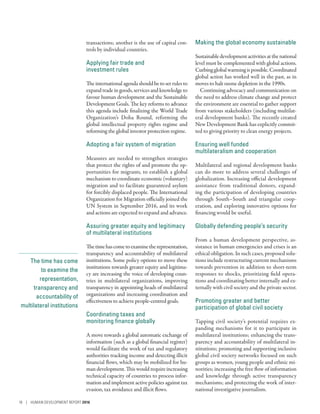
  • 54.
    As more people raisetheir voices to express their hopes and aspirations as well as their despair and frustration, mobilizing to demand what they want will become easier 400,000 people in Manhattan­—­and hundreds of thousands more in other cities­—­for the “big- gest climate march in history.”158 Crowdfunding allows individuals to contribute small amounts of money towards a philanthropic project that requires larger funds. Donors can fund local projects through civic crowdfunding or projects in other countries through charity crowdfund- ing.159 Spacehive, a civic crowdfunding platform in the United Kingdom, specializes in raising funds for small community projects such as im- proving a playground or renovating a school. It has raised nearly £5 million (more than $6 mil- lion) since its launch in 2011.160 Although petitions, protests, fundraising and political publications have always existed, the Internet has allowed them to reach an unprec- edented level and bring together people across the world. Mobile phones have multiplied the impact of popular movements. The broadcast- ing on Facebook of police attacks during pro- democracy demonstrations was instrumental in the 2011 Arab Spring.161 Smartphones and subscription-free mobile phones will likely ac- celerate this trend, creating new opportunities for people to express themselves freely, even under authoritarian regimes. As more people raise their voices to express theirhopesandaspirationsaswellastheirdespair and frustration, mobilizing to demand what they want will become easier. People’s voices can thus become a more powerful force, giving others hope in shaping the world they want. Expanding human ingenuity and creativity Human ingenuity and creativity have initiated technological revolutions and translated these revolutions into the way we work, think and behave. Technology is all around us, and some- times in us­—­biotech, digital tech, nanotech, neurotech, green tech and so on. The digital revolution has been going on for some time. The number of connected devices worldwide was projected to increase from 9  billion in 2012 to 23 billion in 2016.162 Some estimates put the Internet’s contribution to global GDP at as much as $4.2 trillion in 2016.163 The innovations of the technological rev- olution have ranged from three-dimensional technology to digital banking, from e-books to e-commerce, from the sharing economy to crowdworking. Economies have become indi- vidualized to match demand and supply peer- to-peer. The labour market does not require a traditional workplace, and the process has opened opportunities for many while making work precarious or even vulnerable for many others. Mobile phones and mobile Internet services offer many new opportunities for BOX 1.7 Cyberactivism­—­a new form of participation Cyberactivism is political engagement by means of the Internet. Netizens are individuals who work to create online communities to realize social or political goals. But the Internet also brings together individuals who do not otherwise engage in political or public life and sim- ply feel concerned by a specific issue. On several occasions in recent years, large num- bers of people have signed online petitions to draw the attention of policymakers to their opinions. In 2010, 2 million petitioners succeeded in banning politicians convicted of crimes from running for office in Brazil. In 2012 an online petition received 1.8 million signatures in support of the recognition of Palestine as a state by the United Nations. In 2014, 2.3 million people signed an online petition to oppose the eviction of the Maasai people from their ancestral lands by the Tanzanian gov- ernment. Since 2010 the United Kingdom has provided the opportunity for citizens to petition Parliament on an issue by gathering 100,000 signatures. In 2003 online mobilization led protests in sev- eral countries against the war in Iraq. Over the past 10 years this trend has encompassed protests by civil society organizations and protests prompted by indi- viduals who join together over a specific issue and then disengage from political discourse. An important aspect of these protests is their geographic scope, sometimes spanning several cities and sometimes several countries. Source: Human Development Report Office. 40 | HUMAN DEVELOPMENT REPORT 2016

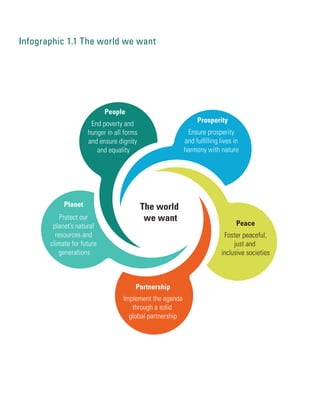
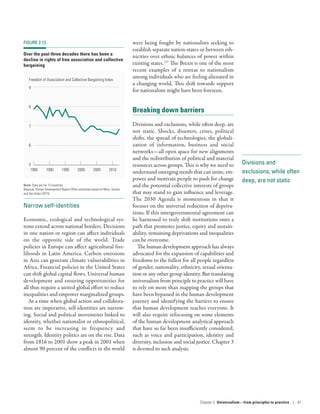

  • 55.
    Women have become activein areas where they were not traditionally active, and they have excelled in every aspect of life where they are engaged people­—­access to dynamic price informa- tion (as in Niger), productivity gains (as in Morocco), job creation in technology-based industries and labour-market services. They have helped poor female entrepreneurs through marketing information (as in Bangladesh) and contributed to the financial inclusion of poor people through mobile banking (as in Kenya).164 The digital revolution raises the hope of ad- dressing such daunting challenges as ensuring food security, overcoming health concerns, combating climate change and meeting energy needs. The development of immunotherapy has opened opportunities for successfully battling different types of cancers, such as breast can- cer. Three-dimensional printing can produce industrial prototypes and human tissue. Cloud technology has the potential to improve access to online information technology services for businesses and governments at low cost and to enable new online products and services for millions of producers and billions of consumers. Continuing the progress in women’s empowerment Women have made major strides in all walks of life.Genderequalityandwomen’sempowerment are not add-on issues in the development dia- logue, but a mainstream dimension of the devel- opment discourse locally, nationally and globally. Women have proved to be productive economic actors, prudent decisionmakers, vi- sionary leaders, compassionate volunteers and constructive peacekeepers. And many women are expanding their horizons. Focusing primarily on girls and disadvan- taged groups, Nepal’s Welcome to School Initiative led to an increase in net enrolment of 470,000 children, 57 percent of them girls, within a year of its implementation in 2005.165 Nepal’s policy on adolescent girls was initially centred on health and education but now en- compasses needs in employment, skills devel- opment and civic participation.166 Access to employment opportunities and to finance has opened opportunities for many poor women. The Women Development Act in the Philippines allows women to borrow mon- ey, obtain loans, execute security and credit ar- rangements and access loans in agrarian reform and land resettlement programmes under the same conditions as men.167 Financial services in South Africa and the United States are similar- ly regulated to avoid gender discrimination.168 Romania’s Order No. 473/2014 supports female entrepreneurs by financing their best business plans.169 It aims to cultivate entrepre- neurship among woman-owned businesses. Bangladesh is encouraging female participation in the workforce, with the ambition of bring- ing the share of women in the workforce up from 34 percent to 82 percent by 2026, thus adding 1.8 percentage points to GDP.170 In the Democratic Republic of Congo a new family code is being drafted to support women in busi- ness.171 All these efforts contribute to women’s economic empowerment, which needs to be appropriately conceptualized (box 1.8). Women have become active in areas where they were not traditionally active, and they have excelled in every aspect of life where they are engaged, even in societies where women have faced great obstacles in overcoming their traditional roles. Consider the success of Kimia Alizadeh, the Iranian female athlete at the 2016 Olympics, who not only competed but won a medal.172 There is now a female fighter pilot in the United Arab Emirates.173 Women are demanding gender equality in all walks of life. Nearly 15,000 people recently signed an online petition in Saudi Arabia call- ing on the government to abolish the country’s guardianship system, which prevents women from engaging in fundamental tasks without the permission of a male relative or without being accompanied.174 Society is gradually accepting and appreciating what women can achieve and contribute. Norms, values and legal frameworks are evolving. Côte d’Ivoire is tackling legal discrimination against women.175 While in the 1990s very few countries legally protected women from violence, today 127 do. This is partly the result of successful awareness-­raising on the human and economic cost of such violence.176 Lebanon now penalizes domestic violence. Peru prohibits sexual harass- mentinpublicspaces.Hungarycriminalizedeco- nomic violence as a form of domestic violence. Cabo Verde adopted a new law in 2011 to fight gender-­based violence.177 The State of Palestine recently elaborated the Arab region’s first nation- al strategy to fight violence against women, with the participation of survivors of violence. Chapter 1  Human development­—­achievements, challenges and hopes | 41
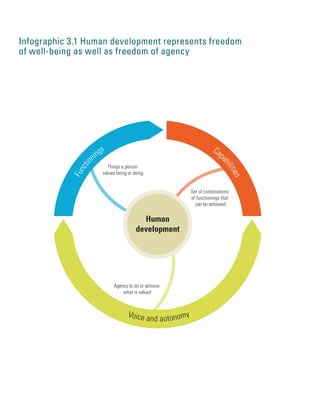
  • 56.
    Countries where the ruleof law is applied also have more gender-equal laws El Salvador obtained its first conviction in a case of femicide after a national protocol to guide investigations was adopted.178 In Latin America and the Caribbean the United Nations Entity for Gender Equality and the Empowerment of Women is working with the Office of the High Commissioner for Human Rights to promote the adoption of a regional model protocol for investigating femicide.179 Gambia and the United Republic of Tanzania have banned child marriage, raising the legal age of marriage for both boys and girls to 18.180 And in Mozambique, marrying the survivor of rape is no longer a defence option for rapists.181 Countries where the rule of law is applied also have more gender-equal laws.182 Specialized courts that tackle acts of violence against women can help provide effective legal action. Domestic and family violence courts were created in Brazil through the Maria da Penha Law. The Indian inheritance law reform im- proved the economic freedom of women, who were thereby able to double their spending on their daughters’ education thanks to increased savings. Slowly opening the space for action on some taboos Several issues that were once rarely discussed and poorly addressed have received increased atten- tion from the general public, civil society and policymakers over the last two decades. Among the groups of people who have benefited from breaking these taboos are lesbian, gay, bisexual, transgender and intersex people, women and girls who suffered female genital mutilation and cutting, and survivors of gender-based violence. Same-sex marriage is performed in nearly two dozen countries.183 Numerous countries rec- ognize civil unions, registered partnership and unregistered cohabitation. Even though lesbian, gay, bisexual, transgender and intersex people haveequalconstitutionalrightsinonly five coun- tries, at least their existence is recognized and their problems are discussed in various platforms, BOX 1.8 Five misconceptions about women’s economic empowerment • Women’s economic contribution is limited when women are not employed. Globally, women are less engaged in paid employment than men. In 2015, 36 percent of women and 44 percent of men worked full time for an employer. However, wom- en’s economic contribution in unpaid care and do- mestic work is remarkable: a 2011 survey in 46 countries found that, on average, 28  percent of women and 6 percent of men spent three to five hours a day on household work. • Women’s economic participation equals women’s economic empowerment. Increasing the number of women in the workforce is an important objec- tive, but if they enter it under poor conditions, their empowerment may not be improved. Exploitation, dangerous or stigmatized work, low pay and job in- security are unfavourable terms often encountered by women. • There is an automatic win-win between gen- der equality and wider development outcomes. Gender equality has been found to promote eco- nomic growth, household poverty reduction and human development. But the reverse is not always true. This means that governments need to pay dedicated attention to gender equality and not rely solely on growth to achieve it. • What works for one group of women will work for another. Women across the world often face sim- ilar obstacles, such as limited access to property and financial services, lack of social protection and unpaid care burden. Yet demographic, economic and cultural contexts also contribute to these bar- riers and make each woman’s experience different from others’. Policymakers cannot consider women to be a homogeneous group and apply standardized solutions to gender issues. Tailored approaches are required. • Increasing women’s individual skills and aspira- tions is the main challenge. Women’s capacity to seize economic opportunities can be substan- tially improved through individual support such as training in business management skills, but structural causes of gender inequality must be addressed simultaneously. A survey of 67 coun- tries in 2009 showed that 20 percent of men be- lieved that women should not be allowed to hold any job that they are qualified for outside of their home. Source: Hunt and Samman 2016. 42 | HUMAN DEVELOPMENT REPORT 2016
  • 57.
    Several countries have implemented legalreforms to reduce female genital mutilation and cutting, femicide, acid violence and honour violence including the United Nations.184 According to a report by GLSEN, the situation of lesbian, gay, bisexual, transgender and intersex students in the United Sates may be gradually improving, but it remainstroublesome.185 Manycivilsocietyorgan- izations such as OutRight Action International have been working to address these issues. Several countries have implemented legal re- forms to reduce female genital mutilation and cutting, femicide, acid violence and honour violence. Gambia has outlawed female genital mutilation and cutting.186 El Salvador and Mexico have enacted legal reforms that define femicide as a criminal offence and have adopted measures to prevent and punish the crime.187 The first law banning acid violence was passed in Bangladesh in 2002, and the death penalty was introduced later as punishment for the crime.188 AcidattacksinBangladeshfellfrom494incidents in 2002 to 59 in 2015. The Indian Penal Code was amended in 2013 to recognize acid violence as a criminal act.189 Female parliamentarians, po- litical leaders and nongovernmental advocates in Pakistanhaveactivelysupportednewlegislationto prevent acid attacks against women.190 About 100 acid attacks in Colombia occur each year, so the countrystrengtheneditslegislativeframeworkand enacted a law in January 2016 to impose sentences of12–50yearsimprisonmentforperpetrators.191 The Acid Survivor Foundation, active in Bangladesh, Cambodia and India, provides support to acid violence survivors.192 A dedicat- ed helpline in the State of Palestine, including online counselling and referral mechanisms, has already provided information to and poten- tially saved the lives of 18,000 callers.193 Increasing awareness of sustainability Awareness of sustainability has been increas- ing. It is much more visible in the global devel- opment agenda today than it was in the 1990s (box 1.9). Both the 2030 Agenda and the Paris Agreement on climate change bear this out. This increased visibility results from changes in the environment, natural resources and the climate that we can now all perceive. These changes have made it necessary to transform the way we produce, consume and function to protect our ability­—­and the ability of future generations­—­to live on the planet. Realization is growing that natural resources areeverybody’sresponsibility,fromindividualsto globalinstitutions.Theyareglobalcommon-pool resources, meaning that they are limited (overuse reduces the availability for other users) and that anyone can access them relatively freely (regu- lating their consumption is difficult). So their management must be global, but national and local actions can have considerable impacts. The pollution of a river by a single factory can deplete natural resources along the riverbanks for kilo- metres downstream and pollute underground water reserves over an even larger area. Positive individual actions, if repeated by millions of peo- ple, can likewise make a difference. BOX 1.9 The growing recognition of the importance of environmental sustainability In 1992 a milestone summit was organized in Rio de Janeiro that led to the United Nations Framework Convention on Climate Change. In 2000 environmen- tal sustainability was included as one of the eight Millennium Development Goals and subsequently inte- grated into most international and national development strategies. At the World Summit on Social Development in 2005, environmental sustainability was recognized as oneofthethreepillarsofsustainabledevelopment,along with economic development and social development. The year 2015 was a turning point with the adop- tion of the 2030 Agenda, which gives unprecedented attention to environmental sustainability and climate change, and the Paris Agreement on climate change, through which 195 member states committed to re- ducing carbon emissions. Three of 17 Sustainable Development Goals are dedicated to environmental sustainability, and all of the others call for environmen- tally sustainable practices in their respective fields. Increasingly perceptible resource depletion and climate change highlight the importance of integrating environ- mental sustainability in development strategies for the good of present and future generations. Source: Human Development Report Office. Chapter 1  Human development­—­achievements, challenges and hopes | 43
  • 58.
    Climate-smart agriculture andclimate-smart development are gaining currency. For example, about 500,000 solar panels were installed every day in 2015, an unprecedented growth that meant that renewable energy had become the world’s top source of installed power capacity.194 On a single day­—­11 July 2016­—­India planted 50 million trees to take on climate change.195 In 2015, 247,000 electric cars were sold in China.196 Globally, 13 percent of greenhouse SPECIAL CONTRIBUTION The power of culture to prompt action My son recently asked me whether he had saved much CO2 from being emit- ted into the air by using the Little Sun solar lamp I designed. He also wanted to know why, if a tonne of CO2 weighs so much, it does not drop to the ground. And where is it? To him, a tonne is heavy and physical and not an intangible mass distributed in the atmosphere. His questions made me real- ize how little I myself know about CO2 . When I was my son’s age, back in the late seventies, there was no discussion of climate change. Nature was where I spent my summers, in a tent in the Icelandic highlands, a stark contrast to the Copenhagen I lived in. These natural and manmade realms could not be more separate. But today, there is no nature outside of human activity. Our survival and future depend on understanding the effects of CO2 consumption and acting on that understanding. But what do we understand? What, for instance, is a tonne of CO2 ? Is it hot or cold, wet or dry? Perhaps it would help to know that one tonne of CO2 could be imagined as a cube the size of a three-storey house or that, when frozen, it would form a block of dry ice about 0.67 cubic metres in size. But what does that actually tell me if I do not know how much CO2 I produce in a year or on an average day? What does it tell me if I do not sense my inter- relationship with planet Earth? We need science to tell us that the weight of CO2 is based on the atomic mass of the molecules. A scientist can tell me that a tonne of CO2 is equal to the energy expenditure of a house for about a month, a small car driven for two days nonstop or a 747 flying for less than two minutes and that because of the greenhouse effect, excessive amounts of CO2 in the atmosphere lead to global warming. But for many people, science alone is not enough to compel action. It struck me, when I was looking up this data, that it was familiar, that I had seen it more than once in the media and that I somehow knew most of it. So I asked myself why does knowing not translate into doing when so much is at stake? This is where culture has something to offer. Culture can help us make sense of abstract concepts and information in ways which resonate. The visual arts, theatre, poetry, literature, dance, architecture and creativity in a broad sense help us build a relationship with abstract ideas, making them concrete, felt. Culture can add motivational impetus to the knowledge we gain from science. Importantly, however, culture can bring people to the point of action without prescribing the actual action. It does not tell us what to do or how to feel, but rather empowers us to find out for ourselves. Today, in politics, we are bombarded with emotional appeals, often linked to polar- izing, populist ideas. The great thing about the arts and culture, on the other hand, is that they allow spaces to emerge in which people can disagree and still be together, where they can share individual and collective experiences, and, in the process, form diverse communities based on inclusion rather than exclusion. Experiences like these can become exercises in democracy, inspiring trust, in ourselves and in society. When I work in my studio, I draw inspiration from the fact that neurosci- entists and psychologists recognize that the brain has two different systems for processing perceptions: one is analytical and deals with facts and data, and the other is experiential and deals with emotions and instincts. The ex- periential system­—­activated when you encounter art, for instance­—­tends to be the stronger motivator. Much of the communication on climate change, however, is focused on the analytical, attempting to reason with people to change their behaviour. Although it is clearly important to ground action in knowledge and rational thought, we also need to understand the central role of our experiential system in motivating action. Ice Watch, an artistic intervention that I created with Minik Rosing, a geologist and expert on Greenland, takes an experiential approach by bring- ing people into direct contact with the physical reality of climate change. In 2015, during COP21 in Paris, we brought almost 100 tonnes of glacial ice from Greenland to the Place du Panthéon. Visitors touched the blocks of ice as they melted, put their ear to them and even tasted the ice. When we asked people about their responses, most described feelings; they felt touched. Some spoke about the sounds of the melting ice, like miniature explosions­—­as if the small pockets of compressed air, frozen inside the tur- quoise ice for millennia, were speaking to us from the past. Contact with the ice afforded an experience of its fragility, of time and of the distant Arctic. It was both concrete, physical and spatial as well as abstract and contempla- tive. Together, the emotional and intellectual experience allowed each of us to host the climate debate in our bodies, paving the way for an embodied understanding of our changing environment and planet. Culture can inspire people to move from thinking to doing, and it holds the potential to inspire great social change. It is only by connecting the head and the heart that we will succeed in building a future for the planet shaped by positive, powerful climate action. Olafur Eliasson Artist and founder of Little Sun 44 | HUMAN DEVELOPMENT REPORT 2016
  • 59.
    In spite ofheated debates leading to bitter gridlock at the national, regional and global levels, through the rubble the tender shoots of a global consensus are emerging to ensure a sustainable world for future generations gas emissions are now covered by carbon pricing initiatives.197 The value of the trade in environ- mental goods almost tripled between 2001 and 2012, from $231 billion to $656 billion.198 According to some estimates, the value of the environmental goods and services market will reach $1.9 trillion by 2020. Trade can also do more to spread green technology. A clear shift in spending towards cleaner energy was seen in 2015­—­$313 billion in renewable energy sourc- es and $221 billion in energy efficiency.199 But awareness about sustainability has to take a broader view. For example, climate change is not only an environmental issue or a science issue. Olafur Eliasson, artist and founder of Little Sun, argues that to internalize and act on the vital data of climate change, culture has something to offer (see special contribution). Stronger global commitments Over the years people have grown accustomed to heated debates leading to bitter gridlock at the national, regional and global levels. But through the rubble the tender shoots of a global consensus are emerging to ensure a sustainable world for future generations. The 2030 Agenda adopted by 193 member states of the United Nations on 25 September 2015 is among the most important platforms for efforts to end poverty by 2030 and pursue a sustainable future.200 The agenda includes 17 Sustainable Development Goals, 169 targets and 230 indicators (box 1.10). Similarly, parties to the United Nations Framework Convention on Climate Change reached a landmark agreement on 12 December 2015 in Paris, charting a fundamen- tally new course in the two-decade-old global climate efforts. After four years of negotiations the treaty is the first to consider both devel- oped and developing countries in a common framework, urging them all to make their best efforts and reinforce their commitments in the coming years.201 All parties should now report regularly on emissions and on efforts to implement their commitments and submit to international review. The Paris Agreement on climate change came into force on 4 November 2016. More than 70 countries, which account for nearly 60 percent of global emissions, have ratified it.202 The first UN Summit for Refugees, held in September 2016, brought member states together to agree on a more humane and co- ordinated way to respond to the risks faced by refugees and migrants and to prepare for future challenges. It resulted in the New York Declaration, a series of national and interna- tional commitments (see chapter 6). A recent groundbreaking ruling by the International Criminal Court in The Hague sentenced an Islamic militant from Mali who helped destroy the fabled shrines of Timbuktu to imprisonment for nine years.203 The trial was unique on two fronts: it was the first at the court to focus solely on cultural destruction as a war crime, and it was the court’s first prosecu- tion of an Islamic militant. The human development approach and the 2030 Agenda The human development approach and the 2030 Agenda have three common analytical links (figure 1.10): • Both are anchored in universalism­—­the hu- man development approach by emphasizing the enhancement of freedoms for every hu- man being and the 2030 Agenda by concen- trating on leaving no one behind. • Both share the same fundamental areas of focus­—­eradicating extreme poverty, ending hunger, reducing inequality, ensuring gender equality and so on. • Both have sustainability as the core principle. The links among the human development ap- proach, the 2030 Agenda and the Sustainable Development Goals are mutually reinforcing in three ways. First, the conceptual foundation of the 2030 Agenda is strengthened by the analytical elements of the human development approach strengthen its conceptual foundation. Similarly, the human development approach is enriched by elements in the narrative of the 2030 Agenda. Second, the Sustainable Development Goal indicators can be used with the human devel- opment indicators in assessing progress towards the Sustainable Development Goals. Similarly, the human development approach can sup- plement the Sustainable Development Goal indicators with additional indicators. Chapter 1  Human development­—­achievements, challenges and hopes | 45
  • 60.
    The links amongthe human development approach, the 2030 Agenda and the Sustainable Development Goals are mutually reinforcing Third, the Human Development Report can be an extremely powerful advocacy instrument for the 2030 Agenda and the Sustainable Development Goals. And the Sustainable Development Goals can be a good platform for the greater visibility of the human develop- ment approach and the Human Development Report through 2030. Universalism is at the core of human de- velopment. And given the progress in human development over the past 25 years and the hope it presents, human development for every- one must be and can be attained. But there are considerable challenges and barriers to universal human development So universalism of human development must not remain a philosophical tenet. It must become a practical reality to analyse the who and where of why human de- velopment not reaching everyone­—­a task for chapter 2. BOX 1.10 Sustainable Development Goals Goal 1 End poverty in all its forms everywhere Goal 2 End hunger, achieve food security and improved nutri- tion and promote sustainable agriculture Goal 3 Ensure healthy lives and promote well-being for all at all ages Goal 4 Ensure inclusive and equitable quality education and promote lifelong learning opportunities for all Goal 5 Achievegenderequality andempowerallwomenandgirls Goal 6 Ensure availability and sustainable management of wa- ter and sanitation for all Goal 7 Ensure access to affordable, reliable, sustainable and modern energy for all Goal 8 Promote sustained, inclusive and sustainable economic growth, full and productive employment and decent work for all Goal 9 Build resilient infrastructure, promote inclusive and sus- tainable industrialization and foster innovation Goal 10 Reduce inequality within and among countries Goal 11 Make cities and human settlements inclusive, safe, ­resilient and sustainable Goal 12 Ensure sustainable consumption and production patterns Goal 13 Take urgent action to combat climate change and its impacts1 Goal 14 Conserve and sustainably use the oceans, seas and ma- rine resources for sustainable development Goal 15 Protect, restore and promote sustainable use of terres- trial ecosystems, sustainably manage forests, combat desertification, and halt and reverse land degradation and halt biodiversity loss Goal 16 Promote peaceful and inclusive societies for sustainable development, provide access to justice for all and build effective, accountable and inclusive institutions at all levels Goal 17 Strengthen the means of implementation and revitalize the Global Partnership for Sustainable Development 1. Acknowledging that the United Nations Framework Convention on Climate Change is the primary international, intergovernmental forum for negotiating the global response to climate change. Source: United Nations 2015c. 46 | HUMAN DEVELOPMENT REPORT 2016
  • 61.
    FIGURE 1.10 Analytical linksbetween the human development approach and the 2030 Agenda Common anchors The human development approach The 2030 Agenda and the Sustainable Development Goals Revie w the narrative of the 2030 Agenda and examine parts that can enrich it Use analytical elements of human development to strengthen its conceptu alfoundation Thecorepri nciple Fundam entalareaoffocusPrinciple of universalism Sustainab ility Eradication of extr emepoverty,endinghunger… Freedo ms for every human being Leaving no one b ehind Source: Human Development Report Office. Chapter 1  Human development­—­achievements, challenges and hopes | 47
  • 63.
  • 64.
    Barriers to universalism Intolerance and exclusion Discriminatorylaws Social norms Violence Weak bargaining power Inequality Lack of voice Narrow self-identities Nationalism Identity politics Elite capture of institutions Rise of 1 percent Lack of pluralism Infographic 2.1 Barriers to universalism
  • 65.
    Human Development Report 2016 HumanDevelopment for Everyone 2. Chapter 2  Universalism—from principles to practice | 51 As gains are achieved, other deprivations may become more critical, and new groups may bear the burden of being left behind Universalism—from principles to practice The progress in human development over the past 25 years has been impressive on many fronts. More children are going to school, people are living longer, incomes are higher and people have greater potential to shape their societies and their future under democratic forms of government. But the gains have not been universal, and not all lives have been lifted. This reality was the impetus for the intergovernmental agreement on the 2030 Agenda, which aims to leave no one behind. Millions of people are indeed unable to reach their full potential in life because they suffer deprivations in multiple dimensions of human development­—­lacking income and secure livelihoods, experiencing hunger and malnutrition, having no or limited access to social services, fearing violence and discrimination and being marginalized from the political processes that shape their lives. There are imbalances across countries; socioeconomic, ethnic and racial groups; urban and rural areas; and women and men. Some groups are more deprived than others, and the most deprived individuals belong to multiple disadvantaged groups­—­an older, ethnic minority woman in a least developed country, for example. The absolute deprivations in basic human devel- opmentremainpronouncedanddemandurgent attention.Butbeingleftbehindisadynamicand relative process, so universalism­—­human devel- opment for everyone­—­requires a forward-look- ing approach. As gains are achieved, other deprivations may become more critical, and new groupsmaybeartheburdenofbeingleftbehind. Many people appear to be doing well according to measures such as minimum schooling and in- come, but the quality of education and of work conditions are low for many millions of people. Likewise, people are living longer and healthier lives, but many face deficits in political freedom and in opportunities for political participation. Demographic shifts, transitions from peace to insecurity and other macro threats such as epidemics, financial crises, natural disasters and climate change all generate new forms of advantage and disadvantage. In this digital age a lack of reliable access to information, infra- structure or technology can severely curtail opportunities, even in developed countries, reshaping patterns of deprivation. And even as restrictive social norms—such as restrictions on women working outside the home—lose force in some societies, others—such as dis- crimination against older people—become more powerful. Who is left behind, how and why are questions with different answers in different places at different times. Enabling all human beings to realize their full potentialdemandsurgentattentiontoinequality and to relative capabilities and opportunities. It is not enough to enable those with the least capabilities to move above minimum thresh- olds. For instance, even if extreme poverty were to be eradicated globally or universal primary school enrolment attained, the wealthy and highly educated could simultaneously accrue enormous economic resources or achieve higher tertiary enrolment rates, thereby maintaining or even widening gaps in key capabilities. Despite absolute gains for all people, the possibilities for those with the least wealth and education to realize their full potential would continue to lag. Because the starting points vary widely across individuals, more equitable outcomes may require greater attention and support for the people who are farthest behind. It is particularly important to close the gaps in voice and agency. Institutions and policies may otherwise disproportionately reflect the values and interests of elites, who often have greater voice. There is a risk that gaps could become self-perpetuating and ever more difficult to eradicate. And extreme inequalities in voice and agency can breed economic, social and political instability and conflict. Human development embodies a com- mitment to ensure rights, voice, security and freedom­—­not to most, but to all people in every corner of the world. It also stresses the importance of sustaining capabilities and op- portunities throughout an individual’s lifecycle and for subsequent generations.
  • 66.
    One of themain challenges of practical universalism­ ­is reaching those who experience the most extreme deprivations and those who are the most socially marginalized and excluded One of the main challenges of practical universalism­—­advancing from ideas to actions and institutions­—­is reaching those who experi- ence the most extreme deprivations and those who are the most socially marginalized and excluded. Technical and financial barriers can be overcome, and there are indeed strong col- lective efforts in this direction. But deep-seated barriers to universalism, including discrimina- tory social norms and laws and inequalities in agency and voice, require more attention. There is also a need to appreciate the dynamic nature of deprivations and exclusion­—­that gains can be reversed by health or financial shocks, that new barriers can emerge if conflict erupts or community security and services deteriorate and that new groups without reliable access to the Internet can be marginalized when that access becomes central to livelihoods. The goal is not only to reach the most de- prived and ensure that no one is left behind today, but also to protect those at risk of being left behind tomorrow. Universalism is a princi- ple of the human development approach, and now is the time to translate it into practice by identifying and breaking down barriers that exclude certain groups, narrowing the wide gaps in life chances among different groups, proposing policy options that fit contexts and levels of development and identifying institutional shortcomings. This is practical universalism. Momentum towards universalism Space is opening for the practice of universalism and the extension of human development to everyone. The 2030 Agenda takes a universal ap- proach. Its Sustainable Development Goals em- body a shared vision of progress towards a safe, just and sustainable world in which all human beings can thrive. The goals reflect principles of universality that no one and no country should be excluded and that everyone and every country share a common­—­albeit differentiated­ —­responsibility for the outcomes of all. Global momentum is thus in place to enable policymak- ers and advocates to move in ways that may have been much more difficult in the past. Translating principle into policy and institu- tional practice requires mapping out who the deprived are, where they live, what the extent of their deprivation is and what the risks of new deprivations are. The Report on the World Social Situation 2016 noted that universalism is pos- sible only after those who are being left behind have been identified.1 With this reasoning, this chapter: • Looks beyond national averages and existing measures. • Comprehends the development barriers that often block particular groups, such that some groups are disproportionately marginalized and more at risk of emerging threats. • Contextualizes human development, identi- fying deprivations and inequalities across the spectrum of countries with different incomes and human development profiles and map- ping out how new barriers can emerge, even as some deprivations are overcome. • Analyses the barriers to practical universalism so that steps can be taken to eliminate them. Beyond averages­—­using the family of human development indices Human development is about improving the life chances of individuals. However, the meas- ures used to monitor progress in human de- velopment often cover only countries and not individuals or groups. Disaggregated measures are therefore needed that show who is deprived, where they live and the nature of their depri- vations. National, subregional and regional Human Development Reports have identified deprivations by analysing data disaggregated by age, gender, subnational units, ethnicity and other parameters. Disaggregating and analysing the family of human development indices­—­ the Human Development Index (HDI), the Inequality-adjusted Human Development Index (IHDI), the Gender Development Index (GDI), the Gender Inequality Index (GII) and the Multidimensional Poverty Index (MPI)­—­ are early steps towards quantifying the scale of deprivations globally. Human Development Index The HDI is one tool for identifying depriva- tions in a selection of essential capabilities (a 52 | HUMAN DEVELOPMENT REPORT 2016
  • 67.
    Disaggregated HDI values within countriesconfirm that many people live with unacceptably high deprivation, even though their country appears to have improved in HDI value and rank long and healthy life, knowledge and a decent standard of living). Country-level trends on the HDI have been impressive over the past 25 years: Between 1990 and 2015 the number of countries classified as having low human development fell from 62 to 41, and those classified as having very high human develop- ment rose from 11 to 51.2 These shifts reflect improvements in the life conditions of millions of people. But the trends also reflect average national progress. The unfortunate reality is that millions of people fall on the wrong side of the average and struggle with hunger, poverty, illiteracy and malnutrition, among other depri- vations. Making human development work for everyone requires a greater understanding of who these people are and where they live. Disaggregated HDI values within countries confirm that many people live with unaccept- ably high deprivation, even though their coun- try appears to have improved in HDI value and rank. Panama is classified as having high human development, but 2 of its 12 provinces are clas- sified as having low human development, while the capital province is classified as having very high human development.3 Ethiopia is classi- fied as having low human development, as are 9 of its 11 regions, but 2 regions are classified as having medium human development.4 In both countries the split is between capital provinces and more rural areas. Disaggregation at the global level suggests that a third of the world’s population lives in low human development (figure 2.1). Many of these people are severely deprived in education, health and income. Medium, high and very high human development countries are home to hundreds of millions of people living in low human development.5 Many people are being left behind in countries across the development spectrum. Inequality-adjusted Human Development Index Unequal concentrations of well-being mean that indicators of average human development like the HDI do not reflect the well-being of a vast portion of the population. The IHDI quantifies the effects of inequality on human development, measured in terms of the HDI. Some 22 percent of the world’s human devel- opment is lost because of inequality.6 Inequality in education contributes the most to overall inequality, followed by inequality in income and inequality in life expectancy. Sub-Saharan FIGURE 2.1 A third of the world’s population lives in low human development 7.4 billion people in the world One-third live in low human development Where they live 33% Low human development countries 45% Medium human development countries 22% Very high and high human development countries Source: Human Development Report Office. Chapter 2  Universalism—from principles to practice | 53
  • 68.
    The deprivations facing womenare the most extreme barrier to global progress in human development Africa has the highest loss of human develop- ment because of inequality (32 percent).7 At the country level unequal distribution of human development occurs both in low hu- man development countries, such as Comoros (where 46 percent of human development is lost because of inequality) and in very high human development countries, such as Chile (where 18 percent of human development is lost because of inequality).8 The IHDI indicates that human de- velopment for everyone will require considerable interventions to overcome unequal distributions in key capabilities within countries. Gender Development Index and Gender Inequality Index Women are more likely than men to suffer from low human development.9 Many groups are disadvantaged, but the systemic deprivations of women relative to men deserve to be highlight- ed because women constitute half the world’s population. The deprivations facing women are the most extreme barrier to global progress in human development. Despite the fact that in all regions women have longer life expectancy than do men and the fact that in most regions the expected num- ber of years of schooling for girls is similar to that for boys, women consistently have a lower HDI value than do men. The largest differences captured by the GDI are in South Asia, where the HDI value for women is 17.8 percent lower than the HDI value for men, followed by the Arab States with a 14.4 percent difference and Sub-Saharan Africa with 12.3 percent. Much of the variation in HDI between women and men is due to lower income among women relative to men and to lower educational attainment among women relative to men. Part of the variation in the HDI between men and women is generated by barriers to women work- ing outside the home, to accessing education, to voicing their concerns in political arenas, to shaping policies and to receiving the benefits of high-quality and accessible health care. The GII is a composite index that captures the inequality that many women face in repro- ductive health, secondary education, political representation and the labour market (figure 2.2). Women are the most disadvantaged in low human development countries.10 A challenge to global progress in human de- velopment across all regions and groups, gender inequality is most severe in low and medium human development countries and in the Arab States, South Asia and Sub-Saharan Africa.11 As countries’ human development improves, women’s choices and opportunities must be equal to those of men so that everyone benefits from advances in human development. Multidimensional Poverty Index Deprived people often lack capabilities and opportunities across multiple dimensions. The MPI, which is calculated for 102 developing countries, reveals more about the depth and overlapping nature of people’s nonincome dep- rivations than do one-dimensional measures of poverty. Based on 10 indicators, the MPI iden- tifies households that are acutely deprived by their health, education and standard of living. Almost 1.5 billion people in the developing countries for which the MPI is calculated live in multidimensional poverty, 53.9 percent of them in South Asia and 33.5 percent in Sub- Saharan Africa.12 People are also deprived in developed countries (box 2.1). Some systematic patterns of deprivation can be inferred from poverty measures. People in rural areas are far more likely than people in urban areas to be multidimensionally poor (29 FIGURE 2.2 Women are the most disadvantaged in low human development countries Very high human development Medium human development High human development Low human development .491 .291.590 .174 Note: 1 indicates absolute inequality, as measured by the Gender Inequality Index, and 0 indicates perfect equality. Source: Human Development Report Office. 54 | HUMAN DEVELOPMENT REPORT 2016
  • 69.
    There is ahigh likelihood that if a household is deprived in one of the 10 indicators used to calculate the MPI, it will also be deprived in others percent versus 11 percent), though there is var- iation across regions (figure 2.3). Nearly half of people in rural areas worldwide lack access to improved sanitation facilities, compared with a sixth of people in urban are- as.13 And twice as many rural children as urban children are out of school.14 At the same time, slumdwellers account for 48 percent of the urban population in developing countries and are deprived of many services and opportunities­ —­the very benefits that many deprived people migrated from rural areas to obtain.15 There is a high likelihood that if a household is deprived in one of the 10 indicators used to calculate the MPI, it will also be deprived in others. To improve the conditions of the most BOX 2.1 Poverty is also a developed country problem Deprivations are a universal problem afflicting people in developed and developing countries alike. An average of 11 percent of the population in Organisation for Economic Co-operation and Development (OECD) countries were below the income poverty line in 2014.1 As of 2012 there were 633,000 homeless people in the United States and 284,000 in Germany.2 OECD countries have the highest incarceration rates of any group of countries: an aver- age of 274 people per 100,000, isolated from society in prison.3 An average of 15 percent of young people ages 15–29 are neither employed nor in education or training and are struggling to find their place in society.4 Health deprivations caused by obesity are also high. The most re- cent survey data indicate that an average of 53.8 percent of the adult population in OECD countries is overweight or obese and faces high risks of cardiovascular disease, respiratory illnesses, diabetes and other diseases.5 The data make clear that not all people in countries classified as having very high human development are able to achieve their full life potential. Poverty can take different forms in developed countries and in developing countries, but it is no less debilitating to the choices and the future of individuals and households experiencing the deprivations. Notes 1. OECD 2016a. 2. OECD 2015a. 3. Based on UNODC (2016). 4. OECD 2016e. 5. OECD 2015b. Source: Human Development Report Office. FIGURE 2.3 People in rural areas are far more likely than people in urban areas to be multidimensionally poor Latin America the Caribbean 19 3 East Asia the Pacific 8 2 Europe and Central Asia 3 1 Sub-Saharan Africa 74 31 Developing countries 29 11 Rural population Urban population South Asia 64 25 Arab States 29 8 Population in multidimensional poverty (%) Source: Human Development Report Office. Chapter 2  Universalism—from principles to practice | 55
  • 70.
    Viewing the nation asthe primary unit of analysis for policymaking and measurement has value, but looking directly at the conditions of individuals is essential for identifying who is being left behind deprived, a more comprehensive cross-sectoral approach to policy may thus be more effective than interventions that separately target par- ticular elements of poverty. Poverty rates differ between men and wom- en. Although at the global level households headed by men and those headed women are almost equally likely to be multidimensionally poor­—­29 percent of man-headed households and 28 percent of woman-headed households are multidimensionally poor­—­there is consid- erable variation across countries and regions.16 Because the MPI is calculated at the household level rather than at the individual level, com- plementary research may be needed to clarify the relationship between gender and poverty. People are more likely to fall into multidi- mensional poverty during conflict, and people in conflict areas face particular barriers to moving out of multidimensional poverty. An average of 49 percent of the population in 24 countries in conflict for which the MPI is cal- culated lives in multidimensional poverty, and another 16 percent live in near-poverty. An av- erage of 27 percent of people in these countries live in severe multidimensional poverty. Deprivations also vary across socioeconomic groups. In Sub-Saharan Africa poor people, especially women attending school in rural communities, are far less likely than nonpoor people to be learning critical skills such as reading, writing and mathematics.17 In Chad the richest quintile of the population averages 6.7 years of schooling, compared with 1.0 for the poorest quintile. The story is similar in Ethiopia­—­7.5 years for the richest quintile and 1.6 years for the poorest quintile­—­and in Madagascar­—­9.8 years and 1.7 years.18 In South Africa HIV prevalence is higher among the poorest socioeconomic groups. Access to basic social services of acceptable quality is often limited among people living in poverty, intensifying the disparities in well-being. In Zambia poor people are less likely to use pub- lic hospitals because of financial and physical barriers, despite having greater need than other income groups.19 Too many people are still missing out The HDI, GII, GDI and MPI indicate that not everyone is lifted as countries progress on these average measures. Despite the overall progress, about one-third of people in the world live in unacceptably low human development. Many of them­—­especially women and girls, people in rural areas and people in countries in conflict— suffer multiple and overlapping deprivations. Viewing the nation as the primary unit of analysis for policymaking and measurement has value, but looking directly at the condi- tions of individuals is essential for identifying who is being left behind. Countries’ human development may improve, but this does not mean that entire populations are better off or benefit equally. Supplementing national measures with subnational measures is impor- tant for policymaking. Data disaggregation is critical for identifying the integrated actions needed to support universalism and the full realization of life potential among all people (see chapter 3). Melinda Gates, co-chair of the Bill Melinda Gates Foundation, ar- gues that getting a clearer picture of poverty and deprivation is a fundamental first step towards designing and implementing more ef- fective policies and interventions (see special contribution). A look at disadvantaged groups All people in all circumstances are not equally disadvantaged. People with certain charac- teristics, in certain locations or at particularly vulnerable stages of the lifecycle are more likely than other people to lack access to ­capability-enhancing resources and opportu- nities to suffer deprivations. These groups are also disproportionately exposed and vulnerable to emerging threats such as epidemics, climate change and natural disasters, so progress may be less sustainable among these groups even when gains in human development are achieved. Group distinctions such as ethnicity or religion can serve as dividing lines to support discrimination and restrict access to resources and opportunities. The result can be differ- ences in the human development outcomes of particular groups. The following subsections identify some of the groups that are missing out on progress in human development and show how deprivations may take shape in particular contexts and conditions. 56 | HUMAN DEVELOPMENT REPORT 2016
  • 71.
    SPECIAL CONTRIBUTION Getting aclearer picture of poverty I was asked last year to select one photograph that has profoundly influenced my life. I chose an image known as Migrant Mother­—­a haunting picture of a woman named Florence Owens Thompson sitting with three of her chil- dren in their makeshift home, a rudimentary tent. The photograph was taken in California in 1936 as millions of American families struggled through the Great Depression. Florence and her family are destitute and desperate. That iconic photograph, which I first came across in high school, still comes to mind whenever poverty is the topic of conversation. Poverty as a category of analysis is an abstraction. Migrant Mother captures its harsh, biting reality better than any other image­—­and any dictionary definition or economic indicator­—­that I have ever seen. And what motivates me is that, 70 years on, this struggle is still daily life for more than a billion people around the world. In my work I have seen that struggle firsthand. I have seen how lack of family planning advice and contraceptives leaves parents with more mouths to feed than they can afford; how not getting the right food and nutrients leaves people unable to fulfil their potential; and how disease leaves adults too weak to work, and children too sick for school. So while there are robust and legitimate debates going on about the methodology and measurements we use to classify poverty, first and fore- most we must remember what it actually means to be poor. Essentially, being poor is about deprivation. Poverty not only deprives people of food, shelter, sanitation, health, income, assets and education, it also deprives them of their fundamental rights, social protections and basic dignity. Poverty also looks different in different places. While in East Africa it is related mostly to living standards, in West Africa child mortality and lack of education are the biggest contributors. All this complexity and variation is impossible to capture in a defini- tion of poverty as simplistic as living on less than $1.90 a day. If we really mean to “end poverty in all its forms everywhere,” as laid out in the first Sustainable Development Goal (SDG), then it fits that we have to know what all those forms are. We need to have a far clearer picture of the most mar- ginalized and most vulnerable. Not just those who are financially poor, but those facing a number of distinct disadvantages, such as gender, race and ethnicity, that taken together deprive them of the chance to lead healthy, productive lives. One of the reasons I find Migrant Mother so powerful is that it focuses on the plight of a woman and how she is scarred by deprivation, at a time when their hardship and suffering was sometimes overlooked by politi- cians and policymakers. It is critical to know more about the lives of today’s Florence Owens Thompsons since women and girls are widely recognized as one of the most disregarded and disenfranchised groups in many developing countries. Indeed, the World Bank argues that a “complete demographic poverty profile should also include a gender dimension,” given that most average income measurements miss the contribution and consumption of women and girls within households entirely. For a long time, for example, when data collectors in Uganda conducted labour force surveys, they only asked about a household’s primary earner. In most cases, the main breadwinner in Ugandan households was the man, so the data made it look like barely any women were participating in the work- force. When the data collectors started asking a second question­—­who else in the household works?­—­Uganda’s workforce immediately increased by 700,000 people, most of them women. Obviously, these women had ex- isted all along. But until their presence was counted and included in official reports, these women and the daily challenges they faced were ignored by policymakers. Similarly, because many surveys tend to focus solely on the head of household­—­and assume that to be the man­—­we have less idea of the numbers of women and children living in poverty and the proportion of woman-headed households in poverty. Getting a clearer picture of poverty and deprivation is a fundamental first step towards designing and implementing more effective policies and interventions, as well as better targeting scarce resources where they will have the greatest impact. That’s why our foundation is supporting partners to better identify who and where the poorest and most vulnerable are, col- lect better information on what they want and need to improve their lives and develop a better understanding of the structural barriers they face. The findings will then be used to develop strategies that specifically target those identified within the first 1,000 days of SDG implementation. This report is a welcome contribution to these efforts, along with the United Nations Development Programme’s ongoing work to revamp the Human Development Index (HDI), including an explicit focus on women and girls. Since its creation in 1990 the HDI has been a central pillar of multidimensional poverty and a key instrument to measure both how much we have achieved and the challenges ahead. The report is also a timely addition to the calls made by the Commission on Global Poverty, the Organisation for Economic Co-Operation and Development and others for incorporating quality of life dimensions into the way we understand and determine human deprivation. I am excited by the prospect of a broader, more sophisticated approach to determining poverty. But all the best data in the world won’t do us much good if they sit on a shelf collecting dust. They must be used to influence decisionmaking and accountability, and ultimately to transform the lives of the world’s most vulnerable people. The last 15 years have shown us that progress on poverty is possible. But we also know that it is not inevitable­—­ nor has it been universal. My hope is that this report will catalyse the global community to ensure that, this time, no one is left behind. Let’s not squander this momentum. Melinda Gates Co-chair of the Bill Melinda Gates Foundation Chapter 2  Universalism—from principles to practice | 57
  • 72.
    Gender disparities in humandevelopment, while narrowing slowly, are embedded in social norms and long-standing patterns of exclusion from household and community decisionmaking that limit women’s opportunities and choices Women and girls Women and girls are not able to live their lives to their full potential in many countries. Gender disparities in human development, while narrowing slowly, are embedded in social norms and long-standing patterns of exclusion from household and community decision- making that limit women’s opportunities and choices (box 2.2). Gender-based discrimination starts before school, even before birth. The preference for a son can lead to sex-selective abortions and miss- ing women, particularly in some South Asian countries. Discrimination continues in families through intrahousehold resource allocation. The gender politics of food­—­nurtured by the assumptions, norms and values about women needing fewer calories­—­can push women into a perpetual state of malnutrition and protein deficiency. Women and girls sometimes eat last and least within the household. Early marriage among girls limits their long-term capabilities and potential. Each year, 15 million girls in developing countries marry before age 18, and if there is no reduction in the incidence of early marriage among girls, by 2050, 18 million girls will be married before age 18.20 Worldwide, one out of eight age-eligible girls does not attend primary or secondary school.21 Only 62 of 145 countries have achieved gender parity in prima- ry and secondary education.22 As highlighted in the 2015 Human Development Report, women face numerous disadvantages in paid and unpaid work. The global labour force participation rate is 49.6 percent among women and 76.2 percent among men.23 Women employed in vulnerable work or the informal economy may lack decent work conditions, social security and voice and have lower earnings than do other workers. Women also suffer discrimination in relation to productive assets, such as the right to land and property. Women are barred from owning land because of customary laws and social norms and practices. Only 10–20 percent of landholders BOX 2.2 Gender-based inequalities in South Asian households Women in South Asia are often excluded from decision- making, have limited access to and control over resourc- es, are restricted in their mobility and are often under threat of violence from male relatives. These depriva- tions are linked strongly to patriarchal social norms and attitudes that impede equitable gender relationships within households. They have consequences for health, education and community participation. Discrimination at each stage of the female life- cycle contributes to health disparities—from sex- selective abortions (particularly common in India and Pakistan) to lower nutrition intake and the neglect of health care among girls and women. A girl between her first and fifth birthdays in India or Pakistan has a 30–50 percent greater chance of dying than a boy. The maternal mortality ratio in South Asia is also stubbornly high, second only to that in Sub-Saharan Africa. This is partly because many births are not attended by skilled health personnel (44 percent in Bangladesh). Decisions about seeking care are made largely by husbands or older male and female house- hold members, and mistrust or misinformation about modern health facilities for child delivery restricts ac- cess by women. Inequality in work and education begins in child- hood. Girls in South Asia learn domestic skills in the household and begin to take on domestic duties and child care. There are strong beliefs in rural areas that sons should be educated because they will remain in the family and support ageing parents, while daughters are likely to serve other families after marriage. Cultural be- liefs that the role of a woman is to be a wife and mother have direct consequences on parents’ incentives to in- vest in expanding their daughters’ capabilities through education and preparation for paid work. Another com- mon perception is that education for girls beyond primary school will make it harder for a woman to find a husband. Legislation promoting gender equality is vital for women in South Asia. But households are where most decisionmaking takes place, and norms and values continue to perpetuate inequalities between men and women across generations, even when such laws are in place. If women are not encouraged to work outside the home, labour laws will not reach them. If families do not allow girls to attend school, scholarships and school gender quotas will not support them. And if violence against women is overlooked in the home, women will not feel empowered to voice their concerns. Source: Banu 2016. 58 | HUMAN DEVELOPMENT REPORT 2016
  • 73.
    In many developing anddeveloped countries ethnic minority status is associated with lower capabilities and opportunities in developing countries are women.24 Women take on a disproportionate amount of unpaid work in the home, forgoing opportunities for other activities, including education, visits to health centres and work outside the home. There are more women than men living in poverty. In 2012 in Latin America and the Caribbean there were 117 women in poor households for every 100 men, an 8 percent increase since 1997.25 In many countries outcomes in educational attainment and health are worse for girls than for boys. Globally, 60.3 percent of adult women have at least some secondary education, com- paredwith69.2percentofadultmen.26 Maternal mortality ratios and adolescent birth rates are declining but remain high in Sub-Saharan Africa, at 551 deaths per 100,000 live births and 103 births per 1,000 women ages 15–19.27 One of the most brutal forms of women’s disempowerment is violence against women, including in the home, in all societies, among all socioeconomic groups and at all levels of edu- cation. According to a 2013 global review, one- third of women­—­and more than two-thirds in some countries­—­have experienced physical or sexual violence inflicted by an intimate partner or sexual violence inflicted by a nonpartner. Some 20 percent of women experienced sexual violence as children.28 Nearly a quarter of girls ages 15–19 worldwide reported having been victims of violence after turning 15.29 Violence against women can be perpet- uated through social norms. For example, female genital mutilation and cutting remain widespread. New estimates indicate that 200 million women and girls living today have undergone female genital mutilation, even though the majority of men and women op- pose the practice in many countries where it is performed.30 Acid attacks against women are a heinous form of violence common in com- munities where patriarchal gender orders are used to justify violence against women. In the last 15 years more than 3,300 acid-throwing attacks have been recorded  in Bangladesh, Colombia, Pakistan, Uganda and the United Kingdom.31 The true number is likely much higher because many cases go unrecorded. In some societies women are also targets of honour-based violence, where the concept of honour and shame is fundamentally bound up with the expected behaviours of women, as dictated by their families or societies. Worldwide, 5,000 women a year are murdered in such honour killings.32 When women are discriminated against, so- ciety suffers. Even in a narrow economic sense, gender gaps in women’s entrepreneurship and labour force participation account for estimat- ed economywide income losses of 27 percent in the Middle East and North Africa, 19 percent in South Asia, 14 percent in Latin America and the Caribbean and 10 percent in Europe.33 In Sub-Saharan Africa annual economic losses because of gender gaps in effective labour (the labour force participation rate and years of schooling) are estimated at $95 billion.34 Ethnic minorities In many developing and developed countries ethnic minority status is associated with lower capabilities and opportunities. More than 250 million people worldwide face discrimination solely on the basis of caste or inherited status.35 In Viet Nam there are gaps between the capa- bilities of ethnic or linguistic minorities and the Kinh-Hoa majority. In 2012, 50.9 percent of the ethnic minority population was living in multidimensional poverty, compared with only 16.5 percent of the Kinh-Hoa popula- tion. In 2008 the poverty rate was 51 percent among ethnic minorities and 54 percent among non-Vietnamese speakers, compared with only 26 percent among the Kinh-Hoa population. Some 84.6 percent of Kinh-Hoa children ages 12–23 months were fully immunized in 2014, compared with 69.4 percent of ethnic minority children.36 Evidence from Nepal shows similar patterns of disadvantages among ethnic minority groups. The 2014 Nepal National Human Development Report found wide variations in HDI values across population groups, although the trends are towards less inequality. The Newar people have the highest HDI value, 0.565, followed by the Brahman-Chhetris (0.538), followed by Janajatis (0.482), Dalits (0.434) and Muslims (0.422; figure 2.4). The variations in HDI values are significant within these groups, de- pending on location. The highest inequalities are in education, and this may have pronounced long-term effects on capabilities later in life. Chapter 2  Universalism—from principles to practice | 59
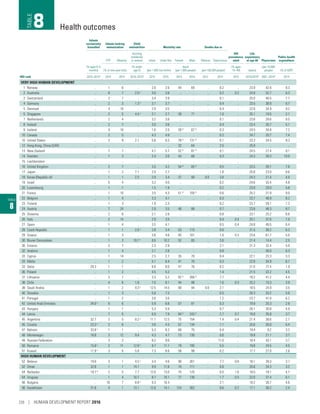
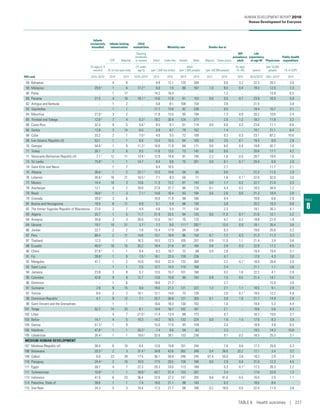
  • 74.
    Deprivations among ethnic minorities arealso apparent in very high human development countries Deprivations among ethnic minorities are also apparent in countries classified as having very high human development. Measure of America produces an HDI value that is disag- gregated by ethnic group for each state in the United States. The country’s average HDI value (scaled from 0 to 10) is 5.03; the HDI value for Latinos (4.05), African Americans (3.81) and Native Americans (3.55) are below this average, while the HDI values for Whites (5.43) and Asian Americans (7.21) are above it (figure 2.5). Box 2.3 focuses on the issue of human FIGURE 2.4 Variations in Human Development Index values are wide across population groups in Nepal Hill Brahman Hill Chhetri Madhesi Brahman/Chhetri Hill Dalit Madhesi Dalit Hill Janajati Tarai Janajati 0.538 0.557 0.507 0.536 0.460 0.434 0.446 0.400 0.565 0.482 0.509 0.473 0.422 0.511 0.454 0.586 Human Development Index value, 2011 All Brahman/Chhetri Madhesi other castes All Dalits Newar All Janajatis excluding Newar Muslim/Musalman All Hill/Mountain groups All Tarai/Madhesi groups Others Source: UNDP 2014e. FIGURE 2.5 In the United States the Human Development Index value is below the country average for some ethnic groups but above it for others Asian Americans Whites Latinos African Americans Native Americans 7.21 Overall US average 5.03 Human Development Index value, 2010 (0–10) 5.43 4.05 3.81 3.55 5.69 3.97 3.35 2.62 1.27 Subgroup national average Subgroup lowest state average Note: Data refer to the Human Development Index produced by Measure of America, which differs from teh Human Development Index produced by hte Human Developme Report Office. Source: Human Development Report Office estimates based on Lewis and Burd-Sharps (2013). 60 | HUMAN DEVELOPMENT REPORT 2016
  • 75.
    Individuals born into communitiesthat are geographically isolated, predominantly home to politically and socially excluded minorities or disproportionately exposed to environmental pressures have fewer opportunities development among African Americans in the United States. Deprivations in capabilities linked to ethnic- ity can be exacerbated by greater exposure to external pressures such as climate change. In Cambodia indigenous peoples are disadvan- taged by higher poverty rates, limited access to education and health, and fewer representa- tives in national and subnational decisionmak- ing institutions. The same groups are doubly deprived because their livelihoods rely more heavily on natural resources and agriculture than those of other population groups, and the impact of climate change on their livelihoods has been high. People in vulnerable locations Where individuals are born has an immense effect on their potential capabilities and op- portunities. People born in the least developed countries, fragile states and countries in conflict suffer huge disadvantages relative to people born in stable, highly developed countries. Citizenship, an ascribed group characteristic, can tie individuals to place-based conditions of violence and insecurity, under-resourced public programmes or vulnerability to environmental change and economic shocks, with devastating effects on life chances (box 2.4). The resources available to individuals to enhance their capabilities vary by country. For example, public spending on health care pro- grammes and insurance in Organisation for Economic Co-operation and Development (OECD) countries averages 7.7 percent of GDP, while public health expenditures in the least developed countries average only 1.8 percent of GDP.37 Public expenditure on education is 5.1 percent of GDP in OECD countries but 3.3 percent in the least devel- oped countries.38 In 2010 the share of the population living on degraded land (land with limited productive capacity) was only 3.4 percent in OECD countries but 23.5 percent in the least developed countries.39 These statis- tics suggest why people in different countries face different means of reaching their full potential. Individuals born into communities that are geographically isolated, predominantly home to politically and socially excluded minorities or disproportionately exposed to environmen- tal pressures have fewer opportunities. Whole communities risk being left behind unless un- balanced service distribution is rectified. BOX 2.3 Human development among African Americans in the United States African Americans’ life expectancy is shorter than that of other ethnic and racial groups in the United States. African Americans also trail Whites and Asian Ameri- cans in education and wages: Whites earn 27 percent more on average. In some metropolitan areas the dispar- ity is particularly striking. The life expectancy of African Americans in Baltimore, Chicago, Detroit, Pittsburgh, St. Petersburg and Tampa is now close to the national av- erage in the late 1970s.1 The reasons are complex but linked to a long history of legal and social discrimination. Policies that improve educational achievement can expand opportunities for African Americans and other racial and ethnic minorities in work and other areas. Equalizing educational achievement could reduce dis- parities in employment between African Americans and Whites by 53 percent, incarceration by 79 percent and health outcomes by 88 percent.2 Differences in wages between African Americans and Whites are also related to discrimination in the job market. Discrimination accounts for an estimated one-third of wage disparities, all else (including edu- cation) being equal.3 This indicates that policies are needed to ensure that skills and education are rewarded equally. Social pressures within the African American community can limit choices and later life chances among adolescents. Being labelled as “acting White”­ —­whereby high-achieving African American students are shunned in some contexts by their peers for doing well academically­—­can discourage good performance in school.4 Reducing the stigmatization of academic achievement among African American youth could be a step towards reducing inequalities in human develop- ment outcomes. Notes 1. Lewis and Burd-Sharps 2013. 2. Curto, Fryer and Howard 2011. 3. Fryer, Pager and Spenkuch 2013. 4. Fryer 2006. Source: Human Development Report Office. Chapter 2  Universalism—from principles to practice | 61
  • 76.
    The ability toaccess health care, education, water and housing can vary greatly by region in a country, as can the quality of these services People in conflict-affected countries ex- perience severe and immediate impacts on human development. Modelling of the losses in each dimension of the HDI by the United Nations Relief and Works Agency for Palestine Refugees in the Near East in 2013 suggested that over two conflict years the Syrian Arab Republic lost the equivalent of 35 years of pro- gress in human development.40 Conflict limits the availability of essential human development–enhancing services such as health care and education. Children in conflict-affected countries accounted for half of all children denied an education in 2011, even though they made up only 22 percent of the world’s primary school–age children.41 The United Nations Educational, Scientific and Cultural Organization reported in 2013 that 28.5 million children in conflict-affected countries were out of school.42 Livelihoods are similarly disrupted when violence interferes with trade, infrastructure and service provision. The distribution of opportunities and social services is uneven between and within countries. The ability to access health care, education, water and housing can vary greatly by region in a country, as can the quality of these services.43 Financial support­—­national and official devel- opment assistance­—­also varies across regions, with different effects on development outcomes. Thus, a far greater proportion of people are poor in rural areas than in urban areas, and in urban areas poor people are often clustered in slums. Health care in India exemplifies the extreme geographic differences in health services. In the mid-2000s, 39 percent of children overall and 59 percent in urban areas benefited from full immunization coverage, theoretically provided by the public sector. Kerala had one public hos- pital bed per 1,299 people, but Uttar Pradesh only one bed per 20,041. Almost all births in Kerala were attended by health personnel, com- pared with just 27 percent in Uttar Pradesh.44 Geography in Tunisia counts much more than wealth, gender or the education level of the household head in determining access to some opportunities. Whether a person was born in a rural or urban area explains 30 per- cent of the inequality in school attendance and almost 50 percent of the inequality in access to sanitation. The pattern is similar in other Arab States, including Egypt and Morocco.45 And in BOX 2.4 Limitations in opportunities among young people in small island developing states Small island developing states face several economic challenges stemming from the limited resource base, remoteness from markets and barriers to economies of scale. Extreme vulnerabilities to climate change place additional stress on economic activity, particularly in tourism, fisheries and agriculture. The economic vul- nerabilities translate into limited choices and oppor- tunities among citizens. The obstacles are especially high for young people looking for decent work. The youth unemployment rate ranges from 18 percent to 47 percent among countries in the Caribbean, with the ex- ception of Trinidad and Tobago, and the jobs available to working young people are often in low-skill areas with limited mobility.1 Likewise, in the Pacific Islands, youth unemployment is estimated at 23 percent but reaches 63 percent in the Republic of the Marshall Islands, 54 percent in Kiribati and 46 percent in the Solomon Islands.2 The lack of stable employment op- portunities is detrimental to income generation and poverty reduction efforts and negatively affects securi- ty by exacerbating crime and violence. Indeed, in 2012, 17–24 percent of male school-age young people in 10 Caribbean countries admitted to having been involved in gangs.3 High rates of crime and violence can con- tribute to a vicious cycle whereby youth imprisonment and declines in revenues from tourism reduce overall economic activity and opportunities. There are formidable challenges to expanding choic- es among young people and other vulnerable groups in small island developing states, but some of these chal- lenges could be transformed into opportunities with the right mix of policies. Investments in ­climate-resilient in- frastructure could turn climate change into a generator of employment. Investments in high-quality education and youth training programmes could increase entre- preneurship and remittances from labour migration and invigorate sectors such as telecommunication, tourism and creative industries.4 Notes 1. UNDP 2016b. 2. ILO 2014b. 3. UNDP 2016b. 4. ILO 2014b. Source: Human Development Report Office. 62 | HUMAN DEVELOPMENT REPORT 2016
  • 77.
    Individuals born into disadvantage­havefew strategies available to better their conditions. One option may be to leave their home and community in search of more physically and economically secure environments Sudan in the mid-2000s the use of antenatal health care services was five times greater in urban areas than in rural areas.46 The 2016 Mongolia National Human Development Report highlights differences in levelsofinequalityinhumandevelopmentacross aimags, first-level administrative subdivisions.47 Likewise, the HDI in China varies considerably across regions: from the equivalent of a medium human development country in some provinces (for example, Gansu, at 0.689) to the equivalent of a high human development country in other provinces (for example, Fujian, at 0.758) and to the equivalent of a very high human develop- ment country in Beijing (at 0.869).48 Migrants and refugees Individuals born into disadvantage­—­in conflict-affected situations, countries at risk of environmental disaster or areas with few economic opportunities­—­have few strategies available to better their conditions. One option may be to leave their home and community in search of more physically and economically se- cure environments despite the risks the journey presents and the potential obstacles to be faced. The United Nations Population Fund report- ed in 2015 that 244 million people were living outside their home countries.49 Many are seek- ing better economic opportunities and hope to enhance their livelihoods and send money back home. A 2012 survey in Somalia reported that more than 60 percent of young people intend- ed to leave the country in search of better work opportunities.50 In 2010/2011 one person in nine born in Africa who had obtained a tertiary diploma lived in an OECD country.51 Not all migrants move because of hardship, and not all move because of a lack of choices at home. Many migrants return with new skills and experience as opportunities for employ- ment at home increase, particularly in emerging economies. But many migrants, especially the world’s nearly 23 million refugees, asylumseek- ers and stateless people, are fleeing extreme conditions.52 And there are 50 million irregular migrants who seek better conditions at great risk, often relying on smugglers for travel.53 People migrating to flee conflict and insecurity usually experience declines in their overall hu- man development, but migration is still a better choice than exposure to the harms they would face by staying home. Migrants who leave with- out the push of violence typically improve their human development potential by migrating.54 Migrants fleeing conflict are cut off from their main sources of income and may lack access to health care and social services beyond emergen- cy humanitarian assistance (box 2.5). They fre- quently face harassment, animosity and violence in receiving countries. Trying to find work and earn an income is the single greatest challenge. In many countries refugees are not permitted to work; when they are, they see few opportunities. Many also lack identification papers, limiting access to formal jobs and services. People fleeing conflict are especially vulnerable to trafficking, forced labour, child labour, sex work and work in other exploitative, high-risk activities. Migrants also confront barriers to partici- pation in political and public life. Numerous countries impose restrictions on noncitizens in voting and holding elected public office. The restrictions may be based on the duration of the stay of the migrants, reciprocal laws in the country of origin or the scope of the election­—­most countries grant noncitizens the right to vote at communal but not regional or national elections. Language barriers can also be a key obstacle to community engagement. Newspapers, websites, television and radio pro- grammes covering host country political and public issues in the migrants’ native language can encourage civil participation. As migrant and refugee flows surge, the in- frastructure and services of host countries are challenged to absorb the newcomers. The pres- sure is especially intense in Jordan, Lebanon and Turkey, which have taken in the vast majority of refugees from the conflict in the Syrian Arab Republic.55 All basic services in Lebanon are un- der stress, especially the education system, which has welcomed refugee children from the Syrian Arab Republic but is now stretched thin.56 Indigenous peoples Indigenous peoples are characterized by dis- tinct cultures and close relationships with the land they inhabit. There are more than 370 mil- lion self-identified indigenous peoples in some 70 countries. Latin America alone numbers more than 400 groups, and Asia and the Pacific Chapter 2  Universalism—from principles to practice | 63
  • 78.
    Because indigenous self-determination is explicitlylimited by the right of states to territorial integrity, the representation of indigenous groups in parliament is a powerful symbol of self-determination and of inclusion more widely an estimated 705.57 Indigenous peoples account for around 5 percent of the world’s population but 15 percent of people living in poverty.58 Indigenous peoples face deprivations caused by social, economic and political exclusion. In Africa indigenous peoples are more vulnerable to HIV and AIDS because of a range of factors, including stigmatization, structural racism and discrimination, and individual and community disempowerment.59 In the United States Native Americans die at rates higher than the national average, especially as a result of liver disease, diabetes, accidents, homicide, suicide and chronic lower respiratory diseases.60 Indigenous children are challenged in edu- cation systems by daily schedules that do not accommodate nomadic movement, and cur- ricula rarely incorporate their history, culture and language.61 In many countries this leads to substantial gaps in years of schooling between indigenous children and nonindigenous chil- dren (table 2.1). In Guatemala nonindigenous children average twice as many years of school- ing as indigenous children. Income-generating opportunities are more difficult to access when indigenous young people have low educational attainment. Calls for self-determination through self-gov- ernment have been at the forefront of the relationship between states and indigenous communities since the mid-20th century. Because indigenous self-determination is explic- itly limited by the right of states to territorial in- tegrity, the representation of indigenous groups in parliament is a powerful symbol of self-deter- mination and of inclusion more widely. In some cases, indigenous peoples have estab- lished their own parliaments or councils that act as consultative bodies­—­for example, the Sami people of Finland, Norway and Sweden. In other cases, such as the Maori in New Zealand, parliamentary seats are allocated for indigenous representatives.62 Lesbian, gay, bisexual, transgender and intersex individuals In many countries people who are lesbian, gay, bisexual, transgender and intersex suffer extreme discrimination and insecurity that deprive them of dignity, basic rights and opportunities. Statistics on sexual orientation are scarce, espe- cially in countries where same-sex sexual acts are illegal or socially invisible. But recent surveys in BOX 2.5 Disadvantages facing migrants Migrants face barriers in accessing services to main- tain their capabilities. They may not have the legal or financial resources to access health care in their host countries and may therefore develop physical or mental problems that are aggravated by poor transit and living conditions. When they are able to access health care, they may not find health practitioners experienced in treating diseases that are uncommon in the host coun- try, such as tropical diseases in northern latitudes or the psychological trauma associated with migration. They may also face discrimination from health practitioners or be unable to express themselves in the same language. Health care provided in refugee camps is not always of adequate quality and quantity, and people in transit may not be available for long-term treatments. The poor liv- ing conditions and the high population density in most camps can propagate communicable diseases. Women often confront threats of violence and physical insecurity. Education is another challenge among migrants. Migrant children often have difficulty adapting in the host country’s classrooms, where the teaching methods, curriculum and language are unfamiliar. An Organisation for Economic Co-operation and Development study in 23 countries showed that first-generation immigrant stu- dents have much lower scores than do local students; second-generation immigrant students do slightly bet- ter.1 The variations across host countries are important, which may indicate that policies to integrate migrant students affect these students’ outcomes. Migrant chil- dren may be experiencing school for the first time in the host country at an age when their peers have already been in school. Besides the stress of adapting to a new country, migrant children must catch up to become in- tegrated in their new schools. Some migrant children do not have access to education in their host country, especially if they are undocumented. Note 1. Keeley 2009. Source: Human Development Report Office. 64 | HUMAN DEVELOPMENT REPORT 2016
  • 79.
    Even in countries wherelesbian, gay, bisexual, transgender and intersex people are not considered criminals, their prospects for human development are limited by discrimination in social and economic life developed countries give some indication of the size of the population. In Australia 3 percent of the adult population self-identified as gay, lesbi- an or “other” in 2014.63 In the United Kingdom 545,000 adults identified as gay or lesbian, and 220,000 identified as bisexual in 2012.64 In the United States 3.4 percent of adults identified as lesbian, gay, bisexual or transgender.65 In these surveys younger respondents were more likely than older respondents to self-report as lesbian, gay, bisexual, transgender or intersex, suggesting that social norms influence the likelihood of higher response rates. Same-sex sexual acts are illegal among men in 73 countries and among women in 45. In 13 countries people who engage in such acts can face the death penalty.66 Even in countries where lesbian, gay, bisexual, transgender and intersex people are not considered criminals, their prospects for human development are lim- ited by discrimination in social and economic life. Unlike other minorities the lesbian, gay, bisexual, transgender and intersex community is often hidden. Sexual minorities may not dis- close their identity for fear of legal punishment, social abuse, hostility and discrimination by society or by close friends and family members. Because differences in sexual orientation are not openly recognized in many societies, data on discrimination are not widely available, and evidence-based policymaking is difficult. For 25 countries with data, attitudes towards the lesbian, gay, bisexual, transgender and in- tersex community have become more tolerant since the 1990s (figure 2.6). Social acceptance has increased as the adoption of antidiscrimi- nation legislation has moved forward. Social norms and legislation have positively reinforced one another. Where intolerance remains high, legislation is critical to pushing back against hostile and discriminatory behaviour that lim- its the choices of a large global population. Older people Given that many countries have an ageing pop- ulation, what are the deprivations facing older people? By 2020 the number of people ages 60 and older will be greater than the number of children under age 5. The proportion of the world’s population over age 60 will dou- ble between 2015 and 2050, to 22 percent.67 Few countries are prepared to cope with this demographic transition. Without adequate health systems, social protection, and work and retirement schemes in place, older people are deprived of opportunities to maintain and expand their capabilities. They also suffer from prejudicial attitudes and discriminatory poli- cies and practices, often referred to as ageism.68 These issues may be particularly pertinent for women, because the life expectancy of women usually exceeds that of men. Pensions may be unavailable to women who have performed unpaid care work for much of their lives or who have worked in the informal sector. Older men are more likely to have pensions as a benefit of their paid formal work. Poverty rates are higher among older women than among older men.69 In theEuropeanUnionolderwomenare37percent more likely than older men to live in poverty.70 Women are often expected to continue well into old age unpaid care work for spouses and grandchildren. This can be a source of fulfilment but also takes a physical toll and may come with little recognition. Many older people, TABLE 2.1 Years of schooling, indigenous and nonindigenous children, selected countries Country Nonindigenous Indigenous Difference Bolivia 9.6 5.9 3.7 Ecuador 6.9 4.3 2.6 Guatemala 5.7 2.5 3.2 Mexico 7.9 4.6 3.3 Peru 8.7 6.4 2.3 Source: UNDESA 2009. Chapter 2  Universalism—from principles to practice | 65
  • 80.
    Deprivations suffered in oldage are generally accumulated through the lifecycle particularly women, are also constrained by psychological and physical abuse that reduces their sense of security and dignity. A HelpAge International study found that two-thirds of old- er people who experience emotional, economic and physical abuse in Moldova are women.71 The general increase in life expectancy means that older people have many healthy, produc- tive years ahead of them. In 2014, 11 percent of entrepreneurs in the United States were in the 55–64 age group.72 Many older people are still capable and willing to work, and many need to continue working if adequate retirement schemes are not in place. But hiring practices that discriminate against older people limit their opportunities for work, and a mandatory retirement age may force older people to leave the labour market. Deprivations suffered in old age are generally accumulated through the lifecycle. Children in poorer households may suffer from malnu- trition, have poorer health, have less schooling and end up in a low-skilled, low-paid job without health insurance or retirement bene- fits. In the United Kingdom people in wealth- ier neighbourhoods live six years longer than people in poor neighbourhoods and spend 13 more years without disability.73 Persons with disabilities Physical and social barriers may deprive per- sons with disabilities of the chance to achieve their full life potential. Special facilities allow persons with disabilities, older people and other groups with limited mobility to fully participate in public life. Although around 1 billion people worldwide live with some form of disability, adequate infrastructure for persons with disabilities is still underdeveloped, making independent mobility a challenge for many.74 Remote rural areas present severe mobility chal- lenges. Additional impediments may remain even when infrastructure is in place­—­such as discriminatory hiring practices that limit access to jobs for persons with disabilities . FIGURE 2.6 Since the 1990s attitudes towards the lesbian, gay, bisexual, transgender and intersex community have become more tolerant, and the number of antidiscrimination laws has increased 1990s 2000s 2010s % of the population that does not want homosexuals as neighbours No antidiscrimination laws Antidiscrimination laws approved70 60 50 40 30 20 10 Country group I No antidiscrimination laws Country group II Antidiscrimination laws approved in the 2010s Country group III Antidiscrimination laws approved in the 2000s Country group IV Antidiscrimination laws approved in the 1990s Source: Human Development Report Office estimates based on ILGA (2016a) and WVSA (2016). 66 | HUMAN DEVELOPMENT REPORT 2016
  • 81.
    Deprivations can materialize when developmentleads to new needs and new mechanisms of exclusion People with mental health conditions are particularly vulnerable to social exclusion. In 27 European countries the gap in unemploy- ment rates between individuals with mental health conditions and those without widened between 2006 and 2010 (before and after the financial crisis), and social stigmatization was an important factor contributing to job insecurity.75 In Germany the unwillingness to recommend an individual with depression for a job increased between 1990–2000 and 2000–2010.76 An estimated 350 million people worldwide are affected by depression, about 60 million are affected by bipolar affec- tive disorders, 21 million by schizophrenia and other psychoses and 47.5 million by demen- tia.77 The fact that half a billion people suffer from these conditions means that the exclusion of people with mental health conditions from work and social activities is a major barrier to universalism.78 Deprivations in human development as a dynamic process The universal achievement of some basic capa- bilities will not enable all people to realize their full life potential. Many dimensions of human development may still be lacking, including agency, security and sustainability. And the capabilities that matter most vary in different contexts and at different stages of the life­cycle. Security may be at the top of the list for a household in a conflict-affected country, while interesting work opportunities may be the top priority of an educated young person. Nor does rising above the low human development threshold ensure that people are protected from emerging and future threats to human development. Indeed, 900 million people live close to the threshold of multidimensional poverty and risk falling into poverty after even a minor setback in health, education or live- lihood.79 The condition of being deprived is therefore dynamic. Deprivations can materialize when develop- ment leads to new needs and new mechanisms of exclusion. Political transitions, demographic shifts and outbreaks of violence put pressure on achieved gains. Climate change, financial crises and epidemics push people into multidimen- sional poverty. People in developed countries can lack opportunities for work, education and access to information, despite extensive infor- mation and communication technology infra- structure because broadband Internet systems do not reach some rural areas or carry prohibi- tive costs. This section elaborates on important but perhaps underemphasized issues of human development­—­quality, information access, security, and lifecycle and intergenerational deprivations­—­that are increasingly central to people’s life potential. From quantity to quality in human development Over the last quarter-century, assessments of human development have focused primar- ily on quantitative achievements. But with substantial progress in human development linked to measures of quantity, such as years of schooling or life expectancy, there are questions about whether quality has also improved. Has quality in education, health and standards of living been enhanced? Quality is an important yardstick against which the progress in human development across countries and individuals should be examined. Large variations in the quality of human development across groups can become the basis for inequality and the perpetuation of deprivations throughout an individual’s lifecycle and across generations. Within the human development approach, the concept of quality can be explored in opportu- nities for public participation, the enforcement of rights and the quality of work. As a starting point, the analysis is directed at the quality of education, health and living standards­—­the di- mensions of human development that compose the HDI. Many countries have made gains in access to education, but improvements in the quality of education have not kept pace. One-third of primary school–age children are not learning basic mathematics and reading even though half of them have spent at least four years in school.80 Girls’ enrolment in primary education has increased, but the results in terms of litera- cy are not encouraging. In half of 53 develop- ing countries with data, the majority of adult women who completed four to six years of Chapter 2  Universalism—from principles to practice | 67
  • 82.
    People are living longerbut also spending more years suffering because of illness and disability primary school are illiterate.81 These outcomes are linked partly to the quality of teaching. The number of primary school teachers trained according to national standards is below 75 percent in around a third of the countries for which data are available.82 High pupil–teacher ratios are also a challenge to quality of educa- tion. Ratios in primary education were above 40 to 1 in 26 countries (23 in Sub-Saharan Africa) in 2011.83 Such lack of support dimin- ishes the prospects of learning and raises the likelihood of dropping out of school. Health is improving worldwide. People are living longer. Life expectancy at birth globally was four years longer in 2015 than in 2000.84 This is due in part to declines in death and illness caused by HIV and AIDS and malaria in the past decade as well as to advances in treat- ing communicable, maternal, neonatal and nu- tritional disorders. Improvements in sanitation and indoor air quality, greater access to immu- nization and better nutrition have also enabled children in poor countries to live longer.85 But are the added years of life expectancy healthy years or years with illnesses and disability? The World Health Organization has exam- ined healthy life expectancy by measuring the years lived in good health without disability. Analysis for 188 countries in 1990, 2005 and 2013 indicates that there have been increases in healthy life expectancy but that they have not been as dramatic as the increase in overall life expectancy.86 The difference between life expectancy and healthy life expectancy can be interpreted as years that are burdened with illness and disability. In 2015 the difference was more than 10 years in nine countries (table 2.2). People are living longer but also spending more years suffering because of illness and disability. It is assumed that people’s living standards im- prove when incomes rise. However, the quality of people’s lives can vary greatly even as per cap- ita income rises. Per capita income measures can rise when goods and services that are consumed in response to social malaise and problems­—­ such as police protection, prison systems, legal services and mental health services­—­increase. Per capita income likewise excludes some goods and services that may raise the quality of people’s lives, such as unpaid care work and ecological services. Qualitative improvements in people’s standard of living thus need to be assessed be- yond quantitative growth in per capita income. Inequality in access to advanced, high-­ quality education, health care and other servic- es restricts the ability of some people to expand their capabilities. It also affects the distribution of income in the long run. Inequality in the quality and quantity of education is directly related to unequal income. Segregated edu- cation systems can reinforce class distinctions and the intergenerational perpetuation of inequalities.87 Governments can take steps to reduce differences in service quality between TABLE 2.2 The difference between life expectancy and healthy life expectancy in selected countries Country Relative difference between life expectancy and healthy life expectancy (percent) Absolute difference between life expectancy and healthy life expectancy (years) Nicaragua 14.8 11.1 Qatar 13.4 10.5 Saudi Arabia 13.4 10.0 Australia 13.2 10.9 United States 12.9 10.2 Sweden 12.6 10.4 Spain 12.6 10.4 Chile 12.5 10.1 Finland 12.5 10.1 Source: Human Development Report Office estimates based on WHO (2016e). 68 | HUMAN DEVELOPMENT REPORT 2016
  • 83.
    The digital divide continuesto impede universal benefits and could push people who are already deprived in other areas further behind private and public providers and standardize costs, including by taxing private suppliers to support public services (box 2.6). The key is to build the support across all population groups for good-quality, universal services so that all classes, genders and ethnicities have an interest in fair and adequate provision to all. Expanding digital access Broadband coverage and variations in access to computers and smartphones could generate new forms of exclusion. Inexpensive and relia- ble access to the Internet is becoming essential to the development of capabilities in other areas, such as education, work and political par- ticipation. Access to information is crucial for high-quality education and thus for expanding opportunities among children and youth. The biggest challenge is to make these benefits available to all people everywhere. However, the digital divide continues to impede universal benefits and could push people who are already deprived in other areas further behind. Less than half the world’s population (47 per- cent) uses the Internet. Only 25 percent of peo- ple in Sub-Saharan Africa are users, and only 42 percent of people in Asia and the Pacific and the Arab States are. In contrast, two-thirds of the population is online in the Americas and in the Commonwealth of Independent States. The rate in Europe is 79 percent.88 Prices in many regions make connecting to the Internet prohibitively expensive. Basic mo- bile or fixed broadband plans cost much more in developing countries than in developed countries and cost the most in the least devel- oped countries (figure 2.7). But digital divides exist even in developed countries. To enable all people to benefit from the opportunities that information and commu- nication technology holds for human devel- opment, striving for universal access to free Wi-Fi may be needed. Combined with access BOX 2.6 The challenge of a two-tier public and private system for universal access to quality services Despite advances towards universal public education, health care and social protection in many countries, people are still being left behind in accessing high-­ quality services. Quality differs greatly between public and private services in some cases. Access to high-­ quality services is too often a privilege reserved for well-off populations. Highly unequal societies face the risk of segmentation between a universal public system and a smaller private system for elites. Take Argentina. Despite expanded investment in public schools between 2003 and 2011, enrolment in pri- vate schools increased from 22 percent to 39 percent.1 In Latin America and the Caribbean on average 50 per- cent of children of households in the highest income quintile attended private primary and secondary schools in 2010, compared with less than 4 percent of children of households in the lowest income quintile.2 In Turkey expansion among private health care providers has re- sulted in more social stratification in the consumption of health services because higher income patients are abandoning public services for private services that are often better in quality.3 The use of private services by middle and upper segments of the welfare distribution across countries increases the likelihood of poor-quality public services because large segments of the population do not have a vested interest in public service quality, social pressure is insufficient to maintain good-quality, universally accessi- ble public services and public services are becoming less cost-efficient because of user flight. The sustainability of funding for public programmes is at risk if the middle class does not have a vested interest in the programmes. A two-tier public and private service system is not inherently negative. It is problematic only if there are extreme variations in quality between the two options that reinforce inequalities in opportunity among those who can pay and those who cannot. There are wide dis- parities in quality between public and private education services in many developing countries. A recent review of 21 studies in Ghana, India, Kenya, Nepal, Nigeria and Pakistan found that students in private schools tend to achieve better learning outcomes than do students in state schools. Teaching is also often better in private schools than in state schools­—­for example, in India, Kenya, Nigeria, Pakistan, South Africa and Tanzania.4 Notes 1. Martinez-Franzoni and Sánchez-Ancochea 2016. 2. Daude 2012. 3. Agartan 2012. 4. Day Ashley and others 2014. Source: Human Development Report Office. Chapter 2  Universalism—from principles to practice | 69
  • 84.
    Epidemics, violence, climate changeand natural disasters can quickly undermine progress in human development to high-quality education, universal Internet access could greatly increase opportunities and reduce inequalities everywhere. Security threats There may be threats to the security of the more abundant choices and opportunities available to people today. Epidemics, violence, climate change and natural disasters can quickly under- mine the progress of individuals who have exited poverty and push poor people into more extreme poverty.Theycanalsogeneratenewdeprivations. Millions of people around the world are exposed to climate-related natural disasters, droughts and associated food insecurities and subsist on de- graded land. Between 1995 and 2014 more than 15,000 extreme weather events resulted in more than 525,000 deaths worldwide and economic losses of more than $2.97 trillion.89 Some groups are more exposed to threats than others. Many women depend on agriculture for their livelihoods and are therefore dispropor- tionately exposed to climate pressures on food production. Children are physiologically and metabolically less able than adults to adapt to heat and other climate-related exposure and are more likely to be injured or killed during natural disasters.90 They may also be kept out of school following disasters. During the Ebola outbreak in 2014 an estimated 5 million children were de- prived of education in Guinea, Liberia and Sierra Leone because schools were closed for months.91 Women were also disproportionately affected by the Ebola outbreak: they faced higher risks of infection because of their role caring for the sick, and they suffered from less antenatal, perinatal and postnatal care. In Sierra Leone’s Kenema District avoidance of hospitals and birthing centres for fear of exposure to Ebola resulted in 29 percent fewer antenatal care visits and 21 percent fewer postnatal care visits.92 Voicing concerns about these emerging threats can carry risk. Defenders of land and the environment around the world suffer from threats and physical violence, criminalization and restrictions on their freedoms. As environ- mental pressures have increased, so have phys- ical threats against environmental activists. A record number of environmentalists were killed in 2015­—­185 in 16 countries, up 59 percent from 2014. Members of indigenous groups, who accounted for 40 percent of the deaths in 2015, are among the most at risk.93 The physical insecurity of those who speak out about environmental pressures is part of a larger condition of physical insecurity and violence that severely restrict the choices and freedoms of individuals around the world. Many people feel insecure in their homes and communities. One billion girls and boys ages 2–17 worldwide experienced physical, sexual or psychological violence in the prior year, accord- ing to one study.94 Some 25 percent of children suffer physical abuse, and nearly 20 percent of girls are sexually abused at least once in their life.95 Elder abuse remains a hidden problem:96 10 percent of older adults were abused in the prior month.97 Homicide is also a major social concern. In 2012, 437,000 people worldwide were the victims of intentional homicide.98 Average homicide rates in Latin America and the Caribbean between 2010 and 2014 exceed- ed 20 per 100,000 people.99 Freedom from violence was one of the most frequently cited concerns among respondents FIGURE 2.7 Basic mobile or fixed broadband plans cost much more in developing countries than in developed countries and cost the most in the least developed countries World Developed countries Developing countries Least developed countries 140 120 100 80 60 40 20 0 Monthly cost, 2015 (PPP $) Fixed broadband plan Mobile broadband plan Source: ITU 2016b. 70 | HUMAN DEVELOPMENT REPORT 2016
  • 85.
    Lifelong deprivations among childrenand adults can begin even before birth to a survey on human security carried out by the Human Development Report Office. Physical security and freedom from the threat of violence were particular concerns among female respondents (box 2.7). For women, real or perceived physical and emotional violence is a major barrier to meeting their full human potential and feeling free to move about. Deprivations throughout the lifecycle and across generations Lifelong deprivations among children and adults can begin even before birth (figure 2.8). Starting at conception, the environment to which pregnant women are exposed and the choices available to them shape the future skills and abilities of their children in ways that are difficult to alter as the children grow. A lack of medical attention, poor nutrition and heavy physical demands put unborn children at risk. Poor children are more likely than their more affluent peers to experience myriad environ- mental risks before birth, including household disruption, pollution and violence. These an- tenatal exposures to stress have been found to mould life trajectories in health and cognitive and socioemotional development­—­precisely the areas of development that might otherwise allow individuals to be productive members of society (box 2.8). For instance, children in Canada who had been exposed in the womb to a strong winter storm in 1998 later exhib- ited lower levels of cognitive development, language functioning and motor functioning than did children who had not been exposed. Antenatal exposure to a 2005 earthquake in Chile has been negatively associated with chil- dren’s future cognitive ability. Such exposure to stress can play a role in the intergenerational transmission of disadvantage by constraining development potential early in life.100 BOX 2.7 Human security from a woman’s point of view A survey conducted by the Human Development Report Office asked women of all ages and occupational back- grounds around the world, “What does human security mean to you?” Many women responded that they were concerned with physical and psychological violence. “Human security is the right to move freely in your town without worrying about whether you will return home unharmed and unthreatened.” —A female teacher from Brazil “It is impossible to feel safe as a human being if our own existence is not recognized or respected, even if we have access to all sorts of opportunities.” —A female economist from Mauritania “Human security means being able to go about alone outside any time of the day or night and not fear any possible violence. It means that I should not consider my gender, religion or any other distinctive features when making a decision to spend time outdoors for fear of malicious intent.” —A female development worker from Kazakhstan “Human security for me is freedom from fear, fear of being looked down at because of being a woman and being assaulted and disrespected because of the same” —A female student from India “Human security is being able to sleep peacefully, not being afraid of getting home late at night because of violators, not driving with closed windows for fear that someone will grab my bag, going to the supermarket without being afraid of having my belongings stolen from the car, going to the Yaoundé market without hiding my money in my bra, and walking freely along Kennedy Avenue.” —A woman from Cameroon “Human security is the freedom to live your life free from hate crimes, sexism, racism and other kinds of op- pression, freedom to express yourself and be active in society.” —A female activist from Sweden “Human security means freedom from abuse and vio- lence, particularly child abuse, domestic violence, in- terpersonal violence and intimate partner violence. It is about the protection of children, youth, elderly, persons with disabilities and women from violence and crime.” —A female researcher from Trinidad and Tobago Source: Human Development Report Office. Chapter 2  Universalism—from principles to practice | 71
  • 86.
    Educational attainment is acentral mechanism for perpetuating socioeconomic stratification across generations FIGURE 2.8 Deprivations among women can accumulate throughout life Female infanticide and neglect Low primary and secondary school enrollment Insufficient access to health care High maternal mortality risk High burden of care work Low labour force particiaption Insufficient pensions and protection in old age Source: Human Development Report Office. BOX 2.8 Antenatal stress and intergenerational deprivation Educational attainment is a central mechanism for per- petuating socioeconomic stratification across genera- tions. Advantaged parents can afford more and better education for their children, which has many benefits in the labour market. There is also a direct transmission of economic advantage through inheritance and the use of job referral networks to favour children. These mecha- nisms affect later stages of the lifecycle, when children have reached school age or working age. But a growing body of research suggests that the intergenerational perpetuation of deprivation begins before birth and that the intergenerational transmission of advantage may already be advanced when children enter the education system. Exposure to environmental stressors in the womb has been connected to poor birth outcomes such as lower birthweight and higher probability of preterm birth. It has also been connected to children’s develop- mental outcomes such as motor skills, cognitive ability, emotional stability, attention deficit disorder and early educational achievement. Given that birth outcomes and early childhood development predict educational and economic attainment in adulthood, the higher probability that poor people will be exposed to risks in the womb may constitute the first injustice and may play a central role in the persistence of disadvantage across generations. Why does antenatal exposure have such persistent effects over the lifecycle? The antenatal period includes critical and sensitive developmental stages in which the effect of the environment on future capabilities is especially strong and potentially irreversible, regardless of subsequent interventions. During the antenatal pe- riod the central nervous system and the brain undergo a cascade of critical developmental processes that are particularly susceptible to the environment and that shape later abilities in a cumulative fashion. An ante- natal shock can result in reduced language ability in the first years of life, which may affect the ability to read and to succeed in school overall. Abundant research in the biological and behav- ioural sciences highlights the importance of investing in the well-being of populations in the early stages of life, starting at conception. An economic perspective suggests that investments in capabilities early in life are much more cost-effective than investments later on. Source: Torche 2016. 72 | HUMAN DEVELOPMENT REPORT 2016
  • 87.
    Interventions to overcome deprivations today needto be viewed as opportunities to prevent deprivations among future generations Parents’ educational attainment and earnings are strong predictors of children’s educational attainment.101 A study in South Africa found that fathers with high educational attainment pass on three-fifths of their earnings advantage to sons.102 Daughters who inherit the low ed- ucational attainment of their parents are more disadvantaged as adults: They are 9 percent more likely to be in the bottom of the occupa- tion distribution relative to the overall popula- tion.103 In the United Kingdom people whose father had low educational attainment are 7.5 times more likely to have little education than are people with a highly educated father; in turn, people with low educational attainment are 11 times more likely to be deprived of ma- terial assets than are people with higher educa- tional attainment.104 As the 2015 Human Development Report stressed, increasing women’s access to educa- tion and paid work may have effects on the choices of subsequent generations of girls. Girls are more likely to be employed and to earn more as adults if their mother was employed. In the United States the daughters of mothers who are employed earn 23 percent more than the daughters of mothers who do not work outside the home.105 In Senegal the parents’ education is positively associated with the offspring’s adult living standards, and maternal education has a much larger positive effect than does paternal education.106 Interventions to overcome deprivations today need to be viewed as opportunities to prevent deprivations among future generations. Interventions for women early in life can prevent deprivations later in the lifecycle (fig- ure 2.9). When investments in life capabilities occur sooner rather than later, as through early childhood education and care, the prospects improve for education and work.107 This is because capabilities at any stage in life are path dependent and reflect the challenges and opportunities encountered at earlier stages. Children who do not have access to early child- hood education may not do as well in primary and secondary school. Young people who have an education but live in an area with a sluggish labour market may resort to informal work or remain unemployed, which can lead to an insufficient pension in old age. Older people may suffer illnesses and disabilities accumulat- ed over years of strenuous physical labour and insufficient preventive health care. The barriers facing marginalized groups may emerge at vari- ous points throughout the lifecycle and lead to FIGURE 2.9 Interventions for women early in life can prevent deprivations later in the lifecycle Equitable access to primary and secondary education for girls Lower likelihood of child marriage and adolescent pregnancies Higher likelihood of labour force participation and paid work More women in parliament and upper managment positions More sufficient pensions and social protection for women in old age Source: Human Development Report Office. Chapter 2  Universalism—from principles to practice | 73
  • 88.
    Fulfilling basic needs isan essential part of expanding capabilities but is insufficient to enable people to reach their full potential severe deprivations in old age. Early interven- tions can prevent subsequent limitations, along with interventions that help individuals recover from past deprivation. What do people value in human development beyond the basics? Fulfilling basic needs is an essential part of expanding capabilities but is insufficient to enable people to reach their full potential. This is especially so in a world characterized by new and often more precarious forms of work, escalating violence and mounting environ- mental crises. Many people are deprived of a sense of security that they will be able to retain tomorrow the gains they have made today. Many are deprived of voice and opportunities to participate in the collective valuation of policies and priorities. Others lack access to good-quality services and to information and communication technology. Practical univer- salism requires attention to these and other dimensions of human development in which people in both developed and developing countries remain deprived. Development in some of these dimensions may not have appeared so urgent in the past simply because of the scale of the deprivation in basic needs. Parents of children who lack access to schooling may not worry about the quality of secondary education. Families that are trying to get by on less than $1.90 a day may not pri- oritize the prevention of environmental crises. But as the types of deprivations captured in the HDI and MPI are reduced for individuals and societies, other deprivations become more prominent. People have more choices and free- doms, but there are still constraints that limit life potential. Surveys based on subjective evaluations pro- vide insights into the diversity of values across populations and suggest links between the surroundings and the development priorities of individuals. For example, the My World global survey being conducted by the United Nations in support of the 2030 Agenda assessed devel- opment issues that matter most to people.108 More than 9 million responses have prioritized action issues from 16 options, ranging from securing a good education and ensuring polit- ical freedom to tackling climate change. The top three priorities are good education, better health care and better job opportunities. A disaggregation of the survey data by develop- ment status, age, gender, citizenship and region shows more variation in the top priorities. There are thus differences in the aggregate priorities of individuals in countries at different levels of human development (figure 2.10). Good education is the top priority across all human development groups, and the top three priorities are similar in the low, medium and high human development countries. But an honest and responsive government and access to clean water and sanitation are among the top three priorities in very high human devel- opment countries, where better health care and better job opportunities are not even among the top five priorities. A survey by the Pew Research Center re- inforces the context specificity of people’s priorities and concerns. Some 83 percent of respondents in 34 developing countries considered crime to be the biggest problem in their country.109 Corruption, lack of health care, poor schools and water pollution were also viewed as major problems. The percentage of respondents who listed crime as a concern was 93 percent) in Tunisia, compared with only 31 percent in Poland, where 59 percent of respondents listed health care as a very big problem (which compares with only 17 percent in China). Income can also shape people’s priorities. Respondents in a nationwide opinion survey in Chile were asked what was most important to them in order to have a happy life. The answers of respondents in the highest and lowest income quintiles varied substantially. Respondents in the highest income quintile most often cited the achievement of life goals and targets, whereas respondents in the lowest income quintile cited a peaceful life without much disruption (figure 2.11). Leading a meaningful life and enjoying the good things in life were less of a priority among respondents in the lowest income quintile. People’s priorities and values appear to be context specific. In Algeria, where youth un- employment rates are high, a young woman may value employment most. Once integrated into the labour market and at the peak of her career, she may value free time the most. A 74 | HUMAN DEVELOPMENT REPORT 2016
  • 89.
    Because values evolve andshift according to the context, the human development approach remains relevant even as basic needs are met healthy older man in Norway may value good interpersonal relationships with friends and family the most, despite having valued free time more when he was younger and working, like his Algerian counterpart. Because values evolve and shift according to the context, the human development approach remains relevant even as basic needs are met. FIGURE 2.10 There are differences in the aggregate priorities of individuals in countries at different levels of human development A good education Better health care Better job opportunities An honest and responsive government Affordable and nutritious food Access to clean water and sanitation Protection against crime and violence Low human development Medium human development High human development Very high human development 1 11 1 2 32 3 23 45 34 5 5 4 45 2 Source: Human Development Report Office estimates based on United Nations (2015b). FIGURE 2.11 The priorities of Chileans vary by income Leading a meaningful life Sharing with others Leading a peaceful life without much disruption That loved ones have a good life Achieving life goals and targets Enjoying the good things in life 40 30 20 10 0 % Poorest 20 percent Richest 20 percent Most important to have a happy life Source: UNDP 2012a. Chapter 2  Universalism—from principles to practice | 75
  • 90.
    Whether intentional or unintentional,the exclusion from the opportunities of one group by another group is often the root of deprivation and disadvantage Barriers to universalism Deprivations can be eliminated. The progress since the first Human Development Report in 1990 demonstrates this. The global HDI value has increased 20 percent since then, from 0.597 to 0.717. The increase in the HDI value for the least developed countries is 46 percent.110 Progress has not come easily, but the path to progress may have been easier than the path to the goal of leaving no one behind. Individuals who are still deprived may be the most difficult to reach­—­geographically, politically, socially and economically. It is time to push to eradicate the remaining deprivations not only in access to health care, education and livelihoods, but also in other dimensions of well-being, such as se- curity, freedom of participation in political life and access to advanced, high-quality services. The realization of this vision will face chal- lenges. Some barriers may require technical solutions­—­greater fiscal resources and devel- opment assistance, gains in technology and improved data resources for monitoring and evaluation (see chapter 3). These barriers can be addressed, albeit not easily, through changes in national policies (see chapter 4) and in interna- tional systems (see chapter 5). Other barriers are deeply embedded in so- cial and political relationships and identities. The context in which many individuals make choices is fraught with insecurity, glaring inequalities and competition for scarce re- sources. Discriminatory laws, exclusionary social norms, violence, imbalances in political participation and unequal distribution of opportunities all stand in the way of progress. Exclusion can be intentional or unintentional, but the results are the same­—­some people will be more deprived than others, and not all people will have an equal chance to realize their full potential. Men have more choices than women, rich people have more choices than poor people, citizens have more choices than migrants and some ethnicities have more choices than others. Progress towards universal human devel- opment requires a deep awareness and under- standing of the drivers and dynamics of these groups’ exclusion. The drivers and the dynamics inevitably vary across countries and regions. Universalism in practice is possible, but key barriers and types of exclusion must be over- come (see infographic 2.1 at the beginning of the chapter). Intolerance and exclusion and the related mechanisms Whether intentional or unintentional, one group excluding another group from oppor- tunities is often the root of deprivation and disadvantage. Membership in a group fulfils a basic desire to belong to a family, a community, a religion or a race. Individuals have multiple group affiliations at any one time and belong to different groups throughout life. Groups allow individuals to identify with others based on a shared characteristic or interest, but they also permit exclusion. Group inequalities reflect divisions that are socially constructed and sustained because they establish a basis for unequal access to valued outcomes and scarce resources. Once inequal- ities are established, the organizational focus becomes how to maintain the distinctions and ensure group loyalty and solidarity so that those who benefit from membership in the group are able to maintain their advantageous positions. At the same time the dimensions and mechanisms of exclusion are dynamic, as are the characteristics that groups use as a basis for exclusion. An ethnic minority group may penetrate the political space that has been occupied by the majority­—­a success from the perspective of equity in political participation­ —­but the members of the ethnic minority who occupy the space may then use class divisions to exclude others in the same ethnic minority from participating in policy decisions. It is thus important to recognize that group identity and barriers of exclusion tend to shift under strate- gies to protect advantages. Many dynamics have a bearing on group for- mation and protection strategies. Today, trends in global income distribution present challeng- es to collective agreements and cooperation across countries and population segments. Voters in the lower middle class in developed countries are frustrated with the lower than average growth in their living standards relative to elites (box 2.9). The frustration is coupled with an awareness of high income growth in emerging economies such as China and India, 76 | HUMAN DEVELOPMENT REPORT 2016
  • 91.
    which may becomea source of resentment against trade with and migration from develop- ing countries. The pace of change is rapid and unpredict- able, and many people are struggling to find their way. With globalization and greater hu- man mobility, come changes in demographic structures, languages and cultural diversity. From a human development perspective, diversity should be celebrated as a powerful ingredient of human creativity. But there are also risks that social cohesion, mutual respect and tolerance of differences can be strained or break down altogether, resulting in xenopho- bia, nationalism, discrimination and violence. There can be a lack of recognition or appre- ciation for different beliefs and views, norms and cultures, and lifestyles. Historically, people have navigated periods of widespread change and unpredictability, but these periods are often characterized by immense suffering and conflict. Strict and extreme beliefs and views­ —­whether religious or political­—­breed intol- erance and prevent flexibility and adjustability to change. It is therefore crucial to identify and reverse patterns of intolerance during such times, whether discriminatory laws, exclusion- ary social norms or violence and coercion and to instead respond to emerging global challeng- es through mutual respect and collaboration. Discrimination, exclusion and intolerance run counter to universalism­—­the centrepiece of human development and the cornerstone of the world we want. BOX 2.9 From the champagne glass to the elephant curve The 1992 Human Development Report showed that global income distribution followed a champagne glass pattern, where the bulk of income is concentrated at the top of the distribution, and the global income distribution in 1998 and 2008 reflected that pattern (see left panel of figure). One might conclude that the people who are not at the top of the distribution have a collective interest in redistributing resources. But there seems to be a different lived experience across the stem of the glass. The rate of change in the real income between 1988 and 2008 follows an elephant curve (see right panel of figure).1 The per- centage change in real income favoured those who were in the bottom half and the top declie of the global income distribution, whereas the real income of the lower middle class in developed countries—grew only modestly. For example, in Germany the real income of the poorest 50 percent grew 0–7 percent, in the United States the poorest 50 percent saw real income growth of slightly over 20 percent and in Japan the poorest 10 percent saw real income decline. Income gains from 1998 to 2008 have not been even across income deciles 2008 “Champagne glass” 1988 “Champagne glass” Poorest 10% P10–P20 P20–P30 P30–P40 P40–P50 P50–P60 P60–P70 P70–P80 P80–P90 P90–P95 P95–P99 Richest 1% 39% 27% 17% 12% 58% 72% 70% 62% 53% 46% 25% 5% Real income growth, 1988–2008 (%) Global income distribution, 1988 and 2008 The bulk of global income is concentrated at the very top of the distribution The real incomes of the lower middle class in developed countries have seen only modest growth 50,000 40,000 030,000 20,000 10,000 (2005 PPP $) Note 1. Milanovi´c 2016. Source: Human Development Report Office estimates based on Milanovi´c (2016) and UNDP (1992). Chapter 2  Universalism—from principles to practice | 77
  • 92.
    Legal and political institutionscan be used and abused to perpetuate group divisions Discriminatory laws Legal and political institutions can be used and abused to perpetuate group divisions. An extreme case relates to the rights of the lesbian, gay, bisexual, transgender and intersex com- munity in the 73 countries and five territories where same-sex sexual acts are illegal, including 13 where such acts are punishable by death.111 Only 10 countries grant lesbian, gay, bisexual, transgender and intersex people equal consti- tutional rights.112 Laws are discriminatory in other cases because they prevent certain groups from accessing services or opportunities, such as when host countries legally bar refugees from working. State policies can be discrimina- tory as well­—­such as denying citizenship or the right to vote or run for political office. National borders thus become legal instruments that can reinforce inequalities between the citizens of different countries. Within-country ine- qualities are wide, but the laws and practices in countries of birth can also determine life chances and opportunities. In some cases women do not have the same legal rights as men. Women’s opportunities are impeded by law in 155 out of 173 countries with data. In 100 countries women are prevent- ed from engaging in some professions because of their gender. In 32 countries the procedures that women face to obtain a passport differ from those that men face. In 18 countries wom- en need their husband’s approval to take a job. And in 46 countries laws do not protect women from domestic violence.113 Women also face dis- crimination if their opportunities and choices are restricted because appropriate protective laws have not been enacted­—­for example, when paid maternity leave is not mandated or when discriminatory hiring practices are tolerated. As the 2015 Human Development Report highlighted, far more women would become active in the labour market and have better wages and positions of influence if regulations were in place to reduce workplace harassment against women, ensure equal wages and hiring practices and provide care options for children and older people.114 Discriminatory laws and the lack of legislation restrict women’s freedoms and impede their full participation in public life as equal members of society. These outcomes are linked to the fact that women are often excluded from the political spaces where policies and leg- islation are agreed. Globally women hold only 22 percent of the seats in parliament, 26 percent of the seats on the highest courts and 18 percent of ministerial positions. Regulations and the nature of institutions can also indirectly limit the access poor people have to services and resources. For example, banks that require minimum deposits limit access to financial services for poor people. Around 2 billion people worldwide are still unbanked­—­lacking accounts at banks, other financial institutions or mobile money service providers.115 Similarly, the absence of birth registrations and lack of identity cards can pre- vent poor people from gaining access to many public services. Social norms Social norms are implicitly established rules of behaviour. Some may be helpful in promoting harmonious coexistence, but others may be discriminatory, prejudicial and exclusive. For example, prejudice and social perceptions often lead to unequal outcomes among different groups in job markets, which reduces livelihood opportunities for minorities. In employment recruitment in the United States White job applicants are often systematically selected over African American and Latino job applicants, even when the minorities have equal or higher qualifications. African Americans are often re- jected solely on the basis of their names (which employers glean from resumes) and receive only half as many job offers as White candidates. Despite Nepal’s laws against untouchability, in- dividuals considered of lower caste continue to be excluded from certain jobs and services, and Dalits earn considerably less than non-Dalits. Discriminatory treatment of persons with dis- abilities is widespread and has implications for their livelihoods. In Mauritius, Panama, Peru, the Russian Federation and the United States the employment gap between persons with dis- abilities and persons without disabilities is more than 40 percentage points.116 In many countries social norms reduce choice and opportunities for women and girls. As the 2015 Human Development Report highlight- ed, norms and traditions that distribute the bulk of unpaid work in the home to women 78 | HUMAN DEVELOPMENT REPORT 2016
  • 93.
    Intolerance of others­—­legal, social orcoercive­—­is antithetical to human development and to universalism limit women’s participation in the labour mar- ket and can prevent girls from attending school.117 Women are typically responsible for more than three-quarters of unpaid care work in the household.118 The presence of women as customers in cafés or restaurants may also be discouraged by social norms, and in some cases it is taboo for women to travel in public without being accompanied by a man.119 Practices such as female genital mutilation and cutting, per- formed on 200 million girls and women alive today, are also linked to social norms and put girls at extreme and unnecessary health risk.120 Social norms in marriage can reduce op- portunities and reinforce inequalities. Child marriage is a fundamental violation of human rights, yet it continues because of customs and other normative factors.121 In South Asia 46 percent of girls become child brides, and many marry before age 15 (figure 2.12). Early mar- riage limits a girl’s future development because it increases the likelihood of early pregnancy, social isolation and leaving school early. There is also evidence that the choices peo- ple make in marriage reinforce socioeconomic hierarchies and ethnic divisions because people tend to marry within their own socioeco- nomic or ethnic group. A study in the United Kingdom found that 56 percent of the current generation of women have married a partner in the same social class, a rising trend.122 Some 11 percent of the increase in inequality in developed countries since the 1980s is due to people’s choice to marry at a similar socioec- onomic level­—­doctors marrying lawyers, for instance.123 Marriage also perpetuates social norms and traditions linked to ethnic groups. The preference in Mauritius for marrying with- in the same ethnic group overrides even class- based considerations.124 Violence Perhaps the most direct and radical mechanism of exclusion is violence. Coercive tools enable one group to force its vision of society on another and to protect its access to resources, outcomes and the power to make decisions. Motivations include consolidating political power, safeguarding the well-being of elites, controlling the distribution of resources, seiz- ing territory and resources and favouring ide- ologies based on the supremacy of one identity and set of values.125 Exclusion breeds violence. One study draw- ing on global data since 1945 found that a 30 percent increase in the size of the politically excluded population boosted the chance of civil war by 25 percent.126 Another study found that countries with higher inequality among ethnic groups have lower incomes overall and a more uneven distribution of services and in- frastructure and are more prone to conflict and violence.127 Intolerance of others­—­legal, social or coercive­—­is antithetical to human develop- ment and to universalism. Intolerance, exclu- sion and inequality are nonetheless common and are on the rise in some cases. Overcoming these barriers will require finding ways to link collective interests to equity and justice (see chapter 3). Elite capture of institutions Some thrive in a global labour market owing to their advanced skills and education. They retire comfortably with private pension funds and savings. They send their children to the best schools for advanced tertiary education. They FIGURE 2.12 In South Asia many girls marry before age 18— some before age 15 Bangladesh India Sri Lanka Pakistan 60 40 20 0 % Under age 15 Under age 18 Source: Banu 2016. Chapter 2  Universalism—from principles to practice | 79
  • 94.
    Extreme inequality and theconcentration of capabilities and opportunities among a narrow elite are part of a vicious circle live in the safest communities. And they have the means to influence the political process in their favour. There are links among income inequality, inequalities in education and health care and inequalities in political participation and influ- ence. The top 1 percent of the wealth distribu- tion holds 46 percent of the world’s wealth.128 Much of the income gain in recent decades has been at the top: 44 percent of the income earned between 1988 and 2008 went to only 5 percent of the population.129 Such income inequalities influence inequalities in other di- mensions of well-being. Extreme inequality and the concentration of capabilities and opportunities among a narrow elite are part of a vicious circle. As inequalities become wider, marginalized and excluded groups face growing deficiencies in opportuni- ties to expand and apply their capabilities and to influence the institutions and policies that determine the subsequent distribution. Positive opportunities for political participation and influence are central to breaking the vicious circle. The interests of the middle class may also sometimes lead to policy decisions that per- petuate deprivations and the exclusion of poorer groups. Antipoverty programmes have been opposed in some countries because they do not benefit the middle class, an important political constituency.130 One result is that redistribution programmes can have limited coverage among the poorest population and exhibit substantial leakage to the middle class and elites. Some programmes tie eligibility for transfers to employment in the formal sector in order to gain the support of the middle class.131 In Tanzania distributing vouchers for agricul- tural inputs disproportionately benefited the households of village officials, who received 60 percent of the vouchers.132 These approaches increase political support, but miss those who are most in need of support. Conditional cash transfers have generated impressive reductions in poverty, but their reach has extended beyond poor people. In some cases this has been to ensure that peo- ple who are near poverty and people who are vulnerable have access to funds, but there is also leakage to those with less need. The share of nonpoor beneficiaries of conditional cash transfers increased from 46 percent in 2004 to 65 percent in 2010 in Ecuador and from 40 percent in 2002 to 61 percent in 2010 in Mexico.133 Elite capture of the benefits of development and the institutions­—­markets, states and civil society­—­that guide the distribution of oppor- tunities can widen and perpetuate divisions in capabilities in highly unequal societies.134 The extreme concentration of capabilities and opportunities at the top can erode democratic governance and reduce pluralism in decision- making. Equity and justice take a back seat to rules that perpetuate divides. Weak bargaining power Excluded groups are in a weak position to instigate the transformation of institutions because of the extent of inequality and elite capture. They lack agency and voice and have little political leverage to influence policy outcomes and legislation through traditional means. Over the past three decades, various measures have shown a decline in rights of free association and collective bargaining (figure 2.13).135 The increasingly flexible and part-time nature of work reduces the ability of traditional worker organizations, such as trade unions, to counter elite interests. Other, sometimes dangerous and debilitating means of participating become more attractive in highly unequal societies. There has been a steady increase in local and global protests in recent years, including demonstrations and rallies, campaigns of social and political move- ments and unorganized crowd actions such as riots (843 worldwide between 2006 and 2013).136 This suggests that people do not feel sufficiently empowered by established political processes and are choosing to voice their con- cerns in alternative ways. Groups may be organizing and participating in peaceful marches and rallies, but they are also using civil disobedience to magnify their voices by blocking roads and occupying city streets and public spaces. They are using technology to leak government and corporate data. The global circulation of the Panama Papers drew attention to grievances against offshore tax havens and hidden wealth accumulation among the world’s political and corporate leaders. 80 | HUMAN DEVELOPMENT REPORT 2016
  • 95.
    Divisions and exclusions, whileoften deep, are not static Narrow self-identities Economic, ecological and technological sys- tems extend across national borders. Decisions in one nation or region can affect individuals on the opposite side of the world. Trade policies in Europe can affect agricultural live- lihoods in Latin America. Carbon emissions in Asia can generate climate vulnerabilities in Africa. Financial policies in the United States can shift global capital flows. Universal human development and ensuring opportunities for all thus require a united global effort to reduce inequalities and empower marginalized groups. At a time when global action and collabora- tion are imperative, self-identities are narrow- ing. Social and political movements linked to identity, whether nationalist or ethno­political, seem to be increasing in frequency and strength. Identity politics are on the rise. Data from 1816 to 2001 show a peak in 2001 when almost 90 percent of the conflicts in the world were being fought by nationalists seeking to establish separate nation-states or between eth- nicities over ethnic balances of power within existing states.137 The Brexit is one of the most recent examples of a retreat to nationalism among individuals who are feeling alienated in a changing world. This shift towards support for nationalism might have been foreseen. Breaking down barriers Divisions and exclusions, while often deep, are not static. Shocks, disasters, crises, political shifts, the spread of technologies, the globali- zation of information, business and social networks­—­all open space for new alignments and the redistribution of political and material resources across groups. This is why we need to understand emerging trends that can unite, em- power and motivate people to push for change and the potential collective interests of groups that may stand to gain influence and leverage. The 2030 Agenda is momentous in that it focuses on the universal reduction of depriva- tions. If this intergovernmental agreement can be harnessed to truly shift institutions onto a path that promotes justice, equity and sustain- ability, remaining deprivations and inequalities can be overcome. The human development approach has always advocated for the expansion of capabilities and freedoms to the fullest for all people regardless of gender, nationality, ethnicity, sexual orienta- tion or any other group identity. But translating universalism from principle to practice will have to rely on more than mapping the groups that have been bypassed in the human development journey and identifying the barriers to ensure that human development reaches everyone. It will also require refocusing on some elements of the human development analytical approach that have so far been insufficiently considered, such as voice and participation, identity and diversity, inclusion and social justice. Chapter 3 is devoted to such analysis. FIGURE 2.13 Over the past three decades there has been a decline in rights of free association and collective bargaining Freedom of Association and Collective Bargaining Index 1985 5 6 7 8 9 1990 1995 2000 2005 2010 Note: Data are for 73 countries. Source: Human Development Report Office estimates based on Marx, Soares and Van Acker (2015). Chapter 2  Universalism—from principles to practice | 81
  • 97.
  • 98.
    Human development Functio nings Cap abilities Voice andautonomy Things a person values being or doing Set of combinations of functionings that can be achieved Agency to do or achieve what is valued Infographic 3.1 Human development represents freedom of well-being as well as freedom of agency
  • 99.
    Human Development Report 2016 HumanDevelopment for Everyone 3. Chapter 3  Reaching everyone­—­analytical and assessment issues | 85 The human development approach can be especially powerful in illuminating the interplay among factors that can operate to the disadvantage of individuals and groups in different contexts Reaching everyone­—­ analytical and assessment issues The human development approach is anchored in the idea of universalism, whereby all people­—­present and future­—­can realize their full potential. Two issues stand out. First, practical universalism shows that progress in human development is unbalanced across and within countries, socioeconomic groups, ethnic and racial groups, women and men, and generations and have not always reached the most deprived. Second, the world of today differs from the world of 25 years ago and presents new opportunities and challenges. It is thus necessary to map out those who have been left out of the progress in human development and to understand why. It is equally important­—­as this chapter outlines­—­to address analytical and assessment issues that, once resolved, may help the barriers to universal human development be overcome. The human development approach is based on two fundamental freedoms­—­the freedom of well-being, including functionings and capa- bilities, and the freedom of agency, including voice and autonomy. Functionings are the var- ious things that a person may value being and doing, and capabilities are the combinations of functionings that a person can achieve. Agency is related to “what a person is free to do and achieve in pursuit of whatever goals or values he or she regards as important” (see infographic 3.1 on the preceding page).1 What aspects need to be analysed Over the years the Human Development Report has emphasized that human develop- ment is about expanding choices. This remains true. Choices determine who we are and what we do. Those choices rest on four foundations: the wide range of options that we have to choose from­—­our capabilities; the social and cognitive constraints and social norms and in- fluences that shape our values and choices; our own empowerment and the agency we exercise individually and as part of groups in shaping our options and opportunities; and the mech- anisms that exist to resolve competing claims in ways that are fair and conducive to realizing human potential (figure 3.1). Examining these foundations is particularly important to ensuring human development for everyone. The human development approach, grounded in the capability approach, provides a systematic way to articulate these ideas. It can be especially powerful in illuminating the interplay among factors that can operate to the disadvantage of individuals and groups in different contexts. This chapter highlights ideas from the hu- man development approach that need to be re-emphasized to ensure that human develop- ment reaches everyone. It also presents specific analytical perspectives for examination. The human development approach has shown continuity but also resilience. It has proven robust but also adaptable to changes in the world over the past quarter-century. The core definitions of the approach have been used in diverse ways. They have been used to describe whether and how much people have a say in matters that concern their lives, a meaningful opportunity to contribute to development and a chance to obtain a fair share of the fruits of development. And they have been simplified by attributing to human development any improvement in the human condition that allows people to live longer and healthier lives. The human development approach is ultimately “simple yet rich, full yet open-ended, flexible yet responsible, norma- tive yet visionary, inspiring yet practical.”2 Human rights­—­the bedrock of the human development approach The definition of human rights consistently used in the Human Development Report is that of the Universal Declaration of Human Rights of 1948, which considers political and
  • 100.
    Focusing on accountability for failureswithin a social system broadens the outlook beyond the minimum claims of human development and can be a powerful tool in seeking remedy socioeconomic rights as well as civil and cultural rights.3 Human rights thus include the right to life, liberty and security; the freedom of assem- bly, thought, religion and opinion; the right to work; the right to an adequate standard of living, food, clothing, housing and education; and the right to participate in community life. Human development and human rights are closely related. The best way to secure human rights may be to consider rights in terms of capabilities. The right to bodily integrity, to associate freely, to political participation and all other rights are secured when the relevant capabilities are available. To secure a right is to enable people to be or do something that they have reason to value. Yet certain fundamental rights may be recognized on paper but not implemented or available in practice.4 Women may have the right to vote by law but be threat- ened with violence if they leave the house. They thus lack the capability to exercise the human right of political participation. Human rights offer a useful perspective for analysing human development such as “the idea that others have duties to facilitate and enhance human development.”5 The 2000 Human Development Report highlighted that “to have a particular right is to have a claim on other people or institutions that they should help or collaborate in ensuring access to some free- dom.”6 With invoked duties come the notions of accountability, culpability and responsibil- ity. For example, recognizing the human right to free basic education means much more than merely agreeing that it is a good thing for every- one to have a basic education­—­or even that everyone should have an education. Rather, asserting this right is claiming that all people are entitled to a free elementary education and that if some lack access to it, there must be accountability somewhere in the social system. This focus on accountability for failures with- in a social system broadens the outlook beyond the minimum claims of human development. This broader perspective can be a powerful tool in seeking remedy, and the analysis of human development can profit from it. Such a per- spective spotlights the strategies and actions of various duty bearers to contribute to fulfilling human rights and advancing the corresponding aspects of human development. It also leads to an analysis of the responsibilities of actors and institutions when rights go unfulfilled. This anal- ysis and understanding are essential to achieving progress inhuman development for everyone. Voice, participation and democratic practice­—­an integral part of human development The ability to deliberate, participate in public debates and be agents in shaping their own lives and environments is a fundamental value of most people. There are three main reasons within the human development approach to value voice and participation (box 3.1). Voice FIGURE 3.1 Choices rest on four foundations Foundations underlying choices The wide range of options that we have to choose from— our capabilities Our own empowerment and the agency we exercise individually and as part of groups in shaping our options and opportunities The mechanisms that exist to resolve competing claims in ways that are fair and conducive to realizing human potential The social and cognitive constraints and social norms and influences that shape our values and choices Source: Human Development Report Office. 86 | HUMAN DEVELOPMENT REPORT 2016
  • 101.
    Agency can advance one’sown well- being, but it can also further the well-being of others and participation are both a means and an end. Truly functional, participatory democracy, which is much broader than a voting process, leads to a virtuous circle. Political freedoms empower people to demand policies that ex- pand their opportunities to hold governments accountable. Debate and discussion help communities shape priorities. A free press, a vibrant civil society and the political freedoms guaranteed by a constitution underpin inclu- sive institutions and human development. The human development approach views people not only as beneficiaries of development, but also as architects of their own lives.7 Related to this is the notion of agency. People who enjoy high levels of agency are engaged in actions congruent with their values. When people are coerced into an action, are submis- sive or desirous to please or are simply passive, they are not exercising agency.8 Well-being and agency­—­the two funda- mental freedoms in the human development approach­—­are related yet distinct. An agent is someone who acts and brings about change. Agency can advance one’s own well-being, but it can also further the well-being of others. People may thus volunteer for causes that do not advance their own well-being, such as pro- tecting the rights or improving the conditions of vulnerable groups or conserving ecosystems, landmarks or historical monuments. People may put themselves in gruelling situations, working to promote causes they believe in at the cost of their own health or security. They are exercising their agency. Human agency thus advances any goals that are important to individuals­—­for themselves, for their commu- nities or for other entities. The exponential spread of information and communication technologies, along with ris- ing education and literacy rates, has provided individuals with new tools for participation (box 3.2). Online participation can have a major impact on agency and empowerment. But new forms of participation also face chal- lenges and risks that must be addressed. Equal access to the Internet for all people must be pursued between and within countries. And people must be protected from the risks of misinformation and online violence­—­such as cyberbullying, online sexual abuse, harassment or hate speech­—­that target mostly children and women.9 The primary focus of the human development approach and of the Human Development Report has largely been on the freedom of well-being. This is reflected in the way the Human Development Index (HDI) has been constructed. This focus may have arisen because basic deprivations were once more widespread, attracting the preponderance of analysis, meas- urement and policy response. But as well-being was realized, emphasizing freedom of agency has becomemoreimportant.Thatfreedomhasanin- dependent, intrinsic worth, in addition to an in- strumental value because it enhances well-being. BOX 3.1 Voice and participation—intrinsic, instrumental and constructive Voice and participation are intrinsically important, make instrumental contributions and play a constructive role in the human development approach: • Intrinsic. Voice and participation have high intrinsic value to people as key functionings. • Instrumental. Voice and participation enhance dem- ocratic political freedoms and thus have instrumen- tal value in expanding capabilities. The functionings of being well fed and free of disease or having an adequate education may appear basic. In practice, even these are difficult to achieve without the abili- ty to participate in society. Being excluded and shut off and not possessing voice are usually the rea- sons that people and groups lack basic capabilities, sometimes generation after generation. • Constructive. Societies and nations must deliberate and decide, through give and take, their common priorities and agendas. Effective participation en- sures that all groups sit at the table. Broad, truly representative participation in civic dialogue is the way to ensure that societies advance towards re- alizing the concept of justice, the principles of uni- versalism and sustainability, and other values that they hold collectively. Source: Human Development Report Office. Chapter 3  Reaching everyone­—­analytical and assessment issues | 87
  • 102.
    Looking at theworld only through the lens of threats sometimes imposes the tyranny of the urgent over the essential Human security­—­a precondition for human development The concept of human security shifts the attention from interstate conflicts towards people’s feelings of insecurity. It encompasses concerns about jobs, income, health, the envi- ronment and crime. It also means protection from sudden and harmful disruptions in life. According to the 1994 Human Development Report, “human security is not a concern with weapons­—­it is a concern with human life and dignity.”10 Millions of people around the world must cope with the impacts of climate change, natural disasters, economic and health crises, and intolerance and violence (see chapter 1). Because of these new realities and the aspi- ration of leaving no one behind, the concept of human security remains highly relevant. The emphasis should be on achieving a deep understanding of threats, risks and crises and addressing them through joint action based on the crucial concepts and approaches of human development and human security.11 Two ideas are relevant: • Countering the shock-driven response to global threats. There is no denying that an inevitable short-term security imperative exists requiring an emergency response. This is understandable from a human agency perspective. The effect of shocks on global attention nonetheless has significance in responding to questions about who is being left behind and why. This is because precisely these forgotten or difficult to reach populations are usually the most at risk to shocks. But looking at the world only through the lens of threats sometimes imposes the tyranny of the urgent over the essential. Peaks in attention to emergencies fail to address the gradual and complex process of vulnerability that builds between shocks. The human development and human security approaches, while remaining available to con- front short-term security imperatives, should become involved in aligning efforts to shift the emphasis away from shock-driven responses to globalthreats.Peoplearealsoleftbehindwhen threats are protracted and require a long-term commitment to crisis management. • Promoting a culture of prevention. How should we understand and practise preven- tion as part of the development process? If one sees the world through the prism of threats, it may appear normal for crises to be considered opportunities. A return to busi- ness as usual once the emergency has passed may appear equally normal. Yet, while crisis prevention may receive the least attention in the cycle of crisis management, it is the com- ponent that, everybody agrees, should be the most important. To shift from a shock-driven response to cri- sis to a needs-driven one, human development strategies must be anchored in the everyday and not rooted in emergencies. Human secu- rity emphasizes the centrality of people in the calculations that make us assign importance to some threats over others. This emphasis should also encourage us to pay attention to the full cycle of relief, recovery and prevention in crisis management. BOX 3.2 Facilitating participation through new technologies The spread of the Internet over the past decades has facilitated the rise of new forms of civil participa- tion. These include e-government, online petitions, mass demonstrations, crowdfunding and blogging. Although petitions, protests, fundraising and politi- cal publications have long existed, the Internet has allowed them to achieve unprecedented coverage, bringing people together across physical borders with enormous speed. Activists can now gather support from millions of people in a few weeks and with limited resources, per- mitting them to have an impact on public and political life that would have been impossible through traditional means of participation. This has challenged government and party monopolies in politics and effectively broad- ened civil participation. New technologies have also helped previously excluded groups—such as people with limited mobility, people living in secluded areas and young people—participate in public and political life. Source: Human Development Report Office. 88 | HUMAN DEVELOPMENT REPORT 2016
  • 103.
    Human development is alsoa matter of promoting the freedoms of groups or collective entities Human decisionmaking­—­to be examined more closely The functionings that individuals realize through their capabilities flow from a conflu- ence of conscious or subconscious choices. In making choices, people often fail to take into account the spillovers and long-term conse- quences. They may follow the herd or fail to correct for cognitive bias. They may simply be overwhelmed and unable to process all the available information­—­with important im- plications for human development. Examples include the failure to save for retirement or taking on bad loans although better options are available. Such mistakes are well documented in the literature on behavioural and cognitive science.12 People face many decisions, ranging from the trivial to the consequential. They face multiple options and have to make choices, sometimes as part of a group. Development economists and practitioners use standard models to assess how people make choices. Psychologists and experimental and behavioural economists, meanwhile, have been documenting the mis- takes in how people make choices.13 People’s decisions seem to be swayed by considerations that should not matter­—­the default option, the order in which options are presented and sometimes seemingly irrelevant options. Some researchers say that people are irrational or that they make (predictably) irrational choices.14 Dan Ariely, James B. Duke Professor at Duke University and a leading authority on behav- ioural economics, shares his thoughts on how to advance human development in a less than rational world (see special contribution). What seems like irrational behaviour by a group, such as poor people, may at times simply reflect a lack of access to services that everyone else takes for granted. People with stable incomes may fail to save and ensure fu- ture financial security. This may appear to be irrational behaviour. But it may simply be that these people lack access to basic services such as savings accounts. In the Philippines about 30 percent of people who were offered a savings account with no option to make a withdrawal for six months accepted. Individuals who used the accounts increased their savings 82 percent more than the control group did.15 Some choices seem to irrationally depend on considerations that should not matter­—­how healthy and unhealthy foods are arranged in the supermarket or whether a company signs up employees automatically for a retirement savings plan. In all walks of life, how the op- tions are presented and experienced can have an effect on the choices made.16 In some cases understanding how and under what conditions choices are made may suggest straightforward policy fixes.17 In many other cases there may be no easy policy fixes. So being aware of the vagaries of human behaviour is essential. Only by being aware of how people make choices can planners design programmes and policies to support decisionmaking ap- propriately among people who may otherwise be especially prone to mistakes. Policy design involves judgements about default options, how much information to introduce and how the information is framed, presented and dis- seminated. Understanding how people make choices can enhance the process.18 Some of these insights are integrated into policymak- ing. Others are novel, and a large number of researchers around the world are working on uncovering them.19 Collective capabilities­—­helping marginalized groups Human development is not only a matter of promoting the freedoms that individuals have and have reason to choose and value. It is also a matter of promoting the freedoms of groups or collective entities. Individuals are not the only unit of moral concern; structures of living together are, too.20 The failure to explicitly include them in evaluating the state of affairs leads to the loss of important information. Take the example of a society that makes explicit arrangements to include persons with disabilities in the mainstream, allowing them to lead full lives as individuals and members of society. Or a society that is open towards and accepting of refugees, allowing them to find work and integrate in the mainstream. Conversely, a community that discourages les- bian, gay, bisexual, transgender or intersex indi- viduals from marrying or having children limits the fulfilment of these people’s lives. Societies vary in the number, functions and effectiveness Chapter 3  Reaching everyone­—­analytical and assessment issues | 89
  • 104.
    SPECIAL CONTRIBUTION Predictably irrational—helpingadvance human development in a less than rational world How did you get into studying how individuals make decisions or choices? Was this a rational decision? I got into this following my experience of being in hospital for a very long time. I was badly injured when young. While in hospital, there were a num- ber of things that I thought were very wrong, and I didn’t like. One was how the bandages were replaced for burn patients. What is the right approach for doing this—ripping them fast, or taking them out slowly? What is the best way to minimize the pain? The nurses said they knew the best ap- proach, which was to rip them off fast. They followed their intuition. I didn’t agree that this was the right way. Despite good intentions, the nurses were wrong about this. After leaving the hospital, I thought about doing experiments to under- stand how we sometimes have bad intuitions. Where do these fail us the most? What is the right model of human behaviour? I wanted to understand how people behave, how we make mistakes and also how we can do better. This was not a “rational” decision. I did not consider all my options and think about them. I found something I liked to do and felt passionate about. I jumped right into it without thinking too much and without thinking for too long. What have we learned from behavioural economics about how individuals and groups make decisions? How has this changed how economists think about decisionmaking? What are the implications in terms of policies for health, education and well-being? People, in general, don’t make very thoughtful, rational decisions. For ex- ample, take texting and driving and our general addiction to cellphones. This is quite irrational. Most of the messages and emails we get do not need immediate attention. There is the concept of random reinforcement. A rat gets food every 100th time he presses a lever. If the food is given on any random press between 1 and 200, the rat will go on pressing for much longer in hope of a reward. This is why we are addicted to our phones. From time to time we get an email or message that is very exciting, and hence we are hooked. We check our phones way too often, including when we are driving. Take overeating, underexercising, financial decisionmaking, and there are millions of other places where we fail. In terms of relevant policies, this is not always an information problem. With smoking, for example, the bar- rier is not lack of good information. A policy is a tool to get people to behave in a different way. If the model that the policy is based on is wrong, the policy will fail. There are some assumptions in standard models that have to be questioned. For example, people do not usually think long term. And then, with banking regulation there is a need to understand the model. Bankers are not bad people, but there are conflicts of interest. Policies are introduced, for example, to increase transparency, but they do not achieve much. What is needed is a better theory of how people behave, what the conflicts of interest are and what can be done to bring down these conflicts of interest. Being able to lead a long and healthy life, being well informed and being able to participate and make decisions are the foundations of well-being in the human development approach. This view holds that the expansion of individuals’ choices should be the goal of development. Given what we know from behavioural economics, would you say this view can be qualified, or nuanced, in some way? This is a beautiful but naïve perspective. Choices are all good when they have no cost. Having choices can lead to what has been called the burden of choice. We have to ask ourselves: Are we helping people by giving choices? Is it fair? Do you want to choose when to end your parent’s life, when to pull life support? There are tiny choices—where to drink coffee, eat. People have no time to think about those choices. People take what is easily available. They don’t make these choices with full agency. There are the middle-range choices, for example, which camera or stereo system to buy. These are the decisions where people can make the right choice—given the right information, if they have the time and they think about it. Then there are the really huge choices, involving marriage, house, sav- ings, etc. When people get bad news, say about a health condition, they “shut down.” Studies show that with people who have prostate cancer, the course of treatment depends on which doctor they see first. If they see a surgeon, they have surgery. If they see a different doctor, they have a differ- ent treatment plan, not surgery. It is with the very small and the very big choices that we have to help people. We want to explore how individuals act as part of groups. How much are individual decisions impacted by social norms, values, stereotypes and prejudices? How do norms such as those of fairness, cooperation and honesty come to be, and how are they sustained? With honesty, we have to think about rationalization. There are different aspects of honesty. People ask, how dishonest can I be and yet feel good about myself? This has to do with social norms. In some countries, bribery is ok. People ask themselves, what is acceptable here? They end up say- ing, ok, this is acceptable. If you live in a country where giving a bribe to a public official is common practice, you tell yourself that this is perfectly acceptable. In the United States everyone gets away with illegal downloads. This is corruption! There is a big social element to it. People know it is illegal. Because everyone does it, this empties the moral content of it. 90 | HUMAN DEVELOPMENT REPORT 2016
  • 105.
    Society must organize resources,technology, expertise, policies and institutions in a way that enables individuals to take action to achieve human freedom of social institutions and thus in the range of social competencies that can promote human freedoms.21 What social institutions­—­family, communi- ty, nongovernmental organizations, neighbour- hood or social clubs, and cooperatives­—­can be or do reflects collective capabilities. Such capabilities enhance human development, par- ticularly among people who are marginalized or deprived and whose freedom cannot be en- hanced through the actions of individuals alone. The collective capabilities of social institu- tions are essential in many cases. Every indi- vidual values freedom from hunger, but few individuals have the capability to achieve this freedom through their own efforts. Society must organize resources, technology, expertise, policies and institutions in a way that enables individuals to take action to achieve the free- dom. Similarly, people in forced labour may not escape it without collective capabilities or the capabilities of institutions. Groups and coalitions are a means of exer- cising collective agency, which is much more powerful than people exercising individual agency. Groups to which individuals belong, including groups that individuals may establish, can expand individual capabilities and afford individuals new freedoms. A leading example is the Grameen Bank experience in Bangladesh, where groups of destitute women helped em- power individual woman economically and so- cially, which individual efforts might not have achieved. Informal workers in many economies have organized to demand their rights to better conditions. Through organization and collec- tive action since 2002, waste pickers in Buenos Aires transformed a hazardous activity based on poor technology into a cooperative system of urban recycling based on decent work con- ditions, appropriate technology and reduced incidence of child labour.22 Social values and norms­—­key impacts on universalism Social values and norms influence the parame- ters of the freedoms that are enhanced through human development. Societies may limit the freedoms that are recognized among individu- als who are, say, women, gay, transgender, with disabilities or of a particular race or religion (see chapter 2). For example, a society that ex- pects women to perform only unpaid care work explicitly or implicitly discourages girls from attaining higher education and fulfilling their full potential. Thenormsandvaluesofasocietymaynotsup- port the most disadvantaged. Prejudice against some groups is sometimes deeply ingrained in culture and practice. Women face explicit and implicit discrimination in school and working life.23 This discrimination is found even in en- vironments that would be expected to reward merit objectively, such as higher education and the scientific community.24 In advanced coun- tries groups may face discrimination and lack of opportunities based on race. In the United States the bias of educators against African American children has an impact as early as preschool.25 Bias and prejudice thus play a role in almost all important aspects of life. What individuals do and how they act are dictated largely by social traditions of privilege and subordination. How important is self-image, or how we view ourselves, in making decisions? What are some applications of this and some implications for policy design? Experiments show that people are not completely dishonest. People cheat less than what the theory of rational individuals would suggest. People ask themselves what they will be comfortable with (not what they can get away with). There is a range of goodness. People have a self-image, an internal standard for good behaviour, which is very much a social construct. Policies that take advantage of the impact of social norms can be very effective. They had this problem in Bogotá, where people would not stop at red lights. The city hired mimes (clowns) to stand at intersections and to make fun of people who wouldn’t stop at traffic signals. People started behaving better. If you think about it, it was a beautiful intervention. This underlines the importance of understanding social constructs, changing the words and terms that people use and to get people to start thinking of them- selves in different ways. Dan Ariely James B. Duke Professor of Psychology and Behavioral Economics at Duke University SPECIAL CONTRIBUTION Chapter 3  Reaching everyone­—­analytical and assessment issues | 91
  • 106.
    People should have theliberty of choosing their identities Groups are governed by social norms that also influence the behaviour of individuals and often shape the freedoms individuals articulate, particularly agency. The effect on freedom has been analysed in terms of adaptive preferenc- es, the mechanism people use to adjust their preferences according to their circumstances. The frequently unconscious adaptation of pref- erences distorts perceptions of freedom so that individuals may not notice that their freedom of choice has been constrained. The concept of adaptive preferences is espe- cially applicable to the gender debate.26 The deprivation in agency associated with social norms and culture is evident in the practice of early marriage, the lack of women’s control over household resources and the attitudes that expose women to the risk of gender-based violence. Almost half the women surveyed in Africa report agency-related deprivation in more than one area of their lives. Women who are educated, who work or who live in urban areas have more voice and autonomy. In Africa almost 20 percent of women who live in rural areas and have no more than a primary education experience three major deprivations, compared with 1 percent of women who live in urban areas and have higher education.27 Social norms, rules and conventions are not created in a vacuum. Norms and expected and accepted behaviour evolve. The circumstances that may have given rise to particular norms may change, but the norms themselves may not. Traditions and norms tend to become entrenched. Once established, a norm can be difficult to dislodge. Many anachronistic and sometimes perverse social norms persist for generations. Traditions, including dowry from the families of brides and child marriage, are maintained by households under social pressure. Violating a norm can cause psychological dis- comfort, financial loss or worse. In these cases the focus should be how the norms can influence the effects of healthy policies and the identifica- tion of ways to alter the norms (box 3.3). Multiple identities­—­how they influence agency and well-being Multiple identities influence an individual’s agency and well-being (functionings and ca- pabilities): citizenship, residence, geographic origin, class, gender, politics, profession, em- ployment, social commitments and so on. Each of these groups is associated with a specific aspect of an individual’s identity. Group affili- ations and identities are more fluid than fixed. Each person belongs to a number of groups at one time. People are born into some groups­ —­a woman, an Asian, lefthandedness. Other groups may be abandoned, such as religion. Still others may be joined, such as citizenship. No single identity can completely define an individual throughout her or his life. People have the liberty of choosing their identities. Individuals have reason to recognize, value and defend the freedom to choose identi- ties. Liberty is important and valuable because all individuals deserve the space to consider the various facets, nuances and choices associated with their identity. Liberty is also a precondi- tion for peaceful coexistence in multiethnic and multicultural societies. Three identity issues have implications for human development. First, the space for mul- tiple identities is more limited among people who are marginalized, and those people may lack the freedom to choose the identity they BOX 3.3 Strategies for changing social norms • Rectify mistaken beliefs about what others do or think. • Use the mechanisms of social pressure. • Change the symbolic meaning of a social norm. • Create or exploit conflicts among different norms. • Change the signalling function of norm compliance. • Change the incentives for supporting norms among key actors. • Send countermessages through appropriate messengers. • Adjust how norms interact with laws. Source: World Bank 2014. 92 | HUMAN DEVELOPMENT REPORT 2016
  • 107.
    Interdependent freedoms and choices arealso characteristic of intergenerational equity­ value. This absence can be a serious deprivation in their lives because it limits their agency. Second, many people favour a single identity to the disadvantage of all others and deny rea- soning and choice in selecting identities. Much extremism and hatred can be undermined by promoting the acceptance of multiple iden- tities over a single identity, such as ethnicity, religion or caste. Embracing single identities may make other groups or identities appear as rivals or even enemies. It misses all the multiple identities that may be shared, such as humanity, parents or neighbours. Multiple identities are essential to the freedom of agency because they provide people with the chance to explore dif- ferent functionings and capabilities, and they can ensure autonomy. Third, identity groups interact and com- pete with each other over limited economic and political resources and power. Groups often seek to obtain more power at the cost of other groups. They are often able to become entrenched in positions of power. The result- ing concentration of economic and political control within a single group can be difficult to unravel (see chapter 2). In this process, margin- alized groups experiencing deprivations­—­such as indigenous groups, older people and ethnic minorities­—­lose out and may become excluded from progress in human development. Yet groups have the space to interact and share their concerns in a participatory dem- ocratic system. They should seek a common understanding of a fair society through ne- gotiation and discussion so all people possess the freedom to explore different identities and choose their own path. Collective values and collective aspirations can be fostered through a collective discourse in which all constituencies truly and effectively participate. The interdependence of freedoms­ —­the inevitability of tradeoffs According to the human development ap- proach, all people should be able to lead the kind of life that they have reason to value. But the freedom of one person or group may interfere with the freedom of another person or group. This can be an unintended outcome or a deliberate goal. Given the political economy of societies, there may be attempts by richer and more powerful groups to restrict the freedom of others. This is reflected in the affluence bias of the policy matrix, the way the legal system functions and the way institutions operate in many economies. This elite capture represents an attempt of the rich and the powerful to curb the opportunities of poor and deprived people. The human development approach recogniz- es that more must be done than merely calling for the expansion of capabilities and freedoms. All societies need to make tradeoffs, decide among the claims of competing groups on finite resources and establish priorities in a context of unequal distribution of income and wealth, voice and participation, inclusion and diversity, and so on. Following reasoned debate, societies need to determine the principles for settling these issues to realize a more just society. Sustainable development as social justice Interdependent freedoms and choices are also characteristic of intergenerational equity­—­the freedoms of future generations in relation to the freedoms of the present generation. The 2011 Human Development Report defines sustainable human development as “the ex- pansion of the substantive freedoms of people today while making reasonable efforts to avoid seriously compromising those of future generations.”28 This is similar to many conventional notions of environmental sustainability. But it also reflects the concept of universalism, which goes deeper. Universalism argues that the life experiences of all individuals within and across generations are equally important. The human development approach therefore considers sustainability as a matter of distributional equity both within and across generations. Human Development Reports have consist- ently advanced this integrated approach to sustainability. The human development approach reiterates that sustainable development is much broader than the protection of natural resources and the environment; that environmental degra- dation exerts larger, unequal impacts on poor, marginalized and vulnerable people; and that climate change affects the people and countries the most that have least contributed to it. From Chapter 3  Reaching everyone­—­analytical and assessment issues | 93
  • 108.
    The more command womenhave over household income, the more they participate in the economy, the more girls are enrolled in secondary school and the larger the benefits for their families, their communities and their countries a human development perspective, sustainable development thus embodies social justice. Gender equality and women’s empowerment­—­vital markers If human development must reach everyone, gender equality and women’s empowerment need to be central. When women are allowed to work in a profession of their choice, when they have access to financial services and when they are protected by law from domestic vi- olence, they are able to lead lives to their full potential. The more command women have over household income, the more they partici- pate in the economy, the more girls are enrolled in secondary school and the larger the benefits for their families, their communities and their countries. Gender equality and women’s empowerment need to be addressed in a mainstreamed and in- tegrated way. Sustainable Development Goal 5 covers gender equality and the empowerment of all women and girls, and it proposes relevant targets and indicators. But gender equality and women’s empowerment should not be limited to a single goal. Gender-focused targets are also covered by Sustainable Development Goal 3 (good health and well-being) and Goal 4 (quality education). These goals and targets have catalysing effects on achieving the other Sustainable Development Goals. Gender parity is often mistaken for gender equality. Gender parity is an equality of num- bers. Gender equality, by contrast, refers to the social relationship between men and women and has deeper dimensions. Take the example of women’s participation in peacebuilding efforts to end conflicts. At times, female representatives are invited to negotiations in order to meet a formal requirement for equal participation. However, when women are em- powered to be effective participants, they can have a great impact.29 In the recently completed Colombia peace process, one-third of partic- ipants in the negotiations were women. Their lobbying ensured that those who committed sexual violence in the conflict would not be eligible for pardons. The women also advocat- ed for economic support for women in rural areas for new development activities.30 When women are included in the peace process, there is a 20 percent increase in the probability of an agreement lasting at least 2 years and a 35 per- cent increase in the probability of an agreement lasting at least 15 years.31 Checking whether progress in human development reaches everyone­—­ assessment requirements Averages are not adequate for determining whether everyone benefits from progress in human development; a disaggregated approach is needed. Nor will a purely quantitative assess- ment succeed; qualitative aspects are needed, too. Data on freedom of agency also need to be reviewed, particularly on voice and account- ability. Other indicators of human well-being can provide insights, such as the social progress index.32 Finally, good generation and dissem- ination of data are important and require additional in-depth research, experimentation, consultations and alliance-building among stakeholders. The disaggregated perspective An assessment of whether progress in human development is reaching everyone requires dis- aggregated data by region, gender, rural–urban location, socioeconomic status, race, ethnicity and so on. Disaggregated data unmask the av- erages and show who has been bypassed, where they are and why. Development barriers often fall along group lines. People with certain characteristics, in certain locations and with certain identities are more likely to lack access to essential services and opportunities and are more prone to be victims of discrimination and other forms of social exclusion. To include everyone in progress in human development, the excluded and marginalized, as well as the depth of their deprivations, need to be identified, often through data disaggregated in National Human Development Reports. For example, Ethiopia’s 2014 National Human Development Report presented HDI values dis- aggregated by region, Mexico’s 2010 National Human Development Report presented HDI values disaggregated by indigenous group and 94 | HUMAN DEVELOPMENT REPORT 2016
  • 109.
    Investments in national statisticalcapacities, more financing to support longer and more detailed surveys that target the individual rather than the household and greater use of big data will be needed to strengthen and extend survey coverage Somalia’s 2012 National Human Development Report presented Multidimensional Poverty Index values disaggregated by area (nomadic, rural, urban and the like).33 The 2030 Agenda stipulates that progress towards achieving the Sustainable Development Goals will depend on high-quality, accessible, timely and reliable data disaggregated by income, gender, age, race, ethnicity, migration status, disability, geograph- ic location and other characteristics relevant in national contexts.34 While there is agreement in principle that enabling all people to benefit from progress in human development demands disaggregated data, there is less clarity about how to ensure data availability. Which survey instruments are the most accurate and cost-effective for collecting these data? And there are questions about how to gather data that may be culturally or politically sensitive but extremely important. Many groups may remain largely invisible in data because of such sensitivities­—­for example, the lesbian, gay, bisexual, transgender and inter- sex community. Any group that suffers extreme discrimination or criminalization may hide their identity, making the collection of accurate data nearly impossible. Likewise, data disaggre- gated by indigenous population or ethnic group may be discouraged. Overcoming these cultural and political barriers to open self-identification is a great challenge in reaching the most exclud- ed and marginalized groups. Data on health, education and other aspects of well-being are already available in disaggre- gated form by gender, age, location and income decile through household surveys, including Demographic and Health Surveys, Multiple Indicator Cluster Surveys and the Living Standards Measurement Study.35 More can be done to increase the frequency of these surveys and improve their comparability, but using the disaggregated data that already exist is a start towards understanding patterns of exclusion. Investments in national statistical capacities, more financing to support longer and more de- tailed surveys that target the individual rather than the household and greater use of big data will be needed to strengthen and extend survey coverage. Disaggregated data can also be mobilized through perception surveys. A 2015 field survey in Nigeria revealed that people’s per- ceptions of threats to security in such areas as ability to support oneself or losing one’s bank savings were much more intense in the Federal Capital Territory than in the South-South re- gion (figure 3.2). Such information alerts poli- cymakers to the barriers to a sense of security in the Federal Capital Territory and to the need to undertake remedial action.36 FIGURE 3.2 People’s perceptions of threats to security were much more intense in Nigeria’s Federal Capital Territory than in the South-South region 90 60 30 0 Being unable to support oneself Inability to pay for one’s children’s or one’s own education Inability to pay one’s rent or other household bills Losing one’s saving in the bank Needing to bribe someone in order to obtain a service South-South Federal Capital Territory (%) Source: UNDP 2015b. Chapter 3  Reaching everyone­—­analytical and assessment issues | 95
  • 110.
    Disparities in one areamay reinforce disparities in other areas and create a dynamic whereby people are left further and further behind in human development Determining the types of disaggregation needed to reveal inequalities along particular di- mensions can be difficult without understanding the processes of exclusion and marginalization in a society. It is thus important that decisions about data collection be rooted in qualitative and historical research on these processes in each context. For example, in Mongolia, data have been disaggregated by disability. In 2010 the share of people ages 10 or older with no education was three times higher among persons with disabilities than among the rest of the pop- ulation, and persons with disabilities were also less likely to obtain higher education (8 percent versus 18 percent of the rest of the population).37 Disparities in one area may reinforce dispari- ties in other areas and create a dynamic where- by people are left further and further behind in human development. For example, women are generally disadvantaged relative to men in obtaining the benefits of human development. If such women are living in ecologically fragile areas, they are doubly deprived: because of their gender and because of their location. The deprivations may pile up if these women are also poor. The assessment perspective should thus address these dynamics and focus first on those who are furthest behind. One key dimension of data disaggregation is gender, yet this dimension is missing or opaque in most development indicators. The 2030 Agenda, particularly Sustainable Development Goal 5, focuses on targets that will require ­gender-disaggregated data, including:38 • Ending all forms of discrimination against all women and girls everywhere. • Eliminating all forms of violence against all women and girls in the public and private spheres, including trafficking and sexual and other types of exploitation. • Eliminating all harmful practices, such as child, early and forced marriage and female genital mutilation. • Recognizing and valuing unpaid care and do- mestic work through the provision of public services. • Ensuring women’s full and effective partici- pation and equal opportunities for leadership at all levels of decisionmaking in political, economic and public life. • Ensuring universal access to sexual and re- productive health and reproductive rights as agreed in accordance with the Programme of Action of the International Conference on Population and Development (1994) and the Beijing Platform for Action (1995) and the outcome documents of their review conferences. Qualitative assessment Progress in human development has often been widespread and impressive quantitatively but is less impressive when the quality of outcomes is factored in. The differences in quality across groups can also be stark. In terms of people and their lives, low quality implies a lack of the tools necessary to reach one’s full potential and express all one’s capabilities. More children are enrolled in and attending school than ever. But 250  million children worldwide do not learn basic skills, even though half of them have spent at least four years in school.39 In most countries class size, the number of qualified teachers and the availability of im- proved facilities are more desirable in better-off neighbourhoods than in poorer neighbour- hoods, leading to wide differences in learning. International testing has been conducted since the 1950s to compare cognitive achieve- ment at various levels of schooling across coun- tries and to identify the causes of measured differences (box 3.4). Most of these attempts to assess the quality of education reflect the principle that cognitive development is the main objective of education and thus measure the success of education systems based on this concept. Scholastic test scores provide a gauge of how well the curriculum is learned and of students’ learning achievements at the main exit points of school systems. Global health is also improving. People are living longer. Global life expectancy at birth was 4.9 years longer in 2015 than in 2000, though there were wide variations across re- gions and countries. The increase in life expec- tancy at birth from 2000 to 2015 was greatest in Sub-­Saharan Africa (8.8 years), followed by South Asia (5.5 years) and Latin America and the Caribbean (3.8 years).40 But are the added years of life expectancy healthy years or years characterized by illness and disability? The notion of healthy life expectancy helps answer this question (see chapter 2). The increase in 96 | HUMAN DEVELOPMENT REPORT 2016
  • 111.
    An assessment that combineswell-­being with agency and participation at the political level may be a more complete assessment of human development healthy life expectancy has not been as dramat- ic as the increase in life expectancy, so people are generally living more years, but those years are not free from illness and disability.41 Urban-based health facilities provide better health services than do rural health centres. The upshot is that not everyone or every group enjoys high-quality human development; there are differences in the quality of the capabilities achieved and the opportunities available. Data on freedom of agency Even though freedom of agency has always been an integral component of the concept of human development, the Human Development Report has usually been much more concerned with well-being than with agency. This is true of the HDI, which does not accord intrinsic value­—­as distinct from instrumental value­—­to freedom of agency. The omission is mitigated to some extent by the Gender Empowerment Index and related measures, but agency is not only a gender issue. One of the problems in assessing freedom of agency is that it is inherently much more difficult than well-being to measure. However, a good deal can be learned about the progress in achieving freedom of agency (or not) around the world without precise measurements. This is particularly relevant to examining who is being left behind and why and who is likely to be left behind as a result of ongoing trends. Groups that suffer absolute and relative depri- vations in outcomes are often also deprived in voice, participation and process freedoms. The extent of agency and participation enjoyed by different groups may change. Advances in technology, government regimes, economic structures and legal frameworks may affect freedom of agency. There is generally a positive relationship be- tween well-being (measured by the HDI) and agency and participation (as measured by the World Bank’s voice and accountability indicator; box 3.5). But it is possible for a country to have a high HDI value and a low score on the voice and accountability index (figure 3.3). This supports the notion that the two measures, if not perfectly correlated, are complementary. In other words, societies may achieve high average freedom of well-being but not freedom of agency. If human development is to reach everyone in its various aspects, freedom of agency must be enhanced. An assessment that combines well-­being with agency and participation at the political level may be a more complete assessment of human development. One aspect of freedom of agency is the extent of women’s agency and the extent to which women are able to shape decisions that affect their lives. This is extremely important from a human development perspective but difficult to capture quantitatively in all its BOX 3.4 Test score methods for assessing the quality of education More than 60 countries and other education systems participate in the Trends in International Mathematics and Science Study, which covers mathematics and science, and 55 education systems took part in the 2011 round of the Progress in International Reading Literacy Study.1 In 2015 the Organisation for Economic Co-operation and Development’s Programme for International Student Assessment (PISA) was conduct- ed in 72 countries and economies, mainly industrialized and middle-income countries. Other initiatives include the 16 country Southern and Eastern African Consortium for Monitoring Educational Quality and the 15 country Latin American Laboratory for the Assessment of Quality in Education. The question is whether these international tests provide a useful assessment of the quality of education outcomes in a country or remain mainly a measure of how well students have learned a curriculum. PISA is the only one that uses tests not directly linked to curri- cula. National PISA scores are averages and so conceal variations within a country. PISA and the Latin American Laboratory assessment provide more detail on distribu- tion, such as quartiles, and on standard deviations and scores by parent income quintile. Note 1. U.S. Department of Education’s Trends in International Mathematics and Science Study website (https://nces.ed.gov/timss/) and Progress in International Reading Literacy Study website (https://nces.ed.gov/surveys/pirls/). Source: Human Development Report Office. Chapter 3  Reaching everyone­—­analytical and assessment issues | 97
  • 112.
    One dimension that lendsitself to measurement is women’s participation in national political life and decisionmaking dimensions. One dimension that lends itself to measurement is women’s participation in national political life and decisionmaking, which is measured using women’s share of seats in the national parliament. (This indicator is included in the Gender Inequality Index.) By shedding light on a key dimension of women’s agency, this indicator complements the HDI and provides a more complete picture of a nation’s progress. BOX 3.5 Voice and accountability indicator—the World Bank’s approach The voice and accountability indicator is one of six aggre- gate governance indicators constructed by the World Bank to capture the dimensions of governance in a country— voice and accountability, political stability and absence of violence, government effectiveness, regulatory qual- ity, rule of law and control of corruption. Each indicator is based on information from several data sources, ranging from household and firm surveys to the subjective assess- ments of multilateral organizations, nongovernmental organizations and providers of commercial business infor- mation. The voice and accountability indicator aggregates data from surveys to capture perceptions of “the extent to which a country’s citizens are able to participate in select- ing their government, as well as freedom of expression, freedom of association and a free media.”1 The individual variables from the various data sources are rescaled to run from zero to one, with higher values in- dicating better outcomes, and the rescaled values are then used to construct estimates of voice and accountability. Estimates are available for 214 countries and territories from1996to2015inunitsofastandardnormaldistribution ranging from approximately –2.5 to 2.5. Updated annually, the indicator was first used by the Human Development Report Office in the 2002 Human Development Report.2 Notes 1. World Bank 2007, p. 262. 2. UNDP 2002. Source: Human Development Report Office. FIGURE 3.3 It is possible for a country to have a high Human Development Index value and a low score on the voice and accountability index 1.0 1.0 2.0–2.0 –1.0 0 0.9 0.8 0.7 0.6 0.5 0.4 0.3 Voice and accountability, 2015 Human Development Index, 2015 Arab States East Asia the Pacific Europe and Central Asia Latin America the Caribbean OECD South Asia Sub-Saharan Africa Source: The World Bank’s Worldwide Governance Indicators website (www.govindicators.org); Human Development Report Office. 98 | HUMAN DEVELOPMENT REPORT 2016
  • 113.
    All regions havemade progress in closing the gap in representation in parliament between women and men HDI values can be estimated separately for women and men by estimating education, health and income outcomes among women and men separately. The gender-based differ- ences in well-being outcomes tend to be more pronounced in the education and health out- comes. They are also measured more clearly, are better understood and reflect more robust data. So estimates of nonincome HDI values among women and men are used­—­that is, HDI values constructed from the education and health dimensions alone. The trend in nonincome HDI values and in women’s and men’s shares of seats in par- liament is moving in the desired direction in every region, even if initial points and chang- es over time vary (figure 3.4). Yet all regions have made progress in closing the gap in representation in parliament between women and men. Latin America and the Caribbean has one of the strongest performances, while East Asia and the Pacific has made little progress. Other measures of well-being Various measures of human well-being have been proposed and constructed over the years. In the context of human development reaching everyone, this section examines whether some of these measures can provide an assessment framework for capturing universal well-being. Social progress index The social progress index ranks countries by social progress­—­how societies improve in social, political and economic structures so that every- one benefits.42 Gains may derive from direct human action, such as through social enterprise or social activism, or as a natural progression in sociocultural evolution. The index measures the extent to which countries provide for the social and environmental needs of their citizens. Fifty- three indicators on basic human needs, the foun- dationsofwell-beingandopportunitytoprogress show the relative performance of nations. FIGURE 3.4 The trend in nonincome Human Development Index values and in women’s and men’s shares of seats in parliament is moving in the desired direction in every region 1.0 75 1000 25 50 0.9 0.8 0.7 0.6 0.5 0.4 0.3 Share of seats in parliament, 1997 and 2015 (%) Human Development Index, 1997 and 2015 Female Male Arab States East Asia the Pacific Europe and Central Asia Latin America the Caribbean South Asia Sub-Saharan Africa Source: Human Development Report Office. Chapter 3  Reaching everyone­—­analytical and assessment issues | 99
  • 114.
    Various measures of humanwell-being have been proposed and constructed over the years World happiness index The world happiness index annually surveys nu- merous people in various countries around the world to identify the country with the happiest population.43 Rankings are based on responses to a life evaluation questionnaire that is based on Cantril’s ladder. It asks respondents to think of a ladder on which their best possible life would be step 10, while their worst possible life would be step 0. Respondents are then asked to rate their lives at the present moment as a step on the ladder. The researchers identify the re- sult as the perception respondents have of their own happiness. The responses are weighted based on six other factors: level of gross domes- tic product (GDP), life expectancy, generosity, social support, freedom and corruption. Better life index The better life index is a composite index com- puted for the 35 Organisation for Economic Co-operation and Development countries plus Brazil, the Russian Federation and South Africa. It measures well-being according to 11 themes in living conditions (housing, income and jobs) and quality of life (community, edu- cation, environment, civic engagement, health, life satisfaction, safety and work–life balance).44 It involves citizens in constructing the index, so people have a say in its value. Subjective measures of well-being Some countries support subjective measures of well-being or happiness. For example, Bhutan has a gross national happiness index.45 The United Kingdom, through the Office for National Statistics, is one of the first countries to officially embrace the measurement of life satisfaction and happiness, with measures of national well-be- ing.46 Proponents note that a single measure of happiness, which arguably summarizes people’s feelings about many aspects of well-being, avoids the need to weight components. Others note that an individual’s happiness may also be related to his or her relative­—­rather than absolute­—­ level of well-being in a society, which may hinder cross-countrycomparisons.Manypeople,includ- ing young people, are thinking of a long-term vi- sion of the future in terms of achieving a life that can be graded “good” (box 3.6). Human development indicators and Sustainable Development Goal indicators Human development indicators and Sustainable Development Goal indicators may support each other (figure 3.5). For example, BOX 3.6 A long-term vision of the future—the Leimers List In 1967 Martin Luther King, Jr., called for a world per- spective. The young people of HOPE XXL are trying to answer that call. HOPE XXL wants to ensure that all people can achieve a life they grade as “good” (at least a 8 on a scale of 0 to 10). HOPE XXL started in 2009 in The Netherlands. Ten young people from the Liemers region developed the first versionoftheLiemersList:along-termvisionofthefuture. HOPE XXL has since grown into an international move- ment with thousands of young people joining and sharing their ideas. During a series of international events, includ- ing the 2012 European conference with Kofi Annan, the Liemers List was developed further. The Liemers List was finalized by young people from all over the world at the HOPE XXL Global Summit in Costa Rica in January 2015 and presented to the United Nations in February 2015. HOPE XXL challenges everyone to contribute. To implement the Liemers List, HOPE XXL has pro- posed a new approach to international cooperation called the People’s Partnership. It is an essential ele- ment in the young people’s vision of the future and a new approach to international cooperation. In the People’s Partnership all countries are paired together to realize the goal of all persons grading their lives as good. HOPE XXL believes that the number 8 encompasses the great- er goal of the UN Global Goals and is therefore the per- fect symbol to communicate to reach a wider audience. The first partnership is between Bangladesh and The Netherlands, and HOPE XXL is focusing on strength- ening the relationship between the two countries. Source: HOPE XXL 2015. 100 | HUMAN DEVELOPMENT REPORT 2016
  • 115.
    Data need tobe generated and disseminated on the basis of innovative perspectives­ ­to encourage the participation of more people, use of new technologies and reliance on more aspects of people’s perceptions Sustainable Development Goal indicator 3.2.1 on the under-five mortality rate can draw on data in the Human Development Report (see Statistical table 8) and be used to track progress. Similar examples can be drawn from such areas as poverty and inequality, education and gender equality. Human development indicators in the Human Development Report may also identify and integrate Sustainable Development Goal indicators in the Human Development Report statistical tables, particu- larly those on sustainability, urbanization and governance. New ways to generate and disseminate data Data need to be generated and disseminated on the basis of innovative perspectives­—­to encourage the participation of more people, use of new technologies and reliance on more aspects of people’s perceptions. In a survey of existing projects that use new sources of data and their suitability for measurement of the Sustainable Development Goals, the most common sources of new data were mobile phones, satellite imagery and social media (figure 3.6).47 One issue in the data generation and the dissemination process is Big Data. Big Data is about data characterized by high volume, high velocity, great variety and often also significant veracity.48 It is as much associated with how, where and why it is generated, whether col- lected purposely by official or private entities or as byproducts of data generated for other FIGURE 3.5 Human development indicators and Sustainable Development Goal indicators may support each other—an example in health Indicator 3.1.1 Maternal mortality ratio A component of Gender Inequality Index Table 5 Sustainable Development Goal indicators Human development indicators Indicator 3.2.1 Under-five mortality rate In health outcomes Table 8 Indicator 3.4.2 Suicide mortality rate In human security Table 12 Indicator 3.7.2 Adolescent birth rate A component of Gender Inequality Index Table 5 Sustainable Development Goal 3—promoting long and healthy well-being at all ages Source: Human Development Report Office. FIGURE 3.6 New data sources for Sustainable Development Goals Mobile phone Satellite imagery Other social networks Web Scanner Twitter Financial transactions Facebook Sensors Smart meter 20 Number of projects by data source 18 12 12 11 11 11 8 6 5 Source: Ballivian 2015. Chapter 3  Reaching everyone­—­analytical and assessment issues | 101
  • 116.
    A true datarevolution would draw on existing and new sources of data to integrate statistics into decisionmaking purposes. Granularity­—­detail­—­is a particular strength, enabling deeper, more nuanced anal- ysis and tracking, but it is also associated with elements of risk, particularly pertaining to the protection of individuals or groups who may not be aware that they are being monitored. The World Economic Forum obtained data from LinkedIn to add granularity to analysis of tertiary education for its 2016 Human Capital Report.49 In the international context Big Data has wide application in humanitar- ian situations and for data on community behaviour as part of programme and project implementation. The UN Secretary-General’s High-Level Panel on Sustainable Development called for a data revolution for sustainable development in 2013 through a new international initiative to improve the quality of statistics and infor- mation available to citizens.50 It asked stake- holders to take advantage of new technology, crowdsourcing and improved connectivity to empower people with information on the progress towards the Sustainable Development Goal targets. It maintained that better data and statistics would help governments track progress and ensure that decisions were based on evidence. These enhanced data and statistics can also strengthen accountability. A true data revolution would draw on existing and new sources of data to integrate statistics into deci- sionmaking, promote open access to and use of data and ensure increased support for statistical systems. Particularly important in the call for a data revolution is the focus on empowering citizens through information, including through the transparency and openness of official statistics and through government accountability. The call was also recognition that the trajectory of progress in internationally available official statistics was inadequate and needed new mo- mentum, despite the efforts of the Partnership in Statistics for Development in the 21st Century and other bilateral, regional and glob- al initiatives. A dashboard approach has become a com- mon approach for measuring development outcomes. It provides colour-coded tables that show the levels and progress of humanity on various development indicators. Such an approach can be effective in presenting data on well-being. This edition of the Human Development Report experiments with two dashboards, one on the environmental, economic and social aspects of sustainable development and one on gender equality and women’s empowerment (see the statistical an- nex). A dashboard does not convey a definitive conclusion on country achievements, merely an indication. But if useful, dashboards could be extended to other areas of human development. *  *  * The human development approach recognizes that the choices people make are the ways in which they realize their aspirations, though the claims of individuals are interdependent and can compete with one another. A practical realization of universal outcomes thus requires considering not only the ways choices are made, but also the ways those choices can be en- hanced not for a few, not for the most, but for everyone. And that is where policies become important­—­a theme taken up in chapter 4. 102 | HUMAN DEVELOPMENT REPORT 2016
  • 117.
    Chapter 4 Caring forthose left out­—­national policy options
  • 118.
    Infographic 4.1 Nationalpolicies to care for those left out­— ­a four-pronged strategy Caring for those left out—national policy options Reachingthoseleftoutus ing universal policies Pursuing measures for M aking human development resilient Addressing epidemics, shocks and risks Combating violence and ensuring people’s security Addressing climate change Maintaining human well-being in postconflict situations Promoting social protection Mobilizing resources for human development priorities Addressing lifecycle capabilities Pursuing inclusive growth Using affirmative action Promoting human development for marginalized groups Ensuring accountability Promoting inclusion Ensuring access to justice Upholding human rights Enhancing opportunities for women Empoweringthoseleftout groups with special needs
  • 119.
    Human Development Report 2016 HumanDevelopment for Everyone 4. Chapter 4  Caring for those left out­—­national policy options | 105 Some policies that enhance human development, especially universal ones, can have more than proportionally positive impacts on marginalized and vulnerable people Caring for those left out­—­ national policy options Basic human development has progressed well on average in all regions of the world. But not everyone has benefited from this progress—at least not equitably. Some have been left out, and some have been left behind. Given the challenges of today’s world, this chapter identifies the key national policies and strategies that need to be pursued to achieve basic human development for everyone and to protect the gains that have been made. Ensuring that human development reaches everyone calls for a four-pronged policy approach (see infographic 4.1 on the facing page). First, universal policies are needed to reach those left out. There are three important aspects of universal policies. One, universalism is an idea, but as chapter 2 shows, practical universalism is another matter, particularly in policy areas. For example, a country may be committed to universal health care, but diffi- cult geography may prevent it from establish- ing health care centres that are accessible to all localities. Two, even with universal outcomes, there may be disparities. For instance, a coun- try may attain universal primary education, but the quality of learning may vary between schools in rich neighbourhoods and schools in poor neighbourhoods. Three, because of these factors, universal human development policies need to be reoriented to reach those left out. Thus, economic growth is an important means to achieve human development, but if the benefits of growth are to reach disadvantaged and marginalized people, growth will have to be inclusive such that poor and disadvantaged people actively participate in the generation of growth and have an equitable share in the outcome. Second, even with the new focus on univer- sal policies, some groups of people have special needs that would not be met (see chapter 2). Their situations require specific measures and attention. For example, persons with disabili- ties require measures to ensure their mobility, participation and work opportunities. Third, human development achieved does not mean human development sustained. Particularly in today’s world, with all the risks and vulnerabilities (see chapter 1), progress in human development may be slowed or even reversed. This makes it essential to protect the gains and avoid reversal, especially for people who have achieved only the basics in human development and for people who have yet to achieve the basics. The first group could fall back below the threshold of basic human development, and the second might make no headway towards reaching it. Thus human development has to be resilient. Fourth, people who have been left out will have to be empowered so that if policies and the relevant actors fail to deliver, these people can raise their voice, demand their rights and seek to redress the situation. That requires a framework for human rights and access to justice, a space for dialogue and effective par- ticipation, and a mechanism for demanding accountability. Reaching those left out using universal policies Some policies that enhance human develop- ment, especially universal ones, can have more than proportionally positive impacts on mar- ginalized and vulnerable people. Identifying and reorienting these policies can narrow the human development deficits of those left out. Essential in this are pursuing inclusive growth, enhancing opportunities for women, addressing lifecycle capabilities and mobilizing resources for human development priorities­ —­because universal policies are resource intensive. Pursuing inclusive growth For human development to reach everyone, growth has to be inclusive. This means that
  • 120.
    Lack of accessto finance has been identified as a major constraint to an inclusive growth process people who are willing and able to participate in the growth process must be able to do so and to derive equitable benefits. Inclusive growth has four mutually supporting pillars: formulat- ing an employment-led growth strategy with an emphasis on creating productive and remu- nerative employment opportunities in sectors where poor people live and work; enhancing inclusion in productive resources, especially finance; investing in human development priorities relevant to those who are left out; undertaking high-impact multidimensional interventions (win-win strategies). Formulating an employment-led growth strategy The major elements of an employment-led growth strategy are: • Removing barriers to employment-centred development. For example, small- and medi- um-size enterprises often face bias in market entry and access to credit, and entrepreneurs may lack access to information and market- ing skills. Removing these barriers requires multiple levels of support to improve the productivity and income of such enterprises. • Designing and implementing a conducive legal and regulatory framework to tackle informal work. Informal workers are among the most vulnerable and insecure, and a regulatory framework can provide protection, which increases security and incentives to enhance productivity and value added. • Strengthening the links between large firms (typically capital intensive) and small and me- dium-size enterprises (typically labour inten- sive). Industrial clusters supported by public investment can increase access to capital and technology and promote transfers of skills. Those actions can shift resources to sectors with greater potential for creating jobs and adding value. • Focusing on sectors where poor people live and work, especially in rural areas. Policy measures to sustain and generate jobs in agriculture can improve productivity (without displac- ing jobs) through intensive cultivation, reg- ular changes in cropping patterns, integrated input packages and better marketing. As the 2015 Human Development Report indicat- ed, low-cost, sustainable technologies are available in agriculture and can be transferred to and adapted in various economies through collaboration across developing countries.1 • Adjusting the distribution of capital and la- bour in public spending to create jobs. Public spending can support job creation by favour- ing technologies and sectors that enhance human development. It can also have a demonstration effect, signalling to the rest of the economy the many ways of using more labour-intensive technologies. Securing decent work opportunities and better jobs for all people around the world with the notion of just jobs­—­those with fair remu- neration, rights at work and opportunities for economic mobility­—­is the main feature of the Global Deal launched in September 2016 (box 4.1).2 Enhancing financial inclusion People who are left out lack access to pro- ductive resources, including land, inputs and technology. But lack of access to finance has been identified as a major constraint to their economic opportunities and to becoming a part of the inclusive growth process. From 2011 to 2014, 700 million additional people worldwide became bank account holders, yet 2 billion people are still unbanked.3 Financial services can be a bridge out of poverty and vulnerability. Several measures can enhance the financial inclusion of the poor. • Expanding banking services to disadvantaged and marginalized groups. Opening bank branches in rural areas, offering easy banking services, using group solidarity as collateral (as with the Grameen Bank in Bangladesh) and having simple procedures that can be followed by people with low literacy can all reach people now unbanked. The former Yugoslav Republic of Macedonia has a model for others to emulate (box 4.2). • Steering credit towards unserved remote areas and sectors. Investment banks in Argentina, Brazil, Malaysia and the Republic of Korea have directed credit to industrial sectors spe- cializing in exports.4 • Reducing interest rates and providing credit guarantees and subsidized credit to small and medium-size enterprises. In Nigeria an agri- cultural lending facility provided incentives 106 | HUMAN DEVELOPMENT REPORT 2016
  • 121.
    Financial services can bea bridge out of poverty and vulnerability to banks to allocate a large share of their credit to agribusiness, particularly small entrepreneurs. Such loans accounted for 1 percent of total bank loans in 2010 and are expected to reach 10 percent by 2020.5 • Harnessing modern technology to promote financial inclusion. In Africa 12 percent of adults have mobile bank accounts, compared with 2  percent globally.6 Kenya leads the way at 58 percent, followed by Somalia, the United Republic of Tanzania and Uganda at 35 percent.7 M-Pesa in Kenya is a prime example of how mobile phone technology can reach the unbanked. BKash, a mobile banking system in Bangladesh, has changed the way poor people transfer money, includ- ing remittances by garment workers, bill pay- ments and the purchase of daily necessities. Investing in human development priorities In 2014 public expenditure as a percentage of such basic social services as health care was 3 percent in developing countries; the share in education was 4.7 percent between 2005 and 2014.8 Yet a major part of this expenditure may not reach those who need the services the most. Most disadvantaged and marginalized groups lack universal primary education, universal health care, improved sanitation and decent housing. But simply increasing social spending is not enough because in many instances such spending goes for modern health facilities for well-off groups in urban areas rather than to mother and child care centres in rural areas. Focused investments in human development BOX 4.1 The Global Deal­—­a triple-win strategy Decent work and good labour relations contribute to great- er equality and more inclusive economic development, benefiting workers, companies and societies (a triple win). The Global Deal­—­initiated by the Prime Minister of Sweden and designed with the Organisation for Economic Co-operation and Development and the International Labour Organization­—­aims to enhance dialogue among like-minded national governments, companies, employer associations, trade unions and broader civil society to im- prove employment conditions and boost productivity. It aims to develop a platform for parties to collabo- rate and to strengthen existing cooperation structures. It will build on established initiatives and projects, providing political direction and impetus to overall development and systematizing and scaling up exist- ing processes. The expectation is that it will contribute to inclusive growth, reduce inequalities and become a step towards achieving the Sustainable Development Goals and the ultimate goal of eradicating extreme poverty. Source: Dewan and Randolph 2016; Global Citizen 2016. BOX 4.2 Providing finance to rural farmers in the former Yugoslav Republic of Macedonia Two-thirds of the poor people in the former Yugoslav Republic of Macedonia, mostly subsistence farmers, unemployed people and pensioners, live in rural areas, where they lack the finance for investment and rural fi- nancial and technical services. A 2008 Agricultural Financial Services Project that was aligned with the country’s rural development policy concentrated on two basic services. In one, groups of clients were formed, their financial literacy was enhanced and the technical and managerial skills of service providers were improved. In the other, only ag- ricultural financial services and technical support were provided through agricultural investments. In a simple but focused approach, the project pro- vided 2,745 loans, lifting the average participant house- hold’s annual business income from €5,166 to €8,050 in two years. Project-linked branches offering credit and credit officers expanded fivefold.1 Note 1. IFAD 2009, 2016. Source: Human Development Report Office. Chapter 4  Caring for those left out­—­national policy options | 107
  • 122.
    Focused investments in humandevelopment priorities can deliver high-quality services to disadvantaged and marginalized groups priorities can produce human development benefits by delivering services along with infra- structure, thereby directing high-quality servic- es to disadvantaged and marginalized groups (figure 4.1). Investing in human priorities is intended to reach those who lack basic social services such as education and health care that are essential for enhancing human capital so that these people can not only be part of inclusive growth, but also enhance their capabilities, which are intrinsically valuable. But there are four relevant policy consider- ations. First, the mere availability of services or access to them is not enough; the effective use of services also requires affordability and adaptability. Low-cost but good services are possible and can be affordable for poor people. In Nicaragua compact ultrasound machines that can be carried on bicycles are being used to monitor the health of pregnant women, improving antenatal care at relatively low cost.9 Similarly, services must be sensitive to the cul- tural and social norms of the contexts in which they are provided. For example, the presence of only male doctors in rural mother and child care centres would be a disincentive for women and girls to use the centres. Second, mere provisioning of services with- out considering quality is detrimental to poor people. Many services in poor areas are low quality­—­partly because of the perception that poor people do not want to pay for high-­quality services and partly because of the perception that it is enough that poor people have some services, regardless of the quality. The result: Most high-quality services are enjoyed by the affluent. But poor people are usually ready to pay for high-quality and affordable services. In 2004 poor parents in Chad paid for schooling both in cash ($2 is the average annual contribu- tion) and in kind (volunteering at community or government schools).10 Parents also covered the cost of books and other supplies. High-quality services can indeed be provided to poor people, as in Burkina Faso. The Office National de l’Eau et de l’Assainissement (the National Office of Water and Sanitation), the utility in charge of water and wastewater services in the capital, Ouagadougou, and other urban areas, provides piped water only to formal settlements.11 But about 16 percent FIGURE 4.1 Investments in priority human development to ensure human development for everyone Public expenditure ratio Government share of GNP Social allocation ratio Social services share of government spending Social priority ratio Human priority share of social sector spending Human expenditure ratio Human priority share of GNP The human expenditure ratio is the product of three ratios: E/Y = public expenditure as a proportion of national income S/E = the proportion of public expenditure going to the social sector—the social allocation ratio P/S = the proportion of expenditure in the social sectors going to human development priorities—the social priority ratio Put differently, the human expenditure ratio is E/Y x S/E x P/S Source: Human Development Report Office based on UNDP (1991). 108 | HUMAN DEVELOPMENT REPORT 2016
  • 123.
    Universal human development couldbe accelerated if some multidimensional high- impact interventions are pursued of Ouagadougou’s nearly 2 million inhabitants live in informal settlements, which are beyond the utility’s mandate.12 To skirt this problem, the utility designed five-year concession con- tracts for private firms to build and operate water networks in five informal settlements, beginning in 2013.13 The utility sells bulk water to the operators and regulates the tariffs. The model has been so successful that the utility added two more concessions in Ouagadougou and three in Houndé in 2015. Another should be ready by the end of 2016 in Bobo-Dioulasso. Third, nongovernmental organizations have become major actors in many countries by providing such basic social services as health care, education and safe drinking water. The BRAC nonformal education system in Bangladesh is a prime example.14 Following an innovative curriculum but providing education in a cost-­effective way has boosted both school attendance and retention. Two major measures that BRAC schools have initiated are separate toilets and two free sets of school uniforms for girls. These measures have contributed im- mensely to the education of girls in Bangladesh. BRAC also leads in providing basic social ser- vices, particularly in conflict and post­conflict countries such as Afghanistan.15 In many coun- tries nongovernmental organizations and foun- dations (for instance, the Bill Melinda Gates Foundation) are working with governments and other agencies on immunization drives for children.16 Public–­private partnerships and al- liances may thus be an effective mechanism for providing services. Fourth, innovative services rarely include poor people, even though poor people often need these services the most. As the UN Secretary-General’s High-Level Panel on Access to Medicines highlighted, medical innovations have saved and improved millions of lives around the world, but access to them is highly unequal. Vulnerable groups are prevented from fully benefiting from the innovations because of multiple factors, including limited resources, stigma, discrimination, poor health education, unavailability of health insurance, regulatory barriers and exclusive marketing rights.17 One stark example: The international non- governmental organization Médecins Sans Frontières validated new tests for tuberculo- sis to be used in low-income, humanitarian settings.18 Yet the cost was too high for affected developing countries, which obtained the tests only after a dedicated public–private part- nership was created. Economic and political choices around the funding and support of innovations often result in such barriers to ac- cess. Identifying gaps in the protection of target populations, determining the best new ways to address persistent challenges and providing evidence of the efficiency of the new methods may convince decisionmakers to scale up inno- vations and ensure inclusiveness.19 Since 2000, governments around the world have increasingly used the Internet to engage with their populations, publishing official doc- uments and data on websites, allowing citizens to undertake administrative procedures online and sometimes inviting them to provide feed- back or even participate in political decision- making (box 4.3).20 But with a digital divide and without a digital dividend, few marginal and vulnerable groups can take advantage of these services. Undertaking high-impact multidimensional interventions­—­win-win strategies Universal human development could be accel- erated if some multidimensional high-impact interventions are pursued. Measures such as providing school meals, redistributing assets and prioritizing local actions are a crucial part of the answer because such interventions have strong and multiple impacts; they are win-win strategies. Providing school meals. School meal pro- grammes provide multiple benefits: social protection by helping families educate their children and protect their children’s food se- curity in times of crisis; nutrition, because in poor countries school meals are often the only regular and nutritious meal a child receives; ed- ucation, because a daily school meal provides a strong incentive to send children to school and keep them there; and a boost to local agricul- ture, because food is often bought locally, ben- efiting local farmers. Evidence from Botswana, Cabo Verde, Côte d’Ivoire, Ghana, Kenya, Mali, Namibia, Nigeria and South Africa bears testimony to all the benefits of school feeding programmes.21 Chapter 4  Caring for those left out­—­national policy options | 109
  • 124.
    Differences in educational attainment preventpoor people from becoming part of the high-productivity growth process Rural infrastructure, especially roads and electricity, is another area. Building rural roads reduces transport costs, connects rural farmers to markets, allows workers to move more freely and promotes access to schools and health care clinics. More than 1 billion people worldwide lack electricity.22 Electrification in rural commu- nities in Guatemala and South Africa has helped increase employment among marginalized groups.23 Low-cost options such as mini-grids have been successful in Kenya (green mini-grid), Senegal (smaller community projects) and the United Republic of Tanzania (good consumer tariff) and can be easily replicated elsewhere.24 Mini-grids­—­oftensuppliedbyhybridgeneration systems and incorporating smart technologies­—­ are also connecting rural households. Cost-effective nutritional interventions can address deficiencies in iodine and micronutrients­—­deficiencies common among disadvantaged and marginalized groups.25 Adding iodine to salt, removing taxes on micro- nutrients and fortifying staples and condiments have improved the nutrition status of poor peo- ple.26 Such easy low-cost interventions can be readily scaled up and replicated elsewhere. Redistributing assets. Redistributive policies are often framed as reducing inequalities in outcomes (such as income) or providing social protection (as in cash transfers). But redistrib- uting assets can also bring those left out into the growth process. For example, land reform has been advocated as a prerequisite for levelling the playing field so that growth is equitable. But customary laws for property tenure are still the norm in many societies. Such laws cover more than 75 percent of the land in most African countries and deprive women in particular.27 Appropriate land legislation can be formulated to supersede customary laws. Human capital is an asset, and differences in educational attainment, one aspect of this asset, prevent poor people from becoming part of the high-productivity growth process. And the out- come of that difference becomes stark in tertiary education. In the United States in 2015 the me- dian weekly income of a person with a master’s degree was $1,341, but that of a person with only a high school diploma was roughly half that, at $678.28 (The 2015 Human Development Report called for democratizing tertiary educa- tion both nationally and globally.)29 Subsidizing inputs for poor people enhanc- es their productivity and contributes to the growth process. For example, subsidizing green energy would be both poverty reducing and en- vironment friendly. Bangladesh’s central bank has financed environmentally sustainable initi- atives through a low-cost refinancing window.30 Jordan and Morocco have followed suit. Prioritizing local actions. Local approaches can limit conflict, protect minority rights, improve service delivery and be more responsive to local needs and citizen preferences. BOX 4.3 E-governance Digital identification systems, a new area of develop- ment for civil participation, have great potential. They have increased the efficiency of public services in Belgium, Estonia, Finland, France, the Republic of Korea and Singapore, where citizens can pay taxes or request official documents online.1 In developing countries digi- tal identification can expand civil registration systems. Nigeria piloted a new voter authentication system in the 2015 elections, using fingerprint-encoded cards to avoid duplicate votes.2 E-government can reduce costs and expand reach to even the most secluded areas of a country, as long as the Internet is accessible. In 2000 the United States launched the government’s official web portal to provide informa- tion and services to the public. Today 159 governments publish information online on finance, 151 on health, 146 on education, 132 on labour, 130 on the environment and 123 on social welfare.3 Another rapidly developing area is open government data­—­freely accessible on websites with raw data, giving people the opportunity to follow their government’s results and to hold it accountable. Notes 1. World Bank 2016p. 2. World Bank 2016p. 3. UNDESA 2014a. Source: Human Development Report Office. 110 | HUMAN DEVELOPMENT REPORT 2016
  • 125.
    Local approaches can contributemuch to human development in the poorest areas Providing autonomy to local governments in formulating and implementating local development plans allows plans to reflect the aspirations of local communities. Fiscal decen- tralization can also empower local governments to collect their own revenues and depend less on central government grants, under a formula for revenue generation between the central government and local governments. In Latin America decentralization increased local gov- ernment spending from 20 percent of total gov- ernment spending in 1985 to about 30 percent in 2010.31 But the share of own-source revenue remained unchanged, at about 10 percent of the national total, making local government finances more vulnerable and less predictable, undermining long-term planning. Indonesia’s big bang decentralizations provide resources to meet local needs (box 4.4). But if the local approach is to ensure human development for those left out, it will also re- quire people’s participation and greater local administrative capacity. A transparent and accountable mechanism should be in place to monitor human development outcomes. With community involvement and support from the central government and other development partners, local approaches can contribute much to human development in the poorest areas, as in Moldova (box 4.5).32 The participatory model has worked so well that 70 towns and communities have adopted it, and 350,000 Moldovans are involved in improving local development. Enhancing opportunities for women Creating opportunities for women requires ensuring women’s empowerment in the eco- nomic, political and cultural spheres (figure 4.2). Investing in girls and women has multi- dimensional benefits­—­for example, if all girls in developing countries completed secondary education, the under-five mortality rate would be halved.33 As more girls finish primary and secondary education, they can carry on to higher edu- cation, enabling them to do the work of the future and move up the career ladder. But more women should be in science, technology, engi- neering and mathematics, where much future demand for high-level work will be. Only one- fifth of countries had achieved gender parity in research by 2015, meaning that 45–55 per- cent of researchers were women.34 Increasing women’s enrolment in tertiary education and in science, technology, engineering and mathe- matics requires such incentives as scholarships, admission quotas and internships with research institutions and technology firms. BOX 4.4 Fiscal decentralization in Indonesia­—­improving service delivery Starting in 2000, when devolution to cities and districts became a focus of government reforms, decentraliza- tion was especially strong on the expenditure side in Indonesia. Subnational governments now manage al- most a third of total public spending and about half of development outlays. Local governments are obliged to provide health care, education, and environmental and infrastructure services. Some of the major steps of the reforms: • Local governments were given budget autonomy. The next higher administrative level was mandat- ed to review legality. Law 32/2004 expanded high- er-level oversight of local budgeting. • Local and provincial assemblies are now elected every five years. • Provincial governors and local mayors have been directly elected since 2005. • The Public Information Disclosure Act, passed in 2008, promised better access to public information as well as more transparency. • Citizens provide input into local government plan- ning, and there are mechanisms for providing small-scale community services. The positive outcomes of the reforms include a substantial increase in local public spending on services and better service delivery in some sectors. But there have been issues with spending efficiency in some ar- eas, as well as disputes over the extent of gains. And more attention has to be paid to developing effective local accountability mechanisms. Source: Smoke 2015. Chapter 4  Caring for those left out­—­national policy options | 111
  • 126.
    Investing in girls andwomen brings multidimensional benefits­—­for example, if all girls in developing countries were to complete secondary education, the under-five mortality rate would be halved Women also have to juggle paid employment outside the home and unpaid care work inside the home as well as balance their productive and reproductive roles. Reserving jobs for women on maternity leave for up to a year and flexible working arrangements, including telecommuting, can allow women to return to work after giving birth. Women could also be offered salary increases to return to work. Reducing the burden of unpaid care work among women can also give women more choices. Enlarging care options, including day FIGURE 4.2 Factors that enable or constrain women’s empowerment—six direct and four underlying factors Access to property, assets and financial services Gendernorm s and discriminatory social norms Education skills development and training Collective action and leadership Access to quality, decent paid work Address unpaid care and work burdens Social protection Labour marketcharacteristics Legal, regulatory and policy framework Fiscalpolicy Women’s economic empowerment Source: Hunt and Samman 2016. BOX 4.5 How local government makes a difference in Moldova Telenesti, a town of 9,000, was once one of Moldova’s poorest. For 20 years basic water, sewerage and gar- bage services were a rare luxury for most people. Then Telenesti’s municipal government teamed with local residents to improve basic services under a national participatory initiative. A long-standing problem was that local govern- ments had little experience in guiding local develop- ment. Under socialism they depended on the distant central government for direction. So more than 10,000 local officials­—­80 percent of the national total­—­were trained in how to engage with community members and better manage public services. Telenesti has since renovated its water network, added street lighting and built new roads. It became the first town in the country to provide all residents with access to a sewerage system. Source: UNDP 2013a. 112 | HUMAN DEVELOPMENT REPORT 2016
  • 127.
    Mentoring, coaching and sponsoringcan empower women in the workplace by using successful senior female managers as role models and as sponsors care centres, afterschool programmes, homes for senior citizens and long-term care facilities could help. Another option is to subsidize unpaid care work through vouchers or credits. Improved ac- cess to clean water and sanitation, energy services and public infrastructure, including transport, can greatly reduce the burden of unpaid care work, leaving more time for paid work, if women choose to pursue it. Parental leave for mothers and fathers can balance the distribution of unpaid care work and reduce wage gaps in paid work when fathers are included and have incen- tives to use it. A more equitable distribution of reproductive roles between mothers and fathers would also benefit men, who often miss out on important family time with their children. Encouraging and supporting female entrepreneurs Measures to encourage women’s entrepreneur- ship include establishing a legal framework that removes barriers to women owning land, a critical asset, especially in agriculture. Farms managed by woman-­headed households are between half and two-thirds the size of farms run by man-­headed households.35 So, land pol- icies, legislation and administration need to be changed to accommodate women—and the new rules must be enforced. These measures should cover formal and informal legal systems. In some countries legal reforms are already under way that may provide opportunities for women that have been heretofore unavailable (box 4.6). Breaking the glass ceiling The glass ceiling, though cracked in many places, is far from being shattered. Women in business hold 24 percent of senior management positions globally, but 33 percent of business- es have no women in those posts.36 Gender requirements in selection and recruitment and incentive mechanisms for retention can enhance women’s representation in the public and private sectors. The criteria for promoting men and women into senior management po- sitions should be identical, based on equal pay for equal work. Indevelopingcountriesbusinessleadershippo- sitions that are open to women are often limited to micro or small enterprises. In such contexts, policies promoting women’s entrepreneurship and supporting the participation of women-led small and medium-size enterprises in public sec- tor procurement can be particularly relevant. Women’s representation can be increased through affirmative action, such as quotas for women on corporate boards, as in the European Union. Such efforts are even more effective when accompanied by policies that raise reten- tion rates. Mentoring, coaching and sponsoring can empower women in the workplace by using successful senior female managers as role mod- els and as sponsors. All these approaches can change norms and promote women to positions of seniority and responsibility. A complementa- ry approach is to encourage men to join profes- sions traditionally dominated by women. BOX 4.6 Arab States­—­opening opportunities for women Business associations are emerging to support female entrepreneurs through training, research, network- ing and other services. Examples include the MENA Businesswomen’s Network Association in Bahrain, the Occupied Palestinian Territory Business Women’s Forum and the National Association of Women Entrepreneurs of Tunisia.1 Female labour force participation may increase in the Arab States as businesses and governments recognize the financial benefits of employing women, especially given women’s higher educational attainment and purchasing power. In Saudi Arabia the number of women employed has increased 48 percent since 2010, thanks partly to petitions and legal reforms that enable women to work in formerly closed sectors, including law, to go outside unaccompa- nied by men, to exercise voting rights and to be elected at certain levels of government.2 In Jordan the online platform for engineering contractors, Handasiyat.net, has attracted female engineers seeking to work from home.3 Notes 1. ILO 2016b. 2. Chew 2015. 3. ILO 2016b. Source: Human Development Report Office. Chapter 4  Caring for those left out­—­national policy options | 113
  • 128.
    Universally fulfilling outcomes aremore likely when all children can acquire the skills that match the opportunities open to young people joining the workforce The Norwegian quota law requires all public (limited) companies listed on the Norwegian Stock Exchange as well as state-owned, munici- pal, intermunicipal and cooperative companies to appoint boards that include at least 40 per- cent women. Women made up 6 percent of the boards of public limited liability companies in 2002 and 40 percent only six years later.37 Addressing lifecycle capabilities Capabilities built over a lifetime have to be nurtured and maintained. And vulnerabilities that people face in various phases of their lives must be overcome. To ensure that human de- velopment reaches those left out, building capa- bilities should be seen through a lifecycle lens. Helping children prepare for the future Universally fulfilling outcomes are more likely when all children can acquire the skills that match the opportunities open to young people joining the workforce. Much attention is cor- rectly focused on what is needed to ensure that all children, everywhere, complete a full course of schooling. But the formal education system is only part of a continuum of influences that connects a newborn to adulthood. Social and cultural in- fluences operate inside and outside the school system. Factors critical to learning and life out- comes make themselves felt even in the womb and are cumulative, so that a shortfall at one stage can be compounded later and become harder­—­if not impossible­—­to address. At one level, school systems have to be flexible enough to accommodate divergent cultures. At another, promoting school readiness­—­creating capabilities that promote learning­—­is as important as schooling for pro- ducing positive life outcomes, such as increased productivity, higher income, better health and greater upward mobility. Traditional methods of remediation, such as public on-the-job training or adult literacy programmes to boost the skills of disadvantaged young people, have lower returns than early childhood pro- grammes. A better choice is early interventions in the preschool years that promote learning and retention in school. Early childhood ed- ucation services have expanded considerably since 2000, but the gaps, still large, require urgent attention. The World Bank has found that every dollar spent on preschool education earns $6–$17 in public benefits in the form of a healthier and more productive workforce.38 Many developing countries seem to have accepted this. Ethiopia says that it will increase preschool enrolment to 80 percent by 2020, from 4 percent in 2009. Ghana now includes two years of preschool in the education system. China is contem- plating providing preschool facilities for all youngsters.39 Empowering young people Voting is often the main avenue to influenc- ing a political process, but it seems to be less attractive to younger voters than to older vot- ers. In Canada 35–50 percent of voters ages 18–34 voted in 2004–2011, compared with 65–78 percent of voters ages 55–74.40 Young people also seem disenchanted with traditional politics. That should not be interpreted as a lack of interest in public life. Millennials are seeking alternative ways to improve their communities, both locally and globally. Sixty-three percent of them have do- nated to charity, 52 percent have signed peti- tions and 43 percent have volunteered for civil society organizations.41 They are also looking to social movements and community organi- zations as platforms for their political interests and action. In Egypt, the Syrian Arab Republic and Tunisia young protesters used their mobile phones to post comments, photos and videos of events during the Arab Spring live on social media, to generate national and international support for their demands.42 The challenge in these areas is integrating into policymaking the opinions and convictions of young people expressed through alternative forms of participation. One approach might be through government-sponsored advisory roles, youth parliaments and roundtable discussions. At least 30 countries have some kind of non- adult parliamentary structure, nationally or in cities, villages or schools.43 Government agendas developed for children and youth, such as those in New Zealand, can also promote participation. On the economic front creating new op- portunities for young people and preparing 114 | HUMAN DEVELOPMENT REPORT 2016
  • 129.
    As some jobs disappear,new jobs will appear in nontradables such as education, health care and public services, which are also fundamental to enhancing human development young people with the skills needed to take advantage of those opportunities are required. More than one-third of the skills important in today’s economy will have changed by 2020.44 Acquiring skills for the 21st century has to be part of lifelong learning of the four C’s­—­ critical thinking, collaborating, creating and communicating (figure 4.3). Unbridling young people’s creativity and entrepreneurship requires policy support for sectors and enterprises in new areas of the economy, for young entrepreneurs involved in startups or crowdsourcing, for instance, and for social entrepreneurs (box 4.7). Protecting vulnerable workers Three of the world’s ten largest employers are replacing workers with robots, and an esti- mated 57 percent of jobs in Organisation for Economic Co-operation and Development countries are at risk because of automation (figure 4.4).45 The world is also moving towards a knowledge economy, so that low-skilled or marginal workers are losing their livelihoods. The European Union is expected to add 16 mil- lion new jobs between 2010 and 2020, but the number of jobs available for people with little or no formal education is anticipated to decline by around 12 million.46 Assomejobsdisappear,newjobswillappearin nontradables such as education, health care and public services, which are also fundamental to enhancing human development. Workers should be educated for and guided towards such jobs. For example, skills can be developed so workers can transition to sustainable employment in the green economy, solar energy and wind power. A fit-for-the-future skill-learning system can be designed and implemented starting in secondary school and continuing in tertiary ed- ucation. An emphasis on science, technology, engineering and mathematics may be necessary. But flexibility in the curricula of the learning FIGURE 4.3 21st century skills Ways of thinking Creativity Critical thinking Problemsolving Decisionmaking Learning Tools for working Information and communication technology Information literacy Ways of working Communication Collaboration Skills for living in the world Citizenship Life and career Personal and social responsibility Source: Human Development Report Office. BOX 4.7 Social businesses attract young people Social businesses are emerging as new areas of work among young people. They are cause-driven entities designed to address a social problem­—­nonloss, non- dividend companies, financially self-sustainable, the primary aim of which is not to maximize profits (though profits are desirable) but social benefits. Inspired by a particular cause and by the desire to give back to society, numerous successful young commercial entrepreneurs around the world are transitioning from for-profit ventures to engage in social change. A survey of 763 commercial entrepreneurs in India who made the transition from commercial to social entrepreneurship between 2003 and 2013 and a quan- titative analysis of 493 entrepreneurs indicated that 21 percent of successful entrepreneurs shifted to social change efforts. Most are skilled organization builders, independently wealthy, often establishment outsiders, and some from the diaspora. Source: UNDP 2015a. Chapter 4  Caring for those left out­—­national policy options | 115
  • 130.
    Older people require dedicatedattention to ensure that their human rights are respected system is crucial, and training should provide multitasking skills and the agility to move from one line of activity to another. Workers whose livelihoods are threatened can transition to jobs at similar and higher levels with the aid of wage subsidies and temporary income support. Caring for older people Older people form a particularly vulnerable group that often suffers from deprivations in health, income and social life (see chapter 2). They require dedicated attention from policy- makers to ensure that their human rights are re- spected and that opportunities are available so they can enjoy self-realization and contribute to society. Some appropriate measures include: • Establishing a combination of public and pri- vate provisioning of elder care. Public provision of health care can be strengthened through affordable but high-quality health services targeted exclusively at older people. Because of changing family structures and women’s increasing economic activity, market mecha- nisms can enable private provision of such care (such as the employment of private caregivers) or innovative collective community-based sys- tems. Under the Fureai Kippu system in Japan, people earn credits for caring for older people that they can use later when they need care or that they can transfer to others.47 • Strengthening the social protection for older people through basic noncontributory social pensions (as in Brazil).48 Countries should also explore fully funded contributory pen- sions and social pensions.49 • Creating opportunities for older people to work where they can contribute, including teaching children, care work and voluntary work. Older relatives may provide care for children whose parents are working or have migrated for work or where the children have become orphans. In Denmark and the Netherlands more than 60 percent of women and more than 40 percent of men ages 60–65 provide care for their grandchildren.50 In the United Kingdom 30 percent of people ages 65–74 engage in voluntary work.51 Mobilizing resources for human development priorities Public policies for human development priorities require domestic and external resources. One of the critical issues is how resources are mobilized for such investments. The domestic revenue base inmanydevelopingcountriesisgenerallylow.For example, in 2002 tax revenue as a share of GDP was about 7.2 percent in low human develop- mentcountries,comparedwithnearly15 percent in very high human development countries.52 Foreign direct investment favours certain coun- tries (such as China and India), but not so much other countries. The economic lifeline of some poor countries is official development assistance, the prospect of which is rather dim because of the global political economy situation. Given such diverse circumstances, there are at least five options that developing countries can explore to generate the necessary resources. Creating fiscal space Fiscal space is the financing available to gov- ernments through policy actions aimed at enhancing resource mobilization and reforms FIGURE 4.4 Navigating the fourth industrial revolution 1784 1870 1969 ???? Steam, water, mechanical production equipment 1 2 3 4 Division of labour, electricity, mass production The computer, electronics and the Internet The barriers between people and machine dissolve Source: Schwab 2016. 116 | HUMAN DEVELOPMENT REPORT 2016
  • 131.
    Consolidating and streamlining remittances could makethem a funding source for human development priorities to improve the governance, institutional and economic environment. Fiscal space has four pillars: official development assistance, domes- tic revenue, deficit financing (through domes- tic and external borrowing) and variations in spending priorities and efficiency.53 The choice of which pillar to use to increase or rebuild fiscal space depends mainly on coun- try characteristics. In 2009 Ghana considered improving revenue collection to increase the health budget, even though the share of the to- tal government budget allocated to health was stable.54 In 2006 Chile identified higher revenue and greater borrowing as channels to expand the fiscal space.55 In the mid-2000s Brazil and India identified higher expenditure efficiency in areas where stronger revenue efforts were identified as a means to boost the fiscal space.56 Expanding the per capita fiscal space allows for greater spending on sectors of the economy that directly enhance human development. And the stability of the fiscal space during economic downturns can also help maintain or even increase expenditure on social services as a countercyclical measure. Macroeconomic stability can help boost the fiscal space. Fiscal rules, stabilization funds and a medium-term expenditure framework can strengthen fiscal governance and bolster the fis- cal space, as can more efficient use of resources. For example, developing countries might take advantage of lower commodity prices to reform subsidies. Broadening the tax base and reduc- ing tax distortions also help. Consolidating remittances In 2016 remittances to developing countries­—­a lifeline for many societies­—­were expected to reach $442 billion.57 They enter through various channels (not all legal) for a raft of purposes, from pure consumption to education and asset purchases, including land. But the transfer costs are steep, averaging nearly 8 percent worldwide to send $200 internationally in 2015. Consolidating and streamlining remittances could make them a funding source for human development priorities. Remittance banks can be set up in countries where the remittance flows are large, such as Bangladesh, Jordan and the Philippines. Easy and transparent legal remittance-sending mechanisms can be instituted in consultation with host countries. And digital remittance transfers can be mod- elled after M-Pesa and BKash. Using climate finance as human development priority financing The 2030 Agenda and the Paris Climate Change Agreement mark the global communi- ty’s commitment to take action to end poverty, confront inequality and tackle climate change, which impact marginalized and vulnerable peo- ple the most. Climate finance has thus emerged as a major resource to help countries tackle climate change. Given the differences in con- cerns in middle-income countries and the least developed countries, there has been a debate about the appropriate relationship between development finance and climate finance. Concerns vary across countries. Developed and middle-income countries that emit the majority of the carbon dioxide into the atmos- phere are seeking financing and technologies to reduce emissions and mitigate climate change. But in the least developed countries, where emissions are low, climate finance can expand climate-resilient livelihoods, improve water and sanitation systems and ensure food security. These investments go beyond climate adapta- tion programmes in the narrow sense to focus on achieving human development by increasing the long-term climate resilience of economies and societies. Exploiting other means An estimated $1 trillion flows illegally out of developing and emerging economies each year, more than these economies receive in foreign direct investment and official development as- sistance.58 Beyond depriving the world’s needy countries, this propels crime, corruption and tax evasion. Most of the money is lost through trade invoicing­—­changing prices to secretly move money across borders. If exporting and importing countries collaborate to monitor invoicing through trade rules and other mech- anisms, such flows can be identified and seized. Development impact bonds can be floated to open revenue streams from private inves- tors and allow public entities to transfer risk. They also force policymakers to measure the Chapter 4  Caring for those left out­—­national policy options | 117
  • 132.
    Ending subsidies tothe rich or for commodities such as fossil fuel can generate resources for human development benefits of interventions. But they need clear goals­—­such as building 1  million toilets. A clear quantitative goal may sound great and be easily measurable, but the toilets would make little difference if they are not part of a locally led sustainable sanitation system. Stopping corruption and capital flight can also provide resources for human develop- ment. In 2010, $21 trillion worth of financial assets were transferred to offshore tax havens.59 Nigeria is estimated to have lost over $400 bil- lion to corruption between independence and 1999.60 A small fraction of that could do much to reach those left out. Ending subsidies to the rich or for com- modities such as fossil fuel can free resources for human development. In 2014 the richest 20  percent of India’s population enjoyed subsidies of $16  billion thanks to six com- modities and services­—­cooking gas, railways, power, aviation fuel, gold and kerosene­—­and exempt-­exempt-exempt tax treatment under the public provident fund.61 The International Monetary Fund estimates that fossil fuel companies benefit from global subsidies of $10 million a minute largely because polluters are not charged for the cost of the environ- mental damage they cause.62 That cost includes the harm to local populations by air pollution as well as to people across the globe affected by the floods, droughts and storms driven by climate change. In the 1990s a 20:20 compact was proposed for basic human development­—­developing countries would devote 20  percent of their domestic budget to human development priorities, complemented by 20 percent of of- ficial development assistance.63 Given the 2030 Agenda, such ideas should be revived. Using resources efficiently Efficiency in resource use is equivalent to generating additional resources. For example, telemedicine can deliver medical advice and treatment options to patients irrespective of their location, thereby reducing the cost of service provision. Frontline health workers have difficulty diagnosing pneumonia, which kills more than 1 million children a year, and pre-­eclampsia, the second-leading cause of maternal deaths. To change this, the Phone Oximeter mobile health platform uses a low-cost sensor powered by a mobile phone to measure blood oxygen levels and then displays informed advice for diagnosis and treatment.64 Pursuing measures for groups with special needs Because some groups in society are systemat- ically discriminated against and thereby left out, only positive discriminatory measures can achieve more equitable outcomes in human development. To ensure that human development reaches everyone, measures are needed for some groups with special needs­—­ such as women, ethnic minorities, indigenous peoples, persons with disabilities, people living with HIV and AIDS and vulnerable workers. One of these measures is to collect disaggre- gated data on all these groups (see chapter 3). Other policy measures are affirmative action and specific interventions to promote human development for marginalized groups. Using affirmative action Affirmative action­—­positive discrimination for distributive justice­—­has been important in redressing historical and persistent group disparities and group discrimination and in reiterating that every human being has equal rights. Women, ethnic minorities and per- sons with disabilities face various forms of discrimination because of their sex, ethnicity or circumstances (see chapter 2). Stigma and norms also contribute to the disparities and discrimination affecting indigenous peoples or people living with HIV and AIDS. Affirmative action may take the form of enrolment quotas for ethnic minorities in tertiary education or preferential treatment for female entrepre- neurs in obtaining subsidized credit through the banking system. Affirmative action such as quotas not only re- serves jobs for persons with disabilities, but also provides an opportunity for the rest of society to observe the capabilities and achievements of these people, changing bias, attitudes and social norms. One area where affirmative action has 118 | HUMAN DEVELOPMENT REPORT 2016
  • 133.
    Despite the great diversityin identities and needs, marginalized groups must confront common constraints in their efforts to enhance their capabilities and freedoms made a difference is in women’s representation in parliament (box 4.8). India’s affirmative action programme­—­ launched in 1950, making it the world’s oldest­ —­was originally intended to benefit Scheduled Castes, which include Dalits, or untouchables, who had been oppressed for centuries under the caste system and accounted for about 16 percent of the population, and Scheduled Tribes, the historically neglected tribal groups that accounted for about 8  percent of the population.65 The programme was expanded in the early 1990s to include the Other Backward Classes, lower castes of socially and education- ally disadvantaged people encompassing about 25 percent of the population. The programme has not remedied caste-based exclusions, but it has had substantial positive effects. In 1965, for example, Dalits held fewer than 2 percent of senior civil service positions, but the share had grown to 11 percent by 2001. In 2013, 32 of the 38 state universities and 40 of the 59 federal universities in Brazil had some form of affirmative action policy.66 Between 1997 and 2011 the share of Afro-Brazilians of college age enrolled in university rose from 4 percent to 20 percent. Promoting human development for marginalized groups Despite the great diversity in identities and needs (see chapter 2), marginalized groups, such as ethnic minorities, indigenous peoples, persons with disabilities, people living with HIV and AIDS, and lesbian, gay, bisexual, transgender and intersex individuals, often face similar constraints in their efforts to en- hance their capabilities and freedoms, such as marginalization in basic well-being, voice and autonomy, or rights and privileges. They often face discrimination, social stigma and risk of being harmed. But each group also has special needs that must be met for the group to benefit from progress in human development. First, for some vulnerable groups, such as eth- nic minorities or persons with disabilities, anti­ discrimination and other rights are guaranteed in constitutions and other legislation. Similarly, special provisions often protect indigenous peoples, as in Canada and New Zealand. Yet in many cases effective mechanisms for full equal- ity in law are lacking. National human rights commissions or commissions for specific groups can provide oversight and ensure that the rights BOX 4.8 Affirmative action has helped increase women’s representation in parliament Gender-based quotas in senior positions and parlia- ments have gained prominence since the adoption of the Beijing Declaration and Platform for Action at the United Nations Fourth World Conference in 1995 and the Committee on the Elimination of Discrimination against Women’s general recommendation 25 (2004) on special temporary measures, including quotas. Governments have increasingly adopted quotas since the conference to boost women’s participation, counter discrimination and accelerate change. In countries with some type of parliamentary gen- der quota a higher share of parliamentary seats are held by women. Women average 26  percent of the seats in lower houses and in single houses of parlia- ment in countries with voluntary party quotas, 25 per- cent in countries with legislated candidate quotas and 23 percent in countries with reserved seats for women.1 Compare this with 16 percent in countries with no such quotas. Countries with quotas for female parliamentari- ans have provided confidence and incentives for women to contest general parliamentary seats and win those seats. Rwanda, with female representation of 64 percent in the House of Deputies, is a shining example. The 2003 constitution set aside 30 percent of legislative seats for women. Each election since has increased the seats held by women, both those reserved for women and some of the nonreserved seats. Women’s representation in the House of Deputies rose to 64 percent in 2013. Today, women account for over 60 percent of the members of parliament.2 Since the introduction of quotas, women have not only increased their number of representa- tives, they have also used their positions to pass laws empowering women, including preventing and punishing violence against women, increasing property rights for women and promoting women in the labour force. Notes 1. United Nations 2015d. 2. UN Women 2016a. Source: Human Development Report Office. Chapter 4  Caring for those left out­—­national policy options | 119
  • 134.
    Quotas in favourof ethnic minorities and the representation of indigenous peoples in parliaments are a means not only to foster self-determination, but also to raise issues of special concern of these groups are not violated. Some of these groups are not recognized as marginalized in many countries. Only five countries recognize the rights of lesbian, gay, bisexual, transgender and intersex people (box 4.9; see also chapter 2). Second, recognition of the special identity and status of marginalized groups, such as ethnic minorities or indigenous peoples, is necessary. Thus, because recognizing the right to self-­ determination sends a powerful message about the need for protection, recognizing the right of self-­determination among indigenous commu- nities is crucial. The special relationship of many indigenous peoples and the land should likewise be recognized, with measures to advance human development among these people reflecting an awareness of this reality. Ethnic minorities and indigenous peoples have distinct cultures and languages that need to be taken into considera- tion in expanding access to health care facilities and education opportunities. Education in their native language not only recognizes the impor- tance of distinct native languages, but is also conducive to greater learning among children. Third, effective participation by disadvan- taged groups in the processes that shape their lives needs to be ensured. Quotas for ethnic mi- norities and indigenous peoples in parliaments are thus a means not only to foster self-deter- mination, but also to help them raise their con- cerns. Some indigenous peoples have their own parliaments or councils, which are consultative bodies (see chapter 2). New Zealand has the longest history of indigenous self-representa- tion in a national legislature (box 4.10). Mirna Cunningham Kain, activist for the rights of the Nicaraguan Miskitu indigenous peoples rights activist and former chairperson of the United Nations Permanent Forum on Indigenous Issues, emphasizes that the there is much to learn from indigenous peoples’ quest for peace and develop- ment in a plural world (see special contribution). BOX 4.9 Overcoming discrimination against lesbian, gay, bisexual, transgender and intersex individuals Overcoming the discrimination and abuse of lesbian, gay, bisexual, transgender and intersex (LGBTI) indi- viduals requires a legal framework that can defend the relevant human rights. Where LGBTI people are criminal- ized, they are widely discriminated against. In countries with no basic legal tolerance for LGBTI people, there is almost no room for a defence based on the principle of antidiscrimination: The main protection is for LGBTI people to deny their sexual preference. Awareness campaigns need to be launched in households, com- munities, schools and workplaces so that acceptance becomes easier. Nonacceptance within households of- ten leads teenagers to run away or drift and encourages harassment in schools and discrimination in hiring. Help centres, hotlines and mentoring groups can assist this community. Source: Human Development Report Office. BOX 4.10 Maori representation in New Zealand’s parliament The Maori Representation Act of 1867 introduced a dual constituency system in New Zealand whereby mem- bers of parliament are elected from two sets of single-­ member electorates, one for people of Maori descent and the other for people of European descent­—­now referred to as general electorates. In 1975 the act was amended to introduce a Maori Electoral Option, which gave electors of Maori descent the right to choose whether they enrolled in the Maori or the general electorates. Electoral reform in the 1990s affected Maori rep- resentation in two ways. First, it allowed the number of Maori electorates, which had remained fixed at four since 1867, to vary up or down depending on the numbers of voters of Maori descent who elected to enroll to vote in those electorates. Second, it introduced proportional representation, which allowed Maori and other groups to be elected from party lists. This resulted in the elec- tion of Maori from a wider range of political parties and a much higher number of Maori members of parliament (currently 25 out of 121 total members of parliament). Source: Edwards 2015; Forbes 2015. 120 | HUMAN DEVELOPMENT REPORT 2016
  • 135.
    SPECIAL CONTRIBUTION The worldhas much to learn from indigenous peoples From my lifelong experiences, being an advocate for the rights of some of the most marginalized peoples, allow me to share what I have learned and come to see as essential elements to ensure peaceful societies and sustain- able development in a plural world. Celebrating diversity Indigenous peoples contribute to diversity, and their history emphasizes the importance of revitalizing and celebrating ancient cultures, music, languag- es, knowledge, traditions and identities. Living in an era where xenophobia, fundamentalism, populism and racism are on the rise in many parts of the world, celebrations and positive messages about the value of diversity can contribute to counter negative stereotypes, racism and discrimination and instead foster tolerance, innovation and peaceful coexistence between peoples. This is essential to safeguard the inherent belief in human beings’ equal worth, as reflected in the fundamental principles of the Universal Declaration on Human Rights. Taking special measures to ensure equality and combat discrimination The world today is more unequal than ever before­—­yet, there is an increas- ing recognition of the crucial importance of addressing systematic inequali- ties to ensure sustainable development. To address inequalities, a first step is to repeal discriminatory policies and laws that continue to exist in many countries, preventing particular groups of peoples from fully realizing their potential. For indigenous peoples, it is necessary to adopt positive or special measures to overcome discrimination and ensure the progressive achieve- ment of indigenous peoples’ rights, as emphasised in the UN Declaration on the Rights of Indigenous Peoples (article 21.2). This includes measures to safeguard cultural values and identities of indigenous peoples (article 8.2) or to ensure access to education in their own languages (article 14). Further, nondiscrimination for indigenous peoples is strongly related to the right to self-determination and cultural integrity. These principles should be promoted in the context of addressing target 16b of the 2030 Agenda, pro- moting and enforcing nondiscriminatory laws and policies. Getting down to the root causes of conflicts No solution to conflicts and injustices will be possible without addressing the root causes for these conflicts. For indigenous peoples, root causes most often relate to violations against their human rights, in particular rights related to their lands, territories and resources. Across the world, indigenous peoples increasingly experience militarization, armed conflict, forced displacements or other conflicts on their lands, which have become increasingly valuable in light of globalization and the continued quest for resource extraction. Indigenous human rights and environmental defenders, who mobilize to protect their rights, face death threats, harassment, crimi- nalization and killings. According to an Oxfam Report, 41 percent of murders of human rights defenders in Latin America were related to the defence of the environment, land, territory and indigenous peoples. The essential and first step to prevent conflict and ensure peaceful development is hence to protect, promote and ensure the basic rights of all peoples, including their free, prior and informed consent on development activities taking place on their lands. In that light the 2030 Agenda’s goal 16 on peaceful societies and strong institutions is essential. In particular, the focus on transparency, the rule of law and equal access to justice will be crucial to ensure account- ability to the rights of all peoples. Bringing in the voices, world views and power of indigenous peoples Indigenous peoples have called for their rights to be at the negotiating table and have a voice in decisionmaking processes. “Nothing about us, without us” goes one of the mottoes, that is being repeated. Consistent with the UN Declaration on the Rights of Indigenous Peoples article 7, indigenous peoples have the collective right to live in freedom, peace and security as distinct peoples. Furthermore, in postconflict societies, states should ensure the participation of indigenous peoples through their own representative institutions in peace negotiations, peacebuilding, peacekeeping, humanitar- ian assistance and reconciliation processes. By strengthening indigenous peoples’ own institutions and governance systems and ensuring their inclu- sion in essential decisionmaking processes at the local, national and global levels, just solutions to conflicts can be found, and the structural root causes that led to the conflicts can be addressed. Indigenous peoples can also con- tribute to peace processes through their ancient wisdom and approaches to reconciliation and peace. Indigenous approaches to reconciliation often go beyond legal solutions with an essential focus on forgiveness, coexistence and harmony, which can inspire in a conflict situation that might otherwise seem protracted. The world has much to learn from indigenous peoples in the quest for peace and development in a plural world, as the one we are living in. Mirna Cunningham Kain Nicaraguan Miskitu, indigenous peoples rights activist and former chairperson of the United Nations Permanent Forum on Indigenous Issues Chapter 4  Caring for those left out­—­national policy options | 121
  • 136.
    Persons with disabilities are differentlyabled Fourth, among marginalized groups inclusion and accommodation are fundamental human rights and are critical to empowering them to live independently, find employment and participate in and contribute to society on an equal basis. An environmentconducive toproductivity and crea- tivity is essential among persons with disabilities, though finding and sustaining employment may bedifficult.Ensuringskillandvocationaltraining among persons with disabilities, expanding their access to productive resources (such as finance for self-employment) and providing information over mobile devices are positive steps. More ef- ficient information flows and infrastructure can help persons with disabilities obtain work and help employers take advantage of this wealth of human ingenuity. Some countries are relying on these techniques to enlarge employment choices among persons with disabilities (box 4.11). There is also a need to encourage behavioural shifts in favour of persons with disabilities. Changing social norms and perceptions to promote the perception that persons with disabilities are differently abled and should be given a fair opportunity in work is fundamental and should be backed by a legal framework that discourages discrimination. Technology can enhance the capacities of per- sons with disabilities. Indonesia instituted a legal requirement for Braille templates for blind voters or voters with visual impairments at all polling stations.67 Cambodia has made such templates available since 2008.68 The Philippines offers special voter registration facilities before election dayandexpresslanesforvoterswithdisabilities.69 Fifth,migrantsandrefugees­—­oftencompelled to leave their home countries by violent conflict and consequently a desperate form of migration­ —­arevulnerableinhostcountries(seechapter2). Although a cross-border issue (chapter 5 analyses it as a global challenge), the problem also needs to be addressed locally. And actions need to re- flect the new nature of migration and its context. Countries should pass laws that protect refugees, particularly women and children, a big part of the refugee population and the main victims. Transit and destination countries should provide essential public goods in catering to displaced people, such as schooling for refugee children; refugees will otherwise become a lost generation. Destination countries should formulate tempo- rary work policies and provisions for refugees because work is the best social protection for these people (box 4.12). A comprehensive set of indicators measuring human development among migrant families should be created. Governments should establish comprehensive migration policy regimes, given that migration boosts national economies, as in Sweden (box 4.13). Because the refugee problem isglobal,collaborationamongnationalandinter- national actors would represent a step forward. Making human development resilient Progress in human development can stagnate or even be reversed if threatened by shocks from environmental degradation, climate BOX 4.11 Enlarging employment choices among persons with disabilities in Serbia Living with a disability in Serbia has often meant being poor and unemployed and facing prejudice and social exclusion. More than 10 percent of the population has disabilities, more than 70 percent of persons with dis- abilities live in poverty, and only 13 percent of persons with disabilities have access to employment.1 In 2009 the government introduced the Law on Professional Rehabilitation and Employment of Persons with Disabilities. The law established an employment quota system that legally obliged all employers with 20– 50 employees to hire at least one person with disabilities and one more for every 50 additional employees. Private companies could opt not to comply with the quotas, but then had to pay a tax that would fund services for persons with disabilities. Almost 3,700 persons with disabilities found employment in 2010, up from only 600 in 2009.2 Notes 1. UNDP 2011a. 2. UNDP 2011a. Source: Human Development Report Office. 122 | HUMAN DEVELOPMENT REPORT 2016
  • 137.
    Progress in human developmentcan stagnate or even be reversed if threatened by shocks from environmental degradation, climate change, natural disasters, global epidemics and conflicts change, natural disasters, global epidemics and conflicts. Vulnerable and marginalized groups­ —­those already left out­—­are the major victims. Promoting social protection Social protection provides support for those left out, but it can also have an impact on devel- opment by enhancing capabilities. Social pro- tection includes social security, social assistance and social safety nets. Only 27 percent of the world’s population is covered by a comprehen- sive social protection system­—­about 5.2 bil- lion people are not.70 Policy options to expand social protection include: • Pursuing well designed, well targeted and well implemented social protection programmes. A social protection floor­—­a nationally defined set of basic social security guarantees­—­ launched within the UN system in 2009 and updated with concrete recommendations in 2012 aims to secure a minimum level of health care, pensions and other social rights for every- one.71 Countries are exploring ways to finance the floor, ranging from restructuring current public expenditures to extending social securi- ty contributions, restructuring debt and using the foreign exchange reserves of central banks. • Combining social protection with appropriate employment strategies. Creating jobs through a public works programme targeted at poor people can reduce poverty through income generation, build physical infra- structure and protect poor people against shocks. The National Rural Employment Guarantee Programme in India and the Rural Employment Opportunities for Public Assets Programme in Bangladesh are prime examples.72 • Providing a living income. A guaranteed basic minimum income for all citizens, independ- ent of the job market, is also a policy option. Finland is about to launch an experiment whereby a randomly selected group of 2,000– 3,000 citizens already on unemployment benefits will receive a basic monthly income of €560 (approximately $600), which would replace their existing benefits. The amount is the same as the country’s guaranteed min- imum social security support. A pilot study to run in 2017–2018 will assess whether this basic income transfer can reduce poverty, social exclusion and bureaucracy, while in- creasing employment.73 Switzerland held a BOX 4.13 The Swedish economy is being boosted by immigration Immigration has helped fuel Sweden’s biggest eco- nomic boom in five years. In 2015 Sweden took in more refugees per capita than any other country in Europe. The National Institute of Economic and Social Research indicates that the economy has benefited from the larger workforce, but emphasizes the difference between immigrants and refugees. There is a perception that a large influx of refugees is an impossible burden on the state even in the short term, but it increases growth. Still, the govern- ment needs a long-term strategy to integrate refu- gees and continue the economic expansion. Source: Witton 2016. BOX 4.12 Providing work to Syrian refugees in Jordan In Jordan the presence of Syrian refugees in host communities has bolstered the informal economy, de- pressed wages, impeded access to public services and increased child labour. Efforts are under way to improve the access of Syrian refugees and members of local host communities to Jordan’s formal labour market. Early in 2016 Jordan agreed to accommodate a fixed number of Syrians in the labour market in return for better access to European markets, greater European investment in Jordan and access to soft loans. As a followup, Syrian refugees were given a three-month grace period to apply for work permits. The focus then became finding a practical means to increase Syrian refugees’ access to the labour market in a way that would fill labour shortfalls, benefit host communities and contribute to Jordan’s economy. By June 2016, 12,000 new work permits had been issued to Syrian refugees. Source: ILO 2016a. Chapter 4  Caring for those left out­—­national policy options | 123
  • 138.
    Human development will neverbe resilient in the fight against HIV and AIDS unless everyone who needs help can be reached referendum on a basic minimum income in 2016, but only 23 percent of voters backed the measure.74 The main criticism is the enormous cost; the counterargument is that a large portion of the cost would be offset by the elimination of other social programmes. Another criticism is that a living income would be a disincentive to work, but the goal is not to enhance the incentive to work for pay, but to enable people to live if there is no paid work. • Tailoring programmes to local contexts. The les- sons learned through highly successful Latin American experiences show that cash trans- fers can provide effective social protection. The conditional cash transfer programme in the Philippines reached 4.4 million families in 2015, covering 21 percent of the popu- lation; 82  percent of the benefits went to the poorest 40 percent of the population.75 The programme’s success can be linked to careful targeting and regular assessments to update the list of recipients and ensure that the programme effectively matches the needs of the most vulnerable. Madagascar, where 60 percent of the population lives in extreme poverty, has a simple cash transfer programme. Beneficiaries, mostly women, receive regular cash payments and training in nutrition, early childhood development and leadership skills.76 Addressing epidemics, shocks and risks Human development will never be resilient in the fight against HIV and AIDS unless everyone who needs help can be reached. Yes, much progress has been made in scaling up antiretroviral therapy, but 18 million people living with HIV still do not have access to it.77 Particular populations are left out; young women, who may be exposed to gender-based violence and have limited access to infor- mation and health care, are among the most exposed.78 Still, there have been successes in reducing infection rates among women and children and in expanding their access to treatment (box 4.14). In an increasingly interconnected world, in which people move around more and more easily and frequently, being prepared for possi- ble health crises has become a priority in both developed and developing countries. The re- cent epidemic of the Zika virus provides a good example of why countries should be prepared for health shocks. The outbreak of the virus BOX 4.14 Reaching those left out in the fight against HIV and AIDS Malawi is a leader in the fight against HIV and AIDS with a game-changing approach known as Option B+, adopted in 2011. The programme provides antiretroviral therapy to all pregnant women with HIV in a treat-all approach, which removes the delays and hurdles involved in de- termining eligibility. Early treatment helps women stay healthy, protects their next pregnancies from infection and reduces the risk of transmitting HIV to their partners. A year after Option B+ was introduced, the number of pregnant and breastfeeding women living with HIV who were on antiretroviral therapy had risen from 1,257 in the second quarter of 2011 to 10,663 in the third quarter of 2012.1 Following this success, Malawi launched the 2015–2020 National HIV and AIDS Strategic Plan in 2014 to reach populations missed by previous initiatives. Brazil opened its first clinic for transgender people in São Paulo in 2010 and has since opened nine more primary health care services in the city centre. In Kigali, Rwanda, the Women’s Equity in Access to Care and Treatment Clinic, dedicated to working with women and vulnerable young people and adolescents living with HIV, supports nearly 400 young people living with HIV, 90 percent of them on antiretroviral therapy. In Dar es Salaam, United Republic of Tanzania, the faith-based organization Pastoral Activities and Services for People with AIDS Dar es Salaam Archdiocese offers testing and counselling to increase enrolment in care, treatment and support among children and adolescents living with HIV. In Nairobi, Kenya, the Mathari hospital provides antiret- roviral therapy for those living with HIV who inject drugs. And Support for Addiction, Prevention and Treatment in Africa provides psychosocial counselling, testing for HIV and other sexually transmitted infections, and needle and syringe programmes at two facilities.2 Notes 1. CDC 2013; UNAIDS 2016f. 2. UNAIDS 2016c. Source: UNAIDS 2016f. 124 | HUMAN DEVELOPMENT REPORT 2016
  • 139.
    The drivers of violenceare complex and thus call for a multipronged approach occurred at the beginning of 2015 in Brazil, and the virus spread rapidly across countries in the Americas. The spread of the virus has been so rapid and alarming that in February 2016 the World Health Organization declared the virus a Public Health Emergency of International Concern. Countries have reacted in different ways to the spread of the Zika virus. Countries with an ongoing virus transmission such as Colombia, the Dominican Republic, Ecuador and Jamaica have advised women to postpone pregnancy.79 In Brazil a new mosquito strain was released to try to fight the virus, and members of the armed forces were sent across the country to educate people about mosquito control and to warn them of the risks linked to the virus.80 The revised strategic response plan designed by the World Health Organization, in collab- oration with more than 60 partners, focuses on research, detection, prevention, and care and support.81 The Ebola epidemic that tore through West Africa in 2014 claimed 11,310 lives. A combi- nation of factors contributed to its savagery, in- cluding a mobile population, crumbling public health systems, official neglect and hazardous burial practices. A genetic mutation may have made Ebola more deadly by improving the vi- rus’s ability to enter human cells. This suggests that the scope of the epidemic was expanded. According to one alarming finding, patients in- fected with mutated versions of Ebola are much more likely to die.82 Natural disasters­—­earthquakes, floods, tsu- namis, volcanic eruptions and the like­—­can generate enormous loss of life, drive people into poverty and even reverse progress in hu- man development. The effects of disasters on human well-being can be greatly reduced, espe- cially among the groups that are most exposed. Building disaster resilience into policies and programmes can reduce the associated risks and greatly mitigate the effects. This is the approach at the heart of the Sendai Framework for Disaster Risk Reduction agreed in March 2015. Several programmes illustrate the innovations involved in the approach. In Azerbaijan meteorological stations are being modernized with automatic alarm systems to alert authorities when critically high water lev- els are reached.83 The system also collects data that can be used to predict seasonal flooding. Sri Lanka has implemented projects to improve the resilience of school buildings that can joint- ly serve as community facilities during disasters such as the 2004 tsunami.84 The buildings are designed with storm-­resilient toilets, solar systems for electricity, high foundations to re- duce flood vulnerability and flat concrete roofs to resist high winds. The success of these and similar programmes requires cooperation and collaboration among various stakeholders and affected groups (government, civil society, sci- entific research institutions, the private sector, women, migrants, poor people and children). It also requires communication and shared resources among institutions at all levels and an understanding of the different roles these institutions play in disaster monitoring and response. Combating violence and ensuring people’s security Violence endangers people’s security. The driv- ers of violence are complex and thus call for a multipronged approach that includes: • Promoting the rule of law based on fairness and zero tolerance for violence. This approach needs a civic space for dialogue and partici- patory decisionmaking against violence and close collaboration with local leaders and credible intermediaries to promote dialogue with gangs and alienated groups. • Strengthening local governments, community policing and law enforcement personnel in hot- spots of violence not only to address violence, but also to fight corruption. • Developing high-quality infrastructure, im- proving public transit in high-crime neighbour- hoods and building better housing in the poorest urban areas to enhance the trust between the authorities and people left out. The Medellín miracle in Colombia’s second largest city is a prime example of how a multipronged approach can turn a city once notorious for its homicide rate (about 6,000 a year in 1991) into a thriving and agreeable place to live.85 • Providing socioeconomic alternatives to vi- olence, particularly among young people, by building social cohesion. • Developing response and support services to address violence and aid its victims. Chapter 4  Caring for those left out­—­national policy options | 125
  • 140.
    Successful programmes in disarmament, demobilizationand reintegration must recognize that ex-­combatants are a heterogeneous group and often include child soldiers, so a targeted, phased approach is needed Maintaining human well-being in postconflict situations Many societies, especially those with low human development, face great difficulty in achieving progress in well-being because they are in the grips of violent conflict or its aftermath. Human development policies in such situations must include both political and economic measures. On the political front a three-pronged ap- proach to transforming institutions is needed during postconflict relief, recovery and recon- struction. First is to ensure people’s security. This needs to be done through citizen protec- tion and community policing, including the vetting and redeployment of security forces accountable to the public. The need to immedi- ately deploy an effective police force­—­national or international­—­trained in dealing with vio- lence against women is urgent. Second is to pursue faster caseload process- ing to ensure social accountability, especially in delivering humanitarian relief and establishing the groundwork for future powersharing. Third is to reintegrate ex-­combatants. Disarmament, demobilization and reintegra- tion of ex-­combatants are early steps in the transition from war to peace. Disarmament and demobilization require security, the inclusion of all warring parties, political agreement, a comprehensive approach and sufficient resources. Reintegration focuses on reinsertion, addressing the economic needs of ex-­combatants and economic reintegration. Successful programmes in disarmament, demobilization and reintegration must recog- nize that ex-­combatants are a heterogeneous group and often include child soldiers, so a targeted, phased approach is needed. On the economic front, the following policy interventions are necessary: • Reviving basic social services. This has social and political benefits, and positive results can be achieved even in the direst situations (box 4.15). Communities, nongovernmental or- ganizations and public–private partnerships can be good catalysts in such situations. • Supporting work in the health system to cover many goals. In many conflict-afflicted coun- tries the health system has collapsed, con- verting health services into a life-­threatening challenge for helpers and the wounded. International aid becomes indispensable in this setting, but local volunteers can contrib- ute substantially to providing crucial health services and saving lives. • Initiating public works programmes. Emergency temporary jobs and cash for work can provide much-needed livelihoods and contribute to the building of critical physical and social infrastructure. • Formulating and implementing targeted com- munity-based programmes­—­for example by continuing to use makeshift schools so that chil- dren do not lose access to education. Through such initiatives, the capabilities of future generations can be maintained. Economic activities can be jumpstarted by reconnecting people, reconstructing networks and helping restore the social fabric. BOX 4.15 Success in reducing maternal and child mortality in Afghanistan After the collapse of the Taliban in 2002, Afghanistan adopted a new development path and, with the help of donors, invested billions of dollars in rebuilding the country’s economy and health systems. These invest- ments have improved maternal and child health and reduced maternal and under-five mortality. The 2010 Afghanistan Mortality Survey estimated that there were 327 maternal deaths per 100,000 live births and 97 deaths among children under age 5 per 1,000 live births. Decreases in the maternal mortality ratio and the under-five mortality rate are consistent with changes in key determinants of mortality, including higher age at marriage, greater contraceptive use, lower fertil- ity, better immunization coverage, improvements in the share of women delivering in health facilities, more widespread antenatal and postnatal care, greater involvement of community health workers and increased access to the basic package of health services. Source: Rasooly and others 2014. 126 | HUMAN DEVELOPMENT REPORT 2016
  • 141.
    Rather than placing formalrestrictions on emissions, a price on carbon raises the awareness of polluters while giving them a choice; it is the most flexible and least costly way for society to achieve environmental protection Addressing climate change Climate change jeopardizes the lives and livelihoods of poor and marginalized people through food insecurity, health and other risks. Addressing it requires three initial policy measures. Putting a price on carbon pollution and ending fossil subsidies Putting a price on carbon pollution brings down emissions and drives investment into cleaner options. There are several paths governments can take to price carbon, all leading to the same result (box 4.16). The choice of the instrument will depend on national and economic circum- stances. There are also more indirect ways of accurately pricing carbon, such as through fuel taxes, the removal of fossil fuel subsidies and regulations that incorporate a social cost of carbon. Greenhouse gas emissions can also be priced through payments for emission reduc- tions. Private or sovereign entities can purchase emissions reductions to compensate for their own emissions (offsets) or to support mitigation activities through results-­based finance. These measures begin to capture what are known as the external costs of carbon emissions­ —­costs that the public pays for in other ways, such as higher food prices because of damage to crops, higher health care costs because of heat waves and droughts, and damage to property because of flooding and sea level rise­—­and tie them to their sources through a price on carbon. These options are intended to make those who are responsible for the damage and who are in a position to limit it pay for remediation. Rather than placing formal restrictions on emissions, a price on carbon raises the aware- ness of polluters while giving them a choice. They can interrupt their polluting activities, find ways to reduce their emissions or agree to pay the price for the pollution they generate. This is the most flexible and least costly way for society to achieve environmental protection. It is also an efficient way to encourage inno- vations in clean technologies while promoting economic growth. Approximately 40 countries and more than 20 cities, states and provinces use carbon pricing mechanisms, and more intend to do so in coming years. These mechanisms cover around half of the emissions of these entities, or 13 percent of annual global greenhouse gas emissions.86 The Paris Agreement on climate change further encourages countries to cooper- ate internationally on carbon markets and link their respective carbon pricing policies. Getting prices right is only one part of the equation. Cities are growing fast, particularly in developing countries. Over half the glob- al population is urban today; by 2050 that proportion is expected to reach two-thirds.87 With careful planning in transport and land use and the establishment of energy efficiency standards, cities can avoid locking in unsustain- able patterns. They can open access to jobs and opportunities for poor people, while reducing air pollution. BOX 4.16 Two paths in carbon pricing There are two main types of carbon pricing: an emis- sions trading system and a carbon tax. An emissions trading system­—­sometimes referred to as a cap-and- trade system­—­caps the total level of greenhouse gas emissions and allows industries with low emissions to sell their extra allowances to larger emitters. By cre- ating supply and demand for emissions allowances, the system establishes a market price for greenhouse gas emissions. The cap helps ensure that the required emission reductions will take place to keep the emit- ters (in aggregate) within their preallocated carbon budget. A carbon tax directly sets a price on carbon by defin- ing a tax rate on greenhouse gas emissions or­—­more commonly­—­on the carbon content of fossil fuels. It is different from an emissions trading system in that the reduction in emissions as a result of the tax is not pre- defined, though the price of carbon is. Source: World Bank 2016j. Chapter 4  Caring for those left out­—­national policy options | 127
  • 142.
    Poor people and environmentaldamage are often caught in a downward spiral. Past resource degradation deepens today’s poverty, which forces poor people to deplete resources to survive By phasing out harmful fossil fuel subsidies, countries can reallocate their spending to where it is most needed and most effective, including targeted support for poor people. In 2013 glob- al fossil fuel subsidies totalled $550 billion and accounted for a large share of some countries’ GDP.88 Yet fossil fuel subsidies are not about protecting the poor: The wealthiest 20 percent of the population captures six times more ben- efit from such subsidies than does the poorest 20 percent.89 Increasing energy efficiency and the use of renewable energy About 1.2 billion people worldwide lack access to electricity, and 2.8 billion rely on solid fuels, such as wood, charcoal and coal, which cause noxious indoor air pollution, for cooking.90 The Sustainable Energy for All Initiative sets out three goals for 2030: achieve universal access to modern energy, double the rate of improvement in energy efficiency and double the share of renewable energy in the global energy mix. More than 20 years of effort in im- proving energy efficiency have reduced global energy use to one-third less than it otherwise would have been. Choosing renewable energy is more affordable than ever. Prices are falling, and developing utility-scale renewable energy is now less expensive than the cost of fossil fuel facilities in a number of countries.91 Focusing on the poverty–­environment nexus­—­complex but critical for marginalized people The poverty–­environment nexus is complex. Environmental damage almost always affects people living in poverty the most. These people become the major victims of air and water pol- lution, experience drought and desertification and generally live nearest to the dirty factories, busy roads, waste dumps and ecologically frag- ile lands. There is an irony here. Even though poor people bear the brunt of environmental damage, they are seldom the creators of it. The rich pollute more, generate more waste and put more stress on nature. Poor people and environmental damage are often caught in a downward spiral. Past resource degradation deepens today’s poverty, which forcespoorpeopletodepleteresourcestosurvive. Biodiversity, on which poor people’s lives, liveli- hoods,foodandmedicinedepend,haspassedthe precautionarythresholdinhalftheworld’sland.92 It would be too simplistic to explain the poverty–­environment nexus in terms of income only: Questions about the ownership of natural resources, access to common resources (such as water), the strengths and weaknesses of local communities and local institutions, and ensur- ing poor people’s rights and entitlements to re- sources are all part of the policy options because they impact people’s environmental behaviour. Climate-smart agriculture supports develop- ment while ensuring food security as climate changes. Using this approach, farmers can raise productivity and improve their resilience to climate change. Their farms, along with forests, can absorb and store carbon, creating carbon sinks and reducing overall emissions.93 Through a Poverty–Environment Initiative led jointly by the United Nations Development Programme and the United Nations Environment Programme, the mutually rein- forcing links between poverty and environment have been mainstreamed into the national and local development strategies of 24 countries and into the sector strategies of 18 countries in an integrated fashion, focusing on multi- dimensional development issues (box 4.17). Protecting the gains of human development and stopping the reversals of these gains would model resilience in concentric circles around the individual, the family and tight local groups, the local community, local government, the state and the planet. The government’s role is to ensure a balance between the protection and the empowerment of the individual and the concentric circles of security providers, which are either extensions of the individual or, if they are malfunctioning, the threats to the individual. Latvia has been at the forefront of such an approach, which can be replicated in other parts of the world (box 4.18). Empowering those left out If policies do not deliver well-being to mar- ginalized and vulnerable people and if insti- tutions fail to ensure that people are not left out, there must be instruments and redress 128 | HUMAN DEVELOPMENT REPORT 2016
  • 143.
    The landscape of humanrights tools for addressing deprivations and exclusion across the dimensions of human development is complex mechanisms so that these people can claim their rights and demand what they deserve. Upholding human rights The landscape of human rights tools for ad- dressing deprivations and exclusion across the dimensions of human development is complex. Frameworks are in place to guarantee universal human rights and justice for all people. But state commitments to upholding these rights vary, national institutions have different imple- mentation capacities and accountability mech- anisms are sometimes missing. The Universal BOX 4.17 Mainstreaming the poverty–­environment nexus Rwanda has integrated the poverty–­environment nexus and climate objectives and targets into 30 district plans, as it institutionalizes mainstream approaches to the poverty–­environment nexus and implements poverty–­ environment objectives into its National Development Plan. Mongolia’s Green Development Policy integrates poverty–­environment objectives and indicators. Sub- stantial progress was also made in 17 provincial de- velopment plans and in the National Socio-Economic Development Plan (2016–2020), in which sustainable development and inclusive growth are outcomes in sup- port of the country’s economic development. A poverty–­environment initiative has helped the government of Guatemala include pro-poor, gender and sustainable natural resource management objec- tives in its National Development Plan and regional development plans.1 The initiative has trained govern- ment officials on how ecosystem services and valuation methodologies can contribute to poverty reduction. Lao People’s Democratic Republic has identi- fied foreign direct investment in natural resources, including land, mining and hydropower, as the key poverty–­environment nexus issue.2 Such investment was driving rapid economic growth in the country but degrading the environment of rural communities. The initiative has helped integrate social and environmen- tal safeguards into national development planning and private investment management, including modern guidelines for new investments and improved moni- toring capacity, in a signal contribution to Sustainable Development Goal target 17.5, to adopt and implement investment promotion regimes for least developed countries.3 Notes 1. UNEP and UNDP 2016. 2. United Nations 2015c. 3. United Nations 2015c. Source: GC-RED 2016. BOX 4.18 Resilient human development­—­lessons from Latvia First, human resilience must be seen though a combined lens of human development and human security. Second, human resilience must be embedded in reality, as follows: • Information technology and human mobility in- crease the impact of individual and global actions. • There are many development goals and limited re- sources. The best development gains result from smart prioritizing and making good choices. • The emergence of behavioural economics helps policymakers address human perceptions. Third, to prioritize actions, decisionmakers may take the following steps: • Ask people to identify the main threats, risks and barriers to their development, collect data on the risks identified, gauge the intensity of the threats through standard approaches and identify the most vulnerable groups. • Address objective and subjective factors because both affect behaviour. • Identify and strengthen the factors with the great- est impact on promoting resilience, remembering that these factors can be specific to individuals and communities. • Foster the abilities of individuals to develop their own security strategies. • Ensure efficient security constellations­—­inter­ sectoral, multilevel cooperation to help the individ- ual, community and country to maintain security. Source: Simane 2016. Chapter 4  Caring for those left out­—­national policy options | 129
  • 144.
    In an integrated world,human rights require global justice Declaration of Human Rights, adopted in 1948, has served as the foundation for global and national human rights and moral calls for action.94 It has drawn attention to human rights by influencing national constitutions and prompting international treaties aimed at protecting specific types of rights, including the International Covenant on Civil and Political Rights and the International Covenant on Economic, Social and Cultural Rights. Governments have been selective in rec- ognizing international treaties and vary in adoption of mechanisms for greater account- ability (figure 4.5). Optional protocols have been established to provide individuals with a means to file complaints about rights violations to international committees. These committees are entrusted to conduct inquiries into serious and systematic abuses. Human development for all entails a full commitment to human rights that, as measured by ratifications of human rights treaties, has yet to be made. It also requires strong national human rights institutions with the capacity, mandate and will to address discrimination and ensure the protection of human rights across multiple dimensions. Such institutions, including human rights commissions and ­ombudsmen, handle complaints about rights abuses, educate civil society and states about human rights and recommend legal reforms. Treating development as a human right has been instrumental in reducing deprivations in some dimensions and contexts. For example, under the Indian Constitution the state must provide schools within a reasonable distance to the communities they serve; after this provision became a motive of public litigation against the government in the Supreme Court, such schools were provided. Treating the full expansion of choices and freedoms associated with human development as human rights is a practical way of shifting highly unequal power balances. Human rights provide principles, vocabularies and tools for defending the rights, help reshape political dy- namics and open space for social change. In an integrated world, human rights require global justice. The state-centred model of accountability must be extended to the obliga- tions of nonstate actors and to the state’s obli- gations beyond national borders. Human rights cannot be realized universally without well established domestic mechanisms and stronger international action (see chapter 5). Ensuring access to justice Access to justice is the ability of people to seek and obtain remedy through formal or informal judicial institutions. The justice process has qualitative dimensions and should be pursued in accordance with human rights principles and standards. A central feature of the rule of law is the equality of all before the law­—­all people have the right to the protection of their rights by the state, particularly the judiciary. Therefore, equal access to the courts and other institutions of justice involved in enforcing the law is impor- tant. Access to justice goes beyond access to the formal structures of the courts and the legal sys- tem; it is more than legal empowerment alone. Poor and disadvantaged people face immense obstacles, including their lack of awareness and legal knowledge, compounded by structural and personal alienation. Poor people have limited ac- cess to public services, which are often expensive and cumbersome and lack adequate resources, personnel and facilities. Police stations and courts may not be available in remote areas, and poor people can rarely afford the cost of legal processes, such as legal fees. Quasi-judicial mech- anisms may also be inaccessible or prejudicial. Obstacles to justice for indigenous peoples and for racial and ethnic minorities stem from their historically subordinate status and from sociopolitical systems that reinforce bias in the legal framework and the justice system, which may tend to criminalize the actions of and incar- cerate members of these minorities dispropor- tionately. This leads to a systemic reinforcement of weaknesses and susceptibility to abuse by law enforcement officials. The political and legal marginalization of historically oppressed or subordinate groups can still be seen in these groups’ limited access to justice. Ethnic minorities, poor rural people and people displaced by conflict have tradition- ally faced some of the largest barriers to justice. Universal access to justice is particularly important for marginalized groups. Legal em- powerment and knowledge are essential so that people can claim their rights. The weakest in society need them the most. The state-financed 130 | HUMAN DEVELOPMENT REPORT 2016
  • 145.
    Legal Aid Servicein Georgia is a promising example that has produced timely and tangible results (box 4.19).95 Promoting inclusion Countries have deployed various political approaches in dealing with difference and diversity among their population and within borders. Societies have dealt with cultural di- versity and heterogeneous populations through multiple measures that focus on integration, assimilation and multiculturalism. These approaches have often required an evolving notion of citizenship with socio­political features. These features have had varying effects FIGURE 4.5 Many countries have not ratified or signed various international human rights instruments 177 168 164 189 160 196 49 53 168 6 7 6 2 10 1 17 51 19 14 22 27 6 27 0 132 93 11 International Convention on the Elimination of All Forms of Racial Discrimination (1965) International Covenant on Civil and Political Rights (1966) International Covenant on Economic, Social and Cultural Rights (1966) Convention on the Elimination of All Forms of Discrimination against Women (1979) Convention against Torture and Other Cruel, Inhuman or Degrading Treatment or Punishment (1984) Convention on the Rights of the Child (1989) International Convention on the Protection of the Rights of All Migrant Workers and Members of their Families (1990) International Convention for the Protection of all Persons from Enforced Disappearance (2006) Convention on the Rights of Persons with Disabilities (2007) State party Signatory No action Source: UNOHCHR 2016. Chapter 4  Caring for those left out­—­national policy options | 131
  • 146.
    The right toinformation requires the freedom to use that information to form public opinions, call governments to account, participate in decisionmaking and exercise the right to freedom of expression on people’s well-being and human development priorities because they have had a broad impact on people’s political freedoms, their relative position in markets and their status in social and public life. For example, some 1.5 billion people worldwide cannot prove who they are.96 Without birth registration, a birth certificate or any other identification document, they face bar- riers carrying out everyday tasks such as opening a bank account, accessing social benefits and obtaining health insurance. New technologies can help countries build robust and inclusive identification systems. Where the deprived, excluded group is a demographic majority, democratic institutions may lead to comprehensive policies that reduce socioeconomic inequalities. This was the case in post-apartheid South Africa and in Malaysia following the adoption of the New Economic Policy in 1970. Inclusion is at the core of the 2030 Agenda. The pledge to leave no one behind is embedded in the vision of a just, equitable, tolerant, open and socially inclusive world in which the needs of the most vulnerable are met. Ensuring accountability Holdingsocialinstitutionspubliclyandmutually accountable, especially in protecting the rights of excluded segments of a population, requires ex- plicitpolicyinterventions.Onemajorinstrument to accomplish this is the right to information. Since the 1990s more than 50 countries have adopted new instruments that protect the right to information.97 In 2015 more than 100 coun- trieshadnationallawsornationalordinancesand regulations on the right to information.98 While laws on freedom of information were enacted in advanced industrialized countries to promote good governance, transparency and accountabil- ity, they had a somewhat different trajectory in many developing countries (box 4.20). The right to information requires the free- dom to use that information to form public opinions, call governments to account, partic- ipate in decisionmaking and exercise the right to freedom of expression. This right of access to information places two key obligations on governments: to publish and disseminate to the public key information on what public bodies are doing and to respond by letting the public view the original documents or receive copies of documents and information. Participatory exercises to hold state institu- tions accountable, such as public expenditure tracking surveys, citizen report cards, score cards, social audits and community monitoring, have all been used to develop direct accountability re- lationshipsbetweenserviceusersandservicepro- viders. They also provide stakeholder inputs in deliberative exercises that prioritize and allocate localservicesandresourcesthroughparticipatory budgeting, sector-specific budget monitoring andparticipatoryaudits,allimprovingcitizenen- gagement in the management of public finances. BOX 4.19 Equality under the law­—­Georgia’s Legal Aid Service Georgia’s state-financed Legal Aid Service was estab- lished in 2007 to provide legal advice, particularly to vulnerable groups, as part of a sweeping package of judicial reforms. The service operates as an indepen- dent entity accountable to parliament. Its indepen- dence and transparency are safeguarded by the Legal Aid Council. The government has established the High School of Justice to train judicial professionals.1 Lawyers have gained public outreach skills, particularly on behalf of marginalized groups. Three-quarters of respondents to a 2010 survey rat- ed the service “very satisfactory,” and 71 percent said that they had achieved a favourable outcome in court.2 By 2015 the service had expanded to 18 offices across the country and had provided free legal as- sistance to more than 75,000 people. The majority of beneficiaries were from the most vulnerable groups­ —­57 percent without jobs, 11 percent without the edu- cation to understand legal language, 10 percent socially vulnerable and 4 percent ethnic minorities. Fifty-eight percent of users were women. Notes 1. UNDP 2016g. 2. UNDP 2016g. Source: Human Development Report Office. 132 | HUMAN DEVELOPMENT REPORT 2016
  • 147.
    People’s freedoms, including those associatedwith voice and accountability, can have instrumental or indirect value for other development objectives, because different types of freedoms can be complementary Such participation is also well recognized as contributing to human development and to democratic governance—particularly for those left out. Empowered voice and participation have had pro-poor development outcomes as well as democracy-building outcomes. People’s freedoms, including those associated with voice and accountability, can also have instrumental or indirect value for other development ob- jectives, because different types of freedoms can be complementary. Enhancing voice and accountability can therefore have an impact on poverty and deprivations. Conclusion Advancing human development through efforts to reach everyone requires meaning- ful and well designed policies­—­including universal policies with appropriate focus and reorientation, measures for groups with specific needs and interventions to protect human de- velopment gains and stop reversals. But policies supporting national policies will also involve ensuring people’s participation in influencing policies and in evaluating development results, particularly the voice of the marginalized and vulnerable. For this, the quality and use of data for evidence-based policymaking will need to be greatly improved. And the systems and tools for transparency, accountability and evaluation will need to be greatly strengthened. But the relevance and the effectiveness of national policies depend largely on what hap- pens globally in terms of issues and institutions, given the broader bounds of the global com- munity and global markets. Chapter 5 takes up that issue. BOX 4.20 Right to information­—­actions in developing countries Since 2005 India has introduced progressive acts on the right to socioeconomic entitlements, including informa- tion, work, education, forest conservation, food and pub- lic service. These acts have been marked by their explicit use of rights-based claims and by the design of innovative governance mechanisms that seek to enhance the trans- parency, responsiveness and accountability of the state.1 Social audits, defined as mechanisms by which information on expenditures and implementation prob- lems is gathered and then presented for discussion in a public meeting, have become popular, thanks to the work of the Indian grassroots group Mazdoor Kisaan Shakti Sangathana.2 In Bangladesh the Local Government (Union Pari- shad) Act 2009 and the Right to Information Act 2009 require disclosure of information on the Union Parishad’s proposed budget at open meetings and of current de- velopment plans and budgets at citizen gatherings.3 Mozambique’s Conselhos consultivas (consulting coun- cils) comprise citizens elected by their communi- ties, with quotas for community leaders (40 percent), women (30  percent) and young people (20  percent). They are intended to establish a public administration for development as part of a process through which citizens participate and influence the decisionmaking on development. Notes 1. Ruparelia 2013. 2. Joshi 2010. 3. McGee and Kroesschell 2013. Source: Human Development Report Office. Chapter 4  Caring for those left out­—­national policy options | 133
  • 149.
  • 150.
    Challenges and reforms in globalinstitutions Structural challenges in global institutions Options for reforming global institutions Global markets and th eirregulation Global civil soc iety Multilateralinstitutions Limited inclusiveness Inequitable globalization Unbalanced governance of economic globalization Inequitable multilateralism Reactive multilateralism Underfunded multilateralism Limited participation in multilateral processes Limited informed deliberation Increase information flow and transparency Greater equity and legitimacy of multilateral institutions Well funded multilateralism and cooperation Globally defending people’s security Protect investigative journalism Expand participation in multilateral processes Promote and support inclusive civil society networks Macro- economic stability Fair trade and investment rules Global tax coordination Sustainable global economy Fair system of migration Infographic 5.1 Challenges and reforms in global institutions—a summary
  • 151.
    Human Development Report 2016 HumanDevelopment for Everyone 5. Chapter 5  Transforming global institutions | 137 The winners and losers of globalization depend on the way globalization is pursued Transforming global institutions The current global landscape is very different from what the world faced in 1990. New global challenges threaten the 2030 Agenda for “leaving no one behind.” Inequality and exclusion, violence and extremism, refugees and migration, pollution and environmental degradation­—­all are caused by humans and their interactions, particularly across borders. That is why their solution depends not only on the actions of individual countries, but also on the construction of global collective capabilities to achieve results that no country can on its own. All these cases involve global public goods and spillovers, which have grown in tandem with globalization and human connectivity. Uncoordinated national policies addressing global challenges­—­cutting greenhouse gas emis- sions, protecting labour rights, ensuring mini- mum incomes, cooperating to strengthen fragile states, providing humanitarian aid and refuge to those extremely endangered­—­are bound to be insufficient because of the existence of externali- ties.1 So global and regional institutions are nec- essary to bring systematic attention, monitoring and coordination to key global issues. International institutions and the resulting global order have enabled considerable progress in human development. But these institutions have also coexisted with persistent extreme deprivation­—­leaving behind large segments of the global population­—­and persistent human insecurity (see chapters 1 and 2). The mixed success calls for reforms, with an agenda that keeps what works and addresses evident gaps. The main global social institutions­—­ markets, multilateral organizations and civil society­—­are the focus of this chapter. They include rules and regulations governing the interchange of goods, services, capital and labour; multilateral organizations setting and enforcing the promotion of global public goods; and global networks of citizens pro- moting their diverse interests. The chapter addresses the structural challenges for human development, particularly for reaching every- one, and presents reform options. On the challenges and structural deficien- cies, the leitmotif is inequality among coun- tries at different levels of development and among segments of the global population. Asymmetries persist in the way countries par- ticipate in global markets, in defining rules, in financing compensatory mechanisms and in having the capacity to pursue accountability. These inequalities constitute barriers to prac- tical universalism and compromise fairness, as some groups have decisive advantages in defin- ing both the rules of the game and the payoffs. The winners and losers of globalization depend on the way globalization is pursued. To respond to these challenges, global institu- tions can enhance collective capabilities. They can expand opportunities for international exchange (including people, knowledge, goods, services and capital), both for cooperation and for participation and accountability. But there is tension between globalization and democrat- ic national policymaking. International rules can constrain some national policies, including those that today’s developed countries used in the past. However, it is possible to construct better global institutions and governance along the following lines: • Rules that over-restrict development policies are not an inevitable result of globalization. They are the consequence of a particular path to globalization, where some countries and some voices have had a greater say at the negotiating table. But if broader views are included more systematically and more equitably, it will be possible to enact human development–friendly rules for all. In par- ticular, expanding opportunities requires that countries retain meaningful space for national policymaking under democratic principles. • The generation of global public goods demands stronger multilateralism and policy coher- ence, able to match the common good with the common responsibility, all endowed with legitimacy. For example, curbing the inflow of migrants cannot be fully separated from the responsibility to protect people facing extreme deprivation abroad.
  • 152.
    Collective decisions shape global institutions­—­through theinteractions of different groups, with varying costs and benefits • Developing countries require enhanced ca- pacities to use globalization for sustainable development. In the past they have accepted­ —­through democratic processes­—­the restrictions on national policymaking in investment protection treaties, tax incentives to foreign companies and the liberalization of trade. Some of these commitments later become obstacles for development policies in some countries. Structural challenges in global institutions Human development for everyone requires identifying relevant barriers to practical uni- versalism at the level of the main global insti- tutions: markets, multilateral organizations and global civil society. Governance of economic globalization Unbalanced governance of economic globalization The globalization of market institutions regu- lating the international flow of goods, services, capital and labour is neither spontaneous nor inevitable. The world has previously seen waves of globalization followed by periods of protectionism, a result of collective national, regional and global decisions. Globalization requires minimum standards, rules and trust. For individuals globalization can be seen as intrinsically human development–enhancing, since it opens new opportunities for interact- ing, travelling and investing (an expansion of individual capabilities). But it also implies ex- posure to external shocks through interactions with other people and nations. Some shocks will expand capabilities, some will reduce them (table 5.1). Based on these effects, collective decisions shape global institutions­—­through the interactions of different groups, with var- ying costs and benefits. Multilateral and bilateral organizations determine the main rules and standards. For trade in goods and services the World Trade Organization is the main standard-setting en- tity: Member countries are bound by its norms. For the flow of capital the main mechanisms of protection are international investment agreements and bilateral investment treaties. For the flow of labour there is a mix of bilateral agreements and international conventions. The multilateral mechanisms protect- ing foreign goods and foreign capital from TABLE 5.1 Examples of the social benefits and costs of globalizing market institutions Benefits Costs Trade • Access to goods and services at a lower price • Access to larger markets • Upgrading and diversifying economic structures • Unemployment in import-substituting sectors • Exposure to negative trade shocks • Reduced space for national policies • Race to the bottom (workers) Finance • Access to new sources of financing • Ability for firms to diversify risks by accessing other markets • Financial volatility (exposure to financial shocks) • Reduced space for national policies • Race to the bottom (workers, tax systems and regulations) Migration • Access to a broader labour market for host countries • Access to better working and living conditions than in source countries for migrants • Remittances for source countries • Flow of knowledge and culture • Vulnerability of migrants and their families • Potential imbalances in service provision in host countries, particularly in the face of a migration shock • Gaps in skills and care for countries of origin (“brain drain”) Source: Human Development Report Office. 138 | HUMAN DEVELOPMENT REPORT 2016
  • 153.
    Mobility is more limitedfor workers than for goods or for capital. But there has been little progress in policies favouring labour mobility discriminatory treatment are much more prev- alent than those protecting foreign workers from discrimination (figure 5.1). The World Trade Organization has 164 members subject to its standards and rules; 181 countries have signed investment protection treaties, which provide legal mechanisms for affected corpora- tions to sue states. But fewer than 50 countries are committed to protecting migrants, their ba- sic rights as human beings and their economic rights as workers. The asymmetry in multilateral and bilateral institutions regulating international markets has affected patterns of globalization. The globali- zation of trade has surged since 1990, averaging 6.7 percent growth a year. The globalization of finance has expanded even faster. Foreign direct investment increased 8.9 percent a year over 1990–2015.2 Meanwhile the number of mi- grants has grown 1.9 percent a year, keeping the share of migrants in the world population stable over the last 25 years, at around 3 percent.3 Mobility differs for goods, services, capital and labour. It is more limited for workers than for goods or for capital, which can move in seconds. But there has been little progress in policies favouring labour mobility. About 73 percent of surveyed countries had migration policies consistent with keeping migration constant (typically no intervention), 16 per- cent had policies to lower migration and only 11 percent had policies to increase it.4 One of the main costs of globalization is the transmission of “major” external shocks, those beyond “normal” cycles. A collapse in terms of trade because of global recession, a sudden stop of capital flows or a surge in migrants caused by a conflict in a neighbouring country are ex- ternal events with the potential to create large cross-border crises. From the point of view of a particular country, these external shocks are typically exogenous, but from the point of view of the international community, they are endogenous human-caused events. So in many cases they are preventable. Similarly, once the shock starts, individual countries rarely have the capacity to affect its magnitude and dura- tion. Instead, the coordinated action of many countries must contain and reduce the negative effects. FIGURE 5.1 The number of countries subscribing to multilateral instruments varies International Convention on the Protection of the Rights of all Migrant Workers and Members of their families Migration: ILO Convention 143 on Migrant Workers Migration: ILO Convention 97 on Migration for Employment Countries with a bilateral investment treaty World Trade Organization (members) 164 181 49 23 49 Number of countries Global protectionism through limited adoption of migration-related conventions correlates with low growth rates Annual growth of the global migration: 1.9% Global openess to trade and investment flow correlates with high growth rates Annual growth of global trade: 6.7% Annual growth of foreign direct investment: 8.9% Note: Growth rates are for 1990–2015. Source: World Trade Organization, United Nations Conference on Trade and Development, United Nations Department of Economic and Social Affairs, International Labour Organization and United Nations Treaty Collection. Chapter 5  Transforming global institutions | 139
  • 154.
    The current architecture of international institutionsand unbalanced evolution of global markets present challenges to human development Inequitable globalization The current architecture of international institu- tionsandunbalancedevolutionofglobalmarkets present challenges to human development on two fronts. Some population segments have pro- gressed, leaving others behind. And unregulated financial globalization has increased people’s economic insecurity (see chapters 1 and 2). Capitaltendstobeconcentratedinthewealth- iest segment of the population, which enjoys the benefits of mobility and the increasingly flexible forms of production (global value chains). Some of the gains are transmitted to the rest of society, but the positive effects cannot be taken for grant- ed (box 5.1). The increasingly complex global economy has also created loopholes that might accommodate illegal activities and tax evasion, undermininggovernmenteffectiveness(box5.2). Barriers to migration undermine one path to development for people in poor countries. Orderly migration increases opportunities for people in developing countries. Individuals gen- erally see moving to another country as a way to increase their well-being and human devel- opment. More than 75 percent of international migrants move to a country with higher human development than in their home country.5 In some cases they discover choices they did not have at home. For instance, women may be al- lowed to study and work more freely. Refugees can escape violence and persecution and hope that their human rights will be respected. International migrants are a source of money, investment and trade for their home country.6 But the costs of migration can be unaccept- ably high. They derive from the lack of pro- tection of migrants’ basic rights, resulting in, BOX 5.1 Transnational corporations and human development—no automatic link Transnational corporations have been one of the most notable faces of globalization. The stock of foreign di- rect investment grew from $2 billion in 1990 to $25 bil- lion in 2015.1 This increase has been associated with investment treaties (see figure 5.1) and national invest- ment policies liberalizing or promoting foreign direct investment. An underlying promise is that foreign direct investment can enhance human development, through different channels: the increase in productive capacity (particularly in developing countries, which are capital scarce), the transfer and diffusion of technology and knowhow, the creation of employment and skill devel- opment and increases in tax revenues. But these posi- tive links should not be taken for granted. • A significant share of foreign direct investment is devoted to mergers and acquisitions related to ex- isting assets. In those cases, there is no direct cre- ation of productive capacity. In 2015, 41 percent of foreign direct investment inflows were for mergers and acquisitions.2 • Foreign direct investment tends to come from and go to high-income countries. In such economies the stock of foreign direct investment was 37 percent of GDP in 2015, compared with 31 percent in transition countries and 28 percent in developing countries.3 • Transnational corporations often operate protect- ed by investment treaties that might prevent the correction of negative externalities rooted in their operations. For example, legislative reform in the re- newable energy sector was the top activity by states pursuing investment arbitration in 2015. Similarly, the Energy Charter Treaty is by far the most frequent- ly invoked international investment agreement.4 • Transnational corporations have been changing the global pattern of production through global value chains, geographically fragmenting production pro- cesses. Today around 80 percent of global exports are nested within global value chains.5 If a country imports all high value-added inputs, it might end up exporting sophisticated final goods with relatively low value-added. One consequence is that for de- veloping countries, engaging in a manufacturing global value chain does not necessarily upgrade the productive and social structure. • Transnational corporations often use geographical fragmentation to avoid taxes.6 • Another effect of global value chains is the rising share of value added generated by capital and high-skilled labour, with pervasive consequences for the distribution of income across and within countries (between investors and workers and be- tween different segments of the population, in gen- eral).7 For example, in Latin America foreign direct investment widened income gaps.8 Notes 1. UNCTAD 2016. 2. UNCTAD 2016. 3. UNCTAD 2016. 4. UNCTAD 2016. 5. Montes and Lunenborg 2016. 6. Zucman 2015. 7. Timmer and others 2014. 8. Herzer, Huhne and Nunnenkamp 2014; Suanes 2016. 140 | HUMAN DEVELOPMENT REPORT 2016
  • 155.
    The governance of multilateralinstitutions is important not only for achieving their key functions, but also for expanding the collective capabilities among nations for example, a high death toll among refugees and widespread human trafficking (as the 2015 Human Development Report documented). Such costs undermine the globalization of labour as a vehicle for human development. The growth in the stock of voluntary migrants (excluding refugees) fell from 3  percent in 2005–2010 to 1.5 percent in 2010–2015.7 Imbalances in the governance of multilateral institutions Inequitable multilateralism The governance of multilateral institutions is important not only for achieving their key functions, but also for expanding the collective capabilities among nations. An appropriate structure ensures the legitimacy and the quality of the work of such institutions. The International Monetary Fund (IMF) helps solve information, commitment and coordination problems that might affect the stability and soundness of the global mon- etary system. In practical terms it performs surveillance work (having access to sensitive information) and acts as a trusted advisor. Its effectiveness depends on how trustworthy, competent and impartial countries see it. The IMF’s governance structure (which is dominated by Group of 7 countries) mat- ters. After reforms agreed on in 2010 and BOX 5.2 Loopholes of globalization—tax avoidance and illegal financial flows The mobility of capital in a world of uneven rules has created loopholes that erode the capacities of national governments to perform such basic tasks as collecting taxes and regulating and restricting illegal activities. Large firms and high-income groups take advan- tage of regulatory loopholes on international financial markets to avoid paying national taxes. Corporations producing at global scale can shift profits to places with lower taxes (through transfer pricing and debt re- structuring). For example, in August 2016 the European Commission determined that the effective corporate tax rate that Apple paid was 0.005 percent in fiscal 2014, thanks to a special tax regime in Ireland, where profits from sales across Europe could be recorded.1 Similarly, high-income people can use offshore centres to hide their money and reduce their tax burden. The wealth in offshore centres was estimated at $7.6 trillion in 2014, more than the capitalization of the world’s 20 largest companies, and the accumulated assets of the wealthi- est 1,645 people (see figure). In April 2016 the “Panama Papers” offered a glimpse into the mechanisms that wealthy people use in offshore centres. The fiscal cost to national governments: more than $190 billion a year.2 Illicit financial flows—money illegally earned, trans- ferred or used—present a big challenge for developing countries, particularly those in Africa. The flows weaken governance and reduce consumption, investment and social spending, hurting the long-term construction of collective capabilities and the expansion of human development. In Africa an estimated $30–$60  billion Transferring wealth offshore 7.6 5.9 6.4 Assets of the wealthiest 1,645 billionaires Market capitalization of the 20 largest global companies Offshore wealth $ trillions Comparable to Source: Zucman 2015; Forbes FT 500. a year is lost because of laundering criminal proceeds associated with human trafficking—corruption that leads to the theft of state assets, tax abuse and com- mercial abuse. In 2001–2010 Africa lost around $400 billion to trade mispricing alone. The size of illicit finan- cial flows are in the range of total official development assistance to the region.3 There are multiple drivers of illicit financial flows, but the main ones are lack of trans- parency, lack of monitoring systems, heterogeneous tax systems, limited national capacities, incomplete international architecture and insufficient coordination among countries, all in a context of economies based on extractive industries operating under weak institutions.4 1. European Commission 2016. 2. Zucman 2015. 3. Over the last 50 years Africa lost an estimated $1 trillion dollars because of illicit financial flows, which is roughly the level of official development assistance (African Union and Economic Commission for Africa 2015). 4. African Union and Economic Commission for Africa 2015. Source: Human Development Report Office. Chapter 5  Transforming global institutions | 141
  • 156.
    The rules thatgovern international trade affect national space to define public policies implemented in January 2016, the United States alone has veto power, with almost 17 percent of the voting power. Brazil, China, India, the Russian Federation and South Africa combined have 14 percent of the voting power.8 There are some complaints that lending decisions have been connected to the borrower’s alignment with the main shareholders’ interests.9 For ex- ample, the systemic exemption clause­—­in effect during 2010–2015 to assist Greece­—­allowed the IMF to provide loans to countries with unsustainable debts if the countries’ problems could pose a threat to international financial stability.10 The policy has pros (defending global financial stability) and cons (creating moral hazard). Such a case also raises an alert about possible tension at the geopolitical level. The IMF’s Independent Evaluation Office found that trust in the organization was vari- able, “with authorities in Asia, Latin America and large emerging markets the most sceptical, and those in large advanced countries the most indifferent.”11 Limited trust affects its role not only as advisor, but also as lender in times of crisis.12 It is argued that as a result of this limit- ed trust, developing economies have chosen to accumulate very large reserves as self-insurance, a choice that is costly for countries and ineffi- cient (with a recessionary bias) for the world.13 The World Bank is also governed by share- holders, predominately Group of 7 countries, though China became the third largest voter after the United States and Japan since a 2010 reform.14 There may be tension between the goal of eradicating poverty and the goal of overcoming failures in capital markets and pro- viding global public goods.15 The governance of international trade is dom- inated by rules­—­the General Agreement on Tariffs and Trade and its successor, the World Trade Organization. They have favoured trade expansion16 in a context of generalized trade lib- eralization in developing countries as a result of structural adjustment in the 1980s and 1990s.17 However, the rules affect national space to de- fine public policies.18 In particular, they limit the use of trade policy to support sectoral or in- dustrial development (policies used in the past by today’s developed countries to promote their industries).19 In addition, some rules can restrict the use of social policy, such as India’s National Food Security Act (box 5.3). The World Trade Organization’s Doha Development Round offered some space for rebalancing the rules, this time towards a ­development-oriented perspective. But pro- gress on the key issues of this round, negotiated since 2001, has been limited.20 With the Doha Round stalled, international trade rules have been dominated by regional and bilateral trade agreements, where protecting investments and intellectual property rights have become central. In practice, industrial countries (the main source of foreign direct investment and BOX 5.3 The World Trade Organization and India’s national development policies India’s National Food Security Act of 2013 grants the “right to food” in the biggest ever food safety net pro- gramme, distributing highly subsidized food grain (61 million tonnes) to 67 percent of the population. The scale of buying grain from poor farmers for sale to poorer consumers put India at risk of violating its World Trade Organization obligations in agriculture. World Trade Organization members are subject to trade sanc- tions if they breach a ceiling on their agricultural subsi- dies. But the method of calculating the ceiling is fixed on the basis of 1986–1988 prices and in national currency, an unusually low baseline. This clear asymmetry in international rules reduces national space for development policy. India, as other developing countries, did not have large agricultural subsidies when the rules were originally agreed. The act—which aims to stave off hunger for 840 million people and which can play a pivotal role in the UN agenda to end hunger everywhere—is being challenged because it raises India’s direct food subsidy bill from roughly $15 billion a year to $21 billion. In comparison, the United States increased its agricultural domestic support from $60 billion in 1995 to $140 billion in 2013. The matter has not been resolved, except for a negotiated pause in dispute actions against countries with existing programmes that notify the World Trade Organization and promise to negotiate a permanent solution. Source: Montes and Lunenborg 2016. 142 | HUMAN DEVELOPMENT REPORT 2016
  • 157.
    The expenditures of UNoperational and peacekeeping activities are funded largely by a few donor countries patents) use such agreements to obtain benefits. The payments of royalties and licences from de- veloping to developed countries (particularly to the United States) have grown immensely since 1990 (figure 5.2).21 International investment agreements and bilateral investment treaties might restrict governments’ ability to define national policies and standards.22 These agreements often define expropriation as an action that reduces inves- tors’ expected profits—a very broad definition that is ripe for litigation.23 An international en- tity, in most cases the International Centre for Settlement of Investment Disputes, resolves dis- putes related to these instruments. Proper reg- ulation of foreign corporations might become difficult (box 5.4). Most countries have signed some of the 2,958 bilateral investment treaties recorded by the United Nations Conference on Trade and Development (see figure 5.1). With 193 member states and most resolu- tions decided by one country–one vote, the United Nations is perhaps the international organization with the greatest international legitimacy. However, asymmetries exist, nota- bly between developed and developing coun- tries, tied to two elements. First, the five permanent members of the Security Council­—­China, France, the Russian Federation, the United Kingdom and the United States­—­have veto power. As the only UN body with the capacity to issue binding resolutions, the Security Council has a decisive role in selecting the UN Secretary-General (ap- pointed by the General Assembly but only on the recommendation of the Security Council, according to Article 97 of the UN Charter). Second, the expenditures of both opera- tional and peacekeeping activities are funded largely by a few donor countries. For the UN system as a whole, 55 percent of resources are earmarked by donors, meaning that they have to be spent on specific, predetermined activi- ties.24 For its operational activities (62 percent of UN expenditure), core resources (those not restricted) represent a small and declining pro- portion of total funding, falling from 32 per- cent in 2003 to 24 percent in 2014 (figure 5.3). FIGURE 5.2 Net payments of royalties and licences from developing to developed countries have grown immensely since 1990 1980 60 70 80 50 40 30 20 10 0 –10 –20 –30 –40 1985 1990 1995 2000 Low- and middle-income countries United States $ billions 2005 2010 Source: Montes and Lunenborg 2016. Chapter 5  Transforming global institutions | 143
  • 158.
    The funding of globalinstitutions appears inadequate for achieving international targets Noncore resources, typically earmarked to a certain thematic or geographical area, have been increasing, resulting in UN development agencies having to compete for funding from donors. While earmarked funds can in some cases expand the resource envelope, they have generally crowded out core resources. Underfunded multilateralism The resources channelled through the main global institutions are modest. In 2014 official development assistance was a mere 0.17 percent of global GDP.25 UN spending in 2014 was 0.06 percent of global GDP.26 Lending from the main international financial institutions has also been limited: IMF disbursements were 0.04 percent of global GDP,27 and multi- lateral development bank disbursements were 0.09 percent of global GDP.28 If directed to one goal, these resources make a difference. But they are often directed to multiple fronts, some associated with deprivations and some with global public goods (with increasing de- mand, as for peace and security). The European Union, facing fewer deprivations, manages around 1 percent of its members’ GDP.29 The funding of global institutions appears inadequate for achieving international tar- gets. The Sustainable Development Goals, far broader than the Millennium Development Goals, require investments in developing FIGURE 5.3 The share of core resources in UN operational activities is low and declining (%) 20042003 20142005 2006 2007 2008 2009 2010 2011 2012 2013 32 30 28 26 24 22 0 Source: Human Development Report Office based on ECOSOC (2016). BOX 5.4 Bilateral investment treaties and national policies in Ecuador InOctober2012anarbitrationtribunaloftheInternational Centre for Settlement of Investment Disputes ruled against Ecuador in a case brought by Occidental Petroleum Corporation and Occidental Exploration and Production Company under the United States–Ecuador Bilateral Investment Treaty. It imposed a penalty on Ecuador of $1.8 billion plus compound interest and litiga- tion costs, bringing the award to $2.3 billion. What legal observers found striking about this judgement is that the tribunal recognized that Ecuador cancelled its contract because the company violated a key clause (selling 40 percent of the concession to another company without permission) but found that Ecuador violated the obligation of “fair and equitable treatment” under the United States–Ecuador Bilateral Investment Treaty. Source: Montes and Lunenborg 2016; Wallach and Beachy 2012. 144 | HUMAN DEVELOPMENT REPORT 2016
  • 159.
    Today’s armed conflicts areincreasingly within countries, but the consequences are felt globally countries of $3.3–4.5 trillion over the next 15 years. Subtracting current annual investments of $1.4  trillion, the resource gap is around $2.5 trillion (around 3 percent of global GDP in current prices).30 The global agenda also demands a strong global approach. The United Nations­—­leading this agenda, which includes several issues intrinsically global, particularly those related to the environment and climate change­—­has a budget that is very small (around 2 percent of the resource gap for achieving the Sustainable Development Goals in developing countries31 ). Nor is the Sustainable Development Goals’ more ambitious agenda matched by resources provided by traditional donor countries through official development assistance. The typical con- tribution of developed countries has with a few exceptions been consistently below 0.7 percent of gross national income (GNI), a mark estab- lished in 1970 and reaffirmed by the Monterrey Consensus in 2002 and by the Sustainable Development Goals last year. In 2014 the aver- age contribution of donor countries through this channel was 0.39 percent of GNI.32 Two problems demand a strong economic role of global institutions: the underprovision of public goods when left to voluntary de- centralized decisions, and the imperfections in capital markets. Reducing carbon dioxide emissions under the Paris Agreement on climate change would require annual clean energy investments equivalent to 1.5 percent of every country’s GDP.33 The resource gaps are also wide for such urgent issues as forcibly displaced people. Despite record contributions from donors in 2015 ($3.36  billion), the funding gap for the Office of the United Nations High Commissioner for Refugees grew to 53 percent, from 36 percent in 2010.34 In 2016 its estimated funding need is $6.55 billion35 ­—­equivalent to 0.4 percent of global military expenditure.36 Reactive multilateralism Over the last few years the number of countries in conflict and the number of casualties have trended upward.37 Today’s armed conflicts are increasingly within countries, reducing the traditional tools of coercive diplomacy and deterrence.38 But the consequences are felt glob- ally, both because the international community must respond to international terrorism and violations of human rights and because extreme human insecurity can be a source of border ten- sions and refugee crises. These “new” phenome- na have the following characteristics:39 • Themajorityaresupportedbyillegalfinancing. • Nonstate actors are much more prominent. • Civilians account for the vast majority of vic- tims.40 Of people killed or injured by explo- sive weapons in populated areas, 92 percent are civilians.41 These crises highlight the weakness of global institutions, whether their inadequate response to forced migration or their failure to prevent crises through bolder development programmes. In most cases the surge in interna- tional cooperation seems to have waited until the situation reached a global scale. International cooperation is based on sov- ereignty. Bilateral cooperation takes place between two sovereign states. Multilateral cooperation through UN entities is demand driven: Programmes are agreed with govern- ments. The underlying assumption is that the ­nation-state can protect its citizens, which is not always the case. But the envelope of resources also depends on the priorities of donor countries. Therefore, this system of de- mand and supply leaves some people behind. Consider the three main sources of refugees in 2010–2015 (Afghanistan, Somalia and the Syrian Arab Republic).42 In the late 1990s they received 0.4 percent of total official de- velopment assistance, despite accounting for 0.8 percent of the population of developing countries.43 In the last few years, after the crisis became a reality affecting other countries, they received around 5 percent,44 led more by their instability than by the root social conditions causing it. Untapped potential of global civil society Limited participation in multilateral processes One notable institutional change over the past 25 years is the progressive involvement of global civil society movements in formal multilateral processes. In 2000 the United Nations Millennium Declaration encouraged Chapter 5  Transforming global institutions | 145
  • 160.
    Global social movements have spotlightedinequality, sustainability and the globalization of markets governments to develop strong partnerships with civil society organizations.45 The Paris Declaration on Aid Efficiency in 2005, the Accra Agenda for Action in 2008 and the Busan Partnership for Effective Development in 2011 all acknowledged civil society’s growing responsibilities in pursuing the development agenda. More recently, the post-2015 agenda for sustainable development brought together governmental and nongovernmental actors in dozens of national, regional, global and thematic consultations. The 2030 Agenda now recognizes the role of civil society organizations and phil- anthropic organizations in its implementation.46 The United Nations Economic and Social Council grants consultative status to more than 4,500 nongovernmental organizations, up from 41 at its creation in 1946.47 Of the nongovern- mental organizations with consultative status, 72 percent were admitted after 2000, and 43 per- cent between 2010 and 2015 (figure 5.4).48 Global social movements have spotlighted inequality, sustainability and the globalization of markets. On environmental sustainability they have been particularly successful in raising awareness and promoting policies (box 5.5). Nongovernmental organizations were among the first stakeholders to bring environmental sus- tainability to the attention of the general public andpolicymakersinthe1980sand1990s.Today, they implement environmental programmes in- dependently or in partnership with governments and multilateral institutions. They also monitor progress and ensure that governments and cor- porations respect their commitments. Limited inclusiveness Information and communication technologies have allowed civil society to gather across borders andshareideas,onlineoroffline,butareunequal- ly spread around the world. Telecommunication infrastructure and online participation tools are positively correlated (figure 5.5).49 The more a country’s telecommunication infrastructure is developed, the more likely the existence of online mechanismsforcivilsocietyparticipationinpub- lic and political life. Although less than 5 percent of the world’s people are native English speakers, 53 percent of online content is in English.50 Around 85 per- cent of user-generated content on Google today FIGURE 5.4 Of the more than 4,500 nongovernmental organizations granted consultative status by the United Nations Economic and Social Council, 72 percent were admitted after 2000 1946–1955 1956–1965 1966–1975 1976–1985 1986–1995 1996 ECOSOC opens consultative status to noninternational nongovernmental organizations 2000–2015 Millennium Development Goals encourage partnerships with civil society % of nongovernmental organizations 1996–2005 2006–2015 2 0 3 4 6 29 55 ECOSOC is the United Nations Economic and Social Council. Source: ECOSOC 2015. 146 | HUMAN DEVELOPMENT REPORT 2016
  • 161.
    New forms of participation­—­ particularlythough social networks with global reach­—­are increasingly important in policymaking is produced in Canada, Europe or the United States.51 Individuals unable to read or write English are thus excluded from most of the op- portunities for participation on the Internet. Limited informed deliberation New forms of participation­—­particularly though social networks with global reach­—­are increasingly important in policymaking. They are based on fast and decentralized interactions, which do not always allow proper fact-checking and analysis. So the policy debate can be too reactive and based on a short-term news cycle. Computer-generated fake accounts (bots) can alter the information that governments and the media extract from social networks. Social media can also spread false infor- mation. User-created content allows anyone to publish anything regardless of its veracity. Aggregating users by their identity, tastes and beliefs into “echo chambers” makes it easier to persuade groups of people.52 This is reinforced by a confirmation bias that leads people to fo- cus on information matching their own opin- ion rather than be open to other arguments. Options for institutional reform The global order and its effects on human de- velopment depend on the quality of global in- stitutions. While national policies can facilitate a country’s insertion in global society, a good economic, social and political order requires institutions to coordinate the collective actions of all countries. The following options for re- form aim to make better global institutions by promoting global public goods. Stabilizing the global economy The history of financial crises shows how capi- tal markets tend to underestimate risks in times of liquidity and to overreact in times of trouble. FIGURE 5.5 Good telecommunication infrastructure means more online participation E-participation index Information and communication technology infrastructure index 0.8 0.6 0.4 0.2 0 0 0.1 0.2 0.3 0.4 Low-income countries Upper middle- income countries High-income countries Lower middle- income countries Source: UNDESA 2016d. BOX 5.5 Civil society and environment sustainability The international nongovernmental organization Green- peace elaborated one of the first scenarios for mitigating climate change as early as 1993 and was instrumental in raisingawarenessofglobalwarmingthroughprotestsand other communications.1 In the early 1990s it developed a new technology, Greenfreeze, to build refrigerators with- out using chlorofluorocarbons, which deplete ozone. In 1997 the United Nations Environment Programme recog- nized Greenpeace’s contributions to protecting the Earth’s ozone layer. Today, more than 800 million of the world’s refrigerators use Greenfreeze technology.2 Civil society organizations have had a major lo- cal, national or global impact on the environment, through their direct action and their advocacy. Highly publicized campaigns, in the media or on the streets, have informed people about environmental issues and pressured governments to take action. For instance, Greenpeace research on deforestation in the Amazon due to the production of soy, followed by protests by the organization’s activists, led the Brazilian government to adopt an agreement keeping the rainforest from being destroyed by soybean farming.3 Notes 1. IPCC 2000. 2. Greenpeace 2016a. 3. Greenpeace 2016b. Source: Human Development Report Office. Chapter 5  Transforming global institutions | 147
  • 162.
    Macroeconomic coordination among larger economiesis key to preserving the public good of stability Coordinate macroeconomic policies and regulations Macroeconomic coordination among larger economies is key to preserving the public good of stability. Global imbalances could be more systematically addressed with greater participa- tion of the United Nations in Group of 7 and Group of 20 meetings, on behalf of developing countries with small economies but great expo- sure to external shocks. The 2008 financial crisis triggered a wide array of coordination efforts, led by the Group of 20, around a consensus for countercyclical fiscal and monetary policy. An important meas- ure was the heavy capitalization of multilateral development banks. And the IMF approved the largest issuance of special drawing rights in its history ($250 billion), allocating 60 percent to high-income countries.53 After the crisis the main central banks (US Federal Reserve, Bank of Canada, European Central Bank, Bank of England, People’s Bank of China and Bank of Japan) used currency swaps to provide liquidity and stabilize exchange rate mar- kets, working among themselves and with some central banks from developing countries.54 Such coordinationshouldbeenhancedandmademore systematic. One proposal is a global international reservesystembasedonspecialdrawingrightsand managedbytheIMF,allowingcountriestodepos- itunusedspecialdrawingrightsattheIMF,which could finance its lending operations, facilitating countercyclical policy and efficient risk sharing.55 Regulate currency transactions and capital flows To help capital markets channel resources from savers to investors and facilitate the smoothing of consumption, regulation has become well accepted, but mainly in the space of banks. The Financial Stability Board coordinates na- tional financial authorities and international ­standard-setting in their efforts to come up with regulatory and supervisory policies. But there has been reluctance to regulate nonbank international capital flows.56 One option is to tax international trans- actions. A multilateral tax on the four major trading currencies (with a very small rate of 0.1 percent) could raise roughly 0.05 percent of global GDP.57 Such transaction taxes in France curtail trading volumes and intraday volatility with negligible effect on liquidity.58 A multilat- eral tax could reduce speculation and the asso- ciated short-term volatility and strengthen the longer term segments of capital markets, linked to productive investment. Another option is to use capital controls. Even the IMF (which in 1997 attempted to make capital account liberalization mandatory for all its members) has recently acknowledged their benefits,59 highlighting that they reduced vulnerabilities (overheating and excessive in- debtedness) before the financial crisis in 2008.60 Applying fair trade and investment rules A fair system regulating the flow of goods, ser- vices, knowledge and productive investment is a global public good. International trade has been a strong engine of development for many coun- tries, particularly in Asia. But two problems are now crucial. First, trade rules­—­including their extension to intellectual property rights and investment protection treaties­—­tend to favour developed countries. Second, global trade has slowed in recent years, which might reduce opportunities for developing countries.61 The international agenda should be to set rules to expand trade of goods, services and knowl- edge to favour human development and the Sustainable Development Goals. Finalize the World Trade Organization’s Doha Round For developing countries, one of the most important global public goods would be a fair and well functioning World Trade Organization. There is hope: As developing countries have gained negotiating power, mul- tilateral agreements can, despite their limita- tions, become a tool for fairer trade. The Doha Round intends to add development principles to trade rules, by introducing implementation issues to ease the ability of developing coun- tries to perform World Trade Organization obligations, by addressing imbalances in agri- cultural subsidy regimes and by strengthening and operationalizing special and differential treatment (see Sustainable Development Goal target 17.10). 148 | HUMAN DEVELOPMENT REPORT 2016
  • 163.
    Migration can continue tobe a source of human development if the long-term needs of host countries match the interests of migrants Reform the global intellectual property rights regime Assessing the usefulness of the current intel- lectual property rights regime to meet the Sustainable Development Goals could be a ba- sis for reform. Two Sustainable Development Goals are particularly sensitive to property rights: the promotion of healthy life and well-being for all (Sustainable Development Goal 3) and the technology facilitation mech- anism, introduced in the Addis Ababa Action Agenda (Sustainable Development Goal 17). The UN Secretary-General’s High-Level Panel on Access to Medicines has recommend- ed that World Trade Organization members revise agreements on Trade-Related Aspects of Intellectual Property Rights to enable a swift and expeditious export of essential medicines produced under compulsory license to coun- tries that cannot produce them themselves.62 In practice, priority should be given to medicines on the World Health Organization Model List of Essential Medicines. A similar principle should be used with the technology facilitation mechanism: Every year technologies critical to achieving the Sustainable Development Goals should be identified (in a forum proposed by the Addis Agenda), as should the obstacles to their adoption. In this context, if intellectual property rights enforced through World Trade Organization mechanisms prove to be an obstacle to the timely diffusion of required technology, the international community must take a hard look at reshaping the way such assets are protected and remunerated in- ternationally.63 Progress in this direction could be particularly important in fighting climate change, since technology diffusion is essential to decouple GDP growth from greenhouse gas emissions. Reform the global investor protection regime While investors and their property rights have to be properly defended against arbitrariness, most bilateral investment treaties with devel- oping countries have been negotiated asym- metrically. Developing countries should use the available legal space to reassess and change the models of these treaties (box 5.6). Adopting a fair system of migration Strengthen strategies that protect the rights of and promote opportunities for migrants A first step in implementing a human rights– based approach to protect migrants is to ratify the 1990 UN Convention on Migrant Workers and Their Families. Since migration is also part of a global economy, its rules should be the counterpart to fair trade and investment rules, establishing nondiscriminatory treatment of national workers. This market-based view should be subject to negotiation in bilateral and regional agreements, taking advantage of similarities among countries. Migration can continue to be a source of human development if the long-term needs of host countries match the interests of migrants. Voluntary global mobility could benefit from better coordination among countries of origin, transit and destination. International agree- ments could ensure migrants’ security and increase their productivity. Training and infor- mation could be provided to migrants in their country of origin on the opportunities and chal- lenges they will encounter in their host country. Governments could exchange administrative information on migrants to facilitate their integration. For example, the Bulgarian city of Kavarna signed an agreement with Polish cities, where most of its Roma population is employed, BOX 5.6 Reassessing treaties—some examples South Africa, after consultations with the investment community, has allowed existing bilateral investment treaties to lapse and locates investor protections in a domestic law effective December 2015. Brazil has negotiated new treaties with Angola, Chile, Colombia, Malawi, Mexico, Mozambique and Peru based on a core model of investment facilita- tion and cooperation. The Brazilian approach gen- erally rejects investor–state arbitration to resolve disputes. India’s new model protects the investor instead of the investment. And it requires the exhaustion of do- mestic remedies before arbitration can be triggered. Source: Montes and Lunenborg 2016. Chapter 5  Transforming global institutions | 149
  • 164.
    Since displacement lasts onaverage 17 years, the journeys of forcibly displaced people require international coordination and agreement to ensure their right to work, allow them to start companies and facilitate tax collection.64 The Romas’ economic success improved how the host community perceived them. Establish a global mechanism to coordinate economic migration The International Organization for Migration joined the UN system in September 2016 (box 5.7). Long-term migration policies, with a human development perspective, require continuous and consistent coordination and co- operation at all levels. As part of the UN system the International Organization for Migration becomes a permanent member of the Chief Executives Board, the highest entity for UN coordination, and its subsidiary bodies. The International Organization for Migration is now formalized in UN country teams as part of the UN Development Assistance Framework. It is poised to be the main supporter of negotiations to adopt the Global Compact for Safe, Orderly and Regular Migration, scheduled for 2018. Facilitate guaranteed asylum for forcibly displaced people The 1951 Refugee Convention and its 1967 Protocol oblige countries to welcome ­asylumseekers on their territories and to not send them back where their lives may be at risk. Only 148 of 193 UN member states are party to the convention or its protocol. The safety of forcibly displaced people during their journey must also be ensured through humanitarian aid or organized trans- portation. Since displacement lasts on average 17 years, their journeys require international coordination and agreement to share the re- sponsibility of care in times of emergency and in the longer term.65 In the Kenyan refugee camp of Kalobeyei, refugees have been granted plots of land and the right to sell their produce and to open businesses for more sustainable livelihoods.66 Coordinating taxes and monitoring finance, globally One of the pillars of human development is a systemoftaxationtofinancekeyhumandevelop- ment priorities. But the recent wave of globaliza- tion has been weakening governments’ ability to collect taxes and curb illicit financial flows. Move towards a global automatic exchange of information from financial institutions A global financial register, recording ownership of all financial securities in circulation in the world, would facilitate the work of tax and regulatory authorities tracking income and BOX 5.7 International Organization for Migration—a new member of the UN family The International Organization for Migration—the lead global agency on migration—joined the UN system as a related organization in September 2016, precisely when the international community faced the task of coordinat- ing a holistic approach to the global challenge of large movements of migrants and refugees. It embraces areas as diverse as migration, humanitarian assistance (includ- ing food security), public health and labour markets. With its new status, cooperation with UN agencies, funds and programmes will be deepened on substantial issues as well as in such areas as administrative cooperation, re- ciprocal representation and personnel arrangements. As part of a regional response to the Syrian crisis, the International Organization for Migration provided assistance for 4 million people in Iraq, Jordan, Lebanon, the Syrian Arab Republic and Turkey.1 It has room for cooperation with the Office of the High Commissioner for Refugees and other specialized UN agencies, funds and programmes. It is expected to play a key role from a migration perspective in the long-term normalization of the crisis, providing services in prescreening, counsel- ling, medical processing, training, transport, reception and integration.2 Notes 1. IOM 2016a, 2016b. 2. UNHCR 1997. Source: Human Development Report Office. 150 | HUMAN DEVELOPMENT REPORT 2016
  • 165.
    Technological development has already allowed thedecoupling of economic growth and carbon dioxide emissions in 21 countries detecting illicit flows. This is feasible if existing registries from main markets are centralized and expanded to include derivatives.67 On-demand information (for example, one government requesting information about some taxpayer) is not effective, since it has to go through an investigation with limited in- formation (precisely why information is being requested). But an active global mechanism is feasible. In 2010 the US Congress passed the Foreign Account Tax Compliance Act, which requires financial institutions in the world to inform US tax authorities of assets held by US citizens.68 Integrated information systems can reduce illicit financial flows, enabling authorities at both ends of the flows to act against them. For instance, the destination of illicit flows from Africa is concentrated in its main trading partners (Canada, China, Europe, India, Japan, the Republic of Korea and the United States).69 Given the institutional weakness of most African countries, their trading partners could boost transparency. Increase technical capacity of countries to process information and implement active policies against tax evasion, tax avoidance and illicit flows To make the globalization of information work in favour of public policies, governments require preparation. Even if information about foreign assets becomes readily available as the result of a data revolution, its effectiveness will depend on adequate and systematic analysis. So international cooperation should support the development of technical capacity in this area. Making the global economy sustainable The Paris Agreement on climate change is a milestone but will not be enough in itself. Experts agree that countries’ current pledges to reduce greenhouse gas emissions (intended nationally determined contributions) will not keep global warming below the critical level of 1.5°–2°C above preindustrial levels.70 In fact, if all countries were to keep to their pledges, the global mean temperature would rise 2.4°– 2.7°C by 2100.71 Yet curbing global warming is possible. Coordinated global action has worked well in the past, as in moves to halt ozone depletion in the 1990s. The 1987 Montreal Protocol on Substances That Deplete the Ozone Layer and subsequent compliance by signatory states led to a sharp decline in atmospheric chlorine, which depletes the ozone layer.72 Then, howev- er, both the problem and the solution appeared much more straightforward. Now the world has a clear diagnosis of the problem associated with greenhouse gases, but the solution is not as clear and even less incentive-compatible. Still, things may be changing: A proposed plan to raise global investment in energy efficiency and to expand renewable energy from the current 0.4 percent of GDP a year to 1.5–2 percent of GDP a year would reduce carbon dioxide emissions 40 percent over 20 years, to levels consistent with a limited increase in temper- atures, and have positive net macroeconomic effects.73 With enough political commitment, these targets are feasible. Technological development has already allowed the decoupling of economic growth and carbon dioxide emissions in 21 countries, including Germany, Spain, Sweden, the United Kingdom and the United States.74 World economic growth in 2014 and 2015 was not accompanied by emissions growth.75 So there is space for a good equilibrium. If countries have access to those technologies through new investments, a decisive investment plan can overcome the feared tradeoff between faster economic development and lower greenhouse gas emissions. Environmentally sustainable policies are not only the right thing to do for future generations, they are also an effective way of promoting human development now. An aggressive in- vestment plan is likely to have a positive effect on job creation, based on estimates in Brazil, China, Germany, India, Indonesia, the Republic of Korea, South Africa, Spain and the United States. In India increasing clean energy invest- ments by 1.5 percent of GDP a year for 20 years will generate a net increase of about 10 million jobs annually, after factoring in job losses from retrenchments in the fossil fuel industries.76 Continuing advocacy and communication on the need to address climate change and protect the environment are essential to gather Chapter 5  Transforming global institutions | 151
  • 166.
    Today’s new realities andaspirations call for improved representation of developing countries in the governance of multilateral organizations support from governments, corporations and individuals. Technological advances and better knowledge of impacts on the environment have provided the tools to correct ways of living, consuming and producing. This correction will come with a cost, including inevitable job losses in polluting industries. But the 2015 Human Development Report exposed different ways to respond to this challenge, such as targeted social policies and the development of new professional skills for affected workers.77 A good balance requires access to technol- ogy, economic incentives aligned with green investment, and resources to invest. Indeed, efficiency and sustainability depend on iden- tifying the “right” social costs of the different types of energy and on tackling failures in cred- it markets. One promising option is to expand access to credit through national and multilateral devel- opment banks. Germany is a world leader in energy efficiency thanks to the decisive action of Germany’s state-owned development bank, KfW. Its loans and subsidies for investment in energy-efficiency measures in buildings and in- dustry have leveraged voluminous private funds. And the recently created New Development Bank, which is expected to emphasize sustain- able development and renewable energy, has explicitly committed to giving priority to clean energy projects. In 2016 it approved its first package of loans worth $811 million to Brazil, China, India and South Africa. Assuring greater equity and legitimacy of multilateral institutions With today’s new realities the time has come to examine the governance structures of multilat- eral institutions. Increase the voice of developing countries in multilateral organizations There has been progress over the last few years with the recapitalization of the IMF and multi- lateral development banks to face the financial crisis, but most developing countries remain under-represented. The UN Security Council should open more space for developing coun- tries. Today’s new realities and aspirations call for improved representation of developing countries in the governance of multilateral organizations. Improve transparency in appointing heads of multilateral organizations The appointment process of heads of multilat- eral organizations should be more transparent. The lack of transparency limits the oppor- tunity to shape each organization for future challenges. In 2016 the United Nations made some progress on this front, with the election of the Secretary-General preceded by public declarations of candidacies and public informal dialogues with member states. This progress should continue with more robust processes in all multilateral organizations. Increase coordination and effectiveness to achieve people-centred goals The performance of multilateral institutions should be assessed on people’s agency and well-being. The multilateral system is commit- ted to achieving the Sustainable Development Goals by 2030. This powerful agenda might re- quire institutional adjustments, such as reshap- ing entities to strengthen coherence, increase accountability and ensure synergy, or binding mechanisms to make effective the common but differentiated responsibility of countries. The advancement of disadvantaged groups in many parts of the world depends heavily on the consistent work of multilateral organizations (box 5.8). Ensuring well funded multilateralism and cooperation The international community should expand the resource envelope for global action, includ- ing global financing for national development and for institutional public goods. Strengthen multilateral and regional development banks Multilateral and regional development banks can address the lack of resources to support poverty eradication, the knowledge gaps in policymaking, the market failures affecting the financing of socially valuable projects 152 | HUMAN DEVELOPMENT REPORT 2016
  • 167.
    Multilateral and regional development banksplayed an active countercyclical role in the financial crisis of 2008, a role to be strengthened (local, national, regional or global) and finan- cial instability. The World Bank Group is the most important multilateral development bank (with around 50 percent of multilateral development bank disbursements over 2004–2012).78 Founded to address market failures in international capital markets, it now has the primary goal of reducing extreme poverty. It is also a knowledge bank, collecting and disseminating data and ideas. Multilateral and regional development banks played an active countercyclical role in the fi- nancial crisis of 2008, a role to be strengthened. For example, the multilateral development banks increased their lending to developing and emerging countries 72 percent between 2008 and 2009, precisely when private capital mar- kets were contracting their flows of resources.79 They reacted quickly to the paralysis in private trade financing, committing to $9.1  billion, on top of the $3.2 billion they were already providing. The Group of 20 agreed in 2009 to support the recapitalization of multilateral development banks.80 Development banks can catalyse long-term private financing and thus leverage public resources. For example, in 2012 the European Investment Bank doubled its paid-in capital by €10 billion, which increased its lending capac- ity by €80 billion. Given typical cofinancing of at least 50 percent by private investors, this opened financing space of €160  billion.81 If multilateral development banks diversify, they can accommodate broader objectives in line with the Sustainable Development Goals. In the last few years two very large multilateral BOX 5.8 Global institutional developments promoting women’s inclusion Global institutions supporting gender equality and women’s empowerment have evolved over the last three decades. In addition to the continuing work of the Commission on the Status of Women (since 1946) and the 1979 Convention on the Elimination of all Forms of Discrimination against Women, two important process- es have been under way. First, the institutional architecture has been expand- ed since the 1995 Beijing Platform for Action, which de- fined strategic objectives and actions by governments, regional organizations, multilateral organizations and private sector and civil society organizations. In July 2010 the United Nations Entity for Gender Equality and the Empowerment of Women, also known as UN Women, was created to consolidate the mandates of four previously separate entities in the UN system and to lead, coordinate and promote the accountability of the UN system in its work on gender equality and wom- en’s empowerment. Second, the normative work on gender equal- ity and women’s empowerment has been progressively mainstreamed through different instruments, follow- ing the rights-based and evidence-based premise that improving the situation of women is not only a moral imperative, but also a prerequisite and an effective— and indispensable—development tool. In 2000 the UN Security Council approved the landmark resolution 1325, stressing the key role of women in preventing and resolving conflicts through peace negotiations, peacebuilding, peacekeeping, humanitarian responses and postconflict reconstruction. In 2015 it approved resolution 2242, strengthening the agenda for Women, Peace and Security within the UN system and defining the accountability of all peace actors, including UN peacekeepers. The dual role of gender equality and women’s em- powerment—as a means and end of human develop- ment—has been consistently reflected in the global development agenda. In the Millennium Development Goals and in the 2030 Agenda and the Sustainable Development Goals, gender equality and women’s em- powerment appear both as standalone goals and part of most development objectives. This view, in turn, has trickled down to other multilateral, regional, national and local government entities, supported by a global network of civil society organizations. A majority of developing regions have achieved gender parity in primary education, and gaps have nar- rowed in secondary and tertiary education. But in most areas progress has been too slow and uneven.1 One im- portant global institutional challenge is to generate ac- curate and updated sex-disaggregated statistical data and information for all countries, particularly in lagged statistical areas such as time use, essential for compre- hensive analysis of the economic and noneconomic situ- ation of women and men in a rapidly changing world. Note 1. UNDESA 2015e. Source: Human Development Report Office. Chapter 5  Transforming global institutions | 153
  • 168.
    development banks havebeen created: the Asian Infrastructure Investment Bank, support- ing an infrastructure-led view of development and a regional emphasis (box 5.9), and the New Development Bank, emphasizing sustainable development and renewable energy. Increase official development assistance from traditional donors Developed countries should increase their con- tributions to official development assistance, meeting their commitment of 0.7 percent of gross national income (supported in the Addis Ababa Agenda and a target under Sustainable Development Goal 17). Meeting this target would have added an estimated $191 billion to actual official development assistance in 2014, an increase of 141 percent (figure 5.6). Meeting this Sustainable Development Goal target would be crucial to achieve other Sustainable Development Goals, in particular in the least developed countries­—­unable to mobilize do- mestic resources or access private international capital markets. Expand the participation of developing countries through South–South and triangular cooperation With the rise of donors that do not form part of the Organisation for Economic Co- operation and Development—Development Assistance Committee, the landscape of development cooperation has been changing, with South-South cooperation and triangular cooperation gaining importance. The first is a long-standing form of international cooper- ation with its roots in the 1970s; the second emerged at the end of the 1990s. In both forms developing countries share skills, knowledge and resources to meet their development goals. Triangular cooperation includes either a Development Assistance Committee donor or a multilateral institution, facilitating funding, training and management. As suggested by the Paris Declaration for Aid Effectiveness,82 developing countries should assume ownership of technical cooperation projects and carefully select areas of cooperation and partner coun- tries according to their needs. BOX 5.9 The new regional development bank—for infrastructure in Asia Regional development banks provide technical and financial assistance to developing countries through technical cooperation, grants and low-interest loans. Traditionally the regional development banks have in- cluded the African Development Bank, the Asian De- velopment Bank, the European Bank for Reconstruction and Development and the Inter-American Development Bank. The Asian Infrastructure Investment Bank, a major new institution, emerged in January 2016. Considering the substantive challenge of reaching the Sustainable Development Goals by 2030, the re- gional development banks complement global coopera- tion. They can disseminate region-specific knowledge, align their programmes and projects to region-specific challenges and appear as more legitimate regional ac- tors than global institutions. The Asian Infrastructure Investment Bank is the first major regional development bank funded mainly by the region’s emerging econo- mies. Of $85.9 billion in subscriptions, China contrib- utes 34.7 percent, India 9.7 percent and the Russian Federation 7.6 percent. This reflects a shift towards a greater role for emerging countries in development fi- nance, with potentially important implications for global governance, including more diverse sources of finance for developing and emerging country borrowers as well as more favourable lending conditions. The Asian Infrastructure Investment Bank’s man- date is slightly different from that of other development banks in that it emphasizes investing in infrastructure and other productive areas rather than directly targeting poverty reduction and social protection. The expansion of regional development banking is a major step in development policies, but also a man- agement and governance challenge. Griffith-Jones (2016) underscores clear targets in the context of clear development frameworks; good governance to increase efficiency and promote alignment with national develop- ment strategies; correct incentives for bank staff and for borrowers to ensure that loans maximize development impact and ensure a minimum commercial return; trans- parency of operations; and technical assistance to limit adverse social and environmental effects in operations. Source: Human Development Report Office. FIGURE 5.6 Developing countries would add $191 billion to official development assistance by meeting their contribution target of 0.7 percent of gross national income 135 Actual 2014 326 Potential 2014 $ billions Source: Human Development Report Office calculations based on UNSD (2016). 154 | HUMAN DEVELOPMENT REPORT 2016
  • 169.
    South–South cooperation has become popular becauseof several comparative advantages of developing countries Although financial contributions from most non–Development Assistance Committee donors are not officially reported to the Organisation for Economic Co-operation and Development, some estimates provide insights on the increasing amount of these financial flows to developing countries. Saudi Arabia, as the largest non–Development Assistance Committee donor in financial terms, provided $13.7 billion in 2014, followed by the United Arab Emirates, with $5.1 billion the same year. China increased its aid flows from $2.6 billion in 2010 to $3.4  billion in 2014, and India from $708 million to $1.4 billion. Substantial resources also came from Qatar ($1.3 billion in 2013), the Russian Federation ($876 million in 2014), Mexico ($529 million in 2013), Brazil ($500  million in 2010)83 and South Africa ($148 million in 2014). Smaller countries such as Chile and Costa Rica have also contributed ($49 million and $24 million, respectively, in 2014), especially in triangular cooperation agreements with other donors.84 South–South cooperation has become pop- ular because of several comparative advantages of developing countries. First, given their own very recent path to development, they are more familiar with recent development challenges. Second, many southern countries share the same development contexts and perspectives background as their cooperation partners. Third, some South–South cooperation projects may be more cost-efficient than traditional technical cooperation. Shorter distances between partner countries can reduce travel costs, while fees for translation are saved when the two partner coun- tries speak the same language (table 5.2). Triangular cooperation has benefits similar to those of South–South cooperation. An ex- ample of triangular cooperation is Germany’s support for Brazil and Peru to create a Centre for Environmental Technology. The centre trains experts in air technology, the Clean Development Mechanism, regeneration of degraded areas, energy efficiency, renewable energy and innovations in environmental technologies.85 It was jointly funded by the German Regional Fund for the Promotion of Triangular Cooperation in Latin America and the Caribbean and the Brazilian and Peruvian governments. Another example of triangular cooperation is Brazil’s Centre of Excellence against Hunger. A joint initiative between the World Food TABLE 5.2 South–South cooperation advantages in Asia and Latin America Comparative advantage of southern partners South–South cooperation example Expertise through recent path to development Based on India’s outstanding capacities in information and communication technology, the Indian government established the Indian Technical and Economic Cooperation Civilian Training Programme. The purpose is to share expertise in information technology, telecommunication, management, renewable energy, small and medium-size enterprise, rural development and other specialized disciplines. Financed with some $32 million by the Indian government, 10,000 participants, mostly from the least developed countries, were trained in 2014–2015.a Alignment thanks to regional background—and cost-efficiency Argentina and Colombia are cooperating in the peace negotiations between the Colombian government and the Fuerzas Armadas Revolucionarias de Colombia. The two countries are working on a database with genetic profiles of people who disappeared during the conflict to identify and register victims. This work aims at establishing justice and reparation for the victims’ families. The common regional background, including the same language and similar culture, can be useful in this delicate work. a. Asia Foundation 2015. Source: Human Development Report Office. Chapter 5  Transforming global institutions | 155
  • 170.
    The existing multilateral institutions havea long- established legitimacy and functioning capacity to convene states around common actions. But they require substantial reforms to address today’s issues Programme and the Brazilian government, the centre makes the successful Brazilian strategy of addressing Zero Hunger available to other developing countries. Brazil had reduced the number of people suffering from hunger from 22.8 million in 1992 to 13.6 million in 2012.86 The centre, launched in 2011, aims to improve food security, social protection and school attendance (through school feeding) in devel- oping countries—mostly in Africa but also in Asia and Latin America­—­through training, workshops, technical missions and national consultations.87 Explore options for funding global public goods In view of conflicts, insecurity, financial volatil- ity and environmental degradation, awareness of the need to provide global public goods is increasing, but collective action problems encourage states to free ride. That is why such goods are hugely underfunded. One option is the traditional mechanism of UN financing, included in the Charter of the United Nations: “The expenses of the organization shall be borne by the Members as apportioned by the General Assembly.” In 2014 assessed contributions accounted for around 29  percent of UN system revenues, more than half of which were devoted to peacekeeping operations.88 Given the growing share of earmarked resources, enhanced man- datory assessed contributions can be explored to increase the global collective capabilities to, for example, deal with crises­—­such as climate mitigation and adaptation­—that have global repercussions. Contributions can be an incen- tive device, linking them to the generation of negative externalities, such as carbon dioxide emissions.89 The Adaptation Fund established under the Kyoto Protocol of the United Nations Framework Convention on Climate Change is financed in part by government and private donors as well as from a 2  percent share of proceeds of Certified Emission Reductions issued under the Protocol’s Clean Development Mechanism projects. Since 2010 it has committed almost $360 million to climate adaptation and resilience activities in 61 countries.90 The collapse of carbon prices has greatly reduced this mechanism’s revenues. A global financial transaction tax to increase funding for developing countries has been proposed by some entities (such as the UN Department of Economic and Social Affairs). As discussed earlier, this would increase the cost of purely speculative financial transactions. Some of the revenues could go towards global public goods.91 About 30 economies have some form of financial transaction tax. The European Union is the closest to adopting a comprehen- sive approach, including 10 member states, but has yet to make a final decision.92 Other innovative ways to fund global pub- lic goods include taxes, fees and levies; funds from private companies; public sources from developing countries (including South–South cooperation); and partnerships that combine sources. UNITAID, established in 2006 by the governments of Brazil, Chile, France, Norway and the United Kingdom, aims to prevent and treat HIV and AIDS, tuberculosis and malaria. Through traditional contributions and an addi- tional tax on airfares, it raises around $300 mil- lion a year.93 Globally defending people’s security Rising geopolitical instability, challenging globalization and reappearing nationalism and xenophobia in many countries make it more important than ever to bring the world together through multilateral organizations. The existing multilateral institutions have a long-established legitimacy and functioning capacity to convene states around common actions. But they require substantial reforms to address today’s issues. Discussions are under way to ensure that the United Nations provides a forum to reach multilateral decisions promptly in response to major global problems­—­and that it possesses the means to implement decisions effectively. Some of the proposed solutions are restructur- ing current mechanisms towards prevention rather than towards mere reaction, prioritizing field operations and coordinating better in- ternally and with civil society and the private sector. In a special contribution, Carol Bellamy, chair of the Governing Board of the Global Community Engagement and Resilience 156 | HUMAN DEVELOPMENT REPORT 2016
  • 171.
    The international community should beable to act in cases of evident deterioration of human conditions, particularly in crisis situations Fund and former executive director of United Nations Children’s Fund, argues that prevent- ing violent extremism has worked its way onto the global development agenda (see special contribution). Improve mechanisms to ensure an adequate response to crisis The 2014 Human Development Report pointed out that today’s fragmented global institutions are not accountable or fast-­acting enough to address crises. They typically work in an ad hoc manner with neither the mandate nor the resources to tackle modern threats. Each global institution has its own structural problems and drawbacks.94 For example, the United Nations was founded explicitly to uphold the collective security of sovereign states, a structure that no longer matches today’s security threats. It thus suffers from structural legacies of the Cold War­—­such as Security Council vetoes­—­that restrict multilateral actions. Humanitarian organizations, which are usually the first to respond to human suffering in the aftermath of natural disasters, see themselves restricted in conflict prevention and resolution because of their need to preserve absolute impartiality towards the belligerents and nondiscrimina- tion towards the victims. They may stay away from peace processes in order to assure their ability to continue their work in case conflict prevention fails.95 Such problems highlight first, the need for institutional adequacy and coherence, and second, the need for commensurate resources to tackle these modern threats. Global and multilateral institutions require fundamental reforms that can endow their international efforts with both legitimacy and capacity­—­ boosting their means of implementation. The international community should be able to act in cases of evident deterioration of hu- man conditions, particularly in crisis situations. The 2014 Human Development Report argues that the responsibility to protect should be ex- panded beyond mass atrocities to include other intense deprivations in the human security of particular vulnerable groups.96 Strengthen global redress mechanisms For human security the rule of law imposes dual accountability on the state. First, the state has an obligation to victims of violence to bring perpetrators to justice. Second, when agents of the state break the law they too must be held to account. Yet it is precisely in war- torn societies that the rule of law is absent and difficult to rebuild, leaving the demand for justice unmet. That is why advocates of human rights saw the establishment of the International Criminal Court as one of their major victories. More than a decade later the assessment is sobering. Prosecutions have been few, slow and difficult, with patchy support and cooperation from member states. There is no clear evidence to suggest that the court’s action has had a de- terrent effect­—­and enhanced protection and empowerment of victims. On the contrary, the court has encountered severe resistance from governments and local communities.97 In 2016 Burundi and South Africa announced their withdrawal from it.98 Adequate, well equipped and well accepted global redress mechanisms are indispensable for resolving cross-broader issues, such as genocide, ethnic cleansing, refugees, migrant workers, hu- mans trafficked and claims on international or territorial waters. Yet the international forums for deliberating these shared global challenges remain mired with historic deficits in partici- pation and accountability. Global mechanisms to deal with international crimes need to be strengthened, by reasserting country com- mitments to accountable, collective action at the global level and by holding member states accountable for compliance both in commit- ments and in action. Promoting greater and better participation of global civil society in multilateral processes Greater people’s participation should be en- sured in multilateral decisionmaking, making it inclusive, equitable and truly global. It should also be based on facts and reason, to produce positive changes in policies. Chapter 5  Transforming global institutions | 157
  • 172.
    Expand mechanisms forparticipation of civil society in multilateral institutions Efforts have already been made to encourage civil society in multilateral institutions, such as including nongovernmental organizations in international debates as observers or con- sultants. Some civil society organizations participate in international initiatives, alongside governments and intergovernmental organi- zations. Consider the Busan Partnership for Effective Development Co-operation, which counts the Bill Melinda Gates Foundation and the civil society network Better Aids among its signatories. Such participation mechanisms should be developed further to ensure that the SPECIAL CONTRIBUTION Preventing violent extremism and promoting human development for all: A critical issue on the global development agenda “Preventing violent extremism” (PVE) has gradually worked its way onto the global development agenda and now seems set to become a permanent fixture. Initially there was scepticism among many in the development commu- nity, but it has gained much wider legitimacy, for example, through the work of the 35 member state Global Counterterrorism Forum (GCTF). At the same time the fact the PVE agenda emerged from a counterterrorism community was a further concern. While welcoming the effort to correct the security- heavy counterterrorism policies of the past, there remained a suspicion that PVE was no more than a fig leaf and that efforts to engage development would simply continue to instrumentalize it. While the development community is still far from fully converted, a number of recent advances may alleviate concerns. First, the UN Secretary- General has embraced PVE and its relevance to the global development agenda, publishing his Action Plan to Prevent Violent Extremism in January 2016 and calling on all UN agencies to respond. Second, this builds on a clear recognition of the interdependency of security and development in the Sustainable Development Goals. Third, the Development Assistance Committee (DAC) of the Organisation for Economic Co-operation and Development (OECD) has recognized PVE contributions by donors as eli- gible for official development assistance (ODA) status. As a result, some of the most significant development donors—from the UK Department for International Development (DFID) through the Swiss Agency for Development and Cooperation (SDC) to the US Agency for International Development (USAID) —are now funding PVE activities at scale. Existing research on what causes and may in turn prevent violent ex- tremism—while still in its infancy—nevertheless points up the potential relevance of development interventions. While one of the challenges of PVE remains that its drivers are context-specific and extremely localized, exclusion and marginalization are constants. How to lift the obstacles to human development generated by exclusion and marginalization is one of the themes for this Human Development Report; and it is clear that doing so will also help prevent violent extremism. The sorts of interventions that have been demonstrated to be most effective, for example, include empowering women and girls, educating children especially to think critically, and creat- ing positive alternatives such as apprenticeships and jobs. Beyond the individual and community levels, the linkages between development and violent extremism at the national and global levels are also becoming clearer. Despite media attention to atrocities committed in a growing number of rich countries, it is worth remembering that the im- pact of violent extremism is felt disproportionately by poor communities in poorer countries. Rapidly developing countries like Egypt, Kenya and Tunisia are losing a significant proportion of their GDP because of the reduction in tourism in response to concerns about extremism and terrorism. The 2015 Global Terrorism Index estimated that the global economic cost of terrorism (including direct and indirect costs) was over $50 billion in 2014, thereby also making a strong business case for private sector engagement. The Global Community Engagement and Resilience Fund (GCERF) has been at the forefront with initiatives to prevent violent extremism through promoting human development. They are conceived and developed by af- fected communities and include activities for raising awareness of violent extremism, mobilizing action against it and creating positive alternatives. In its first two years the fund has distributed about $25 million to support local initiatives to build community resilience against violent extremism in Bangladesh, Kenya, Kosovo,* Mali, Myanmar and Nigeria. Such initiatives also seek to bridge different perspectives on security and development among stakeholders and ensure national ownership, doing no harm and pro- tecting the communities that participate. The challenges of integrating PVE with human development should not be underestimated. But perhaps for the first time in my career, human de- velopment for all may actually be attainable. I am strongly committed to contribute to lift a significant barrier that remains in the way of this epochal achievement. Preventing violent extremism is a critical development goal. Carol Bellamy Chair of the Governing Board of the Global Community Engagement and Resilience Fund and former executive director of the United Nations Children’s Fund * References to Kosovo shall be understood to be in the context of Security Council Resolution 1244 (1999). 158 | HUMAN DEVELOPMENT REPORT 2016
  • 173.
    Multilateral organizations must themselves be accountablenot only to member states, but also to civil society civil society organizations involved represent a wide range of interests. Enhance the transparency and accountability of multilateral institutions Information and communication technologies provide new tools for civil society and concerned individuals from around the world to monitor the commitments and results of multilateral institutions. Some multilateral institutions recently published databases online so that the public could use them for monitoring and advo- cacy, starting with the United Nations in 2008,99 the World Bank in 2011100 and the European Union in 2012.101 Other mechanisms include online petitions to address multilateral bodies on specific issues. To support these new forms of civil participation, more people must possess computer skills and have access to the Internet. Promote and support inclusive global civil society networks focused on specific groups Networks of women; young people; ethnic minorities; persons with disabilities; lesbian, gay, bisexual, transgender and intersex peo- ple; and displaced workers make their voices stronger in the global arena and facilitate peer-learning of best practices to promote inclusion in every country. Civil society has been praised for its positive impact on wom- en’s participation in public and political life (box 5.10). Increase the free flow of information and knowledge through active transparency mechanisms In the long term both market and multilateral institutions will benefit from the accounta- bility ensured by a well informed civil society. Well regulated markets collect and disseminate information about prices, wages, taxes paid and service quality. Similarly, multilateral initiatives are standardizing open government practices, such as the Open Government Partnership, which has 70 member countries.102 Multilateral organizations must themselves be accountable not only to member states, but also to civil society. The International Aid Transparency Initiative is a global benchmark for multilateral organizations to publish relevant information on their programmes. Open government data initiatives publish raw data on freely accessible websites; in 2014, 86 countries provided gov- ernment data in machine-readable structures, such as Microsoft Excel.103 The United States launched the Open Government Initiative in 2009,104 joined by the United Kingdom in 2010,105 Kenya in 2011,106 Ghana in 2012107 and Japan in 2013,108 to cite a few. BOX 5.10 Civil society and women’s participation Women are less represented than men in traditional politi- cal forums. In 2015 women held 22.5 percent of national parliamentary seats worldwide. When women face dis- crimination in formally entering political or public life, civil society presents them with alternatives for participation. Of the 11,554 UN online volunteers who contributed their skills for peace and development in 2015, 59 percent were women.1 Civil society organizations have been advocating for gender equity and raising awareness of women’s rights violations for decades. The role of civil society in gender initiatives is now fully recognized by multilateral institutions. The United Nations Entity for Gender Equality and the Empowerment of Women regards civil society as one of its most important constituencies, playing “a pivotal role in advancing gender equality and the empowerment of women”2 In 2016 the Commission on the Status of Women agreed to increase resources and support for women’s and civil society orga- nizations to promote gender equality, the empowerment of women and the rights of women and girls. The United Nations Development Programme’s 2014–2017 Gender Equality Strategy also plans to support women’s networks and civil society movements to bring gender equality per- spectives into policymaking and legal reforms. Notes 1. UNV 2016. 2. UN Women 2014. Source: Human Development Report Office. Chapter 5  Transforming global institutions | 159
  • 174.
    The transformation of globalinstitutions can expand human development for everyone Protect the work of international investigative journalism Freedoms of expression and of information are fundamental human rights recognized in the Universal Declaration of Human Rights and the International Covenant on Civil and Political Rights. They are also instrumental in human development and human security. Free and competent media can ensure transparency, accountability and the rule of law, promote participation in public and political discourse and contribute to the fight against poverty. Yet freedom of the press has been under attack worldwide in recent years, with investigative journalists risking their freedom and sometimes their lives for their work. The United Nations recommends making freedom of expression possible through:109 • A legal and regulatory environment that al- lows for an open and pluralistic media sector to emerge. • Political will to support the sector and rule of law to protect. • Laws ensuring access to information, espe- cially information in the public domain. • Media literacy skills among news consumers to critically analyse and synthesize the infor- mation they receive to use it in their daily lives and to hold the media accountable for its actions. The media have uncovered war crimes, asym- metries in global markets, abuses of privacy on the Internet and problems in international organizations, information essential for im- proving national and global institutions. Conclusion The transformation of global institutions can expand human development for everyone. It is a process that requires a delicate balance among the regulation of markets, the governance of multilateral organizations and the participa- tion of an increasingly interconnected global civil society. The three are linked, and their reciprocal accountability is crucial to under- take reforms. Global markets are a great source of dynamism, but they need to be properly regulated to work for the majority. These reg- ulations in turn need to be rooted in legitimate multilateral processes, where the interests of developing countries are central and where the voices of people contribute to the deliberative process. These transformations at the global level are essential for achieving human develop- ment for everyone. Chapter 6 builds on the national policies and global reforms to propose a five point action agenda. It also looks forward to identify the substantive work on human development that needs to be undertaken to extend the frontiers of knowledge on human development for everyone.. 160 | HUMAN DEVELOPMENT REPORT 2016
  • 175.
    Chapter 6 Human development foreveryone— looking forward
  • 176.
    Human development for everyone Identify those who facehuman development deficits and map where they are Pursue a range of available policy options with coherence Work towards reforms in the global system Implement the Sustainable Development Goals and other global agreements Close the gender gap Infographic 6.1 Human development for everyone— a five-point action agenda
  • 177.
    Human Development Report 2016 HumanDevelopment for Everyone 6. Chapter 6  Human development for everyone—looking forward | 163 Identifying those who have been left out of the progress in human development and mapping their locations are not just parts of an academic exercise, they are essential tasks for useful advocacy and for effective policymaking Human development for everyone is not a dream; it is a realizable goal. We can build on what we have achieved. We can explore new possibilities to overcome challenges. We can attain what once seemed unattainable, for what seem to be challenges today can be overcome tomorrow. Realizing our hopes is within our reach. The 2030 Agenda and the Sustainable Development Goals are criti- cal steps towards human development for everyone. But the reality is that the impressive progress on many human development fronts over the past 25 years has bypassed many people, particularly those who are marginalized and vulnerable. Such progress has enriched many lives­—­but not to the same extent and certainly not for all. The barriers are still substantial­—­ economic, political and social­—­for all human beings to realize their full potential in life. Such barriers are particularly stark for women and girls, since they are discriminated against just because of their gender. Overcoming such inequality and barriers is a prerequisite for human development for everyone. Despite the barriers to universalism, a more just, equitable and inclusive world must be viewed as achievable. Particularly where the financial and technological resources exist to eliminate deprivations, the persistence of such injustice is indefensible. A more equal world calls for practical and immediate ac- tion on three fronts. First is implementing relevant measures from the range of available policy options. Second is reforming global governance with fairer multilateralism. And third is refocusing on analytical issues, such as disaggregated indicators, voice and autonomy measures and qualitative assessments of human development. The world has fewer than 15 years to achieve the aspirational and inspirational goals to eradicate poverty, end hunger, achieve gender equality and empower all women and girls. Time is of the essence, as Sub-­Saharan Africa shows (figure 6.1). To eliminate extreme pover- ty by 2030, it must progress twice as fast as its current rate. If nothing happens in the next six years, progress will have to be more than three times faster.1 If numbers stagnate in the next 11 years, progress will have to be eight times faster. Human development for everyone­—­an action agenda In the context of these aspirations, the Report builds on its analysis and findings to suggest a five-point action agenda for ensuring human development for everyone (see infographic 6.1 on the facing page). These actions cover policy issues and global commitments. Identifying those who face human development deficits and mapping where they are Identifying those who have been left out of the progress in human development and mapping their locations are not just parts of an academ- ic exercise, they are essential tasks for useful advocacy and for effective policymaking. Such mapping can help development activists demand action and guide policymakers in formulating and implementing policies to improve the well-being of marginalized and vulnerable people. National and subnational Human Development Reports can be useful instruments for identifying those left behind and mapping their locations. Human development for everyone­—­ looking forward We want a world where human development reaches everyone and no one is left behind­—­now or in the future. In that broader perspective the preceding chapters have articulated the message that since universalism is key to human develop- ment, it is both an ethical imperative and a practical requirement. The human development journey will not be universal if we leave anyone behind, and we cannot build a peaceful and prosperous world by excluding people on the path.
  • 178.
    FIGURE 6.1 Reaching everyone­—­timeis of the essence in Sub-­Saharan Africa 20.6% 10.9% 5.6% 4.5% 32.2% 12.1% 9.3% 33.1% 15.4% 10.0% 5.9% 42.4% 24.1% 12.9% 10.4% 55.2% 33.0% 23.5% 14.8% 0 10 20 30 40 50 60 2027 2024 2021 2018 2015 Annual change needed to eliminate education poverty by 2030 Annual change needed to eliminate ultra povertya by 2030 Annual change needed to achieve universal birth registration by 2030 Annual change needed to reduce under-five mortality to 25 preventable deaths per 1,000 live births by 2030 Annual change needed to halve national poverty by 2030 18.2% 16.8% 17.7% 7.5% 7.4% 7.4% a. Defined as poverty in which individuals cannot afford to meet daily recommended food requirements. Source: ODI 2016. 164 | HUMAN DEVELOPMENT REPORT 2016
  • 179.
    Gender equality and women’s empowerment arefundamental dimensions of human development A critical element of such a mapping exercise is collecting relevant information and data. Rather than traditional census and household surveys, innovative data collection mechanisms­ —­such as administrative registries, as pursued in some countries in Latin America and the Caribbean­—­can be more effective (box 6.1). Pursuing a range of available policy options with coherence Translating universalism from principle to practice will have to go beyond mapping those left out in the human development journey and identifying the barriers they face. Pursuing necessary policies and empowering those left out are a must. Human development for everyone requires a multipronged set of national policy options (see chapter 4): reaching those left out using universal policies, pursuing measures for groups with special needs, making human development resilient and empowering those left out. Keep in mind, however, that country situa- tions differ and policy options have to be tai- lored to each country. Policies in every country have to be pursued in a coherent way through multistakeholder engagement, local and subna- tional adaptations and horizontal (across silos) and vertical policy coherence (for international and global consistency). Closing the gender gap Gender equality and women’s empowerment are fundamental dimensions of human de- velopment. With half of humanity lacking equal progress in human development, human development is not universal. This simple but a powerful truth is often forgotten in the preoc- cupation with average human progress. Gender gaps exist in capabilities as well as opportunities. As the 2016 Global Gender Gap Report indicates, progress is still too slow for realizing the full potential of half of humanity within our lifetimes.2 On current trends East Asia and the Pacific will take 111 years to close just the economic gender gap (not to speak of other gender gaps), and the Middle East and North Africa, 356 years. At a historic gathering in New York in September 2015 some 80 world leaders com- mitted to end discrimination against women by 2030 and announced concrete and measurable national actions to kickstart rapid changes. The commitments address the most pressing barri- ers for women, such as increasing investment in gender equality, reaching parity for women at all levels of decisionmaking, eliminating discriminatory legislation and tackling social norms that perpetuate discrimination and vio- lence against women. Now is the time to act on what has been promised and agreed. BOX 6.1 Administrative registries in Latin America and the Caribbean Administrative registries collect multidimensional data on such subjects as time use, income and subjective well-being. A well known example is Brazil’s Cadastro Único shared registry, which provides panel data on the vulnerable population, defined as households earn- ing half or less of a minimum wage per person or three minimum wages in all. The database contains informa- tion on the characteristics of the household and each family member and on their social and economic circum- stances and access to public services. Run by Caixa Econômica Federal, a public bank, the database covers about 78 million people, mainly to assign benefits for Bolsa Família, the well known cash transfer programme. It has increased the programme’s outreach while mitigating the risk of data manipulation, fraud and clientelism, for which Bolsa Família was ear- lier criticized. Other countries in Latin America and the Caribbean have followed Brazil’s lead. The Dominican Republic’s Single Beneficiary Selection System helps identify and classify households eligible for social programmes. This targeting mechanism has been key for channelling resourc- es to the most vulnerable households, while also improving the monitoring and evaluation of social policy programmes. A single national database for determining eligibil- ity has other benefits, such as preventing duplication (otherwise people may receive benefits from several programmes), reducing administrative costs across pro- grammes and facilitating the monitoring of criteria for time limits and graduation. Source: Checchi and van der Werfhorst 2014; ILO 2014a; World Bank 2015c. Chapter 6  Human development for everyone—looking forward | 165
  • 180.
    The Sustainable Development Goals, criticalin their own right, are also crucial for human development for everyone; the 2030 Agenda and the human development approach are mutually reinforcing Implementing the Sustainable Development Goals and other global agreements The Sustainable Development Goals, critical in their own right, are also crucial for human development for everyone; the 2030 Agenda and the human development approach are mutually reinforcing. Further, achieving the Sustainable Development Goals is an impor- tant step for all human beings to realize their full potential in life. In that context the focus should be not only on people who are “just be- hind and visible,” but also on those who are “far behind and invisible.” Tracking and monitoring the Sustainable Development Goals are thus important to measure progress, identify gaps in sustainable development and change policies and implementation plans, if development is off track. Her Excellency Angela Merkel, chancellor of the Federal Republic of Germany, argues that all of humanity will have to work together towards realizing the inspirational 2030 Agenda (see special contribution). The historic Paris Agreement on climate change is the first to consider both developed and developing countries in a common frame- work, urging them all to make their best efforts and reinforce their commitments in the coming years (box 6.2). All parties should now report regularly on their emissions and their efforts to implement their commitments, submitting to international review. On another front, the New York Declaration, announced at the UN Summit for Refugees in September 2016, con- tains bold commitments to address the issues facing refugees and migrants and to prepare for future challenges (box 6.3). The international community, national governments and all oth- er parties must ensure that the agreements are honoured, implemented and monitored. Working towards reforms in the global system In today’s globalized world, national policies for universal human development must be complemented and supplemented by a global system that is fair and that enriches human development. The current architecture of the global system has five glaring shortcomings: the governance of economic globalization is BOX 6.2 The Paris Agreement on climate change The key outcomes of the Conference of the Parties of the United Nations Framework Convention on Climate Change were the Paris Agreement and a companion deci- sion known as the 21st Session. Among their provisions: • Reaffirm the goal of limiting global temperature in- crease to well below 2°C above preindustrial levels, while urging efforts to limit the increase to 1.5°C. • Establish binding commitments by all parties to make nationally determined contributions and pur- sue domestic measures aimed at achieving the contributions. • Commit all countries to report regularly on their emissions and progress in implementing and achieving nationally determined contributions and to undergo international review. • Commit all countries to submit new nationally de- termined contributions every five years, with the clear expectation that they will represent progress beyond the previous contributions. • Reaffirm the binding obligations of developed coun- tries under the United Nations Framework Conven- tion on Climate Change to support the efforts of developing countries, while encouraging voluntary contributions by developing countries, too. • Extend through 2025 the current goal of mobilizing $100 billion a year in support by 2020 with a higher goal to be set for the period after 2025. • Extend a mechanism to address the loss and dam- age resulting from climate change, which explicitly will not involve or provide a basis for any liability or compensation. • Require parties engaging in international emissions trading to avoid double counting. • Call for a new mechanism, similar to the Clean De- velopment Mechanism under the Kyoto Protocol, that enables emission reductions in one country to be counted towards another country’s nationally determined contributions. Source: UNFCCC 2015. 166 | HUMAN DEVELOPMENT REPORT 2016
  • 181.
    unbalanced, globalization remainsinequitable, imbalances exist in the governance of multi- lateral institutions, multilateralism remains reactive to human security and the potential of global civil society remains untapped. These shortcomings pose challenges to human development on several fronts. The distributional consequences of inequitable globalization promote the progress of some segments of the population, leaving poor and SPECIAL CONTRIBUTION The Sustainable Development Goals—shared vision, collective responsibilities Human dignity is inviolable. This principle has not changed since 1948 when it was formulated by the United Nations in the Universal Declaration of Human Rights. It does not stop at national borders and applies to every- one regardless of age, gender or religion. However, to what extent have we lived up to this high principle? How far have we progressed in reality towards ensuring that every individual can lead a life in dignity? The Human Development Report sheds light on this regularly. By placing the focus on individuals, it also highlights the necessity of investing in people: in health, in education and training, in economic and social infrastructure. Poverty and hunger, state fragility and terror­—­we are aware of these and other existential challenges. However, we also know that good human development is possible. Even in the poorest regions there are not only natu- ral resources, but also tremendous creativity, innovative drive and a willing- ness to work hard. We have to make the most of these assets in order to seize the opportunities for a life in dignity­—­regardless of how difficult that might be in some cases. At a time of increasing globalization, life chances on the different con- tinents are more closely interconnected than ever before. It is therefore all the more important to act jointly on the basis of shared values. That is why we have adopted the 2030 Agenda with its global Sustainable Development Goals. That is why we have concluded a global climate agreement. As a result of these instruments, all states have an obligation and responsibil- ity to tackle the key challenges facing humankind­—­from the eradication of poverty and the protection of the climate, nature and the environment to ensuring peace. In many respects, viable answers to such crucial questions require us to fundamentally change how we think and act in the way we live and work. The economy, social issues and the environment have an impact on each other. Economic productivity, social responsibility and protection of the natu- ral resources on our planet therefore have to be reconciled. This is exactly the meaning of the principle of sustainability, which the 2030 Agenda is aiming for. In its essence, it is about nothing less than a life in dignity, justice and peace, a life in an intact environment, social security and the opportu- nity for every individual to reach their economic potential. The 2030 Agenda has laid the cornerstone of a new global partnership in which Germany too is assuming an active role. Already in July 2016, at the first High-Level Political Forum in New York, the German government reported on the steps taken towards implementing the agenda at national level, as well as the measures to follow. At the international level we will use our G20 presidency in 2017 in particular to set priorities on the AGENDA. The consistent implementation of the 2030 Agenda  also calls for a transformation of the international system. One key task of the new UN Secretary-General, António Guterres, will therefore be to make the UN structures and institutions fit for purpose. Germany will be happy to support him in this process. Modern information and communications technologies offer major op- portunities for the successful implementation of the 2030 Agenda. They boost the efficiency, effectivity and transparency of measures and process- es, thus saving time and money. They open up new possibilities for dialogue and cooperation. They enable everyone to have access to knowledge. Broader access to information can, not least, promote development pol- icy goals in areas such as good governance and rural development, as well as education, health and the development of financial systems. The develop- ment and expansion of digital infrastructure can create new opportunities for economic growth and employment in both industrialized and developing countries. The important thing is to eliminate existing differences not only between industrialized and developing countries, but also within developing countries, for example between urban and rural regions. Alongside access to modern technologies, there is the question of digi- tal inclusion. The right qualifications are essential if every man and woman is to participate in the digital world on an equal basis in both economic and social terms. This, too, will be one of the focal issues during Germany’s G20 presidency. Not only determination, but also unity are required in order to master the diverse global challenges and in some cases crisis-ridden developments. The 2030 Agenda provides us with a comprehensive and forward-looking approach for shaping our world together­—­not any old way, not at the ex- pense of people and nature in other regions but for the benefit of everyone in our one world. We all have a responsibility, day in and day out, to make sustainability a guiding principle in action­—­as responsible politicians and decisionmakers in business and society, as individuals who are truly inter- ested in our future. Before the adoption of the 2030 Agenda it was the time to negotiate. Now is the time to act. It is up to us to enable everyone to live a life in dignity. Dr. Angela Merkel Chancellor of the Federal Republic of Germany Chapter 6  Human development for everyone—looking forward | 167
  • 182.
    Voice and autonomy havebecome more important not only in their own right, but also as critical instruments for the empowerment and well-being of those left out vulnerable people behind. Such globalization makes those left behind economically insecure. And people suffer in lingering conflicts. To move towards a fairer global system, the agenda for global institutional reforms should focus on global markets and their regulation, on the governance of multilateral institutions and on the strengthening of glob- al civil society. That reform agenda should be promoted vigorously and consistently by bolstering public advocacy, building alliances among stakeholders and pushing through the agenda for reform. Human development for everyone­ —­future substantive work To ensure universal human development, the action agenda for policies and reforms will have to be backed by substantive work on analytical issues and assessment perspectives. The substantive work must begin with the why questions. Why are people discriminated? Why have social norms and values evolved to what they are now? Answering will require not only economic analysis, but also sociological and anthropological studies. Some issues in the human development approach need to be refocused. So far, the approach has concentrated more on freedom of well-­being than on freedom of agency. This may have a historical reason. In earlier years ba- sic deprivations were more significant, deserv- ing the most analysis, measurement and policy response. But as well-being has been realized, freedom of agency has become more impor- tant. Voice and autonomy have become more important not only in their own right, but also as critical instruments for the empowerment and well-being of those left out. The focus also has to be on analysing and un- derstanding collective capabilities. Collective agency is critical for people who are margin- alized and vulnerable, who may not be able to achieve much alone. And because poor and disadvantaged people suffer most from insecu- rities and vulnerabilities, human security needs to be analysed through its links with human de- velopment and the balance between short-term responses and long-term prevention. To ensure human development for every- one, future substantive work should also concentrate on assessing human development. Reaching everyone requires disaggregated data and the pursuit of three other issues. BOX 6.3 The New York Declaration • Protect the human rights of all refugees and mi- grants, regardless of status. This includes the rights of women and girls and promoting their full, equal and meaningful participation in finding solutions. • Ensure that all refugee and migrant children are re- ceiving education within a few months of arrival. • Prevent and respond to sexual and gender-based violence. • Support those countries rescuing, receiving and hosting large numbers of refugees and migrants. • Work towards ending the practice of detaining chil- dren for the purposes of determining their migra- tion status. • Strongly condemn xenophobia against refugees and migrants and support a global campaign to counter it. • Strengthen the positive contributions made by mi- grants to economic and social development in their host countries. • Improve the delivery of humanitarian and develop- ment assistance to those countries most affected, including through innovative multilateral financial solutions, with the goal of closing all funding gaps. • Implement a comprehensive refugee response based on a new framework that sets out the re- sponsibility of Member States, civil society part- ners and the UN system, whenever there is a large movement of refugees or a protracted refugee situation. • Find new homes for all refugees identified by the United Nations High Commissioner for Refugees as needing resettlement and expand the opportunities for refugees to relocate to other countries through, for example, labour mobility or education schemes. • Strengthen the global governance of migration by bringing the International Organization for Migra- tion into the UN system. Source: United Nations 2016i. 168 | HUMAN DEVELOPMENT REPORT 2016
  • 183.
    Human development requires recognizing thatevery life is equally valuable and that human development for everyone must start with those farthest behind First, assessments of human development so far have focused on quantitative achievements. But with progress in human development, quality has also become important. For ex- ample, more children are enrolled in and at- tending school, but what are they learning? So along with quantitative monitoring of progress in human development, it is equally important to assess the quality of those achievements. Second, even though it is more difficult to measure voice and autonomy, research should focus on developing such a measure. Much has been written on this, and human devel- opment assessments can build on that work. Such a measure would not only complement the Human Development Index (a measure of well-being), it would also be a powerful instru- ment to advocate for the voiceless. Third, various measures of well-being and deprivations have been proposed from different perspectives. Those left out suffer deprivation in multiple aspects of life. So it is crucial that we have a clear idea of multiple deprivations and well-being. Examining how human development measures can benefit from the other measures of well-being would be a worthwhile exercise. Because universalism is central to the human development approach, some of these analytical and assessment issues would inform and guide the research, analysis and work of future Human Development Reports, including the 2017 Report. This is necessary to extend the frontiers of the human development approach, to better understand human development issues and to address future human development challenges. Conclusion From a human development perspective, we want a world where all human beings have the freedom to realize their full potential in life so they can attain what they value. This is what human development is all about­—­universalism, leaving no one behind. Universal human devel- opment must enable all people­—­regardless of their age, citizenship, religion, ethnicity, gender, sexual orientation or any other identity­—­to expand their capabilities fully and put those ca- pabilities to use. This also means that capabilities and opportunities are sustainable throughout an individual’s lifecycle and across generations. But those less endowed or lagging behind need sup- port from others­—­from individuals, communi- ties and states­—­to realize their full potential. In the ultimate analysis, development is of the people, by the people and for the people. People have to partner with each other. There needs to be a balance between people and the planet. And humanity has to strive for peace and prosperity. Human development requires recognizing that every life is equally valuable and that human development for everyone must start with those farthest behind. The 2016 Human Development Report is an intellectual contribution to resolving these issues. We strongly believe that only after they are resolved will we all reach the end of the road together. And when we look back, we will see that no one has been left out. Chapter 6  Human development for everyone—looking forward | 169
  • 185.
    Notes Overview 1 UNFPA 2014. 2 United Nations 2015a. 3 United Nations 2015c. 4 UNDP 1990. 5 United Nations 2015a. 6 United Nations 2016h. 7 United Nations 2016h. 8 UNICEF 2014a. 9 IEA 2016b. 10 UNAIDS 2016a. 11 UNHCR 2016a. 12 UNDP 2014a. 13 SIDA 2015. 14 UNDP 2016e. 15 UNDESA 2016a. 16 WHO 2011b. 17 UNFPA 2015. 18 ILGA 2016b. 19 Charmes 2015. 20 Abadeer 2015. 21 Human Development Report Office calculation using data from Milanovi´c (2016). 22 The Social Progress Imperative’s Social Progress Index website (www.­ socialprogressimperative.org/global-­ index/, accessed 12 December 2016). 23 The Sustainable Development Solutions Network’s World Happiness Report website (http://­ worldhappiness.report, accessed 12 December 2016). 24 The Organisation for Economic Co-operation and Development’s Better Life Index website (www.­ oecdbetterlifeindex.org, accessed 12 December 2016). 25 Centre for Bhutan Studies and GNH Research’s Gross National Happiness Index website (www.­ grossnationalhappiness.com/­articles/, accessed 12 December 2016). 26 In 2009 the UN Secretary-General created the Global Pulse initiative aiming to harness Big Data as a public good in the service of sustainable de- velopment and humanitarian action. In 2014 the UN Statistical Commission formed a Global Working Group on Big Data. The Global Partnership on Sustainable Development Data was formed among governments, corpo- rate, UN and international financial institutions, nonprofits and academic stakeholders. It currently has 150 members. 27 Demirgüç-Kunt and others 2014. 28 Harris and Marks 2009. 29 WFP 2016b. 30 World Bank 2016i. 31 UNESCO 2013b. 32 World Bank 2015b. 33 The Economist 2016c. 34 UNDESA 2016a. 35 WEF 2016a. 36 Cecchini and others 2015. 37 Cashin 2016. 38 UN Women 2016a. 39 UNDESA 2016a. 40 UNDESA 2016a. 41 UNAIDS 2016d. 42 WHO 2016j. 43 The Guardian 2016a. 44 WHO 2016j. 45 World Bank 2015a. 46 World Bank 2015a. 47 UNDP 2015a. 48 Demos Helsinki 2016. 49 United Nations 2013. 50 UN Women 2015b. Chapter 1 1 Jahan 2010. 2 UNDP 1994. 3 UNDP 1995. 4 UNDP 1997. The Human Poverty Index was replaced by the Multidimensional Poverty Index in 2010. 5 UNDP 1994 6 Jahan 2003. 7 UNDP 2002, 2004, 2007, 2011b, 2015a. 8 UNDP 2017. 9 UNDP and IAER 2013. 10 World Bank 2017. 11 IFPRI 2015; United Nations 2015a. 12 WHO 2015c, 2016b. 13 UNICEF 2014a. 14 IEA 2016b; UNAIDS 2016a. 15 UNHCR 2016a. 16 UNHCR 2016a. 17 FAO 2016a. 18 IEP 2016. 19 Street Child 2014. 20 Human Development Report Office estimates based on data from UNDESA (2015d), UNESCO Institute for Statistics (2016), UNSD (2016), World Bank (2016o), Barro and Lee (2015) and IMF (2016d). 21 World Bank 2016i. 22 World Bank 2017. 23 United Nations 2016h. 24 United Nations 2016h. 25 United Nations 2016h. 26 United Nations 2016h. 27 United Nations 2015a. 28 United Nations 2015a. 29 United Nations 2015a. 30 WHO 2016i. 31 United Nations 2015a. 32 United Nations 2015a. 33 United Nations 2015a. 34 United Nations 2015a. 35 United Nations 2015a. 36 United Nations 2015a. 37 United Nations 2015a. 38 United Nations 2015a. 39 United Nations 2016h. 40 ITU 2016a. 41 World Bank 2016e. 42 UNDESA 2016d. 43 WHO 2011a; UNDESA 2014a. 44 Cukier and Mayer-Schoenberger 2013. 45 World Bank 2017. 46 UNICEF and World Bank 2016. 47 WFP 2016a. 48 Fink and others 2016. 49 FAO 2011a. 50 McKenzie 2014. 51 UNICEF 2016c. 52 UNESCO Institute for Statistics 2016. 53 ILO 2016d. 54 Woosey 2005; Lattier 2015. 55 Niño-Zarazúa, Roope and Tarp 2016. 56 World Bank 2016i. 57 Lawson 2016. 58 Saez and Zucman 2014. 59 World Bank 2016p. 60 United Nations 2016h. 61 DFID 2010. 62 UNDESA 2014b. 63 World Bank 2015g. 64 World Bank 2016d. 65 United Nations 2015a; WEF 2015. 66 WEF 2015. 67 UNDESA 2014b. 68 UNDESA 2015c. 69 UNDESA 2015a. 70 UNDESA 2015b. 71 Kharas and Gertz 2010. 72 The Economist 2016a. 73 Kharas and Gertz 2010. 74 Ehrenfreund 2016. 75 UNFPA 2014. 76 UNDESA 2015b. 77 UNFPA 2016. 78 Office of the Secretary-General’s Envoy on Youth 2016. 79 ILO 2015a; UNDESA 2016e. 80 UNDESA 2016e. 81 ILO 2016e. 82 S4YE 2015. 83 ManpowerGroup 2016. 84 World Bank 2017. 85 ILO 2015b. 86 Fajgelbaum and Khandelwal 2016. 87 UNCTAD 2015. 88 McKinsey Global Institute 2014. 89 UNDP 2015a. 90 The Economist 2016e. 91 The Economist 2016e. 92 UNHCR 2016a. 93 UNHCR 2016a. 94 UNICEF 2016e. 95 UNHCR 2016a. 96 Purdie and Khaltarkhuu 2016. 97 Purdie and Khaltarkhuu 2016. 98 FAO and WFP 2016. 99 United Nations 2000a. 100 UN Women 2012. 101 United Nations Peacekeeping 2016. 102 IEP 2016. 103 IEP 2015. 104 The Economist 2016b. 105 IEP 2016. 106 IEP 2016. 107 IANYD 2016. 108 UNESCO 2016a. 109 ILO 2015c. 110 World Bank 2016c. 111 World Bank 2016c. 112 World Bank 2016c. 113 WHO 2016h. 114 UNAIDS 2014a. 115 UNAIDS 2016b. 116 UNAIDS 2014b. 117 UNAIDS 2015. 118 WHO 2015d. 119 WHO 2015b. 120 Ng and others 2014. 121 World Bank 2015d. 122 WHO 2016a. 123 World Bank 2016b. 124 CRED and UNISDR 2015. 125 UNISDR 2015. 126 UNDP 2016f. 127 UNCCD 2015. 128 Braimoh 2015. 129 Newbold and others 2016. 130 Gjerde 2006; Parker 2015; PlasticsEurope 2013. 131 Gall and Thompson 2015. 132 GAHP 2014. 133 IEA 2016b. 134 World Bank and IHME 2016. 135 IEA 2016b. 136 IEA 2016b. 137 World Bank 2016n. 138 Chao 2012. 139 FAO 2016b. 140 Mekonnen and Hoekstra 2016. 141 World Bank 2016a. 142 EIA 2016. 143 Coady and others 2015; IEA 2016c. 144 United Nations 2016h. 145 United Nations 2010. 146 WHO 2016c. 147 Hallegatte and others 2016. 148 World Bank 2017. 149 World Bank 2016i. 150 Demirgüç-Kunt and others 2014. 151 United Nations 2015a. 152 PAHO-WHO 2016a. 153 PAHO-WHO 2016b. 154 United Nations 2015a. 155 Stuart and others 2016. 156 Stuart and others 2016. 157 Peracod 2012. 158 Avaaz 2016. 159 Hollow 2013. 160 Spacehive 2016. 161 Austin 2011. 162 Statista 2016. 163 Dean and others 2012. 164 UNDP 2015a. 165 UNICEF 2004. 166 Watson 2016. 167 Arekapudi 2014. 168 Arekapudi 2014. Notes | 171
  • 186.
    169 Arekapudi 2014. 170 Indrawati 2015. 171 Indrawati 2015. 172 IOC 2016. 173 Ford 2016. 174 New York Times 2016. 175 Indrawati 2015. 176 Indrawati 2015. 177 UN Women 2016b. 178 UN Women 2016b. 179 UN Women 2013. 180 BBC News 2016b. 181 Indrawati 2015. 182 Indrawati 2015. 183 Pew Research Center 2015b. 184 Raub and others 2016. 185 Greytak and others 2016. 186 Lyons 2015. 187 UN Women 2016b. 188 Le Coz 2016. 189 Ghosh 2016. 190 UN Women 2016b. 191 BBC News 2016a. 192 Avon Global Center for Women and Justice and others 2011. 193 UN Women 2016b. 194 Clark 2016. 195 Banerjee 2016. 196 Kynge 2016. 197 World Bank and ECOFYS 2016. 198 ITC 2014. 199 IEA 2016c. 200 United Nations 2015c. 201 C2ES 2015. 202 United Nations 2016e. 203 Bokova 2016. Chapter 2 1 UNDESA 2016c. 2 HDI classifications are based on HDI fixed cutoff points, which are derived from the quartiles of distributions of the component indicators. The cutoff points are less than 0.550 for low human development, 0.550–0.699 for medium human development, 0.700–0.799 for high human devel- opment and 0.800 or greater for very high human development. 3 UNDP 2014c. 4 UNDP 2014d. 5 Human Development Report Office estimate. 6 Human Development Report Office es- timates based on abridged life-tables of the United Nations Department of Economic and Social Affairs (UNDESA 2015d) and data of the Luxembourg Income Study database (LIS 2016), Eurostat’s European Union Statistics on Income and Living Conditions (Eurostat 2016b), the World Bank’s International Income Distribution Data Set (World Bank 2013), United Nations Children’s Fund Multiple Indicator Cluster Surveys (UNICEF 2016b) and Demographic and Health Surveys (ICF International 2016) using the methodology described in Technical note 2 (available at http:// hdr.undp.org/sites/default/files/ hdr2016_­technical_notes.pdf). 7 Human Development Report Office estimates based on UNDESA (2015d). 8 Human Development Report Office estimates based on data from UNDESA (2015d), UNESCO Institute for Statistics (2016), UNSD (2016), World Bank (2016o), Barro and Lee (2015) and IMF (2016d). 9 Human Development Report Office estimates based on the GDI. 10 Human Development Report Office estimates based on data from the UN Maternal Mortality Estimation Group (2016), UNDESA (2015d), IPU (2016), UNESCO Institute for Statistics (2016) and ILO (2016c). 11 Human Development Report Office estimates based on IPU (2016), ILO (2016c), UN Maternal Mortality Estimation Group (2016), UNDESA (2015d) and UNESCO (2016b). 12 Human Development Report Office estimates based on data on household deprivations in education, health and living standards from various household surveys using the methodology described in Technical note 1 (available at http://hdr.undp. org/sites/default/files/hdr2016_­ technical_notes.pdf). 13 United Nations 2015a. 14 United Nations 2015a. 15 UN-Habitat 2014. 16 Human Development Report Office estimates. 17 Agbor 2012. 18 Watkins, van Fleet and Greubel 2012. 19 Phiri and Ataguba 2014. 20 UNICEF 2014a. 21 UNESCO 2015a. 22 UNESCO 2015b. 23 Human Development Report Office estimates based on ILO (2016c). 24 SIDA 2015. 25 United Nations 2015a. 26 Human Development Report Office estimates based on UNESCO (2016b). 27 Human Development Report Office estimates based on UN Maternal Mortality Estimation Group (2016) and UNDESA (2015d). 28 WHO 2016g. 29 UNICEF 2014b. 30 UNICEF 2016a. 31 Acid Survivors Foundation 2016. 32 Thomson 2016. 33 World Bank 2015h. 34 UNDP 2016a. 35 United Nations 2016g. 36 UNDP 2016e. 37 Human Development Report Office estimates based on UNDESA (2015d). 38 Human Development Report Office estimates based on World Bank (2016o). 39 Human Development Report Office estimates based on FAO (2011b). 40 UNRWA 2013. 41 UNESCO and UNICEF 2015. 42 UNESCO 2013a. 43 Much of the data in this section are from Martinez-Franzoni and Sánchez- Ancochea (2016). 44 Baru and others 2010. 45 Krishnan and others 2016. 46 Kronfol 2012. 47 UNDP 2016i. 48 UNDP 2016c. 49 UNFPA 2015. 50 UNDP 2012b. 51 OECD and UNDESA 2013. 52 UNHCR 2016c. 53 IOM 2014. 54 UNDP 2009. 55 UNHCR 2016b. 56 Watkins 2013. 57 UNDESA 2016a. 58 IFAD 2012. 59 UNDESA 2013a. 60 IHS 2016. 61 IWGIA 2016. 62 UNDESA 2016e. 63 ABC News 2015. 64 ONS 2012. 65 Gates and Newport 2012. 66 ILGA 2016b. 67 WHO 2015e. 68 Butler 1980. 69 Shriver Center 2016. 70 UN Women 2015a. 71 HelpAge International and Center for Demographic Research 2015. 72 Kelley and others 2015. 73 UCL Institute of Health Equity 2010. 74 WHO 2011b. 75 Evans-Lacko and others 2013. 76 Angermeyer, Matschinger and Schomerus 2013. 77 WHO 2016f. 78 WHO 2016f. 79 Human Development Report Office estimates based on data on household deprivation in education, health and living standards from various household surveys using the methodology described in Technical note 1 (available at http://hdr.undp. org/sites/default/files/hdr2016_­ technical_notes.pdf). 80 UNESCO 2014b. 81 Sandefur 2016. 82 UNESCO 2014b. 83 UNESCO 2014b. 84 Human Development Report Office estimates based on UNDESA (2015d). 85 IHME 2016. 86 Murray and others 2015. 87 Checchi and van der Werfhorst 2014. 88 ITU 2016b. 89 Kreft and others 2015. 90 UNICEF 2011. 91 United Nations 2015a. 92 Strong and Schwartz 2016. 93 Global Witness 2016. 94 Hillis and others 2014. 95 End Violence Against Children: The Global Partnership 2016. 96 The World Health Organization defines elder abuse as an act of com- mission or of omission (neglect) that may be intentional or psychological (involving emotional or verbal aggres- sion) financial or material, inflicting unnecessary suffering, injury or pain. 97 WHO 2015e. 98 UNODC 2013. 99 Human Development Report Office estimates based on UNODC (2016). 100 Torche 2016. 101 Blanden 2013; Duncan and Murnane 2011; Torche 2014. 102 Piraino 2015. 103 Keswell, Girdwood and Leibbrandt 2013. 104 Serafina and Tonkin 2014. 105 McGinn, Castro and Lingo 2015. 106 Lambert, Ravallion and van de Walle 2014. 107 UNDP 2014b. 108 At the time of writing, there were more than 9.7 million survey votes on what matters to respondents. The data may not be statistically repre- sentative in all countries and subpop- ulations, but the results are indicative of variations in values. The responses are based on subjective evaluations. See United Nations (2016a). 109 See Pew Research Center (2014). The survey involved face to face interviews with approximately 1,000 respondents in each country, except China (3,190) and India (2,464). 110 Human Development Report Office estimates based on data from Barro and Lee (2015), IMF (2016d), UNDESA (2015d, 2016e), UNDP (1990), UNESCO (2016b) and World Bank (2016o). 111 ILGA 2016c. 112 Raub and others 2016. 113 World Bank 2015h. 114 UNDP 2015a. 115 Demirgüç-Kunt and others 2014. 116 Banning-Lover 2016. 117 UNDP 2015a. 118 Charmes 2015. 119 Abadeer 2015. 120 WHO 2016d. 121 UNICEF 2016b. 122 IPPR 2012. 123 OECD 2011. 124 Nave 2000. 125 United Nations 2014. 126 See Wimmer (2012). The size of the politically excluded population is cal- culated as a function of the number of power sharing elites. 127 Alesina, Michalopoulos and Papaioannou 2012. 128 Milanovi´c 2016. 129 Milanovi´c 2016. 130 Desai 2007. 131 Desai 2007. 132 Pan and Christiaensen 2012. 133 Stampini and Tornarolli 2012. 172 | HUMAN DEVELOPMENT REPORT 2016
  • 187.
    134 Darrow andTomas 2005; Johnson and Start 2001. 135 See Marx and others (2015), which is based on data from a sample of 73 mostly high- and middle-income countries. 136 Ortiz and others 2013. 137 Wimmer 2012. Chapter 3 1 Sen 1985, p. 203. 2 Alkire 2010, p. 1. 3 United Nations 1948. 4 Nussbaum 2003. 5 UNDP 2000, p. 21. 6 UNDP 2000, p. 21. 7 UNDP 2010a. 8 Alkire 2009. 9 United Nations Broadband Commission for Digital Development 2015; UNODC 2014b. 10 UNDP 1994, p. 22. 11 Gómez, Muto and Kamidohzono 2016. 12 Kahneman and Tversky 2000. 13 Kahneman and Tversky 2000; Thaler 2015. 14 Ariely 2008, 2015. 15 World Bank 2015i. 16 Ariely 2008; Diamond and Vartiainen 2007. 17 Banerjee and Duflo 2011; Karlan and Appel 2011. 18 Thaler and Sunstein 2008. 19 Thaler and Sunstein 2008; World Bank 2015i. 20 Deneulin 2008. 21 Stewart 2013. 22 Deneulin 2016. 23 United Nations 2016b. 24 Mandavilli 2016; Moss-Racusin and others 2012. 25 Gillian and others 2016. 26 Nussbaum 2003. 27 UNDP 2016a; World Bank 2014. 28 UNDP 2011b, p. 2. See also Sen (2009). 29 United Nations 2015b. 30 Power 2016. 31 UN Women n.d. 32 Social Progress Imperative 2016. 33 UNDP 2010b, 2012b, 2014d. 34 United Nations 2015c. 35 ICF International 2016; UNICEF 2016b; World Bank 2016g. 36 UNDP 2015b. 37 UNDP 2016i. 38 United Nations 2015c. 39 UNESCO 2014a. 40 Based on UNDESA (2015d). 41 Murray and others 2015. 42 The Social Progress Imperative’s Social Progress Index website (www. socialprogressimperative.org/­global- index/, accessed 12 December 2016). 43 The Sustainable Development Solutions Network’s World Happiness Report website (http://­ worldhappiness.report, accessed 12 December 2016). 44 The Organisation for Economic Co-operation and Development’s Better Life Index website (www.­ oecdbetterlifeindex.org, accessed 12 December 2016). 45 Centre for Bhutan Studies and GNH Research’s Gross National Happiness website (www.­ grossnationalhappiness.com/­articles/, accessed 12 December 2016). 46 UK Office for National Statistics’s National Wellbeing Website (www.ons.gov.uk/­ peoplepopulationandcommunity/well- being, accessed 12 December 2016). 47 Ballivian 2015. 48 GWG 2016. 49 WEF 2016c. 50 The UN Secretary-General created the Global Pulse Initiative in 2009 to harness Big Data as a public good in the service of sustainable develop- ment and humanitarian action. The UN Statistical Commission formed the Global Working Group on Big Data in 2014. The Global Partnership on Sustainable Development Data was formed among governments, corpo- rate partners, the United Nations, international financial institutions, and nonprofit and academic stake- holders. It currently has more than 150 members. Chapter 4 1 UNDP 2015a. 2 Dewan and Randolph 2016; Global Citizen 2016. 3 Demirgüç-Kunt and others 2014. 4 Epstein 2007. 5 Rizwanul and Iyanatul 2015. 6 Demirgüç-Kunt and others 2014. 7 Demirgüç-Kunt and others 2014. 8 UNDP 2015a. 9 Harris and Marks 2009. 10 Hillman and Jenkner 2004. 11 World Bank 2011a. 12 INSD 2016; Soura 2015. 13 Filou 2014. 14 BRAC Centre 2016. 15 BRAC Afghanistan 2016. 16 Bill Melinda Gates Foundation 2016. 17 United Nations Secretary General’s High-Level Panel on Access to Medicines 2016. 18 CID 2016. 19 United Nations Secretary General’s High-Level Panel on Access to Medicines 2016. 20 UNDESA 2014a. 21 WFP 2016b. 22 United Nations 2016h. 23 World Bank 2016i. 24 Wiemann and Eibs-Singer 2016. 25 FAO and ILSI 1997. 26 Allen and others 2006. 27 SIDA 2015. 28 US Bureau of Labor Statistics 2016. 29 UNDP 2015a. 30 UNEP 2016. 31 Bonet and Cibils 2013. 32 UNDP 2013a. 33 UNESCO 2013c. 34 UN Women 2016c. 35 SIDA 2015. 36 Grant Thornton 2016. 37 Teigen 2012. 38 World Bank 2015e. 39 The Economist 2016c. 40 Kembhavi 2013. 41 Deloitte 2014. 42 Austin 2011. 43 United Nations 2016h. 44 WEF 2016a. 45 Schwab 2016; Williams-Grut 2016. 46 UNDP 2015a. 47 UNDP 2015a. 48 Cecchini and others 2015. 49 UNDP 2015a. 50 UNFPA and HelpAge International 2012. 51 UNDP 2015a. 52 See Statistical table 10. 53 Roy, Heuty and Letouzé 2007. 54 Cashin 2016. 55 World Bank 2006. 56 World Bank 2006. 57 World Bank 2016k. 58 Kar and Spanjers 2015. 59 Amundsen 2014. 60 Nnochiri 2012. 61 Nair 2016. 62 Coady and others 2015. 63 UNDP 1991. 64 PATH 2013. 65 Brown and Langer 2015. 66 Lloyd 2015. 67 Mann 2014. 68 Cambodian Disabled People’s Organization 2015. 69 Asia Foundation 2013. 70 UNDP 2015a. 71 Rizwanul and Iyanatul 2015. 72 UNDP 2015a. 73 Neuvonen 2016. 74 BBC News 2016c. 75 World Bank 2015f. 76 Rutkowski 2016. 77 UNAIDS 2016e. 78 UNAIDS 2015. 79 WHO 2016j. 80 The Guardian 2016a. 81 WHO 2016j. 82 Zimmer 2016. 83 UNDP 2016h. 84 UNDP 2016j. 85 Brodzinsky 2014. 86 World Bank 2015j. 87 UNDESA 2015f. 88 World Bank 2015a. 89 Coady, Flamini and Sears 2015. 90 World Bank 2015a. 91 World Bank 2015a. 92 Vaughan 2016. 93 World Bank 2015a. 94 United Nations 1948. 95 UNDP 2016g. 96 World Bank 2016f. 97 United Nations 2013. 98 Banisar 2015. Chapter 5 1 For actions with positive externali- ties the result is underprovision, as individuals or countries decide to free-ride without contributing to their supply. For actions with negative externalities there is a tendency to overprovision or overexploitation, as some individual or countries do not absorb their direct cost. 2 UNCTAD 2016. 3 UNDESA 2015c. 4 UNDESA 2013b. 5 UNDP 2009. 6 For example, in 2015 remittances to Sub-­Saharan Africa amounted to 2.46 percent of GDP, over three times more than in 1990. In Latin America and the Caribbean they almost tripled over the same time period, to 1.43 percent of GDP. In 2015 global remittances came to more than four times global official development assistance (World Bank 2016h). See also UNDP (2015a). 7 Human Development Report Office es- timate based on data from the United Nations Department of Economic and Social Affairs, the Office of the United Nations High Commissioner for Refugees and the United Nations Relief and Works Agency for Palestine Refugees in the Near East. 8 IMF 2016a. 9 Thacker 1999; Dreher, Sturm and Vreeland 2009; Reinhart and Trebesch 2016. 10 IMF 2016b. 11 Independent Evaluation Office of the International Monetary Fund 2013, p. 1. 12 Eichengreen and Woods 2016. 13 Ocampo 2015a. 14 World Bank 2016m. 15 Clemens and Kremer 2016; Ravallion 2016. 16 Subramanian and Wei 2007. 17 Seth 2016. 18 Even creating tensions with democrat- ic principles, as described by Rodrik (2011). 19 Chang 2002. 20 Montes and Lunenborg 2016. 21 Protection can go beyond foreign direct investment flows. For instance, the North American Free Trade Agreement introduced clauses to limit potential regulations not only for foreign direct investment , but also for destabilizing short-term speculative flows (Gallager and others 2013). 22 Montes and Lunenborg 2016; Mercurio 2014. 23 Montes and Lunenborg 2016. 24 Jenks and Topping 2016. Notes | 173
  • 188.
    25 Equivalent to$135 billion in 2014. UNSD 2016; World Bank 2016o. 26 Equivalent to $48 billion in 2014. Jenks and Topping 2016; World Bank 2016o. 27 Data are the average for the period 2008–2015 to include the response to the global financial crisis (IMF 2016c; World Bank 2016o). 28 Data are for 2012. Ocampo 2015a; World Bank 2016o. 29 European Union 2014. 30 UNCTAD 2014. Similar estimates can be found in Schmidt-Traub (2015). 31 Comparing the UN budget ($48 billion) with the estimated annual resource gap of implementing the Sustainable Development Goals in developing countries ($2.5 trillion). 32 OECD 2016f, table 4. 33 Pollin 2016. 34 UNHCR 2015a. 35 UNHCR 2015b. 36 Perlo-Freeman and others 2016. 37 UCDP 2016. 38 Kaldor 1999. 39 Weiss 2007; Kaldor 2013. 40 Wiist and others 2014. 41 United Nations 2016d. 42 UNHCR 2016a. 43 OECD 2016d. 44 OECD 2016d. 45 United Nations 2000b. 46 United Nations 2015c. 47 UNDESA 2016b. 48 ECOSOC 2015. 49 UNDESA 2016b. 50 W3 Techs 2016. 51 World Bank 2016p. 52 Del Vicario and others 2016. 53 Ocampo 2015a. 54 Council on Foreign Relations 2015. 55 Ocampo 2015b. 56 Ocampo 2015a. 57 Matheson 2011. 58 Becchetti, Ferrari and Trenta 2014. 59 IMF 2012. 60 Ostry and others 2011. 61 Montes and Lunenborg 2016. 62 United Nations Secretary-General’s High-Level Panel on Access to Medicines 2016. 63 Montes and Lunenborg 2016. 64 IOM 2015. 65 UNHCR 2014. 66 The Economist 2016d. 67 See details in Zucman (2015). 68 See details in Zucman (2015). 69 African Union and Economic Commission for Africa 2015. 70 Independent Commission on Multilateralism 2016; Pollin 2016; IEA 2016d. 71 IEA 2016d; Pollin 2016. 72 Independent Commission on Multilateralism 2016. 73 Pollin 2016. 74 World Resources Institute 2016. 75 IEA 2016a. 76 Pollin 2016. 77 UNDP 2015a. 78 Ocampo 2015a. 79 Griffith-Jones 2016. 80 Ocampo 2015a. 81 Griffith-Jones and Cozzi 2015. 82 OECD 2008. 83 Brazil’s development cooperation is significantly higher according to the official figures published by the Brazilian government. The Organisation for Economic Co- operation and Development uses these data but, for its analysis, only includes in its estimates activities in low- and middle-income countries and contributions to multilateral agencies whose main aim is promot- ing the economic development and welfare of developing countries (or a percentage of these contributions when a multilateral agency does not work exclusively on development activities in developing countries). The Organisation for Economic Co-operation and Development also excludes bilateral peacekeeping activ- ities. Brazil’s official data may exclude some activities that would be includ- ed as development cooperation in Development Assistance Committee statistics and so are also excluded from the Organisation for Economic Co-operation and Development estimates that are based on Brazil’s own data. (www.oecd.org/dac/ dac-global-relations/brazil-develop- ment-co-operation.htm). 84 All data are Organisation for Economic Co-operation and Development estimates, except those for the Russian Federation and the United Arab Emirates, which do not report to the Organisation for Economic Co-operation and Development (www.oecd.org/develop- ment/stats/non-dac-reporting.htm). 85 GIZ 2014. 86 WFP 2014. 87 UNOSSC 2016. 88 Jenks and Topping 2016. 89 Sachs 2012. 90 Adaptation Fund 2015; United Nations 2011. 91 UNDESA 2012. 92 Hemmelgarn and others 2015; Council of the European Union 2016. 93 WHO 2013. 94 UNDP 2014b. 95 Tanner 2000. 96 UNDP 2014b. 97 Khan 2016. 98 The Guardian 2016b. 99 UNSD 2008. 100 World Bank 2011b. 101 European Union 2012. 102 Open Government Partnership web- site (www.opengovpartnership.org, accessed 26 September 2016). 103 UNDESA 2014a. 104 United States of America 2009. 105 United Kingdom 2010. 106 Republic of Kenya 2011. 107 Republic of Ghana 2012. 108 State of Japan 2013. 109 United Nations 2016f. Chapter 6 1 ODI 2016. 2 WEF 2016b. 174 | HUMAN DEVELOPMENT REPORT 2016
  • 189.
    References Abadeer, A.S.Z. 2015.Norms and Gender Discrimination in the Arab World. New York: Palgrave Macmillan. ABC (Australian Broadcasting Corporation) News. 2015. “ABS Collects Data on Sexual Orientation for First Time.” PM (news broadcast), 6 July. www.abc.net.au/ news/2015-07-06/abs-collects-data-on-sexual-orientation- for-first/6599506. Accessed 26 October 2016. Acid Survivors Foundation. 2016. “Statistics.” www. acidsurvivors.org/Statistics. Accessed 11 October 2016. Adaptation Fund. 2015. “About the Adaptation Fund.” www. adaptation-fund.org/about/. Accessed 30 September 2016. African Union and Economic Commission for Africa. 2015. Illicit Financial Flows: Report of the High Level Panel on Illicit Financial Flows from Africa. www. uneca.org/sites/default/files/PublicationFiles/iff_main_ report_26feb_en.pdf. Accessed 8 November 2016. Agartan, T.I. 2012. “Marketization and Universalism: Crafting the Right Balance in the Turkish Healthcare System.” Current Sociology 60(4): 456–471. Agbor, J. 2012. “Op-Ed: Poverty, Inequality and Africa’s Education Crisis.” Brookings Institution, Washington, DC. www.brookings.edu/opinions/poverty-inequality-and- africas-education-crisis/. Accessed 26 October 2016. Alesina, A.F., S. Michalopoulos and E. Papaioannou. 2012. “Ethnic Inequality.” NBER Working Paper 18512, National Bureau of Economic Research, Cambridge, MA. www.nber.org/papers/w18512.pdf. Accessed 27 October 2016. Alkire, S. 2009. “Concepts and Measures of Agency.” In K. Basu and R. Kanbur, eds., Arguments for a Better World: Essays in Honor of Amartya Sen. Volume I: Ethics, Welfare, and Measurement and Volume II: Development, Society, and Institutions. Oxford, UK: Oxford University Press. ———. 2010. “Human Development: Definitions, Critiques, and Related Concepts.” Human Development Research Paper 2010/01. United Nations Development Programme, New York. Allen, L., B. de Benoist, O. Dary and R. Hurrell, eds. 2006. Guidelines on Food Fortification with Micronutrients. Geneva: World Health Organization; Rome: Food and Agriculture Organization of the United Nations. www. who.int/nutrition/publications/guide_food_fortification_­ micronutrients.pdf. Accessed 22 November 2016. Amundsen, I. 2014. “Corruption and Other Leakages.” Paper presented at the 2014 Natural Resource Charter Conference “Strengthening Resource Governance,” 12–13 June, Oxford, UK. www.cmi.no/publications/5247-­corruption-and-other- leakages. Accessed 7 November 2016. Angermeyer, M.C., H. Matschinger and G. Schomerus. 2013. “Public Attitudes towards People with Depression in Times of Uncertainty: Results from Three Population Surveys in Germany.” Social Psychiatry and Psychiatric Epidemiology 48(9): 1513–1518. Arekapudi, N. 2014. “Credit for All: Increasing Women’s Access to Finance.” Thomson Reuters Foundation News, 11 November. New York. http://news.trust.org// item/20141111224416-boan9/. Accessed 14 October 2016. Ariely, D. 2008. Predictably Irrational: The Hidden Forces That Shape Our Decisions. New York: HarperCollins. ———. 2015. Irrationally Yours: On Missing Socks, Pickup Lines, and Other Existential Puzzles. New York: HarperCollins. Asia Foundation. 2013. “The Right to Vote: Filipinos with Disabilities and the 2013 Elections.” Manila, The Philippines. https://asiafoundation.org/resources/pdfs/ PWDs2013Elections.pdf. Accessed 7 November 2016. ———. 2015. 50 Years of Indian Technical and Economic Cooperation. Indian Development Cooperation Research Report. Manila, The Philippines. www.cprindia.org/sites/ default/files/working_papers/IDCR%20Report%20-%20 50%20years%20of%20ITEC.pdf. Accessed 19 November 2016. Austin, L. 2011. “The Politics of Youth Bulge: From Islamic Activism to Democratic Reform in the Middle East and North Africa.” SAIS Review of International Affairs 31(2): 81–96. Avaaz. 2016. “Climate Change: The Beginning of the End of Fossil Fuels.” https://avaaz.org/page/en/highlights/. Accessed 11 October 2016. Avon Global Center for Women and Justice, New York City Bar Association, Cornell Law School International Human Rights Clinic and Virtue Foundation. 2011. “Combating Acid Violence in Bangladesh, India, and Cambodia.” New York. www. lawschool.cornell.edu/womenandjustice/upload/ Combating-Acid-Violence-Report.pdf. Accessed 14 October 2016. Ballivian, A. 2015. “Using Big Data for the Sustainable Development Goals.” Global Working Group on Big Data for Official Statistics, New York. http://unstats.un.org/ unsd/trade/events/2015/abudhabi/presentations/ day3/02/2b%20A-Using%20Big%20Data%20for%20 the%20Sustainable%20Development%20Goals%20 10222015.pdf. Accessed 7 November 2016. Banerjee, A., and E. Duflo. 2011. Poor Economics: A Radical Rethinking of the Way to Fight Global Poverty. Philadelphia: Public Affairs. Banerjee, B. 2016. “India State Aims to Plant a Record 50 Million Trees in a Day.” Associated Press, 11 July. http:// bigstory.ap.org/article/6421397504594f6e80a179d07f35 f8d3/india-state-aims-plant-record-50-million-trees-day. Accessed 26 August 2016. Banisar, D. 2015. “National Right to Information Laws, Regulations and Initiatives 2015.” Article 19: Global Campaign for Free Expression. http://dx.doi.org/10.2139/ ssrn.1857498. Accessed 7 November 2016. Banning-Lover, R. 2016. “Russia and the US Have the Worst Employment Gaps for Disabled People.” The Guardian, 23 June. www.theguardian.com/global-­ development-professionals-network/2016/jun/23/ russia-and-the-us-have-the-worst-employment-gaps-for- disabled-people. Accessed 25 August 2016. Banu, A. 2016. “Human Development, Disparity and Vulnerability: Women in South Asia.” Background paper for Human Development Report 2016. United Nations Development Programme, Human Development Report Office, New York. Barro, R.J., and J.-W. Lee. 2015. Education Matters: Global Schooling Gains from the 19th to the 21st Century. New York: Oxford University Press. Baru, R., A. Acharya, S. Acharya, A.K. Shiva Kumar and K. Nagaraj. 2010. “Inequities in Access to Health Services in India: Caste, Class and Region.” Economic and Political Weekly 45(38): 49–58. BBC News. 2016a. “Colombia’s President Santos Enacts Tougher Law on Acid Attacks.” 19 January. www.bbc. com/news/world-latin-america-35349222. Accessed 14 October 2016. ———. 2016b. “Gambia and Tanzania Outlaw Child Marriage.” 8 July. www.bbc.com/news/world-­ africa-36746174. Accessed 14 October 2016. ———. 2016c. “Switzerland’s Voters Reject Basic Income Plan.” 5 June. www.bbc.com/news/world- europe-36454060. Accessed 7 November 2016. Becchetti, L., M. Ferrari and U. Trenta. 2014. “The Impact of the French Tobin Tax.” Journal of Financial Stability 15: 127–148. Bill Melinda Gates Foundation. 2016. “What We Do: Vaccine Delivery Strategy Overview.” Seattle www.gatesfoundation.org/What-We-Do/Global- Development/Vaccine-Delivery. Accessed 17 December 2016. Blanden, J. 2013. “Cross-country Rankings in Intergenerational Mobility: A Comparison of Approaches from Economics and Sociology.” Journal of Economic Surveys 27(1): 38–73. Bokova, I. 2016. “At Last, the Destruction of Heritage Has Been Recognised as a Weapon of War.” The Guardian, 28 September. www.theguardian.com/global-­ development/2016/sep/28/destruction-of-heritage- weapon-of-war-timbuktu-shrines-irina-bokova. Accessed 14 October 2016. Bonet, J, and V.F. Cibils. 2013. “Expanding Local Revenues for Promoting Local Development.” Urban Public Economics Review 19(July–December): 64–87. BRAC Afghanistan. 2016. “BRAC Afghanistan.” Kabul. http://brac.net/brac-afghanistan/item/756-education. Accessed 17 December 2016 BRAC Centre. 2016. “Education.” Dhaka. http://brac.net/ education-programme/item/758-overview. Accessed 17 December 2016. Braimoh, A. 2015. “To Fight Desertification, Let’s Manage Our Land Better.” Landscape Approach (Blog), 17 June. World Bank, Washington, DC. http://blogs.worldbank.org/ taxonomy/term/13891. Accessed 11 October 2016. Brodzinsky, S. 2014. “From Murder Capital to Model City: Is Medellín’s Miracle Show or Substance?” The Guardian, 17 April. www.theguardian.com/cities/2014/apr/17/ medellin-murder-capital-to-model-city-miracle-un-world- urban-forum. Accessed 7 November 2016. Brown, G.K., and A. Langer. 2015. “Does Affirmative Action Work? Lessons from around the World.” Foreign Notes | 175
  • 190.
    Affairs 94(March–April): 49–56.www.foreignaffairs. com/articles/2015-03-01/does-affirmative-action-work. Accessed 7 November 2016. Butler, R.N. 1980. “Ageism: A Foreword.” Journal of Social Issues 36(2): 8–11. C2ES (Centre for Climate and Energy Solutions). 2015. “Outcomes of the U.N. Climate Change Conference in Paris.” Arlington, VA. www.c2es.org/international/­ negotiations/cop21-paris/summary. Accessed 14 October 2016. Cambodian Disabled People’s Organization. 2015. “Disability Inclusion in the Voter Registration Processes, The Challenges, Lessons Learned and Good Practices: A Pathway of Disability Inclusion in Political Rights.” Phnom Penh. www.ifes.org/sites/default/files/cdpo_report_the_ challenges_lessons_learned_and_good_practices.pdf. Accessed 7 November 2016. Cashin, C. 2016. Health Financing Policy: The Macroeconomic, Fiscal, and Public Finance Context. Washington, DC: World Bank. http://elibrary.worldbank. org/doi/abs/10.1596/978-1-4648-0796-1. Accessed 7 November 2016. CDC (US Centers for Disease Control and Prevention). 2013. “Impact of an Innovative Approach to Prevent Mother-to-Child Transmission of HIV: Malawi, July 2011– September 2012.” Morbidity and Mortality Weekly Report, 1 March. www.cdc.gov/mmwr/preview/mmwrhtml/ mm6208a3.htm?s_cid=mm6208a3_w. Accessed 7 November 2016. Cecchini, S., F. Filgueira, R. Martínez and C. Rossel, eds. 2015. Towards Universal Social Protection: Latin American Pathways and Policy Tools. Santiago: United Nations Economic Commission for Latin America and the Caribbean. Chang, H.-J. 2002. Kicking Away the Ladder: Development Strategy in Historical Perspective. London and New York: Anthem Press. Chao, S. 2012. “Forest Peoples: Numbers across the World.” Forest Peoples Programme, Moreton-in-Marsh, UK. www. forestpeoples.org/sites/fpp/files/publication/2012/05/­ forest-peoples-numbers-across-world-final_0.pdf. Accessed 26 October 2016. Charmes, J. 2015. “Time Use across the World: Findings of a World Compilation of Time Use Surveys.” Background pa- per for Human Development Report 2015. United Nations Development Programme, Human Development Report Office, New York. www.hdr.undp.org/sites/default/files/ charmes_hdr_2015_final.pdf. Accessed 27 October 2016. Checchi, D., and H.G. van der Werfhorst. 2014. “Educational Policies and Income Inequality.” IZA Discussion Paper 8222. Institute for the Study of Labour, Bonn, Germany. http://ftp.iza.org/dp8222.pdf. Accessed 26 October 2016. Chew, J. 2015. “Women Are Taking over Saudi Arabia’s Workforce.” Fortune, 10 August. http://fortune. com/2015/08/10/women-saudi-arabia/. Accessed 7 November 2016. CID (Council for International Development). 2016. “Healthcare Innovations Won’t Cure Global Health Inequality: Political Action Will.” Wellington. www.cid.org. nz/news/healthcare-innovations-wont-cure-global-health- inequality-political-action-will/. Accessed 7 November 2016. Clark, P. 2016. “Renewables Overtake Coal as World’s Largest Source of Power Capacity.” Financial Times, 25 October. www.ft.com/content/09a1f984-9a1d-11e6-8f9b- 70e3cabccfae. Accessed 1 November 2016. Clemens, M., and M. Kremer. 2016. “The New Role for the World Bank.” Journal of Economic Perspectives 30(1): 53–76. Coady, D., I.W.H. Parry, L. Sears and B. Shang. 2015. “How Large Are Global Energy Subsidies.” IMF Working Paper 15/105. International Monetary Fund, Washington, DC. www.imf.org/external/pubs/cat/longres. aspx?sk=42940.0. Accessed 7 November 2016. Coady, D., V. Flamini and L. Sears. 2015. “The Unequal Benefits of Fuel Subsidies Revisited: Evidence for Developing Countries.” IMF Working Paper 15/250. International Monetary Fund, Washington, DC. www.imf. org/external/pubs/ft/wp/2015/wp15250.pdf. Accessed 22 November 2016. Cornia, G.A., and F. Stewart, eds. 2014. Towards Human Development: New Approaches to Macroeconomics and Inequality. Oxford: Oxford University Press. Council of the European Union. 2016. “Outcome of the Council Meeting, 3475th Council Meeting, Economic and Financial Affairs.” Luxembourg. www.consilium.europa. eu. Accessed 30 September 2016. Council on Foreign Relations. 2015. “Central Bank Currency Swaps.” www.cfr.org/international-finance/central-bank- currency-swaps-since-financial-crisis/p36419#!/?cid=from_ interactives_listing. Accessed 8 November 2016. CRED (Centre for Research on the Epidemiology of Disasters) and UNISDR (United Nations Office for Disaster Risk Reduction). 2015. “The Human Cost of Weather-Related Disasters 1995–2015.” Geneva. www. unisdr.org/files/46796_cop21weatherdisastersreport2015. pdf. Accessed 14 October 2016. Cukier, K.N., and V. Mayer-Schoenberger. 2013. “Rise of Big Data: How It’s Changing the Way We Think about the World.” Foreign Affairs 92(3): 28–40. http://faculty.cord. edu/andersod/The%20Rise%20of%20Big%20Data.docx. Accessed 4 December 2016. Curto, V.E., R.G. Fryer, Jr., and M.L. Howard. 2011. “It May Not Take a Village: Increasing Achievement among the Poor.” In G.J. Duncan and R.J. Murnane, eds., Whither Opportunity? Rising Inequality, Schools, and Children’s Life Chances. New York: Russell Sage Foundation. http:// scholar.harvard.edu/files/fryer/files/it_may_not_take_a_ village_increasing_achievement_among_the_poor.pdf. Accessed 26 October 2016. Darrow, M., and A. Tomas. 2005. “Power, Capture, and Conflict: A Call for Human Rights Accountability in Development Cooperation.” Human Rights Quarterly 27(2): 471–538. Daude, C. 2012. “Educación, Clases Medias y Movilidad Social en América Latina.” In L. Paramio and R. Grynspan, eds., Clases medias en sociedades emergen- tes. Pensamiento Iberoamericano Series 10. Madrid: Fundación Carolina and Agencia Española de Cooperación Internacional para el Desarrollo. www.fundacioncarolina. es/wp-content/uploads/2014/07/PensamientoIbero10.pdf. Accessed 26 October 2016. Day Ashley, L., C. Mcloughlin, M. Aslam, J. Engel, J. Wales, S. Rawal, R. Batley, G. Kingdon, S. Nicolai and P. Rose. 2014. “The Role and Impact of Private Schools in Developing Countries.” Education Rigorous Literature Review. UK Department for International Development, London. www.gov.uk/government/uploads/ system/uploads/attachment_data/file/439702/private- schools-full-report.pdf. Accessed 26 October 2016. Dean, D., S. DiGrande, D. Field, A. Lundmark, J. O’Day, J. Pineda and P. Zwillenberg. 2012. “BCG Report: The Connected World; The Internet Economy in the G-20: The $4.2 Trillion Growth Opportunity.” Boston Consulting Group, Boston, MA. www.bcg.com/documents/file100409. pdf. Accessed 20 October 2016. Del Vicario, M., A. Bessi, F. Zollo, F. Petroni, A. Scala, G. Caldarelli, H. Stanley and W. Quattrociocchi. 2016. “The Spreading of Misinformation Online.” Proceedings of the National Academy of Sciences of the United States of America 113(3): 554–559. Deloitte. 2014. “Big Demands and High Expectations: The Deloitte Millennial Survey.” London. http://www2. deloitte.com/content/dam/Deloitte/ru/Documents/ Corporate_responsibility/ru_2014_MillennialSurvey_ ExecutiveSummary.pdf. Accessed 7 November 2016. Demirgüç-Kunt, A., L.F. Klapper, D. Singer and P. Van Oudheusden. 2014. “The Global Findex Database 2014: Measuring Financial Inclusion around the World.” Policy Research Working Paper 7255. World Bank, Washington, DC. http://documents.worldbank.org/curated/ en/187761468179367706/pdf/WPS7255.pdf. Accessed 21 December 2016. Demos Helsinki. 2016. “Thousands to Receive Basic Income in Finland: A Trial That Could Lead to the Greatest Societal Transformation of Our Time.” Helsinki. www. demoshelsinki.fi/en/2016/08/30/thousands-to-receive- basic-income-in-finland-a-trial-that-could-lead-to-the- greatest-societal-transformation-of-our-time/. Accessed 7 November 2016. Deneulin, S. 2008. “Beyond Individual Freedom and Agency: Structures of Living Together in the Capability Approach.” In F. Comim, M. Qizilbash and S. Alkire, eds., The Capability Approach: Concepts, Measures and Applications. New York: Cambridge University Press. ———. 2016. “Expanding Freedoms, Changing Structures: The Human Development Report 2014.” Development and Change 47(FORUM 2016): 937–951. Desai, R.M. 2007. “The Political Economy of Poverty Reduction: Scaling Up Antipoverty Programs in the Developing World.” Working Paper 2. Brookings Institution, Wolfensohn Center for Development, Washington, DC. www.brookings.edu/wp-content/ uploads/2016/06/11_poverty_desai.pdf. Accessed 27 October 2016. Dewan, S., and G. Randolph. 2016. “The Global Deal: A New Economic Consensus.” Huffington Post (Blog), 17 June. www.huffingtonpost.com/sabina-dewan/the-global-deal-a- new-eco_b_7603460.html. Accessed 7 November 2016. DFID (UK Department for International Development). 2010. Cities: The New Frontier. London. www.gov.uk/ government/uploads/system/uploads/attachment_data/ file/67689/cities-new-frontier.pdf. Accessed 25 August 2016. Diamond, P., and H. Vartiainen, eds. 2007. Behavioral Economics and its Applications. Princeton, NJ: Princeton University Press. 176 | HUMAN DEVELOPMENT REPORT 2016
  • 191.
    Dreher, A., J.Sturm and J. Vreeland. 2009. “Global Horse Trading: IMF Loans for Votes in the United Nations Security Council.” European Economic Review 53(7): 742–757. Duncan, G.J., and R.J. Murnane, eds. 2011. Whither Opportunity? Rising Inequality, Schools, and Children’s Life Chances. New York: Russell Sage Foundation. The Economist. 2016a. “China’s Middle Class: 225m Reasons for China’s Leaders to Worry.” 9 July. www. economist.com/news/leaders/21701760-communist-party- tied-its-fortunes-mass-affluence-may-now-threaten-its- survival-225m. Accessed 11 October 2016. ———. 2016b. “Daily Chart: Iraq’s Deadly War.” 8 July. www.economist.com/blogs/graphicdetail/2016/07/daily- chart-4?fsrc=scn/tw/te/bl/ed/iraqsdeadlywar. Accessed 25 August 2016. ———. 2016c. “Early Childhood Development: Give Me a Child.” 29 October. www.economist.com/news/ international/21709292-boosting-health-toddlers-bodies- and-brains-brings-multiple-benefits-too-often. Accessed 7 November 2016. ———. 2016d. “Special Report on Migration.” 28 May–3 June. ———. 2016e. “The World Economy: An Open and Shut Case.” 1 October. www.economist.com/news/special- report/21707833-consensus-favour-open-economies- cracking-says-john-osullivan. Accessed 11 October 2016. ECOSOC (United Nations Economic and Social Council). 2015. “List of Non-governmental Organizations in Consultative Status with the Economic and Social Council as of 1 September 2015.” E/2015/INF/5. New York. http://csonet.org. Accessed 18 October 2016. ———. 2016. “Statistical Annex on Funding Data of the 2016 Secretary General’s Report on the Implementation of the QCPR.” www.un.org/en/ecosoc/qcpr/pdf/statistical_ annex_tables_on_funding_flows_2014.xlsx. Accessed 28 July 2016. Edwards, B. 2015. “2014 NZ General Election Results—The Definitive Stats.” Liberation (Blog), 3 March. http://liberation. typepad.com/liberation/2015/03/2014-nz-general-election- results-the-definitive-stats.html. Accessed 2 June 2015. Ehrenfreund, M. 2016. “This Is How Immigration Will Change Europe during the Rest of This Century.” World Economic Forum, Geneva. www.weforum.org/agen- da/2016/07/this-is-how-immigration-will-change-europe- over-the-rest-of-this-century. Accessed 11 October 2016. EIA (US Energy Information Administration). 2016. International Energy Outlook 2016. Washington, DC. www. eia.gov/forecasts/ieo/pdf/0484(2016).pdf. Accessed 14 October 2016. Eichengreen, B., and N. Woods. 2016. “The IMF’s Unmet Challenges.” Journal of Economic Perspectives 30(1): 29–52. End Violence Against Children: The Global Partnership. 2016. “Global Leaders and Youth Advocates Launch New Partnership and Fund to End Violence against Children Everywhere.” Press release, 12 July. New York. www.end-violence.org/press_releases.html. Accessed 27 October 2016. Epstein, G. 2007. “Central Banks as Agents of Employment Creation.” Working Paper 38. Report ST/ESA/2007/ DWP/38. United Nations Department of Economic and Social Affairs, New York. www.un.org/esa/desa/­ papers/2007/wp38_2007.pdf. Accessed 22 November 2016. European Commission. 2014. “Communication from the Commission on the European Citizens’ Initiative ‘Water and Sanitation Are a Human Right! Water Is a Public Good, Not a Commodity!’” Brussels. http://ec.europa.eu/ transparency/regdoc/rep/1/2014/EN/1-2014-177-EN-F1-1. Pdf. Accessed 7 November 2016. ———. 2016. “State Aid: Ireland Gave Illegal Tax Benefits to Apple Worth up to €13 Billion.” Press release, 30 August. http://europa.eu/rapid/press-release_IP-16- 2923_en.htm. Accessed 21 December 2016. European Union. 2012. “European Union Open Data Portal.” Brussels. http://open-data.europa.eu/en/data. Accessed 26 September 2016. ———. 2014. “The European Union Explained: Budget.” Brussels. https://europa.eu/european-union/topics/­ budget_en. Accessed 28 November 2016. Eurostat. 2016a. “Asylum Statistics Source.” http:// ec.europa.eu/eurostat/statistics-explained/index.php/ Asylum_statistics. Accessed 21 October 2016. ———. 2016b. European Union Statistics on Income and Living Conditions (EUSILC). Brussels. http://ec.europa.eu/ eurostat/web/microdata/european-union-statistics-on -income-and-living-conditions. EUSILC UDB 2014­—­version 2 of August 2016. Evans-Lacko, S., M. Knapp, P. McCrone, G. Thornicroft and R. Mojtabai. 2013. “The Mental Health Consequences of the Recession: Economic Hardship and Employment of People with Mental Health Problems in 27 European Countries.” Plos One (Community Blog), 26 July. http://journals.plos.org/plosone/article?id=10.1371/­ journal.pone.0069792. Accessed 26 October 2016. Fajgelbaum, P.D., and A.K. Khandelwal. 2016. “Measuring the Unequal Gains from Trade.” Quarterly Journal of Economics 131(3): 1113–1180. FAO (Food and Agriculture Organization of the United Nations). 2011a. “Global Food Losses and Food Waste: Extent, Causes and Prevention.” Rome. www.fao.org/­ docrep/014/mb060e/mb060e.pdf. Accessed 24 August 2016. ———. 2011b. The State of the World’s Land and Water Resources for Food and Agriculture: Managing Systems at Risk. Rome. www.fao.org/docrep/017/i1688e/i1688e.pdf. Accessed 7 November 2016. ———. 2016a. “UN Seeks to Boost Response to El Niño’s Dire Impact in Africa and Asia/Pacific, Urges La Niña Preparedness.” Rome. www.fao.org/news/story/en/ item/423058/icode/. Accessed 23 August 2016. ———. 2016b. State of the World’s Forests 2016, Forests and Agriculture: Land-Use Challenges and Opportunities. Rome. www.fao.org/3/a-i5588e.pdf. Accessed 23 August 2016. FAO (Food and Agriculture Organization of the United Nations) and ILSI (International Life Sciences Institute). 1997. Preventing Micronutrient Malnutrition: A Guide to Food-Based Approaches: A Manual for Policy Makers and Programme Planners. Rome. www.fao.org/­ docrep/X5244E/X5244e00.htm. Accessed 22 November 2016. FAO (Food and Agriculture Organization of the United Nations) and WFP (World Food Programme). 2016. “Monitoring Food Security in Countries with Conflict Situations: A Joint FAO/WFP Update for the United Nations Security Council (July 2016).” Rome. www.fao. org/3/a-c0335e.pdf. Accessed 11 October 2016. Filou, E. 2014. “The African Water Companies Serving the Poorest and Staying Afloat.” The Guardian, 4 October. www.theguardian.com/global-development-professionals- network/2016/oct/04/urban-africa-water-companies- poorest-profit. Accessed 22 November 2016. Fink, G., E. Peet, G. Danaei, K. Andrews, D.C. McCoy, C.R. Sudfeld, M.C.S. Fawzi, M. Ezzati and W.W. Fawzi. 2016. “Schooling and Wage Income Losses Due to Early-Childhood Growth Faltering in Developing Countries: National, Regional, and Global Estimates.” American Journal of Clinical Nutrition 104(1): 104–112. Forbes, M. 2015. “A Year of Mixed Fortunes for Maori MPs.” Radio New Zealand, 29 December. www.radionz.co.nz/ news/national/293124/year-of-mixed-fortunes-for-maori- mps. Accessed 7 November 2016. Ford, D. 2016. “UAE’s First Female Fighter Pilot Led Airstrike against ISIS.” CNN, 9 October. www.cnn. com/2014/09/25/world/meast/uae-female-fighter-pilot/. Accessed 14 October 2016. Fryer, R.G., Jr. 2006. “Acting White: The Social Price Paid by the Best and Brightest Minority Students.” Education Next Winter: 52–59. http://educationnext.org/files/­ ednext20061_52.pdf. Accessed 26 October 2016. Fryer, R.G., Jr., and S.D. Levitt. 2004.”The Causes and Consequences of Distinctively Black Names.” Quarterly Journal of Economics 119(3): 767–805. Fryer, R.G., Jr., D. Pager and J.L. Spenkuch. 2013. “Racial Disparities in Job Finding and Offered Wages.” Journal of Law and Economics 56(3): 633–689. GAHP (Global Alliance on Health and Pollution). 2014. “Pollution: The Silent Killer of Millions in Poor Countries.” New York. www.gahp.net/new/wp-content/­ uploads/2014/12/GAHP-PollutionSummaryNov2014DRAFT. pdf. Accessed 23 August 2016. Gall, S.C., and R.C. Thompson. 2015. “The Impact of Debris on Marine Life.” Marine Pollution Bulletin 92(1–2): 170–179. Gallager, K., R. Ffrench-Davis, L. Mah-Hui and K. Soverel. 2013. “Financial Stability and the Trans-Pacific Partnership: Lessons from Chile and Malaysia.” GEGI Working Paper. Boston, MA: Global Economic Governance Initiative. Gates, G.J., and F. Newport. 2012. “Special Report: 3.4% of U.S. Adults Identify as LGBT.” Gallup, Politics, 18 October. Washington, DC. www.gallup.com/poll/158066/ special-report-adults-identify-lgbt.aspx. Accessed 26 October 2016. GC-RED (Global Policy Centre on Resilient Ecosystems and Desertification). 2016. “UNDP-UNEP Poverty- Environment Initiative (PEI).” Nairobi. www.undp.org/ content/undp/en/home/ourwork/global-policy-centres/ sustainable_landmanagement/pei.html. Accessed 7 November 2016. Geneva Declaration on Armed Violence and Development. 2015. “Executive Summary.” Global Burden of Armed Violence 2015: Every Body Counts. Geneva. www.genevadeclaration.org/fileadmin/docs/ GBAV3/GBAV3_ExecSummary_pp1-10.pdf. Accessed 11 October 2016. Ghosh, T. 2016. “Acid Attack in India: Where Does the Nation Stand Today?” Huffington Post, 29 March. www. huffingtonpost.com/tanushree-ghosh/acid-attack-in-india- wher_b_9559790.html. Accessed 14 October 2016. References | 177
  • 192.
    Gillian, W.S., A.N.Maupin, C.R. Reyes, M. Accavitti and F. Shic. 2016. “Do Early Educators’ Implicit Biases Regarding Sex and Race Relate to Behavior Expectations and Recommendations of Preschool Expulsions and Suspensions?” Research Study Brief. Yale University, Yale Child Study Center, New Haven, CT. GIZ (Deutsche Gesellschaft für Internationale Zusammenarbeit). 2014. Developing an Environmental Technology Centre (CTA) in Peru. Triangular Cooperation Brazil–Peru–Germany. Eschborn, Germany. www.giz.de/ en/downloads/giz2014-en-zentrum-umwelttechnologien- peru.pdf. Accessed 8 November 2016. Gjerde, K.M. 2006. “Ecosystems and Biodiversity in Deep Waters and High Seas.” UNEP Regional Seas Reports and Studies No. 178. United Nations Environment Programme, Nairobi. www.unep.org/pdf/EcosystemBiodiversity_ DeepWaters_20060616.pdf. Accessed 11 October 2016. Global Citizen. 2016. “Sweden’s New Global Deal Will Boost Employment and the SDGs.” 12 October. New York. www.globalcitizen.org/en/content/sweden-new-global- deal/. Accessed 7 November 2016. Global Initiative to End All Corporal Punishment of Children. 2015. “Towards Non-violent Schools: Prohibiting All Corporal Punishment, Global Report 2015.” London. www.endcorporalpunishment.org/assets/pdfs/ reports-thematic/Schools%20Report%202015-EN.pdf. Accessed 26 October 2016. Global Witness. 2016. “On Dangerous Ground.” London. www.globalwitness.org/en/reports/dangerous-ground/. Accessed 26 October 2016. Gómez, O.A., A. Muto and S.G. Kamidohzono. 2016. “Sharing the Journey: The Way Ahead for Human Development and Human Security Frameworks.” Background paper for Human Development Report 2016. United Nations Development Programme, Human Development Report Office, New York. Grant Thornton. 2016. “Women in Business: Turning Promise into Practice.” London. www.grantthornton. global/en/insights/articles/women-in-business-2016/. Greenpeace. 2016a. “Refrigeration that Won’t Heat Up the Planet.” www.greenpeace.org/international/en/ campaigns/climate-change/Solutions/Climate-friendly- refrigeration/. Accessed 8 November 2016. ———. 2016b. “10 Years Ago the Amazon Was Being Bulldozed for Soy—Then Everything Changed.” www. greenpeace.org/usa/victories/amazon-rainforest-­ deforestation-soy-moratorium-success/. Accessed 8 November 2016. Greytak, E.A., J.G. Kosciw, C. Villenas and N.M. Giga. 2016. “From Teasing to Torment: School Climate Revisited, A Survey of U.S. Secondary School Students and Teachers.” GLSEN, New York. www.glsen.org/sites/ default/files/TeasingtoTorment%202015%20FINAL%20 PDF%5B1%5D_0.pdf. Accessed 14 October 2016. Griffith-Jones, S. 2016. “Global Governance and Growth for Human Development.” Background paper for Human Development Report 2016. United Nations Development Programme, Human Development Report Office, New York. Griffith-Jones, S., and G. Cozzi. 2015. “Investment-led Growth: A Solution to the European Crisis.” Political Quarterly 86: 119–133. The Guardian. 2016a. “Brazil is ‘Badly Losing’ the Battle against Zika Virus, Says Health Minister.” 26 January. www.theguardian.com/world/2016/jan/26/brazil-zika- virus-health-minister-armed-forces-eradication. Accessed 30 November 2016. ———. 2016b. “South Africa to Quit International Criminal Court.” www.theguardian.com/world/2016/oct/21/south- africa-to-quit-international-criminal-court-document- shows. Accessed 8 November 2016. GWG (Global Working Group on Big Data for Official Statistics). 2016. “UN Big Data for Official Statistics.” United Nations Department of Economic and Social Affairs, New York. http://unstats.un.org/bigdata/. Accessed 7 November 2016. Hallegatte, S., M. Bangalore, L. Bonzanigo, M. Fay, T. Kane, U. Narloch, J. Rozenberg, D. Treguer and A. Vogt-Schilb. 2016. Shock Waves: Managing the Impacts of Climate Change on Poverty. Climate Change and Development Series. Washington, DC: World Bank. https://openknowledge.worldbank.org/bitstream/ handle/10986/22787/9781464806735.pdf. Accessed 25 August 2016. Harris, R.D., and W.M. Marks. 2009. “Compact Ultrasound for Improving Maternal and Perinatal Care in Low- Resource Settings: Review of the Potential Benefits, Implementation Challenges and Public Health Issues.” Journal of Ultrasound Medicine 28: 1067–1076. Heckman, J., R. Pinto and P. Savelyev. 2013. “Understanding the Mechanisms through Which an Influential Early Childhood Program Boosted Adult Outcomes.” American Economic Review 103(6): 2052–86. HelpAge International and Center for Demographic Research. 2015. “Breaking the Silence: Elder Abuse in the Republic of Moldova.” Chisinau, Moldova. www.refworld. org/pdfid/566a972e4.pdf. Accessed 26 October 2016. Hemmelgarn, T., G. Nicodème, B. Tasnadi and P. Vermote. 2015. “Financial Transaction Taxes in the European Union.” Taxation Papers Working Paper 62. Brussels. www.steuer-gegen-armut.org/fileadmin/ Dateien/Kampagnen-Seite/Unterstuetzung_Ausland/ EU/2015-2016/1602_EU_Commission.pdf. Accessed 30 September 2016. Herzer, D., P. Huhne and P. Nunnenkamp. 2014. “FDI and Income Inequality: Evidence from Latin American Economies.” Review of Development Economics 18(4): 778–793. Hillis, S., J. Mercy, A. Amobi and H. Kress. 2014. “Global Prevalence of Past-year Violence against Children: A Systematic Review and Minimum Estimates.” Pediatrics 137(3):e20154079. Hillman, A.L., and E. Jenkner. 2004. “Educating Children in Poor Countries.” Economic Issues 33. International Monetary Fund, Washington, DC. www.imf.org/external/ pubs/ft/issues/issues33/. Accessed 7 November 2016. Hollow, M. 2013. “Crowdfunding and Civic Society in Europe: A Profitable Partnership?” Open Citizenship 4(1): 68–73. www.academia.edu/3415172/Crowdfunding_ and_Civic_Society_in_Europe_A_Profitable_Partnership. Accessed 11 October 2016. HOPE XXL. 2015. “The Liemers List: Final Version.” Duiven, The Netherlands. www.hope-xxl.com/downloads/liemers- list-final-version.pdf. Accessed 7 November 2016. Hunt, A., and E. Samman. 2016. “Women’s Economic Empowerment: Navigating Enablers and Constraints.” Research Report. Overseas Development Institute, London. www.odi.org/sites/odi.org.uk/files/resource- documents/10683.pdf. Accessed 7 November 2016. IANYD (United Nations Inter-Agency Network on Youth Development). 2016. “Young People’s Participation in Peacebuilding: A Practice Note.” New York. www. un.org/en/peacebuilding/pbso/pdf/Practice%20Note%20 Youth%20%20Peacebuilding%20-%20January%202016. pdf. Accessed 11 October 2016. ICAP (International Carbon Action Partnership). 2016. “Korea Emissions Trading Scheme.” 26 September, Berlin. https://icapcarbonaction.com/en/?option=com_etsma ptask=exportformat=pdflayout=listsystems[]=47. Accessed 22 November 2016. ICF International. 2016. “Data.” DHS Program. Rockville, MD. www.dhsprogram.com/Data/. Accessed 15 July 2016. IEA (International Energy Agency). 2016a. “Decoupling of Global Emissions and Economic Growth Confrmed.” Press release, 16 March. Paris. www.iea.org/newsroom/ news/2016/march/decoupling-of-global-emissions-and- economic-growth-confirmed.html. Accessed 24 October 2016. ———. 2016b. Energy and Air Pollution: World Energy Outlook Special Report. Paris. www.iea.org/publications/ freepublications/publication/WorldEnergyOutlookSpecial Report2016EnergyandAirPollution.pdf. Accessed 23 August 2016. ———. 2016c. “WEI 2016: Fact Sheet.” Paris. www.iea. org/media/publications/wei/WEI2016FactSheet.pdf. Accessed 14 October 2016. ———. 2016d. World Energy Outlook 2016. www.iea. org/media/publications/weo/WEO2016Factsheet.pdf. Accessed 1 November 2016. IEP (Institute for Economics and Peace). 2015. “Global Terrorism Index 2015: Measuring and Understanding the Impact of Terrorism.” New York. http://­economicsandpeace. org/wp-content/uploads/2015/11/Global-Terrorism- Index-2015.pdf. Accessed 23 August 2016. ———. 2016. “Global Peace Index 2016: Ten Years of Measuring Peace.” New York. http://economicsandpeace. org/wp-content/uploads/2016/06/GPI-2016-Report_2.pdf. Accessed 23 August 2016. IFAD (International Fund for Agricultural Development). 2009. “Macedonia: Agricultural Financial Services Project.” Project Completion Digests. Rome. http://­ operations.ifad.org/documents/654016/037e464d-864a- 458d-b142-dcdf0086bca8. Accessed 7 November 2016. ———. 2012. “Indigenous Peoples: Valuing, Respecting and Supporting Diversity.” Rome. www.ifad.org/ documents/10180/0f2e8980-09bc-45d6-b43b- 8518a64962b3. Accessed 1 November 2016. ———. 2016. “Rural Poverty Portal.” Rome. www. ruralpovertyportal.org/country/statistics/tags/macedonia. Accessed 7 November 2016. IFPRI (International Food Policy Research Institute). 2015. Global Nutrition Report 2015: Actions and Accountability to Advance Nutrition and Sustainable Development. Washington, DC. http://ebrary.ifpri. org/utils/getfile/collection/p15738coll2/id/129443/­ filename/129654.pdf. Accessed 24 August 2016. IHME (Institute for Health Metrics and Evaluation). 2016. “Rethinking Development and Health: Findings from the Global Burden of Disease Study.” IHME University of 178 | HUMAN DEVELOPMENT REPORT 2016
  • 193.
    Washington, Seattle. www.healthdata.org/policy-report/ rethinking-development-and-health-findings-global- burden-disease-study.Accessed 4 November 2016. IHS (Indian Health Service, Federal Health Program for American Indians and Alaska Natives). 2016. “Disparities.” Fact sheet. Rockville, MD. www.ihs.gov/news- room/factsheets/disparities/. Accessed 28 October 2016. IISD (International Institute for Sustainable Development). 2016. “Fossil-Fuel Subsidies.” Global Subsidies Initiative, Geneva. www.iisd.org/gsi/fossil-fuel- subsidies. Accessed 7 November 2016. ILGA (International Lesbian, Gay, Bisexual, Trans and Intersex Association). 2016a. “Global Attitudes Survey on LGBTI People.” Geneva. http://ilga.org/what-we-do/ ilga-riwi-global-attitudes-survey-lgbti-logo/. Accessed 2 November 2016. ———. 2016b. “Sexual Orientation Laws in the World: Criminalisation.” Geneva. http://ilga.org/downloads/04_ ILGA_WorldMap_ENGLISH_Crime_May2016.pdf. Accessed 26 October 2016. ———. 2016c. “Sexual Orientation Laws in the World: Overview.” Geneva. http://ilga.org/downloads/03_ILGA_ WorldMap_ENGLISH_Overview_May2016.pdf. Accessed 26 October 2016. ILO (International Labour Organization). 2012. “ILO Global Estimate of Forced Labour: Results and Methodology.” Geneva. www.ilo.org/wcmsp5/groups/ public/---ed_norm/---declaration/documents/publication/ wcms_182004.pdf. Accessed 26 October 2016. ———. 2014a. “Brazil, Cadastro Único: Operating a Registry through a National Public Bank.” Geneva. ———. 2014b. “Decent Work and Social Justice in Pacific Small Island Developing States: Challenges, Opportunities and Policy Responses.” ILO Office for Pacific Island Countries, Suva, Fiji Islands. www.ilo.org/wcmsp5/ groups/public/---dgreports/---nylo/documents/publication/ wcms_242172.pdf. Accessed 28 November 2016. ———. 2015a. “Global Employment Trends for Youth 2015: Scaling Up Investments in Decent Jobs for Youth.” Geneva. www.ilo.org/wcmsp5/groups/public/- --dgreports/---dcomm/---publ/documents/publication/ wcms_412015.pdf. Accessed 23 August 2016. ———. 2015b. World Employment and Social Outlook: The Changing Nature of Jobs. Geneva. www.ilo.org/wcmsp5/ groups/public/---dgreports/---dcomm/---publ/documents/ publication/wcms_368626.pdf. Accessed 11 October 2016. ———. 2015c. World Employment and Social Outlook: Trends 2015. Geneva. www.ilo.org/­wcmsp5/groups/ public/---dgreports/---dcomm/---publ/documents/­ publication/wcms_337069.pdf. Accessed 14 October 2016. ———. 2016a. “Our Impact, Their Voices: Helping Syrian Refugees Formalize Their Work Status through Cooperatives.” 26 June. Geneva. www.ilo.org/beirut/ media-centre/fs/WCMS_493964/lang--en/index.htm. Accessed 10 November 2016. ———. 2016b. “Women in Business and Management: Gaining Momentum in the Middle East and North Africa.” Regional Office for Arab States, Beirut. www. ilo.org/wcmsp5/groups/public/---arabstates/---ro-beirut/ documents/publication/wcms_446101.pdf. Accessed 7 November 2016. ———. 2016c. “Women at Work: Trends 2016.” Geneva. http://ilo.org/wcmsp5/groups/public/---dgreports/--- dcomm/---publ/documents/publication/wcms_457317.pdf. Accessed 7 November 2016. ———. 2016d. World Employment and Social Outlook 2016: Transforming Jobs to End Poverty. Geneva. https://sustainabledevelopment.un.org/content/ documents/10290ILO%20WESO(2016).pdf. Accessed 11 October 2016. ———. 2016e. World Employment and Social Outlook: Trends for Youth 2016. Geneva. www.ilo.org/wcmsp5/ groups/public/---dgreports/---dcomm/---publ/documents/ publication/wcms_513739.pdf. Accessed 20 October 2016. IMF (International Monetary Fund). 2012. The Liberalization and Management of Capital Flows: An Institutional View. Washington, DC. ———. 2016a. “IMF Members’ Quotas and Voting Power, and IMF Board of Governors.” Washington, DC. www.imf. org/external/np/sec/memdir/members.aspx. Accessed 16 December 2016. ———. 2016b. “IMF Survey: IMF Reforms Policy for Exceptional Access Lending.” www.imf.org/external/ pubs/ft/survey/so/2016/pol012916a.htm. Accessed 21 December 2016. ———. 2016c. “Past IMF Disbursements and Repayments for All Members.” Washington, DC. www.imf.org/­external/ np/fin/tad/extrep1.aspx. Accessed 10 November 2016. ———. 2016d. World Economic Outlook: October 2016: Subdued Demand: Symptoms and Remedies. World Economic and Financial Surveys. Washington, DC. www. imf.org/external/pubs/ft/weo/2016/02/pdf/text.pdf. Accessed 7 November 2016. Independent Commission on Multilateralism. 2016. UN 2030: Rebuilding Order in a Fragmenting World. New York. www.ipinst.org/wp-content/uploads/2016/08/ IPI-ICM-UN-2030-Chairs-Report2FINAL.pdf. Accessed 26 September 2016. Independent Evaluation Office of the International Monetary Fund. 2013. The Role of the IMF as Trusted Advisor. Evaluation Report. www.ieo-imf.org/ieo/ files/completedevaluations/RITA_-_Main_Report.pdf. Accessed 8 November 2016. Indrawati, S.M. 2015. “Discriminating against Women Keeps Countries Poorer.” Voices: Perspectives on Development (Blog), 10 September. Washington, DC. http://blogs.worldbank.org/voices/discriminating-against- women-keeps-countries-poorer. Accessed 14 October 2016. INSD (Burkina Faso Institut National de la Statistique et de la Démographie). 2016. “Chiffres clés.” Ouagadougou. www.insd.bf/n/. Accessed 22 November 2016. IOC (International Olympic Committee). 2016. “Kimia Alizadeh: The Yog Star Flying the Flag for Female Athletes in Iran.” 26 August. Lausanne, Switzerland. www.olympic. org/news/kimia-alizadeh-the-yog-star-flying-the-flag-for- female-athletes-in-iran. Accessed 14 October 2016. IOM (International Organization for Migration). 2014. “Global Migration Trends: An Overview.” Geneva. http:// missingmigrants.iom.int/sites/default/files/Global- migration-trends_December-2014_final.pdf. Accessed 26 October 2016. ———. 2015. World Migration Report 2015: Migrants and Cities: New Partnerships to Manage Mobility. Geneva. http://publications.iom.int/system/files/wmr2015_en.pdf. Accessed 26 September 2016. ———. 2016a. IOM Regional Response to the Syria Crisis. Geneva. http://reliefweb.int/sites/reliefweb.int/files/ resources/IOM%20Regional%20Response%20to%20 the%20Syria%20Crisis%20Sitrep%20%28June%20 2016%29.pdf. Accessed 7 November 2016. ———. 2016b. IOM Regional Response to the Syria Crisis [infographic]. Geneva. www.iom.int/sites/default/files/ country/docs/IOM-Regional-Response-to-the-Syria-Crisis- Map-March2016.pdf. Accessed 16 December 2016. IPCC (Intergovernmental Panel on Climate Change). 2000. Special Report on Emission Scenarios. Cambridge, UK: Cambridge University Press. IPPR (Institute for Public Policy Research). 2012. “Modern Women Marrying Men of the Same or Lower Social Class.” 5 April. London. www.ippr.org/news-and- media/press-releases/modern-women-marrying-men- of-the-same-or-lower-social-class. Accessed 27 October 2016. IPU (Inter-Parliamentary Union). 2016. Women in na- tional parliaments. www.ipu.org/wmn-e/classif-arc.htm. Accessed 19 July 2016. ITC (International Trade Centre). 2014. “Trade in Environmental Goods and Services: Opportunities and Challenges.” Technical Paper. Geneva. www.intracen. org/uploadedFiles/intracenorg/Content/Publications/ AssetPDF/EGS%20Ecosystems%20Brief%20040914%20 -%20low%20res.pdf. Accessed 27 October 2016. ITU (International Telecommunication Union). 2016a. End-2016 Estimates for Key ICT Indicators. Geneva. www. itu.int/en/ITU-D/Statistics/Documents/statistics/2016/ ITU_Key_2005-2016_ICT_data.xls. Accessed 4 December 2016. ———. 2016b. “ICT Facts and Figures 2016.” Geneva. www.itu.int/en/ITU-D/Statistics/Documents/facts/ ICTFactsFigures2016.pdf. Accessed 26 October 2016. IWGIA (International Work Group for Indigenous Affairs). 2016. “Indigenous Peoples’ Education.” Copenhagen. www.iwgia.org/culture-and-identity/ indigenous-peoples-and-education. Accessed 28 October 2016. Jahan, S. 2003. “Evolution of the Human Development Index.” In S. Fukuda-Parr and A.K. Shiva Kumar, eds., Readings in Human Development: Concepts, Measures and Policies for a Development Paradigm. New Delhi: Oxford University Press. ———. 2010. Freedom for Choice: Essays in Human Development. Dhaka: Shahitya Prakash. Jenks, B., and J. Topping. 2016. Financing the United Nations Development System: Current Trends and New Directions. Uppsala, Sweden: Dag Hammarskjold Foundation and Multi-Partner Trust Fund Office. Johnson, C., and D. Start. 2001.”Rights, Claims and Capture: Understanding the Politics of Pro-Poor Policy.” Working Paper 145. Overseas Development Institute, London. www.odi.org/sites/odi.org.uk/files/odi-assets/ publications-opinion-files/2319.pdf. Accessed 27 October 2016. Joshi, A. 2010. “Review of Impact and Effectiveness of Transparency and Accountability Initiatives: References | 179
  • 194.
    Annex 1 ServiceDelivery.” Paper prepared for the Transparency and Accountability Initiative Workshop, Institute of Development Studies, 14–15 October, Brighton, UK. www.ids.ac.uk/files/dmfile/ IETAAnnex1ServicedeliveryJoshiFinal28Oct2010.pdf. Accessed 22 November 2016. Kahneman, D. 2011. Thinking, Fast and Slow. New York: Farrar, Straus and Giroux. Kahneman, D., and A. Tversky, eds. 2000. Choices, Values and Frames. Cambridge: Cambridge University Press; New York: Russell Sage Foundation. Kaldor, M. 1999. New and Old Wars: Organized Violence in a Global Era. Cambridge, UK: Polity Press. ———. 2013. “In Defense of New Wars.” Stability: International Journal of Security and Development 2(1). www.stabilityjournal.org/articles/10.5334/sta.at/. Accessed 19 December 2016. Kar, D., and J. Spanjers. 2015. “Illicit Financial Flows from Developing Countries: 2004–2013.” Global Financial Integrity, Washington, DC. www.gfintegrity.org/wp- content/uploads/2015/12/IFF-Update_2015-Final-1.pdf. Accessed 22 November 2016. Karki, M., and A.K. Bohara. 2014. “Evidence of Earnings Inequality Based on Caste in Nepal.” Developing Economies 52(3): 262–286. Karlan, D., and J. Appel. 2011. More Than Good Intentions: How a New Economics Is Helping to Solve Global Poverty. New York: Dutton Adult. Keeley, B. 2009. International Migration: The Human Face of Globalization. OECD Insights. Paris. www.oecd-ilibrary. org/docserver/download/0109111e.pdf?expires=14604750 31id=idaccname=guestchecksum=600363DC6E73F73 CCFACB0DAF7A97E36. Accessed 26 October 2016. Kelley, D.J., A. Ali, C. Brush, A.C. Corbett, C. Daniels, P.H. Kim, T.S. Lyons, M. Majbouri and E.G. Rogoff. 2015. “Global Entrepreneurship Monitor: 2014 United States Report.” Global Entrepreneurship Research Association, London Business School, London. www.­ babson.edu/Academics/centers/blank-center/global- research/gem/Documents/GEM%20USA%202014.pdf. Accessed 2 November 2016. Kembhavi, R. 2013. “Political Participation among Seniors.” Research Note. Elections Canada, Gatineau, Quebec, Canada. www.elections.ca/res/rec/part/partsen/pdf/ sen_e.pdf. Accessed 7 November 2016. Keswell, M., S. Girdwood and M. Leibbrandt. 2013. “Educational Inheritance and the Distribution of Occupations: Evidence from South Africa.” Review of Income and Wealth 59(S1): S111–S137. Keuleers, P. 2016. “Securing Our Societies from the Threat of Senseless Terrorism.” Our Perspectives (Blog), 11 April. New York. www.undp.org/content/undp/en/home/ blog/2016/4/11/Securing-our-societies-from-the-threat-of- senseless-terrorism-.html. Accessed 11 October 2016. Khan, I. 2016. “Pathways to Justice: Rule of Law, Human Rights, Sustainable Development and Human Security.” Background paper for Human Development Report 2016. United Nations Development Programme, Human Development Report Office, New York. Kharas, H., and G. Gertz. 2010. “The New Global Middle Class: A Crossover from West to East.” In China’s Emerging Middle Class: Beyond Economic Transformation, Cheng Li, ed. Washington, DC: Brookings Institution Press. Kim, C.-Y. 2011. From Despair to Hope: Economic Policy Making in Korea: 1945-1979. Seoul: Korean Development Institute. Kim, D.-I. and R.H. Topel. 1995. “Labor Markets and Economic Growth: Lessons from Korea’s Industrialization, 1970-1990.” In R.B. Freeman and L. Katz, eds., Differences and Changes in Wage Structures. Chicago, IL: University of Chicago Press. Kim, K.S., and J.K. Kim. 1997. “Korean Economic Development: An Overview.” In D.-S. Cha, K.S. Kim and D.H. Perkins, The Korean Economy 1945-1995: Performance and Vision for the 21st Century. Seoul: Korea Development Institute. Kim, T.-H. 2011. “Development of a Gender Equality Index and Measurement of Gender Equality in South Korea.” Gender Studies and Policy Review 4: 80–93. Kreft, S., D. Eckstein, L. Dorsch and L. Fischer. 2015. “Global Climate Risk Index 2016: Who Suffers Most from Extreme Weather Events? Weather-Related Loss Events in 2014 and 1995 to 2014.” Germanwatch Briefing Paper. Bonn, Germany. http://docplayer.net/18855757-Global- climate-risk-index-2016.html. Accessed 3 November 2016. Krishnan, N., G.L. Ibarra, A. Narayan, S. Tiwari and T. Vishwanath. 2016. Uneven Odds, Unequal Outcomes: Inequality of Opportunity in the Middle East and North Africa. Directions in Development: Poverty Series. Washington, DC: World Bank. Kronfol, N.M. 2012. “Access and Barriers to Health Care Delivery in Arab Countries: A Review.” Eastern Mediterranean Health Journal 18(12): 1239–1246. Kynge, J. 2016. “China in Three Numbers.” Financial Times, 13 July. http://video.ft.com/5032304024001/China-in- three-numbers/World. Accessed 14 October 2016. Lambert, S., M. Ravallion and D. van de Walle. 2014. “Intergenerational Mobility and Interpersonal Inequality in an African Economy.” Journal of Development Economics 110(C): 327–344. Lattier, D. 2015. “32 Million U.S. Adults Are ‘Functionally Illiterate’: What Does That Even Mean?” 25 August. Intellectual Takeout, Bloomington, MN. www.­ intellectualtakeout.org/blog/32-million-us-adults-are- functionally-illiterate-what-does-even-mean. Accessed 26 October 2016. Lawson, M. 2016. “It’s Time to Demolish the Myth of Trickle-Down Economics.” 19 July. World Economic Forum, Geneva. www.weforum.org/agenda/2016/07/it-s-time-to- demolish-the-myth-of-trickle-down-economics. Accessed 11 October 2016. Le Coz, C. 2016. “As Acid Attacks Rise against Women, Laws Help to Deter Such Assaults.” City University of New York, Ralph Bunche Institute for International Studies, New York. www.passblue.com/2016/02/29/ as-acid-­attacks-rise-against-women-laws-help-deter-such- assaults/. Accessed 14 October 2016. Lee, J.H., and D.-I. Kim. 1997. “Labor Market Developments and Reforms in Korea.” Working Paper 9703. Korean Development Institute, Seoul. Lee, K., W. Shin and H. Shin. 2015. “How Large or Small in the Policy Space? WTO Regime and Industrial Policy.” In J. Alonso and J. Ocampo, eds., Global Governance and Rules for the Post-2015 Era: Addressing Emerging Issues in the Global Environment. New York: Bloomsbury. Lewis, K., and S. Burd-Sharps. 2013. American Human Development Report: The Measure of America 2013–2014. New York: Measure of America. www.­ measureofamerica.org/wp-content/uploads/2013/06/ MOA-III.pdf. Accessed 26 October 2016. LIS (Luxembourg Income Study). 2016. “LIS Database.” Cross-National Data Center in Luxembourg, Luxembourg. www.lisdatacenter.org/our-data/lis-database/. Accessed 15 July 2016. Lloyd, M. 2015. “A Decade of Affirmative Action in Brazil: Lessons for the Global Debate.” In R.T. Teranishi, L.B. Pazich, M. Knobel and W.R. Allen, eds., Mitigating Inequality: Higher Education Research, Policy and Practice in an Era of Massification and Stratification. Bingley, UK: Emerald Group Publishing. www.ses. unam.mx/integrantes/uploadfile/mlloyd/Lloyd_ ADecadeOffAffirmativeActionInBrazil.pdf. Accessed 22 November 2016. Lyons, K. 2015. “The Gambia Bans Female Genital Mutilation.” The Guardian, 24 November. London. www. theguardian.com/society/2015/nov/24/the-gambia-bans- female-genital-mutilation. Accessed 14 October 2016. Mandavilli, A. 2016. “Female Scientists Turn to Data to Fight Lack of Representation on Panels.” New York Times, 5 September. Mann, T. 2014. “Prejudice at the Polling Booth: Disabled Indonesians Face Barriers in Voting.” Asia Foundation, Jakarta. http://asiafoundation.org/2014/04/09/prejudice- at-the-polling-booth-disabled-indonesians-face-barriers- in-voting/. Accessed 7 November 2016. ManpowerGroup. 2016. “Millennial Careers: 2020 Vision, Facts, Figures and Practical Advice from Workforce Experts.” Milwaukee, WI. www.manpowergroup. com/wps/wcm/connect/660ebf65-144c-489e-975c- 9f838294c237/MillennialsPaper1_2020Vision_ lo.pdf?MOD=AJPERES. Accessed 20 October 2016. Martínez-Franzoni, J. and D. Sánchez-Ancochea. 2016. “Achieving Universalism in Developing Countries.” Background paper for Human Development Report 2016. United Nations Development Programme, Human Development Report Office, New York. Marx, A., J. Soares and W. Van Acker. 2015. “The Protection of International Labour Rights: A Longitudinal Analysis of the Protection of the Rights of Freedom of Association and Collective Bargaining over 30 Years in 73 Countries.” In A. Marx, J. Wouters, G. Rayp and L. Beke, eds., Global Governance of Labour Rights: Assessing the Effectiveness of Transnational Public and Private Policy Initiatives. Leuven Global Governance Series. Cheltenham, UK: Edward Elgar Publishing. Marx, A., J. Wouters, G. Rayp and L. Beke, eds. 2015. Global Governance of Labour Rights: Assessing the Effectiveness of Transnational Public and Private Policy Initiatives. Leuven Global Governance Series. Cheltenham, UK: Edward Elgar Publishing. Matheson, T. 2011. “Taxing Financial Transactions: Issues and Evidence.” Working Paper WP/11/54. Washington, DC: International Monetary Fund. McGee, R., and C. Kroesschell. 2013. “Local Accountabilities in Fragile Contexts: Experiences from Nepal, Bangladesh and Mozambique.” IDS Working Paper 422. Institute of Development Studies, Brighton, UK. www.ids.ac.uk/download.cfm?objectid=E8A258F0-A82B- 11E2-806C005056AA0D87. Accessed 7 November 2016. 180 | HUMAN DEVELOPMENT REPORT 2016
  • 195.
    McGinn, K.L., M.R.Castro and E.L. Lingo. 2015. “Mums the Word! Cross-National Effects of Maternal Employment on Gender Inequalities at Work and at Home.” Harvard Business School Working Paper 15–094. Harvard Business School, Boston, MA. https://dash.harvard.edu/bitstream/ handle/1/16727933/15-094%20(2).pdf?sequence=4. Accessed 26 October 2016. McKenzie, A.D. 2014. “A Billion Tons of Food Wasted Yearly While Millions Still Go Hungry.” Inter Press Service, 9 October. www.ipsnews.net/2014/10/a-billion-tons- of-food-wasted-yearly-while-millions-still-go-hungry/. Accessed 24 August 2016. McKinsey Global Institute. 2012. “Africa at Work: Job Creation and Inclusive Growth.” London. www.mckinsey. com/global-themes/middle-east-and-africa/africa-at-work. Accessed 28 November 2016. ———. 2014. “Global Flows in a Digital Age: How Trade, Finance, People, and Data Connect the World Economy.” New York. www.mckinsey.com/~/media/mckinsey/ global%20themes/globalization/global%20flows%20 in%20a%20digital%20age/mgi%20global%20flows%20 in%20a%20digial%20age%20executive%20summary. ashx. Accessed 11 October 2016. Mekonnen, M.M., and A. Hoekstra. 2016. “Four Billion People Facing Severe Water Scarcity.” Science Advances 2(2). http://advances.sciencemag.org/content/2/2/ e1500323. Accessed 14 December 2016. Mercurio, B. 2014. “International Investment Agreements and Public Health: Neutralizing a Threat through Treaty Drafting.” Bulletin of the World Health Organization 92: 520–525. Milanovi´c, B. 2016. Global Inequality: A New Approach for the Age of Globalization. Cambridge, MA: Harvard University Press. www.hup.harvard.edu/catalog. php?isbn=9780674737136. Accessed 20 October 2016. MINN (Minnesota International NGO Network). 2016. Why Do So Many Developing Countries Fail to Develop? Minneapolis, MN. www.minnesotangos.org/event/why- do-so-many-developing-countries-fail-develop. Accessed 7 November 2016. Montes, M., and P. Lunenborg. 2016. “Trade Rules and Integration Trends and Human Development.” Background paper for Human Development Report 2016. United Nations Development Programme, Human Development Report Office, New York. Moss-Racusin, C.A., J.F. Dovidio, V.L. Brescoll, M.J. Graham and J. Handelsman. 2012. “Science Faculty’s Subtle Gender Biases Favor Male Students.” Proceedings of the National Academy of Sciences 109(41): 16474–16479. Murray, C.J.L., R.M. Barber, K.J. Foreman, A.A. Ozgoren, F. Abd-Allah, S.F. Abera, V. Aboyans and others. 2015. “Global, Regional, and National Disability- Adjusted Life Years (DALYs) for 306 Diseases and Injuries and Healthy Life Expectancy (HALE) for 188 Countries, 1990–2013: Quantifying the Epidemiological Transition.” Lancet 386(10009): 2145–2191. Nair, R. 2016. “Economic Survey Says the Rich Get Implicit Subsidy of More Than Rs1 Trillion.” Livemint, 10 December. www.livemint.com/Specials/­ d4pZ9spLnUtMu55D59GI8I/Why-should-rich-benefit-from- subsidies.html. Accessed 7 November 2016. Nave, A. 2000. “Marriage and the Maintenance of Ethnic Group Boundaries: The Case of Mauritius.” Ethnic and Racial Studies 23(2): 329–352. Neuvonen, A. 2016. “Thousands to Receive Basic Income in Finland: A Trial That Could Lead to the Greatest Societal Transformation of Our Time.” Demos Helsinki, 30 August. www.demoshelsinki.fi/en/2016/08/30/thousands-to- receive-basic-income-in-finland-a-trial-that-could-lead- to-the-greatest-societal-transformation-of-our-time/. Accessed 7 November 2016. New York Times. 2016. “Thousands Sign Petition to Abolish Guardianship of Women in Saudi Arabia.” Women in the World, 27 September. http://nytlive.nytimes.com/ womenintheworld/2016/09/27/thousands-sign-petition- to-abolish-guardianship-of-women-in-saudi-arabia/. Accessed 14 October 2016. Newbold, T., L.N. Hudson, A.P. Arnell, S. Contu, A. De Palma, S. Ferrier, S.L.L. Hill and others. 2016. “Has Land Use Pushed Terrestrial Biodiversity beyond the Planetary Boundary? A Global Assessment.” Science 353(6296): 288–291. http://science.sciencemag.org/ content/353/6296/288. Accessed 20 October 2016. Ng, M., T. Fleming, M. Robinson, N. Thomson, N. Graetz, C. Margono, E.C. Mullany and others. 2014. “Global, Regional, and National Prevalence of Overweight and Obesity in Children and Adults during 1980–2013: A Systematic Analysis for the Global Burden of Disease Study 2013.” Lancet 384(9945): 766–781. Niño-Zarazúa, M., L. Roope and F. Tarp. 2016. “Global Inequality: Relatively Lower, Absolutely Higher.” Review of Income and Wealth. http://onlinelibrary.wiley.com/ doi/10.1111/roiw.12240/full. Accessed 11 October 2016. Nnochiri, I. 2012. “Nigeria Loses $400bn to Oil Thieves: Ezekwesili.” Vanguard, 28 August. www.vanguardngr. com/2012/08/nigeria-loses-400bn-to-oil-thieves-­ ezekwesili/. Accessed 7 November 2016. Nussbaum, M.C. 2003. “Capabilities as Fundamental Entitlements: Sen and Social Justice.” Feminist Economics 9(2–3): 33–59. Ocampo, J. 2015a. “Reforming the International Monetary and Financial Architecture.” In J. Alonso and J. Ocampo, eds., Global Governance and Rules for the Post-2015 Era: Addressing Emerging Issues in the Global Environment. New York: Bloomsbury. ———. 2015b. A Special Moment for Special Drawing Rights. www.project-syndicate.org/commentary/has- moment-come-for-special-drawing-right-by-jose-antonio- ocampo-2015-10. Accessed 8 November 2016. ODI (Overseas Development Institute). 2016. Leaving No One Behind: A Critical Path for the First 1,000 Days of the Sustainable Development Goals. London. www.odi. org/sites/odi.org.uk/files/resource-documents/10692.pdf. Accessed 14 October 2016. OECD (Organisation for Economic Co-operation and Development). 2008. “The Paris Declaration on Aid Effectiveness and the Accra Agenda for Action 2005/2008.” Paris. www.oecd.org/dac/­effectiveness/ 34428351.pdf. Accessed 2 December 2016. ———. 2011. “An Overview of Growing Income Inequalities in OECD Countries: Main Findings.” In Divided We Stand: Why Inequality Keeps Rising. Paris. www.oecd.org/els/ soc/49499779.pdf. Accessed 27 October 2016. ———. 2015a. Health at a Glance 2015: OECD Indicators. Paris. http://apps.who.int/medicinedocs/documents/ s22177en/s22177en.pdf. Accessed 28 October 2016. ———. 2015b. Integrating Social Services for Vulnerable Groups: Bridging Sectors for Better Service Delivery. Paris. www.keepeek.com/Digital-Asset-Management/oecd/ social-issues-migration-health/integrating-the-delivery- of-social-services-for-vulnerable-groups_9789264233775- en#.WBOlnC0rIdU#page1. Accessed 28 October 2016. ———. 2015c. OECD Yearbook 2015. Paris. ———. 2016a. “Education at a Glance 2016: OECD Indicators.” Paris. www.oecd.org/edu/education-at-a- glance-19991487.htm. Accessed 28 October 2016. ———. 2016b. How’s Life in Korea? Paris. ———. 2016c. OECD Better Life Index. Paris. ———. 2016d. OECD Statistics. Paris. http://stats.oecd. org/#. Accessed 21 October 2016. ———. 2016e. Society at a Glance 2016, OECD Social Indicators: A Spotlight on Youth. Paris. http://static.pulso. cl/20161005/2338198.pdf. Accessed 28 October 2016. ———. 2016f. “Statistics on Resource Flows to Developing Countries.” Paris. www.oecd.org/dac/financing-­ sustainable-development/development-finance-data/ statisticsonresourceflowstodevelopingcountries.htm. Accessed 16 December 2016. OECD (Organisation for Economic Co-operation and Development) and UNDESA (United Nations Department of Economic and Social Affairs). 2013. “World Migration in Figures.” Paris. www.oecd.org/els/mig/ World-Migration-in-Figures.pdf. Accessed 26 October 2016. Office of the Secretary-General’s Envoy on Youth. 2016. “#YouthStats: Information and Communication Technology.” New York. www.un.org/youthenvoy/ information-communication-technology/. Accessed 11 October 2016. ONS (United Kingdom Office for National Statistics). 2012. “Integrated Household Survey April 2011 to March 2012: Experimental Statistics.” Statistical Bulletin, 28 September. London. http://webarchive.­nationalarchives. gov.uk/20160105160709/www.ons.gov.uk/ons/ dcp171778_280451.pdf. Accessed 26 October 2016. Ortiz, I., S. Burke, M. Berrada and H. Cortés. 2013. “World Protests 2006–2013.” Working Paper. Initiative for Policy Dialogue and Friedrich-Ebert-Stiftung, New York. http://policydialogue.org/files/publications/World_ Protests_2006-2013-Executive_Summary.pdf. Accessed 27 October 2016. Ostry, J., A. Ghosh, K. Habermeier, L. Laeven, M. Chamon, M. Qureshi and A. Kokenyne. 2011. “Managing Capital Inflows: What Tools to Use?” IMF Staff Discussion Note SDN/11/06. Washington, DC: International Monetary Fund. Pager, D., B. Western and B. Bonikowski. 2009. “Discrimination in a Low-Wage Labor Market: A Field Experiment.” American Sociological Review 74(5): 777–799. PAHO-WHO (Pan American Health Organization–World Health Organization). 2016a. “Region of the Americas Is Declared Free of Measles.” 27 September. Washington, DC. www.paho.org/hq/index.php?option=com_content view=articleid=12528%3Aregion-americas-declared- free-measles. Accessed 14 October 2016. References | 181
  • 196.
    ———. 2016b. “GuatemalaIs the Fourth Country in the World to Eliminate Onchocerciasis, Known as ‘River Blindness’.” 26 September. Washington, DC. www.paho. org/hq/index.php?option=com_contentview=articleid =12520%3Aguatemala-eliminates-onchocerciasis-river- blindnessItemid=135lang=en. Accessed 14 October 2016. Pan, L., and L. Christiaensen. 2012. “Who Is Vouching for the Input Voucher? Decentralized Targeting and Elite Capture in Tanzania.” World Development 40(8): 1619–1633. Parker, L. 2015. “Ocean Trash: 5.25 Trillion Pieces and Counting, but Big Questions Remain.” National Geographic, 11 January. http://news.nationalgeographic. com/news/2015/01/150109-oceans-plastic-sea-trash- science-marine-debris/. Accessed 26 October 2015. PATH. 2013. “Breakthrough Innovations That Can Save Women and Children Now.” Washington, DC. www.path. org/publications/files/APP_unga_innovations_rpt.pdf. Accessed 7 November 2016. Patten, E., and R. Fry. 2015. “How Millennials Today Compare with Their Grandparents 50 Years Ago.” Factan, 19 March. Pew Research Center, Washington, DC. www. pewresearch.org/fact-tank/2015/03/19/how-millennials- compare-with-their-grandparents/#!17. Accessed 7 November 2016. Peracod (Programme for the Promotion of Renewable Energy, Rural Electrification and a Sustainable Supply of Household Fuels). 2012. “The Rural Electrification Senegal (ERSEN) Project: Electricity for over 90,000 Persons.” Dakar. https://energypedia.info/ images/6/61/Rural_Electrification_Senegal_ERSEN_ Project_Factsheet.pdf. Accessed 25 August 2016. Perlo-Freeman, S., A. Fleurant, P. Wezeman and S. Wezeman. 2016. “Trends in World Military Expenditure, 2015.” SIPRI Fact Sheet. Stockholm: Stockholm International Peace Research Institute. Pew Research Center. 2014. “Crime and Corruption Top Problems in Emerging and Developing Countries.” Global Attitudes Trends. Washington, DC. www.pewglobal. org/2014/11/06/crime-and-corruption-top-problems-in- emerging-and-developing-countries/. Accessed 26 October 2016. ———. 2015a. “Latest Trends in Religious Restrictions and Hostilities, Sidebar: Religious Hostilities and Religious Minorities in Europe.” 26 February. Washington, DC. www.pewforum.org/2015/02/26/sidebar-religious- hostilities-and-religious-minorities-in-europe/. Accessed 26 October 2016. ———. 2015b. “Gay Marriage around the World.” 26 June. Washington, DC. www.pewforum.org/2015/06/26/gay- marriage-around-the-world-2013/. Accessed 14 October 2016. Phiri, J., and J.E. Ataguba. 2014. “Inequalities in Public Health Care Delivery in Zambia.” International Journal for Equity in Health 13(24). Piraino, P. 2015. “Intergenerational Earnings Mobility and Equality of Opportunity in South Africa.” World Development 67(C): 396–405. PlasticsEurope (Association of Plastics Manufacturers in Europe). 2013. “Plastics, the Facts 2013: An Analysis of European Latest Plastics Production, Demand and Waste Data.” Brussels. www.plasticseurope.de/cust/ documentrequest.aspx?DocID=59179. Accessed 20 October 2016. Pollin, R. 2016. “Global Green Growth for Human Development.” Background paper for Human Development Report 2016. United Nations Development Programme, Human Development Report Office, New York. Power, S. 2016. “Remarks at a UN Security Council Open Debate on Women, Peace, and Security.” 25 October. New York. https://usun.state.gov/remarks/7505. Accessed 7 November 2016. Purdie, E., and B.E. Khaltarkhuu. 2016. “Obstacles to Development: What Data Are Available on Fragility, Conflict and Violence?” The Data Blog, 13 July. World Bank, Washington, DC. http://blogs.worldbank. org/­opendata/obstacles-development-what-data-are- available-fragility-conflict-and-violence. Accessed 25 August 2016. Rasooly, M.H., P. Govindasamy, A. Agil, S. Rutstein, F. Arnold, B. Noormal, A. Way, S. Brock and A. Shadoul. 2014. “Success in Reducing Maternal and Child Mortality in Afghanistan.” Global Public Health 9(Supplement 1): S29–542. Raub, A., A. Cassola, I. Latz and J. Heymann. 2016. “Protections of Equal Rights across Sexual Orientation and Gender Identity: An Analysis of 193 National Constitutions.” Yale Journal of Law and Feminism 28(1): 149–169. www.worldpolicycenter.org/sites/default/files/ WORLD_Constitutions_SOGI.pdf. Accessed 25 August 2016. Ravallion, M. 2016. “The World Bank: Why It Is Still Needed and Why It Still Disappoints.” Journal of Economic Perspectives 30(1): 77–94. Reinhart, C., and Trebesch, C. 2016. “The International Monetary Fund: 70 Years of Reinvention.” Journal of Economic Perspectives 30(1): 3–28. Republic of Ghana. 2012. “Ghana Open Data Initiative.” Accra. http://data.gov.gh. Accessed 26 September 2016. Republic of Kenya. 2011. “Kenya Open Data.” Nairobi. www.opendata.go.ke. Accessed 26 September 2016. Rizwanul, I., and I. Iyanatul. 2015. Employment and Inclusive Development. Routledge Studies in Development Economics Series. New York: Routledge. Rodrik, D. 2011. The Globalization Paradox: Democracy and the Future of the World Economy. New York: Norton. Roy, R., A. Heuty and E. Letouzé. 2007. “Fiscal Space for What? Analytical Issues from a Human Development Perspective.” Paper prepared for the G-20 workshop on fiscal policy, Istanbul, 30 June–2 July. www.undp. org/content/dam/aplaws/publication/en/publications/ poverty-reduction/poverty-website/fiscal-space-for-what/ FiscalSpaceforWhat.pdf. Accessed 7 November 2016. Ruparelia, S. 2013. “A Progressive Juristocracy? The Unexpected Social Activism of India’s Supreme Court.” Helen Kellogg Institute Working Paper 391. University of Notre Dame, South Bend, IN. http://citeseerx.ist.psu.edu/ viewdoc/download;jsessionid=12495ED2CD0B6B329183D D50898008F7?doi=10.1.1.352.2424rep=rep1type=pdf. Accessed 17 November 2016. Rutkowski, M. 2016. “Combating Poverty and Building Resilience through Social Protection.” Voices: Perspectives on Development, 21 September. World Bank, Washington, DC. http://blogs.worldbank.org/voices/combating- poverty-and-building-resilience-through-social-protection. Accessed 7 November 2016. S4YE (Solutions for Youth Employment). 2015. “Toward Solutions for Youth Employment: A Baseline for 2015.” Washington, DC. www.s4ye.org/sites/default/files/ Toward_Solutions_for_Youth_Employment_Full.pdf. Accessed 11 October 2016. Sachs, J. 2012. “How to Make Rich Countries Pay for Climate Change?” http://jeffsachs.org/2012/10/how-to- make-rich-countries-pay-for-climate-change/. Accessed 8 November 2016. Saez, E., and G. Zucman. 2014. “Wealth Inequality in the United States since 1913: Evidence from Capitalized Income Tax Data.” NBER Working Paper 20625. National Bureau of Economic Research, Cambridge, MA. http:// gabriel-zucman.eu/files/SaezZucman2014.pdf. Accessed 1 November 2016. Sandefur, J. 2016. “Measuring the Quality of Girls’ Education across the Developing World.” Views from the Center: Education, Gender. Center for Global Development, Washington, DC. www.cgdev.org/blog/ measuring-quality-girls-education-across-developing- world?utm_source=261018utm_medium=cgd_ emailutm_campaign=cgd_weeklyutm_. Accessed 31 October 2016. Schmidt-Traub, G. 2015. “Investment Needs to Achieve the Sustainable Development Goals: Understanding the Billions and Trillions.” SDSN Working Paper Version 2. Sustainable Development Solutions Network, Paris. http:// unsdsn.org/wp-content/uploads/2015/09/151112-SDG- Financing-Needs.pdf. Accessed 19 November 2016. Schwab, K. 2016. “How Can We Embrace the Opportunities of the Fourth Industrial Revolution?” World Economic Forum, Geneva. www.weforum.org/agenda/2016/01/ how-can-we-embrace-the-opportunities-of-the-fourth- industrial-revolution/. Accessed 7 November 2016. Sen, A. 1985. “Well-being, Agency and Freedom: The Dewey Lectures 1984.” Journal of Philosophy 2(4): 169–221. ———. 2009. The Idea of Justice. Cambridge, MA: Harvard University Press. Serafina, P., and R. Tonkin. 2014. “Intergenerational Transmission of Disadvantage in the UK EU, 2014.” 23 September. UK Office for National Statistics, London. http://webarchive.nationalarchives. gov.uk/20160105160709/www.ons.gov.uk/ons/ dcp171766_378097.pdf. Accessed 26 October 2016. Seth, A. 2016. “Macroeconomic Policies for Human Development.” Background paper for Human Development Report 2016. United Nations Development Programme, Human Development Report Office, New York. Shin, G.-W. 1998. “Agrarian Conflict and the Origins of Korean Capitalism.” American Journal of Sociology 103(5): 1309–1351. Shriver Center (Sargent Shriver National Center on Poverty Law). 2016. “Older Women and Poverty.” WomanView 19(9). Chicago. www.ncdsv.org/SSNCPL_ Woman-View-Older-Women-and-Poverty_3-30-2016.pdf. Accessed 1 November 2016. SIDA (Swedish International Development Agency). 2015. “Women and Land Rights.” Gender Tool Box Brief. Stockholm. www.sida.se/contentassets/3a820dbd152 f4fca98bacde8a8101e15/women-and-land-rights.pdf. Accessed 26 October 2016. Simane, M. 2016. “Human Resilience and Human Security in Latvia.” Background paper for Human Development Report 182 | HUMAN DEVELOPMENT REPORT 2016
  • 197.
    2016. United NationsDevelopment Programme, Human Development Report Office, New York. Smoke, P. 2015. “Quality Support Facilities in the Field of Decentralization, Local Governance and Local Development: Decentralization in Indonesia.” Letter of Contract No. 2, 330793. IBF International Consulting and Local Development International and European Union, Brussels. Social Progress Imperative. 2016. “2016 Social Progress Index.” Washington, DC. www.socialprogressimperative. org/global-index/. Accessed 19 July 2016. Soura, A.B. 2015. “Climate Variability and Water Availability in Ouagadougou’s Informal Settlements.” International Development Research Centre of Canada, Climate Change and Water Programme, Ouagadougou. https://idl-bnc. idrc.ca/dspace/bitstream/10625/54180/1/IDL-54180.pdf. Accessed 22 November 2016. Spacehive. 2016. “Spacehive: About Us.” London. www. spacehive.com/Home/AboutUs. Accessed 11 October 2016. Stampini, M., and L. Tornarolli. 2012. “The Growth of Conditional Cash Transfers in Latin America and the Caribbean: Did They Go Too Far?” Social Sector, Social Protection and Health Division Policy Brief IDB-PB-185. Inter-American Development Bank, Washington, DC. https://publications.iadb.org/handle/11319/1448?locale- attribute=en. Accessed 27 October 2016. State of Japan. 2013. “Japan’s Open Data Initiative.” Tokyo. www.data.go.jp. Accessed 26 September 2016. Statista. 2016. “Refugees and Forced Displacement in Focus: In 2015, 65.3 Million People Were Forcibly Displaced from Their Homes.” New York. www.statista.com/chart/5073/ forced-displacement-in-focus/. Accessed 8 December 2016. Stewart, F. 2013. “Capabilities and Human Development, Beyond the Individual: The Critical Role of Social Institutions and Social Competencies.” Occasional Paper 2013/03, United Nations Development Programme, Human Development Report Office, New York. Stone, L. 2015. “Quantitative Analysis of Women’s Participation in Peace Processes.” In M. O’Reilly, A.Ó. Súilleabháin and T. Paffenholz, eds., Reimagining Peacemaking: Women’s Roles in Peace Processes. New York: International Peace Institute. Street Child. 2014. “Ebola Orphans: Rays of Hope for 2015, but 30,000+ at Crisis Point Now.” London. www. street-child.co.uk/news/2014/12/22/ebola-orphans-rays- of-hope-for-2015-but-30000-at-crisis-point-now. Accessed 11 October 2016. Strong, A., and D.A. Schwartz. 2016. “Sociocultural Aspects of Risk to Pregnant Women during the 2013–2015 Multinational Ebola Virus Outbreak in West Africa.” Health Care for Women International 37(8): 922–942. Stuart, E., K. Bird, T. Bhatkal, R. Greenhill, S. Lally, G. Rabinowitz, E. Samman and M.B. Sarwar. 2016. “Leaving No One Behind: A Critical Path for the First 1,000 Days of the Sustainable Development Goals.” With Alainna Lynch, Overseas Development Institute, London. www.odi.org/sites/odi.org.uk/files/resource- documents/10692.pdf. Accessed 14 October 2016. Suanes, M. 2016. “Foreign Direct Investment and Income Inequality in Latin America: a Sectoral Analysis.” CEPAL Review 118, April. Subramanian, A., and S.-J. Wei. 2007. “The WTO Promotes Trade, Strongly But Unevenly.” Journal of International Economics 72(1): 151–75. Swartz, J. 2016. “China’s National Emissions Trading System: Implications for Carbon Markets and Trade.” Issue Paper 6. International Centre for Trade and Sustainable Development, Geneva. www.ieta.org/resources/China/ Chinas_National_ETS_Implications_for_Carbon_ Markets_and_Trade_ICTSD_March2016_Jeff_Swartz.pdf. Accessed 16 November 2016. Tanner, F. 2000. “Conflict Prevention and Conflict Resolution: Limits of Multilateralism.” International Review of the Red Cross 839. Teigen, M. 2012. “Gender Quotas on Corporate Boards.” Discussion paper presented at the European Commission “Exchange of Good Practices on Gender Equality: Women in Economic Decision-Making,” 10–11 May, Oslo. http:// ec.europa.eu/justice/gender-equality/files/exchange_ of_good_practice_no/no_discussion_paper_no_2012_ en.pdf. Accessed 22 November 2016. Thacker, S. 1999. “The High Politics of IMF Lending.” World Politics 52: 38–75. Thaler, R.H. 2015. Misbehaving: The Making of Behavioral Economics. New York: W.W. Norton Company. Thaler, R.H., and C.R. Sunstein. 2008. Nudge: Improving Decisions about Health, Wealth, and Happiness. New Haven, CT: Yale University Press. Thomson, S. 2016. “5,000 Women a Year Are Still Being Killed in the Name of ‘Honour’.” World Economic Forum, Geneva. www.weforum.org/agenda/2016/07/honour-­ killings-pakistan-qandeel-baloch/. Accessed 11 October 2016. Timmer, M., A. Erumban, B. Los, R. Stehrer and G. de Vries. 2014. “Slicing Up Global Value Chains.” Journal of Economic Perspectives 28(2): 99–118. Torche, F. 2014. “Intergenerational Mobility and Inequality: The Latin American Case.” Annual Review of Sociology 40(1): 619–642. ———. 2016. “Early-Life Exposures and the Intergenerational Persistence of Disadvantage.” Background paper for Human Development Report 2016. United Nations Development Programme, Human Development Report Office, New York. UCDP (Uppsala Conflict Data Program). 2016. “Uppsala Conflict Data Program Database.” www.ucdp.uu.se. Accessed 8 November 2016. UCL Institute of Health Equity. 2010. Fair Society, Healthy Lives: Marmot Review, Strategic Review of Health Inequalities in England Post-2010. London. www.­ instituteofhealthequity.org/projects/fair-society-healthy- lives-the-marmot-review. Accessed 26 October 2016. UNAIDS (Joint United Nations Programme on HIV/ AIDS). 2014a. “The Gap Report 2014: Adolescent Girls and Young Women.” In The Gap Report. Geneva. www.unaids.org/sites/default/files/media_asset/02_ Adolescentgirlsandyoungwomen.pdf. Accessed 14 October 2016. ———. 2014b. The Gap Report. Geneva. www.unaids.org/ sites/default/files/media_asset/UNAIDS_Gap_­report_ en.pdf. Accessed 14 October 2016. ———. 2015. World AIDS Day 2015: On the Fast-Track to End AIDS by 2030: Focus on Location and Population. Geneva. www.unaids.org/sites/default/files/media_asset/ WAD2015_report_en_part01.pdf. Accessed 14 October 2016. ———. 2016a. AIDS by the Numbers: AIDS Is Not Over, But It Can Be. Geneva. www.unaids.org/sites/default/ files/media_asset/AIDS-by-the-numbers-2016_en.pdf. Accessed 23 August 2016. ———. 2016b.”Children and HIV.” Fact sheet. Geneva. www.unaids.org/sites/default/files/media_asset/ FactSheet_Children_en.pdf. Accessed 14 October 2016. ———. 2016c. “Fast-Track Cities: Cities Ending the AIDS Epidemic.” Geneva. www.unaids.org/sites/default/files/ media_asset/cities-ending-the-aids-epidemic_en.pdf. Accessed 16 November 2016. ———. 2016d. Global Aids Update 2016. Geneva. www. unaids.org/sites/default/files/media_asset/global-AIDS- update-2016_en.pdf. Accessed 25 August 2016. ———. 2016e. “Global HIV Statistics Fact Sheet November 2016.” Geneva. www.unaids.org/sites/default/files/ media_asset/UNAIDS_FactSheet_en.pdf. Accessed 30 November 2016. ———. 2016f. “On the Fast-Track to an AIDS-Free Generation.” Geneva. www.unaids.org/sites/default/ files/media_asset/GlobalPlan2016_en.pdf. Accessed 7 November 2016. UNCCD (United Nations Convention to Combat Desertification). 2015. “Desertification, Land Degradation and Drought (DLDD): Some Global Facts and Figures. Bonn, Germany. www.unccd.int/Lists/SiteDocumentLibrary/ WDCD/DLDD%20Facts.pdf. Accessed 11 October 2016. UNCTAD (United Nations Conference on Trade and Development). 2014. World Investment Report 2014: Investing in the SDGs: An Action Plan. Geneva. ———. 2015. UNCTADStat. Geneva. http://unctadstat.­ unctad.org/wds/ReportFolders/reportFolders.aspx. Accessed 11 October 2016. ———. 2016. World Investment Report 2016: Investor Nationality: Policy Challenges. Geneva. UNDESA (United Nations Department of Economic and Social Affairs). 2009. State of the World’s Indigenous Peoples. Report ST/ESA/328. New York. www.un.org/esa/ socdev/unpfii/documents/SOWIP/en/SOWIP_web.pdf. Accessed 28 October 2016. ———. 2012. World Economic and Social Survey 2012: In Search of New Development Finance. New York. ———. 2013a. Indigenous Peoples’ Access to Health Services. Vol. 2 of State of the World’s Indigenous Peoples. New York. www.un.org/esa/socdev/unpfii/­documents/2015/ sowip2volume-ac.pdf. Accessed 28 October 2016. ———. 2013b. International Migration Policies: Government Views and Priorities. New York. ———. 2014a. United Nations E-government Survey 2014: E-Government for the Future We Want. Report ST/ESA/ PAD/SER.E/188. New York. https://publicadministration. un.org/egovkb/Portals/egovkb/Documents/un/2014- Survey/E-Gov_Complete_Survey-2014.pdf. Accessed 7 November 2016. ———. 2014b. World Urbanization Prospects: The 2014 Revision. New York. https://esa.un.org/unpd/wup/ Publications/Files/WUP2014-Report.pdf. Accessed 11 October 2016. ———. 2015a. “Old-Age Dependency Ratio (Ratio of Population Aged 65+ per 100 Population 15–64).” https:// esa.un.org/unpd/wpp/DataQuery/. Accessed 26 October 2016. References | 183
  • 198.
    ———. 2015b.”Percentage ofTotal Population by Broad Age Group, Both Sexes (per 100 Total Population).” New York. https://esa.un.org/unpd/wpp/DataQuery/. Accessed 26 October 2016. ———. 2015c. Trends in International Migrant Stock: The 2015 Revision. New York. ———. 2015d. World Population Prospects: Key Findings and Advance Tables: 2015 Revision. New York. https:// esa.un.org/unpd/wpp/Publications/Files/Key_Findings_ WPP_2015.pdf. Accessed 23 August 2016. ———. 2015e. The World’s Women 2015: Trends and Statistics. New York. ———. 2015f. World Urbanization Prospects: The 2014 Revision. Report ST/ESA/SER.A/366. New York. https:// esa.un.org/unpd/wup/Publications/Files/WUP2014- Report.pdf. Accessed 16 November 2016. ———. 2016a. Global Sustainable Development Report 2016. New York. https://sustainabledevelopment.un.org/ content/documents/2328Global%20Sustainable%20 development%20report%202016%20(final).pdf. Accessed 1 November 2016. ———. 2016b. “NGO Branch.” New York. http://csonet.org. Accessed 18 October 2016. ———. 2016c. Report on the World Social Situation 2016, Leaving No One Behind: The Imperative of Inclusive Development. Document ST/ESA/362. New York. www. un.org/development/desa/dspd/2015/12/30/report-on- world-social-situation-2016-2/. Accessed 4 November 2016. ———. 2016d. United Nations E-government Survey 2016: E-government in Support of Sustainable Development. New York. http://workspace.unpan.org/sites/Internet/ Documents/UNPAN96407.pdf. Accessed 4 December 2016. ———. 2016e. World Youth Report on Youth Civic Engagement. New York. www.unworldyouthreport.org/ images/docs/un_world_youth_report_youth_civic_­ engagement.pdf. Accessed 23 August 2016. UNDP (United Nations Development Programme). 1990. Human Development Report 1990: Concept and Measurement of Human Development. New York: Oxford University Press. http://hdr.undp.org/sites/default/ files/­reports/219/hdr_1990_en_complete_nostats.pdf. Accessed 8 December 2016. ———. 1991. Human Development Report 1991. New York: Oxford University Press. http://hdr.undp.org/sites/default/ files/reports/220/hdr_1991_en_complete_nostats.pdf. Accessed 7 November 2016. ———. 1992. Human Development Report 1992: Global Dimensions of Human Development. New York. http://hdr. undp.org/sites/default/files/reports/221/hdr_1992_en_ complete_nostats.pdf. Accessed 7 November 2016. ———. 1994. Human Development Report 1994: New Dimensions of Human Security. New York: Oxford University Press. http://hdr.undp.org/sites/default/ files/­reports/255/hdr_1994_en_complete_nostats.pdf. Accessed 11 October 2016. ———. 1995. Human Development Report 1995: Gender and Human Development. New York: Oxford University Press. http://hdr.undp.org/sites/default/files/reports/256/ hdr_1995_en_complete_nostats.pdf. Accessed 11 October 2016. ———. 1997. Human Development Report 1997: Human Development to Eradicate Poverty. New York: Oxford University Press. http://hdr.undp.org/sites/default/ files/­reports/258/hdr_1997_en_complete_nostats.pdf. Accessed 11 October 2016. ———. 2000. Human Development Report 2000: Human Rights and Human Development. New York: Oxford University Press. ———. 2002. Human Development Report 2002: Deepening Democracy in a Fragmented World. New York: Oxford University Press. http://hdr.undp.org/sites/default/files/ reports/263/hdr_2002_en_complete.pdf. Accessed 11 October 2016. ———. 2004. Human Development Report 2004: Cultural Liberty in Today’s Diverse World. New York: Oxford University Press. http://hdr.undp.org/sites/default/ files/reports/265/hdr_2004_complete.pdf. Accessed 11 October 2016. ———. 2007. Human Development Report 2007/2008: Fighting Climate Change: Human Solidarity in a Divided World. New York: Palgrave Macmillan. http://hdr.undp. org/sites/default/files/reports/268/hdr_20072008_en_ complete.pdf. Accessed 11 October 2016. ———. 2009. Human Development Report 2009: Overcoming Barriers: Human Mobility and Development. New York: Palgrave Macmillan. www.hdr.undp.org/sites/ default/files/reports/269/hdr_2009_en_complete.pdf. Accessed 26 October 2016. ———. 2010a. Human Development Report 2010: The Real Wealth of Nations: Pathways to Human Development. New York: Palgrave Macmillan. ———. 2010b. Informe sobre Desarrollo Humano de los Pueblos Indígenas en México: El reto de la desigualdad de oportunidades. Mexico City. ———. 2011a. “Empowering Lives, Building Resilience: Development Stories from Europe and Central Asia.” Volume 1. New York. www.scribd.com/doc/153150985/ UNDP-development-stories-Europe-and-CIS. Accessed 7 November 2016. ———. 2011b. Human Development Report 2011: Sustainability and Equity: A Better Future for All. New York: Palgrave Macmillan. http://hdr.undp.org/sites/ default/files/reports/271/hdr_2011_en_complete.pdf. Accessed 11 October 2016. ———. 2012a. Desarrollo Humano en Chile 2012: Bienestar subjetivo: el desafío de repensar el desarrollo. Santiago. http://desarrollohumano.cl/idh/informes/2012-bienestar- subjetivo-el-desafio-de-repensar-el-desarrollo/. Accessed 26 October 2016. ———. 2012b. Somalia Human Development Report 2012: Empowering Youth for Peace and Development. Mogadishu. www.hdr.undp.org/sites/default/files/reports/242/­somalia_ report_2012.pdf. Accessed 26 October 2016. ———. 2013a. Annual Report 2012–2013: Supporting Global Progress. New York. www.undp.org/content/dam/ timorleste/img/UNDP_AR2013_English_v11-PRINT-Ready. pdf. Accessed 7 November 2016. ———. 2013b. China National Human Development Report 2013: Sustainable and Liveable Cities: Toward Ecological Civilization. Beijing. www.hdr.undp.org/sites/default/files/ china_nhdr_2013_en_final.pdf. Accessed 1 November 2016. ———. 2013c. Human Development Report 2013: The Rise of the South: Human Progress in a Diverse World. New York. http://hdr.undp.org/sites/default/files/reports/14/ hdr2013_en_complete.pdf. Accessed 4 December 2016. ———. 2014a. Beyond Geography: Unlocking Human Potential. Kathmandu. www.hdr.undp.org/sites/default/ files/nepal_nhdr_2014-final.pdf. Accessed 26 October 2016. ———. 2014b. Human Development Report 2014: Sustaining Human Progress: Reducing Vulnerabilities and Building Resilience. New York. http://hdr.undp.org/sites/default/ files/hdr14-report-en-1.pdf. Accessed 26 October 2016. ———. 2014c. Informe Nacional de Desarrollo Humano Panamá 2014: El Futuro es ahora: Primera infancia, juventud y formación de capacidades para la vida. Panama City. www.hdr.undp.org/sites/default/files/idh-panama- ene-10-14-final.pdf. Accessed 26 October 2016. ———. 2014d. National Human Development Report 2014: Ethiopia: Accelerating Inclusive Growth for Sustainable Human Development in Ethiopia. Addis Ababa. www.hdr. undp.org/sites/default/files/nhdr2015-ethiopia-en.pdf. Accessed 26 October 2016. ———. 2014e. Nepal Human Development Report 2014: Beyond Geography: Unlocking Human Potential. Kathmandu. http://hdr.undp.org/sites/default/files/­nepal_ nhdr_2014-final.pdf. Accessed 26 October 2016. ———. 2015a. Human Development Report 2015: Work for Human Development. New York. http://hdr.undp.org/ sites/default/files/2015_human_development_report.pdf. Accessed 11 October 2016. ———. 2015b. National Human Development Report 2015: Human Security and Human Development in Nigeria. Abuja. ———. 2016a. Africa Human Development Report 2016: Accelerating Gender Equality and Women’s Empowerment in Africa. New York. www.undp.org/content/dam/undp/ library/corporate/HDR/Africa%20HDR/AfHDR_2016_ lowres_EN.pdf?download. Accessed 14 October 2016. ———. 2016b. Caribbean Human Development Report: Multidimensional Progress: Human Resilience beyond Income. New York. www.bb.undp.org/content/barbados/ en/home/presscenter/articles/2016/09/13/caribbean- human-development-report-2016-launched.html. Accessed 28 November 2016. ———. 2016c. China National Human Development Report 2016: Social Innovation for Inclusive Human Development. Beijing. www.cn.undp.org/content/china/en/home/ library/human_development/china-human-development- report-2016.html. Accessed 13 December 2016. ———. 2016d. Eurasia: 2015 in Review: Stories across the Region, from the Year that Changed the Global Development Agenda. https://undpeurasia.exposure.co/eurasia-2015-in- review. New York. Accessed 7 November 2016. ———. 2016e. Growth that Works for All: Viet Nam Human Development Report 2015 on Inclusive Growth. Hanoi. www.hdr.undp.org/sites/default/files/nhdr_2015_e.pdf. Accessed 26 October 2016. ———. 2016f. “Helen Clark: Remarks at the Panel on Ensuring that No-One Is Left Behind and the Challenge of Countries in Special Situations at the Ministerial Segment of the ECOSOC High Level Political Forum on Sustainable Development.” 18 July. New York. www.undp.org/­content/undp/en/home/presscenter/ speeches/2016/07/18/helen-clark-remarks-at-the-panel- on-ensuring-that-no-one-is-left-behind-at-the-ministerial- segment-of-the-ecosoc-high-level-political-forum-on- sustainable-development.html. Accessed 11 October 2016. 184 | HUMAN DEVELOPMENT REPORT 2016
  • 199.
    ———. 2016g. “LegalAid Service in Georgia.” New York. www.undp.org/content/undp/en/home/ourwork/­ democraticgovernance/projects_and_initiatives/­georgia_ justice_forall.html. Accessed 17 November 2016. ———. 2016h. “Managing Droughts and Floods in Azerbaijan.” New York. www.undp.org/content/undp/en/ home/ourwork/ourstories/managing-droughts-and-floods- in-azerbaijan-.html. Accessed 16 November 2016. ———. 2016i. Mongolia Human Development Report 2016: Building a Better Tomorrow: Including Youth in the Development of Mongolia. Ulaanbaatar. www.hdr.undp. org/sites/default/files/mongolia_human_­devlopment_­ report_2016_english_full_report_2016_06_28.pdf. Accessed 1 November 2016. ———. 2016j. “Together, Sri Lankan Communities Build Back with Resilience.” New York. www.undp.org/content/ undp/en/home/ourwork/ourstories/together-sri-lankan- communities-build-back-with-resilience.html. Accessed 16 November 2016. ———. 2017. Human Development Report Office’s Library [online database]. http://hdr.undp.org/en/reports. Accessed 16 January 2017. UNDP (United Nations Development Programme) and IAER (Institute for Applied Economic Research, João Pinheiro Foundation). 2013. Human Development Atlas in Brazil. http://atlasbrasil.org.br/2013/en/o_atlas/o_­ atlas_/. Accessed 14 December 2016. UNEP (United Nations Environment Programme). 2016. “Developing Countries Show World Way Forward on Green Finance.” UNEP News Centre, 18 July. Geneva. www.unep.org/newscentre/default.aspx?DocumentID=27 079ArticleID=36231l=en. Accessed 9 November 2016. UNEP (United Nations Environment Programme) and UNDP (United Nations Development Programme). 2016. “The Poverty-Environment Initiative in the Context of the Sustainable Development Goals: Relevance and Experience for National and Subnational Implementation.” UNDP-UNEP Poverty-Environment Facility, United Nations, Nairobi. www.undp.org/content/dam/undp/library/ Environment%20and%20Energy/sustainable%20land%20 management/Factsheet-PEI.pdf. Accessed 16 November 2016. UNESCO (United Nations Educational, Scientific and Cultural Organization). 2013a. “Children Still Battling to go to School.” Education for all Global Monitoring Report, Policy Paper 10. Montreal. http://unesdoc.unesco.org/ images/0022/002216/221668E.pdf. Accessed 26 October 2016. ———. 2013b. Education for All Global Monitoring Report – Girls’ Education – the Facts. Paris. ———. 2013c. “Girls’ Education: The Facts.” Education for All Global Monitoring Report, Fact Sheet. Paris. http:// en.unesco.org/gem-report/sites/gem-report/files/girls- factsheet-en.pdf. Accessed 7 November 2016. ———. 2014a. Education for All: Global Monitoring Report 2014: Teaching and Learning: Achieving Quality for All. Paris. ———. 2014b. Teaching and Learning: Achieving Quality for All: EFA Global Monitoring Report 2013/4: Summary. Paris. http://unesdoc.unesco.org/images/0022/002256/225654e. pdf. Accessed 3 November 2016. ———. 2015a. “A Growing Number of Children and Adolescents Are out of School as Aid Fails to Meet the Mark.” Policy Paper 22/Fact sheet 31. Paris. www.uis. unesco.org/Education/Documents/fs-31-out-of-school- children-en.pdf. Accessed 25 August 2016. ———. 2015b. 2015 Global Monitoring Report: Education for All 2000-2015: Achievements and Challenges. Paris. http://unesdoc.unesco.org/images/0023/002322/232205e. pdf. Accessed 14 October 2016. ———. 2016a. Global Education Monitoring Report 2016: Education for People and Planet: Creating Sustainable Futures for All. Paris. http://unesdoc.unesco.org/ images/0024/002457/245752e.pdf. Accessed 11 October 2016. ———. 2016b. “UNESCO eAtlas of Gender Inequality in Education.” UNESCO Institute for Statistics, Montreal. www.tellmaps.com/uis/gender/#!/tellmap/-1195952519. Accessed 10 June 2016. UNESCO (United Nations Educational, Scientific and Cultural Organization) Institute for Statistics. 2016. “Education: Illiterate Population.” Montreal. http://data. uis.unesco.org. Accessed 8 December 2016. UNESCO (United Nations Educational, Scientific and Cultural Organization) and UNICEF (United Nations Children’s Fund). 2015. “Fixing the Broken Promise of Education for All: Findings from the Global Initiative on Out-of-School Children.” UNESCO Institute for Statistics, Montreal. http://unesdoc.unesco.org/ images/0023/002315/231511e.pdf. Accessed 26 October 2016. UNFCCC (United Nations Framework Convention on Climate Change). 2015. “Paris Agreement on Climate Change.” Paris. http://unfccc.int/paris_agreement/ items/9485.php. Accessed on 3 December 2016. UNFPA (United Nations Population Fund). 2014. State of World Population 2014: The Power of 1.8 Billion. New York. www.unfpa.org/sites/default/files/pub-pdf/EN-SWOP14- Report_FINAL-web.pdf. Accessed 20 October 2016. ———. 2015. “Migration.” 23 December. New York. www. unfpa.org/migration. Accessed 26 October 2016. ———. 2016. “World Population Day.” New York. www. unfpa.org/events/world-population-day. Accessed 11 October 2016. UNFPA (United Nations Population Fund) and HelpAge International. 2012. Ageing in the Twenty-First Century: A Celebration and a Challenge. New York. www.unfpa. org/publications/ageing-twenty-first-century. Accessed 22 November 2016. UN-Habitat (United Nations Human Settlements Programme). 2014. “Proportion of Urban Population Living in Slums 1990–2014.” Nairobi. http://unhabitat. org/wp-content/uploads/2014/03/Table-2.2-Proportion-of- urban-population-living-in-slums-1990-2014.pdf. Accessed 26 October 2016. UNHCR (United Nations High Commissioner for Refugees). 1997. “Memorandum of Understanding between the United Nations High Commissioner for Refugees and the International Organization for Migration.” Geneva. www.unhcr.org/4aa7a3ed9.pdf. Accessed 11 November 2016. ———. 2014. UNHCR Global Report 2014: Progressing towards Solutions. Geneva. www.unhcr.org/en-us/ publications/fundraising/5575a78813/unhcr-global-report- 2014-progressing-towards-solutions.html?query=17years. Accessed 26 September 2016. ———. 2015a. “Funding UNHCR’s Programmes.” In Global Report 2015. Geneva. www.unhcr.org/574ed5574.pdf. Accessed 7 November 2016. ———. 2015b. “Needs and Funding Requirements.” In UNHCR Global Appeal 2016-2017. Geneva. www.unhcr. org/564da0e20.pdf. Accessed 16 December 2016. ———. 2016a. Global Trends: Forced Displacement in 2015. Geneva. https://s3.amazonaws.com/ unhcrsharedmedia/2016/2016-06-20-global-trends/2016- 06-14-Global-Trends-2015.pdf. Accessed 23 August 2016. ———. 2016b. “Syria Regional Refugee Response.” Geneva. http://data.unhcr.org/syrianrefugees/regional. php. Accessed 1 November 2016. ———. 2016c. “UNHCR Statistics: The World in Numbers.” Geneva. http://popstats.unhcr.org/en/overview. Accessed 26 October 2016. UNICEF (United Nations Children’s Fund). 2004. “Nepal, Welcome to School: Enrolment and Retention in the Education for All Initiative.” New York. www.unicef.org/ innovations/files/fa2_nepal_welcome_to_school(1).doc. Accessed 14 October 2016. ———. 2011. “Children’s Vulnerability to Climate Change and Disaster Impacts in East Asia and the Pacific.” UNICEF East Asia and Pacific Regional Office, Bangkok. www. unicef.org/environment/files/Climate_Change_Regional_ Report_14_Nov_final.pdf. Accessed 26 October 2016. ———. 2014a. Ending Child Marriage: Progress and Prospects. New York. www.unicef.org/media/files/Child_ Marriage_Report_7_17_LR..pdf. Accessed 23 August 2016 ———. 2014b. A Statistical Snapshot of Violence against Adolescent Girls. New York. www.unicef.org/publications/ files/A_Statistical_Snapshot_of_Violence_Against_ Adolescent_Girls.pdf. Accessed 25 August 2016. ———. 2016a. “Female Genital Mutilation/Cutting: A Global Concern.” New York. www.unicef.org/media/ files/FGMC_2016_brochure_final_UNICEF_SPREAD.pdf. Accessed 26 August 2016. ———. 2016b. “Multiple Indicator Cluster Surveys.” New York. http://mics.unicef.org. Accessed 15 July 2016. ———. 2016c. State of the World’s Children 2016: A Fair Chance for Every Child. New York. www.unicef.org/ publications/files/UNICEF_SOWC_2016.pdf. Accessed 24 August 2016. ———. 2016d. “UNICEF Data: Monitoring the Situation of Children and Women.” New York. http://data.unicef.org/ child-protection/child-marriage.html. Accessed 27 October 2016. ———. 2016e. Uprooted: The Growing Crisis of Migrant Children. New York. www.unicef.org/publications/files/ Uprooted_growing_crisis_for_refugee_and_migrant_­ children.pdf. Accessed 11 October 2016. UNICEF (United Nations Children’s Fund) and World Bank. 2016. “Ending Extreme Poverty: A Focus on Children.” New York. www.unicef.org/publications/ files/Ending_Extreme_Poverty_A_Focus_on_Children_ Oct_2016.pdf. Accessed 11 October 2016. UNISDR (United Nations Office for Disaster Risk Reduction). 2015. Global Assessment Report on Disaster Risk Reduction 2015: Making Development Sustainable: The Future of Disaster Risk Management. Geneva. www. preventionweb.net/english/hyogo/gar/2015/en/gar-pdf/ GAR2015_EN.pdf. Accessed 11 October 2016. References | 185
  • 200.
    United Kingdom. 2010.“Opening up Government.” London. https://data.gov.uk. Accessed 26 September 2016. United Nations. 1948. “Universal Declaration of Human Rights.” Document A/RES/3/217 A. New York. ———. 2000a. “Resolution 1325 (2000) Adopted by the Security Council at its 4213th meeting, on 31 October 2000.” New York. https://documents-dds-ny. un.org/doc/UNDOC/GEN/N00/720/18/PDF/N0072018. pdf?OpenElement. Accessed 11 October 2016. ———. 2000b. United Nations Millennium Declaration, A/ RES/55/2. New York. www.un.org/millennium/declara- tion/ares552e.htm/. Accessed 26 September 2016. ———. 2010. “Decade for Deserts and the Fight against Desertification: Why Now?” New York. www.un.org/en/ events/desertification_decade/whynow.shtml. Accessed 23 August 2016. ———. 2011. Innovative Mechanisms of Financing for Development. Report of the Secretary-General. New York. www.un.org/ga/search/view_doc. asp?symbol=A/66/334Lang=E. Accessed 30 September 2016. ———. 2012. “The Future We Want.” General Assembly Resolution 66/288. New York. www.un.org/ga/search/ view_doc.asp?symbol=A/RES/66/288Lang=E. Accessed 1 July 2015. ———. 2013. “Promotion and Protection of the Right to Freedom of Opinion and Expression.” Note by the Secretary- General. A/68/362. New York. https://­documents-dds-ny. un.org/doc/UNDOC/GEN/N13/464/76/pdf/N1346476. pdf?OpenElement. Accessed 7 November 2016. ———. 2014. “Framework of Analysis for Atrocity Crimes: A Tool for Prevention.” United Nations Office on Genocide Prevention and the Responsibility to Protect, New York. www.un.org/en/preventgenocide/adviser/pdf/ framework%20of%20analysis%20for%20atrocity%20 crimes_en.pdf. Accessed 27 October 2016. ———. 2015a. The Millennium Development Goals Report 2015. New York. www.un.org/millenniumgoals/2015_ MDG_Report/pdf/MDG%202015%20rev%20(July%201). pdf. Accessed 26 October 2016. ———. 2015b. “Report of the Secretary-General on Women, Peace and Security.” Document S/2015/716. UN Security Council, New York. ———. 2015c. Transforming Our World: The 2030 Agenda for Sustainable Development. Resolution adopted by the General Assembly on 25 September 2015. New York. www.un.org/ga/search/view_doc.asp?symbol=A/ RES/70/1Lang=E. Accessed 26 September 2016. ———. 2015d. “The World’s Women 2015: Trends and Statistics.” New York. http://unstats.un.org/unsd/gender/ downloads/Ch5_Power_and_decision_info.pdf. Accessed 22 November 2016. ———. 2016a. “Have Your Say.” My World Analytics. New York. http://data.myworld2015.org. Accessed 26 October 2016. ———. 2016b. Leave No One Behind: A Call to Action for Gender Equality and Women’s Economic Empowerment. New York. ———. 2016c. “New York Declaration.” New York. http://refugeesmigrants.un.org/declaration. Accessed 7 November 2016. ———. 2016d. One Humanity: Shared Responsibility. Report of the Secretary General for the World Humanitarian Summit. New York. ———. 2016e. “Paris Climate Agreement to Enter into Force on 4 November 2016.” New York. www.un.org/ sustainabledevelopment/blog/2016/10/paris-climate- agreement-to-enter-into-force-on-4-november/. Accessed 14 October 2016. ———. 2016f. “Press Freedom: Freedom of Expression, a Human Right.” New York. www.un.org/en/events/­ pressfreedomday/background.shtml. Accessed 8 December 2016. ———. 2016g. “Report of the Special Rapporteur on Minority Issues.” Document A/HRC/31/56. New York. www.refworld. org/docid/56dfde5d4.html. Accessed 14 October 2016. ———. 2016h. “The Sustainable Development Goals Report 2016.” New York. http://unstats.un.org/sdgs/report/2016/ The%20Sustainable%20Development%20Goals%20 Report%202016.pdf. Accessed 23 August 2016. ———. 2016i. “UN Summit for Refugees.” New York. http://refugeesmigrants.un.org/summit. Accessed on 3 December 2016. United Nations Broadband Commission for Digital Development, Working Group on Broadband and Gender. 2015. Cyber Violence against Women and Girls: A World-wide Wake-up Call. Geneva. United Nations Peacekeeping. 2016. “Gender Statistics by Mission for the Month of August.” 7 September. New York. www.un.org/en/peacekeeping/contributors/ gender/2016gender/aug16.pdf. Accessed 11 October 2016. United Nations Secretary General’s High-Level Panel on Access to Medicines. 2016. Report of the United Nations Secretary General’s High-Level Panel on Access to Medicines: Promoting Innovation and Access to Health Technologies. New York. https://static1.squarespace.com/ static/562094dee4b0d00c1a3ef761/t/57d9c6ebf5e231b2f 02cd3d4/1473890031320/UNSG+HLP+Report+FINAL+12+ Sept+2016.pdf. Accessed 2 December 2016. United States of America. 2009. “Open Government.” Washington, DC. www.data.gov/open-gov/. Accessed 26 September 2016. UN Maternal Mortality Estimation Group (World Health Organization, United Nations Children’s Fund, United Nations Population Fund and World Bank). 2016. Maternal mortality data. http://data.unicef.org/ topic/­maternal-health/maternal-mortality/. Accessed 28 April 2016. UNODC (United Nations Office on Drugs and Crime). 2013. Global Study on Homicide 2013. Vienna. www.­unodc.org/documents/gsh/pdfs/2014_GLOBAL_ HOMICIDE_BOOK_web.pdf. Accessed 14 October 2016. ———. 2014a. Global Study on Homicide 2013: Trends, Contexts, Data. Vienna. www.unodc.org/documents/ gsh/pdfs/2014_GLOBAL_HOMICIDE_BOOK_web.pdf. Accessed 14 October 2016. ———. 2014b. “Study Facilitating the Identification, Description and Evaluation of the Effects of New Information Technologies on the Abuse and Exploitation of Children.” Vienna. www.unodc.org/documents/commis- sions/CCPCJ/CCPCJ_Sessions/CCPCJ_23/E-CN15-2014- CRP1_E.pdf. Accessed 7 November 2016. ———. 2016. “Statistics, UN-CTS Metadata 2014–2015: Prisons.” Vienna. https://data.unodc. org/?lf=1lng=en#state:6. Accessed 7 November 2016. UNOHCHR (Office of the United Nations High Commissioner for Human Rights). 2016. “Monitoring the Core International Human Rights Treaties.” Geneva. www.ohchr.org/EN/HRBodies/Pages/TreatyBodies.aspx. Accessed 7 November 2016. UNOSSC (United Nations Office for South-South Cooperation). 2016. Good Practices in South-South and Triangular Cooperation for Sustainable Development. New York. UNRWA (United Nations Relief and Works Agency for Palestine Refugees in the Near East). 2013. The Syrian Catastrophe: Socioeconomic Monitoring Report. First Quarterly Report (January–March). Amman. www. unrwa.org/userfiles/2013071244355.pdf. Accessed 26 October 2016. UNSD (United Nations Statistics Division). 2008. UNdata: A World of Information. New York. http://data. un.org/Default.aspx. Accessed 26 September 2016. ———. 2016. “Millennium Development Goals Indicators: The Official United Nations Site for the MDG Indicators.” New York. http://mdgs.un.org/unsd/mdg/Data.aspx. Accessed 16 June 2016. UNV (United Nations Volunteers). 2016. Annual Report: Delivering at the Grassroots. New York. www.unv.org/ annual-report-2015/pdf/UNV-Annual-report-2015.pdf. Accessed 19 November 2016. UN Women (United Nations Entity for Gender Equality and the Empowerment of Women). 2012. “Women’s Participation in Peace Negotiations: Connections between Presence and Influence.” New York. www.unwomen. org/~/media/headquarters/attachments/sections/ library/publications/2012/10/wpssourcebook-03a-­ womenpeacenegotiations-en.pdf. Accessed 11 October 2016. ———. 2013. “Femicide in Latin America.” 4 April. New York. www.unwomen.org/en/news/stories/2013/4/ femicide-in-latin-america. Accessed 14 October 2016. ———. 2014. The Premise and Promise of UN Women’s Partnerships with Civil Society. New York. www2.­ unwomen.org/-/media/headquarters/attachments/­ sections/partnerships/civil%20society/unwomen-­ civilsociety-brochure-en.pdf?v=1d=20141013T121445. Accessed 16 December 2016. ———. 2015a. Progress of the World’s Women 2015–2016: Transforming Economies, Realizing Rights. New York. http://progress.unwomen.org/en/2015/. Accessed 1 November 2016. ———. 2015b. “World Leaders Agree: We Must Close the Gender Gap. Historic Gathering Boosts Political Commitment for Women’s Empowerment at the Highest Levels.” Press release, 27 September. New York. www. unwomen.org/en/news/stories/2015/9/press-release- global-leaders-meeting. Accessed 12 December 2016. ———. 2016a. “Facts and Figures: Leadership and Political Participation, Women in Parliaments.” New York. www. unwomen.org/en/what-we-do/leadership-and-political- participation/facts-and-figures. Accessed 22 November 2016. 186 | HUMAN DEVELOPMENT REPORT 2016
  • 201.
    ———. 2016b. “Passingand Implementing Effective Laws and Policies.” New York. www.unwomen.org/en/what- we-do/ending-violence-against-women/passing-strong- laws-and-policies. Accessed 14 October 2016. ———. 2016c. “Let’s Change These Numbers and Get More Women in STEM.” Tweet, 3 October. https://twitter.com/ un_women/status/782982362854461442. ———. n.d. “Women at the Forefront of Peacebuilding.” New York. www.unwomen.org/en/news/in-focus/women- peace-security. Accessed 7 November 2016. US Bureau of Labor Statistics. 2016. “Employment Projections.” United States Department of Labor, Washington, DC. www.bls.gov/emp/ep_chart_001.htm. Accessed 7 November 2016. Vaughan, A. 2016. “Biodiversity Is Below Safe Levels across More Than Half of World’s Land—Study.” The Guardian, 14 July. www.theguardian.com/environment/2016/jul/14/ biodiversity-below-safe-levels-across-over-half-of-worlds- land-study. Accessed 7 November 2016. W3 Techs. 2016. “Usage of Content Languages for Websites.” https://w3techs.com/technologies/overview/ content_language/all. Accessed 28 November 2016. Walk Free Foundation. 2016. The Global Slavery Index 2016. Broadway Nedlands, Western Australia. http://assets.globalslaveryindex.org/downloads/ Global+Slavery+Index+2016.pdf. Accessed 11 October 2016. Wallach, L., and B. Beachy. 2012. “Occidental v. Ecuador Award Spotlights Perils of Investor-State System.” Global Trade Watch. www.citizen.org/documents/oxy-v-ecuador- memo.pdf. Accessed 16 December 2016. Watkins, K. 2013. “Education without Borders: A Report from Lebanon on Syria’s Out-of-School Children.” World at School, London. www.odi.org/sites/odi.org.uk/files/ odi-assets/publications-opinion-files/8575.pdf. Accessed 26 October 2016. Watkins, K., J.W. van Fleet and L. Greubel. 2012. “Interactive: Africa Learning Barometer.” 17 September. Brookings Institution, Washington, DC. www.brookings. edu/interactives/africa-learning-barometer/. Accessed 4 November 2016. Watson, C. 2016. “How Communications Can Change Social Norms around Adolescent Girls: Lessons Learned from Year 3 of a Multi-country Field Study.” Overseas Development Institute, London. www.odi.org/sites/odi. org.uk/files/resource-documents/10375.pdf. Accessed 20 October 2016. WEF (World Economic Forum). 2015. “Global Risks 2015, Part 2: Risks in Focus: 2.3 City Limits: The Risks of Rapid and Unplanned Urbanization in Developing Countries.” Geneva. http://reports.weforum.org/global-risks-2015/ part-2-risks-in-focus/2-3-city-limits-the-risks-of-rapid- and-unplanned-urbanization-in-developing-countries/. Accessed 11 October 2016. ———. 2016a. The Future of Jobs. Employment, Skills and Workforce Strategy for the Fourth Industrial Revolution. Global Challenge Insight Report. Geneva. www3.weforum. org/docs/WEF_Future_of_Jobs.pdf. Accessed 25 August 2016. ———. 2016b. Global Gender Gap Report 2016. Davos. http://reports.weforum.org/global-gender-gap-­report- 2016/.Accessed 3 December 2016. ———. 2016c. Insight Report: The Human Capital Report 2016. Geneva. Weiss, T. 2007. Humanitarian Intervention: Ideas in Action. Cambridge: Polity Press. WFP (World Food Programme). 2014. “Brazil: A Champion in the Fight against Hunger.” www.wfp.org/stories/brazil- champions-fight-against-hunger. Accessed 30 September 2016. ———. 2016a. “Hunger Statistics.” Rome. www.wfp.org/ hunger/stats. Accessed 25 August 2016. ———. 2016b. “School Meals.” Rome. www.wfp.org/ school-meals. Accessed 7 November 2016. WHO (World Health Organization). 2011a. mHealth: New Horizons for Health through Mobile Technologies. Geneva. www.who.int/goe/publications/goe_mhealth_web.pdf. Accessed 4 December 2016. ———. 2011b. World Report on Disability. Geneva. www. who.int/disabilities/world_report/2011/en/. Accessed 28 November 2016. ———. 2013. UNITAID Strategy 2013-2016. Geneva. ———. 2015a. “Ageing and Health.” Fact sheet 404. Geneva. www.who.int/mediacentre/factsheets/fs404/en/. Accessed 26 October 2016. ———. 2015b. “Cancer.” Fact sheet 297. Geneva. www. who.int/mediacentre/factsheets/fs297/en/. Accessed 14 October 2016. ———. 2015c. “Maternal Mortality.” Fact sheet 348. Geneva. www.who.int/mediacentre/factsheets/fs348/en/. Accessed 11 October 2016. ———. 2015d. “Noncommunicable Diseases.” Fact sheet 355. Geneva. www.who.int/mediacentre/factsheets/ fs355/en/. Accessed 14 October 2016. ———. 2015e. World Report on Ageing and Health. Geneva. http://apps.who.int/iris/bitstre am/10665/186463/1/9789240694811_eng.pdf?ua=1. Accessed 25 August 2016. ———. 2016a. “Call to Action: Combat Antimicrobial Resistance and Preserve Antimicrobials for Future Generations.” Geneva. http://apps.who.int/medicinedocs/ documents/s22393en/s22393en.pdf. Accessed 14 October 2016. ———. 2016b. “Children: Reducing Mortality.” Fact sheet 178. Geneva. www.who.int/mediacentre/factsheets/ fs178/en/. Accessed 11 October 2016. ———. 2016c. “Climate Change and Health.” Fact sheet 266. Geneva. www.who.int/mediacentre/factsheets/ fs266/en/. Accessed 25 August 2016. ———. 2016d. “Female Genital Mutilation.” Fact sheet 241. Geneva. www.who.int/mediacentre/factsheets/ fs241/en/. Accessed 27 October 2016. ———. 2016e. “Global Health Observatory (GHO) Data.” Geneva. www.who.int/gho/mortality_burden_disease/ life_tables/en/. Accessed 3 November 2016. ———. 2016f. “Mental Disorders.” Fact sheet 396. Geneva. www.who.int/mediacentre/factsheets/fs396/en/. Accessed 26 October 2016. ———. 2016g. “Violence against Women: Intimate Partner and Sexual Violence against Women.” Fact sheet 239. Geneva. www.who.int/mediacentre/factsheets/fs239/en/. Accessed 25 August 2016. ———. 2016h. “WHO Issues New Guidance on HIV Self-testing ahead of World AIDS Day.” Press release, 29 November. Geneva. www.who.int/mediacentre/news/ releases/2016/world-aids-day/en/. Accessed 5 December 2016. ———. 2016i. World Malaria Report 2016. Geneva. http://apps.who.int/iris/bitstre am/10665/252038/1/9789241511711-eng.pdf?ua=1. Accessed 14 December 2016. ———. 2016j. “Zika Strategic Response Plan.” Geneva. http://apps.who.int/iris/bitstream/10665/246091/1/ WHO-ZIKV-SRF-16.3-eng.pdf?ua=1ua=1ua=1ua=1. Accessed 30 November 2016. Wiemann, M., and C. Eibs-Singer. 2016. “Renewable Mini-grids: Unlocking Africa’s Rural Powerhouse.” ESI Africa Issue 1. www.ruralelec.org/sites/default/files/ esiafrica-renewablemini-grids.pdf. Accessed 7 November 2016. Wiist, W., K. Barker, N. Arya, J. Rohde, M. Donohoe, S. White, P. Lubens, G. Gorman and A. Hagopian. 2014. “The Role of Public Health in the Prevention of War: Rationale and Competencies.” American Journal of Public Health 104(6): e34–e47 www.ncbi.nlm.nih.gov/pmc/­ articles/PMC4062030/. Accessed 19 November 2016. Williams-Grut, O. 2016. “3 of the World’s 10 Largest Employers Are Now Replacing Their Workers with Robots.” Business Insider, 9 June. www.businessinsider.com/ clsa-wef-and-citi-on-the-future-of-robots-and-ai-in-the- workforce-2016-6?r=UKIR=T. Accessed 7 November 2016. Wimmer, A. 2012. Waves of War: Nationalism, State Formation, and Ethnic Exclusion in the Modern World. Cambridge Studies in Comparative Politics Series. New York: Cambridge University Press. Witton, B. 2016. “How Immigration is Fuelling Sweden’s Economic Boom.” Independent, 5 October. www.­ independent.co.uk/news/world/europe/sweden-­ immigration-economic-boom-theresa-may-refugee-crisis- tory-conference-a7347136.html. Accessed 10 November 2016. Woosey, B. 2005. “The Effect the Eight Million Illiterate Adults on the UK.” Where I Live Northhamptonshire, 2 November. BBC Northamptonshire, Northampton, UK. www.bbc.co.uk/northamptonshire/content/ articles/2005/02/11/becky_woosey_the_effect_the_ eight_million_illiterate_adults_on_the_uk_feature.shtml. Accessed 26 October 2016. World Bank. 2006. “Fiscal Policy for Growth and Development: An Interim Report.” Report DC2006-0003. Washington, DC. http://siteresources.worldbank.org/ DEVCOMMINT/Documentation/20890698/DC2006- 0003(E)-FiscalPolicy.pdf. Accessed 7 November 2016. ———. 2007. World Development Indicators 2007. Washington, DC. ———. 2011a. “Water Supply and Sanitation in Burkina Faso: Turning Finance into Services for 2015 and Beyond.” AMCOW Country Status Overview, Report 74207, Water and Sanitation Program, Nairobi. https://­openknowledge. worldbank.org/handle/10986/17756. Accessed 7 November 2016. ———. 2011b. “World Bank Open Data.” Washington DC. http://data.worldbank.org. Accessed 26 September 2016. ———. 2013. “The International Income Distribution Data Set (I2D2).” Washington, DC. ———. 2014. Voice and Agency: Empowering Women and Girls for Shared Prosperity. Washington, DC. References | 187
  • 202.
    ———. 2015a. “5Ways to Reduce the Drivers of Climate Change.” Washington, DC. www.worldbank.org/en/news/ feature/2015/03/18/5-ways-reduce-drivers-climate- change?cid=CCG_TTccgEN_D_EXT. Accessed 7 November 2016. ———. 2015b. “Boosting the Health of Toddlers’ Bodies and Brains Brings Multiple Benefits: But Too Often the Wrong Methods Are Used.” Washington, DC. www.­ worldbank.org/en/topic/earlychildhooddevelopment/ overview. Accessed 7 November 2016. ———. 2015c. “Dominican Republic: Integrated Social Protection and Promotion Project.” Report PAD1070. Washington, DC. ———. 2015d. Ending Poverty and Hunger by 2030: An Agenda for the Global Food System. Washington, DC. http://documents.worldbank.org/curated/ en/700061468334490682/pdf/95768-REVISED-WP-­ PUBLIC-Box391467B-Ending-Poverty-and-Hunger-by-2030- FINAL.pdf. Accessed 26 October 2016. ———. 2015e. “Overview.” 22 December. Washington, DC. www.worldbank.org/en/topic/­earlychildhooddevelopment/ overview. Accessed 7 November 2016. ———. 2015f. “Philippines: CCT Proven to Keep Poor Children Healthy and in School.” Press release, 23 September. Washington, DC. www.worldbank.org/en/ news/press-release/2015/09/23/philippines-cct-proven- to-keep-poor-children-healthy-and-in-school. Accessed 7 November 2016. ———. 2015g. “Urban Development: Overview.” 10 October. Washington, DC. www.worldbank.org/en/topic/ urbandevelopment/overview. Accessed 11 October 2016. ———. 2015h. Women, Business and the Law 2016: Getting to Equal. Washington, DC. http://wbl.worldbank. org/~/media/WBG/WBL/Documents/Reports/2016/ Women-Business-and-the-Law-2016.pdf. Accessed 14 October 2016. ———. 2015i. World Development Report 2015: Mind, Society, and Behavior. Washington, DC. ———. 2016a. “Climate-Driven Water Scarcity Could Hit Economic Growth by Up to 6 Percent in Some Regions, Says World Bank.” Press release, 3 May. www.worldbank. org/en/news/press-release/2016/05/03/climate-driven- water-scarcity-could-hit-economic-growth-by-up-to- 6-percent-in-some-regions-says-world-bank. Accessed 14 October 2016. ———. 2016b. “Drug-Resistant Infections: A Threat to Our Economic Future.” Discussion Draft. Washington, DC. http://pubdocs.worldbank.org/en/527731474225046104/ AMR-Discussion-Draft-Sept18updated.pdf. Accessed 14 October 2016. ———. 2016c. “The Economic Effects of War and Peace.” MENA Quarterly Economic Brief 6. Washington, DC. http://documents.worldbank.org/curated/ en/644191468191061975/pdf/103013-REPLACEMENT- PUBLIC-MENA-QEB-ISSUE-6-JANUARY-2016.pdf. Accessed 14 October 2016. ———. 2016d. “Eight Stubborn Facts about Housing Policies.” Washington, DC. http://blogs.worldbank.org/ sustainablecities/eight-stubborn-facts-about-housing- policies. Accessed 11 October 2016. ———. 2016e. “High-Technology Exports (Current US$).” Washington, DC. http://data.worldbank.org/indicator/ TX.VAL.TECH.CD. Accessed 4 December 2016. ———. 2016f. “I4D, Identification for Development: Strategic Framework.” 25 January. Washington, DC. http://pubdocs.worldbank.org/en/21571460567481655/ April-2016-ID4D-Strategic-RoadmapID4D.pdf. Accessed 7 November 2016. ———. 2016g. “Living Standards Measurement Study.” Washington, DC. http://go.worldbank.org/IPLXWMCNJ0. Accessed 7 November 2016. ———. 2016h. “Personal Remittances, Received (% of GDP).” http://data.worldbank.org/indicator/BX.TRF.PWKR. DT.GD.ZS. Accessed 2 November 2016. ———. 2016i. Poverty and Shared Prosperity 2016: Taking on Inequality. Washington, DC. www.worldbank.org/en/ publication/poverty-and-shared-prosperity. Accessed 22 November 2016. ———. 2016j. “Pricing Carbon.” Washington, DC. www. worldbank.org/en/programs/pricing-carbon. Accessed 7 November 2016. ———. 2016k. “Remittances to Developing Countries Edge Up Slightly in 2015.” Press release, 13 April. Washington, DC. www.worldbank.org/en/news/press- release/2016/04/13/remittances-to-developing-countries- edge-up-slightly-in-2015. Accessed 7 November 2016. ———. 2016l. “Urban Violence: A Challenge of Epidemic Proportions.” 6 September. Washington, DC. www.­ worldbank.org/en/news/feature/2016/09/06/urban- violence-a-challenge-of-epidemic-proportions. Accessed 11 October 2016. ———. 2016m. “World Bank Group Finances Top 8 Countries Voting Power.” Washington, DC. https:// finances.worldbank.org/Shareholder-Equity/Top-8- countries-voting-power/udm3-vzz9/data. Accessed 5 December 2016. ———. 2016n. “World Bank Group: Forest Action Plan FY16–20.” Washington, DC. http://documents.worldbank. org/curated/en/240231467291388831/pdf/106467- REVISED-v1-PUBLIC.pdf. Accessed 23 August 2016. ———. 2016o. World Development Indicators database. Washington, DC. http://data.worldbank.org. Accessed 14 October 2016. ———. 2016p. World Development Report: Digital Dividends. Washington, DC. www.worldbank.org/en/ publication/wdr2016. Accessed 22 November 2016. ———. 2017. PovcalNet [online database]. http://­iresearch. worldbank.org/PovcalNet/povDuplicateWB.aspx. Accessed 5 December 2016. World Bank and ECOFYS. 2016. “Carbon Pricing Watch 2016.” Washington, DC. https://openknowledge.­ worldbank.org/handle/10986/24288. Accessed 26 August 2016. World Bank and IHME (Institute for Health Metrics and Evaluation). 2016. “The Cost of Air Pollution: Strengthening the Economic Case for Action.” Washington, DC. https://openknowledge.­worldbank. org/bitstream/handle/10986/25013/108141. pdf?sequence=4isAllowed=y. Accessed 20 October 2016. World Resources Institute. 2016. “The Roads to Decoupling: 21 Countries Are Reducing Carbon Emissions While Growing GDP.” www.wri.org/blog/2016/04/roads- decoupling-21-countries-are-reducing-carbon-emissions- while-growing-gdp. Accessed 26 September 2016. WVSA (World Values Survey Association). 2016. “Data and Documentation.” Institute for Comparative Survey Research, Vienna. www.worldvaluessurvey.org/ WVSContents.jsp. Accessed 2 November 2016. WWF-Korea. 2016. Korea Ecological Footprint Report 2016: Measuring Korea’s Impact on Nature. Seoul. Yi, I. 2012. “Economic and Social Development in the Republic of Korea: Processes, Institutions and Actors.” Research and Policy Brief 14. United Nations Research Institute for Social Development, Geneva. ———. 2014. “How Could the Enhancement of Education and Health Contribute to Economic Growth in South Korea?” In I. Yi and T. Mkandawire, eds., Learning from the South Korean Developmental Success: Effective Developmental Cooperation and Synergistic Institutions and Policies. London: Palgrave Macmillan UK. Yi, I., C. Olive, H. Rhee and Y.-A. Chung. 2011. “The Korean Experience within the Context of Development Cooperation Effectiveness.” Presentation at the 5th Seoul ODA International Conference, 13 Ocotober, Seoul. Yi, l., O. Cocoman, Y.-A. Chung and H. Rhee. 2014. “Effective Aid and Development Cooperation in South Korea.” In I. Yi and T. Mkandawire, eds., Learning from the South Korean Developmental Success: Effective Development Cooperation and Synergistic Institutions and Policies. London: Palgrave Macmillan UK. Zimmer, C. 2016. “Ebola Evolved Into Deadlier Enemy during the African Epidemic.” New York Times, 3 November. www.nytimes.com/2016/11/04/science/ebola-evolution- african-epidemic.html. Accessed 7 November 2016. Zucman, G. 2015. The Hidden Wealth of Nations: The Scourge of Tax Havens. Chicago, IL: University of Chicago Press. 188 | HUMAN DEVELOPMENT REPORT 2016
  • 203.
    Human Development Reports1990–2016 1990 Concept and Measurement of Human Development 1991 Financing Human Development 1992 Global Dimensions of Human Development 1993 People’s Participation 1994 New Dimensions of Human Security 1995 Gender and Human Development 1996 Economic Growth and Human Development 1997 Human Development to Eradicate Poverty 1998 Consumption for Human Development 1999 Globalization with a Human Face 2000 Human Rights and Human Development 2001 Making New Technologies Work for Human Development 2002 Deepening Democracy in a Fragmented World 2003 Millennium Development Goals: A Compact among Nations to End Human Poverty 2004 Cultural Liberty in Today’s Diverse World 2005 International Cooperation at a Crossroads: Aid, Trade and Security in an Unequal World 2006 Beyond Scarcity: Power, Poverty and the Global Water Crisis 2007/2008 Fighting Climate Change: Human Solidarity in a Divided World 2009 Overcoming Barriers: Human Mobility and Development 2010 The Real Wealth of Nations: Pathways to Human Development 2011 Sustainability and Equity: A Better Future for All 2013 The Rise of the South: Human Progress in a Diverse World 2014 Sustaining Human Progress: Reducing Vulnerability and Building Resilience 2015 Work for Human Development 2016 Human Development for Everyone
  • 205.
    Statistical annex Readers guide 193 Statistical tables Human development composite indices 1 Human Development Index and its components 198 2 Human Development Index trends, 1990–2015 202 3 Inequality-adjusted Human Development Index 206 4 Gender Development Index 210 5 Gender Inequality Index 214 6 Multidimensional Poverty Index: developing countries 218 Human development indicators 7 Population trends 222 8 Health outcomes 226 9 Education achievements 230 10 National income and composition of resources 234 11 Work and employment 238 12 Human security 242 13 International integration 246 14 Supplementary indicators: perceptions of well-being 250 15 Status of fundamental human rights treaties 254 Human development dashboards 1 Life-course gender gap 259 2 Sustainable development 264 Regions 269 Statistical references 270 Statistical annex | 191 HUMAN DEVELOPMENT REPORT 2016 Human Development for Everyone
  • 207.
    Readers guide The 17statistical tables in this annex provide an overview of key aspects of human development. The first six tables contain the family of composite human development indices and their components estimated by the Human Development Report Office (HDRO). The remaining tables present a broader set of indicators related to human development. The two dashboards introduce partial groupings of countries according to their performance on each indicator. Unless otherwise noted, tables use data available to the HDRO as of 1 September 2016. All indices and indicators, along with technical notes on the calculation of composite indi- ces and additional source information, are available at http:// hdr.undp.org/en/data. Countries and territories are ranked by 2015 Human Devel- opment Index (HDI) value. Robustness and reliability analysis has shown that for most countries differences in HDI are not statistically significant at the fourth decimal place. For this rea- son countries with the same HDI value at three decimal places are listed with tied ranks. Sources and definitions Unless otherwise noted, the HDRO uses data from interna- tional data agencies with the mandate, resources and expertise to collect national data on specific indicators. Definitions of indicators and sources for original data com- ponents are given at the end of each table, with full source details in Statistical references. Methodology updates The 2016 Report retains all the composite indices from the family of human development indices­—­the HDI, the Inequality-­adjusted Human Development Index (IHDI), the Gender Development Index (GDI), the Gender Inequality Index (GII) and the Multidimensional Poverty Index (MPI). The methodology used to compute these indices is the same as the one used in the 2015 Report. See Technical notes 1–5 at http://hdr.undp.org/sites/default/files/hdr2016_techni- cal_notes.pdf for details. New in this year’s Report are two colour-coded dashboard tables, Life-course gender gap and Sustainable development. The dashboards introduce partial grouping of countries by their performance on each indicator. Comparisons over time and across editions of the Report Because national and international agencies continually improve their data series, the data­—­including the HDI values and ranks­—­presented in this Report are not comparable to those published in earlier editions. For HDI comparability across years and countries see table 2, which presents trends using consistent data. Discrepancies between national and international estimates National and international data can differ because interna- tional agencies harmonize national data using a consistent methodology and occasionally produce estimates of missing data to allow comparability across countries. In other cases international agencies might not have access to the most recent national data. When HDRO becomes aware of discrepancies, it brings them to the attention of national and international data authorities. Country groupings and aggregates The tables present weighted aggregates for several country groupings. In general, an aggregate is shown only when data are available for at least half the countries and represent at least two-thirds of the population in that classification. Aggregates for each classification cover only the countries for which data are available. Human development classification HDI classifications are based on HDI fixed cutoff points, which are derived from the quartiles of distributions of the component indicators. The cutoff points are HDI of less than 0.550 for low human development, 0.550–0.699 for medium human development, 0.700–0.799 for high human develop- ment and 0.800 or greater for very high human development. Regional groupings Regional groupings are based on United Nations Development Programme regional classifications. Least developed countries and small island developing states are defined according to UN classifications (see www.unohrlls.org). Readers guide | 193
  • 208.
    Developing countries Aggregates areprovided for the group of all countries classified as developing countries, grouped by region. Organisation for Economic Co-operation and Development Of the 35 OECD members, 32 are considered developed and 3 developing (Chile, Mexico and Turkey). Aggregates refer to all countries from the group for which data are available. Country note Data for China do not include Hong Kong Special Administra- tive Region of China, Macao Special Administrative Region of China or Taiwan Province of China. Symbols A dash between two years, as in 2005–2014, indicates that the data are from the most recent year available during the period specified. A slash between years, as in 2005/2014, indicates that data are the average for the years shown. Growth rates are usually average annual rates of growth between the first and last years of the period shown. The following symbols are used in the tables: .. Not available 0 or 0.0 Nil or negligible — Not applicable Statistical acknowledgements The Report’s composite indices and other statistical resources draw on a wide variety of the most respected international data providers in their specialized fields. HDRO is particularly grateful to the Centre for Research on the Epidemiology of Disasters; Economic Commission for Latin America and the Caribbean; Eurostat; Food and Agriculture Organization; Gallup; ICF Macro; Institute for Criminal Policy Research; Internal Displacement Monitoring Centre; International Labour Organization; International Monetary Fund; Inter- national Telecommunication Union; International Union for the Conservation of Nature; Inter-Parliamentary Union; Luxembourg Income Study; Office of the United Nations High Commissioner for Human Rights; Office of the United Nations High Commissioner for Refugees; Organisation for ­Economic Co-­operation and Development; Socio-Economic Database for Latin America and the Caribbean; Syrian Center for Policy Research; United Nations Children’s Fund; United Nations Conference on Trade and Development; United Nations Department of Economic and Social Affairs; United Nations Economic and Social Commission for West Asia; United Nations Educational, Scientific and Cultural Organ- ization Institute for Statistics; United Nations Entity for Gender Equality and the Empowerment of Women; United Nations Office on Drugs and Crime; United Nations Relief and Works Agency for Palestine Refugees in the Near East; United Nations World Tourism Organization; World Bank; and World Health Organization. The international education database maintained by Robert Barro (Harvard University) and Jong-Wha Lee (Korea University) was another invaluable source for the calculation of the Report’s indices. Statistical tables The first six tables relate to the five composite human develop- ment indices and their components. Since the 2010 Human Development Report, four composite human development indices­—­the HDI, the IHDI, the GII and the MPI for developing countries­—­have been calculated. The 2014 Report introduced the GDI, which compares the HDI calculated separately for women and men. The remaining tables present a broader set of human develop- ment indicators and provide a more comprehensive picture of a country’s human development. Table 1, Human Development Index and its components, ranks countries by 2015 HDI value and details the values of the three HDI components: longevity, education (with two indicators) and income. The table also presents the difference in rankings by HDI and gross national income per capita, as well as the ranking on the 2014 HDI, calculated using the most recently revised historical data available in 2016. Table 2, Human Development Index trends, 1990–2015, provides a time series of HDI values allowing 2015 HDI values to be compared with those for previous years. The table uses the most recently revised historical data available in 2016 and the same methodology applied to compute 2015 HDI values. The table also includes the change in HDI rank over the last five years and the average annual HDI growth rate across four time intervals: 1990–2000, 2000–2010, 2010–2015 and 1990–2015. Table 3, Inequality-adjusted Human Development Index, contains two related measures of inequality­—­the IHDI and the loss in HDI due to inequality. The IHDI looks beyond the average achievements of a country in longevity, education and income to show how these achievements are distributed among its residents. An IHDI value can be interpreted as the level of human development when inequality is accounted for. The rela- tive difference between IHDI and HDI values is the loss due to inequality in distribution of the HDI within the country. The table also presents the coefficient of human inequality, which 194 | HUMAN DEVELOPMENT REPORT 2016
  • 209.
    is an unweightedaverage of inequalities in three dimensions. In addition, the table shows each country’s difference in rank on the HDI and the IHDI. A negative value means that taking inequality into account lowers a country’s rank on the HDI. The table also presents three standard measures of income inequality: the ratio of the top and the bottom quintiles; the Palma ratio, which is the ratio of income of the top 10 percent and the bottom 40 percent; and the Gini coefficient. Table 4, Gender Development Index, measures disparities on the HDI by gender. The table contains HDI values estimat- ed separately for women and men; the ratio of which is the GDI value. The closer the ratio is to 1, the smaller the gap between women and men. Values for the three HDI components­—­ longevity, education (with two indicators) and income­—­are also presented by gender. The table includes five country group- ings by absolute deviation from gender parity in HDI values. Table 5, Gender Inequality Index, presents a composite measure of gender inequality using three dimensions: reproduc- tive health, empowerment and the labour market. Reproductive health is measured by two indicators: the maternal mortality ratio and the adolescent birth rate. Empowerment is measured by the share of parliamentary seats held by women and the shares of population with at least some secondary education by gender. And labour market is measured by participation in the labour force by gender. A low GII value indicates low inequality between women and men, and vice-versa. Table 6, Multidimensional Poverty Index: developing countries, captures the multiple deprivations that people in developing countries face in their education, health and living standards. The MPI shows both the incidence of nonincome multidimensional poverty (a headcount of those in multidi- mensional poverty) and its intensity (the average deprivation score experienced by poor people). Based on deprivation score thresholds, people are classified as multidimensionally poor, near multidimensional poverty or in severe poverty. The con- tributions of deprivations in each dimension to overall poverty are also presented. In addition, the table provides measures of income poverty­—population living below the national poverty line and ­population living on less than PPP $1.90 per day. MPI estimations for this year use the revised methodology intro- duced in the 2014 Report, which modified the original set of 10 indicators in several ways. Height-for-age replaced weight- for-age for children under age 5 because stunting is a better indicator of chronic malnutrition. A child death is considered a health deprivation only if it happened in the five years prior to the survey. The minimum threshold for education depriva- tion was raised from five years of schooling to six to reflect the standard definition of primary schooling used in the Millenni- um Development Goals and in international measures of func- tional literacy. And the indicators for household assets were expanded to better reflect rural as well as urban households. Table 7, Population trends, contains major population indicators, including total population, median age, dependency ratios and total fertility rates, which can help assess the burden of support that falls on the labour force in a country. Table 8, Health outcomes, presents indicators of infant health (percentage of infants who are exclusively breastfed for the first six months of life, percentage of infants who lack immunization for DTP and measles, and infant mortality rate) and of child health (under-five mortality rate and percentage of children under age 5 whose height is stunted). The table also contains indicators of adult health (adult mortality rates by gender, mortality rates due to malaria and tuberculosis, HIV prevalence rates and life expectancy at age 60). Two indicators of quality of health care are also included: number of physicians per 10,000 people and public health expenditure as a share of GDP. Table 9, Education achievements, presents standard edu- cation indicators along with indicators on education quality. The table provides indicators of educational attainment­—­adult and youth literacy rates and the share of the adult population with at least some secondary education. Gross enrolment ratios at each level of education are complemented by primary school dropout rates. The table also includes two indicators of edu- cation quality­—­primary school teachers trained to teach and the pupil–teacher ratio­—­as well as government expenditure on education as a percentage of GDP. Table 10, National income and composition of resourc- es, covers several macroeconomic indicators such as gross domestic product (GDP), gross fixed capital formation, and taxes on income, profit and capital gain as percentage of total tax revenue. Gross fixed capital formation is a rough indicator of national income that is invested rather than consumed. In times of economic uncertainty or recession, gross fixed capital formation typically declines. General government final con- sumption expenditure (presented as a share of GDP and as average annual growth) is an indicator of public spending. In addition, the table presents two indicators of debt­—­domestic credit provided by the financial sector and total debt service, both measured as a percentage of GDP or GNI. The consumer price index is a measure of inflation; two indicators related to the price of food are also presented­—­the price level index and the price volatility index. Table11,Workandemployment, presents indicators on two components: employment and unemployment. Two key indica- tors related to employment are the employment to population ratio and labour force participation rate. The table also reports employment in agriculture and in services and indicators related to vulnerable employment and different forms of unemployment. The table brings together indicators on child labour and the working poor. Two indicators­—­paid maternity leave and old-age pensions­—­reflect security stemming from employment. Table 12, Human security, reflects the extent to which the population is secure. The table begins with indicators of birth registration, refugees by country of origin and internal- ly displaced persons. It then shows the size of the homeless Readers guide | 195 HUMAN DEVELOPMENT REPORT 2016 Human Development for Everyone
  • 210.
    population due tonatural disasters, the population of orphaned children and the prison population. Also provided are indi- cators of homicide and suicide (by gender), violence against women and the depth of food deficit. Table 13, International integration, provides indicators of several aspects of globalization. International trade is captured by measuring exports and imports as a share of GDP. Financial flows are represented by net inflows of foreign direct investment and flows of private capital, net official development assistance and inflows of remittances. Human mobility is captured by the net migration rate, the stock of immigrants, the net number of tertiary students from abroad (expressed as a percentage of total tertiary enrolment in that country) and the number of interna- tional inbound tourists. International communication is rep- resented by the share of the population that uses the Internet, the number of mobile phone subscriptions per 100 people and the percentage change in mobile phone subscriptions between 2010 and 2015. Table 14, Supplementary indicators: perceptions of well-being, includes indicators that reflect individuals’ per- ceptions of relevant dimensions of human development­—edu- cation ­quality, health care quality, standard of living and labour market, personal safety and overall satisfaction with freedom of choice and life. The table also presents indicators reflecting perceptions about community and government. Table 15, Status of fundamental human rights treaties, shows when the key human rights conventions were ratified by countries. The 11 selected conventions cover civil and political rights; social, economic, and cultural rights; and rights and freedoms related to elimination of all forms of racial and gen- der discrimination and violence, protection of children’s rights, rights of migrant workers and persons with disabilities. They also cover torture and other cruel, inhuman and degrading treatment as well as protection from enforced disappearance. Dashboard 1, Life-course gender gap, contains a selection of indicators that indicate gender gaps over the life course­—­ childhood and youth, adulthood and older age. The indicators refer to health, education, labour market and work, leadership, seats in parliament and social protection. Some indicators are presented only for women, and others are presented as a ratio of female to male values. Three-colour coding visualizes partial grouping of countries by indicator. For each indicator countries are divided into three groups of approximately equal size (terciles)­—­the top third, the middle third and the bottom third. Sex ratio at birth is an exception­—­countries are dividedintotwogroups:thenaturalgroup(countrieswithavalue between 1.04–1.07, inclusive) and the gender-biased group (all other countries). Deviations from the natural sex ratio at birth have implications for population replacement levels, suggest possible future social and economic problems and may indicate gender bias. Countries with values of a parity index concen- trated around 1 form the group with the best achievements in that indicator. Deviations from parity are treated equally regardless of which gender is overachieving. The intention is not to suggest thresholds or target values for these indicators. See Technical note 6 at http://hdr.undp.org/sites/default/files/ hdr2016_­technical_notes.pdf for details about partial grouping in the table. Dashboard 2, Sustainable development, contains a selection of indicators that cover environmental, econom- ic and social sustainable development. A mix of level and change indicators is related to renewable energy consumption, ­carbon-dioxide emissions, forest areas and fresh water with- drawals. Economic sustainability indicators look at natural resource depletion, national savings, external debt stock, gov- ernment spending on research and development, and diversity of economy. Social sustainability is captured by changes in income and gender inequality and by the old-age dependency ratio. Three-colour coding visualizes a partial grouping of countries by indicator. For each indicator countries are divided into three groups of approximately equal sizes (terciles)­: ­the top third, the middle third and the bottom third. The intention is not to suggest thresholds or target values for these indicators. See Technical note 7 at http://hdr.undp.org/sites/default/files/ hdr2016_­technical_notes.pdf for more details about partial grouping in the table. 196 | HUMAN DEVELOPMENT REPORT 2016
  • 211.
  • 212.
    TABLE 1 Human Development Index (HDI) Lifeexpectancy at birth Expected years of schooling Mean years of schooling Gross national income (GNI) per capita GNI per capita rank minus HDI rank HDI rank Value (years) (years) (years) (2011 PPP $) HDI rank 2015 2015 2015a 2015a 2015 2015 2014 VERY HIGH HUMAN DEVELOPMENT 1 Norway 0.949 81.7 17.7 12.7 67,614 5 1 2 Australia 0.939 82.5 20.4 b 13.2 42,822 19 3 2 Switzerland 0.939 83.1 16.0 13.4 56,364 7 2 4 Germany 0.926 81.1 17.1 13.2 c 45,000 13 4 5 Denmark 0.925 80.4 19.2 b 12.7 44,519 13 6 5 Singapore 0.925 83.2 15.4 d 11.6 78,162 e –3 4 7 Netherlands 0.924 81.7 18.1 b 11.9 46,326 8 6 8 Ireland 0.923 81.1 18.6 b 12.3 43,798 11 8 9 Iceland 0.921 82.7 19.0 b 12.2 c 37,065 20 9 10 Canada 0.920 82.2 16.3 13.1 f 42,582 12 9 10 United States 0.920 79.2 16.5 13.2 53,245 1 11 12 Hong Kong, China (SAR) 0.917 84.2 15.7 11.6 54,265 –2 12 13 New Zealand 0.915 82.0 19.2 b 12.5 32,870 20 13 14 Sweden 0.913 82.3 16.1 12.3 46,251 2 15 15 Liechtenstein 0.912 80.2 g 14.6 12.4 h 75,065 e,i –11 14 16 United Kingdom 0.909 80.8 16.3 13.3 37,931 10 16 17 Japan 0.903 83.7 15.3 12.5 c 37,268 10 17 18 Korea (Republic of) 0.901 82.1 16.6 12.2 34,541 12 18 19 Israel 0.899 82.6 16.0 12.8 31,215 16 19 20 Luxembourg 0.898 81.9 13.9 12.0 62,471 –12 20 21 France 0.897 82.4 16.3 11.6 38,085 4 22 22 Belgium 0.896 81.0 16.6 11.4 41,243 1 21 23 Finland 0.895 81.0 17.0 11.2 f 38,868 1 23 24 Austria 0.893 81.6 15.9 11.3 c 43,609 –4 24 25 Slovenia 0.890 80.6 17.3 12.1 28,664 13 25 26 Italy 0.887 83.3 16.3 10.9 33,573 6 27 27 Spain 0.884 82.8 17.7 9.8 32,779 7 26 28 Czech Republic 0.878 78.8 16.8 12.3 28,144 11 28 29 Greece 0.866 81.1 17.2 10.5 24,808 16 29 30 Brunei Darussalam 0.865 79.0 14.9 9.0 f 72,843 –25 30 30 Estonia 0.865 77.0 16.5 12.5 c 26,362 12 31 32 Andorra 0.858 81.5 g 13.5 d 10.3 47,979 j –18 32 33 Cyprus 0.856 80.3 14.3 11.7 29,459 4 34 33 Malta 0.856 80.7 14.6 11.3 29,500 3 35 33 Qatar 0.856 78.3 13.4 9.8 129,916 e –32 33 36 Poland 0.855 77.6 16.4 11.9 24,117 11 36 37 Lithuania 0.848 73.5 16.5 12.7 26,006 7 37 38 Chile 0.847 82.0 16.3 9.9 21,665 16 38 38 Saudi Arabia 0.847 74.4 16.1 9.6 51,320 –26 38 40 Slovakia 0.845 76.4 15.0 12.2 26,764 1 40 41 Portugal 0.843 81.2 16.6 8.9 26,104 2 41 42 United Arab Emirates 0.840 77.1 13.3 k 9.5 c 66,203 –35 42 43 Hungary 0.836 75.3 15.6 12.0 23,394 6 43 44 Latvia 0.830 74.3 16.0 11.7 f 22,589 7 44 45 Argentina 0.827 76.5 17.3 9.9 f 20,945 l 12 45 45 Croatia 0.827 77.5 15.3 11.2 20,291 14 46 47 Bahrain 0.824 76.7 14.5 k 9.4 m 37,236 –19 46 48 Montenegro 0.807 76.4 15.1 11.3 n 15,410 24 49 49 Russian Federation 0.804 70.3 15.0 12.0 23,286 1 48 50 Romania 0.802 74.8 14.7 10.8 19,428 11 51 51 Kuwait 0.800 74.5 13.3 7.3 76,075 e –48 50 HIGH HUMAN DEVELOPMENT 52 Belarus 0.796 71.5 15.7 12.0 15,629 19 51 52 Oman 0.796 77.0 13.7 8.1 m 34,402 –21 53 54 Barbados 0.795 75.8 15.3 10.5 n 14,952 20 54 54 Uruguay 0.795 77.4 15.5 8.6 19,148 8 54 56 Bulgaria 0.794 74.3 15.0 10.8 c 16,261 13 57 56 Kazakhstan 0.794 69.6 15.0 11.7 f 22,093 –3 56 58 Bahamas 0.792 75.6 12.7 k 10.9 21,565 –3 58 59 Malaysia 0.789 74.9 13.1 10.1 24,620 –13 59 60 Palau 0.788 72.9 g 14.3 12.3 k 13,771 21 62 60 Panama 0.788 77.8 13.0 9.9 19,470 0 60 Human Development Index and its componentsTABLE 1 198 | HUMAN DEVELOPMENT REPORT 2016
  • 213.
    TABLE 1 Human Development Index (HDI) Lifeexpectancy at birth Expected years of schooling Mean years of schooling Gross national income (GNI) per capita GNI per capita rank minus HDI rank HDI rank Value (years) (years) (years) (2011 PPP $) HDI rank 2015 2015 2015a 2015a 2015 2015 2014 62 Antigua and Barbuda 0.786 76.2 13.9 9.2 k 20,907 –4 61 63 Seychelles 0.782 73.3 14.1 9.4 k 23,886 –15 63 64 Mauritius 0.781 74.6 15.2 9.1 17,948 1 64 65 Trinidad and Tobago 0.780 70.5 12.7 o 10.9 28,049 –25 64 66 Costa Rica 0.776 79.6 14.2 8.7 14,006 14 66 66 Serbia 0.776 75.0 14.4 10.8 12,202 22 66 68 Cuba 0.775 79.6 13.9 11.8 m 7,455 p 48 69 69 Iran (Islamic Republic of) 0.774 75.6 14.8 8.8 f 16,395 –2 68 70 Georgia 0.769 75.0 13.9 12.2 8,856 38 71 71 Turkey 0.767 75.5 14.6 7.9 18,705 –7 72 71 Venezuela (Bolivarian Republic of) 0.767 74.4 14.3 9.4 15,129 2 70 73 Sri Lanka 0.766 75.0 14.0 10.9 f 10,789 21 72 74 Saint Kitts and Nevis 0.765 74.0 g 13.7 8.4 k 22,436 –22 75 75 Albania 0.764 78.0 14.2 9.6 10,252 24 75 76 Lebanon 0.763 79.5 13.3 8.6 m 13,312 8 74 77 Mexico 0.762 77.0 13.3 8.6 16,383 –9 77 78 Azerbaijan 0.759 70.9 12.7 11.2 16,413 –12 77 79 Brazil 0.754 74.7 15.2 7.8 14,145 –1 79 79 Grenada 0.754 73.6 15.8 8.6 k 11,502 13 80 81 Bosnia and Herzegovina 0.750 76.6 14.2 9.0 10,091 22 82 82 The former Yugoslav Republic of Macedonia 0.748 75.5 12.9 9.4 n 12,405 5 83 83 Algeria 0.745 75.0 14.4 7.8 c 13,533 –1 84 84 Armenia 0.743 74.9 12.7 11.3 8,189 28 85 84 Ukraine 0.743 71.1 15.3 11.3 f 7,361 34 81 86 Jordan 0.741 74.2 13.1 10.1 10,111 15 85 87 Peru 0.740 74.8 13.4 9.0 11,295 6 89 87 Thailand 0.740 74.6 13.6 7.9 14,519 –11 88 89 Ecuador 0.739 76.1 14.0 8.3 10,536 6 87 90 China 0.738 76.0 13.5 7.6 c 13,345 –7 91 91 Fiji 0.736 70.2 15.3 k 10.5 f 8,245 20 91 92 Mongolia 0.735 69.8 14.8 9.8 m 10,449 4 93 92 Saint Lucia 0.735 75.2 13.1 9.3 m 9,791 14 90 94 Jamaica 0.730 75.8 12.8 9.6 f 8,350 16 94 95 Colombia 0.727 74.2 13.6 7.6 c 12,762 –10 95 96 Dominica 0.726 77.9 g 12.8 k 7.9 m 10,096 6 95 97 Suriname 0.725 71.3 12.7 8.3 m 16,018 –27 97 97 Tunisia 0.725 75.0 14.6 7.1 c 10,249 3 97 99 Dominican Republic 0.722 73.7 13.2 7.7 12,756 –13 101 99 Saint Vincent and the Grenadines 0.722 73.0 13.3 m 8.6 k 10,372 –1 99 101 Tonga 0.721 73.0 14.3 m 11.1 5,284 33 101 102 Libya 0.716 71.8 13.4 k 7.3 c 14,303 –25 100 103 Belize 0.706 70.1 12.8 10.5 7,375 14 103 104 Samoa 0.704 73.7 12.9 d 10.3 d 5,372 27 104 105 Maldives 0.701 77.0 12.7 o 6.2 q 10,383 –8 105 105 Uzbekistan 0.701 69.4 r 12.2 12.0 m 5,748 21 108 MEDIUM HUMAN DEVELOPMENT 107 Moldova (Republic of) 0.699 71.7 11.8 11.9 5,026 31 105 108 Botswana 0.698 64.5 12.6 9.2 c 14,663 –33 107 109 Gabon 0.697 64.9 12.6 8.1 q 19,044 –46 109 110 Paraguay 0.693 73.0 12.3 8.1 8,182 3 110 111 Egypt 0.691 71.3 13.1 7.1 f 10,064 –7 111 111 Turkmenistan 0.691 65.7 10.8 9.9 k 14,026 –32 111 113 Indonesia 0.689 69.1 12.9 7.9 10,053 –8 113 114 Palestine, State of 0.684 73.1 12.8 8.9 5,256 21 115 115 Viet Nam 0.683 75.9 12.6 8.0 c 5,335 18 115 116 Philippines 0.682 68.3 11.7 9.3 8,395 –7 114 117 El Salvador 0.680 73.3 13.2 6.5 7,732 –3 115 118 Bolivia (Plurinational State of) 0.674 68.7 13.8 8.2 6,155 6 118 119 South Africa 0.666 57.7 13.0 10.3 12,087 –30 119 120 Kyrgyzstan 0.664 70.8 13.0 10.8 c 3,097 32 120 121 Iraq 0.649 69.6 10.1 k 6.6 n 11,608 –30 121 122 Cabo Verde 0.648 73.5 13.5 4.8 k 6,049 3 122 123 Morocco 0.647 74.3 12.1 5.0 f 7,195 –4 123 HUMAN DEVELOPMENT REPORT 2016 Human Development for Everyone TABLE 1  Human Development Index and its components | 199
  • 214.
    TABLE 1  HUMANDEVELOPMENT INDEX AND ITS COMPONENTS TABLE 1 Human Development Index (HDI) Life expectancy at birth Expected years of schooling Mean years of schooling Gross national income (GNI) per capita GNI per capita rank minus HDI rank HDI rank Value (years) (years) (years) (2011 PPP $) HDI rank 2015 2015 2015a 2015a 2015 2015 2014 124 Nicaragua 0.645 75.2 11.7 6.5 f 4,747 16 124 125 Guatemala 0.640 72.1 10.7 6.3 7,063 –4 126 125 Namibia 0.640 65.1 11.7 6.7 f 9,770 –18 126 127 Guyana 0.638 66.5 10.3 8.4 c 6,884 –5 125 127 Micronesia (Federated States of) 0.638 69.3 11.7 k 9.7 d 3,291 22 126 129 Tajikistan 0.627 69.6 11.3 10.4 q 2,601 30 129 130 Honduras 0.625 73.3 11.2 6.2 4,466 11 130 131 India 0.624 68.3 11.7 6.3 c 5,663 –4 131 132 Bhutan 0.607 69.9 12.5 3.1 n 7,081 –12 132 133 Timor-Leste 0.605 68.5 12.5 4.4 q 5,371 l –1 133 134 Vanuatu 0.597 72.1 10.8 o 6.8 n 2,805 23 134 135 Congo 0.592 62.9 11.1 6.3 c 5,503 –7 135 135 Equatorial Guinea 0.592 57.9 9.2 k 5.5 q 21,517 –79 137 137 Kiribati 0.588 66.2 11.9 7.8 k 2,475 23 136 138 Lao People’s Democratic Republic 0.586 66.6 10.8 5.2 n 5,049 –2 137 139 Bangladesh 0.579 72.0 10.2 5.2 c 3,341 8 140 139 Ghana 0.579 61.5 11.5 6.9 f 3,839 5 140 139 Zambia 0.579 60.8 12.5 6.9 f 3,464 7 139 142 Sao Tome and Principe 0.574 66.6 12.0 5.3 3,070 12 142 143 Cambodia 0.563 68.8 10.9 4.7 q 3,095 10 143 144 Nepal 0.558 70.0 12.2 4.1 n 2,337 19 144 145 Myanmar 0.556 66.1 9.1 m 4.7 f 4,943 –6 146 146 Kenya 0.555 62.2 11.1 6.3 f 2,881 10 147 147 Pakistan 0.550 66.4 8.1 5.1 5,031 –10 148 LOW HUMAN DEVELOPMENT 148 Swaziland 0.541 48.9 11.4 6.8 n 7,522 –33 149 149 Syrian Arab Republic 0.536 69.7 9.0 5.1 s 2,441 t 13 145 150 Angola 0.533 52.7 11.4 5.0 q 6,291 –27 150 151 Tanzania (United Republic of) 0.531 65.5 8.9 5.8 2,467 10 152 152 Nigeria 0.527 53.1 10.0 6.0 q 5,443 –23 151 153 Cameroon 0.518 56.0 10.4 6.1 c 2,894 2 154 154 Papua New Guinea 0.516 62.8 9.9 k 4.3 f 2,712 4 153 154 Zimbabwe 0.516 59.2 10.3 7.7 1,588 20 158 156 Solomon Islands 0.515 68.1 9.6 m 5.3 d 1,561 19 155 157 Mauritania 0.513 63.2 8.5 4.3 f 3,527 –12 155 158 Madagascar 0.512 65.5 10.3 6.1 n 1,320 25 157 159 Rwanda 0.498 64.7 10.8 3.8 1,617 14 162 160 Comoros 0.497 63.6 11.1 4.8 q 1,335 22 160 160 Lesotho 0.497 50.1 10.7 6.1 f 3,319 –12 161 162 Senegal 0.494 66.9 9.5 2.8 m 2,250 3 163 163 Haiti 0.493 63.1 9.1 k 5.2 c 1,657 9 164 163 Uganda 0.493 59.2 10.0 5.7 m 1,670 8 165 165 Sudan 0.490 63.7 7.2 3.5 3,846 –22 165 166 Togo 0.487 60.2 12.0 4.7 q 1,262 18 167 167 Benin 0.485 59.8 10.7 3.5 c 1,979 1 168 168 Yemen 0.482 64.1 9.0 3.0 c 2,300 –4 159 169 Afghanistan 0.479 60.7 10.1 3.6 f 1,871 1 169 170 Malawi 0.476 63.9 10.8 4.4 f 1,073 16 170 171 Côte d’Ivoire 0.474 51.9 8.9 5.0 f 3,163 –20 172 172 Djibouti 0.473 62.3 6.3 4.1 k 3,216 –22 171 173 Gambia 0.452 60.5 8.9 3.3 f 1,541 3 173 174 Ethiopia 0.448 64.6 8.4 2.6 q 1,523 5 174 175 Mali 0.442 58.5 8.4 2.3 2,218 –9 175 176 Congo (Democratic Republic of the) 0.435 59.1 9.8 6.1 680 15 178 177 Liberia 0.427 61.2 9.9 4.4 f 683 13 177 178 Guinea-Bissau 0.424 55.5 9.2 m 2.9 k 1,369 3 179 179 Eritrea 0.420 64.2 5.0 3.9 k 1,490 1 181 179 Sierra Leone 0.420 51.3 9.5 3.3 f 1,529 –1 176 181 Mozambique 0.418 55.5 9.1 3.5 q 1,098 4 182 181 South Sudan 0.418 56.1 4.9 4.8 n 1,882 –12 179 183 Guinea 0.414 59.2 8.8 2.6 q 1,058 4 182 184 Burundi 0.404 57.1 10.6 3.0 c 691 5 184 185 Burkina Faso 0.402 59.0 7.7 1.4 q 1,537 –8 185 200 | HUMAN DEVELOPMENT REPORT 2016
  • 215.
    TABLE 1 Human Development Index (HDI) Lifeexpectancy at birth Expected years of schooling Mean years of schooling Gross national income (GNI) per capita GNI per capita rank minus HDI rank HDI rank Value (years) (years) (years) (2011 PPP $) HDI rank 2015 2015 2015a 2015a 2015 2015 2014 186 Chad 0.396 51.9 7.3 2.3 n 1,991 –19 186 187 Niger 0.353 61.9 5.4 1.7 f 889 1 187 188 Central African Republic 0.352 51.5 7.1 4.2 n 587 4 188 OTHER COUNTRIES OR TERRITORIES Korea (Democratic People’s Rep. of) .. 70.5 12.0 .. .. .. .. Marshall Islands .. .. .. .. 4,412 .. .. Monaco .. .. .. .. .. .. .. Nauru .. .. 9.7k .. 12,058 .. .. San Marino .. .. 15.1 .. 50,063 .. .. Somalia .. 55.7 .. .. 294 .. .. Tuvalu .. .. .. .. 5,395 .. .. Human development groups Very high human development 0.892 79.4 16.4 12.2 39,605 — — High human development 0.746 75.5 13.8 8.1 13,844 — — Medium human development 0.631 68.6 11.5 6.6 6,281 — — Low human development 0.497 59.3 9.3 4.6 2,649 — — Developing countries 0.668 70.0 11.8 7.2 9,257 — — Regions Arab States 0.687 70.8 11.7 6.8 14,958 — — East Asia and the Pacific 0.720 74.2 13.0 7.7 12,125 — — Europe and Central Asia 0.756 72.6 13.9 10.3 12,862 — — Latin America and the Caribbean 0.751 75.2 14.1 8.3 14,028 — — South Asia 0.621 68.7 11.3 6.2 5,799 — — Sub-Saharan Africa 0.523 58.9 9.7 5.4 3,383 — — Least developed countries 0.508 63.6 9.4 4.4 2,385 — — Small island developing states 0.667 70.3 11.5 8.1 7,303 — — Organisation for Economic Co‑operation and Development 0.887 80.3 15.9 11.9 37,916 — — World 0.717 71.6 12.3 8.3 14,447 — — NOTES a Data refer to 2015 or the most recent year available. b In calculating the HDI value, expected years of schooling is capped at 18 years. c Updated by HDRO using Barro and Lee (2016) estimates. d Based on data from the national statistical office. e In calculating the HDI value, GNI per capita is capped at $75,000. f Based on Barro and Lee (2016). g Value from UNDESA (2011). h Calculated as the average of mean years of schooling for Austria and Switzerland. i Estimated using the purchasing power parity (PPP) rate and projected growth rate of Switzerland. j Estimated using the PPP rate and projected growth rate of Spain. k Based on cross-country regression. l HDRO estimate based on data from World Bank (2016a) and United Nations Statistics Division (2016a). m Updated by HDRO based on data from UNESCO Institute for Statistics (2016). n Based on data from United Nations Children’s Fund (UNICEF) Multiple Indicator Cluster Surveys for 2006–2015. o Updated by HDRO based on data from ICF Macro Demographic and Health Surveys for 2006–2015. p Based on a cross-country regression and the projected growth rate from UNECLAC (2016). q Based on data from ICF Macro Demographic and Health Surveys for 2006–2015. r Value from WHO (2016). s Updated by HDRO based on Syrian Centre for Policy Research (2016). t Based on projected growth rates from UNESCWA (2016) and World Bank (2016a). DEFINITIONS Human Development Index (HDI): A composite index measuring average achievement in three basic dimensions of human development­—­a long and healthy life, knowledge and a decent standard of living. See Technical note 1 at http://hdr.undp.org/ sites/default/files/hdr2016_technical_notes.pdf for details on how the HDI is calculated. Life expectancy at birth: Number of years a newborn infant could expect to live if prevailing patterns of age-specific mortality rates at the time of birth stay the same throughout the infant’s life. Expected years of schooling: Number of years of schooling that a child of school entrance age can expect to receive if prevailing patterns of age-specific enrolment rates persist throughout the child’s life. Mean years of schooling: Average number of years of education received by people ages 25 and older, converted from education attainment levels using official durations of each level. Gross national income (GNI) per capita: Aggregate income of an economy generated by its production and its ownership of factors of production, less the incomes paid for the use of factors of production owned by the rest of the world, converted to international dollars using PPP rates, divided by midyear population. GNI per capita rank minus HDI rank: Difference in ranking by GNI per capita and by HDI value. A negative value means that the country is better ranked by GNI than by HDI value. HDI rank for 2014: Ranking by HDI value for 2014, which was calculated using the same most recently revised data available in 2016 that were used to calculate HDI values for 2015. MAIN DATA SOURCES Columns 1 and 7: HDRO calculations based on data from UNDESA (2015a), UNESCO Institute for Statistics (2016), United Nations Statistics Division (2016a), World Bank (2016a), Barro and Lee (2016) and IMF (2016). Column 2: UNDESA (2015a). Column 3: UNESCO Institute for Statistics (2016), ICF Macro Demographic and Health Surveys and UNICEF Multiple Indicator Cluster Surveys. Column 4: UNESCO Institute for Statistics (2016), Barro and Lee (2016), ICF Macro Demographic and Health Surveys and UNICEF Multiple Indicator Cluster Surveys. Column 5: World Bank (2016a), IMF (2016) and United Nations Statistics Division (2016a). Column 6: Calculated based on data in columns 1 and 5. HUMAN DEVELOPMENT REPORT 2016 Human Development for Everyone TABLE 1  Human Development Index and its components | 201
  • 216.
    TABLE 2 Human Development Index(HDI) Change in HDI rank Average annual HDI growth Value (%) HDI rank 1990 2000 2010 2011 2012 2013 2014 2015 2010–2015a 1990–2000 2000–2010 2010–2015 1990–2015 VERY HIGH HUMAN DEVELOPMENT 1 Norway 0.849 0.917 0.939 0.941 0.942 0.945 0.948 0.949 0 0.77 0.24 0.21 0.45 2 Australia 0.866 0.899 0.927 0.930 0.933 0.936 0.937 0.939 1 0.38 0.31 0.24 0.32 2 Switzerland 0.831 0.888 0.932 0.932 0.934 0.936 0.938 0.939 0 0.67 0.49 0.16 0.49 4 Germany 0.801 0.860 0.912 0.916 0.919 0.920 0.924 0.926 0 0.71 0.59 0.30 0.58 5 Denmark 0.799 0.862 0.910 0.922 0.924 0.926 0.923 0.925 2 0.76 0.55 0.32 0.59 5 Singapore 0.718 0.820 0.911 0.917 0.920 0.922 0.924 0.925 0 1.34 1.05 0.30 1.02 7 Netherlands 0.830 0.878 0.911 0.921 0.922 0.923 0.923 0.924 –2 0.56 0.37 0.29 0.43 8 Ireland 0.762 0.857 0.909 0.895 0.902 0.910 0.920 0.923 1 1.17 0.60 0.29 0.77 9 Iceland 0.797 0.854 0.894 0.901 0.907 0.915 0.919 0.921 7 0.70 0.46 0.60 0.58 10 Canada 0.849 0.867 0.903 0.907 0.909 0.912 0.919 0.920 1 0.21 0.41 0.38 0.32 10 United States 0.860 0.884 0.910 0.913 0.915 0.916 0.918 0.920 –3 0.28 0.29 0.20 0.27 12 Hong Kong, China (SAR) 0.781 0.825 0.898 0.905 0.907 0.913 0.916 0.917 3 0.55 0.85 0.42 0.64 13 New Zealand 0.818 0.868 0.901 0.904 0.908 0.910 0.913 0.915 0 0.61 0.36 0.32 0.45 14 Sweden 0.815 0.877 0.901 0.903 0.904 0.906 0.909 0.913 –1 0.73 0.28 0.25 0.45 15 Liechtenstein .. 0.862 0.904 0.909 0.908 0.912 0.911 0.912 –5 .. 0.48 0.16 .. 16 United Kingdom 0.775 0.866 0.902 0.898 0.899 0.904 0.908 0.909 –4 1.13 0.41 0.16 0.64 17 Japan 0.814 0.856 0.884 0.889 0.894 0.899 0.902 0.903 1 0.51 0.32 0.44 0.42 18 Korea (Republic of) 0.731 0.820 0.884 0.889 0.891 0.896 0.899 0.901 0 1.15 0.76 0.37 0.84 19 Israel 0.785 0.850 0.883 0.889 0.891 0.895 0.898 0.899 2 0.81 0.38 0.35 0.54 20 Luxembourg 0.782 0.854 0.894 0.892 0.892 0.892 0.896 0.898 –4 0.88 0.46 0.11 0.56 21 France 0.779 0.849 0.882 0.885 0.887 0.890 0.894 0.897 1 0.86 0.39 0.34 0.57 22 Belgium 0.805 0.873 0.884 0.886 0.889 0.890 0.895 0.896 –4 0.81 0.12 0.27 0.42 23 Finland 0.783 0.856 0.878 0.884 0.887 0.890 0.893 0.895 1 0.90 0.25 0.37 0.53 24 Austria 0.794 0.837 0.880 0.884 0.887 0.892 0.892 0.893 –1 0.53 0.50 0.31 0.47 25 Slovenia 0.767 0.824 0.876 0.877 0.878 0.888 0.888 0.890 0 0.73 0.61 0.33 0.60 26 Italy 0.768 0.828 0.872 0.877 0.876 0.877 0.881 0.887 0 0.76 0.51 0.34 0.58 27 Spain 0.755 0.825 0.867 0.871 0.874 0.877 0.882 0.884 0 0.90 0.49 0.40 0.64 28 Czech Republic 0.761 0.821 0.861 0.864 0.865 0.871 0.875 0.878 0 0.76 0.47 0.39 0.57 29 Greece 0.760 0.801 0.860 0.858 0.860 0.862 0.865 0.866 0 0.52 0.71 0.14 0.52 30 Brunei Darussalam 0.782 0.819 0.846 0.852 0.860 0.863 0.864 0.865 1 0.46 0.33 0.43 0.40 30 Estonia 0.728 0.781 0.838 0.850 0.856 0.860 0.863 0.865 2 0.71 0.70 0.65 0.69 32 Andorra .. .. 0.819 0.819 0.843 0.850 0.857 0.858 9 .. .. 0.95 .. 33 Cyprus 0.733 0.800 0.847 0.850 0.849 0.850 0.854 0.856 –3 0.88 0.58 0.20 0.62 33 Malta 0.736 0.783 0.826 0.821 0.828 0.847 0.853 0.856 3 0.63 0.53 0.71 0.61 33 Qatar 0.754 0.809 0.827 0.837 0.843 0.854 0.855 0.856 2 0.71 0.22 0.68 0.51 36 Poland 0.712 0.784 0.829 0.834 0.838 0.850 0.852 0.855 –3 0.97 0.56 0.62 0.74 37 Lithuania 0.731 0.757 0.826 0.830 0.834 0.841 0.846 0.848 –1 0.36 0.87 0.53 0.60 38 Chile 0.700 0.761 0.820 0.826 0.831 0.841 0.845 0.847 2 0.84 0.75 0.65 0.76 38 Saudi Arabia 0.698 0.742 0.803 0.818 0.830 0.841 0.845 0.847 9 0.61 0.80 1.05 0.77 40 Slovakia 0.738 0.763 0.829 0.835 0.838 0.841 0.842 0.845 –7 0.34 0.83 0.39 0.54 41 Portugal 0.711 0.782 0.818 0.824 0.827 0.837 0.841 0.843 1 0.97 0.45 0.59 0.68 42 United Arab Emirates 0.726 0.798 0.824 0.826 0.829 0.832 0.836 0.840 –4 0.94 0.32 0.38 0.58 43 Hungary 0.703 0.769 0.821 0.823 0.824 0.834 0.834 0.836 –4 0.89 0.67 0.36 0.70 44 Latvia 0.703 0.728 0.810 0.812 0.814 0.822 0.828 0.830 1 0.35 1.07 0.49 0.67 45 Argentina 0.705 0.771 0.816 0.822 0.823 0.825 0.826 0.827 –2 0.90 0.57 0.28 0.64 45 Croatia 0.669 0.749 0.808 0.815 0.817 0.820 0.823 0.827 1 1.13 0.77 0.47 0.85 47 Bahrain 0.745 0.794 0.812 0.812 0.815 0.820 0.823 0.824 –3 0.63 0.23 0.29 0.40 48 Montenegro .. .. 0.792 0.797 0.799 0.803 0.804 0.807 2 .. .. 0.38 .. 49 Russian Federation 0.733 0.720 0.785 0.792 0.799 0.803 0.805 0.804 5 –0.18 0.87 0.48 0.37 50 Romania 0.700 0.708 0.798 0.797 0.794 0.797 0.798 0.802 –2 0.11 1.20 0.12 0.55 51 Kuwait 0.713 0.786 0.792 0.794 0.796 0.787 0.799 0.800 –1 0.98 0.07 0.21 0.46 HIGH HUMAN DEVELOPMENT 52 Belarus .. 0.681 0.787 0.793 0.796 0.796 0.798 0.796 1 .. 1.45 0.23 .. 52 Oman .. 0.705 0.797 0.797 0.796 0.796 0.795 0.796 –3 .. 1.25 –0.04 .. 54 Barbados 0.714 0.750 0.780 0.785 0.792 0.793 0.794 0.795 2 0.49 0.39 0.37 0.43 54 Uruguay 0.692 0.742 0.780 0.784 0.788 0.791 0.794 0.795 2 0.70 0.50 0.37 0.55 56 Bulgaria 0.700 0.713 0.775 0.778 0.781 0.787 0.792 0.794 3 0.19 0.83 0.49 0.50 56 Kazakhstan 0.690 0.685 0.766 0.774 0.782 0.789 0.793 0.794 7 –0.07 1.13 0.72 0.56 58 Bahamas .. 0.778 0.788 0.789 0.790 0.789 0.790 0.792 –6 .. 0.13 0.08 .. 59 Malaysia 0.643 0.725 0.774 0.776 0.779 0.783 0.787 0.789 1 1.20 0.67 0.39 0.83 60 Palau .. 0.741 0.770 0.775 0.779 0.782 0.783 0.788 2 .. 0.38 0.47 .. 60 Panama 0.662 0.721 0.758 0.765 0.773 0.780 0.785 0.788 4 0.86 0.50 0.76 0.70 Human Development Index trends, 1990–2015TABLE 2 202 | HUMAN DEVELOPMENT REPORT 2016
  • 217.
    TABLE 2 Human Development Index(HDI) Change in HDI rank Average annual HDI growth Value (%) HDI rank 1990 2000 2010 2011 2012 2013 2014 2015 2010–2015a 1990–2000 2000–2010 2010–2015 1990–2015 62 Antigua and Barbuda .. .. 0.782 0.778 0.781 0.782 0.784 0.786 –7 .. .. 0.08 .. 63 Seychelles .. 0.714 0.744 0.755 0.762 0.766 0.781 0.782 11 .. 0.41 1.02 .. 64 Mauritius 0.620 0.673 0.748 0.756 0.765 0.769 0.779 0.781 6 0.83 1.05 0.89 0.93 65 Trinidad and Tobago 0.670 0.715 0.774 0.772 0.773 0.778 0.779 0.780 –5 0.65 0.79 0.16 0.61 66 Costa Rica 0.653 0.708 0.752 0.758 0.762 0.768 0.775 0.776 3 0.82 0.61 0.64 0.70 66 Serbia 0.714 0.709 0.757 0.767 0.766 0.771 0.775 0.776 0 –0.07 0.65 0.50 0.33 68 Cuba 0.676 0.686 0.780 0.778 0.773 0.772 0.772 0.775 –12 0.15 1.28 –0.13 0.55 69 Iran (Islamic Republic of) 0.572 0.666 0.745 0.755 0.769 0.770 0.774 0.774 3 1.53 1.12 0.78 1.22 70 Georgia .. 0.673 0.742 0.749 0.755 0.759 0.768 0.769 5 .. 0.99 0.72 .. 71 Turkey 0.576 0.653 0.737 0.750 0.754 0.759 0.764 0.767 9 1.26 1.22 0.81 1.15 71 Venezuela (Bolivarian Republic of) 0.634 0.672 0.756 0.767 0.770 0.771 0.769 0.767 –4 0.58 1.18 0.29 0.76 73 Sri Lanka 0.626 0.686 0.746 0.752 0.757 0.760 0.764 0.766 –2 0.92 0.84 0.56 0.82 74 Saint Kitts and Nevis .. .. 0.741 0.746 0.749 0.756 0.762 0.765 2 .. .. 0.64 .. 75 Albania 0.635 0.662 0.738 0.752 0.759 0.761 0.762 0.764 4 0.41 1.10 0.70 0.74 76 Lebanon .. .. 0.758 0.763 0.766 0.763 0.763 0.763 –12 .. .. 0.14 .. 77 Mexico 0.648 0.700 0.745 0.748 0.753 0.754 0.758 0.762 –5 0.77 0.63 0.44 0.65 78 Azerbaijan .. 0.642 0.741 0.742 0.745 0.752 0.758 0.759 –2 .. 1.43 0.48 .. 79 Brazil 0.611 0.685 0.724 0.730 0.734 0.747 0.754 0.754 7 1.15 0.55 0.83 0.85 79 Grenada .. .. 0.741 0.744 0.745 0.749 0.751 0.754 –3 .. .. 0.33 .. 81 Bosnia and Herzegovina .. .. 0.711 0.728 0.735 0.742 0.747 0.750 14 .. .. 1.07 .. 82 The former Yugoslav Republic of Macedonia .. .. 0.735 0.739 0.741 0.743 0.746 0.748 0 .. .. 0.35 .. 83 Algeria 0.577 0.644 0.724 0.732 0.737 0.741 0.743 0.745 3 1.11 1.18 0.56 1.03 84 Armenia 0.634 0.644 0.729 0.732 0.736 0.739 0.741 0.743 1 0.16 1.24 0.39 0.64 84 Ukraine 0.706 0.673 0.734 0.739 0.744 0.746 0.748 0.743 –1 –0.48 0.87 0.25 0.21 86 Jordan 0.620 0.706 0.737 0.735 0.737 0.737 0.741 0.741 –6 1.31 0.43 0.13 0.72 87 Peru 0.613 0.677 0.721 0.725 0.731 0.735 0.737 0.740 3 1.01 0.63 0.53 0.76 87 Thailand 0.574 0.649 0.720 0.729 0.733 0.737 0.738 0.740 4 1.25 1.03 0.56 1.02 89 Ecuador 0.643 0.670 0.710 0.717 0.725 0.737 0.739 0.739 7 0.41 0.58 0.83 0.56 90 China 0.499 0.592 0.700 0.703 0.713 0.723 0.734 0.738 11 1.72 1.70 1.05 1.57 91 Fiji 0.641 0.683 0.709 0.714 0.719 0.727 0.734 0.736 6 0.64 0.37 0.75 0.56 92 Mongolia 0.579 0.588 0.701 0.712 0.720 0.729 0.733 0.735 8 0.17 1.77 0.94 0.96 92 Saint Lucia .. 0.684 0.733 0.735 0.734 0.723 0.735 0.735 –8 .. 0.69 0.06 .. 94 Jamaica 0.651 0.680 0.722 0.725 0.727 0.727 0.729 0.730 –6 0.44 0.60 0.22 0.46 95 Colombia 0.592 0.653 0.700 0.707 0.712 0.720 0.724 0.727 6 0.99 0.70 0.76 0.83 96 Dominica .. 0.695 0.722 0.722 0.721 0.724 0.724 0.726 –8 .. 0.38 0.13 .. 97 Suriname .. .. 0.704 0.708 0.719 0.722 0.723 0.725 1 .. .. 0.58 .. 97 Tunisia 0.569 0.654 0.714 0.717 0.720 0.722 0.723 0.725 –5 1.40 0.88 0.29 0.97 99 Dominican Republic 0.596 0.656 0.703 0.706 0.709 0.712 0.718 0.722 0 0.96 0.69 0.54 0.77 99 Saint Vincent and the Grenadines .. 0.673 0.712 0.713 0.717 0.720 0.720 0.722 –6 .. 0.55 0.28 .. 101 Tonga 0.648 0.674 0.712 0.717 0.718 0.716 0.718 0.721 –8 0.38 0.56 0.24 0.42 102 Libya 0.681 0.732 0.756 0.706 0.735 0.730 0.719 0.716 –35 0.72 0.32 –1.06 0.20 103 Belize 0.648 0.677 0.700 0.702 0.706 0.705 0.706 0.706 –2 0.43 0.33 0.19 0.34 104 Samoa 0.598 0.645 0.693 0.698 0.700 0.701 0.702 0.704 0 0.75 0.72 0.32 0.65 105 Maldives .. 0.587 0.663 0.675 0.683 0.693 0.701 0.701 10 .. 1.24 1.11 .. 105 Uzbekistan .. 0.594 0.664 0.673 0.681 0.690 0.697 0.701 6 .. 1.12 1.07 .. MEDIUM HUMAN DEVELOPMENT 107 Moldova (Republic of) 0.652 0.597 0.672 0.679 0.686 0.696 0.701 0.699 0 –0.87 1.18 0.81 0.28 108 Botswana 0.585 0.560 0.678 0.687 0.693 0.697 0.698 0.698 –3 –0.43 1.93 0.56 0.71 109 Gabon 0.620 0.633 0.664 0.669 0.678 0.687 0.694 0.697 5 0.20 0.48 0.97 0.47 110 Paraguay 0.580 0.624 0.675 0.679 0.679 0.688 0.692 0.693 –4 0.73 0.79 0.54 0.71 111 Egypt 0.547 0.612 0.671 0.673 0.681 0.686 0.688 0.691 –3 1.12 0.93 0.60 0.94 111 Turkmenistan .. .. 0.665 0.672 0.678 0.683 0.688 0.691 2 .. .. 0.78 .. 113 Indonesia 0.528 0.604 0.662 0.669 0.677 0.682 0.686 0.689 3 1.36 0.92 0.78 1.07 114 Palestine, State of .. .. 0.669 0.674 0.684 0.678 0.678 0.684 –5 .. .. 0.45 .. 115 Viet Nam 0.477 0.576 0.655 0.662 0.668 0.675 0.678 0.683 2 1.92 1.29 0.85 1.45 116 Philippines 0.586 0.622 0.669 0.666 0.671 0.676 0.679 0.682 –7 0.60 0.72 0.39 0.61 117 El Salvador 0.529 0.615 0.666 0.670 0.675 0.676 0.678 0.680 –6 1.52 0.80 0.41 1.01 118 Bolivia (Plurinational State of) 0.535 0.607 0.649 0.655 0.661 0.666 0.671 0.674 0 1.26 0.66 0.77 0.92 119 South Africa 0.621 0.629 0.638 0.644 0.652 0.660 0.665 0.666 2 0.13 0.14 0.89 0.28 120 Kyrgyzstan 0.615 0.593 0.632 0.638 0.647 0.656 0.662 0.664 3 –0.37 0.65 0.98 0.30 121 Iraq 0.572 0.607 0.649 0.656 0.659 0.658 0.649 0.649 –3 0.59 0.67 0.01 0.51 122 Cabo Verde .. 0.562 0.632 0.636 0.643 0.643 0.646 0.648 1 .. 1.19 0.50 .. 123 Morocco 0.458 0.530 0.612 0.623 0.634 0.640 0.645 0.647 4 1.46 1.47 1.12 1.39 HUMAN DEVELOPMENT REPORT 2016 Human Development for Everyone TABLE 2  Human Development Index trends, 1990–2015 | 203
  • 218.
    TABLE 2 TABLE 2  HUMANDEVELOPMENT INDEXTRENDS, 1990–2015 Human Development Index (HDI) Change in HDI rank Average annual HDI growth Value (%) HDI rank 1990 2000 2010 2011 2012 2013 2014 2015 2010–2015a 1990–2000 2000–2010 2010–2015 1990–2015 124 Nicaragua 0.495 0.570 0.620 0.625 0.630 0.636 0.642 0.645 2 1.42 0.83 0.82 1.06 125 Guatemala 0.478 0.546 0.609 0.616 0.611 0.614 0.637 0.640 5 1.34 1.09 1.00 1.17 125 Namibia 0.578 0.556 0.612 0.619 0.625 0.632 0.637 0.640 2 –0.39 0.96 0.91 0.41 127 Guyana 0.541 0.606 0.624 0.630 0.633 0.636 0.638 0.638 –2 1.14 0.29 0.45 0.66 127 Micronesia (Federated States of) .. 0.604 0.638 0.640 0.641 0.639 0.637 0.638 –6 .. 0.56 –0.01 .. 129 Tajikistan 0.616 0.535 0.608 0.613 0.617 0.622 0.625 0.627 2 –1.39 1.28 0.64 0.08 130 Honduras 0.507 0.557 0.611 0.614 0.614 0.618 0.623 0.625 –1 0.94 0.94 0.45 0.84 131 India 0.428 0.494 0.580 0.590 0.599 0.607 0.615 0.624 4 1.45 1.62 1.46 1.52 132 Bhutan .. .. 0.572 0.581 0.589 0.596 0.604 0.607 5 .. .. 1.19 .. 133 Timor-Leste .. 0.470 0.607 0.618 0.620 0.612 0.603 0.605 –1 .. 2.57 –0.03 .. 134 Vanuatu .. .. 0.591 0.592 0.591 0.596 0.598 0.597 –1 .. .. 0.20 .. 135 Congo 0.521 0.487 0.558 0.557 0.576 0.581 0.589 0.592 3 –0.67 1.38 1.20 0.52 135 Equatorial Guinea .. 0.527 0.580 0.582 0.586 0.582 0.582 0.592 0 .. 0.96 0.44 .. 137 Kiribati .. .. 0.585 0.581 0.589 0.597 0.586 0.588 –3 .. .. 0.10 .. 138 Lao People’s Democratic Republic 0.397 0.463 0.542 0.554 0.563 0.573 0.582 0.586 5 1.54 1.59 1.59 1.57 139 Bangladesh 0.386 0.468 0.545 0.557 0.565 0.570 0.575 0.579 2 1.95 1.54 1.21 1.64 139 Ghana 0.455 0.485 0.554 0.563 0.570 0.576 0.575 0.579 0 0.63 1.34 0.88 0.97 139 Zambia 0.398 0.424 0.543 0.554 0.565 0.570 0.576 0.579 3 0.64 2.50 1.30 1.51 142 Sao Tome and Principe 0.454 0.497 0.546 0.553 0.559 0.562 0.565 0.574 –2 0.91 0.94 1.00 0.94 143 Cambodia 0.357 0.412 0.533 0.540 0.546 0.553 0.558 0.563 1 1.46 2.61 1.09 1.84 144 Nepal 0.378 0.446 0.529 0.538 0.545 0.551 0.555 0.558 2 1.66 1.73 1.07 1.57 145 Myanmar 0.353 0.427 0.526 0.533 0.540 0.547 0.552 0.556 2 1.90 2.12 1.10 1.83 146 Kenya 0.473 0.447 0.530 0.536 0.541 0.546 0.550 0.555 –1 –0.57 1.72 0.90 0.64 147 Pakistan 0.404 0.450 0.525 0.529 0.538 0.542 0.548 0.550 2 1.09 1.55 0.95 1.24 LOW HUMAN DEVELOPMENT 148 Swaziland 0.548 0.506 0.526 0.534 0.539 0.541 0.541 0.541 –1 –0.78 0.38 0.57 –0.05 149 Syrian Arab Republic 0.556 0.589 0.646 0.645 0.635 0.575 0.553 0.536 –29 0.58 0.94 –3.68 –0.15 150 Angola .. 0.391 0.495 0.508 0.523 0.527 0.531 0.533 4 .. 2.38 1.49 .. 151 Tanzania (United Republic of) 0.370 0.391 0.498 0.504 0.513 0.512 0.519 0.531 1 0.57 2.45 1.27 1.46 152 Nigeria .. .. 0.500 0.507 0.514 0.521 0.525 0.527 –1 .. .. 1.08 .. 153 Cameroon 0.444 0.437 0.486 0.496 0.501 0.507 0.514 0.518 5 –0.15 1.06 1.27 0.61 154 Papua New Guinea 0.360 0.422 0.494 0.501 0.506 0.511 0.515 0.516 1 1.60 1.57 0.90 1.45 154 Zimbabwe 0.499 0.427 0.452 0.464 0.488 0.498 0.507 0.516 15 –1.55 0.57 2.67 0.13 156 Solomon Islands .. 0.442 0.497 0.505 0.509 0.512 0.513 0.515 –3 .. 1.19 0.71 .. 157 Mauritania 0.378 0.444 0.487 0.491 0.501 0.509 0.513 0.513 0 1.62 0.94 1.04 1.23 158 Madagascar .. 0.456 0.504 0.506 0.508 0.509 0.511 0.512 –8 .. 1.01 0.33 .. 159 Rwanda 0.244 0.332 0.464 0.475 0.485 0.488 0.493 0.498 4 3.14 3.39 1.40 2.89 160 Comoros .. .. 0.479 0.484 0.490 0.497 0.498 0.497 –1 .. .. 0.78 .. 160 Lesotho 0.493 0.443 0.469 0.479 0.484 0.491 0.495 0.497 2 –1.06 0.56 1.20 0.04 162 Senegal 0.367 0.381 0.455 0.463 0.474 0.483 0.491 0.494 4 0.37 1.80 1.65 1.20 163 Haiti 0.408 0.443 0.470 0.477 0.483 0.487 0.490 0.493 –2 0.82 0.60 0.96 0.76 163 Uganda 0.309 0.396 0.477 0.477 0.478 0.483 0.488 0.493 –3 2.51 1.88 0.66 1.88 165 Sudan 0.331 0.399 0.463 0.468 0.478 0.485 0.488 0.490 –1 1.89 1.49 1.15 1.58 166 Togo 0.404 0.426 0.457 0.464 0.470 0.475 0.484 0.487 –1 0.53 0.69 1.32 0.75 167 Benin 0.345 0.395 0.454 0.458 0.466 0.475 0.481 0.485 0 1.38 1.40 1.32 1.37 168 Yemen 0.405 0.444 0.493 0.494 0.498 0.500 0.499 0.482 –12 0.91 1.06 –0.44 0.70 169 Afghanistan 0.295 0.340 0.454 0.463 0.470 0.476 0.479 0.479 –2 1.43 2.95 1.08 1.97 170 Malawi 0.325 0.387 0.444 0.454 0.459 0.466 0.473 0.476 1 1.74 1.40 1.38 1.53 171 Côte d’Ivoire 0.389 0.395 0.441 0.444 0.452 0.459 0.466 0.474 1 0.16 1.11 1.43 0.79 172 Djibouti .. 0.363 0.451 0.460 0.464 0.467 0.470 0.473 –2 .. 2.19 0.98 .. 173 Gambia 0.330 0.384 0.441 0.440 0.445 0.449 0.450 0.452 –1 1.54 1.40 0.46 1.27 174 Ethiopia .. 0.283 0.411 0.422 0.427 0.435 0.441 0.448 1 .. 3.79 1.71 .. 175 Mali 0.222 0.297 0.404 0.411 0.421 0.430 0.438 0.442 4 2.94 3.14 1.82 2.80 176 Congo (Democratic Republic of the) 0.356 0.331 0.398 0.407 0.412 0.419 0.425 0.435 4 –0.73 1.89 1.79 0.81 177 Liberia .. 0.386 0.406 0.416 0.419 0.425 0.427 0.427 0 .. 0.51 1.00 .. 178 Guinea-Bissau .. .. 0.410 0.416 0.415 0.419 0.421 0.424 –2 .. .. 0.67 .. 179 Eritrea .. .. 0.405 0.410 0.414 0.416 0.418 0.420 –1 .. .. 0.74 .. 179 Sierra Leone 0.272 0.302 0.392 0.401 0.413 0.426 0.431 0.420 3 1.04 2.65 1.39 1.75 181 Mozambique 0.209 0.298 0.397 0.400 0.405 0.409 0.414 0.418 0 3.63 2.90 1.03 2.82 181 South Sudan .. .. 0.429 0.419 0.417 0.421 0.421 0.418 –7 .. .. –0.49 .. 183 Guinea 0.271 0.322 0.385 0.396 0.406 0.412 0.414 0.414 0 1.74 1.80 1.45 1.71 184 Burundi 0.270 0.268 0.385 0.393 0.398 0.404 0.406 0.404 –1 –0.06 3.67 0.97 1.62 185 Burkina Faso .. .. 0.377 0.384 0.391 0.398 0.399 0.402 0 .. .. 1.27 .. 204 | HUMAN DEVELOPMENT REPORT 2016
  • 219.
    TABLE 2 Human Development Index(HDI) Change in HDI rank Average annual HDI growth Value (%) HDI rank 1990 2000 2010 2011 2012 2013 2014 2015 2010–2015a 1990–2000 2000–2010 2010–2015 1990–2015 186 Chad .. 0.300 0.370 0.381 0.387 0.390 0.394 0.396 0 .. 2.13 1.37 .. 187 Niger 0.212 0.255 0.323 0.331 0.341 0.345 0.351 0.353 1 1.85 2.41 1.76 2.06 188 Central African Republic 0.320 0.314 0.361 0.366 0.370 0.345 0.347 0.352 –1 –0.19 1.41 –0.47 0.39 OTHER COUNTRIES OR TERRITORIES Korea (Democratic People’s Rep. of) .. .. .. .. .. .. .. .. .. .. .. .. .. Marshall Islands .. .. .. .. .. .. .. .. .. .. .. .. .. Monaco .. .. .. .. .. .. .. .. .. .. .. .. .. Nauru .. .. .. .. .. .. .. .. .. .. .. .. .. San Marino .. .. .. .. .. .. .. .. .. .. .. .. .. Somalia .. .. .. .. .. .. .. .. .. .. .. .. .. Tuvalu .. .. .. .. .. .. .. .. .. .. .. .. .. Human development groups Very high human development 0.791 0.836 0.876 0.881 0.884 0.887 0.890 0.892 — 0.55 0.48 0.35 0.48 High human development 0.574 0.637 0.716 0.721 0.728 0.736 0.744 0.746 — 1.04 1.19 0.83 1.06 Medium human development 0.465 0.525 0.598 0.606 0.613 0.620 0.626 0.631 — 1.23 1.31 1.09 1.23 Low human development 0.356 0.388 0.475 0.481 0.486 0.490 0.494 0.497 — 0.89 2.02 0.92 1.35 Developing countries 0.514 0.569 0.640 0.646 0.653 0.659 0.665 0.668 — 1.02 1.18 0.85 1.05 Regions Arab States 0.556 0.611 0.672 0.677 0.684 0.685 0.686 0.687 — 0.96 0.95 0.45 0.85 East Asia and the Pacific 0.516 0.595 0.688 0.692 0.700 0.709 0.717 0.720 — 1.45 1.45 0.92 1.35 Europe and Central Asia 0.652 0.667 0.732 0.741 0.745 0.750 0.754 0.756 — 0.23 0.95 0.63 0.59 Latin America and the Caribbean 0.626 0.685 0.730 0.735 0.739 0.745 0.750 0.751 — 0.92 0.63 0.58 0.74 South Asia 0.438 0.502 0.583 0.592 0.601 0.607 0.614 0.621 — 1.38 1.51 1.25 1.40 Sub-Saharan Africa 0.399 0.421 0.497 0.504 0.510 0.515 0.520 0.523 — 0.54 1.67 1.04 1.09 Least developed countries 0.347 0.399 0.481 0.489 0.495 0.500 0.504 0.508 — 1.40 1.90 1.08 1.54 Small island developing states 0.570 0.604 0.656 0.658 0.661 0.663 0.665 0.667 — 0.59 0.83 0.33 0.63 Organisation for Economic Co‑operation and Development 0.785 0.835 0.872 0.876 0.879 0.882 0.885 0.887 — 0.62 0.44 0.33 0.49 World 0.597 0.641 0.696 0.701 0.706 0.710 0.715 0.717 — 0.71 0.82 0.61 0.74 NOTES a A positive value indicates an improvement in rank. DEFINITIONS Human Development Index (HDI): A composite index measuring average achievement in three basic dimensions of human development­—­a long and healthy life, knowledge and a decent standard of living. See Technical note 1 at http://hdr.undp.org/ sites/default/files/hdr2016_technical_notes.pdf for details on how the HDI is calculated. Average annual HDI growth: A smoothed annualized growth of the HDI in a given period, calculated as the annual compound growth rate. MAIN DATA SOURCES Columns 1–8: HDRO calculations based on data from UNDESA (2015a), UNESCO Institute for Statistics (2016), United Nations Statistics Division (2016a), World Bank (2016a), Barro and Lee (2016) and IMF (2016). Column 9: Calculated based on data in columns 3 and 8. Columns 10–13: Calculated based on data in columns 1, 2, 3 and 8. HUMAN DEVELOPMENT REPORT 2016 Human Development for Everyone TABLE 2  Human Development Index trends, 1990–2015 | 205
  • 220.
    TABLE 3 Human Development Index (HDI) Inequality-adjusted HDI (IHDI) Coefficient ofhuman inequality Inequality in life expectancy Inequality- adjusted life expectancy index Inequality in educationa Inequality- adjusted education index Inequality in incomea Inequality- adjusted income index Income inequality Value Value Overall loss (%) Difference from HDI rankb (%) Value (%) Value (%) Value Quintile ratio Palma ratio Gini coefficient HDI rank 2015 2015 2015 2015 2015 2010–2015c 2015 2015d 2015 2015d 2015 2010–2015e 2010–2015e 2010–2015e VERY HIGH HUMAN DEVELOPMENT 1 Norway 0.949 0.898 5.4 0 5.4 3.3 0.918 2.4 0.894 10.4 0.882 3.8 0.9 25.9 2 Australia 0.939 0.861 8.2 –1 8.0 4.3 0.921 1.9 0.921 17.7 0.753 6.0 1.4 34.9 2 Switzerland 0.939 0.859 8.6 –4 8.4 3.8 0.934 5.7 0.840 15.7 0.806 4.9 1.2 31.6 4 Germany 0.926 0.859 7.2 –1 7.0 3.7 0.905 2.6 0.891 14.8 0.787 4.6 1.1 30.1 5 Denmark 0.925 0.858 7.2 –2 7.0 3.8 0.894 3.0 0.896 14.3 0.789 4.5 1.0 29.1 5 Singapore 0.925 .. .. .. .. 3.0 0.943 .. .. .. .. .. .. .. 7 Netherlands 0.924 0.861 6.9 2 6.8 3.7 0.914 4.2 0.859 12.4 0.812 4.2 1.0 28.0 8 Ireland 0.923 0.850 7.9 –2 7.7 3.7 0.905 3.0 0.883 16.3 0.769 5.3 1.3 32.5 9 Iceland 0.921 0.868 5.8 6 5.7 2.9 0.937 2.5 0.884 11.7 0.789 4.0 1.0 26.9 10 Canada 0.920 0.839 8.9 –2 8.7 4.7 0.912 3.9 0.856 17.4 0.755 5.8 1.3 33.7 10 United States 0.920 0.796 13.5 –10 12.9 6.1 0.856 5.6 0.850 27.0 0.692 9.1 2.0 41.1 12 Hong Kong, China (SAR) 0.917 .. .. .. .. 2.8 0.959 .. .. .. .. .. .. .. 13 New Zealand 0.915 .. .. .. .. 4.6 0.910 .. .. .. .. .. .. .. 14 Sweden 0.913 0.851 6.7 3 6.6 3.3 0.928 3.4 0.826 13.1 0.806 4.2 0.9 27.3 15 Liechtenstein 0.912 .. .. .. .. .. .. .. .. .. .. .. .. .. 16 United Kingdom 0.909 0.836 8.0 –1 7.8 4.5 0.894 2.8 0.871 16.2 0.752 5.3 1.3 32.6 17 Japan 0.903 0.791 12.4 –8 12.2 3.2 0.948 19.8 0.675 13.5 0.774 5.4 f 1.2 f 32.1 f 18 Korea (Republic of) 0.901 0.753 16.4 –19 15.9 3.7 0.920 25.5 0.645 18.4 0.720 .. .. .. 19 Israel 0.899 0.778 13.5 –11 12.9 3.9 0.925 8.4 0.796 26.4 0.639 10.3 2.2 42.8 20 Luxembourg 0.898 0.827 8.0 1 7.8 2.6 0.927 5.8 0.738 15.1 0.826 5.9 1.4 34.8 21 France 0.897 0.813 9.4 –1 9.3 4.0 0.921 7.5 0.776 16.3 0.752 5.3 1.3 33.1 22 Belgium 0.896 0.821 8.3 2 8.3 4.0 0.901 8.1 0.773 12.7 0.794 4.2 1.0 27.6 23 Finland 0.895 0.843 5.8 9 5.7 3.4 0.907 2.0 0.830 11.6 0.796 3.9 1.0 27.1 24 Austria 0.893 0.815 8.7 3 8.5 3.7 0.912 4.3 0.785 17.5 0.757 4.9 1.1 30.5 25 Slovenia 0.890 0.838 5.9 9 5.8 3.6 0.898 2.6 0.863 11.3 0.758 3.7 0.9 25.6 26 Italy 0.887 0.784 11.5 –3 11.2 3.0 0.945 9.9 0.734 20.8 0.696 6.7 1.4 35.2 27 Spain 0.884 0.791 10.5 1 10.1 3.5 0.932 5.1 0.777 21.8 0.684 7.3 1.5 35.9 28 Czech Republic 0.878 0.830 5.4 10 5.3 3.5 0.873 1.4 0.866 11.1 0.757 3.8 0.9 26.1 29 Greece 0.866 0.758 12.4 –6 12.2 3.7 0.905 11.7 0.733 21.1 0.657 7.6 1.6 36.7 30 Brunei Darussalam 0.865 .. .. .. .. 4.4 0.868 .. .. .. .. .. .. .. 30 Estonia 0.865 0.788 8.9 3 8.6 4.8 0.835 2.3 0.856 18.7 0.684 5.7 1.3 33.2 32 Andorra 0.858 .. .. .. .. .. .. .. .. .. .. .. .. .. 33 Cyprus 0.856 0.762 10.9 –2 10.8 4.0 0.891 12.4 0.688 15.9 0.722 5.4 1.4 34.3 33 Malta 0.856 0.786 8.1 3 8.0 4.5 0.892 6.0 0.734 13.6 0.742 .. .. .. 33 Qatar 0.856 .. .. .. .. 6.1 0.843 .. .. .. .. .. .. .. 36 Poland 0.855 0.774 9.5 2 9.3 5.2 0.840 5.4 0.806 17.4 0.685 5.0 1.2 32.1 37 Lithuania 0.848 0.759 10.5 0 10.2 5.5 0.778 5.6 0.833 19.6 0.675 6.5 1.4 35.2 38 Chile 0.847 0.692 18.2 –12 17.1 7.6 0.881 8.2 0.719 35.5 0.524 12.2 3.2 50.5 38 Saudi Arabia 0.847 .. .. .. .. 11.0 0.745 .. .. .. .. .. .. .. 40 Slovakia 0.845 0.793 6.1 12 6.0 5.3 0.822 1.4 0.812 11.4 0.748 4.0 0.9 26.1 41 Portugal 0.843 0.755 10.4 1 10.1 3.9 0.905 5.9 0.712 20.4 0.669 6.7 1.5 36.0 42 United Arab Emirates 0.840 .. .. .. .. 5.8 0.828 .. .. .. .. .. .. .. 43 Hungary 0.836 0.771 7.8 6 7.6 5.2 0.807 3.1 0.808 14.6 0.704 5.0 1.1 30.6 44 Latvia 0.830 0.742 10.6 –1 10.3 6.7 0.780 3.8 0.803 20.3 0.653 6.7 1.4 35.5 45 Argentina 0.827 0.698 15.6 –6 15.2 10.0 0.782 8.1 0.742 27.4 0.586 10.0 2.1 42.7 45 Croatia 0.827 0.752 9.1 2 8.9 4.5 0.845 4.4 0.763 17.7 0.660 5.7 1.2 32.5 47 Bahrain 0.824 .. .. .. .. 6.3 0.818 .. .. .. .. .. .. .. 48 Montenegro 0.807 0.736 8.8 1 8.7 5.2 0.823 7.4 0.738 13.6 0.657 4.8 1.2 31.9 49 Russian Federation 0.804 0.725 9.8 1 9.6 8.8 0.705 2.2 0.798 17.7 0.678 8.2 2.0 41.6 50 Romania 0.802 0.714 11.1 0 10.8 8.4 0.773 4.6 0.734 19.5 0.641 4.1 1.0 27.5 51 Kuwait 0.800 .. .. .. .. 7.2 0.779 .. .. .. .. .. .. .. HIGH HUMAN DEVELOPMENT 52 Belarus 0.796 0.745 6.4 6 6.4 5.8 0.746 3.7 0.804 9.7 0.689 3.9 1.0 27.2 52 Oman 0.796 .. .. .. .. 7.0 0.815 .. .. .. .. .. .. .. 54 Barbados 0.795 .. .. .. .. 7.8 0.791 5.5 0.730 .. .. .. .. .. 54 Uruguay 0.795 0.670 15.7 –7 15.4 9.5 0.799 10.4 0.642 26.2 0.586 9.1 2.0 41.6 56 Bulgaria 0.794 0.709 10.7 2 10.5 7.8 0.771 5.5 0.735 18.2 0.629 6.9 1.5 36.0 56 Kazakhstan 0.794 0.714 10.1 4 10.1 11.6 0.674 5.9 0.758 12.7 0.712 3.7 0.9 26.3 58 Bahamas 0.792 .. .. .. .. 9.4 0.774 .. .. .. .. .. .. .. 59 Malaysia 0.789 .. .. .. .. 6.7 0.788 .. .. .. .. 11.3 f 2.6 f 46.3 f Inequality-adjusted Human Development IndexTABLE 3 206 | HUMAN DEVELOPMENT REPORT 2016
  • 221.
    TABLE 3 Human Development Index (HDI) Inequality-adjusted HDI (IHDI) Coefficient ofhuman inequality Inequality in life expectancy Inequality- adjusted life expectancy index Inequality in educationa Inequality- adjusted education index Inequality in incomea Inequality- adjusted income index Income inequality Value Value Overall loss (%) Difference from HDI rankb (%) Value (%) Value (%) Value Quintile ratio Palma ratio Gini coefficient HDI rank 2015 2015 2015 2015 2015 2010–2015c 2015 2015d 2015 2015d 2015 2010–2015e 2010–2015e 2010–2015e 60 Palau 0.788 .. .. .. .. .. .. 12.0 0.711 23.0 0.573 .. .. .. 60 Panama 0.788 0.614 22.0 –19 21.0 11.5 0.786 13.6 0.597 38.0 0.493 16.4 3.4 50.7 62 Antigua and Barbuda 0.786 .. .. .. .. 8.4 0.792 .. .. .. .. .. .. .. 63 Seychelles 0.782 .. .. .. .. 9.0 0.746 .. .. .. .. 9.8 2.6 46.8 64 Mauritius 0.781 0.669 14.4 –4 14.3 9.8 0.758 13.2 0.629 19.8 0.628 5.9 1.5 35.8 65 Trinidad and Tobago 0.780 0.661 15.3 –5 15.0 16.6 0.648 6.6 0.670 21.9 0.665 .. .. .. 66 Costa Rica 0.776 0.628 19.1 –9 18.2 8.2 0.842 12.4 0.599 34.1 0.492 12.8 3.0 48.5 66 Serbia 0.776 0.689 11.2 3 11.1 7.9 0.780 8.1 0.698 17.4 0.600 4.4 1.1 29.1 68 Cuba 0.775 .. .. .. .. 5.5 0.866 10.9 0.694 .. .. .. .. .. 69 Iran (Islamic Republic of) 0.774 0.518 33.1 –40 31.5 10.6 0.764 37.3 0.441 46.6 0.412 6.6 1.6 37.4 70 Georgia 0.769 0.672 12.7 3 12.2 10.3 0.759 2.2 0.777 24.1 0.514 8.2 1.9 40.1 71 Turkey 0.767 0.645 15.9 –3 15.8 11.5 0.756 14.2 0.574 21.8 0.618 8.0 1.9 40.2 71 Venezuela (Bolivarian Republic of) 0.767 0.618 19.4 –11 19.1 11.4 0.741 17.6 0.586 28.4 0.543 16.0 f 2.8 f 46.9 f 73 Sri Lanka 0.766 0.678 11.6 8 11.5 8.1 0.778 12.8 0.656 13.7 0.610 6.6 1.8 39.2 74 Saint Kitts and Nevis 0.765 .. .. .. .. .. .. .. .. .. .. .. .. .. 75 Albania 0.764 0.661 13.5 4 13.4 9.9 0.804 11.9 0.630 18.3 0.571 4.3 1.0 29.0 76 Lebanon 0.763 0.603 21.0 –10 20.4 7.2 0.850 24.1 0.498 30.0 0.517 .. .. .. 77 Mexico 0.762 0.587 22.9 –12 22.4 13.2 0.761 19.7 0.525 34.3 0.506 10.8 2.9 48.2 78 Azerbaijan 0.759 0.659 13.2 5 13.0 21.7 0.613 8.3 0.663 8.9 0.702 4.8 f 1.2 f 31.8 79 Brazil 0.754 0.561 25.6 –19 25.0 14.4 0.721 22.6 0.527 37.8 0.465 15.5 3.5 51.5 79 Grenada 0.754 .. .. .. .. 8.7 0.752 .. .. .. .. .. .. .. 81 Bosnia and Herzegovina 0.750 0.650 13.3 6 13.1 6.7 0.813 12.5 0.607 20.2 0.556 5.7 1.3 33.8 82 The former Yugoslav Republic of Macedonia 0.748 0.623 16.7 1 16.1 7.6 0.789 10.6 0.602 30.1 0.509 9.3 f 2.3 f 44.1 f 83 Algeria 0.745 .. .. .. .. 18.6 0.689 .. .. .. .. .. .. .. 84 Armenia 0.743 0.674 9.3 15 9.2 10.1 0.759 3.7 0.703 13.9 0.573 4.7 1.2 31.5 84 Ukraine 0.743 0.690 7.2 18 7.2 8.7 0.718 3.6 0.774 9.2 0.590 3.3 0.8 24.1 86 Jordan 0.741 0.619 16.5 3 16.4 11.9 0.734 16.9 0.583 20.5 0.554 .. .. .. 87 Peru 0.740 0.580 21.6 –8 21.3 14.2 0.724 20.3 0.536 29.5 0.503 10.8 2.3 44.1 87 Thailand 0.740 0.586 20.8 –5 20.2 10.4 0.753 16.1 0.538 34.0 0.496 6.5 1.7 37.9 89 Ecuador 0.739 0.587 20.5 –1 20.2 15.1 0.733 15.5 0.562 30.1 0.492 10.5 2.5 45.4 90 China 0.738 .. .. .. .. 8.9 0.784 .. .. 29.5 0.521 9.2 2.1 42.2 91 Fiji 0.736 0.624 15.3 9 15.1 12.3 0.677 10.5 0.695 22.6 0.516 8.2 f 2.1 f 42.8 f 92 Mongolia 0.735 0.639 13.0 13 13.0 17.1 0.635 9.4 0.668 12.3 0.616 5.0 1.2 32.0 92 Saint Lucia 0.735 0.618 16.0 7 15.6 10.1 0.763 9.2 0.614 27.4 0.503 .. .. .. 94 Jamaica 0.730 0.609 16.6 6 15.9 11.9 0.757 5.6 0.640 30.1 0.467 .. .. .. 95 Colombia 0.727 0.548 24.6 –9 23.7 14.4 0.714 17.4 0.520 39.4 0.444 17.3 3.9 53.5 96 Dominica 0.726 .. .. .. .. .. .. .. .. .. .. .. .. .. 97 Suriname 0.725 0.551 24.0 –7 23.3 13.6 0.682 19.0 0.510 37.3 0.481 .. .. .. 97 Tunisia 0.725 0.562 22.5 –3 21.9 12.2 0.743 34.6 0.421 18.9 0.567 6.4 1.5 35.8 99 Dominican Republic 0.722 0.565 21.7 1 21.6 16.8 0.687 19.9 0.498 28.1 0.527 10.8 2.7 47.1 99 Saint Vincent and the Grenadines 0.722 .. .. .. .. 12.7 0.712 .. .. .. .. .. .. .. 101 Tonga 0.721 .. .. .. .. 13.6 0.704 .. .. .. .. 6.9 f 1.7 f 38.1 f 102 Libya 0.716 .. .. .. .. 15.8 0.671 .. .. .. .. .. .. .. 103 Belize 0.706 0.546 22.7 –6 21.8 11.6 0.681 15.9 0.592 37.9 0.403 .. .. .. 104 Samoa 0.704 .. .. .. .. 13.3 0.716 .. .. .. .. 7.9 f 2.2 f 42.7 f 105 Maldives 0.701 0.529 24.6 –9 23.4 7.1 0.814 40.0 0.337 23.2 0.539 7.1 f 1.7 f 38.4 f 105 Uzbekistan 0.701 0.590 15.8 10 15.3 24.3 0.575 1.4 0.729 20.1 0.489 .. .. .. MEDIUM HUMAN DEVELOPMENT 107 Moldova (Republic of) 0.699 0.628 10.2 21 10.1 9.0 0.724 7.3 0.672 14.0 0.509 3.8 0.9 26.8 108 Botswana 0.698 0.433 37.9 –23 36.2 20.9 0.542 32.1 0.447 55.5 0.335 22.9 f 5.8 f 60.5 f 109 Gabon 0.697 0.531 23.9 –3 23.8 27.6 0.501 23.5 0.473 20.4 0.631 8.4 f 2.1 f 42.2 f 110 Paraguay 0.693 0.524 24.3 –5 23.5 18.3 0.666 14.0 0.527 38.3 0.410 14.7 3.5 51.7 111 Egypt 0.691 0.491 29.0 –10 28.2 13.4 0.684 35.0 0.390 36.3 0.444 .. .. .. 111 Turkmenistan 0.691 .. .. .. .. 26.0 0.521 .. .. .. .. .. .. .. 113 Indonesia 0.689 0.563 18.2 9 18.2 16.5 0.630 20.8 0.492 17.3 0.576 6.6 1.8 39.5 114 Palestine, State of 0.684 0.581 15.1 13 15.1 13.7 0.705 16.5 0.547 15.0 0.509 5.5 f 1.4 f 34.5 f 115 Viet Nam 0.683 0.562 17.8 9 17.8 14.2 0.738 17.6 0.508 21.4 0.472 6.8 1.6 37.6 116 Philippines 0.682 0.556 18.4 8 18.2 16.2 0.623 11.6 0.563 26.8 0.490 8.4 2.2 43.0 117 El Salvador 0.680 0.529 22.2 3 22.0 13.7 0.707 26.6 0.429 25.7 0.488 8.4 2.0 41.8 118 Bolivia (Plurinational State of) 0.674 0.478 29.0 –6 28.7 29.0 0.532 20.8 0.520 36.4 0.396 14.7 3.0 48.4 119 South Africa 0.666 0.435 34.7 –12 32.0 25.7 0.430 13.8 0.608 56.4 0.316 27.9 7.1 63.4 HUMAN DEVELOPMENT REPORT 2016 Human Development for Everyone TABLE 3  Inequality-adjusted Human Development Index | 207
  • 222.
    TABLE 3  INEQUALITY-ADJUSTEDHUMAN DEVELOPMENT INDEX TABLE 3 Human Development Index (HDI) Inequality-adjusted HDI (IHDI) Coefficient of human inequality Inequality in life expectancy Inequality- adjusted life expectancy index Inequality in educationa Inequality- adjusted education index Inequality in incomea Inequality- adjusted income index Income inequality Value Value Overall loss (%) Difference from HDI rankb (%) Value (%) Value (%) Value Quintile ratio Palma ratio Gini coefficient HDI rank 2015 2015 2015 2015 2015 2010–2015c 2015 2015d 2015 2015d 2015 2010–2015e 2010–2015e 2010–2015e 120 Kyrgyzstan 0.664 0.582 12.3 20 12.1 13.6 0.675 5.0 0.685 17.7 0.427 3.7 1.0 26.8 121 Iraq 0.649 0.505 22.3 1 22.0 19.3 0.616 30.6 0.347 16.1 0.602 .. .. .. 122 Cabo Verde 0.648 0.518 20.1 4 19.9 13.4 0.713 18.2 0.436 28.0 0.446 10.7 f 2.7 f 47.2 f 123 Morocco 0.647 0.456 29.5 –2 28.3 16.0 0.702 45.8 0.273 23.0 0.497 7.4 f 1.9 f 40.7 f 124 Nicaragua 0.645 0.479 25.8 1 25.4 14.6 0.725 29.5 0.382 32.1 0.396 10.9 2.7 47.1 125 Guatemala 0.640 0.450 29.6 –2 29.1 17.0 0.665 36.2 0.324 34.1 0.424 12.1 3.0 48.7 125 Namibia 0.640 0.415 35.2 –13 33.4 21.7 0.543 25.0 0.410 53.6 0.321 20.3 f 5.8 f 61.0 f 127 Guyana 0.638 0.518 18.8 10 18.5 20.7 0.567 10.5 0.508 24.4 0.483 .. .. .. 127 Micronesia (Federated States of) 0.638 .. .. .. .. 19.8 0.608 .. .. .. .. 9.6 2.1 42.5 129 Tajikistan 0.627 0.532 15.2 16 14.9 23.2 0.586 6.5 0.615 15.0 0.418 4.5 1.2 30.8 130 Honduras 0.625 0.443 29.2 0 28.5 19.6 0.660 24.4 0.391 41.5 0.336 15.8 3.4 50.6 131 India 0.624 0.454 27.2 4 26.5 24.0 0.565 39.4 0.324 16.1 0.512 5.3 1.5 35.2 132 Bhutan 0.607 0.428 29.4 –3 28.4 20.7 0.608 44.8 0.250 19.6 0.517 6.8 1.8 38.8 133 Timor-Leste 0.605 0.416 31.2 –5 29.9 24.4 0.564 47.6 0.259 17.8 0.495 4.6 f 1.2 f 31.6 f 134 Vanuatu 0.597 0.494 17.2 12 17.1 15.4 0.678 17.5 0.434 18.5 0.410 6.6 1.6 37.2 135 Congo 0.592 0.446 24.8 6 24.6 31.1 0.455 21.5 0.408 21.2 0.477 12.8 3.1 48.9 135 Equatorial Guinea 0.592 .. .. .. .. 38.4 0.359 .. .. .. .. .. .. .. 137 Kiribati 0.588 0.394 33.1 –7 32.0 26.1 0.526 21.4 0.464 48.4 0.250 7.2 f 1.6 f 37.6 f 138 Lao People’s Democratic Republic 0.586 0.427 27.1 1 26.9 26.2 0.529 34.1 0.313 20.3 0.472 6.3 1.7 37.9 139 Bangladesh 0.579 0.412 28.9 –2 28.6 20.1 0.639 37.3 0.287 28.3 0.380 4.7 1.3 32.1 139 Ghana 0.579 0.391 32.5 –8 32.5 30.8 0.442 34.9 0.358 31.7 0.377 9.3 f 2.2 f 42.8 f 139 Zambia 0.579 0.373 35.6 –11 34.7 33.8 0.416 21.7 0.452 48.6 0.275 16.0 4.3 55.6 142 Sao Tome and Principe 0.574 0.432 24.7 7 24.7 26.9 0.524 21.4 0.400 25.8 0.384 4.7 1.1 30.8 143 Cambodia 0.563 0.436 22.5 11 22.4 19.7 0.603 27.3 0.333 20.3 0.413 4.4 1.2 30.8 144 Nepal 0.558 0.407 27.0 2 25.8 19.6 0.618 43.9 0.267 13.9 0.410 5.0 1.3 32.8 145 Myanmar 0.556 .. .. .. .. 26.0 0.525 19.4 0.330 .. .. .. .. .. 146 Kenya 0.555 0.391 29.5 –1 29.4 32.1 0.440 22.9 0.400 33.1 0.339 11.6 f 2.9 f 48.5 f 147 Pakistan 0.550 0.380 30.9 –2 29.6 32.8 0.479 44.4 0.220 11.6 0.523 4.4 1.2 30.7 LOW HUMAN DEVELOPMENT 148 Swaziland 0.541 0.361 33.3 –5 33.1 35.0 0.289 26.8 0.399 37.6 0.408 14.2 f 3.5 f 51.5 f 149 Syrian Arab Republic 0.536 0.419 21.8 10 21.4 14.5 0.653 31.5 0.286 18.3 0.394 .. .. .. 150 Angola 0.533 0.336 37.0 –8 36.6 46.2 0.271 34.6 0.316 28.9 0.445 8.9 f 2.2 f 42.7 f 151 Tanzania (United Republic of) 0.531 0.396 25.4 7 25.4 25.0 0.525 28.5 0.315 22.7 0.374 6.2 1.7 37.8 152 Nigeria 0.527 0.328 37.8 –10 37.5 40.8 0.301 43.3 0.270 28.4 0.432 9.1 f 2.2 f 43.0 f 153 Cameroon 0.518 0.348 32.8 –1 32.4 39.4 0.335 34.8 0.322 23.1 0.391 11.4 2.7 46.5 154 Papua New Guinea 0.516 .. .. .. .. 26.5 0.484 11.5 0.371 .. .. 10.4 f 2.3 f 43.9 f 154 Zimbabwe 0.516 0.369 28.5 2 28.1 31.2 0.415 17.4 0.450 35.8 0.268 8.5 2.2 43.2 156 Solomon Islands 0.515 0.392 23.8 9 23.8 22.3 0.575 22.8 0.343 26.3 0.306 10.5 f 2.6 f 46.1 f 157 Mauritania 0.513 0.347 32.4 1 31.9 33.7 0.441 40.8 0.223 21.2 0.424 5.3 1.2 32.4 158 Madagascar 0.512 0.374 27.0 7 26.8 24.8 0.527 35.0 0.320 20.4 0.310 8.6 2.1 42.7 159 Rwanda 0.498 0.339 31.9 1 31.8 29.8 0.483 29.3 0.301 36.4 0.267 11.0 3.2 50.4 160 Comoros 0.497 0.270 45.8 –18 44.8 30.9 0.463 47.6 0.246 56.0 0.172 .. .. .. 160 Lesotho 0.497 0.320 35.6 –6 34.9 33.5 0.308 24.3 0.380 47.0 0.280 20.5 4.3 54.2 162 Senegal 0.494 0.331 33.1 1 32.5 25.0 0.541 44.7 0.196 27.7 0.340 7.7 1.9 40.3 163 Haiti 0.493 0.298 39.6 –7 39.2 30.9 0.458 38.3 0.262 48.4 0.219 32.5 6.5 60.8 163 Uganda 0.493 0.341 30.9 6 30.8 35.7 0.388 29.4 0.330 27.3 0.309 7.6 2.0 41.0 165 Sudan 0.490 .. .. .. .. 31.8 0.459 42.7 0.182 .. .. 6.2 f 1.4 f 35.4 f 166 Togo 0.487 0.332 31.9 5 31.6 32.4 0.418 38.9 0.299 23.5 0.293 10.7 2.6 46.0 167 Benin 0.485 0.304 37.4 –3 37.1 37.0 0.385 44.8 0.228 29.4 0.318 8.4 2.2 43.4 168 Yemen 0.482 0.320 33.7 0 32.7 29.4 0.478 48.1 0.182 20.6 0.376 .. .. .. 169 Afghanistan 0.479 0.327 31.8 3 30.4 35.7 0.403 44.8 0.219 10.8 0.395 .. .. .. 170 Malawi 0.476 0.328 31.2 5 31.1 32.7 0.454 28.2 0.320 32.5 0.242 9.6 2.6 46.1 171 Côte d’Ivoire 0.474 0.294 37.8 –2 37.4 39.7 0.296 45.1 0.228 27.4 0.379 9.6 f 2.2 f 43.2 f 172 Djibouti 0.473 0.310 34.6 3 33.7 32.5 0.439 47.0 0.165 21.7 0.410 10.2 2.3 44.1 173 Gambia 0.452 .. .. .. .. 31.3 0.428 .. .. 26.9 0.302 .. .. .. 174 Ethiopia 0.448 0.330 26.3 10 25.5 30.3 0.478 36.6 0.202 9.5 0.372 5.2 1.3 33.2 175 Mali 0.442 0.293 33.7 0 32.7 40.4 0.353 41.6 0.182 16.1 0.393 5.2 f 1.3 f 33.0 f 176 Congo (Democratic Republic of the) 0.435 0.297 31.9 3 31.7 39.1 0.366 27.7 0.343 28.2 0.208 8.7 2.1 42.1 177 Liberia 0.427 0.284 33.4 1 32.9 33.1 0.424 42.9 0.242 22.7 0.224 6.7 f 1.6 f 36.5 f 178 Guinea-Bissau 0.424 0.257 39.3 –5 39.1 44.6 0.302 40.3 0.211 32.5 0.267 12.6 3.3 50.7 179 Eritrea 0.420 .. .. .. .. 25.9 0.504 .. .. .. .. .. .. .. 208 | HUMAN DEVELOPMENT REPORT 2016
  • 223.
    TABLE 3 Human Development Index (HDI) Inequality-adjusted HDI (IHDI) Coefficient ofhuman inequality Inequality in life expectancy Inequality- adjusted life expectancy index Inequality in educationa Inequality- adjusted education index Inequality in incomea Inequality- adjusted income index Income inequality Value Value Overall loss (%) Difference from HDI rankb (%) Value (%) Value (%) Value Quintile ratio Palma ratio Gini coefficient HDI rank 2015 2015 2015 2015 2015 2010–2015c 2015 2015d 2015 2015d 2015 2010–2015e 2010–2015e 2010–2015e 179 Sierra Leone 0.420 0.262 37.8 –3 36.6 43.4 0.273 47.3 0.197 19.2 0.333 5.4 1.4 34.0 181 Mozambique 0.418 0.280 33.0 3 32.9 36.4 0.347 33.8 0.244 28.4 0.259 9.9 f 2.5 f 45.6 f 181 South Sudan 0.418 .. .. .. .. 40.7 0.330 39.6 0.180 .. .. 13.1 f 2.7 f 46.3 f 183 Guinea 0.414 0.270 34.8 2 33.6 35.4 0.390 48.3 0.171 17.1 0.296 5.5 1.3 33.7 184 Burundi 0.404 0.276 31.5 4 30.6 40.8 0.338 36.9 0.249 14.1 0.251 4.8 f 1.3 f 33.4 f 185 Burkina Faso 0.402 0.267 33.6 2 33.3 37.1 0.377 38.6 0.161 24.2 0.313 5.3 1.5 35.3 186 Chad 0.396 0.238 39.9 –1 39.6 46.2 0.264 41.9 0.163 30.7 0.313 10.0 2.2 43.3 187 Niger 0.353 0.253 28.3 1 27.5 35.3 0.417 35.0 0.134 12.3 0.290 5.4 1.4 34.0 188 Central African Republic 0.352 0.199 43.5 0 43.1 45.7 0.263 34.5 0.221 49.2 0.136 18.3 f 4.5 f 56.2 f OTHER COUNTRIES OR TERRITORIES Korea (Democratic People’s Rep. of) .. .. .. .. .. 15.4 0.658 .. .. .. .. .. .. .. Marshall Islands .. .. .. .. .. .. .. .. .. .. .. .. .. .. Monaco .. .. .. .. .. .. .. .. .. .. .. .. .. .. Nauru .. .. .. .. .. .. .. .. .. .. .. .. .. .. San Marino .. .. .. .. .. .. .. .. .. .. .. .. .. .. Somalia .. .. .. .. .. 42.1 0.318 43.5 .. .. .. .. .. .. Tuvalu .. .. .. .. .. .. .. 10.5 .. .. .. 7.7 1.9 41.1 Human development groups Very high human development 0.892 0.793 11.1 — 10.9 5.4 0.865 7.2 0.797 19.9 0.723 — — — High human development 0.746 0.597 20.0 — 19.6 10.5 0.764 18.3 0.535 30.0 0.521 — — — Medium human development 0.631 0.469 25.7 — 25.5 22.6 0.578 33.7 0.357 20.1 0.500 — — — Low human development 0.497 0.337 32.3 — 32.0 35.1 0.392 37.1 0.258 23.9 0.377 — — — Developing countries 0.668 0.499 25.2 — 25.1 19.6 0.619 31.0 0.391 24.7 0.515 — — — Regions Arab States 0.687 0.498 27.5 — 27.1 17.9 0.642 37.1 0.347 26.2 0.556 — — — East Asia and the Pacific 0.720 0.581 19.3 — 19.0 11.2 0.740 18.3 0.505 27.4 0.526 — — — Europe and Central Asia 0.756 0.660 12.7 — 12.6 13.2 0.702 7.9 0.670 16.7 0.611 — — — Latin America and the Caribbean 0.751 0.575 23.4 — 22.9 14.0 0.730 19.7 0.537 34.9 0.486 — — — South Asia 0.621 0.449 27.7 — 27.1 23.9 0.570 39.5 0.314 17.8 0.504 — — — Sub-Saharan Africa 0.523 0.355 32.2 — 32.1 34.9 0.389 34.0 0.297 27.4 0.386 — — — Least developed countries 0.508 0.356 30.0 — 29.8 30.5 0.466 35.3 0.264 23.6 0.366 — — — Small island developing states 0.667 0.500 25.1 — 24.7 19.2 0.625 20.7 0.469 34.3 0.426 — — — Organisation for Economic Co‑operation and Development 0.887 0.776 12.6 — 12.3 5.9 0.873 9.5 0.758 21.5 0.704 — — — World 0.717 0.557 22.3 — 22.3 17.1 0.658 25.9 0.458 23.8 0.573 — — — NOTES a See http://hdr.undp.org/en/composite/IHDI for the list of surveys used to estimate inequalities. b Based on countries for which an Inequality-adjusted Human Development Index value is calculated. c Calculated by HDRO from the 2010–2015 period life tables from UNDESA (2015a). d Data refer to 2015 or the most recent year available. e Data refer to the most recent year available during the period specified. f Data refer to a year earlier than 2010. DEFINITIONS Human Development Index (HDI): A composite index measuring average achievement in three basic dimensions of human development­—­a long and healthy life, knowledge and a decent standard of living. See Technical note 1 at http://hdr.undp.org/ sites/default/files/hdr2016_technical_notes.pdf for details on how the HDI is calculated. Inequality-adjusted HDI (IHDI): HDI value adjusted for inequalities in the three basic dimensions of human development. See Technical note 2 at http:// hdr.undp.org/sites/default/files/hdr2016_technical_ notes.pdf for details on how the IHDI is calculated. Overall loss: Percentage difference between the IHDI value and the HDI value. Difference from HDI rank: Difference in ranks on the IHDI and the HDI, calculated only for countries for which an IHDI value is calculated. Coefficient of human inequality: Average inequality in three basic dimensions of human development. Inequality in life expectancy: Inequality in distribution of expected length of life based on data from life tables estimated using the Atkinson inequality index. Inequality-adjusted life expectancy index: HDI life expectancy index value adjusted for inequality in distribution of expected length of life based on data from life tables listed in Main data sources. Inequality in education: Inequality in distribution of years of schooling based on data from household surveys estimated using the Atkinson inequality index. Inequality-adjusted education index: HDI education index value adjusted for inequality in distribution of years of schooling based on data from household surveys listed in Main data sources. Inequality in income: Inequality in income distribution based on data from household surveys estimated using the Atkinson inequality index. Inequality-adjusted income index: HDI income index value adjusted for inequality in income distribution based on data from household surveys listed in Main data sources. Quintile ratio: Ratio of the average income of the richest 20 percent of the population to the average income of the poorest 20 percent of the population. Palma ratio: Ratio of the richest 10 percent of the population’s share of gross national income (GNI) divided by the poorest 40 percent’s share. It is based on the work of Palma (2011). Gini coefficient: Measure of the deviation of the distribution of income among individuals or households within a country from a perfectly equal distribution. A value of 0 represents absolute equality, a value of 100 absolute inequality. MAIN DATA SOURCES Column 1: HDRO calculations based on data from UNDESA (2015a), UNESCO Institute for Statistics (2016), United Nations Statistics Division (2016a), World Bank (2016a), Barro and Lee (2016) and IMF (2016). Column 2: Calculated as the geometric mean of the values in inequality-adjusted life expectancy index, inequality-adjusted education index and inequality- adjusted income index using the methodology in Technical note 2 (available at http://hdr.undp.org/ sites/default/files/hdr2016_technical_notes.pdf). Column 3: Calculated based on data in columns 1 and 2. Column 4: Calculated based on IHDI values and recalculated HDI ranks for countries for which an IHDI value is calculated. Column 5: Calculated as the arithmetic mean of the values in inequality in life expectancy, inequality in education and inequality in income using the methodology in Technical note 2 (available at http:// hdr.undp.org/sites/default/files/hdr2016_technical_ notes.pdf). Column 6: Calculated based on abridged life tables from UNDESA (2015a). Column 7: Calculated based on inequality in life expectancy and the HDI life expectancy index. Columns 8 and 10: Calculated based on data from the Luxembourg Income Study database, Eurostat’s European Union Statistics on Income and Living Conditions, the World Bank’s International Income Distribution Database, ICF Macro Demographic and Health Surveys and United Nations Children’s Fund Multiple Indicator Cluster Surveys using the methodology in Technical note 2 (available at http:// hdr.undp.org/sites/default/files/hdr2016_technical_ notes.pdf). Column 9: Calculated based on inequality in education and the HDI education index. Column 11: Calculated based on inequality in income and the HDI income index. Columns 12 and 13: HDRO calculations based on data from World Bank (2016a). Column 14: World Bank (2016a). HUMAN DEVELOPMENT REPORT 2016 Human Development for Everyone TABLE 3  Inequality-adjusted Human Development Index | 209
  • 224.
    TABLE 4 Gender Development Index Human Development Index(HDI) Life expectancy at birth Expected years of schooling Mean years of schooling Estimated gross national income per capitaa Value Groupb Value (years) (years) (years) (2011 PPP $) Female Male Female Male Female Male Female Male Female Male HDI rank 2015 2015 2015 2015 2015 2015 2015c 2015c 2015c 2015c 2015 2015 VERY HIGH HUMAN DEVELOPMENT 1 Norway 0.993 1 0.944 0.951 83.7 79.7 18.3 17.1 12.8 12.7 59,800 75,314 2 Australia 0.978 1 0.927 0.948 84.6 80.5 20.9 d 20.0 d 13.4 13.0 34,271 51,386 2 Switzerland 0.974 2 0.926 0.951 85.1 81.0 16.0 16.1 13.3 13.5 46,798 66,116 4 Germany 0.964 2 0.908 0.942 83.4 78.7 16.9 17.3 12.9e 13.6e 35,878 54,440 5 Denmark 0.970 2 0.910 0.938 82.3 78.5 20.0 d 18.4 d 12.6 12.9 36,857 52,293 5 Singapore 0.985 1 0.913 0.927 86.2 80.1 15.5 15.3 11.1f 12.1f 60,787 96,001g 7 Netherlands 0.946 3 0.895 0.946 83.5 79.9 18.2 d 18.1 d 11.6 12.2 30,117 62,773 8 Ireland 0.976 1 0.909 0.931 83.1 79.0 18.6 d 18.6 d 12.5 11.9 33,497 54,135 9 Iceland 0.965 2 0.905 0.938 84.2 81.2 20.1 d 17.9 12.2e 12.6e 30,530 43,576 10 Canada 0.983 1 0.911 0.926 84.1 80.2 16.8 15.9 13.3h 12.9h 33,288 52,026 10 United States 0.993 1 0.915 0.922 81.6 76.9 17.3 15.8 13.2 13.2 42,272 64,410 12 Hong Kong, China (SAR) 0.964 2 0.903 0.937 87.0 81.4 15.8 15.5 11.5 12.4 39,525 70,921 13 New Zealand 0.963 2 0.896 0.930 83.7 80.3 20.0 d 18.5 d 12.6 12.5 24,413 41,718 14 Sweden 0.997 1 0.909 0.911 84.0 80.6 16.6 15.1 12.4 12.2 40,328 52,181 15 Liechtenstein .. .. .. .. .. .. 13.5 15.9 .. .. .. .. 16 United Kingdom 0.964 2 0.890 0.924 82.7 78.9 16.7 15.9 13.2 13.4 26,324 49,872 17 Japan 0.970 2 0.887 0.914 86.9 80.4 15.2 15.5 12.6e 12.4e 25,385 49,818 18 Korea (Republic of) 0.929 3 0.863 0.929 85.2 78.8 15.8 17.3 11.5 12.9 21,308 47,934 19 Israel 0.973 2 0.884 0.909 84.2 80.8 16.5 15.5 12.8 12.7 23,323 39,239 20 Luxembourg 0.966 2 0.881 0.911 84.1 79.6 14.0 13.7 11.6 12.3 47,539 77,291g 21 France 0.988 1 0.892 0.902 85.2 79.4 16.6 15.9 11.5 11.8 31,742 44,776 22 Belgium 0.978 1 0.881 0.901 83.4 78.5 16.7 15.9 11.2f 11.6f 32,416 50,358 23 Finland 1.000 1 0.895 0.895 83.8 78.2 17.6 16.5 11.5h 11.1h 32,069 45,882 24 Austria 0.957 2 0.870 0.909 84.0 79.1 16.2 15.6 10.8e 11.8e 29,829 57,888 25 Slovenia 1.003 1 0.890 0.888 83.5 77.6 18.1 16.7 11.9 12.2 25,654 31,726 26 Italy 0.963 2 0.865 0.899 85.7 80.9 16.7 15.9 10.5 11.0 22,910 44,844 27 Spain 0.974 2 0.870 0.894 85.4 80.0 18.0 17.4 9.6 10.0 24,382 41,500 28 Czech Republic 0.983 1 0.869 0.883 81.6 75.9 17.6 16.1 12.1 12.6 20,997 35,543 29 Greece 0.957 2 0.844 0.883 84.0 78.2 17.1 17.3 10.3 10.8 17,304 32,683 30 Brunei Darussalam 0.986 1 0.854 0.866 80.9 77.2 15.4 14.6 9.0h 9.1h 55,402 89,256g 30 Estonia 1.032 2 0.878 0.851 81.4 72.2 17.3 15.7 13.0e 12.2e 21,976 31,347 32 Andorra .. .. .. .. .. .. .. .. 10.2 10.3 .. .. 33 Cyprus 0.979 1 0.846 0.864 82.6 78.2 14.7 13.8 11.6 11.9 23,450 35,227 33 Malta 0.923 4 0.817 0.885 82.4 79.0 14.3 15.0 10.9 11.6 17,295 41,802 33 Qatar 0.991 1 0.851 0.859 80.1 77.5 13.5 13.3 10.9 9.5 50,324 159,897g 36 Poland 1.006 1 0.857 0.852 81.5 73.6 17.2 15.5 11.9 12.0 18,928 29,658 37 Lithuania 1.032 2 0.861 0.834 79.1 67.9 17.1 16.0 12.7 12.7 22,147 30,530 38 Chile 0.966 2 0.829 0.858 84.7 79.0 16.6 16.1 9.8 10.0 14,955 28,556 38 Saudi Arabia 0.882 5 0.779 0.884 75.9 73.2 15.3 17.0 9.0 10.0 19,300 75,923g 40 Slovakia 0.991 1 0.838 0.846 80.0 72.7 15.5 14.4 12.0 12.3 20,173 33,770 41 Portugal 0.980 1 0.833 0.850 84.0 78.2 16.5 16.6 8.9 8.9 21,095 31,673 42 United Arab Emirates 0.972 2 0.815 0.838 78.7 76.5 13.9 12.9 10.6e 8.7e 27,257 80,420g 43 Hungary 0.988 1 0.830 0.840 78.8 71.6 16.0 15.2 12.0f 12.1f 17,787 29,567 44 Latvia 1.025 2 0.840 0.820 79.0 69.3 16.6 15.5 12.0f,h 11.6f,h 18,824 27,031 45 Argentina 0.982 1 0.813 0.828 80.2 72.6 18.4 16.1 9.7h 10.0h 12,875 29,367 45 Croatia 0.997 1 0.827 0.830 80.8 74.2 16.0 14.6 11.2 11.6 16,932 23,897 47 Bahrain 0.970 2 0.806 0.831 77.8 75.9 15.1 13.7 9.4i 9.4i 25,717 44,303 48 Montenegro 0.955 2 0.789 0.827 78.6 74.2 15.7 15.0 10.7j 12.0j 11,757 19,149 49 Russian Federation 1.016 1 0.809 0.796 75.9 64.6 15.3 14.7 12.0 12.1 17,868 29,531 50 Romania 0.990 1 0.796 0.805 78.4 71.3 15.1 14.4 10.3 11.0 16,272 22,786 51 Kuwait 0.972 2 0.769 0.791 75.9 73.6 13.6 12.4 7.4 6.9 35,164 107,991g HIGH HUMAN DEVELOPMENT 52 Belarus 1.021 1 0.803 0.786 77.3 65.7 16.1 15.1 11.9 12.1 12,327 19,433 52 Oman 0.927 3 0.755 0.814 79.4 75.3 13.9 13.6 7.7i 8.5i 15,703 43,894 54 Barbados 1.006 1 0.795 0.791 78.1 73.3 16.7 13.9 10.6j 10.3j 11,801 18,377 54 Uruguay 1.017 1 0.799 0.786 80.8 73.7 16.6 14.4 8.8 8.3 14,608 24,014 56 Bulgaria 0.984 1 0.789 0.801 77.8 70.9 15.3 14.8 10.8e 11.2e 12,979 19,736 56 Kazakhstan 1.006 1 0.795 0.790 74.3 64.8 15.4 14.6 11.7h 11.7h 16,364 28,226 58 Bahamas .. .. .. .. 78.5 72.5 .. .. 11.5 10.5 18,070 25,209 59 Malaysia .. .. .. .. 77.3 72.6 .. .. 10.0 10.8 17,170 32,208 60 Palau .. .. .. .. .. .. 17.6 13.7 .. .. .. .. Gender Development IndexTABLE 4 210 | HUMAN DEVELOPMENT REPORT 2016
  • 225.
    TABLE 4 Gender Development Index Human Development Index(HDI) Life expectancy at birth Expected years of schooling Mean years of schooling Estimated gross national income per capitaa Value Groupb Value (years) (years) (years) (2011 PPP $) Female Male Female Male Female Male Female Male Female Male HDI rank 2015 2015 2015 2015 2015 2015 2015c 2015c 2015c 2015c 2015 2015 60 Panama 0.997 1 0.783 0.785 80.9 74.8 13.2 12.4 10.3 9.5 14,550 24,365 62 Antigua and Barbuda .. .. .. .. 78.6 73.7 14.6 13.3 .. .. .. .. 63 Seychelles .. .. .. .. 78.2 69.1 14.8 13.5 .. .. .. .. 64 Mauritius 0.954 2 0.759 0.796 78.2 71.1 15.5 14.8 8.8 9.5 10,540 25,539 65 Trinidad and Tobago 1.004 1 0.786 0.783 74.2 67.1 14.3 k 12.3 k 10.8 11.0 21,104 35,179 66 Costa Rica 0.969 2 0.762 0.786 82.1 77.2 14.5 13.8 8.7 8.7 9,955 18,052 66 Serbia 0.969 2 0.763 0.787 77.9 72.2 14.8 13.9 10.3 11.4 9,600 14,932 68 Cuba 0.946 3 0.750 0.792 81.6 77.6 14.4 13.5 11.5i 12.0i 5,013 9,874 69 Iran (Islamic Republic of) 0.862 5 0.700 0.812 76.7 74.5 14.6 15.0 8.5h 9.1h 5,132 27,499 70 Georgia 0.970 2 0.754 0.777 78.5 71.3 14.1 13.7 12.3 12.2 6,105 11,871 71 Turkey 0.908 4 0.724 0.797 78.7 72.3 14.0 15.0 7.0 8.8 10,648 27,035 71 Venezuela (Bolivarian Republic of) 1.028 2 0.776 0.754 78.6 70.4 15.4 13.2 9.7 9.0 11,579 18,709 73 Sri Lanka 0.934 3 0.734 0.785 78.4 71.7 14.3 13.6 10.3h 11.4h 6,067 15,869 74 Saint Kitts and Nevis .. .. .. .. .. .. 13.8 13.5 .. .. .. .. 75 Albania 0.959 2 0.747 0.778 80.6 75.6 14.4 14.0 9.5 9.8 7,365 13,186 76 Lebanon 0.893 5 0.709 0.793 81.5 77.9 13.0 13.6 8.3i 8.7i 5,844 20,712 77 Mexico 0.951 2 0.737 0.775 79.4 74.6 13.5 13.1 8.2 8.6 10,710 22,115 78 Azerbaijan 0.940 3 0.732 0.779 74.1 67.8 12.6 12.7 10.3 12.0 11,029 21,845 79 Brazil 1.005 1 0.754 0.751 78.5 71.0 15.7 14.7 8.1 7.5 10,672 17,736 79 Grenada .. .. .. .. 76.0 71.1 16.2 15.3 .. .. .. .. 81 Bosnia and Herzegovina 0.923 4 0.721 0.781 79.2 74.1 14.8 14.0 7.8 10.6 6,950 13,261 82 The former Yugoslav Republic of Macedonia 0.947 3 0.725 0.765 77.9 73.2 13.0 12.8 8.9j 9.8j 9,050 15,790 83 Algeria 0.854 5 0.665 0.779 77.5 72.7 14.6 14.1 6.6e 8.5e 4,022 22,926 84 Armenia 0.993 1 0.736 0.741 78.7 71.1 13.8 11.4 11.3 11.3 5,535 11,258 84 Ukraine 1.000 1 0.741 0.741 76.0 66.2 15.5 15.1 11.3h 11.3h 5,791 9,181 86 Jordan 0.864 5 0.670 0.776 75.9 72.6 13.4 12.9 9.7 10.7 3,203 16,694 87 Peru 0.959 2 0.723 0.754 77.5 72.2 13.5 13.2 8.4 9.5 8,939 13,655 87 Thailand 1.001 1 0.740 0.739 78.0 71.3 14.1 13.1 7.7 8.2 12,938 16,145 89 Ecuador 0.976 1 0.730 0.748 78.9 73.4 14.4 13.9 8.2 8.4 8,278 12,795 90 China 0.954 2 0.718 0.753 77.5 74.5 13.7 13.4 7.2e 7.9e 10,705 15,830 91 Fiji .. .. .. .. 73.4 67.3 .. .. 10.9h 10.2h 4,695 11,676 92 Mongolia 1.026 2 0.744 0.725 74.2 65.6 15.5 14.2 10.0i 9.5i 8,809 12,122 92 Saint Lucia 0.986 1 0.729 0.740 78.0 72.5 13.4 12.9 9.4i 9.3i 8,033 11,617 94 Jamaica 0.975 2 0.719 0.738 78.2 73.5 13.1 12.6 9.7h 9.6h 6,628 10,086 95 Colombia 1.004 1 0.731 0.728 77.8 70.7 14.5 13.3 7.6e 7.5e 10,215 15,389 96 Dominica .. .. .. .. .. .. .. .. .. .. .. .. 97 Suriname 0.972 2 0.709 0.730 74.6 68.2 13.0 12.0 8.2i 8.5i 10,501 21,512 97 Tunisia 0.904 4 0.680 0.752 77.4 72.7 15.1 14.2 6.7e 7.8e 4,662 15,967 99 Dominican Republic 0.990 1 0.717 0.724 76.9 70.6 13.7 12.7 7.9 7.5 9,281 16,256 99 Saint Vincent and the Grenadines .. .. .. .. 75.2 71.0 13.5 i 13.1 i .. .. 7,600 13,095 101 Tonga 0.969 2 0.707 0.730 76.0 70.1 14.6 14.0 11.0 11.1 3,959 6,602 102 Libya 0.950 2 0.691 0.727 74.8 69.0 13.6 13.2 7.7e 7.0e 7,163 21,364 103 Belize 0.967 2 0.693 0.716 73.1 67.4 13.0 12.5 10.5 10.5 5,360 9,402 104 Samoa .. .. .. .. 77.0 70.7 13.3 12.5 .. .. 3,444 7,182 105 Maldives 0.937 3 0.676 0.721 78.0 76.0 12.8 k 12.7 k 6.2f,k 6.3f,k 7,155 13,591 105 Uzbekistan 0.946 3 0.672 0.711 71.9 65.1 11.8 12.2 11.8 12.3 3,891 7,668 MEDIUM HUMAN DEVELOPMENT 107 Moldova (Republic of) 1.010 1 0.702 0.695 75.9 67.6 12.1 11.6 12.0 11.8 4,461 5,637 108 Botswana 0.984 1 0.693 0.704 66.9 62.2 12.8 12.5 9.2e 9.5e 13,278 16,050 109 Gabon 0.923 4 0.669 0.725 65.7 64.1 12.5 12.7 7.3k 9.0k 15,838 22,177 110 Paraguay 0.966 2 0.679 0.703 75.2 70.9 12.6 12.0 8.1 8.2 6,138 10,165 111 Egypt 0.884 5 0.640 0.724 73.6 69.2 13.0 13.2 6.4h 7.9h 4,750 15,267 111 Turkmenistan .. .. .. .. 70.0 61.6 10.6 11.0 .. .. 9,359 18,856 113 Indonesia 0.926 3 0.660 0.712 71.2 67.0 12.9 12.9 7.4 8.5 6,668 13,391 114 Palestine, State of 0.867 5 0.616 0.710 75.1 71.1 13.7 12.1 8.6 9.3 1,766 8,651 115 Viet Nam 1.010 1 0.687 0.681 80.6 71.2 12.9 12.5 7.9e 8.2e 4,834 5,846 116 Philippines 1.001 1 0.682 0.681 71.9 65.0 12.1 11.4 9.5f 9.2f 6,845 9,917 117 El Salvador 0.958 2 0.663 0.691 77.7 68.6 13.0 13.3 6.2 6.9 5,386 10,385 118 Bolivia (Plurinational State of) 0.934 3 0.650 0.695 71.3 66.3 13.5 14.1 7.6 8.8 4,695 7,610 119 South Africa 0.962 2 0.651 0.677 59.5 55.5 13.6 12.5 10.2 10.5 8,795 15,489 120 Kyrgyzstan 0.967 2 0.648 0.671 74.8 66.8 13.3 12.7 10.9e 10.7e 2,123 4,090 121 Iraq 0.804 5 0.569 0.708 71.8 67.4 9.7 k 11.5 k 5.4j 7.8j 3,552 19,467 HUMAN DEVELOPMENT REPORT 2016 Human Development for Everyone TABLE 4  Gender Development Index | 211
  • 226.
    TABLE 4  GENDERDEVELOPMENT INDEX TABLE 4 Gender Development Index Human Development Index (HDI) Life expectancy at birth Expected years of schooling Mean years of schooling Estimated gross national income per capitaa Value Groupb Value (years) (years) (years) (2011 PPP $) Female Male Female Male Female Male Female Male Female Male HDI rank 2015 2015 2015 2015 2015 2015 2015c 2015c 2015c 2015c 2015 2015 122 Cabo Verde .. .. .. .. 75.2 71.6 13.9 13.1 .. .. 4,030 8,123 123 Morocco 0.826 5 0.579 0.700 75.3 73.3 11.5 12.6 3.8h 6.4h 3,388 11,091 124 Nicaragua 0.961 2 0.629 0.654 78.2 72.2 11.9 11.4 6.8h 6.4h 3,150 6,389 125 Guatemala 0.959 2 0.624 0.651 75.6 68.5 10.5 11.0 6.3 6.3 5,132 9,081 125 Namibia 0.986 1 0.635 0.644 67.5 62.5 11.8 11.5 6.9h 6.5h 7,971 11,667 127 Guyana 0.943 3 0.615 0.652 68.9 64.2 10.5 10.2 8.5e 8.4e 4,346 9,397 127 Micronesia (Federated States of) .. .. .. .. 70.3 68.2 .. .. .. .. .. .. 129 Tajikistan 0.930 3 0.604 0.650 73.4 66.3 10.6 11.9 9.6k 11.2k 2,100 3,088 130 Honduras 0.942 3 0.600 0.637 75.9 70.9 11.6 10.9 6.2 6.1 2,680 6,254 131 India 0.819 5 0.549 0.671 69.9 66.9 11.9 11.3 4.8e 8.2e 2,184 8,897 132 Bhutan 0.900 5 0.573 0.637 70.1 69.6 12.6 12.4 2.1j 4.2j 5,657 8,308 133 Timor-Leste 0.858 5 0.558 0.651 70.4 66.8 12.1 13.7 3.6k 5.3k 3,124 7,549 134 Vanuatu .. .. .. .. 74.3 70.2 10.4 11.1 .. .. 2,139 3,453 135 Congo 0.932 3 0.568 0.610 64.4 61.4 11.0 11.3 5.5e 6.7e 4,731 6,274 135 Equatorial Guinea .. .. .. .. 59.4 56.6 .. .. 4.0k 7.3k 17,462 25,375 137 Kiribati .. .. .. .. 69.5 63.0 12.3 11.5 .. .. .. .. 138 Lao People’s Democratic Republic 0.924 4 0.560 0.607 68.0 65.2 10.4 11.2 4.5j 5.6j 4,408 5,696 139 Bangladesh 0.927 3 0.556 0.599 73.3 70.7 10.4 9.9 5.0e 5.6e 2,379 4,285 139 Ghana 0.899 5 0.545 0.606 62.5 60.5 11.1 11.7 5.8h 7.9h 3,200 4,484 139 Zambia 0.924 4 0.555 0.601 62.9 58.8 12.1 13.0 6.4h 7.4h 2,803 4,126 142 Sao Tome and Principe 0.907 4 0.542 0.597 68.6 64.5 12.2 11.7 4.7 5.9 2,000 4,149 143 Cambodia 0.892 5 0.529 0.592 70.8 66.7 10.1 11.7 3.7 5.5 2,650 3,563 144 Nepal 0.925 4 0.538 0.582 71.5 68.6 12.7 12.2 3.2j 5.0j 1,979 2,718 145 Myanmar .. .. .. .. 68.2 64.0 .. .. 4.9h 4.9h 4,182 5,740 146 Kenya 0.919 4 0.531 0.577 64.1 60.3 10.8 11.4 5.7h 7.0h 2,357 3,405 147 Pakistan 0.742 5 0.452 0.610 67.4 65.4 7.4 8.8 3.7 6.5 1,498 8,376 LOW HUMAN DEVELOPMENT 148 Swaziland 0.853 5 0.495 0.580 48.1 49.6 11.0 11.8 6.4j 7.2j 5,078 10,020 149 Syrian Arab Republic 0.851 5 0.475 0.558 76.6 63.9 8.9 9.0 4.6 5.6 835 4,007 150 Angola .. .. .. .. 54.2 51.2 8.7 14.0 .. .. 5,073 7,527 151 Tanzania (United Republic of) 0.937 3 0.512 0.546 66.9 64.1 8.3 9.3 5.4 6.2 2,359 2,576 152 Nigeria 0.847 5 0.482 0.569 53.4 52.7 9.2 10.8 4.9k 7.1k 4,132 6,706 153 Cameroon 0.853 5 0.474 0.555 57.1 54.8 9.6 11.3 4.6e 7.4e 2,340 3,448 154 Papua New Guinea .. .. .. .. 65.0 60.7 .. .. 3.7h 5.3h 2,362 3,047 154 Zimbabwe 0.927 3 0.496 0.535 60.7 57.7 10.2 10.5 7.3 8.2 1,360 1,822 156 Solomon Islands .. .. .. .. 69.6 66.7 9.1 i 10.1 i .. .. 1,061 2,045 157 Mauritania 0.818 5 0.454 0.555 64.7 61.7 8.4 8.5 3.3h 5.4h 1,608 5,422 158 Madagascar 0.948 3 0.500 0.527 67.0 64.0 10.2 10.5 6.7 6.1 1,091 1,549 159 Rwanda 0.992 1 0.491 0.495 67.4 61.8 11.4 9.3 3.3 4.4 1,428 1,822 160 Comoros 0.817 5 0.437 0.535 65.3 61.9 10.9 11.3 3.7 5.6 715 1,945 160 Lesotho 0.962 2 0.485 0.505 50.0 49.9 11.2 10.3 7.0f 5.3f 2,631 4,020 162 Senegal 0.886 5 0.464 0.523 68.8 64.9 9.2 9.7 2.1i 3.6i 1,706 2,814 163 Haiti .. .. .. .. 65.3 61.0 .. .. 3.9e 6.6e 1,370 1,950 163 Uganda 0.878 5 0.459 0.523 61.1 57.3 9.9 10.1 4.5i 6.8i 1,266 2,075 165 Sudan 0.839 5 0.441 0.526 65.3 62.2 7.0 7.4 3.0 4.1 1,902 5,775 166 Togo 0.841 5 0.444 0.528 60.9 59.4 10.8 13.1 3.2k 6.3k 1,116 1,412 167 Benin 0.858 5 0.461 0.538 61.2 58.3 10.5 13.7 2.8e 4.3e 1,673 2,287 168 Yemen 0.737 5 0.400 0.543 65.4 62.7 7.6 10.4 1.9e 4.2e 1,045 3,530 169 Afghanistan 0.609 5 0.348 0.572 62.0 59.5 8.3 i 13.1 i 1.6h 5.8h 511 3,148 170 Malawi 0.921 4 0.455 0.495 64.8 62.9 10.7 10.8 3.8h 5.0h 972 1,175 171 Côte d’Ivoire 0.814 5 0.421 0.517 52.8 51.1 7.8 9.8 3.9h 6.1h 2,136 4,155 172 Djibouti .. .. .. .. 64.0 60.7 5.8 6.8 .. .. 1,981 4,441 173 Gambia 0.878 5 0.425 0.484 61.9 59.1 8.7 9.6 2.6h 4.2h 1,296 1,790 174 Ethiopia 0.842 5 0.408 0.484 66.6 62.7 7.9 8.8 1.5k 3.7k 1,161 1,886 175 Mali 0.786 5 0.385 0.491 58.3 58.6 7.5 9.4 1.7 3.0 1,349 3,071 176 Congo (Democratic Republic of the) 0.832 5 0.390 0.469 60.5 57.6 8.7 10.0 4.0 8.1 599 761 177 Liberia 0.830 5 0.387 0.466 62.2 60.2 9.3 10.6 3.1 6.0 575 788 178 Guinea-Bissau .. .. .. .. 57.3 53.7 .. .. .. .. 1,139 1,603 179 Eritrea .. .. .. .. 66.3 62.0 4.4 5.6 .. .. 1,286 1,693 179 Sierra Leone 0.871 5 0.392 0.451 51.9 50.8 9.1 10.0 2.6h 4.2h 1,354 1,708 181 Mozambique 0.879 5 0.391 0.444 56.8 54.0 8.6 9.5 2.5k 4.6k 1,016 1,184 181 South Sudan .. .. .. .. 57.1 55.2 3.8 6.3 4.0j 5.3j .. .. 212 | HUMAN DEVELOPMENT REPORT 2016
  • 227.
    TABLE 4 Gender Development Index Human Development Index(HDI) Life expectancy at birth Expected years of schooling Mean years of schooling Estimated gross national income per capitaa Value Groupb Value (years) (years) (years) (2011 PPP $) Female Male Female Male Female Male Female Male Female Male HDI rank 2015 2015 2015 2015 2015 2015 2015c 2015c 2015c 2015c 2015 2015 183 Guinea 0.784 5 0.364 0.464 59.7 58.7 7.5 10.1 1.5k 3.9k 848 1,267 184 Burundi 0.919 4 0.388 0.422 59.2 55.1 10.2 11.1 2.6e 3.6e 632 752 185 Burkina Faso 0.874 5 0.375 0.429 60.3 57.6 7.3 8.1 1.0 2.0 1,278 1,800 186 Chad 0.765 5 0.340 0.445 53.0 50.8 5.8 8.8 1.2 3.4 1,581 2,400 187 Niger 0.732 5 0.291 0.397 62.9 61.1 4.7 5.9 1.1h 2.3h 481 1,292 188 Central African Republic 0.776 5 0.306 0.395 53.4 49.5 5.8 8.4 2.8j 5.7j 482 696 OTHER COUNTRIES OR TERRITORIES Korea (Democratic People’s Rep. of) .. .. .. .. 73.9 66.9 11.5 12.5 .. .. .. .. Marshall Islands .. .. .. .. .. .. .. .. .. .. .. .. Monaco .. .. .. .. .. .. .. .. .. .. .. .. Nauru .. .. .. .. .. .. 10.2 9.2 .. .. .. .. San Marino .. .. .. .. .. .. 15.6 14.6 .. .. .. .. Somalia .. .. .. .. 57.4 54.1 .. .. .. .. 170 418 Tuvalu .. .. .. .. .. .. .. .. .. .. .. .. Human development groups Very high human development 0.980 — 0.881 0.898 82.4 76.6 16.7 16.0 12.1 12.2 29,234 50,284 High human development 0.958 — 0.728 0.760 77.7 73.4 14.1 13.6 7.8 8.3 10,214 17,384 Medium human development 0.871 — 0.582 0.668 70.4 66.8 11.5 11.3 5.6 7.8 3,314 9,131 Low human development 0.849 — 0.455 0.536 60.7 58.0 8.5 10.0 3.6 5.6 1,950 3,365 Developing countries 0.913 — 0.635 0.695 71.9 68.2 11.8 11.9 6.5 7.9 6,053 12,390 Regions Arab States 0.856 — 0.621 0.726 72.8 69.1 11.4 12.1 5.9 7.6 5,455 23,810 East Asia and the Pacific 0.956 — 0.704 0.736 76.2 72.3 13.3 13.0 7.3 8.0 9,569 14,582 Europe and Central Asia 0.951 — 0.733 0.770 76.3 68.7 13.7 14.0 9.9 10.7 8,453 17,547 Latin America and the Caribbean 0.981 — 0.743 0.757 78.4 72.0 14.7 13.8 8.3 8.3 10,053 18,091 South Asia 0.822 — 0.549 0.667 70.2 67.4 11.3 11.1 4.9 7.8 2,278 9,114 Sub-Saharan Africa 0.877 — 0.488 0.557 60.2 57.6 9.1 10.3 4.5 6.3 2,637 4,165 Least developed countries 0.874 — 0.473 0.541 65.1 62.1 8.9 9.9 3.7 5.2 1,792 2,994 Small island developing states .. — .. .. 72.7 67.9 .. .. .. .. 5,223 9,256 Organisation for Economic Co‑operation and Development 0.974 — 0.873 0.896 82.9 77.7 16.2 15.7 11.7 12.0 28,441 47,684 World 0.938 — 0.693 0.738 73.8 69.6 12.4 12.3 7.7 8.8 10,306 18,555 NOTES a Because disaggregated income data are not available, data are crudely estimated. See Definitions and Technical note 3 at http://hdr. undp.org/sites/default/files/hdr2016_technical_ notes.pdf for details on how the Gender Development Index is calculated. b Countries are divided into five groups by absolute deviation from gender parity in HDI values. c Data refer to 2015 or the most recent year available. d In calculating the HDI value, expected years of schooling is capped at 18 years. e Updated by HDRO using Barro and Lee (2016) estimates. f Updated by HDRO based on data from UNESCO Institute for Statistics (2016) and Barro and Lee (2016). g In calculating the male HDI value, estimated gross national income per capita is capped at $75,000. h Based on Barro and Lee (2016). i Updated by HDRO based on data from UNESCO Institute for Statistics (2016). j Based on data from United Nations Children’s Fund (UNICEF) Multiple Indicator Cluster Surveys for 2006–2015. k Updated by HDRO based on data from ICF Macro Demographic and Health Surveys for 2006–2015. DEFINITIONS Gender Development Index: Ratio of female to male HDI values. See Technical note 3 at http://hdr.undp.org/sites/default/files/hdr2016_ technical_notes.pdf for details on how the Gender Development Index is calculated. Gender Development Index groups: Countries are divided into five groups by absolute deviation from gender parity in HDI values. Group 1 comprises countries with high equality in HDI achievements between women and men (absolute deviation of less than 2.5 percent), group 2 comprises countries with medium to high equality in HDI achievements between women and men (absolute deviation of 2.5– 5 percent), group 3 comprises countries with medium equality in HDI achievements between women and men (absolute deviation of 5–7.5 percent), group 4 comprises countries with medium to low equality in HDI achievements between women and men (absolute deviation of 7.5–10 percent) and group 5 comprises countries with low equality in HDI achievements between women and men (absolute deviation from gender parity of more than 10 percent). Human Development Index (HDI): A composite index measuring average achievement in three basic dimensions of human development­—­a long and healthy life, knowledge and a decent standard of living. See Technical note 1 at http://hdr.undp.org/ sites/default/files/hdr2016_technical_notes.pdf for details on how the HDI is calculated. Life expectancy at birth: Number of years a newborn infant could expect to live if prevailing patterns of age-specific mortality rates at the time of birth stay the same throughout the infant’s life. Expected years of schooling: Number of years of schooling that a child of school entrance age can expect to receive if prevailing patterns of age-specific enrolment rates persist throughout the child’s life. Mean years of schooling: Average number of years of education received by people ages 25 and older, converted from educational attainment levels using official durations of each level. Estimated gross national income per capita: Derived from the ratio of female to male wages, female and male shares of economically active population and gross national income (in 2011 purchasing power parity terms). See Technical note 3 at http://hdr.undp.org/sites/default/files/ hdr2016_technical_notes.pdf for details. MAIN DATA SOURCES Column 1: Calculated based on data in columns 3 and 4. Column 2: Calculated based on data in column 1. Columns 3 and 4: HDRO calculations based on data from UNDESA (2015a), UNESCO Institute for Statistics (2016), Barro and Lee (2016), World Bank (2016a), ILO (2016a) and IMF (2016). Columns 5 and 6: UNDESA (2015a). Columns 7 and 8: UNESCO Institute for Statistics (2016), ICF Macro Demographic and Health Surveys and UNICEF Multiple Indicator Cluster Surveys. Columns 9 and 10: UNESCO Institute for Statistics (2016), Barro and Lee (2016), ICF Macro Demographic and Health Surveys and UNICEF Multiple Indicator Cluster Surveys. Columns 11 and 12: HDRO calculations based on ILO (2016a), UNDESA (2015a), World Bank (2016a) and IMF (2016). HUMAN DEVELOPMENT REPORT 2016 Human Development for Everyone TABLE 4  Gender Development Index | 213
  • 228.
    TABLE 5 Gender Inequality Index Maternal mortality ratio Adolescent birthrate Share of seats in parliament Population with at least some secondary education Labour force participation rate Value Rank (deaths per 100,000 live births) (births per 1,000 women ages 15–19) (% held by women) (% ages 25 and older) (% ages 15 and older) Female Male Female Male HDI rank 2015 2015 2015 2015a 2015 2005–2015b 2005–2015b 2015 2015 VERY HIGH HUMAN DEVELOPMENT 1 Norway 0.053 6 5 5.9 39.6 96.1 94.6 61.2 68.5 2 Australia 0.120 24 6 14.1 30.5 91.4 91.5 58.6 70.9 2 Switzerland 0.040 1 5 2.9 28.9 96.1 97.4 62.7 74.8 4 Germany 0.066 9 6 6.7 36.9 96.4 97.0 54.5 66.4 5 Denmark 0.041 2 6 4.0 37.4 89.1 98.5 58.0 66.2 5 Singapore 0.068 11 10 3.8 23.9 75.5 81.9 58.2 76.4 7 Netherlands 0.044 3 7 4.0 36.4 86.2 90.3 57.5 70.2 8 Ireland 0.127 26 8 10.4 19.9 86.8 82.2 52.4 67.8 9 Iceland 0.051 5 3 6.1 41.3 100.0 97.2 70.7 77.5 10 Canada 0.098 18 7 9.8 28.3 100.0 100.0 61.0 70.3 10 United States 0.203 43 14 22.6 19.5 95.4 95.1 56.0 68.4 12 Hong Kong, China (SAR) .. .. .. 3.2 .. 80.9 74.7 53.4 68.5 13 New Zealand 0.158 34 11 23.6 31.4 98.8 98.7 62.4 73.1 14 Sweden 0.048 4 4 5.7 43.6 87.8 88.3 60.9 68.2 15 Liechtenstein .. .. .. .. 20.0 .. .. .. .. 16 United Kingdom 0.131 28 9 14.6 26.7 81.3 84.6 56.9 68.7 17 Japan 0.116 21 5 4.1 11.6 93.0 90.6 49.1 70.2 18 Korea (Republic of) 0.067 10 11 1.6 16.3 88.8 94.6 50.0 71.8 19 Israel 0.103 20 5 9.7 26.7 87.3 90.3 58.9 69.4 20 Luxembourg 0.075 13 10 5.9 28.3 100.6 99.4 52.2 66.1 21 France 0.102 19 8 8.9 25.7 79.7 85.5 50.7 60.1 22 Belgium 0.073 12 7 8.2 42.4 80.1 84.7 48.2 59.3 23 Finland 0.056 8 3 6.5 41.5 100.0 100.0 55.0 62.1 24 Austria 0.078 14 4 7.1 30.3 98.7 99.2 54.7 66.0 25 Slovenia 0.053 6 9 3.8 27.7 96.5 98.3 52.2 63.0 26 Italy 0.085 16 4 6.0 30.1 79.1 83.3 39.3 58.1 27 Spain 0.081 15 5 8.4 38.0 70.9 76.7 52.3 64.8 28 Czech Republic 0.129 27 4 9.9 19.6 99.8 99.8 51.1 68.2 29 Greece 0.119 23 3 7.5 19.7 63.7 71.7 43.9 60.0 30 Brunei Darussalam .. .. 23 21.0 .. 67.7c 69.6c 51.0 75.3 30 Estonia 0.131 28 9 13.1 23.8 100.0 100.0 55.4 69.5 32 Andorra .. .. .. .. 39.3 72.0 73.7 .. .. 33 Cyprus 0.116 21 7 5.0 12.5 77.0 82.7 57.5 70.2 33 Malta 0.217 44 9 16.6 12.9 72.7 81.2 38.8 66.0 33 Qatar 0.542 127 13 10.7 0.0d 70.9 67.8 53.6 94.2 36 Poland 0.137 30 3 13.4 24.8 81.1 86.9 49.1 65.3 37 Lithuania 0.121 25 10 11.0 23.4 91.1 95.6 53.9 65.5 38 Chile 0.322 65 22 47.8 15.8 76.1 76.9 50.7 74.6 38 Saudi Arabia 0.257 50 12 8.8 19.9 63.3 72.1 20.1 79.1 40 Slovakia 0.179 39 6 20.2 18.7 99.2 99.5 51.4 68.3 41 Portugal 0.091 17 10 9.9 34.8 50.8 52.2 53.6 64.2 42 United Arab Emirates 0.232 46 6 29.7 22.5 77.4 64.5 41.9 91.6 43 Hungary 0.252 49 17 18.0 10.1 95.6 97.9 46.4 62.5 44 Latvia 0.191 41 18 13.6 18.0 99.3 98.8 54.4 67.7 45 Argentina 0.362 77 52 63.8 37.1e 63.5 61.4 48.4 74.5 45 Croatia 0.141 31 8 9.5 15.2 92.0 96.0 46.4 58.7 47 Bahrain 0.233 48 15 13.5 15.0 61.6c 55.6c 39.2 85.4 48 Montenegro 0.156 33 7 12.2 17.3 86.9 96.2 42.0 56.1 49 Russian Federation 0.271 52 25 23.4 14.5 94.6 94.7 56.6 71.7 50 Romania 0.339 72 31 34.6 12.0 86.1 92.2 47.6 64.9 51 Kuwait 0.335 70 4 9.8 1.5 56.8 58.1 48.4 84.5 HIGH HUMAN DEVELOPMENT 52 Belarus 0.144 32 4 18.2 29.2 87.0 92.2 54.5 68.2 52 Oman 0.281 54 17 8.1 8.2 59.8 57.1 30.0 85.6 54 Barbados 0.291 59 27 40.7 19.6 93.0 90.6 62.4 70.7 54 Uruguay 0.284 55 15 56.1 19.2 55.0 51.6 55.4 76.3 56 Bulgaria 0.223 45 11 37.7 20.4 93.1 95.5 48.6 60.1 56 Kazakhstan 0.202 42 12 27.9 20.1 99.7 100.0 66.1 77.0 58 Bahamas 0.362 77 80 29.6 16.7 87.4 87.6 69.4 79.1 59 Malaysia 0.291 59 40 13.6 13.2 75.4 79.1 49.3 77.6 60 Palau .. .. .. .. 10.3 .. .. .. .. Gender Inequality IndexTABLE 5 214 | HUMAN DEVELOPMENT REPORT 2016
  • 229.
    TABLE 5 Gender Inequality Index Maternal mortality ratio Adolescent birthrate Share of seats in parliament Population with at least some secondary education Labour force participation rate Value Rank (deaths per 100,000 live births) (births per 1,000 women ages 15–19) (% held by women) (% ages 25 and older) (% ages 15 and older) Female Male Female Male HDI rank 2015 2015 2015 2015a 2015 2005–2015b 2005–2015b 2015 2015 60 Panama 0.457 100 94 74.5 18.3 70.1 66.1 50.5 80.5 62 Antigua and Barbuda .. .. .. 44.8 25.7 .. .. .. .. 63 Seychelles .. .. .. 57.4 43.8 .. .. .. .. 64 Mauritius 0.380 82 53 28.5 11.6 57.0 62.0 46.8 74.9 65 Trinidad and Tobago 0.324 67 63 31.5 31.5 70.6 68.4 52.6 73.6 66 Costa Rica 0.308 63 25 56.5 33.3 54.5 53.8 46.8 76.6 66 Serbia 0.185 40 17 19.0 34.0 82.3 91.6 43.4 60.1 68 Cuba 0.304 62 39 45.6 48.9 83.9 86.7 42.6 68.6 69 Iran (Islamic Republic of) 0.509 118 25 26.7 3.1 66.8 70.2 16.2 72.7 70 Georgia 0.361 76 36 39.7 11.3 96.1 97.4 57.3 78.4 71 Turkey 0.328 69 16 27.6 14.9 43.5 64.8 30.4 71.4 71 Venezuela (Bolivarian Republic of) 0.461 101 95 79.4 17.0 72.6 65.0 51.4 78.4 73 Sri Lanka 0.386 87 30 14.8 4.9 80.2 80.6 30.2 75.6 74 Saint Kitts and Nevis .. .. .. .. 13.3 .. .. .. .. 75 Albania 0.267 51 29 21.7 20.7 90.2 90.5 40.3 60.7 76 Lebanon 0.381 83 15 12.4 3.1 53.0 55.4 23.5 70.3 77 Mexico 0.345 73 38 62.8 40.6 56.1 59.0 45.4 79.5 78 Azerbaijan 0.326 68 25 59.8 16.9 93.9 97.5 61.9 68.3 79 Brazil 0.414 92 44 67.0 10.8 59.1 55.2 56.3 78.5 79 Grenada .. .. 27 30.5 25.0 .. .. .. .. 81 Bosnia and Herzegovina 0.158 34 11 8.6 19.3 69.5 87.5 34.4 58.0 82 The former Yugoslav Republic of Macedonia 0.160 36 8 17.6 33.3 40.2 55.6 43.9 68.1 83 Algeria 0.429 94 140 10.6 25.7 34.1 35.7 16.8 70.4 84 Armenia 0.293 61 25 23.0 10.7 98.5 98.1 54.9 73.6 84 Ukraine 0.284 55 24 24.1 12.1 94.3 96.0 52.2 67.4 86 Jordan 0.478 111 58 23.2 11.6 78.5 82.7 14.2 64.4 87 Peru 0.385 86 68 49.1 22.3 56.2 67.0 65.7 82.6 87 Thailand 0.366 79 20 44.6 6.1 40.9 45.8 62.9 80.2 89 Ecuador 0.391 88 64 75.9 41.6 48.2 49.4 49.0 79.7 90 China 0.164 37 27 7.3 23.6 69.8 79.4 63.6 77.9 91 Fiji 0.358 75 30 44.8 16.0 73.9 66.5 37.0 71.3 92 Mongolia 0.278 53 44 15.7 14.5 89.7 85.8 56.5 68.8 92 Saint Lucia 0.354 74 48 53.9 20.7 48.2 42.0 63.1 76.5 94 Jamaica 0.422 93 89 59.7 16.7 67.1 59.4 57.7 72.2 95 Colombia 0.393 89 64 50.2 20.9 50.3 59.6 57.9 79.8 96 Dominica .. .. .. .. 21.9 .. .. .. .. 97 Suriname 0.448 99 155 46.1 25.5 57.7 56.8 40.5 68.6 97 Tunisia 0.289 58 62 6.8 31.3 37.5 49.9 25.1 71.3 99 Dominican Republic 0.470 107 92 97.9 19.1 57.2 55.5 52.3 78.7 99 Saint Vincent and the Grenadines .. .. 45 51.0 13.0 .. .. 56.3 77.2 101 Tonga 0.659 152 124 15.2 0.0d 91.2 91.1 52.8 74.0 102 Libya 0.167 38 9 6.2 16.0 65.7c 44.2c 27.8 78.7 103 Belize 0.375 81 28 65.9 13.3 77.9 77.4 56.3 83.6 104 Samoa 0.439 97 51 25.0 6.1 77.8 70.4 23.1 58.0 105 Maldives 0.312 64 68 6.7 5.9 34.3 30.9 57.3 78.8 105 Uzbekistan 0.287 57 36 17.7 16.4 99.9 99.9 48.3 76.2 MEDIUM HUMAN DEVELOPMENT 107 Moldova (Republic of) 0.232 46 23 22.6 21.8 95.2 97.3 38.8 45.6 108 Botswana 0.435 95 129 32.3 9.5 85.1c 86.7c 73.4 81.3 109 Gabon 0.542 127 291 99.9 16.0 62.3c 45.9c 39.9 57.5 110 Paraguay 0.464 104 132 57.4 16.8 46.2 47.0 58.1 84.6 111 Egypt 0.565 135 33 51.9 2.2f 54.5c 68.2c 22.8 76.1 111 Turkmenistan .. .. 42 16.4 25.8 .. .. 47.3 77.5 113 Indonesia 0.467 105 126 49.6 17.1 42.9 51.7 50.9 83.9 114 Palestine, State of .. .. 45 58.6 .. 56.3 61.2 17.8 69.1 115 Viet Nam 0.337 71 54 38.6 24.3 64.0 76.7 73.8 83.2 116 Philippines 0.436 96 114 61.7 27.1 72.8 70.3 50.5 78.8 117 El Salvador 0.384 85 54 65.2 32.1 39.4 44.8 49.1 79.2 118 Bolivia (Plurinational State of) 0.446 98 206 70.8 51.8 49.6 58.7 63.9 82.5 119 South Africa 0.394 90 138 45.5 41.2g 73.7 76.2 46.2 60.2 120 Kyrgyzstan 0.394 90 76 39.6 19.2 100.0 99.9 49.4 77.1 121 Iraq 0.525 123 50 84.0 26.5 35.8c 55.5c 15.1 69.7 HUMAN DEVELOPMENT REPORT 2016 Human Development for Everyone TABLE 5  Gender Inequality Index | 215
  • 230.
    TABLE 5  GENDERINEQUALITY INDEX TABLE 5 Gender Inequality Index Maternal mortality ratio Adolescent birth rate Share of seats in parliament Population with at least some secondary education Labour force participation rate Value Rank (deaths per 100,000 live births) (births per 1,000 women ages 15–19) (% held by women) (% ages 25 and older) (% ages 15 and older) Female Male Female Male HDI rank 2015 2015 2015 2015a 2015 2005–2015b 2005–2015b 2015 2015 122 Cabo Verde .. .. 42 73.4 20.8h .. .. 53.2 84.2 123 Morocco 0.494 113 121 31.7 15.7 25.7c 33.2c 25.3 74.3 124 Nicaragua 0.462 103 150 88.8 41.3 45.7c 44.1c 49.1 80.3 125 Guatemala 0.494 113 88 80.7 13.9 37.4 36.2 41.3 83.6 125 Namibia 0.474 108 265 76.8 37.7 38.1 39.0 55.7 63.3 127 Guyana 0.508 117 229 88.0 30.4 68.1c 53.2c 41.8 77.2 127 Micronesia (Federated States of) .. .. 100 15.0 0.0d .. .. .. .. 129 Tajikistan 0.322 65 32 38.1 14.7 98.1 88.2 59.4 77.5 130 Honduras 0.461 101 129 65.0 25.8 33.4 31.1 47.2 84.4 131 India 0.530 125 174 24.5 12.2 35.3c 61.4c 26.8 79.1 132 Bhutan 0.477 110 148 21.4 8.3 5.8 13.4 58.7 72.8 133 Timor-Leste .. .. 215 46.6 38.5 .. .. 26.8 55.5 134 Vanuatu .. .. 78 43.1 0.0d .. .. 61.6 80.5 135 Congo 0.592 141 442 117.7 11.5 45.0c 50.0c 67.1 72.6 135 Equatorial Guinea .. .. 342 108.7 19.7 .. .. 71.3 92.0 137 Kiribati .. .. 90 17.2 8.7 .. .. .. .. 138 Lao People’s Democratic Republic 0.468 106 197 64.1 25.0 30.4c 42.8c 77.7 77.0 139 Bangladesh 0.520 119 176 83.0 20.0 42.0c 44.3c 43.1 81.0 139 Ghana 0.547 131 319 66.8 10.9 51.8 68.5 75.5 78.5 139 Zambia 0.526 124 224 90.4 12.7 52.3 48.9 69.8 80.9 142 Sao Tome and Principe 0.524 122 156 84.3 18.2 30.8 44.8 45.3 76.2 143 Cambodia 0.479 112 161 51.6 19.0 13.2 26.1 75.5 86.7 144 Nepal 0.497 115 258 71.9 29.5 24.1c 41.2c 79.7 86.8 145 Myanmar 0.374 80 178 16.5 13.0 27.1c 20.0c 75.1 81.1 146 Kenya 0.565 135 510 90.9 20.8 27.8 34.1 62.1 72.1 147 Pakistan 0.546 130 178 38.7 20.0 26.5 46.1 24.3 82.2 LOW HUMAN DEVELOPMENT 148 Swaziland 0.566 137 389 70.4 14.7 27.3c 30.5c 40.0 64.2 149 Syrian Arab Republic 0.554 133 68 39.4 12.4 34.8 43.4 12.2 70.8 150 Angola .. .. 477 164.3 36.8 .. .. 59.9 77.1 151 Tanzania (United Republic of) 0.544 129 398 118.6 36.0 10.1 15.3 74.0 83.3 152 Nigeria .. .. 814 110.6 5.8 .. .. 48.4 64.0 153 Cameroon 0.568 138 596 104.6 27.1 31.7 37.9 71.0 81.1 154 Papua New Guinea 0.595 143 215 54.8 2.7 8.8c 14.7c 69.6 71.0 154 Zimbabwe 0.540 126 443 109.7 35.1 51.9 64.7 77.8 87.3 156 Solomon Islands .. .. 114 48.4 2.0 .. .. 61.1 73.5 157 Mauritania 0.626 147 602 78.6 22.2 11.1c 23.5c 29.1 65.3 158 Madagascar .. .. 353 116.2 20.5 .. .. 83.8 89.1 159 Rwanda 0.383 84 290 26.3 57.5 10.5 16.4 86.4 83.2 160 Comoros .. .. 335 68.3 3.0 .. .. 35.3 79.4 160 Lesotho 0.549 132 487 92.7 24.8 23.6 22.5 59.2 73.9 162 Senegal 0.521 120 315 78.6 42.7 10.2 19.2 45.0 70.2 163 Haiti 0.593 142 359 39.3 3.5 25.7c 38.7c 61.5 71.4 163 Uganda 0.522 121 343 111.9 35.0 25.9 32.1 82.3 87.7 165 Sudan 0.575 140 311 74.0 31.0 13.7c 18.8c 24.3 72.2 166 Togo 0.556 134 368 92.0 17.6 23.1 36.1 81.1 80.6 167 Benin 0.613 144 405 83.2 7.2 15.8 30.8 70.0 73.4 168 Yemen 0.767 159 385 61.5 0.5 15.6c 33.2c 25.8 73.1 169 Afghanistan 0.667 154 396 74.0 27.4 8.8c 35.4c 19.1 83.6 170 Malawi 0.614 145 634 136.2 16.7 14.9 24.2 81.2 80.8 171 Côte d’Ivoire 0.672 155 645 135.5 9.2 16.6c 32.7c 52.4 80.9 172 Djibouti .. .. 229 21.5 12.7 .. .. 36.5 68.1 173 Gambia 0.641 148 706 113.0 9.4 25.3c 39.1c 72.2 82.7 174 Ethiopia 0.499 116 353 58.4 37.3 10.8 20.7 77.0 89.1 175 Mali 0.689 156 587 174.6 8.8 7.3 16.2 50.1 82.3 176 Congo (Democratic Republic of the) 0.663 153 693 122.6 8.2 14.5c 35.0c 70.5 71.8 177 Liberia 0.649 150 725 108.8 10.7 17.3c 39.7c 58.0 63.9 178 Guinea-Bissau .. .. 549 89.5 13.7 .. .. 67.2 78.3 179 Eritrea .. .. 501 54.3 22.0 .. .. 77.7 90.2 179 Sierra Leone 0.650 151 1,360 118.2 12.4 16.8c 29.7c 65.0 68.6 216 | HUMAN DEVELOPMENT REPORT 2016
  • 231.
    TABLE 5 Gender Inequality Index Maternal mortality ratio Adolescent birthrate Share of seats in parliament Population with at least some secondary education Labour force participation rate Value Rank (deaths per 100,000 live births) (births per 1,000 women ages 15–19) (% held by women) (% ages 25 and older) (% ages 15 and older) Female Male Female Male HDI rank 2015 2015 2015 2015a 2015 2005–2015b 2005–2015b 2015 2015 181 Mozambique 0.574 139 489 139.7 39.6 2.8c 8.0c 82.5 75.4 181 South Sudan .. .. 789 65.9 24.3 .. .. 71.2 75.3 183 Guinea .. .. 679 140.6 21.9 .. .. 79.5 85.1 184 Burundi 0.474 108 712 28.3 37.8 7.1c 9.6c 84.6 82.7 185 Burkina Faso 0.615 146 371 108.5 9.4 6.0 11.5 76.6 90.7 186 Chad 0.695 157 856 133.5 14.9 1.7 9.9 64.0 79.3 187 Niger 0.695 157 553 202.4 13.3 3.6c 8.4c 40.2 89.4 188 Central African Republic 0.648 149 882 91.9 12.5f 12.3c 29.8c 71.7 84.6 OTHER COUNTRIES OR TERRITORIES Korea (Democratic People’s Rep. of) .. .. 82 0.5 16.3 .. .. 73.6 85.9 Marshall Islands .. .. .. .. 9.1 91.6 92.5 .. .. Monaco .. .. .. .. 20.8 .. .. .. .. Nauru .. .. .. .. 5.3 .. .. .. .. San Marino .. .. .. .. 16.7 .. .. .. .. Somalia .. .. 732 103.9 13.8 .. .. 33.2 75.9 Tuvalu .. .. .. .. 6.7 .. .. .. .. Human development groups Very high human development 0.174 — 14 17.0 25.8 88.4 89.3 52.6 68.6 High human development 0.291 — 36 27.4 21.6 66.9 74.0 56.5 77.1 Medium human development 0.491 — 164 40.8 19.9 40.4 57.6 37.2 79.4 Low human development 0.590 — 553 101.8 22.0 14.8 25.9 60.3 77.1 Developing countries 0.469 — 231 48.8 21.0 51.7 63.4 48.7 78.2 Regions Arab States 0.535 — 142 47.7 15.5 41.6 52.3 22.3 75.1 East Asia and the Pacific 0.315 — 63 23.1 19.6 64.1 73.0 62.3 79.1 Europe and Central Asia 0.279 — 24 26.6 19.0 78.1 85.7 45.4 70.5 Latin America and the Caribbean 0.390 — 67 64.3 28.1 57.8 58.1 52.8 78.6 South Asia 0.520 — 175 33.7 17.4 36.9 58.6 28.3 79.4 Sub-Saharan Africa 0.572 — 551 103.0 23.3 25.3 33.9 64.9 76.1 Least developed countries 0.555 — 436T 91.4 22.3 21.8 29.5 61.5 80.9 Small island developing states 0.463 — 204 59.0 23.4 55.2 58.2 53.4 72.7 Organisation for Economic Co‑operation and Development 0.194 — 15 22.4 27.7 84.2 86.9 51.1 68.6 World 0.443 — 216 T 44.7 22.5 60.3 69.2 49.6 76.2 NOTES a Data are average of period estimates for 2010–2015 and projections for 2015–2020. b Data refer to the most recent year available during the period specified. c Based on Barro and Lee (2016). d In calculating the Gender Inequality Index, a value of 0.1 percent was used. e Refers to 2014. f Refers to 2012. g Excludes the 36 special rotating delegates appointed on an ad hoc basis. h Refers to 2013. T From original data source. DEFINITIONS Gender Inequality Index: A composite measure reflecting inequality in achievement between women and men in three dimensions: reproductive health, empowerment and the labour market. See Technical note 4 at http://hdr.undp.org/sites/default/files/ hdr2016_technical_notes.pdf for details on how the Gender Inequality Index is calculated. Maternal mortality ratio: Number of deaths due to pregnancy-related causes per 100,000 live births. Adolescent birth rate: Number of births to women ages 15–19 per 1,000 women ages 15–19. Share of seats in parliament: Proportion of seats held by women in the national parliament expressed as percentage of total seats. For countries with a bicameral legislative system, the share of seats is calculated based on both houses. Population with at least some secondary education: Percentage of the population ages 25 and older that has reached (but not necessarily completed) a secondary level of education. Labour force participation rate: Proportion of the working-age population (ages 15 and older) that engages in the labour market, either by working or actively looking for work, expressed as a percentage of the working-age population. MAIN DATA SOURCES Column 1: HDRO calculations based on data in columns 3–9. Column 2: Calculated based on data in column 1. Column 3: UN Maternal Mortality Estimation Group (2016). Column 4: UNDESA (2015a). Column 5: IPU (2016). Columns 6 and 7: UNESCO Institute for Statistics (2016). Columns 8 and 9: ILO (2016a). HUMAN DEVELOPMENT REPORT 2016 Human Development for Everyone TABLE 5  Gender Inequality Index | 217
  • 232.
    TABLE 6 Country Multidimensional Poverty Indexa Population inmultidimensional povertya Population near multidimensional povertya Population in severe multidimensional povertya Contribution of deprivation in dimension to overall povertya Population living below income poverty line Year and surveyb Index Headcount Intensity of deprivation (%) (%) National poverty line PPP $1.90 a day 2005–2015 Value (%) (thousands) (%) (%) (%) Education Health Living standards 2005–2014c 2005–2014c Afghanistan 2010/2011 M 0.293d 58.8d 16,942d 49.9d 16.0d 29.8d 45.6d 19.2d 35.2d 35.8 .. Albania 2008/2009 D 0.005 1.2 35 38.3 7.2 0.1 22.4 47.1 30.5 14.3 1.1 Argentina 2005 N 0.015e 3.7e 1,457e 39.1e 5.2e 0.5e 38.2e 27.8e 34.0e .. 1.7 Armenia 2010 D 0.002 0.6 18 37.0 3.0 0.1 3.4 87.8 8.7 30.0 2.3 Azerbaijan 2006 D 0.009 2.4 210 38.2 11.5 0.2 20.0 50.7 29.3 6.0 0.5 Bangladesh 2014 D 0.188 40.7 64,816 46.2 19.6 16.0 28.4 26.1 45.5 31.5 18.5 Barbados 2012 M 0.004f 1.2f 3f 33.7f 0.3f 0.0f 1.5f 95.9f 2.6f .. .. Belarus 2005 M 0.001 0.4 41 34.5 1.1 0.0 2.6 89.7 7.7 5.1 0.0 Belize 2011 M 0.030 7.4 24 41.2 6.4 1.5 36.2 34.8 29.0 .. .. Benin 2011/2012 D 0.343 64.2 6,454 53.3 16.9 37.7 33.1 24.8 42.1 36.2 53.1 Bhutan 2010 M 0.128 29.4 212 43.5 18.0 8.8 40.3 26.3 33.4 12.0 2.2 Bolivia (Plurinational State of) 2008 D 0.097 20.6 1,974 47.0 17.3 7.8 21.9 27.9 50.2 38.6 6.8 Bosnia and Herzegovina 2011/2012 M 0.006 f 1.7f 65f 37.3f 3.2f 0.0f 7.8f 79.5f 12.7f 17.9 0.1 Brazil 2014 N 0.010d,g 2.4d,g 4,994d,g 40.0d,g 6.7d,g 0.3d,g 24.9d,g 45.1d,g 30.1d,g 7.4 3.7 Burkina Faso 2010 D 0.508 82.8 12,951 61.3 7.6 63.8 39.0 22.5 38.5 40.1 43.7 Burundi 2010 D 0.442 81.8 7,740 54.0 12.0 48.2 25.0 26.3 48.8 64.6 77.7 Cambodia 2014 D 0.150 33.8 5,180 44.3 21.6 11.4 30.8 26.4 42.8 17.7 2.2 Cameroon 2011 D 0.260 48.2 10,170 54.1 17.8 27.1 24.5 31.3 44.2 37.5 24.0 Central African Republic 2010 M 0.424 76.3 3,392 55.6 15.7 48.5 23.8 26.2 50.0 62.0 66.3 Chad 2010 M 0.545 86.9 10,339 62.7 8.8 67.6 32.3 22.5 45.2 46.7 38.4 China 2012 N 0.023 g 5.2g 70,807g 43.3g 22.7g 1.0g 30.0g 36.6g 33.4g .. 1.9 Colombia 2010 D 0.032 7.6 3,494 42.2 10.2 1.8 34.3 24.7 41.0 27.8 5.7 Comoros 2012 D/M 0.165 34.3 252 48.1 23.1 14.9 29.1 25.9 45.0 44.8 13.5 Congo 2011/2012 D 0.192 43.0 1,844 44.7 26.2 12.2 10.6 32.8 56.6 46.5 37.0 Congo (Democratic Republic of the) 2013/2014 D 0.369 72.5 54,314 50.8 18.5 36.7 15.6 31.0 53.4 63.6 77.1 Côte d’Ivoire 2011/2012 D 0.307 59.3 12,521 51.7 17.9 32.4 36.5 25.8 37.7 46.3 29.0 Djibouti 2006 M 0.127 26.9 213 47.3 16.0 11.1 36.1 22.7 41.2 .. 22.5 Dominican Republic 2013 D 0.025 6.0 613 41.6 20.6 1.0 28.4 39.6 32.0 32.4 2.3 Ecuador 2013/2014 N 0.015 3.7 585 39.6 8.4 0.5 23.6 42.4 34.0 23.3 3.8 Egypt 2014 D 0.016 h 4.2h 3,750h 37.4h 5.6h 0.4h 45.6h 46.7h 7.8h 25.2 .. Ethiopia 2011 D 0.537 88.2 79,298 60.9 6.7 67.0 27.4 25.2 47.4 29.6 33.5 Gabon 2012 D 0.073 16.7 270 43.4 19.9 4.4 15.2 43.8 40.9 32.7 8.0 Gambia 2013 D 0.289 57.2 1,068 50.5 21.3 31.7 32.9 30.9 36.2 48.4 .. Georgia 2005 M 0.008 2.2 99 37.6 4.1 0.1 7.4 67.4 25.2 14.8 9.8 Ghana 2014 D 0.147 32.4 8,688 45.4 20.5 11.1 27.2 31.5 41.2 24.2 25.2 Guinea 2012 D/M 0.425 73.8 8,588 57.6 12.7 49.8 36.6 22.8 40.6 55.2 35.3 Guinea-Bissau 2006 M 0.495 80.4 1,201 61.6 10.5 58.4 30.5 27.9 41.6 69.3 67.1 Guyana 2009 D 0.031 7.8 59 40.0 18.8 1.2 16.8 51.2 32.0 .. .. Haiti 2012 D 0.242 50.2 5,161 48.1 22.2 20.1 24.8 23.4 51.8 58.5 53.9 Honduras 2011/2012 D 0.098 i 20.7i 1,601i 47.4i 28.6i 7.2i 36.6i 23.1i 40.3i 62.8 16.0 India 2005/2006 D 0.282 55.3 642,391 51.1 18.2 27.8 22.7 32.5 44.8 21.9 21.2 Indonesia 2012 D 0.024d 5.9d 14,644d 41.3d 8.1d 1.1d 24.7d 35.1d 40.2d 11.3 8.3 Iraq 2011 M 0.052 13.3 4,241 39.4 7.4 2.5 50.1 38.6 11.3 18.9 .. Jamaica 2012 N 0.011f,g 2.7f,g 76f,g 40.5f,g 9.6f,g 0.5f,g 8.8f,g 52.0f,g 39.2f,g 19.9 1.7 Jordan 2012 D 0.004 1.2 85 35.3 1.0 0.1 31.5 65.0 3.5 14.4 .. Kazakhstan 2010/2011 M 0.004 1.1 178 36.4 2.3 0.0 4.3 83.9 11.8 2.7 0.0 Kenya 2014 D 0.166 36.0 16,170 46.1 32.0 10.7 12.3 32.2 55.5 45.9 33.6 Kyrgyzstan 2014 M 0.008 2.2 127 36.3 6.5 0.0 13.0 73.5 13.5 32.1 1.3 Lao People’s Democratic Republic 2011/2012 M 0.186 36.8 2,383 50.5 18.5 18.8 37.7 25.4 36.9 23.2 16.7 Lesotho 2009 D 0.227 49.5 984 45.9 20.4 18.2 14.8 33.8 51.4 57.1 59.7 Liberia 2013 D 0.356 70.1 3,010 50.8 21.5 35.4 23.0 25.6 51.4 63.8 68.6 Libya 2007 P 0.005 1.4 82 37.5 6.3 0.1 31.9 47.9 20.2 .. .. Madagascar 2008/2009 D 0.420 77.0 15,774 54.6 11.7 48.0 31.6 24.5 43.9 75.3 77.8 Malawi 2013/2014 M 0.273 56.1 9,369 48.6 27.2 24.3 19.3 27.2 53.5 50.7 70.9 Maldives 2009 D 0.008 2.0 7 37.5 8.5 0.1 27.8 60.2 11.9 15.7 7.3 Mali 2012/2013 D 0.456 78.4 13,009 58.2 10.8 55.9 37.9 22.4 39.7 43.6 49.3 Mauritania 2011 M 0.291 55.6 2,049 52.4 16.8 29.9 34.5 20.3 45.3 42.0 5.9 Mexico 2012 N 0.024 6.0 7,346 39.9 10.1 1.1 31.4 25.6 43.0 53.2 3.0 Moldova (Republic of) 2012 M 0.004 1.1 44 38.4 2.2 0.1 11.0 66.9 22.1 11.4 0.0 Mongolia 2010 M 0.047 11.1 302 42.5 19.3 2.3 18.1 27.7 54.2 21.6 0.2 Montenegro 2013 M 0.002 0.5 3 38.9 2.0 0.0 22.0 59.9 18.1 8.6 0.0 Multidimensional Poverty Index: developing countriesTABLE 6 218 | HUMAN DEVELOPMENT REPORT 2016
  • 233.
    TABLE 6 Country Multidimensional Poverty Indexa Population inmultidimensional povertya Population near multidimensional povertya Population in severe multidimensional povertya Contribution of deprivation in dimension to overall povertya Population living below income poverty line Year and surveyb Index Headcount Intensity of deprivation (%) (%) National poverty line PPP $1.90 a day 2005–2015 Value (%) (thousands) (%) (%) (%) Education Health Living standards 2005–2014c 2005–2014c Morocco 2011 P 0.069 15.6 5,090 44.3 12.6 4.9 44.8 21.8 33.4 8.9 3.1 Mozambique 2011 D 0.390 70.2 17,552 55.6 14.8 44.1 30.4 22.3 47.3 54.7 68.7 Namibia 2013 D 0.205 44.9 1,054 45.5 19.3 13.4 11.0 39.2 49.8 28.7 22.6 Nepal 2014 M 0.116 26.6 7,493 43.7 14.4 9.3 32.2 25.6 42.2 25.2 15.0 Nicaragua 2011/2012 D 0.088 19.4 1,127 45.6 14.8 6.9 37.8 12.6 49.6 29.6 6.2 Niger 2012 D 0.584 89.8 15,838 65.0 5.9 73.5 35.9 24.0 40.0 48.9 45.7 Nigeria 2013 D 0.279 50.9 88,018 54.8 18.4 30.0 29.8 29.8 40.4 46.0 53.5 Pakistan 2012/2013 D 0.237 45.6 82,612 52.0 14.9 26.5 36.2 32.3 31.6 29.5 6.1 Palestine, State of 2014 M 0.005 1.4 65 38.2 5.4 0.2 20.8 67.8 11.5 25.8 0.1 Peru 2012 D 0.043 10.4 3,150 41.4 12.3 2.1 19.4 29.8 50.8 21.8 3.1 Philippines 2013 D 0.033 d,j 6.3d,j 6,169d,j 51.9d,j 8.4d,j 4.2d,j 35.3d,j 30.2d,j 34.5d,j 25.2 13.1 Rwanda 2014/2015 D 0.253 53.9 6,263 47.0 25.0 20.5 28.6 18.4 53.0 44.9 60.4 Saint Lucia 2012 M 0.003f 0.8f 2f 34.5f 0.9f 0.0f 15.8f 65.2f 19.0f .. .. Sao Tome and Principe 2008/2009 D 0.217 47.5 79 45.5 21.5 16.4 29.1 26.5 44.4 61.7 32.3 Senegal 2014 D 0.278 51.9 7,621 53.5 18.1 30.8 43.6 23.1 33.4 46.7 38.0 Serbia 2014 M 0.002 0.4 38 40.6 2.7 0.1 30.7 40.7 28.7 25.4 0.2 Sierra Leone 2013 D 0.411 77.5 4,791 53.0 14.6 43.9 25.7 28.5 45.9 52.9 52.3 Somalia 2006 M 0.500 81.8 7,104 61.1 8.3 63.6 33.7 18.8 47.5 .. .. South Africa 2012 N 0.041 10.3 5,446 39.6 17.1 1.3 8.4 61.4 30.2 53.8 16.6 South Sudan 2010 M 0.551 89.3 8,980 61.7 8.5 69.6 39.3 14.3 46.3 50.6 42.7 Sudan 2010 M 0.290 53.1 19,161 54.6 17.9 31.9 30.4 20.7 48.9 46.5 14.9 Suriname 2010 M 0.033 f 7.6f 39f 43.1f 4.7f 2.0f 31.0f 37.2f 31.8f .. .. Swaziland 2010 M 0.113 25.9 309 43.5 20.5 7.4 13.7 41.0 45.3 63.0 42.0 Syrian Arab Republic 2009 P 0.028 7.2 1,485 39.1 7.4 1.3 54.7 34.0 11.3 35.2 .. Tajikistan 2012 D 0.031 7.9 623 39.0 23.4 1.2 13.4 52.6 34.0 31.3 19.5 Tanzania (United Republic of) 2010 D 0.335 66.4 30,290 50.4 21.5 32.1 16.9 28.2 54.9 28.2 46.6 Thailand 2005/2006 M 0.004 1.0 667 38.8 4.4 0.1 19.4 51.3 29.4 10.5 0.0 The former Yugoslav Republic of Macedonia 2011 M 0.007 f 1.7f 35f 38.4f 2.4f 0.1f 18.5f 57.2f 24.3f 22.1 1.3 Timor-Leste 2009/2010 D 0.322 64.3 680 50.1 21.4 31.5 20.0 30.4 49.6 41.8 46.8 Togo 2013/2014 D 0.242 48.5 3,454 49.9 19.9 23.2 26.4 28.8 44.9 55.1 54.2 Trinidad and Tobago 2006 M 0.007d 1.7d 23d 38.0d 0.5d 0.2d 2.2d 86.1d 11.7d .. .. Tunisia 2011/2012 M 0.006 1.5 161 39.3 3.2 0.2 33.7 48.2 18.1 15.5 2.0 Turkmenistan 2006 M 0.011 3.0 144 37.0 6.5 0.1 7.4 82.5 10.1 .. .. Uganda 2011 D 0.359 70.3 24,088 51.1 20.6 33.3 18.0 30.2 51.9 19.5 34.6 Ukraine 2012 M 0.001d 0.4d 161d 34.5d 0.0d 0.0d 19.0d 77.5d 3.5d 6.4 0.0 Uzbekistan 2006 M 0.013 3.5 931 36.6 6.2 0.1 3.7 83.4 12.8 14.1 .. Vanuatu 2007 M 0.135 31.2 69 43.1 32.6 7.3 24.4 24.1 51.6 12.7 15.4 Viet Nam 2013/2014 M 0.016d 3.9d 3,646d 39.9d 4.3d 0.6d 39.6d 24.3d 36.1d 13.5 3.1 Yemen 2013 D 0.200 40.0 10,204 50.1 22.4 19.4 29.5 32.2 38.2 34.8 .. Zambia 2013/2014 D 0.264 54.4 8,554 48.6 23.1 22.5 17.9 29.8 52.3 60.5 64.4 Zimbabwe 2014 M 0.128 28.9 4,409 44.1 29.3 7.8 10.8 34.5 54.8 72.3 21.4 NOTES a Not all indicators were available for all countries, so caution should be used in cross-country comparisons. Where an indicator is missing, weights of available indicators are adjusted to total 100 percent. See Technical note 5 at http://hdr.undp.org/sites/default/files/hdr2016_ technical_notes.pdf for details. b D indicates data from Demographic and Health Surveys, M from Multiple Indicator Cluster Surveys, P from Pan Arab Population and Family Health Survey and N from national surveys (see http://hdr.undp.org/en/faq-page/ multidimensional-poverty-index-mpi for the list of national surveys). c Data refer to the most recent year available during the period specified. d Missing indicators on nutrition. e Refers to urban areas only f Missing indicator on child mortality. g Missing indicator on type of floor. h Missing indicator on cooking fuel. i Missing indicator on electricity. j Missing indicator on school attendance. DEFINITIONS Multidimensional Poverty Index: Percentage of the population that is multidimensionally poor adjusted by the intensity of the deprivations. See Technical note 5 at http://hdr.undp.org/sites/ default/files/hdr2016_technical_notes.pdf for details on how the Multidimensional Poverty Index is calculated. Multidimensional poverty headcount: Percentage of the population with a deprivation score of at least 33 percent. It is also expressed in thousands of the population in the survey year. Intensity of deprivation of multidimensional poverty: Average deprivation score experienced by people in multidimensional poverty. Population near multidimensional poverty: Percentage of the population at risk of suffering multiple deprivations­—­that is, those with a deprivation score of 20–33 percent. Population in severe multidimensional poverty: Percentage of the population in severe multidimensional poverty­—­that is, those with a deprivation score of 50 percent or more. Contribution of deprivation to overall poverty: Percentage of the Multidimensional Poverty Index attributed to deprivations in each dimension. Population living below national poverty line: Percentage of the population living below the national poverty line, which is the poverty line deemed appropriate for a country by its authorities. National estimates are based on population‑weighted subgroup estimates from household surveys. Population living below PPP$1.90 a day: Percentage of the population living below the international poverty line $1.90 (in purchasing power parity terms) a day. MAIN DATA SOURCES Column 1: Refers to the year and the survey whose data were used to calculate the country’s multidimensional poverty index and its components. Columns 2–10: HDRO calculations based on data on household deprivations in education, health and living standards from various household surveys listed in column 1 using a revised methodology described in Technical note 5 (available at at http:// hdr.undp.org/sites/default/files/hdr2016_technical_ notes.pdf). Columns 11 and 12: World Bank (2016a). HUMAN DEVELOPMENT REPORT 2016 Human Development for Everyone TABLE 6  Multidimensional Poverty Index: developing countries | 219
  • 235.
  • 236.
    TABLE 7 Population Dependency ratio Total Averageannual growth Urbana Under age 5 Ages 15–64 Ages 65 and older Median age (per 100 people ages 15–64) Total fertility rate (millions) (%) (%) (millions) (years) Young age (0–14) Old age (65 and older) (births per woman) HDI rank 2015 2030b 2000/2005 2010/2015 2015 2015 2015 2015 2015 2015 2015 2000/2005 2010/2015 VERY HIGH HUMAN DEVELOPMENT 1 Norwayc 5.2 5.9 0.6 1.3 80.5 0.3 3.4 0.9 39.1 27.3 24.9 1.8 1.8 2 Australiad 24.0 28.5 1.2 1.6 89.4 1.5 15.9 3.6 37.5 28.2 22.7 1.8 1.9 2 Switzerland 8.3 9.2 0.7 1.2 73.9 0.4 5.6 1.5 42.3 22.0 26.9 1.4 1.5 4 Germany 80.7 79.3 –0.2 0.1 75.3 3.4 53.2 17.1 46.2 19.6 32.2 1.4 1.4 5 Denmark 5.7 6.0 0.3 0.4 87.7 0.3 3.6 1.1 41.6 26.3 29.6 1.8 1.7 5 Singapore 5.6 6.4 2.7 2.0 100.0 0.3 4.1 0.7 40.0 21.4 16.1 1.3 1.2 7 Netherlands 16.9 17.6 0.5 0.4 90.5 0.9 11.0 3.1 42.7 25.3 27.9 1.7 1.8 8 Ireland 4.7 5.2 1.8 0.3 63.2 0.4 3.1 0.6 36.9 33.5 20.2 2.0 2.0 9 Iceland 0.3 0.4 1.1 0.7 94.1 0.0 0.2 0.0 36.0 30.8 20.8 2.0 2.0 10 Canada 35.9 40.4 1.0 1.0 81.8 1.9 .. 5.8 40.6 23.5 23.8 1.5 1.6 10 United States 321.8 355.8 0.9 0.8 81.6 19.7 213.2 47.6 38.0 28.6 22.3 2.0 1.9 12 Hong Kong, China (SAR) 7.3 8.0 0.2 0.8 100.0 0.4 5.3 1.1 43.2 16.4 20.6 1.0 1.2 13 New Zealand 4.5 5.1 1.4 0.7 86.3 0.3 2.9 0.7 38.0 31.1 22.9 1.9 2.1 14 Sweden 9.8 10.8 0.4 0.8 85.8 0.6 6.1 1.9 41.0 27.5 31.8 1.7 1.9 15 Liechtenstein 0.0 0.0 0.9 0.7 14.3 .. .. .. .. .. .. .. .. 16 United Kingdom 64.7 70.1 0.5 0.6 82.6 4.1 41.7 11.5 40.0 27.6 27.6 1.7 1.9 17 Japan 126.6 120.1 0.2 –0.1 93.5 5.3 77.0 33.3 46.5 21.1 43.3 1.3 1.4 18 Korea (Republic of) 50.3 52.5 0.6 0.5 82.5 2.3 36.7 6.6 40.6 19.2 18.0 1.2 1.3 19 Israel 8.1 10.0 1.9 1.7 92.1 0.8 4.9 0.9 30.3 45.7 18.4 2.9 3.1 20 Luxembourg 0.6 0.7 1.0 2.2 90.2 0.0 0.4 0.1 39.2 23.6 20.1 1.7 1.6 21 France 64.4 68.0 0.6 0.5 79.5 3.9 40.2 12.3 41.2 29.6 30.6 1.9 2.0 22 Belgium 11.3 12.0 0.6 0.7 97.9 0.7 7.3 2.1 41.5 26.1 28.1 1.7 1.8 23 Finlande 5.5 5.7 0.3 0.5 84.2 0.3 3.5 1.1 42.5 25.9 32.4 1.8 1.7 24 Austria 8.5 8.8 0.5 0.4 66.0 0.4 5.7 1.6 43.2 21.2 28.0 1.4 1.5 25 Slovenia 2.1 2.1 0.1 0.1 49.7 0.1 1.4 0.4 43.1 22.0 26.7 1.2 1.6 26 Italy 59.8 59.1 0.5 0.1 69.0 2.6 38.2 13.4 45.9 21.5 35.1 1.3 1.4 27 Spainf 46.1 45.9 1.5 –0.2 79.6 2.1 30.6 8.7 43.2 22.4 28.3 1.3 1.3 28 Czech Republic 10.5 10.5 –0.1 0.1 73.0 0.5 7.1 1.9 41.5 22.5 27.0 1.2 1.5 29 Greece 11.0 10.5 0.2 –0.4 78.0 0.5 7.0 2.3 43.6 22.8 33.4 1.3 1.3 30 Brunei Darussalam 0.4 0.5 1.8 1.5 77.2 0.0 0.3 0.0 30.6 31.9 6.1 2.1 1.9 30 Estonia 1.3 1.2 –0.6 –0.3 67.5 0.1 0.9 0.2 41.7 24.7 28.8 1.4 1.6 32 Andorra 0.1 0.1 4.3 –3.6 85.1 .. .. .. .. .. .. .. .. 33 Cyprusg 1.2 1.3 1.8 1.1 66.9 0.1 0.8 0.1 35.9 23.4 18.2 1.6 1.5 33 Malta 0.4 0.4 0.5 0.3 95.4 0.0 0.3 0.1 41.5 21.8 29.0 1.5 1.4 33 Qatar 2.2 2.8 6.9 4.7 99.2 0.1 1.9 0.0 30.7 18.6 1.4 3.0 2.1 36 Poland 38.6 37.2 0.0 0.0 60.5 2.0 26.8 6.0 39.6 21.5 22.3 1.3 1.4 37 Lithuania 2.9 2.7 –0.8 –1.6 66.5 0.2 1.9 0.5 43.1 21.8 28.3 1.3 1.6 38 Chile 17.9 20.2 1.2 1.1 89.5 1.2 12.4 2.0 34.4 29.3 16.0 2.0 1.8 38 Saudi Arabia 31.5 39.1 2.9 2.3 83.1 3.2 21.6 0.9 28.3 41.7 4.2 3.6 2.9 40 Slovakia 5.4 5.4 0.0 0.1 53.6 0.3 3.9 0.8 39.1 21.3 19.5 1.2 1.4 41 Portugal 10.3 9.8 0.4 –0.4 63.5 0.4 6.7 2.2 44.0 21.6 31.9 1.5 1.3 42 United Arab Emirates 9.2 11.0 7.7 1.9 85.5 0.5 7.8 0.1 33.3 16.4 1.3 2.4 1.8 43 Hungary 9.9 9.3 –0.3 –0.3 71.2 0.5 6.7 1.8 41.3 21.5 26.3 1.3 1.3 44 Latvia 2.0 1.8 –1.3 –1.2 67.4 0.1 1.3 0.4 42.9 22.7 29.5 1.3 1.5 45 Argentina 43.4 49.4 1.1 1.0 91.8 3.7 27.7 4.7 30.8 39.4 17.1 2.5 2.3 45 Croatia 4.2 4.0 –0.2 –0.4 59.0 0.2 2.8 0.8 42.8 22.5 28.6 1.4 1.5 47 Bahrain 1.4 1.6 5.3 1.8 88.8 0.1 1.0 0.0 30.3 28.2 3.2 2.7 2.1 48 Montenegro 0.6 0.6 0.1 0.1 64.0 0.0 0.4 0.1 37.6 27.6 20.2 1.9 1.7 49 Russian Federation 143.5 138.7 –0.4 0.0 74.0 9.2 100.3 19.2 38.7 24.0 19.1 1.3 1.7 50 Romania 19.5 17.6 –0.7 –0.8 54.6 0.9 13.1 3.4 42.1 23.1 25.8 1.3 1.5 51 Kuwait 3.9 5.0 3.2 4.8 98.3 0.3 2.9 0.1 31.0 29.5 2.6 2.6 2.2 HIGH HUMAN DEVELOPMENT 52 Belarus 9.5 9.0 –0.6 0.0 76.7 0.6 6.6 1.3 39.6 23.0 20.0 1.3 1.6 52 Oman 4.5 5.2 2.3 8.4 77.6 0.4 3.5 0.1 29.0 26.7 3.4 3.2 2.9 54 Barbados 0.3 0.3 0.3 0.3 31.5 0.0 0.2 0.0 38.5 29.1 21.3 1.8 1.8 54 Uruguay 3.4 3.6 0.0 0.3 95.3 0.2 2.2 0.5 34.9 33.4 22.5 2.2 2.0 56 Bulgaria 7.1 6.3 –0.8 –0.7 73.9 0.3 4.7 1.4 43.5 21.5 30.4 1.2 1.5 56 Kazakhstan 17.6 20.1 0.7 1.6 53.2 1.9 11.7 1.2 29.3 40.1 10.1 2.0 2.6 58 Bahamas 0.4 0.4 2.0 1.5 82.9 0.0 0.3 0.0 32.4 29.6 11.7 1.9 1.9 59 Malaysiah 30.3 36.1 1.9 1.5 74.7 2.5 21.1 1.8 28.5 35.2 8.4 2.5 2.0 Population trendsTABLE 7 222 | HUMAN DEVELOPMENT REPORT 2016
  • 237.
    TABLE 7 Population Dependency ratio Total Averageannual growth Urbana Under age 5 Ages 15–64 Ages 65 and older Median age (per 100 people ages 15–64) Total fertility rate (millions) (%) (%) (millions) (years) Young age (0–14) Old age (65 and older) (births per woman) HDI rank 2015 2030b 2000/2005 2010/2015 2015 2015 2015 2015 2015 2015 2015 2000/2005 2010/2015 60 Palau 0.0 0.0 0.8 0.8 87.1 .. .. .. .. .. .. .. .. 60 Panama 3.9 4.8 1.8 1.6 66.6 0.4 2.6 0.3 28.7 41.7 11.7 2.6 2.5 62 Antigua and Barbuda 0.1 0.1 1.2 1.0 23.8 0.0 0.1 0.0 30.9 35.2 10.4 2.3 2.1 63 Seychelles 0.1 0.1 1.8 0.7 53.9 0.0 0.1 0.0 32.6 33.6 9.9 2.2 2.3 64 Mauritiusi 1.3 1.3 0.6 0.4 39.7 0.1 0.9 0.1 35.2 27.2 13.4 1.9 1.5 65 Trinidad and Tobago 1.4 1.4 0.5 0.5 8.4 0.1 0.9 0.1 33.8 29.8 13.5 1.8 1.8 66 Costa Rica 4.8 5.4 1.6 1.1 76.8 0.4 3.3 0.4 31.4 32.4 12.9 2.2 1.9 66 Serbiaj 8.9 8.3 –0.6 –0.5 55.6 0.5 5.9 1.5 40.6 24.5 25.6 1.7 1.6 68 Cuba 11.4 11.2 0.3 0.1 77.1 0.6 7.9 1.6 41.2 23.4 20.0 1.6 1.6 69 Iran (Islamic Republic of) 79.1 88.5 1.3 1.3 73.4 6.9 56.4 4.0 29.5 33.1 7.1 2.0 1.7 70 Georgiak 4.0 3.9 –1.2 –1.2 53.6 0.3 2.7 0.6 37.5 25.2 20.4 1.6 1.8 71 Turkey 78.7 87.7 1.4 1.7 73.4 6.8 52.5 5.9 29.8 38.4 11.3 2.4 2.1 71 Venezuela (Bolivarian Republic of) 31.1 36.7 1.8 1.4 89.0 3.0 20.4 2.0 27.4 42.8 9.5 2.7 2.4 73 Sri Lanka 20.7 21.5 0.8 0.5 18.4 1.6 13.7 1.9 32.3 37.2 14.1 2.3 2.1 74 Saint Kitts and Nevis 0.1 0.1 1.5 1.2 32.0 .. .. .. .. .. .. .. .. 75 Albania 2.9 3.0 –0.3 0.0 57.4 0.2 2.0 0.4 34.3 26.9 18.0 1.9 1.8 76 Lebanon 5.9 5.3 4.2 6.0 87.8 0.5 4.0 0.5 28.5 35.4 12.0 2.0 1.7 77 Mexico 127.0 148.1 1.3 1.4 79.2 11.6 83.7 8.2 27.4 41.9 9.8 2.6 2.3 78 Azerbaijanl 9.8 10.7 1.1 1.4 54.6 0.9 7.1 0.5 30.9 30.3 7.8 2.0 2.3 79 Brazil 207.8 228.7 1.4 0.9 85.7 15.0 143.7 16.3 31.3 33.3 11.3 2.3 1.8 79 Grenada 0.1 0.1 0.3 0.4 35.6 0.0 0.1 0.0 27.2 39.9 10.8 2.4 2.2 81 Bosnia and Herzegovina 3.8 3.6 0.2 –0.1 39.8 0.2 2.7 0.6 41.5 19.0 21.7 1.2 1.3 82 The former Yugoslav Republic of Macedonia 2.1 2.1 0.3 0.2 57.1 0.1 1.5 0.3 37.5 24.0 17.4 1.6 1.5 83 Algeria 39.7 48.3 1.3 1.9 70.7 4.6 26.0 2.4 27.6 43.6 9.1 2.4 2.9 84 Armenia 3.0 3.0 –0.4 0.4 62.7 0.2 2.1 0.3 34.6 26.0 15.3 1.7 1.6 84 Ukrainem 44.8 40.9 –0.8 –0.4 69.7 2.5 31.3 6.9 40.3 21.4 21.9 1.1 1.5 86 Jordan 7.6 9.1 2.2 3.1 83.7 1.0 4.6 0.3 22.5 58.5 6.2 3.9 3.5 87 Peru 31.4 36.9 1.3 1.3 78.6 3.0 20.5 2.1 27.5 42.7 10.5 2.8 2.5 87 Thailand 68.0 68.3 1.0 0.4 50.4 3.8 48.8 7.1 38.0 24.7 14.6 1.6 1.5 89 Ecuador 16.1 19.6 1.7 1.6 63.7 1.6 10.4 1.1 26.6 45.1 10.4 2.9 2.6 90 China 1,376.0 1,415.5 0.6 0.5 55.6 83.2 1,000.0 131.4 37.0 23.5 13.0 1.5 1.6 91 Fiji 0.9 0.9 0.3 0.7 53.7 0.1 0.6 0.1 27.6 43.9 8.9 3.0 2.6 92 Mongolia 3.0 3.5 1.0 1.7 72.0 0.3 2.0 0.1 27.3 41.7 6.0 2.1 2.7 92 Saint Lucia 0.2 0.2 1.1 0.8 18.5 0.0 0.1 0.0 31.2 34.1 13.3 2.1 1.9 94 Jamaica 2.8 2.9 0.6 0.4 54.8 0.2 1.9 0.3 29.1 35.0 13.6 2.5 2.1 95 Colombia 48.2 53.2 1.4 1.0 76.4 3.7 33.1 3.4 30.0 35.4 10.2 2.3 1.9 96 Dominica 0.1 0.1 0.2 0.4 69.5 .. .. .. .. .. .. .. .. 97 Suriname 0.5 0.6 0.5 0.9 66.0 0.0 0.4 0.0 29.0 40.4 10.4 2.7 2.4 97 Tunisia 11.3 12.7 0.8 1.1 66.8 1.0 7.8 0.9 31.2 33.8 11.0 2.0 2.2 99 Dominican Republic 10.5 12.1 1.5 1.2 79.0 1.1 6.7 0.7 26.1 47.3 10.5 2.8 2.5 99 Saint Vincent and the Grenadines 0.1 0.1 0.2 0.0 50.6 0.0 0.1 0.0 29.8 36.0 10.8 2.2 2.0 101 Tonga 0.1 0.1 0.6 0.4 23.7 0.0 0.1 0.0 21.3 64.1 10.2 4.2 3.8 102 Libya 6.3 7.4 1.7 0.0 78.6 0.6 4.1 0.3 27.5 45.5 6.9 2.8 2.5 103 Belize 0.4 0.5 2.7 2.2 44.0 0.0 0.2 0.0 23.5 50.9 5.9 3.4 2.6 104 Samoa 0.2 0.2 0.6 0.8 19.1 0.0 0.1 0.0 21.2 64.9 9.1 4.4 4.2 105 Maldives 0.4 0.4 1.7 1.8 45.5 0.0 0.2 0.0 26.4 40.5 6.9 2.6 2.2 105 Uzbekistan 29.9 34.4 1.1 1.5 36.4 3.2 20.0 1.4 26.3 42.7 7.0 2.5 2.5 MEDIUM HUMAN DEVELOPMENT 107 Moldova (Republic of)n 4.1 3.8 –0.2 –0.1 45.0 0.2 3.0 0.4 35.6 21.2 13.4 1.2 1.3 108 Botswana 2.3 2.8 1.4 2.0 57.4 0.3 1.5 0.1 24.2 49.7 5.6 3.2 2.9 109 Gabon 1.7 2.3 2.2 2.2 87.2 0.2 1.0 0.1 21.4 64.3 8.8 4.4 4.0 110 Paraguay 6.6 7.8 1.8 1.3 59.7 0.7 4.2 0.4 24.9 47.2 9.4 3.2 2.6 111 Egypt 91.5 117.1 1.8 2.2 43.1 12.1 56.4 4.8 24.7 53.8 8.5 3.2 3.4 111 Turkmenistan 5.4 6.2 1.1 1.3 50.0 0.5 3.6 0.2 26.4 41.7 6.1 2.8 2.3 113 Indonesia 257.6 295.5 1.3 1.3 53.7 24.9 172.9 13.3 28.4 41.2 7.7 2.5 2.5 114 Palestine, State ofo 4.7 6.8 2.1 2.8 75.3 0.7 2.7 0.1 19.3 70.8 5.2 5.0 4.3 115 Viet Nam 93.4 105.2 1.0 1.1 33.6 7.7 65.6 6.3 30.4 32.9 9.6 1.9 2.0 116 Philippines 100.7 123.6 2.0 1.6 44.4 11.3 63.9 4.6 24.2 50.3 7.2 3.7 3.0 117 El Salvador 6.1 6.4 0.5 0.3 66.7 0.5 4.0 0.5 26.7 41.7 12.6 2.6 2.0 118 Bolivia (Plurinational State of) 10.7 13.2 1.8 1.6 68.5 1.2 6.6 0.7 24.1 53.1 10.6 3.8 3.0 119 South Africa 54.5 60.0 1.5 1.1 64.8 5.4 35.8 2.7 25.7 44.5 7.7 2.8 2.4 HUMAN DEVELOPMENT REPORT 2016 Human Development for Everyone TABLE 7  Population trends | 223
  • 238.
    TABLE 7  POPULATIONTRENDS TABLE 7 PopulationDependency ratio Total Average annual growth Urbana Under age 5 Ages 15–64 Ages 65 and older Median age (per 100 people ages 15–64) Total fertility rate (millions) (%) (%) (millions) (years) Young age (0–14) Old age (65 and older) (births per woman) HDI rank 2015 2030b 2000/2005 2010/2015 2015 2015 2015 2015 2015 2015 2015 2000/2005 2010/2015 120 Kyrgyzstan 5.9 7.1 0.6 1.7 35.7 0.8 3.8 0.3 25.1 48.8 6.6 2.5 3.1 121 Iraq 36.4 54.1 2.7 3.3 69.5 5.7 20.4 1.1 19.3 73.2 5.5 4.7 4.6 122 Cabo Verde 0.5 0.6 1.6 1.2 65.5 0.1 0.3 0.0 24.5 45.1 7.0 3.2 2.4 123 Morocco 34.4 39.8 1.0 1.4 60.2 3.4 22.9 2.1 28.0 40.9 9.3 2.5 2.6 124 Nicaragua 6.1 7.0 1.4 1.2 58.8 0.6 3.9 0.3 25.2 46.3 7.8 2.8 2.3 125 Guatemala 16.3 21.4 2.4 2.1 51.6 2.1 9.6 0.8 21.2 62.6 8.3 4.2 3.3 125 Namibia 2.5 3.3 1.3 2.3 46.7 0.3 1.5 0.1 21.2 61.4 5.9 3.8 3.6 127 Guyana 0.8 0.8 0.0 0.4 28.6 0.1 0.5 0.0 24.7 43.5 7.6 2.9 2.6 127 Micronesia (Federated States of) 0.1 0.1 –0.2 0.2 22.4 0.0 0.1 0.0 21.5 55.3 7.1 4.1 3.3 129 Tajikistan 8.5 11.1 1.9 2.2 26.8 1.2 5.3 0.3 22.5 56.0 4.8 3.7 3.6 130 Honduras 8.1 9.7 1.9 1.5 54.7 0.8 5.1 0.4 23.4 50.1 7.7 3.6 2.5 131 India 1,311.1 1,527.7 1.7 1.3 32.7 123.7 860.0 73.6 26.6 43.9 8.6 3.1 2.5 132 Bhutan 0.8 0.9 2.9 1.5 38.6 0.1 0.5 0.0 26.7 39.5 7.4 3.1 2.1 133 Timor-Leste 1.2 1.6 3.1 2.3 32.8 0.2 0.6 0.1 18.5 81.5 10.7 7.0 5.9 134 Vanuatu 0.3 0.4 2.5 2.3 26.1 0.0 0.2 0.0 22.2 61.6 7.1 4.1 3.4 135 Congo 4.6 6.8 2.4 2.6 65.4 0.8 2.5 0.2 18.7 79.4 6.8 5.1 5.0 135 Equatorial Guinea 0.8 1.2 3.3 3.0 39.9 0.1 0.5 0.0 20.5 67.9 5.0 5.6 5.0 137 Kiribati 0.1 0.1 1.8 1.8 44.3 0.0 0.1 0.0 22.4 57.0 6.0 4.0 3.8 138 Lao People’s Democratic Republic 6.8 8.5 1.5 1.7 38.6 0.8 4.2 0.3 21.9 56.6 6.2 3.9 3.1 139 Bangladesh 161.0 186.5 1.7 1.2 34.3 15.3 105.6 8.0 25.6 44.9 7.6 2.9 2.2 139 Ghana 27.4 36.9 2.6 2.4 54.0 4.1 15.8 0.9 20.6 67.2 5.9 4.6 4.2 139 Zambia 16.2 25.3 2.6 3.1 40.9 2.9 8.3 0.5 16.9 89.7 5.7 6.1 5.5 142 Sao Tome and Principe 0.2 0.3 2.2 2.2 65.1 0.0 0.1 0.0 18.5 78.5 5.7 5.1 4.7 143 Cambodia 15.6 19.0 1.8 1.6 20.7 1.8 10.0 0.6 23.9 49.2 6.4 3.4 2.7 144 Nepal 28.5 33.1 1.4 1.2 18.6 2.8 17.6 1.6 23.1 52.9 9.0 3.6 2.3 145 Myanmar 53.9 60.2 0.9 0.8 34.1 4.6 36.2 2.9 27.9 41.1 8.0 2.9 2.3 146 Kenya 46.1 65.4 2.6 2.7 25.6 7.2 25.5 1.3 18.9 75.8 5.1 5.0 4.4 147 Pakistan 188.9 244.9 2.1 2.1 38.8 24.7 114.3 8.5 22.5 57.9 7.4 4.2 3.7 LOW HUMAN DEVELOPMENT 148 Swaziland 1.3 1.5 0.8 1.5 21.3 0.2 0.8 0.0 20.5 63.2 6.1 4.0 3.4 149 Syrian Arab Republic 18.5 28.6 2.1 –2.3 57.7 2.2 10.9 0.8 20.8 63.1 6.9 3.7 3.0 150 Angola 25.0 39.4 3.5 3.3 44.1 4.7 12.5 0.6 16.1 95.2 4.6 6.8 6.2 151 Tanzania (United Republic of)p 53.5 82.9 2.8 3.2 31.6 9.4 27.6 1.7 17.3 87.6 6.2 5.7 5.2 152 Nigeria 182.2 262.6 2.6 2.7 47.8 31.1 97.1 5.0 17.9 82.6 5.1 6.1 5.7 153 Cameroon 23.3 32.9 2.6 2.5 54.4 3.7 12.7 0.7 18.5 78.4 5.9 5.5 4.8 154 Papua New Guinea 7.6 10.1 2.5 2.1 13.0 1.0 4.6 0.2 21.2 62.1 5.0 4.4 3.8 154 Zimbabwe 15.6 21.4 0.8 2.2 32.4 2.5 8.7 0.5 18.9 75.0 5.3 4.0 4.0 156 Solomon Islands 0.6 0.8 2.6 2.1 22.3 0.1 0.3 0.0 19.9 69.1 5.9 4.6 4.1 157 Mauritania 4.1 5.7 3.0 2.5 59.9 0.6 2.3 0.1 19.8 70.5 5.7 5.3 4.7 158 Madagascar 24.2 36.0 3.0 2.8 35.1 3.8 13.4 0.7 18.7 75.2 5.1 5.3 4.5 159 Rwanda 11.6 15.8 2.3 2.4 28.8 1.7 6.5 0.3 19.2 73.1 5.0 5.4 4.1 160 Comoros 0.8 1.1 2.4 2.4 28.3 0.1 0.4 0.0 19.7 70.7 4.9 5.2 4.6 160 Lesotho 2.1 2.5 0.7 1.2 27.3 0.3 1.3 0.1 21.0 60.3 6.9 3.8 3.3 162 Senegal 15.1 22.8 2.7 3.1 43.7 2.6 8.1 0.4 18.0 82.1 5.5 5.4 5.2 163 Haiti 10.7 12.6 1.6 1.4 58.6 1.2 6.6 0.5 23.0 54.8 7.5 4.0 3.1 163 Uganda 39.0 61.9 3.3 3.3 16.1 7.3 19.3 1.0 15.9 97.3 5.0 6.7 5.9 165 Sudan 40.2 56.4 2.6 2.2 33.8 6.0 22.6 1.3 19.4 72.1 5.9 5.3 4.5 166 Togo 7.3 10.5 2.7 2.7 40.0 1.2 4.0 0.2 18.7 76.8 5.0 5.3 4.7 167 Benin 10.9 15.6 3.3 2.7 44.0 1.7 6.0 0.3 18.6 76.7 5.3 5.8 4.9 168 Yemen 26.8 36.3 2.8 2.6 34.6 3.9 15.3 0.7 19.3 70.7 4.9 6.0 4.4 169 Afghanistan 32.5 43.9 4.3 3.0 26.7 5.0 17.4 0.8 17.5 82.3 4.6 7.2 5.1 170 Malawi 17.2 26.6 2.6 3.1 16.3 3.0 8.8 0.6 17.2 87.9 6.7 6.1 5.3 171 Côte d’Ivoire 22.7 32.1 1.9 2.4 54.2 3.7 12.4 0.7 18.4 77.9 5.6 5.7 5.1 172 Djibouti 0.9 1.1 1.5 1.3 77.3 0.1 0.6 0.0 23.6 51.9 6.6 4.2 3.3 173 Gambia 2.0 3.1 3.2 3.2 59.6 0.4 1.0 0.0 16.8 89.7 4.5 5.9 5.8 174 Ethiopia 99.4 138.3 2.8 2.5 19.5 14.6 54.7 3.5 18.6 75.2 6.3 6.1 4.6 175 Mali 17.6 27.4 3.1 3.0 39.9 3.3 8.8 0.4 16.2 95.1 5.0 6.9 6.4 176 Congo (Democratic Republic of the) 77.3 120.3 3.1 3.2 42.5 13.9 39.4 2.3 16.9 90.1 5.8 7.0 6.2 177 Liberia 4.5 6.4 2.5 2.6 49.7 0.7 2.5 0.1 18.6 77.4 5.5 5.7 4.8 178 Guinea-Bissau 1.8 2.5 2.1 2.4 49.3 0.3 1.0 0.1 19.4 72.8 5.7 5.6 5.0 179 Eritrea 5.2 7.3 3.4 2.2 22.6 0.8 2.9 0.1 18.6 78.4 4.8 5.1 4.4 224 | HUMAN DEVELOPMENT REPORT 2016
  • 239.
    TABLE 7 Population Dependency ratio Total Averageannual growth Urbana Under age 5 Ages 15–64 Ages 65 and older Median age (per 100 people ages 15–64) Total fertility rate (millions) (%) (%) (millions) (years) Young age (0–14) Old age (65 and older) (births per woman) HDI rank 2015 2030b 2000/2005 2010/2015 2015 2015 2015 2015 2015 2015 2015 2000/2005 2010/2015 179 Sierra Leone 6.5 8.6 4.4 2.2 39.9 1.0 3.5 0.2 18.5 77.1 4.9 6.0 4.8 181 Mozambique 28.0 41.4 2.9 2.8 32.2 4.8 14.4 0.9 17.1 88.2 6.5 5.8 5.5 181 South Sudan 12.3 17.8 3.8 4.1 18.8 2.0 6.7 0.4 18.6 77.3 6.4 6.0 5.2 183 Guinea 12.6 18.3 1.9 2.7 37.2 2.0 6.9 0.4 18.5 78.2 5.6 5.9 5.1 184 Burundi 11.2 17.4 3.2 3.3 12.1 2.1 5.9 0.3 17.6 85.0 4.7 6.9 6.1 185 Burkina Faso 18.1 27.2 2.9 2.9 29.9 3.1 9.4 0.4 17.0 87.6 4.6 6.4 5.6 186 Chad 14.0 21.9 3.8 3.3 22.5 2.6 7.0 0.3 16.0 95.8 4.9 7.2 6.3 187 Niger 19.9 36.0 3.7 4.0 18.7 4.1 9.3 0.5 14.8 107.5 5.5 7.7 7.6 188 Central African Republic 4.9 6.5 1.7 2.0 40.0 0.7 2.8 0.2 20.0 68.4 6.8 5.3 4.4 OTHER COUNTRIES OR TERRITORIES Korea (Democratic People’s Rep. of) 25.2 26.7 0.8 0.5 60.9 1.7 17.4 2.4 33.9 30.5 13.8 2.0 2.0 Marshall Islands 0.1 0.1 0.0 0.2 72.7 .. .. .. .. .. .. .. .. Monaco 0.0 0.0 1.0 0.5 100.0 .. .. .. .. .. .. .. .. Nauru 0.0 0.0 0.1 0.4 100.0 .. .. .. .. .. .. .. .. San Marino 0.0 0.0 1.3 0.7 94.2 .. .. .. .. .. .. .. .. Somalia 10.8 16.5 2.7 2.4 39.6 2.0 5.4 0.3 16.5 92.5 5.6 7.4 6.6 Tuvalu 0.0 0.0 0.6 0.2 59.7 .. .. .. .. .. .. .. .. Human development groups Very high human development 1,350.1 1,414.3 0.6 0.5 80.4 77.1 870.8 225.3 40.2 25.7 25.2 1.6 1.7 High human development 2,379.4 2,524.4 0.8 0.8 62.7 165.3 1,683.6 210.4 34.4 28.3 12.4 1.8 1.8 Medium human development 2,622.3 3,124.5 1.7 1.4 38.5 269.8 1,696.4 138.2 25.9 46.4 8.1 3.2 2.7 Low human development 929.2 1,361.4 2.8 2.7 35.8 153.3 496.3 27.7 17.9 81.7 5.6 6.0 5.2 Developing countries 6,071.2 7,178.3 1.5 1.4 48.5 601.1 3,971.0 385.6 28.1 42.9 9.7 2.9 2.7 Regions Arab States 387.6 504.2 2.2 2.1 57.9 48.4 242.3 16.8 24.3 53.0 7.0 3.6 3.4 East Asia and the Pacific 2,041.6 2,176.5 0.8 0.7 52.9 144.1 1,448.7 171.3 34.3 28.5 11.8 1.8 1.8 Europe and Central Asia 239.4 255.4 0.5 1.0 60.3 20.1 162.4 22.1 32.3 33.9 13.6 2.0 2.1 Latin America and the Caribbean 629.0 715.5 1.4 1.1 79.8 53.1 419.3 47.5 29.3 38.7 11.3 2.5 2.2 South Asia 1,823.0 2,147.4 1.7 1.4 34.8 180.1 1,185.8 98.5 26.1 45.4 8.3 3.2 2.6 Sub-Saharan Africa 949.5 1,378.0 2.7 2.7 37.9 155.2 511.8 29.3 18.3 79.8 5.7 5.7 5.1 Least developed countries 954.4 1,325.9 2.5 2.4 31.5 139.6 538.7 34.1 19.9 70.8 6.3 5.1 4.3 Small island developing states 55.7 63.9 1.3 1.2 55.5 5.5 35.5 4.0 27.9 45.2 11.3 3.1 2.8 Organisation for Economic Co‑operation and Development 1,276.4 1,359.2 0.7 0.6 80.3 76.3 813.5 207.1 39.1 27.7 24.8 1.8 1.8 World 7,349.5T 8,500.8 T 1.2 T 1.2 T 54.0 T 670.9 T 4,825.5 T 608.2 T 29.6 T 39.7 T 12.6 T 2.6 T 2.5 T NOTES a Because data are based on national definitions of what constitutes a city or metropolitan area, cross-country comparison should be made with caution. b Projections based on medium-fertility variant. c Includes Svalbard and Jan Mayen Islands. d Includes Christmas Island, Cocos (Keeling) Islands and Norfolk Island. e Includes Åland Islands. f Includes Canary Islands, Ceuta and Melilla. g Includes Northern Cyprus. h Includes Sabah and Sarawak. i Includes Agalega, Rodrigues and Saint Brandon. j Includes Kosovo. k Includes Abkhazia and South Ossetia. l Includes Nagorno-Karabakh. m Includes Crimea. n Includes Transnistria. o Includes East Jerusalem. p Includes Zanzibar. T From original data source. DEFINITIONS Total population: De facto population in a country, area or region as of 1 July. Population average annual growth: Average annual exponential growth rate for the period specified. Urban population: De facto population living in areas classified as urban according to the criteria used by each country or area as of 1 July. Population under age 5: De facto population in a country, area or region under age 5 as of 1 July. Population ages 15–64: De facto population in a country, area or region ages 15–64 as of 1 July. Population ages 65 and older: De facto population in a country, area or region ages 65 and older as of 1 July. Median age: Age that divides the population distribution into two equal parts­—­that is, 50 percent of the population is above that age and 50 percent is below it. Young age dependency ratio: Ratio of the population ages 0–14 to the population ages 15–64, expressed as the number of dependants per 100 people of working age (ages 15–64). Old-age dependency ratio: Ratio of the population ages 65 and older to the population ages 15–64, expressed as the number of dependants per 100 people of working age (ages 15–64). Total fertility rate: Number of children who would be born to a woman if she were to live to the end of her child-bearing years and bear children at each age in accordance with prevailing age-specific fertility rates. MAIN DATA SOURCES Columns 1–4 and 6–13: UNDESA (2015a). Column 5: UNDESA (2014). HUMAN DEVELOPMENT REPORT 2016 Human Development for Everyone TABLE 7  Population trends | 225
  • 240.
    TABLE 8 Infants exclusively breastfed Infants lacking immunization Child malnutrition Mortalityrate Deaths due to HIV prevalence, adult Life expectancy at age 60 Physicians Public health expenditure (% ages 0–5 months) DTP Measles Stunting (moderate or severe) Infant Under-five Female Male Malaria Tuberculosis (% of one-year-olds) (% under age 5) (per 1,000 live births) Adult (per 1,000 people) (per 100,000 people) (% ages 15–49) (years) (per 10,000 people) (% of GDP) HDI rank 2010–2015a 2014 2014 2010–2015a 2015 2015 2014 2014 2012 2014 2015 2010/2015b 2001–2014a 2014 VERY HIGH HUMAN DEVELOPMENT 1 Norway .. 1 6 .. 2.0 2.6 44 69 .. 0.2 .. 23.9 42.8 8.3 2 Australia .. 8 7 2.0 c 3.0 3.8 .. .. .. 0.2 0.2 24.9 32.7 6.3 2 Switzerland .. 2 7 .. 3.4 3.9 .. .. .. 0.1 .. 25.0 40.5 7.7 4 Germany .. 2 3 1.3 c 3.1 3.7 .. .. .. 0.4 .. 23.5 38.9 8.7 5 Denmark .. 4 10 .. 2.9 3.5 .. .. .. 0.4 .. 22.8 34.9 9.2 5 Singapore .. 2 5 4.4 c 2.1 2.7 39 71 .. 1.0 .. 25.1 19.5 2.1 7 Netherlands .. 2 4 .. 3.2 3.8 .. .. .. 0.1 .. 23.8 28.6 9.5 8 Ireland .. 2 7 .. 3.0 3.6 .. .. .. 0.4 .. 23.4 26.7 5.1 9 Iceland .. 4 10 .. 1.6 2.0 39 d 67 d .. 0.3 .. 24.5 34.8 7.2 10 Canada .. 2 5 .. 4.3 4.9 .. .. .. 0.2 .. 24.7 20.7 7.4 10 United States .. 2 9 2.1 5.6 6.5 78 d 131 d .. 0.1 .. 23.3 24.5 8.3 12 Hong Kong, China (SAR) .. .. .. .. .. .. 32 64 .. 2.5 .. 25.8 .. .. 13 New Zealand .. 7 7 .. 4.7 5.7 52 d 81 d .. 0.1 .. 24.5 27.4 9.1 14 Sweden .. 1 3 .. 2.4 3.0 43 66 .. 0.3 .. 24.3 39.3 10.0 15 Liechtenstein .. .. .. .. .. .. .. .. .. .. .. .. .. .. 16 United Kingdom .. 2 7 .. 3.5 4.2 54 d 85 d .. 0.5 .. 23.5 28.1 7.6 17 Japan .. 1 2 7.1 2.0 2.7 .. .. .. 1.8 .. 25.8 23.0 8.6 18 Korea (Republic of) .. 1 1 2.5 2.9 3.4 37 90 0.0 3.8 .. 24.3 21.4 4.0 19 Israel .. 5 4 .. 3.2 4.0 .. .. .. 0.2 .. 24.6 33.4 4.8 20 Luxembourg .. 1 1 .. 1.5 1.9 .. .. .. 0.2 .. 23.9 29.0 5.8 21 France .. 1 10 .. 3.5 4.3 51 d 105 d .. 0.6 .. 25.2 31.9 9.0 22 Belgium .. 1 4 .. 3.3 4.1 .. .. .. 0.3 .. 23.7 48.9 8.2 23 Finland .. 1 3 .. 1.9 2.3 .. .. .. 0.2 .. 23.7 29.1 7.3 24 Austria .. 7 24 .. 2.9 3.5 46 86 .. 0.7 .. 23.8 48.3 8.7 25 Slovenia .. 2 6 .. 2.1 2.6 .. .. .. 0.8 .. 23.1 25.2 6.6 26 Italy .. 2 14 .. 2.9 3.5 .. .. .. 0.4 0.4 25.1 37.6 7.0 27 Spain .. 1 4 .. 3.5 4.1 .. .. .. 0.5 0.4 24.8 49.5 6.4 28 Czech Republic .. 1 1 2.6 c 2.8 3.4 53 115 .. 0.6 .. 21.5 36.2 6.3 29 Greece .. 1 3 .. 3.6 4.6 45 101 .. 1.0 0.3 23.6 61.7 5.0 30 Brunei Darussalam .. 1 3 19.7 c 8.6 10.2 52 85 .. 3.6 .. 21.4 14.4 2.5 30 Estonia .. 5 7 .. 2.3 2.9 .. .. .. 2.1 .. 21.3 32.4 5.0 32 Andorra .. 1 4 .. 2.1 2.8 .. .. .. 0.8 .. .. 40.0 6.3 33 Cyprus .. 1 14 .. 2.5 2.7 35 70 .. 0.4 .. 22.1 23.3 3.3 33 Malta .. 1 2 .. 5.1 6.4 41 70 .. 0.3 .. 22.8 34.9 6.7 33 Qatar 29.3 1 1 .. 6.8 8.0 47 76 .. 0.2 .. 21.0 77.4 1.9 36 Poland .. 1 2 .. 4.5 5.2 .. .. .. 1.4 .. 21.5 22.2 4.5 37 Lithuania .. 3 7 .. 3.3 5.2 92 d 266 d .. 7.7 .. 19.2 41.2 4.4 38 Chile .. 4 6 1.8 7.0 8.1 44 96 .. 1.6 0.3 25.2 10.3 3.9 38 Saudi Arabia .. 1 2 9.3 c 12.5 14.5 80 94 0.0 2.1 .. 18.5 24.9 3.5 40 Slovakia .. 1 3 .. 5.8 7.3 .. .. .. 0.5 .. 20.3 33.2 5.8 41 Portugal .. 1 2 .. 3.0 3.6 .. .. .. 1.2 .. 23.7 41.0 6.2 42 United Arab Emirates 34.0 c 6 6 .. 5.9 6.8 57 81 .. 0.3 .. 19.8 25.3 2.6 43 Hungary .. 1 1 .. 5.3 5.9 .. .. .. 0.7 .. 20.1 30.8 4.9 44 Latvia .. 7 5 .. 6.9 7.9 94 d 243 d .. 2.7 0.7 19.8 35.8 3.7 45 Argentina 32.7 2 5 8.2 c 11.1 12.5 75 154 .. 1.4 0.4 21.4 38.6 2.7 45 Croatia 23.3 c 2 6 .. 3.6 4.3 57 134 .. 1.1 .. 20.6 30.0 6.4 47 Bahrain 33.8 c 1 1 .. 5.3 6.2 60 75 .. 0.4 .. 19.4 9.2 3.2 48 Montenegro 16.8 3 12 9.4 4.3 4.7 73 130 .. 0.6 .. 19.8 21.1 3.7 49 Russian Federation .. 3 2 .. 8.2 9.6 .. .. .. 11.0 .. 18.4 43.1 3.7 50 Romania 15.8 c 2 11 12.8 c 9.7 11.1 79 195 .. 5.5 .. 19.8 24.5 4.5 51 Kuwait 11.9 c 3 6 5.8 7.3 8.6 58 98 .. 0.2 .. 17.7 27.0 2.6 HIGH HUMAN DEVELOPMENT 52 Belarus 19.0 3 1 4.5 c 3.4 4.6 90 261 .. 7.7 0.6 18.1 39.3 3.7 52 Oman 32.8 1 1 14.1 9.9 11.6 70 111 .. 0.6 .. 20.6 24.3 3.2 54 Barbados 19.7 e 2 5 7.7 12.0 13.0 75 125 .. 0.0 1.6 19.5 18.1 4.7 54 Uruguay .. 1 4 10.7 8.7 10.1 77 136 .. 1.7 0.5 22.0 37.4 6.1 56 Bulgaria .. 10 7 8.8 c 9.3 10.4 .. .. .. 2.1 .. 19.2 38.7 4.6 56 Kazakhstan 31.8 4 1 13.1 12.6 14.1 124 302 .. 8.6 0.2 17.1 36.2 2.4 Health outcomesTABLE 8 226 | HUMAN DEVELOPMENT REPORT 2016
  • 241.
    TABLE 8 Infants exclusively breastfed Infants lacking immunization Child malnutrition Mortalityrate Deaths due to HIV prevalence, adult Life expectancy at age 60 Physicians Public health expenditure (% ages 0–5 months) DTP Measles Stunting (moderate or severe) Infant Under-five Female Male Malaria Tuberculosis (% of one-year-olds) (% under age 5) (per 1,000 live births) Adult (per 1,000 people) (per 100,000 people) (% ages 15–49) (years) (per 10,000 people) (% of GDP) HDI rank 2010–2015a 2014 2014 2010–2015a 2015 2015 2014 2014 2012 2014 2015 2010/2015b 2001–2014a 2014 58 Bahamas .. 4 8 .. 9.9 12.1 120 200 .. 0.6 3.2 22.3 28.2 3.6 59 Malaysia 29.0 c 1 6 17.2 c 6.0 7.0 80 167 1.0 8.0 0.4 19.3 12.0 2.3 60 Palau .. 1 17 .. 14.2 16.4 .. .. .. 1.2 .. .. 13.8 6.5 60 Panama 21.5 4 10 19.1 c 14.6 17.0 81 153 0.0 5.5 0.7 23.9 16.5 5.9 62 Antigua and Barbuda .. 1 2 .. 5.8 8.1 108 154 .. 3.8 .. 21.5 .. 3.8 63 Seychelles .. 1 1 .. 11.7 13.6 92 238 .. 0.0 .. 19.4 10.7 3.1 64 Mauritius 21.0 c 3 2 .. 11.8 13.5 95 194 .. 1.3 0.9 20.2 10.6 2.4 65 Trinidad and Tobago 12.8 c 7 4 5.3 c 18.2 20.4 124 217 .. 2.0 1.2 18.2 11.8 3.2 66 Costa Rica 32.5 9 5 5.6 c 8.5 9.7 61 114 0.0 0.8 0.3 23.6 11.1 6.8 66 Serbia 12.8 3 14 6.0 5.9 6.7 79 152 .. 1.4 .. 19.1 21.1 6.4 68 Cuba 33.2 2 1 7.0 c 4.0 5.5 72 109 .. 0.3 0.3 23.1 67.2 10.6 69 Iran (Islamic Republic of) 53.1 1 1 6.8 13.4 15.5 64 105 0.0 3.5 0.1 19.4 8.9 2.8 70 Georgia 54.8 c 1 8 11.3 c 10.6 11.9 64 171 0.0 6.6 0.4 19.8 42.7 1.6 71 Turkey 30.1 3 6 9.5 11.6 13.5 73 142 0.0 0.6 .. 20.8 17.1 4.2 71 Venezuela (Bolivarian Republic of) 7.1 c 12 11 13.4 c 12.9 14.9 91 195 2.2 1.8 0.5 20.7 19.4 1.5 73 Sri Lanka 75.8 c 1 1 14.7 8.4 9.8 75 201 0.0 6.1 0.1 f 20.4 6.8 2.0 74 Saint Kitts and Nevis .. 1 7 .. 8.4 10.5 .. .. .. 2.7 .. .. 11.7 2.1 75 Albania 38.6 c 1 2 23.1 c 12.5 14.0 50 85 .. 0.6 .. 21.2 11.5 2.9 76 Lebanon 26.6 c 16 21 16.5 c 7.1 8.3 50 71 .. 1.6 0.1 f 22.0 32.0 3.0 77 Mexico 14.4 10 3 13.6 11.3 13.2 81 143 0.0 1.7 0.2 22.7 21.0 3.3 78 Azerbaijan 12.1 4 2 18.0 27.9 31.7 86 178 0.1 0.4 0.2 18.3 34.0 1.2 79 Brazil 38.6 c 1 3 7.1 c 14.6 16.4 93 194 0.6 2.6 0.6 21.3 18.9 3.8 79 Grenada 39.0 c 3 6 .. 10.8 11.8 98 186 .. 0.4 .. 18.8 6.6 2.8 81 Bosnia and Herzegovina 18.5 8 11 8.9 5.1 5.4 66 130 .. 3.8 .. 20.2 19.3 6.8 82 The former Yugoslav Republic of Macedonia 23.0 2 7 4.9 4.8 5.5 71 134 .. 2.3 .. 19.1 26.3 4.1 83 Algeria 25.7 1 5 11.7 21.9 25.5 84 135 0.0 11.0 0.1 f 21.6 12.1 5.2 84 Armenia 34.6 3 3 20.8 12.6 14.1 70 170 .. 4.7 0.2 19.6 27.0 1.9 84 Ukraine 19.7 10 21 3.7 c 7.7 9.0 111 d 292 d .. 13.0 0.9 18.1 35.4 3.6 86 Jordan 22.7 2 2 7.8 15.4 17.9 94 128 .. 0.3 .. 19.0 25.6 5.2 87 Peru 68.4 2 11 14.6 13.1 16.9 96 154 0.7 7.2 0.3 21.3 11.3 3.3 87 Thailand 12.3 1 1 16.3 10.5 12.3 105 207 0.9 11.0 1.1 21.4 3.9 5.6 89 Ecuador 40.0 c 16 15 25.2 18.4 21.6 87 164 0.0 2.9 0.3 22.9 17.2 4.5 90 China 27.6 c 1 1 9.4 9.2 10.7 72 98 0.0 2.8 .. 19.4 19.4 3.1 91 Fiji 39.8 c 1 6 7.5 c 19.1 22.4 139 236 .. 4.7 .. 17.0 4.3 3.0 92 Mongolia 47.1 1 2 10.8 19.0 22.4 132 300 .. 2.2 0.1 f 18.0 28.4 2.6 92 Saint Lucia .. 1 1 2.5 12.7 14.3 110 168 .. 2.4 .. 21.1 1.1 3.6 94 Jamaica 23.8 3 8 5.7 13.5 15.7 101 166 .. 0.3 1.6 22.2 4.1 2.8 95 Colombia 42.8 9 9 12.7 13.6 15.9 90 192 0.9 1.5 0.5 21.4 14.7 5.4 96 Dominica .. 1 6 .. 19.6 21.2 .. .. .. 2.7 .. .. 15.9 3.8 97 Suriname 2.8 9 15 8.8 19.0 21.3 121 222 1.2 2.1 1.1 18.5 9.1 2.9 97 Tunisia 8.5 2 2 10.1 12.1 14.0 73 126 .. 2.0 0.1 f 19.5 12.2 4.0 99 Dominican Republic 4.7 9 12 7.1 25.7 30.9 121 205 0.1 3.9 1.0 21.7 14.9 2.9 99 Saint Vincent and the Grenadines .. 1 1 .. 16.6 18.3 130 182 .. 1.0 .. 19.9 5.3 4.4 101 Tonga 52.2 14 33 8.1 14.4 16.7 102 167 .. 2.1 .. 18.6 5.6 4.3 102 Libya .. 4 7 21.0 c 11.4 13.4 99 173 .. 9.7 .. 18.2 19.0 3.7 103 Belize 14.7 4 5 19.3 14.2 16.5 132 224 0.0 1.8 1.5 17.0 8.3 3.9 104 Samoa 51.3 c 1 9 .. 15.0 17.5 93 159 .. 3.4 .. 18.9 4.8 6.5 105 Maldives 47.8 c 1 1 20.3 c 7.4 8.6 59 83 .. 2.3 .. 19.5 14.2 10.8 105 Uzbekistan 26.4 c 1 1 19.6 c 33.9 39.1 133 238 .. 9.1 0.2 18.3 25.3 3.1 MEDIUM HUMAN DEVELOPMENT 107 Moldova (Republic of) 36.4 6 10 6.4 13.6 15.8 101 244 .. 7.8 0.6 17.3 29.8 5.3 108 Botswana 20.3 c 2 3 31.4 c 34.8 43.6 262 346 0.4 28.0 22.2 17.1 3.4 3.2 109 Gabon 6.0 23 39 17.5 36.1 50.8 246 245 67.4 55.0 3.8 18.3 2.9 2.4 110 Paraguay 24.4 c 2 10 10.9 17.5 20.5 126 166 0.0 2.9 0.4 21.0 12.3 4.5 111 Egypt 39.7 4 7 22.3 20.3 24.0 113 189 .. 0.3 0.1 f 17.3 28.3 2.2 111 Turkmenistan 10.9 c 1 1 18.9 c 43.7 51.4 153 297 .. 3.4 .. 17.0 23.9 1.3 113 Indonesia 41.5 6 23 36.4 22.8 27.2 147 205 9.8 41.0 0.5 16.5 2.0 1.1 114 Palestine, State of 38.6 1 1 7.4 18.0 21.1 98 143 .. 0.2 .. 18.5 8.4 .. 115 Viet Nam 24.3 5 3 19.4 17.3 21.7 68 186 0.2 18.0 0.5 22.4 11.9 3.8 HUMAN DEVELOPMENT REPORT 2016 Human Development for Everyone TABLE 8  Health outcomes | 227
  • 242.
    TABLE 8  HEALTHOUTCOMES TABLE 8 Infants exclusively breastfed Infants lacking immunization Child malnutrition Mortality rate Deaths due to HIV prevalence, adult Life expectancy at age 60 Physicians Public health expenditure (% ages 0–5 months) DTP Measles Stunting (moderate or severe) Infant Under-five Female Male Malaria Tuberculosis (% of one-year-olds) (% under age 5) (per 1,000 live births) Adult (per 1,000 people) (per 100,000 people) (% ages 15–49) (years) (per 10,000 people) (% of GDP) HDI rank 2010–2015a 2014 2014 2010–2015a 2015 2015 2014 2014 2012 2014 2015 2010/2015b 2001–2014a 2014 116 Philippines 34.0 c 14 12 30.3 22.2 28.0 144 272 0.1 10.0 0.1 f 16.8 11.5 1.6 117 El Salvador 47.0 4 6 14.0 14.4 16.8 105 265 0.0 1.9 0.5 21.5 16.0 4.5 118 Bolivia (Plurinational State of) 64.3 2 5 18.1 30.6 38.4 156 219 0.1 3.1 0.3 21.1 4.7 4.6 119 South Africa 8.3 c 27 30 23.9 c 33.6 40.5 419 464 2.2 44.0 19.2 16.1 7.8 4.2 120 Kyrgyzstan 41.1 4 4 12.9 19.0 21.3 111 251 0.0 11.0 0.2 17.7 19.7 3.6 121 Iraq 19.6 23 43 22.6 26.5 32.0 132 198 .. 2.2 .. 17.5 6.1 3.3 122 Cabo Verde 59.6 c 1 7 .. 20.7 24.5 97 137 0.0 31.0 1.0 18.6 3.1 3.6 123 Morocco 27.8 1 1 14.9 23.7 27.6 87 106 .. 7.9 0.1 19.1 6.2 2.0 124 Nicaragua 31.7 1 1 23.0 c 18.8 22.1 106 194 0.1 3.4 0.3 22.3 9.0 5.1 125 Guatemala 53.2 11 33 46.5 24.3 29.1 129 236 0.0 1.6 0.6 21.3 9.3 2.3 125 Namibia 48.5 8 17 23.1 32.8 45.4 249 325 0.1 63.0 13.3 17.3 3.7 5.4 127 Guyana 23.3 2 1 12.0 32.0 39.4 173 250 23.6 21.0 1.5 16.0 2.1 3.1 127 Micronesia (Federated States of) 60.0 c 2 9 .. 28.6 34.7 150 178 .. 16.0 .. 17.3 1.8 12.4 129 Tajikistan 34.3 2 2 26.8 38.5 44.8 118 207 0.0 3.3 0.3 18.3 19.2 2.0 130 Honduras 31.2 14 12 22.7 17.4 20.4 122 174 0.1 1.0 0.4 22.1 3.7 4.4 131 India 46.4 c 10 17 38.7 37.9 47.7 145 217 4.1 17.0 .. 17.7 7.0 1.4 132 Bhutan 51.4 1 3 33.6 27.2 32.9 216 210 0.0 9.5 .. 20.2 2.6 2.6 133 Timor-Leste 62.3 19 26 50.2 44.7 52.6 128 174 16.2 94.0 .. 16.9 0.7 1.3 134 Vanuatu 72.6 25 47 28.5 23.1 27.5 108 156 3.7 7.9 .. 18.0 1.2 4.5 135 Congo 32.9 5 20 21.2 33.2 45.0 247 286 103.8 46.0 .. 17.9 1.0 4.2 135 Equatorial Guinea 7.4 35 56 26.2 68.2 94.1 286 326 69.3 6.6 4.9 16.8 3.0 2.9 137 Kiribati 69.0 c 17 9 .. 43.6 55.9 159 240 .. 49.0 .. 16.8 3.8 8.3 138 Lao People’s Democratic Republic 40.4 6 13 43.8 50.7 66.7 176 217 9.5 55.0 .. 16.6 1.8 0.9 139 Bangladesh 55.3 3 11 36.1 30.7 37.6 107 152 13.9 51.0 0.1 f 18.7 3.6 0.8 139 Ghana 52.3 1 8 18.8 42.8 61.6 231 270 67.0 36.0 1.6 15.6 1.0 2.1 139 Zambia 72.5 4 15 40.0 43.3 64.0 270 331 79.2 32.0 12.9 17.7 1.7 2.8 142 Sao Tome and Principe 73.8 2 8 17.2 34.6 47.3 165 219 42.5 7.3 .. 18.2 4.9 3.6 143 Cambodia 65.2 1 6 32.4 24.6 28.7 145 210 3.7 58.0 0.6 17.1 1.7 1.3 144 Nepal 56.9 6 12 37.4 29.4 35.8 139 177 0.2 17.0 0.2 17.3 2.1 2.3 145 Myanmar 23.6 10 14 35.1 39.5 50.0 173 229 11.3 53.0 0.8 16.7 6.1 1.0 146 Kenya 61.4 12 21 26.0 35.5 49.4 251 296 49.6 21.0 5.9 17.8 2.0 3.5 147 Pakistan 37.7 21 37 45.0 65.8 81.1 143 179 1.8 26.0 0.1 f 17.8 8.3 0.9 LOW HUMAN DEVELOPMENT 148 Swaziland 63.8 1 14 25.5 44.5 60.7 612 576 1.2 51.0 28.8 16.3 1.7 7.0 149 Syrian Arab Republic 42.6 c 35 46 27.5 c 11.1 12.9 86 283 .. 0.1 .. 18.7 14.6 1.5 150 Angola .. 1 15 29.2 c 96.0 156.9 321 369 100.9 52.0 2.2 15.7 1.7 2.1 151 Tanzania (United Republic of) 41.1 1 1 34.7 35.2 48.7 243 281 50.5 58.0 4.7 18.5 0.3 2.6 152 Nigeria 17.4 25 49 32.9 69.4 108.8 346 379 106.6 97.0 3.1 13.7 4.0 0.9 153 Cameroon 28.2 7 20 31.7 57.1 87.9 345 370 64.7 31.0 4.5 16.5 0.8 0.9 154 Papua New Guinea 56.1 c 13 35 49.5 44.5 57.3 237 313 40.3 40.0 0.8 14.9 0.6 3.5 154 Zimbabwe 41.0 2 8 27.6 46.6 70.7 382 413 18.4 15.0 14.7 17.5 0.8 2.5 156 Solomon Islands 73.7 c 5 7 32.8 c 23.6 28.1 157 198 5.5 13.0 .. 16.9 2.2 4.6 157 Mauritania 26.9 12 16 22.0 65.1 84.7 183 228 67.2 22.0 0.6 16.5 0.7 1.9 158 Madagascar 41.9 17 36 49.2 c 35.9 49.6 199 248 41.4 51.0 0.4 16.9 1.6 1.5 159 Rwanda 87.3 1 2 37.9 31.1 41.7 178 296 33.2 6.4 2.9 17.9 0.6 2.9 160 Comoros 12.1 17 20 32.1 55.1 73.5 204 254 70.4 7.5 .. 16.2 1.5 2.2 160 Lesotho 66.9 3 8 33.2 69.2 90.2 599 581 .. 64.0 22.7 15.5 0.5 8.1 162 Senegal 33.0 6 20 19.4 41.7 47.2 160 227 59.5 21.0 0.5 16.6 0.6 2.4 163 Haiti 39.7 28 47 21.9 52.2 69.0 215 277 5.1 20.0 1.7 17.8 .. 1.6 163 Uganda 63.2 11 18 34.2 37.7 54.6 283 346 57.9 12.0 7.1 17.3 1.2 1.8 165 Sudan 55.4 1 14 38.2 47.6 70.1 197 254 16.5 21.0 0.3 17.8 2.8 1.8 166 Togo 57.5 9 18 27.5 52.3 78.4 256 289 82.8 8.8 2.4 15.1 0.5 2.0 167 Benin 41.4 16 37 34.0 64.2 99.5 223 270 79.6 9.8 1.1 15.6 0.6 2.3 168 Yemen 10.3 6 25 46.5 33.8 41.9 201 245 10.0 4.4 0.1 f 16.3 2.0 1.3 169 Afghanistan .. 18 34 40.9 66.3 91.1 238 281 0.2 44.0 0.1 f 15.7 2.7 2.9 170 Malawi 70.2 3 15 42.4 43.4 64.0 262 279 62.9 17.0 9.1 18.8 0.2 6.0 171 Côte d’Ivoire 12.1 22 37 29.6 66.6 92.6 388 424 70.6 .. 3.2 14.1 1.4 1.7 172 Djibouti 1.3 c 7 29 33.5 54.2 65.3 230 277 27.9 120.0 1.6 17.5 2.3 6.8 173 Gambia 46.8 2 4 24.5 47.9 68.9 237 291 83.7 18.0 1.8 15.2 0.4 5.0 228 | HUMAN DEVELOPMENT REPORT 2016
  • 243.
    TABLE 8 Infants exclusively breastfed Infants lacking immunization Child malnutrition Mortalityrate Deaths due to HIV prevalence, adult Life expectancy at age 60 Physicians Public health expenditure (% ages 0–5 months) DTP Measles Stunting (moderate or severe) Infant Under-five Female Male Malaria Tuberculosis (% of one-year-olds) (% under age 5) (per 1,000 live births) Adult (per 1,000 people) (per 100,000 people) (% ages 15–49) (years) (per 10,000 people) (% of GDP) HDI rank 2010–2015a 2014 2014 2010–2015a 2015 2015 2014 2014 2012 2014 2015 2010/2015b 2001–2014a 2014 174 Ethiopia 52.0 14 30 40.4 41.4 59.2 203 255 48.1 33.0 .. 17.8 0.2 2.9 175 Mali 37.8 c 20 20 38.5 c 74.5 114.7 263 258 92.1 11.0 1.3 15.2 0.8 1.6 176 Congo (Democratic Republic of the) 47.6 19 23 42.6 74.5 98.3 241 290 106.6 69.0 0.8 16.6 1.1 1.6 177 Liberia 55.2 26 42 32.1 52.8 69.9 231 269 69.2 68.0 1.1 15.4 0.1 3.2 178 Guinea-Bissau 52.5 8 31 27.6 60.3 92.5 252 306 96.2 63.0 .. 15.0 0.5 1.1 179 Eritrea 68.7 3 4 50.3 34.1 46.5 228 295 3.6 14.0 0.6 15.4 0.5 1.5 179 Sierra Leone 32.0 12 22 37.9 87.1 120.4 399 407 108.7 45.0 1.3 13.0 0.2 1.9 181 Mozambique 41.0 7 15 43.1 56.7 78.5 382 425 71.4 67.0 10.5 17.0 0.4 3.9 181 South Sudan 45.1 51 78 31.1 60.3 92.6 321 348 55.4 29.0 2.5 16.4 .. 1.1 183 Guinea 20.5 40 48 31.3 61.0 93.7 260 285 104.8 29.0 1.6 15.0 1.0 2.7 184 Burundi 69.3 2 6 57.5 54.1 81.7 267 327 63.7 23.0 1.0 16.4 0.3 4.0 185 Burkina Faso 50.1 5 12 32.9 60.9 88.6 250 279 103.3 9.1 0.8 15.1 0.5 2.6 186 Chad 0.3 40 46 39.9 85.0 138.7 346 388 152.6 23.0 2.0 15.7 0.4 2.0 187 Niger 23.3 11 28 43.0 57.1 95.5 203 239 131.1 18.0 0.5 16.0 0.2 3.2 188 Central African Republic 34.3 31 51 40.7 91.5 130.1 382 423 114.9 48.0 3.7 15.8 0.5 2.1 OTHER COUNTRIES OR TERRITORIES Korea (Democratic People’s Rep. of) 68.9 6 1 27.9 19.7 24.9 106 176 0.0 20.0 .. 16.8 32.9 .. Marshall Islands 31.3 c 3 21 .. 29.6 36.0 .. .. .. 38.0 .. .. 4.4 14.4 Monaco .. 1 1 .. 2.8 3.5 .. .. .. 0.2 .. .. 71.7 3.8 Nauru 67.2c 1 2 24.0c 29.1 35.4 .. .. .. 6.0 .. .. 7.1 2.9 San Marino .. 18 43 .. 2.6 2.9 .. .. .. 0.0 .. .. 51.0 5.7 Somalia 5.3c 48 54 25.9c 85.0 136.8 285 346 33.5 67.0 0.5 16.1 0.4 .. Tuvalu 34.7c 1 4 10.0c 22.8 27.1 .. .. .. 14.0 .. .. 10.9 16.4 Human development groups Very high human development .. 2 6 .. 5.4 6.3 .. .. .. 2.0 0.4 23.4 30.9 7.5 High human development 29.3 3 3 10.4 11.6 13.4 79 129 .. 3.5 0.4 19.9 19.0 3.4 Medium human development 43.0 10 18 35.0 35.5 44.6 147 215 7.1 22.7 1.6 17.8 7.3 1.8 Low human development 37.8 15 29 36.7 57.3 84.0 269 316 71.0 46.8 3.0 16.3 1.8 1.7 Developing countries 37.7 9 17 28.3 34.4 45.8 133 190 14.2 18.4 1.6 18.9 11.5 3.0 Regions Arab States 31.4 8 16 23.3 26.8 34.9 118 169 .. 7.1 0.1 18.6 15.6 3.0 East Asia and the Pacific 31.4 4 7 18.4 14.9 17.9 90 134 1.8 11.3 0.5 19.2 15.4 3.0 Europe and Central Asia 27.4 4 6 12.5 18.2 20.5 97 210 .. 5.7 0.5 19.0 25.8 3.7 Latin America and the Caribbean 32.9 6 8 13.0 15.1 17.8 92 176 .. 2.7 0.5 21.8 19.6 3.6 South Asia 46.6 11 19 37.9 40.7 50.8 137 202 4.4 20.7 0.1 17.9 6.8 1.6 Sub-Saharan Africa 38.7 15 28 34.9 56.1 82.2 288 331 73.2 48.4 5.1 16.2 1.9 2.4 Least developed countries 46.1 11 21 37.9 51.0 72.0 208 254 47.9 39.5 1.9 17.3 1.8 1.8 Small island developing states 35.7 13 24 22.8 34.9 44.9 148 212 .. 15.4 1.0 20.7 22.5 5.3 Organisation for Economic Co‑operation and Development .. 3 6 .. 5.9 6.9 .. .. .. 0.8 0.3 24.0 27.7 7.7 World 37.7 9 16 26.9 31.6 41.7 127 183 .. 15.5 1.5 20.4 14.9 6.0 NOTES a Data refer to the most recent year available during the period specified. b Data are annual average of projected values for 2010–2015. c Refers to a year earlier than that specified. d Refers to 2013. e Based on small denominators (typically 25–49 unweighted cases). f 0.1 or less. DEFINITIONS Infants exclusively breastfed: Percentage of children ages 0–5 months who are fed exclusively with breast milk in the 24 hours prior to the survey. Infants lacking immunization against DPT: Percentage of surviving infants who have not received their first dose of diphtheria, pertussis and tetanus vaccine. Infants lacking immunization against measles: Percentage of surviving infants who have not received the first dose of measles vaccine. Child malnutrition (stunting moderate or severe): Percentage of children ages 0–59 months who are more than two standard deviations below the median height-for-age of the World Health Organization Child Growth Standards. Infant mortality rate: Probability of dying between birth and exactly age 1, expressed per 1,000 live births. Under-five mortality rate: Probability of dying between birth and exactly age 5, expressed per 1,000 live births. Adult mortality rate: Probability that a 15-year-old will die before reaching age 60, expressed per 1,000 people. Deaths due to malaria: Number of deaths due to malaria from confirmed and probable cases, expressed per 100,000 people. Deaths due to tuberculosis: Number of deaths due to tuberculosis from confirmed and probable cases, expressed per 100,000 people. HIV prevalence, adult: Percentage of the population ages 15–49 that is living with HIV. Life expectancy at age 60: Additional number of years that a 60-year-old could expect to live if prevailing patterns of age-specific mortality rates stay the same throughout the rest of his or her life. Physicians: Number of medical doctors (physicians), both generalists and specialists, expressed per 10,000 people. Public health expenditure: Current and capital spending on health from government (central and local) budgets, external borrowing and grants (including donations from international agencies and nongovernmental organizations) and social (or compulsory) health insurance funds, expressed as a percentage of GDP. MAIN DATA SOURCES Columns 1 and 4: UNICEF (2016). Columns 2 and 3: WHO and UNICEF (2016). Columns 5 and 6: UN Inter-agency Group for Child Mortality Estimation (2015). Columns 7, 8, 11, 13 and 14: World Bank (2016a). Column 9: United Nations Statistics Division (2016b). Column 10: United Nations Statistics Division (2016c). Column 12: UNDESA (2015a). HUMAN DEVELOPMENT REPORT 2016 Human Development for Everyone TABLE 8  Health outcomes | 229
  • 244.
    TABLE 9 Literacy rate Population with at leastsome secondary education Gross enrolment ratio Primary school dropout rate Education quality Government expenditure on education Adult (% ages 15 and older) Youth (% ages 15–24) Pre-primary Primary Secondary Tertiary Primary school teachers trained to teach Pupil– teacher ratio, primary school Female Male (% ages 25 and older) (% of preschool-age children) (% of primary school–age population) (% of secondary school–age population) (% of tertiary school–age population) (% of primary school cohort) (%) (number of pupils per teacher) (% of GDP) HDI rank 2005–2015a 2005–2015a 2005–2015a 2005–2015a 2010–2015a 2010–2015a 2010–2015a 2010–2015a 2005–2015a 2005–2015a 2010–2015a 2010–2014a VERY HIGH HUMAN DEVELOPMENT 1 Norway .. .. .. 95.3 98 100 113 77 0.4 .. 9 7.4 2 Australia .. .. .. 91.5 109 107 138 87 .. .. .. 5.3 2 Switzerland .. .. .. 96.7 105 103 100 57 .. .. 10 5.1 4 Germany .. .. .. 96.7 111 103 102 65 3.5 .. 12 4.9 5 Denmark .. .. .. 89.5 96 101 130 82 0.5 .. .. 8.5 5 Singapore 96.8 99.9 99.9 78.6 .. .. .. .. 1.3 94 .. 2.9 7 Netherlands .. .. .. 88.2 95 104 132 79 .. .. 12 5.6 8 Ireland .. .. .. 85.5 108 103 126 73 .. .. 16 5.8 9 Iceland .. .. .. 98.6 97 99 111 82 2.1 .. 10 7.0 10 Canada .. .. .. 100.0 74 101 110 .. .. .. .. 5.3 10 United States .. .. .. 95.3 71 100 98 87 .. .. 15 5.2 12 Hong Kong, China (SAR) .. .. .. 77.4 109 111 101 69 1.6 96 14 3.6 13 New Zealand .. .. .. 98.7 92 99 117 81 .. .. 14 6.4 14 Sweden .. .. .. 88.0 96 121 133 62 0.4 .. 10 7.7 15 Liechtenstein .. .. .. .. 106 103 116 37 20.6 .. 7 2.6 16 United Kingdom .. .. .. 82.9 88 108 128 56 .. .. 17 5.7 17 Japan .. .. .. 91.8 90 102 102 62 0.2 .. 17 3.8 18 Korea (Republic of) .. .. .. 91.4 92 99 98 95 0.4 .. 17 4.6 19 Israel .. .. .. 88.8 111 104 102 66 0.8 .. 13 5.9 20 Luxembourg .. .. .. 100.0 93 97 102 19 15.2 .. 8 .. 21 France .. .. .. 82.5 109 105 111 64 .. .. 18 5.5 22 Belgium .. .. .. 82.3 118 105 165 73 7.8 .. 11 6.4 23 Finland .. .. .. 100.0 80 101 145 89 0.4 .. 13 7.2 24 Austria .. .. .. 98.9 102 102 99 80 0.5 .. 11 5.6 25 Slovenia 99.7 99.9 99.8 97.3 93 99 111 83 1.0 .. 17 5.7 26 Italy 99.2 99.9 99.9 82.3 100 102 102 63 1.1 .. 12 4.1 27 Spain 98.1 99.8 99.7 73.7 98 105 130 89 3.7 .. 13 4.3 28 Czech Republic .. .. .. 99.8 105 99 105 66 0.7 .. 19 4.3 29 Greece 97.7 99.4 99.5 67.5 76 99 108 110 9.3 .. 9 .. 30 Brunei Darussalam 96.4 99.7 99.5 68.6 b 74 107 99 32 3.6 87 10 3.8 30 Estonia 99.8 100.0 100.0 100.0 88 101 109 73 3.4 .. 11 4.7 32 Andorra .. .. .. 72.8 .. .. .. .. 29.3 100 10 3.1 33 Cyprus 99.1 99.9 99.8 79.0 77 99 99 53 9.2 .. 13 6.6 33 Malta 94.1 99.5 98.8 76.9 115 97 85 45 3.1 .. 11 6.8 33 Qatar 97.8 99.7 98.3 68.4 58 101 109 16 2.3 49 11 3.5 36 Poland 99.8 100.0 100.0 83.9 77 101 109 71 1.5 .. 10 4.8 37 Lithuania 99.8 99.9 99.9 93.1 88 102 107 69 2.8 .. 13 4.8 38 Chile 97.3 99.7 99.0 76.5 128 101 100 87 0.5 .. 20 4.6 38 Saudi Arabia 94.7 99.3 99.4 66.5 16 109 108 61 1.3 100 11 .. 40 Slovakia 99.6 99.5 99.4 99.3 92 101 92 53 2.1 .. 15 4.1 41 Portugal 95.7 99.6 99.5 51.4 92 109 116 66 .. .. 13 5.1 42 United Arab Emirates 93.8 99.1 99.6 67.7 92 107 .. 22 8.0 100 19 .. 43 Hungary 99.1 99.0 98.7 96.6 84 102 107 53 1.7 .. 11 4.6 44 Latvia 99.9 99.9 99.8 99.1 91 100 115 67 6.5 .. 11 4.9 45 Argentina 98.1 99.5 99.1 62.4 72 111 106 80 5.4 .. .. 5.3 45 Croatia 99.3 99.8 99.7 95.8 61 99 99 70 0.6 .. 14 4.2 47 Bahrain 95.7 99.7 99.8 57.9 b 55 .. .. 37 2.2 83 12 2.6 48 Montenegro 98.7 99.0 99.3 89.2 55 94 90 55 19.5 .. .. .. 49 Russian Federation 99.7 99.8 99.7 94.6 84 99 101 79 3.6 .. 20 4.2 50 Romania 98.8 99.3 99.3 89.1 90 96 95 53 6.0 .. 18 2.9 51 Kuwait 96.2 99.5 99.6 57.4 81 103 94 27 4.3 79 9 .. HIGH HUMAN DEVELOPMENT 52 Belarus 99.7 99.9 99.8 89.3 105 99 107 89 1.7 99 16 5.0 52 Oman 94.8 99.1 99.1 58.8 54 110 102 29 1.3 .. .. 5.0 54 Barbados .. .. .. 92.6 84 94 109 65 6.6 100 18 6.7 54 Uruguay 98.4 99.3 98.5 53.4 70 110 94 63 5.3 .. 14 4.4 56 Bulgaria 98.4 97.8 98.2 94.2 83 99 101 71 2.2 .. 18 3.5 56 Kazakhstan 99.8 99.9 99.8 100.0 60 111 109 46 1.2 100 16 .. Education achievements9TABLE 230 | HUMAN DEVELOPMENT REPORT 2016
  • 245.
    TABLE 9 Literacy rate Population with at leastsome secondary education Gross enrolment ratio Primary school dropout rate Education quality Government expenditure on education Adult (% ages 15 and older) Youth (% ages 15–24) Pre-primary Primary Secondary Tertiary Primary school teachers trained to teach Pupil– teacher ratio, primary school Female Male (% ages 25 and older) (% of preschool-age children) (% of primary school–age population) (% of secondary school–age population) (% of tertiary school–age population) (% of primary school cohort) (%) (number of pupils per teacher) (% of GDP) HDI rank 2005–2015a 2005–2015a 2005–2015a 2005–2015a 2010–2015a 2010–2015a 2010–2015a 2010–2015a 2005–2015a 2005–2015a 2010–2015a 2010–2014a 58 Bahamas .. .. .. 87.5 .. 108 93 .. 10.5 92 14 .. 59 Malaysia 94.6 98.5 98.3 77.1 99 107 79 30 5.8 99 11 6.1 60 Palau 99.5 99.8 99.8 .. 74 114 114 62 .. .. .. .. 60 Panama 95.0 98.0 98.3 68.6 71 105 75 39 6.8 90 25 3.3 62 Antigua and Barbuda 99.0 .. .. .. 75 97 102 23 8.7 70 14 .. 63 Seychelles 95.2 99.6 98.6 .. 93 104 75 6 .. 87 13 3.6 64 Mauritius 90.6 99.1 98.4 59.7 102 103 98 39 1.8 100 19 5.0 65 Trinidad and Tobago 99.0 99.6 99.6 69.8 .. 106 .. .. 10.6 88 .. .. 66 Costa Rica 97.8 99.4 99.2 54.2 53 111 120 53 9.6 94 13 7.0 66 Serbia 98.1 98.4 98.6 86.7 59 101 94 58 1.7 56 16 4.4 68 Cuba 99.7 99.9 99.9 84.8 98 98 100 41 3.5 100 9 12.8 69 Iran (Islamic Republic of) 86.8 98.2 98.5 67.7 42 109 88 66 3.8 100 26 3.0 70 Georgia 99.8 99.8 99.7 96.7 .. 117 99 39 1.3 95 9 2.0 71 Turkey 95.0 98.8 99.7 54.0 28 107 100 79 10.0 .. 20 .. 71 Venezuela (Bolivarian Republic of) 95.4 98.3 97.1 68.9 73 101 92 .. 12.9 .. .. .. 73 Sri Lanka 92.6 99.2 98.4 80.5 95 101 100 21 1.8 80 24 1.6 74 Saint Kitts and Nevis .. .. .. .. 94 84 92 79 7.2 68 14 .. 75 Albania 97.6 99.1 99.0 90.3 89 112 96 63 1.3 .. 19 3.5 76 Lebanon 93.9 99.3 98.8 54.2 84 97 68 43 6.7 97 12 2.6 77 Mexico 94.4 98.8 98.7 57.4 69 103 91 30 4.3 96 27 5.2 78 Azerbaijan 99.8 99.9 100.0 95.6 23 106 103 23 2.7 100 13 2.5 79 Brazil 92.6 99.2 98.6 57.5 86 110 102 46 .. .. 21 5.9 79 Grenada .. .. .. .. 91 103 101 .. .. 63 14 .. 81 Bosnia and Herzegovina 98.5 99.6 99.7 78.0 15 100 89 48 13.5 .. 17 .. 82 The former Yugoslav Republic of Macedonia 97.8 98.5 98.7 47.8 29 86 82 39 2.5 .. 15 .. 83 Algeria 80.2 95.5 95.6 34.9 79 119 100 35 6.6 95 24 .. 84 Armenia 99.8 99.9 99.8 98.3 52 .. .. 44 9.8 77 .. 2.2 84 Ukraine 99.8 99.8 99.7 95.1 104 104 99 82 1.5 100 17 6.7 86 Jordan 96.7 99.4 99.0 81.3 32 89 84 48 2.1 .. .. .. 87 Peru 94.5 99.0 98.9 61.5 88 101 96 41 9.5 .. 18 3.7 87 Thailand 96.7 98.2 98.3 43.3 73 104 86 53 6.5 100 15 4.1 89 Ecuador 94.5 98.8 98.8 48.8 62 113 104 40 11.1 82 24 4.2 90 China 96.4 99.7 99.7 75.0 82 104 94 39 .. .. 16 .. 91 Fiji .. .. .. 72.9 .. 106 89 .. 2.8 100 28 3.9 92 Mongolia 98.4 99.0 98.1 87.8 86 102 91 64 .. 100 27 4.6 92 Saint Lucia .. .. .. 45.2 65 .. 86 17 9.9 79 14 4.8 94 Jamaica 88.7 98.9 94.2 63.4 105 .. 69 28 5.1 96 22 6.0 95 Colombia 94.7 99.1 98.2 54.9 55 114 99 51 16.5 98 24 4.7 96 Dominica .. .. .. .. 85 118 97 .. 15.0 65 14 .. 97 Suriname 95.6 99.7 98.4 57.6 94 120 78 .. 14.1 6 14 .. 97 Tunisia 81.8 97.8 98.3 43.9 43 113 88 35 6.0 100 17 6.2 99 Dominican Republic 91.8 98.6 97.3 56.4 44 101 78 48 21.4 85 21 .. 99 Saint Vincent and the Grenadines .. .. .. .. 69 105 105 .. 31.4 76 16 5.1 101 Tonga 99.4 99.5 99.4 91.2 39 108 90 .. 9.6 97 22 .. 102 Libya 91.0 99.9 100.0 55.1 b .. .. .. .. .. .. .. .. 103 Belize 82.7 89.9 87.3 77.6 50 112 80 24 5.3 61 22 6.2 104 Samoa 99.0 99.4 98.9 74.5 37 106 87 .. 10.0 .. 30 .. 105 Maldives 99.3 99.5 100.0 32.6 .. .. .. .. 17.8 86 12 5.2 105 Uzbekistan 99.6 100.0 99.9 99.9 25 97 95 9 1.9 100 16 .. MEDIUM HUMAN DEVELOPMENT 107 Moldova (Republic of) 99.4 100.0 100.0 96.2 84 93 87 41 4.9 94 17 7.5 108 Botswana 88.5 99.6 96.1 85.9 b 18 109 84 28 6.0 99 23 .. 109 Gabon 83.2 90.5 87.8 54.1 b 37 142 .. .. .. .. 25 .. 110 Paraguay 95.6 99.5 98.6 46.6 38 106 77 35 15.9 92 24 5.0 111 Egypt 75.2 92.1 94.5 61.4 b 30 104 86 32 3.9 73 23 .. 111 Turkmenistan 99.7 99.9 99.8 .. 63 89 85 8 .. .. .. 3.0 113 Indonesia 93.9 99.1 98.9 47.3 58 106 82 31 18.1 .. 17 3.3 114 Palestine, State of 96.7 99.3 99.4 58.8 51 95 82 44 2.5 100 24 .. 115 Viet Nam 94.5 98.0 98.2 71.7 81 109 .. 30 10.4 100 19 6.3 HUMAN DEVELOPMENT REPORT 2016 Human Development for Everyone TABLE 9  Education achievements | 231
  • 246.
    TABLE 9  EDUCATIONACHIEVEMENTS TABLE 9 Literacy rate Population with at least some secondary education Gross enrolment ratio Primary school dropout rate Education quality Government expenditure on education Adult (% ages 15 and older) Youth (% ages 15–24) Pre-primary Primary Secondary Tertiary Primary school teachers trained to teach Pupil– teacher ratio, primary school Female Male (% ages 25 and older) (% of preschool-age children) (% of primary school–age population) (% of secondary school–age population) (% of tertiary school–age population) (% of primary school cohort) (%) (number of pupils per teacher) (% of GDP) HDI rank 2005–2015a 2005–2015a 2005–2015a 2005–2015a 2010–2015a 2010–2015a 2010–2015a 2010–2015a 2005–2015a 2005–2015a 2010–2015a 2010–2014a 116 Philippines 96.3 98.9 97.0 71.6 .. 117 88 36 24.2 100 31 3.4 117 El Salvador 88.4 97.9 97.5 41.0 72 112 81 29 17.4 96 24 3.4 118 Bolivia (Plurinational State of) 95.7 98.9 99.2 54.2 63 .. 85 .. 3.3 .. .. 7.3 119 South Africa 94.3 99.4 98.6 74.9 76 100 94 20 .. .. 32 6.1 120 Kyrgyzstan 99.5 99.8 99.7 100.0 25 108 91 46 1.2 72 25 6.8 121 Iraq 79.7 80.6 82.4 45.6 b .. .. .. .. .. .. .. .. 122 Cabo Verde 87.6 98.6 98.1 .. 70 113 93 23 9.4 96 23 5.0 123 Morocco 72.4 93.5 96.6 29.4 b 60 116 69 25 10.7 100 26 .. 124 Nicaragua 82.8 93.6 89.7 45.0 b 58 123 74 .. 51.6 75 30 4.5 125 Guatemala 79.3 91.0 95.5 36.8 66 104 64 18 28.2 .. 23 2.8 125 Namibia 81.9 93.3 86.5 38.5 21 111 .. .. 9.4 96 30 8.3 127 Guyana 88.5 94.8 94.1 60.9 b 94 85 89 12 7.8 70 23 3.2 127 Micronesia (Federated States of) .. .. .. .. .. 98 .. .. .. .. .. .. 129 Tajikistan 99.8 99.9 99.9 93.3 11 98 88 26 1.4 100 22 4.0 130 Honduras 88.5 98.1 96.2 32.3 47 109 68 21 24.6 .. 14 5.9 131 India 72.1 87.2 91.8 48.7 b 10 111 69 24 .. .. 32 3.8 132 Bhutan 64.9 87.3 89.9 9.6 17 102 84 11 21.1 91 27 5.9 133 Timor-Leste 67.5 82.9 81.9 .. 17 137 73 18 18.8 .. 31 7.7 134 Vanuatu 85.2 96.0 95.5 .. 97 124 60 .. 28.5 100 23 4.9 135 Congo 79.3 76.9 85.7 47.4 14 111 55 10 29.7 80 44 6.2 135 Equatorial Guinea 95.3 98.8 97.7 .. 68 84 .. .. 27.9 49 26 .. 137 Kiribati .. .. .. .. .. 113 .. .. .. 85 26 .. 138 Lao People’s Democratic Republic 79.9 87.3 93.1 36.4 b 30 116 57 17 22.4 98 25 4.2 139 Bangladesh 61.5 85.8 80.6 43.1 b 32 112 58 13 33.8 58 40 2.0 139 Ghana 76.6 89.9 91.3 59.8 121 110 71 16 16.3 55 31 6.0 139 Zambia 63.4 62.1 69.4 51.8 .. 104 .. .. 44.5 93 48 .. 142 Sao Tome and Principe 74.9 82.3 84.0 37.7 51 114 85 13 20.5 34 39 3.9 143 Cambodia 77.2 91.9 91.1 19.6 18 116 .. 16 53.1 100 45 2.0 144 Nepal 64.7 87.4 92.6 32.0 b 85 135 67 16 29.9 94 23 4.7 145 Myanmar 93.1 96.3 96.3 23.8 b 23 100 51 14 25.2 100 28 .. 146 Kenya 78.0 86.6 85.2 32.0 74 111 68 .. .. 97 57 5.5 147 Pakistan 58.7 69.3 81.5 35.4 70 94 42 10 20.4 84 47 2.5 LOW HUMAN DEVELOPMENT 148 Swaziland 87.5 96.0 93.5 28.8 b 25 113 63 5 25.3 79 28 8.6 149 Syrian Arab Republic 86.4 95.6 97.1 38.9 6 80 50 33 83.9 .. .. .. 150 Angola 71.1 67.3 78.6 .. 79 129 29 10 68.1 47 43 3.4 151 Tanzania (United Republic of) 80.3 87.2 87.4 12.6 32 87 32 4 33.3 99 43 3.5 152 Nigeria 59.6 65.3 79.9 .. 13 85 44 .. 20.7 66 38 .. 153 Cameroon 75.0 80.4 87.1 31.8 34 114 56 12 30.2 79 44 3.0 154 Papua New Guinea 64.2 78.8 66.3 11.7 b .. 115 40 .. .. .. .. .. 154 Zimbabwe 86.5 93.5 90.0 57.7 42 100 48 6 23.1 86 36 2.0 156 Solomon Islands .. .. .. .. 98 114 48 .. 28.5 65 20 10.0 157 Mauritania 52.1 55.0 70.0 17.3 b 3 98 30 6 35.9 91 34 3.3 158 Madagascar 64.7 64.8 65.4 .. 14 147 38 4 59.9 17 42 2.1 159 Rwanda 70.5 82.2 78.5 13.2 14 134 39 8 65.3 95 58 5.0 160 Comoros 77.8 88.2 86.9 .. 23 105 59 9 .. 75 28 5.1 160 Lesotho 79.4 93.4 77.0 23.0 31 107 52 10 32.6 76 33 .. 162 Senegal 55.7 63.6 75.9 13.9 15 81 40 7 38.6 70 32 5.6 163 Haiti 60.7 81.6 82.6 32.0 b .. .. .. .. .. .. .. .. 163 Uganda 73.9 86.6 87.4 30.8 11 110 28 4 75.2 95 46 2.2 165 Sudan 75.9 87.8 91.3 16.3 b 34 70 43 17 20.6 60 25 .. 166 Togo 66.5 81.4 88.9 33.3 15 125 55 10 47.2 76 41 4.8 167 Benin 38.4 42.5 62.6 23.3 21 126 54 15 46.6 68 46 4.4 168 Yemen 70.1 82.7 97.6 24.4 b 1 97 49 10 30.5 .. 30 .. 169 Afghanistan 38.2 46.3 69.6 22.2 b .. 112 56 9 .. .. 46 4.8 170 Malawi 65.8 75.2 74.9 19.6 .. 147 39 1 50.9 91 61 6.9 171 Côte d’Ivoire 43.1 40.7 59.6 24.9 b 7 90 40 9 26.0 85 43 4.7 172 Djibouti .. .. .. .. 5 66 47 5 15.6 100 33 4.5 173 Gambia 55.5 70.8 75.6 31.9 b 34 86 57 3 22.7 84 37 2.8 232 | HUMAN DEVELOPMENT REPORT 2016
  • 247.
    TABLE 9 Literacy rate Population with at leastsome secondary education Gross enrolment ratio Primary school dropout rate Education quality Government expenditure on education Adult (% ages 15 and older) Youth (% ages 15–24) Pre-primary Primary Secondary Tertiary Primary school teachers trained to teach Pupil– teacher ratio, primary school Female Male (% ages 25 and older) (% of preschool-age children) (% of primary school–age population) (% of secondary school–age population) (% of tertiary school–age population) (% of primary school cohort) (%) (number of pupils per teacher) (% of GDP) HDI rank 2005–2015a 2005–2015a 2005–2015a 2005–2015a 2010–2015a 2010–2015a 2010–2015a 2010–2015a 2005–2015a 2005–2015a 2010–2015a 2010–2014a 174 Ethiopia 49.1 67.8 71.1 15.8 25 100 36 8 63.4 95 64 4.5 175 Mali 38.7 46.4 61.5 11.5 4 77 44 7 38.4 52 42 4.3 176 Congo (Democratic Republic of the) 77.3 80.5 91.6 24.6 b 4 107 44 7 44.6 95 35 2.2 177 Liberia 47.6 44.0 64.7 28.3 b .. 96 38 12 32.2 56 26 2.8 178 Guinea-Bissau 59.9 73.7 80.8 .. 6 114 .. .. .. 39 52 2.4 179 Eritrea 73.8 91.9 94.5 .. 15 51 36 3 22.4 80 40 .. 179 Sierra Leone 48.1 59.3 75.8 23.1 b 10 130 43 .. 52.2 57 35 2.8 181 Mozambique 58.8 69.7 83.7 5.2 b .. 104 25 6 69.3 90 54 6.5 181 South Sudan 31.9 41.7 46.9 .. 6 84 .. .. .. 44 50 0.8 183 Guinea 30.4 47.5 43.0 .. 15 91 39 11 34.1 75 46 3.5 184 Burundi 85.6 87.8 87.4 8.7 b 7 128 38 4 47.4 92 44 5.4 185 Burkina Faso 36.0 43.2 47.6 8.5 4 87 30 5 30.5 86 44 4.5 186 Chad 40.2 50.2 55.3 5.5 1 101 22 3 49.0 65 62 2.9 187 Niger 19.1 17.1 36.4 6.1 b 7 71 19 2 35.6 50 36 6.8 188 Central African Republic 36.8 27.0 48.9 20.9 b 6 93 17 3 53.4 58 80 1.2 OTHER COUNTRIES OR TERRITORIES Korea (Democratic People’s Rep. of) 100.0 100.0 100.0 .. .. .. .. 30 .. .. .. .. Marshall Islands .. .. .. 92.1 48 105 .. 43 16.5 .. .. .. Monaco .. .. .. .. .. .. .. .. .. .. .. 1.0 Nauru .. .. .. .. 90 105 83 .. .. 74 39 .. San Marino .. .. .. .. 107 93 95 60 3.8 .. 6 2.4 Somalia .. .. .. .. .. .. .. .. .. .. .. .. Tuvalu .. .. .. .. 93 101 81 .. .. .. .. .. Human development groups Very high human development .. .. .. 88.8 84 102 106 75 .. .. 14 5.1 High human development 95.3 99.3 99.2 70.6 74 105 95 43 .. .. 18 .. Medium human development 76.4 88.5 91.5 49.1 34 109 68 23 .. .. 29 3.9 Low human development 60.9 69.1 77.5 20.3 18 98 40 8 42.2 76 42 3.8 Developing countries 83.3 88.7 91.8 57.7 42 105 71 29 .. .. 26 .. Regions Arab States 80.7 91.6 94.6 47.0 37 98 76 30 16.1 85 21 .. East Asia and the Pacific 95.7 99.0 98.9 68.9 74 106 88 37 .. .. 17 .. Europe and Central Asia 98.1 99.4 99.7 81.7 44 104 98 55 5.2 .. 18 .. Latin America and the Caribbean 93.2 98.4 98.0 58.1 74 107 95 44 .. .. 22 5.4 South Asia 70.3 84.8 89.5 47.9 23 109 65 23 .. .. 33 3.4 Sub-Saharan Africa 64.3 71.1 78.3 29.6 26 100 43 8 41.7 78 43 4.8 Least developed countries 63.3 74.3 78.9 25.7 22 104 44 9 45.4 78 41 3.3 Small island developing states 82.8 90.0 87.8 56.6 .. 107 73 .. .. .. .. .. Organisation for Economic Co‑operation and Development .. .. .. 85.5 80 103 104 70 .. .. 16 5.1 World 84.3 89.1 92.1 64.9 47 105 76 35 .. .. 24 5.0 NOTES a Data refer to the most recent year available during the period specified. b Based on Barro and Lee (2016). DEFINITIONS Adult literacy rate: Percentage of the population ages 15 and older that can, with understanding, both read and write a short simple statement on everyday life. Youth literacy rate: Percentage of the population ages 15–24 that can, with understanding, both read and write a short simple statement on everyday life. Population with at least some secondary education: Percentage of the population ages 25 and older that has reached (but not necessarily completed) a secondary level of education. Gross enrolment ratio: Total enrolment in a given level of education (pre-primary, primary, secondary or tertiary), regardless of age, expressed as a percentage of the official school-age population for the same level of education. Primary school dropout rate: Percentage of students from a given cohort who have enrolled in primary school but who drop out before reaching the last grade of primary education. It is calculated as 100 minus the survival rate to the last grade of primary education and assumes that observed flow rates remain unchanged throughout the cohort life and that dropouts do not re-enter school. Primary school teachers trained to teach: Percentage of primary school teachers who have received the minimum organized teacher training (pre-service or in-service) required for teaching at the primary level. Pupil–teacher ratio, primary school: Average number of pupils per teacher in primary education in a given school year. Government expenditure on education: Current, capital and transfer spending on education, expressed as a percentage of GDP. MAIN DATA SOURCES Columns 1–11: UNESCO Institute for Statistics (2016). Column 12: World Bank (2016a). HUMAN DEVELOPMENT REPORT 2016 Human Development for Everyone TABLE 9  Education achievements | 233
  • 248.
    TABLE 10 Gross domestic product (GDP) Gross fixed capital formation Generalgovernment final consumption expenditure Total tax revenue Taxes on income, profits and capital gains Debts Prices Domestic credit provided by financial sector Total debt service Consumer price index Domestic food price level Total (2011 PPP $ billions) Per capita (2011 PPP $) (% of GDP) Total (% of GDP) Average annual growth (%) (% of GDP) (% of total tax revenue) (% of GDP) (% of GNI) (2010=100) Index Volatility index HDI rank 2015 2015 2010–2015a 2010–2015a 2010–2015a 2005–2014a 2005–2014a 2010–2015a 2014 2015 2010–2014a 2010–2014a VERY HIGH HUMAN DEVELOPMENT 1 Norway 334.9 64,451 23.3 23.2 1.9 23.8 26.2 .. .. 109 1.5 11.3 2 Australia 1,038.2 43,655 26.5 18.0 1.3 22.2 63.6 177.2 .. 112 1.4 .. 2 Switzerland 456.7 55,112 23.7 11.3 2.4 9.6 20.9 178.8 .. 98 1.4 6.6 4 Germany 3,586.5 44,053 20.0 19.4 2.5 11.5 16.5 135.1 .. 107 1.5 5.6 5 Denmark 246.4 43,415 19.1 26.2 0.6 34.8 44.0 219.0 .. 107 1.3 6.0 5 Singapore 443.9 80,192 25.5 10.4 0.1 13.9 34.7 121.1 .. 113 1.0 4.0 7 Netherlands 785.4 46,374 19.5 25.3 0.3 20.9 24.1 218.9 .. 109 1.4 5.6 8 Ireland 240.8 51,899 22.0 17.2 –0.8 23.8 37.6 130.5 .. 105 1.2 3.3 9 Iceland 14.0 42,449 19.2 23.8 1.8 25.7 29.8 108.0 .. 118 1.8 5.4 10 Canada 1,537.7 42,891 23.3 21.2 1.7 11.8 52.9 .. .. 109 1.3 7.1 10 United States 16,890.2 52,549 19.6 14.3 0.4 10.9 52.8 238.3 .. 109 1.0 0.0 12 Hong Kong, China (SAR) 390.0 53,380 22.6 9.6 3.4 12.5 36.2 211.5 .. 123 .. .. 13 New Zealand 159.8 34,762 22.4 18.6 2.3 26.7 50.8 150.7 .. 108 2.0 .. 14 Sweden 443.9 45,296 24.2 26.1 2.5 26.4 14.3 152.4 .. 104 1.5 6.7 15 Liechtenstein .. .. .. .. .. .. .. .. .. .. .. .. 16 United Kingdom 2,518.1 38,658 17.3 19.4 1.5 25.0 32.6 163.2 .. 112 1.2 5.0 17 Japan 4,545.7 35,804 21.7 20.4 1.2 10.9 47.6 376.6 .. 104 1.9 5.6 18 Korea (Republic of) 1,740.5 34,387 29.1 15.2 3.4 14.4 30.3 166.5 .. 110 1.9 9.1 19 Israel 265.4 31,671 18.6 22.3 2.9 23.5 28.9 83.2 .. 107 2.2 5.9 20 Luxembourg 53.3 93,553 17.4 16.6 2.7 25.9 29.1 191.2 .. 109 1.3 8.9 21 France 2,492.3 37,306 21.5 23.9 1.4 23.3 25.4 148.4 .. 106 1.7 4.8 22 Belgium 464.3 41,138 23.3 24.2 0.2 26.1 36.5 148.3 .. 109 1.7 6.0 23 Finland 211.8 38,643 20.3 24.6 –0.9 20.8 14.8 158.6 .. 109 1.6 6.2 24 Austria 378.0 43,893 22.1 20.1 1.4 26.4 28.1 126.1 .. 111 1.4 5.9 25 Slovenia 59.7 28,942 19.4 18.5 0.7 17.6 10.4 71.3 .. 106 2.2 9.4 26 Italy 2,042.2 33,587 16.5 19.0 –0.7 23.6 31.6 171.4 .. 107 2.0 5.0 27 Spain 1,523.2 32,814 20.4 19.3 2.7 12.2 28.2 193.6 .. 107 2.0 8.4 28 Czech Republic 314.5 29,805 25.8 19.3 2.8 13.5 14.5 70.8 .. 108 2.3 10.7 29 Greece 266.4 24,617 11.7 20.0 0.0 24.6 18.8 135.4 .. 101 2.6 11.2 30 Brunei Darussalam 28.2 66,647 27.3 21.6 1.1 .. .. 33.4 .. 102 3.0 4.7 30 Estonia 35.3 26,930 24.2 19.9 2.1 1.0 10.4 76.5 .. 111 2.8 7.4 32 Andorra .. .. .. .. .. .. .. .. .. .. .. .. 33 Cyprus 25.5 30,310 10.8 15.7 –8.7 24.5 23.3 314.2 .. 102 2.0 12.7 33 Malta 12.2 b 28,822 b 14.3 20.2 0.9 28.0 32.6 151.5 .. 108 2.6 8.6 33 Qatar 302.5 135,322 .. 19.4 8.3 14.7 40.2 120.2 .. 112 1.8 6.3 36 Poland 943.8 24,836 20.1 18.0 3.4 15.5 19.1 73.6 .. 108 2.7 7.0 37 Lithuania 76.8 26,397 18.9 16.9 1.3 4.6 15.1 47.5 .. 108 3.5 5.5 38 Chile 397.5 22,145 22.7 13.4 5.8 17.1 28.9 123.6 .. 118 2.6 7.4 38 Saudi Arabia 1,586.0 50,284 28.8 29.6 12.0 .. .. 20.8 .. 118 2.9 3.8 40 Slovakia 148.6 27,394 23.0 19.0 3.4 16.1 28.3 74.4 .. 109 2.6 9.2 41 Portugal 276.2 26,690 15.0 18.1 0.6 22.7 25.1 167.0 .. 107 2.5 9.0 42 United Arab Emirates 605.3 66,102 23.7 7.5 3.7 0.4 .. 100.1 .. 109 .. .. 43 Hungary 240.9 24,474 21.7 20.2 2.9 23.0 15.0 59.4 .. 111 2.4 5.8 44 Latvia 44.8 22,628 22.9 17.6 4.9 14.0 8.7 58.0 .. 108 2.9 7.9 45 Argentina .. .. 15.6 18.3 6.7 .. .. 41.2 .. 106 c .. .. 45 Croatia 86.3 20,430 19.1 19.7 0.6 19.6 7.9 88.7 .. 107 3.2 2.7 47 Bahrain 60.8 44,182 15.3 15.7 2.9 1.1 0.5 87.8 .. 111 2.2 18.5 48 Montenegro 9.3 15,010 22.9 17.6 –3.0 .. .. 59.9 5.8 111 5.6 9.1 49 Russian Federation 3,498.4 23,895 21.9 19.1 –1.8 13.4 1.9 54.5 .. 152 4.3 5.2 50 Romania 395.2 19,926 24.7 13.5 1.8 18.0 18.7 37.5 12.5 114 3.7 4.3 51 Kuwait 261.2 67,113 .. 19.4 8.8 .. .. 88.0 .. 118 2.6 3.7 HIGH HUMAN DEVELOPMENT 52 Belarus 158.1 16,621 28.6 14.9 –0.4 15.1 3.5 51.5 7.2 .. 5.3 6.0 52 Oman 161.6 35,983 28.0 25.0 3.9 2.6 2.6 64.2 .. 110 3.3 9.2 54 Barbados 4.4 15,426 13.0 20.6 31.3 25.2 27.6 .. .. 117 2.4 5.4 54 Uruguay 68.5 19,952 19.9 13.9 2.6 18.8 18.4 36.3 .. 150 3.1 6.4 56 Bulgaria 121.7 16,956 21.2 16.3 0.3 18.6 14.6 61.8 10.4 107 3.2 5.9 56 Kazakhstan 427.2 24,353 19.9 10.3 10.3 .. .. 44.9 15.2 137 .. .. National income and composition of resources10TABLE 234 | HUMAN DEVELOPMENT REPORT 2016
  • 249.
    TABLE 10 Gross domestic product (GDP) Gross fixed capital formation Generalgovernment final consumption expenditure Total tax revenue Taxes on income, profits and capital gains Debts Prices Domestic credit provided by financial sector Total debt service Consumer price index Domestic food price level Total (2011 PPP $ billions) Per capita (2011 PPP $) (% of GDP) Total (% of GDP) Average annual growth (%) (% of GDP) (% of total tax revenue) (% of GDP) (% of GNI) (2010=100) Index Volatility index HDI rank 2015 2015 2010–2015a 2010–2015a 2010–2015a 2005–2014a 2005–2014a 2010–2015a 2014 2015 2010–2014a 2010–2014a 58 Bahamas 8.7 22,394 20.6 15.7 4.4 .. .. 99.4 .. 109 1.6 5.4 59 Malaysia 767.6 25,308 26.2 13.2 4.3 15.6 52.0 144.8 4.0 113 2.9 4.3 60 Palau 0.3 14,386 .. .. .. .. .. .. .. .. .. .. 60 Panama 82.1 20,885 43.3 9.9 3.0 .. .. 82.4 3.1 120 3.0 2.1 62 Antigua and Barbuda 2.0 21,615 25.0 23.0 41.5 18.6 12.0 68.0 .. 110 2.6 .. 63 Seychelles 2.4 25,668 33.7 26.3 .. 28.4 27.9 33.7 .. 121 6.7 7.2 64 Mauritius 23.1 18,333 17.7 14.4 4.3 18.7 19.9 118.1 28.2 120 4.9 11.7 65 Trinidad and Tobago 41.7 30,677 13.8 15.5 8.3 27.6 49.6 33.5 .. 134 4.0 16.5 66 Costa Rica 69.6 14,472 21.8 17.8 3.5 13.7 15.6 69.9 7.2 122 3.2 7.6 66 Serbia 91.3 12,863 18.1 16.9 –1.2 19.7 7.6 55.5 19.6 133 4.0 8.5 68 Cuba 226.7 b 19,950 b 10.4 33.3 2.2 .. .. .. .. .. .. .. 69 Iran (Islamic Republic of) 1,289.9 c 16,507 c 26.2 10.7 2.7 7.7 19.3 .. 0.1 285 4.5 13.0 70 Georgia 33.5 9,109 28.5 16.5 6.6 24.1 35.2 52.6 11.4 115 .. .. 71 Turkey 1,491.4 18,959 20.3 15.7 6.7 21.1 17.4 92.8 7.1 146 3.8 12.9 71 Venezuela (Bolivarian Republic of) 485.4 15,603 22.2 12.4 0.6 15.5 21.5 61.9 .. 730 4.5 12.8 73 Sri Lanka 231.6 11,048 26.5 8.8 10.3 10.4 16.2 66.9 3.2 128 6.9 8.3 74 Saint Kitts and Nevis 1.3 22,934 29.0 22.6 .. 20.2 9.8 79.0 .. 106 2.9 .. 75 Albania 30.0 10,397 27.3 10.9 –2.8 .. .. 62.6 2.5 111 6.4 10.3 76 Lebanon 76.7 13,117 27.6 13.8 –0.3 14.8 19.3 206.0 7.2 115 .. .. 77 Mexico 2,096.0 16,502 22.2 12.3 2.3 .. .. 53.7 4.1 119 3.7 4.7 78 Azerbaijan 161.1 16,695 28.6 12.5 2.2 13.0 13.6 35.4 2.5 .. .. .. 79 Brazil 3,004.4 14,455 18.2 20.2 –1.0 14.1 26.5 108.7 2.5 138 2.6 4.4 79 Grenada 1.3 12,203 15.0 15.0 .. 18.7 16.9 58.0 2.9 104 3.4 .. 81 Bosnia and Herzegovina 38.2 10,024 18.9 22.3 0.9 19.8 6.5 58.5 4.4 104 4.8 6.3 82 The former Yugoslav Republic of Macedonia 26.4 12,725 25.0 16.7 4.6 16.4 10.7 59.6 8.8 110 5.1 7.9 83 Algeria 548.3 13,823 36.7 19.4 1.1 37.2 60.2 39.8 0.1 127 5.1 5.5 84 Armenia 23.8 7,899 20.4 13.8 3.1 17.5 21.3 48.2 11.8 125 8.9 11.9 84 Ukraine 319.2 7,450 13.3 19.0 –15.8 18.3 11.8 85.6 13.7 181 5.2 3.9 86 Jordan 77.8 10,240 22.1 18.9 –1.1 15.3 13.6 105.5 3.9 116 4.5 6.1 87 Peru 366.2 11,672 24.3 13.0 9.5 16.5 34.0 27.6 2.6 118 3.9 3.4 87 Thailand 1,042.9 15,345 24.7 17.1 1.7 16.0 34.6 173.4 3.9 110 4.5 2.8 89 Ecuador 173.0 10,718 27.0 14.6 1.1 .. .. 30.9 4.0 121 3.4 5.7 90 China 18,374.7 13,400 44.3 13.6 3.1 10.4 24.9 196.9 0.5 115 3.3 8.1 91 Fiji 7.7 8,620 17.1 15.2 .. 23.2 32.5 119.9 1.2 116 5.1 8.3 92 Mongolia 33.9 11,471 18.2 11.9 –7.8 15.3 11.6 69.3 12.1 163 4.8 16.7 92 Saint Lucia 1.9 10,344 20.8 19.3 .. 22.9 27.1 97.4 2.7 111 3.4 12.3 94 Jamaica 23.2 8,529 22.0 14.8 –1.0 26.6 29.0 50.4 11.3 141 5.0 7.0 95 Colombia 626.4 12,988 26.7 18.2 2.8 14.7 19.4 52.6 3.6 118 2.7 4.5 96 Dominica 0.8 10,614 12.3 21.3 .. 23.1 16.2 51.6 3.8 104 .. .. 97 Suriname 8.7 15,970 50.1 17.0 34.0 19.5 31.9 53.4 .. 139 6.2 9.7 97 Tunisia 119.1 10,726 19.6 19.7 10.3 21.1 26.7 90.2 4.2 127 3.9 4.7 99 Dominican Republic 140.8 13,375 21.3 11.8 8.8 13.8 27.2 54.8 5.3 122 4.1 5.2 99 Saint Vincent and the Grenadines 1.1 10,379 23.4 16.6 .. .. .. 58.4 4.3 105 3.4 4.8 101 Tonga 0.5 c 4,972 c 33.6 19.2 .. .. .. 29.5 1.5 110 .. .. 102 Libya 83.6 13,321 .. .. .. .. .. 2.7 .. 126 b .. .. 103 Belize 2.9 8,025 19.7 15.0 5.5 22.6 28.7 66.6 5.8 98 3.0 27.9 104 Samoa 1.1 5,574 .. .. .. 0.0 20.3 76.1 2.5 108 .. .. 105 Maldives 4.9 11,892 .. .. .. 13.7 2.8 80.1 2.9 133 3.5 14.2 105 Uzbekistan 176.6 5,643 23.8 15.8 .. .. .. .. 1.4 .. .. .. MEDIUM HUMAN DEVELOPMENT 107 Moldova (Republic of) 16.9 4,742 24.2 20.4 0.0 18.6 2.7 37.2 6.7 136 4.8 5.7 108 Botswana 33.7 14,876 29.5 17.4 8.7 26.9 23.9 12.4 0.4 133 2.9 3.6 109 Gabon 32.5 18,832 29.3 15.0 –7.3 .. .. 16.9 2.4 110 5.2 21.0 110 Paraguay 57.4 8,644 17.1 12.9 6.0 12.8 11.6 48.7 9.3 125 4.3 11.2 111 Egypt 938.0 10,250 13.7 11.8 7.0 12.5 26.2 95.8 2.0 157 7.5 9.8 111 Turkmenistan 83.4 15,527 47.2 8.9 .. .. .. .. 0.1 .. .. .. 113 Indonesia 2,674.9 10,385 33.2 9.8 5.4 11.4 34.8 46.7 5.4 132 6.7 10.7 114 Palestine, State of 20.9 4,715 23.8 26.6 11.8 5.7 3.5 11.2 .. 111 .. .. 115 Viet Nam 519.8 5,668 24.7 6.3 7.0 .. .. 128.3 3.8 145 .. .. HUMAN DEVELOPMENT REPORT 2016 Human Development for Everyone TABLE 10  National income and composition of resources | 235
  • 250.
    TABLE 10  NATIONALINCOME AND COMPOSITION OF RESOURCES TABLE 10 Gross domestic product (GDP) Gross fixed capital formation General government final consumption expenditure Total tax revenue Taxes on income, profits and capital gains Debts Prices Domestic credit provided by financial sector Total debt service Consumer price index Domestic food price level Total (2011 PPP $ billions) Per capita (2011 PPP $) (% of GDP) Total (% of GDP) Average annual growth (%) (% of GDP) (% of total tax revenue) (% of GDP) (% of GNI) (2010=100) Index Volatility index HDI rank 2015 2015 2010–2015a 2010–2015a 2010–2015a 2005–2014a 2005–2014a 2010–2015a 2014 2015 2010–2014a 2010–2014a 116 Philippines 697.4 6,926 21.7 11.0 9.4 12.9 42.1 59.2 1.8 117 6.8 2.6 117 El Salvador 49.6 8,096 14.0 11.9 4.7 15.4 25.8 77.8 5.2 108 4.3 3.0 118 Bolivia (Plurinational State of) 69.5 6,476 21.0 14.7 6.7 17.0 9.6 66.7 3.2 134 5.9 12.2 119 South Africa 680.9 12,390 20.0 20.3 0.3 26.6 48.4 180.1 2.9 130 3.0 6.2 120 Kyrgyzstan 19.2 3,225 32.8 17.5 –0.5 18.1 19.1 19.0 5.6 146 .. .. 121 Iraq 510.6 14,018 23.5 22.4 .. .. .. 9.3 .. 116 5.1 16.4 122 Cabo Verde 3.3 6,296 46.7 18.5 3.4 18.4 18.2 82.8 2.5 109 5.7 5.4 123 Morocco 257.3 7,361 29.4 19.9 –0.5 23.3 25.4 107.4 4.5 106 5.7 4.9 124 Nicaragua 29.7 4,884 30.3 7.2 4.1 15.1 30.0 48.2 6.5 137 4.5 6.4 125 Guatemala 118.5 7,253 13.2 10.4 –0.1 10.8 29.4 42.8 3.6 122 7.1 5.5 125 Namibia 24.1 9,801 33.4 26.9 9.4 23.1 32.6 56.6 .. 129 3.5 7.2 127 Guyana 5.4 7,064 25.2 17.0 .. .. .. 56.8 2.2 109 .. .. 127 Micronesia (Federated States of) 0.3 c 3,177 c .. .. .. .. .. –26.2 .. .. .. .. 129 Tajikistan 22.2 2,616 14.1 11.7 1.1 .. .. 20.2 3.7 .. .. .. 130 Honduras 38.6 4,785 23.1 15.2 1.6 16.7 21.5 59.7 3.9 129 4.8 4.8 131 India 7,512.5 5,730 30.8 10.9 12.8 10.8 44.8 76.8 4.6 148 4.7 8.4 132 Bhutan 5.9 7,601 56.8 17.7 2.4 9.2 15.9 54.3 4.5 146 5.1 6.4 133 Timor-Leste 2.6 2,126 37.9 67.2 –24.0 .. .. –9.0 .. 143 .. .. 134 Vanuatu 0.7 c 2,891 c 25.9 14.9 –1.1 16.0 .. 72.1 1.0 107 .. .. 135 Congo 27.7 5,993 40.9 18.1 –6.5 7.6 4.6 21.5 2.6 117 6.3 18.8 135 Equatorial Guinea 23.9 28,272 54.6 9.3 –2.8 18.8 35.7 16.9 .. 123 .. .. 137 Kiribati 0.2 1,749 .. .. .. .. .. .. .. .. .. .. 138 Lao People’s Democratic Republic 36.3 5,341 32.9 14.2 .. 14.8 17.6 26.5 3.2 126 8.6 3.6 139 Bangladesh 505.0 3,137 28.9 5.4 8.8 8.7 22.4 59.7 0.9 144 8.0 4.5 139 Ghana 108.4 3,953 23.6 19.0 4.3 14.9 24.7 35.1 2.1 179 5.4 18.3 139 Zambia 58.8 3,626 25.9 2.8 .. 16.1 48.0 29.4 1.6 144 10.1 3.2 142 Sao Tome and Principe 0.6 c 3,030 c .. .. .. 13.9 12.8 26.2 4.1 154 9.1 50.5 143 Cambodia 51.1 3,278 21.2 5.3 4.0 14.6 15.2 53.9 1.0 117 7.8 4.7 144 Nepal 66.0 2,313 23.0 11.1 18.0 15.3 18.7 75.1 1.1 152 9.5 10.2 145 Myanmar .. .. .. .. .. .. 25.2 32.1 0.1 131 8.5 8.1 146 Kenya 133.6 2,901 21.5 14.5 15.4 15.9 40.9 45.2 2.0 150 5.8 6.0 147 Pakistan 896.4 4,745 13.5 11.8 16.0 11.2 27.9 48.8 2.3 145 7.1 13.2 LOW HUMAN DEVELOPMENT 148 Swaziland 10.2 7,930 14.3 16.5 –5.8 .. .. 16.8 0.7 135 .. .. 149 Syrian Arab Republic .. .. .. .. .. 14.2 30.2 .. 1.7 d 143 e .. .. 150 Angola 173.6 6,937 10.3 17.9 .. 18.8 31.9 31.0 6.4 161 7.2 13.7 151 Tanzania (United Republic of) 130.3 2,510 31.3 14.3 10.0 11.7 21.9 22.8 0.5 158 11.5 4.8 152 Nigeria 1,027.4 5,639 15.1 7.4 5.6 1.6 28.3 21.8 0.1 159 6.3 4.0 153 Cameroon 68.6 2,939 21.0 11.4 54.8 .. .. 14.8 1.4 113 7.8 10.0 154 Papua New Guinea 20.3 c 2,723 c .. .. .. .. .. 51.0 7.1 128 .. .. 154 Zimbabwe 26.3 1,688 13.2 25.1 4.5 .. .. .. 25.3 106 .. .. 156 Solomon Islands 1.2 2,058 .. .. .. .. .. 24.3 1.6 125 .. .. 157 Mauritania 14.7 c 3,694 c 42.9 21.3 2.3 .. .. 29.6 4.3 120 10.1 3.1 158 Madagascar 33.3 1,373 14.8 13.1 3.5 10.1 21.2 18.0 0.9 140 7.1 3.5 159 Rwanda 19.2 1,655 25.7 12.3 –14.7 13.4 25.7 .. 0.7 122 8.6 10.5 160 Comoros 1.0 c 1,364 c 20.4 16.7 1.4 .. .. 29.2 0.1 98 .. .. 160 Lesotho 5.3 c 2,517 c 35.2 35.1 –0.9 58.7 17.4 0.7 1.6 127 4.4 6.4 162 Senegal 34.6 2,288 27.0 15.4 4.6 19.2 23.1 36.0 2.3 105 8.4 8.7 163 Haiti 17.8 1,658 .. .. .. .. .. 31.6 0.3 139 9.7 3.4 163 Uganda 67.1 1,718 24.9 9.6 17.6 11.0 30.6 17.9 0.4 157 5.2 21.8 165 Sudan 158.0 3,927 17.9 7.0 4.1 .. .. 20.9 0.4 349 .. .. 166 Togo 10.0 1,374 21.3 14.6 3.6 20.0 11.1 42.0 1.5 110 6.8 15.5 167 Benin 21.6 1,986 26.0 15.1 4.6 15.5 16.7 19.6 1.1 110 8.1 21.8 168 Yemen 93.5 b 3,663 b .. .. .. .. .. 33.9 0.8 b 158 c 7.6 11.0 169 Afghanistan 59.2 1,820 21.2 13.6 .. 7.5 3.7 0.4 0.2 131 .. .. 170 Malawi 19.2 1,113 12.8 13.6 11.7 .. .. 15.1 1.1 251 7.6 23.6 171 Côte d’Ivoire 74.7 3,290 16.1 14.9 –20.9 14.4 22.1 31.5 5.1 111 6.7 8.8 172 Djibouti 2.7 c 3,120 c .. .. .. .. .. 33.2 2.3 f 115 c .. .. 173 Gambia 3.0 c 1,556 c 21.2 9.3 0.7 .. .. 53.7 5.3 122 c 7.3 2.7 236 | HUMAN DEVELOPMENT REPORT 2016
  • 251.
    TABLE 10 Gross domestic product (GDP) Gross fixed capital formation Generalgovernment final consumption expenditure Total tax revenue Taxes on income, profits and capital gains Debts Prices Domestic credit provided by financial sector Total debt service Consumer price index Domestic food price level Total (2011 PPP $ billions) Per capita (2011 PPP $) (% of GDP) Total (% of GDP) Average annual growth (%) (% of GDP) (% of total tax revenue) (% of GDP) (% of GNI) (2010=100) Index Volatility index HDI rank 2015 2015 2010–2015a 2010–2015a 2010–2015a 2005–2014a 2005–2014a 2010–2015a 2014 2015 2010–2014a 2010–2014a 174 Ethiopia 152.1 1,530 39.3 9.0 5.5 9.2 16.0 .. 1.4 209 6.3 9.0 175 Mali 40.2 2,285 16.7 16.2 12.4 13.0 21.9 21.9 0.6 110 7.7 9.4 176 Congo (Democratic Republic of the) 56.9 737 16.1 15.0 2.6 8.8 11.9 9.7 1.4 129 b .. .. 177 Liberia 3.5 787 20.0 16.7 5.2 .. .. 36.2 1.0 137 c .. .. 178 Guinea-Bissau 2.5 1,367 6.4 8.5 .. .. .. 19.9 0.2 108 .. .. 179 Eritrea 6.8 g 1,411 g 10.0 21.1 –9.5 .. .. 104.0 0.9 g .. .. .. 179 Sierra Leone 9.7 1,497 13.3 11.1 3.6 .. .. 17.2 0.7 168 6.8 3.3 181 Mozambique 31.2 1,116 38.1 25.8 6.3 20.4 29.5 43.5 1.1 125 8.6 6.7 181 South Sudan 21.5 1,741 11.2 35.8 0.4 .. .. 39.5 .. 331 .. .. 183 Guinea 14.3 1,135 13.2 8.6 2.5 .. .. 34.3 1.2 186 9.9 7.3 184 Burundi 7.7 693 21.7 21.9 –0.4 .. .. 28.5 0.9 154 7.0 8.3 185 Burkina Faso 28.3 1,562 31.2 20.7 0.3 15.2 19.9 29.3 0.8 108 8.4 11.8 186 Chad 28.7 2,044 28.0 5.2 –55.3 .. .. 17.8 0.9 116 8.0 11.7 187 Niger 17.9 897 38.8 16.7 15.4 .. .. 16.3 0.7 106 7.2 9.4 188 Central African Republic 2.8 562 11.4 13.8 .. 9.4 6.9 34.8 0.9 187 .. .. OTHER COUNTRIES OR TERRITORIES Korea (Democratic People’s Rep. of) .. .. .. .. .. .. .. .. .. .. .. .. Marshall Islands 0.2c 3,628c .. .. .. .. .. .. .. .. .. .. Monaco .. .. .. .. .. .. .. .. .. .. .. .. Nauru .. .. .. .. .. .. .. .. .. .. .. .. San Marino .. .. .. .. .. 22.3 15.5 .. .. 108 .. .. Somalia .. .. 8.0 6.9 .. .. .. .. 0.0 .. .. .. Tuvalu 0.0c 3,592c .. .. .. .. .. .. .. .. .. .. Human development groups Very high human development 52,478.7 39,989 20.7 17.7 1.3 14.9 36.5 200.0 .. — — — High human development 33,383.7 14,079 35.5 14.5 2.8 12.2 26.3 154.6 1.9 — — — Medium human development 16,333.5 6,361 27.0 11.8 9.1 12.7 38.5 73.1 3.8 — — — Low human development 2,516.9 2,775 18.7 11.1 5.5 .. .. 23.8 1.5 — — — Developing countries 55,360.8 9,376 32.2 14.2 4.5 12.0 29.3 125.3 2.3 — — — Regions Arab States 5,863.9 16,377 24.7 19.1 6.8 .. .. 64.9 2.2 — — — East Asia and the Pacific 24,233.9 12,386 41.7 13.3 .. .. .. 179.4 1.1 — — — Europe and Central Asia 3,128.1 13,226 21.5 14.9 4.5 20.0 15.6 76.5 8.3 — — — Latin America and the Caribbean 8,221.0 14,041 20.4 16.5 2.2 .. .. 73.8 3.4 — — — South Asia 10,571.4 5,806 28.3 10.6 11.4 10.3 38.2 71.8 3.4 — — — Sub-Saharan Africa 3,317.0 3,493 20.1 13.7 4.6 13.0 38.4 60.7 2.1 — — — Least developed countries 2,041.5 2,306 24.5 11.3 5.7 12.5 25.6 35.5 1.5 — — — Small island developing states 557.4 10,032 .. .. .. .. .. 57.5 7.2 — — — Organisation for Economic Co‑operation and Development 48,239.7 37,660 20.6 17.5 1.2 15.1 37.5 206.6 .. — — — World 104,713.0 14,600 24.8 16.4 2.3 14.0 34.7 176.4 2.4 — — — NOTES a Data refer to the most recent year available during the period specified. b Refers to 2013. c Refers to 2014. d Refers to 2007. e Refers to 2012. f Refers to 2005. g Refers to 2011. DEFINITIONS Gross domestic product (GDP): Sum of gross value added by all resident producers in the economy plus any product taxes and minus any subsidies not included in the value of the products, expressed in 2011 international dollars using purchasing power parity (PPP) rates. GDP per capita: GDP in a particular period divided by the total population in the same period. Gross fixed capital formation: Value of acquisitions of new or existing fixed assets by the business sector, governments and households (excluding their unincorporated enterprises) less disposals of fixed assets, expressed as a percentage of GDP. No adjustment is made for depreciation of fixed assets. General government final consumption expenditure: All government current expenditures for purchases of goods and services (including compensation of employees and most expenditures on national defence and security but excluding government military expenditures that are part of government capital formation), expressed as a percentage of GDP. Total tax revenue: Compulsory transfers to the central government for public purposes, expressed as a percentage of GDP. Taxes on income, profits and capital gains: Taxes levied on the actual or presumptive net income of individuals, on the profits of corporations and enterprises and on capital gains, whether realized or not, on land, securities and other assets. Domestic credit provided by financial sector: Credit to various sectors on a gross basis (except credit to the central government, which is net), expressed as a percentage of GDP. Total debt service: Sum of principal repayments and interest actually paid in foreign currency, goods or services on long-term debt; interest paid on short- term debt; and repayments (repurchases and charges) to the International Monetary Fund, expressed as a percentage of gross national income (GNI). Consumer price index: Index that reflects changes in the cost to the average consumer of acquiring a basket of goods and services that may be fixed or changed at specified intervals, such as yearly. Domestic food price level index: Food PPP rate divided by the general PPP rate. The index shows the price of food in a country relative to the price of the generic consumption basket in the country. Domestic food price level volatility index: Measure of variation of the domestic food price level index, computed as the standard deviation of the deviations from the trend over the previous eight months. MAIN DATA SOURCES Columns 1–10: World Bank (2016a). Columns 11 and 12: FAO (2016a). HUMAN DEVELOPMENT REPORT 2016 Human Development for Everyone TABLE 10  National income and composition of resources | 237
  • 252.
    TABLE 11 Employment Unemployment Work thatis a risk to human development Employment-related social security Employment to population ratioa Labour force participation ratea Employment in agriculture Employment in services Total Youth Youth not in school or employment Vulnerable employment Child labour Working poor at PPP$3.10 a day Mandatory paid maternity leave Old-age pension recipients (% ages 15 and older) (% of total employment) (% of labour force) (% ages 15–24) (% of total employment) (% ages 5–14) (% of total employment) (days) (% of statutory pension age population) HDI rank 2015 2015 2010–2014b 2010–2014b 2015 2015 2010–2014b 2005–2014b 2009–2015b 2004–2013b 2015 2004–2013b,c VERY HIGH HUMAN DEVELOPMENT 1 Norway 62.2 64.9 2.1 77.0 4.1 10.1 5.5 5.3 .. .. .. 100.0 2 Australia 60.7 64.7 2.6 69.5 6.3 13.5 9.8 .. .. .. .. 83.0 2 Switzerland 65.7 68.7 3.2 73.9 4.3 7.0 7.3 9.1 .. .. 98 100.0 4 Germany 57.6 60.3 1.3 70.4 4.6 7.1 6.4 6.3 .. .. 98 100.0 5 Denmark 58.1 62.0 2.3 78.0 6.3 10.8 5.8 5.4 .. .. 126 100.0 5 Singapore 65.0 67.2 .. 70.6 3.3 7.3 18.9 8.7 .. .. 105 0.0 7 Netherlands 59.9 63.8 2.0 75.3 6.1 8.8 5.0 12.8 .. .. 112 100.0 8 Ireland 54.3 60.0 6.1 75.2 9.5 20.9 15.2 12.7 .. .. 182 90.5 9 Iceland 70.8 74.1 4.2 77.1 4.4 8.7 5.8 8.5 .. .. 90 100.0 10 Canada 61.0 65.6 2.1 78.2 6.9 13.2 13.3 .. .. .. 105 97.7 10 United States 58.8 62.1 1.6 81.2 5.3 11.8 16.5d .. .. .. .. 92.5 12 Hong Kong, China (SAR) 58.3 60.3 .. 79.9 3.3 9.5 6.6 6.9 .. .. 70 72.9 13 New Zealand 63.6 67.6 6.4 73.0 5.9 14.4 11.9 .. .. .. 112 98.0 14 Sweden 59.8 64.5 1.7 79.0 7.4 20.8 7.2 6.7 .. .. .. 100.0 15 Liechtenstein .. .. .. .. .. .. .. .. .. .. .. .. 16 United Kingdom 59.3 62.7 1.1 79.1 5.5 15.1 11.9 12.7 .. .. 14 99.5 17 Japan 57.3 59.3 3.7 69.1 3.3 5.3 3.9 .. .. .. 98 80.3 18 Korea (Republic of) 58.6 60.8 6.1 69.5 3.7 10.4 18.8e .. .. .. 90 77.6 19 Israel 60.8 64.0 1.1 79.7 5.0 8.1 15.7 .. .. .. 98 73.6 20 Luxembourg 55.7 59.1 1.3 85.7 5.9 18.6 6.3 6.3 .. .. 112 90.0 21 France 49.4 55.2 2.8 75.8 10.6 24.7 10.7 7.2 .. .. 112 100.0 22 Belgium 48.9 53.6 1.1 77.4 8.7 21.8 12.1 10.5 .. .. 105 84.6 23 Finland 52.9 58.5 3.9 73.7 9.6 23.3 10.2 9.8 .. .. 147 100.0 24 Austria 56.8 60.2 4.3 69.7 5.7 10.2 7.7 8.6 .. .. 112 100.0 25 Slovenia 52.1 57.5 7.7 60.2 9.3 16.7 9.4 15.1 .. .. 105 95.1 26 Italy 42.5 48.4 3.5 69.5 12.1 42.1 22.0 18.1 .. .. 150 81.1 27 Spain 45.3 58.4 4.2 76.3 22.4 49.4 17.1 12.5 .. .. 112 68.2 28 Czech Republic 56.4 59.4 2.7 58.9 5.2 13.0 8.1 14.5 .. .. 196 100.0 29 Greece 38.8 51.7 13.0 71.8 24.9 49.2 19.1 29.6 .. .. 119 77.4 30 Brunei Darussalam 62.3 63.5 0.6 80.8 1.9 5.7 .. .. .. .. 91 81.7 30 Estonia 58.2 61.9 3.9 65.5 5.9 11.3 11.7 5.7 .. .. 140 98.0 32 Andorra .. .. .. .. .. .. .. .. .. .. .. .. 33 Cyprus 53.9 63.9 3.9 79.6 15.6 32.3 17.0 14.2 .. .. 126 85.2 33 Malta 49.5 52.3 1.2 77.1 5.4 12.3 11.4 9.4 .. .. 126 60.5 33 Qatar 84.4 84.6 1.4 46.8 0.2 0.8 .. 0.2 .. .. 50 7.9 36 Poland 52.7 56.9 11.2 57.9 7.4 19.9 12.0 17.2 .. .. 182 96.5 37 Lithuania 53.5 59.1 9.0 65.8 9.5 17.6 9.9 9.8 .. .. 126 100.0 38 Chile 58.4 62.4 9.2 67.1 6.4 16.4 11.8 .. 7.0f 4.9 126 74.5 38 Saudi Arabia 51.6 54.8 4.9 70.9 5.8 31.0 18.4 .. .. .. 70 .. 40 Slovakia 52.8 59.5 3.5 60.9 11.3 25.2 12.8 12.2 .. .. 238 100.0 41 Portugal 51.4 58.5 5.5 69.5 12.1 30.1 12.3 14.5 3.0f,g .. .. 100.0 42 United Arab Emirates 77.1 80.1 .. .. 3.7 11.1 .. 1.0 .. .. 45 .. 43 Hungary 50.2 54.0 4.6 64.5 7.0 18.2 13.6 5.8 .. .. 168 91.4 44 Latvia 54.4 60.4 7.3 68.6 9.8 14.8 12.0 7.6 .. .. 112 100.0 45 Argentina 56.9 61.0 0.5 74.7 6.7 19.1 18.6 20.5 4.0 5.1 90 90.7 45 Croatia 43.9 52.3 8.7 63.9 16.1 43.8 19.3 10.4 .. .. 208 57.6 47 Bahrain 68.3 69.2 1.1 62.4 1.2 5.4 .. 2.0 5.0g .. 60 40.1 48 Montenegro 40.0 48.9 5.7 73.0 18.2 37.5 .. .. 13.0f 1.8 45 52.3 49 Russian Federation 59.8 63.5 6.7 65.8 5.8 15.0 12.0 6.0 .. 3.9 140 100.0 50 Romania 52.0 55.9 25.4 44.5 6.9 23.1 17.0 30.9 1.0g .. 126 98.0 51 Kuwait 66.7 69.2 1.2 58.6 3.5 17.3 .. 2.2 .. .. 70 27.3 HIGH HUMAN DEVELOPMENT 52 Belarus 57.0 60.8 9.6 57.2 6.1 12.9 .. 2.1 1.0 3.1 126 93.6 52 Oman 64.8 69.1 5.2 57.9 6.3 19.3 .. .. .. .. 50 24.7 54 Barbados 58.2 66.3 2.7 78.4 12.3 30.4 .. .. 2.0 .. 84 68.3 54 Uruguay 60.6 65.3 9.3 69.1 7.3 20.3 20.5h 22.5 8.0f,g 5.3 98 76.5 56 Bulgaria 48.9 54.2 6.9 62.8 9.8 22.2 20.2 8.7 .. .. 410 96.9 56 Kazakhstan 67.2 71.2 24.2 56.0 5.6 5.1 .. 28.6 2.0g 3.4 126 95.9 58 Bahamas 63.5 74.1 3.7 83.0 14.4 28.4 .. .. .. .. 91 84.2 Work and employment11TABLE 238 | HUMAN DEVELOPMENT REPORT 2016
  • 253.
    TABLE 11 Employment Unemployment Work thatis a risk to human development Employment-related social security Employment to population ratioa Labour force participation ratea Employment in agriculture Employment in services Total Youth Youth not in school or employment Vulnerable employment Child labour Working poor at PPP$3.10 a day Mandatory paid maternity leave Old-age pension recipients (% ages 15 and older) (% of total employment) (% of labour force) (% ages 15–24) (% of total employment) (% ages 5–14) (% of total employment) (days) (% of statutory pension age population) HDI rank 2015 2015 2010–2014b 2010–2014b 2015 2015 2010–2014b 2005–2014b 2009–2015b 2004–2013b 2015 2004–2013b,c 59 Malaysia 61.5 63.3 12.2 60.3 2.9 10.4 1.2 21.1 .. 6.9 60 19.8 60 Palau .. .. .. .. .. .. .. .. .. .. .. 48.0 60 Panama 62.0 65.4 16.7 65.0 5.2 13.7 17.6 29.9 6.0f 10.4 98 37.3 62 Antigua and Barbuda .. .. .. .. .. .. .. .. .. .. 91 69.7 63 Seychelles .. .. 3.6 78.2 .. .. 20.0 10.4 .. .. 98 100.0 64 Mauritius 55.8 60.5 8.0 63.5 7.9 17.5 .. 17.1 .. 6.1 84 100.0 65 Trinidad and Tobago 60.5 62.9 .. .. 3.8 9.6 52.5 15.6 1.0g .. 98 98.7 66 Costa Rica 56.3 61.6 12.7 68.2 8.6 21.1 17.8 20.7 4.0 1.7 120 55.8 66 Serbia 41.7 51.5 21.3 52.9 19.0 45.2 19.5 28.6 10.0f 0.4 135 46.1 68 Cuba 53.9 55.6 18.6 64.2 3.0 6.5 .. .. .. 5.6 .. .. 69 Iran (Islamic Republic of) 39.9 44.5 17.9 48.3 10.5 24.1 34.3 40.5 11.0f 3.7 270 26.4 70 Georgia 58.9 67.1 .. .. 12.3 29.8 .. 59.8 18.0g 15.2 183 89.8 71 Turkey 45.1 50.3 19.7 51.9 10.3 16.4 24.8 29.4 6.0f 4.0 112 88.1 71 Venezuela (Bolivarian Republic of) 59.5 64.7 7.4 71.1 8.0 16.7 19.2 30.3 8.0g 9.2 182 59.4 73 Sri Lanka 49.3 51.8 30.4 43.4 4.7 20.2 0.5i 43.1 3.0f 12.2 84 17.1 74 Saint Kitts and Nevis .. .. .. .. .. .. .. .. .. .. 91 44.7 75 Albania 41.6 50.3 .. .. 17.3 32.7 30.5 58.1 5.0f 2.0 365 77.0 76 Lebanon 43.7 47.0 .. .. 7.1 21.6 .. 27.8 2.0 .. 70 0.0 77 Mexico 59.5 62.2 13.4 62.4 4.3 8.8 20.0 .. 4.0 9.0 84 25.2 78 Azerbaijan 61.9 65.0 36.8 48.9 4.7 14.3 .. 56.4 7.0f,g 1.7 126 81.7 79 Brazil 62.3 67.1 14.5 76.6 7.2 16.8 19.6 23.1 8.0f 5.1 120 86.3 79 Grenada .. .. .. .. .. .. .. .. .. .. 90 34.0 81 Bosnia and Herzegovina 32.2 46.1 .. .. 30.3 66.9 .. 25.3 5.0g 1.5 365 29.6 82 The former Yugoslav Republic of Macedonia 40.9 55.9 18.0 51.4 26.9 49.4 25.1 22.8 13.0 3.0 270 52.2 83 Algeria 39.1 43.7 10.8 58.4 10.5 28.6 22.8 26.9 5.0 .. 98 63.6 84 Armenia 53.0 63.3 36.3 46.7 16.3 37.2 40.9 42.4 4.0 13.6 140 80.0 84 Ukraine 53.2 59.1 14.8 59.1 9.9 23.1 20.0 18.1 2.0 1.9 126 95.0 86 Jordan 34.8 40.0 1.8 79.6 12.8 33.4 24.6 9.7 2.0f,g 12.7 70 42.2 87 Peru 71.5 74.1 .. 75.9 3.5 9.3 15.3h 46.3 34.0f,g 12.1 90 33.2 87 Thailand 70.6 71.4 41.9 37.5 1.1 4.7 13.8 55.9 8.0g 1.5 90 81.7 89 Ecuador 61.4 64.2 25.3 54.3 4.3 10.9 3.8 39.0 3.0f 11.2 84 53.0 90 China 67.6 70.9 2.5 47.0 4.6 12.1 .. .. .. 14.8 128 74.4 91 Fiji 50.2 54.3 .. .. 7.7 18.2 .. 38.8 .. 13.2 84 10.6 92 Mongolia 58.1 62.5 35.0 46.8 7.1 14.7 1.5 51.4 15.0f 6.8 120 100.0 92 Saint Lucia 55.6 69.6 .. .. 20.1 47.2 .. .. 4.0 .. 91 26.5 94 Jamaica 56.0 64.8 18.2 66.5 13.7 32.7 28.8 37.5 3.0 7.8 56 55.5 95 Colombia 61.7 68.6 16.3 64.1 10.0 20.5 22.0j 47.9 10.0f 9.2 98 23.0 96 Dominica .. .. .. .. .. .. .. .. .. .. 84 38.5 97 Suriname 50.2 54.5 3.2 72.9 7.8 18.6 .. 12.9 4.0 .. 0 .. 97 Tunisia 40.6 47.7 14.8 51.5 14.8 34.5 25.4 21.6 2.0 4.6 30 68.8 99 Dominican Republic 55.9 65.3 14.5 41.9 14.4 29.8 21.3 41.7 13.0f 7.8 84 11.1 99 Saint Vincent and the Grenadines 53.5 66.8 .. .. 20.0 39.6 .. 8.0 .. .. 91 76.6 101 Tonga 60.0 63.2 .. .. 5.2 11.7 .. .. .. .. 0 1.0 102 Libya 42.2 53.2 .. .. 20.6 50.0 .. .. .. .. 98 43.3 103 Belize 61.6 69.8 .. .. 11.8 22.0 27.9 23.5 3.0f .. 98 64.6 104 Samoa 38.7 41.1 5.4 79.9 5.8 14.1 38.2 30.9 .. .. 28 49.5 105 Maldives 59.9 68.0 14.6 67.0 11.8 27.9 56.4k 18.8 .. 13.0 60 99.7 105 Uzbekistan 55.6 61.8 .. .. 10.1 19.8 .. .. .. .. 126 98.1 MEDIUM HUMAN DEVELOPMENT 107 Moldova (Republic of) 39.9 42.0 28.8 53.5 5.0 15.6 28.6 32.0 16.0 1.2 126 72.8 108 Botswana 63.0 77.4 26.4 56.1 18.6 29.4 .. 12.9 9.0f,g 26.3 84 100.0 109 Gabon 38.8 48.8 .. .. 20.5 36.3 .. 31.3 13.0 17.7 98 38.8 110 Paraguay 68.0 71.5 22.8 58.2 4.9 12.3 12.3i 38.1 28.0f 6.0 63 22.2 111 Egypt 43.5 49.4 28.0 47.9 12.1 35.5 27.9 26.4 7.0f 48.2 90 32.7 111 Turkmenistan 55.8 62.0 .. .. 10.0 19.5 .. .. .. .. .. .. 113 Indonesia 63.4 67.4 34.3 44.8 5.8 19.3 24.1 33.0 7.0 38.7 90 8.1 114 Palestine, State of 32.4 43.7 10.5 61.1 25.9 39.8 31.0 25.6 6.0 2.6 70 8.0 115 Viet Nam 76.7 78.3 46.8 32.0 2.1 5.3 9.3 62.6 16.0f 14.6 180 34.5 116 Philippines 60.4 64.7 30.4 53.6 6.7 15.7 24.8 38.4 11.0f 32.0 60 28.5 117 El Salvador 58.7 62.8 19.6 60.1 6.4 13.0 5.7d 37.6 19.0f 9.4 84 18.1 HUMAN DEVELOPMENT REPORT 2016 Human Development for Everyone TABLE 11  Work and employment | 239
  • 254.
    TABLE 11  WORKAND EMPLOYMENT TABLE 11 Employment Unemployment Work that is a risk to human development Employment-related social security Employment to population ratioa Labour force participation ratea Employment in agriculture Employment in services Total Youth Youth not in school or employment Vulnerable employment Child labour Working poor at PPP$3.10 a day Mandatory paid maternity leave Old-age pension recipients (% ages 15 and older) (% of total employment) (% of labour force) (% ages 15–24) (% of total employment) (% ages 5–14) (% of total employment) (days) (% of statutory pension age population) HDI rank 2015 2015 2010–2014b 2010–2014b 2015 2015 2010–2014b 2005–2014b 2009–2015b 2004–2013b 2015 2004–2013b,c 118 Bolivia (Plurinational State of) 70.5 73.1 .. .. 3.6 7.1 .. 54.3 26.0f,g 12.7 90 100.0 119 South Africa 39.7 53.0 4.6 71.9 25.1 50.0 31.3 9.3 .. 16.6 120 92.6 120 Kyrgyzstan 57.7 62.9 31.7 48.1 8.2 14.6 21.2 41.6 26.0f 15.4 126 100.0 121 Iraq 35.3 42.4 .. .. 16.9 35.1 .. .. 5.0 29.7 72 56.0 122 Cabo Verde 60.9 68.3 .. .. 10.8 17.5 .. .. 6.0f 48.7 60 55.7 123 Morocco 44.5 49.2 39.2 39.4 9.6 19.3 .. 50.7 8.0g 13.1 98 39.8 124 Nicaragua 60.4 64.2 32.2 51.3 6.0 9.7 .. 47.1 15.0g 20.2 84 23.7 125 Guatemala 59.8 61.5 32.7 50.2 2.7 6.2 29.8 44.5 26.0f 14.4 84 14.1 125 Namibia 44.2 59.3 31.4 54.2 25.5 49.6 32.0 7.8 .. 31.2 84 98.4 127 Guyana 52.9 59.5 .. .. 11.2 25.1 .. .. 18.0f .. 91 100.0 127 Micronesia (Federated States of) .. .. .. .. .. .. .. .. .. .. .. .. 129 Tajikistan 61.0 68.5 .. .. 10.9 16.8 .. 47.1 10.0g 21.6 140 80.2 130 Honduras 63.1 65.6 35.8 45.4 3.9 7.1 41.4l 53.3 15.0f 28.2 84 8.4 131 India 51.9 53.7 49.7 28.7 3.5 9.7 27.2 80.8 12.0g 52.9 84 24.1 132 Bhutan 64.7 66.4 56.3 32.7 2.6 9.2 .. 53.1 3.0 10.9 56 3.2 133 Timor-Leste 39.3 41.3 50.6 39.8 5.0 15.7 .. 69.6 4.0g 77.7 84 100.0 134 Vanuatu 68.0 71.0 .. .. 4.3 8.8 .. 70.0 15.0f .. 84 3.5 135 Congo 64.8 69.8 .. .. 7.2 12.2 .. 75.1 23.0f 46.3 105 22.1 135 Equatorial Guinea 74.3 82.0 .. .. 9.4 15.3 .. .. 28.0g 20.4 84 .. 137 Kiribati .. .. 22.1 61.8 .. .. .. 53.3 .. .. 84 .. 138 Lao People’s Democratic Republic 76.1 77.4 71.3 20.2 1.6 4.0 .. 83.9 10.0f 84.1 105 5.6 139 Bangladesh 59.4 62.2 47.5 35.3 4.4 11.6 40.3 57.8 4.0f 86.1 112 39.5 139 Ghana 72.1 77.0 44.7 40.9 6.3 12.2 .. 76.8 22.0f 44.1 84 7.6 139 Zambia 67.3 75.3 52.2 38.3 10.7 19.7 28.3e 79.0 41.0f,g 78.4 84 7.7 142 Sao Tome and Principe 52.1 60.5 26.1 46.9 14.0 21.8 .. .. 26.0f .. 90 41.8 143 Cambodia 80.5 80.9 54.1 29.6 0.5 0.8 7.8 64.1 19.0f 71.8 90 5.0 144 Nepal 80.5 83.0 66.5 22.4 3.1 5.1 9.2 .. 37.0f 43.9 52 62.5 145 Myanmar 74.3 78.0 .. .. 4.7 12.1 .. .. .. 82.6 98 .. 146 Kenya 60.9 67.1 .. .. 9.2 17.6 .. .. 26.0g .. 90 7.9 147 Pakistan 51.0 53.9 43.5 34.0 5.4 10.7 .. 63.1 .. 37.1 84 2.3 LOW HUMAN DEVELOPMENT 148 Swaziland 38.6 51.8 .. .. 25.6 53.0 .. .. 7.0 22.9 14 86.0 149 Syrian Arab Republic 36.5 41.7 13.2 55.3 12.3 28.5 .. 32.9 4.0g 34.8 120 16.7 150 Angola 63.2 68.4 .. .. 7.6 12.0 .. .. 24.0g 49.9 90 14.5 151 Tanzania (United Republic of) 76.0 78.6 66.9 26.6 3.2 6.3 31.8 74.0 29.0f 72.6 84 3.2 152 Nigeria 53.1 56.3 .. .. 5.8 8.6 .. .. 25.0 72.3 84 .. 153 Cameroon 72.5 76.0 .. .. 4.6 7.0 10.8 73.6 47.0f 48.1 98 12.5 154 Papua New Guinea 68.1 70.3 .. .. 3.1 6.7 .. .. .. 66.5 0 0.9 154 Zimbabwe 74.7 82.4 65.8 25.0 9.3 15.4 .. 65.5 .. 82.9 98 6.2 156 Solomon Islands 43.9 67.4 .. .. 34.8 51.5 .. .. .. 52.6 84 13.1 157 Mauritania 32.5 47.2 .. .. 31.1 47.3 .. .. 15.0 17.6 98 9.3m 158 Madagascar 84.6 86.4 75.3 16.9 2.2 3.6 5.0 86.0 23.0f 90.0 98 4.6 159 Rwanda 82.9 84.9 75.3 16.2 2.4 3.0 .. 77.7 29.0 82.1 84 4.7 160 Comoros 46.2 57.4 .. .. 19.6 37.7 .. .. 22.0 25.3 98 .. 160 Lesotho 48.1 66.4 .. .. 27.5 37.6 .. 17.4 23.0g 64.6 84 100.0 162 Senegal 51.7 57.1 46.1 22.4 9.3 13.1 .. 58.0 15.0 63.8 98 23.5 163 Haiti 61.7 66.3 .. .. 6.9 17.4 .. .. 24.0 60.5 42 1.0n 163 Uganda 81.9 85.0 71.9 20.2 3.6 6.0 5.9h 78.9 16.0f 60.6 84 6.6 165 Sudan 41.6 48.1 44.6 40.1 13.6 22.5 .. .. 25.0f 27.6 56 4.6 166 Togo 74.6 80.9 .. .. 7.7 12.2 9.0 89.1 28.0f 65.7 98 10.9 167 Benin 70.9 71.7 45.1 44.0 1.1 2.3 20.0 87.7 15.0 65.7 98 9.7 168 Yemen 41.7 49.6 24.7 56.2 15.9 30.1 48.1 29.6 23.0g 50.5 70 8.5 169 Afghanistan 47.5 52.5 .. .. 9.6 19.9 .. .. 29.0f 89.8 90 10.7 170 Malawi 75.5 81.0 64.1 28.5 6.7 8.9 16.7 .. 39.0f 87.6 56 4.1 171 Côte d’Ivoire 60.6 67.0 .. .. 9.5 13.7 .. 79.0 26.0 53.9 98 7.7 172 Djibouti 24.1 52.3 .. .. 53.9 .. .. .. 8.0g .. 98 12.0m 173 Gambia 54.0 77.3 31.5 54.6 30.1 44.4 .. 60.5 19.0 .. 180 10.8 174 Ethiopia 78.4 83.0 72.7 19.9 5.5 7.6 1.1i 88.8 27.0 75.3 90 9.0 175 Mali 60.6 66.2 .. .. 8.5 10.7 13.5 82.9 21.0 80.0 98 5.7 176 Congo (Democratic Republic of the) 68.4 71.1 .. .. 3.8 6.2 .. .. 38.0f 85.3 98 15.0 240 | HUMAN DEVELOPMENT REPORT 2016
  • 255.
    TABLE 11 Employment Unemployment Work thatis a risk to human development Employment-related social security Employment to population ratioa Labour force participation ratea Employment in agriculture Employment in services Total Youth Youth not in school or employment Vulnerable employment Child labour Working poor at PPP$3.10 a day Mandatory paid maternity leave Old-age pension recipients (% ages 15 and older) (% of total employment) (% of labour force) (% ages 15–24) (% of total employment) (% ages 5–14) (% of total employment) (days) (% of statutory pension age population) HDI rank 2015 2015 2010–2014b 2010–2014b 2015 2015 2010–2014b 2005–2014b 2009–2015b 2004–2013b 2015 2004–2013b,c 177 Liberia 58.4 60.9 46.5 41.2 4.2 4.9 14.5 78.7 21.0g 89.0 90 .. 178 Guinea-Bissau 67.2 72.7 .. .. 7.6 12.4 .. .. 38.0 79.4 60 6.2 179 Eritrea 76.9 83.9 .. .. 8.4 13.0 .. .. .. 69.0 60 .. 179 Sierra Leone 64.5 66.8 .. .. 3.4 5.3 .. .. 37.0 81.4 84 0.9 181 Mozambique 61.5 79.1 .. .. 22.3 37.8 10.1 .. 22.0g 90.9 60 17.3 181 South Sudan .. 73.2 .. .. .. .. .. .. .. .. 56 .. 183 Guinea 80.9 82.3 74.8 19.3 1.8 1.2 .. 89.8 28.0 72.5 98 8.8 184 Burundi 82.4 83.7 .. .. 1.5 2.9 .. 93.7 26.0 93.5 84 4.0 185 Burkina Faso 81.1 83.5 .. .. 2.9 4.7 .. 89.6 39.0 80.5 98 3.2 186 Chad 67.6 71.6 .. .. 5.6 8.3 .. .. 26.0 67.0 98 1.6 187 Niger 62.9 64.7 .. .. 2.8 3.9 .. 84.8 31.0 85.1 98 6.1 188 Central African Republic 72.1 78.0 .. .. 7.6 12.3 .. .. 29.0 81.3 98 .. OTHER COUNTRIES OR TERRITORIES Korea (Democratic People’s Rep. of) 74.2 79.5 .. .. 6.7 12.8 .. .. .. 81.4 .. .. Marshall Islands .. .. 11.0 79.6 .. .. .. .. .. .. .. 64.2 Monaco .. .. .. .. .. .. .. .. .. .. .. .. Nauru .. .. .. .. .. .. .. .. .. .. .. 56.5 San Marino .. .. 0.3 65.4 .. .. .. .. .. .. 150 .. Somalia 50.2 54.3 .. .. 7.5 11.7 .. .. 49.0g 76.7 .. .. Tuvalu .. .. .. .. .. .. .. .. .. .. .. 19.5 Human development groups Very high human development 56.4 60.4 3.8 72.7 6.8 16.3 13.4 .. .. .. 114 90.4 High human development 63.1 66.8 14.0 53.8 5.8 14.4 .. .. .. 11.8 116 70.9 Medium human development 55.5 58.6 43.7 35.6 5.2 13.4 .. 63.0 12.1 47.9 91 25.6 Low human development 64.0 68.6 .. .. 7.0 11.4 .. .. 26.8 71.9 85 9.4 Developing countries 60.0 63.6 35.1 41.4 5.7 13.5 .. .. 15.6 33.3 95 50.9 Regions Arab States 44.2 49.8 22.8 51.9 11.7 29.0 .. .. 12.1 34.9 73 36.6 East Asia and the Pacific 67.6 70.8 25.1 44.1 4.6 12.6 .. .. .. 20.7 82 65.5 Europe and Central Asia 51.5 57.4 20.3 54.4 10.4 19.3 .. 28.5 6.4 4.3 165 86.1 Latin America and the Caribbean 61.2 65.4 14.8 65.0 6.4 14.3 19.5 31.3 10.2 8.6 89 59.6 South Asia 52.2 54.5 47.3 30.9 4.2 10.7 28.2 74.8 12.1 52.5 99 23.9 Sub-Saharan Africa 65.2 70.4 .. .. 7.8 12.5 .. .. 27.4 70.0 89 20.5 Least developed countries 66.9 71.1 .. .. 6.2 11.4 .. .. 24.5 75.7 85 19.5 Small island developing states 57.9 63.0 .. .. 7.9 18.2 .. .. .. .. .. 29.0 Organisation for Economic Co‑operation and Development 55.6 59.6 4.8 72.3 6.9 14.7 15.0 .. .. .. 122 87.0 World 59.3 62.9 26.2 50.4 5.9 13.8 .. 46.3T .. 32.5 103 64.4 NOTES a Modeled International Labour Organization estimates. b Data refer to the most recent year available during the period specified. c Because statutory pension ages differ by country, cross-country comparisons should be made with caution. d Refers to population ages 16–24. e Refers to population ages 15–29. f Differs from standard definition or refers to only part of the country. g Refers to years or periods other than those specified. h Refers to population ages 14–24. i Refers to population ages 10–24. j Refers to population ages 14–28. k Refers to population ages 18–35. l Refers to population ages 12–30. m Refers to 2002. n Refers to 2001. T From original data source. DEFINITIONS Employment to population ratio: Percentage of the population ages 15 years and older that is employed. Labour force participation rate: Percentage of a country’s working-age population that engages actively in the labour market, either by working or looking for work. It provides an indication of the relative size of the supply of labour available to engage in the production of goods and services. Employment in agriculture: Share of total employment that is employed in agriculture. Employment in services: Share of total employment that is employed in services. Total unemployment rate: Percentage of the labour force population ages 15 and older that is not in paid employment or self-employed but is available for work and has taken steps to seek paid employment or self-employment. Youth unemployment rate: Percentage of the labour force population ages 15–24 that is not in paid employment or self-employed but is available for work and has taken steps to seek paid employment or self-employment. Youth not in school or employment: Percentage of people ages 15–24 who are not in employment or in education or training. Vulnerable employment: Percentage of employed people engaged as unpaid family workers and own- account workers. Child labour: Percentage of children ages 5–11 who, during the reference week, engaged in at least one hour of economic activity or at least 28 hours of household chores, or children ages 12–14 who, during the reference week, engaged in at least 14 hours of economic activity or at least 28 hours of household chores. Working poor at PPP$3.10 a day: Proportion of employed people who live on less than $3.10 (in purchasing power parity terms) a day, expressed as a percentage of the total employed population ages 15 and older. Mandatory paid maternity leave: Number of days of paid time off work to which a female employee is entitled to take care of a newborn child. Old-age pension recipients: Proportion of people older than the statutory pensionable age receiving an old-age pension (contributory, noncontributory or both), expressed as a percentage of the eligible population. MAIN DATA SOURCES Columns 1–8 and 10: ILO (2016a). Column 9: UNICEF (2016). Column 11: World Bank (2016b). Column 12: ILO (2016c). HUMAN DEVELOPMENT REPORT 2016 Human Development for Everyone TABLE 11  Work and employment | 241
  • 256.
    TABLE 12 Birth registration Refugees by country of origin Internally displaced persons Homeless peopledue to natural disaster Orphaned children Prison population Homicide rate Suicide rate Justification of wife beating Violence against women ever experienceda Depth of food deficit (% under age 5) (thousands) (thousands) (average annual per million people) (thousands) (per 100,000 people) (per 100,000 people) (per 100,000 people) (% ages 15–49) Intimate partner Nonintimate partner (kilocalories per person per day)Female Male Female Male (%) HDI rank 2010–2015b 2015c 2015 2005/2015 2014 2004–2015b 2010–2014b 2012 2012 2010–2015b 2010–2015b 2005–2015b 2005–2015b 2013/2015 VERY HIGH HUMAN DEVELOPMENT 1 Norway 100 0.0 .. 0 .. 71 0.6 5.2 13.0 .. .. 27.0 .. .. 2 Australia 100 0.0 .. 57 .. 151 1.0 5.2 16.1 .. .. 16.9 .. .. 2 Switzerland 100 0.0 .. 0 .. 84 0.5 5.1 13.6 .. .. .. .. .. 4 Germany 100 0.2 .. 0 .. 78 0.9 4.1 14.5 .. .. 22.0 7.0 .. 5 Denmark 100 0.0 .. 0 .. 61 1.0 4.1 13.6 .. .. 32.0 11.0 .. 5 Singapore .. 0.1 .. 0 .. 227 0.3 5.3 9.8 .. .. 6.1 .. .. 7 Netherlands 100 0.1 .. 0 .. 69 0.7 4.8 11.7 .. .. 25.0 12.0 .. 8 Ireland 100 0.0 .. 0 .. 80 1.1 5.2 16.9 .. .. 15.0 5.0 .. 9 Iceland 100 .. .. 0 .. 45 0.3 6.7 21.0 .. .. 22.4 .. .. 10 Canada 100 0.1 .. 19 .. 106 1.4 4.8 14.9 .. .. .. .. .. 10 United States 100 4.8 .. 16 .. 698 3.9 5.2 19.4 .. .. .. .. .. 12 Hong Kong, China (SAR) .. 0.0 .. 0 .. 114 0.9 .. .. .. .. .. .. .. 13 New Zealand 100 0.0 .. 15 .. 194 0.9 5.0 14.4 .. .. .. .. .. 14 Sweden 100 0.0 .. 0 .. 55 0.9 6.1 16.2 .. .. 28.0 12.0 .. 15 Liechtenstein 100 .. .. .. .. 21d 2.7 .. .. .. .. .. .. .. 16 United Kingdom 100 0.1 .. 44 .. 146e 0.9 2.6 9.8 .. .. 29.0 7.0 .. 17 Japan 100 0.1 .. 29 .. 48 0.3 10.1 26.9 .. .. .. .. .. 18 Korea (Republic of) .. 0.4 .. 8 .. 101 0.7 18.0 41.7 .. .. .. .. 4 19 Israel 100 0.8 .. 0 .. 256 1.7 2.3 9.8 .. .. .. .. .. 20 Luxembourg 100 0.0 .. 0 .. 112 0.7 4.4 13.0 .. .. 22.0 8.0 .. 21 France 100 0.1 .. 1 .. 95d 1.2 6.0 19.3 .. .. 26.0 9.0 .. 22 Belgium 100 0.1 .. 0 .. 105 1.8 7.7 21.0 .. .. 24.0 8.0 .. 23 Finland 100 0.0 .. 0 .. 57 1.6 7.5 22.2 .. .. 30.0 11.0 .. 24 Austria 100 0.0 .. 0 .. 95 0.5 5.4 18.2 .. .. 13.0 4.0 .. 25 Slovenia 100 0.0 .. 47 .. 73 0.7 4.4 20.8 .. .. 13.0 4.0 .. 26 Italy 100 0.1 .. 116 .. 86 0.8 1.9 7.6 .. .. 19.0 5.0 .. 27 Spain 100 0.1 .. 30 .. 136 0.7 2.2 8.2 .. .. 13.0 3.0 .. 28 Czech Republic 100 1.3 .. 0 .. 195 0.7 3.9 21.5 .. .. 21.0 4.0 .. 29 Greece 100 0.1 .. 33 .. 109 0.1 1.3 6.3 .. .. 19.0 1.0 .. 30 Brunei Darussalam .. .. .. 0 .. 132 0.5 5.2 7.7 .. .. .. .. 13 30 Estonia 100 0.3 .. 0 .. 216 3.1 3.8 24.9 .. .. 20.0 9.0 .. 32 Andorra 100 0.0 .. .. .. 72 0.0 .. .. .. .. .. .. .. 33 Cyprus 100 0.0 272.0 0 .. 94d 0.1 1.5 7.7 .. .. 15.0 2.0 .. 33 Malta 100 0.0 .. .. .. 135 1.4 0.7 11.1 .. .. 15.0 5.0 .. 33 Qatar .. 0.0 .. .. .. 53 7.2 1.2 5.7 7.0 16.0 .. .. .. 36 Poland 100 1.3 .. 0 .. 191 0.7 3.8 30.5 .. .. 13.0 2.0 .. 37 Lithuania 100 0.1 .. 0 .. 268 5.5 8.4 51.0 .. .. 24.0 5.0 .. 38 Chile 99f 0.6 .. 4,573 .. 247 3.6 5.8 19.0 .. .. .. .. 22 38 Saudi Arabia .. 0.7 .. 32 .. 161 6.2 0.2 0.6 .. .. .. .. 10 40 Slovakia 100 0.3 .. 0 .. 184 1.1 2.5 18.5 .. .. 23.0 4.0 .. 41 Portugal 100 0.0 .. 1 .. 138 0.9 3.5 13.6 .. .. 19.0 1.0 .. 42 United Arab Emirates 100f 0.1 .. .. .. 229 0.7 1.7 3.9 .. .. .. .. 22 43 Hungary 100 1.4 .. 0 .. 187 1.5 7.4 32.4 .. .. 21.0 3.0 .. 44 Latvia 100 0.2 .. 0 .. 239 3.9 4.3 30.7 .. .. 32.0 7.0 .. 45 Argentina 100f 0.2 .. 16 .. 160 7.6 4.1 17.2 2.0 .. .. .. 3 45 Croatia .. 33.5 .. 0 .. 89 0.8 4.5 19.8 .. .. 13.0 3.0 .. 47 Bahrain .. 0.4 .. 0 .. 301 0.5 2.9 11.6 .. .. .. .. .. 48 Montenegro 99 0.7 .. 0 .. 174 3.2 6.4 24.7 3.0 5.0 .. .. .. 49 Russian Federation 100 67.1 27.0 9 .. 445 9.5 6.2 35.1 .. .. .. .. .. 50 Romania .. 1.7 .. 26 .. 143 1.5 2.9 18.4 .. .. 24.0 2.0 .. 51 Kuwait .. 1.1 .. 0 .. 92 1.8 0.8 1.0 .. .. .. .. 20 HIGH HUMAN DEVELOPMENT 52 Belarus 100f 4.1 .. 0 .. 306 3.6 6.4 32.7 4.0 4.0 .. .. .. 52 Oman .. 0.0 .. 0 .. 36 1.1 0.6 1.2 8.0 .. .. .. 36 54 Barbados 99 0.1 .. 0 .. 322 8.8 0.6 4.1 3.0 .. .. .. 23 54 Uruguay 100 0.1 .. 269 .. 291 7.8 5.2 20.0 2.0 .. .. .. 25 56 Bulgaria 100 1.3 .. 15 .. 125 1.6 5.3 16.6 .. .. 23.0 6.0 .. 56 Kazakhstan 100 2.3 .. 49 .. 234 7.4 9.3 40.6 12.0 17.0 .. .. 19 58 Bahamas .. 0.2 .. 0 .. 363 29.8 1.3 3.6 .. .. .. .. .. 59 Malaysia .. 0.4 .. 94 .. 171 1.9 1.5 4.7 .. .. .. .. 17 Human security12TABLE 242 | HUMAN DEVELOPMENT REPORT 2016
  • 257.
    TABLE 12 Birth registration Refugees by country of origin Internally displaced persons Homeless peopledue to natural disaster Orphaned children Prison population Homicide rate Suicide rate Justification of wife beating Violence against women ever experienceda Depth of food deficit (% under age 5) (thousands) (thousands) (average annual per million people) (thousands) (per 100,000 people) (per 100,000 people) (per 100,000 people) (% ages 15–49) Intimate partner Nonintimate partner (kilocalories per person per day)Female Male Female Male (%) HDI rank 2010–2015b 2015c 2015 2005/2015 2014 2004–2015b 2010–2014b 2012 2012 2010–2015b 2010–2015b 2005–2015b 2005–2015b 2013/2015 60 Palau .. 0.0 .. 0 .. 343 3.1 .. .. .. .. 25.3 15.1 .. 60 Panama 96 0.1 .. 32 .. 392 17.4 1.3 8.1 6.0 .. .. .. 69 62 Antigua and Barbuda .. 0.1 .. 0 .. 373 11.2 .. .. .. .. .. .. .. 63 Seychelles .. 0.0 .. 0 .. 799 2.1 .. .. .. .. .. .. .. 64 Mauritius .. 0.1 .. 0 .. 155 2.7 2.9 13.2 .. .. .. .. 36 65 Trinidad and Tobago 97g 0.4 .. 0 .. 258 25.9 6.2 20.4 8.0g .. .. .. 59 66 Costa Rica 100f 0.4 .. 0 .. 352 10.0 2.2 11.2 4.0 .. .. .. 39 66 Serbia 99 .. .. 15 .. 148 1.3 5.8 19.9 4.0 .. .. .. .. 68 Cuba 100 5.9 .. 1,307 .. 510 4.7 4.5 18.5 4.0f 7.0f .. .. 8 69 Iran (Islamic Republic of) 99f 84.9 .. 25 .. 287 4.8 3.6 6.7 .. .. .. .. 36 70 Georgia 100 6.5 239.0 129 .. 274d 2.7 1.0 5.7 7.0g .. 9.0 0.2 60 71 Turkey 99f 59.6 954.0 43 .. 220 4.3 4.2 11.8 13.0 .. 38.0 .. 1 71 Venezuela (Bolivarian Republic of) 81f 7.5 .. 12 .. 178 62.0 1.0 4.3 .. .. .. .. 10 73 Sri Lanka 97g 121.4 44.0 5,380 .. 92 2.9 12.8 46.4 53.0f,g .. .. .. 200 74 Saint Kitts and Nevis .. 0.0 .. 0 .. 607 33.6 .. .. .. .. .. .. .. 75 Albania 99g 10.4 .. 7 .. 189 4.0 5.2 6.6 30.0g 36.0g 24.6 .. .. 76 Lebanon 100g 4.4 12.0 0 .. 120 4.3 0.6 1.2 10.0f,g .. .. .. 33 77 Mexico 93 11.3 287.0 288 .. 212 15.7 1.7 7.1 .. .. 14.1 .. 30 78 Azerbaijan 94g 9.7 564.0 69 .. 236 2.5 1.0 2.4 28.0 .. 13.5 .. 13 79 Brazil 96 0.9 .. 82 .. 301 24.6 2.5 9.4 .. .. .. .. 11 79 Grenada .. 0.3 .. 0 .. 398 7.5 .. .. .. .. .. .. .. 81 Bosnia and Herzegovina 100g 18.7 98.0 0 .. 73e 1.3 4.1 18.0 5.0 6.0 .. .. .. 82 The former Yugoslav Republic of Macedonia 100 1.8 0.2 0 .. 147 1.6 3.2 7.3 15.0 .. .. .. .. 83 Algeria 100g 3.5 .. 11 .. 162 1.5 1.5 2.3 59.0f .. .. .. 21 84 Armenia 100 11.2 8.4 0 .. 130 2.0 0.9 5.0 9.0 20.0 9.5 .. 45 84 Ukraine 100 321.0 1,679.0 6 .. 195d 4.4 5.3 30.3 3.0 9.0 13.2 1.3 .. 86 Jordan 99 1.8 .. 0 .. 150 2.3 1.9 2.2 70.0f .. 23.6 .. 13 87 Peru 97f 3.6 60.0 193 .. 242 6.7 2.1 4.4 .. .. 36.4 .. 54 87 Thailand 99f 0.2 35.0 25 .. 461 3.9 4.5 19.1 13.0 .. .. .. 57 89 Ecuador 92 1.0 .. 89 .. 162 8.2 5.3 13.2 .. .. 37.5 .. 72 90 China .. 212.9 .. 203 .. 119d 0.8 8.7 7.1 .. .. .. .. 78 91 Fiji .. 0.9 .. 0 .. 174 3.0 4.1 10.6 .. .. 64.0 9.0 30 92 Mongolia 99 2.2 .. 0 .. 266 7.5 3.7 16.3 10.0 9.0f .. .. 165 92 Saint Lucia 92 1.0 .. 0 .. 349 21.6 .. .. 7.0 .. .. .. .. 94 Jamaica 100 1.9 .. 39 .. 145 36.1 0.7 1.8 5.0 .. 35.0 .. 62 95 Colombia 97 90.8 6,270.0 26 .. 244 27.9 1.9 9.1 .. .. 37.4 .. 67 96 Dominica .. 0.0 .. 853 .. 300 8.4 .. .. .. .. .. .. .. 97 Suriname 99 0.0 .. 0 .. 183 9.5 11.9 44.5 13.0 .. .. .. 58 97 Tunisia 99 1.6 .. 0 .. 212 3.1 1.4 3.4 30.0 .. .. .. 4 99 Dominican Republic 88 0.4 .. 128 .. 233 17.4 2.1 6.1 2.0 .. 22.4 .. 88 99 Saint Vincent and the Grenadines .. 1.8 .. 499 .. 378 25.6 .. .. .. .. .. .. 46 101 Tonga 93 0.0 .. 0 .. 166 0.1 .. .. 29.0 21.0 39.6 .. .. 102 Libya .. 6.1 500.0 0 .. 99 2.5 1.4 2.2 .. .. .. .. .. 103 Belize 95 0.1 .. 0 .. 449 34.4 0.5 4.9 9.0 .. .. .. 41 104 Samoa 59 0.0 .. 0 .. 250 3.2 .. .. 37.0 30.0 46.1 11.0 22 105 Maldives 93g 0.0 .. 0 .. 341 0.9 4.9 7.8 31.0f,g 14.0f,g 19.5 6.2 39 105 Uzbekistan 100g 4.2 .. 0 .. 150 3.2 4.1 13.2 70.0g 61.0g .. .. 31 MEDIUM HUMAN DEVELOPMENT 107 Moldova (Republic of) 100 2.3 .. 0 .. 215d 3.2 4.8 24.1 11.0 13.0 45.5 .. .. 108 Botswana 72g 0.3 .. 0 100 188 14.8 2.0 5.7 .. .. .. .. 183 109 Gabon 90 0.2 .. 47 68 210 9.4 4.5 12.1 50.0 40.0 48.6 5.0 19 110 Paraguay 85f 0.1 .. 29 .. 158 8.8 3.2 9.1 .. .. .. .. 76 111 Egypt 99 17.9 78.0 1 .. 76 3.2 1.2 2.4 36.0f .. 26.0 .. 12 111 Turkmenistan 96g 0.5 .. 0 .. 583 4.3 7.5 32.5 38.0f,g .. .. .. 24 113 Indonesia 69f 9.3 6.1 296 .. 64 0.5 4.9 3.7 35.0 18.0f .. .. 51 114 Palestine, State of 99 98.0h 221.0 11 .. .. 0.6 .. .. .. .. .. .. .. 115 Viet Nam 96 313.2 .. 863 .. 154 1.5 2.4 8.0 28.0 .. 34.4 .. 89 116 Philippines 90 0.6 62.0 91 .. 121 9.9 1.2 4.8 13.0 .. 14.6 1.6 96 117 El Salvador 99 14.8 289.0 268 .. 492 64.2 5.7 23.5 8.0 .. 26.3 .. 86 118 Bolivia (Plurinational State of) 76f,g 0.6 .. 47 .. 122 12.4 8.5 16.2 16.0g .. .. 4.0 109 HUMAN DEVELOPMENT REPORT 2016 Human Development for Everyone TABLE 12  Human security | 243
  • 258.
    TABLE 12  HUMANSECURITY TABLE 12 Birth registration Refugees by country of origin Internally displaced persons Homeless people due to natural disaster Orphaned children Prison population Homicide rate Suicide rate Justification of wife beating Violence against women ever experienceda Depth of food deficit (% under age 5) (thousands) (thousands) (average annual per million people) (thousands) (per 100,000 people) (per 100,000 people) (per 100,000 people) (% ages 15–49) Intimate partner Nonintimate partner (kilocalories per person per day)Female Male Female Male (%) HDI rank 2010–2015b 2015c 2015 2005/2015 2014 2004–2015b 2010–2014b 2012 2012 2010–2015b 2010–2015b 2005–2015b 2005–2015b 2013/2015 119 South Africa 85f 0.4 .. 15 2,800 292 33.0 1.1 5.5 .. .. .. .. 14 120 Kyrgyzstan 98 2.5 .. 140 .. 166 3.7 4.5 14.2 33.0 .. 25.4 0.1 41 121 Iraq 99 261.1 3,290.0 8 .. 123 7.9 2.1 1.2 51.0 .. .. .. 188 122 Cabo Verde 91 0.0 .. 0 .. 286 10.6 1.6 9.1 17.0f,g 16.0f,g 12.6 .. 72 123 Morocco 94f 1.8 .. 0 .. 222 1.0 1.2 9.9 64.0g .. .. .. 33 124 Nicaragua 85 1.5 .. 91 .. 171 11.5 4.9 15.4 14.0f,g .. 29.3 .. 126 125 Guatemala 97g 10.3 251.0 379 .. 121 31.2 4.3 13.7 .. .. 27.6 .. 101 125 Namibia 87f 1.5 .. 0 100 144 16.9 1.4 4.4 28.0 22.0 .. .. 323 127 Guyana 89 0.5 .. 0 .. 259 20.4 22.1 70.8 10.0 10.0 .. .. 77 127 Micronesia (Federated States of) .. .. .. 0 .. 127 4.8 .. .. .. .. 32.8 8.0 .. 129 Tajikistan 88 0.8 .. 29 .. 121 1.4 2.8 5.7 60.0 .. 20.3 .. 258 130 Honduras 94 6.8 174.0 129 .. 196 74.6 2.8 8.3 12.0 10.0 .. .. 85 131 India 72 9.9 612.0 662 29,600 33 3.2 16.4 25.8 47.0g 42.0g 37.2 0.3 110 132 Bhutan 100 17.7 .. 0 .. 145 2.7 11.2 23.1 68.0 .. .. .. .. 133 Timor-Leste 55 0.0 .. 0 .. 50 3.7 5.8 10.2 86.0 81.0 34.6 0.4 190 134 Vanuatu 43f 0.0 .. 0 .. 87 2.9 .. .. 60.0 60.0 60.0 33.0 41 135 Congo 96 14.8 7.8 437 210 27 10.5 4.6 14.7 54.0 40.0 .. .. 196 135 Equatorial Guinea 54 0.2 .. 0 43 129 3.4 8.6 24.1 53.0 52.0 56.9 .. .. 137 Kiribati 94g 0.0 .. 75 .. 136 7.5 .. .. 76.0g 60.0g 67.6 10.0 23 138 Lao People’s Democratic Republic 75 7.4 .. 1 .. 71 7.3 6.6 11.2 58.0 49.0 15.0 5.0 131 139 Bangladesh 37 12.2 426.0 71 .. 43 2.8 8.7 6.8 33.0f .. 67.2 .. 120 139 Ghana 71 23.0 .. 19 950 53 1.7 2.2 4.2 28.0 13.0 22.9 4.2 22 139 Zambia 11 0.3 .. 131 950 125 5.8 10.8 20.8 47.0 32.0 49.5 2.9 411 142 Sao Tome and Principe 95 0.0 .. 0 .. 101 3.4 .. .. 19.0 14.0 27.9 .. 38 143 Cambodia 73 12.8 .. 366 .. 105 1.8 6.5 12.6 50.0f 27.0f 21.0 4.0 102 144 Nepal 58 8.9 50.0 284 .. 59 2.9 20.0 30.1 43.0 .. 28.2 0.4 49 145 Myanmar 72 198.7 644.0 15 .. 113 2.5 10.3 16.5 .. .. .. .. 108 146 Kenya 67 7.9 309.0 11 2,000 118 5.9 8.4 24.4 42.0 36.0 41.2 3.5 136 147 Pakistan 34 277.3 1,459.0 2,742 .. 43 7.8 9.6 9.1 42.0f 32.0f .. .. 171 LOW HUMAN DEVELOPMENT 148 Swaziland 54 0.2 .. 20 87 289 17.4 4.1 8.6 20.0 17.0 .. .. 190 149 Syrian Arab Republic 96g 4,850.8 6,600.0 0 .. 60 2.2 0.2 0.7 .. .. .. .. .. 150 Angola 36 11.9 .. 436 1,300 106 9.8 7.3 20.7 .. .. .. .. 96 151 Tanzania (United Republic of) 15f 6.2 .. 70 2,600 69 7.9 18.3 31.6 54.0 38.0 43.6 2.9 237 152 Nigeria 30f 152.1 2,096.0 8 9,900 31 10.1 2.9 10.3 35.0 25.0 16.2 1.5 40 153 Cameroon 66 10.6 124.0 204 1,200 115 2.7 3.4 10.9 36.0 39.0 51.1 5.0 64 154 Papua New Guinea .. 0.3 6.3 295 300 61 10.4 9.1 15.9 .. .. .. .. .. 154 Zimbabwe 32 21.3 .. 3 810 145 6.7 9.7 27.2 37.0 24.0 42.3 1.2 264 156 Solomon Islands .. 0.1 .. 171 .. 56 .. 7.2 13.9 69.0g 65.0g 63.5 .. 67 157 Mauritania 59 34.7 .. 326 .. 44 11.4 1.5 4.5 38.0 .. .. .. 37 158 Madagascar 83 0.3 .. 1,967 .. 83 0.6 6.9 15.2 45.0 46.0f .. .. 227 159 Rwanda 63 286.4 .. 52 500 434 4.9 7.2 17.1 56.0 25.0 56.4 .. 240 160 Comoros 87 0.6 .. 0 .. 31 7.8 10.3 24.0 39.0 17.0 6.4 1.5 .. 160 Lesotho 45g 0.0 .. 117 120 92 38.0 3.4 9.2 37.0g 48.0g .. .. 76 162 Senegal 73 21.3 24.0 0 .. 62 7.9 2.8 8.6 57.0 27.0 .. .. 66 163 Haiti 80 34.8 .. 867 300 97 10.0 2.4 3.3 17.0 15.0 20.8 2.0 530 163 Uganda 30 6.3 30.0 782 1,900 115 11.8 12.3 26.9 58.0 44.0 50.5 3.7 170 165 Sudan 67 622.5i 3,182.0 556 .. 50 6.5 11.5 23.0 34.0 .. .. .. 176j 166 Togo 78 8.8 3.0 190 330 64 9.2 2.8 8.5 29.0 18.0 .. .. 85 167 Benin 85 0.4 .. 1,468 440 77 6.3 3.1 8.8 36.0 17.0 .. .. 52 168 Yemen 31 15.9 2,509.0 15 .. 53 6.7 3.0 4.3 49.0 .. .. .. 180 169 Afghanistan 37 2,663.0 1,174.0 281 .. 74 6.6 5.3 6.2 90.0 .. .. .. 166 170 Malawi 6f 0.4 .. 514 990 73 1.8 8.9 23.9 13.0 8.0 31.0 1.7 139 171 Côte d’Ivoire 65 71.1 303.0 45 1,200 52 11.4 4.1 10.6 48.0 42.0 25.5 .. 94 172 Djibouti 92g 1.1 .. 0 32 68 7.0 9.5 20.9 .. .. .. .. 130 173 Gambia 72 8.5 .. 21 87 58 9.4 2.6 7.6 58.0 33.0 .. .. 33 174 Ethiopia 7g 85.8 450.0 1 3,500 128 8.0 6.7 16.5 68.0 45.0 .. .. 244 175 Mali 81 154.2 50.0 308 810 33 10.2 2.7 7.2 87.0 .. 34.6 .. 23 176 Congo (Democratic Republic of the) 25 541.3 1,500.0 32 4,000 32 12.5 4.8 15.8 75.0 61.0 64.1 2.7 .. 177 Liberia 25f 10.0 .. 89 190 39 3.2 2.0 6.8 43.0 24.0 38.6 2.6 261 178 Guinea-Bissau 24 1.5 .. 42 120 .. 9.9 2.4 7.2 42.0 29.0 .. .. 152 244 | HUMAN DEVELOPMENT REPORT 2016
  • 259.
    TABLE 12 Birth registration Refugees by country of origin Internally displaced persons Homeless peopledue to natural disaster Orphaned children Prison population Homicide rate Suicide rate Justification of wife beating Violence against women ever experienceda Depth of food deficit (% under age 5) (thousands) (thousands) (average annual per million people) (thousands) (per 100,000 people) (per 100,000 people) (per 100,000 people) (% ages 15–49) Intimate partner Nonintimate partner (kilocalories per person per day)Female Male Female Male (%) HDI rank 2010–2015b 2015c 2015 2005/2015 2014 2004–2015b 2010–2014b 2012 2012 2010–2015b 2010–2015b 2005–2015b 2005–2015b 2013/2015 179 Eritrea .. 379.8 .. 0 140 .. 9.7 8.7 25.8 51.0 45.0 .. .. .. 179 Sierra Leone 77 4.9 .. 36 310 55 1.9 4.5 11.0 63.0 34.0 45.3 .. 162 181 Mozambique 48 0.1 .. 292 1,800 61 3.6 21.1 34.2 23.0 20.0 33.1 .. 188 181 South Sudan 35 778.6k 1,697.0 0 570 65 13.9 12.8 27.1 79.0 .. .. .. .. 183 Guinea 58 17.0 .. 33 .. 26 8.7 2.4 7.1 92.0 66.0 .. .. 118 184 Burundi 75 292.8 99.0 519 580 93 4.0 12.5 34.1 73.0 44.0 .. .. .. 185 Burkina Faso 77 2.1 .. 367 830 34 0.7 2.8 7.3 44.0 34.0 11.5 .. 167 186 Chad 12 14.9 107.0 93 970 39 9.2 2.3 7.4 62.0 .. .. .. 276 187 Niger 64 1.4 153.0 449 .. 39 4.5 1.9 5.3 60.0 27.0 .. .. 58 188 Central African Republic 61 471.1 452.0 920 300 16 13.2 5.3 14.1 80.0 75.0 29.8 .. 349 OTHER COUNTRIES OR TERRITORIES Korea (Democratic People’s Rep. of) 100g 1.1 .. 1,315 .. .. 4.7 .. .. .. .. .. .. 344 Marshall Islands 96g 0.0 .. 0 .. .. 4.7 .. .. 56.0g 58.0g 51.0 13.0 .. Monaco 100 0.0 .. .. .. 74d .. .. .. .. .. .. .. .. Nauru 83g .. .. .. .. 140 1.3 .. .. .. .. 48.1 47.0 .. San Marino 100 0.0 .. .. .. .. 0.0 .. .. .. .. .. .. .. Somalia 3g 1,123.0 1,223.0 234 630 .. 5.6 6.8 18.1 76.0f,g .. .. .. .. Tuvalu 50g 0.0 .. 0 .. 110 20.3 .. .. 70.0g 73.0g 36.8 .. .. Human development groups Very high human development 100 118.2l 299.0l 81 .. 289 2.9 5.6 19.9 .. .. .. .. .. High human development .. 1,019.2l 10,750.6l 203 .. 174 6.0 6.4 8.9 .. .. .. .. 60 Medium human development 70 1,335.9l 7,878.9l 609 .. 66 4.8 11.0 17.3 41.3 .. 37.3 .. 104 Low human development 39 11,584.9l 20,559.3l 233 3,982 70 8.2 6.6 15.2 51.8 36.1 .. .. 147 Developing countries 65 15,066.6l 40,683.8l 399 .. 111 5.8 8.3 13.5 .. .. .. .. 92 Regions Arab States 84 7,011.7l 17,615.0l 72 .. 116 4.0 2.6 5.5 45.8 .. .. .. 67 East Asia and the Pacific .. 760.1l 753.4l 241 .. 126 1.5 7.3 7.3 .. .. .. .. 79 Europe and Central Asia 98 456.2l 3,542.6l 29 .. 209 3.9 4.8 18.6 21.5 .. 26.2 .. 27 Latin America and the Caribbean 94 197.8l 7,331.0l 290 .. 244 21.6 2.8 9.9 .. .. .. .. 41 South Asia 64 3,195.4l 3,765.0l 838 .. 48 3.8 14.3 21.6 45.8 .. .. .. 115 Sub-Saharan Africa 41 3,445.3l 7,404.8l 189 3,702 88 9.5 6.3 15.5 50.3 35.5 .. .. 131 Least developed countries 40 7,859.6l 13,773.0l 249 .. 75 6.4 8.5 15.6 51.9 .. .. .. 165 Small island developing states 82 50.9l 6.3l 506 .. 229 12.0 4.3 11.8 13.2 .. .. .. 169 Organisation for Economic Co‑operation and Development 99 83.3l 1,241.0l 114 .. 274 3.3 5.3 17.4 .. .. .. .. .. World 69 15,182.3l 40,710.8l 334 .. 143 5.2 7.9 14.7 .. .. .. .. 91 NOTES a Data collection methods, age ranges, sampled women (ever-partnered, ever-married or all women) and definitions of the forms of violence and of perpetrators vary by survey. Thus data are not necessarily comparable across countries. b Data refer to the most recent year available during the period specified. c Data refer to people recognized as refugees under the 1951 UN Convention, the 1967 UN Protocol and the 1969 Organization of African Unity Convention. In the absence of government figures, the Office of the UN High Commissioner for Refugees (UNHCR) has estimated the refugee population in many industrial countries based on 10 years of individual asylum-seeker recognition. d For more detailed country notes, see www. prisonstudies.org. e HDRO calculations based on data from ICPS (2016). f Differs from standard definition or refers to only part of the country. g Refers to years or periods other than those specified. h Refers to Palestinian refugees under the UNHCR mandate only. Another 5,589,488 Palestinian refugees are under the responsibility of United Nations Relief and Works Agency for Palestinian Refugees in the Near East. i May include citizens of South Sudan. j Refers to the average for 2009–2011, prior to South Sudan’s independence. k An unknown number of refugees and asylum-­ seekers from South Sudan may be included under data for Sudan. l Unweighted sum of national estimates. DEFINITIONS Birth registration: Percentage of children under age 5 who were registered at the moment of the survey. It includes children whose birth certificate was seen by the interviewer and children whose mother or caretaker says the birth has been registered. Refugees by country of origin: Number of people who have fled their country of origin because of a well founded fear of persecution due to their race, religion, nationality, political opinion or membership in a particular social group and who cannot or do not want to return to their country of origin. Internally displaced persons: Number of people who have been forced to leave their homes or places of habitual residence­—­in particular, as a result of or to avoid the effects of armed conflict, situations of generalized violence, violations of human rights or natural or human-made disasters­—­and who have not crossed an internationally recognized state border. Homeless people due to natural disaster: Average annual number of people who lack a shelter for living quarters as a result of natural disasters, who carry their few possessions with them and who sleep in the streets, in doorways or on piers, or in any other space, on a more or less random basis, expressed per million people. Orphaned children: Number of children (ages 0–17) who have lost one or both parents due to any cause. Prison population: Number of adult and juvenile prisoners­—­including pretrial detainees, unless otherwise noted­—­expressed per 100,000 people. Homicide rate: Number of unlawful deaths purposefully inflicted on a person by another person, expressed per 100,000 people. Suicide rate: Number of deaths from purposely self-inflicted injuries, expressed per 100,000 people in the reference population. Justification of wife beating: Percentage of women and men ages 15–49 who consider a husband to be justified in hitting or beating his wife for at least one of the following reasons: if his wife burns the food, argues with him, goes out without telling him, neglects the children or refuses sexual relations. Violence against women ever experienced, intimate partner: Percentage of the female population, ages 15 and older, that has ever experienced physical or sexual violence from an intimate partner. Violence against women ever experienced, nonintimate partner: Percentage of the female population, ages 15 and older, that has ever experienced sexual violence from a nonintimate partner. Depth of the food deficit: Number of kilocalories needed to lift the undernourished from their status, holding all other factors constant. MAIN DATA SOURCES Columns 1, 5, 10 and 11: UNICEF (2016). Column 2: UNHCR (2016). Column 3: IDMC (2016). Column 4: CRED EM-DAT (2016) and UNDESA (2015a). Column 6: ICPS (2016). Column 7: UNODC (2016). Columns 8 and 9: WHO (2016). Columns 12 and 13: UN Women (2016). Column 14: FAO (2016a). HUMAN DEVELOPMENT REPORT 2016 Human Development for Everyone TABLE 12  Human security | 245
  • 260.
    TABLE 13 Trade Financial flowsHuman mobility Communication Exports and imports Foreign direct investment, net inflows Private capital flows Net official development assistance receiveda Remittances, inflows Net migration rate Stock of immigrants International student mobility International inbound tourists Internet users Mobile phone subscriptions (% of GDP) (% of GDP) (% of GDP) (% of GNI) (% of GDP) (per 1,000 people) (% of population) (% of total tertiary enrolment) (thousands) (% of population) (per 100 people) (% change) HDI rank 2015b 2015b 2015b 2014c 2015b 2010/2015d 2015 2013e 2014c 2015 2015 2010–2015 VERY HIGH HUMAN DEVELOPMENT 1 Norway 68.5 –1.5 14.6 .. 0.16 9.3f 14.2f –3.4 4,855 96.8 113.6 –0.8 2 Australia 41.0 2.8 –7.2 .. 0.16 8.9g 28.2g 17.1 6,868 84.6 132.8 32.2 2 Switzerland 114.6 18.0 8.5 .. 0.34 9.5 29.4 12.6 9,158 88.0 142.0 15.3 4 Germany 86.0 1.4 8.4 .. 0.46 3.1 14.9 2.8 32,999 87.6 116.7 9.6 5 Denmark 100.2 0.6 –2.1 .. 0.42 3.5 10.1 8.3 10,267 96.3 128.3 11.0 5 Singapore 326.1 22.3 8.5 .. .. 14.9 45.4 10.3 11,864 82.1 146.1 0.5 7 Netherlands 154.3 9.0 4.5 .. 0.18 1.3 11.7 5.4 13,925 93.1 123.5 7.0 8 Ireland 222.0 85.5 –64.8 .. 0.25 –6.0 15.9 –3.9 8,813 80.1 103.7 –1.5 9 Iceland 100.4 2.3 20.5 .. 1.15 –0.2 11.4 –8.2 998 98.2 114.0 6.3 10 Canada 65.4 3.6 –0.1 .. 0.09 6.7 21.8 .. 16,537 88.5 81.9 8.3 10 United States 28.1 2.1 –0.7 .. 0.04 3.2 14.5 3.6 75,011 74.6 117.6 28.8 12 Hong Kong, China (SAR) 400.0 58.4 6.9 .. 0.12 4.2 39.0 –1.7 27,770 84.9 228.8 16.9 13 New Zealand 55.2 –0.3 –0.3 .. 0.24 0.3 23.0 14.0 2,772 88.2 121.8 13.0 14 Sweden 86.1 3.2 –0.1 .. 0.66 5.7 16.8 1.8 5,660 90.6 130.4 11.3 15 Liechtenstein .. .. .. .. .. .. 62.6 –16.8 54 96.6 108.8 10.7 16 United Kingdom 56.8 1.8 –18.2 .. 0.18 2.8 13.2 16.3 32,613 92.0 125.8 1.7 17 Japan 36.8 0.0 6.4 .. 0.09 0.6 1.6 3.0 13,413 93.3 125.1 29.2 18 Korea (Republic of) 84.8 0.4 5.2 .. 0.47 1.2 2.6 –1.7 14,202 89.9 118.5 13.1 19 Israel 59.4 3.9 1.7 .. 0.29 0.5 24.9 –2.6 2,927 78.9 133.5 8.7 20 Luxembourg 391.5 42.6 –98.4 .. 2.79 18.1 44.0 –85.9 1,038 97.3 148.5 3.8 21 France 61.4 1.8 1.4 .. 0.96 1.0 12.1 6.6 83,767 84.7 102.6 12.3 22 Belgium 167.1 –4.6 –2.7 .. 2.19 4.9 12.3 6.6 7,887 85.1 115.7 4.1 23 Finland 74.3 8.1 –7.9 .. 0.35 4.0 h 5.7h 4.4 4,226 92.7 135.5 –13.3 24 Austria 102.4 1.5 6.7 .. 0.75 3.5 17.5 13.1 25,291 83.9 157.4 8.0 25 Slovenia 146.3 3.9 4.3 .. 1.70 0.4 11.4 –0.1 2,411 73.1 113.2 9.6 26 Italy 57.3 0.4 6.3 .. 0.52 1.8 9.7 1.6 48,576 65.6 151.3 –2.2 27 Spain 63.8 1.9 3.8 .. 0.22 –2.6i 12.7i 1.4 64,995 78.7 107.9 –3.0 28 Czech Republic 162.5 1.4 –3.1 .. 1.48 0.6 3.8 6.5 10,617 81.3 129.2 5.4 29 Greece 60.4 –0.1 4.9 .. 0.22 –2.5 11.3 –0.8 22,033 66.8 114.0 3.0 30 Brunei Darussalam 106.6 1.1 6.8 .. .. 1.0 24.3 –38.3 201 71.2 108.1 –0.5 30 Estonia 155.4 –0.8 3.0 .. 1.96 –1.8 15.4 –3.5 2,918 88.4 148.7 16.8 32 Andorra .. .. .. .. .. .. 59.7 –182.3 2,363 96.9 88.1 4.8 33 Cyprus 108.1 27.1 13.9 .. 1.29 6.2j 16.8j –61.0 2,441 71.7 95.4 1.8 33 Malta 182.5 5.7 –45.9 .. 2.09 3.0 9.9 –6.3 1,690 76.2 129.3 20.5 33 Qatar 90.9 0.6 11.7 .. 0.26 36.3 75.5 16.6 2,826 92.9 153.6 22.9 36 Poland 95.9 1.5 –0.3 .. 1.43 –0.4 1.6 0.2 16,000 68.0 148.7 21.0 37 Lithuania 154.7 1.5 –2.6 .. 3.33 –11.3 4.7 –5.0 2,063 71.4 139.5 –12.5 38 Chile 60.4 8.5 –3.0 0.1 0.05 2.3 2.6 –0.5 3,674 64.3 129.5 11.9 38 Saudi Arabia 72.5 1.3 1.1 .. 0.05 5.7 32.3 –0.8 18,259 69.6 176.6 –6.7 40 Slovakia 185.2 2.5 0.1 .. 2.47 0.0 3.3 –10.9 6,235 85.0 122.3 12.2 41 Portugal 79.9 –0.7 –0.3 .. 0.18 –2.7 8.1 1.4 9,092 68.6 110.4 –4.2 42 United Arab Emirates 175.9 3.0 .. .. .. 9.3 88.4 38.2 .. 91.2 187.3 44.7 43 Hungary 171.2 –0.8 4.9 .. 3.33 0.6 4.6 3.4 12,140 72.8 118.9 –0.9 44 Latvia 118.9 2.7 6.2 .. 5.24 –7.2 13.4 –2.9 1,843 79.2 127.0 15.1 45 Argentina 22.9 2.1 –1.8 0.0 0.08 0.1 4.8 .. 5,931 69.4 143.9 1.8 45 Croatia 96.0 0.3 –0.5 0.2 4.32 –0.9 13.6 –5.2 11,623 69.8 103.8 –8.7 47 Bahrain 115.3 –4.5 88.7 .. .. 4.5 51.1 –4.7 10,452 93.5 185.3 48.0 48 Montenegro 104.4 17.5 –20.5 2.2 9.55 –0.8 13.2 .. 1,350 64.6 162.2 –14.1 49 Russian Federation 50.7 0.5 3.2 .. 0.52 1.6 8.1 1.2 32,421 73.4 160.0 –3.4 50 Romania 82.7 2.2 –1.2 .. 1.65 –4.4 1.2 –1.4 8,442 55.8 107.1 –3.8 51 Kuwait 99.1 0.3 33.5 .. 0.03 29.8 73.6 .. 307 82.1 231.8 74.2 HIGH HUMAN DEVELOPMENT 52 Belarus 119.2 2.9 –0.9 0.2 1.27 2.5 11.4 –4.0 137 62.2 123.6 13.6 52 Oman 115.4 1.2 1.9 0.0 0.06 65.2 41.1 –11.8 1,519 74.2 159.9 –2.7 54 Barbados 81.2 5.7 0.9 0.4 2.43 1.5 12.1 3.9 521 76.1 116.5 –6.7 54 Uruguay 44.9 3.3 –2.5 0.2 0.22 –1.8 2.1 .. 2,682 64.6 160.2 21.8 56 Bulgaria 131.5 3.6 –5.5 .. 2.95 –1.4 1.4 –4.6 7,311 56.7 129.3 –6.4 56 Kazakhstan 53.3 2.2 –2.8 0.0 0.10 1.9 20.1 –5.1 4,560 72.9 187.2 53.6 58 Bahamas 93.4 0.9 –0.7 .. .. 5.2 15.3 .. 1,427 78.0 80.3 –32.4 International integration13TABLE 246 | HUMAN DEVELOPMENT REPORT 2016
  • 261.
    TABLE 13 Trade Financial flowsHuman mobility Communication Exports and imports Foreign direct investment, net inflows Private capital flows Net official development assistance receiveda Remittances, inflows Net migration rate Stock of immigrants International student mobility International inbound tourists Internet users Mobile phone subscriptions (% of GDP) (% of GDP) (% of GDP) (% of GNI) (% of GDP) (per 1,000 people) (% of population) (% of total tertiary enrolment) (thousands) (% of population) (per 100 people) (% change) HDI rank 2015b 2015b 2015b 2014c 2015b 2010/2015d 2015 2013e 2014c 2015 2015 2010–2015 59 Malaysia 134.4 3.7 2.2 0.0 0.55 3.1k 8.3k –0.2 27,437 71.1 143.9 20.2 60 Palau 134.5 –3.1 –16.3 9.8 0.79 .. 26.6 .. 141 .. 111.5 57.3 60 Panama 115.0 11.0 –6.8 –0.4 1.07 1.5 4.7 .. 1,745 51.2 174.2 –3.6 62 Antigua and Barbuda 97.8 11.9 –10.8 0.2 1.68 –0.1 30.6 –19.0 249 65.2 137.2 –28.7 63 Seychelles 181.3 7.4 –15.9 0.7 1.14 –3.3 13.3 –198.3 233 58.1 158.1 22.6 64 Mauritius 109.4 1.8 –0.6 0.4 0.01 0.0 l 2.2l –11.6 1,039 50.1 140.6 45.3 65 Trinidad and Tobago 59.9 5.8 .. 0.0 0.45 –0.7 3.7 .. 412 69.2 157.7 10.5 66 Costa Rica 72.3 5.9 –5.9 0.1 1.08 0.8 8.8 .. 2,527 59.8 150.7 124.9 66 Serbia 105.1 6.4 –4.6 0.9 9.23 –2.2m 9.1m –1.2 1,029 65.3 120.5 –3.8 68 Cuba 44.3 .. .. 0.1 .. –1.4 0.1 4.1 2,970 31.1 29.7 233.5 69 Iran (Islamic Republic of) 43.1 0.5 .. 0.0 0.31 –0.8 3.4 –1.0 4,967 44.1 93.4 28.6 70 Georgia 110.0 9.6 –7.5 3.4 10.45 –14.4n 4.2n –5.8 5,516 45.2 129.0 42.3 71 Turkey 58.8 2.4 0.5 0.4 0.19 5.3 3.8 0.2 39,811 53.7 96.0 12.1 71 Venezuela (Bolivarian Republic of) 54.3 0.6 0.1 0.0 0.03 –0.5 4.5 –0.5 857 61.9 93.0 –3.1 73 Sri Lanka 48.5 0.8 –1.6 0.6 8.50 –4.7 0.2 –5.1 1,527 30.0 112.8 34.9 74 Saint Kitts and Nevis 79.0 8.5 –13.1 3.8 5.61 .. 13.4 –57.9 113 75.7 131.8 –13.7 75 Albania 71.4 8.6 –11.5 2.1 9.14 –6.3 2.0 –12.1 3,341 63.3 106.4 24.5 76 Lebanon 121.9 5.0 –5.3 1.8 15.88 49.1 34.1 6.9 1,355 74.0 87.1 32.0 77 Mexico 72.8 2.6 –3.5 0.1 2.29 –0.9 0.9 –0.6 29,346 57.4 85.3 10.0 78 Azerbaijan 72.6 7.6 –3.6 0.3 2.39 –0.3 o 2.7o –6.6 2,160 77.0 111.3 11.2 79 Brazil 27.4 4.2 –4.7 0.0 0.16 0.0 0.3 –0.2 6,430 59.1 126.6 25.5 79 Grenada 68.7 6.2 –9.1 4.5 3.03 –8.