POST-WAR
ARCHITECTURE
An article by Shivang Madaan
MAY 2022
INTRODUCTION
The conception of architecture, structure, and
cultures was born from the need to be defended—
from the climate, from animals, or from
adversaries. Towers, forts, moats, barricades, and
revetments were all made to prepare for and
protect. After that, came production, technology,
battle machines, explosives, and spacecraft; fortress
and towering only made it uncomplicated to be
found and attacked, and places were ruined to the
bone. Architecture became more of an apparatus to
live and pay tribute: dwellings, soldiers’ quarters,
and mausoleums.
Because of its innovative expression of lifestyle,
architecture can be the first thing to be besieged
and ravaged during warfare.
Architecture
became more of an
apparatus to live
and pay tribute:
dwellings, soldiers’
quarters, and
mausoleums.
Various architectural
schools and styles
were born because of
World Wars and how
architects approached
different means of
fixing the
consequences. For
example, The Bauhaus
movement was
founded by Walter
Gropius six months
after the end of World
War I. It desired to
rebuild society and fix
the adversities of the
war.
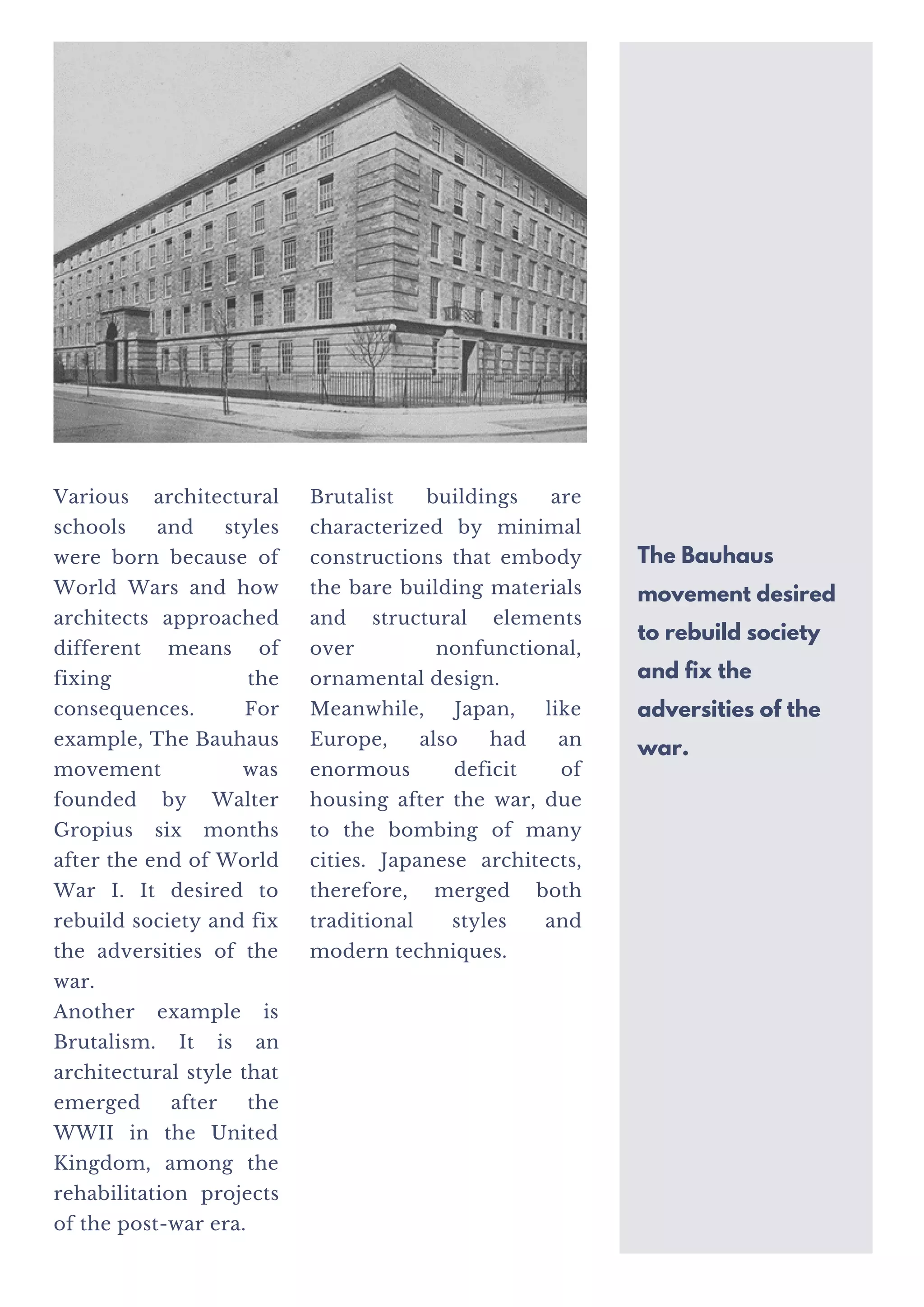
Another example is
Brutalism. It is an
architectural style that
emerged after the
WWII in the United
Kingdom, among the
rehabilitation projects
of the post-war era.
Brutalist buildings are
characterized by minimal
constructions that embody
the bare building materials
and structural elements
over nonfunctional,
ornamental design.
Meanwhile, Japan, like
Europe, also had an
enormous deficit of
housing after the war, due
to the bombing of many
cities. Japanese architects,
therefore, merged both
traditional styles and
modern techniques.
The Bauhaus
movement desired
to rebuild society
and fix the
adversities of the
war.
Cities and property can
become a purpose of
violence when locations
exhibit ‘the nonessential or
sinister distinction and
when the command of
space becomes an
instrument of force or
coercion. But architectural
principles or urban
planning can also provide
asylum from violence, a
safe sanctuary, a substitute
or accessory to it in
tempestuous surroundings.
The repercussions of crises
affect how people
construct, discern, and
occupy spaces and places.
The community has to
consider new systems of
spatial classification and
management: security
check zones, military-
controlled zones, landmine
fields, dormant zones,
humanitarian asylums,
usable sites, prohibited areas,
etc. Places have to change their
social function of most of the
places. For example- a place of
worship becomes a lodging
house or a clinic, a school
becomes a barracks or jail and a
transitional place between two
fences becomes the ground for
collaboration. Even with those
changes, communities are likely
to re-purpose all those social
places into known social places
of importance through coping
strategies or use and
redevelopment of customs. For
all intents and purposes, the loss
of their land and habitat is
correlated to the loss of
communal links. Extreme
changes in space and the
environment can only lead to a
disruption of society.
Extreme changes in
space and the
environment can
only lead to a
disruption of
society.
HOW DOES WAR AFFECT
ARCHITECTURE?
The UK's post-war
architecture may be
quite lifeless. The
word ‘Subtopia’ is
used to depict the
bland, characterless
landscape that has
developed over the
last century. The
number of dwellings
in this sector has
increased from 7.7
million in 1900 to
over 26 million today.
Accommodation
provision by the end
of warfare,
particularly in
metropolitan centers,
was believed to be
insufficient, not only
in quantity but in
quality as well.
War had impacted the
amount of housing stock,
but additionally, much
bygone housing had been
earmarked for knocking
down before the war.
All this boom in post-war
architecture in Britain was
directed at avoiding
disease outbreaks like
cholera, dysentery, rickets,
scurvy, and typhoid. All
these diseases are
propagated by
overcrowding, bad
hygiene, incompetent
facilities for the
preparation of meals and
by the pollution of houses
from neighboring
industries.
The number of
dwellings in this
sector has
increased from 7.7
million in 1900 to
over 26 million
today.
POST-WAR ARCHITECTURE IN
THE UK
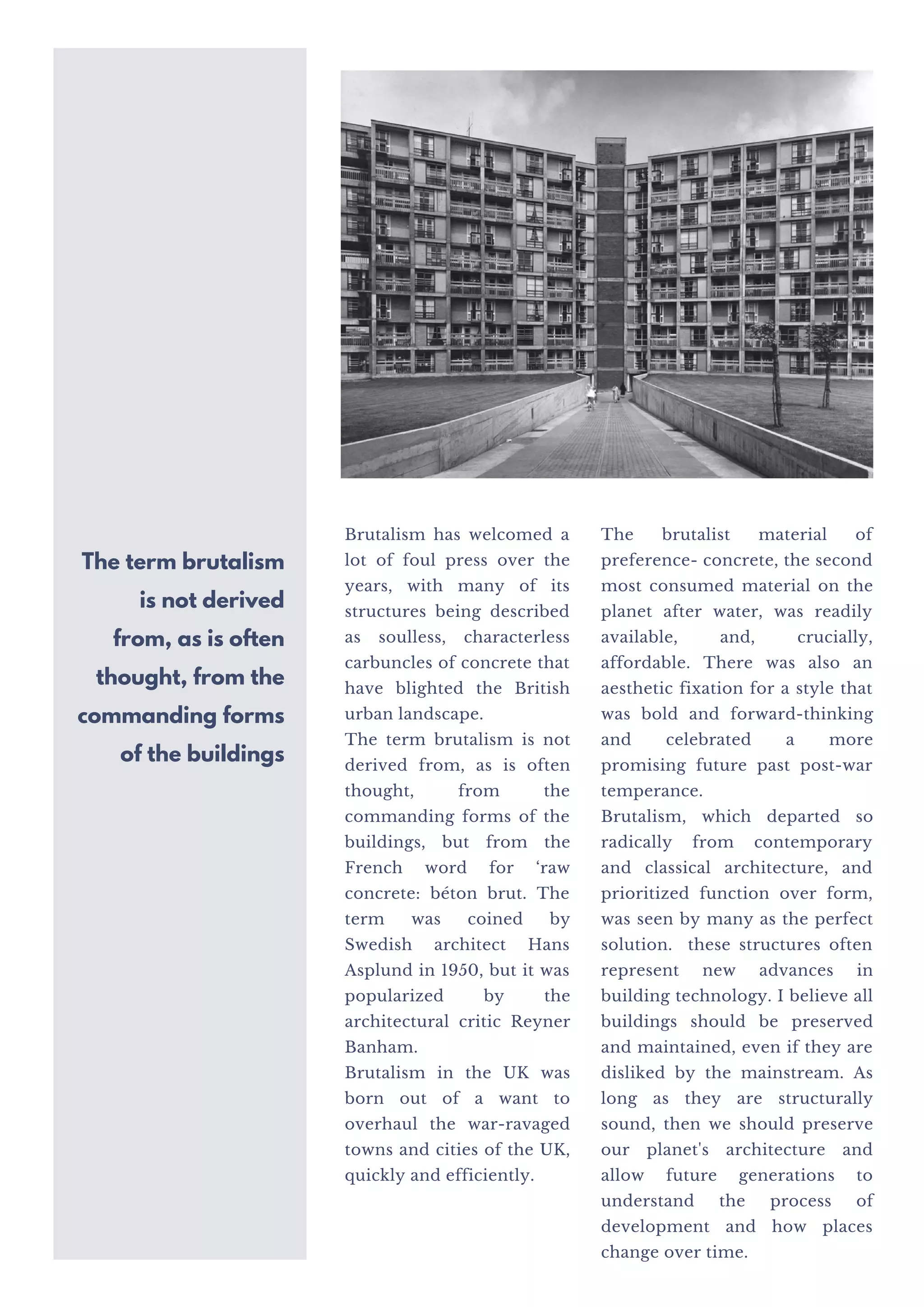
Brutalism has welcomed a
lot of foul press over the
years, with many of its
structures being described
as soulless, characterless
carbuncles of concrete that
have blighted the British
urban landscape.
The term brutalism is not
derived from, as is often
thought, from the
commanding forms of the
buildings, but from the
French word for ‘raw
concrete: béton brut. The
term was coined by
Swedish architect Hans
Asplund in 1950, but it was
popularized by the
architectural critic Reyner
Banham.
Brutalism in the UK was
born out of a want to
overhaul the war-ravaged
towns and cities of the UK,
quickly and efficiently.
The brutalist material of
preference- concrete, the second
most consumed material on the
planet after water, was readily
available, and, crucially,
affordable. There was also an
aesthetic fixation for a style that
was bold and forward-thinking
and celebrated a more
promising future past post-war
temperance.
Brutalism, which departed so
radically from contemporary
and classical architecture, and
prioritized function over form,
was seen by many as the perfect
solution. these structures often
represent new advances in
building technology. I believe all
buildings should be preserved
and maintained, even if they are
disliked by the mainstream. As
long as they are structurally
sound, then we should preserve
our planet's architecture and
allow future generations to
understand the process of
development and how places
change over time.
The term brutalism
is not derived
from, as is often
thought, from the
commanding forms
of the buildings

Post-War Architecture

  • 1.
    POST-WAR ARCHITECTURE An article byShivang Madaan MAY 2022 INTRODUCTION The conception of architecture, structure, and cultures was born from the need to be defended— from the climate, from animals, or from adversaries. Towers, forts, moats, barricades, and revetments were all made to prepare for and protect. After that, came production, technology, battle machines, explosives, and spacecraft; fortress and towering only made it uncomplicated to be found and attacked, and places were ruined to the bone. Architecture became more of an apparatus to live and pay tribute: dwellings, soldiers’ quarters, and mausoleums. Because of its innovative expression of lifestyle, architecture can be the first thing to be besieged and ravaged during warfare. Architecture became more of an apparatus to live and pay tribute: dwellings, soldiers’ quarters, and mausoleums.
  • 2.
    Various architectural schools andstyles were born because of World Wars and how architects approached different means of fixing the consequences. For example, The Bauhaus movement was founded by Walter Gropius six months after the end of World War I. It desired to rebuild society and fix the adversities of the war. Another example is Brutalism. It is an architectural style that emerged after the WWII in the United Kingdom, among the rehabilitation projects of the post-war era. Brutalist buildings are characterized by minimal constructions that embody the bare building materials and structural elements over nonfunctional, ornamental design. Meanwhile, Japan, like Europe, also had an enormous deficit of housing after the war, due to the bombing of many cities. Japanese architects, therefore, merged both traditional styles and modern techniques. The Bauhaus movement desired to rebuild society and fix the adversities of the war.
  • 3.
    Cities and propertycan become a purpose of violence when locations exhibit ‘the nonessential or sinister distinction and when the command of space becomes an instrument of force or coercion. But architectural principles or urban planning can also provide asylum from violence, a safe sanctuary, a substitute or accessory to it in tempestuous surroundings. The repercussions of crises affect how people construct, discern, and occupy spaces and places. The community has to consider new systems of spatial classification and management: security check zones, military- controlled zones, landmine fields, dormant zones, humanitarian asylums, usable sites, prohibited areas, etc. Places have to change their social function of most of the places. For example- a place of worship becomes a lodging house or a clinic, a school becomes a barracks or jail and a transitional place between two fences becomes the ground for collaboration. Even with those changes, communities are likely to re-purpose all those social places into known social places of importance through coping strategies or use and redevelopment of customs. For all intents and purposes, the loss of their land and habitat is correlated to the loss of communal links. Extreme changes in space and the environment can only lead to a disruption of society. Extreme changes in space and the environment can only lead to a disruption of society. HOW DOES WAR AFFECT ARCHITECTURE?
  • 4.
    The UK's post-war architecturemay be quite lifeless. The word ‘Subtopia’ is used to depict the bland, characterless landscape that has developed over the last century. The number of dwellings in this sector has increased from 7.7 million in 1900 to over 26 million today. Accommodation provision by the end of warfare, particularly in metropolitan centers, was believed to be insufficient, not only in quantity but in quality as well. War had impacted the amount of housing stock, but additionally, much bygone housing had been earmarked for knocking down before the war. All this boom in post-war architecture in Britain was directed at avoiding disease outbreaks like cholera, dysentery, rickets, scurvy, and typhoid. All these diseases are propagated by overcrowding, bad hygiene, incompetent facilities for the preparation of meals and by the pollution of houses from neighboring industries. The number of dwellings in this sector has increased from 7.7 million in 1900 to over 26 million today. POST-WAR ARCHITECTURE IN THE UK
  • 5.
    Brutalism has welcomeda lot of foul press over the years, with many of its structures being described as soulless, characterless carbuncles of concrete that have blighted the British urban landscape. The term brutalism is not derived from, as is often thought, from the commanding forms of the buildings, but from the French word for ‘raw concrete: béton brut. The term was coined by Swedish architect Hans Asplund in 1950, but it was popularized by the architectural critic Reyner Banham. Brutalism in the UK was born out of a want to overhaul the war-ravaged towns and cities of the UK, quickly and efficiently. The brutalist material of preference- concrete, the second most consumed material on the planet after water, was readily available, and, crucially, affordable. There was also an aesthetic fixation for a style that was bold and forward-thinking and celebrated a more promising future past post-war temperance. Brutalism, which departed so radically from contemporary and classical architecture, and prioritized function over form, was seen by many as the perfect solution. these structures often represent new advances in building technology. I believe all buildings should be preserved and maintained, even if they are disliked by the mainstream. As long as they are structurally sound, then we should preserve our planet's architecture and allow future generations to understand the process of development and how places change over time. The term brutalism is not derived from, as is often thought, from the commanding forms of the buildings