GROUP-2 EVS ASSIGNMENT
Topics: -
1. Noise Pollution
2. Thermal Pollution
3. Nuclear Disasters
4. SolidWaste Management
5. Role of Individuals in Pollution Prevention
Submitted By: -
1. Shivang Madaan (Roll Number- 17071978142)
2. Gurleen Kaur (Roll Number- 17071978167)
3. Snehael Goel (Roll Number- 17071978172)
4. Sarthak Singla (Roll Number- 17071978182)
5. Rajvir Singh (Roll Number- 17071978151)
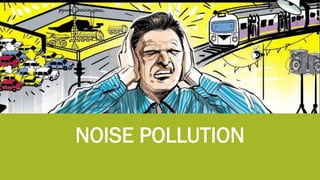
NOISE POLLUTION
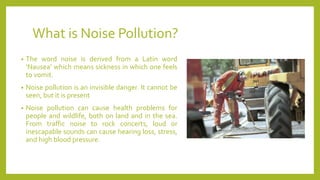
What is Noise Pollution?
• The word noise is derived from a Latin word
‘Nausea’ which means sickness in which one feels
to vomit.
• Noise pollution is an invisible danger. It cannot be
seen, but it is present
• Noise pollution can cause health problems for
people and wildlife, both on land and in the sea.
From traffic noise to rock concerts, loud or
inescapable sounds can cause hearing loss, stress,
and high blood pressure.
Types of Noise Pollution
Noise Pollution is of the following types: -
• Transport Noise- It mainly consists of traffic noise which has increased in recent
years with the increase in the number of vehicles.The increase in noise pollution
leads to deafening of older people, headache, hypertension, etc.
• Neighbourhood Noise- The noise from gadgets, household utensils etc. Some of
the main sources are musical instruments, transistors, loudspeakers etc.
• Industrial Noise- It is the high-intensity sound which is caused by heavy industrial
machines. According to many researches, industrial noise pollution damages the
hearing ability to around 20%.
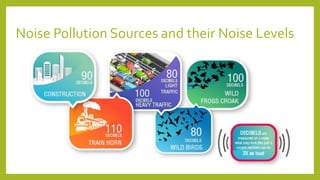
Noise Pollution Sources and their Noise Levels
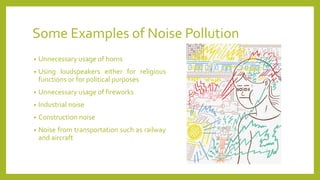
Some Examples of Noise Pollution
• Unnecessary usage of horns
• Using loudspeakers either for religious
functions or for political purposes
• Unnecessary usage of fireworks
• Industrial noise
• Construction noise
• Noise from transportation such as railway
and aircraft
Effects of Noise on Humans
• Noise pollution impacts millions of people on a daily basis.
• The most common health problem it causes is Noise Induced Hearing Loss (NIHL).
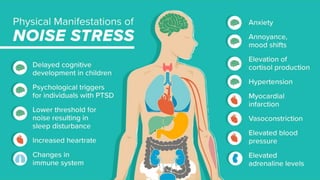
• Exposure to loud noise can also cause high blood pressure, heart disease, sleep
disturbances, and stress.
• Many children who live near noisy airports or streets have been found to suffer
from stress and other problems, such as impairments in memory, attention level,
and reading skill.
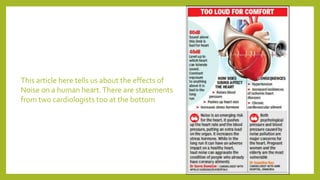
This article here tells us about the effects of
Noise on a human heart.There are statements
from two cardiologists too at the bottom
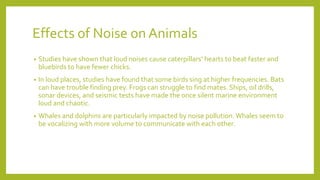
Effects of Noise on Animals
• Studies have shown that loud noises cause caterpillars’ hearts to beat faster and
bluebirds to have fewer chicks.
• In loud places, studies have found that some birds sing at higher frequencies. Bats
can have trouble finding prey. Frogs can struggle to find mates. Ships, oil drills,
sonar devices, and seismic tests have made the once silent marine environment
loud and chaotic.
• Whales and dolphins are particularly impacted by noise pollution. Whales seem to
be vocalizing with more volume to communicate with each other.
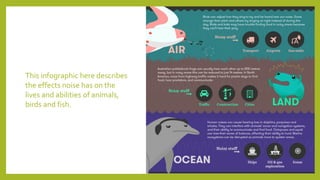
This infographic here describes
the effects noise has on the
lives and abilities of animals,
birds and fish.
Effects of Noise on Plants
• Human noise can have ripple effects on long-lived plants and trees that can last for
decades even after the sources of noise subside.
• Noise pollution is altering the landscape of plants and trees, which depend on
noise-affected animals to pollinate them and spread their seeds.
• The ripple effects can be far reaching and long lasting, especially for trees, which
often take decades to grow from seedlings into adults.
Noise Monitoring Stations
• With increasing urbanization and industrialization, noise pollution particularly in
ambient is also increasing.
• Government of India has taken a number of steps to control noise pollution, such
as notifying noise rules- 2009 and prescribing noise standards for vehicles,
generators sets, fire crackers, etc.
• The Indian government has set up a lot of noise monitoring tower stations across
India with the help of the State Governments.
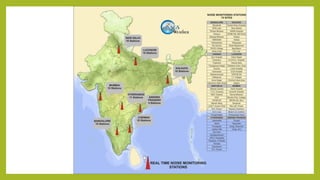
• The next slide shows the location of most of the noise monitoring stations in India.
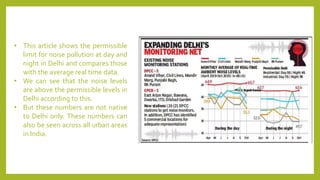
• This article shows the permissible
limit for noise pollution at day and
night in Delhi and compares those
with the average real time data.
• We can see that the noise levels
are above the permissible levels in
Delhi according to this.
• But these numbers are not native
to Delhi only. These numbers can
also be seen across all urban areas
in India.
How to Prevent Noise Pollution
Some noise pollution preventive measures are provided in the points below: -
• Honking in public places like teaching institutes, hospital, etc. should be banned.
• In commercial, hospital, and industrial buildings, adequate soundproof systems
should be installed.
• Musical instruments sound should be controlled to desirable limits.
• Dense tree cover is useful in noise pollution prevention.
• Explosives should be not used in forest, mountainous, and mining areas.
How Can We Adapt Architectural Building Design to
Stop Noise from Entering the Buildings?
THERMAL POLLUTION
▪ The accumulation and entry of unused heat generated by human activities is called as
“Thermal Pollution.”
▪ Thermal pollution is the degradation of water quality by any process that changes
ambient water temperature.
▪ This can disrupt the ecosystems in the natural environment and can be understood in
the context of water.
▪ The industries like iron and steel plants, petroleum refineries, nuclear reactors,
electric power plants etc. use large amount of water for cooling purposes.
▪ The water discharged from such installations carries a lot of heat which when
released into nearby bodies leads to thermal pollution.
▪ A temperature increase as small as 1 or 2 Celsius degrees can kill native fish, shellfish,
and plants and species.
What isThermal Pollution?
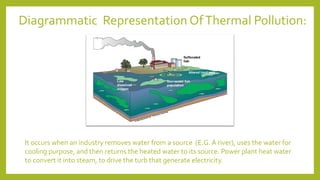
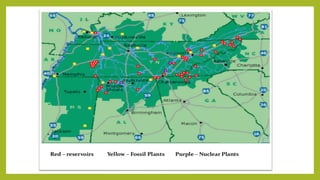
Diagrammatic Representation OfThermal Pollution:
It occurs when an industry removes water from a source (E.G. A river), uses the water for
cooling purpose, and then returns the heated water to its source. Power plant heat water
to convert it into steam, to drive the turb that generate electricity.
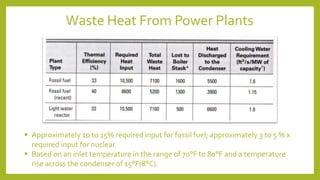
Waste Heat From Power Plants
▪ Approximately 10 to 15% required input for fossil fuel; approximately 3 to 5 % x
required input for nuclear.
▪ Based on an inlet temperature in the range of 70°F to 80°F and a temperature
rise across the condenser of 15°F(8°C).
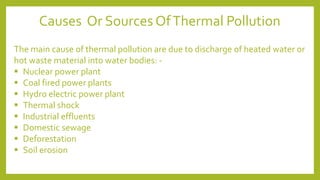
The main cause of thermal pollution are due to discharge of heated water or
hot waste material into water bodies: -
▪ Nuclear power plant
▪ Coal fired power plants
▪ Hydro electric power plant
▪ Thermal shock
▪ Industrial effluents
▪ Domestic sewage
▪ Deforestation
▪ Soil erosion
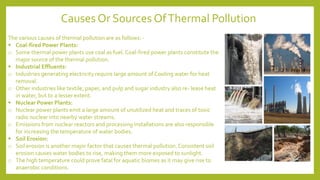
Causes Or Sources OfThermal Pollution
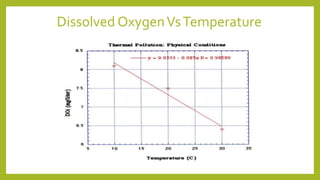
Dissolved OxygenVsTemperature
The various causes of thermal pollution are as follows: -
▪ Coal-fired Power Plants:
o Some thermal power plants use coal as fuel. Coal-fired power plants constitute the
major source of the thermal pollution.
▪ Industrial Effluents:
o Industries generating electricity require large amount of Cooling water for heat
removal.
o Other industries like textile, paper, and pulp and sugar industry also re- lease heat
in water, but to a lesser extent.
▪ Nuclear Power Plants:
o Nuclear power plants emit a large amount of unutilized heat and traces of toxic
radio nuclear into nearby water streams.
o Emissions from nuclear reactors and processing installations are also responsible
for increasing the temperature of water bodies.
▪ Soil Erosion:
o Soil erosion is another major factor that causes thermal pollution.Consistent soil
erosion causes water bodies to rise, making them more exposed to sunlight.
o The high temperature could prove fatal for aquatic biomes as it may give rise to
anaerobic conditions.
Causes Or Sources OfThermal Pollution
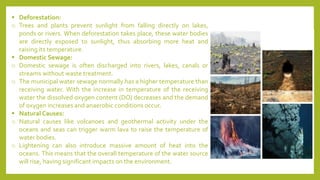
▪ Deforestation:
o Trees and plants prevent sunlight from falling directly on lakes,
ponds or rivers. When deforestation takes place, these water bodies
are directly exposed to sunlight, thus absorbing more heat and
raising its temperature.
▪ Domestic Sewage:
o Domestic sewage is often discharged into rivers, lakes, canals or
streams without waste treatment.
o The municipal water sewage normally has a higher temperature than
receiving water. With the increase in temperature of the receiving
water the dissolved oxygen content (DO) decreases and the demand
of oxygen increases and anaerobic conditions occur.
▪ Natural Causes:
o Natural causes like volcanoes and geothermal activity under the
oceans and seas can trigger warm lava to raise the temperature of
water bodies.
o Lightening can also introduce massive amount of heat into the
oceans. This means that the overall temperature of the water source
will rise, having significant impacts on the environment.
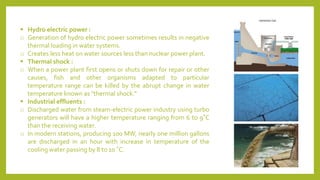
▪ Hydro electric power :
o Generation of hydro electric power sometimes results in negative
thermal loading in water systems.
o Creates less heat on water sources less than nuclear power plant.
▪ Thermal shock :
o When a power plant first opens or shuts down for repair or other
causes, fish and other organisms adapted to particular
temperature range can be killed by the abrupt change in water
temperature known as "thermal shock.“
▪ Industrial effluents :
o Discharged water from steam-electric power industry using turbo
generators will have a higher temperature ranging from 6 to 9˚C
than the receiving water.
o In modern stations, producing 100 MW, nearly one million gallons
are discharged in an hour with increase in temperature of the
cooling water passing by 8 to 10 ˚C.
The effects of thermal pollution on ecosystems,
however, greatly outweigh the benefits that
industries have by participating in the act.
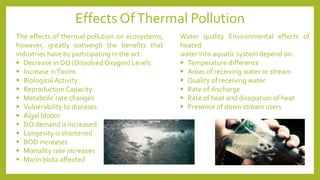
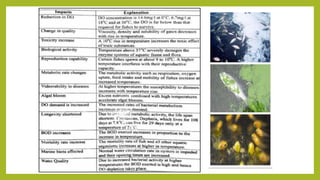
▪ Decrease in DO (Dissolved Oxygen) Levels
▪ Increase inToxins
▪ Biological Activity
▪ Reproduction Capacity
▪ Metabolic rate changes
▪ Vulnerability to diseases
▪ Algal bloom
▪ DO demand is increased
▪ Longevity is shortened
▪ BOD increases
▪ Mortality rate increases
▪ Marin biota affected
Water quality Environmental effects of
heated
water into aquatic system depend on:
▪ Temperature difference
▪ Areas of receiving water or stream
▪ Quality of receiving water
▪ Rate of discharge
▪ Rate of heat and dissipation of heat
▪ Presence of down stream users
Effects OfThermal Pollution
▪ Industries and power plants use water to cool machinery and
discharge the warm water into a stream.
▪ Stream temperature rises when trees and tall vegetation providing
shade are cut.
▪ Soil erosion caused due to construction also leads to thermal
pollution.
▪ Removal of stream side vegetation.
▪ Poor farming practices also lead to thermal pollution.
Thermal Pollution In Streams By Human Activities
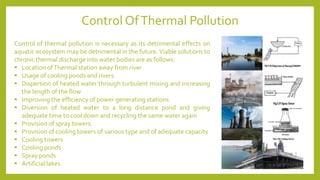
Control of thermal pollution is necessary as its detrimental effects on
aquatic ecosystem may be detrimental in the future. Viable solutions to
chronic thermal discharge into water bodies are as follows:
▪ Location ofThermal station away from river
▪ Usage of cooling ponds and rivers
▪ Dispersion of heated water through turbulent mixing and increasing
the length of the flow
▪ Improving the efficiency of power generating stations
▪ Diversion of heated water to a long distance pond and giving
adequate time to cool down and recycling the same water again
▪ Provision of spray towers
▪ Provision of cooling towers of various type and of adequate capacity
▪ Cooling towers
▪ Cooling ponds
▪ Spray ponds
▪ Artificial lakes
Control OfThermal Pollution
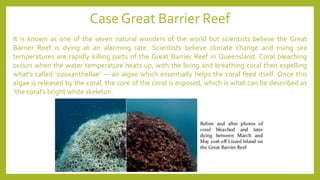
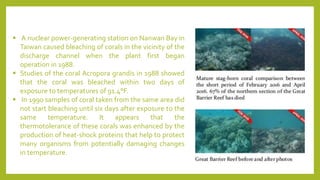
It is known as one of the seven natural wonders of the world but scientists believe the Great
Barrier Reef is dying at an alarming rate. Scientists believe climate change and rising sea
temperatures are rapidly killing parts of the Great Barrier Reef in Queensland. Coral bleaching
occurs when the water temperature heats up, with the living and breathing coral then expelling
what’s called ‘zooxanthellae’ — an algae which essentially helps the coral feed itself. Once this
algae is released by the coral, the core of the coral is exposed, which is what can be described as
‘the coral’s bright white skeleton.
Case Great Barrier Reef
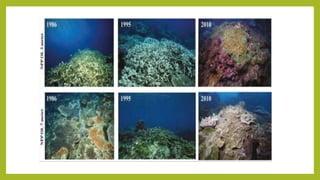
▪ A nuclear power-generating station on Nanwan Bay in
Taiwan caused bleaching of corals in the vicinity of the
discharge channel when the plant first began
operation in 1988.
▪ Studies of the coral Acropora grandis in 1988 showed
that the coral was bleached within two days of
exposure to temperatures of 91.4°F.
▪ In 1990 samples of coral taken from the same area did
not start bleaching until six days after exposure to the
same temperature. It appears that the
thermotolerance of these corals was enhanced by the
production of heat-shock proteins that help to protect
many organisms from potentially damaging changes
in temperature.
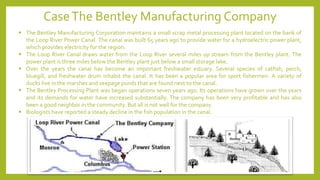
▪ The Bentley Manufacturing Corporation maintains a small scrap metal processing plant located on the bank of
the Loop River Power Canal. The canal was built 65 years ago to provide water for a hydroelectric power plant,
which provides electricity for the region.
▪ The Loop River Canal draws water from the Loop River several miles up stream from the Bentley plant. The
power plant is three miles below the Bentley plant just below a small storage lake.
▪ Over the years the canal has become an important freshwater estuary. Several species of catfish, perch,
bluegill, and freshwater drum inhabit the canal. It has been a popular area for sport fishermen. A variety of
ducks live in the marshes and seepage ponds that are found next to the canal.
▪ The Bentley Processing Plant was began operations seven years ago. Its operations have grown over the years
and its demands for water have increased substantially. The company has been very profitable and has also
been a good neighbor in the community. But all is not well for the company.
▪ Biologists have reported a steady decline in the fish population in the canal.
CaseThe Bentley Manufacturing Company
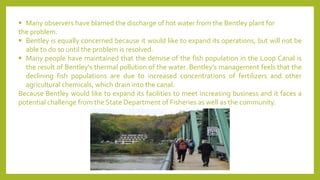
▪ Many observers have blamed the discharge of hot water from the Bentley plant for
the problem.
▪ Bentley is equally concerned because it would like to expand its operations, but will not be
able to do so until the problem is resolved.
▪ Many people have maintained that the demise of the fish population in the Loop Canal is
the result of Bentley's thermal pollution of the water. Bentley's management feels that the
declining fish populations are due to increased concentrations of fertilizers and other
agricultural chemicals, which drain into the canal.
Because Bentley would like to expand its facilities to meet increasing business and it faces a
potential challenge from the State Department of Fisheries as well as the community.
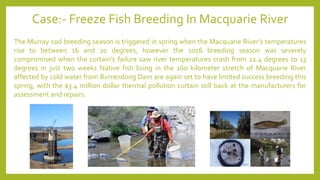
The Murray cod breeding season is triggered in spring when the Macquarie River’s temperatures
rise to between 16 and 20 degrees, however the 2016 breeding season was severely
compromised when the curtain’s failure saw river temperatures crash from 22.4 degrees to 13
degrees in just two weeks Native fish living in the 160 kilometer stretch of Macquarie River
affected by cold water from Burrendong Dam are again set to have limited success breeding this
spring, with the $3.4 million dollar thermal pollution curtain still back at the manufacturers for
assessment and repairs.
Case:- Freeze Fish Breeding In Macquarie River
Thermal Pollution AndThe Hudson River:
▪ The source of said pollution is from the three unit nuclear energy plant, Indian Point, in
Buchanan NewYork, located on the banks of the Hudson.
▪ Indian Point daily pumps million upon millions of gallons of Hudson River water to itself, then
dumps the now hot, contaminated water back into the river, posing a threat to both human
and aquatic life.
▪ That same river is a victim of thermal pollution due to Indian Point’s cooling methods.
▪ In fact, two thirds of the energy produced by the power plant is thermal-waste, not
electricity.
▪ The power plant uses the water of the Hudson River to cool two out of its three reactors,
daily; i.e two million gallons of water per minute are circulated throughout the plant then
back into the river.
Also, as a result of thermal pollution, millions of fish per year are affected by heat-shock which
can lead to “behavioral and growth impacts
The Future is
Now:
• Ensure to use 100% renewable sources
• This pollution negatively affect the yield and quality of crops
• The plant can be considered at most important modes to use
solar thermal and biomass power in future
CONCLUSION
NUCLEAR HAZARDS
Risk or danger to human health or the environment posed by
radiation emanating from the atomic nuclei of a given
substance, or the possibility of an uncontrolled explosion
originating from a fusion or fission reaction of atomic nuclei.
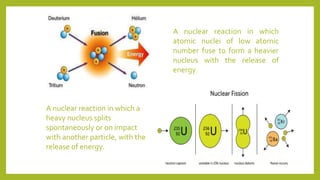
A nuclear reaction in which
atomic nuclei of low atomic
number fuse to form a heavier
nucleus with the release of
energy.
A nuclear reaction in which a
heavy nucleus splits
spontaneously or on impact
with another particle, with the
release of energy.
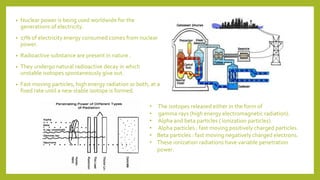
• Nuclear power is being used worldwide for the
generations of electricity.
• 17% of electricity energy consumed comes from nuclear
power.
• Radioactive substance are present in nature .
• They undergo natural radioactive decay in which
unstable isotopes spontaneously give out.
• Fast moving particles, high energy radiation or both, at a
fixed rate until a new stable isotope is formed.
• The isotopes released either in the form of
• gamma rays (high energy electromagnetic radiation).
• Alpha and beta particles ( ionization particles).
• Alpha particles : fast moving positively charged particles.
• Beta particles : fast moving negatively charged electrons.
• These ionization radiations have variable penetration
power.
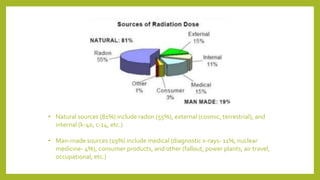
• Natural sources (81%) include radon (55%), external (cosmic, terrestrial), and
internal (k-40, c-14, etc.)
• Man-made sources (19%) include medical (diagnostic x-rays- 11%, nuclear
medicine- 4%), consumer products, and other (fallout, power plants, air travel,
occupational, etc.)
SOURCE OF NUCLEAR RADIATION
• The main source of radiation is nuclear power plant and particularly from the core
and coolant of the reactor. The fission products produced during normal
operation of nuclear plant, remain within the fuel elements and also in the nuclear
wastes.
• The real problems are about the storing and disposal of radioactive wastes and
possibility of accidents.
• Radiation is also emitted from radioactive materials such as uranium and radon
gas that occurs naturally in the earth’s crust.
• The radio-active contaminants decay by beta emission.
• The contamination occurs due to leakage from the reactor. Contamination can
also place due to coolant leak and causes emission of radioactive gases.
• Radiation hazards may also occur at the time of overhaul of reactor.
• Research reactors also pose special health problems during conducting
experiments nuclear installations and tests contribute to 4% the total radiation.
EFFECTS OF RADIO ACTIVE POLLUTION
• Nuclear warfare poses a continuous threat to the existence of mankind.
• Exposure to low levels of radiation by large public, increase the risk of cancer and other disorders.
• Radioactive emissions can penetrate biological tissue and cause damage and prevent cell division.
Radioactive emission is measured in “rem”. One roentgen is defined as the quantity of radiation which
produces 1.6 × 10¹² pairs of ions in 1 gm of air.
• Radioactive emission is used to destroy cancerous tumour. However, if the whole body is exposed to such
levels of radiation over 100 rem, a generalized blockage of cell division occurs and prevents the normal
replacement or repair of blood, skin and other tissues and leads to “radiation sickness” and finally may causes
death.Very high doses of radiation may totally destroy cells, causing immediate death.
• Lower doses may damage DNA, the genetic substance inside the cell. Cells with damaged DNA may begin
dividing and growing out of central forming malignant tumours and leukaemia.
• It also weakens immune system, causes mental retardation and development of cataracts. All the above
health hazards and adverse effects are directly related to the level of exposure. Generally, the doses in the
range of 10 – 15 rem result in the increased risk of cancer.
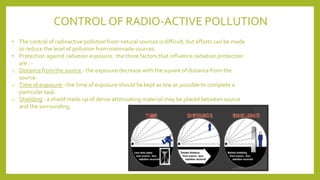
CONTROL OF RADIO-ACTIVE POLLUTION
• The control of radioactive pollution from natural sources is difficult, but efforts can be made
to reduce the level of pollution from manmade sources.
• Protection against radiation exposure : the three factors that influence radiation protection
are : -
o Distance from the source - the exposure decrease with the square of distance from the
source.
o Time of exposure - the time of exposure should be kept as low as possible to complete a
particular task.
o Shielding - a shield made up of dense attenuating material may be placed between source
and the surrounding.
CONTROL OF RADIO ACTIVE POLLUTION
• The radioactive particles are particularly hazardous if inhaled causing
irradiation.This can be minimized by using laboratory hoods, air filters,
and exhaust systems, eliminating dry sweeping, wearing protective
clothing and radiation indicators which show the total amount of radiation
to which a person is exposed.
• Use of respirators, prohibition of smoking and eating where radioactive
materials are used.
• The accessibility to areas which are susceptible for radiation exposure
should be controlled by placing appropriate sign boards like “ restricted
area” or “radiation zone”. Radiation resistant enclosures or barriers are to
be placed for screening workers from radioactive materials
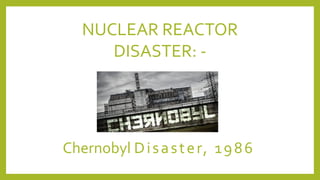
Chernobyl Disaster, 1986
NUCLEAR REACTOR
DISASTER: -
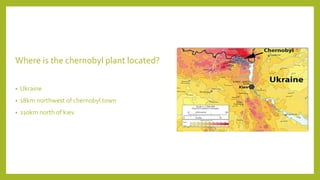
Where is the chernobyl plant located?
• Ukraine
• 18km northwest of chernobyl town
• 110km north of kiev
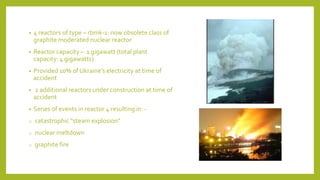
• 4 reactors of type – rbmk-1: now obsolete class of
graphite moderated nuclear reactor
• Reactor capacity – 1 gigawatt (total plant
capacity: 4 gigawatts)
• Provided 10% of Ukraine’s electricity at time of
accident
• 2 additional reactors under construction at time of
accident
• Series of events in reactor 4 resulting in: -
o catastrophic “steam explosion”
o nuclear meltdown
o graphite fire
25 APRIL 1986
• 11 pm: control rods were lowered to reduce reactor output for planned turbine test)
but too quickly - almost complete shut down
• 1 am: control rods raised to increase reactor activity for the test (12%)
• 1:23 am: reactor overheats; water coolant turns to steam
• 6 control rods left; minimum safe number = 30
• Emergency shut down button pressed
• Control rods re-inserted but fault causes power surge in reactor; output:100 times
normal
• Fuel pellets explode; roof blown off; air sucked in causing fire
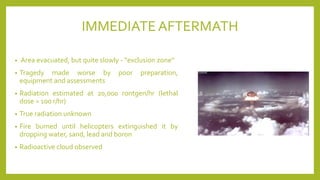
IMMEDIATEAFTERMATH
• Area evacuated, but quite slowly - “exclusion zone”
• Tragedy made worse by poor preparation,
equipment and assessments
• Radiation estimated at 20,000 rontgen/hr (lethal
dose = 100 r/hr)
• True radiation unknown
• Fire burned until helicopters extinguished it by
dropping water, sand, lead and boron
• Radioactive cloud observed
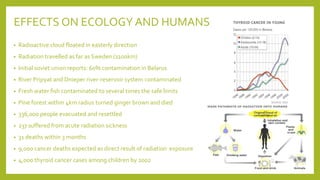
EFFECTS ON ECOLOGY AND HUMANS
• Radioactive cloud floated in easterly direction
• Radiation travelled as far as Sweden (1100km)
• Initial soviet union reports: 60% contamination in Belarus
• River Pripyat and Dnieper river-reservoir system contaminated
• Fresh water fish contaminated to several times the safe limits
• Pine forest within 4km radius turned ginger brown and died
• 336,000 people evacuated and resettled
• 237 suffered from acute radiation sickness
• 31 deaths within 3 months
• 9,000 cancer deaths expected as direct result of radiation exposure
• 4,000 thyroid cancer cases among children by 2002
IMPERFECT REACTOR DESIGN
• High void coefficient: weaken convection currents
• Graphite tipped control rods: increase activity for short period
• Vertical water channels in core: temperature gradient in core
• Partial containment measurements to save costs
• Operational for 1 year – stored fission by products
• Reactor vessel warped under intense heat, preventing insertion of control
rods
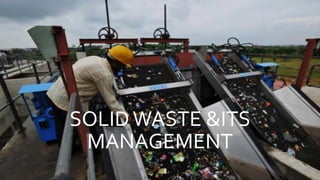
SOLIDWASTE &ITS
MANAGEMENT
INTRODUCTION
• Waste is unwanted or unusable material, substances, or by-
products.
• It is of three types: - solid waste, liquid waste, and gaseous waste
SOLID WASTE: - Solid waste is the unwanted or useless solid
materials generated from combined residential, industrial and
commercial activities in a given area
SOLID WASTE MANAGEMENT: - Solid waste management is the
process of collection, transportation and disposal of solid waste in a
systematic, economic and hygienic manner
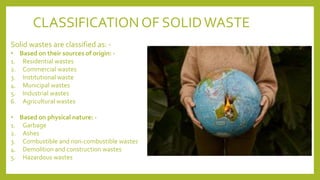
CLASSIFICATIONOF SOLIDWASTE
Solid wastes are classified as: -
• Based on their sources of origin: -
1. Residential wastes
2. Commercial wastes
3. Institutional waste
4. Municipal wastes
5. Industrial wastes
6. Agricultural wastes
• Based on physical nature: -
1. Garbage
2. Ashes
3. Combustible and non-combustible wastes
4. Demolition and construction wastes
5. Hazardous wastes
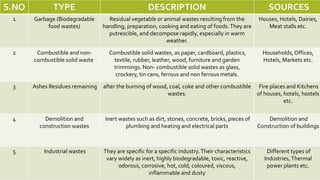
S.NO TYPE DESCRIPTION SOURCES
1 Garbage (Biodegradable
food wastes)
Residual vegetable or animal wastes resulting from the
handling, preparation, cooking and eating of foods.They are
putrescible, and decompose rapidly, especially in warm
weather.
Houses, Hotels, Dairies,
Meat stalls etc.
2 Combustible and non-
combustible solid waste
Combustible solid wastes, as paper, cardboard, plastics,
textile, rubber, leather, wood, furniture and garden
trimmings. Non- combustible solid wastes as glass,
crockery, tin cans, ferrous and non ferrous metals.
Households, Offices,
Hotels, Markets etc.
3 Ashes Residues remaining after the burning of wood, coal, coke and other combustible
wastes.
Fire places and Kitchens
of houses, hotels, hostels
etc.
4 Demolition and
construction wastes
Inert wastes such as dirt, stones, concrete, bricks, pieces of
plumbing and heating and electrical parts
Demolition and
Construction of buildings
5 Industrial wastes They are specific for a specific industry.Their characteristics
vary widely as inert, highly biodegradable, toxic, reactive,
odorous, corrosive, hot, cold, coloured, viscous,
inflammable and dusty
Different types of
Industries,Thermal
power plants etc.
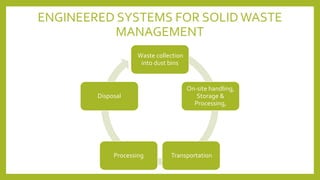
ENGINEERED SYSTEMS FOR SOLID WASTE
MANAGEMENT
Waste collection
into dust bins
On-site handling,
Storage &
Processing,
TransportationProcessing
Disposal
METHODS FORTHETREATMENT OF SOLID WASTE
These treatment processes has been listed
below: -
• Open Dumps
• Landfills
• Anaerobic Digestion
• Composting
• Vermicomposting
• Encapsulation
• Incineration
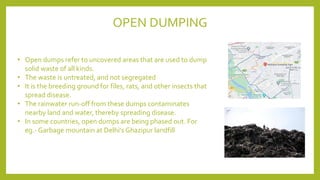
• Open dumps refer to uncovered areas that are used to dump
solid waste of all kinds.
• The waste is untreated, and not segregated
• It is the breeding ground for files, rats, and other insects that
spread disease.
• The rainwater run-off from these dumps contaminates
nearby land and water, thereby spreading disease.
• In some countries, open dumps are being phased out. For
eg.- Garbage mountain at Delhi's Ghazipur landfill
OPEN DUMPING
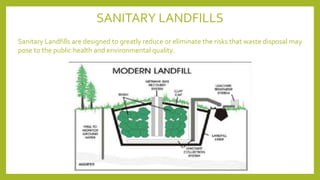
SANITARY LANDFILLS
Sanitary Landfills are designed to greatly reduce or eliminate the risks that waste disposal may
pose to the public health and environmental quality.
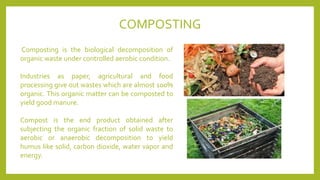
Composting is the biological decomposition of
organic waste under controlled aerobic condition.
Industries as paper, agricultural and food
processing give out wastes which are almost 100%
organic. This organic matter can be composted to
yield good manure.
Compost is the end product obtained after
subjecting the organic fraction of solid waste to
aerobic or anaerobic decomposition to yield
humus like solid, carbon dioxide, water vapor and
energy.
COMPOSTING
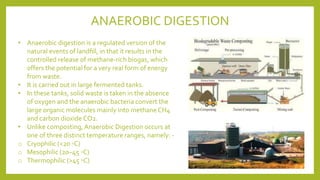
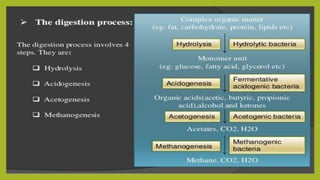
• Anaerobic digestion is a regulated version of the
natural events of landfill, in that it results in the
controlled release of methane-rich biogas, which
offers the potential for a very real form of energy
from waste.
• It is carried out in large fermented tanks.
• In these tanks, solid waste is taken in the absence
of oxygen and the anaerobic bacteria convert the
large organic molecules mainly into methane CH4
and carbon dioxide CO2.
• Unlike composting, Anaerobic Digestion occurs at
one of three distinct temperature ranges, namely: -
o Cryophilic (<20 ◦C)
o Mesophilic (20–45 ◦C)
o Thermophilic (>45 ◦C)
ANAEROBIC DIGESTION
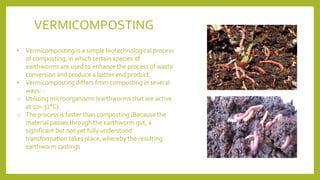
• Vermicomposting is a simple biotechnological process
of composting, in which certain species of
earthworms are used to enhance the process of waste
conversion and produce a better end product.
• Vermicomposting differs from composting in several
ways: -
o Utilizing microorganisms (earthworms that are active
at 10– 32°C).
o The process is faster than composting (Because the
material passes through the earthworm gut, a
significant but not yet fully understood
transformation takes place, whereby the resulting
earthworm castings
VERMICOMPOSTING
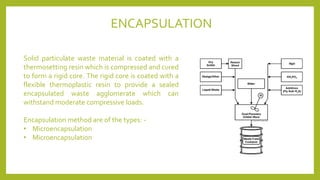
Solid particulate waste material is coated with a
thermosetting resin which is compressed and cured
to form a rigid core. The rigid core is coated with a
flexible thermoplastic resin to provide a sealed
encapsulated waste agglomerate which can
withstand moderate compressive loads.
Encapsulation method are of the types: -
• Microencapsulation
ENCAPSULATION
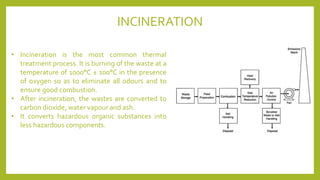
• Incineration is the most common thermal
treatment process. It is burning of the waste at a
temperature of 1000°C ± 100°C in the presence
of oxygen so as to eliminate all odours and to
ensure good combustion.
• After incineration, the wastes are converted to
carbon dioxide, water vapour and ash.
• It converts hazardous organic substances into
less hazardous components.
INCINERATION
MANAGEMENT OF SOLID WASTE
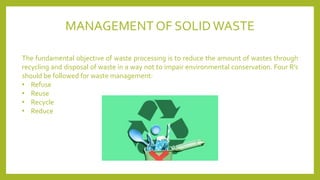
The fundamental objective of waste processing is to reduce the amount of wastes through
recycling and disposal of waste in a way not to impair environmental conservation. Four R’s
should be followed for waste management:
• Refuse
• Reuse
• Recycle
• Reduce
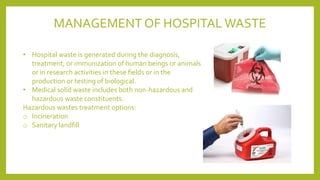
• Hospital waste is generated during the diagnosis,
treatment, or immunization of human beings or animals
or in research activities in these fields or in the
production or testing of biological.
• Medical solid waste includes both non-hazardous and
hazardous waste constituents.
Hazardous wastes treatment options:
o Incineration
o Sanitary landfill
MANAGEMENT OF HOSPITAL WASTE
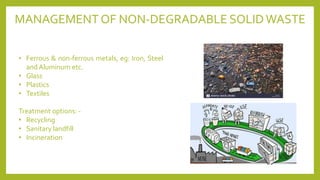
• Ferrous & non-ferrous metals, eg: Iron, Steel
and Aluminum etc.
• Glass
• Plastics
• Textiles
Treatment options: -
• Recycling
• Sanitary landfill
• Incineration
MANAGEMENT OF NON-DEGRADABLE SOLIDWASTE
• Following process applied in hazardous waste
treatment:
o Physical separation
o Gravity separation
o Dissolved air floatation
o Solvent extraction
o Sorption on activated carbon
• Hazardous wasteTreatment options:
o Thermal treatment
o Incineration
o Biological treatment
MANAGEMENT OF HAZARDOUS WASTE
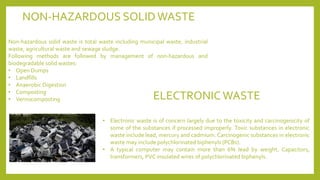
NON-HAZARDOUS SOLIDWASTE
Non-hazardous solid waste is total waste including municipal waste, industrial
waste, agricultural waste and sewage sludge.
Following methods are followed by management of non-hazardous and
biodegradable solid wastes:
• Open Dumps
• Landfills
• Anaerobic Digestion
• Composting
• Vermicomposting ELECTRONIC WASTE
• Electronic waste is of concern largely due to the toxicity and carcinogenicity of
some of the substances if processed improperly. Toxic substances in electronic
waste include lead, mercury and cadmium. Carcinogenic substances in electronic
waste may include polychlorinated biphenyls (PCBs).
• A typical computer may contain more than 6% lead by weight. Capacitors,
transformers, PVC insulated wires of polychlorinated biphenyls.
FACTORS AFFECTING SOLID WASTE MANAGEMENT
There are certain factors that affect the management of solid waste
management: -
• Per capita income and status
• Climate and percentage moisture
• Systematic growth of city
• Status of the municipality
• Resources available
CONCLUSION
Solid waste management is the process of removal of solid
waste in such a manner that it does not cause any problem to
environment and the living organism as well. It is done through
different methods as per the category of the solid waste.
ROLE OF INDIVIDUALS IN
POLLUTION PREVENTION
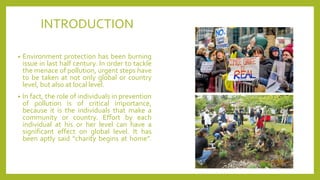
INTRODUCTION
• Environment protection has been burning
issue in last half century. In order to tackle
the menace of pollution, urgent steps have
to be taken at not only global or country
level, but also at local level.
• In fact, the role of individuals in prevention
of pollution is of critical importance,
because it is the individuals that make a
community or country. Effort by each
individual at his or her level can have a
significant effect on global level. It has
been aptly said “charity begins at home”.
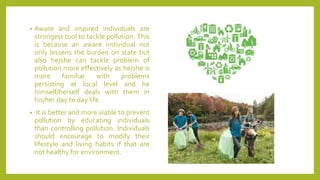
• Aware and inspired individuals are
strongest tool to tackle pollution. This
is because an aware individual not
only lessens the burden on state but
also he/she can tackle problem of
pollution more effectively as he/she is
more familiar with problems
persisting at local level and he
himself/herself deals with them in
his/her day to day life.
• It is better and more viable to prevent
pollution by educating individuals
than controlling pollution. Individuals
should encourage to modify their
lifestyle and living habits if that are
not healthy for environment.
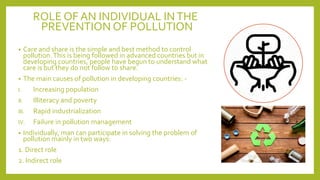
ROLE OF AN INDIVIDUAL INTHE
PREVENTION OF POLLUTION
• Care and share is the simple and best method to control
pollution.This is being followed in advanced countries but in
developing countries, people have begun to understand what
care is but they do not follow to share.
• The main causes of pollution in developing countries: -
I. Increasing population
II. Illiteracy and poverty
III. Rapid industrialization
IV. Failure in pollution management
• Individually, man can participate in solving the problem of
pollution mainly in two ways:
1. Direct role
2. Indirect role
DIRECT ROLE OF AN INDIVIDUAL
• Direct Role of an Individual involves those functions which are done by
individual himself. Since nature cannot solve the problem of pollution on its
own basis, it is the duty of man to find means to solve this problem.
• Since the cause of pollution is mainly human beings, only they can
minimize it by preventing its increase and spread. One can remember the
old saying that prevention is better than cure. A man should regulate and
reduce the causes of pollution at every step.
Preventive measures for Air Pollution: -
1. Establish or transfer factories or industries away from residential areas.
2. Reduce the use of automobiles and make use of public transport system.
3. Keep vehicle filters clean and use only quality fuels.
4. Make vehicle’s engine off while taking or standing at any crossing.
5. Use CNG (Compressed Natural Gas) as fuel for auto engines instead of
liquid petroleum.
6. Use self or low noise horns and avoid blowing them
unnecessarily
7. Use efficient silencer in vehicles.
8. Use of crackers should be avoided.
9. Use LPG for cooking instead of wood, coal.
10. Do not burn plastics.
11. Quit smoking.
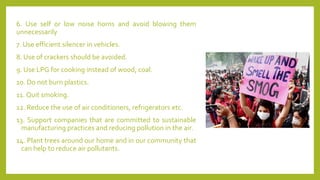
12. Reduce the use of air conditioners, refrigerators etc.
13. Support companies that are committed to sustainable
manufacturing practices and reducing pollution in the air.
14. Plant trees around our home and in our community that
can help to reduce air pollutants.
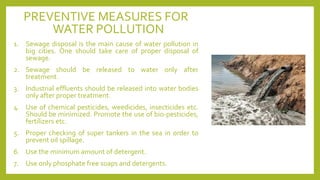
PREVENTIVE MEASURES FOR
WATER POLLUTION
1. Sewage disposal is the main cause of water pollution in
big cities. One should take care of proper disposal of
sewage.
2. Sewage should be released to water only after
treatment.
3. Industrial effluents should be released into water bodies
only after proper treatment.
4. Use of chemical pesticides, weedicides, insecticides etc.
Should be minimized. Promote the use of bio-pesticides,
fertilizers etc.
5. Proper checking of super tankers in the sea in order to
prevent oil spillage.
6. Use the minimum amount of detergent.
7. Use only phosphate free soaps and detergents.
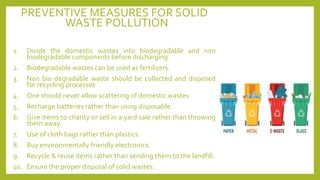
PREVENTIVE MEASURES FOR SOLID
WASTE POLLUTION
1. Divide the domestic wastes into biodegradable and non
biodegradable components before discharging
2. Biodegradable wastes can be used as fertilizers.
3. Non bio degradable waste should be collected and disposed
for recycling processes
4. One should never allow scattering of domestic wastes
5. Recharge batteries rather than using disposable.
6. Give items to charity or sell in a yard sale rather than throwing
them away.
7. Use of cloth bags rather than plastics.
8. Buy environmentally friendly electronics.
9. Recycle & reuse items rather than sending them to the landfill.
10. Ensure the proper disposal of solid wastes.
Indirect Role of an Individual
• Man can participate in various activities for solving the problem of
pollution.
• One should support expansion of environmental education by
participating or supporting the system.
• One should make efforts to develop awareness of environmental pollution
by:
-Publishing information on pollution
-Organizing various exhibitions or competitions
-Sponsoring environment related advertisement
• One should make Non Governmental Organizations or encourage and
help in developing NGO for social services against environmental
pollution.
• One should celebrate environmental dates as festivals of society and
develop them as non-caste and non-religious occasions for all.
• One should organize special programmes and rallies on Tree Plantation
Day (7 July) & World Environmental Day and raise the slogans in the
society.
• One should encourage to follow Environmental Laws by making them
popular and help people to respect.
ICONIC ENVIRONMENTALISTS OF
INDIA
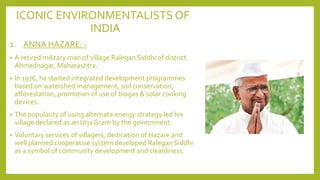
1. ANNA HAZARE: -
• A retired military man of village Ralegan Siddhi of district
Ahmednagar, Maharashtra.
• In 1976, he started integrated development programmes
based on watershed management, soil conservation,
afforestation, promotion of use of biogas & solar cooking
devices.
• The popularity of using alternate energy strategy led his
village declared as an Urja Gram by the government.
• Voluntary services of villagers, dedication of Hazare and
well planned cooperative system developed Ralegan Siddhi
as a symbol of community development and cleanliness.
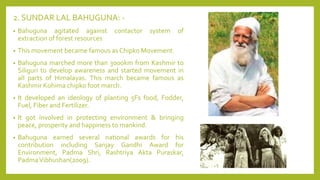
2. SUNDAR LAL BAHUGUNA: -
• Bahuguna agitated against contactor system of
extraction of forest resources
• This movement became famous as Chipko Movement.
• Bahuguna marched more than 3000km from Kashmir to
Siliguri to develop awareness and started movement in
all parts of Himalayas. This march became famous as
Kashmir Kohima chipko foot march.
• It developed an ideology of planting 5Fs food, Fodder,
Fuel, Fiber and Fertilizer.
• It got involved in protecting environment & bringing
peace, prosperity and happiness to mankind.
• Bahuguna earned several national awards for his
contribution including Sanjay Gandhi Award for
Environment, Padma Shri, Rashtriya Akta Puraskar,
PadmaVibhushan(2009).
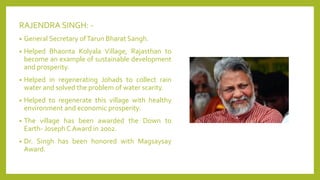
RAJENDRA SINGH: -
• General Secretary ofTarun Bharat Sangh.
• Helped Bhaonta Kolyala Village, Rajasthan to
become an example of sustainable development
and prosperity.
• Helped in regenerating Johads to collect rain
water and solved the problem of water scarity.
• Helped to regenerate this village with healthy
environment and economic prosperity.
• The village has been awarded the Down to
Earth- Joseph C Award in 2002.
• Dr. Singh has been honored with Magsaysay
Award.
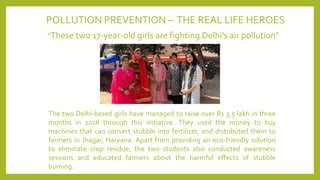
POLLUTION PREVENTION – THE REAL LIFE HEROES
“These two 17-year-old girls are fighting Delhi's air pollution”
The two Delhi-based girls have managed to raise over Rs 3.5 lakh in three
months in 2018 through this initiative. They used the money to buy
machines that can convert stubble into fertilizer, and distributed them to
farmers in Jhajjar, Haryana. Apart from providing an eco-friendly solution
to eliminate crop residue, the two students also conducted awareness
sessions and educated farmers about the harmful effects of stubble
burning.
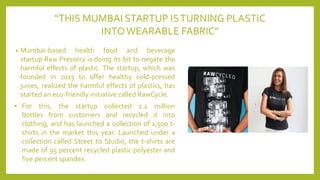
• Mumbai-based health food and beverage
startup Raw Pressery is doing its bit to negate the
harmful effects of plastic. The startup, which was
founded in 2013 to offer healthy cold-pressed
juices, realized the harmful effects of plastics, has
started an eco-friendly initiative called RawCycle.
“THIS MUMBAI STARTUP ISTURNING PLASTIC
INTOWEARABLE FABRIC”
• For this, the startup collected 1.2 million
bottles from customers and recycled it into
clothing, and has launched a collection of 1,500 t-
shirts in the market this year. Launched under a
collection called Street to Studio, the t-shirts are
made of 95 percent recycled plastic polyester and
five percent spandex.
“THIS ORGANIZATION ISWORKING TOWARDS A CLEANER AND GREENER
INDIATHROUGH ITS PLANTATION AND AWARENESS DRIVES”
Shankar Singh was very keen on contributing to the country’s
Swachh Bharat mission. In 2019, he started Vrikshit Foundation in
Delhi and has since organized over 150 clean-up and plantation
drives across the country.
• Britannia Chowk in Delhi is usually characterized by mounds of garbage and an
acrid smell. However, a few months ago, the place witnessed a total
transformation. A bunch of young and enthusiastic individuals from an NGO
gathered all the litter with shovels and swept the area until it was as clean as a
whistle. Despite being one of the prime commercial and industrial localities in the
National Capital Region, the government, as well as the locals, had disregarded the
piling trash.
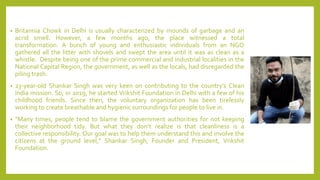
• 23-year-old Shankar Singh was very keen on contributing to the country’s Clean
India mission. So, in 2019, he started Vrikshit Foundation in Delhi with a few of his
childhood friends. Since then, the voluntary organization has been tirelessly
working to create breathable and hygienic surroundings for people to live in.
• “Many times, people tend to blame the government authorities for not keeping
their neighborhood tidy. But what they don’t realize is that cleanliness is a
collective responsibility. Our goal was to help them understand this and involve the
citizens at the ground level,” Shankar Singh, Founder and President, Vrikshit
Foundation.
CONCLUSION
Pollution is a man made problem created as a result of
irresponsible over exploitation of nature. Only man can
minimize pollution by preventing its increase and
spread. If man has to survive he has to overcome this
gigantic problem.Though global efforts are being made,
the responsibility of an individual is equally significant.The
individuals of developed countries behave with care and
precautions but those of developing and undeveloped
countries are lagging behind. It is very essential to aware
people on their role in the prevention of pollution then
only we can reduce and control pollution.
It is our duty to protect our environment from pollution.
An individual can adopt several preventive measures to
reduce pollution. Individuals can contribute several
indirect roles to minimize pollution. Several Indians have
shown exemplary contribution towards developing
pollution free environment & bringing social prosperity.
Anna Hazare, Rajendra Singh, S.L. Bahuguna are such
icons.

Noise Pollution, Thermal Pollution, Nuclear Disasters, Solid Waste Management, Role to prevent pollution

  • 1.
    GROUP-2 EVS ASSIGNMENT Topics:- 1. Noise Pollution 2. Thermal Pollution 3. Nuclear Disasters 4. SolidWaste Management 5. Role of Individuals in Pollution Prevention Submitted By: - 1. Shivang Madaan (Roll Number- 17071978142) 2. Gurleen Kaur (Roll Number- 17071978167) 3. Snehael Goel (Roll Number- 17071978172) 4. Sarthak Singla (Roll Number- 17071978182) 5. Rajvir Singh (Roll Number- 17071978151)
  • 2.
  • 3.
    What is NoisePollution? • The word noise is derived from a Latin word ‘Nausea’ which means sickness in which one feels to vomit. • Noise pollution is an invisible danger. It cannot be seen, but it is present • Noise pollution can cause health problems for people and wildlife, both on land and in the sea. From traffic noise to rock concerts, loud or inescapable sounds can cause hearing loss, stress, and high blood pressure.
  • 4.
    Types of NoisePollution Noise Pollution is of the following types: - • Transport Noise- It mainly consists of traffic noise which has increased in recent years with the increase in the number of vehicles.The increase in noise pollution leads to deafening of older people, headache, hypertension, etc. • Neighbourhood Noise- The noise from gadgets, household utensils etc. Some of the main sources are musical instruments, transistors, loudspeakers etc. • Industrial Noise- It is the high-intensity sound which is caused by heavy industrial machines. According to many researches, industrial noise pollution damages the hearing ability to around 20%.
  • 5.
    Noise Pollution Sourcesand their Noise Levels
  • 6.
    Some Examples ofNoise Pollution • Unnecessary usage of horns • Using loudspeakers either for religious functions or for political purposes • Unnecessary usage of fireworks • Industrial noise • Construction noise • Noise from transportation such as railway and aircraft
  • 8.
    Effects of Noiseon Humans • Noise pollution impacts millions of people on a daily basis. • The most common health problem it causes is Noise Induced Hearing Loss (NIHL). • Exposure to loud noise can also cause high blood pressure, heart disease, sleep disturbances, and stress. • Many children who live near noisy airports or streets have been found to suffer from stress and other problems, such as impairments in memory, attention level, and reading skill.
  • 9.
    This article heretells us about the effects of Noise on a human heart.There are statements from two cardiologists too at the bottom
  • 11.
    Effects of Noiseon Animals • Studies have shown that loud noises cause caterpillars’ hearts to beat faster and bluebirds to have fewer chicks. • In loud places, studies have found that some birds sing at higher frequencies. Bats can have trouble finding prey. Frogs can struggle to find mates. Ships, oil drills, sonar devices, and seismic tests have made the once silent marine environment loud and chaotic. • Whales and dolphins are particularly impacted by noise pollution. Whales seem to be vocalizing with more volume to communicate with each other.
  • 12.
    This infographic heredescribes the effects noise has on the lives and abilities of animals, birds and fish.
  • 13.
    Effects of Noiseon Plants • Human noise can have ripple effects on long-lived plants and trees that can last for decades even after the sources of noise subside. • Noise pollution is altering the landscape of plants and trees, which depend on noise-affected animals to pollinate them and spread their seeds. • The ripple effects can be far reaching and long lasting, especially for trees, which often take decades to grow from seedlings into adults.
  • 14.
    Noise Monitoring Stations •With increasing urbanization and industrialization, noise pollution particularly in ambient is also increasing. • Government of India has taken a number of steps to control noise pollution, such as notifying noise rules- 2009 and prescribing noise standards for vehicles, generators sets, fire crackers, etc. • The Indian government has set up a lot of noise monitoring tower stations across India with the help of the State Governments. • The next slide shows the location of most of the noise monitoring stations in India.
  • 16.
    • This articleshows the permissible limit for noise pollution at day and night in Delhi and compares those with the average real time data. • We can see that the noise levels are above the permissible levels in Delhi according to this. • But these numbers are not native to Delhi only. These numbers can also be seen across all urban areas in India.
  • 17.
    How to PreventNoise Pollution Some noise pollution preventive measures are provided in the points below: - • Honking in public places like teaching institutes, hospital, etc. should be banned. • In commercial, hospital, and industrial buildings, adequate soundproof systems should be installed. • Musical instruments sound should be controlled to desirable limits. • Dense tree cover is useful in noise pollution prevention. • Explosives should be not used in forest, mountainous, and mining areas.
  • 18.
    How Can WeAdapt Architectural Building Design to Stop Noise from Entering the Buildings?
  • 20.
  • 21.
    ▪ The accumulationand entry of unused heat generated by human activities is called as “Thermal Pollution.” ▪ Thermal pollution is the degradation of water quality by any process that changes ambient water temperature. ▪ This can disrupt the ecosystems in the natural environment and can be understood in the context of water. ▪ The industries like iron and steel plants, petroleum refineries, nuclear reactors, electric power plants etc. use large amount of water for cooling purposes. ▪ The water discharged from such installations carries a lot of heat which when released into nearby bodies leads to thermal pollution. ▪ A temperature increase as small as 1 or 2 Celsius degrees can kill native fish, shellfish, and plants and species. What isThermal Pollution?
  • 22.
    Diagrammatic Representation OfThermalPollution: It occurs when an industry removes water from a source (E.G. A river), uses the water for cooling purpose, and then returns the heated water to its source. Power plant heat water to convert it into steam, to drive the turb that generate electricity.
  • 24.
    Waste Heat FromPower Plants ▪ Approximately 10 to 15% required input for fossil fuel; approximately 3 to 5 % x required input for nuclear. ▪ Based on an inlet temperature in the range of 70°F to 80°F and a temperature rise across the condenser of 15°F(8°C).
  • 25.
    The main causeof thermal pollution are due to discharge of heated water or hot waste material into water bodies: - ▪ Nuclear power plant ▪ Coal fired power plants ▪ Hydro electric power plant ▪ Thermal shock ▪ Industrial effluents ▪ Domestic sewage ▪ Deforestation ▪ Soil erosion Causes Or Sources OfThermal Pollution
  • 26.
  • 27.
    The various causesof thermal pollution are as follows: - ▪ Coal-fired Power Plants: o Some thermal power plants use coal as fuel. Coal-fired power plants constitute the major source of the thermal pollution. ▪ Industrial Effluents: o Industries generating electricity require large amount of Cooling water for heat removal. o Other industries like textile, paper, and pulp and sugar industry also re- lease heat in water, but to a lesser extent. ▪ Nuclear Power Plants: o Nuclear power plants emit a large amount of unutilized heat and traces of toxic radio nuclear into nearby water streams. o Emissions from nuclear reactors and processing installations are also responsible for increasing the temperature of water bodies. ▪ Soil Erosion: o Soil erosion is another major factor that causes thermal pollution.Consistent soil erosion causes water bodies to rise, making them more exposed to sunlight. o The high temperature could prove fatal for aquatic biomes as it may give rise to anaerobic conditions. Causes Or Sources OfThermal Pollution
  • 28.
    ▪ Deforestation: o Treesand plants prevent sunlight from falling directly on lakes, ponds or rivers. When deforestation takes place, these water bodies are directly exposed to sunlight, thus absorbing more heat and raising its temperature. ▪ Domestic Sewage: o Domestic sewage is often discharged into rivers, lakes, canals or streams without waste treatment. o The municipal water sewage normally has a higher temperature than receiving water. With the increase in temperature of the receiving water the dissolved oxygen content (DO) decreases and the demand of oxygen increases and anaerobic conditions occur. ▪ Natural Causes: o Natural causes like volcanoes and geothermal activity under the oceans and seas can trigger warm lava to raise the temperature of water bodies. o Lightening can also introduce massive amount of heat into the oceans. This means that the overall temperature of the water source will rise, having significant impacts on the environment.
  • 29.
    ▪ Hydro electricpower : o Generation of hydro electric power sometimes results in negative thermal loading in water systems. o Creates less heat on water sources less than nuclear power plant. ▪ Thermal shock : o When a power plant first opens or shuts down for repair or other causes, fish and other organisms adapted to particular temperature range can be killed by the abrupt change in water temperature known as "thermal shock.“ ▪ Industrial effluents : o Discharged water from steam-electric power industry using turbo generators will have a higher temperature ranging from 6 to 9˚C than the receiving water. o In modern stations, producing 100 MW, nearly one million gallons are discharged in an hour with increase in temperature of the cooling water passing by 8 to 10 ˚C.
  • 30.
    The effects ofthermal pollution on ecosystems, however, greatly outweigh the benefits that industries have by participating in the act. ▪ Decrease in DO (Dissolved Oxygen) Levels ▪ Increase inToxins ▪ Biological Activity ▪ Reproduction Capacity ▪ Metabolic rate changes ▪ Vulnerability to diseases ▪ Algal bloom ▪ DO demand is increased ▪ Longevity is shortened ▪ BOD increases ▪ Mortality rate increases ▪ Marin biota affected Water quality Environmental effects of heated water into aquatic system depend on: ▪ Temperature difference ▪ Areas of receiving water or stream ▪ Quality of receiving water ▪ Rate of discharge ▪ Rate of heat and dissipation of heat ▪ Presence of down stream users Effects OfThermal Pollution
  • 31.
    ▪ Industries andpower plants use water to cool machinery and discharge the warm water into a stream. ▪ Stream temperature rises when trees and tall vegetation providing shade are cut. ▪ Soil erosion caused due to construction also leads to thermal pollution. ▪ Removal of stream side vegetation. ▪ Poor farming practices also lead to thermal pollution. Thermal Pollution In Streams By Human Activities
  • 33.
    Control of thermalpollution is necessary as its detrimental effects on aquatic ecosystem may be detrimental in the future. Viable solutions to chronic thermal discharge into water bodies are as follows: ▪ Location ofThermal station away from river ▪ Usage of cooling ponds and rivers ▪ Dispersion of heated water through turbulent mixing and increasing the length of the flow ▪ Improving the efficiency of power generating stations ▪ Diversion of heated water to a long distance pond and giving adequate time to cool down and recycling the same water again ▪ Provision of spray towers ▪ Provision of cooling towers of various type and of adequate capacity ▪ Cooling towers ▪ Cooling ponds ▪ Spray ponds ▪ Artificial lakes Control OfThermal Pollution
  • 34.
    It is knownas one of the seven natural wonders of the world but scientists believe the Great Barrier Reef is dying at an alarming rate. Scientists believe climate change and rising sea temperatures are rapidly killing parts of the Great Barrier Reef in Queensland. Coral bleaching occurs when the water temperature heats up, with the living and breathing coral then expelling what’s called ‘zooxanthellae’ — an algae which essentially helps the coral feed itself. Once this algae is released by the coral, the core of the coral is exposed, which is what can be described as ‘the coral’s bright white skeleton. Case Great Barrier Reef
  • 35.
    ▪ A nuclearpower-generating station on Nanwan Bay in Taiwan caused bleaching of corals in the vicinity of the discharge channel when the plant first began operation in 1988. ▪ Studies of the coral Acropora grandis in 1988 showed that the coral was bleached within two days of exposure to temperatures of 91.4°F. ▪ In 1990 samples of coral taken from the same area did not start bleaching until six days after exposure to the same temperature. It appears that the thermotolerance of these corals was enhanced by the production of heat-shock proteins that help to protect many organisms from potentially damaging changes in temperature.
  • 37.
    ▪ The BentleyManufacturing Corporation maintains a small scrap metal processing plant located on the bank of the Loop River Power Canal. The canal was built 65 years ago to provide water for a hydroelectric power plant, which provides electricity for the region. ▪ The Loop River Canal draws water from the Loop River several miles up stream from the Bentley plant. The power plant is three miles below the Bentley plant just below a small storage lake. ▪ Over the years the canal has become an important freshwater estuary. Several species of catfish, perch, bluegill, and freshwater drum inhabit the canal. It has been a popular area for sport fishermen. A variety of ducks live in the marshes and seepage ponds that are found next to the canal. ▪ The Bentley Processing Plant was began operations seven years ago. Its operations have grown over the years and its demands for water have increased substantially. The company has been very profitable and has also been a good neighbor in the community. But all is not well for the company. ▪ Biologists have reported a steady decline in the fish population in the canal. CaseThe Bentley Manufacturing Company
  • 38.
    ▪ Many observershave blamed the discharge of hot water from the Bentley plant for the problem. ▪ Bentley is equally concerned because it would like to expand its operations, but will not be able to do so until the problem is resolved. ▪ Many people have maintained that the demise of the fish population in the Loop Canal is the result of Bentley's thermal pollution of the water. Bentley's management feels that the declining fish populations are due to increased concentrations of fertilizers and other agricultural chemicals, which drain into the canal. Because Bentley would like to expand its facilities to meet increasing business and it faces a potential challenge from the State Department of Fisheries as well as the community.
  • 39.
    The Murray codbreeding season is triggered in spring when the Macquarie River’s temperatures rise to between 16 and 20 degrees, however the 2016 breeding season was severely compromised when the curtain’s failure saw river temperatures crash from 22.4 degrees to 13 degrees in just two weeks Native fish living in the 160 kilometer stretch of Macquarie River affected by cold water from Burrendong Dam are again set to have limited success breeding this spring, with the $3.4 million dollar thermal pollution curtain still back at the manufacturers for assessment and repairs. Case:- Freeze Fish Breeding In Macquarie River
  • 40.
    Thermal Pollution AndTheHudson River: ▪ The source of said pollution is from the three unit nuclear energy plant, Indian Point, in Buchanan NewYork, located on the banks of the Hudson. ▪ Indian Point daily pumps million upon millions of gallons of Hudson River water to itself, then dumps the now hot, contaminated water back into the river, posing a threat to both human and aquatic life. ▪ That same river is a victim of thermal pollution due to Indian Point’s cooling methods. ▪ In fact, two thirds of the energy produced by the power plant is thermal-waste, not electricity. ▪ The power plant uses the water of the Hudson River to cool two out of its three reactors, daily; i.e two million gallons of water per minute are circulated throughout the plant then back into the river. Also, as a result of thermal pollution, millions of fish per year are affected by heat-shock which can lead to “behavioral and growth impacts
  • 41.
  • 42.
    • Ensure touse 100% renewable sources • This pollution negatively affect the yield and quality of crops • The plant can be considered at most important modes to use solar thermal and biomass power in future CONCLUSION
  • 43.
    NUCLEAR HAZARDS Risk ordanger to human health or the environment posed by radiation emanating from the atomic nuclei of a given substance, or the possibility of an uncontrolled explosion originating from a fusion or fission reaction of atomic nuclei.
  • 44.
    A nuclear reactionin which atomic nuclei of low atomic number fuse to form a heavier nucleus with the release of energy. A nuclear reaction in which a heavy nucleus splits spontaneously or on impact with another particle, with the release of energy.
  • 45.
    • Nuclear poweris being used worldwide for the generations of electricity. • 17% of electricity energy consumed comes from nuclear power. • Radioactive substance are present in nature . • They undergo natural radioactive decay in which unstable isotopes spontaneously give out. • Fast moving particles, high energy radiation or both, at a fixed rate until a new stable isotope is formed. • The isotopes released either in the form of • gamma rays (high energy electromagnetic radiation). • Alpha and beta particles ( ionization particles). • Alpha particles : fast moving positively charged particles. • Beta particles : fast moving negatively charged electrons. • These ionization radiations have variable penetration power.
  • 46.
    • Natural sources(81%) include radon (55%), external (cosmic, terrestrial), and internal (k-40, c-14, etc.) • Man-made sources (19%) include medical (diagnostic x-rays- 11%, nuclear medicine- 4%), consumer products, and other (fallout, power plants, air travel, occupational, etc.)
  • 47.
    SOURCE OF NUCLEARRADIATION • The main source of radiation is nuclear power plant and particularly from the core and coolant of the reactor. The fission products produced during normal operation of nuclear plant, remain within the fuel elements and also in the nuclear wastes. • The real problems are about the storing and disposal of radioactive wastes and possibility of accidents. • Radiation is also emitted from radioactive materials such as uranium and radon gas that occurs naturally in the earth’s crust. • The radio-active contaminants decay by beta emission. • The contamination occurs due to leakage from the reactor. Contamination can also place due to coolant leak and causes emission of radioactive gases. • Radiation hazards may also occur at the time of overhaul of reactor. • Research reactors also pose special health problems during conducting experiments nuclear installations and tests contribute to 4% the total radiation.
  • 48.
    EFFECTS OF RADIOACTIVE POLLUTION • Nuclear warfare poses a continuous threat to the existence of mankind. • Exposure to low levels of radiation by large public, increase the risk of cancer and other disorders. • Radioactive emissions can penetrate biological tissue and cause damage and prevent cell division. Radioactive emission is measured in “rem”. One roentgen is defined as the quantity of radiation which produces 1.6 × 10¹² pairs of ions in 1 gm of air. • Radioactive emission is used to destroy cancerous tumour. However, if the whole body is exposed to such levels of radiation over 100 rem, a generalized blockage of cell division occurs and prevents the normal replacement or repair of blood, skin and other tissues and leads to “radiation sickness” and finally may causes death.Very high doses of radiation may totally destroy cells, causing immediate death. • Lower doses may damage DNA, the genetic substance inside the cell. Cells with damaged DNA may begin dividing and growing out of central forming malignant tumours and leukaemia. • It also weakens immune system, causes mental retardation and development of cataracts. All the above health hazards and adverse effects are directly related to the level of exposure. Generally, the doses in the range of 10 – 15 rem result in the increased risk of cancer.
  • 49.
    CONTROL OF RADIO-ACTIVEPOLLUTION • The control of radioactive pollution from natural sources is difficult, but efforts can be made to reduce the level of pollution from manmade sources. • Protection against radiation exposure : the three factors that influence radiation protection are : - o Distance from the source - the exposure decrease with the square of distance from the source. o Time of exposure - the time of exposure should be kept as low as possible to complete a particular task. o Shielding - a shield made up of dense attenuating material may be placed between source and the surrounding.
  • 50.
    CONTROL OF RADIOACTIVE POLLUTION • The radioactive particles are particularly hazardous if inhaled causing irradiation.This can be minimized by using laboratory hoods, air filters, and exhaust systems, eliminating dry sweeping, wearing protective clothing and radiation indicators which show the total amount of radiation to which a person is exposed. • Use of respirators, prohibition of smoking and eating where radioactive materials are used. • The accessibility to areas which are susceptible for radiation exposure should be controlled by placing appropriate sign boards like “ restricted area” or “radiation zone”. Radiation resistant enclosures or barriers are to be placed for screening workers from radioactive materials
  • 51.
  • 52.
    Where is thechernobyl plant located? • Ukraine • 18km northwest of chernobyl town • 110km north of kiev
  • 53.
    • 4 reactorsof type – rbmk-1: now obsolete class of graphite moderated nuclear reactor • Reactor capacity – 1 gigawatt (total plant capacity: 4 gigawatts) • Provided 10% of Ukraine’s electricity at time of accident • 2 additional reactors under construction at time of accident • Series of events in reactor 4 resulting in: - o catastrophic “steam explosion” o nuclear meltdown o graphite fire
  • 54.
    25 APRIL 1986 •11 pm: control rods were lowered to reduce reactor output for planned turbine test) but too quickly - almost complete shut down • 1 am: control rods raised to increase reactor activity for the test (12%) • 1:23 am: reactor overheats; water coolant turns to steam • 6 control rods left; minimum safe number = 30 • Emergency shut down button pressed • Control rods re-inserted but fault causes power surge in reactor; output:100 times normal • Fuel pellets explode; roof blown off; air sucked in causing fire
  • 55.
    IMMEDIATEAFTERMATH • Area evacuated,but quite slowly - “exclusion zone” • Tragedy made worse by poor preparation, equipment and assessments • Radiation estimated at 20,000 rontgen/hr (lethal dose = 100 r/hr) • True radiation unknown • Fire burned until helicopters extinguished it by dropping water, sand, lead and boron • Radioactive cloud observed
  • 56.
    EFFECTS ON ECOLOGYAND HUMANS • Radioactive cloud floated in easterly direction • Radiation travelled as far as Sweden (1100km) • Initial soviet union reports: 60% contamination in Belarus • River Pripyat and Dnieper river-reservoir system contaminated • Fresh water fish contaminated to several times the safe limits • Pine forest within 4km radius turned ginger brown and died • 336,000 people evacuated and resettled • 237 suffered from acute radiation sickness • 31 deaths within 3 months • 9,000 cancer deaths expected as direct result of radiation exposure • 4,000 thyroid cancer cases among children by 2002
  • 57.
    IMPERFECT REACTOR DESIGN •High void coefficient: weaken convection currents • Graphite tipped control rods: increase activity for short period • Vertical water channels in core: temperature gradient in core • Partial containment measurements to save costs • Operational for 1 year – stored fission by products • Reactor vessel warped under intense heat, preventing insertion of control rods
  • 58.
  • 59.
    INTRODUCTION • Waste isunwanted or unusable material, substances, or by- products. • It is of three types: - solid waste, liquid waste, and gaseous waste SOLID WASTE: - Solid waste is the unwanted or useless solid materials generated from combined residential, industrial and commercial activities in a given area SOLID WASTE MANAGEMENT: - Solid waste management is the process of collection, transportation and disposal of solid waste in a systematic, economic and hygienic manner
  • 60.
    CLASSIFICATIONOF SOLIDWASTE Solid wastesare classified as: - • Based on their sources of origin: - 1. Residential wastes 2. Commercial wastes 3. Institutional waste 4. Municipal wastes 5. Industrial wastes 6. Agricultural wastes • Based on physical nature: - 1. Garbage 2. Ashes 3. Combustible and non-combustible wastes 4. Demolition and construction wastes 5. Hazardous wastes
  • 61.
    S.NO TYPE DESCRIPTIONSOURCES 1 Garbage (Biodegradable food wastes) Residual vegetable or animal wastes resulting from the handling, preparation, cooking and eating of foods.They are putrescible, and decompose rapidly, especially in warm weather. Houses, Hotels, Dairies, Meat stalls etc. 2 Combustible and non- combustible solid waste Combustible solid wastes, as paper, cardboard, plastics, textile, rubber, leather, wood, furniture and garden trimmings. Non- combustible solid wastes as glass, crockery, tin cans, ferrous and non ferrous metals. Households, Offices, Hotels, Markets etc. 3 Ashes Residues remaining after the burning of wood, coal, coke and other combustible wastes. Fire places and Kitchens of houses, hotels, hostels etc. 4 Demolition and construction wastes Inert wastes such as dirt, stones, concrete, bricks, pieces of plumbing and heating and electrical parts Demolition and Construction of buildings 5 Industrial wastes They are specific for a specific industry.Their characteristics vary widely as inert, highly biodegradable, toxic, reactive, odorous, corrosive, hot, cold, coloured, viscous, inflammable and dusty Different types of Industries,Thermal power plants etc.
  • 62.
    ENGINEERED SYSTEMS FORSOLID WASTE MANAGEMENT Waste collection into dust bins On-site handling, Storage & Processing, TransportationProcessing Disposal
  • 63.
    METHODS FORTHETREATMENT OFSOLID WASTE These treatment processes has been listed below: - • Open Dumps • Landfills • Anaerobic Digestion • Composting • Vermicomposting • Encapsulation • Incineration
  • 64.
    • Open dumpsrefer to uncovered areas that are used to dump solid waste of all kinds. • The waste is untreated, and not segregated • It is the breeding ground for files, rats, and other insects that spread disease. • The rainwater run-off from these dumps contaminates nearby land and water, thereby spreading disease. • In some countries, open dumps are being phased out. For eg.- Garbage mountain at Delhi's Ghazipur landfill OPEN DUMPING
  • 65.
    SANITARY LANDFILLS Sanitary Landfillsare designed to greatly reduce or eliminate the risks that waste disposal may pose to the public health and environmental quality.
  • 66.
    Composting is thebiological decomposition of organic waste under controlled aerobic condition. Industries as paper, agricultural and food processing give out wastes which are almost 100% organic. This organic matter can be composted to yield good manure. Compost is the end product obtained after subjecting the organic fraction of solid waste to aerobic or anaerobic decomposition to yield humus like solid, carbon dioxide, water vapor and energy. COMPOSTING
  • 67.
    • Anaerobic digestionis a regulated version of the natural events of landfill, in that it results in the controlled release of methane-rich biogas, which offers the potential for a very real form of energy from waste. • It is carried out in large fermented tanks. • In these tanks, solid waste is taken in the absence of oxygen and the anaerobic bacteria convert the large organic molecules mainly into methane CH4 and carbon dioxide CO2. • Unlike composting, Anaerobic Digestion occurs at one of three distinct temperature ranges, namely: - o Cryophilic (<20 ◦C) o Mesophilic (20–45 ◦C) o Thermophilic (>45 ◦C) ANAEROBIC DIGESTION
  • 69.
    • Vermicomposting isa simple biotechnological process of composting, in which certain species of earthworms are used to enhance the process of waste conversion and produce a better end product. • Vermicomposting differs from composting in several ways: - o Utilizing microorganisms (earthworms that are active at 10– 32°C). o The process is faster than composting (Because the material passes through the earthworm gut, a significant but not yet fully understood transformation takes place, whereby the resulting earthworm castings VERMICOMPOSTING
  • 70.
    Solid particulate wastematerial is coated with a thermosetting resin which is compressed and cured to form a rigid core. The rigid core is coated with a flexible thermoplastic resin to provide a sealed encapsulated waste agglomerate which can withstand moderate compressive loads. Encapsulation method are of the types: - • Microencapsulation • Microencapsulation ENCAPSULATION
  • 71.
    • Incineration isthe most common thermal treatment process. It is burning of the waste at a temperature of 1000°C ± 100°C in the presence of oxygen so as to eliminate all odours and to ensure good combustion. • After incineration, the wastes are converted to carbon dioxide, water vapour and ash. • It converts hazardous organic substances into less hazardous components. INCINERATION
  • 72.
    MANAGEMENT OF SOLIDWASTE The fundamental objective of waste processing is to reduce the amount of wastes through recycling and disposal of waste in a way not to impair environmental conservation. Four R’s should be followed for waste management: • Refuse • Reuse • Recycle • Reduce
  • 73.
    • Hospital wasteis generated during the diagnosis, treatment, or immunization of human beings or animals or in research activities in these fields or in the production or testing of biological. • Medical solid waste includes both non-hazardous and hazardous waste constituents. Hazardous wastes treatment options: o Incineration o Sanitary landfill MANAGEMENT OF HOSPITAL WASTE
  • 74.
    • Ferrous &non-ferrous metals, eg: Iron, Steel and Aluminum etc. • Glass • Plastics • Textiles Treatment options: - • Recycling • Sanitary landfill • Incineration MANAGEMENT OF NON-DEGRADABLE SOLIDWASTE
  • 75.
    • Following processapplied in hazardous waste treatment: o Physical separation o Gravity separation o Dissolved air floatation o Solvent extraction o Sorption on activated carbon • Hazardous wasteTreatment options: o Thermal treatment o Incineration o Biological treatment MANAGEMENT OF HAZARDOUS WASTE
  • 76.
    NON-HAZARDOUS SOLIDWASTE Non-hazardous solidwaste is total waste including municipal waste, industrial waste, agricultural waste and sewage sludge. Following methods are followed by management of non-hazardous and biodegradable solid wastes: • Open Dumps • Landfills • Anaerobic Digestion • Composting • Vermicomposting ELECTRONIC WASTE • Electronic waste is of concern largely due to the toxicity and carcinogenicity of some of the substances if processed improperly. Toxic substances in electronic waste include lead, mercury and cadmium. Carcinogenic substances in electronic waste may include polychlorinated biphenyls (PCBs). • A typical computer may contain more than 6% lead by weight. Capacitors, transformers, PVC insulated wires of polychlorinated biphenyls.
  • 77.
    FACTORS AFFECTING SOLIDWASTE MANAGEMENT There are certain factors that affect the management of solid waste management: - • Per capita income and status • Climate and percentage moisture • Systematic growth of city • Status of the municipality • Resources available
  • 78.
    CONCLUSION Solid waste managementis the process of removal of solid waste in such a manner that it does not cause any problem to environment and the living organism as well. It is done through different methods as per the category of the solid waste.
  • 79.
    ROLE OF INDIVIDUALSIN POLLUTION PREVENTION
  • 80.
    INTRODUCTION • Environment protectionhas been burning issue in last half century. In order to tackle the menace of pollution, urgent steps have to be taken at not only global or country level, but also at local level. • In fact, the role of individuals in prevention of pollution is of critical importance, because it is the individuals that make a community or country. Effort by each individual at his or her level can have a significant effect on global level. It has been aptly said “charity begins at home”.
  • 81.
    • Aware andinspired individuals are strongest tool to tackle pollution. This is because an aware individual not only lessens the burden on state but also he/she can tackle problem of pollution more effectively as he/she is more familiar with problems persisting at local level and he himself/herself deals with them in his/her day to day life. • It is better and more viable to prevent pollution by educating individuals than controlling pollution. Individuals should encourage to modify their lifestyle and living habits if that are not healthy for environment.
  • 82.
    ROLE OF ANINDIVIDUAL INTHE PREVENTION OF POLLUTION • Care and share is the simple and best method to control pollution.This is being followed in advanced countries but in developing countries, people have begun to understand what care is but they do not follow to share. • The main causes of pollution in developing countries: - I. Increasing population II. Illiteracy and poverty III. Rapid industrialization IV. Failure in pollution management • Individually, man can participate in solving the problem of pollution mainly in two ways: 1. Direct role 2. Indirect role
  • 83.
    DIRECT ROLE OFAN INDIVIDUAL • Direct Role of an Individual involves those functions which are done by individual himself. Since nature cannot solve the problem of pollution on its own basis, it is the duty of man to find means to solve this problem. • Since the cause of pollution is mainly human beings, only they can minimize it by preventing its increase and spread. One can remember the old saying that prevention is better than cure. A man should regulate and reduce the causes of pollution at every step. Preventive measures for Air Pollution: - 1. Establish or transfer factories or industries away from residential areas. 2. Reduce the use of automobiles and make use of public transport system. 3. Keep vehicle filters clean and use only quality fuels. 4. Make vehicle’s engine off while taking or standing at any crossing. 5. Use CNG (Compressed Natural Gas) as fuel for auto engines instead of liquid petroleum.
  • 84.
    6. Use selfor low noise horns and avoid blowing them unnecessarily 7. Use efficient silencer in vehicles. 8. Use of crackers should be avoided. 9. Use LPG for cooking instead of wood, coal. 10. Do not burn plastics. 11. Quit smoking. 12. Reduce the use of air conditioners, refrigerators etc. 13. Support companies that are committed to sustainable manufacturing practices and reducing pollution in the air. 14. Plant trees around our home and in our community that can help to reduce air pollutants.
  • 85.
    PREVENTIVE MEASURES FOR WATERPOLLUTION 1. Sewage disposal is the main cause of water pollution in big cities. One should take care of proper disposal of sewage. 2. Sewage should be released to water only after treatment. 3. Industrial effluents should be released into water bodies only after proper treatment. 4. Use of chemical pesticides, weedicides, insecticides etc. Should be minimized. Promote the use of bio-pesticides, fertilizers etc. 5. Proper checking of super tankers in the sea in order to prevent oil spillage. 6. Use the minimum amount of detergent. 7. Use only phosphate free soaps and detergents.
  • 86.
    PREVENTIVE MEASURES FORSOLID WASTE POLLUTION 1. Divide the domestic wastes into biodegradable and non biodegradable components before discharging 2. Biodegradable wastes can be used as fertilizers. 3. Non bio degradable waste should be collected and disposed for recycling processes 4. One should never allow scattering of domestic wastes 5. Recharge batteries rather than using disposable. 6. Give items to charity or sell in a yard sale rather than throwing them away. 7. Use of cloth bags rather than plastics. 8. Buy environmentally friendly electronics. 9. Recycle & reuse items rather than sending them to the landfill. 10. Ensure the proper disposal of solid wastes.
  • 87.
    Indirect Role ofan Individual • Man can participate in various activities for solving the problem of pollution. • One should support expansion of environmental education by participating or supporting the system. • One should make efforts to develop awareness of environmental pollution by: -Publishing information on pollution -Organizing various exhibitions or competitions -Sponsoring environment related advertisement • One should make Non Governmental Organizations or encourage and help in developing NGO for social services against environmental pollution. • One should celebrate environmental dates as festivals of society and develop them as non-caste and non-religious occasions for all. • One should organize special programmes and rallies on Tree Plantation Day (7 July) & World Environmental Day and raise the slogans in the society. • One should encourage to follow Environmental Laws by making them popular and help people to respect.
  • 88.
    ICONIC ENVIRONMENTALISTS OF INDIA 1.ANNA HAZARE: - • A retired military man of village Ralegan Siddhi of district Ahmednagar, Maharashtra. • In 1976, he started integrated development programmes based on watershed management, soil conservation, afforestation, promotion of use of biogas & solar cooking devices. • The popularity of using alternate energy strategy led his village declared as an Urja Gram by the government. • Voluntary services of villagers, dedication of Hazare and well planned cooperative system developed Ralegan Siddhi as a symbol of community development and cleanliness.
  • 89.
    2. SUNDAR LALBAHUGUNA: - • Bahuguna agitated against contactor system of extraction of forest resources • This movement became famous as Chipko Movement. • Bahuguna marched more than 3000km from Kashmir to Siliguri to develop awareness and started movement in all parts of Himalayas. This march became famous as Kashmir Kohima chipko foot march. • It developed an ideology of planting 5Fs food, Fodder, Fuel, Fiber and Fertilizer. • It got involved in protecting environment & bringing peace, prosperity and happiness to mankind. • Bahuguna earned several national awards for his contribution including Sanjay Gandhi Award for Environment, Padma Shri, Rashtriya Akta Puraskar, PadmaVibhushan(2009).
  • 90.
    RAJENDRA SINGH: - •General Secretary ofTarun Bharat Sangh. • Helped Bhaonta Kolyala Village, Rajasthan to become an example of sustainable development and prosperity. • Helped in regenerating Johads to collect rain water and solved the problem of water scarity. • Helped to regenerate this village with healthy environment and economic prosperity. • The village has been awarded the Down to Earth- Joseph C Award in 2002. • Dr. Singh has been honored with Magsaysay Award.
  • 91.
    POLLUTION PREVENTION –THE REAL LIFE HEROES “These two 17-year-old girls are fighting Delhi's air pollution” The two Delhi-based girls have managed to raise over Rs 3.5 lakh in three months in 2018 through this initiative. They used the money to buy machines that can convert stubble into fertilizer, and distributed them to farmers in Jhajjar, Haryana. Apart from providing an eco-friendly solution to eliminate crop residue, the two students also conducted awareness sessions and educated farmers about the harmful effects of stubble burning.
  • 92.
    • Mumbai-based healthfood and beverage startup Raw Pressery is doing its bit to negate the harmful effects of plastic. The startup, which was founded in 2013 to offer healthy cold-pressed juices, realized the harmful effects of plastics, has started an eco-friendly initiative called RawCycle. “THIS MUMBAI STARTUP ISTURNING PLASTIC INTOWEARABLE FABRIC” • For this, the startup collected 1.2 million bottles from customers and recycled it into clothing, and has launched a collection of 1,500 t- shirts in the market this year. Launched under a collection called Street to Studio, the t-shirts are made of 95 percent recycled plastic polyester and five percent spandex.
  • 93.
    “THIS ORGANIZATION ISWORKINGTOWARDS A CLEANER AND GREENER INDIATHROUGH ITS PLANTATION AND AWARENESS DRIVES” Shankar Singh was very keen on contributing to the country’s Swachh Bharat mission. In 2019, he started Vrikshit Foundation in Delhi and has since organized over 150 clean-up and plantation drives across the country.
  • 94.
    • Britannia Chowkin Delhi is usually characterized by mounds of garbage and an acrid smell. However, a few months ago, the place witnessed a total transformation. A bunch of young and enthusiastic individuals from an NGO gathered all the litter with shovels and swept the area until it was as clean as a whistle. Despite being one of the prime commercial and industrial localities in the National Capital Region, the government, as well as the locals, had disregarded the piling trash. • 23-year-old Shankar Singh was very keen on contributing to the country’s Clean India mission. So, in 2019, he started Vrikshit Foundation in Delhi with a few of his childhood friends. Since then, the voluntary organization has been tirelessly working to create breathable and hygienic surroundings for people to live in. • “Many times, people tend to blame the government authorities for not keeping their neighborhood tidy. But what they don’t realize is that cleanliness is a collective responsibility. Our goal was to help them understand this and involve the citizens at the ground level,” Shankar Singh, Founder and President, Vrikshit Foundation.
  • 95.
    CONCLUSION Pollution is aman made problem created as a result of irresponsible over exploitation of nature. Only man can minimize pollution by preventing its increase and spread. If man has to survive he has to overcome this gigantic problem.Though global efforts are being made, the responsibility of an individual is equally significant.The individuals of developed countries behave with care and precautions but those of developing and undeveloped countries are lagging behind. It is very essential to aware people on their role in the prevention of pollution then only we can reduce and control pollution. It is our duty to protect our environment from pollution. An individual can adopt several preventive measures to reduce pollution. Individuals can contribute several indirect roles to minimize pollution. Several Indians have shown exemplary contribution towards developing pollution free environment & bringing social prosperity. Anna Hazare, Rajendra Singh, S.L. Bahuguna are such icons.