David Wald
U.S. Geological Survey
Golden, Colorado
Kuo-Wan Lin & Kishor Jaiswal
U.S. Geological Survey
Loren Turner
Caltrans, Sacramento
USGS National Earthquake
Information Center,
Golden, Colorado
Post–Real Time Post-Earthquake Impact
Assessment and Response Prioritization
 In-situ monitoring: full-blown, smart sensors
 Ground-truthing: expert; aggregated media/social media
 Remote sensing: image processed (or crowd-sourced)
 Estimating: e.g., ShakeMap  ShakeCast/PAGER/HAZUS
 Combinating of all of the above!
Post-Earthquake Assessment Strategies
 In-situ monitoring: full-blown, smart sensors
 Ground-truthing: expert; aggregated media/social media
 Remote sensing: image processed (or crowd-sourced)
 Estimating: e.g., ShakeMap  ShakeCast/PAGER/HAZUS
 Combining of all of the above!
Post-Earthquake Assessment Strategies
Multichannel (e.g., USGS@VA Hospitals); wireless, MEMS sensor, GPS, strain meters
Radar Interferometry (image changes; ARIA/Sang-ho Yun, this meeting); imagery (Geo-Can/Haiti)
911; news & social media aggregators, DYFI?, disaster forensics (CEDIM), LFE/GEER & others’ recon
Fast, automatic, ubiquitous.
Rapid; high-quality, research grade, but expensive, state-of-health tools & deployment of sensors limited
Latency is an issue; highly variable. High resolution, but quality of interpretation limited but improving.
Snap-shots. Incomplete or long latency. Quality & scope of aggregated data maybe insufficient.
Approximate. Limited by lack of recordings & info on structure, vulnerability, demographic data.
PAGER (Prompt Assessment of
Global Earthquakes for Response)
ShakeMap“Did You Feel It?”
ShakeCast
PAGER:
Prompt
Assessment
of Global
Earthquakes
for Response
2010 M7.0 Haiti
2010 M8.8 Chile
UCB – Unreinforced concrete block
masonry & low rise non-ductile
concrete frame
W or INF – Light timber or steel frame
(informal/makeshift type)
M – Mud wall construction
RM & RM2L – Reinforced masonry
(commonly low-rise) and masonry
with frames (dual)
RS – Rubble stone masonry (hybrid)
S2 – Steel frame
A – Adobe block
PAGER estimates of buildings contributing to casualties
Note: color scheme applies to different buildings for Chile & Haiti
K. Jaiswal & EERI/WHE (2013)
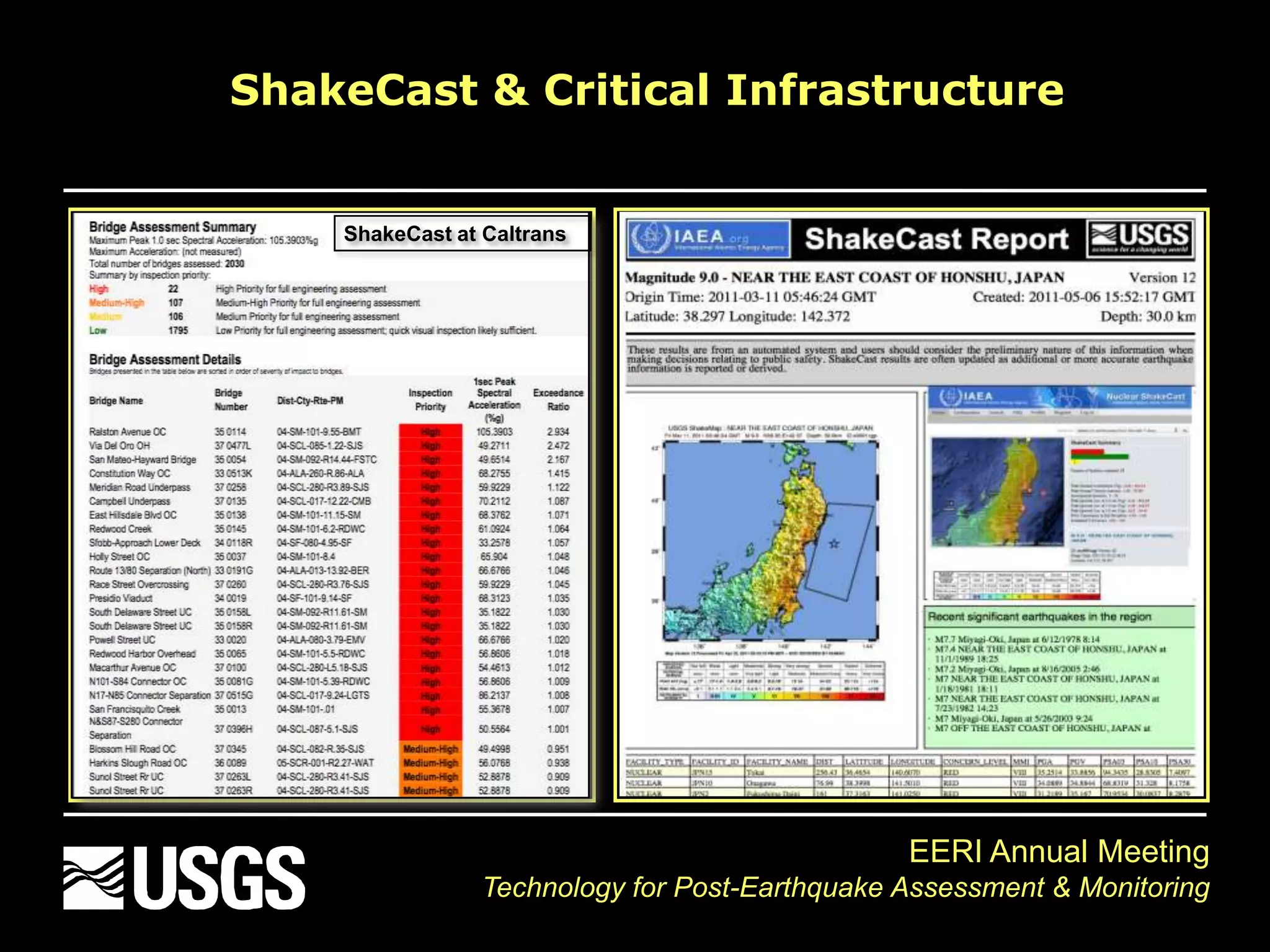
ShakeCast & Critical Infrastructure
EERI Annual Meeting
Technology for Post-Earthquake Assessment & Monitoring
ShakeCast at Caltrans
ShakeMap Response Regions
Mag>3.5
SC
NC
Utah
PNW
HI
AK
AK
NV
HI
AK
NV
Mag>3.5
Mag>4.0
Italy (INGV)
Switzerland
Iceland
Indonesia
(BKMG)
! "#$%"&' ( ) *+$%"&,,
- . "/) 0 "1,
23 1&) 3 ) %4"#$%5,
6$748*"&,920 :,
2%5#484$,; ) ,
0 ) 4) $7$&$*+",Iran (IIEES)
France/Spain (BRGM/IGC)
Romania (NIEP)
Global
ShakeMap
(USGS)
ShakeCast input: ShakeMap grid.xml file
Values at each lat/long grid cell:
Ground motion estimates:
• Intensity (MMI)
• Peak ground acceleration (PGA)
• Peak ground velocity (PGV)
• Spectral response at 0.3, 1, 3 sec.
Metadata:
• Vs30
• Ground motion uncertainty (sigma)
Lon Lat PGA PGV MMI SA.3 SA1 SA3 Sigma Vs30
ShakeMap/ShakeCast Flowchart
Internet
Internet
JSON
CommunicationLayer
ApplicationAPI
Data Analysis API
User IT Infrastructure
ShakeCast
Plugin Plugin Plugin
User FragilityFacility
User Interface
Third-Party
Programs
(ROVER, Marconi)
ShakeMap and
Other Earthquake
Products
ShakeCast
Notifications
ShakeCast Version 3 System Diagram
ShakeCast Updated User Interface (V3)
using Responsive Web Design
Key ShakeCast Products
Summary PDF
Summary
Email
Web User
Interface
Default or User Defined
Damage States
Fragility information in look-up tables
that contain discrete ground-motion
thresholds between damage states
HAZUS high-code model
building types
Can be based on:
• Peak ground acceleration (PGA)
• Peak ground velocity (PGV)
• Spectral response at 0.3, 1, 3 sec.
• Intensity (MMI)
24
ShakeCast
Threshold
Caltrans Bridge Fragilities
Basöz and Mander/HAZUS
CommunicationLayer
ApplicationAPI
Data Analysis API
User IT Infrastructure
ShakeCast
Plugin Plugin Plugin
User FragilityFacility
User Interface
Third-Party
Programs
(ROVER, Marconi)
ShakeMap and
Other Earthquake
Products
ShakeCast
Notifications
ShakeCast Probabilistic Fragility Analysis
Damage Function Probabilistic Fragility Analysis
The probability of each structural damage state for a
given facility is expressed as a function of IM:
ds = 0
1 <= ds <= n-1
ds = n
where
is the probability of structural
damage state ds for a given IM.
Facility damage functions are in the form of lognormal
fragility curves that relates the probability of being in,
or exceeding, a damage state for a given intensity
measure parameter. The probability that structural
damage reaches or exceeds a specific damage state, ds,
for a given intensity measure, IM, is approximated as a
cumulative lognormal distribution function:
Damage State Probability
Accounting Data Variability
Best Estimate Damage Levels for Rapid Notification















dsds
IM
IMdsP

ln
1
]|[
where
is the median value of input intensity measure
at which the structure reaches the threshold of the
damage state ds,
is the standard deviation of nature logarithm for
the damage state ds, and
is standard cumulative lognormal distribution
function.
ds
ds

 
IM
x dximxfxIMdsDSPIMdsDSP ),;(]|[]|[ 
where
is the probability density function of
intensity measure im and
is the uncertainty for intensity measure im.
),( imfim

]|0[1]|[ IMDSPIMdsDSP 
]|1[]|[ IMdsDSPIMdsDSP 
]|[ IMnDSP 
]|[ IMdsDSP 
The figure at the bottom is an example showing the
output plot of full fragility analysis for a Caltrans bridge
using a M7.2 San Andreas ShakeMap scenario. In this
example there were three fragility curves defined for the
bridge that represent inspection priority: low (filled green
curve), medium (filled yellow curve), and high (filled red
curve). Thus a total of four damage state probability
estimates were produced (histogram) as a result; high
inspection priority is the state of highest probability.
ShakeCast statistical fragility analysis plot
Probability Distribution
for the Input Motion
Input Motion
Lin & Wald (2012) 15WCEE
Caltrans Advanced Bridge Fragility in ShakeCast
Caltrans Generation 2 Fragility (g2F)
Slide courtesy of L. Turner, Caltrans
HAZUS – System Level
Fragility (ShakeCast v2)g2F – System Level
Fragility (ShakeCast v3)
Columns
Seats
Restrainers
BearingsJoints
Approach
Implementation of Probabilistic
Fragility Analysis
• Implement full
statistical interpretation
of fragility curves.
• Implement a
component-based
fragility analysis
framework.
• Provide summary for
inspection priority for
key components.
CommunicationLayer
ApplicationAPI
Data Analysis API
User IT Infrastructure
ShakeCast
Plugin Plugin Plugin
User FragilityFacility
User Interface
Third-Party
Programs
(ROVER, Marconi)
ShakeMap and
Other Earthquake
Products
ShakeCast
Notifications
Rule-based
Fragility Criteria
Predefined rule set determining the level
of concern that ties directly with the
users’ post-earthquake response protocol
Nuclear ShakeCast Regulatory Criteria (USNRC & IAEA)
Regulatory Level “worker”
• SL1/OBE Exceedance
• SL2/SSE Exceedance
• RG 1.166A Exceedance
• Magnitude (>5.0) & Distance
(<200KM) Check
• Felt (M>6.0 & MMI II) Check
• Felt on Site (MMI IV) Check
Plugin
CommunicationLayer
ApplicationAPI
Data Analysis API
User IT Infrastructure
ShakeCast
Plugin Plugin Plugin
User FragilityFacility
User Interface
Third-Party
Programs
(ROVER, Marconi)
ShakeMap and
Other Earthquake
Products
ShakeCast
Notifications
ShakeMap Atlas
• All available data (ground
motion, intensity, fault)
• Site conditions from
topographic-slope proxy
• Standard ShakeMap
approach to combine
observed, estimated
shaking
• Uses other than PAGER:
GEM, loss estimation,
secondary hazards,
insurance, mitigation,
response planning, …
ShakeMap Atlas 2.0:
>10,000 Earthquakes
[1973 – 2011]
10
10
10
10
10
10
10
10
10
10
10
1010
10
10
10
20
2020
20 30
30
30
40 40
40
40
50
60
70
80
Secondary Hazards:
Landslides
Liquefaction
USGS Peak Accel. Map (in %g) : Northridge, California
JAN 17 1994 12:30:55 AM GMT M 6.7 N34.21 W118.54 Depth: 19.0km ID:199401171230
Map Version 1 Processed Fri Jun 15, 2012 02:39:00 PM MDT
INSTRUMENTAL
INTENSITY
PEAK ACC.(%g)
I II−III IV V VI VII VIII IX X+
<0.05 0.3 2.8 6.2 12 22 40 75 >139
Scale based upon Worden et al. (2011)
−119˚ −118˚
33.5˚
34˚
34.5˚
35˚
0 50
km
15
15
15
15
15
15
15
15
15
15
15
15
15
15
15
15
15
30
30
30
30
30
30
30
45
45
45
45
60
6060
60
60
75
75
75
90
90
105
Secondary Hazards:
Landslides
USGS Peak Accel. Map (in %g) : Wenchuan, China
MAY 12 2008 06:28:01 AM GMT M 7.9 N30.99 E103.36 Depth: 19.0km ID:200805120628
Map Version 1 Processed Mon Jun 18, 2012 02:31:03 PM MDT
INSTRUMENTAL
INTENSITY
PEAK ACC.(%g)
I II−III IV V VI VII VIII IX X+
<0.05 0.3 2.8 6.2 12 22 40 75 >139
Scale based upon Worden et al. (2011)
103˚ 104˚ 105˚ 106˚
30˚
30.5˚
31˚
31.5˚
32˚
32.5˚
33˚
0 50
km
Beichuan, China, 2008
Secondary Hazards
Wenchuan, China
Mw 7.9. 2008
Liquefaction
Candidate Explanatory Variables (Global Application)
Landslides
Static load Susceptibility Shaking Intensity
Slope (from Topog.) [Lithology, Geology] ShakeMap (PGA)
[From Zhu et al. (2012)]
[From Nowicki et al. (2012)
Soil Strength Saturation Shaking Intensity
Vs30 (from slope) “CTI or Wetness Index” (PGA)
2011 Christchurch, New Zealand (M6.3)
Logistic Regression for Liquefaction Probability
J. Zhu, E.Thompson & L. Baise, Wald, & Knudsen, 2013]
[Courtesy of Sang-Ho Yun, JPL]
Liquefaction
InSAR
LIDAR
Optical
GPS
Population
Landslides
Building
Damage or
Collapse
Distribution of high
Landslide likelihood
Fatality distribution
Distribution of high
Liquefaction likelihood
Peak Acceleration
Slope & Geology
Finite Fault
Vegetation?
Landslides?
Liquefaction?
Ground
deformation?
Collapse?
Inundation?
PAGERALERT
?
Strategy for Incorporating
Remotely-sensed imagery
into impact Assessment
REPAIR Project: USGS, JPL, & Caltech
• Low-cost instrument at user’s facility, maintained by
USGS,
• Data processed in real-time, parametric data go directly
into ShakeMap,
• ShakeCast damage
assessment site-specific, based on recordings at user’s
facility,
• User accessible
seismograph.
40
USGS NetQuakes
41
CommunicationLayer
ApplicationAPI
Data Analysis API
User IT Infrastructure
ShakeCast
Plugin Plugin Plugin
User FragilityFacility
User Interface
Third-Party
Programs
(ROVER, Marconi)
ShakeMap and
Other Earthquake
Products
ShakeCast
Notifications
Independent
Sensors &
Ground Motion
recordings
J
ShakeCast Seattle Workshop Attendees... January, 2012
Example ShakeCast User Sectors, Users, Uses
NRC
ShakeCast: Example Critical Users
California Department of Transportation
Coverage: California (Uses CISN’s NC & SC ShakeMap)
Facilties: ~20,000 overpasses & bridges statewide
Fragilites: SA(T), HAZUS capacity-spectrum approach based on very
detailed NBI inventory + Caltrans specifications.
Usage: Bridge inspection priority after earthquakes. >300 users
within Caltrans.
Status: Fully Operational
Contact: Loren Turner, PE, Senior Bridge Engineer, Sacramento.
 Integrated into Caltran response protocols.
 Over 300 current subscribers to ShakeCast:
◦ Structure Maintenance & Investigations inspectors (SM&I)
◦ Earthquake Engineering staff & managers
◦ Members of the Post EQ Investigations Team (PEQIT)
◦ Structures Construction inspectors & managers
◦ Geotechnical Services staff and managers
◦ District Traffic Management Center (TMC) managers & staff
◦ District Emergency Operations Center (EOC) managers
◦ Caltrans Upper Management, including the Director & some
Deputy Directors
Slide courtesy of L. Turner, Caltrans
ShakeCast identified the
only bridge damaged in
this event as the top
priority for inspection.
Slide courtesy of L. Turner, Caltrans
4
9
Coverage: LAUSD (City of LA: LA Basin/SF/SG Valleys)
Facilities: 1096 Schools/Office locations monitored
Fragilities: MMI, working on building-specific HAZUS types
Usage: Generate priority list for initial support & inspection; prioritize
possible schools that can receive displaced students; clarify
locations for Red Cross Shelters.
Status: Operational; remotely served by Amazon cloud service
Contact: Bob Spears, Director Office of Emergency Services
Los Angeles Unified School District
ShakeCast: Example Critical Users
[LAUSD serves 740,000 students; 80,000 employees, $7B annual
budget, serves 500,000 lunches per day!]
East Bay Metropolitan Utility District (EBMUD)
ShakeCast: Example Critical Users
Use Sector: Critical Lifeline Utility, Government
Coverage: San Francisco East Bay Area
Facilities: hundreds of dams, pipelines,
control bldgs., facility structures
Fragilities: Custom
Usage: Situational awareness
Status: Operational
Contact: Xavier Arias,
Dir. Engineering & Construction
EBMUD
Pipelines (blue)
Walmart
ShakeCast: Example Critical Users
Use Sector: Private sector, Commerce, Transportation
Coverage: Domestic & global
Facilities: 4,200+ retail outlets, 148 dist. centers, 50 corp. facilties,
1.6+ million assoc. in 50 states; as many more globally
Fragilities: Intensity-based
Usage: Situational awareness for Walmart EO/headquarters;
“Taking care of our people, operations, communities”
Status: Operational
Contact: Lucas McDonald, Emergency Operations Manager
3
Where We Operate
United States
•1.6+ Million associates in 50 States
•4,200+ Retail Outlets
•148 Distribution Centers
•50+ Corporate Facilities
Slide courtesy of L. McDonald, Walmart
Degenkolb
ShakeCast: Example Critical Users
Use Sector: Private, Engineering
Coverage: Hospitals, various engineered structures
Facilities: Hospitals, engineered structures; portfolios
Fragilities: SA(T); HAZUS (capacity spectrum); custom
Usage: Post earthquake evaluation, inspection,
priorities, as a customer service
Status: Operational & development
Contact: M. Hachem, Associate Principal
– In-situ monitoring: full-blown & smart sensor
– Remote sensing: image processed (or crowd-sourced)
– Ground-truth: expert; aggregated media/social media
– Recorded/modeled: e.g., ShakeMap  ShakeCast/PAGER
– A combination of all of the above!
Post-Earthquake Assessment Strategies
56
California Department of Transportation
Sponsors
ShakeCast Project Support
5
7
California Department of Transportation
U.S. Nuclear Regulatory Commission
International Atomic Energy Agency
U.S. Department of Veterans Affairs
• Software:
http://earthquake.usgs.gov/shakecast/
• ShakeCast Help Line
Shakecast-help@usgs.gov
• ShakeCast Community Support Mailing List
https://geohazards.usgs.gov/mailman/listinfo/shakecast-
users
• ShakeCast Wiki
https://my.usgs.gov/ShakeCastWiki/
58
ShakeCast Documents/Support
Acknowledgments
ShakeMap
• R&D, software support by Bruce Worden (Pasadena)
• Operations, support & development by Kuo-Wan Lin
• Operations of ShakeMap by NEIC, CISN, & other ANSS
regional networks: USGS, CIT, BKS, UW, UU, UNR, UM, UAF, …)
ShakeCast
• Development by Kuo-wan Lin, w/ Travis LaWall, Ft. Collins, CO.
• User support by Travis LaWall
• Loren Turner (& Cliff Roblee), Trans. Engineers, Caltrans
• Annie Kammerer, USNRC
PAGER
• Kishor Jaiswal (USGS/NEIC), Engineering/Loss Model Development
• Programming & support, Mike Hearne, Kristin Marano, USGS

Post–Real Time Post-Earthquake Impact Assessment and Response Prioritization - David Wald

  • 1.
    David Wald U.S. GeologicalSurvey Golden, Colorado Kuo-Wan Lin & Kishor Jaiswal U.S. Geological Survey Loren Turner Caltrans, Sacramento USGS National Earthquake Information Center, Golden, Colorado Post–Real Time Post-Earthquake Impact Assessment and Response Prioritization
  • 2.
     In-situ monitoring:full-blown, smart sensors  Ground-truthing: expert; aggregated media/social media  Remote sensing: image processed (or crowd-sourced)  Estimating: e.g., ShakeMap  ShakeCast/PAGER/HAZUS  Combinating of all of the above! Post-Earthquake Assessment Strategies
  • 3.
     In-situ monitoring:full-blown, smart sensors  Ground-truthing: expert; aggregated media/social media  Remote sensing: image processed (or crowd-sourced)  Estimating: e.g., ShakeMap  ShakeCast/PAGER/HAZUS  Combining of all of the above! Post-Earthquake Assessment Strategies Multichannel (e.g., USGS@VA Hospitals); wireless, MEMS sensor, GPS, strain meters Radar Interferometry (image changes; ARIA/Sang-ho Yun, this meeting); imagery (Geo-Can/Haiti) 911; news & social media aggregators, DYFI?, disaster forensics (CEDIM), LFE/GEER & others’ recon Fast, automatic, ubiquitous. Rapid; high-quality, research grade, but expensive, state-of-health tools & deployment of sensors limited Latency is an issue; highly variable. High resolution, but quality of interpretation limited but improving. Snap-shots. Incomplete or long latency. Quality & scope of aggregated data maybe insufficient. Approximate. Limited by lack of recordings & info on structure, vulnerability, demographic data.
  • 4.
    PAGER (Prompt Assessmentof Global Earthquakes for Response) ShakeMap“Did You Feel It?” ShakeCast
  • 6.
  • 7.
    2010 M7.0 Haiti 2010M8.8 Chile UCB – Unreinforced concrete block masonry & low rise non-ductile concrete frame W or INF – Light timber or steel frame (informal/makeshift type) M – Mud wall construction RM & RM2L – Reinforced masonry (commonly low-rise) and masonry with frames (dual) RS – Rubble stone masonry (hybrid) S2 – Steel frame A – Adobe block PAGER estimates of buildings contributing to casualties Note: color scheme applies to different buildings for Chile & Haiti K. Jaiswal & EERI/WHE (2013)
  • 8.
    ShakeCast & CriticalInfrastructure EERI Annual Meeting Technology for Post-Earthquake Assessment & Monitoring ShakeCast at Caltrans
  • 10.
  • 11.
    Italy (INGV) Switzerland Iceland Indonesia (BKMG) ! "#$%"&'( ) *+$%"&,, - . "/) 0 "1, 23 1&) 3 ) %4"#$%5, 6$748*"&,920 :, 2%5#484$,; ) , 0 ) 4) $7$&$*+",Iran (IIEES) France/Spain (BRGM/IGC) Romania (NIEP) Global ShakeMap (USGS)
  • 12.
    ShakeCast input: ShakeMapgrid.xml file Values at each lat/long grid cell: Ground motion estimates: • Intensity (MMI) • Peak ground acceleration (PGA) • Peak ground velocity (PGV) • Spectral response at 0.3, 1, 3 sec. Metadata: • Vs30 • Ground motion uncertainty (sigma) Lon Lat PGA PGV MMI SA.3 SA1 SA3 Sigma Vs30
  • 13.
  • 14.
    CommunicationLayer ApplicationAPI Data Analysis API UserIT Infrastructure ShakeCast Plugin Plugin Plugin User FragilityFacility User Interface Third-Party Programs (ROVER, Marconi) ShakeMap and Other Earthquake Products ShakeCast Notifications ShakeCast Version 3 System Diagram
  • 15.
    ShakeCast Updated UserInterface (V3) using Responsive Web Design
  • 17.
    Key ShakeCast Products SummaryPDF Summary Email Web User Interface
  • 19.
    Default or UserDefined Damage States Fragility information in look-up tables that contain discrete ground-motion thresholds between damage states HAZUS high-code model building types Can be based on: • Peak ground acceleration (PGA) • Peak ground velocity (PGV) • Spectral response at 0.3, 1, 3 sec. • Intensity (MMI)
  • 20.
  • 21.
    CommunicationLayer ApplicationAPI Data Analysis API UserIT Infrastructure ShakeCast Plugin Plugin Plugin User FragilityFacility User Interface Third-Party Programs (ROVER, Marconi) ShakeMap and Other Earthquake Products ShakeCast Notifications
  • 22.
    ShakeCast Probabilistic FragilityAnalysis Damage Function Probabilistic Fragility Analysis The probability of each structural damage state for a given facility is expressed as a function of IM: ds = 0 1 <= ds <= n-1 ds = n where is the probability of structural damage state ds for a given IM. Facility damage functions are in the form of lognormal fragility curves that relates the probability of being in, or exceeding, a damage state for a given intensity measure parameter. The probability that structural damage reaches or exceeds a specific damage state, ds, for a given intensity measure, IM, is approximated as a cumulative lognormal distribution function: Damage State Probability Accounting Data Variability Best Estimate Damage Levels for Rapid Notification                dsds IM IMdsP  ln 1 ]|[ where is the median value of input intensity measure at which the structure reaches the threshold of the damage state ds, is the standard deviation of nature logarithm for the damage state ds, and is standard cumulative lognormal distribution function. ds ds    IM x dximxfxIMdsDSPIMdsDSP ),;(]|[]|[  where is the probability density function of intensity measure im and is the uncertainty for intensity measure im. ),( imfim  ]|0[1]|[ IMDSPIMdsDSP  ]|1[]|[ IMdsDSPIMdsDSP  ]|[ IMnDSP  ]|[ IMdsDSP  The figure at the bottom is an example showing the output plot of full fragility analysis for a Caltrans bridge using a M7.2 San Andreas ShakeMap scenario. In this example there were three fragility curves defined for the bridge that represent inspection priority: low (filled green curve), medium (filled yellow curve), and high (filled red curve). Thus a total of four damage state probability estimates were produced (histogram) as a result; high inspection priority is the state of highest probability. ShakeCast statistical fragility analysis plot Probability Distribution for the Input Motion Input Motion Lin & Wald (2012) 15WCEE
  • 23.
    Caltrans Advanced BridgeFragility in ShakeCast Caltrans Generation 2 Fragility (g2F) Slide courtesy of L. Turner, Caltrans HAZUS – System Level Fragility (ShakeCast v2)g2F – System Level Fragility (ShakeCast v3) Columns Seats Restrainers BearingsJoints Approach
  • 24.
    Implementation of Probabilistic FragilityAnalysis • Implement full statistical interpretation of fragility curves. • Implement a component-based fragility analysis framework. • Provide summary for inspection priority for key components.
  • 25.
    CommunicationLayer ApplicationAPI Data Analysis API UserIT Infrastructure ShakeCast Plugin Plugin Plugin User FragilityFacility User Interface Third-Party Programs (ROVER, Marconi) ShakeMap and Other Earthquake Products ShakeCast Notifications
  • 26.
    Rule-based Fragility Criteria Predefined ruleset determining the level of concern that ties directly with the users’ post-earthquake response protocol Nuclear ShakeCast Regulatory Criteria (USNRC & IAEA) Regulatory Level “worker” • SL1/OBE Exceedance • SL2/SSE Exceedance • RG 1.166A Exceedance • Magnitude (>5.0) & Distance (<200KM) Check • Felt (M>6.0 & MMI II) Check • Felt on Site (MMI IV) Check Plugin
  • 27.
    CommunicationLayer ApplicationAPI Data Analysis API UserIT Infrastructure ShakeCast Plugin Plugin Plugin User FragilityFacility User Interface Third-Party Programs (ROVER, Marconi) ShakeMap and Other Earthquake Products ShakeCast Notifications
  • 28.
    ShakeMap Atlas • Allavailable data (ground motion, intensity, fault) • Site conditions from topographic-slope proxy • Standard ShakeMap approach to combine observed, estimated shaking • Uses other than PAGER: GEM, loss estimation, secondary hazards, insurance, mitigation, response planning, … ShakeMap Atlas 2.0: >10,000 Earthquakes [1973 – 2011]
  • 29.
    10 10 10 10 10 10 10 10 10 10 10 1010 10 10 10 20 2020 20 30 30 30 40 40 40 40 50 60 70 80 SecondaryHazards: Landslides Liquefaction USGS Peak Accel. Map (in %g) : Northridge, California JAN 17 1994 12:30:55 AM GMT M 6.7 N34.21 W118.54 Depth: 19.0km ID:199401171230 Map Version 1 Processed Fri Jun 15, 2012 02:39:00 PM MDT INSTRUMENTAL INTENSITY PEAK ACC.(%g) I II−III IV V VI VII VIII IX X+ <0.05 0.3 2.8 6.2 12 22 40 75 >139 Scale based upon Worden et al. (2011) −119˚ −118˚ 33.5˚ 34˚ 34.5˚ 35˚ 0 50 km
  • 30.
    15 15 15 15 15 15 15 15 15 15 15 15 15 15 15 15 15 30 30 30 30 30 30 30 45 45 45 45 60 6060 60 60 75 75 75 90 90 105 Secondary Hazards: Landslides USGS PeakAccel. Map (in %g) : Wenchuan, China MAY 12 2008 06:28:01 AM GMT M 7.9 N30.99 E103.36 Depth: 19.0km ID:200805120628 Map Version 1 Processed Mon Jun 18, 2012 02:31:03 PM MDT INSTRUMENTAL INTENSITY PEAK ACC.(%g) I II−III IV V VI VII VIII IX X+ <0.05 0.3 2.8 6.2 12 22 40 75 >139 Scale based upon Worden et al. (2011) 103˚ 104˚ 105˚ 106˚ 30˚ 30.5˚ 31˚ 31.5˚ 32˚ 32.5˚ 33˚ 0 50 km Beichuan, China, 2008 Secondary Hazards Wenchuan, China Mw 7.9. 2008
  • 31.
    Liquefaction Candidate Explanatory Variables(Global Application) Landslides Static load Susceptibility Shaking Intensity Slope (from Topog.) [Lithology, Geology] ShakeMap (PGA) [From Zhu et al. (2012)] [From Nowicki et al. (2012) Soil Strength Saturation Shaking Intensity Vs30 (from slope) “CTI or Wetness Index” (PGA)
  • 33.
    2011 Christchurch, NewZealand (M6.3) Logistic Regression for Liquefaction Probability J. Zhu, E.Thompson & L. Baise, Wald, & Knudsen, 2013]
  • 34.
  • 35.
    Liquefaction InSAR LIDAR Optical GPS Population Landslides Building Damage or Collapse Distribution ofhigh Landslide likelihood Fatality distribution Distribution of high Liquefaction likelihood Peak Acceleration Slope & Geology Finite Fault Vegetation? Landslides? Liquefaction? Ground deformation? Collapse? Inundation? PAGERALERT ? Strategy for Incorporating Remotely-sensed imagery into impact Assessment REPAIR Project: USGS, JPL, & Caltech
  • 36.
    • Low-cost instrumentat user’s facility, maintained by USGS, • Data processed in real-time, parametric data go directly into ShakeMap, • ShakeCast damage assessment site-specific, based on recordings at user’s facility, • User accessible seismograph. 40 USGS NetQuakes
  • 37.
  • 38.
    CommunicationLayer ApplicationAPI Data Analysis API UserIT Infrastructure ShakeCast Plugin Plugin Plugin User FragilityFacility User Interface Third-Party Programs (ROVER, Marconi) ShakeMap and Other Earthquake Products ShakeCast Notifications Independent Sensors & Ground Motion recordings
  • 40.
    J ShakeCast Seattle WorkshopAttendees... January, 2012
  • 41.
    Example ShakeCast UserSectors, Users, Uses
  • 42.
    NRC ShakeCast: Example CriticalUsers California Department of Transportation Coverage: California (Uses CISN’s NC & SC ShakeMap) Facilties: ~20,000 overpasses & bridges statewide Fragilites: SA(T), HAZUS capacity-spectrum approach based on very detailed NBI inventory + Caltrans specifications. Usage: Bridge inspection priority after earthquakes. >300 users within Caltrans. Status: Fully Operational Contact: Loren Turner, PE, Senior Bridge Engineer, Sacramento.
  • 43.
     Integrated intoCaltran response protocols.  Over 300 current subscribers to ShakeCast: ◦ Structure Maintenance & Investigations inspectors (SM&I) ◦ Earthquake Engineering staff & managers ◦ Members of the Post EQ Investigations Team (PEQIT) ◦ Structures Construction inspectors & managers ◦ Geotechnical Services staff and managers ◦ District Traffic Management Center (TMC) managers & staff ◦ District Emergency Operations Center (EOC) managers ◦ Caltrans Upper Management, including the Director & some Deputy Directors Slide courtesy of L. Turner, Caltrans
  • 44.
    ShakeCast identified the onlybridge damaged in this event as the top priority for inspection. Slide courtesy of L. Turner, Caltrans
  • 45.
  • 46.
    Coverage: LAUSD (Cityof LA: LA Basin/SF/SG Valleys) Facilities: 1096 Schools/Office locations monitored Fragilities: MMI, working on building-specific HAZUS types Usage: Generate priority list for initial support & inspection; prioritize possible schools that can receive displaced students; clarify locations for Red Cross Shelters. Status: Operational; remotely served by Amazon cloud service Contact: Bob Spears, Director Office of Emergency Services Los Angeles Unified School District ShakeCast: Example Critical Users [LAUSD serves 740,000 students; 80,000 employees, $7B annual budget, serves 500,000 lunches per day!]
  • 47.
    East Bay MetropolitanUtility District (EBMUD) ShakeCast: Example Critical Users Use Sector: Critical Lifeline Utility, Government Coverage: San Francisco East Bay Area Facilities: hundreds of dams, pipelines, control bldgs., facility structures Fragilities: Custom Usage: Situational awareness Status: Operational Contact: Xavier Arias, Dir. Engineering & Construction EBMUD Pipelines (blue)
  • 48.
    Walmart ShakeCast: Example CriticalUsers Use Sector: Private sector, Commerce, Transportation Coverage: Domestic & global Facilities: 4,200+ retail outlets, 148 dist. centers, 50 corp. facilties, 1.6+ million assoc. in 50 states; as many more globally Fragilities: Intensity-based Usage: Situational awareness for Walmart EO/headquarters; “Taking care of our people, operations, communities” Status: Operational Contact: Lucas McDonald, Emergency Operations Manager
  • 49.
    3 Where We Operate UnitedStates •1.6+ Million associates in 50 States •4,200+ Retail Outlets •148 Distribution Centers •50+ Corporate Facilities Slide courtesy of L. McDonald, Walmart
  • 50.
    Degenkolb ShakeCast: Example CriticalUsers Use Sector: Private, Engineering Coverage: Hospitals, various engineered structures Facilities: Hospitals, engineered structures; portfolios Fragilities: SA(T); HAZUS (capacity spectrum); custom Usage: Post earthquake evaluation, inspection, priorities, as a customer service Status: Operational & development Contact: M. Hachem, Associate Principal
  • 51.
    – In-situ monitoring:full-blown & smart sensor – Remote sensing: image processed (or crowd-sourced) – Ground-truth: expert; aggregated media/social media – Recorded/modeled: e.g., ShakeMap  ShakeCast/PAGER – A combination of all of the above! Post-Earthquake Assessment Strategies
  • 52.
  • 53.
    Sponsors ShakeCast Project Support 5 7 CaliforniaDepartment of Transportation U.S. Nuclear Regulatory Commission International Atomic Energy Agency U.S. Department of Veterans Affairs
  • 54.
    • Software: http://earthquake.usgs.gov/shakecast/ • ShakeCastHelp Line Shakecast-help@usgs.gov • ShakeCast Community Support Mailing List https://geohazards.usgs.gov/mailman/listinfo/shakecast- users • ShakeCast Wiki https://my.usgs.gov/ShakeCastWiki/ 58 ShakeCast Documents/Support
  • 55.
    Acknowledgments ShakeMap • R&D, softwaresupport by Bruce Worden (Pasadena) • Operations, support & development by Kuo-Wan Lin • Operations of ShakeMap by NEIC, CISN, & other ANSS regional networks: USGS, CIT, BKS, UW, UU, UNR, UM, UAF, …) ShakeCast • Development by Kuo-wan Lin, w/ Travis LaWall, Ft. Collins, CO. • User support by Travis LaWall • Loren Turner (& Cliff Roblee), Trans. Engineers, Caltrans • Annie Kammerer, USNRC PAGER • Kishor Jaiswal (USGS/NEIC), Engineering/Loss Model Development • Programming & support, Mike Hearne, Kristin Marano, USGS

Editor's Notes

  • #8 SHAKEMAP IS BASIC INPUTSHAKECAST FOR SITE-SPECIFIC estimates of loss/inspection priority at a PORTFOLIO of facilities/buildings&amp; PAGER FOR GLOBAL VIEW (Literally and figurative)
  • #12 For example, we are working on producing charts of which structure are likely to dominate response and recovery, and which culprit buildings will be the source of fatalities &amp; USAR.We are currently working with funding from USAID to provide USAR what they need in terms of structural information. We are working with USAID/OFDA and the LA/Fairfax teams to improve this product.So here we are going to need more building-specific information.
  • #18 ShakeCast is intended more for major utilities and companies, Like Caltrans who have major exposure and need to prioritize response. ShakeCast runs completely in the background, automatically, downloads the ShakeMap, computes the shaking and likelihood of damage at the users’ facilities and sends out notifications to the users response team.
  • #36 Predictor variables, Explanatory variables.
  • #40 Predictor variables, Explanatory variables.
  • #43 In the grand scheme of things, integrating independent smart-sensor, facility specific data is possible with ShakeCast, but we’ve kept it rather simple due to the scope of the problem.SC can take independent SGM data and treat those observations as better quality than a ShakeMap, but as an entity providing ShakeMap, it’s even more beneficial if site observations are also incorporated into ShakeMap for the greater good. It’s also easier to set the standards and data flow this way.
  • #44 Oakland, CA, ShakeCast Workshop
  • #45 Doug Wilson, Senior Facilities Engineer, Snohomish County Public Utility District
  • #48 Integrated means, documented and institualionalized in the post-earthquake response environment.
  • #52 Walmart is basically one of the worlds most impressive trucking/shipping companies.
  • #53 Walmart is basically one of the worlds most impressive distribution companies.
  • #58 Primary funding from USGS and these sponsors. Caltrans has been fundamentally generous in promoting the openness of the development made with their funds and use of ShakeCast by any interested partners.