PostPartum hyPertension
Ali Bendary
Assistant Lecturer Of Obstetrics & Gynecology
Benha University Hospitals
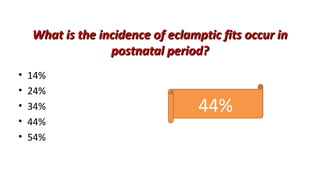
What is the incidence of eclamptic fits occur inWhat is the incidence of eclamptic fits occur in
postnatal period?postnatal period?
• 14%
• 24%
• 34%
• 44%
• 54%
44%
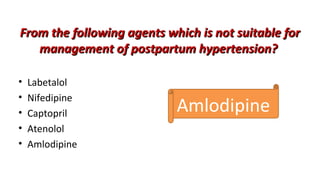
From the following agents which is not suitable forFrom the following agents which is not suitable for
management of postpartum hypertension?management of postpartum hypertension?
• Labetalol
• Nifedipine
• Captopril
• Atenolol
• Amlodipine
Amlodipine
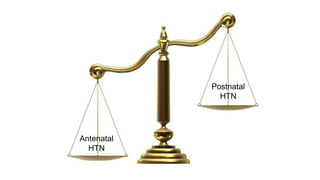
Antenatal
HTN
Postnatal
HTN
• What is the normal physiology of
blood pressure postpartum?
• What is the evidences and prevalence
of such condition?
• Which considerations should be taken
when prescribe drugs?
• How to manage ongoing postnatal
hypertension?
scoPescoPe
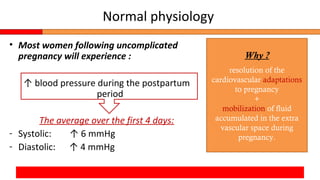
Normal physiology
• Most women following uncomplicated
pregnancy will experience :
↑ blood pressure during the postpartum
period
The average over the first 4 days:
- Systolic: ↑ 6 mmHg
- Diastolic: ↑ 4 mmHg
Why ?
resolution of the
cardiovascular adaptations
to pregnancy
+
mobilization of fluid
accumulated in the extra
vascular space during
pregnancy.
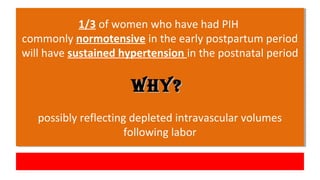
1/3 of women who have had PIH
commonly normotensive in the early postpartum period
will have sustained hypertension in the postnatal period
Why?Why?
possibly reflecting depleted intravascular volumes
following labor
1/3 of women who have had PIH
commonly normotensive in the early postpartum period
will have sustained hypertension in the postnatal period
Why?Why?
possibly reflecting depleted intravascular volumes
following labor
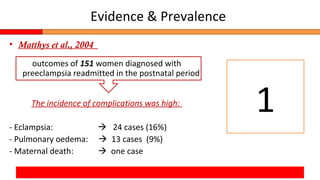
Evidence & Prevalence
• Matthys et al., 2004
outcomes of 151 women diagnosed with
preeclampsia readmitted in the postnatal period
The incidence of complications was high:
- Eclampsia:  24 cases (16%)
- Pulmonary oedema:  13 cases (9%)
- Maternal death:  one case
1
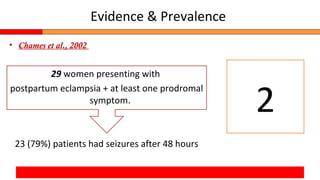
Evidence & Prevalence
• Chames et al., 2002
29 women presenting with
postpartum eclampsia + at least one prodromal
symptom.
23 (79%) patients had seizures after 48 hours
2
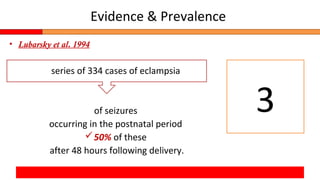
Evidence & Prevalence
• Lubarsky et al. 1994
series of 334 cases of eclampsia
of seizures
occurring in the postnatal period
50% of these
after 48 hours following delivery.
3
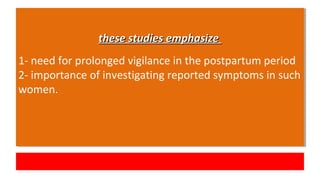
these studies emphasizethese studies emphasize
1- need for prolonged vigilance in the postpartum period
2- importance of investigating reported symptoms in such
women.
these studies emphasizethese studies emphasize
1- need for prolonged vigilance in the postpartum period
2- importance of investigating reported symptoms in such
women.
Considerations of antihypertensive agents
1. Effectively control blood pressure without
diurnal peaks and falls
2. Will have minimal maternal side effects
3. Safe for breastfeeding infants
4. Effective with once or twice daily dosing to
maximize compliance
Magee L, Sadeghi S. Prevention and treatment of postpartum hypertension. Cochrane
Database Syst Rev 2005;
Due to the paucity of data, it is difficult to recommend one
antihypertensive agent over another
Ideal anti-
HTN
agent ?
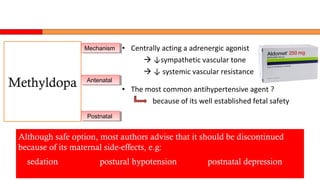
• Centrally acting a adrenergic agonist
 ↓sympathetic vascular tone
 ↓ systemic vascular resistance
• The most common antihypertensive agent ?
because of its well established fetal safety
Although safe option, most authors advise that it should be discontinued
because of its maternal side-effects, e.g:
sedation postural hypotension postnatal depression
Methyldopa
MechanismMechanism
AntenatalAntenatal
PostnatalPostnatal
• b2 receptor  peripheral vasodilation
• b1 receptors
cardiac tissue  modulate the sympathetic
response
renal tissue  mediate changes in renin synthesis
• Aggravate asthma and heart failure
The high lipid solubility of the drug
concentrated in breast milk
raised concerns about transfer to the neonate
however, only a single case of neonatal b-blockade has been reported
B-Blockers
MechanismMechanism
CautionCaution
PostnatalPostnatal
• inhibiting Ca influx into vascular myoctyes
 inhibiting vasoconstriction + ↓ vascular resistance
• Minimal effects on cardiac conduction and heart rate
• minimal excretion into breast milk
Nifedipine (slow release [SR]) is the most
commonly prescribed calcium channel blocker and can
initially be prescribed at a dose of 10–20 mg twice daily
Calcium
Channel
Blockers
MechanismMechanism
BenefitsBenefits
PostnatalPostnatal
• inhibit ACE
 ↓ production of ATII
 ↓ ATII mediated vasoconstriction
They can be associated with adverse fetal outcomes
Enalapril can
be prescribed as a twice-daily dose of 5–20 mg.
Angiotensin
Converting
Enzyme
(ACE)
Inhibitors
MechanismMechanism
AntenatalAntenatal
PostnatalPostnatal
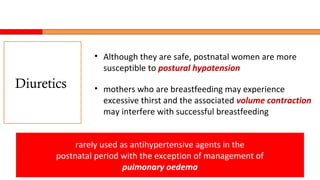
• Although they are safe, postnatal women are more
susceptible to postural hypotension
• mothers who are breastfeeding may experience
excessive thirst and the associated volume contraction
may interfere with successful breastfeeding
rarely used as antihypertensive agents in the
postnatal period with the exception of management of
pulmonary oedema
Diuretics
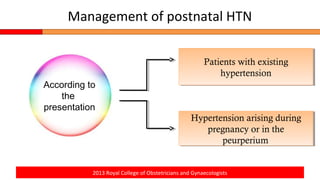
Management of postnatal HTN
2013 Royal College of Obstetricians and Gynaecologists
According to
the
presentation
Patients with existing
hypertension
Patients with existing
hypertension
Hypertension arising during
pregnancy or in the
peurperium
Hypertension arising during
pregnancy or in the
peurperium
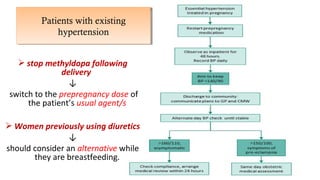
 stop methyldopa following
delivery
↓
switch to the prepregnancy dose of
the patient’s usual agent/s
 Women previously using diuretics
↓
should consider an alternative while
they are breastfeeding.
Patients with existing
hypertension
Patients with existing
hypertension
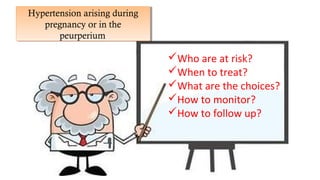
Who are at risk?
When to treat?
What are the choices?
How to monitor?
How to follow up?
Hypertension arising during
pregnancy or in the
peurperium
Hypertension arising during
pregnancy or in the
peurperium
Who are atWho are at
risk?risk?
RCOG, 2013
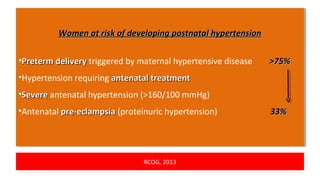
Women at risk of developing postnatal hypertensionWomen at risk of developing postnatal hypertension
•Preterm deliveryPreterm delivery triggered by maternal hypertensive disease >75%>75%
•Hypertension requiring antenatalantenatal treatmenttreatment
•SevereSevere antenatal hypertension (>160/100 mmHg)
•Antenatal pre-eclampsiapre-eclampsia (proteinuric hypertension) 33%33%
Women at risk of developing postnatal hypertensionWomen at risk of developing postnatal hypertension
•Preterm deliveryPreterm delivery triggered by maternal hypertensive disease >75%>75%
•Hypertension requiring antenatalantenatal treatmenttreatment
•SevereSevere antenatal hypertension (>160/100 mmHg)
•Antenatal pre-eclampsiapre-eclampsia (proteinuric hypertension) 33%33%
When toWhen to
start?start?
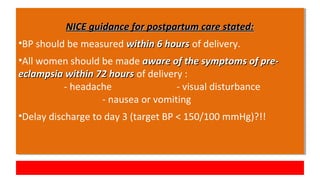
NICE guidance for postpartum care stated:NICE guidance for postpartum care stated:
•BP should be measured within 6 hourswithin 6 hours of delivery.
•All women should be made aware of the symptoms of pre-aware of the symptoms of pre-
eclampsia within 72 hourseclampsia within 72 hours of delivery :
- headache - visual disturbance
- nausea or vomiting
•Delay discharge to day 3 (target BP < 150/100 mmHg)?!!
NICE guidance for postpartum care stated:NICE guidance for postpartum care stated:
•BP should be measured within 6 hourswithin 6 hours of delivery.
•All women should be made aware of the symptoms of pre-aware of the symptoms of pre-
eclampsia within 72 hourseclampsia within 72 hours of delivery :
- headache - visual disturbance
- nausea or vomiting
•Delay discharge to day 3 (target BP < 150/100 mmHg)?!!
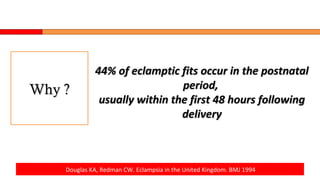
44% of eclamptic fits occur in the postnatal44% of eclamptic fits occur in the postnatal
period,period,
usually within the first 48 hours followingusually within the first 48 hours following
deliverydelivery
Douglas KA, Redman CW. Eclampsia in the United Kingdom. BMJ 1994
Why ?Why ?
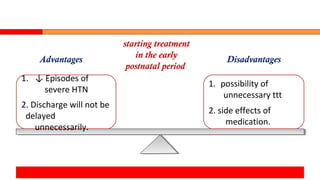
1. ↓ Episodes of
severe HTN
2. Discharge will not be
delayed
unnecessarily.
1. possibility of
unnecessary ttt
2. side effects of
medication.
Advantages Disadvantages
starting treatment
in the early
postnatal period
TOG, 2013
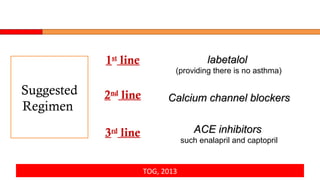
Suggested
Regimen
1st
line
2nd
line
3rd
line
labetalollabetalol
(providing there is no asthma)
Calcium channel blockersCalcium channel blockers
ACE inhibitorsACE inhibitors
such enalapril and captopril
What are theWhat are the
choices?choices?
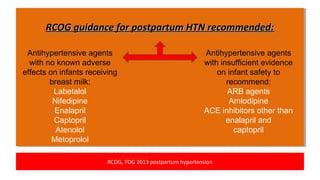
RCOG, TOG 2013 postpartum hypertension
RCOG guidance for postpartum HTN recommended:RCOG guidance for postpartum HTN recommended:RCOG guidance for postpartum HTN recommended:RCOG guidance for postpartum HTN recommended:
Antihypertensive agents
with no known adverse
effects on infants receiving
breast milk:
Labetalol
Nifedipine
Enalapril
Captopril
Atenolol
Metoprolol
Antihypertensive agents
with insufficient evidence
on infant safety to
recommend:
ARB agents
Amlodipine
ACE inhibitors other than
enalapril and
captopril
How toHow to
monitor ?monitor ?
Lewis G. The Confidential Enquiry into Maternal and Child Health (CEMACH). Saving Mothers’ Lives:
Reviewing Maternal Deaths to Make Motherhood Safer - 2003–2005. The Seventh Report on
Confidential Enquiries into Maternal Deaths in the United Kingdom. London: CEMACH; 2007.
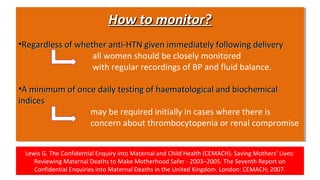
How to monitor?How to monitor?
•Regardless of whether anti-HTN given immediately following deliveryRegardless of whether anti-HTN given immediately following delivery
all women should be closely monitored
with regular recordings of BP and fluid balance.
•A minimum of once daily testing of haematological and biochemicalA minimum of once daily testing of haematological and biochemical
indicesindices
may be required initially in cases where there is
concern about thrombocytopenia or renal compromise
How to monitor?How to monitor?
•Regardless of whether anti-HTN given immediately following deliveryRegardless of whether anti-HTN given immediately following delivery
all women should be closely monitored
with regular recordings of BP and fluid balance.
•A minimum of once daily testing of haematological and biochemicalA minimum of once daily testing of haematological and biochemical
indicesindices
may be required initially in cases where there is
concern about thrombocytopenia or renal compromise
Chandiramani M et al,. Modern management of postpartum hypertension. Trends in Urology Gynecol
Sexual Health 2007
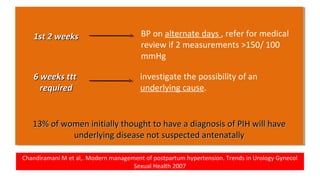
13% of women initially thought to have a diagnosis of PIH will have13% of women initially thought to have a diagnosis of PIH will have
underlying disease not suspected antenatallyunderlying disease not suspected antenatally
13% of women initially thought to have a diagnosis of PIH will have13% of women initially thought to have a diagnosis of PIH will have
underlying disease not suspected antenatallyunderlying disease not suspected antenatally
BP on alternate days , refer for medical
review if 2 measurements >150/ 100
mmHg
investigate the possibility of an
underlying cause.
1st 2 weeks1st 2 weeks
6 weeks ttt6 weeks ttt
requiredrequired
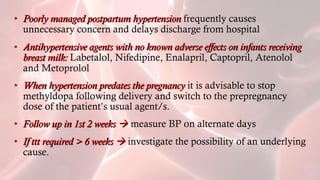
• Poorly managed postpartum hypertensionPoorly managed postpartum hypertension frequently causes
unnecessary concern and delays discharge from hospital
• Antihypertensive agents with no known adverse effects on infants receivingAntihypertensive agents with no known adverse effects on infants receiving
breast milk:breast milk: Labetalol, Nifedipine, Enalapril, Captopril, Atenolol
and Metoprolol
• When hypertension predates the pregnancyWhen hypertension predates the pregnancy it is advisable to stop
methyldopa following delivery and switch to the prepregnancy
dose of the patient’s usual agent/s.
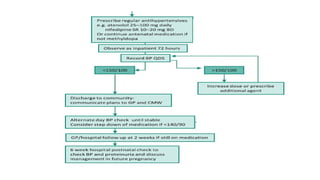
• Follow up in 1st 2 weeksFollow up in 1st 2 weeks  measure BP on alternate days
• If ttt required > 6 weeksIf ttt required > 6 weeks  investigate the possibility of an underlying
cause.
Postpartum hypertension

Postpartum hypertension

  • 1.
    PostPartum hyPertension Ali Bendary AssistantLecturer Of Obstetrics & Gynecology Benha University Hospitals
  • 2.
    What is theincidence of eclamptic fits occur inWhat is the incidence of eclamptic fits occur in postnatal period?postnatal period? • 14% • 24% • 34% • 44% • 54% 44%
  • 3.
    From the followingagents which is not suitable forFrom the following agents which is not suitable for management of postpartum hypertension?management of postpartum hypertension? • Labetalol • Nifedipine • Captopril • Atenolol • Amlodipine Amlodipine
  • 4.
  • 6.
    • What isthe normal physiology of blood pressure postpartum? • What is the evidences and prevalence of such condition? • Which considerations should be taken when prescribe drugs? • How to manage ongoing postnatal hypertension? scoPescoPe
  • 7.
    Normal physiology • Mostwomen following uncomplicated pregnancy will experience : ↑ blood pressure during the postpartum period The average over the first 4 days: - Systolic: ↑ 6 mmHg - Diastolic: ↑ 4 mmHg Why ? resolution of the cardiovascular adaptations to pregnancy + mobilization of fluid accumulated in the extra vascular space during pregnancy.
  • 8.
    1/3 of womenwho have had PIH commonly normotensive in the early postpartum period will have sustained hypertension in the postnatal period Why?Why? possibly reflecting depleted intravascular volumes following labor 1/3 of women who have had PIH commonly normotensive in the early postpartum period will have sustained hypertension in the postnatal period Why?Why? possibly reflecting depleted intravascular volumes following labor
  • 9.
    Evidence & Prevalence •Matthys et al., 2004 outcomes of 151 women diagnosed with preeclampsia readmitted in the postnatal period The incidence of complications was high: - Eclampsia:  24 cases (16%) - Pulmonary oedema:  13 cases (9%) - Maternal death:  one case 1
  • 10.
    Evidence & Prevalence •Chames et al., 2002 29 women presenting with postpartum eclampsia + at least one prodromal symptom. 23 (79%) patients had seizures after 48 hours 2
  • 11.
    Evidence & Prevalence •Lubarsky et al. 1994 series of 334 cases of eclampsia of seizures occurring in the postnatal period 50% of these after 48 hours following delivery. 3
  • 12.
    these studies emphasizethesestudies emphasize 1- need for prolonged vigilance in the postpartum period 2- importance of investigating reported symptoms in such women. these studies emphasizethese studies emphasize 1- need for prolonged vigilance in the postpartum period 2- importance of investigating reported symptoms in such women.
  • 13.
    Considerations of antihypertensiveagents 1. Effectively control blood pressure without diurnal peaks and falls 2. Will have minimal maternal side effects 3. Safe for breastfeeding infants 4. Effective with once or twice daily dosing to maximize compliance Magee L, Sadeghi S. Prevention and treatment of postpartum hypertension. Cochrane Database Syst Rev 2005; Due to the paucity of data, it is difficult to recommend one antihypertensive agent over another Ideal anti- HTN agent ?
  • 14.
    • Centrally actinga adrenergic agonist  ↓sympathetic vascular tone  ↓ systemic vascular resistance • The most common antihypertensive agent ? because of its well established fetal safety Although safe option, most authors advise that it should be discontinued because of its maternal side-effects, e.g: sedation postural hypotension postnatal depression Methyldopa MechanismMechanism AntenatalAntenatal PostnatalPostnatal
  • 15.
    • b2 receptor peripheral vasodilation • b1 receptors cardiac tissue  modulate the sympathetic response renal tissue  mediate changes in renin synthesis • Aggravate asthma and heart failure The high lipid solubility of the drug concentrated in breast milk raised concerns about transfer to the neonate however, only a single case of neonatal b-blockade has been reported B-Blockers MechanismMechanism CautionCaution PostnatalPostnatal
  • 16.
    • inhibiting Cainflux into vascular myoctyes  inhibiting vasoconstriction + ↓ vascular resistance • Minimal effects on cardiac conduction and heart rate • minimal excretion into breast milk Nifedipine (slow release [SR]) is the most commonly prescribed calcium channel blocker and can initially be prescribed at a dose of 10–20 mg twice daily Calcium Channel Blockers MechanismMechanism BenefitsBenefits PostnatalPostnatal
  • 17.
    • inhibit ACE ↓ production of ATII  ↓ ATII mediated vasoconstriction They can be associated with adverse fetal outcomes Enalapril can be prescribed as a twice-daily dose of 5–20 mg. Angiotensin Converting Enzyme (ACE) Inhibitors MechanismMechanism AntenatalAntenatal PostnatalPostnatal
  • 18.
    • Although theyare safe, postnatal women are more susceptible to postural hypotension • mothers who are breastfeeding may experience excessive thirst and the associated volume contraction may interfere with successful breastfeeding rarely used as antihypertensive agents in the postnatal period with the exception of management of pulmonary oedema Diuretics
  • 19.
    Management of postnatalHTN 2013 Royal College of Obstetricians and Gynaecologists According to the presentation Patients with existing hypertension Patients with existing hypertension Hypertension arising during pregnancy or in the peurperium Hypertension arising during pregnancy or in the peurperium
  • 20.
     stop methyldopafollowing delivery ↓ switch to the prepregnancy dose of the patient’s usual agent/s  Women previously using diuretics ↓ should consider an alternative while they are breastfeeding. Patients with existing hypertension Patients with existing hypertension
  • 21.
    Who are atrisk? When to treat? What are the choices? How to monitor? How to follow up? Hypertension arising during pregnancy or in the peurperium Hypertension arising during pregnancy or in the peurperium
  • 22.
    Who are atWhoare at risk?risk?
  • 23.
    RCOG, 2013 Women atrisk of developing postnatal hypertensionWomen at risk of developing postnatal hypertension •Preterm deliveryPreterm delivery triggered by maternal hypertensive disease >75%>75% •Hypertension requiring antenatalantenatal treatmenttreatment •SevereSevere antenatal hypertension (>160/100 mmHg) •Antenatal pre-eclampsiapre-eclampsia (proteinuric hypertension) 33%33% Women at risk of developing postnatal hypertensionWomen at risk of developing postnatal hypertension •Preterm deliveryPreterm delivery triggered by maternal hypertensive disease >75%>75% •Hypertension requiring antenatalantenatal treatmenttreatment •SevereSevere antenatal hypertension (>160/100 mmHg) •Antenatal pre-eclampsiapre-eclampsia (proteinuric hypertension) 33%33%
  • 24.
  • 25.
    NICE guidance forpostpartum care stated:NICE guidance for postpartum care stated: •BP should be measured within 6 hourswithin 6 hours of delivery. •All women should be made aware of the symptoms of pre-aware of the symptoms of pre- eclampsia within 72 hourseclampsia within 72 hours of delivery : - headache - visual disturbance - nausea or vomiting •Delay discharge to day 3 (target BP < 150/100 mmHg)?!! NICE guidance for postpartum care stated:NICE guidance for postpartum care stated: •BP should be measured within 6 hourswithin 6 hours of delivery. •All women should be made aware of the symptoms of pre-aware of the symptoms of pre- eclampsia within 72 hourseclampsia within 72 hours of delivery : - headache - visual disturbance - nausea or vomiting •Delay discharge to day 3 (target BP < 150/100 mmHg)?!!
  • 26.
    44% of eclampticfits occur in the postnatal44% of eclamptic fits occur in the postnatal period,period, usually within the first 48 hours followingusually within the first 48 hours following deliverydelivery Douglas KA, Redman CW. Eclampsia in the United Kingdom. BMJ 1994 Why ?Why ?
  • 27.
    1. ↓ Episodesof severe HTN 2. Discharge will not be delayed unnecessarily. 1. possibility of unnecessary ttt 2. side effects of medication. Advantages Disadvantages starting treatment in the early postnatal period
  • 28.
    TOG, 2013 Suggested Regimen 1st line 2nd line 3rd line labetalollabetalol (providing thereis no asthma) Calcium channel blockersCalcium channel blockers ACE inhibitorsACE inhibitors such enalapril and captopril
  • 29.
    What are theWhatare the choices?choices?
  • 30.
    RCOG, TOG 2013postpartum hypertension RCOG guidance for postpartum HTN recommended:RCOG guidance for postpartum HTN recommended:RCOG guidance for postpartum HTN recommended:RCOG guidance for postpartum HTN recommended: Antihypertensive agents with no known adverse effects on infants receiving breast milk: Labetalol Nifedipine Enalapril Captopril Atenolol Metoprolol Antihypertensive agents with insufficient evidence on infant safety to recommend: ARB agents Amlodipine ACE inhibitors other than enalapril and captopril
  • 31.
  • 32.
    Lewis G. TheConfidential Enquiry into Maternal and Child Health (CEMACH). Saving Mothers’ Lives: Reviewing Maternal Deaths to Make Motherhood Safer - 2003–2005. The Seventh Report on Confidential Enquiries into Maternal Deaths in the United Kingdom. London: CEMACH; 2007. How to monitor?How to monitor? •Regardless of whether anti-HTN given immediately following deliveryRegardless of whether anti-HTN given immediately following delivery all women should be closely monitored with regular recordings of BP and fluid balance. •A minimum of once daily testing of haematological and biochemicalA minimum of once daily testing of haematological and biochemical indicesindices may be required initially in cases where there is concern about thrombocytopenia or renal compromise How to monitor?How to monitor? •Regardless of whether anti-HTN given immediately following deliveryRegardless of whether anti-HTN given immediately following delivery all women should be closely monitored with regular recordings of BP and fluid balance. •A minimum of once daily testing of haematological and biochemicalA minimum of once daily testing of haematological and biochemical indicesindices may be required initially in cases where there is concern about thrombocytopenia or renal compromise
  • 34.
    Chandiramani M etal,. Modern management of postpartum hypertension. Trends in Urology Gynecol Sexual Health 2007 13% of women initially thought to have a diagnosis of PIH will have13% of women initially thought to have a diagnosis of PIH will have underlying disease not suspected antenatallyunderlying disease not suspected antenatally 13% of women initially thought to have a diagnosis of PIH will have13% of women initially thought to have a diagnosis of PIH will have underlying disease not suspected antenatallyunderlying disease not suspected antenatally BP on alternate days , refer for medical review if 2 measurements >150/ 100 mmHg investigate the possibility of an underlying cause. 1st 2 weeks1st 2 weeks 6 weeks ttt6 weeks ttt requiredrequired
  • 37.
    • Poorly managedpostpartum hypertensionPoorly managed postpartum hypertension frequently causes unnecessary concern and delays discharge from hospital • Antihypertensive agents with no known adverse effects on infants receivingAntihypertensive agents with no known adverse effects on infants receiving breast milk:breast milk: Labetalol, Nifedipine, Enalapril, Captopril, Atenolol and Metoprolol • When hypertension predates the pregnancyWhen hypertension predates the pregnancy it is advisable to stop methyldopa following delivery and switch to the prepregnancy dose of the patient’s usual agent/s. • Follow up in 1st 2 weeksFollow up in 1st 2 weeks  measure BP on alternate days • If ttt required > 6 weeksIf ttt required > 6 weeks  investigate the possibility of an underlying cause.