Gestational hypertension
Pregnancy Induced Hypertension
Dr. Mehjabeen Naveed
Pregnancy induced hypertension :
Definition:
Gestational hypertension is new hypertension presenting
after 20 weeks without significant proteinuria.
Diastolic B.P > 110 mmhg on any one occasion or
Diastolic B.P >90 mmhg on two or more consecutive
occasions > 4 hours apart.
Pathophysiology
Changes seen in patients
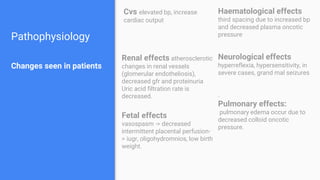
Cvs elevated bp, increase
cardiac output
Haematological effects
third spacing due to increased bp
and decreased plasma oncotic
pressure
Renal effects atherosclerotic
changes in renal vessels
(glomerular endotheliosis),
decreased gfr and proteinuria
Uric acid filtration rate is
decreased.
Neurological effects
hyperreflexia, hypersensitivity, in
severe cases, grand mal seizures
.
Pulmonary effects:
pulmonary edema occur due to
decreased colloid oncotic
pressure.
Fetal effects
vasospasm -> decreased
intermittent placental perfusion-
> iugr, oligohydromnios, low birth
weight.
Pathophysiology :
contd.
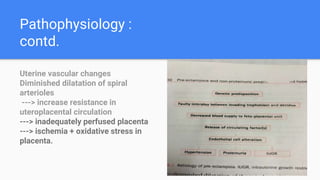
Uterine vascular changes
Diminished dilatation of spiral
arterioles
---> increase resistance in
uteroplacental circulation
---> inadequately perfused placenta
---> ischemia + oxidative stress in
placenta.
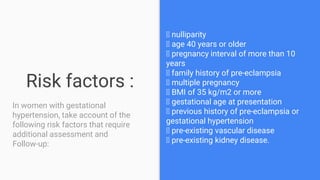
Risk factors :
In women with gestational
hypertension, take account of the
following risk factors that require
additional assessment and
Follow-up:
􀁸 nulliparity
􀁸 age 40 years or older
􀁸 pregnancy interval of more than 10
years
􀁸 family history of pre-eclampsia
􀁸 multiple pregnancy
􀁸 BMI of 35 kg/m2 or more
􀁸 gestational age at presentation
􀁸 previous history of pre-eclampsia or
gestational hypertension
􀁸 pre-existing vascular disease
􀁸 pre-existing kidney disease.
History :
History: Inquire pt. about the following…
Prior miscarriage, a new partner, chronic htn,
gdm,obesity,aps, multiple pregnancies, molar
pregnancy, family history in first degree relative..
Signs and Symptoms:
Headache,
pedal edema
cerebral or visual disturbances,
Oliguria,
pulmonary edema,
cyanosis,
epigastric or right upper quadrant pain,
thrombocytopenia
Complications of PIH :
Eclampsia is a convulsive
condition associated with
pre-eclampsia
Pre-eclampsia is new
hypertension presenting
after 20 weeks with
significant proteinuria
HELLP syndrome is
haemolysis, elevated liver
enzymes and low platelet
Pre eclampsia :
Pre eclampsia:
Development of HTN with proteinuria induced by pregnancy
generally in the second half of gestation
More frequent at the extremes of reproductive years
More common in women who have not carried a previous
pregnancy beyond 20 weeks
Pre eclampsia
contd.
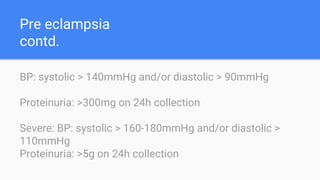
BP: systolic > 140mmHg and/or diastolic > 90mmHg
Proteinuria: >300mg on 24h collection
Severe: BP: systolic > 160-180mmHg and/or diastolic >
110mmHg
Proteinuria: >5g on 24h collection
Pre eclampsia..
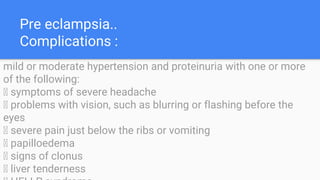
Complications :
mild or moderate hypertension and proteinuria with one or more
of the following:
􀁸 symptoms of severe headache
􀁸 problems with vision, such as blurring or flashing before the
eyes
􀁸 severe pain just below the ribs or vomiting
􀁸 papilloedema
􀁸 signs of clonus
􀁸 liver tenderness
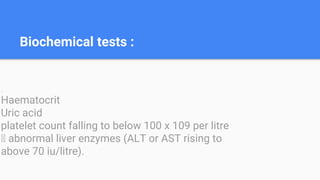
Biochemical tests :
.
Haematocrit
Uric acid
platelet count falling to below 100 x 109 per litre
􀁸 abnormal liver enzymes (ALT or AST rising to
above 70 iu/litre).
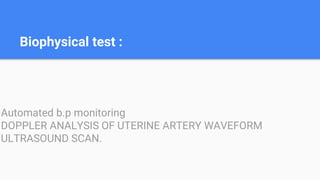
Biophysical test :
Automated b.p monitoring
DOPPLER ANALYSIS OF UTERINE ARTERY WAVEFORM
ULTRASOUND SCAN.
u/s investigation..
Carry out ultrasound fetal growth and amniotic fluid volume
assessment and umbilical artery doppler velocimetry starting at
between 28 and 30 weeks and repeating 4 weeks later in women with previous:
􀁸 severe pre-eclampsia
􀁸 pre-eclampsia that needed birth before 34 weeks
􀁸 pre-eclampsia with a baby whose birth weight was less than the
10th centile
􀁸 intrauterine death
􀁸 placental abruption
Treatment
Advise women with risk for preeclampsia to take 75 mg of
aspirin* daily from 12 weeks until the birth of the baby.
outpatient with weekly visits with BP monitoring chart
LIMIT SALT INTAKE,
Advice moderate exercise
Keep an eye on proteinuria
Antihypertensive therapy:
methyldopa 250mg BID/TID max 3g/day
Other medications that can be used in pregnancy (oral):
2• Nifedipine 30-60mg max 120mg/day
if diastolic pressure is repeatedly above 110mmHg
Hydralazine (Apresoline) 5mg increments IV until acceptable BP is obtained
(diastolic pressure to 90-100mmHg range)
3• Magnesium sulfate in severe gestational HTN for seizure prophylaxis
Intrapartum Bp. control
Should be checked every 15 minutes
i/v anti htn therapy should be started at MAP >125mmhg
LABETALOL is the First line..
Administration of i/v fluid in oliguria must be performed with
caution d/t the risk of pulmonary edema..
Foley’s catheter should be inserted and fluid balance recorded.
Pre eclampsia
Treatment ;
Mild preeclampsia :
If immature fetus -> bed rest mainly in lateral decubitus position
HTN therapy if needed
Severe preeclampsia
:loading dose of 4g magnesium sulphate should be given intravenously over 5 minutes,
followed by an infusion of 1 g/hour maintained for 24 hours
􀁸 recurrent seizures should be treated with a further dose of 2–4 g given over 5 minutes
Antihypertensive therapy
Induction or cesarean delivery
♦ fetal pulmonary maturity depending on gestational age should be considered
(>=34weeks)
gv dexa 12mg 12hr apart prophylactically
eclampsia
Addition of convulsions in a woman with preeclampsia
occurs in 0.5-4% of deliveries
most cases occur within 24h of delivery with about 3% of
cases diagnosed between 2-10 days postpartum
25% have eclamptic seizures before labour, 50% during
labour, and 25% after delivery
eclampsia
treatment
Anti convulsant therapy
Diazepam or similar drugs
• Magnesium sulfate to prevent further seizures
• Maintain adequate airway, oxygenation, restraining gently
as needed and inserting a padded tongue blade
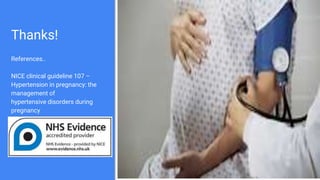
Thanks!
References..
NICE clinical guideline 107 –
Hypertension in pregnancy: the
management of
hypertensive disorders during
pregnancy

Pregnancy Induced Hypertension ppt

  • 1.
    Gestational hypertension Pregnancy InducedHypertension Dr. Mehjabeen Naveed
  • 2.
    Pregnancy induced hypertension: Definition: Gestational hypertension is new hypertension presenting after 20 weeks without significant proteinuria. Diastolic B.P > 110 mmhg on any one occasion or Diastolic B.P >90 mmhg on two or more consecutive occasions > 4 hours apart.
  • 3.
    Pathophysiology Changes seen inpatients Cvs elevated bp, increase cardiac output Haematological effects third spacing due to increased bp and decreased plasma oncotic pressure Renal effects atherosclerotic changes in renal vessels (glomerular endotheliosis), decreased gfr and proteinuria Uric acid filtration rate is decreased. Neurological effects hyperreflexia, hypersensitivity, in severe cases, grand mal seizures . Pulmonary effects: pulmonary edema occur due to decreased colloid oncotic pressure. Fetal effects vasospasm -> decreased intermittent placental perfusion- > iugr, oligohydromnios, low birth weight.
  • 4.
    Pathophysiology : contd. Uterine vascularchanges Diminished dilatation of spiral arterioles ---> increase resistance in uteroplacental circulation ---> inadequately perfused placenta ---> ischemia + oxidative stress in placenta.
  • 5.
    Risk factors : Inwomen with gestational hypertension, take account of the following risk factors that require additional assessment and Follow-up: 􀁸 nulliparity 􀁸 age 40 years or older 􀁸 pregnancy interval of more than 10 years 􀁸 family history of pre-eclampsia 􀁸 multiple pregnancy 􀁸 BMI of 35 kg/m2 or more 􀁸 gestational age at presentation 􀁸 previous history of pre-eclampsia or gestational hypertension 􀁸 pre-existing vascular disease 􀁸 pre-existing kidney disease.
  • 6.
    History : History: Inquirept. about the following… Prior miscarriage, a new partner, chronic htn, gdm,obesity,aps, multiple pregnancies, molar pregnancy, family history in first degree relative..
  • 7.
    Signs and Symptoms: Headache, pedaledema cerebral or visual disturbances, Oliguria, pulmonary edema, cyanosis, epigastric or right upper quadrant pain, thrombocytopenia
  • 8.
    Complications of PIH: Eclampsia is a convulsive condition associated with pre-eclampsia Pre-eclampsia is new hypertension presenting after 20 weeks with significant proteinuria HELLP syndrome is haemolysis, elevated liver enzymes and low platelet
  • 9.
    Pre eclampsia : Preeclampsia: Development of HTN with proteinuria induced by pregnancy generally in the second half of gestation More frequent at the extremes of reproductive years More common in women who have not carried a previous pregnancy beyond 20 weeks
  • 10.
    Pre eclampsia contd. BP: systolic> 140mmHg and/or diastolic > 90mmHg Proteinuria: >300mg on 24h collection Severe: BP: systolic > 160-180mmHg and/or diastolic > 110mmHg Proteinuria: >5g on 24h collection
  • 11.
    Pre eclampsia.. Complications : mildor moderate hypertension and proteinuria with one or more of the following: 􀁸 symptoms of severe headache 􀁸 problems with vision, such as blurring or flashing before the eyes 􀁸 severe pain just below the ribs or vomiting 􀁸 papilloedema 􀁸 signs of clonus 􀁸 liver tenderness
  • 12.
    Biochemical tests : . Haematocrit Uricacid platelet count falling to below 100 x 109 per litre 􀁸 abnormal liver enzymes (ALT or AST rising to above 70 iu/litre).
  • 13.
    Biophysical test : Automatedb.p monitoring DOPPLER ANALYSIS OF UTERINE ARTERY WAVEFORM ULTRASOUND SCAN.
  • 14.
    u/s investigation.. Carry outultrasound fetal growth and amniotic fluid volume assessment and umbilical artery doppler velocimetry starting at between 28 and 30 weeks and repeating 4 weeks later in women with previous: 􀁸 severe pre-eclampsia 􀁸 pre-eclampsia that needed birth before 34 weeks 􀁸 pre-eclampsia with a baby whose birth weight was less than the 10th centile 􀁸 intrauterine death 􀁸 placental abruption
  • 15.
    Treatment Advise women withrisk for preeclampsia to take 75 mg of aspirin* daily from 12 weeks until the birth of the baby.
  • 16.
    outpatient with weeklyvisits with BP monitoring chart LIMIT SALT INTAKE, Advice moderate exercise Keep an eye on proteinuria Antihypertensive therapy: methyldopa 250mg BID/TID max 3g/day Other medications that can be used in pregnancy (oral): 2• Nifedipine 30-60mg max 120mg/day if diastolic pressure is repeatedly above 110mmHg Hydralazine (Apresoline) 5mg increments IV until acceptable BP is obtained (diastolic pressure to 90-100mmHg range) 3• Magnesium sulfate in severe gestational HTN for seizure prophylaxis
  • 17.
    Intrapartum Bp. control Shouldbe checked every 15 minutes i/v anti htn therapy should be started at MAP >125mmhg LABETALOL is the First line.. Administration of i/v fluid in oliguria must be performed with caution d/t the risk of pulmonary edema.. Foley’s catheter should be inserted and fluid balance recorded.
  • 18.
    Pre eclampsia Treatment ; Mildpreeclampsia : If immature fetus -> bed rest mainly in lateral decubitus position HTN therapy if needed Severe preeclampsia :loading dose of 4g magnesium sulphate should be given intravenously over 5 minutes, followed by an infusion of 1 g/hour maintained for 24 hours 􀁸 recurrent seizures should be treated with a further dose of 2–4 g given over 5 minutes Antihypertensive therapy Induction or cesarean delivery ♦ fetal pulmonary maturity depending on gestational age should be considered (>=34weeks) gv dexa 12mg 12hr apart prophylactically
  • 19.
    eclampsia Addition of convulsionsin a woman with preeclampsia occurs in 0.5-4% of deliveries most cases occur within 24h of delivery with about 3% of cases diagnosed between 2-10 days postpartum 25% have eclamptic seizures before labour, 50% during labour, and 25% after delivery
  • 20.
    eclampsia treatment Anti convulsant therapy Diazepamor similar drugs • Magnesium sulfate to prevent further seizures • Maintain adequate airway, oxygenation, restraining gently as needed and inserting a padded tongue blade
  • 21.
    Thanks! References.. NICE clinical guideline107 – Hypertension in pregnancy: the management of hypertensive disorders during pregnancy