Suburban Transformations 1st Edition Paul Lukez
download
https://ebookbell.com/product/suburban-transformations-1st-
edition-paul-lukez-51413710
Explore and download more ebooks at ebookbell.com
Here are some recommended products that we believe you will be
interested in. You can click the link to download.
Asian American Political Action Suburban Transformations James S Lai
https://ebookbell.com/product/asian-american-political-action-
suburban-transformations-james-s-lai-51894870
Latino Orlando Suburban Transformation And Racial Conflict Simone
Pierre Delerme
https://ebookbell.com/product/latino-orlando-suburban-transformation-
and-racial-conflict-simone-pierre-delerme-23892250
Dont Blame Us Suburban Liberals And The Transformation Of The
Democratic Party Pilot Project Ebook Available To Selected Us
Libraries Only Lily Geismer
https://ebookbell.com/product/dont-blame-us-suburban-liberals-and-the-
transformation-of-the-democratic-party-pilot-project-ebook-available-
to-selected-us-libraries-only-lily-geismer-51949484
Dont Blame Us Suburban Liberals And The Transformation Of The
Democratic Party Lily Geismer
https://ebookbell.com/product/dont-blame-us-suburban-liberals-and-the-
transformation-of-the-democratic-party-lily-geismer-5046708
Transformation From Below White Suburbia In The Transformation Of
Apartheid South Africa To Democracy 1st Edition Ursula Scheidegger
https://ebookbell.com/product/transformation-from-below-white-
suburbia-in-the-transformation-of-apartheid-south-africa-to-
democracy-1st-edition-ursula-scheidegger-51883416
Suburban Dreams Imagining And Building The Good Life Greg Dickinson
https://ebookbell.com/product/suburban-dreams-imagining-and-building-
the-good-life-greg-dickinson-48991382
Suburban Empire Cold War Militarization In The Us Pacific 1 Ebook
Lauren Hirshberg
https://ebookbell.com/product/suburban-empire-cold-war-militarization-
in-the-us-pacific-1-ebook-lauren-hirshberg-50488292
Suburban Century Social Change And Urban Growth In England And The
United State Mark Clapson
https://ebookbell.com/product/suburban-century-social-change-and-
urban-growth-in-england-and-the-united-state-mark-clapson-50671380
Suburban Sweatshops The Fight For Immigrant Rights 1st Edition
Jennifer Gordon
https://ebookbell.com/product/suburban-sweatshops-the-fight-for-
immigrant-rights-1st-edition-jennifer-gordon-51387914
Suburban Transformations
Paul Lukez
Princeton Architectural Press
New York
Published by
Princeton Architectural Press
37 East Seventh Street
New York, New York 10003
For a free catalog of books, call 1.800.722.6657.
Visit our web site at www.papress.com.
© 2007 Princeton Architectural Press
All rights reserved
Printed and bound in China
10 09 08 07 4 3 2 1 First edition
No part of this book may be used or reproduced in any manner without
written permission from the publisher, except in the context of reviews.
Every reasonable attempt has been made to identify owners of copyright.
Errors or omissions will be corrected in subsequent editions.
Editor: Lauren Nelson Packard
Designer: Jan Haux
Special thanks to: Nettie Aljian, Sara Bader, Dorothy Ball, Nicola Bednarek,
Janet Behning, Becca Casbon, Penny (Yuen Pik) Chu, Russell Fernandez,
Pete Fitzpatrick, Wendy Fuller, Clare Jacobson, John King, Nancy Eklund
Later, Linda Lee, Katharine Myers, Jennifer Thompson, Arnoud Verhaeghe,
Paul Wagner, Joseph Weston, and Deb Wood of Princeton Architectural
Press —Kevin C. Lippert, publisher
Library of Congress Cataloging-in-Publication Data
Lukez, Paul, 1958-
Suburban transformations / Paul Lukez.
p. cm.
Includes index.
ISBN 978-1-56898-683-8 (alk. paper)
1. Suburbs. 2. City planning. 3. Architecture—Social aspects.
4. Community life. I. Title.
HT351.L85 2007
307.74—dc22
2007018890
Contents
Preface
Acknowledgments
Foreword
by Anthony Flint
The Development of Identity
Chapter 1
In Search of Identity over Time
Chapter 2
The Adaptive Design Process
Chapter 3
Mapping
Chapter 4
Cross-Mapping
Chapter 5
Editing
Chapter 6
Selecting Tools: (Hybrid) Building
Typologies and Design Tools
Chapter 7
Spatial Models
Case Studies:
Burlington, Massachusetts
Amsterdam, the Netherlands
e-Mall, Dedham, Massachusetts
Shenzhen, China
Revere Beach, Massachusetts
Significance of the Proposition
Index
6
8
9
10
23
41
51
75
89
93
105
127
147
159
167
177
187
192
“Will we ever drag our visiting relatives out to show
off our Edge City, our shining city on the hill?”
Joel Garreau, Edge City 1
In his seminal book Edge City, Joel Garreau states, “Edge
City’s problem is history. It has none.” He follows by
speculating on the development of Venice, spanning over
a thousand years, from its earlier “chaotic” form into
a highly refined and interwoven assemblage of urban
spaces and forms. Buildings were continually built, torn
down, rebuilt, and altered, while the city’s open spaces
were sculpted and refined in response to the evolving
demands of a growing city and its populace. The result
of this thousand-year design and construction process
is a richly woven tapestry of urban form and space,
recognized by urban design experts today as a marvel
in city planning. Yet, while the successes of the current
configuration of the city are well documented, the most
valuable lessons may lie in understanding how Venice’s
sometimes messy transformation over time came to be.
Regarding our relatively contemporary
settlements—suburbs, exurbs, edge cities, and edge
nodes—are we perhaps looking at the very early stages
of new types of communities, whose mature forms have
yet to crystallize, through successive and selective acts of
writing and erasing buildings and spaces? What are the
processes and design principles that might allow these
relatively recent early community forms to develop into
dynamic and memorable environments?
Throughout my academic and professional career,
I have been interested in the relationship between time
and architecture. In particular, I’ve been interested
in how structures and their urban fabric change over
time to accommodate new programs. These patterns of
transformation reveal the behavior of form in response
to changing circumstances. My fascination with
understanding the vagaries of time led to the study of
infrastructure elements and large municipal structures,
as they were more likely to withstand entropy and
because their mass could serve as repositories of time’s
accretions. I discovered that these kinds of structures
often mutated into unusual typological configurations
that defied conventional classifications.
The “traces” of these structures found in maps of
richly layered cities suggest that the particularity of
place is deeply rooted to time and circumstance. In an
irreversible equation, the identity of a place cannot be
altered: Venice, its structure and environment, can be of
no other place. This quality of unique identity is lacking
in current suburban contexts. Garreau’s summation of
the lack of history inherent in the edge city does not
mean to imply that these contemporary sites are merely
too recent, but that the processes that have engendered
them deny transformation. There is a pathology to the
contemporary development process that negates both
Time and Circumstance.
The Adaptive Design Process, described in the
pages of this book, explicitly incorporates time and
circumstance into the design process. By mapping and
cross-mapping the rich variety of features that make up
any site, such as environmental features, topography,
street patterns, building profiles, and sights and smells,
opportunities for identity can be determined in even the
most generic places. Carrying these mappings from the
past on to the present and into the future in a series of
“filmstrips” shows how a site is transformed over time,
creating the essence of place.
This is a book for anyone who cares about the
quality of their physical environment—particularly
suburban and edge city sites—and wishes to see it
improved, whether on the scale of building, community,
or region. This includes planners, designers, town
officials, policymakers, developers, landowners,
environmental activists, and all those individual and
institutional members of a community that have a stake
or interest in shaping its future.
The book provides the reader with evocative images
of just some of the multitude of strategies through which
these goals can be achieved over time. The power of
seeing what is possible, so much richer than the current
reality, is the first step in activating new models for
transforming our communities. The images included
in the book transcend the limitations of visionary
drawings; they are rooted in a process that constantly
updates and recalibrates the projected reality within the
limits of contemporary constraints. Yet the images have
the potential to become iconic, in that they temporally
register the dreams and aspirations of a community at a
particular time.
Five case studies demonstrate the Adaptive Design
Process. The study of Burlington, Massachusetts, your
Preface
typical edge city, with its regional mall, speculative office
buildings, corporate headquarters, strip malls, housing
developments, and parking lots, provides a fine-grained
illustration of the Adaptive Design Process in action.
Tools such as mapping and cross-mapping are explained
in depth using this extended case study. The other four
case studies show the application of these ideas in edge
cities that in various ways, are less than typical: Revere
Beach, Massachusetts; Dedham Mall, Massachusetts;
Shenzhen, China; and Amsterdam, the Netherlands.
Each of these places exhibits certain conditions that are
common to edge cities, but also have special differences,
which can help illustrate the power of the Adaptive
Design Process. In every case, site conditions and history
are carefully mapped and analyzed and help inform
future proposed transformations.
This book contends that it is conceivable that edge
cities (and their suburban environs) could, over time,
evolve into more habitable, cohesive, efficient, and
memorable places with unique identities and histories,
distinguishable from other edge cities and suburbs.
1 Joel Garreau, Edge City: Life on the New Frontier (New York:
Random House, Inc., 1991), 9.
7
Acknowledgments
This book is about how suburbs and edge cities can
evolve over time. Through successive acts of erasure
and writing generated by multiple parties, richly layered
places can be created.
Similarly, this book has evolved over time, some-
times through more erasure than writing, but always with
the participation and assistance of many people, includ-
ing mentors, teachers, colleagues, students, staff, editors,
friends, and family. As an analysis of some of the most
satisfying and beautiful cities can reveal, authorship is
shared by the many who have contributed over time in
ways, large and small, in realizing a city’s final form. So
too, this book is the result of multi-layered contributions
over time.
While most of the content of this book was pro-
duced over the last five years, the book’s genesis finds its
origins in Kurt Forster’s (my former Professor) evocative
and inspiring lectures on urban palimpsests. Further
study led me to the research of Prof. John Habraken,
Prof. Ranko Bon, and Prof. Jan Wampler on time and
change in the design of the built environment. I am deep-
ly appreciative to both John and Jan, who served as gen-
erous mentors throughout my academic and professional
career. Jan, in particular, demonstrated the enriching
potential of integrating teaching, research, and practice.
The book itself was produced in successive waves of
writing, and design, often overlapping with my teaching
and research at MIT’s Department of Architecture. It
was Prof. Stanford Anderson who, while serving as De-
partment Chair, generously supported the research that
helped to advance the book’s development. In addition, I
am grateful to Dean Adele Santos, Dean William Mitch-
ell, and Chairman Yung Ho Chang for their continued
support of this project through its completion. The col-
legial encouragement of Prof. John De Monchaux, Prof.
William Porter, Prof. Bill Hubbard, Prof. Larry Vale,
Prof. Dennis Frenchman, Prof. Shun Kanda, and Jim
Batchelor helped immeasurably at important moments.
Prof. David Friedman strategic guidance and sustaining
friendship helped push me through critical challenges
and obstacles.
Early outlines and texts were developed with the
advice, and editorial assistance of Pamela Hartford. Pa-
mela’s steadfast commitment to this project helped shape
the structure of the book and its central arguments.
Pamela Siska of MIT provided further editorial help and
Erin Carlon finalized the book proposal. James Nuzum
entered the project with fortuitous and uncanny timing.
His insightful revisions and considerable editorial skill
helped clarify the final text.
The design work was organized around teams both
at MIT and my practice. Design workshops at MIT gen-
erated many of the initial conceptual investigations. The
special contributions of my graduate students—Ariel
Fausto, Mark Jewell, Chris Mulvey, Steven Jackson, Mi-
chael Spinelo, Pamela Cambell, Xin Tian, Otto Choi,
Pablo Wenceslao, Marco Marranccinni, and Nicole Mi-
chel—helped to explore a wide array of theoretical and
design issues. Mark and Xin’s contributions in particular
will always be cherished and valued.
Final design case studies were developed in my of-
fice (Paul Lukez Architecture) with the assistance of a
multi-talented staff. The key contributors in the Burling-
ton case study included Jason Hart, Pearl Tang, Heike
Braungardt, Molly Forr, Chris Starkey, Sam Batchelor,
Jian Zheng, Jue Zhan, Klemens Holzenbein, and Paul
Lipchak. The Dedham e-Mall was developed primarily
with the assistance of Matt Ostrow, whose design and
computational skills astound. The Shenzhen proposal
was coordinated by Tian Hao whose graduate research
served as the foundation for the proposal’s thesis. The
design for the Amsterdam case study was based on the
initial design developed by David Foxe, a graduate stu-
dent who participated in Amsterdam design studio in
2005. The Amsterdam proposal was further developed
by Derek Little, and Jian Xiang Huang at my office. The
Revere project was generated for our visionary client,
Joe DiGangi of Eurovest, and in close collaboration with
George Tremblay, a partner at Arrowstreet Inc. Our
urban design team was lead by Michael Gibson, work-
ing closely with Al Wei, and Jian Xiang Huang. Michael
also led an inter-disciplinary research team comprised of
eight MIT and Harvard graduate students.
Special thanks are extended to two designers, Ben
Gramann and Jie Zhao, whose extraordinary design fa-
cilities touched most of the important design work and
representations featured in the book. Ben and Jie worked
closely with me over the past five years on many of the
renderings and drawings.
The challenging task of formatting and compil-
ing the over 1,000 images generated through multiple
design phases was coordinated by Noura Alkhayat and
9
Foreword
For the last half-century, Americans have spread
themselves thinly across the landscape. But today the
soaring cost, in financial and environmental terms, of
inhabiting and navigating the suburbs has irrevocably
changed the framework for analyzing the post-war
settlement pattern. Budgets strain to the breaking point
keeping the gasoline tank full for long commutes, and
heating and cooling large detached homes. A tumultuous
future awaits the planet if we continue to drive, waste
energy, and pour emissions into the atmosphere.
Energy and climate change have become the
new rationale for more compact, mixed-use, walkable
and transit-oriented settlements, whether in new
development or in existing cities. But few believe that
will be enough. In addition to a new paradigm for
future growth, we are also left with the dilemma of what
to do with the built environment we’ve got—the vast
exurban frontier, the extra-wide arterials serving big-
box conglomerations and office parks, the single-family
subdivisions built so enthusiastically by the corporate
builders over acres of ranchland, farm fields, desert, and
scrub forests, from Florida to the Central Valley.
How can these environments be retrofitted? Can
they at all? That is the singular challenge for Paul Lukez
in this book: to make more habitable cohesive places,
with their own identity and unique quality of life, out
of stretches of landscape created with very little design
intention at all. A timelier guide to this invaluable
exercise is hard to imagine. The field needs more analysis
because, above all, it is staggeringly hard work. Not only
is there no blank canvas, there is composition that must
be radically altered, if not undone. The Lincoln Institute
of Land Policy holds a seminar that describes this
challenge similarly: Redesigning the Edgeless City.
Less alluring than the architectural wonder, more
complex than any sketched New Urbanist village, the
process of transforming the suburbs will, in the years
ahead, become the highest calling for urban design. In
these pages, practitioners will find an intriguing and
innovative approach that promises to endure for many
years to come.
Anthony Flint
Lincoln Institute of Land Policy
Cambridge, Massachusetts
Leslie Lok. With so many images, special attention was
directed toward the graphic design of the images, dia-
grams and tables. Heart felt thanks are extended to Ra-
chel Schauer, Matt Ostrow, Garrick Jones, and especially
Sophie Kelle who found elegant solutions to graphically
illustrating the Adaptive Design Process and other im-
portant diagrams.
I feel very fortunate to have been associated with
our publisher, Princeton Architectural Press, and its
outstanding editorial team. I am especially indebted to
Clare Jacobson, the acquisitions editor, for supporting my
proposal. Lauren Nelson Packard, the book’s editor, has
been a delight to work with throughout the editorial and
production process. Her intelligent critique of the book
and enthusiasm for the topic was always appreciated. Jan
Haux deftly met the challenge of designing a book with
over 300 images, carefully coordinated with text in a
dynamic yet clear format. Lauren and Jan’s shared vision,
and their collective efforts were a model for collaboration.
And finally, I am forever beholden to my loving
wife for her unwavering support of this book, despite the
significant investment of time and resources required to
complete it. The joyful rewards of watching my children
(Alexander and Stephanie) mature sustained me over
these past five years, as did their love and laughter. It is
to my family that I dedicate this book with the deep grat-
itude and love of one who feels blessed beyond belief.
Introduction
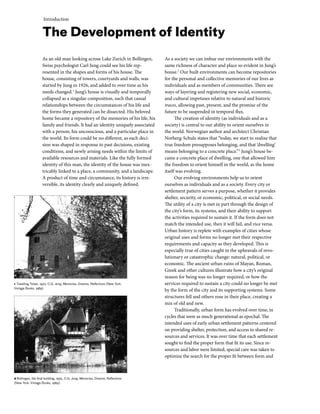
As an old man looking across Lake Zurich in Bollingen,
Swiss psychologist Carl Jung could see his life rep-
resented in the shapes and forms of his house. The
house, consisting of towers, courtyards and walls, was
started by Jung in 1926, and added to over time as his
needs changed.1
Jung’s house is visually and temporally
collapsed as a singular composition, such that causal
relationships between the circumstances of his life and
the forms they generated can be dissected. His beloved
home became a repository of the memories of his life, his
family and friends. It had an identity uniquely associated
with a person, his unconscious, and a particular place in
the world. Its form could be no different, as each deci-
sion was shaped in response to past decisions, existing
conditions, and newly arising needs within the limits of
available resources and materials. Like the fully formed
identity of this man, the identity of the house was inex-
tricably linked to a place, a community, and a landscape.
A product of time and circumstance, its history is irre-
versible, its identity clearly and uniquely defined.
As a society we can imbue our environments with the
same richness of character and place so evident in Jung’s
house.2
Our built environments can become repositories
for the personal and collective memories of our lives as
individuals and as members of communities. There are
ways of layering and registering new social, economic,
and cultural impetuses relative to natural and historic
traces, allowing past, present, and the promise of the
future to be suspended in temporal flux.
The creation of identity (as individuals and as a
society) is central to our ability to orient ourselves in
the world. Norwegian author and architect Christian
Norberg-Schulz states that “today, we start to realize that
true freedom presupposes belonging, and that ‘dwelling’
means belonging to a concrete place.”3
Jung’s house be-
came a concrete place of dwelling, one that allowed him
the freedom to orient himself in the world, as the home
itself was evolving.
Our evolving environments help us to orient
ourselves as individuals and as a society. Every city or
settlement pattern serves a purpose, whether it provides
shelter, security, or economic, political, or social needs.
The utility of a city is met in part through the design of
the city’s form, its systems, and their ability to support
the activities required to sustain it. If the form does not
match the intended use, then it will fail, and vice versa.
Urban history is replete with examples of cities whose
original uses and forms no longer met their respective
requirements and capacity as they developed. This is
especially true of cities caught in the upheavals of revo-
lutionary or catastrophic change: natural, political, or
economic. The ancient urban ruins of Mayan, Roman,
Greek and other cultures illustrate how a city’s original
reason for being was no longer required, or how the
services required to sustain a city could no longer be met
by the form of the city and its supporting systems. Some
structures fell and others rose in their place, creating a
mix of old and new.
Traditionally, urban form has evolved over time, in
cycles that were as much generational as epochal. The
intended uses of early urban settlement patterns centered
on providing shelter, protection, and access to shared re-
sources and services. It was over time that each settlement
sought to find the proper form that fit its use. Since re-
sources and labor were limited, special care was taken to
optimize the search for the proper fit between form and
The Development of Identity
1 Dwelling Tower, 1923. C.G. Jung, Memories, Dreams, Reflections (New York:
Vintage Books, 1989).
2 Bollingen, the final building, 1955. C.G. Jung, Memories, Dreams, Reflections
(New York: Vintage Books, 1989).
use. Determining the fit could very much be a function of
the utilitarian as well as loftier cultural or aesthetic goals.
The development of the gothic cathedral, for instance,
represents the long and arduous task of finding the right
match between cultural, religious, and spatial objectives
within the material and engineering limits of stone and
glass. The beauty that emerged out of this multi-century
process is one that is dependant on the interaction and
creative contributions of a multitude of craftsmen, arti-
sans, and masons, from church to church, and generation
to generation. And so it is with the development of urban
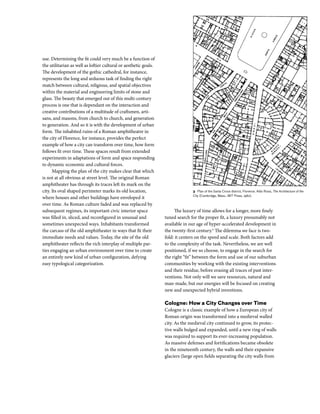
form. The inhabited ruins of a Roman amphitheatre in
the city of Florence, for instance, provides the perfect
example of how a city can transform over time, how form
follows fit over time. These spaces result from extended
experiments in adaptations of form and space responding
to dynamic economic and cultural forces.
Mapping the plan of the city makes clear that which
is not at all obvious at street level. The original Roman
amphitheater has through its traces left its mark on the
city. Its oval shaped perimeter marks its old location,
where houses and other buildings have enveloped it
over time. As Roman culture faded and was replaced by
subsequent regimes, its important civic interior space
was filled in, sliced, and reconfigured in unusual and
sometimes unexpected ways. Inhabitants transformed
the carcass of the old amphitheater in ways that fit their
immediate needs and values. Today, the site of the old
amphitheater reflects the rich interplay of multiple par-
ties engaging an urban environment over time to create
an entirely new kind of urban configuration, defying
easy typological categorization.
The luxury of time allows for a longer, more finely
tuned search for the proper fit, a luxury presumably not
available in our age of hyper-accelerated development in
the twenty-first century.4
The dilemma we face is two-
fold: it centers on the speed and scale. Both factors add
to the complexity of the task. Nevertheless, we are well
positioned, if we so choose, to engage in the search for
the right “fit” between the form and use of our suburban
communities by working with the existing interventions
and their residue, before erasing all traces of past inter-
ventions. Not only will we save resources, natural and
man-made, but our energies will be focused on creating
new and unexpected hybrid inventions.
Cologne: How a City Changes over Time
Cologne is a classic example of how a European city of
Roman origin was transformed into a medieval walled
city. As the medieval city continued to grow, its protec-
tive walls bulged and expanded, until a new ring of walls
was required to support its ever-increasing population.
As massive defenses and fortifications became obsolete
in the nineteenth century, the walls and their expansive
glaciers (large open fields separating the city walls from
3 Plan of the Santa Croce district, Florence. Aldo Rossi, The Architecture of the
City (Cambridge, Mass.: MIT Press, 1982).
surrounding developments or encroachments) were
no longer required. Consequently, valuable real estate
was reclaimed through the demolition and destruction
of the system of walls. Many cities have witnessed this
kind of pattern, including Vienna, Munich, and Paris.
But this phenomenon is about more than the walls and
the spaces that bound growing communities. It is about
how the underlying order of the original Roman city has
been transformed over time. Traces of the original cardo
and decumanus (the major north-south and east-west
axes typical of Roman town planning) are still visible on
contemporary maps. The lines of these axes may jog and
shift from their original laser straight paths. Similarly,
the block structures of the Roman colonies were ab-
sorbed into the amorphous sets of shapes and geometries
that govern medieval city form. Cologne’s form has been
further enriched with complexity because, like Berlin,
tumultuous historic forces, like the destruction of war,
punctuate its history.
A Brief History
The Romans recognized the value of Cologne’s location
at the crossroads between east and west trade routes, and
its strategic location along the Rhine River. The Roman
governor Marcus Vipsanius Agrippa founded the city in
53 B.C. and built the city with the assistance of the local
Teutonic tribe of Ubier. Together they built a city en-
closed by 4.5 kilometers of walls, with twenty-one towers
and nine gates. The city made good use of its location
on the river and the island that ran parallel to its banks.
Accessible by land and water, the island served primarily
as a commercial/market area. Despite strong defenses, as
an outpost of the Roman Empire, it came under continu-
ous attack by the Franks, who overran the city in 260
AD. The last Roman governor left in 425 A.D.
The cultural dormancy of the Dark Ages left its
mark on Cologne’s development. The first expansions to
the original Roman walls occurred in 950 A.D., when
the commercial district of the island was enveloped in
the new walls. In 1106 the largely rectilinear perimeter
of the city walls began to “bulge” out in three loca-
tions, such that the shape of the city’s new perimeter
was more circular than square. By 1180, a new city
wall, of greater girth, wrapped the expanding city. The
area within the city included newly built churches as
well as small farms and gardens. The city continued to
flourish as a pilgrimage site, as the Relics of Epiphany
were transferred to Cologne from Milan. The Cologne
Cathedral’s foundation was laid in 1248, and the city’s
coffers filled as it benefited from trade on the Rhine.
Pilgrimages decreased, however, and the city suf-
fered an economic downturn. As a result, construction
on the church stopped in 1560 and would not resume
for another 282 years. In 1794, the French occupied
Cologne and secularized this most Catholic city. Services
were greatly improved, and immigration of Protestants
and Jews was once again allowed. Combined with the
emerging Industrial Revolution, Cologne built new rail
links and bridges, establishing itself as a regional center
of commerce. In 1880, the fourth wave of urban devel-
opment further encircled the city in a “green belt.” The
former city walls were demolished and replaced with
elegant tree-lined avenues serving new neighborhoods.
World War II brought massive destruction to the
city and its monuments. Reconstruction has been ex-
tensive, and the suburbs have continued to grow beyond
Fritz Schumacher’s “green belt” in a radial pattern of
development. Today, as Germany’s fourth largest city,
Cologne’s form, despite the bombings, is rooted in its
genesis as a Roman city and its subsequent transforma-
tion. The medieval marketplace, cathedral spires, and
bridge spanning the Rhine serve as landmarks that ori-
ent residents and visitors alike and are emblematic of the
city’s rich past. The developed glaciers surrounding the
city link together old and new. Cologne’s robust econ-
omy, compact scale, gardens, surrounding landscape,
and medieval core make it a dynamic and livable city.
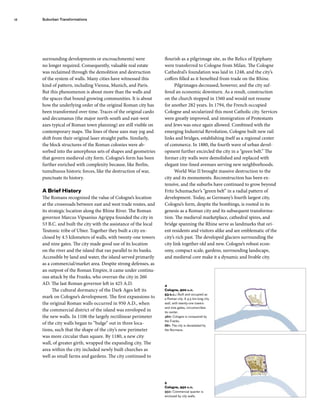
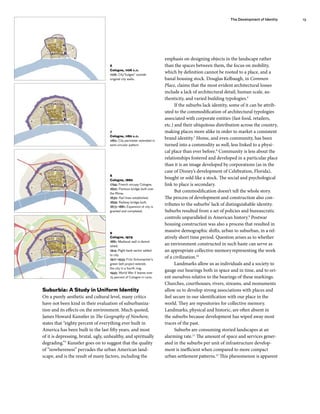
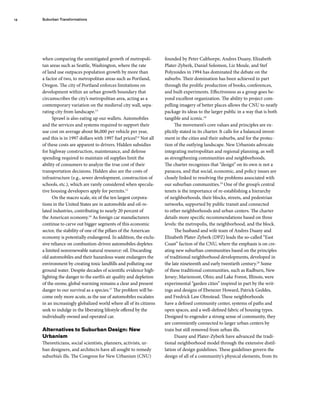
5
Cologne, 950 a.d.
950: Commercial quarter is
enclosed by city walls.
4
Cologne, 900 a.d.
53 b.c.: Built and occupied as
a Roman city. A 4.5 km-long city
wall, with twenty-one towers
and nine gates, circumscribes
its center.
460: Cologne is conquered by
the Franks.
881: The city is devastated by
the Normans.
Suburban Transformations
12
emphasis on designing objects in the landscape rather
than the spaces between them, the focus on mobility,
which by definition cannot be rooted to a place, and a
banal housing stock. Douglas Kelbaugh, in Common
Place, claims that the most evident architectural losses
include a lack of architectural detail, human scale, au-
thenticity, and varied building typologies.6
If the suburbs lack identity, some of it can be attrib-
uted to the commodification of architectural typologies
associated with corporate entities (fast food, retailers,
etc.) and their ubiquitous distribution across the country,
making places more alike in order to market a consistent
brand identity.7
Home, and even community, has been
turned into a commodity as well, less linked to a physi-
cal place than ever before.8
Community is less about the
relationships fostered and developed in a particular place
than it is an image developed by corporations (as in the
case of Disney’s development of Celebration, Florida),
bought or sold like a stock. The social and psychological
link to place is secondary.
But commodification doesn’t tell the whole story.
The process of development and construction also con-
tributes to the suburbs’ lack of distinguishable identity.
Suburbs resulted from a set of policies and bureaucratic
controls unparalleled in American history.9
Postwar
housing construction was also a process that resulted in
massive demographic shifts, urban to suburban, in a rel-
atively short time period. Question arises as to whether
an environment constructed in such haste can serve as
an appropriate collective memoryrepresenting the work
of a civilization.10
Landmarks allow us as individuals and a society to
gauge our bearings both in space and in time, and to ori-
ent ourselves relative to the bearings of these markings.
Churches, courthouses, rivers, streams, and monuments
allow us to develop strong associations with places and
feel secure in our identification with our place in the
world. They are repositories for collective memory.
Landmarks, physical and historic, are often absent in
the suburbs because development has wiped away most
traces of the past.
Suburbs are consuming storied landscapes at an
alarming rate.11
The amount of space and services gener-
ated in the suburbs per unit of infrastructure develop-
ment is inefficient when compared to more compact
urban settlement patterns.12
This phenomenon is apparent
6
Cologne, 1106 a.d.
1106: City”bulges” outside
original city walls.
Suburbia: A Study in Uniform Identity
On a purely aesthetic and cultural level, many critics
have not been kind in their evaluation of suburbaniza-
tion and its effects on the environment. Much quoted,
James Howard Kunstler in The Geography of Nowhere,
states that “eighty percent of everything ever built in
America has been built in the last fifty years, and most
of it is depressing, brutal, ugly, unhealthy, and spiritually
degrading.”5
Kunstler goes on to suggest that the quality
of “nowhereness” pervades the urban American land-
scape, and is the result of many factors, including the
7
Cologne, 1180 a.d.
1180: City perimeter extended in
semi-circular pattern.
8
Cologne, 1880
1794: French occupy Cologne.
1822: Pontoon bridge built over
the Rhine.
1830: Rail lines established.
1859: Railway bridge built.
1873–1881: Expansion of city is
granted and completed.
9
Cologne, 1979
1881: Medieval wall is demol-
ished.
1914: Right bank sector added
to city.
1917–1933: Fritz Schumacher’s
green belt project extends
the city in a fourth ring.
1945: World War II leaves over
75 percent of Cologne in ruins.
The Development of Identity 13
when comparing the unmitigated growth of metropoli-
tan areas such as Seattle, Washington, where the rate
of land use outpaces population growth by more than
a factor of two, to metropolitan areas such as Portland,
Oregon. The city of Portland enforces limitations on
development within an urban growth boundary that
circumscribes the city’s metropolitan area, acting as a
contemporary variation on the medieval city wall, sepa-
rating city from landscape.13
Sprawl is also eating up our wallets. Automobiles
and the services and systems required to support their
use cost on average about $6,000 per vehicle per year,
and this is in 1997 dollars with 1997 fuel prices!14
Not all
of these costs are apparent to drivers. Hidden subsidies
for highway construction, maintenance, and defense
spending required to maintain oil supplies limit the
ability of consumers to analyze the true cost of their
transportation decisions. Hidden also are the costs of
infrastructure (e.g., sewer development, construction of
schools, etc.), which are rarely considered when specula-
tive housing developers apply for permits.15
On the macro scale, six of the ten largest corpora-
tions in the United States are in automobile and oil-re-
lated industries, contributing to nearly 20 percent of
the American economy.16
As foreign car manufacturers
continue to carve out bigger segments of this economic
sector, the stability of one of the pillars of the American
economy is potentially endangered. In addition, the exclu-
sive reliance on combustion-driven automobiles depletes
a limited nonrenewable natural resource: oil. Discarding
old automobiles and their hazardous waste endangers the
environment by creating toxic landfills and polluting our
ground water. Despite decades of scientific evidence high-
lighting the danger to the earth’s air quality and depletion
of the ozone, global warming remains a clear and present
danger to our survival as a species.17
The problem will be-
come only more acute, as the use of automobiles escalates
in an increasingly globalized world where all of its citizens
seek to indulge in the liberating lifestyle offered by the
individually owned and operated car.
Alternatives to Suburban Design: New
Urbanism
Theoreticians, social scientists, planners, activists, ur-
ban designers, and architects have all sought to remedy
suburbia’s ills. The Congress for New Urbanism (CNU)
founded by Peter Calthorpe, Andres Duany, Elizabeth
Plater-Zyberk, Daniel Solomon, Liz Moule, and Stef
Polyzoides in 1994 has dominated the debate on the
suburbs. Their domination has been achieved in part
through the prolific production of books, conferences,
and built experiments. Effectiveness as a group goes be-
yond excellent organization. The ability to project com-
pelling imagery of better places allows the CNU to neatly
package its ideas to the larger public in a way that is both
tangible and iconic.18
The movement’s core values and principles are ex-
plicitly stated in its charter. It calls for a balanced invest-
ment in the cities and their suburbs, and for the protec-
tion of the outlying landscape. New Urbanists advocate
integrating metropolitan and regional planning, as well
as strengthening communities and neighborhoods.
The charter recognizes that “design” on its own is not a
panacea, and that social, economic, and policy issues are
closely linked to resolving the problems associated with
our suburban communities.19
One of the group’s central
tenets is the importance of re-establishing a hierarchy
of neighborhoods, their blocks, streets, and pedestrian
networks, supported by public transit and connected
to other neighborhoods and urban centers. The charter
details more specific recommendations based on three
levels: the metropolis, the neighborhood, and the block.
The husband and wife team of Andres Duany and
Elizabeth Plater-Zyberk (DPZ) leads the so-called “East
Coast” faction of the CNU, where the emphasis is on cre-
ating new suburban communities based on the principles
of traditional neighborhood developments, developed in
the late nineteenth and early twentieth century.20
Some
of these traditional communities, such as Radburn, New
Jersey; Mariemont, Ohio; and Lake Forest, Illinois, were
experimental “garden cities” inspired in part by the writ-
ings and designs of Ebenezer Howard, Patrick Geddes,
and Fredrick Law Olmstead. These neighborhoods
have a defined community center, systems of paths and
open spaces, and a well-defined fabric of housing types.
Designed to engender a strong sense of community, they
are conveniently connected to larger urban centers by
train but still removed from urban ills.
Duany and Plater-Zyberk have advanced the tradi-
tional neighborhood model through the extensive distil-
lation of design guidelines. These guidelines govern the
design of all of a community’s physical elements, from its
Suburban Transformations
14
street and block organization, to the detail of curb cuts at
intersections. Their best known projects include Seaside
Florida (featured in the movie The Truman Show) and
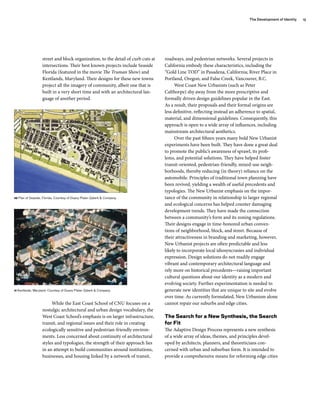
Kentlands, Maryland. Their designs for these new towns
project all the imagery of community, albeit one that is
built in a very short time and with an architectural lan-
guage of another period.
While the East Coast School of CNU focuses on a
nostalgic architectural and urban design vocabulary, the
West Coast School’s emphasis is on larger infrastructure,
transit, and regional issues and their role in creating
ecologically sensitive and pedestrian-friendly environ-
ments. Less concerned about continuity of architectural
styles and typologies, the strength of their approach lies
in an attempt to build communities around institutions,
businesses, and housing linked by a network of transit,
roadways, and pedestrian networks. Several projects in
California embody these characteristics, including the
“Gold Line TOD” in Pasadena, California; River Place in
Portland, Oregon; and False Creek, Vancouver, B.C.
West Coast New Urbanists (such as Peter
Calthorpe) shy away from the more prescriptive and
formally driven design guidelines popular in the East.
As a result, their proposals and their formal origins are
less definitive, reflecting instead an adherence to spatial,
material, and dimensional guidelines. Consequently, this
approach is open to a wide array of influences, including
mainstream architectural aesthetics.
Over the past fifteen years many bold New Urbanist
experiments have been built. They have done a great deal
to promote the public’s awareness of sprawl, its prob-
lems, and potential solutions. They have helped foster
transit-oriented, pedestrian-friendly, mixed-use neigh-
borhoods, thereby reducing (in theory) reliance on the
automobile. Principles of traditional town planning have
been revived, yielding a wealth of useful precedents and
typologies. The New Urbanist emphasis on the impor-
tance of the community in relationship to larger regional
and ecological concerns has helped counter damaging
development trends. They have made the connection
between a community’s form and its zoning regulations.
Their designs engage in time-honored urban conven-
tions of neighborhood, block, and street. Because of
their attractiveness in branding and marketing, however,
New Urbanist projects are often predictable and less
likely to incorporate local idiosyncrasies and individual
expression. Design solutions do not readily engage
vibrant and contemporary architectural language and
rely more on historical precedents—raising important
cultural questions about our identity as a modern and
evolving society. Further experimentation is needed to
generate new identities that are unique to site and evolve
over time. As currently formulated, New Urbanism alone
cannot repair our suburbs and edge cities.
The Search for a New Synthesis, the Search
for Fit
The Adaptive Design Process represents a new synthesis
of a wide array of ideas, themes, and principles devel-
oped by architects, planners, and theoreticians con-
cerned with urban and suburban form. It is intended to
provide a comprehensive means for reforming edge cities
10 Plan of Seaside, Florida. Courtesy of Duany Plater-Zyberk & Company.
11 Kentlands, Maryland. Courtesy of Duany Plater-Zyberk & Company.
The Development of Identity 15
and suburbs into unique places with their own distinct
identities. The following principles guide and inform the
Adaptive Design Process:
 Evolving Identity over Applied Identity
 Rooted to Place over Absent of Place
 Historical over A-historical
 Temporal over A-temporal
 Acquired Meaning over Marketed Meaning
 Community as Place over Community as Commodity
These themes are tightly interwoven and can be found in
the works of the New Urbanists, radical Dutch urban-
ists, smart growth movement, new typologists, landscape
architects, geographers, and urban morphologists that
inform Suburban Transformations. All of these think-
ers and designers concern themselves with the idea of fit
in one way or another. Fit happens when urban form is
uniquely matched to place or circumstance.
The search for the right fit between place and use
can only happen over time. The impact of new interven-
tions on existing contexts generates complex interac-
tions between physical, ecological, social, and economic
systems: interactions that go beyond our capacity to
properly evaluate. Brasilia, for instance, presents the
challenges of building instantaneous utopias. The oft-
cited example of Levittown reveals a search for the
proper fit between form and use, as inhabitants have
altered the shapes and configurations of their homes and
community to meet their needs. Both of these adapta-
tions to form, to find its proper fit, happened by ac-
cident. Whereas the planned portion of Brasilia’s design
resulted from a “closed system” driven by government
coordinated development processes, Levittown, after its
initial monolithic and instantaneous development and
construction process, engaged the open systems available
in the marketplace to generate change. The challenge lies
in finding open and dynamic processes that can operate
on all scales of development, regional to individual, such
that societal forces can be harnessed and engaged over
time for the productive improvement of our environ-
ment and the enhancement of our culture and its people.
Mapping techniques that can record landscape features,
highlight interrelations existing on a site, trace trans-
formations over time, and provide for a mechanism to
project transformations into the future are essential to
the task of finding fit over time.
Mapping offers designers the ability to discover,
record, and communicate complex site features and
relationships. The study of urban morphology is well
positioned to inform suburban design because it tracks
the changing structure of urban tissue. It is a field that
studies the historical process that generates form.21
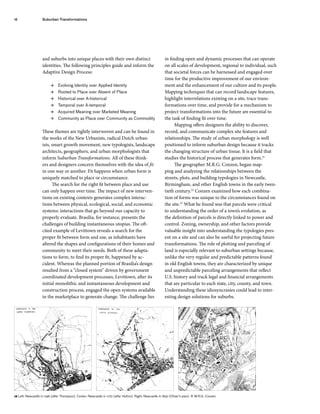
The geographer M.R.G. Conzen, began map-
ping and analyzing the relationships between the
streets, plots, and building typologies in Newcastle,
Birmingham, and other English towns in the early twen-
tieth century.22
Conzen examined how each combina-
tion of forms was unique to the circumstances found on
the site.23
What he found was that parcels were critical
to understanding the order of a town’s evolution, as
the definition of parcels is directly linked to power and
control. Zoning, ownership, and other factors provide
valuable insight into understanding the typologies pres-
ent on a site and can also be useful for projecting future
transformations. The role of plotting and parceling of
land is especially relevant to suburban settings because,
unlike the very regular and predictable patterns found
in old English towns, they are characterized by unique
and unpredictable parceling arrangements that reflect
U.S. history and track legal and financial arrangements
that are particular to each state, city, county, and town.
Understanding these idiosyncrasies could lead to inter-
esting design solutions for suburbs.
16 Suburban Transformations
12 Left: Newcastle in 1746 (after Thompson). Center: Newcastle in 1770 (after Hutton). Right: Newcastle in 1830 (Oliver’s plan). © M.R.G. Conzen.
Urban morphologist James Vance built on Conzen’s
ideas by outlining the processes involved in morphogen-
esis, which includes land assignment, connection, initia-
tion and transformation through adaptation.24
Vance
saw beyond a formal and physical analysis of the city’s
structure by taking into consideration capital accumu-
lation and transfers, speculation, and market forces in
his analysis, long considered a weakness of the Conzen
School.25
Vance’s mapping techniques therefore give us
a tool for understanding how, for example, a farm sub-
divided for tract housing might later on be recombined
for large scale commercial development; it has to do with
improving capital flows, or how much revenue a piece of
land can produce.
Professor Emeritus of MIT John Habraken gives us
yet another way of understanding urban form by map-
ping the various levels of control and decision making
power on a site. For Habraken, the arcaded streets of
Bologna, the ruins of Pompeii, Amsterdam’s canal lined
blocks, and Boston’s Back Bay neighborhood, provide
rich examples of urban tissue that has been inhabited and
altered over time to meet the needs of its inhabitants.26
These environments can be viewed through a filter of
levels, representing different scales of control from block
to street to building to room. Habraken’s mapping tech-
niques show how territorial control is exercised over a
site and its structures by its inhabitants. In any suburb or
edge city, territory is controlled in ways that reflect vari-
ous levels of national, state, county, city, neighborhood,
and individual interests. All of these influences are strong
determinants of how land is inhabited and controlled.
The great landscape architect Ian McHarg provides a
tool for understanding the interconnectedness of natural
systems by overlaying or cross-mapping separate ecologi-
cal systems that play a role on a site. In his seminal book
Design with Nature, through case studies of communities
on the outskirts of Washington, D.C. and Philadelphia,
McHarg provides “an ecological manual for the good
steward who aspires to art.” For McHarg, this art involves
bringing into balance the needs of the human environ-
ment with the natural environment, recognizing that “in
order to endure we must maintain the bounty of the great
cornucopia which is our inheritance.”27
His beautifully
illustrated book lays out strategies and processes that
distill information about the landscape and the needs
of contemporary urban development through a “physio-
graphic” mapping process. With great foresight and
inventiveness that preceded the development of
Geographical Information Systems (GIS),28
McHarg laid
one transparent map of information about the site’s ecol-
ogy and physical attributes over another, like a “complex
X-ray photograph with dark and light tones.”29
Together,
these composite maps reveal important values and
opportunities for future designs, which consider the
multitude of natural forces operating on a site. McHarg’s
mapping techniques inspired the cross-mapping tech-
niques discussed later in this book. Instead of just overlay-
ing the different ecological systems at work on a site the
Adaptive Design Process examines all systems operating
on a site, from environment to infrastructure, plots, and
capital flows. Through graphically comparing relevant
community features, interesting relationships that make
up identity can be discovered and enhanced over time.
Building on the McHargian tradition, Anuradha
Mathur and Dilip da Cunha have documented, through
lush and rich visuals, the shifting landscape of the
Mississippi River. Challenging the Army Corp of
Engineers’ vision of the river as an object that “arrest[s]
time through hydrology,” Mathur and da Cunha attempt
to define the Mississippi “as a dynamic, living phenom-
enon that asserts its own dimensions.”30
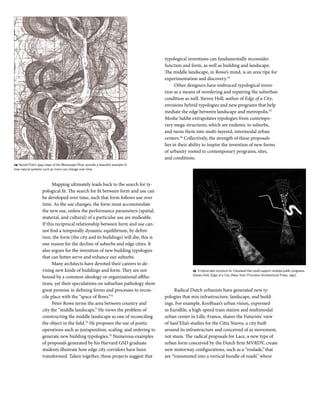
It is the journey
to understand this river that led to this extraordinary
compilation of maps, charts, sections, paintings, photo-
transects, and silk-screens, highlighting the behavior
and conflicts that arise in the relationship between a
powerful natural system, like the Mississippi, and man’s
attempt to inhabit its boundaries.
17
13 Map of Pompeii illustrating an “urban tissue” comprised of a courtyard typology,
transformed to meet the needs of different users over time. John Habraken,
Transformations of the Site (Cambridge, Mass.: Awater Press, 1988).
The Development of Identity
Mapping ultimately leads back to the search for ty-
pological fit. The search for fit between form and use can
be developed over time, such that form follows use over
time. As the use changes, the form must accommodate
the new use, unless the performance parameters (spatial,
material, and cultural) of a particular use are malleable.
If this reciprocal relationship between form and use can-
not find a temporally dynamic equilibrium, by defini-
tion, the form (the city and its buildings) will die; this is
one reason for the decline of suburbs and edge cities. It
also argues for the invention of new building typologies
that can better serve and enhance our suburbs.
Many architects have devoted their careers to de-
vising new kinds of buildings and form. They are not
bound by a common ideology or organizational affilia-
tions, yet their speculations on suburban pathology show
great promise in defining forms and processes to recon-
cile place with the “space of flows.”31
Peter Rowe terms the area between country and
city the “middle landscape.” He views the problem of
constructing the middle landscape as one of reconciling
the object in the field.32
He proposes the use of poetic
operations such as juxtaposition, scaling, and ordering to
generate new building typologies.33
Numerous examples
of proposals generated by his Harvard GSD graduate
students illustrate how edge city corridors have been
transformed. Taken together, these projects suggest that
typological inventions can fundamentally reconsider
function and form, as well as building and landscape.
The middle landscape, in Rowe’s mind, is an area ripe for
experimentation and discovery.34
Other designers have embraced typological inven-
tion as a means of reordering and repairing the suburban
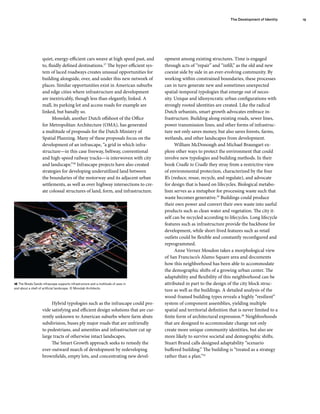
condition as well. Steven Holl, author of Edge of a City,
envisions hybrid typologies and new programs that help
mediate the edge between landscape and metropolis.35
Moshe Safdie extrapolates typologies from contempo-
rary mega-structures, which are endemic to suburbs,
and turns them into multi-layered, intermodal urban
centers.36
Collectively, the strength of these proposals
lies in their ability to inspire the invention of new forms
of urbanity rooted to contemporary programs, sites,
and conditions.
Radical Dutch urbanists have generated new ty-
pologies that mix infrastructure, landscape, and build-
ings. For example, Koolhaas’s urban vision, expressed
in Eurallile, a high-speed train station and multimodal
urban center in Lille, France, shares the Futurists’ view
of Sant’Elia’s studies for the Citta Nuova, a city built
around its infrastructure and conceived of as movement,
not stasis. The radical proposals for Lace, a new type of
urban form conceived by the Dutch firm MVRDV, create
new motorway configurations, such as a “roulade,”that
are “transmuted into a vertical bundle of roads” where
18 Suburban Transformation
14 Harold Fisk’s 1944 maps of the Mississippi River provide a beautiful example of
how natural systems such as rivers can change over time.
15 A hybrid dam structure for Cleveland that could support multiple public programs.
Steven Holl, Edge of a City (New York: Princeton Architectural Press, 1991).
quiet, energy-efficient cars weave at high speed past, and
to, fluidly defined destinations.37
The hyper-efficient sys-
tem of laced roadways creates unusual opportunities for
building alongside, over, and under this new network of
places. Similar opportunities exist in American suburbs
and edge cities where infrastructure and development
are inextricably, though less than elegantly, linked. A
mall, its parking lot and access roads for example are
linked, but banally so.
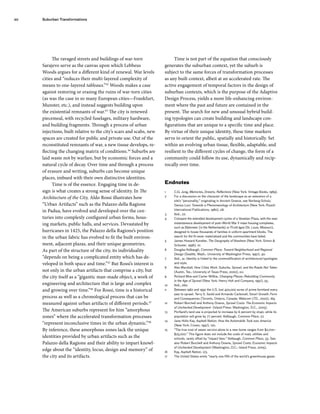
Monolab, another Dutch offshoot of the Office
for Metropolitan Architecture (OMA), has generated
a multitude of proposals for the Dutch Ministry of
Spatial Planning. Many of these proposals focus on the
development of an infrascape, “a grid in which infra-
structure—in this case freeway, beltway, conventional
and high-speed railway tracks—is interwoven with city
and landscape.”38
Infrascape projects have also created
strategies for developing underutilized land between
the boundaries of the motorway and its adjacent urban
settlements, as well as over highway intersections to cre-
ate colossal structures of land, form, and infrastructure.
Hybrid typologies such as the infrascape could pro-
vide satisfying and efficient design solutions that are cur-
rently unknown to American suburbs where farm abuts
subdivision, buses ply major roads that are unfriendly
to pedestrians, and amenities and infrastructure cut up
large tracts of otherwise intact landscapes.
The Smart Growth approach seeks to remedy the
ever-outward march of development by redeveloping
brownfields, empty lots, and concentrating new devel-
opment among existing structures. Time is engaged
through acts of “repair” and “infill,” as the old and new
coexist side by side in an ever-evolving community. By
working within constrained boundaries, these processes
can in turn generate new and sometimes unexpected
spatial-temporal typologies that emerge out of neces-
sity. Unique and idiosyncratic urban configurations with
strongly rooted identities are created. Like the radical
Dutch urbanists, smart growth advocates embrace in-
frastructure. Building along existing roads, sewer lines,
power transmission lines, and other forms of infrastruc-
ture not only saves money, but also saves forests, farms,
wetlands, and other landscapes from development.
William McDonough and Michael Braungart ex-
plore other ways to protect the environment that could
involve new typologies and building methods. In their
book Cradle to Cradle they stray from a restrictive view
of environmental protection, characterized by the four
R’s (reduce, reuse, recycle, and regulate), and advocate
for design that is based on lifecycles. Biological metabo-
lism serves as a metaphor for processing waste such that
waste becomes generative.39
Buildings could produce
their own power and convert their own waste into useful
products such as clean water and vegetation. The city it-
self can be recycled according to lifecycles. Long lifecycle
features such as infrastructure provide the backbone for
development, while short-lived features such as retail
outlets could be flexible and constantly reconfigured and
reprogrammed.
Anne Vernez Moudon takes a morphological view
of San Francisco’s Alamo Square area and documents
how this neighborhood has been able to accommodate
the demographic shifts of a growing urban center. The
adaptability and flexibility of this neighborhood can be
attributed in part to the design of the city block struc-
ture as well as the buildings. A detailed analysis of the
wood-framed building types reveals a highly “resilient”
system of component assemblies, yielding multiple
spatial and territorial definition that is never limited to a
finite form of architectural expression.40
Neighborhoods
that are designed to accommodate change not only
create more unique community identities, but also are
more likely to survive societal and demographic shifts.
Stuart Brand calls designed adaptability “scenario
buffered building.” The building is “treated as a strategy
rather than a plan.”41
The Development of Identity 19
16 The Breda Sands infrascape supports infrastructure and a multitude of uses in
and about a shell of artificial landscape. © Monolab Architects.
The ravaged streets and buildings of war-torn
Sarajevo serve as the canvas upon which Lebbeus
Woods argues for a different kind of renewal. War levels
cities and “reduces their multi-layered complexity of
means to one-layered tableaux.”42
Woods makes a case
against restoring or erasing the ruins of war-torn cities
(as was the case in so many European cities—Frankfurt,
Munster, etc.), and instead suggests building upon
the existential remnants of war.43
The city is renewed
piecemeal, with recycled fuselages, military hardware,
and building fragments. Through a process of urban
injections, built relative to the city’s scars and scabs, new
spaces are created for public and private use. Out of the
reconstituted remnants of war, a new tissue develops, re-
flecting the changing matrix of conditions.44
Suburbs are
laid waste not by warfare, but by economic forces and a
natural cycle of decay. Over time and through a process
of erasure and writing, suburbs can become unique
places, imbued with their own distinctive identities.
Time is of the essence. Engaging time in de-
sign is what creates a strong sense of identity. In The
Architecture of the City, Aldo Rossi illustrates how
“Urban Artifacts” such as the Palazzo della Ragione
in Padua, have evolved and developed over the cen-
turies into complexly configured urban forms, hous-
ing markets, public halls, and services. Devastated by
hurricanes in 1425, the Palazzo della Ragione’s position
in the urban fabric has evolved to fit the built environ-
ment, adjacent plazas, and their unique geometries.
As part of the structure of the city, its individuality
“depends on being a complicated entity which has de-
veloped in both space and time.”45
But Rossi’s interest is
not only in the urban artifacts that comprise a city, but
the city itself as a “gigantic man-made object, a work of
engineering and architecture that is large and complex
and growing over time.”46
For Rossi, time is a historical
process as well as a chronological process that can be
measured against urban artifacts of different periods.47
The American suburbs represent for him “amorphous
zones” where the accelerated transformation processes
“represent inconclusive times in the urban dynamic.”48
By inference, these amorphous zones lack the unique
identities provided by urban artifacts such as the
Palazzo della Ragione and their ability to impart knowl-
edge about the “identity, locus, design and memory” of
the city and its artifacts.
Time is not part of the equation that consciously
generates the suburban context, yet the suburb is
subject to the same forces of transformation processes
as any built context, albeit at an accelerated rate. The
active engagement of temporal factors in the design of
suburban contexts, which is the purpose of the Adaptive
Design Process, yields a more life-enhancing environ-
ment where the past and future are contained in the
present. The search for new and unusual hybrid build-
ing typologies can create building and landscape con-
figurations that are unique to a specific time and place.
By virtue of their unique identity, these time markers
serve to orient the public, spatially and historically. Set
within an evolving urban tissue, flexible, adaptable, and
resilient to the different cycles of change, the form of a
community could follow its use, dynamically and recip-
rocally over time.
Endnotes
1 C.G. Jung, Memories, Dreams, Reflections (New York: Vintage Books, 1989).
2 For a discussion on the character of the landscape as an extension of a
site’s “personality,” originating in Ancient Greece, see Norberg-Schulz,
Genius Loci: Towards a Phenomenology of Architecture (New York: Rizzoli
International Publications, 1980), 28.
3 Ibid., 22.
4 Compare the extended development cycles of a Venetian Plaza, with the near
instantaneous development of post–World War II mass housing complexes,
such as Bijlemeer (in the Netherlands) or Pruitt-Igoe (St. Louis, Missouri),
designed to house thousands of families in uniform apartment blocks. The
search for the fit never materialized and the communities have failed.
5 James Howard Kunstler, The Geography of Nowhere (New York: Simon &
Schuster, 1996), 10.
6 Douglas Kelbaugh, Common Place: Toward Neighborhood and Regional
Design (Seattle, Wash.: University of Washington Press, 1997), 40.
7 Ibid., 41. Identity is linked to the commodification of architectural typologies
and style.
8 Alex Marshall, How Cities Work: Suburbs, Sprawl, and the Roads Not Taken
(Austin, Tex.: University of Texas Press, 2000), xvi.
9 Richard Moe and Carter Willkie, Changing Places: Rebuilding Community
in the Age of Sprawl (New York: Henry Holt and Company, 1997), 55.
10 Ibid., 260.
11 Between 1982 and 1992 the U.S. lost 400,000 acres of prime farmland every
year to sprawl. Terry S. Szold and Armando Carbonell, Smart Growth: Form
and Consequences (Toronto, Ontario, Canada: Webcom LTD., 2002), 169.
12 Robert Burchell and Anthony Downs, Sprawl Costs: The Economic Impacts
of Unchecked Development (Island Press: Washington, D.C., 2005).
13 Portland’s land use is projected to increase by 6 percent by 2040, while its
population will grow by 77 percent. Kelbaugh, Common Place, 27.
14 Jane Holtz Kay, Asphalt Nation: How the Automobile Took over America
(New York: Crown, 1997), 120.
15 “The true cost of sewer service alone to a new home ranges from $2,700–
$25,000.” This figure does not include the costs of road, utilities and
schools, rarely offset by “impact fees.” Kelbaugh, Common Place, 33. See
also Robert Burchell and Anthony Downs, Sprawl Costs: Economic Impacts
of Unchecked Development (Washington, D.C.: Island Press, 2005).
16 Kay, Asphalt Nation, 123.
17 The United States emits “nearly one fifth of the world’s greenhouse gases
20 Suburban Transformations
Random documents with unrelated
content Scribd suggests to you:
corn, which they keep always ready besides what they sell; and
the like with other commodities, so that if a Dearth of Fish,
wine, grain, or anything else begins in the country, forthwith the
Dutch are ready with fifty or a hundred ships dispersing
themselves at every ‘Port-Town’ in England, trading away their
cargoes and carrying off English gold. Moreover, the Dutch have
in their hands the greater part of the carrying trade of France,
Portugal, Spain, Italy, Turkey, the East Indies, and the West
Indies. Yet London is a much more convenient port for a store-
house and for the carrying trade if our merchants would but
bend their course for it.”
As for small duties in foreign countries compared with the
excessive customs in ours. James, it will be remembered, relied on
his Customs duties, which were heavy, thereby keeping off foreign
trade. In Holland the Customs duties were so much lighter that a
ship which would pay £900 in the port of London could be cleared at
Amsterdam for £50. Raleigh points out that what is lost by lowering
the duties is more than made up by the increase of trade when the
duties are low. He advocates Free Trade, observe, long before that
innovation was thought of.
By the “fashion” of the ships he means the Dutch merchant
vessels called “Boyers, Hoy-barks, and Hoys,” constructed to contain
a great bulk of merchandise and to sail with a small crew. Thus an
English ship of 200 tons required a crew of thirty hands, while a ship
of the same tonnage built in Holland wanted no more than nine or
ten mariners.
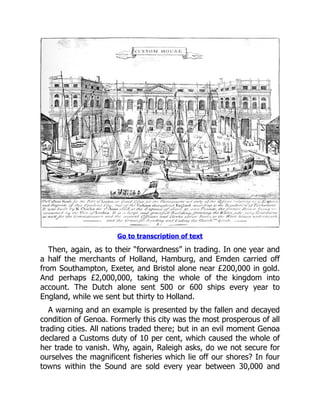
Go to transcription of text
Then, again, as to their “forwardness” in trading. In one year and
a half the merchants of Holland, Hamburg, and Emden carried off
from Southampton, Exeter, and Bristol alone near £200,000 in gold.
And perhaps £2,000,000, taking the whole of the kingdom into
account. The Dutch alone sent 500 or 600 ships every year to
England, while we sent but thirty to Holland.
A warning and an example is presented by the fallen and decayed
condition of Genoa. Formerly this city was the most prosperous of all
trading cities. All nations traded there; but in an evil moment Genoa
declared a Customs duty of 10 per cent, which caused the whole of
her trade to vanish. Why, again, Raleigh asks, do we not secure for
ourselves the magnificent fisheries which lie off our shores? In four
towns within the Sound are sold every year between 30,000 and
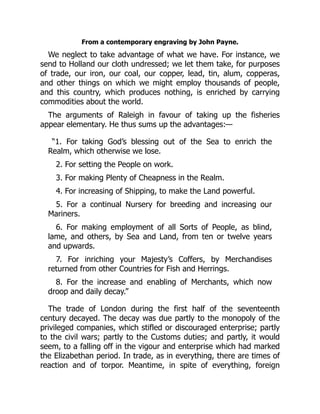
Walker & Cockerell.
40,000 casts of herrings, representing £620,000. In Denmark,
Norway, Sweden, etc., are sold our herrings, caught on our shores,
to the amount of £170,000. This fishery represents over a million
sterling in addition to all this. They are herrings caught off our
shores, and yet we have no share in this great trade.
The Dutch employ a thousand ships in carrying salt to the East
Kingdoms; we none. They have 600 ships in the timber trade; we
none; they send into the East Kingdoms 3000 ships every year; we
100 only. They carry goods from the East Kingdoms to France,
Spain, Portugal, and Italy in 2000 ships; we have none in that trade.
They trade to all the ports of France; we to five or six only. They
trade with every one of our ports—with 600 ships; we with three
only of these ports, and but forty ships.
THE SOVERAIGNE OF THE SEAS, BUILT 1637
From a contemporary engraving by John Payne.
We neglect to take advantage of what we have. For instance, we
send to Holland our cloth undressed; we let them take, for purposes
of trade, our iron, our coal, our copper, lead, tin, alum, copperas,
and other things on which we might employ thousands of people,
and this country, which produces nothing, is enriched by carrying
commodities about the world.
The arguments of Raleigh in favour of taking up the fisheries
appear elementary. He thus sums up the advantages:—
“1. For taking God’s blessing out of the Sea to enrich the
Realm, which otherwise we lose.
2. For setting the People on work.
3. For making Plenty of Cheapness in the Realm.
4. For increasing of Shipping, to make the Land powerful.
5. For a continual Nursery for breeding and increasing our
Mariners.
6. For making employment of all Sorts of People, as blind,
lame, and others, by Sea and Land, from ten or twelve years
and upwards.
7. For inriching your Majesty’s Coffers, by Merchandises
returned from other Countries for Fish and Herrings.
8. For the increase and enabling of Merchants, which now
droop and daily decay.”
The trade of London during the first half of the seventeenth
century decayed. The decay was due partly to the monopoly of the
privileged companies, which stifled or discouraged enterprise; partly
to the civil wars; partly to the Customs duties; and partly, it would
seem, to a falling off in the vigour and enterprise which had marked
the Elizabethan period. In trade, as in everything, there are times of
reaction and of torpor. Meantime, in spite of everything, foreign
trade increased. But Raleigh’s comparison between the trade of
Holland and that of London shows how small our foreign trade was,
in comparison with the vast bulk carried on by the Dutch.
After Sir Walter Raleigh’s “observations” let me quote Howell on
the profession or calling of the merchant:—
“For my part I do not know any profession of Life (especially
in an Island) more to be cherished and countenanced with
honourable employments than the Merchant-Adventurer (I do
not mean only the staplers of Hamburgh and Rotterdam); for if
valiant and dangerous actions do enoble a Man, and make him
merit, surely the Merchant-Adventurer deserves more Honour
than any; for he is to encounter not only with Men of all
Tempers and Humours (as a French Counsellor hath it), but he
contests and tugs oft-time with all the Elements; nor do I see
how some of our Country Squires, who sell Calves and Runts,
and their Wives perhaps Cheese and Apples, should be held
more genteel than the noble Merchant-Adventurer who sells
Silks and Satins, Tissues and Cloths of Gold, Diamonds and
Pearl, with Silver and Gold.”
In the year 1606 James made an attempt to introduce the
breeding of silkworms. He sent mulberry-trees into the country with
instructions for the feeding of the worms. There was a certain
amount of English-grown silk manufactured, as is shown by an entry
in Thoresby’s Diary. “Saw at Mr. Gale’s a sample of the satin lately
made at Chelsea of English silkworms, for the Princess of Wales,
which was very rich and beautiful.” The experiment proved
unsuccessful, yet it caused the immigration of a great number of silk
throwsters, weavers, and dyers, who settled here and entered upon
the silk trade in London. The raw silk was brought from India and
China by the East India Company.
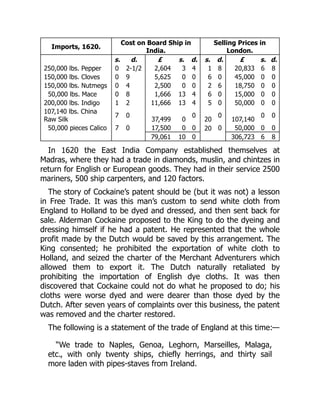
A table of imports from India in 1620 gives the most astonishing
difference between the cost in India and the selling price in London
(see Capper, Port and Trade of London, p. 82):—
Imports, 1620.
Cost on Board Ship in
India.
Selling Prices in
London.
s. d. £ s. d. s. d. £ s. d.
250,000 lbs. Pepper 0 2-1/2 2,604 3 4 1 8 20,833 6 8
150,000 lbs. Cloves 0 9 5,625 0 0 6 0 45,000 0 0
150,000 lbs. Nutmegs 0 4 2,500 0 0 2 6 18,750 0 0
50,000 lbs. Mace 0 8 1,666 13 4 6 0 15,000 0 0
200,000 lbs. Indigo 1 2 11,666 13 4 5 0 50,000 0 0
107,140 lbs. China
Raw Silk
7 0
37,499 0
0
20
0
107,140
0 0
50,000 pieces Calico 7 0 17,500 0 0 20 0 50,000 0 0
79,061 10 0 306,723 6 8
In 1620 the East India Company established themselves at
Madras, where they had a trade in diamonds, muslin, and chintzes in
return for English or European goods. They had in their service 2500
mariners, 500 ship carpenters, and 120 factors.
The story of Cockaine’s patent should be (but it was not) a lesson
in Free Trade. It was this man’s custom to send white cloth from
England to Holland to be dyed and dressed, and then sent back for
sale. Alderman Cockaine proposed to the King to do the dyeing and
dressing himself if he had a patent. He represented that the whole
profit made by the Dutch would be saved by this arrangement. The
King consented; he prohibited the exportation of white cloth to
Holland, and seized the charter of the Merchant Adventurers which
allowed them to export it. The Dutch naturally retaliated by
prohibiting the importation of English dye cloths. It was then
discovered that Cockaine could not do what he proposed to do; his
cloths were worse dyed and were dearer than those dyed by the
Dutch. After seven years of complaints over this business, the patent
was removed and the charter restored.
The following is a statement of the trade of England at this time:—
“We trade to Naples, Genoa, Leghorn, Marseilles, Malaga,
etc., with only twenty ships, chiefly herrings, and thirty sail
more laden with pipes-staves from Ireland.
To Portugal and Andalusia we sent twenty ships for wines,
sugar, fruit, and West Indian drugs.
To Bordeaux we send sixty ships and barks for wines.
To Hamburgh and Middleburgh, thirty-five ships are sent by
our Merchant Adventurers’ Company.
To Dantzic, Koningsburg, etc., we send yearly about thirty
ships, viz. six from London, six from Ipswich, and the rest from
Hull, Lynn, and Newcastle, but the Dutch many more.
To Norway we send not above five ships, and the Dutch
above forty, and great ships too.
Our Newcastle coal trade employs 400 sail of ships; viz. 200
for supplying of London, and 200 for the rest of England.
And besides our own ships, hither, even to the mine’s mouth,
come all our neighbouring nations with their ships continually,
employing their own shipping and mariners. I doubt not
whether, if they had such a treasure, they would employ not
their own shipping solely therein. The French sail thither in
whole fleets of fifty sail together, serving all their ports of
Picardie, Normandie, Bretagne, etc., even as far as Rochel and
Bordeaux. And the ships of Bremen, Emden, Holland, and
Zealand supply those of Flanders, etc., whose shipping is not
great, with our coals.
Our Iceland fishery employs 120 ships and barks of our own.
And the Newfoundland fishery 150 small ships.
And our Greenland whale fishery fourteen ships.
As for the Bermudas, we know not yet what they will do; and
for Virginia, we know not what to do with it; the present profit
of these two colonies not employing any store of shipping”
(Capper, p. 84).
The completion of the New River in 1620 was a great boon and
blessing to the people, but the greatest benefit to trade in the reign
of James I. was the improvement of the navigation of the upper part
of the Thames by deepening the channel, so that not only was
Oxford placed in communication with London, but the country all
round Oxford.
The granting of monopolies was an interference with trade which
would now cause a revolution. There were many complaints.
Parliament declared that all monopolies were void. That was under
James. Charles began, notwithstanding, to sell monopolies to
whomsoever would pay him most for them. Thus the importation of
alum was prohibited, for the protection of the alum works of Whitby;
also brick-making, the manufacture of saltpetre, of tapestry, the
coining of farthings, the making of steel, the making of stone pots
and jugs, making guns, melting iron ore, and many other things.
More than this, Charles made the sale of tobacco a royal monopoly;
he forbade the infant colony of Virginia to sell tobacco to any foreign
state; he levied a duty of four shillings a chaldron on all coal
exported to foreign parts; and he actually endeavoured to establish
a malting and a brewing monopoly. When we read the historian on
the despotic acts of Charles and his attempts on the liberties of his
people, let us bear in mind the constant exasperations of these
interferences with trade—that is, with the livelihood of the people.
When at last he became awakened to the danger of the position, he
revoked all their “grants, licences, and privileges”; but it was then
too late—revolution had already arisen.
Shops which had been open stalls confined to one or two markets
in London, such as East and West Chepe, began, towards the end of
the sixteenth century and early in the seventeenth, to appear along
Fleet Street, the Strand, and in King Street, Westminster.
Haberdashers, milliners, woollen drapers, cutlers, upholsterers,
glassmen, perfumers, and others established themselves
everywhere, making so brave a show every day, that, as Stow
complains, “the people of London began to expend extravagantly.”
There were offered, among other wares, “French and Spanish
gloves, and French cloth or frigarde (frieze), Flanders-dyed kersies,
daggers, swords, knives, Spanish girdles, painted cruses, dials,
tables, cards, balls, glasses, fine earthen pots, salt-cellars, spoons,
tin dishes, puppets, pennons, ink-horns, toothpicks, silk, and silver
buttons. All which ‘made such a show in passengers’ eyes, that they
could not help gazing on and buying these knicknacks.’ This great
offence a contemporary writer, quoted by Stow, bitterly
apostrophises. He ‘marvels’ that ‘no man taketh heed to it what
number of trifles cometh hither from beyond the seas, that we might
either clean spare, or else make them within our own realm; for the
which we either pay inestimable treasure every year, or else
exchange substantial wares and necessaries for them, for the which
we might receive great treasure.”
There had then arisen outside the City a new class, and one which
was becoming wealthy and important, namely, the suburban
shopkeepers. They were certainly not a class that Charles could
afford to exasperate. But apparently he never asked himself how far
it was prudent to exasperate any class. Thus, in the blindness of his
wrath against the Puritans, whose emigration was the best thing
that could happen to him, he forbade them to emigrate without a
certificate of having taken the oath of allegiance and supremacy, and
likewise from the minister of their parish a certificate of their
conversation and conformity to the orders and discipline of the
Church of England. He therefore did what he could to preserve his
own enemies in his kingdom, and to increase their hostility. Again,
he ordered that the Weavers’ Company should admit to its freedom
none but members of the Church of England. He even interfered
with trade to the extent of trading on his own account, on one
occasion buying up all the pepper imported by the East India
Company and selling it again at a profit.
The foundation of the banking business is said to date from the
outbreak of the Civil War; perhaps it was partly due to that event.
Banking was impossible in earlier times for several reasons: there
was no system of commercial credit; there were no bank-notes;
goods were bought or sold for actual coin; there was no Exchange;
when men went abroad or came home, they had to take their
foreign money to the Mint for re-coinage, or they had to get foreign
money at the Mint; there was no recognised system of lending or
borrowing; if a man borrowed money he did so as a special occasion
and for a special purpose, and paid a large interest for the
accommodation. The money-lenders were the Jews first, who carried
on the trade as a Royal monopoly, followed by the Lombards, who
came as the agents of Papal taxation; and afterwards the London
merchants and goldsmiths.
When the Civil War broke out it became a serious consideration
with the merchants to place their money in some place of security.
The Mint, their former place of deposit, could not be trusted because
Charles had already seized upon £200,000 belonging to merchants,
and placed there for safety; their own strong rooms would not do,
because if the City fell into the hands of the Royalists, the strong
room would most certainly be plundered first.[8] They therefore
began to lodge their cash in the hands of goldsmiths, keeping what
was called a “running cash” account. They probably thought that in
case of need the goldsmiths could take their money and plate
abroad. Country gentlemen also began to send their money up to
London for greater security. This method was found so convenient
that banking quickly spread and the bankers began to flourish.
During the Commonwealth one Henry Robinson proposed the
establishment of a “Land Bank,” with branches in the country to lend
money upon mortgage, the payments to be by paper.
THE FIRST ROYAL EXCHANGE—EXTERIOR AND INTERIOR
The wars with the Dutch and the extraordinary developments of
French industries caused our imports to vastly exceed our exports;
every maid-servant, it was said, paid the French King half her
wages; when peace came and trade was recovering, the madness of
Charles II. in closing the Exchequer paralysed and ruined the City for
a while. Never did monarch inflict a blow so cruel upon his people.
And never did the Stuarts recover the confidence which this measure
lost them.
The Plague of 1665, followed by the Fire, proved, as might be
expected, a temporary check to the prosperity of the City. But the
people kept up their courage.
After the Fire there was built, in place of Gresham’s Exchange,
which had been burned, a new Royal Exchange of which the first
stone was laid by King Charles II.
The increase of trade, although petty trade, in the West was
recognised in the foundation of the New Exchange, an institution
which has been mostly overlooked by historians.
“This building was erected by Robert, Earl of Salisbury, somewhat
after the shape of the Royal Exchange, having cellars underneath
and paved walks above with rows of shops. The first stone was laid
on the 10th of June 1608. It was opened by King James I., April
10th, 1609, who came attended by the Queen, the Duke of York, the
Lady Elizabeth, and many great lords and ladies, but it was not
successful” (Stow).
“In the Strand on the N. side of Durham House stood an olde long
stable, the outer wall whereof on the street side was very olde and
ruinate, all which was taken down and a stately building sodainely
erected in the place by Robert, E. of Salisbury, Lord High Treasurer
of England. The first stone of this beautiful building was laid the
10th of June last past, and was fully finished in November following.
And on Tuesday, the 10th April, the year (1609), many of the upper
shoppes were richly furnished with wares, and the next day after
that, the King, Queen and Prince, the Lady Elizabeth and the D. of
York, with many great Lordes and chief ladies, came thither, and
were there entertained with pleasant speeches, gifts, and ingenious
devices: there the King gave it a name and called it Britain’s Burse”
(Nich., Progresses, vol. ii. p. 248).
The exports and the imports of London during fifty years of this
century are thus tabulated. It will be seen that they show a steady
increase in the bulk of trade:—
Exports. Imports.
1614 2,090,640 2,141,283
1622 2,320,436 2,619,315
1663 2,022,812 4,016,019
1669 2,063,274 4,196,139
The prosperity of the country was shown by the contemporary
writers to have been advancing steadily and rapidly, in spite of the
civil wars, the Dutch wars, the pestilence which on five separate
occasions devastated the country and the City, and the Great Fire
which destroyed all the “Stock” of the merchants. Sir William Petty
(1676) observes that the number of houses in London was double
that of 1636, and that there had been a great increase of houses in
many towns of the United Kingdom, that the Royal Navy was four
times as powerful as in later years, that the coal trade of Newcastle
had quadrupled, the Customs yielded three times their former value,
that more than 40,000 tons of shipping were employed in the
Guinea and American trade, that the King’s revenue was trebled, and
that the postage of letters had increased from one to twenty.
Davenant also (1698) speaks twenty years later to the same
effect. He shows that the value of land had risen from twelve years’
purchase in former times to fourteen, sixteen, and twenty years’
purchase in 1666; and by the end of the century to twenty-six or
even more; that great quantities of waste land had been enclosed
and cultivated; that the merchant marine had doubled between 1666
and 1688; that many noble buildings had been erected; that the
Customs duties had increased in twenty years by a third; that the
standard of comfort among the working-classes was greatly
improved; and that property in cattle, stock-in-trade, and personal
effects had risen from £17,000,000 in 1600 to £88,000,000 in 1688.
As already mentioned, the Revocation of the Edict of Nantes
brought to this country some 70,000 of the most highly skilled
artificers. Many thousands settled in the suburbs of London,
especially in Bethnal Green, Spitalfields, and St. Giles. Among the
things they made or prepared were “light woollens, silk, linen,
writing-paper, glass, hats, lute-string, silks, brocades, satins, velvets,
watches, cutlery, clocks, jacks, locks, surgeons’ instruments,
hardware, and toys” (Capper, p. 103).
These refugees gave the country a large and valuable industry in
silk-weaving; it is also supposed that the manufacture of fine paper
was due to the French immigrants. In 1670 the Duke of Buckingham
brought Venetians over here who introduced the manufacture of fine
glass.
The making of linen cloth and tapestry was encouraged by an Act
of 1666, which offered special advantages to those who set up the
trade of hemp dressing. In 1669 certain French Protestants settled
at Ipswich and engaged in this trade.
The old industry of woollen cloth was protected by the prohibition
to export wool. In 1666 a law was passed directing that every one
should be buried in wool, and the clergy were required to take an
affidavit to that effect at every interment.
In 1676 the printing of calicoes was commenced in London. A
writer of the day says that “instead of green say, that was wont to
be used for children’s frocks, is now used painted and Indian and
striped calico, and instead of perpetuam or shalloon to line men’s
coats with is used sometimes glazed calico, which in the whole is not
a shilling cheaper, and abundantly worse.”
An Act passed in 1662 forbade the importation of foreign bone
lace, cut work, embroidery, fringe, band-strings, buttons, and
needlework on the ground that many persons in this country made
their living by this work.
The art of tinning plate-iron was brought over from Germany. The
first wire-mill was also put up at this period by a Dutchman.
In short, the development of the arts was largely advanced during
the century, and almost entirely by foreigners—French, German,
Venetian, and Dutch.
The income of the Crown does not belong to the history of
London, except that the City furnished a large part of it. That of
Charles II. was ordered by the Parliament, August 31, 1660, to be
made up to £1,200,000 a year. To raise this sum various Acts were
passed. Thus there was the subsidy called “tonnage” levied upon
foreign wine, and that called “pundage” levied upon the export and
import of certain commodities. These taxes were collected at the
Custom House. There was also the excise upon beer, ale, and other
liquors sold within the kingdom. There was the tax of hearth money,
which was two shillings upon any fire, hearth, or stove in every
house worth more than twenty shillings a year. There were also the
Royal lands, such as the Forest of Dean, the duties on the mines in
the Duchy of Cornwall, the first-fruits and tenths of church
benefices, the Post Office, etc. Other duties were laid occasionally on
land, on personal property, on the sale of wine, etc. It must be
remembered, however, that the King maintained out of this income
the Fleet and the Army.
The coinage current in London consisted of more kinds than the
present simpler system. In gold there were sovereigns, half-
sovereigns, crowns, and half-crowns; in silver, crowns, half-crowns,
shillings, sixpences, half-groats, pennies, and halfpennies. To this
there were added from time to time the Thistle crown of four
shillings, the Scottish six pound gold coin valued at ten shillings, the
French crown called “The Sun,” valued at seven shillings. There were
also farthing tokens in lead, tin, copper, and leather.
Ben Jonson shows us what kind of money was carried about. “The
man had 120 Edward’s shillings, one old Harry sovereign, three
James shillings, an Elizabeth groat: in all twenty nobles”—a noble
was worth 7s. 2d.; “also he had some Philip and Marias, a half-
crown of gold about his wrist that his love gave him, and a leaden
heart when she forsook him.”
“Before the reign of James I. nothing beyond pennies and
halfpennies in silver appear to have been attempted to supply the
poor with a currency. In 1611 Sir Robert Cotton propounded a
scheme for a copper coinage; this was not, however, carried out. A
scheme to enrich the king produced the farthing token, weighing six
grains, and producing 24s. 3d. for the pound weight of copper; half
the profit was to be the king’s and the other half the patentee’s. The
first patent was granted to Baron Harrington of Exton, Rutlandshire,
April 10, 1613, and a Proclamation was issued May 19, 1613,
forbidding the use of traders’ tokens in lead, copper, or brass. The
new coin was to bear, on the one side, the King’s title, ‘Jaco. D. G.
Mag. Bri., two sceptres through a crown;’ on the reverse, ‘Fra. et.
Hib. Rex., a harp crowned.’ The mint mark, a rose. A Proclamation
was published June 4, 1625, prohibiting any one from counterfeiting
this coin. Upon the death of Lord Harrington, in 1614, the Patent
was confirmed to Lady Harrington and her assigns; subsequently it
was granted to the Duke of Lennox and James, Marquis of Hamilton,
and on the 11th of July 1625 to Frances, Duchess Dowager of
Richmond and Lennox, and Sir Francis Crane, Knight, for seventeen
years, the patentees paying to the King one hundred marks yearly.
By a Proclamation issued in 1633, the counterfeiters of these tokens
were, upon conviction, to be fined £100 apiece, to be set on the
pillory in Cheapside, and from thence whipped through the streets to
Old Bridewell, and there kept to work; and when enlarged, to find
sureties for their good behaviour. On the 3rd of August 1644 the
Mayor, Aldermen, and Commons of the City of London petitioned the
House of Commons against the inconvenience of this coin, and the
hardship suffered by the poor in consequence. No farthing tokens
being issued during the Commonwealth, private persons were under
the necessity of striking their own tokens. The practice being,
however, contrary to law, was subsequently prohibited by a
Proclamation issued August 16, 1672. It further appears, by an
advertisement in the London Gazette, No. 714, September 23, 1672,
that an office called the ‘Farthing Office’ was opened in Fenchurch
Street, near Mincing Lane, for the issue of these coins on Tuesday in
each week, and in 1673–4 an order was passed to open the office
daily. These measures not proving effectual to prevent private
coinage of tokens, another Proclamation was issued on October 17,
1673, and another on December 12, 1674. These farthing tokens
encountered the contempt and scorn of all persons to whom they
were tendered, as being of the smallest possible value. Sarcastic
allusions were made to them by dramatists, poets, and wits.
‘Meercroft,’ in Ben Jonson’s Devill is an Asse, Act ii. sc. 1, played in
1616, alludes to this coin and its patentee” (Index to Remem. pp.
89, 90, note).
In 1694 the London tradesmen began to cry out about the
badness of the coinage; vast numbers of halfpence and farthings
were forged, and the chipping of the silver went on almost openly.
The Government resolved on an entirely new issue, which was
complete in 1699.
COINS OF THE PERIOD
1. Old Harry sovereign
2. Edward shilling.
3. James I. shilling.
4. Charles II. gold crown.
5. Elizabeth groat.
6. Charles II. half groat.
7. Charles II. sixpence.
8. Charles II. gold sovereign.
9. Charles II. half broad (gold)
10. Charles II. shilling.
11. Charles II. crown.
12. Charles II. half crown.
13. Charles II. silver Maundy penny.
It was not a time of universal prosperity; witness the following
account of the Grocers’ Company (Ninth Report, Historical MSS.):—
“27th March 1673. The Grocers’ proposal for payment of their
debts. The Company’s year rents and revenues amount to only
£722:5:4, and are charged with a yearly payment of £7571:19:8
in charity. Their debts are £24,000. In 1640 they lent the king
£4500, for repayment whereof some of the Peers became
bound. In 1642 they advanced £9000 for suppressing the Irish
Rebellion. In 1643 they lent the City of London £4500. The
principal and interest of these several debts, still owing to the
Company as aforesaid, amount to above £40,000. The greater
part of their estate was in houses burnt down in the late Fire,
and since leased out for 60, 70, and 80 years, by decrees made
in the late Court of Judicature established by Act of Parliament.
The several sums they owe were voluntarily lent them. They
propose that £12,000 be raised by voluntary subscriptions and
equally distributed among all their creditors within six months;
that, to discharge the rest of their debt, the debts owing to the
Company be assigned to trustees; that a special memorandum
be entered in the Company’s books, that, in case the creditors
be not satisfied by the means proposed, the Company shall, if
ever in a capacity hereafter, pay the whole remainder to every
creditor; and that, on performance of these proposals, the
Company be absolutely discharged from all their debts.
Meanwhile all prosecutions against the Company to be stayed,
that the Company may be animated cheerfully to raise the
money. The Company submit, in conclusion, that a Hall
encumbered and not half finished is all the Company of Grocers
have to encourage their members to a voluntary contribution to
satisfy debts contracted before most of them were born, and
before all the residue, save some few only, were free of the
Company. (Offered this day, having been called for by the
Committee on the 24th. Rejected as ‘not satisfactory’ on the
28th. Com. Book of date.)
OLD GROCERS’ HALL USED FOR BANK OF ENGLAND, 1695
28th March. Answer of the Appellants. The Company, besides
their £722:15:4 for rents in England, have an estate of nearly
£400 rental in Ireland, and their Hall, with appurtenances worth
£200 a year more. The lands charged with charitable uses are
expressly excepted by the decree. The estate is let at quit-rents,
and, if rack-rented, would yield another £12,000. The yearly
contributions of members amount to another £1000.
Their disbursements in 1671 were:—
£ s. d.
For payment for dinners and collations
17
2
1
3
1
0
To the Wardens
12
1
0 0
Corn money 25 0 0
Reparation of their Hall
28
1 4 6
In Gratuity given 89 0 0
Suit in Chancery and in Parliament with Appellants
89 8
1
1
Lord Mayor’s Day 44 4 0
Interest money
46
1
4 0
Besides this they can at pleasure raise in a month’s time, by
fines for offices and calling to livery, £4000. Most of their debts
are recent. Their loans to the City should be sued for by
themselves. The loan of 1643 was to defend the City against the
King. The Company did not suffer much by the Fire, as most of
their estate was let on long leases. All the creditors have
received one-sixth of their claims, except the Cholmleys, who
have been promised payment since the decree, but have
received nothing. The Company itself is willing to pay its debts,
but is prevented by a small minority, who are the authors of the
proposal, and dishonestly deny liability. Appellants cannot agree
to stand equally with the rest of the creditors, who refused to
join them at first before the suit commenced, and only sued the
Company at its own litigation, with a view to forestall
Appellants. They cannot accept the Grocers’ proposals in lieu of
the decree they hold. The Company have already offered more
favourable terms, which have been refused. The Hall is actually
sequestered, and was so before its conveyance to the Lord
Mayor, etc. of London, as Governors of Christ’s Hospital. The
Company’s estate is sufficient to cover their claim, in which
Appellants are supported by several members of the Company
itself. If the Company will give good personal security to
discharge their debts in seven years, and to pay at once the
sixth part of the principal to the Cholmleys, with interest from
the time others had it, with costs, Appellants will accept these
terms, assign over their sequestration, and help them to pay
their other creditors; otherwise they pray the sale may be
enforced. (Put in this day, but rejected by the Grocers’ Counsel.
Com. Book of date.”)
Another company was also struggling with difficulties, as the
following extract from the same Report shows:—
“10th March, 1675. The petition of the Master, Warden,
Assistants and Commonaltie of the Corporation of Pin-makers,
London, to the King; with paper of proposals attached thereto
Reminding his Majesty of a contract made between Him and
their Company, for the benefit alike of His Majesty and the
London Pin-makers, that came to nought in consequence of the
Great Plague and the Dutch, the Pin-makers beg for an aid of
£20,000—£10,000 thereof to be laid out in wire, to be bought of
His Majesty at 30d. per hundred weight about the current rate
of such wire; and the other £10,000 thereof to be used as a
fund by Commissioners, and the pins being distributed to buyers
at a cost sufficient only to cover the charge of production. By
operation of the scheme, embodied in these proposals, it is
urged the trade of the pin-making will revive, the pin-makers
will have full and lucrative employment, and his Majesty will by
his profit on the wire receive a revenue of at least £4000 per
annum.”
The most important civic event in the reign of William was the
foundation of the Bank of England. The bankers of the City had
been, as we have seen, the goldsmiths, who not only received and
kept money for their customers, but lent it out, for them and for
themselves, on interest. Thus, when Charles the Second, on January
2, 1672, closed the Exchequer, his creditors could obtain neither
principal nor interest. He then owed the goldsmiths of London the
sum of £1,328,526. Some of the older banks of London trace a
descent to the goldsmiths of the seventeenth century—Child’s, for
instance, Hoare’s, and others.
A PERSPECTIVE VIEW OF THE BANK OF ENGLAND, 1743
From Maitland’s History and Survey of London.
The idea of a National Bank seems to have been considered and
discussed for some years before it was carried into effect. The
principal advocate of the scheme was a Scotchman named William
Anderson. The advantages which he put forward in defence of the
Bank were the support of public credit and the relief of the
Government from the ruinous terms upon which supplies were then
raised. There was great difficulty in getting the scheme considered,
but it was at last passed by an Act of Parliament in 1693. By the
terms of this Act it was provided that the Government should take a
loan of £1,200,000 from the Bank, this amount to be subscribed;
additional taxes were imposed which would produce about £140,000
a year, out of which the Bank was to receive £100,000 a year,
including interest at 8 per cent, and £4000 a year for management.
The Company was empowered to purchase lands, and to deal in bills
of exchange and gold and silver bullion, but not to buy or sell
merchandise, though they might sell unredeemed goods on which
they had made advances.
The subscription for the £1,200,000 was completed in ten days.
The Bank began its business on July 27, 1694.
Its offices were at first the Grocers’ Hall, where they continued
until the year 1743. In this year the new building, part of the present
edifice, was completed.
Maitland describes it as
“A most magnificent structure; the front next the street is
about 80 feet in length, adorned with columns, entablature,
etc., of the Ionick order. There is a handsome courtyard
between this and the main building, which, like the other, is of
stone, and adorned with pillars, pilasters, entablature, and
triangular pediment of the Corinthian Order. The hall is 79 feet
in length, and 40 in breadth, is wainscotted about 8 feet high,
has a fine fretwork ceiling, and a large Venetian window at the
west end of it. Beyond this is another quadrangle, with an
arcade on the east and west sides of it: and on the north is the
Accomptant’s Office, which is 60 feet long, and 28 feet broad.
There are handsome apartments over this and the other sides
of the quadrangle, with a fine staircase adorned with fretwork;
and under it are large vaults, that have very strong walls and
iron gates for the p reservation of the cash.”
By the charter they constituted a Governor, who must have £4000
in Bank stock; a Deputy Governor, who must have £3000; and
twenty-four Directors, who must have £2000 each.
The Bank, although a year or two after its foundation its utility
was fully recognised by merchants, did not command complete
confidence for many years. Pamphlets were written against it. They
were answered in 1707 by Nathaniel Tench, a merchant. The
defence is instructive. Maitland sums it up:—
“The chief purpose of this defence was to vindicate a
corporation, and the management thereof; not so much from
crimes they had already been guilty of in the experiment of
eleven or twelve years, as the fear of what they might do
hereafter.”
The charter of the Bank was renewed in 1697 to 1711; in 1708 to
1733; in 1712 to 1743; in 1742 to 1765; in 1763 to 1786; in 1781 to
1812; and so on. There have been times of tightness. In 1697 the
Bank was forced to suspend partially payment in coin, giving 10 per
cent once a fortnight, and afterwards at the rate of 3 per cent once
in three months. In 1720 it escaped the disaster of the South Sea
Bubble. In 1745, when London was thrown into a panic by the
approach of the Pretender, there was a run upon the Bank. This was
staved off by paying slowly in silver. In the year 1797, by an order in
Council, last payments were suspended. These events, however,
belong to the after history of the Bank.
The foundation of the Bank of England brought about a complete
revolution in the relations of Crown and City. We have seen that
hitherto the City was called the King’s Chamber; when the King
wanted money he sent to the City for a loan; sometimes he asked
more than the City could lend; generally the City readily conceded
the loan.
In a note, Sharpe calls attention to the absurdity of representing
the Chancellor of the Exchequer going about, hat in hand, borrowing
£100 of this hosier and £100 from that ironmonger:—
“The mode of procedure was nearly always the same. The
lords of the treasury would appear some morning before the
Common Council, and after a few words of explanation as to the
necessities of the time, would ask for a loan, offering in most
cases undeniable security. Supposing that the Council agreed to
raise the required loan, which it nearly always did, the mayor for
the time being was usually instructed to issue his precept to the
aldermen to collect subscriptions within their several wards,
whilst other precepts were (in later times at least) sent to the
master of wardens of the livery companies to do the same
among the members of their companies. There were times,
also, when the companies were called upon to subscribe in
proportion to their assessment for supplying the City with corn
in times of distress” (London and the Kingdom, vol. ii. pp. 586,
587).
The last loan ever asked by the King of the City was that asked by
William the Third in 1697 to pay off his navy after the Peace of
Utrecht. Instead of going to the City the King went to the Bank, but
not then without the authority of Parliament. The City was no longer
to be the Treasurer—or the Pawnbroker—of the King and the nation.
This event, though the citizens did not apprehend its full meaning
for many years, deprived London of that special power which had
made her from the Norman Conquest alternately the object of the
Sovereign’s affections or of his hatred. Henceforth it mattered
nothing to London whether the King loved or hated her. The power
of the City was now exercised legitimately by her representatives in
the House of Commons.
CHAPTER VII
THE IRISH ESTATES
The following history of the Irish estates is taken from London and
Londonderry, published in Belfast (1890) by Messrs. Marcus Ward
and Co.
In the year 1608 the first steps were taken towards the settlement
of Ulster by English and Scotch emigrants—a measure whose
wisdom was shown eighty years later, when the grandson of James
the First owed his expulsion largely to the descendants of the
original settlers.
The greater part of six counties in the Province of Ulster, viz.
Donegal, Fermanagh, Cavan, Tyrone, Armagh, and Coleraine, after
the rebellions of O’Neill and O’Donnell, were declared to be
escheated to the Crown. James conceived a plan for securing the
peace and welfare of Ulster by replacing the Irish rebels by
Protestant settlers, together with those of the Irish who were willing
to conform to the English rule and religion. He therefore invited
“undertakers” who would accept of lands in Ulster on his conditions.
These were, that they should not ask for large portions “in tending
their private property only;” that there should be three classes of
undertakers:
(1) Those who would plant with English or Scotch tenants.
(2) Servitors or military undertakers.
(3) Native Irish admitted as freeholders.
The first class were to pay to the Crown the great rent of £5:6:8
for every thousand acres. The second class, when they planted with
English or Scotch tenants, were to pay the same; otherwise, the
second class were to pay £8 for every thousand acres; and the third
class were to pay £10:13:4 for every thousand acres.
The third condition was, that all were required to provide
strongholds and arms for defence, to let their lands on easy terms,
to “avoid Irish exactions,” and to be resident; they were not to
accept the “mere” Irish as tenants at all; they were required to
create market towns, and to found at least one free school in every
county for education in religion and learning. They were also
privileged to import from Great Britain for three years, free of
custom, everything requisite to put the plantation on a satisfactory
footing.
In 1609 Commissioners were appointed to survey the escheated
lands and to divide them into convenient parcels for allocation.
In the same year proposals were made in the King’s name to the
City that the Corporation itself should undertake the restoration of
the city of Derry and the town of Coleraine, and should plant the
rest of the county with undertakers. The City was offered the
Customs for twenty-one years at 6s. 8d. per annum, the fisheries of
the Bann and the Foyle, free license to export wares grown on their
own land, and the admiralty of Tyrconnel and Coleraine.
The following were the inducements held out to the City:—
“If multitudes of men were employed proportionally to these
commodities which might be there by industry attained, many
thousands would be set on work to the great service of the
King, strength of his realm, advancement of several trades, and
benefit of particular persons, whom the infinite increasing
greatness (that often doth minister occasion of ruin to itself) of
this city might not only conveniently spare, but also reap a
singular commodity by easing themselves of an insupportable
burthen which so surcharged all the parts of the city that one
tradesman can scarce live by another, which in all probability
would be a means also and preserve the city from infection; and
by consequence the whole kingdom, of necessity, must have
recourse thither, which persons pestered or closed up together
can neither otherwise or very hardly avoid” (London and
Londonderry, p. 7).
On July 1, 1609, the Court of Aldermen sent a precept to each of
the City Companies asking them to appoint representatives to
consider the propositions. The Companies refused to undertake this
work. Thereupon the Mayor appointed a Committee, ignoring the
refusal of the Companies, to carry out the undertaking. This
Committee sent an order to the Companies to ascertain what each
member would willingly undertake.
On August 1, 1609, the City sent out four “viewers” to survey the
place intended for the new Plantation and “to make report to this
City.” The viewers returned in December, when it was resolved that
£15,000 should be raised to meet preliminary expenses. The money
was to be raised in the Companies, not by the Companies. Meantime
the City asked for certain additional advantages, including forces for
defence to be maintained at the King’s charges. It was agreed that
200 houses should be built at Derry, leaving room for 300 more, and
that 100 houses should be built at Coleraine, leaving room for 200
more, and that fortifications should be constructed. Another sum of
£5000 was then ordered to be raised. In January 1610 the demands
of the City were granted by the Privy Council. It is important to
observe that the “undertaking” by the City was not a purchase by
the Companies, but taxation of the members of the Companies by
order of the City, just as any other tax was imposed and collected.
Some of the poorer Companies were exempted, but not the “abler”
men among them.
In July 1611 another contribution of £20,000 was raised by tax. In
this case those Companies which might choose to lose the benefits
resulting from their previous contributions were exempt—a privilege
accepted by two of the Companies.
Power was given by the Common Council to the Committee of the
Corporation, afterwards the Irish Society, to divide the land among
those Companies willing to accept them, and so “to build and plant
the same at their own cost and charges, accordingly as by the
Printed Book of Plantation is required.” Eight of the great Companies
accepted at once, and the other four shortly afterwards.
Meantime the Privy Council made certain conditions, among them
the following:—
“The Londoners are first to provide habitations for such poor
and necessary men as they draw thither for their business, and
afterwards to let for such rents as shall be fitting as well for the
good of the Plantation as for some valuable rent (the charges
considered), the Londoners always performing the Articles of
Plantation” (London and Londonderry, pp. 12, 13).
It would appear from this that the subscribers were intended to
get rent in return for their outlay, but they never did, because the
Companies added the rents of the land to their own corporate funds.
As the subscribers do not appear to have objected, this was
probably done openly and without any remonstrance or objection.
Complaints began to be made that the conditions were not carried
out; only twenty houses were built at Derry instead of the 200
promised; the Londoners were converting the timber to their own
profit. In December 1612 the King wrote to Sir Arthur Chichester, the
Lord Deputy:—
“‘If there were no reason of State to press it forward, yet we
would pursue and effect that work with the same earnestness,
merely for the goodness and morality of it, esteeming the
settling of religion, the introducing of civility, order, and
government among a barbarous and unsubjected people to be
the acts of piety and glory, and worthy also a Christian Prince to
endeavour’” (London and Londonderry, p. 13).
On March 29, 1613, the first charter was granted to the Irish
Society as representing not the Companies, but the Corporation of
the City of London for the Plantations. This charter constitutes and
incorporates the Irish Society:—
“‘For the better ordering, directing, and governing all and all
manner of things for and concerning the City and Citizens of
Londonderry aforesaid, and the aforesaid County of
Londonderry, and the Plantation to be made within the same
City and County of Londonderry, and other businesses belonging
to the same,’ giving the Society power to purchase and hold in
fee, for these purposes, lands, goods, etc., in England or in
Ireland, to have a common seal, and to sue or be sued” (p. 14).
A grant of timber is made only for the Plantation and “not for any
other causes to be merchandized or sold.” In other words, the Irish
Society was incorporated for the purpose of a Trust; the members
were originally Trustees.
It is charged against the Society that they began by neglecting the
conditions, setting too high a rent upon their lands, and trying to
make a profit for the Londoners out of the property. James himself
was much dissatisfied with the conduct of the estates. He wrote to
Sir Arthur again in August 1615, adding a postscript in his own hand:
—“My Lord, in this service I expect that zeal and uprightness from
you, that you will spare no flesh, English or Scotch, for no private
man’s worth is able to counterbalance the particular safety of a
kingdom, which this Plantation, being well accomplished, will
procure.”
A year afterwards the King granted a licence to the twelve
Companies to hold in mortmain whatever lands the Irish Society
might grant them.
These grants contained a reservation of the right of re-entry if the
conditions specified were not kept.
It is, of course, evident that if the Irish Society were Trustees they
could not give away their lands, and that they could only make
grants under the conditions of their Trust.
Welcome to our website – the perfect destination for book lovers and
knowledge seekers. We believe that every book holds a new world,
offering opportunities for learning, discovery, and personal growth.
That’s why we are dedicated to bringing you a diverse collection of
books, ranging from classic literature and specialized publications to
self-development guides and children's books.
More than just a book-buying platform, we strive to be a bridge
connecting you with timeless cultural and intellectual values. With an
elegant, user-friendly interface and a smart search system, you can
quickly find the books that best suit your interests. Additionally,
our special promotions and home delivery services help you save time
and fully enjoy the joy of reading.
Join us on a journey of knowledge exploration, passion nurturing, and
personal growth every day!
ebookbell.com

Suburban Transformations 1st Edition Paul Lukez

  • 1.
    Suburban Transformations 1stEdition Paul Lukez download https://ebookbell.com/product/suburban-transformations-1st- edition-paul-lukez-51413710 Explore and download more ebooks at ebookbell.com
  • 2.
    Here are somerecommended products that we believe you will be interested in. You can click the link to download. Asian American Political Action Suburban Transformations James S Lai https://ebookbell.com/product/asian-american-political-action- suburban-transformations-james-s-lai-51894870 Latino Orlando Suburban Transformation And Racial Conflict Simone Pierre Delerme https://ebookbell.com/product/latino-orlando-suburban-transformation- and-racial-conflict-simone-pierre-delerme-23892250 Dont Blame Us Suburban Liberals And The Transformation Of The Democratic Party Pilot Project Ebook Available To Selected Us Libraries Only Lily Geismer https://ebookbell.com/product/dont-blame-us-suburban-liberals-and-the- transformation-of-the-democratic-party-pilot-project-ebook-available- to-selected-us-libraries-only-lily-geismer-51949484 Dont Blame Us Suburban Liberals And The Transformation Of The Democratic Party Lily Geismer https://ebookbell.com/product/dont-blame-us-suburban-liberals-and-the- transformation-of-the-democratic-party-lily-geismer-5046708
  • 3.
    Transformation From BelowWhite Suburbia In The Transformation Of Apartheid South Africa To Democracy 1st Edition Ursula Scheidegger https://ebookbell.com/product/transformation-from-below-white- suburbia-in-the-transformation-of-apartheid-south-africa-to- democracy-1st-edition-ursula-scheidegger-51883416 Suburban Dreams Imagining And Building The Good Life Greg Dickinson https://ebookbell.com/product/suburban-dreams-imagining-and-building- the-good-life-greg-dickinson-48991382 Suburban Empire Cold War Militarization In The Us Pacific 1 Ebook Lauren Hirshberg https://ebookbell.com/product/suburban-empire-cold-war-militarization- in-the-us-pacific-1-ebook-lauren-hirshberg-50488292 Suburban Century Social Change And Urban Growth In England And The United State Mark Clapson https://ebookbell.com/product/suburban-century-social-change-and- urban-growth-in-england-and-the-united-state-mark-clapson-50671380 Suburban Sweatshops The Fight For Immigrant Rights 1st Edition Jennifer Gordon https://ebookbell.com/product/suburban-sweatshops-the-fight-for- immigrant-rights-1st-edition-jennifer-gordon-51387914
  • 5.
  • 7.
  • 8.
    Published by Princeton ArchitecturalPress 37 East Seventh Street New York, New York 10003 For a free catalog of books, call 1.800.722.6657. Visit our web site at www.papress.com. © 2007 Princeton Architectural Press All rights reserved Printed and bound in China 10 09 08 07 4 3 2 1 First edition No part of this book may be used or reproduced in any manner without written permission from the publisher, except in the context of reviews. Every reasonable attempt has been made to identify owners of copyright. Errors or omissions will be corrected in subsequent editions. Editor: Lauren Nelson Packard Designer: Jan Haux Special thanks to: Nettie Aljian, Sara Bader, Dorothy Ball, Nicola Bednarek, Janet Behning, Becca Casbon, Penny (Yuen Pik) Chu, Russell Fernandez, Pete Fitzpatrick, Wendy Fuller, Clare Jacobson, John King, Nancy Eklund Later, Linda Lee, Katharine Myers, Jennifer Thompson, Arnoud Verhaeghe, Paul Wagner, Joseph Weston, and Deb Wood of Princeton Architectural Press —Kevin C. Lippert, publisher Library of Congress Cataloging-in-Publication Data Lukez, Paul, 1958- Suburban transformations / Paul Lukez. p. cm. Includes index. ISBN 978-1-56898-683-8 (alk. paper) 1. Suburbs. 2. City planning. 3. Architecture—Social aspects. 4. Community life. I. Title. HT351.L85 2007 307.74—dc22 2007018890
  • 9.
    Contents Preface Acknowledgments Foreword by Anthony Flint TheDevelopment of Identity Chapter 1 In Search of Identity over Time Chapter 2 The Adaptive Design Process Chapter 3 Mapping Chapter 4 Cross-Mapping Chapter 5 Editing Chapter 6 Selecting Tools: (Hybrid) Building Typologies and Design Tools Chapter 7 Spatial Models Case Studies: Burlington, Massachusetts Amsterdam, the Netherlands e-Mall, Dedham, Massachusetts Shenzhen, China Revere Beach, Massachusetts Significance of the Proposition Index 6 8 9 10 23 41 51 75 89 93 105 127 147 159 167 177 187 192
  • 10.
    “Will we everdrag our visiting relatives out to show off our Edge City, our shining city on the hill?” Joel Garreau, Edge City 1 In his seminal book Edge City, Joel Garreau states, “Edge City’s problem is history. It has none.” He follows by speculating on the development of Venice, spanning over a thousand years, from its earlier “chaotic” form into a highly refined and interwoven assemblage of urban spaces and forms. Buildings were continually built, torn down, rebuilt, and altered, while the city’s open spaces were sculpted and refined in response to the evolving demands of a growing city and its populace. The result of this thousand-year design and construction process is a richly woven tapestry of urban form and space, recognized by urban design experts today as a marvel in city planning. Yet, while the successes of the current configuration of the city are well documented, the most valuable lessons may lie in understanding how Venice’s sometimes messy transformation over time came to be. Regarding our relatively contemporary settlements—suburbs, exurbs, edge cities, and edge nodes—are we perhaps looking at the very early stages of new types of communities, whose mature forms have yet to crystallize, through successive and selective acts of writing and erasing buildings and spaces? What are the processes and design principles that might allow these relatively recent early community forms to develop into dynamic and memorable environments? Throughout my academic and professional career, I have been interested in the relationship between time and architecture. In particular, I’ve been interested in how structures and their urban fabric change over time to accommodate new programs. These patterns of transformation reveal the behavior of form in response to changing circumstances. My fascination with understanding the vagaries of time led to the study of infrastructure elements and large municipal structures, as they were more likely to withstand entropy and because their mass could serve as repositories of time’s accretions. I discovered that these kinds of structures often mutated into unusual typological configurations that defied conventional classifications. The “traces” of these structures found in maps of richly layered cities suggest that the particularity of place is deeply rooted to time and circumstance. In an irreversible equation, the identity of a place cannot be altered: Venice, its structure and environment, can be of no other place. This quality of unique identity is lacking in current suburban contexts. Garreau’s summation of the lack of history inherent in the edge city does not mean to imply that these contemporary sites are merely too recent, but that the processes that have engendered them deny transformation. There is a pathology to the contemporary development process that negates both Time and Circumstance. The Adaptive Design Process, described in the pages of this book, explicitly incorporates time and circumstance into the design process. By mapping and cross-mapping the rich variety of features that make up any site, such as environmental features, topography, street patterns, building profiles, and sights and smells, opportunities for identity can be determined in even the most generic places. Carrying these mappings from the past on to the present and into the future in a series of “filmstrips” shows how a site is transformed over time, creating the essence of place. This is a book for anyone who cares about the quality of their physical environment—particularly suburban and edge city sites—and wishes to see it improved, whether on the scale of building, community, or region. This includes planners, designers, town officials, policymakers, developers, landowners, environmental activists, and all those individual and institutional members of a community that have a stake or interest in shaping its future. The book provides the reader with evocative images of just some of the multitude of strategies through which these goals can be achieved over time. The power of seeing what is possible, so much richer than the current reality, is the first step in activating new models for transforming our communities. The images included in the book transcend the limitations of visionary drawings; they are rooted in a process that constantly updates and recalibrates the projected reality within the limits of contemporary constraints. Yet the images have the potential to become iconic, in that they temporally register the dreams and aspirations of a community at a particular time. Five case studies demonstrate the Adaptive Design Process. The study of Burlington, Massachusetts, your Preface
  • 11.
    typical edge city,with its regional mall, speculative office buildings, corporate headquarters, strip malls, housing developments, and parking lots, provides a fine-grained illustration of the Adaptive Design Process in action. Tools such as mapping and cross-mapping are explained in depth using this extended case study. The other four case studies show the application of these ideas in edge cities that in various ways, are less than typical: Revere Beach, Massachusetts; Dedham Mall, Massachusetts; Shenzhen, China; and Amsterdam, the Netherlands. Each of these places exhibits certain conditions that are common to edge cities, but also have special differences, which can help illustrate the power of the Adaptive Design Process. In every case, site conditions and history are carefully mapped and analyzed and help inform future proposed transformations. This book contends that it is conceivable that edge cities (and their suburban environs) could, over time, evolve into more habitable, cohesive, efficient, and memorable places with unique identities and histories, distinguishable from other edge cities and suburbs. 1 Joel Garreau, Edge City: Life on the New Frontier (New York: Random House, Inc., 1991), 9. 7
  • 12.
    Acknowledgments This book isabout how suburbs and edge cities can evolve over time. Through successive acts of erasure and writing generated by multiple parties, richly layered places can be created. Similarly, this book has evolved over time, some- times through more erasure than writing, but always with the participation and assistance of many people, includ- ing mentors, teachers, colleagues, students, staff, editors, friends, and family. As an analysis of some of the most satisfying and beautiful cities can reveal, authorship is shared by the many who have contributed over time in ways, large and small, in realizing a city’s final form. So too, this book is the result of multi-layered contributions over time. While most of the content of this book was pro- duced over the last five years, the book’s genesis finds its origins in Kurt Forster’s (my former Professor) evocative and inspiring lectures on urban palimpsests. Further study led me to the research of Prof. John Habraken, Prof. Ranko Bon, and Prof. Jan Wampler on time and change in the design of the built environment. I am deep- ly appreciative to both John and Jan, who served as gen- erous mentors throughout my academic and professional career. Jan, in particular, demonstrated the enriching potential of integrating teaching, research, and practice. The book itself was produced in successive waves of writing, and design, often overlapping with my teaching and research at MIT’s Department of Architecture. It was Prof. Stanford Anderson who, while serving as De- partment Chair, generously supported the research that helped to advance the book’s development. In addition, I am grateful to Dean Adele Santos, Dean William Mitch- ell, and Chairman Yung Ho Chang for their continued support of this project through its completion. The col- legial encouragement of Prof. John De Monchaux, Prof. William Porter, Prof. Bill Hubbard, Prof. Larry Vale, Prof. Dennis Frenchman, Prof. Shun Kanda, and Jim Batchelor helped immeasurably at important moments. Prof. David Friedman strategic guidance and sustaining friendship helped push me through critical challenges and obstacles. Early outlines and texts were developed with the advice, and editorial assistance of Pamela Hartford. Pa- mela’s steadfast commitment to this project helped shape the structure of the book and its central arguments. Pamela Siska of MIT provided further editorial help and Erin Carlon finalized the book proposal. James Nuzum entered the project with fortuitous and uncanny timing. His insightful revisions and considerable editorial skill helped clarify the final text. The design work was organized around teams both at MIT and my practice. Design workshops at MIT gen- erated many of the initial conceptual investigations. The special contributions of my graduate students—Ariel Fausto, Mark Jewell, Chris Mulvey, Steven Jackson, Mi- chael Spinelo, Pamela Cambell, Xin Tian, Otto Choi, Pablo Wenceslao, Marco Marranccinni, and Nicole Mi- chel—helped to explore a wide array of theoretical and design issues. Mark and Xin’s contributions in particular will always be cherished and valued. Final design case studies were developed in my of- fice (Paul Lukez Architecture) with the assistance of a multi-talented staff. The key contributors in the Burling- ton case study included Jason Hart, Pearl Tang, Heike Braungardt, Molly Forr, Chris Starkey, Sam Batchelor, Jian Zheng, Jue Zhan, Klemens Holzenbein, and Paul Lipchak. The Dedham e-Mall was developed primarily with the assistance of Matt Ostrow, whose design and computational skills astound. The Shenzhen proposal was coordinated by Tian Hao whose graduate research served as the foundation for the proposal’s thesis. The design for the Amsterdam case study was based on the initial design developed by David Foxe, a graduate stu- dent who participated in Amsterdam design studio in 2005. The Amsterdam proposal was further developed by Derek Little, and Jian Xiang Huang at my office. The Revere project was generated for our visionary client, Joe DiGangi of Eurovest, and in close collaboration with George Tremblay, a partner at Arrowstreet Inc. Our urban design team was lead by Michael Gibson, work- ing closely with Al Wei, and Jian Xiang Huang. Michael also led an inter-disciplinary research team comprised of eight MIT and Harvard graduate students. Special thanks are extended to two designers, Ben Gramann and Jie Zhao, whose extraordinary design fa- cilities touched most of the important design work and representations featured in the book. Ben and Jie worked closely with me over the past five years on many of the renderings and drawings. The challenging task of formatting and compil- ing the over 1,000 images generated through multiple design phases was coordinated by Noura Alkhayat and
  • 13.
    9 Foreword For the lasthalf-century, Americans have spread themselves thinly across the landscape. But today the soaring cost, in financial and environmental terms, of inhabiting and navigating the suburbs has irrevocably changed the framework for analyzing the post-war settlement pattern. Budgets strain to the breaking point keeping the gasoline tank full for long commutes, and heating and cooling large detached homes. A tumultuous future awaits the planet if we continue to drive, waste energy, and pour emissions into the atmosphere. Energy and climate change have become the new rationale for more compact, mixed-use, walkable and transit-oriented settlements, whether in new development or in existing cities. But few believe that will be enough. In addition to a new paradigm for future growth, we are also left with the dilemma of what to do with the built environment we’ve got—the vast exurban frontier, the extra-wide arterials serving big- box conglomerations and office parks, the single-family subdivisions built so enthusiastically by the corporate builders over acres of ranchland, farm fields, desert, and scrub forests, from Florida to the Central Valley. How can these environments be retrofitted? Can they at all? That is the singular challenge for Paul Lukez in this book: to make more habitable cohesive places, with their own identity and unique quality of life, out of stretches of landscape created with very little design intention at all. A timelier guide to this invaluable exercise is hard to imagine. The field needs more analysis because, above all, it is staggeringly hard work. Not only is there no blank canvas, there is composition that must be radically altered, if not undone. The Lincoln Institute of Land Policy holds a seminar that describes this challenge similarly: Redesigning the Edgeless City. Less alluring than the architectural wonder, more complex than any sketched New Urbanist village, the process of transforming the suburbs will, in the years ahead, become the highest calling for urban design. In these pages, practitioners will find an intriguing and innovative approach that promises to endure for many years to come. Anthony Flint Lincoln Institute of Land Policy Cambridge, Massachusetts Leslie Lok. With so many images, special attention was directed toward the graphic design of the images, dia- grams and tables. Heart felt thanks are extended to Ra- chel Schauer, Matt Ostrow, Garrick Jones, and especially Sophie Kelle who found elegant solutions to graphically illustrating the Adaptive Design Process and other im- portant diagrams. I feel very fortunate to have been associated with our publisher, Princeton Architectural Press, and its outstanding editorial team. I am especially indebted to Clare Jacobson, the acquisitions editor, for supporting my proposal. Lauren Nelson Packard, the book’s editor, has been a delight to work with throughout the editorial and production process. Her intelligent critique of the book and enthusiasm for the topic was always appreciated. Jan Haux deftly met the challenge of designing a book with over 300 images, carefully coordinated with text in a dynamic yet clear format. Lauren and Jan’s shared vision, and their collective efforts were a model for collaboration. And finally, I am forever beholden to my loving wife for her unwavering support of this book, despite the significant investment of time and resources required to complete it. The joyful rewards of watching my children (Alexander and Stephanie) mature sustained me over these past five years, as did their love and laughter. It is to my family that I dedicate this book with the deep grat- itude and love of one who feels blessed beyond belief.
  • 14.
    Introduction As an oldman looking across Lake Zurich in Bollingen, Swiss psychologist Carl Jung could see his life rep- resented in the shapes and forms of his house. The house, consisting of towers, courtyards and walls, was started by Jung in 1926, and added to over time as his needs changed.1 Jung’s house is visually and temporally collapsed as a singular composition, such that causal relationships between the circumstances of his life and the forms they generated can be dissected. His beloved home became a repository of the memories of his life, his family and friends. It had an identity uniquely associated with a person, his unconscious, and a particular place in the world. Its form could be no different, as each deci- sion was shaped in response to past decisions, existing conditions, and newly arising needs within the limits of available resources and materials. Like the fully formed identity of this man, the identity of the house was inex- tricably linked to a place, a community, and a landscape. A product of time and circumstance, its history is irre- versible, its identity clearly and uniquely defined. As a society we can imbue our environments with the same richness of character and place so evident in Jung’s house.2 Our built environments can become repositories for the personal and collective memories of our lives as individuals and as members of communities. There are ways of layering and registering new social, economic, and cultural impetuses relative to natural and historic traces, allowing past, present, and the promise of the future to be suspended in temporal flux. The creation of identity (as individuals and as a society) is central to our ability to orient ourselves in the world. Norwegian author and architect Christian Norberg-Schulz states that “today, we start to realize that true freedom presupposes belonging, and that ‘dwelling’ means belonging to a concrete place.”3 Jung’s house be- came a concrete place of dwelling, one that allowed him the freedom to orient himself in the world, as the home itself was evolving. Our evolving environments help us to orient ourselves as individuals and as a society. Every city or settlement pattern serves a purpose, whether it provides shelter, security, or economic, political, or social needs. The utility of a city is met in part through the design of the city’s form, its systems, and their ability to support the activities required to sustain it. If the form does not match the intended use, then it will fail, and vice versa. Urban history is replete with examples of cities whose original uses and forms no longer met their respective requirements and capacity as they developed. This is especially true of cities caught in the upheavals of revo- lutionary or catastrophic change: natural, political, or economic. The ancient urban ruins of Mayan, Roman, Greek and other cultures illustrate how a city’s original reason for being was no longer required, or how the services required to sustain a city could no longer be met by the form of the city and its supporting systems. Some structures fell and others rose in their place, creating a mix of old and new. Traditionally, urban form has evolved over time, in cycles that were as much generational as epochal. The intended uses of early urban settlement patterns centered on providing shelter, protection, and access to shared re- sources and services. It was over time that each settlement sought to find the proper form that fit its use. Since re- sources and labor were limited, special care was taken to optimize the search for the proper fit between form and The Development of Identity 1 Dwelling Tower, 1923. C.G. Jung, Memories, Dreams, Reflections (New York: Vintage Books, 1989). 2 Bollingen, the final building, 1955. C.G. Jung, Memories, Dreams, Reflections (New York: Vintage Books, 1989).
  • 15.
    use. Determining thefit could very much be a function of the utilitarian as well as loftier cultural or aesthetic goals. The development of the gothic cathedral, for instance, represents the long and arduous task of finding the right match between cultural, religious, and spatial objectives within the material and engineering limits of stone and glass. The beauty that emerged out of this multi-century process is one that is dependant on the interaction and creative contributions of a multitude of craftsmen, arti- sans, and masons, from church to church, and generation to generation. And so it is with the development of urban form. The inhabited ruins of a Roman amphitheatre in the city of Florence, for instance, provides the perfect example of how a city can transform over time, how form follows fit over time. These spaces result from extended experiments in adaptations of form and space responding to dynamic economic and cultural forces. Mapping the plan of the city makes clear that which is not at all obvious at street level. The original Roman amphitheater has through its traces left its mark on the city. Its oval shaped perimeter marks its old location, where houses and other buildings have enveloped it over time. As Roman culture faded and was replaced by subsequent regimes, its important civic interior space was filled in, sliced, and reconfigured in unusual and sometimes unexpected ways. Inhabitants transformed the carcass of the old amphitheater in ways that fit their immediate needs and values. Today, the site of the old amphitheater reflects the rich interplay of multiple par- ties engaging an urban environment over time to create an entirely new kind of urban configuration, defying easy typological categorization. The luxury of time allows for a longer, more finely tuned search for the proper fit, a luxury presumably not available in our age of hyper-accelerated development in the twenty-first century.4 The dilemma we face is two- fold: it centers on the speed and scale. Both factors add to the complexity of the task. Nevertheless, we are well positioned, if we so choose, to engage in the search for the right “fit” between the form and use of our suburban communities by working with the existing interventions and their residue, before erasing all traces of past inter- ventions. Not only will we save resources, natural and man-made, but our energies will be focused on creating new and unexpected hybrid inventions. Cologne: How a City Changes over Time Cologne is a classic example of how a European city of Roman origin was transformed into a medieval walled city. As the medieval city continued to grow, its protec- tive walls bulged and expanded, until a new ring of walls was required to support its ever-increasing population. As massive defenses and fortifications became obsolete in the nineteenth century, the walls and their expansive glaciers (large open fields separating the city walls from 3 Plan of the Santa Croce district, Florence. Aldo Rossi, The Architecture of the City (Cambridge, Mass.: MIT Press, 1982).
  • 16.
    surrounding developments orencroachments) were no longer required. Consequently, valuable real estate was reclaimed through the demolition and destruction of the system of walls. Many cities have witnessed this kind of pattern, including Vienna, Munich, and Paris. But this phenomenon is about more than the walls and the spaces that bound growing communities. It is about how the underlying order of the original Roman city has been transformed over time. Traces of the original cardo and decumanus (the major north-south and east-west axes typical of Roman town planning) are still visible on contemporary maps. The lines of these axes may jog and shift from their original laser straight paths. Similarly, the block structures of the Roman colonies were ab- sorbed into the amorphous sets of shapes and geometries that govern medieval city form. Cologne’s form has been further enriched with complexity because, like Berlin, tumultuous historic forces, like the destruction of war, punctuate its history. A Brief History The Romans recognized the value of Cologne’s location at the crossroads between east and west trade routes, and its strategic location along the Rhine River. The Roman governor Marcus Vipsanius Agrippa founded the city in 53 B.C. and built the city with the assistance of the local Teutonic tribe of Ubier. Together they built a city en- closed by 4.5 kilometers of walls, with twenty-one towers and nine gates. The city made good use of its location on the river and the island that ran parallel to its banks. Accessible by land and water, the island served primarily as a commercial/market area. Despite strong defenses, as an outpost of the Roman Empire, it came under continu- ous attack by the Franks, who overran the city in 260 AD. The last Roman governor left in 425 A.D. The cultural dormancy of the Dark Ages left its mark on Cologne’s development. The first expansions to the original Roman walls occurred in 950 A.D., when the commercial district of the island was enveloped in the new walls. In 1106 the largely rectilinear perimeter of the city walls began to “bulge” out in three loca- tions, such that the shape of the city’s new perimeter was more circular than square. By 1180, a new city wall, of greater girth, wrapped the expanding city. The area within the city included newly built churches as well as small farms and gardens. The city continued to flourish as a pilgrimage site, as the Relics of Epiphany were transferred to Cologne from Milan. The Cologne Cathedral’s foundation was laid in 1248, and the city’s coffers filled as it benefited from trade on the Rhine. Pilgrimages decreased, however, and the city suf- fered an economic downturn. As a result, construction on the church stopped in 1560 and would not resume for another 282 years. In 1794, the French occupied Cologne and secularized this most Catholic city. Services were greatly improved, and immigration of Protestants and Jews was once again allowed. Combined with the emerging Industrial Revolution, Cologne built new rail links and bridges, establishing itself as a regional center of commerce. In 1880, the fourth wave of urban devel- opment further encircled the city in a “green belt.” The former city walls were demolished and replaced with elegant tree-lined avenues serving new neighborhoods. World War II brought massive destruction to the city and its monuments. Reconstruction has been ex- tensive, and the suburbs have continued to grow beyond Fritz Schumacher’s “green belt” in a radial pattern of development. Today, as Germany’s fourth largest city, Cologne’s form, despite the bombings, is rooted in its genesis as a Roman city and its subsequent transforma- tion. The medieval marketplace, cathedral spires, and bridge spanning the Rhine serve as landmarks that ori- ent residents and visitors alike and are emblematic of the city’s rich past. The developed glaciers surrounding the city link together old and new. Cologne’s robust econ- omy, compact scale, gardens, surrounding landscape, and medieval core make it a dynamic and livable city. 5 Cologne, 950 a.d. 950: Commercial quarter is enclosed by city walls. 4 Cologne, 900 a.d. 53 b.c.: Built and occupied as a Roman city. A 4.5 km-long city wall, with twenty-one towers and nine gates, circumscribes its center. 460: Cologne is conquered by the Franks. 881: The city is devastated by the Normans. Suburban Transformations 12
  • 17.
    emphasis on designingobjects in the landscape rather than the spaces between them, the focus on mobility, which by definition cannot be rooted to a place, and a banal housing stock. Douglas Kelbaugh, in Common Place, claims that the most evident architectural losses include a lack of architectural detail, human scale, au- thenticity, and varied building typologies.6 If the suburbs lack identity, some of it can be attrib- uted to the commodification of architectural typologies associated with corporate entities (fast food, retailers, etc.) and their ubiquitous distribution across the country, making places more alike in order to market a consistent brand identity.7 Home, and even community, has been turned into a commodity as well, less linked to a physi- cal place than ever before.8 Community is less about the relationships fostered and developed in a particular place than it is an image developed by corporations (as in the case of Disney’s development of Celebration, Florida), bought or sold like a stock. The social and psychological link to place is secondary. But commodification doesn’t tell the whole story. The process of development and construction also con- tributes to the suburbs’ lack of distinguishable identity. Suburbs resulted from a set of policies and bureaucratic controls unparalleled in American history.9 Postwar housing construction was also a process that resulted in massive demographic shifts, urban to suburban, in a rel- atively short time period. Question arises as to whether an environment constructed in such haste can serve as an appropriate collective memoryrepresenting the work of a civilization.10 Landmarks allow us as individuals and a society to gauge our bearings both in space and in time, and to ori- ent ourselves relative to the bearings of these markings. Churches, courthouses, rivers, streams, and monuments allow us to develop strong associations with places and feel secure in our identification with our place in the world. They are repositories for collective memory. Landmarks, physical and historic, are often absent in the suburbs because development has wiped away most traces of the past. Suburbs are consuming storied landscapes at an alarming rate.11 The amount of space and services gener- ated in the suburbs per unit of infrastructure develop- ment is inefficient when compared to more compact urban settlement patterns.12 This phenomenon is apparent 6 Cologne, 1106 a.d. 1106: City”bulges” outside original city walls. Suburbia: A Study in Uniform Identity On a purely aesthetic and cultural level, many critics have not been kind in their evaluation of suburbaniza- tion and its effects on the environment. Much quoted, James Howard Kunstler in The Geography of Nowhere, states that “eighty percent of everything ever built in America has been built in the last fifty years, and most of it is depressing, brutal, ugly, unhealthy, and spiritually degrading.”5 Kunstler goes on to suggest that the quality of “nowhereness” pervades the urban American land- scape, and is the result of many factors, including the 7 Cologne, 1180 a.d. 1180: City perimeter extended in semi-circular pattern. 8 Cologne, 1880 1794: French occupy Cologne. 1822: Pontoon bridge built over the Rhine. 1830: Rail lines established. 1859: Railway bridge built. 1873–1881: Expansion of city is granted and completed. 9 Cologne, 1979 1881: Medieval wall is demol- ished. 1914: Right bank sector added to city. 1917–1933: Fritz Schumacher’s green belt project extends the city in a fourth ring. 1945: World War II leaves over 75 percent of Cologne in ruins. The Development of Identity 13
  • 18.
    when comparing theunmitigated growth of metropoli- tan areas such as Seattle, Washington, where the rate of land use outpaces population growth by more than a factor of two, to metropolitan areas such as Portland, Oregon. The city of Portland enforces limitations on development within an urban growth boundary that circumscribes the city’s metropolitan area, acting as a contemporary variation on the medieval city wall, sepa- rating city from landscape.13 Sprawl is also eating up our wallets. Automobiles and the services and systems required to support their use cost on average about $6,000 per vehicle per year, and this is in 1997 dollars with 1997 fuel prices!14 Not all of these costs are apparent to drivers. Hidden subsidies for highway construction, maintenance, and defense spending required to maintain oil supplies limit the ability of consumers to analyze the true cost of their transportation decisions. Hidden also are the costs of infrastructure (e.g., sewer development, construction of schools, etc.), which are rarely considered when specula- tive housing developers apply for permits.15 On the macro scale, six of the ten largest corpora- tions in the United States are in automobile and oil-re- lated industries, contributing to nearly 20 percent of the American economy.16 As foreign car manufacturers continue to carve out bigger segments of this economic sector, the stability of one of the pillars of the American economy is potentially endangered. In addition, the exclu- sive reliance on combustion-driven automobiles depletes a limited nonrenewable natural resource: oil. Discarding old automobiles and their hazardous waste endangers the environment by creating toxic landfills and polluting our ground water. Despite decades of scientific evidence high- lighting the danger to the earth’s air quality and depletion of the ozone, global warming remains a clear and present danger to our survival as a species.17 The problem will be- come only more acute, as the use of automobiles escalates in an increasingly globalized world where all of its citizens seek to indulge in the liberating lifestyle offered by the individually owned and operated car. Alternatives to Suburban Design: New Urbanism Theoreticians, social scientists, planners, activists, ur- ban designers, and architects have all sought to remedy suburbia’s ills. The Congress for New Urbanism (CNU) founded by Peter Calthorpe, Andres Duany, Elizabeth Plater-Zyberk, Daniel Solomon, Liz Moule, and Stef Polyzoides in 1994 has dominated the debate on the suburbs. Their domination has been achieved in part through the prolific production of books, conferences, and built experiments. Effectiveness as a group goes be- yond excellent organization. The ability to project com- pelling imagery of better places allows the CNU to neatly package its ideas to the larger public in a way that is both tangible and iconic.18 The movement’s core values and principles are ex- plicitly stated in its charter. It calls for a balanced invest- ment in the cities and their suburbs, and for the protec- tion of the outlying landscape. New Urbanists advocate integrating metropolitan and regional planning, as well as strengthening communities and neighborhoods. The charter recognizes that “design” on its own is not a panacea, and that social, economic, and policy issues are closely linked to resolving the problems associated with our suburban communities.19 One of the group’s central tenets is the importance of re-establishing a hierarchy of neighborhoods, their blocks, streets, and pedestrian networks, supported by public transit and connected to other neighborhoods and urban centers. The charter details more specific recommendations based on three levels: the metropolis, the neighborhood, and the block. The husband and wife team of Andres Duany and Elizabeth Plater-Zyberk (DPZ) leads the so-called “East Coast” faction of the CNU, where the emphasis is on cre- ating new suburban communities based on the principles of traditional neighborhood developments, developed in the late nineteenth and early twentieth century.20 Some of these traditional communities, such as Radburn, New Jersey; Mariemont, Ohio; and Lake Forest, Illinois, were experimental “garden cities” inspired in part by the writ- ings and designs of Ebenezer Howard, Patrick Geddes, and Fredrick Law Olmstead. These neighborhoods have a defined community center, systems of paths and open spaces, and a well-defined fabric of housing types. Designed to engender a strong sense of community, they are conveniently connected to larger urban centers by train but still removed from urban ills. Duany and Plater-Zyberk have advanced the tradi- tional neighborhood model through the extensive distil- lation of design guidelines. These guidelines govern the design of all of a community’s physical elements, from its Suburban Transformations 14
  • 19.
    street and blockorganization, to the detail of curb cuts at intersections. Their best known projects include Seaside Florida (featured in the movie The Truman Show) and Kentlands, Maryland. Their designs for these new towns project all the imagery of community, albeit one that is built in a very short time and with an architectural lan- guage of another period. While the East Coast School of CNU focuses on a nostalgic architectural and urban design vocabulary, the West Coast School’s emphasis is on larger infrastructure, transit, and regional issues and their role in creating ecologically sensitive and pedestrian-friendly environ- ments. Less concerned about continuity of architectural styles and typologies, the strength of their approach lies in an attempt to build communities around institutions, businesses, and housing linked by a network of transit, roadways, and pedestrian networks. Several projects in California embody these characteristics, including the “Gold Line TOD” in Pasadena, California; River Place in Portland, Oregon; and False Creek, Vancouver, B.C. West Coast New Urbanists (such as Peter Calthorpe) shy away from the more prescriptive and formally driven design guidelines popular in the East. As a result, their proposals and their formal origins are less definitive, reflecting instead an adherence to spatial, material, and dimensional guidelines. Consequently, this approach is open to a wide array of influences, including mainstream architectural aesthetics. Over the past fifteen years many bold New Urbanist experiments have been built. They have done a great deal to promote the public’s awareness of sprawl, its prob- lems, and potential solutions. They have helped foster transit-oriented, pedestrian-friendly, mixed-use neigh- borhoods, thereby reducing (in theory) reliance on the automobile. Principles of traditional town planning have been revived, yielding a wealth of useful precedents and typologies. The New Urbanist emphasis on the impor- tance of the community in relationship to larger regional and ecological concerns has helped counter damaging development trends. They have made the connection between a community’s form and its zoning regulations. Their designs engage in time-honored urban conven- tions of neighborhood, block, and street. Because of their attractiveness in branding and marketing, however, New Urbanist projects are often predictable and less likely to incorporate local idiosyncrasies and individual expression. Design solutions do not readily engage vibrant and contemporary architectural language and rely more on historical precedents—raising important cultural questions about our identity as a modern and evolving society. Further experimentation is needed to generate new identities that are unique to site and evolve over time. As currently formulated, New Urbanism alone cannot repair our suburbs and edge cities. The Search for a New Synthesis, the Search for Fit The Adaptive Design Process represents a new synthesis of a wide array of ideas, themes, and principles devel- oped by architects, planners, and theoreticians con- cerned with urban and suburban form. It is intended to provide a comprehensive means for reforming edge cities 10 Plan of Seaside, Florida. Courtesy of Duany Plater-Zyberk & Company. 11 Kentlands, Maryland. Courtesy of Duany Plater-Zyberk & Company. The Development of Identity 15
  • 20.
    and suburbs intounique places with their own distinct identities. The following principles guide and inform the Adaptive Design Process:  Evolving Identity over Applied Identity  Rooted to Place over Absent of Place  Historical over A-historical  Temporal over A-temporal  Acquired Meaning over Marketed Meaning  Community as Place over Community as Commodity These themes are tightly interwoven and can be found in the works of the New Urbanists, radical Dutch urban- ists, smart growth movement, new typologists, landscape architects, geographers, and urban morphologists that inform Suburban Transformations. All of these think- ers and designers concern themselves with the idea of fit in one way or another. Fit happens when urban form is uniquely matched to place or circumstance. The search for the right fit between place and use can only happen over time. The impact of new interven- tions on existing contexts generates complex interac- tions between physical, ecological, social, and economic systems: interactions that go beyond our capacity to properly evaluate. Brasilia, for instance, presents the challenges of building instantaneous utopias. The oft- cited example of Levittown reveals a search for the proper fit between form and use, as inhabitants have altered the shapes and configurations of their homes and community to meet their needs. Both of these adapta- tions to form, to find its proper fit, happened by ac- cident. Whereas the planned portion of Brasilia’s design resulted from a “closed system” driven by government coordinated development processes, Levittown, after its initial monolithic and instantaneous development and construction process, engaged the open systems available in the marketplace to generate change. The challenge lies in finding open and dynamic processes that can operate on all scales of development, regional to individual, such that societal forces can be harnessed and engaged over time for the productive improvement of our environ- ment and the enhancement of our culture and its people. Mapping techniques that can record landscape features, highlight interrelations existing on a site, trace trans- formations over time, and provide for a mechanism to project transformations into the future are essential to the task of finding fit over time. Mapping offers designers the ability to discover, record, and communicate complex site features and relationships. The study of urban morphology is well positioned to inform suburban design because it tracks the changing structure of urban tissue. It is a field that studies the historical process that generates form.21 The geographer M.R.G. Conzen, began map- ping and analyzing the relationships between the streets, plots, and building typologies in Newcastle, Birmingham, and other English towns in the early twen- tieth century.22 Conzen examined how each combina- tion of forms was unique to the circumstances found on the site.23 What he found was that parcels were critical to understanding the order of a town’s evolution, as the definition of parcels is directly linked to power and control. Zoning, ownership, and other factors provide valuable insight into understanding the typologies pres- ent on a site and can also be useful for projecting future transformations. The role of plotting and parceling of land is especially relevant to suburban settings because, unlike the very regular and predictable patterns found in old English towns, they are characterized by unique and unpredictable parceling arrangements that reflect U.S. history and track legal and financial arrangements that are particular to each state, city, county, and town. Understanding these idiosyncrasies could lead to inter- esting design solutions for suburbs. 16 Suburban Transformations 12 Left: Newcastle in 1746 (after Thompson). Center: Newcastle in 1770 (after Hutton). Right: Newcastle in 1830 (Oliver’s plan). © M.R.G. Conzen.
  • 21.
    Urban morphologist JamesVance built on Conzen’s ideas by outlining the processes involved in morphogen- esis, which includes land assignment, connection, initia- tion and transformation through adaptation.24 Vance saw beyond a formal and physical analysis of the city’s structure by taking into consideration capital accumu- lation and transfers, speculation, and market forces in his analysis, long considered a weakness of the Conzen School.25 Vance’s mapping techniques therefore give us a tool for understanding how, for example, a farm sub- divided for tract housing might later on be recombined for large scale commercial development; it has to do with improving capital flows, or how much revenue a piece of land can produce. Professor Emeritus of MIT John Habraken gives us yet another way of understanding urban form by map- ping the various levels of control and decision making power on a site. For Habraken, the arcaded streets of Bologna, the ruins of Pompeii, Amsterdam’s canal lined blocks, and Boston’s Back Bay neighborhood, provide rich examples of urban tissue that has been inhabited and altered over time to meet the needs of its inhabitants.26 These environments can be viewed through a filter of levels, representing different scales of control from block to street to building to room. Habraken’s mapping tech- niques show how territorial control is exercised over a site and its structures by its inhabitants. In any suburb or edge city, territory is controlled in ways that reflect vari- ous levels of national, state, county, city, neighborhood, and individual interests. All of these influences are strong determinants of how land is inhabited and controlled. The great landscape architect Ian McHarg provides a tool for understanding the interconnectedness of natural systems by overlaying or cross-mapping separate ecologi- cal systems that play a role on a site. In his seminal book Design with Nature, through case studies of communities on the outskirts of Washington, D.C. and Philadelphia, McHarg provides “an ecological manual for the good steward who aspires to art.” For McHarg, this art involves bringing into balance the needs of the human environ- ment with the natural environment, recognizing that “in order to endure we must maintain the bounty of the great cornucopia which is our inheritance.”27 His beautifully illustrated book lays out strategies and processes that distill information about the landscape and the needs of contemporary urban development through a “physio- graphic” mapping process. With great foresight and inventiveness that preceded the development of Geographical Information Systems (GIS),28 McHarg laid one transparent map of information about the site’s ecol- ogy and physical attributes over another, like a “complex X-ray photograph with dark and light tones.”29 Together, these composite maps reveal important values and opportunities for future designs, which consider the multitude of natural forces operating on a site. McHarg’s mapping techniques inspired the cross-mapping tech- niques discussed later in this book. Instead of just overlay- ing the different ecological systems at work on a site the Adaptive Design Process examines all systems operating on a site, from environment to infrastructure, plots, and capital flows. Through graphically comparing relevant community features, interesting relationships that make up identity can be discovered and enhanced over time. Building on the McHargian tradition, Anuradha Mathur and Dilip da Cunha have documented, through lush and rich visuals, the shifting landscape of the Mississippi River. Challenging the Army Corp of Engineers’ vision of the river as an object that “arrest[s] time through hydrology,” Mathur and da Cunha attempt to define the Mississippi “as a dynamic, living phenom- enon that asserts its own dimensions.”30 It is the journey to understand this river that led to this extraordinary compilation of maps, charts, sections, paintings, photo- transects, and silk-screens, highlighting the behavior and conflicts that arise in the relationship between a powerful natural system, like the Mississippi, and man’s attempt to inhabit its boundaries. 17 13 Map of Pompeii illustrating an “urban tissue” comprised of a courtyard typology, transformed to meet the needs of different users over time. John Habraken, Transformations of the Site (Cambridge, Mass.: Awater Press, 1988). The Development of Identity
  • 22.
    Mapping ultimately leadsback to the search for ty- pological fit. The search for fit between form and use can be developed over time, such that form follows use over time. As the use changes, the form must accommodate the new use, unless the performance parameters (spatial, material, and cultural) of a particular use are malleable. If this reciprocal relationship between form and use can- not find a temporally dynamic equilibrium, by defini- tion, the form (the city and its buildings) will die; this is one reason for the decline of suburbs and edge cities. It also argues for the invention of new building typologies that can better serve and enhance our suburbs. Many architects have devoted their careers to de- vising new kinds of buildings and form. They are not bound by a common ideology or organizational affilia- tions, yet their speculations on suburban pathology show great promise in defining forms and processes to recon- cile place with the “space of flows.”31 Peter Rowe terms the area between country and city the “middle landscape.” He views the problem of constructing the middle landscape as one of reconciling the object in the field.32 He proposes the use of poetic operations such as juxtaposition, scaling, and ordering to generate new building typologies.33 Numerous examples of proposals generated by his Harvard GSD graduate students illustrate how edge city corridors have been transformed. Taken together, these projects suggest that typological inventions can fundamentally reconsider function and form, as well as building and landscape. The middle landscape, in Rowe’s mind, is an area ripe for experimentation and discovery.34 Other designers have embraced typological inven- tion as a means of reordering and repairing the suburban condition as well. Steven Holl, author of Edge of a City, envisions hybrid typologies and new programs that help mediate the edge between landscape and metropolis.35 Moshe Safdie extrapolates typologies from contempo- rary mega-structures, which are endemic to suburbs, and turns them into multi-layered, intermodal urban centers.36 Collectively, the strength of these proposals lies in their ability to inspire the invention of new forms of urbanity rooted to contemporary programs, sites, and conditions. Radical Dutch urbanists have generated new ty- pologies that mix infrastructure, landscape, and build- ings. For example, Koolhaas’s urban vision, expressed in Eurallile, a high-speed train station and multimodal urban center in Lille, France, shares the Futurists’ view of Sant’Elia’s studies for the Citta Nuova, a city built around its infrastructure and conceived of as movement, not stasis. The radical proposals for Lace, a new type of urban form conceived by the Dutch firm MVRDV, create new motorway configurations, such as a “roulade,”that are “transmuted into a vertical bundle of roads” where 18 Suburban Transformation 14 Harold Fisk’s 1944 maps of the Mississippi River provide a beautiful example of how natural systems such as rivers can change over time. 15 A hybrid dam structure for Cleveland that could support multiple public programs. Steven Holl, Edge of a City (New York: Princeton Architectural Press, 1991).
  • 23.
    quiet, energy-efficient carsweave at high speed past, and to, fluidly defined destinations.37 The hyper-efficient sys- tem of laced roadways creates unusual opportunities for building alongside, over, and under this new network of places. Similar opportunities exist in American suburbs and edge cities where infrastructure and development are inextricably, though less than elegantly, linked. A mall, its parking lot and access roads for example are linked, but banally so. Monolab, another Dutch offshoot of the Office for Metropolitan Architecture (OMA), has generated a multitude of proposals for the Dutch Ministry of Spatial Planning. Many of these proposals focus on the development of an infrascape, “a grid in which infra- structure—in this case freeway, beltway, conventional and high-speed railway tracks—is interwoven with city and landscape.”38 Infrascape projects have also created strategies for developing underutilized land between the boundaries of the motorway and its adjacent urban settlements, as well as over highway intersections to cre- ate colossal structures of land, form, and infrastructure. Hybrid typologies such as the infrascape could pro- vide satisfying and efficient design solutions that are cur- rently unknown to American suburbs where farm abuts subdivision, buses ply major roads that are unfriendly to pedestrians, and amenities and infrastructure cut up large tracts of otherwise intact landscapes. The Smart Growth approach seeks to remedy the ever-outward march of development by redeveloping brownfields, empty lots, and concentrating new devel- opment among existing structures. Time is engaged through acts of “repair” and “infill,” as the old and new coexist side by side in an ever-evolving community. By working within constrained boundaries, these processes can in turn generate new and sometimes unexpected spatial-temporal typologies that emerge out of neces- sity. Unique and idiosyncratic urban configurations with strongly rooted identities are created. Like the radical Dutch urbanists, smart growth advocates embrace in- frastructure. Building along existing roads, sewer lines, power transmission lines, and other forms of infrastruc- ture not only saves money, but also saves forests, farms, wetlands, and other landscapes from development. William McDonough and Michael Braungart ex- plore other ways to protect the environment that could involve new typologies and building methods. In their book Cradle to Cradle they stray from a restrictive view of environmental protection, characterized by the four R’s (reduce, reuse, recycle, and regulate), and advocate for design that is based on lifecycles. Biological metabo- lism serves as a metaphor for processing waste such that waste becomes generative.39 Buildings could produce their own power and convert their own waste into useful products such as clean water and vegetation. The city it- self can be recycled according to lifecycles. Long lifecycle features such as infrastructure provide the backbone for development, while short-lived features such as retail outlets could be flexible and constantly reconfigured and reprogrammed. Anne Vernez Moudon takes a morphological view of San Francisco’s Alamo Square area and documents how this neighborhood has been able to accommodate the demographic shifts of a growing urban center. The adaptability and flexibility of this neighborhood can be attributed in part to the design of the city block struc- ture as well as the buildings. A detailed analysis of the wood-framed building types reveals a highly “resilient” system of component assemblies, yielding multiple spatial and territorial definition that is never limited to a finite form of architectural expression.40 Neighborhoods that are designed to accommodate change not only create more unique community identities, but also are more likely to survive societal and demographic shifts. Stuart Brand calls designed adaptability “scenario buffered building.” The building is “treated as a strategy rather than a plan.”41 The Development of Identity 19 16 The Breda Sands infrascape supports infrastructure and a multitude of uses in and about a shell of artificial landscape. © Monolab Architects.
  • 24.
    The ravaged streetsand buildings of war-torn Sarajevo serve as the canvas upon which Lebbeus Woods argues for a different kind of renewal. War levels cities and “reduces their multi-layered complexity of means to one-layered tableaux.”42 Woods makes a case against restoring or erasing the ruins of war-torn cities (as was the case in so many European cities—Frankfurt, Munster, etc.), and instead suggests building upon the existential remnants of war.43 The city is renewed piecemeal, with recycled fuselages, military hardware, and building fragments. Through a process of urban injections, built relative to the city’s scars and scabs, new spaces are created for public and private use. Out of the reconstituted remnants of war, a new tissue develops, re- flecting the changing matrix of conditions.44 Suburbs are laid waste not by warfare, but by economic forces and a natural cycle of decay. Over time and through a process of erasure and writing, suburbs can become unique places, imbued with their own distinctive identities. Time is of the essence. Engaging time in de- sign is what creates a strong sense of identity. In The Architecture of the City, Aldo Rossi illustrates how “Urban Artifacts” such as the Palazzo della Ragione in Padua, have evolved and developed over the cen- turies into complexly configured urban forms, hous- ing markets, public halls, and services. Devastated by hurricanes in 1425, the Palazzo della Ragione’s position in the urban fabric has evolved to fit the built environ- ment, adjacent plazas, and their unique geometries. As part of the structure of the city, its individuality “depends on being a complicated entity which has de- veloped in both space and time.”45 But Rossi’s interest is not only in the urban artifacts that comprise a city, but the city itself as a “gigantic man-made object, a work of engineering and architecture that is large and complex and growing over time.”46 For Rossi, time is a historical process as well as a chronological process that can be measured against urban artifacts of different periods.47 The American suburbs represent for him “amorphous zones” where the accelerated transformation processes “represent inconclusive times in the urban dynamic.”48 By inference, these amorphous zones lack the unique identities provided by urban artifacts such as the Palazzo della Ragione and their ability to impart knowl- edge about the “identity, locus, design and memory” of the city and its artifacts. Time is not part of the equation that consciously generates the suburban context, yet the suburb is subject to the same forces of transformation processes as any built context, albeit at an accelerated rate. The active engagement of temporal factors in the design of suburban contexts, which is the purpose of the Adaptive Design Process, yields a more life-enhancing environ- ment where the past and future are contained in the present. The search for new and unusual hybrid build- ing typologies can create building and landscape con- figurations that are unique to a specific time and place. By virtue of their unique identity, these time markers serve to orient the public, spatially and historically. Set within an evolving urban tissue, flexible, adaptable, and resilient to the different cycles of change, the form of a community could follow its use, dynamically and recip- rocally over time. Endnotes 1 C.G. Jung, Memories, Dreams, Reflections (New York: Vintage Books, 1989). 2 For a discussion on the character of the landscape as an extension of a site’s “personality,” originating in Ancient Greece, see Norberg-Schulz, Genius Loci: Towards a Phenomenology of Architecture (New York: Rizzoli International Publications, 1980), 28. 3 Ibid., 22. 4 Compare the extended development cycles of a Venetian Plaza, with the near instantaneous development of post–World War II mass housing complexes, such as Bijlemeer (in the Netherlands) or Pruitt-Igoe (St. Louis, Missouri), designed to house thousands of families in uniform apartment blocks. The search for the fit never materialized and the communities have failed. 5 James Howard Kunstler, The Geography of Nowhere (New York: Simon & Schuster, 1996), 10. 6 Douglas Kelbaugh, Common Place: Toward Neighborhood and Regional Design (Seattle, Wash.: University of Washington Press, 1997), 40. 7 Ibid., 41. Identity is linked to the commodification of architectural typologies and style. 8 Alex Marshall, How Cities Work: Suburbs, Sprawl, and the Roads Not Taken (Austin, Tex.: University of Texas Press, 2000), xvi. 9 Richard Moe and Carter Willkie, Changing Places: Rebuilding Community in the Age of Sprawl (New York: Henry Holt and Company, 1997), 55. 10 Ibid., 260. 11 Between 1982 and 1992 the U.S. lost 400,000 acres of prime farmland every year to sprawl. Terry S. Szold and Armando Carbonell, Smart Growth: Form and Consequences (Toronto, Ontario, Canada: Webcom LTD., 2002), 169. 12 Robert Burchell and Anthony Downs, Sprawl Costs: The Economic Impacts of Unchecked Development (Island Press: Washington, D.C., 2005). 13 Portland’s land use is projected to increase by 6 percent by 2040, while its population will grow by 77 percent. Kelbaugh, Common Place, 27. 14 Jane Holtz Kay, Asphalt Nation: How the Automobile Took over America (New York: Crown, 1997), 120. 15 “The true cost of sewer service alone to a new home ranges from $2,700– $25,000.” This figure does not include the costs of road, utilities and schools, rarely offset by “impact fees.” Kelbaugh, Common Place, 33. See also Robert Burchell and Anthony Downs, Sprawl Costs: Economic Impacts of Unchecked Development (Washington, D.C.: Island Press, 2005). 16 Kay, Asphalt Nation, 123. 17 The United States emits “nearly one fifth of the world’s greenhouse gases 20 Suburban Transformations
  • 25.
    Random documents withunrelated content Scribd suggests to you:
  • 26.
    corn, which theykeep always ready besides what they sell; and the like with other commodities, so that if a Dearth of Fish, wine, grain, or anything else begins in the country, forthwith the Dutch are ready with fifty or a hundred ships dispersing themselves at every ‘Port-Town’ in England, trading away their cargoes and carrying off English gold. Moreover, the Dutch have in their hands the greater part of the carrying trade of France, Portugal, Spain, Italy, Turkey, the East Indies, and the West Indies. Yet London is a much more convenient port for a store- house and for the carrying trade if our merchants would but bend their course for it.” As for small duties in foreign countries compared with the excessive customs in ours. James, it will be remembered, relied on his Customs duties, which were heavy, thereby keeping off foreign trade. In Holland the Customs duties were so much lighter that a ship which would pay £900 in the port of London could be cleared at Amsterdam for £50. Raleigh points out that what is lost by lowering the duties is more than made up by the increase of trade when the duties are low. He advocates Free Trade, observe, long before that innovation was thought of. By the “fashion” of the ships he means the Dutch merchant vessels called “Boyers, Hoy-barks, and Hoys,” constructed to contain a great bulk of merchandise and to sail with a small crew. Thus an English ship of 200 tons required a crew of thirty hands, while a ship of the same tonnage built in Holland wanted no more than nine or ten mariners.
  • 27.
    Go to transcriptionof text Then, again, as to their “forwardness” in trading. In one year and a half the merchants of Holland, Hamburg, and Emden carried off from Southampton, Exeter, and Bristol alone near £200,000 in gold. And perhaps £2,000,000, taking the whole of the kingdom into account. The Dutch alone sent 500 or 600 ships every year to England, while we sent but thirty to Holland. A warning and an example is presented by the fallen and decayed condition of Genoa. Formerly this city was the most prosperous of all trading cities. All nations traded there; but in an evil moment Genoa declared a Customs duty of 10 per cent, which caused the whole of her trade to vanish. Why, again, Raleigh asks, do we not secure for ourselves the magnificent fisheries which lie off our shores? In four towns within the Sound are sold every year between 30,000 and
  • 28.
    Walker & Cockerell. 40,000casts of herrings, representing £620,000. In Denmark, Norway, Sweden, etc., are sold our herrings, caught on our shores, to the amount of £170,000. This fishery represents over a million sterling in addition to all this. They are herrings caught off our shores, and yet we have no share in this great trade. The Dutch employ a thousand ships in carrying salt to the East Kingdoms; we none. They have 600 ships in the timber trade; we none; they send into the East Kingdoms 3000 ships every year; we 100 only. They carry goods from the East Kingdoms to France, Spain, Portugal, and Italy in 2000 ships; we have none in that trade. They trade to all the ports of France; we to five or six only. They trade with every one of our ports—with 600 ships; we with three only of these ports, and but forty ships. THE SOVERAIGNE OF THE SEAS, BUILT 1637
  • 29.
    From a contemporaryengraving by John Payne. We neglect to take advantage of what we have. For instance, we send to Holland our cloth undressed; we let them take, for purposes of trade, our iron, our coal, our copper, lead, tin, alum, copperas, and other things on which we might employ thousands of people, and this country, which produces nothing, is enriched by carrying commodities about the world. The arguments of Raleigh in favour of taking up the fisheries appear elementary. He thus sums up the advantages:— “1. For taking God’s blessing out of the Sea to enrich the Realm, which otherwise we lose. 2. For setting the People on work. 3. For making Plenty of Cheapness in the Realm. 4. For increasing of Shipping, to make the Land powerful. 5. For a continual Nursery for breeding and increasing our Mariners. 6. For making employment of all Sorts of People, as blind, lame, and others, by Sea and Land, from ten or twelve years and upwards. 7. For inriching your Majesty’s Coffers, by Merchandises returned from other Countries for Fish and Herrings. 8. For the increase and enabling of Merchants, which now droop and daily decay.” The trade of London during the first half of the seventeenth century decayed. The decay was due partly to the monopoly of the privileged companies, which stifled or discouraged enterprise; partly to the civil wars; partly to the Customs duties; and partly, it would seem, to a falling off in the vigour and enterprise which had marked the Elizabethan period. In trade, as in everything, there are times of reaction and of torpor. Meantime, in spite of everything, foreign
  • 30.
    trade increased. ButRaleigh’s comparison between the trade of Holland and that of London shows how small our foreign trade was, in comparison with the vast bulk carried on by the Dutch. After Sir Walter Raleigh’s “observations” let me quote Howell on the profession or calling of the merchant:— “For my part I do not know any profession of Life (especially in an Island) more to be cherished and countenanced with honourable employments than the Merchant-Adventurer (I do not mean only the staplers of Hamburgh and Rotterdam); for if valiant and dangerous actions do enoble a Man, and make him merit, surely the Merchant-Adventurer deserves more Honour than any; for he is to encounter not only with Men of all Tempers and Humours (as a French Counsellor hath it), but he contests and tugs oft-time with all the Elements; nor do I see how some of our Country Squires, who sell Calves and Runts, and their Wives perhaps Cheese and Apples, should be held more genteel than the noble Merchant-Adventurer who sells Silks and Satins, Tissues and Cloths of Gold, Diamonds and Pearl, with Silver and Gold.” In the year 1606 James made an attempt to introduce the breeding of silkworms. He sent mulberry-trees into the country with instructions for the feeding of the worms. There was a certain amount of English-grown silk manufactured, as is shown by an entry in Thoresby’s Diary. “Saw at Mr. Gale’s a sample of the satin lately made at Chelsea of English silkworms, for the Princess of Wales, which was very rich and beautiful.” The experiment proved unsuccessful, yet it caused the immigration of a great number of silk throwsters, weavers, and dyers, who settled here and entered upon the silk trade in London. The raw silk was brought from India and China by the East India Company. A table of imports from India in 1620 gives the most astonishing difference between the cost in India and the selling price in London (see Capper, Port and Trade of London, p. 82):—
  • 31.
    Imports, 1620. Cost onBoard Ship in India. Selling Prices in London. s. d. £ s. d. s. d. £ s. d. 250,000 lbs. Pepper 0 2-1/2 2,604 3 4 1 8 20,833 6 8 150,000 lbs. Cloves 0 9 5,625 0 0 6 0 45,000 0 0 150,000 lbs. Nutmegs 0 4 2,500 0 0 2 6 18,750 0 0 50,000 lbs. Mace 0 8 1,666 13 4 6 0 15,000 0 0 200,000 lbs. Indigo 1 2 11,666 13 4 5 0 50,000 0 0 107,140 lbs. China Raw Silk 7 0 37,499 0 0 20 0 107,140 0 0 50,000 pieces Calico 7 0 17,500 0 0 20 0 50,000 0 0 79,061 10 0 306,723 6 8 In 1620 the East India Company established themselves at Madras, where they had a trade in diamonds, muslin, and chintzes in return for English or European goods. They had in their service 2500 mariners, 500 ship carpenters, and 120 factors. The story of Cockaine’s patent should be (but it was not) a lesson in Free Trade. It was this man’s custom to send white cloth from England to Holland to be dyed and dressed, and then sent back for sale. Alderman Cockaine proposed to the King to do the dyeing and dressing himself if he had a patent. He represented that the whole profit made by the Dutch would be saved by this arrangement. The King consented; he prohibited the exportation of white cloth to Holland, and seized the charter of the Merchant Adventurers which allowed them to export it. The Dutch naturally retaliated by prohibiting the importation of English dye cloths. It was then discovered that Cockaine could not do what he proposed to do; his cloths were worse dyed and were dearer than those dyed by the Dutch. After seven years of complaints over this business, the patent was removed and the charter restored. The following is a statement of the trade of England at this time:— “We trade to Naples, Genoa, Leghorn, Marseilles, Malaga, etc., with only twenty ships, chiefly herrings, and thirty sail more laden with pipes-staves from Ireland.
  • 32.
    To Portugal andAndalusia we sent twenty ships for wines, sugar, fruit, and West Indian drugs. To Bordeaux we send sixty ships and barks for wines. To Hamburgh and Middleburgh, thirty-five ships are sent by our Merchant Adventurers’ Company. To Dantzic, Koningsburg, etc., we send yearly about thirty ships, viz. six from London, six from Ipswich, and the rest from Hull, Lynn, and Newcastle, but the Dutch many more. To Norway we send not above five ships, and the Dutch above forty, and great ships too. Our Newcastle coal trade employs 400 sail of ships; viz. 200 for supplying of London, and 200 for the rest of England. And besides our own ships, hither, even to the mine’s mouth, come all our neighbouring nations with their ships continually, employing their own shipping and mariners. I doubt not whether, if they had such a treasure, they would employ not their own shipping solely therein. The French sail thither in whole fleets of fifty sail together, serving all their ports of Picardie, Normandie, Bretagne, etc., even as far as Rochel and Bordeaux. And the ships of Bremen, Emden, Holland, and Zealand supply those of Flanders, etc., whose shipping is not great, with our coals. Our Iceland fishery employs 120 ships and barks of our own. And the Newfoundland fishery 150 small ships. And our Greenland whale fishery fourteen ships. As for the Bermudas, we know not yet what they will do; and for Virginia, we know not what to do with it; the present profit of these two colonies not employing any store of shipping” (Capper, p. 84). The completion of the New River in 1620 was a great boon and blessing to the people, but the greatest benefit to trade in the reign
  • 33.
    of James I.was the improvement of the navigation of the upper part of the Thames by deepening the channel, so that not only was Oxford placed in communication with London, but the country all round Oxford. The granting of monopolies was an interference with trade which would now cause a revolution. There were many complaints. Parliament declared that all monopolies were void. That was under James. Charles began, notwithstanding, to sell monopolies to whomsoever would pay him most for them. Thus the importation of alum was prohibited, for the protection of the alum works of Whitby; also brick-making, the manufacture of saltpetre, of tapestry, the coining of farthings, the making of steel, the making of stone pots and jugs, making guns, melting iron ore, and many other things. More than this, Charles made the sale of tobacco a royal monopoly; he forbade the infant colony of Virginia to sell tobacco to any foreign state; he levied a duty of four shillings a chaldron on all coal exported to foreign parts; and he actually endeavoured to establish a malting and a brewing monopoly. When we read the historian on the despotic acts of Charles and his attempts on the liberties of his people, let us bear in mind the constant exasperations of these interferences with trade—that is, with the livelihood of the people. When at last he became awakened to the danger of the position, he revoked all their “grants, licences, and privileges”; but it was then too late—revolution had already arisen. Shops which had been open stalls confined to one or two markets in London, such as East and West Chepe, began, towards the end of the sixteenth century and early in the seventeenth, to appear along Fleet Street, the Strand, and in King Street, Westminster. Haberdashers, milliners, woollen drapers, cutlers, upholsterers, glassmen, perfumers, and others established themselves everywhere, making so brave a show every day, that, as Stow complains, “the people of London began to expend extravagantly.” There were offered, among other wares, “French and Spanish gloves, and French cloth or frigarde (frieze), Flanders-dyed kersies, daggers, swords, knives, Spanish girdles, painted cruses, dials,
  • 34.
    tables, cards, balls,glasses, fine earthen pots, salt-cellars, spoons, tin dishes, puppets, pennons, ink-horns, toothpicks, silk, and silver buttons. All which ‘made such a show in passengers’ eyes, that they could not help gazing on and buying these knicknacks.’ This great offence a contemporary writer, quoted by Stow, bitterly apostrophises. He ‘marvels’ that ‘no man taketh heed to it what number of trifles cometh hither from beyond the seas, that we might either clean spare, or else make them within our own realm; for the which we either pay inestimable treasure every year, or else exchange substantial wares and necessaries for them, for the which we might receive great treasure.” There had then arisen outside the City a new class, and one which was becoming wealthy and important, namely, the suburban shopkeepers. They were certainly not a class that Charles could afford to exasperate. But apparently he never asked himself how far it was prudent to exasperate any class. Thus, in the blindness of his wrath against the Puritans, whose emigration was the best thing that could happen to him, he forbade them to emigrate without a certificate of having taken the oath of allegiance and supremacy, and likewise from the minister of their parish a certificate of their conversation and conformity to the orders and discipline of the Church of England. He therefore did what he could to preserve his own enemies in his kingdom, and to increase their hostility. Again, he ordered that the Weavers’ Company should admit to its freedom none but members of the Church of England. He even interfered with trade to the extent of trading on his own account, on one occasion buying up all the pepper imported by the East India Company and selling it again at a profit. The foundation of the banking business is said to date from the outbreak of the Civil War; perhaps it was partly due to that event. Banking was impossible in earlier times for several reasons: there was no system of commercial credit; there were no bank-notes; goods were bought or sold for actual coin; there was no Exchange; when men went abroad or came home, they had to take their foreign money to the Mint for re-coinage, or they had to get foreign
  • 35.
    money at theMint; there was no recognised system of lending or borrowing; if a man borrowed money he did so as a special occasion and for a special purpose, and paid a large interest for the accommodation. The money-lenders were the Jews first, who carried on the trade as a Royal monopoly, followed by the Lombards, who came as the agents of Papal taxation; and afterwards the London merchants and goldsmiths. When the Civil War broke out it became a serious consideration with the merchants to place their money in some place of security. The Mint, their former place of deposit, could not be trusted because Charles had already seized upon £200,000 belonging to merchants, and placed there for safety; their own strong rooms would not do, because if the City fell into the hands of the Royalists, the strong room would most certainly be plundered first.[8] They therefore began to lodge their cash in the hands of goldsmiths, keeping what was called a “running cash” account. They probably thought that in case of need the goldsmiths could take their money and plate abroad. Country gentlemen also began to send their money up to London for greater security. This method was found so convenient that banking quickly spread and the bankers began to flourish. During the Commonwealth one Henry Robinson proposed the establishment of a “Land Bank,” with branches in the country to lend money upon mortgage, the payments to be by paper.
  • 36.
    THE FIRST ROYALEXCHANGE—EXTERIOR AND INTERIOR The wars with the Dutch and the extraordinary developments of French industries caused our imports to vastly exceed our exports; every maid-servant, it was said, paid the French King half her wages; when peace came and trade was recovering, the madness of Charles II. in closing the Exchequer paralysed and ruined the City for
  • 37.
    a while. Neverdid monarch inflict a blow so cruel upon his people. And never did the Stuarts recover the confidence which this measure lost them. The Plague of 1665, followed by the Fire, proved, as might be expected, a temporary check to the prosperity of the City. But the people kept up their courage. After the Fire there was built, in place of Gresham’s Exchange, which had been burned, a new Royal Exchange of which the first stone was laid by King Charles II. The increase of trade, although petty trade, in the West was recognised in the foundation of the New Exchange, an institution which has been mostly overlooked by historians. “This building was erected by Robert, Earl of Salisbury, somewhat after the shape of the Royal Exchange, having cellars underneath and paved walks above with rows of shops. The first stone was laid on the 10th of June 1608. It was opened by King James I., April 10th, 1609, who came attended by the Queen, the Duke of York, the Lady Elizabeth, and many great lords and ladies, but it was not successful” (Stow). “In the Strand on the N. side of Durham House stood an olde long stable, the outer wall whereof on the street side was very olde and ruinate, all which was taken down and a stately building sodainely erected in the place by Robert, E. of Salisbury, Lord High Treasurer of England. The first stone of this beautiful building was laid the 10th of June last past, and was fully finished in November following. And on Tuesday, the 10th April, the year (1609), many of the upper shoppes were richly furnished with wares, and the next day after that, the King, Queen and Prince, the Lady Elizabeth and the D. of York, with many great Lordes and chief ladies, came thither, and were there entertained with pleasant speeches, gifts, and ingenious devices: there the King gave it a name and called it Britain’s Burse” (Nich., Progresses, vol. ii. p. 248).
  • 38.
    The exports andthe imports of London during fifty years of this century are thus tabulated. It will be seen that they show a steady increase in the bulk of trade:— Exports. Imports. 1614 2,090,640 2,141,283 1622 2,320,436 2,619,315 1663 2,022,812 4,016,019 1669 2,063,274 4,196,139 The prosperity of the country was shown by the contemporary writers to have been advancing steadily and rapidly, in spite of the civil wars, the Dutch wars, the pestilence which on five separate occasions devastated the country and the City, and the Great Fire which destroyed all the “Stock” of the merchants. Sir William Petty (1676) observes that the number of houses in London was double that of 1636, and that there had been a great increase of houses in many towns of the United Kingdom, that the Royal Navy was four times as powerful as in later years, that the coal trade of Newcastle had quadrupled, the Customs yielded three times their former value, that more than 40,000 tons of shipping were employed in the Guinea and American trade, that the King’s revenue was trebled, and that the postage of letters had increased from one to twenty. Davenant also (1698) speaks twenty years later to the same effect. He shows that the value of land had risen from twelve years’ purchase in former times to fourteen, sixteen, and twenty years’ purchase in 1666; and by the end of the century to twenty-six or even more; that great quantities of waste land had been enclosed and cultivated; that the merchant marine had doubled between 1666 and 1688; that many noble buildings had been erected; that the Customs duties had increased in twenty years by a third; that the standard of comfort among the working-classes was greatly improved; and that property in cattle, stock-in-trade, and personal effects had risen from £17,000,000 in 1600 to £88,000,000 in 1688.
  • 39.
    As already mentioned,the Revocation of the Edict of Nantes brought to this country some 70,000 of the most highly skilled artificers. Many thousands settled in the suburbs of London, especially in Bethnal Green, Spitalfields, and St. Giles. Among the things they made or prepared were “light woollens, silk, linen, writing-paper, glass, hats, lute-string, silks, brocades, satins, velvets, watches, cutlery, clocks, jacks, locks, surgeons’ instruments, hardware, and toys” (Capper, p. 103). These refugees gave the country a large and valuable industry in silk-weaving; it is also supposed that the manufacture of fine paper was due to the French immigrants. In 1670 the Duke of Buckingham brought Venetians over here who introduced the manufacture of fine glass. The making of linen cloth and tapestry was encouraged by an Act of 1666, which offered special advantages to those who set up the trade of hemp dressing. In 1669 certain French Protestants settled at Ipswich and engaged in this trade. The old industry of woollen cloth was protected by the prohibition to export wool. In 1666 a law was passed directing that every one should be buried in wool, and the clergy were required to take an affidavit to that effect at every interment. In 1676 the printing of calicoes was commenced in London. A writer of the day says that “instead of green say, that was wont to be used for children’s frocks, is now used painted and Indian and striped calico, and instead of perpetuam or shalloon to line men’s coats with is used sometimes glazed calico, which in the whole is not a shilling cheaper, and abundantly worse.” An Act passed in 1662 forbade the importation of foreign bone lace, cut work, embroidery, fringe, band-strings, buttons, and needlework on the ground that many persons in this country made their living by this work. The art of tinning plate-iron was brought over from Germany. The first wire-mill was also put up at this period by a Dutchman.
  • 40.
    In short, thedevelopment of the arts was largely advanced during the century, and almost entirely by foreigners—French, German, Venetian, and Dutch. The income of the Crown does not belong to the history of London, except that the City furnished a large part of it. That of Charles II. was ordered by the Parliament, August 31, 1660, to be made up to £1,200,000 a year. To raise this sum various Acts were passed. Thus there was the subsidy called “tonnage” levied upon foreign wine, and that called “pundage” levied upon the export and import of certain commodities. These taxes were collected at the Custom House. There was also the excise upon beer, ale, and other liquors sold within the kingdom. There was the tax of hearth money, which was two shillings upon any fire, hearth, or stove in every house worth more than twenty shillings a year. There were also the Royal lands, such as the Forest of Dean, the duties on the mines in the Duchy of Cornwall, the first-fruits and tenths of church benefices, the Post Office, etc. Other duties were laid occasionally on land, on personal property, on the sale of wine, etc. It must be remembered, however, that the King maintained out of this income the Fleet and the Army. The coinage current in London consisted of more kinds than the present simpler system. In gold there were sovereigns, half- sovereigns, crowns, and half-crowns; in silver, crowns, half-crowns, shillings, sixpences, half-groats, pennies, and halfpennies. To this there were added from time to time the Thistle crown of four shillings, the Scottish six pound gold coin valued at ten shillings, the French crown called “The Sun,” valued at seven shillings. There were also farthing tokens in lead, tin, copper, and leather. Ben Jonson shows us what kind of money was carried about. “The man had 120 Edward’s shillings, one old Harry sovereign, three James shillings, an Elizabeth groat: in all twenty nobles”—a noble was worth 7s. 2d.; “also he had some Philip and Marias, a half- crown of gold about his wrist that his love gave him, and a leaden heart when she forsook him.”
  • 41.
    “Before the reignof James I. nothing beyond pennies and halfpennies in silver appear to have been attempted to supply the poor with a currency. In 1611 Sir Robert Cotton propounded a scheme for a copper coinage; this was not, however, carried out. A scheme to enrich the king produced the farthing token, weighing six grains, and producing 24s. 3d. for the pound weight of copper; half the profit was to be the king’s and the other half the patentee’s. The first patent was granted to Baron Harrington of Exton, Rutlandshire, April 10, 1613, and a Proclamation was issued May 19, 1613, forbidding the use of traders’ tokens in lead, copper, or brass. The new coin was to bear, on the one side, the King’s title, ‘Jaco. D. G. Mag. Bri., two sceptres through a crown;’ on the reverse, ‘Fra. et. Hib. Rex., a harp crowned.’ The mint mark, a rose. A Proclamation was published June 4, 1625, prohibiting any one from counterfeiting this coin. Upon the death of Lord Harrington, in 1614, the Patent was confirmed to Lady Harrington and her assigns; subsequently it was granted to the Duke of Lennox and James, Marquis of Hamilton, and on the 11th of July 1625 to Frances, Duchess Dowager of Richmond and Lennox, and Sir Francis Crane, Knight, for seventeen years, the patentees paying to the King one hundred marks yearly. By a Proclamation issued in 1633, the counterfeiters of these tokens were, upon conviction, to be fined £100 apiece, to be set on the pillory in Cheapside, and from thence whipped through the streets to Old Bridewell, and there kept to work; and when enlarged, to find sureties for their good behaviour. On the 3rd of August 1644 the Mayor, Aldermen, and Commons of the City of London petitioned the House of Commons against the inconvenience of this coin, and the hardship suffered by the poor in consequence. No farthing tokens being issued during the Commonwealth, private persons were under the necessity of striking their own tokens. The practice being, however, contrary to law, was subsequently prohibited by a Proclamation issued August 16, 1672. It further appears, by an advertisement in the London Gazette, No. 714, September 23, 1672, that an office called the ‘Farthing Office’ was opened in Fenchurch Street, near Mincing Lane, for the issue of these coins on Tuesday in each week, and in 1673–4 an order was passed to open the office
  • 42.
    daily. These measuresnot proving effectual to prevent private coinage of tokens, another Proclamation was issued on October 17, 1673, and another on December 12, 1674. These farthing tokens encountered the contempt and scorn of all persons to whom they were tendered, as being of the smallest possible value. Sarcastic allusions were made to them by dramatists, poets, and wits. ‘Meercroft,’ in Ben Jonson’s Devill is an Asse, Act ii. sc. 1, played in 1616, alludes to this coin and its patentee” (Index to Remem. pp. 89, 90, note). In 1694 the London tradesmen began to cry out about the badness of the coinage; vast numbers of halfpence and farthings were forged, and the chipping of the silver went on almost openly. The Government resolved on an entirely new issue, which was complete in 1699.
  • 43.
  • 44.
    1. Old Harrysovereign 2. Edward shilling. 3. James I. shilling. 4. Charles II. gold crown. 5. Elizabeth groat. 6. Charles II. half groat. 7. Charles II. sixpence. 8. Charles II. gold sovereign. 9. Charles II. half broad (gold) 10. Charles II. shilling. 11. Charles II. crown. 12. Charles II. half crown. 13. Charles II. silver Maundy penny. It was not a time of universal prosperity; witness the following account of the Grocers’ Company (Ninth Report, Historical MSS.):— “27th March 1673. The Grocers’ proposal for payment of their debts. The Company’s year rents and revenues amount to only £722:5:4, and are charged with a yearly payment of £7571:19:8 in charity. Their debts are £24,000. In 1640 they lent the king £4500, for repayment whereof some of the Peers became bound. In 1642 they advanced £9000 for suppressing the Irish Rebellion. In 1643 they lent the City of London £4500. The principal and interest of these several debts, still owing to the Company as aforesaid, amount to above £40,000. The greater part of their estate was in houses burnt down in the late Fire, and since leased out for 60, 70, and 80 years, by decrees made in the late Court of Judicature established by Act of Parliament. The several sums they owe were voluntarily lent them. They propose that £12,000 be raised by voluntary subscriptions and equally distributed among all their creditors within six months; that, to discharge the rest of their debt, the debts owing to the Company be assigned to trustees; that a special memorandum be entered in the Company’s books, that, in case the creditors be not satisfied by the means proposed, the Company shall, if ever in a capacity hereafter, pay the whole remainder to every
  • 45.
    creditor; and that,on performance of these proposals, the Company be absolutely discharged from all their debts. Meanwhile all prosecutions against the Company to be stayed, that the Company may be animated cheerfully to raise the money. The Company submit, in conclusion, that a Hall encumbered and not half finished is all the Company of Grocers have to encourage their members to a voluntary contribution to satisfy debts contracted before most of them were born, and before all the residue, save some few only, were free of the Company. (Offered this day, having been called for by the Committee on the 24th. Rejected as ‘not satisfactory’ on the 28th. Com. Book of date.) OLD GROCERS’ HALL USED FOR BANK OF ENGLAND, 1695 28th March. Answer of the Appellants. The Company, besides their £722:15:4 for rents in England, have an estate of nearly £400 rental in Ireland, and their Hall, with appurtenances worth £200 a year more. The lands charged with charitable uses are expressly excepted by the decree. The estate is let at quit-rents,
  • 46.
    and, if rack-rented,would yield another £12,000. The yearly contributions of members amount to another £1000. Their disbursements in 1671 were:— £ s. d. For payment for dinners and collations 17 2 1 3 1 0 To the Wardens 12 1 0 0 Corn money 25 0 0 Reparation of their Hall 28 1 4 6 In Gratuity given 89 0 0 Suit in Chancery and in Parliament with Appellants 89 8 1 1 Lord Mayor’s Day 44 4 0 Interest money 46 1 4 0 Besides this they can at pleasure raise in a month’s time, by fines for offices and calling to livery, £4000. Most of their debts are recent. Their loans to the City should be sued for by themselves. The loan of 1643 was to defend the City against the King. The Company did not suffer much by the Fire, as most of their estate was let on long leases. All the creditors have received one-sixth of their claims, except the Cholmleys, who have been promised payment since the decree, but have received nothing. The Company itself is willing to pay its debts, but is prevented by a small minority, who are the authors of the proposal, and dishonestly deny liability. Appellants cannot agree to stand equally with the rest of the creditors, who refused to join them at first before the suit commenced, and only sued the Company at its own litigation, with a view to forestall Appellants. They cannot accept the Grocers’ proposals in lieu of the decree they hold. The Company have already offered more favourable terms, which have been refused. The Hall is actually sequestered, and was so before its conveyance to the Lord
  • 47.
    Mayor, etc. ofLondon, as Governors of Christ’s Hospital. The Company’s estate is sufficient to cover their claim, in which Appellants are supported by several members of the Company itself. If the Company will give good personal security to discharge their debts in seven years, and to pay at once the sixth part of the principal to the Cholmleys, with interest from the time others had it, with costs, Appellants will accept these terms, assign over their sequestration, and help them to pay their other creditors; otherwise they pray the sale may be enforced. (Put in this day, but rejected by the Grocers’ Counsel. Com. Book of date.”) Another company was also struggling with difficulties, as the following extract from the same Report shows:— “10th March, 1675. The petition of the Master, Warden, Assistants and Commonaltie of the Corporation of Pin-makers, London, to the King; with paper of proposals attached thereto Reminding his Majesty of a contract made between Him and their Company, for the benefit alike of His Majesty and the London Pin-makers, that came to nought in consequence of the Great Plague and the Dutch, the Pin-makers beg for an aid of £20,000—£10,000 thereof to be laid out in wire, to be bought of His Majesty at 30d. per hundred weight about the current rate of such wire; and the other £10,000 thereof to be used as a fund by Commissioners, and the pins being distributed to buyers at a cost sufficient only to cover the charge of production. By operation of the scheme, embodied in these proposals, it is urged the trade of the pin-making will revive, the pin-makers will have full and lucrative employment, and his Majesty will by his profit on the wire receive a revenue of at least £4000 per annum.” The most important civic event in the reign of William was the foundation of the Bank of England. The bankers of the City had been, as we have seen, the goldsmiths, who not only received and
  • 48.
    kept money fortheir customers, but lent it out, for them and for themselves, on interest. Thus, when Charles the Second, on January 2, 1672, closed the Exchequer, his creditors could obtain neither principal nor interest. He then owed the goldsmiths of London the sum of £1,328,526. Some of the older banks of London trace a descent to the goldsmiths of the seventeenth century—Child’s, for instance, Hoare’s, and others.
  • 49.
    A PERSPECTIVE VIEWOF THE BANK OF ENGLAND, 1743 From Maitland’s History and Survey of London. The idea of a National Bank seems to have been considered and discussed for some years before it was carried into effect. The principal advocate of the scheme was a Scotchman named William Anderson. The advantages which he put forward in defence of the
  • 50.
    Bank were thesupport of public credit and the relief of the Government from the ruinous terms upon which supplies were then raised. There was great difficulty in getting the scheme considered, but it was at last passed by an Act of Parliament in 1693. By the terms of this Act it was provided that the Government should take a loan of £1,200,000 from the Bank, this amount to be subscribed; additional taxes were imposed which would produce about £140,000 a year, out of which the Bank was to receive £100,000 a year, including interest at 8 per cent, and £4000 a year for management. The Company was empowered to purchase lands, and to deal in bills of exchange and gold and silver bullion, but not to buy or sell merchandise, though they might sell unredeemed goods on which they had made advances. The subscription for the £1,200,000 was completed in ten days. The Bank began its business on July 27, 1694. Its offices were at first the Grocers’ Hall, where they continued until the year 1743. In this year the new building, part of the present edifice, was completed. Maitland describes it as “A most magnificent structure; the front next the street is about 80 feet in length, adorned with columns, entablature, etc., of the Ionick order. There is a handsome courtyard between this and the main building, which, like the other, is of stone, and adorned with pillars, pilasters, entablature, and triangular pediment of the Corinthian Order. The hall is 79 feet in length, and 40 in breadth, is wainscotted about 8 feet high, has a fine fretwork ceiling, and a large Venetian window at the west end of it. Beyond this is another quadrangle, with an arcade on the east and west sides of it: and on the north is the Accomptant’s Office, which is 60 feet long, and 28 feet broad. There are handsome apartments over this and the other sides of the quadrangle, with a fine staircase adorned with fretwork;
  • 51.
    and under itare large vaults, that have very strong walls and iron gates for the p reservation of the cash.” By the charter they constituted a Governor, who must have £4000 in Bank stock; a Deputy Governor, who must have £3000; and twenty-four Directors, who must have £2000 each. The Bank, although a year or two after its foundation its utility was fully recognised by merchants, did not command complete confidence for many years. Pamphlets were written against it. They were answered in 1707 by Nathaniel Tench, a merchant. The defence is instructive. Maitland sums it up:— “The chief purpose of this defence was to vindicate a corporation, and the management thereof; not so much from crimes they had already been guilty of in the experiment of eleven or twelve years, as the fear of what they might do hereafter.” The charter of the Bank was renewed in 1697 to 1711; in 1708 to 1733; in 1712 to 1743; in 1742 to 1765; in 1763 to 1786; in 1781 to 1812; and so on. There have been times of tightness. In 1697 the Bank was forced to suspend partially payment in coin, giving 10 per cent once a fortnight, and afterwards at the rate of 3 per cent once in three months. In 1720 it escaped the disaster of the South Sea Bubble. In 1745, when London was thrown into a panic by the approach of the Pretender, there was a run upon the Bank. This was staved off by paying slowly in silver. In the year 1797, by an order in Council, last payments were suspended. These events, however, belong to the after history of the Bank. The foundation of the Bank of England brought about a complete revolution in the relations of Crown and City. We have seen that hitherto the City was called the King’s Chamber; when the King wanted money he sent to the City for a loan; sometimes he asked more than the City could lend; generally the City readily conceded the loan.
  • 52.
    In a note,Sharpe calls attention to the absurdity of representing the Chancellor of the Exchequer going about, hat in hand, borrowing £100 of this hosier and £100 from that ironmonger:— “The mode of procedure was nearly always the same. The lords of the treasury would appear some morning before the Common Council, and after a few words of explanation as to the necessities of the time, would ask for a loan, offering in most cases undeniable security. Supposing that the Council agreed to raise the required loan, which it nearly always did, the mayor for the time being was usually instructed to issue his precept to the aldermen to collect subscriptions within their several wards, whilst other precepts were (in later times at least) sent to the master of wardens of the livery companies to do the same among the members of their companies. There were times, also, when the companies were called upon to subscribe in proportion to their assessment for supplying the City with corn in times of distress” (London and the Kingdom, vol. ii. pp. 586, 587). The last loan ever asked by the King of the City was that asked by William the Third in 1697 to pay off his navy after the Peace of Utrecht. Instead of going to the City the King went to the Bank, but not then without the authority of Parliament. The City was no longer to be the Treasurer—or the Pawnbroker—of the King and the nation. This event, though the citizens did not apprehend its full meaning for many years, deprived London of that special power which had made her from the Norman Conquest alternately the object of the Sovereign’s affections or of his hatred. Henceforth it mattered nothing to London whether the King loved or hated her. The power of the City was now exercised legitimately by her representatives in the House of Commons.
  • 53.
    CHAPTER VII THE IRISHESTATES The following history of the Irish estates is taken from London and Londonderry, published in Belfast (1890) by Messrs. Marcus Ward and Co. In the year 1608 the first steps were taken towards the settlement of Ulster by English and Scotch emigrants—a measure whose wisdom was shown eighty years later, when the grandson of James the First owed his expulsion largely to the descendants of the original settlers. The greater part of six counties in the Province of Ulster, viz. Donegal, Fermanagh, Cavan, Tyrone, Armagh, and Coleraine, after the rebellions of O’Neill and O’Donnell, were declared to be escheated to the Crown. James conceived a plan for securing the peace and welfare of Ulster by replacing the Irish rebels by Protestant settlers, together with those of the Irish who were willing to conform to the English rule and religion. He therefore invited “undertakers” who would accept of lands in Ulster on his conditions. These were, that they should not ask for large portions “in tending their private property only;” that there should be three classes of undertakers: (1) Those who would plant with English or Scotch tenants. (2) Servitors or military undertakers. (3) Native Irish admitted as freeholders. The first class were to pay to the Crown the great rent of £5:6:8 for every thousand acres. The second class, when they planted with English or Scotch tenants, were to pay the same; otherwise, the second class were to pay £8 for every thousand acres; and the third class were to pay £10:13:4 for every thousand acres.
  • 54.
    The third conditionwas, that all were required to provide strongholds and arms for defence, to let their lands on easy terms, to “avoid Irish exactions,” and to be resident; they were not to accept the “mere” Irish as tenants at all; they were required to create market towns, and to found at least one free school in every county for education in religion and learning. They were also privileged to import from Great Britain for three years, free of custom, everything requisite to put the plantation on a satisfactory footing. In 1609 Commissioners were appointed to survey the escheated lands and to divide them into convenient parcels for allocation. In the same year proposals were made in the King’s name to the City that the Corporation itself should undertake the restoration of the city of Derry and the town of Coleraine, and should plant the rest of the county with undertakers. The City was offered the Customs for twenty-one years at 6s. 8d. per annum, the fisheries of the Bann and the Foyle, free license to export wares grown on their own land, and the admiralty of Tyrconnel and Coleraine. The following were the inducements held out to the City:— “If multitudes of men were employed proportionally to these commodities which might be there by industry attained, many thousands would be set on work to the great service of the King, strength of his realm, advancement of several trades, and benefit of particular persons, whom the infinite increasing greatness (that often doth minister occasion of ruin to itself) of this city might not only conveniently spare, but also reap a singular commodity by easing themselves of an insupportable burthen which so surcharged all the parts of the city that one tradesman can scarce live by another, which in all probability would be a means also and preserve the city from infection; and by consequence the whole kingdom, of necessity, must have recourse thither, which persons pestered or closed up together
  • 55.
    can neither otherwiseor very hardly avoid” (London and Londonderry, p. 7). On July 1, 1609, the Court of Aldermen sent a precept to each of the City Companies asking them to appoint representatives to consider the propositions. The Companies refused to undertake this work. Thereupon the Mayor appointed a Committee, ignoring the refusal of the Companies, to carry out the undertaking. This Committee sent an order to the Companies to ascertain what each member would willingly undertake. On August 1, 1609, the City sent out four “viewers” to survey the place intended for the new Plantation and “to make report to this City.” The viewers returned in December, when it was resolved that £15,000 should be raised to meet preliminary expenses. The money was to be raised in the Companies, not by the Companies. Meantime the City asked for certain additional advantages, including forces for defence to be maintained at the King’s charges. It was agreed that 200 houses should be built at Derry, leaving room for 300 more, and that 100 houses should be built at Coleraine, leaving room for 200 more, and that fortifications should be constructed. Another sum of £5000 was then ordered to be raised. In January 1610 the demands of the City were granted by the Privy Council. It is important to observe that the “undertaking” by the City was not a purchase by the Companies, but taxation of the members of the Companies by order of the City, just as any other tax was imposed and collected. Some of the poorer Companies were exempted, but not the “abler” men among them. In July 1611 another contribution of £20,000 was raised by tax. In this case those Companies which might choose to lose the benefits resulting from their previous contributions were exempt—a privilege accepted by two of the Companies. Power was given by the Common Council to the Committee of the Corporation, afterwards the Irish Society, to divide the land among those Companies willing to accept them, and so “to build and plant
  • 56.
    the same attheir own cost and charges, accordingly as by the Printed Book of Plantation is required.” Eight of the great Companies accepted at once, and the other four shortly afterwards. Meantime the Privy Council made certain conditions, among them the following:— “The Londoners are first to provide habitations for such poor and necessary men as they draw thither for their business, and afterwards to let for such rents as shall be fitting as well for the good of the Plantation as for some valuable rent (the charges considered), the Londoners always performing the Articles of Plantation” (London and Londonderry, pp. 12, 13). It would appear from this that the subscribers were intended to get rent in return for their outlay, but they never did, because the Companies added the rents of the land to their own corporate funds. As the subscribers do not appear to have objected, this was probably done openly and without any remonstrance or objection. Complaints began to be made that the conditions were not carried out; only twenty houses were built at Derry instead of the 200 promised; the Londoners were converting the timber to their own profit. In December 1612 the King wrote to Sir Arthur Chichester, the Lord Deputy:— “‘If there were no reason of State to press it forward, yet we would pursue and effect that work with the same earnestness, merely for the goodness and morality of it, esteeming the settling of religion, the introducing of civility, order, and government among a barbarous and unsubjected people to be the acts of piety and glory, and worthy also a Christian Prince to endeavour’” (London and Londonderry, p. 13). On March 29, 1613, the first charter was granted to the Irish Society as representing not the Companies, but the Corporation of
  • 57.
    the City ofLondon for the Plantations. This charter constitutes and incorporates the Irish Society:— “‘For the better ordering, directing, and governing all and all manner of things for and concerning the City and Citizens of Londonderry aforesaid, and the aforesaid County of Londonderry, and the Plantation to be made within the same City and County of Londonderry, and other businesses belonging to the same,’ giving the Society power to purchase and hold in fee, for these purposes, lands, goods, etc., in England or in Ireland, to have a common seal, and to sue or be sued” (p. 14). A grant of timber is made only for the Plantation and “not for any other causes to be merchandized or sold.” In other words, the Irish Society was incorporated for the purpose of a Trust; the members were originally Trustees. It is charged against the Society that they began by neglecting the conditions, setting too high a rent upon their lands, and trying to make a profit for the Londoners out of the property. James himself was much dissatisfied with the conduct of the estates. He wrote to Sir Arthur again in August 1615, adding a postscript in his own hand: —“My Lord, in this service I expect that zeal and uprightness from you, that you will spare no flesh, English or Scotch, for no private man’s worth is able to counterbalance the particular safety of a kingdom, which this Plantation, being well accomplished, will procure.” A year afterwards the King granted a licence to the twelve Companies to hold in mortmain whatever lands the Irish Society might grant them. These grants contained a reservation of the right of re-entry if the conditions specified were not kept. It is, of course, evident that if the Irish Society were Trustees they could not give away their lands, and that they could only make grants under the conditions of their Trust.
  • 58.
    Welcome to ourwebsite – the perfect destination for book lovers and knowledge seekers. We believe that every book holds a new world, offering opportunities for learning, discovery, and personal growth. That’s why we are dedicated to bringing you a diverse collection of books, ranging from classic literature and specialized publications to self-development guides and children's books. More than just a book-buying platform, we strive to be a bridge connecting you with timeless cultural and intellectual values. With an elegant, user-friendly interface and a smart search system, you can quickly find the books that best suit your interests. Additionally, our special promotions and home delivery services help you save time and fully enjoy the joy of reading. Join us on a journey of knowledge exploration, passion nurturing, and personal growth every day! ebookbell.com