Cloud Deployment Patterns – Multi-tenancy Pattern
Adekunbi Adewojo , a.adewojo@rgu.ac.uk Supervisor: Julian Bass
+AddDB()
+DeleteDB()
sharedDB
-SysDBName
+AddTable()
+DeleteTable()
+UpdateTable()
sharedTable
-SysTableName
+AddRow()
+DeleteRow()
+UpdateRow()
tenantRowItem
-TenantID
+End11
+End2*
-End31
-End4*
+AddTables()
-ApplTableName
-ApplRowItem
dedicatedTableItem
+AddDB()
+DeleteDB()
-ApplDBName
dedicatedDBItem
+AddRow()
+DeleteRow()
+UpdateRow()
-RowID
dedicatedRowItem
-End91
-End101..*
-End111
-End12*
• Standardized solutions to recurrent
problems
• Reusable solutions to software design
problems
• Represented as templates used in diverse
contexts.
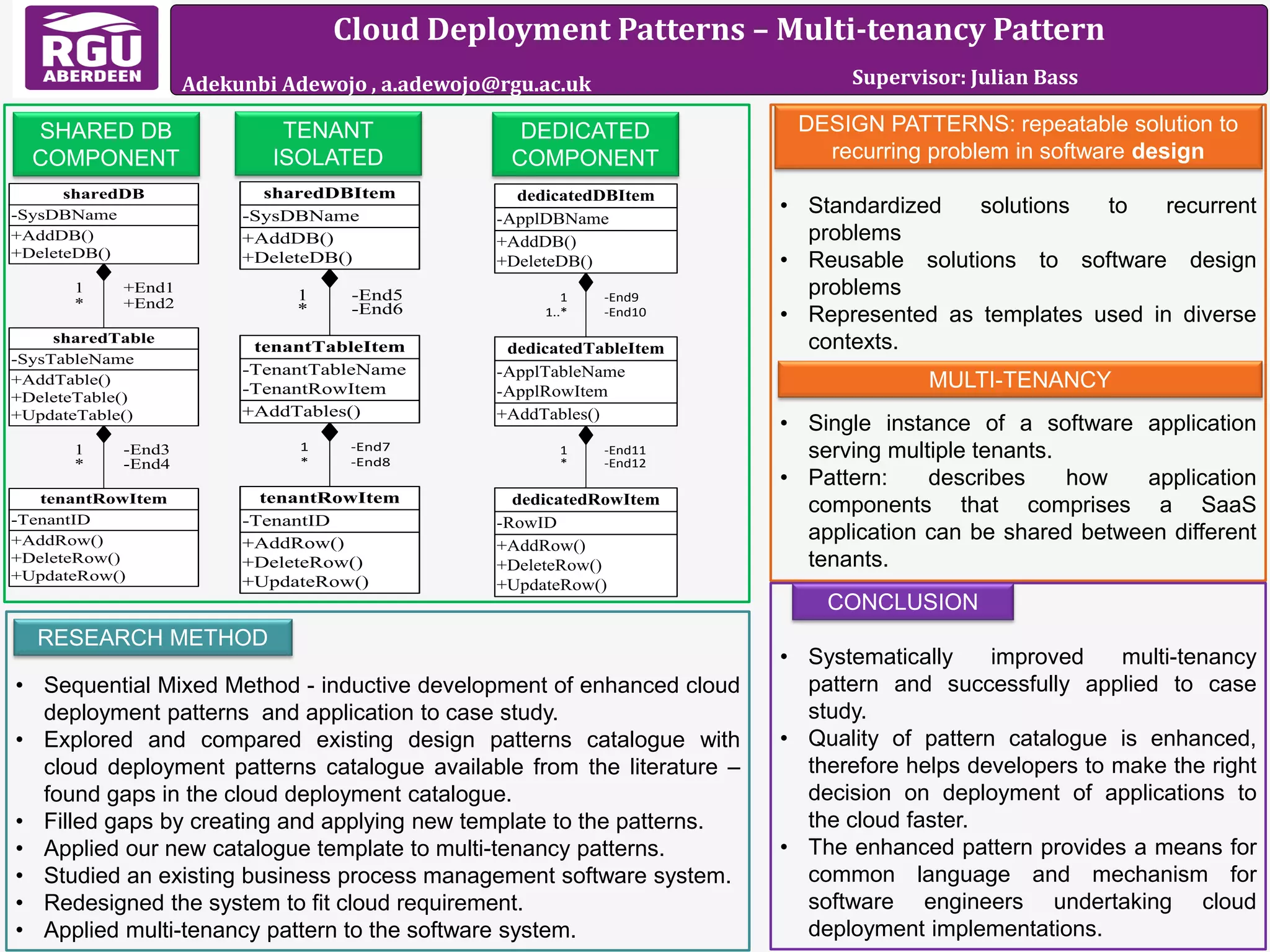
• Single instance of a software application
serving multiple tenants.
• Pattern: describes how application
components that comprises a SaaS
application can be shared between different
tenants.
DESIGN PATTERNS: repeatable solution to
recurring problem in software design
MULTI-TENANCY
• Systematically improved multi-tenancy
pattern and successfully applied to case
study.
• Quality of pattern catalogue is enhanced,
therefore helps developers to make the right
decision on deployment of applications to
the cloud faster.
• The enhanced pattern provides a means for
common language and mechanism for
software engineers undertaking cloud
deployment implementations.
CONCLUSION
+AddDB()
+DeleteDB()
sharedDBItem
-SysDBName
+AddTables()
tenantTableItem
-TenantTableName
-TenantRowItem
-End51
-End6*
+AddRow()
+DeleteRow()
+UpdateRow()
tenantRowItem
-TenantID
-End71
-End8*
SHARED DB
COMPONENT
TENANT
ISOLATED
DEDICATED
COMPONENT
• Sequential Mixed Method - inductive development of enhanced cloud
deployment patterns and application to case study.
• Explored and compared existing design patterns catalogue with
cloud deployment patterns catalogue available from the literature –
found gaps in the cloud deployment catalogue.
• Filled gaps by creating and applying new template to the patterns.
• Applied our new catalogue template to multi-tenancy patterns.
• Studied an existing business process management software system.
• Redesigned the system to fit cloud requirement.
• Applied multi-tenancy pattern to the software system.
RESEARCH METHOD

Poster-Adekunbi

  • 1.
    Cloud Deployment Patterns– Multi-tenancy Pattern Adekunbi Adewojo , a.adewojo@rgu.ac.uk Supervisor: Julian Bass +AddDB() +DeleteDB() sharedDB -SysDBName +AddTable() +DeleteTable() +UpdateTable() sharedTable -SysTableName +AddRow() +DeleteRow() +UpdateRow() tenantRowItem -TenantID +End11 +End2* -End31 -End4* +AddTables() -ApplTableName -ApplRowItem dedicatedTableItem +AddDB() +DeleteDB() -ApplDBName dedicatedDBItem +AddRow() +DeleteRow() +UpdateRow() -RowID dedicatedRowItem -End91 -End101..* -End111 -End12* • Standardized solutions to recurrent problems • Reusable solutions to software design problems • Represented as templates used in diverse contexts. • Single instance of a software application serving multiple tenants. • Pattern: describes how application components that comprises a SaaS application can be shared between different tenants. DESIGN PATTERNS: repeatable solution to recurring problem in software design MULTI-TENANCY • Systematically improved multi-tenancy pattern and successfully applied to case study. • Quality of pattern catalogue is enhanced, therefore helps developers to make the right decision on deployment of applications to the cloud faster. • The enhanced pattern provides a means for common language and mechanism for software engineers undertaking cloud deployment implementations. CONCLUSION +AddDB() +DeleteDB() sharedDBItem -SysDBName +AddTables() tenantTableItem -TenantTableName -TenantRowItem -End51 -End6* +AddRow() +DeleteRow() +UpdateRow() tenantRowItem -TenantID -End71 -End8* SHARED DB COMPONENT TENANT ISOLATED DEDICATED COMPONENT • Sequential Mixed Method - inductive development of enhanced cloud deployment patterns and application to case study. • Explored and compared existing design patterns catalogue with cloud deployment patterns catalogue available from the literature – found gaps in the cloud deployment catalogue. • Filled gaps by creating and applying new template to the patterns. • Applied our new catalogue template to multi-tenancy patterns. • Studied an existing business process management software system. • Redesigned the system to fit cloud requirement. • Applied multi-tenancy pattern to the software system. RESEARCH METHOD