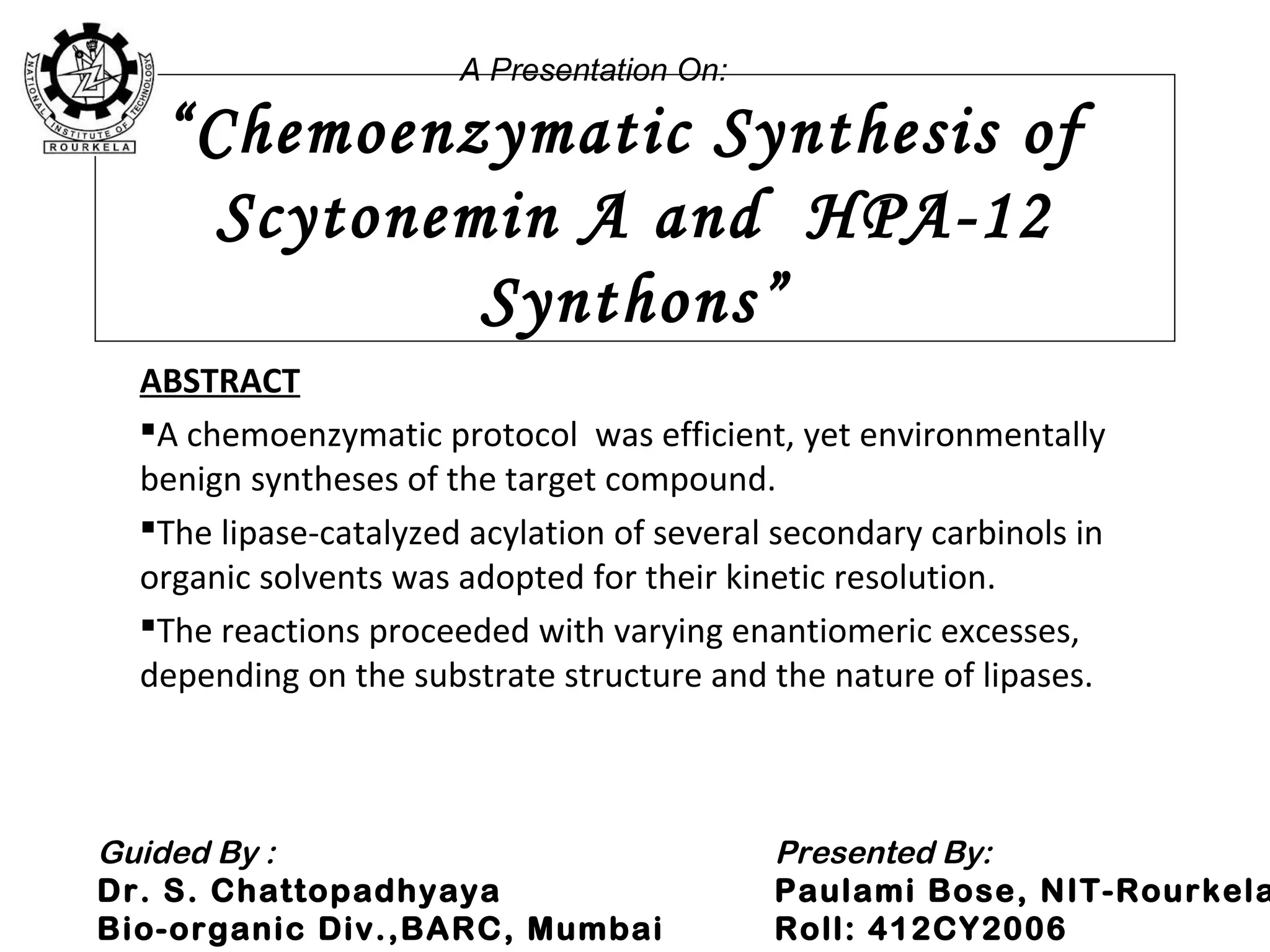
“Chemoenzymatic Synthesis of
Scytonemin A and HPA-12
Synthons”
ABSTRACT
A chemoenzymatic protocol was efficient, yet environmentally
benign syntheses of the target compound.
The lipase-catalyzed acylation of several secondary carbinols in
organic solvents was adopted for their kinetic resolution.
The reactions proceeded with varying enantiomeric excesses,
depending on the substrate structure and the nature of lipases.
Presented By:
Paulami Bose, NIT-Rourkela
Roll: 412CY2006
A Presentation On:
Guided By :
Dr. S. Chattopadhyaya
Bio-organic Div.,BARC, Mumbai
OBJECTIVE
 Enantiomerically pure secondary carbinols are reported as useful
synthons for many natural products with useful biological activities.
 The project was primarily aimed (Figure 1) at formulating asymmetric
syntheses of:
i. the aryl-alkyl segment of of the cyclic peptide scytonemin A and
ii. N-(3-Hydroxy-1-hydroxymethyl-3-phenylpropyl)dodecanamide (HPA-
12), an inhibitor of ceramide trafficking.
NH O
HO
O
N
H
O
O
OH
OH
O
O
N
OH
N
O
HO
NH
O
O
HN
O
HO
O O NH
N
O
OH
O
Scytonemin A (I)
Figure. Chemical structures of scytonemin A and 12-HPA, and their segments.
NH2O
OHHO
OH
OH
Aryl-alkyl segment (1)
HO
NH OH
Ph
C11H23
OH
HO
HN OH
Ph
12-HPA segment (2)
Pg
12-HPA (II)
INTRODUCTIO
N
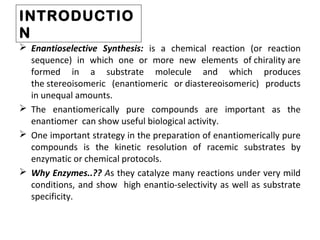
 Enantioselective Synthesis: is a chemical reaction (or reaction
sequence) in which one or more new elements of chirality are
formed in a substrate molecule and which produces
the stereoisomeric (enantiomeric or diastereoisomeric) products
in unequal amounts.
 The enantiomerically pure compounds are important as the
enantiomer can show useful biological activity.
 One important strategy in the preparation of enantiomerically pure
compounds is the kinetic resolution of racemic substrates by
enzymatic or chemical protocols.
 Why Enzymes..?? As they catalyze many reactions under very mild
conditions, and show high enantio-selectivity as well as substrate
specificity.
SCYTONEMIN A SEGEMENT
Importance of Targeted Molecule
Isolated from the marine organism, Scytonemin sp. (Scytonematacea).
The cyclic peptide Scytonemin A (I) is a potent calcium antagonist
Distinctive feature : Sphingosine component with terminal phenyl
group.
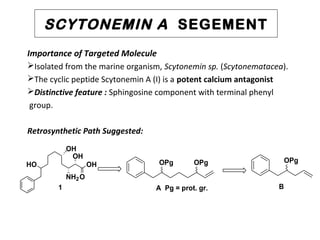
Retrosynthetic Path Suggested:
NH2O
OHHO
OH
OH
OPg OPg
1 A Pg = prot. gr.
OPg
B
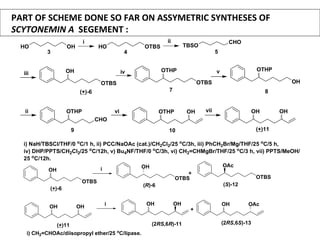
PART OF SCHEME DONE SO FAR ON ASSYMETRIC SYNTHESES OF
SCYTONEMIN A SEGEMENT :
HO OH HO OTBS TBSO
CHO
OH
OTBS
OTHP
OTBS
OTHP
OH
OTHP
CHO
OTHP OH OH OH
3 4 5
(+)-6 7 8
9 10 (+)11
i ii
iii iv v
vi viiii
i) NaH/TBSCl/THF/0 o
C/1 h, ii) PCC/NaOAc (cat.)/CH2Cl2/25 o
C/3h, iii) PhCH2Br/Mg/THF/25 o
C/5 h,
iv) DHP/PPTS/CH2Cl2/25 o
C/12h, v) Bu4NF/THF/0 o
C/3h, vi) CH2=CHMgBr/THF/25 o
C/3 h, vii) PPTS/MeOH/
25 o
C/12h.
OH
OTBS
(+)-6
OH
OTBS
(R)-6
OAc
OTBS
(S)-12
+
i
OH OH
(+)11
i OH OH
(2RS,6R)-11
OH OAc
+
(2RS,6S)-13
i) CH2=CHOAc/diisopropyl ether/25 o
C/lipase.
N-(3-Hydroxy-1-hydroxymethyl-3-
phenylpropyl)dodecanamide (HPA-12)
Importance of Targeted Molecule
 Shingolipids present in mammalian cells has active role in cell
growth, differentiation, and apoptosis.
 Its misregulation leads to variety of disease states.
 Sphingomylin (SM) is produced from ceramide on transportation
from endoplasmic reticulum (ER) to the Golgi Apparatus. This
transportation is mediated by cytosolic protein, CERT and N-(3-
Hydroxy-1-hydroxymethyl-3-phenylpropyl)dodecanamide (HPA-12)
acts an inhibitor of ceramide trafficking.
 HPA-12 is now known as direct antagonist of CERT, and is used for
various biological in vitro studies.
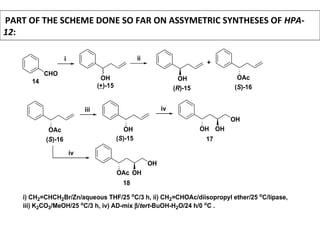
PART OF THE SCHEME DONE SO FAR ON ASSYMETRIC SYNTHESES OF HPA-
12:
CHO
(+)-15
14
i
OH
ii
OH
+
OAc
(R)-15 (S)-16
i) CH2=CHCH2Br/Zn/aqueous THF/25 o
C/3 h, ii) CH2=CHOAc/diisopropyl ether/25 o
C/lipase,
iii) K2CO3/MeOH/25 o
C/3 h, iv) AD-mix β/tert-BuOH-H2O/24 h/0 o
C .
OAc
(S)-16
iii
OH
(S)-15
iv
OH
OH
OH
17
OAc
OH
OH
18
iv
CHARACTERIZATIO
N
[α]D
25
-5.4206 (c 1.07, CHCl3); 1
H NMR: δ 1.24-1.53 (m, 6H), 2.05 (s, 3H), 2.58-2.69 (m,
1H), 2.76-2.86 (m, 1H), 3.77-3.80 (m, 1H), 5.13-5.26 (m, 3H), 5.67-5.85 (m, 1H),
7.18-7.34 (m, 5H); 13
C NMR: δ 21.0, 33.8, 36.1, 43.8, 72.1, 74.5, 116.4, 126.1,
128.2, 129.2, 136.2, 138.4, 170.2.
OH OAc
(2RS,6S)-13
Scytonemin A
HPA-12
OAc
(S)-16
CONCLUSION
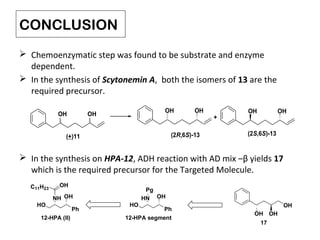
 Chemoenzymatic step was found to be substrate and enzyme
dependent.
 In the synthesis of Scytonemin A, both the isomers of 13 are the
required precursor.
 In the synthesis on HPA-12, ADH reaction with AD mix –β yields 17
which is the required precursor for the Targeted Molecule.
OH OH
(+)11
OH OH
(2R,6S)-13
OH OH
+
(2S,6S)-13
OH
OH
OH
17
HO
HN OH
Ph
12-HPA segment
Pg
HO
NH OH
Ph
C11H23
OH
12-HPA (II)
CONCLUSION
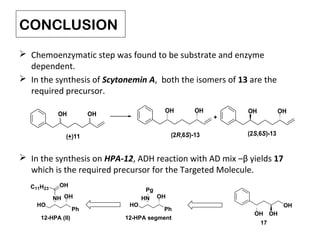
 Chemoenzymatic step was found to be substrate and enzyme
dependent.
 In the synthesis of Scytonemin A, both the isomers of 13 are the
required precursor.
 In the synthesis on HPA-12, ADH reaction with AD mix –β yields 17
which is the required precursor for the Targeted Molecule.
OH OH
(+)11
OH OH
(2R,6S)-13
OH OH
+
(2S,6S)-13
OH
OH
OH
17
HO
HN OH
Ph
12-HPA segment
Pg
HO
NH OH
Ph
C11H23
OH
12-HPA (II)

Poster PRESENTATION

  • 1.
    “Chemoenzymatic Synthesis of ScytoneminA and HPA-12 Synthons” ABSTRACT A chemoenzymatic protocol was efficient, yet environmentally benign syntheses of the target compound. The lipase-catalyzed acylation of several secondary carbinols in organic solvents was adopted for their kinetic resolution. The reactions proceeded with varying enantiomeric excesses, depending on the substrate structure and the nature of lipases. Presented By: Paulami Bose, NIT-Rourkela Roll: 412CY2006 A Presentation On: Guided By : Dr. S. Chattopadhyaya Bio-organic Div.,BARC, Mumbai
  • 2.
    OBJECTIVE  Enantiomerically puresecondary carbinols are reported as useful synthons for many natural products with useful biological activities.  The project was primarily aimed (Figure 1) at formulating asymmetric syntheses of: i. the aryl-alkyl segment of of the cyclic peptide scytonemin A and ii. N-(3-Hydroxy-1-hydroxymethyl-3-phenylpropyl)dodecanamide (HPA- 12), an inhibitor of ceramide trafficking. NH O HO O N H O O OH OH O O N OH N O HO NH O O HN O HO O O NH N O OH O Scytonemin A (I) Figure. Chemical structures of scytonemin A and 12-HPA, and their segments. NH2O OHHO OH OH Aryl-alkyl segment (1) HO NH OH Ph C11H23 OH HO HN OH Ph 12-HPA segment (2) Pg 12-HPA (II)
  • 3.
    INTRODUCTIO N  Enantioselective Synthesis:is a chemical reaction (or reaction sequence) in which one or more new elements of chirality are formed in a substrate molecule and which produces the stereoisomeric (enantiomeric or diastereoisomeric) products in unequal amounts.  The enantiomerically pure compounds are important as the enantiomer can show useful biological activity.  One important strategy in the preparation of enantiomerically pure compounds is the kinetic resolution of racemic substrates by enzymatic or chemical protocols.  Why Enzymes..?? As they catalyze many reactions under very mild conditions, and show high enantio-selectivity as well as substrate specificity.
  • 4.
    SCYTONEMIN A SEGEMENT Importanceof Targeted Molecule Isolated from the marine organism, Scytonemin sp. (Scytonematacea). The cyclic peptide Scytonemin A (I) is a potent calcium antagonist Distinctive feature : Sphingosine component with terminal phenyl group. Retrosynthetic Path Suggested: NH2O OHHO OH OH OPg OPg 1 A Pg = prot. gr. OPg B
  • 5.
    PART OF SCHEMEDONE SO FAR ON ASSYMETRIC SYNTHESES OF SCYTONEMIN A SEGEMENT : HO OH HO OTBS TBSO CHO OH OTBS OTHP OTBS OTHP OH OTHP CHO OTHP OH OH OH 3 4 5 (+)-6 7 8 9 10 (+)11 i ii iii iv v vi viiii i) NaH/TBSCl/THF/0 o C/1 h, ii) PCC/NaOAc (cat.)/CH2Cl2/25 o C/3h, iii) PhCH2Br/Mg/THF/25 o C/5 h, iv) DHP/PPTS/CH2Cl2/25 o C/12h, v) Bu4NF/THF/0 o C/3h, vi) CH2=CHMgBr/THF/25 o C/3 h, vii) PPTS/MeOH/ 25 o C/12h. OH OTBS (+)-6 OH OTBS (R)-6 OAc OTBS (S)-12 + i OH OH (+)11 i OH OH (2RS,6R)-11 OH OAc + (2RS,6S)-13 i) CH2=CHOAc/diisopropyl ether/25 o C/lipase.
  • 6.
    N-(3-Hydroxy-1-hydroxymethyl-3- phenylpropyl)dodecanamide (HPA-12) Importance ofTargeted Molecule  Shingolipids present in mammalian cells has active role in cell growth, differentiation, and apoptosis.  Its misregulation leads to variety of disease states.  Sphingomylin (SM) is produced from ceramide on transportation from endoplasmic reticulum (ER) to the Golgi Apparatus. This transportation is mediated by cytosolic protein, CERT and N-(3- Hydroxy-1-hydroxymethyl-3-phenylpropyl)dodecanamide (HPA-12) acts an inhibitor of ceramide trafficking.  HPA-12 is now known as direct antagonist of CERT, and is used for various biological in vitro studies.
  • 7.
    PART OF THESCHEME DONE SO FAR ON ASSYMETRIC SYNTHESES OF HPA- 12: CHO (+)-15 14 i OH ii OH + OAc (R)-15 (S)-16 i) CH2=CHCH2Br/Zn/aqueous THF/25 o C/3 h, ii) CH2=CHOAc/diisopropyl ether/25 o C/lipase, iii) K2CO3/MeOH/25 o C/3 h, iv) AD-mix β/tert-BuOH-H2O/24 h/0 o C . OAc (S)-16 iii OH (S)-15 iv OH OH OH 17 OAc OH OH 18 iv
  • 8.
    CHARACTERIZATIO N [α]D 25 -5.4206 (c 1.07,CHCl3); 1 H NMR: δ 1.24-1.53 (m, 6H), 2.05 (s, 3H), 2.58-2.69 (m, 1H), 2.76-2.86 (m, 1H), 3.77-3.80 (m, 1H), 5.13-5.26 (m, 3H), 5.67-5.85 (m, 1H), 7.18-7.34 (m, 5H); 13 C NMR: δ 21.0, 33.8, 36.1, 43.8, 72.1, 74.5, 116.4, 126.1, 128.2, 129.2, 136.2, 138.4, 170.2. OH OAc (2RS,6S)-13 Scytonemin A HPA-12 OAc (S)-16
  • 9.
    CONCLUSION  Chemoenzymatic stepwas found to be substrate and enzyme dependent.  In the synthesis of Scytonemin A, both the isomers of 13 are the required precursor.  In the synthesis on HPA-12, ADH reaction with AD mix –β yields 17 which is the required precursor for the Targeted Molecule. OH OH (+)11 OH OH (2R,6S)-13 OH OH + (2S,6S)-13 OH OH OH 17 HO HN OH Ph 12-HPA segment Pg HO NH OH Ph C11H23 OH 12-HPA (II)
  • 10.
    CONCLUSION  Chemoenzymatic stepwas found to be substrate and enzyme dependent.  In the synthesis of Scytonemin A, both the isomers of 13 are the required precursor.  In the synthesis on HPA-12, ADH reaction with AD mix –β yields 17 which is the required precursor for the Targeted Molecule. OH OH (+)11 OH OH (2R,6S)-13 OH OH + (2S,6S)-13 OH OH OH 17 HO HN OH Ph 12-HPA segment Pg HO NH OH Ph C11H23 OH 12-HPA (II)