Validity of maternal recall
of prescription drug use during pregnancy
                Marleen van Gelder1
        Iris van Rooij1, Hermien de Walle2,
          Nel Roeleveld1, Marian Bakker2

           1) Department of Epidemiology, Biostatistics and HTA
               Radboud University Nijmegen Medical Centre
        2) Eurocat Northern Netherlands, Department of Genetics,
                   University Medical Center Groningen


                                                   EUROCAT 2011 symposium,
                                                   June 17 20 2011, Antwerp
Study design in birth defects epidemiology

• Majority of studies used case-control design
• Method of data collection:
     Medical records
     Self-administered questionnaire
     Interview

• Often data collection takes place months
  to years after delivery
• Data on the accuracy of recall of prescription drug use during
  pregnancy are scarce
Research questions

1. What is the validity of a self-administered questionnaire to
   assess prescription drug use just before and during
   pregnancy?

2. Do maternal and pregnancy characteristics influence the
   accuracy of questionnaire data on prescription drug use
   during pregnancy?
Methods (1): Study population

• Imbedded in Eurocat Northern Netherlands
     Population-based birth defects registry
     Covers provinces of Groningen, Friesland, and Drenthe
     Annually 18,000 births (10% of all births in Netherlands)

• Infants younger than 16 years and fetuses with birth defects
  and genetic disorders eligible for registration
• Validation study: cases registered between 01-01-2009 and
  30-06-2010 (n = 1,105)
Methods (2): Data collection

• Extensive questionnaire sent to parents
• Separate questionnaire on prescription drug use
     Screening question: “Did you use any…”
     Questions on specific indications / drug groups
        o Specify drug in open-ended question
        o Timing of use

• Pharmacy records checked for compliance
  by maternal interviews
Methods (3): Statistical analyses

• Drugs ordered in three mutually exclusive categories:*
     For chronic conditions
     For occasional and short-term use
     Pregnancy-related

• “Gold Standard”: Eurocat database (pharmacy records)
• Validity: sensitivity and specificity
• Only drugs with ≥10 true exposures
• Multivariable logistic regression analysis for
  selected maternal and pregnancy characteristics


                                                    *Bakker et al. BJOG 2006
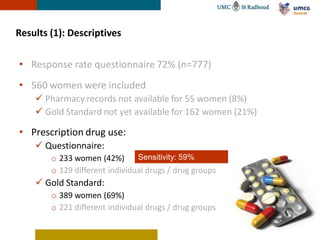
Results (1): Descriptives

• Response rate questionnaire 72% (n=777)
• 560 women were included
     Pharmacy records not available for 55 women (8%)
     Gold Standard not yet available for 162 women (21%)

• Prescription drug use:
     Questionnaire:
        o 233 women (42%)
        o 129 different individual drugs / drug groups
     Gold Standard:
        o 389 women (69%)
        o 221 different individual drugs / drug groups
Results (1): Descriptives

• Response rate questionnaire 72% (n=777)
• 560 women were included
     Pharmacy records not available for 55 women (8%)
     Gold Standard not yet available for 162 women (21%)

• Prescription drug use:
     Questionnaire:
        o 233 women (42%)       Sensitivity: 59%
        o 129 different individual drugs / drug groups
     Gold Standard:
        o 389 women (69%)
        o 221 different individual drugs / drug groups
Results (2): Validity and reliability comparisons

• Sensitivity drug categories:
     Corticosteroids: 12% (systemic corticosteroids: 50%)
     Antihypertensives / thyroid therapy: 88%

• Sensitivity individual drugs:
     Naproxen: 0%
     Salbutamol: 73%

• Specificity: 93-100%
• Sensitivity highest for chronic drugs
• Sensitivity first 4 months pregnancy generally comparable or
  slightly better than for complete pregnancy period
Results (3): Characteristics influencing disagreement

• Most maternal and pregnancy characteristics did not
  influence level of disagreement
• Disagreement occurred more often among:
     Younger women (<25 years of age)
     Women who had fertility problems
     Women who smoked during pregnancy
     Women who had miscarriage / stillbirth
     Women who completed questionnaire
      >1 year after delivery
Discussion

• Strengths and limitations:
    + Choice of gold standard
    + High consent rate to obtain pharmacy records
    – only mothers of infants with major birth defects
    – no information on OTC drugs, low prevalence individual drugs
    – screening question

• Validity comparable with studies conducted in the ‘80s and ‘90s
• Use of infants with genetic disorder as control group does not
  seem to introduce recall bias
Conclusion

• Validity of self-administered questionnaire on prescription drug
  use was generally moderate to poor for most drugs
• Future retrospective studies need additional data sources for
  prescription drug use
• Drug-specific questions could increase sensitivity
• Data collection should be completed before or as shortly after
  delivery as possible
Questions?


Thank you for your attention!

Validity of meternal recall of prescription drug use during pregnancy

  • 1.
    Validity of maternalrecall of prescription drug use during pregnancy Marleen van Gelder1 Iris van Rooij1, Hermien de Walle2, Nel Roeleveld1, Marian Bakker2 1) Department of Epidemiology, Biostatistics and HTA Radboud University Nijmegen Medical Centre 2) Eurocat Northern Netherlands, Department of Genetics, University Medical Center Groningen EUROCAT 2011 symposium, June 17 20 2011, Antwerp
  • 2.
    Study design inbirth defects epidemiology • Majority of studies used case-control design • Method of data collection:  Medical records  Self-administered questionnaire  Interview • Often data collection takes place months to years after delivery • Data on the accuracy of recall of prescription drug use during pregnancy are scarce
  • 3.
    Research questions 1. Whatis the validity of a self-administered questionnaire to assess prescription drug use just before and during pregnancy? 2. Do maternal and pregnancy characteristics influence the accuracy of questionnaire data on prescription drug use during pregnancy?
  • 4.
    Methods (1): Studypopulation • Imbedded in Eurocat Northern Netherlands  Population-based birth defects registry  Covers provinces of Groningen, Friesland, and Drenthe  Annually 18,000 births (10% of all births in Netherlands) • Infants younger than 16 years and fetuses with birth defects and genetic disorders eligible for registration • Validation study: cases registered between 01-01-2009 and 30-06-2010 (n = 1,105)
  • 5.
    Methods (2): Datacollection • Extensive questionnaire sent to parents • Separate questionnaire on prescription drug use  Screening question: “Did you use any…”  Questions on specific indications / drug groups o Specify drug in open-ended question o Timing of use • Pharmacy records checked for compliance by maternal interviews
  • 6.
    Methods (3): Statisticalanalyses • Drugs ordered in three mutually exclusive categories:*  For chronic conditions  For occasional and short-term use  Pregnancy-related • “Gold Standard”: Eurocat database (pharmacy records) • Validity: sensitivity and specificity • Only drugs with ≥10 true exposures • Multivariable logistic regression analysis for selected maternal and pregnancy characteristics *Bakker et al. BJOG 2006
  • 7.
    Results (1): Descriptives •Response rate questionnaire 72% (n=777) • 560 women were included  Pharmacy records not available for 55 women (8%)  Gold Standard not yet available for 162 women (21%) • Prescription drug use:  Questionnaire: o 233 women (42%) o 129 different individual drugs / drug groups  Gold Standard: o 389 women (69%) o 221 different individual drugs / drug groups
  • 8.
    Results (1): Descriptives •Response rate questionnaire 72% (n=777) • 560 women were included  Pharmacy records not available for 55 women (8%)  Gold Standard not yet available for 162 women (21%) • Prescription drug use:  Questionnaire: o 233 women (42%) Sensitivity: 59% o 129 different individual drugs / drug groups  Gold Standard: o 389 women (69%) o 221 different individual drugs / drug groups
  • 9.
    Results (2): Validityand reliability comparisons • Sensitivity drug categories:  Corticosteroids: 12% (systemic corticosteroids: 50%)  Antihypertensives / thyroid therapy: 88% • Sensitivity individual drugs:  Naproxen: 0%  Salbutamol: 73% • Specificity: 93-100% • Sensitivity highest for chronic drugs • Sensitivity first 4 months pregnancy generally comparable or slightly better than for complete pregnancy period
  • 10.
    Results (3): Characteristicsinfluencing disagreement • Most maternal and pregnancy characteristics did not influence level of disagreement • Disagreement occurred more often among:  Younger women (<25 years of age)  Women who had fertility problems  Women who smoked during pregnancy  Women who had miscarriage / stillbirth  Women who completed questionnaire >1 year after delivery
  • 11.
    Discussion • Strengths andlimitations: + Choice of gold standard + High consent rate to obtain pharmacy records – only mothers of infants with major birth defects – no information on OTC drugs, low prevalence individual drugs – screening question • Validity comparable with studies conducted in the ‘80s and ‘90s • Use of infants with genetic disorder as control group does not seem to introduce recall bias
  • 12.
    Conclusion • Validity ofself-administered questionnaire on prescription drug use was generally moderate to poor for most drugs • Future retrospective studies need additional data sources for prescription drug use • Drug-specific questions could increase sensitivity • Data collection should be completed before or as shortly after delivery as possible
  • 13.
    Questions? Thank you foryour attention!