HepG2 cell model for genotoxicity and steatosis assessment
Julian BURSZTYKA1 & Nathalie Maubon1
1 HCS Pharma, 6 rue Pierre Joseph Colin, 35000 Rennes
Abstract
Early detection of toxic events induced by drug cantidats is mandatory in order to avoid late attrition in the process
of R&D. Here we present two assays that can be done with the HepG2 human hepatoma cell line: genotoxicity assay
(DNA double strand break) and steatosis.
MethodsResults
Conclusions & Perspectives
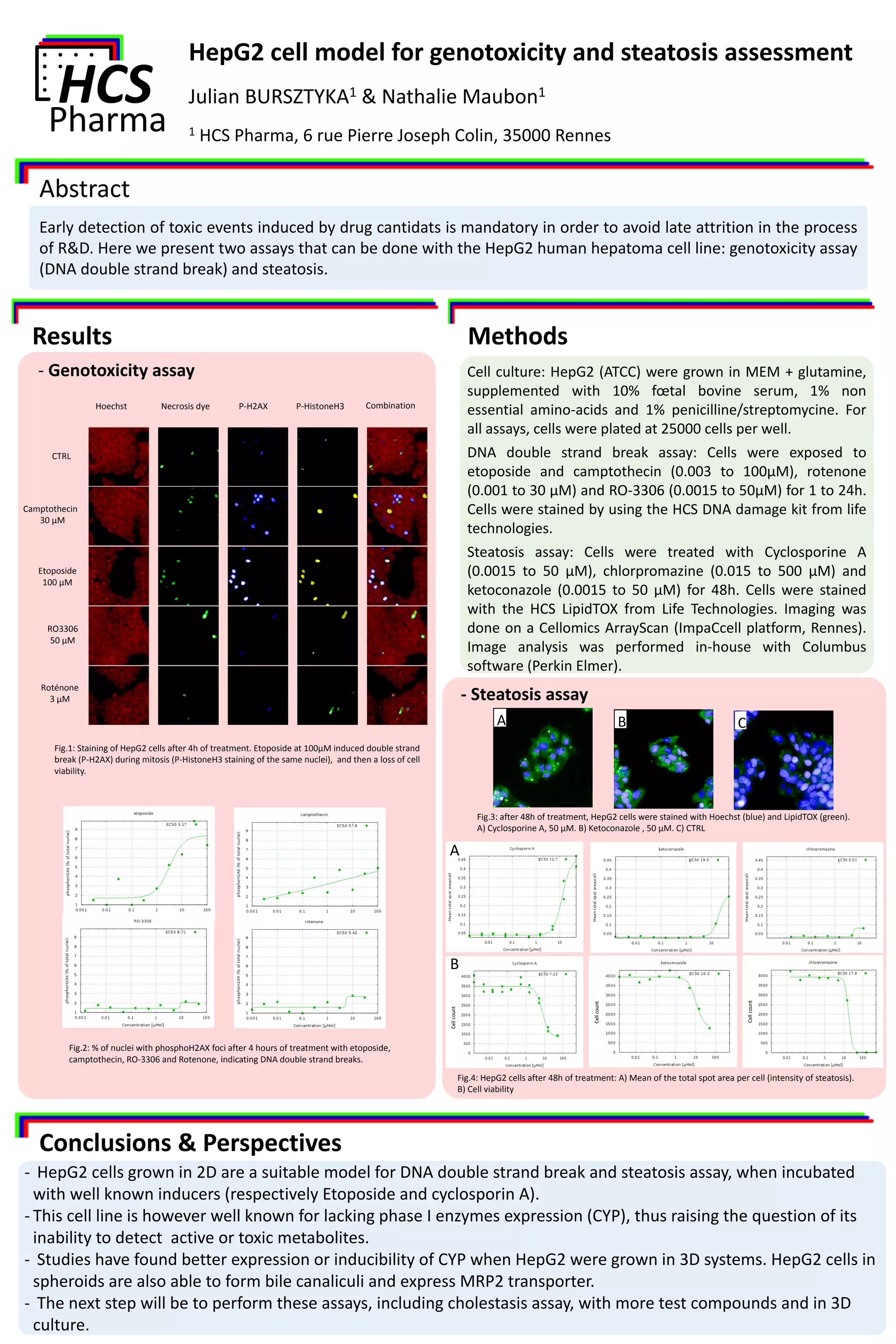
- HepG2 cells grown in 2D are a suitable model for DNA double strand break and steatosis assay, when incubated
with well known inducers (respectively Etoposide and cyclosporin A).
- This cell line is however well known for lacking phase I enzymes expression (CYP), thus raising the question of its
inability to detect active or toxic metabolites.
- Studies have found better expression or inducibility of CYP when HepG2 were grown in 3D systems. HepG2 cells in
spheroids are also able to form bile canaliculi and express MRP2 transporter.
- The next step will be to perform these assays, including cholestasis assay, with more test compounds and in 3D
culture.
Cell culture: HepG2 (ATCC) were grown in MEM + glutamine,
supplemented with 10% fœtal bovine serum, 1% non
essential amino-acids and 1% penicilline/streptomycine. For
all assays, cells were plated at 25000 cells per well.
DNA double strand break assay: Cells were exposed to
etoposide and camptothecin (0.003 to 100µM), rotenone
(0.001 to 30 µM) and RO-3306 (0.0015 to 50µM) for 1 to 24h.
Cells were stained by using the HCS DNA damage kit from life
technologies.
Steatosis assay: Cells were treated with Cyclosporine A
(0.0015 to 50 µM), chlorpromazine (0.015 to 500 µM) and
ketoconazole (0.0015 to 50 µM) for 48h. Cells were stained
with the HCS LipidTOX from Life Technologies. Imaging was
done on a Cellomics ArrayScan (ImpaCcell platform, Rennes).
Image analysis was performed in-house with Columbus
software (Perkin Elmer).
- Genotoxicity assay
Fig.3: after 48h of treatment, HepG2 cells were stained with Hoechst (blue) and LipidTOX (green).
A) Cyclosporine A, 50 µM. B) Ketoconazole , 50 µM. C) CTRL
A B C
CTRL
Hoechst Necrosis dye P-H2AX P-HistoneH3 Combination
Camptothecin
30 µM
Etoposide
100 µM
RO3306
50 µM
Roténone
3 µM
Fig.1: Staining of HepG2 cells after 4h of treatment. Etoposide at 100µM induced double strand
break (P-H2AX) during mitosis (P-HistoneH3 staining of the same nuclei), and then a loss of cell
viability.
Fig.2: % of nuclei with phosphoH2AX foci after 4 hours of treatment with etoposide,
camptothecin, RO-3306 and Rotenone, indicating DNA double strand breaks.
Fig.4: HepG2 cells after 48h of treatment: A) Mean of the total spot area per cell (intensity of steatosis).
B) Cell viability
- Steatosis assay
A E E E
B
Cellcount
Cellcount
Cellcount
E E E

HepG2 cell model for genotoxicity and steatosis assessment

  • 1.
    HepG2 cell modelfor genotoxicity and steatosis assessment Julian BURSZTYKA1 & Nathalie Maubon1 1 HCS Pharma, 6 rue Pierre Joseph Colin, 35000 Rennes Abstract Early detection of toxic events induced by drug cantidats is mandatory in order to avoid late attrition in the process of R&D. Here we present two assays that can be done with the HepG2 human hepatoma cell line: genotoxicity assay (DNA double strand break) and steatosis. MethodsResults Conclusions & Perspectives - HepG2 cells grown in 2D are a suitable model for DNA double strand break and steatosis assay, when incubated with well known inducers (respectively Etoposide and cyclosporin A). - This cell line is however well known for lacking phase I enzymes expression (CYP), thus raising the question of its inability to detect active or toxic metabolites. - Studies have found better expression or inducibility of CYP when HepG2 were grown in 3D systems. HepG2 cells in spheroids are also able to form bile canaliculi and express MRP2 transporter. - The next step will be to perform these assays, including cholestasis assay, with more test compounds and in 3D culture. Cell culture: HepG2 (ATCC) were grown in MEM + glutamine, supplemented with 10% fœtal bovine serum, 1% non essential amino-acids and 1% penicilline/streptomycine. For all assays, cells were plated at 25000 cells per well. DNA double strand break assay: Cells were exposed to etoposide and camptothecin (0.003 to 100µM), rotenone (0.001 to 30 µM) and RO-3306 (0.0015 to 50µM) for 1 to 24h. Cells were stained by using the HCS DNA damage kit from life technologies. Steatosis assay: Cells were treated with Cyclosporine A (0.0015 to 50 µM), chlorpromazine (0.015 to 500 µM) and ketoconazole (0.0015 to 50 µM) for 48h. Cells were stained with the HCS LipidTOX from Life Technologies. Imaging was done on a Cellomics ArrayScan (ImpaCcell platform, Rennes). Image analysis was performed in-house with Columbus software (Perkin Elmer). - Genotoxicity assay Fig.3: after 48h of treatment, HepG2 cells were stained with Hoechst (blue) and LipidTOX (green). A) Cyclosporine A, 50 µM. B) Ketoconazole , 50 µM. C) CTRL A B C CTRL Hoechst Necrosis dye P-H2AX P-HistoneH3 Combination Camptothecin 30 µM Etoposide 100 µM RO3306 50 µM Roténone 3 µM Fig.1: Staining of HepG2 cells after 4h of treatment. Etoposide at 100µM induced double strand break (P-H2AX) during mitosis (P-HistoneH3 staining of the same nuclei), and then a loss of cell viability. Fig.2: % of nuclei with phosphoH2AX foci after 4 hours of treatment with etoposide, camptothecin, RO-3306 and Rotenone, indicating DNA double strand breaks. Fig.4: HepG2 cells after 48h of treatment: A) Mean of the total spot area per cell (intensity of steatosis). B) Cell viability - Steatosis assay A E E E B Cellcount Cellcount Cellcount E E E