Understanding Creepiness:
                                       Development of a Typology of Creepy Behaviors and Feelings
                                                           Shannon T. Carton, Sean M. Horan, & Brian H. Spitzberg
           Literature Review                                                              Purpose of Study                                                                      Examples
                                                                                                                                                                                  Question 1
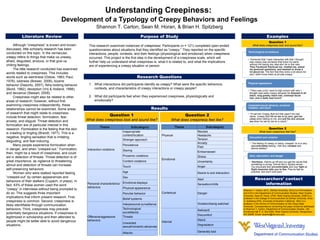
      Although “creepiness” is known and known         This research examined instances of creepiness. Participants (n = 121) completed open-ended                What does creepiness look and sound like?
discussed, little scholarly research has been          questionnaires about situations that they identified as “creepy.” They reported on the specific
conducted on this topic. In the vernacular,            interactions, people, contexts, and their feelings (physiological and emotional) when creepiness
creepy refers to things that make us uneasy,           occurred. This project is the first step in the development of a creepiness scale, which will
afraid, disgusted, anxious, or that give us            further help us understand what creepiness is, what it is related to, and what the implications
chilling feelings.                                     are of experiencing a creepy situation or person.
      The little research conducted has examined
words related to creepiness. This includes
words such as weirdness (Ostow, 1963; Paul,                                            Research Questions
1976), oddness (Brewer, 2008), bizarre
behavior (Deporto, 2007), fishy-looking behavior       1. What interactions did participants identify as creepy? What were the specific behaviors,
(Bond, 1992), deception (Vrij & Holland, 1998),           contexts, and characteristics of creepy interactions or creepy people?
and deviance (Stewart, 2009).
      Creepiness might also be related to other        2. What did participants feel when they experienced creepiness, physiologically and
areas of research; however, without first                 emotionally?
examining creepiness independently, these
relationships cannot be examined. Some areas                                                     Results
of research that might relate to creepiness
include threat detection, formication, fear,
                                                                     Question 1                                         Question 2
anxiety, and disgust. Threat detection and            What does creepiness look and sound like?                What does creepiness feel like?
formication are of particular interest in this
research. Formication is the feeling that the skin                                                                                                                                Question 2
                                                                                                                                                                         What does creepiness feel like?
is crawling or tingling (Brandt, 1977). This is a
negative, tingling sensation that is irritating,
disgusting, and fear-inducing.
      Many people experience formication when
in danger, and when “creeped-out.” Formication,
then, might be a result of creepiness, and could
aid in detection of threats. Threat detection is of
great importance, as vigilance to threatening
stimuli and detection of threats can increase
self-preserving behaviors.
      Women who were stalked reported feeling
“creeped-out” by certain appearances and
behaviors of their stalkers (Cupach, in press). In
                                                                                                                                                                     Researchers’ contact
fact, 43% of these women used the word                                                                                                                                   information
“creepy” in interviews without being prompted to                                                                                                          Shannon T. Carton, (M.A., DePaul University, 2012) is a PhD student
do so. This suggests three important                                                                                                                      and GTA in the Department of Communication Studies, West Virginia
                                                                                                                                                          University. Sean M. Horan, (PhD, West Virginia University, 2009) is a
implications that inform present research. First,                                                                                                         professor in the College of Communication at DePaul University. Brian
creepiness is common. Second, creepiness is                                                                                                               H. Spitzberg (PhD, University of Southern California, 1981) is a
                                                                                                                                                          professor in the School of Communication at San Diego State
likely identifiable through communication                                                                                                                 University. Correspondence concerning this paper should be addressed
behaviors. Third, creepiness may precede                                                                                                                  to Shannon T. Carton, Department of Communication Studies, 108
                                                                                                                                                          Armstrong Hall P. O. Box 6293, West Virginia University, Morgantown,
potentially dangerous situations. If creepiness is                                                                                                        WV 26506. Email: stcarton@mix.wvu.edu
legitimized in scholarship and then attended to,
people might be better able to avoid dangerous
situations.

Understanding Creepiness: Development of a Typology of Creepy Behaviors and Feelings

  • 1.
    Understanding Creepiness: Development of a Typology of Creepy Behaviors and Feelings Shannon T. Carton, Sean M. Horan, & Brian H. Spitzberg Literature Review Purpose of Study Examples Question 1 Although “creepiness” is known and known This research examined instances of creepiness. Participants (n = 121) completed open-ended What does creepiness look and sound like? discussed, little scholarly research has been questionnaires about situations that they identified as “creepy.” They reported on the specific conducted on this topic. In the vernacular, interactions, people, contexts, and their feelings (physiological and emotional) when creepiness creepy refers to things that make us uneasy, occurred. This project is the first step in the development of a creepiness scale, which will afraid, disgusted, anxious, or that give us further help us understand what creepiness is, what it is related to, and what the implications chilling feelings. are of experiencing a creepy situation or person. The little research conducted has examined words related to creepiness. This includes words such as weirdness (Ostow, 1963; Paul, Research Questions 1976), oddness (Brewer, 2008), bizarre behavior (Deporto, 2007), fishy-looking behavior 1. What interactions did participants identify as creepy? What were the specific behaviors, (Bond, 1992), deception (Vrij & Holland, 1998), contexts, and characteristics of creepy interactions or creepy people? and deviance (Stewart, 2009). Creepiness might also be related to other 2. What did participants feel when they experienced creepiness, physiologically and areas of research; however, without first emotionally? examining creepiness independently, these relationships cannot be examined. Some areas Results of research that might relate to creepiness include threat detection, formication, fear, Question 1 Question 2 anxiety, and disgust. Threat detection and What does creepiness look and sound like? What does creepiness feel like? formication are of particular interest in this research. Formication is the feeling that the skin Question 2 What does creepiness feel like? is crawling or tingling (Brandt, 1977). This is a negative, tingling sensation that is irritating, disgusting, and fear-inducing. Many people experience formication when in danger, and when “creeped-out.” Formication, then, might be a result of creepiness, and could aid in detection of threats. Threat detection is of great importance, as vigilance to threatening stimuli and detection of threats can increase self-preserving behaviors. Women who were stalked reported feeling “creeped-out” by certain appearances and behaviors of their stalkers (Cupach, in press). In Researchers’ contact fact, 43% of these women used the word information “creepy” in interviews without being prompted to Shannon T. Carton, (M.A., DePaul University, 2012) is a PhD student do so. This suggests three important and GTA in the Department of Communication Studies, West Virginia University. Sean M. Horan, (PhD, West Virginia University, 2009) is a implications that inform present research. First, professor in the College of Communication at DePaul University. Brian creepiness is common. Second, creepiness is H. Spitzberg (PhD, University of Southern California, 1981) is a professor in the School of Communication at San Diego State likely identifiable through communication University. Correspondence concerning this paper should be addressed behaviors. Third, creepiness may precede to Shannon T. Carton, Department of Communication Studies, 108 Armstrong Hall P. O. Box 6293, West Virginia University, Morgantown, potentially dangerous situations. If creepiness is WV 26506. Email: stcarton@mix.wvu.edu legitimized in scholarship and then attended to, people might be better able to avoid dangerous situations.