Increasing	
  Con-idence	
  In	
  SNAP	
  Participants	
  
at	
  the	
  Cache	
  County	
  Gardner’s	
  Market	
  
Tayla	
  Lambright,	
  Kelsey	
  Hall,	
  Heidi	
  LeBlanc,	
  Debra	
  Christofferson,	
  Kelsie	
  Maw,	
  Mateja	
  Savoie,	
  Casey	
  Maher	
  
USU	
  Extension	
  Utah	
  State	
  University	
  84321	
  
Abstract:	
  
“The	
  aim	
  of	
  Food	
  $ense	
  is	
  to	
  provide	
  educa6on	
  to	
  food	
  stamp	
  recipients	
  
and/or	
  food	
  stamp	
  eligible	
  to	
  promote	
  healthy	
  ea6ng	
  and	
  an	
  ac6ve	
  
lifestyle.”	
  There	
  has	
  been	
  an	
  increase	
  of	
  obesity	
  and	
  disease	
  in	
  the	
  
United	
  States,	
  especially	
  among	
  those	
  individuals	
  from	
  low-­‐income	
  
backgrounds.	
  (1)	
  In	
  recent	
  years,	
  Electron	
  Benefit	
  Transfer	
  (EBT)	
  cards	
  
have	
  been	
  accepted	
  at	
  local	
  farmers	
  markets	
  to	
  draw	
  in	
  low	
  income	
  
families.	
  Food	
  $ense	
  uses	
  an	
  educa6onal	
  booth	
  at	
  the	
  Cache	
  County	
  
Gardner’s	
  Market	
  to	
  help	
  SNAP	
  eligibles	
  gain	
  knowledge	
  of	
  how	
  to	
  use	
  
local	
  produce	
  in	
  a	
  variety	
  of	
  easy	
  and	
  cost	
  friendly	
  recipes.	
  This	
  is	
  done	
  
through	
  free	
  samples,	
  recipe	
  cards,	
  nutri6onal	
  6ps	
  and	
  other	
  helpful	
  
resources	
  from	
  Food	
  $ense.	
  A	
  study	
  was	
  conducted	
  to	
  determine	
  the	
  use	
  
and	
  overall	
  effec6veness	
  of	
  the	
  Food	
  $ense	
  booth.	
  Individuals	
  were	
  
compensated	
  with	
  two-­‐dollar	
  tokens	
  to	
  spend	
  on	
  produce	
  at	
  the	
  
Farmers	
  Market.	
  Results	
  showed	
  that	
  over	
  50%	
  of	
  the	
  individuals	
  were	
  
likely	
  to	
  buy	
  produce	
  and	
  make	
  recipes	
  sampled	
  at	
  the	
  Food	
  $ense	
  
booth.	
  
Methods:	
  
A	
  survey	
  was	
  distributed	
  to	
  shoppers	
  over	
  an	
  8	
  week	
  period	
  at	
  
the	
  Cache	
  County	
  Gardeners	
  Market.	
  Par6cipants	
  had	
  the	
  choice	
  
between	
  filling	
  out	
  a	
  paper	
  survey	
  or	
  filling	
  it	
  out	
  electronically	
  
through	
  the	
  use	
  of	
  an	
  Ipad.	
  Survey	
  ques6ons	
  included	
  
demographic	
  ques6ons,	
  likelihood	
  of	
  buying	
  sampled	
  produce,	
  
and	
  likelihood	
  of	
  making	
  tested	
  recipes	
  at	
  home.A	
  two	
  dollar	
  
token	
  to	
  spend	
  on	
  produce	
  at	
  the	
  Gardeners	
  Market	
  was	
  given	
  
to	
  volunteers	
  that	
  par6cipated	
  in	
  the	
  survey	
  as	
  an	
  incen6ve.	


Data	
  collected	
  from	
  the	
  surveys	
  was	
  imported	
  into	
  excel	
  then	
  
later	
  transferred	
  to	
  SPSS	
  for	
  data	
  analysis.	
  (4)	
  Several	
  tests	
  were	
  
run	
  to	
  determine	
  the	
  effec6veness	
  of	
  the	
  Food	
  $ense	
  booth	
  at	
  
the	
  Cache	
  County	
  Gardner’s	
  Market.	


Results:	
  
At	
  the	
  Food	
  $ense	
  booth,	
  free	
  recipe	
  cards	
  are	
  given	
  out	
  to	
  encourage	
  
par6cipants	
  to	
  buy	
  produce	
  at	
  the	
  Gardner’s	
  Market	
  and	
  make	
  the	
  
recipes	
  at	
  home.	
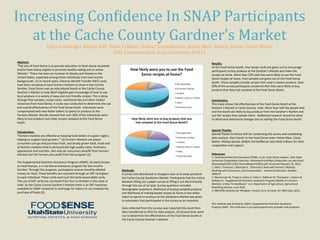
  More	
  than	
  52%	
  said	
  they	
  were	
  likely	
  to	
  use	
  the	
  Food	
  
$ense	
  recipes	
  at	
  home.	
  Free	
  samples	
  are	
  given	
  out	
  at	
  the	
  Food	
  $ense	
  
booth.	
  These	
  samples	
  include	
  recipes	
  that	
  used	
  in	
  season	
  produce.	
  Over	
  
50%	
  of	
  the	
  survey	
  par6cipants	
  answered	
  that	
  they	
  were	
  likely	
  to	
  buy	
  
produce	
  that	
  they	
  had	
  sampled	
  at	
  the	
  Food	
  $ense	
  Booth.	


Conclusions:	
  
This	
  study	
  shows	
  the	
  effec6veness	
  of	
  the	
  Food	
  $ense	
  booth	
  at	
  the	
  
Gardner’s	
  Market	
  in	
  Cache	
  County,	
  Utah.	
  More	
  than	
  half	
  the	
  people	
  that	
  
visit	
  the	
  booth	
  are	
  likely	
  to	
  buy	
  produce	
  from	
  the	
  Gardner’s	
  Market	
  and	
  
use	
  the	
  recipes	
  they	
  sample	
  there.	
  	
  Addi6onal	
  research	
  should	
  be	
  done	
  
to	
  determine	
  behavioral	
  changes	
  due	
  to	
  visi6ng	
  the	
  Food	
  $ense	
  booth.	
  	
  
References:	
  
1.	
  Food	
  Sense	
  Nutri6on	
  Educa6on	
  (FSNE).	
  (n.d).	
  Food	
  $ense	
  Impacts.	
  Utah	
  State	
  
University	
  Coopera6ve	
  Extension.	
  Retrieved	
  fromh^ps://extension.usu.edu/fsne/
files/uploads/2011/2011AnnualReport%20(2).pdf.	
  Accessed	
  February	
  25,	
  2013.	
  
2.	
  Abel	
  J,	
  Thomson	
  J,	
  Maretzki	
  A.	
  “Extension’s	
  Role	
  with	
  Farmers’	
  Markets:	
  
Working	
  with	
  Consumers,	
  and	
  Communi6es”.	
  Journal	
  of	
  Extension.	
  October	
  
1999;37.	
  	
  
3.	
  Wasserman	
  W,	
  Tropp	
  D,	
  Lakins	
  V,	
  Foley	
  C,	
  DeNinno	
  M,	
  Thompson	
  J,	
  Owens	
  N,	
  
Williams	
  K.	
  “Supplemental	
  Nutri6on	
  Assistance	
  Program	
  (SNAP)	
  at	
  Frarmers	
  
Markets:	
  A	
  How-­‐To	
  Handbook.”	
  U.S.	
  Department	
  of	
  Agriculture,	
  Agricultural	
  
Marke6ng	
  Service.	
  June	
  2010.	
  	
  
4.	
  IBM	
  SPSS	
  Sta6s6cs	
  for	
  Windows.	
  Version	
  21.0.	
  Armonk,	
  NY;	
  IBM	
  Corp;	
  2012.	
  
Special	
  Thanks:	
  
Special	
  thanks	
  to	
  Kelsey	
  Hall	
  for	
  conduc6ng	
  the	
  survey	
  and	
  comple6ng	
  
data	
  analysis.	
  Also	
  thanks	
  to	
  the	
  Food	
  $ense	
  team:	
  Kelsie	
  Maw,	
  Casey	
  
Maher,	
  Mateja	
  Savoie,	
  Debbie	
  Christofferson	
  and	
  Heidi	
  LeBlanc	
  for	
  their	
  
coopera6on	
  and	
  support.	
  	
  
Introduc;on:	
  
“Farmers	
  markets	
  are	
  effec6ve	
  at	
  keeping	
  food	
  dollars	
  in	
  a	
  given	
  region,	
  
helping	
  to	
  support	
  local	
  growers.”	
  (2)	
  Farmers	
  Markets	
  are	
  places	
  
consumers	
  can	
  go	
  and	
  purchase	
  fresh,	
  and	
  locally	
  grown	
  food.	
  Food	
  sold	
  
at	
  farmers	
  markets	
  tend	
  to	
  demonstrate	
  high	
  quality	
  taste,	
  freshness,	
  
appearance	
  and	
  nutri6on.	
  Not	
  only	
  do	
  consumers	
  benefit	
  from	
  Farmers	
  
Markets	
  but	
  the	
  farmers	
  also	
  profit	
  from	
  this	
  program	
  (3).	


The	
  Supplemental	
  Nutri6on	
  Assistance	
  Program	
  (SNAP),	
  formerly	
  known	
  
as	
  Food	
  Stamps,	
  is	
  a	
  nutri6onal	
  assistance	
  program	
  for	
  low-­‐income	
  
families.	
  Through	
  this	
  program,	
  par6cipants	
  receive	
  monthly-­‐allo^ed	
  
money	
  for	
  food.	
  These	
  benefits	
  are	
  accessed	
  through	
  an	
  EBT	
  card	
  given	
  
to	
  each	
  individual.	
  These	
  cards	
  work	
  just	
  like	
  bank-­‐issued	
  debit	
  cards.	
  
The	
  use	
  of	
  EBT	
  cards	
  has	
  increased	
  from	
  four	
  to	
  thirteen	
  in	
  the	
  state	
  of	
  
Utah.	
  At	
  the	
  Cache	
  County	
  Gardner’s	
  Market	
  there	
  is	
  an	
  EBT	
  machines	
  
available	
  for	
  SNAP	
  recipients	
  to	
  exchange	
  for	
  tokens	
  to	
  use	
  towards	
  the	
  
purchase	
  of	
  foods	
  (3).	
  	
  
This	
  material	
  was	
  funded	
  by	
  USDA’s	
  Supplemental	
  Nutri6on	
  Assistance	
  
Program-­‐SNAP.	
  This	
  ins6tu6on	
  is	
  an	
  equal	
  opportunity	
  provider	
  and	
  employer.	


Poster 2013

  • 1.
    Increasing  Con-idence  In  SNAP  Participants   at  the  Cache  County  Gardner’s  Market   Tayla  Lambright,  Kelsey  Hall,  Heidi  LeBlanc,  Debra  Christofferson,  Kelsie  Maw,  Mateja  Savoie,  Casey  Maher   USU  Extension  Utah  State  University  84321   Abstract:   “The  aim  of  Food  $ense  is  to  provide  educa6on  to  food  stamp  recipients   and/or  food  stamp  eligible  to  promote  healthy  ea6ng  and  an  ac6ve   lifestyle.”  There  has  been  an  increase  of  obesity  and  disease  in  the   United  States,  especially  among  those  individuals  from  low-­‐income   backgrounds.  (1)  In  recent  years,  Electron  Benefit  Transfer  (EBT)  cards   have  been  accepted  at  local  farmers  markets  to  draw  in  low  income   families.  Food  $ense  uses  an  educa6onal  booth  at  the  Cache  County   Gardner’s  Market  to  help  SNAP  eligibles  gain  knowledge  of  how  to  use   local  produce  in  a  variety  of  easy  and  cost  friendly  recipes.  This  is  done   through  free  samples,  recipe  cards,  nutri6onal  6ps  and  other  helpful   resources  from  Food  $ense.  A  study  was  conducted  to  determine  the  use   and  overall  effec6veness  of  the  Food  $ense  booth.  Individuals  were   compensated  with  two-­‐dollar  tokens  to  spend  on  produce  at  the   Farmers  Market.  Results  showed  that  over  50%  of  the  individuals  were   likely  to  buy  produce  and  make  recipes  sampled  at  the  Food  $ense   booth.   Methods:   A  survey  was  distributed  to  shoppers  over  an  8  week  period  at   the  Cache  County  Gardeners  Market.  Par6cipants  had  the  choice   between  filling  out  a  paper  survey  or  filling  it  out  electronically   through  the  use  of  an  Ipad.  Survey  ques6ons  included   demographic  ques6ons,  likelihood  of  buying  sampled  produce,   and  likelihood  of  making  tested  recipes  at  home.A  two  dollar   token  to  spend  on  produce  at  the  Gardeners  Market  was  given   to  volunteers  that  par6cipated  in  the  survey  as  an  incen6ve.       Data  collected  from  the  surveys  was  imported  into  excel  then   later  transferred  to  SPSS  for  data  analysis.  (4)  Several  tests  were   run  to  determine  the  effec6veness  of  the  Food  $ense  booth  at   the  Cache  County  Gardner’s  Market.       Results:   At  the  Food  $ense  booth,  free  recipe  cards  are  given  out  to  encourage   par6cipants  to  buy  produce  at  the  Gardner’s  Market  and  make  the   recipes  at  home.  More  than  52%  said  they  were  likely  to  use  the  Food   $ense  recipes  at  home.  Free  samples  are  given  out  at  the  Food  $ense   booth.  These  samples  include  recipes  that  used  in  season  produce.  Over   50%  of  the  survey  par6cipants  answered  that  they  were  likely  to  buy   produce  that  they  had  sampled  at  the  Food  $ense  Booth.         Conclusions:   This  study  shows  the  effec6veness  of  the  Food  $ense  booth  at  the   Gardner’s  Market  in  Cache  County,  Utah.  More  than  half  the  people  that   visit  the  booth  are  likely  to  buy  produce  from  the  Gardner’s  Market  and   use  the  recipes  they  sample  there.    Addi6onal  research  should  be  done   to  determine  behavioral  changes  due  to  visi6ng  the  Food  $ense  booth.     References:   1.  Food  Sense  Nutri6on  Educa6on  (FSNE).  (n.d).  Food  $ense  Impacts.  Utah  State   University  Coopera6ve  Extension.  Retrieved  fromh^ps://extension.usu.edu/fsne/ files/uploads/2011/2011AnnualReport%20(2).pdf.  Accessed  February  25,  2013.   2.  Abel  J,  Thomson  J,  Maretzki  A.  “Extension’s  Role  with  Farmers’  Markets:   Working  with  Consumers,  and  Communi6es”.  Journal  of  Extension.  October   1999;37.     3.  Wasserman  W,  Tropp  D,  Lakins  V,  Foley  C,  DeNinno  M,  Thompson  J,  Owens  N,   Williams  K.  “Supplemental  Nutri6on  Assistance  Program  (SNAP)  at  Frarmers   Markets:  A  How-­‐To  Handbook.”  U.S.  Department  of  Agriculture,  Agricultural   Marke6ng  Service.  June  2010.     4.  IBM  SPSS  Sta6s6cs  for  Windows.  Version  21.0.  Armonk,  NY;  IBM  Corp;  2012.   Special  Thanks:   Special  thanks  to  Kelsey  Hall  for  conduc6ng  the  survey  and  comple6ng   data  analysis.  Also  thanks  to  the  Food  $ense  team:  Kelsie  Maw,  Casey   Maher,  Mateja  Savoie,  Debbie  Christofferson  and  Heidi  LeBlanc  for  their   coopera6on  and  support.     Introduc;on:   “Farmers  markets  are  effec6ve  at  keeping  food  dollars  in  a  given  region,   helping  to  support  local  growers.”  (2)  Farmers  Markets  are  places   consumers  can  go  and  purchase  fresh,  and  locally  grown  food.  Food  sold   at  farmers  markets  tend  to  demonstrate  high  quality  taste,  freshness,   appearance  and  nutri6on.  Not  only  do  consumers  benefit  from  Farmers   Markets  but  the  farmers  also  profit  from  this  program  (3).       The  Supplemental  Nutri6on  Assistance  Program  (SNAP),  formerly  known   as  Food  Stamps,  is  a  nutri6onal  assistance  program  for  low-­‐income   families.  Through  this  program,  par6cipants  receive  monthly-­‐allo^ed   money  for  food.  These  benefits  are  accessed  through  an  EBT  card  given   to  each  individual.  These  cards  work  just  like  bank-­‐issued  debit  cards.   The  use  of  EBT  cards  has  increased  from  four  to  thirteen  in  the  state  of   Utah.  At  the  Cache  County  Gardner’s  Market  there  is  an  EBT  machines   available  for  SNAP  recipients  to  exchange  for  tokens  to  use  towards  the   purchase  of  foods  (3).     This  material  was  funded  by  USDA’s  Supplemental  Nutri6on  Assistance   Program-­‐SNAP.  This  ins6tu6on  is  an  equal  opportunity  provider  and  employer.