What’s Cooking 
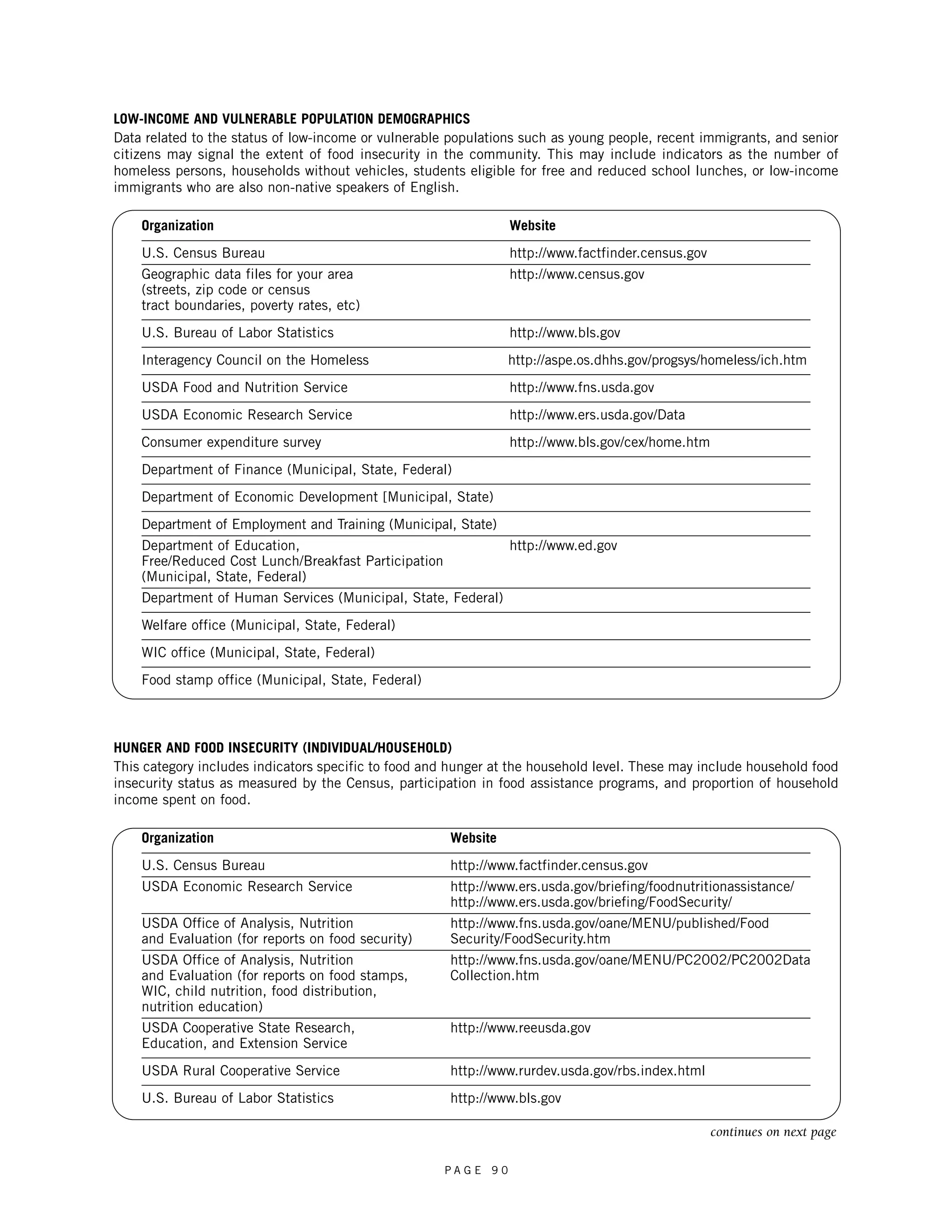
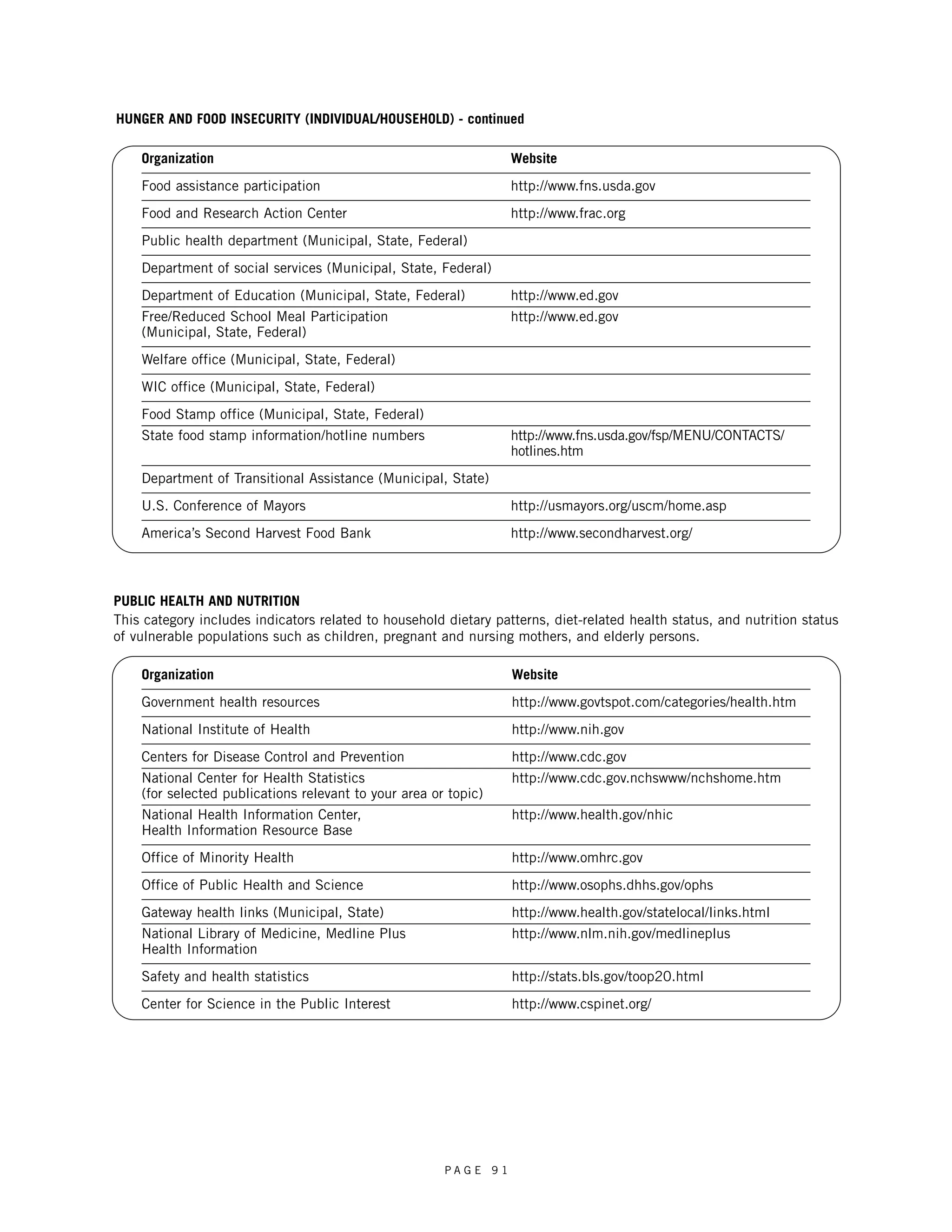
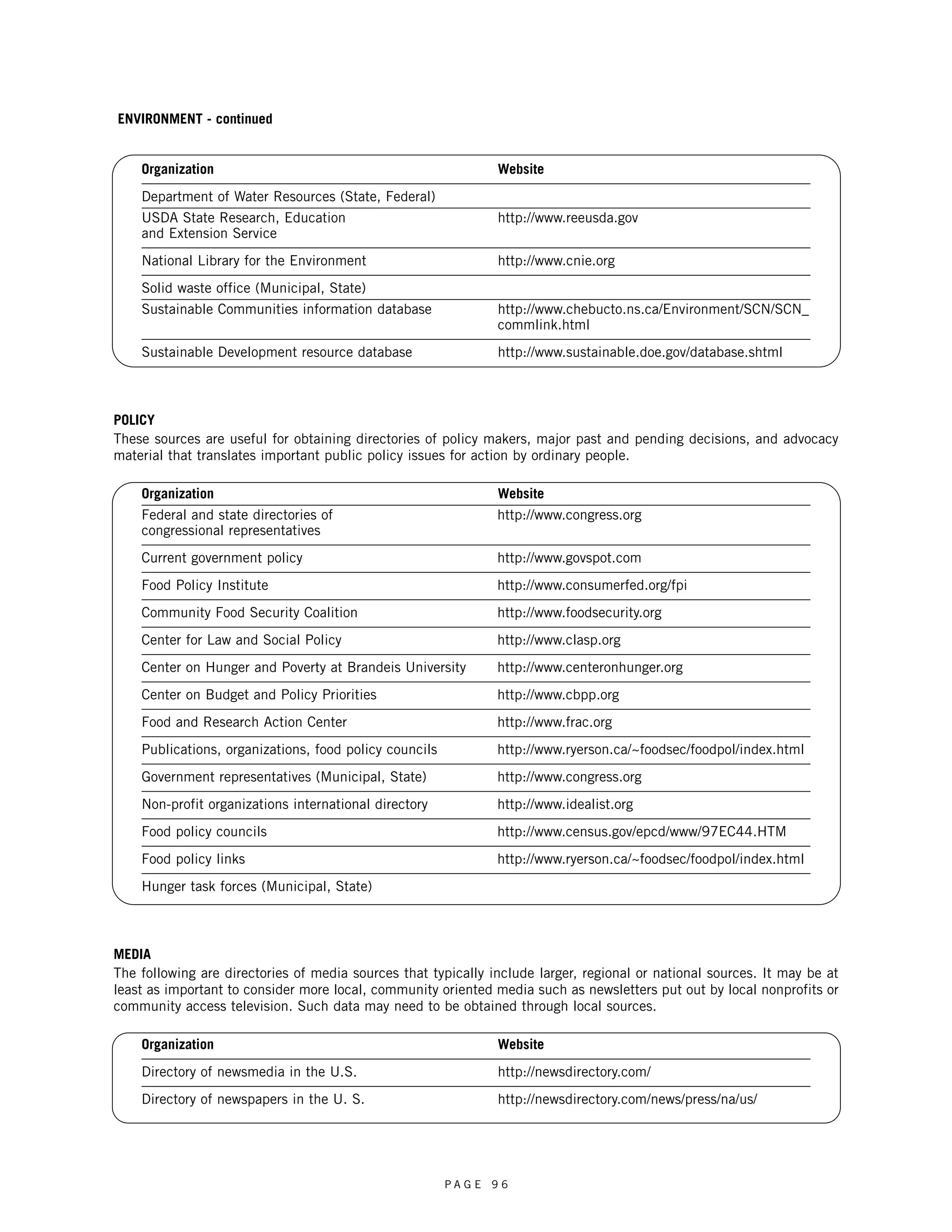
in Your Food System? 
A GUIDE TO COMMUNITY 
FOOD ASSESSMENT 
WRITTEN BY KAMI POTHUKUCHI, HUGH JOSEPH, 
HANNAH BURTON, AND ANDY FISHER 
EDITED BY KAI SIEDENBURG AND KAMI POTHUKUCHI 
2002 
Funding provided by 
University of California Sustainable Agriculture Research and Education Program 
California Department of Health Services and the California Nutrition Network, 
with funding support from the National Food Stamp Program, US Department of Agriculture 
US Department of Agriculture Community Food Projects Competitive Grants Program 
Published by 
Community Food Security Coalition 
P.O. Box 209 
Venice, CA 90294 
(310) 822-5410 
cfsc@foodsecurity.org 
www.foodsecurity.org 
We welcome limited duplication of contents of this Guide for non-profit and educational purposes. Please credit 
the source in all copies, and if possible, include this cover page.
Notes on cover photos: 
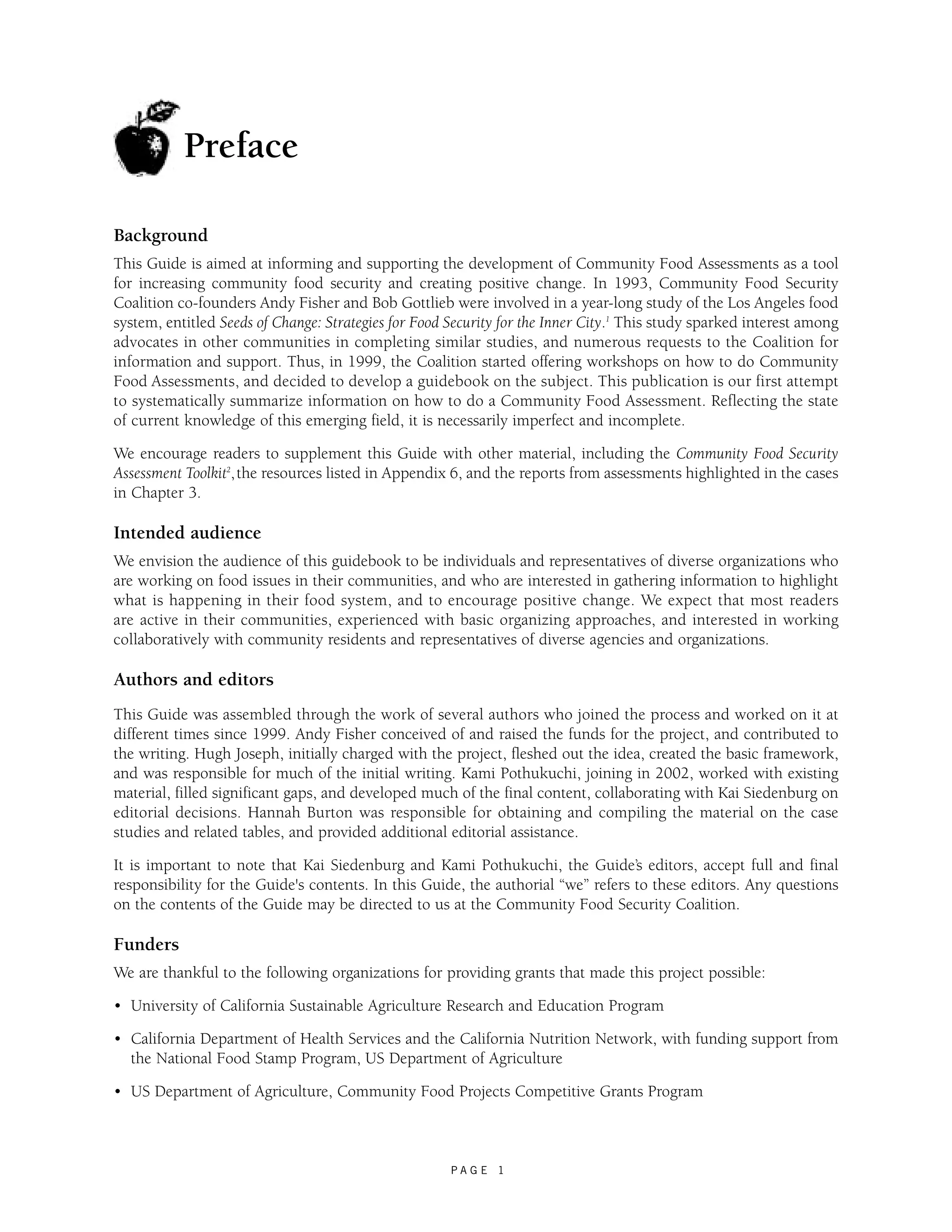
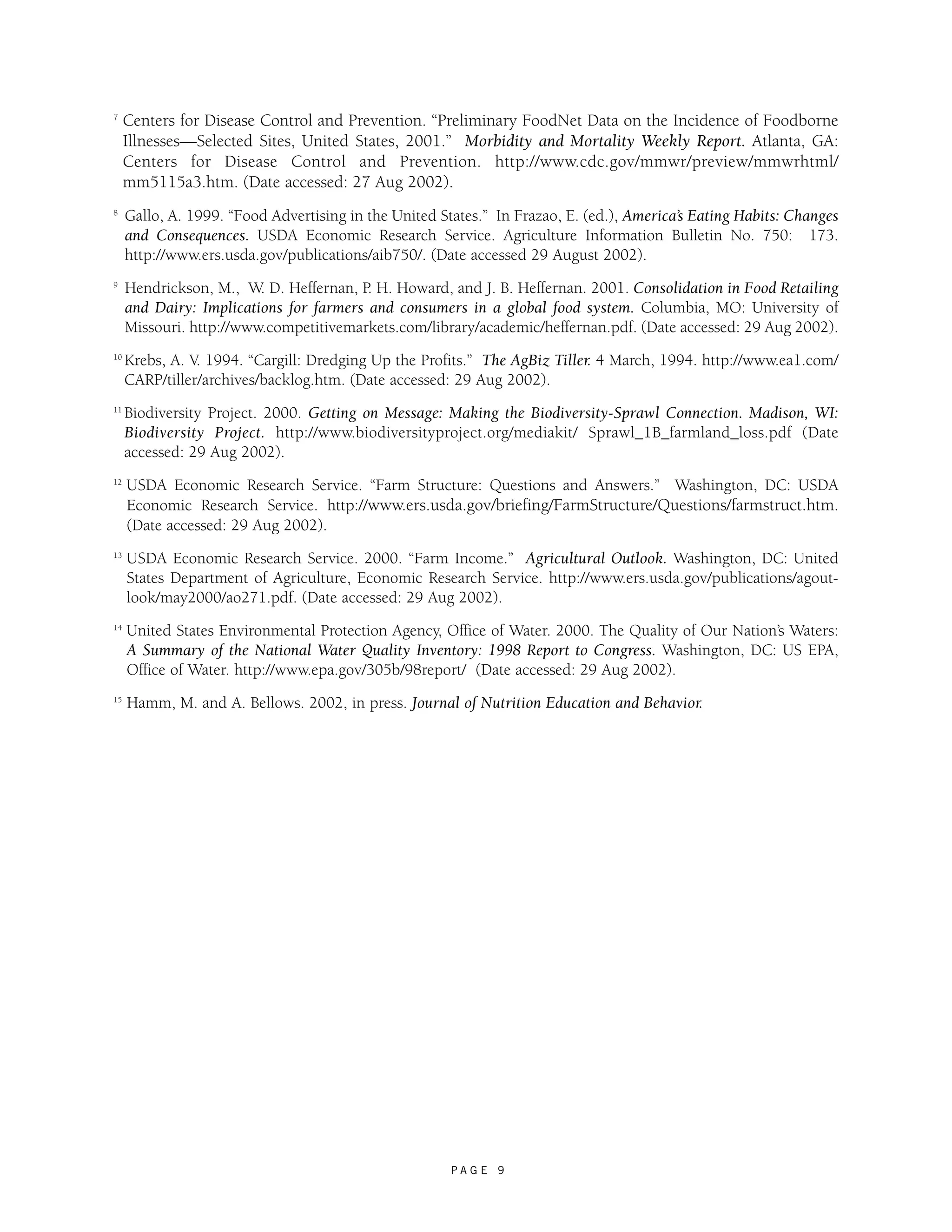
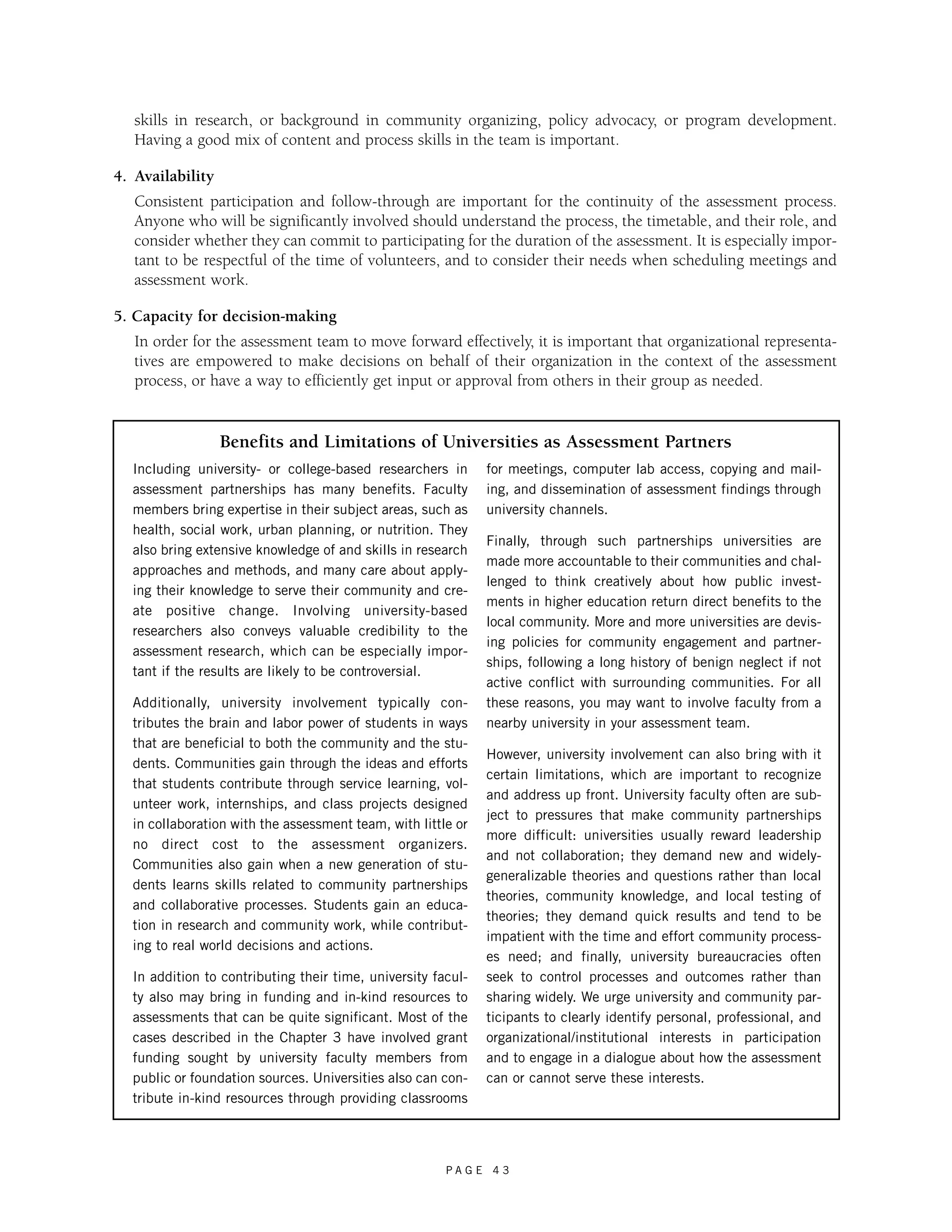
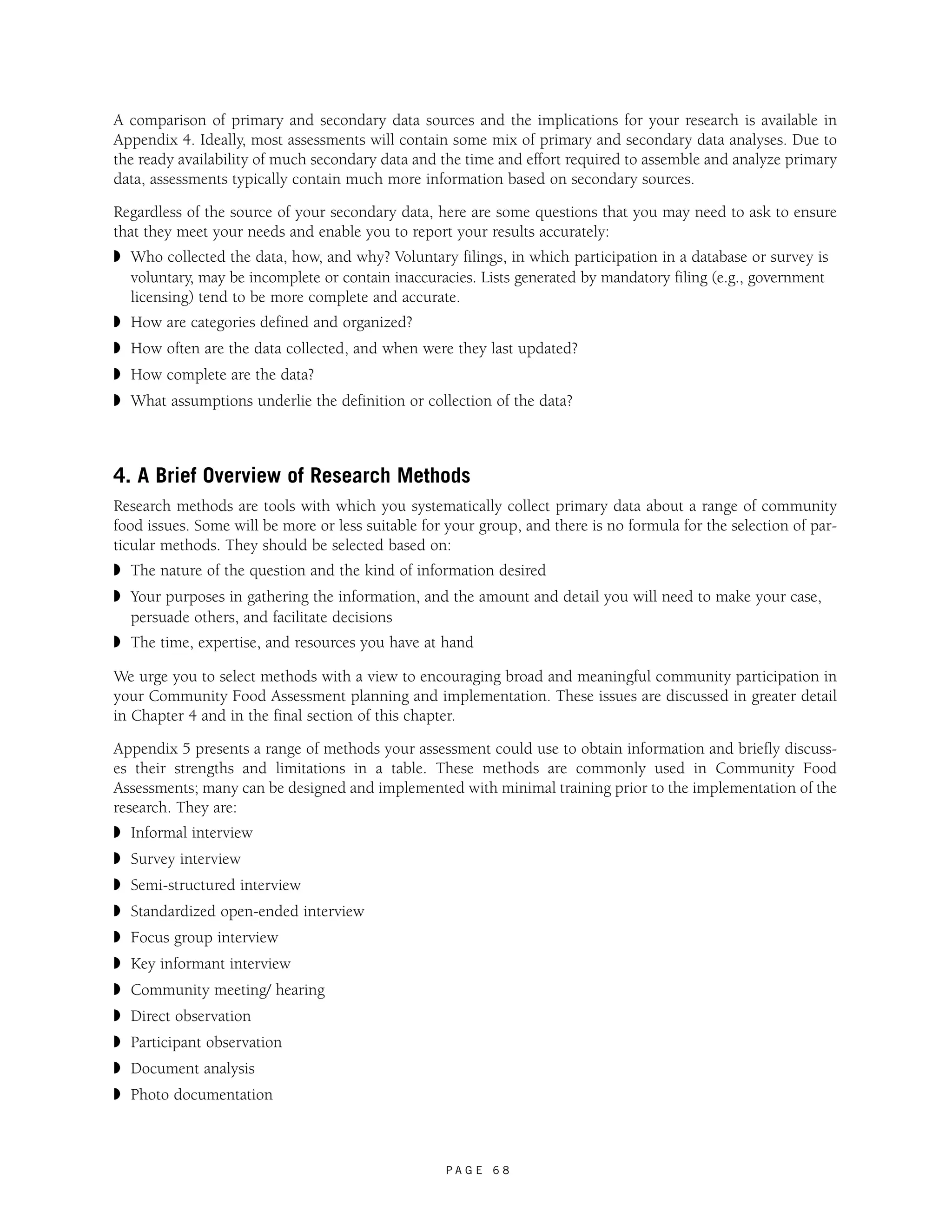
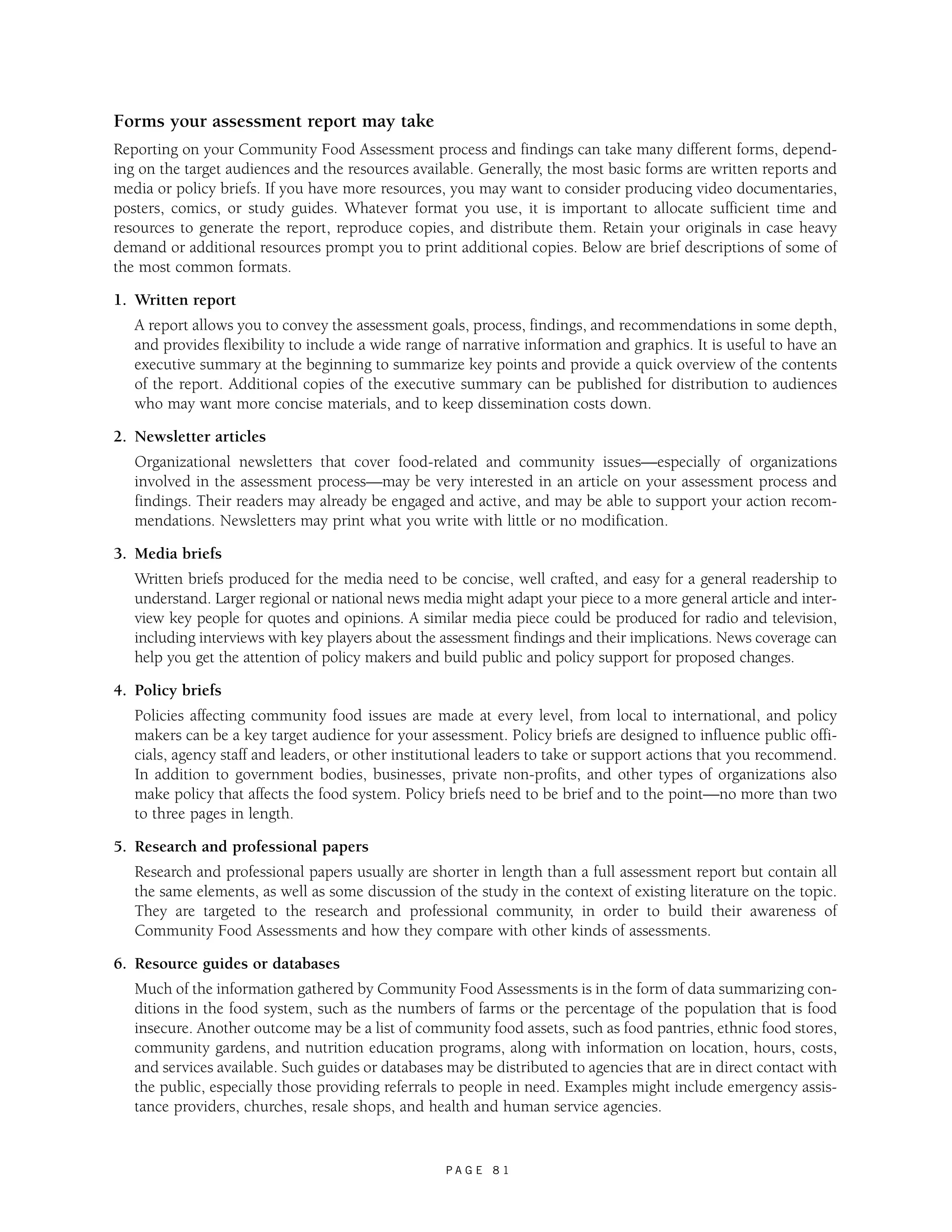
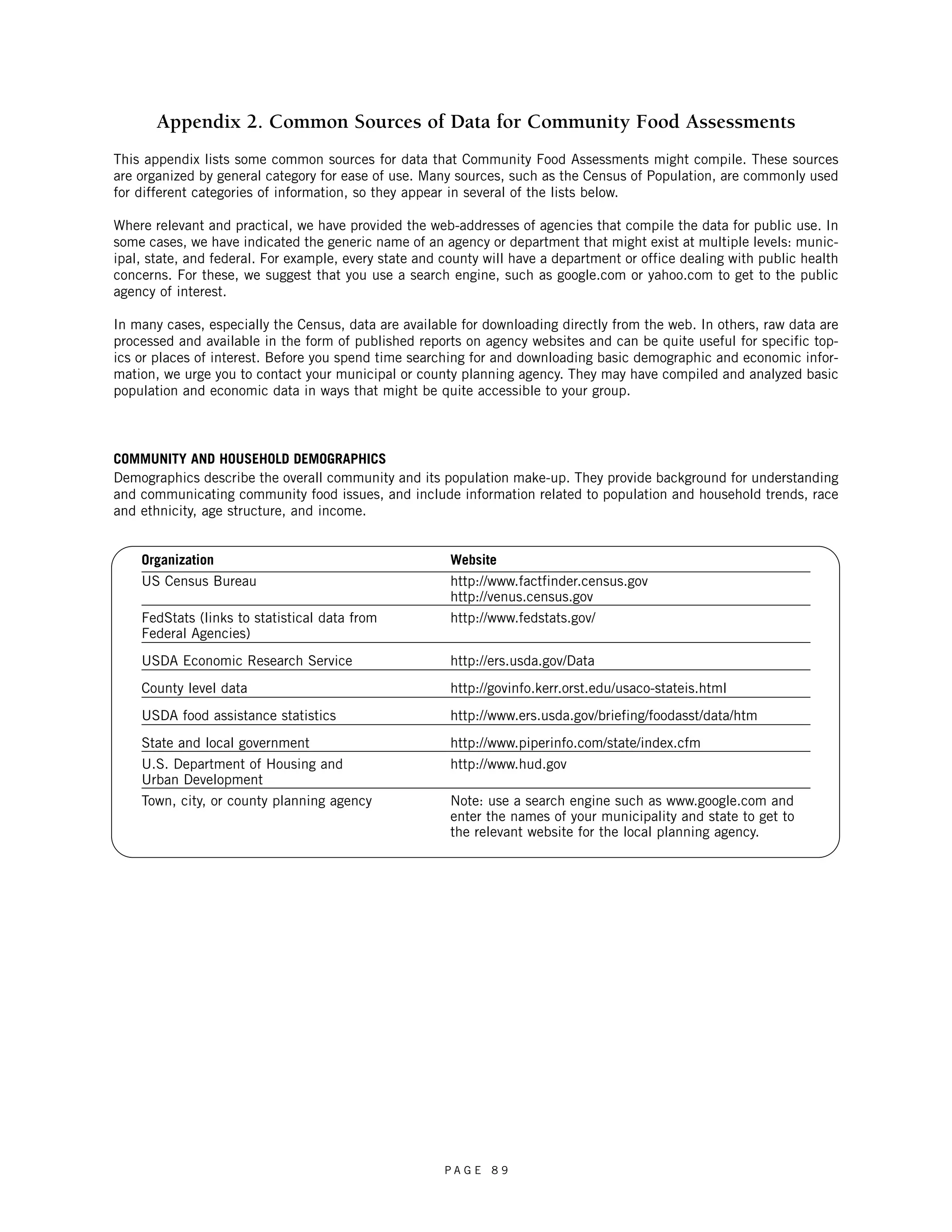
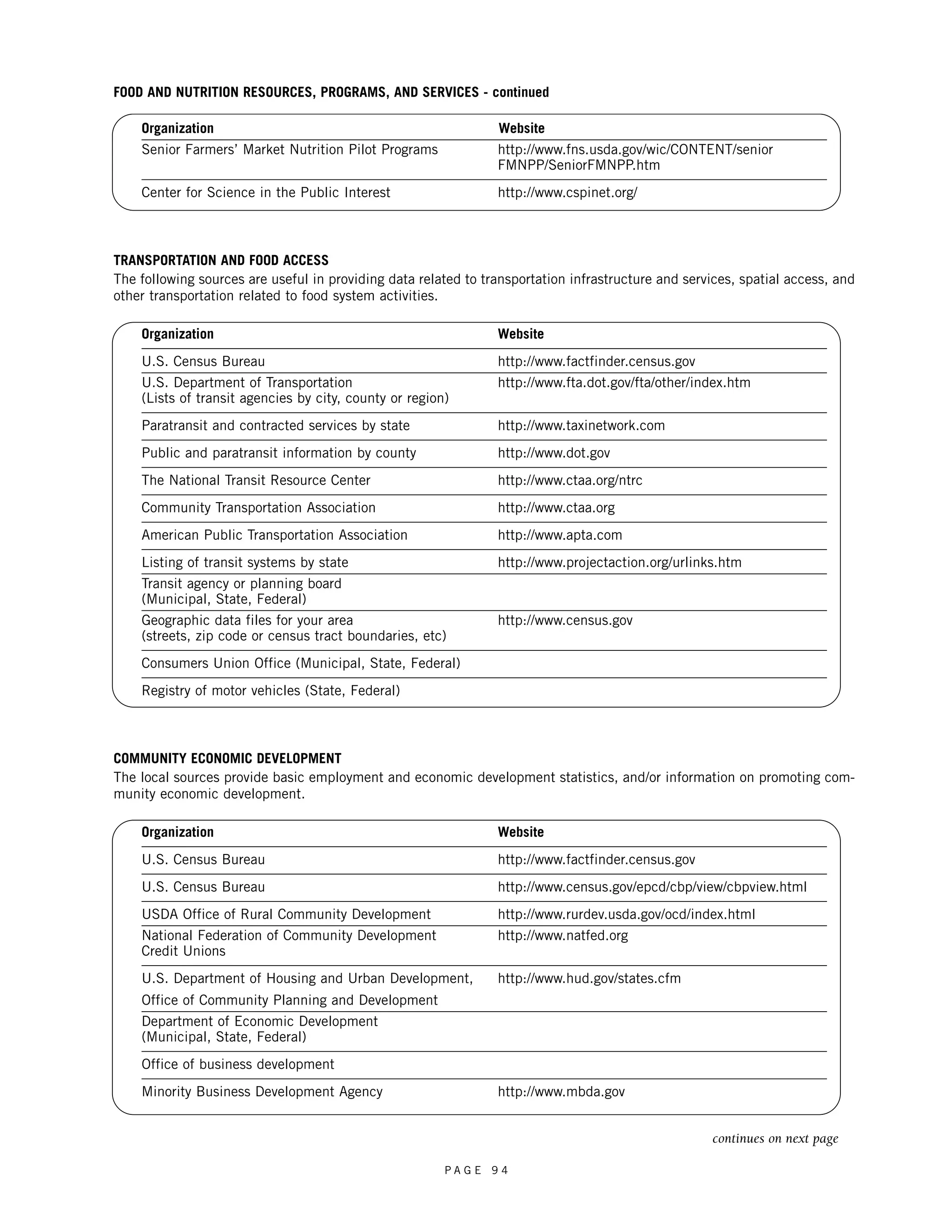
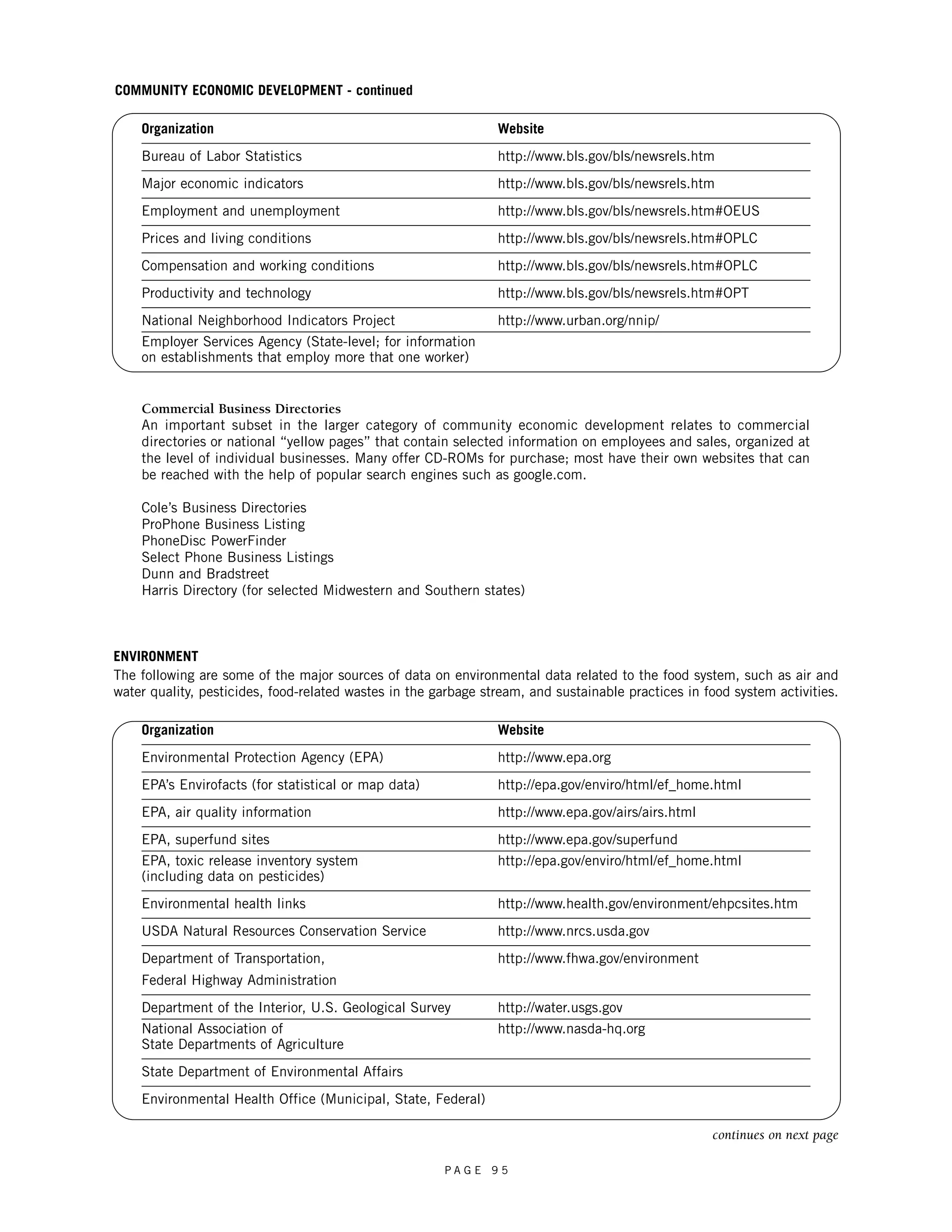
Poster created in 2002 for an assessment conducted by the Neighborhood Food Network in Portland. 
Artist: Alison Farrell. Photo credit: Eric Sopkin. 
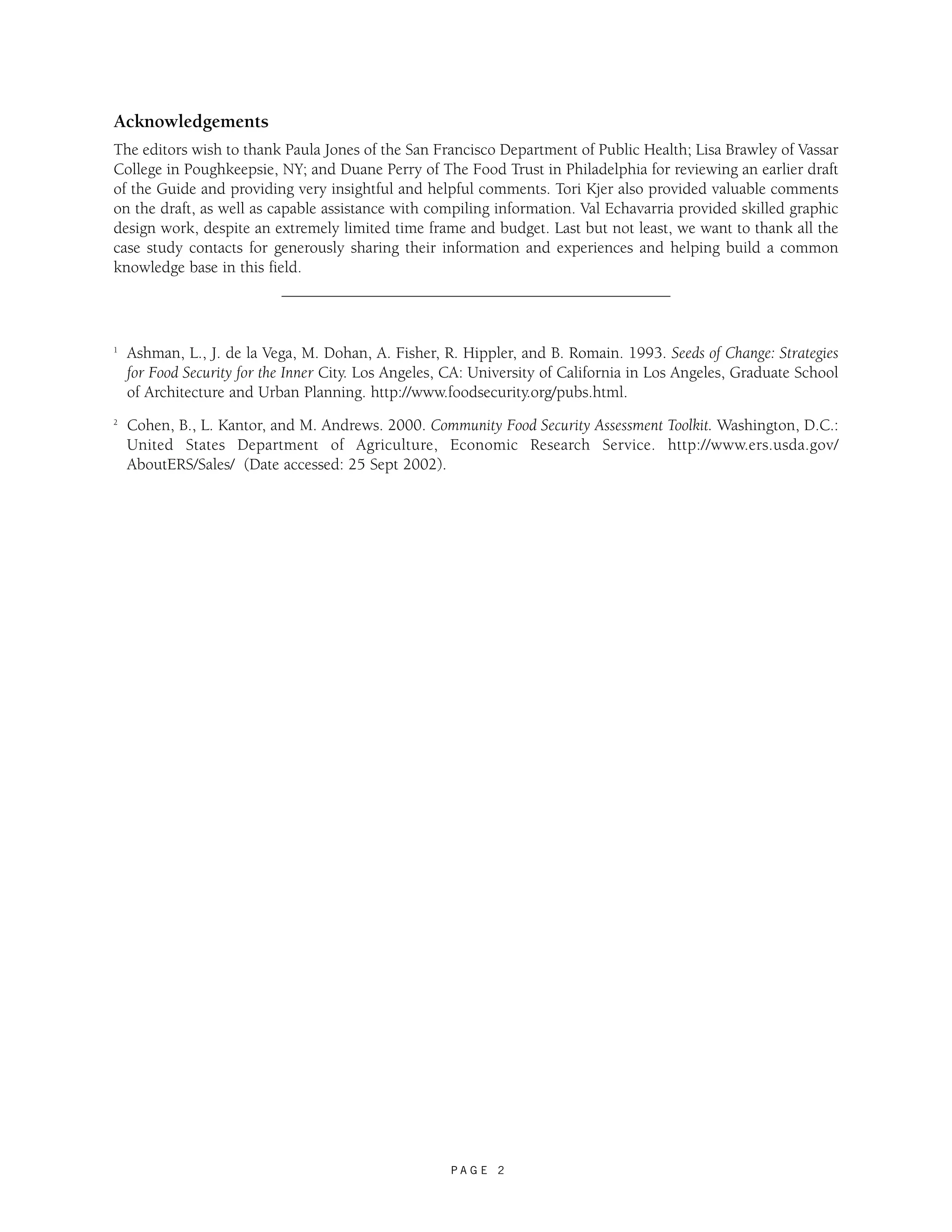
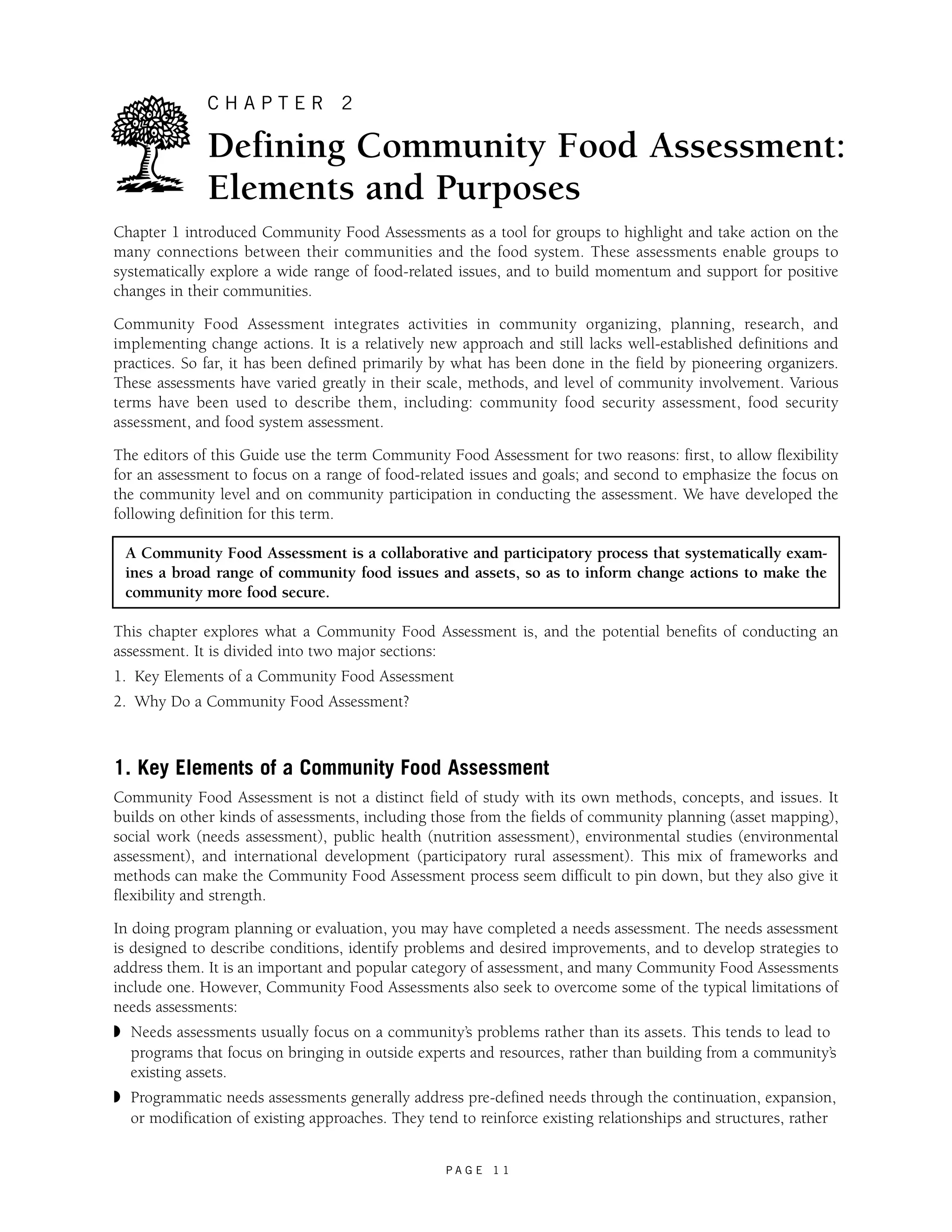
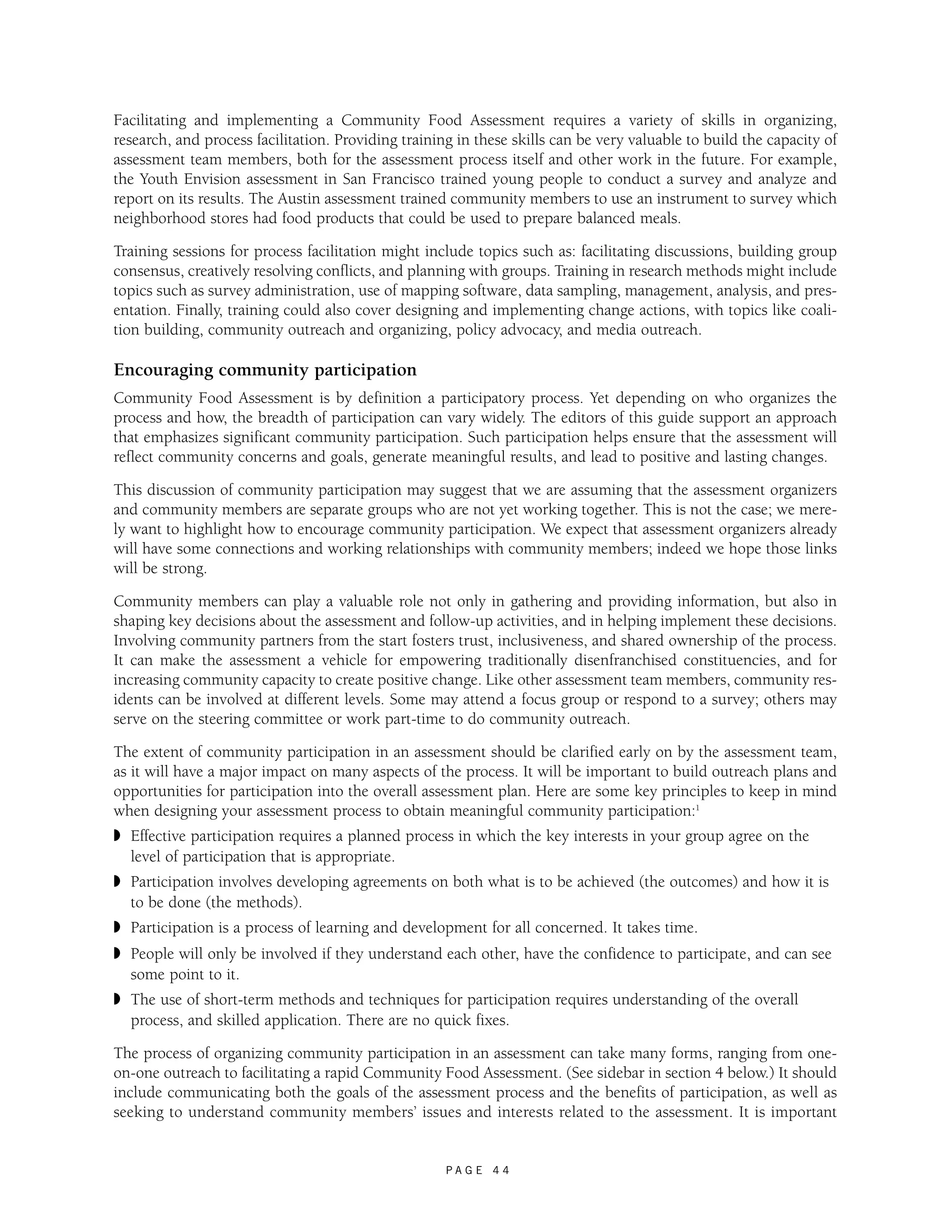
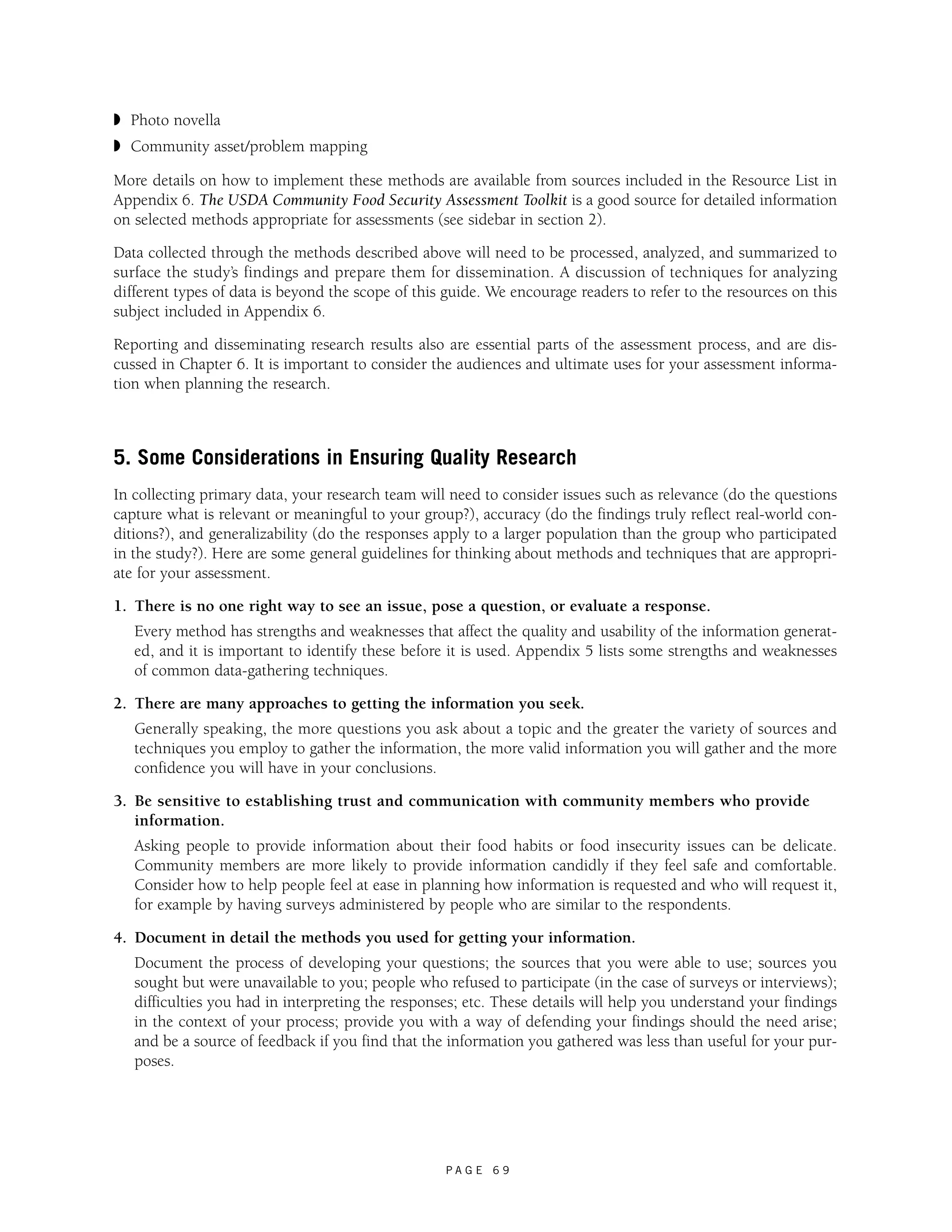
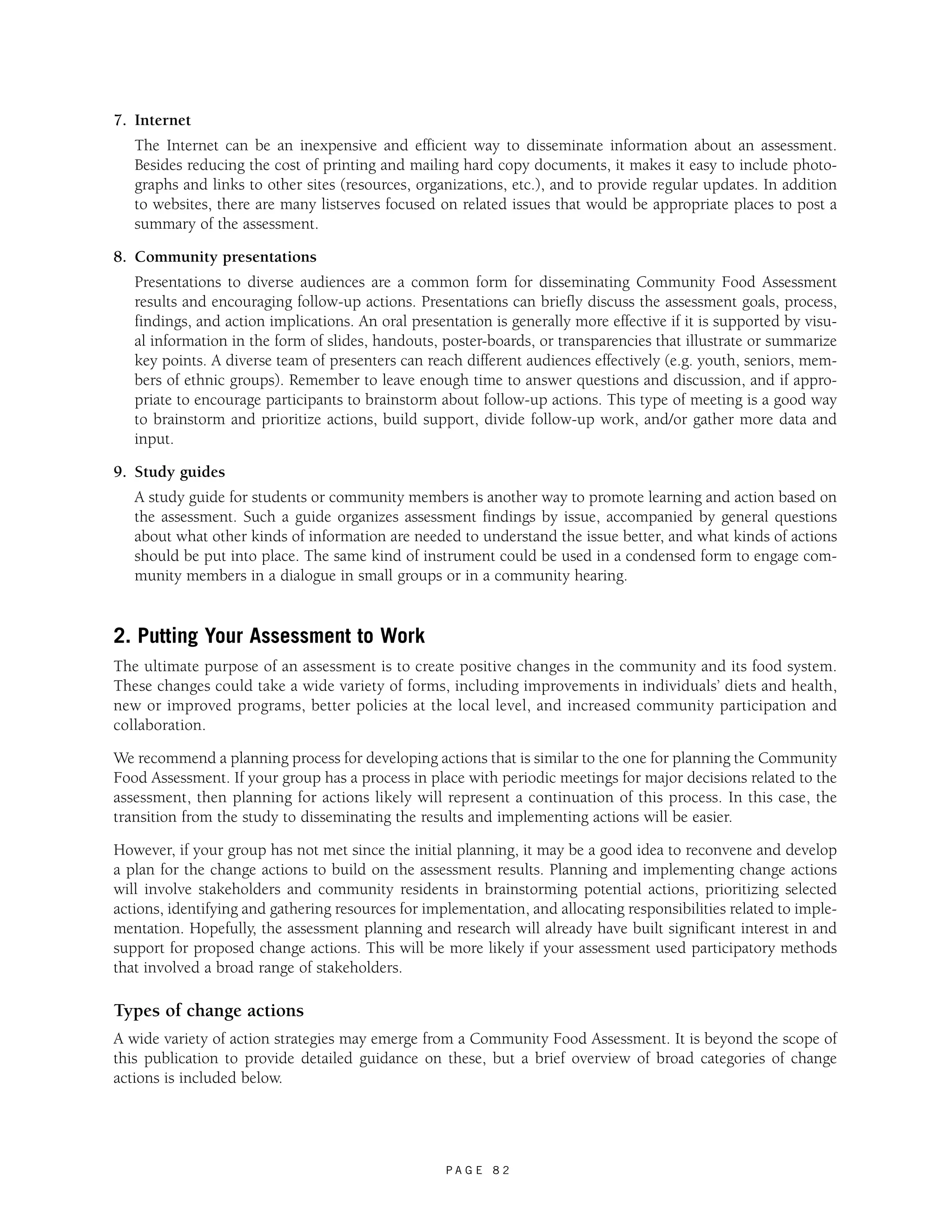
Planning session for the Detroit Food Security Council in 1999. Photo credit: Lou Murray. 
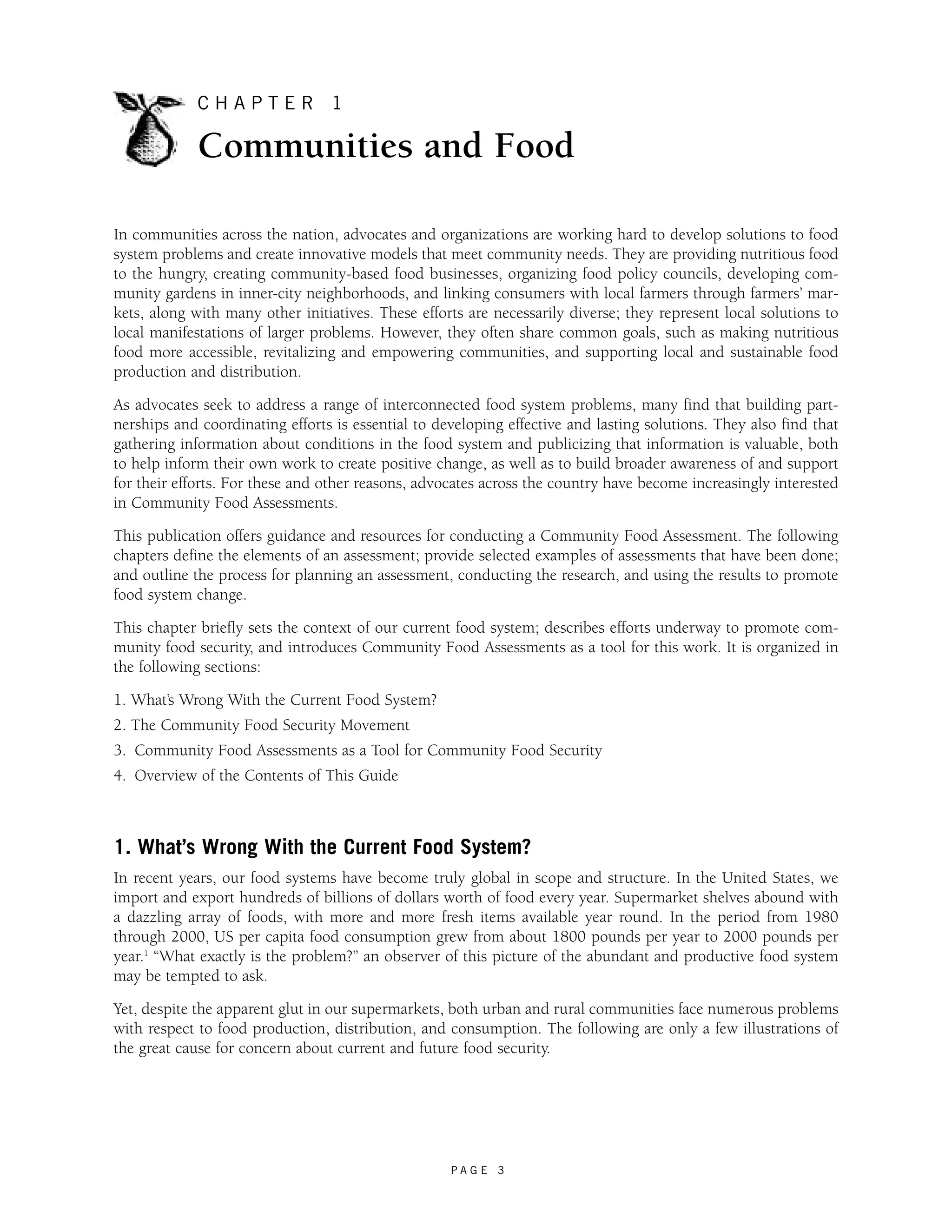
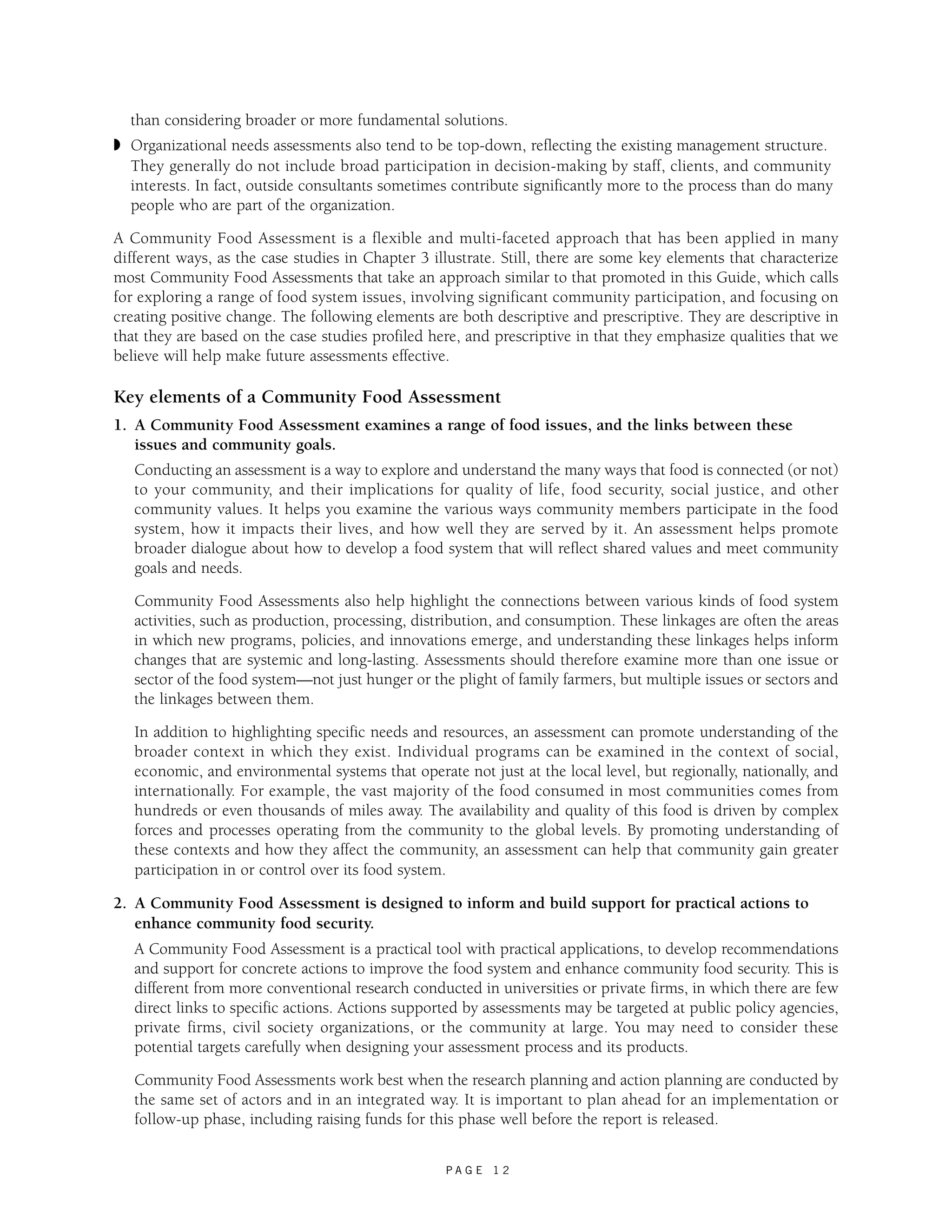
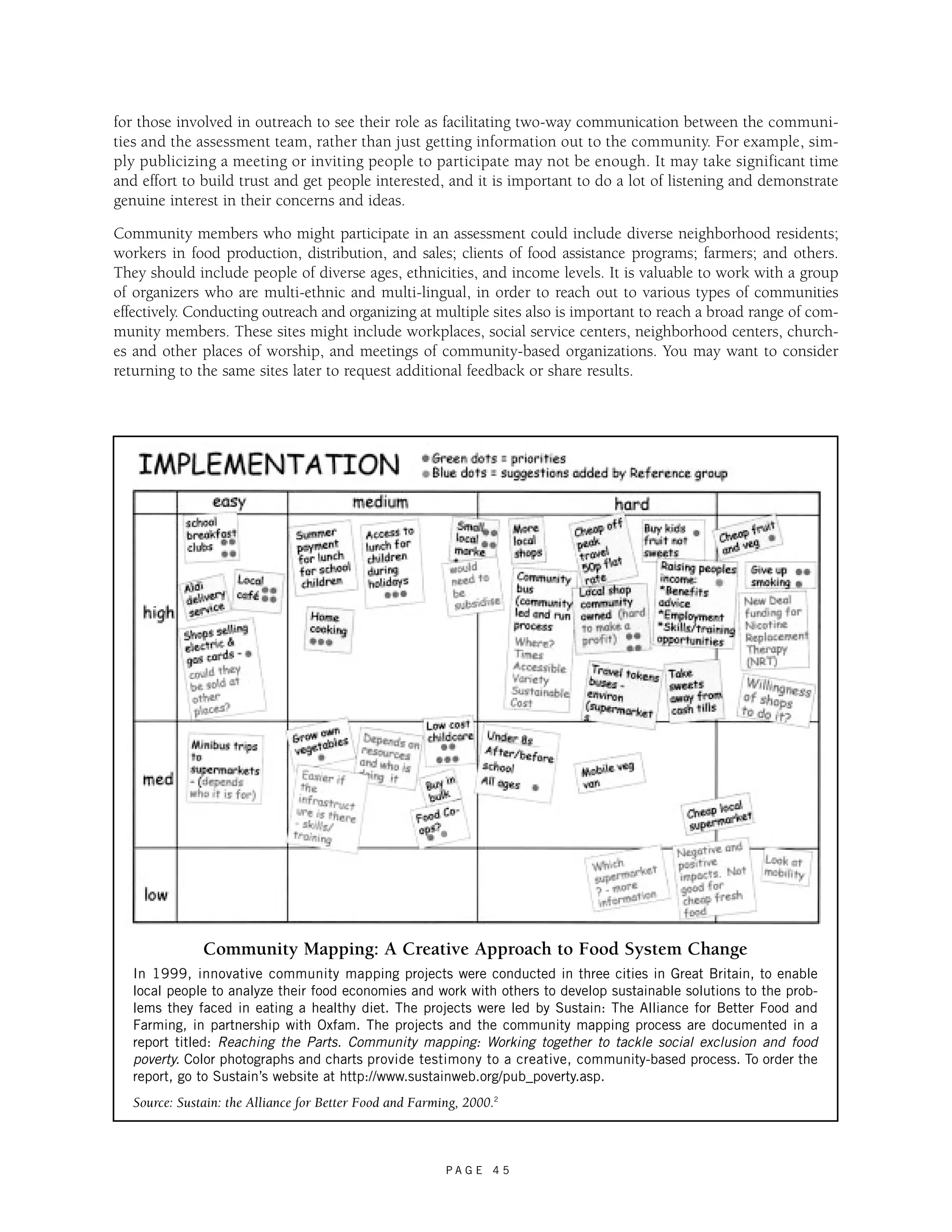
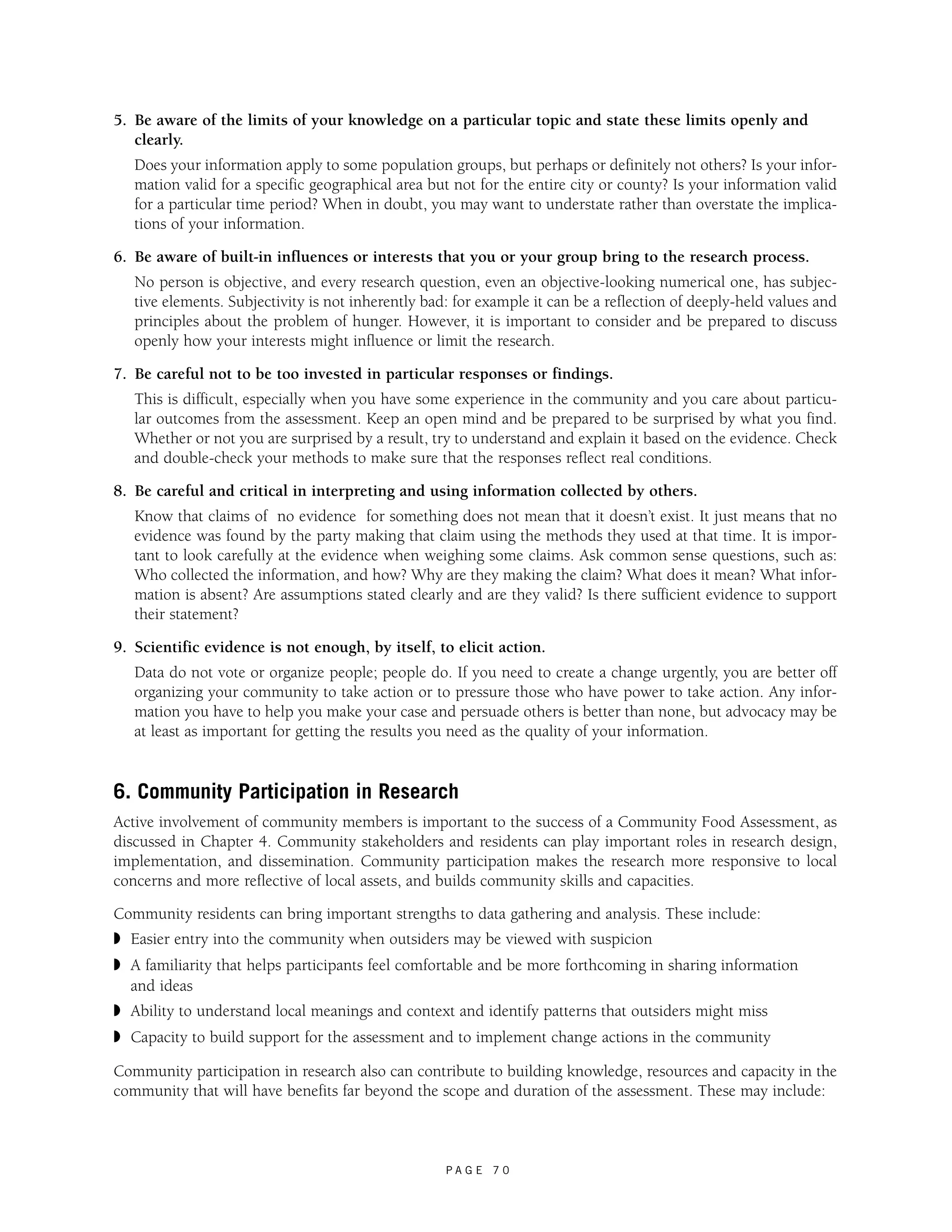
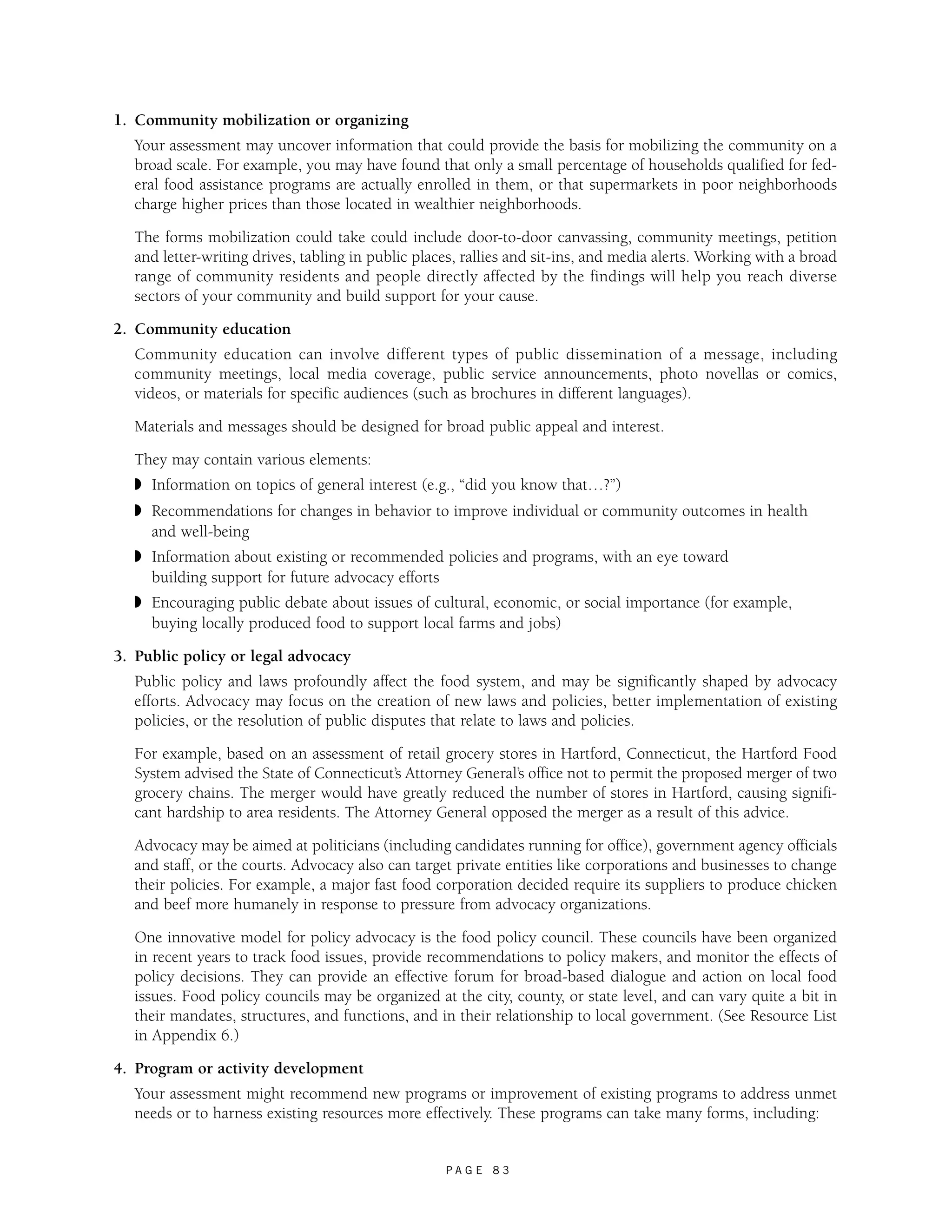
Farm stand organized by NorthEast Neighborhood Alliance at the Rochester Public Market in 1999. 
Photo credit: Kali Meeks. 
Graphic design by Val Echavarria.
Table of Contents 
Preface 1 
Chapter 1: Communities and Food 3 
1. What’s Wrong With the Current Food System? 3 
2. The Community Food Security Movement 5 
3. Community Food Assessments as a Tool for Community Food Security 6 
4. Overview of the Contents of This Guide 8 
Chapter 2: Defining Community Food Assessment: Elements and Purposes 11 
1. Key Elements of a Community Food Assessment 11 
2. Why Do a Community Food Assessment? 16 
Chapter 3: Community Food Assessment Case Studies 21 
1. Introduction 21 
2. Community Food Assessment Case Studies 22 
Austin, Texas 22 
Berkeley, California 24 
Detroit, Michigan 25 
Los Angeles, California 27 
Madison, Wisconsin 28 
Milwaukee, Wisconsin 30 
North Country Region, New York 32 
San Francisco, California 33 
Somerville, Massachusetts 36 
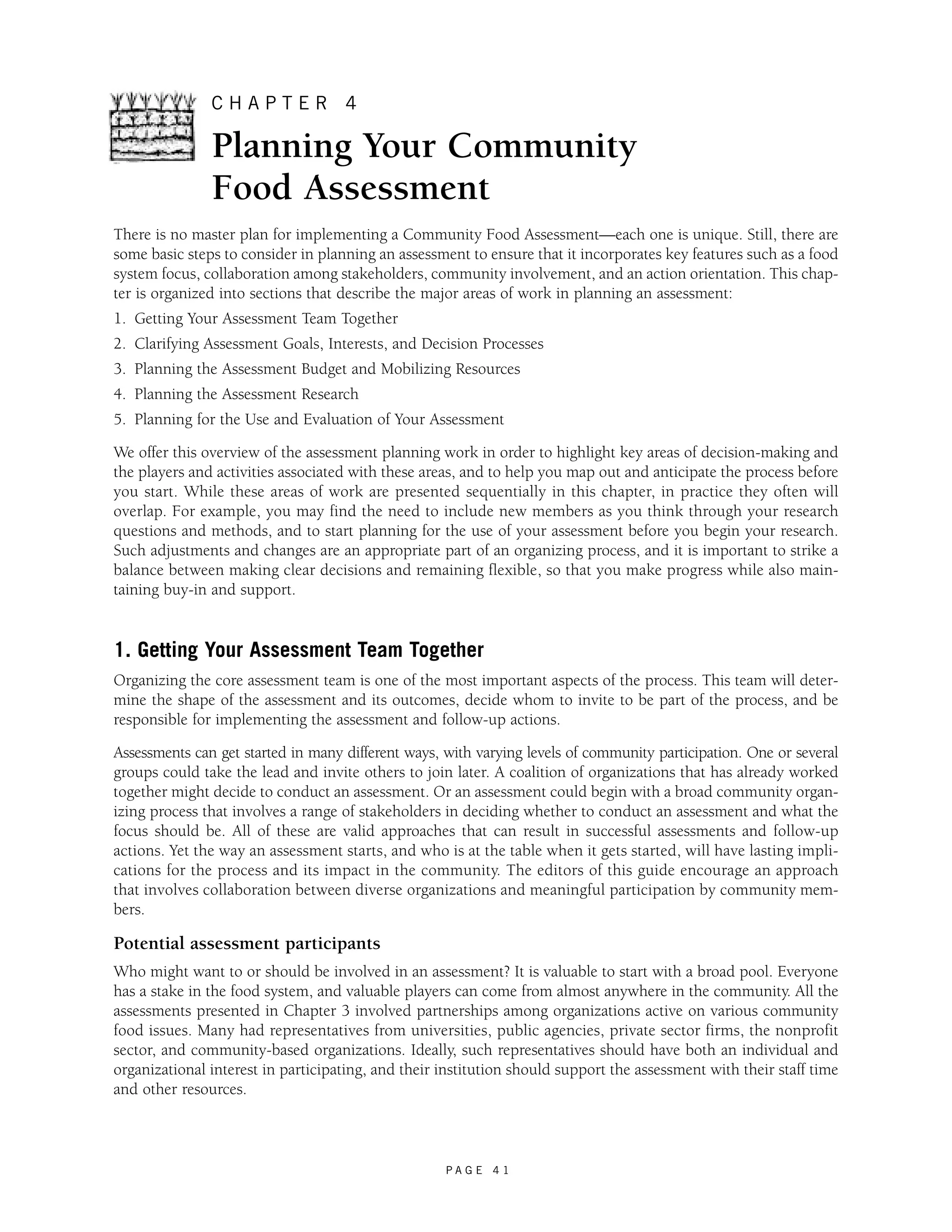
Chapter 4: Planning Your Community Food Assessment 41 
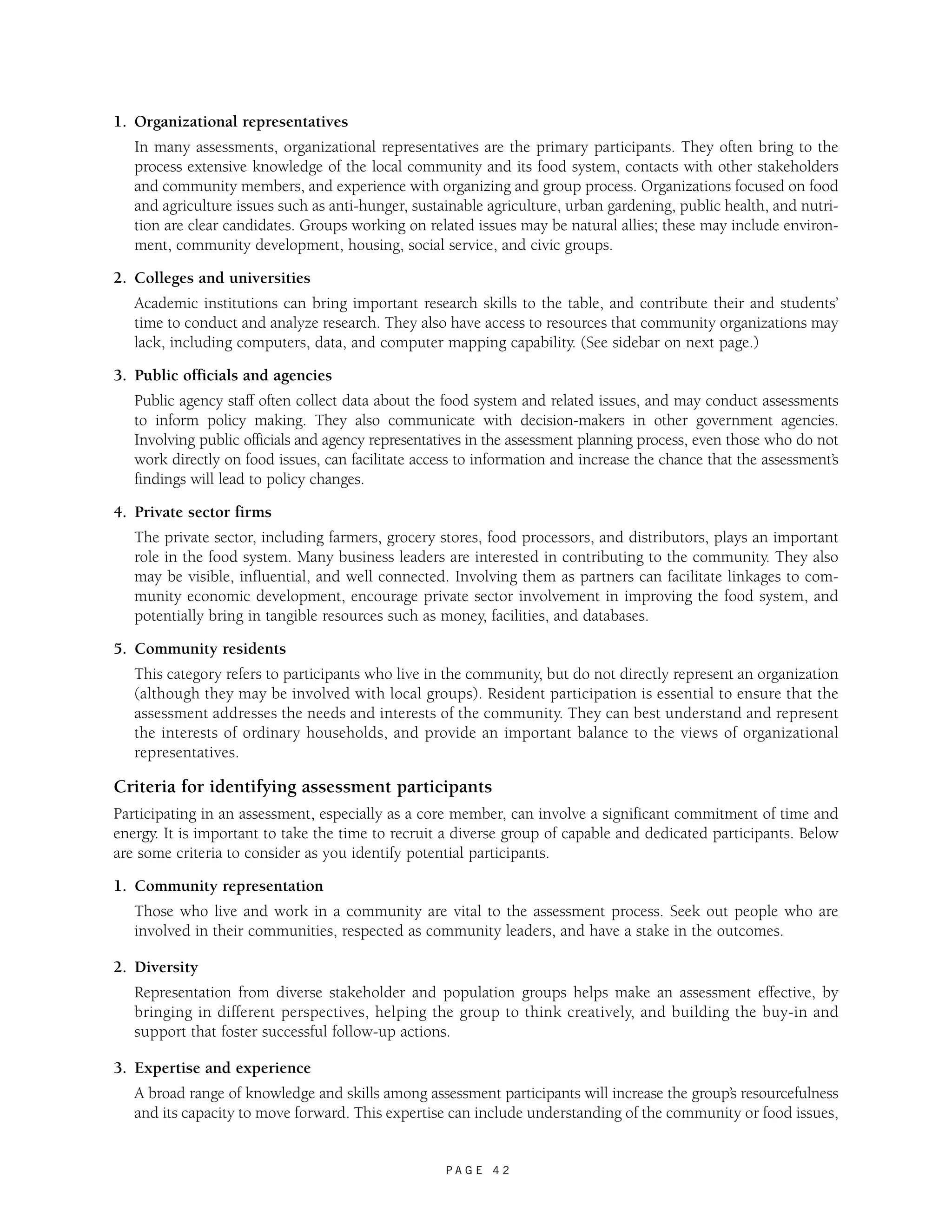
1. Getting Your Assessment Team Together 41 
2. Clarifying Assessment Goals, Interests, and Decision Processes 46 
3. Planning the Assessment Budget and Mobilizing Resources 50 
4. Planning the Assessment Research 52 
5. Planning for the Use and Evaluation of Your Assessment 56 
Chapter 5: Designing and Doing the Assessment Research 59 
1. Mapping Out Your Research Questions 59 
2. Translating Questions Into Indicators 62 
3. Using Primary and Secondary Sources of Data 66 
4. A Brief Overview of Research Methods 68 
5. Some Considerations in Ensuring Quality Research 69 
6. Community Participation in Research 70 
7. Assessing Food Access in Your Community: An Illustration 71 
Chapter 6: Putting Your Community Food Assessment to Work 77 
1. Disseminating Your Assessment’s Findings 77 
2. Putting Your Assessment to Work 82 
Appendices 86
List of Tables and Figures 
Community Food Security Goals and Community Food Assessment 7 
Types of Organizations Participating in Case Studies 14 
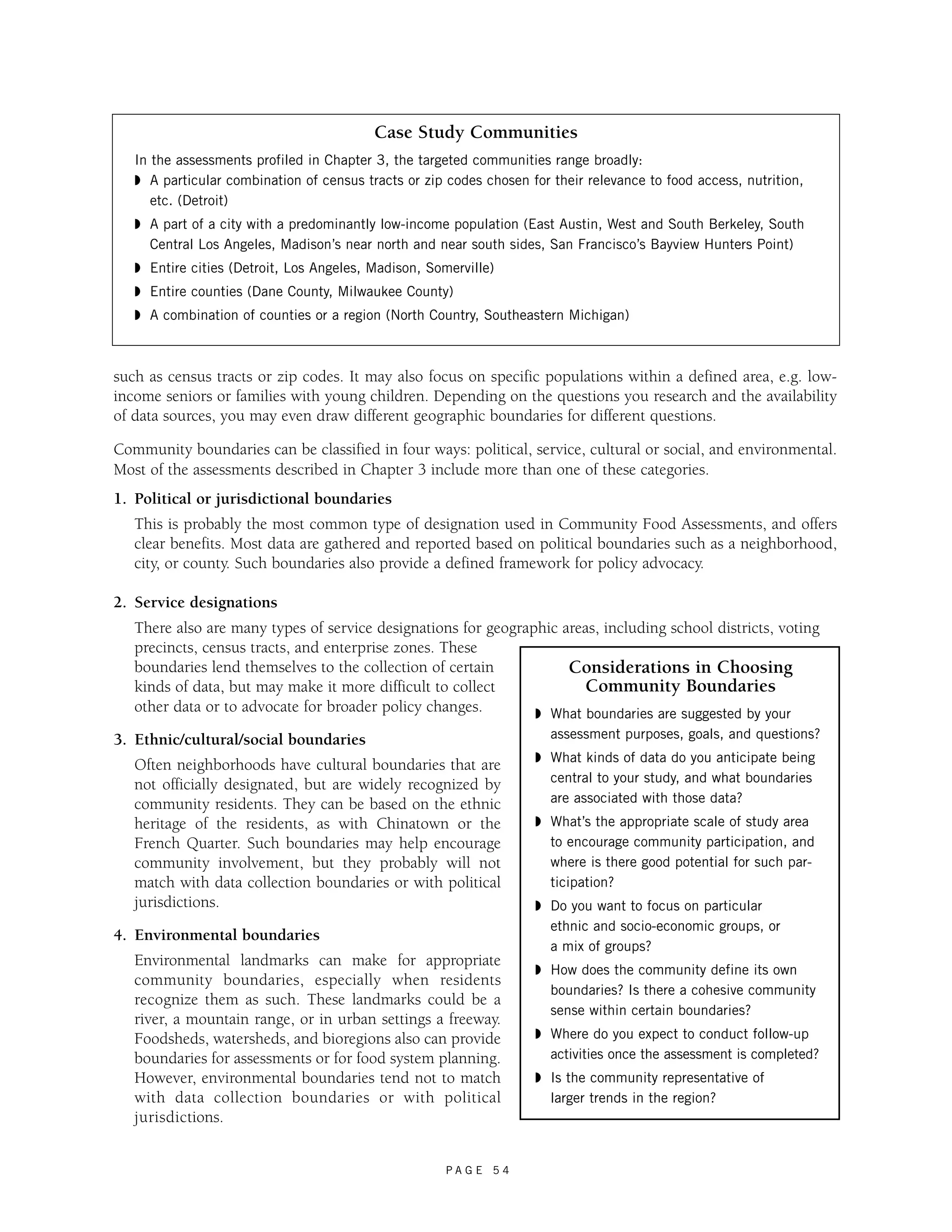
Communities Addressed by Case Studies 21 
Sponsoring Organizations for Case Studies 23 
Hunger and Food Insecurity in Detroit 26 
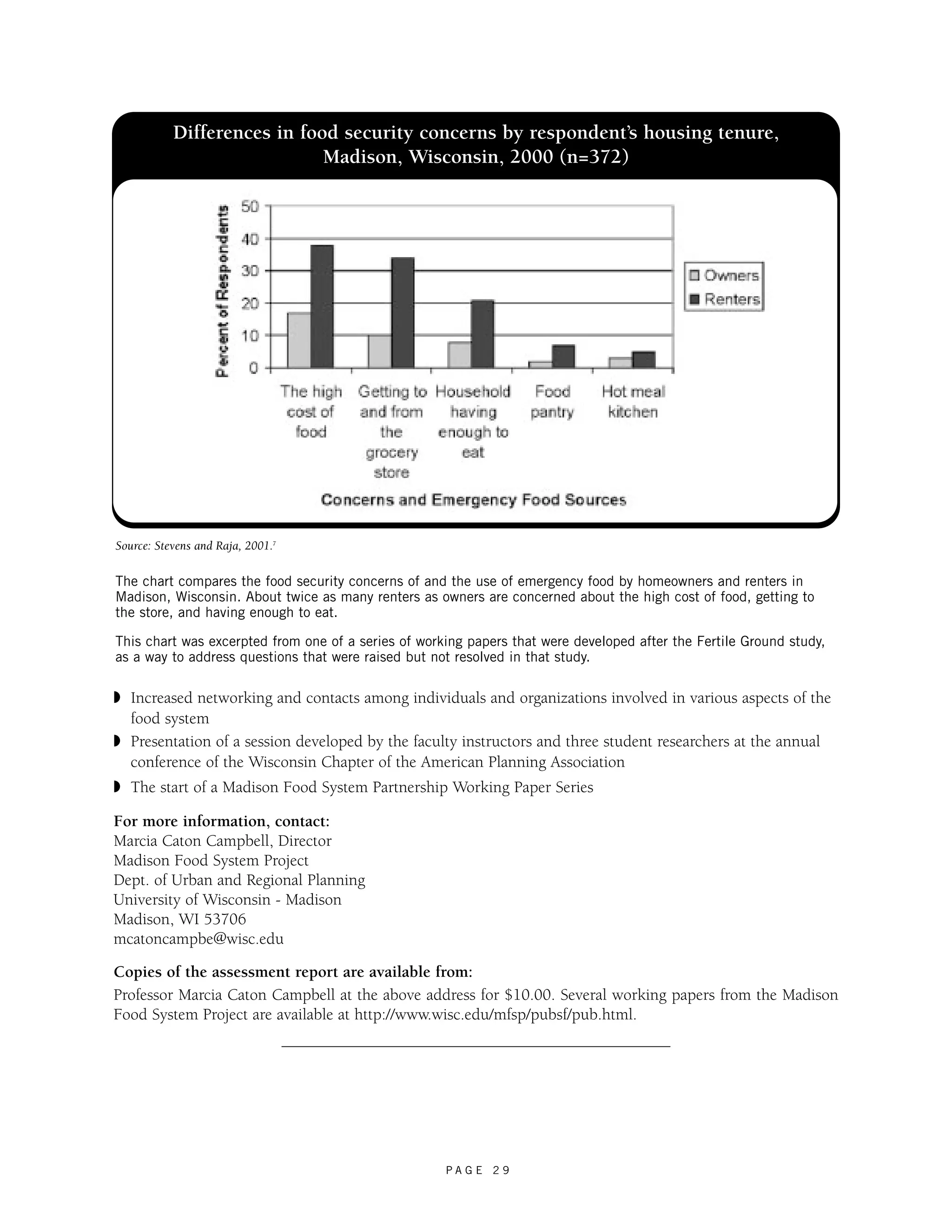
Differences in Food Security Concerns by Respondent’s Housing Tenure, Madison, WI 29 
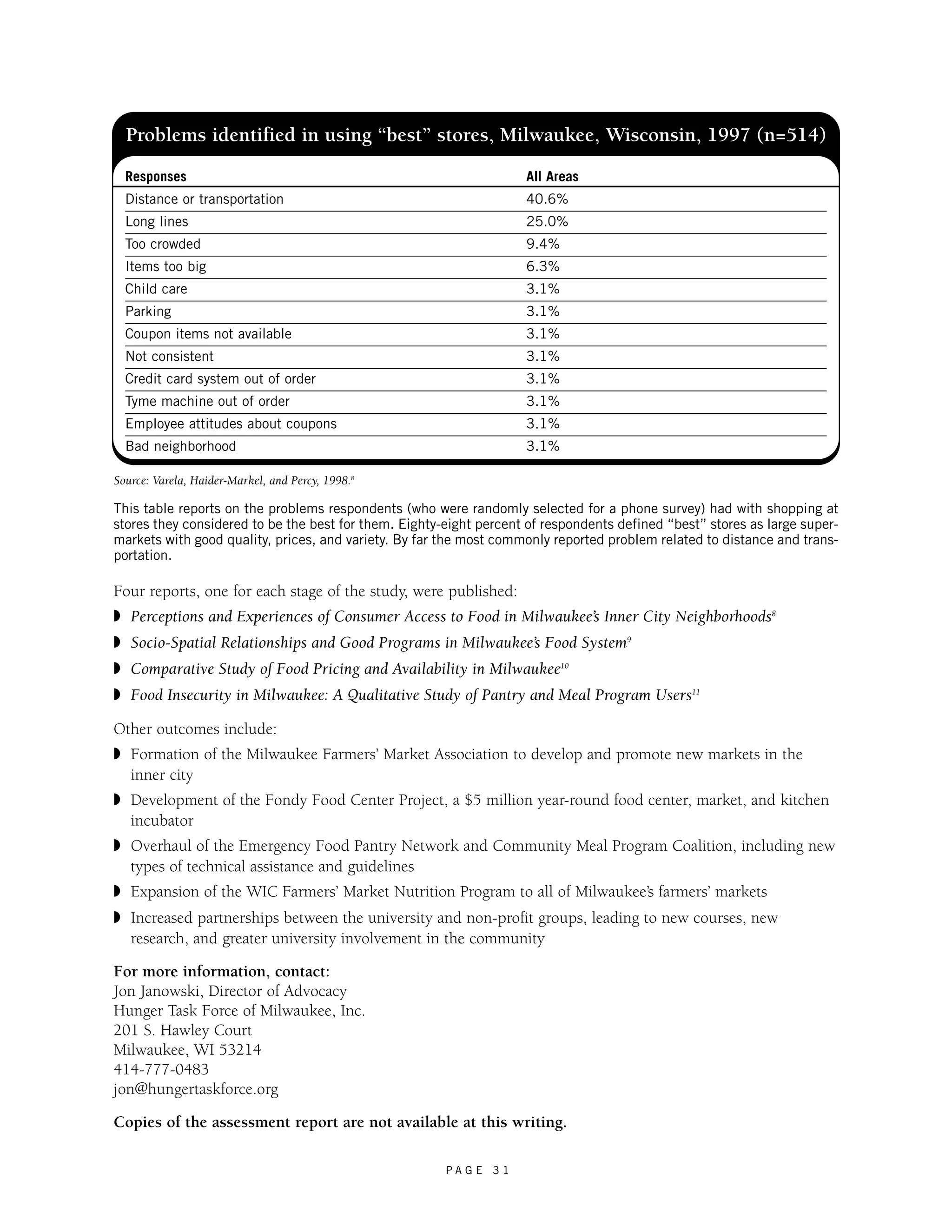
Problems Identified in Using "Best" Stores, Milwaukee, WI 31 
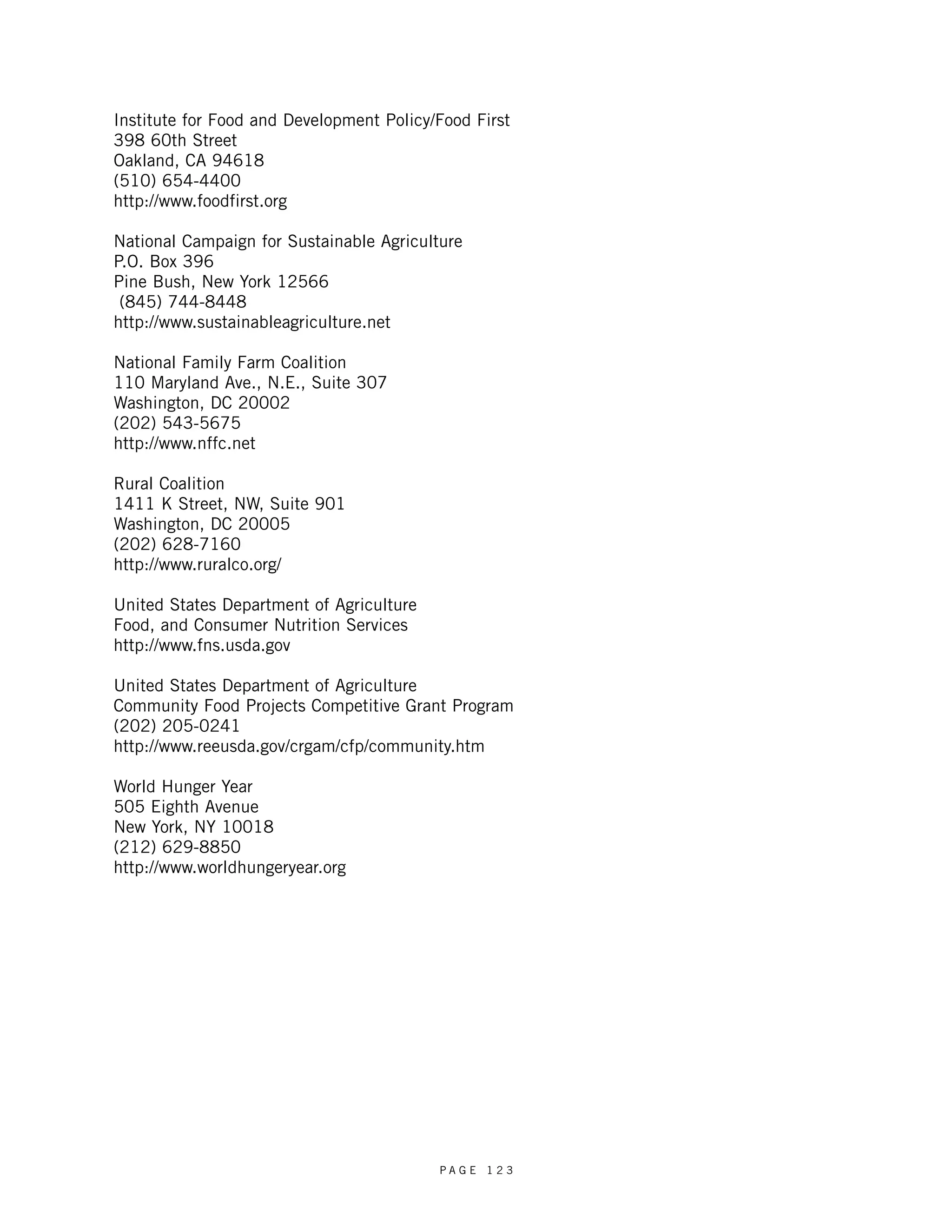
Types of Stores Where Commonly Used Items are Purchased Most Often, Milwaukee, WI 32 
Barriers to Purchasing Healthful Foods, San Francisco, CA 34 
Most Valuable Community Resources for Purchasing Healthful Foods, San Francisco, CA 35 
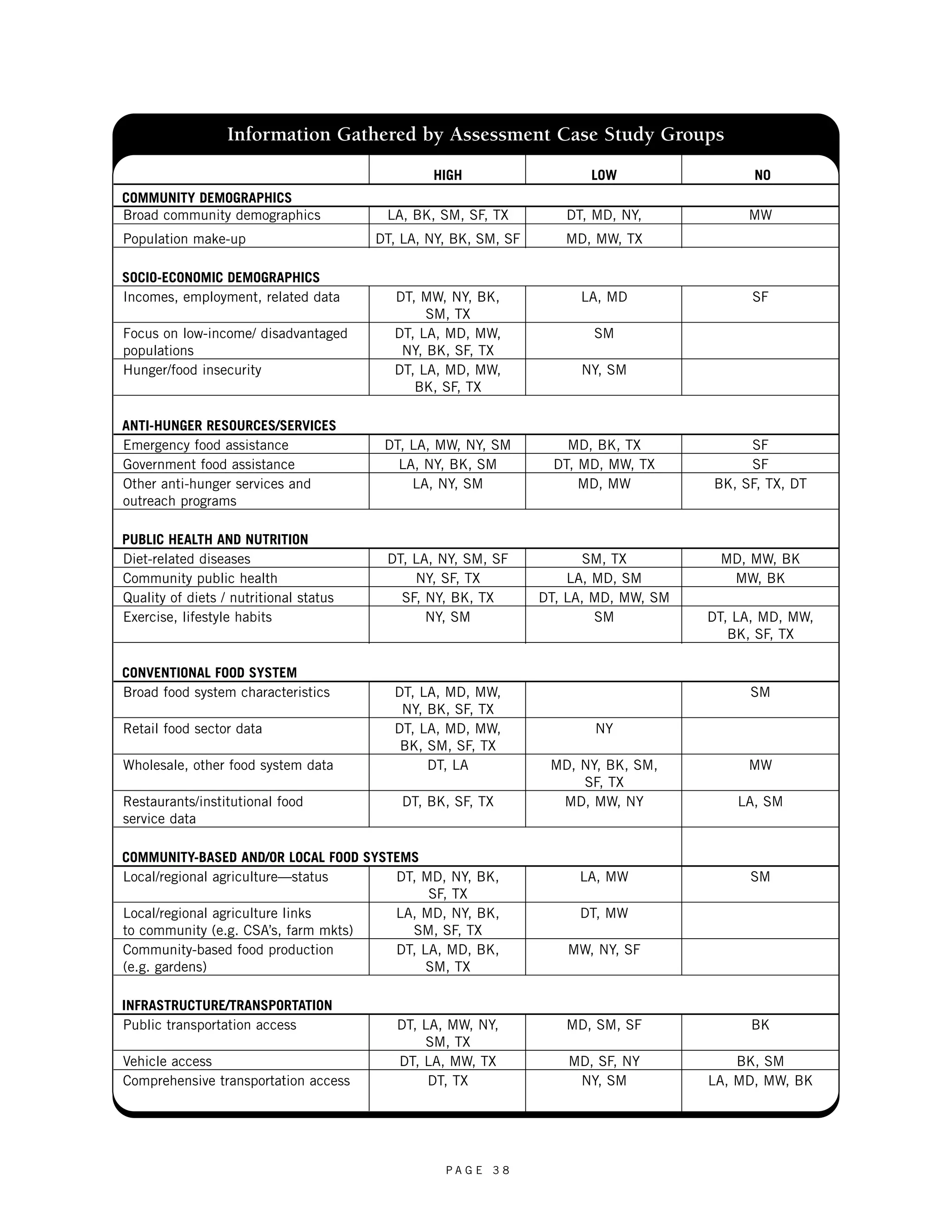
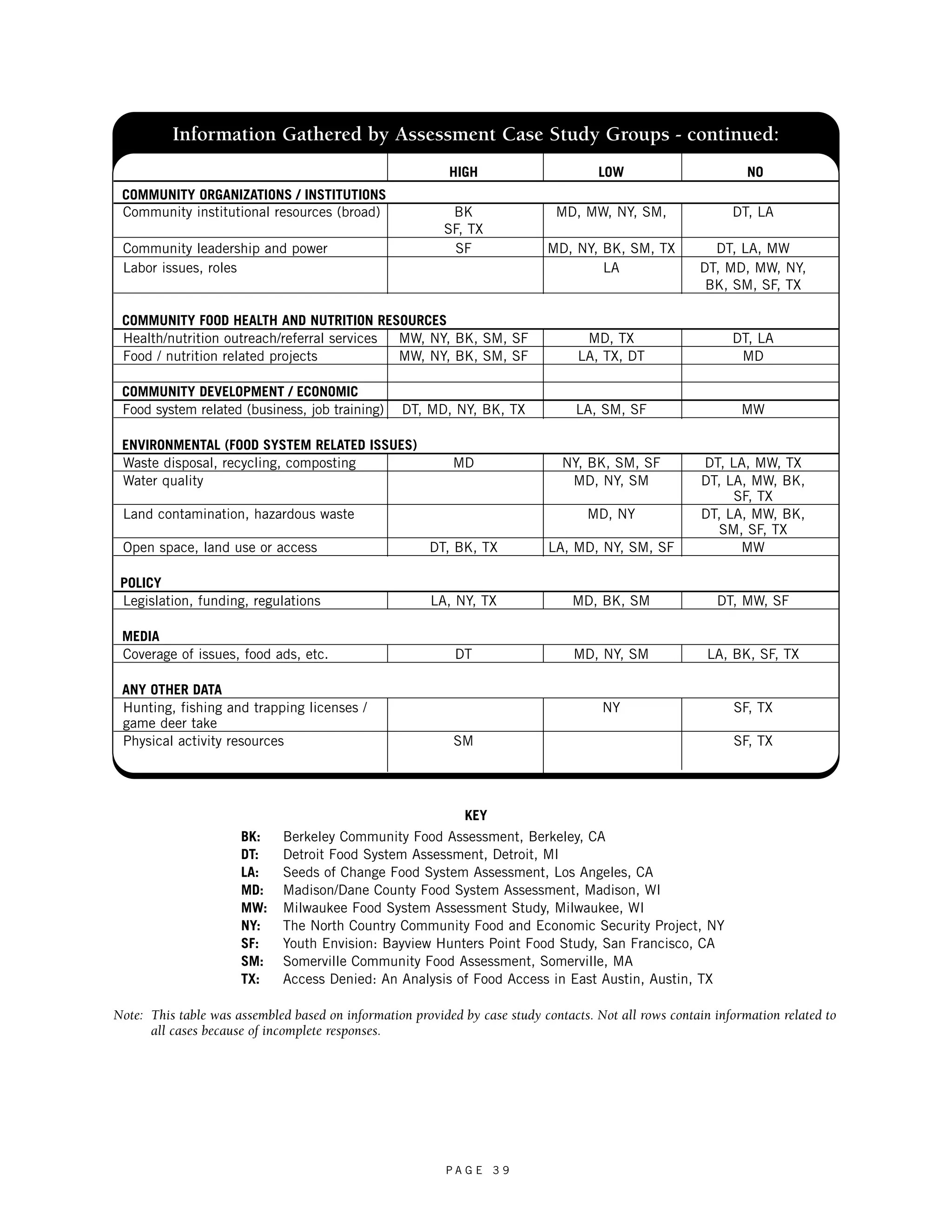
Information Gathered by Assessment Case Study Groups 38 
Implementation Matrix Developed Through Community Mapping Process 45 
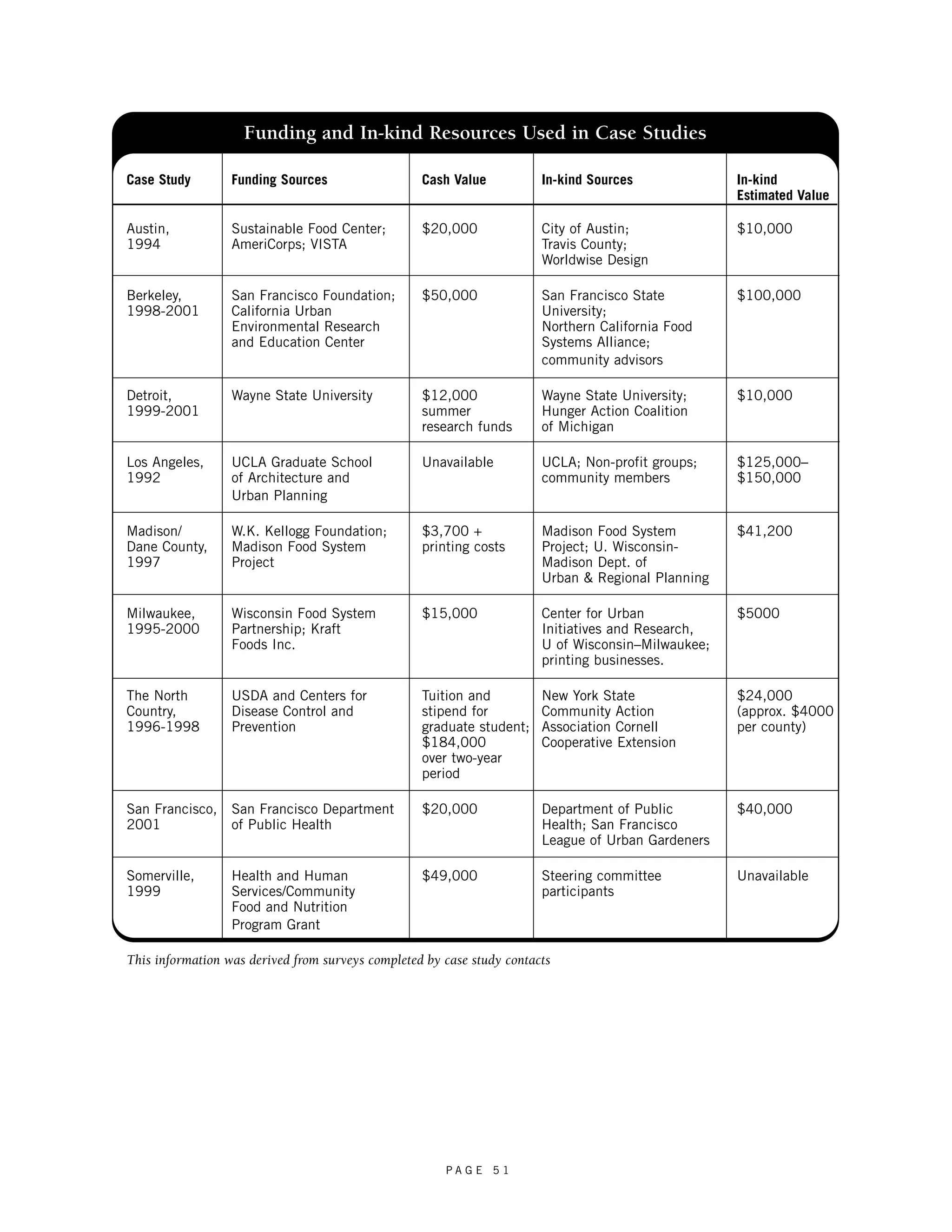
Funding and In-kind Resources Used in Case Studies 51 
Arriving at Assessment Questions 60 
Reasons Why Respondents Did Not Have Enough Food, Green Bay, WI 61 
Secondary Data Sources for Your Assessment 67 
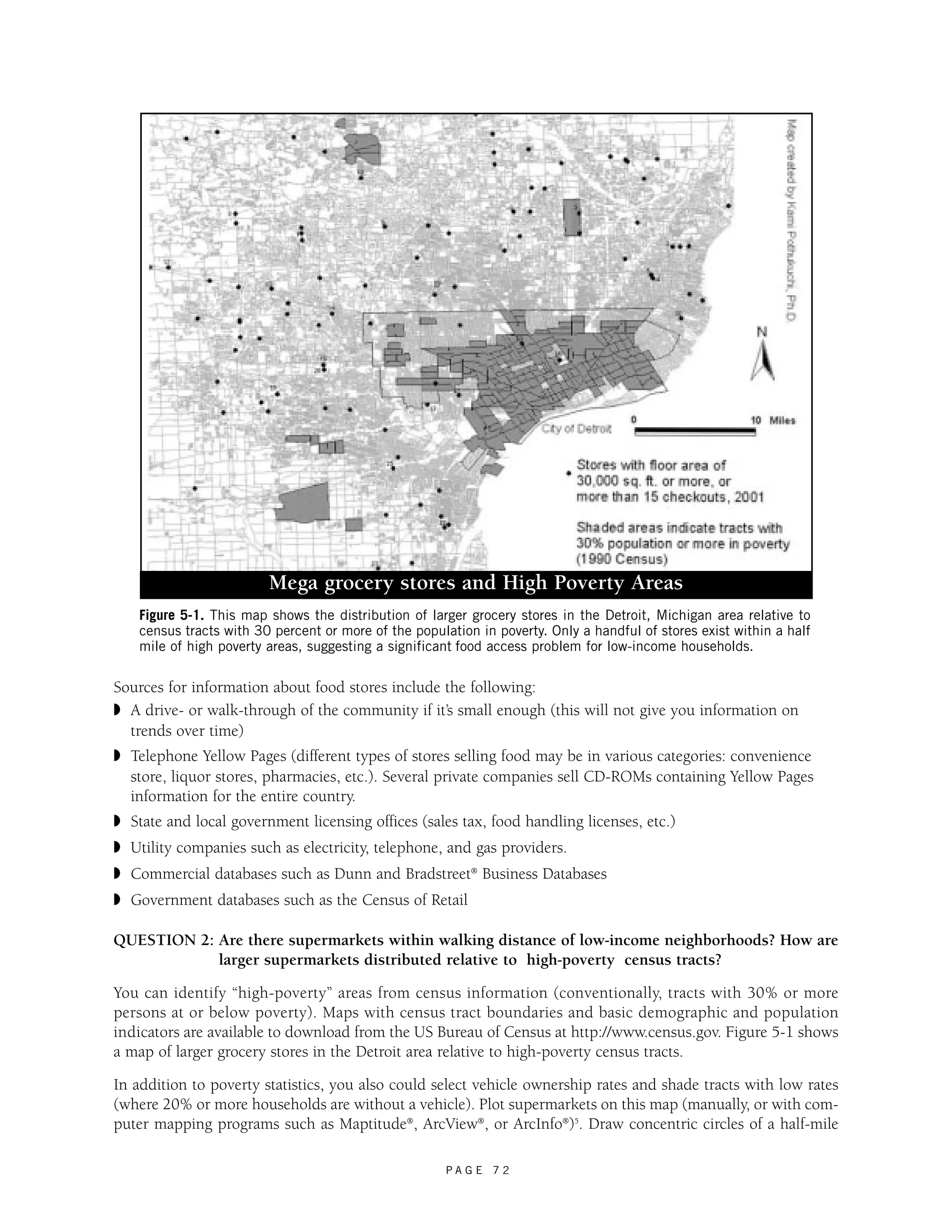
Mega Grocery Stores and High Poverty Areas (Detroit) 72 
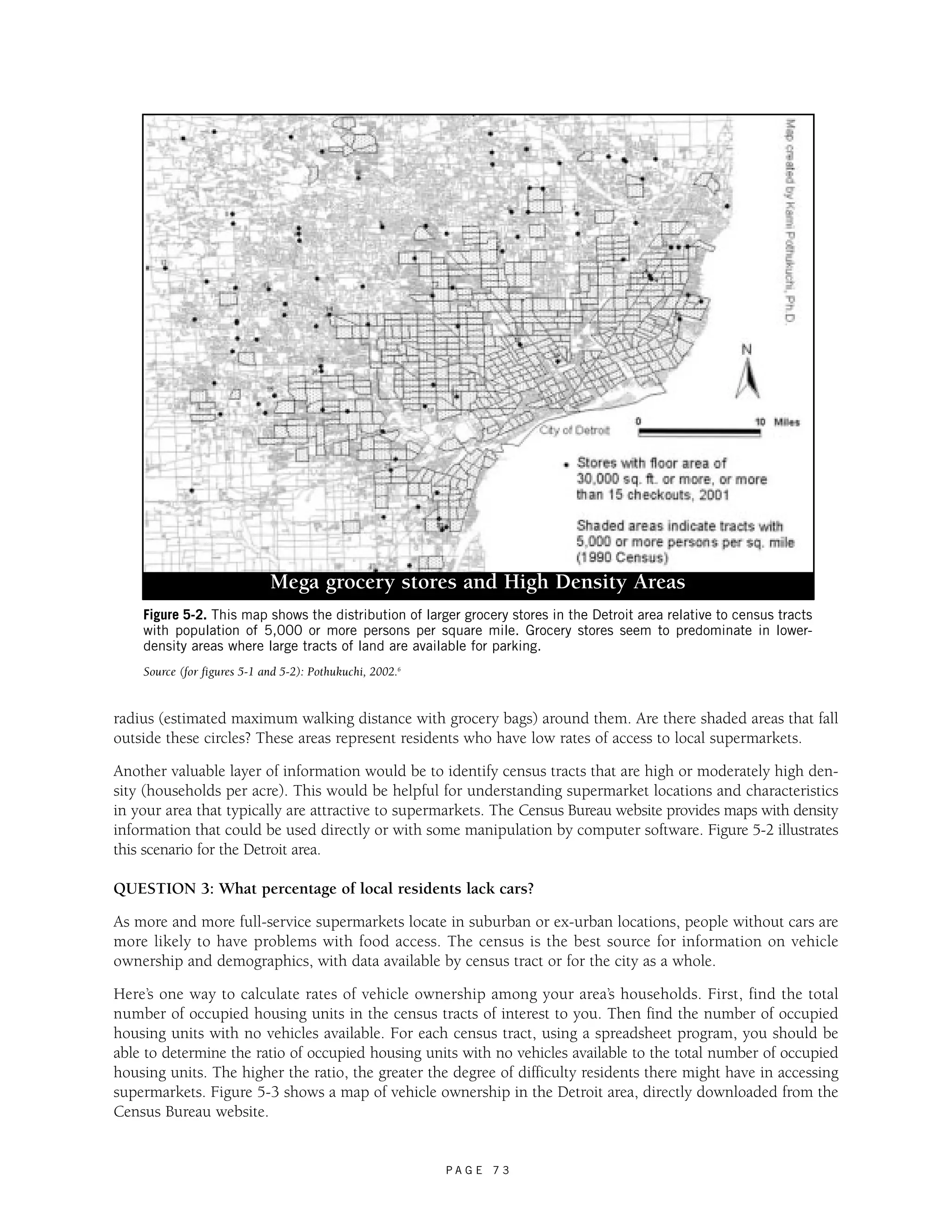
Mega Grocery Stores and High Density Areas (Detroit) 73 
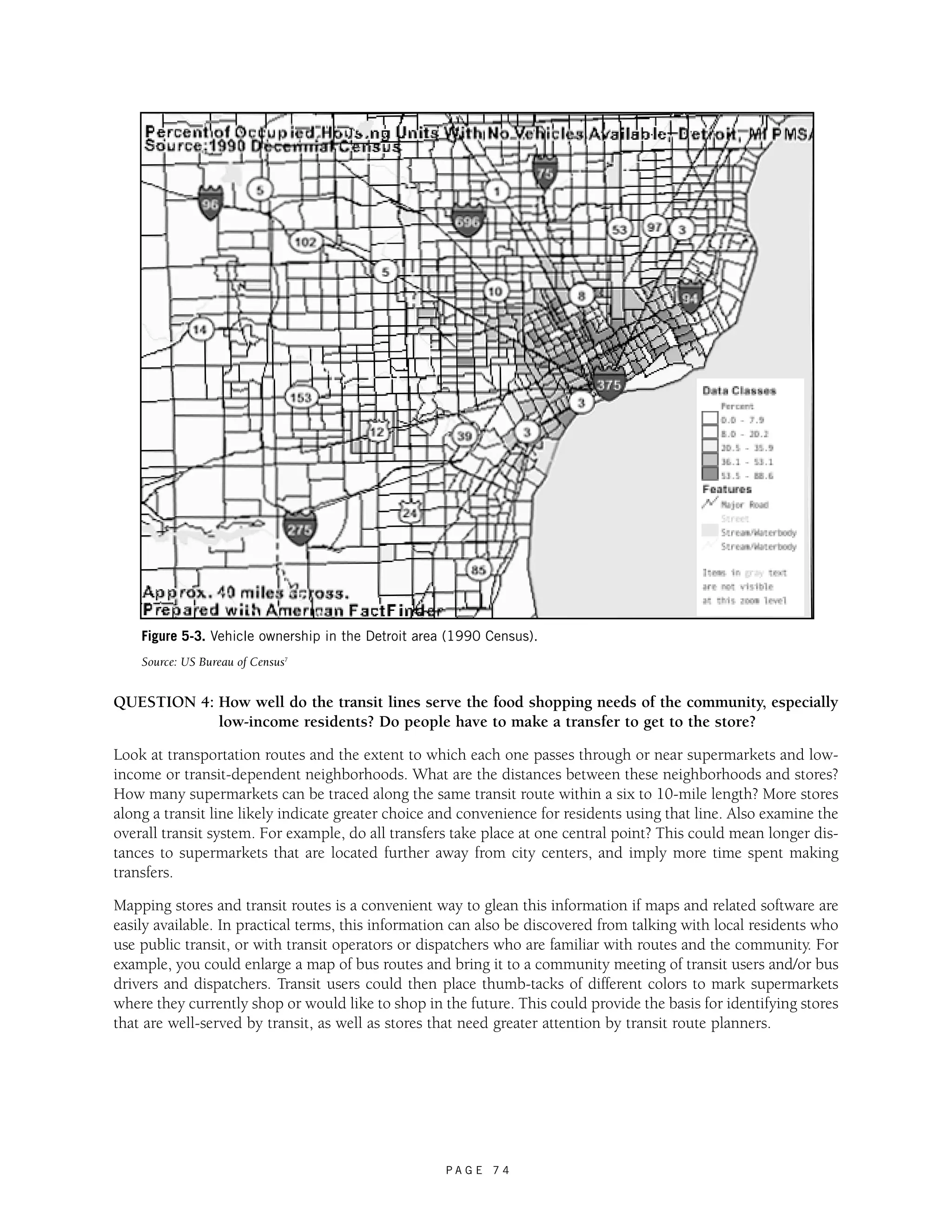
Vehicle Ownership in the Detroit Area 74
Background 
This Guide is aimed at informing and supporting the development of Community Food Assessments as a tool 
for increasing community food security and creating positive change. In 1993, Community Food Security 
Coalition co-founders Andy Fisher and Bob Gottlieb were involved in a year-long study of the Los Angeles food 
system, entitled Seeds of Change: Strategies for Food Security for the Inner City.1 This study sparked interest among 
advocates in other communities in completing similar studies, and numerous requests to the Coalition for 
information and support. Thus, in 1999, the Coalition started offering workshops on how to do Community 
Food Assessments, and decided to develop a guidebook on the subject. This publication is our first attempt 
to systematically summarize information on how to do a Community Food Assessment. Reflecting the state 
of current knowledge of this emerging field, it is necessarily imperfect and incomplete. 
We encourage readers to supplement this Guide with other material, including the Community Food Security 
Assessment Toolkit2, the resources listed in Appendix 6, and the reports from assessments highlighted in the cases 
in Chapter 3. 
Intended audience 
We envision the audience of this guidebook to be individuals and representatives of diverse organizations who 
are working on food issues in their communities, and who are interested in gathering information to highlight 
what is happening in their food system, and to encourage positive change. We expect that most readers 
are active in their communities, experienced with basic organizing approaches, and interested in working 
collaboratively with community residents and representatives of diverse agencies and organizations. 
Authors and editors 
This Guide was assembled through the work of several authors who joined the process and worked on it at 
different times since 1999. Andy Fisher conceived of and raised the funds for the project, and contributed to 
the writing. Hugh Joseph, initially charged with the project, fleshed out the idea, created the basic framework, 
and was responsible for much of the initial writing. Kami Pothukuchi, joining in 2002, worked with existing 
material, filled significant gaps, and developed much of the final content, collaborating with Kai Siedenburg on 
editorial decisions. Hannah Burton was responsible for obtaining and compiling the material on the case 
studies and related tables, and provided additional editorial assistance. 
It is important to note that Kai Siedenburg and Kami Pothukuchi, the Guide’s editors, accept full and final 
responsibility for the Guide's contents. In this Guide, the authorial “we” refers to these editors. Any questions 
on the contents of the Guide may be directed to us at the Community Food Security Coalition. 
Funders 
We are thankful to the following organizations for providing grants that made this project possible: 
• University of California Sustainable Agriculture Research and Education Program 
• California Department of Health Services and the California Nutrition Network, with funding support from 
the National Food Stamp Program, US Department of Agriculture 
• US Department of Agriculture, Community Food Projects Competitive Grants Program 
P A G E 1 
Preface
Acknowledgements 
The editors wish to thank Paula Jones of the San Francisco Department of Public Health; Lisa Brawley of Vassar 
College in Poughkeepsie, NY; and Duane Perry of The Food Trust in Philadelphia for reviewing an earlier draft 
of the Guide and providing very insightful and helpful comments. Tori Kjer also provided valuable comments 
on the draft, as well as capable assistance with compiling information. Val Echavarria provided skilled graphic 
design work, despite an extremely limited time frame and budget. Last but not least, we want to thank all the 
case study contacts for generously sharing their information and experiences and helping build a common 
knowledge base in this field. 
1 Ashman, L., J. de la Vega, M. Dohan, A. Fisher, R. Hippler, and B. Romain. 1993. Seeds of Change: Strategies 
for Food Security for the Inner City. Los Angeles, CA: University of California in Los Angeles, Graduate School 
of Architecture and Urban Planning. http://www.foodsecurity.org/pubs.html. 
2 Cohen, B., L. Kantor, and M. Andrews. 2000. Community Food Security Assessment Toolkit. Washington, D.C.: 
United States Department of Agriculture, Economic Research Service. http://www.ers.usda.gov/ 
AboutERS/Sales/ (Date accessed: 25 Sept 2002). 
P A G E 2
C H A P T E R 1 
Communities and Food 
In communities across the nation, advocates and organizations are working hard to develop solutions to food 
system problems and create innovative models that meet community needs. They are providing nutritious food 
to the hungry, creating community-based food businesses, organizing food policy councils, developing com-munity 
gardens in inner-city neighborhoods, and linking consumers with local farmers through farmers’ mar-kets, 
along with many other initiatives. These efforts are necessarily diverse; they represent local solutions to 
local manifestations of larger problems. However, they often share common goals, such as making nutritious 
food more accessible, revitalizing and empowering communities, and supporting local and sustainable food 
production and distribution. 
As advocates seek to address a range of interconnected food system problems, many find that building part-nerships 
and coordinating efforts is essential to developing effective and lasting solutions. They also find that 
gathering information about conditions in the food system and publicizing that information is valuable, both 
to help inform their own work to create positive change, as well as to build broader awareness of and support 
for their efforts. For these and other reasons, advocates across the country have become increasingly interested 
in Community Food Assessments. 
This publication offers guidance and resources for conducting a Community Food Assessment. The following 
chapters define the elements of an assessment; provide selected examples of assessments that have been done; 
and outline the process for planning an assessment, conducting the research, and using the results to promote 
food system change. 
This chapter briefly sets the context of our current food system; describes efforts underway to promote com-munity 
food security, and introduces Community Food Assessments as a tool for this work. It is organized in 
the following sections: 
1. What’s Wrong With the Current Food System? 
2. The Community Food Security Movement 
3. Community Food Assessments as a Tool for Community Food Security 
4. Overview of the Contents of This Guide 
1. What’s Wrong With the Current Food System? 
In recent years, our food systems have become truly global in scope and structure. In the United States, we 
import and export hundreds of billions of dollars worth of food every year. Supermarket shelves abound with 
a dazzling array of foods, with more and more fresh items available year round. In the period from 1980 
through 2000, US per capita food consumption grew from about 1800 pounds per year to 2000 pounds per 
year.1 “What exactly is the problem?” an observer of this picture of the abundant and productive food system 
may be tempted to ask. 
Yet, despite the apparent glut in our supermarkets, both urban and rural communities face numerous problems 
with respect to food production, distribution, and consumption. The following are only a few illustrations of 
the great cause for concern about current and future food security. 
P A G E 3
Millions of Americans are food insecure. 
◗ The US Department of Agriculture (USDA) reports, based on a national Census Bureau survey, that in 
1999, ten percent of all US households, representing 19 million adults and 12 million children, were “food 
insecure.” 2 
◗ Of these, five million adults and 2.7 million children suffered from food insecurity that was so severe that 
they were classified as “hungry.” 
◗ In a recent national survey of emergency food programs, America’s Second Harvest found that their net-work 
served 23 million people in a year (nine percent more than in 1997), including over nine million 
P A G E 4 
children.3 
Diet-related health problems are on the rise. 
◗ One-third of all cancer deaths are linked to diet, according to the National Cancer Institute.4 
◗ An estimated 300,000 deaths per year may be attributable to obesity.5 
◗ Just seven diet-related health conditions cost the United States $80 billion annually in medical costs and 
productivity losses, according to the latest Economic Research Service estimates.6 
◗ An estimated 76 million persons contract food-borne illnesses each year in the United States. The high 
incidence of food-borne diseases in children, especially infants, are a major concern.7 
The US food industry aggressively promotes unhealthy foods.8 
◗ The US food industry spent $7 billion in advertising in 1997. Most of this advertising focused on highly 
processed and packaged foods. Advertising for fruits, vegetables, and other healthful foods is negligible in 
comparison. 
◗ In 1997, food manufacturers accounted for almost two-thirds of food system advertising. Another 28 
percent was covered by fast food outlets (up from about 5% in 1980). 
The food industry is becoming more concentrated. 
◗ A handful of huge multinational corporations control an increasing share of production, processing, and 
distribution of food products, squeezing out local and regional businesses. 
◗ Today, the top five firms account for 42% of retail sales, whereas in 1997, they accounted for only 24% 
of the market.9 
◗ Four companies control 84% of the US cereal market.10 
The US farm sector is declining. 
◗ Thirty-two percent of the best quality farmland in the US has already irretrievably been lost to develop-ment; 
as much as 70% of the remaining prime farmland is threatened by sprawl.11 
◗ The number of farms has declined dramatically since its peak in 1935, dropping from 6.8 million in 1935 
to only 1.9 million in 1997.12 
◗ Market forces have squeezed US farmers to the point that it is extremely difficult to make a living produc-ing 
food. In 1998 farmers earned an average of only $7,000 per year from their farming operations.13 
◗ The conventional food system has significant negative impacts on air, water, soil, and biodiversity. 
◗ The 1998 National Water Quality Inventory reports that agricultural non-point source pollution is the 
leading source of water quality impacts to surveyed rivers and lakes and a major contributor to contamina-tion 
of the ocean.14
◗ Conventional agricultural production also pollutes the air and soil and damages wildlife habitat. 
◗ Long-distance transportation of food, now mostly by truck, creates air pollution and contributes to global 
warming. 
Thus, despite appearances that our food supply is safe, abundant, and affordable, serious food–related 
problems affect most of the population, and there are grave threats to the long-term security and sustainability 
of the food system. 
2. The Community Food Security Movement 
The good news is that, as mentioned in the introduction, all across the country, people are working together to 
develop innovative solutions to the significant problems in our current food system. Many pioneering groups 
are working to develop ways to produce and distribute food that meet human needs, strengthen communities, 
and conserve natural resources. While most of these efforts are small-scale, they represent the seeds of creative 
and lasting solutions to food system problems. 
Many of these organizations and individuals are linking efforts under an umbrella that is called the communi-ty 
food security movement. Like this movement, the definition of community food security reflects many 
different voices and continues to evolve. The following definition captures many elements on which there is 
broad agreement. 
Community food security is a condition in which all community residents obtain a safe, culturally 
acceptable, nutritionally adequate diet through a sustainable food system that maximizes community 
self-reliance and social justice.15 
Community food security strives to link and integrate diverse fields, including community economic develop-ment, 
anti-hunger, social justice, local and sustainable agriculture, public health, nutrition, and environmen-talism. 
The movement encompasses a broad range of participants working on many different issues. While they 
may not agree on every issue, increasingly they are working toward similar goals: 
◗ To support access to food as a basic human right for all 
◗ To eliminate hunger and food insecurity 
◗ To build more local and regional food self-reliance, and thriving local economies 
◗ To create a more democratic food system that gives communities a greater role in deciding how their food 
is produced and distributed 
◗ To make the food system more equitable and socially just 
◗ To develop environmentally sustainable food production and distribution systems 
◗ To teach young people skills in food production and preparation, and to connect them to other communi-ty 
P A G E 5 
issues through food 
◗ To preserve and celebrate diverse cultures through food 
Conventional “food security” programs generally focus on the individual or household level of need, mostly as 
food assistance and social welfare programs. There is less emphasis on the infrastructure of food access, where 
the food comes from, how it is produced, or the effects of current food production and distribution. In con-trast, 
community food security advocates stress improved access to and availability of food at the community 
level; for example by advocating for more full-service food stores in low-income neighborhoods, and for direct 
links between local farms and consumers. Many also focus on increasing the availability of locally, organically, 
or sustainably produced food. They also consider the issue of who controls the food system, and support the 
right of local communities to have a say about how their food is produced and distributed.
In contrast to more traditional top-down or single-issue organizational strategies, community food security 
encourages integrated, community-focused strategies that emphasize the following elements: 
◗ Progressive planning 
• Getting at the underlying causes of problems and designing preventive approaches 
• Encouraging community-based visioning about the future of the food system 
P A G E 6 
◗ Increased collaboration 
• Bringing together a broad range of players to work together toward common goals 
• Transcending top-down or expert-based decision-making and program delivery 
◗ Community responsiveness and ownership 
• Taking the broad needs of the community into account in developing programs 
• Expanding awareness and promoting a greater sense of ownership of food system issues 
• Developing responses and strategies that are inclusive and that increase community access to information 
◗ Multi-sectoral strategies 
• Incorporating diverse sectors of society in developing solutions and alternatives, including the private, 
public, and nonprofit sectors 
• Incorporating sustainable development strategies that integrate environment, public health and nutrition, 
urban economic development, and other quality of life needs 
The publisher of the Guide, the Community Food Security Coalition, plays an important role in building and 
supporting this growing movement. Founded in 1994 by advocates working on a range of food and farming 
issues, the Coalition has grown to a network of over 250 organizational members. The organization provides a 
broad range of training, networking, and advocacy programs that further the efforts of grassroots groups to cre-ate 
effective food system solutions from the ground up. For more information about the Coalition and its activ-ities, 
go to www.foodsecurity.org. 
3. Community Food Assessments as a Tool for Community Food Security 
As the work of those in the community food security movement continues to evolve, new approaches and 
strategies emerge. In recent years, there has been increased interest in strategies that go far beyond the level of 
a single project to involve a range of stakeholders in developing integrated approaches to a range of food and 
farming issues. These strategies include food policy councils, local and regional food marketing programs, and 
conducting systematic, community-focused studies of the food system through Community Food Assessments. 
Such integrated approaches offer exciting potential to develop broad-based, long-term solutions to persistent 
problems in the food system. 
The Community Food Assessment approach reflects many fundamental aspects of the community food securi-ty 
movement, and contributes to it in important ways. It is integrative, and takes a systems approach. It involves 
collaboration between diverse stakeholders. It is solution-oriented, looking at assets and resources as well as 
problems. Community food assessments promote community food security by increasing knowledge about 
food-related needs and resources, by building collaboration and capacity, by promoting long-term planning, 
and by facilitating a variety of change actions including policy advocacy and program development. 
By emphasizing participatory research that directly helps generate change actions, the Community Food 
Assessment approach distinguishes itself from more traditional research conducted by universities and private 
consultants. Community Food Assessments can be of, by, and for communities and their members. This 
participatory approach is consistent with the general emphasis in the community food security movement on 
promoting more community participation in and control of the food system.
Figure 1-1. Community Food Security Goals and Community Food Assessment 
Promoting 
Community 
food security 
Community Food 
Assessment 
P A G E 7 
Neighborhood, city, or 
regional context 
Food system activities 
• Production 
• Processing 
• Distribution 
• Consumption 
• Recycling of food 
system wastes 
Community 
Development Objectives 
• Preventing hunger 
• Enhancing community health 
• Strengthening local economy 
• Revitalizing neighborhoods 
• Conserving natural resources, 
protecting the environment 
• Developing just, equitable social 
processes and outcomes 
• Preserving cultural heritage 
• Etc., etc. 
Strategies for community change 
• Mobilizing the community (organizing, 
coalition-building, collaboration) 
• Community Education and awareness 
• Policy and Legal Advocacy 
• Program Design and Development 
• Social Services Development 
Community & Food System 
Participants 
• Individuals 
• Nonprofits & community-based 
organizations & coalitions 
• Public agencies 
• Private firms 
Figure 1-1 illustrates the 
connection between 
community food security 
goals and Community 
Food Assessment. An 
individual, community 
organization, public 
agency, or private sector 
organization could form 
a coalition to initiate the 
Community Food Assess-ment. 
Based on the 
information generated, 
actions could be devel-oped 
to affect particular 
community or food 
system activities directly, 
in order to improve com-munity 
food security. In 
this diagram, community 
food security stands at 
the intersection of food 
system activities and 
community goals such 
as preventing hunger, 
enhancing community 
health, conserving natural 
resources, and promoting 
social justice.
Movements do not necessarily need to conduct systematic community-based assessments to bring about 
significant change. However, the knowledge gained from such assessments can be a powerful resource for 
helping organizations to be more effective, to maintain momentum, to gain new allies, to build new knowledge 
and support in the community, and to bring about new policies and practices. Community Food Assessments 
can help achieve these objectives on community food system issues. 
4. Overview of the Contents of This Guide 
The Community Food Security Coalition has created this Guide to help readers learn about what Community 
Food Assessments are, how they are organized, and what benefits they can offer. We hope it will help you to 
decide whether an assessment is right for you, and help you to organize a successful assessment if you decide 
to initiate one. 
Here is a chapter-by-chapter overview of contents of this Guide: 
Chapter 1 provides context for the emerging field of Community Food Assessment through an overview of the 
state of the US food system and the community food security approach. 
Chapter 2 defines Community Food Assessments, describes key elements of assessments, and outlines the 
potential benefits from conducting an assessment. 
Chapter 3 includes brief case studies of nine Community Food Assessments from around the country, focusing 
on their goals, methods, collaborators, and outcomes. 
Chapter 4 provides an overview of the process of planning and organizing an assessment, including recruiting 
collaborators, setting goals, identifying resources, and preparing for follow-up actions. 
Chapter 5 delves into the specifics of the assessment research, providing guidance on developing research goals 
and questions, and selecting indicators and research methods. 
Chapter 6 considers how to effectively put your assessment to work by disseminating the results and developing 
strategies and actions to create positive change in the community. 
1 Jerardo, A. 2002 The Import Share of US Consumed-Food Continues to Rise. Washington, DC: United States 
Department of Agriculture (USDA), Economic Research Service. http://www.ers.usda.gov/publications/ 
fau/july02/fau6601/fau6601.pdf. (Date accessed: 23 Sept 2002). 
2 Food Research and Action Center. 2000. New Data Show Persistent Hunger and Food Insecurity Among 
American Families. Washington, DC: Food Research and Action Center. http://www.frac.org/html/news/food-security99. 
P A G E 8 
html. (Date accessed: 29 Aug 2002). 
3 America’s Second Harvest. 2001. Hunger in America. Chicago, IL: America’s Second Harvest. http://www.hun-gerinamerica. 
org/. (Date accessed: 29 Aug 2002). 
4 Doll, R. and R. Peto. 1981. The causes of cancer: Quantitative estimates of avoidable risks of cancer in 
the United States today. Journal of the National Cancer Institute, 66: 1191-1308. http://rex.nci.nih.gov/ 
NCI_Pub_Interface/raterisk/risks73.html. (Date accessed: 27 Aug 2002). 
5 Allison, D. B., K. R. Fontaine, J. E. Manson, J. Stevens, and T. B. VanItallie. 1999. Annual deaths attributable 
to obesity in the United States. Journal of the American Medical Association, 282(16): 1530-8. 
6 USDA Economic Research Service. “Diet and Health: Overview.” Washington, DC: USDA Economic Research 
Service. http://www.ers.usda.gov/briefing/DietAndHealth/. (Date accessed: 29 Aug 2002).
7 Centers for Disease Control and Prevention. “Preliminary FoodNet Data on the Incidence of Foodborne 
Illnesses—Selected Sites, United States, 2001.” Morbidity and Mortality Weekly Report. Atlanta, GA: 
Centers for Disease Control and Prevention. http://www.cdc.gov/mmwr/preview/mmwrhtml/ 
mm5115a3.htm. (Date accessed: 27 Aug 2002). 
8 Gallo, A. 1999. “Food Advertising in the United States.” In Frazao, E. (ed.), America’s Eating Habits: Changes 
and Consequences. USDA Economic Research Service. Agriculture Information Bulletin No. 750: 173. 
http://www.ers.usda.gov/publications/aib750/. (Date accessed 29 August 2002). 
9 Hendrickson, M., W. D. Heffernan, P. H. Howard, and J. B. Heffernan. 2001. Consolidation in Food Retailing 
and Dairy: Implications for farmers and consumers in a global food system. Columbia, MO: University of 
Missouri. http://www.competitivemarkets.com/library/academic/heffernan.pdf. (Date accessed: 29 Aug 2002). 
10 Krebs, A. V. 1994. “Cargill: Dredging Up the Profits.” The AgBiz Tiller. 4 March, 1994. http://www.ea1.com/ 
CARP/tiller/archives/backlog.htm. (Date accessed: 29 Aug 2002). 
11 Biodiversity Project. 2000. Getting on Message: Making the Biodiversity-Sprawl Connection. Madison, WI: 
Biodiversity Project. http://www.biodiversityproject.org/mediakit/ Sprawl_1B_farmland_loss.pdf (Date 
accessed: 29 Aug 2002). 
12 USDA Economic Research Service. “Farm Structure: Questions and Answers.” Washington, DC: USDA 
Economic Research Service. http://www.ers.usda.gov/briefing/FarmStructure/Questions/farmstruct.htm. 
(Date accessed: 29 Aug 2002). 
13 USDA Economic Research Service. 2000. “Farm Income.” Agricultural Outlook. Washington, DC: United 
States Department of Agriculture, Economic Research Service. http://www.ers.usda.gov/publications/agout-look/ 
may2000/ao271.pdf. (Date accessed: 29 Aug 2002). 
14 United States Environmental Protection Agency, Office of Water. 2000. The Quality of Our Nation’s Waters: 
A Summary of the National Water Quality Inventory: 1998 Report to Congress. Washington, DC: US EPA, 
Office of Water. http://www.epa.gov/305b/98report/ (Date accessed: 29 Aug 2002). 
15 Hamm, M. and A. Bellows. 2002, in press. Journal of Nutrition Education and Behavior. 
P A G E 9
P A G E 1 0
C H A P T E R 2 
Defining Community Food Assessment: 
Elements and Purposes 
Chapter 1 introduced Community Food Assessments as a tool for groups to highlight and take action on the 
many connections between their communities and the food system. These assessments enable groups to 
systematically explore a wide range of food-related issues, and to build momentum and support for positive 
changes in their communities. 
Community Food Assessment integrates activities in community organizing, planning, research, and 
implementing change actions. It is a relatively new approach and still lacks well-established definitions and 
practices. So far, it has been defined primarily by what has been done in the field by pioneering organizers. 
These assessments have varied greatly in their scale, methods, and level of community involvement. Various 
terms have been used to describe them, including: community food security assessment, food security 
assessment, and food system assessment. 
The editors of this Guide use the term Community Food Assessment for two reasons: first, to allow flexibility 
for an assessment to focus on a range of food-related issues and goals; and second to emphasize the focus on 
the community level and on community participation in conducting the assessment. We have developed the 
following definition for this term. 
A Community Food Assessment is a collaborative and participatory process that systematically exam-ines 
a broad range of community food issues and assets, so as to inform change actions to make the 
P A G E 1 1 
community more food secure. 
This chapter explores what a Community Food Assessment is, and the potential benefits of conducting an 
assessment. It is divided into two major sections: 
1. Key Elements of a Community Food Assessment 
2. Why Do a Community Food Assessment? 
1. Key Elements of a Community Food Assessment 
Community Food Assessment is not a distinct field of study with its own methods, concepts, and issues. It 
builds on other kinds of assessments, including those from the fields of community planning (asset mapping), 
social work (needs assessment), public health (nutrition assessment), environmental studies (environmental 
assessment), and international development (participatory rural assessment). This mix of frameworks and 
methods can make the Community Food Assessment process seem difficult to pin down, but they also give it 
flexibility and strength. 
In doing program planning or evaluation, you may have completed a needs assessment. The needs assessment 
is designed to describe conditions, identify problems and desired improvements, and to develop strategies to 
address them. It is an important and popular category of assessment, and many Community Food Assessments 
include one. However, Community Food Assessments also seek to overcome some of the typical limitations of 
needs assessments: 
◗ Needs assessments usually focus on a community’s problems rather than its assets. This tends to lead to 
programs that focus on bringing in outside experts and resources, rather than building from a community’s 
existing assets. 
◗ Programmatic needs assessments generally address pre-defined needs through the continuation, expansion, 
or modification of existing approaches. They tend to reinforce existing relationships and structures, rather
than considering broader or more fundamental solutions. 
◗ Organizational needs assessments also tend to be top-down, reflecting the existing management structure. 
They generally do not include broad participation in decision-making by staff, clients, and community 
interests. In fact, outside consultants sometimes contribute significantly more to the process than do many 
people who are part of the organization. 
A Community Food Assessment is a flexible and multi-faceted approach that has been applied in many 
different ways, as the case studies in Chapter 3 illustrate. Still, there are some key elements that characterize 
most Community Food Assessments that take an approach similar to that promoted in this Guide, which calls 
for exploring a range of food system issues, involving significant community participation, and focusing on 
creating positive change. The following elements are both descriptive and prescriptive. They are descriptive in 
that they are based on the case studies profiled here, and prescriptive in that they emphasize qualities that we 
believe will help make future assessments effective. 
Key elements of a Community Food Assessment 
1. A Community Food Assessment examines a range of food issues, and the links between these 
issues and community goals. 
Conducting an assessment is a way to explore and understand the many ways that food is connected (or not) 
to your community, and their implications for quality of life, food security, social justice, and other 
community values. It helps you examine the various ways community members participate in the food 
system, how it impacts their lives, and how well they are served by it. An assessment helps promote 
broader dialogue about how to develop a food system that will reflect shared values and meet community 
goals and needs. 
Community Food Assessments also help highlight the connections between various kinds of food system 
activities, such as production, processing, distribution, and consumption. These linkages are often the areas 
in which new programs, policies, and innovations emerge, and understanding these linkages helps inform 
changes that are systemic and long-lasting. Assessments should therefore examine more than one issue or 
sector of the food system—not just hunger or the plight of family farmers, but multiple issues or sectors and 
the linkages between them. 
In addition to highlighting specific needs and resources, an assessment can promote understanding of the 
broader context in which they exist. Individual programs can be examined in the context of social, 
economic, and environmental systems that operate not just at the local level, but regionally, nationally, and 
internationally. For example, the vast majority of the food consumed in most communities comes from 
hundreds or even thousands of miles away. The availability and quality of this food is driven by complex 
forces and processes operating from the community to the global levels. By promoting understanding of 
these contexts and how they affect the community, an assessment can help that community gain greater 
participation in or control over its food system. 
2. A Community Food Assessment is designed to inform and build support for practical actions to 
enhance community food security. 
A Community Food Assessment is a practical tool with practical applications, to develop recommendations 
and support for concrete actions to improve the food system and enhance community food security. This is 
different from more conventional research conducted in universities or private firms, in which there are few 
direct links to specific actions. Actions supported by assessments may be targeted at public policy agencies, 
private firms, civil society organizations, or the community at large. You may need to consider these 
potential targets carefully when designing your assessment process and its products. 
Community Food Assessments work best when the research planning and action planning are conducted by 
the same set of actors and in an integrated way. It is important to plan ahead for an implementation or 
follow-up phase, including raising funds for this phase well before the report is released. 
P A G E 1 2
3. A Community Food Assessment is a planned and systematic process of gathering information about 
and analyzing community food issues. 
The scope of possible questions and research in an assessment is so broad that it takes some thoughtful 
planning to clearly define the research goals and questions and to plan the process. This requires having 
clear overall goals for the assessment and follow-up actions. The research process generally involves a blend 
of collecting information from scratch and compiling information that already exists through previous 
research or other published material. 
For the assessment findings to be credible and persuasive, it is important that the research methods are 
reasonable and appropriate, and defensible against charges of bias. It is important to design your research 
so that the findings are not biased by your expectations, and to allow the emergence of new and unexpected 
information. Chapters 4 and 5 detail the assessment planning and the research processes. 
4. A Community Food Assessment addresses both needs and assets. 
Community food security work is grounded in an asset-based approach to community development. This is 
in contrast with the conventional need- or problem-based approaches that typically drive policies and 
services in historically disadvantaged neighborhoods. The Community Food Assessment is an integral 
component of such an asset-based approach, as it identifies local resources that can be used to increase food 
self-reliance and to build other community capacities. 
In general, three main rationales support an asset-based approach to Community Food Assessment. 
• It is more effective. By building on existing resources, it avoids unnecessary duplication and uses limited 
funds and resources more effectively. 
• It is a more positive and respectful. It is based on the concept that even the most impoverished organizations 
and individuals are agents and resources for themselves and their communities. It recognizes the right and 
capacity of all people to have a say in decisions that affect them. 
• It is more sustainable. Because it taps into a community’s experience and culture, it can be absorbed into 
these experiences and become a resource for addressing future issues. Its emphasis on building local 
capacity and social capital, rather than simply gathering data about community needs or problems, also 
enhances its sustainability. 
Implications of an asset-based approach to Community Food Assessment: 
The planning process should involve groups and individuals in low-income and minority communities 
in decisions about the assessment goals and process. For example, these communities could be 
represented in the assessment team, while community meetings could be held to invite broader input. 
This helps ensure that the assessment is broadly representative of the concerns and resources in the 
community. 
The research should include compiling inventories of relevant community assets and resources. For 
example, an ethnic minority community that is concerned about the influx of fast food and the loss 
of traditional cultural practices might want to inventory plants that are part of traditional diets; 
compile traditional recipes; and include oral histories from local elders about other cultural practices 
related to food. 
The research activities can be designed to involve participants from the community. For example, 
young people could be trained to interview seniors about food access issues and coping strategies. 
This would have multiple benefits, including building intergenerational ties, developing youth 
capacities, and encouraging youth involvement in community concerns. 
Community members and resources need to be part of the assessment follow-up actions. For example, 
in a program to encourage more nutritious diets in an African-American community, people who are 
part of and trusted by that community would likely be more effective at conducting outreach. 
P A G E 1 3
5. A Community Food Assessment focuses on a geographically defined place. 
As discussed in Chapter 1, numerous efforts are underway to promote community food security and to build 
local food systems that provide viable alternatives to the current global food system. Place is central to these 
efforts because it links people, culture, and resources. Assessments usually focus on a geographically defined 
place, from a neighborhood to a city to a larger region. Identifying such a place-based community also 
provides practical benefits: it outlines the scope of the project and makes it manageable, as well as providing 
a clear link to various stakeholders and their activities. It also has implications for decision-making and 
follow-up actions, as policies and programs usually are developed for geographically defined areas. 
All Community Food Assessments will need to identify geographic boundaries that are relevant for their 
research questions and for the follow-up actions to be supported by the assessment. They can include 
different geographic areas for different types of research (for example, the Madison Food System Project 
profiled in Chapter 3 did some Dane county analyses, some Madison city analyses, and then focused on one 
low-income area of the city). 
6. A Community Food Assessment involves a broad spectrum of actors from the community. 
Both communities and food systems are complex and multi-faceted, with expertise related to different 
aspects of each spread out among various disciplines, individuals, and organizations. It is valuable to cast a 
wide net in identifying potential collaborators, to include individuals, organizations, and coalitions from the 
private, non-profit, and public sectors. Stakeholders not traditionally associated with food or agriculture-related 
activities, such as local government and community development corporations, can be valuable partners. 
Direct participation by community residents, especially from those groups whose situation the assessment is 
seeking to improve, is extremely important. Agency representatives and other organizational professionals, for 
all their strengths, usually are limited in their ability to address all community interests. Community res-idents 
can contribute valuable knowledge, skills, and perspectives. Their participation helps foster trust, 
community links, and shared ownership of the process and outcomes. Thus, the assessment can help 
increase community participation in addressing local issues, and contribute to empowerment of tradi-tionally 
disenfranchised constituencies. (See Chapter 4 for more on recruiting participants and community 
Types of Organizations Participating in Case Studies 
Case Study Foundations Government Universities, Non-Profit Businesses Coalitions 
Agencies Institutes, Organizations 
Education 
Centers 
P A G E 1 4 
involvement.) 
Austin 1 1 1 1 
Berkeley 1 1 9 1 
Detroit 2 1 7 1 
Los Angeles 1 4 1 
Madison/Dane County 1 1 1 1 
Milwaukee 5 8 12 1 3 
The North Country 3 1 1 8 1 
San Francisco 1 2 1 
Somerville 5 2 5 
Totals: 3 18 15 42 10 8 
This information was derived from surveys completed by case study contacts.
“Community” can be defined in a variety of ways. In gen-eral, 
community as used here is defined by place, or by 
relationships among people based on their identity, social 
situation, or interests and values. We use “community par-ticipation” 
to refer to participation by residents represent-ing 
grassroots issues and interests, often including disen-franchised 
groups. This is in contrast to participants who 
represent an organization or institution and participate in 
the assessment as part of their regular paid work. Of 
course, this distinction is not always clear-cut. 
7. A Community Food Assessment emphasizes collabo-ration 
P A G E 1 5 
among participants. 
Community Food Assessment is based on a collaborative 
approach, with participants working as a team to make 
decisions and implement actions. Such a collaborative 
approach can be more challenging and time-consuming 
than a top-down approach, but it also can convey impor-tant 
and long-lasting benefits. It brings in a range of per-spectives 
that help ensure that the assessment reflects the 
community and is appropriately broad and integrated in 
its scope. It pools expertise, contacts, and resources from 
a variety of sources. It also helps build ownership of and 
accountability to the process, and thereby builds broader 
support for the assessment and its recommendations. 
Collaboration also builds new relationships that will be 
valuable to participants in their work, as well as giving 
them a chance to develop their skills in working with a 
diverse group. And last but certainly not least, collabora-tion 
builds a foundation for effective actions to create 
long-term change in the community. 
In practical terms, participants will vary in the amount of 
time and resources they can commit to an assessment. 
Thus, most assessments develop a clearly-defined core 
group that takes on additional responsibilities not held by 
all team members. 
8. A Community Food Assessment requires significant 
time and resources to plan and implement. 
There is no set time frame for an assessment; depending on the scale or scope, it could take just a few 
months or two or more years to complete. Assessments do need to be completed in a reasonable time frame 
to inform and support actions and to maintain group participation and momentum. Some assessments may 
need to be completed more quickly to inform a pending decision or to help implement an urgently needed 
program. Follow-up actions also may take significant time to implement. 
A Community Food Assessment also requires substantial resources, to bring people together, encourage com-munity 
participation, design and implement the research, disseminate the results, and organize follow-up 
actions. If it is small in scope, an assessment can be done with very few resources, but many may 
ultimately require tens of thousands of dollars to complete. Most assessments rely on substantial in-kind 
resources, and many start with limited funding and raise additional funds as they move forward. The key is 
designing your assessment to match the resources that will be available. (See Chapter 4 for more informa-tion 
on funding and resources for an assessment.) 
Elements of a Quality Assessment 
Community Food Assessments vary greatly in 
their scope, form, and outcomes, so success-ful 
assessments may differ from each other in 
many ways. The following are broadly-defined 
elements of a quality assessment: 
◗ It examines a range of food system issues, 
and the connections between food and 
community goals. 
◗ It involves a broad range of actors from 
the community, including individuals and 
organizations, and the public, private, and 
nonprofit sectors. 
◗ It involves community residents in signifi-cant 
and meaningful ways, and builds 
community capacity for future actions. 
◗ It uses participatory and collaborative 
processes that generate results, build 
new partnerships, and leave participants 
feeling satisfied with the process. 
◗ It focuses on community food assets as 
well as problems. 
◗ The research is rigorous, and the methods 
used are consistent with the overall goals 
of the assessment. 
◗ It makes effective use of cash and in-kind 
resources available, and is completed in a 
reasonable time-frame. 
◗ It fosters broader awareness and understand-ing 
of the community and its food system. 
◗ It contributes to tangible actions to bring 
about positive change in the community’s 
food system.
2. Why Do a Community Food Assessment? 
Many activists working to improve their community’s food system may be reluctant to conduct a Community 
Food Assessment. They may feel like they already know what is happening in their community, and that they 
do not need to do a study to reinforce that knowledge. They may be reluctant to take on what seems to be a 
cumbersome research process, when so many studies have wound up collecting dust while the problems they 
examined worsened. They would rather roll up their sleeves and work for practical improvements and solu-tions. 
These concerns are certainly understandable, and Community Food Assessments are not right for every situa-tion. 
Yet they can be a powerful tool for activists seeking to create lasting change. The information gathered can 
lead to more strategic and effective action, and can highlight issues and build broader support and pressure for 
change. And a Community Food Assessment is much more than an information-gathering process. It also is an 
organizing and planning process that involves coalition building, priority setting, advocacy, and developing 
capacities in the community. All these processes can generate multiple benefits, such as more community 
involvement, increased collaboration, and better integration between programs. Ultimately, an assessment can 
lead to important changes in the community’s food system, such as better food access for low-income people, 
local economic development, and improved public health. 
Possible Benefits of Community Food Assessments 
◗ Improved program development and coordination 
◗ Positive changes in public policy affecting the food system 
◗ Broader awareness and understanding of food-related issues 
◗ Development of new and stronger networks and coalitions 
◗ Increased community participation in shaping the food system 
◗ Greater community capacity to create positive change 
Community Food Assessments can provide a range of benefits that make them well worth the effort. Some of 
these benefits are accrued to participants through the process of planning, implementing, and using an assess-ment. 
These are called process benefits and are valuable to building various skills, shared understandings, 
confidence, and a sense of ownership. Outcome benefits are more tangible products or changes in the larger 
community that result from the assessment. These could include reports, media coverage, and policies or 
programs created in response to the assessment. 
Outcome Benefits 
Community Food Assessments generate valuable information that allows participants to better understand the 
well-being of community residents, and their needs and resources related to access to nutritious, affordable 
food. While assessment participants will likely already have a good understanding of local issues, gathering and 
analyzing more detailed information on local conditions can be extremely valuable. This information can 
increase awareness and understanding of local food system issues, and inform the development of more 
appropriate strategies to address these issues. Such strategies can include program development, policy advocacy, 
and public education. 
1. Program development 
Assessments can be a valuable tool in program design, development, and improvement. They can provide a 
more complete picture of how individuals interact with their food system, the needs and resources available, 
and the potential for building or improving linkages between community organizations and other insti- 
P A G E 1 6
tutions. By doing so, assessments can inform the improvement of existing programs, increase coordination 
between programs, or give rise to creation of new programs or policies. 
Assessments often result in more comprehensive and integrated approaches to addressing the community’s 
food needs. The food system focus and collaborative nature of the assessment process make it possible for 
participants to develop programs outside their usual institutional parameters to address the broader needs 
of the community. The assessment process can allow for integrating multiple perspectives, fostering inno-vative 
approaches, and developing more sustainable projects by leveraging resources and commitments from 
diverse interests. This integrated approach can in turn give rise to strategies to address complex issues such 
as: dealing with the links between poverty, hunger, food access, and diet-related diseases; and addressing the 
long-term sustainability of the mainstream food system. 
For example, the Seeds of Change study documented the trouble low-income community residents in Los 
Angeles had with access to affordable, nutritious food. It highlighted the importance of community-based 
programs such as farmers’ markets in addressing this problem. As a result, the study’s client, the Interfaith 
Hunger Coalition, which previously had been focused on federal food programs, decided to dedicate staff to 
create new community gardens and farmers’ markets as part of its AmeriCorps program. Similarly, the food 
assessment study in Milwaukee led the Hunger Task Force of Milwaukee, a food bank and anti-hunger 
agency, into the economic development realm through sponsoring the Fondy Food Center, a market and 
kitchen incubator project. 
P A G E 1 7 
2. Policy advocacy 
Governments at all levels make decisions that profoundly shape the way food is produced, distributed, 
accessed, and consumed. (See Getting Food on the Table: An Action Guide to Local Food Policy1, for a fuller 
description of the role of local policy and opportunities to shape it.) Changing public policy is 
an important goal of many assessments. 
Assessment reports can be an important tool in the policy advocacy process. Reports provide documentation and 
publicity for conditions that may be well known to advocates and community members, but 
unrecognized by government officials and other decision-makers. They can provide compelling evidence of 
community needs, clearly articulate policy opportunities to promote community food security, and help 
mobilize the community to advocate for policy change. The role of the assessment report in policy 
advocacy can be greatly strengthened by effective publicity and media outreach. 
Austin’s Sustainable Food Center published the results of their food access study in a report titled Access 
Denied: An Analysis of Problems Facing East Austin Residents in Their Attempts to Obtain Affordable, 
Nutritious Food.2 One of their key recommendations, which was implemented by local government, was to 
create a food policy council to address local issues. One of the first actions of this council was to recommend 
a new bus line directly connecting low income neighborhoods and supermarkets in outlying neighborhoods. 
They collaborated with the local transit authority to establish it, and the “Grocery Bus” soon became quite 
popular with transit-dependent residents in East Austin. 
3. Visibility and awareness 
Community Food Assessments offer an opportunity to raise awareness of food system problems and oppor-tunities, 
which is key to building support for long-term change. As noted above, assessments can raise the 
profile of issues that have not received adequate attention from policy makers, businesses, media, and others. 
The information gathered, the needs identified, the solutions proposed, and sometimes even the process 
itself can all provide good opportunities for media coverage. Assessments also can provide 
visibility for participants and sponsors and their ongoing work, helping them gain additional support, funding, 
and legitimacy.
Media exposure of issues and programs is useful for educating the community and building greater under-standing 
of local concerns and assets. It also is important in policy advocacy efforts, as policy makers often 
pay close attention to compelling media stories. For example, the Seeds of Change study in Los Angeles 
gained significant media coverage in the form of a front-page article and an editorial in the Los Angeles 
Times, as well as numerous radio and television news stories. This media attention was instrumental in 
pressuring policy makers to develop a hunger policy for the city. 
Process Benefits 
In addition to practical outcomes generated by an assessment, the process itself also can provide important benefits 
to participants. It can help them develop new skills and capacities, as well as new contacts and partnerships. 
These benefits can enhance participants’ work beyond the scope and duration of the assessment, and in turn 
lead to additional outcomes. Such process benefits are one of the ways Community Food Assessment is different 
from a more conventional top-down research process. Some types of process benefits are summarized below. 
1. Development of networks and coalitions 
Community Food Assessments are collaborative efforts, typically involving participation by many stake-holders. 
They facilitate new and improved working relationships, which can in turn provide new resources 
and support to participants. They may lead to better coordination of existing efforts, collaboration on 
specific projects, or valuable political support. Assessments also provide an opportunity for participants to 
strengthen their skills in collaborating with diverse partners, which increases their capacity to work together 
to create change. 
After the study is completed, assessment partners may choose to form a coalition or collaboration to pursue 
implementation of the report’s recommendations. For example, the assessment process in Madison, 
Wisconsin, helped bring together an advisory group of community food stakeholders, many of whom had 
never worked in such a wide-ranging group before. As a result of this participation, this informal network 
coalesced (with new members) into the Madison-Dane County food policy council. Even if an ongoing coali-tion 
is not formed, it is likely that the assessment will lead to partnerships that continue beyond the dura-tion 
of the assessment. 
P A G E 1 8 
2. Community participation and collaboration 
Because everyone eats, everyone is a food system stakeholder with some knowledge about community food 
issues. The Community Food Assessment process provides an opportunity to promote broad representation 
of residents and other stakeholders (including the disenfranchised) in determining priorities, rather than 
leaving most decision-making to business owners, politicians, and others in positions of power. Thus, 
assessments can help mobilize and empower residents to take charge of their food system. 
Community members can play key roles in overall planning, recruiting participants, gathering information, 
identifying and prioritizing needs, and choosing and implementing follow-up actions. They can help ensure 
that the assessment is accountable to residents’ needs and concerns, and that the changes resulting from it 
are effective and long-lasting. 
Collaboration among community residents and professionals helps build shared understanding and trust, 
and can serve as a resource to create many kinds of actions in the community. For example, the Detroit Food 
Security Council planning process brought together resident leaders of the Gratiot-McDougall neighborhood 
and professionals in nutrition, anti-hunger, community economic development, and urban planning. This 
collaboration led to joint efforts to write grant proposals to bring food-related community development into 
the neighborhood. (See Chapter 4 for more information on community participation in assessments.) 
3. Capacity development 
A Community Food Assessment can provide informal training to its participants in a variety of areas, 
including planning, process facilitation, research, analytical, and implementation skills. Many of these skills
will likely prove useful in other areas of their work. Building such individual capacities helps develop 
organizational capacities, which in turn increases the community’s potential to create positive change. 
Assessments have helped people leading them to develop expertise in areas besides those in which they were 
trained or had experience. For example, participating in an assessment has helped nutritionists speak to food 
access issues more effectively; community organizers to advocate for improved food policies; and gradu-ate 
P A G E 1 9 
students learn to facilitate meetings. 
When a Community Food Assessment may not be right for you 
A Community Food Assessment is a valuable and flexible tool, but it will not be right for every community or 
situation. For example, if your group needs to respond to an urgent issue such as the pending closure of your 
local supermarket, then you may not have the time to conduct a Community Food Assessment. In this case, 
organizing your community and pressuring local officials to take action would be more appropriate. 
Similarly, your situation may call for particular kinds of research that are different from a Community Food 
Assessment. For example, your organization may have an opportunity to influence the content of meals in local 
school cafeterias. You may want to commission an independent, scientific analysis of the nutritional content of 
the meals without taking the time to organize a participatory process or evaluate other contextual issues. 
Finally, if your community has few organizations working on local food issues, then you may want to under-take 
an assessment yourself, rather than organizing a broader, collaborative process. You may want to use the 
results of your assessment to recruit others and develop broader collaboration. 
Conclusion 
In this chapter, we defined Community Food Assessment and described its key elements. We outlined some of 
the possible purposes for an assessment, and the direct and indirect benefits that can result from an assessment. 
We hope that this and future chapters will help your group decide whether a Community Food Assessment is 
right for you, and help guide you through the process if you decide to go ahead. 
1 Biehler, D., A. Fisher, K. Siedenburg, M. Winne, and J. Zachary. 1999. Getting Food on the Table: An Action 
Guide to Local Food Policy. Los Angeles, CA: Community Food Security Coalition and California Sustainable 
Working Group. http://www.foodsecurity.org/pubs.html. 
2 Sustainable FoodCenter. 2001. Access Denied: An Analysis of Problems Facing East Austin Residents in Their 
Attempts to Obtain Affordable, Nutritious Food. 2001. Austin, TX: Sustainable Food Center and Austin 
Community Gardens. http://www. main.org/sfc/access_denied/. (Date accessed: 3 Sept 2002).
P A G E 2 0
C H A P T E R 3 
Community Food Assessment 
Case Studies 
1. Introduction 
This chapter highlights examples of Community Food Assessments conducted in nine communities nationwide 
between 1992 and 2001. Each case study briefly describes the background, goals, actors, process, resources, 
and outcomes for that assessment. These cases illustrate some of the different ways that groups have shaped 
assessments to address local concerns and resources, and provide a sense of the flexibility and power of the 
Community Food Assessment approach for understanding and acting on local food issues. 
For simplicity, we have applied the term Community Food Assessments to this collection of case studies, but 
the groups who implemented them have taken various approaches and used different terms to describe their 
assessments. The overall approach to Community Food Assessment conveyed in this Guide is generally 
informed by the work of the case study groups, but it is not based on one particular model. Although the cases 
include most of the elements of an assessment presented in Chapter 2, not all of them include all these 
elements. For example, the case studies involve varying degrees of community participation in the planning and 
implementation of the assessment, while this Guide encourages an approach that integrates substantial 
community participation. 
Community Food Assessment is a relatively new field, and the approach is still being developed. We present 
these case studies not with the idea that they are perfect models to be replicated. Rather, we present them as 
examples of valuable and pioneering work, with the understanding that it is important for us to learn from each 
others’ experiences, especially in a young field like Community Food Assessment. We encourage you to share 
the stories and lessons from your assessment, to continue this learning process. 
Communities Addressed by Case Studies 
Case Study Assessment Area Population of Study Area 
Austin East Austin, Texas East Austin: 24,000 
Berkeley West and South Berkeley, California West and South Berkeley: 
P A G E 2 1 
approximately 35,000 
Detroit City of Detroit; Southeastern Detroit: 970,000 
Michigan region (six counties); and 
Michigan at large 
Los Angeles South Central Los Angeles, California South Central LA: 53,000 
Madison/Dane County City of Madison, Wisconsin, and Surrounding Area City of Madison: 207,000; 
County: 400,000 
Milwaukee Near-north and near-south sides of the city 
of Milwaukee, Wisconsin; and Milwaukee County Milwaukee: 959,275 
The North Country Jefferson, Lewis, St. Lawrence, Franklin, Clinton, Six-county area: approximately 
and Essex Counties of New York state 431,000 
San Francisco Southeast San Francisco, California— Bayview Hunters Point: 34,000 
Bayview Hunters Point neighborhood 
Somerville Somerville, Massachusetts Somerville: 77,500 
This information was derived from surveys completed by case study contacts.
In this chapter and elsewhere, tables and charts with summary information derived from these case studies 
are included. These tables provide an overview of the communities, participants, funding sources, and research 
questions for these assessments. We developed these tables based on information provided by case study 
contacts. They are meant to be illustrative, rather than an exhaustive representation of each assessment’s 
characteristics. 
2. Community Food Assessment Case Studies 
m AUSTIN, TEXAS 
Access Denied: An Analysis of Food Access in East Austin 
East Austin is an inner-city community of about 24,000 people, primarily Hispanic and African-American. The 
area covers about six square miles, and encompasses strong neighborhoods and well-established minority-owned 
businesses. However, poverty and diet-related diseases are widespread. 
In 1994, the Sustainable Food Center (SFC) initiated a study of food access in East Austin, with the goals of 
raising awareness and forming a food policy council to help address food access issues. SFC is a non-profit 
organization that works to develop sustainable food systems through local, state, and national initiatives. The 
study was planned and implemented over a period of eight months by SFC’s then-Director, Kate Fitzgerald, and 
VISTA volunteer Jon Schragg with the support of the SFC board of directors. The Eastside Advisory Board, a 
group of community stakeholders, also provided project guidance. 
Key project expenses included staff time and printing for the report. SFC paid for the study through their core 
funds, plus federal government support for the VISTA volunteer’s salary. SFC requested donations to help cover 
printing costs for the report. 
Extensive community input was gathered through interviews with over 200 residents. The SFC staff were both 
bilingual and lived in the neighborhood, and they made it a high priority to gather information in ways that 
would build trust and yield meaningful responses. They conducted extensive community outreach designed to 
engage residents in settings in which the residents felt comfortable. The staff worked through trusted community 
leaders who would introduce them and encourage community members to talk to them. (Of all the people they 
asked to help in this way, everyone agreed.) Outreach was conducted at churches, health clinics, elementary 
schools, public housing, neighborhood associations, grocery stores, farmers’ markets, restaurants, bus stops, 
and by going door to door. 
In these interviews, SFC staff focused on engaging community members in a conversation to identify their con-cerns 
about the local food system, and recorded notes afterward. SFC staff felt that these informal conversations 
conducted by local residents were more effective at soliciting honest responses than a survey administered by 
an outsider would have been. 
In addition to these interviews, the project also analyzed census data and conducted detailed surveys at neigh-borhood 
grocery and convenience stores. The researchers compared selection and prices in East Austin with 
stores outside the neighborhood. Like similar studies in other cities, these surveys demonstrated that low-income 
East Austin residents generally paid higher prices and had a narrower selection of groceries available 
than people in other parts of the city. 
The Austin study was conducted with modest resources by people who had a solid base in the community, and 
using methods that were sensitive to the community context. They successfully built on these strengths to 
create an accurate and compelling picture of food access that generated impressive outcomes. 
The assessment results were published in a 1995 report titled Access Denied: An Analysis of Problems Facing 
East Austin Residents in Their Attempts to Obtain Affordable, Nutritious Food1. The report proposed that a food 
policy council be established to address these problems, and recommended practical solutions for improving 
food access in East Austin. About 2,000 copies were distributed. 
P A G E 2 2
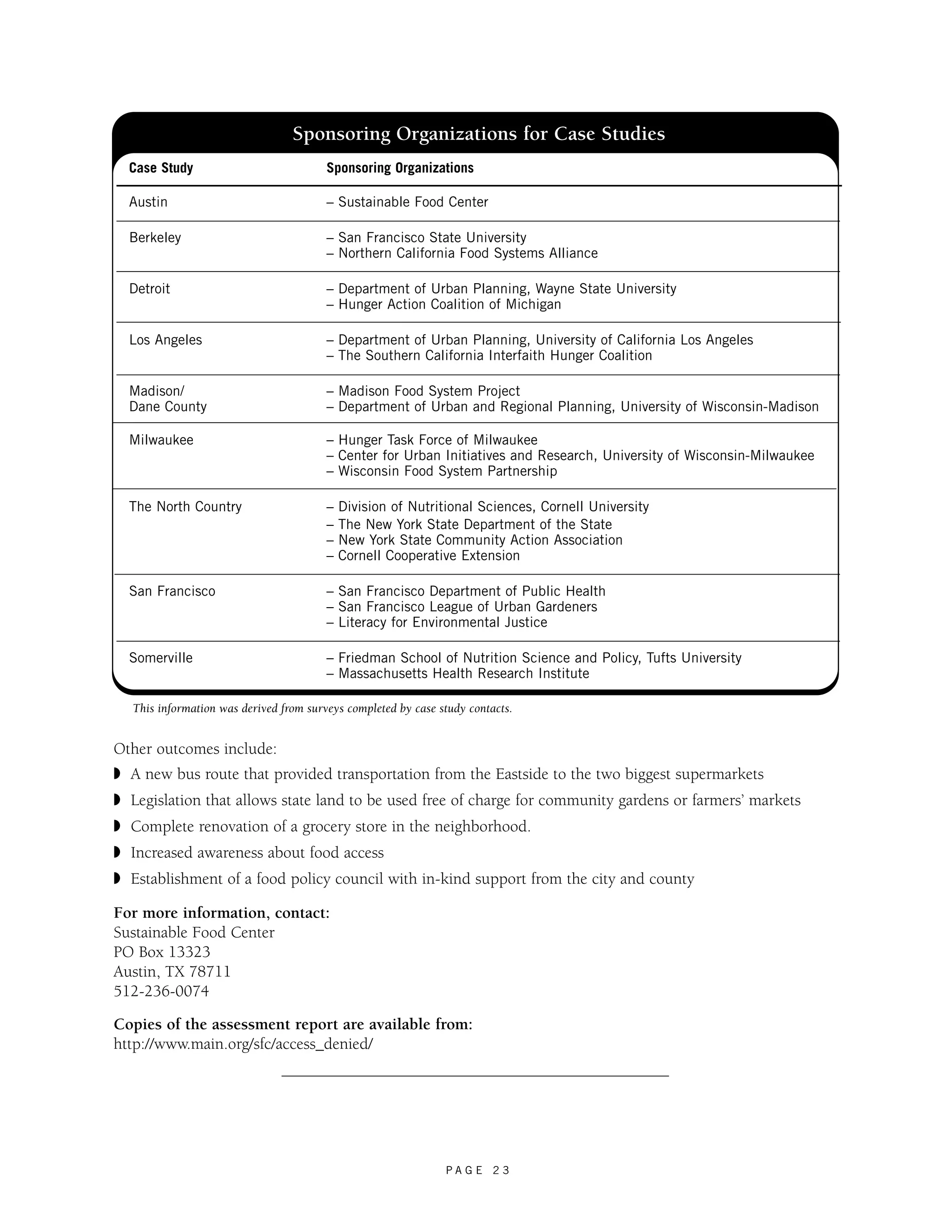
Sponsoring Organizations for Case Studies 
Case Study Sponsoring Organizations 
Austin – Sustainable Food Center 
Berkeley – San Francisco State University 
– Northern California Food Systems Alliance 
Detroit – Department of Urban Planning, Wayne State University 
– Hunger Action Coalition of Michigan 
Los Angeles – Department of Urban Planning, University of California Los Angeles 
– The Southern California Interfaith Hunger Coalition 
Madison/ – Madison Food System Project 
Dane County – Department of Urban and Regional Planning, University of Wisconsin-Madison 
Milwaukee – Hunger Task Force of Milwaukee 
– Center for Urban Initiatives and Research, University of Wisconsin-Milwaukee 
– Wisconsin Food System Partnership 
The North Country – Division of Nutritional Sciences, Cornell University 
– The New York State Department of the State 
– New York State Community Action Association 
– Cornell Cooperative Extension 
San Francisco – San Francisco Department of Public Health 
– San Francisco League of Urban Gardeners 
– Literacy for Environmental Justice 
Somerville – Friedman School of Nutrition Science and Policy, Tufts University 
– Massachusetts Health Research Institute 
This information was derived from surveys completed by case study contacts. 
Other outcomes include: 
◗ A new bus route that provided transportation from the Eastside to the two biggest supermarkets 
◗ Legislation that allows state land to be used free of charge for community gardens or farmers’ markets 
◗ Complete renovation of a grocery store in the neighborhood. 
◗ Increased awareness about food access 
◗ Establishment of a food policy council with in-kind support from the city and county 
For more information, contact: 
Sustainable Food Center 
PO Box 13323 
Austin, TX 78711 
512-236-0074 
Copies of the assessment report are available from: 
http://www.main.org/sfc/access_denied/ 
P A G E 2 3
m BERKELEY, CALIFORNIA 
Berkeley Community Food Assessment 
The city of Berkeley is located just a few hours’ drive from the heart of California’s legendary agricultural 
sector. Yet Berkeley residents are subject to some of the same challenges faced by municipalities across the country— 
inadequate retail service in poorer neighborhoods, a financially struggling school food system, and food 
“education” dominated by TV ads. At the same time, Berkeley is home to exciting pilot initiatives to foster 
sustainability, nutritional health, and equity in the food system. 
Between 1998 and 2001, members of the Northern California Food Systems Alliance and faculty from San 
Francisco State University came together with a committed group of community organizations to take fresh look 
at how to link local farmers and urban consumers. They wrote a report that chronicles and analyzes Berkeley’s 
efforts to build a healthy and equitable food system, titled Good Farming, Healthy Communities: Strengthening 
Sustainable Agriculture Sectors and Local Food Systems2. 
The report focused on five sectors of the Berkeley food system in which organizations were working to create 
change, and identified the kinds of projects these organizations were pursuing (in parentheses): 
1. The food production sector (cooperative ownership, marketing strategies for family farms, and land trusts) 
2. The retail food sector (direct marketing, inner-city greening projects, neighborhood markets) 
3. Urban agriculture (mini-farms, community gardens, agricultural research) 
4. The role of educational institutions (farm-to-school, community nutrition education, and community-driven 
P A G E 2 4 
urban agricultural research) 
5. Public policy (advisory groups, public health, coalitions between green space and housing advocates) 
The major sponsors of the project were the Northern California Food Systems Alliance, the San Francisco 
Foundation, and San Francisco State University. The principal leadership came from Raquel Pinderhughes, a 
professor at the university, with graduate student research assistance. The project was closely tied to community-based 
organizations such as the Ecology Center, the Berkeley Farmers’ Market, the Berkeley Food Policy 
Council, and Berkeley Youth Alternatives. Five members from participating organizations formed a Community 
Advisory Board, which served as the steering committee for the project. Researchers working on the project and 
the Community Advisory Board held regular meetings and strategy sessions. 
Community activists and residents were integral to the project. Community participation was generated 
through information sharing between local councils, neighborhood projects, and non-profit organizations at 
meetings and through involvement in project activities. Local high school students were trained in data 
collection. Further community input came from interviews and surveys of business owners, school children, 
farmers, market coordinators, and emergency food system staff. 
The direct funding for the assessment consisted of two grants of $25,000 each, from the San Francisco 
Foundation and California Urban Environmental Research and Action Center. In-kind donations were valued 
at $100,000 and included the lead investigator’s time, the research work of university students, the voluntary 
efforts of Community Advisory Board members, and additional guidance from other members of the community. 
In addition to the above-mentioned report, outcomes from the Berkeley Community Food Assessment include: 
• Formalized collaboration between the Berkeley Food Policy Council, farmers’ markets, community-based 
organizations, and the Berkeley Youth Alternatives project 
• Linkages between local growers and Berkeley school cafeterias 
• Survey instruments provided for inclusion in the Community Food Security Assessment Toolkit3 recently 
published by USDA
For more information, contact: 
Josh Miner 
Department of Environmental Science, Policy and Management, UC Berkeley 
510-643-0541 
jminer@nature.edu 
Copies of the assessment report are not available at this writing. 
m DETROIT, MICHIGAN 
The Detroit Food System Assessment 
Detroit is home to many individuals and organizations working in low-income communities to increase access 
to fresh, nutritious, and culturally appropriate choices in food. However, when this study began in the late 
1990s, these were disparate efforts without common goals, a broadly shared knowledge base, or a conceptual 
framework for action. Wayne State University Professor Kami Pothukuchi initiated the Detroit Food System 
Assessment to bring community food security concepts and systematic research into a community-based 
discussion that was already underway. The form of the assessment was shaped by discussions with representatives 
from the Hunger Action Coalition and other organizations that participated in the planning process to create 
the Detroit Food Security Council, but it was completed almost entirely within the university. 
The goals of the assessment were to: 
1. Develop a handbook of basic information about Detroit’s food system to support actions and policies that 
P A G E 2 5 
foster community food security 
2. Demonstrate how university faculty could partner with community members to conduct research on local issues 
Wayne State University provided cash and in-kind support by funding Kami Pothukuchi’s time and a student 
assistant to work on the study over two summers. Although community organizations were supportive, their 
efforts were not yet developed to the level of raising funds for systematic assessment work. Hence the 
assessment progressed more slowly than some others, developing over multiple cycles of initial assessment, 
community presentations of findings, discussion of further research questions, and additional research. 
Community partners played key roles in brainstorming research questions, identifying data sources, network-ing 
with key informants, helping build support for the assessment, and planning for program development 
based on the assessment’s findings. 
The initial assessment (conducted in 1999) was organized into sections based on links between food and the 
community goals of health, community economic development, and neighborhood revitalization. Initial pre-sentations 
were made in community forums to provide an overview of basic statistics, and a more detailed 
assessment program emerged from the ensuing discussions. The report expanded to include sections on hunger 
and food insecurity, regional farmland, and small pilot studies that would provide more qualitative glimpses of 
the area’s food system. For example, one pilot study examined the availability of a healthy basket of food in 
stores in an especially underserved neighborhood, while another documented the benefits of a youth nutrition 
garden in a Latino neighborhood. 
The assessment was not the product of a systematic planning process of one organization or coalition; instead 
it emerged from an ongoing set of relationships that increased in size and complexity over time. Accordingly, 
local organizations use it as they see fit, to educate new members about Detroit’s food system, to tell the story 
of the organizing efforts, and to raise more complex questions about unexplored issues. Because the assessment 
was initiated and carried out by a university faculty member, many of the outcomes are university-related. 
The report on the Detroit Food System Assessment is still being finalized at this writing. The assessment has 
contributed to the following outcomes:
Hunger and Food Insecurity in Detroit 
Household food security status by household type and race in Northwest Detroit, 1997 
Household food Total Food Food Food Food 
security status House Secure insecure, insecure, insecure, 
holds hunger moderate severe 
ALL HOUSEHOLDS No. % No. % No. % No. % 
All household types 352 217 61.6 35 9.9 79 22.4 21 6.0 
Households w/children 210 108 51.4 23 11.0 65 31.0 14 6.7 
under age 18 
Households w/elderly, 63 51 81.0 3 4.8 5 7.9 4 6.3 
no children 
Households w/no elderly, 77 57 74.0 9 11.7 8 10.4 3 3.9 
no children 
BY RACE 
All Black households 309 191 61.8 29 9.4 71 23.0 18 5.8 
All White households 21 11 52.4 3 14.3 5 23.8 2 9.5 
All other race households 19 12 63.2 3 15.8 3 15.8 1 5.3 
◗ The formation of the Detroit Food Security Council, consisting of representatives from many area 
organizations, private sector groups, and public agencies, including Hunger Action Coalition, Michigan 
Coalition of Black Farmers, Michigan Department of Agriculture, Michigan Neighborhood Partnership, 
and Detroiters Working for Environmental Justice 
◗ A firm basis for university-community collaboration on food system research and program development, 
with collaborations related to a youth nutrition garden, grocery store investigation, the Community Food 
Projects (CFP) grant process, etc. 
◗ At least two CFP proposals from area organizations and numerous other grant proposals written by 
organizations and partnerships 
◗ Efforts to inform city agencies and local policy makers on specific issues such as the links between food 
and land use and economic development planning, and local advocacy to improve allocation of public 
land for urban agriculture initiatives 
◗ Greater interest among university students, faculty, and administrators in community food issues and 
related university-community partnerships 
For more information, contact: 
Kami Pothukuchi, Ph.D. 
Department of Geography and Urban Planning, Wayne State University 
225 State Hall 
Detroit, MI 48202 
313-577-4296 
k.pothukuchi@wayne.edu 
Copies of the assessment report will be available from Professor Pothukuchi starting December 2002. 
P A G E 2 6 
not evident hunger evident hunger evident 
Source: Pothukuchi, 2002.4 
The table reports on household food security status in a Northwest Detroit neighborhood, derived from a survey of 352 
households selected randomly. It identifies four categories of food security status and helps compare between different types 
of households and racial groups. In this neighborhood, nearly four out of 10 households are food insecure with varying 
degrees of hunger evident.
m LOS ANGELES, CALIFORNIA 
Seeds of Change Food System Assessment 
In 1992, Los Angeles emerged from a period of civil unrest that had wreaked economic and social havoc on the 
city. Los Angeles faced serious food security problems, including significant levels of hunger, inadequate 
government support programs, and an overwhelmed emergency food network. These problems were made 
worse by the lack of basic infrastructure in the inner city, where there were few supermarkets, generally high food 
prices, limited public transportation options, and no integrated policy framework to address these problems. 
Researchers at the University of California Los Angeles (UCLA) Department of Architecture and Urban Planning 
and the Southern California Interfaith Hunger Coalition (IHC), a nonprofit advocacy and education organization, 
joined forces to undertake a comprehensive study of a low-income community of color in South Central LA. 
The purposes of the study, called Seeds of Change, were to: 
1. Evaluate problems of food security in the inner city, in both local and national contexts 
2. Describe and assess the adequacy of the federal government’s response to these problems 
3. Analyze how the structure of the food industry has contributed to food insecurity 
4. Identify and evaluate community-based strategies for change 
5. Propose a framework for food security planning that is equitable, economically efficient, and 
P A G E 2 7 
environmentally sound 
The Seeds of Change project was carried out with no cash budget, but with major in-kind support, especially 
from UCLA. Six principal researchers, two supervisors, and more than a dozen research assistants participated 
in the year-long study (1992-1993). Collaborators and non-profit groups contributed additional in-kind 
support, and students covered the cost of mileage and telephone calls. 
The researchers divided the project into three areas: local, regional, and state/national. The local study included a 
telephone survey; extensive demographic, land use, and spatial analysis using GIS (Geographic Information 
Systems) software; a profile of food outlets; and a comparative price survey at outlets in the case study area and 
two suburban communities. Community members participated through a series of household surveys, market 
surveys, and interviews. 
At the regional level, the researchers conducted surveys of consumers and growers at farmers’ markets, inter-viewed 
low-income community gardeners, reviewed policy and agency activities, examined the structure of the 
food system from grower to grocery store, surveyed land use and transportation routes, and conducted 
comparative demographic analysis. At the state and national level, the study gathered data on existing food 
support programs, examined food policy council initiatives, and analyzed trends of the supermarket industry 
over the past several decades. 
The research from the project was compiled and published as Seeds of Change: Strategies for Food Security for 
the Inner City5. Other outcomes included: 
◗ Formation of the LA Community Food Security Network and the LA Food Security and Hunger 
Partnership (a food policy council) 
◗ Further growth of community gardens and farmers’ markets, and increased food stamp outreach at 
farmers’ markets 
◗ Examples and inspiration that helped spark food assessments in other cities 
◗ Increased awareness that catalyzed the movement for food security in the United States, including 
establishment of the Community Food Security Coalition in 1994
For more information, contact: 
Andy Fisher, Executive Director 
Community Food Security Coalition 
PO Box 209 
Venice, CA 90294 
310-822-5410 
asfisher@aol.com 
Copies of the assessment report are available from: 
http://www.foodsecurity.org/pubs.html 
m MADISON, WISCONSIN 
Madison / Dane County Food System Assessment 
Fertile Ground: Planning for the Madison / Dane County Food System6 was the result of a 1997 planning work-shop 
for graduate students in the University of Wisconsin-Madison Department of Urban and Regional 
Planning (URPL). Students and faculty members took on this project because they believed that the state of the 
food system could act as a barometer of the well-being of the community. The goals of the study were: 
1. To develop a better understanding of the food system in Madison/Dane County 
2. To build strategies for improving food security 
3. To establish university/community partnerships 
The class described the conventional food system in Dane County, evaluated how well this system was working, 
and spelled out how to develop alternative food systems. The study covered both the City of Madison and 
surrounding Dane County, a primarily agricultural region in South-Central Wisconsin. The Madison Food 
System Project (MFSP) and its Director, Jerry Kaufman, provided overall sponsorship and leadership for the 
project. The research team comprised Professors Kaufman and Kami Pothukuchi (then a visiting faculty at 
URPL), teaching assistant Mark Stevens, and more than 20 graduate students. Funding for the project came 
from the W.K. Kellogg Foundation (through MFSP) and in-kind donations from the university. 
A 20-person advisory committee, consisting of 12 community members and eight academics, provided 
guidance for the project. The community groups represented included the Northside Planning Council, the 
Madison Community Gardeners Coalition, the Community Action Coalition, and the Hunger Prevention 
Council of Dane County. Between phases of the project, the students presented their research projects to the 
advisory committee and other key informants. 
The researchers held focus groups with low-income adults and children in Madison’s Northside and Southside 
neighborhoods to better understand the strategies low-income people used to stretch food budgets. They gathered 
information on location and number of food stores, restaurants, food pantries, farmers’ markets, WIC sites, 
community gardens, and other establishments. The students also collected data about local businesses through 
a food-related business survey and a food pricing study in selected supermarkets. 
The workshop culminated in the publication of Fertile Ground: Planning for the Madison/Dane County Food 
System in August of 1997. Over 400 copies have been distributed to individuals and organizations in the U.S. 
and other countries. Other outcomes include: 
◗ Development of the Dane County REAP (Research, Education, Action, and Policy) Food Group, which 
focuses on promoting food security through joint projects, networking, analytical work, and by organizing 
the annual Food for Thought Festival 
◗ Greater visibility of food system issues in Madison 
P A G E 2 8
Differences in food security concerns by respondent’s housing tenure, 
Madison, Wisconsin, 2000 (n=372) 
◗ Increased networking and contacts among individuals and organizations involved in various aspects of the 
food system 
◗ Presentation of a session developed by the faculty instructors and three student researchers at the annual 
conference of the Wisconsin Chapter of the American Planning Association 
◗ The start of a Madison Food System Partnership Working Paper Series 
For more information, contact: 
Marcia Caton Campbell, Director 
Madison Food System Project 
Dept. of Urban and Regional Planning 
University of Wisconsin - Madison 
Madison, WI 53706 
mcatoncampbe@wisc.edu 
Copies of the assessment report are available from: 
Professor Marcia Caton Campbell at the above address for $10.00. Several working papers from the Madison 
Food System Project are available at http://www.wisc.edu/mfsp/pubsf/pub.html. 
P A G E 2 9 
Source: Stevens and Raja, 2001.7 
The chart compares the food security concerns of and the use of emergency food by homeowners and renters in 
Madison, Wisconsin. About twice as many renters as owners are concerned about the high cost of food, getting to 
the store, and having enough to eat. 
This chart was excerpted from one of a series of working papers that were developed after the Fertile Ground study, 
as a way to address questions that were raised but not resolved in that study.
m MILWAUKEE, WISCONSIN 
Milwaukee Food System Assessment Study 
Milwaukee’s Food System Assessment Study (FSAS) was a broad, five-year collaborative campaign (1995- 
2000). Its goals were: 
1. To examine the root causes of hunger 
2. To develop partnerships to promote food security and systemic change in Milwaukee County 
An important objective of the study was to create projects that would promote affordable food access while 
addressing the lack of economic resources that cause families to experience hunger. The study developed a 
comprehensive picture of food security in Milwaukee and highlighted the links between poverty and food 
insecurity in the city. 
The Hunger Task Force of Milwaukee collaborated with the Center for Urban Initiatives and Research (CUIR) 
at the University of Wisconsin-Milwaukee to oversee and conduct the research. The Hunger Task Force was the 
main sponsor, under the leadership of Michael Salinas, then Director of Advocacy. Two researchers from the 
University of Wisconsin, Olmedo Varela and Stephen Percy, developed the research protocol. These collabora-tors 
sought input from the Community Food Security Coalition, Cornell University staff, and local communi-ty 
contacts. Students from the university participated in the third phase of the project (described below). 
The Hunger Task Force of Milwaukee established a Food System Advisory Council to guide and review the 
research and to make recommendations in response to the study’s findings. The Council, which met quarterly, 
represented diverse interests in the food system, among them city and state government, non-profit organizations, 
food pantries, farmers, community activists, and university staff. For detailed decision-making and coordination 
of the research, the CUIR and the Hunger Task Force staff conducted planning and operational meetings as needed. 
The total budget for the study was close to $20,000, which included research assistance, printing, and labor. 
Cash support was provided by the Wisconsin Food System Partnership ($10,000) and Kraft Foods, Inc. 
($4,500). In-kind support (estimated at $5,000) included staff time, reduced rates from printers and graphic 
artists, and university support for survey work and photocopying. 
The assessment’s target areas were located in the near north and near south sides of Milwaukee, both high 
poverty areas. Community members participated in telephone surveys and focus groups. Phone surveys were 
conducted to determine what foods were purchased by residents and where. Focus groups were held with 
clients at food pantries and meal sites. 
The study gathered a broad range of information in four phases. The first phase compiled data on population 
density, income, race and ethnicity, transportation access, as well as the location of emergency food providers, 
community gardens, farmers’ markets, and other indicators. The second phase collected information on food 
retailers, including location, food availability, and pricing. The third and fourth phases compiled data from sur-veys 
and focus groups on perceptions and experiences of the food system among inner-city individuals and 
families using emergency food programs. 
The study developed a thorough picture of food insecurity in Milwaukee and its relationship to poverty. 
Researchers found that the number of people living below the poverty line had increased dramatically since 
1970, and that demand for emergency and non-emergency food programs exceeded their capacity. They also 
found that Milwaukee’s low-income residents paid more for their groceries and had fewer stores located in their 
communities. The Hunger Task Force identified strategies for improving food access, promoting economic 
development, and decreasing poverty. These strategies included promoting public markets, establishing a 
micro-credit program to help low-income people start food-related enterprises, coordinating transportation 
routes to grocery stores, developing a food-buying cooperative for small inner city convenience stores, and 
starting a kitchen incubator for community-based food enterprises. 
P A G E 3 0
Problems identified in using “best” stores, Milwaukee, Wisconsin, 1997 (n=514) 
Responses All Areas 
Distance or transportation 40.6% 
Long lines 25.0% 
Too crowded 9.4% 
Items too big 6.3% 
Child care 3.1% 
Parking 3.1% 
Coupon items not available 3.1% 
Not consistent 3.1% 
Credit card system out of order 3.1% 
Tyme machine out of order 3.1% 
Employee attitudes about coupons 3.1% 
Bad neighborhood 3.1% 
Source: Varela, Haider-Markel, and Percy, 1998.8 
This table reports on the problems respondents (who were randomly selected for a phone survey) had with shopping at 
stores they considered to be the best for them. Eighty-eight percent of respondents defined “best” stores as large super-markets 
with good quality, prices, and variety. By far the most commonly reported problem related to distance and trans-portation. 
Four reports, one for each stage of the study, were published: 
◗ Perceptions and Experiences of Consumer Access to Food in Milwaukee’s Inner City Neighborhoods8 
◗ Socio-Spatial Relationships and Good Programs in Milwaukee’s Food System9 
◗ Comparative Study of Food Pricing and Availability in Milwaukee10 
◗ Food Insecurity in Milwaukee: A Qualitative Study of Pantry and Meal Program Users11 
Other outcomes include: 
◗ Formation of the Milwaukee Farmers’ Market Association to develop and promote new markets in the 
inner city 
◗ Development of the Fondy Food Center Project, a $5 million year-round food center, market, and kitchen 
incubator 
◗ Overhaul of the Emergency Food Pantry Network and Community Meal Program Coalition, including new 
types of technical assistance and guidelines 
◗ Expansion of the WIC Farmers’ Market Nutrition Program to all of Milwaukee’s farmers’ markets 
◗ Increased partnerships between the university and non-profit groups, leading to new courses, new 
research, and greater university involvement in the community 
For more information, contact: 
Jon Janowski, Director of Advocacy 
Hunger Task Force of Milwaukee, Inc. 
201 S. Hawley Court 
Milwaukee, WI 53214 
414-777-0483 
jon@hungertaskforce.org 
Copies of the assessment report are not available at this writing. 
P A G E 3 1
Types of stores where commonly used items are purchased most often, 
Milwaukee, Wisconsin, 1997 (n=514) 
Item Purchased Large Medium Small Don’t Buy No 
Stores Stores Stores Response 
Milk and Dairy Products 83.1% 4.7% 9.7% 1.4% 1.2% 
Canned Food and Vegetables 86.2% 6.4% 1.4% 4.9% 1.2% 
Fresh Food and Vegetables 89.3% 7.4% 0.4% 1.6% 1.4% 
Meat 80.9% 13.8% 1.4% 2.3% 1.6% 
Frozen Food 84.2% 6.6% 1.2% 6.6% 1.4% 
Coffee 62.3% 4.7% 4.7% 25.9% 2.5% 
Bread 73.2% 11.5% 11.9% 1.4% 2.1% 
Bakery Items 68.5% 8.0% 6.4% 15.2% 1.9% 
Beer and Alcohol 16.7% 2.3% 14.0% 65.2% 1.8% 
Cigarettes 12.3% 1.9% 18.5% 65.4% 1.9% 
Ethnic or Specialty Food 23.3% 14.0% 1.8% 57.4% 3.5% 
Source: Varela, Haider-Markel, and Percy, 1998.8 
This table reports on the type of stores where 514 respondents most often purchased commonly used items. Store size 
was defined by examples of specific stores. Corner stores and convenience stores were defined as small. Large stores 
were used most often for purchasing all products except cigarettes. 
m NORTH COUNTRY REGION, NEW YORK 
The North Country Community Food and Economic Security Project 
The North Country of New York State spans six counties near the Canadian border. These counties are primarily 
rural, and agriculture is an integral aspect of the history and identity of the area. Unemployment is roughly 
twice the state average, and the region faces high rates of poverty and social isolation. 
The North Country Community Food and Economic Security Project was conducted between December 1996 
and May 1998, with follow-up work still continuing at this writing. The primary goal of the project was to 
engage and mobilize a broad network of county residents and improve access to healthful, locally produced 
foods while strengthening the economic viability of regional agriculture. 
The project used a community-centered approach to identify residents’ key concerns about the food system. A 
broad range of North Country residents—including dairy farmers, local processors, market managers, local 
agency staff, religious leaders, teachers, low-income parents, and county legislators—participated in two-day 
conferences in each county. Participants engaged in a series of open-ended questions, selected by local adviso-ry 
committees in the search conference model. The search conference is a structured process that engages the 
community in reviewing the past and present, creating ideal future scenarios, identifying common ground, and 
developing action plans. Questions included: 
1. Who’s feeding you and what are you eating? 
2. How can we build a stronger community through better management of local food resources? 
3. How should our local food system look and work in the next five years? 
4. How should our local food system work in 2020? 
Conference participants also reviewed county-specific data on demographics, health, the economy, agriculture, 
and food availability. Residents provided qualitative data such as first-person accounts of historical shifts in 
local agriculture, trends in community development, and changing industries. Additional data were gathered 
through the workshop evaluation form. 
P A G E 3 2
The project was implemented through the North Country Community Food and Economic Security Network, 
which included a small campus-based team in the Division of Nutritional Sciences at Cornell and representa-tives 
of the county offices of Cooperative Extension and Community Action Programs in each of the six North 
Counties. In addition, county representatives from the regional network formed separate advisory committees 
with local residents to steer each of the county search conferences. 
The study was funded by the U.S. Department of Agriculture (USDA) and the Centers for Disease Control and 
Prevention (CDC). The USDA provided tuition and a stipend for a graduate student and CDC provided a budget 
of $184,000 over a two-year period for staff salary, office expenses, search conference fees, and other operating 
costs. In-kind resources of staff time from Community Action Agencies and facilities and food from Cornell 
Cooperative Extension amounted to approximately $4,000 per county. 
Outcomes include: 
◗ Development of a Cornell Cooperative Extension position to continue and further work group efforts 
started during the conferences 
◗ Increased networks among community and agency members 
◗ Creation of a fellowship kitchen to serve all community members including the hungry, elderly, disabled, 
and single-parent families in Essex County 
◗ Implementation of a system to provide donations of venison and beef to local food pantries in Lewis and 
St. Lawrence counties 
◗ Establishment of a weekly regional farmers’ market in Jefferson County 
◗ Improved food distribution networks between the Community Action Programs of Jefferson County and 
Franklin County 
◗ Increased storage and trucking facilities through joint efforts of a Food Security Committee. 
◗ Numerous publications targeted at a variety of audiences 
For more information, contact: 
David Pelletier, Ph.D., Associate Professor of Nutrition Policy 
Division of Nutritional Sciences 
378 MVR Hall 
Cornell University 
Ithaca, NY 14853 
607-255-1086 
Copies of the assessment report are available from: 
The Journal Agriculture and Human Values, Volume 17, Issue 1, 200012. 
m SAN FRANCISCO, CALIFORNIA 
Youth Envision: Bayview Hunters Point Food Study 
The Bayview Hunters Point neighborhood is located in Southeast San Francisco. It is one of the fastest growing 
and most ethnically diverse areas in the city, and also among the poorest. The goal of the Bayview Hunters Point 
Food Study was to identify and promote strategies for improving access to nutritious food in the neighborhood, 
while also providing job training for community trainees and youth interns. 
In March 2001 the San Francisco Department of Public Health, Environmental Health Section (EHS) began a 
partnership in the Bayview Hunters Point neighborhood with a community-based organization, the San 
Francisco League of Urban Gardeners (SLUG). EHS approached SLUG because they had long been active in 
urban agriculture and food security projects in this neighborhood. In turn, SLUG engaged in a collaboration with 
P A G E 3 3
Literacy for Environmental Justice (LEJ) to develop a youth program around food security issues in the Bayview 
Hunters Point. A participatory action model was used to train youth in the skills and resources needed to 
investigate food security in their neighborhood. EHS provided technical instruction and assistance, as well as 
support to SLUG and LEJ project staff on action research methods. SLUG and LEJ coordinated the youth interns. 
The total budget for the study was approximately $20,000, plus significant in-kind time from EHS and SLUG’s 
Youth Internship Program. The assessment project was funded by the Department of Public Health, while 
additional funding for the youth interns was provided by other city agencies. The steering committee consisted of 
the Director of Urban Agriculture at SLUG and members of the Department of Public Health’s Environmental 
Health and Nutrition Sections. Decisions about data and reports were made by the steering committee. 
Project staff working with EHS and the youth participants created a questionnaire focused on identifying ways 
to increase access to nutritious food. The survey sought information on where people were getting their food, 
the barriers to purchasing healthy foods, and changes that would help people to purchase healthy foods. 
Youth empowerment was a significant aspect of the project. The youth developed their own recommendations, 
work plan, and deliverables with the help of project staff. The youth program combined learning about the food 
system with community actions such conducting outreach for a new farmers’ market in the neighborhood, and 
community mapping of food assets. Youth were trained in survey methods, data analysis, health impact assess-ment, 
public communications, and other areas. Seventeen youth advocates collected survey responses from 
more than 280 individuals in their neighborhood. Survey locations included grocery stores, churches, com-munity 
colleges, a post office, and a fast food restaurant. 
The youth then worked with staff to analyze the survey data and create a list of recommendations to improve 
food access in Bayview Hunters Point. The four strategies identified as most helpful by survey respondents were 
the following: 
1. Creation or improvement of a grocery store/supermarket 
2. Creation of a neighborhood farmers’ market 
Barriers to purchasing healthful foods, San Francisco, California, 2001 (n=283) 
Source: Bhatia, Calandra, Brainin-Rodriguez, and Jones, 2001.13 
In this project, youth conducted a survey of 283 non-randomly selected residents of Bayview Hunters Point, a 
neighborhood in San Francisco, and asked what keeps them from purchasing healthful foods. The respondents 
identified a variety of barriers related to access and availability, food quality and costs, and time constraints. 
P A G E 3 4
3. Better quality food on shelves of corner stores 
4. Healthy fast food retailers 
The youth interns shared their research findings widely through meetings and presentations with residents, 
community organizations, and service providers. At this writing, action plans have been developed for the local 
farmers’ market and corner stores, and a plan for a new or improved grocery store is underway. 
Other outcomes include: 
◗ SLUG youth interns and staff created a new Bayview Community Farmers Market as a community 
development project. Youth have assisted with outreach, vendor relations, and market operations. 
◗ Some corner store owners have made a commitment to stock a minimum amount of fresh food. Youth 
interns have conducted healthy snack taste tests at the farmers’ market, and the results have been 
incorporated into an action plan for the corner stores. The Department of Public Health awarded a 
$100,000 grant to the Youth Envision Project to continue the youth work with the corner stores. 
◗ The city’s transit authority agreed to provide new shuttle routes directly from the community to food sources. 
◗ Neighborhood youth gained new skills and empowerment through job training and by working to educate 
and serve their community. 
For more information, contact: 
Fernando Ona, Health Educator/Medical Anthropologist 
San Francisco Department of Public Health 
1390 Market Street, Suite 822 
San Francisco, CA 94102 
415-252-3939 
fernando.ona@sfdph.org 
Copies of the assessment report are not available at this writing. 
Most valuable community resources for purchasing healthful foods. 
San Francisco, California, 2001 (n=283) 
Source: Bhatia, Calandra, Brainin-Rodriguez, and Jones, 2001.13 
In this survey of 283 residents of Bayview Hunters Point (selected non-randomly), respondents were asked which of the 
above resources would most help them purchase healthful foods. The percentages indicate how many respondents said 
they would use each resource “sometimes or regularly.” 
P A G E 3 5
m SOMERVILLE, MASSACHUSETTS 
Somerville Community Food Assessment 
The Somerville Community Food Assessment (SCFA) was a one-year initiative started in late 1999 to take a 
comprehensive look at food and nutrition resources in the city. The goal was to strengthen planning and 
policy for community-based food and nutrition resources for low-income residents in Somerville, 
Massachusetts, a largely working class and ethnically diverse community north of Boston. 
The SCFA was sponsored by the Massachusetts Health Research Institute (MHRI) in Boston, working in 
collaboration with Hugh Joseph at the Tufts University School of Nutrition Science and Policy. It was funded 
by a $49,000 Health and Human Services/Community Food and Nutrition Program grant. Two part-time staff 
and a steering committee of 18 professionals and unaffiliated residents collaborated to collect the data. The 
organizations involved were principally providers of food and nutrition services in Somerville, including emer-gency 
food programs, community gardens, elder services, school food services, public health services, WIC, and 
Head Start. In addition, there were participants from other social services and from academic institutions (Tufts 
and University of Massachusetts at Amherst). 
The steering committee met monthly and made all major decisions regarding data collection, community input, 
and determination of needs and responses to them. Subcommittees helped with collecting information, con-tacting 
community leaders, and other activities. Staff coordinated activities between meetings, collected data, 
prepared reports and carried out other administrative tasks; four interns from Tufts University also assisted with 
activities. Interviews were held with dozens of community leaders and other stakeholders, particularly those 
representing ethnic communities and the public schools. 
A significant component of the Somerville Community Food Assessment was to model participatory food 
systems planning. Project participants attended a Participatory Action Research workshop to learn how to 
involve the community in this process. They then met with city agencies and citizens’ groups to identify com-munity 
priorities in relation to food, health, and nutrition. From these meetings, the assessment participants 
determined that many food and nutrition resources were underutilized due to a lack of awareness about their 
existence or a lack of understanding of eligibility requirements. As a result, project participants decided to 
create a guide to food and nutrition resources in Somerville. 
Outcomes of the assessment include the following: 
◗ An extensive community food and nutrition resource guide was published. The 89-page guide lists a wide 
range of programs and services, primarily targeting low-income and ethnic minority residents. It includes 
retail food stores, government and private food assistance programs, nutrition and health services, commu-nity 
gardens, farmers’ markets, and CSA (Community Supported Agriculture) farms. Several hundred 
copies were distributed and the guide was posted online (see web address at the end of this case study). 
◗ A group of organizations, including Head Start and Project Soup, joined together to offer a series of 
cooking classes for low-income residents through the Operation Frontline program. The group is seeking 
funds to offer more cooking classes in Somerville. 
◗ A Community Kitchen Task Force is examining the feasibility of setting up commercial kitchen facilities 
and resident cooking programs. The group is conducting a focused needs assessment—collecting technical 
assistance information, surveying potential sites and resident and commercial interest, and determining 
sponsorship, development costs, and operational strategies. 
◗ A Public Health Nutrition Task Force was formed after nine months, and now has over 20 participants. 
It has carried out an extensive strategic planning process and made addressing obesity its primary focus. 
Additional activities in planning, research, and fundraising for a healthy weight campaign for children are underway. 
P A G E 3 6
For more information, contact: 
Hugh Joseph Friedman School of Nutrition Science and Policy 
126 Curtis Street 
Medford, MA 02155 
Hugh.Joseph@tufts.edu 
Copies of the assessment report are available from: 
http://nutrition.tufts.edu/publications/somerville/ 
Conclusion 
These case studies are a tribute to the skills and resourcefulness of their organizers, and to the power of the 
Community Food Assessment approach. The case study groups were successful in organizing assessments, 
gathering a wide range of data, and using the results to generate tangible outcomes. They demonstrated that 
assessments in diverse settings can generate a range of powerful results, both tangible outcomes such as new 
policies and programs, and process benefits such as new partnerships and capacity development. That these 
results were achieved at a time when almost no guidance or resources were available to support Community 
Food Assessments is especially remarkable. To us, it is indicative of the depth of concern about local food issues 
and an optimistic sign of the potentially rich future of this approach to addressing them. Our hope is that this 
Guide and other emerging resources, along with the growing body of knowledge from assessments that are 
being conducted, will further support—and speed up!—the development of many more successful Community 
Food Assessments all over the country. 
P A G E 3 7
Information Gathered by Assessment Case Study Groups 
HIGH LOW NO 
COMMUNITY DEMOGRAPHICS 
Broad community demographics LA, BK, SM, SF, TX DT, MD, NY, MW 
Population make-up DT, LA, NY, BK, SM, SF MD, MW, TX 
SOCIO-ECONOMIC DEMOGRAPHICS 
Incomes, employment, related data DT, MW, NY, BK, LA, MD SF 
SM, TX 
Focus on low-income/ disadvantaged DT, LA, MD, MW, SM 
populations NY, BK, SF, TX 
Hunger/food insecurity DT, LA, MD, MW, NY, SM 
BK, SF, TX 
ANTI-HUNGER RESOURCES/SERVICES 
Emergency food assistance DT, LA, MW, NY, SM MD, BK, TX SF 
Government food assistance LA, NY, BK, SM DT, MD, MW, TX SF 
Other anti-hunger services and LA, NY, SM MD, MW BK, SF, TX, DT 
outreach programs 
PUBLIC HEALTH AND NUTRITION 
Diet-related diseases DT, LA, NY, SM, SF SM, TX MD, MW, BK 
Community public health NY, SF, TX LA, MD, SM MW, BK 
Quality of diets / nutritional status SF, NY, BK, TX DT, LA, MD, MW, SM 
Exercise, lifestyle habits NY, SM SM DT, LA, MD, MW, 
P A G E 3 8 
BK, SF, TX 
CONVENTIONAL FOOD SYSTEM 
Broad food system characteristics DT, LA, MD, MW, SM 
NY, BK, SF, TX 
Retail food sector data DT, LA, MD, MW, NY 
BK, SM, SF, TX 
Wholesale, other food system data DT, LA MD, NY, BK, SM, MW 
SF, TX 
Restaurants/institutional food DT, BK, SF, TX MD, MW, NY LA, SM 
service data 
COMMUNITY-BASED AND/OR LOCAL FOOD SYSTEMS 
Local/regional agriculture—status DT, MD, NY, BK, LA, MW SM 
SF, TX 
Local/regional agriculture links LA, MD, NY, BK, DT, MW 
to community (e.g. CSA’s, farm mkts) SM, SF, TX 
Community-based food production DT, LA, MD, BK, MW, NY, SF 
(e.g. gardens) SM, TX 
INFRASTRUCTURE/TRANSPORTATION 
Public transportation access DT, LA, MW, NY, MD, SM, SF BK 
SM, TX 
Vehicle access DT, LA, MW, TX MD, SF, NY BK, SM 
Comprehensive transportation access DT, TX NY, SM LA, MD, MW, BK
Information Gathered by Assessment Case Study Groups - continued: 
HIGH LOW NO 
COMMUNITY ORGANIZATIONS / INSTITUTIONS 
Community institutional resources (broad) BK MD, MW, NY, SM, DT, LA 
SF, TX 
Community leadership and power SF MD, NY, BK, SM, TX DT, LA, MW 
Labor issues, roles LA DT, MD, MW, NY, 
P A G E 3 9 
BK, SM, SF, TX 
COMMUNITY FOOD HEALTH AND NUTRITION RESOURCES 
Health/nutrition outreach/referral services MW, NY, BK, SM, SF MD, TX DT, LA 
Food / nutrition related projects MW, NY, BK, SM, SF LA, TX, DT MD 
COMMUNITY DEVELOPMENT / ECONOMIC 
Food system related (business, job training) DT, MD, NY, BK, TX LA, SM, SF MW 
ENVIRONMENTAL (FOOD SYSTEM RELATED ISSUES) 
Waste disposal, recycling, composting MD NY, BK, SM, SF DT, LA, MW, TX 
Water quality MD, NY, SM DT, LA, MW, BK, 
SF, TX 
Land contamination, hazardous waste MD, NY DT, LA, MW, BK, 
SM, SF, TX 
Open space, land use or access DT, BK, TX LA, MD, NY, SM, SF MW 
POLICY 
Legislation, funding, regulations LA, NY, TX MD, BK, SM DT, MW, SF 
MEDIA 
Coverage of issues, food ads, etc. DT MD, NY, SM LA, BK, SF, TX 
ANY OTHER DATA 
Hunting, fishing and trapping licenses / NY SF, TX 
game deer take 
Physical activity resources SM SF, TX 
KEY 
BK: Berkeley Community Food Assessment, Berkeley, CA 
DT: Detroit Food System Assessment, Detroit, MI 
LA: Seeds of Change Food System Assessment, Los Angeles, CA 
MD: Madison/Dane County Food System Assessment, Madison, WI 
MW: Milwaukee Food System Assessment Study, Milwaukee, WI 
NY: The North Country Community Food and Economic Security Project, NY 
SF: Youth Envision: Bayview Hunters Point Food Study, San Francisco, CA 
SM: Somerville Community Food Assessment, Somerville, MA 
TX: Access Denied: An Analysis of Food Access in East Austin, Austin, TX 
Note: This table was assembled based on information provided by case study contacts. Not all rows contain information related to 
all cases because of incomplete responses.
1 Sustainable Food Center. 2001. Access Denied: An Analysis of Problems Facing East Austin Residents in Their 
Attempts to Obtain Affordable, Nutritious Food. Austin, Texas: Sustainable Food Center. 
http://www.main.org/sfc/access_denied/ (Date accessed: 3 Sept 2002). 
2 Pinderhughes, R., and J. Miner. 2001. Good Farming, Healthy Communities: Strengthening Sustainable 
Agriculture Sectors and Local Food Systems. San Francisco, CA: San Francisco State University, Urban and 
Environmental Studies Program. 
3 Cohen, B. 2002. Community Food Security Assessment Toolkit. Washington, DC: United States Department 
of Agriculture, Economic Research Service. http://www.ers.usda.gov/publications/efan02013/ (Date 
accessed: 3 Sept 2002). 
4 Pothukuchi, K. 2002. The Detroit Food System: A Handbook for Local Planning. Detroit: Wayne State 
University. 
5 Ashman, L., J. de la Vega, M. Dohan, A. Fisher, R. Hippler, and B. Romain. 1993. Seeds of Change: 
Strategies for Food Security for the Inner City. Los Angeles, CA: University of California, Graduate School 
of Architecture and Urban Planning. 
6 University of Wisconsin-Madison, Department of Urban and Regional Planning. 1997. Fertile Ground: 
Planning for the Madison/Dane County Food System. Madison, Wisconsin: University of Wisconsin- 
Madison Food System Project. http://www.wisc.edu/mfsp/pubsf/pub.html (Date accessed: 3 Sept 2002). 
7 Stevens, M. R., and S. Raja. 2001. What’s Eating You About What You Eat? Madison Food System Project 
Working Paper Series MFSP-WPS-05. Madison, WI: University of Wisconsin-Madison, Madison Food 
System Project. 
8 Varela, O. J., D. P. Haider-Markel, and S. L. Percy. 1998. Perceptions and Experiences of Consumer Access to 
Food in Milwaukee’s Inner-City Neighborhoods. Milwaukee, WI: University of Wisconsin-Milwaukee, Center 
for Urban Initiatives and Research. 
9 Varela, O. J. 1996. Socio-spatial Relationships and Food Programs in Milwaukee’s Food System. Milwaukee, 
WI: University of Wisconsin-Milwaukee, Center for Urban Initiatives and Research. 
10 Johnson, K., S. Percy, and E. Wagner. 1996. Comparative Study of Food Pricing and Availability in 
Milwaukee. Milwaukee, WI: University of Wisconsin-Milwaukee, Center for Urban Initiatives and 
Research. 
11 Varela, O. J, K. Johnson, and S. Percy. 1998. Food Insecurity in Milwaukee: A Qualitative Study of Food 
Pantry and Meal Program Users. Milwaukee, WI: University of Wisconsin-Milwaukee, Center for Urban 
Initiatives and Research. 
12 Pelletier, D. L., V. Kraak, C. McCullum, U. Uusitalo and R. Rich. 2000. Values, Public Policy and 
Community Food Security. Agriculture and Human Values, 17(1): 75-93. 
13 Bhatia, R., C. Calandra, L. Brainin-Rodriguez, P. Jones. 2001. Food Access Study of the Bayview Hunters 
Point. San Francisco, CA: San Francisco Department of Public Health; San Francisco League of Urban 
Gardeners. 
P A G E 4 0
C H A P T E R 4 
Planning Your Community 
Food Assessment 
There is no master plan for implementing a Community Food Assessment—each one is unique. Still, there are 
some basic steps to consider in planning an assessment to ensure that it incorporates key features such as a food 
system focus, collaboration among stakeholders, community involvement, and an action orientation. This chap-ter 
is organized into sections that describe the major areas of work in planning an assessment: 
1. Getting Your Assessment Team Together 
2. Clarifying Assessment Goals, Interests, and Decision Processes 
3. Planning the Assessment Budget and Mobilizing Resources 
4. Planning the Assessment Research 
5. Planning for the Use and Evaluation of Your Assessment 
We offer this overview of the assessment planning work in order to highlight key areas of decision-making and 
the players and activities associated with these areas, and to help you map out and anticipate the process before 
you start. While these areas of work are presented sequentially in this chapter, in practice they often will 
overlap. For example, you may find the need to include new members as you think through your research 
questions and methods, and to start planning for the use of your assessment before you begin your research. 
Such adjustments and changes are an appropriate part of an organizing process, and it is important to strike a 
balance between making clear decisions and remaining flexible, so that you make progress while also main-taining 
P A G E 4 1 
buy-in and support. 
1. Getting Your Assessment Team Together 
Organizing the core assessment team is one of the most important aspects of the process. This team will deter-mine 
the shape of the assessment and its outcomes, decide whom to invite to be part of the process, and be 
responsible for implementing the assessment and follow-up actions. 
Assessments can get started in many different ways, with varying levels of community participation. One or several 
groups could take the lead and invite others to join later. A coalition of organizations that has already worked 
together might decide to conduct an assessment. Or an assessment could begin with a broad community organ-izing 
process that involves a range of stakeholders in deciding whether to conduct an assessment and what the 
focus should be. All of these are valid approaches that can result in successful assessments and follow-up 
actions. Yet the way an assessment starts, and who is at the table when it gets started, will have lasting impli-cations 
for the process and its impact in the community. The editors of this guide encourage an approach 
that involves collaboration between diverse organizations and meaningful participation by community mem-bers. 
Potential assessment participants 
Who might want to or should be involved in an assessment? It is valuable to start with a broad pool. Everyone 
has a stake in the food system, and valuable players can come from almost anywhere in the community. All the 
assessments presented in Chapter 3 involved partnerships among organizations active on various community 
food issues. Many had representatives from universities, public agencies, private sector firms, the nonprofit 
sector, and community-based organizations. Ideally, such representatives should have both an individual and 
organizational interest in participating, and their institution should support the assessment with their staff time 
and other resources.
P A G E 4 2 
1. Organizational representatives 
In many assessments, organizational representatives are the primary participants. They often bring to the 
process extensive knowledge of the local community and its food system, contacts with other stakeholders 
and community members, and experience with organizing and group process. Organizations focused on food 
and agriculture issues such as anti-hunger, sustainable agriculture, urban gardening, public health, and nutri-tion 
are clear candidates. Groups working on related issues may be natural allies; these may include environ-ment, 
community development, housing, social service, and civic groups. 
2. Colleges and universities 
Academic institutions can bring important research skills to the table, and contribute their and students’ 
time to conduct and analyze research. They also have access to resources that community organizations may 
lack, including computers, data, and computer mapping capability. (See sidebar on next page.) 
3. Public officials and agencies 
Public agency staff often collect data about the food system and related issues, and may conduct assessments 
to inform policy making. They also communicate with decision-makers in other government agencies. 
Involving public officials and agency representatives in the assessment planning process, even those who do not 
work directly on food issues, can facilitate access to information and increase the chance that the assessment’s 
findings will lead to policy changes. 
4. Private sector firms 
The private sector, including farmers, grocery stores, food processors, and distributors, plays an important 
role in the food system. Many business leaders are interested in contributing to the community. They also 
may be visible, influential, and well connected. Involving them as partners can facilitate linkages to com-munity 
economic development, encourage private sector involvement in improving the food system, and 
potentially bring in tangible resources such as money, facilities, and databases. 
5. Community residents 
This category refers to participants who live in the community, but do not directly represent an organization 
(although they may be involved with local groups). Resident participation is essential to ensure that the 
assessment addresses the needs and interests of the community. They can best understand and represent 
the interests of ordinary households, and provide an important balance to the views of organizational 
representatives. 
Criteria for identifying assessment participants 
Participating in an assessment, especially as a core member, can involve a significant commitment of time and 
energy. It is important to take the time to recruit a diverse group of capable and dedicated participants. Below 
are some criteria to consider as you identify potential participants. 
1. Community representation 
Those who live and work in a community are vital to the assessment process. Seek out people who are 
involved in their communities, respected as community leaders, and have a stake in the outcomes. 
2. Diversity 
Representation from diverse stakeholder and population groups helps make an assessment effective, by 
bringing in different perspectives, helping the group to think creatively, and building the buy-in and 
support that foster successful follow-up actions. 
3. Expertise and experience 
A broad range of knowledge and skills among assessment participants will increase the group’s resourcefulness 
and its capacity to move forward. This expertise can include understanding of the community or food issues,
skills in research, or background in community organizing, policy advocacy, or program development. 
Having a good mix of content and process skills in the team is important. 
Benefits and Limitations of Universities as Assessment Partners 
P A G E 4 3 
4. Availability 
Consistent participation and follow-through are important for the continuity of the assessment process. 
Anyone who will be significantly involved should understand the process, the timetable, and their role, and 
consider whether they can commit to participating for the duration of the assessment. It is especially impor-tant 
to be respectful of the time of volunteers, and to consider their needs when scheduling meetings and 
assessment work. 
5. Capacity for decision-making 
In order for the assessment team to move forward effectively, it is important that organizational representa-tives 
are empowered to make decisions on behalf of their organization in the context of the assessment 
process, or have a way to efficiently get input or approval from others in their group as needed. 
Including university- or college-based researchers in 
assessment partnerships has many benefits. Faculty 
members bring expertise in their subject areas, such as 
health, social work, urban planning, or nutrition. They 
also bring extensive knowledge of and skills in research 
approaches and methods, and many care about apply-ing 
their knowledge to serve their community and cre-ate 
positive change. Involving university-based 
researchers also conveys valuable credibility to the 
assessment research, which can be especially impor-tant 
if the results are likely to be controversial. 
Additionally, university involvement typically con-tributes 
the brain and labor power of students in ways 
that are beneficial to both the community and the stu-dents. 
Communities gain through the ideas and efforts 
that students contribute through service learning, vol-unteer 
work, internships, and class projects designed 
in collaboration with the assessment team, with little or 
no direct cost to the assessment organizers. 
Communities also gain when a new generation of stu-dents 
learns skills related to community partnerships 
and collaborative processes. Students gain an educa-tion 
in research and community work, while contribut-ing 
to real world decisions and actions. 
In addition to contributing their time, university facul-ty 
also may bring in funding and in-kind resources to 
assessments that can be quite significant. Most of the 
cases described in the Chapter 3 have involved grant 
funding sought by university faculty members from 
public or foundation sources. Universities also can con-tribute 
in-kind resources through providing classrooms 
for meetings, computer lab access, copying and mail-ing, 
and dissemination of assessment findings through 
university channels. 
Finally, through such partnerships universities are 
made more accountable to their communities and chal-lenged 
to think creatively about how public invest-ments 
in higher education return direct benefits to the 
local community. More and more universities are devis-ing 
policies for community engagement and partner-ships, 
following a long history of benign neglect if not 
active conflict with surrounding communities. For all 
these reasons, you may want to involve faculty from a 
nearby university in your assessment team. 
However, university involvement can also bring with it 
certain limitations, which are important to recognize 
and address up front. University faculty often are sub-ject 
to pressures that make community partnerships 
more difficult: universities usually reward leadership 
and not collaboration; they demand new and widely-generalizable 
theories and questions rather than local 
theories, community knowledge, and local testing of 
theories; they demand quick results and tend to be 
impatient with the time and effort community process-es 
need; and finally, university bureaucracies often 
seek to control processes and outcomes rather than 
sharing widely. We urge university and community par-ticipants 
to clearly identify personal, professional, and 
organizational/institutional interests in participation 
and to engage in a dialogue about how the assessment 
can or cannot serve these interests.
Facilitating and implementing a Community Food Assessment requires a variety of skills in organizing, 
research, and process facilitation. Providing training in these skills can be very valuable to build the capacity of 
assessment team members, both for the assessment process itself and other work in the future. For example, 
the Youth Envision assessment in San Francisco trained young people to conduct a survey and analyze and 
report on its results. The Austin assessment trained community members to use an instrument to survey which 
neighborhood stores had food products that could be used to prepare balanced meals. 
Training sessions for process facilitation might include topics such as: facilitating discussions, building group 
consensus, creatively resolving conflicts, and planning with groups. Training in research methods might include 
topics such as survey administration, use of mapping software, data sampling, management, analysis, and pres-entation. 
Finally, training could also cover designing and implementing change actions, with topics like coali-tion 
building, community outreach and organizing, policy advocacy, and media outreach. 
Encouraging community participation 
Community Food Assessment is by definition a participatory process. Yet depending on who organizes the 
process and how, the breadth of participation can vary widely. The editors of this guide support an approach 
that emphasizes significant community participation. Such participation helps ensure that the assessment will 
reflect community concerns and goals, generate meaningful results, and lead to positive and lasting changes. 
This discussion of community participation may suggest that we are assuming that the assessment organizers 
and community members are separate groups who are not yet working together. This is not the case; we mere-ly 
want to highlight how to encourage community participation. We expect that assessment organizers already 
will have some connections and working relationships with community members; indeed we hope those links 
will be strong. 
Community members can play a valuable role not only in gathering and providing information, but also in 
shaping key decisions about the assessment and follow-up activities, and in helping implement these decisions. 
Involving community partners from the start fosters trust, inclusiveness, and shared ownership of the process. 
It can make the assessment a vehicle for empowering traditionally disenfranchised constituencies, and for 
increasing community capacity to create positive change. Like other assessment team members, community res-idents 
can be involved at different levels. Some may attend a focus group or respond to a survey; others may 
serve on the steering committee or work part-time to do community outreach. 
The extent of community participation in an assessment should be clarified early on by the assessment team, 
as it will have a major impact on many aspects of the process. It will be important to build outreach plans and 
opportunities for participation into the overall assessment plan. Here are some key principles to keep in mind 
when designing your assessment process to obtain meaningful community participation:1 
◗ Effective participation requires a planned process in which the key interests in your group agree on the 
level of participation that is appropriate. 
◗ Participation involves developing agreements on both what is to be achieved (the outcomes) and how it is 
to be done (the methods). 
◗ Participation is a process of learning and development for all concerned. It takes time. 
◗ People will only be involved if they understand each other, have the confidence to participate, and can see 
some point to it. 
◗ The use of short-term methods and techniques for participation requires understanding of the overall 
process, and skilled application. There are no quick fixes. 
The process of organizing community participation in an assessment can take many forms, ranging from one-on- 
one outreach to facilitating a rapid Community Food Assessment. (See sidebar in section 4 below.) It should 
include communicating both the goals of the assessment process and the benefits of participation, as well as 
seeking to understand community members’ issues and interests related to the assessment. It is important 
P A G E 4 4
for those involved in outreach to see their role as facilitating two-way communication between the communi-ties 
and the assessment team, rather than just getting information out to the community. For example, sim-ply 
publicizing a meeting or inviting people to participate may not be enough. It may take significant time 
and effort to build trust and get people interested, and it is important to do a lot of listening and demonstrate 
genuine interest in their concerns and ideas. 
Community members who might participate in an assessment could include diverse neighborhood residents; 
workers in food production, distribution, and sales; clients of food assistance programs; farmers; and others. 
They should include people of diverse ages, ethnicities, and income levels. It is valuable to work with a group 
of organizers who are multi-ethnic and multi-lingual, in order to reach out to various types of communities 
effectively. Conducting outreach and organizing at multiple sites also is important to reach a broad range of com-munity 
members. These sites might include workplaces, social service centers, neighborhood centers, church-es 
and other places of worship, and meetings of community-based organizations. You may want to consider 
returning to the same sites later to request additional feedback or share results. 
Community Mapping: A Creative Approach to Food System Change 
In 1999, innovative community mapping projects were conducted in three cities in Great Britain, to enable 
local people to analyze their food economies and work with others to develop sustainable solutions to the prob-lems 
they faced in eating a healthy diet. The projects were led by Sustain: The Alliance for Better Food and 
Farming, in partnership with Oxfam. The projects and the community mapping process are documented in a 
report titled: Reaching the Parts. Community mapping: Working together to tackle social exclusion and food 
poverty. Color photographs and charts provide testimony to a creative, community-based process. To order the 
report, go to Sustain’s website at http://www.sustainweb.org/pub_poverty.asp. 
Source: Sustain: the Alliance for Better Food and Farming, 2000.2 
P A G E 4 5
To effectively foster community participation, it is important to address constraints to this participation. These 
range from practical issues such as not owning a car or needing child care, to cultural and political issues such 
as not feeling part of the dominant culture of the assessment group, or negative past experiences with organiz-ers 
P A G E 4 6 
coming in to a community. 
The composition and leadership of the assessment group, decision-making process, meeting times and places, 
interpreter assistance, and providing expense reimbursements and childcare all are important to consider in 
creating an inclusive process. For example, in planning meetings you may want to consider the following: 
◗ Is the time convenient for those who want to be involved? 
◗ Is the location convenient and accessible by public transit? Will anyone need a ride? 
◗ Is the site comfortable and welcoming for community members? 
◗ Will interpreters be needed, and for what languages? 
◗ Will participants need childcare? 
Finally, since assessment planning can be time-consuming, it’s important to consider reimbursing community 
participants for their time, out-of-pocket expenses, and possible foregone income. This can be extremely 
important to encourage substantial participation by people whose time spent on assessment activities isn’t 
supported by their organizations. 
Techniques for participatory information-gathering 
A variety of techniques can be used to facilitate broad community participation in an assessment. It generally 
is a good idea to use more than one, to ensure a range of diverse responses. Anyone who is using such a 
technique should be sensitive to the social and cultural environment in which it is to be implemented. In choosing 
a technique, the following criteria should be considered: 
◗ The objectives for community participation (e.g., providing input or decision-making) 
◗ Who will be involved in these sessions (e.g. youth, elderly, farm workers)? 
◗ The social relationships that already exist in the community (including tensions) 
◗ Whether the participants have previous experience with involvement in similar projects 
Commonly used techniques for gaining significant community input include: 
◗ Meetings in which information is sought and given 
◗ Community committees that can meet to provide feedback as needed 
◗ Participatory data-gathering 
Participatory data-gathering is discussed in greater detail in Appendix 1, in a summary of various techniques 
as they relate to conducting a Community Food Assessment. 
2. Clarifying Assessment Goals, Interests, and Decision Processes 
The Community Food Assessment is created from the ground up by its participants, based on their goals and 
interests and the resources they are able to mobilize. People will come to the process with a wide range of inter-ests 
and expectations. Therefore, it is very important to clarify participants’ goals and interests, identify shared 
goals, and develop clear agreement on the assessment goals and decision-making processes. 
Clarifying goals and interests 
Once you’ve assembled your initial group, invite members to identify their goals and interests related to the
Basic steps of an assessment 
This checklist provides an overview of the steps typically involved in planning and implementing an assessment. 
These steps may not all be needed in each situation, and they won’t necessarily occur in this sequence. 
Get some background on Community Food Assessments 
• Read reports from previous assessments and related 
resources 
• Talk to people who have conducted assessments to 
learn about their experiences 
Recruit participants 
• Identify a group of key stakeholders and organize 
an initial meeting 
• Determine the group’s interest in conducting an 
assessment 
• Identify and recruit other participants, representing 
diverse interests and skills 
community’s food system. Examples of goals might include: more farmland saved; more economic opportunity; 
greater access to fresh produce in low-income neighborhoods; and building healthful eating among youth. 
As you review participants’ goals, it is valuable to step back to see if other important goals may need to be 
included, and to consider whether there are others who can address these missing goals who should be invited 
to participate. 
Once you have identified participants’ goals, it is important to use a clear process to prioritize these and agree 
upon a limited number of shared goals for the assessment team. As you prioritize the goals, you may want to 
consider criteria such as the breadth of support among the participants for the goals, the relative difficulty or 
ease of realizing the goals, resources the group may expect to mobilize, and the urgency with which par-ticular 
goals are sought. You also may want a mix of short-term goals that can be achieved relatively easily, and 
longer-term goals. As you examine further issues of scope, resources, and capacity to do the research, you may 
P A G E 4 7 
Determine assessment purposes and goals 
• Identify participants’ goals and interests 
• Clarify and prioritize initial goals for assessment 
• Revisit and refine goals later as needed 
Develop a planning and decision-making process 
• Clarify who will make decisions and how 
• Clarify the roles of participants, defining various 
levels of participation 
• Develop a plan for meaningful community participation 
Define the community 
• Define geographic boundaries for the assessment 
• Decide whether to focus on specific population 
groups 
Identify funds and other resources 
• Develop overall budget 
• Secure grants or other funding 
• Identify in-kind resources and a project sponsor 
• Recruit and train staff and volunteers as needed 
Plan and conduct research 
• Develop assessment questions and indicators 
• Identify existing data and information needed 
• Determine appropriate research methods 
• Collect data from existing and original sources 
• Process and analyze data 
• Summarize assessment findings 
Present and disseminate assessment findings 
• Identify audiences for assessment and appropriate 
ways to reach them 
• Compile assessment findings into a report and/or 
other materials 
• Disseminate findings through materials, meetings, 
and media outreach 
Evaluate and celebrate 
• Review assessment process and outcomes 
• Celebrate! Thank and honor participants 
Implement follow-up actions 
• Develop goals and action plan based on the 
assessment results 
• Mobilize additional resources and participants if 
needed 
• Consider whether to implement another assessment 
phase
need to revise this list somewhat. But you will be well on your way to having addressed the fundamental plan-ning 
question of identifying the goals for you assessment. 
In addition to identifying participants’ goals, you may wish to explicitly identify interests. The key ques-tion 
is: “What are we hoping to gain for ourselves and our organizations by participating in the Community 
Food Assessment process?” Often, these are the same as the goals identified above. Examples of interests might 
include: organizations might want to gain visibility or support for their work; a local official might want to 
improve her standing in the neighborhood; retailers would want to improve their sales and profits; and uni-versity 
faculty might want to get a paper published from the research. 
In a group process characterized by familiar and close ties, past collaborative successes, and professional 
respect, these personal and organizational interests would likely be easily voiced and mutually supported in the 
group. However, in a group that is coming together for the first time or where significant mistrust or conflict 
exists, many interests might remain unspoken. 
Some interests may well emerge as the planning team members build trust and recognize shared interests. 
However, unspoken interests may continue to affect the process, and in some cases may be at odds with the 
assessment goals. Therefore, it is very important to create an environment in which personal and organizational 
interests can be openly articulated. If some participants’ interests are different from the goals that emerge from 
the process above, it will be important to consider whether or not it is appropriate to incorporate these 
interests into the assessment goals. 
Clarifying the decision-making structure and process 
As a collaborative process, Community Food Assessment involves a great deal of group planning and decision-making. 
It is important to develop decision-making structures and processes that the group understands and 
supports, and that allow the group to move forward efficiently. These will go a long way to helping ensure that 
the assessment meets its goals and builds capacity for further collaboration and action. And they will make the 
journey easier and more enjoyable! 
As you pull together your team and start planning for your assessment, it will become clear that different peo-ple 
have varying degrees of enthusiasm and ability to attend to the details of planning and implementing the 
assessment. You may need to identify a smaller group that can handle more day-to-day decision-making and 
implementation of broad group directions. Many assessments develop three basic tiers of involvement in 
assessment planning: 
1. A steering committee decides overall directions for the assessment, provides some assistance in carrying 
out the research, identifies and helps to access resources, and helps to design action strategies based on the 
assessment findings. Committee members usually are linked to networks of formal or informal power and 
influence in the community, and should include community residents. 
The size of the steering committee depends on the structure of the assessment, length of the process, 
resources available, and other considerations, but in general is around 15 or 20 people. The group needs 
enough members to provide diverse representation, but should not be so large as to be unwieldy. Such a 
group might meet once a month or so. 
2. A smaller core group and/or coordinator usually makes and carries out day-to-day decisions that follow 
from the broad directives of the steering committee. This group or individual coordinates the planning 
process, gives shape to the final assessment design, brings questions to the steering committee for decisions, 
raises funds, and carries out the research. This smaller group includes people who can commit significant 
time to the process and who have specific skills needed for the assessment. They may conduct the research 
or hire outside researchers. 
3. Community hearings or meetings often are held at key points in the planning and implementation 
process. These meetings provide opportunities to gain broad community input into planning, to update 
P A G E 4 8
the community on the progress of the assessment as it proceeds, and to report on the assessment findings 
after it is completed. Such meetings can be a valuable way to gain community input to and participation in 
the assessment planning and research. More importantly, they are central to building a broad base of 
community support for actions resulting from the assessment, and can encourage accountability from 
decision-makers and greater community control of decisions related to the food system. The success of these 
community meetings will depend greatly on the relationships and trust that have been developed between 
assessment organizers and community members, and the extent to which the community has an oppor-tunity 
P A G E 4 9 
to shape the process. 
Documenting the assessment planning process and decisions 
As your assessment group starts to work together, you will need to develop ways to document the process and 
share this information with participants and others. This documentation can serve several purposes, including: 
◗ Providing a memory of people, decisions, and resources 
◗ Keeping participants updated and promoting accountability 
◗ Helping tell your assessment’s story 
◗ Capturing information that can be used to evaluate the assessment process and outcomes 
Some elements of this record keeping are standard for any group process; others may be more specific to your 
assessment. Some of this information should be provided to participants; some can be kept in a central 
location. Here is a sample list: 
◗ A participant contact list 
◗ Agendas for meetings 
◗ Minutes of meetings, with decisions, action steps and responsible individuals, and timelines highlighted 
◗ A periodically updated schedule of activities 
◗ Files with information on relevant community food issues, such as newspaper clippings and academic 
studies 
◗ Lists or files of resources that you may need for your assessment, including sources of funding or in-kind 
support, data sources, research tools, and media and presentation outlets 
Clarifying who will do what 
Deciding who will do what is a key part of planning an assessment. It is important to have clear agreements 
about roles and expectations, based on a shared commitment to the assessment as a collaborative project. 
Maintaining a sense of teamwork, appreciating people for their work, and keeping up a sense of momentum all 
are important to keep people motivated to participate actively. 
Basic project management tools are helpful to keep people on track, especially when you are working with a 
team of busy people with multiple commitments. It is helpful to have clear timelines for completion of tasks 
and systems for checking in, perhaps at regular planning meetings. A formal agreement or Memorandum of 
Understanding (MOU) also can be valuable in clarifying roles. An assessment coordinator can play a key role 
in helping ensure coordination and accountability. 
In dividing labor, consider which partners can do which types of work most effectively. It is helpful to start 
identifying each partner’s skills and roles early on; this also will become clearer as the assessment moves for-ward 
and people get to know each other. Examples of assessment work that require particular skills include: 
◗ Planning and facilitating the meetings and group process 
◗ Inviting and organizing community participation 
◗ Raising funds and identifying other resources
◗ Designing and implementing research activities 
◗ Producing reports and other materials for distribution 
Representatives of organizations that have an interest in the assessment and provide some staff time or other 
support will likely do the bulk of work on an assessment. Yet significant participation by community residents 
in shaping and implementing the assessment is valuable to ensure that it generates real change in the commu-nity, 
as discussed earlier in this chapter. Such community residents will likely have more limited time to con-tribute, 
and probably will be available only outside their regular work hours. 
3. Planning the Assessment Budget and Mobilizing Resources 
How much funding will you need to conduct your assessment? That depends, as discussed above, on the scope 
and scale of your assessment, as well as the amount of in-kind resources you can gather. Consider that resources 
will be needed to organize the team, to plan for the assessment, and to carry it out, as well as to support fol-low- 
up actions. Below is a list of major categories of expenses associated with assessments. 
Categories of assessment expenses 
◗ Planning meetings (organizing, materials, record-keeping, site, refreshments) 
◗ Community outreach and participation (organizing, translation, payment for participation, reimbursement 
for expenses) 
◗ Coordination or support staff 
◗ Research personnel (research administration, instrument development, data-gathering, and data analysis) 
◗ Infrastructure (office space, equipment, phone line, copying) 
◗ Fundraising 
◗ Developing materials (writing, graphics, layout) 
◗ Dissemination (printing/copying, mailing, advertisements) 
◗ Evaluation 
◗ Follow-up actions 
All the above items could be provided in-kind depending on the assessment partners and their ability to 
commit these resources. However, in most of the case studies, salaries for research and production staff and the 
direct costs of administration were funded by grants raised specifically for the assessment. 
Possible funding sources for assessments 
Federal funding may be difficult to obtain for this purpose, although the Community Food and Nutrition 
Program3 has funded assessments in the past. The Community Food Projects Competitive Grants Program4 also 
sometimes funds assessments if they are part of a broader program development process, and in the future may 
provide planning grants that can be used specifically for assessments. Community development block grants 
and food stamp nutrition education funds are two other potential sources. VISTA (Volunteers in Service to 
America)5 volunteers can provide staffing. At the local level, government agencies that address nutrition, health, 
community development, or other relevant areas may be potential funding sources. 
Community foundations can be a fruitful source of funds for assessments, given their planning and community 
involvement functions. While your local community foundation might not be interested in community food 
security, consider framing your assessment in other terms that match their interests, such as community eco-nomic 
development, public health and nutrition, leadership development, and/or democratic participation. 
Other private foundations with similar interests also may be a good source. 
P A G E 5 0
Funding and In-kind Resources Used in Case Studies 
Case Study Funding Sources Cash Value In-kind Sources In-kind 
P A G E 5 1 
Estimated Value 
Austin, Sustainable Food Center; $20,000 City of Austin; $10,000 
1994 AmeriCorps; VISTA Travis County; 
Worldwise Design 
Berkeley, San Francisco Foundation; $50,000 San Francisco State $100,000 
1998-2001 California Urban University; 
Environmental Research Northern California Food 
and Education Center Systems Alliance; 
community advisors 
Detroit, Wayne State University $12,000 Wayne State University; $10,000 
1999-2001 summer Hunger Action Coalition 
research funds of Michigan 
Los Angeles, UCLA Graduate School Unavailable UCLA; Non-profit groups; $125,000– 
1992 of Architecture and community members $150,000 
Urban Planning 
Madison/ W.K. Kellogg Foundation; $3,700 + Madison Food System $41,200 
Dane County, Madison Food System printing costs Project; U. Wisconsin- 
1997 Project Madison Dept. of 
Urban & Regional Planning 
Milwaukee, Wisconsin Food System $15,000 Center for Urban $5000 
1995-2000 Partnership; Kraft Initiatives and Research, 
Foods Inc. U of Wisconsin–Milwaukee; 
printing businesses. 
The North USDA and Centers for Tuition and New York State $24,000 
Country, Disease Control and stipend for Community Action (approx. $4000 
1996-1998 Prevention graduate student; Association Cornell per county) 
$184,000 Cooperative Extension 
over two-year 
period 
San Francisco, San Francisco Department $20,000 Department of Public $40,000 
2001 of Public Health Health; San Francisco 
League of Urban Gardeners 
Somerville, Health and Human $49,000 Steering committee Unavailable 
1999 Services/Community participants 
Food and Nutrition 
Program Grant 
This information was derived from surveys completed by case study contacts
Other funding sources can include: 
◗ Faith-based funders: Churches and religious or faith-based organizations often have programs that deal 
with the issues addressed by assessments, and can be a good source of funding and other support. 
◗ Other community organizations: Partner organizations or other supporters may have funds accessible for 
the assessment. 
◗ Fundraising events: It can be hard to raise money directly for an assessment through such an event, but 
partners may be willing to agree to set aside a percentage of the proceeds from their fundraising events. 
◗ Special funds from legal settlements: In recent years, legal settlements with corporations (e.g., tobacco, 
oil, anti-trust suits) have made funding available for community initiatives. These funds often are not well 
publicized, and may be housed in relatively unlikely domains such as the Attorney General’s Office or a 
county agency. 
In-kind resources 
Non-cash or in-kind resources are a staple of Community Food Assessments. They can significantly reduce 
overall cash costs while reinforcing the collaborative nature of the assessment process. Following are some 
common types of in-kind contributions: 
◗ Participation in the assessment coordinating body and/or other decision-making committees or meetings 
◗ Personnel time from participating organizations to perform assessment-related tasks 
◗ Student and faculty time for research assistance 
◗ Access to other academic resources in the form of databases, computer mapping, and library resources 
◗ Access to office-related support, such as desk space, copying, supplies, telephone, and Internet 
◗ Administrative time and expertise in the form of financial management, fiscal sponsorship, event hosting, 
and program planning 
Sources of in-kind support can be found throughout the community. They include assessment partners, 
community members and businesses, and volunteer organizations such as AmeriCorps and VISTA, which can 
provide substantial help with data collection and community organizing. Colleges and universities can be excel-lent 
partners, with both academic professionals and students involved in carrying out components of the assess-ment. 
For example, the influential Seeds of Change study in Los Angeles and Fertile Ground in Madison were 
conducted primarily by graduate students. (See sidebar in section 1 of this chapter.) 
4. Planning the Assessment Research 
The assessment goals your group identified earlier will provide the foundation for your research plan. You also 
will need to decide what questions your research will address, what kind of data you will collect, and what 
methods you will use. This process will be shaped by practical considerations of time and resources. Data take 
time to collect, assemble, and analyze, and some data may require intensive effort to obtain. You’ll need to 
decide how to focus the information-gathering to get the most mileage toward your goals. As the research 
options become clearer, you may need to revisit your goals. 
Your assessment research plan should answer the following questions: 
◗ What questions or indicators emerge from the goals identified for your assessment? (The breadth of your 
questions will suggest the scope of your research.) 
◗ What geographic boundaries make sense for each question or indicator you wish to investigate? 
◗ What is the scale of your research project? Will it be relatively small, involving simply compilation and 
analysis of existing data? Or will it include collection and analysis of original information)? 
◗ What research skills and other resources are available or can be mobilized? 
P A G E 5 2
This section will explore these issues briefly. Chapter 5 will discuss research questions, methods, and data 
sources in greater depth. We encourage you to acquire the USDA’s Community Food Assessment Toolkit6 for more 
information on some kinds of assessment methods. Early on in the research planning, you may want to review 
previous assessments done in other communities, or other relevant research on your community’s food system. 
The case studies in this guide provide a good starting point; additional assessment reports are listed in the 
Resource List in Appendix 6. 
Deciding the scope of your assessment: what topics to research 
One of the first decisions you’ll need to make as you formulate your research plan is what areas of the food sys-tem 
you will examine. Will the scope of your research be relatively broad, covering a diverse range of commu-nity 
food issues, or will it focus on one or two specific issues? These decisions will emerge from the clarifica-tion 
of goals and interests by your team, and will become more concrete as you discuss resource and time avail-ability 
and access to information. 
For example, your assessment questions may focus on evaluating food access in a low-income neighborhood 
and identifying existing and potential sources of fresh, nutritious food in this area. This would involve a fairly 
focused scope of questions touching on mostly food distribution and consumption issues. However, if your 
group decides to gather information on many more aspects of the food system and their links to various com-munity 
objectives (such as health, environmental sustainability, equity), the scope will be much broader. In 
addition to food-related topics, you probably will want to assemble and present some background information 
on your community’s population, economy, and resources. 
As you start discussing the details of your research plan, your group may need to consider bringing in addi-tional 
members who have knowledge and skills that you will need. As additional members enter the process, 
you may have to revisit the goals and research plan in order to bring new members up to speed and enable them 
to contribute ideas. 
Sample List of Basic Community Indicators That May be Addressed by Your Assessment 
◗ Community and household demographics 
◗ Labor statistics (unemployment and under-employment, wage-levels, types of jobs) 
◗ Local/regional agriculture (amounts and value of crops, sustainability, farmland loss) 
◗ Community food assets/resources (grocery stores, food processing facilities, community gardens) 
◗ Local employment and sales, in food retail, manufacture, and wholesale 
◗ Community-based organizations involved in food issues 
◗ Food and nutrition resources and services 
◗ Incidence of hunger and food insecurity 
◗ Incidence of diet-related illnesses, and resulting mortality and costs 
◗ Local policies related to food issues (preserving agricultural land, promoting small businesses, attracting 
supermarkets) 
Defining the boundaries of your assessment community 
As we saw in Chapter 3, focusing on a specific geographical area is a fundamental element of the Community 
Food Assessment. What are the appropriate physical boundaries for an assessment? Geographically, a 
“community” can mean any grouping of people who live and/or work together in the same physical area such 
as a neighborhood or city. 
In practice, an assessment can be carried out in any community or combination of communities, a neighbor-hood, 
town or city, metropolitan area or county, or multi-county region. It can use more practical boundaries 
P A G E 5 3
Case Study Communities 
In the assessments profiled in Chapter 3, the targeted communities range broadly: 
◗ A particular combination of census tracts or zip codes chosen for their relevance to food access, nutrition, 
etc. (Detroit) 
◗ A part of a city with a predominantly low-income population (East Austin, West and South Berkeley, South 
Central Los Angeles, Madison’s near north and near south sides, San Francisco’s Bayview Hunters Point) 
◗ Entire cities (Detroit, Los Angeles, Madison, Somerville) 
◗ Entire counties (Dane County, Milwaukee County) 
◗ A combination of counties or a region (North Country, Southeastern Michigan) 
such as census tracts or zip codes. It may also focus on specific populations within a defined area, e.g. low-income 
seniors or families with young children. Depending on the questions you research and the availability 
of data sources, you may even draw different geographic boundaries for different questions. 
Community boundaries can be classified in four ways: political, service, cultural or social, and environmental. 
Most of the assessments described in Chapter 3 include more than one of these categories. 
1. Political or jurisdictional boundaries 
This is probably the most common type of designation used in Community Food Assessments, and offers 
clear benefits. Most data are gathered and reported based on political boundaries such as a neighborhood, 
city, or county. Such boundaries also provide a defined framework for policy advocacy. 
P A G E 5 4 
2. Service designations 
There also are many types of service designations for geographic areas, including school districts, voting 
precincts, census tracts, and enterprise zones. These 
boundaries lend themselves to the collection of certain 
kinds of data, but may make it more difficult to collect 
other data or to advocate for broader policy changes. 
3. Ethnic/cultural/social boundaries 
Often neighborhoods have cultural boundaries that are 
not officially designated, but are widely recognized by 
community residents. They can be based on the ethnic 
heritage of the residents, as with Chinatown or the 
French Quarter. Such boundaries may help encourage 
community involvement, but they probably will not 
match with data collection boundaries or with political 
jurisdictions. 
4. Environmental boundaries 
Environmental landmarks can make for appropriate 
community boundaries, especially when residents 
recognize them as such. These landmarks could be a 
river, a mountain range, or in urban settings a freeway. 
Foodsheds, watersheds, and bioregions also can provide 
boundaries for assessments or for food system planning. 
However, environmental boundaries tend not to match 
with data collection boundaries or with political 
jurisdictions. 
Considerations in Choosing 
Community Boundaries 
◗ What boundaries are suggested by your 
assessment purposes, goals, and questions? 
◗ What kinds of data do you anticipate being 
central to your study, and what boundaries 
are associated with those data? 
◗ What’s the appropriate scale of study area 
to encourage community participation, and 
where is there good potential for such par-ticipation? 
◗ Do you want to focus on particular 
ethnic and socio-economic groups, or 
a mix of groups? 
◗ How does the community define its own 
boundaries? Is there a cohesive community 
sense within certain boundaries? 
◗ Where do you expect to conduct follow-up 
activities once the assessment is completed? 
◗ Is the community representative of 
larger trends in the region?
Defining the scale of your research 
Among the first questions assessment organizers tend to ask 
are: how big does the study have to be, and how much time 
and money will it require? The answer is: it depends on the 
scope and scale of your project, and the skills and resources 
your group is able to mobilize. We discussed issues of scope 
previously in this section. Assessments can be implemented 
on a wide variety of scales, from a comprehensive study 
involving dozens of graduate student researchers and a 
$200,000 in-kind budget, to a much more modest analysis of 
food access in a small neighborhood. In general, covering a 
broad range of community food issues, conducting significant 
original research, and/or facilitating extensive community 
participation all will tend to increase the scale of the project. 
A key factor that will determine the scale of the research will 
be how much of your assessment is based on existing data 
sources and how much original data-gathering you do. Most 
assessments will contain some combination of original 
(primary) and existing (secondary) data analysis. The char-acteristics 
and advantages and disadvantages of each are 
discussed in Appendix 4. In general, the more primary 
data-gathering in your assessment, the longer it will take, and 
the more skills and resources will be needed for planning and 
conducting data-gathering, analysis, and presentation. 
Additionally, assessments that involve extensive community 
participation in planning and implementation also tend to 
require more time and resources. This participation also can 
bring many benefits, as discussed in section 1 of this chapter. 
No one has unlimited time and resources, and Community 
Food Assessments are action-oriented, so you will need to 
find a balance between doing a study that is appropriately 
comprehensive in scope and broad in its scale, while staying 
within resource constraints and moving the process forward 
to generate recommendations and action. Finding this bal-ance 
is one of the central challenges in conducting an 
assessment. Fortunately, it is quite possible to conduct an 
assessment that is relatively small-scale and low-budget, 
but still generates important results. For example, the East 
Austin assessment (described in Chapter 3) was conducted 
in only eight months and with fairly modest resources, yet 
it generated impressive outcomes, including complete 
renovation of a grocery store in the neighborhood, a new 
bus route from the Eastside to the two biggest supermarkets, 
and establishment of a food policy council with in-kind sup-port 
P A G E 5 5 
from the city and county. 
The scale of your assessment also may depend on how 
quickly you need to produce results, and the commitment of 
your group to do an in-depth, longer-term assessment. One 
Rapid Community Food Assessment 
This process is designed to gather community 
input on a limited set of questions fairly quick-ly, 
and can be used as a basis for organizing 
change actions. It is important to carefully 
frame questions that are broad enough to cap-ture 
a range of responses, but also specific in 
their language and purpose. With some 
advance planning, rapid assessments can gen-erate 
data, analysis, and action recommenda-tions 
in one collective exercise. 
For example, you could organize three or four 
sessions to be held at a local school, commu-nity 
center, food pantry, and/or a farmers’ mar-ket. 
Each session could ask a few questions 
that capture a range of community concerns, 
which would be explored through a facilitated 
dialogue. For example, the questions might be: 
◗ What do community members do to get 
food, if they do not have adequate and dig-nified 
access to healthful foods at all 
times? 
◗ What barriers prevent community members 
from having adequate and dignified access 
to healthful foods at all times? 
◗ What resources currently exist to help com-munity 
members have adequate and digni-fied 
access to healthful choices of food at 
all times? 
◗ Who should do what to improve access to 
healthful food for all residents? 
Based on a discussion of these questions, your 
group may identify specific actions for change 
in your community food system targeted at var-ious 
sectors, including local government, com-munity- 
based organizations, or the private sec-tor. 
A rapid assessment also could generate 
products that include a brief report compiling 
the key points emerging from the dialogue; 
visual material such as photographs and 
videos; and other material that could be used 
in organizing actions, such as a petition or a 
list of skills in the group. It may be used to 
build interest in conducting a more compre-hensive 
Community Food Assessment.
strategy for those with fairly limited resources and time is to approach the assessment process in stages. A pre-liminary 
assessment could focus on gathering data to help identify needs, bring in more people and resources, 
and build commitment to go forward. It could compile readily-available data such as: basic demographics, 
poverty and car ownership rates, statistics on participation in food assistance programs, mapping of grocery 
stores, mortality and morbidity statistics, and so on. Once initial findings are assembled into a report, you could 
distribute it to local media outlets, policy makers, and community organizations. If there is sufficient interest 
and support, you could organize a coalition to develop a larger assessment and mobilize resources for it. 
5. Planning for the Use and Evaluation of Your Assessment 
Planning for the use of your assessment results 
In Chapter 2, we outlined possible purposes and outcomes for Community Food Assessments. Earlier in this 
chapter, we discussed the importance of defining clear goals for your assessment. After you plan your assess-ment 
research, you may wish to revisit the issue of how you plan to use your assessment results to generate 
change actions. This issue is discussed at greater length in Chapter 6, but it is mentioned at this stage of the 
planning process for four main reasons. 
One, it keeps your assessment research planning on track and tied to your group’s goals. Brainstorming about 
research can generate a wide range of topics and questions that pique participants’ curiosity. Many of these 
questions are intriguing and can seem central to solving community food system problems. However, when the 
question, “How are we going to use the answers to this question to accomplish our goals?” is asked, some 
research topics can seem less urgent. 
Two, it is possible that as you discussed your assessment goals and research topics, other audiences or uses for 
your assessment may have surfaced. For example, if one of your group’s questions was to study the extent to 
which institutional food purchasers bought from local food producers or manufacturers, you may then want to 
consider representatives of these institutions as another audience for the findings. 
Three, based on your discussion of fundraising and the need to garner in-kind resources, you may want to 
include new partners who might suggest additional uses for the assessment. For example, as you engage in dis-cussions 
with a local foundation, you may be requested to distribute the assessment report to all their grantees. 
Four, discussing the many audiences for the assessment results and the forms it will take will give you a better 
sense of the funding and support you will need for dissemination. Costs of developing materials, printing and 
copying, and video or audio production can add up quickly. Planning and fundraising for these costs in advance 
will help ensure that you can successfully get the word out about your assessment results. 
Planning for evaluation of your assessment 
Incorporating evaluation plans into your overall assessment plan is important to ensure that you will have the 
information you need to assess and learn from your efforts. Evaluation of your assessment is valuable for many 
reasons. It can: 
◗ Help you assess whether or not your assessment delivered the desired outcomes 
◗ Help you make your assessment more effective, by providing feedback about both content and process 
along the way 
◗ Help you track impacts of your assessment, or the effects of change actions carried out as a result of 
your assessment 
Your evaluation can help you assess outcomes related to: 
◗ How timely your assessment was; whether major activities took place in the time frame scheduled 
◗ How relevant to participating stakeholders and community members were the decisions made in the 
P A G E 5 6
assessment (goals, questions, methods, change actions, etc.) 
◗ How efficient your assessment was in the use of money and other in-kind resources 
◗ Whether your assessment met your targets for dissemination of results 
Evaluation of your assessment process may include: 
◗ Participation of stakeholders and community members (and their satisfaction with the opportunities for 
and impact of their participation) 
◗ A sense of ownership and investment in the process 
◗ Individual and organizational capacities that were developed as a result of doing the assessment (such as 
leadership in representing community food interests, facilitation of groups, technical skills in gathering 
and analyzing data) 
Impact evaluation studies the changes in the community as a result of doing and implementing the assessment. 
These might include: 
◗ Increased knowledge of community food issues among community residents 
◗ Program development or improvement, or expanded participation in programs 
◗ Policy changes put into place as a result of the assessment 
◗ New coalitions or partnerships 
◗ Community development or food security improvement (e.g., improved access to food through grocery 
store or community garden development) 
Measuring impact is a longer-term activity, because creating change takes time and effort and it can take years 
for the effects to become apparent. However, your group may want to identify ways to monitor progress on par-ticular 
P A G E 5 7 
issues of impact. 
Categories of information to collect for evaluation 
Systematic data from the following sources can be valuable for assessing the process, outcomes, and impacts of 
the assessment: 
◗ Collection of demographic and other information about participants 
◗ Surveys, interviews, or focus groups of participants about their perceptions of their contributions to the 
assessment and the benefits of their participation 
◗ Review of documents produced during the assessment process, such as collaborative agreements, publicity 
materials, the research plan, and the assessment report 
◗ Observation of assessment activities to assess the quality of the participation of assessment members, deci-sion- 
making processes, collaborative work, and use of time and resources 
◗ Measurement of progress toward intended outcomes, including information gathered, constituencies 
involved, and findings disseminated 
◗ Review of change actions put into place following the assessment 
◗ Impacts on the community’s food system as a result of these change actions, to the extent that these can be 
documented 
◗ Collection of demographic and other information about community members affected by change actions 
resulting from the assessment
Conclusion 
This chapter provided an overview of the major activities involved in planning for a Community Food 
Assessment. It emphasized issues related to: pulling together a broad team of committed participants, 
involving community members in the process, clarifying participants’ goals and interests, identifying sources 
for funding and other resources, and keeping a focus on the intended uses of the assessment. This chapter 
underscores the importance of investing time in planning in order to build a sense of shared purpose and 
mutual trust, and to facilitate activities that contribute to lasting and meaningful change. 
1 Wilcox, D. 1994. The Guide to Effective Participation. Partnerships Online. http://www.partnerships.org.uk. 
(Date accessed: 3 Sept 2002). 
2 Sustain: The Alliance for Better Food and Farming. 2000. Reaching the Parts...Community mapping: Working 
together to tackle social exclusion and food poverty. To order a copy of the report, go to http://www.sustain-web. 
P A G E 5 8 
org (Date accessed, 20 September). 
3 United States Department of Health and Human Services, Office of Community Services. 
http://www.acf.dhhs.gov/programs/ocs/cfn02.htm. (Date accessed: 19 Sept 2002). 
4 United States Department of Agriculture, Cooperative State Research, Education, and Extension Services. 
Community Food Projects Competitive Grants Program. http://www.reeusda.gov/crgam/cfp/community.htm. 
(Date accessed: 19 Sept 2002). 
5 Corporation for National and Community Service. Volunteers in Service to America. http://www.ameri-corps. 
org/. (Date accessed: 20 Sept 2002). 
6 Cohen, B. 2002. Community Food Security Assessment Toolkit. Washington, DC: United States Department of 
Agriculture, Economic Research Service. http://www.ers.usda.gov/publications/efan02013/. (Date accessed: 7 
Sept 2002).
C H A P T E R 5 
Designing and Doing 
the Assessment Research 
In this chapter, we will move from general assessment planning to more concrete issues related to designing and 
doing the research. As in Chapter 4, while these steps are discussed sequentially, the activities will tend to overlap 
in time. You may need to revisit some key planning questions as you go through the detailed design of your research. 
This chapter is organized into the following sections: 
1. Mapping Out Your Research Questions 
2. Translating Questions Into Indicators 
3. Using Primary and Secondary Sources of Data 
4. A Brief Overview of Research Methods 
5. Some Considerations in Ensuring Quality Research 
6. Community Participation in Research 
7. Assessing Food Access in Your Community: An Illustration 
Additional information on many of these areas, particularly data sources and research methods, is included in 
the Appendices. 
1. Mapping Out Your Research Questions 
The research planning process described in Chapter 4 is useful for developing a prioritized list of questions your 
group wishes to answer through your Community Food Assessment. The answers to these questions will help you 
implement the change actions your group envisioned early in the process to achieve your goals. These research 
questions need to be fairly specific and compelling. They also need to be accompanied by a discussion about time-lines 
and the skills, capacities, and resources (both cash and in-kind) your group is able to garner. See next page 
for an illustration of how to develop research questions that are integrated with your assessment purpose and goals. 
“What,” “where,” “how,” and “why” questions 
The key questions raised by your group will attempt to accomplish various objectives related to examining your 
community’s food system. They may seek to answer questions related to the “what,” “where,” “how,” and “why” 
of the issues you address. The following list provides an overview of some of the categories of information your 
assessment may include in response to these questions. 
◗ A basic description of your community and its food system, including a summary of any existing 
assessment research. This could include: 
• Population and household demographics and socio-economic characteristics (number of people and 
households, income, race and ethnicity, age structure, etc.) 
• Major food system activities, including types, amounts, and value of foods produced, processed, and 
sold in the community 
• Number of people involved in food-related economic activities, including agriculture and fisheries, 
manufacturing, and distribution 
• Number and characteristics of households that depend on government programs such as food stamps, 
free and reduced school lunches 
• Rates of food insecurity in your community as defined in the US Census of Population and Households1 
P A G E 5 9
Arriving at Assessment Questions 
P A G E 6 0 
CFA goals or outcomes 
What actions do you wish to put in place to achieve 
your purposes? 
For example, 
1. Provide healthy food choices at sites where youth 
gather 
2. Reduce the availability of less nutritious foods 
3. Develop programs in community schools, 
day-care centers, and meal sites to 
educate youth and administrators about nutrition 
4. Create youth-to-youth nutrition training programs 
5. Educate parents about the benefits of nutrition 
CFA purposes 
What changes do you wish to make in your 
community's food system? 
For example, 
• Develop healthful eating practices among 
community youth 
CFA questions 
What information do you need to help you achieve your 
goals? 
For example (for #1 above), 
1. How many schools, day-care facilities, and meal sites 
are there in your community? 
2. What current practices exist relative to youth food 
consumption in these sites? What are their 
implications for nutritional health? 
3. What are the barriers to providing healthier food 
choices at these sites? 
4. What ideas do the youth and adults at these sites (and 
outside) have for breaking these (and other) barriers? 
5. What short term and long term actions might be taken 
based on answers to above questions? 
6. Who needs to do what to implement these actions? 
Specifying these questions 
may lead you to revise your 
CFA purposes or goal somewhat 
to ensure that it accurately 
captures your group's 
intentions 
Problems obtaining data 
might lead you to revise 
your question or identify 
alternative (perhaps less 
than ideal) sources or 
methods 
Data sources and methods 
Where will you get the information you need and by what method? 
For example, (for #1 in the above box), 
School district • Compile names and addresses 
of elementary, middle, and high 
schools, including contact 
information for administrators 
of cafeterias, free and reduced 
meal programs, and food 
dispensing machines 
Local government child care • Compile names and addresses 
of day-care agencies, including 
contact information 
Local health and human services agency • Compile names and addresses 
of summer food service 
programs for youth
◗ A discussion of “how” different activities in the community’s food system take place; that is, looking 
closely at various processes related to food production, distribution, and consumption, and their links to 
people, policy, and programs. Research addressing questions in this area could cover: 
• How low-income households cope with food insecurity 
• How farmers try to develop local markets or increase the returns from their products 
• How food is transported to various types of outlets from production and processing sites 
• How supermarkets make decisions about where to locate 
• How farmland is lost to development 
• How households make decisions about where to shop for food and what to buy 
◗ An analysis of “why” things are the way they are in your community’s food system; that is, understand-ing 
the deeper processes in society that are affecting your community’s food issues. This is often compli-cated 
because many of these processes are hidden and intertwined with each other. Before studying these 
types of “why” questions, it is important to gather basic background information on the issue. Examples 
of “why” questions might include: 
• Why many households rely on government and private food assistance programs 
• Why many young people eat fewer than five servings of fruits and vegetables daily 
• Why a large proportion of food sold in the community comes from outside the region 
• Why farmers decide to stop farming or sell off farmland for development 
• Why food service jobs pay low wages 
Reasons why respondents did not have enough food, 
Green Bay Wisconsin, 1999 (n=187) 
Source: Dethlefs, Kok, and Early, 1999.2 
This chart illustrates the explanations for food insecurity given by 187 respondents who had previously reported that 
they sometimes or often did not have enough food. Respondents were presented with a series of possible reasons and 
asked to identify those that contributed to their food insecurity. The most common response by far was “not enough 
money for food.” 
P A G E 6 1
◗ A discussion of what community members want their food system to look like in the future. Different 
communities will have different visions, but examples might include: 
• Everyone has adequate and affordable choices of nutritious and culturally appropriate food at all times 
• Farmers, farm workers, and other food workers are able to make a decent livelihood 
• The community is able to make local decisions to influence their food system 
• A majority of foods available in community retail outlets are healthful and nutritious 
• Food system activities protect the quality of the community’s air, water, and soil 
◗ A discussion of possible steps to help move your community’s food system toward the vision 
articulated by your group, along with an examination of factors that will help or hinder these steps: 
• Increasing access to fresh and nutritious choices of food in low-income neighborhoods via neighborhood 
stores, farmers’ markets, and farm stands 
• Identifying retailers who buy from local food producers and processors, and encouraging the public to buy 
from these retailers 
• Developing salad bars and nutrition programs in local schools 
• Promoting local policies to conserve area farmland and support farming 
• Developing a local food policy council to bring a more systematic focus on community food issues over 
the long term 
Once you have identified key research questions, you will need to discuss and select relevant indicators, 
identify data sources, decide on methods for data collection and analysis, and discuss the details for dissemi-nating 
the results and putting change actions into place. Each of these steps will be outlined below, in the rest 
P A G E 6 2 
of Chapter 5 and in Chapter 6. 
2. Translating Questions Into Indicators 
Indicators are used to express, describe and/or measure the key concepts in your research questions. They are 
derived from the issues you are examining in your assessment. For example, if you are researching food access 
in your community, the indicators you use to describe it might include: 
◗ Average distance to the store in miles from a particular neighborhood 
◗ For neighborhoods with low rates of vehicle ownership, time required to get to the store by foot or public bus 
◗ The availability (and cost, yet another indicator) of food items needed to assemble culturally appropriate, 
wholesome diets 
Indicators can describe the existence, types, quality, or the amount of something of interest (for example, the 
amount of land under cultivation or type of stores selling food). They can provide summary information about 
conditions in the community (average time to travel to a grocery store from a particular neighborhood). 
Finally, they can help compare changes over time or across geographical boundaries (rate of farmland lost over 
the last 10 years; number of grocery stores per 1000 persons in your community’s various zip codes). 
Indicators help define a complex issue of interest, in practical, operational, and measurable terms. Appendices 
2 and 3 in this Guide contain lists of possible indicators for examining a community’s food system and sources 
for this information. These lists provide somewhat different information and are fairly comprehensive, but they 
certainly do not include every possible indicator. They are provided to assist you in selecting appropriate indi-cators 
for the topics you wish to study. It is important to start with the questions and issues that are of most 
interest to your group and then design or select the indicators that best describe them. 
Indicators may be quantitative or qualitative. Quantitative measures for indicators are quite common, and often 
are expressed numerically to describe amounts, rates, or scale of something of interest, such as acres in food
production, or food retail sales as a percent of all retail 
sales. Qualitative indicators are more descriptive of percep-tions 
or experiences, and tend to be more narrative in nature. 
They require some creative and careful thought about how to 
best describe the indicator. Most Community Food 
Assessments done to date have included both qualitative and 
quantitative data, and we encourage you to include both in 
your assessment. See sidebar on qualitative and quantitative 
data. 
For an example of a qualitative method, let’s say a group of 
youth wish to document the food wastes in local school 
cafeterias to spark community discussion about food 
practices in schools. They want to use videography for 
maximum impact among fellow students. Their method 
might include tracking food products through the cafeteria 
and interviewing a sample of students and cafeteria staff. 
Students and staff may need to be carefully selected from 
among the entire school population to minimize biases 
that might result when participants select themselves. The 
researchers may want to include participants who choose 
not to eat in the cafeteria at all. 
The youth might list the following items of interest for video 
documentation: 
◗ The process of assembly of food into finished products in 
the cafeteria 
◗ The disposal of waste, both raw materials and cooked leftovers 
◗ Students’ preferred choices in food and products they would throw away 
◗ The disposal of plate wastes 
Quite possibly, students may uncover differences between various schools, and may be able to draw lessons, 
best practices, and recommendations for action based on this research. Even the process of videotaping may 
have the positive side-effect of raising the level of awareness among students and staff about food wastes, and 
generating a dialogue about how to minimize wastes and promote healthful cooking and eating (perhaps even 
before the video is developed and disseminated!) 
Selecting and designing indicators 
A standard set of indicators of community food security does not currently exist and is perhaps impossible 
to create, because community food security is determined by a complex array of factors, and because commu-nities’ 
food systems differ widely. However, USDA has developed a valuable Community Food Security 
Assessment Toolkit3 that provides templates for six different kinds of assessments related to community food 
security. (See sidebar on next page.) 
In addition to the six components included in the USDA’s Toolkit, we suggest that assessment organizers also 
consider the following general categories when developing or selecting indicators: 
◗ Health and social impacts of food practices prevalent in the community 
◗ Environmental impacts of food system activities, such as production, processing, distribution, and consumption 
◗ Contributions of food system activities to the local economy, and wage rates in food system jobs 
P A G E 6 3 
Qualitative and Quantitative Data 
Qualitative data elicit verbal, visual, and other 
kinds of information in the form of pictures or 
films, or written records such as field notes or 
transcriptions from interviews or focus groups. 
They tend to have a descriptive, process-orient-ed, 
and contextual flavor. Qualitative data in 
the form of personal stories or quotes can “put 
a face” on your assessment, and can be quite 
persuasive with policymakers and the media. 
On the other hand, quantitative data may be 
essential to understanding and communicating 
numerical information such as the incidence, 
rates, or causes of well-defined phenomena or 
elements, such as the number of people with-out 
vehicles in a community, or the number of 
farms that have gone out of business in the 
past decade. Quantitative data are useful for 
developing statistical relationships between 
variables and for confirming and predicting 
relationships that are precisely defined. 
Numbers also provide a broader context for 
personal stories, and can provide a basis for 
comparison across time and space.
◗ Proportion of foods sold locally that are produced and 
processed in the state or region 
◗ Local policies that link to food system activities 
The potential number and type of measures for any indicator 
could vary substantially. For example, for an indicator as 
seemingly straightforward as food stamp use, measures could 
include: 
◗ The total value of food stamps received in the last year; 
and changes over the past five or 10 years 
◗ The number of food stamp recipients in the last year; and 
changes over the past five or 10 years 
◗ Actual food stamp enrollment; and its value relative to 
total estimated eligibility for enrollment 
◗ Characteristics of people using food stamps; especially 
the relative use of food stamps by traditionally under-served 
P A G E 6 4 
constituencies (immigrants, elders, etc.) 
◗ Characteristics of those receiving food stamps relative to 
those most in need of them (for example, food stamp use 
in relation to food security/hunger status of households) 
◗ Changes in food stamp eligibility and in other regulations 
that affect eligibility over the past two years 
◗ Locations of food stamp office(s) relative to neighbor-hoods 
where households in need predominate; and hours 
of service 
Community Food Security 
Assessment Toolkit 
In 2002, the US Department of Agriculture 
(USDA) released a Community Food Security 
Assessment Toolkit that provides practical 
measurement tools for assessing various 
aspects of community food security. It 
includes a general guide to community assess-ment, 
and focused materials for examining six 
basic assessment components: 
1. Profile of community socioeconomic and 
demographic characteristics 
2. Profile of community food resources 
3. Assessment of household food security 
4. Assessment of food resource accessibility 
5. Assessment of food resource availability 
and affordability 
6. Assessment of community food production 
resources 
The Toolkit also includes practical data 
collection tools such as focus group guides, a 
food store survey instrument, and secondary 
data sources. It is designed for use by com-munity- 
based nonprofit organizations and 
business groups, local government officials, 
private citizens, and community planners. 
◗ Extent of awareness of food stamp availability among 
eligible residents 
◗ Barriers to access—regulations, language, office location, 
The Toolkit can be downloaded from the 
and hours of operation 
USDA’s Economic Research Service website at: 
http://www.ers.usda.gov/publications/efan02013/. 
◗ Projected changes in future food stamp usage 
◗ Current food stamp outreach efforts and links to other social service and anti-hunger programs 
◗ Level of use of food stamps at farmers’ markets and farm stands 
◗ Presence or absence of nutrition education linked to food stamp availability 
A combination of measures like these can shape a comprehensive assessment of the food stamp program in a 
community, but not all the data may be readily available, and they could be costly and time-consuming to col-lect 
from scratch. Your decisions on which measures to select could be based partly on the level of priority of 
having that information, and on the availability and ease of obtaining such data. Given the wide range of pos-sible 
indicators, it will be crucial to clearly prioritize your overall goals, which will inform the key questions 
you want to address, which in turn will help you prioritize and limit the indicators your assessment examines. 
As you choose or develop indicators, it may be useful to keep careful notes on the strengths and weaknesses of 
your choices in relation to your overall assessment purposes. 
Developing a precise measure of conditions can be quite challenging. Sometimes the professional literature pro-vides 
guidance; for example, the Nutrition Screening Initiative Checklist4 is a broadly used screening tool for 
assessing elderly persons at nutritional risk. The USDA provides a scientifically validated, quantitative measure 
of household food security that is included in the Toolkit described in the previous sidebar.
Criteria for selecting or developing indicators 
The following are some questions and criteria that you may want to consider as you select or develop indica-tors. 
You may also want to return to these criteria after you have identified indicators to confirm that they accu-rately 
reflect the goals and purposes of your group. 
P A G E 6 5 
1. What does your group want to assess? 
The indicators you select or design are the tools that help you answer your assessment questions. These 
questions, in turn, will help you achieve your group’s goals and purposes. The same questions that were 
raised for the design of your research in Chapter 4, therefore, are also relevant for the selection or design of 
indicators. This process has been discussed in the previous chapter and earlier in this chapter. 
Whatever specific questions your group is exploring, your assessment will be well-served to start with a 
basic social, economic, and demographic analysis of your community. Information in these categories is reg-ularly 
collected and made available by government agencies. This is fundamental to gaining a better under-standing 
of the overall context of the assessment. (See list in Section 1 of this chapter.) 
2. How much data do you need for your purposes? 
Developing a complete assessment of a community’s food security and/or its food system is impractical and 
probably even unattainable. Given limited resources and time frames, the assessment team needs to identify 
a practical number of indicators and measures for them. How much data you need to collect depends on 
what would help you answer your questions, how much information already is available, and what resources 
you have. It also will depend on your overall purposes—persuading people to change their behaviors, 
advocating for new policies, or designing new programs. 
3. Can you rely on sources of data that already are available to answer a significant proportion of your 
questions? 
Many types of data are available on a regular basis from a variety of private, public, and nonprofit sources. 
If most of your questions can be answered through data obtained from these (secondary) sources, then iden-tifying 
and selecting your indicators will be easier, because they will already have been defined by the insti-tutions 
that collected the data. You may need to review these definitions to make sure that they accurately 
capture the information you seek. For example, the US Census of Agriculture provides numbers of farms in 
different kinds of production at the county level, based on a particular definition of “farm.” If this definition 
and the data provided adequately meet your needs, you could rely on this existing source. 
However, in other cases you may want to develop your own indicators. For example, no database current-ly 
exists that captures the following type of food retail operation: “a food store that sells all the ingredients 
needed to assemble at least five different types of healthy meals in accordance with the food guide pyramid.” 
In attempting to map a particular type of food store, you may need to combine different indicators and use 
a variety of methods and data sources. 
4. If you answered yes to #3, are the data of sufficient quality, appropriate for your time/place needs, 
and easily accessible? 
If the available data are complete and reliable, are available for your desired time frame and up-to-date, and 
are broken down for the geographic boundaries of interest to you, then you may be able to use the existing 
indicators. 
However, sometimes available data may require expert assistance to process that may not be readily avail-able 
to your group. Alternatively, some data collected by public agencies may not be easily available for your 
use because of privacy concerns. In these cases, you may need to develop simpler indicators from scratch. 
Also, some data are collected once every ten years (such as the Census of Population). If you are close to the 
end of the ten-year period, but cannot wait until updated official data are available, you may need to use 
recent estimates rather than outdated census figures.
5. If you need to collect original data, what resources and expertise are you able to gather, and what is 
the time frame? 
If you have to collect a lot of data from scratch, you will have to spend some time and effort developing the 
indicators for your research. Depending on the amount of time and the level of resources you have, you may 
need to simplify your questions to a few basic indicators. Information on these indicators may then come 
from original research such as interviews, surveys, document analysis, or geo-mapping. 
3. Using Primary and Secondary Sources of Data 
As your group clarifies your assessment questions and resulting indicators, you will need to determine how and 
where to get the data you need. Some of these issues have been discussed in the previous section. One of the 
major considerations is whether to use primary and/or secondary data sources. 
Primary data are original information collected from scratch. Primary data may be obtained through surveys, 
personal interviews, document analysis, observation, visual documentation, or other approaches. Some primary 
data may be easy and inexpensive to collect, especially if members in your group are already involved with the 
topic; for example a list of community gardens or other food resources in the community. You will need to rely 
on primary data sources if secondary sources are unavailable or unsuitable for answering your assessment ques-tions. 
Primary data can help make your assessment more relevant for your purposes and ensure greater originality 
and accuracy in dealing with issues of interest. Methods to collect primary data can help you interact directly 
with sources, seek clarifications and additional information as necessary, and gain a degree of flexibility while 
doing the research. They may also be educational and/or empowering for those who participate in the research, 
and may increase buy-in to the assessment process. 
However, relying extensively or entirely on primary sources for your assessment may also require more 
resources and expertise than your group may be able to mobilize on a timely basis. Primary research also 
requires greater care in the design and administration of questions, and in the analysis and interpretation of 
results. 
Secondary data are information that already have been collected, and usually analyzed and published or made 
available for public use. Secondary data are especially useful to provide broad descriptors of your community’s 
social, demographic, political, economic, and food security characteristics. Secondary data may be gathered and 
compiled by governmental, university, commercial, or nonprofit entities. Some categories of publicly collected 
information are not available to the public under any circumstances, in order to protect the privacy of individ-uals, 
but some that are not openly available may be obtained through the Freedom of Information Act (1996). 
These days, a variety of census and survey data collected periodically by government agencies are available on 
the web. See Appendices 2 and 3 for information on basic indicators and their sources. 
Existing data can be extracted directly from the original source or indirectly from another source. For example, 
US Census data can be found directly from Census Bureau websites and from government and privately pub-lished 
data sets. But others will extract some of this data and publish it as well. Your municipal planning agency 
may be an excellent source of census data for your community. A university research center may take census 
data and analyze it to provide additional details about your community’s population and trends that influence 
its characteristics. 
Private databases such as Selectphone® Yellow Pages or Dunn and Bradstreet® business data are commercially 
available, and depending on your budget and needs, can be quite expensive. Selectphone® is available as a 
CD-ROM with yellow pages for the entire country organized by place, zip code, type of business, and SIC 
(Standard Industrial Classification—now changed to NAICS, or the North American Industrial Classification 
System) code. 
P A G E 6 6
Types of Data 
Census data 
(US Bureau of 
Census compiles 
and disseminates 
census data on a 
range of popula-tion, 
household, 
economic 
indicators) 
Sample survey, 
polling data con-ducted 
by public 
or private entities 
Membership lists, 
databases 
Research reports, 
articles 
Spatial 
information, 
maps 
Secondary data sources for your assessment 
University Example 
Research project 
reports on area job 
loss/gain based on 
census data 
Researchers conduct 
cross-sectional (one-time) 
or longitudinal 
(over a period of 
time) surveys on 
dietary behavior 
Extension agents 
use government or 
commercial data-bases 
to assess 
minority ownership 
of local farms 
Ph.D. dissertation 
compares availability, 
costs, quality of 
foods in different 
types of local stores 
Extension agent 
maps trends over 
last 50 years of 
farmland loss in a 
region 
Government Agency 
Example 
US Department of 
Housing and Urban 
Development 
distributes CDBG 
(Community 
Development Block 
Grant) funding 
based on popula-tion, 
poverty, and 
rate of overcrowding 
in housing 
Bureau of Labor 
Statistics compiles 
costs of numerous 
consumer items to 
produce the 
Consumer Price 
Index 
Department of 
Health and Human 
Services compiles 
list of stores accept-ing 
food stamps or 
WIC coupons 
Government agency 
studies economic 
viability of small 
farms across the 
country 
Regional council of 
governments assem-bles 
maps in popu-lation 
and economic 
categories to assist 
in regional growth 
management 
Private, Commercial 
Example 
Supermarket chain 
devises strategy for 
location of new 
stores based on 
census data on 
population density 
and income 
Food manufacturers 
conduct market 
studies on product 
taste, placement, 
and packaging 
Private companies 
compile for sale, 
directories of com-mercial 
enterprises, 
including food 
businesses 
Private consultant 
conducts feasibility 
study of market 
garden within city 
boundaries 
Food processor 
conducts geographic 
assessment of 
potential locations 
for a meat-packing 
plant 
Nonprofit 
Organization Example 
Social service or 
community develop-ment 
organization 
designs transporta-tion 
assistance 
program to serve 
low-income 
populations 
Nonprofit conducts 
evaluation of nutri-tion 
education pro-gram 
outcomes of 
WIC clients 
Nonprofit referral 
service compiles list 
of service providers 
related to food and 
nutrition assistance 
Anti-hunger agency 
documents inci-dence 
of hunger 
and food insecurity 
in low-income 
neighborhoods 
Community develop-ment 
agency maps 
stores most used 
by community 
members for food 
purchase 
Secondary data sources for your assessment 
This table summarizes the typical kinds of information that can be useful for an assessment and gives examples 
of uses of that information by different institutional actors. It is provided to help stimulate ideas of sources and types 
of information that might be useful for your assessment, and to help you identify potential sources that your organiza-tion 
P A G E 6 7 
might not ordinarily approach.
A comparison of primary and secondary data sources and the implications for your research is available in 
Appendix 4. Ideally, most assessments will contain some mix of primary and secondary data analyses. Due to 
the ready availability of much secondary data and the time and effort required to assemble and analyze primary 
data, assessments typically contain much more information based on secondary sources. 
Regardless of the source of your secondary data, here are some questions that you may need to ask to ensure 
that they meet your needs and enable you to report your results accurately: 
◗ Who collected the data, how, and why? Voluntary filings, in which participation in a database or survey is 
voluntary, may be incomplete or contain inaccuracies. Lists generated by mandatory filing (e.g., government 
licensing) tend to be more complete and accurate. 
◗ How are categories defined and organized? 
◗ How often are the data collected, and when were they last updated? 
◗ How complete are the data? 
◗ What assumptions underlie the definition or collection of the data? 
4. A Brief Overview of Research Methods 
Research methods are tools with which you systematically collect primary data about a range of community 
food issues. Some will be more or less suitable for your group, and there is no formula for the selection of par-ticular 
methods. They should be selected based on: 
◗ The nature of the question and the kind of information desired 
◗ Your purposes in gathering the information, and the amount and detail you will need to make your case, 
persuade others, and facilitate decisions 
◗ The time, expertise, and resources you have at hand 
We urge you to select methods with a view to encouraging broad and meaningful community participation in 
your Community Food Assessment planning and implementation. These issues are discussed in greater detail 
in Chapter 4 and in the final section of this chapter. 
Appendix 5 presents a range of methods your assessment could use to obtain information and briefly discuss-es 
their strengths and limitations in a table. These methods are commonly used in Community Food 
Assessments; many can be designed and implemented with minimal training prior to the implementation of the 
research. They are: 
◗ Informal interview 
◗ Survey interview 
◗ Semi-structured interview 
◗ Standardized open-ended interview 
◗ Focus group interview 
◗ Key informant interview 
◗ Community meeting/ hearing 
◗ Direct observation 
◗ Participant observation 
◗ Document analysis 
◗ Photo documentation 
P A G E 6 8
◗ Photo novella 
◗ Community asset/problem mapping 
More details on how to implement these methods are available from sources included in the Resource List in 
Appendix 6. The USDA Community Food Security Assessment Toolkit is a good source for detailed information 
on selected methods appropriate for assessments (see sidebar in section 2). 
Data collected through the methods described above will need to be processed, analyzed, and summarized to 
surface the study’s findings and prepare them for dissemination. A discussion of techniques for analyzing 
different types of data is beyond the scope of this guide. We encourage readers to refer to the resources on this 
subject included in Appendix 6. 
Reporting and disseminating research results also are essential parts of the assessment process, and are dis-cussed 
in Chapter 6. It is important to consider the audiences and ultimate uses for your assessment informa-tion 
when planning the research. 
5. Some Considerations in Ensuring Quality Research 
In collecting primary data, your research team will need to consider issues such as relevance (do the questions 
capture what is relevant or meaningful to your group?), accuracy (do the findings truly reflect real-world con-ditions?), 
and generalizability (do the responses apply to a larger population than the group who participated 
in the study?). Here are some general guidelines for thinking about methods and techniques that are appropri-ate 
P A G E 6 9 
for your assessment. 
1. There is no one right way to see an issue, pose a question, or evaluate a response. 
Every method has strengths and weaknesses that affect the quality and usability of the information generat-ed, 
and it is important to identify these before it is used. Appendix 5 lists some strengths and weaknesses 
of common data-gathering techniques. 
2. There are many approaches to getting the information you seek. 
Generally speaking, the more questions you ask about a topic and the greater the variety of sources and 
techniques you employ to gather the information, the more valid information you will gather and the more 
confidence you will have in your conclusions. 
3. Be sensitive to establishing trust and communication with community members who provide 
information. 
Asking people to provide information about their food habits or food insecurity issues can be delicate. 
Community members are more likely to provide information candidly if they feel safe and comfortable. 
Consider how to help people feel at ease in planning how information is requested and who will request it, 
for example by having surveys administered by people who are similar to the respondents. 
4. Document in detail the methods you used for getting your information. 
Document the process of developing your questions; the sources that you were able to use; sources you 
sought but were unavailable to you; people who refused to participate (in the case of surveys or interviews); 
difficulties you had in interpreting the responses; etc. These details will help you understand your findings 
in the context of your process; provide you with a way of defending your findings should the need arise; 
and be a source of feedback if you find that the information you gathered was less than useful for your pur-poses.
5. Be aware of the limits of your knowledge on a particular topic and state these limits openly and 
clearly. 
Does your information apply to some population groups, but perhaps or definitely not others? Is your infor-mation 
valid for a specific geographical area but not for the entire city or county? Is your information valid 
for a particular time period? When in doubt, you may want to understate rather than overstate the implica-tions 
P A G E 7 0 
of your information. 
6. Be aware of built-in influences or interests that you or your group bring to the research process. 
No person is objective, and every research question, even an objective-looking numerical one, has subjec-tive 
elements. Subjectivity is not inherently bad: for example it can be a reflection of deeply-held values and 
principles about the problem of hunger. However, it is important to consider and be prepared to discuss 
openly how your interests might influence or limit the research. 
7. Be careful not to be too invested in particular responses or findings. 
This is difficult, especially when you have some experience in the community and you care about particu-lar 
outcomes from the assessment. Keep an open mind and be prepared to be surprised by what you find. 
Whether or not you are surprised by a result, try to understand and explain it based on the evidence. Check 
and double-check your methods to make sure that the responses reflect real conditions. 
8. Be careful and critical in interpreting and using information collected by others. 
Know that claims of no evidence for something does not mean that it doesn’t exist. It just means that no 
evidence was found by the party making that claim using the methods they used at that time. It is impor-tant 
to look carefully at the evidence when weighing some claims. Ask common sense questions, such as: 
Who collected the information, and how? Why are they making the claim? What does it mean? What infor-mation 
is absent? Are assumptions stated clearly and are they valid? Is there sufficient evidence to support 
their statement? 
9. Scientific evidence is not enough, by itself, to elicit action. 
Data do not vote or organize people; people do. If you need to create a change urgently, you are better off 
organizing your community to take action or to pressure those who have power to take action. Any infor-mation 
you have to help you make your case and persuade others is better than none, but advocacy may be 
at least as important for getting the results you need as the quality of your information. 
6. Community Participation in Research 
Active involvement of community members is important to the success of a Community Food Assessment, as 
discussed in Chapter 4. Community stakeholders and residents can play important roles in research design, 
implementation, and dissemination. Community participation makes the research more responsive to local 
concerns and more reflective of local assets, and builds community skills and capacities. 
Community residents can bring important strengths to data gathering and analysis. These include: 
◗ Easier entry into the community when outsiders may be viewed with suspicion 
◗ A familiarity that helps participants feel comfortable and be more forthcoming in sharing information 
and ideas 
◗ Ability to understand local meanings and context and identify patterns that outsiders might miss 
◗ Capacity to build support for the assessment and to implement change actions in the community 
Community participation in research also can contribute to building knowledge, resources and capacity in the 
community that will have benefits far beyond the scope and duration of the assessment. These may include:
◗ Richer informal networks and improved communications 
◗ Increased awareness of assets and needs 
◗ A stronger shared vision for creating change 
◗ Analytical and research skills related to community issues 
◗ Community-based planning skills 
◗ Trust and mutual respect 
Chapter 4 discussed some general issues related to community participation that are important to consider in 
the research planning. These include planning ahead for participation at different points in the assessment and 
raising funds to support it; recruiting collaborators who bring skills in community organizing and outreach and 
multi-cultural backgrounds; and providing appropriate training to residents and other assessment participants. 
Different organizational models exist for involving residents in research. Whatever the model used, it is impor-tant 
to devise means for the community to make recommendations to the planning group, to get feedback, to 
conduct research tasks, and to disseminate research findings. These can include tabling, community meetings, 
surveys, and taskforces. Additionally, techniques have been developed to do rapid, participatory data-gathering 
in a community after some planning and preparation. These include community mapping, rapid Community 
Food Assessment, open space technology, and future search. These methods are discussed in Appendix 1. 
7. Assessing Food Access in Your Community: An Illustration 
Below is a list of some key questions related to assessing food access in a community. After each question are 
notes on issues to consider in defining indicators and identifying potential data sources. This list is merely a 
starting point and by no means comprehensive. 
Question 1: How many food stores are there in the city or in a particular neighborhood, and what types 
P A G E 7 1 
of products do they sell? 
One key factor for developing indicators will be the definition of a food store. Is it store that might sell any-thing 
edible: gas stations, discount stores, convenience stores, etc? Or a store where people can buy a variety 
of food ingredients in order to assemble complete meals at home? The definition used would be based on your 
overall purposes and data availability. 
There are numerous classification schemes for food stores. The retail food industry tends to classify stores based 
on product category, sales, employees, and/or floor area. There is no easy way to relate these characteristics to 
the types, varieties, and quantities of products sold. For example, an inner-city liquor store may sell many types 
of food and may have total sales that are comparable to a chain grocery supermarket. However, the store’s sales 
probably will include a much higher proportion of liquor, and the selection of foods they carry may not be ade-quate 
for home meal preparation. 
The Census of Retail classifies food stores by code numbers (called North American Industrial Classification 
System or NAICS codes, previously known as Standard Industrial Classification or SIC codes). This system is 
useful in that it breaks down grocery stores by type (food stores, convenience stores, etc.), but it provides infor-mation 
only in the aggregate for cities, metropolitan statistical areas (MSAs), or other geographically defined 
areas—not for individual stores. 
Another system of classification is based on food licensing regulations. For example, the Michigan Department 
of Agriculture classifies stores based on the amount and type of food handling required, to provide the appro-priate 
food handling license. Community residents may categorize their neighborhood’s stores by other factors 
such as the types of products carried, or whether the store takes WIC or other vouchers or provides credit. No 
objective database exists that can provide accurate data in all these categories.
Mega grocery stores and High Poverty Areas 
Figure 5-1. This map shows the distribution of larger grocery stores in the Detroit, Michigan area relative to 
census tracts with 30 percent or more of the population in poverty. Only a handful of stores exist within a half 
mile of high poverty areas, suggesting a significant food access problem for low-income households. 
Sources for information about food stores include the following: 
◗ A drive- or walk-through of the community if it’s small enough (this will not give you information on 
trends over time) 
◗ Telephone Yellow Pages (different types of stores selling food may be in various categories: convenience 
store, liquor stores, pharmacies, etc.). Several private companies sell CD-ROMs containing Yellow Pages 
information for the entire country. 
◗ State and local government licensing offices (sales tax, food handling licenses, etc.) 
◗ Utility companies such as electricity, telephone, and gas providers. 
◗ Commercial databases such as Dunn and Bradstreet® Business Databases 
◗ Government databases such as the Census of Retail 
QUESTION 2: Are there supermarkets within walking distance of low-income neighborhoods? How are 
larger supermarkets distributed relative to high-poverty census tracts? 
You can identify “high-poverty” areas from census information (conventionally, tracts with 30% or more 
persons at or below poverty). Maps with census tract boundaries and basic demographic and population 
indicators are available to download from the US Bureau of Census at http://www.census.gov. Figure 5-1 shows 
a map of larger grocery stores in the Detroit area relative to high-poverty census tracts. 
In addition to poverty statistics, you also could select vehicle ownership rates and shade tracts with low rates 
(where 20% or more households are without a vehicle). Plot supermarkets on this map (manually, or with com-puter 
mapping programs such as Maptitude®, ArcView®, or ArcInfo®)5. Draw concentric circles of a half-mile 
P A G E 7 2
Mega grocery stores and High Density Areas 
Figure 5-2. This map shows the distribution of larger grocery stores in the Detroit area relative to census tracts 
with population of 5,000 or more persons per square mile. Grocery stores seem to predominate in lower-density 
areas where large tracts of land are available for parking. 
radius (estimated maximum walking distance with grocery bags) around them. Are there shaded areas that fall 
outside these circles? These areas represent residents who have low rates of access to local supermarkets. 
Another valuable layer of information would be to identify census tracts that are high or moderately high den-sity 
(households per acre). This would be helpful for understanding supermarket locations and characteristics 
in your area that typically are attractive to supermarkets. The Census Bureau website provides maps with density 
information that could be used directly or with some manipulation by computer software. Figure 5-2 illustrates 
this scenario for the Detroit area. 
QUESTION 3: What percentage of local residents lack cars? 
As more and more full-service supermarkets locate in suburban or ex-urban locations, people without cars are 
more likely to have problems with food access. The census is the best source for information on vehicle 
ownership and demographics, with data available by census tract or for the city as a whole. 
Here’s one way to calculate rates of vehicle ownership among your area’s households. First, find the total 
number of occupied housing units in the census tracts of interest to you. Then find the number of occupied 
housing units with no vehicles available. For each census tract, using a spreadsheet program, you should be 
able to determine the ratio of occupied housing units with no vehicles available to the total number of occupied 
housing units. The higher the ratio, the greater the degree of difficulty residents there might have in accessing 
supermarkets. Figure 5-3 shows a map of vehicle ownership in the Detroit area, directly downloaded from the 
Census Bureau website. 
P A G E 7 3 
Source (for figures 5-1 and 5-2): Pothukuchi, 2002.6
Figure 5-3. Vehicle ownership in the Detroit area (1990 Census). 
Source: US Bureau of Census7 
QUESTION 4: How well do the transit lines serve the food shopping needs of the community, especially 
low-income residents? Do people have to make a transfer to get to the store? 
Look at transportation routes and the extent to which each one passes through or near supermarkets and low-income 
or transit-dependent neighborhoods. What are the distances between these neighborhoods and stores? 
How many supermarkets can be traced along the same transit route within a six to 10-mile length? More stores 
along a transit line likely indicate greater choice and convenience for residents using that line. Also examine the 
overall transit system. For example, do all transfers take place at one central point? This could mean longer dis-tances 
to supermarkets that are located further away from city centers, and imply more time spent making 
transfers. 
Mapping stores and transit routes is a convenient way to glean this information if maps and related software are 
easily available. In practical terms, this information can also be discovered from talking with local residents who 
use public transit, or with transit operators or dispatchers who are familiar with routes and the community. For 
example, you could enlarge a map of bus routes and bring it to a community meeting of transit users and/or bus 
drivers and dispatchers. Transit users could then place thumb-tacks of different colors to mark supermarkets 
where they currently shop or would like to shop in the future. This could provide the basis for identifying stores 
that are well-served by transit, as well as stores that need greater attention by transit route planners. 
P A G E 7 4
Conclusion 
This chapter discussed a variety of issues related to designing and conducting Community Food Assessment 
research. We covered topics related to developing your research questions and selecting indicators, emphasizing 
the wide range of possibilities and the need to prioritize based on your assessment goals and other considera-tions. 
We also briefly introduced research methods (with details in relevant appendices) and some considerations 
for ensuring quality research. We emphasized the potential for significant community participation in the 
research process, and highlighted the benefits of such participation. With the help of a concrete illustration, we 
also discussed specific questions, data sources, and techniques for gathering information. This chapter under-scores 
the adaptability of the Community Food Assessment approach to a wide range of issue areas and situations. 
1 Nord, M., N. Kabbani, L. Tiehen, M. Andrews, G. Bickel, and S. Carlson. 2002. Household Food Security in the 
United States, 2000. Washington, DC: United States Department of Agriculture, Economic Research Service. 
http://www.ers.usda.gov/publications/fanrr21/. (Date accessed: 18 Sept 2002). 
2 Dethlefs, T.M., A. Kok, and K. Early. 1999. Food Security Survey of At-Risk Households in Green Bay, Wisconsin, Spring 
1999. Green Bay: University of Wisconsin–Cooperative Extension; University of Wisconsin–Green Bay, Social Work 
Professional Program. 
3 Cohen, B. 2002. Community Food Security Assessment Toolkit. Washington, DC: United States Department of 
Agriculture, Economic Research Service. http://www.ers.usda.gov/publications/efan02013/ (Date accessed: 3 Sept 
2002). 
4 American Association of Family Physicians, Nutrition Screening Initiative Checklist. http://www.aafp.org/nsi/ 
e-checkl.html (Date accessed: 20 Sept 2002). 
5 Some versions of mapping software are available free of cost or for an affordable price from different sources. See 
http://www.esri.com. The US Department of Housing and Urban Development also makes available Maptitude at a 
low cost to enable communities to do geo-mapping. See http://www.hud.gov or call the housing and community 
development office in your city, town, or county. 
6 Pothukuchi, K. 2002. The Detroit Food System: A Handbook for Local Planning. Detroit, MI: Wayne State University. 
7 United States Bureau of Census. http://factfinder.census.gov/servlet/BasicFactsServlet. (Date accessed: 20 Sept 
2002). 
P A G E 7 5
P A G E 7 6
C H A P T E R 6 
Putting Your Community Food 
Assessment to Work 
Once you’ve completed your assessment research, two key steps remain: disseminating the assessment results 
and organizing change actions based on your findings. These steps are crucial to achieving your goals and to 
making your assessment an effective tool for change in your community. Yet even before you take these steps, 
it is likely that your assessment organizing and research work already will have attracted significant interest and 
built momentum for creating positive change in your community. 
Other assessment follow-up activities may include conducting an evaluation of your process and outcomes (see 
Chapter 4), and considering whether you want to do some additional data-gathering. And last, but not least, 
don’t forget to celebrate your accomplishments and thank all those who contributed! 
This chapter is organized in two sections: 
1. Disseminating Your Assessment’s Findings 
2. Putting Your Assessment to Work 
1. Disseminating Your Assessment’s Findings 
Wide dissemination of the assessment results is important for building a shared understanding of food-related 
needs and assets, and to foster broad-based support for change actions. There are a range of potential audi-ences, 
types of content, and forms for your assessment reports and materials. These are outlined below, along 
with tips for producing effective materials. Your team may want to develop several pieces that present the results 
at varying levels of detail and for different audiences. 
The audiences for your report 
Who is going to read the assessment report? It is important to consider who your audiences are, what infor-mation 
will interest them, and what forms will be persuasive to them. They may want a brief summary of 
results, technical detail, and/or an analysis of the implications of your findings for policy and program devel-opment. 
Hopefully, you already identified your audiences in the assessment planning process. New audiences 
also may have emerged during and after the research process. Audiences may include the following groups: 
1. Assessment partners, stakeholders, and participants 
Those involved in the assessment process—core members, stakeholders, residents, and others who provid-ed 
input—will likely be interested in hearing about how the effort proceeded, and what came out of it. You 
may want to distribute report brochures or other publicity material to anyone who ever attended meetings. 
A list can be compiled from meeting sign-up sheets. 
2. Other community-based or non-profit organizations 
A host of groups working in the community may be interested in the assessment results. Even if they do not 
work directly on food issues, the assessment may build their interest in collaborating on food-related issues, 
using the results to advance their community work, or perhaps conducting an assessment of their own. A 
list of these groups could be generated from suggestions of assessment participants, local resource guides, 
and requests from the groups themselves as news of the Community Food Assessment spreads. 
P A G E 7 7 
3. The community at large 
Community residents may be very interested in the assessment results and action recommendations, especial-ly 
if they already are concerned about the issues addressed by the assessment. Reaching the broader com-
munity is an important way to build support for actions 
and advocacy. It requires identifying how different 
sectors of the community get their information, which 
may include local newspapers, radio and television outlets 
(including community cable stations), special interest or 
neighborhood newsletters, schools, city agencies, and 
local libraries. It may be important to develop materials 
in several different languages. 
4. Policy makers within and outside the community 
Policy makers are an important audience for assess-ments, 
and should be targeted for dissemination 
whether or not they were involved in the process. Such 
outreach will draw attention to your assessment findings 
and may help you identify valuable new allies. Materials 
sent to policy makers should be brief and to the point, 
probably no longer than two to three pages, with 
information about where to obtain the full report. (See 
sidebar.) 
Consider sending this brief document to all the elected 
officials in your area, including representatives at the 
county, state, and federal levels. You also may want to 
include leaders and appointed officials in government 
agencies such as planning, parks, and transit commis-sions. 
Key staff in these offices may merit additional 
contacts before and after you send along your assess-ment 
P A G E 7 8 
materials. 
5. Academic and professional organizations 
Faculty and students working in various fields that are 
related to community or food issues, such as social 
work, community development, nutrition, and agricul-ture, 
may be interested in your research results. A list of 
Tips for Communicating With 
Local Policy Makers 
◗ Identify the issue clearly, and state briefly 
why you’re concerned. Your experience 
and the assessment will lend supporting 
evidence. Explain how you think the issue 
will affect your community, neighborhood, 
or family. 
◗ If the policy maker has supported your 
cause or idea in previous decisions, let him 
or her know that you and others appreciate 
his or her past leadership on the issue. 
◗ If you want the official to take actions, 
clearly (but politely) ask for these actions. 
Volunteer your services as an information 
resource or researcher. 
◗ If your assessment issue has received 
media coverage, include copies with your 
correspondence. If it hasn’t, it might be 
useful to focus on getting coverage before 
approaching policy makers. 
◗ Restrict yourself to one topic in a letter 
or other communication. Summarize your 
arguments and make your recommendations 
on one page. Use your own words and avoid 
technical terms. 
◗ You may find it useful to consider potential 
arguments against your position and provide 
responses to them. 
◗ Communicate with lawmakers as a 
constituent, not as a self-appointed 
neighborhood, community, or professional 
spokesperson. However, if you are truly 
representing a particular group, mention it. 
faculty to target may be generated by university players 
on your assessment team, or by working with the local 
university’s community relations office. If faculty and 
students were not involved in the assessment, seeing the results and learning about the process may moti-vate 
them to pursue similar projects or to incorporate the assessment into their teaching and research activ-ities. 
Professional associations organized at the state or national levels may also be interested in the assess-ment 
process and results. 
6. Private sector food system actors and businesses 
Owners or managers of restaurants and grocery stores, chefs, farmers, representatives of trade associations, 
and others in the private sector may find your assessment results useful. The results might help them gain 
support for community-spirited actions they want to put into place, such as buying locally produced foods 
or composting food wastes. You may wish to write a letter briefly summarizing key findings and send it to 
such individuals, especially those who you think may be sympathetic to your goals. 
7. Funders 
As with any project, funders usually request reports on the progress and results of activities they have sup-ported. 
You will need to send a report to organizations that funded your assessment or provided in-kind
Checklist: Key Principles of Effective Print Materials 
Content/Style 
___ The material is interactive and allows for audience involvement. 
___ The material presents “how-to” information. 
___ Peer language is used whenever appropriate, to increase personal identification and 
P A G E 7 9 
improve readability. 
___ Words are familiar to the reader. New words are defined clearly. 
___ Sentences are simple, specific, direct, and written in the active voice. 
___ Each idea is clear and logically sequenced (according to audience logic). 
___ The number of concepts is limited per piece. 
___ The material uses concrete examples rather than abstract concepts. 
___ The text highlights and summarizes important points. 
Layout 
___ The material uses advance organizers and headers. 
___ Headers are simple and close to text. 
___ Layout balances white space with words and illustrations. 
___ Text uses upper and lower case letters. 
___ Underlining or bolding rather than capital letters to give emphasis. 
___ Type style and size of print are easy-to-read; type is at least 12 point. 
Visuals 
___ Visuals are relevant to text, meaningful to the audience, and appropriately located. 
___ Illustrations and photographs are simple and free from clutter and distraction. 
___ Visuals use adult rather than childlike images. 
___ Illustrations show familiar images that reflect cultural context. 
___ Visuals have captions. Each visual illustrates and is directly related to one message. 
___ Different illustration styles, such as photographs, shaded line drawings, and simple line 
drawings, are pre-tested with the audience to determine which is understood best. 
___ Cues, such as circles or arrows, point out key information. 
___ Colors used are appealing to the audience (as determined by pre-testing). 
Readability 
___ Readability analysis is done to determine reading level. 
Source: Gatson and Daniels, 19881
resources. It may be a good idea to send brief material to other, similar funders as well, to educate them and 
help build support for Community Food Assessments and related work. This may help you to raise money 
for future assessments or for activities that results from the assessment. 
The above groups are the most common types of audiences for assessment findings. Others may include: food 
writers in the media, national non-profits associated with community food issues, and scholarly publications 
that deal with community food or assessment issues. 
The contents of the assessment report 
Whoever your audiences may be, it will be important to develop a well-organized, readable, persuasive, and 
affordable document that clearly communicates what the assessment is about and why it is important to them. 
Every Community Food Assessment has at least one major “story” in it. Sometimes the story centers around a 
specific research finding or comparisons between different locations or across time. Telling this story persua-sively 
is important to build support for change actions. 
Like other aspects of the assessment, the contents of the report should be derived from your broader goals. 
Given how much information your assessment has generated, it may be a challenge to decide what to highlight. 
You will need to step back from all the details and try to view your research findings from your audience’s per-spective. 
This task will likely be easier if you have discussed the findings with a range of stakeholders at vari-ous 
P A G E 8 0 
points in the assessment process. 
In developing materials, it is important to consider what your audience wants and needs, as well as factors that 
may affect their ability to read, understand, and use your report. These might include time constraints, lack of 
knowledge of the issues, low levels of literacy, or cultural differences. The accompanying sidebar discusses prin-ciples 
for effective print materials. It was developed for low-literacy audiences, but most of it is applicable to 
general audiences. 
The contents of your report will likely include the following major elements: 
1. An overview of your community and its food system 
This typically is a compilation of secondary data on the community’s basic socio-economic and demographic 
indicators, economic base, and food system activities. It also may provide general context for the study and 
comparisons to nearby or similar communities or to the state or nation as a whole. 
2. The story of your Community Food Assessment process 
This includes the elements of who was involved, how decisions were made, what outcomes were desired, 
what key questions were posed, how research was conducted, the resources that supported the process, and 
when the assessment was conducted. 
3. Highlights and discussion of the key research findings 
This should include the key research questions and a brief description of research methods and indicators. 
The narrative may contain quotes, vignettes, human interest details, photographs, and other features to 
increase readability and appeal to broad audiences. 
4. Recommendations for change actions 
This is a very important section, because it explicitly links your research findings to proposed actions, and 
identifies who needs to do what to make these actions happen. Often these links need to be spelled out 
because they may not be obvious to people who are not directly involved with community food issues. 
Clearly explaining the recommendations should make it easier for you to implement action strategies and 
rally community support.
Forms your assessment report may take 
Reporting on your Community Food Assessment process and findings can take many different forms, depend-ing 
on the target audiences and the resources available. Generally, the most basic forms are written reports and 
media or policy briefs. If you have more resources, you may want to consider producing video documentaries, 
posters, comics, or study guides. Whatever format you use, it is important to allocate sufficient time and 
resources to generate the report, reproduce copies, and distribute them. Retain your originals in case heavy 
demand or additional resources prompt you to print additional copies. Below are brief descriptions of some of 
the most common formats. 
1. Written report 
A report allows you to convey the assessment goals, process, findings, and recommendations in some depth, 
and provides flexibility to include a wide range of narrative information and graphics. It is useful to have an 
executive summary at the beginning to summarize key points and provide a quick overview of the contents 
of the report. Additional copies of the executive summary can be published for distribution to audiences 
who may want more concise materials, and to keep dissemination costs down. 
P A G E 8 1 
2. Newsletter articles 
Organizational newsletters that cover food-related and community issues—especially of organizations 
involved in the assessment process—may be very interested in an article on your assessment process and 
findings. Their readers may already be engaged and active, and may be able to support your action recom-mendations. 
Newsletters may print what you write with little or no modification. 
3. Media briefs 
Written briefs produced for the media need to be concise, well crafted, and easy for a general readership to 
understand. Larger regional or national news media might adapt your piece to a more general article and inter-view 
key people for quotes and opinions. A similar media piece could be produced for radio and television, 
including interviews with key players about the assessment findings and their implications. News coverage can 
help you get the attention of policy makers and build public and policy support for proposed changes. 
4. Policy briefs 
Policies affecting community food issues are made at every level, from local to international, and policy 
makers can be a key target audience for your assessment. Policy briefs are designed to influence public offi-cials, 
agency staff and leaders, or other institutional leaders to take or support actions that you recommend. 
In addition to government bodies, businesses, private non-profits, and other types of organizations also 
make policy that affects the food system. Policy briefs need to be brief and to the point—no more than two 
to three pages in length. 
5. Research and professional papers 
Research and professional papers usually are shorter in length than a full assessment report but contain all 
the same elements, as well as some discussion of the study in the context of existing literature on the topic. 
They are targeted to the research and professional community, in order to build their awareness of 
Community Food Assessments and how they compare with other kinds of assessments. 
6. Resource guides or databases 
Much of the information gathered by Community Food Assessments is in the form of data summarizing con-ditions 
in the food system, such as the numbers of farms or the percentage of the population that is food 
insecure. Another outcome may be a list of community food assets, such as food pantries, ethnic food stores, 
community gardens, and nutrition education programs, along with information on location, hours, costs, 
and services available. Such guides or databases may be distributed to agencies that are in direct contact with 
the public, especially those providing referrals to people in need. Examples might include emergency assis-tance 
providers, churches, resale shops, and health and human service agencies.
P A G E 8 2 
7. Internet 
The Internet can be an inexpensive and efficient way to disseminate information about an assessment. 
Besides reducing the cost of printing and mailing hard copy documents, it makes it easy to include photo-graphs 
and links to other sites (resources, organizations, etc.), and to provide regular updates. In addition 
to websites, there are many listserves focused on related issues that would be appropriate places to post a 
summary of the assessment. 
8. Community presentations 
Presentations to diverse audiences are a common form for disseminating Community Food Assessment 
results and encouraging follow-up actions. Presentations can briefly discuss the assessment goals, process, 
findings, and action implications. An oral presentation is generally more effective if it is supported by visu-al 
information in the form of slides, handouts, poster-boards, or transparencies that illustrate or summarize 
key points. A diverse team of presenters can reach different audiences effectively (e.g. youth, seniors, mem-bers 
of ethnic groups). Remember to leave enough time to answer questions and discussion, and if appro-priate 
to encourage participants to brainstorm about follow-up actions. This type of meeting is a good way 
to brainstorm and prioritize actions, build support, divide follow-up work, and/or gather more data and 
input. 
9. Study guides 
A study guide for students or community members is another way to promote learning and action based on 
the assessment. Such a guide organizes assessment findings by issue, accompanied by general questions 
about what other kinds of information are needed to understand the issue better, and what kinds of actions 
should be put into place. The same kind of instrument could be used in a condensed form to engage com-munity 
members in a dialogue in small groups or in a community hearing. 
2. Putting Your Assessment to Work 
The ultimate purpose of an assessment is to create positive changes in the community and its food system. 
These changes could take a wide variety of forms, including improvements in individuals’ diets and health, 
new or improved programs, better policies at the local level, and increased community participation and 
collaboration. 
We recommend a planning process for developing actions that is similar to the one for planning the Community 
Food Assessment. If your group has a process in place with periodic meetings for major decisions related to the 
assessment, then planning for actions likely will represent a continuation of this process. In this case, the 
transition from the study to disseminating the results and implementing actions will be easier. 
However, if your group has not met since the initial planning, it may be a good idea to reconvene and develop 
a plan for the change actions to build on the assessment results. Planning and implementing change actions 
will involve stakeholders and community residents in brainstorming potential actions, prioritizing selected 
actions, identifying and gathering resources for implementation, and allocating responsibilities related to imple-mentation. 
Hopefully, the assessment planning and research will already have built significant interest in and 
support for proposed change actions. This will be more likely if your assessment used participatory methods 
that involved a broad range of stakeholders. 
Types of change actions 
A wide variety of action strategies may emerge from a Community Food Assessment. It is beyond the scope of 
this publication to provide detailed guidance on these, but a brief overview of broad categories of change 
actions is included below.
P A G E 8 3 
1. Community mobilization or organizing 
Your assessment may uncover information that could provide the basis for mobilizing the community on a 
broad scale. For example, you may have found that only a small percentage of households qualified for fed-eral 
food assistance programs are actually enrolled in them, or that supermarkets in poor neighborhoods 
charge higher prices than those located in wealthier neighborhoods. 
The forms mobilization could take could include door-to-door canvassing, community meetings, petition 
and letter-writing drives, tabling in public places, rallies and sit-ins, and media alerts. Working with a broad 
range of community residents and people directly affected by the findings will help you reach diverse 
sectors of your community and build support for your cause. 
2. Community education 
Community education can involve different types of public dissemination of a message, including 
community meetings, local media coverage, public service announcements, photo novellas or comics, 
videos, or materials for specific audiences (such as brochures in different languages). 
Materials and messages should be designed for broad public appeal and interest. 
They may contain various elements: 
◗ Information on topics of general interest (e.g., “did you know that…?”) 
◗ Recommendations for changes in behavior to improve individual or community outcomes in health 
and well-being 
◗ Information about existing or recommended policies and programs, with an eye toward 
building support for future advocacy efforts 
◗ Encouraging public debate about issues of cultural, economic, or social importance (for example, 
buying locally produced food to support local farms and jobs) 
3. Public policy or legal advocacy 
Public policy and laws profoundly affect the food system, and may be significantly shaped by advocacy 
efforts. Advocacy may focus on the creation of new laws and policies, better implementation of existing 
policies, or the resolution of public disputes that relate to laws and policies. 
For example, based on an assessment of retail grocery stores in Hartford, Connecticut, the Hartford Food 
System advised the State of Connecticut’s Attorney General’s office not to permit the proposed merger of two 
grocery chains. The merger would have greatly reduced the number of stores in Hartford, causing signifi-cant 
hardship to area residents. The Attorney General opposed the merger as a result of this advice. 
Advocacy may be aimed at politicians (including candidates running for office), government agency officials 
and staff, or the courts. Advocacy also can target private entities like corporations and businesses to change 
their policies. For example, a major fast food corporation decided require its suppliers to produce chicken 
and beef more humanely in response to pressure from advocacy organizations. 
One innovative model for policy advocacy is the food policy council. These councils have been organized 
in recent years to track food issues, provide recommendations to policy makers, and monitor the effects of 
policy decisions. They can provide an effective forum for broad-based dialogue and action on local food 
issues. Food policy councils may be organized at the city, county, or state level, and can vary quite a bit in 
their mandates, structures, and functions, and in their relationship to local government. (See Resource List 
in Appendix 6.) 
4. Program or activity development 
Your assessment might recommend new programs or improvement of existing programs to address unmet 
needs or to harness existing resources more effectively. These programs can take many forms, including:
◗ Physical resource development (such as incubator kitchens for job training in food processing, or 
grocery stores or farm stands in underserved neighborhoods) 
◗ Social services development (such as nutrition education for young mothers or targeting food stamp 
enrollment efforts) 
◗ Linking existing resources or services (getting school cafeterias to buy from local farmers; training 
public housing youth to work in community-based food enterprises) 
◗ Modifying existing programs to make them more effective (changing the hours of operation of food 
pantries to reflect the schedules of clients; or changing nutrition education materials to reflect culturally 
appropriate diets) 
The Community Food Projects Competitive Grants Program of the USDA has funded a wide range of projects 
seeking to enhance community food security. Brief project descriptions are available from USDA’s Cooperative 
State Research, Education, and Extension Service website: http://www.reeusda.gov/crgam/cfp/community.htm. 
Prioritizing actions 
As you identify possible actions that are suggested by your assessment, you may want to use the same priori-tizing 
process used for your assessment goals (see Chapter 4). The following questions are provided to help 
your group identify criteria for ranking possible actions. This list is just a starting point; your team may 
identify other criteria as you discuss possible actions. 
1. What is the extent of the problem or need? 
Your assessment research may have helped highlight the most pressing food-related needs in your commu-nity, 
based on factors such as the number of people affected and level of impact. 
P A G E 8 4 
2. What is the level of concern and support? 
A high level of concern among assessment stakeholders and the community as a whole will make it easier 
to mobilize action, as will support from other key interests or decision-makers. Similarly, consider whether 
there is broad agreement on the need for change, or whether taking action may be divisive. 
3. What will it take to make these actions happen? 
Every action you undertake will require time, effort, and resources. It’s important to evaluate the time and 
resources required for various actions in comparison to what is available. Also, consider whether someone 
is willing to take the lead in coordinating the action, and if others are willing to support their efforts. 
4. What will these actions accomplish and who will benefit? 
It is valuable to reflect on the potential impacts of proposed change actions and who the likely beneficiaries 
might be. This will help ensure that change actions are well thought out and appropriately targeted. 
5. Will the actions facilitate collaboration? 
Actions will likely be more effective in creating change if they provide opportunities for collaboration 
between diverse individuals and organizations. Building working relationships and identifying common 
goals will help build a foundation for continued collaboration in the future. 
6. Will the actions foster long-term change? 
It is valuable to consider whether a possible action will help you meet your long-term goals for creating pos-itive 
change. In some cases, actions that are somewhat more challenging to implement in the short term may 
go farther toward addressing your long-term goals.
Planning for a follow-up assessment 
Your assessment may have generated a great deal of interest, excitement, and momentum in your assessment 
team and in the community. As you plan and build support for change actions, you may find new questions 
and resources emerging. This may be a good time to start sketching out a plan for another phase of assessment 
work. 
Follow-up assessments may be easier to implement because there already will be a structure and processes in 
place. It will be important to get clear agreement from the assessment team to move forward, and to give par-ticipants 
who are not able to extend their participation an opportunity to step down, as well as giving new 
P A G E 8 5 
stakeholders a chance to join the group. 
Conclusion 
In this Guide, we laid out and discussed a broad set of concepts and activities related to understanding and 
implementing a Community Food Assessment. To conclude, here’s a brief review. We started out with a brief 
discussion of the current food system and the community food security concept, and introduced Community 
Food Assessment as a tool to help achieve community food security. We then focused on the Community Food 
Assessment approach itself, moving from its definition and characteristics, to specific case studies, and then to 
the process of planning and implementing an assessment. Finally, we ended with a discussion of how to 
disseminate findings and put your assessment to work. 
Our intent has been to offer clear information about how to plan and implement a Community Food 
Assessment, which we hope will prove useful in your work. We have attempted to strike a balance between 
offering specific guidance and providing information that is flexible enough to accommodate a broad range of 
goals, interests, players, and approaches. We realize that any single publication cannot provide all the 
information and guidance needed to conduct an assessment. Some of that can be gained from the resources 
listed at the end of this Guide, and some only through experience. 
We hope that you found this Guide useful in learning about and perhaps conducting an assessment. We wish 
you well in your efforts to enhance your community’s food security, whether or not these efforts include a 
Community Food Assessment. We encourage you to contact the Community Food Security Coalition to let us 
know about your work—we would love to hear from you! 
1 Gatson N. and P. Daniels. 1988. Guidelines: Writing for Adults with Limited Reading Skills. Washington, D.C.: 
United States Department of Agriculture, Food and Nutrition Service.
List of Appendices 
1. Techniques for Participatory Data-gathering 
2. Common Sources of Data for Community Food Assessments 
3. County Food System Indicators 
4. Comparing Primary and Secondary Data 
5. Data-collection Techniques: Strengths and Weaknesses 
6. Resource List 
P A G E 8 6
Appendix 1. Techniques for Participatory Data-gathering 
Below are brief summaries of various techniques for participatory data-gathering, emphasizing how they relate to 
conducting a Community Food Assessment. See Resource List in Appendix 6 for more information. 
1. Group consultation and listening sessions 
This technique usually involves three phases that can be tailored to particular assessment situations: 
• Information, in which the facilitator explains the objectives of the consultation and provides the larger context of 
assessment planning 
• Analysis, in which the participants interactively provide options for assessment purposes and then in small groups, 
prioritize related goals and actions 
• Conclusion, in which the results of the small group are disseminated to the larger group and examined by others who 
comment on the ideas and priorities 
These phases may be completed in one long session, or in multiple sessions. Small groups then develop a report that 
incorporates comments and modifications to the assessment purposes, goals, and actions. The report could be as 
simple as compiling comments on butcher paper in view of all participants. It should also contain suggestions on how 
to implement the plan with available resources. 
2. Community mapping and modelling 
This process utilizes visual material to involve community members in an interactive dialogue. The focus is on 
developing a map or a model of the current state of the food system and the problems and opportunities inherent in 
it, as well as one or more alternative visions of a desired food system in the community. These models and maps tap 
into the daily experience of participants and help them express their ideas in creative, powerful ways. Through these 
models, participants are encouraged to discuss actions that are needed to achieve the desired vision for the food system. 
Maps and models can be saved as a record of the meeting, and can be assembled into a report or a more visual form 
that can be distributed in the community. The models themselves can be preserved for ongoing discussion and for 
participatory tracking of changes to the current reality or to the alternative visions. This method requires planning for 
the range of materials that might be needed to assemble maps and/or models. Aerial photographs offer one good place 
to start in developing a basic map of the current situation. 
3. Tabling 
Tabling at neighborhood grocery stores, community centers, and similar places can be an effective and low-cost way to 
inform the community about an assessment and to invite input and participation. Tabling targets individuals who are 
curious and interested in talking to the person operating the table. 
This method involves displaying relevant materials on a table that is staffed by someone who is familiar with the 
community and able to speak about the assessment. The materials and conversations with community members could 
meet one or more of the following objectives: 
• Describe the assessment process and its goals 
• Solicit input into the assessment goals and questions, or participation in the process 
• Collect specific information, through surveys or conversation 
• Convey the key findings of the assessment (if it already has been completed) 
• Encourage or implement actions such as signing petitions or open letters 
4. Open Space Technology 
The objective of the Open Space approach is to empower individuals and the group by giving them the opportunity and 
the responsibility for creating their own work. This is facilitated by a structure that builds on the energy, commitment, 
and shared leadership within the community, with less time spent on advance planning and logistics. The facilitator 
creates a powerful theme statement to stimulate people’s interest and to generate a broad discussion of topics that 
participants feel are important. 
On the day of the event, all participants convene in a large room and sit in a circle. Posted on one wall is an empty 
conference schedule showing available meeting rooms and times. The facilitator explains the theme and process, and 
then invites anyone with a topic to convene a session by reserving a room on the schedule at a particular time. 
Convenors then have a chance announce their sessions to the group. 
Once all the sessions have been posted and announced, people sign up for sessions. Successful sessions are commonly 
P A G E 8 7
held with as few as two people or as many as thirty. A common agenda for all the sessions is developed that includes 
goals, priorities, and action steps. After the sessions end, each convener is asked to present the highlights of their 
session and agreed-upon actions. Written summaries are then compiled into an account of the proceedings of the event, 
which can be done on site and handed out that day, or completed and sent out later. 
If a follow-up process is necessary beyond what already is determined by the participants within sessions, proposals are 
made, discussed, and agreed upon. This can be accomplished in the actual Open Space process if it is long enough, 
or by a series of short meetings (perhaps by a sub-group) following the event. Once the implementation process is 
agreed upon, participants have an opportunity to briefly comment on what they have learned in a closing circle of the 
full group. 
5. Future Search 
The Future Search process is designed to generate a common agenda and a high degree of commitment to decisions.1 
It takes considerable effort to determine participants, time frames, and tasks. It is based on social experience and 
theory, usually takes three days, and is structured around five general tasks: 
• Reviewing the past 
• Exploring the present 
• Creating ideal future scenarios (five to 20 years) 
• Identifying common ground (with the full participation of all members) 
• Making action plans (including public commitments) 
The main features include an emphasis on values, and an exploration of the present and the past specific to the 
community and its global context. These are brought together through the facilitation process. Finding common ground 
among participants is an essential element. Any unresolved differences are left as such if they have not been resolved 
by the end of the process. 
The North Country case study in Chapter 3 utilized this approach. 
1 Weisbord, M. R. and S. Janoff, 1995. Future Search: An Action Guide to Finding Common Ground in Organizations 
& Communities. San Francisco, CA: Berrett-Koehler Publishers. 
P A G E 8 8
Appendix 2. Common Sources of Data for Community Food Assessments 
This appendix lists some common sources for data that Community Food Assessments might compile. These sources 
are organized by general category for ease of use. Many sources, such as the Census of Population, are commonly used 
for different categories of information, so they appear in several of the lists below. 
Where relevant and practical, we have provided the web-addresses of agencies that compile the data for public use. In 
some cases, we have indicated the generic name of an agency or department that might exist at multiple levels: munic-ipal, 
state, and federal. For example, every state and county will have a department or office dealing with public health 
concerns. For these, we suggest that you use a search engine, such as google.com or yahoo.com to get to the public 
agency of interest. 
In many cases, especially the Census, data are available for downloading directly from the web. In others, raw data are 
processed and available in the form of published reports on agency websites and can be quite useful for specific top-ics 
or places of interest. Before you spend time searching for and downloading basic demographic and economic infor-mation, 
we urge you to contact your municipal or county planning agency. They may have compiled and analyzed basic 
population and economic data in ways that might be quite accessible to your group. 
COMMUNITY AND HOUSEHOLD DEMOGRAPHICS 
Demographics describe the overall community and its population make-up. They provide background for understanding 
and communicating community food issues, and include information related to population and household trends, race 
and ethnicity, age structure, and income. 
Organization Website 
US Census Bureau http://www.factfinder.census.gov 
http://venus.census.gov 
FedStats (links to statistical data from http://www.fedstats.gov/ 
Federal Agencies) 
USDA Economic Research Service http://ers.usda.gov/Data 
County level data http://govinfo.kerr.orst.edu/usaco-stateis.html 
USDA food assistance statistics http://www.ers.usda.gov/briefing/foodasst/data/htm 
State and local government http://www.piperinfo.com/state/index.cfm 
U.S. Department of Housing and http://www.hud.gov 
Urban Development 
Town, city, or county planning agency Note: use a search engine such as www.google.com and 
enter the names of your municipality and state to get to 
the relevant website for the local planning agency. 
P A G E 8 9
LOW-INCOME AND VULNERABLE POPULATION DEMOGRAPHICS 
Data related to the status of low-income or vulnerable populations such as young people, recent immigrants, and senior 
citizens may signal the extent of food insecurity in the community. This may include indicators as the number of 
homeless persons, households without vehicles, students eligible for free and reduced school lunches, or low-income 
immigrants who are also non-native speakers of English. 
Organization Website 
U.S. Census Bureau http://www.factfinder.census.gov 
Geographic data files for your area http://www.census.gov 
(streets, zip code or census 
tract boundaries, poverty rates, etc) 
U.S. Bureau of Labor Statistics http://www.bls.gov 
Interagency Council on the Homeless http://aspe.os.dhhs.gov/progsys/homeless/ich.htm 
USDA Food and Nutrition Service http://www.fns.usda.gov 
USDA Economic Research Service http://www.ers.usda.gov/Data 
Consumer expenditure survey http://www.bls.gov/cex/home.htm 
Department of Finance (Municipal, State, Federal) 
Department of Economic Development [Municipal, State) 
Department of Employment and Training (Municipal, State) 
Department of Education, http://www.ed.gov 
Free/Reduced Cost Lunch/Breakfast Participation 
(Municipal, State, Federal) 
Department of Human Services (Municipal, State, Federal) 
Welfare office (Municipal, State, Federal) 
WIC office (Municipal, State, Federal) 
Food stamp office (Municipal, State, Federal) 
HUNGER AND FOOD INSECURITY (INDIVIDUAL/HOUSEHOLD) 
This category includes indicators specific to food and hunger at the household level. These may include household food 
insecurity status as measured by the Census, participation in food assistance programs, and proportion of household 
income spent on food. 
Organization Website 
U.S. Census Bureau http://www.factfinder.census.gov 
USDA Economic Research Service http://www.ers.usda.gov/briefing/foodnutritionassistance/ 
http://www.ers.usda.gov/briefing/FoodSecurity/ 
USDA Office of Analysis, Nutrition http://www.fns.usda.gov/oane/MENU/published/Food 
and Evaluation (for reports on food security) Security/FoodSecurity.htm 
USDA Office of Analysis, Nutrition http://www.fns.usda.gov/oane/MENU/PC2002/PC2002Data 
and Evaluation (for reports on food stamps, Collection.htm 
WIC, child nutrition, food distribution, 
nutrition education) 
USDA Cooperative State Research, http://www.reeusda.gov 
Education, and Extension Service 
USDA Rural Cooperative Service http://www.rurdev.usda.gov/rbs.index.html 
U.S. Bureau of Labor Statistics http://www.bls.gov 
P A G E 9 0 
continues on next page
HUNGER AND FOOD INSECURITY (INDIVIDUAL/HOUSEHOLD) - continued 
Organization Website 
Food assistance participation http://www.fns.usda.gov 
Food and Research Action Center http://www.frac.org 
Public health department (Municipal, State, Federal) 
Department of social services (Municipal, State, Federal) 
Department of Education (Municipal, State, Federal) http://www.ed.gov 
Free/Reduced School Meal Participation http://www.ed.gov 
(Municipal, State, Federal) 
Welfare office (Municipal, State, Federal) 
WIC office (Municipal, State, Federal) 
Food Stamp office (Municipal, State, Federal) 
State food stamp information/hotline numbers http://www.fns.usda.gov/fsp/MENU/CONTACTS/ 
P A G E 9 1 
hotlines.htm 
Department of Transitional Assistance (Municipal, State) 
U.S. Conference of Mayors http://usmayors.org/uscm/home.asp 
America’s Second Harvest Food Bank http://www.secondharvest.org/ 
PUBLIC HEALTH AND NUTRITION 
This category includes indicators related to household dietary patterns, diet-related health status, and nutrition status 
of vulnerable populations such as children, pregnant and nursing mothers, and elderly persons. 
Organization Website 
Government health resources http://www.govtspot.com/categories/health.htm 
National Institute of Health http://www.nih.gov 
Centers for Disease Control and Prevention http://www.cdc.gov 
National Center for Health Statistics http://www.cdc.gov.nchswww/nchshome.htm 
(for selected publications relevant to your area or topic) 
National Health Information Center, http://www.health.gov/nhic 
Health Information Resource Base 
Office of Minority Health http://www.omhrc.gov 
Office of Public Health and Science http://www.osophs.dhhs.gov/ophs 
Gateway health links (Municipal, State) http://www.health.gov/statelocal/links.html 
National Library of Medicine, Medline Plus http://www.nlm.nih.gov/medlineplus 
Health Information 
Safety and health statistics http://stats.bls.gov/toop20.html 
Center for Science in the Public Interest http://www.cspinet.org/
AGRICULTURE 
This is a general list of sources for agriculture-related demographics and statistics. It includes sources for local/region-al 
and national information. Sources in this list could provide data on farmers and farmland, and a variety of indica-tors 
related to sustainable agriculture, including direct marketing links between farms and local consumers, Farmers 
Market Nutrition Programs, community gardens, and gleaning programs. 
Organization Website 
USDA agencies http://www.usda.gov/agencies/agencies.htm 
USDA National Agricultural Statistics Service http://www.nass.usda.gov/census 
USDA Economic Research Service http://ers.usda.gov/Data 
USDA Cooperative State Research, Education, http://www.reeusda.gov 
and Extension Service 
USDA Rural Cooperative Service http://www.rurdev.usda.gov/rbs.index.html 
Local community garden organizations http://www.communitygarden.org/information/index.html 
National directory of farmers markets by state http://www.ams.usda.gov/farmersmarkets 
Urban agriculture http://www.cityfarmer.org 
State Department of Food and Agriculture 
Local Farm Bureau 
Local farmer organizations 
National Association of Farmers’ Market 
Nutrition Programs 
Regional certified organic farmers’ organization 
Department of Agriculture (State, Federal) 
Agricultural search engine http://www.web-agri.com 
National Agricultural Library http://www.nal.usda.gov 
Appropriate Technology Transfer for Rural Areas http://www.attra.org 
Community Supported Agriculture http://www.umass.edu/umext/csa 
Food cooperatives http://www.prairienet.org/co-op/directory or 
http://www.cooperative.org/food.cfm 
P A G E 9 2 
National gardening association 
Nonprofit gleaning organizations
CONVENTIONAL FOOD SYSTEM 
Conventional food systems are characterized here as businesses or other operations that produce, process, distribute, 
and market most of the food people purchase through traditional enterprises. We differentiate these from enterprises 
that focus primarily on local/regional production and distribution, unless they are clearly integrated into these main-stream 
operations. The sources listed below could provide information on indicators such as numbers of firms; trends 
in plant openings and closures; and employment, sales, and wages in agriculture and food manufacturing. 
Organization Website 
Economic census data http://www.census.gov/epcd/www/97EC44.HTM 
Census of Agriculture http://www.nass.usda.gov/census 
U.S. Bureau of Labor Statistics http://www.bls.gov 
USDA Economic Research Service http://www.ers.usda.gov 
U.S. Department of Commerce http://www.doc.gov 
Chamber of Commerce http://www.chamberofcommerce.org 
Reference USA http://reference.infousa.com 
Food Marketing Institute http://www.fmi.org 
Consumer Federation of America http://www.consumerfed.org 
Consumer Union Office (Municipal, State, Federal) 
Regional Economic Information System http://govinfo.kerr.orst.edu/reis-stateis.html 
Center for Science in the Public Interest http://www.cspinet.org/ 
FOOD AND NUTRITION RESOURCES, PROGRAMS, AND SERVICES 
The following provide information on emergency food programs and services, federal and state food safety net programs, 
and other resources related to food and nutrition. 
Organization Website 
USDA Food and Nutrition Service http://www.fns.usda.gov 
USDA School Meal Initiative http://www.nal.usda.gov/fnic/schoolmeals/team.html 
USDA Food Stamp Program http://www.fas.usda.gov 
State food stamp information/hotline numbers http://www.fns.usda.gov/fsp/MENU/CONTACTS/hot 
lines.htm 
Social security regional pages http://www.ssa.gov/regions/regional.html 
Regional Medicaid offices http://www.hcfa.gov/medicaid/clia/regionsof.htm 
Department of Social Services (Municipal, State, Federal) 
Welfare office (Municipal, State, Federal) 
WIC office (Municipal, State, Federal) 
Food stamp office (Municipal, State, Federal) 
Religious institutions and churches (Municipal, State) 
Department of Education (Municipal, State, Federal) http://www.ed.gov 
WIC Farmers’ Market Nutrition Program http://www.fns.usda.gov/wic/content/FMNP/FMNP 
faqs.htm 
continues on next page 
P A G E 9 3
Organization Website 
Senior Farmers’ Market Nutrition Pilot Programs http://www.fns.usda.gov/wic/CONTENT/senior 
FMNPP/SeniorFMNPP.htm 
Center for Science in the Public Interest http://www.cspinet.org/ 
TRANSPORTATION AND FOOD ACCESS 
The following sources are useful in providing data related to transportation infrastructure and services, spatial access, and 
other transportation related to food system activities. 
Organization Website 
U.S. Census Bureau http://www.factfinder.census.gov 
U.S. Department of Transportation http://www.fta.dot.gov/fta/other/index.htm 
(Lists of transit agencies by city, county or region) 
Paratransit and contracted services by state http://www.taxinetwork.com 
Public and paratransit information by county http://www.dot.gov 
The National Transit Resource Center http://www.ctaa.org/ntrc 
Community Transportation Association http://www.ctaa.org 
American Public Transportation Association http://www.apta.com 
Listing of transit systems by state http://www.projectaction.org/urlinks.htm 
Transit agency or planning board 
(Municipal, State, Federal) 
Geographic data files for your area http://www.census.gov 
(streets, zip code or census tract boundaries, etc) 
Consumers Union Office (Municipal, State, Federal) 
Registry of motor vehicles (State, Federal) 
COMMUNITY ECONOMIC DEVELOPMENT 
The local sources provide basic employment and economic development statistics, and/or information on promoting com-munity 
P A G E 9 4 
economic development. 
Organization Website 
U.S. Census Bureau http://www.factfinder.census.gov 
U.S. Census Bureau http://www.census.gov/epcd/cbp/view/cbpview.html 
USDA Office of Rural Community Development http://www.rurdev.usda.gov/ocd/index.html 
National Federation of Community Development http://www.natfed.org 
Credit Unions 
U.S. Department of Housing and Urban Development, http://www.hud.gov/states.cfm 
Office of Community Planning and Development 
Department of Economic Development 
(Municipal, State, Federal) 
Office of business development 
Minority Business Development Agency http://www.mbda.gov 
continues on next page 
FOOD AND NUTRITION RESOURCES, PROGRAMS, AND SERVICES - continued
Organization Website 
Bureau of Labor Statistics http://www.bls.gov/bls/newsrels.htm 
Major economic indicators http://www.bls.gov/bls/newsrels.htm 
Employment and unemployment http://www.bls.gov/bls/newsrels.htm#OEUS 
Prices and living conditions http://www.bls.gov/bls/newsrels.htm#OPLC 
Compensation and working conditions http://www.bls.gov/bls/newsrels.htm#OPLC 
Productivity and technology http://www.bls.gov/bls/newsrels.htm#OPT 
National Neighborhood Indicators Project http://www.urban.org/nnip/ 
Employer Services Agency (State-level; for information 
on establishments that employ more that one worker) 
Commercial Business Directories 
An important subset in the larger category of community economic development relates to commercial 
directories or national “yellow pages” that contain selected information on employees and sales, organized at 
the level of individual businesses. Many offer CD-ROMs for purchase; most have their own websites that can 
be reached with the help of popular search engines such as google.com. 
Cole’s Business Directories 
ProPhone Business Listing 
PhoneDisc PowerFinder 
Select Phone Business Listings 
Dunn and Bradstreet 
Harris Directory (for selected Midwestern and Southern states) 
ENVIRONMENT 
The following are some of the major sources of data on environmental data related to the food system, such as air and 
water quality, pesticides, food-related wastes in the garbage stream, and sustainable practices in food system activities. 
Organization Website 
Environmental Protection Agency (EPA) http://www.epa.org 
EPA’s Envirofacts (for statistical or map data) http://epa.gov/enviro/html/ef_home.html 
EPA, air quality information http://www.epa.gov/airs/airs.html 
EPA, superfund sites http://www.epa.gov/superfund 
EPA, toxic release inventory system http://epa.gov/enviro/html/ef_home.html 
(including data on pesticides) 
Environmental health links http://www.health.gov/environment/ehpcsites.htm 
USDA Natural Resources Conservation Service http://www.nrcs.usda.gov 
Department of Transportation, http://www.fhwa.gov/environment 
Federal Highway Administration 
Department of the Interior, U.S. Geological Survey http://water.usgs.gov 
National Association of http://www.nasda-hq.org 
State Departments of Agriculture 
State Department of Environmental Affairs 
Environmental Health Office (Municipal, State, Federal) 
P A G E 9 5 
continues on next page 
COMMUNITY ECONOMIC DEVELOPMENT - continued
Organization Website 
Department of Water Resources (State, Federal) 
USDA State Research, Education http://www.reeusda.gov 
and Extension Service 
National Library for the Environment http://www.cnie.org 
Solid waste office (Municipal, State) 
Sustainable Communities information database http://www.chebucto.ns.ca/Environment/SCN/SCN_ 
commlink.html 
Sustainable Development resource database http://www.sustainable.doe.gov/database.shtml 
POLICY 
These sources are useful for obtaining directories of policy makers, major past and pending decisions, and advocacy 
material that translates important public policy issues for action by ordinary people. 
Organization Website 
Federal and state directories of http://www.congress.org 
congressional representatives 
Current government policy http://www.govspot.com 
Food Policy Institute http://www.consumerfed.org/fpi 
Community Food Security Coalition http://www.foodsecurity.org 
Center for Law and Social Policy http://www.clasp.org 
Center on Hunger and Poverty at Brandeis University http://www.centeronhunger.org 
Center on Budget and Policy Priorities http://www.cbpp.org 
Food and Research Action Center http://www.frac.org 
Publications, organizations, food policy councils http://www.ryerson.ca/~foodsec/foodpol/index.html 
Government representatives (Municipal, State) http://www.congress.org 
Non-profit organizations international directory http://www.idealist.org 
Food policy councils http://www.census.gov/epcd/www/97EC44.HTM 
Food policy links http://www.ryerson.ca/~foodsec/foodpol/index.html 
Hunger task forces (Municipal, State) 
MEDIA 
The following are directories of media sources that typically include larger, regional or national sources. It may be at 
least as important to consider more local, community oriented media such as newsletters put out by local nonprofits or 
community access television. Such data may need to be obtained through local sources. 
Organization Website 
Directory of newsmedia in the U.S. http://newsdirectory.com/ 
Directory of newspapers in the U. S. http://newsdirectory.com/news/press/na/us/ 
P A G E 9 6 
ENVIRONMENT - continued
NEIGHBORHOOD INDICATORS 
Many communities across the country are compiling data on a range of social, economic, and civic indicators and 
resources for their areas. These compilations are useful for obtaining data and other information about types of indi-cators 
that your CFA could focus on. At the bottom are selected compilations of neighborhood indicators available on 
P A G E 9 7 
the web. 
Organization Website 
Neighborhood organizations http://www.nctweb.com/CDS/selphone.html 
(from Select Phone national yellow pages) 
American Library Association http://www.ala.org/ 
Churches, schools, cultural resources http://www.nctweb.com/CDS/selphone.html 
available from Select Phone yellow pages) 
Schools (Check your local school district) 
Neighborhood development corporations or centers 
(Check your local economic development agency) 
Community nonprofits (check your local http://national.unitedway.org/myuw/) 
United Way for a possible directory) 
Parks, playgrounds, community gardens 
(Check your local parks agency) 
Public and subsidized housing http://www/huduser.org/data.html 
Local board of elections 
(for voter records) (Municipal, State) 
AmeriCorps /Vista volunteers in your area http://www.americorps.org/ 
Selected compilations of neighborhood indicators on the web 
Organization Website 
National Neighborhood Indicators Project http://www.urban.org/nnip/ 
(Atlanta, Baltimore, Boston, Cleveland, Denver, 
Indianapolis, Miami, Milwaukee, Oakland, 
Philadelphia, Providence, Washington DC) 
Philadelphia http://westphillydata.library.upenn.edu/ 
Los Angeles (Neighborhood Knowledge LA) http://nkla.sppsr.ucla.edu./
Note: This template was developed for use in collecting data for a study of the food system in three counties in California. It can be 
readily applied to other areas, as it provides an extensive list of food system indicators with information sources for each, and most of 
the sources are national in scope. 
Source: Feenstra, G.F. & S. King. 2001. County Food System Indicators. Davis, CA: UC Sustainable Agriculture Research & Education Program 
Indicator 
Population 
State Population 
County Population 
County Population as 
Percent of State 
Population 
Population Density, 
Persons per sq. Mile 
Urban Growth 
Urban Growth 
Percent of County 
Population in Cities 
over 50K 
Ethnic Distribution 
Asian and Pacific Islander 
Black 
Caucasian 
Latino 
Native American 
Income 
Inflation Adjustment 
Total Employment 
for the County 
Total Earnings 
for the County 
County Per Capita Annual 
Income 
County’s Rank in the State 
for Per Capita Income 
Poverty 
Number of Welfare 
Recipients (AFDC/TANF) 
Appendix 3. County Food System Indicators 
Demographic Indicators 
Years 
69, 74, 78, 82, 
87, 92, 97 
69, 74, 78, 82, 
87, 92, 97 
69, 74, 78, 82, 
87, 92, 97 
69, 74, 78, 82, 
87, 92, 97 
69, 74, 78, 82, 
87, 92, 97 
69, 74, 78, 82, 
87, 92, 97 
69, 74, 78, 82, 
87, 92, 97 
72, 77, 82, 87, 
92, 97 
72, 77, 82, 87, 
92, 97 
72, 77, 82, 87, 
92, 97 
72, 77, 82, 87, 
92, 97 
88, 91, 94, 97 
Source 
California Department of Finance 
Demographic Research Unit 
Bureau of Economic Analysis Regional 
Economic Analysis CD ROM. 
Bureau of Economic Analysis Regional 
Economic Analysis CD ROM. 
California Department of Finance 
Demographic Research Unit. 
California Department of Finance 
Demographic Research Unit. 
California Department of Finance 
Demographic Research Unit. 
Consumer Price Index data compiled by 
Robert Sahr, Political Science Department, 
Oregon State University, Corvalis, Oregon. 
Bureau of Economic Analysis Regional 
Economic Analysis CD ROM. 
Bureau of Economic Analysis Regional 
Economic Analysis CD ROM. 
Bureau of Economic Analysis Regional 
Economic Analysis CD ROM. 
Bureau of Economic Analysis Regional 
Economic Analysis CD ROM . 
AFDC Caseload Movement and Expenditures 
Reports, Statistical Services Bureau, Dept. 
of Social Services; Compiled by RAND Co. 
Measure/Graph 
Number of people in state vs. time. 
Number of people in county vs. time. 
Percent of state population resident in 
county vs. time. 
Number of persons per sq. mile average 
for county vs. time. 
Percent of county population in cities 
over 50,000 vs. time. 
Percentage of county population that 
classify themselves in each of the 
following groups: Asian and Pacific 
Islander, Black, Caucasian, Latino, 
Native American. 
Factor used as multiplier to convert 
dollar values for a given year to 1997 
equivalent. 
Number of people employed vs. time for 
census years. 
Total earnings vs. time for census years. 
County per capita annual income vs. 
time. 
Rank of county per capita income in 
state vs. time. 
Number of people receiving AFDC/TANF 
assistance in the county vs. time. 
continues on next page 
P A G E 9 8
Indicator 
Percent of County’s 
Population Receiving 
Welfare 
Civilian Unemployment 
Rate, Percent 
Percent of County’s 
Population Below Poverty 
Line 
Percent of County’s 
Families below poverty 
Demographic Indicators - continued 
Years 
88, 91, 94, 97 
85, 88, 91, 94, 
97 
70, 80, 90 
50, 60, 70, 80, 
90 
Source 
Calculated from sources on this page. 
Employment Development Department, 
Compiled by RAND Co. 
Calculated from County and City Data 
Book published by The Census Bureau and 
population data, this pg. 
County and City Data Book published by 
The Census Bureau. 
Measure/Graph 
Percentage of county population 
receiving AFDC/TANF assistance in the 
county vs. time. 
Percent of county labor force 
unemployed vs. time. 
Percent of county’s population below 
poverty level vs. time. 
Percent of total number of families in 
county below poverty level vs. time. 
Indicator 
Groundwater Pollution 
Well Water Pollution, Average 
Nitrate (NO3) 
Total Supplemental Water Use by Agriculture 
Use of State and Federal 
Subsidized Water by 
Agriculture 
Number of Farms Using 
Irrigation 
Total Number of Irrigated 
Acres in the County 
Synthetic Input Use and Dependence 
Pesticide Use, Total Pounds 
A. I. Applied 
Expenditures on Fuel, 
Fertilizer, and Pesticides 
Total Specified Farm 
Expenditures 
Cost of Inputs as Percent 
Total Farm Costs 
Environmental Indicators 
Source 
California Department of Health 
Services. 
California Department of Water 
Resources. 
U.S. Census of Agriculture, 
Geographic (Area) Series. 
U.S. Census of Agriculture, 
Geographic (Area) Series. 
Department of Pesticide Regulation 
Pesticide Use Reporting Data com-piled 
by Environmental Toxicology 
Dept. researchers at UCD. 
U.S. Census of Agriculture, 
Geographic (Area) Series. 
U.S. Census of Agriculture, 
Geographic (Area) Series. 
U.S. Census of Agriculture, 
Geographic (Area) Series. 
Measure/Graph 
Concentration of nitrate in well samples 
averaged countywide vs. time. 
Acre feet of water supplied by federal and 
state water projects to county for agricul-ture 
vs. time for ag. census years. 
Number of farms in county using irrigation 
vs. time for ag. census years. 
Total county irrigated acreage vs. time for 
ag. census years. 
Total pounds of active ingredient* applied 
in the county vs. time for ag. census 
years. 
Sum of expenditures on fuel, fertilizer, 
and pesticides reported under specified 
farm expenditures, ag. census years . Not 
graphed. 
Total specified farm expenditures, ag. 
census years. Not graphed. 
Percent total specified expenditures spent 
on synthetic chemicals and fuels for all 
farms in county vs. time for ag. census 
years.** 
Years 
89, 92, 95, 
97 
82, 87, 92, 
97 
50, 54, 59, 
64, 69, 74, 
78, 82, 87, 
92, 97 
50, 54, 59, 
64, 69, 74, 
78, 82, 87, 
92, 97 
74, 78, 82, 
87, 92, 97 
74, 78, 82, 
87, 92, 97 
74, 78, 82, 
87, 92, 97 
74, 78, 82, 
87, 92, 97 
* Excludes sulfur, inert ingredients, and organically acceptable materials. 
** Calculated using total specified farm expenditures and summed expenditures on fertilizer, fuel, and pesticides. 
P A G E 9 9
Indicator 
Farm Numbers and Acreage 
Number of Farms in State 
Acres in Farming, State Total 
Number of Farms in Placer 
County 
Acres in Farming in Placer 
County 
Percent of California’s Farms 
in Placer County 
Percent of California’s Farm 
Acreage in Placer County 
Average Farm Size, Acres 
Number Farms by Acreage 
Size Class 
Farm Ownership 
Acres in Full Ownership 
Acres in Part Ownership 
Acres in Tenant Farming 
Number Full Owners in 
County 
Minority Farm Operators, 
Number of Farms 
Agricultural Resource Base Indicators 
Source 
U.S. Census of Agriculture, Geographic 
(Area) Series. 
U.S. Census of Agriculture, Geographic 
(Area) Series. 
U.S. Census of Agriculture, Geographic 
(Area) Series. 
U.S. Census of Agriculture, Geographic 
(Area) Series. 
U.S. Census of Agriculture, Geographic 
(Area) Series. 
U.S. Census of Agriculture, Geographic 
(Area) Series. 
U.S. Census of Agriculture, Geographic 
(Area) Series. 
U.S. Census of Agriculture, Geographic 
(Area) Series. 
U.S. Census of Agriculture, Geographic 
(Area) Series. 
U.S. Census of Agriculture, Geographic 
(Area) Series. 
U.S. Census of Agriculture, Geographic 
(Area) Series. 
Measure/Graph 
No graph – used for comparison 
calculations only. 
No graph – used for comparison 
calculations only. 
Total number of farms in the county vs. 
time for ag. census years. 
Acres in farming for county vs. time 
for ag. census years. 
Number farms in county as percent of 
state total vs. time for ag. census years. 
Acreage in farming for county as percent 
of state total vs. time for ag. census 
years. 
Total acres in farming in county divided 
by total number of farms in the county 
vs. time for ag. census years. 
As a bar graph with each bar containing 
one year’s distributions for 1-9, 10-49, 
50-179, 180-499, 500-999, and 1000 
+ acre categories for ag. census years. 
Acres under full owner, part owner, and 
tenant owner (3 lines on a single graph) 
in county vs. time for ag. census years. 
Number of full owners of farms in 
Placer County vs. time for ag. 
census years 
Number minority-operated farms in coun-ty 
vs. time, ag. census years. 
Years 
50, 54, 59, 
64, 69, 74, 
78, 82, 87, 
92, 97 
50, 54, 59, 
64, 69, 74, 
78, 82, 87, 
92, 97 
50, 54, 59, 
64, 69, 74, 
78, 82, 87, 
92, 97 
50, 54, 59, 
64, 69, 74, 
78, 82, 87, 
92, 97 
50, 54, 59, 
64, 69, 74, 
78, 82, 87, 
92, 97 
50, 54, 59, 
64, 69, 74, 
78, 82, 87, 
92, 97 
50, 54, 59, 
64, 69, 74, 
78, 82, 87, 
92, 97 
50, 54, 59, 
64, 69, 74, 
78, 82, 87, 
92, 97 
50, 54, 59, 
64, 69, 74, 
78, 82, 87, 
92, 97 
50, 54, 59, 
64, 69, 74, 
78, 82, 87, 
92, 97 
74, 78, 82, 
87, 92, 97 
P A G E 1 0 0 continues on next page
Indicator 
Age of Farmers 
Average Farmer Age 
Organic Farming 
Number of Organic Farms 
Acreage in Organic Farming 
Land Conservation 
Acres of Farmland 
Converted for Development 
Acres enrolled in the 
Williamson act 
Agricultural Resource Base Indicators - continued 
Source 
U.S. Census of Agriculture, Geographic 
(Area) Series. 
County Agricultural Commissioner Crop 
Reports. 
County Agricultural Commissioner Crop 
Reports. 
California State Department of Conservation 
Farmland Mapping Program. 
California State Department of Conservation 
Farmland Mapping Program. 
Measure/Graph 
Average farmer age in county vs. time, 
ag. census years. 
Number of organic farms in the county 
vs. time, ag. census years. 
Acreage in organic farming in the 
county vs. time, ag. census years. 
Acreage converted to urban or subur-ban 
development in county vs. time, 
ag. census years. 
Acres enrolled in the Williamson act 
in the county vs. time for ag. census 
years. 
Years 
59, 64, 69, 
74, 78, 82, 
87, 92, 97 
92, 94, 96, 
98 
92, 94, 96, 
98 
86, 88, 90, 
92, 94, 96, 
98 
74, 78, 82, 
87, 92, 97 
Indicator 
Number of Farm Product Raw 
Material Wholesalers 
(Packers, Shippers) 
Number of Food 
Manufacturers 
Number of Food Wholesalers 
Number of Food Retailers 
Number Food Servers 
(incl. Restaurants) 
Number Farmer’s Markets 
Number CSA’s 
Number Roadside Stands 
Food Distribution Network Indicators 
(U.S. Economic Census categories) 
Years 
72, 77, 82, 
87, 92, 97 
72, 77, 82, 
87, 92, 97 
72, 77, 82, 
87, 92, 97 
72, 77, 82, 
87, 92, 97 
72, 77, 82, 
87, 92, 97 
1999 
? 
? 
Source 
U.S. Economic Census, Geographic 
Area Series. 
U.S. Economic Census, Geographic 
Area Series. 
U.S. Economic Census, Geographic 
Area Series. 
U.S. Economic Census, Geographic 
Area Series. 
U.S. Economic Census, Geographic 
Area Series. 
Sustainable Agriculture Research and 
Education System, UC Davis. 
Measure/Graph 
Number establishments in the county vs. 
time for economic census years. 
Number establishments in the county vs. 
time for economic census years. 
Number establishments in the county vs. 
time for economic census years. 
Number establishments in the county vs. 
time for economic census years. 
Number establishments in the county vs. 
time for economic census years. 
Number of farmers’ markets in the county. 
P A G E 1 0 1
P A G E 1 0 2 
Indicator 
Top Ten Agricultural Products 
by Gross Sales 
Gross Agricultural Productivity 
Inflation Adjustment, 
Agricultural Producers 
State Gross Agricultural 
Production 
Gross Agricultural 
Productivity, County 
County Gross Production as 
Percentage of State Total 
Gross Receipts From Direct 
Marketing, all Types, all 
Farms 
Number of Farms Engaged 
in Direct Marketing, all Types 
Estimated Dollar Value, 
Farmer’s Market Sales 
Estimated Dollar Value, CSA 
Sales 
Estimated Dollar Value, 
Roadside Stand Sales 
Inflation Adjustment, Food 
Manufacturers 
Inflation Adjustment, Farm 
Product Wholesalers 
Economic Productivity Indicators 
Source 
County Agricultural Commissioners, 
compiled by California Farmer magazine. 
Bureau of Labor Statistics Producer Price 
Index data, non-seasonally adjusted annual 
average, farm products group. 
U.S. Census of Agriculture, Geographic 
(Area) Series. 
U.S. Census of Agriculture, Geographic 
(Area) Series; County Annual Crop Reports. 
U.S. Census of Agriculture, Geographic 
(Area) Series; County Annual Crop Reports. 
U.S. Census of Agriculture, Geographic 
(Area) Series. 
U.S. Census of Agriculture, Geographic 
(Area) Series. 
Sustainable Agriculture Research and 
Education Program, UC Davis 
? 
? 
Bureau of Labor Statistics Producer Price 
Index data, non-seasonally adjusted annual 
average, processed foods and feeds group. 
Bureau of Labor Statistics Producer Price 
Index data, non-seasonally adjusted annual 
average, crude foodstuffs and feedstuffs 
group. 
Measure/Graph 
List of products produced in county 
ranked by gross sales, ag. census years 
since 1963. 
Factor used as multiplier to convert 
dollar values for a given year to 
1997 equivalent. 
State gross agricultural production, 
all agricultural products. Not graphed. 
Gross earnings from sale of all ag. 
products in the county vs. time for 
ag. census years. 
Gross earnings from sale of all ag. 
products in the county vs. time for ag. 
census years presented as percent of 
state total calculated from census data. 
Gross receipts for direct marketing, all 
types, for county vs. time, ag. census 
years (1987 no data published, extrapo-lated). 
Number of farms participating in direct 
marketing, all types, for county vs. time, 
ag. census years (1987 no data pub-lished, 
extrapolated). 
Estimated total sales from all farmer’s 
markets in the county. Single year. 
Estimated total sales from all community 
supported sustainable agriculture (CSA) 
programs in the county. Single year. 
Estimated total sales from roadside 
stands in the county. Single year. 
Factor used as multiplier to convert 
dollar values for a given year to 1997 
equivalent. 
Factor used as multiplier to convert 
dollar values for a given year to 1997 
equivalent. 
Years 
63, 67, 73, 
77, 82, 86, 
92, 97 
50, 54, 59, 
64, 69, 74, 
78, 82, 87, 
92, 97 
50, 54, 59, 
64, 69, 74, 
78, 82, 87, 
92, 97 
50, 54, 59, 
64, 69, 74, 
78, 82, 87, 
92, 97 
50, 54, 59, 
64, 69, 74, 
78, 82, 87, 
92, 97 
78, 82, 87 
extr., 92, 97 
78, 82, 87 
extr., 92, 97 
1999 
? 
? 
72, 77, 82, 
87, 92, 97 
72, 77, 82, 
87, 92, 97 
Direct Marketing 
Food Distribution System 
continues on next page
P A G E 1 0 3 
Indicator 
Inflation Adjustment, Food 
Wholesalers and Retailers 
Inflation Adjustment, Food 
Servers 
Food Manufacturers Net Value 
Added to Products 
Farm Product Wholesalers 
Gross Receipts 
Food Wholesalers Gross 
Receipts 
Food Retailers Gross Receipts 
Food Servers Gross Receipts 
Economic Productivity Indicators - continued 
Resource 
Bureau of Labor Statistics Producer Price 
Index data, non-seasonally adjusted annual 
average, finished consumer foods group. 
Consumer Price Index data compiled by 
Robert Sahr, Political Science Department, 
Oregon State University, Corvalis, Oregon. 
U.S. Economic Census, Geographic Area 
Series. 
U.S. Economic Census, Geographic Area 
Series. 
U.S. Economic Census, Geographic Area 
Series. 
U.S. Economic Census, Geographic Area 
Series. 
U.S. Economic Census, Geographic Area 
Series. 
Measure/Graph 
Factor used as multiplier to convert 
dollar values for a given year to 1997 
equivalent. 
Factor used as multiplier to convert 
dollar values for a given year to 1997 
equivalent. 
Total earnings for the county vs. time, 
economic census years. 
Total earnings for the county vs. time, 
economic census years. 
Total earnings for the county vs. time, 
economic census years. 
Total earnings for the county vs. time, 
economic census years. 
Total earnings for the county vs. time, 
economic census years. 
Years 
72, 77, 82, 
87, 92, 97 
72, 77, 82, 
87, 92, 97 
72, 77, 82, 
87, 92, 97 
72, 77, 82, 
87, 92, 97 
72, 77, 82, 
87, 92, 97 
72, 77, 82, 
87, 92, 97 
72, 77, 82, 
87, 92, 97
Indicator 
Number Full Owners of Farms 
in the State 
Number Full Owners of Farms 
in the County 
Percent of State Full Farm 
Owners from County 
Farm Labor Wages 
Inflation Adjustment 
County Total Wages 
Farm Labor Wages 
Farming Labor Wages as 
Percent County Total Wages 
Average Annual Earnings for a 
Farm Laborer 
(adjusted for inflation) 
Farm Labor Employment 
County Total Employment 
State Farm Labor 
Employment 
County Farm Labor 
Employment 
Food System Wages and Employment Indicators 
Source 
U.S. Census of Agriculture, Geographic 
(Area) Series. 
U.S. Census of Agriculture, Geographic 
(Area) Series. 
Calculate using U.S. Census of Agriculture, 
Geographic (Area) Series data. 
Consumer Price Index data compiled by 
Robert Sahr, Political Science Department, 
Oregon State University, Corvalis, Oregon. 
Bureau of Economic Analysis Regional 
Economic Analysis CD ROM. 
U.S. Census of Agriculture, Geographic 
(Area) Series, specified farm expenditures 
data. 
Calculated from the two preceding data sets. 
Calculated using total farm labor wage data 
and total farm labor employment data from 
this section, adjusted with inflation adjust-ment 
factor from this section. 
Bureau of Economic Analysis Regional 
Economic Analysis CD ROM. 
U.S. Census of Agriculture, Geographic 
(Area) Series. 
U.S. Census of Agriculture, Geographic 
(Area) Series. 
Measure/Graph 
Number of full owners of farms in state 
vs. time for ag. census years. 
Number of full owners of farms in county 
vs. time for ag. census years. 
Number of full owners of farms in county 
as percent of total number full farm own-ers 
in state vs. time for ag. census years. 
Factor used as multiplier to convert 
dollar values for a given year to 1997 
equivalent. 
Total wages earned by the labor force in 
the county, all occupations, vs. time for 
ag. census years. 
Wages paid to all farm workers working 
150 days/year or more in county vs. 
time, ag. census years. 
Wages paid to all farm workers in 
county as % of total wages in county vs. 
time for ag. census years. 
Total county farm labor wages for the 
county divided by total county farm labor 
employment times inflation adjustment 
vs. time for ag. census years. 
Total number of people employed in the 
county, all occupations, for time vs. ag. 
census years. (1987 not reported, 
extrapolated). Not graphed. 
Number people employed on farms in 
state for 150 days/year or more vs. time, 
ag. census year. (1987 not reported, 
extrapolated). Not graphed. 
Number of farm workers working 150 
days/year or more in county vs. time, ag. 
census years. (1987 not reported, 
extrapolated). 
Agricultural Production 
Employment as Farmers 
Years 
50, 54, 59, 
64, 69, 74, 
78, 82, 87, 
92, 97 
50, 54, 59, 
64, 69, 74, 
78, 82, 87, 
92, 97 
50, 54, 59, 
64, 69, 74, 
78, 82, 87, 
92, 97 
50, 54, 59, 
64, 69, 74, 
78, 82, 87, 
92, 97 
69, 74, 78, 
82, 87, 92, 
97 
50, 54, 59, 
64, 69, 74, 
78, 82, 87, 
92, 97 
50, 54, 59, 
64, 69, 74, 
78, 82, 87, 
92, 97 
50, 54, 59, 
64, 69, 74, 
78, 82, 87 
92, 97 
69, 74, 78, 
82, 87 extr., 
92, 97 
50, 54, 59, 
64, 69, 74, 
78, 82, 87 
extr., 92, 97 
50, 54, 59, 
64, 69, 74, 
78, 82, 87 
extr., 92, 97 
continues on next page 
P A G E 1 0 4
Food System Wages and Employment Indicators - continued 
Indicator 
County Farm Labor 
Employment as Percent of 
State Total 
Farm Labor Employment as 
Percentage of County Total 
Employment 
Food Distribution System 
Food Distribution System Wages 
Inflation Adjustment 
Total Food Distribution 
System Wages for the County 
Food Distribution Wages as 
Percent of County Total Wages 
Average Annual Earnings for a 
Food Distribution System 
Employee (adjusted for infla-tion) 
Farm Product Raw Material 
Wholesaler Wages Paid, 
County 
Food Manufacturers Wages 
Paid, County 
Food Wholesalers Wages Paid, 
County 
Food Retailers Wages Paid, 
County 
Food Servers Wages Paid, 
County 
Food Distribution System Employment 
Total Food Distribution 
System Employment for the 
State 
Total Food Distribution 
System Employment for the 
County 
Total County Food Distribution 
System Employment as 
Percent State Total 
Measure/Graph 
Number hired farm workers in county as 
percent state total vs. time, ag census 
years. (1987 not reported, extrapolated). 
Number workers employed in farming as 
% of total county work force vs. time for 
ag. census years. (1987 not reported, 
extrapolated). 
Factor used as multiplier to convert 
dollar values for a given year to 1997 
equivalent. 
Wages paid to all food distribution 
system workers in county vs. time for 
economic census years. 
Wages paid to all food distribution 
system workers in county as percent 
of total wages in county vs. time for 
economic census years. 
Total food distribution system wages 
for the county divided by total food 
distribution system employment times 
inflation adjustment vs. time for 
economic census years. 
One graph with a line for each measure 
in dollars vs. time, economic census 
years. 
Number workers employed in food 
system in state, sum of state totals 
for each food system category from 
economic census. Not graphed. 
Number workers employed in food 
distribution system in the county vs. 
time, economic census years. 
Total number workers employed in the 
county for all parts of food distribution 
system as percent of state total food 
system employment vs. time for 
economic census years. 
Years 
50, 54, 59, 
64, 69, 74, 
78, 82, 87 
extr., 92, 97 
69, 74, 78, 
82, 87 extr., 
92, 97 
72, 77, 82, 
87, 92, 97 
72, 77, 82, 
87, 92, 97 
72, 77, 82, 
87, 92, 97 
72, 77, 82, 
87, 92, 97 
72, 77, 82, 
87, 92, 97 
72, 77, 82, 
87, 92 
72, 77, 82, 
87, 92, 97 
72, 77, 82, 
87, 92 
Source 
Calculated from the two preceding data sets. 
Calculated using county total employment 
and county farm labor employment data 
sets. 
Consumer Price Index data compiled by 
Robert Sahr, Political Science Department, 
Oregon State University, Corvalis, Oregon. 
Summed from U.S. Economic Census, 
Geographic Area Series data in this section. 
Calculated using total county wages from 
demographic section and sum of all food 
system wages from this section. 
Calculated using sum of all food distribution 
system employment and sum of all wages 
from this section, adjusted with inflation 
adjustment factor from this section. 
U.S. Census of Agriculture, Geographic 
(Area) Series. 
Summed from U.S. Economic Census, 
Geographic Area Series data in this section. 
Summed from U.S. Economic Census, 
Geographic Area Series data in this section. 
Calculate summing food system data in this 
section. 
P A G E 1 0 5 continues on next page
Food System Wages and Employment Indicators - continued 
Indicator 
Food Distribution System 
Employment as Percent 
County Total Employment 
Farm Product Raw Material 
Wholesaler Employment, 
County 
Food Manufacturers 
Employment, County 
Food Wholesalers 
Employment, County 
Food Retailers Gross 
Employment, County 
Food Servers Gross 
Employment, County 
Years 
72, 77, 82, 
87, 92, 97 
72, 77, 82, 
87, 92, 97 
Measure/Graph 
Number workers employed in food 
distribution system as percent of total 
county work force vs. time for economic 
census years. 
One graph with a line for each measure 
vs. time, economic census years. 
Source 
Calculate using total county employment 
from demographic section and sum of all 
food system employment from this section. 
U.S. Census of Agriculture, Geographic 
(Area) Series. 
P A G E 1 0 6
P A G E 1 0 7 
Descriptor 
Inflation Adjustment 
Total Food Expenditures, 
County 
Total Food Expenditures 
in County Derived from 
National Average 
Total County Earnings 
Total Food Expenditures in 
County as % Total County 
Earnings 
County Population 
County Per Capita Income 
Per Capita Food 
Expenditures, 
National Average 
Per Capita Food 
Expenditures, County 
Per Capita Food 
Expenditures, County 
Deviation from National 
Average 
County Per Capita Food 
Expenditures as % Per 
Capita Income 
(adjusted for inflation) 
National Average Derived 
County Per Capita Food 
Expenditures as % Per 
Capita Income 
(adjusted for inflation) 
Food Consumption Indicators 
Years 
72, 77, 82, 
87, 92, 97 
72, 77, 82, 
87, 92, 97 
72, 77, 82, 
87, 92, 97 
72, 77, 82, 
87, 92, 97 
72, 77, 82, 
87, 92, 97 
72, 77, 82, 
87, 92, 97 
72, 77, 82, 
87, 92, 97 
72, 77, 82, 
87, 92, 97 
72, 77, 82, 
87, 92, 97 
72, 77, 82, 
87, 92, 97 
72, 77, 82, 
87, 92, 97 
72, 77, 82, 
87, 92, 97 
Source 
Consumer Price Index data compiled by 
Robert Sahr, Political Science Department, 
Oregon State University, Corvalis, Oregon. 
U.S. Economic Census, Geographic Area 
Series. 
Bureau of Economic Analysis Regional 
Economic Analysis CD ROM; US Census 
Bureau Historical National Population 
Estimates; Food Consumption, Prices, and 
Expenditures, USDA. 
Bureau of Economic Analysis Regional 
Economic Analysis CD ROM. 
Calculated from Economic Census and 
Bureau of Economic Analysis data in this 
section. 
Bureau of Economic Analysis Regional 
Economic Analysis CD ROM. 
Bureau of Economic Analysis Regional 
Economic Analysis CD ROM. 
Food Consumption, Prices, and 
Expenditures, USDA; US Census Bureau 
Historical National Population Estimates. 
Bureau of Economic Analysis Regional 
Economic Analysis CD ROM.; U.S. 
Economic Census, Geographic Area Series. 
Calculated from preceding two variables. 
Bureau of Economic Analysis Regional 
Economic Analysis CD ROM.; U.S. 
Economic Census, Geographic Area Series. 
Bureau of Economic Analysis Regional 
Economic Analysis CD ROM.; U.S. 
Economic Census, Geographic Area Series. 
Measure/Graph 
Factor used as multiplier to convert 
dollar values for a given year to 1997 
equivalent. 
Sum of food retailer and food server gross 
receipts reported in the Economic Census 
vs. time, Economic Census years. 
County population divided by US 
population, multiplied by total US food 
expenditures from Food Consumption, 
Prices, and Expenditures vs. time, 
Economic Census years. 
Total county wages vs. time, Economic 
Census years. 
Total food expenditures as percent of total 
county earnings vs. time for Economic 
Census years. 
County population vs. time, Economic 
Census years. 
County per capita income vs. time, 
Economic Census years. 
Total US food expenditures reported in 
Food Consumption, Prices, and 
Expenditures divided by US population vs. 
time, Economic Census years. 
Total food expenditures for county 
from Economic Census data divided 
by county population vs. time for 
Economic Census years. 
Difference between per capita food 
expenditures, county and per capita 
food expenditures, national average, 
vs. time for Economic Census years. 
Per capita food expenditures, county, 
as percent county per capita income vs. 
time, Economic Census years. 
Inflation adjusted per capita food 
expenditures, national average, divided 
by inflation adjusted county per capita 
income times 100 vs. time, Economic 
Census years. 
Total Food Expenditures 
Per Capita Food Expenditures 
continues on next page
Food Consumption Indicators - continued 
P A G E 1 0 8 
Descriptor 
Food Retailers’ Gross 
Receipts (Home) 
Food Servers’ Gross 
Receipts (Away) 
Money Spent on Food at 
Home in County, Derived 
from National Average 
Money Spent on Food 
Away from Home in 
County, Derived from 
National Average 
Ratio, Food Consumed 
Home vs. Away, County 
National Averages, Ratio 
Food Consumption, 
Home vs. Away 
Years 
72, 77, 82, 
87, 92, 97 
72, 77, 82, 
87, 92, 97 
72, 77, 82, 
87, 92, 97 
72, 77, 82, 
87, 92, 97 
72, 77, 82, 
87, 92, 97 
72, 77, 82, 
87, 92, 97 
Source 
U.S. Economic Census, Geographic Area 
Series. 
U.S. Economic Census, Geographic Area 
Series. 
Food Consumption, Prices, and 
Expenditures, USDA; US Census Bureau 
Historical National Population Estimates; 
Bureau of Economic Analysis Regional 
Economic Analysis CD ROM. 
Food Consumption, Prices, and 
Expenditures, USDA; US Census Bureau 
Historical National Population Estimates; 
Bureau of Economic Analysis Regional 
Economic Analysis CD ROM. 
U.S. Economic Census, Geographic Area 
Series. 
Food Consumption, Prices, and 
Expenditures, USDA. 
Measure/Graph 
Food retailers’ gross receipts vs. time, 
Economic Census years. 
Food servers’ gross receipts vs. time, 
Economic Census years. 
Total US food expenditures for home 
reported in Food Consumption, Prices, 
and Expenditures divided by US popula-tion, 
multiplied by county population 
vs. time for Economic Census years. 
Total US food expenditures away from 
home reported in Food Consumption, 
Prices, and Expenditures divided by US 
population, multiplied by county popula-tion 
vs. time for Economic Census years. 
Ratio, food retailers’ gross receipts 
divided by food servers’ gross receipts 
for county vs. time for Economic 
Census years. 
Ratio, total US food expenditures for 
home divided by expenditures away 
data reported in Food Consumption, 
Prices, and Expenditures vs. time for 
Economic Census years. 
Dollars Spent on Food, Home vs. Away
Indicator 
County Population 
Number of People Receiving 
Food Stamps 
Percent of County Population 
Receiving Food Stamps 
County Population 
Number of People in WIC 
Programs 
Percent of County Population 
in WIC Programs 
Number of FMNP’s 
Number of People Reached 
by FMNP’s 
Number of Children Enrolled 
in School Meal Programs 
Community Kitchens 
Number of Community Kitchens 
Food Banks 
Number of Food Banks 
Number of People Served by 
Food Banks 
Pounds of Food Served at 
Food Banks 
Gleaning Program 
Number of Gleaning Programs 
Pounds of Food Gleaned 
Number of Gleaning Program 
Participants 
Community Gardens 
Number of Community 
Gardens 
Number of Community 
Gardeners 
Community Food Security and Access Indicators 
Years 
69, 74, 78, 
82, 87, 92, 97 
69, 74, 78, 
82, 87, 92, 97 
69, 74, 78, 
82, 87, 92, 97 
90, 92, 94, 
96, 98 
90, 92, 94, 
96, 98 
90, 92, 94, 
96, 98 
Single year? 
1997 
Single year? 
Single year? 
Single year? 
Single year? 
Single year? 
Single year? 
Single year? 
Single year? 
Single year? 
Single year? 
Source 
California Department of Finance 
Demographic Research Unit. 
California Department of social 
Welfare, Public Assistance in 
California (Periodical). 
Calculated from preceding two 
measures. 
California Department of Finance 
Demographic Research Unit. 
California State WIC Office. 
California Department of Education, 
Compiled by RAND Corporation. 
Cooperative Extension. 
Local food banks? 
Local food banks? 
Local food banks? 
Local gleaning organizations? 
Cooperative Extension or local 
gardening organizations? 
Cooperative Extension or local 
gardening organizations? 
Measure/Graph 
Number of People in the county vs. time. Not 
graphed. 
Number of individuals participating in the food 
stamp program in the county vs. time. 
Number of individuals participating in the food 
stamp program in the county as a 
percent of total county population vs. time. 
Number of People in the county vs. time. Not 
graphed. 
Number of people in WIC programs in the 
county vs. time. 
Number of people in WIC programs as a 
percent of county population vs. time. 
Number of FMNP’s in the county. 
Number of people reached by FMNP’s 
vs. time. 
Number of students receiving free and reduced 
price lunches. 
Number of community kitchens in the county. 
Number of food banks in the county. 
Number of people served by county food banks. 
Pounds of food served at county food banks. 
Number of gleaning programs active in the 
county. 
Pounds of food gleaned from sources in the county. 
Number of people participating in gleaning 
programs and activities. 
Number of community gardens in the county. 
Number of people using community 
gardening space in the county. 
Government Food Program Participation
P A G E 1 1 0 
Indicator 
Number of Schools in the 
County with Educational 
Gardens 
Number of Schools in the 
County with Agricultural 
Vocational Education 
Number of Schools in County 
with “Agriculture in the 
Classroom” 
Number of Universities, 
Colleges, and Community 
Colleges in the County with 
Sustainable Agriculture 
Courses 
Number of Sustainable 
Agriculture Organizations 
Active in the County 
Number of Consumer 
Advocacy Organizations Active 
in the County 
Number of County-Resident 
Members in Sustainable 
Agriculture Organizations 
Number of County-Resident 
Members in Consumer 
Advocacy Organizations 
Number of Agricultural 
Tourism Programs in the 
County 
Number of Community Food 
Security Projects in the 
County 
Number of Hunger Advocacy 
Organizations Active in the 
County 
Education and Advocacy Indicators 
Years 
Single year? 
Single year? 
Single year? 
Single year? 
Single year? 
Single year? 
Single year? 
Single year? 
Single year? 
Single year? 
Single year? 
Source 
County Office of Education? 
Farm Bureau? County Office 
of Education? 
Local colleges, universities, 
community colleges? 
Personal communication with 
local nonprofits? 
Personal communication with 
local nonprofits? 
Personal communication with 
local nonprofits? 
Personal communication with 
local nonprofits? 
County Agricultural Commissioner or 
Cooperative Extension? 
Measure/Graph 
Number of schools in the county with 
educational garden programs. 
Number of schools in the county with 
courses in agriculture as a vocation. 
Number of schools in the county with 
“Agriculture in the Classroom” programs. 
Higher Education Institutions with 
Sustainable Agriculture Courses 
Number of universities, colleges, and 
community colleges in the county with 
courses in sustainable, organic, or other 
alternative agriculture. 
Number of sustainable agriculture 
organizations active in the county. 
Number of consumer advocacy organiza-tions 
active in the county. 
Number of county-resident members in 
sustainable agriculture organizations. 
Number of county-resident members in 
consumer advocacy organizations. 
Number of agricultural tourism programs 
in the county. 
Number of community food security 
projects in the county. 
Number of hunger advocacy organizations 
active in the county. 
K-12 Schools with Agriculture/Food Education 
Higher Education Institutions with Sustainable Agriculture Courses 
Sustainable Agriculture and Consumer Advocacy 
Agricultural Tourism 
Community Food Security
Appendix 4. Comparing Primary and Secondary Data 
P A G E 1 1 1 
Issue or question 
Key defining 
characteristic 
What are the issues 
in using either pri-mary 
or secondary 
sources? 
When you would 
need to consider it? 
So, what’s the 
catch? 
Costs 
How it might affect 
the quality of your 
research? 
Primary data 
You gather your own data from scratch and 
conduct your own analysis. 
You tailor the indicators, instruments, and data-gathering 
and analyses processes to meet your 
needs and objectives. For example, you could 
define exactly: 
• Categories and variables 
• Geographic scope 
• Specific population groups 
• The type of response needed/desired 
• Time period of relevance 
You may derive benefits from research processes 
that go beyond the research findings themselves. 
For example, collecting data from scratch in the 
community can: 
• Generate grassroots interest in and ownership of 
the assessment, and its use to design programs 
and actions 
• Build community appreciation of and skills in 
research and follow-up activities 
• Facilitate greater control in the community over 
data collected from people and activities there 
• When your choice of indicators and other 
research parameters call for it. 
• When you wish to derive other benefits (see 
above) of collecting data from scratch. 
• When you have no choice but to collect your own 
data, because secondary sources are unavailable 
for your questions, geographic scope, budget, or 
time period of interest. 
• It takes time to design indicators and 
instruments from scratch and to gather and 
analyze data 
• It may require special resources, training, and 
expertise to design and administer the research 
• It can be cheap or expensive depending on your 
needs, scale of research, and expertise. It’s gen-erally 
more expensive than freely available sec-ondary 
data (such as Census data, for example). 
• In-kind resources for research activities might 
help keep down costs. In general, scientifically 
conducted, large sample surveys can be expen-sive 
to implement and analyze. 
• Primary data sources are better for context- and 
time-sensitive information. Developing primary 
data for comparisons across time and space 
may need expertise and resources to develop. 
• Depending on research techniques used, 
community members may need to be trained to 
ensure high data quality. 
Secondary data 
You use existing data or analysis. 
You choose indicators tailored by others and use 
the data based on these original definitions. The 
indicators may not exactly match your needs in 
terms of geographic scope, population groups, time 
period, etc., but nonetheless may still be useful. 
Secondary data offer the following benefits: 
• Promote quality control of data 
• Allow comparisons across time and space 
• Typically require less time and fewer resources 
to obtain 
• When you need to include some general communi-ty 
statistics in your assessment to establish the 
broader context for more detailed food issues. 
• When you need to compare your community’s data 
with other communities, or to regional or national 
data. 
• When there is a good match between existing data 
and your indicators of interest. 
• When you have little choice but to go with existing 
data, due to limited time and resources. 
• You may need to know exactly how the indicator 
was defined in the secondary source, how data 
were collected, analyzed, and displayed, and any 
other characteristics that be relevant to your inter-pretation 
of the data. 
• Many data collected by the government are 
available to the public free of cost. 
• In some cases, you may get publicly collected data 
through the Freedom of Information Act (1996), 
but may have to pay for associated retrieval costs. 
• Commercially available databases may be 
expensive. 
• Secondary data are scientifically and rigorously 
developed and therefore can be used to make gen-eral 
conclusions about groups and areas, and for 
comparison across time and place. 
continues on next page
Issue or question 
How might it affect 
your group’s capac-ity 
to persuade dif-ferent 
audiences? 
Examples of data 
sources 
Forms findings 
can take 
Primary data 
• Involving community partners and members in 
the research design, implementation, and analy-sis 
increases local relevance and helps generate 
more responsive instruments and stronger partici-pation 
rates, more sensitive programs and 
actions, and greater community capacity in 
research and program development 
• Primary research that answers specific questions 
for a particular time and place of interest may be 
especially useful to community actors, agencies 
and members. 
• Lawmakers tend to be impressed when an 
assessment addresses a particular place and time 
period that are relevant for policy advocacy or 
implementation. 
• Community memory tends to resonate with the 
stories, experiences, and events that are better 
collected by primary methods, thereby increasing 
the credibility of the research. 
• Subjective data such as those best collected by 
primary methods may also be perceived in some 
arenas as weak and biased. Research design and 
implementation need to be carefully conducted 
and well-documented so as to defend against 
allegations of poor science or bias. 
• Individual persons (interviews or surveys of 
residents, farmers, business, city staff, etc) 
• Organizational/agency documents (policy manu-als, 
annual reports, etc) 
• Newspaper and other archival records 
• Photographs, videotapes, journals, recipe books, 
restaurant menus 
• Can take as many forms as your group envisions: 
statistics, maps, quotes, pictures and photo 
novellas, compilations of assets. 
• Some forms that are easily available through sec-ondary 
data—i.e., aerial photos, or longitudinal 
analyses–may be very expensive to generate from 
scratch. 
Secondary data 
• Policy-makers and agency staff tend to understand 
and use government data sources (such as the 
Census of Population) widely. Summary data in 
the form of statistics, listings, maps, graphs, are 
persuasive in policy arenas. 
• Secondary sources (especially government) tend to 
be rigorously developed and implemented and are 
therefore perceived by many interests to be valid, 
unbiased, and reliable. 
• Comparative views—usually drawn with the help of 
statistics—are useful for all audiences, including 
those located within the community. These may 
need greater interpretation for the general public. 
• Census of population and households (decennial) 
• Census TIGER (Topographically Integrated Geographic 
Encoding and Referencing system) maps 
• Census of Agriculture 
• Census of Retail 
• Census of Wholesale 
• Census of Manufacturing 
• Bureau of Labor Statistics 
• Centers for Disease Control and Prevention 
• Dunn and Bradstreet business databases 
(commercial) 
• Selectphone CD-ROM yellow pages (commercial) 
• Can take any form depending on who collected the 
data and for what purposes: statistics, phone and 
address directories, maps, aerial photographs, for 
example. 
• It is also possible that a recently completed PhD 
dissertation could be the source of secondary data 
for your assessment. 
P A G E 1 1 2
Appendix 5. Data-collection Techniques: Strengths and Weaknesses 
Characteristics 
• Relies mainly on spontaneous generation of 
questions during an interaction. 
• Interviewer maintains maximum flexibility in 
pursuing questions and to respond to 
information. 
• Relies on a survey instrument with predeter-mined 
questions and may have a structured 
set of options for response. 
• Can be administered in person, or by mail, 
phone, or computer. 
• Sample needs to be carefully selected to avoid 
bias and to ensure that the findings can be 
said to reflect the larger population and not 
just the participants who responded. 
• Relies on an interview guide containing a pre-determined 
set of questions. 
• Guide serves as a checklist, ensuring that the 
same information is obtained from all partici-pants. 
• Interviewer is free to pursue questions in 
greater depth. 
• Consists of a set of open-ended questions 
carefully worded and arranged in advance. 
• Interviewer asks same questions of each 
respondent. 
• Interviews with small groups of people with 
similar backgrounds and experiences. 
• Participants are asked to reflect on the ques-tions 
asked by the interviewers, provide their 
own comments, listen to others, and respond. 
• Interviews are conducted several times with 
different groups so the evaluator can identify 
trends in perceptions and opinions. 
• The interviewer acts as facilitator, guiding the 
discussion and encouraging participation. 
Advantages/Strengths 
• Interviewer can be flexible and responsive to 
individual differences, situational changes, 
and new information. 
• A good way to systematically collect informa-tion 
for different types of research objectives. 
• Widely and commonly used by professionals in 
behavioral and social sciences, health sci-ences, 
and other fields. 
• Makes interviewing of a number of individuals 
more systematic and comprehensive. 
• Logical gaps in the data collected can be 
anticipated and closed, while the interviews 
remain fairly conversational and situational. 
• Allows the evaluator to collect detailed data 
systematically and to compare across 
participants. 
• Appropriate when there are several interview-ers 
and evaluator wants to minimize variation 
in questions, or when it is desirable to have 
the same information from each interviewee at 
several points in time. 
• This method elicits ideas, insights, and 
experiences in a small group. 
• Especially good for exploratory phase to iden-tify 
a broad range of issues and experiences. 
• Participant interaction provides a quality 
control mechanism. 
Limitations/Weaknesses 
• May generate less systematic data that are 
difficult and time consuming to classify 
and analyze. 
• A good survey requires expertise and resources 
to conduct. 
• Compensating participants for answering 
questions can be expensive. 
• Does not permit the interviewer to pursue 
issues of interest that were not included in 
the interview guide. 
• May not be good to study some kinds 
of issues, processes, or flows or where 
contextual detail is needed. 
• Does not permit the interviewer to pursue 
issues of interest that were not included in 
the interview guide. 
• Interviewer flexibility in wording and sequenc-ing 
questions may result in widely differing 
responses, making it hard to compare these 
responses. 
• Does not permit the interviewer to pursue 
issues that were not included in the interview 
instrument. 
• Limits the use of alternative lines of question-ing 
with different people depending on their 
particular experiences. 
• Skillful facilitation is required to ensure 
participation from all members. 
• Not good for getting information on prevalence 
or statistical relationships. 
• Not good for getting information when people 
may feel ashamed talking about something in 
front of others, or have something to hide. 
Technique 
Informal interview 
Survey interview 
Semi-structured 
interview 
Standardized 
open-ended interview 
Focus group interviews
Appendix 5. Data-collection Techniques: Strengths and Weaknesses - continued 
Characteristics 
• A key informant (KI) is an individual who has 
access to information as a result of their 
knowledge, experience, or status in a commu-nity. 
• May need careful planning of questions 
beforehand. 
• Structured rather than informal interview. 
• Public meetings in which members of the 
community are consulted. 
• Typically involve a set of factually-based, fairly 
closed-ended questions. 
• Once the interviewers pose the question, the 
group interacts to get consensus around an 
answer. 
• Involves systematic recording of activities, 
behaviors, and things as an unobtrusive 
observer. 
• Can include driving through a neighborhood at 
different times of the week, or sitting in on 
meetings. 
• The researcher is or becomes a member of the 
community or group that is being studied. 
• He or she participates in the activities of the 
community and observes behaviors. 
• The purpose of this technique is not only to 
see what is happening but to feel what it is 
like to be part of the group. 
• Involves gathering and analyzing relevant 
material such as laws, regulations, contracts, 
correspondence, meeting minutes, and client 
records. 
Advantages/Strengths 
• Information from KIs can assist in under-standing 
the context of a program or project. 
• Many audiences will want to know what local 
well-networked individuals think of community 
issues. 
• Interviewing the community can provide valu-able 
information on problems or how well a 
project is working. 
• Works especially well when there is an event or 
a crisis that brings the community together. 
• Can be a rapid and economical way of obtain-ing 
basic information. 
• If participants are not aware that they are 
being observed, they are less likely to change 
their behavior. 
• The researcher is able to experience and 
thereby better understand the context of the 
community and the experiences of the group 
studied. 
• For example, author and researcher Barbara 
Ehrenreich, took up a job as a low-wage wait-ress 
and tried to make a living out of her earn-ings. 
Her report is the book, “Nickeled and 
Dimed: On Not Getting by in America” (2000) 
• Good source of information on program 
activities. 
• Can generate ideas for questions that can be 
pursued by other methods. 
• Provides valuable information that may not be 
accessible by other means (e.g. because they 
record events that occurred earlier). 
• Documents were generated at the time of the 
events and may therefore be more accurate 
than data from an interview. 
Limitations/Weaknesses 
• Since selection of key informants is not 
random, bias is possible. 
• It may be difficult to form a balanced view 
of the situation. 
• Some audiences may want an outsider per-spective 
on particular situations (such as a 
conflict between two groups in a community). 
• Participation may be limited to a few high 
status or vocal members of the community. 
• Community leaders may use the forum to 
seek consensus on their own views. 
• May raise ethical issues if individuals’ privacy 
or confidentiality are violated. 
• Asking for permission before observing may 
cause participants to act differently. 
• The presence of the researcher may alter the 
behavior that is being observed. 
• Ethical issues may arise if the observer 
misrepresents himself/herself in order to be 
accepted by the community being studied. 
• Bias may be introduced if only selected 
documents are kept. 
Technique 
Key informant interview 
Community meetings/ 
hearings/ testimonies 
Direct observation 
Participant observation 
Document Analysis
Appendix 5. Data-collection Techniques: Strengths and Weaknesses - continued 
Characteristics 
• Uses photographs as a means of documenting 
the current state of a place, or comparing 
“before” and “after.” 
• Important to accurately note time and place 
where pictures were taken. 
• Presents a short dialogue with pictures like a 
comic strip. 
• Provides a picture of the community, its 
people, organizations, resources, problems, 
and opportunities. 
• Helps compile useful background information 
for potential projects and identify potential 
partners that may be located close to each 
other, e.g., community gardens and possible 
retail facilities within one mile that could sell 
the produce. 
Advantages/Strengths 
• Dramatic and persuasive, especially when it 
complements other forms of data collection. 
• Clarifies information and/or messages in a 
visual manner. 
• Appealing to groups with limited reading skills 
and best when constructed by members of the 
audience. 
• Some kinds of questions are better for this 
method than others, e.g. how residents cope 
with lack of food access. 
• Addresses can be obtained from public and 
private sources (e.g. yellow pages). 
• Can be mapped manually or with the help of 
software. 
• Can document relationships that were ignored 
or taken for granted. 
• Can be easily done through university partners 
using computing hardware and software 
(Geographic Information Systems). 
• US Census (www.census.gov) provides maps 
on the web. 
Limitations/Weaknesses 
• Pictures can be subject to manipulation. 
• Photo novellas may be dismissed or discounted 
by policy-makers as not serious research. 
• Basic computing resources and skills may be 
unavailable. 
• Assets or features most important to the 
community may not be available in database 
form (e.g. stores that offer food on credit). 
Collecting this information systematically 
can be time-consuming. 
• Maps may need to updated frequently for 
accuracy. 
Technique 
Photo documentation 
Photo novella 
Community 
asset/problem mapping
Appendix 6. Resource List 
Community Food Assessment 
Ashman, L., J. de la Vega, M. Dohan, A. Fisher, R. Hippler, and B. Romain. 1993. Seeds of 
Change: Strategies for Food Security for the Inner City. Los Angeles, CA: University of 
California in Los Angeles, Graduate School of Architecture and Urban Planning. 
http://www.foodsecurity.org/pubs.html. (Date accessed: 23 Sept 2002). 
Cohen, B., L. Kantor, and M. Andrews. 2000. Community Food Security Assessment Toolkit. 
Washington, D.C.: United States Department of Agriculture, Economic Research Service. 
http://www.ers.usda.gov/AboutERS/Sales/ (Date accessed: 25 Sept 2002). 
Cornell Cooperative Extension of Tompkins County. 2000. Community Food Security in 
Tompkins County. New York: Cornell Cooperative Extension of Tompkins County. 
http://www.cals.cornell.edu/agfoodcommunity/afs_temp3.cfm?topicID=260#tompkinscounty. 
(Date accessed: 23 Sept 2002). 
Johnson, K., S. Percy, and E. Wagner. 1996. Comparative Study of Food Pricing and 
Availability in Milwaukee. Milwaukee, WI: University of Wisconsin-Milwaukee, Center for Urban 
Initiatives and Research. 
Pelletier, D. L., V. Kraak, C. McCullum, U. Uusitalo and R. Rich. 2000. Values, Public Policy 
and Community Food Security. Agriculture and Human Values, 17(1): 75-93. 
http://www.cep.unt.edu/agro.html (Date accessed: 25 Sept 2002). 
Pinderhughes, R., and J. Miner. 2001. Good Farming, Healthy Communities: Strengthening 
Sustainable Agriculture Sectors and Local Food Systems. San Francisco, CA: San Francisco 
State University, Urban and Environmental Studies Program. 
Pothukuchi, K. 2002 (forthcoming). The Detroit Area Food System: A Handbook for Local 
Planning. Detroit: Wayne State University. 
Seavey, D. and A.F Sullivan. 2001. Household Food Security Study Summaries. Waltham, MA: 
Brandeis University, Center on Hunger and Poverty. 
http://www.centeronhunger.org/pubs/pubs.html. (Date accessed: 23 Sept 2002). 
Sullivan, A.F. and E. Choi. 2002. Hunger and Food Insecurity in the Fifty States, 1998-2000. 
Waltham, MA: Brandeis University, Center on Hunger and Poverty. 
http://www.centeronhunger.org/pubs/pubs.html. (Date accessed: 23 Sept 2002). 
Sustain - The Alliance for Better Food and Farming. 2000. Reaching the Parts. London: 
Sustain - The Alliance for Better Food and Farming. 
http://www.sustainweb.org/pub_poverty.asp. (Date accessed: 23 Sept 2002). 
Sustainable Food Center. 2001. Access Denied: An Analysis of Problems Facing East Austin 
Residents in Their Attempts to Obtain Affordable, Nutritious Food. Austin, TX: Sustainable 
Food Center. http://www.main.org/sfc/access_denied/. (Date accessed: 3 Sept 2002). 
P A G E 1 1 6
University of Wisconsin—Madison, Department of Urban and Regional Planning 1997. Fertile 
Ground: Planning for the Madison/Dane County Food System. Madison, WI: University of 
Wisconsin-Madison, Madison Food System Project. http://www.wisc.edu/mfsp/pubsf/pub.html. 
(Date accessed: 23 Sept 2002). 
Varela, O. J. 1996. Socio-spatial Relationships and Food Programs in Milwaukee’s Food 
System. Milwaukee, WI: University of Wisconsin-Milwaukee, Center for Urban Initiatives and 
Research. 
Varela, O. J., D. P. Haider-Markel, and S. L. Percy. 1998. Perceptions and Experiences of 
Consumer Access to Food in Milwaukee’s Inner-City Neighborhoods. Milwaukee, WI: University 
of Wisconsin-Milwaukee, Center for Urban Initiatives and Research. 
Varela, O. J., K. Johnson, and S. Percy. 1998. Food Insecurity in Milwaukee: A Qualitative 
Study of Food Pantry and Meal Program Users. Milwaukee, WI: University of Wisconsin- 
Milwaukee, Center for Urban Initiatives and Research. 
Community Food Systems / Community Food Security 
Azuma, A. and A. Fisher. 2001. Healthy Farms, Healthy Kids: Evaluating the Barriers and 
Opportunities for Farm-to-School Programs. Venice, CA: Community Food Security Coalition. 
http://www.foodsecurity.org. (Date accessed: 23 Sept 2002). 
Biehler, D., A. Fisher, K. Siedenburg, M. Winne, J. Zachary. 1999. Getting Food on the Table: 
An Action Guide to Local Food Policy. Venice, CA: Community Food Security Coalition. 
http://www.foodsecurity.org. (Date accessed: 23 Sept 2002). 
Clancy, K., and J. L. Wilkins. 1994. Creating communities that are food secure, in 
Leidenfrost, N.B. and J.L. Wilkins, (Eds.), Food Security in the United States: A Guidebook for 
Public Issues Education. Washington, D.C.: Cooperative Education System. 
Fisher, A., B. Gottlieb, T. Forster, and M. Winne. 2001. The Healthy Farms, Food and 
Communities Act: Policy Initiatives for the 2002 Farm Bill And the First Decade of the 21st 
Century. Venice, CA: Community Food Security Coalition. http://www.foodsecurity.org. (Date 
accessed: 23 Sept 2002). 
Food and Nutrition Service. 1999. The National Nutrition Safety Net: Tools for Community 
Food Security. Alexandria, VA: United States Department of Agriculture. 
Food Research and Action Center (FRAC). Food policy resources. http://www.frac.org. (Date 
accessed: 12 Sept 2002). 
Food Security Institute. Waltham, MA: Brandeis Center on Hunger and Poverty. 
http://www.center onhunger.org/fsiintro.html. (Date accessed: 23 Sept 2002). 
Gottlieb, R., A. Fisher, M. Dohan, L. O’Connor, and V. Parks. 1996. Homeward Bound: Food- 
Related Transportation Strategies for Low-Income and Transit Dependent Communities. Los 
Angeles, CA: UCLA Pollution Prevention Education and Research Center and the Community 
Food Security Coalition. 
P A G E 1 1 7
Hartford Food System. 1998. Making Room at the Table: A Guide to Community Food 
Security in Connecticut. Hartford, CT: Hartford Food System. http://www.hartfordfood.org/. 
(Date accessed: 23 Sept 2002). 
Johnson, K., S. Percy and E. Wagner. 1996. Comparative Study of Food Pricing and 
Availability in Milwaukee. Milwaukee, WI: University of Wisconsin-Milwaukee, Center for Urban 
Initiatives and Research. 
Kloppenburg, J. Jr., J. Hendrickson and G. Stevenson. 1996. Coming into the foodshed, in W. 
Vitek and W. Jackson (Eds.), Rooted in the Land: Essays on Community and Place. New Haven, 
CT: Yale University Press. 
Martin, K. 2001. Food Security and Community: Putting the Pieces Together. Hartford, CT: 
Hartford Food System. http://www.hartfordfood.org. (Date accessed: 23 Sept 2002). 
Minnesota Food Association. 1997. Strategies, Policy Approaches, and Resources for Local 
Food System Planning and Organizing. Minneapolis, MN. (Date accessed: 23 Sept 2002). 
http://www.mnfoodassociation.org/. 
Prehm, M., S. Yee and P. Hox. 2002. Planning Community Food Security Projects: From the 
Ground UP! Sacramento, CA: California Nutrition Network for Healthy, Active Families. 
Rohrer, J. E. 1996. Planning for Community-Oriented Health Systems. Washington, D.C.: 
American Public Health Association Publications. 
Toronto Food Policy Council. 1996. Toronto food policy council discussion paper series. 
Toronto, Ontario. http://www.city.toronto.on.ca/health/tfpc_discussion_paper.htm. (Date 
accessed: 12 Sept 2002). 
Winne, M., H. Joseph, and A. Fisher. 1997. Community Food Security: A Guide to Concept, 
Design and Implementation. Venice, CA: Community Food Security Coalition. http://www.food-security. 
org. (Date accessed: 23 Sept 2002). 
Community Needs Assessment 
Gubbels, P. and C. Koss. 2001. From the Roots Up: Strengthening Organizational Capacity 
through Guided Self-Assessment. Oklahoma City, OK: World Neighbors. http://www.wn.org. 
(Date accessed: 23 Sept 2002). 
Kaufman, R. 1993. Needs Assessment: A User’s Guide. Englewood Cliffs, NJ: Educational 
Technology Publications, Inc. 
Samuels, Bryan, N. Ahsan, and J. Garcia. 1995. Know Your Community: A Step by Step 
Guide to Community Needs and Resource Assessment. Chicago, IL: Family Resource Coalition. 
Soriano, F. I. 1995. Conducting Needs Assessments: A Multidisciplinary Approach. Thousand 
Oaks, CA: Sage Publications. 
Witkin, B.R., and J.W. Altschuld. 1995. Planning and Conducting Needs Assessments: A 
Practical Guide. Thousand Oaks, CA: Sage Publications. 
P A G E 1 1 8
Research Methods 
Brewer, J. and A. Hunter. 1989. Multimethod Research: A Synthesis of Styles. Newbury Park, 
CA: Sage Publications. 
Cozby, P. 1993. Methods in Behavioral Research. 4th Edition. CA: Mayfield Publishing. 
Foddy, W. 1993. Constructing Questions for Interviews and Questionnaires: Theory and 
Practice in Social Research. Cambridge, UK: Cambridge University Press. 
Greenbaum, T.L. 1998. The Practical Handbook and Guide to Focus Group Research. 
Lexington, MA: Lexington Books. 
Inter-American Development Bank. Resource Book on Participation. Washington, DC. 
http://www.iadb.org/exr/english/policies/participate/sec7.htm. (Date accessed: 23 Sept 2002). 
Owen, H. 1992. Open Space Technology: A User’s Guide. Potomac, MD: Abbott Publishing. 
Owen, H. 1995. Tales from Open Space. Potomac, MD: Abbott Publishing. 
Weisbord, M. R. and S. Janoff. 1995. Future Search: An Action Guide to Finding Common 
Ground in Organizations & Communities. San Francisco, CA: Berrett-Koehler Publishers. 
Spatial Mapping / Geographic Information Systems (GIS) 
Aberley, D., (Ed.), 1993. Boundaries of Home: Mapping for Local Empowerment. 
Philadelphia, PA: New Society Publishers. 
ESRI (developer of ArcView and related GIS software). http://www.esri.com (Date accessed: 23 
Sept 2002). 
Kretzmann, J. and J. McKnight. 1993. Building Communities from the Inside Out: A Path 
Toward Finding & Mobilizing a City’s Assets. Chicago, IL: Northwestern University. 
Kretzmann, J., J. McKnight, and D. Puntenney. 1996. A Guide to Mapping Consumer 
Expenditures and Mobilizing Consumer Expenditure Capacities. Evanston, IL: Asset-Based 
Community Development Institute. 
Kretzmann, J., J. McKnight, and D. Puntenney. 1996. A Guide to Mapping and Mobilizing the 
Economic Capacities of Local Residents. Evanston, IL: Asset-Based Community Development 
Institute. 
Kretzmann J., J. McKnight, and D. Puntenney. 1996. A Guide to Mapping Local Business 
Assets and Mobilizing Local Business Capacities. Evanston, IL: Asset-Based Community 
Development Institute. 
Public Health Institute, California Project Lean. LeanGIS – http://eisdot.gislab.teale.ca.gov/ 
(Date accessed: 23 Sept 2002). 
P A G E 1 1 9
Participatory Action Research 
Goshen College, Department of Sociology, Social Work, and Anthropology. 
http://www.goshen.edu/soan/soan96p.htm. (Date accessed: 27 Sept 2002). An extensive list of 
links to sites with participatory action focus. 
Institute of Development Studies. Participation Research. Brighton, UK: Institute of 
Development Studies. http://www.ids.ac.uk/ids/particip/research.html. (Date accessed: 23 Sept 
2002). 
Kemmis, S. and McTaggart, R. (Eds., 3rd Edition), 1988. The Action Research Planner. 
Victoria, British Columbia (Canada): Deakin University Press. 
Park, P. 1989. What is Participatory Research? A Theoretical and Methodological Perspective. 
Amherst, MA: University of Massachusetts. 
Pretty, J. and R. Hines. 1999. Participatory Appraisal for Community Assessment: Principles 
and Methods. University of Essex, UK: Centre for Environment and Society. 
http://www2.essex.ac.uk/ces/CommParticipation/ComPartPrinciplesnmethods.htm (Date 
accessed: 23 Sept 2002). 
Whyte, W. F. 1991. Participatory Research. Newbury Park, CA: Sage Publications. 
Qualitative Research 
Denzin, N. and Y. Lincoln (Eds.). 1994. Handbook of Qualitative Research. Thousand Oaks, 
CA: Sage Publications. 
Dillman, D. 1978. Mail and Telephone Surveys, the Total Design Method. New York, NY: John 
Wiley & Sons. 
Greenbaum, T.L. 1998. The Practical Handbook and Guide to Focus Group Research. 
Lexington, MA: Lexington Books. 
Marshall, C. and Rossmas, G. 1995. 2nd edition. Designing Qualitative Research. Thousand 
Oaks, CA: Sage Publications. 
Miles, M. and Huberman, M. 1989. 2nd edition. Qualitative Data Analysis: An 
Expanded Sourcebook. Thousand Oaks, CA: Sage Publications. 
Strauss, A. and Corbin, J. 1990. Basics of Qualitative Research: Grounded Theory Procedures 
and Techniques. Newbury Park, CA: Sage Publications. 
P A G E 1 2 0
Communicating and Disseminating Information 
Brawley, E. A. 1983. Mass Media and Human Services: Getting the Message Across. Beverly 
Hills, CA: Sage. 
Ferris-Morris, M., V. Kraak, and D.L. Pelletier. 1992. Using Communication to Improve 
Nutrition-Relevant Decision-Making in the Community. Ithaca, NY: Division of Nutritional 
Sciences, Cornell University. 
Gatson N. and P. Daniels. 1988. Guidelines: Writing for Adults with Limited Reading Skills. 
Washington, D.C.: United States Department of Agriculture, Food and Nutrition Service. 
Gordon, R. 1978. We interrupt this program… A Citizen’s Guide to Using the Media for Social 
Change. Amherst, MA: Citizen Development Training Project. 
Lauffer, A. 1984. Strategic Marketing for Not-for-Profit Organizations. New York, NY: Free 
Press. 
Wollack, L., K. Woodruff, L. Dorfman, and I. Diaz. 1999. News for a Change: An Advocates 
Guide to Working with the Media. Thousand Oaks, CA: Sage Publications. 
Community Organizing and Participation 
Beresford, P. and S. Croft. 1993. Citizen Involvement: A Practical Guide for Change. London: 
Macmillan. 
Beresford, P. and T. Harding (Eds.), 1993. A Challenge to Change: Practical Experiences of 
Building User-led Services. London: National Institute for Social Work. 
Croft, S. and P. Beresford. 1993. Getting Involved: A Practical Manual. York, UK: Joseph 
Rowntree. 
Fisher, R. 1984. Let the People Decide: Organizing in America. Boston, MA: Twayne 
Publishers. 
Lewis. B. A. 1991. The Kid’s Guide to Social Action: How to Solve the Social Problems You 
Choose – and Turn Creative Thinking into Positive Action. Minneapolis, MN: Free Spirit 
Publishing. 
Minkler, M. 1997. Community Organizing and Community Building for Health. London, UK: 
Routledge. 
Staples, L. 1984. Roots to Power: A Manual for Grassroots Organizing. New York, NY: Praeger 
Paperwork. 
P A G E 1 2 1
Facilitation and Collaboration 
Cantrell, P. 1991. The Food and Agriculture Workbook. Snowmass, CO: Rocky Mountain 
Institute. 
Clark, R. 1992. Building Coalitions. The Ohio Center For Action on Coalition Development. 
Columbus, OH: Ohio Cooperative Extension Service, The Ohio State University. 
Doyle, M. and D. Strauss. 1986. How to Make Meetings Work. New York, NY: Jove. 
Hargrove, R. 1998. Mastering the Art of Creative Collaboration. New York, NY: MacGraw-Hill 
Companies, Inc. 
Payne, M. 1982. Working in Teams. London, UK: Macmillan. 
Selected Food-Related Organizations 
American Community Gardening Association 
100 N. 20th Street, 5th Floor 
Philadelphia, PA 19103-1495 
(215) 988-8785 
http://www.communitygarden.org 
California Food Policy Advocates 
116 New Montgomery St., Suite 530 
San Francisco, California 94105 
http://www.cfpa.net 
Community Food Security Coalition 
PO Box 209 
Venice, CA 90294 
(310) 822-5410 
http://www.foodsecurity.org 
Food Research and Action Center 
1875 Connecticut Avenue, NW, Suite 540 
Washington, DC 20009 
(202) 986-2200 
http://www.frac.org 
Hartford Food System 
509 Wethersfield Avenue 
Hartford, CT 06114 
(860) 296-9325 
http://www.hartfordfood.org 
P A G E 1 2 2
Institute for Food and Development Policy/Food First 
398 60th Street 
Oakland, CA 94618 
(510) 654-4400 
http://www.foodfirst.org 
National Campaign for Sustainable Agriculture 
P.O. Box 396 
Pine Bush, New York 12566 
(845) 744-8448 
http://www.sustainableagriculture.net 
National Family Farm Coalition 
110 Maryland Ave., N.E., Suite 307 
Washington, DC 20002 
(202) 543-5675 
http://www.nffc.net 
Rural Coalition 
1411 K Street, NW, Suite 901 
Washington, DC 20005 
(202) 628-7160 
http://www.ruralco.org/ 
United States Department of Agriculture 
Food, and Consumer Nutrition Services 
http://www.fns.usda.gov 
United States Department of Agriculture 
Community Food Projects Competitive Grant Program 
(202) 205-0241 
http://www.reeusda.gov/crgam/cfp/community.htm 
World Hunger Year 
505 Eighth Avenue 
New York, NY 10018 
(212) 629-8850 
http://www.worldhungeryear.org 
P A G E 1 2 3

What’s Cooking in Your Food System: A Guide to Community Food Assessment

  • 1.
    What’s Cooking inYour Food System? A GUIDE TO COMMUNITY FOOD ASSESSMENT WRITTEN BY KAMI POTHUKUCHI, HUGH JOSEPH, HANNAH BURTON, AND ANDY FISHER EDITED BY KAI SIEDENBURG AND KAMI POTHUKUCHI 2002 Funding provided by University of California Sustainable Agriculture Research and Education Program California Department of Health Services and the California Nutrition Network, with funding support from the National Food Stamp Program, US Department of Agriculture US Department of Agriculture Community Food Projects Competitive Grants Program Published by Community Food Security Coalition P.O. Box 209 Venice, CA 90294 (310) 822-5410 cfsc@foodsecurity.org www.foodsecurity.org We welcome limited duplication of contents of this Guide for non-profit and educational purposes. Please credit the source in all copies, and if possible, include this cover page.
  • 2.
    Notes on coverphotos: Poster created in 2002 for an assessment conducted by the Neighborhood Food Network in Portland. Artist: Alison Farrell. Photo credit: Eric Sopkin. Planning session for the Detroit Food Security Council in 1999. Photo credit: Lou Murray. Farm stand organized by NorthEast Neighborhood Alliance at the Rochester Public Market in 1999. Photo credit: Kali Meeks. Graphic design by Val Echavarria.
  • 3.
    Table of Contents Preface 1 Chapter 1: Communities and Food 3 1. What’s Wrong With the Current Food System? 3 2. The Community Food Security Movement 5 3. Community Food Assessments as a Tool for Community Food Security 6 4. Overview of the Contents of This Guide 8 Chapter 2: Defining Community Food Assessment: Elements and Purposes 11 1. Key Elements of a Community Food Assessment 11 2. Why Do a Community Food Assessment? 16 Chapter 3: Community Food Assessment Case Studies 21 1. Introduction 21 2. Community Food Assessment Case Studies 22 Austin, Texas 22 Berkeley, California 24 Detroit, Michigan 25 Los Angeles, California 27 Madison, Wisconsin 28 Milwaukee, Wisconsin 30 North Country Region, New York 32 San Francisco, California 33 Somerville, Massachusetts 36 Chapter 4: Planning Your Community Food Assessment 41 1. Getting Your Assessment Team Together 41 2. Clarifying Assessment Goals, Interests, and Decision Processes 46 3. Planning the Assessment Budget and Mobilizing Resources 50 4. Planning the Assessment Research 52 5. Planning for the Use and Evaluation of Your Assessment 56 Chapter 5: Designing and Doing the Assessment Research 59 1. Mapping Out Your Research Questions 59 2. Translating Questions Into Indicators 62 3. Using Primary and Secondary Sources of Data 66 4. A Brief Overview of Research Methods 68 5. Some Considerations in Ensuring Quality Research 69 6. Community Participation in Research 70 7. Assessing Food Access in Your Community: An Illustration 71 Chapter 6: Putting Your Community Food Assessment to Work 77 1. Disseminating Your Assessment’s Findings 77 2. Putting Your Assessment to Work 82 Appendices 86
  • 4.
    List of Tablesand Figures Community Food Security Goals and Community Food Assessment 7 Types of Organizations Participating in Case Studies 14 Communities Addressed by Case Studies 21 Sponsoring Organizations for Case Studies 23 Hunger and Food Insecurity in Detroit 26 Differences in Food Security Concerns by Respondent’s Housing Tenure, Madison, WI 29 Problems Identified in Using "Best" Stores, Milwaukee, WI 31 Types of Stores Where Commonly Used Items are Purchased Most Often, Milwaukee, WI 32 Barriers to Purchasing Healthful Foods, San Francisco, CA 34 Most Valuable Community Resources for Purchasing Healthful Foods, San Francisco, CA 35 Information Gathered by Assessment Case Study Groups 38 Implementation Matrix Developed Through Community Mapping Process 45 Funding and In-kind Resources Used in Case Studies 51 Arriving at Assessment Questions 60 Reasons Why Respondents Did Not Have Enough Food, Green Bay, WI 61 Secondary Data Sources for Your Assessment 67 Mega Grocery Stores and High Poverty Areas (Detroit) 72 Mega Grocery Stores and High Density Areas (Detroit) 73 Vehicle Ownership in the Detroit Area 74
  • 5.
    Background This Guideis aimed at informing and supporting the development of Community Food Assessments as a tool for increasing community food security and creating positive change. In 1993, Community Food Security Coalition co-founders Andy Fisher and Bob Gottlieb were involved in a year-long study of the Los Angeles food system, entitled Seeds of Change: Strategies for Food Security for the Inner City.1 This study sparked interest among advocates in other communities in completing similar studies, and numerous requests to the Coalition for information and support. Thus, in 1999, the Coalition started offering workshops on how to do Community Food Assessments, and decided to develop a guidebook on the subject. This publication is our first attempt to systematically summarize information on how to do a Community Food Assessment. Reflecting the state of current knowledge of this emerging field, it is necessarily imperfect and incomplete. We encourage readers to supplement this Guide with other material, including the Community Food Security Assessment Toolkit2, the resources listed in Appendix 6, and the reports from assessments highlighted in the cases in Chapter 3. Intended audience We envision the audience of this guidebook to be individuals and representatives of diverse organizations who are working on food issues in their communities, and who are interested in gathering information to highlight what is happening in their food system, and to encourage positive change. We expect that most readers are active in their communities, experienced with basic organizing approaches, and interested in working collaboratively with community residents and representatives of diverse agencies and organizations. Authors and editors This Guide was assembled through the work of several authors who joined the process and worked on it at different times since 1999. Andy Fisher conceived of and raised the funds for the project, and contributed to the writing. Hugh Joseph, initially charged with the project, fleshed out the idea, created the basic framework, and was responsible for much of the initial writing. Kami Pothukuchi, joining in 2002, worked with existing material, filled significant gaps, and developed much of the final content, collaborating with Kai Siedenburg on editorial decisions. Hannah Burton was responsible for obtaining and compiling the material on the case studies and related tables, and provided additional editorial assistance. It is important to note that Kai Siedenburg and Kami Pothukuchi, the Guide’s editors, accept full and final responsibility for the Guide's contents. In this Guide, the authorial “we” refers to these editors. Any questions on the contents of the Guide may be directed to us at the Community Food Security Coalition. Funders We are thankful to the following organizations for providing grants that made this project possible: • University of California Sustainable Agriculture Research and Education Program • California Department of Health Services and the California Nutrition Network, with funding support from the National Food Stamp Program, US Department of Agriculture • US Department of Agriculture, Community Food Projects Competitive Grants Program P A G E 1 Preface
  • 6.
    Acknowledgements The editorswish to thank Paula Jones of the San Francisco Department of Public Health; Lisa Brawley of Vassar College in Poughkeepsie, NY; and Duane Perry of The Food Trust in Philadelphia for reviewing an earlier draft of the Guide and providing very insightful and helpful comments. Tori Kjer also provided valuable comments on the draft, as well as capable assistance with compiling information. Val Echavarria provided skilled graphic design work, despite an extremely limited time frame and budget. Last but not least, we want to thank all the case study contacts for generously sharing their information and experiences and helping build a common knowledge base in this field. 1 Ashman, L., J. de la Vega, M. Dohan, A. Fisher, R. Hippler, and B. Romain. 1993. Seeds of Change: Strategies for Food Security for the Inner City. Los Angeles, CA: University of California in Los Angeles, Graduate School of Architecture and Urban Planning. http://www.foodsecurity.org/pubs.html. 2 Cohen, B., L. Kantor, and M. Andrews. 2000. Community Food Security Assessment Toolkit. Washington, D.C.: United States Department of Agriculture, Economic Research Service. http://www.ers.usda.gov/ AboutERS/Sales/ (Date accessed: 25 Sept 2002). P A G E 2
  • 7.
    C H AP T E R 1 Communities and Food In communities across the nation, advocates and organizations are working hard to develop solutions to food system problems and create innovative models that meet community needs. They are providing nutritious food to the hungry, creating community-based food businesses, organizing food policy councils, developing com-munity gardens in inner-city neighborhoods, and linking consumers with local farmers through farmers’ mar-kets, along with many other initiatives. These efforts are necessarily diverse; they represent local solutions to local manifestations of larger problems. However, they often share common goals, such as making nutritious food more accessible, revitalizing and empowering communities, and supporting local and sustainable food production and distribution. As advocates seek to address a range of interconnected food system problems, many find that building part-nerships and coordinating efforts is essential to developing effective and lasting solutions. They also find that gathering information about conditions in the food system and publicizing that information is valuable, both to help inform their own work to create positive change, as well as to build broader awareness of and support for their efforts. For these and other reasons, advocates across the country have become increasingly interested in Community Food Assessments. This publication offers guidance and resources for conducting a Community Food Assessment. The following chapters define the elements of an assessment; provide selected examples of assessments that have been done; and outline the process for planning an assessment, conducting the research, and using the results to promote food system change. This chapter briefly sets the context of our current food system; describes efforts underway to promote com-munity food security, and introduces Community Food Assessments as a tool for this work. It is organized in the following sections: 1. What’s Wrong With the Current Food System? 2. The Community Food Security Movement 3. Community Food Assessments as a Tool for Community Food Security 4. Overview of the Contents of This Guide 1. What’s Wrong With the Current Food System? In recent years, our food systems have become truly global in scope and structure. In the United States, we import and export hundreds of billions of dollars worth of food every year. Supermarket shelves abound with a dazzling array of foods, with more and more fresh items available year round. In the period from 1980 through 2000, US per capita food consumption grew from about 1800 pounds per year to 2000 pounds per year.1 “What exactly is the problem?” an observer of this picture of the abundant and productive food system may be tempted to ask. Yet, despite the apparent glut in our supermarkets, both urban and rural communities face numerous problems with respect to food production, distribution, and consumption. The following are only a few illustrations of the great cause for concern about current and future food security. P A G E 3
  • 8.
    Millions of Americansare food insecure. ◗ The US Department of Agriculture (USDA) reports, based on a national Census Bureau survey, that in 1999, ten percent of all US households, representing 19 million adults and 12 million children, were “food insecure.” 2 ◗ Of these, five million adults and 2.7 million children suffered from food insecurity that was so severe that they were classified as “hungry.” ◗ In a recent national survey of emergency food programs, America’s Second Harvest found that their net-work served 23 million people in a year (nine percent more than in 1997), including over nine million P A G E 4 children.3 Diet-related health problems are on the rise. ◗ One-third of all cancer deaths are linked to diet, according to the National Cancer Institute.4 ◗ An estimated 300,000 deaths per year may be attributable to obesity.5 ◗ Just seven diet-related health conditions cost the United States $80 billion annually in medical costs and productivity losses, according to the latest Economic Research Service estimates.6 ◗ An estimated 76 million persons contract food-borne illnesses each year in the United States. The high incidence of food-borne diseases in children, especially infants, are a major concern.7 The US food industry aggressively promotes unhealthy foods.8 ◗ The US food industry spent $7 billion in advertising in 1997. Most of this advertising focused on highly processed and packaged foods. Advertising for fruits, vegetables, and other healthful foods is negligible in comparison. ◗ In 1997, food manufacturers accounted for almost two-thirds of food system advertising. Another 28 percent was covered by fast food outlets (up from about 5% in 1980). The food industry is becoming more concentrated. ◗ A handful of huge multinational corporations control an increasing share of production, processing, and distribution of food products, squeezing out local and regional businesses. ◗ Today, the top five firms account for 42% of retail sales, whereas in 1997, they accounted for only 24% of the market.9 ◗ Four companies control 84% of the US cereal market.10 The US farm sector is declining. ◗ Thirty-two percent of the best quality farmland in the US has already irretrievably been lost to develop-ment; as much as 70% of the remaining prime farmland is threatened by sprawl.11 ◗ The number of farms has declined dramatically since its peak in 1935, dropping from 6.8 million in 1935 to only 1.9 million in 1997.12 ◗ Market forces have squeezed US farmers to the point that it is extremely difficult to make a living produc-ing food. In 1998 farmers earned an average of only $7,000 per year from their farming operations.13 ◗ The conventional food system has significant negative impacts on air, water, soil, and biodiversity. ◗ The 1998 National Water Quality Inventory reports that agricultural non-point source pollution is the leading source of water quality impacts to surveyed rivers and lakes and a major contributor to contamina-tion of the ocean.14
  • 9.
    ◗ Conventional agriculturalproduction also pollutes the air and soil and damages wildlife habitat. ◗ Long-distance transportation of food, now mostly by truck, creates air pollution and contributes to global warming. Thus, despite appearances that our food supply is safe, abundant, and affordable, serious food–related problems affect most of the population, and there are grave threats to the long-term security and sustainability of the food system. 2. The Community Food Security Movement The good news is that, as mentioned in the introduction, all across the country, people are working together to develop innovative solutions to the significant problems in our current food system. Many pioneering groups are working to develop ways to produce and distribute food that meet human needs, strengthen communities, and conserve natural resources. While most of these efforts are small-scale, they represent the seeds of creative and lasting solutions to food system problems. Many of these organizations and individuals are linking efforts under an umbrella that is called the communi-ty food security movement. Like this movement, the definition of community food security reflects many different voices and continues to evolve. The following definition captures many elements on which there is broad agreement. Community food security is a condition in which all community residents obtain a safe, culturally acceptable, nutritionally adequate diet through a sustainable food system that maximizes community self-reliance and social justice.15 Community food security strives to link and integrate diverse fields, including community economic develop-ment, anti-hunger, social justice, local and sustainable agriculture, public health, nutrition, and environmen-talism. The movement encompasses a broad range of participants working on many different issues. While they may not agree on every issue, increasingly they are working toward similar goals: ◗ To support access to food as a basic human right for all ◗ To eliminate hunger and food insecurity ◗ To build more local and regional food self-reliance, and thriving local economies ◗ To create a more democratic food system that gives communities a greater role in deciding how their food is produced and distributed ◗ To make the food system more equitable and socially just ◗ To develop environmentally sustainable food production and distribution systems ◗ To teach young people skills in food production and preparation, and to connect them to other communi-ty P A G E 5 issues through food ◗ To preserve and celebrate diverse cultures through food Conventional “food security” programs generally focus on the individual or household level of need, mostly as food assistance and social welfare programs. There is less emphasis on the infrastructure of food access, where the food comes from, how it is produced, or the effects of current food production and distribution. In con-trast, community food security advocates stress improved access to and availability of food at the community level; for example by advocating for more full-service food stores in low-income neighborhoods, and for direct links between local farms and consumers. Many also focus on increasing the availability of locally, organically, or sustainably produced food. They also consider the issue of who controls the food system, and support the right of local communities to have a say about how their food is produced and distributed.
  • 10.
    In contrast tomore traditional top-down or single-issue organizational strategies, community food security encourages integrated, community-focused strategies that emphasize the following elements: ◗ Progressive planning • Getting at the underlying causes of problems and designing preventive approaches • Encouraging community-based visioning about the future of the food system P A G E 6 ◗ Increased collaboration • Bringing together a broad range of players to work together toward common goals • Transcending top-down or expert-based decision-making and program delivery ◗ Community responsiveness and ownership • Taking the broad needs of the community into account in developing programs • Expanding awareness and promoting a greater sense of ownership of food system issues • Developing responses and strategies that are inclusive and that increase community access to information ◗ Multi-sectoral strategies • Incorporating diverse sectors of society in developing solutions and alternatives, including the private, public, and nonprofit sectors • Incorporating sustainable development strategies that integrate environment, public health and nutrition, urban economic development, and other quality of life needs The publisher of the Guide, the Community Food Security Coalition, plays an important role in building and supporting this growing movement. Founded in 1994 by advocates working on a range of food and farming issues, the Coalition has grown to a network of over 250 organizational members. The organization provides a broad range of training, networking, and advocacy programs that further the efforts of grassroots groups to cre-ate effective food system solutions from the ground up. For more information about the Coalition and its activ-ities, go to www.foodsecurity.org. 3. Community Food Assessments as a Tool for Community Food Security As the work of those in the community food security movement continues to evolve, new approaches and strategies emerge. In recent years, there has been increased interest in strategies that go far beyond the level of a single project to involve a range of stakeholders in developing integrated approaches to a range of food and farming issues. These strategies include food policy councils, local and regional food marketing programs, and conducting systematic, community-focused studies of the food system through Community Food Assessments. Such integrated approaches offer exciting potential to develop broad-based, long-term solutions to persistent problems in the food system. The Community Food Assessment approach reflects many fundamental aspects of the community food securi-ty movement, and contributes to it in important ways. It is integrative, and takes a systems approach. It involves collaboration between diverse stakeholders. It is solution-oriented, looking at assets and resources as well as problems. Community food assessments promote community food security by increasing knowledge about food-related needs and resources, by building collaboration and capacity, by promoting long-term planning, and by facilitating a variety of change actions including policy advocacy and program development. By emphasizing participatory research that directly helps generate change actions, the Community Food Assessment approach distinguishes itself from more traditional research conducted by universities and private consultants. Community Food Assessments can be of, by, and for communities and their members. This participatory approach is consistent with the general emphasis in the community food security movement on promoting more community participation in and control of the food system.
  • 11.
    Figure 1-1. CommunityFood Security Goals and Community Food Assessment Promoting Community food security Community Food Assessment P A G E 7 Neighborhood, city, or regional context Food system activities • Production • Processing • Distribution • Consumption • Recycling of food system wastes Community Development Objectives • Preventing hunger • Enhancing community health • Strengthening local economy • Revitalizing neighborhoods • Conserving natural resources, protecting the environment • Developing just, equitable social processes and outcomes • Preserving cultural heritage • Etc., etc. Strategies for community change • Mobilizing the community (organizing, coalition-building, collaboration) • Community Education and awareness • Policy and Legal Advocacy • Program Design and Development • Social Services Development Community & Food System Participants • Individuals • Nonprofits & community-based organizations & coalitions • Public agencies • Private firms Figure 1-1 illustrates the connection between community food security goals and Community Food Assessment. An individual, community organization, public agency, or private sector organization could form a coalition to initiate the Community Food Assess-ment. Based on the information generated, actions could be devel-oped to affect particular community or food system activities directly, in order to improve com-munity food security. In this diagram, community food security stands at the intersection of food system activities and community goals such as preventing hunger, enhancing community health, conserving natural resources, and promoting social justice.
  • 12.
    Movements do notnecessarily need to conduct systematic community-based assessments to bring about significant change. However, the knowledge gained from such assessments can be a powerful resource for helping organizations to be more effective, to maintain momentum, to gain new allies, to build new knowledge and support in the community, and to bring about new policies and practices. Community Food Assessments can help achieve these objectives on community food system issues. 4. Overview of the Contents of This Guide The Community Food Security Coalition has created this Guide to help readers learn about what Community Food Assessments are, how they are organized, and what benefits they can offer. We hope it will help you to decide whether an assessment is right for you, and help you to organize a successful assessment if you decide to initiate one. Here is a chapter-by-chapter overview of contents of this Guide: Chapter 1 provides context for the emerging field of Community Food Assessment through an overview of the state of the US food system and the community food security approach. Chapter 2 defines Community Food Assessments, describes key elements of assessments, and outlines the potential benefits from conducting an assessment. Chapter 3 includes brief case studies of nine Community Food Assessments from around the country, focusing on their goals, methods, collaborators, and outcomes. Chapter 4 provides an overview of the process of planning and organizing an assessment, including recruiting collaborators, setting goals, identifying resources, and preparing for follow-up actions. Chapter 5 delves into the specifics of the assessment research, providing guidance on developing research goals and questions, and selecting indicators and research methods. Chapter 6 considers how to effectively put your assessment to work by disseminating the results and developing strategies and actions to create positive change in the community. 1 Jerardo, A. 2002 The Import Share of US Consumed-Food Continues to Rise. Washington, DC: United States Department of Agriculture (USDA), Economic Research Service. http://www.ers.usda.gov/publications/ fau/july02/fau6601/fau6601.pdf. (Date accessed: 23 Sept 2002). 2 Food Research and Action Center. 2000. New Data Show Persistent Hunger and Food Insecurity Among American Families. Washington, DC: Food Research and Action Center. http://www.frac.org/html/news/food-security99. P A G E 8 html. (Date accessed: 29 Aug 2002). 3 America’s Second Harvest. 2001. Hunger in America. Chicago, IL: America’s Second Harvest. http://www.hun-gerinamerica. org/. (Date accessed: 29 Aug 2002). 4 Doll, R. and R. Peto. 1981. The causes of cancer: Quantitative estimates of avoidable risks of cancer in the United States today. Journal of the National Cancer Institute, 66: 1191-1308. http://rex.nci.nih.gov/ NCI_Pub_Interface/raterisk/risks73.html. (Date accessed: 27 Aug 2002). 5 Allison, D. B., K. R. Fontaine, J. E. Manson, J. Stevens, and T. B. VanItallie. 1999. Annual deaths attributable to obesity in the United States. Journal of the American Medical Association, 282(16): 1530-8. 6 USDA Economic Research Service. “Diet and Health: Overview.” Washington, DC: USDA Economic Research Service. http://www.ers.usda.gov/briefing/DietAndHealth/. (Date accessed: 29 Aug 2002).
  • 13.
    7 Centers forDisease Control and Prevention. “Preliminary FoodNet Data on the Incidence of Foodborne Illnesses—Selected Sites, United States, 2001.” Morbidity and Mortality Weekly Report. Atlanta, GA: Centers for Disease Control and Prevention. http://www.cdc.gov/mmwr/preview/mmwrhtml/ mm5115a3.htm. (Date accessed: 27 Aug 2002). 8 Gallo, A. 1999. “Food Advertising in the United States.” In Frazao, E. (ed.), America’s Eating Habits: Changes and Consequences. USDA Economic Research Service. Agriculture Information Bulletin No. 750: 173. http://www.ers.usda.gov/publications/aib750/. (Date accessed 29 August 2002). 9 Hendrickson, M., W. D. Heffernan, P. H. Howard, and J. B. Heffernan. 2001. Consolidation in Food Retailing and Dairy: Implications for farmers and consumers in a global food system. Columbia, MO: University of Missouri. http://www.competitivemarkets.com/library/academic/heffernan.pdf. (Date accessed: 29 Aug 2002). 10 Krebs, A. V. 1994. “Cargill: Dredging Up the Profits.” The AgBiz Tiller. 4 March, 1994. http://www.ea1.com/ CARP/tiller/archives/backlog.htm. (Date accessed: 29 Aug 2002). 11 Biodiversity Project. 2000. Getting on Message: Making the Biodiversity-Sprawl Connection. Madison, WI: Biodiversity Project. http://www.biodiversityproject.org/mediakit/ Sprawl_1B_farmland_loss.pdf (Date accessed: 29 Aug 2002). 12 USDA Economic Research Service. “Farm Structure: Questions and Answers.” Washington, DC: USDA Economic Research Service. http://www.ers.usda.gov/briefing/FarmStructure/Questions/farmstruct.htm. (Date accessed: 29 Aug 2002). 13 USDA Economic Research Service. 2000. “Farm Income.” Agricultural Outlook. Washington, DC: United States Department of Agriculture, Economic Research Service. http://www.ers.usda.gov/publications/agout-look/ may2000/ao271.pdf. (Date accessed: 29 Aug 2002). 14 United States Environmental Protection Agency, Office of Water. 2000. The Quality of Our Nation’s Waters: A Summary of the National Water Quality Inventory: 1998 Report to Congress. Washington, DC: US EPA, Office of Water. http://www.epa.gov/305b/98report/ (Date accessed: 29 Aug 2002). 15 Hamm, M. and A. Bellows. 2002, in press. Journal of Nutrition Education and Behavior. P A G E 9
  • 14.
    P A GE 1 0
  • 15.
    C H AP T E R 2 Defining Community Food Assessment: Elements and Purposes Chapter 1 introduced Community Food Assessments as a tool for groups to highlight and take action on the many connections between their communities and the food system. These assessments enable groups to systematically explore a wide range of food-related issues, and to build momentum and support for positive changes in their communities. Community Food Assessment integrates activities in community organizing, planning, research, and implementing change actions. It is a relatively new approach and still lacks well-established definitions and practices. So far, it has been defined primarily by what has been done in the field by pioneering organizers. These assessments have varied greatly in their scale, methods, and level of community involvement. Various terms have been used to describe them, including: community food security assessment, food security assessment, and food system assessment. The editors of this Guide use the term Community Food Assessment for two reasons: first, to allow flexibility for an assessment to focus on a range of food-related issues and goals; and second to emphasize the focus on the community level and on community participation in conducting the assessment. We have developed the following definition for this term. A Community Food Assessment is a collaborative and participatory process that systematically exam-ines a broad range of community food issues and assets, so as to inform change actions to make the P A G E 1 1 community more food secure. This chapter explores what a Community Food Assessment is, and the potential benefits of conducting an assessment. It is divided into two major sections: 1. Key Elements of a Community Food Assessment 2. Why Do a Community Food Assessment? 1. Key Elements of a Community Food Assessment Community Food Assessment is not a distinct field of study with its own methods, concepts, and issues. It builds on other kinds of assessments, including those from the fields of community planning (asset mapping), social work (needs assessment), public health (nutrition assessment), environmental studies (environmental assessment), and international development (participatory rural assessment). This mix of frameworks and methods can make the Community Food Assessment process seem difficult to pin down, but they also give it flexibility and strength. In doing program planning or evaluation, you may have completed a needs assessment. The needs assessment is designed to describe conditions, identify problems and desired improvements, and to develop strategies to address them. It is an important and popular category of assessment, and many Community Food Assessments include one. However, Community Food Assessments also seek to overcome some of the typical limitations of needs assessments: ◗ Needs assessments usually focus on a community’s problems rather than its assets. This tends to lead to programs that focus on bringing in outside experts and resources, rather than building from a community’s existing assets. ◗ Programmatic needs assessments generally address pre-defined needs through the continuation, expansion, or modification of existing approaches. They tend to reinforce existing relationships and structures, rather
  • 16.
    than considering broaderor more fundamental solutions. ◗ Organizational needs assessments also tend to be top-down, reflecting the existing management structure. They generally do not include broad participation in decision-making by staff, clients, and community interests. In fact, outside consultants sometimes contribute significantly more to the process than do many people who are part of the organization. A Community Food Assessment is a flexible and multi-faceted approach that has been applied in many different ways, as the case studies in Chapter 3 illustrate. Still, there are some key elements that characterize most Community Food Assessments that take an approach similar to that promoted in this Guide, which calls for exploring a range of food system issues, involving significant community participation, and focusing on creating positive change. The following elements are both descriptive and prescriptive. They are descriptive in that they are based on the case studies profiled here, and prescriptive in that they emphasize qualities that we believe will help make future assessments effective. Key elements of a Community Food Assessment 1. A Community Food Assessment examines a range of food issues, and the links between these issues and community goals. Conducting an assessment is a way to explore and understand the many ways that food is connected (or not) to your community, and their implications for quality of life, food security, social justice, and other community values. It helps you examine the various ways community members participate in the food system, how it impacts their lives, and how well they are served by it. An assessment helps promote broader dialogue about how to develop a food system that will reflect shared values and meet community goals and needs. Community Food Assessments also help highlight the connections between various kinds of food system activities, such as production, processing, distribution, and consumption. These linkages are often the areas in which new programs, policies, and innovations emerge, and understanding these linkages helps inform changes that are systemic and long-lasting. Assessments should therefore examine more than one issue or sector of the food system—not just hunger or the plight of family farmers, but multiple issues or sectors and the linkages between them. In addition to highlighting specific needs and resources, an assessment can promote understanding of the broader context in which they exist. Individual programs can be examined in the context of social, economic, and environmental systems that operate not just at the local level, but regionally, nationally, and internationally. For example, the vast majority of the food consumed in most communities comes from hundreds or even thousands of miles away. The availability and quality of this food is driven by complex forces and processes operating from the community to the global levels. By promoting understanding of these contexts and how they affect the community, an assessment can help that community gain greater participation in or control over its food system. 2. A Community Food Assessment is designed to inform and build support for practical actions to enhance community food security. A Community Food Assessment is a practical tool with practical applications, to develop recommendations and support for concrete actions to improve the food system and enhance community food security. This is different from more conventional research conducted in universities or private firms, in which there are few direct links to specific actions. Actions supported by assessments may be targeted at public policy agencies, private firms, civil society organizations, or the community at large. You may need to consider these potential targets carefully when designing your assessment process and its products. Community Food Assessments work best when the research planning and action planning are conducted by the same set of actors and in an integrated way. It is important to plan ahead for an implementation or follow-up phase, including raising funds for this phase well before the report is released. P A G E 1 2
  • 17.
    3. A CommunityFood Assessment is a planned and systematic process of gathering information about and analyzing community food issues. The scope of possible questions and research in an assessment is so broad that it takes some thoughtful planning to clearly define the research goals and questions and to plan the process. This requires having clear overall goals for the assessment and follow-up actions. The research process generally involves a blend of collecting information from scratch and compiling information that already exists through previous research or other published material. For the assessment findings to be credible and persuasive, it is important that the research methods are reasonable and appropriate, and defensible against charges of bias. It is important to design your research so that the findings are not biased by your expectations, and to allow the emergence of new and unexpected information. Chapters 4 and 5 detail the assessment planning and the research processes. 4. A Community Food Assessment addresses both needs and assets. Community food security work is grounded in an asset-based approach to community development. This is in contrast with the conventional need- or problem-based approaches that typically drive policies and services in historically disadvantaged neighborhoods. The Community Food Assessment is an integral component of such an asset-based approach, as it identifies local resources that can be used to increase food self-reliance and to build other community capacities. In general, three main rationales support an asset-based approach to Community Food Assessment. • It is more effective. By building on existing resources, it avoids unnecessary duplication and uses limited funds and resources more effectively. • It is a more positive and respectful. It is based on the concept that even the most impoverished organizations and individuals are agents and resources for themselves and their communities. It recognizes the right and capacity of all people to have a say in decisions that affect them. • It is more sustainable. Because it taps into a community’s experience and culture, it can be absorbed into these experiences and become a resource for addressing future issues. Its emphasis on building local capacity and social capital, rather than simply gathering data about community needs or problems, also enhances its sustainability. Implications of an asset-based approach to Community Food Assessment: The planning process should involve groups and individuals in low-income and minority communities in decisions about the assessment goals and process. For example, these communities could be represented in the assessment team, while community meetings could be held to invite broader input. This helps ensure that the assessment is broadly representative of the concerns and resources in the community. The research should include compiling inventories of relevant community assets and resources. For example, an ethnic minority community that is concerned about the influx of fast food and the loss of traditional cultural practices might want to inventory plants that are part of traditional diets; compile traditional recipes; and include oral histories from local elders about other cultural practices related to food. The research activities can be designed to involve participants from the community. For example, young people could be trained to interview seniors about food access issues and coping strategies. This would have multiple benefits, including building intergenerational ties, developing youth capacities, and encouraging youth involvement in community concerns. Community members and resources need to be part of the assessment follow-up actions. For example, in a program to encourage more nutritious diets in an African-American community, people who are part of and trusted by that community would likely be more effective at conducting outreach. P A G E 1 3
  • 18.
    5. A CommunityFood Assessment focuses on a geographically defined place. As discussed in Chapter 1, numerous efforts are underway to promote community food security and to build local food systems that provide viable alternatives to the current global food system. Place is central to these efforts because it links people, culture, and resources. Assessments usually focus on a geographically defined place, from a neighborhood to a city to a larger region. Identifying such a place-based community also provides practical benefits: it outlines the scope of the project and makes it manageable, as well as providing a clear link to various stakeholders and their activities. It also has implications for decision-making and follow-up actions, as policies and programs usually are developed for geographically defined areas. All Community Food Assessments will need to identify geographic boundaries that are relevant for their research questions and for the follow-up actions to be supported by the assessment. They can include different geographic areas for different types of research (for example, the Madison Food System Project profiled in Chapter 3 did some Dane county analyses, some Madison city analyses, and then focused on one low-income area of the city). 6. A Community Food Assessment involves a broad spectrum of actors from the community. Both communities and food systems are complex and multi-faceted, with expertise related to different aspects of each spread out among various disciplines, individuals, and organizations. It is valuable to cast a wide net in identifying potential collaborators, to include individuals, organizations, and coalitions from the private, non-profit, and public sectors. Stakeholders not traditionally associated with food or agriculture-related activities, such as local government and community development corporations, can be valuable partners. Direct participation by community residents, especially from those groups whose situation the assessment is seeking to improve, is extremely important. Agency representatives and other organizational professionals, for all their strengths, usually are limited in their ability to address all community interests. Community res-idents can contribute valuable knowledge, skills, and perspectives. Their participation helps foster trust, community links, and shared ownership of the process and outcomes. Thus, the assessment can help increase community participation in addressing local issues, and contribute to empowerment of tradi-tionally disenfranchised constituencies. (See Chapter 4 for more on recruiting participants and community Types of Organizations Participating in Case Studies Case Study Foundations Government Universities, Non-Profit Businesses Coalitions Agencies Institutes, Organizations Education Centers P A G E 1 4 involvement.) Austin 1 1 1 1 Berkeley 1 1 9 1 Detroit 2 1 7 1 Los Angeles 1 4 1 Madison/Dane County 1 1 1 1 Milwaukee 5 8 12 1 3 The North Country 3 1 1 8 1 San Francisco 1 2 1 Somerville 5 2 5 Totals: 3 18 15 42 10 8 This information was derived from surveys completed by case study contacts.
  • 19.
    “Community” can bedefined in a variety of ways. In gen-eral, community as used here is defined by place, or by relationships among people based on their identity, social situation, or interests and values. We use “community par-ticipation” to refer to participation by residents represent-ing grassroots issues and interests, often including disen-franchised groups. This is in contrast to participants who represent an organization or institution and participate in the assessment as part of their regular paid work. Of course, this distinction is not always clear-cut. 7. A Community Food Assessment emphasizes collabo-ration P A G E 1 5 among participants. Community Food Assessment is based on a collaborative approach, with participants working as a team to make decisions and implement actions. Such a collaborative approach can be more challenging and time-consuming than a top-down approach, but it also can convey impor-tant and long-lasting benefits. It brings in a range of per-spectives that help ensure that the assessment reflects the community and is appropriately broad and integrated in its scope. It pools expertise, contacts, and resources from a variety of sources. It also helps build ownership of and accountability to the process, and thereby builds broader support for the assessment and its recommendations. Collaboration also builds new relationships that will be valuable to participants in their work, as well as giving them a chance to develop their skills in working with a diverse group. And last but certainly not least, collabora-tion builds a foundation for effective actions to create long-term change in the community. In practical terms, participants will vary in the amount of time and resources they can commit to an assessment. Thus, most assessments develop a clearly-defined core group that takes on additional responsibilities not held by all team members. 8. A Community Food Assessment requires significant time and resources to plan and implement. There is no set time frame for an assessment; depending on the scale or scope, it could take just a few months or two or more years to complete. Assessments do need to be completed in a reasonable time frame to inform and support actions and to maintain group participation and momentum. Some assessments may need to be completed more quickly to inform a pending decision or to help implement an urgently needed program. Follow-up actions also may take significant time to implement. A Community Food Assessment also requires substantial resources, to bring people together, encourage com-munity participation, design and implement the research, disseminate the results, and organize follow-up actions. If it is small in scope, an assessment can be done with very few resources, but many may ultimately require tens of thousands of dollars to complete. Most assessments rely on substantial in-kind resources, and many start with limited funding and raise additional funds as they move forward. The key is designing your assessment to match the resources that will be available. (See Chapter 4 for more informa-tion on funding and resources for an assessment.) Elements of a Quality Assessment Community Food Assessments vary greatly in their scope, form, and outcomes, so success-ful assessments may differ from each other in many ways. The following are broadly-defined elements of a quality assessment: ◗ It examines a range of food system issues, and the connections between food and community goals. ◗ It involves a broad range of actors from the community, including individuals and organizations, and the public, private, and nonprofit sectors. ◗ It involves community residents in signifi-cant and meaningful ways, and builds community capacity for future actions. ◗ It uses participatory and collaborative processes that generate results, build new partnerships, and leave participants feeling satisfied with the process. ◗ It focuses on community food assets as well as problems. ◗ The research is rigorous, and the methods used are consistent with the overall goals of the assessment. ◗ It makes effective use of cash and in-kind resources available, and is completed in a reasonable time-frame. ◗ It fosters broader awareness and understand-ing of the community and its food system. ◗ It contributes to tangible actions to bring about positive change in the community’s food system.
  • 20.
    2. Why Doa Community Food Assessment? Many activists working to improve their community’s food system may be reluctant to conduct a Community Food Assessment. They may feel like they already know what is happening in their community, and that they do not need to do a study to reinforce that knowledge. They may be reluctant to take on what seems to be a cumbersome research process, when so many studies have wound up collecting dust while the problems they examined worsened. They would rather roll up their sleeves and work for practical improvements and solu-tions. These concerns are certainly understandable, and Community Food Assessments are not right for every situa-tion. Yet they can be a powerful tool for activists seeking to create lasting change. The information gathered can lead to more strategic and effective action, and can highlight issues and build broader support and pressure for change. And a Community Food Assessment is much more than an information-gathering process. It also is an organizing and planning process that involves coalition building, priority setting, advocacy, and developing capacities in the community. All these processes can generate multiple benefits, such as more community involvement, increased collaboration, and better integration between programs. Ultimately, an assessment can lead to important changes in the community’s food system, such as better food access for low-income people, local economic development, and improved public health. Possible Benefits of Community Food Assessments ◗ Improved program development and coordination ◗ Positive changes in public policy affecting the food system ◗ Broader awareness and understanding of food-related issues ◗ Development of new and stronger networks and coalitions ◗ Increased community participation in shaping the food system ◗ Greater community capacity to create positive change Community Food Assessments can provide a range of benefits that make them well worth the effort. Some of these benefits are accrued to participants through the process of planning, implementing, and using an assess-ment. These are called process benefits and are valuable to building various skills, shared understandings, confidence, and a sense of ownership. Outcome benefits are more tangible products or changes in the larger community that result from the assessment. These could include reports, media coverage, and policies or programs created in response to the assessment. Outcome Benefits Community Food Assessments generate valuable information that allows participants to better understand the well-being of community residents, and their needs and resources related to access to nutritious, affordable food. While assessment participants will likely already have a good understanding of local issues, gathering and analyzing more detailed information on local conditions can be extremely valuable. This information can increase awareness and understanding of local food system issues, and inform the development of more appropriate strategies to address these issues. Such strategies can include program development, policy advocacy, and public education. 1. Program development Assessments can be a valuable tool in program design, development, and improvement. They can provide a more complete picture of how individuals interact with their food system, the needs and resources available, and the potential for building or improving linkages between community organizations and other insti- P A G E 1 6
  • 21.
    tutions. By doingso, assessments can inform the improvement of existing programs, increase coordination between programs, or give rise to creation of new programs or policies. Assessments often result in more comprehensive and integrated approaches to addressing the community’s food needs. The food system focus and collaborative nature of the assessment process make it possible for participants to develop programs outside their usual institutional parameters to address the broader needs of the community. The assessment process can allow for integrating multiple perspectives, fostering inno-vative approaches, and developing more sustainable projects by leveraging resources and commitments from diverse interests. This integrated approach can in turn give rise to strategies to address complex issues such as: dealing with the links between poverty, hunger, food access, and diet-related diseases; and addressing the long-term sustainability of the mainstream food system. For example, the Seeds of Change study documented the trouble low-income community residents in Los Angeles had with access to affordable, nutritious food. It highlighted the importance of community-based programs such as farmers’ markets in addressing this problem. As a result, the study’s client, the Interfaith Hunger Coalition, which previously had been focused on federal food programs, decided to dedicate staff to create new community gardens and farmers’ markets as part of its AmeriCorps program. Similarly, the food assessment study in Milwaukee led the Hunger Task Force of Milwaukee, a food bank and anti-hunger agency, into the economic development realm through sponsoring the Fondy Food Center, a market and kitchen incubator project. P A G E 1 7 2. Policy advocacy Governments at all levels make decisions that profoundly shape the way food is produced, distributed, accessed, and consumed. (See Getting Food on the Table: An Action Guide to Local Food Policy1, for a fuller description of the role of local policy and opportunities to shape it.) Changing public policy is an important goal of many assessments. Assessment reports can be an important tool in the policy advocacy process. Reports provide documentation and publicity for conditions that may be well known to advocates and community members, but unrecognized by government officials and other decision-makers. They can provide compelling evidence of community needs, clearly articulate policy opportunities to promote community food security, and help mobilize the community to advocate for policy change. The role of the assessment report in policy advocacy can be greatly strengthened by effective publicity and media outreach. Austin’s Sustainable Food Center published the results of their food access study in a report titled Access Denied: An Analysis of Problems Facing East Austin Residents in Their Attempts to Obtain Affordable, Nutritious Food.2 One of their key recommendations, which was implemented by local government, was to create a food policy council to address local issues. One of the first actions of this council was to recommend a new bus line directly connecting low income neighborhoods and supermarkets in outlying neighborhoods. They collaborated with the local transit authority to establish it, and the “Grocery Bus” soon became quite popular with transit-dependent residents in East Austin. 3. Visibility and awareness Community Food Assessments offer an opportunity to raise awareness of food system problems and oppor-tunities, which is key to building support for long-term change. As noted above, assessments can raise the profile of issues that have not received adequate attention from policy makers, businesses, media, and others. The information gathered, the needs identified, the solutions proposed, and sometimes even the process itself can all provide good opportunities for media coverage. Assessments also can provide visibility for participants and sponsors and their ongoing work, helping them gain additional support, funding, and legitimacy.
  • 22.
    Media exposure ofissues and programs is useful for educating the community and building greater under-standing of local concerns and assets. It also is important in policy advocacy efforts, as policy makers often pay close attention to compelling media stories. For example, the Seeds of Change study in Los Angeles gained significant media coverage in the form of a front-page article and an editorial in the Los Angeles Times, as well as numerous radio and television news stories. This media attention was instrumental in pressuring policy makers to develop a hunger policy for the city. Process Benefits In addition to practical outcomes generated by an assessment, the process itself also can provide important benefits to participants. It can help them develop new skills and capacities, as well as new contacts and partnerships. These benefits can enhance participants’ work beyond the scope and duration of the assessment, and in turn lead to additional outcomes. Such process benefits are one of the ways Community Food Assessment is different from a more conventional top-down research process. Some types of process benefits are summarized below. 1. Development of networks and coalitions Community Food Assessments are collaborative efforts, typically involving participation by many stake-holders. They facilitate new and improved working relationships, which can in turn provide new resources and support to participants. They may lead to better coordination of existing efforts, collaboration on specific projects, or valuable political support. Assessments also provide an opportunity for participants to strengthen their skills in collaborating with diverse partners, which increases their capacity to work together to create change. After the study is completed, assessment partners may choose to form a coalition or collaboration to pursue implementation of the report’s recommendations. For example, the assessment process in Madison, Wisconsin, helped bring together an advisory group of community food stakeholders, many of whom had never worked in such a wide-ranging group before. As a result of this participation, this informal network coalesced (with new members) into the Madison-Dane County food policy council. Even if an ongoing coali-tion is not formed, it is likely that the assessment will lead to partnerships that continue beyond the dura-tion of the assessment. P A G E 1 8 2. Community participation and collaboration Because everyone eats, everyone is a food system stakeholder with some knowledge about community food issues. The Community Food Assessment process provides an opportunity to promote broad representation of residents and other stakeholders (including the disenfranchised) in determining priorities, rather than leaving most decision-making to business owners, politicians, and others in positions of power. Thus, assessments can help mobilize and empower residents to take charge of their food system. Community members can play key roles in overall planning, recruiting participants, gathering information, identifying and prioritizing needs, and choosing and implementing follow-up actions. They can help ensure that the assessment is accountable to residents’ needs and concerns, and that the changes resulting from it are effective and long-lasting. Collaboration among community residents and professionals helps build shared understanding and trust, and can serve as a resource to create many kinds of actions in the community. For example, the Detroit Food Security Council planning process brought together resident leaders of the Gratiot-McDougall neighborhood and professionals in nutrition, anti-hunger, community economic development, and urban planning. This collaboration led to joint efforts to write grant proposals to bring food-related community development into the neighborhood. (See Chapter 4 for more information on community participation in assessments.) 3. Capacity development A Community Food Assessment can provide informal training to its participants in a variety of areas, including planning, process facilitation, research, analytical, and implementation skills. Many of these skills
  • 23.
    will likely proveuseful in other areas of their work. Building such individual capacities helps develop organizational capacities, which in turn increases the community’s potential to create positive change. Assessments have helped people leading them to develop expertise in areas besides those in which they were trained or had experience. For example, participating in an assessment has helped nutritionists speak to food access issues more effectively; community organizers to advocate for improved food policies; and gradu-ate P A G E 1 9 students learn to facilitate meetings. When a Community Food Assessment may not be right for you A Community Food Assessment is a valuable and flexible tool, but it will not be right for every community or situation. For example, if your group needs to respond to an urgent issue such as the pending closure of your local supermarket, then you may not have the time to conduct a Community Food Assessment. In this case, organizing your community and pressuring local officials to take action would be more appropriate. Similarly, your situation may call for particular kinds of research that are different from a Community Food Assessment. For example, your organization may have an opportunity to influence the content of meals in local school cafeterias. You may want to commission an independent, scientific analysis of the nutritional content of the meals without taking the time to organize a participatory process or evaluate other contextual issues. Finally, if your community has few organizations working on local food issues, then you may want to under-take an assessment yourself, rather than organizing a broader, collaborative process. You may want to use the results of your assessment to recruit others and develop broader collaboration. Conclusion In this chapter, we defined Community Food Assessment and described its key elements. We outlined some of the possible purposes for an assessment, and the direct and indirect benefits that can result from an assessment. We hope that this and future chapters will help your group decide whether a Community Food Assessment is right for you, and help guide you through the process if you decide to go ahead. 1 Biehler, D., A. Fisher, K. Siedenburg, M. Winne, and J. Zachary. 1999. Getting Food on the Table: An Action Guide to Local Food Policy. Los Angeles, CA: Community Food Security Coalition and California Sustainable Working Group. http://www.foodsecurity.org/pubs.html. 2 Sustainable FoodCenter. 2001. Access Denied: An Analysis of Problems Facing East Austin Residents in Their Attempts to Obtain Affordable, Nutritious Food. 2001. Austin, TX: Sustainable Food Center and Austin Community Gardens. http://www. main.org/sfc/access_denied/. (Date accessed: 3 Sept 2002).
  • 24.
    P A GE 2 0
  • 25.
    C H AP T E R 3 Community Food Assessment Case Studies 1. Introduction This chapter highlights examples of Community Food Assessments conducted in nine communities nationwide between 1992 and 2001. Each case study briefly describes the background, goals, actors, process, resources, and outcomes for that assessment. These cases illustrate some of the different ways that groups have shaped assessments to address local concerns and resources, and provide a sense of the flexibility and power of the Community Food Assessment approach for understanding and acting on local food issues. For simplicity, we have applied the term Community Food Assessments to this collection of case studies, but the groups who implemented them have taken various approaches and used different terms to describe their assessments. The overall approach to Community Food Assessment conveyed in this Guide is generally informed by the work of the case study groups, but it is not based on one particular model. Although the cases include most of the elements of an assessment presented in Chapter 2, not all of them include all these elements. For example, the case studies involve varying degrees of community participation in the planning and implementation of the assessment, while this Guide encourages an approach that integrates substantial community participation. Community Food Assessment is a relatively new field, and the approach is still being developed. We present these case studies not with the idea that they are perfect models to be replicated. Rather, we present them as examples of valuable and pioneering work, with the understanding that it is important for us to learn from each others’ experiences, especially in a young field like Community Food Assessment. We encourage you to share the stories and lessons from your assessment, to continue this learning process. Communities Addressed by Case Studies Case Study Assessment Area Population of Study Area Austin East Austin, Texas East Austin: 24,000 Berkeley West and South Berkeley, California West and South Berkeley: P A G E 2 1 approximately 35,000 Detroit City of Detroit; Southeastern Detroit: 970,000 Michigan region (six counties); and Michigan at large Los Angeles South Central Los Angeles, California South Central LA: 53,000 Madison/Dane County City of Madison, Wisconsin, and Surrounding Area City of Madison: 207,000; County: 400,000 Milwaukee Near-north and near-south sides of the city of Milwaukee, Wisconsin; and Milwaukee County Milwaukee: 959,275 The North Country Jefferson, Lewis, St. Lawrence, Franklin, Clinton, Six-county area: approximately and Essex Counties of New York state 431,000 San Francisco Southeast San Francisco, California— Bayview Hunters Point: 34,000 Bayview Hunters Point neighborhood Somerville Somerville, Massachusetts Somerville: 77,500 This information was derived from surveys completed by case study contacts.
  • 26.
    In this chapterand elsewhere, tables and charts with summary information derived from these case studies are included. These tables provide an overview of the communities, participants, funding sources, and research questions for these assessments. We developed these tables based on information provided by case study contacts. They are meant to be illustrative, rather than an exhaustive representation of each assessment’s characteristics. 2. Community Food Assessment Case Studies m AUSTIN, TEXAS Access Denied: An Analysis of Food Access in East Austin East Austin is an inner-city community of about 24,000 people, primarily Hispanic and African-American. The area covers about six square miles, and encompasses strong neighborhoods and well-established minority-owned businesses. However, poverty and diet-related diseases are widespread. In 1994, the Sustainable Food Center (SFC) initiated a study of food access in East Austin, with the goals of raising awareness and forming a food policy council to help address food access issues. SFC is a non-profit organization that works to develop sustainable food systems through local, state, and national initiatives. The study was planned and implemented over a period of eight months by SFC’s then-Director, Kate Fitzgerald, and VISTA volunteer Jon Schragg with the support of the SFC board of directors. The Eastside Advisory Board, a group of community stakeholders, also provided project guidance. Key project expenses included staff time and printing for the report. SFC paid for the study through their core funds, plus federal government support for the VISTA volunteer’s salary. SFC requested donations to help cover printing costs for the report. Extensive community input was gathered through interviews with over 200 residents. The SFC staff were both bilingual and lived in the neighborhood, and they made it a high priority to gather information in ways that would build trust and yield meaningful responses. They conducted extensive community outreach designed to engage residents in settings in which the residents felt comfortable. The staff worked through trusted community leaders who would introduce them and encourage community members to talk to them. (Of all the people they asked to help in this way, everyone agreed.) Outreach was conducted at churches, health clinics, elementary schools, public housing, neighborhood associations, grocery stores, farmers’ markets, restaurants, bus stops, and by going door to door. In these interviews, SFC staff focused on engaging community members in a conversation to identify their con-cerns about the local food system, and recorded notes afterward. SFC staff felt that these informal conversations conducted by local residents were more effective at soliciting honest responses than a survey administered by an outsider would have been. In addition to these interviews, the project also analyzed census data and conducted detailed surveys at neigh-borhood grocery and convenience stores. The researchers compared selection and prices in East Austin with stores outside the neighborhood. Like similar studies in other cities, these surveys demonstrated that low-income East Austin residents generally paid higher prices and had a narrower selection of groceries available than people in other parts of the city. The Austin study was conducted with modest resources by people who had a solid base in the community, and using methods that were sensitive to the community context. They successfully built on these strengths to create an accurate and compelling picture of food access that generated impressive outcomes. The assessment results were published in a 1995 report titled Access Denied: An Analysis of Problems Facing East Austin Residents in Their Attempts to Obtain Affordable, Nutritious Food1. The report proposed that a food policy council be established to address these problems, and recommended practical solutions for improving food access in East Austin. About 2,000 copies were distributed. P A G E 2 2
  • 27.
    Sponsoring Organizations forCase Studies Case Study Sponsoring Organizations Austin – Sustainable Food Center Berkeley – San Francisco State University – Northern California Food Systems Alliance Detroit – Department of Urban Planning, Wayne State University – Hunger Action Coalition of Michigan Los Angeles – Department of Urban Planning, University of California Los Angeles – The Southern California Interfaith Hunger Coalition Madison/ – Madison Food System Project Dane County – Department of Urban and Regional Planning, University of Wisconsin-Madison Milwaukee – Hunger Task Force of Milwaukee – Center for Urban Initiatives and Research, University of Wisconsin-Milwaukee – Wisconsin Food System Partnership The North Country – Division of Nutritional Sciences, Cornell University – The New York State Department of the State – New York State Community Action Association – Cornell Cooperative Extension San Francisco – San Francisco Department of Public Health – San Francisco League of Urban Gardeners – Literacy for Environmental Justice Somerville – Friedman School of Nutrition Science and Policy, Tufts University – Massachusetts Health Research Institute This information was derived from surveys completed by case study contacts. Other outcomes include: ◗ A new bus route that provided transportation from the Eastside to the two biggest supermarkets ◗ Legislation that allows state land to be used free of charge for community gardens or farmers’ markets ◗ Complete renovation of a grocery store in the neighborhood. ◗ Increased awareness about food access ◗ Establishment of a food policy council with in-kind support from the city and county For more information, contact: Sustainable Food Center PO Box 13323 Austin, TX 78711 512-236-0074 Copies of the assessment report are available from: http://www.main.org/sfc/access_denied/ P A G E 2 3
  • 28.
    m BERKELEY, CALIFORNIA Berkeley Community Food Assessment The city of Berkeley is located just a few hours’ drive from the heart of California’s legendary agricultural sector. Yet Berkeley residents are subject to some of the same challenges faced by municipalities across the country— inadequate retail service in poorer neighborhoods, a financially struggling school food system, and food “education” dominated by TV ads. At the same time, Berkeley is home to exciting pilot initiatives to foster sustainability, nutritional health, and equity in the food system. Between 1998 and 2001, members of the Northern California Food Systems Alliance and faculty from San Francisco State University came together with a committed group of community organizations to take fresh look at how to link local farmers and urban consumers. They wrote a report that chronicles and analyzes Berkeley’s efforts to build a healthy and equitable food system, titled Good Farming, Healthy Communities: Strengthening Sustainable Agriculture Sectors and Local Food Systems2. The report focused on five sectors of the Berkeley food system in which organizations were working to create change, and identified the kinds of projects these organizations were pursuing (in parentheses): 1. The food production sector (cooperative ownership, marketing strategies for family farms, and land trusts) 2. The retail food sector (direct marketing, inner-city greening projects, neighborhood markets) 3. Urban agriculture (mini-farms, community gardens, agricultural research) 4. The role of educational institutions (farm-to-school, community nutrition education, and community-driven P A G E 2 4 urban agricultural research) 5. Public policy (advisory groups, public health, coalitions between green space and housing advocates) The major sponsors of the project were the Northern California Food Systems Alliance, the San Francisco Foundation, and San Francisco State University. The principal leadership came from Raquel Pinderhughes, a professor at the university, with graduate student research assistance. The project was closely tied to community-based organizations such as the Ecology Center, the Berkeley Farmers’ Market, the Berkeley Food Policy Council, and Berkeley Youth Alternatives. Five members from participating organizations formed a Community Advisory Board, which served as the steering committee for the project. Researchers working on the project and the Community Advisory Board held regular meetings and strategy sessions. Community activists and residents were integral to the project. Community participation was generated through information sharing between local councils, neighborhood projects, and non-profit organizations at meetings and through involvement in project activities. Local high school students were trained in data collection. Further community input came from interviews and surveys of business owners, school children, farmers, market coordinators, and emergency food system staff. The direct funding for the assessment consisted of two grants of $25,000 each, from the San Francisco Foundation and California Urban Environmental Research and Action Center. In-kind donations were valued at $100,000 and included the lead investigator’s time, the research work of university students, the voluntary efforts of Community Advisory Board members, and additional guidance from other members of the community. In addition to the above-mentioned report, outcomes from the Berkeley Community Food Assessment include: • Formalized collaboration between the Berkeley Food Policy Council, farmers’ markets, community-based organizations, and the Berkeley Youth Alternatives project • Linkages between local growers and Berkeley school cafeterias • Survey instruments provided for inclusion in the Community Food Security Assessment Toolkit3 recently published by USDA
  • 29.
    For more information,contact: Josh Miner Department of Environmental Science, Policy and Management, UC Berkeley 510-643-0541 jminer@nature.edu Copies of the assessment report are not available at this writing. m DETROIT, MICHIGAN The Detroit Food System Assessment Detroit is home to many individuals and organizations working in low-income communities to increase access to fresh, nutritious, and culturally appropriate choices in food. However, when this study began in the late 1990s, these were disparate efforts without common goals, a broadly shared knowledge base, or a conceptual framework for action. Wayne State University Professor Kami Pothukuchi initiated the Detroit Food System Assessment to bring community food security concepts and systematic research into a community-based discussion that was already underway. The form of the assessment was shaped by discussions with representatives from the Hunger Action Coalition and other organizations that participated in the planning process to create the Detroit Food Security Council, but it was completed almost entirely within the university. The goals of the assessment were to: 1. Develop a handbook of basic information about Detroit’s food system to support actions and policies that P A G E 2 5 foster community food security 2. Demonstrate how university faculty could partner with community members to conduct research on local issues Wayne State University provided cash and in-kind support by funding Kami Pothukuchi’s time and a student assistant to work on the study over two summers. Although community organizations were supportive, their efforts were not yet developed to the level of raising funds for systematic assessment work. Hence the assessment progressed more slowly than some others, developing over multiple cycles of initial assessment, community presentations of findings, discussion of further research questions, and additional research. Community partners played key roles in brainstorming research questions, identifying data sources, network-ing with key informants, helping build support for the assessment, and planning for program development based on the assessment’s findings. The initial assessment (conducted in 1999) was organized into sections based on links between food and the community goals of health, community economic development, and neighborhood revitalization. Initial pre-sentations were made in community forums to provide an overview of basic statistics, and a more detailed assessment program emerged from the ensuing discussions. The report expanded to include sections on hunger and food insecurity, regional farmland, and small pilot studies that would provide more qualitative glimpses of the area’s food system. For example, one pilot study examined the availability of a healthy basket of food in stores in an especially underserved neighborhood, while another documented the benefits of a youth nutrition garden in a Latino neighborhood. The assessment was not the product of a systematic planning process of one organization or coalition; instead it emerged from an ongoing set of relationships that increased in size and complexity over time. Accordingly, local organizations use it as they see fit, to educate new members about Detroit’s food system, to tell the story of the organizing efforts, and to raise more complex questions about unexplored issues. Because the assessment was initiated and carried out by a university faculty member, many of the outcomes are university-related. The report on the Detroit Food System Assessment is still being finalized at this writing. The assessment has contributed to the following outcomes:
  • 30.
    Hunger and FoodInsecurity in Detroit Household food security status by household type and race in Northwest Detroit, 1997 Household food Total Food Food Food Food security status House Secure insecure, insecure, insecure, holds hunger moderate severe ALL HOUSEHOLDS No. % No. % No. % No. % All household types 352 217 61.6 35 9.9 79 22.4 21 6.0 Households w/children 210 108 51.4 23 11.0 65 31.0 14 6.7 under age 18 Households w/elderly, 63 51 81.0 3 4.8 5 7.9 4 6.3 no children Households w/no elderly, 77 57 74.0 9 11.7 8 10.4 3 3.9 no children BY RACE All Black households 309 191 61.8 29 9.4 71 23.0 18 5.8 All White households 21 11 52.4 3 14.3 5 23.8 2 9.5 All other race households 19 12 63.2 3 15.8 3 15.8 1 5.3 ◗ The formation of the Detroit Food Security Council, consisting of representatives from many area organizations, private sector groups, and public agencies, including Hunger Action Coalition, Michigan Coalition of Black Farmers, Michigan Department of Agriculture, Michigan Neighborhood Partnership, and Detroiters Working for Environmental Justice ◗ A firm basis for university-community collaboration on food system research and program development, with collaborations related to a youth nutrition garden, grocery store investigation, the Community Food Projects (CFP) grant process, etc. ◗ At least two CFP proposals from area organizations and numerous other grant proposals written by organizations and partnerships ◗ Efforts to inform city agencies and local policy makers on specific issues such as the links between food and land use and economic development planning, and local advocacy to improve allocation of public land for urban agriculture initiatives ◗ Greater interest among university students, faculty, and administrators in community food issues and related university-community partnerships For more information, contact: Kami Pothukuchi, Ph.D. Department of Geography and Urban Planning, Wayne State University 225 State Hall Detroit, MI 48202 313-577-4296 k.pothukuchi@wayne.edu Copies of the assessment report will be available from Professor Pothukuchi starting December 2002. P A G E 2 6 not evident hunger evident hunger evident Source: Pothukuchi, 2002.4 The table reports on household food security status in a Northwest Detroit neighborhood, derived from a survey of 352 households selected randomly. It identifies four categories of food security status and helps compare between different types of households and racial groups. In this neighborhood, nearly four out of 10 households are food insecure with varying degrees of hunger evident.
  • 31.
    m LOS ANGELES,CALIFORNIA Seeds of Change Food System Assessment In 1992, Los Angeles emerged from a period of civil unrest that had wreaked economic and social havoc on the city. Los Angeles faced serious food security problems, including significant levels of hunger, inadequate government support programs, and an overwhelmed emergency food network. These problems were made worse by the lack of basic infrastructure in the inner city, where there were few supermarkets, generally high food prices, limited public transportation options, and no integrated policy framework to address these problems. Researchers at the University of California Los Angeles (UCLA) Department of Architecture and Urban Planning and the Southern California Interfaith Hunger Coalition (IHC), a nonprofit advocacy and education organization, joined forces to undertake a comprehensive study of a low-income community of color in South Central LA. The purposes of the study, called Seeds of Change, were to: 1. Evaluate problems of food security in the inner city, in both local and national contexts 2. Describe and assess the adequacy of the federal government’s response to these problems 3. Analyze how the structure of the food industry has contributed to food insecurity 4. Identify and evaluate community-based strategies for change 5. Propose a framework for food security planning that is equitable, economically efficient, and P A G E 2 7 environmentally sound The Seeds of Change project was carried out with no cash budget, but with major in-kind support, especially from UCLA. Six principal researchers, two supervisors, and more than a dozen research assistants participated in the year-long study (1992-1993). Collaborators and non-profit groups contributed additional in-kind support, and students covered the cost of mileage and telephone calls. The researchers divided the project into three areas: local, regional, and state/national. The local study included a telephone survey; extensive demographic, land use, and spatial analysis using GIS (Geographic Information Systems) software; a profile of food outlets; and a comparative price survey at outlets in the case study area and two suburban communities. Community members participated through a series of household surveys, market surveys, and interviews. At the regional level, the researchers conducted surveys of consumers and growers at farmers’ markets, inter-viewed low-income community gardeners, reviewed policy and agency activities, examined the structure of the food system from grower to grocery store, surveyed land use and transportation routes, and conducted comparative demographic analysis. At the state and national level, the study gathered data on existing food support programs, examined food policy council initiatives, and analyzed trends of the supermarket industry over the past several decades. The research from the project was compiled and published as Seeds of Change: Strategies for Food Security for the Inner City5. Other outcomes included: ◗ Formation of the LA Community Food Security Network and the LA Food Security and Hunger Partnership (a food policy council) ◗ Further growth of community gardens and farmers’ markets, and increased food stamp outreach at farmers’ markets ◗ Examples and inspiration that helped spark food assessments in other cities ◗ Increased awareness that catalyzed the movement for food security in the United States, including establishment of the Community Food Security Coalition in 1994
  • 32.
    For more information,contact: Andy Fisher, Executive Director Community Food Security Coalition PO Box 209 Venice, CA 90294 310-822-5410 asfisher@aol.com Copies of the assessment report are available from: http://www.foodsecurity.org/pubs.html m MADISON, WISCONSIN Madison / Dane County Food System Assessment Fertile Ground: Planning for the Madison / Dane County Food System6 was the result of a 1997 planning work-shop for graduate students in the University of Wisconsin-Madison Department of Urban and Regional Planning (URPL). Students and faculty members took on this project because they believed that the state of the food system could act as a barometer of the well-being of the community. The goals of the study were: 1. To develop a better understanding of the food system in Madison/Dane County 2. To build strategies for improving food security 3. To establish university/community partnerships The class described the conventional food system in Dane County, evaluated how well this system was working, and spelled out how to develop alternative food systems. The study covered both the City of Madison and surrounding Dane County, a primarily agricultural region in South-Central Wisconsin. The Madison Food System Project (MFSP) and its Director, Jerry Kaufman, provided overall sponsorship and leadership for the project. The research team comprised Professors Kaufman and Kami Pothukuchi (then a visiting faculty at URPL), teaching assistant Mark Stevens, and more than 20 graduate students. Funding for the project came from the W.K. Kellogg Foundation (through MFSP) and in-kind donations from the university. A 20-person advisory committee, consisting of 12 community members and eight academics, provided guidance for the project. The community groups represented included the Northside Planning Council, the Madison Community Gardeners Coalition, the Community Action Coalition, and the Hunger Prevention Council of Dane County. Between phases of the project, the students presented their research projects to the advisory committee and other key informants. The researchers held focus groups with low-income adults and children in Madison’s Northside and Southside neighborhoods to better understand the strategies low-income people used to stretch food budgets. They gathered information on location and number of food stores, restaurants, food pantries, farmers’ markets, WIC sites, community gardens, and other establishments. The students also collected data about local businesses through a food-related business survey and a food pricing study in selected supermarkets. The workshop culminated in the publication of Fertile Ground: Planning for the Madison/Dane County Food System in August of 1997. Over 400 copies have been distributed to individuals and organizations in the U.S. and other countries. Other outcomes include: ◗ Development of the Dane County REAP (Research, Education, Action, and Policy) Food Group, which focuses on promoting food security through joint projects, networking, analytical work, and by organizing the annual Food for Thought Festival ◗ Greater visibility of food system issues in Madison P A G E 2 8
  • 33.
    Differences in foodsecurity concerns by respondent’s housing tenure, Madison, Wisconsin, 2000 (n=372) ◗ Increased networking and contacts among individuals and organizations involved in various aspects of the food system ◗ Presentation of a session developed by the faculty instructors and three student researchers at the annual conference of the Wisconsin Chapter of the American Planning Association ◗ The start of a Madison Food System Partnership Working Paper Series For more information, contact: Marcia Caton Campbell, Director Madison Food System Project Dept. of Urban and Regional Planning University of Wisconsin - Madison Madison, WI 53706 mcatoncampbe@wisc.edu Copies of the assessment report are available from: Professor Marcia Caton Campbell at the above address for $10.00. Several working papers from the Madison Food System Project are available at http://www.wisc.edu/mfsp/pubsf/pub.html. P A G E 2 9 Source: Stevens and Raja, 2001.7 The chart compares the food security concerns of and the use of emergency food by homeowners and renters in Madison, Wisconsin. About twice as many renters as owners are concerned about the high cost of food, getting to the store, and having enough to eat. This chart was excerpted from one of a series of working papers that were developed after the Fertile Ground study, as a way to address questions that were raised but not resolved in that study.
  • 34.
    m MILWAUKEE, WISCONSIN Milwaukee Food System Assessment Study Milwaukee’s Food System Assessment Study (FSAS) was a broad, five-year collaborative campaign (1995- 2000). Its goals were: 1. To examine the root causes of hunger 2. To develop partnerships to promote food security and systemic change in Milwaukee County An important objective of the study was to create projects that would promote affordable food access while addressing the lack of economic resources that cause families to experience hunger. The study developed a comprehensive picture of food security in Milwaukee and highlighted the links between poverty and food insecurity in the city. The Hunger Task Force of Milwaukee collaborated with the Center for Urban Initiatives and Research (CUIR) at the University of Wisconsin-Milwaukee to oversee and conduct the research. The Hunger Task Force was the main sponsor, under the leadership of Michael Salinas, then Director of Advocacy. Two researchers from the University of Wisconsin, Olmedo Varela and Stephen Percy, developed the research protocol. These collabora-tors sought input from the Community Food Security Coalition, Cornell University staff, and local communi-ty contacts. Students from the university participated in the third phase of the project (described below). The Hunger Task Force of Milwaukee established a Food System Advisory Council to guide and review the research and to make recommendations in response to the study’s findings. The Council, which met quarterly, represented diverse interests in the food system, among them city and state government, non-profit organizations, food pantries, farmers, community activists, and university staff. For detailed decision-making and coordination of the research, the CUIR and the Hunger Task Force staff conducted planning and operational meetings as needed. The total budget for the study was close to $20,000, which included research assistance, printing, and labor. Cash support was provided by the Wisconsin Food System Partnership ($10,000) and Kraft Foods, Inc. ($4,500). In-kind support (estimated at $5,000) included staff time, reduced rates from printers and graphic artists, and university support for survey work and photocopying. The assessment’s target areas were located in the near north and near south sides of Milwaukee, both high poverty areas. Community members participated in telephone surveys and focus groups. Phone surveys were conducted to determine what foods were purchased by residents and where. Focus groups were held with clients at food pantries and meal sites. The study gathered a broad range of information in four phases. The first phase compiled data on population density, income, race and ethnicity, transportation access, as well as the location of emergency food providers, community gardens, farmers’ markets, and other indicators. The second phase collected information on food retailers, including location, food availability, and pricing. The third and fourth phases compiled data from sur-veys and focus groups on perceptions and experiences of the food system among inner-city individuals and families using emergency food programs. The study developed a thorough picture of food insecurity in Milwaukee and its relationship to poverty. Researchers found that the number of people living below the poverty line had increased dramatically since 1970, and that demand for emergency and non-emergency food programs exceeded their capacity. They also found that Milwaukee’s low-income residents paid more for their groceries and had fewer stores located in their communities. The Hunger Task Force identified strategies for improving food access, promoting economic development, and decreasing poverty. These strategies included promoting public markets, establishing a micro-credit program to help low-income people start food-related enterprises, coordinating transportation routes to grocery stores, developing a food-buying cooperative for small inner city convenience stores, and starting a kitchen incubator for community-based food enterprises. P A G E 3 0
  • 35.
    Problems identified inusing “best” stores, Milwaukee, Wisconsin, 1997 (n=514) Responses All Areas Distance or transportation 40.6% Long lines 25.0% Too crowded 9.4% Items too big 6.3% Child care 3.1% Parking 3.1% Coupon items not available 3.1% Not consistent 3.1% Credit card system out of order 3.1% Tyme machine out of order 3.1% Employee attitudes about coupons 3.1% Bad neighborhood 3.1% Source: Varela, Haider-Markel, and Percy, 1998.8 This table reports on the problems respondents (who were randomly selected for a phone survey) had with shopping at stores they considered to be the best for them. Eighty-eight percent of respondents defined “best” stores as large super-markets with good quality, prices, and variety. By far the most commonly reported problem related to distance and trans-portation. Four reports, one for each stage of the study, were published: ◗ Perceptions and Experiences of Consumer Access to Food in Milwaukee’s Inner City Neighborhoods8 ◗ Socio-Spatial Relationships and Good Programs in Milwaukee’s Food System9 ◗ Comparative Study of Food Pricing and Availability in Milwaukee10 ◗ Food Insecurity in Milwaukee: A Qualitative Study of Pantry and Meal Program Users11 Other outcomes include: ◗ Formation of the Milwaukee Farmers’ Market Association to develop and promote new markets in the inner city ◗ Development of the Fondy Food Center Project, a $5 million year-round food center, market, and kitchen incubator ◗ Overhaul of the Emergency Food Pantry Network and Community Meal Program Coalition, including new types of technical assistance and guidelines ◗ Expansion of the WIC Farmers’ Market Nutrition Program to all of Milwaukee’s farmers’ markets ◗ Increased partnerships between the university and non-profit groups, leading to new courses, new research, and greater university involvement in the community For more information, contact: Jon Janowski, Director of Advocacy Hunger Task Force of Milwaukee, Inc. 201 S. Hawley Court Milwaukee, WI 53214 414-777-0483 jon@hungertaskforce.org Copies of the assessment report are not available at this writing. P A G E 3 1
  • 36.
    Types of storeswhere commonly used items are purchased most often, Milwaukee, Wisconsin, 1997 (n=514) Item Purchased Large Medium Small Don’t Buy No Stores Stores Stores Response Milk and Dairy Products 83.1% 4.7% 9.7% 1.4% 1.2% Canned Food and Vegetables 86.2% 6.4% 1.4% 4.9% 1.2% Fresh Food and Vegetables 89.3% 7.4% 0.4% 1.6% 1.4% Meat 80.9% 13.8% 1.4% 2.3% 1.6% Frozen Food 84.2% 6.6% 1.2% 6.6% 1.4% Coffee 62.3% 4.7% 4.7% 25.9% 2.5% Bread 73.2% 11.5% 11.9% 1.4% 2.1% Bakery Items 68.5% 8.0% 6.4% 15.2% 1.9% Beer and Alcohol 16.7% 2.3% 14.0% 65.2% 1.8% Cigarettes 12.3% 1.9% 18.5% 65.4% 1.9% Ethnic or Specialty Food 23.3% 14.0% 1.8% 57.4% 3.5% Source: Varela, Haider-Markel, and Percy, 1998.8 This table reports on the type of stores where 514 respondents most often purchased commonly used items. Store size was defined by examples of specific stores. Corner stores and convenience stores were defined as small. Large stores were used most often for purchasing all products except cigarettes. m NORTH COUNTRY REGION, NEW YORK The North Country Community Food and Economic Security Project The North Country of New York State spans six counties near the Canadian border. These counties are primarily rural, and agriculture is an integral aspect of the history and identity of the area. Unemployment is roughly twice the state average, and the region faces high rates of poverty and social isolation. The North Country Community Food and Economic Security Project was conducted between December 1996 and May 1998, with follow-up work still continuing at this writing. The primary goal of the project was to engage and mobilize a broad network of county residents and improve access to healthful, locally produced foods while strengthening the economic viability of regional agriculture. The project used a community-centered approach to identify residents’ key concerns about the food system. A broad range of North Country residents—including dairy farmers, local processors, market managers, local agency staff, religious leaders, teachers, low-income parents, and county legislators—participated in two-day conferences in each county. Participants engaged in a series of open-ended questions, selected by local adviso-ry committees in the search conference model. The search conference is a structured process that engages the community in reviewing the past and present, creating ideal future scenarios, identifying common ground, and developing action plans. Questions included: 1. Who’s feeding you and what are you eating? 2. How can we build a stronger community through better management of local food resources? 3. How should our local food system look and work in the next five years? 4. How should our local food system work in 2020? Conference participants also reviewed county-specific data on demographics, health, the economy, agriculture, and food availability. Residents provided qualitative data such as first-person accounts of historical shifts in local agriculture, trends in community development, and changing industries. Additional data were gathered through the workshop evaluation form. P A G E 3 2
  • 37.
    The project wasimplemented through the North Country Community Food and Economic Security Network, which included a small campus-based team in the Division of Nutritional Sciences at Cornell and representa-tives of the county offices of Cooperative Extension and Community Action Programs in each of the six North Counties. In addition, county representatives from the regional network formed separate advisory committees with local residents to steer each of the county search conferences. The study was funded by the U.S. Department of Agriculture (USDA) and the Centers for Disease Control and Prevention (CDC). The USDA provided tuition and a stipend for a graduate student and CDC provided a budget of $184,000 over a two-year period for staff salary, office expenses, search conference fees, and other operating costs. In-kind resources of staff time from Community Action Agencies and facilities and food from Cornell Cooperative Extension amounted to approximately $4,000 per county. Outcomes include: ◗ Development of a Cornell Cooperative Extension position to continue and further work group efforts started during the conferences ◗ Increased networks among community and agency members ◗ Creation of a fellowship kitchen to serve all community members including the hungry, elderly, disabled, and single-parent families in Essex County ◗ Implementation of a system to provide donations of venison and beef to local food pantries in Lewis and St. Lawrence counties ◗ Establishment of a weekly regional farmers’ market in Jefferson County ◗ Improved food distribution networks between the Community Action Programs of Jefferson County and Franklin County ◗ Increased storage and trucking facilities through joint efforts of a Food Security Committee. ◗ Numerous publications targeted at a variety of audiences For more information, contact: David Pelletier, Ph.D., Associate Professor of Nutrition Policy Division of Nutritional Sciences 378 MVR Hall Cornell University Ithaca, NY 14853 607-255-1086 Copies of the assessment report are available from: The Journal Agriculture and Human Values, Volume 17, Issue 1, 200012. m SAN FRANCISCO, CALIFORNIA Youth Envision: Bayview Hunters Point Food Study The Bayview Hunters Point neighborhood is located in Southeast San Francisco. It is one of the fastest growing and most ethnically diverse areas in the city, and also among the poorest. The goal of the Bayview Hunters Point Food Study was to identify and promote strategies for improving access to nutritious food in the neighborhood, while also providing job training for community trainees and youth interns. In March 2001 the San Francisco Department of Public Health, Environmental Health Section (EHS) began a partnership in the Bayview Hunters Point neighborhood with a community-based organization, the San Francisco League of Urban Gardeners (SLUG). EHS approached SLUG because they had long been active in urban agriculture and food security projects in this neighborhood. In turn, SLUG engaged in a collaboration with P A G E 3 3
  • 38.
    Literacy for EnvironmentalJustice (LEJ) to develop a youth program around food security issues in the Bayview Hunters Point. A participatory action model was used to train youth in the skills and resources needed to investigate food security in their neighborhood. EHS provided technical instruction and assistance, as well as support to SLUG and LEJ project staff on action research methods. SLUG and LEJ coordinated the youth interns. The total budget for the study was approximately $20,000, plus significant in-kind time from EHS and SLUG’s Youth Internship Program. The assessment project was funded by the Department of Public Health, while additional funding for the youth interns was provided by other city agencies. The steering committee consisted of the Director of Urban Agriculture at SLUG and members of the Department of Public Health’s Environmental Health and Nutrition Sections. Decisions about data and reports were made by the steering committee. Project staff working with EHS and the youth participants created a questionnaire focused on identifying ways to increase access to nutritious food. The survey sought information on where people were getting their food, the barriers to purchasing healthy foods, and changes that would help people to purchase healthy foods. Youth empowerment was a significant aspect of the project. The youth developed their own recommendations, work plan, and deliverables with the help of project staff. The youth program combined learning about the food system with community actions such conducting outreach for a new farmers’ market in the neighborhood, and community mapping of food assets. Youth were trained in survey methods, data analysis, health impact assess-ment, public communications, and other areas. Seventeen youth advocates collected survey responses from more than 280 individuals in their neighborhood. Survey locations included grocery stores, churches, com-munity colleges, a post office, and a fast food restaurant. The youth then worked with staff to analyze the survey data and create a list of recommendations to improve food access in Bayview Hunters Point. The four strategies identified as most helpful by survey respondents were the following: 1. Creation or improvement of a grocery store/supermarket 2. Creation of a neighborhood farmers’ market Barriers to purchasing healthful foods, San Francisco, California, 2001 (n=283) Source: Bhatia, Calandra, Brainin-Rodriguez, and Jones, 2001.13 In this project, youth conducted a survey of 283 non-randomly selected residents of Bayview Hunters Point, a neighborhood in San Francisco, and asked what keeps them from purchasing healthful foods. The respondents identified a variety of barriers related to access and availability, food quality and costs, and time constraints. P A G E 3 4
  • 39.
    3. Better qualityfood on shelves of corner stores 4. Healthy fast food retailers The youth interns shared their research findings widely through meetings and presentations with residents, community organizations, and service providers. At this writing, action plans have been developed for the local farmers’ market and corner stores, and a plan for a new or improved grocery store is underway. Other outcomes include: ◗ SLUG youth interns and staff created a new Bayview Community Farmers Market as a community development project. Youth have assisted with outreach, vendor relations, and market operations. ◗ Some corner store owners have made a commitment to stock a minimum amount of fresh food. Youth interns have conducted healthy snack taste tests at the farmers’ market, and the results have been incorporated into an action plan for the corner stores. The Department of Public Health awarded a $100,000 grant to the Youth Envision Project to continue the youth work with the corner stores. ◗ The city’s transit authority agreed to provide new shuttle routes directly from the community to food sources. ◗ Neighborhood youth gained new skills and empowerment through job training and by working to educate and serve their community. For more information, contact: Fernando Ona, Health Educator/Medical Anthropologist San Francisco Department of Public Health 1390 Market Street, Suite 822 San Francisco, CA 94102 415-252-3939 fernando.ona@sfdph.org Copies of the assessment report are not available at this writing. Most valuable community resources for purchasing healthful foods. San Francisco, California, 2001 (n=283) Source: Bhatia, Calandra, Brainin-Rodriguez, and Jones, 2001.13 In this survey of 283 residents of Bayview Hunters Point (selected non-randomly), respondents were asked which of the above resources would most help them purchase healthful foods. The percentages indicate how many respondents said they would use each resource “sometimes or regularly.” P A G E 3 5
  • 40.
    m SOMERVILLE, MASSACHUSETTS Somerville Community Food Assessment The Somerville Community Food Assessment (SCFA) was a one-year initiative started in late 1999 to take a comprehensive look at food and nutrition resources in the city. The goal was to strengthen planning and policy for community-based food and nutrition resources for low-income residents in Somerville, Massachusetts, a largely working class and ethnically diverse community north of Boston. The SCFA was sponsored by the Massachusetts Health Research Institute (MHRI) in Boston, working in collaboration with Hugh Joseph at the Tufts University School of Nutrition Science and Policy. It was funded by a $49,000 Health and Human Services/Community Food and Nutrition Program grant. Two part-time staff and a steering committee of 18 professionals and unaffiliated residents collaborated to collect the data. The organizations involved were principally providers of food and nutrition services in Somerville, including emer-gency food programs, community gardens, elder services, school food services, public health services, WIC, and Head Start. In addition, there were participants from other social services and from academic institutions (Tufts and University of Massachusetts at Amherst). The steering committee met monthly and made all major decisions regarding data collection, community input, and determination of needs and responses to them. Subcommittees helped with collecting information, con-tacting community leaders, and other activities. Staff coordinated activities between meetings, collected data, prepared reports and carried out other administrative tasks; four interns from Tufts University also assisted with activities. Interviews were held with dozens of community leaders and other stakeholders, particularly those representing ethnic communities and the public schools. A significant component of the Somerville Community Food Assessment was to model participatory food systems planning. Project participants attended a Participatory Action Research workshop to learn how to involve the community in this process. They then met with city agencies and citizens’ groups to identify com-munity priorities in relation to food, health, and nutrition. From these meetings, the assessment participants determined that many food and nutrition resources were underutilized due to a lack of awareness about their existence or a lack of understanding of eligibility requirements. As a result, project participants decided to create a guide to food and nutrition resources in Somerville. Outcomes of the assessment include the following: ◗ An extensive community food and nutrition resource guide was published. The 89-page guide lists a wide range of programs and services, primarily targeting low-income and ethnic minority residents. It includes retail food stores, government and private food assistance programs, nutrition and health services, commu-nity gardens, farmers’ markets, and CSA (Community Supported Agriculture) farms. Several hundred copies were distributed and the guide was posted online (see web address at the end of this case study). ◗ A group of organizations, including Head Start and Project Soup, joined together to offer a series of cooking classes for low-income residents through the Operation Frontline program. The group is seeking funds to offer more cooking classes in Somerville. ◗ A Community Kitchen Task Force is examining the feasibility of setting up commercial kitchen facilities and resident cooking programs. The group is conducting a focused needs assessment—collecting technical assistance information, surveying potential sites and resident and commercial interest, and determining sponsorship, development costs, and operational strategies. ◗ A Public Health Nutrition Task Force was formed after nine months, and now has over 20 participants. It has carried out an extensive strategic planning process and made addressing obesity its primary focus. Additional activities in planning, research, and fundraising for a healthy weight campaign for children are underway. P A G E 3 6
  • 41.
    For more information,contact: Hugh Joseph Friedman School of Nutrition Science and Policy 126 Curtis Street Medford, MA 02155 Hugh.Joseph@tufts.edu Copies of the assessment report are available from: http://nutrition.tufts.edu/publications/somerville/ Conclusion These case studies are a tribute to the skills and resourcefulness of their organizers, and to the power of the Community Food Assessment approach. The case study groups were successful in organizing assessments, gathering a wide range of data, and using the results to generate tangible outcomes. They demonstrated that assessments in diverse settings can generate a range of powerful results, both tangible outcomes such as new policies and programs, and process benefits such as new partnerships and capacity development. That these results were achieved at a time when almost no guidance or resources were available to support Community Food Assessments is especially remarkable. To us, it is indicative of the depth of concern about local food issues and an optimistic sign of the potentially rich future of this approach to addressing them. Our hope is that this Guide and other emerging resources, along with the growing body of knowledge from assessments that are being conducted, will further support—and speed up!—the development of many more successful Community Food Assessments all over the country. P A G E 3 7
  • 42.
    Information Gathered byAssessment Case Study Groups HIGH LOW NO COMMUNITY DEMOGRAPHICS Broad community demographics LA, BK, SM, SF, TX DT, MD, NY, MW Population make-up DT, LA, NY, BK, SM, SF MD, MW, TX SOCIO-ECONOMIC DEMOGRAPHICS Incomes, employment, related data DT, MW, NY, BK, LA, MD SF SM, TX Focus on low-income/ disadvantaged DT, LA, MD, MW, SM populations NY, BK, SF, TX Hunger/food insecurity DT, LA, MD, MW, NY, SM BK, SF, TX ANTI-HUNGER RESOURCES/SERVICES Emergency food assistance DT, LA, MW, NY, SM MD, BK, TX SF Government food assistance LA, NY, BK, SM DT, MD, MW, TX SF Other anti-hunger services and LA, NY, SM MD, MW BK, SF, TX, DT outreach programs PUBLIC HEALTH AND NUTRITION Diet-related diseases DT, LA, NY, SM, SF SM, TX MD, MW, BK Community public health NY, SF, TX LA, MD, SM MW, BK Quality of diets / nutritional status SF, NY, BK, TX DT, LA, MD, MW, SM Exercise, lifestyle habits NY, SM SM DT, LA, MD, MW, P A G E 3 8 BK, SF, TX CONVENTIONAL FOOD SYSTEM Broad food system characteristics DT, LA, MD, MW, SM NY, BK, SF, TX Retail food sector data DT, LA, MD, MW, NY BK, SM, SF, TX Wholesale, other food system data DT, LA MD, NY, BK, SM, MW SF, TX Restaurants/institutional food DT, BK, SF, TX MD, MW, NY LA, SM service data COMMUNITY-BASED AND/OR LOCAL FOOD SYSTEMS Local/regional agriculture—status DT, MD, NY, BK, LA, MW SM SF, TX Local/regional agriculture links LA, MD, NY, BK, DT, MW to community (e.g. CSA’s, farm mkts) SM, SF, TX Community-based food production DT, LA, MD, BK, MW, NY, SF (e.g. gardens) SM, TX INFRASTRUCTURE/TRANSPORTATION Public transportation access DT, LA, MW, NY, MD, SM, SF BK SM, TX Vehicle access DT, LA, MW, TX MD, SF, NY BK, SM Comprehensive transportation access DT, TX NY, SM LA, MD, MW, BK
  • 43.
    Information Gathered byAssessment Case Study Groups - continued: HIGH LOW NO COMMUNITY ORGANIZATIONS / INSTITUTIONS Community institutional resources (broad) BK MD, MW, NY, SM, DT, LA SF, TX Community leadership and power SF MD, NY, BK, SM, TX DT, LA, MW Labor issues, roles LA DT, MD, MW, NY, P A G E 3 9 BK, SM, SF, TX COMMUNITY FOOD HEALTH AND NUTRITION RESOURCES Health/nutrition outreach/referral services MW, NY, BK, SM, SF MD, TX DT, LA Food / nutrition related projects MW, NY, BK, SM, SF LA, TX, DT MD COMMUNITY DEVELOPMENT / ECONOMIC Food system related (business, job training) DT, MD, NY, BK, TX LA, SM, SF MW ENVIRONMENTAL (FOOD SYSTEM RELATED ISSUES) Waste disposal, recycling, composting MD NY, BK, SM, SF DT, LA, MW, TX Water quality MD, NY, SM DT, LA, MW, BK, SF, TX Land contamination, hazardous waste MD, NY DT, LA, MW, BK, SM, SF, TX Open space, land use or access DT, BK, TX LA, MD, NY, SM, SF MW POLICY Legislation, funding, regulations LA, NY, TX MD, BK, SM DT, MW, SF MEDIA Coverage of issues, food ads, etc. DT MD, NY, SM LA, BK, SF, TX ANY OTHER DATA Hunting, fishing and trapping licenses / NY SF, TX game deer take Physical activity resources SM SF, TX KEY BK: Berkeley Community Food Assessment, Berkeley, CA DT: Detroit Food System Assessment, Detroit, MI LA: Seeds of Change Food System Assessment, Los Angeles, CA MD: Madison/Dane County Food System Assessment, Madison, WI MW: Milwaukee Food System Assessment Study, Milwaukee, WI NY: The North Country Community Food and Economic Security Project, NY SF: Youth Envision: Bayview Hunters Point Food Study, San Francisco, CA SM: Somerville Community Food Assessment, Somerville, MA TX: Access Denied: An Analysis of Food Access in East Austin, Austin, TX Note: This table was assembled based on information provided by case study contacts. Not all rows contain information related to all cases because of incomplete responses.
  • 44.
    1 Sustainable FoodCenter. 2001. Access Denied: An Analysis of Problems Facing East Austin Residents in Their Attempts to Obtain Affordable, Nutritious Food. Austin, Texas: Sustainable Food Center. http://www.main.org/sfc/access_denied/ (Date accessed: 3 Sept 2002). 2 Pinderhughes, R., and J. Miner. 2001. Good Farming, Healthy Communities: Strengthening Sustainable Agriculture Sectors and Local Food Systems. San Francisco, CA: San Francisco State University, Urban and Environmental Studies Program. 3 Cohen, B. 2002. Community Food Security Assessment Toolkit. Washington, DC: United States Department of Agriculture, Economic Research Service. http://www.ers.usda.gov/publications/efan02013/ (Date accessed: 3 Sept 2002). 4 Pothukuchi, K. 2002. The Detroit Food System: A Handbook for Local Planning. Detroit: Wayne State University. 5 Ashman, L., J. de la Vega, M. Dohan, A. Fisher, R. Hippler, and B. Romain. 1993. Seeds of Change: Strategies for Food Security for the Inner City. Los Angeles, CA: University of California, Graduate School of Architecture and Urban Planning. 6 University of Wisconsin-Madison, Department of Urban and Regional Planning. 1997. Fertile Ground: Planning for the Madison/Dane County Food System. Madison, Wisconsin: University of Wisconsin- Madison Food System Project. http://www.wisc.edu/mfsp/pubsf/pub.html (Date accessed: 3 Sept 2002). 7 Stevens, M. R., and S. Raja. 2001. What’s Eating You About What You Eat? Madison Food System Project Working Paper Series MFSP-WPS-05. Madison, WI: University of Wisconsin-Madison, Madison Food System Project. 8 Varela, O. J., D. P. Haider-Markel, and S. L. Percy. 1998. Perceptions and Experiences of Consumer Access to Food in Milwaukee’s Inner-City Neighborhoods. Milwaukee, WI: University of Wisconsin-Milwaukee, Center for Urban Initiatives and Research. 9 Varela, O. J. 1996. Socio-spatial Relationships and Food Programs in Milwaukee’s Food System. Milwaukee, WI: University of Wisconsin-Milwaukee, Center for Urban Initiatives and Research. 10 Johnson, K., S. Percy, and E. Wagner. 1996. Comparative Study of Food Pricing and Availability in Milwaukee. Milwaukee, WI: University of Wisconsin-Milwaukee, Center for Urban Initiatives and Research. 11 Varela, O. J, K. Johnson, and S. Percy. 1998. Food Insecurity in Milwaukee: A Qualitative Study of Food Pantry and Meal Program Users. Milwaukee, WI: University of Wisconsin-Milwaukee, Center for Urban Initiatives and Research. 12 Pelletier, D. L., V. Kraak, C. McCullum, U. Uusitalo and R. Rich. 2000. Values, Public Policy and Community Food Security. Agriculture and Human Values, 17(1): 75-93. 13 Bhatia, R., C. Calandra, L. Brainin-Rodriguez, P. Jones. 2001. Food Access Study of the Bayview Hunters Point. San Francisco, CA: San Francisco Department of Public Health; San Francisco League of Urban Gardeners. P A G E 4 0
  • 45.
    C H AP T E R 4 Planning Your Community Food Assessment There is no master plan for implementing a Community Food Assessment—each one is unique. Still, there are some basic steps to consider in planning an assessment to ensure that it incorporates key features such as a food system focus, collaboration among stakeholders, community involvement, and an action orientation. This chap-ter is organized into sections that describe the major areas of work in planning an assessment: 1. Getting Your Assessment Team Together 2. Clarifying Assessment Goals, Interests, and Decision Processes 3. Planning the Assessment Budget and Mobilizing Resources 4. Planning the Assessment Research 5. Planning for the Use and Evaluation of Your Assessment We offer this overview of the assessment planning work in order to highlight key areas of decision-making and the players and activities associated with these areas, and to help you map out and anticipate the process before you start. While these areas of work are presented sequentially in this chapter, in practice they often will overlap. For example, you may find the need to include new members as you think through your research questions and methods, and to start planning for the use of your assessment before you begin your research. Such adjustments and changes are an appropriate part of an organizing process, and it is important to strike a balance between making clear decisions and remaining flexible, so that you make progress while also main-taining P A G E 4 1 buy-in and support. 1. Getting Your Assessment Team Together Organizing the core assessment team is one of the most important aspects of the process. This team will deter-mine the shape of the assessment and its outcomes, decide whom to invite to be part of the process, and be responsible for implementing the assessment and follow-up actions. Assessments can get started in many different ways, with varying levels of community participation. One or several groups could take the lead and invite others to join later. A coalition of organizations that has already worked together might decide to conduct an assessment. Or an assessment could begin with a broad community organ-izing process that involves a range of stakeholders in deciding whether to conduct an assessment and what the focus should be. All of these are valid approaches that can result in successful assessments and follow-up actions. Yet the way an assessment starts, and who is at the table when it gets started, will have lasting impli-cations for the process and its impact in the community. The editors of this guide encourage an approach that involves collaboration between diverse organizations and meaningful participation by community mem-bers. Potential assessment participants Who might want to or should be involved in an assessment? It is valuable to start with a broad pool. Everyone has a stake in the food system, and valuable players can come from almost anywhere in the community. All the assessments presented in Chapter 3 involved partnerships among organizations active on various community food issues. Many had representatives from universities, public agencies, private sector firms, the nonprofit sector, and community-based organizations. Ideally, such representatives should have both an individual and organizational interest in participating, and their institution should support the assessment with their staff time and other resources.
  • 46.
    P A GE 4 2 1. Organizational representatives In many assessments, organizational representatives are the primary participants. They often bring to the process extensive knowledge of the local community and its food system, contacts with other stakeholders and community members, and experience with organizing and group process. Organizations focused on food and agriculture issues such as anti-hunger, sustainable agriculture, urban gardening, public health, and nutri-tion are clear candidates. Groups working on related issues may be natural allies; these may include environ-ment, community development, housing, social service, and civic groups. 2. Colleges and universities Academic institutions can bring important research skills to the table, and contribute their and students’ time to conduct and analyze research. They also have access to resources that community organizations may lack, including computers, data, and computer mapping capability. (See sidebar on next page.) 3. Public officials and agencies Public agency staff often collect data about the food system and related issues, and may conduct assessments to inform policy making. They also communicate with decision-makers in other government agencies. Involving public officials and agency representatives in the assessment planning process, even those who do not work directly on food issues, can facilitate access to information and increase the chance that the assessment’s findings will lead to policy changes. 4. Private sector firms The private sector, including farmers, grocery stores, food processors, and distributors, plays an important role in the food system. Many business leaders are interested in contributing to the community. They also may be visible, influential, and well connected. Involving them as partners can facilitate linkages to com-munity economic development, encourage private sector involvement in improving the food system, and potentially bring in tangible resources such as money, facilities, and databases. 5. Community residents This category refers to participants who live in the community, but do not directly represent an organization (although they may be involved with local groups). Resident participation is essential to ensure that the assessment addresses the needs and interests of the community. They can best understand and represent the interests of ordinary households, and provide an important balance to the views of organizational representatives. Criteria for identifying assessment participants Participating in an assessment, especially as a core member, can involve a significant commitment of time and energy. It is important to take the time to recruit a diverse group of capable and dedicated participants. Below are some criteria to consider as you identify potential participants. 1. Community representation Those who live and work in a community are vital to the assessment process. Seek out people who are involved in their communities, respected as community leaders, and have a stake in the outcomes. 2. Diversity Representation from diverse stakeholder and population groups helps make an assessment effective, by bringing in different perspectives, helping the group to think creatively, and building the buy-in and support that foster successful follow-up actions. 3. Expertise and experience A broad range of knowledge and skills among assessment participants will increase the group’s resourcefulness and its capacity to move forward. This expertise can include understanding of the community or food issues,
  • 47.
    skills in research,or background in community organizing, policy advocacy, or program development. Having a good mix of content and process skills in the team is important. Benefits and Limitations of Universities as Assessment Partners P A G E 4 3 4. Availability Consistent participation and follow-through are important for the continuity of the assessment process. Anyone who will be significantly involved should understand the process, the timetable, and their role, and consider whether they can commit to participating for the duration of the assessment. It is especially impor-tant to be respectful of the time of volunteers, and to consider their needs when scheduling meetings and assessment work. 5. Capacity for decision-making In order for the assessment team to move forward effectively, it is important that organizational representa-tives are empowered to make decisions on behalf of their organization in the context of the assessment process, or have a way to efficiently get input or approval from others in their group as needed. Including university- or college-based researchers in assessment partnerships has many benefits. Faculty members bring expertise in their subject areas, such as health, social work, urban planning, or nutrition. They also bring extensive knowledge of and skills in research approaches and methods, and many care about apply-ing their knowledge to serve their community and cre-ate positive change. Involving university-based researchers also conveys valuable credibility to the assessment research, which can be especially impor-tant if the results are likely to be controversial. Additionally, university involvement typically con-tributes the brain and labor power of students in ways that are beneficial to both the community and the stu-dents. Communities gain through the ideas and efforts that students contribute through service learning, vol-unteer work, internships, and class projects designed in collaboration with the assessment team, with little or no direct cost to the assessment organizers. Communities also gain when a new generation of stu-dents learns skills related to community partnerships and collaborative processes. Students gain an educa-tion in research and community work, while contribut-ing to real world decisions and actions. In addition to contributing their time, university facul-ty also may bring in funding and in-kind resources to assessments that can be quite significant. Most of the cases described in the Chapter 3 have involved grant funding sought by university faculty members from public or foundation sources. Universities also can con-tribute in-kind resources through providing classrooms for meetings, computer lab access, copying and mail-ing, and dissemination of assessment findings through university channels. Finally, through such partnerships universities are made more accountable to their communities and chal-lenged to think creatively about how public invest-ments in higher education return direct benefits to the local community. More and more universities are devis-ing policies for community engagement and partner-ships, following a long history of benign neglect if not active conflict with surrounding communities. For all these reasons, you may want to involve faculty from a nearby university in your assessment team. However, university involvement can also bring with it certain limitations, which are important to recognize and address up front. University faculty often are sub-ject to pressures that make community partnerships more difficult: universities usually reward leadership and not collaboration; they demand new and widely-generalizable theories and questions rather than local theories, community knowledge, and local testing of theories; they demand quick results and tend to be impatient with the time and effort community process-es need; and finally, university bureaucracies often seek to control processes and outcomes rather than sharing widely. We urge university and community par-ticipants to clearly identify personal, professional, and organizational/institutional interests in participation and to engage in a dialogue about how the assessment can or cannot serve these interests.
  • 48.
    Facilitating and implementinga Community Food Assessment requires a variety of skills in organizing, research, and process facilitation. Providing training in these skills can be very valuable to build the capacity of assessment team members, both for the assessment process itself and other work in the future. For example, the Youth Envision assessment in San Francisco trained young people to conduct a survey and analyze and report on its results. The Austin assessment trained community members to use an instrument to survey which neighborhood stores had food products that could be used to prepare balanced meals. Training sessions for process facilitation might include topics such as: facilitating discussions, building group consensus, creatively resolving conflicts, and planning with groups. Training in research methods might include topics such as survey administration, use of mapping software, data sampling, management, analysis, and pres-entation. Finally, training could also cover designing and implementing change actions, with topics like coali-tion building, community outreach and organizing, policy advocacy, and media outreach. Encouraging community participation Community Food Assessment is by definition a participatory process. Yet depending on who organizes the process and how, the breadth of participation can vary widely. The editors of this guide support an approach that emphasizes significant community participation. Such participation helps ensure that the assessment will reflect community concerns and goals, generate meaningful results, and lead to positive and lasting changes. This discussion of community participation may suggest that we are assuming that the assessment organizers and community members are separate groups who are not yet working together. This is not the case; we mere-ly want to highlight how to encourage community participation. We expect that assessment organizers already will have some connections and working relationships with community members; indeed we hope those links will be strong. Community members can play a valuable role not only in gathering and providing information, but also in shaping key decisions about the assessment and follow-up activities, and in helping implement these decisions. Involving community partners from the start fosters trust, inclusiveness, and shared ownership of the process. It can make the assessment a vehicle for empowering traditionally disenfranchised constituencies, and for increasing community capacity to create positive change. Like other assessment team members, community res-idents can be involved at different levels. Some may attend a focus group or respond to a survey; others may serve on the steering committee or work part-time to do community outreach. The extent of community participation in an assessment should be clarified early on by the assessment team, as it will have a major impact on many aspects of the process. It will be important to build outreach plans and opportunities for participation into the overall assessment plan. Here are some key principles to keep in mind when designing your assessment process to obtain meaningful community participation:1 ◗ Effective participation requires a planned process in which the key interests in your group agree on the level of participation that is appropriate. ◗ Participation involves developing agreements on both what is to be achieved (the outcomes) and how it is to be done (the methods). ◗ Participation is a process of learning and development for all concerned. It takes time. ◗ People will only be involved if they understand each other, have the confidence to participate, and can see some point to it. ◗ The use of short-term methods and techniques for participation requires understanding of the overall process, and skilled application. There are no quick fixes. The process of organizing community participation in an assessment can take many forms, ranging from one-on- one outreach to facilitating a rapid Community Food Assessment. (See sidebar in section 4 below.) It should include communicating both the goals of the assessment process and the benefits of participation, as well as seeking to understand community members’ issues and interests related to the assessment. It is important P A G E 4 4
  • 49.
    for those involvedin outreach to see their role as facilitating two-way communication between the communi-ties and the assessment team, rather than just getting information out to the community. For example, sim-ply publicizing a meeting or inviting people to participate may not be enough. It may take significant time and effort to build trust and get people interested, and it is important to do a lot of listening and demonstrate genuine interest in their concerns and ideas. Community members who might participate in an assessment could include diverse neighborhood residents; workers in food production, distribution, and sales; clients of food assistance programs; farmers; and others. They should include people of diverse ages, ethnicities, and income levels. It is valuable to work with a group of organizers who are multi-ethnic and multi-lingual, in order to reach out to various types of communities effectively. Conducting outreach and organizing at multiple sites also is important to reach a broad range of com-munity members. These sites might include workplaces, social service centers, neighborhood centers, church-es and other places of worship, and meetings of community-based organizations. You may want to consider returning to the same sites later to request additional feedback or share results. Community Mapping: A Creative Approach to Food System Change In 1999, innovative community mapping projects were conducted in three cities in Great Britain, to enable local people to analyze their food economies and work with others to develop sustainable solutions to the prob-lems they faced in eating a healthy diet. The projects were led by Sustain: The Alliance for Better Food and Farming, in partnership with Oxfam. The projects and the community mapping process are documented in a report titled: Reaching the Parts. Community mapping: Working together to tackle social exclusion and food poverty. Color photographs and charts provide testimony to a creative, community-based process. To order the report, go to Sustain’s website at http://www.sustainweb.org/pub_poverty.asp. Source: Sustain: the Alliance for Better Food and Farming, 2000.2 P A G E 4 5
  • 50.
    To effectively fostercommunity participation, it is important to address constraints to this participation. These range from practical issues such as not owning a car or needing child care, to cultural and political issues such as not feeling part of the dominant culture of the assessment group, or negative past experiences with organiz-ers P A G E 4 6 coming in to a community. The composition and leadership of the assessment group, decision-making process, meeting times and places, interpreter assistance, and providing expense reimbursements and childcare all are important to consider in creating an inclusive process. For example, in planning meetings you may want to consider the following: ◗ Is the time convenient for those who want to be involved? ◗ Is the location convenient and accessible by public transit? Will anyone need a ride? ◗ Is the site comfortable and welcoming for community members? ◗ Will interpreters be needed, and for what languages? ◗ Will participants need childcare? Finally, since assessment planning can be time-consuming, it’s important to consider reimbursing community participants for their time, out-of-pocket expenses, and possible foregone income. This can be extremely important to encourage substantial participation by people whose time spent on assessment activities isn’t supported by their organizations. Techniques for participatory information-gathering A variety of techniques can be used to facilitate broad community participation in an assessment. It generally is a good idea to use more than one, to ensure a range of diverse responses. Anyone who is using such a technique should be sensitive to the social and cultural environment in which it is to be implemented. In choosing a technique, the following criteria should be considered: ◗ The objectives for community participation (e.g., providing input or decision-making) ◗ Who will be involved in these sessions (e.g. youth, elderly, farm workers)? ◗ The social relationships that already exist in the community (including tensions) ◗ Whether the participants have previous experience with involvement in similar projects Commonly used techniques for gaining significant community input include: ◗ Meetings in which information is sought and given ◗ Community committees that can meet to provide feedback as needed ◗ Participatory data-gathering Participatory data-gathering is discussed in greater detail in Appendix 1, in a summary of various techniques as they relate to conducting a Community Food Assessment. 2. Clarifying Assessment Goals, Interests, and Decision Processes The Community Food Assessment is created from the ground up by its participants, based on their goals and interests and the resources they are able to mobilize. People will come to the process with a wide range of inter-ests and expectations. Therefore, it is very important to clarify participants’ goals and interests, identify shared goals, and develop clear agreement on the assessment goals and decision-making processes. Clarifying goals and interests Once you’ve assembled your initial group, invite members to identify their goals and interests related to the
  • 51.
    Basic steps ofan assessment This checklist provides an overview of the steps typically involved in planning and implementing an assessment. These steps may not all be needed in each situation, and they won’t necessarily occur in this sequence. Get some background on Community Food Assessments • Read reports from previous assessments and related resources • Talk to people who have conducted assessments to learn about their experiences Recruit participants • Identify a group of key stakeholders and organize an initial meeting • Determine the group’s interest in conducting an assessment • Identify and recruit other participants, representing diverse interests and skills community’s food system. Examples of goals might include: more farmland saved; more economic opportunity; greater access to fresh produce in low-income neighborhoods; and building healthful eating among youth. As you review participants’ goals, it is valuable to step back to see if other important goals may need to be included, and to consider whether there are others who can address these missing goals who should be invited to participate. Once you have identified participants’ goals, it is important to use a clear process to prioritize these and agree upon a limited number of shared goals for the assessment team. As you prioritize the goals, you may want to consider criteria such as the breadth of support among the participants for the goals, the relative difficulty or ease of realizing the goals, resources the group may expect to mobilize, and the urgency with which par-ticular goals are sought. You also may want a mix of short-term goals that can be achieved relatively easily, and longer-term goals. As you examine further issues of scope, resources, and capacity to do the research, you may P A G E 4 7 Determine assessment purposes and goals • Identify participants’ goals and interests • Clarify and prioritize initial goals for assessment • Revisit and refine goals later as needed Develop a planning and decision-making process • Clarify who will make decisions and how • Clarify the roles of participants, defining various levels of participation • Develop a plan for meaningful community participation Define the community • Define geographic boundaries for the assessment • Decide whether to focus on specific population groups Identify funds and other resources • Develop overall budget • Secure grants or other funding • Identify in-kind resources and a project sponsor • Recruit and train staff and volunteers as needed Plan and conduct research • Develop assessment questions and indicators • Identify existing data and information needed • Determine appropriate research methods • Collect data from existing and original sources • Process and analyze data • Summarize assessment findings Present and disseminate assessment findings • Identify audiences for assessment and appropriate ways to reach them • Compile assessment findings into a report and/or other materials • Disseminate findings through materials, meetings, and media outreach Evaluate and celebrate • Review assessment process and outcomes • Celebrate! Thank and honor participants Implement follow-up actions • Develop goals and action plan based on the assessment results • Mobilize additional resources and participants if needed • Consider whether to implement another assessment phase
  • 52.
    need to revisethis list somewhat. But you will be well on your way to having addressed the fundamental plan-ning question of identifying the goals for you assessment. In addition to identifying participants’ goals, you may wish to explicitly identify interests. The key ques-tion is: “What are we hoping to gain for ourselves and our organizations by participating in the Community Food Assessment process?” Often, these are the same as the goals identified above. Examples of interests might include: organizations might want to gain visibility or support for their work; a local official might want to improve her standing in the neighborhood; retailers would want to improve their sales and profits; and uni-versity faculty might want to get a paper published from the research. In a group process characterized by familiar and close ties, past collaborative successes, and professional respect, these personal and organizational interests would likely be easily voiced and mutually supported in the group. However, in a group that is coming together for the first time or where significant mistrust or conflict exists, many interests might remain unspoken. Some interests may well emerge as the planning team members build trust and recognize shared interests. However, unspoken interests may continue to affect the process, and in some cases may be at odds with the assessment goals. Therefore, it is very important to create an environment in which personal and organizational interests can be openly articulated. If some participants’ interests are different from the goals that emerge from the process above, it will be important to consider whether or not it is appropriate to incorporate these interests into the assessment goals. Clarifying the decision-making structure and process As a collaborative process, Community Food Assessment involves a great deal of group planning and decision-making. It is important to develop decision-making structures and processes that the group understands and supports, and that allow the group to move forward efficiently. These will go a long way to helping ensure that the assessment meets its goals and builds capacity for further collaboration and action. And they will make the journey easier and more enjoyable! As you pull together your team and start planning for your assessment, it will become clear that different peo-ple have varying degrees of enthusiasm and ability to attend to the details of planning and implementing the assessment. You may need to identify a smaller group that can handle more day-to-day decision-making and implementation of broad group directions. Many assessments develop three basic tiers of involvement in assessment planning: 1. A steering committee decides overall directions for the assessment, provides some assistance in carrying out the research, identifies and helps to access resources, and helps to design action strategies based on the assessment findings. Committee members usually are linked to networks of formal or informal power and influence in the community, and should include community residents. The size of the steering committee depends on the structure of the assessment, length of the process, resources available, and other considerations, but in general is around 15 or 20 people. The group needs enough members to provide diverse representation, but should not be so large as to be unwieldy. Such a group might meet once a month or so. 2. A smaller core group and/or coordinator usually makes and carries out day-to-day decisions that follow from the broad directives of the steering committee. This group or individual coordinates the planning process, gives shape to the final assessment design, brings questions to the steering committee for decisions, raises funds, and carries out the research. This smaller group includes people who can commit significant time to the process and who have specific skills needed for the assessment. They may conduct the research or hire outside researchers. 3. Community hearings or meetings often are held at key points in the planning and implementation process. These meetings provide opportunities to gain broad community input into planning, to update P A G E 4 8
  • 53.
    the community onthe progress of the assessment as it proceeds, and to report on the assessment findings after it is completed. Such meetings can be a valuable way to gain community input to and participation in the assessment planning and research. More importantly, they are central to building a broad base of community support for actions resulting from the assessment, and can encourage accountability from decision-makers and greater community control of decisions related to the food system. The success of these community meetings will depend greatly on the relationships and trust that have been developed between assessment organizers and community members, and the extent to which the community has an oppor-tunity P A G E 4 9 to shape the process. Documenting the assessment planning process and decisions As your assessment group starts to work together, you will need to develop ways to document the process and share this information with participants and others. This documentation can serve several purposes, including: ◗ Providing a memory of people, decisions, and resources ◗ Keeping participants updated and promoting accountability ◗ Helping tell your assessment’s story ◗ Capturing information that can be used to evaluate the assessment process and outcomes Some elements of this record keeping are standard for any group process; others may be more specific to your assessment. Some of this information should be provided to participants; some can be kept in a central location. Here is a sample list: ◗ A participant contact list ◗ Agendas for meetings ◗ Minutes of meetings, with decisions, action steps and responsible individuals, and timelines highlighted ◗ A periodically updated schedule of activities ◗ Files with information on relevant community food issues, such as newspaper clippings and academic studies ◗ Lists or files of resources that you may need for your assessment, including sources of funding or in-kind support, data sources, research tools, and media and presentation outlets Clarifying who will do what Deciding who will do what is a key part of planning an assessment. It is important to have clear agreements about roles and expectations, based on a shared commitment to the assessment as a collaborative project. Maintaining a sense of teamwork, appreciating people for their work, and keeping up a sense of momentum all are important to keep people motivated to participate actively. Basic project management tools are helpful to keep people on track, especially when you are working with a team of busy people with multiple commitments. It is helpful to have clear timelines for completion of tasks and systems for checking in, perhaps at regular planning meetings. A formal agreement or Memorandum of Understanding (MOU) also can be valuable in clarifying roles. An assessment coordinator can play a key role in helping ensure coordination and accountability. In dividing labor, consider which partners can do which types of work most effectively. It is helpful to start identifying each partner’s skills and roles early on; this also will become clearer as the assessment moves for-ward and people get to know each other. Examples of assessment work that require particular skills include: ◗ Planning and facilitating the meetings and group process ◗ Inviting and organizing community participation ◗ Raising funds and identifying other resources
  • 54.
    ◗ Designing andimplementing research activities ◗ Producing reports and other materials for distribution Representatives of organizations that have an interest in the assessment and provide some staff time or other support will likely do the bulk of work on an assessment. Yet significant participation by community residents in shaping and implementing the assessment is valuable to ensure that it generates real change in the commu-nity, as discussed earlier in this chapter. Such community residents will likely have more limited time to con-tribute, and probably will be available only outside their regular work hours. 3. Planning the Assessment Budget and Mobilizing Resources How much funding will you need to conduct your assessment? That depends, as discussed above, on the scope and scale of your assessment, as well as the amount of in-kind resources you can gather. Consider that resources will be needed to organize the team, to plan for the assessment, and to carry it out, as well as to support fol-low- up actions. Below is a list of major categories of expenses associated with assessments. Categories of assessment expenses ◗ Planning meetings (organizing, materials, record-keeping, site, refreshments) ◗ Community outreach and participation (organizing, translation, payment for participation, reimbursement for expenses) ◗ Coordination or support staff ◗ Research personnel (research administration, instrument development, data-gathering, and data analysis) ◗ Infrastructure (office space, equipment, phone line, copying) ◗ Fundraising ◗ Developing materials (writing, graphics, layout) ◗ Dissemination (printing/copying, mailing, advertisements) ◗ Evaluation ◗ Follow-up actions All the above items could be provided in-kind depending on the assessment partners and their ability to commit these resources. However, in most of the case studies, salaries for research and production staff and the direct costs of administration were funded by grants raised specifically for the assessment. Possible funding sources for assessments Federal funding may be difficult to obtain for this purpose, although the Community Food and Nutrition Program3 has funded assessments in the past. The Community Food Projects Competitive Grants Program4 also sometimes funds assessments if they are part of a broader program development process, and in the future may provide planning grants that can be used specifically for assessments. Community development block grants and food stamp nutrition education funds are two other potential sources. VISTA (Volunteers in Service to America)5 volunteers can provide staffing. At the local level, government agencies that address nutrition, health, community development, or other relevant areas may be potential funding sources. Community foundations can be a fruitful source of funds for assessments, given their planning and community involvement functions. While your local community foundation might not be interested in community food security, consider framing your assessment in other terms that match their interests, such as community eco-nomic development, public health and nutrition, leadership development, and/or democratic participation. Other private foundations with similar interests also may be a good source. P A G E 5 0
  • 55.
    Funding and In-kindResources Used in Case Studies Case Study Funding Sources Cash Value In-kind Sources In-kind P A G E 5 1 Estimated Value Austin, Sustainable Food Center; $20,000 City of Austin; $10,000 1994 AmeriCorps; VISTA Travis County; Worldwise Design Berkeley, San Francisco Foundation; $50,000 San Francisco State $100,000 1998-2001 California Urban University; Environmental Research Northern California Food and Education Center Systems Alliance; community advisors Detroit, Wayne State University $12,000 Wayne State University; $10,000 1999-2001 summer Hunger Action Coalition research funds of Michigan Los Angeles, UCLA Graduate School Unavailable UCLA; Non-profit groups; $125,000– 1992 of Architecture and community members $150,000 Urban Planning Madison/ W.K. Kellogg Foundation; $3,700 + Madison Food System $41,200 Dane County, Madison Food System printing costs Project; U. Wisconsin- 1997 Project Madison Dept. of Urban & Regional Planning Milwaukee, Wisconsin Food System $15,000 Center for Urban $5000 1995-2000 Partnership; Kraft Initiatives and Research, Foods Inc. U of Wisconsin–Milwaukee; printing businesses. The North USDA and Centers for Tuition and New York State $24,000 Country, Disease Control and stipend for Community Action (approx. $4000 1996-1998 Prevention graduate student; Association Cornell per county) $184,000 Cooperative Extension over two-year period San Francisco, San Francisco Department $20,000 Department of Public $40,000 2001 of Public Health Health; San Francisco League of Urban Gardeners Somerville, Health and Human $49,000 Steering committee Unavailable 1999 Services/Community participants Food and Nutrition Program Grant This information was derived from surveys completed by case study contacts
  • 56.
    Other funding sourcescan include: ◗ Faith-based funders: Churches and religious or faith-based organizations often have programs that deal with the issues addressed by assessments, and can be a good source of funding and other support. ◗ Other community organizations: Partner organizations or other supporters may have funds accessible for the assessment. ◗ Fundraising events: It can be hard to raise money directly for an assessment through such an event, but partners may be willing to agree to set aside a percentage of the proceeds from their fundraising events. ◗ Special funds from legal settlements: In recent years, legal settlements with corporations (e.g., tobacco, oil, anti-trust suits) have made funding available for community initiatives. These funds often are not well publicized, and may be housed in relatively unlikely domains such as the Attorney General’s Office or a county agency. In-kind resources Non-cash or in-kind resources are a staple of Community Food Assessments. They can significantly reduce overall cash costs while reinforcing the collaborative nature of the assessment process. Following are some common types of in-kind contributions: ◗ Participation in the assessment coordinating body and/or other decision-making committees or meetings ◗ Personnel time from participating organizations to perform assessment-related tasks ◗ Student and faculty time for research assistance ◗ Access to other academic resources in the form of databases, computer mapping, and library resources ◗ Access to office-related support, such as desk space, copying, supplies, telephone, and Internet ◗ Administrative time and expertise in the form of financial management, fiscal sponsorship, event hosting, and program planning Sources of in-kind support can be found throughout the community. They include assessment partners, community members and businesses, and volunteer organizations such as AmeriCorps and VISTA, which can provide substantial help with data collection and community organizing. Colleges and universities can be excel-lent partners, with both academic professionals and students involved in carrying out components of the assess-ment. For example, the influential Seeds of Change study in Los Angeles and Fertile Ground in Madison were conducted primarily by graduate students. (See sidebar in section 1 of this chapter.) 4. Planning the Assessment Research The assessment goals your group identified earlier will provide the foundation for your research plan. You also will need to decide what questions your research will address, what kind of data you will collect, and what methods you will use. This process will be shaped by practical considerations of time and resources. Data take time to collect, assemble, and analyze, and some data may require intensive effort to obtain. You’ll need to decide how to focus the information-gathering to get the most mileage toward your goals. As the research options become clearer, you may need to revisit your goals. Your assessment research plan should answer the following questions: ◗ What questions or indicators emerge from the goals identified for your assessment? (The breadth of your questions will suggest the scope of your research.) ◗ What geographic boundaries make sense for each question or indicator you wish to investigate? ◗ What is the scale of your research project? Will it be relatively small, involving simply compilation and analysis of existing data? Or will it include collection and analysis of original information)? ◗ What research skills and other resources are available or can be mobilized? P A G E 5 2
  • 57.
    This section willexplore these issues briefly. Chapter 5 will discuss research questions, methods, and data sources in greater depth. We encourage you to acquire the USDA’s Community Food Assessment Toolkit6 for more information on some kinds of assessment methods. Early on in the research planning, you may want to review previous assessments done in other communities, or other relevant research on your community’s food system. The case studies in this guide provide a good starting point; additional assessment reports are listed in the Resource List in Appendix 6. Deciding the scope of your assessment: what topics to research One of the first decisions you’ll need to make as you formulate your research plan is what areas of the food sys-tem you will examine. Will the scope of your research be relatively broad, covering a diverse range of commu-nity food issues, or will it focus on one or two specific issues? These decisions will emerge from the clarifica-tion of goals and interests by your team, and will become more concrete as you discuss resource and time avail-ability and access to information. For example, your assessment questions may focus on evaluating food access in a low-income neighborhood and identifying existing and potential sources of fresh, nutritious food in this area. This would involve a fairly focused scope of questions touching on mostly food distribution and consumption issues. However, if your group decides to gather information on many more aspects of the food system and their links to various com-munity objectives (such as health, environmental sustainability, equity), the scope will be much broader. In addition to food-related topics, you probably will want to assemble and present some background information on your community’s population, economy, and resources. As you start discussing the details of your research plan, your group may need to consider bringing in addi-tional members who have knowledge and skills that you will need. As additional members enter the process, you may have to revisit the goals and research plan in order to bring new members up to speed and enable them to contribute ideas. Sample List of Basic Community Indicators That May be Addressed by Your Assessment ◗ Community and household demographics ◗ Labor statistics (unemployment and under-employment, wage-levels, types of jobs) ◗ Local/regional agriculture (amounts and value of crops, sustainability, farmland loss) ◗ Community food assets/resources (grocery stores, food processing facilities, community gardens) ◗ Local employment and sales, in food retail, manufacture, and wholesale ◗ Community-based organizations involved in food issues ◗ Food and nutrition resources and services ◗ Incidence of hunger and food insecurity ◗ Incidence of diet-related illnesses, and resulting mortality and costs ◗ Local policies related to food issues (preserving agricultural land, promoting small businesses, attracting supermarkets) Defining the boundaries of your assessment community As we saw in Chapter 3, focusing on a specific geographical area is a fundamental element of the Community Food Assessment. What are the appropriate physical boundaries for an assessment? Geographically, a “community” can mean any grouping of people who live and/or work together in the same physical area such as a neighborhood or city. In practice, an assessment can be carried out in any community or combination of communities, a neighbor-hood, town or city, metropolitan area or county, or multi-county region. It can use more practical boundaries P A G E 5 3
  • 58.
    Case Study Communities In the assessments profiled in Chapter 3, the targeted communities range broadly: ◗ A particular combination of census tracts or zip codes chosen for their relevance to food access, nutrition, etc. (Detroit) ◗ A part of a city with a predominantly low-income population (East Austin, West and South Berkeley, South Central Los Angeles, Madison’s near north and near south sides, San Francisco’s Bayview Hunters Point) ◗ Entire cities (Detroit, Los Angeles, Madison, Somerville) ◗ Entire counties (Dane County, Milwaukee County) ◗ A combination of counties or a region (North Country, Southeastern Michigan) such as census tracts or zip codes. It may also focus on specific populations within a defined area, e.g. low-income seniors or families with young children. Depending on the questions you research and the availability of data sources, you may even draw different geographic boundaries for different questions. Community boundaries can be classified in four ways: political, service, cultural or social, and environmental. Most of the assessments described in Chapter 3 include more than one of these categories. 1. Political or jurisdictional boundaries This is probably the most common type of designation used in Community Food Assessments, and offers clear benefits. Most data are gathered and reported based on political boundaries such as a neighborhood, city, or county. Such boundaries also provide a defined framework for policy advocacy. P A G E 5 4 2. Service designations There also are many types of service designations for geographic areas, including school districts, voting precincts, census tracts, and enterprise zones. These boundaries lend themselves to the collection of certain kinds of data, but may make it more difficult to collect other data or to advocate for broader policy changes. 3. Ethnic/cultural/social boundaries Often neighborhoods have cultural boundaries that are not officially designated, but are widely recognized by community residents. They can be based on the ethnic heritage of the residents, as with Chinatown or the French Quarter. Such boundaries may help encourage community involvement, but they probably will not match with data collection boundaries or with political jurisdictions. 4. Environmental boundaries Environmental landmarks can make for appropriate community boundaries, especially when residents recognize them as such. These landmarks could be a river, a mountain range, or in urban settings a freeway. Foodsheds, watersheds, and bioregions also can provide boundaries for assessments or for food system planning. However, environmental boundaries tend not to match with data collection boundaries or with political jurisdictions. Considerations in Choosing Community Boundaries ◗ What boundaries are suggested by your assessment purposes, goals, and questions? ◗ What kinds of data do you anticipate being central to your study, and what boundaries are associated with those data? ◗ What’s the appropriate scale of study area to encourage community participation, and where is there good potential for such par-ticipation? ◗ Do you want to focus on particular ethnic and socio-economic groups, or a mix of groups? ◗ How does the community define its own boundaries? Is there a cohesive community sense within certain boundaries? ◗ Where do you expect to conduct follow-up activities once the assessment is completed? ◗ Is the community representative of larger trends in the region?
  • 59.
    Defining the scaleof your research Among the first questions assessment organizers tend to ask are: how big does the study have to be, and how much time and money will it require? The answer is: it depends on the scope and scale of your project, and the skills and resources your group is able to mobilize. We discussed issues of scope previously in this section. Assessments can be implemented on a wide variety of scales, from a comprehensive study involving dozens of graduate student researchers and a $200,000 in-kind budget, to a much more modest analysis of food access in a small neighborhood. In general, covering a broad range of community food issues, conducting significant original research, and/or facilitating extensive community participation all will tend to increase the scale of the project. A key factor that will determine the scale of the research will be how much of your assessment is based on existing data sources and how much original data-gathering you do. Most assessments will contain some combination of original (primary) and existing (secondary) data analysis. The char-acteristics and advantages and disadvantages of each are discussed in Appendix 4. In general, the more primary data-gathering in your assessment, the longer it will take, and the more skills and resources will be needed for planning and conducting data-gathering, analysis, and presentation. Additionally, assessments that involve extensive community participation in planning and implementation also tend to require more time and resources. This participation also can bring many benefits, as discussed in section 1 of this chapter. No one has unlimited time and resources, and Community Food Assessments are action-oriented, so you will need to find a balance between doing a study that is appropriately comprehensive in scope and broad in its scale, while staying within resource constraints and moving the process forward to generate recommendations and action. Finding this bal-ance is one of the central challenges in conducting an assessment. Fortunately, it is quite possible to conduct an assessment that is relatively small-scale and low-budget, but still generates important results. For example, the East Austin assessment (described in Chapter 3) was conducted in only eight months and with fairly modest resources, yet it generated impressive outcomes, including complete renovation of a grocery store in the neighborhood, a new bus route from the Eastside to the two biggest supermarkets, and establishment of a food policy council with in-kind sup-port P A G E 5 5 from the city and county. The scale of your assessment also may depend on how quickly you need to produce results, and the commitment of your group to do an in-depth, longer-term assessment. One Rapid Community Food Assessment This process is designed to gather community input on a limited set of questions fairly quick-ly, and can be used as a basis for organizing change actions. It is important to carefully frame questions that are broad enough to cap-ture a range of responses, but also specific in their language and purpose. With some advance planning, rapid assessments can gen-erate data, analysis, and action recommenda-tions in one collective exercise. For example, you could organize three or four sessions to be held at a local school, commu-nity center, food pantry, and/or a farmers’ mar-ket. Each session could ask a few questions that capture a range of community concerns, which would be explored through a facilitated dialogue. For example, the questions might be: ◗ What do community members do to get food, if they do not have adequate and dig-nified access to healthful foods at all times? ◗ What barriers prevent community members from having adequate and dignified access to healthful foods at all times? ◗ What resources currently exist to help com-munity members have adequate and digni-fied access to healthful choices of food at all times? ◗ Who should do what to improve access to healthful food for all residents? Based on a discussion of these questions, your group may identify specific actions for change in your community food system targeted at var-ious sectors, including local government, com-munity- based organizations, or the private sec-tor. A rapid assessment also could generate products that include a brief report compiling the key points emerging from the dialogue; visual material such as photographs and videos; and other material that could be used in organizing actions, such as a petition or a list of skills in the group. It may be used to build interest in conducting a more compre-hensive Community Food Assessment.
  • 60.
    strategy for thosewith fairly limited resources and time is to approach the assessment process in stages. A pre-liminary assessment could focus on gathering data to help identify needs, bring in more people and resources, and build commitment to go forward. It could compile readily-available data such as: basic demographics, poverty and car ownership rates, statistics on participation in food assistance programs, mapping of grocery stores, mortality and morbidity statistics, and so on. Once initial findings are assembled into a report, you could distribute it to local media outlets, policy makers, and community organizations. If there is sufficient interest and support, you could organize a coalition to develop a larger assessment and mobilize resources for it. 5. Planning for the Use and Evaluation of Your Assessment Planning for the use of your assessment results In Chapter 2, we outlined possible purposes and outcomes for Community Food Assessments. Earlier in this chapter, we discussed the importance of defining clear goals for your assessment. After you plan your assess-ment research, you may wish to revisit the issue of how you plan to use your assessment results to generate change actions. This issue is discussed at greater length in Chapter 6, but it is mentioned at this stage of the planning process for four main reasons. One, it keeps your assessment research planning on track and tied to your group’s goals. Brainstorming about research can generate a wide range of topics and questions that pique participants’ curiosity. Many of these questions are intriguing and can seem central to solving community food system problems. However, when the question, “How are we going to use the answers to this question to accomplish our goals?” is asked, some research topics can seem less urgent. Two, it is possible that as you discussed your assessment goals and research topics, other audiences or uses for your assessment may have surfaced. For example, if one of your group’s questions was to study the extent to which institutional food purchasers bought from local food producers or manufacturers, you may then want to consider representatives of these institutions as another audience for the findings. Three, based on your discussion of fundraising and the need to garner in-kind resources, you may want to include new partners who might suggest additional uses for the assessment. For example, as you engage in dis-cussions with a local foundation, you may be requested to distribute the assessment report to all their grantees. Four, discussing the many audiences for the assessment results and the forms it will take will give you a better sense of the funding and support you will need for dissemination. Costs of developing materials, printing and copying, and video or audio production can add up quickly. Planning and fundraising for these costs in advance will help ensure that you can successfully get the word out about your assessment results. Planning for evaluation of your assessment Incorporating evaluation plans into your overall assessment plan is important to ensure that you will have the information you need to assess and learn from your efforts. Evaluation of your assessment is valuable for many reasons. It can: ◗ Help you assess whether or not your assessment delivered the desired outcomes ◗ Help you make your assessment more effective, by providing feedback about both content and process along the way ◗ Help you track impacts of your assessment, or the effects of change actions carried out as a result of your assessment Your evaluation can help you assess outcomes related to: ◗ How timely your assessment was; whether major activities took place in the time frame scheduled ◗ How relevant to participating stakeholders and community members were the decisions made in the P A G E 5 6
  • 61.
    assessment (goals, questions,methods, change actions, etc.) ◗ How efficient your assessment was in the use of money and other in-kind resources ◗ Whether your assessment met your targets for dissemination of results Evaluation of your assessment process may include: ◗ Participation of stakeholders and community members (and their satisfaction with the opportunities for and impact of their participation) ◗ A sense of ownership and investment in the process ◗ Individual and organizational capacities that were developed as a result of doing the assessment (such as leadership in representing community food interests, facilitation of groups, technical skills in gathering and analyzing data) Impact evaluation studies the changes in the community as a result of doing and implementing the assessment. These might include: ◗ Increased knowledge of community food issues among community residents ◗ Program development or improvement, or expanded participation in programs ◗ Policy changes put into place as a result of the assessment ◗ New coalitions or partnerships ◗ Community development or food security improvement (e.g., improved access to food through grocery store or community garden development) Measuring impact is a longer-term activity, because creating change takes time and effort and it can take years for the effects to become apparent. However, your group may want to identify ways to monitor progress on par-ticular P A G E 5 7 issues of impact. Categories of information to collect for evaluation Systematic data from the following sources can be valuable for assessing the process, outcomes, and impacts of the assessment: ◗ Collection of demographic and other information about participants ◗ Surveys, interviews, or focus groups of participants about their perceptions of their contributions to the assessment and the benefits of their participation ◗ Review of documents produced during the assessment process, such as collaborative agreements, publicity materials, the research plan, and the assessment report ◗ Observation of assessment activities to assess the quality of the participation of assessment members, deci-sion- making processes, collaborative work, and use of time and resources ◗ Measurement of progress toward intended outcomes, including information gathered, constituencies involved, and findings disseminated ◗ Review of change actions put into place following the assessment ◗ Impacts on the community’s food system as a result of these change actions, to the extent that these can be documented ◗ Collection of demographic and other information about community members affected by change actions resulting from the assessment
  • 62.
    Conclusion This chapterprovided an overview of the major activities involved in planning for a Community Food Assessment. It emphasized issues related to: pulling together a broad team of committed participants, involving community members in the process, clarifying participants’ goals and interests, identifying sources for funding and other resources, and keeping a focus on the intended uses of the assessment. This chapter underscores the importance of investing time in planning in order to build a sense of shared purpose and mutual trust, and to facilitate activities that contribute to lasting and meaningful change. 1 Wilcox, D. 1994. The Guide to Effective Participation. Partnerships Online. http://www.partnerships.org.uk. (Date accessed: 3 Sept 2002). 2 Sustain: The Alliance for Better Food and Farming. 2000. Reaching the Parts...Community mapping: Working together to tackle social exclusion and food poverty. To order a copy of the report, go to http://www.sustain-web. P A G E 5 8 org (Date accessed, 20 September). 3 United States Department of Health and Human Services, Office of Community Services. http://www.acf.dhhs.gov/programs/ocs/cfn02.htm. (Date accessed: 19 Sept 2002). 4 United States Department of Agriculture, Cooperative State Research, Education, and Extension Services. Community Food Projects Competitive Grants Program. http://www.reeusda.gov/crgam/cfp/community.htm. (Date accessed: 19 Sept 2002). 5 Corporation for National and Community Service. Volunteers in Service to America. http://www.ameri-corps. org/. (Date accessed: 20 Sept 2002). 6 Cohen, B. 2002. Community Food Security Assessment Toolkit. Washington, DC: United States Department of Agriculture, Economic Research Service. http://www.ers.usda.gov/publications/efan02013/. (Date accessed: 7 Sept 2002).
  • 63.
    C H AP T E R 5 Designing and Doing the Assessment Research In this chapter, we will move from general assessment planning to more concrete issues related to designing and doing the research. As in Chapter 4, while these steps are discussed sequentially, the activities will tend to overlap in time. You may need to revisit some key planning questions as you go through the detailed design of your research. This chapter is organized into the following sections: 1. Mapping Out Your Research Questions 2. Translating Questions Into Indicators 3. Using Primary and Secondary Sources of Data 4. A Brief Overview of Research Methods 5. Some Considerations in Ensuring Quality Research 6. Community Participation in Research 7. Assessing Food Access in Your Community: An Illustration Additional information on many of these areas, particularly data sources and research methods, is included in the Appendices. 1. Mapping Out Your Research Questions The research planning process described in Chapter 4 is useful for developing a prioritized list of questions your group wishes to answer through your Community Food Assessment. The answers to these questions will help you implement the change actions your group envisioned early in the process to achieve your goals. These research questions need to be fairly specific and compelling. They also need to be accompanied by a discussion about time-lines and the skills, capacities, and resources (both cash and in-kind) your group is able to garner. See next page for an illustration of how to develop research questions that are integrated with your assessment purpose and goals. “What,” “where,” “how,” and “why” questions The key questions raised by your group will attempt to accomplish various objectives related to examining your community’s food system. They may seek to answer questions related to the “what,” “where,” “how,” and “why” of the issues you address. The following list provides an overview of some of the categories of information your assessment may include in response to these questions. ◗ A basic description of your community and its food system, including a summary of any existing assessment research. This could include: • Population and household demographics and socio-economic characteristics (number of people and households, income, race and ethnicity, age structure, etc.) • Major food system activities, including types, amounts, and value of foods produced, processed, and sold in the community • Number of people involved in food-related economic activities, including agriculture and fisheries, manufacturing, and distribution • Number and characteristics of households that depend on government programs such as food stamps, free and reduced school lunches • Rates of food insecurity in your community as defined in the US Census of Population and Households1 P A G E 5 9
  • 64.
    Arriving at AssessmentQuestions P A G E 6 0 CFA goals or outcomes What actions do you wish to put in place to achieve your purposes? For example, 1. Provide healthy food choices at sites where youth gather 2. Reduce the availability of less nutritious foods 3. Develop programs in community schools, day-care centers, and meal sites to educate youth and administrators about nutrition 4. Create youth-to-youth nutrition training programs 5. Educate parents about the benefits of nutrition CFA purposes What changes do you wish to make in your community's food system? For example, • Develop healthful eating practices among community youth CFA questions What information do you need to help you achieve your goals? For example (for #1 above), 1. How many schools, day-care facilities, and meal sites are there in your community? 2. What current practices exist relative to youth food consumption in these sites? What are their implications for nutritional health? 3. What are the barriers to providing healthier food choices at these sites? 4. What ideas do the youth and adults at these sites (and outside) have for breaking these (and other) barriers? 5. What short term and long term actions might be taken based on answers to above questions? 6. Who needs to do what to implement these actions? Specifying these questions may lead you to revise your CFA purposes or goal somewhat to ensure that it accurately captures your group's intentions Problems obtaining data might lead you to revise your question or identify alternative (perhaps less than ideal) sources or methods Data sources and methods Where will you get the information you need and by what method? For example, (for #1 in the above box), School district • Compile names and addresses of elementary, middle, and high schools, including contact information for administrators of cafeterias, free and reduced meal programs, and food dispensing machines Local government child care • Compile names and addresses of day-care agencies, including contact information Local health and human services agency • Compile names and addresses of summer food service programs for youth
  • 65.
    ◗ A discussionof “how” different activities in the community’s food system take place; that is, looking closely at various processes related to food production, distribution, and consumption, and their links to people, policy, and programs. Research addressing questions in this area could cover: • How low-income households cope with food insecurity • How farmers try to develop local markets or increase the returns from their products • How food is transported to various types of outlets from production and processing sites • How supermarkets make decisions about where to locate • How farmland is lost to development • How households make decisions about where to shop for food and what to buy ◗ An analysis of “why” things are the way they are in your community’s food system; that is, understand-ing the deeper processes in society that are affecting your community’s food issues. This is often compli-cated because many of these processes are hidden and intertwined with each other. Before studying these types of “why” questions, it is important to gather basic background information on the issue. Examples of “why” questions might include: • Why many households rely on government and private food assistance programs • Why many young people eat fewer than five servings of fruits and vegetables daily • Why a large proportion of food sold in the community comes from outside the region • Why farmers decide to stop farming or sell off farmland for development • Why food service jobs pay low wages Reasons why respondents did not have enough food, Green Bay Wisconsin, 1999 (n=187) Source: Dethlefs, Kok, and Early, 1999.2 This chart illustrates the explanations for food insecurity given by 187 respondents who had previously reported that they sometimes or often did not have enough food. Respondents were presented with a series of possible reasons and asked to identify those that contributed to their food insecurity. The most common response by far was “not enough money for food.” P A G E 6 1
  • 66.
    ◗ A discussionof what community members want their food system to look like in the future. Different communities will have different visions, but examples might include: • Everyone has adequate and affordable choices of nutritious and culturally appropriate food at all times • Farmers, farm workers, and other food workers are able to make a decent livelihood • The community is able to make local decisions to influence their food system • A majority of foods available in community retail outlets are healthful and nutritious • Food system activities protect the quality of the community’s air, water, and soil ◗ A discussion of possible steps to help move your community’s food system toward the vision articulated by your group, along with an examination of factors that will help or hinder these steps: • Increasing access to fresh and nutritious choices of food in low-income neighborhoods via neighborhood stores, farmers’ markets, and farm stands • Identifying retailers who buy from local food producers and processors, and encouraging the public to buy from these retailers • Developing salad bars and nutrition programs in local schools • Promoting local policies to conserve area farmland and support farming • Developing a local food policy council to bring a more systematic focus on community food issues over the long term Once you have identified key research questions, you will need to discuss and select relevant indicators, identify data sources, decide on methods for data collection and analysis, and discuss the details for dissemi-nating the results and putting change actions into place. Each of these steps will be outlined below, in the rest P A G E 6 2 of Chapter 5 and in Chapter 6. 2. Translating Questions Into Indicators Indicators are used to express, describe and/or measure the key concepts in your research questions. They are derived from the issues you are examining in your assessment. For example, if you are researching food access in your community, the indicators you use to describe it might include: ◗ Average distance to the store in miles from a particular neighborhood ◗ For neighborhoods with low rates of vehicle ownership, time required to get to the store by foot or public bus ◗ The availability (and cost, yet another indicator) of food items needed to assemble culturally appropriate, wholesome diets Indicators can describe the existence, types, quality, or the amount of something of interest (for example, the amount of land under cultivation or type of stores selling food). They can provide summary information about conditions in the community (average time to travel to a grocery store from a particular neighborhood). Finally, they can help compare changes over time or across geographical boundaries (rate of farmland lost over the last 10 years; number of grocery stores per 1000 persons in your community’s various zip codes). Indicators help define a complex issue of interest, in practical, operational, and measurable terms. Appendices 2 and 3 in this Guide contain lists of possible indicators for examining a community’s food system and sources for this information. These lists provide somewhat different information and are fairly comprehensive, but they certainly do not include every possible indicator. They are provided to assist you in selecting appropriate indi-cators for the topics you wish to study. It is important to start with the questions and issues that are of most interest to your group and then design or select the indicators that best describe them. Indicators may be quantitative or qualitative. Quantitative measures for indicators are quite common, and often are expressed numerically to describe amounts, rates, or scale of something of interest, such as acres in food
  • 67.
    production, or foodretail sales as a percent of all retail sales. Qualitative indicators are more descriptive of percep-tions or experiences, and tend to be more narrative in nature. They require some creative and careful thought about how to best describe the indicator. Most Community Food Assessments done to date have included both qualitative and quantitative data, and we encourage you to include both in your assessment. See sidebar on qualitative and quantitative data. For an example of a qualitative method, let’s say a group of youth wish to document the food wastes in local school cafeterias to spark community discussion about food practices in schools. They want to use videography for maximum impact among fellow students. Their method might include tracking food products through the cafeteria and interviewing a sample of students and cafeteria staff. Students and staff may need to be carefully selected from among the entire school population to minimize biases that might result when participants select themselves. The researchers may want to include participants who choose not to eat in the cafeteria at all. The youth might list the following items of interest for video documentation: ◗ The process of assembly of food into finished products in the cafeteria ◗ The disposal of waste, both raw materials and cooked leftovers ◗ Students’ preferred choices in food and products they would throw away ◗ The disposal of plate wastes Quite possibly, students may uncover differences between various schools, and may be able to draw lessons, best practices, and recommendations for action based on this research. Even the process of videotaping may have the positive side-effect of raising the level of awareness among students and staff about food wastes, and generating a dialogue about how to minimize wastes and promote healthful cooking and eating (perhaps even before the video is developed and disseminated!) Selecting and designing indicators A standard set of indicators of community food security does not currently exist and is perhaps impossible to create, because community food security is determined by a complex array of factors, and because commu-nities’ food systems differ widely. However, USDA has developed a valuable Community Food Security Assessment Toolkit3 that provides templates for six different kinds of assessments related to community food security. (See sidebar on next page.) In addition to the six components included in the USDA’s Toolkit, we suggest that assessment organizers also consider the following general categories when developing or selecting indicators: ◗ Health and social impacts of food practices prevalent in the community ◗ Environmental impacts of food system activities, such as production, processing, distribution, and consumption ◗ Contributions of food system activities to the local economy, and wage rates in food system jobs P A G E 6 3 Qualitative and Quantitative Data Qualitative data elicit verbal, visual, and other kinds of information in the form of pictures or films, or written records such as field notes or transcriptions from interviews or focus groups. They tend to have a descriptive, process-orient-ed, and contextual flavor. Qualitative data in the form of personal stories or quotes can “put a face” on your assessment, and can be quite persuasive with policymakers and the media. On the other hand, quantitative data may be essential to understanding and communicating numerical information such as the incidence, rates, or causes of well-defined phenomena or elements, such as the number of people with-out vehicles in a community, or the number of farms that have gone out of business in the past decade. Quantitative data are useful for developing statistical relationships between variables and for confirming and predicting relationships that are precisely defined. Numbers also provide a broader context for personal stories, and can provide a basis for comparison across time and space.
  • 68.
    ◗ Proportion offoods sold locally that are produced and processed in the state or region ◗ Local policies that link to food system activities The potential number and type of measures for any indicator could vary substantially. For example, for an indicator as seemingly straightforward as food stamp use, measures could include: ◗ The total value of food stamps received in the last year; and changes over the past five or 10 years ◗ The number of food stamp recipients in the last year; and changes over the past five or 10 years ◗ Actual food stamp enrollment; and its value relative to total estimated eligibility for enrollment ◗ Characteristics of people using food stamps; especially the relative use of food stamps by traditionally under-served P A G E 6 4 constituencies (immigrants, elders, etc.) ◗ Characteristics of those receiving food stamps relative to those most in need of them (for example, food stamp use in relation to food security/hunger status of households) ◗ Changes in food stamp eligibility and in other regulations that affect eligibility over the past two years ◗ Locations of food stamp office(s) relative to neighbor-hoods where households in need predominate; and hours of service Community Food Security Assessment Toolkit In 2002, the US Department of Agriculture (USDA) released a Community Food Security Assessment Toolkit that provides practical measurement tools for assessing various aspects of community food security. It includes a general guide to community assess-ment, and focused materials for examining six basic assessment components: 1. Profile of community socioeconomic and demographic characteristics 2. Profile of community food resources 3. Assessment of household food security 4. Assessment of food resource accessibility 5. Assessment of food resource availability and affordability 6. Assessment of community food production resources The Toolkit also includes practical data collection tools such as focus group guides, a food store survey instrument, and secondary data sources. It is designed for use by com-munity- based nonprofit organizations and business groups, local government officials, private citizens, and community planners. ◗ Extent of awareness of food stamp availability among eligible residents ◗ Barriers to access—regulations, language, office location, The Toolkit can be downloaded from the and hours of operation USDA’s Economic Research Service website at: http://www.ers.usda.gov/publications/efan02013/. ◗ Projected changes in future food stamp usage ◗ Current food stamp outreach efforts and links to other social service and anti-hunger programs ◗ Level of use of food stamps at farmers’ markets and farm stands ◗ Presence or absence of nutrition education linked to food stamp availability A combination of measures like these can shape a comprehensive assessment of the food stamp program in a community, but not all the data may be readily available, and they could be costly and time-consuming to col-lect from scratch. Your decisions on which measures to select could be based partly on the level of priority of having that information, and on the availability and ease of obtaining such data. Given the wide range of pos-sible indicators, it will be crucial to clearly prioritize your overall goals, which will inform the key questions you want to address, which in turn will help you prioritize and limit the indicators your assessment examines. As you choose or develop indicators, it may be useful to keep careful notes on the strengths and weaknesses of your choices in relation to your overall assessment purposes. Developing a precise measure of conditions can be quite challenging. Sometimes the professional literature pro-vides guidance; for example, the Nutrition Screening Initiative Checklist4 is a broadly used screening tool for assessing elderly persons at nutritional risk. The USDA provides a scientifically validated, quantitative measure of household food security that is included in the Toolkit described in the previous sidebar.
  • 69.
    Criteria for selectingor developing indicators The following are some questions and criteria that you may want to consider as you select or develop indica-tors. You may also want to return to these criteria after you have identified indicators to confirm that they accu-rately reflect the goals and purposes of your group. P A G E 6 5 1. What does your group want to assess? The indicators you select or design are the tools that help you answer your assessment questions. These questions, in turn, will help you achieve your group’s goals and purposes. The same questions that were raised for the design of your research in Chapter 4, therefore, are also relevant for the selection or design of indicators. This process has been discussed in the previous chapter and earlier in this chapter. Whatever specific questions your group is exploring, your assessment will be well-served to start with a basic social, economic, and demographic analysis of your community. Information in these categories is reg-ularly collected and made available by government agencies. This is fundamental to gaining a better under-standing of the overall context of the assessment. (See list in Section 1 of this chapter.) 2. How much data do you need for your purposes? Developing a complete assessment of a community’s food security and/or its food system is impractical and probably even unattainable. Given limited resources and time frames, the assessment team needs to identify a practical number of indicators and measures for them. How much data you need to collect depends on what would help you answer your questions, how much information already is available, and what resources you have. It also will depend on your overall purposes—persuading people to change their behaviors, advocating for new policies, or designing new programs. 3. Can you rely on sources of data that already are available to answer a significant proportion of your questions? Many types of data are available on a regular basis from a variety of private, public, and nonprofit sources. If most of your questions can be answered through data obtained from these (secondary) sources, then iden-tifying and selecting your indicators will be easier, because they will already have been defined by the insti-tutions that collected the data. You may need to review these definitions to make sure that they accurately capture the information you seek. For example, the US Census of Agriculture provides numbers of farms in different kinds of production at the county level, based on a particular definition of “farm.” If this definition and the data provided adequately meet your needs, you could rely on this existing source. However, in other cases you may want to develop your own indicators. For example, no database current-ly exists that captures the following type of food retail operation: “a food store that sells all the ingredients needed to assemble at least five different types of healthy meals in accordance with the food guide pyramid.” In attempting to map a particular type of food store, you may need to combine different indicators and use a variety of methods and data sources. 4. If you answered yes to #3, are the data of sufficient quality, appropriate for your time/place needs, and easily accessible? If the available data are complete and reliable, are available for your desired time frame and up-to-date, and are broken down for the geographic boundaries of interest to you, then you may be able to use the existing indicators. However, sometimes available data may require expert assistance to process that may not be readily avail-able to your group. Alternatively, some data collected by public agencies may not be easily available for your use because of privacy concerns. In these cases, you may need to develop simpler indicators from scratch. Also, some data are collected once every ten years (such as the Census of Population). If you are close to the end of the ten-year period, but cannot wait until updated official data are available, you may need to use recent estimates rather than outdated census figures.
  • 70.
    5. If youneed to collect original data, what resources and expertise are you able to gather, and what is the time frame? If you have to collect a lot of data from scratch, you will have to spend some time and effort developing the indicators for your research. Depending on the amount of time and the level of resources you have, you may need to simplify your questions to a few basic indicators. Information on these indicators may then come from original research such as interviews, surveys, document analysis, or geo-mapping. 3. Using Primary and Secondary Sources of Data As your group clarifies your assessment questions and resulting indicators, you will need to determine how and where to get the data you need. Some of these issues have been discussed in the previous section. One of the major considerations is whether to use primary and/or secondary data sources. Primary data are original information collected from scratch. Primary data may be obtained through surveys, personal interviews, document analysis, observation, visual documentation, or other approaches. Some primary data may be easy and inexpensive to collect, especially if members in your group are already involved with the topic; for example a list of community gardens or other food resources in the community. You will need to rely on primary data sources if secondary sources are unavailable or unsuitable for answering your assessment ques-tions. Primary data can help make your assessment more relevant for your purposes and ensure greater originality and accuracy in dealing with issues of interest. Methods to collect primary data can help you interact directly with sources, seek clarifications and additional information as necessary, and gain a degree of flexibility while doing the research. They may also be educational and/or empowering for those who participate in the research, and may increase buy-in to the assessment process. However, relying extensively or entirely on primary sources for your assessment may also require more resources and expertise than your group may be able to mobilize on a timely basis. Primary research also requires greater care in the design and administration of questions, and in the analysis and interpretation of results. Secondary data are information that already have been collected, and usually analyzed and published or made available for public use. Secondary data are especially useful to provide broad descriptors of your community’s social, demographic, political, economic, and food security characteristics. Secondary data may be gathered and compiled by governmental, university, commercial, or nonprofit entities. Some categories of publicly collected information are not available to the public under any circumstances, in order to protect the privacy of individ-uals, but some that are not openly available may be obtained through the Freedom of Information Act (1996). These days, a variety of census and survey data collected periodically by government agencies are available on the web. See Appendices 2 and 3 for information on basic indicators and their sources. Existing data can be extracted directly from the original source or indirectly from another source. For example, US Census data can be found directly from Census Bureau websites and from government and privately pub-lished data sets. But others will extract some of this data and publish it as well. Your municipal planning agency may be an excellent source of census data for your community. A university research center may take census data and analyze it to provide additional details about your community’s population and trends that influence its characteristics. Private databases such as Selectphone® Yellow Pages or Dunn and Bradstreet® business data are commercially available, and depending on your budget and needs, can be quite expensive. Selectphone® is available as a CD-ROM with yellow pages for the entire country organized by place, zip code, type of business, and SIC (Standard Industrial Classification—now changed to NAICS, or the North American Industrial Classification System) code. P A G E 6 6
  • 71.
    Types of Data Census data (US Bureau of Census compiles and disseminates census data on a range of popula-tion, household, economic indicators) Sample survey, polling data con-ducted by public or private entities Membership lists, databases Research reports, articles Spatial information, maps Secondary data sources for your assessment University Example Research project reports on area job loss/gain based on census data Researchers conduct cross-sectional (one-time) or longitudinal (over a period of time) surveys on dietary behavior Extension agents use government or commercial data-bases to assess minority ownership of local farms Ph.D. dissertation compares availability, costs, quality of foods in different types of local stores Extension agent maps trends over last 50 years of farmland loss in a region Government Agency Example US Department of Housing and Urban Development distributes CDBG (Community Development Block Grant) funding based on popula-tion, poverty, and rate of overcrowding in housing Bureau of Labor Statistics compiles costs of numerous consumer items to produce the Consumer Price Index Department of Health and Human Services compiles list of stores accept-ing food stamps or WIC coupons Government agency studies economic viability of small farms across the country Regional council of governments assem-bles maps in popu-lation and economic categories to assist in regional growth management Private, Commercial Example Supermarket chain devises strategy for location of new stores based on census data on population density and income Food manufacturers conduct market studies on product taste, placement, and packaging Private companies compile for sale, directories of com-mercial enterprises, including food businesses Private consultant conducts feasibility study of market garden within city boundaries Food processor conducts geographic assessment of potential locations for a meat-packing plant Nonprofit Organization Example Social service or community develop-ment organization designs transporta-tion assistance program to serve low-income populations Nonprofit conducts evaluation of nutri-tion education pro-gram outcomes of WIC clients Nonprofit referral service compiles list of service providers related to food and nutrition assistance Anti-hunger agency documents inci-dence of hunger and food insecurity in low-income neighborhoods Community develop-ment agency maps stores most used by community members for food purchase Secondary data sources for your assessment This table summarizes the typical kinds of information that can be useful for an assessment and gives examples of uses of that information by different institutional actors. It is provided to help stimulate ideas of sources and types of information that might be useful for your assessment, and to help you identify potential sources that your organiza-tion P A G E 6 7 might not ordinarily approach.
  • 72.
    A comparison ofprimary and secondary data sources and the implications for your research is available in Appendix 4. Ideally, most assessments will contain some mix of primary and secondary data analyses. Due to the ready availability of much secondary data and the time and effort required to assemble and analyze primary data, assessments typically contain much more information based on secondary sources. Regardless of the source of your secondary data, here are some questions that you may need to ask to ensure that they meet your needs and enable you to report your results accurately: ◗ Who collected the data, how, and why? Voluntary filings, in which participation in a database or survey is voluntary, may be incomplete or contain inaccuracies. Lists generated by mandatory filing (e.g., government licensing) tend to be more complete and accurate. ◗ How are categories defined and organized? ◗ How often are the data collected, and when were they last updated? ◗ How complete are the data? ◗ What assumptions underlie the definition or collection of the data? 4. A Brief Overview of Research Methods Research methods are tools with which you systematically collect primary data about a range of community food issues. Some will be more or less suitable for your group, and there is no formula for the selection of par-ticular methods. They should be selected based on: ◗ The nature of the question and the kind of information desired ◗ Your purposes in gathering the information, and the amount and detail you will need to make your case, persuade others, and facilitate decisions ◗ The time, expertise, and resources you have at hand We urge you to select methods with a view to encouraging broad and meaningful community participation in your Community Food Assessment planning and implementation. These issues are discussed in greater detail in Chapter 4 and in the final section of this chapter. Appendix 5 presents a range of methods your assessment could use to obtain information and briefly discuss-es their strengths and limitations in a table. These methods are commonly used in Community Food Assessments; many can be designed and implemented with minimal training prior to the implementation of the research. They are: ◗ Informal interview ◗ Survey interview ◗ Semi-structured interview ◗ Standardized open-ended interview ◗ Focus group interview ◗ Key informant interview ◗ Community meeting/ hearing ◗ Direct observation ◗ Participant observation ◗ Document analysis ◗ Photo documentation P A G E 6 8
  • 73.
    ◗ Photo novella ◗ Community asset/problem mapping More details on how to implement these methods are available from sources included in the Resource List in Appendix 6. The USDA Community Food Security Assessment Toolkit is a good source for detailed information on selected methods appropriate for assessments (see sidebar in section 2). Data collected through the methods described above will need to be processed, analyzed, and summarized to surface the study’s findings and prepare them for dissemination. A discussion of techniques for analyzing different types of data is beyond the scope of this guide. We encourage readers to refer to the resources on this subject included in Appendix 6. Reporting and disseminating research results also are essential parts of the assessment process, and are dis-cussed in Chapter 6. It is important to consider the audiences and ultimate uses for your assessment informa-tion when planning the research. 5. Some Considerations in Ensuring Quality Research In collecting primary data, your research team will need to consider issues such as relevance (do the questions capture what is relevant or meaningful to your group?), accuracy (do the findings truly reflect real-world con-ditions?), and generalizability (do the responses apply to a larger population than the group who participated in the study?). Here are some general guidelines for thinking about methods and techniques that are appropri-ate P A G E 6 9 for your assessment. 1. There is no one right way to see an issue, pose a question, or evaluate a response. Every method has strengths and weaknesses that affect the quality and usability of the information generat-ed, and it is important to identify these before it is used. Appendix 5 lists some strengths and weaknesses of common data-gathering techniques. 2. There are many approaches to getting the information you seek. Generally speaking, the more questions you ask about a topic and the greater the variety of sources and techniques you employ to gather the information, the more valid information you will gather and the more confidence you will have in your conclusions. 3. Be sensitive to establishing trust and communication with community members who provide information. Asking people to provide information about their food habits or food insecurity issues can be delicate. Community members are more likely to provide information candidly if they feel safe and comfortable. Consider how to help people feel at ease in planning how information is requested and who will request it, for example by having surveys administered by people who are similar to the respondents. 4. Document in detail the methods you used for getting your information. Document the process of developing your questions; the sources that you were able to use; sources you sought but were unavailable to you; people who refused to participate (in the case of surveys or interviews); difficulties you had in interpreting the responses; etc. These details will help you understand your findings in the context of your process; provide you with a way of defending your findings should the need arise; and be a source of feedback if you find that the information you gathered was less than useful for your pur-poses.
  • 74.
    5. Be awareof the limits of your knowledge on a particular topic and state these limits openly and clearly. Does your information apply to some population groups, but perhaps or definitely not others? Is your infor-mation valid for a specific geographical area but not for the entire city or county? Is your information valid for a particular time period? When in doubt, you may want to understate rather than overstate the implica-tions P A G E 7 0 of your information. 6. Be aware of built-in influences or interests that you or your group bring to the research process. No person is objective, and every research question, even an objective-looking numerical one, has subjec-tive elements. Subjectivity is not inherently bad: for example it can be a reflection of deeply-held values and principles about the problem of hunger. However, it is important to consider and be prepared to discuss openly how your interests might influence or limit the research. 7. Be careful not to be too invested in particular responses or findings. This is difficult, especially when you have some experience in the community and you care about particu-lar outcomes from the assessment. Keep an open mind and be prepared to be surprised by what you find. Whether or not you are surprised by a result, try to understand and explain it based on the evidence. Check and double-check your methods to make sure that the responses reflect real conditions. 8. Be careful and critical in interpreting and using information collected by others. Know that claims of no evidence for something does not mean that it doesn’t exist. It just means that no evidence was found by the party making that claim using the methods they used at that time. It is impor-tant to look carefully at the evidence when weighing some claims. Ask common sense questions, such as: Who collected the information, and how? Why are they making the claim? What does it mean? What infor-mation is absent? Are assumptions stated clearly and are they valid? Is there sufficient evidence to support their statement? 9. Scientific evidence is not enough, by itself, to elicit action. Data do not vote or organize people; people do. If you need to create a change urgently, you are better off organizing your community to take action or to pressure those who have power to take action. Any infor-mation you have to help you make your case and persuade others is better than none, but advocacy may be at least as important for getting the results you need as the quality of your information. 6. Community Participation in Research Active involvement of community members is important to the success of a Community Food Assessment, as discussed in Chapter 4. Community stakeholders and residents can play important roles in research design, implementation, and dissemination. Community participation makes the research more responsive to local concerns and more reflective of local assets, and builds community skills and capacities. Community residents can bring important strengths to data gathering and analysis. These include: ◗ Easier entry into the community when outsiders may be viewed with suspicion ◗ A familiarity that helps participants feel comfortable and be more forthcoming in sharing information and ideas ◗ Ability to understand local meanings and context and identify patterns that outsiders might miss ◗ Capacity to build support for the assessment and to implement change actions in the community Community participation in research also can contribute to building knowledge, resources and capacity in the community that will have benefits far beyond the scope and duration of the assessment. These may include:
  • 75.
    ◗ Richer informalnetworks and improved communications ◗ Increased awareness of assets and needs ◗ A stronger shared vision for creating change ◗ Analytical and research skills related to community issues ◗ Community-based planning skills ◗ Trust and mutual respect Chapter 4 discussed some general issues related to community participation that are important to consider in the research planning. These include planning ahead for participation at different points in the assessment and raising funds to support it; recruiting collaborators who bring skills in community organizing and outreach and multi-cultural backgrounds; and providing appropriate training to residents and other assessment participants. Different organizational models exist for involving residents in research. Whatever the model used, it is impor-tant to devise means for the community to make recommendations to the planning group, to get feedback, to conduct research tasks, and to disseminate research findings. These can include tabling, community meetings, surveys, and taskforces. Additionally, techniques have been developed to do rapid, participatory data-gathering in a community after some planning and preparation. These include community mapping, rapid Community Food Assessment, open space technology, and future search. These methods are discussed in Appendix 1. 7. Assessing Food Access in Your Community: An Illustration Below is a list of some key questions related to assessing food access in a community. After each question are notes on issues to consider in defining indicators and identifying potential data sources. This list is merely a starting point and by no means comprehensive. Question 1: How many food stores are there in the city or in a particular neighborhood, and what types P A G E 7 1 of products do they sell? One key factor for developing indicators will be the definition of a food store. Is it store that might sell any-thing edible: gas stations, discount stores, convenience stores, etc? Or a store where people can buy a variety of food ingredients in order to assemble complete meals at home? The definition used would be based on your overall purposes and data availability. There are numerous classification schemes for food stores. The retail food industry tends to classify stores based on product category, sales, employees, and/or floor area. There is no easy way to relate these characteristics to the types, varieties, and quantities of products sold. For example, an inner-city liquor store may sell many types of food and may have total sales that are comparable to a chain grocery supermarket. However, the store’s sales probably will include a much higher proportion of liquor, and the selection of foods they carry may not be ade-quate for home meal preparation. The Census of Retail classifies food stores by code numbers (called North American Industrial Classification System or NAICS codes, previously known as Standard Industrial Classification or SIC codes). This system is useful in that it breaks down grocery stores by type (food stores, convenience stores, etc.), but it provides infor-mation only in the aggregate for cities, metropolitan statistical areas (MSAs), or other geographically defined areas—not for individual stores. Another system of classification is based on food licensing regulations. For example, the Michigan Department of Agriculture classifies stores based on the amount and type of food handling required, to provide the appro-priate food handling license. Community residents may categorize their neighborhood’s stores by other factors such as the types of products carried, or whether the store takes WIC or other vouchers or provides credit. No objective database exists that can provide accurate data in all these categories.
  • 76.
    Mega grocery storesand High Poverty Areas Figure 5-1. This map shows the distribution of larger grocery stores in the Detroit, Michigan area relative to census tracts with 30 percent or more of the population in poverty. Only a handful of stores exist within a half mile of high poverty areas, suggesting a significant food access problem for low-income households. Sources for information about food stores include the following: ◗ A drive- or walk-through of the community if it’s small enough (this will not give you information on trends over time) ◗ Telephone Yellow Pages (different types of stores selling food may be in various categories: convenience store, liquor stores, pharmacies, etc.). Several private companies sell CD-ROMs containing Yellow Pages information for the entire country. ◗ State and local government licensing offices (sales tax, food handling licenses, etc.) ◗ Utility companies such as electricity, telephone, and gas providers. ◗ Commercial databases such as Dunn and Bradstreet® Business Databases ◗ Government databases such as the Census of Retail QUESTION 2: Are there supermarkets within walking distance of low-income neighborhoods? How are larger supermarkets distributed relative to high-poverty census tracts? You can identify “high-poverty” areas from census information (conventionally, tracts with 30% or more persons at or below poverty). Maps with census tract boundaries and basic demographic and population indicators are available to download from the US Bureau of Census at http://www.census.gov. Figure 5-1 shows a map of larger grocery stores in the Detroit area relative to high-poverty census tracts. In addition to poverty statistics, you also could select vehicle ownership rates and shade tracts with low rates (where 20% or more households are without a vehicle). Plot supermarkets on this map (manually, or with com-puter mapping programs such as Maptitude®, ArcView®, or ArcInfo®)5. Draw concentric circles of a half-mile P A G E 7 2
  • 77.
    Mega grocery storesand High Density Areas Figure 5-2. This map shows the distribution of larger grocery stores in the Detroit area relative to census tracts with population of 5,000 or more persons per square mile. Grocery stores seem to predominate in lower-density areas where large tracts of land are available for parking. radius (estimated maximum walking distance with grocery bags) around them. Are there shaded areas that fall outside these circles? These areas represent residents who have low rates of access to local supermarkets. Another valuable layer of information would be to identify census tracts that are high or moderately high den-sity (households per acre). This would be helpful for understanding supermarket locations and characteristics in your area that typically are attractive to supermarkets. The Census Bureau website provides maps with density information that could be used directly or with some manipulation by computer software. Figure 5-2 illustrates this scenario for the Detroit area. QUESTION 3: What percentage of local residents lack cars? As more and more full-service supermarkets locate in suburban or ex-urban locations, people without cars are more likely to have problems with food access. The census is the best source for information on vehicle ownership and demographics, with data available by census tract or for the city as a whole. Here’s one way to calculate rates of vehicle ownership among your area’s households. First, find the total number of occupied housing units in the census tracts of interest to you. Then find the number of occupied housing units with no vehicles available. For each census tract, using a spreadsheet program, you should be able to determine the ratio of occupied housing units with no vehicles available to the total number of occupied housing units. The higher the ratio, the greater the degree of difficulty residents there might have in accessing supermarkets. Figure 5-3 shows a map of vehicle ownership in the Detroit area, directly downloaded from the Census Bureau website. P A G E 7 3 Source (for figures 5-1 and 5-2): Pothukuchi, 2002.6
  • 78.
    Figure 5-3. Vehicleownership in the Detroit area (1990 Census). Source: US Bureau of Census7 QUESTION 4: How well do the transit lines serve the food shopping needs of the community, especially low-income residents? Do people have to make a transfer to get to the store? Look at transportation routes and the extent to which each one passes through or near supermarkets and low-income or transit-dependent neighborhoods. What are the distances between these neighborhoods and stores? How many supermarkets can be traced along the same transit route within a six to 10-mile length? More stores along a transit line likely indicate greater choice and convenience for residents using that line. Also examine the overall transit system. For example, do all transfers take place at one central point? This could mean longer dis-tances to supermarkets that are located further away from city centers, and imply more time spent making transfers. Mapping stores and transit routes is a convenient way to glean this information if maps and related software are easily available. In practical terms, this information can also be discovered from talking with local residents who use public transit, or with transit operators or dispatchers who are familiar with routes and the community. For example, you could enlarge a map of bus routes and bring it to a community meeting of transit users and/or bus drivers and dispatchers. Transit users could then place thumb-tacks of different colors to mark supermarkets where they currently shop or would like to shop in the future. This could provide the basis for identifying stores that are well-served by transit, as well as stores that need greater attention by transit route planners. P A G E 7 4
  • 79.
    Conclusion This chapterdiscussed a variety of issues related to designing and conducting Community Food Assessment research. We covered topics related to developing your research questions and selecting indicators, emphasizing the wide range of possibilities and the need to prioritize based on your assessment goals and other considera-tions. We also briefly introduced research methods (with details in relevant appendices) and some considerations for ensuring quality research. We emphasized the potential for significant community participation in the research process, and highlighted the benefits of such participation. With the help of a concrete illustration, we also discussed specific questions, data sources, and techniques for gathering information. This chapter under-scores the adaptability of the Community Food Assessment approach to a wide range of issue areas and situations. 1 Nord, M., N. Kabbani, L. Tiehen, M. Andrews, G. Bickel, and S. Carlson. 2002. Household Food Security in the United States, 2000. Washington, DC: United States Department of Agriculture, Economic Research Service. http://www.ers.usda.gov/publications/fanrr21/. (Date accessed: 18 Sept 2002). 2 Dethlefs, T.M., A. Kok, and K. Early. 1999. Food Security Survey of At-Risk Households in Green Bay, Wisconsin, Spring 1999. Green Bay: University of Wisconsin–Cooperative Extension; University of Wisconsin–Green Bay, Social Work Professional Program. 3 Cohen, B. 2002. Community Food Security Assessment Toolkit. Washington, DC: United States Department of Agriculture, Economic Research Service. http://www.ers.usda.gov/publications/efan02013/ (Date accessed: 3 Sept 2002). 4 American Association of Family Physicians, Nutrition Screening Initiative Checklist. http://www.aafp.org/nsi/ e-checkl.html (Date accessed: 20 Sept 2002). 5 Some versions of mapping software are available free of cost or for an affordable price from different sources. See http://www.esri.com. The US Department of Housing and Urban Development also makes available Maptitude at a low cost to enable communities to do geo-mapping. See http://www.hud.gov or call the housing and community development office in your city, town, or county. 6 Pothukuchi, K. 2002. The Detroit Food System: A Handbook for Local Planning. Detroit, MI: Wayne State University. 7 United States Bureau of Census. http://factfinder.census.gov/servlet/BasicFactsServlet. (Date accessed: 20 Sept 2002). P A G E 7 5
  • 80.
    P A GE 7 6
  • 81.
    C H AP T E R 6 Putting Your Community Food Assessment to Work Once you’ve completed your assessment research, two key steps remain: disseminating the assessment results and organizing change actions based on your findings. These steps are crucial to achieving your goals and to making your assessment an effective tool for change in your community. Yet even before you take these steps, it is likely that your assessment organizing and research work already will have attracted significant interest and built momentum for creating positive change in your community. Other assessment follow-up activities may include conducting an evaluation of your process and outcomes (see Chapter 4), and considering whether you want to do some additional data-gathering. And last, but not least, don’t forget to celebrate your accomplishments and thank all those who contributed! This chapter is organized in two sections: 1. Disseminating Your Assessment’s Findings 2. Putting Your Assessment to Work 1. Disseminating Your Assessment’s Findings Wide dissemination of the assessment results is important for building a shared understanding of food-related needs and assets, and to foster broad-based support for change actions. There are a range of potential audi-ences, types of content, and forms for your assessment reports and materials. These are outlined below, along with tips for producing effective materials. Your team may want to develop several pieces that present the results at varying levels of detail and for different audiences. The audiences for your report Who is going to read the assessment report? It is important to consider who your audiences are, what infor-mation will interest them, and what forms will be persuasive to them. They may want a brief summary of results, technical detail, and/or an analysis of the implications of your findings for policy and program devel-opment. Hopefully, you already identified your audiences in the assessment planning process. New audiences also may have emerged during and after the research process. Audiences may include the following groups: 1. Assessment partners, stakeholders, and participants Those involved in the assessment process—core members, stakeholders, residents, and others who provid-ed input—will likely be interested in hearing about how the effort proceeded, and what came out of it. You may want to distribute report brochures or other publicity material to anyone who ever attended meetings. A list can be compiled from meeting sign-up sheets. 2. Other community-based or non-profit organizations A host of groups working in the community may be interested in the assessment results. Even if they do not work directly on food issues, the assessment may build their interest in collaborating on food-related issues, using the results to advance their community work, or perhaps conducting an assessment of their own. A list of these groups could be generated from suggestions of assessment participants, local resource guides, and requests from the groups themselves as news of the Community Food Assessment spreads. P A G E 7 7 3. The community at large Community residents may be very interested in the assessment results and action recommendations, especial-ly if they already are concerned about the issues addressed by the assessment. Reaching the broader com-
  • 82.
    munity is animportant way to build support for actions and advocacy. It requires identifying how different sectors of the community get their information, which may include local newspapers, radio and television outlets (including community cable stations), special interest or neighborhood newsletters, schools, city agencies, and local libraries. It may be important to develop materials in several different languages. 4. Policy makers within and outside the community Policy makers are an important audience for assess-ments, and should be targeted for dissemination whether or not they were involved in the process. Such outreach will draw attention to your assessment findings and may help you identify valuable new allies. Materials sent to policy makers should be brief and to the point, probably no longer than two to three pages, with information about where to obtain the full report. (See sidebar.) Consider sending this brief document to all the elected officials in your area, including representatives at the county, state, and federal levels. You also may want to include leaders and appointed officials in government agencies such as planning, parks, and transit commis-sions. Key staff in these offices may merit additional contacts before and after you send along your assess-ment P A G E 7 8 materials. 5. Academic and professional organizations Faculty and students working in various fields that are related to community or food issues, such as social work, community development, nutrition, and agricul-ture, may be interested in your research results. A list of Tips for Communicating With Local Policy Makers ◗ Identify the issue clearly, and state briefly why you’re concerned. Your experience and the assessment will lend supporting evidence. Explain how you think the issue will affect your community, neighborhood, or family. ◗ If the policy maker has supported your cause or idea in previous decisions, let him or her know that you and others appreciate his or her past leadership on the issue. ◗ If you want the official to take actions, clearly (but politely) ask for these actions. Volunteer your services as an information resource or researcher. ◗ If your assessment issue has received media coverage, include copies with your correspondence. If it hasn’t, it might be useful to focus on getting coverage before approaching policy makers. ◗ Restrict yourself to one topic in a letter or other communication. Summarize your arguments and make your recommendations on one page. Use your own words and avoid technical terms. ◗ You may find it useful to consider potential arguments against your position and provide responses to them. ◗ Communicate with lawmakers as a constituent, not as a self-appointed neighborhood, community, or professional spokesperson. However, if you are truly representing a particular group, mention it. faculty to target may be generated by university players on your assessment team, or by working with the local university’s community relations office. If faculty and students were not involved in the assessment, seeing the results and learning about the process may moti-vate them to pursue similar projects or to incorporate the assessment into their teaching and research activ-ities. Professional associations organized at the state or national levels may also be interested in the assess-ment process and results. 6. Private sector food system actors and businesses Owners or managers of restaurants and grocery stores, chefs, farmers, representatives of trade associations, and others in the private sector may find your assessment results useful. The results might help them gain support for community-spirited actions they want to put into place, such as buying locally produced foods or composting food wastes. You may wish to write a letter briefly summarizing key findings and send it to such individuals, especially those who you think may be sympathetic to your goals. 7. Funders As with any project, funders usually request reports on the progress and results of activities they have sup-ported. You will need to send a report to organizations that funded your assessment or provided in-kind
  • 83.
    Checklist: Key Principlesof Effective Print Materials Content/Style ___ The material is interactive and allows for audience involvement. ___ The material presents “how-to” information. ___ Peer language is used whenever appropriate, to increase personal identification and P A G E 7 9 improve readability. ___ Words are familiar to the reader. New words are defined clearly. ___ Sentences are simple, specific, direct, and written in the active voice. ___ Each idea is clear and logically sequenced (according to audience logic). ___ The number of concepts is limited per piece. ___ The material uses concrete examples rather than abstract concepts. ___ The text highlights and summarizes important points. Layout ___ The material uses advance organizers and headers. ___ Headers are simple and close to text. ___ Layout balances white space with words and illustrations. ___ Text uses upper and lower case letters. ___ Underlining or bolding rather than capital letters to give emphasis. ___ Type style and size of print are easy-to-read; type is at least 12 point. Visuals ___ Visuals are relevant to text, meaningful to the audience, and appropriately located. ___ Illustrations and photographs are simple and free from clutter and distraction. ___ Visuals use adult rather than childlike images. ___ Illustrations show familiar images that reflect cultural context. ___ Visuals have captions. Each visual illustrates and is directly related to one message. ___ Different illustration styles, such as photographs, shaded line drawings, and simple line drawings, are pre-tested with the audience to determine which is understood best. ___ Cues, such as circles or arrows, point out key information. ___ Colors used are appealing to the audience (as determined by pre-testing). Readability ___ Readability analysis is done to determine reading level. Source: Gatson and Daniels, 19881
  • 84.
    resources. It maybe a good idea to send brief material to other, similar funders as well, to educate them and help build support for Community Food Assessments and related work. This may help you to raise money for future assessments or for activities that results from the assessment. The above groups are the most common types of audiences for assessment findings. Others may include: food writers in the media, national non-profits associated with community food issues, and scholarly publications that deal with community food or assessment issues. The contents of the assessment report Whoever your audiences may be, it will be important to develop a well-organized, readable, persuasive, and affordable document that clearly communicates what the assessment is about and why it is important to them. Every Community Food Assessment has at least one major “story” in it. Sometimes the story centers around a specific research finding or comparisons between different locations or across time. Telling this story persua-sively is important to build support for change actions. Like other aspects of the assessment, the contents of the report should be derived from your broader goals. Given how much information your assessment has generated, it may be a challenge to decide what to highlight. You will need to step back from all the details and try to view your research findings from your audience’s per-spective. This task will likely be easier if you have discussed the findings with a range of stakeholders at vari-ous P A G E 8 0 points in the assessment process. In developing materials, it is important to consider what your audience wants and needs, as well as factors that may affect their ability to read, understand, and use your report. These might include time constraints, lack of knowledge of the issues, low levels of literacy, or cultural differences. The accompanying sidebar discusses prin-ciples for effective print materials. It was developed for low-literacy audiences, but most of it is applicable to general audiences. The contents of your report will likely include the following major elements: 1. An overview of your community and its food system This typically is a compilation of secondary data on the community’s basic socio-economic and demographic indicators, economic base, and food system activities. It also may provide general context for the study and comparisons to nearby or similar communities or to the state or nation as a whole. 2. The story of your Community Food Assessment process This includes the elements of who was involved, how decisions were made, what outcomes were desired, what key questions were posed, how research was conducted, the resources that supported the process, and when the assessment was conducted. 3. Highlights and discussion of the key research findings This should include the key research questions and a brief description of research methods and indicators. The narrative may contain quotes, vignettes, human interest details, photographs, and other features to increase readability and appeal to broad audiences. 4. Recommendations for change actions This is a very important section, because it explicitly links your research findings to proposed actions, and identifies who needs to do what to make these actions happen. Often these links need to be spelled out because they may not be obvious to people who are not directly involved with community food issues. Clearly explaining the recommendations should make it easier for you to implement action strategies and rally community support.
  • 85.
    Forms your assessmentreport may take Reporting on your Community Food Assessment process and findings can take many different forms, depend-ing on the target audiences and the resources available. Generally, the most basic forms are written reports and media or policy briefs. If you have more resources, you may want to consider producing video documentaries, posters, comics, or study guides. Whatever format you use, it is important to allocate sufficient time and resources to generate the report, reproduce copies, and distribute them. Retain your originals in case heavy demand or additional resources prompt you to print additional copies. Below are brief descriptions of some of the most common formats. 1. Written report A report allows you to convey the assessment goals, process, findings, and recommendations in some depth, and provides flexibility to include a wide range of narrative information and graphics. It is useful to have an executive summary at the beginning to summarize key points and provide a quick overview of the contents of the report. Additional copies of the executive summary can be published for distribution to audiences who may want more concise materials, and to keep dissemination costs down. P A G E 8 1 2. Newsletter articles Organizational newsletters that cover food-related and community issues—especially of organizations involved in the assessment process—may be very interested in an article on your assessment process and findings. Their readers may already be engaged and active, and may be able to support your action recom-mendations. Newsletters may print what you write with little or no modification. 3. Media briefs Written briefs produced for the media need to be concise, well crafted, and easy for a general readership to understand. Larger regional or national news media might adapt your piece to a more general article and inter-view key people for quotes and opinions. A similar media piece could be produced for radio and television, including interviews with key players about the assessment findings and their implications. News coverage can help you get the attention of policy makers and build public and policy support for proposed changes. 4. Policy briefs Policies affecting community food issues are made at every level, from local to international, and policy makers can be a key target audience for your assessment. Policy briefs are designed to influence public offi-cials, agency staff and leaders, or other institutional leaders to take or support actions that you recommend. In addition to government bodies, businesses, private non-profits, and other types of organizations also make policy that affects the food system. Policy briefs need to be brief and to the point—no more than two to three pages in length. 5. Research and professional papers Research and professional papers usually are shorter in length than a full assessment report but contain all the same elements, as well as some discussion of the study in the context of existing literature on the topic. They are targeted to the research and professional community, in order to build their awareness of Community Food Assessments and how they compare with other kinds of assessments. 6. Resource guides or databases Much of the information gathered by Community Food Assessments is in the form of data summarizing con-ditions in the food system, such as the numbers of farms or the percentage of the population that is food insecure. Another outcome may be a list of community food assets, such as food pantries, ethnic food stores, community gardens, and nutrition education programs, along with information on location, hours, costs, and services available. Such guides or databases may be distributed to agencies that are in direct contact with the public, especially those providing referrals to people in need. Examples might include emergency assis-tance providers, churches, resale shops, and health and human service agencies.
  • 86.
    P A GE 8 2 7. Internet The Internet can be an inexpensive and efficient way to disseminate information about an assessment. Besides reducing the cost of printing and mailing hard copy documents, it makes it easy to include photo-graphs and links to other sites (resources, organizations, etc.), and to provide regular updates. In addition to websites, there are many listserves focused on related issues that would be appropriate places to post a summary of the assessment. 8. Community presentations Presentations to diverse audiences are a common form for disseminating Community Food Assessment results and encouraging follow-up actions. Presentations can briefly discuss the assessment goals, process, findings, and action implications. An oral presentation is generally more effective if it is supported by visu-al information in the form of slides, handouts, poster-boards, or transparencies that illustrate or summarize key points. A diverse team of presenters can reach different audiences effectively (e.g. youth, seniors, mem-bers of ethnic groups). Remember to leave enough time to answer questions and discussion, and if appro-priate to encourage participants to brainstorm about follow-up actions. This type of meeting is a good way to brainstorm and prioritize actions, build support, divide follow-up work, and/or gather more data and input. 9. Study guides A study guide for students or community members is another way to promote learning and action based on the assessment. Such a guide organizes assessment findings by issue, accompanied by general questions about what other kinds of information are needed to understand the issue better, and what kinds of actions should be put into place. The same kind of instrument could be used in a condensed form to engage com-munity members in a dialogue in small groups or in a community hearing. 2. Putting Your Assessment to Work The ultimate purpose of an assessment is to create positive changes in the community and its food system. These changes could take a wide variety of forms, including improvements in individuals’ diets and health, new or improved programs, better policies at the local level, and increased community participation and collaboration. We recommend a planning process for developing actions that is similar to the one for planning the Community Food Assessment. If your group has a process in place with periodic meetings for major decisions related to the assessment, then planning for actions likely will represent a continuation of this process. In this case, the transition from the study to disseminating the results and implementing actions will be easier. However, if your group has not met since the initial planning, it may be a good idea to reconvene and develop a plan for the change actions to build on the assessment results. Planning and implementing change actions will involve stakeholders and community residents in brainstorming potential actions, prioritizing selected actions, identifying and gathering resources for implementation, and allocating responsibilities related to imple-mentation. Hopefully, the assessment planning and research will already have built significant interest in and support for proposed change actions. This will be more likely if your assessment used participatory methods that involved a broad range of stakeholders. Types of change actions A wide variety of action strategies may emerge from a Community Food Assessment. It is beyond the scope of this publication to provide detailed guidance on these, but a brief overview of broad categories of change actions is included below.
  • 87.
    P A GE 8 3 1. Community mobilization or organizing Your assessment may uncover information that could provide the basis for mobilizing the community on a broad scale. For example, you may have found that only a small percentage of households qualified for fed-eral food assistance programs are actually enrolled in them, or that supermarkets in poor neighborhoods charge higher prices than those located in wealthier neighborhoods. The forms mobilization could take could include door-to-door canvassing, community meetings, petition and letter-writing drives, tabling in public places, rallies and sit-ins, and media alerts. Working with a broad range of community residents and people directly affected by the findings will help you reach diverse sectors of your community and build support for your cause. 2. Community education Community education can involve different types of public dissemination of a message, including community meetings, local media coverage, public service announcements, photo novellas or comics, videos, or materials for specific audiences (such as brochures in different languages). Materials and messages should be designed for broad public appeal and interest. They may contain various elements: ◗ Information on topics of general interest (e.g., “did you know that…?”) ◗ Recommendations for changes in behavior to improve individual or community outcomes in health and well-being ◗ Information about existing or recommended policies and programs, with an eye toward building support for future advocacy efforts ◗ Encouraging public debate about issues of cultural, economic, or social importance (for example, buying locally produced food to support local farms and jobs) 3. Public policy or legal advocacy Public policy and laws profoundly affect the food system, and may be significantly shaped by advocacy efforts. Advocacy may focus on the creation of new laws and policies, better implementation of existing policies, or the resolution of public disputes that relate to laws and policies. For example, based on an assessment of retail grocery stores in Hartford, Connecticut, the Hartford Food System advised the State of Connecticut’s Attorney General’s office not to permit the proposed merger of two grocery chains. The merger would have greatly reduced the number of stores in Hartford, causing signifi-cant hardship to area residents. The Attorney General opposed the merger as a result of this advice. Advocacy may be aimed at politicians (including candidates running for office), government agency officials and staff, or the courts. Advocacy also can target private entities like corporations and businesses to change their policies. For example, a major fast food corporation decided require its suppliers to produce chicken and beef more humanely in response to pressure from advocacy organizations. One innovative model for policy advocacy is the food policy council. These councils have been organized in recent years to track food issues, provide recommendations to policy makers, and monitor the effects of policy decisions. They can provide an effective forum for broad-based dialogue and action on local food issues. Food policy councils may be organized at the city, county, or state level, and can vary quite a bit in their mandates, structures, and functions, and in their relationship to local government. (See Resource List in Appendix 6.) 4. Program or activity development Your assessment might recommend new programs or improvement of existing programs to address unmet needs or to harness existing resources more effectively. These programs can take many forms, including:
  • 88.
    ◗ Physical resourcedevelopment (such as incubator kitchens for job training in food processing, or grocery stores or farm stands in underserved neighborhoods) ◗ Social services development (such as nutrition education for young mothers or targeting food stamp enrollment efforts) ◗ Linking existing resources or services (getting school cafeterias to buy from local farmers; training public housing youth to work in community-based food enterprises) ◗ Modifying existing programs to make them more effective (changing the hours of operation of food pantries to reflect the schedules of clients; or changing nutrition education materials to reflect culturally appropriate diets) The Community Food Projects Competitive Grants Program of the USDA has funded a wide range of projects seeking to enhance community food security. Brief project descriptions are available from USDA’s Cooperative State Research, Education, and Extension Service website: http://www.reeusda.gov/crgam/cfp/community.htm. Prioritizing actions As you identify possible actions that are suggested by your assessment, you may want to use the same priori-tizing process used for your assessment goals (see Chapter 4). The following questions are provided to help your group identify criteria for ranking possible actions. This list is just a starting point; your team may identify other criteria as you discuss possible actions. 1. What is the extent of the problem or need? Your assessment research may have helped highlight the most pressing food-related needs in your commu-nity, based on factors such as the number of people affected and level of impact. P A G E 8 4 2. What is the level of concern and support? A high level of concern among assessment stakeholders and the community as a whole will make it easier to mobilize action, as will support from other key interests or decision-makers. Similarly, consider whether there is broad agreement on the need for change, or whether taking action may be divisive. 3. What will it take to make these actions happen? Every action you undertake will require time, effort, and resources. It’s important to evaluate the time and resources required for various actions in comparison to what is available. Also, consider whether someone is willing to take the lead in coordinating the action, and if others are willing to support their efforts. 4. What will these actions accomplish and who will benefit? It is valuable to reflect on the potential impacts of proposed change actions and who the likely beneficiaries might be. This will help ensure that change actions are well thought out and appropriately targeted. 5. Will the actions facilitate collaboration? Actions will likely be more effective in creating change if they provide opportunities for collaboration between diverse individuals and organizations. Building working relationships and identifying common goals will help build a foundation for continued collaboration in the future. 6. Will the actions foster long-term change? It is valuable to consider whether a possible action will help you meet your long-term goals for creating pos-itive change. In some cases, actions that are somewhat more challenging to implement in the short term may go farther toward addressing your long-term goals.
  • 89.
    Planning for afollow-up assessment Your assessment may have generated a great deal of interest, excitement, and momentum in your assessment team and in the community. As you plan and build support for change actions, you may find new questions and resources emerging. This may be a good time to start sketching out a plan for another phase of assessment work. Follow-up assessments may be easier to implement because there already will be a structure and processes in place. It will be important to get clear agreement from the assessment team to move forward, and to give par-ticipants who are not able to extend their participation an opportunity to step down, as well as giving new P A G E 8 5 stakeholders a chance to join the group. Conclusion In this Guide, we laid out and discussed a broad set of concepts and activities related to understanding and implementing a Community Food Assessment. To conclude, here’s a brief review. We started out with a brief discussion of the current food system and the community food security concept, and introduced Community Food Assessment as a tool to help achieve community food security. We then focused on the Community Food Assessment approach itself, moving from its definition and characteristics, to specific case studies, and then to the process of planning and implementing an assessment. Finally, we ended with a discussion of how to disseminate findings and put your assessment to work. Our intent has been to offer clear information about how to plan and implement a Community Food Assessment, which we hope will prove useful in your work. We have attempted to strike a balance between offering specific guidance and providing information that is flexible enough to accommodate a broad range of goals, interests, players, and approaches. We realize that any single publication cannot provide all the information and guidance needed to conduct an assessment. Some of that can be gained from the resources listed at the end of this Guide, and some only through experience. We hope that you found this Guide useful in learning about and perhaps conducting an assessment. We wish you well in your efforts to enhance your community’s food security, whether or not these efforts include a Community Food Assessment. We encourage you to contact the Community Food Security Coalition to let us know about your work—we would love to hear from you! 1 Gatson N. and P. Daniels. 1988. Guidelines: Writing for Adults with Limited Reading Skills. Washington, D.C.: United States Department of Agriculture, Food and Nutrition Service.
  • 90.
    List of Appendices 1. Techniques for Participatory Data-gathering 2. Common Sources of Data for Community Food Assessments 3. County Food System Indicators 4. Comparing Primary and Secondary Data 5. Data-collection Techniques: Strengths and Weaknesses 6. Resource List P A G E 8 6
  • 91.
    Appendix 1. Techniquesfor Participatory Data-gathering Below are brief summaries of various techniques for participatory data-gathering, emphasizing how they relate to conducting a Community Food Assessment. See Resource List in Appendix 6 for more information. 1. Group consultation and listening sessions This technique usually involves three phases that can be tailored to particular assessment situations: • Information, in which the facilitator explains the objectives of the consultation and provides the larger context of assessment planning • Analysis, in which the participants interactively provide options for assessment purposes and then in small groups, prioritize related goals and actions • Conclusion, in which the results of the small group are disseminated to the larger group and examined by others who comment on the ideas and priorities These phases may be completed in one long session, or in multiple sessions. Small groups then develop a report that incorporates comments and modifications to the assessment purposes, goals, and actions. The report could be as simple as compiling comments on butcher paper in view of all participants. It should also contain suggestions on how to implement the plan with available resources. 2. Community mapping and modelling This process utilizes visual material to involve community members in an interactive dialogue. The focus is on developing a map or a model of the current state of the food system and the problems and opportunities inherent in it, as well as one or more alternative visions of a desired food system in the community. These models and maps tap into the daily experience of participants and help them express their ideas in creative, powerful ways. Through these models, participants are encouraged to discuss actions that are needed to achieve the desired vision for the food system. Maps and models can be saved as a record of the meeting, and can be assembled into a report or a more visual form that can be distributed in the community. The models themselves can be preserved for ongoing discussion and for participatory tracking of changes to the current reality or to the alternative visions. This method requires planning for the range of materials that might be needed to assemble maps and/or models. Aerial photographs offer one good place to start in developing a basic map of the current situation. 3. Tabling Tabling at neighborhood grocery stores, community centers, and similar places can be an effective and low-cost way to inform the community about an assessment and to invite input and participation. Tabling targets individuals who are curious and interested in talking to the person operating the table. This method involves displaying relevant materials on a table that is staffed by someone who is familiar with the community and able to speak about the assessment. The materials and conversations with community members could meet one or more of the following objectives: • Describe the assessment process and its goals • Solicit input into the assessment goals and questions, or participation in the process • Collect specific information, through surveys or conversation • Convey the key findings of the assessment (if it already has been completed) • Encourage or implement actions such as signing petitions or open letters 4. Open Space Technology The objective of the Open Space approach is to empower individuals and the group by giving them the opportunity and the responsibility for creating their own work. This is facilitated by a structure that builds on the energy, commitment, and shared leadership within the community, with less time spent on advance planning and logistics. The facilitator creates a powerful theme statement to stimulate people’s interest and to generate a broad discussion of topics that participants feel are important. On the day of the event, all participants convene in a large room and sit in a circle. Posted on one wall is an empty conference schedule showing available meeting rooms and times. The facilitator explains the theme and process, and then invites anyone with a topic to convene a session by reserving a room on the schedule at a particular time. Convenors then have a chance announce their sessions to the group. Once all the sessions have been posted and announced, people sign up for sessions. Successful sessions are commonly P A G E 8 7
  • 92.
    held with asfew as two people or as many as thirty. A common agenda for all the sessions is developed that includes goals, priorities, and action steps. After the sessions end, each convener is asked to present the highlights of their session and agreed-upon actions. Written summaries are then compiled into an account of the proceedings of the event, which can be done on site and handed out that day, or completed and sent out later. If a follow-up process is necessary beyond what already is determined by the participants within sessions, proposals are made, discussed, and agreed upon. This can be accomplished in the actual Open Space process if it is long enough, or by a series of short meetings (perhaps by a sub-group) following the event. Once the implementation process is agreed upon, participants have an opportunity to briefly comment on what they have learned in a closing circle of the full group. 5. Future Search The Future Search process is designed to generate a common agenda and a high degree of commitment to decisions.1 It takes considerable effort to determine participants, time frames, and tasks. It is based on social experience and theory, usually takes three days, and is structured around five general tasks: • Reviewing the past • Exploring the present • Creating ideal future scenarios (five to 20 years) • Identifying common ground (with the full participation of all members) • Making action plans (including public commitments) The main features include an emphasis on values, and an exploration of the present and the past specific to the community and its global context. These are brought together through the facilitation process. Finding common ground among participants is an essential element. Any unresolved differences are left as such if they have not been resolved by the end of the process. The North Country case study in Chapter 3 utilized this approach. 1 Weisbord, M. R. and S. Janoff, 1995. Future Search: An Action Guide to Finding Common Ground in Organizations & Communities. San Francisco, CA: Berrett-Koehler Publishers. P A G E 8 8
  • 93.
    Appendix 2. CommonSources of Data for Community Food Assessments This appendix lists some common sources for data that Community Food Assessments might compile. These sources are organized by general category for ease of use. Many sources, such as the Census of Population, are commonly used for different categories of information, so they appear in several of the lists below. Where relevant and practical, we have provided the web-addresses of agencies that compile the data for public use. In some cases, we have indicated the generic name of an agency or department that might exist at multiple levels: munic-ipal, state, and federal. For example, every state and county will have a department or office dealing with public health concerns. For these, we suggest that you use a search engine, such as google.com or yahoo.com to get to the public agency of interest. In many cases, especially the Census, data are available for downloading directly from the web. In others, raw data are processed and available in the form of published reports on agency websites and can be quite useful for specific top-ics or places of interest. Before you spend time searching for and downloading basic demographic and economic infor-mation, we urge you to contact your municipal or county planning agency. They may have compiled and analyzed basic population and economic data in ways that might be quite accessible to your group. COMMUNITY AND HOUSEHOLD DEMOGRAPHICS Demographics describe the overall community and its population make-up. They provide background for understanding and communicating community food issues, and include information related to population and household trends, race and ethnicity, age structure, and income. Organization Website US Census Bureau http://www.factfinder.census.gov http://venus.census.gov FedStats (links to statistical data from http://www.fedstats.gov/ Federal Agencies) USDA Economic Research Service http://ers.usda.gov/Data County level data http://govinfo.kerr.orst.edu/usaco-stateis.html USDA food assistance statistics http://www.ers.usda.gov/briefing/foodasst/data/htm State and local government http://www.piperinfo.com/state/index.cfm U.S. Department of Housing and http://www.hud.gov Urban Development Town, city, or county planning agency Note: use a search engine such as www.google.com and enter the names of your municipality and state to get to the relevant website for the local planning agency. P A G E 8 9
  • 94.
    LOW-INCOME AND VULNERABLEPOPULATION DEMOGRAPHICS Data related to the status of low-income or vulnerable populations such as young people, recent immigrants, and senior citizens may signal the extent of food insecurity in the community. This may include indicators as the number of homeless persons, households without vehicles, students eligible for free and reduced school lunches, or low-income immigrants who are also non-native speakers of English. Organization Website U.S. Census Bureau http://www.factfinder.census.gov Geographic data files for your area http://www.census.gov (streets, zip code or census tract boundaries, poverty rates, etc) U.S. Bureau of Labor Statistics http://www.bls.gov Interagency Council on the Homeless http://aspe.os.dhhs.gov/progsys/homeless/ich.htm USDA Food and Nutrition Service http://www.fns.usda.gov USDA Economic Research Service http://www.ers.usda.gov/Data Consumer expenditure survey http://www.bls.gov/cex/home.htm Department of Finance (Municipal, State, Federal) Department of Economic Development [Municipal, State) Department of Employment and Training (Municipal, State) Department of Education, http://www.ed.gov Free/Reduced Cost Lunch/Breakfast Participation (Municipal, State, Federal) Department of Human Services (Municipal, State, Federal) Welfare office (Municipal, State, Federal) WIC office (Municipal, State, Federal) Food stamp office (Municipal, State, Federal) HUNGER AND FOOD INSECURITY (INDIVIDUAL/HOUSEHOLD) This category includes indicators specific to food and hunger at the household level. These may include household food insecurity status as measured by the Census, participation in food assistance programs, and proportion of household income spent on food. Organization Website U.S. Census Bureau http://www.factfinder.census.gov USDA Economic Research Service http://www.ers.usda.gov/briefing/foodnutritionassistance/ http://www.ers.usda.gov/briefing/FoodSecurity/ USDA Office of Analysis, Nutrition http://www.fns.usda.gov/oane/MENU/published/Food and Evaluation (for reports on food security) Security/FoodSecurity.htm USDA Office of Analysis, Nutrition http://www.fns.usda.gov/oane/MENU/PC2002/PC2002Data and Evaluation (for reports on food stamps, Collection.htm WIC, child nutrition, food distribution, nutrition education) USDA Cooperative State Research, http://www.reeusda.gov Education, and Extension Service USDA Rural Cooperative Service http://www.rurdev.usda.gov/rbs.index.html U.S. Bureau of Labor Statistics http://www.bls.gov P A G E 9 0 continues on next page
  • 95.
    HUNGER AND FOODINSECURITY (INDIVIDUAL/HOUSEHOLD) - continued Organization Website Food assistance participation http://www.fns.usda.gov Food and Research Action Center http://www.frac.org Public health department (Municipal, State, Federal) Department of social services (Municipal, State, Federal) Department of Education (Municipal, State, Federal) http://www.ed.gov Free/Reduced School Meal Participation http://www.ed.gov (Municipal, State, Federal) Welfare office (Municipal, State, Federal) WIC office (Municipal, State, Federal) Food Stamp office (Municipal, State, Federal) State food stamp information/hotline numbers http://www.fns.usda.gov/fsp/MENU/CONTACTS/ P A G E 9 1 hotlines.htm Department of Transitional Assistance (Municipal, State) U.S. Conference of Mayors http://usmayors.org/uscm/home.asp America’s Second Harvest Food Bank http://www.secondharvest.org/ PUBLIC HEALTH AND NUTRITION This category includes indicators related to household dietary patterns, diet-related health status, and nutrition status of vulnerable populations such as children, pregnant and nursing mothers, and elderly persons. Organization Website Government health resources http://www.govtspot.com/categories/health.htm National Institute of Health http://www.nih.gov Centers for Disease Control and Prevention http://www.cdc.gov National Center for Health Statistics http://www.cdc.gov.nchswww/nchshome.htm (for selected publications relevant to your area or topic) National Health Information Center, http://www.health.gov/nhic Health Information Resource Base Office of Minority Health http://www.omhrc.gov Office of Public Health and Science http://www.osophs.dhhs.gov/ophs Gateway health links (Municipal, State) http://www.health.gov/statelocal/links.html National Library of Medicine, Medline Plus http://www.nlm.nih.gov/medlineplus Health Information Safety and health statistics http://stats.bls.gov/toop20.html Center for Science in the Public Interest http://www.cspinet.org/
  • 96.
    AGRICULTURE This isa general list of sources for agriculture-related demographics and statistics. It includes sources for local/region-al and national information. Sources in this list could provide data on farmers and farmland, and a variety of indica-tors related to sustainable agriculture, including direct marketing links between farms and local consumers, Farmers Market Nutrition Programs, community gardens, and gleaning programs. Organization Website USDA agencies http://www.usda.gov/agencies/agencies.htm USDA National Agricultural Statistics Service http://www.nass.usda.gov/census USDA Economic Research Service http://ers.usda.gov/Data USDA Cooperative State Research, Education, http://www.reeusda.gov and Extension Service USDA Rural Cooperative Service http://www.rurdev.usda.gov/rbs.index.html Local community garden organizations http://www.communitygarden.org/information/index.html National directory of farmers markets by state http://www.ams.usda.gov/farmersmarkets Urban agriculture http://www.cityfarmer.org State Department of Food and Agriculture Local Farm Bureau Local farmer organizations National Association of Farmers’ Market Nutrition Programs Regional certified organic farmers’ organization Department of Agriculture (State, Federal) Agricultural search engine http://www.web-agri.com National Agricultural Library http://www.nal.usda.gov Appropriate Technology Transfer for Rural Areas http://www.attra.org Community Supported Agriculture http://www.umass.edu/umext/csa Food cooperatives http://www.prairienet.org/co-op/directory or http://www.cooperative.org/food.cfm P A G E 9 2 National gardening association Nonprofit gleaning organizations
  • 97.
    CONVENTIONAL FOOD SYSTEM Conventional food systems are characterized here as businesses or other operations that produce, process, distribute, and market most of the food people purchase through traditional enterprises. We differentiate these from enterprises that focus primarily on local/regional production and distribution, unless they are clearly integrated into these main-stream operations. The sources listed below could provide information on indicators such as numbers of firms; trends in plant openings and closures; and employment, sales, and wages in agriculture and food manufacturing. Organization Website Economic census data http://www.census.gov/epcd/www/97EC44.HTM Census of Agriculture http://www.nass.usda.gov/census U.S. Bureau of Labor Statistics http://www.bls.gov USDA Economic Research Service http://www.ers.usda.gov U.S. Department of Commerce http://www.doc.gov Chamber of Commerce http://www.chamberofcommerce.org Reference USA http://reference.infousa.com Food Marketing Institute http://www.fmi.org Consumer Federation of America http://www.consumerfed.org Consumer Union Office (Municipal, State, Federal) Regional Economic Information System http://govinfo.kerr.orst.edu/reis-stateis.html Center for Science in the Public Interest http://www.cspinet.org/ FOOD AND NUTRITION RESOURCES, PROGRAMS, AND SERVICES The following provide information on emergency food programs and services, federal and state food safety net programs, and other resources related to food and nutrition. Organization Website USDA Food and Nutrition Service http://www.fns.usda.gov USDA School Meal Initiative http://www.nal.usda.gov/fnic/schoolmeals/team.html USDA Food Stamp Program http://www.fas.usda.gov State food stamp information/hotline numbers http://www.fns.usda.gov/fsp/MENU/CONTACTS/hot lines.htm Social security regional pages http://www.ssa.gov/regions/regional.html Regional Medicaid offices http://www.hcfa.gov/medicaid/clia/regionsof.htm Department of Social Services (Municipal, State, Federal) Welfare office (Municipal, State, Federal) WIC office (Municipal, State, Federal) Food stamp office (Municipal, State, Federal) Religious institutions and churches (Municipal, State) Department of Education (Municipal, State, Federal) http://www.ed.gov WIC Farmers’ Market Nutrition Program http://www.fns.usda.gov/wic/content/FMNP/FMNP faqs.htm continues on next page P A G E 9 3
  • 98.
    Organization Website SeniorFarmers’ Market Nutrition Pilot Programs http://www.fns.usda.gov/wic/CONTENT/senior FMNPP/SeniorFMNPP.htm Center for Science in the Public Interest http://www.cspinet.org/ TRANSPORTATION AND FOOD ACCESS The following sources are useful in providing data related to transportation infrastructure and services, spatial access, and other transportation related to food system activities. Organization Website U.S. Census Bureau http://www.factfinder.census.gov U.S. Department of Transportation http://www.fta.dot.gov/fta/other/index.htm (Lists of transit agencies by city, county or region) Paratransit and contracted services by state http://www.taxinetwork.com Public and paratransit information by county http://www.dot.gov The National Transit Resource Center http://www.ctaa.org/ntrc Community Transportation Association http://www.ctaa.org American Public Transportation Association http://www.apta.com Listing of transit systems by state http://www.projectaction.org/urlinks.htm Transit agency or planning board (Municipal, State, Federal) Geographic data files for your area http://www.census.gov (streets, zip code or census tract boundaries, etc) Consumers Union Office (Municipal, State, Federal) Registry of motor vehicles (State, Federal) COMMUNITY ECONOMIC DEVELOPMENT The local sources provide basic employment and economic development statistics, and/or information on promoting com-munity P A G E 9 4 economic development. Organization Website U.S. Census Bureau http://www.factfinder.census.gov U.S. Census Bureau http://www.census.gov/epcd/cbp/view/cbpview.html USDA Office of Rural Community Development http://www.rurdev.usda.gov/ocd/index.html National Federation of Community Development http://www.natfed.org Credit Unions U.S. Department of Housing and Urban Development, http://www.hud.gov/states.cfm Office of Community Planning and Development Department of Economic Development (Municipal, State, Federal) Office of business development Minority Business Development Agency http://www.mbda.gov continues on next page FOOD AND NUTRITION RESOURCES, PROGRAMS, AND SERVICES - continued
  • 99.
    Organization Website Bureauof Labor Statistics http://www.bls.gov/bls/newsrels.htm Major economic indicators http://www.bls.gov/bls/newsrels.htm Employment and unemployment http://www.bls.gov/bls/newsrels.htm#OEUS Prices and living conditions http://www.bls.gov/bls/newsrels.htm#OPLC Compensation and working conditions http://www.bls.gov/bls/newsrels.htm#OPLC Productivity and technology http://www.bls.gov/bls/newsrels.htm#OPT National Neighborhood Indicators Project http://www.urban.org/nnip/ Employer Services Agency (State-level; for information on establishments that employ more that one worker) Commercial Business Directories An important subset in the larger category of community economic development relates to commercial directories or national “yellow pages” that contain selected information on employees and sales, organized at the level of individual businesses. Many offer CD-ROMs for purchase; most have their own websites that can be reached with the help of popular search engines such as google.com. Cole’s Business Directories ProPhone Business Listing PhoneDisc PowerFinder Select Phone Business Listings Dunn and Bradstreet Harris Directory (for selected Midwestern and Southern states) ENVIRONMENT The following are some of the major sources of data on environmental data related to the food system, such as air and water quality, pesticides, food-related wastes in the garbage stream, and sustainable practices in food system activities. Organization Website Environmental Protection Agency (EPA) http://www.epa.org EPA’s Envirofacts (for statistical or map data) http://epa.gov/enviro/html/ef_home.html EPA, air quality information http://www.epa.gov/airs/airs.html EPA, superfund sites http://www.epa.gov/superfund EPA, toxic release inventory system http://epa.gov/enviro/html/ef_home.html (including data on pesticides) Environmental health links http://www.health.gov/environment/ehpcsites.htm USDA Natural Resources Conservation Service http://www.nrcs.usda.gov Department of Transportation, http://www.fhwa.gov/environment Federal Highway Administration Department of the Interior, U.S. Geological Survey http://water.usgs.gov National Association of http://www.nasda-hq.org State Departments of Agriculture State Department of Environmental Affairs Environmental Health Office (Municipal, State, Federal) P A G E 9 5 continues on next page COMMUNITY ECONOMIC DEVELOPMENT - continued
  • 100.
    Organization Website Departmentof Water Resources (State, Federal) USDA State Research, Education http://www.reeusda.gov and Extension Service National Library for the Environment http://www.cnie.org Solid waste office (Municipal, State) Sustainable Communities information database http://www.chebucto.ns.ca/Environment/SCN/SCN_ commlink.html Sustainable Development resource database http://www.sustainable.doe.gov/database.shtml POLICY These sources are useful for obtaining directories of policy makers, major past and pending decisions, and advocacy material that translates important public policy issues for action by ordinary people. Organization Website Federal and state directories of http://www.congress.org congressional representatives Current government policy http://www.govspot.com Food Policy Institute http://www.consumerfed.org/fpi Community Food Security Coalition http://www.foodsecurity.org Center for Law and Social Policy http://www.clasp.org Center on Hunger and Poverty at Brandeis University http://www.centeronhunger.org Center on Budget and Policy Priorities http://www.cbpp.org Food and Research Action Center http://www.frac.org Publications, organizations, food policy councils http://www.ryerson.ca/~foodsec/foodpol/index.html Government representatives (Municipal, State) http://www.congress.org Non-profit organizations international directory http://www.idealist.org Food policy councils http://www.census.gov/epcd/www/97EC44.HTM Food policy links http://www.ryerson.ca/~foodsec/foodpol/index.html Hunger task forces (Municipal, State) MEDIA The following are directories of media sources that typically include larger, regional or national sources. It may be at least as important to consider more local, community oriented media such as newsletters put out by local nonprofits or community access television. Such data may need to be obtained through local sources. Organization Website Directory of newsmedia in the U.S. http://newsdirectory.com/ Directory of newspapers in the U. S. http://newsdirectory.com/news/press/na/us/ P A G E 9 6 ENVIRONMENT - continued
  • 101.
    NEIGHBORHOOD INDICATORS Manycommunities across the country are compiling data on a range of social, economic, and civic indicators and resources for their areas. These compilations are useful for obtaining data and other information about types of indi-cators that your CFA could focus on. At the bottom are selected compilations of neighborhood indicators available on P A G E 9 7 the web. Organization Website Neighborhood organizations http://www.nctweb.com/CDS/selphone.html (from Select Phone national yellow pages) American Library Association http://www.ala.org/ Churches, schools, cultural resources http://www.nctweb.com/CDS/selphone.html available from Select Phone yellow pages) Schools (Check your local school district) Neighborhood development corporations or centers (Check your local economic development agency) Community nonprofits (check your local http://national.unitedway.org/myuw/) United Way for a possible directory) Parks, playgrounds, community gardens (Check your local parks agency) Public and subsidized housing http://www/huduser.org/data.html Local board of elections (for voter records) (Municipal, State) AmeriCorps /Vista volunteers in your area http://www.americorps.org/ Selected compilations of neighborhood indicators on the web Organization Website National Neighborhood Indicators Project http://www.urban.org/nnip/ (Atlanta, Baltimore, Boston, Cleveland, Denver, Indianapolis, Miami, Milwaukee, Oakland, Philadelphia, Providence, Washington DC) Philadelphia http://westphillydata.library.upenn.edu/ Los Angeles (Neighborhood Knowledge LA) http://nkla.sppsr.ucla.edu./
  • 102.
    Note: This templatewas developed for use in collecting data for a study of the food system in three counties in California. It can be readily applied to other areas, as it provides an extensive list of food system indicators with information sources for each, and most of the sources are national in scope. Source: Feenstra, G.F. & S. King. 2001. County Food System Indicators. Davis, CA: UC Sustainable Agriculture Research & Education Program Indicator Population State Population County Population County Population as Percent of State Population Population Density, Persons per sq. Mile Urban Growth Urban Growth Percent of County Population in Cities over 50K Ethnic Distribution Asian and Pacific Islander Black Caucasian Latino Native American Income Inflation Adjustment Total Employment for the County Total Earnings for the County County Per Capita Annual Income County’s Rank in the State for Per Capita Income Poverty Number of Welfare Recipients (AFDC/TANF) Appendix 3. County Food System Indicators Demographic Indicators Years 69, 74, 78, 82, 87, 92, 97 69, 74, 78, 82, 87, 92, 97 69, 74, 78, 82, 87, 92, 97 69, 74, 78, 82, 87, 92, 97 69, 74, 78, 82, 87, 92, 97 69, 74, 78, 82, 87, 92, 97 69, 74, 78, 82, 87, 92, 97 72, 77, 82, 87, 92, 97 72, 77, 82, 87, 92, 97 72, 77, 82, 87, 92, 97 72, 77, 82, 87, 92, 97 88, 91, 94, 97 Source California Department of Finance Demographic Research Unit Bureau of Economic Analysis Regional Economic Analysis CD ROM. Bureau of Economic Analysis Regional Economic Analysis CD ROM. California Department of Finance Demographic Research Unit. California Department of Finance Demographic Research Unit. California Department of Finance Demographic Research Unit. Consumer Price Index data compiled by Robert Sahr, Political Science Department, Oregon State University, Corvalis, Oregon. Bureau of Economic Analysis Regional Economic Analysis CD ROM. Bureau of Economic Analysis Regional Economic Analysis CD ROM. Bureau of Economic Analysis Regional Economic Analysis CD ROM. Bureau of Economic Analysis Regional Economic Analysis CD ROM . AFDC Caseload Movement and Expenditures Reports, Statistical Services Bureau, Dept. of Social Services; Compiled by RAND Co. Measure/Graph Number of people in state vs. time. Number of people in county vs. time. Percent of state population resident in county vs. time. Number of persons per sq. mile average for county vs. time. Percent of county population in cities over 50,000 vs. time. Percentage of county population that classify themselves in each of the following groups: Asian and Pacific Islander, Black, Caucasian, Latino, Native American. Factor used as multiplier to convert dollar values for a given year to 1997 equivalent. Number of people employed vs. time for census years. Total earnings vs. time for census years. County per capita annual income vs. time. Rank of county per capita income in state vs. time. Number of people receiving AFDC/TANF assistance in the county vs. time. continues on next page P A G E 9 8
  • 103.
    Indicator Percent ofCounty’s Population Receiving Welfare Civilian Unemployment Rate, Percent Percent of County’s Population Below Poverty Line Percent of County’s Families below poverty Demographic Indicators - continued Years 88, 91, 94, 97 85, 88, 91, 94, 97 70, 80, 90 50, 60, 70, 80, 90 Source Calculated from sources on this page. Employment Development Department, Compiled by RAND Co. Calculated from County and City Data Book published by The Census Bureau and population data, this pg. County and City Data Book published by The Census Bureau. Measure/Graph Percentage of county population receiving AFDC/TANF assistance in the county vs. time. Percent of county labor force unemployed vs. time. Percent of county’s population below poverty level vs. time. Percent of total number of families in county below poverty level vs. time. Indicator Groundwater Pollution Well Water Pollution, Average Nitrate (NO3) Total Supplemental Water Use by Agriculture Use of State and Federal Subsidized Water by Agriculture Number of Farms Using Irrigation Total Number of Irrigated Acres in the County Synthetic Input Use and Dependence Pesticide Use, Total Pounds A. I. Applied Expenditures on Fuel, Fertilizer, and Pesticides Total Specified Farm Expenditures Cost of Inputs as Percent Total Farm Costs Environmental Indicators Source California Department of Health Services. California Department of Water Resources. U.S. Census of Agriculture, Geographic (Area) Series. U.S. Census of Agriculture, Geographic (Area) Series. Department of Pesticide Regulation Pesticide Use Reporting Data com-piled by Environmental Toxicology Dept. researchers at UCD. U.S. Census of Agriculture, Geographic (Area) Series. U.S. Census of Agriculture, Geographic (Area) Series. U.S. Census of Agriculture, Geographic (Area) Series. Measure/Graph Concentration of nitrate in well samples averaged countywide vs. time. Acre feet of water supplied by federal and state water projects to county for agricul-ture vs. time for ag. census years. Number of farms in county using irrigation vs. time for ag. census years. Total county irrigated acreage vs. time for ag. census years. Total pounds of active ingredient* applied in the county vs. time for ag. census years. Sum of expenditures on fuel, fertilizer, and pesticides reported under specified farm expenditures, ag. census years . Not graphed. Total specified farm expenditures, ag. census years. Not graphed. Percent total specified expenditures spent on synthetic chemicals and fuels for all farms in county vs. time for ag. census years.** Years 89, 92, 95, 97 82, 87, 92, 97 50, 54, 59, 64, 69, 74, 78, 82, 87, 92, 97 50, 54, 59, 64, 69, 74, 78, 82, 87, 92, 97 74, 78, 82, 87, 92, 97 74, 78, 82, 87, 92, 97 74, 78, 82, 87, 92, 97 74, 78, 82, 87, 92, 97 * Excludes sulfur, inert ingredients, and organically acceptable materials. ** Calculated using total specified farm expenditures and summed expenditures on fertilizer, fuel, and pesticides. P A G E 9 9
  • 104.
    Indicator Farm Numbersand Acreage Number of Farms in State Acres in Farming, State Total Number of Farms in Placer County Acres in Farming in Placer County Percent of California’s Farms in Placer County Percent of California’s Farm Acreage in Placer County Average Farm Size, Acres Number Farms by Acreage Size Class Farm Ownership Acres in Full Ownership Acres in Part Ownership Acres in Tenant Farming Number Full Owners in County Minority Farm Operators, Number of Farms Agricultural Resource Base Indicators Source U.S. Census of Agriculture, Geographic (Area) Series. U.S. Census of Agriculture, Geographic (Area) Series. U.S. Census of Agriculture, Geographic (Area) Series. U.S. Census of Agriculture, Geographic (Area) Series. U.S. Census of Agriculture, Geographic (Area) Series. U.S. Census of Agriculture, Geographic (Area) Series. U.S. Census of Agriculture, Geographic (Area) Series. U.S. Census of Agriculture, Geographic (Area) Series. U.S. Census of Agriculture, Geographic (Area) Series. U.S. Census of Agriculture, Geographic (Area) Series. U.S. Census of Agriculture, Geographic (Area) Series. Measure/Graph No graph – used for comparison calculations only. No graph – used for comparison calculations only. Total number of farms in the county vs. time for ag. census years. Acres in farming for county vs. time for ag. census years. Number farms in county as percent of state total vs. time for ag. census years. Acreage in farming for county as percent of state total vs. time for ag. census years. Total acres in farming in county divided by total number of farms in the county vs. time for ag. census years. As a bar graph with each bar containing one year’s distributions for 1-9, 10-49, 50-179, 180-499, 500-999, and 1000 + acre categories for ag. census years. Acres under full owner, part owner, and tenant owner (3 lines on a single graph) in county vs. time for ag. census years. Number of full owners of farms in Placer County vs. time for ag. census years Number minority-operated farms in coun-ty vs. time, ag. census years. Years 50, 54, 59, 64, 69, 74, 78, 82, 87, 92, 97 50, 54, 59, 64, 69, 74, 78, 82, 87, 92, 97 50, 54, 59, 64, 69, 74, 78, 82, 87, 92, 97 50, 54, 59, 64, 69, 74, 78, 82, 87, 92, 97 50, 54, 59, 64, 69, 74, 78, 82, 87, 92, 97 50, 54, 59, 64, 69, 74, 78, 82, 87, 92, 97 50, 54, 59, 64, 69, 74, 78, 82, 87, 92, 97 50, 54, 59, 64, 69, 74, 78, 82, 87, 92, 97 50, 54, 59, 64, 69, 74, 78, 82, 87, 92, 97 50, 54, 59, 64, 69, 74, 78, 82, 87, 92, 97 74, 78, 82, 87, 92, 97 P A G E 1 0 0 continues on next page
  • 105.
    Indicator Age ofFarmers Average Farmer Age Organic Farming Number of Organic Farms Acreage in Organic Farming Land Conservation Acres of Farmland Converted for Development Acres enrolled in the Williamson act Agricultural Resource Base Indicators - continued Source U.S. Census of Agriculture, Geographic (Area) Series. County Agricultural Commissioner Crop Reports. County Agricultural Commissioner Crop Reports. California State Department of Conservation Farmland Mapping Program. California State Department of Conservation Farmland Mapping Program. Measure/Graph Average farmer age in county vs. time, ag. census years. Number of organic farms in the county vs. time, ag. census years. Acreage in organic farming in the county vs. time, ag. census years. Acreage converted to urban or subur-ban development in county vs. time, ag. census years. Acres enrolled in the Williamson act in the county vs. time for ag. census years. Years 59, 64, 69, 74, 78, 82, 87, 92, 97 92, 94, 96, 98 92, 94, 96, 98 86, 88, 90, 92, 94, 96, 98 74, 78, 82, 87, 92, 97 Indicator Number of Farm Product Raw Material Wholesalers (Packers, Shippers) Number of Food Manufacturers Number of Food Wholesalers Number of Food Retailers Number Food Servers (incl. Restaurants) Number Farmer’s Markets Number CSA’s Number Roadside Stands Food Distribution Network Indicators (U.S. Economic Census categories) Years 72, 77, 82, 87, 92, 97 72, 77, 82, 87, 92, 97 72, 77, 82, 87, 92, 97 72, 77, 82, 87, 92, 97 72, 77, 82, 87, 92, 97 1999 ? ? Source U.S. Economic Census, Geographic Area Series. U.S. Economic Census, Geographic Area Series. U.S. Economic Census, Geographic Area Series. U.S. Economic Census, Geographic Area Series. U.S. Economic Census, Geographic Area Series. Sustainable Agriculture Research and Education System, UC Davis. Measure/Graph Number establishments in the county vs. time for economic census years. Number establishments in the county vs. time for economic census years. Number establishments in the county vs. time for economic census years. Number establishments in the county vs. time for economic census years. Number establishments in the county vs. time for economic census years. Number of farmers’ markets in the county. P A G E 1 0 1
  • 106.
    P A GE 1 0 2 Indicator Top Ten Agricultural Products Top Ten Agricultural Products by Gross Sales Gross Agricultural Productivity Inflation Adjustment, Agricultural Producers State Gross Agricultural Production Gross Agricultural Productivity, County County Gross Production as Percentage of State Total Gross Receipts From Direct Marketing, all Types, all Farms Number of Farms Engaged in Direct Marketing, all Types Estimated Dollar Value, Farmer’s Market Sales Estimated Dollar Value, CSA Sales Estimated Dollar Value, Roadside Stand Sales Inflation Adjustment, Food Manufacturers Inflation Adjustment, Farm Product Wholesalers Economic Productivity Indicators Source County Agricultural Commissioners, compiled by California Farmer magazine. Bureau of Labor Statistics Producer Price Index data, non-seasonally adjusted annual average, farm products group. U.S. Census of Agriculture, Geographic (Area) Series. U.S. Census of Agriculture, Geographic (Area) Series; County Annual Crop Reports. U.S. Census of Agriculture, Geographic (Area) Series; County Annual Crop Reports. U.S. Census of Agriculture, Geographic (Area) Series. U.S. Census of Agriculture, Geographic (Area) Series. Sustainable Agriculture Research and Education Program, UC Davis ? ? Bureau of Labor Statistics Producer Price Index data, non-seasonally adjusted annual average, processed foods and feeds group. Bureau of Labor Statistics Producer Price Index data, non-seasonally adjusted annual average, crude foodstuffs and feedstuffs group. Measure/Graph List of products produced in county ranked by gross sales, ag. census years since 1963. Factor used as multiplier to convert dollar values for a given year to 1997 equivalent. State gross agricultural production, all agricultural products. Not graphed. Gross earnings from sale of all ag. products in the county vs. time for ag. census years. Gross earnings from sale of all ag. products in the county vs. time for ag. census years presented as percent of state total calculated from census data. Gross receipts for direct marketing, all types, for county vs. time, ag. census years (1987 no data published, extrapo-lated). Number of farms participating in direct marketing, all types, for county vs. time, ag. census years (1987 no data pub-lished, extrapolated). Estimated total sales from all farmer’s markets in the county. Single year. Estimated total sales from all community supported sustainable agriculture (CSA) programs in the county. Single year. Estimated total sales from roadside stands in the county. Single year. Factor used as multiplier to convert dollar values for a given year to 1997 equivalent. Factor used as multiplier to convert dollar values for a given year to 1997 equivalent. Years 63, 67, 73, 77, 82, 86, 92, 97 50, 54, 59, 64, 69, 74, 78, 82, 87, 92, 97 50, 54, 59, 64, 69, 74, 78, 82, 87, 92, 97 50, 54, 59, 64, 69, 74, 78, 82, 87, 92, 97 50, 54, 59, 64, 69, 74, 78, 82, 87, 92, 97 78, 82, 87 extr., 92, 97 78, 82, 87 extr., 92, 97 1999 ? ? 72, 77, 82, 87, 92, 97 72, 77, 82, 87, 92, 97 Direct Marketing Food Distribution System continues on next page
  • 107.
    P A GE 1 0 3 Indicator Inflation Adjustment, Food Wholesalers and Retailers Inflation Adjustment, Food Servers Food Manufacturers Net Value Added to Products Farm Product Wholesalers Gross Receipts Food Wholesalers Gross Receipts Food Retailers Gross Receipts Food Servers Gross Receipts Economic Productivity Indicators - continued Resource Bureau of Labor Statistics Producer Price Index data, non-seasonally adjusted annual average, finished consumer foods group. Consumer Price Index data compiled by Robert Sahr, Political Science Department, Oregon State University, Corvalis, Oregon. U.S. Economic Census, Geographic Area Series. U.S. Economic Census, Geographic Area Series. U.S. Economic Census, Geographic Area Series. U.S. Economic Census, Geographic Area Series. U.S. Economic Census, Geographic Area Series. Measure/Graph Factor used as multiplier to convert dollar values for a given year to 1997 equivalent. Factor used as multiplier to convert dollar values for a given year to 1997 equivalent. Total earnings for the county vs. time, economic census years. Total earnings for the county vs. time, economic census years. Total earnings for the county vs. time, economic census years. Total earnings for the county vs. time, economic census years. Total earnings for the county vs. time, economic census years. Years 72, 77, 82, 87, 92, 97 72, 77, 82, 87, 92, 97 72, 77, 82, 87, 92, 97 72, 77, 82, 87, 92, 97 72, 77, 82, 87, 92, 97 72, 77, 82, 87, 92, 97 72, 77, 82, 87, 92, 97
  • 108.
    Indicator Number FullOwners of Farms in the State Number Full Owners of Farms in the County Percent of State Full Farm Owners from County Farm Labor Wages Inflation Adjustment County Total Wages Farm Labor Wages Farming Labor Wages as Percent County Total Wages Average Annual Earnings for a Farm Laborer (adjusted for inflation) Farm Labor Employment County Total Employment State Farm Labor Employment County Farm Labor Employment Food System Wages and Employment Indicators Source U.S. Census of Agriculture, Geographic (Area) Series. U.S. Census of Agriculture, Geographic (Area) Series. Calculate using U.S. Census of Agriculture, Geographic (Area) Series data. Consumer Price Index data compiled by Robert Sahr, Political Science Department, Oregon State University, Corvalis, Oregon. Bureau of Economic Analysis Regional Economic Analysis CD ROM. U.S. Census of Agriculture, Geographic (Area) Series, specified farm expenditures data. Calculated from the two preceding data sets. Calculated using total farm labor wage data and total farm labor employment data from this section, adjusted with inflation adjust-ment factor from this section. Bureau of Economic Analysis Regional Economic Analysis CD ROM. U.S. Census of Agriculture, Geographic (Area) Series. U.S. Census of Agriculture, Geographic (Area) Series. Measure/Graph Number of full owners of farms in state vs. time for ag. census years. Number of full owners of farms in county vs. time for ag. census years. Number of full owners of farms in county as percent of total number full farm own-ers in state vs. time for ag. census years. Factor used as multiplier to convert dollar values for a given year to 1997 equivalent. Total wages earned by the labor force in the county, all occupations, vs. time for ag. census years. Wages paid to all farm workers working 150 days/year or more in county vs. time, ag. census years. Wages paid to all farm workers in county as % of total wages in county vs. time for ag. census years. Total county farm labor wages for the county divided by total county farm labor employment times inflation adjustment vs. time for ag. census years. Total number of people employed in the county, all occupations, for time vs. ag. census years. (1987 not reported, extrapolated). Not graphed. Number people employed on farms in state for 150 days/year or more vs. time, ag. census year. (1987 not reported, extrapolated). Not graphed. Number of farm workers working 150 days/year or more in county vs. time, ag. census years. (1987 not reported, extrapolated). Agricultural Production Employment as Farmers Years 50, 54, 59, 64, 69, 74, 78, 82, 87, 92, 97 50, 54, 59, 64, 69, 74, 78, 82, 87, 92, 97 50, 54, 59, 64, 69, 74, 78, 82, 87, 92, 97 50, 54, 59, 64, 69, 74, 78, 82, 87, 92, 97 69, 74, 78, 82, 87, 92, 97 50, 54, 59, 64, 69, 74, 78, 82, 87, 92, 97 50, 54, 59, 64, 69, 74, 78, 82, 87, 92, 97 50, 54, 59, 64, 69, 74, 78, 82, 87 92, 97 69, 74, 78, 82, 87 extr., 92, 97 50, 54, 59, 64, 69, 74, 78, 82, 87 extr., 92, 97 50, 54, 59, 64, 69, 74, 78, 82, 87 extr., 92, 97 continues on next page P A G E 1 0 4
  • 109.
    Food System Wagesand Employment Indicators - continued Indicator County Farm Labor Employment as Percent of State Total Farm Labor Employment as Percentage of County Total Employment Food Distribution System Food Distribution System Wages Inflation Adjustment Total Food Distribution System Wages for the County Food Distribution Wages as Percent of County Total Wages Average Annual Earnings for a Food Distribution System Employee (adjusted for infla-tion) Farm Product Raw Material Wholesaler Wages Paid, County Food Manufacturers Wages Paid, County Food Wholesalers Wages Paid, County Food Retailers Wages Paid, County Food Servers Wages Paid, County Food Distribution System Employment Total Food Distribution System Employment for the State Total Food Distribution System Employment for the County Total County Food Distribution System Employment as Percent State Total Measure/Graph Number hired farm workers in county as percent state total vs. time, ag census years. (1987 not reported, extrapolated). Number workers employed in farming as % of total county work force vs. time for ag. census years. (1987 not reported, extrapolated). Factor used as multiplier to convert dollar values for a given year to 1997 equivalent. Wages paid to all food distribution system workers in county vs. time for economic census years. Wages paid to all food distribution system workers in county as percent of total wages in county vs. time for economic census years. Total food distribution system wages for the county divided by total food distribution system employment times inflation adjustment vs. time for economic census years. One graph with a line for each measure in dollars vs. time, economic census years. Number workers employed in food system in state, sum of state totals for each food system category from economic census. Not graphed. Number workers employed in food distribution system in the county vs. time, economic census years. Total number workers employed in the county for all parts of food distribution system as percent of state total food system employment vs. time for economic census years. Years 50, 54, 59, 64, 69, 74, 78, 82, 87 extr., 92, 97 69, 74, 78, 82, 87 extr., 92, 97 72, 77, 82, 87, 92, 97 72, 77, 82, 87, 92, 97 72, 77, 82, 87, 92, 97 72, 77, 82, 87, 92, 97 72, 77, 82, 87, 92, 97 72, 77, 82, 87, 92 72, 77, 82, 87, 92, 97 72, 77, 82, 87, 92 Source Calculated from the two preceding data sets. Calculated using county total employment and county farm labor employment data sets. Consumer Price Index data compiled by Robert Sahr, Political Science Department, Oregon State University, Corvalis, Oregon. Summed from U.S. Economic Census, Geographic Area Series data in this section. Calculated using total county wages from demographic section and sum of all food system wages from this section. Calculated using sum of all food distribution system employment and sum of all wages from this section, adjusted with inflation adjustment factor from this section. U.S. Census of Agriculture, Geographic (Area) Series. Summed from U.S. Economic Census, Geographic Area Series data in this section. Summed from U.S. Economic Census, Geographic Area Series data in this section. Calculate summing food system data in this section. P A G E 1 0 5 continues on next page
  • 110.
    Food System Wagesand Employment Indicators - continued Indicator Food Distribution System Employment as Percent County Total Employment Farm Product Raw Material Wholesaler Employment, County Food Manufacturers Employment, County Food Wholesalers Employment, County Food Retailers Gross Employment, County Food Servers Gross Employment, County Years 72, 77, 82, 87, 92, 97 72, 77, 82, 87, 92, 97 Measure/Graph Number workers employed in food distribution system as percent of total county work force vs. time for economic census years. One graph with a line for each measure vs. time, economic census years. Source Calculate using total county employment from demographic section and sum of all food system employment from this section. U.S. Census of Agriculture, Geographic (Area) Series. P A G E 1 0 6
  • 111.
    P A GE 1 0 7 Descriptor Inflation Adjustment Total Food Expenditures, County Total Food Expenditures in County Derived from National Average Total County Earnings Total Food Expenditures in County as % Total County Earnings County Population County Per Capita Income Per Capita Food Expenditures, National Average Per Capita Food Expenditures, County Per Capita Food Expenditures, County Deviation from National Average County Per Capita Food Expenditures as % Per Capita Income (adjusted for inflation) National Average Derived County Per Capita Food Expenditures as % Per Capita Income (adjusted for inflation) Food Consumption Indicators Years 72, 77, 82, 87, 92, 97 72, 77, 82, 87, 92, 97 72, 77, 82, 87, 92, 97 72, 77, 82, 87, 92, 97 72, 77, 82, 87, 92, 97 72, 77, 82, 87, 92, 97 72, 77, 82, 87, 92, 97 72, 77, 82, 87, 92, 97 72, 77, 82, 87, 92, 97 72, 77, 82, 87, 92, 97 72, 77, 82, 87, 92, 97 72, 77, 82, 87, 92, 97 Source Consumer Price Index data compiled by Robert Sahr, Political Science Department, Oregon State University, Corvalis, Oregon. U.S. Economic Census, Geographic Area Series. Bureau of Economic Analysis Regional Economic Analysis CD ROM; US Census Bureau Historical National Population Estimates; Food Consumption, Prices, and Expenditures, USDA. Bureau of Economic Analysis Regional Economic Analysis CD ROM. Calculated from Economic Census and Bureau of Economic Analysis data in this section. Bureau of Economic Analysis Regional Economic Analysis CD ROM. Bureau of Economic Analysis Regional Economic Analysis CD ROM. Food Consumption, Prices, and Expenditures, USDA; US Census Bureau Historical National Population Estimates. Bureau of Economic Analysis Regional Economic Analysis CD ROM.; U.S. Economic Census, Geographic Area Series. Calculated from preceding two variables. Bureau of Economic Analysis Regional Economic Analysis CD ROM.; U.S. Economic Census, Geographic Area Series. Bureau of Economic Analysis Regional Economic Analysis CD ROM.; U.S. Economic Census, Geographic Area Series. Measure/Graph Factor used as multiplier to convert dollar values for a given year to 1997 equivalent. Sum of food retailer and food server gross receipts reported in the Economic Census vs. time, Economic Census years. County population divided by US population, multiplied by total US food expenditures from Food Consumption, Prices, and Expenditures vs. time, Economic Census years. Total county wages vs. time, Economic Census years. Total food expenditures as percent of total county earnings vs. time for Economic Census years. County population vs. time, Economic Census years. County per capita income vs. time, Economic Census years. Total US food expenditures reported in Food Consumption, Prices, and Expenditures divided by US population vs. time, Economic Census years. Total food expenditures for county from Economic Census data divided by county population vs. time for Economic Census years. Difference between per capita food expenditures, county and per capita food expenditures, national average, vs. time for Economic Census years. Per capita food expenditures, county, as percent county per capita income vs. time, Economic Census years. Inflation adjusted per capita food expenditures, national average, divided by inflation adjusted county per capita income times 100 vs. time, Economic Census years. Total Food Expenditures Per Capita Food Expenditures continues on next page
  • 112.
    Food Consumption Indicators- continued P A G E 1 0 8 Descriptor Food Retailers’ Gross Receipts (Home) Food Servers’ Gross Receipts (Away) Money Spent on Food at Home in County, Derived from National Average Money Spent on Food Away from Home in County, Derived from National Average Ratio, Food Consumed Home vs. Away, County National Averages, Ratio Food Consumption, Home vs. Away Years 72, 77, 82, 87, 92, 97 72, 77, 82, 87, 92, 97 72, 77, 82, 87, 92, 97 72, 77, 82, 87, 92, 97 72, 77, 82, 87, 92, 97 72, 77, 82, 87, 92, 97 Source U.S. Economic Census, Geographic Area Series. U.S. Economic Census, Geographic Area Series. Food Consumption, Prices, and Expenditures, USDA; US Census Bureau Historical National Population Estimates; Bureau of Economic Analysis Regional Economic Analysis CD ROM. Food Consumption, Prices, and Expenditures, USDA; US Census Bureau Historical National Population Estimates; Bureau of Economic Analysis Regional Economic Analysis CD ROM. U.S. Economic Census, Geographic Area Series. Food Consumption, Prices, and Expenditures, USDA. Measure/Graph Food retailers’ gross receipts vs. time, Economic Census years. Food servers’ gross receipts vs. time, Economic Census years. Total US food expenditures for home reported in Food Consumption, Prices, and Expenditures divided by US popula-tion, multiplied by county population vs. time for Economic Census years. Total US food expenditures away from home reported in Food Consumption, Prices, and Expenditures divided by US population, multiplied by county popula-tion vs. time for Economic Census years. Ratio, food retailers’ gross receipts divided by food servers’ gross receipts for county vs. time for Economic Census years. Ratio, total US food expenditures for home divided by expenditures away data reported in Food Consumption, Prices, and Expenditures vs. time for Economic Census years. Dollars Spent on Food, Home vs. Away
  • 113.
    Indicator County Population Number of People Receiving Food Stamps Percent of County Population Receiving Food Stamps County Population Number of People in WIC Programs Percent of County Population in WIC Programs Number of FMNP’s Number of People Reached by FMNP’s Number of Children Enrolled in School Meal Programs Community Kitchens Number of Community Kitchens Food Banks Number of Food Banks Number of People Served by Food Banks Pounds of Food Served at Food Banks Gleaning Program Number of Gleaning Programs Pounds of Food Gleaned Number of Gleaning Program Participants Community Gardens Number of Community Gardens Number of Community Gardeners Community Food Security and Access Indicators Years 69, 74, 78, 82, 87, 92, 97 69, 74, 78, 82, 87, 92, 97 69, 74, 78, 82, 87, 92, 97 90, 92, 94, 96, 98 90, 92, 94, 96, 98 90, 92, 94, 96, 98 Single year? 1997 Single year? Single year? Single year? Single year? Single year? Single year? Single year? Single year? Single year? Single year? Source California Department of Finance Demographic Research Unit. California Department of social Welfare, Public Assistance in California (Periodical). Calculated from preceding two measures. California Department of Finance Demographic Research Unit. California State WIC Office. California State WIC Office. California State WIC Office. California State WIC Office. California Department of Education, Compiled by RAND Corporation. Cooperative Extension. Local food banks? Local food banks? Local food banks? Local gleaning organizations? Local gleaning organizations? Local gleaning organizations? Cooperative Extension or local gardening organizations? Cooperative Extension or local gardening organizations? Measure/Graph Number of People in the county vs. time. Not graphed. Number of individuals participating in the food stamp program in the county vs. time. Number of individuals participating in the food stamp program in the county as a percent of total county population vs. time. Number of People in the county vs. time. Not graphed. Number of people in WIC programs in the county vs. time. Number of people in WIC programs as a percent of county population vs. time. Number of FMNP’s in the county. Number of people reached by FMNP’s vs. time. Number of students receiving free and reduced price lunches. Number of community kitchens in the county. Number of food banks in the county. Number of people served by county food banks. Pounds of food served at county food banks. Number of gleaning programs active in the county. Pounds of food gleaned from sources in the county. Number of people participating in gleaning programs and activities. Number of community gardens in the county. Number of people using community gardening space in the county. Government Food Program Participation
  • 114.
    P A GE 1 1 0 Indicator Number of Schools in the County with Educational Gardens Number of Schools in the County with Agricultural Vocational Education Number of Schools in County with “Agriculture in the Classroom” Number of Universities, Colleges, and Community Colleges in the County with Sustainable Agriculture Courses Number of Sustainable Agriculture Organizations Active in the County Number of Consumer Advocacy Organizations Active in the County Number of County-Resident Members in Sustainable Agriculture Organizations Number of County-Resident Members in Consumer Advocacy Organizations Number of Agricultural Tourism Programs in the County Number of Community Food Security Projects in the County Number of Hunger Advocacy Organizations Active in the County Education and Advocacy Indicators Years Single year? Single year? Single year? Single year? Single year? Single year? Single year? Single year? Single year? Single year? Single year? Source County Office of Education? County Office of Education? Farm Bureau? County Office of Education? Local colleges, universities, community colleges? Personal communication with local nonprofits? Personal communication with local nonprofits? Personal communication with local nonprofits? Personal communication with local nonprofits? County Agricultural Commissioner or Cooperative Extension? Measure/Graph Number of schools in the county with educational garden programs. Number of schools in the county with courses in agriculture as a vocation. Number of schools in the county with “Agriculture in the Classroom” programs. Higher Education Institutions with Sustainable Agriculture Courses Number of universities, colleges, and community colleges in the county with courses in sustainable, organic, or other alternative agriculture. Number of sustainable agriculture organizations active in the county. Number of consumer advocacy organiza-tions active in the county. Number of county-resident members in sustainable agriculture organizations. Number of county-resident members in consumer advocacy organizations. Number of agricultural tourism programs in the county. Number of community food security projects in the county. Number of hunger advocacy organizations active in the county. K-12 Schools with Agriculture/Food Education Higher Education Institutions with Sustainable Agriculture Courses Sustainable Agriculture and Consumer Advocacy Agricultural Tourism Community Food Security
  • 115.
    Appendix 4. ComparingPrimary and Secondary Data P A G E 1 1 1 Issue or question Key defining characteristic What are the issues in using either pri-mary or secondary sources? When you would need to consider it? So, what’s the catch? Costs How it might affect the quality of your research? Primary data You gather your own data from scratch and conduct your own analysis. You tailor the indicators, instruments, and data-gathering and analyses processes to meet your needs and objectives. For example, you could define exactly: • Categories and variables • Geographic scope • Specific population groups • The type of response needed/desired • Time period of relevance You may derive benefits from research processes that go beyond the research findings themselves. For example, collecting data from scratch in the community can: • Generate grassroots interest in and ownership of the assessment, and its use to design programs and actions • Build community appreciation of and skills in research and follow-up activities • Facilitate greater control in the community over data collected from people and activities there • When your choice of indicators and other research parameters call for it. • When you wish to derive other benefits (see above) of collecting data from scratch. • When you have no choice but to collect your own data, because secondary sources are unavailable for your questions, geographic scope, budget, or time period of interest. • It takes time to design indicators and instruments from scratch and to gather and analyze data • It may require special resources, training, and expertise to design and administer the research • It can be cheap or expensive depending on your needs, scale of research, and expertise. It’s gen-erally more expensive than freely available sec-ondary data (such as Census data, for example). • In-kind resources for research activities might help keep down costs. In general, scientifically conducted, large sample surveys can be expen-sive to implement and analyze. • Primary data sources are better for context- and time-sensitive information. Developing primary data for comparisons across time and space may need expertise and resources to develop. • Depending on research techniques used, community members may need to be trained to ensure high data quality. Secondary data You use existing data or analysis. You choose indicators tailored by others and use the data based on these original definitions. The indicators may not exactly match your needs in terms of geographic scope, population groups, time period, etc., but nonetheless may still be useful. Secondary data offer the following benefits: • Promote quality control of data • Allow comparisons across time and space • Typically require less time and fewer resources to obtain • When you need to include some general communi-ty statistics in your assessment to establish the broader context for more detailed food issues. • When you need to compare your community’s data with other communities, or to regional or national data. • When there is a good match between existing data and your indicators of interest. • When you have little choice but to go with existing data, due to limited time and resources. • You may need to know exactly how the indicator was defined in the secondary source, how data were collected, analyzed, and displayed, and any other characteristics that be relevant to your inter-pretation of the data. • Many data collected by the government are available to the public free of cost. • In some cases, you may get publicly collected data through the Freedom of Information Act (1996), but may have to pay for associated retrieval costs. • Commercially available databases may be expensive. • Secondary data are scientifically and rigorously developed and therefore can be used to make gen-eral conclusions about groups and areas, and for comparison across time and place. continues on next page
  • 116.
    Issue or question How might it affect your group’s capac-ity to persuade dif-ferent audiences? Examples of data sources Forms findings can take Primary data • Involving community partners and members in the research design, implementation, and analy-sis increases local relevance and helps generate more responsive instruments and stronger partici-pation rates, more sensitive programs and actions, and greater community capacity in research and program development • Primary research that answers specific questions for a particular time and place of interest may be especially useful to community actors, agencies and members. • Lawmakers tend to be impressed when an assessment addresses a particular place and time period that are relevant for policy advocacy or implementation. • Community memory tends to resonate with the stories, experiences, and events that are better collected by primary methods, thereby increasing the credibility of the research. • Subjective data such as those best collected by primary methods may also be perceived in some arenas as weak and biased. Research design and implementation need to be carefully conducted and well-documented so as to defend against allegations of poor science or bias. • Individual persons (interviews or surveys of residents, farmers, business, city staff, etc) • Organizational/agency documents (policy manu-als, annual reports, etc) • Newspaper and other archival records • Photographs, videotapes, journals, recipe books, restaurant menus • Can take as many forms as your group envisions: statistics, maps, quotes, pictures and photo novellas, compilations of assets. • Some forms that are easily available through sec-ondary data—i.e., aerial photos, or longitudinal analyses–may be very expensive to generate from scratch. Secondary data • Policy-makers and agency staff tend to understand and use government data sources (such as the Census of Population) widely. Summary data in the form of statistics, listings, maps, graphs, are persuasive in policy arenas. • Secondary sources (especially government) tend to be rigorously developed and implemented and are therefore perceived by many interests to be valid, unbiased, and reliable. • Comparative views—usually drawn with the help of statistics—are useful for all audiences, including those located within the community. These may need greater interpretation for the general public. • Census of population and households (decennial) • Census TIGER (Topographically Integrated Geographic Encoding and Referencing system) maps • Census of Agriculture • Census of Retail • Census of Wholesale • Census of Manufacturing • Bureau of Labor Statistics • Centers for Disease Control and Prevention • Dunn and Bradstreet business databases (commercial) • Selectphone CD-ROM yellow pages (commercial) • Can take any form depending on who collected the data and for what purposes: statistics, phone and address directories, maps, aerial photographs, for example. • It is also possible that a recently completed PhD dissertation could be the source of secondary data for your assessment. P A G E 1 1 2
  • 117.
    Appendix 5. Data-collectionTechniques: Strengths and Weaknesses Characteristics • Relies mainly on spontaneous generation of questions during an interaction. • Interviewer maintains maximum flexibility in pursuing questions and to respond to information. • Relies on a survey instrument with predeter-mined questions and may have a structured set of options for response. • Can be administered in person, or by mail, phone, or computer. • Sample needs to be carefully selected to avoid bias and to ensure that the findings can be said to reflect the larger population and not just the participants who responded. • Relies on an interview guide containing a pre-determined set of questions. • Guide serves as a checklist, ensuring that the same information is obtained from all partici-pants. • Interviewer is free to pursue questions in greater depth. • Consists of a set of open-ended questions carefully worded and arranged in advance. • Interviewer asks same questions of each respondent. • Interviews with small groups of people with similar backgrounds and experiences. • Participants are asked to reflect on the ques-tions asked by the interviewers, provide their own comments, listen to others, and respond. • Interviews are conducted several times with different groups so the evaluator can identify trends in perceptions and opinions. • The interviewer acts as facilitator, guiding the discussion and encouraging participation. Advantages/Strengths • Interviewer can be flexible and responsive to individual differences, situational changes, and new information. • A good way to systematically collect informa-tion for different types of research objectives. • Widely and commonly used by professionals in behavioral and social sciences, health sci-ences, and other fields. • Makes interviewing of a number of individuals more systematic and comprehensive. • Logical gaps in the data collected can be anticipated and closed, while the interviews remain fairly conversational and situational. • Allows the evaluator to collect detailed data systematically and to compare across participants. • Appropriate when there are several interview-ers and evaluator wants to minimize variation in questions, or when it is desirable to have the same information from each interviewee at several points in time. • This method elicits ideas, insights, and experiences in a small group. • Especially good for exploratory phase to iden-tify a broad range of issues and experiences. • Participant interaction provides a quality control mechanism. Limitations/Weaknesses • May generate less systematic data that are difficult and time consuming to classify and analyze. • A good survey requires expertise and resources to conduct. • Compensating participants for answering questions can be expensive. • Does not permit the interviewer to pursue issues of interest that were not included in the interview guide. • May not be good to study some kinds of issues, processes, or flows or where contextual detail is needed. • Does not permit the interviewer to pursue issues of interest that were not included in the interview guide. • Interviewer flexibility in wording and sequenc-ing questions may result in widely differing responses, making it hard to compare these responses. • Does not permit the interviewer to pursue issues that were not included in the interview instrument. • Limits the use of alternative lines of question-ing with different people depending on their particular experiences. • Skillful facilitation is required to ensure participation from all members. • Not good for getting information on prevalence or statistical relationships. • Not good for getting information when people may feel ashamed talking about something in front of others, or have something to hide. Technique Informal interview Survey interview Semi-structured interview Standardized open-ended interview Focus group interviews
  • 118.
    Appendix 5. Data-collectionTechniques: Strengths and Weaknesses - continued Characteristics • A key informant (KI) is an individual who has access to information as a result of their knowledge, experience, or status in a commu-nity. • May need careful planning of questions beforehand. • Structured rather than informal interview. • Public meetings in which members of the community are consulted. • Typically involve a set of factually-based, fairly closed-ended questions. • Once the interviewers pose the question, the group interacts to get consensus around an answer. • Involves systematic recording of activities, behaviors, and things as an unobtrusive observer. • Can include driving through a neighborhood at different times of the week, or sitting in on meetings. • The researcher is or becomes a member of the community or group that is being studied. • He or she participates in the activities of the community and observes behaviors. • The purpose of this technique is not only to see what is happening but to feel what it is like to be part of the group. • Involves gathering and analyzing relevant material such as laws, regulations, contracts, correspondence, meeting minutes, and client records. Advantages/Strengths • Information from KIs can assist in under-standing the context of a program or project. • Many audiences will want to know what local well-networked individuals think of community issues. • Interviewing the community can provide valu-able information on problems or how well a project is working. • Works especially well when there is an event or a crisis that brings the community together. • Can be a rapid and economical way of obtain-ing basic information. • If participants are not aware that they are being observed, they are less likely to change their behavior. • The researcher is able to experience and thereby better understand the context of the community and the experiences of the group studied. • For example, author and researcher Barbara Ehrenreich, took up a job as a low-wage wait-ress and tried to make a living out of her earn-ings. Her report is the book, “Nickeled and Dimed: On Not Getting by in America” (2000) • Good source of information on program activities. • Can generate ideas for questions that can be pursued by other methods. • Provides valuable information that may not be accessible by other means (e.g. because they record events that occurred earlier). • Documents were generated at the time of the events and may therefore be more accurate than data from an interview. Limitations/Weaknesses • Since selection of key informants is not random, bias is possible. • It may be difficult to form a balanced view of the situation. • Some audiences may want an outsider per-spective on particular situations (such as a conflict between two groups in a community). • Participation may be limited to a few high status or vocal members of the community. • Community leaders may use the forum to seek consensus on their own views. • May raise ethical issues if individuals’ privacy or confidentiality are violated. • Asking for permission before observing may cause participants to act differently. • The presence of the researcher may alter the behavior that is being observed. • Ethical issues may arise if the observer misrepresents himself/herself in order to be accepted by the community being studied. • Bias may be introduced if only selected documents are kept. Technique Key informant interview Community meetings/ hearings/ testimonies Direct observation Participant observation Document Analysis
  • 119.
    Appendix 5. Data-collectionTechniques: Strengths and Weaknesses - continued Characteristics • Uses photographs as a means of documenting the current state of a place, or comparing “before” and “after.” • Important to accurately note time and place where pictures were taken. • Presents a short dialogue with pictures like a comic strip. • Provides a picture of the community, its people, organizations, resources, problems, and opportunities. • Helps compile useful background information for potential projects and identify potential partners that may be located close to each other, e.g., community gardens and possible retail facilities within one mile that could sell the produce. Advantages/Strengths • Dramatic and persuasive, especially when it complements other forms of data collection. • Clarifies information and/or messages in a visual manner. • Appealing to groups with limited reading skills and best when constructed by members of the audience. • Some kinds of questions are better for this method than others, e.g. how residents cope with lack of food access. • Addresses can be obtained from public and private sources (e.g. yellow pages). • Can be mapped manually or with the help of software. • Can document relationships that were ignored or taken for granted. • Can be easily done through university partners using computing hardware and software (Geographic Information Systems). • US Census (www.census.gov) provides maps on the web. Limitations/Weaknesses • Pictures can be subject to manipulation. • Photo novellas may be dismissed or discounted by policy-makers as not serious research. • Basic computing resources and skills may be unavailable. • Assets or features most important to the community may not be available in database form (e.g. stores that offer food on credit). Collecting this information systematically can be time-consuming. • Maps may need to updated frequently for accuracy. Technique Photo documentation Photo novella Community asset/problem mapping
  • 120.
    Appendix 6. ResourceList Community Food Assessment Ashman, L., J. de la Vega, M. Dohan, A. Fisher, R. Hippler, and B. Romain. 1993. Seeds of Change: Strategies for Food Security for the Inner City. Los Angeles, CA: University of California in Los Angeles, Graduate School of Architecture and Urban Planning. http://www.foodsecurity.org/pubs.html. (Date accessed: 23 Sept 2002). Cohen, B., L. Kantor, and M. Andrews. 2000. Community Food Security Assessment Toolkit. Washington, D.C.: United States Department of Agriculture, Economic Research Service. http://www.ers.usda.gov/AboutERS/Sales/ (Date accessed: 25 Sept 2002). Cornell Cooperative Extension of Tompkins County. 2000. Community Food Security in Tompkins County. New York: Cornell Cooperative Extension of Tompkins County. http://www.cals.cornell.edu/agfoodcommunity/afs_temp3.cfm?topicID=260#tompkinscounty. (Date accessed: 23 Sept 2002). Johnson, K., S. Percy, and E. Wagner. 1996. Comparative Study of Food Pricing and Availability in Milwaukee. Milwaukee, WI: University of Wisconsin-Milwaukee, Center for Urban Initiatives and Research. Pelletier, D. L., V. Kraak, C. McCullum, U. Uusitalo and R. Rich. 2000. Values, Public Policy and Community Food Security. Agriculture and Human Values, 17(1): 75-93. http://www.cep.unt.edu/agro.html (Date accessed: 25 Sept 2002). Pinderhughes, R., and J. Miner. 2001. Good Farming, Healthy Communities: Strengthening Sustainable Agriculture Sectors and Local Food Systems. San Francisco, CA: San Francisco State University, Urban and Environmental Studies Program. Pothukuchi, K. 2002 (forthcoming). The Detroit Area Food System: A Handbook for Local Planning. Detroit: Wayne State University. Seavey, D. and A.F Sullivan. 2001. Household Food Security Study Summaries. Waltham, MA: Brandeis University, Center on Hunger and Poverty. http://www.centeronhunger.org/pubs/pubs.html. (Date accessed: 23 Sept 2002). Sullivan, A.F. and E. Choi. 2002. Hunger and Food Insecurity in the Fifty States, 1998-2000. Waltham, MA: Brandeis University, Center on Hunger and Poverty. http://www.centeronhunger.org/pubs/pubs.html. (Date accessed: 23 Sept 2002). Sustain - The Alliance for Better Food and Farming. 2000. Reaching the Parts. London: Sustain - The Alliance for Better Food and Farming. http://www.sustainweb.org/pub_poverty.asp. (Date accessed: 23 Sept 2002). Sustainable Food Center. 2001. Access Denied: An Analysis of Problems Facing East Austin Residents in Their Attempts to Obtain Affordable, Nutritious Food. Austin, TX: Sustainable Food Center. http://www.main.org/sfc/access_denied/. (Date accessed: 3 Sept 2002). P A G E 1 1 6
  • 121.
    University of Wisconsin—Madison,Department of Urban and Regional Planning 1997. Fertile Ground: Planning for the Madison/Dane County Food System. Madison, WI: University of Wisconsin-Madison, Madison Food System Project. http://www.wisc.edu/mfsp/pubsf/pub.html. (Date accessed: 23 Sept 2002). Varela, O. J. 1996. Socio-spatial Relationships and Food Programs in Milwaukee’s Food System. Milwaukee, WI: University of Wisconsin-Milwaukee, Center for Urban Initiatives and Research. Varela, O. J., D. P. Haider-Markel, and S. L. Percy. 1998. Perceptions and Experiences of Consumer Access to Food in Milwaukee’s Inner-City Neighborhoods. Milwaukee, WI: University of Wisconsin-Milwaukee, Center for Urban Initiatives and Research. Varela, O. J., K. Johnson, and S. Percy. 1998. Food Insecurity in Milwaukee: A Qualitative Study of Food Pantry and Meal Program Users. Milwaukee, WI: University of Wisconsin- Milwaukee, Center for Urban Initiatives and Research. Community Food Systems / Community Food Security Azuma, A. and A. Fisher. 2001. Healthy Farms, Healthy Kids: Evaluating the Barriers and Opportunities for Farm-to-School Programs. Venice, CA: Community Food Security Coalition. http://www.foodsecurity.org. (Date accessed: 23 Sept 2002). Biehler, D., A. Fisher, K. Siedenburg, M. Winne, J. Zachary. 1999. Getting Food on the Table: An Action Guide to Local Food Policy. Venice, CA: Community Food Security Coalition. http://www.foodsecurity.org. (Date accessed: 23 Sept 2002). Clancy, K., and J. L. Wilkins. 1994. Creating communities that are food secure, in Leidenfrost, N.B. and J.L. Wilkins, (Eds.), Food Security in the United States: A Guidebook for Public Issues Education. Washington, D.C.: Cooperative Education System. Fisher, A., B. Gottlieb, T. Forster, and M. Winne. 2001. The Healthy Farms, Food and Communities Act: Policy Initiatives for the 2002 Farm Bill And the First Decade of the 21st Century. Venice, CA: Community Food Security Coalition. http://www.foodsecurity.org. (Date accessed: 23 Sept 2002). Food and Nutrition Service. 1999. The National Nutrition Safety Net: Tools for Community Food Security. Alexandria, VA: United States Department of Agriculture. Food Research and Action Center (FRAC). Food policy resources. http://www.frac.org. (Date accessed: 12 Sept 2002). Food Security Institute. Waltham, MA: Brandeis Center on Hunger and Poverty. http://www.center onhunger.org/fsiintro.html. (Date accessed: 23 Sept 2002). Gottlieb, R., A. Fisher, M. Dohan, L. O’Connor, and V. Parks. 1996. Homeward Bound: Food- Related Transportation Strategies for Low-Income and Transit Dependent Communities. Los Angeles, CA: UCLA Pollution Prevention Education and Research Center and the Community Food Security Coalition. P A G E 1 1 7
  • 122.
    Hartford Food System.1998. Making Room at the Table: A Guide to Community Food Security in Connecticut. Hartford, CT: Hartford Food System. http://www.hartfordfood.org/. (Date accessed: 23 Sept 2002). Johnson, K., S. Percy and E. Wagner. 1996. Comparative Study of Food Pricing and Availability in Milwaukee. Milwaukee, WI: University of Wisconsin-Milwaukee, Center for Urban Initiatives and Research. Kloppenburg, J. Jr., J. Hendrickson and G. Stevenson. 1996. Coming into the foodshed, in W. Vitek and W. Jackson (Eds.), Rooted in the Land: Essays on Community and Place. New Haven, CT: Yale University Press. Martin, K. 2001. Food Security and Community: Putting the Pieces Together. Hartford, CT: Hartford Food System. http://www.hartfordfood.org. (Date accessed: 23 Sept 2002). Minnesota Food Association. 1997. Strategies, Policy Approaches, and Resources for Local Food System Planning and Organizing. Minneapolis, MN. (Date accessed: 23 Sept 2002). http://www.mnfoodassociation.org/. Prehm, M., S. Yee and P. Hox. 2002. Planning Community Food Security Projects: From the Ground UP! Sacramento, CA: California Nutrition Network for Healthy, Active Families. Rohrer, J. E. 1996. Planning for Community-Oriented Health Systems. Washington, D.C.: American Public Health Association Publications. Toronto Food Policy Council. 1996. Toronto food policy council discussion paper series. Toronto, Ontario. http://www.city.toronto.on.ca/health/tfpc_discussion_paper.htm. (Date accessed: 12 Sept 2002). Winne, M., H. Joseph, and A. Fisher. 1997. Community Food Security: A Guide to Concept, Design and Implementation. Venice, CA: Community Food Security Coalition. http://www.food-security. org. (Date accessed: 23 Sept 2002). Community Needs Assessment Gubbels, P. and C. Koss. 2001. From the Roots Up: Strengthening Organizational Capacity through Guided Self-Assessment. Oklahoma City, OK: World Neighbors. http://www.wn.org. (Date accessed: 23 Sept 2002). Kaufman, R. 1993. Needs Assessment: A User’s Guide. Englewood Cliffs, NJ: Educational Technology Publications, Inc. Samuels, Bryan, N. Ahsan, and J. Garcia. 1995. Know Your Community: A Step by Step Guide to Community Needs and Resource Assessment. Chicago, IL: Family Resource Coalition. Soriano, F. I. 1995. Conducting Needs Assessments: A Multidisciplinary Approach. Thousand Oaks, CA: Sage Publications. Witkin, B.R., and J.W. Altschuld. 1995. Planning and Conducting Needs Assessments: A Practical Guide. Thousand Oaks, CA: Sage Publications. P A G E 1 1 8
  • 123.
    Research Methods Brewer,J. and A. Hunter. 1989. Multimethod Research: A Synthesis of Styles. Newbury Park, CA: Sage Publications. Cozby, P. 1993. Methods in Behavioral Research. 4th Edition. CA: Mayfield Publishing. Foddy, W. 1993. Constructing Questions for Interviews and Questionnaires: Theory and Practice in Social Research. Cambridge, UK: Cambridge University Press. Greenbaum, T.L. 1998. The Practical Handbook and Guide to Focus Group Research. Lexington, MA: Lexington Books. Inter-American Development Bank. Resource Book on Participation. Washington, DC. http://www.iadb.org/exr/english/policies/participate/sec7.htm. (Date accessed: 23 Sept 2002). Owen, H. 1992. Open Space Technology: A User’s Guide. Potomac, MD: Abbott Publishing. Owen, H. 1995. Tales from Open Space. Potomac, MD: Abbott Publishing. Weisbord, M. R. and S. Janoff. 1995. Future Search: An Action Guide to Finding Common Ground in Organizations & Communities. San Francisco, CA: Berrett-Koehler Publishers. Spatial Mapping / Geographic Information Systems (GIS) Aberley, D., (Ed.), 1993. Boundaries of Home: Mapping for Local Empowerment. Philadelphia, PA: New Society Publishers. ESRI (developer of ArcView and related GIS software). http://www.esri.com (Date accessed: 23 Sept 2002). Kretzmann, J. and J. McKnight. 1993. Building Communities from the Inside Out: A Path Toward Finding & Mobilizing a City’s Assets. Chicago, IL: Northwestern University. Kretzmann, J., J. McKnight, and D. Puntenney. 1996. A Guide to Mapping Consumer Expenditures and Mobilizing Consumer Expenditure Capacities. Evanston, IL: Asset-Based Community Development Institute. Kretzmann, J., J. McKnight, and D. Puntenney. 1996. A Guide to Mapping and Mobilizing the Economic Capacities of Local Residents. Evanston, IL: Asset-Based Community Development Institute. Kretzmann J., J. McKnight, and D. Puntenney. 1996. A Guide to Mapping Local Business Assets and Mobilizing Local Business Capacities. Evanston, IL: Asset-Based Community Development Institute. Public Health Institute, California Project Lean. LeanGIS – http://eisdot.gislab.teale.ca.gov/ (Date accessed: 23 Sept 2002). P A G E 1 1 9
  • 124.
    Participatory Action Research Goshen College, Department of Sociology, Social Work, and Anthropology. http://www.goshen.edu/soan/soan96p.htm. (Date accessed: 27 Sept 2002). An extensive list of links to sites with participatory action focus. Institute of Development Studies. Participation Research. Brighton, UK: Institute of Development Studies. http://www.ids.ac.uk/ids/particip/research.html. (Date accessed: 23 Sept 2002). Kemmis, S. and McTaggart, R. (Eds., 3rd Edition), 1988. The Action Research Planner. Victoria, British Columbia (Canada): Deakin University Press. Park, P. 1989. What is Participatory Research? A Theoretical and Methodological Perspective. Amherst, MA: University of Massachusetts. Pretty, J. and R. Hines. 1999. Participatory Appraisal for Community Assessment: Principles and Methods. University of Essex, UK: Centre for Environment and Society. http://www2.essex.ac.uk/ces/CommParticipation/ComPartPrinciplesnmethods.htm (Date accessed: 23 Sept 2002). Whyte, W. F. 1991. Participatory Research. Newbury Park, CA: Sage Publications. Qualitative Research Denzin, N. and Y. Lincoln (Eds.). 1994. Handbook of Qualitative Research. Thousand Oaks, CA: Sage Publications. Dillman, D. 1978. Mail and Telephone Surveys, the Total Design Method. New York, NY: John Wiley & Sons. Greenbaum, T.L. 1998. The Practical Handbook and Guide to Focus Group Research. Lexington, MA: Lexington Books. Marshall, C. and Rossmas, G. 1995. 2nd edition. Designing Qualitative Research. Thousand Oaks, CA: Sage Publications. Miles, M. and Huberman, M. 1989. 2nd edition. Qualitative Data Analysis: An Expanded Sourcebook. Thousand Oaks, CA: Sage Publications. Strauss, A. and Corbin, J. 1990. Basics of Qualitative Research: Grounded Theory Procedures and Techniques. Newbury Park, CA: Sage Publications. P A G E 1 2 0
  • 125.
    Communicating and DisseminatingInformation Brawley, E. A. 1983. Mass Media and Human Services: Getting the Message Across. Beverly Hills, CA: Sage. Ferris-Morris, M., V. Kraak, and D.L. Pelletier. 1992. Using Communication to Improve Nutrition-Relevant Decision-Making in the Community. Ithaca, NY: Division of Nutritional Sciences, Cornell University. Gatson N. and P. Daniels. 1988. Guidelines: Writing for Adults with Limited Reading Skills. Washington, D.C.: United States Department of Agriculture, Food and Nutrition Service. Gordon, R. 1978. We interrupt this program… A Citizen’s Guide to Using the Media for Social Change. Amherst, MA: Citizen Development Training Project. Lauffer, A. 1984. Strategic Marketing for Not-for-Profit Organizations. New York, NY: Free Press. Wollack, L., K. Woodruff, L. Dorfman, and I. Diaz. 1999. News for a Change: An Advocates Guide to Working with the Media. Thousand Oaks, CA: Sage Publications. Community Organizing and Participation Beresford, P. and S. Croft. 1993. Citizen Involvement: A Practical Guide for Change. London: Macmillan. Beresford, P. and T. Harding (Eds.), 1993. A Challenge to Change: Practical Experiences of Building User-led Services. London: National Institute for Social Work. Croft, S. and P. Beresford. 1993. Getting Involved: A Practical Manual. York, UK: Joseph Rowntree. Fisher, R. 1984. Let the People Decide: Organizing in America. Boston, MA: Twayne Publishers. Lewis. B. A. 1991. The Kid’s Guide to Social Action: How to Solve the Social Problems You Choose – and Turn Creative Thinking into Positive Action. Minneapolis, MN: Free Spirit Publishing. Minkler, M. 1997. Community Organizing and Community Building for Health. London, UK: Routledge. Staples, L. 1984. Roots to Power: A Manual for Grassroots Organizing. New York, NY: Praeger Paperwork. P A G E 1 2 1
  • 126.
    Facilitation and Collaboration Cantrell, P. 1991. The Food and Agriculture Workbook. Snowmass, CO: Rocky Mountain Institute. Clark, R. 1992. Building Coalitions. The Ohio Center For Action on Coalition Development. Columbus, OH: Ohio Cooperative Extension Service, The Ohio State University. Doyle, M. and D. Strauss. 1986. How to Make Meetings Work. New York, NY: Jove. Hargrove, R. 1998. Mastering the Art of Creative Collaboration. New York, NY: MacGraw-Hill Companies, Inc. Payne, M. 1982. Working in Teams. London, UK: Macmillan. Selected Food-Related Organizations American Community Gardening Association 100 N. 20th Street, 5th Floor Philadelphia, PA 19103-1495 (215) 988-8785 http://www.communitygarden.org California Food Policy Advocates 116 New Montgomery St., Suite 530 San Francisco, California 94105 http://www.cfpa.net Community Food Security Coalition PO Box 209 Venice, CA 90294 (310) 822-5410 http://www.foodsecurity.org Food Research and Action Center 1875 Connecticut Avenue, NW, Suite 540 Washington, DC 20009 (202) 986-2200 http://www.frac.org Hartford Food System 509 Wethersfield Avenue Hartford, CT 06114 (860) 296-9325 http://www.hartfordfood.org P A G E 1 2 2
  • 127.
    Institute for Foodand Development Policy/Food First 398 60th Street Oakland, CA 94618 (510) 654-4400 http://www.foodfirst.org National Campaign for Sustainable Agriculture P.O. Box 396 Pine Bush, New York 12566 (845) 744-8448 http://www.sustainableagriculture.net National Family Farm Coalition 110 Maryland Ave., N.E., Suite 307 Washington, DC 20002 (202) 543-5675 http://www.nffc.net Rural Coalition 1411 K Street, NW, Suite 901 Washington, DC 20005 (202) 628-7160 http://www.ruralco.org/ United States Department of Agriculture Food, and Consumer Nutrition Services http://www.fns.usda.gov United States Department of Agriculture Community Food Projects Competitive Grant Program (202) 205-0241 http://www.reeusda.gov/crgam/cfp/community.htm World Hunger Year 505 Eighth Avenue New York, NY 10018 (212) 629-8850 http://www.worldhungeryear.org P A G E 1 2 3