The end is the beginning:
the challenges of digital
resources post-digitisation
Paola Marchionni, Programme Manager Digitisation
p.marchionni@jisc.ac.uk @paolamarchionni
The end of a digitisation project marks
the beginning of the public life
of a digital resource.

That’s why it’s important to plan for its sustainability
as part of the development of the project.
But what is sustainability all about? What are the challenges?
1. A cautionary tale
(with a happy ending)

2. Some facts & figures

3. Some good examples
1. A cautionary tale
(with a happy ending)
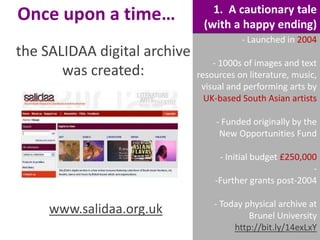
Once upon a time…
the SALIDAA digital archive
was created:

1. A cautionary tale
(with a happy ending)
- Launched in 2004

- 1000s of images and text
resources on literature, music,
visual and performing arts by
UK-based South Asian artists
- Funded originally by the
New Opportunities Fund
- Initial budget £250,000
-Further grants post-2004

www.salidaa.org.uk

- Today physical archive at
Brunel University
http://bit.ly/14exLxY
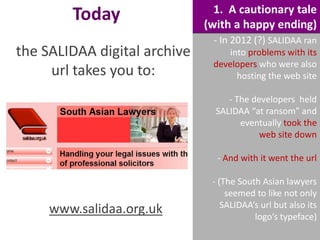
Today
the SALIDAA digital archive
url takes you to:

1. A cautionary tale
(with a happy ending)
- In 2012 (?) SALIDAA ran
into problems with its
developers who were also
hosting the web site
- The developers held
SALIDAA “at ransom” and
eventually took the
web site down
- And with it went the url

www.salidaa.org.uk

- (The South Asian lawyers
seemed to like not only
SALIDAA’s url but also its
logo’s typeface)
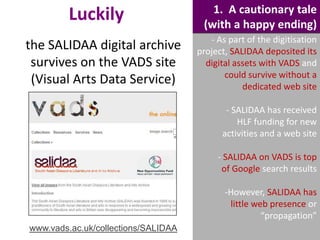
Luckily
the SALIDAA digital archive
survives on the VADS site
(Visual Arts Data Service)

1. A cautionary tale
(with a happy ending)
- As part of the digitisation
project, SALIDAA deposited its
digital assets with VADS and
could survive without a
dedicated web site
- SALIDAA has received
HLF funding for new
activities and a web site
- SALIDAA on VADS is top
of Google search results
-However, SALIDAA has
little web presence or
“propagation”

www.vads.ac.uk/collections/SALIDAA
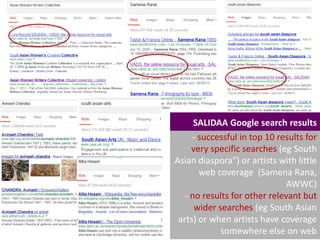
SALIDAA Google search results
- successful in top 10 results for
very specific searches (eg South
Asian diaspora”) or artists with little
web coverage (Samena Rana,
AWWC)
- no results for other relevant but
wider searches (eg South Asian
arts) or when artists have coverage
somewhere else on web
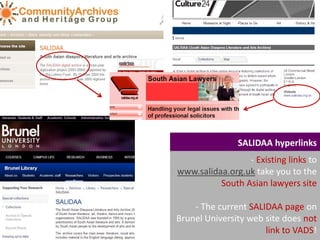
SALIDAA hyperlinks
- Existing links to
www.salidaa.org.uk take you to the
South Asian lawyers site
- The current SALIDAA page on
Brunel University web site does not
link to VADS!
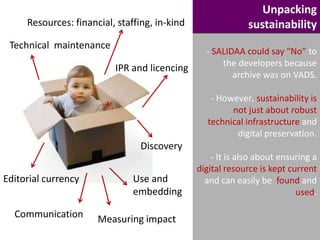
Resources: financial, staffing, in-kind
Technical maintenance
IPR and licencing

Unpacking
sustainability
- SALIDAA could say “No” to
the developers because
archive was on VADS.
- However, sustainability is
not just about robust
technical infrastructure and
digital preservation.

Discovery
Editorial currency
Communication

Use and
embedding
Measuring impact

- It is also about ensuring a
digital resource is kept current
and can easily be found and
used.
2. Some facts and figures
Digitisation and post-digitisation context
The majority of UK Higher Education research libraries (RLUK
members) have engaged in digitisation projects
•

97% of respondents to a recent RLUK-OCLC survey have completed at
least one special collections digitisation project and/or have an active
digitisation programme that includes special collections

•

40% can undertake projects only with special funding, while one-third
have a recurring budget for digitisation

•

More than 40% have licensing contracts with commercial vendors to
digitise materials and sell access.
Digitisation and post-digitisation context
Special collections are recognised as strategically important to
institutions
•

“special collections and archives play a key role in differentiating each
institution from its peers” (RLUK p15)

•

“over 80% [of respondents] agreed that digitized special collections are
critical to our current strategic direction” (ARL)
Digitisation and post-digitisation context
However, not much is known about users and how collections
are being used
•

Although overall use of special collections (not just digitised) by all types
of users has increased, 90% of user “type” is not known (RLUK p16)

•

Outreach and fundraising , among others, identified as biggest
challenges and areas where staff are in need of training (RLUK p16)

•

No established metrics for assessing user services (RLUK p16)

•

Once collections have been digitised, little investment is made in
understanding the needs of audiences: 43% of libraries gather analytics
but far less conduct any qualitative research (ARL)
Digitisation and post-digitisation context
Sustainability of digitised collections still relies on fairly
traditional models
•

Many projects draw support from host institution typically for storage,
preservation, access, but this is not budgeted or guaranteed (SCA-Ithaka
p4)

•

No much effort or budget goes towards enhancement of resources
created (ARL p2)

•

No much effort goes towards revenue generation activities (SCA-Ithaka
p4) often seen in conflict with institutional/open mission (ARL p24)

•

Revenue generation activities (eg content licencing or print on
demand), gain only on average 21% of the total cost of maintaining the
collection in the previous year, median only 10% (ARL p27)
Digitisation and post-digitisation context:
useful publications
• Survey of Special Collections and Archives in the United Kingdom
and Ireland. http://bit.ly/11IjKHa
RLUK-OCLC, 2013
• Sustaining our Digital Future: Institutional Strategies for Digital
Content. http://bit.ly/11Ijrfr
Jisc/SCA-Ithaka S+R, 2013
• Appraising our Digital Investment: Sustainability of Digitized Special
Collections in ARL [Association of Research Libraries]
http://bit.ly/11IjQOT
Ithaka S+R, 2013
More publications on sustainability and business models from
Jisc/SCA at http://bit.ly/120ABEI
3. Some good examples
Sustainability: revenues

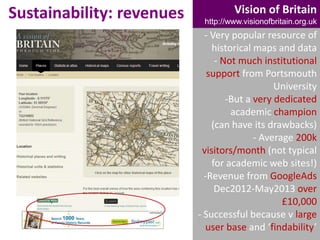
Vision of Britain
http://www.visionofbritain.org.uk

- Very popular resource of
historical maps and data
- Not much institutional
support from Portsmouth
University
-But a very dedicated
academic champion
(can have its drawbacks)
- Average 200k
visitors/month (not typical
for academic web sites!)
-Revenue from GoogleAds
Dec2012-May2013 over
£10,000
- Successful because v large
user base and ‘findability’
Sustainability: revenues

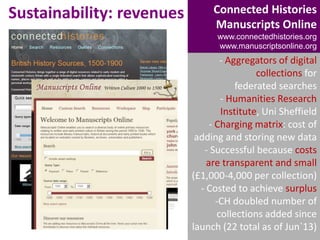
Connected Histories
Manuscripts Online
www.connectedhistories.org
www.manuscriptsonline.org

- Aggregators of digital
collections for
federated searches
- Humanities Research
Institute, Uni Sheffield
- Charging matrix: cost of
adding and storing new data
- Successful because costs
are transparent and small
(£1,000-4,000 per collection)
- Costed to achieve surplus
-CH doubled number of
collections added since
launch (22 total as of Jun`13)
Sustainability: discovery

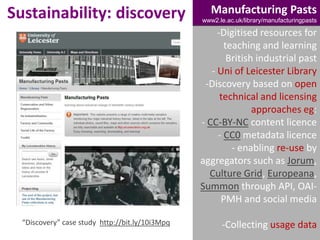
Manufacturing Pasts
www2.le.ac.uk/library/manufacturingpasts

-Digitised resources for
teaching and learning
British industrial past
- Uni of Leicester Library
-Discovery based on open
technical and licensing
approaches eg:
- CC-BY-NC content licence
- CC0 metadata licence
- enabling re-use by
aggregators such as Jorum,
Culture Grid, Europeana,
Summon through API, OAIPMH and social media
“Discovery” case study http://bit.ly/10i3Mpq

-Collecting usage data
Sustainability: discovery

Social media
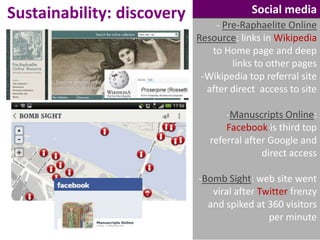
- Pre-Raphaelite Online
Resource: links in Wikipedia
to Home page and deep
links to other pages
-Wikipedia top referral site
after direct access to site
-Manuscripts Online:
Facebook is third top
referral after Google and
direct access
-Bomb Sight: web site went
viral after Twitter frenzy
and spiked at 360 visitors
per minute
Sustainability: impact

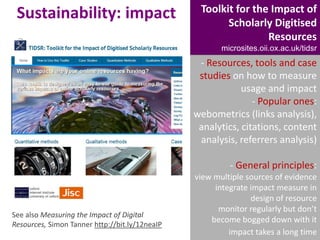
Toolkit for the Impact of
Scholarly Digitised
Resources
microsites.oii.ox.ac.uk/tidsr

- Resources, tools and case
studies on how to measure
usage and impact
- Popular ones:
webometrics (links analysis),
analytics, citations, content
analysis, referrers analysis)
- General principles:

See also Measuring the Impact of Digital
Resources, Simon Tanner http://bit.ly/12neaIP

view multiple sources of evidence
integrate impact measure in
design of resource
monitor regularly but don’t
become bogged down with it
impact takes a long time
Thank you
Paola Marchionni
p.marchionni@jisc.ac.uk
@paolamarchionni

Image credit cover slide http://www.l2l-edu.com/2013/01/every-end-is-new-beginning.html
Slide 10: http://moving.about.com/b/2007/03/14/are-you-tired-of-unpacking.htm

The end is the beginning: the challenges of digital resources post-digitisation

  • 1.
    The end isthe beginning: the challenges of digital resources post-digitisation Paola Marchionni, Programme Manager Digitisation p.marchionni@jisc.ac.uk @paolamarchionni
  • 2.
    The end ofa digitisation project marks the beginning of the public life of a digital resource. That’s why it’s important to plan for its sustainability as part of the development of the project. But what is sustainability all about? What are the challenges?
  • 3.
    1. A cautionarytale (with a happy ending) 2. Some facts & figures 3. Some good examples
  • 4.
    1. A cautionarytale (with a happy ending)
  • 5.
    Once upon atime… the SALIDAA digital archive was created: 1. A cautionary tale (with a happy ending) - Launched in 2004 - 1000s of images and text resources on literature, music, visual and performing arts by UK-based South Asian artists - Funded originally by the New Opportunities Fund - Initial budget £250,000 -Further grants post-2004 www.salidaa.org.uk - Today physical archive at Brunel University http://bit.ly/14exLxY
  • 6.
    Today the SALIDAA digitalarchive url takes you to: 1. A cautionary tale (with a happy ending) - In 2012 (?) SALIDAA ran into problems with its developers who were also hosting the web site - The developers held SALIDAA “at ransom” and eventually took the web site down - And with it went the url www.salidaa.org.uk - (The South Asian lawyers seemed to like not only SALIDAA’s url but also its logo’s typeface)
  • 7.
    Luckily the SALIDAA digitalarchive survives on the VADS site (Visual Arts Data Service) 1. A cautionary tale (with a happy ending) - As part of the digitisation project, SALIDAA deposited its digital assets with VADS and could survive without a dedicated web site - SALIDAA has received HLF funding for new activities and a web site - SALIDAA on VADS is top of Google search results -However, SALIDAA has little web presence or “propagation” www.vads.ac.uk/collections/SALIDAA
  • 8.
    SALIDAA Google searchresults - successful in top 10 results for very specific searches (eg South Asian diaspora”) or artists with little web coverage (Samena Rana, AWWC) - no results for other relevant but wider searches (eg South Asian arts) or when artists have coverage somewhere else on web
  • 9.
    SALIDAA hyperlinks - Existinglinks to www.salidaa.org.uk take you to the South Asian lawyers site - The current SALIDAA page on Brunel University web site does not link to VADS!
  • 10.
    Resources: financial, staffing,in-kind Technical maintenance IPR and licencing Unpacking sustainability - SALIDAA could say “No” to the developers because archive was on VADS. - However, sustainability is not just about robust technical infrastructure and digital preservation. Discovery Editorial currency Communication Use and embedding Measuring impact - It is also about ensuring a digital resource is kept current and can easily be found and used.
  • 11.
    2. Some factsand figures
  • 12.
    Digitisation and post-digitisationcontext The majority of UK Higher Education research libraries (RLUK members) have engaged in digitisation projects • 97% of respondents to a recent RLUK-OCLC survey have completed at least one special collections digitisation project and/or have an active digitisation programme that includes special collections • 40% can undertake projects only with special funding, while one-third have a recurring budget for digitisation • More than 40% have licensing contracts with commercial vendors to digitise materials and sell access.
  • 13.
    Digitisation and post-digitisationcontext Special collections are recognised as strategically important to institutions • “special collections and archives play a key role in differentiating each institution from its peers” (RLUK p15) • “over 80% [of respondents] agreed that digitized special collections are critical to our current strategic direction” (ARL)
  • 14.
    Digitisation and post-digitisationcontext However, not much is known about users and how collections are being used • Although overall use of special collections (not just digitised) by all types of users has increased, 90% of user “type” is not known (RLUK p16) • Outreach and fundraising , among others, identified as biggest challenges and areas where staff are in need of training (RLUK p16) • No established metrics for assessing user services (RLUK p16) • Once collections have been digitised, little investment is made in understanding the needs of audiences: 43% of libraries gather analytics but far less conduct any qualitative research (ARL)
  • 15.
    Digitisation and post-digitisationcontext Sustainability of digitised collections still relies on fairly traditional models • Many projects draw support from host institution typically for storage, preservation, access, but this is not budgeted or guaranteed (SCA-Ithaka p4) • No much effort or budget goes towards enhancement of resources created (ARL p2) • No much effort goes towards revenue generation activities (SCA-Ithaka p4) often seen in conflict with institutional/open mission (ARL p24) • Revenue generation activities (eg content licencing or print on demand), gain only on average 21% of the total cost of maintaining the collection in the previous year, median only 10% (ARL p27)
  • 16.
    Digitisation and post-digitisationcontext: useful publications • Survey of Special Collections and Archives in the United Kingdom and Ireland. http://bit.ly/11IjKHa RLUK-OCLC, 2013 • Sustaining our Digital Future: Institutional Strategies for Digital Content. http://bit.ly/11Ijrfr Jisc/SCA-Ithaka S+R, 2013 • Appraising our Digital Investment: Sustainability of Digitized Special Collections in ARL [Association of Research Libraries] http://bit.ly/11IjQOT Ithaka S+R, 2013 More publications on sustainability and business models from Jisc/SCA at http://bit.ly/120ABEI
  • 17.
    3. Some goodexamples
  • 18.
    Sustainability: revenues Vision ofBritain http://www.visionofbritain.org.uk - Very popular resource of historical maps and data - Not much institutional support from Portsmouth University -But a very dedicated academic champion (can have its drawbacks) - Average 200k visitors/month (not typical for academic web sites!) -Revenue from GoogleAds Dec2012-May2013 over £10,000 - Successful because v large user base and ‘findability’
  • 19.
    Sustainability: revenues Connected Histories ManuscriptsOnline www.connectedhistories.org www.manuscriptsonline.org - Aggregators of digital collections for federated searches - Humanities Research Institute, Uni Sheffield - Charging matrix: cost of adding and storing new data - Successful because costs are transparent and small (£1,000-4,000 per collection) - Costed to achieve surplus -CH doubled number of collections added since launch (22 total as of Jun`13)
  • 20.
    Sustainability: discovery Manufacturing Pasts www2.le.ac.uk/library/manufacturingpasts -Digitisedresources for teaching and learning British industrial past - Uni of Leicester Library -Discovery based on open technical and licensing approaches eg: - CC-BY-NC content licence - CC0 metadata licence - enabling re-use by aggregators such as Jorum, Culture Grid, Europeana, Summon through API, OAIPMH and social media “Discovery” case study http://bit.ly/10i3Mpq -Collecting usage data
  • 21.
    Sustainability: discovery Social media -Pre-Raphaelite Online Resource: links in Wikipedia to Home page and deep links to other pages -Wikipedia top referral site after direct access to site -Manuscripts Online: Facebook is third top referral after Google and direct access -Bomb Sight: web site went viral after Twitter frenzy and spiked at 360 visitors per minute
  • 22.
    Sustainability: impact Toolkit forthe Impact of Scholarly Digitised Resources microsites.oii.ox.ac.uk/tidsr - Resources, tools and case studies on how to measure usage and impact - Popular ones: webometrics (links analysis), analytics, citations, content analysis, referrers analysis) - General principles: See also Measuring the Impact of Digital Resources, Simon Tanner http://bit.ly/12neaIP view multiple sources of evidence integrate impact measure in design of resource monitor regularly but don’t become bogged down with it impact takes a long time
  • 23.
    Thank you Paola Marchionni p.marchionni@jisc.ac.uk @paolamarchionni Imagecredit cover slide http://www.l2l-edu.com/2013/01/every-end-is-new-beginning.html Slide 10: http://moving.about.com/b/2007/03/14/are-you-tired-of-unpacking.htm

Editor's Notes

  • #6 New Opportunity Fund (later Big Lottery Fund): UK-wide programme £50m, launched in 1999, with most projects terminating in 2004. Total of 148 projects.
  • #12 SALIDAA has very little web presence. The Brunel web page does not mention, or link to, the VADS web site, and describes the archive as available for visits only during certain times.A couple of links to the SALIDAA web site from Culture24 http://www.culture24.org.uk/am24149 and the Community Archives and Heritage Group http://www.communityarchives.org.uk/page_id__15_path__0p2p13p.aspx take you to the South Asian lawyers web site.
  • #13 Survey of Special Collections and Archives in the United Kingdom and Ireland. http://bit.ly/11IjKHa p18
  • #17 RLUK-OCLC survey: 122 academic and research libraries with significant special collections received invitations to participate in the survey. The rate of response was 67% (82 responses), including 100% of RLUK members.ARL (ARL): total of 202 respondents in ARL institutions (covering different roles). ARL includes 125 research libraries from institutions in Canada and the USASCA-Ithaka: interviewed 84 individuals in HE and heritage sector and 3 case studies: UCL, NLW and Imperial War Museum