Positive PR for Principals
AWSA Conference
February 5, 2012
Kevin Hickman – JP Cullen
Debbie Brewster – DeForest Area School District
Kate Winckler – CESA 6
Why is Positive PR Important?
• Schools with great reputations
have made a commitment to
communication
• The commitment begins with you
• If you don’t tell your school’s story,
who will?
• It becomes part of your staff,
school and parent culture
Today’s Topics
Community Engagement and Leadership
Building a Network of Support
Marketing Tips for Positive PR in Your School
Creating Connections with Social Media
Three Thresholds of Successful
Community Engagement
• Make your targets aware there really is a
challenge
• Answer your colleagues’ questions – all of them
• Create a clear sense of urgency for your
partners to take action
Q: What are your challenges?
Six Keys to Successful Community
Engagement
• Be a leader first
• Interact early and often
• Make it easy to participate
• Welcome newbies to the process
• Reward positive contributors
• Tap into existing networks
Q: What key is most critical?
Be a leader first
• Have patience and tact
• Develop a thick skin
• Exercise compassion and tolerance
• Be passionate
Q: Are you being a leader?
Q: How do you interact?
Interact Early and Often
• Multiply effort
• Encourage discussion
• Don’t ignore
• Timely follow up
• One-on-one contact
Q: Do you make it easy?
Make it easy to participate
• Invite ideas
• Go to them
• Utilize familiar tools
• Avoid unnecessary change
Q: How welcoming are you?
Welcome Newbies to the Process
• Make beneficial introductions
• Call out good ideas
• Diversify opinions
• Avoid groupthink traps
Q: How do you encourage?
Reward and Encourage Positive Contributors
• Leadership roles on committees
• Public recognition
• Tell their story to others
Q: Have you asked for help?
Tap Into Existing Networks
• Colleagues
• Booster clubs
• Civic
• Mom’s clubs
• Parent / Teacher
Building a network of support
• Form a Key Communicator Group
– Who is in your group?
– Network of informal leaders
who establish solid two-way communications
– Not necessarily your most visible leaders
Why small groups work
• Disseminate accurate information
• Correct misinformation
• Source of input
• Builds support (grapevine)
• Personal face-to-face contact
The power of word of mouth
• Internal stakeholders
• Staff (teachers, assistants, office,
substitutes)
• Volunteers
Encouraging positive PR from staff
• Front office staff are often the first
impression a parent, media, or business
person will have
• Consider customer service training for staff
who answer the phone and greet visitors
Possible Channels of Sending
Communication
Meetings
Newsletters
Social media
Face-to-face
Committees
Web site
News Releases
Video
Blogs
E-mail
E-newsletters
Phone calls/texts
Robo-calls
Possible Channels to Receive
Communication
• “Contact Us” – set protocol to
respond
• Face-to-Face meetings
• Surveys
• Focus groups (key communicators)
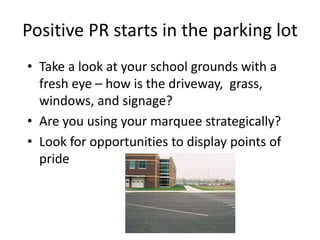
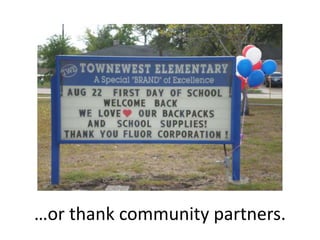
Positive PR starts in the parking lot
• Take a look at your school grounds with a
fresh eye – how is the driveway, grass,
windows, and signage?
• Are you using your marquee strategically?
• Look for opportunities to display points of
pride
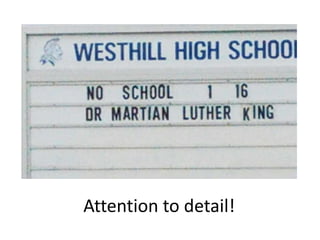
Attention to detail!
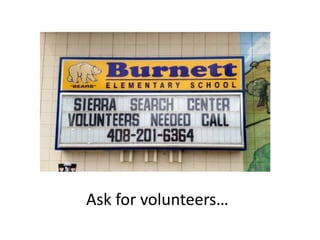
Ask for volunteers…
…or thank community partners.
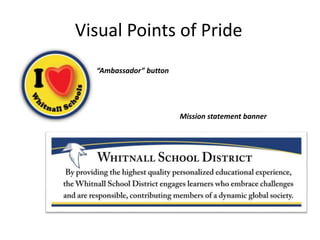
Visual Points of Pride
“Ambassador” button
Mission statement banner
Communications Worksheet here
5 Marketing tools for positive PR
1. Up-to-date web pages
2. Principal newsletter: short articles, digital
photos about life at your school
3. Newsletter: email or printed (or both)
4. Brochures and flyers
5. Short, fun videos about celebrations,
student projects, or staff highlights
Media Relations
• Local media is hungry for good information
• Put area newspapers and newsrooms on your
e-mail list
• Send copies of school newsletters, flyers, press
releases, and bulletins to the community's
newspaper editors
• Invite media to be guests at key school
functions
Use content efficiently
• Re-purpose content for each
communication channel
• For example: re-use principal
newsletter for a newspaper column
or press release
• Or, use a principal newsletter to
create a few Facebook posts, a link
on Twitter, or for a parent
e-newsletter article.
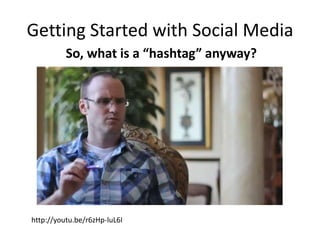
Getting Started with Social Media
So, what is a “hashtag” anyway?
http://youtu.be/r6zHp-luL6I
Creating Connections with
Social Media
• Facebook: create engagement with useful,
interesting information
• Twitter: “trend” fast-moving news in your
district in short bursts
• Email: Key tool to build credibility with
parents, staff and community supporters
• Text: Quickly connect with students and
parents
Developing content for social media
• Start with your school calendar
• Add special events, celebrations, seasonal or
holiday topics
• Write is on a content calendar – a simple
spreadsheet or Word doc
• Best practice: Spend 2-3 hrs /week on social
media, post 3-5 times per week
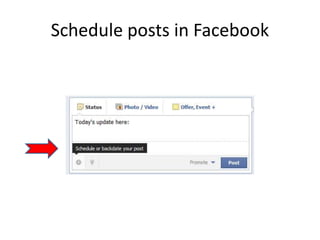
Schedule posts in Facebook
Three Twitter Takeaways
Wisconsin Educators on Twitter:
http://tiny.cc/WIeducators
CESA 6 Twitter for PLC and How-To’s (click on Resources tab):
http://tiny.cc/socialadmin
CESA 6 How to send texts via Twitter:
http://tiny.cc/socialadmin
(click on Text from Twitter on left nav)
In Summary…
• Share the facts
• Avoid jargon-talk about real impact on real kids,
teachers and your community
• Listen
• K.I.S.S. - 3 talking points
• Encourage 2-way engagement with marketing and
social media tools
Open, honest, direct, regular communication
is always the best practice!
Resources:
www.wspra.org
 Communications Plan Worksheet
 CESA 6 Communications Plan brochure
 Sample social media content planner
 WSPRA Spring Conference – Community Engagement – March 8

Positive PR for Principals

  • 1.
    Positive PR forPrincipals AWSA Conference February 5, 2012 Kevin Hickman – JP Cullen Debbie Brewster – DeForest Area School District Kate Winckler – CESA 6
  • 2.
    Why is PositivePR Important? • Schools with great reputations have made a commitment to communication • The commitment begins with you • If you don’t tell your school’s story, who will? • It becomes part of your staff, school and parent culture
  • 3.
    Today’s Topics Community Engagementand Leadership Building a Network of Support Marketing Tips for Positive PR in Your School Creating Connections with Social Media
  • 4.
    Three Thresholds ofSuccessful Community Engagement • Make your targets aware there really is a challenge • Answer your colleagues’ questions – all of them • Create a clear sense of urgency for your partners to take action Q: What are your challenges?
  • 5.
    Six Keys toSuccessful Community Engagement • Be a leader first • Interact early and often • Make it easy to participate • Welcome newbies to the process • Reward positive contributors • Tap into existing networks Q: What key is most critical?
  • 6.
    Be a leaderfirst • Have patience and tact • Develop a thick skin • Exercise compassion and tolerance • Be passionate Q: Are you being a leader?
  • 7.
    Q: How doyou interact? Interact Early and Often • Multiply effort • Encourage discussion • Don’t ignore • Timely follow up • One-on-one contact
  • 8.
    Q: Do youmake it easy? Make it easy to participate • Invite ideas • Go to them • Utilize familiar tools • Avoid unnecessary change
  • 9.
    Q: How welcomingare you? Welcome Newbies to the Process • Make beneficial introductions • Call out good ideas • Diversify opinions • Avoid groupthink traps
  • 10.
    Q: How doyou encourage? Reward and Encourage Positive Contributors • Leadership roles on committees • Public recognition • Tell their story to others
  • 11.
    Q: Have youasked for help? Tap Into Existing Networks • Colleagues • Booster clubs • Civic • Mom’s clubs • Parent / Teacher
  • 12.
    Building a networkof support • Form a Key Communicator Group – Who is in your group? – Network of informal leaders who establish solid two-way communications – Not necessarily your most visible leaders
  • 13.
    Why small groupswork • Disseminate accurate information • Correct misinformation • Source of input • Builds support (grapevine) • Personal face-to-face contact
  • 14.
    The power ofword of mouth • Internal stakeholders • Staff (teachers, assistants, office, substitutes) • Volunteers
  • 15.
    Encouraging positive PRfrom staff • Front office staff are often the first impression a parent, media, or business person will have • Consider customer service training for staff who answer the phone and greet visitors
  • 16.
    Possible Channels ofSending Communication Meetings Newsletters Social media Face-to-face Committees Web site News Releases Video Blogs E-mail E-newsletters Phone calls/texts Robo-calls
  • 17.
    Possible Channels toReceive Communication • “Contact Us” – set protocol to respond • Face-to-Face meetings • Surveys • Focus groups (key communicators)
  • 18.
    Positive PR startsin the parking lot • Take a look at your school grounds with a fresh eye – how is the driveway, grass, windows, and signage? • Are you using your marquee strategically? • Look for opportunities to display points of pride
  • 19.
  • 20.
  • 21.
  • 22.
    Visual Points ofPride “Ambassador” button Mission statement banner
  • 23.
  • 24.
    5 Marketing toolsfor positive PR 1. Up-to-date web pages 2. Principal newsletter: short articles, digital photos about life at your school 3. Newsletter: email or printed (or both) 4. Brochures and flyers 5. Short, fun videos about celebrations, student projects, or staff highlights
  • 25.
    Media Relations • Localmedia is hungry for good information • Put area newspapers and newsrooms on your e-mail list • Send copies of school newsletters, flyers, press releases, and bulletins to the community's newspaper editors • Invite media to be guests at key school functions
  • 26.
    Use content efficiently •Re-purpose content for each communication channel • For example: re-use principal newsletter for a newspaper column or press release • Or, use a principal newsletter to create a few Facebook posts, a link on Twitter, or for a parent e-newsletter article.
  • 27.
    Getting Started withSocial Media So, what is a “hashtag” anyway? http://youtu.be/r6zHp-luL6I
  • 28.
    Creating Connections with SocialMedia • Facebook: create engagement with useful, interesting information • Twitter: “trend” fast-moving news in your district in short bursts • Email: Key tool to build credibility with parents, staff and community supporters • Text: Quickly connect with students and parents
  • 29.
    Developing content forsocial media • Start with your school calendar • Add special events, celebrations, seasonal or holiday topics • Write is on a content calendar – a simple spreadsheet or Word doc • Best practice: Spend 2-3 hrs /week on social media, post 3-5 times per week
  • 30.
  • 31.
    Three Twitter Takeaways WisconsinEducators on Twitter: http://tiny.cc/WIeducators CESA 6 Twitter for PLC and How-To’s (click on Resources tab): http://tiny.cc/socialadmin CESA 6 How to send texts via Twitter: http://tiny.cc/socialadmin (click on Text from Twitter on left nav)
  • 32.
    In Summary… • Sharethe facts • Avoid jargon-talk about real impact on real kids, teachers and your community • Listen • K.I.S.S. - 3 talking points • Encourage 2-way engagement with marketing and social media tools Open, honest, direct, regular communication is always the best practice!
  • 33.
    Resources: www.wspra.org  Communications PlanWorksheet  CESA 6 Communications Plan brochure  Sample social media content planner  WSPRA Spring Conference – Community Engagement – March 8

Editor's Notes

  • #3 Source for bullet #1 - (source: Rich Bagin, (NSPRA) Tell your story, before someone else does! PR professionals take a proactive stance. PR professionals anticipate problems and provide solutions. Good communication is like a friendship - morale is high, parents are involved, and students have a real sense of pride. Particularly critical to cultivate good two-way communication BEFORE making a big change, or before a crisis hits. Such as: An issue, decision or crisis has inflamed the community New media environment Public scrutiny about budgets and financial pressures Referendum or bond issues Education is under attack
  • #4 Please feel free to ask questions, and share what has worked or hasn’t worked at your schools
  • #13 Move to after Kevin’s
  • #14 You keep them informed about what’s going on, and you want them to tell you about rumblings in the community, questions that many people seem to be asking or rumors that are flying. What? . . . Recent examples: 8th grade parents wondering about Formative and Summative Grading at high school level Vet ideas, new initiatives Ex: calendar (early release days; pt conferences)
  • #15 Staff and teachers are your neighbors and friends Give them accurate, simple talking points Refer to key messages on worksheet – K.I.S.S.
  • #16 How long does it take to get through on the phone? Phone etiquette WSPRA customer service training pitch here Spirit wear shows school pride, buttons, etc.
  • #19 Three examples: Misspelling on a sign marquee Kettle Moraine – flags on sign poles around town Whitnall School District – banner with mission statement hung in school board room and in commons
  • #22 News story – www.biddingforgood.com – school wil raffle off marquee space for a fee, you can post a special message to an athlete or student. http://www.biddingforgood.com/auction/item/Item.action;jsessionid=y3FeskVCWmT8IKvIuU2a1g**.app2?id=183839252
  • #23 Put Whitnall banner image here and we love whitnall button here. Hangs in room where board meetings are held/videotaped. Could also be put in commons areas or hung outside a building.
  • #25 Make your website work really hard for you – train people to go there for info Make it easy – if you don’t have a support person to help you, download a Microsoft Word or Publisher template, and make it 1-2 pages long to get started. Ask staff for input to contribute content. “Guest contributor” on a specific topic or initiative. Example – “Math Minute” series, or series about Reading from Reading specialist. PBIS, testing, special education, etc. Parents like short, newsy articles, calendars, and information about everyday learning as well as family nights, field trips, etc. Allocate some money in your budget for digital camera and a video camera. Or encourage staff to take video using their cell phone. Video – use cable access channel? High school level – student produced videos? Could work with local businesses to create a “commercial.” Brochures and flyers can be for open enrollment “about us” type of fact sheets, or for special events, like a referendum.
  • #26 Big scary words, but it can be as simple as… Greendale story – Middle School Technology-free challenge; good coverage by Fox 6
  • #27 Get the most mileage from your content DEBBIE – here Give example: re-use superintendent newspaper column or press release for a few Facebook posts or for a parent e-newsletter article. (I consistently repurpose press releases (and superintendent newspaper columns) into our blog, and many times post on our website and/or Facebook -- if you would like me to give that as an example.) DO NOT copy and paste the entire press release onto your Facebook page!
  • #29 Many are tempted to jump right into social media, without a plan for content. Then they wonder why they have low engagement. Social media creates engagement. It is a tactic, not a strategy. But you still need to be intentional about social media. Add notes about Pinterest, Instagram, Twitter for PLC, Twitter for texting, Tumblr and blogs
  • #30 Show example of Menasha social media content calendar Link to other news outlets who cover your school (Patch, local internet news sites, etc.)
  • #31 Use tools like Tweet Deck or Hootsuite to schedule content If you are an administrator of a Facebook page, you can schedule posts ahead of time.
  • #32 WI Principals on Twitter: http://tiny.cc/Wieducators Note: the short how-to video uses Brown Deer School District as an example, but you can just substitute your own or your school’s Twitter handle. 3rd resource is same link as above