Cougar Pride Positive
Behavior Support
System
Luke Nyegaard
EL 5053 Community Engagement, Outreach, and Collaboration
3/18/18
OUR PARTNERS IN THE
COMMUNITY
We welcome and need you!
YOU make the difference!
We need your help and involvement:
• You will be provided the proper training, we need your time.
• Provide mentorship to our students.
• Provide role model training to our students.
• Provide tutoring to our students.
• Be a positive influence to our students.
What Student’s Need: Data backed
evidence.
Positive Behavior Support System (PBSS)/Community
Mentorship Program
 The best and most sufficient means of preventing student behavior
problems, is through implementing a Positive Behavior Support
System (Hawken & Johnston, 2007).
 Our student’s performance on End of Course (EOC) exams, college
entrance exams such as the ACT and SAT, state tests such as HSAP
and WorkKeys have maintained a constant overall percentage score
or declined. We have not seen a rise in our students overall
performance.
 We are consistently seeing an increase in our methods of punitive
discipline such as Out of School (OSS) and In School (ISS)
Suspensions.
 We have seen up to a 24 % increase in student discipline/behavior
referrals and classroom management issues.
The Partnership
Vision
 Increase our student’s achievement.
 Develop, grow and maintain relationships, with our
students, that are meaningful and positive so to reduce
and even eliminate our issues with discipline.
 Develop a hand in hand working relationship between our
Positive Behavior Support System (PBSS) and our
community volunteer/student mentoring program.
 Implement an active, successful (PBSS) that involves our
school stakeholders.
Student Achievement
Impact
Let’s look at how this works:
Reduce or eliminate the management issues dealing with
behavior as well as reduce punitive discipline (ISS/OSS)
+
Active community involvement and active parent/guardian
involvement
=
Positive, more improved student achievement on college entry
exams, standardized state exams, and school/local assessments
performance on standardized, college entry, and local level
assessments
Our Proposed Strategies and
Activities
 In order to promote and build character
development skills, along with emotional/social
skills, will promote the Positive Action program
recognized to reduce those student behaviors
causing a learning interference and behavioral
issues.
 Caring School Community will drive and promote
productive student social behavior and positive core
values producing an atmosphere of community and
pride throughout our school.
The Process of
Implementation
 Design and create a set of guidelines to direct the PBSS and
community mentor program.
 Select and contact the needed stakeholders acquiring their
participation in the creation process.
 Locate, interview, and train quality mentors (teachers, coaches,
parents, pastors, community stakeholders, faculty, etc…)
 Begin the professional development series, implementing the
program to the teachers and faculty throughout the school.
 Monitor, track and analyze all needed data results.
Timeline, Responsibilities,
and Personnel
• R. Poston- Administrator in Charge
• June/July/August 2018
Draft and Create the PBSS
and Behavioral Support
Matrix
• C. Bolin (Director of District Wide Technology Center)-
Administrator in Charge
• June/July/August 2018
Recruitment of Mentors
• D. Farris and R. Poston – Administrators in Charge
• July/August 2018 Training (initial)
• September 2018 to May 2019 (Monthly Professional Development)
Provide Professional
Development (PD) and
Training for all Necessary
Personnel
• L. Johnson Davis (Testing/Curriculum Coordinator)-Administrator in
Charge
• T. Ray (Data analyzation)- Administrator in Charge
• August 2018 to June 2019
Data Analyzation,
Coordination, and
Implementation
Needed Resources
OK… What resources do we need to
make this work?
We need people!
We need you!
People are the Resource we need to
make this work and improve our
Students!
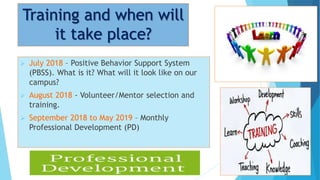
Training and when will
it take place?
 July 2018 – Positive Behavior Support System
(PBSS). What is it? What will it look like on our
campus?
 August 2018 - Volunteer/Mentor selection and
training.
 September 2018 to May 2019 – Monthly
Professional Development (PD)
The Process of Evaluation
 Monitor/Analyze Behavior and Discipline
 The number of student behavior referrals
 The type of student referral issued
 The amount of punitive (ISS/OSS) discipline issued
 The amount of time spent out of the classroom setting
 Monitor/Analyze Student Academic Achievement Data
 Classroom and local type of assessments (End of Course (EOC) exams)
 Standardized type tests (High School Assessment Program (HSAP) and
WorkKeys)
 College entrance exams (ACT/SAT)
 Monitor/Analyze/Adjust in order to improve the above
Audience Response… How can you help
and what can you do?
1) We need your help. Please consider helping us! We
need you to become an active member and
participate!
2) Talk to members of our community and ask them to
consider helping as well.
3) Encourage our students to buy into this process and
make our PBSS successful.
4) Be a reason our students and school experience
greatness!
References:
Hawken, L.S. & Johnston, S.S. (2007). Preventing Severe Problem
Behavior in Young Children: The Behavior Education Program.
Journal of Early and Intensive Behavior Intervention,
4 (3), 599-613.
York School District One. (2016). District Strategic Improvement Plan,
1-47.
What Works Clearinghouse. (2017). Caring School Community. Retrieved
from http://ies.ed.gov/ncee/wwc/pdf/intervention_reports/WWC
Caring_School_042307.pdf
What Works Clearinghouse. (2017). Positive Action. Retrieved from
http://ies.ed.gov/ncee/wwc/pdf/intervention_reports/WWC_
Positive_Action_042307.pdf

Positive Behavior Support System

  • 1.
    Cougar Pride Positive BehaviorSupport System Luke Nyegaard EL 5053 Community Engagement, Outreach, and Collaboration 3/18/18
  • 2.
    OUR PARTNERS INTHE COMMUNITY We welcome and need you! YOU make the difference! We need your help and involvement: • You will be provided the proper training, we need your time. • Provide mentorship to our students. • Provide role model training to our students. • Provide tutoring to our students. • Be a positive influence to our students.
  • 3.
    What Student’s Need:Data backed evidence. Positive Behavior Support System (PBSS)/Community Mentorship Program  The best and most sufficient means of preventing student behavior problems, is through implementing a Positive Behavior Support System (Hawken & Johnston, 2007).  Our student’s performance on End of Course (EOC) exams, college entrance exams such as the ACT and SAT, state tests such as HSAP and WorkKeys have maintained a constant overall percentage score or declined. We have not seen a rise in our students overall performance.  We are consistently seeing an increase in our methods of punitive discipline such as Out of School (OSS) and In School (ISS) Suspensions.  We have seen up to a 24 % increase in student discipline/behavior referrals and classroom management issues.
  • 4.
    The Partnership Vision  Increaseour student’s achievement.  Develop, grow and maintain relationships, with our students, that are meaningful and positive so to reduce and even eliminate our issues with discipline.  Develop a hand in hand working relationship between our Positive Behavior Support System (PBSS) and our community volunteer/student mentoring program.  Implement an active, successful (PBSS) that involves our school stakeholders.
  • 5.
    Student Achievement Impact Let’s lookat how this works: Reduce or eliminate the management issues dealing with behavior as well as reduce punitive discipline (ISS/OSS) + Active community involvement and active parent/guardian involvement = Positive, more improved student achievement on college entry exams, standardized state exams, and school/local assessments performance on standardized, college entry, and local level assessments
  • 6.
    Our Proposed Strategiesand Activities  In order to promote and build character development skills, along with emotional/social skills, will promote the Positive Action program recognized to reduce those student behaviors causing a learning interference and behavioral issues.  Caring School Community will drive and promote productive student social behavior and positive core values producing an atmosphere of community and pride throughout our school.
  • 7.
    The Process of Implementation Design and create a set of guidelines to direct the PBSS and community mentor program.  Select and contact the needed stakeholders acquiring their participation in the creation process.  Locate, interview, and train quality mentors (teachers, coaches, parents, pastors, community stakeholders, faculty, etc…)  Begin the professional development series, implementing the program to the teachers and faculty throughout the school.  Monitor, track and analyze all needed data results.
  • 8.
    Timeline, Responsibilities, and Personnel •R. Poston- Administrator in Charge • June/July/August 2018 Draft and Create the PBSS and Behavioral Support Matrix • C. Bolin (Director of District Wide Technology Center)- Administrator in Charge • June/July/August 2018 Recruitment of Mentors • D. Farris and R. Poston – Administrators in Charge • July/August 2018 Training (initial) • September 2018 to May 2019 (Monthly Professional Development) Provide Professional Development (PD) and Training for all Necessary Personnel • L. Johnson Davis (Testing/Curriculum Coordinator)-Administrator in Charge • T. Ray (Data analyzation)- Administrator in Charge • August 2018 to June 2019 Data Analyzation, Coordination, and Implementation
  • 9.
    Needed Resources OK… Whatresources do we need to make this work? We need people! We need you! People are the Resource we need to make this work and improve our Students!
  • 10.
    Training and whenwill it take place?  July 2018 – Positive Behavior Support System (PBSS). What is it? What will it look like on our campus?  August 2018 - Volunteer/Mentor selection and training.  September 2018 to May 2019 – Monthly Professional Development (PD)
  • 11.
    The Process ofEvaluation  Monitor/Analyze Behavior and Discipline  The number of student behavior referrals  The type of student referral issued  The amount of punitive (ISS/OSS) discipline issued  The amount of time spent out of the classroom setting  Monitor/Analyze Student Academic Achievement Data  Classroom and local type of assessments (End of Course (EOC) exams)  Standardized type tests (High School Assessment Program (HSAP) and WorkKeys)  College entrance exams (ACT/SAT)  Monitor/Analyze/Adjust in order to improve the above
  • 12.
    Audience Response… Howcan you help and what can you do? 1) We need your help. Please consider helping us! We need you to become an active member and participate! 2) Talk to members of our community and ask them to consider helping as well. 3) Encourage our students to buy into this process and make our PBSS successful. 4) Be a reason our students and school experience greatness!
  • 13.
    References: Hawken, L.S. &Johnston, S.S. (2007). Preventing Severe Problem Behavior in Young Children: The Behavior Education Program. Journal of Early and Intensive Behavior Intervention, 4 (3), 599-613. York School District One. (2016). District Strategic Improvement Plan, 1-47. What Works Clearinghouse. (2017). Caring School Community. Retrieved from http://ies.ed.gov/ncee/wwc/pdf/intervention_reports/WWC Caring_School_042307.pdf What Works Clearinghouse. (2017). Positive Action. Retrieved from http://ies.ed.gov/ncee/wwc/pdf/intervention_reports/WWC_ Positive_Action_042307.pdf