The Portuguese Empire History 140 Aaron Land
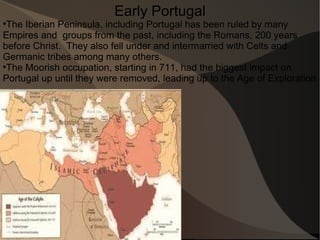
Early Portugal The Iberian Peninsula, including Portugal has been ruled by many Empires and  groups from the past, including the Romans, 200 years before Christ.  They also fell under and intermarried with Celts and Germanic tribes among many others.  The Moorish occupation, starting in 711, had the biggest impact on Portugal up until they were removed, leading up to the Age of Exploration
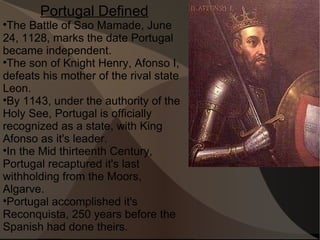
Portugal Defined The Battle of Sao Mamade, June 24, 1128, marks the date Portugal became independent.  The son of Knight Henry, Afonso I, defeats his mother of the rival state Leon.  By 1143, under the authority of the Holy See, Portugal is officially recognized as a state, with King Afonso as it's leader. In the Mid thirteenth Century, Portugal recaptured it's last withholding from the Moors, Algarve. Portugal accomplished it's Reconquista, 250 years before the Spanish had done theirs.
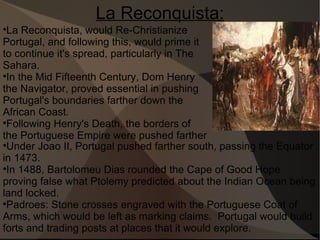
La Reconquista: La Reconquista, would Re-Christianize Portugal, and following this, would prime it to continue it's spread, particularly in The Sahara.  In the Mid Fifteenth Century, Dom Henry the Navigator, proved essential in pushing Portugal's boundaries farther down the African Coast. Following Henry's Death, the borders of the Portuguese Empire were pushed farther Under Joao II, Portugal pushed farther south, passing the Equator in 1473.  In 1488, Bartolomeu Dias rounded the Cape of Good Hope proving false what Ptolemy predicted about the Indian Ocean being land locked. Padroes: Stone crosses engraved with the Portuguese Coat of Arms, which would be left as marking claims.  Portugal would build forts and trading posts at places that it would explore.
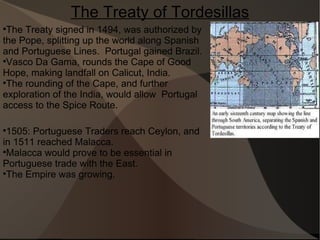
The Treaty of Tordesillas The Treaty signed in 1494, was authorized by the Pope, splitting up the world along Spanish and Portuguese Lines.  Portugal gained Brazil. Vasco Da Gama, rounds the Cape of Good Hope, making landfall on Calicut, India. The rounding of the Cape, and further exploration of the India, would allow  Portugal access to the Spice Route.  1505: Portuguese Traders reach Ceylon, and in 1511 reached Malacca. Malacca would prove to be essential in Portuguese trade with the East.  The Empire was growing.
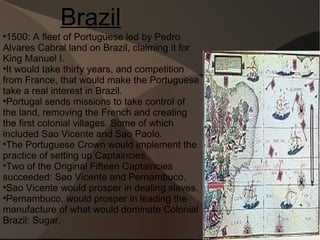
Brazil 1500: A fleet of Portuguese led by Pedro Alvares Cabral land on Brazil, claiming it for King Manuel I. It would take thirty years, and competition from France, that would make the Portuguese take a real interest in Brazil. Portugal sends missions to take control of the land, removing the French and creating the first colonial villages. Some of which included Sao Vicente and Sao Paolo. The Portuguese Crown would implement the practice of setting up Captaincies. Two of the Original Fifteen Captaincies succeeded: Sao Vicente and Pernambuco. Sao Vicente would prosper in dealing slaves. Pernambuco, would prosper in leading the manufacture of what would dominate Colonial Brazil: Sugar.
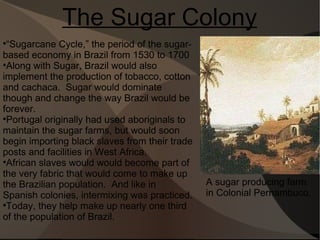
The Sugar Colony A sugar producing farm in Colonial Pernambuco. “ Sugarcane Cycle,” the period of the sugar-based economy in Brazil from 1530 to 1700 Along with Sugar, Brazil would also implement the production of tobacco, cotton and cachaca.  Sugar would dominate though and change the way Brazil would be forever. Portugal originally had used aboriginals to maintain the sugar farms, but would soon begin importing black slaves from their trade posts and facilities in West Africa. African slaves would would become part of the very fabric that would come to make up the Brazilian population.  And like in Spanish colonies, intermixing was practiced. Today, they help make up nearly one third of the population of Brazil.

Portugal

  • 1.
    The Portuguese EmpireHistory 140 Aaron Land
  • 2.
    Early Portugal TheIberian Peninsula, including Portugal has been ruled by many Empires and groups from the past, including the Romans, 200 years before Christ. They also fell under and intermarried with Celts and Germanic tribes among many others. The Moorish occupation, starting in 711, had the biggest impact on Portugal up until they were removed, leading up to the Age of Exploration
  • 3.
    Portugal Defined TheBattle of Sao Mamade, June 24, 1128, marks the date Portugal became independent. The son of Knight Henry, Afonso I, defeats his mother of the rival state Leon. By 1143, under the authority of the Holy See, Portugal is officially recognized as a state, with King Afonso as it's leader. In the Mid thirteenth Century, Portugal recaptured it's last withholding from the Moors, Algarve. Portugal accomplished it's Reconquista, 250 years before the Spanish had done theirs.
  • 4.
    La Reconquista: LaReconquista, would Re-Christianize Portugal, and following this, would prime it to continue it's spread, particularly in The Sahara. In the Mid Fifteenth Century, Dom Henry the Navigator, proved essential in pushing Portugal's boundaries farther down the African Coast. Following Henry's Death, the borders of the Portuguese Empire were pushed farther Under Joao II, Portugal pushed farther south, passing the Equator in 1473. In 1488, Bartolomeu Dias rounded the Cape of Good Hope proving false what Ptolemy predicted about the Indian Ocean being land locked. Padroes: Stone crosses engraved with the Portuguese Coat of Arms, which would be left as marking claims. Portugal would build forts and trading posts at places that it would explore.
  • 5.
    The Treaty ofTordesillas The Treaty signed in 1494, was authorized by the Pope, splitting up the world along Spanish and Portuguese Lines. Portugal gained Brazil. Vasco Da Gama, rounds the Cape of Good Hope, making landfall on Calicut, India. The rounding of the Cape, and further exploration of the India, would allow Portugal access to the Spice Route. 1505: Portuguese Traders reach Ceylon, and in 1511 reached Malacca. Malacca would prove to be essential in Portuguese trade with the East. The Empire was growing.
  • 6.
    Brazil 1500: Afleet of Portuguese led by Pedro Alvares Cabral land on Brazil, claiming it for King Manuel I. It would take thirty years, and competition from France, that would make the Portuguese take a real interest in Brazil. Portugal sends missions to take control of the land, removing the French and creating the first colonial villages. Some of which included Sao Vicente and Sao Paolo. The Portuguese Crown would implement the practice of setting up Captaincies. Two of the Original Fifteen Captaincies succeeded: Sao Vicente and Pernambuco. Sao Vicente would prosper in dealing slaves. Pernambuco, would prosper in leading the manufacture of what would dominate Colonial Brazil: Sugar.
  • 7.
    The Sugar ColonyA sugar producing farm in Colonial Pernambuco. “ Sugarcane Cycle,” the period of the sugar-based economy in Brazil from 1530 to 1700 Along with Sugar, Brazil would also implement the production of tobacco, cotton and cachaca. Sugar would dominate though and change the way Brazil would be forever. Portugal originally had used aboriginals to maintain the sugar farms, but would soon begin importing black slaves from their trade posts and facilities in West Africa. African slaves would would become part of the very fabric that would come to make up the Brazilian population. And like in Spanish colonies, intermixing was practiced. Today, they help make up nearly one third of the population of Brazil.