Big History Aaron Land
Greece: The Beginnings Ancient Greek society began the beginnings of Modern social order, civilized institutions, and rational thinking. Thales of Miletus (624-546 BC) used geometry to explain nature, using logic and science, rather than mythology.  6 th  Century BC : Politics and debate begin, philosophy and social order are questioned.  Thales: “Finding Order with nature, without Chaos.”  Institutions and their Effects Avoidance of chaos is managed by giving up things, and allowing institutions to set up systems of certainty.  Ritual Ex: Marriage Western Paradox: We eliminate change by setting rules, while also having institutions that teach us to question change. Buddhism: Contrary thinking, does not look for change. WEST VS EAST We are different, yet also similar.
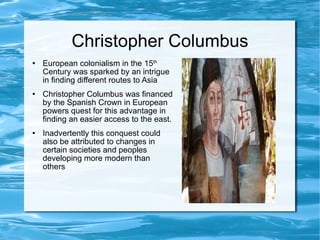
Christopher Columbus European colonialism in the 15 th  Century was sparked by an intrigue in finding different routes to Asia Christopher Columbus was financed by the Spanish Crown in European powers quest for this advantage in finding an easier access to the east. Inadvertently this conquest could also be attributed to changes in certain societies and peoples developing more modern than others
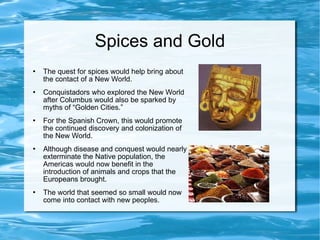
Spices and Gold The quest for spices would help bring about the contact of a New World. Conquistadors who explored the New World after Columbus would also be sparked by myths of “Golden Cities.” For the Spanish Crown, this would promote the continued discovery and colonization of the New World.  Although disease and conquest would nearly exterminate the Native population, the Americas would now benefit in the introduction of animals and crops that the Europeans brought. The world that seemed so small would now come into contact with new peoples.
Eastern VS Western In Papua New Guinea, farming never developed with the use domesticated animals as a source of muscle power.  Contributions to this can be attributed to European Colonialism that discovered other parts. Areas with farming techniques that are thousands of years old, and crops that lacked mass production, have not become modernized.  These societies in contrast to the West lack the “Cargo” that they described as things.
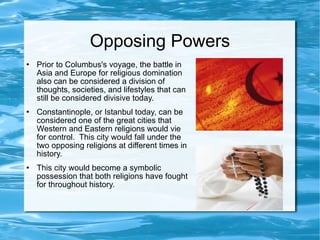
Opposing Powers Prior to Columbus's voyage, the battle in Asia and Europe for religious domination also can be considered a division of thoughts, societies, and lifestyles that can still be considered divisive today.  Constantinople, or Istanbul today, can be considered one of the great cities that Western and Eastern religions would vie for control.  This city would fall under the two opposing religions at different times in history.  This city would become a symbolic possession that both religions have fought for throughout history.
Similarities among differences Science and gene mapping have conjured up opposing views to the traditional thought of historical and societal differences among people.  Migrations have also been linked, and a better understanding has developed of the spread of man from Africa. Genes now can connect all people, a continuous flow of peoples and blending.
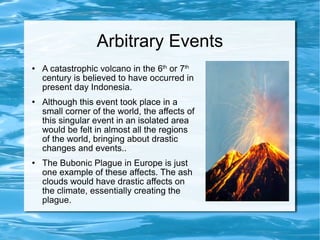
Arbitrary Events A catastrophic volcano in the 6 th  or 7 th  century is believed to have occurred in present day Indonesia.  Although this event took place in a small corner of the world, the affects of this singular event in an isolated area would be felt in almost all the regions of the world, bringing about drastic changes and events.. The Bubonic Plague in Europe is just one example of these affects. The ash clouds would have drastic affects on the climate, essentially creating the plague.
The Americas Affected Another affect of this once thought of isolated event, was major droughts in The Valley of Mexico during the reign of Teotihuacan.  The health of the population has proven to become jeopardized due to these climatic changes, possibly bringing chaos and uncertainty to their civilization.
The World Today History can be viewed as singular events that have shaped modern civilization, with events that created diverse societies, some to be considered more evolved and civilized than others. With globalization, less developed societies have become more integrated into the modern world, and with that comes a new urgency of finding common understandings and tolerance for those that are different.  As history has also shown, these events that in many instances seem arbitrary prove to be just the opposite, showing the inter connectedness that our world has.

Big history

  • 1.
  • 2.
    Greece: The BeginningsAncient Greek society began the beginnings of Modern social order, civilized institutions, and rational thinking. Thales of Miletus (624-546 BC) used geometry to explain nature, using logic and science, rather than mythology. 6 th Century BC : Politics and debate begin, philosophy and social order are questioned. Thales: “Finding Order with nature, without Chaos.” Institutions and their Effects Avoidance of chaos is managed by giving up things, and allowing institutions to set up systems of certainty. Ritual Ex: Marriage Western Paradox: We eliminate change by setting rules, while also having institutions that teach us to question change. Buddhism: Contrary thinking, does not look for change. WEST VS EAST We are different, yet also similar.
  • 3.
    Christopher Columbus Europeancolonialism in the 15 th Century was sparked by an intrigue in finding different routes to Asia Christopher Columbus was financed by the Spanish Crown in European powers quest for this advantage in finding an easier access to the east. Inadvertently this conquest could also be attributed to changes in certain societies and peoples developing more modern than others
  • 4.
    Spices and GoldThe quest for spices would help bring about the contact of a New World. Conquistadors who explored the New World after Columbus would also be sparked by myths of “Golden Cities.” For the Spanish Crown, this would promote the continued discovery and colonization of the New World. Although disease and conquest would nearly exterminate the Native population, the Americas would now benefit in the introduction of animals and crops that the Europeans brought. The world that seemed so small would now come into contact with new peoples.
  • 5.
    Eastern VS WesternIn Papua New Guinea, farming never developed with the use domesticated animals as a source of muscle power. Contributions to this can be attributed to European Colonialism that discovered other parts. Areas with farming techniques that are thousands of years old, and crops that lacked mass production, have not become modernized. These societies in contrast to the West lack the “Cargo” that they described as things.
  • 6.
    Opposing Powers Priorto Columbus's voyage, the battle in Asia and Europe for religious domination also can be considered a division of thoughts, societies, and lifestyles that can still be considered divisive today. Constantinople, or Istanbul today, can be considered one of the great cities that Western and Eastern religions would vie for control. This city would fall under the two opposing religions at different times in history. This city would become a symbolic possession that both religions have fought for throughout history.
  • 7.
    Similarities among differencesScience and gene mapping have conjured up opposing views to the traditional thought of historical and societal differences among people. Migrations have also been linked, and a better understanding has developed of the spread of man from Africa. Genes now can connect all people, a continuous flow of peoples and blending.
  • 8.
    Arbitrary Events Acatastrophic volcano in the 6 th or 7 th century is believed to have occurred in present day Indonesia. Although this event took place in a small corner of the world, the affects of this singular event in an isolated area would be felt in almost all the regions of the world, bringing about drastic changes and events.. The Bubonic Plague in Europe is just one example of these affects. The ash clouds would have drastic affects on the climate, essentially creating the plague.
  • 9.
    The Americas AffectedAnother affect of this once thought of isolated event, was major droughts in The Valley of Mexico during the reign of Teotihuacan. The health of the population has proven to become jeopardized due to these climatic changes, possibly bringing chaos and uncertainty to their civilization.
  • 10.
    The World TodayHistory can be viewed as singular events that have shaped modern civilization, with events that created diverse societies, some to be considered more evolved and civilized than others. With globalization, less developed societies have become more integrated into the modern world, and with that comes a new urgency of finding common understandings and tolerance for those that are different. As history has also shown, these events that in many instances seem arbitrary prove to be just the opposite, showing the inter connectedness that our world has.